
Module 7 (Lecture 24 to 28) RETAINING WALLS
|
|
|
- Sherman Dalton
- 9 years ago
- Views:
Transcription
1 Module 7 (Lecture 24 to 28) RETAINING WALLS Topics 24.1 INTRODUCTION 24.2 GRAVITY AND CANTILEVER WALLS 24.3 PROPORTIONING RETAINING WALLS 24.4 APPLICATION OF LATERAL EARTH PRESSURE THEORIES TO DESIGN 24.5 STABILITY CHECKS Check for Overturning Check for Sliding Along the Base Check for Bearing Capacity Failure Example Factor of Safety Against Overturning Factor of Safety Against Sliding Factor of Safety Against Bearing Capacity Failure 25.1 OTHER TYPES OF POSSIBLE RETAINING WALL FAILURE 26.1 COMMENTS RELATING TO STABILITY 26.2 DRAINAGE FROM THE BACKFILL OF THE RETAINING WALL 26.3 PROVISION OF JOINTS IN RETAINING-WALL CONSTRUCTION

2 26.4 GRAVITY RETAINING-WALL DESIGN FOR EARTHQUAKE CONDITIONS 26.5 MECHANICALLY STABILIZED RETAINING WALLS 26.6 GENERAL DESIGN CONSIDERATIONS 27.1 RETAINING WALLS WITH METALLIC STRIP REINFORCEMENT Calculation of Active Horizontal and vertical Pressure Tie Force Factor of Safety Against Tie Failure Total Length of Tie 27.2 STEP-BY-STEP DESIGN PROCEDURE (METALLIC STRIP REINFORCEMENT Internal Stability External Stability Internal Stability Check Tie thickness Tie length External Stability Check Check for overturning Check for sliding Check for bearing capacity 28.1 RETAINING WALLS WITH METALLIC STRIP REINFORCEMENT 28.2 Calculation of Active Horizontal and vertical Pressure Tie Force
3 Factor of Safety Against Tie Failure Total Length of Tie 28.3 STEP-BY-STEP DESIGN PROCEDURE (METALLIC STRIP REINFORCEMENT General: Internal Stability: Internal Stability Check Check for overturning: Check for sliding Check for bearing capacity PROBLEMS REFERENCE

4 Module 7 (Lecture 24) RETAINING WALLS Topics 1.1 INTRODUCTION 1.2 GRAVITY AND CANTILEVER WALLS PROPORTIONING RETAINING WALLS 1.3 APPLICATION OF LATERAL EARTH PRESSURE THEORIES TO DESIGN 1.4 STABILITY CHECKS Check for Overturning Check for Sliding Along the Base INTRODUCTION In chapter 6 you were introduced to various types of lateral earth pressure. Those theories will be used in this chapter to design various types of retaining walls. In general, retaining walls can be divided into two major categories: (a) conventional retaining walls, and (b) mechanically stabilized earth walls. Conventional retaining walls can generally be classified as 1. Gravity retaining walls 2. Semigravity retaining walls 3. Cantilever retaining walls 4. Counterfort retaining walls
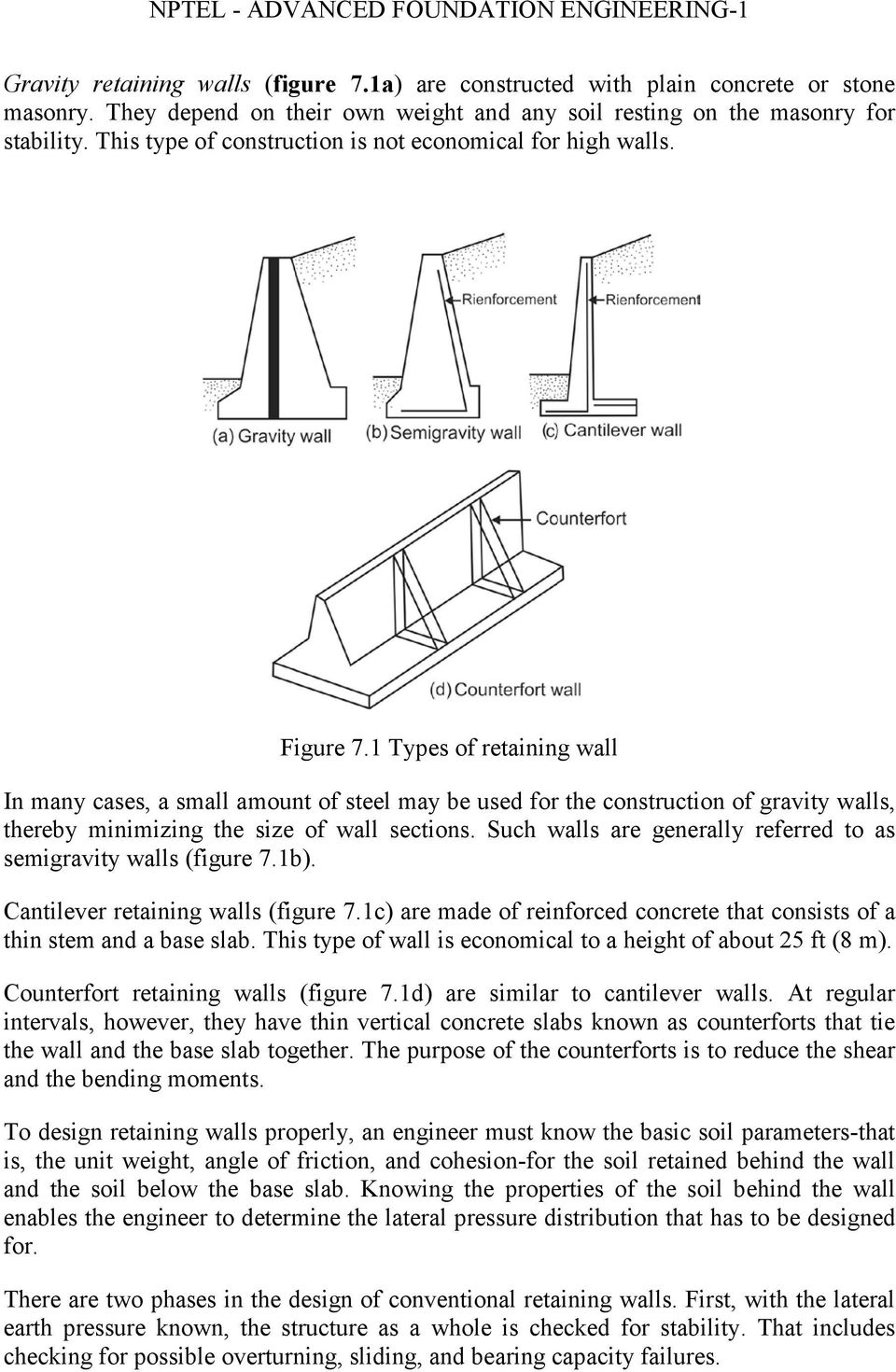
5 Gravity retaining walls (figure 7.1a) are constructed with plain concrete or stone masonry. They depend on their own weight and any soil resting on the masonry for stability. This type of construction is not economical for high walls. Figure 7.1 Types of retaining wall In many cases, a small amount of steel may be used for the construction of gravity walls, thereby minimizing the size of wall sections. Such walls are generally referred to as semigravity walls (figure 7.1b). Cantilever retaining walls (figure 7.1c) are made of reinforced concrete that consists of a thin stem and a base slab. This type of wall is economical to a height of about 25 ft (8 m). Counterfort retaining walls (figure 7.1d) are similar to cantilever walls. At regular intervals, however, they have thin vertical concrete slabs known as counterforts that tie the wall and the base slab together. The purpose of the counterforts is to reduce the shear and the bending moments. To design retaining walls properly, an engineer must know the basic soil parameters-that is, the unit weight, angle of friction, and cohesion-for the soil retained behind the wall and the soil below the base slab. Knowing the properties of the soil behind the wall enables the engineer to determine the lateral pressure distribution that has to be designed for. There are two phases in the design of conventional retaining walls. First, with the lateral earth pressure known, the structure as a whole is checked for stability. That includes checking for possible overturning, sliding, and bearing capacity failures.
6 Second, each component of the structure is checked for adequate strength, and the steel reinforcement of each component is determined. This chapter presents the procedures for determining retaining wall stability. Checks for adequate strength of each component of the structures can be found in any textbook on reinforced concrete. Mechanically stabilized retaining walls have their backfills stabilized by inclusion of reinforcing elements such as metal strips, bars, welded wire mats, geotextiles, and geogrids. These walls are relatively flexible and can sustain large horizontal and vertical displacement without much damage. In this chapter the gravity and cantilever retaining walls will be described first, followed by mechanically stabilized walls with metal strips, geotextiles, and geogrids reinforced backfills. GRAVITY AND CANTILEVER WALLS PROPORTIONING RETAINING WALLS When designing retaining walls, an engineer must assume some of the dimensions, called proportioning, which allows the engineer to check trial sections for stability. If the stability checks yield undesirable results, the sections can be changed and rechecked. Figure 7. 2 shows the general proportions of various retaining walls components that can be used for initial checks. Figure 7.2 Approximate dimensions for various components of retaining wall for initial stability checks: (a) gravity wall; (b) cantilever wall [note: minimum dimension of DD is 2 ft ( 0.6 m)]
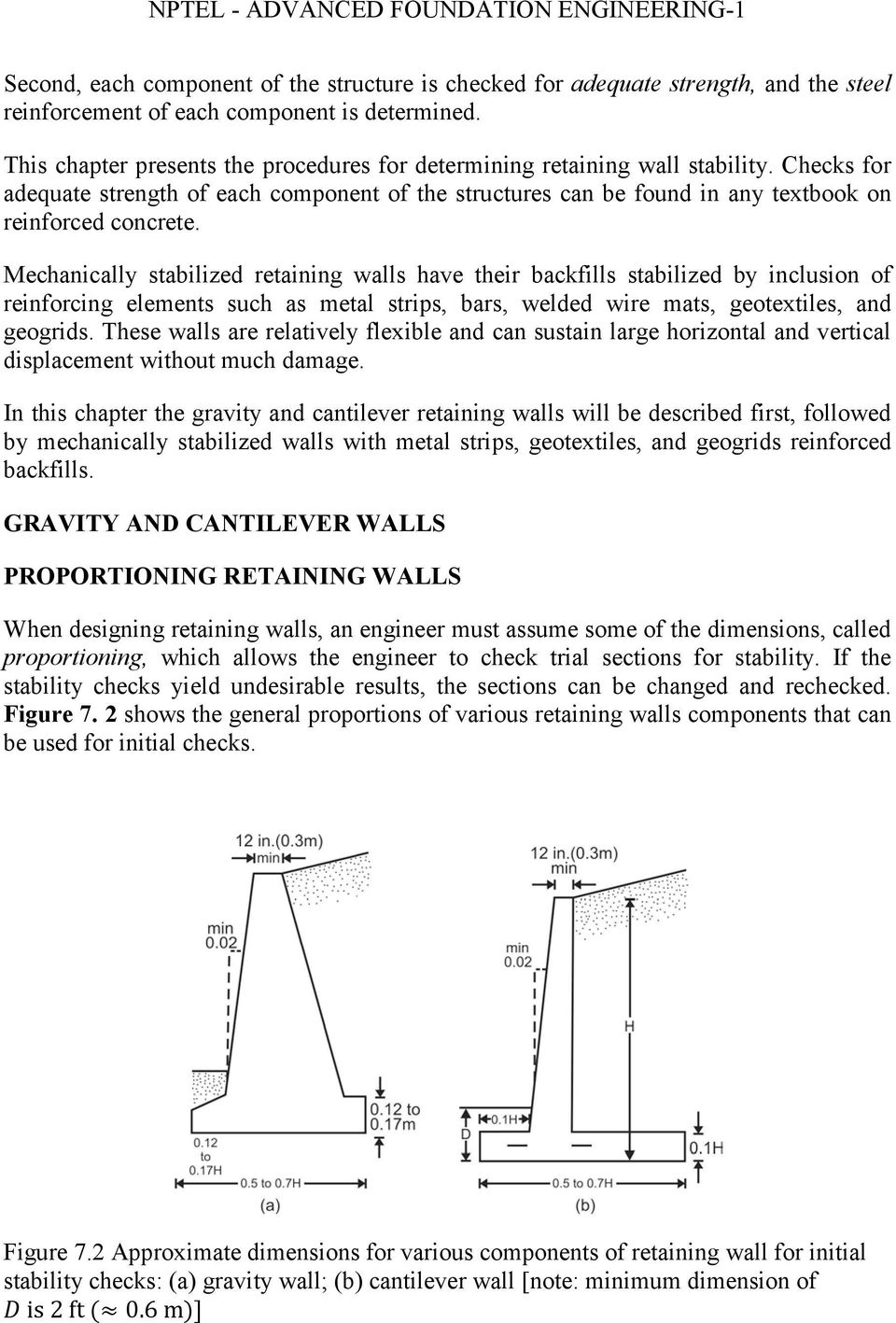
7 Note that the top of the stem of any retaining wall should not be less than about 12 in. ( 0.3 m) for proper placement of concrete. The depth, D, to the bottom of the base slab should be a minimum of 2 ft ( 0.6 m). However, the bottom of the base slab should be positioned below the seasonal frost line. For counterfort retaining walls, the general proportion of the stem and the base slab is the same as for cantilever walls. However, the counterfort slabs may be about 12 in. ( 0.3 m) thick and spaced at center-to-center distances of 0.3HH to 0.7 HH. APPLICATION OF LATERAL EARTH PRESSURE THEORIES TO DESIGN The fundamental theories for calculating lateral earth pressure have been presented in chapter 6. To use these theories in design, an engineer must make several simple assumptions. In the case of cantilever walls, use of the Rankine earth pressure theory for stability checks involves drawing a vertical line AAAA through point A, as shown in figure 7. 3a, (which is located at the edge of the heel of the base slab. The Rankine active condition is assumed to exist along the vertical plane AAAA. Rankine active earth pressure equations may then be used to calculate the lateral pressure on the face AAAA. In the analysis of stability for the wall, the force PP aa(rankine ), the weight of soil above the heel, WW ss, and the weight of the concrete, WW cc, all should be taken into consideration. The assumption for the development of Rankine active pressure along the soil face AAAA is theoretically concrete if the shear zone bounded by the line AAAA is not obstructed by the stem of the wall. The angle, ηη, that the line AAAA makes with the vertical is ηη = 45 + αα φφ 2 2 sin 1 sin αα [7.1] sin φφ Figure 7.3 Assumption for the determination of lateral earth pressure: (a) cantilever wall; (b) and (c) gravity wall

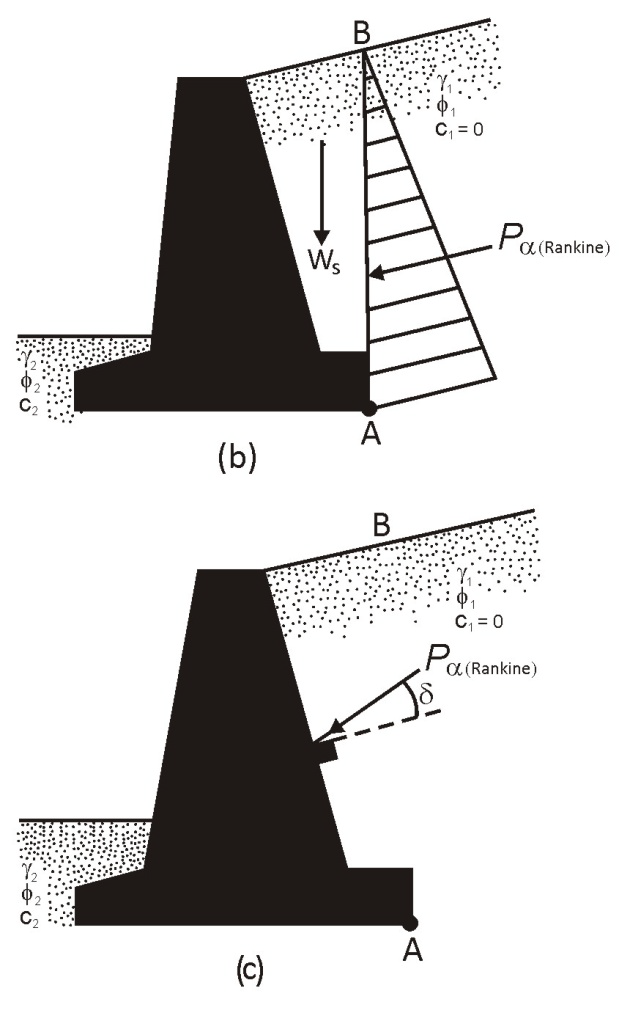
8 Figure 7. 3 Continued A similar type of analysis may be used for gravity walls, as shown in figure 7. 3b. However, Coulomb s theory also may be used, as shown in figure 7. 3c. If Coulomb s active pressure theory is used, the only forces to be considered are PP aa(coulomb ) and the weight of the wall, WW cc. If Coulomb s earth pressure theory is used, it will be necessary to know the range of the wall friction angle δδ with various types of backfill material. Following are some ranges of wall friction angle for masonry or mass concrete walls: Backfill material Range of δδ(deg) Gravel Coarse sand Fine sand Stiff clay 15-20

9 Silty clay In the case of ordinary retaining walls, water table problems and hence hydrostatic pressure are not encountered. Facilities for drainage from the soils retained are always provided. In several instances, for small retaining walls, emiempirical charts are used to evaluate lateral earth pressure. Figure 7.4 and 5 show two semiempirical charts given by Terzaghi and Peck (1967). Figure 7.4 is for backfills with plane surfaces, and figure 7.5 is for backfills that slope upward from the crest of the wall for a limited distance and then become horizontal. Note that 1 2 KK vvhh 2 is the vertical component of the active force on plane AAAA; similarly, 1 2 KK hhh 2 is the horizontal force. The numerals on the curves indicate the types of soil described in table 1. Figure 7.4 Continued

10 Figure 7.5 Chart for estimating pressure of backfill against retaining walls supporting backfills with surface that slopes upward from crest of wall for limited distance and then becomes horizontal (after Soil Mechanics in Engineering Practice, Second Edition, by K. Terzaghi and R. B. Peck. Copyright 1967 by John Wiley and Sons. Reprinted with permission) (note: 1 kn/m 3 = lb/ft 3 ) Chart for estimating pressure of backfill against retaining walls supporting backfills with surface that slopes upward from crest of wall for limited distance and then becomes horizontal (after Soil Mechanics in Engineering Practice, Second Edition, by K. Terzaghi and R. B. Peck. Copyright 1967 by John Wiley and Sons. Reprinted with permission) (note: 1 kn/m 3 = lb/ft 3 ) STABILITY CHECKS To check the stability of a retaining wall, the following steps are necessary: 1. Check for overturning about its toe 2. Check for sliding along its base 3. Check for bearing capacity failure of the base 4. Check for settlement 5. Check for overall stability This section describes the procedure for checking for overturning and sliding and bearing capacity failure. The principles of investigation for settlement were covered in chapter 4 and will not be repeated here. Some problems regarding the overall stability of retaining walls are discussed in section 5.

11 Check for Overturning Figure 7. 6 shows the forces acting on a cantilever and a gravity retaining wall, based on the assumption that the Rankine active pressure is acting along a vertical plane AAAA drawn through the heel. PP pp is the Rankine passive pressure; recall that its magnitude is PP pp = 1 2 KK ppγγ 2 DD 2 + 2cc 2 KK pp DD (Chapter 6 equation 58) Figure 7.6 Check for overturning: assume that Rankine pressure is valid: Table 1 types of Backfill for Retaining Walls
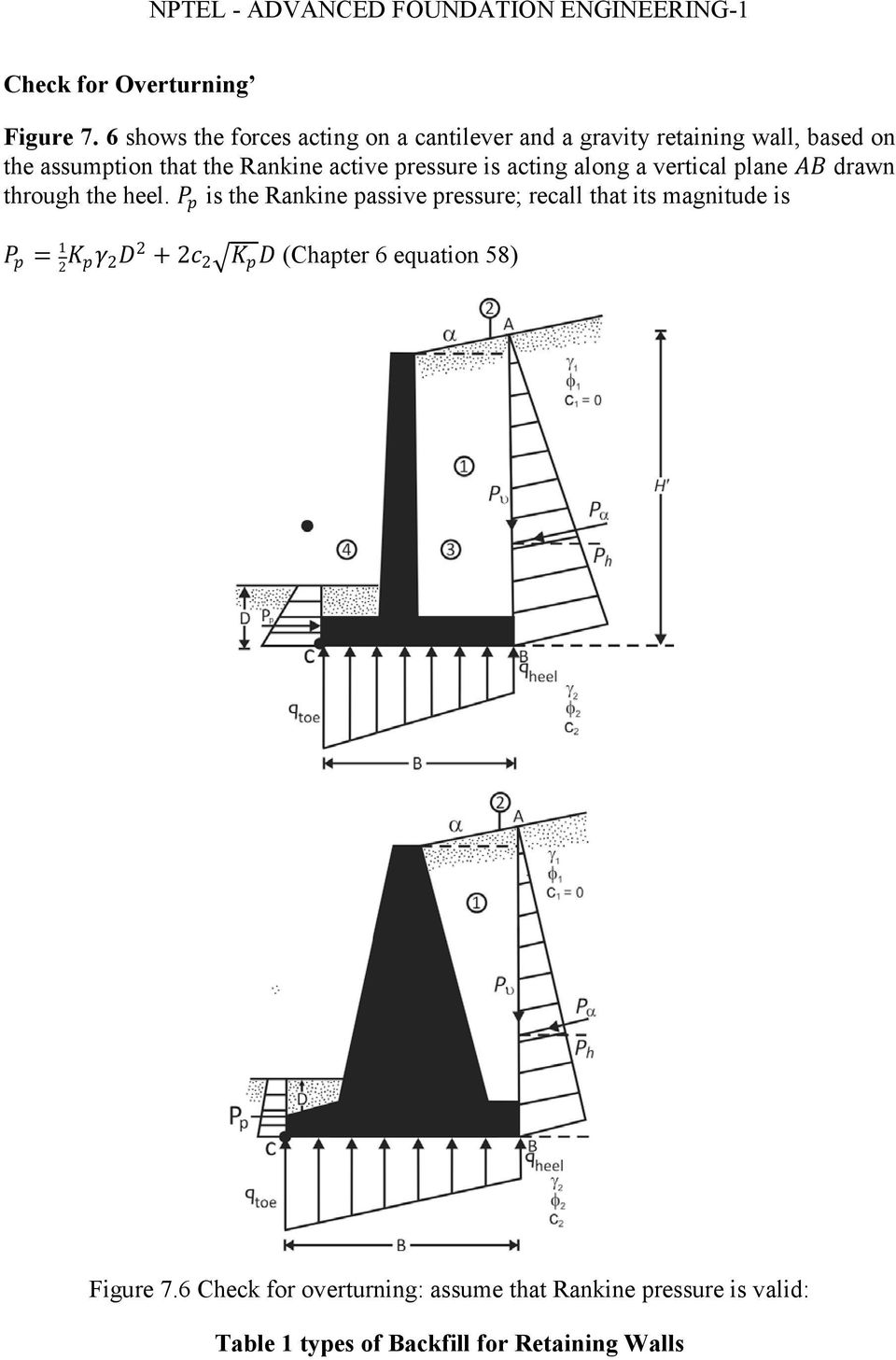
12 1. Coarse-grained soil without admixture of fine soil particles, very permeable (clean sand or gravel). 2. Coarse-grained soil of low permeability due to admixture of particles of silt size. 3. Residual soil with stones, fine silty sand, and granular materials with conspicuous clay content. 4. Very soft or soft clay, organic silts, or silty clay. 5. Medium or stiff clay, deposited in chunks and protected in such a way that a negligible amount of water enters the spaces between the chunks during floods or heavy rains. If this condition of protection cannot be satisfied, the clay should not be used as backfill material. With increasing stiffness of the clay, danger to the wall due to infiltration of water increases rapidly. From Soil Mechanics in Engineering Practice, Second Edition, by K. Terzaghi and R. B. Peck. Copyright 1967 by John Wiley and Sons. Reprinted with permission. Where γγ 2 = unit weight of soil in front of the heel and under the base slab KK pp = Rankine passive earth pressure coefficient = tan 2 (45 + φφ 2 /2) cc 2, φφ 2 = cohesion and soil friction angle, respectively The factor of safety against overturning about the toe-that is, about point C in figure may be expressed as FFFF (overturning ) = Σ MM RR Σ MM OO [7.2] Where Σ MM OO = sum of the moments of forces tending to overturn about point CC Σ MM RR = sum of the moments of forces tending to resist overturning about point CC The overturning moment is Σ MM OO = PP h HH 3 [7.3] Where PP h = PP aa cos αα For calculation of the resisting moment, Σ MM RR (neglectingpp PP ), a table (such as table 2) can he prepared. The weight of the soil above the heel and the weight of the concrete (or masonry) are both forces that contribute to the resisting moment. Note that the force PP vv

13 also contributes to the resisting moment. PP vv is the vertical component of the active force PP aa, or PP vv = PP aa sin αα [7.4] The moment of the force PP vv about C is MM vv = PP vv BB = PP aa sin αα BB [7.5] Where BB = width of the base slab Table 2 Procedure for Calculation of Σ MM RR Section (1) Area (2) Weight/unit length of wall (3) Moment arm measured from C (4) Moment about C (5) 1 AA 1 WW 1 = γγ 1 AA 1 XX 1 MM 1 2 AA 2 WW 2 = γγ 2 AA 2 XX 2 MM 2 3 AA 3 WW 3 = γγ cc AA 3 XX 3 MM 3 4 AA 4 WW 4 = γγ cc AA 4 XX 4 MM 4 5 AA 5 WW 5 = γγ cc AA 5 XX 5 MM 5 6 AA 6 WW 6 = γγ cc AA 6 XX 6 MM 6 PP vv BB MM vv Σ VV Σ MM RR Note: γγ 1 = unit weight of backfill γγ 2 = unit weight of concrete Once Σ MM RR is known, the factor of safety can be calculated as FFFF (overturning ) = MM 1+MM 2 +MM 3 +MM 4 +MM 5 +MM 6 PP aa cos αα(hh /3) MM vv [7.6]
![5] Where BB = width of the base slab Table 2 Procedure for Calculation of Σ MM RR Section (1) Area (2) Weight/unit length of wall (3) Moment arm measured from C (4) Moment about C (5) 1 AA 1 WW 1 =](/docs-images/46/21643556/images/page_13.jpg "γγ 1 AA 1 XX 1 MM 1 2 AA 2 WW 2 = γγ 2 AA 2 XX 2 MM 2 3 AA 3 WW 3 = γγ cc AA 3 XX 3 MM 3 4 AA 4 WW 4 = γγ cc AA 4 XX 4 MM 4 5 AA 5 WW 5 = γγ cc AA 5 XX 5 MM 5 6 AA 6 WW 6 = γγ cc AA 6 XX 6 MM 6 PP vv")
14 Check for Sliding Along the Base The factor of safety against sliding may be expressed by the equation FFFF (sliding ) = Σ FF RR Σ FF dd [7.7] Where Σ FF RR = sum of the horizontal resisting forces Σ FF dd = sum of the horizontal driving forces Figure 7. 7 indicates that the shear strength of the soil immediately below the base slab may be represented as ss = σσ tan δδ + cc aa Where δδ = angle of friction between the soil and the base slab cc aa = adhesion between the soil and the base slab Figure 7.7 Check for sliding along the base
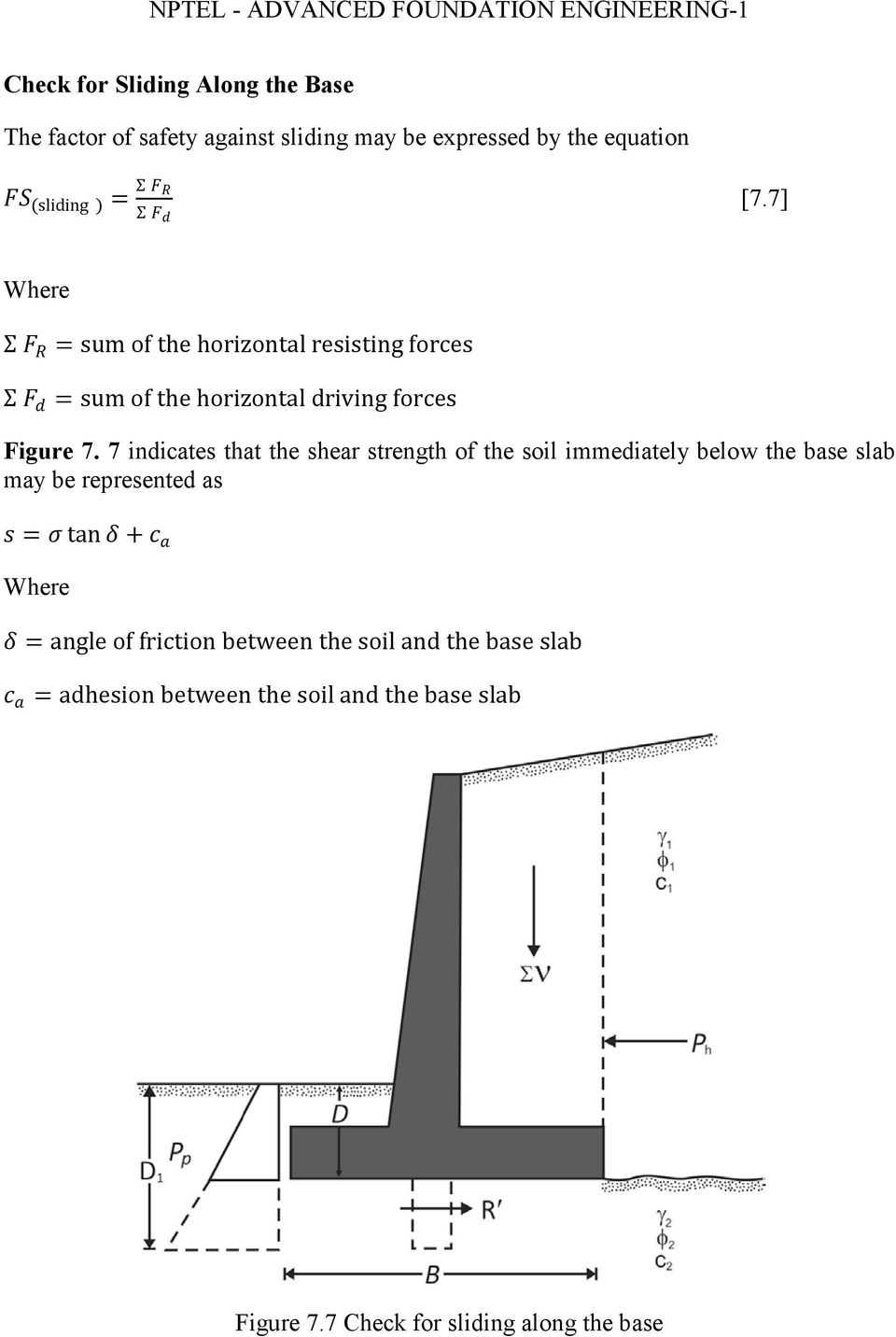
15 Thus the maximum resisting force that can be derived from the soil per unit length of the wall along the bottom of the base slab is RR = ss(area of cross section) = ss(bb 1) = BBBB tan δδ + BBBB aa However, BBBB = sum of the vertical force = Σ VV (see table 2) So RR = (Σ VV) tan δδ + BBBB aa + PP pp [7.8] The only horizontal force that will tend to cause the wall to slide (driving force) is the horizontal component of the active force PP aa, so Σ FF dd = PP aa cos αα [7.9] Combings equations (7, 8, and 9) yields FFFF (sliding ) = (Σ VV) tan δδ+bbbb aa +PP pp PP aa cos αα [7.10] A minimum factor of safety of 1.5 against sliding is generally required. In many cases, the passive force PP pp is ignored for calculation of the factor of safety with respect to sliding. In general, we can write δδ = kk 1 φφ 2 and cc aa = kk 2 cc 2. In most cases, kk 1 and kk 2 are in the range of 1 2 to 2 3. Thus FFFF (sliding ) = (Σ VV) tan (kk 1φφ 2 )+BBBB 2 cc 2 +PP pp PP aa cos αα [7.11] In some instances, certain walls may not yield a desired factor of safety of 1.5. To increase their resistance to sliding, a base key may be used. Base keys are illustrated by broken lines in figure It indicates that the passive force at the toe without the key is PP pp = 1 2 γγ 2DD 2 KK pp + 2cc 2 DD KK pp However, it a key is included, the passive force per unit length of the wall becomes PP pp = 1 2 γγ 2DD 1 2 KK pp + 2cc 2 DD 1 KK pp Where KK pp = tan 2 (45 + φφ 2 /2)
![8] The only horizontal force that will tend to cause the wall to slide (driving force) is the horizontal component of the active force PP aa, so Σ FF dd = PP aa cos αα [7.](/docs-images/46/21643556/images/page_15.jpg "9] Combings equations (7, 8, and 9) yields FFFF (sliding ) = (Σ VV) tan δδ+bbbb aa +PP pp PP aa cos αα [7.10] A minimum factor of safety of 1.5 against sliding is generally required.")
16 Because DD 1 > DD, a key obviously will help increase the passive resistance at the toe and hence the factor of safety against sliding. Usually the base key is constructed below the stem and some main steel is run into the key. Another possible way to increase the value of FFFF (sliding ) is to consider reducing the value of PP aa [see equation (11)]. One possible way to do so is to use the method, developed by Elman and Terry (1988). The discussion here is limited to the case in which the retaining wall has to horizontal granular backfill (figure 7. 8). In figure 7. 8, the active force, PP aa, is horizontal (αα = 0) so that Figure 7.8 Retaining wall with sloped heel PP aa cos αα = PP h = PP aa And PP aa sin αα = PP vv = 0 However, PP aa = PP aa(1) + PP aa(2) [7.12] The magnitudes of PP aa(2) can be reduced if the heel of the retaining wall is sloped as shown in figure 7. 8b. For this case, PP aa = PP aa(1) + AAAA aa(2) [7.13] The magnitude of A, as shown in figure 7. 9, is valid for αα = 45. However, note that in figure 7. 8a
![Another possible way to increase the value of FFFF (sliding ) is to consider reducing the value of PP aa [see equation (11)].](/docs-images/46/21643556/images/page_16.jpg "One possible way to do so is to use the method, developed by Elman and Terry (1988).")
17 Figure 7.9 Variation of A with friction angle of backfill [equation (14)] PP aa(1) = 1 γγ 2 1KK aa (HH DD ) 2 And PP aa = 1 γγ 2 1KK aa HH 2 Hence PP aa(2) = 1 γγ 2 1KK aa [HH 2 (HH DD ) 2 ] So, for the active pressure diagram shown in figure 7. 8b, PP aa = 1 γγ 2 1KK aa (HH DD ) 2 + AA γγ 2 1KK aa [HH 2 (HH DD ) 2 ] [7.14] Sloping the heel of a retaining wall can thus be extremely helpful in some cases.
![And PP aa = 1 γγ 2 1KK aa HH 2 Hence PP aa(2) = 1 γγ 2 1KK aa [HH 2 (HH DD ) 2 ] So, for the active](/docs-images/46/21643556/images/page_17.jpg "pressure diagram shown in figure 7.")
REINFORCED CONCRETE. Reinforced Concrete Design. A Fundamental Approach - Fifth Edition. Walls are generally used to provide lateral support for:
 HANDOUT REINFORCED CONCRETE Reinforced Concrete Design A Fundamental Approach - Fifth Edition RETAINING WALLS Fifth Edition A. J. Clark School of Engineering Department of Civil and Environmental Engineering
Module 5 (Lectures 17 to 19) MAT FOUNDATIONS
 Module 5 (Lectures 17 to 19) MAT FOUNDATIONS Topics 17.1 INTRODUCTION Rectangular Combined Footing: Trapezoidal Combined Footings: Cantilever Footing: Mat foundation: 17.2 COMMON TYPES OF MAT FOUNDATIONS
vulcanhammer.net This document downloaded from
 This document downloaded from vulcanhammer.net since 1997, your source for engineering information for the deep foundation and marine construction industries, and the historical site for Vulcan Iron Works
Earth Pressure and Retaining Wall Basics for Non-Geotechnical Engineers
 PDHonline Course C155 (2 PDH) Earth Pressure and Retaining Wall Basics for Non-Geotechnical Engineers Instructor: Richard P. Weber, P.E. 2012 PDH Online PDH Center 5272 Meadow Estates Drive Fairfax, VA
GEOTECHNICAL ENGINEERING FORMULAS. A handy reference for use in geotechnical analysis and design
 GEOTECHNICAL ENGINEERING FORMULAS A handy reference for use in geotechnical analysis and design TABLE OF CONTENTS Page 1. SOIL CLASSIFICATION...3 1.1 USCS: Unified Soil Classification System...3 1.1.1
PART TWO GEOSYNTHETIC SOIL REINFORCEMENT. Martin Street Improvements, Fredonia, Wisconsin; Keystone Compac Hewnstone
 GEOSYNTHETIC SOIL REINFORCEMENT Martin Street Improvements, Fredonia, Wisconsin; Keystone Compac Hewnstone DESIGN MANUAL & KEYWALL OPERATING GUIDE GEOSYNTHETIC SOIL REINFORCEMENT Keystone retaining walls
PDHonline Course S151A (1 PDH) Steel Sheet Piling. Instructor: Matthew Stuart, PE, SE. PDH Online PDH Center
 PDHonline Course S151A (1 PDH) Steel Sheet Piling Instructor: Matthew Stuart, PE, SE 2012 PDH Online PDH Center 5272 Meadow Estates Drive Fairfax, VA 22030-6658 Phone & Fax: 703-988-0088 www.pdhonline.org
Worked Example 2 (Version 1) Design of concrete cantilever retaining walls to resist earthquake loading for residential sites
 Worked Example 2 (Version 1) Design of concrete cantilever retaining walls to resist earthquake loading for residential sites Worked example to accompany MBIE Guidance on the seismic design of retaining
FOUNDATION DESIGN. Instructional Materials Complementing FEMA 451, Design Examples
 FOUNDATION DESIGN Proportioning elements for: Transfer of seismic forces Strength and stiffness Shallow and deep foundations Elastic and plastic analysis Foundation Design 14-1 Load Path and Transfer to
Printing Letters Correctly
 Printing Letters Correctly The ball and stick method of teaching beginners to print has been proven to be the best. Letters formed this way are easier for small children to print, and this print is similar
K x ' Retaining. Walls ENCE 461. Foundation Analysis and Design. Mohr s Circle. and Lateral Earth. Pressures. Lateral Earth Pressure.
 Lateral Earth Pressure Coefficient K x ' z ' K = lateral earth pressure coefficient x = horizontal effective stress Mohr s Circle and Lateral Earth Pressures x ' = = z ' ENCE 461 Foundation Analysis and
SPECIFICATIONS FOR PRECAST MODULAR BLOCK RETAINING WALL SYSTEM (revised 11/5/13)
 Page 1 of 7 STONE STRONG SYSTEMS SPECIFICATIONS FOR PRECAST MODULAR BLOCK RETAINING WALL SYSTEM (revised ) PART 1: GENERAL 1.01 Description A. Work includes furnishing and installing precast modular blocks
MECHANICS OF SOLIDS - BEAMS TUTORIAL 2 SHEAR FORCE AND BENDING MOMENTS IN BEAMS
 MECHANICS OF SOLIDS - BEAMS TUTORIAL 2 SHEAR FORCE AND BENDING MOMENTS IN BEAMS This is the second tutorial on bending of beams. You should judge your progress by completing the self assessment exercises.
RETAINING WALL CONSTRUCTION DETAILS 2006 ESTIMATING AND INSTALLATION MANUAL. Featuring Highland Stone. anchorwall.com
 RETAINING WALL CONSTRUCTION DETAILS 2006 ESTIMATING AND INSTALLATION MANUAL 11 Featuring Highland Stone anchorwall.com TABLE OF CONTENTS 2 TABLE OF CONTENTS BEFORE YOU BEGIN............................
SIENA STONE GRAVITY RETAINING WALL INSTALLATION SPECIFICATIONS. Prepared by Risi Stone Systems Used by permission.
 SIENA STONE GRAVITY RETAINING WALL INSTALLATION SPECIFICATIONS Prepared by Risi Stone Systems Used by permission. 1-800-UNILOCK www.unilock.com FOREWORD This outline specification has been prepared for
Report on. Wind Resistance of Signs supported by. Glass Fiber Reinforced Concrete (GFRC) Pillars
 Report on Wind Resistance of Signs supported by Glass Fiber Reinforced Concrete (GFRC) Pillars Prepared for US Sign and Fabrication Corporation January, 2006 SUMMARY This study found the attachment of
Optimum proportions for the design of suspension bridge
 Journal of Civil Engineering (IEB), 34 (1) (26) 1-14 Optimum proportions for the design of suspension bridge Tanvir Manzur and Alamgir Habib Department of Civil Engineering Bangladesh University of Engineering
Structural Axial, Shear and Bending Moments
 Structural Axial, Shear and Bending Moments Positive Internal Forces Acting Recall from mechanics of materials that the internal forces P (generic axial), V (shear) and M (moment) represent resultants
DESIGN GUIDELINES FOR EARTH RETENTION
 DESIGN GUIDELINES FOR EARTH RETENTION Strata Systems, Inc. 380 Dahlonega Rd., Suite 200 Cumming, GA 30040 USA www.geogrid.com TABLE OF CONTENTS MECHANICS OF RETAINING WALLS... 3 THE STRATAWEB SOLUTION...4
A N Beal EARTH RETAINING STRUCTURES - worked examples 1
 A N Beal EARTH RETAINING STRUCTURES - worked examples 1 Worked examples of retaining wall design to BS8002 The following worked examples have been prepared to illustrate the application of BS8002 to retaining
Copyright 2011 Casa Software Ltd. www.casaxps.com. Centre of Mass
 Centre of Mass A central theme in mathematical modelling is that of reducing complex problems to simpler, and hopefully, equivalent problems for which mathematical analysis is possible. The concept of
Fric-3. force F k and the equation (4.2) may be used. The sense of F k is opposite
 4. FRICTION 4.1 Laws of friction. We know from experience that when two bodies tend to slide on each other a resisting force appears at their surface of contact which opposes their relative motion. The
Technical Notes 3B - Brick Masonry Section Properties May 1993
 Technical Notes 3B - Brick Masonry Section Properties May 1993 Abstract: This Technical Notes is a design aid for the Building Code Requirements for Masonry Structures (ACI 530/ASCE 5/TMS 402-92) and Specifications
p atmospheric Statics : Pressure Hydrostatic Pressure: linear change in pressure with depth Measure depth, h, from free surface Pressure Head p gh
 IVE1400: n Introduction to Fluid Mechanics Statics : Pressure : Statics r P Sleigh: [email protected] r J Noakes:[email protected] January 008 Module web site: www.efm.leeds.ac.uk/ive/fluidslevel1
SEISMIC DESIGN. Various building codes consider the following categories for the analysis and design for earthquake loading:
 SEISMIC DESIGN Various building codes consider the following categories for the analysis and design for earthquake loading: 1. Seismic Performance Category (SPC), varies from A to E, depending on how the
EXAMPLE 1 DESIGN OF CANTILEVERED WALL, GRANULAR SOIL
 EXAMPLE DESIGN OF CANTILEVERED WALL, GRANULAR SOIL A sheet pile wall is required to support a 2 excavation. The soil is uniform as shown in the figure. To take into account the friction between the wall
Embedded Retaining Wall Design Engineering or Paradox?
 Embedded Retaining Wall Design Engineering or Paradox? A personal viewpoint by A.Y. Chmoulian, associate at Royal Haskoning Introduction Retaining wall design theory is a complicated subject with a long
Dimensional and Structural Data for Elliptical Pipes. PD 26 rev D 21/09/05
 Dimensional and Structural Data for Elliptical Pipes 21/09/05 Page 1 of 15 1. Foreword This document details a method for the structural design of Stanton Bonna Elliptical pipes for the common conditions
THE OBJECTIVES OF ROUTINE ROAD CUTS AND FILLS
 Chapter 11 Slope Stabiliza bilization and Stability of Cuts and Fills THE OBJECTIVES OF ROUTINE ROAD CUTS AND FILLS are 1) to create space for the road template and driving surface; 2) to balance material
ENGINEERING SCIENCE H1 OUTCOME 1 - TUTORIAL 3 BENDING MOMENTS EDEXCEL HNC/D ENGINEERING SCIENCE LEVEL 4 H1 FORMERLY UNIT 21718P
 ENGINEERING SCIENCE H1 OUTCOME 1 - TUTORIAL 3 BENDING MOMENTS EDEXCEL HNC/D ENGINEERING SCIENCE LEVEL 4 H1 FORMERLY UNIT 21718P This material is duplicated in the Mechanical Principles module H2 and those
UNDER DRAINAGE AND FILTER DESIGN
 UNDER DRAINAGE AND FILTER DESIGN Tailings and HLP Workshop 28 April to 1 May 2010 INTRODUCTION The internal drainage is of crucial importance to the reliability and safety of a tailings dam throughout
19 DYNAmax Free Standing Server C A B I N E T s
 9 DYNAmax Free Standing Server C A B I N E T s 9 DYNAmax Free Standing Server Cabinets FAMILY W=600mm and W=800mm DYNAmax Series Free Standing Server Cabinets DYNAmax series Servering Enclosures, provide
Figure A-1. Figure A-2. continued on next page... HPM-1. Grout Reservoir. Neat Cement Grout (Very Flowable) Extension Displacement Plate
 Addendum HELICAL PULLDOWN Micropile (HPM) Introduction The HPM is a system for constructing a grout column around the shaft of a standard Helical Screw Foundation (see Figure A1). To begin the process,
Specification Guidelines: Allan Block Modular Retaining Wall Systems
 Specification Guidelines: Allan Block Modular Retaining Wall Systems The following specifications provide Allan Block Corporation's typical requirements and recommendations. At the engineer of record's
Settlement of Precast Culverts Under High Fills; The Influence of Construction Sequence and Structural Effects of Longitudinal Strains
 Settlement of Precast Culverts Under High Fills; The Influence of Construction Sequence and Structural Effects of Longitudinal Strains Doug Jenkins 1, Chris Lawson 2 1 Interactive Design Services, 2 Reinforced
Technical handbook Panel Anchoring System
 1 Basic principles of sandwich panels 3 Design conditions 4 Basic placement of anchors and pins 9 Large elements (muliple rows) 10 Small elements (two rows) 10 Turned elements 10 Slender elements 10 Cantilevering
DESIGN OF SLABS. 3) Based on support or boundary condition: Simply supported, Cantilever slab,
 DESIGN OF SLABS Dr. G. P. Chandradhara Professor of Civil Engineering S. J. College of Engineering Mysore 1. GENERAL A slab is a flat two dimensional planar structural element having thickness small compared
When the fluid velocity is zero, called the hydrostatic condition, the pressure variation is due only to the weight of the fluid.
 Fluid Statics When the fluid velocity is zero, called the hydrostatic condition, the pressure variation is due only to the weight of the fluid. Consider a small wedge of fluid at rest of size Δx, Δz, Δs
10.1 Powder mechanics
 Fluid and Particulate systems 424514 /2014 POWDER MECHANICS & POWDER FLOW TESTING 10 Ron Zevenhoven ÅA Thermal and Flow Engineering [email protected] 10.1 Powder mechanics RoNz 2/38 Types of flow of
NUMERICAL ANALYSIS OF SEEPAGE THROUGH EMBANKMENT DAMS (CASE STUDY: KOCHARY DAM, GOLPAYEGAN)
 NUMERICAL ANALYSIS OF SEEPAGE THROUGH EMBANKMENT DAMS (CASE STUDY: KOCHARY DAM, GOLPAYEGAN) *Reza Naghmehkhan Dahande 1 and Ahmad Taheri 2 1 Department of Civil Engineering-Water Management, Islamic Azad
Appendix A Sub surface displacements around excavations Data presented in Xdisp sample file
 Appendix A Sub surface displacements around excavations Data presented in Xdisp sample file Notation B1 = lowest level of basement slab c = cohesion E = drained Young s Modulus Eu = undrained Young s Modulus
Determination of Thermal Conductivity of Coarse and Fine Sand Soils
 Proceedings World Geothermal Congress Bali, Indonesia, - April Determination of Thermal Conductivity of Coarse and Fine Sand Soils Indra Noer Hamdhan 1 and Barry G. Clarke 2 1 Bandung National of Institute
Acceleration due to Gravity
 Acceleration due to Gravity 1 Object To determine the acceleration due to gravity by different methods. 2 Apparatus Balance, ball bearing, clamps, electric timers, meter stick, paper strips, precision
ALLOWABLE LOADS ON A SINGLE PILE
 C H A P T E R 5 ALLOWABLE LOADS ON A SINGLE PILE Section I. BASICS 5-1. Considerations. For safe, economical pile foundations in military construction, it is necessary to determine the allowable load capacity
19 DYNAmax Free Standing Server C A B I N E T s
 9 DYNAmax Free Standing Server C A B I N E T s 9 DYNAmax Free Standing Server Cabinets FAMILY W=mm and W=800mm DYNAmax Series Free Standing Server Cabinets DYNAmax series Servering Enclosures, provide
DIRECT SHEAR TEST SOIL MECHANICS SOIL MECHANICS LABORATORY DEPARTMENT OF CIVIL ENGINEERING UNIVERSITY OF MORATUWA SRI LANKA
 DIRECT SHEAR TEST SOIL MECHANICS SOIL MECHANICS LABORATORY DEPARTMENT OF CIVIL ENGINEERING UNIVERSITY OF MORATUWA SRI LANKA DIRECT SHEAR TEST OBJEVTIVES To determine the shear strength parameters for a
CH. 2 LOADS ON BUILDINGS
 CH. 2 LOADS ON BUILDINGS GRAVITY LOADS Dead loads Vertical loads due to weight of building and any permanent equipment Dead loads of structural elements cannot be readily determined b/c weight depends
Welded Mesh Gabions and Mattresses River Protection Design Guide HY-TEN GABION SOLUTIONS Dunstall Hill Trading Estate, Gorsebrook Road,
 Welded Mesh Gabions and Mattresses River Protection Design Guide HY-TEN GABION SOLUTIONS Dunstall Hill Trading Estate, Gorsebrook Road, Wolverhampton, WV6 0PJ Tel 01902 712200 Fax 01902 714096 e-mail [email protected]
Drained and Undrained Conditions. Undrained and Drained Shear Strength
 Drained and Undrained Conditions Undrained and Drained Shear Strength Lecture No. October, 00 Drained condition occurs when there is no change in pore water pressure due to external loading. In a drained
DESIGN OF PILES AND PILE GROUPS CONSIDERING CAPACITY, SETTLEMENT, AND NEGATIVE SKIN FRICTION
 DESIGN OF PILES AND PILE GROUPS CONSIDERING CAPACITY, SETTLEMENT, AND NEGATIVE SKIN FRICTION Introduction Bengt H. Fellenius, Dr.Tech., P.Eng. Background Notes for Demo Example for UniPile at www.unisoftltd.com
A perforated conduit such as pipe, tubing or tile installed beneath the ground to intercept and convey ground water. or structures.
 BMP: SUBSURFACE DRAIN Definition A perforated conduit such as pipe, tubing or tile installed beneath the ground to intercept and convey ground water. PurRoses 1. To prevent sloping soils from becoming
CHAPTER 9 FEM MODELING OF SOIL-SHEET PILE WALL INTERACTION
 391 CHAPTER 9 FEM MODELING OF SOIL-SHEET PILE WALL INTERACTION 9.1 OVERVIEW OF FE SOIL-STRUCTURE INTERACTION Clough and Denby (1969) introduced Finite Element analysis into the soil-structure interaction
VERTICAL STRESS INCREASES IN SOIL TYPES OF LOADING. Point Loads (P) Line Loads (q/unit length) Examples: - Posts. Examples: - Railroad track
 VERTICAL STRESS INCREASES IN SOIL Point Loads (P) TYPES OF LOADING Line Loads (q/unit length) Revised 0/015 Figure 6.11. Das FGE (005). Examples: - Posts Figure 6.1. Das FGE (005). Examples: - Railroad
Formwork for Concrete
 UNIVERSITY OF WASHINGTON DEPARTMENT OF CONSTRUCTION MANAGEMENT CM 420 TEMPORARY STRUCTURES Winter Quarter 2007 Professor Kamran M. Nemati Formwork for Concrete Horizontal Formwork Design and Formwork Design
The Verdura Wall check with your local building department
 The Verdura Wall The Verdura Wall by Soil Retention Products, Inc of Carlsbad, California can be constructed as a gravity retaining structure or a geosynthetic reinforced segmental retaining wall, depending
Bending Stress in Beams
 936-73-600 Bending Stress in Beams Derive a relationship for bending stress in a beam: Basic Assumptions:. Deflections are very small with respect to the depth of the beam. Plane sections before bending
Wang, L., Gong, C. "Abutments and Retaining Structures." Bridge Engineering Handbook. Ed. Wai-Fah Chen and Lian Duan Boca Raton: CRC Press, 2000
 Wang, L., Gong, C. "Abutments and Retaining Structures." Bridge Engineering Handbook. Ed. Wai-Fah Chen and Lian Duan Boca Raton: CRC Press, 000 9 Abutments and Retaining Structures Linan Wang California
Soil Strength. Performance Evaluation of Constructed Facilities Fall 2004. Prof. Mesut Pervizpour Office: KH #203 Ph: x4046
 ENGR-627 Performance Evaluation of Constructed Facilities, Lecture # 4 Performance Evaluation of Constructed Facilities Fall 2004 Prof. Mesut Pervizpour Office: KH #203 Ph: x4046 1 Soil Strength 2 Soil
National Council of Examiners for Engineering and Surveying. Principles and Practice of Engineering Structural Examination
 Structural Effective Beginning with the April 2011 The structural engineering exam is a breadth and exam examination offered in two components on successive days. The 8-hour Vertical Forces (Gravity/Other)
EN 1997-1 Eurocode 7. Section 10 Hydraulic Failure Section 11 Overall Stability Section 12 Embankments. Trevor L.L. Orr Trinity College Dublin Ireland
 EN 1997 1: Sections 10, 11 and 12 Your logo Brussels, 18-20 February 2008 Dissemination of information workshop 1 EN 1997-1 Eurocode 7 Section 10 Hydraulic Failure Section 11 Overall Stability Section
Design of Steel Structures Prof. S.R.Satish Kumar and Prof. A.R.Santha Kumar. The design of any foundation consists of following two parts.
 8.7. Design procedure for foundation The design of any foundation consists of following two parts. 8.7.1 Stability analysis Stability analysis aims at removing the possibility of failure of foundation
INDIRECT METHODS SOUNDING OR PENETRATION TESTS. Dr. K. M. Kouzer, Associate Professor in Civil Engineering, GEC Kozhikode
 INDIRECT METHODS SOUNDING OR PENETRATION TESTS STANDARD PENETRATION TEST (SPT) Reference can be made to IS 2131 1981 for details on SPT. It is a field edtest to estimate e the penetration e resistance
Designed and Engineered to Perform
 History EARTH CONTACT PRODUCTS, L.L.C., is a family owned company, based in Olathe, Kansas. This company was built upon Don May s U.S. Patented fourth-generation Steel Piering System that has led to the
Comprehensive Design Example 2: Foundations for Bulk Storage Facility
 Comprehensive Design Example 2: Foundations for Bulk Storage Facility Problem The project consists of building several dry product storage silos near an existing rail siding in an open field presently
THE DEVELOPMENT OF DESIGN METHODS FOR REINFORCED AND UNREINFORCED MASONRY BASEMENT WALLS J.J. ROBERTS
 THE DEVELOPMENT OF DESIGN METHODS FOR REINFORCED AND UNREINFORCED MASONRY BASEMENT WALLS J.J. ROBERTS Technical Innovation Consultancy Emeritus Professor of Civil Engineering Kingston University, London.
5/1/2013. Topics. The challenge is to better maintain native characteristics of soils during and after construction
 PIN Foundations Topics Applications Design and Construction Flow Control Credits www.pinfoundations.com Copyright 2008, Pin Foundations, Inc. Curtis Hinman WSU Extension Faculty, Watershed Ecologist [email protected]
Page 1 of 18 28.4.2008 Sven Alexander Last revised 1.3.2010. SB-Produksjon STATICAL CALCULATIONS FOR BCC 250
 Page 1 of 18 CONTENT PART 1 BASIC ASSUMPTIONS PAGE 1.1 General 1. Standards 1.3 Loads 1. Qualities PART ANCHORAGE OF THE UNITS.1 Beam unit equilibrium 3. Beam unit anchorage in front..1 Check of capacity..
1997 Uniform Administrative Code Amendment for Earthen Material and Straw Bale Structures Tucson/Pima County, Arizona
 for Earthen Material and Straw Bale Structures SECTION 70 - GENERAL "APPENDIX CHAPTER 7 - EARTHEN MATERIAL STRUCTURES 70. Purpose. The purpose of this chapter is to establish minimum standards of safety
CONSTANT HEAD AND FALLING HEAD PERMEABILITY TEST
 CONSTANT HEAD AND FALLING HEAD PERMEABILITY TEST 1 Permeability is a measure of the ease in which water can flow through a soil volume. It is one of the most important geotechnical parameters. However,
SLAB DESIGN. Introduction ACI318 Code provides two design procedures for slab systems:
 Reading Assignment SLAB DESIGN Chapter 9 of Text and, Chapter 13 of ACI318-02 Introduction ACI318 Code provides two design procedures for slab systems: 13.6.1 Direct Design Method (DDM) For slab systems
Recitation #5. Understanding Shear Force and Bending Moment Diagrams
 Recitation #5 Understanding Shear Force and Bending Moment Diagrams Shear force and bending moment are examples of interanl forces that are induced in a structure when loads are applied to that structure.
Soil Mechanics SOIL STRENGTH page 1
 Soil Mechanics SOIL STRENGTH page 1 Contents of this chapter : CHAPITRE 6. SOIL STRENGTH...1 6.1 PRINCIPAL PLANES AND PRINCIPAL STRESSES...1 6.2 MOHR CIRCLE...1 6.2.1 POLE METHOD OF FINDING STRESSES ON
Detailing of Reinforcment in Concrete Structures
 Chapter 8 Detailing of Reinforcment in Concrete Structures 8.1 Scope Provisions of Sec. 8.1 and 8.2 of Chapter 8 shall apply for detailing of reinforcement in reinforced concrete members, in general. For
PILE FOUNDATIONS FM 5-134
 C H A P T E R 6 PILE FOUNDATIONS Section I. GROUP BEHAVIOR 6-1. Group action. Piles are most effective when combined in groups or clusters. Combining piles in a group complicates analysis since the characteristics
Problem 1: Computation of Reactions. Problem 2: Computation of Reactions. Problem 3: Computation of Reactions
 Problem 1: Computation of Reactions Problem 2: Computation of Reactions Problem 3: Computation of Reactions Problem 4: Computation of forces and moments Problem 5: Bending Moment and Shear force Problem
Tremie Concrete CM 420 CM 420 CM 420 CM 420. Temporary Structures. Tremie Concrete
 Tremie Concrete Underwater concrete plays an important role in the construction of offshore structures. It may be used to tie together various elements in composite action (i.e., to tie piling to the footing).
MECHANICS OF SOLIDS - BEAMS TUTORIAL 1 STRESSES IN BEAMS DUE TO BENDING. On completion of this tutorial you should be able to do the following.
 MECHANICS OF SOLIDS - BEAMS TUTOIAL 1 STESSES IN BEAMS DUE TO BENDING This is the first tutorial on bending of beams designed for anyone wishing to study it at a fairly advanced level. You should judge
Aluminium systems profile selection
 Aluminium systems profile selection The purpose of this document is to summarise the way that aluminium profile selection should be made, based on the strength requirements for each application. Curtain
Open channel flow Basic principle
 Open channel flow Basic principle INTRODUCTION Flow in rivers, irrigation canals, drainage ditches and aqueducts are some examples for open channel flow. These flows occur with a free surface and the pressure
HYDRAULIC STRUCTURES, EQUIPMENT AND WATER DATA ACQUISITION SYSTEMS Vol. IV - Testing of Materials and Soils - F. Druyts
 TESTING OF MATERIALS AND SOILS F. Druyts Pr. Eng., Department of Water Affairs and Forestry, Pretoria, South Africa Keywords: Materials testing, soil mechanics/properties, construction materials, earth
APPENDIX A PRESSUREMETER TEST INTERPRETATION
 APPENDIX A PRESSUREMETER TEST INTERPRETATION PRESSUREMETER TEST INTERPRETATION Description of test The pressuremeter test, discussed in great detail by Martin (1977), Baguelin et al. (1978), Barksdale
Stabilenka HUESKER. and Separation. Engineering with Geosynthetics SKER HUESKER HUESKER HUESKER HUESKERHUES
 HUESKER Engineering with Geosynthetics rhuesker HUESKER HUESKER HUESKER HUESKER HUESKERr rhuesker HUESKER Woven HUESKER HUESKER Fabrics HUESKER HUESKERr SKER HUESKER HUESKER HUESKER HUESKERHUES rhuesker
ENCE 4610 Foundation Analysis and Design
 This image cannot currently be displayed. ENCE 4610 Foundation Analysis and Design Shallow Foundations Total and Differential Settlement Schmertmann s Method This image cannot currently be displayed. Strength
Design Manual to BS8110
 Design Manual to BS8110 February 2010 195 195 195 280 280 195 195 195 195 195 195 280 280 195 195 195 The specialist team at LinkStudPSR Limited have created this comprehensive Design Manual, to assist
Shear Force and Moment Diagrams
 C h a p t e r 9 Shear Force and Moment Diagrams In this chapter, you will learn the following to World Class standards: Making a Shear Force Diagram Simple Shear Force Diagram Practice Problems More Complex
Chapter 11 Equilibrium
 11.1 The First Condition of Equilibrium The first condition of equilibrium deals with the forces that cause possible translations of a body. The simplest way to define the translational equilibrium of
v v ax v a x a v a v = = = Since F = ma, it follows that a = F/m. The mass of the arrow is unchanged, and ( )
 Week 3 homework IMPORTANT NOTE ABOUT WEBASSIGN: In the WebAssign versions of these problems, various details have been changed, so that the answers will come out differently. The method to find the solution
Design of diaphragm and sheet pile walls. D-Sheet Piling. User Manual
 Design of diaphragm and sheet pile walls D-Sheet Piling User Manual D-SHEET PILING Design of diaphragm and sheet pile walls User Manual Version: 14.1.34974 31 July 2014 D-SHEET PILING, User Manual Published
FOOTING DESIGN EXAMPLE
 County: Any Design: BRG Date: 10/007 Hwy: Any Ck Dsn: BRG Date: 10/007 FOOTING DESIGN EXAMPLE Design: Based on AASHTO LRFD 007 Specifications, TxDOT LRFD Bridge Design Manual, and TxDOT Project 0-4371
CONCRETE FLOOR SLAB & CASTING BED CONSTRUCTION
 CONCRETE FLOOR SLAB & CASTING BED CONSTRUCTION General 7 www.meadowburke.com 877-518-7665 MB1109 CONCRETE FLOOR SLAB AND CASTING BED CONSTRUCTION Quality Construction Begins at Ground Level Everything
Fluid Mechanics: Static s Kinematics Dynamics Fluid
 Fluid Mechanics: Fluid mechanics may be defined as that branch of engineering science that deals with the behavior of fluid under the condition of rest and motion Fluid mechanics may be divided into three
CHAPTER: 6 FLOW OF WATER THROUGH SOILS
 CHAPTER: 6 FLOW OF WATER THROUGH SOILS CONTENTS: Introduction, hydraulic head and water flow, Darcy s equation, laboratory determination of coefficient of permeability, field determination of coefficient
Chapter 2 Basis of design and materials
 Chapter 2 Basis of design and materials 2.1 Structural action It is necessary to start a design by deciding on the type and layout of structure to be used. Tentative sizes must be allocated to each structural
HOW TO DESIGN CONCRETE STRUCTURES Foundations
 HOW TO DESIGN CONCRETE STRUCTURES Foundations Instructions for the Members of BIBM, CEMBUREAU, EFCA and ERMCO: It is the responsibility of the Members (national associations) of BIBM, CEMBUREAU, EFCA and
INTRODUCTION TO BEAMS
 CHAPTER Structural Steel Design LRFD Method INTRODUCTION TO BEAMS Third Edition A. J. Clark School of Engineering Department of Civil and Environmental Engineering Part II Structural Steel Design and Analysis
Outline MICROPILES SUBJECT TO LATERAL LOADING. Dr. Jesús Gómez, P.E.
 MICROPILES SUBJECT TO LATERAL LOADING Dr. Jesús Gómez, P.E. Micropile Design and Construction Seminar Las Vegas, NV April 3-4, 2008 Outline When are micropiles subject to lateral load? How do we analyze
Shear Forces and Bending Moments
 Chapter 4 Shear Forces and Bending Moments 4.1 Introduction Consider a beam subjected to transverse loads as shown in figure, the deflections occur in the plane same as the loading plane, is called the