
Digital Mammography Quality Control
|
|
|
- Geoffrey Taylor
- 9 years ago
- Views:
Transcription
1 Digital Mammography Quality Control Advanced Health Education Center Quality Assurance All-encompassing management program used to ensure excellence in healthcare through the systematic collection and evaluation of data. Patient scheduling, management techniques, departmental policies and procedures, technical effectiveness and efficiency, in -service education and image interpretation Quality Control Quality control is the part of the quality assurance program that deals with techniques used in monitoring and maintenance of the technical elements of the systems that affect the quality of the image. Level I Noninvasive and Simple Level II Noninvasive and Complex Level III Invasive and Complex Quality Control Quality Control are simple checks that ensure the digital system is operating to the standards that is was designed to do. The system is designed to detect any changes in settings that could compromise image quality, and deterioration in the equipment performance over a period of time. How is QC broken down for FFDM Indirect Conversion/Direct Conversion Also per each manufacturer specific FDA approved QC manual per Manufacturer. Updated version # of QC Tests State specific also Why Quality Control Reduce exposure to patients and personnel Consistent image quality Detect and correct for potential problems, before they impact image quality 1

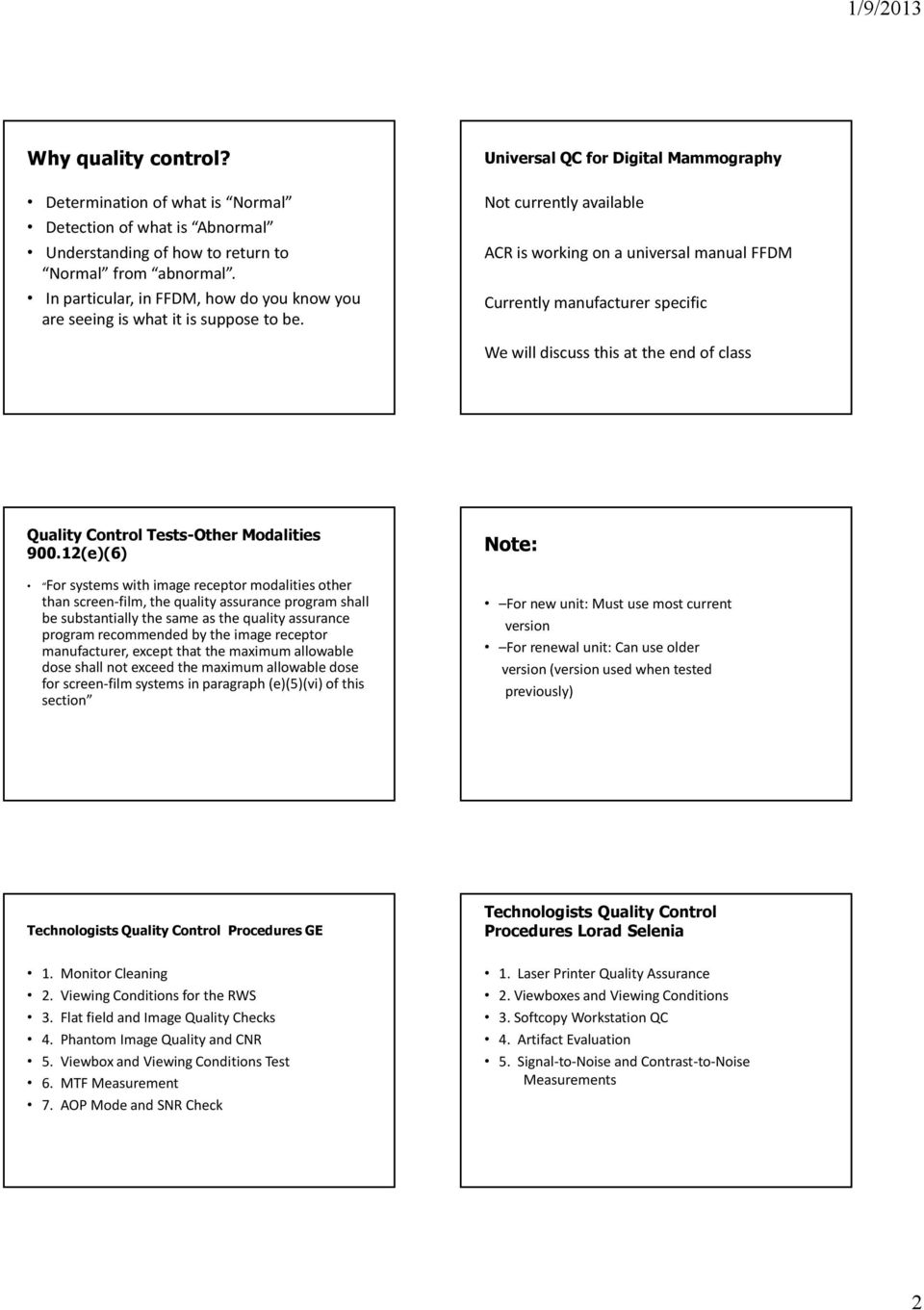
2 Why quality control? Determination of what is Normal Detection of what is Abnormal Understanding of how to return to Normal from abnormal. In particular, in FFDM, how do you know you are seeing is what it is suppose to be. Universal QC for Digital Mammography Not currently available ACR is working on a universal manual FFDM Currently manufacturer specific We will discuss this at the end of class Quality Control Tests-Other Modalities (e)(6) For systems with image receptor modalities other than screen-film, the quality assurance program shall be substantially the same as the quality assurance program recommended by the image receptor manufacturer, except that the maximum allowable dose shall not exceed the maximum allowable dose for screen-film systems in paragraph (e)(5)(vi) of this section Note: For new unit: Must use most current version For renewal unit: Can use older version (version used when tested previously) Technologists Quality Control Procedures GE Technologists Quality Control Procedures Lorad Selenia 1. Monitor Cleaning 2. Viewing Conditions for the RWS 3. Flat field and Image Quality Checks 4. Phantom Image Quality and CNR 5. Viewbox and Viewing Conditions Test 6. MTF Measurement 7. AOP Mode and SNR Check 1. Laser Printer Quality Assurance 2. Viewboxes and Viewing Conditions 3. Softcopy Workstation QC 4. Artifact Evaluation 5. Signal-to-Noise and Contrast-to-Noise Measurements 2
3 Lorad Selenia 6. Phantom Image 7. Detector Flat-Field Calibration 8. Visual Checklist 9. Repeat Analysis 10. Compression Siemens Mammomat Novation QC Detector Calibration-Weekly and as needed Artifact Detection-Weekly and as needed Phantom image quality-daily-image phantom and score SNR and CNR Measurements-Weekly Printer Check-when clinical images are to be printed- Daily Repeat Analysis-quarterly Compression force-semi-annually Technologists Quality Control Procedures Fischer Senoscan 1. Detector Calibration and Flat Field Test 2. Phantom Image Acquisition Test 3. Phantom Image Quality Test 4. System Resolution/Scan Speed Uniformity 5. Image Display Monitor(s) Test 6. System Operations 7. Repeat Rate 8. Compression 9. Printer MQSA Inspections and Selenia QC Manuals Inspectors were requiring facility s with Hologic Selenia units that they must have and work from the most current Selenia QC manual released by Hologic. This is a misunderstanding and not a requirement. It is not necessary to have a copy of the latest QC manual for each system. There should be no penalties to facilities using the QC manual that was shipped with their Selenia system or with subsequent system upgrades. Basis for this To date, all revisions to the Selenia QC manuals have not increased any QC test performance standard or action level from those stated in earlier versions. If this were to change in the future, Hologic would first need to obtain FDA approval and then notify all affected customers Basis for this To date, none of the software upgrades have affected QC performance criteria or action levels. If this were to change in the future, Hologic must notify the FDA and all affected customers. 3

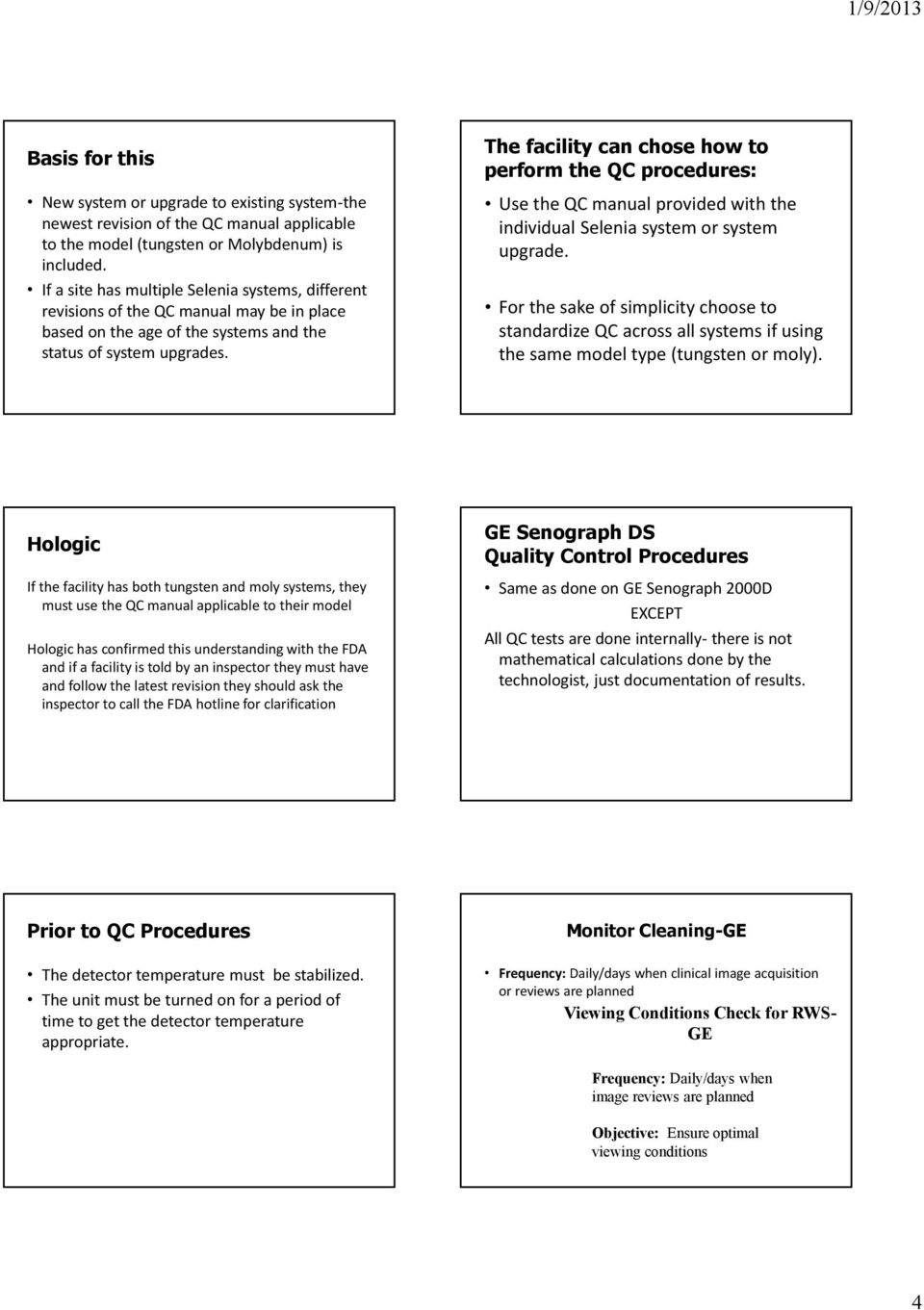
4 Basis for this New system or upgrade to existing system-the newest revision of the QC manual applicable to the model (tungsten or Molybdenum) is included. If a site has multiple Selenia systems, different revisions of the QC manual may be in place based on the age of the systems and the status of system upgrades. The facility can chose how to perform the QC procedures: Use the QC manual provided with the individual Selenia system or system upgrade. For the sake of simplicity choose to standardize QC across all systems if using the same model type (tungsten or moly). Hologic If the facility has both tungsten and moly systems, they must use the QC manual applicable to their model Hologic has confirmed this understanding with the FDA and if a facility is told by an inspector they must have and follow the latest revision they should ask the inspector to call the FDA hotline for clarification GE Senograph DS Quality Control Procedures Same as done on GE Senograph 2000D EXCEPT All QC tests are done internally- there is not mathematical calculations done by the technologist, just documentation of results. Prior to QC Procedures The detector temperature must be stabilized. The unit must be turned on for a period of time to get the detector temperature appropriate. Monitor Cleaning-GE Frequency: Daily/days when clinical image acquisition or reviews are planned Viewing Conditions Check for RWS- GE Frequency: Daily/days when image reviews are planned Objective: Ensure optimal viewing conditions 4
5 Monitor Cleaning Monitor Cleaning Do not use cleaning agents which attack the surface, such as petroleum (mineral) spirits. The front panel is extremely sensitive to mechanical damage. Avoid all scratches, knocks, etc. Do not apply the cleaning liquid directly to the monitor housing or screen. Do not allow the cleaning liquid to enter the monitor housing; be sure to dampen the cloth sparingly Daily Ensures good image review conditions Lightly dampen cloth with water/solution Clean with cloth or cleaning tissue to remove dust, finger prints and other marks Record completion in book Viewing Conditions Check For The Reading Rooms Each room has a data form that is filled out by the Medical Physicist for the room configuration. The medical physicist looks at the normal value of the ambient light in the room and measures it. If changes are made in the room such as small lamp, new doors, room curtains, blinds, etc Flat Field-GE Frequency: Weekly Objective: Five tests performed during Flat Field test. 1)brightness uniformity, 2)high frequency modulation (HFM), 3)SNR uniformity, 4)bad ROI, 5)bad pixel verification. First day of week/ first thing in the morning- image receptor retains ghost images taken during the week. Technical factors-automatic Two exposures Brightness Uniformity Checks the magnitude of low frequency structures or large shapes in defects High Frequency Modulation(HFM) Looks at the magnitude of high frequency structures or small defects 5

6 Signal-to-noise ratio (SNR) Uniformity, which is the variation of the SNR over the whole image Bad Pixel Verification Measures the number of pixels having signals much different from those of their neighbors and the density of the bad pixels Bad Regions Of Interest (ROI) Counts the number of regions of interest containing more than two bad pixels The Ideal response of the Detector is a uniform image with the following No large or small defects No pixel having a signal much higher or much lower than its neighbors. A uniform signal-to-noise ratio If Test Fails look at the following Artifact Evaluation The compression paddle and grid cover have been removed No object except the Flat Field test object is in the field The collimator is open to the largest field size The tube arm angle is at O degrees The Flat field test object is clean and free from scratches or other imperfections The surface of the image receptor is clean The Flat Field test object fully covers the FOV of the image receptor TO MAKE SURE THAT THE IMAGE IS FREE OF UNDESIRABLE ARTIFACTS (LORAD) 6

7 Artifact Evaluation Select the First Flat Field view from the examination screen window on the Acquisition Workstation. Acquired an exposure Make sure to change the Center and Width numbers to make it darker Do two exposures with Mo Filter and the second in Rhodium Filter or one with Tungston filter and second image with Ag. Depends on what system you have. Pan across the whole image to look for artifacts. Move zoom/pan like your mowing the lawn. When image displays record the mas value Activate the Full Zoom/pan function on the preview screen If you want to establish a Mean Pixel Value, click the ROI in preview tools and click User draw. Then choose 64 X 64 from the dropdown list. Click the center of the flat field image and the ROI Statistics dialog box will appear. Take the Mean Pixel Value with the first three numbers for a start for the Center Setting. An average center number is around 500 and the average width setting is around 600. But make sure it isn t too dark or too light because there will be artifacts that are missed. So you want a dark gray look to the image If artifacts are present rotate the acrylic 180 and repeat procedure If the appearance of the artifacts changes location between the two images they are in the phantom and there is not a system problem. If the artifacts persist in the same location there is a problem in either the x-ray system or the digital receptor Case Study for Flat field check 7

8 DICOM Printer Artifact Evaluation Print a flat field pattern to the printer. Do not take a flat field image is not appropriate for this test. Inspect the laser film for artifacts If multiple FFDM s only do this test from one of the machines and use the same machine every time for consistency. After you have looked for artifacts on the film, then record on the form. Performance Criteria Artifacts traced to the digital image receptor or the x-ray unit shall be eliminated by a qualified service engineer within 30 days of the test Siemens Artifact Detection Objective-to determine if the detector is dusty, damaged or has other artifacts Insert collimator mounted plexi phantom (40 mm thick) Insert compression plate simulator Choose procedure QC raw 28 kvp 90 mas Look at image for clinical relevant artifacts by magnifying to full resolution If the image has artifacts do calibration and repeat Performance Criteria No clinically relevant artifacts should be seen on the image Must be corrected prior to further examinations Inspection News GE FFDM Phantom QC Requirements Clarification of GE FFDM Phantom QC testing requirements QC manuals have phantom being done on both the AWS monitor and the printer weekly FDA contacted GE to clarify the printer requirement if a facility only does soft copy interpretation GE Phantom GE-does not intend for a facility to perform routine weekly phantom QC on devices that are not used for image interpretation If a facility does its final interpretations using softcopy only, it does not have to perform routine weekly phantom test evaluation using the printer. The facility must still perform a phantom QC test prior to printing final interpretation quality images. 8

9 Phantom Image Quality on AWS, RWS, and Printer and CNR Test-GE Frequency: Weekly after establishing the baseline for the Contrast-to-Noise Ratio (CNR) test. Only after successful completion of the Flat Field test. Phantom Image quality test of the printer-run only after successful completion of the daily QC test for the printer Phantom Image Quality Objective: CNR (Contrast to Noise Ratio) is a measure of the detectors ability to distinguish between objects in an image and the image noise Ensure adequate/consistent quality of images acquired by the detector and displayed on the AWS and RWS monitors and the printer. Contrast Resolution is the ability of an imaging system to distinguish similarities of objects in an image. Analog Phantom QC/Digital Phantom QC Differences In film-screen mammography imaging systems the phantom image test is for the consistency of image contrast as represented by the density difference (DD) between the image of an added test object (4mm thick acrylic disk) and the background density of the phantom. Analog Phantom QC/Digital Phantom QC Differences In GE s digital imaging the relative level of a signal or contrast to the image noise is the more relevant measure of image quality. Therefore, the measure of consistency of CNR is used as a replacement for the measure of consistency of DD. CNR B. Change in CNR Measurement Operating level for the CNR ratio measurement must be established, CNRol. 5 consecutive days to determine a 5 day average and a CNR operating level. Subsequent weekly measurements are compared to this operating level. The following events require re-establishment of the CNRol: replacement of the x-ray tube replacement of the Mo x-ray beam filter replacement of the compression paddle replacement of the phantom replacement of the anti-scatter grid replacement of the detector re-calibration of detector gain 9

10 Why the raw image? CNR Tests depend on using numerical values that are proportional to the amount of x- rays detected. Raw images provide image numbers that behave in the above manner. Processed images are good for viewing but are useless for the numerical tests. The values used are ones that best represent the incidental x-ray beam and the response of the detector when raw image is used. B. CNR measurement change continued Open the acquired raw image, zoom factor of 1, adjust the WW and WL between 125 and 175 to achieve the best contrast/object detectablity. CNR Now do the math: Calculate the CNR as (mean_background-mean_mass)/sd-background Calculate the change in the CNR: If the new CNR is smaller than or equal to the CNR operating level (CNRol), then calculate : Change in CNR=1-(CNR/CNRol) If the new CNR is larger than the CNR operating level (CNRol), then calculate Change in CNR=(CNR/CNRol)-1 Example: CNRol = 3.92 Mean_mass = Mean_background= sd_background=12.01 (mean_background-mean_mass)/sd-background =48.17 = Change in CNR=(CNR/CNRol) =.02 change in CNR 3.92 Why use the number 1 in the formulas Change in CNR=1-(CNR/CNRol) Change in CNR=(CNR/CNRol)-1 So you end up with a whole positive number 10

11 Contrast to Noise Define contrast to be the signal difference between two tissues A and B CAB=SA-SB We are assuming that SA > SB so that contrast is always positive. Mean An average of a group of numbers or data points. Action Limit: The change in CNR must not exceed 0.2. System fails- the source of the problem must be identified and corrective action taken before any further examinations are performed. How do you score the Phantom Passes-proceed to next step...score the phantom 11

12 GE Senographe DS and Essential Phantom Scoring Only on AWS Phantom IQ Test on The Printer Action Limit: Fibers-4 Masses-3 Calcifications-3 less than above-failed Identify source of problem Corrective action taken before any further examinations are performed. Siemens Phantom-Daily Objective-to ensure that adequate image quality is achieved Phantom-no disk Record mas Program 2-4.5cm breast technique Score on monitor If there is a problem send it to the review workstation and printer and examine. Performance Criteria Must score Correction required before examinations if failed 12

13 Signal to Noise The power ratio between a signal (meaningful information) and the background noise. Both signal and noise power must be measured at the same or equivalent points in the system and within the same bandwidth (width or range of frequencies that an electronic signal uses on a given transmission medium). Signal to Noise Bandwidth-in computer networks it is a synonym for data transfer rate-the amount of data than can be carried from one point to another in a given time period (bits of data per second). SNR=the ratio of the mean pixel value to the standard deviation of the pixel values. Standard Deviation In statistics-(the number you get for the standard deviation is considered statistics) a measure of how much the data in a certain collection are scattered around the mean. Siemens SNR and CNR Objective-to assure proper functioning of the solid-state detector by evaluating the SNR and the CNR of the detector Use the baseline values for SNR and CNR for weekly testing consistency. Siemens SNR and CNR Performance Criteria Choose procedure QC raw Compress phantom Program cm average breast technique Select AEC sensor 2 at the AWS Acquire phantom image Draw ROI in largest mass and record mean value Draw ROI in background and record mean value and standard deviation Calculate: mean (bg) DC (offset-always 50) SNR= std (bg) SNR 40 Deviation SNR ± 15% Deviation CNR ± 15% Calculate: CNR= (mean_background-mean_mass)/sd-background 13

14 Signal-to-Noise and Contrast-to-Noise Measurements-LoRad Frequency: weekly Objective: To assure consistency of the digital image receptor SNR (Signal to Noise Ratio) compares the level of the desired signal to the level of background noise phantom and disk 18x24 compression paddle-on phantom as close to 4.5 cm as possible Use clinically used exposure factors: (i.e. Auto Filter) SNR and CNR Lorad Phantom image will appear on monitor. ROI over disk slightly smaller than the disk-record Mean Value (Mean) Drag the previously drawn ROI next to the disk toward the chest wall-record the Mean Value (Mean) and standard deviation (STD). Do not use the Signalto-Noise ratio given by the ROI statistics box. Accept Image.. Now SNR is automatic with the SNR button on monitor The SNR shall be computed using the mean and standard deviation values obtained from the ROI next to the acrylic disk. 1. Compute the SNR of the detector according to: SNR = mean background - DC offset std deviation mean background and std background=the mean and standard deviation obtained from the ROI statistics dialog for the ROI next to the acrylic disk. DC offset is a DC offset added to the detector signal and is equal to Compute the CNR of the detector according to: mean background mean disk CNR = std background mean disk= the mean value obtained from the ROI statistics dialog for the ROI on the acrylic disk. 3. Compute the deviation from the original CNR measurements according to: CNR base CNR measured Diff = CNR base X 100 CNR base=the CNR base value established by the medical physicist during acceptance testing of the digital detector This is recorded in the Signal-to-Noise Ratio (SNR) and Contrast-to-Noise Ratio (CNR) Control Chart CNR measured is the new CNR computed in step 2. SNR and CNR Performance Criteria The measured SNR must be equal to or greater then 40. The computed CNR must be within ± 15% of the value determined by the medical physicist 14

15 Siemens SNR and CNR Objective-to assure proper functioning of the solid-state detector by evaluating the SNR and the CNR of the detector Use the baseline values for SNR and CNR for weekly testing consistency Siemens SNR and CNR Choose procedure QC raw Compress phantom Program cm average breast technique Select AEC sensor 2 at the AWS Acquire phantom image Draw ROI in largest mass and record mean value Draw ROI in background and record mean value and standard deviation Calculate: mean (bg) DC (offset-always 50) SNR= std (bg) Calculate: CNR= (mean_background-mean mass)/sd-background Performance Criteria SNR 40 Deviation SNR ± 15% Deviation CNR ± 15% Noise Radiographic noise or mottle The unwanted random (uncorrelated), nonrandom (correlated), or static level in a radiograph that has been given a uniform x-ray exposure Noise Quantum Mottle The random spatial variation of x-ray absorbed in the image receptor Fewer x-rays = noise or SNR & visibility of subtle contrasts Microcalcifications that can be the first sign of cancer may not be visible in a noisy or underexposed image Noise SNR & DQE The ratio of the magnitude of the image signal to the noise Detective quantum efficiency SNR transfer efficiency (good information transfer) High DQE good information transfer & more dose efficient Low DQE poor information transfer & less dose efficient 15

16 SNR Detector Design Noise SDNR Design & calibration of the detector & electronics for adequate dynamic range & number of bits of digitization are essential to precisely record the entire range of x-ray intensities transmitted by the breast SDNR Signal difference-to-noise ratio A measure of the difference between a signal & its background divided by the noise Indicator of reliably depicting a structure in the breast in the presence of noise Radiation dose depends on desired SDNR Viewbox and Viewing Conditions Spatial Resolution Frequency: Weekly Objective: To ensure good image review conditions by keeping the viewboxes free of dust, finger prints, and other marks and the viewing conditions optimized. Procedure: This test is not unique to digital mammography systems. Follow accepted mammographic QC procedures and action limits to complete this test. High Contrast Spatial Resolution The ability of an imaging system to allow 2 adjacent structures to be visualized as being separate, or the distinctness of an edge of the image (ie. Sharpness) Spatial Resolution Loss most easily observed when imaging fine detail Speculations radiating from a mass Microcalcifications 16

17 Spatial Resolution - Qualitative Measurement Achieved with a bar pattern of alternating radio-opaque bars & radiolucent spaces of equal width Determines limiting resolution in lp/distance or lp/mm Spatial Resolution Geometric Blurring Minimized by using small FS for contact imaging (e.g., 0.3 nominal size) Minimized by using an even smaller FS for magnification (e.g., 0.1 nominal size) Minimized by OID as much as possible SID (e.g., cm) Spatial Resolution Detector Specific Blurring Spatial Resolution Detector Specific Blurring Occurs in x-ray converter material Scintillator-based converters First source of blur = spreading of emitted light within the scintillator material Determined by Material thickness Crystal structure Reflective & absorptive properties Direct flat panel detectors Voltage or electric field across the direct conversion material must be adequate Spatial Resolution Detector Specific Blurring PSP resolution characteristics Not determined by the emitted light spread Spatial sampling is determined by Size of the scanned laser beam on readout Laser beam effective size (effective del) determined by actual beam size & amount of scattering of the laser light within the phosphor Spatial Resolution Motion Blurring Caused by movement of the breast during exposure Minimized by Short exposure time Compressing the breast 17

18 Spatial Resolution Motion Blurring kvp may be Image processing compensates for contrast losses to the extent allowed by Background noise Image SNR Spatial Resolution Motion Blurring SSCCD - scan slot charge-coupled device systems Misregistration artifacts between the anatomy imaged before motion occurs & that imaged after Spatial Resolution Geometric Blurring Contact imaging Minimized by using small FS (0.3 nominal size) Minimized by OID SID (60-65 cm) Use an even smaller FS for magnification (0.1 nominal size) Spatial Resolution Motion Blurring Movement of the breast during exposure Minimized by a short exposure time & compression MTF Measurement-GE Frequency: Monthly (only after successful completion of the Flat Field Test) Objective: Monitor the contrast delivered by the detector Ensure contrast is adequate over the 0-5 lp/mm spatial frequency range by obtaining an estimate of the MTF (Modulation Transfer Function) values near 2 and 4 lp/mm. MTF Measurement-GE Contrast is evaluated by measuring the fluctuation of a bar pattern signal in a region of interest. The bar pattern provides a signal to the detector, which is essentially alternating bars and spaces. The test determines how close to black the signal at the position of the bars is and how close to white the signal at the position of the spaces is. 18

19 MTF Measurement-GE The closer the output signal is to black and white, the more contrast there is in the image and the more variation is recorded in the region of interest during the MTF Test. MTF Measurement-GE Spatial resolution is the ability to see the difference in detail between adjoining objects, which is why we look at the spatial frequency groups. Attention is given to both low and high spatial frequency, Contrast at low spatial frequencies, which we measure at 2 lp/mm, aids in detection of masses and fibers. Contrast at high spatial frequencies, which we measure at 4 lp/mm, aids in detection of microcalcifications. The greater the signal fluctuation, the greater the MTF and the greater detectability. MTFMTF Measurement-GE 100 micron => 5 lp/mm 70 micron => 7.14 lp/mm 54 micron / standard resolution => 9.26 lp/mm 27 micron => 18.5 lp/mm Film screen 15 lp/mm and film screen mag is 18 lp/mm MTF Measurement-GE Procedure: Resolution bar pattern including spatial frequency groups of and 4 ± 0.1 lp/mm and a thickness of at least 0.1 mm of lead. Positioning the pattern on the bucky and expose using the supplied technical factors. Measurements made on raw image Zoom image to 1, adjust the brightness and contrast for optimum visibility of the test object. Using the ellipse tool, measurements are made. MTF Measurement-GE Measurements: 2 lp/mm pattern 4 lp/mm pattern space material-mean_space bar material-mean_bar A line pair consists of two elements-a bar and a space. The bar is the highly attenuating element and the space is the low-attenuating element. MTF Measurement Test MTF is always expressed in % 19

20 MTF Measurement Test MTF Measurement Test Example: Estimate the MTF expressed in % at 2 lp/mm: 2lp/mm (sd) X 222 = = 77% mean space-mean bar = MTF Measurement Test Example: Estimate the MTF expressed in % at 4 lp/mm: 4lp/mm (sd) X 222 = = 29.5% mean space-mean bar = What does the 222 represent in the formula? A decision based on a dilemma. Mathematically it is [100 x π x Square Root(2)/2]. It is based on a method of obtaining MTF estimates from images of bar patterns. Using a calculation with pi and a square root in it would have perplexed the technologists and is a waste of time for the tech to recalculate every time. A simple constant (222) was decided to be used in place of. MTF Measurement Test Action Limit: The test is successful if: MTF 2lp/mm > 58% and MTF 4lp/mm > 25% If these results are not obtained, the source of the problem must be identified, and corrective action taken, before any further examinations are performed. CNR and MTF Measurement Senograph DS and Essential Frequency: Weekly. The measurement must be made only after successful completion of the Flat Field Test Objective: The test is designed to check the consistency of the contrast to noise ratio (CNR) and to ensure that contrast is adequate over the 0-5 lp/mm spatial frequency range by obtaining an estimate of the MTF (Modulation Transfer Function) values at 2 and 4 lp/mm. CNR measurement is done in two steps: - Establishment of a baseline operating level CNRol 20
![18 What does the 222 represent in the formula? A decision based on a dilemma. Mathematically it is [100 x π x Square Root(2)/2].](/docs-images/47/20807426/images/page_20.jpg "It is based on a method of obtaining MTF estimates from images of bar patterns.")
21 CNR and MTF Measurement Senograph DS and Essential 1. Click on the QAP button on the right column of the Browser window. A list of tests is displayed. Select the CNR and MTF test. 2. Enter or verify the reference of the IQST device (Serial Number or SN, written on the side of the device) on the AWS screen, then click Start. Note: If the device reference entered is different from the previous one, you will be asked if you want to restart the calibration process with this new reference. 3. Install the Bucky on the digital detector if it is not already installed. 4. Remove the compression paddle. 5. Position the IQST device on top of the Bucky. CNR and MTF Measurement Senograph DS and Essential 6. The following parameters are selected automatically: Rh/Rh/30kV/56mAs. 7. Perform one exposure. 8. After the image has been captured, the results of the tests are displayed: - The values of MTF at 2 lp/mm and MTF at 4 lp/mm. - The value of the change in CNR, computed as follows: Change in CNR = CNR - CNRol / CNRol where CNRol = the CNR Operating Level as described above. If CNRol has not been calculated yet, the change in CNR is computed as follows: Change in CNR = CNR - mean / mean where mean = the mean of the CNR values previously stored AOP Mode and SNR Check-GE Frequency: Monthly Objective: Checks the following aspects of system operation: -correct choice of parameters in AOP (Automatic Optimization of Parameters) mode -correct level of SNR (Signal-to-Noise Ratio) in the image AOP Mode and SNR Check-GE Procedure: A set of acrylic plates (minimum size 20 cm 20 cm) allowing thicknesses of 25 ± 0.1 mm, 40 ± 0.1 mm and 60 ± 0.1 mm used with 5 deca newtons compression force AOP Mode and SNR Check for GE Senograph 2000D AOP Mode and SNR Check for GE Senograph 2000D This test is done with a set of acrylic plates allowing 25+/-- 0.1mm and 40+/-- 0.1mm and 60+/-- 0.1mm used with 5 deca Newtons compression force. Three exposures: one for each of the three thicknesses of acrylic in the field of view using the AOP STD mode. Record the exposure parameters after each exposure. Open each raw image for review and view it with the default zoom ( true size ). 21
22 AOP Mode and SNR Check for GE Senograph 2000D Use the ellipse ROI tool: Measure the mean value Standard deviation, sd, of the image in the region close to the chest wall edge and laterally centered. Calculate the SNR: mean= SNR sd Document results. GE Senograph DS and GE Essential Action Limit: AOP Mode Test successful: Exposure parameters are in accord with the values specified by the manufacturer. If the system fails the test, the source of the problem must be identified, and corrective action taken, before any further examinations are performed. GE Example: Calculate the SNR as mean/sd 25mm mean = sd = mm mean = sd = = = The Signal-To-Noise test is another measurement related to our ability to detect objects in the image. Signal refers to the average of the numerical values in an area of the image. The signals in the image are the anatomical structures such as glandular tissue, adipose tissue, calcifications, and masses, which are evaluated in interpreting a mammogram. 60mm mean = sd = =
23 Noise refers to the random variation of the signal. This random variation can obscure the clinical information the observer is trying to detect. The signal-to-noise ratio is a measure of the relative strengths of the signal and noise. That is, the signal, or useful image information, divided by the noise, or random information. When the signal-to-noise ratio is large, then noise does not obscure the objects of interest in the image. When the SNR is small, objects and noise can be confused and the objects of interest; for example, masses and calcifications, may be difficult to detect. Manufacturers parameters in following table: The SNR is also important because it sets the limit on the amount of contrast enhancement you can use to try to make the objects easier to see. Such enhancement generally increases both the signal and the noise and reduces the SNR. If the initial SNR is not sufficiently high, the enhancement lowers the SNR to the point where the contrast-enhanced noise eventually obscures the objects of interest. The value of SNR must exceed 50 Visual Checklist-GE Compression Thickness Indicator Frequency: Monthly and after any service or maintenance on the mammography system. Objective: To assure that the mammographic x-ray system indicator lights, displays, and mechanical locks and detents are working properly and that the system is mechanically safe. 23
24 Remember. The compression Thickness indicator shall always be accurate to +/--.5cm from the actual thickness. No record forms needed for this test, if any problems, consult the medical physicist Image Display Monitor Primary Display (RWS) Softcopy Display Monitors Display workstations used for official interpretation of mammographic images FDA recommends primary display monitors be cleared for FFDM by the FDA ACR strongly recommends only FDA - cleared monitors 24
25 Monitor Primary Display (RWS) Once a display has been purchased & calibrated, it should be tested regularly by the medical physicist to maintain compliance 5 megapixel monitor (2,000 x 2,500 Pixel samples in the horizontal & vertical directions for portrait orientation) preferred Monitor Primary Display (RWS) Maximum luminance of grayscale least 450 cd/m 2 Reflected ambient light from the display surface should be included in luminance measurement Minimum of 8 bit luminance resolution (bit depth) is required Two-monitor portrait set up Monitor Primary Display (RWS) Monitor Primary Display (RWS) Ability to select image sequence & display format (hanging protocols) Ability to accurately associate the patient & study demographic information with the images of the study performed Eyeglasses specifically for viewing distances (15 60 cm) During readout all images should be viewed at 1:1 or 100% size Pixel size (or pitch) should be less than ~200microns Display device specifications should match as closely as possible the acquisition matrix size Monitor Primary Display (RWS) Monitor Primary Display (RWS) Window & level adjustment tools must be available Zoom (magnification) & pan (roaming) capabilities must be available Rotation & Flipping tools are essential Calculation & display of linear measurements, ROI & pixel value determination should be possible All images acquired in the study need to be fully accessible during interpretation 25
26 Monitor Primary Display (RWS) Monitor Primary Display (RWS) Clinically relevant technical parameters of the acquired image data should be accessible mas kvp Bit depth Exposure time Matrix size Exposure values to assess technique for dose, quality, & feedback for technologists Sufficient for viewing all types of CR/DR images Monitor Primary Display (RWS) Monitor Primary Display (RWS) Reflections from ambient light sources should be kept at a minimum Indirect & backlight incandescent lights with dimmer switches rather than fluorescent Color tint should be uniform across the display area Monitor pairs should be color matched from the same manufacturing batch Optimize viewing conditions Control reading room lighting Eliminate reflection on the monitor Lower ambient lighting level as much as feasible Monitor Primary Display (RWS) Softcopy Display Monitors Other Guidelines Ambient lights should NOT be turned off completely nor turned up completely 20 lux is generally sufficient Displays must be able to Display mammography CAD marks when CAD is implemented Apply marks on the displayed image corresponding to all findings encoded in the DICOM mammography CAD strured reporting (SR) objects Display images in true size 26
27 Softcopy Display Monitors Other Guidelines Displays must be able to Display images in same display size even if from different acquisition stations with different pixel sizes Annotate image information, image identification, & technical factor information Display simultaneously a set of current & prior conventional four-view screening mammogram images Display Device Calibration Check-GE Frequency: Monthly Objective: Assure the monitor is calibrated Brightness and contrast settings are at an appropriate level for the reading of the images on the review workstation. Procedure: At the RWS the Start Calibration is selected. As displays age, luminance and color temperature are apt to change. TOTOKU's Medivisor will keep your displays performing to DICOM standards. Medivisor is included in the calibration kits, along with photo se Display Device Calibration Check-GE The pattern is examined carefully for the following features: verify that the 0%-5% contrast is visible verify that the 95%-100% contrast is visible verify that each gray level step from 0% to 100% can be distinguished from the adjacent squares. For example, that you can distinguish the 0% square from the 10% square, etc. verify that the line-pair images at the center and corners of the SMPTE pattern are distinguishable. As displays age, luminance are apt to change. Monitor testing will keep your displays performing to DICOM standards. The calibration kit, along with photo sensor or "puck" for luminance testing and adjustment is included. Digital Image Presentation Issues This test is no longer used with the new LCD monitor screens. The only time the puck testing is needed if facilities still use the CRT (Cathode Ray Tube) monitor. Remember this test records luminance levels on the monitor screen. Time required to display an image on the WS 3 seconds or less Displays should be able to accommodate fast & easy navigation between old & new studies 27
28 Digital Image Presentation Issues Hanging protocols should be Flexible Tailored to user preferences Specifically for mammography with proper labeling & orientation of images Digital Image Presentation Issues WS software tools must include Window/level Zoom/pan Specific recommendations regarding types of tools to be used & how to use them most effectively do not exist Digital Image Presentation Issues Monitor Secondary Display (TWS) WS should accommodate & display images from several modalities Technologist s workstations used to judge image quality during acquisition should be as similar as possible to the RWS Resolution (may have less) Maximum & minimum luminance Contrast ratio Ambient lighting Conformance to DICOM Zoom & pan Monitor Clinician WS Used to review images as an adjunct to the official interpretation by a radiologist May not need as high resolution as RWS Repeat Analysis Check Frequency: Quarterly. For the repeat rate to be meaningful, an analysis period that yields a patient volume of at least 250 patients or 1,000 exposures is needed. Objective: To determine the number and cause of repeated digital mammograms. Analysis of this data can help identify ways to improve system efficiency and reduce digital retakes and patient exposure. 28
29 Repeat Analysis check The applicable MQSA Quality Mammography Standard is: (e)(3)(ii) Quarterly quality control tests. Facilities with screen-film systems shall perform the following quality control tests at least quarterly: (ii) Repeat analysis. If the total repeat or reject rate changes from the previously determined rate by more than 2.0 percent of the total films included in the analysis, the reason(s) for the change shall be determined. Any corrective actions shall be recorded and the results of these corrective actions shall be assessed. Action Limit: If the total repeat rate changes from the rate determined for the previous analysis period by more than 2.0% of the total exposures included in the analysis, the reasons for the change must be determined. Any corrective actions taken must be recorded and an assessment must be made of their effectiveness. Compression Force Test Frequency: Initial installation and then every 6 months. Objective: To assure that the mammographic system can provide adequate compression in power driven and manual modes and that the equipment does not allow too much compression to be applied. Breast Compression Breast compression is equally important for digital mammography as it is for film screen. It contributes to digital image quality by immobilizing the breast (reduces motion unsharpness), producing a more uniform, thinner tissue (lowers scatter radiation, more even penetration of x-rays, less magnification or geometric blurring, less anatomical superimposition), and lowering dose Compression force test Procedure: This test is not unique to digital mammography systems. Follow accepted mammographic QC procedures to perform this test. Record the results. Action Limit-GE &Lorad The maximum compression force for the initial power drive must be between 11 and 20 dan (25-45 lb.) Printer Objective: To ensure optimal quality of the film printer output, follow the QC developed by the manufacturer of the device. If the printer is used with a film processor incorporating wet chemistry processing, follow the QC program developed by the manufacturer of the printer. 29
30 Hardcopy Printing - Considerations FDA recommends only printers specifically cleared for FFDM by the FDA s ODE (Office of Device Evaluation) MQSA does allow other printers to be used ACR strongly recommends only FDA - cleared printers be used for digital mammography Hardcopy Printing - Considerations FDA requires the ability to print FFDM images of final interpretation quality to film Manufacturer s guidelines should be followed Hardcopy Printing - Considerations FDA requires all printers used with an FFDM unit Comply with a quality assurance program that is substantially the same as that recommended by the FFDM manufacturer That they pass the phantom & clinical image review process of the facility s accreditation body Hardcopy Printing - Considerations At present, no accreditation body reviews softcopy images FDA recommends Softcopy images be of such quality that if they were submitted they would pass the phantom & clinical image review process of the facility s accreditation body QC testing for printers and monitors without QC manuals Procedure: Follow the manufacturers recommended quality control procedure. Chart results. In some cases the QC manual for the digital mammography unit instructs the facility to test monitors and printers according to the component s QC manual. In these cases, it is the responsibility of the facility to ensure that it obtains and follows the component s QC manual for its monitors and printers 30
31 Same printer or monitor with FFDM units from different manufacturers For facilities using FFDM units from different manufacturers, each with its own QC requirements for printers and monitors, there is some uncertainty regarding the QC tests to perform on these components. DICOM Printer Quality Control For Lorad Selenia s DICOM Laser Printer Quality Control Close any open examinations Select test patterns from the Admin Menu Select SMPTE from the Pattern drop-down menu Select from the Output Size drop-down menu the image size 18X24cm paddle Uncheck the Print true size Select the printer from the Output Devices dropdown menu Click Send to print the SMPTE pattern on the selected printer An image Queued dialog box appears informing you that the image is being sent. Click on OK to close it. Click close to exit the Test Pattern dialog MD- Speed, DD- Contrast, LD- B&F, DC- Direct Current 31
32 Most printers are dry laser printers compared to wet chemistry printers. These devices were introduced in They require specialty film which is photothermographic that uses silver behenate rather than silver halide to produce the image and is processed thermally rather than with liquid developer and fixer. The film is exposed with a scanning laser. After exposure, the film is heated to a temperature of 120 degree s for 24 seconds to process the image. After the image has been recorded, the film, immediately after it is ejected from the printer, is still in the processing image development. Light from the viewbox illuminator can cause slight changes in the optical density. Example 1 Each FFDM manufacturer QC manual requires that the same or equivalent test be done, but at different time frequencies. In this case facilities need to perform the test at the more stringent frequency. Example 2 Each FFDM manufacturer QC manual requires that different but equivalent test be done. In this case facilities may perform only one of the tests at the more stringent frequency. The medical physicist should provide a written statement for the facility s QC records, indicating that in his or her opinion, the two tests are equivalent. Example 3 Each FFDM manufacturer QC manual requires that different test (not equivalent) be done. In this case facilities need to perform each test at the frequency required in the respective FFDM manufacturer QC manual. FUJI CR QC Baseline Tests-first measurement for each test Printer QC Monitor QC CNR Weekly Check Image Quality S Value Confirmation System Resolution CR Reader Scanner performance AEC system performance assessment Imaging plate fog System artifact evaluation Dynamic range Primary erasure Inter-plate consistency Dose 32
33 Image Plate Erasure FUJI CR QC Using secondary erasure erase each plate first thing each morning WEEKLY CNR Phantom Image Printer QC Monitor QC FUJI CR QC Monthly Visual Checklist Quarterly Repeat Analysis Semi-annual Compression Imaging Plate Fog Fuji CNR Check Objective: To establish an operating level of Contrast-to- Noise Ratio (CNR) at a specific exposure and weekly confirm that the CNR remains consistent, within limits over time at the same exposure setting. Establish a baseline CNR with 5 day average of the CNR values when doing the 5 day average remove and replace the aluminum between exposures since positioning of it may have some effect on the calculated CNR from week to week. Erase dedicated QC cassette using secondary erasure 4 cm acrylic on bucky with 0.2 mm thick aluminum object on top positioned as shown in diagram. Compression paddle in contact Exposure: Mo/Mo 26 mas Interval processing time-control time interval between X-ray exposure and reading of the IP. It must be consistent to Reduce the influence of IP fading characteristics on the test. 5 or 10 minutes 33
34 Reestablish (5 day average) new baseline if: X-ray tube replacement Filter replacement Replacement of compression paddle Change in phantom used Change of IP/and or cassette used Change of grid Change of x-ray generator Change of CR reader calibration Performance Criteria CNR Must be within ± 20% of the baseline image (CNR) established If failed must be corrected before any further examinations Fuji Phantom Image Objective: To assure that contrast, uniformity and image quality (due to the x-ray exposure system, image reader and printer and workstation) are maintained at optimum levels. Done hardcopy and softcopy Expose on technique used for 50/50 breast (this was auto filter-lorad unit) Photocell in center of wax insert and in same place every time Same compression thickness every time Send to printer once processed Phantom Hardcopy Background density center of phantom no less than 1.20 Density difference in disc and adjacent to disk and subtract Plot on chart and plot mas Score subtracting for artifacts Phantom Softcopy Plot the S value from the exposure on the S value range line on chart Score subtracting for artifacts 34
35 Performance Criteria Score If hard copy are used for final interpretation the OD must be within ±.20 of the established OL and the DD must be within ±.05 If softcopy images are used for final interpretation the S value must not vary by greater than ± 20% (the S value of the phantom confirms the exposure unit output and the FCRm reader sensitivity setting) If criteria is not met for either must be corrected before any further examinations are performed. Fuji Printer QC Objective- to assure the printer used for final interpretation is performing according to the manufacturers specifications Upcoming Changes in QC for FFDM New BI-RAD s and lexicon changes New ACR FFDM QC Control Manual New Digital Phantom for FFDM Possibly a new Phantom for DBT ACR FFDM QC Manual Project ACR FFDM QC Manual Project ACR Subcommittee on Quality Assurance Clinical Representatives MITA Representatives ACR Representatives Information written by.et al. Eric Berns, PhD Subcommittee Charge: Design ACR Accreditation Phantom for FFDM Write QC Manual for ACR FFDM Mammography Accreditation Program 35
36 ACR Digital QC Manual Structure of Manual: Radiologist s Section Clinical Image Quality Section Radiologic Technologist s Section Medical Physicist s Section Educational, Guidance, and Troubleshooting Section Glossary References Index What will be New? Tech Section Enhanced positioning and image quality section New Test: Monitor QC for the Radiologist New Test: Facility QC Review New Format: Corrective Action Log New Documentation: Facility Equipment Inventory Instructions for Mobile Units Eliminating calculations (Yet to be determined) The ACR FFDM Phantom 24 X 30 Design Summary Differences from screen-film phantom Eliminate subtraction for artifacts Add Fail for artifacts Improve specific rules for scoring Change pass/fail criteria from 4,3,3 to 2,3,2 **But, objects are the same (effective) size as SFM Phantom ACR Digital QC Manual Benefits of Phantom Design Provides view of entire detector artifact evaluation W/L optimized for test objects optimizes for artifact eval Finer gradations of test objects Test objects go to smaller sizes AGD measurement & limit same as SFM Meets MQSA Provides single image/exposure for evaluation(s) Minimal training (~ 25,000 Techs currently trained) Provides basis for monitor and laser printer QC ACR Physics Reviewers Can see scores and artifacts on single submitted film (or image) Do not need different WW/WL settings 36
37 CIRS Model 020 BR3D Mammography Phantom The CIRS Model 020 BR3D Mammography Phantom was designed to assess detectability of various size lesions within a tissue equivalent, complex, heterogeneous background. This phantom provides more realistic challenges for standard screen and FFDM mammography systems as well as Tomosynthesis and breast Computed Tomography. The phantom consists of a set of six (6) slabs made of heterogeneous breast equivalent material that exhibits characteristics of real breast tissue and demonstrates how underlying targets can be obscured by varying glandularity. Each slab contains two tissue equivalent materials mimicking 100% adipose and gland tissues swirled together in a approximate 50/50 ratio by weight. One of the slabs contains an assortment of micro-calcifications, fibrils and masses. That s enough QC!! 37
Quality Control of Full Field Digital Mammography Units
 Quality Control of Full Field Digital Mammography Units Melissa C. Martin, M.S., FACMP, FACR, FAAPM [email protected] 310-612-8127 ACMP Annual Meeting Virginia Beach, VA May 2, 2009 History of
Introduction. Digital Mammography Detector QC FFDM. What is FFDM QC and why is it. important? What to know before you start. Eric A. Berns, Ph.D.
 Slide 1 Digital Mammography Detector QC Slide 2 Introduction What is FFDM QC and why is it important? Eric A. Berns, Ph.D. What to know before you start [email protected] Overview and compare QC tests
Update on ACR Digital Mammography QC Manual
 Update on ACR Digital Mammography QC Manual Priscilla F. Butler, M.S. Medical Physicist and Senior Director, ACR, Reston, VA (with thanks to Eric Berns, Ph.D.) Overview Phantom Specifications QC Manual
Role of the Medical Physicist in Clinical Implementation of Breast Tomosynthesis
 Role of the Medical Physicist in Clinical Implementation of Breast Tomosynthesis Bob Liu, Ph.D. Department of Radiology Massachusetts General Hospital And Harvard Medical School Digital Breast Tomosynthesis
Q.A. Collectible. Sponsored by CRCPD s Committee on Quality Assurance in Diagnostic X-Ray (H-7)
 Q.A. Collectible Sponsored by CRCPD s Committee on Quality Assurance in Diagnostic X-Ray (H-7) Mammography Phantom Image Quality Evaluation (from the American College of Radiology 1999 Mammography Quality
Digital Mammography Update: Design and Characteristics of Current Systems
 : Design and Characteristics of Current Systems Kalpana M. Kanal, Ph.D., DABR Assistant Professor Department of Radiology University of Washington Seattle, Washington AAPM Annual Meeting 2009 Anaheim,
Digital Breast Tomosynthesis QC Requirements
 Digital Breast Tomosynthesis QC Requirements AAPM Spring Clinical Meeting March 8, 2015 Michael S Glaser, MS, DABR Alliance Medical Physics, LLC Learning Objectives 1. GE SenoClaire - Physicist & Technologist
INTRODUCTION. A. Purpose
 New York State Department of Health Bureau of Environmental Radiation Protection Guide for Radiation Safety/Quality Assurance Programs Computed Radiography INTRODUCTION A. Purpose This guide describes
An Overview of Digital Imaging Systems for Radiography and Fluoroscopy
 An Overview of Digital Imaging Systems for Radiography and Fluoroscopy Michael Yester, Ph.D. University of Alabama at Birmingham Outline Introduction Imaging Considerations Receptor Properties General
MQSA Quality Control Manual for Monochrome Displays for Mammography
 MQSA Quality Control Manual for Monochrome Displays for Mammography Ver1.0 Applicable Models LMD-DM50, LMD-DM30 Sony Corporation - 1 - MQSA Quality Control Manual for Monochrome Displays for Mammography
SECTION 1: REQUIREMENTS FOR CERTIFICATES OF COMPLIANCE FOR CLASSES OF RADIATION APPARATUS
 Department of Health and Human services Population Health Radiation Protection Act 2005 Section 17 CERTIFICATE OF COMPLIANCE: STANDARD FOR RADIATION APPARATUS - X-RAY MEDICAL DIAGNOSTIC (MAMMOGRAPHY) SECTION
Applicable Models ME511L, ME551i2, MS31i2, MS33i2, MS51i2, MS53i2
 Version 3.1 Applicable Models ME511L, ME551i2, MS31i2, MS33i2, MS51i2, MS53i2 MQSA Quality Control Manual for Monochrome Monitors for Mammography Foreword Purpose of this Document This document is for
Surveying and QC of Stereotactic Breast Biopsy Units for ACR Accreditation
 Surveying and QC of Stereotactic Breast Biopsy Units for ACR Accreditation LORAD Stereotactic Breast Biopsy System AAPM Spring Clinical Meeting Phoenix, AZ March 17, 2013 Melissa C. Martin, M.S., FACR,
Mammography. For 35+ years, screenfilm has been the gold standard for breast cancer detection
 Digital Mammography Upright Stereo Mammography For 35+ years, screenfilm has been the gold standard for breast cancer detection IN THE BEGINNING Mammography technology has come a long way since the first
Performance testing for Precision 500D Classical R/F System
 Performance testing for Precision 500D Classical R/F System John M. Boudry, Ph.D. Image Quality Systems Engineer GE Healthcare Technologies Outline System background Image Quality Signature Test (IQST)
Page: 1 of 6 Page: 1 of 6
 Page: 1 of 6 Page: 1 of 6 CR Basics and FAQ Overview Computed Radiography is a term used to describe a system that electronically records a radiographic image. Computed Radiographic systems use unique
Quality Control and Maintenance Programs
 Quality Control and Maintenance Programs Cari Borrás, D.Sc., FACR, FAAPM Visiting Professor DOIN-DEN / UFPE Recife, Pernambuco, Brazil Co-Chair, IUPESM Health Technology Task Group 1 Medical Imaging Equipment
Aspire FCRm/CRm Fujifilm CR for Mammography
 : May 2013 Fujifilm Medical Systems U.S.A., Inc. 2 CONTENTS FOREWORD... 5 Introduction to Measurements... 6 S value... 7 Overview of Testing... 8 Section A Getting Started... 9 0 Set-up & Baseline Images...10
ACR AAPM SIIM PRACTICE PARAMETER FOR DETERMINANTS OF IMAGE QUALITY IN DIGITAL MAMMOGRAPHY
 The American College of Radiology, with more than 30,000 members, is the principal organization of radiologists, radiation oncologists, and clinical medical physicists in the United States. The College
A software tool for Quality Assurance of Computed / Digital Radiography (CR/DR) systems
 A software tool for Quality Assurance of Computed / Digital Radiography (CR/DR) systems Nikunj Desai a and Daniel J Valentino a,b a icr Company Inc, 2580 West 237th Street, Torrance, CA 90505, USA b Department
The American College of Radiology Stereotactic Breast Biopsy Accreditation Program: Frequently Asked Questions (Updated: August 24, 2015)
 The American College of Radiology Stereotactic Breast Biopsy Accreditation Program: Frequently Asked Questions (Updated: August 24, 2015) Table of Contents Stereotactic Breast Biopsy Accreditation Program
Chapter 15. Creating the Digital Image. Objectives. Key Terms
 Chapter 15 Creating the Digital Image Objectives Describe how a digital image is created and processed. Sequence the steps of image production and evaluation of the digital image. Identify the components
Physics testing of image detectors
 Physics testing of image detectors Parameters to test Spatial resolution Contrast resolution Uniformity/geometric distortion Features and Weaknesses of Phantoms for CR/DR System Testing Dose response/signal
Annual MQSA Inspection Questions NMQAAC April 19, 2004
 1 1 1 1 1 1 1 1 0 1 0 1 0 1 0 1 Annual MQSA Inspection Questions NMQAAC April 1, 00 1.0 Inspection Information 1.1 Name and Address 1. Equipment Registration.0 Facility Inspection Download.0 Facility Inspections.0
COST EFFECTIVE FLAT PANEL DIGITAL RADIOGRAPHY UPGRADE SOLUTIONS
 COST EFFECTIVE FLAT PANEL DIGITAL RADIOGRAPHY UPGRADE SOLUTIONS DRive is a digital imaging DR hardware & Software solution designed for General Radiography of anatomy. It is intended to replace film/screen
Update on MQSA and ACR Mammography Accreditation
 MQSA - Who s Who Update on MQSA and ACR Mammography Accreditation The Law: Mammography Quality Standards Act (MQSA) The Regulator: US Food and Drug Administration (FDA) Pamela L. Platt, BSRT(R)(M)(CV)
IAC Ch 41, p.1. Procedure means a stereotactically guided breast biopsy performed on a patient for diagnostic purposes.
 IAC Ch 41, p.1 641 41.7 (136C) X-ray machines used for stereotactically guided breast biopsy. 41.7(1) Definitions. In addition to the definitions provided in rules 641 38.2(136C), 641 40.2(136C), and 641
Dose Measurement in Mammography; What are we measuring? David E. Hintenlang, Ph.D. DABR University of Florida
 Dose Measurement in Mammography; What are we measuring? David E. Hintenlang, Ph.D. DABR University of Florida Average Glandular Dose Required measurement performed by medical physicist as part of Mammography
Radiographic Grid. Principles of Imaging Science II (RAD 120) Image-Forming X-Rays. Radiographic Grids
 Principles of Imaging Science II (RAD 120) Radiographic Grids 1 Image-Forming X-Rays Four X-ray paths a. X-rays interact with patient and scatter away from the receptor b. X-rays interact and are absorbed
Scan Time Reduction and X-ray Scatter Rejection in Dual Modality Breast Tomosynthesis. Tushita Patel 4/2/13
 Scan Time Reduction and X-ray Scatter Rejection in Dual Modality Breast Tomosynthesis Tushita Patel 4/2/13 Breast Cancer Statistics Second most common cancer after skin cancer Second leading cause of cancer
American College of Radiology Mammography Accreditation Program
 American College of Radiology Mammography Accreditation Program Objectives Overview of the ACR Mammography Accreditation Program Interrelationship between mammography accreditation, FDA certification and
THE ROYAL AUSTRALIAN AND NEW ZEALAND COLLEGE OF RADIOLOGISTS
 guidelines for quality control testing for digital (cr DR) mammography THE ROYAL AUSTRALIAN AND NEW ZEALAND COLLEGE OF RADIOLOGISTS The Royal Australian and New Zealand College of Radiologists Eligibility
SUBCHAPTER 22 QUALITY ASSURANCE PROGRAMS FOR MEDICAL DIAGNOSTIC X-RAY INSTALLATIONS
 Note: This is a courtesy copy and is not the official version of this rule. The official, legally effective version of this rule is available through www.lexisnexic.com/bookstore (Phone: (800) 223-1940).
EPSON SCANNING TIPS AND TROUBLESHOOTING GUIDE Epson Perfection 3170 Scanner
 EPSON SCANNING TIPS AND TROUBLESHOOTING GUIDE Epson Perfection 3170 Scanner SELECT A SUITABLE RESOLUTION The best scanning resolution depends on the purpose of the scan. When you specify a high resolution,
Digital radiography conquers the veterinary world
 Digital radiography conquers the veterinary world Author: Dirk De Langhe Increasingly, veterinarians are using medical imaging to diagnose their patients. There is a corresponding tendency towards replacing
Coronis 5MP Mammo. The standard of care for digital mammography
 Coronis 5MP Mammo The standard of care for digital mammography The standard of care For thousands of women every day, details make all the difference. This understanding, along with many years of commitment
PERFORM-X DIGITAL X-RAY SYSTEM PERFORM-X. with ceiling mounted tube support PERFORM-X
 DIGITAL X-RAY SYSTEM with ceiling mounted tube support Universal Digital Radiographic System Conventional system, full DR components Best-in-class image quality Flexible connectivity to PACS systems General
College on Medical Physics. Digital Imaging Science and Technology to Enhance Healthcare in the Developing Countries
 2166-Handout College on Medical Physics. Digital Imaging Science and Technology to Enhance Healthcare in the Developing Countries 13 September - 1 October, 2010 Digital Radiography Image Parameters SNR,
REGULATION: QUALITY ASSURANCE PROGRAMS FOR MEDICAL DIAGNOSTIC X-RAY INSTALLATIONS N.J.A.C. 7:28-22
 REGULATION: QUALITY ASSURANCE PROGRAMS FOR MEDICAL DIAGNOSTIC X-RAY INSTALLATIONS N.J.A.C. 7:28-22 New Jersey Department of Environmental Protection Bureau of Radiological Health PO Box 415 Trenton NJ
CT RADIATION DOSE REPORT FROM DICOM. Frank Dong, PhD, DABR Diagnostic Physicist Imaging Institute Cleveland Clinic Foundation Cleveland, OH
 CT RADIATION DOSE REPORT FROM DICOM Frank Dong, PhD, DABR Diagnostic Physicist Imaging Institute Cleveland Clinic Foundation Cleveland, OH CT Patient comes out... Patient goes in... Big Black Box Radiology
DICOM Correction Item
 Correction Number DICOM Correction Item CP-626 Log Summary: Type of Modification Clarification Rationale for Correction Name of Standard PS 3.3 2004 + Sup 83 The description of pixel spacing related attributes
CONTENT SPECIFICATIONS FOR THE FLUOROSCOPY EXAMINATION
 CONTENT SPECIFICATIONS FOR THE FLUOROSCOPY EXAMINATION Publication Date: November 2010 Implementation Date: March 2011 The purpose of the American Registry of Radiologic Technologists Fluoroscopy Examination
Supports screening, diagnostic, and multimodality workflows
 GE Healthcare Universal Viewer Breast Imaging Product Data Sheet Supports screening, diagnostic, and multimodality workflows Introduction Centricity PACS with Universal Viewer 1 puts clinical insight within
Health. NYC Quality Assurance Guidelines for. Primary Diagnostic Monitors
 Health NYC Quality Assurance Guidelines for Primary Diagnostic Monitors June 2015 Content I. Overview... 1 II. Definitions... 1 III. Acceptance Testing Requirements... 4 IV. Bi-weekly PDM Testing... 4
MQSA and ACR Digital Breast Tomosynthesis Mammography Accreditation
 US FFDM Mammography Facilities and Units MQSA and ACR Digital Breast Tomosynthesis Mammography Accreditation Pamela L. Platt, BSRT(R)(M)(CV) FDA Liaison, ACR Breast Imaging Accreditation Program In 2000
Picture archiving and communication systems (PACS) and guidelines on diagnostic display devices
 IT Guidance Documents Picture archiving and communication systems (PACS) and guidelines on diagnostic display devices Second edition Board of the Faculty of Clinical Radiology The Royal College of Radiologists
Personal Identity Verification (PIV) IMAGE QUALITY SPECIFICATIONS FOR SINGLE FINGER CAPTURE DEVICES
 Personal Identity Verification (PIV) IMAGE QUALITY SPECIFICATIONS FOR SINGLE FINGER CAPTURE DEVICES 1.0 SCOPE AND PURPOSE These specifications apply to fingerprint capture devices which scan and capture
Hardware Guide for the Classic and Elite CR Systems. 2011-08-04 PN 9G9637 Version 1.0
 Hardware Guide for the Classic and Elite CR Systems 2011-08-04 PN 9G9637 Version 1.0 Use of the Content Carestream Health CR Systems are designed to meet international safety and performance standards.
BREAST CHARACTERISTICS AND DOSIMETRIC DATA IN X RAY MAMMOGRAPHY - A LARGE SAMPLE WORLDWIDE SURVEY
 BREAST CHARACTERISTICS AND DOSIMETRIC DATA IN X RAY MAMMOGRAPHY - A LARGE SAMPLE WORLDWIDE SURVEY N. GEERAERT a,b,c, R. KLAUSZ a, S. MULLER a, I. BLOCH c, H. BOSMANS b a GE Healthcare, Buc, France b Department
QUALITY ASSURANCE PROGRAMS FOR DIAGNOSTIC RADIOLOGY FACILITIES. (a) Applicability. (b) Definitions
 QUALITY ASSURANCE PROGRAMS FOR DIAGNOSTIC RADIOLOGY FACILITIES (a) Applicability Quality assurance programs as described in paragraph (c) of this section are recommended for all diagnostic radiology facilities.
Understanding Digital Modalities: System Integration and Use
 Understanding Digital Modalities: System Integration and Use Donald J. Peck, PhD Henry Ford Health System Detroit, MI [email protected] Dicom Digital Imaging and Communications in Medicine Part 3: Information
EPEX. The Hologic EPEX General. Direct-to-Digital System for General Radiography. Versatility for a complete range of general radiographic exams
 EPEX Direct-to-Digital System for General Radiography Featuring... Versatility for a complete range of general radiographic exams The Hologic EPEX General Radiography System is a direct-to-digital, fully
Fundamentals of Digital Mammography: Physics, Technology and Practical Considerations Andrew P. Smith, Ph.D.
 Fundamentals of Digital Mammography: Physics, Technology and Practical Considerations Andrew P. Smith, Ph.D. Introduction Screen-film image receptors have been the standard detector used in conventional
A PACS-Aware DICOM Image Object
 Designing and Implementing A PACS-Aware DICOM Image Object For Digital X-ray, Mammography and Intraoral Applications David A. Clunie Quintiles Intelligent Imaging Clear Vision for the Healthcare Industry
Compliance Guidance for FLUOROSCOPIC QUALITY CONTROL
 Compliance Guidance for FLUOROSCOPIC QUALITY CONTROL New Jersey Department of Environmental Protection Bureau of Radiological Health PO Box 415 Trenton NJ 08625 FAX 609-984-5811 Website: http://www.state.nj.us/dep/rpp
Scanners and How to Use Them
 Written by Jonathan Sachs Copyright 1996-1999 Digital Light & Color Introduction A scanner is a device that converts images to a digital file you can use with your computer. There are many different types
Lecture 14. Point Spread Function (PSF)
 Lecture 14 Point Spread Function (PSF), Modulation Transfer Function (MTF), Signal-to-noise Ratio (SNR), Contrast-to-noise Ratio (CNR), and Receiver Operating Curves (ROC) Point Spread Function (PSF) Recollect
Comparing Digital and Analogue X-ray Inspection for BGA, Flip Chip and CSP Analysis
 Comparing Digital and Analogue X-ray Inspection for BGA, Flip Chip and CSP Analysis David Bernard & Steve Ainsworth Dage Precision Industries Abstract Non-destructive testing during the manufacture of
R/F. Efforts to Reduce Exposure Dose in Chest Tomosynthesis Targeting Lung Cancer Screening. 3. Utility of Chest Tomosynthesis. 1.
 R/F Efforts to Reduce Exposure Dose in Chest Tomosynthesis Targeting Lung Cancer Screening Department of Radiology, National Cancer Center Hospital East Kaoru Shimizu Ms. Kaoru Shimizu 1. Introduction
Mammography: Dosimetry ACMP Annual Meeting Virginia Beach Saturday, May 2, 2009 Lawrence N. Rothenberg, Ph.D. Department of Medical Physics Memorial
 Mammography: Dosimetry ACMP Annual Meeting Virginia Beach Saturday, May 2, 2009 Lawrence N. Rothenberg, Ph.D. Department of Medical Physics Memorial Sloan-Kettering Cancer Center New York, NY [email protected]
PRACTICAL TIPS IN ENSURING RADIATION SAFETY IN THE USE OF MEDICAL DIAGNOSTIC X-RAY EQUIPMENT
 PRACTICAL TIPS IN ENSURING RADIATION SAFETY IN THE USE OF MEDICAL DIAGNOSTIC X-RAY EQUIPMENT Although the medical uses of X-rays to examine a patient without surgery became an amazing medical breakthrough,
Checklist for the Qualification of Digital Detector Array Systems
 Paper No. 010-12 Checklist for the Qualification of Digital Detector Array Systems 1 February 2012 This document was created by the Federal Working Group on Industrial Digital Radiography. Reproduction
Breast MRI Quality Control
 Donna M. Reeve, MS, DABR, DABMP Department of Imaging Physics Educational Objectives Discuss the importance of breast MRI quality control (QC). Provide an overview of the new ACR Breast MRI Accreditation
HIGH PERFORMANCE MOBILE SURGICAL C-ARM KMC-950
 HIGH PERFORMANCE MOBILE SURGICAL C-ARM 1K x 1k CCD Digital Camera System H.F. GENERATOR & ROTATING ANODE TUBE WITH DIGITAL WORKSTATION DESCRIPTION: Mobile Surgical C-arm systems are integrated with a triple
Digital Image Requirements for New Online US Visa Application
 Digital Image Requirements for New Online US Visa Application As part of the electronic submission of your DS-160 application, you will be asked to provide an electronic copy of your photo. The photo must
Overview of Digital Detector Technology
 Overview of Digital Detector Technology J. Anthony Seibert, Ph.D. Department of Radiology University of California, Davis Disclosure Member (uncompensated) Barco-Voxar Medical Advisory Board ALARA (CR
Routine Ultrasound Equipment Tests for Quality Assurance. Contents
 Routine Ultrasound Equipment Tests for Quality Assurance James A. Zagzebski, Ph.D. Nick Rupert, M.S. Ryan DeWall, M.S. Tomy Varghese, Ph.D. Dept. of Medical Physics University of Wisconsin, Madison, WI,
CHAPTER 3: DIGITAL IMAGING IN DIAGNOSTIC RADIOLOGY. 3.1 Basic Concepts of Digital Imaging
 Physics of Medical X-Ray Imaging (1) Chapter 3 CHAPTER 3: DIGITAL IMAGING IN DIAGNOSTIC RADIOLOGY 3.1 Basic Concepts of Digital Imaging Unlike conventional radiography that generates images on film through
Tube Control Measurement, Sorting Modular System for Glass Tube
 Tube Control Measurement, Sorting Modular System for Glass Tube Tube Control is a modular designed system of settled instruments and modules. It comprises measuring instruments for the tube dimensions,
Radiographic Image Production. Radiographic Image Production. Principles of Imaging Science I (RAD 119) Film, Screens, and Cassettes
 Principles of Imaging Science I (RAD 119) Film, Screens, and Cassettes Radiographic Image Production X-ray photons emitted from the x-ray tube interact with the body, exit the patient (exit beam) and interact
X-ray Imaging Systems
 Principles of Imaging Science I (RAD 119) X-ray Tube & Equipment X-ray Imaging Systems Medical X-ray Equipment Classified by purpose or energy/current levels kvp, ma Radiographic Non-dynamic procedures
MIN-R 2000 Plus Film
 Technical Data Sheet Issued 2014-03 MIN-R 2000 Plus Film MIN-R 2000 Plus Film is a medium speed, dual coated, orthochromatic medical x-ray film for mammographic use with single green-emitting intensifying
X-ray Imaging Systems
 Principles of Imaging Science I (RAD 119) X-ray Tube & Equipment X-ray Imaging Systems Medical X-ray Equipment Classified by purpose or energy/current levels kvp, ma Radiographic Non-dynamic procedures
Content Sheet 7-1: Overview of Quality Control for Quantitative Tests
 Content Sheet 7-1: Overview of Quality Control for Quantitative Tests Role in quality management system Quality Control (QC) is a component of process control, and is a major element of the quality management
Study the Quality Assurance of Conventional X-ray Machines Using Non Invasive KV meter
 Study the Quality Assurance of Conventional X-ray Machines Using Non Invasive KV meter T.M.Taha Radiation Protection Department, Nuclear Research Center, Atomic Energy Authority, Cairo.P.O.13759 Egypt.
WHITE PAPER DECEMBER 2010 CREATING QUALITY BAR CODES FOR YOUR MOBILE APPLICATION
 DECEMBER 2010 CREATING QUALITY BAR CODES FOR YOUR MOBILE APPLICATION TABLE OF CONTENTS 1 Introduction...3 2 Printed bar codes vs. mobile bar codes...3 3 What can go wrong?...5 3.1 Bar code Quiet Zones...5
SE05: Getting Started with Cognex DataMan Bar Code Readers - Hands On Lab Werner Solution Expo April 8 & 9
 SE05: Getting Started with Cognex DataMan Bar Code Readers - Hands On Lab Werner Solution Expo April 8 & 9 Learning Goals: At the end of this lab, the student should have basic familiarity with the DataMan
Standard Test Method for Classification of Film Systems for Industrial Radiography 1
 Designation: E 1815 96 (Reapproved 2001) Standard Test Method for Classification of Film Systems for Industrial Radiography 1 This standard is issued under the fixed designation E 1815; the number immediately
Interfacing Fuji CR in a DICOM Network Environment
 Interfacing Fuji CR in a DICOM Network Environment Wayne T. DeJarnette, Ph.D., Valmore Albrecht, RT, Alan Orth, RT, Jon Sayer, M.S. DeJarnette Research Systems, Inc. 401 Washington Avenue Towson, MD 21204
CHAPTER 5 QC Test For Radiographic Equipment. Prepared by:- Kamarul Amin bin Abdullah @ Abu Bakar School of Medical Imaging KLMUC
 CHAPTER 5 QC Test For Radiographic Equipment Prepared by:- Kamarul Amin bin Abdullah @ Abu Bakar School of Medical Imaging KLMUC Lesson Outcomes Describe the objectives of each QC test done.(importance)
Easy Quality Control with - PTW Equipment. Code of Practice - Quality control of X-ray equipment in diagnostic radiology
 Easy Quality Control with - PTW Equipment Code of Practice - Quality control of X-ray equipment in diagnostic radiology Revised edition October 2010 Code of Practice- Quality control of X-ray equipment
Mammography. What is Mammography?
 Scan for mobile link. Mammography Mammography is a specific type of breast imaging that uses low-dose x-rays to detect cancer early before women experience symptoms when it is most treatable. Tell your
HP Scanjet G4000 series. User Guide
 HP Scanjet G4000 series User Guide Contents 1 How to use the scanner...2 Where to get additional information...2 Accessibility...2 How to use the HP Photosmart software...3 Front panel and accessories
PET/CT QC/QA. Quality Control in PET. Magnus Dahlbom, Ph.D. Verify the operational integrity of the system. PET Detectors
 Quality Control in PET PET/CT QC/QA Magnus Dahlbom, Ph.D. Division of Nuclear Medicine Ahmanson Biochemical Imaging Clinic David Geffen School of Medicine at UCLA Los Angeles Verify the operational integrity
Correcting the Lateral Response Artifact in Radiochromic Film Images from Flatbed Scanners
 Correcting the Lateral Response Artifact in Radiochromic Film Images from Flatbed Scanners Background The lateral response artifact (LRA) in radiochromic film images from flatbed scanners was first pointed
Instant Ear Thermometer
 INSTRUCTION MANUAL Instant Ear Thermometer Model 18-107-000 Please read this detailed guidebook completely before operating this unit. English Spanish Limited Five-Year Warranty Your Ear Thermometer is
Digital Radiography Image Quality: Image Acquisition
 Digital Radiography Image Quality: Image Acquisition Mark B. Williams, PhD a, Elizabeth A. Krupinski, PhD b, Keith J. Strauss, MS c, William K. Breeden, III, MS d, Mark S. Rzeszotarski, PhD e, Kimberly
Medical imaging monitors specification guidelines
 Medical imaging monitors specification guidelines Document details Contact for enquiries and proposed changes If you have any questions regarding this document or if you have a suggestion for improvements,
Pictorial User s Guide
 S-T IMAGING Pictorial User s Guide Copyright 2008 ST Imaging, Inc. a division of Digital Check Corp. All Rights Reserved. Table of Contents Getting Started... 1 Adjust for Viewing...1 Loading Microfilm...2
Scan2CRM for ACT! User Guide
 Scan2CRM for ACT! User Guide APPENDIX Warranty... I Notice to user...ii Publication...III Trademarks...IV Version 9.50 - Supports ACT! by Sage for windows, ACT! 2007 (Version 9) and above. This publication
USAccess System- Registrar. Help Guide. Prepared for
 USAccess System- Registrar Help Guide Prepared for United States Department of Agriculture Office of Security 300 7th Street SW, Washington DC 20024 Version 1.0 December 12, 2007 USAccess System Registrar
Name: Date: Team: Lab Experiment # 3. Focused Grid Positioning Errors. Computed Radiography and Direct Digital Radiography
 Name: Date: Team: Lab Experiment # 3 Focused Grid Positioning Errors Computed Radiography and Direct Digital Radiography Purpose This experiment is designed to demonstrate the effect of off-level error,
Dental Radiography collimator Ionising radiation image radiolucent area radiopaque area controlled zone scatter radiation intraoral
 Dental Radiography X-rays for dental radiography are produced by high voltages of electricity within an x-ray head and come out through a metal tube called a collimator. This ensures the x-rays only come
ZIMBABWE SCHOOL EXAMINATIONS COUNCIL. COMPUTER STUDIES 7014/01 PAPER 1 Multiple Choice SPECIMEN PAPER
 ZIMBABWE SCHOOL EXAMINATIONS COUNCIL General Certificate of Education Ordinary Level COMPUTER STUDIES 7014/01 PAPER 1 Multiple Choice SPECIMEN PAPER Candidates answer on the question paper Additional materials:
Computed Radiography: Acceptance Testing and Quality Control
 Computed Radiography: Acceptance Testing and Quality Control J. Anthony Seibert, Ph.D. University of California Davis Department of Radiology Sacramento, California Introduction CR is the primary means
Equipment. Lin muyan. Presented by: CocticaUwititonze Email: [email protected] Cell:+250 (0)7888 44764
 Digital Medical Radiography Diagnostic (DR) system X-ray Equipment Presented by: CocticaUwititonze Email: [email protected] Cell:+250 (0)7888 44764 Lin muyan 1. Goals 2. Introduction 3. X-ray machine
Beckman Coulter DTX 880 Multimode Detector Bergen County Technical Schools Stem Cell Lab
 Beckman Coulter DTX 880 Multimode Detector Bergen County Technical Schools Stem Cell Lab Room 213 Beckman Coulter DTX 880 Multimode Detector Information The Beckman Coulter DTX 880 Multimode Detector is
kv-& MV-CBCT Imaging for Daily Localization: Commissioning, QA, Clinical Use, & Limitations
 kv-& MV-CBCT Imaging for Daily Localization: Commissioning, QA, Clinical Use, & Limitations Moyed Miften, PhD Dept of Radiation Oncology University of Colorado Denver Questions Disease Stage (local, regional,
IAEA-TECDOC-1447 Optimization of the radiological protection of patients: Image quality and dose in mammography (coordinated research in Europe)
 IAEA-TECDOC-1447 Optimization of the radiological protection of patients: Image quality and dose in mammography (coordinated research in Europe) Results of the Coordinated Research Project on Optimization