
Houghton Mifflin Phonics/Decoding Screening Test Protocol and Analysis Sheet
|
|
|
- Lawrence Foster
- 9 years ago
- Views:
Transcription
1 Houghton Mifflin Phonics/Decoding Screening Test Protocol and Analysis Sheet Name Mark Lester Grade Date /20 Phonics/Decoding Summary Sheet Alphabet Skills 26 /26 (2) Task. Letter names uppercase 26 /26 (2) Task 2. Letter names lowercase 2 /2 (8) Task. Consonant sounds / (4) Task 4. Long-vowel sounds / (4) Short-vowel sounds Components/Observations Knows all basic decoding elements. Task. Reading and Decoding Skills 0 /0 (8) A. Short vowels in CVC words 9 /0 (8) B. Short vowels, digraphs, and -tch trigraph 20 /20 (6) C. Short vowels and consonant blends 0 /0 (8) D. Long vowels 0 /0 (8) E. r- and l-controlled vowels 0 /0 (8) F. Vowel diphthongs Multisyllabic Words: 24 /24 (9) G. Two-syllable words /8 (6) H. Multisyllabic words Task 6. Spelling Skills / (4) A. Initial consonants / (4) B. Final consonants / (4) C. CVC words / (4) D. Long-vowel words *Gave /p/ for ph in pseudo word (probably not a problem; will provide review). Can apply basic decoding skills to reading CVC words. Has difficulty applying decoding skills to multisyllabic words. R70 Houghton Mifflin Phonics/Decoding Screening Test: Recording Sheet

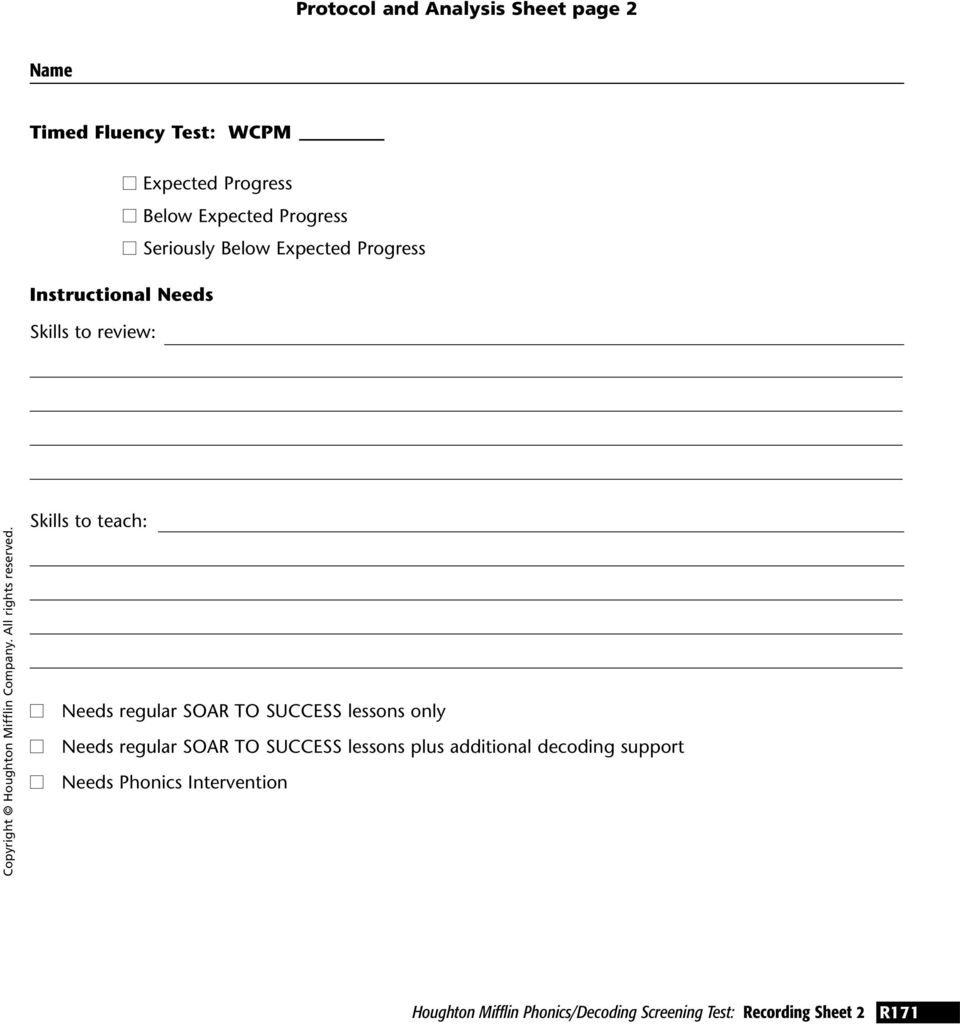
2 Protocol and Analysis Sheet page 2 Name Mark Lester Timed Fluency Test: WCPM 76 Expected Progress Below Expected Progress Seriously Below Expected Progress Instructional Needs Skills to review: Quick review of ph = / f/ Skills to teach: Focus on application of al l decoding skills to multisyllabic words. Use Decoding Longer Words lessons on Optional Day. Does not need Making Words because he already knows basic skills. Place heavy emphasis on CLARIFY/PHONICS: THINK ABOUT WORDS during SOAR lesson. Needs regular SOAR TO SUCCESS lessons only Needs regular SOAR TO SUCCESS lessons plus additional decoding support Needs Phonics Intervention Houghton Mifflin Phonics/Decoding Screening Test: Recording Sheet 2 R7
3 TASK. Letter names Uppercase MATERIALS: Student Materials, p. R76 Say to the student: Tell me the names of these letters. Circle all incorrect responses. If the student cannot name three or more consecutive letters, say: Look at all of the letters and tell me which ones you do know. D A N S X Z J L H T Y E C O M R P W 26 /26 K U G B F Q V I correct TASK 2. Letter Names Lowercase MATERIALS: Student Materials, p. R76 Say to the student: Tell me the names of these letters. Circle all incorrect responses. If the student cannot name three or more consecutive letters, say: Look at all of the letters and tell me which ones you do know. d a n s x z j l h t y e c o m r p w 26 /26 k u g b f q v i correct TASK. Said like in box. Couldn t isolate sound. Consonant Sounds MATERIALS: Student Materials, p. R76 Say to the student: Look at these letters. Tell me the sound each letter stands for. Ask if he or she knows of another sound for the letters g and c. If the sound given is correct, do not mark this form. If it is incorrect, write the sound the student gives above each letter. If no sound is given, circle the letter. If the student cannot say the sound for three or more consecutive letters, say: Look at all of the letters and tell me which sounds you do know. d l n s x z j t y p c h m r 2 /2 k w g b f q v correct R72 Houghton Mifflin Phonics/Decoding Screening Test: Recording Sheet

4 TASK 4. Vowel Sounds MATERIALS: Student Materials, p. R76 Say to the student: Tell me the sounds of each letter. If the student names the letter, count it as the long-vowel sound. Then ask: Can you tell me the other sound for the letter? The student should name the short-vowel sound. s s e i a o u s s s l = long sound s = short sound Record l on the first line for the long sound (letter name) and s for the short sound on the second line. If the student makes an error, record the error over the letter. / Long-vowel sounds (count the number of l s above) / Short-vowel sounds (count the number of s s above) TASK. Reading and Decoding MATERIALS: Student Materials, p. R77 79 For items A through G, students must read both real and pseudowords (made-up words). For the first line of real words, tell the student: I want you to read these words. If the student cannot read two or more of the real words, do not administer the line of pseudowords. Go to the next set of items. Before asking the student to read the line of pseudowords, say: Now I want you to read some made-up words. Do not try to make them sound like real words. A. Short vowels in CVC words / sip cat let but hog (real) / vop fut dit keb laz (pseudo) B. Short vowels, digraphs, and -tch trigraph 4 / when chop rich shut match (real) / wheck shom thax phitch chud (pseudo) C. Consonant blends with short vowels pitch / stop trap quit spell plan (real) / stig brab qued snop dran (pseudo) / clip fast sank limp held (real) / frep nast wunk kimp jelt (pseudo) Houghton Mifflin Phonics/Decoding Screening Test: Recording Sheet 4 R7

5 D. Long-vowel spellings / tape key lute paid feet (real) / loe bine joad vay soat (pseudo) E. r- and l-controlled vowels / bark horn chirp term cold (real) / ferm dall gorf murd char (pseudo) F. Variant spellings and diphthongs / few down toy hawk coin (real) / voot rew fout zoy bawk (pseudo) (Note: Student can pronounce oo in voot as in moon or book.) G. Two-syllable words Administer these items if the student is able to read most of the single-syllable real and pseudowords in the previous items. Say to the student: Now I want you to read down the first column of words. Each of the real words in this column has two syllables. Point to the first column. If the student can read at least three out of eight of the words in this column, say: Now I want you to read some made-up words. Point to the second column. Repeat the same procedure for the third column. Note: The following made-up words can be pronounced in two ways: sunop (su-nop or sun-op); wopam (wo-pam or wop-am); potife (po-tife or pot-ife); zuride (zu-ride or zur-ide); and zubo (zu-bo or zub-o). If words are read correctly, do not make any marks. / Closed kidnap pugnad quilbrap / Silent e compete slifnate prubkine / Open, closed depend sunop wopam / Closed or open, open zero zubo yodu pâo-tâif / Open, silent e locate potife zuride / Consonant-le stable grickle morkle / r-controlled further tirper pharbid / Vowel team outlaw doipnoe loymaud gave both pronunc. zâu-râid R74 Houghton Mifflin Phonics/Decoding Screening Test: Recording Sheet

6 H. Multisyllabic Words Administer these items only if the student is able to read six of the eight items in Task G. Say to the student: Now I want you to read down the first column of words. Each of the real words in this column has more than two syllables. Point to the first column. If the student can read at least three of the 4 words in this column, say: Now I want you to read some made-up words. Point to the second column. If the words are read correctly, make no marks. If words are read incorrectly, record the student s response above the word. Expected pronunciations for the pseudowords are given below the word c ar- -van /2 (Closed, unaccented, closed) caravan petimel (pet i mel) or (pe tim el) /2 (r-controlled, unaccented, silent e) marmalade dorlishane (dor li shane) /2 (Open, closed, closed) momentum bolansun (bo lan sun) or (bol an sun) e marl mald vel vâee ten dorl-ish-an mat loo pen /2 (Closed, unaccented, vowel team) velveteen matlopeen (mat lo peen) or (mat lop een) TASK 6. Spelling A. Give the student a pencil and a sheet of lined paper. Tell the student: Number your paper from through. Listen to each of the words I read and write the first sound you hear. Write the student s responses over the words. /. fit 2. map. pen 4. kid. hand B. Tell the student: Number through. Listen to each of the words I read, and write the last sound you hear. /. rub 2. fled. leg 4. sell. less C. Tell the student: Number through 0. Listen to each of the words I read, and write the whole word. /. fork 2. yarn. sip 4. shop. tub / 6. coin 7. float 8. steep 9. drive 0. spoon Houghton Mifflin Phonics/Decoding Screening Test: Recording Sheet 6 R7

7 Houghton Mifflin Phonics/Decoding Screening Test. D A N S X Z J L H T Y E C O M R P W K U G B F Q V I 2. d a n s x z j l h t y e c o m r p w k u g b f q v i. d l n s x z j t y p c h m r k w g b f q v 4. e i a o u R76 Houghton Mifflin Phonics/Decoding Screening Test: Student Copy, page

8 . Reading and Decoding A. sip cat let but hog vop fut dit keb laz B. when chop rich shut match wheck shom thax phitch chud C. stop trap quit spell plan stig brab qued snop dran clip fast sank limp held frep nast wunk kimp jelt Houghton Mifflin Phonics/Decoding Screening Test: Student Copy, page 2 R77

9 D. tape key lute paid feet loe bine joad vay soat E. bark horn chirp term cold ferm dall gorf murd char F. few down toy hawk coin voot rew fout zoy bawk R78 Houghton Mifflin Phonics/Decoding Screening Test: Student Copy, page

10 G. kidnap pugnad quilbrap compete slifnate prubkine depend sunop wopam zero zubo yodu locate potife zuride stable grickle morkle further tirper pharbid outlaw doipnoe loymaud H. caravan marmalade momentum velveteen petimel dorlishane bolansun matlopeen Houghton Mifflin Phonics/Decoding Screening Test: Student Copy, page 4 R79

California Treasures Phonics Scope and Sequence K-6
 California Treasures Phonics Scope and Sequence K-6 Phonics skills get progressively more complex throughout the grade and year to year (e.g., 1. short vowel CVC words; 2. final e CVCe words; 3. long vowel
Phonics. Phonics is recommended as the first strategy that children should be taught in helping them to read.
 Phonics What is phonics? There has been a huge shift in the last few years in how we teach reading in UK schools. This is having a big impact and helping many children learn to read and spell. Phonics
DRA2 Word Analysis. correlated to. Virginia Learning Standards Grade 1
 DRA2 Word Analysis correlated to Virginia Learning Standards Grade 1 Quickly identify and generate words that rhyme with given words. Quickly identify and generate words that begin with the same sound.
2e. Initial sounds isolate and pronounce in CVC (/c/ in cat) Onsets and rhymes in single
 Kindergarten Common Core ELA Foundational Skills Unit Timeline Trimester 1 Trimester 2 1a. Follow print left to right top to bottom page by page 1b. / 1c.Words recognize letters together in a specific
Intervention Strategies for Struggling Readers
 PROGRAM OVERVIEW Intervention Appropriate K 6 Intervention Strategies for Struggling Readers M BA SE G IL LI NG M ORT N- HA O D PRO G RA What is Recipe for Reading? Recipe for Reading is a research-based,
Houghton Mifflin Harcourt StoryTown Grade 1. correlated to the. Common Core State Standards Initiative English Language Arts (2010) Grade 1
 Houghton Mifflin Harcourt StoryTown Grade 1 correlated to the Common Core State Standards Initiative English Language Arts (2010) Grade 1 Reading: Literature Key Ideas and details RL.1.1 Ask and answer
Indiana Department of Education
 GRADE 1 READING Guiding Principle: Students read a wide range of fiction, nonfiction, classic, and contemporary works, to build an understanding of texts, of themselves, and of the cultures of the United
Kolbe Academy Home School
 GRADE ONE PHONICS A TABLE OF CONTENTS I. Syllabus 2 II. Daily Course Plan A. Quarter 1 4 B. Quarter 2 13 C. Quarter 3 22 D. Quarter 4 31 III. Quarterly Exams A. Quarter 1 B. Quarter 2 C. Quarter 3 D. Quarter
Assessment Directions for Preschool Teachers & Parents:
 Assessment Directions for Preschool Teachers & Parents: Literacy Resources, Inc. created this Phonemic Awareness Assessment, aligned to the Illinois Early Learning and Development Standards to assess a
Progression in each phase for Letters & Sounds:
 Burford School Marlow Bottom Marlow Buckinghamshire SL7 3PQ T: 01628 486655 F: 01628 898103 E: [email protected] W: www.burfordschool.co.uk Headteacher: Karol Whittington M.A., B.Ed. Hons Progression
Picture Sorts for Short- and Long- Vowel Sounds
 Unit I Picture Sorts for Short- and Long- Vowel Sounds NOTES FOR THE TEACHER Background and Objectives These first six picture sorts are designed to focus students attention on the vowel sound in the middle
Unit 1 Title: Word Work Grade Level: 1 st Grade Timeframe: 6 Weeks
 Unit 1 Title: Grade Level: 1 st Grade Timeframe: 6 Weeks Unit Overview: This unit of word work will focus on the student s ability to distinguish long and short vowel sounds in single syllable Students
Transitional Plan Levels J-M Based on 20-minute lesson each day. Prompts for Guided Reading
 Next Step in Guided Reading K-2 Emergent & Early Plan levels A-I Transitional Plan Levels J-M Based on 20-minute lesson each day Based on 20-minute lesson each day Day 1 Day 2 Day 1 Day 2 Day 3 Sight word
Kindergarten Common Core State Standards: English Language Arts
 Kindergarten Common Core State Standards: English Language Arts Reading: Foundational Print Concepts RF.K.1. Demonstrate understanding of the organization and basic features of print. o Follow words from
iboard Phonics Curriculum Guidance
 iboard Phonics Curriculum Guidance Contents Page Summary, Purpose of Document 3 Introduction, Revisit and Review 4 Teach 5 Practice 6 Apply, Assess Learning 7 Phase Descriptors 8 Summary iboard Phonics
Alburnett Community Schools. Theme 1 Finding My Place/ Six Weeks. Phonics: Apply knowledge of letter/sound correspondence.
 3 rd Grade Reading District Curriculum Map Theme 1 Finding My Place/ Six Weeks Apply knowledge of letter/sound correspondence. Learnings or Understandings (ICC) Use a variety of strategies to develop and
Right into Reading. Program Overview Intervention Appropriate K 3+ A Phonics-Based Reading and Comprehension Program
 Right into Reading Program Overview Intervention Appropriate K 3+ A Phonics-Based Reading and Comprehension Program What is Right into Reading? Right into Reading is a phonics-based reading and comprehension
PUSD High Frequency Word List
 PUSD High Frequency Word List For Reading and Spelling Grades K-5 High Frequency or instant words are important because: 1. You can t read a sentence or a paragraph without knowing at least the most common.
Montessori Academy of Owasso
 Montessori Academy of Owasso 5 & 6 Year-Old Curriculum Academic Area: Language Arts Category: Reading: Literature Subcategory: Key Ideas and Details Element 1:With prompting and support, ask and answer
Fantastic Phonics Teaching Guide
 Fantastic Phonics Teaching Guide Book 21 - I want a Pie Momentum Multimedia 2004 New Words: pie, die, lie, tie, sign, fly, said, pulled, too, was, splat, buzz Extra Words: cry, dry, fry, try, high, sign,
Scope and Sequence Skills Strand Grade 1
 The Skills strand of the Core Knowledge Language Arts program teaches students the decoding skills needed for (future) independent reading. Each Skills lesson begins with a warm-up, reviewing previously
Tips for Teaching. Word Recognition
 Word Recognition Background Before children can begin to read they need to understand the relationships between a symbol or a combination of symbols and the sound, or sounds, they represent. The ability
Phonics and Word Work
 Phonics and Word Work Introduction Foundational Skills This guide explores how explicit and systematic phonics and word work instruction is included in the ReadyGEN program. It looks at the resources that
Wednesday 4 th November 2015. Y1/2 Parent Workshop Phonics & Reading
 Wednesday 4 th November 2015 Y1/2 Parent Workshop Phonics & Reading This presentation was an aide memoire for staff during the recent Phonics and Reading Workshop (04.11.15). The aim of the presentation
Assessment Directions for 1 st Grade Teachers & Parents:
 Assessment Directions for 1 st Grade Teachers & Parents: Literacy Resources, Inc. created this Phonemic Awareness & Phonics Assessment to align to the Common Core State Standards for 1 st grade and to
Phonics Scope and Sequence Struggling or At Risk Readers. Phonological Awareness and Letter Naming : Early Literacy Kindergarten or first grade 1
 Phonics Scope and Sequence Struggling or At Risk Readers Phonological Awareness and Letter Naming : Early Literacy Kindergarten or first grade 1 Phonological Awareness 1. Hearing Rhymes 2. Producing rhymes
TRAINGING GUIDE. To Log in type the web address www.readinga-z.com into your browser. This will open the Reading A-Z home page.
 TRAINGING GUIDE Getting Started To Log in type the web address www.readinga-z.com into your browser. This will open the Reading A-Z home page. Click Members at top right hand corner of the screen. Type
Unit 4 Module 1: Administering the Texas Middle School Fluency Assessment
 Unit 4 Module 1: Administering the Texas Middle School Fluency Assessment Section 1 Slide 1 Title Slide Welcome to the first module in the Diagnostic and Progress Monitoring Data unit, Administering the
Unit 2 Title: Word Work Grade Level: 1 st Grade Timeframe: 6 Weeks
 Unit 2 Title: Grade Level: 1 st Grade Timeframe: 6 Weeks Unit Overview: This unit of word work will focus on the student s ability to identify and pronounce the initial, medial vowel, and final sounds.
http://setup.clihome.com/cli.cmap.web/home/maps/viewmapmultipleyear.aspx?teach...
 Page 1 of 6 READING - 1st School Teacher Email Course# Grade Level Lettie Brown Elementary School VanDerVoorn, Lauri [email protected] LA1100 1 Show Icon August 2015 August 2014 Review of
Assessment Directions for Kindergarten Teachers & Parents:
 Assessment Directions for Kindergarten Teachers & Parents: Literacy Resources, Inc. created this Phonemic Awareness Assessment to align to the Common Core State Standards and to assess a child s progress
Mrs. LaBorde s. Words Their Way. Spelling Homework Guide. (Please keep this all year to help with spelling homework!!!)
 Mrs. LaBorde s Words Their Way Homework Guide (Please keep this all year to help with spelling homework!!!) ABOUT WORDS THEIR WAY Words Their Way is a new approach to teaching spelling that allows students
Phonics. Phase 1 6 Support for spelling Monitoring and assessing resources
 Phonics Phase 1 6 Support for spelling Monitoring and assessing resources Phase 1 Letters and Sounds phase 1 - Seven aspects 1) Environmental sounds 2) Instrumental sounds 3) Body percussion 4) Rhythm
the Emergent Stages NOTES FOR THE TEACHER ALPHABET ASSESSMENTS Alphabet Recitation and Tracking Alphabet Recognition Uppercase
 Chapter 1 Assessments for the Emergent Stages NOTES FOR THE TEACHER This chapter provides you with a variety of tools to assess your students in the emergent stage. These assessments, which complement
Diagnostic Assessments of Reading. Second Edition Form A
 Diagnostic Assessments of Reading Second Edition Form A A Snapshot Diagnostic Reading Assessments Ages 5 Adult Reading Levels from Early Reading through High School Nine Tests of Components of Reading
Reading/Fluency Standards Based Annual Goals
 Reading/Fluency First grade (1.5.1) The student will establish letter-naming fluency at a rate of 40-plus letters per minute by the First grade (1.5.3) When given a first grade passage, the student will
Before administering the Basic Phonics Placement Assessment, please familiarlize yourself with this manual and the assessment.
 Directions The is designed to provide information about appropriate placement in the K12 PhonicsWorks Program. Correct placement ensures that students will master early reading skills efficiently and without
Grade 1 LA. 1. 1. 1. 1. Subject Grade Strand Standard Benchmark. Florida K-12 Reading and Language Arts Standards 27
 Grade 1 LA. 1. 1. 1. 1 Subject Grade Strand Standard Benchmark Florida K-12 Reading and Language Arts Standards 27 Grade 1: Reading Process Concepts of Print Standard: The student demonstrates knowledge
Word Journeys & Words Their Way Correlation Chart Note: ES = Emergent Spellers LN = Letter Name WW = Within Word SA = Syllables and Affixes
 Note: Waynesboro Public Schools requires the use of the Developmental Spelling Assessment (DSA) found within the Word Journeys book written by Kathy Ganske. This assessment is administered 3 x/year on
CCSS English/Language Arts Standards Reading: Foundational Skills First Grade
 CCSS.ELA-Literacy.RF.1.1 Demonstrate understanding of the organization and basic features of print. CCSS.ELA-Literacy.RF.1.1.A Recognize the distinguishing features of a sentence (e.g., first word, capitalization,
Class 3. Early Reading Assessment
 Class 3. Early Reading Assessment 1. Phonemic Awareness: Initial Sound Segmentation Assess child s phonemic awareness: the knowledge that words are made of sounds put together. Assess ability to identify
Write your spelling words in alphabetical order. Then write your words in reverse alphabetical order!
 P Write each of your spelling words with a pencil. Then trace over each word three times, using a different color each time. Trace neatly, and you will see a funky rainbow! Use each of your spelling words
Further information is available at: www.standards.dfes.gov.uk/phonics. Introduction
 Phonics and early reading: an overview for headteachers, literacy leaders and teachers in schools, and managers and practitioners in Early Years settings Please note: This document makes reference to the
First Grade Spelling 3-1. First Grade Spelling. 1. an 2. at 3. can 4. cat 5. had 6. man 7. I 8. and 9. the 10. a. Dictation Sentences:
 First Grade Spelling Dear Parents, Beginning this week, the first graders will be starting their spelling program. Each Monday, or the beginning of the week, they will be given a pre-test on 10 words that
INTEGRATING THE COMMON CORE STANDARDS INTO INTERACTIVE, ONLINE EARLY LITERACY PROGRAMS
 INTEGRATING THE COMMON CORE STANDARDS INTO INTERACTIVE, ONLINE EARLY LITERACY PROGRAMS By Dr. Kay MacPhee President/Founder Ooka Island, Inc. 1 Integrating the Common Core Standards into Interactive, Online
TYPES OF SYLLABLES. A syllable that has an R right after the vowel. The vowel sound is neither long nor short.
 TYPES OF SYLLABLES R controlled A syllable that has an R right after the vowel. The vowel sound is neither long nor short. Magic E Always at the end of a word. Magic E jumps over the consonant to make
Bilingual Kindergarten Language Arts Report Card Rubric - Third Six Weeks
 Print Awareness / Phonological Awareness / Phonics I can identify the uppercase and lowercase letters (including diagraphs (ch, ll, rr)) in random order (see chart on report card). K.1(B) The student identifies
Sight words. Alphabet knowledge. Reading at home. Building Language and Literacy at Home. Phonemic Awareness
 + Alphabet knowledge Sight words Phonemic Awareness Reading at home Building Language and Literacy at Home Preschool and Kindergarten Family Night November 3 rd, 2014 + Children s own names and highly
CAMBRIDGE FIRST CERTIFICATE Listening and Speaking NEW EDITION. Sue O Connell with Louise Hashemi
 CAMBRIDGE FIRST CERTIFICATE SKILLS Series Editor: Sue O Connell CAMBRIDGE FIRST CERTIFICATE Listening and Speaking NEW EDITION Sue O Connell with Louise Hashemi PUBLISHED BY THE PRESS SYNDICATE OF THE
Strand: Reading Literature Topics Standard I can statements Vocabulary Key Ideas and Details
 Strand: Reading Literature Key Ideas and Craft and Structure Integration of Knowledge and Ideas RL.K.1. With prompting and support, ask and answer questions about key details in a text RL.K.2. With prompting
Early Reading Behaviours. Phonic Awareness and Sight Vocabulary Assessments
 Early Reading Behaviours. Phonic Awareness and Sight Vocabulary Assessments EARLY READING Behaviour Checklist Name: Date:. Date of Birth Year Group:.. Choose a book and bring it to me. Put it here so we
Massachusetts Tests for Educator Licensure
 Massachusetts Tests for Educator Licensure FIELD 90: FOUNDATIONS OF READING TEST OBJECTIVES Subarea Multiple-Choice Range of Objectives Approximate Test Weighting I. Foundations of Reading Development
Reading and Writing CVCe Words
 Skill: Explicit Phonics Reading and Writing CVCe Words Overview of Activity In a CVCe pattern word, a single vowel is followed by a consonant, which, in turn, is followed by a final e. In approximately
Reading Apps. Letter Names & Sounds
 Reading Apps Letter Names & Sounds App Title App Description Price JANES ABCs 123s JANES ABCs 123s is a set of interactive flash cards, developed to teach children their ABCs and letter sounds. The app
CCSS English/Language Arts Standards Reading: Foundational Skills Kindergarten
 Reading: Foundational Skills Print Concepts CCSS.ELA-Literacy.RF.K.1 Demonstrate understanding of the organization and basic features of print. CCSS.ELA-Literacy.RF.K.1.A Follow words from left to right,
Unit 2 Title: Word Work Grade Level: Kindergarten Timeframe: 6 Weeks
 Unit 2 Title: Grade Level: Kindergarten Timeframe: 6 Weeks Unit Overview: This unit of word work will focus on the student s ability to produce the primary letter sounds of consonants and some vowels;
888.924.7257 www.palsmarketplace.com
 PALS is the essential screening, diagnostic, and progress monitoring tool for measuring the fundamental components of literacy. 888.924.7257 www.palsmarketplace.com PALS Who are we? The Phonological Awareness
Teaching Word Identification and Spelling Word Identification by Rebecca Felton, PhD.
 Teaching Word Identification and Spelling Word Identification by Rebecca Felton, PhD. The importance of decoding to the reading process cannot be underestimated. Perfetti (1984) states that only a reader
Instructional Design: Objectives, Curriculum and Lesson Plans for Reading Sylvia Linan-Thompson, The University of Texas at Austin Haitham Taha,
 Instructional Design: Objectives, Curriculum and Lesson Plans for Reading Sylvia Linan-Thompson, The University of Texas at Austin Haitham Taha, Sakhnin College December xx, 2013 Topics The importance
CCSS English/Language Arts "I Can" Standards Reading: Foundational Skills First Grade
 CCSS.ELA-Literacy.RF.1.1 I can show that I know how books can be read. Reading: Foundational Skills Print Concepts Re- CCSS.ELA-Literacy.RF.1.1.A I can find and point to the first word, the beginning capital
Homework Activities for Kindergarten
 Homework Activities for Kindergarten Listed below are several learning activities for your child to complete at home to reinforce skills being taught in school. The sight words are on the last page. Reading
California Treasures High-Frequency Words Scope and Sequence K-3
 California Treasures High-Frequency Words Scope and Sequence K-3 Words were selected using the following established frequency lists: (1) Dolch 220 (2) Fry 100 (3) American Heritage Top 150 Words in English
Essential Reading Strategies for the Struggling Reader: Activities for an Accelerated Reading Program E X P A N D E D E D I T I O N
 Essential Reading Strategies for the Struggling Reader: Activities for an Accelerated Reading Program E X P A N D E D E D I T I O N www.texasreading.org T E X A S EDUCATION A G E N C Y 2001 University
Grade 1 National Reading Vocabulary Developed by TampaReads - ReadingKey.com/TampaReads.com
 Grade 1 National Reading Vocabulary Developed by TampaReads - ReadingKey.com/TampaReads.com The 340 reading vocabulary words in this 1st Grade reading list have been carefully selected as words which Grade
Phonics: assessment and tracking guidance
 Phonics: assessment and tracking guidance Phonics: assessment and tracking guidance First published in 2009 Ref: 00906-2009PDF-EN-01 Disclaimer The Department for Children, Schools and Families wishes
A Comparison of Jolly Phonics and Jolly Grammar with the Six Phases of Letters and Sounds
 A Comparison of Jolly Phonics and Jolly Grammar with the Six Phases of Letters and Sounds Same Letters and Sounds Jolly Phonics Direct, daily, systematic teaching Active multisensory lessons, including
Plants That Eat Bugs, Level H LANGUAGE AND LITERARY FEATURES SENTENCE COMPLEXITY
 YOU WILL NEED Take-Home Book, Little Wolf s New Home magnetic letters: s, e, e, d, f, r, t, h, w, p, l, g, n word bags highlighter tape NEW BOOK Plants That Eat Bugs, Level H REREADING Little Wolf s New
1. 2. 3. 4. 5. 6. 7. 8.
 arm horn core oar Pick a word from the box to match each picture. Write the word on the line. artist bark garden roar score short start store stork storm 1. 2. 3. 4. 5. 6. 7. 8. Pick a word that is the
Summer Reading Program Implementation Guide
 Summer Reading Program Implementation Guide Summer Reading Program Implementation Guide Contents Overview... 3 Direct Instruction - Adapting for Summer... 4 Direct Instruction - Timeline for Grades 1-3...
Directions: Reading Skills Practice Tests
 Directions: Reading Skills Practice Tests Two Reading Skills Practice Tests can be found on pages 13-16 of this Teacher s Edition. You can photocopy them and use them all at once, or have students do just
Reading Instruction Competence Assessment (RICA )
 Reading Instruction Competence Assessment (RICA ) Domain Range of Objectives Weighting (Approximate) 1. Planning, Organizing, and Managing Reading 001 002 10% Instruction Based on Ongoing Assessment 2.
KINDGERGARTEN. Listen to a story for a particular reason
 KINDGERGARTEN READING FOUNDATIONAL SKILLS Print Concepts Follow words from left to right in a text Follow words from top to bottom in a text Know when to turn the page in a book Show spaces between words
Planning, Organizing, and Managing Reading Instruction Based on Ongoing Assessment
 Reading Instruction Competence Assessment (RICA ) Content Specifications (effective as of the August 8, 2009, test administration) DESCRIPTION OF THE RICA The goal of reading instruction is to develop
WWW.MRSCARRION.WEBS.COM. First Grade High Frequency /Spelling Words
 WWW.MRSCARRION.WEBS.COM Name: First Grade High Frequency /Spelling Words Indicate Words that become decodable and are included in blending lines and word work for that week. 1. can 2. I 3. we 4. like 5.
How To: Promote Phonics Skills: Word Boxes & Word Sort
 How the Common Core Works Series 2013 Jim Wright www.interventioncentral.org 1 How To: Promote Phonics Skills: Word Boxes & Word Sort Young children must master phonics--the mapping of the sounds of speech
coat road own grow yellow show snow coach throw toast toe
 Skills: oa, ow, -oe Introduce Concept 1. Display the flash cards for each of the following sounds: oa, ow, oe 2. Say each sound aloud. Note that each vowel team makes the long o sound. The second vowel
Center/Station Activities for Word Study
 Center/Station Activities for Word Study Word/Picture Sort Connection: All of the activities below should be introduced, modeled and rehearsed with the students before they try them independently. The
Five Pronunciation Games for Brazil
 Five Pronunciation Games for Brazil Mark Hancock with Ricardo Sili I presented a workshop called 'Pronunciation Games for Brazil' with Ricardo Sili at the 13th BRAZ-TESOL National Convention. This article
Thai Pronunciation and Phonetic Symbols Prawet Jantharat Ed.D.
 Thai Pronunciation and Phonetic Symbols Prawet Jantharat Ed.D. This guideline contains a number of things concerning the pronunciation of Thai. Thai writing system is a non-roman alphabet system. This
mclass: Reading 3D Reminders
 mclass: Reading 3D By: Carlos Mattlock Vass Jonesville Elementary School mclass: Reading 3D By: Carlos Mattlock Vass Jonesville Elementary School Hold the device so the child cannot see it Say each word,
READING KINDERGARTEN
 READING KINDERGARTEN Concepts about print Identify the front cover, back cover, and title page of a book. Follow words from left to right and from top to bottom on the printed page. Understand that printed
Directions for Administering the Graded Passages
 Directions for Administering the Graded Passages The versions (A D for grades 9 12; A and B for adult literacy students at grades 1 8) of Graded Passages are about different topics but similar in length
An In-Depth Look at the IEP for Students with Dyslexia
 An In-Depth Look at the IEP for Students with Dyslexia 800.221.4792 20 Roszel Road Princeton NJ 08540 www.learningally.org Individual Education Plans A Document? YES but more importantly A PROCESS! Overview
Teaching Young Children How to Read: Phonics vs. Whole Language. Introduction and Background
 Kelly Waldo Senior Capstone Paper Paoze Thao, PhD California State University Monterey Bay Teaching Young Children How to Read: Phonics vs. Whole Language Introduction and Background I am interested in
CCSS English/Language Arts "I Can" Standards Reading: Foundational Skills Kindergarten
 CCSS.ELA-Literacy.RF.K.1 I can show that I know how books should be read. CCSS.ELA-Literacy.RF.K.1.A I can read the words in a book in the right order. CCSS.ELA-Literacy.RF.K.1.B I can understand that
Phonemic Awareness. Section III
 Section III Phonemic Awareness Rationale Without knowledge of the separate sounds that make up words, it is difficult for children to hear separate sounds, recognize the sound s position in a word, and
20 by Renaissance Learning, Inc. All rights reserved. Printed in the United States of America.
 R4 Advanced Technology for, Renaissance, Renaissance Learning, Renaissance Place, STAR Early Literacy, STAR Math, and STAR Reading, are trademarks of Renaissance Learning, Inc., and its subsidiaries, registered,
Welcome to the exciting world of Jolly Phonics!
 Welcome to the exciting world of Jolly Phonics! You can check out http://www.jollylearning.co.uk/ if you want to see more about the company itself. Here s some information listed on the site: Jolly Phonics
What ARE the Other Kids Doing? K-2 Meaningful Literacy Centers
 What ARE the Other Kids Doing? K-2 Meaningful Literacy Centers Kathy Bumgardner Literacy Specialist / Consultant National Consulting Author Macmillan McGraw Hill [email protected] Kathy Keane ELA Curriculum
MCGF CE TI GE LS CS HOTS
 First Grade Reading District Curriculum Map Good Times we Share: Lunch Week 1 Use letter-sound correspondence to decode words and build a sight word vocabulary. Letter-sound association: /m/, /r/, /s/
Tapescript. B Listen and write the words. C Help the baby spider. Draw a red line. D Help the baby frog. Listen and draw a green line.
 Unit 1 Hello! Topics animals, colours, numbers Functions following instructions, spelling and writing Grammar questions (What s? What are? What colour?), demonstratives (this/these), imperatives Vocabulary
Helping your child with Reading
 Helping your child with Reading Some ways that you can support. Getting Started Sharing books - We teach phonics to help our children learn to read and write and in order to do this successfully they need
Guidelines for Examining Phonics & Word Recognition
 Guidelines for Examining Phonics & Word Recognition Revised Edition 2002 Texas Education Agency. These materials are copyrighted and trademarked as the property of the Texas Education Agency and may not
Wilson Reading System Rules Notebook
 Wilson Reading System Rules Notebook Compiled by Mrs. Loy Updated May 2004 May 2005 May 2009 Book One 1.1 1.3 Consonants b, c, d, f, g, h, j, k, l, m, n, p, q, r, s, t, v, w, x, y, z Vowels a apple e Ed
Domain and goal Activities Dancing game Singing/Vocalizing game Date What did your child do?
 AUDITION Sways, dances or vocalizes to music and singing CD, MP3, radio Voice Bombardment of /p/ Speech Sounds p.5 6 An important aspect of learning to listen is learning that music and singing is different
Measurable Annual Goals
 Measurable Annual Goals This document was developed to help special education teachers begin transitioning from standards based IEP goals to measurable annual goals that are specific to individual student
Starting Points. Assessment Guide
 Starting Points Assessment Guide Mā te mōhio ka ora: mā te ora ka mōhio Through learning there is life: through life there is learning! The Tertiary Education Commission would like to thank the many people
In English there are 26 letters which represent 44 phonemes. These phonemes are represented by approximately 140 different letter combinations.
 PHONIC RULES/PATTERNS, WHICH MAY BE USEFUL AT EACH PHASE OF LETTERS AND SOUNDS NB: These rules are equally relevant to other synthetic phonics programmes In English there are 26 letters which represent
Reading IV Grade Level 4
 Reading IV Reading IV introduces students to a variety of topics to enrich their reading experience including: a review of consonant and vowel sounds using phonetic clues and diacritical marks to identify
Counting Money and Making Change Grade Two
 Ohio Standards Connection Number, Number Sense and Operations Benchmark D Determine the value of a collection of coins and dollar bills. Indicator 4 Represent and write the value of money using the sign