
DRA2 Word Analysis. correlated to. Virginia Learning Standards Grade 1
|
|
|
- Francis McCarthy
- 9 years ago
- Views:
Transcription
1 DRA2 Word Analysis correlated to Virginia Learning Standards Grade 1

2 Quickly identify and generate words that rhyme with given words. Quickly identify and generate words that begin with the same sound. Quickly segment spoken sentences into words words into onset and rime and/or syllables. Quickly identify, blend, segment, and manipulate phonemes in spoken words. Strand 1: Phonological Awareness Rhyming Task 1: Students identify a picture that rhymes with the first picture in the set. Task 13: Students provide a word that rhymes with a word given by the teacher Alliteration Task 2: Students identify a picture that begins with the same sound as the first picture in the set. Task 19: Students provide a word that begins with the same sound as the word given by the teacher. Segmentation Task 8: Students use a number line to show the number of words in a sentence. Task 14: Students segment a given word by separating the onset from the rime. Task 18: Students clap the syllables as they say a pictured word. Phonemic Awareness Task 3: Students isolate the initial sound of a word given by the teacher. Task 12: Students repeat segmented phonemes in a word and then say the word. c) Create rhyming words orally. b) Add or delete phonemes (sounds) orally to a) Count phonemes (sounds) in syllables or words with a maximum of three syllables. b) Add or delete phonemes (sounds) orally to d) Blend sounds to make word parts and words with one to three syllables. b) Add or delete phonemes (sounds) orally to 1

3 Understand language used to talk about basic printed language concepts; continue to learn terms used to talk about printed language, i.e., vowel, consonant, prefix, suffix, syllable, etc. Task 15: Students repeat a word given by the teacher without the first sound(s). Task 20: Students repeat a word given by the teacher without the last sound(s). Task 21: Students segment a given word into phonemes. Strand 2: Metalanguage Task 4: Students demonstrate that they understand language used to talk about printed language concepts using their first and last names. Task 7: Students demonstrate that they understand language used to talk about printed language concepts using words in sentences. 1.1 The student will continue to demonstrate growth in the use of oral language. a) Listen and respond to a variety of media, including books, audiotapes, videos, and other age-appropriate materials. 1.2 The student will continue to expand and use listening and speaking vocabularies. a) Increase oral descriptive vocabulary. 1.5 The student will apply knowledge of how print is organized and read. b) Match spoken words with print. c) Identify letters, words, and sentences. Automatically recognize, name, and form the uppercase and lowercase letters of the alphabet Strand 3: Letter and Word Recognition Letter Recognition Task 5: Students name randomly placed uppercase letters. Task 6: Students name randomly placed lowercase letters. Possess a large and ever-increasing number of High Frequency Word Recognition 1.5 The student will apply knowledge of how 2

4 "sight" words automatically recognized and understood. Tasks 9, 17, 22, 29: Students read as quickly as possible lists of high frequency words that increase in difficulty. print is organized and read. b) Match spoken words with print. c) Identify letters, words, and sentences. 1.8 The student will read familiar stories, poems, and passages with fluency and expression. spell many high frequency words conventionally; segment words into syllables, onset and rime, and phonemes as neededto sound out words; use analogies for spelling patterns that cannot be sounded out; reflect their current knowledge of sound/spelling patterns in their spelling approximations. Strand 4: Phonics Encoding Task 10: Students spell two to three-letter high frequency words. Task 16: Students spell words with short vowels and common spelling patterns. Task 27: Students spell words with VCe, initial diagraphs, pre-consonant nasals, or suffixes. Task 36: Students spell words with r- controlled vowels, suffixes, initial blends, ck, or open first syllable. Task 40: Students spell words with prefixes, closed first syllables, suffixes, three-letter initial blends, diphthongs, or long vowel patterns. a) Use beginning and ending consonants to b) Use two-letter consonant blends to decode and spell single-syllable words. c) Use beginning consonant digraphs to d) Use short vowel sounds to decode and spell single-syllable words. e) Blend beginning, middle, and ending sounds to recognize and read words. f) Use word patterns to decode unfamiliar words The student will write to communicate ideas. f) Use correct spelling for high-frequency sight words and phonetically regular words 3

5 in final copies. Automatically identify and associate spelling patterns with sounds; identify letters that represent more than one sound i.e., c or a identify vowel patterns; quickly blend letter sounds and generate words or names that begin with the designated sound(s). Decoding Task 11: Students provide the phoneme for each letter and give a word or name that begins with that phoneme. Task 25: Students blend two to three consonantletter sounds and say a word or name that begins with the consonant blend. Task 26: Students tell how the words with the same vowel are alike, say the long and short sounds of the designated vowel, and read the words in each set. Task 32: Students identify the vowel pattern in a set of words and read aloud the words. a) Use beginning and ending consonants to b) Use two-letter consonant blends to decode and spell single-syllable words. c) Use beginning consonant digraphs to d) Use short vowel sounds to decode and spell single-syllable words. e) Blend beginning, middle, and ending sounds to recognize and read words. f) Use word patterns to decode unfamiliar words. Know when to sound out words; attend to spelling patterns and use analogies to identify unknown words. Task 33: Students blend a group of letters and give a word that makes sense and begins with those blended sounds. Substitution/Analogies Task 23: Students tell how the words are alike and read aloud the rhyming words in each set. Task 24: Students tell how the words are alike and read aloud the words in each set. Task 30: Students read six sets of words with different rimes. Task 31: Students use parts of familiar words to a) Use beginning and ending consonants to b) Use two-letter consonant blends to decode and spell single-syllable words. c) Use beginning consonant digraphs to d) Use short vowel sounds to decode and spell single-syllable words. e) Blend beginning, middle, and ending 4
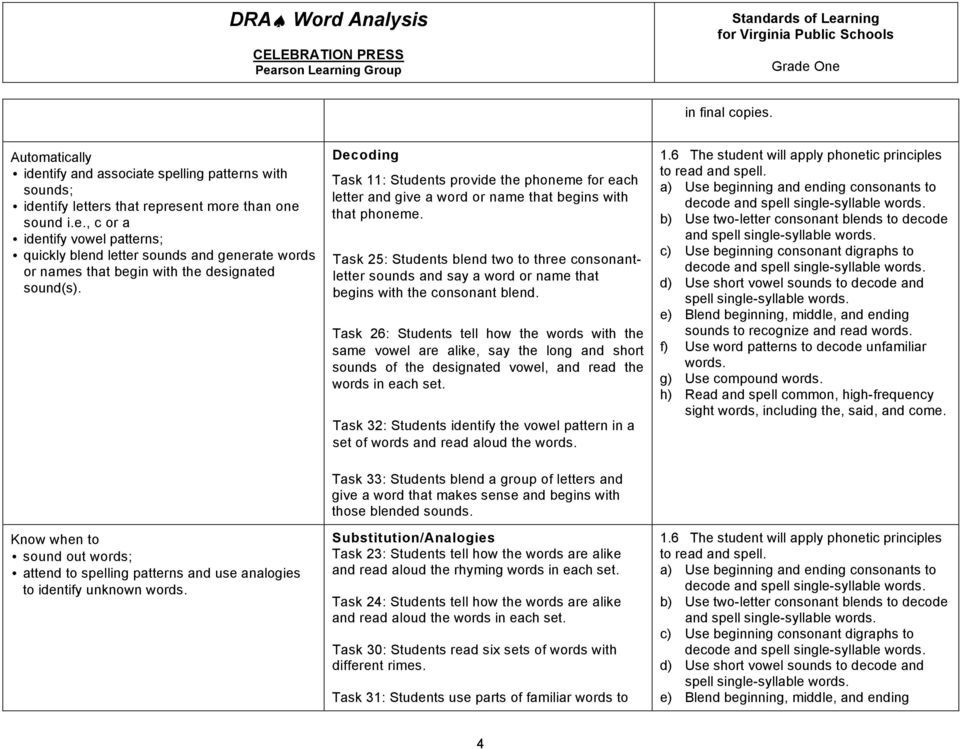
6 problem-solve unknown words. Strand 5: Structural Analysis and Syllabication sounds to recognize and read words. f) Use word patterns to decode unfamiliar words. Identify and isolate word parts such as affixes and base or root words; understand the meaning of commonly used prefixes and suffixes; use structural analysis to determine word meanings. Recognize and use syllable patterns to decode polysyllabic words; analyze the pattern of vowels and consonants in a word to determine where the word breaks into syllables. Tasks 28, 35, 38: Students read aloud and use each word to which a suffix has been added in a sentence to demonstrate their understanding of the word. Task 37: Students read aloud and tell the meaning of each word to which a prefix has been added. Tasks 34, 39: Students read aloud a polysyllabic word, clap the syllables while saying the word, and tell where to divide the word into syllables. d) Count phonemes (sounds) in syllables or words with a maximum of three syllables. e) Add or delete phonemes (sounds) orally to 5
Interpreting areading Scaled Scores for Instruction
 Interpreting areading Scaled Scores for Instruction Individual scaled scores do not have natural meaning associated to them. The descriptions below provide information for how each scaled score range should
Kindergarten Common Core State Standards: English Language Arts
 Kindergarten Common Core State Standards: English Language Arts Reading: Foundational Print Concepts RF.K.1. Demonstrate understanding of the organization and basic features of print. o Follow words from
Indiana Department of Education
 GRADE 1 READING Guiding Principle: Students read a wide range of fiction, nonfiction, classic, and contemporary works, to build an understanding of texts, of themselves, and of the cultures of the United
Strand: Reading Literature Topics Standard I can statements Vocabulary Key Ideas and Details
 Strand: Reading Literature Key Ideas and Craft and Structure Integration of Knowledge and Ideas RL.K.1. With prompting and support, ask and answer questions about key details in a text RL.K.2. With prompting
Unit 2 Title: Word Work Grade Level: 1 st Grade Timeframe: 6 Weeks
 Unit 2 Title: Grade Level: 1 st Grade Timeframe: 6 Weeks Unit Overview: This unit of word work will focus on the student s ability to identify and pronounce the initial, medial vowel, and final sounds.
Unit 1 Title: Word Work Grade Level: 1 st Grade Timeframe: 6 Weeks
 Unit 1 Title: Grade Level: 1 st Grade Timeframe: 6 Weeks Unit Overview: This unit of word work will focus on the student s ability to distinguish long and short vowel sounds in single syllable Students
Grade 1 LA. 1. 1. 1. 1. Subject Grade Strand Standard Benchmark. Florida K-12 Reading and Language Arts Standards 27
 Grade 1 LA. 1. 1. 1. 1 Subject Grade Strand Standard Benchmark Florida K-12 Reading and Language Arts Standards 27 Grade 1: Reading Process Concepts of Print Standard: The student demonstrates knowledge
CCSS English/Language Arts Standards Reading: Foundational Skills Kindergarten
 Reading: Foundational Skills Print Concepts CCSS.ELA-Literacy.RF.K.1 Demonstrate understanding of the organization and basic features of print. CCSS.ELA-Literacy.RF.K.1.A Follow words from left to right,
Reading/Fluency Standards Based Annual Goals
 Reading/Fluency First grade (1.5.1) The student will establish letter-naming fluency at a rate of 40-plus letters per minute by the First grade (1.5.3) When given a first grade passage, the student will
INTEGRATING THE COMMON CORE STANDARDS INTO INTERACTIVE, ONLINE EARLY LITERACY PROGRAMS
 INTEGRATING THE COMMON CORE STANDARDS INTO INTERACTIVE, ONLINE EARLY LITERACY PROGRAMS By Dr. Kay MacPhee President/Founder Ooka Island, Inc. 1 Integrating the Common Core Standards into Interactive, Online
Massachusetts Tests for Educator Licensure
 Massachusetts Tests for Educator Licensure FIELD 90: FOUNDATIONS OF READING TEST OBJECTIVES Subarea Multiple-Choice Range of Objectives Approximate Test Weighting I. Foundations of Reading Development
Houghton Mifflin Harcourt StoryTown Grade 1. correlated to the. Common Core State Standards Initiative English Language Arts (2010) Grade 1
 Houghton Mifflin Harcourt StoryTown Grade 1 correlated to the Common Core State Standards Initiative English Language Arts (2010) Grade 1 Reading: Literature Key Ideas and details RL.1.1 Ask and answer
Ohio Early Learning and Development Standards Domain: Language and Literacy Development
 Ohio Early Learning and Development Standards Domain: Language and Literacy Development Strand: Listening and Speaking Topic: Receptive Language and Comprehension Infants Young Toddlers (Birth - 8 months)
2e. Initial sounds isolate and pronounce in CVC (/c/ in cat) Onsets and rhymes in single
 Kindergarten Common Core ELA Foundational Skills Unit Timeline Trimester 1 Trimester 2 1a. Follow print left to right top to bottom page by page 1b. / 1c.Words recognize letters together in a specific
Dynamic Learning Maps Essential Elements English Language Arts. Version 2 Comparison Document
 Dynamic Learning Maps Essential Elements English Language Arts Version 2 Comparison Document COMMON CORE ESSENTIAL ELEMENTS AND ACHIEVEMENT DESCRIPTORS FOR KINDERGARTEN Kindergarten English Language Arts
ELAGSEKRI7: With prompting and support, describe the relationship between illustrations and the text (how the illustrations support the text).
 READING LITERARY (RL) Key Ideas and Details ELAGSEKRL1: With prompting and support, ask and answer questions about key details in a text. ELAGSEKRL2: With prompting and support, retell familiar stories,
OCPS Curriculum, Instruction, Assessment Alignment
 OCPS Curriculum, Instruction, Assessment Alignment Subject Area: Grade: Strand 1: Standard 1: Reading and Language Arts Kindergarten Reading Process The student demonstrates knowledge of the concept of
Phonics and Word Work
 Phonics and Word Work Introduction Foundational Skills This guide explores how explicit and systematic phonics and word work instruction is included in the ReadyGEN program. It looks at the resources that
Selecting Research Based Instructional Programs
 Selecting Research Based Instructional Programs Marcia L. Grek, Ph.D. Florida Center for Reading Research Georgia March, 2004 1 Goals for Today 1. Learn about the purpose, content, and process, for reviews
Grading Benchmarks FIRST GRADE. Trimester 4 3 2 1 1 st Student has achieved reading success at. Trimester 4 3 2 1 1st In above grade-level books, the
 READING 1.) Reads at grade level. 1 st Student has achieved reading success at Level 14-H or above. Student has achieved reading success at Level 10-F or 12-G. Student has achieved reading success at Level
Support for Standards-Based Individualized Education Programs: English Language Arts K-12. Guidance for West Virginia Schools and Districts
 Support for Standards-Based Individualized Education Programs: English Language Arts K-12 Guidance for West Virginia Schools and Districts Office of Special Programs West Virginia Department of Education
Reading Competencies
 Reading Competencies The Third Grade Reading Guarantee legislation within Senate Bill 21 requires reading competencies to be adopted by the State Board no later than January 31, 2014. Reading competencies
As Approved by State Board 4/2/09
 Improving students' ability to learn, communicate, and collaborate through literacy education As Approved by State Board 4/2/09 Nebraska Language Arts Standards As approved by State Board 4/2/09 Table
Suggested Components for 90-Minute Wave 1 Literacy Blocks throughout Primary years
 Suggested s for 90-Minute Wave 1 Literacy Blocks throughout Primary years Notes 1. These are suggestions only but reflect the need to include components of each of the Big Six in each Literacy Block. 2.
CCSS English/Language Arts Standards Reading: Foundational Skills First Grade
 CCSS.ELA-Literacy.RF.1.1 Demonstrate understanding of the organization and basic features of print. CCSS.ELA-Literacy.RF.1.1.A Recognize the distinguishing features of a sentence (e.g., first word, capitalization,
Word Journeys & Words Their Way Correlation Chart Note: ES = Emergent Spellers LN = Letter Name WW = Within Word SA = Syllables and Affixes
 Note: Waynesboro Public Schools requires the use of the Developmental Spelling Assessment (DSA) found within the Word Journeys book written by Kathy Ganske. This assessment is administered 3 x/year on
There are many reasons why reading can be hard. This handout describes
 Understand the problems a child may be having with reading, and target what you can do to help! Look inside for practical, research-based information for parents and teachers about: Phonological and Phonemic
Academic Standards for Reading, Writing, Speaking, and Listening
 Academic Standards for Reading, Writing, Speaking, and Listening Pre-K - 3 REVISED May 18, 2010 Pennsylvania Department of Education These standards are offered as a voluntary resource for Pennsylvania
Guidelines for Examining Phonics & Word Recognition
 Guidelines for Examining Phonics & Word Recognition Revised Edition 2002 Texas Education Agency. These materials are copyrighted and trademarked as the property of the Texas Education Agency and may not
KINDGERGARTEN. Listen to a story for a particular reason
 KINDGERGARTEN READING FOUNDATIONAL SKILLS Print Concepts Follow words from left to right in a text Follow words from top to bottom in a text Know when to turn the page in a book Show spaces between words
Teaching Reading Essentials:
 Teaching Reading Essentials: Video Demonstrations of Small-Group Interventions OVERVIEW Fully aligned with and This is the professional development you ve been asking for! TM Sopris West Educating Our
Year 1 reading expectations (New Curriculum) Year 1 writing expectations (New Curriculum)
 Year 1 reading expectations Year 1 writing expectations Responds speedily with the correct sound to graphemes (letters or groups of letters) for all 40+ phonemes, including, where applicable, alternative
http://setup.clihome.com/cli.cmap.web/home/maps/viewmapmultipleyear.aspx?teach...
 Page 1 of 6 READING - 1st School Teacher Email Course# Grade Level Lettie Brown Elementary School VanDerVoorn, Lauri [email protected] LA1100 1 Show Icon August 2015 August 2014 Review of
Test Blueprint. Grade 3 Reading. 2010 English Standards of Learning
 Test Blueprint Grade 3 Reading 2010 English Standards of Learning This revised test blueprint will be effective with the administration of the 2012-2013 English Standards of Learning (SOL) tests. Notice
Reading IV Grade Level 4
 Reading IV Reading IV introduces students to a variety of topics to enrich their reading experience including: a review of consonant and vowel sounds using phonetic clues and diacritical marks to identify
Reading K 10 Grade Level Expectations: A New Level of Specificity
 Reading K 10 Grade Level Expectations: A New Level of Specificity Washington State s Essential Academic Learning Requirements Introduction Contents Introduction................................... 1 Overview..................................
READING KINDERGARTEN
 READING KINDERGARTEN Concepts about print Identify the front cover, back cover, and title page of a book. Follow words from left to right and from top to bottom on the printed page. Understand that printed
APPENDIX B CHECKLISTS
 APPENDIX B CHECKLISTS Kindergarten First Grade Second Grade Third Grade 69 70 Teacher Visit 1 By: Date / / Time - WG SG Visit 2 By: Date / / Time - WG SG Visit 3 By: Date / / Time - WG SG VISITS 1 2 3
Montessori Academy of Owasso
 Montessori Academy of Owasso 5 & 6 Year-Old Curriculum Academic Area: Language Arts Category: Reading: Literature Subcategory: Key Ideas and Details Element 1:With prompting and support, ask and answer
Phonological Awareness and Phonics
 Kindergarten and First Grade Student Center Activities Phonological Awareness and Phonics Produced by the Florida Center for Reading Research Copyright Florida Department of Education 2005 Revised June,
20 by Renaissance Learning, Inc. All rights reserved. Printed in the United States of America.
 R4 Advanced Technology for, Renaissance, Renaissance Learning, Renaissance Place, STAR Early Literacy, STAR Math, and STAR Reading, are trademarks of Renaissance Learning, Inc., and its subsidiaries, registered,
Alburnett Community Schools. Theme 1 Finding My Place/ Six Weeks. Phonics: Apply knowledge of letter/sound correspondence.
 3 rd Grade Reading District Curriculum Map Theme 1 Finding My Place/ Six Weeks Apply knowledge of letter/sound correspondence. Learnings or Understandings (ICC) Use a variety of strategies to develop and
California. www.heinemann.com Phone: 800.225.5800
 California Preschool Learning Foundations, Vol. 1 (Foundations in Language and Literacy) and The Continuum of Literacy Learning, Grades PreK 8: A Guide to Teaching by Gay Su Pinnell and Irene C. Fountas
Child-speak Reading Level 1 APP AF1 AF2 AF3 AF4 AF5 AF6 AF7 Use a range of strategies, including accurate decoding text, to read for meaning
 Child-speak Reading Level 1 APP In some usually I can break down and blend consonant vowel consonant words e.g. cat (1c) I can recognise some familiar words in the I read. (1c) When aloud, I know the sentences
Create stories, songs, plays, and rhymes in play activities. Act out familiar stories, songs, rhymes, plays in play activities
 PRESCHOOL Language Arts Literacy Expectation 1 Children listen and respond to environmental sounds, directions, and conversations. NJCCC K-12 Standard 3.4 Listening Strand A: Active Listening Strand B:
MFL skills map. Year 3 Year 4 Year 5 Year 6 Develop understanding of the sounds of Individual letters and groups of letters (phonics).
 listen attentively to spoken language and show understanding by joining in and responding explore the patterns and sounds of language through songs and rhymes and link the spelling, sound and meaning of
Table of Contents. Introduction 12 Standard Organization 18. K-5 Reading 20 Enduring Understandings 20 Essential Questions 21
 Table of Contents Introduction 12 Standard Organization 18 K-5 Reading 20 Enduring Understandings 20 Essential Questions 21 Reading Literature (RL) 21 RL 1 21 RL 2 22 RL 3 22 RL 4 23 RL 5 23 RL 6 24 RL
Reading Readiness Online
 4433 Bissonnet Bellaire, Texas 77401 713.664.7676 f: 713.664.4744 Reading Readiness Online Lesson 1: Introduction Prerequisite Reading Skills What is Reading? Reading is a process in which symbols on paper
Fantastic Phonics Teaching Guide
 Fantastic Phonics Teaching Guide Book 21 - I want a Pie Momentum Multimedia 2004 New Words: pie, die, lie, tie, sign, fly, said, pulled, too, was, splat, buzz Extra Words: cry, dry, fry, try, high, sign,
ENGLISH LANGUAGE ARTS
 ENGLISH LANGUAGE ARTS INTRODUCTION Clear student learning outcomes and high learning standards in the program of studies are designed to prepare students for present and future language requirements. Changes
Bilingual Kindergarten Language Arts Report Card Rubric - Third Six Weeks
 Print Awareness / Phonological Awareness / Phonics I can identify the uppercase and lowercase letters (including diagraphs (ch, ll, rr)) in random order (see chart on report card). K.1(B) The student identifies
WiggleWorks Aligns to Title I, Part A
 WiggleWorks Aligns to Title I, Part A The purpose of Title I, Part A Improving Basic Programs is to ensure that children in high-poverty schools meet challenging State academic content and student achievement
Adult Ed ESL Standards
 Adult Ed ESL Standards Correlation to For more information, please contact your local ESL Specialist: Basic www.cambridge.org/chicagoventures Please note that the Chicago Ventures correlations to the City
Put Reading First. The Research Building Blocks For Teaching Children to Read. Kindergarten Through Grade 3. Third Edition
 Put Reading First Kindergarten Through Grade 3 The Research Building Blocks For Teaching Children to Read Third Edition The Research Building Blocks for Teaching Children to Read Put Reading First Kindergarten
A Consumer s Guide to Evaluating a Core Reading Program Grades K-3: A Critical Elements Analysis
 A Consumer s Guide to Evaluating a Core Reading Program Grades K-3: A Critical Elements Analysis National Center to Improve thetools of Educators Deborah C. Simmons, Ph. D. Edward J. Kame enui, Ph. D.
Unit 2 Title: Word Work Grade Level: Kindergarten Timeframe: 6 Weeks
 Unit 2 Title: Grade Level: Kindergarten Timeframe: 6 Weeks Unit Overview: This unit of word work will focus on the student s ability to produce the primary letter sounds of consonants and some vowels;
Right into Reading. Program Overview Intervention Appropriate K 3+ A Phonics-Based Reading and Comprehension Program
 Right into Reading Program Overview Intervention Appropriate K 3+ A Phonics-Based Reading and Comprehension Program What is Right into Reading? Right into Reading is a phonics-based reading and comprehension
Reading Instruction Competence Assessment (RICA )
 Reading Instruction Competence Assessment (RICA ) Domain Range of Objectives Weighting (Approximate) 1. Planning, Organizing, and Managing Reading 001 002 10% Instruction Based on Ongoing Assessment 2.
Students with Reading Problems Their Characteristics and Needs
 Students with Reading Problems Their Characteristics and Needs Roxanne Hudson, Ph.D. Florida Center for Reading Research Florida State University [email protected] We want all students to read grade level
Planning, Organizing, and Managing Reading Instruction Based on Ongoing Assessment
 Reading Instruction Competence Assessment (RICA ) Content Specifications (effective as of the August 8, 2009, test administration) DESCRIPTION OF THE RICA The goal of reading instruction is to develop
LiteracyPlanet & the Australian Curriculum: Pre-School
 LiteracyPlanet & the Australian Curriculum: Pre-School We look at learning differently. LiteracyPlanet & the Australian Curriculum Welcome to LiteracyPlanet & the Australian Curriculum. LiteracyPlanet
Phonics: assessment and tracking guidance
 Phonics: assessment and tracking guidance Phonics: assessment and tracking guidance First published in 2009 Ref: 00906-2009PDF-EN-01 Disclaimer The Department for Children, Schools and Families wishes
LAFS: Language Arts Florida Standards GRADE: K
 LAFS: Language Arts Florida Standards GRADE: K Strand: READING S FOR LITERATURE Cluster 1: Key Ideas and Details CODE LAFS.K.RL.1.1 LAFS.K.RL.1.2 LAFS.K.RL.1.3 With prompting and support, ask and answer
CCSS English/Language Arts "I Can" Standards Reading: Foundational Skills First Grade
 CCSS.ELA-Literacy.RF.1.1 I can show that I know how books can be read. Reading: Foundational Skills Print Concepts Re- CCSS.ELA-Literacy.RF.1.1.A I can find and point to the first word, the beginning capital
Meeting the Standard in Virginia
 KINDERGARTEN Phonological Awareness K.1a Phonological Awareness K.1e Phonological Awareness K.1f Oral Communication K.2b-d Phonological Awareness K.4b Concept of Print K.5d Letters and Sounds K.7a Letters
iboard Phonics Curriculum Guidance
 iboard Phonics Curriculum Guidance Contents Page Summary, Purpose of Document 3 Introduction, Revisit and Review 4 Teach 5 Practice 6 Apply, Assess Learning 7 Phase Descriptors 8 Summary iboard Phonics
Intervention Strategies for Struggling Readers
 PROGRAM OVERVIEW Intervention Appropriate K 6 Intervention Strategies for Struggling Readers M BA SE G IL LI NG M ORT N- HA O D PRO G RA What is Recipe for Reading? Recipe for Reading is a research-based,
Grade 3 LA. 3. 1. 1. 1. Subject Grade Strand Standard Benchmark. Florida K-12 Reading and Language Arts Standards 55
 Grade 3 LA. 3. 1. 1. 1 Subject Grade Strand Standard Benchmark Florida K-12 Reading and Language Arts Standards 55 Grade 3: Reading Process Phonics/Word Analysis Standard: The student demonstrates knowledge
St. Petersburg College. RED 4335/Reading in the Content Area. Florida Reading Endorsement Competencies 1 & 2. Reading Alignment Matrix
 Course Credit In-service points St. Petersburg College RED 4335/Reading in the Content Area Florida Reading Endorsement Competencies 1 & 2 Reading Alignment Matrix Text Rule 6A 4.0292 Specialization Requirements
To learn to read is to light a fire; every syllable that is spelled out is a spark." Victor Hugo, Les Miserables
 To learn to read is to light a fire; every syllable that is spelled out is a spark." Victor Hugo, Les Miserables Development and Management of an Effective Reading Intervention Program Research into Practice
Starting Points. Assessment Guide
 Starting Points Assessment Guide Mā te mōhio ka ora: mā te ora ka mōhio Through learning there is life: through life there is learning! The Tertiary Education Commission would like to thank the many people
Diagnostic Assessments of Reading. Second Edition Form A
 Diagnostic Assessments of Reading Second Edition Form A A Snapshot Diagnostic Reading Assessments Ages 5 Adult Reading Levels from Early Reading through High School Nine Tests of Components of Reading
Adult General Education Standards and Curriculum Frameworks 2016-2017
 Adult General Education Standards and Curriculum Frameworks 2016-2017 Division of Career and Adult Education Florida Department of Education Rule 6A-6.0571 Effective July, 2016 Florida Department of Education
Essential Reading Strategies for the Struggling Reader: Activities for an Accelerated Reading Program E X P A N D E D E D I T I O N
 Essential Reading Strategies for the Struggling Reader: Activities for an Accelerated Reading Program E X P A N D E D E D I T I O N www.texasreading.org T E X A S EDUCATION A G E N C Y 2001 University
The National Reading Panel: Five Components of Reading Instruction Frequently Asked Questions
 The National Reading Panel: Five Components of Reading Instruction Frequently Asked Questions Phonemic Awareness What is a phoneme? A phoneme is the smallest unit of sound in a word. For example, the word
Common Core State Standards English Language Arts. IEP Goals and Objectives Guidance: Basic Format
 Current Academic Achievement Common Core State Standards English Language Arts IEP Goals and Objectives Guidance: Basic Format Just as you have, address a deficit by stating what the student can do relative
Tips for Teaching. Word Recognition
 Word Recognition Background Before children can begin to read they need to understand the relationships between a symbol or a combination of symbols and the sound, or sounds, they represent. The ability
& Sample Lesson. Before Reading. Sight Word Review (1 minute)
 Planning Support & Sample Lesson TIP The Early Guided Reading Lesson Plan found on page 190 in the Appendix is a template you can use to plan your lessons. Each component of the lesson is described in
CCSS English/Language Arts "I Can" Standards Reading: Foundational Skills Kindergarten
 CCSS.ELA-Literacy.RF.K.1 I can show that I know how books should be read. CCSS.ELA-Literacy.RF.K.1.A I can read the words in a book in the right order. CCSS.ELA-Literacy.RF.K.1.B I can understand that
Office Phone/E-mail: 963-1598 / [email protected] Office Hours: MW 3:50-4:50, TR 12:00-12:30
 ENG 432/532: Phonetics and Phonology (Fall 2010) Course credits: Four (4) Time/classroom: MW2:00-3:40 p.m./ LL243 Instructor: Charles X. Li, Ph.D. Office location: LL403H Office Phone/E-mail: 963-1598
Grade 1 Overview ------------------------------------------------------------------------------------------------------------
 Grade 1 Overview ------------------------------------------------------------------------------------------------------------ What are the 6 themes we will be looking at during PYP? The framework, called
What Does Research Tell Us About Teaching Reading to English Language Learners?
 Jan/Feb 2007 What Does Research Tell Us About Teaching Reading to English Language Learners? By Suzanne Irujo, ELL Outlook Contributing Writer As a classroom teacher, I was largely ignorant of, and definitely
First Grade in California Public Schools. and the Common Core State Standards
 A Look at First Grade in California Public Schools and the Common Core State Standards CURRICULUM FRAMEWORKS AND INSTRUCTIONAL RESOURCES DIVISION INSTRUCTION AND LEARNING SUPPORT BRANCH CALIFORNIA DEPARTMENT
Domain II: Phonological and Other Linguistic Processes Related to Reading
 Domain II: Phonological and Other Linguistic Processes Related to Reading There are approximately 65-70 multiple choice questions on the RICA exam. These include both content questions, in which knowledge
miss off will fill hill kiss pass stiff jazz
 Unit #9 Skills: ss, ll, ff, zz Introduce Sounds 1. Display the flash card for each of the following sounds (one at a time): ss, ll, ff, zz 2. Say each sound aloud. Call attention to how each sound is made
Ms Juliani -Syllabus Special Education-Language/ Writing
 Ms Juliani -Syllabus Special Education-Language/ Writing * As a teacher, I have high expectations for my students and believe that they need to be encouraged, nurtured, and rewarded for their efforts.
Standards and progression point examples
 English Progressing towards Foundation Progression Point 0.5 At 0.5, a student progressing towards the standard at Foundation may, for example: explain the directionality of printed texts (ACELA1433 Concepts
Primary Curriculum 2014
 Primary Curriculum 2014 Suggested Key Objectives for Reading at Key Stages 1 and 2 www.primarycurriculum.me.uk Deriving the Key Objectives This booklet was based on the earlier booklet of Maths Key Objectives.
TExES Texas Examinations of Educator Standards. Preparation Manual. 191 Generalist EC 6
 TExES Texas Examinations of Educator Standards Preparation Manual 191 Generalist EC 6 Copyright 2011 by Texas Education Agency (TEA). All rights reserved. The Texas Education Agency logo and TEA are registered
Pre-A Lesson Plan. Students: Date: Lesson # Working with Letters. Letter Activity: Letter formation: Working with Names (Circle 1) Name puzzles.
 Pre-A Lesson Plan Students: Date: Lesson # Activity Options * Working with Letters Observations/Notes Letter Activity: Letter formation: # Working with Names (Circle 1) Name puzzles. Make names out of
A Correlation of. Developmental Reading Assessment (DRA) Word Analysis 2nd Edition, 2006. To Words Their Way. Word Study in Action 2012.
 Developmental Reading Assessment (DRA) Word Analysis 2nd Edition, 2006 To Words Their Way Word Study in Action 2012 Grades K 5 Introduction This document demonstrates how Words Their Way: Word Study in
Second Edition June 2003
 Second Edition June 2003 K INDERGARTEN THROUGH G RADE 3 Put Reading First: The Research Building Blocks for Teaching Children to Read This publication was developed by the Center for the Improvement of
Reading VIII Grade Level 8
 Reading VIII Reading VIII introduces students to a variety of topics to enrich their reading experience including: understanding common misspellings using prefixes, suffixes, root words, and forming compounds
An Early Childhood Practitioner s Guide: Developmentally Appropriate Literacy Practices for Preschool-Age Children
 An Early Childhood Practitioner s Guide: Developmentally Appropriate Literacy Practices for Preschool-Age Children SUMMARY In her discussion of user-friendly and developmentally appropriate literacy strategies
Center/Station Activities for Word Study
 Center/Station Activities for Word Study Word/Picture Sort Connection: All of the activities below should be introduced, modeled and rehearsed with the students before they try them independently. The
cvbnmqwertyuiopasdfghjklzxcvbnmq wertyuiopasdfghjklzxcvbnmqwertyui opasdfghjklzxcvbnmqwertyuiopasdfg hjklzxcvbnmqwertyuiopasdfghjklzxc
 qwertyuiopasdfghjklzxcvbnmqwerty uiopasdfghjklzxcvbnmqwertyuiopasd fghjklzxcvbnmqwertyuiopasdfghjklzx A LITERACY PRACTICES GUIDE cvbnmqwertyuiopasdfghjklzxcvbnmq Prep to Year 1 This guide provides a means
STEP Literacy Assessment Technical Report of Validity and Reliability
 page 1 STEP Literacy Assessment Technical Report of Validity and Reliability David Kerbow and Anthony Bryk September 2004 Introduction Children, particularly in urban settings, begin school with a variety
Scientifically Based Reading Programs: What are they and how do I know?
 Scientifically Based Reading Programs: What are they and how do I know? Elissa J. Arndt, M.S. CCC-SLP Florida Center for Reading Research Alternate Assessment Summer Training Institute July, 2007 1 Goals