
Intervention Strategies for Struggling Readers
|
|
|
- Randell Norris
- 9 years ago
- Views:
Transcription
1 PROGRAM OVERVIEW Intervention Appropriate K 6 Intervention Strategies for Struggling Readers M BA SE G IL LI NG M ORT N- HA O D PRO G RA
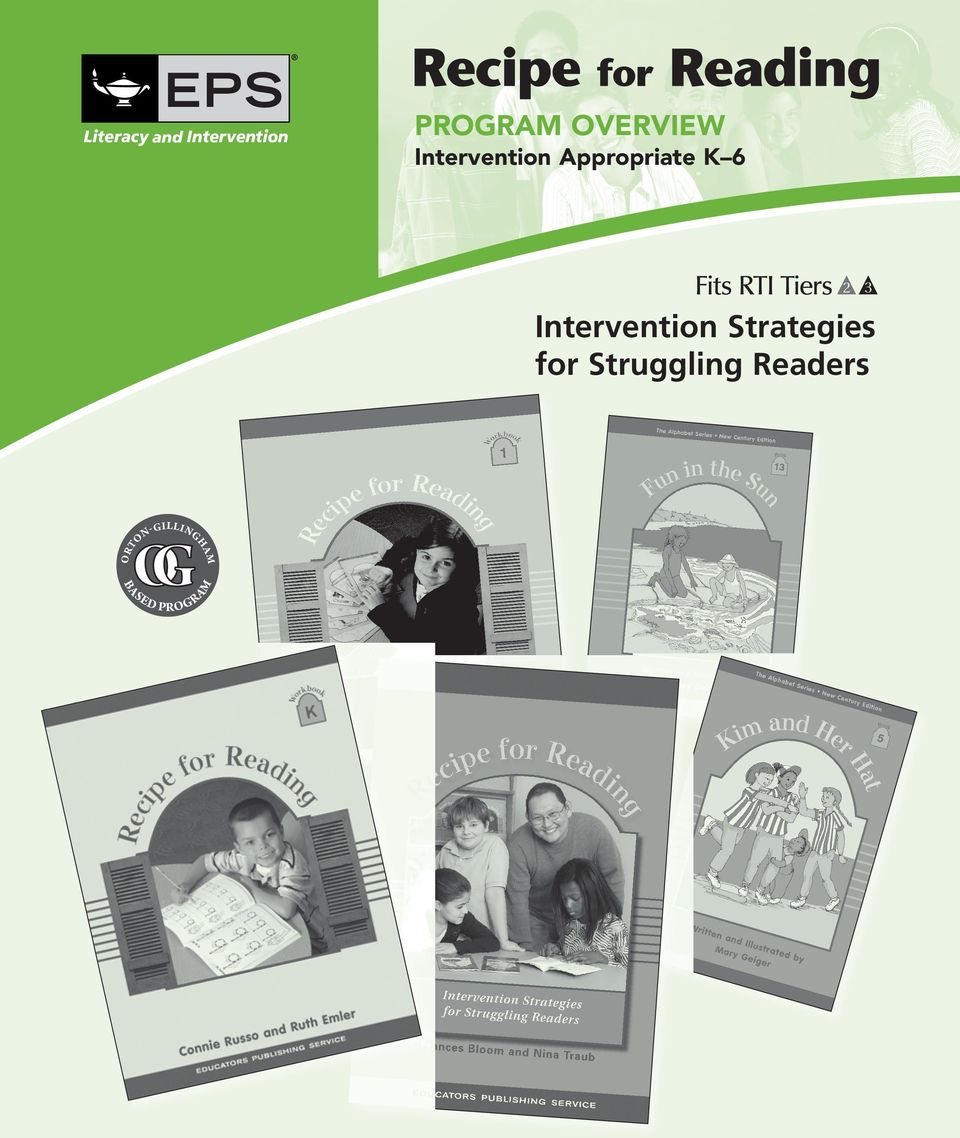
2 What is Recipe for Reading? Recipe for Reading is a research-based, comprehensive, multisensory, phonics-based reading program that is designed for beginning readers in grades K 3 or at-risk and struggling readers in grades 1 6. Recipe for Reading incorporates visual, auditory, and kinesthetic techniques to teach and reinforce phonetic concepts. The Recipe for Reading curriculum is ideal for differentiated instruction in a variety of settings inclusion, one-on-one, or whole class. Recipe for Reading comprises: Features for You Provides direct, multisensory instruction integrating visual, auditory, and kinesthetic modalities. Research-based instruction supports all five essential pillars of Reading First (phonological awareness, phonics, comprehension, vocabulary, and fluency). Accompanying storybooks contain controlled vocabulary and follow the Recipe for Reading sequence, allowing students to apply phonics skills in context. Teacher s manual provides detailed lessons for every phonetic skill in a carefully structured scope and sequence. Benefits for Your Students Struggling learners are better able to retain and learn new concepts through multisensory instruction. Students gain essential reading skills with an emphasis on phonological awareness, phonics, and fluency. Students build decoding and fluency skills in context as they read engaging stories at their own skill level. Research shows that students learn best when instruction is systematic and continually reinforced. How can I fit Recipe for Reading into my curriculum? Recipe for Reading is a comprehensive, multisensory phonics-based reading program. It can be used as a core phonics program or as focused, supplemental phonics instruction for struggling readers. The carefully structured scope and sequence allows you to differentiate instruction to meet the needs of all students. Go to epsbooks.com/rfr to find: Research paper Sample lessons 2 To Order: Call Fax Online epsbooks.com

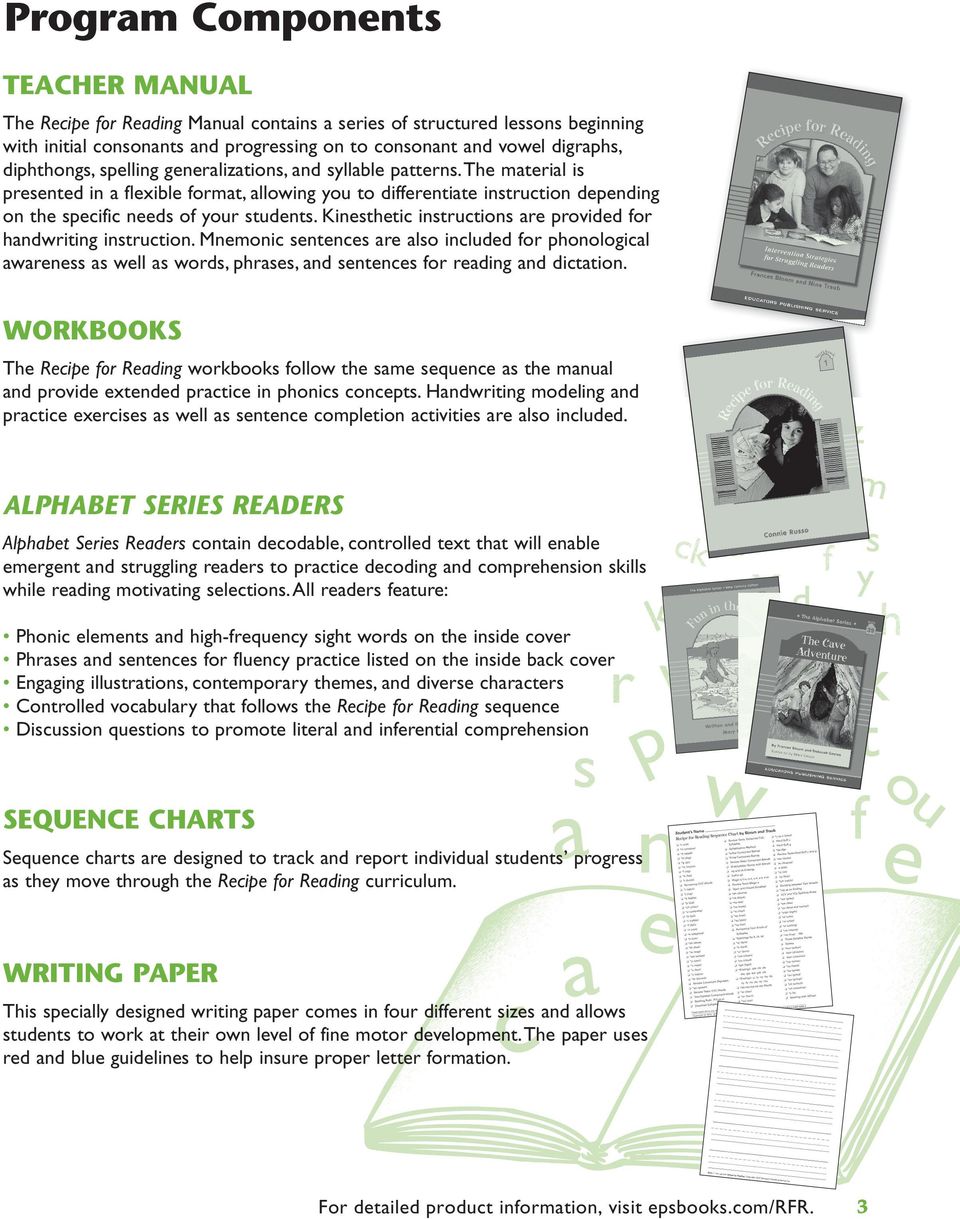
3 program components teacher manual The Recipe for Reading Manual contains a series of structured lessons beginning with initial consonants and progressing on to consonant and vowel digraphs, diphthongs, spelling generalizations, and syllable patterns. The material is presented in a flexible format, allowing you to differentiate instruction depending on the specific needs of your students. Kinesthetic instructions are provided for handwriting instruction. Mnemonic sentences are also included for phonological awareness as well as words, phrases, and sentences for reading and dictation. WorkBooks The Recipe for Reading workbooks follow the same sequence as the manual and provide extended practice in phonics concepts. Handwriting modeling and practice exercises as well as sentence completion activities are also included. alphabet SeRieS ReadeRS Alphabet Series Readers contain decodable, controlled text that will enable emergent and struggling readers to practice decoding and comprehension skills while reading motivating selections. All readers feature: Phonic elements and high-frequency sight words on the inside cover Phrases and sentences for fluency practice listed on the inside back cover Engaging illustrations, contemporary themes, and diverse characters Controlled vocabulary that follows the Recipe for Reading sequence Discussion questions to promote literal and inferential comprehension sequence charts Sequence charts are designed to track and report individual students progress as they move through the Recipe for Reading curriculum. Writing paper This specially designed writing paper comes in four different sizes and allows students to work at their own level of fine motor development. The paper uses red and blue guidelines to help insure proper letter formation. For detailed product information, visit epsbooks.com/rfr. 3
4 Recipe for Reading Workbook K Workbook K introduces initial consonants and short vowels through auditory, visual, kinesthetic activities. Engaging mnemonics are used to help students understand and remember letter-sound relationships. This is the perfect tool for students who need additional phonemic awareness practice before starting Recipe for Reading Workbook 1. Skills Addressed Consonants k, d, g, m, l, h, t, j, k, p, b, r, f, n, s, w, y, v, z, qu Short vowels o, a, i, u, e Recipe for Reading Scope and Sequence Workbooks Workbook 1 Workbook 2 Workbook 3 Workbook 4 Workbook 5 Workbook 6 Workbook 7 Workbook 8 Teacher Manual Sequence Consonant sounds c, d, g, m, l, h, t, j, k, p, b Short vowels o, a, u, i Consonant digraph ch Consonant sounds r, f, n, s, w, y, v, x, z, qu Short vowel e Consonant digraphs sh, th, wh Compound words Double ff, ll, ss rule VC/CV syllable division Initial and final consonant blends Multisyllabic words Ending sounds -ing, -ang, -ong, -ung, -ank, -onk, -unk, -ink Magic e Consonant digraph ph ea, oa, ai, ee, ay, oe Three sounds of -ed Spellings for /k/ ck Syllable division R-controlled vowels er, ir, ur, ar, or ow, ou, oo igh Consonant -le Ending consonant -y Hard and soft c and g Spelling rule for ge/dge Spelling rule for ch/tch aw, au, oi, oy y as vowel Dividing syllables between vowels Spelling rules for adding suffixes Doubling rule Inflectional ending -ing ew, eu, ue eigh, ei ei, ie tion, sion Multiple sounds of ow, ea, oo, ou, ch, s Endings on words with final y Root words and suffixes Alphabet Series Alphabet Series Volume 1 Alphabet Series Volume 2 Alphabet Series Volume 3 4 To Order: Call Fax Online epsbooks.com

5 Recipe for Reading Lesson Format The Recipe for Reading lesson follows a consistent format that integrates visual, auditory, and tactile/kinesthetic methods. Each lesson reinforces previously learned concepts as well as introducing new material. The lesson sequence is as follows: 1. Sound card drills Visual The teacher flashes index cards with all of the sounds previously learned. Students respond to each card with the proper sound. 2. sound-symbol practice Auditory-Kinesthetic The teacher gives the sound of each letter or letter combination aloud. The students respond by naming the letter(s) aloud and then writing them. 3. Blending drills Auditory-Visual Sound cards are placed together to form CVC words. Students sound each letter separately and then blend the sounds to form the word or syllable. 4. new concept introduced Visual-Kinesthetic Students are shown the new phonetic element and practice saying and writing the sound through tracing and copying. 5. Word dictation Auditory-Kinesthetic Teacher dictates words using the new phonetic element. Students repeat the word, spell it orally, and then write the word. Students then read the words they have written aloud. 6. sentence dictation Auditory-Kinesthetic Teacher dictates a sentence and students repeat the sentence and write it while saying each word aloud. Students then read the sentences aloud. 7. Reading Visual Students read vocabulary-controlled text containing only those sounds and high-frequency sight words previously taught. 8. Reinforcement Students engage in word games or other reinforcement activities to practice and review phonic elements. For detailed product information, visit epsbooks.com/rfr. 5

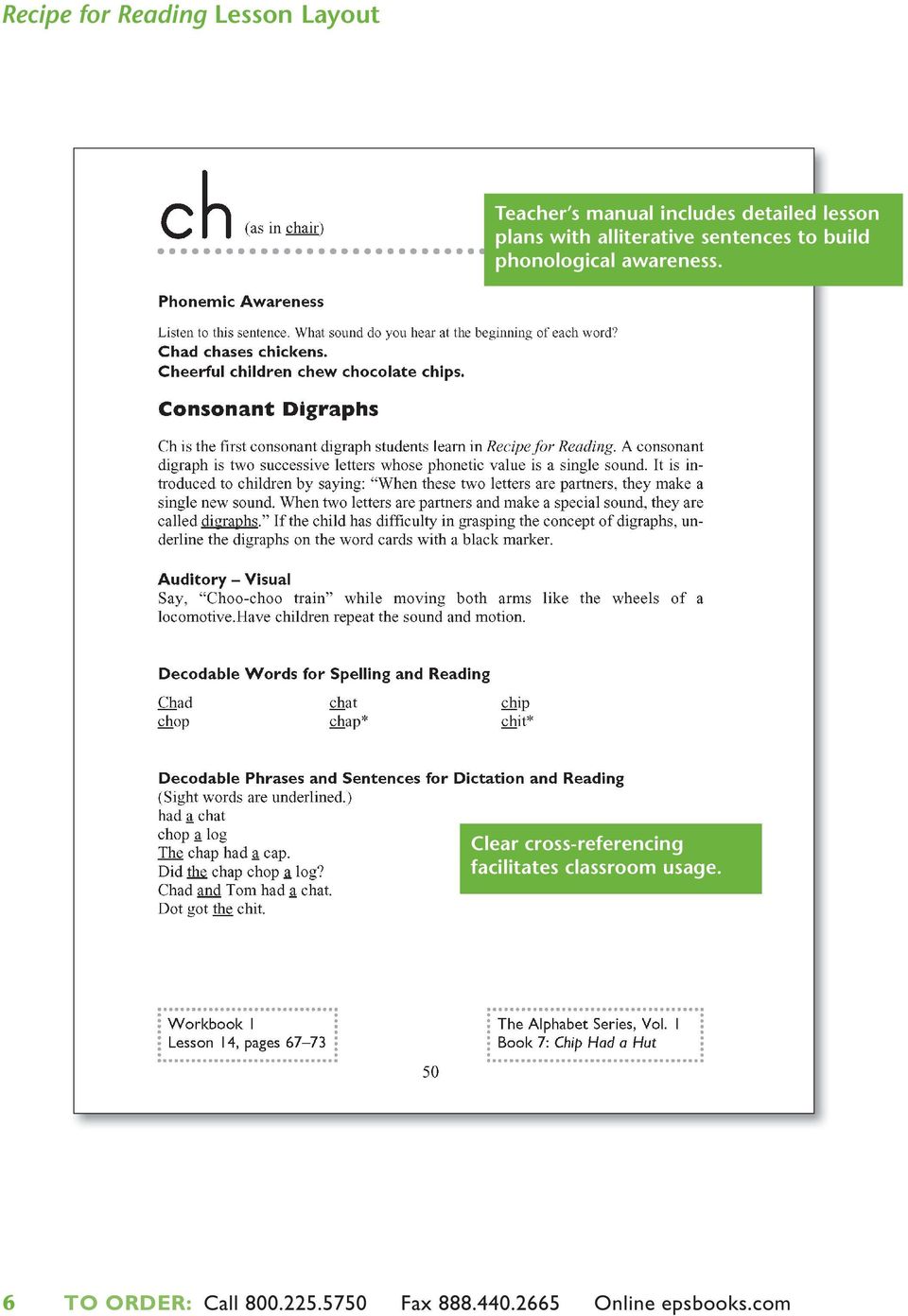
6 Recipe for Reading Lesson Layout Teacher s manual includes detailed lesson plans with alliterative sentences to build phonological awareness. Clear cross-referencing facilitates classroom usage. 6 TO ORDER: Call Fax Online epsbooks.com
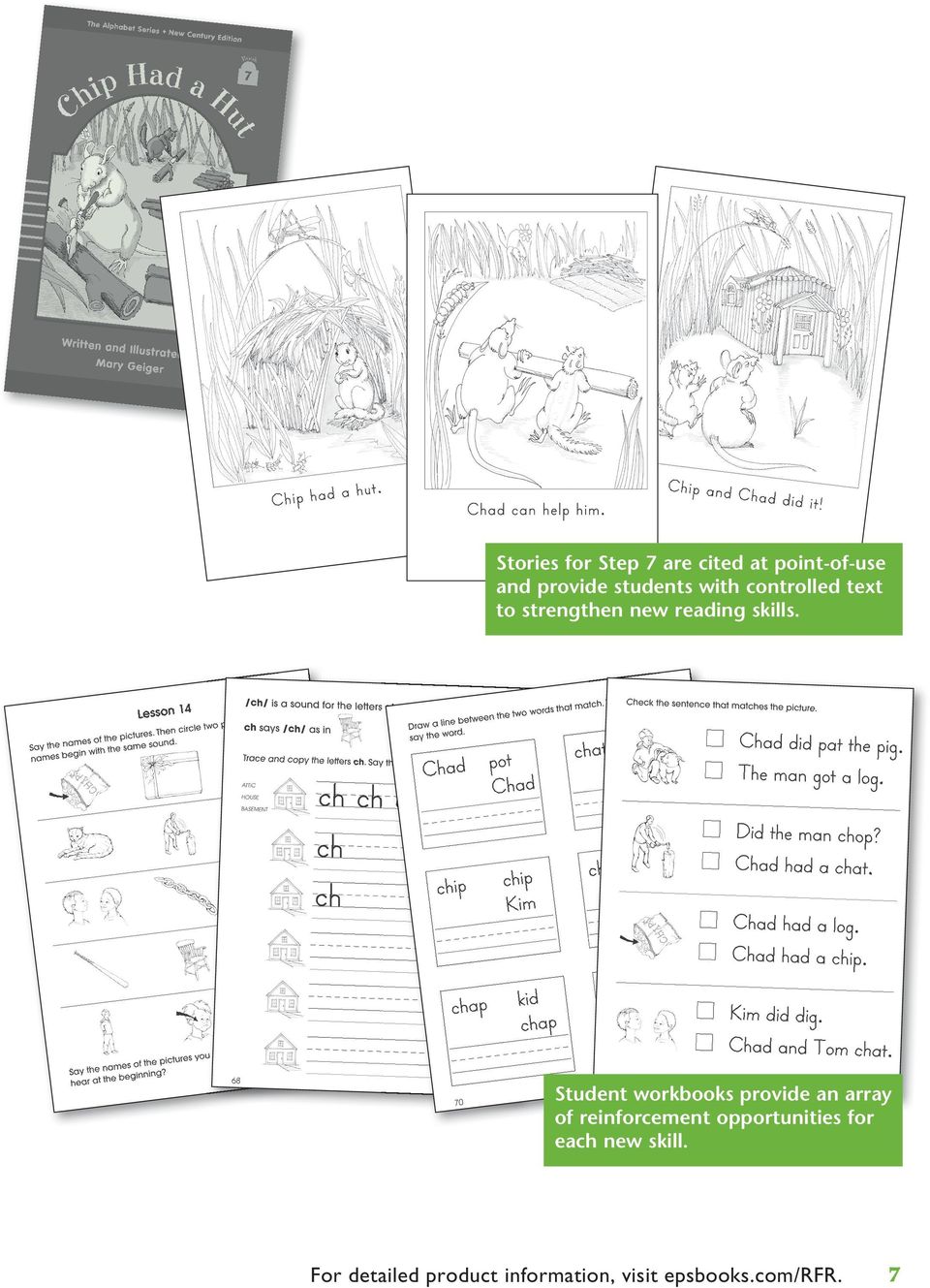
7 Stories for Step 7 are cited at point-of-use and provide students with controlled text to strengthen new reading skills. Student workbooks provide an array of reinforcement opportunities for each new skill. For detailed product information, visit epsbooks.com/rfr. 7
8 Recipe for Reading Manual Every lesson includes phonic word lists and sentences for spelling and dictation. 8 TO ORDER: Call Fax Online epsbooks.com

9 Recipe for Reading Manual Instructions are included for manuscript letter formation with verbal cues. For detailed product information, visit epsbooks.com/rfr. 9

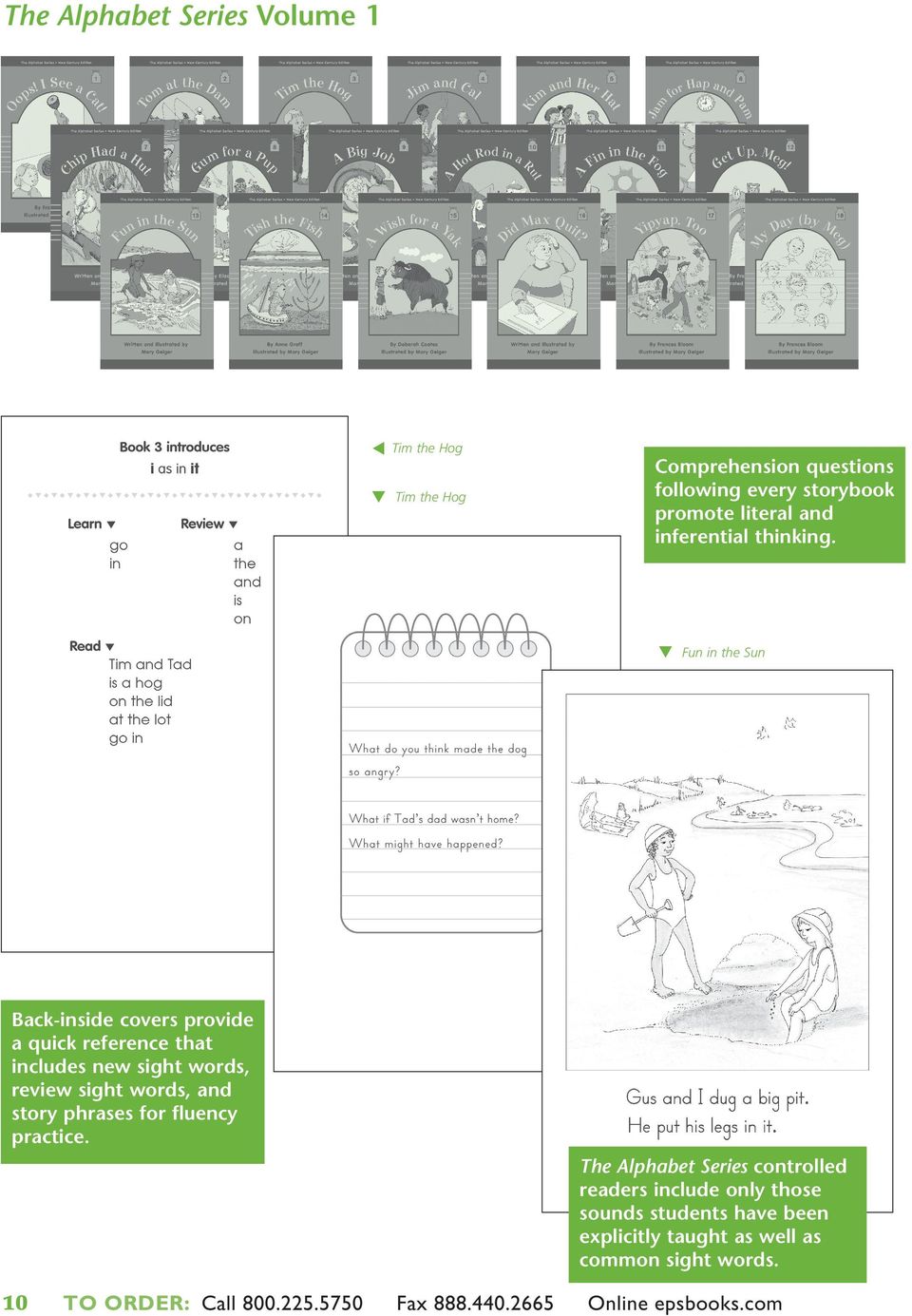
10 The Alphabet Series Volume 1 Tim the Hog Tim the Hog Comprehension questions following every storybook promote literal and inferential thinking. Fun in the Sun Back-inside covers provide a quick reference that includes new sight words, review sight words, and story phrases for fluency practice. The Alphabet Series controlled readers include only those sounds students have been explicitly taught as well as common sight words. 10 To Order: Call Fax Online epsbooks.com
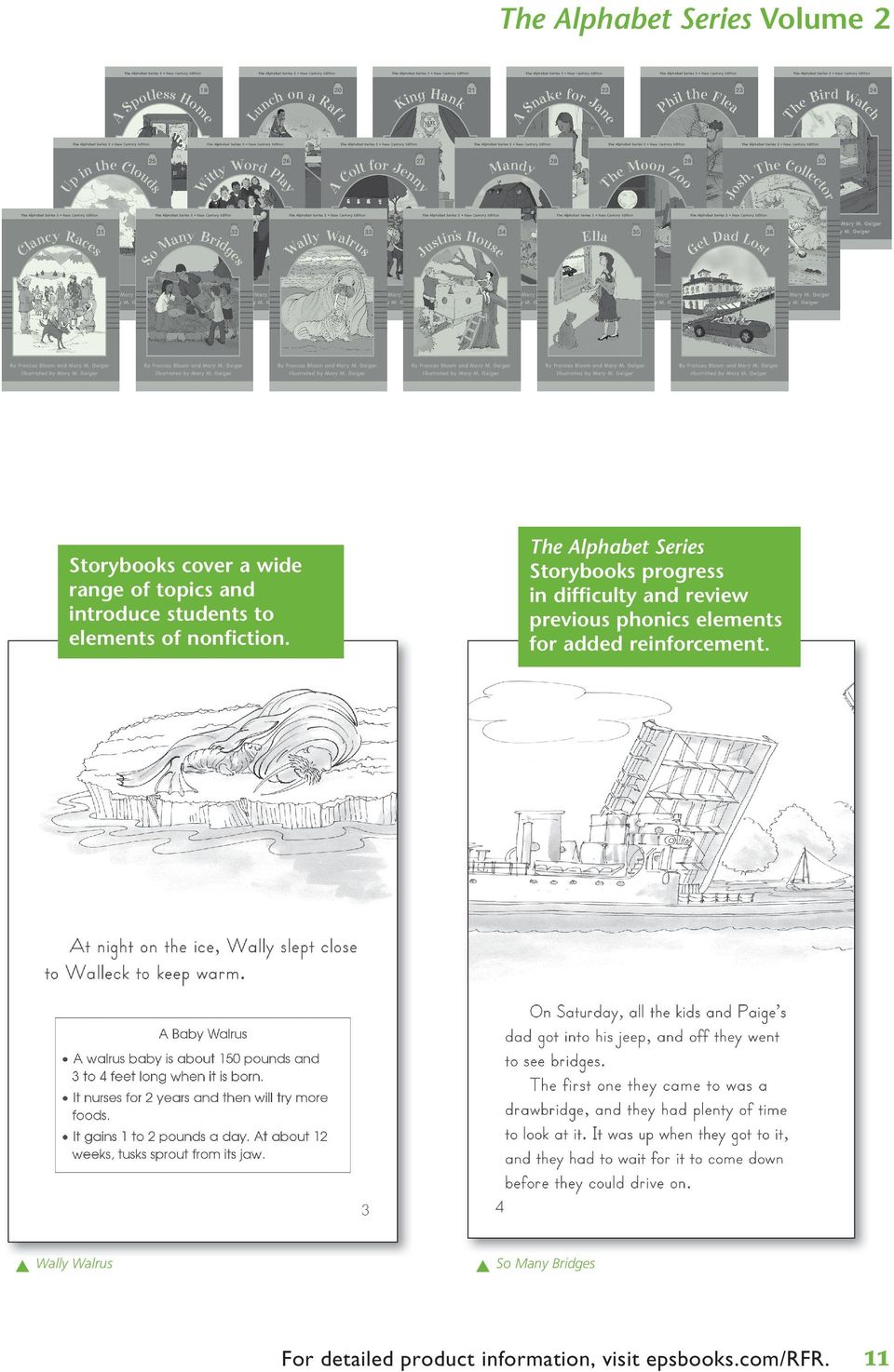
11 The Alphabet Series Volume 2 The Alphabet Series Storybooks progress in difficulty and review previous phonics elements for added reinforcement. Storybooks cover a wide range of topics and introduce students to elements of nonfiction. Wally Walrus So Many Bridges For detailed product information, visit epsbooks.com/rfr. 11
12 The Alphabet Series Volume 3 chapterbooks The 3 chapterbooks in Volume 3 center on a small group of friends, their families and neighbors and the adventures they share. Chapterbooks correspond to the final third of the lessons in the manual, enabling students to apply their phonics and structural analyses skills to engaging stories. Playball! The Cave Adventure 12 TO ORDER: Call Fax Online epsbooks.com

13 Workbooks K 2 Students master letter-sound relationships through auditory, visual, and kinesthetic activities. Visual and picture cues ensure proper letter formation. Workbook K Students are provided multiple practice opportunities for each Recipe for Reading lesson. Workbook 1 Workbook 2 For detailed product information, visit epsbooks.com/rfr. 13

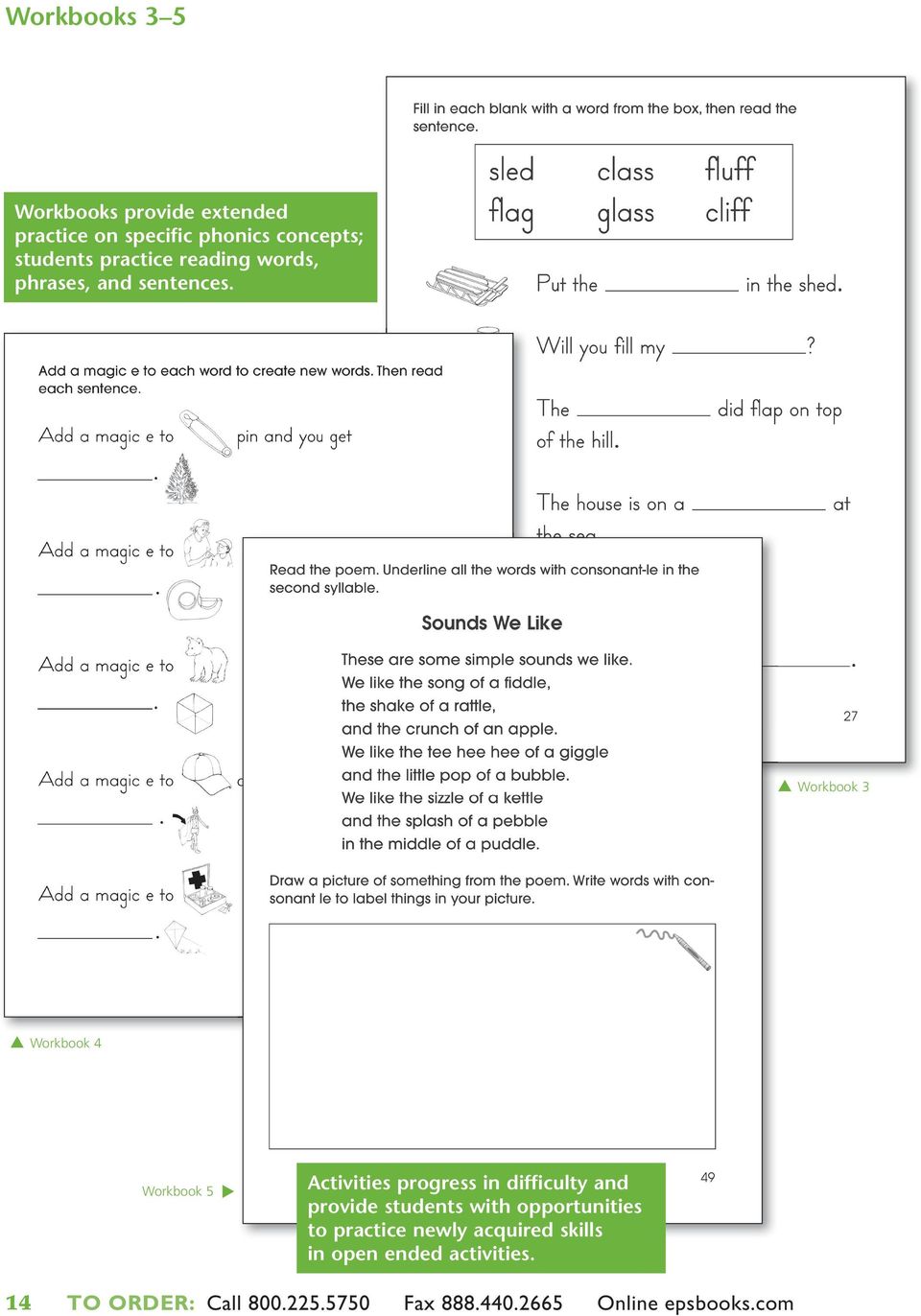
14 Workbooks 3 5 Workbooks provide extended practice on specific phonics concepts; students practice reading words, phrases, and sentences. Workbook 3 Workbook 4 Workbook 5 Activities progress in difficulty and provide students with opportunities to practice newly acquired skills in open ended activities. 14 TO ORDER: Call Fax Online epsbooks.com
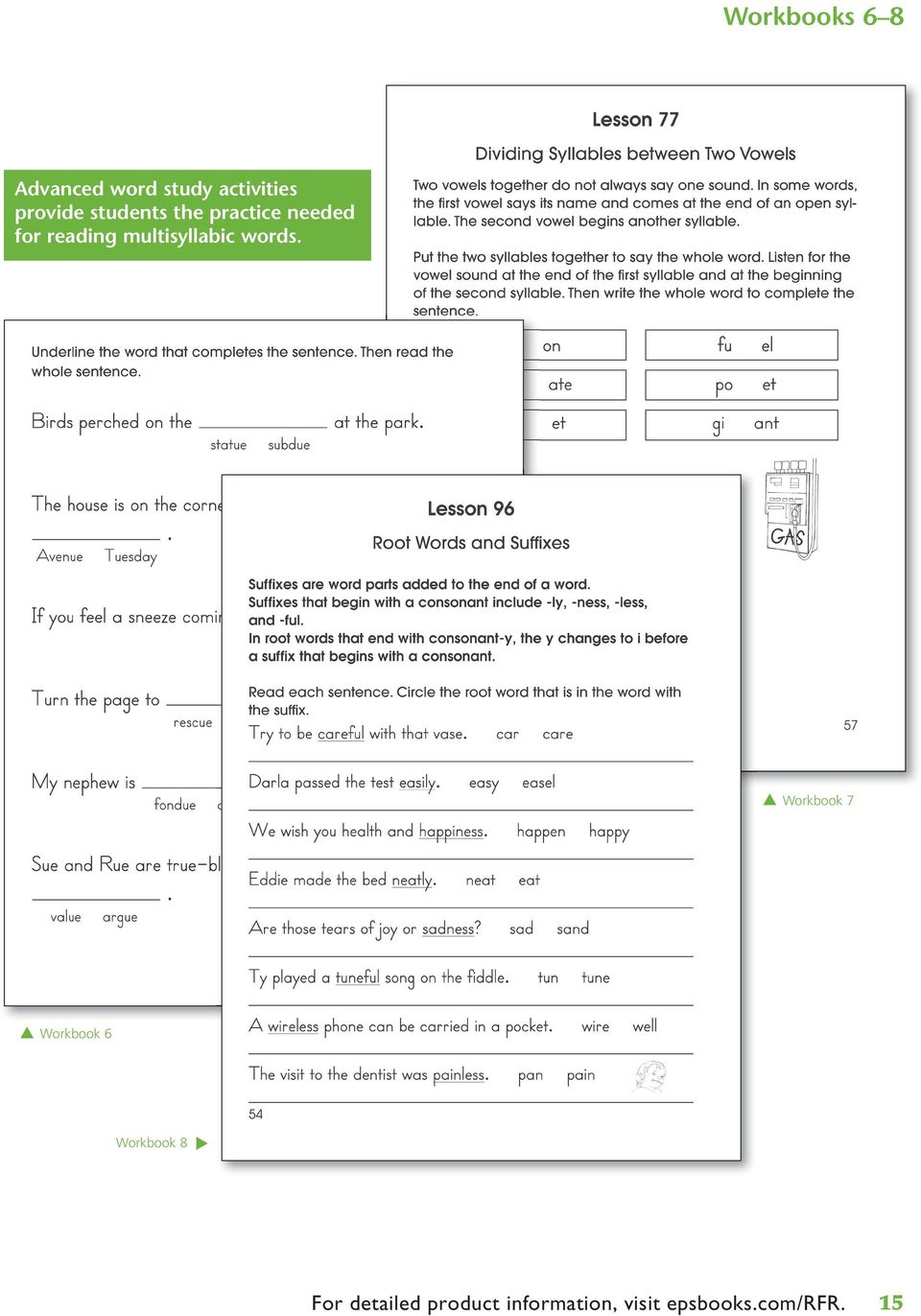
15 Workbooks 6 8 Advanced word study activities provide students the practice needed for reading multisyllabic words. Workbook 7 Workbook 6 Workbook 8 For detailed product information, visit epsbooks.com/rfr. 15
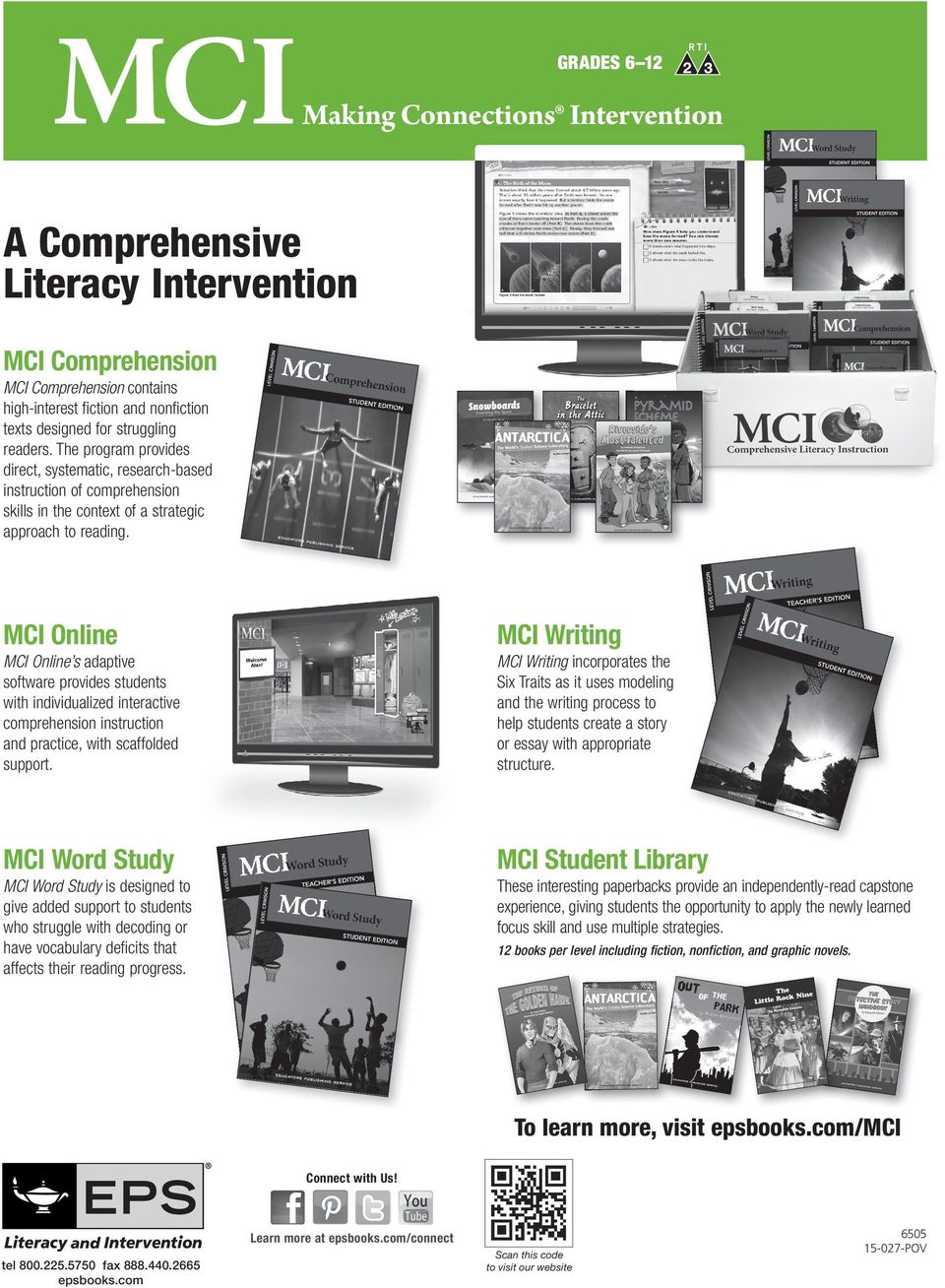
16 MCI GRADES 6 12 RTI Making Connections Intervention A Comprehensive Literacy Intervention MCI Comprehension MCI Comprehension contains high-interest fiction and nonfiction texts designed for struggling readers. The program provides direct, systematic, research-based instruction of comprehension skills in the context of a strategic approach to reading. MCI Online MCI Writing MCI Online s adaptive software provides students with individualized interactive comprehension instruction and practice, with scaffolded support. MCI Writing incorporates the Six Traits as it uses modeling and the writing process to help students create a story or essay with appropriate structure. MCI Word Study MCI Student Library MCI Word Study is designed to give added support to students who struggle with decoding or have vocabulary deficits that affects their reading progress. These interesting paperbacks provide an independently-read capstone experience, giving students the opportunity to apply the newly learned focus skill and use multiple strategies. 12 books per level including fiction, nonfiction, and graphic novels. To learn more, visit epsbooks.com/mci Connect with Us! Learn more at epsbooks.com/connect tel fax epsbooks.com Scan this code to visit our website POV
Right into Reading. Program Overview Intervention Appropriate K 3+ A Phonics-Based Reading and Comprehension Program
 Right into Reading Program Overview Intervention Appropriate K 3+ A Phonics-Based Reading and Comprehension Program What is Right into Reading? Right into Reading is a phonics-based reading and comprehension
California Treasures Phonics Scope and Sequence K-6
 California Treasures Phonics Scope and Sequence K-6 Phonics skills get progressively more complex throughout the grade and year to year (e.g., 1. short vowel CVC words; 2. final e CVCe words; 3. long vowel
A Comparison of Jolly Phonics and Jolly Grammar with the Six Phases of Letters and Sounds
 A Comparison of Jolly Phonics and Jolly Grammar with the Six Phases of Letters and Sounds Same Letters and Sounds Jolly Phonics Direct, daily, systematic teaching Active multisensory lessons, including
Phonics. Phonics is recommended as the first strategy that children should be taught in helping them to read.
 Phonics What is phonics? There has been a huge shift in the last few years in how we teach reading in UK schools. This is having a big impact and helping many children learn to read and spell. Phonics
Alburnett Community Schools. Theme 1 Finding My Place/ Six Weeks. Phonics: Apply knowledge of letter/sound correspondence.
 3 rd Grade Reading District Curriculum Map Theme 1 Finding My Place/ Six Weeks Apply knowledge of letter/sound correspondence. Learnings or Understandings (ICC) Use a variety of strategies to develop and
Phonics Scope and Sequence Struggling or At Risk Readers. Phonological Awareness and Letter Naming : Early Literacy Kindergarten or first grade 1
 Phonics Scope and Sequence Struggling or At Risk Readers Phonological Awareness and Letter Naming : Early Literacy Kindergarten or first grade 1 Phonological Awareness 1. Hearing Rhymes 2. Producing rhymes
Montessori Academy of Owasso
 Montessori Academy of Owasso 5 & 6 Year-Old Curriculum Academic Area: Language Arts Category: Reading: Literature Subcategory: Key Ideas and Details Element 1:With prompting and support, ask and answer
Overview of Spellings on www.spellzoo.co.uk
 Overview of Spellings on www.spellzoo.co.uk Year 1 Set 1: CVC words Set 2: CVC and CCVC words Set 3: CVC, CCVC and CCVCC words Set 4: Words containing 'ch', 'sh', 'th' and 'wh' Set 5: Words ending in 'll',
Summer Reading Program Implementation Guide
 Summer Reading Program Implementation Guide Summer Reading Program Implementation Guide Contents Overview... 3 Direct Instruction - Adapting for Summer... 4 Direct Instruction - Timeline for Grades 1-3...
Wednesday 4 th November 2015. Y1/2 Parent Workshop Phonics & Reading
 Wednesday 4 th November 2015 Y1/2 Parent Workshop Phonics & Reading This presentation was an aide memoire for staff during the recent Phonics and Reading Workshop (04.11.15). The aim of the presentation
Indiana Department of Education
 GRADE 1 READING Guiding Principle: Students read a wide range of fiction, nonfiction, classic, and contemporary works, to build an understanding of texts, of themselves, and of the cultures of the United
In English there are 26 letters which represent 44 phonemes. These phonemes are represented by approximately 140 different letter combinations.
 PHONIC RULES/PATTERNS, WHICH MAY BE USEFUL AT EACH PHASE OF LETTERS AND SOUNDS NB: These rules are equally relevant to other synthetic phonics programmes In English there are 26 letters which represent
Progression in each phase for Letters & Sounds:
 Burford School Marlow Bottom Marlow Buckinghamshire SL7 3PQ T: 01628 486655 F: 01628 898103 E: [email protected] W: www.burfordschool.co.uk Headteacher: Karol Whittington M.A., B.Ed. Hons Progression
A Parents Guide to Understanding. Reading
 A Parents Guide to Understanding Reading Dear Parents, After teaching first grade for many years, I was always faced with the same questions at the beginning of the year: What is Pathways to Reading? How
Phonics. Phase 1 6 Support for spelling Monitoring and assessing resources
 Phonics Phase 1 6 Support for spelling Monitoring and assessing resources Phase 1 Letters and Sounds phase 1 - Seven aspects 1) Environmental sounds 2) Instrumental sounds 3) Body percussion 4) Rhythm
Suggested Components for 90-Minute Wave 1 Literacy Blocks throughout Primary years
 Suggested s for 90-Minute Wave 1 Literacy Blocks throughout Primary years Notes 1. These are suggestions only but reflect the need to include components of each of the Big Six in each Literacy Block. 2.
Phonics and Word Work
 Phonics and Word Work Introduction Foundational Skills This guide explores how explicit and systematic phonics and word work instruction is included in the ReadyGEN program. It looks at the resources that
SEPTEMBER Unit 1 Page Learning Goals 1 Short a 2 b 3-5 blends 6-7 c as in cat 8-11 t 12-13 p
 The McRuffy Kindergarten Reading/Phonics year- long program is divided into 4 units and 180 pages of reading/phonics instruction. Pages and learning goals covered are noted below: SEPTEMBER Unit 1 1 Short
Visualizing Phoneme Segmentation: Final Clarifying consonant Sounds. Clarifying. Summarizing
 First Grade Imagine It! Unit 1 - Back to School Unit 1 Week 1/ Lessons 1-5 Read Aloud First Day Jitters (realistic fiction) Big Book Back to School (photo essay), And the Answer Is? (poem) Phonics Phonemic
MCGF CE TI GE LS CS HOTS
 First Grade Reading District Curriculum Map Good Times we Share: Lunch Week 1 Use letter-sound correspondence to decode words and build a sight word vocabulary. Letter-sound association: /m/, /r/, /s/
Scope and Sequence Skills Strand Grade 1
 The Skills strand of the Core Knowledge Language Arts program teaches students the decoding skills needed for (future) independent reading. Each Skills lesson begins with a warm-up, reviewing previously
Selecting Research Based Instructional Programs
 Selecting Research Based Instructional Programs Marcia L. Grek, Ph.D. Florida Center for Reading Research Georgia March, 2004 1 Goals for Today 1. Learn about the purpose, content, and process, for reviews
WiggleWorks Aligns to Title I, Part A
 WiggleWorks Aligns to Title I, Part A The purpose of Title I, Part A Improving Basic Programs is to ensure that children in high-poverty schools meet challenging State academic content and student achievement
A Consumer s Guide to Evaluating a Core Reading Program Grades K-3: A Critical Elements Analysis
 A Consumer s Guide to Evaluating a Core Reading Program Grades K-3: A Critical Elements Analysis National Center to Improve thetools of Educators Deborah C. Simmons, Ph. D. Edward J. Kame enui, Ph. D.
St. Petersburg College. RED 4335/Reading in the Content Area. Florida Reading Endorsement Competencies 1 & 2. Reading Alignment Matrix
 Course Credit In-service points St. Petersburg College RED 4335/Reading in the Content Area Florida Reading Endorsement Competencies 1 & 2 Reading Alignment Matrix Text Rule 6A 4.0292 Specialization Requirements
Massachusetts Tests for Educator Licensure
 Massachusetts Tests for Educator Licensure FIELD 90: FOUNDATIONS OF READING TEST OBJECTIVES Subarea Multiple-Choice Range of Objectives Approximate Test Weighting I. Foundations of Reading Development
APPENDIX B CHECKLISTS
 APPENDIX B CHECKLISTS Kindergarten First Grade Second Grade Third Grade 69 70 Teacher Visit 1 By: Date / / Time - WG SG Visit 2 By: Date / / Time - WG SG Visit 3 By: Date / / Time - WG SG VISITS 1 2 3
Using Leveled Text to Teach and Support Reading Strategies
 Using Leveled Text to Teach and Support Reading Strategies The text structures of leveled text support the teaching of strategies along a developmental continuum. As the levels increase, the demands on
DRA2 Word Analysis. correlated to. Virginia Learning Standards Grade 1
 DRA2 Word Analysis correlated to Virginia Learning Standards Grade 1 Quickly identify and generate words that rhyme with given words. Quickly identify and generate words that begin with the same sound.
Planning, Organizing, and Managing Reading Instruction Based on Ongoing Assessment
 Reading Instruction Competence Assessment (RICA ) Content Specifications (effective as of the August 8, 2009, test administration) DESCRIPTION OF THE RICA The goal of reading instruction is to develop
Phonics and Word Study
 Phonics and Word Study Learn About Overview Once students begin to grasp the concept that the sounds they hear are represented by letters, they are gaining access to phonemics and graphophonics. 1 The
Teaching Word Identification and Spelling Word Identification by Rebecca Felton, PhD.
 Teaching Word Identification and Spelling Word Identification by Rebecca Felton, PhD. The importance of decoding to the reading process cannot be underestimated. Perfetti (1984) states that only a reader
Phonics and Word Study Scope and Sequence. Grades K 6
 Phonics and Word Study Scope and Sequence Grades K 6 KINDERGARTEN 1. Letter Recognition: Aa, Bb, Cc, Dd, Ee, 2. Letter Recognition: Ff, Gg, Hh, Ii, Jj, Kk, Ll, Mm, Nn 3. Letter Recognition: Oo, Pp, Qq,
Reading Instruction Competence Assessment (RICA )
 Reading Instruction Competence Assessment (RICA ) Domain Range of Objectives Weighting (Approximate) 1. Planning, Organizing, and Managing Reading 001 002 10% Instruction Based on Ongoing Assessment 2.
READING SPECIALIST STANDARDS
 READING SPECIALIST STANDARDS Standard I. Standard II. Standard III. Standard IV. Components of Reading: The Reading Specialist applies knowledge of the interrelated components of reading across all developmental
Teaching Reading Essentials:
 Teaching Reading Essentials: Video Demonstrations of Small-Group Interventions OVERVIEW Fully aligned with and This is the professional development you ve been asking for! TM Sopris West Educating Our
About the KS2 Spelling Resources on SaveTeachersSundays.com
 About the KS2 Spelling Resources on SaveTeachersSundays.com The new curriculum has statutory requirements for which graphemes (spelling patterns) and words need to be taught in each year group. The Spelling
Transitional Plan Levels J-M Based on 20-minute lesson each day. Prompts for Guided Reading
 Next Step in Guided Reading K-2 Emergent & Early Plan levels A-I Transitional Plan Levels J-M Based on 20-minute lesson each day Based on 20-minute lesson each day Day 1 Day 2 Day 1 Day 2 Day 3 Sight word
Scientifically Based Reading Programs: What are they and how do I know?
 Scientifically Based Reading Programs: What are they and how do I know? Elissa J. Arndt, M.S. CCC-SLP Florida Center for Reading Research Alternate Assessment Summer Training Institute July, 2007 1 Goals
Florida Center for Reading Research Project Read
 1 Florida Center for Reading Research Project Read What is Project Read? Project Read is a comprehensive language arts program designed to provide explicit instruction in a structured reading curriculum.
Learning Today Smart Tutor Supports English Language Learners
 Learning Today Smart Tutor Supports English Language Learners By Paolo Martin M.A. Ed Literacy Specialist UC Berkley 1 Introduction Across the nation, the numbers of students with limited English proficiency
PAF. Preventing Academic Failure. A Multisensory Curriculum for Teaching Reading, Spelling, and Handwriting. Phyllis Bertin Eileen Perlman
 3 PAF Preventing Academic Failure A Multisensory Curriculum for Teaching Reading, Spelling, and Handwriting Phyllis Bertin Eileen Perlman with the assistance of Elizabeth McGoldrick 11 Click on the sections
Minnesota K-12 Academic Standards in Language Arts Curriculum and Assessment Alignment Form Rewards Intermediate Grades 4-6
 Minnesota K-12 Academic Standards in Language Arts Curriculum and Assessment Alignment Form Rewards Intermediate Grades 4-6 4 I. READING AND LITERATURE A. Word Recognition, Analysis, and Fluency The student
Kindergarten Common Core State Standards: English Language Arts
 Kindergarten Common Core State Standards: English Language Arts Reading: Foundational Print Concepts RF.K.1. Demonstrate understanding of the organization and basic features of print. o Follow words from
Unit 2 Title: Word Work Grade Level: 1 st Grade Timeframe: 6 Weeks
 Unit 2 Title: Grade Level: 1 st Grade Timeframe: 6 Weeks Unit Overview: This unit of word work will focus on the student s ability to identify and pronounce the initial, medial vowel, and final sounds.
iboard Phonics Curriculum Guidance
 iboard Phonics Curriculum Guidance Contents Page Summary, Purpose of Document 3 Introduction, Revisit and Review 4 Teach 5 Practice 6 Apply, Assess Learning 7 Phase Descriptors 8 Summary iboard Phonics
Further information is available at: www.standards.dfes.gov.uk/phonics. Introduction
 Phonics and early reading: an overview for headteachers, literacy leaders and teachers in schools, and managers and practitioners in Early Years settings Please note: This document makes reference to the
Words Their Way TM. Word Study in Action. Correlated to: North Carolina STANDARD COURSE OF STUDY Language Arts for Third Grade
 TM Word Study in Action Correlated to: North Carolina STANDARD COURSE OF STUDY Language Arts for Third Grade For More Information Contact Debbie Owens, Sales Representative 1-800-435-3499 Ext. 8092 www.pearsonlearning.com
General Reading Research
 Synopsis The PCI Reading Program is a comprehensive sight-words based curriculum developed to teach students with developmental disabilities and significant learning differences to read. It is firmly grounded
Grade 1 LA. 1. 1. 1. 1. Subject Grade Strand Standard Benchmark. Florida K-12 Reading and Language Arts Standards 27
 Grade 1 LA. 1. 1. 1. 1 Subject Grade Strand Standard Benchmark Florida K-12 Reading and Language Arts Standards 27 Grade 1: Reading Process Concepts of Print Standard: The student demonstrates knowledge
Ms Juliani -Syllabus Special Education-Language/ Writing
 Ms Juliani -Syllabus Special Education-Language/ Writing * As a teacher, I have high expectations for my students and believe that they need to be encouraged, nurtured, and rewarded for their efforts.
Best Practices. Using Lexia Software to Drive Reading Achievement
 Best Practices Using Lexia Software to Drive Reading Achievement An overview of Implementation Principles to apply in your school for using Lexia Reading Skills Software to Close the Reading Achievement
ISBN Item Format Price
 McGraw-Hill Education, by its School Education Group SRA Reading Mastery Signature Edition Author: Engelmann Et Al. Copyright 2008/1 st (Print and Internet Based) Reading Program - K-5 Grade Series Bid
Literacy. Work Stations. Source: Diller, D.(2003) Literacy Work Stations, Making Centers Work
 Literacy Work Stations Source: Diller, D.(2003) Literacy Work Stations, Making Centers Work Kyrene Reading Instruction Focus: Improve student achievement through implementation of curriculum and adopted
ENGLISH LANGUAGE - SCHEMES OF WORK. For Children Aged 8 to 12
 1 ENGLISH LANGUAGE - SCHEMES OF WORK For Children Aged 8 to 12 English Language Lessons Structure Time Approx. 90 minutes 1. Remind class of last topic area explored and relate to current topic. 2. Discuss
Reading Competencies
 Reading Competencies The Third Grade Reading Guarantee legislation within Senate Bill 21 requires reading competencies to be adopted by the State Board no later than January 31, 2014. Reading competencies
& Sample Lesson. Before Reading. Sight Word Review (1 minute)
 Planning Support & Sample Lesson TIP The Early Guided Reading Lesson Plan found on page 190 in the Appendix is a template you can use to plan your lessons. Each component of the lesson is described in
Mrs. LaBorde s. Words Their Way. Spelling Homework Guide. (Please keep this all year to help with spelling homework!!!)
 Mrs. LaBorde s Words Their Way Homework Guide (Please keep this all year to help with spelling homework!!!) ABOUT WORDS THEIR WAY Words Their Way is a new approach to teaching spelling that allows students
Word Journeys & Words Their Way Correlation Chart Note: ES = Emergent Spellers LN = Letter Name WW = Within Word SA = Syllables and Affixes
 Note: Waynesboro Public Schools requires the use of the Developmental Spelling Assessment (DSA) found within the Word Journeys book written by Kathy Ganske. This assessment is administered 3 x/year on
Scientifically Based Reading Programs. Marcia L. Kosanovich, Ph.D. Florida Center for Reading Research SLP Academy Fall, 2005
 Scientifically Based Reading Programs Marcia L. Kosanovich, Ph.D. Florida Center for Reading Research SLP Academy Fall, 2005 Goals for Today 1. Understand the big picture of an effective reading program.
http://setup.clihome.com/cli.cmap.web/home/maps/viewmapmultipleyear.aspx?teach...
 Page 1 of 6 READING - 1st School Teacher Email Course# Grade Level Lettie Brown Elementary School VanDerVoorn, Lauri [email protected] LA1100 1 Show Icon August 2015 August 2014 Review of
Test Blueprint. Grade 3 Reading. 2010 English Standards of Learning
 Test Blueprint Grade 3 Reading 2010 English Standards of Learning This revised test blueprint will be effective with the administration of the 2012-2013 English Standards of Learning (SOL) tests. Notice
To learn to read is to light a fire; every syllable that is spelled out is a spark." Victor Hugo, Les Miserables
 To learn to read is to light a fire; every syllable that is spelled out is a spark." Victor Hugo, Les Miserables Development and Management of an Effective Reading Intervention Program Research into Practice
An Early Childhood Practitioner s Guide: Developmentally Appropriate Literacy Practices for Preschool-Age Children
 An Early Childhood Practitioner s Guide: Developmentally Appropriate Literacy Practices for Preschool-Age Children SUMMARY In her discussion of user-friendly and developmentally appropriate literacy strategies
Sitton Spelling & Word Skills Program Overview Grades K 8
 Sitton Spelling & Word Skills Program Overview Grades K 8 Spelling instruction that transfers to everyday writing Sitton Kindergarten Literacy and Word Skills Aligned to the ommon Core STATE STANDARDS
ALCOS ALCOS # Assessments Priority Skills Phonic Progression. ELA. 8 Focus: Writing a Sentence Trait: Voice DIBELS ARMT/SAT 10
 Reading Language Arts Curriculum Guide Second Grade Use with Scott Foresman Reading Street Draft: 2008-09 Unit One: Exploration Pacing: 6 Weeks Date Week/Story ALCOS ALCOS # s Priority Skills Phonic Progression
Academic Standards for Reading, Writing, Speaking, and Listening
 Academic Standards for Reading, Writing, Speaking, and Listening Pre-K - 3 REVISED May 18, 2010 Pennsylvania Department of Education These standards are offered as a voluntary resource for Pennsylvania
As Approved by State Board 4/2/09
 Improving students' ability to learn, communicate, and collaborate through literacy education As Approved by State Board 4/2/09 Nebraska Language Arts Standards As approved by State Board 4/2/09 Table
Grading Benchmarks FIRST GRADE. Trimester 4 3 2 1 1 st Student has achieved reading success at. Trimester 4 3 2 1 1st In above grade-level books, the
 READING 1.) Reads at grade level. 1 st Student has achieved reading success at Level 14-H or above. Student has achieved reading success at Level 10-F or 12-G. Student has achieved reading success at Level
Teaching Young Children How to Read: Phonics vs. Whole Language. Introduction and Background
 Kelly Waldo Senior Capstone Paper Paoze Thao, PhD California State University Monterey Bay Teaching Young Children How to Read: Phonics vs. Whole Language Introduction and Background I am interested in
Interpreting areading Scaled Scores for Instruction
 Interpreting areading Scaled Scores for Instruction Individual scaled scores do not have natural meaning associated to them. The descriptions below provide information for how each scaled score range should
How To Teach Reading
 Florida Reading Endorsement Alignment Matrix Competency 1 The * designates which of the reading endorsement competencies are specific to the competencies for English to Speakers of Languages (ESOL). The
Wilson Reading System Rules Notebook
 Wilson Reading System Rules Notebook Compiled by Mrs. Loy Updated May 2004 May 2005 May 2009 Book One 1.1 1.3 Consonants b, c, d, f, g, h, j, k, l, m, n, p, q, r, s, t, v, w, x, y, z Vowels a apple e Ed
Principles of Instruction. Teaching Letter-Sound Associations by Rebecca Felton, PhD. Introduction
 Teaching Letter-Sound Associations by Rebecca Felton, PhD. Introduction In order to become proficient readers, students must learn to recognize and name the letters of the English alphabet. Students must
Reading/Fluency Standards Based Annual Goals
 Reading/Fluency First grade (1.5.1) The student will establish letter-naming fluency at a rate of 40-plus letters per minute by the First grade (1.5.3) When given a first grade passage, the student will
Year 1 reading expectations (New Curriculum) Year 1 writing expectations (New Curriculum)
 Year 1 reading expectations Year 1 writing expectations Responds speedily with the correct sound to graphemes (letters or groups of letters) for all 40+ phonemes, including, where applicable, alternative
FRENCH IMMERSION GRADE ONE
 FRENCH IMMERSION GRADE ONE Welcome to the French Immersion Experience! The curriculum for the French Immersion Program is based on the guidelines of the Milton Public School Curriculum, the Curriculum
CCSS English/Language Arts Standards Reading: Foundational Skills Kindergarten
 Reading: Foundational Skills Print Concepts CCSS.ELA-Literacy.RF.K.1 Demonstrate understanding of the organization and basic features of print. CCSS.ELA-Literacy.RF.K.1.A Follow words from left to right,
Designing Lessons for Diverse Learners by Natalie Olinghouse 2008
 Designing Lessons for Diverse Learners by Natalie Olinghouse 2008 Who deserves accommodations? Everyone! Instructional accommodations are not just for students who are struggling. When accommodations are
bow bandage candle buildings bulb coins barn cap corn
 b c bow bandage candle buildings bulb coins barn cap corn Copyright (C) 1999 Senari Programs Page 1 SoundBox Montessori d f darts dice door dove forest farm film foot fish Copyright (C) 1999 Senari Programs
Strand: Reading Literature Topics Standard I can statements Vocabulary Key Ideas and Details
 Strand: Reading Literature Key Ideas and Craft and Structure Integration of Knowledge and Ideas RL.K.1. With prompting and support, ask and answer questions about key details in a text RL.K.2. With prompting
Standards for Special Education Teachers
 Standards for Special Education Teachers Introduction The new standards for special education teachers have been developed to align with the Core Standards For Teachers developed by the North Carolina
21st Century Community Learning Center
 21st Century Community Learning Center Grant Overview The purpose of the program is to establish 21st CCLC programs that provide students with academic enrichment opportunities along with activities designed
INTEGRATING THE COMMON CORE STANDARDS INTO INTERACTIVE, ONLINE EARLY LITERACY PROGRAMS
 INTEGRATING THE COMMON CORE STANDARDS INTO INTERACTIVE, ONLINE EARLY LITERACY PROGRAMS By Dr. Kay MacPhee President/Founder Ooka Island, Inc. 1 Integrating the Common Core Standards into Interactive, Online
Instructional Design: Objectives, Curriculum and Lesson Plans for Reading Sylvia Linan-Thompson, The University of Texas at Austin Haitham Taha,
 Instructional Design: Objectives, Curriculum and Lesson Plans for Reading Sylvia Linan-Thompson, The University of Texas at Austin Haitham Taha, Sakhnin College December xx, 2013 Topics The importance
LiteracyPlanet & the Australian Curriculum: Pre-School
 LiteracyPlanet & the Australian Curriculum: Pre-School We look at learning differently. LiteracyPlanet & the Australian Curriculum Welcome to LiteracyPlanet & the Australian Curriculum. LiteracyPlanet
Jolly Learning Ltd. Lots of printable worksheets, templates and games.
 Structured daily sessions, teaching the five skills for reading and writing. Step-by-step teacherʼs notes for every session, available on screen or for printing. Interactive lessons with lots of blending,
Create stories, songs, plays, and rhymes in play activities. Act out familiar stories, songs, rhymes, plays in play activities
 PRESCHOOL Language Arts Literacy Expectation 1 Children listen and respond to environmental sounds, directions, and conversations. NJCCC K-12 Standard 3.4 Listening Strand A: Active Listening Strand B:
Teacher's Guide to Meeting the Common Core State Standards* with Scott Foresman Reading Street 2008
 Implementing the Common Core State StandArds Teacher's Guide to Meeting the Common Core State Standards* with Scott Foresman Reading Street 2008 Table of Contents Grade 5 Introduction................................................
LANGUAGE ARTS OVERVIEW
 LANGUAGE ARTS OVERVIEW English language arts education incorporates the teaching and learning of reading, writing, speaking, listening, and viewing. Integration of language arts occurs in multiple ways.
Students with Reading Problems Their Characteristics and Needs
 Students with Reading Problems Their Characteristics and Needs Roxanne Hudson, Ph.D. Florida Center for Reading Research Florida State University [email protected] We want all students to read grade level
PRE AND POST TEST TO SEE THE DIFFERENCE BETWEEN YEARS OF ANIMATED LITERACY AND KNOWLEDGE OF LETTERS STEPHANIE, BUCK. Submitted to
 Animated Literacy 1 RUNNING HEAD: Years of Animated Literacy Letters PRE AND POST TEST TO SEE THE DIFFERENCE BETWEEN YEARS OF ANIMATED LITERACY AND KNOWLEDGE OF LETTERS By STEPHANIE, BUCK Submitted to
OCPS Curriculum, Instruction, Assessment Alignment
 OCPS Curriculum, Instruction, Assessment Alignment Subject Area: Grade: Strand 1: Standard 1: Reading and Language Arts Kindergarten Reading Process The student demonstrates knowledge of the concept of
Grade 3 LA. 3. 1. 1. 1. Subject Grade Strand Standard Benchmark. Florida K-12 Reading and Language Arts Standards 55
 Grade 3 LA. 3. 1. 1. 1 Subject Grade Strand Standard Benchmark Florida K-12 Reading and Language Arts Standards 55 Grade 3: Reading Process Phonics/Word Analysis Standard: The student demonstrates knowledge
Develop Struggling Readers Skills, Grades 3 Adult
 Develop Struggling Readers Skills, Grades 3 Adult Corrective Reading Comprehension and Decoding Grades 3 Adult 2 Corrective Reading Comprehension and Decoding Grades 3 Adult For struggling students, the
Unit 1 Title: Word Work Grade Level: 1 st Grade Timeframe: 6 Weeks
 Unit 1 Title: Grade Level: 1 st Grade Timeframe: 6 Weeks Unit Overview: This unit of word work will focus on the student s ability to distinguish long and short vowel sounds in single syllable Students
Reading IV Grade Level 4
 Reading IV Reading IV introduces students to a variety of topics to enrich their reading experience including: a review of consonant and vowel sounds using phonetic clues and diacritical marks to identify
Opportunity Document for STEP Literacy Assessment
 Opportunity Document for STEP Literacy Assessment Introduction Children, particularly in urban settings, begin school with a variety of strengths and challenges that impact their learning. Some arrive
READING KINDERGARTEN
 READING KINDERGARTEN Concepts about print Identify the front cover, back cover, and title page of a book. Follow words from left to right and from top to bottom on the printed page. Understand that printed
Getting Started. Contents
 Getting Started Contents About WordMaker...2 Overview of WordMaker...4 Phonics Patterns in WordMaker...4 Activities...5 The Activity Screen...5 Two Types of Lessons...6 Data Collection...7 Order of Activities...7