
CCSS English/Language Arts "I Can" Standards Reading: Foundational Skills First Grade
|
|
|
- Ursula Kennedy
- 9 years ago
- Views:
Transcription
1 CCSS.ELA-Literacy.RF.1.1 I can show that I know how books can be read. Reading: Foundational Skills Print Concepts Re- CCSS.ELA-Literacy.RF.1.1.A I can find and point to the first word, the beginning capital letter and the ending mark in a sentence. CCSS.ELA-Literacy.RF.1.2 I can show that I know how words and their parts go together. CCSS.ELA-Literacy.RF.1.2.A I can tell the difference between short and long vowel sounds when I hear a word. CCSS.ELA-Literacy.RF.1.2.B I can put sounds together to speak words. CCSS.ELA-Literacy.RF.1.2.C I can find and tell the beginning, middle and ending sounds in short words. CCSS.ELA-Literacy.RF.1.2.D I can break down short words and say each sound by itself. Phonological Awareness

2 CCSS.ELA-Literacy.RF.1.3 I can show what I have learned about letters and sounds by reading words. CCSS.ELA-Literacy.RF.1.3.A I can hear and spell consonant letters that are blended together to make words. CCSS.ELA-Literacy.RF.1.3.B I can read short words. CCSS.ELA-Literacy.RF.1.3.C I can read words with long vowel sounds (silent e or vowel teams). Phonics and Word Recognition Re- CCSS.ELA-Literacy.RF.1.3.D I can use what I know about vowel sounds to help me figure out how many syllables are in words. CCSS.ELA-Literacy.RF.1.3.E I can read words with two syllables. CCSS.ELA-Literacy.RF.1.3.F I can read words that have different endings on them. CCSS.ELA-Literacy.RF.1.3.G I can read first grade words that aren't spelled the way they sound. CCSS.ELA-Literacy.RF.1.4 I can read and understand books at my level well. CCSS.ELA-Literacy.RF.1.4.A I can read and understand first grade books. CCSS.ELA-Literacy.RF.1.4.B I can read aloud like a teacher. CCSS.ELA-Literacy.RF.1.4.C I can stop when I am reading and fix words that I mess up or that I am not sure of. Fluency

3 CCSS.ELA-LITERACY.RL.1.1 I can ask and answer questions about important details in stories. CCSS.ELA-LITERACY.RL.1.2 I can retell a story I know using important details and show that I know the author is trying to teach me. CCSS.ELA-LITERACY.RL.1.3 I can tell the characters, setting and what happens in stories. Reading: Literature Key Ideas and Details Craft and Structure Re- CCSS.ELA-LITERACY.RL.1.4 I can find words in a story or poem that tell about feelings. CCSS.ELA-LITERACY.RL.1.5 I can tell the difference between fiction and nonfiction. CCSS.ELA-LITERACY.RL.1.6 I can figure out who is telling a story at different parts in the story. CCSS.ELA-LITERACY.RL.1.7 I can use the pictures and details in a story to tell about its characters, setting or events. CCSS.ELA-LITERACY.RL.1.8 (not applicable to literature) Integration of Knowledge and Ideas CCSS.ELA-LITERACY.RL.1.9 I can compare what happens to characters in stories. CCSS.ELA-LITERACY.RL.1.10 I can read and understand first grade stories and poems. Range of Reading and Level of Text Complexity

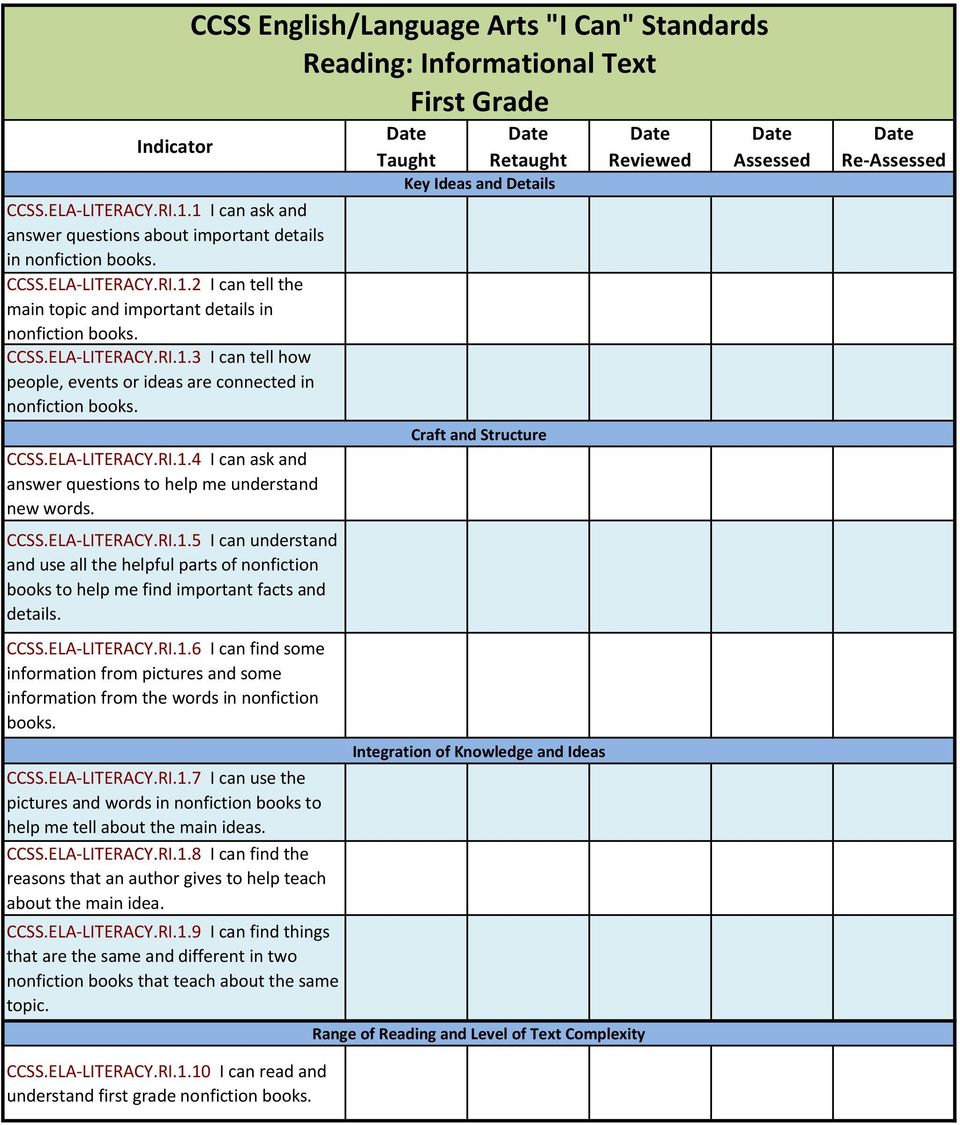
4 CCSS.ELA-LITERACY.RI.1.1 I can ask and answer questions about important details in nonfiction books. CCSS.ELA-LITERACY.RI.1.2 I can tell the main topic and important details in nonfiction books. CCSS.ELA-LITERACY.RI.1.3 I can tell how people, events or ideas are connected in nonfiction books. CCSS.ELA-LITERACY.RI.1.4 I can ask and answer questions to help me understand new words. CCSS.ELA-LITERACY.RI.1.5 I can understand and use all the helpful parts of nonfiction books to help me find important facts and details. CCSS.ELA-LITERACY.RI.1.6 I can find some information from pictures and some information from the words in nonfiction books. CCSS.ELA-LITERACY.RI.1.7 I can use the pictures and words in nonfiction books to help me tell about the main ideas. CCSS.ELA-LITERACY.RI.1.8 I can find the reasons that an author gives to help teach about the main idea. CCSS.ELA-LITERACY.RI.1.9 I can find things that are the same and different in two nonfiction books that teach about the same topic. Reading: Informational Text Key Ideas and Details Craft and Structure Integration of Knowledge and Ideas Range of Reading and Level of Text Complexity Re- CCSS.ELA-LITERACY.RI.1.10 I can read and understand first grade nonfiction books.
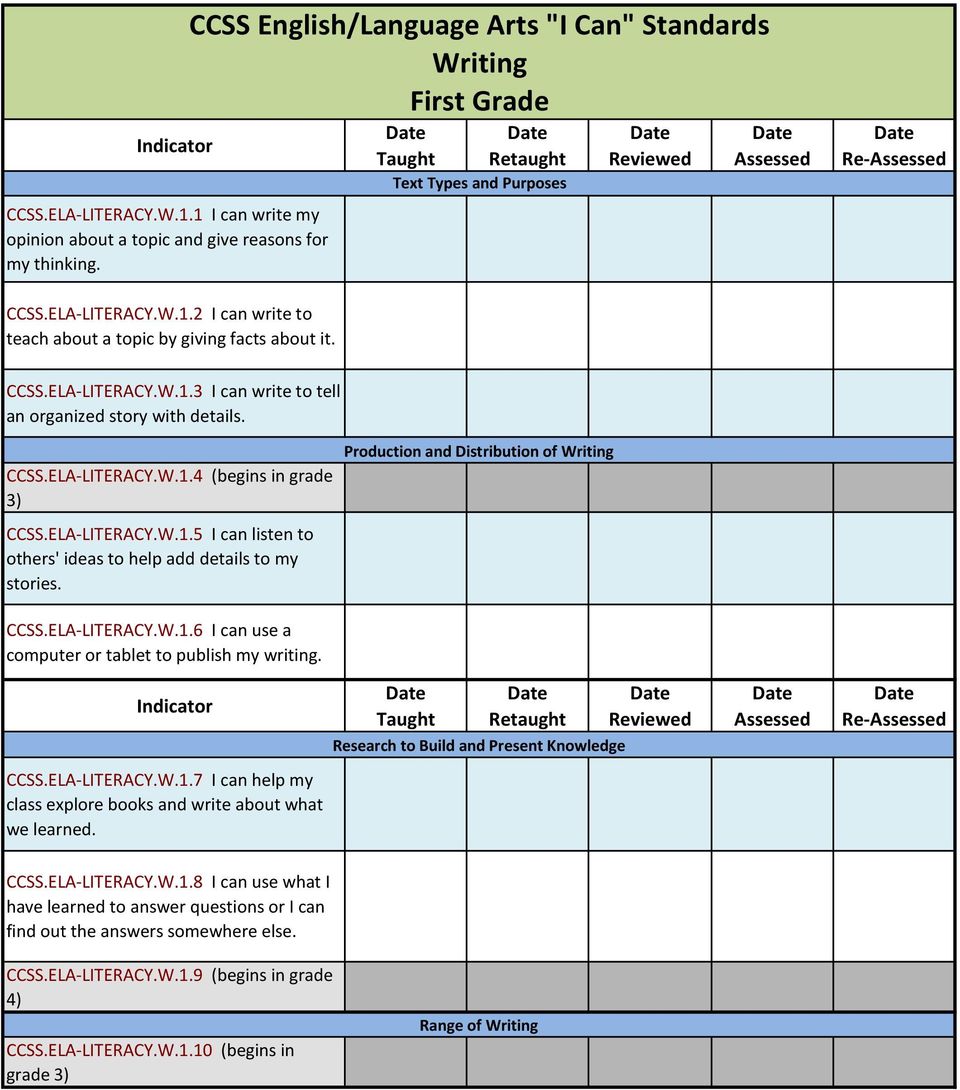
5 CCSS.ELA-LITERACY.W.1.1 I can write my opinion about a topic and give reasons for my thinking. Writing Text Types and Purposes Re- CCSS.ELA-LITERACY.W.1.2 I can write to teach about a topic by giving facts about it. CCSS.ELA-LITERACY.W.1.3 I can write to tell an organized story with details. CCSS.ELA-LITERACY.W.1.4 (begins in grade 3) CCSS.ELA-LITERACY.W.1.5 I can listen to others' ideas to help add details to my stories. Production and Distribution of Writing CCSS.ELA-LITERACY.W.1.6 I can use a computer or tablet to publish my writing. Indicator CCSS.ELA-LITERACY.W.1.7 I can help my class explore books and write about what we learned. Taught Retaught Research to Build and Present Knowledge Re- CCSS.ELA-LITERACY.W.1.8 I can use what I have learned to answer questions or I can find out the answers somewhere else. CCSS.ELA-LITERACY.W.1.9 (begins in grade 4) CCSS.ELA-LITERACY.W.1.10 (begins in grade 3) Range of Writing
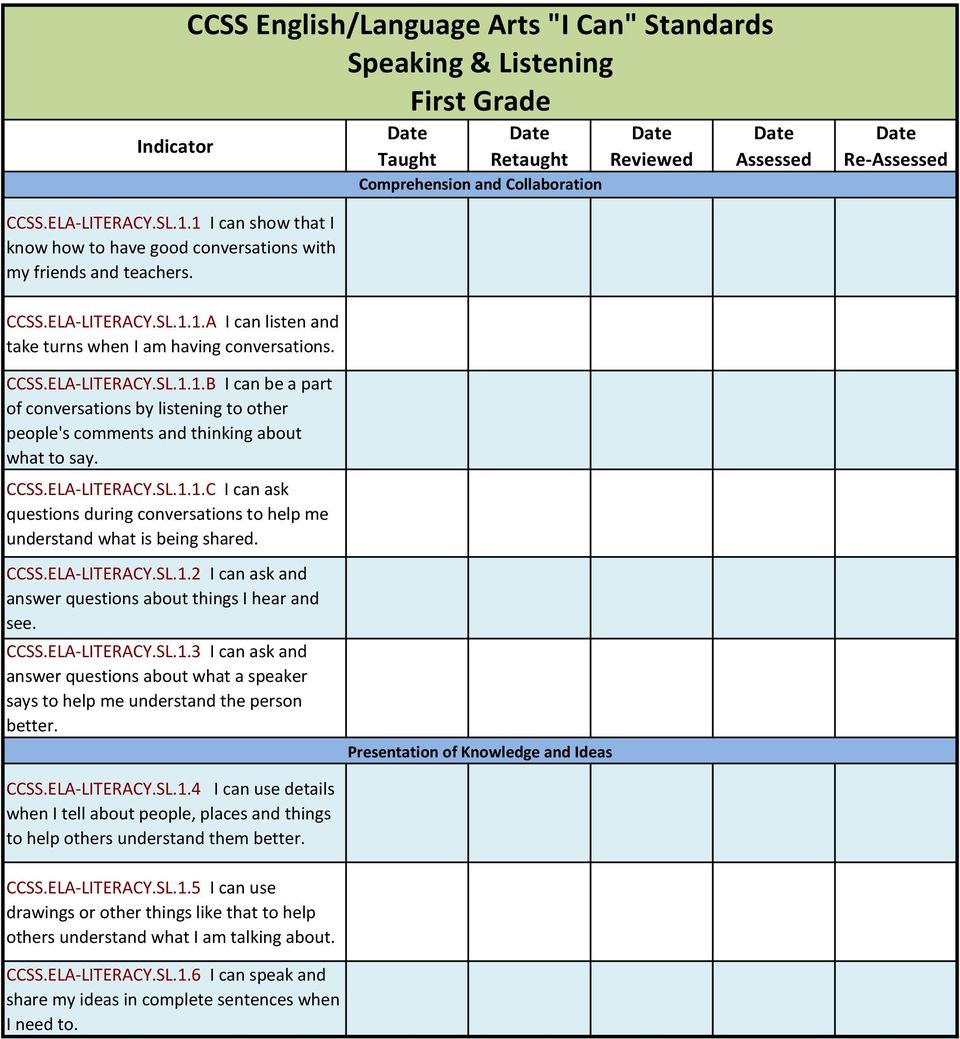
6 Speaking & Listening Comprehension and Collaboration Re- CCSS.ELA-LITERACY.SL.1.1 I can show that I know how to have good conversations with my friends and teachers. CCSS.ELA-LITERACY.SL.1.1.A I can listen and take turns when I am having conversations. CCSS.ELA-LITERACY.SL.1.1.B I can be a part of conversations by listening to other people's comments and thinking about what to say. CCSS.ELA-LITERACY.SL.1.1.C I can ask questions during conversations to help me understand what is being shared. CCSS.ELA-LITERACY.SL.1.2 I can ask and answer questions about things I hear and see. CCSS.ELA-LITERACY.SL.1.3 I can ask and answer questions about what a speaker says to help me understand the person better. Presentation of Knowledge and Ideas CCSS.ELA-LITERACY.SL.1.4 I can use details when I tell about people, places and things to help others understand them better. CCSS.ELA-LITERACY.SL.1.5 I can use drawings or other things like that to help others understand what I am talking about. CCSS.ELA-LITERACY.SL.1.6 I can speak and share my ideas in complete sentences when I need to.
7 CCSS.ELA-LITERACY.L.1.1 I can show that I know how to use words correctly when I write and speak. CCSS.ELA-LITERACY.L.1.1.A I can print all of the upper and lowercase letters. Language Conventions of Standard English Re- CCSS.ELA-LITERACY.L.1.1.B I can use common, proper and possessive nouns. CCSS.ELA-LITERACY.L1.1.C I can use singular and plural nouns with matching verbs in my sentences. CCSS.ELA-LITERACY.L.1.1.D I can use pronouns (I, me, my, they, them, their, anyone, everything). CCSS.ELA-LITERACY.L.1.1.E I can use verbs in the right way to tell about the past, the present and the future. CCSS.ELA-LITERACY.L.1.1.F I can use adjectives. CCSS.ELA-LITERACY.L.1.1.G I can use conjunctions. (and, but, or, so, because) CCSS.ELA-LITERACY.L.1.1.H I can use determiners (a, the, this, that, my, many, few). CCSS.ELA-LITERACY.L.1.1.I I can use common prepositions (during, beyond, toward). CCSS.ELA-LITERACY.L.1.1.J I can use simple and compound sentences (statements, questions, commands and exclamations). CCSS.ELA-LITERACY.L.1.2 I can show that I know how to write sentences correctly. CCSS.ELA-LITERACY.L.1.2.A I can use capital letters in dates and also when I write people's names. CCSS.ELA-LITERACY.L.1.2.B I can use the right punctuation at the ends of my sentences. CCSS.ELA-LITERACY.L.1.2.C I can use commas when I write the date or when I make a list of things in a sentence. 1CCSS.ELA-LITERACY.L.1.2.D I can use sight words and spelling patterns to help me spell words correctly. 1CCSS.ELA-LITERACY.L.1.2.E I can use what I know about letters and their sounds to spell new words correctly.

8 Knowledge of Language CCSS.ELA-LITERACY.L.1.3 (begins in grade 2) Indicator Vocabulary Acquisition and Use Re- CCSS.ELA-LITERACY.L.1.4 I can figure out what words mean by using the strategies I know and thinking about what I have read. CCSS.ELA-LITERACY.L.1.4.A I can use the whole sentence to help me figure out what other words in the sentence mean. CCSS.ELA-LITERACY.L.1.4.B I can use the beginnings and endings of words to help me figure out what it means. CCSS.ELA-LITERACY.L.1.4.C I can find root words with lots of different endings. CCSS.ELA-LITERACY.L.1.5 I can figure out how words are related. I can figure out how their meanings might be alike. CCSS.ELA-LITERACY.L.1.5.A I can sort things into groups and use the names of the groups to help me understand them better (colors, clothing). CCSS.ELA-LITERACY.L.1.5.B I can explain a word by telling how it belongs in a group. CCSS.ELA-LITERACY.L.1.5.C I can tell how words are used in real-life (places in my house that are cozy). CCSS.ELA-LITERACY.L.1.5.D I can tell or show the difference between verbs (action words) that are almost alike (look, peek, glance, stare, glare, scowl). CCSS.ELA-LITERACY.L.1.5.D I can tell or show the difference between adjectives (describing words) that are almost alike (big, large, gigantic). CCSS.ELA-LITERACY.L.1.6 I can use the new words I learn in different ways to show that I know what they mean.

CCSS English/Language Arts Standards Reading: Foundational Skills First Grade
 CCSS.ELA-Literacy.RF.1.1 Demonstrate understanding of the organization and basic features of print. CCSS.ELA-Literacy.RF.1.1.A Recognize the distinguishing features of a sentence (e.g., first word, capitalization,
3rd Grade Common Core State Standards Writing
 Text Types and Purposes Writing CCSS.ELA-Literacy.W.3.1 Write opinion pieces on topics or texts, supporting a point of view with reasons. CCSS.ELA-Literacy.W.3.1a Introduce the topic or text they are writing
Date Re-Assessed. Indicator. CCSS.ELA-Literacy.RF.5.3 Know and apply grade-level phonics and word analysis skills in decoding words.
 CCSS English/Language Arts Standards Reading: Foundational Skills Fifth Grade Retaught Reviewed Assessed Phonics and Word Recognition CCSS.ELA-Literacy.RF.5.3 Know and apply grade-level phonics and word
Houghton Mifflin Harcourt StoryTown Grade 1. correlated to the. Common Core State Standards Initiative English Language Arts (2010) Grade 1
 Houghton Mifflin Harcourt StoryTown Grade 1 correlated to the Common Core State Standards Initiative English Language Arts (2010) Grade 1 Reading: Literature Key Ideas and details RL.1.1 Ask and answer
CCSS English/Language Arts "I Can" Standards Reading: Foundational Skills Kindergarten
 CCSS.ELA-Literacy.RF.K.1 I can show that I know how books should be read. CCSS.ELA-Literacy.RF.K.1.A I can read the words in a book in the right order. CCSS.ELA-Literacy.RF.K.1.B I can understand that
Indiana Department of Education
 GRADE 1 READING Guiding Principle: Students read a wide range of fiction, nonfiction, classic, and contemporary works, to build an understanding of texts, of themselves, and of the cultures of the United
KINDGERGARTEN. Listen to a story for a particular reason
 KINDGERGARTEN READING FOUNDATIONAL SKILLS Print Concepts Follow words from left to right in a text Follow words from top to bottom in a text Know when to turn the page in a book Show spaces between words
Kindergarten Common Core State Standards: English Language Arts
 Kindergarten Common Core State Standards: English Language Arts Reading: Foundational Print Concepts RF.K.1. Demonstrate understanding of the organization and basic features of print. o Follow words from
Strand: Reading Literature Topics Standard I can statements Vocabulary Key Ideas and Details
 Strand: Reading Literature Key Ideas and Craft and Structure Integration of Knowledge and Ideas RL.K.1. With prompting and support, ask and answer questions about key details in a text RL.K.2. With prompting
CCSS English/Language Arts Standards Reading: Foundational Skills Kindergarten
 Reading: Foundational Skills Print Concepts CCSS.ELA-Literacy.RF.K.1 Demonstrate understanding of the organization and basic features of print. CCSS.ELA-Literacy.RF.K.1.A Follow words from left to right,
Interpreting areading Scaled Scores for Instruction
 Interpreting areading Scaled Scores for Instruction Individual scaled scores do not have natural meaning associated to them. The descriptions below provide information for how each scaled score range should
Year 1 reading expectations (New Curriculum) Year 1 writing expectations (New Curriculum)
 Year 1 reading expectations Year 1 writing expectations Responds speedily with the correct sound to graphemes (letters or groups of letters) for all 40+ phonemes, including, where applicable, alternative
ELAGSEKRI7: With prompting and support, describe the relationship between illustrations and the text (how the illustrations support the text).
 READING LITERARY (RL) Key Ideas and Details ELAGSEKRL1: With prompting and support, ask and answer questions about key details in a text. ELAGSEKRL2: With prompting and support, retell familiar stories,
http://setup.clihome.com/cli.cmap.web/home/maps/viewmapmultipleyear.aspx?teach...
 Page 1 of 6 READING - 1st School Teacher Email Course# Grade Level Lettie Brown Elementary School VanDerVoorn, Lauri [email protected] LA1100 1 Show Icon August 2015 August 2014 Review of
Dynamic Learning Maps Essential Elements English Language Arts. Version 2 Comparison Document
 Dynamic Learning Maps Essential Elements English Language Arts Version 2 Comparison Document COMMON CORE ESSENTIAL ELEMENTS AND ACHIEVEMENT DESCRIPTORS FOR KINDERGARTEN Kindergarten English Language Arts
Grading Benchmarks FIRST GRADE. Trimester 4 3 2 1 1 st Student has achieved reading success at. Trimester 4 3 2 1 1st In above grade-level books, the
 READING 1.) Reads at grade level. 1 st Student has achieved reading success at Level 14-H or above. Student has achieved reading success at Level 10-F or 12-G. Student has achieved reading success at Level
Third Grade Language Arts Learning Targets - Common Core
 Third Grade Language Arts Learning Targets - Common Core Strand Standard Statement Learning Target Reading: 1 I can ask and answer questions, using the text for support, to show my understanding. RL 1-1
DRA2 Word Analysis. correlated to. Virginia Learning Standards Grade 1
 DRA2 Word Analysis correlated to Virginia Learning Standards Grade 1 Quickly identify and generate words that rhyme with given words. Quickly identify and generate words that begin with the same sound.
Grade 1 LA. 1. 1. 1. 1. Subject Grade Strand Standard Benchmark. Florida K-12 Reading and Language Arts Standards 27
 Grade 1 LA. 1. 1. 1. 1 Subject Grade Strand Standard Benchmark Florida K-12 Reading and Language Arts Standards 27 Grade 1: Reading Process Concepts of Print Standard: The student demonstrates knowledge
Unit 2 Title: Word Work Grade Level: Kindergarten Timeframe: 6 Weeks
 Unit 2 Title: Grade Level: Kindergarten Timeframe: 6 Weeks Unit Overview: This unit of word work will focus on the student s ability to produce the primary letter sounds of consonants and some vowels;
Livingston Public Schools Scope and Sequence K 6 Grammar and Mechanics
 Grade and Unit Timeframe Grammar Mechanics K Unit 1 6 weeks Oral grammar naming words K Unit 2 6 weeks Oral grammar Capitalization of a Name action words K Unit 3 6 weeks Oral grammar sentences Sentence
First Grade in California Public Schools. and the Common Core State Standards
 A Look at First Grade in California Public Schools and the Common Core State Standards CURRICULUM FRAMEWORKS AND INSTRUCTIONAL RESOURCES DIVISION INSTRUCTION AND LEARNING SUPPORT BRANCH CALIFORNIA DEPARTMENT
Strand: Reading Literature Topics Standard I can statements Vocabulary Key Ideas and Details
 Strand: Reading Literature Key Ideas and Details Craft and Structure RL.3.1 Ask and answer questions to demonstrate understanding of a text, referring explicitly to the text as the basis for the answers.
This image cannot currently be displayed. Course Catalog. Language Arts 400. 2016 Glynlyon, Inc.
 This image cannot currently be displayed. Course Catalog Language Arts 400 2016 Glynlyon, Inc. Table of Contents COURSE OVERVIEW... 1 UNIT 1: READING AND WRITING... 3 UNIT 2: READING FOR MEANING... 3 UNIT
California. www.heinemann.com Phone: 800.225.5800
 California Preschool Learning Foundations, Vol. 1 (Foundations in Language and Literacy) and The Continuum of Literacy Learning, Grades PreK 8: A Guide to Teaching by Gay Su Pinnell and Irene C. Fountas
Support for Standards-Based Individualized Education Programs: English Language Arts K-12. Guidance for West Virginia Schools and Districts
 Support for Standards-Based Individualized Education Programs: English Language Arts K-12 Guidance for West Virginia Schools and Districts Office of Special Programs West Virginia Department of Education
Reading/Fluency Standards Based Annual Goals
 Reading/Fluency First grade (1.5.1) The student will establish letter-naming fluency at a rate of 40-plus letters per minute by the First grade (1.5.3) When given a first grade passage, the student will
Ohio Early Learning and Development Standards Domain: Language and Literacy Development
 Ohio Early Learning and Development Standards Domain: Language and Literacy Development Strand: Listening and Speaking Topic: Receptive Language and Comprehension Infants Young Toddlers (Birth - 8 months)
Albert Pye and Ravensmere Schools Grammar Curriculum
 Albert Pye and Ravensmere Schools Grammar Curriculum Introduction The aim of our schools own grammar curriculum is to ensure that all relevant grammar content is introduced within the primary years in
Reading Strategies by Level. Early Emergent Readers
 The charts below were created as a common language for teachers and students in the Wallingford Public Schools in kindergarten through eighth grade. The level of the chart selected for use in the classroom
Common Core Progress English Language Arts. Grade 3
 [ SADLIER Common Core Progress English Language Arts Aligned to the Florida [ GRADE 6 Next Generation Sunshine State (Common Core) Standards for English Language Arts Contents 2 Strand: Reading Standards
Writing Common Core KEY WORDS
 Writing Common Core KEY WORDS An educator's guide to words frequently used in the Common Core State Standards, organized by grade level in order to show the progression of writing Common Core vocabulary
Words Their Way TM. Word Study in Action. Correlated to: North Carolina STANDARD COURSE OF STUDY Language Arts for Third Grade
 TM Word Study in Action Correlated to: North Carolina STANDARD COURSE OF STUDY Language Arts for Third Grade For More Information Contact Debbie Owens, Sales Representative 1-800-435-3499 Ext. 8092 www.pearsonlearning.com
Minnesota K-12 Academic Standards in Language Arts Curriculum and Assessment Alignment Form Rewards Intermediate Grades 4-6
 Minnesota K-12 Academic Standards in Language Arts Curriculum and Assessment Alignment Form Rewards Intermediate Grades 4-6 4 I. READING AND LITERATURE A. Word Recognition, Analysis, and Fluency The student
Ms Juliani -Syllabus Special Education-Language/ Writing
 Ms Juliani -Syllabus Special Education-Language/ Writing * As a teacher, I have high expectations for my students and believe that they need to be encouraged, nurtured, and rewarded for their efforts.
LAFS: Language Arts Florida Standards GRADE: K
 LAFS: Language Arts Florida Standards GRADE: K Strand: READING S FOR LITERATURE Cluster 1: Key Ideas and Details CODE LAFS.K.RL.1.1 LAFS.K.RL.1.2 LAFS.K.RL.1.3 With prompting and support, ask and answer
Academic Standards for Reading, Writing, Speaking, and Listening
 Academic Standards for Reading, Writing, Speaking, and Listening Pre-K - 3 REVISED May 18, 2010 Pennsylvania Department of Education These standards are offered as a voluntary resource for Pennsylvania
LANGUAGE! 4 th Edition, Levels A C, correlated to the South Carolina College and Career Readiness Standards, Grades 3 5
 Page 1 of 57 Grade 3 Reading Literary Text Principles of Reading (P) Standard 1: Demonstrate understanding of the organization and basic features of print. Standard 2: Demonstrate understanding of spoken
Reading IV Grade Level 4
 Reading IV Reading IV introduces students to a variety of topics to enrich their reading experience including: a review of consonant and vowel sounds using phonetic clues and diacritical marks to identify
Grade 4 Writing Assessment. Eligible Texas Essential Knowledge and Skills
 Grade 4 Writing Assessment Eligible Texas Essential Knowledge and Skills STAAR Grade 4 Writing Assessment Reporting Category 1: Composition The student will demonstrate an ability to compose a variety
FSD Grade 2 READING. Ask and answer such questions as who, what, where, when, why, and how to demonstrate understanding of key details in a text.
 College and Career Readiness Anchor Standards for Reading Read closely to determine what the text says explicitly and to make logical inferences from it; cite specific textual evidence when writing or
Correlation to the Common Core State Standards for English Language Arts, Grade 3
 Correlation to the Common Core State Standards for English Language Arts, Grade 3 Journeys Grade 3 LESSON 1 LESSON 2 LESSON 3 LESSON 4 LESSON 5 1 Houghton Mifflin Harcourt Publishing Company. All rights
Strand: Reading Literature Topics Standard I can statements Vocabulary Key Ideas and Details
 Strand: Reading Literature Topics Standard I can statements Vocabulary Key Ideas and Details Craft and Structure RL.5.1 Quote accurately from a text when explaining what the text says explicitly and when
Pupil SPAG Card 1. Terminology for pupils. I Can Date Word
 Pupil SPAG Card 1 1 I know about regular plural noun endings s or es and what they mean (for example, dog, dogs; wish, wishes) 2 I know the regular endings that can be added to verbs (e.g. helping, helped,
2016-2017 Curriculum Catalog
 2016-2017 Curriculum Catalog 2016 Glynlyon, Inc. Table of Contents LANGUAGE ARTS 400 COURSE OVERVIEW... 1 UNIT 1: JESUS, OUR EXAMPLE... 3 UNIT 2: WORKING WITH INFORMATION... 3 UNIT 3: THE STORY OF OUR
3rd Grade - ELA Writing
 3rd Grade - ELA Text Types and Purposes College & Career Readiness 1. Opinion Write arguments to support claims in an analysis of substantive topics or texts, using valid reasoning and relevant and sufficient
Child-speak Reading Level 1 APP AF1 AF2 AF3 AF4 AF5 AF6 AF7 Use a range of strategies, including accurate decoding text, to read for meaning
 Child-speak Reading Level 1 APP In some usually I can break down and blend consonant vowel consonant words e.g. cat (1c) I can recognise some familiar words in the I read. (1c) When aloud, I know the sentences
INTEGRATING THE COMMON CORE STANDARDS INTO INTERACTIVE, ONLINE EARLY LITERACY PROGRAMS
 INTEGRATING THE COMMON CORE STANDARDS INTO INTERACTIVE, ONLINE EARLY LITERACY PROGRAMS By Dr. Kay MacPhee President/Founder Ooka Island, Inc. 1 Integrating the Common Core Standards into Interactive, Online
CURRICULUM PACING GUIDE GRADE/SUBJECT: /English. 1st Nine Weeks 1
 Approximately Alabama Course Of Study/Quality Core Standards. Ask and answer questions to demonstrate understanding of a text, referring explicitly to the text as the basis for the answers [RL.3.] (.)
Assessment Without Levels
 Assessment reform As part of our reforms to the national curriculum, the current system of levels used to report children s attainment and progress will be removed from September 2014 and will not be replaced.
This image cannot currently be displayed. Course Catalog. Language Arts 600. 2016 Glynlyon, Inc.
 This image cannot currently be displayed. Course Catalog Language Arts 600 2016 Glynlyon, Inc. Table of Contents COURSE OVERVIEW... 1 UNIT 1: ELEMENTS OF GRAMMAR... 3 UNIT 2: GRAMMAR USAGE... 3 UNIT 3:
10th Grade Language. Goal ISAT% Objective Description (with content limits) Vocabulary Words
 Standard 3: Writing Process 3.1: Prewrite 58-69% 10.LA.3.1.2 Generate a main idea or thesis appropriate to a type of writing. (753.02.b) Items may include a specified purpose, audience, and writing outline.
MCGF CE TI GE LS CS HOTS
 First Grade Reading District Curriculum Map Good Times we Share: Lunch Week 1 Use letter-sound correspondence to decode words and build a sight word vocabulary. Letter-sound association: /m/, /r/, /s/
Common Core Progress English Language Arts
 [ SADLIER Common Core Progress English Language Arts Aligned to the [ Florida Next Generation GRADE 6 Sunshine State (Common Core) Standards for English Language Arts Contents 2 Strand: Reading Standards
Academic Standards for Reading, Writing, Speaking, and Listening June 1, 2009 FINAL Elementary Standards Grades 3-8
 Academic Standards for Reading, Writing, Speaking, and Listening June 1, 2009 FINAL Elementary Standards Grades 3-8 Pennsylvania Department of Education These standards are offered as a voluntary resource
& Sample Lesson. Before Reading. Sight Word Review (1 minute)
 Planning Support & Sample Lesson TIP The Early Guided Reading Lesson Plan found on page 190 in the Appendix is a template you can use to plan your lessons. Each component of the lesson is described in
Bilingual Kindergarten Language Arts Report Card Rubric - Third Six Weeks
 Print Awareness / Phonological Awareness / Phonics I can identify the uppercase and lowercase letters (including diagraphs (ch, ll, rr)) in random order (see chart on report card). K.1(B) The student identifies
OCPS Curriculum, Instruction, Assessment Alignment
 OCPS Curriculum, Instruction, Assessment Alignment Subject Area: Grade: Strand 1: Standard 1: Reading and Language Arts Kindergarten Reading Process The student demonstrates knowledge of the concept of
How To Read With A Book
 Behaviors to Notice Teach Level A/B (Fountas and Pinnell) - DRA 1/2 - NYC ECLAS 2 Solving Words - Locates known word(s) in. Analyzes words from left to right, using knowledge of sound/letter relationships
Performance Indicators-Language Arts Reading and Writing 3 rd Grade
 Learning Standards 1 st Narrative Performance Indicators 2 nd Informational 3 rd Persuasive 4 th Response to Lit Possible Evidence Fluency, Vocabulary, and Comprehension Reads orally with Applies letter-sound
MODULE 15 Diagram the organizational structure of your company.
 Student name: Date: MODULE 15 Diagram the organizational structure of your company. Objectives: A. Diagram the organizational chart for your place of business. B. Determine the importance of organization
Advice for Class Teachers. Moderating pupils reading at P 4 NC Level 1
 Advice for Class Teachers Moderating pupils reading at P 4 NC Level 1 Exemplars of writing at P Scales and into National Curriculum levels. The purpose of this document is to provide guidance for class
2016-2017 Curriculum Catalog
 2016-2017 Curriculum Catalog 2016 Glynlyon, Inc. Table of Contents LANGUAGE ARTS 600 COURSE OVERVIEW... 1 UNIT 1: ELEMENTS OF GRAMMAR... 3 UNIT 2: GRAMMAR USAGE... 3 UNIT 3: READING SKILLS... 4 UNIT 4:
PUSD High Frequency Word List
 PUSD High Frequency Word List For Reading and Spelling Grades K-5 High Frequency or instant words are important because: 1. You can t read a sentence or a paragraph without knowing at least the most common.
English programmes of study: key stages 1 and 2. National curriculum in England
 English programmes of study: key stages 1 and 2 National curriculum in England September 2013 Contents Spoken language years 1 to 6 7 Key stage 1 year 1 9 Key stage 1 year 2 16 Lower key stage 2 years
LiteracyPlanet & the Australian Curriculum: Pre-School
 LiteracyPlanet & the Australian Curriculum: Pre-School We look at learning differently. LiteracyPlanet & the Australian Curriculum Welcome to LiteracyPlanet & the Australian Curriculum. LiteracyPlanet
English Appendix 2: Vocabulary, grammar and punctuation
 English Appendix 2: Vocabulary, grammar and punctuation The grammar of our first language is learnt naturally and implicitly through interactions with other speakers and from reading. Explicit knowledge
openmind 1 Practice Online
 Macmillan Practice Online is the easy way to get all the benefits of online learning and with over 100 courses to choose from, covering all competence levels and ranging from business English to exam practice
Meeting the Standard in North Carolina
 KINDERGARTEN 1.02 Demonstrate understanding of the sounds of letters and understanding that words begin and end alike (onsets and rhymes). 1.03 Recognize and name upper and lower case letters of the alphabet.
stress, intonation and pauses and pronounce English sounds correctly. (b) To speak accurately to the listener(s) about one s thoughts and feelings,
 Section 9 Foreign Languages I. OVERALL OBJECTIVE To develop students basic communication abilities such as listening, speaking, reading and writing, deepening their understanding of language and culture
MFL skills map. Year 3 Year 4 Year 5 Year 6 Develop understanding of the sounds of Individual letters and groups of letters (phonics).
 listen attentively to spoken language and show understanding by joining in and responding explore the patterns and sounds of language through songs and rhymes and link the spelling, sound and meaning of
3rd Grade English Language Arts Georgia Standards of Excellence (ELAGSE)
 READING LITERARY (RL) Key Ideas and Details ELAGSE3RL1: Ask and answer questions to demonstrate understanding of a text, referring explicitly to the text as the basis for the answers. ELAGSE3RL2: Recount
Year 2 and Year 3. Planning Exemplification and Spelling Programme. Guidance. Curriculum and Standards. Year 2 and Year 3.
 Guidance Curriculum and Standards Year 2 and Year 3 Planning Exemplification and Spelling Programme Year 2 and Year 3 teachers Status: Recommended Date of issue: 12-2003 Ref: DfES 0000-2003 Disclaimer
Unit 1 Title: Word Work Grade Level: 1 st Grade Timeframe: 6 Weeks
 Unit 1 Title: Grade Level: 1 st Grade Timeframe: 6 Weeks Unit Overview: This unit of word work will focus on the student s ability to distinguish long and short vowel sounds in single syllable Students
Grade 5. Ontario Provincial Curriculum-based Expectations Guideline Walking with Miskwaadesi and Walking with A`nó:wara By Subject/Strand
 Ontario Provincial Curriculum-based Expectations Guideline Walking with Miskwaadesi and Walking with A`nó:wara By Subject/Strand Turtle Island Conservation Ontario Teachers Resource Bundle 1 The Arts 1.1
Phonics and Word Work
 Phonics and Word Work Introduction Foundational Skills This guide explores how explicit and systematic phonics and word work instruction is included in the ReadyGEN program. It looks at the resources that
Evaluating the Elements of a Piece of Practical Writing The author of this friendly letter..
 Practical Writing Intermediate Level Scoring Rubric for a Friendly Letter (to be used upon completion of Lesson 4) Evaluating the Elements of a Piece of Practical Writing The author of this friendly letter..
Plants That Eat Bugs, Level H LANGUAGE AND LITERARY FEATURES SENTENCE COMPLEXITY
 YOU WILL NEED Take-Home Book, Little Wolf s New Home magnetic letters: s, e, e, d, f, r, t, h, w, p, l, g, n word bags highlighter tape NEW BOOK Plants That Eat Bugs, Level H REREADING Little Wolf s New
SIXTH GRADE UNIT 1. Reading: Literature
 Reading: Literature Writing: Narrative RL.6.1 RL.6.2 RL.6.3 RL.6.4 RL.6.5 RL.6.6 RL.6.7 W.6.3 SIXTH GRADE UNIT 1 Key Ideas and Details Cite textual evidence to support analysis of what the text says explicitly
Narrative Writing Conference Planner
 Narrative Writing Conference Planner Name Class Before our conference on your narrative piece, read the list of questions and directions after the trait(s) that I ve highlighted on this sheet. We ll review
Unit 2 Title: Word Work Grade Level: 1 st Grade Timeframe: 6 Weeks
 Unit 2 Title: Grade Level: 1 st Grade Timeframe: 6 Weeks Unit Overview: This unit of word work will focus on the student s ability to identify and pronounce the initial, medial vowel, and final sounds.
Houghton Mifflin Harcourt Journeys Common Core 2014 and Earobics, Grade 3. correlated to the
 Houghton Mifflin Harcourt Journeys Common Core 2014 and Earobics, Grade 3 correlated to the Common Core State Standards English Language Arts Grade 3 RL.3.1 Reading Standards for Literature Key Ideas and
Reading Standards for Literature
 Reading for Literature ELACC3RL1 Key Ideas and Details: Ask and answer questions to demonstrate understanding of a text, referring explicitly to the text as the basis for the answers. 11/5/2012 1 Reading
English Language Curriculum
 English Language Curriculum The Finnish International School of Tampere (FISTA) requires students to comply with the English curriculum. This curriculum includes goals, content and the criteria for evaluation.
Grade 3 LA. 3. 1. 1. 1. Subject Grade Strand Standard Benchmark. Florida K-12 Reading and Language Arts Standards 55
 Grade 3 LA. 3. 1. 1. 1 Subject Grade Strand Standard Benchmark Florida K-12 Reading and Language Arts Standards 55 Grade 3: Reading Process Phonics/Word Analysis Standard: The student demonstrates knowledge
Key Ideas and Details
 FIFTH GRADE READING LITERARY (RL) Key Ideas and Details ELAGSE5RL1: Quote accurately from a text when explaining what the text says explicitly and when drawing inferences from the text. ELAGSE5RL2: Determine
Cambridge Primary English as a Second Language Curriculum Framework
 Cambridge Primary English as a Second Language Curriculum Framework Contents Introduction Stage 1...2 Stage 2...5 Stage 3...8 Stage 4... 11 Stage 5...14 Stage 6... 17 Welcome to the Cambridge Primary English
Common Core Standards Pacing Guide Fourth Grade English/Language Arts Pacing Guide 1 st Nine Weeks
 Common Core Standards Pacing Guide Fourth Grade English/Language Arts Pacing Guide 1 st Nine Weeks Key: Objectives in bold to be assessed after the current nine weeks Objectives in italics to be assessed
Virginia English Standards of Learning Grade 8
 A Correlation of Prentice Hall Writing Coach 2012 To the Virginia English Standards of Learning A Correlation of, 2012, Introduction This document demonstrates how, 2012, meets the objectives of the. Correlation
20 by Renaissance Learning, Inc. All rights reserved. Printed in the United States of America.
 R4 Advanced Technology for, Renaissance, Renaissance Learning, Renaissance Place, STAR Early Literacy, STAR Math, and STAR Reading, are trademarks of Renaissance Learning, Inc., and its subsidiaries, registered,
Fountas & Pinnell Guided Reading Text Level Descriptions
 Fountas & Pinnell Guided Reading Text Level Descriptions A: Characteristics of Texts at Level A: Simple factual texts, animal fantasy and realistic fiction Picture books Text and concepts highly supported
National Curriculum for English Key Stages 1 and 2 Draft. National Curriculum review
 National Curriculum for English Key Stages 1 and 2 Draft National Curriculum review Contents Key Stage 1 Programme of Study Year 1...5 Year 2...10 Lower Key Stage 2 Programme of Study Years 3 4...15 Upper
Index. 344 Grammar and Language Workbook, Grade 8
 Index Index 343 Index A A, an (usage), 8, 123 A, an, the (articles), 8, 123 diagraming, 205 Abbreviations, correct use of, 18 19, 273 Abstract nouns, defined, 4, 63 Accept, except, 12, 227 Action verbs,
Rubrics & Checklists
 Rubrics & Checklists fulfilling Common Core s for Third Grade Narrative Writing Self-evaluation that's easy to use and comprehend Scoring that's based on Common Core expectations Checklists that lead students
Montessori Academy of Owasso
 Montessori Academy of Owasso 5 & 6 Year-Old Curriculum Academic Area: Language Arts Category: Reading: Literature Subcategory: Key Ideas and Details Element 1:With prompting and support, ask and answer
Five Pronunciation Games for Brazil
 Five Pronunciation Games for Brazil Mark Hancock with Ricardo Sili I presented a workshop called 'Pronunciation Games for Brazil' with Ricardo Sili at the 13th BRAZ-TESOL National Convention. This article
Language Lessons. Secondary Child
 Scope & Sequence for Language Lessons for the Secondary Child by Sandi Queen Queen Homeschool Supplies, Inc. Lesson 1: Picture Study and Narration Lesson 2: Creative Writing Lesson 3-5: For Copywork Lesson
Guided Reading Indicators
 Guided Reading Level A Descriptors Characteristics of Early Emergent Readers at Level A Simple factual texts, animal fantasy and realistic fiction Picture books Text and concepts highly supported by pictures
CORRELATION OF COMPREHENSION CLUBS TO THE COMMON CORE STATE STANDARDS INITIATIVE FOR ENGLISH LANGUAGE ARTS GRADES K-5
 CORRELATION OF COMPREHENSION CLUBS TO THE COMMON CORE STATE STANDARDS INITIATIVE FOR ENGLISH LANGUAGE ARTS GRADES K-5 Common Core State Standards Kindergarten Reading: Literature Key Ideas and Details