
The Quantum Harmonic Oscillator Stephen Webb
|
|
|
- Noreen Carroll
- 9 years ago
- Views:
Transcription
1 The Quantum Harmonic Oscillator Stephen Webb The Importance of the Harmonic Oscillator The quantum harmonic oscillator holds a unique importance in quantum mechanics, as it is both one of the few problems that can really be solved in closed form, and is a very generally useful solution, both in approximations and in exact solutions of various problems. The harmonic oscillator is characterized by the Hamiltonian: H = P2 2 m 1 2 m 2 X 2 This Hamiltonian appears in various applications, and in fact the approximation of the harmonic oscillator is valid near the minimum of any potential function. Expanded around a minimum point x*, any potential can then be Taylor expanded as: V x = V 0 x x * V x x = x * 1 2 x x 2 V * 2 x 2 x = x * In this case, V 0 is an arbitrary constant that can be taken to zero, and the second term is zero since the derivative is zero at critical points. If we assume that the variation around the critical point is small, then the higher order terms may be neglected, and we may readjust the variables to place the critical point at 0 and approximate it as a parabola. The harmonic oscillator also gives the exact solution for a particle in a uniform magnetic field of a given vector potential, as that vector potential merely takes the form of a two-dimensional harmonic oscillator. Finally, it serves as an excellent pedagogical tool. It introduces people to the methods of analytically solving the differential equations frequently encountered in quantum mechanics, and also provides a good introduction to the use of raising and lowering operators, and using the abstract vectors that are frequently used in quantum mechanics to solve problems by knowing the action of operators upon state vectors, rather than using integration to evaluate expectation values. The Classical Oscillator: A Review The classical harmonic oscillator is most frequently introduced as a mass on an undamped spring. The Hamiltonian for such a system is: and from the canonical relations we find that: H p = ẋ = p m H = p2 2 m 1 2 k x2 H x = ṗ = kx Solving this set of differential equations then gives the solution: x t = x 0 cos k m t It is this solution that we should approximately get in the high energy limit solution to the quantum harmonic oscillator, and this will be our test that we have found the solution to the problem.

2 The Quantum Harmonic Oscillator: Analytical Solution With the quantum harmonic oscillator we are presented with the problem of finding the eigenfunctions of the given Hamiltonian, which, in the position representation, is: H = ħ2 2 2 m x m 2 x 2 The Schrodinger equation then reads: ħ m x m 2 x 2 = i ħ t This is a second order, nonhomogeneous differential equation, for which we may apply separation of variables to turn it into the standard time independent Schrodinger equation: ħ m x m 2 x 2 = E Our first instinct in solving this problem should be to use a power series solution, as we know that the wave functions must be well behaved enough to be expressed as a power series, and the problem itself demands the use of it. First, we get the problem in unitless dimensions, doing so by making the following substitutions and dividing through by constants: = E ħ y = m x ħ Making these substitutions, we then get a unitless differential equation: ' ' 2 y 2 = 0 To find the solution to this differential equation, we first analyze its asymptotics, that is, the extreme positions of the differential equation. In this case, we look at small energy, when the y^2 term dominates. In this form, the differential equation is approximately: ' ' = y 2 which suggests that the wave function may be a Gaussian, or something of similar form. Thus, we guess that the wave function is of the form: x = u y exp[ y 2 /2] Plugging this into the differential equation we get: u ' ' y exp[ y 2 /2] 2 u ' y y exp[ y 2 /2] 2 1 u y exp[ y 2 /2] = 0 We can get rid of the Gaussian terms, as they represent a general multiplying factor, thus: u ' ' 2 y u ' 2 1 u = 0 If we assume that the equation for u is in the form of a power series, we make the substitution: u y = C n y n C n [n n 1 y n 2 2 ny n 2 1 y n ] = 0 n=0 n=0 Analyzing the resulting series solution, we arrive at the recursion relation: C n 2 = C n 2 n 1 2 n 2 n 1 In theory we've solved the problem, except for the normalization condition. In the limit of large n, we find that the ratio between the succeeding terms is n/2, which grows faster than the terms in the exponential. This series diverges faster than our Gaussian converges, and the only way for the series to converge, and thus for the wave function to have any physical meaning, is for the series to truncate. The best way to do this is to make the numerator zero, as any successive terms to that would be zero as well, and from this we get: 2 = 2 n 1 = n 1 2 E = ħ n 1 2 From the requirement that the power series converge, and therefore truncate, we find that the energy levels for the harmonic oscillator are quantized.

3 This power series solution is not complete, as the individual eigenstates of the Hamiltonian are not yet made orthogonal. When this is carried out, what results is a solution that involves the Hermite polynomials, and is of the form: n x = m 1/4 ħ ħ x] x2 exp m 2 ħ 1 2 n n! n[ H m The computation of expectation values with this involves knowledge of the Hermite polynomials, and involves integrals of Gaussians that become tedious and leave open the possibility for algebraic error. It also does not take much advantage of the tools of linear algebra that can be applied to quantum mechanics. An alternative method, developed by Paul A.M. Dirac, utilizes a different method, in which the Hamiltonian is factored into raising and lowering operators to acquire the different eigenstates of the Hamiltonian, and will be discussed now. The Quantum Harmonic Oscillator: Energy Basis Method The first thing to do is to generate a unitless form of the Hamiltonian, which we do by introducing a new operator: H ' ħ =H This makes the new operator measure the energy states in terms of the characteristic energies, and removes several constants that would otherwise appear in the process of solving the problem, and such a substitution is made with a priori knowledge of the results that are to follow. The substitution the makes the new Hamiltonian operator: H '= P2 2 m ħ 1 m 2 ħ X 2 We now introduce two new operators, what we will eventually recognize as the raising and lowering operators: a = m 1 X P 2 ħ i 2 m ħ a = m 1 X P 2 ħ i 2 m ħ The new Hamiltonian operator we created can be expressed in terms of these operators as: a a = m 2 ħ X m ħ P 2 i 2 ħ [ X, P ] a a = H ' 1 2 H ' = a a 1 2 These operators then satisfy the commutation relations [a,a ] = 1 [a, H ' ] = a [a, H ' ] = a Such commutation relations we will find useful, and these relations indicate that these operators produce new eigenstates of the Hamiltonian: H ' a n = a H ' [a, H ' ] n H ' a n = a H ' a n = n 1 a n The indication of this is that the operator a, which we will now refer to as the lowering operator, generates some new eigenstate for the Hamiltonian, which is one energy level below the previous, to within a normalization constant. A similar procedure can be done to show that a has a similar effect, only raising the eigenenergy of the state. So here we have a mechanism for determining all future eigenstates of the Hamiltonian given only one of them. Theoretically we have the capacity to generate an infinite number of energy states just by

4 repeatedly applying these raising and lowering operators, but we require that the energies be positive just because of our choice of potential and the fact that the state vector must be zero below the minimum potential energy. Therefore, we conclude that for some eigenstate of the Hamiltonian: a 0 = 0 The next question to ask is what the minimum energy of this eigenstate is. We can do this simply by exploiting the linearity of the raising and lowering operators: a 0 = 0 a a 0 =0 a a = H ' 1 2 H ' =0 H ' 0 = H 0 = 1 2 ħ 0 The minimum energy of the harmonic oscillator is ħ, which is exactly what we predicted using the power series method to solving the oscillator. Now we need to find the energy level of the n th eigenstate for the Hamiltonian. To do this, we use the fact that any eigenstate can be represented as the ground state acted upon n times by the raising operator. Doing so, we find that the energy difference between any two energy eigenstates is ħ which then gives us that the energy levels are E n = n ħ, which is exactly the result we gained using the power series method, but without the messy algebra. Now all that is left for using the raising and lowering operators is to find the normalization constant sitting in front of the newly created eigenstates generated by the raising and lowering operators. First, we consider the equation a n = C n n 1 and its complex conjugate: n a = n 1 C n * We combine these two equations to get: n a a n = n 1 n 1 C n * C n n H ' 1 2 n = C * nc n n n n = C n 2 C n 2 = n C n = n e i where the φ in the above equation is an undetermined phase constant usually taken as zero by convention, as it is an unobservable rotation in the energy eigenspace. A similar procedure gives us that a n = n 1 n 1 From all this we can then find that any eigenstate of our Hamiltonian can be expressed as: n = a n n! 0 To recap what we have done so far, we can express everything about the energy of the eigenstates of the harmonic oscillator as follows: H n = n 1 ħ n 2 a n = n n 1 a n = n 1 n 1 We then have a nice mechanism for computing the eigenstates of the Hamiltonian, but we can also express expectation values using the raising and lowering operators. By simply making the substitutions:

5 ħ a a 2 m P = i m ħ 2 a a we can compute any arbitrary expectation values that depend upon these quantities, merely by knowing the effects of the raising and lowering operators upon the eigenstates of the Hamiltonian. Remarks on the Oscillator X = There are several items of note that should be verified by the reader. First of all, the ground state wave function of the harmonic oscillator represents the minimum uncertainty state, for which the Heisenberg uncertainty inequality for momentum and position x p ħ 2 is minimized, that is, the above expression is a strict equality rather than an inequality. This can be easily confirmed using the raising and lowering operators to find that x = 0 p = 0 x 2 = ħ 2 m p2 = m ħ 2 The harmonic oscillator also has its uses in a uniform magnetic field, in which the vector potential and revised Hamiltonian can be written: A = B 0 y x x y 2 H = 1 2 m p q A 2 When the new Hamiltonian is expanded, you get a two dimensional harmonic oscillator in the x-y coordinates and a free particle in the z coordinates. Einstein utilized the 3N uncoupled harmonic oscillators to approximate the heat capacity of a crystal lattice, and approximation far more accurate than the classical one but corrected upon by Debye to deal with the fact that all the oscillators are actually coupled, and provides a good solution for low temperatures. These last two examples can be worked out on your own without much difficulty; the magnetic field example can be done by simply plugging into the new Hamiltonian, whereas the heat capacity problem is an example that can be found in several textbooks. The Three Dimensional Oscillator For a three dimensional oscillator, the solutions are the same as three one-dimensional oscillators added together. Each raising and lowering operator has to be specified to coordinates, and the eigenstates are given by H n x n y n z = n x n y n z 3/2 ħ n x n y n z for an isotropic oscillator. This oscillator experiences various degeneracies on the level of the number of solutions to n x n y n z = k which is given by the formula D k = k 3 1 k Such degeneracies require a study in identical particles to resolve further. Like the one-dimensional harmonic oscillator, we have raising and lowering operators, but these

6 operators act specifically on the different spatial coordinates, thus, we have the raising and lowering operators a x, a x, a y, a y, a z, a z so that their individual actions on an eigenstate are given by a i n i n j n k = n i n i 1 n j n k a i n i n j n k = n i 1 n i 1 n j n k a i a i n i n j n k = n i n i n j n k while the individual operators satisfy their own commutation relations for the same spatial coordinate, but commute with the operators of different coordinates: [a i, a j ] = i, j This three dimensional quantum oscillator was used by Albert Einstein in 1907 when he provided a very primitive and crude explaination of the heat capacity of crystalline solids from the viewpoint of each solid being held in place as a quantum harmonic oscillator. Although this description lacks the sophistication required to provide a legitimate theory explaining the phenomena (it neglects the fact that all the oscillators are coupled), it still provided a qualitative approach which Debye followed with greater success. The Harmonic Oscillator Approximation for the Minima of Potentials As mentioned, in the introduction, the quantum harmonic oscillator is useful as it provides an approximation of the minima of any potential well. To illustrate this, we will analyze the quantum states given by the Hamiltonian H = p2 2 m V 0cosh x/a Our first job is to find the critical point of the potential x V 0cosh x/a = V 0 sinh x/a = 0 x = 0 a Now we have to Taylor expand the potential function about zero, and use zero to find the approximate value for. The Taylor expansion is given by: V 0 cosh x/a = V 0 1 sinh0 x a cosh 0 2 x2 O x 3 The first constant can be disregarded as a scaling factor that can be taken into account with the energy states, finding the total energy by adding back one V 0. Therefore we find that the Hamiltonian can be approximately expressed as: H p2 2 m 1 2 V 0 a 2 x2 V 0 From this and keeping in mind that the scalar in front of the potential Taylor expansion gives: E n n 1 2 ħ V 0 m a 2 V 0 Keeping this in mind, we therefore see that we can use the harmonic oscillator to give a partial approximation to the first few energy states for more esoteric potentials for which we have no hope of finding a closed form solution for.
![same spatial coordinate, but commute with the operators of different coordinates: [a i, a j ] = i, j This three dimensional quantum oscillator was used by Albert Einstein in 1907 when he provided a](/docs-images/47/20790362/images/page_6.jpg "very primitive and crude explaination of the heat capacity of crystalline solids from the viewpoint of each solid being held in place as a quantum harmonic oscillator.")
Three Pictures of Quantum Mechanics. Thomas R. Shafer April 17, 2009
 Three Pictures of Quantum Mechanics Thomas R. Shafer April 17, 2009 Outline of the Talk Brief review of (or introduction to) quantum mechanics. 3 different viewpoints on calculation. Schrödinger, Heisenberg,
Quantum Mechanics and Representation Theory
 Quantum Mechanics and Representation Theory Peter Woit Columbia University Texas Tech, November 21 2013 Peter Woit (Columbia University) Quantum Mechanics and Representation Theory November 2013 1 / 30
Time dependence in quantum mechanics Notes on Quantum Mechanics
 Time dependence in quantum mechanics Notes on Quantum Mechanics http://quantum.bu.edu/notes/quantummechanics/timedependence.pdf Last updated Thursday, November 20, 2003 13:22:37-05:00 Copyright 2003 Dan
5.61 Physical Chemistry 25 Helium Atom page 1 HELIUM ATOM
 5.6 Physical Chemistry 5 Helium Atom page HELIUM ATOM Now that we have treated the Hydrogen like atoms in some detail, we now proceed to discuss the next simplest system: the Helium atom. In this situation,
PHYS 1624 University Physics I. PHYS 2644 University Physics II
 PHYS 1624 Physics I An introduction to mechanics, heat, and wave motion. This is a calculus- based course for Scientists and Engineers. 4 hours (3 lecture/3 lab) Prerequisites: Credit for MATH 2413 (Calculus
2. Spin Chemistry and the Vector Model
 2. Spin Chemistry and the Vector Model The story of magnetic resonance spectroscopy and intersystem crossing is essentially a choreography of the twisting motion which causes reorientation or rephasing
Second Order Linear Nonhomogeneous Differential Equations; Method of Undetermined Coefficients. y + p(t) y + q(t) y = g(t), g(t) 0.
 Second Order Linear Nonhomogeneous Differential Equations; Method of Undetermined Coefficients We will now turn our attention to nonhomogeneous second order linear equations, equations with the standard
Figure 1.1 Vector A and Vector F
 CHAPTER I VECTOR QUANTITIES Quantities are anything which can be measured, and stated with number. Quantities in physics are divided into two types; scalar and vector quantities. Scalar quantities have
arxiv:physics/0004029v1 [physics.ed-ph] 14 Apr 2000
![arxiv:physics/0004029v1 [physics.ed-ph] 14 Apr 2000](/thumbs/32/15427536.jpg "arxiv:physics/0004029v1 [physics.ed-ph] 14 Apr 2000") arxiv:physics/0004029v1 [physics.ed-ph] 14 Apr 2000 Lagrangians and Hamiltonians for High School Students John W. Norbury Physics Department and Center for Science Education, University of Wisconsin-Milwaukee,
arxiv:physics/0004029v1 [physics.ed-ph] 14 Apr 2000 Lagrangians and Hamiltonians for High School Students John W. Norbury Physics Department and Center for Science Education, University of Wisconsin-Milwaukee,
APPLIED MATHEMATICS ADVANCED LEVEL
 APPLIED MATHEMATICS ADVANCED LEVEL INTRODUCTION This syllabus serves to examine candidates knowledge and skills in introductory mathematical and statistical methods, and their applications. For applications
Taylor and Maclaurin Series
 Taylor and Maclaurin Series In the preceding section we were able to find power series representations for a certain restricted class of functions. Here we investigate more general problems: Which functions
Particle Physics. Michaelmas Term 2011 Prof Mark Thomson. Handout 7 : Symmetries and the Quark Model. Introduction/Aims
 Particle Physics Michaelmas Term 2011 Prof Mark Thomson Handout 7 : Symmetries and the Quark Model Prof. M.A. Thomson Michaelmas 2011 206 Introduction/Aims Symmetries play a central role in particle physics;
Operator methods in quantum mechanics
 Chapter 3 Operator methods in quantum mechanics While the wave mechanical formulation has proved successful in describing the quantum mechanics of bound and unbound particles, some properties can not be
MASTER OF SCIENCE IN PHYSICS MASTER OF SCIENCES IN PHYSICS (MS PHYS) (LIST OF COURSES BY SEMESTER, THESIS OPTION)
 MASTER OF SCIENCE IN PHYSICS Admission Requirements 1. Possession of a BS degree from a reputable institution or, for non-physics majors, a GPA of 2.5 or better in at least 15 units in the following advanced
Introduction to Schrödinger Equation: Harmonic Potential
 Introduction to Schrödinger Equation: Harmonic Potential Chia-Chun Chou May 2, 2006 Introduction to Schrödinger Equation: Harmonic Potential Time-Dependent Schrödinger Equation For a nonrelativistic particle
5 Systems of Equations
 Systems of Equations Concepts: Solutions to Systems of Equations-Graphically and Algebraically Solving Systems - Substitution Method Solving Systems - Elimination Method Using -Dimensional Graphs to Approximate
2.2 Magic with complex exponentials
 2.2. MAGIC WITH COMPLEX EXPONENTIALS 97 2.2 Magic with complex exponentials We don t really know what aspects of complex variables you learned about in high school, so the goal here is to start more or
Oscillations. Vern Lindberg. June 10, 2010
 Oscillations Vern Lindberg June 10, 2010 You have discussed oscillations in Vibs and Waves: we will therefore touch lightly on Chapter 3, mainly trying to refresh your memory and extend the concepts. 1
Chapter 9 Unitary Groups and SU(N)
 Chapter 9 Unitary Groups and SU(N) The irreducible representations of SO(3) are appropriate for describing the degeneracies of states of quantum mechanical systems which have rotational symmetry in three
State of Stress at Point
 State of Stress at Point Einstein Notation The basic idea of Einstein notation is that a covector and a vector can form a scalar: This is typically written as an explicit sum: According to this convention,
ORDINARY DIFFERENTIAL EQUATIONS
 ORDINARY DIFFERENTIAL EQUATIONS GABRIEL NAGY Mathematics Department, Michigan State University, East Lansing, MI, 48824. SEPTEMBER 4, 25 Summary. This is an introduction to ordinary differential equations.
Big Ideas in Mathematics
 Big Ideas in Mathematics which are important to all mathematics learning. (Adapted from the NCTM Curriculum Focal Points, 2006) The Mathematics Big Ideas are organized using the PA Mathematics Standards
FLAP P11.2 The quantum harmonic oscillator
 F L E X I B L E L E A R N I N G A P P R O A C H T O P H Y S I C S Module P. Opening items. Module introduction. Fast track questions.3 Ready to study? The harmonic oscillator. Classical description of
LINEAR EQUATIONS IN TWO VARIABLES
 66 MATHEMATICS CHAPTER 4 LINEAR EQUATIONS IN TWO VARIABLES The principal use of the Analytic Art is to bring Mathematical Problems to Equations and to exhibit those Equations in the most simple terms that
1 Variational calculation of a 1D bound state
 TEORETISK FYSIK, KTH TENTAMEN I KVANTMEKANIK FÖRDJUPNINGSKURS EXAMINATION IN ADVANCED QUANTUM MECHAN- ICS Kvantmekanik fördjupningskurs SI38 för F4 Thursday December, 7, 8. 13. Write on each page: Name,
Numerical Analysis An Introduction
 Walter Gautschi Numerical Analysis An Introduction 1997 Birkhauser Boston Basel Berlin CONTENTS PREFACE xi CHAPTER 0. PROLOGUE 1 0.1. Overview 1 0.2. Numerical analysis software 3 0.3. Textbooks and monographs
Similarity and Diagonalization. Similar Matrices
 MATH022 Linear Algebra Brief lecture notes 48 Similarity and Diagonalization Similar Matrices Let A and B be n n matrices. We say that A is similar to B if there is an invertible n n matrix P such that
Accuracy of the coherent potential approximation for a onedimensional array with a Gaussian distribution of fluctuations in the on-site potential
 Accuracy of the coherent potential approximation for a onedimensional array with a Gaussian distribution of fluctuations in the on-site potential I. Avgin Department of Electrical and Electronics Engineering,
RAJALAKSHMI ENGINEERING COLLEGE MA 2161 UNIT I - ORDINARY DIFFERENTIAL EQUATIONS PART A
 RAJALAKSHMI ENGINEERING COLLEGE MA 26 UNIT I - ORDINARY DIFFERENTIAL EQUATIONS. Solve (D 2 + D 2)y = 0. 2. Solve (D 2 + 6D + 9)y = 0. PART A 3. Solve (D 4 + 4)x = 0 where D = d dt 4. Find Particular Integral:
PHY4604 Introduction to Quantum Mechanics Fall 2004 Practice Test 3 November 22, 2004
 PHY464 Introduction to Quantum Mechanics Fall 4 Practice Test 3 November, 4 These problems are similar but not identical to the actual test. One or two parts will actually show up.. Short answer. (a) Recall
Quantum Physics II (8.05) Fall 2013 Assignment 4
 Quantum Physics II (8.05) Fall 2013 Assignment 4 Massachusetts Institute of Technology Physics Department Due October 4, 2013 September 27, 2013 3:00 pm Problem Set 4 1. Identitites for commutators (Based
5 Numerical Differentiation
 D. Levy 5 Numerical Differentiation 5. Basic Concepts This chapter deals with numerical approximations of derivatives. The first questions that comes up to mind is: why do we need to approximate derivatives
MODULE VII LARGE BODY WAVE DIFFRACTION
 MODULE VII LARGE BODY WAVE DIFFRACTION 1.0 INTRODUCTION In the wave-structure interaction problems, it is classical to divide into two major classification: slender body interaction and large body interaction.
6 J - vector electric current density (A/m2 )
 Determination of Antenna Radiation Fields Using Potential Functions Sources of Antenna Radiation Fields 6 J - vector electric current density (A/m2 ) M - vector magnetic current density (V/m 2 ) Some problems
Assessment Plan for Learning Outcomes for BA/BS in Physics
 Department of Physics and Astronomy Goals and Learning Outcomes 1. Students know basic physics principles [BS, BA, MS] 1.1 Students can demonstrate an understanding of Newton s laws 1.2 Students can demonstrate
Theory of electrons and positrons
 P AUL A. M. DIRAC Theory of electrons and positrons Nobel Lecture, December 12, 1933 Matter has been found by experimental physicists to be made up of small particles of various kinds, the particles of
The quantum mechanics of particles in a periodic potential: Bloch s theorem
 Handout 2 The quantum mechanics of particles in a periodic potential: Bloch s theorem 2.1 Introduction and health warning We are going to set up the formalism for dealing with a periodic potential; this
Quantum Mechanics: Postulates
 Quantum Mechanics: Postulates 5th April 2010 I. Physical meaning of the Wavefunction Postulate 1: The wavefunction attempts to describe a quantum mechanical entity (photon, electron, x-ray, etc.) through
Increasing for all. Convex for all. ( ) Increasing for all (remember that the log function is only defined for ). ( ) Concave for all.
 1. Differentiation The first derivative of a function measures by how much changes in reaction to an infinitesimal shift in its argument. The largest the derivative (in absolute value), the faster is evolving.
Linearly Independent Sets and Linearly Dependent Sets
 These notes closely follow the presentation of the material given in David C. Lay s textbook Linear Algebra and its Applications (3rd edition). These notes are intended primarily for in-class presentation
5.61 Fall 2012 Lecture #19 page 1
 5.6 Fall 0 Lecture #9 page HYDROGEN ATOM Consider an arbitrary potential U(r) that only depends on the distance between two particles from the origin. We can write the Hamiltonian simply ħ + Ur ( ) H =
Till now, almost all attention has been focussed on discussing the state of a quantum system.
 Chapter 13 Observables and Measurements in Quantum Mechanics Till now, almost all attention has been focussed on discussing the state of a quantum system. As we have seen, this is most succinctly done
Lecture L2 - Degrees of Freedom and Constraints, Rectilinear Motion
 S. Widnall 6.07 Dynamics Fall 009 Version.0 Lecture L - Degrees of Freedom and Constraints, Rectilinear Motion Degrees of Freedom Degrees of freedom refers to the number of independent spatial coordinates
Generally Covariant Quantum Mechanics
 Chapter 15 Generally Covariant Quantum Mechanics by Myron W. Evans, Alpha Foundation s Institutute for Advance Study (AIAS). ([email protected], www.aias.us, www.atomicprecision.com) Dedicated to the Late
Mean value theorem, Taylors Theorem, Maxima and Minima.
 MA 001 Preparatory Mathematics I. Complex numbers as ordered pairs. Argand s diagram. Triangle inequality. De Moivre s Theorem. Algebra: Quadratic equations and express-ions. Permutations and Combinations.
1 Lecture 3: Operators in Quantum Mechanics
 1 Lecture 3: Operators in Quantum Mechanics 1.1 Basic notions of operator algebra. In the previous lectures we have met operators: ˆx and ˆp = i h they are called fundamental operators. Many operators
Lecture 8. Generating a non-uniform probability distribution
 Discrete outcomes Lecture 8 Generating a non-uniform probability distribution Last week we discussed generating a non-uniform probability distribution for the case of finite discrete outcomes. An algorithm
Au = = = 3u. Aw = = = 2w. so the action of A on u and w is very easy to picture: it simply amounts to a stretching by 3 and 2, respectively.
 Chapter 7 Eigenvalues and Eigenvectors In this last chapter of our exploration of Linear Algebra we will revisit eigenvalues and eigenvectors of matrices, concepts that were already introduced in Geometry
What are the place values to the left of the decimal point and their associated powers of ten?
 The verbal answers to all of the following questions should be memorized before completion of algebra. Answers that are not memorized will hinder your ability to succeed in geometry and algebra. (Everything
Chapter 20. Vector Spaces and Bases
 Chapter 20. Vector Spaces and Bases In this course, we have proceeded step-by-step through low-dimensional Linear Algebra. We have looked at lines, planes, hyperplanes, and have seen that there is no limit
Estimated Pre Calculus Pacing Timeline
 Estimated Pre Calculus Pacing Timeline 2010-2011 School Year The timeframes listed on this calendar are estimates based on a fifty-minute class period. You may need to adjust some of them from time to
Linear Algebra: Vectors
 A Linear Algebra: Vectors A Appendix A: LINEAR ALGEBRA: VECTORS TABLE OF CONTENTS Page A Motivation A 3 A2 Vectors A 3 A2 Notational Conventions A 4 A22 Visualization A 5 A23 Special Vectors A 5 A3 Vector
Lecture L3 - Vectors, Matrices and Coordinate Transformations
 S. Widnall 16.07 Dynamics Fall 2009 Lecture notes based on J. Peraire Version 2.0 Lecture L3 - Vectors, Matrices and Coordinate Transformations By using vectors and defining appropriate operations between
A Brief Review of Elementary Ordinary Differential Equations
 1 A Brief Review of Elementary Ordinary Differential Equations At various points in the material we will be covering, we will need to recall and use material normally covered in an elementary course on
Algebra 1 2008. Academic Content Standards Grade Eight and Grade Nine Ohio. Grade Eight. Number, Number Sense and Operations Standard
 Academic Content Standards Grade Eight and Grade Nine Ohio Algebra 1 2008 Grade Eight STANDARDS Number, Number Sense and Operations Standard Number and Number Systems 1. Use scientific notation to express
Lectures 5-6: Taylor Series
 Math 1d Instructor: Padraic Bartlett Lectures 5-: Taylor Series Weeks 5- Caltech 213 1 Taylor Polynomials and Series As we saw in week 4, power series are remarkably nice objects to work with. In particular,
N 1. (q k+1 q k ) 2 + α 3. k=0
 Teoretisk Fysik Hand-in problem B, SI1142, Spring 2010 In 1955 Fermi, Pasta and Ulam 1 numerically studied a simple model for a one dimensional chain of non-linear oscillators to see how the energy distribution
6. Define log(z) so that π < I log(z) π. Discuss the identities e log(z) = z and log(e w ) = w.
 hapter omplex integration. omplex number quiz. Simplify 3+4i. 2. Simplify 3+4i. 3. Find the cube roots of. 4. Here are some identities for complex conjugate. Which ones need correction? z + w = z + w,
AP1 Oscillations. 1. Which of the following statements about a spring-block oscillator in simple harmonic motion about its equilibrium point is false?
 1. Which of the following statements about a spring-block oscillator in simple harmonic motion about its equilibrium point is false? (A) The displacement is directly related to the acceleration. (B) The
The one dimensional heat equation: Neumann and Robin boundary conditions
 The one dimensional heat equation: Neumann and Robin boundary conditions Ryan C. Trinity University Partial Differential Equations February 28, 2012 with Neumann boundary conditions Our goal is to solve:
3. Reaction Diffusion Equations Consider the following ODE model for population growth
 3. Reaction Diffusion Equations Consider the following ODE model for population growth u t a u t u t, u 0 u 0 where u t denotes the population size at time t, and a u plays the role of the population dependent
Appendix A: Science Practices for AP Physics 1 and 2
 Appendix A: Science Practices for AP Physics 1 and 2 Science Practice 1: The student can use representations and models to communicate scientific phenomena and solve scientific problems. The real world
INTEGRAL METHODS IN LOW-FREQUENCY ELECTROMAGNETICS
 INTEGRAL METHODS IN LOW-FREQUENCY ELECTROMAGNETICS I. Dolezel Czech Technical University, Praha, Czech Republic P. Karban University of West Bohemia, Plzeft, Czech Republic P. Solin University of Nevada,
Physics 9e/Cutnell. correlated to the. College Board AP Physics 1 Course Objectives
 Physics 9e/Cutnell correlated to the College Board AP Physics 1 Course Objectives Big Idea 1: Objects and systems have properties such as mass and charge. Systems may have internal structure. Enduring
LEARNING OBJECTIVES FOR THIS CHAPTER
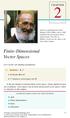 CHAPTER 2 American mathematician Paul Halmos (1916 2006), who in 1942 published the first modern linear algebra book. The title of Halmos s book was the same as the title of this chapter. Finite-Dimensional
Mechanics 1: Conservation of Energy and Momentum
 Mechanics : Conservation of Energy and Momentum If a certain quantity associated with a system does not change in time. We say that it is conserved, and the system possesses a conservation law. Conservation
ASEN 3112 - Structures. MDOF Dynamic Systems. ASEN 3112 Lecture 1 Slide 1
 19 MDOF Dynamic Systems ASEN 3112 Lecture 1 Slide 1 A Two-DOF Mass-Spring-Dashpot Dynamic System Consider the lumped-parameter, mass-spring-dashpot dynamic system shown in the Figure. It has two point
Physics 221A Spring 2016 Notes 1 The Mathematical Formalism of Quantum Mechanics
 Copyright c 2016 by Robert G. Littlejohn Physics 221A Spring 2016 Notes 1 The Mathematical Formalism of Quantum Mechanics 1. Introduction The prerequisites for Physics 221A include a full year of undergraduate
Prerequisite: High School Chemistry.
 ACT 101 Financial Accounting The course will provide the student with a fundamental understanding of accounting as a means for decision making by integrating preparation of financial information and written
Objectives. Materials
 Activity 4 Objectives Understand what a slope field represents in terms of Create a slope field for a given differential equation Materials TI-84 Plus / TI-83 Plus Graph paper Introduction One of the ways
Introduction to Matrix Algebra
 Psychology 7291: Multivariate Statistics (Carey) 8/27/98 Matrix Algebra - 1 Introduction to Matrix Algebra Definitions: A matrix is a collection of numbers ordered by rows and columns. It is customary
(Most of the material presented in this chapter is taken from Thornton and Marion, Chap. 7)
 Chapter 4. Lagrangian Dynamics (Most of the material presented in this chapter is taken from Thornton and Marion, Chap. 7 4.1 Important Notes on Notation In this chapter, unless otherwise stated, the following
1 Inner Products and Norms on Real Vector Spaces
 Math 373: Principles Techniques of Applied Mathematics Spring 29 The 2 Inner Product 1 Inner Products Norms on Real Vector Spaces Recall that an inner product on a real vector space V is a function from
General Theory of Differential Equations Sections 2.8, 3.1-3.2, 4.1
 A B I L E N E C H R I S T I A N U N I V E R S I T Y Department of Mathematics General Theory of Differential Equations Sections 2.8, 3.1-3.2, 4.1 Dr. John Ehrke Department of Mathematics Fall 2012 Questions
Classical Angular Momentum. The Physics of Rotational Motion.
 3. Angular Momentum States. We now employ the vector model to enumerate the possible number of spin angular momentum states for several commonly encountered situations in photochemistry. We shall give
The Method of Partial Fractions Math 121 Calculus II Spring 2015
 Rational functions. as The Method of Partial Fractions Math 11 Calculus II Spring 015 Recall that a rational function is a quotient of two polynomials such f(x) g(x) = 3x5 + x 3 + 16x x 60. The method
NEW YORK STATE TEACHER CERTIFICATION EXAMINATIONS
 NEW YORK STATE TEACHER CERTIFICATION EXAMINATIONS TEST DESIGN AND FRAMEWORK September 2014 Authorized for Distribution by the New York State Education Department This test design and framework document
QUADRATIC, EXPONENTIAL AND LOGARITHMIC FUNCTIONS
 QUADRATIC, EXPONENTIAL AND LOGARITHMIC FUNCTIONS Content 1. Parabolas... 1 1.1. Top of a parabola... 2 1.2. Orientation of a parabola... 2 1.3. Intercept of a parabola... 3 1.4. Roots (or zeros) of a parabola...
Continuous Groups, Lie Groups, and Lie Algebras
 Chapter 7 Continuous Groups, Lie Groups, and Lie Algebras Zeno was concerned with three problems... These are the problem of the infinitesimal, the infinite, and continuity... Bertrand Russell The groups
CITY UNIVERSITY LONDON. BEng Degree in Computer Systems Engineering Part II BSc Degree in Computer Systems Engineering Part III PART 2 EXAMINATION
 No: CITY UNIVERSITY LONDON BEng Degree in Computer Systems Engineering Part II BSc Degree in Computer Systems Engineering Part III PART 2 EXAMINATION ENGINEERING MATHEMATICS 2 (resit) EX2005 Date: August
Module 1 : Conduction. Lecture 5 : 1D conduction example problems. 2D conduction
 Module 1 : Conduction Lecture 5 : 1D conduction example problems. 2D conduction Objectives In this class: An example of optimization for insulation thickness is solved. The 1D conduction is considered
Online Courses for High School Students 1-888-972-6237
 Online Courses for High School Students 1-888-972-6237 PHYSICS Course Description: This course provides a comprehensive survey of all key areas: physical systems, measurement, kinematics, dynamics, momentum,
Physics 235 Chapter 1. Chapter 1 Matrices, Vectors, and Vector Calculus
 Chapter 1 Matrices, Vectors, and Vector Calculus In this chapter, we will focus on the mathematical tools required for the course. The main concepts that will be covered are: Coordinate transformations
FUNDAMENTAL FINITE ELEMENT ANALYSIS AND APPLICATIONS
 FUNDAMENTAL FINITE ELEMENT ANALYSIS AND APPLICATIONS With Mathematica and MATLAB Computations M. ASGHAR BHATTI WILEY JOHN WILEY & SONS, INC. CONTENTS OF THE BOOK WEB SITE PREFACE xi xiii 1 FINITE ELEMENT
South Carolina College- and Career-Ready (SCCCR) Pre-Calculus
 South Carolina College- and Career-Ready (SCCCR) Pre-Calculus Key Concepts Arithmetic with Polynomials and Rational Expressions PC.AAPR.2 PC.AAPR.3 PC.AAPR.4 PC.AAPR.5 PC.AAPR.6 PC.AAPR.7 Standards Know
High Speed Aerodynamics Prof. K. P. Sinhamahapatra Department of Aerospace Engineering Indian Institute of Technology, Kharagpur
 High Speed Aerodynamics Prof. K. P. Sinhamahapatra Department of Aerospace Engineering Indian Institute of Technology, Kharagpur Module No. # 01 Lecture No. # 06 One-dimensional Gas Dynamics (Contd.) We
DERIVATIVES AS MATRICES; CHAIN RULE
 DERIVATIVES AS MATRICES; CHAIN RULE 1. Derivatives of Real-valued Functions Let s first consider functions f : R 2 R. Recall that if the partial derivatives of f exist at the point (x 0, y 0 ), then we
ALGEBRA 2 CRA 2 REVIEW - Chapters 1-6 Answer Section
 ALGEBRA 2 CRA 2 REVIEW - Chapters 1-6 Answer Section MULTIPLE CHOICE 1. ANS: C 2. ANS: A 3. ANS: A OBJ: 5-3.1 Using Vertex Form SHORT ANSWER 4. ANS: (x + 6)(x 2 6x + 36) OBJ: 6-4.2 Solving Equations by
Seminar 4: CHARGED PARTICLE IN ELECTROMAGNETIC FIELD. q j
 Seminar 4: CHARGED PARTICLE IN ELECTROMAGNETIC FIELD Introduction Let take Lagrange s equations in the form that follows from D Alembert s principle, ) d T T = Q j, 1) dt q j q j suppose that the generalized
Integrals of Rational Functions
 Integrals of Rational Functions Scott R. Fulton Overview A rational function has the form where p and q are polynomials. For example, r(x) = p(x) q(x) f(x) = x2 3 x 4 + 3, g(t) = t6 + 4t 2 3, 7t 5 + 3t
CBE 6333, R. Levicky 1 Differential Balance Equations
 CBE 6333, R. Levicky 1 Differential Balance Equations We have previously derived integral balances for mass, momentum, and energy for a control volume. The control volume was assumed to be some large object,
Precession of spin and Precession of a top
 6. Classical Precession of the Angular Momentum Vector A classical bar magnet (Figure 11) may lie motionless at a certain orientation in a magnetic field. However, if the bar magnet possesses angular momentum,
Syllabus for Chem 359: Atomic and Molecular Spectroscopy
 Syllabus for Chem 359: Atomic and Molecular Spectroscopy Instructors: Dr. Reinhard Schweitzer- Stenner and Ms. Siobhan E. Toal Of#ice: Disque 605/Disque 306 Tel: (215) 895-2268 Email: rschweitzer- [email protected]
9.4. The Scalar Product. Introduction. Prerequisites. Learning Style. Learning Outcomes
 The Scalar Product 9.4 Introduction There are two kinds of multiplication involving vectors. The first is known as the scalar product or dot product. This is so-called because when the scalar product of
= N 2 = 3π2 n = k 3 F. The kinetic energy of the uniform system is given by: 4πk 2 dk h2 k 2 2m. (2π) 3 0
 Chapter 1 Thomas-Fermi Theory The Thomas-Fermi theory provides a functional form for the kinetic energy of a non-interacting electron gas in some known external potential V (r) (usually due to impurities)
ADVANCED COMPUTATIONAL TOOLS FOR EDUCATION IN CHEMICAL AND BIOMEDICAL ENGINEERING ANALYSIS
 ADVANCED COMPUTATIONAL TOOLS FOR EDUCATION IN CHEMICAL AND BIOMEDICAL ENGINEERING ANALYSIS Proposal for the FSU Student Technology Fee Proposal Program Submitted by Department of Chemical and Biomedical
MATH 132: CALCULUS II SYLLABUS
 MATH 32: CALCULUS II SYLLABUS Prerequisites: Successful completion of Math 3 (or its equivalent elsewhere). Math 27 is normally not a sufficient prerequisite for Math 32. Required Text: Calculus: Early
Mathematics Course 111: Algebra I Part IV: Vector Spaces
 Mathematics Course 111: Algebra I Part IV: Vector Spaces D. R. Wilkins Academic Year 1996-7 9 Vector Spaces A vector space over some field K is an algebraic structure consisting of a set V on which are
3. Derive the partition function for the ideal monoatomic gas. Use Boltzmann statistics, and a quantum mechanical model for the gas.
 Tentamen i Statistisk Fysik I den tjugosjunde februari 2009, under tiden 9.00-15.00. Lärare: Ingemar Bengtsson. Hjälpmedel: Penna, suddgummi och linjal. Bedömning: 3 poäng/uppgift. Betyg: 0-3 = F, 4-6