
2.2 Magic with complex exponentials
|
|
|
- Sharleen Goodman
- 9 years ago
- Views:
Transcription
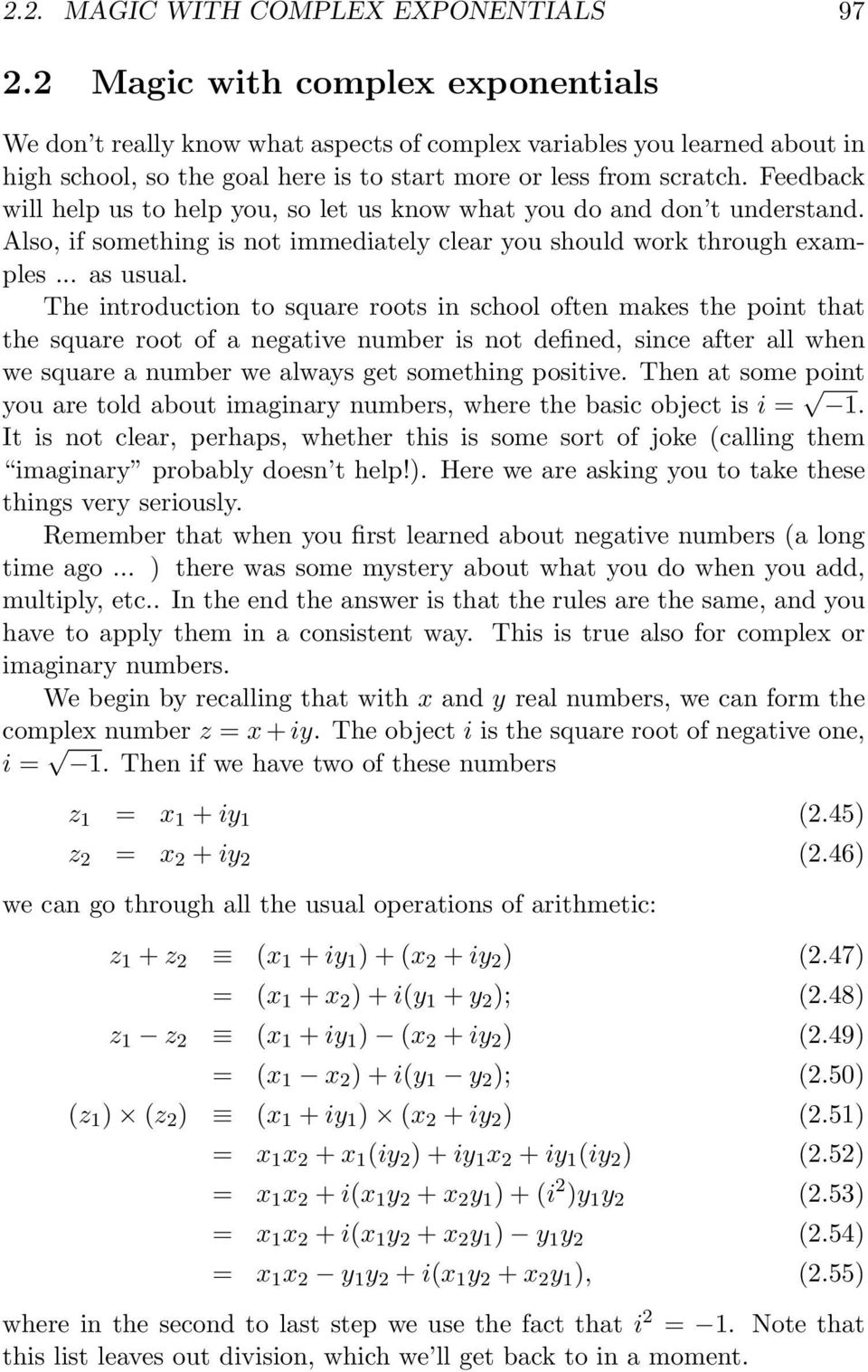
1 2.2. MAGIC WITH COMPLEX EXPONENTIALS Magic with complex exponentials We don t really know what aspects of complex variables you learned about in high school, so the goal here is to start more or less from scratch. Feedback will help us to help you, so let us know what you do and don t understand. Also, if something is not immediately clear you should work through examples... as usual. The introduction to square roots in school often makes the point that the square root of a negative number is not defined, since after all when we square a number we always get something positive. Then at some point you are told about imaginary numbers, where the basic object is i = 1. It is not clear, perhaps, whether this is some sort of joke (calling them imaginary probably doesn t help!). Here we are asking you to take these things very seriously. Remember that when you first learned about negative numbers (a long time ago... ) there was some mystery about what you do when you add, multiply, etc.. In the end the answer is that the rules are the same, and you have to apply them in a consistent way. This is true also for complex or imaginary numbers. We begin by recalling that with x and y real numbers, we can form the complex number z = x + iy. The object i is the square root of negative one, i = 1. Then if we have two of these numbers z 1 = x 1 + iy 1 (2.45) z 2 = x 2 + iy 2 (2.46) we can go through all the usual operations of arithmetic: z 1 + z 2 (x 1 + iy 1 )+(x 2 + iy 2 ) (2.47) = (x 1 + x 2 )+i(y 1 + y 2 ); (2.48) z 1 z 2 (x 1 + iy 1 ) (x 2 + iy 2 ) (2.49) = (x 1 x 2 )+i(y 1 y 2 ); (2.50) (z 1 ) (z 2 ) (x 1 + iy 1 ) (x 2 + iy 2 ) (2.51) = x 1 x 2 + x 1 (iy 2 )+iy 1 x 2 + iy 1 (iy 2 ) (2.52) = x 1 x 2 + i(x 1 y 2 + x 2 y 1 )+(i 2 )y 1 y 2 (2.53) = x 1 x 2 + i(x 1 y 2 + x 2 y 1 ) y 1 y 2 (2.54) = x 1 x 2 y 1 y 2 + i(x 1 y 2 + x 2 y 1 ), (2.55) where in the second to last step we use the fact that i 2 = 1. Note that this list leaves out division, which we ll get back to in a moment.
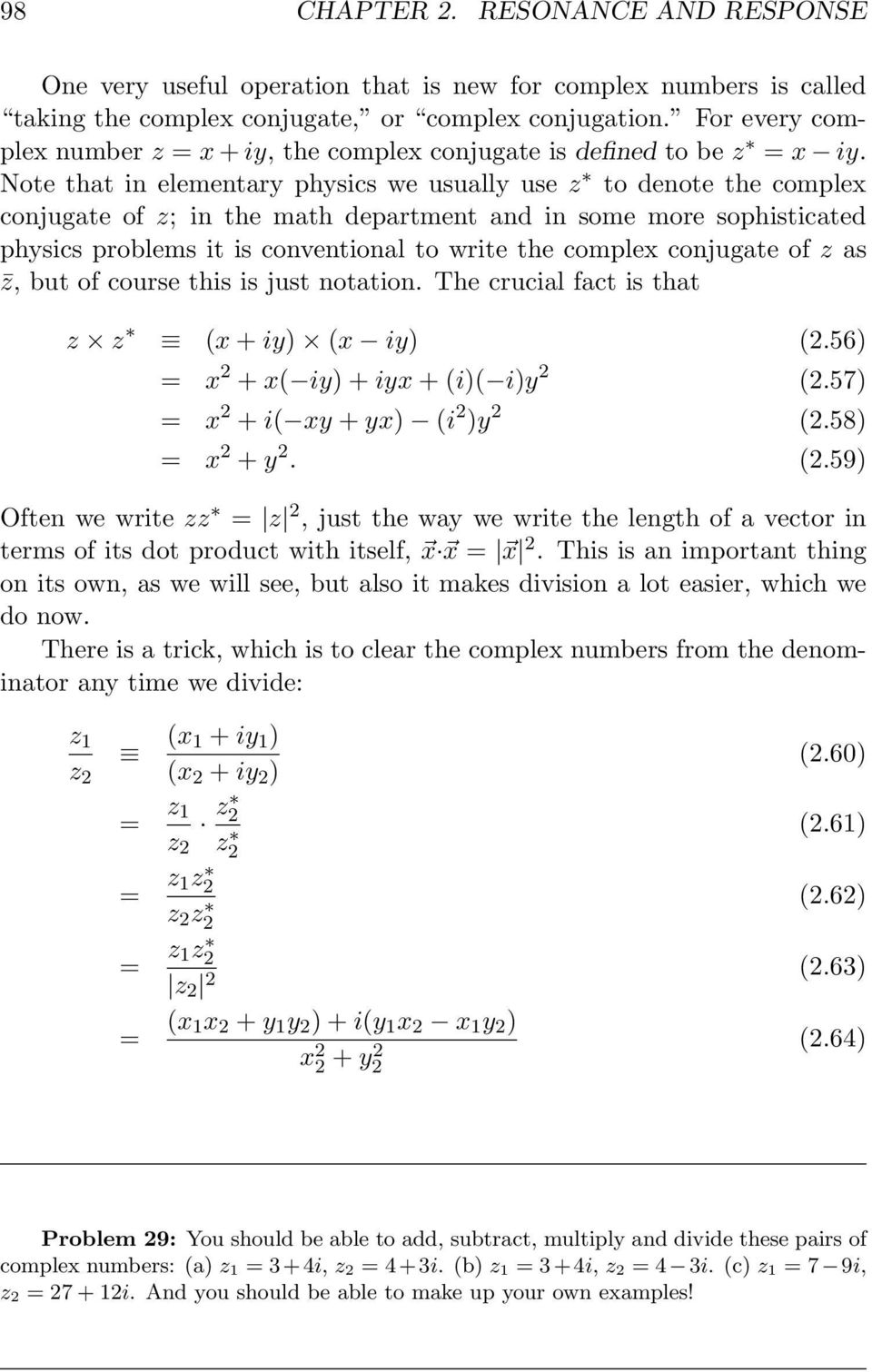
2 98 CHAPTER 2. RESONANCE AND RESPONSE One very useful operation that is new for complex numbers is called taking the complex conjugate, or complex conjugation. For every complex number z = x + iy, the complex conjugate is defined to be z = x iy. Note that in elementary physics we usually use z to denote the complex conjugate of z; in the math department and in some more sophisticated physics problems it is conventional to write the complex conjugate of z as z, but of course this is just notation. The crucial fact is that z z (x + iy) (x iy) (2.56) = x 2 + x( iy)+iyx +(i)( i)y 2 (2.57) = x 2 + i( xy + yx) (i 2 )y 2 (2.58) = x 2 + y 2. (2.59) Often we write zz = z 2, just the way we write the length of a vector in terms of its dot product with itself, x x = x 2. This is an important thing on its own, as we will see, but also it makes division a lot easier, which we do now. There is a trick, which is to clear the complex numbers from the denominator any time we divide: z 1 (x 1 + iy 1 ) z 2 (x 2 + iy 2 ) = z 1 z 2 z 2 z 2 = z 1z 2 z 2 z 2 (2.60) (2.61) (2.62) = z 1z 2 z 2 2 (2.63) = (x 1x 2 + y 1 y 2 )+i(y 1 x 2 x 1 y 2 ) x y2 2 (2.64) Problem 29: You should be able to add, subtract, multiply and divide these pairs of complex numbers: (a) z 1 = 3 + 4i, z 2 = 4 + 3i. (b) z 1 = 3 + 4i, z 2 =4 3i. (c) z 1 =7 9i, z 2 = i. And you should be able to make up your own examples!
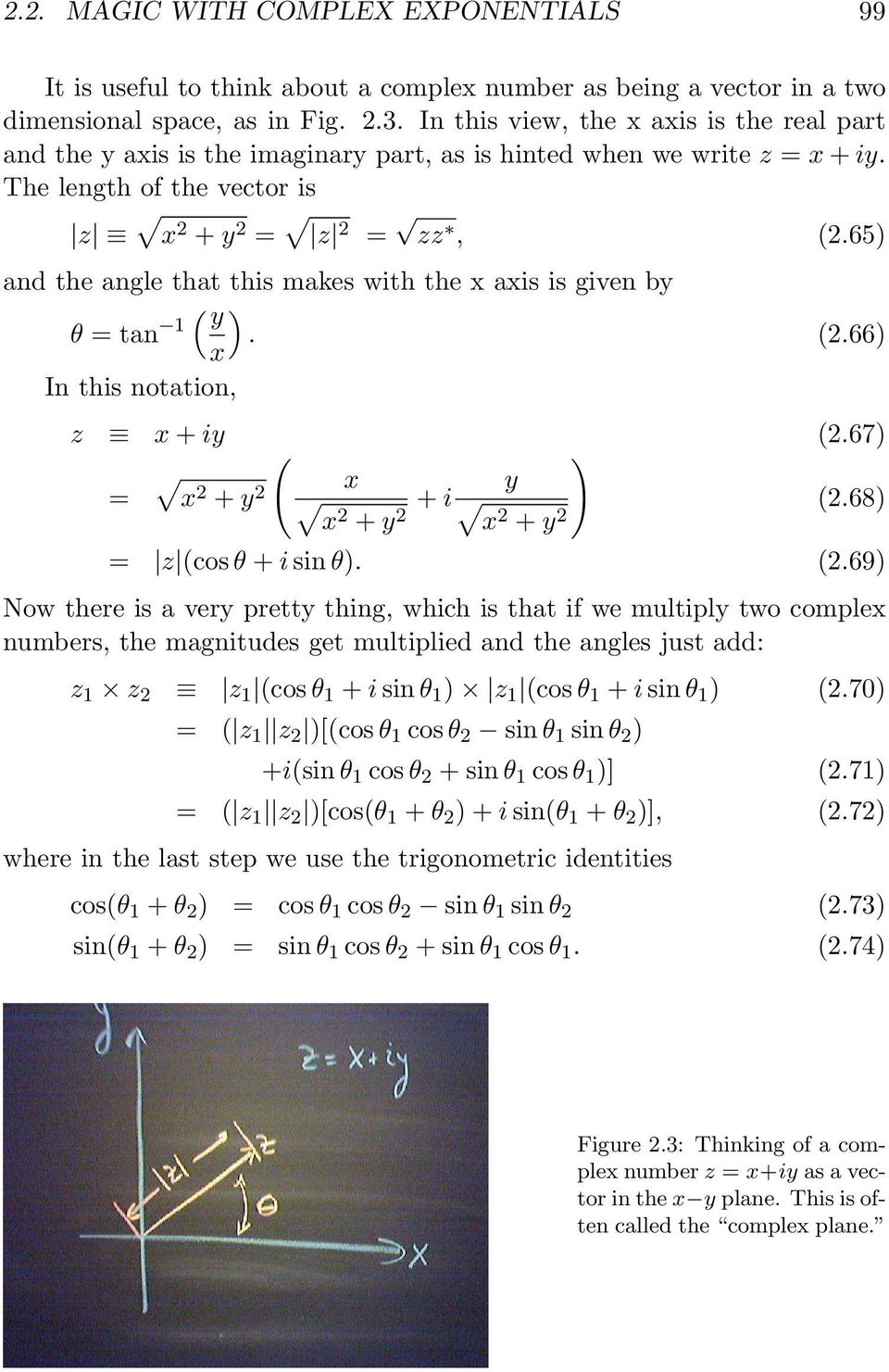
3 2.2. MAGIC WITH COMPLEX EXPONENTIALS 99 It is useful to think about a complex number as being a vector in a two dimensional space, as in Fig In this view, the x axis is the real part and the y axis is the imaginary part, as is hinted when we write z = x + iy. The length of the vector is z x 2 + y 2 = z 2 = zz, (2.65) and the angle that ( this makes with the x axis is given by θ = tan 1 y ). (2.66) x In this notation, z x + iy (2.67) = ( ) x 2 + y 2 x x 2 + y + i y (2.68) 2 x 2 + y 2 = z (cos θ + i sin θ). (2.69) Now there is a very pretty thing, which is that if we multiply two complex numbers, the magnitudes get multiplied and the angles just add: z 1 z 2 z 1 (cos θ 1 + i sin θ 1 ) z 1 (cos θ 1 + i sin θ 1 ) (2.70) = ( z 1 z 2 )[(cos θ 1 cos θ 2 sin θ 1 sin θ 2 ) +i(sin θ 1 cos θ 2 + sin θ 1 cos θ 1 )] (2.71) = ( z 1 z 2 )[cos(θ 1 + θ 2 )+i sin(θ 1 + θ 2 )], (2.72) where in the last step we use the trigonometric identities cos(θ 1 + θ 2 ) = cos θ 1 cos θ 2 sin θ 1 sin θ 2 (2.73) sin(θ 1 + θ 2 ) = sin θ 1 cos θ 2 + sin θ 1 cos θ 1. (2.74) Figure 2.3: Thinking of a complex number z = x+iy as a vector in the x y plane. This is often called the complex plane.
4 100 CHAPTER 2. RESONANCE AND RESPONSE By the same reasoning, one finds z 1 = z 1 z 2 z 2 [cos(θ 1 θ 2 )+i sin(θ 1 θ 2 )]. (2.75) Problem 30: Derive Eq (2.75). Also, in terms of these θ 1 and θ 2, what is the condition for multiplying two complex numbers and getting a real answer? We now have enough tools to figure out what we mean by the exponential of a complex number. Specifically, let s ask what we mean by e iφ. This is a complex number, but it s also an exponential and so it has to obey all the rules for the exponentials. In particular, e iφ 1 e iφ 2 = e i(φ 1+φ 2 ) e iφ 1 e iφ 2 (2.76) = e i(φ 1 φ 2 ). (2.77) You see that the variable φ behaves just like the angle θ in the geometrial representation of complex numbers. Furthermore, if we take the complex number z = e iφ and multiply by its complex conjugate... e iφ [ e iφ] = e iφ [ e iφ] = e i(φ φ) =1. (2.78) Thus z = e iφ is a complex number with unit magnitude, and the angle in the complex plane is just φ itself. Thus we see that e iφ = cos φ + i sin φ, (2.79) which finally tells us what we mean by the complex exponential. Notice that something like this formula had to be true because we know that the solution to the differential equation for the harmonic oscillator can be written either in terms of sines and cosines or in terms of complex exponentials; since solutions are unique, these must be ralted to each other. If you consider the special case of φ = π, then sin φ = 0 and cos φ = 1, leading to the famous Euler formula e iπ + 1 = 0. (2.80)

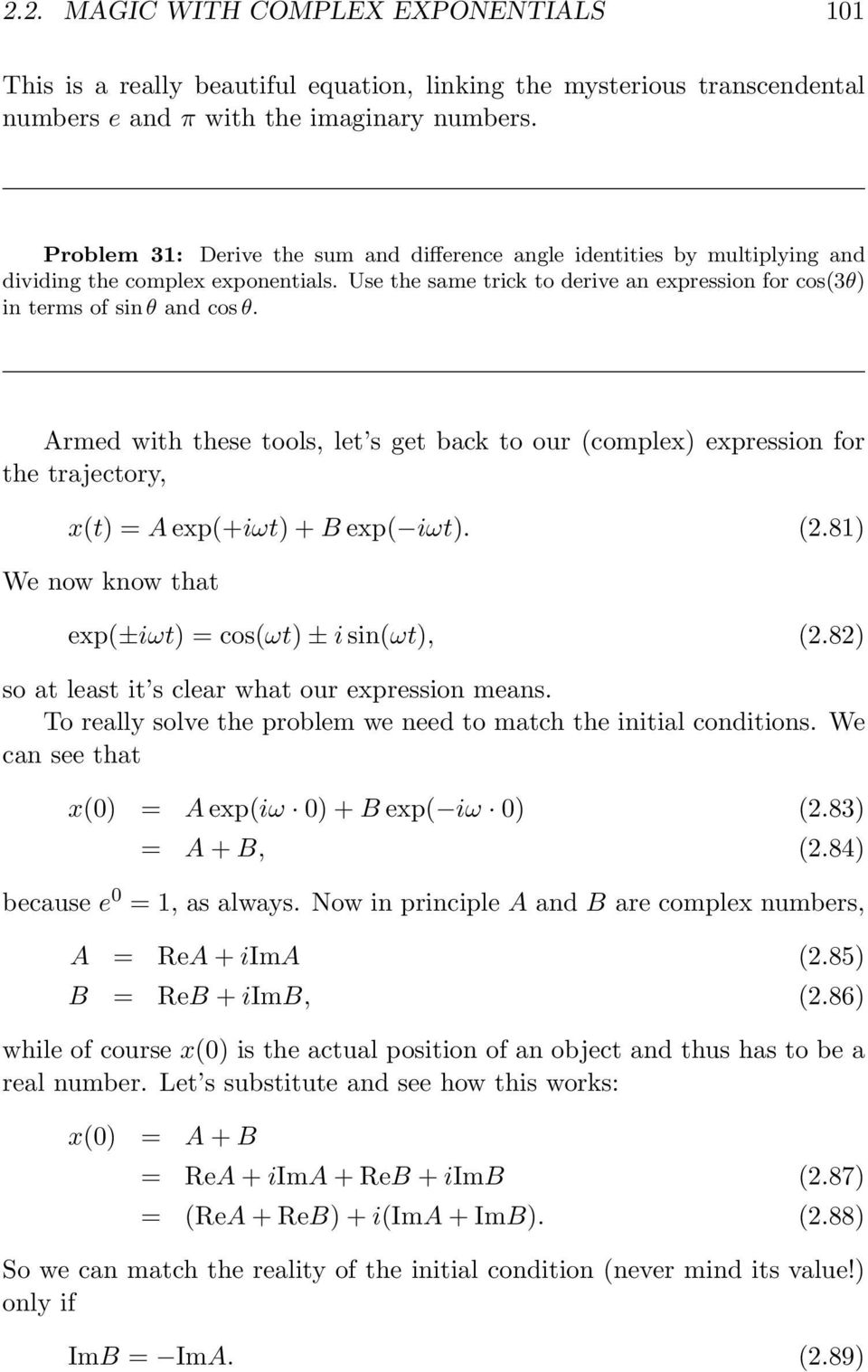
5 2.2. MAGIC WITH COMPLEX EXPONENTIALS 101 This is a really beautiful equation, linking the mysterious transcendental numbers e and π with the imaginary numbers. Problem 31: Derive the sum and difference angle identities by multiplying and dividing the complex exponentials. Use the same trick to derive an expression for cos(3θ) in terms of sin θ and cos θ. Armed with these tools, let s get back to our (complex) expression for the trajectory, x(t) =A exp(+iωt)+b exp( iωt). (2.81) We now know that exp(±iωt) = cos(ωt) ± i sin(ωt), (2.82) so at least it s clear what our expression means. To really solve the problem we need to match the initial conditions. We can see that x(0) = A exp(iω 0) + B exp( iω 0) (2.83) = A + B, (2.84) because e 0 = 1, as always. Now in principle A and B are complex numbers, A = ReA + iima (2.85) B = ReB + iimb, (2.86) while of course x(0) is the actual position of an object and thus has to be a real number. Let s substitute and see how this works: x(0) = A + B = ReA + iima + ReB + iimb (2.87) = (ReA + ReB)+ i(ima + ImB). (2.88) So we can match the reality of the initial condition (never mind its value!) only if ImB = ImA. (2.89)
6 102 CHAPTER 2. RESONANCE AND RESPONSE Now we need to do the same thing for the initial velocity. By differentiating we see that v(t) dx(t) dt = A deiωt dt + B de iωt dt = A(iω)e iωt + B( iω)e iωt, (2.90) and hence v(0) = iω(a B). (2.91) Substituting once again, v(0) = iω(a B) = iω(rea + iima ReB iimb) (2.92) = iω(reareb)+(i)(iω)(ima ImB) (2.93) = ω(ima ImB)+iω(ReA ReB). (2.94) Notice that the real part of the velocity actually comes from the imaginary parts of A and B. In order that the imaginary part of the velocity cancel must have ReA = ReB. (2.95) Thus there really is only one independent complex number here, since we have shown that A = ReA + iima (2.96) B = ReA iima. (2.97) When two complex numbers have this relationship equal real parts and opposite imaginary parts we say that they are complex conjugates, and the notation for this is B = A. The operation simply replaces i by i in a complex number, and clearly (z ) = z. Hence we can write our solution x(t) = A exp(+iωt)+b exp( iωt) = A exp(+iωt)+a exp( iωt). (2.98) But note that exp( iωt) = [exp(+iωt)], so we can write x(t) = A exp(+iωt)+a [exp(+iωt)] (2.99) = A exp(+iωt)+[a exp(+iωt)]. (2.100)

7 2.2. MAGIC WITH COMPLEX EXPONENTIALS 103 Now x(t) is the sum of a complex number and its complex conjugate. But when we add a complex number to its complex conjugate, we cancel the imaginary part and double the real part: z + z = [Re(z)+iIm(z)] + [Re(z) iim(z)] (2.101) = 2Re(z). (2.102) Thus x(t), according to Eq (2.100) will be real at all times. This is good, of course (!). Interestingly, we didn t actually use this condition all we did was to be sure that we match the initial conditions, which of course are real. This is sufficient to insure that trajectories are real forever, which is nice. To proceed further, we recall that all complex numbers can be written as z = Rez + iimz (2.103) = z (cos φ + i sin φ) (2.104) = z exp(iφ), (2.105) where z is the magnitude of the complex number and φ is its phase, z = [Re(z)] 2 + [Im(z)] 2 (2.106) [ ] Im(z) φ = tan 1. (2.107) Re(z) If we do this rewriting of A, A = A exp(iφ A ), (2.108) then the trajectory becomes x(t) = [ A exp(iφ A ) exp(+iωt)] + [ A exp(iφ A ) exp(+iωt)] (2.109) Thus = [ A exp(+iωt + iφ A )] + [ A exp(+iωt + iφ A )]. (2.110) x(t) = [ A exp(+iωt + iφ A )] + [ A exp(+iωt + iφ A )] = 2Re[ A exp(+iωt + iφ A )] (2.111) = 2 A Re[exp(+iωt + iφ A )] (2.112) = 2 A cos(ωt + φ A ). (2.113) So, we are done, except that we have to connect this solution to the initial conditions.
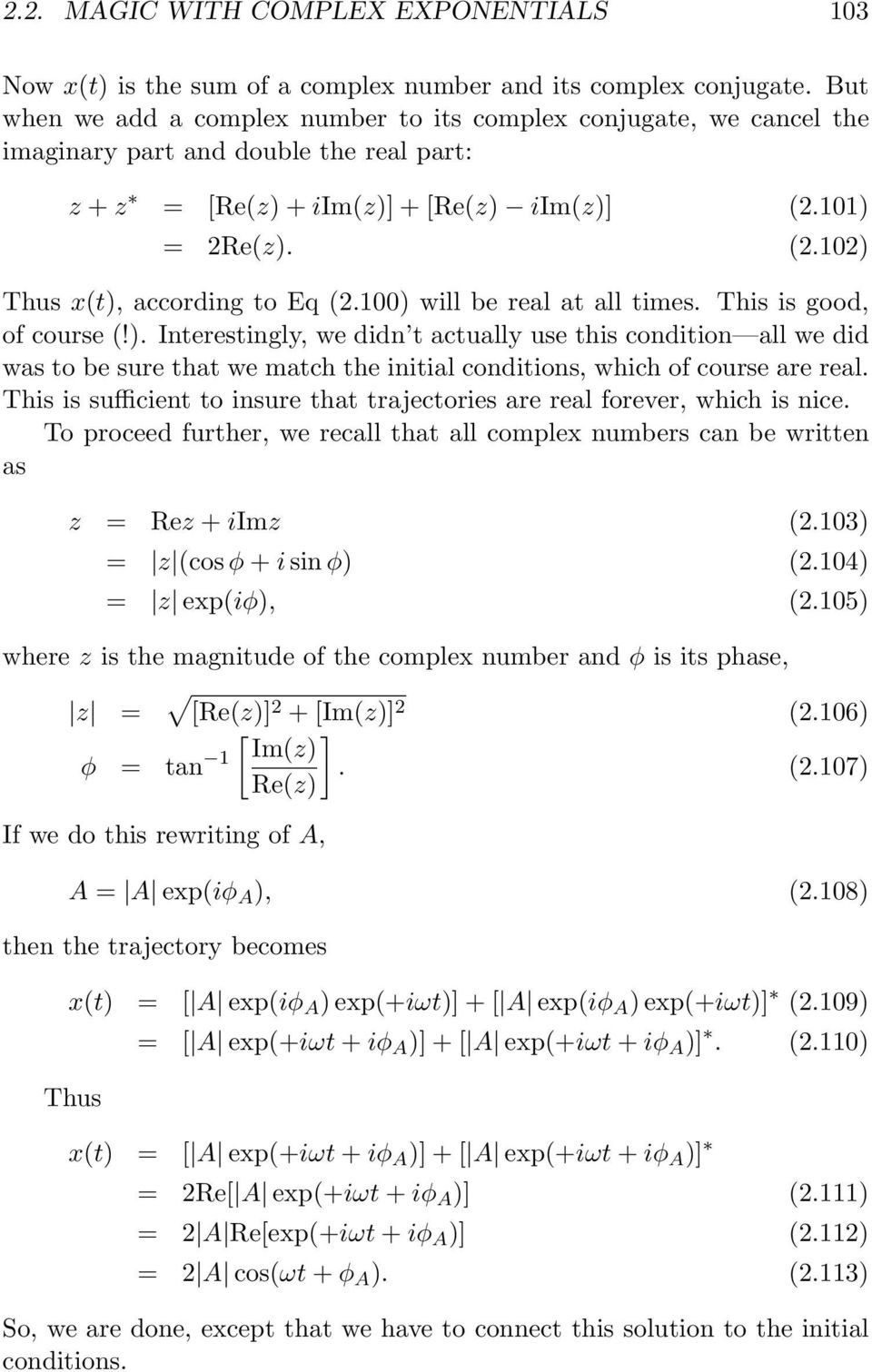
8 104 CHAPTER 2. RESONANCE AND RESPONSE We want to find the arbitrary parameters A and φ A in terms of the initial position and initial velocity. Let s just calculate: x(t = 0) = 2 A cos(ω(0) + φ A ) (2.114) = 2 A cos φ A (2.115) v(t = 0) = dx(t) (2.116) dt t=0 = d dt [2 A cos(ωt + φ A)] (2.117) t=0 = 2 A ω sin(ωt + φ A ) (2.118) t=0 v(t = 0) = 2 A ω sin φ A (2.119) v(t = 0) ω = 2 A sin φ A. (2.120) So we have two equations, Eq s (2.115) and (2.120), that link our parameters to the initial conditions. To solve these equations, note that if we sum the square of the two equations we have [ ] v(0) 2 [x(0)] 2 + = (2 A ) 2 cos 2 φ A + (2 A ) 2 sin 2 φ A (2.121) ω = (2 A ) 2, (2.122) so that [ ] v(0) 2 2 A = [x(0)] 2 +. (2.123) ω Similarly, if we take Eq (2.120) and divide by Eq (2.115), we find v(0) ωx(0) = 2 A sin φ A 2 A cos φ A (2.124) = tan φ A, (2.125) and hence [ ] v(0) φ A = tan 1. (2.126) ωx(0) Thus the amplitude A of the oscillation is related to the initial position, with an extra contribution from the initial velocity, while the phase depends
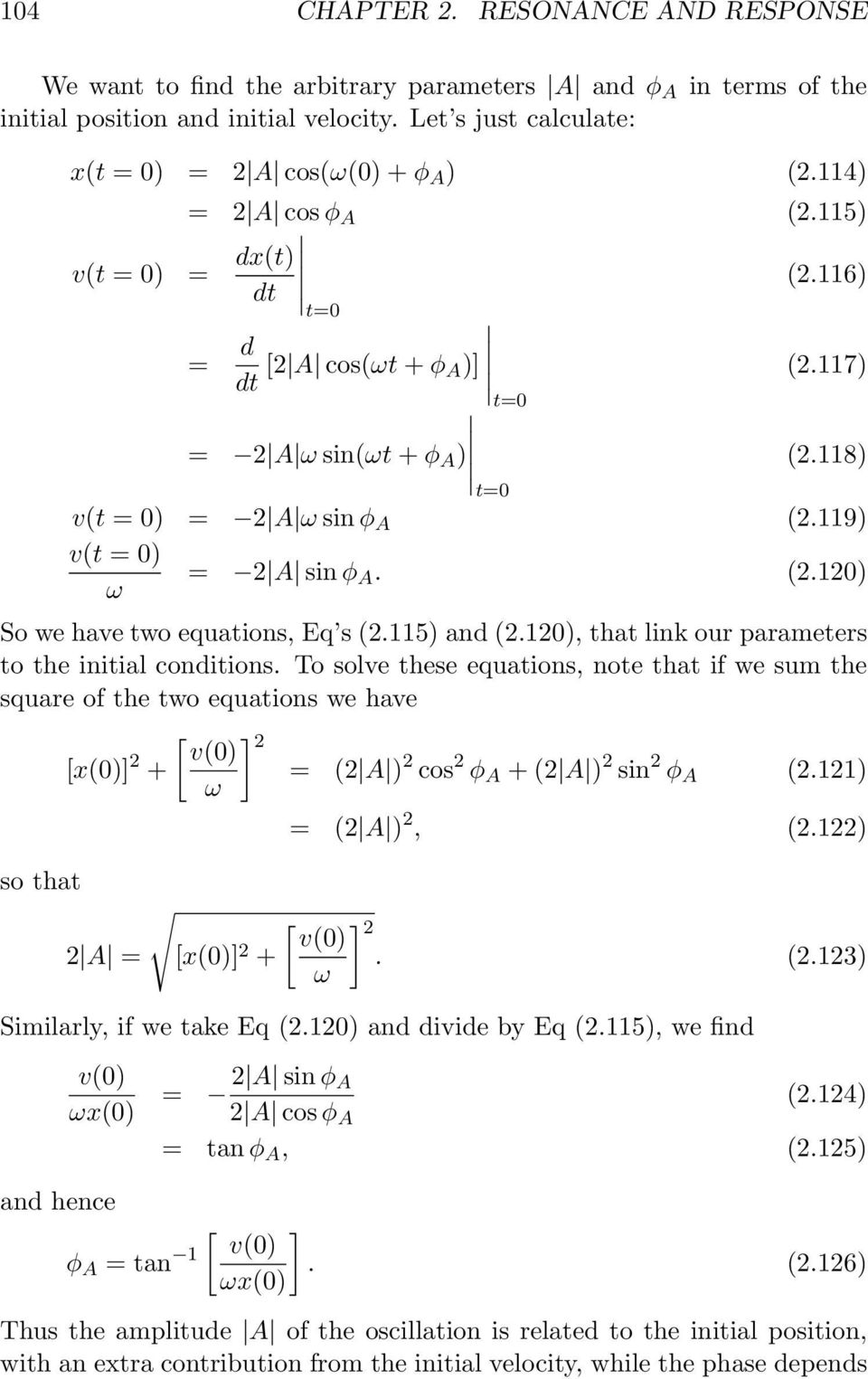
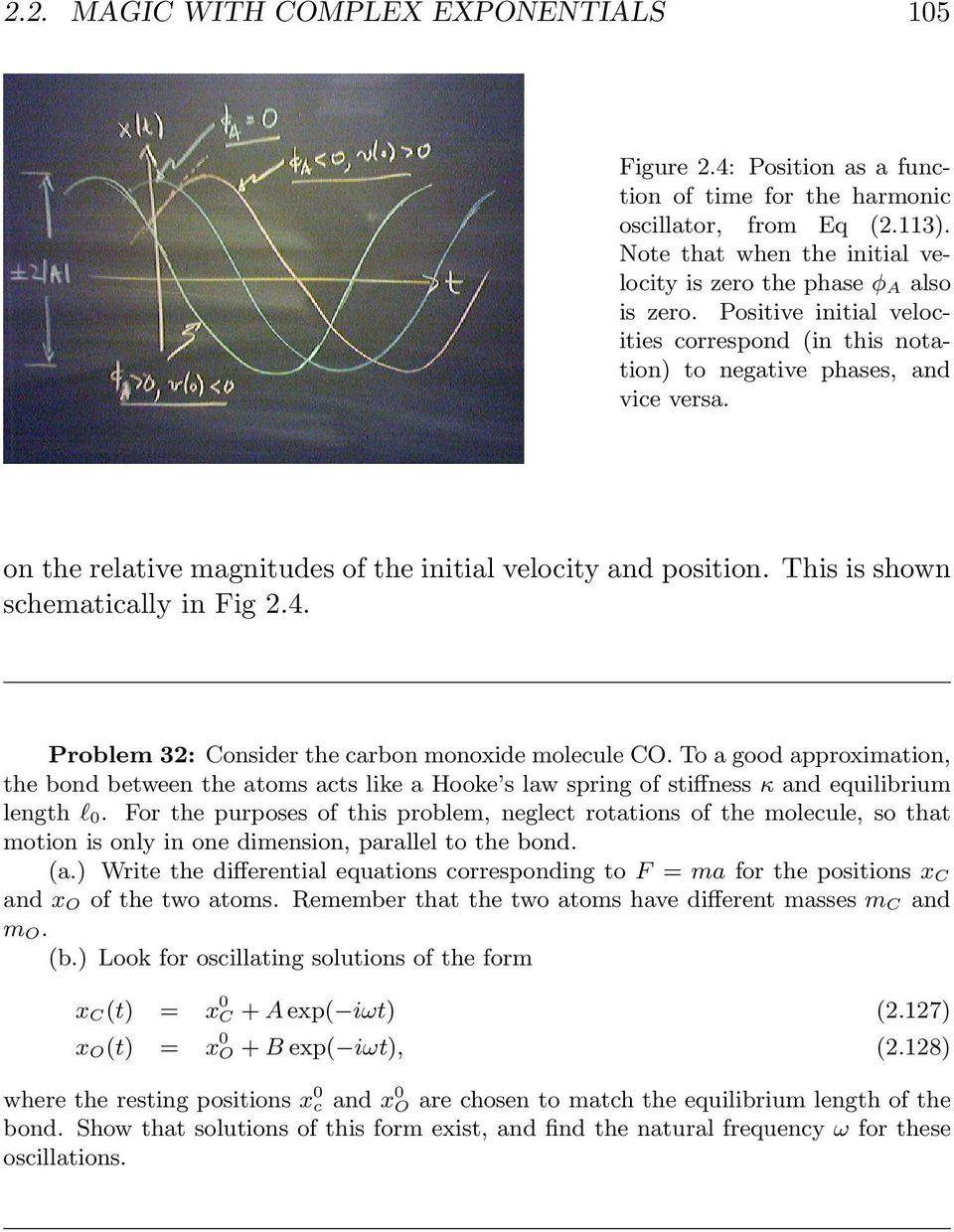
9 2.2. MAGIC WITH COMPLEX EXPONENTIALS 105 Figure 2.4: Position as a function of time for the harmonic oscillator, from Eq (2.113). Note that when the initial velocity is zero the phase φ A also is zero. Positive initial velocities correspond (in this notation) to negative phases, and vice versa. on the relative magnitudes of the initial velocity and position. This is shown schematically in Fig 2.4. Problem 32: Consider the carbon monoxide molecule CO. To a good approximation, the bond between the atoms acts like a Hooke s law spring of stiffness κ and equilibrium length l 0. For the purposes of this problem, neglect rotations of the molecule, so that motion is only in one dimension, parallel to the bond. (a.) Write the differential equations corresponding to F = ma for the positions x C and x O of the two atoms. Remember that the two atoms have different masses m C and m O. (b.) Look for oscillating solutions of the form x C(t) = x 0 C + A exp( iωt) (2.127) x O(t) = x 0 O + B exp( iωt), (2.128) where the resting positions x 0 c and x 0 O are chosen to match the equilibrium length of the bond. Show that solutions of this form exist, and find the natural frequency ω for these oscillations.
10 106 CHAPTER 2. RESONANCE AND RESPONSE

Introduction to Complex Numbers in Physics/Engineering
 Introduction to Complex Numbers in Physics/Engineering ference: Mary L. Boas, Mathematical Methods in the Physical Sciences Chapter 2 & 14 George Arfken, Mathematical Methods for Physicists Chapter 6 The
2.6 The driven oscillator
 2.6. THE DRIVEN OSCILLATOR 131 2.6 The driven oscillator We would like to understand what happens when we apply forces to the harmonic oscillator. That is, we want to solve the equation M d2 x(t) 2 + γ
ANALYTICAL METHODS FOR ENGINEERS
 UNIT 1: Unit code: QCF Level: 4 Credit value: 15 ANALYTICAL METHODS FOR ENGINEERS A/601/1401 OUTCOME - TRIGONOMETRIC METHODS TUTORIAL 1 SINUSOIDAL FUNCTION Be able to analyse and model engineering situations
Oscillations. Vern Lindberg. June 10, 2010
 Oscillations Vern Lindberg June 10, 2010 You have discussed oscillations in Vibs and Waves: we will therefore touch lightly on Chapter 3, mainly trying to refresh your memory and extend the concepts. 1
THE COMPLEX EXPONENTIAL FUNCTION
 Math 307 THE COMPLEX EXPONENTIAL FUNCTION (These notes assume you are already familiar with the basic properties of complex numbers.) We make the following definition e iθ = cos θ + i sin θ. (1) This formula
Lecture L3 - Vectors, Matrices and Coordinate Transformations
 S. Widnall 16.07 Dynamics Fall 2009 Lecture notes based on J. Peraire Version 2.0 Lecture L3 - Vectors, Matrices and Coordinate Transformations By using vectors and defining appropriate operations between
2 Session Two - Complex Numbers and Vectors
 PH2011 Physics 2A Maths Revision - Session 2: Complex Numbers and Vectors 1 2 Session Two - Complex Numbers and Vectors 2.1 What is a Complex Number? The material on complex numbers should be familiar
Vector Math Computer Graphics Scott D. Anderson
 Vector Math Computer Graphics Scott D. Anderson 1 Dot Product The notation v w means the dot product or scalar product or inner product of two vectors, v and w. In abstract mathematics, we can talk about
COMPLEX NUMBERS. a bi c di a c b d i. a bi c di a c b d i For instance, 1 i 4 7i 1 4 1 7 i 5 6i
 COMPLEX NUMBERS _4+i _-i FIGURE Complex numbers as points in the Arg plane i _i +i -i A complex number can be represented by an expression of the form a bi, where a b are real numbers i is a symbol with
Euler s Formula Math 220
 Euler s Formula Math 0 last change: Sept 3, 05 Complex numbers A complex number is an expression of the form x+iy where x and y are real numbers and i is the imaginary square root of. For example, + 3i
7. Beats. sin( + λ) + sin( λ) = 2 cos(λ) sin( )
 34 7. Beats 7.1. What beats are. Musicians tune their instruments using beats. Beats occur when two very nearby pitches are sounded simultaneously. We ll make a mathematical study of this effect, using
Week 13 Trigonometric Form of Complex Numbers
 Week Trigonometric Form of Complex Numbers Overview In this week of the course, which is the last week if you are not going to take calculus, we will look at how Trigonometry can sometimes help in working
Section 9.1 Vectors in Two Dimensions
 Section 9.1 Vectors in Two Dimensions Geometric Description of Vectors A vector in the plane is a line segment with an assigned direction. We sketch a vector as shown in the first Figure below with an
Figure 1.1 Vector A and Vector F
 CHAPTER I VECTOR QUANTITIES Quantities are anything which can be measured, and stated with number. Quantities in physics are divided into two types; scalar and vector quantities. Scalar quantities have
The Force Table Introduction: Theory:
 1 The Force Table Introduction: "The Force Table" is a simple tool for demonstrating Newton s First Law and the vector nature of forces. This tool is based on the principle of equilibrium. An object is
Vector has a magnitude and a direction. Scalar has a magnitude
 Vector has a magnitude and a direction Scalar has a magnitude Vector has a magnitude and a direction Scalar has a magnitude a brick on a table Vector has a magnitude and a direction Scalar has a magnitude
The Vector or Cross Product
 The Vector or ross Product 1 ppendix The Vector or ross Product We saw in ppendix that the dot product of two vectors is a scalar quantity that is a maximum when the two vectors are parallel and is zero
SIGNAL PROCESSING & SIMULATION NEWSLETTER
 1 of 10 1/25/2008 3:38 AM SIGNAL PROCESSING & SIMULATION NEWSLETTER Note: This is not a particularly interesting topic for anyone other than those who ar e involved in simulation. So if you have difficulty
Lecture L5 - Other Coordinate Systems
 S. Widnall, J. Peraire 16.07 Dynamics Fall 008 Version.0 Lecture L5 - Other Coordinate Systems In this lecture, we will look at some other common systems of coordinates. We will present polar coordinates
The Method of Partial Fractions Math 121 Calculus II Spring 2015
 Rational functions. as The Method of Partial Fractions Math 11 Calculus II Spring 015 Recall that a rational function is a quotient of two polynomials such f(x) g(x) = 3x5 + x 3 + 16x x 60. The method
Section V.3: Dot Product
 Section V.3: Dot Product Introduction So far we have looked at operations on a single vector. There are a number of ways to combine two vectors. Vector addition and subtraction will not be covered here,
Spring Simple Harmonic Oscillator. Spring constant. Potential Energy stored in a Spring. Understanding oscillations. Understanding oscillations
 Spring Simple Harmonic Oscillator Simple Harmonic Oscillations and Resonance We have an object attached to a spring. The object is on a horizontal frictionless surface. We move the object so the spring
Unified Lecture # 4 Vectors
 Fall 2005 Unified Lecture # 4 Vectors These notes were written by J. Peraire as a review of vectors for Dynamics 16.07. They have been adapted for Unified Engineering by R. Radovitzky. References [1] Feynmann,
Physics 1120: Simple Harmonic Motion Solutions
 Questions: 1 2 3 4 5 6 7 8 9 10 11 12 13 14 15 16 Physics 1120: Simple Harmonic Motion Solutions 1. A 1.75 kg particle moves as function of time as follows: x = 4cos(1.33t+π/5) where distance is measured
COMPLEX NUMBERS AND SERIES. Contents
 COMPLEX NUMBERS AND SERIES MIKE BOYLE Contents 1. Complex Numbers Definition 1.1. A complex number is a number z of the form z = x + iy, where x and y are real numbers, and i is another number such that
C. Complex Numbers. 1. Complex arithmetic.
 C. Complex Numbers. Complex arithmetic. Most people think that complex numbers arose from attempts to solve quadratic equations, but actually it was in connection with cubic equations they first appeared.
EDEXCEL NATIONAL CERTIFICATE/DIPLOMA MECHANICAL PRINCIPLES AND APPLICATIONS NQF LEVEL 3 OUTCOME 1 - LOADING SYSTEMS
 EDEXCEL NATIONAL CERTIFICATE/DIPLOMA MECHANICAL PRINCIPLES AND APPLICATIONS NQF LEVEL 3 OUTCOME 1 - LOADING SYSTEMS TUTORIAL 1 NON-CONCURRENT COPLANAR FORCE SYSTEMS 1. Be able to determine the effects
Let s first see how precession works in quantitative detail. The system is illustrated below: ...
 lecture 20 Topics: Precession of tops Nutation Vectors in the body frame The free symmetric top in the body frame Euler s equations The free symmetric top ala Euler s The tennis racket theorem As you know,
Differentiation and Integration
 This material is a supplement to Appendix G of Stewart. You should read the appendix, except the last section on complex exponentials, before this material. Differentiation and Integration Suppose we have
Mechanics 1: Conservation of Energy and Momentum
 Mechanics : Conservation of Energy and Momentum If a certain quantity associated with a system does not change in time. We say that it is conserved, and the system possesses a conservation law. Conservation
Evaluating trigonometric functions
 MATH 1110 009-09-06 Evaluating trigonometric functions Remark. Throughout this document, remember the angle measurement convention, which states that if the measurement of an angle appears without units,
9.4. The Scalar Product. Introduction. Prerequisites. Learning Style. Learning Outcomes
 The Scalar Product 9.4 Introduction There are two kinds of multiplication involving vectors. The first is known as the scalar product or dot product. This is so-called because when the scalar product of
Some Comments on the Derivative of a Vector with applications to angular momentum and curvature. E. L. Lady (October 18, 2000)
 Some Comments on the Derivative of a Vector with applications to angular momentum and curvature E. L. Lady (October 18, 2000) Finding the formula in polar coordinates for the angular momentum of a moving
A few words about imaginary numbers (and electronics) Mark Cohen [email protected]
 A few words about imaginary numbers (and electronics) Mark Cohen mscohen@guclaedu While most of us have seen imaginary numbers in high school algebra, the topic is ordinarily taught in abstraction without
Section 10.4 Vectors
 Section 10.4 Vectors A vector is represented by using a ray, or arrow, that starts at an initial point and ends at a terminal point. Your textbook will always use a bold letter to indicate a vector (such
Columbia University Department of Physics QUALIFYING EXAMINATION
 Columbia University Department of Physics QUALIFYING EXAMINATION Monday, January 13, 2014 1:00PM to 3:00PM Classical Physics Section 1. Classical Mechanics Two hours are permitted for the completion of
MAC 1114. Learning Objectives. Module 10. Polar Form of Complex Numbers. There are two major topics in this module:
 MAC 1114 Module 10 Polar Form of Complex Numbers Learning Objectives Upon completing this module, you should be able to: 1. Identify and simplify imaginary and complex numbers. 2. Add and subtract complex
Review A: Vector Analysis
 MASSACHUSETTS INSTITUTE OF TECHNOLOGY Department of Physics 8.02 Review A: Vector Analysis A... A-0 A.1 Vectors A-2 A.1.1 Introduction A-2 A.1.2 Properties of a Vector A-2 A.1.3 Application of Vectors
Analysis of Stresses and Strains
 Chapter 7 Analysis of Stresses and Strains 7.1 Introduction axial load = P / A torsional load in circular shaft = T / I p bending moment and shear force in beam = M y / I = V Q / I b in this chapter, we
Lecture L22-2D Rigid Body Dynamics: Work and Energy
 J. Peraire, S. Widnall 6.07 Dynamics Fall 008 Version.0 Lecture L - D Rigid Body Dynamics: Work and Energy In this lecture, we will revisit the principle of work and energy introduced in lecture L-3 for
The elements used in commercial codes can be classified in two basic categories:
 CHAPTER 3 Truss Element 3.1 Introduction The single most important concept in understanding FEA, is the basic understanding of various finite elements that we employ in an analysis. Elements are used for
A vector is a directed line segment used to represent a vector quantity.
 Chapters and 6 Introduction to Vectors A vector quantity has direction and magnitude. There are many examples of vector quantities in the natural world, such as force, velocity, and acceleration. A vector
Simple Harmonic Motion
 Simple Harmonic Motion 1 Object To determine the period of motion of objects that are executing simple harmonic motion and to check the theoretical prediction of such periods. 2 Apparatus Assorted weights
HOOKE S LAW AND SIMPLE HARMONIC MOTION
 HOOKE S LAW AND SIMPLE HARMONIC MOTION Alexander Sapozhnikov, Brooklyn College CUNY, New York, [email protected] Objectives Study Hooke s Law and measure the spring constant. Study Simple Harmonic
Physics 201 Homework 8
 Physics 201 Homework 8 Feb 27, 2013 1. A ceiling fan is turned on and a net torque of 1.8 N-m is applied to the blades. 8.2 rad/s 2 The blades have a total moment of inertia of 0.22 kg-m 2. What is the
COMPLEX NUMBERS AND DIFFERENTIAL EQUATIONS
 COMPLEX NUMBERS AND DIFFERENTIAL EQUATIONS BORIS HASSELBLATT CONTENTS. Introduction. Why complex numbers were introduced 3. Complex numbers, Euler s formula 3 4. Homogeneous differential equations 8 5.
Understanding Poles and Zeros
 MASSACHUSETTS INSTITUTE OF TECHNOLOGY DEPARTMENT OF MECHANICAL ENGINEERING 2.14 Analysis and Design of Feedback Control Systems Understanding Poles and Zeros 1 System Poles and Zeros The transfer function
REVIEW EXERCISES DAVID J LOWRY
 REVIEW EXERCISES DAVID J LOWRY Contents 1. Introduction 1 2. Elementary Functions 1 2.1. Factoring and Solving Quadratics 1 2.2. Polynomial Inequalities 3 2.3. Rational Functions 4 2.4. Exponentials and
Vector surface area Differentials in an OCS
 Calculus and Coordinate systems EE 311 - Lecture 17 1. Calculus and coordinate systems 2. Cartesian system 3. Cylindrical system 4. Spherical system In electromagnetics, we will often need to perform integrals
EDEXCEL NATIONAL CERTIFICATE/DIPLOMA UNIT 5 - ELECTRICAL AND ELECTRONIC PRINCIPLES NQF LEVEL 3 OUTCOME 4 - ALTERNATING CURRENT
 EDEXCEL NATIONAL CERTIFICATE/DIPLOMA UNIT 5 - ELECTRICAL AND ELECTRONIC PRINCIPLES NQF LEVEL 3 OUTCOME 4 - ALTERNATING CURRENT 4 Understand single-phase alternating current (ac) theory Single phase AC
Complex Algebra. What is the identity, the number such that it times any number leaves that number alone?
 Complex Algebra When the idea of negative numbers was broached a couple of thousand years ago, they were considered suspect, in some sense not real. Later, when probably one of the students of Pythagoras
Lecture L30-3D Rigid Body Dynamics: Tops and Gyroscopes
 J. Peraire, S. Widnall 16.07 Dynamics Fall 2008 Version 2.0 Lecture L30-3D Rigid Body Dynamics: Tops and Gyroscopes 3D Rigid Body Dynamics: Euler Equations in Euler Angles In lecture 29, we introduced
[1] Diagonal factorization
![[1] Diagonal factorization](/thumbs/40/21671034.jpg "[1] Diagonal factorization") 8.03 LA.6: Diagonalization and Orthogonal Matrices [ Diagonal factorization [2 Solving systems of first order differential equations [3 Symmetric and Orthonormal Matrices [ Diagonal factorization Recall:
8.03 LA.6: Diagonalization and Orthogonal Matrices [ Diagonal factorization [2 Solving systems of first order differential equations [3 Symmetric and Orthonormal Matrices [ Diagonal factorization Recall:
Chapter 17. Orthogonal Matrices and Symmetries of Space
 Chapter 17. Orthogonal Matrices and Symmetries of Space Take a random matrix, say 1 3 A = 4 5 6, 7 8 9 and compare the lengths of e 1 and Ae 1. The vector e 1 has length 1, while Ae 1 = (1, 4, 7) has length
COMPLEX NUMBERS AND PHASORS
 COMPLEX NUMBERS AND PHASORS 1 Professor Andrew E. Yagle, EECS 206 Instructor, Fall 2005 Dept. of EECS, The University of Michigan, Ann Arbor, MI 48109-2122 I. Abstract The purpose of this document is to
3. KINEMATICS IN TWO DIMENSIONS; VECTORS.
 3. KINEMATICS IN TWO DIMENSIONS; VECTORS. Key words: Motion in Two Dimensions, Scalars, Vectors, Addition of Vectors by Graphical Methods, Tail to Tip Method, Parallelogram Method, Negative Vector, Vector
Introduction to Complex Fourier Series
 Introduction to Complex Fourier Series Nathan Pflueger 1 December 2014 Fourier series come in two flavors. What we have studied so far are called real Fourier series: these decompose a given periodic function
Linear algebra and the geometry of quadratic equations. Similarity transformations and orthogonal matrices
 MATH 30 Differential Equations Spring 006 Linear algebra and the geometry of quadratic equations Similarity transformations and orthogonal matrices First, some things to recall from linear algebra Two
1.3. DOT PRODUCT 19. 6. If θ is the angle (between 0 and π) between two non-zero vectors u and v,
 1.3. DOT PRODUCT 19 1.3 Dot Product 1.3.1 Definitions and Properties The dot product is the first way to multiply two vectors. The definition we will give below may appear arbitrary. But it is not. It
Chapter 7 - Roots, Radicals, and Complex Numbers
 Math 233 - Spring 2009 Chapter 7 - Roots, Radicals, and Complex Numbers 7.1 Roots and Radicals 7.1.1 Notation and Terminology In the expression x the is called the radical sign. The expression under the
Lecture 6. Weight. Tension. Normal Force. Static Friction. Cutnell+Johnson: 4.8-4.12, second half of section 4.7
 Lecture 6 Weight Tension Normal Force Static Friction Cutnell+Johnson: 4.8-4.12, second half of section 4.7 In this lecture, I m going to discuss four different kinds of forces: weight, tension, the normal
Seminar 4: CHARGED PARTICLE IN ELECTROMAGNETIC FIELD. q j
 Seminar 4: CHARGED PARTICLE IN ELECTROMAGNETIC FIELD Introduction Let take Lagrange s equations in the form that follows from D Alembert s principle, ) d T T = Q j, 1) dt q j q j suppose that the generalized
SOLVING TRIGONOMETRIC EQUATIONS
 Mathematics Revision Guides Solving Trigonometric Equations Page 1 of 17 M.K. HOME TUITION Mathematics Revision Guides Level: AS / A Level AQA : C2 Edexcel: C2 OCR: C2 OCR MEI: C2 SOLVING TRIGONOMETRIC
ASEN 3112 - Structures. MDOF Dynamic Systems. ASEN 3112 Lecture 1 Slide 1
 19 MDOF Dynamic Systems ASEN 3112 Lecture 1 Slide 1 A Two-DOF Mass-Spring-Dashpot Dynamic System Consider the lumped-parameter, mass-spring-dashpot dynamic system shown in the Figure. It has two point
Lecture L29-3D Rigid Body Dynamics
 J. Peraire, S. Widnall 16.07 Dynamics Fall 2009 Version 2.0 Lecture L29-3D Rigid Body Dynamics 3D Rigid Body Dynamics: Euler Angles The difficulty of describing the positions of the body-fixed axis of
Solutions to Homework 10
 Solutions to Homework 1 Section 7., exercise # 1 (b,d): (b) Compute the value of R f dv, where f(x, y) = y/x and R = [1, 3] [, 4]. Solution: Since f is continuous over R, f is integrable over R. Let x
Magnetic Field of a Circular Coil Lab 12
 HB 11-26-07 Magnetic Field of a Circular Coil Lab 12 1 Magnetic Field of a Circular Coil Lab 12 Equipment- coil apparatus, BK Precision 2120B oscilloscope, Fluke multimeter, Wavetek FG3C function generator,
FRICTION, WORK, AND THE INCLINED PLANE
 FRICTION, WORK, AND THE INCLINED PLANE Objective: To measure the coefficient of static and inetic friction between a bloc and an inclined plane and to examine the relationship between the plane s angle
Chapter 15 Collision Theory
 Chapter 15 Collision Theory 151 Introduction 1 15 Reference Frames Relative and Velocities 1 151 Center of Mass Reference Frame 15 Relative Velocities 3 153 Characterizing Collisions 5 154 One-Dimensional
One advantage of this algebraic approach is that we can write down
 . Vectors and the dot product A vector v in R 3 is an arrow. It has a direction and a length (aka the magnitude), but the position is not important. Given a coordinate axis, where the x-axis points out
Right Triangles A right triangle, as the one shown in Figure 5, is a triangle that has one angle measuring
 Page 1 9 Trigonometry of Right Triangles Right Triangles A right triangle, as the one shown in Figure 5, is a triangle that has one angle measuring 90. The side opposite to the right angle is the longest
Trigonometric Functions and Triangles
 Trigonometric Functions and Triangles Dr. Philippe B. Laval Kennesaw STate University August 27, 2010 Abstract This handout defines the trigonometric function of angles and discusses the relationship between
0.8 Rational Expressions and Equations
 96 Prerequisites 0.8 Rational Expressions and Equations We now turn our attention to rational expressions - that is, algebraic fractions - and equations which contain them. The reader is encouraged to
Correlation and Convolution Class Notes for CMSC 426, Fall 2005 David Jacobs
 Correlation and Convolution Class otes for CMSC 46, Fall 5 David Jacobs Introduction Correlation and Convolution are basic operations that we will perform to extract information from images. They are in
CALCULATING THE RESPONSE OF AN OSCILLATOR TO ARBITRARY GROUND MOTION* By G~ORGE W. I-IouSl~ER
 CALCULATING THE RESONSE OF AN OSCILLATOR TO ARBITRARY GROUND MOTION* By G~ORGE W. I-IouSl~ER IN COMUTING the response of a simple oscillator to arbitrary ground motion it is necessary to use arithmetical
Second Order Linear Differential Equations
 CHAPTER 2 Second Order Linear Differential Equations 2.. Homogeneous Equations A differential equation is a relation involving variables x y y y. A solution is a function f x such that the substitution
Chapter 18 Static Equilibrium
 Chapter 8 Static Equilibrium 8. Introduction Static Equilibrium... 8. Lever Law... Example 8. Lever Law... 4 8.3 Generalized Lever Law... 5 8.4 Worked Examples... 7 Example 8. Suspended Rod... 7 Example
Adding vectors We can do arithmetic with vectors. We ll start with vector addition and related operations. Suppose you have two vectors
 1 Chapter 13. VECTORS IN THREE DIMENSIONAL SPACE Let s begin with some names and notation for things: R is the set (collection) of real numbers. We write x R to mean that x is a real number. A real number
2. Spin Chemistry and the Vector Model
 2. Spin Chemistry and the Vector Model The story of magnetic resonance spectroscopy and intersystem crossing is essentially a choreography of the twisting motion which causes reorientation or rephasing
TRIGONOMETRY Compound & Double angle formulae
 TRIGONOMETRY Compound & Double angle formulae In order to master this section you must first learn the formulae, even though they will be given to you on the matric formula sheet. We call these formulae
The continuous and discrete Fourier transforms
 FYSA21 Mathematical Tools in Science The continuous and discrete Fourier transforms Lennart Lindegren Lund Observatory (Department of Astronomy, Lund University) 1 The continuous Fourier transform 1.1
5.1 Radical Notation and Rational Exponents
 Section 5.1 Radical Notation and Rational Exponents 1 5.1 Radical Notation and Rational Exponents We now review how exponents can be used to describe not only powers (such as 5 2 and 2 3 ), but also roots
Lies My Calculator and Computer Told Me
 Lies My Calculator and Computer Told Me 2 LIES MY CALCULATOR AND COMPUTER TOLD ME Lies My Calculator and Computer Told Me See Section.4 for a discussion of graphing calculators and computers with graphing
Lecture L26-3D Rigid Body Dynamics: The Inertia Tensor
 J. Peraire, S. Widnall 16.07 Dynaics Fall 008 Lecture L6-3D Rigid Body Dynaics: The Inertia Tensor Version.1 In this lecture, we will derive an expression for the angular oentu of a 3D rigid body. We shall
Applications of Second-Order Differential Equations
 Applications of Second-Order Differential Equations Second-order linear differential equations have a variety of applications in science and engineering. In this section we explore two of them: the vibration
Core Maths C1. Revision Notes
 Core Maths C Revision Notes November 0 Core Maths C Algebra... Indices... Rules of indices... Surds... 4 Simplifying surds... 4 Rationalising the denominator... 4 Quadratic functions... 4 Completing the
Copyrighted Material. Chapter 1 DEGREE OF A CURVE
 Chapter 1 DEGREE OF A CURVE Road Map The idea of degree is a fundamental concept, which will take us several chapters to explore in depth. We begin by explaining what an algebraic curve is, and offer two
Solutions to Problems in Goldstein, Classical Mechanics, Second Edition. Chapter 7
 Solutions to Problems in Goldstein, Classical Mechanics, Second Edition Homer Reid April 21, 2002 Chapter 7 Problem 7.2 Obtain the Lorentz transformation in which the velocity is at an infinitesimal angle
Exponents and Radicals
 Exponents and Radicals (a + b) 10 Exponents are a very important part of algebra. An exponent is just a convenient way of writing repeated multiplications of the same number. Radicals involve the use of
1. Introduction sine, cosine, tangent, cotangent, secant, and cosecant periodic
 1. Introduction There are six trigonometric functions: sine, cosine, tangent, cotangent, secant, and cosecant; abbreviated as sin, cos, tan, cot, sec, and csc respectively. These are functions of a single
Rotation Matrices and Homogeneous Transformations
 Rotation Matrices and Homogeneous Transformations A coordinate frame in an n-dimensional space is defined by n mutually orthogonal unit vectors. In particular, for a two-dimensional (2D) space, i.e., n
Alternating-Current Circuits
 hapter 1 Alternating-urrent ircuits 1.1 A Sources... 1-1. Simple A circuits... 1-3 1..1 Purely esistive load... 1-3 1.. Purely Inductive oad... 1-5 1..3 Purely apacitive oad... 1-7 1.3 The Series ircuit...
Soil Dynamics Prof. Deepankar Choudhury Department of Civil Engineering Indian Institute of Technology, Bombay
 Soil Dynamics Prof. Deepankar Choudhury Department of Civil Engineering Indian Institute of Technology, Bombay Module - 2 Vibration Theory Lecture - 8 Forced Vibrations, Dynamic Magnification Factor Let
South Carolina College- and Career-Ready (SCCCR) Pre-Calculus
 South Carolina College- and Career-Ready (SCCCR) Pre-Calculus Key Concepts Arithmetic with Polynomials and Rational Expressions PC.AAPR.2 PC.AAPR.3 PC.AAPR.4 PC.AAPR.5 PC.AAPR.6 PC.AAPR.7 Standards Know
Introduction to Matrices
 Introduction to Matrices Tom Davis tomrdavis@earthlinknet 1 Definitions A matrix (plural: matrices) is simply a rectangular array of things For now, we ll assume the things are numbers, but as you go on
The Two-Body Problem
 The Two-Body Problem Abstract In my short essay on Kepler s laws of planetary motion and Newton s law of universal gravitation, the trajectory of one massive object near another was shown to be a conic
Cross product and determinants (Sect. 12.4) Two main ways to introduce the cross product
 Cross product and determinants (Sect. 12.4) Two main ways to introduce the cross product Geometrical definition Properties Expression in components. Definition in components Properties Geometrical expression.
= δx x + δy y. df ds = dx. ds y + xdy ds. Now multiply by ds to get the form of the equation in terms of differentials: df = y dx + x dy.
 ERROR PROPAGATION For sums, differences, products, and quotients, propagation of errors is done as follows. (These formulas can easily be calculated using calculus, using the differential as the associated
Chapter 6 Circular Motion
 Chapter 6 Circular Motion 6.1 Introduction... 1 6.2 Cylindrical Coordinate System... 2 6.2.1 Unit Vectors... 3 6.2.2 Infinitesimal Line, Area, and Volume Elements in Cylindrical Coordinates... 4 Example