
COURSE#1022: Biochemical Applications of NMR Spectroscopy. Basic Principles
|
|
|
- Florence Singleton
- 9 years ago
- Views:
Transcription
1 COURSE#1022: Biochemical Applications of NMR Spectroscopy Basic Principles LAST UPDATE: 1/11/2012
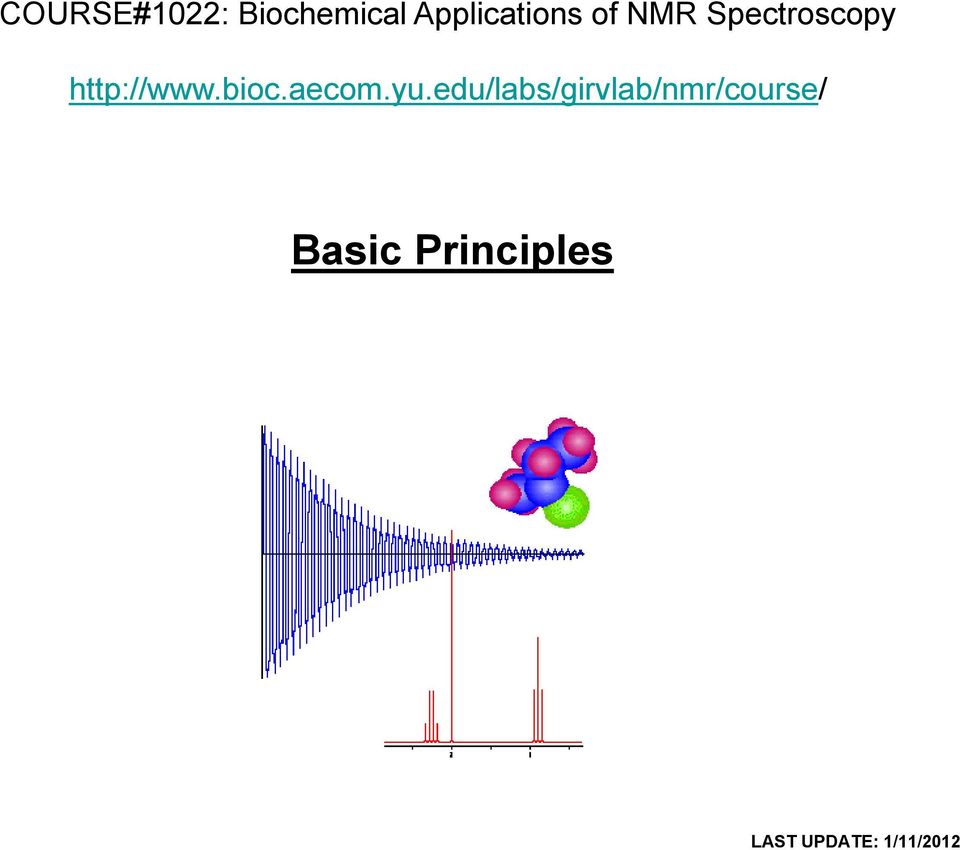
2 Reading Selected Readings for Basic Principles of NMR (any of the following): Evans, pp 2-13 Teng, Chapter 1, pp Cavanagh, Fairbrother, Palmer, & Skelton (1st Ed), pp 1-16 Keeler, Chapter 3 Derome, pp Macomber, Chapters 1 and 2 Online Sources Content from the following online sources were used for some slides in this presentation:

3 What is Spectroscopy? Spectroscopy is the study of the interaction of light with matter. Light refers to any sort of electromagnetic radiation, such as visible light, UV, IR, microwaves and radiowaves: -rays x-rays UV VIS IR -wave radio wavelength ( cm) Type of interaction with matter depends on the frequency ( ) or wavelength ( ) of the radiation involved: E (=h -rays/x-rays - inner shell electrons, nucleus UV/Vis - bonding electrons (valence electrons) IR - Bond length/angle/torsion vibrations NMR - Nuclear spin NOTE: = c (3x10 8 m/s) =c/ )

4 Nuclear Magnetic Resonance (NMR) spectroscopy is the absorption of radio frequencies by atomic nuclei within a sample that is placed in a magnetic field. The types of sample that can be studied are gases, liquids, solids - whole organisms! NMR spectroscopy finds applications in several areas of science and is routinely used to study chemical and biochemical structure and function using simple one-dimensional techniques and more complicated multidimensional techniques. A typical simple Fourier Transform (FT) NMR experiment involves: put sample ( g to g quantities) into a magnet excite nuclei in sample with radiofrequencies using RF probe record nmr spectrum of RF absorbed by sample takes from seconds (1D proton on mg of sample) to days/weeks (multiple dimensions) sample 1D NMR 2D NMR 3D NMR magnet RF probe nmr spectrum

5 Spin An atom is composed of particles (proton, neutron, electron) that possess certain fundamental properties like charge, mass and spin: Mass/amu Charge Spin Proton /2 Neutron /2 Electron 5.49x /2 Spin angular momentum is an intrinsically quantum mechanical property that does not have a classical analog. Spin is a fundamental property of nature like electrical charge or mass. All of these particles are spin=1/2 particles. The nucleus itself has a total spin angular momentum, I, formed by the coupling of the individual spin angular momenta of its constituent nucleons. The total nuclear spin angular momentum quantum number may therefore take values: 0, 1/2, 1, 3/2, 2, 5/2, etc.

6 Spin and Nuclear Magnetic Moment The magnetic moment is a measure of the strength of a magnetic source. Each nuclear spin has a magnetic moment which is associated with the angular momentum of the nucleus. When any charged particle is rotating, it behaves like a current loop with a magnetic moment. The nucleus has a positive charge and is spinning. This generates a small magnetic field. The nucleus therefore possesses a magnetic moment,, which is proportional to its spin, I - The constant,, is called the magnetogyric ratio and is a fundamental nuclear constant which has a different value for every type of nucleus. - h is Planks constant and has a value of x J s (in kms units).

7 Nuclear spin may be related to the nucleon composition of a nucleus in the following manner: Odd mass nuclei (i.e. those having an odd number of nucleons) have fractional spins. Examples are I = 1/2 ( 1 1H, 13 6C, 15 7N, 19 9F, 31 15P), I = 3/2 ( 11 5B) and I = 5/2 ( 17 8O ). Even mass nuclei composed of odd numbers of protons and neutrons have integral spins. Examples are I = 1 ( 2 1H, 14 7N). Even mass nuclei composed of even numbers of protons and neutrons have zero spin ( I = 0 ). Examples are 12 6C, and 16 8O. SIDENOTE: Spin 1/2 nuclei have a spherical charge distribution, and their NMR behavior is the easiest to understand. Other spin nuclei have nonspherical charge distributions (quadrupolar nuclei) and may be analyzed as prolate or oblate spinning bodies. All nuclei with non-zero spins have magnetic moments (μ), but the quadrupolar nuclei also have an electric quadrupole moment (eq). Some characteristic properties of selected nuclei are given in the following table.

8 Magnetic Properties of Some Useful Nuclei Isotope Natural Abundance (%) Spin (I) Magnetogyric Ratio (γ) 10 7 rad s -1 T -1 Absolute Sensitvity 1 H / H x H / C C / x N x N / x O O / x F / P /

9 It is important to note that the 12 C isotope of carbon and the 16 O isotope of oxygen have a spin of 0 this means that the main building blocks of organic compounds cannot be observed by NMR spectroscopy. NMR studies of organic compounds make use of the natural abundance of 13 C for carbon NMR. Isotopic labeling of compounds (eg. 13 C replaces 12 C) can be used under conditions where the natural abundance content is insufficient such as in biomolecules. Also, for most nuclides the nuclear angular momentum vector and the magnetic moment vector point in the same direction, i.e. they are parallel and have a positive magnetogyric ratio. However, in a few cases, for example 15 N and 17 O (and also the electron), they are antiparallel and have a negative magnetogyric ratio. The consequences of this condition will be considered later.

10

11 Group I II IIIa IVa Va VIa VIIa VIII a VIII b VIII c IB IIB III IV V VI VII VIII Period 1 1 H 2 He 2 3 Li 4 Be 5 B 6 C 7 N 8 O 9 F 10 Ne 3 11 Na 12 Mg 13 Al 14 Si 15 P 16 S 17 Cl 18 Ar 4 19 K 20 Ca 21 Sc 22 Ti 23 V 24 Cr 25 Mn 26 Fe 27 Co 28 Ni 29 Cu 30 Zn 31 Ga 32 Ge 33 As 34 Se 35 Br 36 Kr 5 37 Rb 38 Sr 39 Y 40 Zr 41 Nb 42 Mo 43 Tc 44 Ru 45 Rh 46 Pd 47 Ag 48 Cd 49 In 50 Sn 51 Sb 52 Te 53 I 54 Xe 6 55 Cs 56 Ba * 71 Lu 72 Hf 73 Ta 74 W 75 Re 76 Os 77 Ir 78 Pt 79 Au 80 Hg 81 Tl 82 Pb 83 Bi 84 Po 85 At 86 Rn 7 87 Fr 88 Ra ** 103 Lr 104 Unq 105 Unp 106 Unh 107 Uns 108 Uno 109 Mt 110 Uun 111 Uuu 112 Uub 113 Uut 114 Uuq 115 Uup 116 Uuh 117 Uus 118 Uuo *Lanthanides * 57 La 58 Ce 59 Pr 60 Nd 61 Pm 62 Sm 63 Eu 64 Gd 65 Tb 66 Dy 67 Ho 68 Er 69 Tm 70 Yb **Actinides ** 89 Ac 90 Th 91 Pa 92 U 93 Np 94 Pu 95 Am 96 Cm 97 Bk 98 Cf 99 Es 100 Fm 101 Md 102 No Nuclear Spins 1/2 1 3/2 5/2 7/2 9/2

12 Quantization of Spin The magnitude of the spin angular momentum vector is Where = h/2 and h is Plank s constant, the unit of quantization and has a value of x J s (in kms units). This angular momentum is spacequantized: it can only adopt 2I+1 orientations with respect to an arbitrary axis (usually taken to be the z-axis). That is, the projection of I onto the z-axis is given by m is the magnetic quantum number and varies from I to I in increments of 1.

13 Spin States of I=1/2 For example, a nucleus (i.e. a proton), with I=1/2 is described as having two states defined by m=+1/2 ( spin up or state) and m=-1/2 ( spin down or state). The nuclear spin states of a hydrogen nucleus: the nuclear magnetic angular momentum vector, I makes a projection onto the z-axis of (+1/2)h/2 or (-1/2)h/2. In the absence of an applied magnetic field, these states are degenerate (have same energy).

14 Spin States of I=1 For spins with I=1 nuclei three different values for I z are allowed (m=1,0,-1): I z = +h/2 I z = 0 I z = -h/2

15 Effect of a Magnetic Field on 1H (I=1/2) In the ground state all nuclear spins are disordered, and there is no energy difference between them. They are degenerate: = h / 4 Since they have a magnetic moment, when nuclear spins are placed in a strong external magnetic field (B o ), they orient either against or with it: B o There is always a small excess of nuclei (population excess) aligned with the field than pointing against it.

16 Energy of 1H (I=1/2) in a Magnetic Field The aligned nuclei can occupy two energy states, depending on which direction they align in the magnetic field (parallel or antiparallel). The potential energy of an magnetic moment in an external field is given by: Recall that: m I =+1/2 for parallel alignment with external field m I =-1/2 for antiparallel alignment with external field The later stage represents a energetically higher configuration. Apply magnetic field B o

17 Selection Rule and Transitions Spins can undergo a transition between two energy states by the absorption of a photon. The quantum-mechanical selection rule states that only transitions with m=±1 are allowed. The energy of this photon must exactly match the energy difference between the two states. The energy, E, of a photon is related to its frequency,, by Plank's constant (h = 6.626x10⁻³⁴ J s). E=h and E = h B/2 so B/2 In NMR, the quantity is called the resonance frequency or the Larmor frequency. Note: when calculating, make sure units are ok: (rad/s/t); B(T); 2 (rad/cycle)

18 100 s MHz

19 k is Boltzmann's constant, x10-23 J/Kelvin T is the temperature in Kelvin.... so we are very far getting a 13C spectrum as fast as 1H!

20 Classical Mechanics and the Vector Model for NMR When a nuclear magnetic moment is placed in a magnetic field B o, there are two forces acting on it: one wants to bring it towards B o and one that wants to keep it spinning. Mathematically this is described by forming the vector product between dipole moment and magnetic field: Recall that: d /dt = x B This causes it to precess around the field (like a gyroscope under the influence of gravity). The angular frequency of precession, 0, is proportional to the field, B (the same frequency derived from QM energetic considerations).

21 The NMR sample is an ensemble of many nuclear spins and we can understand much about the NMR experiment by examining the behavior of bulk magnetization, M o, resulting from the ensemble using classical mechanics. At thermal equilibrium the spins precess in the magnetic field but they have random phases- no phase coherence so that net magnetization only exists along the z-axis: This represents the situation in most real samples. However, there is an important difference between and M 0. The former is quantized and can only be in one of two states ( or ) while M 0 tells about the whole spin population.
22 The Bloch Equations The Bloch equations are a set of coupled differential equations which were originally proposed by Felix Bloch to describe the motion of the net magnetic moment, M, under different conditions. When properly integrated, the Bloch equations will yield the X, Y, and Z components of magnetization as a function of time. The full Bloch equations contain relaxation terms (to be discussed in a future class) that drive the system back to the equilibrium state (no transverse coherence by T 2 relaxation and relative population of the α/ β states according to the Boltzmann distribution by T 1 relaxation). Loss of coherence terms: d /dt = x B Re-establish Boltzman n equilibrium term:
23 In an NMR instrument, the detector is in the transverse plane perpendicular to the B o magnetic field. In order to detect the magnetization within the sample, we must tip it from the z-axis into the transverse plane. From the Bloch equations, in order to change the magnetization along the z-axis (dm z /dt) a magnetic field has to be introduced along the x- or y-axis (B x or B y,- also known as a B 1 field). Since the magnetization is precessing at the Larmor frequency, transverse magnetic fields that rotate about Z at that same frequency will create a constant torque on the spins and rotate them away from the z-axis.
24
25 The longer we keep B 1 field on (called the RF pulse length ), the more we will keep tipping the magnetization:
26 Back to the beginning (can repeat over and over in a process called signalaveraging)
27 The NMR Spectrum The spectrum consists of signals that have the following properties: position or chemical shift for each type nuclei in molecule intensity which is proportional to # of nuclei of that type width which is sensitive to dynamics and size of molecule splittings or couplings which is sensitive to # of bonded nuclei So the signals within an NMR spectrum depend on the surrounding environment (i.e. structure) and dynamics of the molecule 1 H NMR spectrum of an organic compound 1 H NMR spectrum of a protein
28 Unit Variable Symbol MKSA units Ampere Current I fundamental MKSA unit Coulomb Charge Q Ampere second Farad Capacitance C Coulomb Volt -1 = Joule Volt -2 Henry Inductance L Weber Ampere -1 = Tesla meter 2 Ampere -1 Joule Energy E Newton meter = kilogram meter 2 second -2 Kelvin Temperature T fundamental MKSA unit kilogram Mass m fundamental MKSA unit meter Length L fundamental MKSA unit Newton Force F kilogram meter second -2 Ohm Resistance R Volt Ampere -1 = Volt 2 Joule -1 second -1 Pascal Pressure P Newton meter -2 second time t fundamental MKSA unit Siemens conductance G Ampere Volt -1 = Joule second Volt -2 Tesla Magnetic field B Newton Ampere -1 meter -1 = Joule Ampere -1 meter -2 = Volt second meter -2 Volt potential f Joule coulomb -1 Watt Power P Joule second -1 MKS units and Useful Constants Weber Magnetic flux Tesla meter 2 = Volt second k Boltzmann's constant x J/Kelvin h Planks constant x J s (rad/s) = 2 (s -1 ) 10 4 Gauss = 1 Telsa The earth's magnetic field in Rochester, New York is approximately 5x10⁻⁵ T. = 3 x 10 8 m/s 1 cal = 4.18 Joules
B I N G O B I N G O. Hf Cd Na Nb Lr. I Fl Fr Mo Si. Ho Bi Ce Eu Ac. Md Co P Pa Tc. Uut Rh K N. Sb At Md H. Bh Cm H Bi Es. Mo Uus Lu P F.
 Hf Cd Na Nb Lr Ho Bi Ce u Ac I Fl Fr Mo i Md Co P Pa Tc Uut Rh K N Dy Cl N Am b At Md H Y Bh Cm H Bi s Mo Uus Lu P F Cu Ar Ag Mg K Thomas Jefferson National Accelerator Facility - Office of cience ducation
Chem 115 POGIL Worksheet - Week 4 Moles & Stoichiometry Answers
 Key Questions & Exercises Chem 115 POGIL Worksheet - Week 4 Moles & Stoichiometry Answers 1. The atomic weight of carbon is 12.0107 u, so a mole of carbon has a mass of 12.0107 g. Why doesn t a mole of
Chem 115 POGIL Worksheet - Week 4 Moles & Stoichiometry
 Chem 115 POGIL Worksheet - Week 4 Moles & Stoichiometry Why? Chemists are concerned with mass relationships in chemical reactions, usually run on a macroscopic scale (grams, kilograms, etc.). To deal with
All answers must use the correct number of significant figures, and must show units!
 CHEM 10113, Quiz 2 September 7, 2011 Name (please print) All answers must use the correct number of significant figures, and must show units! IA Periodic Table of the Elements VIIIA (1) (18) 1 2 1 H IIA
CLASS TEST GRADE 11. PHYSICAL SCIENCES: CHEMISTRY Test 6: Chemical change
 CLASS TEST GRADE PHYSICAL SCIENCES: CHEMISTRY Test 6: Chemical change MARKS: 45 TIME: hour INSTRUCTIONS AND INFORMATION. Answer ALL the questions. 2. You may use non-programmable calculators. 3. You may
From Quantum to Matter 2006
 From Quantum to Matter 006 Why such a course? Ronald Griessen Vrije Universiteit, Amsterdam AMOLF, May 4, 004 vrije Universiteit amsterdam Why study quantum mechanics? From Quantum to Matter: The main
ELECTRON CONFIGURATION (SHORT FORM) # of electrons in the subshell. valence electrons Valence electrons have the largest value for "n"!
 179 ELECTRON CONFIGURATION (SHORT FORM) - We can represent the electron configuration without drawing a diagram or writing down pages of quantum numbers every time. We write the "electron configuration".
It takes four quantum numbers to describe an electron. Additionally, every electron has a unique set of quantum numbers.
 So, quantum mechanics does not define the path that the electron follows; rather, quantum mechanics works by determining the energy of the electron. Once the energy of an electron is known, the probability
CHEM 1411 Chapter 5 Homework Answers
 1 CHEM 1411 Chapter 5 Homework Answers 1. Which statement regarding the gold foil experiment is false? (a) It was performed by Rutherford and his research group early in the 20 th century. (b) Most of
MODERN ATOMIC THEORY AND THE PERIODIC TABLE
 CHAPTER 10 MODERN ATOMIC THEORY AND THE PERIODIC TABLE SOLUTIONS TO REVIEW QUESTIONS 1. Wavelength is defined as the distance between consecutive peaks in a wave. It is generally symbolized by the Greek
4. It is possible to excite, or flip the nuclear magnetic vector from the α-state to the β-state by bridging the energy gap between the two. This is a
 BASIC PRINCIPLES INTRODUCTION TO NUCLEAR MAGNETIC RESONANCE (NMR) 1. The nuclei of certain atoms with odd atomic number, and/or odd mass behave as spinning charges. The nucleus is the center of positive
EXPERIMENT 4 The Periodic Table - Atoms and Elements
 EXPERIMENT 4 The Periodic Table - Atoms and Elements INTRODUCTION Primary substances, called elements, build all the materials around you. There are more than 109 different elements known today. The elements
PERIODIC TABLE OF GROUPS OF ELEMENTS Elements can be classified using two different schemes.
 1 PERIODIC TABLE OF GROUPS OF ELEMENTS Elements can be classified using two different schemes. Metal Nonmetal Scheme (based on physical properties) Metals - most elements are metals - elements on left
The Lewis structure is a model that gives a description of where the atoms, charges, bonds, and lone pairs of electrons, may be found.
 CEM110 Week 12 Notes (Chemical Bonding) Page 1 of 8 To help understand molecules (or radicals or ions), VSEPR shapes, and properties (such as polarity and bond length), we will draw the Lewis (or electron
100% ionic compounds do not exist but predominantly ionic compounds are formed when metals combine with non-metals.
 2.21 Ionic Bonding 100% ionic compounds do not exist but predominantly ionic compounds are formed when metals combine with non-metals. Forming ions Metal atoms lose electrons to form +ve ions. Non-metal
Role of Hydrogen Bonding on Protein Secondary Structure Introduction
 Role of Hydrogen Bonding on Protein Secondary Structure Introduction The function and chemical properties of proteins are determined by its three-dimensional structure. The final architecture of the protein
Nuclear Magnetic Resonance
 Nuclear Magnetic Resonance NMR is probably the most useful and powerful technique for identifying and characterizing organic compounds. Felix Bloch and Edward Mills Purcell were awarded the 1952 Nobel
2. John Dalton did his research work in which of the following countries? a. France b. Greece c. Russia d. England
 CHAPTER 3 1. Which combination of individual and contribution is not correct? a. Antoine Lavoisier - clarified confusion over cause of burning b. John Dalton - proposed atomic theory c. Marie Curie - discovered
B) atomic number C) both the solid and the liquid phase D) Au C) Sn, Si, C A) metal C) O, S, Se C) In D) tin D) methane D) bismuth B) Group 2 metal
 1. The elements on the Periodic Table are arranged in order of increasing A) atomic mass B) atomic number C) molar mass D) oxidation number 2. Which list of elements consists of a metal, a metalloid, and
Name period AP chemistry Unit 2 worksheet Practice problems
 Name period AP chemistry Unit 2 worksheet Practice problems 1. What are the SI units for a. Wavelength of light b. frequency of light c. speed of light Meter hertz (s -1 ) m s -1 (m/s) 2. T/F (correct
Inorganic Chemistry review sheet Exam #1
 Inorganic hemistry review sheet Exam #1 h. 1 General hemistry review reaction types: A/B, redox., single displacement, elimination, addition, rearrangement and solvolysis types of substances: elements,
Nuclear Magnetic Resonance (NMR) Spectroscopy
 April 28, 2016 Exam #3: Graded exams on Tuesday! Final Exam Tuesday, May 10 th, 10:30 a.m. Room: Votey 207 (tentative) Review Session: Sunday, May 8 th, 4 pm, Kalkin 325 (tentative) Office Hours Next week:
chemrevise.org 19/08/2013 Periodicity N Goalby chemrevise.org
 chemrevise.org 19/8/213 eriodicity Goalby chemrevise.org locks An s-block element will always have an electronic structure where the outer electron is filling a s-sublevel. kewise the outer electron of
Electronegativity and Polarity
 and Polarity N Goalby Chemrevise.org Definition: is the relative tendency of an atom in a molecule to attract electrons in a covalent bond to itself. is measured on the Pauling scale (ranges from 0 to
ORTEC DET-SW-UPG. Latest Software Features. Ease of Use. Source Location with the Detective V3 Software
 ORTEC DET-SW-UPG Latest Software Features Three Search Modes: Gamma/Neutron total count rate. SNM search mode. Sliding average "monitor" mode. (NEW) User choice of identification schemes: Classify mode
Nuclear ZPE Tapping. Horace Heffner May 2007
 ENERGY FROM UNCERTAINTY The uncertainty of momentum for a particle constrained by distance Δx is given, according to Heisenberg, by: Δmv = h/(2 π Δx) but since KE = (1/2) m v 2 = (1/(2 m) ) (Δmv) 2 ΔKE
UNIT (2) ATOMS AND ELEMENTS
 UNIT (2) ATOMS AND ELEMENTS 2.1 Elements An element is a fundamental substance that cannot be broken down by chemical means into simpler substances. Each element is represented by an abbreviation called
13- What is the maximum number of electrons that can occupy the subshell 3d? a) 1 b) 3 c) 5 d) 2
 Assignment 06 A 1- What is the energy in joules of an electron undergoing a transition from n = 3 to n = 5 in a Bohr hydrogen atom? a) -3.48 x 10⁻¹⁷ J b) 2.18 x 10⁻¹⁹ J c) 1.55 x 10⁻¹⁹ J d) -2.56 x 10⁻¹⁹
13C NMR Spectroscopy
 13 C NMR Spectroscopy Introduction Nuclear magnetic resonance spectroscopy (NMR) is the most powerful tool available for structural determination. A nucleus with an odd number of protons, an odd number
2, 8, 20, 28, 50, 82, 126.
 Chapter 5 Nuclear Shell Model 5.1 Magic Numbers The binding energies predicted by the Liquid Drop Model underestimate the actual binding energies of magic nuclei for which either the number of neutrons
Objectives 404 CHAPTER 9 RADIATION
 Objectives Explain the difference between isotopes of the same element. Describe the force that holds nucleons together. Explain the relationship between mass and energy according to Einstein s theory
Nuclear Magnetic Resonance Spectroscopy
 Nuclear Magnetic Resonance Spectroscopy Nuclear magnetic resonance spectroscopy is a powerful analytical technique used to characterize organic molecules by identifying carbonhydrogen frameworks within
Chem 1A Exam 2 Review Problems
 Chem 1A Exam 2 Review Problems 1. At 0.967 atm, the height of mercury in a barometer is 0.735 m. If the mercury were replaced with water, what height of water (in meters) would be supported at this pressure?
Periodic Table Questions
 Periodic Table Questions 1. The elements characterized as nonmetals are located in the periodic table at the (1) far left; (2) bottom; (3) center; (4) top right. 2. An element that is a liquid at STP is
The Hydrogen Atom Is a Magnet. http://www.seed.slb.com/en/scictr/watch/gashydrates/detecting.htm
 The Hydrogen Atom Is a Magnet Nuclear Magnetic Resonance Spectroscopy (NMR) Proton NMR A hydrogen nucleus can be viewed as a proton, which can be viewed as a spinning charge. As with any spinning charge,
Atomic Structure Ron Robertson
 Atomic Structure Ron Robertson r2 n:\files\courses\1110-20\2010 possible slides for web\atomicstructuretrans.doc I. What is Light? Debate in 1600's: Since waves or particles can transfer energy, what is
Exam 1. Spring 2012/13 CHE 140 Section: 5701 & 5702 100 total points Date: Mon. Feb. 11 & Tue. Feb. 12, 2013
 + 80 points Exam 1 Spring 2012/13 Name: CHE 140 Section: 5701 & 5702 100 total points Date: Mon. Feb. 11 & Tue. Feb. 12, 2013 Directions: Answer the following questions completely. For multiple choice
The rate of change of velocity with respect to time. The average rate of change of distance/displacement with respect to time.
 H2 PHYSICS DEFINITIONS LIST Scalar Vector Term Displacement, s Speed Velocity, v Acceleration, a Average speed/velocity Instantaneous Velocity Newton s First Law Newton s Second Law Newton s Third Law
Chemistry CP Unit 2 Atomic Structure and Electron Configuration. Learning Targets (Your exam at the end of Unit 2 will assess the following:)
 Chemistry CP Unit 2 Atomic Structure and Electron Learning Targets (Your exam at the end of Unit 2 will assess the following:) 2. Atomic Structure and Electron 2-1. Give the one main contribution to the
Basic Principles of Magnetic Resonance
 Basic Principles of Magnetic Resonance Contents: Jorge Jovicich [email protected] I) Historical Background II) An MR experiment - Overview - Can we scan the subject? - The subject goes into the magnet -
Chapter 2 Lecture Notes: Atoms
 Educational Goals Chapter 2 Lecture Notes: Atoms 1. Describe the subatomic structure of an atom. 2. Define the terms element and atomic symbol. 3. Understand how elements are arranged in the periodic table
Sample Exercise 6.1 Concepts of Wavelength and Frequency
 Sample Exercise 6.1 Concepts of Wavelength and Frequency Two electromagnetic waves are represented in the margin. (a) Which wave has the higher frequency? (b) If one wave represents visible light and the
Prof.M.Perucca CORSO DI APPROFONDIMENTO DI FISICA ATOMICA: (III-INCONTRO) RISONANZA MAGNETICA NUCLEARE
 Prof.M.Perucca CORSO DI APPROFONDIMENTO DI FISICA ATOMICA: (III-INCONTRO) RISONANZA MAGNETICA NUCLEARE SUMMARY (I/II) Angular momentum and the spinning gyroscope stationary state equation Magnetic dipole
3. What would you predict for the intensity and binding energy for the 3p orbital for that of sulfur?
 PSI AP Chemistry Periodic Trends MC Review Name Periodic Law and the Quantum Model Use the PES spectrum of Phosphorus below to answer questions 1-3. 1. Which peak corresponds to the 1s orbital? (A) 1.06
Precession of spin and Precession of a top
 6. Classical Precession of the Angular Momentum Vector A classical bar magnet (Figure 11) may lie motionless at a certain orientation in a magnetic field. However, if the bar magnet possesses angular momentum,
Introduction to Nuclear Magnetic Resonance Spectroscopy
 Introduction to Nuclear Magnetic Resonance Spectroscopy Dr. Dean L. Olson, NMR Lab Director School of Chemical Sciences University of Illinois Called figures, equations, and tables are from Principles
NMR - Basic principles
 NMR - Basic principles Subatomic particles like electrons, protons and neutrons are associated with spin - a fundamental property like charge or mass. In the case of nuclei with even number of protons
Electrons in Atoms & Periodic Table Chapter 13 & 14 Assignment & Problem Set
 Electrons in Atoms & Periodic Table Name Warm-Ups (Show your work for credit) Date 1. Date 2. Date 3. Date 4. Date 5. Date 6. Date 7. Date 8. Electrons in Atoms & Periodic Table 2 Study Guide: Things You
Chapter 13 Spectroscopy NMR, IR, MS, UV-Vis
 Chapter 13 Spectroscopy NMR, IR, MS, UV-Vis Main points of the chapter 1. Hydrogen Nuclear Magnetic Resonance a. Splitting or coupling (what s next to what) b. Chemical shifts (what type is it) c. Integration
Find a pair of elements in the periodic table with atomic numbers less than 20 that are an exception to the original periodic law.
 Example Exercise 6.1 Periodic Law Find the two elements in the fifth row of the periodic table that violate the original periodic law proposed by Mendeleev. Mendeleev proposed that elements be arranged
Chemistry - Elements Electron Configurations The Periodic Table. Ron Robertson
 Chemistry - Elements Electron Configurations The Periodic Table Ron Robertson History of Chemistry Before 16 th Century Alchemy Attempts (scientific or otherwise) to change cheap metals into gold no real
How To Understand The Measurement Process
 April 24, 2015 Exam #3: Solution Key online now! Graded exams by Monday! Final Exam Monday, May 4 th, 10:30 a.m. Room: Perkins 107 1 A Classical Perspective A classical view will help us understand the
CHAPTER 8 PRACTICE TEST QUESTIONS (END OF CHAPTER 7 TOO)
 CHAPTER 8 PRACTICE TEST QUESTIONS (END OF CHAPTER 7 TOO) Information that most likely will be on the front cover of your exam: h i Z 2 ΔE = @ 2.18 x 10 @ 18 f Z 2 f J j @ k n f 2 n i 2 1. Which of the
Ionizing Radiation, Czech Republic, CMI (Czech Metrology Institute)
 Ionizing Radiation, Czech Republic, (Czech Metrology Institute) Calibration or Measurement RADIOACTIVITY 1.0E+00 1.0E+02 Bq cm -2 C-14 1.0E+01 1.0E+02 Bq cm -2 Co-60 1.0E+01 1.0E+02 Bq cm -2 Sr-90 1.0E+01
8. Relax and do well.
 CHEM 1314 3:30 pm Section Exam II ohn II. Gelder October 16, 2002 Name TA's Name Lab Section INSTRUCTIONS: 1. This examination consists of a total of 8 different pages. The last three pages include a periodic
5.4 Trends in the Periodic Table
 5.4 Trends in the Periodic Table Think about all the things that change over time or in a predictable way. For example, the size of the computer has continually decreased over time. You may become more
Proton Nuclear Magnetic Resonance Spectroscopy
 Proton Nuclear Magnetic Resonance Spectroscopy Introduction: The NMR Spectrum serves as a great resource in determining the structure of an organic compound by revealing the hydrogen and carbon skeleton.
Objectives. PAM1014 Introduction to Radiation Physics. Constituents of Atoms. Atoms. Atoms. Atoms. Basic Atomic Theory
 PAM1014 Introduction to Radiation Physics Basic Atomic Theory Objectives Introduce and Molecules The periodic Table Electronic Energy Levels Atomic excitation & de-excitation Ionisation Molecules Constituents
47374_04_p25-32.qxd 2/9/07 7:50 AM Page 25. 4 Atoms and Elements
 47374_04_p25-32.qxd 2/9/07 7:50 AM Page 25 4 Atoms and Elements 4.1 a. Cu b. Si c. K d. N e. Fe f. Ba g. Pb h. Sr 4.2 a. O b. Li c. S d. Al e. H f. Ne g. Sn h. Au 4.3 a. carbon b. chlorine c. iodine d.
Nuclear Magnetic Resonance (NMR) Wade Textbook
 Nuclear Magnetic Resonance (NMR) Wade Textbook Background Is a nondestructive structural analysis technique Has the same theoretical basis as magnetic resonance imaging (MRI) Referring to MRI as nuclear
Chapter 8 Atomic Electronic Configurations and Periodicity
 Chapter 8 Electron Configurations Page 1 Chapter 8 Atomic Electronic Configurations and Periodicity 8-1. Substances that are weakly attracted to a magnetic field but lose their magnetism when removed from
Atomic Theory: History of the Atom
 Atomic Theory: History of the Atom Atomic Theory: experimental observations that led scientists to postulate the existence of the atom (smallest bit of an element). 1. Law of Conservation of Mass -During
Basics of Nuclear Physics and Fission
 Basics of Nuclear Physics and Fission A basic background in nuclear physics for those who want to start at the beginning. Some of the terms used in this factsheet can be found in IEER s on-line glossary.
Determination of Molecular Structure by MOLECULAR SPECTROSCOPY
 Determination of Molecular Structure by MOLEULAR SPETROSOPY hemistry 3 B.Z. Shakhashiri Fall 29 Much of what we know about molecular structure has been learned by observing and analyzing how electromagnetic
Chemistry 2 Chapter 13: Electrons in Atoms Please do not write on the test Use an answer sheet! 1 point/problem 45 points total
 Chemistry 2 Chapter 13: Electrons in Atoms Please do not write on the test Use an answer sheet! 1 point/problem 45 points total 1. Calculate the energy in joules of a photon of red light that has a frequency
6.5 Periodic Variations in Element Properties
 324 Chapter 6 Electronic Structure and Periodic Properties of Elements 6.5 Periodic Variations in Element Properties By the end of this section, you will be able to: Describe and explain the observed trends
NMR Nuclear Magnetic Resonance
 NMR Nuclear Magnetic Resonance Nuclear magnetic resonance (NMR) is an effect whereby magnetic nuclei in a magnetic field absorb and re-emit electromagnetic (EM) energy. This energy is at a specific resonance
Organic Chemistry Tenth Edition
 Organic Chemistry Tenth Edition T. W. Graham Solomons Craig B. Fryhle Welcome to CHM 22 Organic Chemisty II Chapters 2 (IR), 9, 3-20. Chapter 2 and Chapter 9 Spectroscopy (interaction of molecule with
Main properties of atoms and nucleus
 Main properties of atoms and nucleus. Atom Structure.... Structure of Nuclei... 3. Definition of Isotopes... 4. Energy Characteristics of Nuclei... 5. Laws of Radioactive Nuclei Transformation... 3. Atom
NMR SPECTROSCOPY A N I N T R O D U C T I O N T O... Self-study booklet NUCLEAR MAGNETIC RESONANCE. 4 3 2 1 0 δ PUBLISHING
 A N I N T R O D U T I O N T O... NMR SPETROSOPY NULEAR MAGNETI RESONANE 4 3 1 0 δ Self-study booklet PUBLISING NMR Spectroscopy NULEAR MAGNETI RESONANE SPETROSOPY Origin of Spectra Theory All nuclei possess
Chapter 7. Electron Structure of the Atom. Chapter 7 Topics
 Chapter 7 Electron Structure of the Atom Copyright The McGraw-Hill Companies, Inc. Permission required for reproduction or display. 1 Chapter 7 Topics 1. Electromagnetic radiation 2. The Bohr model of
The Advanced Placement Examination in Chemistry. Part I Multiple Choice Questions Part II Free Response Questions Selected Questions from1970 to 2010
 The Advanced Placement Examination in Chemistry Part I Multiple Choice Questions Part II Free Response Questions Selected Questions from1970 to 2010 Atomic Theory and Periodicity Part I 1984 1. Which of
AZ State Standards. Concept 3: Conservation of Energy and Increase in Disorder Understand ways that energy is conserved, stored, and transferred.
 Forms of Energy AZ State Standards Concept 3: Conservation of Energy and Increase in Disorder Understand ways that energy is conserved, stored, and transferred. PO 1. Describe the following ways in which
Models of the Atom and periodic Trends Exam Study Guide
 Name 1. What is the term for the weighted average mass of all the naturally occurring isotopes of an element? ans: atomic mass 2. Which is exactly equal to 1/12 the mass of a carbon -12 atom? ans: atomic
The Role of Triads in the Evolution of the Periodic Table: Past and Present
 The Role of Triads in the Evolution of the Periodic Table: Past and Present Eric Scerri Department of Chemistry and Biochemistry, University of California, Los Angeles, Los Angeles, CA 90095; [email protected]
Nuclear Magnetic Resonance Spectroscopy
 Most spinning nuclei behave like magnets. Nuclear Magnetic Resonance Spectroscopy asics owever, as opposed to the behavior of a classical magnet the nuclear spin magnetic moment does not always align with
Generation and Detection of NMR Signals
 Generation and Detection of NMR Signals Hanudatta S. Atreya NMR Research Centre Indian Institute of Science NMR Spectroscopy Spin (I)=1/2h B 0 Energy 0 = B 0 Classical picture (B 0 ) Quantum Mechanical
Nuclear Magnetic Resonance Spectroscopy
 Nuclear Magnetic Resonance Spectroscopy Introduction NMR is the most powerful tool available for organic structure determination. It is used to study a wide variety of nuclei: 1 H 13 C 15 N 19 F 31 P 2
Nuclear Physics. Nuclear Physics comprises the study of:
 Nuclear Physics Nuclear Physics comprises the study of: The general properties of nuclei The particles contained in the nucleus The interaction between these particles Radioactivity and nuclear reactions
Nuclear Magnetic Resonance (NMR) Spectroscopy cont... Recommended Reading:
 Applied Spectroscopy Nuclear Magnetic Resonance (NMR) Spectroscopy cont... Recommended Reading: Banwell and McCash Chapter 7 Skoog, Holler Nieman Chapter 19 Atkins, Chapter 18 Relaxation processes We need
Background A nucleus with an odd atomic number or an odd mass number has a nuclear spin that can be observed by NMR spectrometers.
 NMR Spectroscopy I Reading: Wade chapter, sections -- -7 Study Problems: -, -7 Key oncepts and Skills: Given an structure, determine which protons are equivalent and which are nonequivalent, predict the
Chemistry 307 Chapter 10 Nuclear Magnetic Resonance
 Chemistry 307 Chapter 10 Nuclear Magnetic Resonance Nuclear magnetic resonance (NMR) spectroscopy is one of three spectroscopic techniques that are useful tools for determining the structures of organic
Used to determine relative location of atoms within a molecule Most helpful spectroscopic technique in organic chemistry Related to MRI in medicine
 Structure Determination: Nuclear Magnetic Resonance CHEM 241 UNIT 5C 1 The Use of NMR Spectroscopy Used to determine relative location of atoms within a molecule Most helpful spectroscopic technique in
Atomic Calculations. 2.1 Composition of the Atom. number of protons + number of neutrons = mass number
 2.1 Composition of the Atom Atomic Calculations number of protons + number of neutrons = mass number number of neutrons = mass number - number of protons number of protons = number of electrons IF positive
Chapter 18: The Structure of the Atom
 Chapter 18: The Structure of the Atom 1. For most elements, an atom has A. no neutrons in the nucleus. B. more protons than electrons. C. less neutrons than electrons. D. just as many electrons as protons.
Qualitätsmanagement-Handbuch
 U r Kalibrier- und Messmöglichkeiten Qualitätsmanagement-Handbuch Relative erweiterte Messunsicherheit, die sich aus der Standardmessunsicherheit durch Multiplikation mit dem Erweiterungsfaktor k = 2 ergibt.
WAVES AND ELECTROMAGNETIC RADIATION
 WAVES AND ELECTROMAGNETIC RADIATION All waves are characterized by their wavelength, frequency and speed. Wavelength (lambda, ): the distance between any 2 successive crests or troughs. Frequency (nu,):
Proton Nuclear Magnetic Resonance Spectroscopy
 CHEM 334L Organic Chemistry Laboratory Revision 2.0 Proton Nuclear Magnetic Resonance Spectroscopy In this laboratory exercise we will learn how to use the Chemistry Department's Nuclear Magnetic Resonance
The content is based on the National Science Teachers Association (NSTA) standards and is aligned with state standards.
 Literacy Advantage Physical Science Physical Science Literacy Advantage offers a tightly focused curriculum designed to address fundamental concepts such as the nature and structure of matter, the characteristics
Light as a Wave. The Nature of Light. EM Radiation Spectrum. EM Radiation Spectrum. Electromagnetic Radiation
 The Nature of Light Light and other forms of radiation carry information to us from distance astronomical objects Visible light is a subset of a huge spectrum of electromagnetic radiation Maxwell pioneered
Atoms, Elements, and the Periodic Table (Chapter 2)
 Atoms, Elements, and the Periodic Table (Chapter 2) Atomic Structure 1. Historical View - Dalton's Atomic Theory Based on empirical observations, formulated as Laws of: Conservation of Mass Definite Proportions
Proton Nuclear Magnetic Resonance ( 1 H-NMR) Spectroscopy
 Proton Nuclear Magnetic Resonance ( 1 H-NMR) Spectroscopy Theory behind NMR: In the late 1940 s, physical chemists originally developed NMR spectroscopy to study different properties of atomic nuclei,
NMR SPECTROSCOPY. Basic Principles, Concepts, and Applications in Chemistry. Harald Günther University of Siegen, Siegen, Germany.
 NMR SPECTROSCOPY Basic Principles, Concepts, and Applications in Chemistry Harald Günther University of Siegen, Siegen, Germany Second Edition Translated by Harald Günther JOHN WILEY & SONS Chichester
Chapter 2 Atoms, Ions, and the Periodic Table
 Chapter 2 Atoms, Ions, and the Periodic Table 2.1 (a) neutron; (b) law of conservation of mass; (c) proton; (d) main-group element; (e) relative atomic mass; (f) mass number; (g) isotope; (h) cation; (i)
1. In the general symbol cleus, which of the three letters. 2. What is the mass number of an alpha particle?
 1. In the general symbol cleus, which of the three letters Z A X for a nu represents the atomic number? 2. What is the mass number of an alpha particle? 3. What is the mass number of a beta particle? 4.
Chapter NP-1. Nuclear Physics. Atomic Nature of Matter TABLE OF CONTENTS INTRODUCTION OBJECTIVES 1.0 PROPERTIES OF SUBSTANCES
 Chapter NP-1 Nuclear Physics Atomic Nature of Matter TABLE OF CONTENTS INTRODUCTION OBJECTIVES 1.0 PROPERTIES OF SUBSTANCES 1.1 CHEMICAL AND PHYSICAL PROPERTIES 2.0 COMPOSITION OF ATOMS 2.1 ATOMIC STRUCTURE
8.1 Relaxation in NMR Spectroscopy
 8.1 Relaxation in NMR Spectroscopy Copyright ans J. Reich 2010 All Rights Reserved University of Wisconsin An understanding of relaxation processes is important for the proper measurement and interpretation
Infrared Spectroscopy: Theory
 u Chapter 15 Infrared Spectroscopy: Theory An important tool of the organic chemist is Infrared Spectroscopy, or IR. IR spectra are acquired on a special instrument, called an IR spectrometer. IR is used
Physics Notes Class 11 CHAPTER 2 UNITS AND MEASUREMENTS
 1 P a g e Physics Notes Class 11 CHAPTER 2 UNITS AND MEASUREMENTS The comparison of any physical quantity with its standard unit is called measurement. Physical Quantities All the quantities in terms of
5. The Nature of Light. Does Light Travel Infinitely Fast? EMR Travels At Finite Speed. EMR: Electric & Magnetic Waves
 5. The Nature of Light Light travels in vacuum at 3.0. 10 8 m/s Light is one form of electromagnetic radiation Continuous radiation: Based on temperature Wien s Law & the Stefan-Boltzmann Law Light has