
Phylogeny and the dispersal of Homo. David S. Strait, U Albany
|
|
|
- David Norton
- 9 years ago
- Views:
Transcription
1 Phylogeny and the dispersal of Homo David S. Strait, U Albany

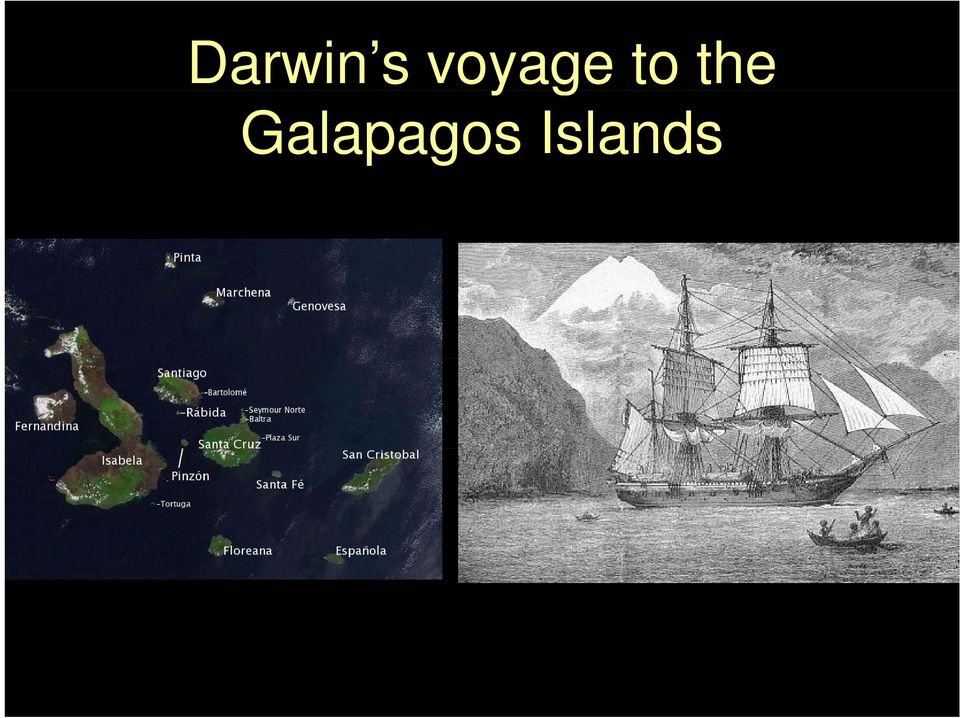
2 Biogeography g The study of how and why organisms are distributed across the landscape

3 Darwin s voyage to the Galapagos Islands
4 Darwin s finches
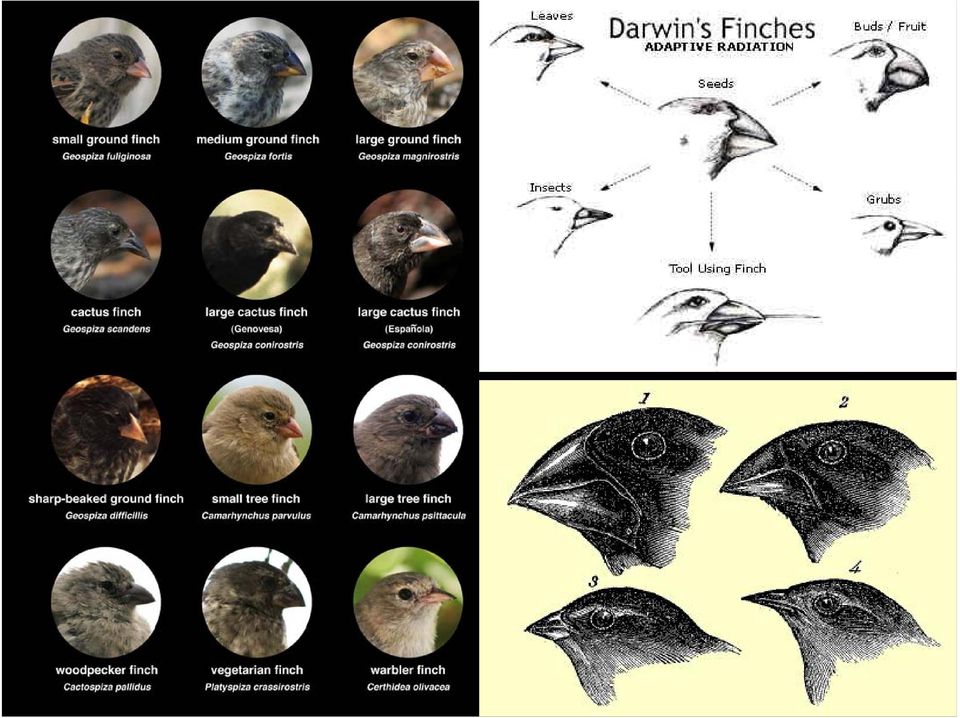
5

6 Phylogeny implies biogeography

7 Strait and Grine (2004)

8 Uncertain Central Africa East Africa South Africa

9 6-7Myr
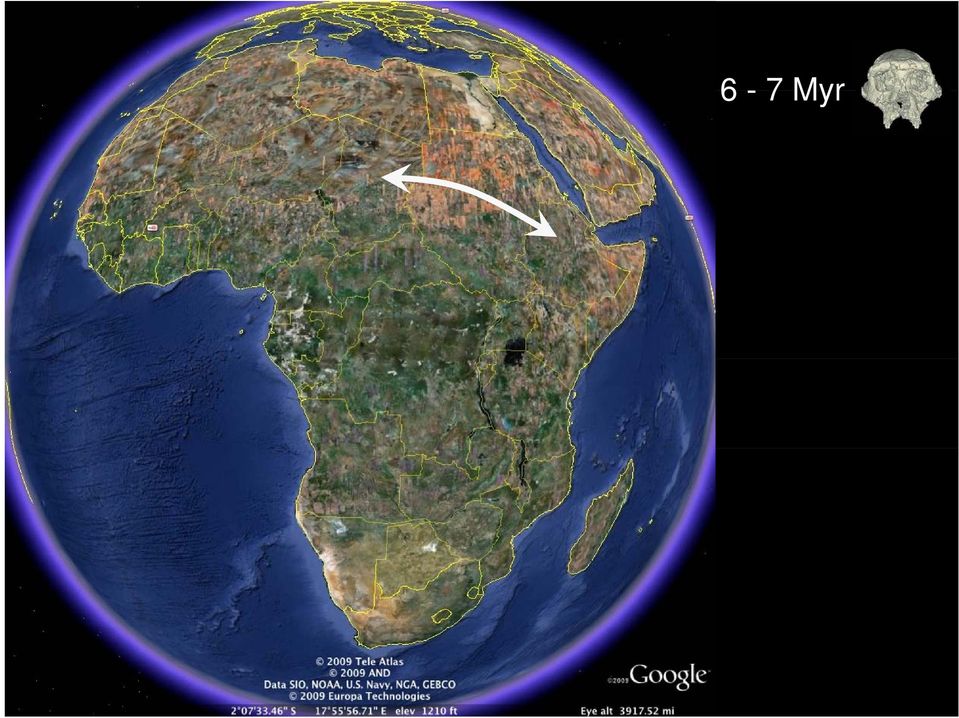
10 6-7Myr > 3 Myr
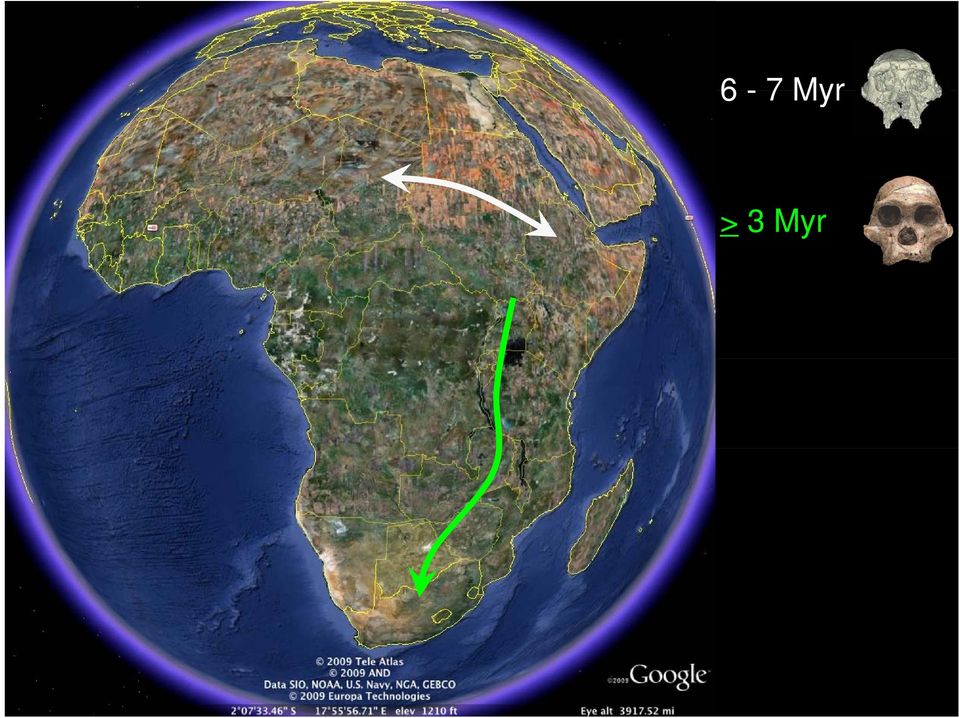
11 6-7Myr > 3 Myr ~ 18Myr 1.8

12 6-7Myr > 3 Myr ~ 18Myr 1.8 ~ 1.8 Myr
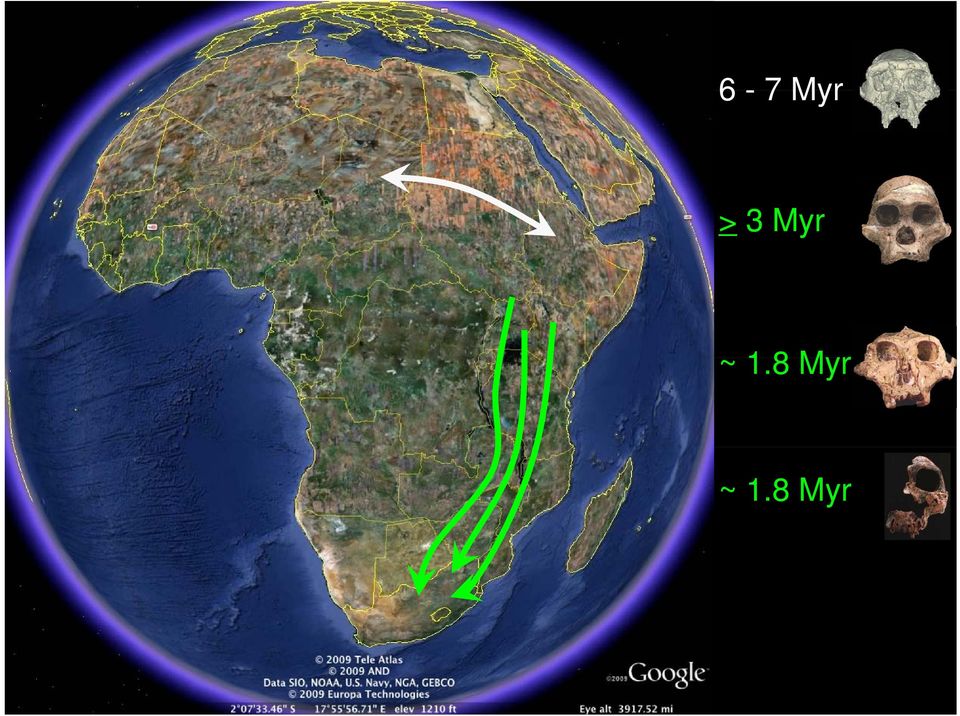
13 6-7Myr > 3 Myr ~ 18Myr 1.8 ~ 1.8 Myr Myr

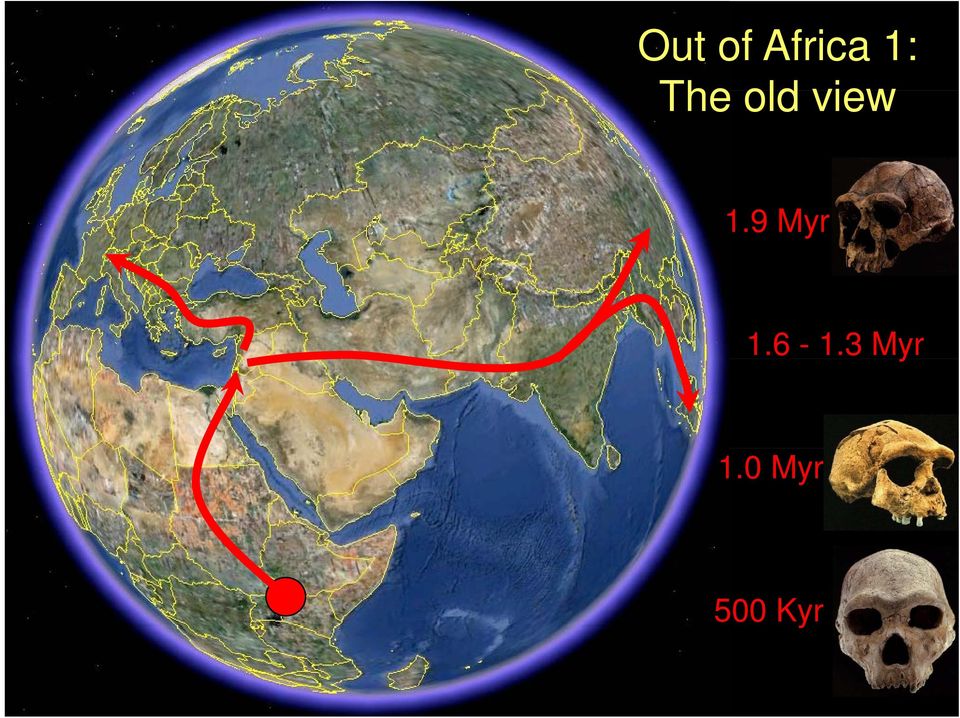
14 Out of Africa 1: The old view 1.9 Myr

15 Out of Africa 1: The old view 1.9 Myr Myr

16 Out of Africa 1: The old view 1.9 Myr Myr 1.0 Myr
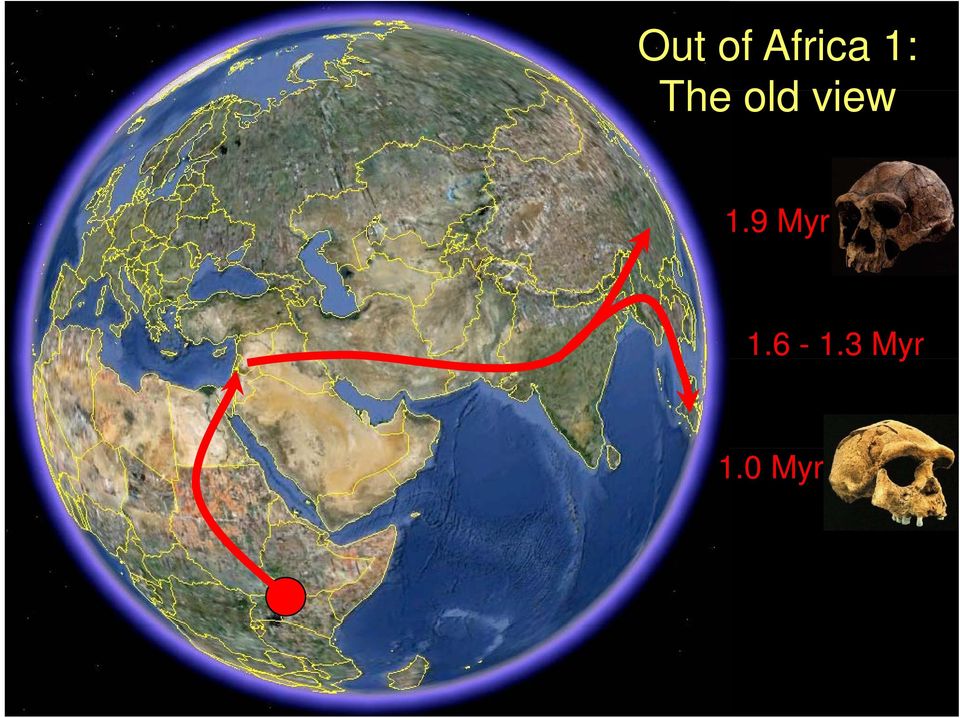
17 Out of Africa 1: The old view 1.9 Myr Myr 1.0 Myr 500 Kyr
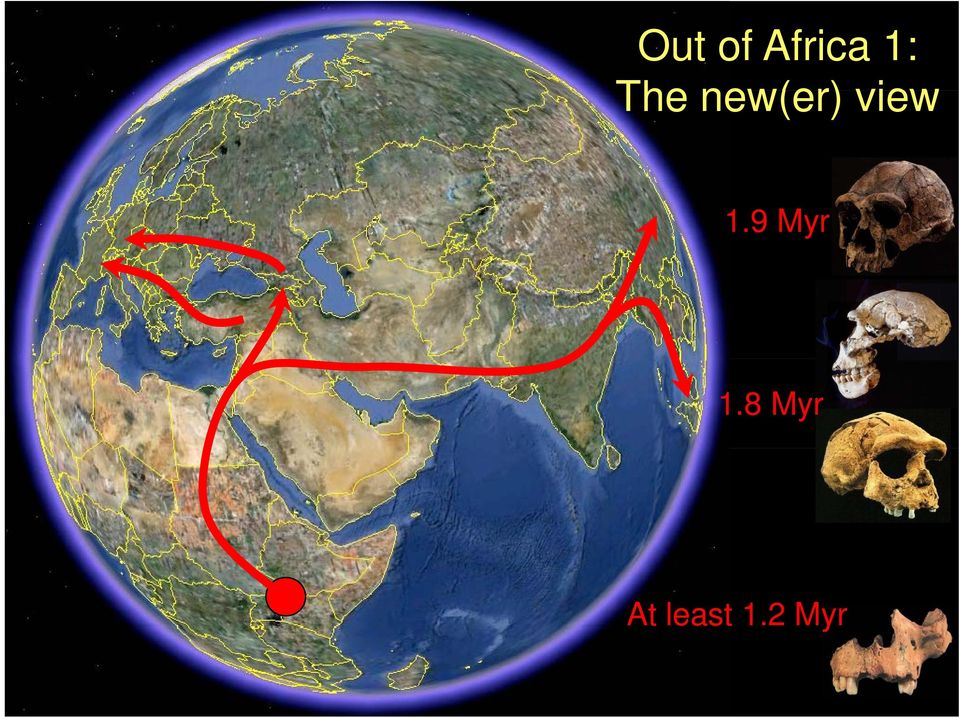
18 Out of Africa 1: The new(er) view 1.9 Myr

19 Out of Africa 1: The new(er) view 1.9 Myr 1.8 Myr

20 Out of Africa 1: The new(er) view 1.9 Myr 1.8 Myr At least 1.2 Myr
21
22
23
24 ER 1813 D 2700
25
26
27
28
29
30
31 Objectives Use cladistic analysis to test the predictions of Out-of-Africa 1 : The first hominin to leave Africa was a descendant of early African Homo erectus (i.e., H. ergaster). All European and Asian H. erectus populations are descended from that original dispersing population (i.e., there were not multiple dispersals out of Africa). African H. erectus is descended from African ancestors (I.e., there were not dispersals of Asian hominins back into Africa). Evaluate the phylogenetic and biogeographic hypotheses emerging from recent analyses of the Dmanisi and Liang Bua hominins.
32 Methods: Taxa Outgroup: Australopithecus africanus Ingroup: Homo habilis Homo rudolfensis Homo ergaster Homo georgicus Homo erectus Homo floresisensis Homo heidelbergensis Homo neanderthalensis Homo sapiens H. ergaster includes only the early fossils from the Turkana Basin (e.g., ER 992, ER 3733, ER 3883, WT 15000)
33 Methods: Taxa Outgroup: Australopithecus africanus Ingroup: Homo habilis Homo rudolfensis Homo ergaster Homo georgicus Homo erectus Homo floresisensis Homo heidelbergensis Homo neanderthalensis Homo sapiens H. erectus includes early and late Asian fossils, similar African fossils, and fossils now attributed to H. antecessor (e.g., Sangiran, Zhoukoutian, Ngangdong, Sambungmachan, Trinil, OH 9, Ternifine, ER 42700, Gran Dolina, Sima del Elephante, Ceprano)
34 Methods: Taxa Outgroup: Australopithecus africanus Ingroup: Homo habilis Homo rudolfensis Homo ergaster Homo georgicus Homo erectus Homo floresisensis Homo heidelbergensis Homo neanderthalensis Homo sapiens H. heidelbergensis includes Asian, African and European archaic humans, including specimens preserving an incomplete set of Neanderthal features (e.g., Dali, Zuttiyeh, Kabwe, Bodo, Florisbad, Petralona, Arago, Steinheim, Mauer, Sima de los Huesos, Swanscombe)
35 Methods: Taxa Outgroup: Australopithecus africanus Ingroup: Homo habilis Homo rudolfensis Homo ergaster Homo georgicus Homo erectus Homo floresisensis Homo heidelbergensis Homo neanderthalensis Homo sapiens H. sapiens includes only early African specimens (e.g., Omo Kibish, Herto, Jebel Irhoud, Border Cave, Klasies River Mouth, Ngaloba, Dar Es Soltane)
36 Methods: characters Examined 81 (mostly cranial) characters, but not all of them were cladistically useful. Many characters were either too variable, or autapomorphic. Examined 51 traditional characters. Of those, 28 were cladistically useful. Examined 30 craniometric characters derived from the Howells data set. Of those, 7 were cladistically useful.
37 Two equally parsimonious trees Tree length = 70 Consistency index = 0.69 Retention index = 0.68
38 Africa Europe Eurasia
39 Africa Europe Eurasia
40 Africa Europe Eurasia
41 Africa Europe Eurasia
42 2.3 Myr
43 2.3 Myr Myr?????
44 2.3 Myr Myr?????????
45 2.3 Myr Myr????????? 1.9 Myr
46 2.3 Myr Myr????????? 1.9 Myr 1.9 Myr
47 2.3 Myr Myr????????? 1.9 Myr 1.9 Myr 1.8 Myr 1.5 Myr
48 2.3 Myr Myr????????? 1.9 Myr 1.9 Myr 1.8 Myr 1.5 Myr At least 1.2 Myr
49 2.3 Myr Myr????????? 1.9 Myr 1.9 Myr 1.8 Myr 1.5 Myr At least 1.2 Myr Kyr
50 Conclusion Cladistic analysis supported cladograms in which H. floresisensis and H. georgicus diverge prior to the appearance of H. ergaster. Biogeographic patterns implied by this phylogeny are inconsistent with Out-of-Africa 1. The first hominins to leave Africa may be broadly classified as belonging to H. habilis sensu lato. Several species of Homo evolve first in Asia and subsequently disperse into Africa and Europe. Neanderthals may have evolved in Europe, and modern humans may have evolved in Africa, but the archaic ancestors of these lineages are likely l to have evolved first in Asia. Fieldwork efforts directed towards expanding the fossil record of Homo in Eurasia are needed.
51 Dedicated to the memory of Charlie Lockwood
52 Adaptive landscapes
53 Shifting balance
Outline 22: Hominid Fossil Record
 Outline 22: Hominid Fossil Record Human ancestors A.=Australopithicus Assumed direct lineage to modern humans Babcock textbook Collecting hominid fossils in East Africa Using Stratigraphy and Radiometric
Tracing the evolution of the genus Homo is important for understanding the ancestry of humans; the only living species of Homo.
 Section 3: Tracing the evolution of the genus Homo is important for understanding the ancestry of humans; the only living species of Homo. K What I Know W What I Want to Find Out L What I Learned Essential
Level 3 Biology, 2012
 90719 907190 3SUPERVISOR S Level 3 Biology, 2012 90719 Describe trends in human evolution 2.00 pm Tuesday 13 November 2012 Credits: Three Check that the National Student Number (NSN) on your admission
Chapter 11: The Origins and Evolution of Early Homo
 Chapter 11: The Origins and Evolution of Early Homo 1. Homo habilis: The First Species of the Genus Homo a. The Path to Humanness: Bigger Brains, Tool Use, and Adaptive Flexibility i. First discovered
EARLY AND LATE ARCHAIC HOMO SAPIENS AND ANATOMICALLY MODERN HOMO SAPIENS
 ANTH 310 Human Origins LABORATORY #5 EARLY AND LATE ARCHAIC HOMO SAPIENS AND ANATOMICALLY MODERN HOMO SAPIENS Traditionally, the hominins after the middle Pleistocene (middle Homo) belong to Homo sapiens.
Classification and Evolution
 Classification and Evolution Starter: How many different ways could I split these objects into 2 groups? Classification All living things can also be grouped how do we decide which groups to put them into?
ANTH 215 Physical Anthropology Study Guide for Exam-III
 ANTH 215 Physical Anthropology Study Guide for Exam-III General: The final exam covers all the lectures and reading in Jurmain et al. (Chapters 8-13 &17) since the last exam. This exam is worth 30% of
On side: Classification of Humans
 1 The modern human, known as the species homo sapien, is characterized by a large and well-developed brain compared to early species of humans.this increased mental capacity has allowed people to excel
The Story of Human Evolution Part 1: From ape-like ancestors to modern humans
 The Story of Human Evolution Part 1: From ape-like ancestors to modern humans Slide 1 The Story of Human Evolution This powerpoint presentation tells the story of who we are and where we came from - how
Human Evolution in the Middle Pleistocene: The Role of Homo heidelbergensis
 218 Evolutionary Anthropology ARTICLES Human Evolution in the Middle Pleistocene: The Role of Homo heidelbergensis G. PHILIP RIGHTMIRE For paleoanthropologists working in the Middle Pleistocene, these
Defining the Genus Homo
 Defining the Genus Homo Mark Collard and Bernard Wood Contents Introduction... 2108 Changing Interpretations of Genus Homo... 2109 Is Genus Homo a Good Genus?... 2114 Updating Wood and Collard s (1999)
Conference Report: Paleoanthropology of the Mani Peninsula (Greece)
 News and Views K. Harvati & E. Delson Conference Report: Paleoanthropology of the Mani Peninsula (Greece) NYCEP; Department of Anthropology, City University of New York Graduate School; and Department
From Africa to Aotearoa Part 1: Out of Africa
 From Africa to Aotearoa Part 1: Out of Africa The spread of modern humans out of Africa started around 65,000 years ago, and ended with the settlement of New Zealand 750 years ago. These PowerPoint presentations
The facts most scientists agree on
 Extant Apes Even though chimps look more similar to gorillas and orangutans, they re actually more closely related to humans according to current genetic data. The facts most scientists agree on Brains:
ARCH 1616 Between Sahara and Sea: North Africa from Human Origins to Islam
 ARCH 1616 Between Sahara and Sea: North Africa from Human Origins to Islam Brett Kaufman [email protected] Office Hours week of September 22: Monday, 2:30-4:30 pm Rhode Island Hall 007 Hominid Evolution
4. Why are common names not good to use when classifying organisms? Give an example.
 1. Define taxonomy. Classification of organisms 2. Who was first to classify organisms? Aristotle 3. Explain Aristotle s taxonomy of organisms. Patterns of nature: looked like 4. Why are common names not
Last class. What species of hominid are found in the early Pliocene? Where are they found? What are their distinguishing anatomical characteristics?
 Last class What species of hominid are found in the early Pliocene? Where are they found? What are their distinguishing anatomical characteristics? How do the Australopithecines differ from the possible
Phylogenetic trees have a long history of representing
 Deep Time in Perspective: An Animated Fossil Hominin Timeline HOLLY M. DUNSWORTH Department of Anthropology, 5500 N. St. Louis Ave., Northeastern Illionois University, Chicago, IL 60625, USA; [email protected]
The presence of human populations in Europe before the
 A cranium for the earliest Europeans: Phylogenetic position of the hominid from Ceprano, Italy G. Manzi*, F. Mallegni*, and A. Ascenzi* *Istituto Italiano di Paleontologia Umana, Piazza Mincio 2, 00198
Directions: Arabian Peninsula Croatia India Asia Indonesia Papua New Guinea
 In this activity, students will use a variety of skills to complete the tasks, including close reading and comprehension abilities, researching, and mapping. The reading part of this activity requires
In 1871 Charles Darwin published another groundbreaking
 23 How Humans Evolved Concept Outline 23.1 The evolutionary path to humans starts with the advent of primates. The Evolutionary Path to Apes. Primates first evolved 65 million years ago, giving rise first
Name Class Date. binomial nomenclature. MAIN IDEA: Linnaeus developed the scientific naming system still used today.
 Section 1: The Linnaean System of Classification 17.1 Reading Guide KEY CONCEPT Organisms can be classified based on physical similarities. VOCABULARY taxonomy taxon binomial nomenclature genus MAIN IDEA:
Is Homo Defined by Culture?
 Is Homo Defined by Culture? BERNARD WOOD & MARK COLLARD The changing face of Homo THE GENUS HOMO was established by Carolus Linnaeus as part of the 1758 edition of his monumental review, the Systema Naturae.
Introduction to Physical Anthropology - Study Guide - Focus Topics
 Introduction to Physical Anthropology - Study Guide - Focus Topics Chapter 1 Species: Recognize all definitions. Evolution: Describe all processes. Culture: Define and describe importance. Biocultural:
Curriculum Vitae Karen L. Baab
 Curriculum Vitae Karen L. Baab Department of Anthropology Office (631) 632-5755 Stony Brook University Fax (631) 632-9165 Stony Brook, New York 11794 [email protected] Education 2007 PhD, City
The First Female Homo erectus Pelvis, from Gona, Afar, Ethiopia
 PRESS RELEASE The First Female Homo erectus Pelvis, from Gona, Afar, Ethiopia To be published in the Journal Science 14 November, 2008 Prepared by the Gona Palaeoanthropological Research Project Stone
he standard uniform for paleontologists is casual. T-shirts, cutoffs, and floppy old hats are common
 NOT FOR SALE A New Kind of Ape T 14 Reprinted from The Tangled Bank: An Introduction to Evolution, Second Edition by Carl Zimmer. Permission granted by Roberts and Company Publishers. http://bit.ly/1bwx1qt
Once We Were Not. Today we take for granted that Homo sapiens is the only hominid on Earth.Yet for at least four million years many
 Today we take for granted that Homo sapiens is the only hominid on Earth.Yet for at least four million years many Once We Were Not PARANTHROPUS BOISEI had massive jaws, equipped with huge grinding teeth
6 LUCY & THE LEAKEYS BIOGRAPHY 770L
 6 LUCY & THE LEAKEYS BIOGRAPHY 770L LUCY & THE LEAKEYS HOMININE FOSSILS AND PALEOARCHAEOLOGISTS Louis Leakey Mary Leakey Lucy c. 3.2 MYA Afar, Ethiopia Born August 7, 1903 Kabete, Kenya Died October 1,
Centre for Archaeological Science Dr Adam Brumm
 Centre for Archaeological Science Dr Adam Brumm ARC Postdoctoral Research Fellow Room: 41.266 Phone No: +61 2 4221 5946 Email: [email protected] Professional Profile Qualifications: BA (Hons), PhD Awards:
The assassination of JFK
 The assassination of JFK John Fitzgerald Kennedy, the 35th President of the United States, was assassinated on Friday, November 22, 1963, in Dealey Plaza, Dallas, Texas. Kennedy was fatally shot by a sniper
ONCE we TODAYWETAKE FOR GRANTED THAT HOMO SAPIENS FOUR MILLION YEARS MANY HOMINID SPECIES EMERGENCE
 EMERGENCE TODAYWETAKE FOR GRANTED THAT HOMO SAPIENS FOUR MILLION YEARS MANY HOMINID SPECIES ONCE we SHARING A SINGLE LANDSCAPE, four kinds of hominids lived about 1.8 million years ago in what is now part
Was North Africa The Launch Pad For Modern Human Migrations?
 Was North Africa The Launch Pad For Modern Human Migrations? A growing number of researchers suspect that long-neglected North Africa was the original home of the modern humans who first trekked out of
Regardless of who you are or where you came from
 We Are All African! Can scientific proof of our commonality save us? Christopher dicarlo Regardless of who you are or where you came from despite ethnic differences, political distinctions, and racial
Relationships of Floras (& Faunas)
 Relationships of Floras (& Faunas) Knowledge of earth and organism histories now permit closer examination of relationships of disjunct floras and faunas. Southern Hemisphere temperate Southern Hemisphere
The revolution that wasn t: a new interpretation of the origin of modern human behavior
 Sally McBrearty Department of Anthropology, University of Connecticut, Storrs, Connecticut 06269, U.S.A. E-mail: [email protected] Alison S. Brooks Department of Anthropology, George Washington University,
Systematics - BIO 615
 Outline - and introduction to phylogenetic inference 1. Pre Lamarck, Pre Darwin Classification without phylogeny 2. Lamarck & Darwin to Hennig (et al.) Classification with phylogeny but without a reproducible
Fossils, feet and the evolution of human bipedal locomotion
 J. Anat. (2004) 204, pp403 416 Blackwell Publishing, Ltd. REVIEW Fossils, feet and the evolution of human bipedal locomotion W. E. H. Harcourt-Smith 1 and L. C. Aiello 2 1 Division of Vertebrate Paleontology,
Name: Class: Date: Multiple Choice Identify the choice that best completes the statement or answers the question.
 Name: Class: Date: Chapter 17 Practice Multiple Choice Identify the choice that best completes the statement or answers the question. 1. The correct order for the levels of Linnaeus's classification system,
CCR Biology - Chapter 10 Practice Test - Summer 2012
 Name: Class: Date: CCR Biology - Chapter 10 Practice Test - Summer 2012 Multiple Choice Identify the choice that best completes the statement or answers the question. 1. What is the term for a feature
Florisbad and Human Population Succession in Southern Africa
 Florisbad and Human Population Succession in Southern Africa G. P. RIGHTMIRE Department of Anthropology, State University of New York, Binghamton, New York 13901 KEY WORDS Florisbad. Fossil hominids. Upper
The Clompleat Cladist
 Seminars on Science Sharks and Rays: Myth and Reality THE UNIVERSITY OF KANSAS SPECIAL PUBLICATION MUSEUM OF NATURAL HISTORY No. 19 The Clompleat Cladist A Primer of Phylogenetic Procedures E.O. WILEY
The femur of Orrorin tugenensis exhibits morphometric affinities with both Miocene apes and later hominins Supplementary Information
 The femur of Orrorin tugenensis exhibits morphometric affinities with both Miocene apes and later hominins Supplementary Information Sergio Almécija, Melissa Tallman, David M. Alba, Marta Pina, Salvador
The Compleat Cladist. A Primer of Phylogenetic Procedures INTRODUCTION, TERMS, AND CONCEPTS
 Seminars on Science: Diversity of Fishes THE UNIVERSITY OF KANSAS MUSEUM OF NATURAL HISTORY SPECIAL PUBLICATION No. 19 October 1991 The Compleat Cladist A Primer of Phylogenetic Procedures E. O. WILEY
PHYLOGENY AND EVOLUTION OF NEWCASTLE DISEASE VIRUS GENOTYPES
 Eötvös Lóránd University Biology Doctorate School Classical and molecular genetics program Project leader: Dr. László Orosz, corresponding member of HAS PHYLOGENY AND EVOLUTION OF NEWCASTLE DISEASE VIRUS
Homo erectus Infancy and Childhood The Turning Point in the Evolution of Behavioral Development in Hominids
 10 Homo erectus Infancy and Childhood The Turning Point in the Evolution of Behavioral Development in Hominids Sue Taylor Parker In man, attachment is mediated by several different sorts of behaviour of
17.1. The Tree of Life CHAPTER 17. Organisms can be classified based on physical similarities. Linnaean taxonomy. names.
 SECTION 17.1 THE LINNAEAN SYSTEM OF CLASSIFICATION Study Guide KEY CONCEPT Organisms can be classified based on physical similarities. VOCABULARY taxonomy taxon binomial nomenclature genus MAIN IDEA: Linnaeus
A model of Homo naledi, a newly discovered species of ape, at the Cradle of Humankind World Heritage Site, Maropeng, South Africa, September 2015
 1 of 10 10/30/2015 10:25 AM Font Size: A A Steven Mithen NOVEMBER 19, 2015 ISSUE The Real Planet of the Apes: A New Story of Human Origins by David R. Begun Princeton University Press, 246 pp., $29.95

READERS of this publication understand the
 The Classification & Evolution of Caminalcules Robert P. Gendron READERS of this publication understand the importance, and difficulty, of teaching evolution in an introductory biology course. The difficulty
Lecture 10 Friday, March 20, 2009
 Lecture 10 Friday, March 20, 2009 Reproductive isolating mechanisms Prezygotic barriers: Anything that prevents mating and fertilization is a prezygotic mechanism. Habitat isolation, behavioral isolation,
LIFE SCIENCES: PAPER I
 NATIONAL SENIOR CERTIFICATE EXAMINATION NOVEMBER 2015 LIFE SCIENCES: PAPER I Time: 3 hours 200 marks PLEASE READ THE FOLLOWING INSTRUCTIONS CAREFULLY 1. This question paper consists of 13 pages and a yellow
Taxonomy and Classification
 Taxonomy and Classification Taxonomy = the science of naming and describing species Wisdom begins with calling things by their right names -Chinese Proverb museums contain ~ 2 Billion specimens worldwide
WJEC AS Biology Biodiversity & Classification (2.1 All Organisms are related through their Evolutionary History)
 Name:.. Set:. Specification Points: WJEC AS Biology Biodiversity & Classification (2.1 All Organisms are related through their Evolutionary History) (a) Biodiversity is the number of different organisms
II. Germ Layers Ontogeny can reveal a great deal about evolutionary relationships. Answer and discuss the following:
 Workshop: The Evolution of Animalia by Dana Krempels Perhaps even more than the other Eukarya, Animalia is characterized by a distinct progression of complexity in form and function as one moves from the
Rethinking the Dispersal of Homo sapiens out of Africa
 Evolutionary Anthropology 24:149 164 (2015) ARTICLE Rethinking the Dispersal of Homo sapiens out of Africa HUW S. GROUCUTT, MICHAEL D. PETRAGLIA, GEOFF BAILEY, ELEANOR M. L. SCERRI, ASH PARTON, LAINE CLARK-BALZAN,
Rethinking Polynesian Origins: Human Settlement of the Pacific
 LENScience Senior Biology Seminar Series Rethinking Polynesian Origins: Human Settlement of the Pacific Michal Denny, and Lisa Matisoo-Smith Our Polynesian ancestors are renowned as some of the world s
Name: DUE: May 2, 2013 Ms. Galaydick. Geologic Time Scale Era Period End date (in millions of years) Cenozoic Quaternary present
 Name: DUE: May 2, 2013 Ms. Galaydick Objective: Use the diagrams to answer the questions for each set: USING SCIENCE SKILLS PART #1 Geologic Time Scale Era Period End date (in millions of years) Cenozoic
FIREFIGHTER/PARAMEDIC EMPLOYMENT APPLICATION (Please Print)
 FIREFIGHTER/PARAMEDIC EMPLOYMENT APPLICATION (Please Print) FOR OFFICE USE ONLY CITY OF SPRINGFIELD, OHIO PERSONNEL DEPARTMENT 76 EAST HIGH STREET SPRINGFIELD, OHIO 45502 INSTRUCTIONS: Please fill out
Extensive Cryptic Diversity in Indo-Australian Rainbowfishes Revealed by DNA Barcoding
 Extensive Cryptic Diversity in Indo-Australian Rainbowfishes Revealed by DNA Barcoding Kadarusman, Hubert N, Hadiaty R.K #, Sudarto, Paradis E., Pouyaud L. Akademi Perikanan Sorong, Papua Barat, Indonesia
HISTORY. Photos 28 and 29: Stone hand axes at Olorgesailie National Monument
 2 HISTORY Human Origins It is now widely accepted that human beings first appeared in eastern Africa. They lived in the savanna grasslands and in areas adjacent to the lakes of the Rift Valley. Much of
Chapter 34 Vertebrates Multiple-Choice Questions 1) Which of the following is a shared characteristic of all chordates? A) scales B) jaws C) vertebrae
 Chapter 34 Vertebrates Multiple-Choice Questions 1) Which of the following is a shared characteristic of all chordates? A) scales B) jaws C) vertebrae D) dorsal, hollow nerve cord E) four-chambered heart
Regional Atlas: Introduction to South Asia
 Name Regional Atlas: Introduction to South Asia Study the map on page 593 of the textbook. 1. The Khyber Pass connects which two countries? CHAPTER 28 2. What capital city is located at 80 E longitude?
Chapter 00. Chapter 13. The Early Hominins. Chapter Outline
 Chapter 00 Chapter 13 The Early Hominins e are all united by our past, that we all hae a common history and though... wwe may be astly different, our origins all lead back to the crucible of human eolution
This is a series of skulls and front leg fossils of organisms believed to be ancestors of the modern-day horse.
 Evidence of Evolution Background When Charles Darwin first proposed the idea that all new species descend from an ancestor, he performed an exhaustive amount of research to provide as much evidence as
The Great Human Migration
 The Great Human Migration Why humans left their African homeland 80,000 years ago to colonize the world By Guy Gugliotta Smithsonian magazine, July 2008 Christopher Henshilwood (in Blombos Cave) dug at
Chordates (phylum Chordata) are bilaterian animals that belong to the clade of animals known as Deuterostomia
 Ch 34 Origin & Evolution of Vertebrates Chordates Chordates (phylum Chordata) are bilaterian animals that belong to the clade of animals known as Deuterostomia Chordates comprise all vertebrates and two
Genetic Variation and Human Evolution Lynn B. Jorde, Ph.D. Department of Human Genetics University of Utah School of Medicine.
 Genetic Variation and Human Evolution Lynn B. Jorde, Ph.D. Department of Human Genetics University of Utah School of Medicine. The past two decades have witnessed an explosion of human genetic data. Innumerable
Evidence for evolution factsheet
 The theory of evolution by natural selection is supported by a great deal of evidence. Fossils Fossils are formed when organisms become buried in sediments, causing little decomposition of the organism.
VIP. Vicariance Inference Program. User's reference manual. Version 11.4.28. J. Salvador Arias
 VIP User's reference manual 1 VIP Vicariance Inference Program User's reference manual Version 11.4.28 J. Salvador Arias CONICET, INSUE, Facultad de Ciencias Naturales e Instituto Miguel Lillo, Miguel
Tropical Rainforests in the Pleistocene. Tropical Rainforests in the Pleistocene. Tropical Rainforests in the Pleistocene
 Tropical Rainforests in the Pleistocene tropics stable during Pleistocene? 1 C temperature drop based on 1976 CLIMAP study of warm vs. cold loving forams (vs. 10 C in North Atlantic) Paleothermometers
MISSING ENTRY REPLACEMENT DATA ANALYSIS: A REPLACEMENT APPROACH TO DEALING WITH MISSING DATA IN PALEONTOLOGICAL AND TOTAL EVIDENCE DATA SETS
 Journal of Vertebrate Paleontology ():, June 00 00 by the Society of Vertebrate Paleontology MISSING ENTRY REPLACEMENT DATA ANALYSIS: A REPLACEMENT APPROACH TO DEALING WITH MISSING DATA IN PALEONTOLOGICAL
Week 1. Week 2. Week 3
 Week 1 1. What US city has the largest population? 2. Where is Aachen? 3. What is the capitol of Florida? 4. What is the longest mountain range in Spain? 5. What countries border Equador? Week 2 1. What
Practice Questions 1: Evolution
 Practice Questions 1: Evolution 1. Which concept is best illustrated in the flowchart below? A. natural selection B. genetic manipulation C. dynamic equilibrium D. material cycles 2. The diagram below
Preparation. Educator s Section: pp. 1 3 Unit 1 instructions: pp. 4 5 Unit 2 instructions: pp. 6 7 Masters/worksheets: pp. 8-17
 ActionBioscience.org lesson To accompany the article by Lawrence M. Page, Ph.D.: "Planetary Biodiversity Inventories: A Response to the Taxonomic Crisis" (May 2006) http://www.actionbioscience.org/biodiversity/page.html
Rocks and Plate Tectonics
 Name: Class: _ Date: _ Rocks and Plate Tectonics Multiple Choice Identify the choice that best completes the statement or answers the question. 1. What is a naturally occurring, solid mass of mineral or
The Art of the Tree of Life. Catherine Ibes & Priscilla Spears March 2012
 The Art of the Tree of Life Catherine Ibes & Priscilla Spears March 2012 from so simple a beginning endless forms most beautiful and most wonderful have been, and are being, evolved. Charles Darwin, The
Were Australopithecines Ape Human Intermediates or Just Apes? A Test of Both Hypotheses Using the Lucy Skeleton
 article Were Australopithecines Ape Human Intermediates or Just Apes? A Test of Both Hypotheses Using the Lucy Skeleton Phil Senter Abstrac t Mainstream scientists often claim that australopithecines such