
Utilizing Time Domain (TDR) Test Methods For Maximizing Microwave Board Performance
|
|
|
- Chad Johns
- 9 years ago
- Views:
Transcription
1 The Performance Leader in Microwave Connectors Utilizing Time Domain (TDR) Test Methods For Maximizing Microwave Board Performance.050 *.040 c S11 Re REF 0.0 Units 10.0 m units/ START 0.0s STOP ps Southwest Microwave, Inc. Tempe, Arizona USA
2 Southwest Microwave, Inc. Utilizing Time Domain (TDR) Test Methods For Maximizing Microwave Board Performance Bill Rosas, Product Engineering Manager, Southwest Microwave, Inc. Copyright 2009 by Southwest Microwave, Inc. and Bill Rosas. All rights reserved. CST Microwave Studio (CST MWS), Teflon (DuPont) and X-Acto are registered trademarks of their respective companies. Southwest Microwave, Inc. Tempe, Arizona USA
3 Table of Contents Introduction What is TDR...2 Relationship Between Time Domain and Frequency Domain...3 Review of Fourier Analysis...2 How Does the TDR Function on a VNA Work?...3 Bandwidth vs. Rise Time Real Units...4 How to Analyze a Transition Using TDR VNA Calibration....5 TDR Set-up...5 Example...5 Calculating Electrical Lengths...6 Analyzing the TDR Plot....6 Inductive Point...7 Time Domain (TDR) Test Data...7 How to Optimize a Transition Using TDR D Simulation...8 CST MWS Model...8 Simulation Results...8 Maximizing the Test Board Performance...9 Test Set-up Critical for Useful TDR Results Agilent 8510C Analyzer Workstation...10 Differences Using Anritsu Equipment...11 Anritsu 37297D (Differences from Agilent) Smith Chart Display to Show Impedance...12 Interpretation of Results: Assumptions/Caveats...13 Windowing...13 Masking...14 Resolution...16 Resolution (Low Frequency)...16 Resolution (Number of Points)...16 Scalar Info Only...17 Accuracy Measurement Range Limitations (Aliasing) Conclusion...17 Southwest Microwave, Inc. Tempe, Arizona USA
4 Introduction Time Domain Reflectometry (TDR) is a very useful tool for designing transitions such as the transition between coaxial connectors and PC boards. The TDR function will display the impedance over time showing the place and nature of discontinuities that are due to impedance changes. This paper discusses the aspects of TDR measurements that are relevant to the analysis of a transition. The complete range of TDR measurements and applications will not be explored. What is TDR? True time domain measurements are made with a pulse generator and an oscilloscope. The TDR tester injects a pulse into a transmission line and the reflections are shown on an oscilloscope. The rise time of the pulse determines the bandwidth of the measurement. The impedance imformation is based on the DC component of the input signal. Reflections displayed represent discontinuities due to a change in the impedance along a transmission line. The magnitude of the impedance of the discontinuity determines the magnitude of the reflection. Zero units represents the characteristic impedance of the line, typically 50 ohms. The direction of the reflection on the display, either positive or negative, is determined by whether the impedance that caused the reflection is inductive or capacitive. The impedance formula for a transmission line is: The reflections are shown on an oscilloscope. Based on the transmission line formula, reflections that show greater than the characteristic impedance are inductive and reflections that show smaller than the characteristic impedance are capacitive. An example transmission line and the corresponding ideal TDR response is shown below. It starts with a 50 ohm characteristic impedance then jumps to 55 ohms (more inductive) then dips to 45 ohms (more capacitive) then returns to the 50 ohm characteristic impedance. Example Transmission Line and TDR Response 50 Ω Z 0 55 Ω Z > Z 0 More Inductive 45 Ω Z < Z 0 More Capacitive 50 Ω Z 0 55 Ωω Z = 50 Ω Z = 50 Ω 45 Ωω Southwest Microwave, Inc. Tempe, Arizona USA
5 Fundamental Relationship Between Time Domain and Frequency Domain Third Harmonic Fifth Harmonic Review of Fourier Analysis Fourier s theory is that any repetitive signal can be expressed as a summation of single frequency signals. Take a square wave for example; it is the infinite summation of harmonics of a sine wave with the same frequency as the square wave. rise time SUM Approximation of (Square Wave) Fundamental frequency and harmonics create an approximation of a square wave. P rise time Fourier transform P Time Domain inverse Fourier transform Frequency Domain f º 2f º 3f º 4f º 5f º Relationship Between Frequency Domain and Time Domain. t f There are no true square waves in electronics. The rise time of a square wave determines the bandwidth or the highest frequency harmonic in a Fourier series describing the square wave. Plotting the single frequency summation on a frequency plot gives the frequency domain representation of a repetitive signal. Translating a time domain signal to frequency domain is done through a Fourier transform and from frequency domain to time domain is done through an inverse Fourier transform. How Does the TDR Function on a VNA Work? A VNA is a frequency domain device. An inverse-fourier transform can be used to convert frequency domain to time domain. To do this there has to be a harmonic relation between the frequencies in the frequency domain. A harmonic relationship means that whatever the start frequency is, all of the following frequencies have to be harmonics. This simply means they have to be multiples. Microwave synthesizers do not have a DC signal. The start sweep frequency is used to extrapolate the DC component. The DC component is what is used to determine the impedance. So the lower the start frequency the more accurate the impedance measurement as long as the start frequency stays stable. Southwest Microwave, Inc. Tempe, Arizona USA
6 Bandwidth vs. Risetime In frequency domain the highest frequency harmonic determines the bandwidth. With modern synthesizers, VNA s can make higher bandwidth TDR measurements than is practical with true TDR measurement systems. For example, a 50 GHz bandwidth measurement corresponds to a 7 psec risetime pulse. It is very difficult to create real pulses with this small a risetime. Bandwidth vs. Risetime BW =.35 t r Example: t r = 7 psec BW =.35 = 50 GHz 7 psec Real Units Real units are on a logarithmic scale normalizing a short (zero impedance) to minus one and an open (infinite impedance) to plus one with the nominal impedance being zero. In the case of a network analyzer the nominal impedance is 50 ohms and is set by the calibration standard. The formula for impedance to real units is: Real Units (RU) = ln (Z/Z 0 ) 2 (0 units) Z = 50 Ω 50 Ω Z 0 55 Ω Z > Z 0 More Inductive (+50 mu) 55 Ω 45 Ω Z < Z 0 More Capacitive (-50 mu) 45 Ω 50 Ω Z 0 (0 units) Z = 50 Ω The scale can be assumed linear close to zero with 10 milli-units approximating an ohm. The transmission line shown on the left is the same shown previously. It starts with a 50 ohm characteristic impedance than jumps to 55 ohms (more inductive) then dips to 45 ohms (more capacitive) then returns to the 50 ohm characteristic impedance. The real unit values are shown on the TDR response for this line with +50 milli-units equaling 55 ohms, -50 milli-units equaling 45 ohms, and zero units equaling 50 ohms. Southwest Microwave, Inc. Tempe, Arizona USA
7 How to Analyze a Transition Using TDR VNA Calibration To make a TDR measurement the calibration of the VNA has to be done with a harmonic sweep. Any calibration method can be used and for TDR it can be single port. There is a minimum number of points that are required and this will be explained in later sections. TDR Set-up The measurement channel should be S ¹¹ The TDR settings to get impedance over distance/time are: low pass step, real units at 10 milli-units per division, and minimum window. The resolution can be adjusted for larger discontinuities. 1 Test Board Trace = Ground = Via Size = Via Spacing = Via Rows = Example To demonstrate the usefulness of a TDR in board transition designs, the following example will step through the analysis of an actual design. This example is a 1 inch test board fabricated out of 30 mil thick Rogers RO4350 material for 2.4 mm end launch connectors. The board has a grounded coplanar structure and this is tested through 50 GHz. Southwest Microwave s Standard Format of S-Parameter Data is S ¹¹ on the bottom of the graph in VSWR with scale of 0.2 per division, and S ²¹ on the top of the graph in Log Mag with a scale of 1 db per division. End Launch Connectors mounted on a test board. S11 (VSWR) S21 (db) START GHz 25.0 GHz STOP GHz Test data original 30 mil coplanar test board. Southwest Microwave, Inc. Tempe, Arizona USA
8 Calculating Electrical Lengths To interpret the TDR plot the electrical lengths of each section need to be calculated. Formula for Calculating Electrical Lengths In Time 2.40 mm Jack Connector Calculation of Electrical Lengths t = l c ε r c is the speed of light The connector is.308 and it has an air dielectric. This calculates to an electrical length of 26 picoseconds (psec). Connector is.308 and the dielectric is mostly air 26 psec Launch pin is.167 and the dielectric is PTFE 20 psec Total length to discontinuity is roughly (26+20) x 2 = 92 psec The actual electrical length of the connector is slightly longer because it is not all air. There is a plastic bead that captures the center conductor. The launch pin is.167 in and the dielectric is Teflon which has a dielectric constant of 2. This calculates to an electrical length of 20 psec. The total electrical distance displayed on the VNA is twice the combined distance since the return distance is included. Test Board 30 mil coplanar test board. Analyzing the TDR Plot Using the calculated electrical lengths the actual TDR plot can be interpreted. The TDR display starts with 0 units for the nominal impedance which is 50 ohms. The change in impedance can be estimated using the conversion of 10 milliunits per ohm. In this example the red circled point is about -50 milli-units which converts to 45 ohms. The time scale is 50 psec per division so this point is just over 100 psec. Looking at the physical structure this discontinuity can be explained by the pin sitting on the trace, so it is assumed to be real. Southwest Microwave, Inc. Tempe, Arizona USA
9 Inductive Point: VNA generated TDR graphs are not direct measurements so errors can occur in the computation. Windowing is used to reduce the effects of these computational errors from anomalies in the reverse Fourier transform. With this test board there is nothing in the structure that corresponds to the inductive spike circled in blue. To confirm that this was a questionable inductive point, capacitance was added by extending the Teflon out over the pin on the board. The inductive spike did not change which indicates it is not an accurate point in the TDR. Changing the windowing to normal greatly reduces the spike as seen in the windowing section of this paper. Also, the simulated TDR from time domain based simulation software does not show it either. Time Domain (TDR) Test Data The TDR data is in real units over time/ distance. It shows the discontinuity at the launch and the impedance of the board. The discontinuity of the launch is a capacitive spike circled in red of a little lower than -50 milli-units. The board impedance is the long section in the middle varying from -20 milli-units to -10 milli-units Questionable Inductive Point START 0.0 s STOP ps TDR of original coplanar test board. Southwest Microwave, Inc. Tempe, Arizona USA
10 How to Optimize a Transition Using TDR 3-D Simulation CST MWS Model Without Connectors 3-D electromagnetic simulation can be used to predict the results of these types of structures. Then changes can be made and the results of the changes can be viewed without having to fabricate and test actual hardware. Decent correlation of the known performance of this test board was achieved with CST Microwave Studio (CST MWS) simulation. CST provided the simulations. CST MWS Model The 3-D simulation model is created by looking only at the transition blocks and the test board. Simulation results verify that the biggest discontinuity in the transmission line is the transition from coax to PCB. The worst transmission line is the PCB. The two coaxial connectors are well matched and have very low loss. Even without including them in the simulation, a very good correlation to the actual performance can be achieved. TDR Simulation Results The insertion loss has a dip at 45 GHz and the VSWR slowly rises over frequency from below 1.2:1 to 1.6:1 through 45 GHz. Both of these are characteristic of the test board and show good correlation of simulated to measured. Simulated S-Parameter data matches very well with measured data. Original Test Board Simulation & Actual Test Data S-Parameter Data / VSWR CST Microwave Studio (CST MWS) Simulation The TDR shows the board impedance below 50 ohms and a capacitive dip on either end where the launch pin sits on the board. This also corresponds to measured data. Simulation of original test board (shown in black & gray), compared to actual measured data (shown in red & blue). Southwest Microwave, Inc. Tempe, Arizona USA
11 Maximizing the Test Board Performance Inductance needs to be added to the board layout to offset the added capacitance of the launch pin. This is done with a taper and the taper is designed such that boards can be modified with an X-Acto knife for those that do not have a simulation tool. The optimized taper design was developed using CST Microwave Studio s optimization routine. The simulation results show the capacitive dip is reduced producing excellent results for S ¹¹, much better than could be realized in practice and the insertion loss is very smooth up to the normal 45 GHz glitch always seen. Taper Simulated TDR Comparison: Optimized taper No Taper TDR CST Microwave Studio (CST MWS) Simulation Optimized taper No Taper Optimized Taper Optimized taper Simulated S-Parameter Data / VSWR.033 CST Microwave Studio (CST MWS) Simulation Actual Test Data for 30 mil Coplanar Board S11 (VSWR) S21 (db) 1.40 Enlarged View of Coplanar Test Board Showing Optimized Taper START GHz 25.0 GHz STOP GHz Southwest Microwave, Inc. Tempe, Arizona USA
12 Test Set-up Critical for Useful TDR Results The measurements in this paper were made on an Agilent 8510C setup as shown. To make accurate TDR measurements the loss has to be minimized. To ensure this, it is recommended that only one cable is used in the test setup and the port without the cable is used for all of the TDR measurements. Overview of Agilent 8510C Workstation The higher the frequency range the better the resolution and there is a minimum number of points needed depending on the electrical length of the device under test. TDR measurements are set up as low pass with step response in real units with a minimum window. The scale is 10 milli-units per division. Agilent 8510C Analyzer Workstation 12-term SOLT calibration. Sliding loads were used. Single cable DUT connected directly to port 1. Non-insertable handled by swapping phase matched adapters. 201 points. Port Configuration of Agilent 8510C Workstation with a Single Cable Harmonic sweep for time domain START 0.0 s STOP ps Agilent 8510C Workstation with Device Under Test Connected to Port 1 Southwest Microwave, Inc. Tempe, Arizona USA
13 Differences Using Anritsu Equipment Anritsu VNA s also have a TDR function which are the same in principal as Agilent s, but some terminology and details are different. The first major difference is that Anritsu s time scale shows the one way distance to the discontinuity, not the return trip distance as Agilent s shows. For example, the test board used in this paper is 500 psec long on an Agilent VNA but it is only 250 psec long on an Anritsu. The setup for measurement is still low pass with step response, real units, 10 milli-units per division, but the windowing is called rectangular instead of minimum. Overview of Anritsu 37297D Workstation Anritsu 37297D (Differences from Agilent) One way distance is displayed instead of return trip. For example 500 psec on Agilent will be 250 psec on Anritsu. Same basic setup: low pass with step response, real units, 10 milli-units per division Windowing is rectangular instead of minimum. Device Under Test Connected to Port 1 S11 (VSWR) S21 (db) Anritsu S ¹¹ Test Data on the Anritsu 37297D Anritsu TDR Test Data on the Anritsu 37297D Southwest Microwave, Inc. Tempe, Arizona USA
14 Smith Chart Display to Show Impedance Using a Smith Chart can give the impedance value at a single point or multiple points. The formula for the conversion between real units and impedance is: Z = e (RU* x 2) x Z0 * RU is Real Units To display the impedance on a Smith Chart, first turn on a marker or markers on the TDR display. Move them to the points to be converted. Then change the display to Smith Chart and the impedance value will be displayed on the Smith Chart markers. For an Anritsu VNA the impedance Smith Chart option should be chosen START 0.0 s STOP ps TDR comparison to Smith Chart of coplanar test board. Southwest Microwave, Inc. Tempe, Arizona USA
15 Interpretation of Results: Assumptions/Caveats The TDR function of a VNA is derived from calculated results which creates its own uncertainties on top of the inherent uncertainties of TDR measurements in general. The biggest point to remember is that after the first discontinuity all other measurements will be skewed, sometimes to the point where all of the accuracy can be lost. The VNA manufacturers do not specify accuracy for TDR measurements nor do they typically warn their customers of these issues with the exception of an application note from Agilent. They just state all of the advantages of TDR without addressing any of the accuracy issues. Windowing The options for windowing are minimum, normal, and maximum. For the purpose of looking at discontinuities in detail that are close to 50 ohms, the minimum window is the best choice. To demonstrate the effect, data for the same board is shown with a minimum window and a normal window. In both plots t he frequency sweep is to 50 GHz in 201 points. Windowing is necessary because of discontinuities in the mathematics of performing an inverse Fourier transform. The trade-off in windowing is between resolution and dynamic range. Since the important information is in the detail of the discontinuity, which requires a high degree of resolution, a minimum window is chosen. Minimum Window Data Normal Window Data Southwest Microwave, Inc. Tempe, Arizona USA
16 Masking A large discontinuity will mask the rest of the data. This is because the first discontinuity will affect any energy that gets past it and then affect it again on the return trip. The first plot is a frequency domain measurement where a bad connector on a test board is creating what is called a suckout. Note that this is an extreme example. When the suspect connector is on port 2 in time domain, the characteristics of the first connector and the board can be easily seen. When the bad connector is on port 1, the first discontinuity masks all of the following information. There is also a second effect from the suckout which is the frequency domain information is lost for the frequency range of the suckout and is not available for the TDR calculation. S-parameters of a failed connector on a board TDR where the failed connector is on port 2 TDR were the failed connector is on port 1 Southwest Microwave, Inc. Tempe, Arizona USA
17 Board End A Board End B mu This test board was modified with an X-Acto knife to introduce a large discontinuity. TDR where board end A is on port 1 Masking When measuring a TDR through significant loss, accuracy will be reduced. One of the test boards was modified using the X-Acto knife method to introduce a large discontinuity. The end of the board with the discontinuity is the A side. The discontinuity on the connector A side of the board, when connected to port 1, measures 28.2 milli-units which is 52.9 ohms. When the board is turned around and connector A is on port 2, then the same discontinuity is measured as 17.8 milli-units which is 51.8 ohms. The more accurate measurement is when connector A is on port 1. TDR where board end A is on port mu Southwest Microwave, Inc. Tempe, Arizona USA
18 Resolution The resolution of a TDR is frequency dependant; the higher the frequency the more resolution. Resolution can also be compromised if there are not enough data points in the sweep. Shown is a 50 GHz sweep with 201 points. High Frequency Resolution (50 GHz, 201 points, 250 MHz start fequency) Resolution (Low Frequency) A low frequency graph shows a TDR on the same board with a 27 GHz, 201 point sweep. The peaks are lost because with a lower frequency there is more distance between the points discerned by the TDR. Low Frequency Resolution (27 GHz, 201 points, 135 MHz start frequency) Resolution (Number of Points) A low number of points graph shows a TDR on the same board with a sweep to 50 GHz with only 51 points. It can be seen that there are not enough points to catch all of the detail available with the 50 GHz bandwidth. There is also an accuracy issue when the number of points are reduced. This is because the DC term is not extrapolated as accurately with a higher start frequency. Remember that it is also important that the start frequency is stable. Too Few Data Points Resolution (50 GHz, 51 points, 1 GHz start frequency) Southwest Microwave, Inc. Tempe, Arizona USA
19 Scalar Info Only It is important to remember that the impedance value of a TDR measurement is the real value only and does not include the imaginary. Placing a marker on the TDR display and converting to a Smith Chart will also show the value of the real component of the impedance. Accuracy There are no stated accuracy specifications for TDR measurements from the manufacturers of which the author is aware. Some experienced users have a good understanding of the accuracy limitations based on previous lessons learned. As a rule of thumb, a 10% uncertainty value can be assumed until the first big discontinuity and then do not trust any of the results after that. This is demonstrated in the masking section. Measurement Range Limitations (Aliasing) On a VNA the time domain response is repeated every 1/Δf seconds. If the length of the device (range) is greater than the repeat time, two or more responses will be seen instead of just one. To increase the range either the number of points can be increased or the frequency range can be increased. Both will have the effect of reducing Δf. This is mostly a problem in cable testing where cables can be very long. Boards are usually too short to cause this problem. Conclusion This paper outlined the principles of TDR measurements as it relates to measuring discontinuities, showed an example of how to optimize a board, and explained the limitations of such measurements. When used properly, TDR measurements can be a very helpful tool in transmission line design. When the results are misinterpreted, it can be detrimental to transmission line design. Transmission line designers are encouraged, especially when a coax to connector transition is involved, to start using TDR measurements to help in optimizing designs. References: [1] Bill Rosas, Optimizing Test Boards for 50 GHz End Launch Connectors: Grounded Coplanar Launches and Through Lines on 30 mil Rogers RO4350 with Comparison to Microstrip, [2] National Instruments Tutorial, Selecting Switch Bandwidth, from the NI Development Zone [3] Agilent Application Note , Time Domain Analysis Using a Network Analyzer [4] Anritsu Application Note, Time Domain for Vector Network Analyzers Southwest Microwave, Inc. Tempe, Arizona USA
20 The Performance Leader in Microwave Connectors Southwest Microwave, Inc. is the leader in hi-performance interconnect products for millimeter wave and microwave applications. Providing the best value through performance as well as: Low VSWR Low Insertion Loss Low RF Leakage High Temperature Higher Power Handling Excellent Repeatability Rugged & Durable Visit us Southwest Microwave, Inc S. McKemy St., Tempe, AZ USA Phone: Fax:
The Design & Test of Broadband Launches up to 50 GHz on Thin & Thick Substrates
 The Performance Leader in Microwave Connectors The Design & Test of Broadband Launches up to 50 GHz on Thin & Thick Substrates Thin Substrate: 8 mil Rogers R04003 Substrate Thick Substrate: 30 mil Rogers
Connectivity in a Wireless World. Cables Connectors 2014. A Special Supplement to
 Connectivity in a Wireless World Cables Connectors 204 A Special Supplement to Signal Launch Methods for RF/Microwave PCBs John Coonrod Rogers Corp., Chandler, AZ COAX CABLE MICROSTRIP TRANSMISSION LINE
Agilent 8510-13 Measuring Noninsertable Devices
 Agilent 8510-13 Measuring Noninsertable Devices Product Note A new technique for measuring components using the 8510C Network Analyzer Introduction The majority of devices used in real-world microwave
Comparison of Vector Network Analyzer and TDA Systems IConnect Generated S-Parameters
 Comparison of Vector Network Analyzer and TDA Systems IConnect Generated S-Parameters Purpose: This technical note presents single-ended insertion loss ( SE IL) and return loss ( SE RL) data generated
Designing the NEWCARD Connector Interface to Extend PCI Express Serial Architecture to the PC Card Modular Form Factor
 Designing the NEWCARD Connector Interface to Extend PCI Express Serial Architecture to the PC Card Modular Form Factor Abstract This paper provides information about the NEWCARD connector and board design
Agilent De-embedding and Embedding S-Parameter Networks Using a Vector Network Analyzer. Application Note 1364-1
 Agilent De-embedding and Embedding S-Parameter Networks Using a Vector Network Analyzer Application Note 1364-1 Introduction Traditionally RF and microwave components have been designed in packages with
SIGNAL GENERATORS and OSCILLOSCOPE CALIBRATION
 1 SIGNAL GENERATORS and OSCILLOSCOPE CALIBRATION By Lannes S. Purnell FLUKE CORPORATION 2 This paper shows how standard signal generators can be used as leveled sine wave sources for calibrating oscilloscopes.
Agilent AN 1287-9 In-Fixture Measurements Using Vector Network Analyzers
 Agilent AN 1287-9 In-Fixture Measurements Using Vector Network Analyzers Application Note Agilent Network Analysis Solutions Table of Contents 3 3 4 4 5 5 6 7 8 12 13 13 13 15 16 17 17 17 17 18 18 19 19
Agilent Time Domain Analysis Using a Network Analyzer
 Agilent Time Domain Analysis Using a Network Analyzer Application Note 1287-12 0.0 0.045 0.6 0.035 Cable S(1,1) 0.4 0.2 Cable S(1,1) 0.025 0.015 0.005 0.0 1.0 1.5 2.0 2.5 3.0 3.5 4.0 Frequency (GHz) 0.005
S-PARAMETER MEASUREMENTS OF MEMS SWITCHES
 Radant MEMS employs adaptations of the JMicroTechnology test fixture depicted in Figure 1 to measure MEMS switch s-parameters. RF probeable JMicroTechnology microstrip-to-coplanar waveguide adapter substrates
Impedance 50 (75 connectors via adapters)
 VECTOR NETWORK ANALYZER PLANAR TR1300/1 DATA SHEET Frequency range: 300 khz to 1.3 GHz Measured parameters: S11, S21 Dynamic range of transmission measurement magnitude: 130 db Measurement time per point:
RF-Microwaves formulas - 1-port systems
 RF-Microwaves formulas - -port systems s-parameters: Considering a voltage source feeding into the DUT with a source impedance of. E i E r DUT The voltage into the DUT is composed of 2 parts, an incident
The Critical Length of a Transmission Line
 Page 1 of 9 The Critical Length of a Transmission Line Dr. Eric Bogatin President, Bogatin Enterprises Oct 1, 2004 Abstract A transmission line is always a transmission line. However, if it is physically
RF Network Analyzer Basics
 RF Network Analyzer Basics A tutorial, information and overview about the basics of the RF Network Analyzer. What is a Network Analyzer and how to use them, to include the Scalar Network Analyzer (SNA),
Experiment 7: Familiarization with the Network Analyzer
 Experiment 7: Familiarization with the Network Analyzer Measurements to characterize networks at high frequencies (RF and microwave frequencies) are usually done in terms of scattering parameters (S parameters).
The Application of Vector Network Analyzers in Balanced Transmission Line Signal Integrity Measurements
 1 The Application of Vector Network Analyzers in Balanced Transmission Line Signal Integrity Measurements Agenda 1. Introduction 1.1 The Application and Advantages of Balanced Transmission Lines 1.2 Important
Using Simple Calibration Load Models to Improve Accuracy of Vector Network Analyzer Measurements
 Using Simple Calibration Load Models to Improve Accuracy of Vector Network Analyzer Measurements Nick M. Ridler 1 and Nils Nazoa 2 1 National Physical Laboratory, UK (www.npl.co.uk) 2 LA Techniques Ltd,
2. The Vector Network Analyzer
 ECE 584 Laboratory Experiments 2. The Vector Network Analyzer Introduction: In this experiment we will learn to use a Vector Network Analyzer to measure the magnitude and phase of reflection and transmission
S-Parameters and Related Quantities Sam Wetterlin 10/20/09
 S-Parameters and Related Quantities Sam Wetterlin 10/20/09 Basic Concept of S-Parameters S-Parameters are a type of network parameter, based on the concept of scattering. The more familiar network parameters
ECE 435 INTRODUCTION TO THE MICROWAVE NETWORK ANALYZER
 ECE 435 INTRODUCTION TO THE MICROWAVE NETWORK ANALYZER Latest revision: October 1999 Introduction A vector network analyzer (VNA) is a device capable of measuring both the magnitude and phase of a sinusoidal
Agilent Improved Method for Characterizing and Modeling Gigabit Flex-Circuit Based Interconnects. White Paper
 Agilent Improved Method for Characterizing and Modeling Gigabit Flex-Circuit Based Interconnects White Paper Improved Method for Characterizing and Modeling Gigabit Flex-Circuit Based Interconnects Eric
Time and Frequency Domain Analysis for Right Angle Corners on Printed Circuit Board Traces
 Time and Frequency Domain Analysis for Right Angle Corners on Printed Circuit Board Traces Mark I. Montrose Montrose Compliance Services 2353 Mission Glen Dr. Santa Clara, CA 95051-1214 Abstract: For years,
Vector Network Analyzer Techniques to Measure WR340 Waveguide Windows
 LS-296 Vector Network Analyzer Techniques to Measure WR340 Waveguide Windows T. L. Smith ASD / RF Group Advanced Photon Source Argonne National Laboratory June 26, 2002 Table of Contents 1) Introduction
Technical Datasheet Scalar Network Analyzer Model 8003-10 MHz to 40 GHz
 Technical Datasheet Scalar Network Analyzer Model 8003-10 MHz to 40 GHz The Giga-tronics Model 8003 Precision Scalar Network Analyzer combines a 90 db wide dynamic range with the accuracy and linearity
Cable Analysis and Fault Detection using the Bode 100
 Cable Analysis and Fault Detection using the Bode 100 By Stephan Synkule 2014 by OMICRON Lab V1.3 Visit www.omicron-lab.com for more information. Contact [email protected] for technical support.
How to make a Quick Turn PCB that modern RF parts will actually fit on!
 How to make a Quick Turn PCB that modern RF parts will actually fit on! By: Steve Hageman www.analoghome.com I like to use those low cost, no frills or Bare Bones [1] type of PCB for prototyping as they
Agilent PN 8753-1 RF Component Measurements: Amplifier Measurements Using the Agilent 8753 Network Analyzer. Product Note
 Agilent PN 8753-1 RF Component Measurements: Amplifier Measurements Using the Agilent 8753 Network Analyzer Product Note 2 3 4 4 4 4 6 7 8 8 10 10 11 12 12 12 13 15 15 Introduction Table of contents Introduction
Cable Impedance and Structural Return Loss Measurement Methodologies
 Cable Impedance and Structural Return Loss Measurement Methodologies Introduction Joe Rowell Joel Dunsmore and Les Brabetz Hewlett Packard Company Santa Rosa, California Two critical electrical specifications
Category 8 Cable Transmission Measurements Comparative Study between 4-port single wire measurements and 2-port balun measurements
 Category 8 Cable Transmission Measurements Comparative Study between 4-port single wire measurements and 2-port balun measurements Stefan Estevanovich Rafael Herrera, Nadim Kafati Hitachi Cable USA NDC
Digital Systems Ribbon Cables I CMPE 650. Ribbon Cables A ribbon cable is any cable having multiple conductors bound together in a flat, wide strip.
 Ribbon Cables A ribbon cable is any cable having multiple conductors bound together in a flat, wide strip. Each dielectric configuration has different high-frequency characteristics. All configurations
HPM-5 Performance Testing
 HPM-5 Performance Testing Test 234 JF Sawdy 7/3/02 Samples: Double-ended 2mm cable assemblies: 3, 6 and 8 meters end-to-end, using Meritec s 700219-01 28 awg twinax cable and Meritec s HPM-5 connectors
Analog and Digital Signals, Time and Frequency Representation of Signals
 1 Analog and Digital Signals, Time and Frequency Representation of Signals Required reading: Garcia 3.1, 3.2 CSE 3213, Fall 2010 Instructor: N. Vlajic 2 Data vs. Signal Analog vs. Digital Analog Signals
Frequency Response of Filters
 School of Engineering Department of Electrical and Computer Engineering 332:224 Principles of Electrical Engineering II Laboratory Experiment 2 Frequency Response of Filters 1 Introduction Objectives To
Agilent AN 1316 Optimizing Spectrum Analyzer Amplitude Accuracy
 Agilent AN 1316 Optimizing Spectrum Analyzer Amplitude Accuracy Application Note RF & Microwave Spectrum Analyzers Table of Contents 3 3 4 4 5 7 8 8 13 13 14 16 16 Introduction Absolute versus relative
Keysight Technologies Understanding the Fundamental Principles of Vector Network Analysis. Application Note
 Keysight Technologies Understanding the Fundamental Principles of Vector Network Analysis Application Note Introduction Network analysis is the process by which designers and manufacturers measure the
MEASUREMENT UNCERTAINTY IN VECTOR NETWORK ANALYZER
 MEASUREMENT UNCERTAINTY IN VECTOR NETWORK ANALYZER W. Li, J. Vandewege Department of Information Technology (INTEC) University of Gent, St.Pietersnieuwstaat 41, B-9000, Gent, Belgium Abstract: Precision
Comprehensive Analysis of Flexible Circuit Materials Performance in Frequency and Time Domains
 Comprehensive Analysis of Flexible Circuit Materials Performance in Frequency and Time Domains Glenn Oliver and Deepu Nair DuPont Jim Nadolny Samtec, Inc. [email protected] [email protected]
Connector Launch Design Guide
 WILD RIVER TECHNOLOGY LLC Connector Launch Design Guide For Vertical Mount RF Connectors James Bell, Director of Engineering 4/23/2014 This guide will information on a typical launch design procedure,
ADS Tutorial Stability and Gain Circles ECE145A/218A
 ADS Tutorial Stability and Gain Circles ECE145A/218A The examples in this tutorial can be downloaded from xanadu.ece.ucsb.edu/~long/ece145a as the file: stab_gain.zap The first step in designing the amplifier
High Speed Characterization Report
 ECUE-E-12-XXX-T1-P2 Mated with: UEC5-019-1-H-D-RA-1-A Description: FireFly Equalized Micro Flyover System, 36 AWG Micro Twinax Ribbon Cable Samtec, Inc. 2005 All Rights Reserved Table of Contents Cable
Introduction to the Smith Chart for the MSA Sam Wetterlin 10/12/09 Z +
 Introduction to the Smith Chart for the MSA Sam Wetterlin 10/12/09 Quick Review of Reflection Coefficient The Smith chart is a method of graphing reflection coefficients and impedance, and is often useful
Lab E1: Introduction to Circuits
 E1.1 Lab E1: Introduction to Circuits The purpose of the this lab is to introduce you to some basic instrumentation used in electrical circuits. You will learn to use a DC power supply, a digital multimeter
Performing Amplifier Measurements with the Vector Network Analyzer ZVB
 Product: Vector Network Analyzer R&S ZVB Performing Amplifier Measurements with the Vector Network Analyzer ZVB Application Note This document describes typical measurements that are required to be made
Techniques for precise cable and antenna measurements in the field
 Techniques for precise cable and antenna measurements in the field Gustaaf Sutorius Application Engineer March 25, 2015 Agenda Techniques for precise cable and antenna measurements in the field Cable &
Inductors in AC Circuits
 Inductors in AC Circuits Name Section Resistors, inductors, and capacitors all have the effect of modifying the size of the current in an AC circuit and the time at which the current reaches its maximum
The N2PK Vector Network Analyzer (N2PK VNA) Original by Paul Kiciak, N2PK, 2007 * (*Pages edited or added by VE7WRS, 2009)
 The N2PK Vector Network Analyzer (N2PK VNA) Original by Paul Kiciak, N2PK, 2007 * (*Pages edited or added by VE7WRS, 2009) What Does Vector Mean?! Vector: magnitude & direction (angle) 01/22/07 N2PK *
ELECTRICAL CHARACTERISATION OF SEMI-RIGID COAXIAL CABLES WITH SMA AND K CONNECTORS. Carmen Diez Rafael García Juan Daniel Gallego.
 ELECTRICAL CHARACTERISATION OF SEMI-RIGID COAXIAL CABLES WITH SMA AND K CONNECTORS March 2005 TECHNICAL REPORT C.A.Y. 2005-4 ABSTRACT Semi-rigid coaxial transitions are normally used in closed cycle refrigerators
spinner Measurement & Calibration equipment for network analyzers
 spinner Measurement & Calibration equipment for network analyzers Edition B 2011 High Frequency Performance Worldwide www.spinner-group.com SPINNER test & calibration equipment for best measurement results
Power Amplifier Gain Compression Measurements
 Technical Brief Power Amplifier Gain Compression Measurements GPIB Private Bus Sweep Out Sweep In Pulse In AC Mod Out Blank/Marker Out Blanking In Overview The 1 db gain compression of an amplifier describes
QUICK START GUIDE FOR DEMONSTRATION CIRCUIT 956 24-BIT DIFFERENTIAL ADC WITH I2C LTC2485 DESCRIPTION
 LTC2485 DESCRIPTION Demonstration circuit 956 features the LTC2485, a 24-Bit high performance Σ analog-to-digital converter (ADC). The LTC2485 features 2ppm linearity, 0.5µV offset, and 600nV RMS noise.
Optical Fibres. Introduction. Safety precautions. For your safety. For the safety of the apparatus
 Please do not remove this manual from from the lab. It is available at www.cm.ph.bham.ac.uk/y2lab Optics Introduction Optical fibres are widely used for transmitting data at high speeds. In this experiment,
Revision 1.10 April 7, 2015 Method of Implementation (MOI) for 100BASE-TX Ethernet Cable Tests Using Keysight E5071C ENA Option TDR
 Revision 1.10 April 7, 2015 Method of Implementation (MOI) for 100BASE-TX Ethernet Cable Tests Using Keysight E5071C ENA Option TDR 1 Table of Contents 1. Revision History... 3 2. Purpose... 3 3. References...
Agilent Test Solutions for Multiport and Balanced Devices
 Agilent Test Solutions for Multiport and Balanced Devices Duplexer test solutions 8753ES option H39/006 During design and final alignment of duplexers, it is often necessary to see both the transmit-antenna
Michael Hiebel. Fundamentals of Vector Network Analysis
 Michael Hiebel Fundamentals of Vector Network Analysis TABIH OF CONTENTS Table of contents 1 Introduction 12 1.1 What is a network analyzer? 12 1.2 Wave quantities and S-parameters 13 1.3 Why vector network
Spectrum Analyzers And Network Analyzers. The Whats, Whys and Hows...
 Spectrum Analyzers And Network Analyzers The Whats, Whys and Hows... Bertrand Zauhar, VE2ZAZ [email protected] June 2010 Today's Program Definitions of Spectrum and Network Analyzers, Differences between
Capacitor Self-Resonance
 Capacitor Self-Resonance By: Dr. Mike Blewett University of Surrey United Kingdom Objective This Experiment will demonstrate some of the limitations of capacitors when used in Radio Frequency circuits.
Agilent 8720 Family Microwave Vector Network Analyzers
 Agilent 8720 Family Microwave Vector Network Analyzers Product Overview High-Performance Solutions for Your Measurement Challenges Now more choices for solving your measurement challenges What's new in
Vector Network Analyzer (VNA) Calibration: The Basics
 White Paper Vector Network Analyzer (VNA) Calibration: The Basics By Michael Hiebel Note: VNA calibration has been the subject of hundreds of papers, and when discussed in terms of its mathematical derivation
Application Note Noise Frequently Asked Questions
 : What is? is a random signal inherent in all physical components. It directly limits the detection and processing of all information. The common form of noise is white Gaussian due to the many random
Recommendations for TDR configuration for channel characterization by S-parameters. Pavel Zivny IEEE 802.3 100GCU Singapore, 2011/03 V1.
 Recommendations for TDR configuration for channel characterization by S-parameters Pavel Zivny IEEE 802.3 100GCU Singapore, 2011/03 V1.0 Agenda TDR/TDT measurement setup TDR/TDT measurement flow DUT electrical
0HDVXULQJWKHHOHFWULFDOSHUIRUPDQFH FKDUDFWHULVWLFVRI5),)DQGPLFURZDYHVLJQDO SURFHVVLQJFRPSRQHQWV
 0HDVXULQJWKHHOHFWULFDOSHUIRUPDQFH FKDUDFWHULVWLFVRI5),)DQGPLFURZDYHVLJQDO SURFHVVLQJFRPSRQHQWV The treatment given here is introductory, and will assist the reader who wishes to consult the standard texts
Making Spectrum Measurements with Rohde & Schwarz Network Analyzers
 Making Spectrum Measurements with Rohde & Schwarz Network Analyzers Application Note Products: R&S ZVA R&S ZVB R&S ZVT R&S ZNB This application note describes how to configure a Rohde & Schwarz Network
Sensor and Simulation Notes. Note 479. October 2003. A Dual-Polarity Impulse Radiating Antenna
 Sensor and Simulation Notes Note 479 October 2003 A Dual-Polarity Impulse Radiating Antenna Leland H. Bowen and Everett G. Farr Farr Research, Inc. Dean I. Lawry Air Force Research Laboratory, Directed
X2Y Solution for Decoupling Printed Circuit Boards
 Summary As printed circuit board s (PCB) power distribution systems (PDS) gain in complexity (i.e. multiple voltages and lower voltages levels) the sensitivity to transients and noise voltage is becoming
MAURY. VNA Calibration Kits, Microwave Components & Adapters. Calibrate With Confidence IN THIS CATALOG:
 MAURY VNA Calibration Kits, Microwave Components & Adapters IN THIS CATALOG: VNA Calibration Kits Calibration Standards Coaxial & Waveguide Adapters Connector Gage Kits Air Lines Torque Wrenches Manual
Op-Amp Simulation EE/CS 5720/6720. Read Chapter 5 in Johns & Martin before you begin this assignment.
 Op-Amp Simulation EE/CS 5720/6720 Read Chapter 5 in Johns & Martin before you begin this assignment. This assignment will take you through the simulation and basic characterization of a simple operational
Understanding SWR by Example
 Understanding SWR by Example Take the mystery and mystique out of standing wave ratio. Darrin Walraven, K5DVW It sometimes seems that one of the most mysterious creatures in the world of Amateur Radio
Standex-Meder Electronics. Custom Engineered Solutions for Tomorrow
 Standex-Meder Electronics Custom Engineered Solutions for Tomorrow RF Reed Relays Part II Product Training Copyright 2013 Standex-Meder Electronics. All rights reserved. Introduction Purpose Designing
Measuring RF Parameters of Networks Bill Leonard NØCU
 Measuring RF Parameters of Networks Bill Leonard NØCU NAØTC - 285 TechConnect Radio Club http://www.naøtc.org/ What is a Network? A Network is a group of electrical components connected is a specific way
Jeff Thomas Tom Holmes Terri Hightower. Learn RF Spectrum Analysis Basics
 Jeff Thomas Tom Holmes Terri Hightower Learn RF Spectrum Analysis Basics Learning Objectives Name the major measurement strengths of a swept-tuned spectrum analyzer Explain the importance of frequency
Application Note. PCIEC-85 PCI Express Jumper. High Speed Designs in PCI Express Applications Generation 3-8.0 GT/s
 PCIEC-85 PCI Express Jumper High Speed Designs in PCI Express Applications Generation 3-8.0 GT/s Copyrights and Trademarks Copyright 2015, Inc. COPYRIGHTS, TRADEMARKS, and PATENTS Final Inch is a trademark
A Comparison of Measurement Uncertainty in Vector Network Analyzers and Time Domain Reflectometers. White Paper
 A Comparison of Measurement Uncertainty in Vector Network Analyzers and Time Domain Reflectometers White Paper May 2010 Abstract: Measurement uncertainty has a direct impact on the reliability of test
When designing. Inductors at UHF: EM Simulation Guides Vector Network Analyzer. measurement. EM SIMULATION. There are times when it is
 Inductors at UHF: EM Simulation Guides Vector Network Analyzer Measurements John B. Call Thales Communications Inc., USA When designing There are times when it is circuits for necessary to measure a operation
Crosstalk effects of shielded twisted pairs
 This article deals with the modeling and simulation of shielded twisted pairs with CST CABLE STUDIO. The quality of braided shields is investigated with respect to perfect solid shields. Crosstalk effects
Electrical Resonance
 Electrical Resonance (R-L-C series circuit) APPARATUS 1. R-L-C Circuit board 2. Signal generator 3. Oscilloscope Tektronix TDS1002 with two sets of leads (see Introduction to the Oscilloscope ) INTRODUCTION
Minimizing crosstalk in a high-speed cable-connector assembly.
 Minimizing crosstalk in a high-speed cable-connector assembly. Evans, B.J. Calvo Giraldo, E. Motos Lopez, T. CERN, 1211 Geneva 23, Switzerland [email protected] [email protected] [email protected]
Impedance Matching and Matching Networks. Valentin Todorow, December, 2009
 Impedance Matching and Matching Networks Valentin Todorow, December, 2009 RF for Plasma Processing - Definition of RF What is RF? The IEEE Standard Dictionary of Electrical and Electronics Terms defines
Probes and Setup for Measuring Power-Plane Impedances with Vector Network Analyzer
 Probes and Setup for Measuring Power-Plane Impedances with Vector Network Analyzer Plane impedance measurement with VNA 1 Outline Introduction, Y, and S parameters Self and transfer impedances VNA One-port
AUTOMATIC NETWORK ANALYZER PROCEDURES FOR 5045 KLYSTRON CAVITIES * J.G. Judkins
 Introduction SLAC-TN-91-10 July 1991 AUTOMATIC NETWORK ANALYZER PROCEDURES FOR 5045 KLYSTRON CAVITIES * J.G. Judkins Stanford Linear Accelerator Center Stanford University, Stanford, CA 94309 This Note
Extending Rigid-Flex Printed Circuits to RF Frequencies
 Extending -Flex Printed Circuits to RF Frequencies Robert Larmouth Teledyne Electronic Technologies 110 Lowell Rd., Hudson, NH 03051 (603) 889-6191 Gerald Schaffner Schaffner Consulting 10325 Caminito
T = 1 f. Phase. Measure of relative position in time within a single period of a signal For a periodic signal f(t), phase is fractional part t p
 Data Transmission Concepts and terminology Transmission terminology Transmission from transmitter to receiver goes over some transmission medium using electromagnetic waves Guided media. Waves are guided
Advanced Calibration Techniques for Vector Network Analyzers
 Advanced Calibration Techniques for Vector Network Analyzers Presented by: Advanced VNA VNA Calibration Agilent Technologies, Inc. Inc. 2006 2006 Welcome to Advanced Calibration Techniques for Vector Network
Experiments Using the HP8714 RF Network Analyzer
 Experiments Using the HP8714 RF Network Analyzer Purpose: The purpose of this set of experiments is two folded: to get familiar with the basic operation of a RF network analyzer, and to gain a physical
Product Name Hexa-Band Cellular SMD Antenna GSM / CDMA / DCS / PCS / WCDMA /UMTS /HSDPA / GPRS / EDGE 800 MHz to 2200 MHz
 Anam PA.25a Specification Part No. PA.25a Product Name Anam Hexa-Band Cellular SMD Antenna GSM / CDMA / DCS / PCS / WCDMA /UMTS /HSDPA / GPRS / EDGE 800 MHz to 2200 MHz Feature High Efficiency Multi-Band
Antenna Trainer EAN. www.edibon.com. Technical Teaching Equipment INTRODUCTION
 Antenna Trainer EAN Technical Teaching Equipment Products Products range Units 3.-Communications INTRODUCTION Antennas are the main element of aerial communications. They are the transition between a transmission
Project 1: Rectangular Waveguide (HFSS)
 Project 1: Rectangular Waveguide (HFSS) b ε r a a = 0.9 (2.286cm) b = 0.4 (1.016cm) ε r = 1.0 Objective Getting Started with HFSS (a tutorial) Using HFSS, simulate an air-filled WR-90 waveguide shown above.
One Port Network Analyzer
 99 Washington Street Melrose, MA 02176 Phone 781-665-1400 Toll Free 1-800-517-8431 Visit us at www.testequipmentdepot.com One Port Network Analyzer 5.4GHz Impendance : 50Ω(75Ωconnectors via adapters) Test
A Network Analyzer For Active Components
 A Network Analyzer For Active Components EEEfCom 29-30 Juni ULM Marc Vanden Bossche, NMDG Engineering Remi Tuijtelaars, BSW Copyright 2005 NMDG Engineering Version 2 Outline Review of S-parameters Theory
Techniques for Precise Cable and Antenna Measurements in the Field
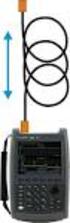 Techniques for Precise Cable and Antenna Measurements in the Field Using FieldFox handheld analyzers Application Note This application note introduces the practical aspects of cable and antenna testing,
AVX EMI SOLUTIONS Ron Demcko, Fellow of AVX Corporation Chris Mello, Principal Engineer, AVX Corporation Brian Ward, Business Manager, AVX Corporation
 AVX EMI SOLUTIONS Ron Demcko, Fellow of AVX Corporation Chris Mello, Principal Engineer, AVX Corporation Brian Ward, Business Manager, AVX Corporation Abstract EMC compatibility is becoming a key design
Co-simulation of Microwave Networks. Sanghoon Shin, Ph.D. RS Microwave
 Co-simulation of Microwave Networks Sanghoon Shin, Ph.D. RS Microwave Outline Brief review of EM solvers 2D and 3D EM simulators Technical Tips for EM solvers Co-simulated Examples of RF filters and Diplexer
Index. 2.40 mm Connector Series. 2.40 mm Connectors (50 GHz)... Page. Interface Standards... 44. Specifications... 45. Connector Numbers...
 Connector Series Index (50 GHz).... Page Interface Standards... 44 Specifications... 45 Connector Numbers... 46 Typical Test Data... 48 End : can be found in the Adapter section. : can be found in the
Coaxial Cable Products Guide. Connectivity for Business-Critical Continuity
 Coaxial Cable Products Guide Connectivity for Business-Critical Continuity The Difference Starts With The Cable BULK CABLES SLA Series Lowest loss cable available to 18 GHz, best choice for critical applications
HIGH REPEATABILITY, BROADBAND TO-5 RELAYS DPDT
 HIGH REPEATABILITY, BROADBAND TO-5 RELAYS DPDT SERIES RF00 RF00D RF00DD RF0 RF0D RF0DD RELAY TYPE Repeatable, RF relay Repeatable, RF relay with internal diode for coil transient suppression Repeatable,
DEPARTMENT OF DEFENSE TEST METHOD STANDARD METHOD OF INSERTION LOSS MEASUREMENT
 INCH-POUND MIL-STD-220C 14 May 2009 SUPERSEDING MIL-STD-220B 24 January 2000 DEPARTMENT OF DEFENSE TEST METHOD STANDARD METHOD OF INSERTION LOSS MEASUREMENT AMSC N/A FSC EMCS FOREWORD 1. This standard
Agilent PN 89400-13 Extending Vector Signal Analysis to 26.5 GHz with 20 MHz Information Bandwidth
 Agilent PN 89400-13 Extending Vector Signal Analysis to 26.5 GHz with 20 MHz Information Bandwidth Product Note The Agilent Technologies 89400 series vector signal analyzers provide unmatched signal analysis
Calibration Procedure for Measuring S-Parameters in Balun Applications on 150-Ω High-Speed Cables
 NASA/TM 2012-217296 Calibration Procedure for Measuring S-Parameters in Balun Applications on 150-Ω High-Speed Cables Onoufrios Theofylaktos and Joseph D. Warner Glenn Research Center, Cleveland, Ohio
Keysight E5063A ENA Series PCB Analyzer
 Keysight E5063A ENA Series PCB Analyzer Technical Overview The Best Solution for PCB Manufacturing Test More accuracy and R&R More languages supported More ESD robustness Why choose the E5063A PCB Analyzer
Measurement & Modeling Device Characterization Solutions
 Also Available from Maury Microwave Measurement & Modeling Device Characterization Solutions Featuring The Most Complete Selection of Load Pull Solutions in the Test & Measurement Industry Helping Your
W1 Connector W1 Adapter W1 Termination
 Data Sheet W1 Connector W1 Adapter W1 Termination DC to 110 GHz A complete coaxial connector system with mode-free performance to 110 GHz Features Excellent RF Performance to 110 GHz 50Ω Impedance Low