
Food Webs: Community. Student Edition
|
|
|
- Lucas Chambers
- 9 years ago
- Views:
Transcription
1 BioMath Food Webs: Community Feeding Relationships Student Edition

2 Funded by the National Science Foundation, Proposal No. ESI This material was prepared with the support of the National Science Foundation. However, any opinions, findings, conclusions, and/or recommendations herein are those of the authors and do not necessarily reflect the views of the NSF. At the time of publishing, all included URLs were checked and active. We make every effort to make sure all links stay active, but we cannot make any guaranties that they will remain so. If you find a URL that is inactive, please inform us at [email protected]. DIMACS Published by COMAP, Inc. in conjunction with DIMACS, Rutgers University COMAP, Inc. Printed in the U.S.A. COMAP, Inc. 175 Middlesex Turnpike, Suite 3B Bedford, MA ISBN: Front Cover Photograph: EPA GULF BREEZE LABORATORY, PATHO-BIOLOGY LAB. LINDA SHARP ASSISTANT This work is in the public domain in the United States because it is a work prepared by an officer or employee of the United States Government as part of that person s official duties.

3 Food Webs: Community Feeding Relationships Food webs are abstract representations of feeding relationships in communities and use a series of arrows from one species to another where the first is a source of food for the second. Discrete mathematics provides a model for a food web using a directed graph (digraph) whose vertices are the species and an arc goes from a to b if a is food for b. Digraphs representing food webs make understanding predator prey relationships easier and various properties of digraphs provide insight into properties of the food web and the species contained within. Overarching questions in this module include, What effect would the removal of a species have on the associated food web? and Why are there so few top predators? Unit Goals and Objectives Unit Goal: Gain a greater appreciation of the use of food webs to model the biological structures of communities Goal: Recognize various relationships between organisms and look for patterns across food webs. Objectives: Use the information provided in the introduction to interpret a food-web diagram that shows relationships among a series of unknown species. Identify a food web. Create a food web from given information. Interpret a food web. Goal: Use graphs to model complex trophic relationships. Objectives: Understand and explain the modeling process. Recognize and draw a digraph. Use digraphs to model and interpret food chains and food webs. Identify paths and loops in digraphs. Goal: Move between levels of trophic relationships within a food web. Objectives: Calculate the lengths of paths in a digraph. Use the shortest-path definition for trophic level to determine the trophic level of a species in a food web. Use the longest-path definition for trophic level to determine the trophic level of a species in a food web. Use the 10% rule to calculate energy loss within a food web. Goal: Calculate the relative importance of each species (vertices) and each relationship (arcs) in a food web. Objectives: Interpret the meaning of removing an edge or a vertex from a food web. Food Webs Student 1

4 Identify keystone species within a food web. Identify arcs that are redundant within a food web. Explore the resiliency of a food web. Goal: Extend the ideas derived from interpretation and use of food webs to other contexts. Objectives: Interpret weighted digraphs that are used to represent food webs. Translate the ideas of food webs to other resources. Food Webs Student 2

5 Lesson 1 Introduction to Food Webs What is Eating What? Have you ever played the game Jenga? It s a game where towers are built from interwoven wooden blocks, and each player tries to remove a single block without the tower falling. The player who crashes the tower of blocks loses the game. Photo by Derek Mawhinney and Cafe Nervosa (en:file:jenga.jpg) [CC-BY-SA-2.5 ( commons.org/ licenses/by-sa/2.5) or CC-BY- SA-2.5 ( via Wikimedia Commons Food webs are towers of organisms used by ecologists to represent the feeding relationships within a community. Each organism depends for food on one or many other organisms in an ecosystem. The exceptions are primary producers the organisms at the foundation of the ecosystems that use sunlight to produce their energy for photosynthesis or use chemicals as an energy source for chemosynthesis. Factors that limit the success of primary producers are generally sunlight, water, or nutrient availability. These are physical factors that control a food web from the bottom up. On the other hand, certain biological factors can also control a food web from the top down. For example, certain predators, such as a shark, lion, wolf, or a human can suppress or enhance the abundance of other organisms. They can suppress them directly by eating their prey or indirectly by eating something that would eat something else. Understanding the difference between direct and indirect interactions within ecosystems is critical to building food webs. For example, suppose your favorite food is a hamburger. The meat came from a cow, but a cow is not a primary producer! It can t photosynthesize! But, a cow eats grass, and grass is a primary producer. So, you eat cows, which eat grass. This is a simple food web with 3 players. If you were to remove the grass, you wouldn t have a cow to eat. So, the availability and growth of grass indirectly influences whether or not you can eat a hamburger. On the other hand, if cows were removed from the food web, then the direct link to your hamburger would be gone, even if grass persists. So, food webs are important because everything you eat eats something else that can eat something else that can eat something else (with any given number of steps) that eventually eats something that is a primary producer. Primary producers are always at the bottom of the food web. Above the primary producers are various types of organisms that exclusively eat plants. These are considered to be herbivores, or grazers. Animals that eat herbivores, or each other, are carnivores, or predators. Animals that eat both plants and other animals are considered to be omnivores. An animal at the very top of the food web is a top predator. Through these various trophic interactions, energy gets transferred from one organism to another. Food Webs Student 3

6 Food webs, through both direct and indirect interactions, describe the flow of energy through an ecosystem. By tracking the energy flow, you can derive where the energy from your last meal came from, and how many species contributed to your meal. Understanding food webs can also help to predict how important any given species is, and how ecosystems change with the addition of a new species or removal of a current species. Now, imagine you re not a human, but you re a shark in the ocean. You eat fish, right? But you might also eat sea otters. Sea otters might also eat fish. Do sharks and sea otters eat the same fish species? Different fish species? What happens if a fish species disappears? What happens if a new fish species is added? Food webs are complex! In this module, you will explore the complexity of food webs in mathematical terms, using a visual model, called a digraph, to help you map the interactions between organisms. A digraph represents the species in an ecosystem as points or vertices (singular = vertex) and connects some vertices to others with arcs and arrows on the arcs to indicate direction. Food Web The A-O food web below, with letters indicating names of species, is used several times throughout this module. This diagraph depicts the feeding relationships of a community of 15 species (species A through O). The arrows show the relationships with the species at the tail of the arrow being eaten by the species at the head/tip of the arrow. Figure 1.1: A-O Food Web Food Webs Student 4

7 ACTIVITY 1-1 Exploring a Food Web Objective: Interpret relationships displayed in a food web. Materials: Handout FW-H2: Exploring a Food Web Worksheet In the real world, nothing lives in isolation. The diagram (digraph) below shows the predatorprey relationships that exist among 15 species of plants and animals labeled A through O. The arrows indicate a particular relationship that is being examined. In this diagram, the arrows can be read is eaten by. For example, notice that there is an arrow between C and H. Because the arrow goes from C to H, the relationship that is indicated here is that species C is eaten by species H. Figure 1.2: A-O Food Web Carefully examine the diagram in Figure 1.2 and answer the following questions. 1. Is species E eaten by species J? Is species M eaten by species I? Explain your answers. 2. What is the relationship between F and E? 3. Why do you think the arrow points toward E rather than toward F? In other words, why did they originally design food webs with the arrow pointing to the predator rather than the prey? 4. What is the direct relationship between K and H? Explain. 5. Are there any relationships between G and K? Explain. Food Webs Student 5
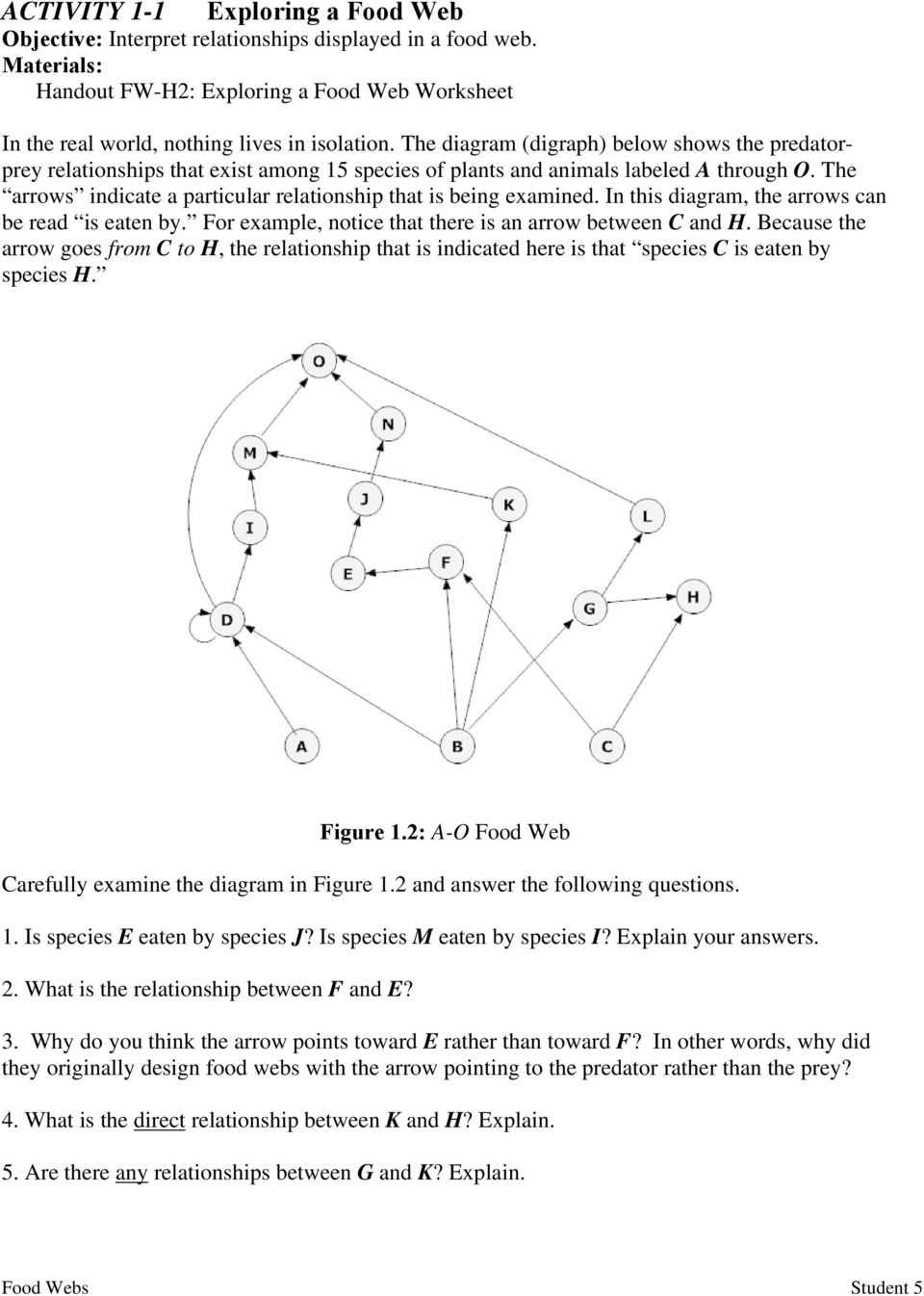
8 6. What does it mean when two arrows go from one species (letter) to two other species (letters)? Find an example of this type of relationship. 7. Species O directly feeds upon how many different species? What are they? 8. What other observations can you make about species O? 9. What can you say about species A? Does this species eat others? How does it get its energy? 10. What other species in the web are like A? As a group, what would you call these types of organism? 11. What species in the web are strictly carnivores? Herbivores? Omnivores? 12. What happens to other species in this diagram if J is removed? 13. What real-world events or circumstances might cause the removal of J? ACTIVITY 1-2 Adjusting a Food Web Objective: Evaluate changes made to a food web. Materials: Handout FW-H3: Adjusting a Food Web Worksheet Working in groups use the following web to answer the questions below. Figure 1.3: A New Food Web (A-J Food Web) 1. Does species B eat species D? 2. Is there a direct relationship between G and F? Is there an indirect relationship? 3. F is a food source for how many other species? Food Webs Student 6

9 4. What species in the web above are most likely herbivores? 5. Using your own experience, give a possible real life example of species F. 6. What happens to the other species if C is hunted to extinction? 7. Comparing this web to the one in class, which is more affected by the removal of species? Explain your answer. 8. Add another primary producer and label it K. 9. Add a species (L) that is a predator of K and is prey for F and E. 10. Add a top-level predator (M) that feeds on any two of the current top-level predators. 11. Compare your new graph (with the changes from steps 8-10) to the original before the changes. Is the new version more stable to the removal of a single species? Why or why not? 12. Give a possible real world list of species that could represent the section of this food chain denoted by the letters A, B, C, D, E, and G. Diagrams of Food Webs The species that occupy an area and interact either directly or indirectly form a community. The interactions and characteristics of these species define the biological structure of the community. These include parameters such as feeding patterns, abundance, population density, dominance, and diversity. Acquisition of food is a fundamental process of nature providing both energy and nutrients. The interactions of species as they attempt to acquire food determine much of the structure of a community. Ecologists use food webs to represent the feeding relationships within a community. For example, in the partial food web below, sharks eat sea otters, sea otters eat sea urchins and large crabs, and sea urchins eat kelp. These relationships can be modeled by the food web shown in Figure 1.4. Figure 1.4: Partial Sea Community Food Web Food Webs Student 7

10 Said in another way, sea urchins and large crabs are eaten by sea otters (both are prey for sea otters) and sea otters are prey for sharks. ACTIVITY 1-3 Creating a Food Web Objective: Develop a food web from a list of species and what they eat Materials: Handout FW-H3: Creating a Food Web Worksheet Table 1.1 provides a list of sea species and the species they feed on. Species shark sea otter sea stars sea urchins abalone large crabs smaller predatory fishes small herbivorous fishes Species They Feed On sea otter sea stars, sea urchins, large crabs, large fish and octopus, abalone abalone, small herbivorous fishes, sea urchins, organic debris kelp, sessile invertebrates, organic debris, organic debris sea stars, smaller predatory fishes, organic debris, small herbivorous fishes, kelp sessile invertebrates, planktonic invertebrates kelp kelp large fish and octopus sessile invertebrates smaller predatory fishes, large crabs microscopic planktonic algae, planktonic invertebrates organic debris planktonic invertebrates microscopic planktonic algae microscopic planktonic algae Table 1.1: Sea otter food web data [1] Food Webs Student 8

11 1. Look carefully at table 1.1. Identify everything that eats organic debris or kelp. 2. Draw a food web to represent this entire table. 3. Look carefully at your graph. Identify everything that eats sea urchins or sessile invertebrates. 4. Compare and contrast the tabular model and the digraph representation of the food web. Which is easier to understand? Which makes who preys on whom more obvious? Questions for Discussion Use the food web you created in Activity 1-3 to answer the following questions: 1. Are there any species that are only predators and not prey, any that are prey that are not predators? What are they? 2. Some species are specialists, who eat only one prey, and others can be viewed more as generalists, who eat multiple prey; Name all specialists and all generalists in this food web. Practice A food web is shown below: 1. Identify the primary producers. Figure 1.5: Practice Food Web 2. The bear eats which species in this food web? 3. Which species consume the most different species, which the least? 4. Which species are consumed by the most different species? Which the least? 5. Give an example of a chain in this food web. Food Webs Student 9

12 Extension When you created your food web in Activity 1-2 you probably used some straight lines and some curved lines to connect species and you probably had many lines crossing each other. If you spent more time planning the web, you likely could rearrange the graph to have fewer crossing lines. 1. If you can have straight and curved lines, what is the fewest number of crossed lines you would need in this web? 2. If you could only draw straight lines between species, what is the fewest number of crossed lines you would need to complete the graph? Food Webs Student 10

13 Lesson 2 Models of Food Webs In an attempt to explain why things happen the way they do or to make predictions about the future, people sometimes create mathematical models, or a representation of what is happening. Mathematical modeling is a process by which a real-world situation is replaced with a mathematical representation. If the real-world situation and the mathematical representation are well matched, then information obtained from the mathematical representation is meaningful in the real-world setting. In this module, digraphs that consist of vertices and arcs are used to model the feeding relationships among species within a given area. Mathematical Modeling Whether a model is driven by the collection of data or by theory, the process of modeling can be summarized in the following steps: Step 1. Identify the Problem: What is it you would like to do or find out? Pose a welldefined question asking exactly what you wish to know. In this situation, we want to better understand food webs and energy transfer from one level of the food web to the other. Step 2. Simplify and Make Assumptions: What factors would you use in building the model? For example, to build a model of a food web you will need to know which species are prey for which other species. Generally you must simplify to get a manageable set of factors. In food webs, you might choose to simplify the web by aggregating, or clumping, similar species. For example, you might aggregate grasshoppers and crickets and make them one vertex. Step 3. Build the Model (a representation for what is happening). What will your model look like? Let mathematical objects (like vertices and arcs) correspond to elements of the real world situation. In this module, species are represented by vertices and transfer of energy is represented by arcs. Once the model has been created, it can be analyzed to find answers to the questions posed. Step 4. Evaluate, Revise, and Interpret: Does your model yield results that are close enough to real world observations and other data? Your conclusions at this point apply to your mathematical model. If the results of the model do not seem to represent the real world, re-examine your assumptions and refine the model in order to draw more accurate conclusions about the real world. You may need to refine your model more than once. To the extent allowed by the accuracy of your model, relate the mathematical conclusions back to your initial question or problem (from step 1). In this module you will use a digraph to interpret in mathematical terms the features and relationships of the food web you have chosen. Food Webs Student 11

14 The following diagram (Figure 2.1) is useful in describing the modeling process: Figure 2.1: The Modeling Process The process begins with a real-world situation, such as the feeding relationships in a community. But after a model is built, analyzed, and tested, it is often necessary to revise the model in order to better explain the problem. In other words, when you look at the results of the model you may find that your first attempt was a poor representation of what actually happens in the real world, so you must make adjustments to your model. Therefore, more than one trip around the modeling diagram may be needed in order to find a model that adequately describes the situation. Observations and data from the real-world situation can provide feedback in the modeling process to help us refine our model. One might ask, "Why spend so much time making a model rather than just working with the 'real thing'?" There are several advantages to creating a model. One advantage is that it may not be possible to work with the 'real thing'. There are many situations for which running an experiment would be too difficult, costly, or possibly unethical. Food webs are one example of this - it would be unethical (and dangerous) to make a species extinct just to see the effect it would have on the rest of the community. Another major advantage in creating a mathematical model is that a computer can now work on the problem. Computers 'understand' how to do mathematics and can run many experiments or scenarios in seconds that might take hundreds of years to do in the real world. It is important to remember, though, that if the model does not represent the real world well, then the conclusions are not very useful. If this is the case, then your model will need to be revised and the process begun again. Therefore, most of the effort goes into setting up a model that best represents the situation. Directed Graphs A directed graph (shortened to digraph) consists of a set of points called vertices, and a set of lines, with direction given for each line, called arcs. Directed graphs are often used to model specific situations, such as predator-prey relationships in a community and winners (and losers) in a tournament bracket. Figures 2.2 and 2.3 show the same digraph. Figure 2.1 shows the vertices with the actual names. Figure 2.3 shows the digraph with lettered vertices that represent sharks, sea otters, sea urchins, large crabs, and kelp. Why is there no arc from kelp to large crabs? Food Webs Student 12

15 Figure 2.2: Digraph with Names Figure 2.3: Diagraph with Lettered Vertices The out-degree of a vertex is the number of arcs that are leaving the vertex. The in-degree of a vertex is the number of arcs that are entering a vertex. For example, the out-degree of sea otters above is 1. The in-degree of sea otters is 2. A path in a digraph is an ordered list vertices such that there is an arc between each pair of vertices in the sequence. For example, in Figure 2.2, sea urchin, sea otter, shark is a path. If a food web is a single path such as kelp, sea urchin, sea otter, shark, it is called a food chain. (See Figure 2.4. Figure 2.4: Food Chain A cycle in a digraph is a path such that the first vertex and the last vertex are the same and no arc is used more than once. Figure 2.5: Cycle For example, in Figure 2.5 a cycle goes from vertex 1 to vertex 2 to vertex 3 and back to vertex 1. Another cycle goes from vertex 1 to vertex 2 to vertex 4 to vertex 3 and back to vertex 1. Food Webs Student 13

16 A loop in a digraph is an arc from one vertex to itself. This is a special case of a cycle. If a loop exists in a food web it is said to represent cannibalism in the community. The digraphs representing food webs will typically be acyclic, that is they will have no cycles. Questions for Discussion 1. Consider the food web below: Figure 2.6: Discussion Food Web a. Which are the primary producers in this food web? b. Which species are eaten by the mountain lion? Are they the same as for the bear? c. Which species consume the most different species, which the least? d. Which species are consumed by the most different species? e. Give an example of a chain in this food web. 2. Add the following arcs to the digraph above: (berries, bird); (berries, deer); (bird, mountain lion). Using this new digraph, re-answer the questions from question Is there another arc you might add to this digraph? Explain why you added this arc. 4. How can you look at the model (the digraph) and quickly tell which species are consumed by the most different species? Practice 1. Look at the A-O food web from figure 1.1. a. Identify a loop. b. What does this loop mean? 2. There are many ways that digraphs are used to model real-world situations. For example, consider a four- player tournament that arises when every player plays every other player as in football division or in a round-robin tournament. In this example, an arc from one vertex to another means that the first vertex beats the second vertex. In the figure below, the vertices Food Webs Student 14

17 represent the players in the tournament and are numbered 1 to 4. There are arcs from 1 to 2, 1 to 3, 1 to 4, 2 to 3, 2 to 4, and 3 to 4. a. Player 1 beats 2 and 3 and 4. Who does Player 2 beat? Who does Player 3 beat? Who does Player 4 beat? b. Show how you would draw the digraph above with all straight lines but no lines crossing one another. c. Give another example of when a digraph might be used to model something in the real world. Food Webs Student 15

18 Lesson 3 Trophic Levels and Energy in Food Webs Scientists have used various methods to classify species in a food web into various feeding groups. The most elementary way is to divide them into the two categories of primary producers and consumers, the latter is divided into herbivores and carnivores based on their consumption of plant or animal products. Trophic Level Trophic level (or trophic status) in food webs is a way of organizing species in a community food web. Using the classification above, this would imply that there are at most three trophic levels in a food web. It also opens the question of how to classify consumers, such as bears, who are omnivores. Some books, however, group omnivores with carnivores. Other scientists consider the positioning of species in the food web--a consumer is at a higher level than what it consumes. A species with no incoming arcs are at trophic level 0; one who eats that species is at level 1, etc. Determining trophic level in a food chain is easy under this latter definition. For example, for the food chain below, kelp is at trophic level 0, sea urchins are at trophic level 1, sea otters are at trophic level 2, and sharks are at trophic level 3. Figure 3.1: Food Chain Food webs are not just food chains, but they are a mixture of food chains meshed together. Determining trophic levels for more complex food webs is more difficult. In fact, as we will see in the next section, the number of trophic levels in a food web is sometimes used as a measure of complexity of the food web. Since food webs can be represented as digraphs, we can use properties of these digraphs to determine trophic levels in the food web. The length of a path in a digraph is the number of arcs included in that path. The shortest path between two vertices x and y in a digraph is the path between x and y with the fewest number of arcs. The longest path between two vertices x and y in a digraph is the path between x and y with the most arcs. Food Webs Student 16

19 Example: Figure 3.2: Example Digraph In figure 3.2 there are two paths from A to D: A,C,D of length 2 and A,D of length of 1. The shortest path is A,D of length 1. The longest path is A,C,D of length 2. Trophic level (shortest path definition): The trophic level of a species X is: i. 0, if X is a primary producers in the food web - a species that does not consume any species in the food web. ii. k, if the shortest path from a level 0 species to X has length k. Example: Figure 3.3: Kelp to Shark Digraph Food Webs Student 17

20 Species Trophic level Shortest path Kelp 0 Sea urchins k = 1 Kelp, Sea urchins Small fishes k = 1 Kelp, small fishes Large crabs k = 2 Kelp, small fishes, large crabs Sea otters k = 2 Kelp, Sea urchins, Sea otters Sharks k = 3 Kelp, Sea urchins, Sea otters, Sharks Table 3.1: Trophic Levels Using Shortest Path Method Energy Relationships, Energy Transfer and the 10% Rule One of the problems that occur when a predator eats is that the predator does not get all of the energy that was available in its prey. Only about 10% of the energy the predator consumes is actually turned into new predator body growth. Some of the remaining 90% is used to for powering body functions, repairing cells, maintaining its body and movement, or is lost as waste. Much of the remaining 90% is lost as heat during chemical reactions. Overall, this concept is known as the 10% rule and basically states that only 10% of the available energy is passed from one trophic level to the next. Consider the following example to explore how the numbers change under the 10% rule. Suppose we start with 1,000 units of energy at trophic level 0. Then we have approximately 100 units at level 1, 10 units at level 2, only 1 unit of energy at level 3, and a tiny 0.1 units at level 4! Trophic Level Energy Amount Level 0 1,000 Level Level 2 10 Level 3 1 Level Table 3.2: Energy Transfer Essentially, each level of a food chain hosts energy at a different order of magnitude. Simply put, each level varies by a fixed ratio. In this example, to move from one trophic level to a higher one, the energy amount of the lower level is multiplied by 0.1. This has considerable implications on the structure and behavior of an ecosystem. Consider first the structure of an ecosystem. Loss of energy through the various trophic levels of a food web means that there are rarely more than 4 or 5 trophic levels. Biomass is the total mass of living biological organisms in a given area or ecosystem at a given time. It takes energy to create biomass. Therefore energy relates to biomass in that as energy declines at each level Food Webs Student 18

21 there is not as much biomass at the higher levels compared to the lower levels. In other words, the total mass of the predator cannot be more than the total mass of its prey in that ecosystem. Remember that mass is not necessarily numerical. There may be numerically more predators than prey or fewer predators than prey; it all depends on relative mass. Assuming a predator has more mass than its prey, this basically means that a predator can not outnumber its prey. On the other hand, if the predator is smaller than its prey then there could be a larger number of predators than prey, but the total mass of the predators would still be less than the total mass of the prey. Can you give examples of predators who are smaller than their prey? Now consider the behavior of an ecosystem. Organisms may eat 'lower' on the food chain than one might expect. For example, it is a better use of resources for the owl to eat the mouse that ate the grain than for the owl to eat the snake that ate the mouse that ate the grain. This would support a larger owl population, since the owls would get ten times the original grain s energy from the mice than they would from the snakes (refer to table 3.2). This is also why you can see such large animals that feed on grass - these animals get more energy for their effort by eating a primary producer. Another example would be large whales that eat very small krill. The krill are low on the food chain and therefore have more available energy to give to the whales than other creatures higher on the food chain. Omnivores, such as bears, may tilt their diet toward berries and nuts rather than eating much meat. In fact, meat only accounts for about 10% of a black bear's diet while the other 90% comes from items lower in trophic level (but higher in energy). This concept of 'eating lower on the food chain' applies to people too. Feeding people grain is a better use of resources than feeding them cows that were grown using the grain. Eating the cow will only give 1/10 the energy (calories) from the grain the cow ate. In other words, you would get 10 times the energy (calories) by directly eating the grain. Due to the practical implications of limiting food webs to 4 or 5 trophic levels based on energy transfer, another behavioral and structural effect on the ecosystem is competition. For example, if two species have the same food source, then they may compete for that food source, but only if they co-exist in the same space at the same time. And if there is not enough of that food source for both, then one of the species will win the competition and drive the other species from that ecosystem. On the other hand, another possibility is that the two don't compete in the same space and time but rather have adapted to the situation by having one predator active during the day and the other active at night. An example of this would be hawks and owls, who might both eat mice, but hunt at different times of day. Again, there must be enough prey to support both, but because the predators changed their behavior, they do not directly compete or come into conflict with one another. As you can see, energy relationships in an ecosystem affect both the structure and behavior of species within that system. This is mostly due to the limited amount of available energy since energy is constantly being lost as it moves up the trophic chain. Food Webs Student 19
22 Figure 3.4: Examples of Energy Transfer. ACTIVITY 3-1 Getting the Most Energy Objective: Analyze energy levels in food webs Materials: Handout FW-H5: Getting the Most Energy Activity Worksheet 1. Consider the mass of predators and prey. a. Can you give examples of predators who are larger than their prey? b. Can you give examples of predators who are smaller than their prey? c. What would happen if the total mass of a predator species were greater than the total mass of its prey species? 2. Given the 10% rule alone, should organisms eat anything other than just primary producers, such as grass?g iven that many organisms, including you, eat more than just vegetables in the real world, give a biological explanation for why this might be so. 3. If energy is constantly being lost in a food web, where does new energy come from to keep the system going? 4.Generally, how do you calculate the orders of magnitude of energy loss between the primary producers and the top predator (in any food web)? Food Webs Student 20
23 5. Mathematically speaking, if you are on an island with a large bag of grain and two egg laying chickens, what is your best eating strategy for survival? Develop three possible strategies and then choose and explain your best strategy. 6. Using the shortest path method, calculate the trophic levels of each species in the food web shown. Do you see any problems or challenges to using the shortest path for computing trophic level? Can you think of any alternatives? Alternative Definition of Trophic Level What happens when we weave a more complex food web? Are there alternative definitions of trophic level and what do these say about energy transfer? One of the problems with using the shortest path method to determine trophic level is illustrated in our previous example shown below: Figure 3.5: Kelp to Shark Digraph Large crabs are direct prey of sea otters, so logic would indicate that large crabs should have a different trophic level from sea otters, yet they have the same trophic level of 2 by our definition. Consider an alternative definition of trophic level: Trophic level (longest path definition): The trophic level of species X is: i. 0 if X is a primary producer in the food web (a species that does not consume any species in the food web) ii. k if the longest path from a level 0 species to X has length k. Food Webs Student 21
24 Example: Using Figure 3.5 Species Trophic level Longest path Kelp 0 Sea urchins k = 1 Kelp, Sea urchins Small fishes k = 1 Kelp, small fishes Large crabs k = 2 Kelp, small fishes, large crabs Sea otters k = 3 Kelp, small fishes, large crabs, sea otters Sharks k = 4 Kelp, small fishes, large crabs, sea otters, sharks Table 3.3: Trophic Levels using Longest Path Method This alternative definition avoids the problem presented using the shortest path definition because each predator now has a higher trophic level than its prey. In general, if the entire food web is not simply a chain, then using the longest path definition yields more trophic levels than using the shortest path definition. Since approximately 10 percent of the energy is transferred from one trophic level to another, more energy is lost from one species to another when using the longest path definition rather than the shortest path definition. Food Webs Student 22
25 ACTIVITY 3-2 Short and Long Differences Objective: Compare and analyze differences in trophic levels when using short and long paths. Materials: Handout FW-H6: Short and Long Differences Activity Handout 1. Consider the food web below: Squid Figure 3.6: Sea Life Food Web [2] a. List the trophic level of each species using the shortest path: b. Now, list the trophic level of each species using the longest path. What species change trophic levels with different definitions? c. Calculate the energy transferred from phytoplankton to sperm whales using the shortest path and the longest path. What is the order of magnitude for each path? 2. Use figure 3.5 to calculate the orders of magnitude of energy loss between the primary producers, kelp, and the top predator, sharks, using the longest path? 3. Using your answer to number 2 above, if Kelp started with 3,500 units of energy, how much energy would sharks have. Food Webs Student 23
26 Lesson 4 Species Importance And Vulnerability The questions of how stable a community is and how vulnerable individual species in the community are can be partially answered using the community s food web. Removal of Vertices and Arcs What happens when a species is no longer in a community? This question can be partially answered by asking what happens when a species is removed from the digraph. We can disconnect a digraph by removing either vertices or arcs. Let s consider the small food web example that we have been working with and see what happens when we remove a vertex (in this case, sea otters) from the food web: Figure 4.1: Sea Life Food Web Sea Otter Removed This digraph is no longer in one piece because there is no path between sharks and the rest of the food web. Based on this graph, the source of food for sharks has been removed and thus sharks will disappear. In this second food web with the removal of sea otters, there is nothing controlling the population of sea urchins or large crabs, so there populations can grow very large. A keystone species has interactions that play a significant role in the community. For example, removal of a keystone species usually causes other species to disappear. In our simplified example, sea otters are a keystone species, since sharks will disappear when sea otters are removed. Are there other keystone species in this example? What are they? Food Webs Student 24
27 Consider what happens when sea urchins are removed from the food web: Figure 4.2: Food Web Sea Urchin Removed The redrawn food web shown in Figure 4.2 is still connected (still in one piece). Kelp, however, has only one predator (consumer). Sea otters have one food source instead of two (large crabs). What happens to connectedness when an arc is removed from a food web? To see the answer, consider the example shown in Figure 4.3. Since there is only one arc from sea otters to sharks, removal of the arc disconnects the digraph (it no longer a connected digraph). Does the removal of an arc always do this? Can you give an example where it doesn t? Is the effect on the food web of removing the sea otter to shark arc the same as removing the shark vertex? Figure 4.3: Food Web Shark Arc Removed One way of recognizing disproportionally important species is by removing arcs as in Figure 4.4 For example, when we remove the arc from sea urchin to sea otter, sea urchins grow uncontrolled since they now have no predator. This, in turn, could affect the amount of kelp, which could affect the number of small fishes. Food Webs Student 25
28 Questions For Discussion Figure 4.4: Food Web Urchin to Otter Arc Removed 1. Develop and defend a set of rules for determining potential keystone species in food webs based on the digraph? 2. When you look at food webs, you might notice that some organisms or species have multiple connections, or arcs, into or out of them. a. What impact does this have on the food web? b. If a vertex has more than one arc into or out of it, is the food web likely to be more or less impacted by the removal of this vertex? Redundancy and Resiliency Multiple arcs into or out of a vertex are redundant, and redundancy within a food web can lead to resiliency, or the potential for a food web to resist major changes or collapse as small changes occur within. Major changes destabilize a food web, and can include local extinction, starvation, uncontrolled population growth, or a disconnect of the food web. How do arcs or vertices disappear from food webs in nature? Vertices, or species, can sometimes disappear from food webs when they become locally extinct. Dinosaurs are globally extinct, and global extinction is a relatively rare phenomenon. However, organisms often become locally extinct. For example, if an animal is over-hunted, or a plant is over-harvested in a given area, or climate changes, it can become locally extinct even if it continues to exist elsewhere. Interestingly, we tend to think of biological communities in terms of spatial arrangements, for example, trees in a forest. However, vertices and/or arcs may change temporally (over time). For example, a given species may have a very short life span - like a butterfly in a cold-weather climate. In the winter, butterflies may not be part of the food web. If the temperature rises, new species might thrive where they didn t before. An example is the malaria mosquito in the Food Webs Student 26
29 Highlands of Kenya, where it wasn t seen before recent climate changes due to global warming. This would have the effect of adding a vertex in that area that did not exist before. Arcs represent the relationship between the species. When an arc disappears in a food web it means that one species no longer eats the other species but that they both still exist in the community. This could occur in the short term as some animals may only eat certain things in certain seasons. For example, deer often eat tree bark in winter when there is little else to eat, but in the summer, deer almost never eat bark. Instead, they feast upon fresh green grass and other, less-woody plant material. This could also occur due to longer-term evolutionary changes. For example, a species may develop a defense mechanism such as needles on a cactus or poison in a frog. Then they would still exist but the animals that used to prey upon them may no longer be able to do so unless that predator also undergoes an co-evolutionary adaptation. Another example of a change could be mimicry. In this situation, one animal evolves a similar appearance to a more dangerous animal, which dissuades its predator from eating it. For example, there are frogs that are not poisonous but mimic the color or patterns of the poisonous frogs. Again, in these situations both the predator and prey exist but their relationship has changed and thus the arc is removed but the vertices stay (assuming the predator has something else it can eat). Thus, arcs and vertices may change over the short-term, and over the long-term as well. These spatial and temporal dynamics make food webs complex, but understanding how species (vertices) and relationships (arcs) contribute to the web (via trophic levels and connectivity) helps scientists to understand real-world trophic dynamics. Looking for More Food Web Patterns Thus far, we've learned a lot about food webs! You should now be able to calculate trophic levels and energy transfer (and loss) across trophic levels. You should also be able to describe the connectedness and resiliency of food webs. Finally, you've become experts at inserting and removing arcs and vertices in various food webs and exploring how these changes occur. ACTIVITY 4-1 Putting It All Together Objective: Discover general patterns about food webs Materials: Handout FW-H7: Putting It All Together Activity Worksheet 1. Choose an arc and a vertex from the A-O food web below (it's okay if everyone makes different choices!), and list your choice here: Your Arc: Your Vertex: In the box below, describe what happens when you remove each one (do not remove both simultaneously). Specifically, calculate the highest trophic level (TL) and describe the connectedness (yes or no) of the graph after each removed arc and each removed vertex: Remove Arc Highest TL: Connected? Vertex Highest TL: Connected? Food Webs Student 27
30 2. Now, it's your turn to be creative! Try adding a new arc and a new vertex not at the same time. (It's okay to make up a species or trophic relationship.) List them below, and draw them on the A-O food web digraph. Arc added: Vertex added: Figure 4.5: A-O Food Web 3. In the box below, describe what happens when you add your new trophic relationships. Specifically, calculate the trophic level (TL) and describe the connectedness (yes or no), as above for every vertex and arc you add: Add Arc Highest TL: Connected? Vertex Highest TL: Connected? 4. It's time to put it all together! Combine your boxes to look for general patterns in the complete box below: Remove Add Arc Highest TL: Connected? Highest TL: Connected? Vertex Highest TL: Connected? Highest TL: Connected? Food Webs Student 28
31 5. What do you notice? Describe general trends using your newfound expertise in food webs and digraph language. Be specific--talk in terms of redundancy, resiliency, connectivity, and trophic level. Practice 1. Use the diagraph below. Figure 4.5: A-O Food Web Practice a. Which of the following is most likely a keystone species? L, or F, or N? Explain. b. Are there arcs that, when removed from the food web, disconnect the food web? Which ones? c. What arcs could be removed that do not disconnect the food web? In other words, are there any redundant arcs? d. Which arcs can be removed that would allow uncontrolled growth of a species? e. Can you remove 3 arcs that would disconnect the graph and have more than one species in each graph? If so, which 3? f. Can you remove 2 arcs that would disconnect the graph and have more than one species in each graph? If so, which 2? g. What is the fewest number of arcs you need to remove to get 3 separate graphs? Food Webs Student 29
32 h. Can you remove 2 vertices that would disconnect the graph and have more than one species in each graph? If so, which 2? i. What is the fewest number of vertices you need to remove to get 3 separate graphs? 2. One example of a redundancy in the above food web is arc (B,F). a. Why is this considered a redundancy? b. Is arc (G,L) a redundancy? Why or why not? c. Find another redundancy in the graph. d. How is the above food web resilient? Explain. Food Webs Student 30
33 Lesson 5 Complexity In Food Webs Not all relationships are the same. For example, you interact differently with your family than with strangers. Or perhaps you love to eat ice cream but eat as few brussel sprouts as possible. While both ice cream and brussel sprouts are food, given an unlimited source of both, would you eat an equal amount of both? Probably not! Similarly, species may eat much more of one species of prey than another. Weighted Arcs in Food Webs Consider the following food web: Figure 5.1: Food Web We could put numbers, or weights, on the arcs to indicate food preferences. For example, if you prefer ice cream to brussel sprouts, then ice cream is more heavily weighted. Consider this food web with a set of weights: Figure 5.2: Weighted Arc Food Web The weight of an arc, called wij, is the proportional food contribution of one vertex (i) to another vertex (j) in the food web. For example, the weight 0.6 on the arc from rodents to snakes reflects that snakes eat 'rodents' more than 'other lizards'. Specifically, 60% of a snake's diet comes from 'rodents', while 40% of its diet is from 'other lizards'. Food Webs Student 31
34 Weighting is more important than you might realize. Looking at hawks, it's clear that they eat both snakes and lizards. However, since snakes are weighted so much more heavily, the removal of snakes from this digraph would shift hawk diets dramatically. Instead of eating lizards 30% of the time, they would eat lizards 100% of the time. Poor lizards! Lucky insects! When snakes are removed, hawks only eat lizards, which dramatically decreases the lizard population, and decreases the food supply for foxes, which also vastly decreases lizard predation on insects, allowing insects to grow uncontrolled. However, now consider what would happen if lizards were initially 90% of hawk diets (instead of 30%). Would the insect population increase so dramatically with the removal of snakes? Probably not. This is important if you are an insect, or anything that eats an insect, or anything that an insect eats. Thus, considering the arc weight is important for predicting indirect changes that trickle down through a food web. In other words, arc weight matters. Translating the Ideas of Food Webs to Other Resources By now, it should be clear that there are many possible trophic, or nutritional, relationships between organisms. Food is obviously an important resource for every organism. But food isn t the only resource that organisms need to survive. For example, all of life requires water. Another resource that might influence interactions between organisms includes space (e.g. habitat, shelter). Can you think of other resources, too? Now that you ve learned how to use digraphs to explore food webs, you can apply the same theory to other critical resources (resource webs). You can even start to combine critical resources to create new digraphs! For example, you might examine how relationships change when organisms compete for food and share the same habitat, versus when organisms happily coexist, but are not necessarily trophically linked. For example, birds build nests in trees, so without trees, that bird may not have a place to build a home. But, that bird may not need to eat the tree, so they would not be trophically linked. On the other hand, if that tree produces fruit critical to the bird's nutrition, then they would be trophically linked. Things get even more complex when you consider that fruit may be only seasonally available, so the trophic relationship between a bird and a fruiting tree may be transitory, or temporary. One way to think about relationships between organisms is within the context of symbiosis. Symbiosis is a complicated word with a simple meaning simply put, symbiosis is the close association of two different kinds of living organisms. However, there are many different kinds of symbiotic interactions. When two organisms help each other, it is called a mutualism. Although symbioses are often nutritionally based, they can also be based on other resources (like water or shelter, as above, but also services that one organism can perform for the other). For example, when honeybees visit flowers, honeybees get a trophic benefit they get nectar that they then use to feed the hive or turn into honey. But the flower gets a benefit, too! The flower doesn t typically eat the honeybee, but the honeybee performs an important service for the flower by cross-pollinating. As the bee travels from flower to flower to collect nectar, it also collects and deposits pollen. The insect-flower pollination interaction is a classic resourceservice mutualism. Another type of symbiosis is called commensalism where one organism Food Webs Student 32
35 benefits, and the other organism does not benefit, but does not suffer any consequences either. For example, spiders often attach their webs to trees. The spider benefits, but the tree does not benefit or suffers. Finally, there is parasitism, in which one organism benefits, and the other is harmed. For example, hookworms are intestinal parasites of mammals. Hookworms steal essential nutrients from their hosts, which helps the worm, but hurts the host. A Story 300 Years in the Making: The extinction of the dodo bird is a well-known story in ecology. Less well known, however, are the after-effects of the dodo s disappearance. One such effect was only recently discovered. Scientists have noted that a tree on the island of Mauritius, the calvaria tree, is dying off. No new calvaria trees have grown for the last 300 years. This time frame coincides with the disappearance of the dodo bird from that same island. Some scientists speculate that the dodo and the tree had a mutualistic relationship. The dodo would eat the fruit of the tree, getting food, and as the seed passed through the digestive system of the bird it would become active so a new tree could grow. Without the dodo eating and excreting the seeds, the trees cannot reproduce. Photograph by Thomas Quine (DoDo Bird Uploaded by Snowmanradio) [CC-BY-SA-2.0 ( via Wikimedia Commons How do symbioses, services, and resources relate to food webs? One, you can use the same graphs to map out the relationships between organisms under these circumstances. In addition, organisms often relate to each other in more than one way. Think about our bird living in the tree there is a commensal relationship where the bird gets a habitat and the tree is neither helped nor harmed, as well as a trophic relationship where trees produce fruit that a bird might eat. However, that trophic relationship may also be a mutualism the bird gets a meal, and the tree gets it s seeds dispersed by the bird. Parasites are often ignored in food webs, but they can function like keystone species, reducing the dominance of high-level predators or superior competitors, and allowing competing species to co-exist. Thinking about relationships between species is complicated, but graphs can help us to map out interactions in a visually appealing and intuitive way. ACTIVITY 5-1 Food Web Relationships Objective: Identify relationships found among and between organisms Materials: Handout FW-H8: Food Web Relationships Activity Worksheet Handout FW-H9: Food Web Examples Colored pencils or markers 1. Find a food web or use one of the examples provided by your teacher a. Using this web, determine a potential keystone species. b. Add arcs between species that have some sort of symbiotic relationship. Use a different color for these arcs than for the food based arcs. Food Webs Student 33
36 c. Use this added information to determine potential keystone species. Compare this answer to part a. 2. Use the graph below to answer the following questions. Figure 5.3: Activity Weighted Arc Food Web a. If you ignore the weights on the arcs, describe the effect on the food web from the removal of prairie dogs? b. Assume that a species can survive on 50% of its normal diet. Use the weights to describe the effect on the food web from the removal of snowshoe hares? c. Assume that a species can survive on 75% of its normal diet. Use the weights to describe the effect on the food web from the removal of black-footed ferrets? Trophic status One example of a dominance definition, which incorporates both the number of species that are direct or indirect prey and the extent of energy, is based on the trophic level of the species, and is called the trophic status of a species, much the way people have various levels of status in a community. Notation: is a symbol that means the sum of things that follow. When it is written as 5 i, it means take the sum of numbers from i = 1 to 5, which yields Define the trophic status of a species u as T(u) = k m 1 mn m, where nm is the number of species whose longest path to u has length m, and the sum includes each possible length of path up to k, Food Webs Student 34
37 the trophic level determined by longest path. In other words, calculating the trophic status gives a weight to each species by finding the total of the trophic levels of all species below u in the food web. Questions for Discussion 1. Determine the trophic status of each species in our small food web: Figure 5.4: Sea Life Food Web For example, the trophic status of sea otters is as follows: the longest path from large crabs to sea otters is 1 as is the longest path from sea urchins to sea otters is 1, and there are no other longest paths of length 1 to sea otters. Thus, when m = 1 we have nm = 2. The longest path from small fishes to sea otters is 2, and there are no other longest paths of length 2 to sea otters. Thus, when m = 2, nm = 2. Similarly there is only one longest path to sea otters of length 3, that from kelp. So, the trophic status of sea otters = T(sea otters) = 1(2) + 2(1) + 3(1) = 7. Finish the calculations to complete the table. Species Trophic level Trophic status Kelp Sea urchins Small fishes Large crabs Sea otters 3 1(2) + 2(1) + 3(1) = 7 length of path is 1, 2, or 3 Sharks 2. A dominant species is defined as one with trophic status higher than the total number of species (consumers) in the food web above trophic level 0. Are there any dominant species in this food web. 3. Determine the trophic status of each of the species in your food web drawn in Activity 1-3 from the data in Table 1.1. Are there any dominant species under the trophic status definition? Food Webs Student 35
38 Extensions 1. Photosynthesis and a Food Chain. Photosynthesis is the use of light energy by plants to convert carbon dioxide and water into simple sugars. a. How does energy transfer through a food chain change when photosynthetic efficiency is lower? b. Can animals compensate by eating more of their prey? If not, do less nutritious food chains have fewer arcs and vertices? 2. Non-food resource webs. a. Use the Internet to find an example of a resource web that is not a food web and determine the possible number of levels for that resource web. b. Does the shortest path or the longest path definition of level make more sense in this case? 3. Multiple edge directed graphs. a. Can you think of reasons for building food webs where there might be more than one arc between two vertices (species)? b. Make up an example and see if you can find another example from the Internet. c. Ecologists often want to look at substructures of food webs based on multiple interactions and graph theorists use arc-coloring (coloring each arc with a color) to indicate specific kinds of interactions. Does arc coloring make sense in this instance? 4. Modeling disease spread in a food web. How would you model the spread of disease across species in a food web? Provide an example. Food Webs Student 36
39 Glossary Arcs the edges of the digraph with direction on them. Acyclic digraph a digraph that contains no cycles. Biomass the total mass of living biological organisms in a given area of an ecosystem at a particular point in time. Cannibalism the act of an organism or species consumes one of its own kind. Carnivores animals that eat herbivores or each other. Chemosynthesis the use of chemicals as an energy source to synthesize carbohydrates from carbon dioxide and water. Commensalism a relationship between two organisms where one organism benefits and the other organism does not benefit, but neither does it suffer. Community the set of species that occupy a certain area and interact either directly or indirectly. Connected digraph a digraph with a path, in one direction or the other, between any two vertices. Cycle a path in a digraph such that the first vertex and the last vertex are the same and no arc is used more than once. Digraph or directed graph a diagram depicting a web of related items consisting of a set of points called vertices, and a set of lines, with direction given for each line, called arcs. Dominant species species whose trophic status is higher than the number of species in the food web. Food chain a food web where each species or organism has at most one predator and one prey. The top member of the chain has only a prey and the bottom member of the chain has only a predator, all others have one predator and one prey. Food web a network of food chains for a community of organisms, where each organism is either predator of or prey to another organism. Ecologists use diagraphs of food webs to represent the feeding relationships within a community. Generalists species who eat more than one prey. Herbivores animals that exclusively eat plants. Food Webs Student 37
40 In-degree of a vertex the number of arcs entering a vertex in a digraph. Keystone species a species that has more importance than most other species in a food web based on a measure used for defining keystone species. Length of a path - the number of arcs included in the path of a diagraph. Longest path - the path between the two vertices in a diagraph with the most arcs. Loop - an arc in a diagraph from one vertex to itself. Mathematical modeling a process by which a real-world situation is replaced with a mathematical representation. Mimicry the close external appearance of one organism/animal to a more dangerous organism/animal for the purpose of benefiting from mistaken identity to keep its predators away. Mutualism a relationship between two organisms when the two organisms help each other. Omnivores animals that eat both plants and animals. Orders of magnitude powers of 10, 1, 10, 10 2, 10 3, where often only the 0, 1, 2, 3, are used. Out-degree of a vertex the number of arcs leaving a vertex in a digraph. Parasitism a relationship between two organisms when one organism benefits and the other is harmed when they interact. Path a sequence of arcs that can be used to go between two vertices in a digraph. Photosynthesis the use of sunlight as an energy source by plants to convert carbon dioxide and water to simple sugars. Predators species that eat other species. Prey species that are food for other species. Primary producers organisms at the foundation of the ecosystems that produce their energy from sunlight through photosynthesis or from chemicals through chemosynthesis. Redundancy multiple arcs into or out of a vertex in a food web. Resiliency the potential for a food web to resist major changes or collapse as small changes occur within. Food Webs Student 38
41 Shortest path between two vertices in a digraph is the path between them with the least number of arcs. Spatial and temporal dynamics when arcs and vertices change in a food web over time, either in the short term or long term. Specialists species that have only one prey. Symbiosis the close association of two different kinds of living organisms. 10% Rule the rule that states only 10% of the available energy is passed from one trophic level to the next. Top predator an animal at the very top of the food web. Trophic of or relating to the feeding interactions of organisms in a community. Trophic level a number that indicates a species positioning in the food web determined by either the shortest path or the longest path from the bottom organisms, or primary producers, to this species. Trophic status a ranking of a species in a food web that combines the trophic level of the species with the number of species that are direct or indirect prey. Vertices the points denoting species in a digraph of a food web. Weight of an arc a number assigned to an arc in a food web that represents the proportion of food contribution from one species to another. References [1] American Museum of Natural History. Center for Biodiversity and Conservation. [2] Ward, Paul, Cool Antartica at: Food Webs Student 39
food chains reflect How are these organisms important to one another? organism: a living thing
 reflect Different plants and animals live together. Look at the picture of the garden. What organisms live there? Grass, trees, bugs, and birds live there. Fish and frogs live there, too. Can you think
Matter and Energy in Ecosystems
 Matter and Energy in Ecosystems The interactions that take place among biotic and abiotic factors lead to transfers of energy and matter. Every species has a particular role, or niche, in an ecosystem.
Prairie Food Chains & Webs Producers, Consumers & Decomposers
 Kansas Prairies s, s & Decomposers Science, Life Science, Reading, Math Materials Vocabulary worksheet Food Chain worksheet Overview To explore the organisms found on a prairie and identify the various
food webs reflect look out! what do you think?
 reflect Imagine for a moment that you stay after school one day to clean up the classroom. While cleaning, you move some plants away from the sunny windows. A week later, you remember to move the plants
Prairie Food Chains & Webs Producers, Consumers, & Decomposers
 Kansas Prairies Prairie Food Chains & Webs Producers, s, & Decomposers Life Science, Math, Reading, Science Materials Student Worksheet A: Vocabulary Student Worksheet B: Food Chain Overview To explore
Producers, Consumers, and Food Webs
 reflect Think about the last meal you ate. Where did the food come from? Maybe it came from the grocery store or a restaurant. Maybe it even came from your backyard. Now think of a lion living on the plains
Food Chains and Food Webs
 Program Support Notes by: Spiro Liacos B.Ed. Produced by: VEA Pty Ltd Commissioning Editor: Sandra Frerichs B.Ed, M.Ed. Executive Producers: Edwina Baden-Powell B.A, CVP. Sandra Frerichs B.Ed, M.Ed. You
The animals at higher levels are more competitive, so fewer animals survive. B.
 Energy Flow in Ecosystems 1. The diagram below shows an energy pyramid. Which of the following best explains why the number of organisms at each level decreases while moving up the energy pyramid? The
FOOD CHAINS, FOOD WEBS AND ECOLOGICAL PYRAMIDS
 FOOD CHAINS, FOOD WEBS AND ECOLOGICAL PYRAMIDS SECTION 1 In an ecosystem, plants capture the sun's energy and use it to convert inorganic compounds into energy-rich organic compounds. This process of using
-* -* -* -* reflecting. A~fion ~ynop i. Gl) ~ linking to real world
 Afion ynop i Students make food webs of their study site, then trace how a change in one population could affect other populations within the web. Session 1 1. Show a food web made by a team of ecologists.
Introduction to Ecology
 Introduction to Ecology Ecology is the scientific study of the interactions between living organisms and their environment. Scientists who study ecology are called ecologists. Because our planet has many
Food Chains (and webs) Flow of energy through an ecosystem Grade 5 Austin Carter, Dale Rucker, Allison Hursey
 Food Chains (and webs) Flow of energy through an ecosystem Grade 5 Austin Carter, Dale Rucker, Allison Hursey References: Columbus Public Schools Curriculum Guide- Grade 5 GK-12 Biological Science Lesson
Lesson 1. Objectives: ocus: Subjects:
 Lesson 1 The Web of Life Objectives: 1. Understand the concept of an ecosystem. 2. Understand the interdependence of members of an ecosystem. Subjects: 1. Ecology 2. Language 3. Art MATERIALS: Copies of
Lesson Plan Two - Ecosystems
 Lesson Plan Two - Ecosystems Summary Students discuss what living things need to survive. They identify the abiotic and biotic components of an ecosystem and describe the roles and interactions of producers
CHAPTER 20 COMMUNITY ECOLOGY
 CHAPTER 20 COMMUNITY ECOLOGY MULTIPLE CHOICE 1. The relationship between a predator and its prey is best illustrated by a. a snake eating a bird. c. a lion eating a zebra. b. a fox eating a mouse. d. a
Food Web Crasher. An introduction to food chains and food webs
 Food Web Crasher An introduction to food chains and food webs Activity Students create a physical food web and watch what happens when an aquatic nuisance species is introduced into the ecosystem. Grade
This hands-on activity incorporates observing, classifying, predicting, sequencing, formulating models, and drawing conclusions.
 SCIENCE Science and the Environment 4 th Grade FOOD CHAINS Overview: All organisms, or living things, depend on other organisms for nutrients. The movement of nutrients through an environment is visualized
Ecology 1 Star. 1. Missing from the diagram of this ecosystem are the
 Name: ate: 1. Missing from the diagram of this ecosystem are the 5. ase your answer(s) to the following question(s) on the diagram below and on your knowledge of biology.. biotic factors and decomposers.
Life processes. All animals have to carry out seven life processes. These are: 2. Respiration taking in one gas and getting rid of another
 Food chains Life processes All animals have to carry out seven life processes. These are: 1. Movement being able to move its body 2. Respiration taking in one gas and getting rid of another 3. Reproduction
Grassland Food Webs: Teacher Notes
 Grassland Food Webs: Teacher Notes Alan Henderson ecosystem Objectives After completing this activity students will be able to: Create a food web and identify producers and consumers. Assign organisms
FOOD CHAINS AND FOOD WEBS PHYTOPLANKTON ZOOPLANKTON SILVERSIDE BLUEFISH
 FOOD CHAINS AND FOOD WEBS Food Chains All living organisms (plants and animals) must eat some type of food for survival. Plants make their own food through a process called photosynthesis. Using the energy
Ecology Symbiotic Relationships
 Ecology Symbiotic Relationships Overview of the Co-evolution and Relationships Exhibited Among Community Members What does Symbiosis mean? How do we define Symbiosis? Symbiosis in the broadest sense is
6. Which of the following is not a basic need off all animals a. food b. *friends c. water d. protection from predators. NAME SOL 4.
 NAME SOL 4.5 REVIEW - Revised Habitats, Niches and Adaptations POPULATION A group of the same species living in the same place at the same time. COMMUNITY-- All of the populations that live in the same
ENERGY FLOW THROUGH LIVING SYSTEMS
 reflect Enter the word domino as a search term on the Internet; you can fi nd some amazing domino runs. You can make your own by setting up a series of dominoes in a line. When you push the fi rst domino
Jennifer Carmack Cannon s Point Unit
 Jennifer Carmack Cannon s Point Unit Unit Organizer: (Approximate Time: 5 days) OVERVIEW: Organisms are dependent upon other organisms for survival. The absence of one organism can disrupt all other organisms
www.irishseedsavers.ie Natural surface water on earth includes lakes, ponds, streams, rivers, estuaries, seas and oceans.
 www.irishseedsavers.ie POND LIFE FACT SHEET Natural surface water on earth includes lakes, ponds, streams, rivers, estuaries, seas and oceans. A pond is a small body of fresh water shallow enough for sunlight
Weaving the Web. Overview Students construct food webs to learn how food chains are interconnected. Suggested Grade Level 2 5
 Weaving the Overview Students construct food webs to learn how food chains are interconnected. Suggested Grade Level 2 5 Estimated Time 30 40 minutes Objectives Students will be able to: 1. construct a
Use this diagram of a food web to answer questions 1 through 5.
 North arolina Testing Program EO iology Sample Items Goal 4 Use this diagram of a food web to answer questions 1 through 5. coyotes 3. If these organisms were arranged in a food pyramid, which organism
RESOURCES FOR THIS LESSON
 Food Chains and Food webs Teacher Notes AIM: To introduce simple food chains and food webs using species found around an offshore windfarm development to illustrate key concepts such as energy flows, trophic
Section 3: Trophic Structures
 Marine Conservation Science and Policy Service learning Program Trophic Structure refers to the way in which organisms utilize food resources and hence where energy transfer occurs within an ecosystem.
Creating Chains and Webs to Model Ecological Relationships
 Creating Chains and Webs to Model Ecological Relationships Overview This hands-on activity supports the HHMI short film The Guide and the 2015 Holiday Lectures on Science: Patterns and Processes in Ecology.
Rain Forests. America's. Web of Life. Rain Forest Ecology. Prince William Network's OVERVIEW OBJECTIVES SUBJECTS
 Rain Forest Ecology National Science Education Standards Standard C: Life Sciences Populations and ecosystems. Standard C: Life Sciences Diversity and adaptation of organisms. Standard F: Science in Personal
NOTE TO TEACHER: It is appropriate to introduce the mitochondria (where energy is made) as a major structure common to all cells.
 5.2.1 Recall the cell as the smallest unit of life and identify its major structures (including cell membrane, cytoplasm, nucleus, and vacuole). Taxonomy level: 1.1 and 1.2-A Remember Factual Knowledge
7 Energy Flow Through an Ecosystem investigation 2 c l a s s se s s i o n s
 7 Energy Flow Through an Ecosystem investigation 2 c l a s s se s s i o n s Overview Students create a food web of a kelp forest ecosystem with which they explore the flow of energy between ecosystem organisms.
REVIEW UNIT 10: ECOLOGY SAMPLE QUESTIONS
 Period Date REVIEW UNIT 10: ECOLOGY SAMPLE QUESTIONS A. Sample Multiple Choice Questions Complete the multiple choice questions to review this unit. 1. All of the following are density-dependent factors
The main source of energy in most ecosystems is sunlight.
 Energy in Ecosystems: Ecology: Part 2: Energy and Biomass The main source of energy in most ecosystems is sunlight. What is the amount of energy from the sun? 100 W/ft 2 The energy gets transferred through
Pond Water Web Lesson Plan
 Pond Water Web Lesson Plan Purpose: As a result of this lesson, students will become familiar with common organisms found in a pond and discover their importance in a balanced aquatic habitat as they create
a. a population. c. an ecosystem. b. a community. d. a species.
 Name: practice test Score: 0 / 35 (0%) [12 subjective questions not graded] The Biosphere Practice Test Multiple Choice Identify the letter of the choice that best completes the statement or answers the
Ecosystems and Food Webs
 Ecosystems and Food Webs How do AIS affect our lakes? Background Information All things on the planet both living and nonliving interact. An Ecosystem is defined as the set of elements, living and nonliving,
5.1 Ecosystems, Energy, and Nutrients
 CHAPTER 5 ECOSYSTEMS 5.1 Ecosystems, Energy, and Nutrients Did anyone ever ask you the question: Where do you get your energy? Energy enters our world from the Sun but how does the Sun s energy become
STUDY GUIDE ECOLOGY. CHAPTER 21: Populations 1. An overview of ecology. Ecology is the study of interactions between organisms and their environment.
 STUDY GUIDE ECOLOGY CHAPTER 21: Populations 1. An overview of ecology. Ecology is the study of interactions between organisms and their environment. 2. A Hierarchy of interactions: cells tissues organs
AP Biology Unit I: Ecological Interactions
 AP Biology Unit I: Ecological Interactions Essential knowledge 1.C.1: Speciation and extinction have occurred throughout the Earth s history. Species extinction rates are rapid at times of ecological stress.
Biology Keystone (PA Core) Quiz Ecology - (BIO.B.4.1.1 ) Ecological Organization, (BIO.B.4.1.2 ) Ecosystem Characteristics, (BIO.B.4.2.
 Biology Keystone (PA Core) Quiz Ecology - (BIO.B.4.1.1 ) Ecological Organization, (BIO.B.4.1.2 ) Ecosystem Characteristics, (BIO.B.4.2.1 ) Energy Flow 1) Student Name: Teacher Name: Jared George Date:
Life Science Study Guide. Environment Everything that surrounds and influences (has an effect on) an organism.
 Life Science Study Guide Environment Everything that surrounds and influences (has an effect on) an organism. Organism Any living thing, including plants and animals. Environmental Factor An environmental
Symbiotic Relationships Grade Seven
 Ohio Standards Connection: Life Sciences Benchmark C Explain how energy entering the ecosystems as sunlight supports the life of organisms through photosynthesis and the transfer of energy through the
Worksheet: The food chain
 Worksheet: The food chain Foundation Phase Grade 1-3 Learning area: Natural Science Specific Aim 2: Investigating phenomena in natural sciences Activity Sheet Activity 1: What is a food chain? Every time
What is a food chain?
 3 What is a food chain? Learning Intention Understand that plants and animals in a habitat are dependent on each other. National Curriculum Skills Science Interdependence of living organisms in those 2
CCR Biology - Chapter 14 Practice Test - Summer 2012
 Name: Class: Date: CCR Biology - Chapter 14 Practice Test - Summer 2012 Multiple Choice Identify the choice that best completes the statement or answers the question. 1. Zebras live on the savannas of
2. Fill in the blank. The of a cell is like a leader, directing and telling the different parts of the cell what to do.
 1. Plant and animal cells have some similarities as well as differences. What is one thing that plant and animal cells have in common? A. cell wall B. chlorophyll C. nucleus D. chloroplasts 2. Fill in
2. What kind of energy is stored in food? A. chemical energy B. heat energy C. kinetic energy D. light energy
 Assessment Bank Matter and Energy in Living Things SC.8.L.18.4 1. What is energy? A. anything that takes up space B. anything that has mass C. the ability to conduct current D. the ability to do work 2.
Section 5.1 Food chains and food webs
 Section 5.1 Food chains and food webs The ultimate source of energy in an ecosystem comes from sunlight This energy is converted to an organic form using photosynthesis which is then passed between organisms
The Balance of Nature Food Chains 101 (Suitable for grades 4-12)
 Environmental Education using Live Birds of Prey Thank you to Xcel Energy Foundation and their Environmental Partnership Program The Balance of Nature Food Chains 101 (Suitable for grades 4-12) OBJECTIVE
Key Idea 2: Ecosystems
 Key Idea 2: Ecosystems Ecosystems An ecosystem is a living community of plants and animals sharing an environment with non-living elements such as climate and soil. An example of a small scale ecosystem
The Need Is Mutual: The Importance of Biological Interactions
 The Need Is Mutual: The Importance of Biological Interactions Science Topic: Food Webs Grades: 6 th -8 th Essential Question: What kinds of relationships are involved in biological interactions? Lesson
Lesson Title: Constructing a Dichotomous Key and Exploring Its Relationship to Evolutionary Patterns
 Lesson Title: Constructing a Dichotomous Key and Exploring Its Relationship to Evolutionary Patterns NSF GK-12 Fellow: Tommy Detmer Grade Level: 4 th and 5 th grade Type of Lesson: STEM Objectives: The
Easter Island Population Model
 Easter Island Population Model Consider a problem that happened on Easter Island. Easter Island is a small island (about 150 square miles) in the Pacific Ocean about 2,000 miles from South America. It
You are What You Eat
 You are What You Eat By: Tanja Schollmeier, marine biologist, School of Fisheries and Ocean Sciences, University of Alaska Fairbanks Grade level: 6-8th grade Context: This lesson emphasizes human impacts
2.2 Interactions Among Species
 Key Terms ecological niche bog predator prey mutualism parasite ecological niche the way that an organism occupies a position in an ecosystem, including all the necessary biotic and abiotic factors 2.2
14.1. Every organism has a habitat and a niche. A habitat differs from a niche. Interactions in Ecosystems CHAPTER 14.
 SECTION 14.1 HABITAT AND NICHE Study Guide KEY CONCEPT Every organism has a habitat and a niche. VOCABULARY habitat ecological niche competitive exclusion ecological equivalent A habitat differs from a
Energy Flow in the Pond Teacher s Guide February 2011
 Energy Flow in the Pond Teacher s Guide February 2011 Grades: 6, 7 & 8 Time: 3 hours With the pond as a model, students explore how energy that originates from the sun keeps changing shape and form as
Chapter 3. 3.3 Energy Flow in Ecosystems
 Chapter 3 3.3 Energy Flow in Ecosystems Key Questions: 1) What happens to energy stored in body tissues when one organism eats another? 2) How does energy flow through an ecosystem? 3) What do the three
1.2 The Biosphere and Energy
 1.2 The Biosphere and Energy All activities require a source of energy a fuel. For example, to sustain a campfire, you need to keep it supplied with wood. To reach a destination by car, you need to have
Activity 1.6: Food for Thought: Climate Change and Trophic Cascades
 Activity 1.6: Food for Thought: Climate Change and Trophic Cascades Grades 7 9 Description: Students will read an article about the impact of melting ice on the Arctic food web. Students will diagram food
Principles of Ecology
 2 Principles of Ecology section 1 Organisms and Their Relationships Before You Read On the lines below, list the organisms that you have encountered today. You share the same environment with these organisms.
Chapter 54: Community Ecology
 Name Period Concept 54.1 Community interactions are classified by whether they help, harm, or have no effect on the species involved. 1. What is a community? List six organisms that would be found in your
ECOSYSTEM RESPONSES. reflect
 reflect There is a saying, No man is an island, which means that people need one another in order to survive. Everyone on Earth is interconnected in some way. This is not only true of human beings, but
Ecosystems Processes: Energy Flow
 Ecosystems Processes: Energy Flow 6 STRUCTURE 6.1 Introduction 6.2 Objectives 6.3 Understanding Energy Flow 6.4 Energy in Ecological Systems 6.5 Food Chains 6.6 Understanding Food Chains 6.7 Conclusion
Scientific Inquiry: What is inquiry-based learning?
 Scientific Inquiry: What is inquiry-based learning? The National Science Education Standards explain the importance of inquiry-based learning: Students at all grade levels and in every domain of science
CPI Links Content Guide & Five Items Resource
 CPI Links Content Guide & Five Items Resource Introduction The following information should be used as a companion to the CPI Links. It provides clarifications concerning the content and skills contained
Lesson Overview. Biodiversity. Lesson Overview. 6.3 Biodiversity
 Lesson Overview 6.3 6.3 Objectives Define biodiversity and explain its value. Identify current threats to biodiversity. Describe how biodiversity can be preserved. THINK ABOUT IT From multicolored coral
Figure 4. Clown fish and anemone. Figure 5. Sea spider. Page 2 of 6. Saylor URL: www.saylor.org/bio102
 Symbiosis The phrase symbiotic relationship simply refers to a close ecological relationship between two different species. These relationships differ along a spectrum from positive to negative interactions.
Symbiotic Relationships Cards
 Predation Cards: Symbiotic Relationships Cards Biology Lion and Zebra The lion hunts and kills the zebra for its food. Wolf and Rabbit The wolf hunts and kills the rabbit for its food. Bear and Salmon
DOG Pets cat - dog - horse - hamster - rabbit - fish
 CAT Pets cat - dog - horse - hamster - rabbit - fish DOG Pets cat - dog - horse - hamster - rabbit - fish HORSE Pets cat - dog - horse - hamster - rabbit - fish HAMSTER Pets cat - dog - horse - hamster
ALASKA DISCOVERY LESSON
 GK-12 Program ALASKA DISCOVERY LESSON Adaptations and Ecology in the Arctic Lesson 4 - Arctic Food Chains What are food chains and food webs and how do they apply to arctic ecology? Developer s Name: Corinne
3D Ocean Bingo. You will need:
 3D Ocean Bingo Background information: To those of us who live on land, the middle of the ocean seems a vast homogeneous area of water, water, and more water. However, to the creatures that live in the
13.1. Principles of Ecology CHAPTER 13. Ecology is the study of the relationships among organisms and their environment.
 SECTION 13.1 KEY CONCEPT ECOLOGISTS STUDY RELATIONSHIPS Study Guide Ecology is the study of the relationships among organisms and their environment. VOCABULARY ecology community MAIN IDEA: Ecologists study
Zoo Connections Curriculum
 Zoo Connections Curriculum We Like to Move It, Move It: Classifying animals by features 1 st grade Curriculum is aligned with the Mississippi Academic Framework. Lessons and support material are provided
Desert Communities Third Grade Core: Standard 2 Objective 2 Describe the interactions between living and nonliving things in a small environment.
 Desert Communities Third Grade Core: Standard 2 Objective 2 Describe the interactions between living and nonliving things in a small environment. (Discovering Deserts NatureScope: page 40, 43, 44) Objective:
UNIVERSITY OF CAMBRIDGE INTERNATIONAL EXAMINATIONS International General Certificate of Secondary Education
 *9282687787* UNIVERSITY OF CAMBRIDGE INTERNATIONAL EXAMINATIONS International General Certificate of Secondary Education BIOLOGY 0610/21 Paper 2 Core October/November 2012 1 hour 15 minutes Candidates
4THE UNIVERSITY OF THE STATE OF NEW YORK
 4THE UNIVERSITY OF THE STATE OF NEW YORK GRADE 4 ELEMENTARY-LEVEL SCIENCE TEST WRITTEN TEST JUNE 6, 2011 Student Name School Name Print your name and the name of your school on the lines above. The test
Name Class Date. Adapting to the Environment Adaptations and Survival
 CHAPTER 3 4 SECTIN Adapting to the Environment Adaptations and Survival EFRE YU READ After you read this section, you should be able to answer these questions: What adaptations help animals survive? What
Ecology Module B, Anchor 4
 Ecology Module B, Anchor 4 Key Concepts: - The biological influences on organisms are called biotic factors. The physical components of an ecosystem are called abiotic factors. - Primary producers are
How Species Interact with Each Other
 SECTION 2 How Species Interact with Each Other What s the difference between lions in a zoo and lions in the wild? In the wild, lions are part of a community and a food web. In the African savanna, lions
These Maps Are For The Birds
 These Maps Are For The Birds Students will study New York State Breeding Bird Atlas maps to learn where different bird species nest and how their distributions have changed over time. Objectives: Students
Plants and Animals of the arctic
 NATIONAL WILDLIFE FEDERATION Plants and Animals of the arctic Summary Students create an arctic food web to understand the feeding connections and social relationships between tundra plants and animals.
4. Which choice below lists the biomes in order from lowest precipitation amounts to highest precipitation amounts?
 Ecosystems and Biomes 1. All of the living organisms in a forest plus their environment is an example of A. a biome. B. a community. C. a population. D. an ecosystem. 2. Which of the following best describes
Graphing Sea Ice Extent in the Arctic and Antarctic
 Graphing Sea Ice Extent in the Arctic and Antarctic Summary: Students graph sea ice extent (area) in both polar regions (Arctic and Antarctic) over a three-year period to learn about seasonal variations
Energy Flow Through an Ecosystem. Food Chains, Food Webs, and Ecological Pyramids
 Energy Flow Through an Ecosystem Food Chains, Food Webs, and Ecological Pyramids What is Ecology? ECOLOGY is a branch of biology that studies ecosystems. Ecological Terminology Environment Ecology Biotic
Practice Questions 1: Evolution
 Practice Questions 1: Evolution 1. Which concept is best illustrated in the flowchart below? A. natural selection B. genetic manipulation C. dynamic equilibrium D. material cycles 2. The diagram below
Evolution (18%) 11 Items Sample Test Prep Questions
 Evolution (18%) 11 Items Sample Test Prep Questions Grade 7 (Evolution) 3.a Students know both genetic variation and environmental factors are causes of evolution and diversity of organisms. (pg. 109 Science
Rainforest Food Web Tropical Rainforests Temperate Rainforests
 Rainforest Food Web The list of plants and animals endemic to rainforest biome is exhaustive, and that makes the rainforest food web one of the most complex food webs of the world. Continue reading...
Activity 1 Exploring Animal Diets and Sizes
 Activity 1 Exploring Animal Diets and Sizes Objective & Overview: Using measurement and books, students will gain a better understanding of animal size, diversity, and diet through the fun study of wildlife.
Title: Create A New Animal. Grade Level: 3 rd -5 th. Subject: Biology. Time: 60-90 minutes
 Title: Create A New Animal Grade Level: 3 rd -5 th Subject: Biology Time: 60-90 minutes Objective: Students will better understand physical adaptations of certain animals, and how those adaptations increase
Is there life on other worlds?
 activity 5 Is there life on other worlds? purpose Is there life on other worlds? People have pondered this question since ancient times. But now, for the first time in human history, advances in the biological
Food Webs and Food Chains Grade Five
 Ohio Standards Connection: Life Sciences Benchmark B Analyze plant and animal structures and functions needed for survival and describe the flow of energy through a system that all organisms use to survive.
Gray Whales on the Move
 Gray Whales on the Move Students trace the migration route of a gray whale and discover the gray whale s natural history. Subjects Science GRADE LEVEL Grades 6 8 TIME 60 minutes OBJECTIVES Students will
Plant Parts. Background Information
 Purpose The purpose of this lesson is for students to learn the six basic plant parts and their functions. Time Teacher Preparation: 30 minutes Student Activity: 60 minutes Materials For the teacher demonstration:
LeSSon 2 Food Chains and Food Webs in an ecosystem
 LeSSon 2 Food Chains and Food Webs in an ecosystem G4 U3 L2 Important Note to the Teacher: This lesson and the next lesson involve observation and experimentation with guppies, which are vertebrates. Fish
Worksheet: The theory of natural selection
 Worksheet: The theory of natural selection Senior Phase Grade 7-9 Learning area: Natural Science Strand: Life and living Theme: Biodiversity, change and continuity Specific Aim 1: Acquiring knowledge of
ENVIRONMENTAL CHANGES
 reflect How do you respond to environmental changes? Maybe you wear different types of clothes in different seasons. Maybe you only ride your bike during certain times of the year. What if you moved to