
Plant Parts. Background Information
|
|
|
- Justina Hampton
- 9 years ago
- Views:
Transcription
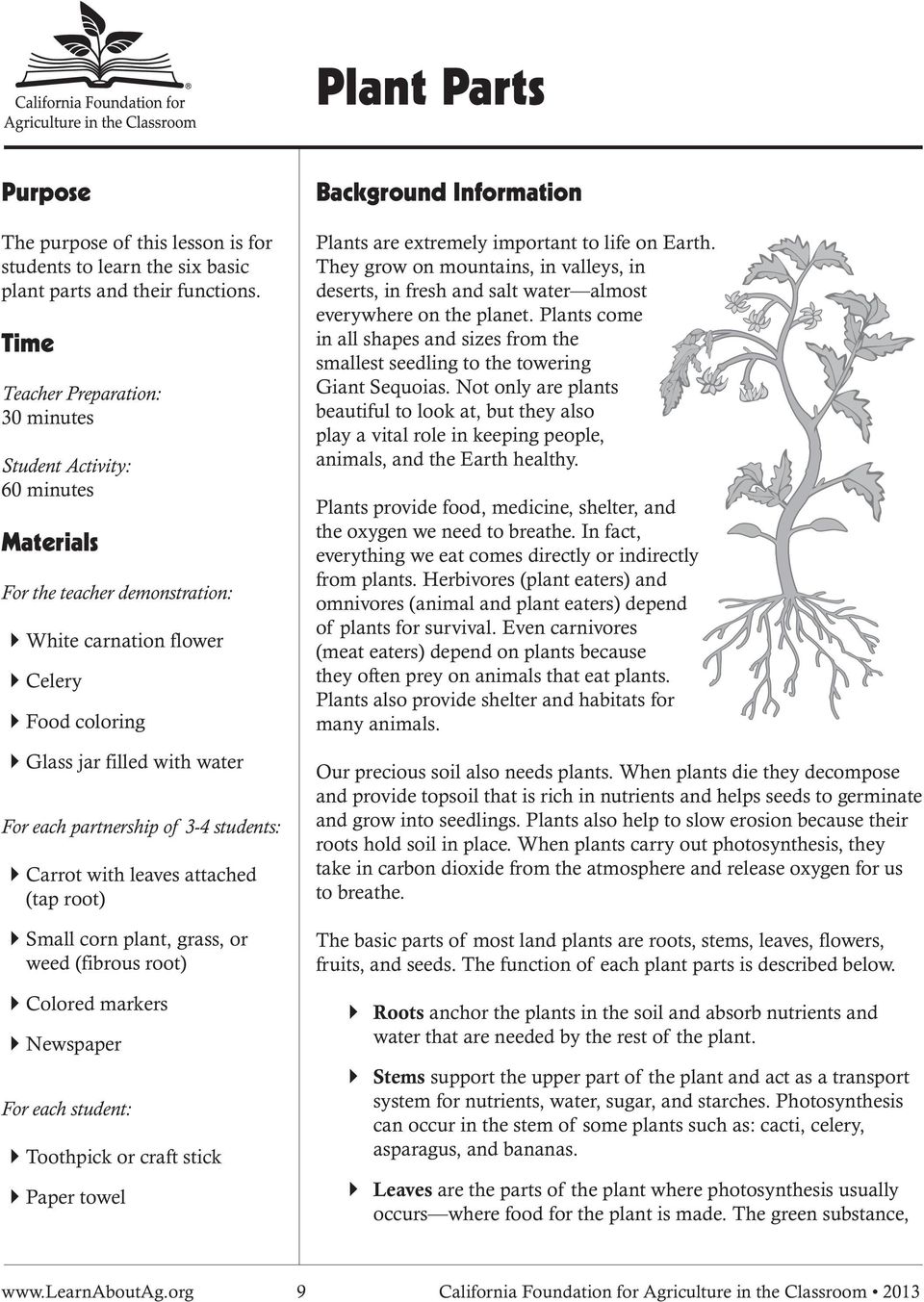
1 Purpose The purpose of this lesson is for students to learn the six basic plant parts and their functions. Time Teacher Preparation: 30 minutes Student Activity: 60 minutes Materials For the teacher demonstration: White carnation flower Celery Food coloring Glass jar filled with water For each partnership of 3-4 students: Carrot with leaves attached (tap root) Small corn plant, grass, or weed (fibrous root) Colored markers Newspaper For each student: Toothpick or craft stick Paper towel Background Information Plants are extremely important to life on Earth. They grow on mountains, in valleys, in deserts, in fresh and salt water almost everywhere on the planet. Plants come in all shapes and sizes from the smallest seedling to the towering Giant Sequoias. Not only are plants beautiful to look at, but they also play a vital role in keeping people, animals, and the Earth healthy. Plants provide food, medicine, shelter, and the oxygen we need to breathe. In fact, everything we eat comes directly or indirectly from plants. Herbivores (plant eaters) and omnivores (animal and plant eaters) depend of plants for survival. Even carnivores (meat eaters) depend on plants because they often prey on animals that eat plants. Plants also provide shelter and habitats for many animals. Our precious soil also needs plants. When plants die they decompose and provide topsoil that is rich in nutrients and helps seeds to germinate and grow into seedlings. Plants also help to slow erosion because their roots hold soil in place. When plants carry out photosynthesis, they take in carbon dioxide from the atmosphere and release oxygen for us to breathe. The basic parts of most land plants are roots, stems, leaves, flowers, fruits, and seeds. The function of each plant parts is described below. Roots anchor the plants in the soil and absorb nutrients and water that are needed by the rest of the plant. Stems support the upper part of the plant and act as a transport system for nutrients, water, sugar, and starches. Photosynthesis can occur in the stem of some plants such as: cacti, celery, asparagus, and bananas. Leaves are the parts of the plant where photosynthesis usually occurs where food for the plant is made. The green substance,
2 Ruler Hand lens Plant Parts handout (pages chlorophyll, captures light energy and uses it to convert water and carbon dioxide into plant food and oxygen. Flowers are the reproductive part of plants. They often have showy petals and fragrances to attract pollinators such as birds, bees, and other insects. Most flowers have four main parts: petals, stamen (anther and filament), pistil (stigma, style and ovary), and sepals. After flowers are pollinated and fertilized, they produce seeds in the ovary of the flower. Fruits are the fleshy substances that usually surround seeds. They protect the seeds and attract animals to eat them. This helps in seed dispersal. Seeds contain plant material that can develop into another plant. This plant material is called an embryo. Seeds are covered with a protective seed coat and have one or two cotyledons. Cotyledons are the food for the baby plant until it can make its own food from light and are often the first embryonic leaves of the plant. Procedure 1. Tell students that scientists consider plants to have six basic parts. Each of these parts has an important function, or role, in the life of the plant. Have students brainstorm different plant parts and record them on the board. Responses should include roots, stems, leaves, flowers, fruits, and seeds. Explain that in this activity, the class will be taking a closer look at plant parts. 2. Use the celery or white carnation to demonstrate how water, food, and minerals are transported up a stem into the leaves. Cut the bottom of a celery stalk or carnation stem and place in water with food coloring added. Throughout the day, students will see how the food coloring travels up the stem into the leaves and flowers. 3. Divide students into groups of three or four. Distribute newspaper, carrot plant, grass plant, hand lens, ruler, and Plant Parts worksheet. Instruct students to lay their plants on the opened newspaper and gently spread the roots out. Have students use a colored marker and draw a circle around the roots of each plant. Invite students to use the hand lens to make close observations of the roots. Ask students to compare each root system by measuring and drawing the roots on their worksheet. 10
3 Content Standards Grade 2 Science Life Sciences 2a, 2f Investigation & Next Generation Science Interdependent Relationships in Ecosystems 2-LS2.A Defining and Delimiting Engineering Problems 2-ETS1.A Developing Possible Solutions 2-ETS1.B English Language Arts Speaking and Listening 1a, 1c Grade 3 Science Life Sciences 3a Next Generation Science Growth and Development of Organisms 3-LS1.B English Language Arts Writing 8 Speaking and Listening 1b, 1c 5. Brainstorm with the students why the roots look different and discuss the possibility of the different functions of the fibrous root verses the taproot. Write their responses on the board. 6. Ask students if they can see the stems on the carrot and corn plants. Explain that the carrot plant has a very small stem located above the root and below the leaves. The corn plant has a very long stem called a stalk. Monocotyledons like the corn or grass plant have a fibrous root, whereas dicotyledons like the carrot plant begin with a taproot and often grow secondary roots. Have students compare the leaves of the carrot and grass plant. What do these leaves have in common? (They are green.) What is different about these leaves? (The shape, size and the veins on the leaves are different.) Explain to the students that all monocots have parallel veins. (The veins on the leaf do not intersect.) Plants that are dicots may have many different leaf shapes and vein patterns. Monocots have parallel leaf veins, fibrous roots and flower petals in multiples of three. Examples are grasses, orchids, lilies, and palms. Dicots have net-like veins, taproots, and flower parts in multiples of 4 or 5. Examples are columbine, roses, peas, sunflowers, oaks, and maples. 8. Ask the students why the plant leaves are green. For simplicity, share with students that plants produce their own food through a process called photosynthesis. Plants take in carbon dioxide, water, and sunlight and make glucose (sugar) and oxygen. Plant leaves contain chlorophyll pigment which is responsible for capturing the sun s energy to carry out photosynthesis. Pigments are chemicals that absorb visible light. Chlorophyll absorbs red and blue light and reflects green light. This is why we see leaves as green. 9. Have students discuss their observations with the class. At this point, students should be able to discuss basic plant parts and their particular functions, like transport of food and water, growth, and reproduction. Extensions Wash and cut enough celery so that each student will be able to taste two stalks of cut celery. Wash and cut celery into five-inch sections. Place half of the celery in a saltwater solution (6 tbsp. salt dissolved into 2 cups water) and the other half into a sugar water solution (6 tbsp. sugar into 2 cups of water). Leave celery overnight in the different water solutions. Take the celery out 11
4 Grade 4 Science Life Sciences 2a, 3c Investigation & Experimentation 6f Next Generation Science Structure and Function English Language Arts Writing 8 Speaking and Listening 1b, 1c of the refrigerator at least one hour before the students taste test. Give students one of each kind of stalk. Ask them if they can taste a difference between the two different stalks of celery. Explain to students that the water moves up the stem in celery through a vascular system called the xylem. Go on a field trip around the school campus. Have students collect leaves as they walk around the campus. Ask students to sort the leaves by shape when they return to the classroom. Ask students if they can tell which leaves come from a monocot plant and which leaves come from a dicot plant (monocot plants have parallel leaves). ELL Adaptations This lesson incorporates hands-on activities. Kinesthetic learning events provide an excellent learning environment for English language learners. Add new vocabulary to a word wall and match photos to the new words. 12
5 Name: Plants typically have six basic parts: roots, stems, leaves, flowers, fruits, and seeds. Draw a diagram of your plants and label each part. Carrot Plant Grass Plant 13

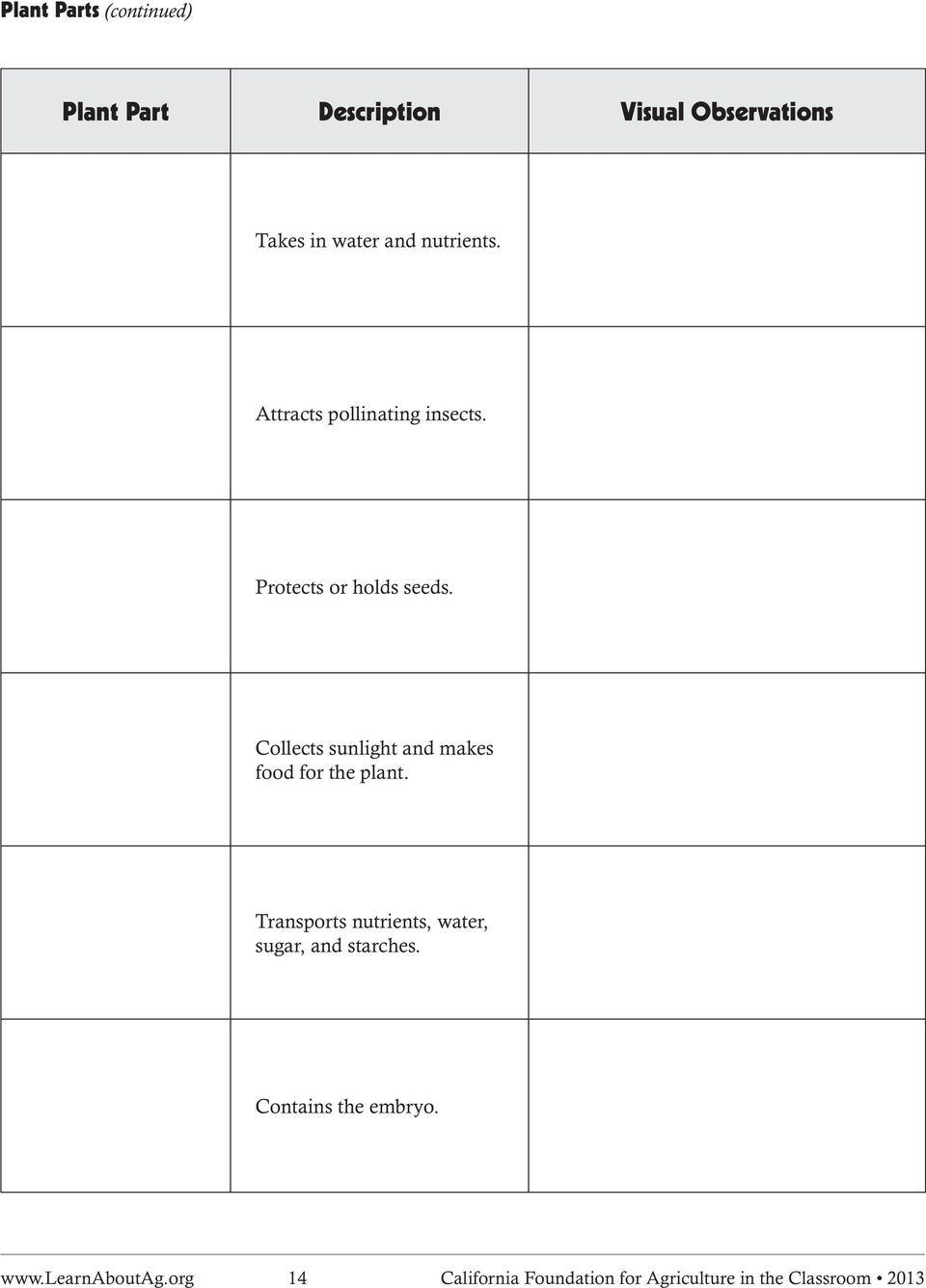
6 (continued) Plant Part Description Visual Observations Takes in water and nutrients. Attracts pollinating insects. Protects or holds seeds. Collects sunlight and makes food for the plant. Transports nutrients, water, sugar, and starches. Contains the embryo.
4th GRADE MINIMUM CONTENTS-NATURAL SCIENCE UNIT 11: PLANTS
 PLANT BITS 4th GRADE MINIMUM CONTENTS-NATURAL SCIENCE UNIT 11: PLANTS There are four main parts to a plant. They are the root, stem, leaf and flower. Each part has an important task to do in the life of
Roots and Stems and Leaves, Oh My!
 Roots and Stems and Leaves, Oh My! Objectives 1. The student will be able to identify parts of a plant. 2. The student will understand the function of plant parts. Grade Level 1-3 4-6 TEKS: 1.6B, 2.6C;
What Do Plants Need to Grow?
 Lesson #401 What Do Plants Need to Grow? Grades 2-4 Editors Mandi Bottoms Shaney Emerson Robin Satnick 2300 River Plaza Drive Sacramento, CA 95833 (916) 561-5625 (800) 700-2482 www.learnaboutag.org California
3MNN Behavioral Outcomes Eat fruits and veggies, etc. SNAP-Education Nutrition Messages Eat fruits and veggies as healthy snacks, MyPyramid servings
 DRAFT 1 Lesson Plan Title: Phenomenal Plant Parts Grade Level: 3 Content Area: Science Setting: School garden, or classroom Instructional Time: 60 to 90 minutes Grade Level Expectations: Life Science L.OL.E3:
Section 24 1 Reproduction With Cones and Flowers (pages 609 616)
 Chapter 24 Reproduction of Seed Plants Section 24 1 Reproduction With Cones and Flowers (pages 609 616) This section describes the reproductive structures of gymnosperms and angiosperms. It also explains
2. Fill in the blank. The of a cell is like a leader, directing and telling the different parts of the cell what to do.
 1. Plant and animal cells have some similarities as well as differences. What is one thing that plant and animal cells have in common? A. cell wall B. chlorophyll C. nucleus D. chloroplasts 2. Fill in
Introduction to Ecology
 Introduction to Ecology Ecology is the scientific study of the interactions between living organisms and their environment. Scientists who study ecology are called ecologists. Because our planet has many
Unit 3 Lesson 5: People Need Plants
 Focus Areas: Characteristics of Plants; Science Focus Skills: observing, identifying, drawing conclusions Dedicated to Reducing Pesticides Objectives To identify parts of a plant To recognize the importance
Rain Forests. America's. Web of Life. Rain Forest Ecology. Prince William Network's OVERVIEW OBJECTIVES SUBJECTS
 Rain Forest Ecology National Science Education Standards Standard C: Life Sciences Populations and ecosystems. Standard C: Life Sciences Diversity and adaptation of organisms. Standard F: Science in Personal
Virginia Gardener http://www.hort.vt.edu/envirohort
 The Virginia Gardener http://www.hort.vt.edu/envirohort Name Help Sheets: Things Plants Need There are certain things that every living thing needs in order to live and grow. Just like you, plants need
IGCSE and GCSE Biology. Answers to questions. Section 2. Flowering Plants. Chapters 6-9. Chapter 6 Plant structure and function
 1 IGCSE and GCSE Biology. Answers to questions Section 2. Flowering Plants. Chapters 6-9 Chapter 6 Plant structure and function Page 54 1. a Epidermis. Helps maintain shape, reduces evaporation, resists
10B Plant Systems Guided Practice
 10B Plant Systems Guided Practice Reproduction Station 1 1. Observe Plant A. Locate the following parts of the flower: stamen, stigma, style, ovary. 2. Draw and label the parts of a flower (listed above)
Biology 172L General Biology Lab II Lab 03: Plant Life Cycles and Adaptations II: Gymnosperms and Angiosperms
 Biology 172L General Biology Lab II Lab 03: Plant Life Cycles and Adaptations II: Gymnosperms and Angiosperms Introduction Vascular seed-bearing plants, such as gymnosperms (cone-bearing plants) and angiosperms
Flowers; Seeds enclosed in fruit
 Name Class Date Chapter 22 Plant Diversity Section Review 22-1 Reviewing Key Concepts Short Answer On the lines provided, answer the following questions. 1. Describe the main characteristics of plants.
What's in a Flower. Ages: 8 to 12. Contributor: Susan Jaquette, Cornell Plantations volunteer
 Ages: 8 to 12 What's in a Flower Contributor: Susan Jauette, Cornell Plantations volunteer Main idea: Flowers are composed of several distinct parts, each of which plays an important role in nature. Objective:
Activities and Ideas: Plants, Trees, and Seeds
 Mathematics Measurement: Take students outside to the playground with a list of plant and/or tree items they will find there (tree trunks, branches, leaves, seeds, flowers, etc.) and a measurement tool
Biology 213 Angiosperms. Introduction
 Biology 213 Angiosperms Introduction The flowering plants, the angiosperms, are the most recent plants to evolve and quickly became the dominant plant life on this planet. They are also the most diverse
Plant Growth - Light and Shade
 Science Unit: Lesson 5: Plants Plant Growth - Light and Shade School year: 2004/2005 Developed for: Developed by: Grade level: Duration of lesson: Notes: Queen Alexandra Elementary School, Vancouver School
Flower Model: Teacher Instructions Sepals Anther Stamens (male) Filament Stigma Pistil Style (female) Ovary Petals sepals petals stamens pistil
 Flower Model: Teacher Instructions In order to better understand the reproductive cycle of a flower, take a look at some flowers and note the male and female parts. Most flowers are different; some have
2. What kind of energy is stored in food? A. chemical energy B. heat energy C. kinetic energy D. light energy
 Assessment Bank Matter and Energy in Living Things SC.8.L.18.4 1. What is energy? A. anything that takes up space B. anything that has mass C. the ability to conduct current D. the ability to do work 2.
The Tiny Seed Written and Illustrated by Eric Carle 1987, Aladdin Paperbacks ISBN 0-689-84244-9
 Teacher s Guide to Third and Fourth Grade Reading and Writing Exercises for Written and Illustrated by Eric Carle 1987, Aladdin Paperbacks ISBN 0-689-84244-9 Developed by Jennifer A. Seitz For Florida
Plants, like all living organisms have basic needs: a source of nutrition (food), water,
 WHAT PLANTS NEED IN ORDER TO SURVIVE AND GROW: LIGHT Grades 3 6 I. Introduction Plants, like all living organisms have basic needs: a source of nutrition (food), water, space in which to live, air, and
Plant Parts and Their Function
 Science Unit: Lesson 6: Plants Plant Parts and Their Function School year: 2004/2005 Developed for: Developed by: Grade level: Duration of lesson: Queen Alexandra Elementary School, Vancouver School District
Lesson 1. Objectives: ocus: Subjects:
 Lesson 1 The Web of Life Objectives: 1. Understand the concept of an ecosystem. 2. Understand the interdependence of members of an ecosystem. Subjects: 1. Ecology 2. Language 3. Art MATERIALS: Copies of
This hands-on activity incorporates observing, classifying, predicting, sequencing, formulating models, and drawing conclusions.
 SCIENCE Science and the Environment 4 th Grade FOOD CHAINS Overview: All organisms, or living things, depend on other organisms for nutrients. The movement of nutrients through an environment is visualized
Parts of a Flower and Pollination
 Science Unit: Lesson 3: Soils, Plants, and First Nations Parts of a Flower and Pollination School year: 2007/2008 Developed for: Britannia Elementary School, Vancouver School District Developed by: Catriona
Section 24 1 Reproduction With Cones and Flowers (pages 609 616)
 Chapter 24 Reproduction of Seed Plants Section 24 1 Reproduction With Cones and Flowers (pages 609 616) Key Concepts What are the reproductive structures of gymnosperms and angiosperms? How does pollination
FOOD CHAINS AND FOOD WEBS PHYTOPLANKTON ZOOPLANKTON SILVERSIDE BLUEFISH
 FOOD CHAINS AND FOOD WEBS Food Chains All living organisms (plants and animals) must eat some type of food for survival. Plants make their own food through a process called photosynthesis. Using the energy
Let s Learn About Plants and Animals!
 Grade Two Pre-Visit Activities Let s Learn About Plants and Animals! i. Teacher Introduction ii. Standards Addressed iii. Pre-Visit Activities 1. Identifying Parts of a Plant 2. Plant a Seed 3. Life Cycles
Anatomy and Physiology of Leaves
 I. Leaf Structure and Anatomy Anatomy and Physiology of Leaves A. Structural Features of the Leaf Question: How do plants respire? Plants must take in CO 2 from the atmosphere in order to photosynthesize.
Plant Reproduction. 2. Evolutionarily, floral parts are modified A. stems B. leaves C. roots D. stolons E. suberins
 Plant Reproduction 1. Angiosperms use temporary reproductive structures that are not present in any other group of plants. These structures are called A. cones B. carpels C. receptacles D. flowers E. seeds
FOOD CHAINS, FOOD WEBS AND ECOLOGICAL PYRAMIDS
 FOOD CHAINS, FOOD WEBS AND ECOLOGICAL PYRAMIDS SECTION 1 In an ecosystem, plants capture the sun's energy and use it to convert inorganic compounds into energy-rich organic compounds. This process of using
www.irishseedsavers.ie Natural surface water on earth includes lakes, ponds, streams, rivers, estuaries, seas and oceans.
 www.irishseedsavers.ie POND LIFE FACT SHEET Natural surface water on earth includes lakes, ponds, streams, rivers, estuaries, seas and oceans. A pond is a small body of fresh water shallow enough for sunlight
8. Study the cladogram underline the derived characteristics and circle the organisms that developed from them.
 Seed Plants: Gymnosperms and Angiosperms Answer the questions as you go through the power point, there are also paragraphs to read where you will need to hi-lite or underline as you read. 1. What are the
Plants Scavenger Hunt Activity
 Name: Plants Activity Materials: Question worksheet (pages 2-3) 16 Fact Cards (pages 4-8) Tape, Scissors, Classroom Preparation: Print the fact cards on card stock or brightly-colored paper and cut them
Introduction to Plants
 Introduction to Plants Unity and Diversity of Life Q: What are the five main groups of plants, and how have four of these groups adapted to life on land? 22.1 What are of plants? WHAT I KNOW SAMPLE ANSWER:
Plants, like all other living organisms have basic needs: a source of nutrition (food),
 LEARNING FROM LEAVES: A LOOK AT LEAF SIZE Grades 3 6 I. Introduction Plants, like all other living organisms have basic needs: a source of nutrition (food), water, space in which to live, air, and optimal
5.1 Ecosystems, Energy, and Nutrients
 CHAPTER 5 ECOSYSTEMS 5.1 Ecosystems, Energy, and Nutrients Did anyone ever ask you the question: Where do you get your energy? Energy enters our world from the Sun but how does the Sun s energy become
PLANET EARTH: Seasonal Forests
 PLANET EARTH: Seasonal Forests Teacher s Guide Grade Level: 6-8 Running Time: 42 minutes Program Description Investigate temperate forests and find some of the most elusive creatures and welladapted plant
Worksheet: The food chain
 Worksheet: The food chain Foundation Phase Grade 1-3 Learning area: Natural Science Specific Aim 2: Investigating phenomena in natural sciences Activity Sheet Activity 1: What is a food chain? Every time
2 nd Grade Science Unit B: Life Sciences Chapter 3: Plants and Animals in Their Environment Lesson 1: How are plants and animals like their parents?
 2 nd Grade Science Unit B: Life Sciences Chapter 3: Plants and Animals in Their Environment Lesson 1: How are plants and animals like their parents? offspring Offspring are young plants and animals. Offspring
Life Science Study Guide. Environment Everything that surrounds and influences (has an effect on) an organism.
 Life Science Study Guide Environment Everything that surrounds and influences (has an effect on) an organism. Organism Any living thing, including plants and animals. Environmental Factor An environmental
food webs reflect look out! what do you think?
 reflect Imagine for a moment that you stay after school one day to clean up the classroom. While cleaning, you move some plants away from the sunny windows. A week later, you remember to move the plants
Ecosystems and Food Webs
 Ecosystems and Food Webs How do AIS affect our lakes? Background Information All things on the planet both living and nonliving interact. An Ecosystem is defined as the set of elements, living and nonliving,
reflect look out! organisms: living things
 reflect Imagine that a student in your school fell down and is having difficulty breathing. Sirens wail as an ambulance pulls into the school parking lot. The emergency workers rush over to help the student.
5 E Lesson Plan. Title: Modeling Photosynthesis Grade Level and Course: 7 th grade, Life Science 10 th grade, Biology
 5 E Lesson Plan Title: Modeling Photosynthesis Grade Level and Course: 7 th grade, Life Science 10 th grade, Biology Materials: a. aluminum tray b. waxed paper c. 6 green marshmallows d. 12 pink marshmallows
Plant Structure, Growth, and Development. Chapter 35
 Plant Structure, Growth, and Development Chapter 35 PLANTS developmental plasticity = ability of plant to alter form to respond to environment Biological heirarchy Cell basic unit of life Tissue group
Dissect a Flower. Huntington Library, Art Collections, and Botanical Gardens
 Huntington Library, Art Collections, and Botanical Gardens Dissect a Flower Overview Students dissect an Alstroemeria or similar flower to familiarize themselves with the basic parts of a flower. They
6. Which of the following is not a basic need off all animals a. food b. *friends c. water d. protection from predators. NAME SOL 4.
 NAME SOL 4.5 REVIEW - Revised Habitats, Niches and Adaptations POPULATION A group of the same species living in the same place at the same time. COMMUNITY-- All of the populations that live in the same
PHOTOSYNTHESIS. reflect. what do you think?
 reflect Suppose you place a plant on a sunny windowsill and water it regularly. At the same time you place a similar plant in a dark closet and keep it watered, too. The only difference between the two
Unit: Healthy Habits Grade: 1
 Unit: Healthy Habits 5.3b Good health habits include hand washing, personal cleanliness; avoiding harmful substances; eating a balanced diet; engaging in regular eercise ways to stay healthy Wash hands
Prairie Food Chains & Webs Producers, Consumers, & Decomposers
 Kansas Prairies Prairie Food Chains & Webs Producers, s, & Decomposers Life Science, Math, Reading, Science Materials Student Worksheet A: Vocabulary Student Worksheet B: Food Chain Overview To explore
Food Chains (and webs) Flow of energy through an ecosystem Grade 5 Austin Carter, Dale Rucker, Allison Hursey
 Food Chains (and webs) Flow of energy through an ecosystem Grade 5 Austin Carter, Dale Rucker, Allison Hursey References: Columbus Public Schools Curriculum Guide- Grade 5 GK-12 Biological Science Lesson
Prairie Food Chains & Webs Producers, Consumers & Decomposers
 Kansas Prairies s, s & Decomposers Science, Life Science, Reading, Math Materials Vocabulary worksheet Food Chain worksheet Overview To explore the organisms found on a prairie and identify the various
DIFFUSION (HYPERTONIC, HYPOTONIC, & ISOTONIC SOLUTIONS) THE GUMMY BEAR LAB PASS
 DIFFUSION (HYPERTONIC, HYPOTONIC, & ISOTONIC SOLUTIONS) THE GUMMY BEAR LAB PASS Have you ever wondered why your fingers have wrinkles after soaking in a bath tub? Your students have probably wondered the
Science Grade 7 Unit 01 & 02: Science Safety & Flow of Energy 2012 2013
 Science Grade 7 Unit 01 & 02: Science Safety & Flow of Energy 2012 2013 1 2 Using the diagram above of a grassland ecosystem, complete the following: Draw and label an energy pyramid to represent this
TEACHING Parts of Plants
 TEACHING GUIDE TEACHING Parts of Plants Kindergarten Reading Level ISBN-13: 978-0-8225-1798-6 2 TEACHING PARTS OF PLANTS Standards Language Arts Reading Language Arts Writing Language Arts Listening and
Photosynthesis Lesson Plan 1. Introduction to Photosynthesis (grade 4) Objectives:
 Photosynthesis Lesson Plan 1 Introduction to Photosynthesis (grade 4) Identify types of living things that use photosynthesis. Understand the concept of photosynthesis. Observe how flowers are grown. First
Section 3: Trophic Structures
 Marine Conservation Science and Policy Service learning Program Trophic Structure refers to the way in which organisms utilize food resources and hence where energy transfer occurs within an ecosystem.
The Seven Characteristics of Life
 Jennifer Hepner Maureen Frandsen Fall 2003 Grade Level: 3 rd grade The Seven Characteristics of Life Abstract: The purpose of this lesson is for students to learn the characteristics of living organisms.
WHAT ARE THE DIFFERENCES BETWEEN VASCULAR AND NON- VASCULAR PLANTS?
 WHAT ARE THE DIFFERENCES BETWEEN VASCULAR AND NON- VASCULAR PLANTS? Let s take a closer look. What makes them different on the outside and inside? Learning Intentions To understand how vascular plant cells
Science of Life Explorations
 Science of Life Explorations Student Scientists: What do Plants Need for Growth? Introduction Do you ever wonder why grass grows, flowers bloom, and fruits blossom and ripen? It is because they are getting
a. a population. c. an ecosystem. b. a community. d. a species.
 Name: practice test Score: 0 / 35 (0%) [12 subjective questions not graded] The Biosphere Practice Test Multiple Choice Identify the letter of the choice that best completes the statement or answers the
CELERY LAB - Structure and Function of a Plant
 CELERY LAB - Structure and Function of a Plant READ ALL INSTRUCTIONS BEFORE BEGINNING! YOU MAY WORK WITH A PARTNER ON THIS ACTIVITY, BUT YOU MUST COMPLETE YOUR OWN LAB SHEET! Plants are incredible organisms!
Angiosperm Reproduction: Flowers, Fruits, and Seeds Overview Objectives bold Part I Floral Anatomy . calyx sepals corolla, petals, stamens, filament
 Angiosperm Reproduction: Flowers, Fruits, and Seeds Overview In this lab you will observe assorted flowers, fruits, and seeds to better understand the unique adaptations of and the life cycle of angiosperms.
Leaf Structure and Transpiration
 10 LESSON Leaf Structure and Transpiration INTRODUCTION Have you wondered what happens to all that water that disappears from the reservoir of your growing system? Although some might have evaporated from
Effect of Light Colors on Bean Plant Growth
 Effect of Light Colors on Bean Plant Growth Teacher Edition Grade: Grades 6-8 Delaware State Science Standard: Science Standard 6 - Life Processes Strand: Structure/Function Relationship Strand: Matter
Food Chains and Food Webs
 Program Support Notes by: Spiro Liacos B.Ed. Produced by: VEA Pty Ltd Commissioning Editor: Sandra Frerichs B.Ed, M.Ed. Executive Producers: Edwina Baden-Powell B.A, CVP. Sandra Frerichs B.Ed, M.Ed. You
NOTE TO TEACHER: It is appropriate to introduce the mitochondria (where energy is made) as a major structure common to all cells.
 5.2.1 Recall the cell as the smallest unit of life and identify its major structures (including cell membrane, cytoplasm, nucleus, and vacuole). Taxonomy level: 1.1 and 1.2-A Remember Factual Knowledge
Matter and Energy in Ecosystems
 Matter and Energy in Ecosystems The interactions that take place among biotic and abiotic factors lead to transfers of energy and matter. Every species has a particular role, or niche, in an ecosystem.
Grassland Food Webs: Teacher Notes
 Grassland Food Webs: Teacher Notes Alan Henderson ecosystem Objectives After completing this activity students will be able to: Create a food web and identify producers and consumers. Assign organisms
(K-5) A scientist keeps a notebook to record his/her process (experiences, observations, and thinking).
 FIFTH GRADE Science Curriculum Framework 1 Investigations will be integrated with social studies and mathematics where appropriate. 2 Investigations will be integrated with language arts non-fiction reading,
CELERY LAB - Structure and Function of a Plant
 CELERY LAB - Structure and Function of a Plant READ ALL INSTRUCTIONS BEFORE BEGINNING! YOU MAY WORK WITH A PARTNER ON THIS ACTIVITY, BUT YOU MUST COMPLETE YOUR OWN LAB SHEET! Look at the back of this paper
Virginia Gardener http://www.hort.vt.edu/envirohort
 The Virginia Gardener http://www.hort.vt.edu/envirohort Name Help Sheets: Seeds What Is a Seed? A seed is a very young plant that is in the dormant, or resting stage. It is very much alive. There are three
nucleus cytoplasm membrane wall A cell is the smallest unit that makes up living and nonliving things.
 1 In nature there are living things and nonliving things. Living things depend on three basic life processes: nutrition, sensitivity and reproduction. Living things are made up of cells. 1. Match the two
1.2 The Biosphere and Energy
 1.2 The Biosphere and Energy All activities require a source of energy a fuel. For example, to sustain a campfire, you need to keep it supplied with wood. To reach a destination by car, you need to have
Food Webs and Food Chains Grade Five
 Ohio Standards Connection: Life Sciences Benchmark B Analyze plant and animal structures and functions needed for survival and describe the flow of energy through a system that all organisms use to survive.
Germination is the process in which a
 The Germination Of a Bean Photographs and article By Lily C. Gerhardt [email protected] Germination is the process in which a seed, spore, or fungi sprouts, or begins growth. Seed germination can occur after
The animals at higher levels are more competitive, so fewer animals survive. B.
 Energy Flow in Ecosystems 1. The diagram below shows an energy pyramid. Which of the following best explains why the number of organisms at each level decreases while moving up the energy pyramid? The
The Balance of Nature Food Chains 101 (Suitable for grades 4-12)
 Environmental Education using Live Birds of Prey Thank you to Xcel Energy Foundation and their Environmental Partnership Program The Balance of Nature Food Chains 101 (Suitable for grades 4-12) OBJECTIVE
Producers, Consumers, and Food Webs
 reflect Think about the last meal you ate. Where did the food come from? Maybe it came from the grocery store or a restaurant. Maybe it even came from your backyard. Now think of a lion living on the plains
Mighty Oaks From Little Acorns
 Science Process: Observe and Measure / Life Science / Math: Measurement (Length), data Analysis (graphing) / reading: Sequencing / Listening / Writing / Visual Arts expression Background Buds are on the
Plants, like all other living organisms have basic needs: a source of nutrition (food),
 WHAT PLANTS NEED IN ORDER TO SURVIVE AND GROW: WATER Grades 3 6 I. Introduction Plants, like all other living organisms have basic needs: a source of nutrition (food), water, space in which to live, air,
Lesson Plan Two - Ecosystems
 Lesson Plan Two - Ecosystems Summary Students discuss what living things need to survive. They identify the abiotic and biotic components of an ecosystem and describe the roles and interactions of producers
Make your whiteboard come alive with science!
 LER 6038 Grades 4+ Ages 9+ Make your whiteboard come alive with science! Explore a plant cell through handson investigation! A. Cell Wall A rigid and strong wall that protects and maintains the shape of
Energy Flow in the Pond Teacher s Guide February 2011
 Energy Flow in the Pond Teacher s Guide February 2011 Grades: 6, 7 & 8 Time: 3 hours With the pond as a model, students explore how energy that originates from the sun keeps changing shape and form as
Food Web Crasher. An introduction to food chains and food webs
 Food Web Crasher An introduction to food chains and food webs Activity Students create a physical food web and watch what happens when an aquatic nuisance species is introduced into the ecosystem. Grade
DID YOU KNOW that the plants most important to
 Flower Anatomy DID YOU KNOW that the plants most important to agriculture all produce flowers? Every major food crop is a flowering plant. We do not think about the flowers of wheat, rice, corn, and soybeans.
Energy Flow Through an Ecosystem. Food Chains, Food Webs, and Ecological Pyramids
 Energy Flow Through an Ecosystem Food Chains, Food Webs, and Ecological Pyramids What is Ecology? ECOLOGY is a branch of biology that studies ecosystems. Ecological Terminology Environment Ecology Biotic
Kindergarten Science Unit B: Life Science Chapter 4: Plant and Animal Parts Lesson 1: What do plant parts do?
 Insert Photo or Graphic for Unit or Lesson Theme Kindergarten Science Unit B: Life Science Chapter 4: Plant and Animal Parts Lesson 1: What do plant parts do? Insert Photo/Graphic parts Insert Photo/Graphic
8.2 Cells and Energy. What is photosynthesis? Photosynthesis takes place in the chloroplasts. CHAPTER 8. Solar cells and chloroplasts
 CHAPTER 8 CELL PROCESSES 8.2 Cells and Energy To stay alive, you need a constant supply of energy. You need energy to move, think, grow, and even sleep. Where does that energy come from? It all starts
Vascular Plants Bryophytes. Seedless Plants
 plant reproduction The Plants Vascular Plants Bryophytes Liverworts, Hornworts, Mosses lack roots and specialized tissues grow in moist, shady areas All have sieve cells and tracheids Seedless Plants Ferns
Photosynthesis. Chemical Energy (e.g. glucose) - They are the ultimate source of chemical energy for all living organisms: directly or indirectly.
 Photosynthesis Light Energy transduction Chemical Energy (e.g. glucose) - Only photosynthetic organisms can do this (e.g. plants) - They are the ultimate source of chemical energy for all living organisms:
Weaving the Web. Overview Students construct food webs to learn how food chains are interconnected. Suggested Grade Level 2 5
 Weaving the Overview Students construct food webs to learn how food chains are interconnected. Suggested Grade Level 2 5 Estimated Time 30 40 minutes Objectives Students will be able to: 1. construct a
The Seed Challenge How Many Seeds Can You Get from a Single Seed?
 The Seed Challenge How Many Seeds Can You Get from a Single Seed? Grade Level: K-4 Catalog Number: 15-8973 Time to pollinate the flowers Time to harvest the seeds True leaves grow Day 3 Day 7 Day 14 Day
Today you need: your notebook, pen or pencil, textbook,worksheet
 Cellular Energy Objectives Students will review plant/ animal cells and prokaryote/eukaryote Students will draw and label a diagram of the cell energy cycles. Students will compare and contrast autotrophs
Plant Classification, Structure, Growth and Hormones
 Biology SAT II Review Sheet Plants Plant Classification, Structure, Growth and Hormones Multicellular autotrophs (organisms that use the energy of inorganic materials to produce organic materials) Utilize
First Grade Unit A: PHYSICAL SCIENCE Chapter 1: Observing Solids, Liquids and Gases Lessons 1 to 5
 First Grade Unit A: PHYSICAL SCIENCE Chapter 1: Observing Solids, Liquids and Gases Lessons 1 to 5 Physical Science Overview Materials (matter) come in different forms. Water can be rain falling (liquid)