
21st International Conference of The Coastal Society
|
|
|
- Dwayne Wilcox
- 10 years ago
- Views:
Transcription
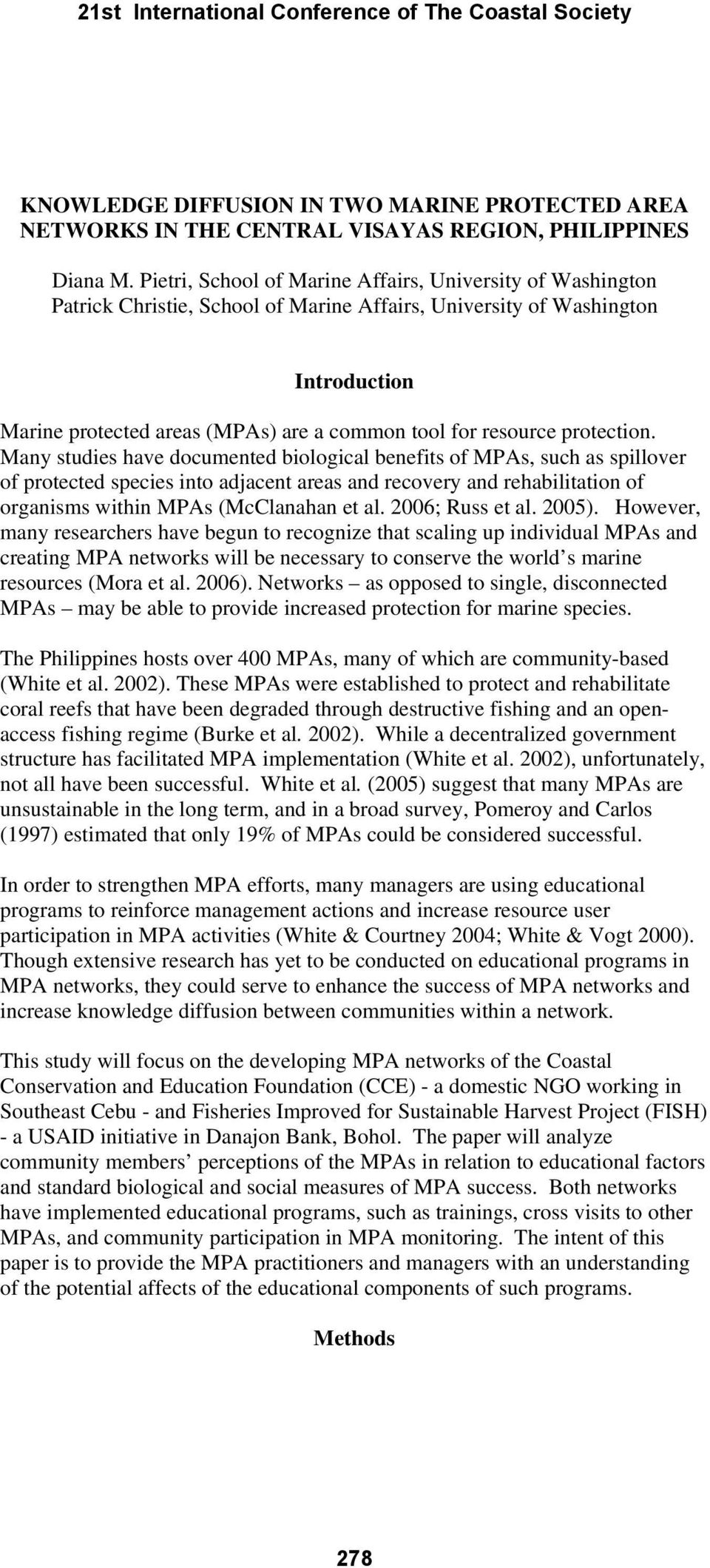
1 21st International Conference of The Coastal Society KNOWLEDGE DIFFUSION IN TWO MARINE PROTECTED AREA NETWORKS IN THE CENTRAL VISAYAS REGION, PHILIPPINES Diana M. Pietri, School of Marine Affairs, University of Washington Patrick Christie, School of Marine Affairs, University of Washington Introduction Marine protected areas (MPAs) are a common tool for resource protection. Many studies have documented biological benefits of MPAs, such as spillover of protected species into adjacent areas and recovery and rehabilitation of organisms within MPAs (McClanahan et al. 2006; Russ et al. 2005). However, many researchers have begun to recognize that scaling up individual MPAs and creating MPA networks will be necessary to conserve the world s marine resources (Mora et al. 2006). Networks as opposed to single, disconnected MPAs may be able to provide increased protection for marine species. The Philippines hosts over 400 MPAs, many of which are community-based (White et al. 2002). These MPAs were established to protect and rehabilitate coral reefs that have been degraded through destructive fishing and an openaccess fishing regime (Burke et al. 2002). While a decentralized government structure has facilitated MPA implementation (White et al. 2002), unfortunately, not all have been successful. White et al. (2005) suggest that many MPAs are unsustainable in the long term, and in a broad survey, Pomeroy and Carlos (1997) estimated that only 19% of MPAs could be considered successful. In order to strengthen MPA efforts, many managers are using educational programs to reinforce management actions and increase resource user participation in MPA activities (White & Courtney 2004; White & Vogt 2000). Though extensive research has yet to be conducted on educational programs in MPA networks, they could serve to enhance the success of MPA networks and increase knowledge diffusion between communities within a network. This study will focus on the developing MPA networks of the Coastal Conservation and Education Foundation (CCE) - a domestic NGO working in Southeast Cebu - and Fisheries Improved for Sustainable Harvest Project (FISH) - a USAID initiative in Danajon Bank, Bohol. The paper will analyze community members perceptions of the MPAs in relation to educational factors and standard biological and social measures of MPA success. Both networks have implemented educational programs, such as trainings, cross visits to other MPAs, and community participation in MPA monitoring. The intent of this paper is to provide the MPA practitioners and managers with an understanding of the potential affects of the educational components of such programs. Methods 278
2 The study administered surveys over a period of two months in 36 communities in Southeast Cebu and Danajon Bank, with 18 communities in each network. In each community, 13 respondents were interviewed: 10 resource users, 2 members of the MPA management committee, and 1 local government official. Surveys focused on issues such as perceived MPA impacts, education and capacity development, communication, and MPA management. Variables relating to information dissemination, education, and MPA success were isolated, and results were averaged for each user group. Correlation analysis was performed to observe relationships between the variables. Stepwise regression analysis was used to determine the strength of the variables as predictors of MPA success, which was measured as fish abundance, coral condition, and compliance with MPA rules. Additionally, semi-structured key informant interviews were conducted with six staff members of CCE and FISH on the educational aspects of the MPA networks and general management and communication issues within the MPAs. The responses were used to complement the statistical survey analysis. Results Table 1 shows the correlation between the 15 education and information dissemination variables and the 3 MPA success variables. Table 1. Correlations between education and information dissemination factors and MPA success. C = Management committee member; R = Resource user Fish abundance Coral Condition MPA Compliance Formal monitoring prog. C Monitoring info shared C Influence of mon. info C Involvement in MPA training C Info learned from outside training participants C Participation in cross visits C * Sharing of cross vis. info C Mang. committee collaboration C Influence of MPA stories C Benefits of MPA network C Community MPA consultation C Clear MPA leader R.421**.438**.186 MPA success stories heard R MPA failure stories heard R MPA education program in place R *.299 * = P < 0.05; ** = P <

3 Correlations between pairs of variables elucidate important relationships, but the combined effect of these variables represents a more realistic situation (Pollnac et al. 2001). This analysis employed a stepwise regression model (Table 2), which combined both forward and backward regression methods, to evaluate the strength of the variables as predictors of the 3 MPA success factors. Table 2. Predictors of MPA success (with standardized independent variables) Dependent variable: Fish abundance Independent variables: Involvement in MPA training (Coefficient =.497); Clear MPA leader (Coefficient = -.317) R =.524 R 2 =.275 Adj. R 2 =.231 F = p < 0.05 N = 36 Dependent variable: Coral condition Independent variables: Clear MPA leader (Coefficient =.388); MPA education program in place (Coefficient =.345) R =.556 R 2 =.309 Adj. R 2 =.267 F = p < 0.05 N = 36 Dependent variable: MPA compliance Independent variable: Participation in cross visits (Coefficient =.375) R =.375 R 2 =.141 Adj. R 2 =.115 F = p < 0.05 N = 36 Discussion Correlation analysis is a useful preliminary tool for analyzing relationships between variables. As shown in Table 1, presence of a community MPA leader correlates strongly with the biological success variables. Other MPA studies in the Philippines also have stressed the importance of strong leadership - either in the form of a single leader or respected community groups - in the implementation of MPA initiatives (White et al. 2002; Pollnac et al. 2001; White & Vogt 2000). Comments from CCE staff echoed this sentiment; one employee stated that many communities have local champions who serve as advocates in increasing community support for MPAs (CCE Staff 1, ). Participation by management committee members in cross visits and the presence of an education program also correlated strongly with improved MPA compliance. A FISH employee commented on the importance of cross visits as a tool to increase MPA support, asserting that cross visits to other successful MPAs are the best ways to convince community members of the potential benefits of an MPA (Fish Staff 1, ). In evaluating the strength of variables as MPA success indicators for factors meeting the stepwise regression statistical entrance requirements, the R 2 values indicate low to moderate (yet still statistically significant) predictive relationships. For coral condition, just over 30% of the variance in the relationship can be attributed to the combined effect of a clear MPA leader and presence on an educational program. This is a moderate relationship; the R 2 values for fish abundance and MPA compliance predictors were slightly lower. 280

4 Although most of the relationships between variables are relatively weak with few significant correlations, interviews with FISH and CCE staff highlight the importance of MPA education. For instance, a CCE employee stated that community member participation in monitoring programs raises [community] awareness and is the best education (CCE staff ). In FISH, their educational program draws on concepts from education and communication theory. The main goal of their transformational communications framework is to ensure that programs have the ability to transform the mindsets of local resource users and affect behavioral change (Fish Staff ). Similarly, Trewhella et al. (2005) report that community environmental education programs in Tanzania and Mauritius induced behavioral change and created a capacity for informed action among local community members. Studies have stressed the importance of capacity building and community participation in marine resource management (Cheunpagdee & Jentoft 2007; White et al. 2002). Education can serve as the basis for these activities: it is a necessary component of capacity building, and educated resource users are more likely to participate in the management process. Trewhella et al. (2005) found that environmental education programs were able to train community leaders to become local educators for others in the community. This suggests that knowledge diffusion should complement existing educational efforts to help ensure that educational programs influence a broad range of people. Conclusions For the FISH and CCE MPA networks, the hope is that educational programs and knowledge diffusion between communities will increase community support and create more successful MPAs. Although only few educational variables correlated with and were strong predictors of MPA success, further analysis may provide clarification. Interrelationships between education and information dissemination variables could be analyzed to see the affects of these variables on one another. Additionally, other sections of the surveys could be studied in order to discover factors that may affect education and information dissemination factors such as size of the community and the condition of the reefs prior to sanctuary establishment. However, the interviews with FISH and CCE demonstrate both the current and potential benefits and efficacy of education programs. These educational efforts should be continued, and more attempts should be made to study the results of these programs and the ways in which knowledge is diffused between the communities in the MPA networks. Acknowledgements This research was supported through the generous support of the Pew Charitable Trust as part of a Pew Fellowship in Marine Conservation. We would like to 281

5 acknowledge the assistance of Dr. Richard Pollnac, Dr. Enrique Oracion, Agnes Sabonsolin, Roxy Diaz, Malcolm Hipponia, and the informants of this study. References Burke, L., Selig, E., Spalding, M., Reefs at Risk in Southeast Asia. Washington DC: World Resources Institute. 76p. Chuenpagdee, R., Jentoft, S., Step zero for fisheries co-management: what precedes implementation, Marine Policy, 31, McClanahan, T., Maranne, M. J., Cinner, J. E., Kiene, W. E, A comparison of marine protected areas and alternative approaches to coral-reef management, Current Biology, 16: Mora, C., Andrefouet, S., Costell, M. j., Kranenburg, C., Rollo, A., Veron, J., Gastona, K. J., Myers, R. A., Coral reefs and the global network of marine protected areas, Science, 312: Pollnac, R. B., Crawford, B. R., Gorospe, M. L. G, Discovering factors that influence the success of community-based marine protected areas in Visayas, Philippines, Ocean and Coastal Management, 44: Pomeroy, R. S., Carlos, M. B., Community-based coastal resource management in the Philippines: a review and evaluation of programs and projects, , Marine Policy, 21: Russ, G. R., Stockwell, B., Alcala, A. C, Inferring versus measuring rates of recovery in no-take marine reserves, Marine Ecology Progress Series, 292:1-12. Trewhella, W. J., Rodriguez-Clark, K. M., Corp, N., Entwistle, A., Garret, S. R.T., Granek, E., Lengel, K. L., Raboude, M. J., Reason, P. F., & Sewall, B. J., Environmental education as a component of multidisciplinary conservation programs: lessons from conservation initiatives for critically endangered fruit bats in the Western Indian Ocean, Conservation Biology, 19(1): White, A. T., Christie, P., D Agnes, H., Lowry, K., Milne, N., Designing ICM projects for sustainability: lesson from the Philippines and Indonesia, Ocean and Coastal Management, 48: White, A., Courtney, C. A., Salamanca, A., Experience with marine protected area planning and management in the Philippines. Coastal Management, 30(1):1-26. White, A. T. and Vogt, H. P., Philippine coral reefs under threat: lessons learned after 25 years of community-based reef conservation, Marine Pollution Bulletin, 40(6): Diana M. Pietri University of Washington, School of Marine Affairs 3707 Brooklyn Ave NE Seattle, WA (412) [email protected] 282
Creating governable EBM and MPA networks: An analytic framework and empirical results from the Philippines
 Creating governable EBM and MPA networks: An analytic framework and empirical results from the Philippines Patrick Christie Associate Professor SMA and JSIS Pew Fellow in Marine Conservation University
Coastal Resilience through Integrated Coastal Management. Alan T. White Indian Ocean Tsunami Warning System Program
 Coastal Resilience through Integrated Coastal Management Alan T. White Indian Ocean Tsunami Warning System Program The coastal zone:an endangered environment Overexploitation and destruction Unplanned
MPA NETWORKS MODULE 2 2.1 INTRODUCTION TO MPA NETWORKS. Advantages of Networks 2.2 TYPES OF MPA NETWORKS. Social Networks. Ecological Networks
 2.1 INTRODUCTION TO MPA NETWORKS Advantages of Networks 2.2 TYPES OF MPA NETWORKS Social Networks Ecological Networks Management-based Networks Case Study: A Regional Approach to MPA Development in West
Importance of Coral Triangle to Food Security and Livelihoods
 U.S. Support, Challenges and Opportunities Most Diverse Ecological Complexes on Earth Cooperation the Key: Regional Conservation s Amazon Congo Basin Importance of Food Security and Livelihoods 363 million
Patrick J. Christie CURRICULUM VITAE
 CURRICULUM VITAE Professor University of Washington School of Marine Affairs and Henry M. Jackson School of International Studies 3707 Brooklyn Ave. NE, Seattle, WA 98105-6715 e-mail: [email protected] telephone:
Coral Triangle Initiative (CTI) on Coral Reefs, Fisheries and Food Securities
 2008/MRCWG/022 Agenda Item: 10 Coral Triangle Initiative (CTI) on Coral Reefs, Fisheries and Food Securities Purpose: Information Submitted by: Indonesia 21 st Marine Resource Conservation Working Group
Alan White The Nature Conservancy
 The Coral Triangle Region, The Coral Triangle Initiative, and the Development of the Six Country Marine Protected Area System Alan White The Nature Conservancy The Coral Triangle Initiative Coral Triangle
Progress Towards the Development of the Six Country Coral Triangle Marine Protected Area System (CTMPAS)
 Progress Towards the Development of the Six Country Coral Triangle Marine Protected Area System (CTMPAS) Alan White Senior Scientist, The Nature Conservancy and Lynette Laroya MPA Technical Working Group,
no-entry only research and monitoring activities no-take zones incorporates other non-extractive uses
 Seaflower Biosphere Reserve Country: COLUMBIA Project Overview Columbia declared the archipelago of San Andres, Old Providence, and Santa Catalina a biosphere reserve called the Seaflower Biosphere Reserve.
Coral Reef Rehabilitation and Management Program- Coral Triangle Initiative (COREMAP-CTI) (P127813)
 Public Disclosure Copy EAST ASIA AND PACIFIC Indonesia Environment Global Practice IBRD/IDA Investment Project Financing FY 2014 Seq No: 2 ARCHIVED on 03-Feb-2015 ISR17440 Implementing Agencies: Ministry
Views from Living Marine Resources Management and the Coral Triangle Project
 Views from Living Marine Resources Management and the Coral Triangle Project Annadel Salvio Cabanban Ecosystem Approach to Fisheries Management Specialist, Coral Triangle Initiative Southeast Asia Project:
BACKGROUND PAPER 4 BEST PRACTICES IN GOVERNANCE AND ENFORCEMENT OF MARINE PROTECTED AREAS: AN OVERVIEW 1. Patrick Christie and Alan T.
 183 BACKGROUND PAPER 4 BEST PRACTICES IN GOVERNANCE AND ENFORCEMENT OF MARINE PROTECTED AREAS: AN OVERVIEW 1 by Patrick Christie and Alan T. White 2 Summary Marine protected areas (MPAs) have emerged as
CORAL REEFS AND HURRICANES IN 2005. edited by Clive Wilkinson and David Souter
 STATUS STATUS OF CARIBBEAN OF CORAL REEFS OFAFTER THE WORLD: BLEACHING 2008 AND HURRICANES IN 2005 edited by Clive edited Wilkinson by Clive Wilkinson and David Souter Expert opinion i of 372 coral reef
COMMUNITY-BASED MARINE SANCTUARIES FOCUS GROUP DISCUSSIONS. in the PHILIPPINES:A REPORT on. Brian Crawford, Miriam Balgos and Cesario R.
 COMMUNITY-BASED MARINE SANCTUARIES in the PHILIPPINES:A REPORT on FOCUS GROUP DISCUSSIONS Brian Crawford, Miriam Balgos and Cesario R. Pagdilao June 2000 Coastal Resources Center University of Rhode Island
Applying Knowledge Management to Scale up Partnership Investments
 Applying Knowledge Management to Scale up Partnership Investments for Sustainable Development of Large Marine Ecosystems of East Asia and Their Coasts Project Title Applying Knowledge Management to Scale
A Functional Classification System for Marine Protected Areas in the United States
 A Functional Classification System for Marine Protected Areas in the United States The U.S. Classification System: An Objective Approach for Understanding the Purpose and Effects of MPAs as an Ecosystem
Indonesia at the Center of the Coral Triangle: Mere Posturing or an Opportunity for Action?
 Indonesia at the Center of the Coral Triangle: Mere Posturing or an Opportunity for Action? Presented at the Indonesia Study Group Meeting Indonesia Project, ANU 18 July 2012 Lydia Napitupulu Faculty of
CALIFORNIA OCEAN PROTECTION COUNCIL. Staff Recommendation March 11, 2011 STATEWIDE SCIENCE INTEGRATION AND MARINE PROTECTED AREA MONITORING PROGRAMS
 CALIFORNIA OCEAN PROTECTION COUNCIL Staff Recommendation March 11, 2011 STATEWIDE SCIENCE INTEGRATION AND MARINE PROTECTED AREA MONITORING PROGRAMS File No.: 08-123-02 File No.: 06-090-02 Project Managers:
Kermadec. Ocean Sanctuary
 Kermadec Ocean Sanctuary Kermadec Ocean Sanctuary, New Zealand Coral Sea Marine Reserve, Australia Pacific Remote Islands National Marine Monument, United States Proposed Pitcairn Marine Reserve, United
Scientific & information management considerations (Best Practice #4 and 12# and Broader consideration #3)
 Public education, communication & awareness (Broader consideration #6) Best Practice examples Virtually the entire community (including the local communities and the wider public) are very familiar with
Marine Protected Areas POLICY
 Marine Protected Areas POLICY Canada March 1999 Published by: Canada Marine Ecosystems Conservation Branch Oceans Directorate Ottawa, ON K1A 0E6 DFO / 5870 Minister of Public Works and Government Service
Fisheries in Crisis and Conflict in the Coral Triangle
 Fisheries in Crisis and Conflict in the Coral Triangle Reflections on the Live Reef Fish Trade and The Coral Triangle Initiative Charles Barber Environmental Advisor Office of Environment and Science Policy
THE CORAL TRIANGLE INITIATIVE (CTI) ON CORAL REEFS, FISHERIES AND FOOD SECURITY. 1st Sulu Sulawesi Sea (SSS) Conference 18-19 November 2015
 THE CORAL TRIANGLE INITIATIVE (CTI) ON CORAL REEFS, FISHERIES AND FOOD SECURITY 1st Sulu Sulawesi Sea (SSS) Conference 18-19 November 2015 1 Introduction to CTI PRESENTATION OUTLINE State of the CTI Marine
The Coral Triangle Ini.a.ve on Coral Reefs, Fisheries, and Food Security (CTI- CFF): An Ini.a.ve For A Sustainable Future
 The Coral Triangle Ini.a.ve on Coral Reefs, Fisheries, and Food Security (CTI- CFF): An Ini.a.ve For A Sustainable Future Presented at the Southeast Asian Regional Center for Graduate Study and Research
Demonstration Site Concept
 The Sustainable Financing and Management of Eastern Caribbean Marine Ecosystems Project Demonstration Site Concept Woburn Clarkes Court Bay Marine Protected Area Improving Water Quality in Marine Protected
MPA Baseline Program. Annual Progress Report
 MPA Baseline Program Annual Progress Report Principal Investigators please use this form to submit your MPA Baseline Program project annual report, including an update on activities completed over the
Smithsonian Marine Science Network
 Smithsonian Office of the Under Secretary for Science Smithsonian Marine Science Network Michael A. Lang January 2010 1 2 Smithsonian Marine Science Network The Smithsonian Marine Science Network is a
The Marine Protected Area Inventory
 The Marine Protected Area Inventory New pictures Jordan Gass, Hugo Selbie and Charlie Wahle ESRI Ocean Forum November 6, 2013 Outline What is the MPA Inventory? Purpose Data How it s used Future directions
An Effective Marine Protected Area. Pacific Island Marine Protected Area Community (PIMPAC)
 An Effective Marine Protected Area Pacific Island Marine Protected Area Community (PIMPAC) Background: The PIMPAC initiative is designed to enhance Marine Protected Area (MPA) management effectiveness
Mangrove loss faster than land-based forests
 ESL ENGLISH LESSON (60-120 mins) 10 th August 2010 Mangrove loss faster than land-based forests Mangrove forests are disappearing faster than land-based forests according to a new United Nations report
How To Help Oceans
 The World Bank & the Ocean A Healthy & Productive Ocean to Help Reduce Poverty Why oceans matter to the World Bank NUTRITION Seafood provides 16% of the world s animal protein 1 billion people in developing
GREAT BARRIER REEF. Climate Change Action Plan
 GREAT BARRIER REEF Climate Change Action Plan 2007 2011 Climate change is now recognised as the greatest long-term threat to the Great Barrier Reef. The Great Barrier Reef is internationally renowned as
Appendix A. The Marine Life Protection Act (MLPA)
 Appendix A. The Marine Life Protection Act (MLPA) THE PEOPLE OF THE STATE OF CALIFORNIA DO ENACT AS FOLLOWS: SECTION 1. Chapter 10.5 (commencing with Section 2850) is added to Division 3 of the Fish and
CONSERVATION AREAS ACT
 CONSERVATION AREAS ACT CAP. 30.15 Conservation Areas Act CAP. 30.15 Arrangement of Sections CONSERVATION AREAS ACT Arrangement of Sections Section 1 Short title... 5 2 Interpretation... 5 3 Declaration
Establishing large-scale trans-boundaries MPA networks: the OSPAR example in North-East Atlantic
 Establishing large-scale trans-boundaries MPA networks: the OSPAR example in North-East Atlantic Introduction A pledge to establish a representative network of marine and coastal protected areas by 2012
Presentation Outline
 Indonesian MPA s: : An overview, with case study on Bunaken National Park Co-Management Meity Mongdong Natural Resources Management Program, North Sulawesi Presentation Outline Overview of Indonesian MPA
TOOLBOX: HOW TO CREATE A MPA
 TOOLBOX: HOW TO CREATE A MPA 40 rue des Renaudes, 75017, Paris, France. Tel : 00 33 (0)1 44 34 06 06. www.cousteaudivers.org Cousteau Divers is a non-profit organisation with exclusively scientific goals
REGIONAL PLAN OF ACTION OF SEA TURTLE FORAGING HABITATS IN SOUTH EAST ASIAN WATERS
 The Seventeenth Meeting of Fisheries Consultative Group of the ASEAN-SEAFDEC Strategic Partnership (FCG/ASSP) Sunee Grand Hotel & Convention Center, Ubon Ratchathani, Thailand 4-5 December 2014 WP06.5a
Mu Koh Chang Coral Reef Demonstration Site: Lessons Learned and Challenges
 Mu Koh Chang Coral Reef Demonstration Site: Lessons Learned and Challenges Thamasak Yeemin, Sittiporn Pengsakun, Chaipichit Saenghaisuk, Wanlaya Klinthong, Makamas Sutthacheep Marine Biodiversity Research
Fisheries Conflicts Communication Framework: A tool for developing plans and strategies for managing fisheries conflicts (FishCom)
 Fisheries s Communication Framework: A tool for developing plans and strategies for managing fisheries conflicts (FishCom) N. Salayo, C. Garforth, J. Khondker, A. Natarajan, M. Sithirith, U. Kanagaratnam,
Dr. Suseno Sukoyono Executive Chair
 The CTI-CFF countries: Development partners: We are for the wold, what the world can offer The Coral Triangle Initiative on Coral Reefs, Fisheries and Food Security: A Platform for Delivering on the Rio+20
Ecosystem perspective on ORs & OCTs
 Workshop on the Application of an Ecosystem Approach for development of Sustainable Aquaculture in Europe s Outermost Regions and Overseas Countries and Territories Session 3: Stakeholders presentations
U.S. Army Corps. of Engineers. A Learning Organization
 U.S. Army Corps A Learning Organization The Corps is committed to the protection of coral reefs and the effective mitigation of any impacts. The Corps believes that there is a need to improve the understanding
SECTOR ASSESSMENT (SUMMARY): AGRICULTURE AND NATURAL RESOURCES 1
 Country Operations Business Plan: Philippines, 2013 2015 SECTOR ASSESSMENT (SUMMARY): AGRICULTURE AND NATURAL RESOURCES 1 A. Sector Performance, Problems, and Opportunities 1. Sector importance and growth
EFFECTIVE COMPLIANCE AND ENFORCEMENT
 EFFECTIVE COMPLIANCE AND ENFORCEMENT A Training Manual to Support Development of Effective Compliance and Enforcement Programs for the Pacific Islands Managed and Protected Area Community (PIMPAC) 1 Introduction...
Mainstreaming CRM in Local Governance: CRMP Experience
 Mainstreaming CRM in Local Governance: CRMP Experience CRMP is a technical assistance project of the Department of Environment and Natural Resources, funded by the United States Agency for International
Marine biological diversity beyond areas of national jurisdiction. Legal and policy framework
 Marine biological diversity beyond areas of national jurisdiction Legal and policy framework 1. The United Nations Convention on the Law of the Sea (UNCLOS) provides the legal framework within which all
Creating and Managing. in the Philippines
 Creating and Managing Marine Protected Areas in the Philippines White Aliño Meneses Fisheries Improved for Sustainable Harvest Project Implemented by the Government of the Philippines Supported by the
Indonesian Government Blue Carbon Priorities. Tonny Wagey
 Indonesian Government Blue Carbon Priorities 1) 2) Tonny Wagey 1) Blue Carbon Centre - MoMAF 2) Arafura and Timor Seas Ecosystem Action (ATSEA) Why is Blue Carbon Important for Indonesia? Total Area: 3.11
The CLME Project: Governance for Caribbean Living Marine Resources
 The CLME Project: Governance for Caribbean Living Marine Resources Lucia Fanning, Robin Mahon, Patrick McConney, Bertha Simmons Centre for Resource Management and Environmental Studies UWI, Cave Hill Campus,
Marine Protected Areas: An Overview Kate Smukler New England Regional Coordinator
 Marine Protected Areas: An Overview Kate Smukler New England Regional Coordinator www.mpa.gov MPAs: Many types, many purposes Conservation and sustainable use Important natural and cultural resources
Contents & Topics. UNITAR Yamao 2009. Lessons learned through Development of Participatory and Decentralized Management
 Greater Role of Local Government and People s Participation on Coastal Resource Management for Attaining Food Security Lessons learned through Development of Participatory and Decentralized Management
Lesson Overview. Biodiversity. Lesson Overview. 6.3 Biodiversity
 Lesson Overview 6.3 6.3 Objectives Define biodiversity and explain its value. Identify current threats to biodiversity. Describe how biodiversity can be preserved. THINK ABOUT IT From multicolored coral
Marine Stewardship Council
 Marine Stewardship Council MSC Fishery Standard Principles and Criteria for Sustainable Fishing Version 1.1 1 st May 2010 Committees responsible for this Standard This standard is intended to be used on
SUBSIDIARY LEGISLATION WILDLIFE & PROTECTED AREAS. Marine Protected Areas Order 2012. S. R. & O. No: 1 of 2012
 SUBSIDIARY LEGISLATION WILDLIFE & PROTECTED AREAS Marine Protected Areas Order 2012 S. R. & O. No: 1 of 2012 Made: 23 February 2012 Published: 29 February 2012 Coming into force: on publication IN EXERCISE
METHODS FOR ECOLOGICAL MONITORING OF CORAL REEFS
 METHODS FOR ECOLOGICAL MONITORING OF CORAL REEFS JOS HILL AND CLIVE WILKINSON VERSION 1 A RESOURCE FOR MANAGERS This compendium of methods contains those known to be in common use for coral reef monitoring
Asian Conservation Company and Ten Knots Group: Private business in El Nido-Taytay Managed Resource Protected Area, Philippines
 V th World Parks Congress: Sustainable Finance Stream September 2003 Durban, South Africa Institutions Session Institutional Arrangements for Financing Protected Areas Panel C Private investments to support
ILMMA learned many lessons including:
 Easygrants ID: 38787 National Fish and Wildlife Foundation NFWF Project ID: 0302.13.038787 Coral Reef Conservation Fund 2013 - Submit Final Programmatic Report (New Metrics) Grantee Organization: Indonesia
MINISTERIAL MEETING OF THE BLUE WEEK 2015
 5 JUNE 2015 MINISTERIAL MEETING OF THE BLUE WEEK 2015 We, Ministers responsible for Ocean/ Fisheries/ Maritime Affairs, having met in Lisbon on June the 5 th, 2015, at the invitation of the Minister of
CHALLENGES AND OPPORTUNITIES FOR THE MAKAH TRIBE AND OLYMPIC COAST NATIONAL MARINE SANCTUARY
 CHALLENGES AND OPPORTUNITIES FOR THE MAKAH TRIBE AND OLYMPIC COAST NATIONAL MARINE SANCTUARY Vincent Cooke, Makah Tribe George Galasso, Olympic National Marine Sanctuary The Makah Tribe is a self-governing
PROMOTING OCEAN AWARENESS and a STEWARDSHIP ETHIC
 NATIONAL OCEANIC AND ATMOSPHERIC ADMINISTRATION NOAA s National Ocean Service R O U N D T A B L E S PROMOTING OCEAN AWARENESS and a STEWARDSHIP ETHIC ducation is an essential part of ocean stewardship.
In many places around the world, local government
 FROM ROADBLOCK TO CHAMPION PHE Advocacy and Local Government Executives POPULATION REFERENCE BUREAU September 2006 by Enrique Hernandez, PATH Foundation Philippines, Inc. South China Sea Palawan Manila
Colorado Natural Heritage Program
 CNHP s mission is to preserve the natural diversity of life by contributing the essential scientific foundation that leads to lasting conservation of Colorado's biological wealth. Colorado Natural Heritage
FRAMEWORK FOR THE NATIONAL SYSTEM OF MARINE PROTECTED AREAS OF THE UNITED STATES OF AMERICA
 ii FRAMEWORK FOR THE NATIONAL SYSTEM OF MARINE PROTECTED AREAS OF THE UNITED STATES OF AMERICA U.S. United States of America USOAP U.S. Ocean Action Plan (USOAP) USGS US Geological Survey WCPA/IUCN World
Behavioral Interventions Based on the Theory of Planned Behavior
 Behavioral Interventions Based on the Theory of Planned Behavior Icek Ajzen Brief Description of the Theory of Planned Behavior According to the theory, human behavior is guided by three kinds of considerations: