
SECTOR ASSESSMENT (SUMMARY): AGRICULTURE AND NATURAL RESOURCES 1
|
|
|
- Derek Thornton
- 9 years ago
- Views:
Transcription
1 Country Operations Business Plan: Philippines, SECTOR ASSESSMENT (SUMMARY): AGRICULTURE AND NATURAL RESOURCES 1 A. Sector Performance, Problems, and Opportunities 1. Sector importance and growth potential. Although the share of agriculture, natural resources, and environment in total gross domestic product at constant 1985 prices declined from about 20% in to slightly over 18% in , the sector continues to play an important role in the Philippine economy. The sector is important for inclusive growth, with agriculture being the key driver of the economy in the rural areas where most Filipinos live (but where poverty incidence remains high). 2 Agriculture remains a major source of employment, with about 36% of the total employed population working in the sector. Total agricultural exports reached about $3.9 billion (8% of the total Philippine exports) in 2008, driven largely by vegetables and fruits ($1.10 billion), fixed vegetable oils and fats ($1.04 billion), and fish and fish preparations ($0.64 billion). The crop subsector is dominated by low-value crops such as rice, maize, and coconut despite its potential for diversification to high-value products. 3 The annual value-added growth rate from livestock and poultry declined from 5.2% in to about 1.5% in , primarily due to the continuing decline in cattle production. As a consequence, the country continues to import substantial volumes of meat products. With its extensive coastline and coastal and oceanic waters, the Philippines ranks 12th among fish-producing countries. The contribution of fisheries in gross value-added in agriculture at constant 1985 prices averaged 21.8% in The fishery subsector is a net earner of foreign exchange. Forestry contributed only 0.5% of the total gross value-added of the sector in , while annual exports of forestry products represent only 0.1% of total Philippine exports. 2. Rice importation. The production of palay (unmilled rice) increased on average by about 3.9% from 2000 to 2008, but the Philippines continues to import large volumes of rice every year. The inability to meet the demand from increasing rice consumption is attributed to relatively low yield, low cropping intensity, high post-harvest losses, and damage due to floods and typhoons. The average rice yield from all farms has increased from about 2 metric tons per hectare (ha) in the 1980s to about 3.8 metric tons/ha in 2008, but remains lower than in neighboring Association of Southeast Asian Nations (ASEAN) countries and well below the maximum potential of about 7 11 metric tons/ha, depending on the type of seed used. The government s rice production incentives and marketing policies are conflicting, costly, and generally ineffective. 3. Natural resources degradation. The country s total land area of 30 million ha is made up of 14.2 million ha of certified alienable and disposable lands, 15 million ha of classified forest land, and 0.8 million ha of unclassified forest lands. Forest cover was estimated in 2003 at about 7.2 million ha, or only 41% of the amount of classified forest land. With an average reforestation rate of just 18,000 ha per year, increasing the density of forest cover remains a concern. Less than 5% of the 25,000 square kilometers (km 2 ) of coral reefs remains in good condition. Mangroves decreased from around 4,500 km 2 in 1918 to only about 1,380 km 2 in the 1990s. Lack of alternative livelihoods, inadequate environmental management programs, and lax implementation of environmental laws contribute to the continuing natural resource degradation. 1 This summary sector assessment is based on ADB Agriculture, Natural Resources, and Environment Sector Assessment, Strategy and Roadmap. Manila (9 September). 2 The two poorest groups are fishermen (poverty incidence of about 50%) and farmers (poverty incidence of about 44%). 3 The three crops make up for about 84% of the area planted and harvested. The total area planted and harvested increased from million hectares (ha) in 2004 to million ha in 2008, an increase of a little over 700,000 ha.
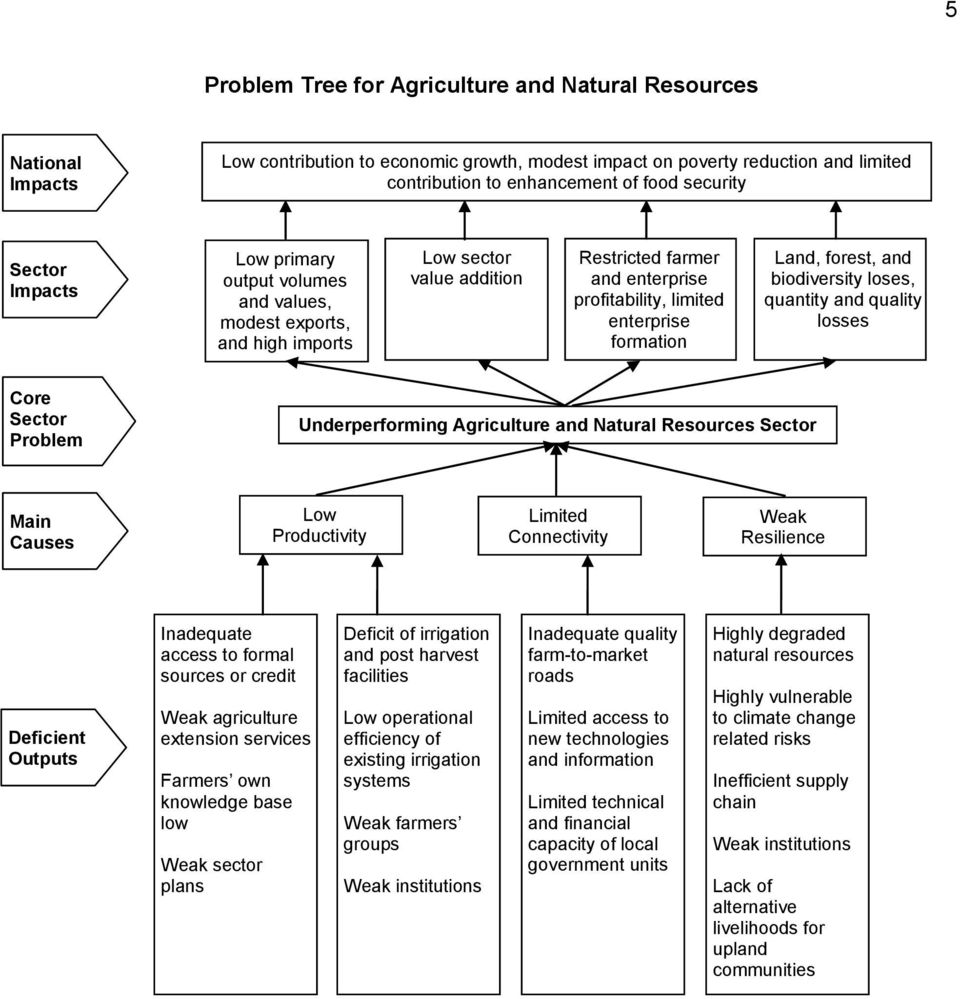
2 2 The continuing degradation of forests also contributes to low yields and the low rate of land utilization, as it results in an inadequate water supply during the dry season and exacerbates damage to crops, fisheries, and rural infrastructure as a result of typhoons and increasing flooding during the wet season Binding constraints to sector development. The main binding constraints to the development of the sector are (i) low productivity; (ii) limited connectivity; and (iii) weak resilience. Sector development is further inhibited by inadequate support services such as access to affordable finance, business development services, supply chain enhancements, and extension services. Compounding all these issues are policy, institutional, and governance concerns. A problem tree for the sector is provided on page 5 of this document. 5. Low productivity. Land productivity in the Philippines is lower than in other countries in the Southeast Asia region. Limited land productivity is a result of many factors such as small farm size; underutilization of land due to water supply issues resulting from watershed degradation; low operational efficiency of existing irrigation systems; a deficit of rural infrastructure, particularly irrigation works, farm-to-market roads, and post-harvest facilities; the high cost of farm inputs; competing uses of agricultural lands; and weak linkages between smallholders or producers and enterprises. 5 The majority of the existing irrigation systems are old and deteriorated due to inappropriate designs, inadequate operation and maintenance budgets, and the lack of funds for timely rehabilitation of facilities damaged by seasonal floods and typhoons. In fisheries, establishment and/or improvement of regional and municipal fish ports and landings, ice plants and cold storage facilities, and marketing support facilities are essential to reducing post-harvest losses. 6. Limited connectivity (roads and access to information). Lack of quality rural transport, particularly farm-to-market roads, discourages farmers from increasing production. The total length of farm-to-market roads in the country is estimated at about 124,000 km, of which more than 90% are gravel and earth roads, the majority of which are barely passable during the wet season. Adoption by farmers, particularly smallholders, of new and value-adding technologies has been slow due to the lack of access to information on production technologies. As a consequence, farmers knowledge of diversified farming technologies is limited, and market linkages remain weak. 7. Weak resilience. The sector lacks resilience in a number of aspects. It is highly vulnerable to climate change-related risks such as flood, typhoons, and droughts. The altitude in a large part of the country the upper river basins (URBs) is significant, and intense high rainfall events tend to occur in much of the Philippines; these can cause severe erosion, given certain soil, vegetation, and slope conditions (such as those present in the URBs). A number of watersheds in the URBs are under continued threat of deterioration due to unregulated extraction of natural resources and the effects of climate change; this poses a danger to the stability and sustainability of downstream investments and economic activities. Longer dry seasons put an additional burden on water supplies for irrigation and seriously impair agricultural productivity. Smallholders are also affected by market price volatility. While the government sets the support price for palay, the actual average farm gate price varies from month to month and is 4 Environment Assessment (accessible from the list of linked documents in Appendix 2 of country partnership strategy, ). 5 Post-harvest losses have been estimated at 10% 15%, and when combined with the loss of quality, represent a potential loss in value of 25% 50%. The average drying loss is documented at about 5% of national production, which is estimated to be worth about P10 billion. Losses in vegetables are even higher. Post-harvest losses in fisheries are also a major concern.
3 3 usually lower than the government support price. The same is true for vegetables. Since vegetables are perishables and the market is fragmented, prices are highly volatile. Small vegetable farmers tend to supply only local traditional wholesale and retail markets, while large farmers are able to realize higher returns by becoming part of more sophisticated supply chains. 8. Inadequate support services. The insufficient provision of key support services affects productivity. The devolution of functions to local government units (LGUs) such as extension, construction and operation and maintenance of farm-to-market roads, small-scale irrigation systems, and other rural infrastructure remains incomplete due to the technical and financial constraints facing LGUs and incompatible priorities between them and national agencies. Opportunities exist for private sector participation in areas such as certified seed production and distribution, laboratory analysis and certification, market information analysis and dissemination, technology dissemination, and supply chain enhancements. Pricing and delivery arrangements for these services often generate disincentives to private sector involvement. Lack of transparency, cumbersome procedures, and inconsistent application of regulatory functions under the authority of the Department of Agriculture inhibit private sector participation and the development of linkages between smallholders or producers and traders or processors. In addition, the majority of private sector enterprises active in the rural sector are small and financially weak and do not have access to comprehensive business development support, which makes promotion of public private partnerships difficult. The majority of smallholder groups (such as irrigators associations) are weak and nonfunctional, and largely limited to negotiation of production and marketing arrangements with suppliers and traders. Two other critical factors have added to the low productivity: (i) lack of access to credit by farm households and small and medium-sized enterprises; and (ii) inadequate diffusion of agricultural research due to funding shortages and inappropriate implementation arrangements. 9. Policy, governance, and capacity issues. Institutional fragmentation weakens planning and service delivery. Unclear and overlapping functions of key government agencies and insufficient planning and results monitoring systems impact on the effectiveness and accountability of service delivery. The three primary departments involved in the sector (the Department of Agriculture, the Department of Agrarian Reform, and the Department of Environment and Natural Resources) include in their organizational structures bureaus, councils, and government-owned and -controlled corporations that handle specific but, to some extent, overlapping activities. In addition, weak governance and changing local-level priorities, due to likely changes in governing officials every 3 years, add to the risks. B. Government s Sector Strategy 10. Vision The vision of the Philippine government is a competitive, sustainable and technology-based agriculture and fisheries sector driven by productive and progressive farmers and fishers, supported by efficient value chains, and well-integrated in the domestic and international markets, contributing to inclusive growth and poverty reduction. 6 Specific sector goals include (i) ensured food security and increased income; (ii) reduction of risks inherent in the sector, including climate change impacts; and (iii) enhanced policy environment and governance. 6 Government of the Philippines Philippine Development Plan, Manila. p. 107.
4 4 C. ADB Sector Experience and Assistance Program 11. From 2003 to 2009, the Asian Development Bank (ADB) approved $112.8 million of project loans and $5.14 million of technical assistance (TA) to the sector, representing about 3% of the loans and grants and 13% of the TA to the country in the period. ADB has three ongoing projects with an aggregate loan amount of $187.8 million aimed at improving the wellbeing of poor and marginalized groups in agrarian reform areas, sustainable management of coastal resources, and increased agriculture productivity and profitability. The 2008 country assistance program evaluation analyzed sector operations implemented during and found that ADB support contributed to local income improvements and poverty reduction through support for agriculture, rural development, and service improvement. 7 However, delivery of assistance to rural areas was hampered by weaknesses in some project designs and delivery, the absence of uniformly strong and well-coordinated national and decentralized institutions supporting agriculture and rural development, and recurrent funding constraints at the LGU level. 12. Sustainable integrated natural resource use and management. In line with the government s goals and consistent s Strategy 2020 and Operational Plan for Sustainable Food Security in Asia and the Pacific, ADB s primary objective is to enhance the state of the different ecosystems and natural resources through an integrated cross-sector approach that incorporates economic considerations, especially the improvement of livelihoods of those dependent on these resources, as well as environmental and social considerations that include biodiversity conservation and climate change. 8 Investment priorities will be (i) urban river basins (URB); (ii) major river basins covering large production areas; (iii) highly degraded URBs; and (iv) coastal and marine resources that are highly at risk and influenced by the priority URBs. 13. Rural infrastructure development. The aim is to improve agricultural productivity through the provision of climate-resilient infrastructure in areas where there is potential for sustainable gains in productivity that will lead to increased rural incomes, particularly for smallholders and the poor in provinces and municipalities with high poverty incidence. Eligible infrastructure will include primarily irrigation, farm-to-market roads, and other associated facilities and complementary peripheral or support infrastructure. With respect to irrigation, the priorities will be rehabilitation and improvement of existing, and construction of new small-scale systems. 14. Capacity development. The objective is to strengthen the organizational and networking capacity of national government agencies and LGUs to formulate policies and to plan and implement activities under the support areas, with deeper participation from both beneficiaries and the private sector. 15. Proposed lending and nonlending programs for In the area of agriculture and natural resources, ADB support will focus on addressing natural resource issues through a multitranche financing facility on natural resources and river basin management. In addition, the Integrated Natural Resource Management Project is now in advanced stages of preparation. To support the lending program, a nonlending program will comprise TA support for multitranche financing facility tranche releases, project preparatory TA, and capacity development TA. A sector results framework is provided on page 6 of this document. 7 ADB Country Assistance Program Evaluation: Philippines Increasing Strategic Focus for Better Results. Manila. 8 ADB Strategy 2020: The Long-Term Strategic Framework of the Asian Development Bank, Manila; ADB Operational Plan for Sustainable Food Security in Asia and the Pacific. Manila.
5 5 Problem Tree for Agriculture and Natural Resources National Impacts Low contribution to economic growth, modest impact on poverty reduction and limited contribution to enhancement of food security Sector Impacts Low primary output volumes and values, modest exports, and high imports Low sector value addition Restricted farmer and enterprise profitability, limited enterprise formation Land, forest, and biodiversity loses, quantity and quality losses Core Sector Problem Underperforming Agriculture and Natural Resources Sector Main Causes Low Productivity Limited Connectivity Weak Resilience Deficient Outputs Inadequate access to formal sources or credit Weak agriculture extension services Farmers own knowledge base low Weak sector plans Deficit of irrigation and post harvest facilities Low operational efficiency of existing irrigation systems Weak farmers groups Weak institutions Inadequate quality farm-to-market roads Limited access to new technologies and information Limited technical and financial capacity of local government units Highly degraded natural resources Highly vulnerable to climate change related risks Inefficient supply chain Weak institutions Lack of alternative livelihoods for upland communities
6 6 Sector Outcomes Contribution Improved food security Sector Results Framework (Agriculture and Natural Resources Sector, ) Country Sector Outcomes Country Sector Outputs ADB Sector Operations Indicators with Sector Outputs Targets and Indicators with Baselines Contribution Incremental Targets Planned and Ongoing ADB Interventions Improved conservation, protection, and rehabilitation of natural resources Increased average crop yields for rice, maize, and banana (rice from 3.6 tons/ha in 2010 to 4.9 tons/ha by 2016, maize from 2.6 tons/ha in 2010 to 3.3 tons/ha in 2016, and banana from 20 tons/ha in 2010 to 25 tons/ha in 2016) Land degradation hot spots placed under sustainable land management practices increased from 53 million ha in 2010 to 63 million ha in 2016 improved and/or constructed Farm-to-market roads improved and/or constructed Mangrove areas and forest cover expanded Improved capacity of national agencies, local government units, and community organizations to manage natural resources and river basins servicing 110,000 ha constructed and/or improved by ,000 km of farm-to-market roads and bridges improved and/or constructed Mangrove areas increased by 15,000 ha by 2016 Forest cover increased by 180,000 hectares by ,000 staff of national agencies and local government units trained in planning and management of natural resources by farmers groups and community organizations in the project areas organized and strengthened Planned key activity areas Sustainable integrated natural resource use and management (forest, coastal) and ecosystem biodiversity ; rural infrastructure development ; institutional capacity development Pipeline projects Integrated Natural Resources and Environmental Management Project (2012 standby: $100 million) Natural Resources and River Basin Management Project (2015 standby: $150 million) PPTA: Natural Resources and River Basin Management Project (2014: $1.0 million) CDTA: Climate Resilience and Green Growth in Critical Watersheds (formerly Capacity Building for Low-Carbon Climate-Resilience Options) (2013: $2.0 million) Capacity Development for Local Government Units in Natural Resources and River Basin Management (2015: $3.0 million) Main Outputs Expected from ADB Interventions Planned key activity areas developed, farm-to-market roads and bridges improved, critical watersheds reforested Pipeline projects 10,000 ha of mangrove areas reforested 90,000 ha of denuded and degraded watersheds reforested and/or rehabilitated 1,000 staff of national agencies and local government units trained in planning, implementation and management of infrastructure and natural resources constructed serving 110,000 ha 15,000 km of farm-to-market roads constructed and/or improved. Ongoing projects Agrarian Reform Communities Project II (2007: $70 million) Integrated Coastal Resources Management Ongoing projects 500 farmers groups and community organizations in the project areas organized and strengthened
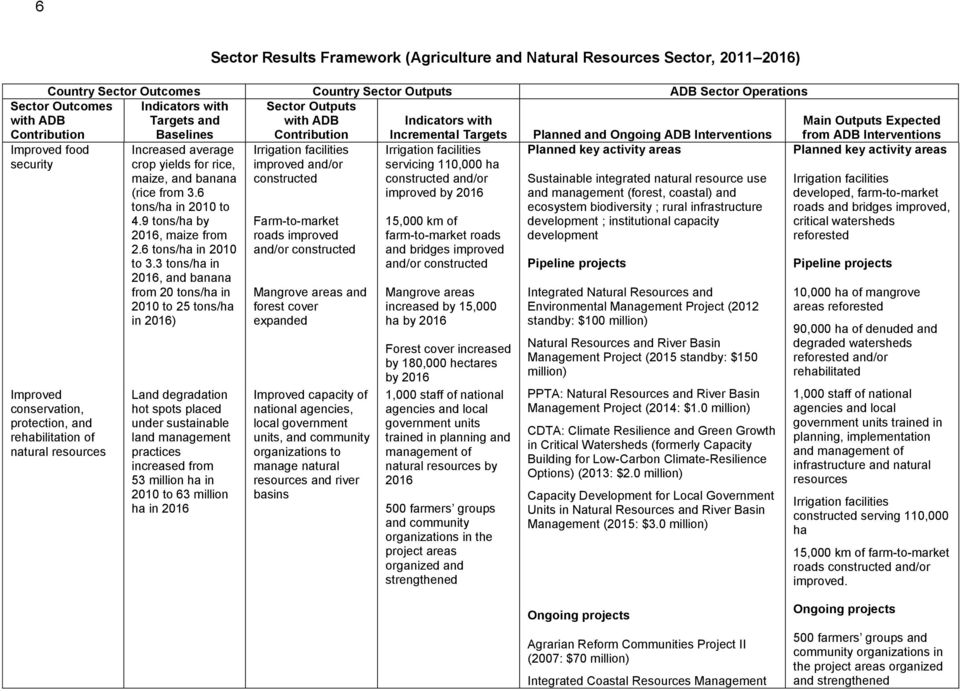
7 7 Country Sector Outcomes Country Sector Outputs ADB Sector Operations Indicators with Sector Outputs Targets and Indicators with Baselines Contribution Incremental Targets Planned and Ongoing ADB Interventions Sector Outcomes Contribution Project (2008: $33.8 million) Decentralized Framework for Sustainable Natural Resources and Rural Infrastructure Management TA (2010: $1.3 million) Main Outputs Expected from ADB Interventions 25% of total beneficiaries are women CDTA = capacity development technical assistance, ha = hectare, km = kilometer, PPTA = project preparatory technical assistance, TA = technical assistance.

SECTOR ASSESSMENT (SUMMARY): CLIMATE CHANGE. 1. Sector Performance, Problems, and Opportunities
 Climate Resilience Sector Project (RRP TON 46351) Sector Road Map SECTOR ASSESSMENT (SUMMARY): CLIMATE CHANGE 1. Sector Performance, Problems, and Opportunities 1. Tonga is being affected by climate change,
Research to improve the use and conservation of agricultural biodiversity for smallholder farmers
 Research to improve the use and conservation of agricultural biodiversity for smallholder farmers Agricultural biodiversity the variability of crops and their wild relatives, trees, animals, arthropods,
Business as Usual is Not an Option: Trade and Markets
 Issues in Brief Business as Usual is Not an Option: Trade and Markets Underinvestment in developing country agriculture including in local and regional market infrastructure, information and services has
Small Farm Modernization & the Quiet Revolution in Asia s Food Supply Chains. Thomas Reardon
 Small Farm Modernization & the Quiet Revolution in Asia s Food Supply Chains Thomas Reardon Part 1 of Talk: Introduction to research issues and method 1. Introduction to Research Issues 1. Research past
DRYLAND SYSTEMS Science for better food security and livelihoods in the dry areas
 DRYLAND SYSTEMS Science for better food security and livelihoods in the dry areas CGIAR Research Program on Dryland Agricultural Production Systems The global research partnership to improve agricultural
Climate Change Impacts in the Asia/Pacific Region
 Climate Change Impacts in the Asia/Pacific Region Global CC threat CC in the A/P region The Stern Review and IPCC 4 th Assessment Report both state that climate change will have adverse impact on people
Joint Knowledge Event on Managing Natural Capital to Ensure Food, Energy, and Water Security Nay Pyi Taw, Myanmar 25 March 2014
 Joint Knowledge Event on Managing Natural Capital to Ensure Food, Energy, and Water Security Nay Pyi Taw, Myanmar 25 March 2014 Opening remarks by Javed H. Mir, Director of Environment, Natural Resources,
JOINT MDB CLIMATE FINANCE TRACKING
 JOINT MDB CLIMATE FINANCE TRACKING Jan-Willem van de Ven Senior Carbon Manager Consultation on Development and Climate Change OECD-CPI event, Warsaw, 19 November 2013 European Bank for Reconstruction and
SECTOR ASSESSMENT (SUMMARY): WATER SUPPLY AND OTHER MUNICIPAL INFRASTRUCTURE AND SERVICES 1. 1. Sector Performance, Problems, and Opportunities
 Country Partnership Strategy: Kyrgyz Republic, 2013 2017 SECTOR ASSESSMENT (SUMMARY): WATER SUPPLY AND OTHER MUNICIPAL INFRASTRUCTURE AND SERVICES 1 Sector Road Map 1. Sector Performance, Problems, and
Creating Green Jobs within the Environment and Culture sector.
 Creating Green Jobs within the Environment and Culture sector. Matilda Skosana Environmental Programmes (ILO Definition): 1. DEFINITION OF GREEN JOB. Jobs are green when they help reduce negative environmental
GLOBAL ALLIANCE FOR CLIMATE-SMART AGRICULTURE (GACSA)
 GLOBAL ALLIANCE FOR CLIMATE-SMART AGRICULTURE (GACSA) FRAMEWORK DOCUMENT Version 01 :: 1 September 2014 I Vision 1. In today s world there is enough food produced for all to be well-fed, but one person
Perspective. The Hanoi Communiqué
 The Hanoi Communiqué The Ministers, representatives of countries, practitioners, scientists, civil society, private sector, and all other participants present at the 2 nd Global Conference on Agriculture,
ARIMNet 2 Call 2014-15
 Coordination of the Agricultural Research In the Mediterranean Area Call i text ARIMNet 2 Call 2014-15 SUBMISSION Pre-proposal by December 1 st, 2014 Full Proposal by May 11 th 2015 on http://arimnet-call.eu/
SECTOR ASSESSMENT (SUMMARY): MICRO, SMALL AND MEDIUM-SIZED ENTERPRISE DEVELOPMENT 1 Sector Road Map 1. Sector Performance, Problems, and Opportunities
 Small Business and Entrepreneurship Development Project (RRP UZB 42007-014) SECTOR ASSESSMENT (SUMMARY): MICRO, SMALL AND MEDIUM-SIZED ENTERPRISE DEVELOPMENT 1 Sector Road Map 1. Sector Performance, Problems,
The Philippines WAVES pilot ecosystem accounts
 The Philippines WAVES pilot ecosystem accounts Developed by: Lars Hein on the basis of the Pilot Ecosystem Accounts developed by the National teams. Date: October 2015 Wealth Accounting and the Valuation
Investing in rural people in Indonesia
 IFAD/Roger Arnold Investing in rural people in Indonesia Rural poverty in Indonesia Indonesia is the largest economy in South-East Asia and has progressed rapidly over the past decade into a dynamic, highly
SUSTAINABLE LIVELIHOODS AND FOOD SECURITY UNDER CHANGING CLIMATE IN DRY AREAS
 Expert Group Meeting on Promoting Best Practices On sustainable Rural Livelihoods in the ESCWA Region Beirut, 24-25 November 2010 SUSTAINABLE LIVELIHOODS AND FOOD SECURITY UNDER CHANGING CLIMATE IN DRY
OUTCOME AND IMPACT LEVEL INDICATORS AGRICULTURE & RURAL DEVELOPMENT WORKING PAPER: OCTOBER 2009
 EC EXTERNAL SERVICES EVALUATION UNIT OUTCOME AND IMPACT LEVEL INDICATORS AGRICULTURE & RURAL DEVELOPMENT WORKING PAPER: OCTOBER 2009 This working paper outlines a set of indicators at the outcome and impact
Agricultural Production and Research in Heilongjiang Province, China. Jiang Enchen. Professor, Department of Agricultural Engineering, Northeast
 1 Agricultural Production and Research in Heilongjiang Province, China Jiang Enchen Professor, Department of Agricultural Engineering, Northeast Agricultural University, Harbin, China. Post code: 150030
The Intended Nationally Determined Contribution of the Kingdom of Saudi Arabia under the UNFCCC
 The Intended Nationally Determined Contribution of the Kingdom of Saudi Arabia under the UNFCCC Riyadh, November 2015 The Kingdom of Saudi Arabia is pleased to submit its Intended Nationally Determined
Rwanda Agricultural Sector and its Impact on Food Security and Economy
 Rwanda Agricultural Sector and its Impact on Food Security and Economy Workshop on Asian Lessons and Agriculture Transformation in Rwanda J.J. Mbonigaba Muhinda Rwanda Agriculture Board [email protected]
Speaker Summary Note
 2020 CONFERENCE MAY 2014 Session: Speaker: Speaker Summary Note Building Resilience by Innovating and Investing in Agricultural Systems Mark Rosegrant Director, Environment and Production Technology Division
Global Environment Facility GEF OPERATIONAL PROGRAM #13 ON CONSERVATION AND SUSTAINABLE USE OF BIOLOGICAL DIVERSITY IMPORTANT TO AGRICULTURE
 Global Environment Facility GEF OPERATIONAL PROGRAM #13 ON CONSERVATION AND SUSTAINABLE USE OF BIOLOGICAL DIVERSITY IMPORTANT TO AGRICULTURE CONTENTS Introduction..1 Convention Guidance... 2 Agricultural
Agriculture and Forestry
 Agriculture and Forestry BUSINESS PLAN 2015 18 ACCOUNTABILITY STATEMENT This business plan was prepared under my direction, taking into consideration the government s policy decisions as of October 15,
Sustainable Land Management in the Global Environment Facility. GEF Role as Financial Mechanism of the UNCCD
 Sustainable Land Management in the Global Environment Facility GEF Role as Financial Mechanism of the UNCCD GEF as Financial Mechanism of the UNCCD Land Degradation Focal Area as main GEF financing window
Track-Risk-Impact-Policy (TRIP) Modeling for the Agricultural Sector
 Track-Risk-Impact-Policy (TRIP) Modeling for the Agricultural Sector Glenn S. Banaguas Environmental and Climate Change Research Institute De La Salle Araneta University Manila Observatory Ateneo De Manila
Madagascar: Makira REDD+
 project focus Madagascar: Makira REDD+ Madagascar is considered to be one of the top five biodiversity hotspots in the world due to more than 75% of all animal and plant species being endemic while less
National Accounting Systems, Agricultural Statistics for Policy Analysis
 National Accounting Systems, Agricultural Statistics for Policy Analysis Workshop on Measuring Sustainable Agriculture, Food Security and Poverty Alleviation for enhancing Accountability in the Post 2015
Country Operations Business Plan. Project Number: 26194 August 2013. Samoa 2014 2016
 Country Operations Business Plan Project Number: 26194 August 2013 Samoa 2014 2016 CURRENCY EQUIVALENTS (as of 11 August 2013) Currency Unit tala (ST) ST$1.00 = $0.4256 $1.00 = ST2.3496 ADB ADF GDP IMF
INTENDED NATIONALLY DETERMINED CONTRIBUTIONS (INDCs)
 UNITED REPUBLIC OF TANZANIA INTENDED NATIONALLY DETERMINED CONTRIBUTIONS (INDCs) 1. Introduction The United Republic of Tanzania, which comprises of Tanzania Mainland and Zanzibar, brings forth her Intended
RURAL AND AGRICULTURE FINANCE Prof. Puneetha Palakurthi School of Community Economic Development Sothern New Hampshire University
 RURAL AND AGRICULTURE FINANCE Prof. Puneetha Palakurthi School of Community Economic Development Sothern New Hampshire University DRIVERS OF RURAL DEVELOPMENT High overall economic growth Effective land
Management of Water and Fisheries Resources to Improve Community Livelihoods in Battambang
 GEF Small Grants Programme Community-Based Adaptation in Small Island Developing States - SIDS CBA Management of Water and Fisheries Resources to Improve Community Livelihoods in Battambang Project No:
JAMAICA. Agricultural Insurance: Scope and Limitations for Weather Risk Management. Diego Arias Economist. 18 June 2009
 JAMAICA Agricultural Insurance: Scope and Limitations for Weather Risk Management Diego Arias Economist 18 June 2009 Financed partly by the AAACP EU Support to the Caribbean Agenda The global market Products
Aquatic Ecosystems Restoration
 Presenter s name Aquatic Ecosystems Restoration Lessons Learned from Asian Development Bank Operations Qingfeng Zhang, Senior Water Resources Engineer Asian Development Bank This Presentation will discuss
FEED THE FUTURE LEARNING AGENDA
 FEED THE FUTURE LEARNING AGENDA OBJECTIVE OF THE LEARNING AGENDA USAID s Bureau of Food Security will develop Feed the Future s (FTF) Learning Agenda, which includes key evaluation questions related to
NREGA for Water Management
 National Rural Employment Guarantee Act NREGA for Water Management 30 th October, 2009 Dr. Rita Sharma Secretary to Government of India Ministry of Rural Development NREGA objective supplement wage-employment
Post Conflict Agricultural Development in Ethiopia: General Overview. Jemal Yousuf, Haramaya University, Ethiopia
 Post Conflict Agricultural Development in Ethiopia: General Overview Jemal Yousuf, Haramaya University, Ethiopia Context of conflict Ethiopia was engulfed with conflict all through the 1980s The conflict
ASEAN Framework for Tackling Climate Change and Food Security
 REGIONAL EXPERT FORUM ON CLIMATE CHANGE, AGRICULTURE AND FOOD SECURITY IN ASEAN 2 nd - 3 rd May 2013 Nai Lert Park Hotel, Bangkok, Thailand ------------------------------------------------------------
Integration of GIS and Multivariate Statistical Analysis in Master Plan Study on Integrated Agricultural Development in Lao PDR
 Integration of GIS and Multivariate Statistical Analysis in Master Plan Study on Integrated Agricultural Development in Lao PDR GIS Makoto ISHIZUKA, Tetsunari GEJO, Shigeya OOTSUKA and Yukiyasu SUMI GIS
DEPARTMENT OF FORESTRY DRAFT REVISED NATIONAL FOREST POLICY OF MALAWI
 DEPARTMENT OF FORESTRY DRAFT REVISED NATIONAL FOREST POLICY OF MALAWI July, 2013 1. Foreword 2. Preface 3. Introduction 4. Policy linkages 5. Broad Policy Direction 6. Policy Priority Areas Provides the
How To Help The World Coffee Sector
 ICC 105 19 Rev. 1 16 October 2012 Original: English E International Coffee Council 109 th Session 24 28 September 2012 London, United Kingdom Strategic action plan for the International Coffee Organization
ASEAN INTEGRATED FOOD SECURITY (AIFS) FRAMEWORK AND STRATEGIC PLAN OF ACTION ON FOOD SECURITY IN THE ASEAN REGION (SPA-FS) 2009-2013
 ASEAN INTEGRATED FOOD SECURITY (AIFS) FRAMEWORK AND STRATEGIC PLAN OF ACTION ON FOOD SECURITY IN THE ASEAN REGION (SPA-FS) 2009-2013 BACKGROUND The sharp increase in international food prices in 2007/2008
Green Development Support Program. For BAPPENAS (Indonesia s Development Planning Ministry) World Bank March 2014
 Green Development Support Program For BAPPENAS (Indonesia s Development Planning Ministry) World Bank March 2014 Background: Bold initiatives of Indonesian Government 26-41% Voluntary emission reduction
APEC Food Security Roadmap Towards 2020 (Version 2014 Draft Track)
 2014/SOM3/PPFS/008 Agenda Item: 9 APEC Food Security Roadmap Towards 2020 (Version 2014 Draft Track) Purpose: Consideration Submitted by: PPFS Chair Policy Partnership on Food Security Meeting Beijing,
Salavanh Province SAL/PR/04: Sustainable Livestock Health Management System for Salavanh Province
 Salavanh Province SAL/PR/04: Sustainable Livestock Health Management System for Salavanh Province Subproject Name Country Province Subproject code Number Subproject type Source of Funding/Amount ADB and
Coastal Resilience through Integrated Coastal Management. Alan T. White Indian Ocean Tsunami Warning System Program
 Coastal Resilience through Integrated Coastal Management Alan T. White Indian Ocean Tsunami Warning System Program The coastal zone:an endangered environment Overexploitation and destruction Unplanned
Seeing the Forest for the Trees Making the Most of Synergies to Achieve SDGs in a Constrained Environment By Mahmoud Mohieldin and Paula Caballero
 Goal 15 Protect, restore and promote sustainable use of terrestrial ecosystems, sustainably manage forests, combat desertification, and halt and reverse land degradation and halt biodiversity loss Seeing
How To Help The Poor
 ICT in ADB Operations April 30th, 2014 Claudia Buentjen Principal Public Management Specialist Regional and Sustainable Development Department Seok Yong Yoon Senior Public Management Specialist (E-Governance)
Inclusive Model for Agribusiness Development. October 2011
 Inclusive Model for Agribusiness Development October 2011 Prevailing Agribusiness Environment Weak economic governance Absence of a coherent agricultural development strategy Lack of investment in agriculture
SECTOR ASSESSMENT (SUMMARY): FINANCE
 Microfinance Expansion Project (RRP PNG 44304) Sector Road Map SECTOR ASSESSMENT (SUMMARY): FINANCE 1. Sector Performance, Problems, and Opportunities 1. During 2000 2006, the growth in population in Papua
THE MASTERCARD FOUNDATION: RURAL AND AGRICULTURAL FINANCE STRATEGY
 THE MASTERCARD FOUNDATION: RURAL AND AGRICULTURAL FINANCE STRATEGY SEPTEMBER 2015 The MasterCard Foundation works with visionary organizations to provide greater access to education, skills training and
Commercialization of Smallholder. Horticultural Farming in Kenya. Poverty, Gender, and Institutional Arrangements. Beatrice Wambui Muriithi
 Commercialization of Smallholder Horticultural Farming in Kenya Poverty, Gender, and Institutional Arrangements Beatrice Wambui Muriithi PL ACADEMIC RESEARCH Table of Contents ListofTables 11 List of Figures
Technology For Adaptation. Forestry Conservation Management. Dr. Javier Aliaga Lordemann
 Technology For Adaptation. Forestry Conservation Management Dr. Javier Aliaga Lordemann Forests has more carbon store than the currently carbon free atmosphere. By contrast, are important sources of emissions
SECTOR ASSESSMENT (SUMMARY): ENERGY 1
 Country Partnership Strategy: Kazakhstan 2012 2016 SECTOR ASSESSMENT (SUMMARY): ENERGY 1 Sector Road Map 1. Sector Performance, Problems, and Opportunities 1. Overview. Oil accounts for about a quarter
THE COMMODITY RISK MANAGEMENT GROUP WORLD BANK
 THE COMMODITY RISK MANAGEMENT GROUP WORLD BANK Agricultural Insurance: Scope and Limitations for Rural Risk Management 5 March 2009 Agenda The global market Products Organisation of agricultural insurance
Special Regional Session: Achieving water security for Asia and the Pacific through sustainable water management
 Special Regional Session: Achieving water security for Asia and the Pacific through sustainable water management Introduction Session report, 15 th January 2015 The session was convened by ESCAP and UNOSD,
SECTOR ASSESSMENT (SUMMARY): TRANSPORT, and INFORMATION AND COMMUNICATION TECHNOLOGY (ROAD TRANSPORT SUBSECTOR) 1
 Country Partnership Strategy: Kazakhstan 2012 2016 SECTOR ASSESSMENT (SUMMARY): TRANSPORT, and INFORMATION AND COMMUNICATION TECHNOLOGY (ROAD TRANSPORT SUBSECTOR) 1 1. Sector Performance, Problems, and
SECTOR ASSESSMENT (SUMMARY): ENERGY 1
 Country Partnership Strategy: Uzbekistan 2012 2016 SECTOR ASSESSMENT (SUMMARY): ENERGY 1 Sector Road Map 1. Sector Performance, Problems, and Opportunities 1. The energy sector underpins Uzbekistan s sustained
WATER HARVESTING AND AQUACULTURE FOR RURAL DEVELOPMENT INTRODUCTION TO AQUACULTURE
 WATER HARVESTING AND AQUACULTURE FOR RURAL DEVELOPMENT INTRODUCTION TO AQUACULTURE 2 INTERNATIONAL CENTER FOR AQUACULTURE AND AQUATIC ENVIRONMENTS AUBURN UNIVERSITY 3 INTRODUCTION More than one-fourth
Matrix of Strategic Plan of Action on Food Security in the ASEAN Region (SPA-FS) 2009-2013
 Appendix 2 Matrix of Strategic Plan of Action on Food Security in the ASEAN Region (SPA-FS) Strategic Thrust 1: Strengthen food security arrangements. 1.1 Strengthen national food security programmes/
Cameroon CFSVA April/May 2011. Cameroon Comprehensive Food Security and Vulnerability Analysis. April/May 2011. Page 1
 Cameroon CFSVA April/May 2011 Cameroon Comprehensive Food Security and Vulnerability Analysis April/May 2011 Page 1 Cameroon CFSVA April/May 2011 Photo: Jane Howard Food insecurity high despite great agricultural
Training Materials for Scaling-up Climate Change Adaptation and Modified Procedures
 Coastal Adaptation and Resilience Planning Component Training Materials for Scaling-up Climate Change Adaptation and Modified Procedures December 2013 ii Training Materials for Scaling-up Climate Change
Food Security in a Volatile World
 Issues in Brief Food Security in a Volatile World Developments in agriculture over the last fifty years have increased yields sufficiently to provide on average more than enough food for every person on
SECTOR ASSESSMENT (SUMMARY): ENERGY 1. 1. Sector Performance, Problems, and Opportunities
 Country Partnership Strategy: Bangladesh, 2011 SECTOR ASSESSMENT (SUMMARY): ENERGY 1 Sector Road Map 1. Sector Performance, Problems, and Opportunities 1. Power generation gap. Bangladesh endures long
How To Help Poor People In Malawi
 IFAD/D.Magada Enabling poor rural people to overcome poverty in Malawi Rural poverty in Malawi Malawi is one of the world s poorest countries, ranking 160th out of 182 countries on the Human Development
Farmer field school networks in Western Kenya
 Chain empowerment Farmer field school networks in Western Kenya Small-scale farmers in Western Kenya produce mainly for their own use, and tend to sell any surplus quite close to home often less than 30
2 CHAPTER 1 Introduction
 Introduction 1 Tropical tree seed handling continuously develops. Scientific research and less advanced, yet persistent practical progress bring about new knowledge and experience on tropical species.
How To Help Disaster Recovery
 Effective and Sustainable Disaster Recovery The Role of the Private Sector Draft Exposure Paper commissioned by the Prudence Foundation and prepared by CSR Asia Richard Welford, Chairman, CSR Asia Purpose
Charcoal Production in Ghana
 Charcoal Production in Ghana Building a Sustainable Model based on Community Management and Payments for Ecosystem Services John J. Mason Executive Director NCRC, Accra In 1900 Ghana had 8.2 million hectares
ACCOUNTING FOR ASIA S NATURAL CAPITAL
 ACCOUNTING FOR S NATURAL CAPITAL DRIVING THE TRANSITION TO A RESOURCE-EFFICIENT GREEN ECONOMY Asia s rapid economic growth during recent decades has been accompanied by serious depletion of the region
Key things to Know About Environment as a. Cross Cutting Issue In Early Recovery
 Key things to Know About Environment as a Cross Cutting Issue In Early Recovery This brief note provides an overview of key things to know about environment for early recovery actors, including Early Recovery
Agricultural Mechanization Strategies in India
 050 India Agricultural Mechanization Strategies in India Dr. Champat Raj Mehta Project Coordinator, All India Co-ordinated Research Project (AICRP) on Farm Implements and Machinery (FIM), Central Institute
Inland Waterway Infrastructure - Mekong River cruise promoting factor. Tokyo September 2010
 Inland Waterway Infrastructure - Mekong River cruise promoting factor Tokyo September 2010 Mekong river system Mekong river system Land and resources: Parts of China, Myanmar and Viet Nam, nearly 1/3 of
How To Treat Malnutrition
 Friedensreich Hundertwasser, 738 Grass for those who cry, 1975, 2013 NAMIDA AG, Glarus/Switzerland Healthy people depend on healthy food systems Sustainable Food Systems for Food Security and Nutrition
Farmer to Farmer East Africa Volunteer Assignment Scope of Work
 Farmer to Farmer East Africa Volunteer Assignment Scope of Work Summary Information Assignment Code UG 20 Country Uganda Country Project Flexible assignment- Coffee Value Chain Host Organization Various
FAO-Adapt. Framework Programme on Climate Change Adaptation
 FAO-Adapt Framework Programme on Climate Change Adaptation Food security and climate change FAO s vision for the future is a world free of hunger and malnutrition where food and agriculture contribute
SECTOR ASSESSMENT (SUMMARY): PUBLIC MANAGEMENT INVESTMENT CLIMATE
 A. INTRODUCTION Increasing Competitiveness for Inclusive Growth Program, Subprogram 2 (RRP PHI P43396) SECTOR ASSESSMENT (SUMMARY): PUBLIC MANAGEMENT INVESTMENT CLIMATE 1. This updated assessment provides
Crop diversification as a climate risk mitigation strategy: Farm-level evidence from Uzbekistan. Martin Petrick, Nodir Djanibekov
 Crop diversification as a climate risk mitigation strategy: Farm-level evidence from Uzbekistan Martin Petrick, Nodir Djanibekov Presentation delivered at IAMO Forum 2015 Halle (Saale), June 17, 2015 Current
SECTOR ASSESSMENT (SUMMARY): ENERGY. 1. Sector Performance, Problems, and Opportunities
 Country Operations Business Plan: Philippines, 2013 2015 SECTOR ASSESSMENT (SUMMARY): ENERGY 1. Sector Performance, Problems, and Opportunities 1. Challenges. Economic growth has been impeded in the Philippines
Speech at the High-Level Conference on World Food Security
 Speech at the High-Level Conference on World Food Security SUN Zhengcai Minister of Agriculture People s Republic of China Rome, June 2008 Distinguished Chairperson, Excellencies, Ladies and Gentlemen,
Agriculture, Food Security and Climate Change A Triple Win?
 Agriculture, Food Security and Climate Change A Triple Win? Dr. Andrew Steer Special Envoy for Climate Change The World Bank Group Your Royal Highnesses, Excellencies, Ladies and Gentlemen, Let me begin
Financing Smallholder Farmers. to Increase Incomes and Transform Lives in Rural Communities
 Financing Smallholder Farmers to Increase Incomes and Transform Lives in Rural Communities EXECUTIVE SUMMARY Africa is home to a quarter of the world s farmland, yet it generates only 10 percent of all
VOLUNTARY GUIDELINES ON THE GOVERNANCE OF TENURE. At a glance
 VOLUNTARY GUIDELINES ON THE GOVERNANCE OF TENURE At a glance VOLUNTARY GUIDELINES ON THE GOVERNANCE OF TENURE At a glance FOOD AND AGRICULTURE ORGANIZATION OF THE UNITED NATIONS Rome, 2012 The designations
Transforming and Improving livelihoods through Market Development and Smallholder Commercialization in Sub- Saharan Africa
 Transforming and Improving livelihoods through Market Development and Smallholder Commercialization in Sub- Saharan Africa Janet Wanjiru Magoiya Mission To build Pro-poor market development initiatives
Robert M. Persaud, MBA, MP Minister of Agriculture
 Robert M. Persaud, MBA, MP Minister of Agriculture Overview Brief Overview of the World Food Situation An integrated perspective: Primary Agriculture, Energy Production, Climate Change, and a world financial
Closing Yield Gaps. Or Why are there yield gaps anyway?
 Closing Yield Gaps Or Why are there yield gaps anyway? Closing Yield Gaps: Large potential to increasing food production Major cereals: attainable yield achieved (%) 0% 10% 20% 30% 40% 50% 60% 70% 80%
SCALING UP AGRICULTURAL FINANCE
 SCALING UP AGRICULTURAL FINANCE Can Small Scale farmers be financed on commercial basis by a Financial Institution? The Case of KCB BANK RWANDA LTD Presentation profile 1. Rwanda s Agricultural scene 2.
AG R I C U LT U R E GREEN ECONOMY
 THIS IS THE STORY OF AG R I C U LT U R E GREEN ECONOMY We need to make the global economy green. provides significant opportunities for growth, investment and jobs to help make this happen. $ Everyone
Tracking Tool for SFM/REDD- Plus Projects. Guidance Note v0.2
 Tracking Tool for SFM/REDD- Plus Projects Guidance Note v0.2 Introduction The SFM/REDD- plus tracking tool (TT) aims to measure progress in achieving the impacts and outcomes established at the portfolio
SECTOR ASSESSMENT (SUMMARY): PUBLIC RESOURCE MANAGEMENT. 1. Public Resource Management Sector Issues and Opportunities
 Country Partnership Strategy: SRI, 2012 2016 SECTOR ASSESSMENT (SUMMARY): PUBLIC RESOURCE MANAGEMENT 1. Public Resource Management Sector Issues and Opportunities 1. The problems in Sri Lanka are multifaceted
How To Finance A Value Chain
 Using the Value Chain in Financing Agriculture Rural and Agricultural Finance Conference Marrakech, Morocco Calvin Miller FAO Agribusiness and Finance Senior Officer Rome, Italy Presentation Applying Agri
PRACTICAL STRATEGIES FOR IMMEDIATE PROGRESS ON CLIMATE CHANGE BUILDING BLOCKS FOR A GLOBAL AGREEMENT
 PRACTICAL STRATEGIES FOR IMMEDIATE PROGRESS ON CLIMATE CHANGE BUILDING BLOCKS FOR A GLOBAL AGREEMENT Forging an effective response to climate change is one of the international community s highest priorities.
PUBLIC POLICY IN FOOD AND AGRICULTURE - Food Security and Government Intervention - Samarendu Mohanty, E. Wesley F. Peterson
 FOOD SECURITY AND GOVERNMENT INTERVENTION Samarendu Mohanty Assistant Professor, Department of Agricultural and Applied Economics, Texas Tech University, Lubbock, Texas, USA E. Department of Agricultural
China s experiences in domestic agricultural support. Tian Weiming China Agricultural University
 China s experiences in domestic agricultural support Tian Weiming China Agricultural University Contents Background The policy system Major measures and their implementation Empirical assessment of the
TURKEY ANATOLIA WATERSHED REHABILITATION PROJECT Sedat Kadioglu Ministry of Environment Abdulmecit Yesil Ministry of Agriculture and Rural Affairs
 TURKEY ANATOLIA WATERSHED REHABILITATION PROJECT Sedat Kadioglu Ministry of Environment Abdulmecit Yesil Ministry of Agriculture and Rural Affairs PROJECT TITLE : Anatolia Watershed Rehabilitation Project
Assessing adaptation options for climate change: A guide for coastal communities in the Coral Triangle of the Pacific 1. Assessment process
 Assessing adaptation options for climate change: A guide for coastal communities in the Coral Triangle of the Pacific 1. Assessment process Scoping Identifying options Evaluation of options Planning implementation
Kingdom of Thailand: Strengthening Integrated Water and Flood Management Implementation
 Technical Assistance Report Project Number: 46231 Policy and Advisory Technical Assistance (PATA) December 2012 Kingdom of Thailand: Strengthening Integrated Water and Flood Management Implementation (Financed
Intended Nationally Determined Contribution (INDC) of the Federal Democratic Republic of Ethiopia
 Intended Nationally Determined Contribution (INDC) of the Federal Democratic Republic of Ethiopia Ethiopia intends to limit its net greenhouse gas (GHG) emissions in 2030 to 145 Mt CO2e or lower. This