
Contents & Topics. UNITAR Yamao Lessons learned through Development of Participatory and Decentralized Management
|
|
|
- Franklin Johnson
- 10 years ago
- Views:
Transcription
1 Greater Role of Local Government and People s Participation on Coastal Resource Management for Attaining Food Security Lessons learned through Development of Participatory and Decentralized Management Contents & Topics 1 Fisheries Development: towards attaining Food Security 2 Decentralized and participatory approach to sustainable coastal fisheries management and coastal community development: Topics and issues 3 How to increase local governance over CRM? lessons from good practices in Southeast Asia Discussion point: new types of resource management body and their works with stakeholders and local government Hiroshima University Masahiro Yamao Statements (1) Management, Decentralization & Participation Iimplementation of Responsible Fisheries has problems reported many of which are governance related. IUU (Illegal, unreported and unregulated) fishing activities have been speared widely over many part of Asia and Pacific (FAO, 2002). A decentralized and participatory approach would be rather effective in implementation of Responsible Fisheries, compared to the centralized and top down approach. Participation in decision making process is a key factor in every development and management project (Chenkitkosol & Yamao, 2006) Human, social and cultural considerations are substantial factors to achieve the success of Coastal Resource Management 3 (CRM). Statement (2) Governance & Its Framework Integrated and complex approaches are required at local levels, including institutional arrangement, monitoring, controlling and surveillance (MCS). Decentralization and participation are becoming the most significant for a further development of CRM. Communitybased and co management approaches are widely acknowledged as effective tool. Enormous effort to develop CBRM and CM has already been done. However, appraisal over decentralized and people s participation always fluctuates. Some projects are successful, but some still fail. Lessons from the past good practices can improve approach to establish sustainable framework of CBRM and CRM, and local governance over them.

2 Statement (3) : New trends New type of projects and programs are designed and implemented, focusing a wider spatial scale of management body, and cluster approach of local governments. However, we have often fluctuate between positive and negative appraisal. Positive appraisal Fluctuation Negative appraisal Questions 1) Policy planners & development staff may often have negative appraisal on people s participation in CRM and any local based management. Why? 2) Greater role of local government in CRM is emphasized. Comanagement approach is anticipated to work effectively. But how to share responsibility between local government and people (and their organizations) is not yet prepared as a workable framework. What constraints and solutions? 3) Livelihood improvement strategy should be designed in proper way in CRM program. Why is this strategy strongly demanded though it is the most difficult? Objectives This presentation has two objectives. 1. Experiences on institutional development of decentralized and participatory coastal resource management (CRM), mainly in Southeast Asia, will be discussed, considering the newly development of integrated coastal management (ICM) from a viewpoint of sustainable fisheries. Development of Decentralized and Participatory Approach to Sustainable Coastal Fisheries 2. What kind of local institutions can take responsibility for coastal resource management? For sustainable coastal resource management, how people and government work together and share responsibility? 7 Indonesia: Sape fishing port, Bima District

3 1 Responsible Fisheries Management : Sustainability, Adjustment and Coordination in Coastal Zone A centralized approach to fisheries management and lack of consultation with stakeholders are obstacles to the Code of Conducts for Responsible Fisheries (FAO 2007). FAO and other international agencies suggest that countries should be encouraged to facilitate an inclusive approach to fisheries management in which stakeholders, through their participation and co management, are called upon to play important roles in decision making process. The coastal zone has multiple uses. Fisheries practices should be carried out to avoid conflict between fishers and other stakeholders, or if disputes occur, they are settled according to established and appropriate procedures 2 1 Decentralization in coastal resource management Coastal resource tends to decline drastically since last several decades (FAO, 2005). The management approach currently prevailing is based on the intervention of central government, which aims at organizing the utilization of resources for solving any issues (Sen and Nielsen, 1996). Top down approach (centralized resume) : Monitoring, controlling and surveillance (MCS) often does not work 1) Poor enforcement of fisheries laws at local levels 2) Not reflect fishers opinions and attitudes 3) Not fit in with local reality of fisheries 4)High management cost, etc Contents of decentralization Central government transfers power and authority to local level institutions Elements of decentralization (Pomeroy and Berkes, 1997) (1) De concentration under supervision of central government (2) Delegation central government can take the power back (3) Devolution without reference back to central government (4) Privatization transfer to private enterprise Various type of decentralization can be established through cooperation between the central and local levels, in order to implement adaptative management Advantages of decentralization Local users active participation may be cost effective. Decision making costs is much expensive, but implementation costs are rather cheaper. Local based management frameworks such as CBRM and CM encourage resource users to achieve awareness building. Fishers' indigenous and local knowledge of coastal resource and environment is of great use. Traditional Ecological Knowledge (TEK) is an important component of decentralized management framework. Transfer of sea boundaries to local communities makes fishers and stakeholders participate easily in resource management. Ownership of the right to aquatic resources within the boundaries motivates fishers to carefully exploit resources to attain their interest in long term use. 12

4 2 4 Requirements of decentralization 1. Amendment of local government code, declaration of new fisheries acts and environmental code,etc. Institutional reforms, Decentralization of management authority 2. Implementation of pilot projects, and their lessons Experiences and Lessons Learned from Community based Resource Management (CBRM) Communal beach seine in Sri Lanka (Source) Chenkitkosol & Yamao, 2006 Pilot projects for the introduction of community based and co management are already implemented with or without a clear cult policy for decentralization. To decentralize the management authority, some Asian countries have amended local government codes, environment codes, and fisheries acts. A decentralized system is regarded as a key instrument to accomplish sustainable resource utilization at local levels People s participation on CRM Participatory management approach offers various advantages. 1) making consensus and achieving agreement based on the information available by considering local knowledge 2) increasing the representation of the community or stakeholders as away to build legitimacy 3) contributing in conflict resolution and coordination 4) Improving decision making procedures, and 5) encouraging accountability and compliance among the participants (and outside) Theses advantages are proved by pilot projects on CBRM in the past Effects of Introducing CBRM Various CBRM projects have been designed and implemented so far according to local demands: voluntary based MCS, fishing ground management, establishment of MPA, resource friendly fishing gears, self regulatory fishing activities, resource enhancement, livelihood activity, community based finance, community business, etc. CBRM Resource users participation is to responsibly manage the diversity of fisheries resource and factors. These factors are available in the community. Long term food subsistence and opportunities of employment for fishers and the community will be feasible. To avoid tragedy of commons in coastal zone, CBRM is considered as effective institutional tool.

5 Characteristics of Common Fisheries Resources in Coastal Zone I Little Control I Awareness building and Zoning (ban destructive gears) CBRM activities Blue swimming crab is caught by small meshed trap (bamboo) in Panay island, the Philippines. Crab meat is exported after processing. Increasing demand causes a rapid expansion of catch effort. Pilot project II Loosely-controlled CPRs II Demarcation (making rules, and enforce ) III Demarcation With TURFs (ex.) Non-excludable III Tightly-controlled CPRs CPR= Common Property Resources (Source) modified Inoue & Miyauchi 2001, Yamao 2006 Non rivalness Simple processing factory, in Owner invested and constructed a modern factory in 2007.

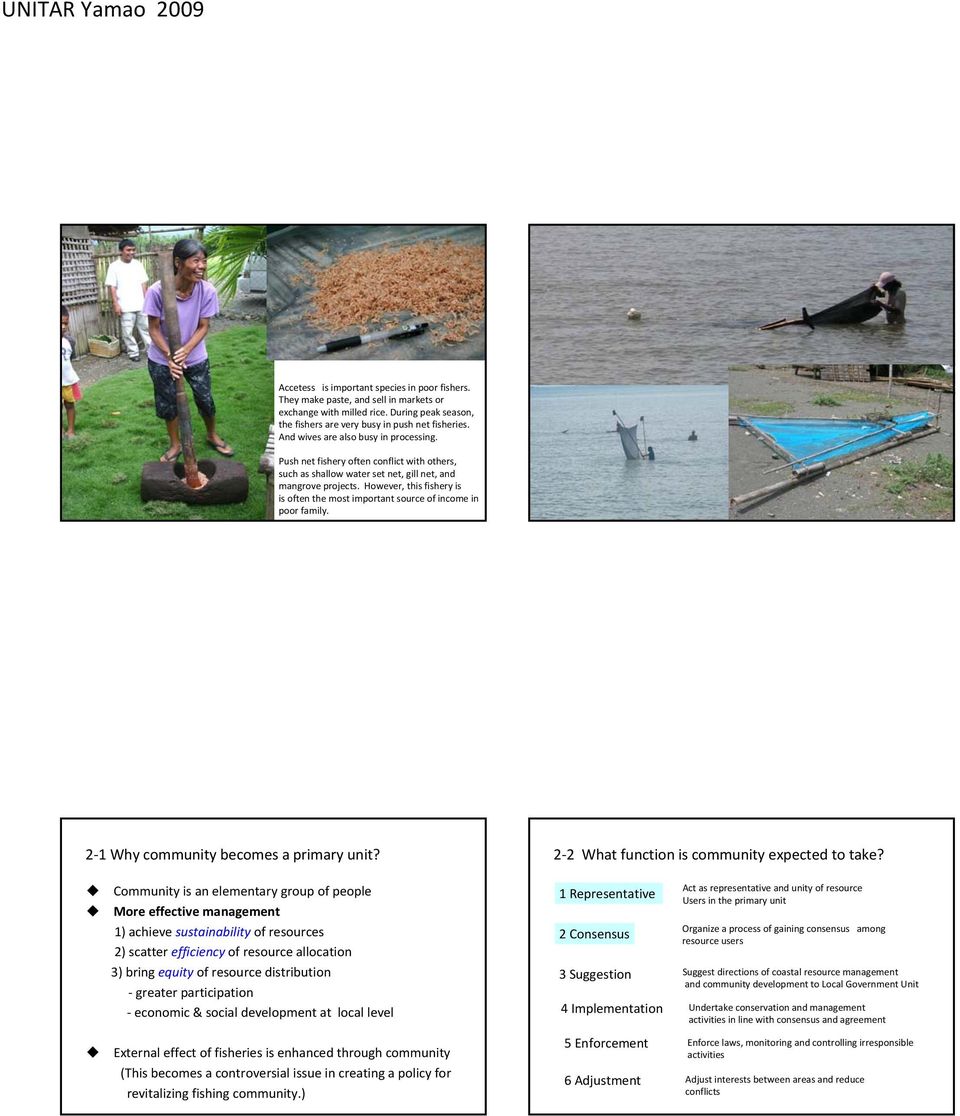
6 Accetess is important species in poor fishers. They make paste, and sell in markets or exchange with milled rice. During peak season, the fishers are very busy in push net fisheries. And wives are also busy in processing. Push net fishery often conflict with others, such as shallow water set net, gill net, and mangrove projects. However, this fishery is is often the most important source of income in poor family. 2 1 Why community becomes a primary unit? 2 2 What function is community expected to take? Community is an elementary group of people More effective management 1) achieve sustainability of resources 2) scatter efficiency of resource allocation 3) bring equity of resource distribution greater participation economic & social development at local level 1 Representative 2 Consensus 3 Suggestion 4 Implementation Act as representative and unity of resource Users in the primary unit Organize a process of gaining consensus among resource users Suggest directions of coastal resource management and community development to Local Government Unit Undertake conservation and management activities in line with consensus and agreement Enforce laws, monitoring and controlling irresponsible activities External effect of fisheries is enhanced through community (This becomes a controversial issue in creating a policy for revitalizing fishing community.) 5 Enforcement 6 Adjustment Adjust interests between areas and reduce conflicts
7 2 3 Practices of CBRM (adopted in Coastal Resource Management) CBRM: Community is a unit of development and management body (and a political unit) CRM community may have 1) defined area with territorial use right in fisheries (TURFs), area fishing right, registration, licensing, etc. 2) delegated authority to control fishing activities 3) participatory manners and democratic procedures 4) opportunity to develop people s own management mechanism, etc. Term community includes wide meanings, differing from area to area, and from country to country. 3 1 Successful factors of community based and comanagement projects Target activities Level of participation Successful projects Legal &formal support Three requirements: 1) Target activities should be clearly identified. 2) Level of participation 3) Legal & formal support Sustainable Development (source) Yamao 2003,Chenkitkosol & Yamao Chart Successful Factors of community-based & co-management projects 3 2 Evolution into a social system of CBRM Practices Wide variety of pilot projects have been designed and implemented so far, mainly establishing loosely controlled CRM. Tightly controlled CRM is not always target. Evolution from implementing pilot projects to the phase of building social system Diversified objectives and activities Awareness building, training, fishing ground management, input control, zoning, marine protected area (MPA), Spawning Per Recruitment (SPR), MSY, and so on. Institutional arrangement will vary according to target resource users. Self management of participatory projects People self encourage to organize and activity. Management of a wide spatial area Lager size of management, bay based and semi enclosed areas, networks of management bodies. Participation in Monitoring, Controlling & Surveillance (MCS) Administration, registration, licensing, patrolling, and so on. The institutional and law enforcement mechanism become complicated. 3 3 A Case of CBRM development In Southeast Asia, an enormous number of CBRM projects have been implemented. They accumulate knowledge and experiences. Along with development of CBRM, formal support are increasingly required. High level input control Output control Fishing ground management, Primary level input control, Technical control, etc. Awareness Building Law enforcement Achieving consensus, making rule Education & Dissemination Increasing role of formal support Community based practice, with Encouraging people s participation

8 3 5 Development of CBRM in Southeast Asia Pilot project stage Network of CBRMs Proposal for CM policy Accumulation of experiment & experiences Management in narrow locality Participation (Source) Yamao 2003, Yamao 2007 Transfer of technology, exchange of practices Establishment of networks Wider area management Intermediary institution Development Proposal learned through lessons New strategy toward ICM Reforming policy Rearranged decentralization New Movement of CRM: Sea tenure Increasing role of local Common fishing Common fishing ground I Common fishing government, ground II and ground how III to share responsibility? 1) Any community members access to common fishing grounds (open access) 2) Net fishing is not allowed. Kaggala community, in Sri Lanka Boundaries Fishing vessels go fishing anywhere Common fishing grounds occupied by a community Neighboring community 1 1 Amendment of laws and regulations Amendment of laws Related laws also amended, such as local codes, environmental codes, etc. Increasing role of local government unit. Lessons learned from past experiences of CBRM Not as pilot projects, it act as a social system regulated by laws and regulations. Trials of new types of projects Integrated Coastal Management (ICM) Making cluster and network of coastal resource management CRM is linked to social economic development Equal allocation of coastal resources, linkage to poverty alleviation, alternative job and livelihood activities, etc. (Re.1) Case: Kkao Thong, Krabi Province (Self management) (Re.1) Case: Kkao Thong, Krabi Province (Self management) Coastal boundary of KhaoThong Area of concession of edible-nest Area of tourism and community s mangrove forest Shallow water set net Shrimp trammel net Crab net Fish Trap & Squid Trap Artificial reefs Wantana & Yamao 2004

9 (Re.2) Pilot project on the management of territorial fishing grounds II Loosely controlled CPRs: Zoning in Demarcated Areas (Thailand) 200 miles AR AR B Cage culture C A 3km Free entrance Own Legal Framework Follow local rules LGU s territory Support by LGU Beach Local people & Local stakeholders Group of Fishers Group of Mangrove conservation Group of Tourist agency community + Public LGU and people explore own system of achieving consensus, making rules, and enforcing regulations, by using local administrative system. Consensus (I) Adjustment (II) Inform Implement & Monitoring (III) Local government units Approval & Issue (III) Development Plan & Rule (Source) Chenkitkosol & Yamao 2004 Chart Process of Decision-making and Implementation in Pilot Project Framework of Local Based CRM in collaboration with LGUs Important task is to design and illustrate shared works. Provincial/ Central Government Delegate issues Local Government Units (LGUs) Network of CBMUs CBMU CBMU CBMU CBMU=Community-based Management Unit Coordinate & share responsibility 1 Manage over a wider zone 2 Adjust between communities 1 Regulate users 2 Manage over immediate zone Decentralized and Participatory Approach: Networks of Community based Management Units (CBMUs) Function of CBMUs Community functions as a primary administrative unit standing between the people and LGU. Community covers a wide range of local concerns. Its administrative unit must open its membership to all residents. A communitybased framework of resource management encourages greater participation of fishers and resource users in a decision making process. Coverage area of CBMU A CBMU does not need to restrict its membership and activities within one community. Organization and membership should be flexibly changed. Network supported by LGUs Network is to arrange and conduct self regulating activities, supported by LGUs. It resolves conflicts between communities, and between different types of fisheries. Sharing responsibility between LGUs and network, it will change flexibly according to the level of people s participation and involvement. 36

10 Case of Indonesia: CM in Waorada Bay, Bima District, Indonesia 2 1 Several Types of Management have developed Community-based management (in Desa) Resource users group management (like Bagan group) Network of Desas (Ketchamatan). Desa Fisheries groups Fisheries (Bagan) goup Desa Waorada Bay District : prepare for scientific research for target species, and advices how to manage Institutionalization Common Fishing Grounds Local rules and regulations Capacity building at District office is important for sustainable resource management. Training program is designed for gathering Information beside administrative work. Below: sampling of anchovy caught by Bagan. Data will be sent to research Institute. Bagan (mobavle) boat: target species are anchovy, sardines and small mackerel. Fish will mostly be dried and salted. Bagan boat owners have respected their traditional rules. They cooperate with LGUs and accept advices.

11 2 2 Community based and self regulatory managements needs two requirements: Traditional ecological & biological knowledge Stability District Office Local & traditional rules Formalization Establishment of Partnership between local and District Fisheries Services (DFC) Scientific ecological & biological knowledge KW Experiments in Waorada Bay Provision of legal framework, MCS Central District Local levels (Desa, Kethamatan, etc) Fishery Laws Make ordinances --registration --permitting Make local rules People s participation Transfer authority of coastal fisheries Decentralized Fisheries Resource Management in Indonesia District Administrative Office District Fisheries Services (DFS) KW activities (JICA s project) 42 Case of Banate Bay, Pnay Island, the Philippines Illegal fishing boats (Danish purse seines) in Panay 3 1 Under Decentralization: Municipality increases role of coastal resource management and conservation Local Government Code 1991 Institutional reforms, mainly geared towards local autonomy over the management of coastal resources, started through the passage of the Code (Francisco 1997). LGU increases contribution to resource management 1) It jurisdictionally owns the right of management. It takes the lead role in any management program and serve like a conductor. 2) LGU enacts local ordinances on resource management within its own territorial waters (municipal waters). Integrated Coastal Management LGUs (municipality and city) are devolved the authority to manage coastal resources including marine, land, and mangrove.

12 3 2 Fisheries Code 1998: Workable Framework of Coastal Resource Management Municipal Fisheries should be managed by LGUs Municipal fisheries (capture operations using boats less than 3 GT). They are registered and licensed at municipal government. Municipal waters are within 15 km from shoreline (commercial fisheries are not allowed to operate). LGUs enact ordinances and regulation Through people s participation in decision making process, LGUs enact own ordinances and regulations, based on Fisheries Code and LGU code. Fisheries & Aquatic Resource Management Council (FARMC) 1) Support to make fisheries development plan and resource utilization plan. 2) Suggest establishment as well as revision of fishing ordinance. 3) Support execution of fisheries code and ordinance within municipal waters. 4) Suggest LGU Assembly. FARMCs are established at Barangay, municipal, regional and central levels. Mechanism of local governance over coastal resources and environment in the Philippines National Municipality (and City) Barangay LGC Fishery Code Make ordinances --registration --permitting Make consensus People s participation Transfer authority of coastal waters (within 15km) MFARMC BFARMCs (organized at Balangay) Inside (informal Agreement source: Yamao 2002, Yamao 2006, Aso 2006 Conventional CBRM 46 Four municipalities face Banate Bay and Barotac Viejo Bay. Fisheries and agriculture are main occupations. Due to excessive catch effort, coastal resources have decreased and depleted. Anilao Barotac Nuevo Banate Municipal territorial waters Barotac Viejo 3 3 Establishment of Banate Bay Resource Management Council, Inc. (BBRMCI) In 1996: three municipalities agreed to establish a bay wide management council, to cut across political and territorial boundaries. They intended to jointly manage the Bay and meet common area development plan. In 1998: Common Fisheries Ordinances were promulgated, based on Fisheries Code In 2002: Barotac Viejo joined. In 2007: JICA started technical cooperation. Anilao Barotac Nuevo Banate + BBRMCI Barotac Viejo Provide fund & dispatch staff Banate Bay Common ordinances & regulations

13 Constructed by JICA project 3 3 Objectives of BBRMCI Objectives 1) To eradicate illegal fishing; ban operations of commercial fishing boats that destroy sea grass and stop indiscriminate gathering of sea shells and corrals 2) To adopt a zoning system that shall eliminate the construction of illegal fish pens, fish ponds and other structures along and within the municipal territorial waters. 3) To adopt regeneration program like mangrove reforestation, and artificial coral reef. 4) To organize the small fisher folk into associations or cooperatives and develop their capacity to manage organizations. 5) To conduct continuous coastal zone research 6) To maintain data banking system. (Source: BBRMCI) BBRMCI has diversified objectives. It intends to function as; 1) a bay wide management body in 4 municipalities 2) a monitoring and patrolling agency 3) a development agency for supporting livelihood in fishing community 4) a training and research institution 3 4 Major Activities of BBRMCI Mangrove: Bufferzone Rivers 1 Institutional Development For enhancing community involvement, organizing f community, education and organizational development. 2 Law Enforcement Responsible for the review and codification of the laws of four municipalities. Strict rules and regulations are adopted. Licensing and registration are undertaken to effect legalization of fishing operation. Monitoring and patrolling are conducted. 3 Coastal Zone Research and Data Banking To monitor coastal resource and environment together with fisher folk. Resource management plan and zoning will be designed. 4 Livelihood Development To provide sustainable livelihood options, and to eradiate poverty in fishing community. 5 Mangrove and Land Use To rehabilitate and conserve mangrove resource management. Within 15 km municipal waters Artifitial reef Tide land area Shallow water fisheries Areas for deep-sea fisheries Mangrove: Core zone 7MPAs MPA Chart Map of Municipal Waters in Banate Bay (Source) Aso 2006

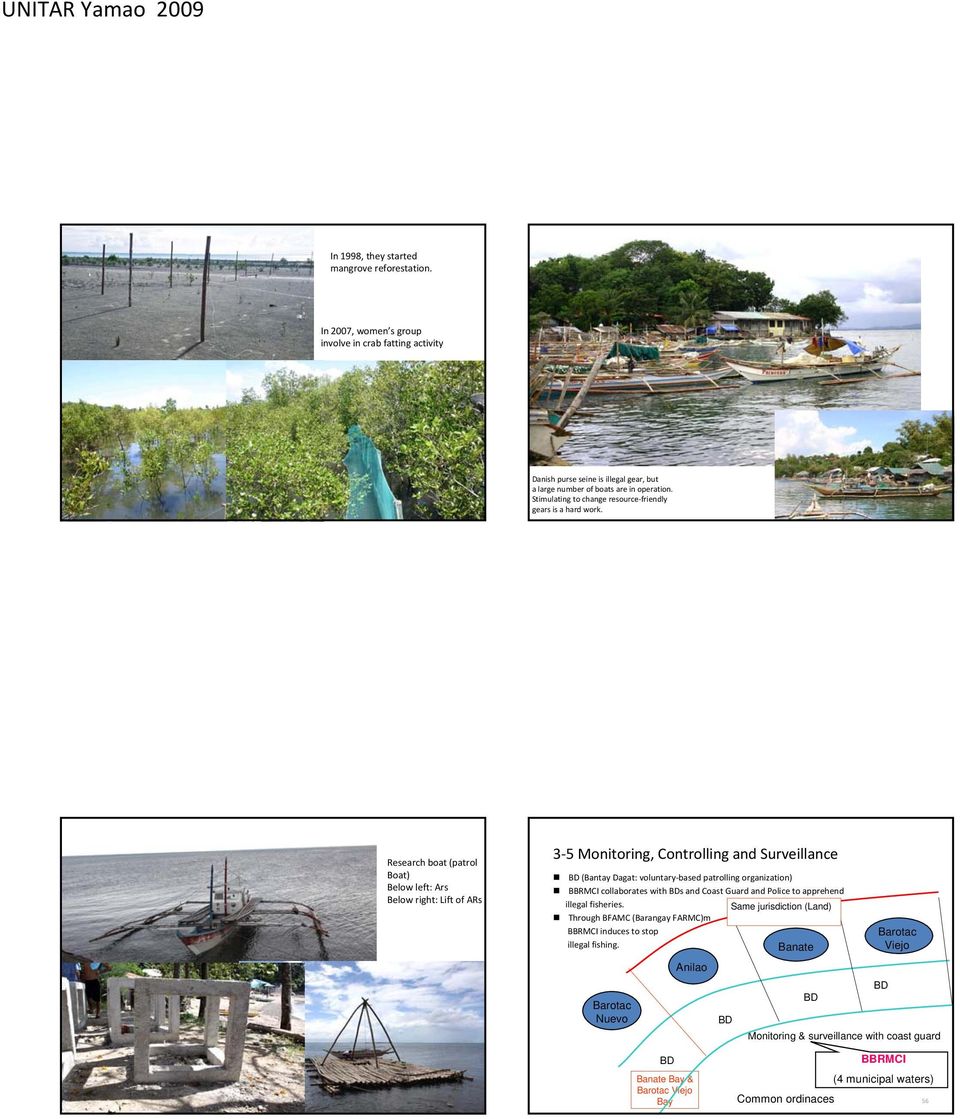
14 In 1998, they started mangrove reforestation. In 2007, women s group involve in crab fatting activity Danish purse seine is illegal gear, but a large number of boats are in operation. Stimulating to change resource friendly gears is a hard work. Research boat (patrol Boat) Below left: Ars Below right: Lift of ARs 3 5 Monitoring, Controlling and Surveillance BD (Bantay Dagat: voluntary based patrolling organization) BBRMCI collaborates with BDs and Coast Guard and Police to apprehend illegal fisheries. Same jurisdiction (Land) Through BFAMC (Barangay FARMC)m BBRMCI induces to stop illegal fishing. Banate Anilao Barotac Viejo Barotac Nuevo BD BD BD Monitoring & surveillance with coast guard BD Banate Bay & Barotac Viejo Bay Common ordinaces BBRMCI (4 municipal waters) 56
15 Students are drawing poster s and cartons of environment conservation. 3 6 Characteristics of BBRMCI Bay wide resource management (Alliance of Municipal FARMCs) Management area covers four municipalities Across the boundary of local administration Bay wide management institution fits into the reality of local fisheries Common ordinances about resource management and fishing activity New types of LGU s policy for coastal resource management New partnership between LGUs and groups of resource users (BFARMCs). Development of decentralized and participatory management: Barangay based => Municipal based => Bay based (Inter municipality alliance) Developed Networks of CBRMs Cooperation of local fisheries administration among LGUs Cost effective administration with professional staff 58 Mechanism of local governance over coastal resources and environment National Municipality LGC New type of CBRM Fishery Code Transfer authority Make ordinances BBRMCI --registration --permitting Conclusion & Recommendation Make rule in each region Barangay People s participation source: Yamao 2002, Yamao 2006, Aso 2006 BFARMCs (organized at Balangay) Inside (informal) Agreement Conventional CBRM 59

16 4 1 New Phase of Decentralized and Participatory Approach: towards Cluster Development Coastal resource and environmental problems are hot issues. Bottom up approach are very effective. Many nations in Asia Pacific region emphasize the importance of decentralization. However, capacity and function of local based management body as well as its size are controversial. Law enforcement does not work effectively. Decentralization program must be redesigned to fit in with local reality. Bottom up organizations should share part of responsibility for administration, planning, and law enforcement. They create own systems and adopt standardized procedures. Empower Local government units (both local and regional levels). Build a cluster approach in a certain defined area. 4 2 Local Responsibility for Sustainable Resource Utilization Greater role of local level on resource management LGU should cooperate together with stakeholders and any relevant institutions, to support people s participatory works on CBRM and CM activities. Within the framework of present fisheries law and other related regulations, LGU should clarify its function and authority in resource management. CBRM and CM units should establish a workable network cover a wider area (commonly utilized) for adjustment between them. To avoid overuse of resource in common fishing ground. Without this network, conflicts often occur. LGUs should develop management methods in collaboration with stakeholders, following the idea of the Code of Conducts Workable Framework of Coastal Resource Management over a Wider Spatial Area Development of more effective method and framework that would be adequate to a wider area management. ex. Networks of CBRM projects, decentralized network, but with topdown nature a. Bottom up and participatory nature may fade b. System of adjusting conflicts between stakeholders and between areas Semi enclosed and bay based management Capacity building of LGU and its staff should be promoted. Stable administrative system should be established, without political intervention. Thank you for your attention. [email protected] 63

Coastal Resilience through Integrated Coastal Management. Alan T. White Indian Ocean Tsunami Warning System Program
 Coastal Resilience through Integrated Coastal Management Alan T. White Indian Ocean Tsunami Warning System Program The coastal zone:an endangered environment Overexploitation and destruction Unplanned
How To Manage Coastal Wetlands In Pangasinan
 A Case of Sustainable Use and Management of Coastal Wetlands Bani, Pangasinan Area: 86.27 Has Bearing: True Scale: 1:10,000 LEGEND: Boundary of Bani Mangrove River/Creek Guard House Board Walk Bani is
Mainstreaming CRM in Local Governance: CRMP Experience
 Mainstreaming CRM in Local Governance: CRMP Experience CRMP is a technical assistance project of the Department of Environment and Natural Resources, funded by the United States Agency for International
MPA NETWORKS MODULE 2 2.1 INTRODUCTION TO MPA NETWORKS. Advantages of Networks 2.2 TYPES OF MPA NETWORKS. Social Networks. Ecological Networks
 2.1 INTRODUCTION TO MPA NETWORKS Advantages of Networks 2.2 TYPES OF MPA NETWORKS Social Networks Ecological Networks Management-based Networks Case Study: A Regional Approach to MPA Development in West
no-entry only research and monitoring activities no-take zones incorporates other non-extractive uses
 Seaflower Biosphere Reserve Country: COLUMBIA Project Overview Columbia declared the archipelago of San Andres, Old Providence, and Santa Catalina a biosphere reserve called the Seaflower Biosphere Reserve.
Demonstration Site Concept
 The Sustainable Financing and Management of Eastern Caribbean Marine Ecosystems Project Demonstration Site Concept Woburn Clarkes Court Bay Marine Protected Area Improving Water Quality in Marine Protected
SECTOR ASSESSMENT (SUMMARY): AGRICULTURE AND NATURAL RESOURCES 1
 Country Operations Business Plan: Philippines, 2013 2015 SECTOR ASSESSMENT (SUMMARY): AGRICULTURE AND NATURAL RESOURCES 1 A. Sector Performance, Problems, and Opportunities 1. Sector importance and growth
Views from Living Marine Resources Management and the Coral Triangle Project
 Views from Living Marine Resources Management and the Coral Triangle Project Annadel Salvio Cabanban Ecosystem Approach to Fisheries Management Specialist, Coral Triangle Initiative Southeast Asia Project:
Fisheries in Crisis and Conflict in the Coral Triangle
 Fisheries in Crisis and Conflict in the Coral Triangle Reflections on the Live Reef Fish Trade and The Coral Triangle Initiative Charles Barber Environmental Advisor Office of Environment and Science Policy
Mu Koh Chang Coral Reef Demonstration Site: Lessons Learned and Challenges
 Mu Koh Chang Coral Reef Demonstration Site: Lessons Learned and Challenges Thamasak Yeemin, Sittiporn Pengsakun, Chaipichit Saenghaisuk, Wanlaya Klinthong, Makamas Sutthacheep Marine Biodiversity Research
INTERIM MEASURES ADOPTED BY PARTICIPANTS IN NEGOTIATIONS TO ESTABLISH SOUTH PACIFIC REGIONAL FISHERIES MANAGEMENT ORGANISATION
 INTERIM MEASURES ADOPTED BY PARTICIPANTS IN NEGOTIATIONS TO ESTABLISH SOUTH PACIFIC REGIONAL FISHERIES MANAGEMENT ORGANISATION Participants in the negotiations to establish a South Pacific Regional Fisheries
Laws to promote environmental sustainability of oceans and seas
 Laws to promote environmental sustainability of oceans and seas Laws regulations and other measures for conservation and sustainable use of living marine resources and biodiversity including those beyond
International Monitoring, Control, and Surveillance (IMCS) Network: Building Capacity to Combat Illegal, Unreported, and Unregulated (IUU) Fishing
 International Monitoring, Control, and Surveillance (IMCS) Network: Building Capacity to Combat Illegal, Unreported, and Unregulated (IUU) Fishing Marcel Kroese Director: IMCS Network Training & Liaison
Data Collection on Tuna Fisheries in Thailand: The transition of the old practice to the modern technology development
 Data Collection on Tuna Fisheries in Thailand: The transition of the old practice to the modern technology development Sampan Panjarat Andaman Sea Fisheries Research and Development Center (Phuket) 77
Eco-tourism and Biodiversity Conservation and Protection Management of Olango Island Wildlife Sanctuary By: Reginaldo G. Bueno
 Eco-tourism and Biodiversity Conservation and Protection Management of Olango Island Wildlife Sanctuary By: Reginaldo G. Bueno Introduction Olango Island Wildlife Sanctuary (OIWS) was proclaimed as protected
RELEVANT PROVISIONS OF LOCAL GOVERNMENT CODE*
 RELEVANT PROVISIONS OF LOCAL GOVERNMENT CODE* A. CONSTITUTIONAL PROVISIONS BY ELEUTERIO C. DUMOGHO The constitutional basis in the enactment of the Local Government Code of 1991. Article X of the 1987
How To Help Oceans
 The World Bank & the Ocean A Healthy & Productive Ocean to Help Reduce Poverty Why oceans matter to the World Bank NUTRITION Seafood provides 16% of the world s animal protein 1 billion people in developing
COMMUNITY-BASED MARINE SANCTUARIES FOCUS GROUP DISCUSSIONS. in the PHILIPPINES:A REPORT on. Brian Crawford, Miriam Balgos and Cesario R.
 COMMUNITY-BASED MARINE SANCTUARIES in the PHILIPPINES:A REPORT on FOCUS GROUP DISCUSSIONS Brian Crawford, Miriam Balgos and Cesario R. Pagdilao June 2000 Coastal Resources Center University of Rhode Island
Coral Reef Rehabilitation and Management Program- Coral Triangle Initiative (COREMAP-CTI) (P127813)
 Public Disclosure Copy EAST ASIA AND PACIFIC Indonesia Environment Global Practice IBRD/IDA Investment Project Financing FY 2014 Seq No: 2 ARCHIVED on 03-Feb-2015 ISR17440 Implementing Agencies: Ministry
The Batanes Protected Area Act (DOT)
 CONGRESS OF THE PHILIPPINES SIXTEENTH CONGRESS Third Regular Session } HOUSE OF REPRESENTATIVES H. No. 6152 BY REPRESENTATIVES ABAD, RELAMPAGOS, ALVAREZ (F.), CAGAS, LANETE, ABUEG, DIMAPORO (I.), FORTUN,
MINISTERIAL MEETING OF THE BLUE WEEK 2015
 5 JUNE 2015 MINISTERIAL MEETING OF THE BLUE WEEK 2015 We, Ministers responsible for Ocean/ Fisheries/ Maritime Affairs, having met in Lisbon on June the 5 th, 2015, at the invitation of the Minister of
COMMITTEE ON FISHERIES
 May 2016 COFI/2016/Inf.15 E COMMITTEE ON FISHERIES Thirty-second Session Rome, 11-15 July 2016 ADVANCING KNOWLEDGE ON RIGHTS-BASED APPROACHES FOR FISHERIES: A GLOBAL WORK PROGRAMME FOR ENHANCING FOOD SECURITY
The current institutional and legal context for biodiversity conservation and management is characterised by the following features:
 National BiodiversityStrategyandActionPlan (NBSAP),St. Lucia page 8 Resource tenure and access Most agricultural lands, and a majority of forest lands, are privately owned. Two significant trends can be
VOLUNTARY GUIDELINES ON THE GOVERNANCE OF TENURE. At a glance
 VOLUNTARY GUIDELINES ON THE GOVERNANCE OF TENURE At a glance VOLUNTARY GUIDELINES ON THE GOVERNANCE OF TENURE At a glance FOOD AND AGRICULTURE ORGANIZATION OF THE UNITED NATIONS Rome, 2012 The designations
Alan White The Nature Conservancy
 The Coral Triangle Region, The Coral Triangle Initiative, and the Development of the Six Country Marine Protected Area System Alan White The Nature Conservancy The Coral Triangle Initiative Coral Triangle
SUBSIDIARY LEGISLATION WILDLIFE & PROTECTED AREAS. Marine Protected Areas Order 2012. S. R. & O. No: 1 of 2012
 SUBSIDIARY LEGISLATION WILDLIFE & PROTECTED AREAS Marine Protected Areas Order 2012 S. R. & O. No: 1 of 2012 Made: 23 February 2012 Published: 29 February 2012 Coming into force: on publication IN EXERCISE
How To Manage Protected Areas
 ECHOES FROM BARILOCHE: Conclusions, Recommendations and Action Guidelines The Second Latin American Congress on National Parks and other Protected Areas aimed to asses, value and project the contribution
Northern Territory Fisheries Resource Sharing Framework
 Northern Territory Fisheries Resource Sharing Framework Page 1 of 11 Introduction Fishing is important in the Northern Territory (Territory). Coastal Aboriginal people recognise sea country out to the
Coral Triangle Initiative (CTI) on Coral Reefs, Fisheries and Food Securities
 2008/MRCWG/022 Agenda Item: 10 Coral Triangle Initiative (CTI) on Coral Reefs, Fisheries and Food Securities Purpose: Information Submitted by: Indonesia 21 st Marine Resource Conservation Working Group
Applying Knowledge Management to Scale up Partnership Investments
 Applying Knowledge Management to Scale up Partnership Investments for Sustainable Development of Large Marine Ecosystems of East Asia and Their Coasts Project Title Applying Knowledge Management to Scale
Creating governable EBM and MPA networks: An analytic framework and empirical results from the Philippines
 Creating governable EBM and MPA networks: An analytic framework and empirical results from the Philippines Patrick Christie Associate Professor SMA and JSIS Pew Fellow in Marine Conservation University
Sri Lanka's Agenda for Coastal Zone Management
 EEZ Technology The Review of Advanced Technologies for the Integrated of EEZs and Coastal Zones Worldwide ICG Publishing Limited Edition 5 Sri Lanka's Agenda for Coastal Zone R.A.D.B. Samaranayake, Coast
COUNTRY NOTE ON NATIONAL FISHERIES MANAGEMENT SYSTEMS -- GERMANY
 COUNTRY NOTE ON NATIONAL FISHERIES MANAGEMENT SYSTEMS -- GERMANY Historical overview 1. There has been an ongoing structural change in the German fleet since the end of World War II. In the 1950s, nearly
Transforming wasted resources. for a sustainable future. The sustainable management of bycatch in Latin America and Caribbean trawl fisheries
 Transforming wasted resources for a sustainable future The sustainable management of bycatch in Latin America and Caribbean trawl fisheries REBYC-II LAC Shrimp trawling and other types of bottom trawling
National Report to the Fifth Session of the United Nations Forum on Forests TURKEY
 National Report to the Fifth Session of the United Nations Forum on Forests TURKEY December 2004 1 I. Key Contacts Head of Forestry and UNFF national focal point for : Turkey Name: Ass. Prof. Dr. Nuri
Fisheries Conflicts Communication Framework: A tool for developing plans and strategies for managing fisheries conflicts (FishCom)
 Fisheries s Communication Framework: A tool for developing plans and strategies for managing fisheries conflicts (FishCom) N. Salayo, C. Garforth, J. Khondker, A. Natarajan, M. Sithirith, U. Kanagaratnam,
Ellen Hey Professor of Public International Law, Erasmus School of Law, Erasmus University Rotterdam
 THE PRINCIPLE OF COMMON BUT DIFFERENTIATED RESPONSIBILITIES Ellen Hey Professor of Public International Law, Erasmus School of Law, Erasmus University Rotterdam Short summary This lecture discusses the
INDONESIA - LAW ON WATER RESOURCES,
 Environment and Development Journal Law LEAD INDONESIA - LAW ON WATER RESOURCES, 2004 VOLUME 2/1 LEAD Journal (Law, Environment and Development Journal) is a peer-reviewed academic publication based in
Marine Stewardship Council
 Marine Stewardship Council MSC Fishery Standard Principles and Criteria for Sustainable Fishing Version 1.1 1 st May 2010 Committees responsible for this Standard This standard is intended to be used on
Appendix A. The Marine Life Protection Act (MLPA)
 Appendix A. The Marine Life Protection Act (MLPA) THE PEOPLE OF THE STATE OF CALIFORNIA DO ENACT AS FOLLOWS: SECTION 1. Chapter 10.5 (commencing with Section 2850) is added to Division 3 of the Fish and
The World Bank Group s Common Property Resource Management Network
 The World Bank Group s Common Property Resource Management Network Guide to CPRNet The World Bank Group s Common Property Resource Management Network (CPRNet) is an international network open to practitioners,
Progress Towards the Development of the Six Country Coral Triangle Marine Protected Area System (CTMPAS)
 Progress Towards the Development of the Six Country Coral Triangle Marine Protected Area System (CTMPAS) Alan White Senior Scientist, The Nature Conservancy and Lynette Laroya MPA Technical Working Group,
COUNTRY REPORT ON FISHERIES AND AQUACULTURE
 COUNTRY REPORT ON FISHERIES AND AQUACULTURE Hayri DENİZ National Coordinator Ministry of Food Agriculture and Livestock FAO and EUROFISH Regional Workshop on WTO and Fisheries: An update on WTO and Market
Asian Conservation Company and Ten Knots Group: Private business in El Nido-Taytay Managed Resource Protected Area, Philippines
 V th World Parks Congress: Sustainable Finance Stream September 2003 Durban, South Africa Institutions Session Institutional Arrangements for Financing Protected Areas Panel C Private investments to support
Indonesian Government Blue Carbon Priorities. Tonny Wagey
 Indonesian Government Blue Carbon Priorities 1) 2) Tonny Wagey 1) Blue Carbon Centre - MoMAF 2) Arafura and Timor Seas Ecosystem Action (ATSEA) Why is Blue Carbon Important for Indonesia? Total Area: 3.11
National Marine Sanctuaries Act
 Please note: This text is from the fourth edition of Federal Historic Preservation Laws, published in 2006 by the National Center for Cultural Resources, National Park Service, Department of the Interior.
5 Year Strategic Plan
 Mid Atlantic Fishery Management Council 5 Year Strategic Plan 2014 2018 DRAFT 5/31/2013 Table of Contents Table of Contents... 1 Introduction... 2 The Mid Atlantic Fishery Management Council... 2 Rationale
Assessing ecosystem services for Lauru Protected Area Network (LPAN), Choiseul, Solomon Islands
 Assessing ecosystem services for Lauru Protected Area Network (LPAN), Choiseul, Solomon Islands Authors: Susi Menazza ([email protected]) and Tasneem Balasinorwala (UNEP-TEEB) Short title: Ecosystem Services
Karl Bruckmeier, Gothenburg University Sweden, Human Ecology Section
 Karl Bruckmeier, Gothenburg University Sweden, Human Ecology Section Sustainable Coastal Zone Management from a Transdisciplinary Human Ecology Perspective Contribution for the International Autumn Academy,
Dr. Suseno Sukoyono Executive Chair
 The CTI-CFF countries: Development partners: We are for the wold, what the world can offer The Coral Triangle Initiative on Coral Reefs, Fisheries and Food Security: A Platform for Delivering on the Rio+20
AP ENVIRONMENTAL SCIENCE 2006 SCORING GUIDELINES. Question 4
 AP ENVIRONMENTAL SCIENCE 2006 SCORING GUIDELINES Question 4 (a) Identify the five-year period during which the greatest rate of decline in the fish harvest took place. For that five-year period, calculate
Marine biological diversity beyond areas of national jurisdiction. Legal and policy framework
 Marine biological diversity beyond areas of national jurisdiction Legal and policy framework 1. The United Nations Convention on the Law of the Sea (UNCLOS) provides the legal framework within which all
Assessing adaptation options for climate change: A guide for coastal communities in the Coral Triangle of the Pacific 5. Social Network Analysis
 Assessing adaptation options for climate change: A guide for coastal communities in the Coral Triangle of the Pacific 5. Social Network Analysis Scoping Identifying options Evaluation of options Planning
The Marine Protected Area Inventory
 The Marine Protected Area Inventory New pictures Jordan Gass, Hugo Selbie and Charlie Wahle ESRI Ocean Forum November 6, 2013 Outline What is the MPA Inventory? Purpose Data How it s used Future directions
How To Be Sustainable With Tourism
 QUÉBEC DECLARATION ON ECOTOURISM In the framework of the UN International Year of Ecotourism, 2002, under the aegis of the United Nations Environment Programme (UNEP) and the World Tourism Organization
REDD+ Inspiring Practices
 WWF Forest and Climate Programme FACTSHEET 2013 snapshot What» Community involvement in participatory land-use mapping as the basis for land-use management planning, conservation of natural resources and
Proceedings of the International Conference on Reducing Climate Change Challenges through Forestry and Other Land Use Practices
 Integrating conservation and livelihood activities towards community adaptation to climate change challenges along Wami-Ruvu mangrove ecosystem, Bagamoyo, Tanzania. Abstract 1 Mahenge, J. and 2 Tegule,
Perspective. The Hanoi Communiqué
 The Hanoi Communiqué The Ministers, representatives of countries, practitioners, scientists, civil society, private sector, and all other participants present at the 2 nd Global Conference on Agriculture,
PIRSA Fisheries & Aquaculture Charter Fishery Compliance Plan 2014-2015
 Fishery Management Plan Goals: 1. Charter Boat Fishery resources harvested within ecologically sustainable limits 2. Optimum utilisation and equitable distribution of the Charter Boat Fishery resources
BANGLADESH. CURRENT LIMITATIONS National waters
 BANGLADESH Source: FAO Fishstat dataset: Global Capture Production Bangladesh reports to FAO data on "Sharks, rays, skates, etc. nei" production starting from 2008 with an average of about 4,000 tonnes/year.
Sunamganj Community Based Resource Management Project (SCBRMP): an approach to sustainable beel fisheries management
 Conference Paper 09 Sunamganj Community Based Resource Management Project (SCBRMP): an approach to sustainable beel fisheries management Sk.Md. Mohsin* *Project Director, SCBRMP 1 SUMMARY Sunamganj is
PHILIPPINES FISHERIES IMPROVED FOR SUSTAI ABLE HARVEST (FISH) PROJECT
 PHILIPPINES FISHERIES IMPROVED FOR SUSTAI ABLE HARVEST (FISH) PROJECT DEVELOPING A FRAMEWO FRAMEWORK FOR ECONOMIC ANALYSIS OF CRM INVESTMENT: THE CASE OF UBAY, BOHOL This publication was prepared by Rina
GCS-Tenure Project. Tenure security and forest-dependent communities
 GCS-Tenure Project Tenure security and forest-dependent communities A global comparative study 2014-2016 Introduction Forest tenure reform has been at the center of the debate, on national as well as international
PHI: Integrated Coastal Resources Management
 Project Administration Memorandum Project Number: 33276 Loan Number: 2311-PHI Grant Number: 0071-PHI September 2007 PHI: Integrated Coastal Resources Management The project administration memorandum is
ILMMA learned many lessons including:
 Easygrants ID: 38787 National Fish and Wildlife Foundation NFWF Project ID: 0302.13.038787 Coral Reef Conservation Fund 2013 - Submit Final Programmatic Report (New Metrics) Grantee Organization: Indonesia
Current challenges in delivering social security health insurance
 International Social Security Association Afric ISSA Meeting of Directors of Social Security Organizations in Asia and the Pacific Seoul, Republic of Korea, 9-11 November 2005 Current challenges in delivering
National Tiger Recovery Program INDONESIA
 MINISTRY OF FORESTRY OF REPUBLIC OF INDONESIA Global Tiger Initiative National Consultations the Road to the Tiger Summit National Tiger Recovery Program INDONESIA July, 10 Template to describe a Summary
PUBLIC PARTICIPATION IN CORAL REHABILITATION AT PHI PHI ISLANDS, KRABI
 PUBLIC PARTICIPATION IN CORAL REHABILITATION AT PHI PHI ISLANDS, KRABI Mid-water coral nursery as a source of coral seedlings to rehabilitate degraded coral reefs Site: Phi Phi Lae Island, in 2006 Marine
AGREEMENT ON PORT STATE MEASURES TO PREVENT, DETER AND ELIMINATE ILLEGAL, UNREPORTED AND UNREGULATED FISHING
 AGREEMENT ON PORT STATE MEASURES TO PREVENT, DETER AND ELIMINATE ILLEGAL, UNREPORTED AND UNREGULATED FISHING The Agreement on Port State Measures to Prevent, Deter and Eliminate Illegal, Unreported and
ROLE AND CONTRIBUTION OF MEN AND WOMEN IN MANGROVE REHABILITATION IN REGION VI, PHILIPPINES
 ROLE AND CONTRIBUTION OF MEN AND WOMEN IN MANGROVE REHABILITATION IN REGION VI, PHILIPPINES Josephine Savaris*, Alice Joan Ferrer**, Rosalie Joven*, Rodney Golbeque*, and Basilio Bajoyo* *CMRP-Zoological
INTERNATIONAL OBLIGATIONS AND AGREEMENTS
 INTERNATIONAL OBLIGATIONS AND AGREEMENTS TITLE DESCRIPTION Ratification Focal Point CONVENTIONS The United Nations Convention on the Law of the Sea (UNCLOS) also called the Law of the Sea Convention or
In many places around the world, local government
 FROM ROADBLOCK TO CHAMPION PHE Advocacy and Local Government Executives POPULATION REFERENCE BUREAU September 2006 by Enrique Hernandez, PATH Foundation Philippines, Inc. South China Sea Palawan Manila
Fishing, Hunting & Gathering The Rights and Responsibilities of First Nations People in Manitoba
 Fishing, Hunting & Gathering The Rights and Responsibilities of First Nations People in Manitoba First Nations people have always had a special relationship with the natural life forms that the land provides
The need to ban fish aggregating devices (FADs) to save juvenile baby tunas. Greenpeace uncovers trade in juvenile tuna in General Santos Fish Port
 The need to ban fish aggregating devices (FADs) to save juvenile baby tunas 2 December 2014 Quezon City, Philippines Greenpeace uncovers trade in juvenile tuna in General Santos Fish Port Introduction
THE CORAL TRIANGLE INITIATIVE (CTI) ON CORAL REEFS, FISHERIES AND FOOD SECURITY. 1st Sulu Sulawesi Sea (SSS) Conference 18-19 November 2015
 THE CORAL TRIANGLE INITIATIVE (CTI) ON CORAL REEFS, FISHERIES AND FOOD SECURITY 1st Sulu Sulawesi Sea (SSS) Conference 18-19 November 2015 1 Introduction to CTI PRESENTATION OUTLINE State of the CTI Marine
China s Land Registration:Situation, Challenges and Efforts
 China s Land Registration:Situation, Challenges and Efforts Huanle He, China 1. Overview of China's Land Registration 1.1 History of China s Land Registration China's land registration has a very long
8. Real Property Taxation in the Philippines 1
 8. Real Property Taxation in the Philippines 1 Local governments in the Philippines are vested with the power to create their own revenue sources. Such power must of course be exercised within the limitations
CONSERVATION AREAS ACT
 CONSERVATION AREAS ACT CAP. 30.15 Conservation Areas Act CAP. 30.15 Arrangement of Sections CONSERVATION AREAS ACT Arrangement of Sections Section 1 Short title... 5 2 Interpretation... 5 3 Declaration
How To Write A Listing Policy For A Species At Risk Act
 Fisheries and Oceans Canada Species at Risk Act Listing Policy and Directive for Do Not List Advice DFO SARA Listing Policy Preamble The Fisheries and Oceans Canada (DFO) Species at Risk Act (SARA) Listing
Presentation on Water Quality Conservation in Community
 Presentation on Water Quality Conservation in Community Prepared by Ms. Dok Sothea, Director, Department of Environment, Kampong Chhnang province Siem Reap, 25 September 2008 Table of Contents 1. General
Voluntary Guidelines for Securing Sustainable Small-Scale Fisheries. in the Context of Food Security and Poverty Eradication
 Voluntary Guidelines for Securing Sustainable Small-Scale Fisheries in the Context of Food Security and Poverty Eradication Voluntary Guidelines for Securing Sustainable Small-Scale Fisheries in the Context
Assessing adaptation options for climate change: A guide for coastal communities in the Coral Triangle of the Pacific 1. Assessment process
 Assessing adaptation options for climate change: A guide for coastal communities in the Coral Triangle of the Pacific 1. Assessment process Scoping Identifying options Evaluation of options Planning implementation
Linking Mid-term Rehabilitation to Long-term Sustainability:
 19 T H A I L A N D Linking Mid-term Rehabilitation to Long-term Sustainability: Baan Tha Klang Fishing Community Co-op Shop GENERAL INFORMATION Country: Thailand Location: Ranong Province, Suksamran District
Maritime Domain Management System
 Maritime Domain Management System A member of the SRT plc group www.srt-marinesystems.com 1 Who is SRT Marine System Solutions? The global leaders in maritime domain VTS, VMS technologies, products and
GHANA S LAND ADMINISTRATION PROJECT: ACCOMPLISHMENTS, IMPACT, AND THE WAY AHEAD. W. ODAME LARBI (PhD, FGhIS) CHIEF EXECUTIVE OFFICER LANDS COMMISSION
 GHANA S LAND ADMINISTRATION PROJECT: ACCOMPLISHMENTS, IMPACT, AND THE WAY AHEAD W. ODAME LARBI (PhD, FGhIS) CHIEF EXECUTIVE OFFICER LANDS COMMISSION PRESENTATION OUTLINE Background The National Land Policy
REGIONAL PLAN OF ACTION OF SEA TURTLE FORAGING HABITATS IN SOUTH EAST ASIAN WATERS
 The Seventeenth Meeting of Fisheries Consultative Group of the ASEAN-SEAFDEC Strategic Partnership (FCG/ASSP) Sunee Grand Hotel & Convention Center, Ubon Ratchathani, Thailand 4-5 December 2014 WP06.5a