
Janus Investment Fund
|
|
|
- Howard Jeffery Small
- 10 years ago
- Views:
Transcription
1 February 27, 2009 Growth & Core Janus Balanced Fund Janus Contrarian Fund Janus Enterprise Fund Janus Fund Janus Growth and Income Fund Janus Orion Fund Janus Research Core Fund (formerly named Janus Fundamental Equity Fund) Janus Research Fund Janus Triton Fund Janus Twenty Fund* Janus Venture Fund* Janus Investment Fund Prospectus Eliminate Paper Mail. Set up e-delivery of prospectuses, annual reports, and statements at *The Fund is closed to new investors. Current investors in the Fund may continue to invest in their Fund account, including reinvestment of any dividends or capital gains distributions. However, once an account is closed, additional investments will not be accepted unless specified criteria are met. The Fund may resume sales of its shares at some future date, but it has no present intention to do so. Refer to the Shareholders Manual section of this Prospectus for more details. The Securities and Exchange Commission has not approved or disapproved of these securities or passed on the accuracy or adequacy of this Prospectus. Any representation to the contrary is a criminal offense. This Prospectus is for those shareholders investing directly with the Funds.

2 Janus Investment Fund Class J Shares Supplement dated September 29, 2009 to Currently Effective Prospectuses The following changes apply to the Shareholder s Manual of the Prospectus as indicated below. For purposes of this supplement, the term Fund refers to any fund or portfolio in the Janus Investment Fund trust. 1. The following changes pertain to the Exchanges section: The following replaces in its entirety the eighth bullet point: The exchange privilege is not intended as a vehicle for short-term or excessive trading. A Fund may suspend or terminate your exchange privilege if you make more than one round trip in the Fund in a 90-day period and may bar future purchases in the Fund or other Funds. The Funds will work with intermediaries to apply the Funds exchange limit. However, the Funds may not always have the ability to monitor or enforce the trading activity in such accounts. For more information about the Funds policy on excessive trading, refer to Excessive Trading. The following is added as the last paragraph: Financial intermediaries may also exchange shares of one class for another class of shares within the same fund, provided the eligibility requirements of the class of shares to be received are met. 2. The following replaces in their entirety the second, third, and fourth paragraphs under the Excessive Trading Policies and Procedures section: The Funds attempt to deter excessive trading through at least the following methods: exchange limitations as described under Exchanges; trade monitoring; fair valuation of securities as described under Pricing of Fund Shares; and redemption fees (where applicable on certain classes of certain funds). Generally, a purchase and redemption of Shares from the same Fund within 90 calendar days (i.e., round trip ) may result in enforcement of a Fund s excessive trading policies and procedures with respect to future purchase orders, provided that each Fund reserves the right to reject any purchase request as explained above.
3 The Funds monitor for patterns of shareholder frequent trading and may suspend or permanently terminate the exchange privilege of any investor who makes more than one round trip in a Fund over a 90-day period, and may bar future purchases into the Fund and other Janus funds by such investor. The Funds excessive trading policies generally do not apply to (i) a money market fund, although money market funds at all times reserve the right to reject any purchase request (including exchange purchases) for any reason without prior notice, and (ii) transactions in the Janus funds by a Janus fund of funds, which is a fund that primarily invests in other Janus mutual funds. In addition, the following replaces in their entirety the seventh and eighth paragraphs under the Excessive Trading Policies and Procedures section: In an attempt to detect and deter excessive trading in omnibus accounts, the Funds or their agents may require intermediaries to impose restrictions on the trading activity of accounts traded through those intermediaries. Such restrictions may include, but are not limited to, requiring that trades be placed by U.S. mail, prohibiting future purchases by investors who have recently redeemed Fund shares, requiring intermediaries to report information about customers who purchase and redeem large amounts, and similar restrictions. The Funds ability to impose such restrictions with respect to accounts traded through particular intermediaries may vary depending on the systems capabilities, applicable contractual and legal restrictions, and cooperation of those intermediaries. Certain transactions in Fund shares, such as periodic rebalancing through intermediaries (no more frequently than every 60 days) or those which are made pursuant to systematic purchase, exchange, or redemption programs generally do not raise excessive trading concerns and normally do not require application of the Funds methods to detect and deter excessive trading. 3. For Funds that are subject to redemption fees, the following are added as the second and third sentences of the fourth paragraph under the Redemption Fee section: For same-fund share class exchanges, no redemption fee will be applied based on the exchange transaction. However, to the extent an intermediary is applying a redemption fee, the redemption fee will be imposed on a subsequent underlying shareholder-initiated sale of shares after the exchange. Investors in the Funds should consider this information when making a long-term investment decision. Please retain this Supplement with your records. 07JAN

4 Janus Investment Fund Class J Shares Supplement dated September 29, 2009 to Currently Effective Prospectuses NOTICE REGARDING IMPORTANT CHANGES TO YOUR FUND The Board of Trustees of your Fund or Portfolio (if applicable) (each, a Fund and collectively, the Funds ) has approved certain changes to be effective on or about February 16, The changes are part of a larger effort by Janus Capital Management LLC ( Janus ) to evolve its mutual fund structure. Janus believes these changes further demonstrate its commitment to the advisory and institutional communities, while at the same time enhancing product offerings for existing direct Fund shareholders. These changes are described below: Shareholders Investing Through a Third-Party Intermediary If you hold Class J Shares through a third-party intermediary, your share class will be renamed Class T Shares. Class T Shares will be available only through certain financial intermediary platforms including, but not limited to, mutual fund wrap fee programs, managed account programs, asset allocation programs, bank trust platforms, and certain retirement platforms. Shareholders Investing Directly with Janus If you hold your Fund shares directly with Janus, your shares will be moved to a newly created Class D Shares, a share class dedicated to shareholders investing directly with Janus. You will continue to receive the same services, including exchanging and purchasing into Class D Shares of new and existing Janus funds, accessing your account online, discussing your account with a Janus representative, and receiving shareholder communications. In addition, you will have access to four additional funds once you become a Class D shareholder on or about February 16, The eligibility requirements for investing directly with Janus are expected to be the same as are currently in effect. As always, individual investors that are not currently investing directly with Janus can access Janus funds through a variety of outlets, including financial advisors or other third-party intermediaries. Change in Transfer Agency Fee Structure In connection with repositioning Class J Shares to a third-party and direct model to better service shareholders in each of those channels, the transfer agency fee structure for the Funds will also be changed. Currently, Janus Services LLC ( Janus
5 Services ), the Funds transfer agent, receives an asset-weighted fee from Class J Shares for transfer agency and other services. While this fee may fluctuate monthly, it is based on an annual fee rate determined by the average proportion of Class J Shares total net assets sold directly and the average proportion of Class J Shares net assets sold through financial intermediaries on a monthly basis. The asset-weighted fee is calculated by applying a blended annual fee rate of 0.12% on average net assets for the proportion of assets sold directly and 0.25% on average net assets for the proportion of assets sold through financial intermediaries. Effective February 16, 2010, Class D Shares of each Fund will pay Janus Services a fixed annual transfer agency fee rate of 0.12% of net assets of Class D Shares. Class T Shares of each Fund will pay Janus Services an annual transfer agency fee rate of 0.25% of net assets of Class T Shares. There are no other changes to the Funds current expense structures. As always, there are numerous factors that can impact a Fund s total expense ratio. The impact of the change in the transfer agency fee structure on your Fund s total expense ratio will depend on a number of factors, including the portion of your Fund s Class J Shares assets that are held directly with Janus or through third parties, as well as market volatility and fluctuations in net assets during the year. Investors in the Funds should consider this information in making a long-term investment decision. Please retain this Supplement with your records. 07JAN

6 Janus Investment Fund Janus Fund Supplement dated September 29, 2009 to Currently Effective Prospectuses NOTICE REGARDING IMPORTANT CHANGES TO YOUR FUND Effective February 16, 2010, the following replaces the investment objective of Janus Fund found in the Fund s Risk/Return Summary section: Janus Fund seeks long-term growth of capital. This change to the Fund s investment objective will not result in a change to the Fund s principal investment strategies. The Fund will continue to invest primarily in common stocks selected for their growth potential. Investors in the Fund should consider this information in making a long-term investment decision. Please retain this Supplement with your records. 07JAN
7 Janus Investment Fund Janus Balanced Fund Supplement dated July 9, 2009 to Currently Effective Prospectuses Janus Balanced Fund (the Fund ) has changed its secondary benchmark index from the Barclays Capital U.S. Government/Credit Bond Index to the Barclays Capital U.S. Aggregate Bond Index. Janus Capital believes that the new secondary benchmark index provides a more appropriate representation of the Fund s investments. The Barclays Capital U.S. Aggregate Bond Index is an unmanaged market value weighted index for U.S. dollar-denominated investment-grade debt issues, including government, corporate, mortgage-backed, and asset-backed securities with maturities of at least one year. The Barclays Capital U.S. Aggregate Bond Index will also replace the Barclays Capital U.S. Government/Credit Bond Index as a portion of the Balanced Index, which is a hypothetical combination of unmanaged indices that the Fund also utilizes as a performance measurement tool. The Prospectus is supplemented to reflect the following: 1) The first paragraph of the Fund s section entitled Principal Investment Strategies is amended to add the following as the last sentence in the paragraph: Fixed-income securities may include corporate debt securities, U.S. government obligations, mortgage-backed securities and other mortgage-related products, and short-term securities. 2) The Fund s section entitled Main Investment Risks is amended to add the following: Mortgage-Backed Securities Risk. Rising interest rates tend to extend the duration of, or reduce the rate of prepayments on, mortgage-backed securities, making them more sensitive to changes in interest rates ( extension risk ). As a result, in a period of rising interest rates, the price of mortgage-backed securities may fall, causing a fund that holds mortgage-backed securities to exhibit additional volatility. Mortgage-backed securities are also subject to prepayment risk. When interest rates decline, borrowers may pay off their mortgages sooner than expected. This can reduce the Fund s returns because the Fund will have to reinvest that money at lower prevailing interest rates.
8 In addition to extension risk and prepayment risk, investments in mortgagebacked securities, including those comprised of subprime mortgages, may be subject to a higher degree of credit risk, valuation risk, and liquidity risk. Please retain this Supplement with your records. JAN

9 Janus Investment Fund Supplement dated June 19, 2009 to Currently Effective Prospectuses The following replaces information under Expense Limitations provided in a supplement dated March 17, 2009, to the Funds currently effective prospectuses: Expense Limitations In connection with the merger of funds of the Janus Adviser Series trust, another trust managed by Janus Capital Management LLC ( Janus Capital ) into your trust, the Janus Investment Fund trust, (the Reorganization ), Janus Capital has agreed to waive all or a portion of its investment advisory fee for certain Funds to the extent total operating expenses for a share class (excluding, for the Janus Smart Portfolios, any expenses of an underlying fund) exceed an expense limit. Certain expenses are excluded from the expense limit with respect to your share class, including transfer agency fees, any applicable performance adjustment to an investment advisory fee, as well as the amount of any items not normally considered operating expenses such as interest, dividends, taxes, brokerage commissions and extraordinary expenses (including, but not limited to, legal claims and liabilities and litigation costs, acquired fund fees and expenses, and any indemnification related thereto) paid or payable by the Fund. For those Funds that currently have an expense limitation agreement with Janus Capital, this new agreement is similar with the exception that transfer agency fees and performance adjustments to the investment advisory fee, as applicable, are now excluded from the expense limit. The current agreements expire upon the launch of new share classes into a Fund, at the time of the Reorganization (anticipated on or about July 6, 2009). The change in expense limits and terms of the agreement may increase or decrease your Fund s total net expense ratio from what it would have been had the current expense limitation agreements been in effect as of the Reorganization. The chart below shows any current expense limits and the new expense limits agreed to by Janus Capital that are contingent upon and effective with the Reorganization (not including expenses that are otherwise excluded). Each new expense limit agreement continues until November 1, Fund Current Expense Limit New Expense Limit INTECH Risk-Managed Core Fund... N/A 0.89% Janus Balanced Fund... N/A 0.76% Janus Contrarian Fund... N/A 0.89% Janus Enterprise Fund... N/A 0.90% Janus Flexible Bond Fund* % 0.55% Janus Fund... N/A 0.78% Janus Global Research Fund* % 1.00% Janus Growth and Income Fund... N/A 0.73%
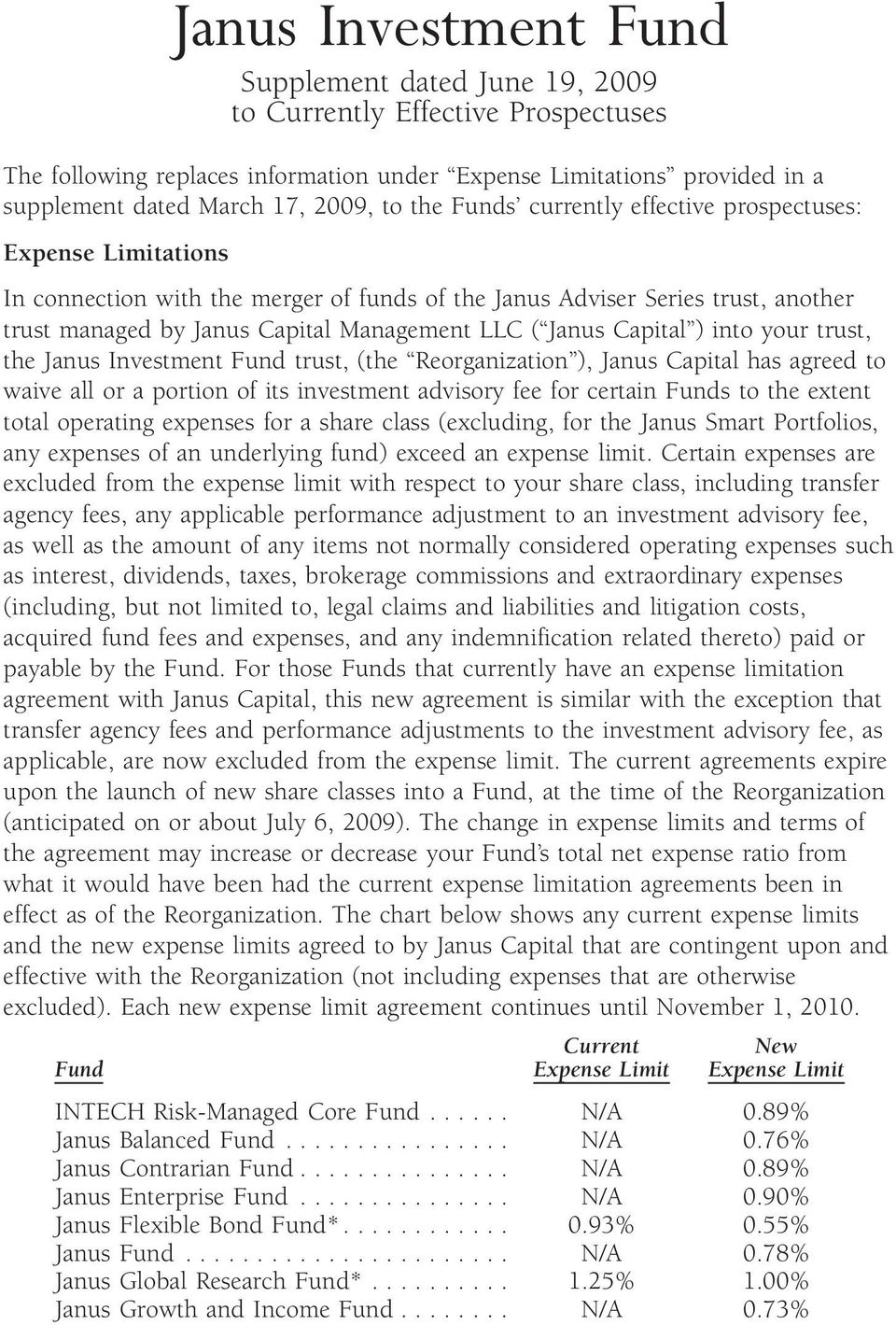
10 Fund Current Expense Limit New Expense Limit Janus High-Yield Fund* % 0.78% Janus Orion Fund..... N/A 0.90% Janus Overseas Fund... N/A 0.92% Janus Research Core Fund N/A 0.66% Janus Short-Term Bond Fund* % 0.55% Janus Smart Portfolio-Conservative* % 0.40% Janus Smart Portfolio-Growth* % 0.45% Janus Smart Portfolio-Moderate* % 0.39% Janus Triton Fund* % 1.05% Janus Worldwide Fund... N/A 1.00% Perkins Mid Cap Value Fund.... N/A 0.86% Perkins Small Cap Value Fund... N/A 0.96% * For those Funds that have a current expense limitation agreement and that will enter into a new expense limitation agreement with Janus Capital, the current and estimated new total net expense ratio (showing the impact of the current and new expense limit as if those limits were in effect as of April 30, 2009, assuming average net assets for the six-month period ended April 30, 2009), are as follows: Janus Flexible Bond Fund 0.75% (current) and 0.72% (new); Janus Global Research Fund 1.25% (current) and 1.30% (new); Janus High-Yield Fund 0.91% (current) and 0.90% (new); Janus Short- Term Bond Fund 0.64% (current) and 0.72% (new); Janus Smart Portfolio-Conservative 0.84% (current) and 0.99% (new); Janus Smart Portfolio-Growth 1.00% (current) and 1.16% (new); Janus Smart Portfolio-Moderate 0.91% (current) and 1.06% (new); and Janus Triton Fund 1.26% (current) and 1.24% (new). Such new expenses reflect the exclusion of certain expenses from the expense limits and the elimination of an annual $4 per account fee, but do not reflect any impact of additional assets merging into a Fund in connection with the Reorganization. It is important for you to know that a decline in a Fund s average net assets during the current fiscal year, as a result of market volatility or other factors, could cause the Fund s expense ratio to be higher than the fees and expenses shown, which means you could pay more if you buy or hold shares of the Fund. Significant declines in a Fund s net assets will increase the Fund s total expense ratio, likely significantly. More current total net asset information is available on janus.com. Investors in the Funds should consider this information in making a long-term investment decision. Please retain this Supplement with your records. 07JAN

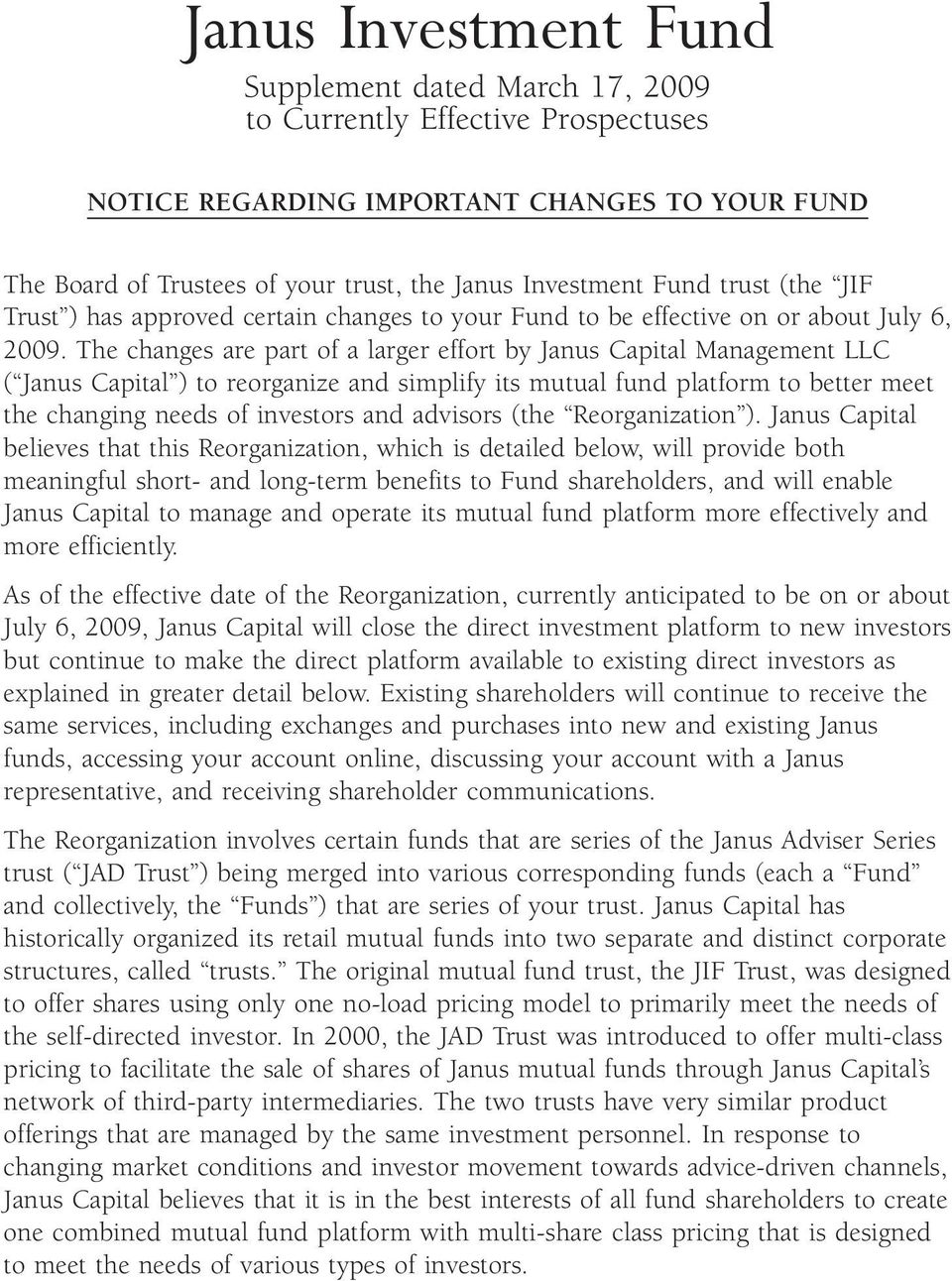
11 Janus Investment Fund Supplement dated March 17, 2009 to Currently Effective Prospectuses NOTICE REGARDING IMPORTANT CHANGES TO YOUR FUND The Board of Trustees of your trust, the Janus Investment Fund trust (the JIF Trust ) has approved certain changes to your Fund to be effective on or about July 6, The changes are part of a larger effort by Janus Capital Management LLC ( Janus Capital ) to reorganize and simplify its mutual fund platform to better meet the changing needs of investors and advisors (the Reorganization ). Janus Capital believes that this Reorganization, which is detailed below, will provide both meaningful short- and long-term benefits to Fund shareholders, and will enable Janus Capital to manage and operate its mutual fund platform more effectively and more efficiently. As of the effective date of the Reorganization, currently anticipated to be on or about July 6, 2009, Janus Capital will close the direct investment platform to new investors but continue to make the direct platform available to existing direct investors as explained in greater detail below. Existing shareholders will continue to receive the same services, including exchanges and purchases into new and existing Janus funds, accessing your account online, discussing your account with a Janus representative, and receiving shareholder communications. The Reorganization involves certain funds that are series of the Janus Adviser Series trust ( JAD Trust ) being merged into various corresponding funds (each a Fund and collectively, the Funds ) that are series of your trust. Janus Capital has historically organized its retail mutual funds into two separate and distinct corporate structures, called trusts. The original mutual fund trust, the JIF Trust, was designed to offer shares using only one no-load pricing model to primarily meet the needs of the self-directed investor. In 2000, the JAD Trust was introduced to offer multi-class pricing to facilitate the sale of shares of Janus mutual funds through Janus Capital s network of third-party intermediaries. The two trusts have very similar product offerings that are managed by the same investment personnel. In response to changing market conditions and investor movement towards advice-driven channels, Janus Capital believes that it is in the best interests of all fund shareholders to create one combined mutual fund platform with multi-share class pricing that is designed to meet the needs of various types of investors.
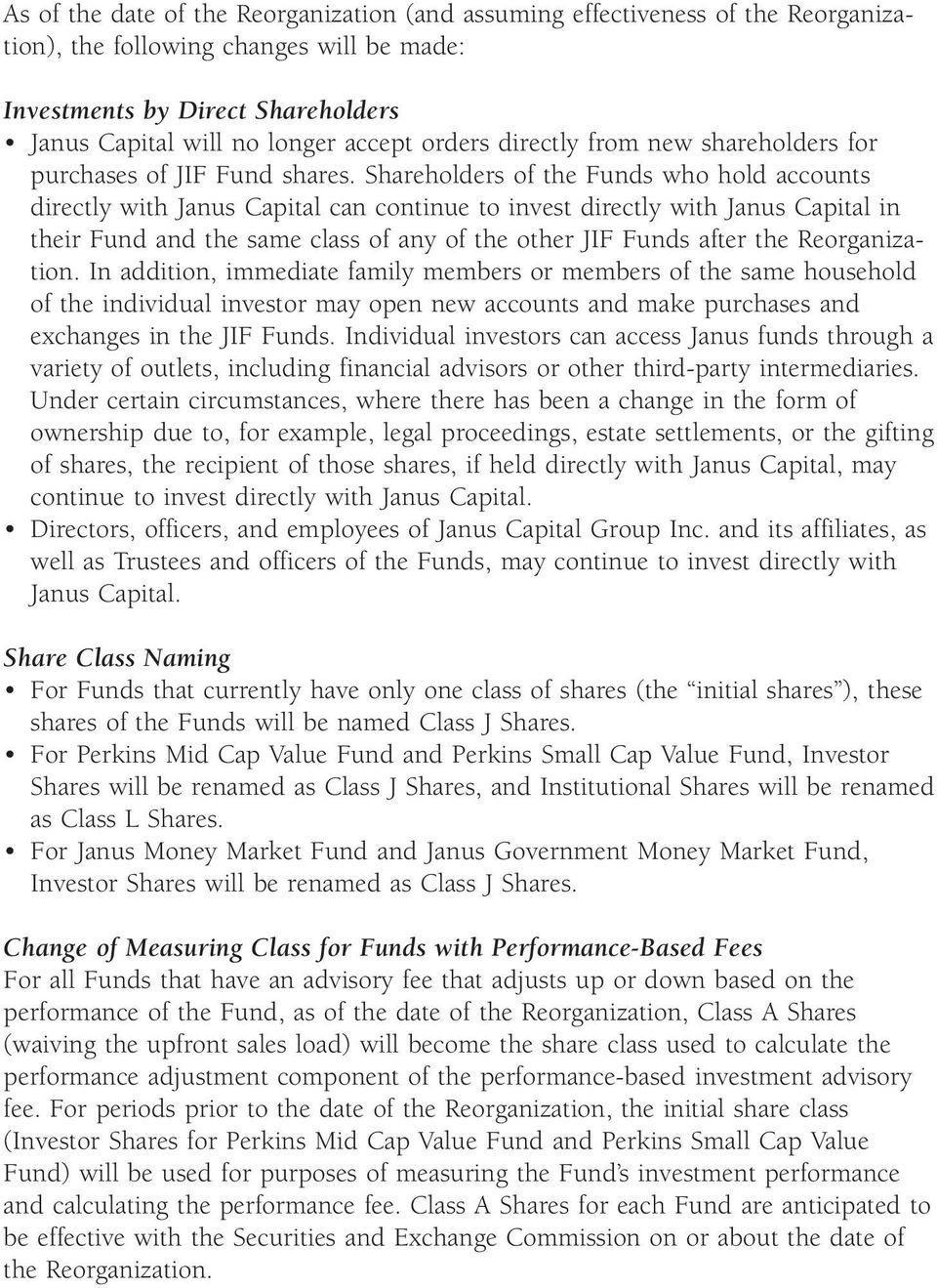
12 As of the date of the Reorganization (and assuming effectiveness of the Reorganization), the following changes will be made: Investments by Direct Shareholders Janus Capital will no longer accept orders directly from new shareholders for purchases of JIF Fund shares. Shareholders of the Funds who hold accounts directly with Janus Capital can continue to invest directly with Janus Capital in their Fund and the same class of any of the other JIF Funds after the Reorganization. In addition, immediate family members or members of the same household of the individual investor may open new accounts and make purchases and exchanges in the JIF Funds. Individual investors can access Janus funds through a variety of outlets, including financial advisors or other third-party intermediaries. Under certain circumstances, where there has been a change in the form of ownership due to, for example, legal proceedings, estate settlements, or the gifting of shares, the recipient of those shares, if held directly with Janus Capital, may continue to invest directly with Janus Capital. Directors, officers, and employees of Janus Capital Group Inc. and its affiliates, as well as Trustees and officers of the Funds, may continue to invest directly with Janus Capital. Share Class Naming For Funds that currently have only one class of shares (the initial shares ), these shares of the Funds will be named Class J Shares. For Perkins Mid Cap Value Fund and Perkins Small Cap Value Fund, Investor Shares will be renamed as Class J Shares, and Institutional Shares will be renamed as Class L Shares. For Janus Money Market Fund and Janus Government Money Market Fund, Investor Shares will be renamed as Class J Shares. Change of Measuring Class for Funds with Performance-Based Fees For all Funds that have an advisory fee that adjusts up or down based on the performance of the Fund, as of the date of the Reorganization, Class A Shares (waiving the upfront sales load) will become the share class used to calculate the performance adjustment component of the performance-based investment advisory fee. For periods prior to the date of the Reorganization, the initial share class (Investor Shares for Perkins Mid Cap Value Fund and Perkins Small Cap Value Fund) will be used for purposes of measuring the Fund s investment performance and calculating the performance fee. Class A Shares for each Fund are anticipated to be effective with the Securities and Exchange Commission on or about the date of the Reorganization.
13 Investment Advisory Fee for Janus Flexible Bond Fund In connection with the Reorganization (and assuming consummation of the Reorganization), Janus Flexible Bond Fund s investment advisory fee rate will change as noted in the following table. Janus Flexible Bond Fund will be acquiring Janus Adviser Flexible Bond Fund, a series of the JAD Trust. The potential impact of this Reorganization on the investment advisory fee rate is shown below, assuming the Reorganization occurred on October 31, Advisory Fee Rate Schedule Effective Advisory Fee Rate Current Pro Forma Current Pro Forma First $300 million: 0.58% First $300 million: 0.50% Over $300 million: 0.48% Over $300 million: 0.40% 0.52% 0.43% Expense Limitations In connection with the Reorganization, Janus Capital has agreed to waive all or a portion of its investment advisory fee for certain Funds to the extent total operating expenses for a share class (excluding, for the Janus Smart Portfolios, any expenses of an underlying fund) exceed an expense limit. Certain expenses are excluded from the expense limit with respect to your share class, including transfer agency fees, any applicable performance adjustment to an investment advisory fee, as well as the amount of any items not normally considered operating expenses such as interest, dividends, taxes, brokerage commissions and extraordinary expenses (including, but not limited to, legal claims and liabilities and litigation costs, acquired fund fees and expenses, and any indemnification related thereto) paid or payable by the Fund. For those Funds that currently have an expense limitation agreement with Janus Capital, this new agreement is similar with the exception that transfer agency fees and performance adjustments to the investment advisory fee, as applicable, are now excluded from the expense limit. The current agreements expire upon the launch of new share classes into a Fund, at the time of the Reorganization (anticipated on or about July 6, 2009). The change in expense limits and terms of the agreement may increase or decrease your Fund s total net expense ratio from what it would have been had the current expense limitation agreements been in effect as of the Reorganization. The chart below shows any current expense limits and the new expense limits agreed to by Janus Capital that are contingent upon and effective with the Reorganization (not including expenses that are otherwise excluded). Each new expense limit agreement continues until November 1, 2010.

14 Fund Current Expense Limit New Expense Limit INTECH Risk-Managed Core Fund N/A 0.89% Janus Balanced Fund N/A 0.76% Janus Contrarian Fund N/A 0.89% Janus Enterprise Fund N/A 0.90% Janus Flexible Bond Fund* 0.93% 0.55% Janus Fund N/A 0.78% Janus Growth and Income Fund N/A 0.73% Janus High-Yield Fund* 0.90% 0.78% Janus Orion Fund N/A 0.90% Janus Overseas Fund N/A 0.92% Janus Research Core Fund N/A 0.66% Janus Short-Term Bond Fund* 0.64% 0.55% Janus Smart Portfolio-Conservative* 0.17% 0.40% Janus Smart Portfolio-Growth* 0.24% 0.45% Janus Smart Portfolio-Moderate* 0.20% 0.39% Janus Triton Fund* 1.25% 1.05% Janus Worldwide Fund N/A 1.00% Perkins Mid Cap Value Fund N/A 0.86% Perkins Small Cap Value Fund N/A 0.96% * For those Funds that have a current expense limitation agreement and that will enter into a new expense limitation agreement with Janus Capital, the total net expense ratio, showing the impact of the current and new expense limit as if those limits were in effect as of October 31, 2008, are as follows: Janus Flexible Bond Fund 0.78% (current) and 0.73% (new); Janus High-Yield Fund 0.91% (current) and 0.91% (new); Janus Short-Term Bond Fund 0.65% (current) and 0.74% (new); Janus Smart Portfolio-Conservative 0.96% (current) and 1.04% (new); Janus Smart Portfolio-Growth 1.07% (current) and 1.08% (new); Janus Smart Portfolio-Moderate 1.01% (current) and 1.04% (new); and Janus Triton Fund 1.21% (current) and 1.21% (new). Investors in the Funds should consider this information in making a long-term investment decision. Please retain this Supplement with your records

15 This Prospectus describes eleven portfolios (each, a Fund and collectively, the Funds ) of Janus Investment Fund (the Trust ) with a variety of investment objectives. Janus Capital Management LLC ( Janus Capital or Janus ) serves as investment adviser to each Fund.

16 TABLE OF CONTENTS RISK/RETURN SUMMARY Janus Balanced Fund... 2 Janus Contrarian Fund... 7 Janus Enterprise Fund Janus Fund Janus Growth and Income Fund Janus Orion Fund Janus Research Core Fund Janus Research Fund Janus Triton Fund Janus Twenty Fund Janus Venture Fund FEES AND EXPENSES PRINCIPAL INVESTMENT STRATEGIES AND RISKS Frequently asked questions about principal investment strategies Risks Frequently asked questions about certain risks General portfolio policies MANAGEMENT OF THE FUNDS Investment adviser Payments to financial intermediaries by Janus Capital or its affiliates.. 65 Management expenses Investment personnel OTHER INFORMATION DISTRIBUTIONS AND TAXES SHAREHOLDER S MANUAL Doing business with Janus Minimum investments Types of account ownership To open an account or buy shares To exchange shares To sell shares Excessive trading Shareholder services and account policies FINANCIAL HIGHLIGHTS GLOSSARY OF INVESTMENT TERMS Table of contents 1

17 RISK/RETURN SUMMARY JANUS BALANCED FUND Janus Balanced Fund (the Fund ) is designed for long-term investors who primarily seek growth of capital and who can tolerate the greater risks associated with common stock investments. Although the Fund may also emphasize some degree of income, it is not designed for investors who desire a certain level of income. Investment Objective Janus Balanced Fund seeks long-term capital growth, consistent with preservation of capital and balanced by current income. The Fund s Board of Trustees may change this objective or the Fund s principal investment strategies without a shareholder vote. The Fund will notify you in writing at least 60 days before making any change to the investment objective or principal investment strategies it considers material. If there is a material change to the Fund s objective or principal investment strategies, you should consider whether the Fund remains an appropriate investment for you. There is no guarantee that the Fund will achieve its investment objective. Principal Investment Strategies The Fund pursues its investment objective by normally investing 50-60% of its assets in equity securities selected primarily for their growth potential and 40-50% of its assets in securities selected primarily for their income potential. The Fund normally invests at least 25% of its assets in fixed-income senior securities. The portfolio managers share day-to-day responsibility for the Fund s investments. In choosing investments for the Fund, the portfolio managers apply a bottom up approach with one portfolio manager focusing on the equity portion of the Fund and the other portfolio manager focusing on the fixed-income portion of the Fund. In other words, the portfolio managers look at companies one at a time to determine if a company is an attractive investment opportunity and if it is consistent with the Fund s investment policies. If the portfolio managers are unable to find such investments, the Fund s uninvested assets may be held in cash or similar investments, subject to the Fund s specific investment policies. Within the parameters of its specific investment policies, the Fund may invest in foreign equity and debt securities, which may include investments in emerging markets. Within the parameters of its specific investment policies, the Fund may invest its assets in derivatives. The Fund may use derivatives for different purposes, including hedging (to offset risks associated with an investment, currency exposure, or market conditions) and to earn income and enhance returns. For 2 Janus Investment Fund

18 more information on derivatives, please refer to Other Types of Investments in this Prospectus, with further detail in the Statement of Additional Information. Main Investment Risks The biggest risk is that the Fund s returns may vary, and you could lose money. The Fund is designed for long-term investors interested in a balanced portfolio, including common stocks and bonds. Common stocks tend to be more volatile than many other investment choices. Market Risk. The value of the Fund s portfolio may decrease if the value of an individual company or multiple companies in the portfolio decreases or if the portfolio managers belief about a company s intrinsic worth is incorrect. Regardless of how well individual companies perform, the value of the Fund s portfolio could also decrease if there are deteriorating economic or market conditions, including, but not limited to, a general decline in prices on the stock markets, a general decline in real estate markets, a decline in commodities prices, or if the market favors different types of securities than the types of securities in which the Fund invests. If the value of the Fund s portfolio decreases, the Fund s net asset value ( NAV ) will also decrease, which means if you sell your shares in the Fund you may lose money. Growth Securities Risk. The Fund often invests in companies after assessing their growth potential. Securities of growth companies may be more volatile than other stocks. If the portfolio managers perception of a company s growth potential is not realized, the securities purchased may not perform as expected, reducing the Fund s return. In addition, because different types of stocks tend to shift in and out of favor depending on market and economic conditions, growth stocks may perform differently from the market as a whole and other types of securities. Fixed-Income Securities Risk. The income component of the Fund s holdings includes fixed-income securities. Typically, the values of fixed-income securities change inversely with interest rates. Therefore, a fundamental risk of fixed-income securities is that their value will generally decline as interest rates rise which may cause the Fund s NAV to likewise decrease, and vice versa. How specific fixedincome securities may react to changes in interest rates will depend on the specific characteristics of each security. For example, while securities with longer maturities tend to produce higher yields, they also tend to be more sensitive to changes in interest rates and are therefore more volatile than shorter-term securities and are subject to greater market fluctuations as a result of changes in interest rates. Fixed-income securities are also subject to credit risk, which is the risk that the credit strength of an issuer of a fixed-income security will weaken and/or the issuer will be unable to make timely principal and interest payments and that the security may go into default. In addition, there is the risk that Risk/return summary 3
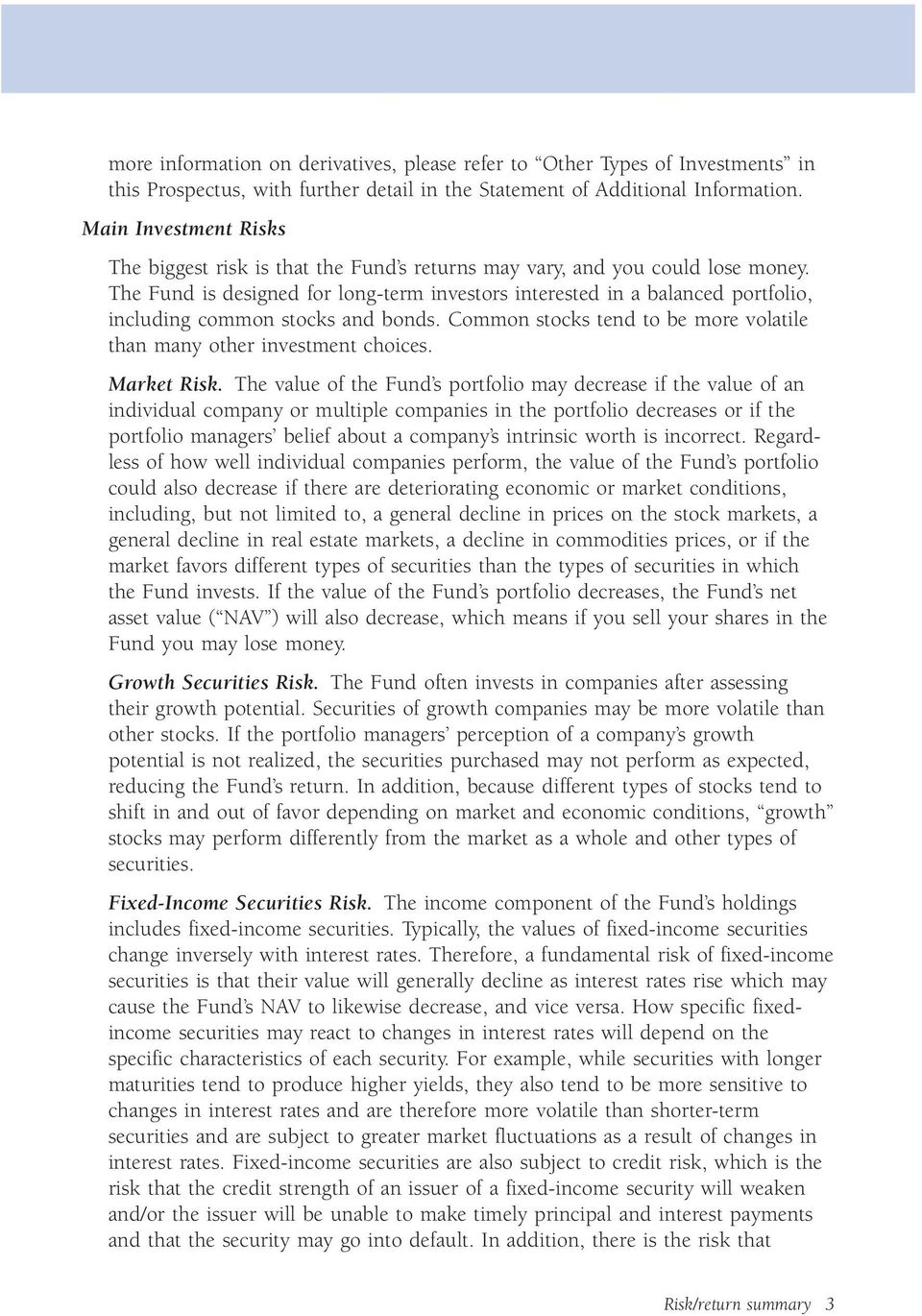
19 during periods of falling interest rates, certain fixed-income securities with higher interest rates, such as mortgage- and asset-backed securities, may be prepaid by the issuer thereby reducing the amount of interest payments and may result in the Fund having to reinvest its proceeds in lower yielding securities. Collateral related to such investments also may be subject to a higher degree of credit risk, valuation risk, and liquidity risk. Foreign Exposure Risk. The Fund may have significant exposure to foreign markets, including emerging markets, which can be more volatile than the U.S. markets. As a result, its returns and NAV may be affected to a large degree by fluctuations in currency exchange rates or political or economic conditions in a particular country. A market swing in one or more countries or regions where the Fund has invested a significant amount of its assets may have a greater effect on the Fund s performance than it would in a more geographically diversified portfolio. The Fund s investments in emerging market countries may involve risks greater than, or in addition to, the risks of investing in more developed countries. Derivatives Risk. Derivatives can be highly volatile and involve risks in addition to the risks of the underlying referenced securities. Gains or losses from derivatives can be substantially greater than the derivatives original cost, and can therefore involve leverage. Derivatives can be complex instruments and may involve analysis that differs from that required for other investment types used by the Fund. If the value of a derivative does not correlate well with the particular market or other asset class to which the derivative is intended to provide exposure, the derivative may not have the anticipated effect. Derivatives can also reduce the opportunity for gain or result in losses by offsetting positive returns in other investments. Derivatives can be less liquid than other types of investments. Derivatives entail the risk that the counterparty will default on its payment obligations to the Fund. If the counterparty to a derivative transaction defaults, the Fund would risk the loss of the net amount of the payments that it contractually is entitled to receive. An investment in the Fund is not a bank deposit and is not insured or guaranteed by the Federal Deposit Insurance Corporation or any other government agency. Performance Information The following information provides some indication of the risks of investing in the Fund by showing how the Fund s performance has varied over time. The bar chart depicts the change in performance from year to year during the periods indicated. The table compares the Fund s average annual returns for the periods indicated to broad-based securities market indices. The indices are not actively managed and are not available for direct investment. All figures assume reinvestment of dividends and distributions. 4 Janus Investment Fund
20 The Fund s past performance (before and after taxes) does not necessarily indicate how it will perform in the future. Janus Balanced Fund Annual returns for periods ended 12/31 40% 23.51% 13.74% 8.71% 7.75% 10.56% 10.15% (2.16)% (5.04)% (6.56)% (15.22)% % 20% 10% 0% (10)% (20)% Best Quarter: 4th % Worst Quarter: 3rd-2008 (7.55)% Average annual total return for periods ended 12/31/08 1 year 5 years 10 years Since Inception (9/1/92) Janus Balanced Fund Return Before Taxes (15.22)% 3.88% 3.96% 9.35% Return After Taxes on Distributions (16.44)% 3.01% 2.91% 7.73% Return After Taxes on Distributions and Sale of Fund Shares (1) (9.00)% 3.05% 2.91% 7.40% S&P 500 Index (2) (37.00)% (2.19)% (1.38)% 6.91% (reflects no deduction for expenses, fees, or taxes) Barclays Capital U.S. Government/Credit Bond Index (3) 5.70% 4.64% 5.64% 6.43% (reflects no deduction for expenses, fees, or taxes) Balanced Index (4) (19.84)% 1.07% 2.06% 6.99% (reflects no deduction for expenses, fees, or taxes) (1) If the Fund incurs a loss, which generates a tax benefit, the Return After Taxes on Distributions and Sale of Fund Shares may exceed the Fund s other return figures. (2) The Standard & Poor s ( S&P ) 500 Index is a commonly recognized, market-capitalization weighted index of 500 widely held equity securities, designed to measure broad U.S. equity performance. (3) The Barclays Capital U.S. Government/Credit Bond Index (formerly named Lehman Brothers U.S. Government/Credit Bond Index) is composed of all bonds that are of investment grade with at least one year until maturity. Pursuant to an acquisition, the Lehman Brothers indices were acquired by Barclays Capital. (4) The Balanced Index is a hypothetical combination of unmanaged indices. This internally calculated index combines the total returns from the S&P 500 Index (55%) and the Barclays Capital U.S. Government/Credit Bond Index (formerly named Lehman Brothers U.S. Government/Credit Bond Index) (45%). Pursuant to an acquisition, the Lehman Brothers indices were acquired by Barclays Capital. Risk/return summary 5

21 After-tax returns are calculated using the historically highest individual federal marginal income tax rates and do not reflect the impact of state and local taxes. Actual after-tax returns depend on your individual tax situation and may differ from those shown in the preceding table. The after-tax return information shown above does not apply to Fund shares held through a tax-deferred account, such as a 401(k) plan or an IRA. 6 Janus Investment Fund
22 JANUS CONTRARIAN FUND Janus Contrarian Fund (the Fund ) is designed for long-term investors who primarily seek growth of capital and who can tolerate the greater risks associated with common stock investments. Investment Objective Janus Contrarian Fund seeks long-term growth of capital. The Fund s Board of Trustees may change this objective or the Fund s principal investment strategies without a shareholder vote. The Fund will notify you in writing at least 60 days before making any change to the investment objective or principal investment strategies it considers material. If there is a material change to the Fund s objective or principal investment strategies, you should consider whether the Fund remains an appropriate investment for you. There is no guarantee that the Fund will achieve its investment objective. Principal Investment Strategies The Fund pursues its investment objective by investing, under normal circumstances, at least 80% of its net assets in equity securities with the potential for long-term growth of capital. The portfolio manager emphasizes investments in companies with attractive price/free cash flow, which is the relationship between the price of a stock and the company s available cash from operations, minus capital expenditures. The portfolio manager will typically seek attractively valued companies that are improving their free cash flow and returns on invested capital. Such companies may also include special situations companies that are experiencing management changes and/or are currently out of favor. The portfolio manager applies a bottom up approach in choosing investments. In other words, the portfolio manager looks at companies one at a time to determine if a company is an attractive investment opportunity and if it is consistent with the Fund s investment policies. If the portfolio manager is unable to find such investments, the Fund s uninvested assets may be held in cash or similar investments, subject to the Fund s specific investment policies. Within the parameters of its specific investment policies, the Fund may invest in foreign equity and debt securities, which may include investments in emerging markets. Within the parameters of its specific investment policies, the Fund may invest its assets in derivatives. The Fund may use derivatives for different purposes, including hedging (to offset risks associated with an investment, currency exposure, or market conditions) and to earn income and enhance returns. For Risk/return summary 7
23 more information on derivatives, please refer to Other Types of Investments in this Prospectus, with further detail in the Statement of Additional Information. Main Investment Risks The biggest risk is that the Fund s returns may vary, and you could lose money. The Fund is designed for long-term investors interested in an equity portfolio, including common stocks. Common stocks tend to be more volatile than many other investment choices. Value Investing Risk. Because different types of stocks tend to shift in and out of favor depending on market and economic conditions, value stocks may perform differently from the market as a whole and other types of stocks and can continue to be undervalued by the market for long periods of time. It is also possible that a value stock may never appreciate to the extent expected. Market Risk. The value of the Fund s portfolio may decrease if the value of an individual company or multiple companies in the portfolio decreases or if the portfolio manager s belief about a company s intrinsic worth is incorrect. Regardless of how well individual companies perform, the value of the Fund s portfolio could also decrease if there are deteriorating economic or market conditions, including, but not limited to, a general decline in prices on the stock markets, a general decline in real estate markets, a decline in commodities prices, or if the market favors different types of securities than the types of securities in which the Fund invests. If the value of the Fund s portfolio decreases, the Fund s net asset value ( NAV ) will also decrease, which means if you sell your shares in the Fund you may lose money. Growth Securities Risk. The Fund often invests in companies after assessing their growth potential. Securities of growth companies may be more volatile than other stocks. If the portfolio manager s perception of a company s growth potential is not realized, the securities purchased may not perform as expected, reducing the Fund s return. In addition, because different types of stocks tend to shift in and out of favor depending on market and economic conditions, growth stocks may perform differently from the market as a whole and other types of securities. Nondiversification Risk. The Fund is classified as nondiversified under the Investment Company Act of 1940, as amended. As a result, an increase or decrease in the value of a single security may have a greater impact on the Fund s NAV and total return. Being nondiversified may also make the Fund more susceptible to financial, economic, political, or other developments that may impact a security. Although the Fund may ordinarily satisfy the requirements for a diversified fund and has operated as diversified, its nondiversified classification gives the Fund s portfolio manager more flexibility to hold larger positions in a smaller number of securities than a fund that is classified as diversified. 8 Janus Investment Fund
24 Foreign Exposure Risk. The Fund may have significant exposure to foreign markets, including emerging markets, which can be more volatile than the U.S. markets. As a result, its returns and NAV may be affected to a large degree by fluctuations in currency exchange rates or political or economic conditions in a particular country. A market swing in one or more countries or regions where the Fund has invested a significant amount of its assets may have a greater effect on the Fund s performance than it would in a more geographically diversified portfolio. The Fund s investments in emerging market countries may involve risks greater than, or in addition to, the risks of investing in more developed countries. As of October 31, 2008, approximately 11.9% of the Fund s investments were in emerging markets. Derivatives Risk. Derivatives can be highly volatile and involve risks in addition to the risks of the underlying referenced securities. Gains or losses from derivatives can be substantially greater than the derivatives original cost, and can therefore involve leverage. Derivatives can be complex instruments and may involve analysis that differs from that required for other investment types used by the Fund. If the value of a derivative does not correlate well with the particular market or other asset class to which the derivative is intended to provide exposure, the derivative may not have the anticipated effect. Derivatives can also reduce the opportunity for gain or result in losses by offsetting positive returns in other investments. Derivatives can be less liquid than other types of investments. Derivatives entail the risk that the counterparty will default on its payment obligations to the Fund. If the counterparty to a derivative transaction defaults, the Fund would risk the loss of the net amount of the payments that it contractually is entitled to receive. An investment in the Fund is not a bank deposit and is not insured or guaranteed by the Federal Deposit Insurance Corporation or any other government agency. Performance Information The following information provides some indication of the risks of investing in the Fund by showing how the Fund s performance has varied over time. The bar chart depicts the change in performance from year to year during the periods indicated. The table compares the Fund s average annual returns for the periods indicated to broad-based securities market indices. The indices are not actively managed and are not available for direct investment. All figures assume reinvestment of dividends and distributions. The Fund s past performance (before and after taxes) does not necessarily indicate how it will perform in the future. Risk/return summary 9
25 Janus Contrarian Fund Annual returns for periods ended 12/31 80% 53.26% 22.61% 16.02% 24.58% 21.22% (11.74)% (23.70)% (48.11)% % 40% 20% 0% (20)% (40)% (60)% Best Quarter: 2nd % Worst Quarter: 4th-2008 (27.53)% Average annual total return for periods ended 12/31/08 1 year 5 years Since Inception (2/29/00) Janus Contrarian Fund Return Before Taxes (48.11)% 2.20% 2.46% Return After Taxes on Distributions (48.46)% 1.50% 1.94% Return After Taxes on Distributions and Sale of Fund Shares (1) (30.85)% 2.13% 2.18% S&P 500 Index (2) (37.00)% (2.19)% (2.89)% (reflects no deduction for expenses, fees, or taxes) Morgan Stanley Capital International All Country World Index SM(3) (42.20)% (0.06)% (2.26)% (reflects no deduction for expenses, fees, or taxes) (1) If the Fund incurs a loss, which generates a tax benefit, the Return After Taxes on Distributions and Sale of Fund Shares may exceed the Fund s other return figures. (2) The Standard & Poor s ( S&P ) 500 Index is a commonly recognized, market-capitalization weighted index of 500 widely held equity securities, designed to measure broad U.S. equity performance. (3) The Morgan Stanley Capital International ( MSCI ) All Country World Index SM is an unmanaged, free float-adjusted, market capitalization weighted index composed of stocks of companies located in countries throughout the world. It is designed to measure equity market performance in global developed and emerging markets. The index includes reinvestment of dividends, net of foreign withholding taxes. After-tax returns are calculated using the historically highest individual federal marginal income tax rates and do not reflect the impact of state and local taxes. Actual after-tax returns depend on your individual tax situation and may differ from those shown in the preceding table. The after-tax return information shown above does not apply to Fund shares held through a tax-deferred account, such as a 401(k) plan or an IRA. 10 Janus Investment Fund
26 JANUS ENTERPRISE FUND Janus Enterprise Fund (the Fund ) is designed for long-term investors who primarily seek growth of capital and who can tolerate the greater risks associated with common stock investments. Investment Objective Janus Enterprise Fund seeks long-term growth of capital. The Fund s Board of Trustees may change this objective or the Fund s principal investment strategies without a shareholder vote. The Fund will notify you in writing at least 60 days before making any change to the investment objective or principal investment strategies it considers material. If there is a material change to the Fund s objective or principal investment strategies, you should consider whether the Fund remains an appropriate investment for you. There is no guarantee that the Fund will achieve its investment objective. Principal Investment Strategies The Fund pursues its investment objective by investing primarily in common stocks selected for their growth potential, and normally invests at least 50% of its equity assets in medium-sized companies. Medium-sized companies are those whose market capitalization falls within the range of companies in the Russell Midcap Growth Index. Market capitalization is a commonly used measure of the size and value of a company. The market capitalizations within the index will vary, but as of December 31, 2008, they ranged from approximately $24 million to $14.9 billion. The portfolio manager applies a bottom up approach in choosing investments. In other words, the portfolio manager looks at companies one at a time to determine if a company is an attractive investment opportunity and if it is consistent with the Fund s investment policies. If the portfolio manager is unable to find such investments, the Fund s uninvested assets may be held in cash or similar investments, subject to the Fund s specific investment policies. Within the parameters of its specific investment policies, the Fund may invest in foreign equity and debt securities, which may include investments in emerging markets. Within the parameters of its specific investment policies, the Fund may invest its assets in derivatives. The Fund may use derivatives for different purposes, including hedging (to offset risks associated with an investment, currency exposure, or market conditions) and to earn income and enhance returns. For more information on derivatives, please refer to Other Types of Investments in this Prospectus, with further detail in the Statement of Additional Information. Risk/return summary 11
27 Main Investment Risks The biggest risk is that the Fund s returns may vary, and you could lose money. The Fund is designed for long-term investors interested in an equity portfolio, including common stocks. Common stocks tend to be more volatile than many other investment choices. Market Risk. The value of the Fund s portfolio may decrease if the value of an individual company or multiple companies in the portfolio decreases or if the portfolio manager s belief about a company s intrinsic worth is incorrect. Regardless of how well individual companies perform, the value of the Fund s portfolio could also decrease if there are deteriorating economic or market conditions, including, but not limited to, a general decline in prices on the stock markets, a general decline in real estate markets, a decline in commodities prices, or if the market favors different types of securities than the types of securities in which the Fund invests. If the value of the Fund s portfolio decreases, the Fund s net asset value ( NAV ) will also decrease, which means if you sell your shares in the Fund you may lose money. Mid-Sized Companies Risk. Due to the Fund s investments in securities issued by mid-sized companies, the Fund s NAV may fluctuate more than that of a fund investing primarily in large companies. Mid-sized companies securities may pose greater market, liquidity, and information risks because of narrow product lines and/or operating history, competitive threats, limited financial resources, limited trading markets, and the potential lack in management depth. Securities issued by mid-sized companies tend to be more volatile than securities issued by larger or more established companies. These holdings tend to be less liquid than stocks of larger companies and could have a significant adverse effect on the Fund s returns, especially as market conditions change. The Fund may also invest in securities issued by small-sized companies. Growth Securities Risk. The Fund often invests in companies after assessing their growth potential. Securities of growth companies may be more volatile than other stocks. If the portfolio manager s perception of a company s growth potential is not realized, the securities purchased may not perform as expected, reducing the Fund s return. In addition, because different types of stocks tend to shift in and out of favor depending on market and economic conditions, growth stocks may perform differently from the market as a whole and other types of securities. Foreign Exposure Risk. The Fund may have significant exposure to foreign markets, including emerging markets, which can be more volatile than the U.S. markets. As a result, its returns and NAV may be affected to a large degree by fluctuations in currency exchange rates or political or economic conditions in a particular country. A market swing in one or more countries or regions where the Fund has invested a significant amount of its assets may have a greater effect on 12 Janus Investment Fund
28 the Fund s performance than it would in a more geographically diversified portfolio. The Fund s investments in emerging market countries may involve risks greater than, or in addition to, the risks of investing in more developed countries. Derivatives Risk. Derivatives can be highly volatile and involve risks in addition to the risks of the underlying referenced securities. Gains or losses from derivatives can be substantially greater than the derivatives original cost, and can therefore involve leverage. Derivatives can be complex instruments and may involve analysis that differs from that required for other investment types used by the Fund. If the value of a derivative does not correlate well with the particular market or other asset class to which the derivative is intended to provide exposure, the derivative may not have the anticipated effect. Derivatives can also reduce the opportunity for gain or result in losses by offsetting positive returns in other investments. Derivatives can be less liquid than other types of investments. Derivatives entail the risk that the counterparty will default on its payment obligations to the Fund. If the counterparty to a derivative transaction defaults, the Fund would risk the loss of the net amount of the payments that it contractually is entitled to receive. An investment in the Fund is not a bank deposit and is not insured or guaranteed by the Federal Deposit Insurance Corporation or any other government agency. Performance Information The following information provides some indication of the risks of investing in the Fund by showing how the Fund s performance has varied over time. The bar chart depicts the change in performance from year to year during the periods indicated. The table compares the Fund s average annual returns for the periods indicated to broad-based securities market indices. The indices are not actively managed and are not available for direct investment. All figures assume reinvestment of dividends and distributions. The Fund s past performance (before and after taxes) does not necessarily indicate how it will perform in the future. Risk/return summary 13
29 Janus Enterprise Fund Annual returns for periods ended 12/31 180% % 35.82% 20.63% 21.81% 11.40% 13.22% (30.52)% (39.93)% (28.28)% (43.13)% % 120% 90% 60% 30% 0% (30)% (60)% Best Quarter: 4th % Worst Quarter: 1st-2001 (32.66)% Average annual total return for periods ended 12/31/08 1 year 5 years 10 years Since Inception (9/1/92) Janus Enterprise Fund Return Before Taxes (43.13)% 1.07% (0.50)% 7.53% Return After Taxes on Distributions (43.13)% 1.07% (0.65)% 6.80% Return After Taxes on Distributions and Sale of Fund Shares (1) (28.04)% 0.91% (0.45)% 6.41% Russell Midcap Growth Index (2) (44.32)% (2.33)% (0.19)% 6.43% (reflects no deduction for expenses, fees, or taxes) S&P MidCap 400 Index (3) (36.23)% (0.08)% 4.46% 9.96% (reflects no deduction for expenses, fees, or taxes) (1) If the Fund incurs a loss, which generates a tax benefit, the Return After Taxes on Distributions and Sale of Fund Shares may exceed the Fund s other return figures. (2) The Russell Midcap Growth Index measures the performance of those Russell Midcap companies with higher price-to-book ratios and higher forecasted growth values. The stocks are also members of the Russell 1000 Growth Index. (3) The S&P MidCap 400 Index is an unmanaged group of 400 domestic stocks chosen for their market size, liquidity, and industry group representation. After-tax returns are calculated using the historically highest individual federal marginal income tax rates and do not reflect the impact of state and local taxes. Actual after-tax returns depend on your individual tax situation and may differ from those shown in the preceding table. The after-tax return information shown above does not apply to Fund shares held through a tax-deferred account, such as a 401(k) plan or an IRA. 14 Janus Investment Fund
30 JANUS FUND Janus Fund (the Fund ) is designed for long-term investors who primarily seek growth of capital and who can tolerate the greater risks associated with common stock investments. Investment Objective Janus Fund seeks long-term growth of capital in a manner consistent with the preservation of capital. The Fund s Board of Trustees may change this objective or the Fund s principal investment strategies without a shareholder vote. The Fund will notify you in writing at least 60 days before making any change to the investment objective or principal investment strategies it considers material. If there is a material change to the Fund s objective or principal investment strategies, you should consider whether the Fund remains an appropriate investment for you. There is no guarantee that the Fund will achieve its investment objective. Principal Investment Strategies The Fund pursues its investment objective by investing primarily in common stocks selected for their growth potential. Although the Fund may invest in companies of any size, it generally invests in larger, more established companies. As of December 31, 2008, the Fund s weighted average market capitalization was $51.8 billion. The portfolio managers apply a bottom up approach in choosing investments. In other words, the portfolio managers look at companies one at a time to determine if a company is an attractive investment opportunity and if it is consistent with the Fund s investment policies. If the portfolio managers are unable to find such investments, the Fund s uninvested assets may be held in cash or similar investments, subject to the Fund s specific investment policies. Within the parameters of its specific investment policies, the Fund may invest in foreign equity and debt securities, which may include investments in emerging markets. Within the parameters of its specific investment policies, the Fund may invest its assets in derivatives. The Fund may use derivatives for different purposes, including hedging (to offset risks associated with an investment, currency exposure, or market conditions) and to earn income and enhance returns. For more information on derivatives, please refer to Other Types of Investments in this Prospectus, with further detail in the Statement of Additional Information. Risk/return summary 15
31 Main Investment Risks The biggest risk is that the Fund s returns may vary, and you could lose money. The Fund is designed for long-term investors interested in an equity portfolio, including common stocks. Common stocks tend to be more volatile than many other investment choices. Market Risk. The value of the Fund s portfolio may decrease if the value of an individual company or multiple companies in the portfolio decreases or if the portfolio managers belief about a company s intrinsic worth is incorrect. Regardless of how well individual companies perform, the value of the Fund s portfolio could also decrease if there are deteriorating economic or market conditions, including, but not limited to, a general decline in prices on the stock markets, a general decline in real estate markets, a decline in commodities prices, or if the market favors different types of securities than the types of securities in which the Fund invests. If the value of the Fund s portfolio decreases, the Fund s net asset value ( NAV ) will also decrease, which means if you sell your shares in the Fund you may lose money. Growth Securities Risk. The Fund often invests in companies after assessing their growth potential. Securities of growth companies may be more volatile than other stocks. If the portfolio managers perception of a company s growth potential is not realized, the securities purchased may not perform as expected, reducing the Fund s return. In addition, because different types of stocks tend to shift in and out of favor depending on market and economic conditions, growth stocks may perform differently from the market as a whole and other types of securities. Foreign Exposure Risk. The Fund may have significant exposure to foreign markets, including emerging markets, which can be more volatile than the U.S. markets. As a result, its returns and NAV may be affected to a large degree by fluctuations in currency exchange rates or political or economic conditions in a particular country. A market swing in one or more countries or regions where the Fund has invested a significant amount of its assets may have a greater effect on the Fund s performance than it would in a more geographically diversified portfolio. The Fund s investments in emerging market countries may involve risks greater than, or in addition to, the risks of investing in more developed countries. Derivatives Risk. Derivatives can be highly volatile and involve risks in addition to the risks of the underlying referenced securities. Gains or losses from derivatives can be substantially greater than the derivatives original cost, and can therefore involve leverage. Derivatives can be complex instruments and may involve analysis that differs from that required for other investment types used by the Fund. If the value of a derivative does not correlate well with the particular market or other asset class to which the derivative is intended to provide 16 Janus Investment Fund
32 exposure, the derivative may not have the anticipated effect. Derivatives can also reduce the opportunity for gain or result in losses by offsetting positive returns in other investments. Derivatives can be less liquid than other types of investments. Derivatives entail the risk that the counterparty will default on its payment obligations to the Fund. If the counterparty to a derivative transaction defaults, the Fund would risk the loss of the net amount of the payments that it contractually is entitled to receive. An investment in the Fund is not a bank deposit and is not insured or guaranteed by the Federal Deposit Insurance Corporation or any other government agency. Performance Information The following information provides some indication of the risks of investing in the Fund by showing how the Fund s performance has varied over time. The bar chart depicts the change in performance from year to year during the periods indicated. The table compares the Fund s average annual returns for the periods indicated to broad-based securities market indices. The indices are not actively managed and are not available for direct investment. All figures assume reinvestment of dividends and distributions. The Fund s past performance (before and after taxes) does not necessarily indicate how it will perform in the future. Risk/return summary 17
33 Janus Fund Annual returns for periods ended 12/31 80% 47.13% 31.71% 10.59% 15.22% (14.91)% (26.10)% (27.56)% 4.69% 3.98% (39.84)% % 40% 20% 0% (20)% (40)% (60)% Best Quarter: 4th % Worst Quarter: 3rd-2001 (25.82)% Average annual total return for periods ended 12/31/08 1 year 5 years 10 years Since Inception (2/5/70) Janus Fund Return Before Taxes (39.84)% (3.55)% (3.01)% 11.92% Return After Taxes on Distributions (39.93)% (3.61)% (3.51)% 9.19% Return After Taxes on Distributions and Sale of Fund Shares (1) (25.79)% (2.98)% (2.44)% 9.16% Russell 1000 Growth Index (2) (38.44)% (3.42)% (4.27)% N/A (reflects no deduction for expenses, fees, or taxes) S&P 500 Index (3) (37.00)% (2.19)% (1.38)% 9.69% (reflects no deduction for expenses, fees, or taxes) (1) If the Fund incurs a loss, which generates a tax benefit, the Return After Taxes on Distributions and Sale of Fund Shares may exceed the Fund s other return figures. (2) The Russell 1000 Growth Index measures the performance of those Russell 1000 companies with higher price-to-book ratios and higher forecasted growth values. (3) The Standard & Poor s ( S&P ) 500 Index is a commonly recognized, market-capitalization weighted index of 500 widely held equity securities, designed to measure broad U.S. equity performance. After-tax returns are calculated using the historically highest individual federal marginal income tax rates and do not reflect the impact of state and local taxes. Actual after-tax returns depend on your individual tax situation and may differ from those shown in the preceding table. The after-tax return information shown above does not apply to Fund shares held through a tax-deferred account, such as a 401(k) plan or an IRA. 18 Janus Investment Fund
34 JANUS GROWTH AND INCOME FUND Janus Growth and Income Fund (the Fund ) is designed for long-term investors who primarily seek growth of capital and who can tolerate the greater risks associated with common stock investments. Although the Fund may also emphasize some degree of income, it is not designed for investors who desire a certain level of income. Investment Objective Janus Growth and Income Fund seeks long-term capital growth and current income. The Fund s Board of Trustees may change this objective or the Fund s principal investment strategies without a shareholder vote. The Fund will notify you in writing at least 60 days before making any change to the investment objective or principal investment strategies it considers material. If there is a material change to the Fund s objective or principal investment strategies, you should consider whether the Fund remains an appropriate investment for you. There is no guarantee that the Fund will achieve its investment objective. Principal Investment Strategies The Fund pursues its investment objective by normally emphasizing investments in common stocks. The Fund will normally invest up to 75% of its assets in equity securities selected primarily for their growth potential and at least 25% of its assets in securities the portfolio manager believes have income potential. Eligible equity securities in which the Fund may invest include: domestic and foreign common stocks preferred stocks securities convertible into common stocks or preferred stocks, such as convertible preferred stocks, bonds, and debentures other securities with equity characteristics Equity securities may make up part or all of the income component if they currently pay dividends or the portfolio manager believes they have potential for increasing or commencing dividend payments. The Fund is not designed for investors who need consistent income, and the Fund s investment strategies could result in significant fluctuations of income. The portfolio manager applies a bottom up approach in choosing investments. In other words, the portfolio manager looks at companies one at a time to determine if a company is an attractive investment opportunity and if it is consistent with the Fund s investment policies. If the portfolio manager is unable Risk/return summary 19
35 to find such investments, the Fund s uninvested assets may be held in cash or similar investments, subject to the Fund s specific investment policies. Within the parameters of its specific investment policies, the Fund may invest in foreign equity and debt securities, which may include investments in emerging markets. Within the parameters of its specific investment policies, the Fund may invest its assets in derivatives. The Fund may use derivatives for different purposes, including hedging (to offset risks associated with an investment, currency exposure, or market conditions) and to earn income and enhance returns. For more information on derivatives, please refer to Other Types of Investments in this Prospectus, with further detail in the Statement of Additional Information. Main Investment Risks The biggest risk is that the Fund s returns may vary, and you could lose money. The Fund is designed for long-term investors interested in an equity portfolio, including common stocks. Common stocks tend to be more volatile than many other investment choices. Market Risk. The value of the Fund s portfolio may decrease if the value of an individual company or multiple companies in the portfolio decreases or if the portfolio manager s belief about a company s intrinsic worth is incorrect. Regardless of how well individual companies perform, the value of the Fund s portfolio could also decrease if there are deteriorating economic or market conditions, including, but not limited to, a general decline in prices on the stock markets, a general decline in real estate markets, a decline in commodities prices, or if the market favors different types of securities than the types of securities in which the Fund invests. If the value of the Fund s portfolio decreases, the Fund s net asset value ( NAV ) will also decrease, which means if you sell your shares in the Fund you may lose money. Growth Securities Risk. The Fund often invests in companies after assessing their growth potential. Securities of growth companies may be more volatile than other stocks. If the portfolio manager s perception of a company s growth potential is not realized, the securities purchased may not perform as expected, reducing the Fund s return. In addition, because different types of stocks tend to shift in and out of favor depending on market and economic conditions, growth stocks may perform differently from the market as a whole and other types of securities. Fixed-Income Securities Risk. The income component of the Fund s holdings may include fixed-income securities. Typically, the values of fixed-income securities change inversely with interest rates. Therefore, a fundamental risk of fixedincome securities is that their value will generally decline as interest rates rise which may cause the Fund s NAV to likewise decrease, and vice versa. How 20 Janus Investment Fund
36 specific fixed-income securities may react to changes in interest rates will depend on the specific characteristics of each security. For example, while securities with longer maturities tend to produce higher yields, they also tend to be more sensitive to changes in interest rates and are therefore more volatile than shorterterm securities and are subject to greater market fluctuations as a result of changes in interest rates. Fixed-income securities are also subject to credit risk, which is the risk that the credit strength of an issuer of a fixed-income security will weaken and/or the issuer will be unable to make timely principal and interest payments and that the security may go into default. In addition, there is the risk that during periods of falling interest rates, certain fixed-income securities with higher interest rates, such as mortgage- and asset-backed securities, may be prepaid by the issuer thereby reducing the amount of interest payments and may result in the Fund having to reinvest its proceeds in lower yielding securities. Collateral related to such investments also may be subject to a higher degree of credit risk, valuation risk, and liquidity risk. Foreign Exposure Risk. The Fund may have significant exposure to foreign markets, including emerging markets, which can be more volatile than the U.S. markets. As a result, its returns and NAV may be affected to a large degree by fluctuations in currency exchange rates or political or economic conditions in a particular country. A market swing in one or more countries or regions where the Fund has invested a significant amount of its assets may have a greater effect on the Fund s performance than it would in a more geographically diversified portfolio. The Fund s investments in emerging market countries may involve risks greater than, or in addition to, the risks of investing in more developed countries. Derivatives Risk. Derivatives can be highly volatile and involve risks in addition to the risks of the underlying referenced securities. Gains or losses from derivatives can be substantially greater than the derivatives original cost, and can therefore involve leverage. Derivatives can be complex instruments and may involve analysis that differs from that required for other investment types used by the Fund. If the value of a derivative does not correlate well with the particular market or other asset class to which the derivative is intended to provide exposure, the derivative may not have the anticipated effect. Derivatives can also reduce the opportunity for gain or result in losses by offsetting positive returns in other investments. Derivatives can be less liquid than other types of investments. Derivatives entail the risk that the counterparty will default on its payment obligations to the Fund. If the counterparty to a derivative transaction defaults, the Fund would risk the loss of the net amount of the payments that it contractually is entitled to receive. An investment in the Fund is not a bank deposit and is not insured or guaranteed by the Federal Deposit Insurance Corporation or any other government agency. Risk/return summary 21
37 Performance Information The following information provides some indication of the risks of investing in the Fund by showing how the Fund s performance has varied over time. The bar chart depicts the change in performance from year to year during the periods indicated. The table compares the Fund s average annual returns for the periods indicated to broad-based securities market indices. The indices are not actively managed and are not available for direct investment. All figures assume reinvestment of dividends and distributions. The Fund s past performance (before and after taxes) does not necessarily indicate how it will perform in the future. 22 Janus Investment Fund
38 Janus Growth and Income Fund Annual returns for periods ended 12/31 80% 51.18% 24.65% 11.89% 12.48% 7.82% 8.69% (11.41)% (14.36)% (21.51)% (42.48)% % 40% 20% 0% (20)% (40)% (60)% Best Quarter: 4th % Worst Quarter: 4th-2008 (21.67)% Average annual total return for periods ended 12/31/08 1 year 5 years 10 years Since Inception (5/15/91) Janus Growth and Income Fund Return Before Taxes (42.48)% (3.24)% (0.49)% 8.71% Return After Taxes on Distributions (42.58)% (3.82)% (1.08)% 7.51% Return After Taxes on Distributions and Sale of Fund Shares (1) (27.42)% (2.58)% (0.40)% 7.37% S&P 500 Index (2) (37.00)% (2.19)% (1.38)% 7.36% (reflects no deduction for expenses, fees, or taxes) Russell 1000 Growth Index (3) (38.44)% (3.42)% (4.27)% 5.72% (reflects no deduction for expenses, fees, or taxes) (1) If the Fund incurs a loss, which generates a tax benefit, the Return After Taxes on Distributions and Sale of Fund Shares may exceed the Fund s other return figures. (2) The Standard & Poor s ( S&P ) 500 Index is a commonly recognized, market-capitalization weighted index of 500 widely held equity securities, designed to measure broad U.S. equity performance. (3) The Russell 1000 Growth Index measures the performance of those Russell 1000 companies with higher price-to-book ratios and higher forecasted growth values. After-tax returns are calculated using the historically highest individual federal marginal income tax rates and do not reflect the impact of state and local taxes. Actual after-tax returns depend on your individual tax situation and may differ from those shown in the preceding table. The after-tax return information shown above does not apply to Fund shares held through a tax-deferred account, such as a 401(k) plan or an IRA. Risk/return summary 23
39 JANUS ORION FUND Janus Orion Fund (the Fund ) is designed for long-term investors who primarily seek growth of capital and who can tolerate the greater risks associated with common stock investments. Investment Objective Janus Orion Fund seeks long-term growth of capital. The Fund s Board of Trustees may change this objective or the Fund s principal investment strategies without a shareholder vote. The Fund will notify you in writing at least 60 days before making any change to the investment objective or principal investment strategies it considers material. If there is a material change to the Fund s objective or principal investment strategies, you should consider whether the Fund remains an appropriate investment for you. There is no guarantee that the Fund will achieve its investment objective. Principal Investment Strategies The Fund pursues its investment objective by normally investing primarily in a core group of domestic and foreign common stocks selected for their growth potential. The Fund may invest in companies of any size, from larger, well-established companies to smaller, emerging growth companies. As of December 31, 2008, the Fund held stocks of 44 companies. Of these holdings, 30 comprised approximately 81.8% of the Fund s holdings. Please refer to Availability of Portfolio Holdings Information in this Prospectus to learn how to access the most recent holdings information. The portfolio manager applies a bottom up approach in choosing investments. In other words, the portfolio manager looks at companies one at a time to determine if a company is an attractive investment opportunity and if it is consistent with the Fund s investment policies. If the portfolio manager is unable to find such investments, the Fund s uninvested assets may be held in cash or similar investments, subject to the Fund s specific investment policies. Within the parameters of its specific investment policies, the Fund may invest in foreign equity and debt securities, which may include investments in emerging markets. Within the parameters of its specific investment policies, the Fund may invest its assets in derivatives. The Fund may use derivatives for different purposes, including hedging (to offset risks associated with an investment, currency exposure, or market conditions) and to earn income and enhance returns. For more information on derivatives, please refer to Other Types of Investments in this Prospectus, with further detail in the Statement of Additional Information. 24 Janus Investment Fund
40 Main Investment Risks The biggest risk is that the Fund s returns may vary, and you could lose money. The Fund invests primarily in common stocks, which tend to be more volatile than many other investment choices. Market Risk. The value of the Fund s portfolio may decrease if the value of an individual company or multiple companies in the portfolio decreases or if the portfolio manager s belief about a company s intrinsic worth is incorrect. Regardless of how well individual companies perform, the value of the Fund s portfolio could also decrease if there are deteriorating economic or market conditions, including, but not limited to, a general decline in prices on the stock markets, a general decline in real estate markets, a decline in commodities prices, or if the market favors different types of securities than the types of securities in which the Fund invests. If the value of the Fund s portfolio decreases, the Fund s net asset value ( NAV ) will also decrease, which means if you sell your shares in the Fund you may lose money. Growth Securities Risk. The Fund often invests in companies after assessing their growth potential. Securities of growth companies may be more volatile than other stocks. If the portfolio manager s perception of a company s growth potential is not realized, the securities purchased may not perform as expected, reducing the Fund s return. In addition, because different types of stocks tend to shift in and out of favor depending on market and economic conditions, growth stocks may perform differently from the market as a whole and other types of securities. Nondiversification Risk. The Fund is classified as nondiversified under the Investment Company Act of 1940, as amended. As a result, an increase or decrease in the value of a single security may have a greater impact on the Fund s NAV and total return. Being nondiversified may also make the Fund more susceptible to financial, economic, political, or other developments that may impact a security. Although the Fund may ordinarily satisfy the requirements for a diversified fund and has operated as diversified, its nondiversified classification gives the Fund s portfolio manager more flexibility to hold larger positions in a smaller number of securities than a fund that is classified as diversified. Foreign Exposure Risk. The Fund may have significant exposure to foreign markets, including emerging markets, which can be more volatile than the U.S. markets. As a result, its returns and NAV may be affected to a large degree by fluctuations in currency exchange rates or political or economic conditions in a particular country. A market swing in one or more countries or regions where the Fund has invested a significant amount of its assets may have a greater effect on the Fund s performance than it would in a more geographically diversified portfolio. The Fund s investments in emerging market countries may involve risks greater than, or in addition to, the risks of investing in more developed countries. Risk/return summary 25
41 Derivatives Risk. Derivatives can be highly volatile and involve risks in addition to the risks of the underlying referenced securities. Gains or losses from derivatives can be substantially greater than the derivatives original cost, and can therefore involve leverage. Derivatives can be complex instruments and may involve analysis that differs from that required for other investment types used by the Fund. If the value of a derivative does not correlate well with the particular market or other asset class to which the derivative is intended to provide exposure, the derivative may not have the anticipated effect. Derivatives can also reduce the opportunity for gain or result in losses by offsetting positive returns in other investments. Derivatives can be less liquid than other types of investments. Derivatives entail the risk that the counterparty will default on its payment obligations to the Fund. If the counterparty to a derivative transaction defaults, the Fund would risk the loss of the net amount of the payments that it contractually is entitled to receive. An investment in the Fund is not a bank deposit and is not insured or guaranteed by the Federal Deposit Insurance Corporation or any other government agency. Performance Information The following information provides some indication of the risks of investing in the Fund by showing how the Fund s performance has varied over time. The bar chart depicts the change in performance from year to year during the periods indicated. The table compares the Fund s average annual returns for the periods indicated to broad-based securities market indices. The indices are not actively managed and are not available for direct investment. All figures assume reinvestment of dividends and distributions. The Fund s past performance (before and after taxes) does not necessarily indicate how it will perform in the future. 26 Janus Investment Fund
42 Janus Orion Fund Annual returns for periods ended 12/31 80% 43.81% 32.38% 14.90% 20.93% 18.64% (14.69)% (29.77)% (49.78)% % 40% 20% 0% (20)% (40)% (60)% Best Quarter: 2nd % Worst Quarter: 4th-2008 (32.29)% Average annual total return for periods ended 12/31/08 1 year 5 years Since Inception (6/30/00) Janus Orion Fund Return Before Taxes (49.78)% 1.85% (4.70)% Return After Taxes on Distributions (49.86)% 1.75% (4.77)% Return After Taxes on Distributions and Sale of Fund Shares (1) (32.27)% 1.57% (3.89)% Russell 3000 Growth Index (2) (38.44)% (3.33)% (8.34)% (reflects no deduction for expenses, fees, or taxes) S&P 500 Index (3) (37.00)% (2.19)% (3.76)% (reflects no deduction for expenses, fees, or taxes) (1) If the Fund incurs a loss, which generates a tax benefit, the Return After Taxes on Distributions and Sale of Fund Shares may exceed the Fund s other return figures. (2) The Russell 3000 Growth Index measures the performance of those Russell 3000 Index companies with higher price-to-book ratios and higher forecasted growth values. The stocks in the Russell 3000 Growth Index are also members of either the Russell 1000 Growth Index or the Russell 2000 Growth Index. (3) The Standard & Poor s ( S&P ) 500 Index is a commonly recognized, market-capitalization weighted index of 500 widely held equity securities, designed to measure broad U.S. equity performance. After-tax returns are calculated using the historically highest individual federal marginal income tax rates and do not reflect the impact of state and local taxes. Actual after-tax returns depend on your individual tax situation and may differ from those shown in the preceding table. The after-tax return information shown above does not apply to Fund shares held through a tax-deferred account, such as a 401(k) plan or an IRA. Risk/return summary 27
43 JANUS RESEARCH CORE FUND Janus Research Core Fund (the Fund ) is designed for long-term investors who primarily seek growth of capital and who can tolerate the greater risks associated with common stock investments. Investment Objective Janus Research Core Fund seeks long-term growth of capital. The Fund s Board of Trustees may change this objective or the Fund s principal investment strategies without a shareholder vote. The Fund will notify you in writing at least 60 days before making any change to the investment objective or principal investment strategies it considers material. If there is a material change to the Fund s objective or principal investment strategies, you should consider whether the Fund remains an appropriate investment for you. There is no guarantee that the Fund will achieve its investment objective. Principal Investment Strategies The Fund pursues its investment objective by investing primarily in equity securities selected for their growth potential. Eligible equity securities in which the Fund may invest include: domestic and foreign common stocks preferred stocks securities convertible into common stocks or preferred stocks, such as convertible preferred stocks, bonds, and debentures other securities with equity characteristics (including the use of derivatives) The Fund may invest in companies of any size. Janus Capital s equity research analysts (the Research Team ) select investments for the Fund. The Research Team, comprised of sector specialists, conducts fundamental analysis with a focus on bottom up research, quantitative modeling, and valuation analysis. Using this research process, analysts rate their stocks based upon attractiveness. Analysts bring their high-conviction ideas to their respective sector teams. Sector teams compare the appreciation and risk potential of each of the team s high-conviction ideas and construct a sector portfolio that is intended to maximize the best risk-reward opportunities. Although the Research Team may find high-conviction investment ideas anywhere in the world, the Research Team may emphasize investments in securities of U.S.-based issuers. Positions may be sold when, among other things, there is no longer high conviction in the return potential of the investment or if the risk characteristics have caused a re-evaluation of the opportunity. This may occur if the stock has 28 Janus Investment Fund
44 appreciated and reflects the anticipated value, if another company represents a better risk-reward opportunity, or if the investment s fundamental characteristics deteriorate. Securities may also be sold from the portfolio to rebalance sector weightings. Janus Capital s Director of Research oversees the investment process and is responsible for the day-to-day management of the Fund. It is expected that the Fund will be broadly diversified among a variety of industry sectors. The Fund intends to be fully invested under normal circumstances. However, under unusual circumstances, if the Research Team does not have high conviction in enough investment opportunities, the Fund s uninvested assets may be held in cash or similar instruments. Within the parameters of its specific investment policies, the Fund may invest in foreign equity and debt securities, which may include investments in emerging markets. Within the parameters of its specific investment policies, the Fund may invest its assets in derivatives. The Fund may use derivatives for different purposes, including hedging (to offset risks associated with an investment, currency exposure, or market conditions) and to earn income and enhance returns. For more information on derivatives, please refer to Other Types of Investments in this Prospectus, with further detail in the Statement of Additional Information. Main Investment Risks The biggest risk is that the Fund s returns may vary, and you could lose money. The Fund is designed for long-term investors interested in an equity portfolio, including common stocks. Common stocks tend to be more volatile than many other investment choices. Market Risk. The value of the Fund s portfolio may decrease if the value of an individual company or multiple companies in the portfolio decreases or if the investment personnel s belief about a company s intrinsic worth is incorrect. Regardless of how well individual companies perform, the value of the Fund s portfolio could also decrease if there are deteriorating economic or market conditions, including, but not limited to, a general decline in prices on the stock markets, a general decline in real estate markets, a decline in commodities prices, or if the market favors different types of securities than the types of securities in which the Fund invests. If the value of the Fund s portfolio decreases, the Fund s net asset value ( NAV ) will also decrease, which means if you sell your shares in the Fund you may lose money. Growth Securities Risk. The Fund often invests in companies after assessing their growth potential. Securities of growth companies may be more volatile than other stocks. If the investment personnel s perception of a company s growth Risk/return summary 29
45 potential is not realized, the securities purchased may not perform as expected, reducing the Fund s return. In addition, because different types of stocks tend to shift in and out of favor depending on market and economic conditions, growth stocks may perform differently from the market as a whole and other types of securities. The Fund compares and broadly matches its sector weights to those of a growth-based index. If growth stocks are out of favor, sectors that are larger in a growth index may underperform, leading to Fund underperformance relative to indices less biased toward growth stocks. Foreign Exposure Risk. The Fund may have significant exposure to foreign markets, including emerging markets, which can be more volatile than the U.S. markets. As a result, its returns and NAV may be affected to a large degree by fluctuations in currency exchange rates or political or economic conditions in a particular country. A market swing in one or more countries or regions where the Fund has invested a significant amount of its assets may have a greater effect on the Fund s performance than it would in a more geographically diversified portfolio. The Fund s investments in emerging market countries may involve risks greater than, or in addition to, the risks of investing in more developed countries. Derivatives Risk. Derivatives can be highly volatile and involve risks in addition to the risks of the underlying referenced securities. Gains or losses from derivatives can be substantially greater than the derivatives original cost, and can therefore involve leverage. Derivatives can be complex instruments and may involve analysis that differs from that required for other investment types used by the Fund. If the value of a derivative does not correlate well with the particular market or other asset class to which the derivative is intended to provide exposure, the derivative may not have the anticipated effect. Derivatives can also reduce the opportunity for gain or result in losses by offsetting positive returns in other investments. Derivatives can be less liquid than other types of investments. Derivatives entail the risk that the counterparty will default on its payment obligations to the Fund. If the counterparty to a derivative transaction defaults, the Fund would risk the loss of the net amount of the payments that it contractually is entitled to receive. An investment in the Fund is not a bank deposit and is not insured or guaranteed by the Federal Deposit Insurance Corporation or any other government agency. Performance Information The following information provides some indication of the risks of investing in the Fund by showing how the Fund s performance has varied over time. The bar chart depicts the change in performance from year to year during the periods indicated. The table compares the Fund s average annual returns for the periods indicated to broad-based securities market indices. The indices are not actively 30 Janus Investment Fund
46 managed and are not available for direct investment. All figures assume reinvestment of dividends and distributions. The Fund s past performance (before and after taxes) does not necessarily indicate how it will perform in the future. Janus Research Core Fund (1) Annual returns for periods ended 12/31 60% 38.50% 40% 23.27% 13.77% 16.36% 10.28% 11.71% 20% (7.15)% (12.11)% (18.02)% (43.15)% 0% (20)% (40)% (60)% Best Quarter: 4th % Worst Quarter: 4th-2008 (24.90)% Average annual total return for periods ended 12/31/08 1 year 5 years 10 years Since Inception (6/28/96) Janus Research Core Fund (1) Return Before Taxes (43.15)% (1.50)% 0.58% 6.69% Return After Taxes on Distributions (43.58)% (2.00)% (0.13)% 5.69% Return After Taxes on Distributions and Sale of Fund Shares (2) (27.52)% (1.18)% 0.37% 5.54% S&P 500 Index (3) (37.00)% (2.19)% (1.38)% 4.17% (reflects no deduction for expenses, fees, or taxes) Russell 1000 Growth Index (4) (38.44)% (3.42)% (4.27)% 2.02% (reflects no deduction for expenses, fees,or taxes) (1) Formerly named Janus Fundamental Equity Fund. (2) If the Fund incurs a loss, which generates a tax benefit, the Return After Taxes on Distributions and Sale of Fund Shares may exceed the Fund s other return figures. (3) The Standard & Poor s ( S&P ) 500 Index is a commonly recognized, market-capitalization weighted index of 500 widely held equity securities, designed to measure broad U.S. equity performance. (4) The Russell 1000 Growth Index measures the performance of those Russell 1000 companies with higher price-to-book ratios and higher forecasted growth values. After-tax returns are calculated using the historically highest individual federal marginal income tax rates and do not reflect the impact of state and local taxes. Actual after-tax returns depend on your individual tax situation and may differ from those shown in the preceding table. The after-tax return information shown above does not apply to Fund shares held through a tax-deferred account, such as a 401(k) plan or an IRA. Risk/return summary 31
47 JANUS RESEARCH FUND Janus Research Fund (the Fund ) is designed for long-term investors who primarily seek growth of capital and who can tolerate the greater risks associated with common stock investments. Investment Objective Janus Research Fund seeks long-term growth of capital. The Fund s Board of Trustees may change this objective or the Fund s principal investment strategies without a shareholder vote. The Fund will notify you in writing at least 60 days before making any change to the investment objective or principal investment strategies it considers material. If there is a material change to the Fund s objective or principal investment strategies, you should consider whether the Fund remains an appropriate investment for you. There is no guarantee that the Fund will achieve its investment objective. Principal Investment Strategies The Fund pursues its investment objective by investing primarily in common stocks selected for their growth potential. The Fund may invest in companies of any size, from larger, well-established companies to smaller, emerging growth companies. Janus Capital s equity research analysts (the Research Team ) select investments for the Fund. The Research Team, comprised of sector specialists, conducts fundamental analysis with a focus on bottom up research, quantitative modeling, and valuation analysis. Using this research process, analysts rate their stocks based upon attractiveness. Analysts bring their high-conviction ideas to their respective sector teams. Sector teams compare the appreciation and risk potential of each of the team s high-conviction ideas and construct a sector portfolio that is intended to maximize the best risk-reward opportunities. Although the Research Team may find high-conviction investment ideas anywhere in the world, the Research Team may emphasize investments in securities of U.S.-based issuers. Positions may be sold when, among other things, there is no longer high conviction in the return potential of the investment or if the risk characteristics have caused a re-evaluation of the opportunity. This may occur if the stock has appreciated and reflects the anticipated value, if another company represents a better risk-reward opportunity, or if the investment s fundamental characteristics deteriorate. Securities may also be sold from the portfolio to rebalance sector weightings. Janus Capital s Director of Research oversees the investment process and is responsible for the day-to-day management of the Fund. It is expected that the 32 Janus Investment Fund
48 Fund will be broadly diversified among a variety of industry sectors. The Fund intends to be fully invested under normal circumstances. However, under unusual circumstances, if the Research Team does not have high conviction in enough investment opportunities, the Fund s uninvested assets may be held in cash or similar instruments. Within the parameters of its specific investment policies, the Fund may invest in foreign equity and debt securities, which may include investments in emerging markets. Within the parameters of its specific investment policies, the Fund may invest its assets in derivatives. The Fund may use derivatives for different purposes, including hedging (to offset risks associated with an investment, currency exposure, or market conditions) and to earn income and enhance returns. For more information on derivatives, please refer to Other Types of Investments in this Prospectus, with further detail in the Statement of Additional Information. Main Investment Risks The biggest risk is that the Fund s returns may vary, and you could lose money. The Fund is designed for long-term investors interested in an equity portfolio, including common stocks. Common stocks tend to be more volatile than many other investment choices. Market Risk. The value of the Fund s portfolio may decrease if the value of an individual company or multiple companies in the portfolio decreases or if the investment personnel s belief about a company s intrinsic worth is incorrect. Regardless of how well individual companies perform, the value of the Fund s portfolio could also decrease if there are deteriorating economic or market conditions, including, but not limited to, a general decline in prices on the stock markets, a general decline in real estate markets, a decline in commodities prices, or if the market favors different types of securities than the types of securities in which the Fund invests. If the value of the Fund s portfolio decreases, the Fund s net asset value ( NAV ) will also decrease, which means if you sell your shares in the Fund you may lose money. Growth Securities Risk. The Fund often invests in companies after assessing their growth potential. Securities of growth companies may be more volatile than other stocks. If the investment personnel s perception of a company s growth potential is not realized, the securities purchased may not perform as expected, reducing the Fund s return. In addition, because different types of stocks tend to shift in and out of favor depending on market and economic conditions, growth stocks may perform differently from the market as a whole and other types of securities. The Fund compares and broadly matches its sector weights to those of a growth-based index. If growth stocks are out of favor, sectors that are larger in Risk/return summary 33
49 a growth index may underperform, leading to Fund underperformance relative to indices less biased toward growth stocks. Foreign Exposure Risk. The Fund may have significant exposure to foreign markets, including emerging markets, which can be more volatile than the U.S. markets. As a result, its returns and NAV may be affected to a large degree by fluctuations in currency exchange rates or political or economic conditions in a particular country. A market swing in one or more countries or regions where the Fund has invested a significant amount of its assets may have a greater effect on the Fund s performance than it would in a more geographically diversified portfolio. The Fund s investments in emerging market countries may involve risks greater than, or in addition to, the risks of investing in more developed countries. Derivatives Risk. Derivatives can be highly volatile and involve risks in addition to the risks of the underlying referenced securities. Gains or losses from derivatives can be substantially greater than the derivatives original cost, and can therefore involve leverage. Derivatives can be complex instruments and may involve analysis that differs from that required for other investment types used by the Fund. If the value of a derivative does not correlate well with the particular market or other asset class to which the derivative is intended to provide exposure, the derivative may not have the anticipated effect. Derivatives can also reduce the opportunity for gain or result in losses by offsetting positive returns in other investments. Derivatives can be less liquid than other types of investments. Derivatives entail the risk that the counterparty will default on its payment obligations to the Fund. If the counterparty to a derivative transaction defaults, the Fund would risk the loss of the net amount of the payments that it contractually is entitled to receive. An investment in the Fund is not a bank deposit and is not insured or guaranteed by the Federal Deposit Insurance Corporation or any other government agency. Performance Information The following information provides some indication of the risks of investing in the Fund by showing how the Fund s performance has varied over time. The bar chart depicts the change in performance from year to year during the periods indicated. The table compares the Fund s average annual returns for the periods indicated to broad-based securities market indices. The indices are not actively managed and are not available for direct investment. All figures assume reinvestment of dividends and distributions. The Fund s past performance (before and after taxes) does not necessarily indicate how it will perform in the future. 34 Janus Investment Fund
50 Janus Research Fund Annual returns for periods ended 12/31 150% 96.23% 32.11% 24.52% 10.77% (22.75)% (29.78)% (29.00)% 6.82% 8.65% (44.36)% % 90% 60% 30% 0% (30)% (60)% Best Quarter: 4th % Worst Quarter: 4th-2008 (25.30)% Average annual total return for periods ended 12/31/08 1 year 5 years 10 years Since Inception (5/3/93) Janus Research Fund Return Before Taxes (44.36)% (2.29)% (1.17)% 8.17% Return After Taxes on Distributions (44.38)% (2.32)% (1.77)% 6.70% Return After Taxes on Distributions and Sale of Fund Shares (1) (28.80)% (1.93)% (1.08)% 6.59% Russell 1000 Growth Index (2) (38.44)% (3.42)% (4.27)% 5.08% (reflects no deduction for expenses, fees, or taxes) S&P 500 Index (3) (37.00)% (2.19)% (1.38)% 6.67% (reflects no deduction for expenses, fees, or taxes) (1) If the Fund incurs a loss, which generates a tax benefit, the Return After Taxes on Distributions and Sale of Fund Shares may exceed the Fund s other return figures. (2) The Russell 1000 Growth Index measures the performance of those Russell 1000 companies with higher price-to-book ratios and higher forecasted growth values. (3) The Standard & Poor s ( S&P ) 500 Index is a commonly recognized, market-capitalization weighted index of 500 widely held equity securities, designed to measure broad U.S. equity performance. After-tax returns are calculated using the historically highest individual federal marginal income tax rates and do not reflect the impact of state and local taxes. Actual after-tax returns depend on your individual tax situation and may differ from those shown in the preceding table. The after-tax return information shown above does not apply to Fund shares held through a tax-deferred account, such as a 401(k) plan or an IRA. Risk/return summary 35
51 JANUS TRITON FUND Janus Triton Fund (the Fund ) is designed for long-term investors who primarily seek growth of capital and who can tolerate the greater risks associated with common stock investments. Investment Objective Janus Triton Fund seeks long-term growth of capital. The Fund s Board of Trustees may change this objective or the Fund s principal investment strategies without a shareholder vote. The Fund will notify you in writing at least 60 days before making any change to the investment objective or principal investment strategies it considers material. If there is a material change to the Fund s objective or principal investment strategies, you should consider whether the Fund remains an appropriate investment for you. There is no guarantee that the Fund will achieve its investment objective. Principal Investment Strategies The Fund pursues its investment objective by investing primarily in common stocks selected for their growth potential. In pursuing that objective, the Fund invests in equity securities of small- and medium-sized companies. Generally, small- and medium-sized companies have a market capitalization of less than $10 billion. Market capitalization is a commonly used measure of the size and value of a company. The portfolio managers apply a bottom up approach in choosing investments. In other words, the portfolio managers look at companies one at a time to determine if a company is an attractive investment opportunity and if it is consistent with the Fund s investment policies. If the portfolio managers are unable to find such investments, the Fund s uninvested assets may be held in cash or similar investments, subject to the Fund s specific investment policies. Within the parameters of its specific investment policies, the Fund may invest in foreign equity and debt securities, which may include investments in emerging markets. Within the parameters of its specific investment policies, the Fund may invest its assets in derivatives. The Fund may use derivatives for different purposes, including hedging (to offset risks associated with an investment, currency exposure, or market conditions) and to earn income and enhance returns. For more information on derivatives, please refer to Other Types of Investments in this Prospectus, with further detail in the Statement of Additional Information. 36 Janus Investment Fund
52 Main Investment Risks The biggest risk is that the Fund s returns may vary, and you could lose money. The Fund is designed for long-term investors interested in an equity portfolio, including common stocks. Common stocks tend to be more volatile than many other investment choices. Market Risk. The value of the Fund s portfolio may decrease if the value of an individual company or multiple companies in the portfolio decreases or if the portfolio managers belief about a company s intrinsic worth is incorrect. Regardless of how well individual companies perform, the value of the Fund s portfolio could also decrease if there are deteriorating economic or market conditions, including, but not limited to, a general decline in prices on the stock markets, a general decline in real estate markets, a decline in commodities prices, or if the market favors different types of securities than the types of securities in which the Fund invests. If the value of the Fund s portfolio decreases, the Fund s net asset value ( NAV ) will also decrease, which means if you sell your shares in the Fund you may lose money. Small- and Mid-Sized Companies Risk. The Fund invests its equity assets in securities issued by small- and mid-sized companies. Due to inherent risks such as limited product lines and/or operating history, competitive threats, limited financial resources, limited trading markets, and the potential lack of management depth, small- and mid-sized companies tend to be more volatile than securities issued by larger or more established companies. These holdings tend to be less liquid than stocks of larger companies and could have a significant impact or negative effect on the Fund s returns, especially as market conditions change. Growth Securities Risk. The Fund often invests in companies after assessing their growth potential. Securities of growth companies may be more volatile than other stocks. If the portfolio managers perception of a company s growth potential is not realized, the securities purchased may not perform as expected, reducing the Fund s return. In addition, because different types of stocks tend to shift in and out of favor depending on market and economic conditions, growth stocks may perform differently from the market as a whole and other types of securities. Foreign Exposure Risk. The Fund may have significant exposure to foreign markets, including emerging markets, which can be more volatile than the U.S. markets. As a result, its returns and NAV may be affected to a large degree by fluctuations in currency exchange rates or political or economic conditions in a particular country. A market swing in one or more countries or regions where the Fund has invested a significant amount of its assets may have a greater effect on the Fund s performance than it would in a more geographically diversified Risk/return summary 37
53 portfolio. The Fund s investments in emerging market countries may involve risks greater than, or in addition to, the risks of investing in more developed countries. Derivatives Risk. Derivatives can be highly volatile and involve risks in addition to the risks of the underlying referenced securities. Gains or losses from derivatives can be substantially greater than the derivatives original cost, and can therefore involve leverage. Derivatives can be complex instruments and may involve analysis that differs from that required for other investment types used by the Fund. If the value of a derivative does not correlate well with the particular market or other asset class to which the derivative is intended to provide exposure, the derivative may not have the anticipated effect. Derivatives can also reduce the opportunity for gain or result in losses by offsetting positive returns in other investments. Derivatives can be less liquid than other types of investments. Derivatives entail the risk that the counterparty will default on its payment obligations to the Fund. If the counterparty to a derivative transaction defaults, the Fund would risk the loss of the net amount of the payments that it contractually is entitled to receive. An investment in the Fund is not a bank deposit and is not insured or guaranteed by the Federal Deposit Insurance Corporation or any other government agency. Performance Information The following information provides some indication of the risks of investing in the Fund by showing how the Fund s performance has varied over time. The bar chart depicts the change in performance from year to year during the periods indicated. The table compares the Fund s average annual returns for the periods indicated to a broad-based securities market index. The index is not actively managed and is not available for direct investment. All figures assume reinvestment of dividends and distributions. For certain periods, the Fund s performance reflects the effect of expense waivers. Without the effect of these expense waivers, the performance shown would have been lower. The Fund s past performance (before and after taxes) does not necessarily indicate how it will perform in the future. 38 Janus Investment Fund
54 Janus Triton Fund Annual returns for periods ended 12/31 45% 15.85% 20.69% (40.53)% % 15% 0% (15)% (30)% (45)% Best Quarter: 1st % Worst Quarter: 4th-2008 (23.79)% Average annual total return for periods ended 12/31/08 1 year Since Inception (2/25/05) Janus Triton Fund Return Before Taxes (40.53)% (0.45)% Return After Taxes on Distributions (40.54)% (1.48)% Return After Taxes on Distributions and Sale of Fund Shares (1) (26.34)% (0.64)% Russell 2500 TM Growth Index (2) (41.50)% (6.03)% (reflects no deduction for expenses, fees, or taxes) (1) If the Fund incurs a loss, which generates a tax benefit, the Return After Taxes on Distributions and Sale of Fund Shares may exceed the Fund s other return figures. (2) The Russell 2500 TM Growth Index measures the performance of those Russell 2500 TM companies with higher price-to-book ratios and higher forecasted growth values. After-tax returns are calculated using the historically highest individual federal marginal income tax rates and do not reflect the impact of state and local taxes. Actual after-tax returns depend on your individual tax situation and may differ from those shown in the preceding table. The after-tax return information shown above does not apply to Fund shares held through a tax-deferred account, such as a 401(k) plan or an IRA. Risk/return summary 39
55 JANUS TWENTY FUND (closed to new investors) Janus Twenty Fund (the Fund ) is designed for long-term investors who primarily seek growth of capital and who can tolerate the greater risks associated with common stock investments. Investment Objective Janus Twenty Fund seeks long-term growth of capital. The Fund s Board of Trustees may change this objective or the Fund s principal investment strategies without a shareholder vote. The Fund will notify you in writing at least 60 days before making any change to the investment objective or principal investment strategies it considers material. If there is a material change to the Fund s objective or principal investment strategies, you should consider whether the Fund remains an appropriate investment for you. There is no guarantee that the Fund will achieve its investment objective. Principal Investment Strategies The Fund pursues its investment objective by normally investing primarily in a core group of common stocks selected for their growth potential. The portfolio manager applies a bottom up approach in choosing investments. In other words, the portfolio manager looks at companies one at a time to determine if a company is an attractive investment opportunity and if it is consistent with the Fund s investment policies. If the portfolio manager is unable to find such investments, the Fund s uninvested assets may be held in cash or similar investments, subject to the Fund s specific investment policies. Within the parameters of its specific investment policies, the Fund may invest in foreign equity and debt securities, which may include investments in emerging markets. Within the parameters of its specific investment policies, the Fund may invest its assets in derivatives. The Fund may use derivatives for different purposes, including hedging (to offset risks associated with an investment, currency exposure, or market conditions) and to earn income and enhance returns. For more information on derivatives, please refer to Other Types of Investments in this Prospectus, with further detail in the Statement of Additional Information. Main Investment Risks The biggest risk is that the Fund s returns may vary, and you could lose money. The Fund is designed for long-term investors interested in an equity portfolio, 40 Janus Investment Fund
56 including common stocks. Common stocks tend to be more volatile than many other investment choices. Market Risk. The value of the Fund s portfolio may decrease if the value of an individual company or multiple companies in the portfolio decreases or if the portfolio manager s belief about a company s intrinsic worth is incorrect. Regardless of how well individual companies perform, the value of the Fund s portfolio could also decrease if there are deteriorating economic or market conditions, including, but not limited to, a general decline in prices on the stock markets, a general decline in real estate markets, a decline in commodities prices, or if the market favors different types of securities than the types of securities in which the Fund invests. If the value of the Fund s portfolio decreases, the Fund s net asset value ( NAV ) will also decrease, which means if you sell your shares in the Fund you may lose money. Growth Securities Risk. The Fund often invests in companies after assessing their growth potential. Securities of growth companies may be more volatile than other stocks. If the portfolio manager s perception of a company s growth potential is not realized, the securities purchased may not perform as expected, reducing the Fund s return. In addition, because different types of stocks tend to shift in and out of favor depending on market and economic conditions, growth stocks may perform differently from the market as a whole and other types of securities. Nondiversification Risk. The Fund is classified as nondiversified under the Investment Company Act of 1940, as amended. As a result, an increase or decrease in the value of a single security may have a greater impact on the Fund s NAV and total return. Being nondiversified may also make the Fund more susceptible to financial, economic, political, or other developments that may impact a security. Although the Fund may satisfy the requirements for a diversified fund, its nondiversified classification gives the Fund s portfolio manager more flexibility to hold larger positions in a smaller number of securities than a fund that is classified as diversified. Foreign Exposure Risk. The Fund may have significant exposure to foreign markets, including emerging markets, which can be more volatile than the U.S. markets. As a result, its returns and NAV may be affected to a large degree by fluctuations in currency exchange rates or political or economic conditions in a particular country. A market swing in one or more countries or regions where the Fund has invested a significant amount of its assets may have a greater effect on the Fund s performance than it would in a more geographically diversified portfolio. The Fund s investments in emerging market countries may involve risks greater than, or in addition to, the risks of investing in more developed countries. Derivatives Risk. Derivatives can be highly volatile and involve risks in addition to the risks of the underlying referenced securities. Gains or losses from Risk/return summary 41
57 derivatives can be substantially greater than the derivatives original cost, and can therefore involve leverage. Derivatives can be complex instruments and may involve analysis that differs from that required for other investment types used by the Fund. If the value of a derivative does not correlate well with the particular market or other asset class to which the derivative is intended to provide exposure, the derivative may not have the anticipated effect. Derivatives can also reduce the opportunity for gain or result in losses by offsetting positive returns in other investments. Derivatives can be less liquid than other types of investments. Derivatives entail the risk that the counterparty will default on its payment obligations to the Fund. If the counterparty to a derivative transaction defaults, the Fund would risk the loss of the net amount of the payments that it contractually is entitled to receive. An investment in the Fund is not a bank deposit and is not insured or guaranteed by the Federal Deposit Insurance Corporation or any other government agency. Performance Information The following information provides some indication of the risks of investing in the Fund by showing how the Fund s performance has varied over time. The bar chart depicts the change in performance from year to year during the periods indicated. The table compares the Fund s average annual returns for the periods indicated to broad-based securities market indices. The indices are not actively managed and are not available for direct investment. All figures assume reinvestment of dividends and distributions. The Fund s past performance (before and after taxes) does not necessarily indicate how it will perform in the future. 42 Janus Investment Fund
58 Janus Twenty Fund Annual returns for periods ended 12/31 100% 64.90% 35.94% 25.31% 23.89% 9.42% 12.30% (32.42)% (29.20)% (24.02)% (41.97)% % 60% 40% 20% 0% (20)% (40)% (60)% Best Quarter: 4th % Worst Quarter: 3rd-2008 (26.00)% Average annual total return for periods ended 12/31/08 1 year 5 years 10 years Since Inception (4/30/85) Janus Twenty Fund Return Before Taxes (41.97)% 3.73% (1.02)% 11.10% Return After Taxes on Distributions (41.97)% 3.70% (1.27)% 9.46% Return After Taxes on Distributions and Sale of Fund Shares (1) (27.28)% 3.21% (0.89)% 9.09% Russell 1000 Growth Index (2) (38.44)% (3.42)% (4.27)% 8.53% (reflects no deduction for expenses, fees, or taxes) S&P 500 Index (3) (37.00)% (2.19)% (1.38)% 9.66% (reflects no deduction for expenses, fees, or taxes) (1) If the Fund incurs a loss, which generates a tax benefit, the Return After Taxes on Distributions and Sale of Fund Shares may exceed the Fund s other return figures. (2) The Russell 1000 Growth Index measures the performance of those Russell 1000 companies with higher price-to-book ratios and higher forecasted growth values. (3) The Standard & Poor s ( S&P ) 500 Index is a commonly recognized, market-capitalization weighted index of 500 widely held equity securities, designed to measure broad U.S. equity performance. After-tax returns are calculated using the historically highest individual federal marginal income tax rates and do not reflect the impact of state and local taxes. Actual after-tax returns depend on your individual tax situation and may differ from those shown in the preceding table. The after-tax return information shown above does not apply to Fund shares held through a tax-deferred account, such as a 401(k) plan or an IRA. Risk/return summary 43
59 JANUS VENTURE FUND (closed to new investors) Janus Venture Fund (the Fund ) is designed for long-term investors who primarily seek capital appreciation and who can tolerate the greater risks associated with common stock investments. Investment Objective Janus Venture Fund seeks capital appreciation. The Fund s Board of Trustees may change this objective or the Fund s principal investment strategies without a shareholder vote. The Fund will notify you in writing at least 60 days before making any change to the investment objective or principal investment strategies it considers material. If there is a material change to the Fund s objective or principal investment strategies, you should consider whether the Fund remains an appropriate investment for you. There is no guarantee that the Fund will achieve its investment objective. Principal Investment Strategies The Fund pursues its investment objective by investing at least 50% of its equity assets in small-sized companies. Small-sized companies are those who have market capitalizations of less than $1 billion or annual gross revenues of less than $500 million. Companies whose capitalization or revenues fall outside these ranges after the Fund s initial purchase continue to be considered small-sized. The Fund may also invest in larger companies with strong growth potential or relatively well-known and large companies with potential for capital appreciation. The portfolio manager applies a bottom up approach in choosing investments. In other words, the portfolio manager looks at companies one at a time to determine if a company is an attractive investment opportunity and if it is consistent with the Fund s investment policies. If the portfolio manager is unable to find such investments, the Fund s uninvested assets may be held in cash or similar investments, subject to the Fund s specific investment policies. Within the parameters of its specific investment policies, the Fund may invest in foreign equity and debt securities, which may include investments in emerging markets. Within the parameters of its specific investment policies, the Fund may invest its assets in derivatives. The Fund may use derivatives for different purposes, including hedging (to offset risks associated with an investment, currency exposure, or market conditions) and to earn income and enhance returns. For more information on derivatives, please refer to Other Types of Investments in this Prospectus, with further detail in the Statement of Additional Information. 44 Janus Investment Fund
60 Main Investment Risks The biggest risk is that the Fund s returns may vary, and you could lose money. The Fund is designed for long-term investors interested in an equity portfolio, including common stocks. Common stocks tend to be more volatile than many other investment choices. Market Risk. The value of the Fund s portfolio may decrease if the value of an individual company or multiple companies in the portfolio decreases or if the portfolio manager s belief about a company s intrinsic worth is incorrect. Regardless of how well individual companies perform, the value of the Fund s portfolio could also decrease if there are deteriorating economic or market conditions, including, but not limited to, a general decline in prices on the stock markets, a general decline in real estate markets, a decline in commodities prices, or if the market favors different types of securities than the types of securities in which the Fund invests. If the value of the Fund s portfolio decreases, the Fund s net asset value ( NAV ) will also decrease, which means if you sell your shares in the Fund you may lose money. Small-Sized Companies Risk. The Fund normally invests at least 50% of its equity assets in securities issued by small-sized companies, which tend to be more volatile than securities issued by larger or more established companies. As a result, the Fund s returns may be more volatile than those of a fund holding securities of larger, more established companies. Foreign Exposure Risk. The Fund may have significant exposure to foreign markets, including emerging markets, which can be more volatile than the U.S. markets. As a result, its returns and NAV may be affected to a large degree by fluctuations in currency exchange rates or political or economic conditions in a particular country. A market swing in one or more countries or regions where the Fund has invested a significant amount of its assets may have a greater effect on the Fund s performance than it would in a more geographically diversified portfolio. The Fund s investments in emerging market countries may involve risks greater than, or in addition to, the risks of investing in more developed countries. Derivatives Risk. Derivatives can be highly volatile and involve risks in addition to the risks of the underlying referenced securities. Gains or losses from derivatives can be substantially greater than the derivatives original cost, and can therefore involve leverage. Derivatives can be complex instruments and may involve analysis that differs from that required for other investment types used by the Fund. If the value of a derivative does not correlate well with the particular market or other asset class to which the derivative is intended to provide exposure, the derivative may not have the anticipated effect. Derivatives can also reduce the opportunity for gain or result in losses by offsetting positive returns in other investments. Derivatives can be less liquid than other types of investments. Risk/return summary 45
61 Derivatives entail the risk that the counterparty will default on its payment obligations to the Fund. If the counterparty to a derivative transaction defaults, the Fund would risk the loss of the net amount of the payments that it contractually is entitled to receive. An investment in the Fund is not a bank deposit and is not insured or guaranteed by the Federal Deposit Insurance Corporation or any other government agency. Performance Information The following information provides some indication of the risks of investing in the Fund by showing how the Fund s performance has varied over time. The bar chart depicts the change in performance from year to year during the periods indicated. The table compares the Fund s average annual returns for the periods indicated to broad-based securities market indices. The indices are not actively managed and are not available for direct investment. All figures assume reinvestment of dividends and distributions. The Fund s past performance (before and after taxes) does not necessarily indicate how it will perform in the future. 46 Janus Investment Fund
62 Janus Venture Fund Annual returns for periods ended 12/31 180% % 55.75% 17.56% 23.58% 16.36% (45.77)% (11.93)% (27.24)% 1.55% (51.43)% % 120% 90% 60% 30% 0% (30)% (60)% Best Quarter: 4th % Worst Quarter: 4th-2000 (30.17)% Average annual total return for periods ended 12/31/08 1 year 5 years 10 years Since Inception (4/30/85) Janus Venture Fund Return Before Taxes (51.43)% (3.57)% 0.83% 9.81% Return After Taxes on Distributions (51.43)% (4.73)% (0.60)% 7.49% Return After Taxes on Distributions and Sale of Fund Shares (1) (33.43)% (2.39)% 0.93% 7.94% Russell 2000 Growth Index (2) (38.54)% (2.35)% (0.76)% 5.53% (reflects no deduction for expenses, fees, or taxes) Russell 2000 Index (3) (33.79)% (0.93)% 3.02% 8.14% (reflects no deduction for expenses, fees, or taxes) (1) If the Fund incurs a loss, which generates a tax benefit, the Return After Taxes on Distributions and Sale of Fund Shares may exceed the Fund s other return figures. (2) The Russell 2000 Growth Index measures the performance of those Russell 2000 companies with higher price-to-book ratios and higher forecasted growth values. (3) The Russell 2000 Index is an index that measures the performance of the 2,000 smallest companies in the Russell 3000 Index with an average market capitalization of approximately $890 million as of December 31, After-tax returns are calculated using the historically highest individual federal marginal income tax rates and do not reflect the impact of state and local taxes. Actual after-tax returns depend on your individual tax situation and may differ from those shown in the preceding table. The after-tax return information shown above does not apply to Fund shares held through a tax-deferred account, such as a 401(k) plan or an IRA. Risk/return summary 47
63 FEES AND EXPENSES The following table describes the shareholder fees and annual fund operating expenses that you may pay if you buy and hold shares of the Funds. The fees and expenses shown were determined based on net assets as of the fiscal year ended October 31, Contractual waivers agreed to by Janus Capital, where applicable, are included under Net Annual Fund Operating Expenses. Shareholder fees are those paid directly from your investment and may include sales loads, redemption fees, or exchange fees. The shares of the Funds do not impose sales charges when you buy or sell the Funds shares. Annual fund operating expenses are paid out of a Fund s assets and include fees for portfolio management, maintenance of shareholder accounts, shareholder servicing, accounting, and other services. You do not pay these fees directly but, as the examples show, these costs are borne indirectly by all shareholders. 48 Janus Investment Fund
64 Shareholder Fees (1) (paid directly from your investment) Sales charges... Redemption fee... Exchange fee... None None None Annual Fund Operating Expenses (deducted from Fund assets)* Management Other Short Sale Dividend Fee (2) Expenses Expenses Acquired Fund (3) Fees and Expenses Total Annual Fund Operating Expenses Net Annual Fund Operating Expenses Expense Waivers Janus Balanced Fund 0.55% 0.24% N/A 0.00% 0.79% N/A 0.79% Janus Contrarian Fund (4) 0.76% 0.25% N/A 0.00% 1.01% N/A 1.01% Janus Enterprise Fund 0.64% 0.28% N/A 0.00% 0.92% N/A 0.92% Janus Fund 0.64% 0.24% N/A 0.00% 0.88% N/A 0.88% Janus Growth and Income Fund 0.62% 0.25% N/A 0.01% 0.88% N/A 0.88% Janus Orion Fund 0.64% 0.28% 0.02% (5) 0.00% 0.94% N/A 0.94% Janus Research Core Fund (6) 0.60% 0.31% N/A 0.00% 0.91% N/A 0.91% Janus Research Fund (4) 0.78% 0.28% N/A 0.00% 1.06% N/A 1.06% Janus Triton Fund 0.64% 0.52% 0.04% (7) 0.01% 1.21% (8) 0.00% 1.21% (8) Janus Twenty Fund (9) 0.64% 0.21% N/A 0.01% 0.86% N/A 0.86% Janus Venture Fund (9) 0.64% 0.25% 0.01% (10) 0.00% 0.90% N/A 0.90% * All expenses are shown without the effect of expense offset arrangements. Pursuant to such arrangements, credits realized as a result of uninvested cash balances are used to reduce custodian and transfer agent expenses. (1) Each Fund may charge a fee to cover the cost of sending a wire transfer for redemptions, and your bank may charge an additional fee to receive the wire. For more information, please refer to Payment of Redemption Proceeds in this Prospectus. (2) The Management Fee is the investment advisory fee rate paid by each Fund to Janus Capital as of the end of the fiscal year. For Janus Contrarian Fund and Janus Research Fund, this fee may go up or down monthly based on the Fund s performance relative to its benchmark index over the performance measurement period. (3) Acquired Fund means any underlying fund (including, but not limited to, exchange-traded funds) in which a Fund invests or has invested during the period. The Funds ratio of gross expenses to average net assets appearing in the Financial Highlights tables does not include Acquired Fund Fees and Expenses and may not correlate to the Total Annual Fund Operating Expenses shown in the table above. Amounts less than 0.01%, if applicable, are included in Other Expenses. (4) Janus Contrarian Fund and Janus Research Fund each pay an investment advisory fee rate that adjusts up or down based upon each Fund s performance relative to its benchmark index during a measurement period. This fee rate, prior to any performance adjustment, is 0.64% for Janus Contrarian Fund and Janus Research Fund, and may go up or down by a variable of up to 0.15% (assuming constant assets) on a monthly basis. Any such adjustment to this fee rate commenced February 2007 for Janus Contrarian Fund and Janus Research Fund and may increase or decrease the Management Fee. Refer to Management Expenses in this Prospectus for additional information with further description in the Statement of Additional Information. (5) Dividends or interest on short sales, which are paid to the lender of borrowed securities, and stock loan fees, which are paid to the prime broker, are considered Other Expenses. Such expenses will vary depending on the short sale arrangement, whether the securities the Fund sells short pay dividends or interest, and the amount of such dividends or interest. While Other Expenses include interest and dividends paid out on short positions and may include stock loan fees, they do not take into account the interest credit the Fund earns on cash proceeds of short sales which serve as collateral for short positions. Including short sale dividends and any applicable stock loan fees, Other Expenses are 0.30%. (6) Formerly named Janus Fundamental Equity Fund. Risk/return summary 49
65 (7) Dividends or interest on short sales, which are paid to the lender of borrowed securities, and stock loan fees, which are paid to the prime broker, are considered Other Expenses. Such expenses will vary depending on the short sale arrangement, whether the securities the Fund sells short pay dividends or interest, and the amount of such dividends or interest. While Other Expenses include interest and dividends paid out on short positions and may include stock loan fees, they do not take into account the interest credit the Fund earns on cash proceeds of short sales which serve as collateral for short positions. Including short sale dividends and any applicable stock loan fees, Other Expenses are 0.56%. (8) Annual Fund Operating Expenses are stated both with and without a contractual expense waiver by Janus Capital. Janus Capital has contractually agreed to waive the Fund s total operating expenses (excluding brokerage commissions, interest, dividends, taxes, and extraordinary expenses including, but not limited to, acquired fund fees and expenses) to a certain limit until at least March 1, The expense waiver shown reflects the application of such limit. The expense limit is described in the Management Expenses section of this Prospectus. (9) Closed to new investors. (10) Dividends or interest on short sales, which are paid to the lender of borrowed securities, and stock loan fees, which are paid to the prime broker, are considered Other Expenses. Such expenses will vary depending on the short sale arrangement, whether the securities the Fund sells short pay dividends or interest, and the amount of such dividends or interest. While Other Expenses include interest and dividends paid out on short positions and may include stock loan fees, they do not take into account the interest credit the Fund earns on cash proceeds of short sales which serve as collateral for short positions. Including short sale dividends and any applicable stock loan fees, Other Expenses are 0.26%. EXAMPLES: The following examples are based on expenses without waivers. These examples are intended to help you compare the cost of investing in the Funds with the cost of investing in other mutual funds. The examples assume that you invest $10,000 in each Fund for the time periods indicated, reinvest all dividends and distributions, and then redeem all of your shares at the end of each period. The examples also assume that your investment has a 5% return each year and that the Funds operating expenses without waivers remain the same. Since no sales load applies, the results apply whether or not you redeem your investment at the end of each period. Although your actual costs may be higher or lower, based upon these assumptions your costs would be as follows: 1 Year 3 Years 5 Years 10 Years Janus Balanced Fund $ 81 $252 $439 $ 978 Janus Contrarian Fund (1) $103 $322 $558 $1,236 Janus Enterprise Fund $ 94 $293 $509 $1,131 Janus Fund $ 90 $281 $488 $1,084 Janus Growth and Income Fund $ 90 $281 $488 $1,084 Janus Orion Fund $ 96 $300 $520 $1,155 Janus Research Core Fund (2) $ 93 $290 $504 $1,120 Janus Research Fund (1) $108 $337 $585 $1,294 Janus Triton Fund $123 $384 $665 $1,466 Janus Twenty Fund (3) $ 88 $274 $477 $1,061 Janus Venture Fund (3) $ 92 $287 $498 $1,108 (1) The numbers shown do not include the impact of any future potential adjustments to the investment advisory fee as a result of the performance-based investment advisory fee. (2) Formerly named Janus Fundamental Equity Fund. (3) Closed to new investors. 50 Janus Investment Fund
66 PRINCIPAL INVESTMENT STRATEGIES AND RISKS This section takes a closer look at the Funds principal investment strategies, as well as certain risks of investing in the Funds. Please carefully review the Risks section of this Prospectus for a discussion of risks associated with certain investment techniques. The Glossary of Investment Terms includes descriptions of investment terms used throughout this Prospectus. FREQUENTLY ASKED QUESTIONS ABOUT PRINCIPAL INVESTMENT STRATEGIES The following questions and answers are designed to help you better understand the Funds principal investment strategies. 1. How are common stocks selected? Unless its investment objective or policies prescribe otherwise, each of the Funds may invest substantially all of its assets in common stocks if the portfolio managers and/or investment personnel believe that common stocks will appreciate in value. The portfolio managers and/or investment personnel generally take a bottom up approach to selecting companies. This means that they seek to identify individual companies with earnings growth potential that may not be recognized by the market at large. The portfolio managers and/or investment personnel make this assessment by looking at companies one at a time, regardless of size, country of organization, place of principal business activity, or other similar selection criteria. The Funds may sell a holding if, among other things, the security reaches the portfolio managers and/or investment personnel s price target, if the company has a deterioration of fundamentals such as failing to meet key operating benchmarks, or if the portfolio managers and/or investment personnel find a better investment opportunity. The Funds may also sell a holding to meet redemptions. Janus Balanced Fund and Janus Growth and Income Fund may each emphasize varying degrees of income. In the case of Janus Balanced Fund and Janus Growth and Income Fund, the portfolio managers may consider dividend-paying characteristics to a greater degree in selecting common stocks. Realization of income is not a significant consideration when choosing investments for the other Funds. Income realized on the Funds investments may be incidental to their investment objectives. Janus Contrarian Fund emphasizes investments in companies with attractive prices compared to their free cash flow. The portfolio manager will typically seek attractively valued companies that are improving their free cash flow and improving their returns on invested capital. These companies may also include special situations companies that are experiencing management changes and/or are temporarily out of favor. Principal investment strategies and risks 51
67 2. Are the same criteria used to select foreign securities? Generally, yes. The portfolio managers and/or investment personnel seek companies that meet the selection criteria, regardless of where a company is located. Foreign securities are generally selected on a stock-by-stock basis without regard to any defined allocation among countries or geographic regions. However, certain factors such as expected levels of inflation, government policies influencing business conditions, the outlook for currency relationships, and prospects for economic growth among countries, regions, or geographic areas may warrant greater consideration in selecting foreign securities. There are no limitations on the countries in which the Funds may invest, and the Funds may at times have significant foreign exposure, including exposure in emerging markets. 3. What does market capitalization mean? Market capitalization is the most commonly used measure of the size and value of a company. It is computed by multiplying the current market price of a share of the company s stock by the total number of its shares outstanding. As noted previously, market capitalization is an important investment criterion for Janus Enterprise Fund, Janus Fund, Janus Triton Fund, and Janus Venture Fund. The other Funds offered by this Prospectus do not emphasize investments in companies of any particular size. 4. How do Janus Balanced Fund and Janus Growth and Income Fund differ from each other? Janus Balanced Fund places a greater emphasis on the income component of its portfolio and will normally invest 40-50% of its net assets in securities selected primarily for their income potential. Janus Growth and Income Fund will normally invest at least 25% of its net assets in securities the portfolio manager believes have income potential. As a result, Janus Balanced Fund is expected to be less volatile than Janus Growth and Income Fund. Janus Growth and Income Fund places a greater emphasis on growth stocks and may derive a greater portion of its income from dividend-paying common stocks. Because of these factors, its NAV can be expected to fluctuate more than Janus Balanced Fund. 5. How are assets allocated between the growth and income components of Janus Balanced Fund s and Janus Growth and Income Fund s portfolios? Janus Balanced Fund and Janus Growth and Income Fund shift assets to varying degrees between the growth and income components of their portfolio holdings based on the portfolio managers analyses of relevant market, financial, and economic conditions. If the portfolio managers believe that growth securities will provide better returns than the yields then available or expected on incomeproducing securities, that Fund will place a greater emphasis on the growth component. Janus Balanced Fund s growth component will normally be 50-60% 52 Janus Investment Fund
68 of its net assets. Janus Growth and Income Fund s growth component will normally be up to 75% of its net assets. In addition, the Funds income component may consist of dividend-paying stocks which exhibit growth characteristics. 6. What types of securities make up the growth component of Janus Balanced Fund s and Janus Growth and Income Fund s portfolios? The growth component of these Funds portfolios is expected to consist primarily of common stocks, but may also include preferred stocks, convertible securities, or other securities selected primarily for their growth potential. Janus Growth and Income Fund may also utilize swaps as a means to gain exposure to certain common stocks. 7. What types of securities make up the income component of Janus Balanced Fund s and Janus Growth and Income Fund s portfolios? Janus Balanced Fund s income component will consist primarily of fixed-income securities. The income component of Janus Growth and Income Fund will consist largely of equities and other securities that the portfolio manager believes have income potential. Such securities may include equity securities, convertible securities, equity derivatives, and all types of debt securities. Equity securities may be included in the income component of Janus Growth and Income Fund if they currently pay dividends or the portfolio manager believes they have the potential for either increasing their dividends or commencing dividends, if none are currently paid. Accordingly, Janus Growth and Income Fund s income component may also exhibit growth characteristics. Janus Growth and Income Fund s income component may consist of structured securities such as equity-linked structured notes. An investment in equity-linked notes creates exposure to the credit risk of the issuing financial institution, as well as to the market risk of the underlying securities. There is no guaranteed return of principal with these securities, and the appreciation potential of these securities may be limited by a maximum payment or call right. In certain cases, equitylinked notes may be more volatile and less liquid than less complex securities or other types of fixed-income securities. Such securities may exhibit price behavior that does not correlate with other fixed-income securities. Equity-linked structured notes are further described in the Glossary of Investment Terms. 8. How could interest rates affect the value of my Janus Balanced Fund or Janus Growth and Income Fund investment? Generally, a fixed-income security will increase in value when interest rates fall and decrease in value when interest rates rise. Longer-term securities are generally more sensitive to interest rate changes than shorter-term securities, but they generally offer higher yields to compensate investors for the associated risks. Principal investment strategies and risks 53
69 High-yield bond prices and floating rate debt security prices are generally less directly responsive to interest rate changes than investment grade issues or comparable fixed rate securities, and may not always follow this pattern. The income component of Janus Balanced Fund s holdings includes fixed-income securities. The income component of Janus Growth and Income Fund s holdings may include fixed-income securities. 9. How does the portfolio manager of Janus Contrarian Fund determine that a company may not be appropriately valued? A company may be undervalued when, in the opinion of the portfolio manager, shares of the company are selling for a price that is below their intrinsic worth. A company may be undervalued due to market or economic conditions, temporary earnings declines, unfavorable developments affecting the company, or other factors. Such factors may provide buying opportunities at attractive prices compared to historical or market price-earnings ratios, price/free cash flow, book value, or return on equity. The portfolio manager believes that buying these securities at a price that is below their intrinsic worth may generate greater returns for the Fund than those obtained by paying premium prices for companies currently in favor in the market. 10. What is a high-yield/high-risk bond? A high-yield/high-risk bond (also called a junk bond) is a bond rated below investment grade by major rating agencies (i.e., BB+ or lower by Standard & Poor s Ratings Service ( Standard & Poor s ) and Fitch, Inc. ( Fitch ), or Ba or lower by Moody s Investors Service, Inc. ( Moody s )) or is an unrated bond of similar quality. It presents greater risk of default (the failure to make timely interest and principal payments) than higher quality bonds. 11. What are U.S. Government securities? The Funds, particularly Janus Balanced Fund, may invest in U.S. Government securities. U.S. Government securities include those issued directly by the U.S. Treasury and those issued or guaranteed by various U.S. Government agencies and instrumentalities. Some government securities are backed by the full faith and credit of the United States. Other government securities are backed only by the rights of the issuer to borrow from the U.S. Treasury. Others are supported by the discretionary authority of the U.S. Government to purchase the obligations. Certain other government securities are supported only by the credit of the issuer. For securities not backed by the full faith and credit of the United States, a Fund must look principally to the agency or instrumentality issuing or guaranteeing the securities for repayment and may not be able to assert a claim against the United States if the agency or instrumentality does not meet its commitment. Although they are high-quality, such securities may involve 54 Janus Investment Fund
70 increased risk of loss of principal and interest compared to government debt securities that are backed by the full faith and credit of the United States. RISKS Because the Funds may invest substantially all of their assets in common stocks, the main risk is the risk that the value of the stocks they hold might decrease in response to the activities of an individual company or in response to general market and/or economic conditions. If this occurs, a Fund s share price may also decrease. A Fund s performance may also be significantly affected, positively or negatively, by certain types of investments, such as foreign (non-u.s.) securities, derivative investments, non-investment grade bonds ( junk bonds ), initial public offerings ( IPOs ), or securities of companies with relatively small market capitalizations. IPOs and other types of investments may have a magnified performance impact on a Fund with a small asset base. A Fund may not experience similar performance as its assets grow. The Funds are actively managed investment portfolios and are therefore subject to the risk that the investment strategies employed for the Funds may fail to produce the intended results. Janus Capital manages many funds and numerous other accounts. Management of multiple accounts may involve conflicts of interest among those accounts, and may create potential risks, such as the risk that investment activity in one account may adversely affect another account. For example, short sale activity in an account could adversely affect the market value of long positions in one or more other accounts (and vice versa). Additionally, Janus Capital is the adviser to the Janus funds of funds, which are funds that invest primarily in other underlying mutual funds managed by Janus Capital. Because Janus Capital is the adviser to the Janus funds of funds and the funds, it is subject to certain potential conflicts of interest when allocating the assets of a Janus fund of funds among such funds. To the extent that a Fund is an underlying fund in a Janus fund of funds, a potential conflict of interest arises when allocating the assets of the Janus fund of funds to that Fund. Purchases and redemptions of fund shares by a Janus fund of funds due to reallocations or rebalancings may result in a fund having to sell securities or invest cash when it otherwise would not do so. Such transactions could accelerate the realization of taxable income if sales of securities resulted in gains and could also increase a fund s transaction costs. Large redemptions by a Janus fund of funds may cause a fund s expense ratio to increase due to a resulting smaller asset base. A further discussion of potential conflicts of interest and a discussion of certain procedures intended to mitigate such potential conflicts are contained in the Funds Statement of Additional Information ( SAI ). Principal investment strategies and risks 55
71 FREQUENTLY ASKED QUESTIONS ABOUT CERTAIN RISKS The following questions and answers are designed to help you better understand some of the risks of investing in the Funds. 1. How does the nondiversified classification of Janus Contrarian Fund, Janus Orion Fund, and Janus Twenty Fund affect the Funds risk profile? Diversification is a way to reduce risk by investing in a broad range of stocks or other securities. A fund that is classified as nondiversified has the ability to take larger positions in a smaller number of issuers than a fund that is classified as diversified. This gives a fund which is classified as nondiversified more flexibility to focus its investments in companies that the portfolio managers have identified as the most attractive for the investment objective and strategy of the funds. However, because the appreciation or depreciation of a single security may have a greater impact on the NAV of a fund which is classified as nondiversified, its share price can be expected to fluctuate more than a comparable fund which is classified as diversified. This fluctuation, if significant, may affect the performance of a Fund. Since Janus Twenty Fund normally invests primarily in a core portfolio of common stocks, this risk may be increased. 2. How could the Funds investments in foreign securities affect their performance? Within the parameters of its specific investment policies, each Fund may invest in foreign debt and equity securities either indirectly (e.g., depositary receipts, depositary shares, and passive foreign investment companies) or directly in foreign markets, including emerging markets. Investments in foreign securities, including those of foreign governments, may involve greater risks than investing in domestic securities because a Fund s performance may depend on factors other than the performance of a particular company. These factors include: Currency Risk. As long as a Fund holds a foreign security, its value will be affected by the value of the local currency relative to the U.S. dollar. When a Fund sells a foreign currency denominated security, its value may be worth less in U.S. dollars even if the security increases in value in its home country. U.S. dollar-denominated securities of foreign issuers may also be affected by currency risk due to the overall impact of exposure to the issuer s local currency. Political and Economic Risk. Foreign investments may be subject to heightened political and economic risks, particularly in emerging markets which may have relatively unstable governments, immature economic structures, national policies restricting investments by foreigners, different legal systems, and economies based on only a few industries. In some countries, there is the risk that the government may take over the assets or operations of a company or that the 56 Janus Investment Fund
72 government may impose taxes or limits on the removal of a Fund s assets from that country. Regulatory Risk. There may be less government supervision of foreign markets. As a result, foreign issuers may not be subject to the uniform accounting, auditing, and financial reporting standards and practices applicable to domestic issuers, and there may be less publicly available information about foreign issuers. Foreign Market Risk. Foreign securities markets, particularly those of emerging market countries, may be less liquid and more volatile than domestic markets. Certain markets may require payment for securities before delivery, and delays may be encountered in settling securities transactions. In some foreign markets, there may not be protection against failure by other parties to complete transactions. Such factors may hinder a Fund s ability to buy and sell emerging market securities in a timely manner, affecting the Fund s investment strategies and potentially affecting the value of the Fund. Transaction Costs. Costs of buying, selling, and holding foreign securities, including brokerage, tax, and custody costs, may be higher than those involved in domestic transactions. 3. Are there special risks associated with investments in securities of companies from emerging market countries? Within the parameters of its specific investment policies, each Fund may invest in a company or companies from one or more developing countries or emerging markets. Such countries include, but are not limited to, countries included in the Morgan Stanley Capital International Emerging Markets Index SM. Janus Contrarian Fund has at times invested a significant portion of its assets in emerging markets and may continue to do so. To the extent that a Fund invests a significant amount of its assets in one or more countries, returns and NAV may be affected to a large degree by events and economic conditions in such countries. A summary of each Fund s investments by country is contained in the Fund s shareholder reports and in the Fund s Form N-Q reports, which are filed with the Securities and Exchange Commission. In many developing markets, there is less government supervision and regulation of business and industry practices, stock exchanges, brokers, and listed companies than in more developed markets. The securities markets of many of the countries in which the Funds may invest may also be smaller, less liquid, and subject to greater price volatility than those in the United States. In the event of a default on any investments in foreign debt obligations, it may be more difficult for the Funds to obtain or to enforce a judgment against the issuers of such Principal investment strategies and risks 57
73 securities. The Funds may be subject to emerging markets risk to the extent that they invest in companies which are not considered to be from emerging markets, but which have customers, products, or transactions associated with emerging markets. 4. Certain Funds may invest in smaller or newer companies. Does this create any special risks? Many attractive investment opportunities may be in smaller, start-up companies offering emerging products or services. Smaller or newer companies may suffer more significant losses as well as realize more substantial growth than larger or more established issuers because they may lack depth of management, be unable to generate funds necessary for growth or potential development, or be developing or marketing new products or services for which markets are not yet established and may never become established. In addition, such companies may be insignificant factors in their industries and may become subject to intense competition from larger or more established companies. Securities of smaller or newer companies may have more limited trading markets than the markets for securities of larger or more established issuers, or may not be publicly traded at all, and may be subject to wide price fluctuations. Investments in such companies tend to be more volatile and somewhat more speculative. Because Janus Venture Fund normally invests at least 50% of its equity assets in securities of smaller or newer companies, these risks may be increased. 5. What is industry risk? Industry risk is the possibility that a group of related securities will decline in price due to industry-specific developments. Companies in the same or similar industries may share common characteristics and are more likely to react similarly to industry-specific market or economic developments. Each Fund s investments, if any, in multiple companies in a particular industry increase that Fund s exposure to industry risk. 6. Are there special risks associated with investments in high-yield/high-risk bonds? High-yield/high-risk bonds (or junk bonds) are bonds rated below investment grade by the primary rating agencies such as Standard & Poor s, Fitch, and Moody s or are unrated bonds of similar quality. The value of lower quality bonds generally is more dependent on credit risk and default risk than investment grade bonds. Issuers of high-yield/high-risk bonds may not be as strong financially as those issuing bonds with higher credit ratings and are more vulnerable to real or perceived economic changes, political changes, or adverse developments specific to the issuer. In addition, the junk bond market can experience sudden and sharp price swings. 58 Janus Investment Fund
74 The secondary market on which high-yield securities are traded may be less liquid than the market for investment grade securities. The lack of a liquid secondary market may have an adverse impact on the market price of the security. Secondary markets for high-yield securities are less liquid than the market for investment grade securities; therefore, it may be more difficult to value the securities because valuation may require more research, and elements of judgment may play a larger role in the valuation because there is less reliable, objective data available. Please refer to the Explanation of Rating Categories section of the SAI for a description of bond rating categories. 7. What is meant by credit quality and what are the risks associated with it? Credit quality measures the likelihood that the issuer or borrower will meet its obligations on a bond. One of the fundamental risks is credit risk, which is the risk that an issuer will be unable to make principal and interest payments when due, or default on its obligations. This may negatively impact a Fund s returns. U.S. Government securities are generally considered to be the safest type of investment in terms of credit risk. Municipal obligations generally rank between U.S. Government securities and corporate debt securities in terms of credit safety. Corporate debt securities, particularly those rated below investment grade, present the highest credit risk. 8. How do the Funds try to reduce risk? The Funds may use short sales, futures, options, swap agreements (including, but not limited to, equity, interest rate, credit default, and total return swaps), and other derivative instruments individually or in combination to hedge or protect their portfolios from adverse movements in securities prices and interest rates. The Funds may also use a variety of currency hedging techniques, including the use of forward currency contracts, to manage currency risk. There is no guarantee that derivative investments will benefit the Funds. A Fund s performance could be worse than if the Fund had not used such instruments. GENERAL PORTFOLIO POLICIES Unless otherwise stated, the following general policies apply to each Fund. Except for the Funds policies with respect to investments in illiquid securities, the percentage limitations included in these policies and elsewhere in this Prospectus and/or the SAI normally apply only at the time of purchase of a security. So, for example, if a Fund exceeds a limit as a result of market fluctuations or the sale of other securities, it will not be required to dispose of any securities. Principal investment strategies and risks 59
75 Cash Position The Funds may not always stay fully invested. For example, when the portfolio managers and/or investment personnel believe that market conditions are unfavorable for profitable investing, or when they are otherwise unable to locate attractive investment opportunities, a Fund s cash or similar investments may increase. In other words, cash or similar investments generally are a residual they represent the assets that remain after a Fund has committed available assets to desirable investment opportunities. Partly because the portfolio managers and/ or investment personnel act independently of each other, the cash positions of the Funds may vary significantly. When a Fund s investments in cash or similar investments increase, it may not participate in market advances or declines to the same extent that it would if the Fund remained more fully invested. To the extent a Fund invests its uninvested cash through a sweep program, it is subject to the risks of the account or fund into which it is investing, including liquidity issues that may delay the Fund from accessing its cash. In addition, a Fund may temporarily increase its cash position under certain unusual circumstances, such as to protect its assets or maintain liquidity in certain circumstances, for example, to meet unusually large redemptions. A Fund s cash position may also increase temporarily due to unusually large cash inflows. Under unusual circumstances such as these, a Fund may invest up to 100% of its assets in cash or similar investments. In this case, the Fund may take positions that are inconsistent with its investment objective. As a result, the Fund may not achieve its investment objective. Portfolio Turnover In general, the Funds intend to purchase securities for long-term investment, although, to a limited extent, each Fund may purchase securities in anticipation of relatively short-term price gains. Short-term transactions may also result from liquidity needs, securities having reached a price or yield objective, changes in interest rates or the credit standing of an issuer, or by reason of economic or other developments not foreseen at the time of the investment decision. A Fund may also sell one security and simultaneously purchase the same or a comparable security to take advantage of short-term differentials in bond yields or securities prices. Portfolio turnover is affected by market conditions, changes in the size of a Fund, the nature of a Fund s investments, and the investment style of the portfolio managers and/or investment personnel. Changes are normally made in a Fund s portfolio whenever the portfolio managers and/or investment personnel believe such changes are desirable. Portfolio turnover rates are generally not a factor in making buy and sell decisions. Increased portfolio turnover may result in higher costs for brokerage commissions, dealer mark-ups, and other transaction costs, and may also result in taxable 60 Janus Investment Fund
76 capital gains. Higher costs associated with increased portfolio turnover may offset gains in a Fund s performance. The Financial Highlights section of this Prospectus shows the Funds historical turnover rates. Counterparties Fund transactions involving a counterparty are subject to the risk that the counterparty or third party will not fulfill its obligation to the Funds ( counterparty risk ). Counterparty risk may arise because of the counterparty s financial condition (i.e., financial difficulties, bankruptcy, or insolvency), market activities and developments, or other reasons, whether foreseen or not. A counterparty s inability to fulfill its obligation may result in significant financial loss to the Funds. A Fund may not recover its investment or may obtain a limited recovery, and/or recovery may be delayed. A Fund may be exposed to counterparty risk through participation in various programs including, but not limited to, lending its securities to third parties, cash sweep arrangements whereby the Fund s cash balances are invested in one or more money market funds, as well as investments in, but not limited to, repurchase agreements, debt securities, and derivatives, including various types of swaps, futures, and options. A Fund intends to enter into financial transactions with counterparties that Janus Capital believes to be creditworthy at the time of the transaction. There is always the risk that Janus Capital s analysis of creditworthiness is incorrect or may change due to market conditions. To the extent that a Fund focuses its transactions with a limited number of counterparties, it will be more susceptible to the risks associated with one or more counterparties. Other Types of Investments Unless otherwise stated within its specific investment policies, each Fund may also invest in other types of domestic and foreign securities and use other investment strategies, as described in the Glossary of Investment Terms. These securities and strategies are not principal investment strategies of the Funds. If successful, they may benefit the Funds by earning a return on the Funds assets or reducing risk; however, they may not achieve the Funds investment objectives. These securities and strategies may include: debt securities exchange-traded funds indexed/structured securities high-yield/high-risk bonds (20% or less of Janus Contrarian Fund s net assets and 35% or less of each of the other Fund s net assets) Principal investment strategies and risks 61
77 various derivative transactions (which could comprise a significant percentage of a fund s portfolio) including, but not limited to, options, futures, forwards, swap agreements (such as equity, interest rate, credit default, and total return swaps), participatory notes, structured notes, and other types of derivatives individually or in combination for hedging purposes or for nonhedging purposes such as seeking to enhance return, to protect unrealized gains, or to avoid realizing losses; such techniques may also be used to gain exposure to the market pending investment of cash balances or to meet liquidity needs short sales (no more than 10% of a Fund s net assets may be invested in short sales other than against the box) securities purchased on a when-issued, delayed delivery, or forward commitment basis bank loans, which may be acquired through loan participations and assignments (for Janus Balanced Fund only, no more than 20% of the Fund s total assets) entering into transactions to manage a Fund s realization of capital gains and to offset such realization of capital gains with capital losses where the portfolio managers and/or investment personnel believe it is appropriate; such techniques may result in increased transaction costs paid by the Fund and may be limited under the Internal Revenue Code and related regulations Short Sales To a limited extent, certain Funds may engage in short sales. A short sale is subject to the risk that if the price of the security sold short increases in value, a Fund will incur a loss because it will have to replace the security sold short by purchasing it at a higher price. In addition, a Fund may not always be able to close out a short position at a particular time or at an acceptable price. A Fund s losses are potentially unlimited in a short sale transaction. A lender may request, or market conditions may dictate, that the securities sold short be returned to the lender on short notice, and a Fund may have to buy the securities sold short at an unfavorable price. If this occurs at a time that other short sellers of the same security also want to close out their positions, it is more likely that a Fund will have to cover its short sale at an unfavorable price and potentially reduce or eliminate any gain, or cause a loss, as a result of the short sale. Due to certain foreign countries restrictions, a Fund will not be able to engage in short sales in certain foreign countries where it may maintain long positions. As a result, a Fund s ability to fully implement a short selling strategy that could otherwise help the Fund pursue its investment goals may be limited. 62 Janus Investment Fund
78 Although Janus Capital believes that its rigorous bottom up approach will be effective in selecting short positions, there is no assurance that Janus Capital will be successful in applying this approach when engaging in short sales. Swap Agreements Certain Funds may utilize swap agreements as a means to gain exposure to certain common stocks and/or to hedge or protect their portfolios from adverse movements in securities prices and interest rates. Swap agreements are two-party contracts to exchange one set of cash flows for another. Swap agreements entail the risk that a party will default on its payment obligations to a Fund. If the other party to a swap defaults, a Fund would risk the loss of the net amount of the payments that it contractually is entitled to receive. If a Fund utilizes a swap at the wrong time or judges market conditions incorrectly, the swap may result in a loss to the Fund and reduce the Fund s total return. Various types of swaps such as credit default, equity, interest rate, and total return swaps are described in the Glossary of Investment Terms. Securities Lending A Fund may seek to earn additional income through lending its securities to certain qualified broker-dealers and institutions. Each Fund may lend portfolio securities on a short-term or long-term basis, up to one-third of its total assets as determined at the time of the loan. When a Fund lends its securities, it receives collateral (including cash collateral), at least equal to the value of securities loaned. There is the risk that when portfolio securities are lent, the securities may not be returned on a timely basis, and the Fund may experience delays and costs in recovering the security or gaining access to the collateral. If the Fund is unable to recover a security on loan, the Fund may use the collateral to purchase replacement securities in the market. There is a risk that the value of the collateral could decrease below the cost of the replacement security by the time the replacement investment is made, resulting in a loss to the Fund. Illiquid Investments Each Fund may invest up to 15% of its net assets in illiquid investments. An illiquid investment is a security or other position that cannot be disposed of quickly in the normal course of business. For example, some securities are not registered under U.S. securities laws and cannot be sold to the U.S. public because of Securities and Exchange Commission regulations (these are known as restricted securities ). Under procedures adopted by the Funds Board of Trustees, certain restricted securities may be deemed liquid and will not be counted toward this 15% limit. Principal investment strategies and risks 63
79 Special Situations The Funds may invest in companies that demonstrate special situations or turnarounds, meaning companies that have experienced significant business problems but are believed to have favorable prospects for recovery. For example, a special situation or turnaround may arise when, in the opinion of a Fund s portfolio managers and/or investment personnel, the securities of a particular issuer will be recognized by the market and appreciate in value due to a specific development with respect to that issuer. Special situations may include significant changes in a company s allocation of its existing capital, a restructuring of assets, or a redirection of free cash flow. For example, issuers undergoing significant capital changes may include companies involved in spin-offs, sales of divisions, mergers or acquisitions, companies emerging from bankruptcy, or companies initiating large changes in their debt to equity ratio. Companies that are redirecting cash flows may be reducing debt, repurchasing shares, or paying dividends. Special situations may also result from: (i) significant changes in industry structure through regulatory developments or shifts in competition; (ii) a new or improved product, service, operation, or technological advance; (iii) changes in senior management or other extraordinary corporate event; (iv) differences in market supply of and demand for the security; or (v) significant changes in cost structure. A Fund s performance could suffer from its investments in special situations. 64 Janus Investment Fund
80 MANAGEMENT OF THE FUNDS INVESTMENT ADVISER Janus Capital Management LLC, 151 Detroit Street, Denver, Colorado , is the investment adviser to each Fund. Janus Capital is responsible for the day-to-day management of the Funds investment portfolios and furnishes continuous advice and recommendations concerning the Funds investments. Janus Capital also provides certain administrative and other services and is responsible for other business affairs of each Fund. Janus Capital (together with its predecessors) has served as investment adviser to Janus Fund since 1970 and currently serves as investment adviser to all of the Janus funds, acts as subadviser for a number of private-label mutual funds, and provides separate account advisory services for institutional accounts. Janus Capital furnishes certain administrative, compliance, and accounting services for the Funds and may be reimbursed by the Funds for its costs in providing those services. In addition, employees of Janus Capital and/or its affiliates serve as officers of the Trust, and Janus Capital provides office space for the Funds and pays the salaries, fees, and expenses of all Fund officers and those Trustees who are considered interested persons of Janus Capital. As of the date of this Prospectus, none of the members of the Board of Trustees ( Trustees ) are affiliated persons of Janus Capital as that term is defined by the Investment Company Act of 1940, as amended (the 1940 Act ). PAYMENTS TO FINANCIAL INTERMEDIARIES BY JANUS CAPITAL OR ITS AFFILIATES From its own assets, Janus Capital or its affiliates may pay fees to selected brokerage firms or other financial intermediaries that sell the Janus funds for distribution, marketing, promotional, or related services. Such payments may be based on gross sales, assets under management, or a combination of sales and assets. The amount of these payments is determined from time to time by Janus Capital, may be substantial, and may differ for different financial intermediaries. Janus Capital and its affiliates consider a number of factors in making payments to financial intermediaries. Janus Capital or its affiliates may pay fees, from their own assets, to brokerage firms, banks, financial advisors, retirement plan service providers, and other financial intermediaries for providing recordkeeping, subaccounting, transaction processing, and other shareholder or administrative services (including payments for processing transactions via National Securities Clearing Corporation or other means) in connection with investments in the Janus funds. These fees are in addition to any fees that may be paid by the Janus funds for these types of services or other services. Management of the Funds 65
81 In addition, Janus Capital or its affiliates may also share certain marketing expenses with intermediaries, or pay for or sponsor informational meetings, seminars, client awareness events, support for marketing materials, or business building programs for such intermediaries, to raise awareness of the Funds. Such payments may be in addition to, or in lieu of, sales- and asset-based payments. These payments are intended to promote the sales of Janus funds and to reimburse financial intermediaries, directly or indirectly, for the costs that they or their salespersons incur in connection with educational seminars, meetings, and training efforts about the Janus funds to enable the intermediaries and their salespersons to make suitable recommendations, provide useful services, and maintain the necessary infrastructure to make the Janus funds available to their customers. The receipt of (or prospect of receiving) payments described above may provide a financial intermediary and its salespersons with an incentive to favor sales of Janus funds shares over sales of other mutual funds (or non-mutual fund investments) or to favor sales of one class of Janus funds shares over sales of another Janus funds share class with respect to which the financial intermediary does not receive such payments or receives them in a lower amount. The receipt of these payments may cause certain financial intermediaries to elevate the prominence of the Janus funds within such financial intermediary s organization by, for example, placement on a list of preferred or recommended funds and/or the provision of preferential or enhanced opportunities to promote the Janus funds in various ways within such financial intermediary s organization. The payment arrangements described above will not change the price an investor pays for shares nor the amount that a Janus fund receives to invest on behalf of the investor. You should consider whether such arrangements exist when evaluating any recommendations from an intermediary to purchase or sell shares of the Funds and, if applicable, considering which share class of a fund is most appropriate for you. MANAGEMENT EXPENSES Each Fund pays Janus Capital an investment advisory fee and incurs expenses not assumed by Janus Capital, including any transfer agent and custodian fees and expenses, legal and auditing fees, printing and mailing costs of sending reports and other information to existing shareholders, and Independent Trustees fees and expenses. Each Fund s investment advisory fee is calculated daily and paid monthly. Each Fund s advisory agreement details the investment advisory fee and other expenses that each Fund must pay. The following tables reflect each Fund s contractual investment advisory fee rate or base fee rate, as applicable (expressed as an annual rate), as well as the actual 66 Janus Investment Fund
82 investment advisory fee rate paid by each Fund to Janus Capital (gross and net of fee waivers, if applicable). Fixed-Rate Investment Advisory Fee The Funds reflected below pay an investment advisory fee at a fixed rate based on each Fund s average daily net assets. Fund Name Average Daily Net Assets of the Fund Contractual Investment Advisory Fee (%) (annual rate) Actual Investment Advisory Fee (%) (for the fiscal year ended October 31, 2008) Janus Balanced Fund All Asset Levels Janus Enterprise Fund All Asset Levels Janus Fund All Asset Levels Janus Growth and Income Fund All Asset Levels (1) Janus Orion Fund All Asset Levels Janus Research Core Fund (2) All Asset Levels Janus Triton Fund All Asset Levels (1)(3) Janus Twenty Fund All Asset Levels (1) Janus Venture Fund All Asset Levels (1) The actual management fee paid reflects credits to the Fund in an amount equal to investment advisory fees paid by the Fund to a Janus money market fund for cash invested in that money market fund under the Fund s money fund sweep program. (2) Formerly named Janus Fundamental Equity Fund. (3) Janus Capital has agreed to limit the Fund s total operating expenses (excluding brokerage commissions, interest, dividends, taxes, and extraordinary expenses including, but not limited to, acquired fund fees and expenses) to a certain level until at least March 1, Application of the expense waiver and its effect on annual fund operating expenses is reflected, when applicable, in the Annual Fund Operating Expenses table in the Fees and Expenses section of this Prospectus, and additional information is included under Expense Limitation below. The waiver is not reflected in the contractual fee rate shown. Performance-Based Investment Advisory Fee Janus Contrarian Fund and Janus Research Fund each pay an investment advisory fee rate that may adjust up or down based on each Fund s performance relative to the cumulative investment record of its benchmark index over the performance measurement period. Any adjustment to the investment advisory fee rate was effective February 2007 for Janus Contrarian Fund and Janus Research Fund. Until such time, only the base fee rate shown below applied. The third column shows the performance hurdle for outperformance or underperformance during the measurement period relative to each Fund s respective benchmark index. The fourth column shows the performance adjusted investment advisory fee rate, which is equal to the Fund s base fee rate plus or minus the performance adjustment over the period. This fourth column shows the actual amount of the investment advisory fee rate paid by each Fund as of the end of the fiscal year. Management of the Funds 67
83 Details discussing this performance fee are included below with further description in the Statement of Additional Information. As an example, if the Fund outperformed its benchmark index over the performance measurement period by its performance hurdle rate (listed in the table below), the advisory fee would increase by 0.15%. Conversely, if the Fund underperformed its benchmark index over the performance measurement period by its performance hurdle rate (listed in the table below), the advisory fee would decrease by 0.15%. Actual performance within the full range of the performance hurdle rate may result in positive or negative incremental adjustments to the advisory fee of greater or less than 0.15%. Fund Name Base Fee (%) Performance Hurdle vs. Benchmark Index Actual Investment Advisory Fee (%) (for the fiscal year ended October 31, 2008) Janus Contrarian Fund 0.64 P7.00% 0.76 Janus Research Fund 0.64 P5.00% 0.78 A discussion regarding the basis for the Trustees approval of the Funds investment advisory agreements will be included in the Funds next annual or semiannual report to shareholders, following such approval. You can request the Funds annual or semiannual reports (as they become available), free of charge, by contacting a Janus representative at The reports are also available, free of charge, at Janus Contrarian Fund and Janus Research Fund For Janus Contrarian Fund and Janus Research Fund, the investment advisory fee is determined by calculating a base fee (shown in the previous table) and applying a performance adjustment (described in further detail below). The performance adjustment either increases or decreases the base fee depending on how well each Fund has performed relative to its benchmark index as shown below: Fund Name Janus Contrarian Fund Janus Research Fund Benchmark Index S&P 500 Index Russell 1000 Growth Index Only the base fee rate applied until February 2007 for Janus Contrarian Fund and Janus Research Fund, at which time the calculation of the performance adjustment applies as follows: Investment Advisory Fee = Base Fee +/ Performance Adjustment 68 Janus Investment Fund
84 The investment advisory fee rate paid to Janus Capital by each Fund in the table above consists of two components: (1) a base fee calculated by applying the contractual fixed rate of the advisory fee to the Fund s average daily net assets during the previous month ( Base Fee ), plus or minus (2) a performance-fee adjustment ( Performance Adjustment ) calculated by applying a variable rate of up to 0.15% (positive or negative) to the Fund s average daily net assets during the applicable performance measurement period. The performance measurement period generally is the previous 36 months, although no Performance Adjustment will be made until a Fund s performance-based fee structure has been in effect for at least 12 months. When a Fund s performance-based fee structure has been in effect for at least 12 months, but less than 36 months, the performance measurement period will be equal to the time that has elapsed since the performance-based fee structure took effect. As noted above, any applicable Performance Adjustment began February 2007 for Janus Contrarian Fund and Janus Research Fund. No Performance Adjustment will be applied unless the difference between the Fund s investment performance and the cumulative investment record of the Fund s benchmark index is 0.50% or greater (positive or negative) during the applicable performance measurement period. Because the Performance Adjustment is tied to a Fund s relative performance compared to its benchmark index (and not its absolute performance), the Performance Adjustment could increase Janus Capital s fee even if the Fund s shares lose value during the performance measurement period and could decrease Janus Capital s fee even if the Fund s shares increase in value during the performance measurement period. For purposes of computing the Base Fee and the Performance Adjustment, net assets will be averaged over different periods (average daily net assets during the previous month for the Base Fee, versus average daily net assets during the performance measurement period for the Performance Adjustment). Performance of a Fund is calculated net of expenses whereas a Fund s benchmark index does not have any fees or expenses. Reinvestment of dividends and distributions is included in calculating both the performance of a Fund and the Fund s benchmark index. The Base Fee is calculated and accrued daily. The Performance Adjustment is calculated monthly in arrears and is accrued evenly each day throughout the month. The investment fee is paid monthly in arrears. Should the Trustees subsequently decide to divide shares of a Fund into two or more separate classes, the oldest class of shares will be used for purposes of determining the Performance Adjustment. After Janus Capital determines whether a particular Fund s performance was above or below its benchmark index by comparing the investment performance of the oldest class of shares for the Funds against the cumulative investment record of that Fund s benchmark index, Janus Capital will apply the same Performance Adjustment (positive or negative) across each other class of shares of the Fund, as applicable. It is not possible to predict Management of the Funds 69
85 the effect of the Performance Adjustment on future overall compensation to Janus Capital since it will depend on the performance of each Fund relative to the record of the Fund s benchmark index and future changes to the size of each Fund. The Funds SAI contains additional information about performance-based fees. Expense Limitation Janus Capital has contractually agreed to waive the advisory fee payable by Janus Triton Fund in an amount equal to the amount, if any, that the Fund s normal operating expenses in any fiscal year, including the investment advisory fee, but excluding brokerage commissions, interest, dividends, taxes, and extraordinary expenses including, but not limited to, acquired fund fees and expenses, exceed the annual rate shown below. For information about how the expense limit affects the total expenses of the Fund, see the Annual Fund Operating Expenses table in the Fees and Expenses section of this Prospectus. Janus Capital has agreed to continue the waiver until at least March 1, Fund Name Expense Limit Percentage (%) Janus Triton Fund Janus Investment Fund
86 INVESTMENT PERSONNEL Unless otherwise noted, the Portfolio Manager has primary responsibility for the day-to-day management of the Fund described. Janus Balanced Fund Co-Portfolio Managers Marc Pinto and Gibson Smith jointly share responsibility for the day-to-day management of the Fund, with no limitation on the authority of one co-portfolio manager in relation to the other. Mr. Pinto focuses on the equity portion of the Fund. Mr. Smith focuses on the fixedincome portion of the Fund. Marc Pinto, CFA, is Executive Vice President and Co-Portfolio Manager of Janus Balanced Fund, which he has co-managed since May Mr. Pinto is also Portfolio Manager of other Janus accounts. He joined Janus Capital in 1994 as an analyst. Mr. Pinto holds a Bachelor s degree in History from Yale University and a Master s degree in Business Administration from Harvard University. He holds the Chartered Financial Analyst designation. Gibson Smith is Co-Chief Investment Officer of Janus Capital. He is Executive Vice President and Co-Portfolio Manager of Janus Balanced Fund, which he has co-managed since May Mr. Smith is also Portfolio Manager of other Janus accounts. He joined Janus Capital in 2001 as a fixed-income analyst. Mr. Smith holds a Bachelor s degree in Economics from the University of Colorado. Janus Contrarian Fund David C. Decker, CFA, is Executive Vice President and Portfolio Manager of Janus Contrarian Fund, which he has managed since inception. Mr. Decker is also Portfolio Manager of other Janus accounts. He joined Janus Capital in 1992 as a research analyst. Mr. Decker holds a Master of Business Administration degree with an emphasis in Finance from The Fuqua School of Business at Duke University and a Bachelor of Arts degree in Economics and Political Science from Tufts University. Mr. Decker holds the Chartered Financial Analyst designation. Management of the Funds 71
87 Janus Enterprise Fund Brian Demain, CFA, is Executive Vice President and Portfolio Manager of Janus Enterprise Fund, which he has managed since November He served as Assistant Portfolio Manager of the Fund from September 2004 to October Mr. Demain joined Janus Capital in 1999 as a securities analyst. He holds a Bachelor s degree in Economics from Princeton University, where he graduated summa cum laude and was a recipient of the Daniel L. Rubinfeld 67 Prize in Empirical Economics for his senior thesis. Mr. Demain holds the Chartered Financial Analyst designation. Janus Fund Co-Portfolio Managers Jonathan D. Coleman and Daniel Riff are responsible for the day-to-day management of the Fund. Mr. Coleman, as lead Portfolio Manager, has the authority to exercise final decision-making on the overall portfolio. Jonathan D. Coleman, CFA, is Co-Chief Investment Officer of Janus Capital. He is Executive Vice President and Co-Portfolio Manager of Janus Fund, which he has co-managed since November Mr. Coleman was Portfolio Manager of Janus Enterprise Fund from February 2002 to October Mr. Coleman is also Portfolio Manager of other Janus accounts. He joined Janus Capital in 1994 as a research analyst. Mr. Coleman holds a Bachelor s degree in Political Economy and Spanish from Williams College, where he was a member of Phi Beta Kappa. As a Fulbright Fellow, he conducted research on economic integration in Central America. Mr. Coleman holds the Chartered Financial Analyst designation. Daniel Riff is Executive Vice President and Co-Portfolio Manager of Janus Fund, which he has co-managed since November Mr. Riff is also Portfolio Manager of other Janus accounts. He joined Janus Capital in 2003 as an analyst. Prior to joining Janus Capital, Mr. Riff was a student at the University of Pennsylvania ( ). Mr. Riff holds a Bachelor s degree (magna cum laude) in Economics from Williams College and a Master of Business Administration degree with honors in Finance from The Wharton School at the University of Pennsylvania. 72 Janus Investment Fund
88 Janus Growth and Income Fund Marc Pinto, CFA, is Executive Vice President and Portfolio Manager of Janus Growth and Income Fund, which he has managed since November Mr. Pinto is also Portfolio Manager of other Janus accounts. He joined Janus Capital in 1994 as an analyst. Mr. Pinto holds a Bachelor s degree in History from Yale University and a Master s degree in Business Administration from Harvard University. He holds the Chartered Financial Analyst designation. Janus Orion Fund John Eisinger is Executive Vice President and Portfolio Manager of Janus Orion Fund, which he has managed since January He joined Janus Capital in 2003 as an equity research analyst. Prior to joining Janus Capital, Mr. Eisinger was an equity analyst for Palantir Partners LP from 2002 to Mr. Eisinger holds a Bachelor s degree (summa cum laude) in Finance from Boston College, Carroll School of Management. Janus Research Core Fund The Research Team (Janus Capital s equity research analysts) selects investments for Janus Research Core Fund and has done so since November James P. Goff, CFA, is Janus Capital s Director of Research and Executive Vice President of the Fund. Mr. Goff leads the team and is primarily responsible for the day-to-day operations of the Fund. Mr. Goff joined Janus Capital in He holds a Bachelor of Arts degree (magna cum laude) in Economics from Yale University. Mr. Goff holds the Chartered Financial Analyst designation. Janus Research Fund The Research Team (Janus Capital s equity research analysts) selects investments for Janus Research Fund and has done so since February James P. Goff, CFA, is Janus Capital s Director of Research and Executive Vice President of the Fund. Mr. Goff leads the team and is primarily responsible for the day-to-day operations of the Fund. Mr. Goff joined Janus Capital in He holds a Bachelor of Arts degree (magna cum laude) in Economics from Yale University. Mr. Goff holds the Chartered Financial Analyst designation. Management of the Funds 73
89 Janus Triton Fund Co-Portfolio Managers Chad Meade and Brian A. Schaub jointly share responsibility for the day-to-day management of the Fund, with no limitation on the authority of one co-portfolio manager in relation to the other. Chad Meade is Executive Vice President and Co-Portfolio Manager of Janus Triton Fund, which he has co-managed since July He is also Portfolio Manager of other accounts. In addition, Mr. Meade performs duties as a research analyst. Mr. Meade joined Janus Capital in 2001 as an equity research analyst. He holds a Bachelor s degree (summa cum laude) in Finance from Virginia Tech. Brian A. Schaub, CFA, is Executive Vice President and Co-Portfolio Manager of Janus Triton Fund, which he has co-managed since July He is also Portfolio Manager of other Janus accounts. In addition, Mr. Schaub performs duties as a research analyst. Mr. Schaub joined Janus Capital in 2000 as an equity research analyst. He holds a Bachelor s degree (cum laude) in Economics from Williams College. Mr. Schaub holds the Chartered Financial Analyst designation. Janus Twenty Fund Ron Sachs, CFA, is Executive Vice President and Portfolio Manager of Janus Twenty Fund, which he has managed since January Mr. Sachs was Portfolio Manager of Janus Triton Fund from its inception (February 2005) to February 2006, and Janus Orion Fund from its inception (June 2000) to December He is also Portfolio Manager of other Janus accounts. Mr. Sachs joined Janus Capital in 1996 as a research analyst. He holds a Bachelor s degree (cum laude) in Economics from Princeton and a law degree from the University of Michigan. Mr. Sachs holds the Chartered Financial Analyst designation. Janus Venture Fund William H. Bales is Executive Vice President and Portfolio Manager of Janus Venture Fund, which he has managed or co-managed since February He is also Portfolio Manager of other Janus accounts. Mr. Bales joined Janus Capital in He holds a Bachelor of Science degree in Marketing and a Master of Science degree in Marketing and Finance from the University of Colorado. Information about the compensation structure, other accounts managed, and the range of ownership of securities for the portfolio managers and/or investment personnel is included in the SAI. 74 Janus Investment Fund
90 OTHER INFORMATION Closed Fund Policies A Fund may limit sales of its shares to new investors if Janus Capital and the Trustees believe continued sales may adversely affect the Fund s ability to achieve its investment objective. If sales of a Fund are limited, it is expected that existing shareholders invested in the Fund would be permitted to continue to purchase shares through their existing Fund accounts and to reinvest any dividends or capital gains distributions in such accounts, absent highly unusual circumstances. Requests for new accounts into a closed fund would be reviewed by management, taking into consideration eligibility requirements and whether the addition to the fund is believed to negatively impact existing fund shareholders. The closed fund may decline opening new accounts, including eligible new accounts, if it would be in the best interests of the fund and its shareholders. Janus Twenty Fund and Janus Venture Fund are closed to new investors. Additional information regarding general policies and exceptions can be found under Closed Fund Policies in the Shareholder s Manual section of this Prospectus. Pending Legal Matters In the fall of 2003, the Securities and Exchange Commission ( SEC ), the Office of the New York State Attorney General ( NYAG ), the Colorado Attorney General ( COAG ), and the Colorado Division of Securities ( CDS ) announced that they were investigating alleged frequent trading practices in the mutual fund industry. On August 18, 2004, Janus Capital announced that it had reached final settlements with the SEC, the NYAG, the COAG, and the CDS related to such regulators investigations into Janus Capital s frequent trading arrangements. A number of civil lawsuits were brought against Janus Capital and certain of its affiliates, the Janus funds, and related entities and individuals based on allegations similar to those announced by the above regulators and were filed in several state and federal jurisdictions. Such lawsuits alleged a variety of theories for recovery including, but not limited to, the federal securities laws, other federal statutes (including ERISA), and various common law doctrines. The Judicial Panel on Multidistrict Litigation transferred these actions to the U.S. District Court for the District of Maryland (the Court ) for coordinated proceedings. On September 29, 2004, five consolidated amended complaints were filed with the Court that generally include: (i) claims by a putative class of investors in certain Janus funds asserting claims on behalf of the investor class (Marini, et al. v. Janus Investment Fund, et al., U.S. District Court, District of Maryland, Case No. 04- CV-00497); (ii) derivative claims by investors in certain Janus funds ostensibly on behalf of such funds (Steinberg et al. v. Janus Capital Management, LLC et al., U.S. District Court, District of Maryland, Case No. 04-CV-00518); (iii) claims on behalf of participants in the Janus 401(k) plan (Wangberger v. Janus Capital Other information 75
91 Group Inc., 401(k) Advisory Committee, et al., U.S. District Court, District of Maryland, Case No. JFM ); (iv) claims brought on behalf of shareholders of Janus Capital Group Inc. ( JCGI ) on a derivative basis against the Board of Directors of JCGI (Chasen v. Whiston, et al., U.S. District Court, District of Maryland, Case No. 04-MD-00855); and (v) claims by a putative class of shareholders of JCGI asserting claims on behalf of the shareholders (Wiggins, et al. v. Janus Capital Group Inc., et al., U.S. District Court, District of Maryland, Case No. 04-CV-00818). Each of the five complaints initially named JCGI and/or Janus Capital as a defendant. In addition, the following were also named as defendants in one or more of the actions: Janus Investment Fund ( JIF ), Janus Aspen Series ( JAS ), Janus Adviser Series ( JAD ), Janus Distributors LLC, INTECH Investment Management LLC ( INTECH ) (formerly named Enhanced Investment Technologies, LLC), Bay Isle Financial LLC ( Bay Isle ), Perkins Investment Management LLC ( Perkins ) (formerly named Perkins, Wolf, McDonnell and Company, LLC), the Advisory Committee of the Janus 401(k) plan, and the current or former directors of JCGI. On August 25, 2005, the Court entered orders dismissing most of the claims asserted against Janus Capital and its affiliates by fund investors in the Marini and Steinberg cases (actions (i) and (ii) above) except certain claims under Section 10(b) of the Securities Exchange Act of 1934 and under Section 36(b) of the Investment Company Act of 1940, as amended (the 1940 Act ). On December 30, 2008, the court granted partial summary judgment in Janus Capital s favor with respect to Plaintiffs damage demand as it relates to what was categorized as approved market timing based on the court s finding that there was no evidence that investors suffered damages that exceed the $50 million they are entitled to receive under the regulatory settlement. The court did not grant summary judgment on the remaining causes of action and requested the parties to submit additional briefing with respect to what was categorized as unapproved market timing. On August 15, 2006, the Wangberger complaint in the 401(k) plan class action (action (iii) above) was dismissed by the Court with prejudice. The plaintiff appealed that dismissal decision to the United States Court of Appeals for the Fourth Circuit, which remanded the case back to the Court for further proceedings. The Court also dismissed the Chasen lawsuit (action (iv) above) against JCGI s Board of Directors without leave to amend. Finally, a Motion to Dismiss the Wiggins suit (action (v) above) was granted and the matter was dismissed in May Plaintiffs appealed that dismissal to the United States Court of Appeals for the Fourth Circuit where the appeal is pending. In addition to the lawsuits described above, the Auditor of the State of West Virginia ( Auditor ), in his capacity as securities commissioner, has initiated administrative proceedings against many of the defendants in the market timing cases (including JCGI and Janus Capital) and, as a part of its relief, is seeking 76 Janus Investment Fund
92 disgorgement and other monetary relief based on similar market timing allegations (In the Matter of Janus Capital Group Inc. et al., Before the Securities Commissioner, State of West Virginia, Summary Order No ). In September 2006, JCGI and Janus Capital filed their answer to the Auditor s summary order instituting proceedings as well as a Motion to Discharge Order to Show Cause. This action is pending. During 2007, two lawsuits were filed against Janus Management Holdings Corporation ( Janus Holdings ), an affiliate of JCGI, by former Janus portfolio managers, alleging that Janus Holdings unilaterally implemented certain changes to compensation in violation of prior agreements (Edward Keely v. Janus Holdings, Denver District Court, Case No. 2007CV7366; Tom Malley v. Janus Holdings, Denver District Court, Case No. 2007CV10719). These complaints allege some or all of the following claims: (1) breach of contract; (2) willful and wanton breach of contract; (3) breach of good faith and fair dealing; and (4) estoppel. Janus Holdings filed Answers to these complaints denying any liability for these claims and intends to vigorously defend against the allegations. Additional lawsuits may be filed against certain of the Janus funds, Janus Capital, and related parties in the future. Janus Capital does not currently believe that these pending actions will materially affect its ability to continue providing services it has agreed to provide to the Janus funds. Distribution of the Funds The Funds are distributed by Janus Distributors LLC, which is a member of the Financial Industry Regulatory Authority, Inc. ( FINRA ). To obtain information about FINRA member firms and their associated persons, you may contact FINRA at or Other information 77
93 DISTRIBUTIONS AND TAXES DISTRIBUTIONS To avoid taxation of the Funds, the Internal Revenue Code requires each Fund to distribute all or substantially all of its net investment income and any net capital gains realized on its investments at least annually. A Fund s income from certain dividends, interest, and any net realized short-term capital gains are paid to shareholders as ordinary income dividends. Certain dividend income may be reported to shareholders as qualified dividend income, which is generally subject to reduced rates of taxation. Net realized long-term capital gains are paid to shareholders as capital gains distributions, regardless of how long shares of the Fund have been held. Distribution Schedule Dividends from net investment income for Janus Balanced Fund and Janus Growth and Income Fund are normally declared and distributed in March, June, September, and December. Dividends from net investment income for the other Funds are normally declared and distributed in December. For investors investing through intermediaries, the date you receive your distribution may vary depending on how your intermediary processes trades. Please consult your intermediary for details. Distributions of capital gains are normally declared and distributed in December. If necessary, dividends and net capital gains may be distributed at other times as well. How Distributions Affect a Fund s NAV Distributions are paid to shareholders as of the record date of a distribution of a Fund, regardless of how long the shares have been held. Undistributed dividends and net capital gains are included in each Fund s daily NAV. The share price of a Fund drops by the amount of the distribution, net of any subsequent market fluctuations. For example, assume that on December 31, a Fund declared a dividend in the amount of $0.25 per share. If the Fund s share price was $10.00 on December 30, the Fund s share price on December 31 would be $9.75, barring market fluctuations. You should be aware that distributions from a taxable mutual fund do not increase the value of your investment and may create income tax obligations. Buying a Dividend If you purchase shares of a Fund just before a distribution, you will pay the full price for the shares and receive a portion of the purchase price back as a taxable distribution. This is referred to as buying a dividend. In the above example, if you bought shares on December 30, you would have paid $10.00 per share. On December 31, the Fund would pay you $0.25 per share as a dividend and your 78 Janus Investment Fund
94 shares would now be worth $9.75 per share. Unless your account is set up as a tax-deferred account, dividends paid to you would be included in your gross income for tax purposes, even though you may not have participated in the increase in NAV of the Fund, whether or not you reinvested the dividends. Before buying shares of a Fund close to year-end, you should consult with your tax adviser as to potential tax consequences of any distributions that may be paid shortly after purchase. For your convenience, distributions of net investment income and net capital gains are automatically reinvested in additional shares of the Fund. To receive distributions in cash, contact your financial intermediary or a Janus representative at Whether reinvested or paid in cash, the distributions may be subject to taxes, unless your shares are held in a qualified tax-deferred plan or account. DISTRIBUTION OPTIONS When you open an account, it will automatically provide for reinvestment of all distributions. If you have a non-retirement account, you may change your distribution option at any time by logging on to by calling a Janus representative, or by writing to the Funds at one of the addresses listed in the Shareholder s Manual section of this Prospectus. The Funds offer the following options: Reinvestment Option. You may reinvest your income dividends and capital gains distributions in additional shares. Cash Option. You may receive your income dividends and capital gains distributions in cash. Reinvest And Cash Option. You may receive either your income dividends or capital gains distributions in cash and reinvest the other in additional shares. Redirect Option. You may direct your dividends or capital gains to purchase shares of another Janus fund. The Funds reserve the right to reinvest undeliverable and uncashed dividend and distribution checks into your open non-retirement account at the NAV next computed after the check is cancelled. Subsequent distributions may also be reinvested. For more information, refer to Distributions. TAXES As with any investment, you should consider the tax consequences of investing in the Funds. Any time you sell or exchange shares of a fund in a taxable account, it is considered a taxable event. For federal income tax purposes, an exchange is treated the same as a sale. Depending on the purchase price and the Distributions and taxes 79
95 sale price, you may have a gain or loss on the transaction; whether the gain or loss is long-term or short-term depends on how long you owned the shares. Any tax liabilities generated by your transactions are your responsibility. The following discussion does not apply to qualified tax-deferred accounts or other non-taxable entities, nor is it a complete analysis of the federal income tax implications of investing in the Funds. You should consult your tax adviser if you have any questions. Additionally, state or local taxes may apply to your investment, depending upon the laws of your state of residence. Taxes on Distributions Distributions by the Funds are subject to federal income tax, regardless of whether the distribution is made in cash or reinvested in additional shares of a Fund. When gains from the sale of a security held by a Fund are paid to shareholders, the rate at which the gain will be taxed to shareholders depends on the length of time the Fund held the security. In certain states, a portion of the distributions (depending on the sources of a Fund s income) may be exempt from state and local taxes. A Fund s net investment income and capital gains are distributed to (and may be taxable to) those persons who are shareholders of the Fund at the record date of such payments. Although a Fund s total net income and net realized gain are the results of its operations, the per share amount distributed or taxable to shareholders is affected by the number of Fund shares outstanding at the record date. Generally, account tax information will be made available to shareholders on or before January 31st of each year. Information regarding distributions may also be reported to the Internal Revenue Service. Distributions made by a Fund with respect to shares purchased through a qualified retirement plan will generally be exempt from current taxation if left to accumulate within the qualified plan. Generally, withdrawals from qualified plans may be subject to ordinary income tax and, if made before age , a 10% penalty tax may be imposed. The tax status of your investment depends on the features of your qualified plan. The Funds may be required to withhold U.S. federal income tax on all distributions and redemptions payable to shareholders who fail to provide their correct taxpayer identification number, fail to make certain required certifications, or who have been notified by the Internal Revenue Service that they are subject to backup withholding. The current backup withholding rate is applied. Taxation of the Funds Dividends, interest, and some capital gains received by the Funds on foreign securities may be subject to foreign tax withholding or other foreign taxes. If a 80 Janus Investment Fund
96 Fund is eligible, it may from year to year make the election permitted under Section 853 of the Internal Revenue Code to pass through such taxes to shareholders as a foreign tax credit. If such an election is not made, any foreign taxes paid or accrued will represent an expense to the Funds. Certain fund transactions may involve short sales, futures, options, swap agreements, hedged investments, and other similar transactions, and may be subject to special provisions of the Internal Revenue Code that, among other things, can potentially affect the character, amount, timing of distributions to shareholders, and utilization of capital loss carryforwards. The Funds will monitor their transactions and may make certain tax elections and use certain investment strategies where applicable in order to mitigate the effect of these tax provisions, if possible. The Funds do not expect to pay any federal income or excise taxes because they intend to meet certain requirements of the Internal Revenue Code. It is important that the Funds meet these requirements so that any earnings on your investment will not be subject to federal income taxes twice. Funds that invest in partnerships may be subject to state tax liabilities. Distributions and taxes 81
97
98 Janus Growth & Core Funds Shareholder s Manual This Shareholder s Manual is for those shareholders investing directly with the Funds. This section will help you become familiar with the different types of accounts you can establish with Janus. It also explains in detail the wide array of services and features you can establish on your account, as well as describes account policies and fees that may apply to your account. Account policies (including fees), services, and features may be modified or discontinued without shareholder approval or prior notice.
99 DOING BUSINESS WITH JANUS Online 24 hours a day, 7 days a week At you can: Open the following types of accounts: individual, joint, UGMA/UTMA, Traditional and Roth IRAs, Simplified Employee Pension ( SEP ) IRAs, and Coverdell Education Savings Accounts Review your account or your complete portfolio Buy, exchange, and sell Funds View your personalized performance Obtain Fund information and performance Update personal information Receive electronic daily, quarterly, and year-end statements, semiannual and annual reports, prospectuses, and tax forms * Certain account or transaction types may be restricted from being processed through If you would like more information about these restrictions, please contact a Janus representative. Janus XpressLine hour automated phone system Janus Representatives TDD For the speech and hearing impaired Mailing Address Janus P.O. Box Denver, CO For Overnight Mail Janus 720 S. Colorado Blvd., Suite 290A Denver, CO Janus Investment Fund
100 MINIMUM INVESTMENTS* To open a new regular Fund account $2,500 To open a new UGMA/UTMA account, Coverdell Education Savings Account, or a retirement Fund account without an automatic investment program $1,000 with an automatic investment program of $100 per month $ 500 To add to any existing type of Fund account $ 100 * The Funds reserve the right to change the amount of these minimums from time to time or to waive them in whole or in part. Participants in certain retirement plans, including but not limited to, 403(b)(7) accounts, Janus prototype Money Purchase Pension and Profit Sharing plans, SEP IRAs, SAR SEP IRAs, or outside qualified retirement plans, may not be subject to the stated minimums. Employees of Janus Capital, its wholly-owned subsidiaries, INTECH, and Perkins may open Fund accounts for $100. Minimum Investment Requirements Due to the proportionately higher costs of maintaining small accounts, the Funds reserve the right to deduct an annual $25 minimum balance fee per Fund account with values below the minimums described under Minimum Investments or to close Fund accounts valued at less than $100. This policy may not apply to accounts that fall below the minimums solely as a result of market value fluctuations or to those accounts not subject to a minimum investment requirement. The fee or account closure will occur during the fourth quarter of each calendar year. You may receive written notice before we charge the $25 fee or close your account so that you may increase your account balance to the required minimum. Please note that you may incur a tax liability as a result of the fee being charged or the redemption. TYPES OF ACCOUNT OWNERSHIP Please refer to or an account application for specific requirements to open and maintain an account. Individual or Joint Ownership Individual accounts are owned by one person. Joint accounts have two or more owners. Janus Twenty Fund and Janus Venture Fund are closed to new investors. Additional information regarding general policies and exceptions can be found under Closed Fund Policies in the Shareholder s Manual section of this Prospectus. Trust An established trust can open an account. The names of each trustee, the name of the trust, and the date of the trust agreement must be included on the Shareholder s manual 85
101 application. Janus Twenty Fund and Janus Venture Fund are closed to new investors. Additional information regarding general policies and exceptions can be found under Closed Fund Policies in the Shareholder s Manual section of this Prospectus. Business Accounts Corporations and partnerships may also open an account. The application must be signed by an authorized officer of the corporation or a general partner of the partnership. Janus Twenty Fund and Janus Venture Fund are closed to new investors. Additional information regarding general policies and exceptions can be found under Closed Fund Policies in the Shareholder s Manual section of this Prospectus. TAX-DEFERRED ACCOUNTS Please refer to or an account application for specific requirements to open and maintain an account. Certain tax-deferred accounts can only be opened and maintained via written request. Please contact a Janus representative for more information. If you are eligible, you may set up one or more tax-deferred accounts. A taxdeferred account allows you to shelter your investment income and capital gains from current income taxes. A contribution to certain of these plans may also be tax deductible. The types of tax-deferred accounts that may be opened with Janus are described below. Investors should consult their tax adviser or legal counsel before selecting a tax-deferred account. You may initiate a rollover or a transfer of assets from certain tax-deferred accounts via Janus Twenty Fund and Janus Venture Fund are closed to new investors. Additional information regarding general policies and exceptions can be found under Closed Fund Policies in the Shareholder s Manual section of this Prospectus. Investing for Your Retirement Please visit or call a Janus representative for more complete information regarding the different types of IRAs available. Distributions from these plans may be subject to income tax and generally to an additional tax if withdrawn prior to age or used for a nonqualifying purpose. Traditional and Roth IRAs Both IRAs allow most individuals with earned income to contribute up to the lesser of $5,000 or 100% of compensation for tax years 2008 and 2009 with future years increased by cost-of-living adjustments. In addition, IRA holders age 50 or older may contribute $1,000 more than these limits for the tax years Janus Investment Fund
102 and Janus Twenty Fund and Janus Venture Fund are closed to new investors. Additional information regarding general policies and exceptions can be found under Closed Fund Policies in the Shareholder s Manual section of this Prospectus. Simplified Employee Pension ( SEP ) IRA This plan allows small business owners (including sole proprietors) to make taxdeductible contributions for themselves and any eligible employee(s). A SEP requires an IRA (a SEP-IRA ) to be set up for each SEP participant. Janus Twenty Fund and Janus Venture Fund are closed to new investors. Additional information regarding general policies and exceptions can be found under Closed Fund Policies in the Shareholder s Manual section of this Prospectus. Profit Sharing or Money Purchase Pension Plans These plans are open to corporations, partnerships, and small business owners (including sole proprietors) for the benefit of their employees and themselves. You may only open and maintain this type of account via written request. Please contact a Janus representative for more information. Janus Twenty Fund and Janus Venture Fund are closed to new investors. Additional information regarding general policies and exceptions can be found under Closed Fund Policies in the Shareholder s Manual section of this Prospectus. ACCOUNTS FOR THE BENEFIT OF A CHILD Custodial Accounts (UGMA or UTMA) An UGMA/UTMA account is a custodial account managed for the benefit of a minor. Janus Twenty Fund and Janus Venture Fund are closed to new investors. Additional information regarding general policies and exceptions can be found under Closed Fund Policies in the Shareholder s Manual section of this Prospectus. Coverdell Education Savings Account This tax-deferred plan allows individuals, subject to certain income limitations, to contribute up to $2,000 annually on behalf of any child under the age of 18. Contributions are also allowed on behalf of children with special needs beyond age 18. Distributions are generally tax-free when used for qualified education expenses. Janus Twenty Fund and Janus Venture Fund are closed to new investors. Additional information regarding general policies and exceptions can be found under Closed Fund Policies in the Shareholder s Manual section of this Prospectus. Please refer to the chart on the following pages for information on opening an account and conducting business with Janus. With certain limited exceptions, the Funds are available only to U.S. citizens or residents. Shareholder s manual 87
103 TO OPEN AN ACCOUNT OR BUY SHARES Certain tax-deferred accounts can only be opened and maintained via written request. Please contact a Janus representative for more information. Although Janus Twenty Fund and Janus Venture Fund are closed to new investors, if you are a current Janus Twenty Fund or Janus Venture Fund shareholder, you may continue to purchase Fund shares through your existing Fund accounts and to reinvest dividends and capital gains in such accounts. Online at You may open a new Fund account or you may buy shares in an existing Fund account. You may elect to have Janus electronically withdraw funds from your designated bank account. You may initiate a rollover or a transfer of assets from certain tax-deferred accounts via A real-time confirmation of your transaction will be provided via By Telephone For an existing account, you may use Janus XpressLine to buy shares 24 hours a day, or you may call a Janus representative during normal business hours. Janus will electronically withdraw funds from your designated bank account. You may also buy shares by wiring money from your bank account to your Fund account. For wiring instructions, call a Janus representative. By Mail/In Writing To open your Fund account, complete and sign the appropriate application. Make your check payable to Janus or elect a one-time electronic withdrawal from your bank account as noted on the appropriate application. To buy additional shares, complete the remittance slip accompanying your confirmation statement. If you are making a purchase into a retirement account, please indicate whether the purchase is a rollover or a current or prior year contribution. Send your check and remittance slip or written instructions to the address listed on the slip. By Automated Investments To buy additional shares through the Automatic Investment Program, you select the frequency with which your money ($100 minimum) will be electronically transferred from your bank account to your Fund account. Certain tax-deferred accounts are not eligible for automated investments. You may buy additional shares using Payroll Deduction if your employer can initiate this type of transaction. You may have all or a portion of your paycheck ($100 minimum) invested directly into your Fund account. Note: For more information, refer to Paying for Shares. 88 Janus Investment Fund
104 TO EXCHANGE SHARES TO SELL SHARES Remember that Janus Twenty Fund and Janus Venture Fund are closed to new investors. Unless you meet the criteria specified in this Shareholder s Manual, once you close your account, you may not make additional investments in the Fund. Online at Online at Exchanges may be made online at By Telephone Generally all accounts are automatically eligible to exchange shares by telephone. To exchange all or a portion of your shares into any other available Janus fund, call Janus XpressLine or a Janus representative. By Mail/In Writing To request an exchange in writing, please follow the instructions in Written Instructions. By Systematic Exchange You determine the amount of money you would like automatically exchanged from one Fund account to another on any day of the month. Note: For more information, refer to Exchanges. Redemptions may be made online at By Telephone Generally all accounts are automatically eligible to sell shares by telephone. To sell all or a portion of your shares, call Janus XpressLine or a Janus representative. The Funds reserve the right to limit the dollar amount that you may redeem from your account by telephone. By Mail/In Writing To request a redemption in writing, please follow the instructions in Written Instructions. By Systematic Redemption This program allows you to sell shares worth a specific dollar amount from your Fund account on a regular basis. Note: For more information, refer to Payment of Redemption Proceeds. Shareholder s manual 89
105 PAYING FOR SHARES Please note the following when purchasing shares: Cash, credit cards, third party checks (with certain limited exceptions), travelers cheques, credit card checks, line of credit checks, or money orders will not be accepted. All purchases must be made in U.S. dollars and checks must be drawn on U.S. banks or an accepted Canadian bank. Purchases initiated using a bill-pay service (or an equivalent) and presented either electronically or in the form of a check are considered direct deposit transactions. When purchasing shares through the Automatic Investment Program, if no date or dollar amount is specified on your application, investments of $100 will be made on the 20th of each month. Your first automatic investment may take up to two weeks to establish. If the balance in the Janus fund account you are buying into falls to zero as the result of a redemption or exchange, your Automatic Investment Program will be discontinued. We may make additional attempts to debit your predesignated bank account for automated investments that initially fail. You are liable for any costs associated with these additional attempts. If your automated investment fails, you may purchase shares of the Funds by submitting good funds via another method accepted by the Funds (e.g., by wire transfer). In this case, your purchase will be processed at the next NAV determined after we receive good funds, not at the NAV available as of the date of the original request. Each Fund reserves the right to reject any purchase order, including exchange purchases, for any reason. The Funds are not intended for excessive trading. For more information about the Funds policy on excessive trading, refer to Excessive Trading. If all or a portion of a purchase is received for investment without a specific fund designation, for investment in one of our closed funds, or for investment in a fund that is not yet available for public sale, the undesignated amount or entire investment, as applicable, will be invested in Janus Money Market Fund. For investments without a specific fund designation, where you own a single Fund account with a current balance greater than zero, the investment will be applied to that Fund account. For investments without a specific fund designation, where you own two or more Fund accounts with current balances greater than zero, and for investments in closed funds, unless you later direct Janus to (i) buy shares of another Janus fund or (ii) sell shares of Janus Money Market Fund and return the proceeds (including any dividends earned) to you, Janus will treat your inaction as approval of the purchase of Janus 90 Janus Investment Fund
106 Money Market Fund. If you hold shares of a closed fund and submit an order directly to Janus for your account in that closed fund, your account must be open and your order must clearly indicate that you are currently a shareholder of the closed fund, or your money will be invested in Janus Money Market Fund. If you submit an order to buy shares of a fund that is not yet available for investment (during a subscription period), your investment will be held in Janus Money Market Fund until the new fund s commencement of operations. At that time, your investment (including any dividends) will be automatically exchanged from Janus Money Market Fund to the new fund. All orders for purchase, exchange, or redemption will receive the NAV as described under Policies in Relation to Transactions. For Fund purchases by check, if your check does not clear for any reason, your purchase will be cancelled. If your purchase is cancelled for any reason, you will be responsible for any losses or fees imposed by your bank and may be responsible for losses that may be incurred as a result of any decline in the value of the cancelled purchase. In compliance with the Uniting and Strengthening America by Providing Appropriate Tools Required to Intercept and Obstruct Terrorism Act of 2001 ( USA PATRIOT Act ), Janus is required to verify certain information on your account application as part of its Anti-Money Laundering Program. You will be required to provide your full name, date of birth, social security number, and permanent street address to assist in verifying your identity. You may also be asked to provide documents that may help to establish your identity. Until verification of your identity is made, Janus may temporarily limit additional share purchases. In addition, Janus may close an account if they are unable to verify a shareholder s identity. Please contact a Janus representative if you need additional assistance when completing your application or additional information about the Anti- Money Laundering Program. The Funds have also adopted an identity theft policy ( Red Flag Policy ) to detect, prevent, and mitigate patterns, practices, or specific activities that indicate the possible existence of identity theft. The Funds are required by law to obtain certain personal information which will be used to verify your identity. The Red Flag Policy applies to the opening of Fund accounts and activity with respect to existing accounts. EXCHANGES Please note the following when exchanging shares: An exchange represents the redemption (or sale) of shares from one Fund and the purchase of shares of another Fund, which may produce a taxable gain or loss in a non-retirement account. Shareholder s manual 91
107 You may generally exchange shares of a Fund for shares of any other fund in the Trust. New regular Janus fund accounts established by exchange must be opened with $2,500 or the total account value if the value of the Janus fund account you are exchanging from is less than $2,500. (If your Janus fund account balance does not meet the minimum investment requirements, you may be subject to an annual minimum balance fee or account closure. For more information, refer to Minimum Investment Requirements. ) UGMA/UTMA accounts, Traditional or Roth IRAs, Simplified Employee Pension IRAs, and Coverdell Education Savings Accounts established by exchange must meet the minimum investment requirements previously described. If the value of the Janus fund account you are exchanging from is less than the stated minimum, you must exchange the entire balance. (If your Janus fund account balance does not meet the minimum investment requirements, you may be subject to an annual minimum balance fee or account closure. For more information, refer to Minimum Investment Requirements. ) New Janus fund non-retirement accounts established by an exchange (or exchange purchases to an existing Roth IRA) resulting from a required minimum distribution from a retirement account do not have an initial minimum investment requirement. (If your Janus fund account balance does not meet the minimum investment requirements, you may be subject to an annual minimum balance fee or account closure. For more information, refer to Minimum Investment Requirements. ) Exchanges between existing Janus fund accounts must meet the $100 subsequent investment requirement. For Systematic Exchanges, if no date is specified on your request, systematic exchanges will be made on the 20th of each month. You may establish this option for as little as $100 per exchange. If the balance in the Janus fund account you are exchanging from falls below the Systematic Exchange amount, all remaining shares will be exchanged and your Systematic Exchange Program will be discontinued. The exchange privilege is not intended as a vehicle for short-term or excessive trading. You may make up to four round trips in a Fund in a 12-month period, although the Funds at all times reserve the right to reject any exchange purchase for any reason without prior notice. Generally, a round trip is a redemption out of a Fund (by any means) followed by a purchase back into the same Fund (by any means). Different restrictions may apply if you invest through an intermediary. The Funds will work with intermediaries to apply the Funds exchange limit. However, the Funds may not always have the ability to 92 Janus Investment Fund
108 monitor or enforce the trading activity in such accounts. For more information about the Funds policy on excessive trading, refer to Excessive Trading. The Funds reserve the right to reject any exchange request and to modify or terminate the exchange privilege at any time. With certain limited exceptions, exchanges between Janus fund accounts will be accepted only if the registrations are identical. If you are exchanging into a closed Janus fund, you will need to meet criteria for investing in the closed fund. For more information, refer to Closed Fund Policies. If the shares you are exchanging are held in certificate form, you must return the certificate to Janus prior to making any exchanges. Shares are no longer available in certificate form. Note: For the fastest and easiest way to exchange shares, log on to 24 hours a day, 7 days a week. * Certain account types do not allow transactions via For more information, access or refer to this Shareholder s Manual. CLOSED FUND POLICIES JANUS TWENTY FUND AND JANUS VENTURE FUND Each Fund has limited sales of its shares because Janus Capital and the Trustees believe continued sales may adversely affect the Fund s ability to achieve its investment objective. Sales to new investors have generally been discontinued and financial intermediaries may not open new accounts with the Funds or add new investors to existing omnibus accounts. Investors who meet certain criteria described below, however, may be able to purchase shares of a Fund. You may be required to demonstrate eligibility to purchase shares of a Fund before your investment is accepted. If you are a current Fund shareholder and close an existing Fund account, you will not be able to make additional investments in that Fund unless you meet one of the specified criteria. Each Fund may resume sales of its shares at some future date, but they have no present intention to do so. Investors who meet the following criteria may be able to invest in a Fund: (i) existing shareholders invested in the Fund are permitted to continue to purchase shares through their existing Fund accounts and to reinvest any dividends or capital gains distributions in such accounts, absent highly unusual circumstances; (ii) discretionary investment advisers may continue to invest in the Fund through an existing omnibus account at a financial institution and/or intermediary on behalf of clients who are current Fund shareholders; (iii) under certain circumstances, all or a portion of the shares held in a closed Fund account may be reallocated to a different form of ownership; this may include, Shareholder s manual 93
109 but is not limited to, mandatory retirement distributions, legal proceedings, estate settlements, and the gifting of Fund shares; (iv) it is expected that existing or new participants in employer-sponsored retirement plans, including employees of Janus Capital Group Inc. ( JCGI ) and any of its subsidiaries covered under the JCGI retirement plan, that currently offer the Fund as an investment option may direct contributions to the Fund through their plan, regardless of whether the participant invested in such Fund prior to its closing; (v) Janus Capital encourages its employees to own shares of the Janus funds, and as such, upon prior approval, employees of Janus Capital and its affiliates may open new accounts in the closed Fund; Trustees of the Janus funds and directors of JCGI may also open new accounts in the closed Fund; (vi) Janus fund of funds, which is a fund that primarily invests in other mutual funds, may invest in the Fund; and (vii) in the case of certain mergers or reorganizations, retirement plans may be able to add the closed Fund as an investment option, and sponsors of certain wrap programs with existing accounts in the Fund would be able to continue to invest in the Fund on behalf of new customers. Such mergers, reorganizations, acquisitions, or other business combination are those in which one or more companies involved in such transaction currently offers the Fund as an investment option, and any company that as a result of such transaction becomes affiliated with the company currently offering the Fund (as a parent company, subsidiary, sister company, or otherwise). Such companies may request to add the Fund as an investment option under its retirement plan. In the case of fund mergers, existing shareholders of predecessor funds may be treated as existing shareholders of a surviving closed Fund in applying closed fund policies. In addition, new accounts may be permitted in the Fund for certain plans and programs offered in connection with employer-sponsored retirement plans where the retirement plan has an existing account in the Fund or where the retirement plan was negotiating with Janus Capital (and/or certain recognized intermediary distributors) to add the closed Fund at the time Fund closure was announced. Requests for purchases into a closed Fund will be reviewed by management on an individual basis, taking into consideration whether the addition of the Fund is believed to negatively impact existing Fund shareholders. EXCESSIVE TRADING Excessive Trading Policies and Procedures The Trustees have adopted policies and procedures with respect to short-term and excessive trading of Fund shares ( excessive trading ). The Funds are intended for long-term investment purposes only, and the Funds will take reasonable steps to attempt to detect and deter excessive trading. Transactions placed in violation of the Funds exchange limits or excessive trading policies may be cancelled or revoked by the Fund by the next business day following receipt by the Fund. The trading history of accounts determined to be under 94 Janus Investment Fund
110 common ownership or control within any of the Janus funds may be considered in enforcing these policies and procedures. As described below, however, the Funds may not be able to identify all instances of excessive trading or completely eliminate the possibility of excessive trading. In particular, it may be difficult to identify excessive trading in certain omnibus accounts and other accounts traded through intermediaries. By their nature, omnibus accounts, in which purchases and redemptions of the Funds shares by multiple investors are aggregated by the intermediary and presented to the Funds on a net basis, may effectively conceal the identity of individual investors and their transactions from the Funds and their agents. This makes the elimination of excessive trading in the accounts impractical without the assistance of the intermediary. The Funds attempt to deter excessive trading through at least the following methods: exchange limitations as described under Exchanges; redemption fees (where applicable on certain funds); and fair valuation of securities as described under Pricing of Fund Shares. The Funds monitor Fund share transactions, subject to the limitations described below. Generally, a purchase of a Fund s shares followed by the redemption of the Fund s shares within a 90-day period may result in enforcement of a Fund s excessive trading policies and procedures with respect to future purchase orders, provided that the Funds reserve the right to reject any purchase request as explained above. The Funds may suspend or permanently terminate the exchange privilege of any investor who makes more than four round trips (as defined under Exchanges ) in a Fund in a 12-month period and may bar future purchases into the Fund and any of the other Janus funds by such investor. The Funds exchange limits and excessive trading policies generally do not apply to (i) a money market fund, although money market funds at all times reserve the right to reject any purchase request (including exchange purchases) for any reason without prior notice, and (ii) transactions in the Janus funds by a Janus fund of funds, which is a fund that primarily invests in other Janus mutual funds. The Funds Trustees may approve from time to time a redemption fee to be imposed by any Janus fund, subject to 60 days notice to shareholders of that fund. Investors who place transactions through the same financial intermediary on an omnibus basis may be deemed part of a group for the purpose of the Funds excessive trading policies and procedures and may be rejected in whole or in part by a Fund. The Funds, however, cannot always identify or reasonably detect excessive trading that may be facilitated by financial intermediaries or made Shareholder s manual 95
111 difficult to identify through the use of omnibus accounts by those intermediaries that transmit purchase, exchange, and redemption orders to the Funds, and thus the Funds may have difficulty curtailing such activity. Transactions accepted by a financial intermediary in violation of the Funds excessive trading policies may be cancelled or revoked by a Fund by the next business day following receipt by that Fund. In an attempt to detect and deter excessive trading in omnibus accounts, the Funds or their agents may require intermediaries to impose restrictions on the trading activity of accounts traded through those intermediaries. Such restrictions may include, but are not limited to, requiring that trades be placed by U.S. mail, prohibiting purchases for a designated period of time (typically 30 to 90 days) by investors who have recently redeemed Fund shares, requiring intermediaries to report information about customers who purchase and redeem large amounts, and similar restrictions. The Funds ability to impose such restrictions with respect to accounts traded through particular intermediaries may vary depending on the systems capabilities, applicable contractual and legal restrictions, and cooperation of those intermediaries. Certain transactions in Fund shares, such as periodic rebalancing (no more frequently than quarterly) or those which are made pursuant to systematic purchase, exchange, or redemption programs generally do not raise excessive trading concerns and normally do not require application of the Funds methods to detect and deter excessive trading. Each Fund also reserves the right to reject any purchase request (including exchange purchases) by any investor or group of investors for any reason without prior notice, including, in particular, if the trading activity in the account(s) is deemed to be disruptive to a Fund. For example, a Fund may refuse a purchase order if the Fund s portfolio managers and/or investment personnel believe they would be unable to invest the money effectively in accordance with the Fund s investment policies or the Fund would otherwise be adversely affected due to the size of the transaction, frequency of trading, or other factors. The Funds policies and procedures regarding excessive trading may be modified at any time by the Funds Trustees. Excessive Trading Risks Excessive trading may present risks to a Fund s long-term shareholders. Excessive trading into and out of a Fund may disrupt portfolio investment strategies, may create taxable gains to remaining Fund shareholders, and may increase Fund expenses, all of which may negatively impact investment returns for all remaining shareholders, including long-term shareholders. 96 Janus Investment Fund
112 Funds that invest in foreign securities may be at a greater risk for excessive trading. Investors may attempt to take advantage of anticipated price movements in securities held by a fund based on events occurring after the close of a foreign market that may not be reflected in the fund s NAV (referred to as price arbitrage ). Such arbitrage opportunities may also arise in funds which do not invest in foreign securities, for example, when trading in a security held by a fund is halted and does not resume prior to the time the fund calculates its NAV (referred to as stale pricing ). Funds that hold thinly-traded securities, such as certain small-capitalization securities, may be subject to attempted use of arbitrage techniques. To the extent that a Fund s valuation of a security differs from the security s market value, short-term arbitrage traders may dilute the NAV of a Fund, which negatively impacts long-term shareholders. Although the Funds have adopted fair valuation policies and procedures intended to reduce the Funds exposure to price arbitrage, stale pricing, and other potential pricing inefficiencies, under such circumstances there is potential for short-term arbitrage trades to dilute the value of Fund shares. Although the Funds take steps to detect and deter excessive trading pursuant to the policies and procedures described in this Prospectus and approved by the Trustees, there is no assurance that these policies and procedures will be effective in limiting excessive trading in all circumstances. For example, the Funds may be unable to completely eliminate the possibility of excessive trading in certain omnibus accounts and other accounts traded through intermediaries. Omnibus accounts may effectively conceal the identity of individual investors and their transactions from the Funds and their agents. This makes the Funds identification of excessive trading transactions in the Funds through an omnibus account difficult and makes the elimination of excessive trading in the account impractical without the assistance of the intermediary. Although the Funds encourage intermediaries to take necessary actions to detect and deter excessive trading, some intermediaries may be unable or unwilling to do so, and accordingly, the Funds cannot eliminate completely the possibility of excessive trading. Shareholders that invest through an omnibus account should be aware that they may be subject to the policies and procedures of their financial intermediary with respect to excessive trading in the Funds. PAYMENT OF REDEMPTION PROCEEDS By Electronic Transfer Generally all accounts are automatically eligible for the electronic redemption option if bank information is provided. Next Day Wire Transfer Your redemption proceeds can be electronically transferred to your predesignated bank account on the next bank business day after receipt of your redemption request (wire transfer). You may be charged a Shareholder s manual 97
113 fee for each wire transfer, and your bank may charge an additional fee to receive the wire. ACH (Automated Clearing House) Transfer Your redemption proceeds can be electronically transferred to your predesignated bank account on or about the second bank business day after receipt of your redemption request. There is no fee associated with this type of electronic transfer. By Check Redemption proceeds will be sent to the shareholder(s) of record at the address of record normally within seven days after receipt of a valid redemption request. During the 10 days following an address change, requests for redemption checks to be sent to a new address require a signature guarantee. By Systematic Redemption If no date is specified on your request, systematic redemptions will be made on or about the 24th of each month. If the balance in the Janus fund account you are selling from falls to zero, your Systematic Redemption Program will be discontinued. Generally, orders to sell shares may be initiated at any time at by telephone, or in writing. Certain tax-deferred accounts may require a written request. If the shares being sold were purchased by check or automated investment, the Funds can delay the payment of your redemption proceeds for up to 15 days from the day of purchase to allow the purchase to clear. Unless you provide alternate instructions, your proceeds will be invested in Janus Money Market Fund during the 15-day hold period. The Funds reserve the right to postpone payment of redemption proceeds for up to seven calendar days. Additionally, the right to require the Funds to redeem their shares may be suspended, or the date of payment may be postponed beyond seven calendar days, whenever: (i) trading on the NYSE is restricted, as determined by the SEC, or the NYSE is closed (except for holidays and weekends); (ii) the SEC permits such suspension and so orders; or (iii) an emergency exists as determined by the SEC so that disposal of securities or determination of NAV is not reasonably practicable. Note: For the fastest and easiest way to redeem shares, log on to 24 hours a day, 7 days a week. * Certain account types do not allow transactions via For more information, access or refer to this Shareholder s Manual. WRITTEN INSTRUCTIONS To redeem or exchange all or part of your shares in writing, your request should be sent to one of the addresses listed under Doing Business with Janus. Requests or documents received in a language other than English may be 98 Janus Investment Fund
114 inadvertently delayed or returned due to an inability to accurately translate the intended instructions. Please include the following information: the name of the Janus fund(s) being redeemed or exchanged; the account number(s); the amount of money or number of shares being redeemed or exchanged; the name(s) on the account; the signature(s) of all registered account owners (refer to account application for signature requirements); and your daytime telephone number. SIGNATURE GUARANTEE A signature guarantee is required if any of the following is applicable: You request a redemption by check above a certain dollar amount. You would like a check made payable to anyone other than the shareholder(s) of record. You would like a check mailed to an address that has been changed within 10 days of the redemption request. You would like a check mailed to an address other than the address of record. You would like your redemption proceeds sent to a bank account other than a bank account of record. The Funds reserve the right to require a signature guarantee under other circumstances or to reject or delay a redemption on certain legal grounds. A signature guarantee may be refused if any of the following is applicable: It does not appear valid or in good form. The transaction amount exceeds the surety bond limit of the signature guarantee. The guarantee stamp has been reported as stolen, missing, or counterfeit. How to Obtain a Signature Guarantee A signature guarantee assures that a signature is genuine. The signature guarantee protects shareholders from unauthorized account transfers. The following financial institutions may guarantee signatures: banks, savings and loan associations, trust companies, credit unions, broker-dealers, and member firms of a national securities exchange. Call your financial institution to see if they have the ability to guarantee a signature. A signature guarantee cannot be provided by a notary public. If you live outside the United States, a foreign bank properly authorized to do business in your country of residence or a U.S. consulate may be able to authenticate your signature. Shareholder s manual 99
115 Redemptions In-Kind Shares normally will be redeemed for cash, although each Fund retains the right to redeem some or all of its shares in-kind under unusual circumstances, in order to protect the interests of remaining shareholders, as part of liquidating a fund, or to accommodate a request by a particular shareholder that does not adversely affect the interests of the remaining shareholders, by delivery of securities selected from its assets at its discretion. However, each Fund is required to redeem shares solely for cash up to the lesser of $250,000 or 1% of the NAV of that Fund during any 90-day period for any one shareholder. Should redemptions by any shareholder exceed such limitation, a Fund will have the option of redeeming the excess in cash or in-kind. In-kind payment means payment will be made in portfolio securities rather than cash. If this occurs, the redeeming shareholder might incur brokerage or other transaction costs to convert the securities to cash. PRICING OF FUND SHARES NAV Determination The per share NAV is computed by dividing the total value of a Fund s securities and other assets, less liabilities, by the total number of outstanding shares. A Fund s NAV is calculated as of the close of the regular trading session of the New York Stock Exchange ( NYSE ) (normally 4:00 p.m. New York time) each day that the NYSE is open ( business day ). However, the NAV may be calculated earlier if trading on the NYSE is restricted, or as permitted by the SEC. The value of a Fund s holdings may change on days that are not business days in the United States and on which you will not be able to purchase or redeem a Fund s shares. All purchases, exchanges, and redemptions will be duly processed at the NAV as described under Policies in Relation to Transactions after your request is received in good order by a Fund (or financial intermediary or plan sponsor, if applicable) or its agents. Securities held by the Funds are generally valued at market value. Certain shortterm instruments maturing within 60 days or less are valued at amortized cost, which approximates market value. If a market quotation for a security is not readily available or is deemed unreliable, or if an event that is expected to affect the value of the security occurs after the close of the principal exchange or market on which the security is traded, and before the close of the NYSE, a fair value of the security (except for short-term instruments maturing within 60 days or less) will be determined in good faith under policies and procedures established by and under the supervision of the Funds Trustees. Such events include, but are not limited to: (i) a significant event that may affect the securities of a single issuer, such as a merger, bankruptcy, or significant issuer-specific development; (ii) an event that may affect an entire market, such as a natural 100 Janus Investment Fund
116 disaster or significant governmental action; and (iii) a non-significant event such as a market closing early or not opening, or a security trading halt. The Funds may use a systematic fair valuation model provided by an independent pricing service to value foreign equity securities in order to adjust for stale pricing, which may occur between the close of certain foreign exchanges and the close of the NYSE. While fair value pricing may be more commonly used with foreign equity securities, it may also be used with, among other things, thinly-traded domestic securities or fixed-income securities. Due to the subjective nature of fair value pricing, a Fund s value for a particular security may be different from the last quoted market price. Fair value pricing may reduce arbitrage activity involving the frequent buying and selling of mutual fund shares by investors seeking to take advantage of a perceived lag between a change in the value of a Fund s portfolio securities and the reflection of such change in that Fund s NAV, as further described in the Excessive Trading section of this Prospectus. While funds that invest in foreign securities may be at a greater risk for arbitrage activity, such activity may also arise in funds which do not invest in foreign securities, for example, when trading in a security held by a fund is halted and does not resume prior to the time the fund calculates its NAV (referred to as stale pricing ). Funds that hold thinly-traded securities, such as certain small-capitalization securities, may be subject to attempted use of arbitrage techniques. To the extent that a Fund s valuation of a security is different from the security s market value, short-term arbitrage traders may dilute the NAV of a Fund, which negatively impacts long-term shareholders. The Funds fair value pricing and excessive trading policies and procedures may not completely eliminate short-term trading in certain omnibus accounts and other accounts traded through intermediaries. The value of the securities of other open-end funds held by a Fund, if any, will be calculated using the NAV of such underlying funds, and the prospectuses for such open-end funds explain the circumstances under which they use fair value pricing and the effects of using fair value pricing. Policies in Relation to Transactions Exchanges Exchange requests between Funds must be received in good order by a Fund or its agent prior to the close of the regular trading session of the NYSE (normally 4:00 p.m. New York time) in order to receive that day s NAV. Other Transactions All phone and written requests, including but not limited to, purchases by check or automated investment, wire transfers, and ACH transfer, must be received in good order by the Fund or its agent prior to the close of the regular trading session of the NYSE (normally 4:00 p.m. New York time) in order to receive the NAV calculated at that time. Transactions involving Shareholder s manual 101
117 funds which pay dividends will generally begin to earn dividends, as applicable, on the first bank business day following the date of purchase. AVAILABILITY OF PORTFOLIO HOLDINGS INFORMATION The Mutual Fund Holdings Disclosure Policies and Procedures adopted by Janus Capital and all mutual funds managed within the Janus fund complex are designed to be in the best interests of the funds and to protect the confidentiality of the funds portfolio holdings. The following describes policies and procedures with respect to disclosure of portfolio holdings. Full Holdings. Each fund is required to disclose its complete holdings in the quarterly holdings report on Form N-Q within 60 days of the end of each fiscal quarter, and in the annual report and semiannual report to fund shareholders. These reports (i) are available on the SEC s website at (ii) may be reviewed and copied at the SEC s Public Reference Room in Washington, D.C. (information on the Public Reference Room may be obtained by calling SEC-0330); and (iii) are available without charge, upon request, by calling a Janus representative at (toll free). Portfolio holdings (excluding cash investments, derivatives, short positions, and other investment positions), consisting of at least the names of the holdings, are generally available on a calendar quarter-end basis with a 30-day lag. Holdings are generally posted approximately two business days thereafter under the Holdings & Details tab of each fund at Top Holdings. Each fund s top portfolio holdings, in order of position size and as a percentage of a fund s total portfolio, are available monthly with a 15-day lag and on a calendar quarter-end basis with a 15-day lag. Most funds disclose their top ten portfolio holdings. However, certain funds disclose only their top five portfolio holdings. Other Information. Each fund may occasionally provide security breakdowns (e.g., industry, sector, regional, market capitalization, and asset allocation), top performance contributors/detractors, and specific portfolio level performance attribution information and statistics monthly with a 30-day lag and on a calendar quarter-end basis with a 15-day lag. Full portfolio holdings will remain available on the Janus websites at least until a Form N-CSR or Form N-Q is filed with the SEC for the period that includes the date as of which the website information is current. Funds disclose their short positions, if applicable, only to the extent required in regulatory reports. Janus Capital may exclude from publication all or any portion of portfolio holdings or change the time periods of disclosure as deemed necessary to protect the interests of the Janus funds. Under extraordinary circumstances, exceptions to the Mutual Fund Holdings Disclosure Policies and Procedures may be made by Janus Capital s Chief Investment Officer(s) or their delegates. Such exceptions may be 102 Janus Investment Fund
118 made without prior notice to shareholders. A summary of the Funds portfolio holdings disclosure policies and procedures, which includes a discussion of any exceptions, is contained in the Funds SAI. SHAREHOLDER SERVICES AND ACCOUNT POLICIES Transactions Through Processing Organizations You may buy or sell Fund shares through an organization that provides recordkeeping and consulting services to 401(k) plans or other employee benefit plans (a Processing Organization ). Processing Organizations may charge you a fee for this service and may require different minimum initial and subsequent investments than the Funds. Processing Organizations may also impose other charges or restrictions different from those applicable to shareholders who invest in the Funds directly. A Processing Organization, rather than its customers, may be the shareholder of record of your shares. The Funds are not responsible for the failure of any Processing Organization to carry out its obligations to its customers. Certain Processing Organizations may receive compensation from Janus Capital or its affiliates, and certain Processing Organizations may receive compensation from the Funds for shareholder recordkeeping and similar services. Janus Twenty Fund and Janus Venture Fund are closed to new investors. Additional information regarding general policies and exceptions can be found under Closed Fund Policies in the Shareholder s Manual section of this Prospectus. Taxpayer Identification Number On the application or other appropriate forms, you may be asked to certify that your Social Security or employer identification number is correct and that you are not subject to backup withholding for failing to report income to the IRS. If you are subject to backup withholding, or you did not certify your taxpayer identification number, the IRS requires the Funds to withhold a certain percentage (at the currently applicable rate) of any dividends paid and redemption or exchange proceeds. In addition to this backup withholding, you may be subject to a $50 fee to reimburse the Funds for any penalty that the IRS may impose. Involuntary Redemptions The Funds reserve the right to close an account if the shareholder is deemed to engage in activities which are illegal or otherwise believed to be detrimental to the Funds. This includes, but is not limited to, accounts that a Fund or its agent believe are engaged in market timing. Any time shares are redeemed in a taxable account, it is considered a taxable event. You are responsible for any tax liabilities associated with an involuntary redemption of your account. Shareholder s manual 103
119 Online and Telephone Transactions You may initiate many transactions through or by calling Janus XpressLine. You may also contact a Janus representative. Generally all new accounts automatically receive online and telephone transaction privileges including redemption privileges. If you do not want to receive these privileges, please visit or call a Janus representative. The Funds and their agents will not be responsible for any losses, costs, or expenses resulting from unauthorized transactions when reasonable procedures designed to verify the identity of the online user or caller are followed. Your account information should be kept private, and you should immediately review any account statements that you receive from Janus. Someone other than you could act on your account if they are able to provide the required identifying information. Contact Janus immediately about any transactions you believe to be unauthorized. Occasionally, we experience high call volumes due to unusual market activity or other events that may make it difficult for you to reach a Janus representative by telephone. If you are unable to reach a Janus representative by telephone, please consider visiting calling Janus XpressLine, or sending written instructions. Distributions Generally, all income dividends and capital gains distributions will automatically be reinvested in your Fund account. If you wish to change your distribution option, please visit call a Janus representative, or send a written request signed by the shareholder(s) of record. If you receive Fund distributions from an open non-retirement Fund account by check, and a distribution check sent to you at your address of record has been returned to Janus and you have failed to respond to follow up mailings from Janus, upon return of the follow up mailing the distribution check will be reinvested in your open Fund account at the next calculated NAV. Your nonretirement Fund account distribution checks will also be reinvested in your Fund account if you do not cash them within one year of the date they were written. No interest will accrue on amounts represented by uncashed distribution or redemption checks. Temporary Suspension of Services The Funds or their agents may, in case of emergency, temporarily suspend telephone transactions and other shareholder services. As previously noted, the Funds may postpone payment of redemption proceeds for up to seven calendar 104 Janus Investment Fund
120 days. In addition, the Funds may suspend redemptions and/or postpone payment of redemption proceeds beyond seven calendar days whenever: (i) trading on the NYSE is restricted, as determined by the SEC, or the NYSE is closed (except for holidays and weekends); (ii) the SEC permits such suspension and so orders; or (iii) an emergency exists as determined by the SEC so that disposal of securities or determination of NAV is not reasonably practicable. The exchange privilege may also be suspended in these circumstances. Address Changes For the easiest way to change the address on your account, visit You may also call a Janus representative or send a written request signed by the shareholder(s) of record. Include the name of the Janus fund(s) you hold, the account number(s), the name(s) on the account, and both the old and new addresses. Certain options may be suspended for 10 days following an address change unless a signature guarantee is provided. Registration Changes To change the name on an account, the shares are generally transferred to a new account. In some cases, legal documentation may be required. Please visit or call a Janus representative for further instructions. Bank Account Changes For the easiest way to change your bank account of record or add new bank account information to your account, visit You may also send a written request signed by the shareholder(s) of record. Please note that you may change or add bank information online at for purchases only. Certain tax-deferred accounts may require a written notice and, in some instances, bank privileges may not be available. We cannot accept changes or additions to bank account redemption options online at or over the telephone. If the added bank account is a joint tenant/tenants in common account, at least one name on the bank account must match one name on the Fund account. Statements, Reports, and Prospectuses We will send you quarterly confirmations of all transactions. You may elect at to discontinue delivery of your paper statements, and instead receive them online. In addition, at the Funds will send you an immediate transaction confirmation statement after every non-systematic or nondirect deposit transaction. If you have not elected to receive online statements, Shareholder s manual 105
121 your confirmation will be mailed within two days of the transaction. The Funds reserve the right to charge a fee for additional account statement requests. The Funds produce financial reports that include a complete list of each of the Funds portfolio holdings semiannually, and update their prospectus annually. You may elect to receive these reports and prospectus updates electronically at Unless you instruct Janus otherwise by contacting a Janus representative, the Funds will mail only one report or prospectus to your address of record ( household ), even if more than one person in your household has a Fund account. This process, known as householding, reduces the amount of mail you receive and helps lower Fund expenses. If you decide that you no longer want the mailing of these documents to be combined with the other members of your household, please call a Janus representative or send a written request signed by the shareholder(s) of record. Individual copies will be sent within thirty (30) days after the Funds receive your instructions. 106 Janus Investment Fund
122 FINANCIAL HIGHLIGHTS The financial highlights tables are intended to help you understand the Funds financial performance through October 31st of each fiscal year or period shown. Items Net asset value, beginning of period through Net asset value, end of period reflect financial results for a single Fund share. The gross expense ratio reflects expenses prior to any expense offset arrangement and the net expense ratio reflects expenses after any expense offset arrangement. Both expense ratios reflect expenses after waivers (reimbursements), if applicable. This information has been audited by PricewaterhouseCoopers LLP, whose report, along with the Funds financial statements, is included in the Annual Report, which is incorporated by reference into the Statement of Additional Information and is available, without charge, at or by contacting Janus at The total returns in the tables represent the rate that an investor would have earned (or lost) on an investment in each of the Funds (assuming reinvestment of all dividends and distributions). Financial highlights 107
123 Janus Balanced Fund Years ended October Net asset value, beginning of period $27.00 $24.07 $21.62 $20.33 $19.34 Income from investment operations: Net investment income/(loss) Net gain/(loss) on securities (both realized and unrealized) (5.58) Total from investment operations (4.99) Less distributions: Dividends from net investment income (0.59) (0.57) (0.43) (0.41) (0.38) Distributions from capital gains (0.84) Total distributions (1.43) (0.57) (0.43) (0.41) (0.38) Net asset value, end of period $20.58 $27.00 $24.07 $21.62 $20.33 Total return (19.34)% 14.73% 13.41% 8.43% 7.11% Net assets, end of period (in millions) $2,362 $2,786 $2,478 $2,507 $2,849 Average net assets for the period (in millions) $2,734 $2,594 $2,499 $2,721 $3,235 Ratio of gross expenses to average net assets (1) 0.79% 0.79% 0.82% 0.80% 0.87% Ratio of net expenses to average net assets 0.79% 0.79% 0.81% 0.79% 0.87% Ratio of net investment income/(loss) to average net assets 2.42% 2.34% 1.85% 1.93% 1.82% Portfolio turnover rate 109% 60% 50% 47% 45% (1) The effect of non-recurring costs assumed by Janus Capital is included in the ratio of gross expenses to average net assets and was less than 0.01%. 108 Janus Investment Fund
124 Janus Contrarian Fund Years ended October Net asset value, beginning of period $21.19 $17.44 $14.20 $11.74 $9.97 Income from investment operations: Net investment income/(loss) Net gain/(loss) on securities (both realized and unrealized) (9.40) Total from investment operations (9.33) Less distributions: Dividends from net investment income (0.08) (0.21) (0.04) (0.03) Distributions from capital gains (0.88) (1.81) (0.18) Total distributions (0.96) (2.02) (0.22) (0.03) Net asset value, end of period $10.90 $21.19 $17.44 $14.20 $11.74 Total return (46.02)% 36.17% 24.60% 21.19% 17.75% Net assets, end of period (in millions) $3,928 $8,452 $4,003 $2,906 $2,384 Average net assets for the period (in millions) $7,252 $6,379 $3,512 $2,716 $2,497 Ratio of gross expenses to average net assets (1) 1.01% 0.97% 0.95% 0.93% 0.98% Ratio of net expenses to average net assets 1.00% 0.96% 0.94% 0.93% 0.98% Ratio of net investment income/(loss) to average net assets 0.43% 0.38% 1.41% 0.45% 0.07% Portfolio turnover rate 52% 28% 39% 42% 30% (1) The effect of non-recurring costs assumed by Janus Capital is included in the ratio of gross expenses to average net assets and was less than 0.01%. Financial highlights 109
125 Janus Enterprise Fund Years ended October Net asset value, beginning of period $59.39 $45.65 $39.48 $33.73 $30.02 Income from investment operations: Net investment income/(loss) 0.05 (0.01) (0.04) Net gain/(loss) on securities (both realized and unrealized) (23.73) Total from investment operations (23.68) Less distributions: Dividends from net investment income Distributions from capital gains Total distributions Net asset value, end of period $35.71 $59.39 $45.65 $39.48 $33.73 Total return (39.87)% 30.10% 15.63% 17.05% 12.36% Net assets, end of period (in millions) $1,398 $2,233 $1,744 $1,704 $1,680 Average net assets for the period (in millions) $2,026 $1,926 $1,779 $1,729 $1,796 Ratio of gross expenses to average net assets (1) 0.92% 0.94% 1.00% 0.96% 1.04% Ratio of net expenses to average net assets 0.92% 0.93% 0.99% 0.95% 1.03% Ratio of net investment income/(loss) to average net assets 0.04% (0.04)% (0.24)% (0.30)% (0.46)% Portfolio turnover rate 69% 32% 40% 28% 27% (1) The effect of non-recurring costs assumed by Janus Capital is included in the ratio of gross expenses to average net assets and was less than 0.01%. 110 Janus Investment Fund
126 Janus Fund Years ended October Net asset value, beginning of period $33.66 $27.43 $24.44 $22.69 $22.52 Income from investment operations: Net investment income/(loss) Net gain/(loss) on securities (both realized and unrealized) (13.33) Total from investment operations (13.15) Less distributions: Dividends from net investment income (0.16) (0.10) (0.02) Distributions from capital gains Total distributions (0.16) (0.10) (0.02) Net asset value, end of period $20.35 $33.66 $27.43 $24.44 $22.69 Total return (39.24)% 23.12% 12.31% 7.71% 0.75% Net assets, end of period (in millions) $7,528 $13,039 $11,209 $11,143 $13,277 Average net assets for the period (in millions) $10,974 $11,817 $11,232 $12,310 $15,433 Ratio of gross expenses to average net assets (1) 0.88% 0.88% 0.90% 0.88% 0.90% Ratio of net expenses to average net assets 0.87% 0.87% 0.90% 0.87% 0.90% Ratio of net investment income/(loss) to average net assets 0.60% 0.52% 0.34% 0.07% (0.17)% Portfolio turnover rate 95% 32% 69% 78% 21% (1) The effect of non-recurring costs assumed by Janus Capital is included in the ratio of gross expenses to average net assets and was less than 0.01%. Financial highlights 111
127 Janus Growth and Income Fund Years ended October Net asset value, beginning of period $44.20 $37.36 $33.97 $29.29 $27.12 Income from investment operations: Net investment income/(loss) Net gain/(loss) on securities (both realized and unrealized) (17.92) Total from investment operations (17.54) Less distributions: Dividends from net investment income (0.49) (0.65) (0.52) (0.22) (0.07) Distributions from capital gains (4.27) Total distributions (4.76) (0.65) (0.52) (0.22) (0.07) Net asset value, end of period $21.90 $44.20 $37.36 $33.97 $29.29 Total return (43.79)% 20.22% 11.56% 16.79% 8.28% Net assets, end of period (in millions) $3,346 $7,108 $6,781 $5,735 $5,177 Average net assets for the period (in millions) $5,464 $6,738 $6,677 $5,455 $5,568 Ratio of gross expenses to average net assets (1) 0.87% 0.87% 0.89% 0.88% 0.92% Ratio of net expenses to average net assets 0.86% 0.86% 0.88% 0.87% 0.92% Ratio of net investment income/(loss) to average net assets 1.17% 1.98% 1.90% 0.68% 0.24% Portfolio turnover rate 76% 54% 50% 38% 41% (1) The effect of non-recurring costs assumed by Janus Capital is included in the ratio of gross expenses to average net assets and was less than 0.01%. 112 Janus Investment Fund
128 Janus Orion Fund Years ended October Net asset value, beginning of period $13.57 $9.49 $7.80 $6.25 $5.64 Income from investment operations: Net investment income/(loss) Net gain/(loss) on securities (both realized and unrealized) (6.47) Total from investment operations (6.39) Less distributions: Dividends from net investment income (0.04) (0.02) (0.06) Distributions from capital gains Total distributions (0.04) (0.02) (0.06) Net asset value, end of period $7.14 $13.57 $9.49 $7.80 $6.25 Total return (47.21)% 43.32% 22.58% 24.80% 10.82% Net assets, end of period (in millions) $2,695 $5,188 $3,243 $691 $530 Average net assets for the period (in millions) $4,709 $3,774 $966 $590 $540 Ratio of gross expenses to average net assets (1) 0.94% (2) 0.93% 1.00% 1.02% 1.09% Ratio of net expenses to average net assets 0.94% (2) 0.92% 0.99% 1.01% 1.08% Ratio of net investment income/(loss) to average net assets 0.67% 0.34% 0.80% 0.52% (0.05)% Portfolio turnover rate 144% 24% 63% 68% 69% (1) The effect of non-recurring costs assumed by Janus Capital is included in the ratio of gross expenses to average net assets and was less than 0.01%. (2) The ratio of gross expenses to average net assets and ratio of net expenses to average net assets includes dividends on short positions. The ratio would be 0.93% and 0.92%, respectively, without the inclusion of dividends on short positions. Financial highlights 113
129 Janus Research Core Fund (1) Years ended October Net asset value, beginning of period $30.28 $25.43 $22.15 $18.78 $17.04 Income from investment operations: Net investment income/(loss) Net gain/(loss) on securities (both realized and unrealized) (12.10) Total from investment operations (11.85) Less distributions: Dividends from net investment income (0.22) (0.11) (0.07) (0.08) (0.06) Distributions from capital gains (2.19) (0.03) Total distributions (2.41) (0.14) (0.07) (0.08) (0.06) Net asset value, end of period $16.02 $30.28 $25.43 $22.15 $18.78 Total return (42.21)% 19.71% 15.15% 18.44% 10.61% Net assets, end of period (in millions) $556 $1,143 $1,018 $721 $613 Average net assets for the period (in millions) $890 $1,068 $956 $653 $654 Ratio of gross expenses to average net assets (2) 0.91% 0.87% 0.92% 0.90% 0.97% Ratio of net expenses to average net assets 0.90% 0.87% 0.91% 0.89% 0.97% Ratio of net investment income/(loss) to average net assets 1.03% 0.48% 0.49% 0.50% 0.24% Portfolio turnover rate 157% 33% 46% 74% 58% (1) Formerly named Janus Fundamental Equity Fund. (2) The effect of non-recurring costs assumed by Janus Capital is included in the ratio of gross expenses to average net assets and was less than 0.01%. 114 Janus Investment Fund
130 Janus Research Fund Years ended October Net asset value, beginning of period $32.09 $24.19 $22.05 $19.48 $18.14 Income from investment operations: Net investment income/(loss) Net gain/(loss) on securities (both realized and unrealized) (13.86) Total from investment operations (13.81) Less distributions: Dividends from net investment income (0.03) (0.02) (0.06) (0.03) Distributions from capital gains Total distributions (0.03) (0.02) (0.06) (0.03) Net asset value, end of period $18.25 $32.09 $24.19 $22.05 $19.48 Total return (43.08)% 32.76% 10.00% 13.35% 7.39% Net assets,end of period (in millions) $2,591 $5,006 $3,877 $4,473 $4,472 Average net assets for the period (in millions) $4,098 $4,267 $4,052 $4,448 $5,007 Ratio of gross expenses to average net assets (1) 1.06% 1.01% 0.98% 0.93% 0.97% Ratio of net expenses to average net assets 1.05% 1.00% 0.97% 0.92% 0.97% Ratio of net investment income/(loss) to average net assets 0.24% 0.11% 0.11% 0.42% (0.26)% Portfolio turnover rate 102% 72% 147% 38% 43% (1) The effect of non-recurring costs assumed by Janus Capital is included in the ratio of gross expenses to average net assets and was less than 0.01%. Financial highlights 115
131 Janus Triton Fund Years or Period ended October (1) Net asset value, beginning of period $17.13 $13.09 $10.86 $10.00 Income from investment operations: Net investment income/(loss) Net gain/(loss) on securities (both realized and unrealized) (6.36) Total from investment operations (6.34) Less distributions and other: Dividends from net investment income (0.03) Distributions from capital gains (1.90) (0.18) (0.02) Return of capital (2) N/A N/A N/A Total distributions and other (1.90) (0.18) (0.05) Net asset value, end of period $8.89 $17.13 $13.09 $10.86 Total return (3) (41.05)% 32.57% 21.06% 8.60% Net assets, end of period (in millions) $123 $152 $112 $38 Average net assets for the period (in millions) $143 $120 $105 $26 Ratio of gross expenses to average net assets (4) 1.20% (5) 1.13% 1.11% 1.27% (6) Ratio of net expenses to average net assets (4) 1.20% (5) 1.11% 1.09% 1.25% Ratio of net investment income/(loss) to average net assets (4) (0.23)% (0.28)% 0.12% (0.24)% Portfolio turnover rate (4) 88% 93% 262% 48% (1) Fiscal period from February 25, 2005 (inception) through October 31, (2) Return of capital aggregated less than $.01 on a per share basis for the period ended October 31, (3) Total return is not annualized for periods of less than one full year. (4) Annualized for periods of less than one full year. (5) The ratio of gross expenses to average net assets and ratio of net expenses to average net assets includes dividends on short positions. The ratio would be 1.16% and 1.16%, respectively, without the inclusion of dividends on short positions. (6) The ratio was 1.85% in 2005 before waiver of certain fees incurred by the Fund. 116 Janus Investment Fund
132 Janus Twenty Fund Years ended October Net asset value, beginning of period $74.70 $52.93 $47.63 $39.60 $34.06 Income from investment operations: Net investment income/(loss) Net gain/(loss) on securities (both realized and unrealized) (28.27) Total from investment operations (28.26) Less distributions: Dividends from net investment income (0.15) (0.32) (0.10) (0.01) (0.17) Distributions from capital gains Total distributions (0.15) (0.32) (0.10) (0.01) (0.17) Net asset value, end of period $46.29 $74.70 $52.93 $47.63 $39.60 Total return (37.91)% 41.95% 11.35% 20.31% 16.85% Net assets, end of period (in millions) $7,671 $12,769 $9,582 $9,613 $9,023 Average net assets for the period (in millions) $11,801 $10,355 $9,512 $9,459 $9,320 Ratio of gross expenses to average net assets (1) 0.85% 0.88% (2) 0.88% (2) 0.86% 0.89% Ratio of net expenses to average net assets 0.84% 0.88% (2) 0.87% (2) 0.86% 0.89% Ratio of net investment income/(loss) to average net assets 0.02% 0.22% 0.60% 0.21% 0.06% Portfolio turnover rate 42% 20% 41% 44% 14% (1) The effect of non-recurring costs assumed by Janus Capital is included in the ratio of gross expenses to average net assets and was less than 0.01%. (2) The ratio of gross expenses to average net assets and ratio of net expenses to average net assets includes dividends on short positions. The ratios would have been 0.86% and 0.86%, respectively, in 2007 and 0.87% and 0.87%, respectively, in 2006, without the inclusion of dividends on short positions. Financial highlights 117
133 Janus Venture Fund Years ended October Net asset value, beginning of period $79.09 $65.75 $56.82 $51.57 $47.77 Income from investment operations: Net investment income/(loss) 0.07 (0.02) (0.06) Net gain/(loss) on securities (both realized and unrealized) (34.87) Total from investment operations (34.80) Less distributions and other: Dividends from net investment income Distributions from capital gains (14.47) (7.49) (2.93) Return of capital (1) N/A N/A N/A N/A Total distributions and other (14.47) (7.49) (2.93) Net asset value, end of period $29.82 $79.09 $65.75 $56.82 $51.57 Total return (52.62)% 34.68% 21.69% 10.18% 7.95% Net assets, end of period (in millions) $761 $1,764 $1,398 $1,293 $1,327 Average net assets for the period (in millions) $1,269 $1,549 $1,353 $1,368 $1,356 Ratio of gross expenses to average net assets (2) 0.90% (3) 0.88% 0.91% 0.87% 0.90% Ratio of net expenses to average net assets 0.90% (3) 0.87% 0.91% 0.87% 0.90% Ratio of net investment income/(loss) to average net assets (0.46)% (0.49)% (0.55)% (0.64)% (0.74)% Portfolio turnover rate 31% 57% 55% 63% 61% (1) Return of capital aggregated less than $.01 on a per share basis for the period ended October 31, (2) The effect of non-recurring costs assumed by Janus Capital is included in the ratio of gross expenses to average net assets and was less than 0.01%. (3) The ratio of gross expenses to average net assets and ratio of net expenses to average net assets includes dividends on short positions. The ratio would be 0.89% and 0.89%, respectively, without the inclusion of dividends on short positions. 118 Janus Investment Fund
134 GLOSSARY OF INVESTMENT TERMS This glossary provides a more detailed description of some of the types of securities, investment strategies, and other instruments in which the Funds may invest. The Funds may invest in these instruments to the extent permitted by their investment objectives and policies. The Funds are not limited by this discussion and may invest in any other types of instruments not precluded by the policies discussed elsewhere in this Prospectus. I. EQUITY AND DEBT SECURITIES Bank loans include institutionally-traded floating and fixed-rate debt securities generally acquired as a participation interest in or assignment of a loan originated by a lender or financial institution. Assignments and participations involve credit, interest rate, and liquidity risk. Interest rates on floating rate securities adjust with interest rate changes and/or issuer credit quality. If a Fund purchases a participation interest, it may only be able to enforce its rights through the lender and may assume the credit risk of both the borrower and the lender. Additional risks are involved in purchasing assignments. If a loan is foreclosed, a Fund may become part owner of any collateral securing the loan and may bear the costs and liabilities associated with owning and disposing of any collateral. The Fund could be held liable as a co-lender. In addition, there is no assurance that the liquidation of any collateral from a secured loan would satisfy a borrower s obligations or that any collateral could be liquidated. A Fund may have difficulty trading assignments and participations to third parties or selling such securities in secondary markets, which in turn may affect the Fund s NAV. Bonds are debt securities issued by a company, municipality, government, or government agency. The issuer of a bond is required to pay the holder the amount of the loan (or par value of the bond) at a specified maturity and to make scheduled interest payments. Certificates of Participation ( COPs ) are certificates representing an interest in a pool of securities. Holders are entitled to a proportionate interest in the underlying securities. Municipal lease obligations are often sold in the form of COPs. Refer to Municipal lease obligations below. Commercial paper is a short-term debt obligation with a maturity ranging from 1 to 270 days issued by banks, corporations, and other borrowers to investors seeking to invest idle cash. A Fund may purchase commercial paper issued in private placements under Section 4(2) of the Securities Act of 1933, as amended (the 1933 Act ). Common stocks are equity securities representing shares of ownership in a company and usually carry voting rights and earn dividends. Unlike preferred stock, dividends on common stock are not fixed but are declared at the discretion of the issuer s board of directors. Glossary of investment terms 119
135 Convertible securities are preferred stocks or bonds that pay a fixed dividend or interest payment and are convertible into common stock at a specified price or conversion ratio. Debt securities are securities representing money borrowed that must be repaid at a later date. Such securities have specific maturities and usually a specific rate of interest or an original purchase discount. Depositary receipts are receipts for shares of a foreign-based corporation that entitle the holder to dividends and capital gains on the underlying security. Receipts include those issued by domestic banks (American Depositary Receipts), foreign banks (Global or European Depositary Receipts), and broker-dealers (depositary shares). Equity securities generally include domestic and foreign common stocks; preferred stocks; securities convertible into common stocks or preferred stocks; warrants to purchase common or preferred stocks; and other securities with equity characteristics. Exchange-traded funds are index-based investment companies which hold substantially all of their assets in securities with equity characteristics. As a shareholder of another investment company, a Fund would bear its pro rata portion of the other investment company s expenses, including advisory fees, in addition to the expenses the Fund bears directly in connection with its own operations. Fixed-income securities are securities that pay a specified rate of return. The term generally includes short- and long-term government, corporate, and municipal obligations that pay a specified rate of interest, dividends, or coupons for a specified period of time. Coupon and dividend rates may be fixed for the life of the issue or, in the case of adjustable and floating rate securities, for a shorter period. High-yield/high-risk bonds are bonds that are rated below investment grade by the primary rating agencies (i.e., BB+ or lower by Standard & Poor s and Fitch, or Ba or lower by Moody s). Other terms commonly used to describe such bonds include lower rated bonds, non-investment grade bonds, and junk bonds. Industrial development bonds are revenue bonds that are issued by a public authority but which may be backed only by the credit and security of a private issuer and may involve greater credit risk. Refer to Municipal securities below. Mortgage- and asset-backed securities are shares in a pool of mortgages or other debt instruments. These securities are generally pass-through securities, which means that principal and interest payments on the underlying securities (less servicing fees) are passed through to shareholders on a pro rata basis. These securities involve prepayment risk, which is the risk that the underlying mortgages or other debt may be refinanced or paid off prior to their maturities during 120 Janus Investment Fund
136 periods of declining interest rates. In that case, a Fund may have to reinvest the proceeds from the securities at a lower rate. Potential market gains on a security subject to prepayment risk may be more limited than potential market gains on a comparable security that is not subject to prepayment risk. Mortgage dollar rolls are transactions in which a Fund sells a mortgage-related security, such as a security issued by GNMA, to a dealer and simultaneously agrees to purchase a similar security (but not the same security) in the future at a predetermined price. A dollar roll can be viewed as a collateralized borrowing in which a Fund pledges a mortgage-related security to a dealer to obtain cash. Municipal lease obligations are revenue bonds backed by leases or installment purchase contracts for property or equipment. Lease obligations may not be backed by the issuing municipality s credit and may involve risks not normally associated with general obligation bonds and other revenue bonds. For example, their interest may become taxable if the lease is assigned and the holders may incur losses if the issuer does not appropriate funds for the lease payments on an annual basis, which may result in termination of the lease and possible default. Municipal securities are bonds or notes issued by a U.S. state or political subdivision. A municipal security may be a general obligation backed by the full faith and credit (i.e., the borrowing and taxing power) of a municipality or a revenue obligation paid out of the revenues of a designated project, facility, or revenue source. Pass-through securities are shares or certificates of interest in a pool of debt obligations that have been repackaged by an intermediary, such as a bank or broker-dealer. Passive foreign investment companies (PFICs) are any foreign corporations which generate certain amounts of passive income or hold certain amounts of assets for the production of passive income. Passive income includes dividends, interest, royalties, rents, and annuities. To avoid taxes and interest that a Fund must pay if these investments are profitable, the Fund may make various elections permitted by the tax laws. These elections could require that a Fund recognize taxable income, which in turn must be distributed, before the securities are sold and before cash is received to pay the distributions. Pay-in-kind bonds are debt securities that normally give the issuer an option to pay cash at a coupon payment date or give the holder of the security a similar bond with the same coupon rate and a face value equal to the amount of the coupon payment that would have been made. Preferred stocks are equity securities that generally pay dividends at a specified rate and have preference over common stock in the payment of dividends and liquidation. Preferred stock generally does not carry voting rights. Glossary of investment terms 121
137 Real estate investment trust (REIT) is an investment trust that operates through the pooled capital of many investors who buy its shares. Investments are in direct ownership of either income property or mortgage loans. Rule 144A securities are securities that are not registered for sale to the general public under the 1933 Act, but that may be resold to certain institutional investors. Standby commitment is a right to sell a specified underlying security or securities within a specified period of time and at an exercise price equal to the amortized cost of the underlying security or securities plus accrued interest, if any, at the time of exercise, that may be sold, transferred, or assigned only with the underlying security or securities. A standby commitment entitles the holder to receive same day settlement, and will be considered to be from the party to whom the investment company will look for payment of the exercise price. Step coupon bonds are high-quality issues with above-market interest rates and a coupon that increases over the life of the bond. They may pay monthly, semiannual, or annual interest payments. On the date of each coupon payment, the issuer decides whether to call the bond at par, or whether to extend it until the next payment date at the new coupon rate. Strip bonds are debt securities that are stripped of their interest (usually by a financial intermediary) after the securities are issued. The market value of these securities generally fluctuates more in response to changes in interest rates than interest-paying securities of comparable maturity. Tender option bonds are relatively long-term bonds that are coupled with the option to tender the securities to a bank, broker-dealer, or other financial institution at periodic intervals and receive the face value of the bond. This investment structure is commonly used as a means of enhancing a security s liquidity. U.S. Government securities include direct obligations of the U.S. Government that are supported by its full faith and credit. Treasury bills have initial maturities of less than one year, Treasury notes have initial maturities of one to ten years, and Treasury bonds may be issued with any maturity but generally have maturities of at least ten years. U.S. Government securities also include indirect obligations of the U.S. Government that are issued by federal agencies and government sponsored entities. Unlike Treasury securities, agency securities generally are not backed by the full faith and credit of the U.S. Government. Some agency securities are supported by the right of the issuer to borrow from the Treasury, others are supported by the discretionary authority of the U.S. Government to purchase the agency s obligations, and others are supported only by the credit of the sponsoring agency. 122 Janus Investment Fund
138 Variable and floating rate securities have variable or floating rates of interest and, under certain limited circumstances, may have varying principal amounts. Variable and floating rate securities pay interest at rates that are adjusted periodically according to a specified formula, usually with reference to some interest rate index or market interest rate (the underlying index ). The floating rate tends to decrease the security s price sensitivity to changes in interest rates. Warrants are securities, typically issued with preferred stock or bonds, which give the holder the right to buy a proportionate amount of common stock at a specified price. The specified price is usually higher than the market price at the time of issuance of the warrant. The right may last for a period of years or indefinitely. Zero coupon bonds are debt securities that do not pay regular interest at regular intervals, but are issued at a discount from face value. The discount approximates the total amount of interest the security will accrue from the date of issuance to maturity. The market value of these securities generally fluctuates more in response to changes in interest rates than interest-paying securities. II. FUTURES, OPTIONS, AND OTHER DERIVATIVES Credit default swaps are a specific kind of counterparty agreement that allows the transfer of third party credit risk from one party to the other. One party in the swap is a lender and faces credit risk from a third party, and the counterparty in the credit default swap agrees to insure this risk in exchange for regular periodic payments. Equity-linked structured notes are derivative securities which are specially designed to combine the characteristics of one or more underlying securities and their equity derivatives in a single note form. The return and/or yield or income component may be based on the performance of the underlying equity securities, an equity index, and/or option positions. Equity-linked structured notes are typically offered in limited transactions by financial institutions in either registered or non-registered form. An investment in equity-linked notes creates exposure to the credit risk of the issuing financial institution, as well as to the market risk of the underlying securities. There is no guaranteed return of principal with these securities, and the appreciation potential of these securities may be limited by a maximum payment or call right. In certain cases, equitylinked notes may be more volatile and less liquid than less complex securities or other types of fixed-income securities. Such securities may exhibit price behavior that does not correlate with other fixed-income securities. Equity swaps involve the exchange by two parties of future cash flow (e.g., one cash flow based on a referenced interest rate and the other based on the performance of stock or a stock index). Glossary of investment terms 123
139 Forward contracts are contracts to purchase or sell a specified amount of a financial instrument for an agreed upon price at a specified time. Forward contracts are not currently exchange-traded and are typically negotiated on an individual basis. A Fund may enter into forward currency contracts for investment purposes or to hedge against declines in the value of securities denominated in, or whose value is tied to, a currency other than the U.S. dollar or to reduce the impact of currency appreciation on purchases of such securities. It may also enter into forward contracts to purchase or sell securities or other financial indices. Futures contracts are contracts that obligate the buyer to receive and the seller to deliver an instrument or money at a specified price on a specified date. A Fund may buy and sell futures contracts on foreign currencies, securities, and financial indices including indices of U.S. Government, foreign government, equity, or fixed-income securities. A Fund may also buy options on futures contracts. An option on a futures contract gives the buyer the right, but not the obligation, to buy or sell a futures contract at a specified price on or before a specified date. Futures contracts and options on futures are standardized and traded on designated exchanges. Indexed/structured securities are typically short- to intermediate-term debt securities whose value at maturity or interest rate is linked to currencies, interest rates, equity securities, indices, commodity prices, or other financial indicators. Such securities may be positively or negatively indexed (e.g., their value may increase or decrease if the reference index or instrument appreciates). Indexed/ structured securities may have return characteristics similar to direct investments in the underlying instruments and may be more volatile than the underlying instruments. A Fund bears the market risk of an investment in the underlying instruments, as well as the credit risk of the issuer. Interest rate swaps involve the exchange by two parties of their respective commitments to pay or receive interest (e.g., an exchange of floating rate payments for fixed rate payments). Inverse floaters are debt instruments whose interest rate bears an inverse relationship to the interest rate on another instrument or index. For example, upon reset, the interest rate payable on the inverse floater may go down when the underlying index has risen. Certain inverse floaters may have an interest rate reset mechanism that multiplies the effects of change in the underlying index. Such mechanism may increase the volatility of the security s market value. Options are the right, but not the obligation, to buy or sell a specified amount of securities or other assets on or before a fixed date at a predetermined price. A Fund may purchase and write put and call options on securities, securities 124 Janus Investment Fund
140 indices, and foreign currencies. A Fund may purchase or write such options individually or in combination. Participatory notes are derivative securities which are linked to the performance of an underlying Indian security and which allow investors to gain market exposure to Indian securities without trading directly in the local Indian market. Total return swaps involve an exchange by two parties in which one party makes payments based on a set rate, either fixed or variable, while the other party makes payments based on the return of an underlying asset, which includes both the income it generates and any capital gains over the payment period. III. OTHER INVESTMENTS, STRATEGIES, AND/OR TECHNIQUES Cash Sweep Program is an arrangement in which a Fund s uninvested cash balance is used to purchase shares of affiliated or non-affiliated money market funds or cash management pooled investment vehicles at the end of each day. Industry concentration for purposes under the 1940 Act is the investment of more than 25% of a Fund s total assets in an industry or group of industries. Market capitalization is the most commonly used measure of the size and value of a company. It is computed by multiplying the current market price of a share of the company s stock by the total number of its shares outstanding. Market capitalization is an important investment criterion for certain funds, while others do not emphasize investments in companies of any particular size. Nondiversification is a classification given to a fund under the 1940 Act. Funds are classified as either diversified or nondiversified. To be classified as diversified under the 1940 Act, a fund may not, with respect to 75% of its total assets, invest more than 5% of its total assets in any issuer and may not own more than 10% of the outstanding voting securities of an issuer. A fund that is classified under the 1940 Act as nondiversified, on the other hand, is not subject to the same restrictions and therefore has the flexibility to take larger positions in a smaller number of issuers than a fund that is classified as diversified. This gives a nondiversified fund more flexibility to focus its investments in companies that the portfolio managers and/or investment personnel have identified as the most attractive for the investment objective and strategy of a fund but also may increase the risk of a fund. Repurchase agreements involve the purchase of a security by a Fund and a simultaneous agreement by the seller (generally a bank or dealer) to repurchase the security from the Fund at a specified date or upon demand. This technique offers a method of earning income on idle cash. These securities involve the risk that the seller will fail to repurchase the security, as agreed. In that case, a Fund will bear the risk of market value fluctuations until the security can be sold and may encounter delays and incur costs in liquidating the security. Glossary of investment terms 125
141 Reverse repurchase agreements involve the sale of a security by a Fund to another party (generally a bank or dealer) in return for cash and an agreement by the Fund to buy the security back at a specified price and time. This technique will be used primarily to provide cash to satisfy unusually high redemption requests, or for other temporary or emergency purposes. Short sales in which a Fund may engage may be either short sales against the box or other short sales. Short sales against the box involve selling short a security that a Fund owns, or the Fund has the right to obtain the amount of the security sold short at a specified date in the future. A Fund may also enter into a short sale to hedge against anticipated declines in the market price of a security or to reduce portfolio volatility. If the value of a security sold short increases prior to the scheduled delivery date, the Fund loses the opportunity to participate in the gain. For short sales, the Fund will incur a loss if the value of a security increases during this period because it will be paying more for the security than it has received from the purchaser in the short sale. If the price declines during this period, a Fund will realize a short-term capital gain. Although a Fund s potential for gain as a result of a short sale is limited to the price at which it sold the security short less the cost of borrowing the security, its potential for loss is theoretically unlimited because there is no limit to the cost of replacing the borrowed security. When-issued, delayed delivery, and forward commitment transactions generally involve the purchase of a security with payment and delivery at some time in the future i.e., beyond normal settlement. A Fund does not earn interest on such securities until settlement and bears the risk of market value fluctuations in between the purchase and settlement dates. New issues of stocks and bonds, private placements, and U.S. Government securities may be sold in this manner. 126 Janus Investment Fund
142 This page intentionally left blank. 127
143 128 This page intentionally left blank.
144 This page intentionally left blank. 129
145 130 This page intentionally left blank.
146 This page intentionally left blank. 131
147 132 This page intentionally left blank.
148 This page intentionally left blank.
149 You can make inquiries and request other information, including a Statement of Additional Information, annual report, or semiannual report (as they become available), free of charge, by contacting a Janus representative at The Funds Statement of Additional Information and most recent annual and semiannual reports are also available, free of charge, at Additional information about the Funds investments is available in the Funds annual and semiannual reports. In the Funds annual and semiannual reports, you will find a discussion of the market conditions and investment strategies that significantly affected the Funds performance during their last fiscal period. Other information is also available from financial intermediaries that sell shares of the Funds. The Statement of Additional Information provides detailed information about the Funds and is incorporated into this Prospectus by reference. You may review and copy information about the Funds (including the Funds Statement of Additional Information) at the Public Reference Room of the SEC or get text only copies, after paying a duplicating fee, by sending an electronic request by to [email protected] or by writing to or calling the Public Reference Room, Washington, D.C ( ). Information on the operation of the Public Reference Room may also be obtained by calling this number. You may also obtain reports and other information about the Funds from the Electronic Data Gathering Analysis and Retrieval (EDGAR) Database on the SEC s website at PO Box Denver, CO The Trust s Investment Company Act File No. is JAN
Janus Investment Fund
 January 28, 2013 Class A Shares Ticker Class C Shares Ticker Class S Shares Ticker Class I Shares Ticker Class N Shares Ticker Class R Shares Ticker Class T Shares Ticker Global & International Janus Asia
Janus Investment Fund
 October 26, 2012 Class A Shares Ticker Class C Shares Ticker Class S Shares Ticker Class I Shares Ticker Class N Shares Ticker Class R Shares Ticker Class T Shares Ticker Fixed Income Janus Flexible Bond
Balanced Fund RPBAX. T. Rowe Price SUMMARY PROSPECTUS
 SUMMARY PROSPECTUS RPBAX May 1, 2016 T. Rowe Price Balanced Fund A fund seeking capital growth and current income through a portfolio of approximately 65% stocks and 35% fixed income securities. Before
T. Rowe Price Target Retirement 2030 Fund Advisor Class
 T. Rowe Price Target Retirement 2030 Fund Advisor Class Supplement to Summary Prospectus Dated October 1, 2015 Effective February 1, 2016, the T. Rowe Price Mid-Cap Index Fund and the T. Rowe Price Small-Cap
ALLOCATION STRATEGIES A, C, & I SHARES PROSPECTUS August 1, 2015
 ALLOCATION STRATEGIES A, C, & I SHARES PROSPECTUS August 1, 2015 Investment Adviser: RidgeWorth Investments A Shares C Shares I Shares Aggressive Growth Allocation Strategy SLAAX CLVLX CVMGX Conservative
Prospectus Socially Responsible Funds
 Prospectus Socially Responsible Funds Calvert Social Investment Fund (CSIF) Balanced Portfolio Equity Portfolio Enhanced Equity Portfolio Bond Portfolio Money Market Portfolio Calvert Social Index Fund
Brown Advisory Strategic Bond Fund Class/Ticker: Institutional Shares / (Not Available for Sale)
 Summary Prospectus October 30, 2015 Brown Advisory Strategic Bond Fund Class/Ticker: Institutional Shares / (Not Available for Sale) Before you invest, you may want to review the Fund s Prospectus, which
Retirement Balanced Fund
 SUMMARY PROSPECTUS TRRIX October 1, 2015 T. Rowe Price Retirement Balanced Fund A fund designed for retired investors seeking capital growth and income through investments in a combination of T. Rowe Price
Fund Name Class A Class B Class C Class I
 Mutual Funds Prospectus August 31, 2011 Nuveen Municipal Bond Funds Dependable, tax-free income because it s not what you earn, it s what you keep. Class / Ticker Symbol Fund Name Class A Class B Class
SUMMARY PROSPECTUS. TCW High Yield Bond Fund FEBRUARY 29 I SHARE: TGHYX N SHARE: TGHNX
 TCW High Yield Bond Fund I SHARE: TGHYX N SHARE: TGHNX 20 6 FEBRUARY 29 SUMMARY PROSPECTUS Before you invest, you may want to review the Fund s Prospectus which contain more information about the Fund
Federated New York Municipal Income Fund
 Summary Prospectus October 31, 2015 Share Class A B Ticker NYIFX NYIBX Federated New York Municipal Income Fund A Portfolio of Federated Municipal Securities Income Trust Before you invest, you may want
Bond Fund of the TIAA-CREF Life Funds
 Summary Prospectus MAY 1, 2015 Bond Fund of the TIAA-CREF Life Funds Ticker: TLBDX Before you invest, you may want to review the Fund s prospectus, which contains more information about the Fund and its
Each Reorganization identified above is subject to certain conditions, including approval by shareholders of the applicable Target Fund.
 Filed pursuant to Rule 497(e) File Nos. 033-19228 and 811-05443 CALAMOS INVESTMENT TRUST Supplement dated July 1, 2016 to the CALAMOS FAMILY OF FUNDS Summary Prospectuses for Class A, B and C and Class
EP Asia Small Companies Fund EP Latin America Fund EP China Fund Each a series of Investment Managers Series Trust
 EP Asia Small Companies Fund EP Latin America Fund EP China Fund Each a series of Investment Managers Series Trust Supplement dated June 30, 2015, to the Summary Prospectus dated March 5, 2015, and the
Morgan Stanley Institutional Fund Trust
 INVESTMENT MANAGEMENT Morgan Stanley Institutional Fund Trust U.S. Equity Portfolios U.S. Mid Cap Value Portfolio U.S. Small Cap Value Portfolio Value Portfolio Prospectus Share Class and Ticker Symbol
JPMorgan U.S. Equity Fund
 Prospectus J.P. Morgan U.S. Equity Funds Institutional Class Shares November 1, 2009 JPMorgan Disciplined Equity Fund JPMorgan Diversified Fund JPMorgan Mid Cap Value Fund JPMorgan Small Cap Growth Fund
Target Retirement Funds
 Prospectus March 1, 2015 Target Retirement Funds Institutional Class Administrative Class Investor Class Harbor Target Retirement Income Fund HARAX HARBX HARCX Harbor Target Retirement 2015 Fund HARGX
Dow Jones Target Date Funds
 Wells Fargo Advantage Funds July 1, 2015 Dow Jones Target Date Funds Prospectus Classes A, B, C Target Today Fund Class A STWRX, Class B WFOKX, Class C WFODX Target 2010 Fund Class A STNRX, Class B SPTBX,
Catalyst/Princeton Floating Rate Income Fund Class A: CFRAX Class C: CFRCX Class I: CFRIX SUMMARY PROSPECTUS NOVEMBER 1, 2015
 Catalyst/Princeton Floating Rate Income Fund Class A: CFRAX Class C: CFRCX Class I: CFRIX SUMMARY PROSPECTUS NOVEMBER 1, 2015 Before you invest, you may want to review the Fund s complete prospectus, which
PIMCO Foreign Bond Fund (U.S. Dollar- Hedged)
 Your Global Investment Authority PIMCO Foreign Bond Fund (U.S. Dollar- Hedged) SUMMARY PROSPECTUS July 31, 2015 (as supplemented December 1, 2015) Share Class: Inst P Admin D A C R Ticker: PFORX PFBPX
Vanguard Target Retirement Funds
 Vanguard Target Retirement Funds Supplement to the Prospectus Dated January 27, 2014 Prospectus Text Changes The Average Annual Total Returns table for Vanguard Target Retirement Income Fund is replaced
Federated Quality Bond Fund II
 Summary Prospectus April 30, 2015 Share Class Primary Federated Quality Bond Fund II A Portfolio of Federated Insurance Series Before you invest, you may want to review the Fund s Prospectus, which contains
EAGLE CAPITAL APPRECIATION FUND EAGLE SERIES TRUST Eagle Investment Grade Bond Fund
 EAGLE CAPITAL APPRECIATION FUND EAGLE SERIES TRUST Eagle Investment Grade Bond Fund SUPPLEMENT DATED JUNE 26, 2015, TO THE PROSPECTUS AND SUMMARY PROSPECTUS DATED MARCH 1, 2015, AS SUPPLEMENTED APRIL 9,
INVESTMENT OBJECTIVE The Fund s investment objective is to generate current income consistent with preservation of capital.
 SUMMARY PROSPECTUS January 31, 2013 AllianceBernstein Global Bond Fund Ticker: Class A ANAGX; Class B ANABX; Class C ANACX; Advisor Class ANAYX; Class R ANARX; Class K ANAKX; Class I ANAIX Before you invest,
Seix Total Return Bond Fund
 Summary Prospectus Seix Total Return Bond Fund AUGUST 1, 2015 (AS REVISED FEBRUARY 1, 2016) Class / Ticker Symbol A / CBPSX R / SCBLX I / SAMFX IS / SAMZX Before you invest, you may want to review the
SUPPLEMENT TO CALVERT VP NATURAL RESOURCES PORTFOLIO. Calvert Variable Products Portfolios Prospectus (Calvert VP Index Portfolios) dated May 1, 2016
 SUPPLEMENT TO CALVERT VP NATURAL RESOURCES PORTFOLIO Calvert Variable Products Portfolios Prospectus (Calvert VP Index Portfolios) dated May 1, 2016 Calvert VP Natural Resources Portfolio Summary Prospectus
Nuveen Intelligent Risk Conservative Allocation Fund will be liquidated after the close of business on June 24, 2016.
 NUVEEN INTELLIGENT RISK CONSERVATIVE ALLOCATION FUND SUPPLEMENT DATED APRIL 18, 2016 TO THE SUMMARY PROSPECTUS DATED DECEMBER 31, 2015 Nuveen Intelligent Risk Conservative Allocation Fund will be liquidated
MML SERIES INVESTMENT FUND
 This Prospectus describes the following Funds. MML SERIES INVESTMENT FUND MML Money Market Fund seeks to maximize current income, preserve capital and maintain liquidity by investing in money market instruments.
BOND FUNDS L SHARES. October 1, 2004
 BOND FUNDS A SHARES L SHARES October 1, 2004 CLASSIC INSTITUTIONAL U.S. GOVERNMENT SECURITIES SUPER SHORT INCOME PLUS FUND FLORIDA TAX-EXEMPT BOND FUND GEORGIA TAX-EXEMPT BOND FUND HIGH INCOME FUND INVESTMENT
May 1, 2015 as amended June 1, 2015
 INSTITUTIONAL INVESTOR May 1, 2015 as amended June 1, 2015 DATE TARGET FUNDS MyDestination 2005 Fund MyDestination 2015 Fund MyDestination 2025 Fund MyDestination 2035 Fund MyDestination 2045 Fund MyDestination
Emerging Markets Bond Fund Emerging Markets Corporate Bond Fund Emerging Markets Local Currency Bond Fund International Bond Fund
 PROSPECTUS PREMX TRECX PRELX RPIBX T. Rowe Price Emerging Markets Bond Fund Emerging Markets Corporate Bond Fund Emerging Markets Local Currency Bond Fund International Bond Fund May 1, 2016 A choice of
(expenses that you pay each year as a percentage of the value of your investment)
 July 31, 2015 SUMMARY PROSPECTUS SAAT Core Market Strategy Allocation Fund (SKTAX) Class A Before you invest, you may want to review the Fund s prospectus, which contains information about the Fund and
BRANDES. Brandes Core Plus Fixed Income Fund Class A BCPAX Class E BCPEX Class I BCPIX. Brandes Credit Focus Yield Fund Class A BCFAX Class I BCFIX
 BRANDES Brandes Core Plus Fixed Income Fund Class A BCPAX Class E BCPEX Class I BCPIX Brandes Credit Focus Yield Fund Class A BCFAX Class I BCFIX Prospectus January 30, 2015 The U.S. Securities and Exchange
FREE MARKET U.S. EQUITY FUND FREE MARKET INTERNATIONAL EQUITY FUND FREE MARKET FIXED INCOME FUND of THE RBB FUND, INC. PROSPECTUS.
 FREE MARKET U.S. EQUITY FUND FREE MARKET INTERNATIONAL EQUITY FUND FREE MARKET FIXED INCOME FUND of THE RBB FUND, INC. PROSPECTUS December 31, 2014 Investment Adviser: MATSON MONEY, INC. 5955 Deerfield
GNMA Fund PRGMX. T. Rowe Price SUMMARY PROSPECTUS
 SUMMARY PROSPECTUS PRGMX October 1, 2015 T. Rowe Price GNMA Fund A bond fund seeking income and high overall credit quality through investments in mortgage-backed securities issued by the Government National
The following replaces similar text in the Investing With Vanguard section:
 Vanguard Funds Supplement to the Prospectus Prospectus Text Changes The following replaces similar text for the second bullet point under the heading Frequent Trading or Market-Timing in the More on the
City National Rochdale Intermediate Fixed Income Fund a series of City National Rochdale Funds
 City National Rochdale Intermediate Fixed Income Fund a series of City National Rochdale Funds SUMMARY PROSPECTUS DATED JANUARY 31, 2015, AS SUPPLEMENTED MAY 1, 2015 Class: Class N Institutional Class
Nuveen NWQ Global Equity Income Fund
 Nuveen NWQ Global Equity Income Fund Summary Prospectus October 30, 2015, as supplemented June 1, 2016 Ticker: Class A NQGAX, Class C NQGCX, Class I NQGIX This summary prospectus is designed to provide
SPDR S&P 400 Mid Cap Value ETF
 SPDR S&P 400 Mid Cap Value ETF Summary Prospectus-October 31, 2015 Before you invest in the SPDR S&P 400 Mid Cap Value ETF (the Fund ), you may want to review the Fund's prospectus and statement of additional
Class / Ticker Symbol Fund Name Class A Class C Class C1 Class I
 Mutual Funds Prospectus August 31, 2011 Nuveen Municipal Bond Funds Dependable, tax-free income because it s not what you earn, it s what you keep. Class / Ticker Symbol Fund Name Class A Class C Class
JPMORGAN VALUE OPPORTUNITIES FUND, INC. JPMORGAN TRUST II JPMorgan Large Cap Value Fund (All Share Classes)
 JPMORGAN VALUE OPPORTUNITIES FUND, INC. JPMORGAN TRUST II JPMorgan Large Cap Value Fund (All Share Classes) Supplement dated October 15, 2013 to the Summary Prospectuses dated November 1, 2012, as supplemented
New Horizons Fund PRNHX. T. Rowe Price SUMMARY PROSPECTUS
 SUMMARY PROSPECTUS PRNHX May 1, 2015 T. Rowe Price New Horizons Fund An aggressive stock fund seeking long-term capital growth primarily through investments in small, rapidly growing companies. Before
MainStay VP Janus Balanced Portfolio
 Summary Prospectus May 1, 2015 MainStay VP Janus Balanced Portfolio To Statutory Prospectus To Statement of Additional Information Before you invest, you may want to review the Portfolio's Prospectus,
Lord Abbett High Yield Fund
 SUMMARY PROSPECTUS Lord Abbett High Yield Fund APRIL 1, 2015 CLASS/TICKER CLASS A... LHYAX CLASS I... LAHYX CLASS R4... TBD CLASS B... LHYBX CLASS P... LHYPX CLASS R5... TBD CLASS C... LHYCX CLASS R2...
How To Invest In American Funds Insurance Series Portfolio Series
 American Funds Insurance Series Portfolio Series Prospectus May 1, 2015 Class 4 shares American Funds Global Growth Portfolio American Funds Growth and Income Portfolio Class P2 shares American Funds Managed
ADVISORSHARES YIELDPRO ETF (NASDAQ Ticker: YPRO) SUMMARY PROSPECTUS November 1, 2015
 ADVISORSHARES YIELDPRO ETF (NASDAQ Ticker: YPRO) SUMMARY PROSPECTUS November 1, 2015 Before you invest in the AdvisorShares Fund, you may want to review the Fund s prospectus and statement of additional
EATON VANCE HEXAVEST GLOBAL EQUITY FUND Supplement to Summary Prospectus dated December 1, 2015
 EATON VANCE HEXAVEST GLOBAL EQUITY FUND Supplement to Summary Prospectus dated December 1, 2015 1. The following replaces Fees and Expenses of the Fund : Fees and Expenses of the Fund This table describes
Lord Abbett High Yield Municipal Bond Fund
 SUMMARY PROSPECTUS Lord Abbett High Yield Municipal Bond Fund FEBRUARY 1, 2016 CLASS/TICKER CLASS A... HYMAX CLASS C... HYMCX CLASS I... HYMIX CLASS B... HYMBX CLASS F... HYMFX CLASS P... HYMPX Before
Daily Income Fund Retail Class Shares ( Retail Shares )
 Daily Income Fund Retail Class Shares ( Retail Shares ) Money Market Portfolio Ticker Symbol: DRTXX U.S. Treasury Portfolio No Ticker Symbol U.S. Government Portfolio Ticker Symbol: DREXX Municipal Portfolio
Summary Prospectus Supplement dated January 12, 2016. Invesco Equity and Income Fund
 VK-EQI SUM SUP-1 011216 Summary Prospectus Supplement dated January 12, 2016 The purpose of this mailing is to provide you with changes to the current Summary Prospectuses for A, B, C, R, Y, R5 and R6
WST ASSET MANAGER U.S. EQUITY FUND
 Prospectus December 18, 2015 WST ASSET MANAGER U.S. EQUITY FUND Investor Shares (Ticker Symbol: WSTEX) Institutional Shares (Ticker Symbol: WSTIX) WST ASSET MANAGER U.S. BOND FUND Investor Shares (Ticker
KKM ARMOR Fund Class A Shares (Symbol: RMRAX) Class I Shares (Symbol: RMRIX)
 KKM ARMOR Fund Class A Shares (Symbol: RMRAX) Class I Shares (Symbol: RMRIX) KKM U.S. Equity ARMOR Fund Class A Shares (Symbol: UMRAX) Class I Shares (Symbol: UMRIX) Prospectus June 2, 2014 The U.S. Securities
The Bond Fund of America
 The Bond Fund of America Summary prospectus March 1, 2015 Class A B C F-1 F-2 529-A 529-B 529-C 529-E ABNDX BFABX BFACX BFAFX ABNFX CFAAX CFABX CFACX CFAEX 529-F-1 R-1 R-2 R-2E R-3 R-4 R-5 R-6 CFAFX RBFAX
TD ASSET MANAGEMENT USA FUNDS INC. TDAM U.S. Equity Shareholder Yield Fund. TDAM U.S. Large Cap Core Equity Fund
 TD ASSET MANAGEMENT USA FUNDS INC. TDAM U.S. Equity Shareholder Yield Fund TDAM U.S. Large Cap Core Equity Fund TDAM Global Equity Shareholder Yield Fund TDAM Global All Cap Fund TDAM U.S. Small-Mid Cap
John Hancock Retirement Choices at 2045 Portfolio
 CLICK HERE FOR PROSPECTUS CLICK HERE FOR THE STATEMENT OF ADDITIONAL INFORMATION John Hancock Retirement Choices at 2045 Portfolio (FORMERLY JOHN HANCOCK RETIREMENT 2045 PORTFOLIO) SUMMARY PROSPECTUS 12
HATTERAS DISCIPLINED OPPORTUNITY FUND CLASS A a series of Hatteras Alternative Mutual Funds Trust. December 3, 2015
 HATTERAS DISCIPLINED OPPORTUNITY FUND CLASS A a series of Hatteras Alternative Mutual Funds Trust December 3, 2015 Supplement to the Summary Prospectus, Prospectus, and Statement of Additional Information
Fund Name Class A Class B Class C Class I. Nuveen Arizona Municipal Bond Fund FAZTX FAZBX FAZCX NMARX
 Mutual Funds Prospectus September 30, 2011 Nuveen Municipal Bond Funds Dependable, tax-free income because it s not what you earn, it s what you keep. Class / Ticker Symbol Fund Name Class A Class B Class
Redemption of Shares Class A Sales Charge Waivers beginning on page 37 of the Fund s Statement of Additional Information.
 USA Mutuals Takeover Targets Fund Trading Symbols: Institutional Class Shares (TOTIX) Investor Class Shares (TOTNX) Class A Shares (TOTAX) Class C Shares (TOTCX) Summary Prospectus July 29, 2015 Before
Nuveen Real Estate Securities Fund
 Nuveen Real Estate Securities Fund Summary Prospectus April 30, 2015 Ticker: Class A FREAX, Class C FRLCX, Class R3 FRSSX, Class R6 FREGX, Class I FARCX This summary prospectus is designed to provide investors
John Hancock Bond Trust. John Hancock Focused High Yield Fund (the fund )
 John Hancock Bond Trust John Hancock Focused High Yield Fund (the fund ) Supplement dated June 24, 2016 to the current Summary Prospectus, as may be supplemented The following information supplements and
UBS RMA Money Market Portfolio U.S. Government Portfolio Tax-Free Fund California Municipal Money Fund New York Municipal Money Fund
 Money Market Funds Prospectus and SAI Supplement UBS RMA Money Market Portfolio U.S. Government Portfolio Tax-Free Fund California Municipal Money Fund New York Municipal Money Fund Supplement to the Prospectus
City National Rochdale High Yield Bond Fund a series of City National Rochdale Funds
 City National Rochdale High Yield Bond Fund a series of City National Rochdale Funds SUMMARY PROSPECTUS DATED JANUARY 31, 2015, AS SUPPLEMENTED MAY 1, 2015 Class: Institutional Class Servicing Class Class
PowerShares Smart Beta Income Portfolio 2016-1 PowerShares Smart Beta Growth & Income Portfolio 2016-1 PowerShares Smart Beta Growth Portfolio 2016-1
 PowerShares Smart Beta Income Portfolio 2016-1 PowerShares Smart Beta Growth & Income Portfolio 2016-1 PowerShares Smart Beta Growth Portfolio 2016-1 The unit investment trusts named above (the Portfolios
SUMMARY PROSPECTUS. TCW Emerging Markets Multi-Asset Opportunities Fund FEBRUARY 29 I SHARE: TGMAX N SHARE: TGMEX
 TCW Emerging Markets Multi-Asset Opportunities Fund I SHARE: TGMAX N SHARE: TGMEX 20 6 FEBRUARY 29 SUMMARY PROSPECTUS Before you invest, you may want to review the Fund s Prospectus which contain more
STEWARD FUNDS MANAGING WEALTH, PROTECTING VALUES SOCIALLY RESPONSIBLE SCREENED FUNDS. PROSPECTUS August 28, 2015
 STEWARD FUNDS MANAGING WEALTH, PROTECTING VALUES SOCIALLY RESPONSIBLE SCREENED FUNDS Steward Large Cap Enhanced Index Fund Individual Class SEEKX Institutional Class SEECX Steward Small-Mid Cap Enhanced
Pioneer Funds. Supplement to the Summary Prospectuses, as in effect and as may be amended from time to time, for: May 1, 2015
 Pioneer Funds May 1, 2015 Supplement to the Summary Prospectuses, as in effect and as may be amended from time to time, for: Fund Pioneer Absolute Return Bond Fund Pioneer AMT-Free Municipal Fund Pioneer
LVIP Dimensional Non-U.S. Equity RPM Fund. Summary Prospectus April 30, 2013
 LVIP Dimensional Non-U.S. Equity RPM Fund (formerly LVIP Dimensional Non-U.S. Equity Fund) (Standard and Service Class) Summary Prospectus April 30, 2013 Before you invest, you may want to review the Fund
Federated Municipal Obligations Fund
 Summary Prospectus June 2, 2015 Share Class Cash Series Ticker MFSXX Federated Municipal Obligations Fund A Portfolio of Money Market Obligations Trust Before you invest, you may want to review the Fund
Nuveen Tactical Market Opportunities Fund
 Nuveen Tactical Market Opportunities Fund Summary Prospectus January 29, 2016 Ticker: Class A NTMAX, Class C NTMCX, Class I FGTYX This summary prospectus is designed to provide investors with key Fund
J.P. MORGAN SPECIALTY FUNDS. JPMorgan U.S. Real Estate Fund (All Share Classes) (a series of JPMorgan Trust II)
 J.P. MORGAN SPECIALTY FUNDS JPMorgan U.S. Real Estate Fund (All Share Classes) (a series of JPMorgan Trust II) Supplement dated November 12, 2013 to the Prospectus and Summary Prospectus dated May 1, 2013,
General Money Market Funds
 General Money Market Funds Prospectus April 1, 2014 Class A General Money Market Fund, Inc. (GMMXX) General Government Securities Money Market Fund (GGSXX) General Treasury Prime Money Market Fund (GTAXX)
DREYFUS VARIABLE INVESTMENT FUND - APPRECIATION PORTFOLIO Supplement dated July 20, 2011 to Prospectus dated May 1, 2011
 DREYFUS VARIABLE INVESTMENT FUND - APPRECIATION PORTFOLIO Supplement dated July 20, 2011 to Prospectus dated May 1, 2011 The following information supplements the information contained in the section of
Federated Total Return Government Bond Fund
 Summary Prospectus April 30, 2016 Share Class Institutional Service Ticker FTRGX FTGSX Federated Total Return Government Bond Fund Before you invest, you may want to review the Fund s Prospectus, which
Managed Account Series BlackRock U.S. Mortgage Portfolio (the Fund )
 Minimum Initial Investment Minimum Additional Investment Managed Account Series BlackRock U.S. Mortgage Portfolio (the Fund ) Supplement dated August 28, 2015 to the Summary Prospectus of the Fund This
BLACKROCK FUNDS SM BlackRock Emerging Markets Long/Short Equity Fund (the Fund )
 BLACKROCK FUNDS SM BlackRock Emerging Markets Long/Short Equity Fund (the Fund ) Supplement dated May 6, 2016 to the Fund s Summary Prospectus and Prospectus, each dated November 27, 2015 Effective immediately,
Evergreen INSTITUTIONAL MONEY MARKET FUNDS. Prospectus July 1, 2009
 Evergreen INSTITUTIONAL MONEY MARKET FUNDS Prospectus July 1, 2009 Evergreen Institutional 100% Treasury Money Market Fund Evergreen Institutional Money Market Fund Evergreen Institutional Municipal Money
Small to Mid Cap Stock Funds
 Wells Fargo Advantage Funds August 1, 2014 Small to Mid Cap Stock Funds Prospectus Institutional Class Intrinsic Small Cap Value Fund WFSSX Small Cap Value Fund WFSVX Small/Mid Cap Value Fund WWMSX Special
Guggenheim Variable Insurance Funds Prospectus
 5.1.2016 Guggenheim Variable Insurance Funds Prospectus Rydex Domestic Equity - Rydex Sector Funds Rydex Specialty Funds Broad Market Funds Banking Commodities Strategy Dow 2x Strategy* Basic Materials
SUP-0115-0216 AB BOND FUNDS -AB
 SUP-0115-0216 AB BOND FUNDS -AB Credit Long/Short Portfolio -AB High Yield Portfolio -AB Intermediate Bond Portfolio -AB Limited Duration High Income Portfolio -AB Tax-Aware Fixed Income Portfolio -AB
Leader Short-Term Bond Fund. Leader Total Return Fund
 Leader Short-Term Bond Fund Institutional Shares: Investor Shares: Class A Shares: Class C Shares: LCCIX LCCMX LCAMX LCMCX Leader Total Return Fund Institutional Shares: Investor Shares: Class A Shares:
Federated Max-Cap Index Fund
 Summary Prospectus December 31, 2015 Share Class C R Institutional Service Ticker MXCCX FMXKX FISPX FMXSX Federated Max-Cap Index Fund A Portfolio of Federated Index Trust Before you invest, you may want
Guide to mutual fund investing. Start with the basics
 Guide to mutual fund investing Start with the basics Pursue your financial goals Why do you invest? For a rainy day? A secure retirement? Funding a college tuition? Having a specific goal in mind will
BlackRock Diversified Income Portfolio. A portfolio from Fidelity Investments designed to seek income while managing risk
 BlackRock Diversified Income Portfolio A portfolio from Fidelity Investments designed to seek income while managing risk Fidelity Investments has formed a strategic alliance with BlackRock Investment Management,
Important Information about Closed-End Funds and Unit Investment Trusts
 Robert W. Baird & Co. Incorporated Important Information about Closed-End Funds and Unit Investment Trusts Baird has prepared this document to help you understand the characteristics and risks associated
Understanding mutual fund share classes, fees and certain risk considerations
 Disclosure Understanding mutual fund share classes, fees and certain risk considerations Highlights Mutual funds may offer different share classes most commonly in retail brokerage accounts, Class A, B
The Fund s investment objective is to seek to provide a level of current income consistent with limited price volatility.
 SUMMARY PROSPECTUS June 30, 2016 DoubleLine Ultra Short Bond Fund DoubleLine F U N D S Share Class (Ticker): Class I (DBULX) Class N (DLUSX) Before you invest, you may wish to review the Fund s Prospectus,