
Prospectus Socially Responsible Funds
|
|
|
- Isaac Fleming
- 10 years ago
- Views:
Transcription
1 Prospectus Socially Responsible Funds Calvert Social Investment Fund (CSIF) Balanced Portfolio Equity Portfolio Enhanced Equity Portfolio Bond Portfolio Money Market Portfolio Calvert Social Index Fund Calvert Large Cap Growth Fund Calvert Capital Accumulation Fund Calvert World Values International Equity Fund Calvert New Vision Small Cap Fund Calvert Small Cap Value Fund Calvert Mid Cap Value Fund January 31, 2006, as revised April 7, 2006
2 PROSPECTUS January 31, 2006, as revised April 7, 2006 About the Funds Investment Objective, Strategy, Principal Risks, Past Performance 2 CSIF Balanced 7 CSIF Equity 11 Calvert Social Index Fund 14 CSIF Enhanced Equity 19 Calvert Large Cap Growth 24 Calvert Capital Accumulation 29 Calvert World Values International Equity 34 Calvert New Vision Small Cap 38 Calvert Small Cap Value 42 Calvert Mid Cap Value 47 CSIF Bond 54 CSIF Money Market 56 Fees and Expenses 71 Principal Investment Strategies and Risks About Social Investing 80 Investment Selection Process 81 Socially Responsible Investment Criteria 84 High Social Impact Investments 85 Special Equities 85 Manager Discovery Program 86 Shareholder Advocacy and Social Responsibility About Your Investment 86 About Calvert 87 Advisor, Subadvisors and Portfolio Managers 96 Advisory Fees 97 How to Buy Shares 97 Getting Started 98 Choosing a Share Class 101 Calculation of CDSC/Waiver 102 Reduced Sales Charges (sales load breakpoints/discount) 105 Reinstatement Privilege 105 Distribution and Service Fees 107 Next Step Account Application 108 Important How Shares are Priced 109 When Your Account Will be Credited 110 Other Calvert Features / Policies (Exchanges, Market Timing Policy, Minimum Account Balance, etc.) 114 Dividends, Capital Gains and Taxes 116 How to Sell Shares 119 Financial Highlights 151 Exhibit A Service Fees and Other Arrangements with Dealers These securities have not been approved or disapproved by the Securities and Exchange Commission (SEC) or any State Securities Commission, nor has the SEC or any State Securities Commission passed on the accuracy or adequacy of this prospectus. Any representation to the contrary is a criminal offense.
3 CSIF BALANCED Objective CSIF Balanced seeks to achieve a competitive total return through an actively managed portfolio of stocks, bonds, and money market instruments which offer income and capital growth opportunity and which satisfy the investment and social criteria. Principal Investment Strategies The Fund typically invests about 60% of its assets in stocks and 40% in bonds or other fixed-income investments. Stock investments are primarily common stock in large-cap companies, while the fixed-income investments are primarily a wide variety of investment grade bonds. CSIF Balanced invests in a combination of stocks, bonds and money market instruments in an attempt to provide a complete investment portfolio in a single product. The Advisor rebalances the portfolio quarterly to adjust for changes in market value. The equity portion of the Fund is, primarily, a large cap core U.S. domestic portfolio, although it may have other investments, including some foreign stocks and mid-cap stocks. The equity portion of the Fund seeks companies that have the potential to outperform the market through exceptional growth and/or valuation improvement. The fixed-income portion reflects an active trading strategy, seeking total return. Equity investments are selected by the Subadvisors, while the Advisor manages the fixed-income assets and determines the overall mix for the Fund depending upon its view of market conditions and economic outlook. The Fund invests with the philosophy that long-term rewards to investors will come from those organizations whose products, services, and methods enhance the human condition and the traditional American values of individual initiative, equality of opportunity, and cooperative effort. All investments are selected on the basis of their ability to contribute to the dual objectives of financial soundness and societal impact. See "Investment Selection Process." SOCIALLY RESPONSIBLE PROSPECTUS 2
4 Principal Risks You could lose money on your investment in the Fund, or the Fund could underperform for any of the following reasons: The market prices of stocks or bonds decline. The individual stocks and bonds in the Fund do not perform as well as expected, and/or the Fund s portfolio management practices do not work to achieve their desired result. Large cap companies may be unable to respond quickly to new competitive challenges such as changes in technology, and also may not be able to attain the high growth rate of successful smaller companies, especially during extended periods of economic expansion. For the fixed-income portion of the Fund, the Advisor s forecast as to interest rates is not correct. For the fixed-income securities held in the Fund, the credit quality of the securities deteriorates, which could lead to default or bankruptcy of the issuer, where the issuer becomes unable to pay its obligations when due. The Federal National Mortgage Association and the Federal Home Loan Mortgage Corporation issue debt and mortgage-backed securities commonly known as Fannie Maes and Freddie Macs, respectively. Securities issued by government-sponsored enterprises ( GSEs ) such as Fannie Mae and Freddie Mac are neither insured nor guaranteed by the U.S. Treasury and are not backed by the full faith and credit of the U.S. Government. Such securities are only supported by the credit of the GSE. Mortgage-backed securities are subject to the risk of prepayment, where unanticipated prepayments may occur (usually in response to a reduction in interest rates), reducing the value of a mortgage-backed security. The Fund must then reinvest those assets at the current market rate, which may be lower. Mortgage-backed securities are also subject to the risk of extension, where an unexpected rise in interest rates will extend the life of a mortgage-backed security beyond the expected prepayment time, typically reducing the security s value. For the foreign securities held in the Fund, there are additional risks relating to political, social, and economic developments abroad. Other risks from these investments result from the differences between the regulations to which U.S. and foreign issuers and markets are subject, the potential for foreign markets to be less liquid than U.S. markets and the currency risk associated with securities that trade in currencies other than the U.S. dollar. The Advisor s allocation among different sectors of the stock and bond markets does not perform as well as expected. Common stocks represent an ownership interest in a company. They may or may not pay dividends or carry voting rights. Common stock occupies the most junior position in a company's capital structure. Debt securities and preferred stocks have rights senior to a company's common stock. Although common stocks have a history of long-term growth in value, their prices fluctuate SOCIALLY RESPONSIBLE PROSPECTUS 3

5 based on changes in a company's financial condition and on overall market and economic conditions. The fixed-income portion of the Fund employs an active style that seeks to position the Fund with securities that offer the greatest price appreciation while minimizing risk. The active style can result in higher turnover, exceeding 100%, and may cause the Fund to have a relatively high amount of short-term capital gains, which are taxable to you at the ordinary income tax rate, and may translate to higher transaction costs. An investment in the Fund is not a bank deposit and is not insured or guaranteed by the Federal Deposit Insurance Corporation or any other government agency. CSIF Balanced Performance The bar chart and table below show the Fund s annual returns and its long-term performance. The chart and table provide some indication of the risks of investing in the Fund. The chart shows how the performance of the Class A shares has varied from year to year. The table compares the Fund s performance over time to that of the Russell 1000 Index and the Lehman U.S. Credit Index, widely recognized unmanaged indexes of common stock and bond prices, respectively. It also shows the Fund s returns compared to the Lipper Balanced Funds Average, an average of the annual return of mutual funds that have an investment goal similar to that of the Fund. After-tax returns are calculated using the historical highest individual federal marginal income tax rates, and do not reflect the impact of state and local taxes. Actual after-tax returns depend on your tax situation and may differ from these shown. The after-tax returns shown are not relevant to you if you hold your Fund shares through a tax-deferred arrangement such as a 401(k) plan or individual retirement account. The return after taxes on distributions and sale of Fund shares may be higher than the return before taxes because the calculation assumes that shareholders receive a tax benefit for capital losses incurred on the sale of their shares. After-tax returns are shown only for Class A shares; after-tax returns for other classes will vary. The Fund s past performance does not necessarily indicate how the Fund will perform in the future. The return for the Fund s other classes of shares offered by this prospectus will differ from the Class A returns shown in the bar chart, depending upon the expenses of that Class. The bar chart does not reflect any sales charge that you may be required to pay upon purchase or redemption of the Fund s shares. Any sales charge will reduce your return. The average total return table shows the Fund s returns with the maximum sales charge deducted. No sales charge has been applied to the indices used for comparison in the table. SOCIALLY RESPONSIBLE PROSPECTUS 4
6 40% CSIF Balanced Year-by-Year Total Return (Class A return at NAV) 30% 20% 18.92% 17.49% 17.49% 10% 9.03% 6.80% 7.84% 5.18% 0% -10% -2.38% -5.36% % -20% Best Quarter (of periods shown) Q % Worst Quarter (of periods shown) Q % Average Annual Total Returns (as of ) (with maximum sales charge deducted) 1 year 5 years 10 years CSIF Balanced Class A: Return before taxes 0.19% 1.01% 5.26% Return after taxes on distributions -0.12% 0.43% 3.49% Return after taxes on distributions and sale of Fund shares 0.26% 0.53% 3.63% Russell 1000 Index 6.27% 1.07% 9.29% Lehman U.S. Credit Index 1.96% 7.11% 6.46% Lipper Balanced Funds Average 4.69% 2.67% 7.17% (Indices reflect no deduction for fees, expenses or taxes. Lipper Average reflects no deduction for taxes.) SOCIALLY RESPONSIBLE PROSPECTUS 5
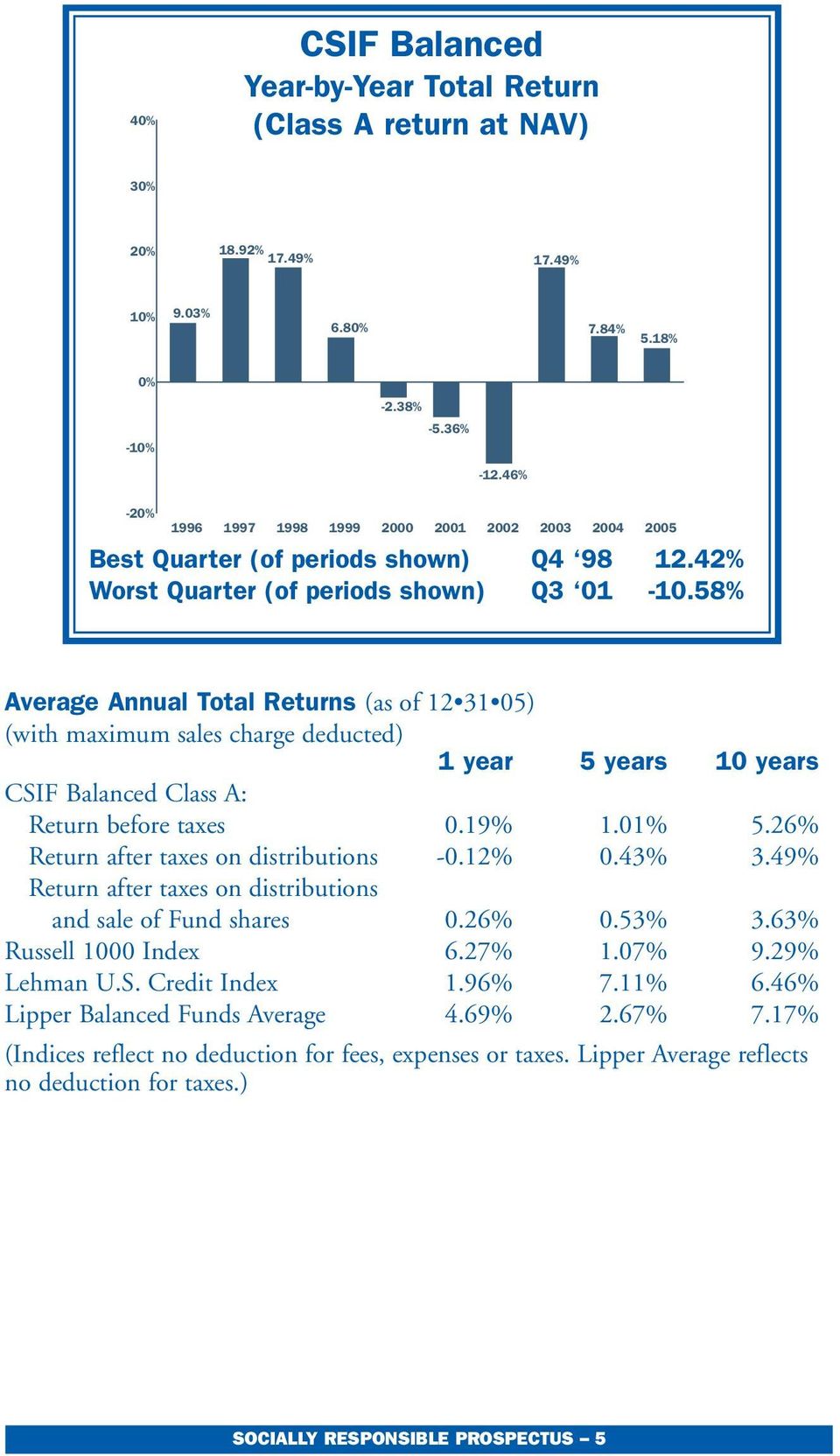
7 Average Annual Total Returns (as of ) (with maximum sales charge deducted) 1 year 5 years Since Inception (3/31/98) CSIF Balanced: Class B -0.86% 0.76% 1.68% Russell 1000 Index 6.27% 1.07% 3.62% Lehman U.S. Credit Index 1.96% 7.11% 6.40% Lipper Balanced Funds Average 4.69% 2.67% 4.00% (Indices reflect no deduction for fees, expenses or taxes. Lipper Average reflects no deduction for taxes.) 1 year 5 years 10 years CSIF Balanced: Class C 3.19% 0.98% 4.68% Russell 1000 Index 6.27% 1.07% 9.29% Lehman U.S. Credit Index 1.96% 7.11% 6.46% Lipper Balanced Funds Average 4.69% 2.67% 7.17% (Indices reflect no deduction for fees, expenses or taxes. Lipper Average reflects no deduction for taxes.) SOCIALLY RESPONSIBLE PROSPECTUS 6
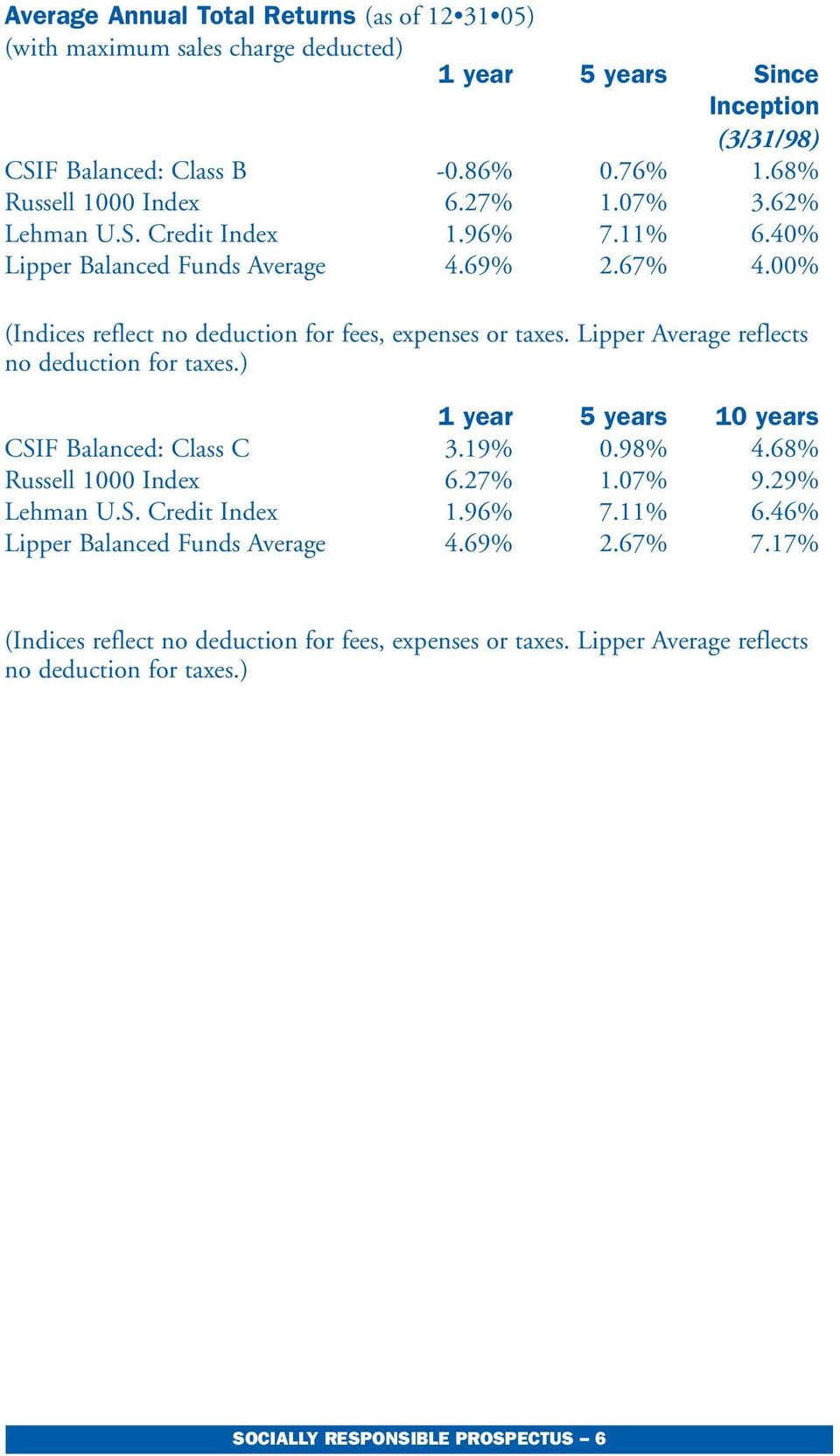
8 CSIF EQUITY Objective CSIF Equity seeks growth of capital through investment in stocks of issuers in industries believed to offer opportunities for potential capital appreciation and which meet the Fund s investment and social criteria. Principal Investment Strategies Under normal circumstances, the Fund will invest at least 80% of its net assets (including borrowings for investment purposes) in equity securities. Equity securities for purposes of this 80% policy means common stock. The Fund will provide shareholders with at least 60 days notice before changing this 80% policy. The Fund invests primarily in the common stocks of U.S. large-cap companies, although it may have other investments, including some foreign stocks and mid-cap stocks. The Fund defines large-cap companies as those whose market capitalization falls within the range of the S&P 500 Index. The S&P 500 Index is reconstituted from time to time. The market capitalization range for the S&P 500 Index was $768 million to $370 billion as of December 31, Under normal circumstances, the Fund seeks to have a weighted average market capitalization of at least $20 billion. The Fund also may purchase stocks outside the S&P 500 Index. Investment returns will be primarily from changes in the price of the Fund s holdings (capital appreciation). The Subadvisor looks for growing companies with a history of steady earnings growth. Companies are selected based on the Subadvisor s opinion that the company has the ability to sustain growth through growing profitability and that the stock is favorably priced with respect to those growth expectations. The Subadvisor may elect to sell a security when deteriorating business or financial prospects, excessive valuation, or other factors that conflict with the original rationale that support investing in the company make the investment less attractive. The Fund invests with the philosophy that long-term rewards to investors will come from those organizations whose products, services, and methods enhance the human condition and the traditional American values of individual initiative, equality of opportunity, and cooperative effort. All investments are selected on the basis of their ability to contribute to the dual objectives of financial soundness and societal impact. See "Investment Selection Process." Principal Risks You could lose money on your investment in the Fund, or the Fund could underperform for any of the following reasons: The stock market goes down. The individual stocks in the Fund do not perform as well as expected, and/or the Fund's portfolio management practices do not work to achieve their desired result. The prices of growth company securities held by the Fund may fall to a greater extent than the overall equity markets due to changing economic, political or market conditions or disappointing growth company earnings results. Growth stocks SOCIALLY RESPONSIBLE PROSPECTUS 7
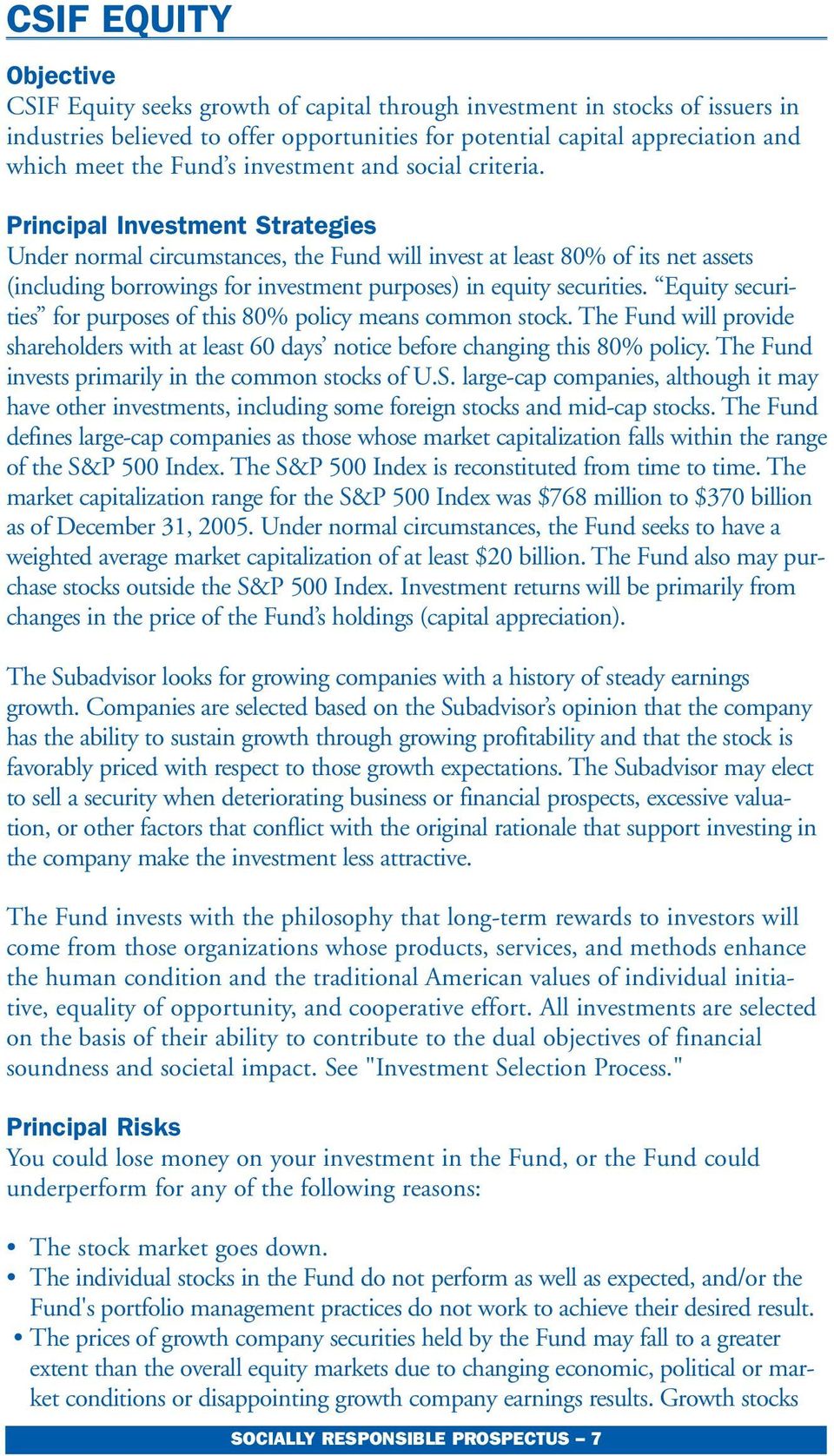
9 also generally lack the dividends of some value stocks that can cushion stock prices in a falling market. Common stocks represent an ownership interest in a company. They may or may not pay dividends or carry voting rights. Common stock occupies the most junior position in a company's capital structure. Debt securities and preferred stocks have rights senior to a company's common stock. Although common stocks have a history of long-term growth in value, their prices fluctuate based on changes in a company's financial condition and on overall market and economic conditions. Large cap companies may be unable to respond quickly to new competitive challenges such as changes in technology, and also may not be able to attain the high growth rate of successful smaller companies, especially during extended periods of economic expansion. For the foreign securities held in the Fund, there are additional risks relating to political, social, and economic developments abroad. Other risks from these investments result from the differences between the regulations to which U.S. and foreign issuers and markets are subject, the potential for foreign markets to be less liquid than U.S. markets and the currency risk associated with securities that trade in currencies other than the U.S. dollar. An investment in the Fund is not a bank deposit and is not insured or guaranteed by the Federal Deposit Insurance Corporation or any other government agency. CSIF Equity Performance The bar chart and table below show the Fund s annual returns and its long-term performance. The chart and table provide some indication of the risks of investing in the Fund. The chart shows how the performance of the Class A shares has varied from year to year. The table compares the Fund s performance over time to that of the Standard & Poor s 500 Index. This is a widely recognized, unmanaged index of common stock prices. It also shows the Fund s returns compared to the Lipper Multi-Cap Core Funds Average, an average of the annual return of mutual funds that have an investment goal similar to that of the Fund. After-tax returns are calculated using the historical highest individual federal marginal income tax rates, and do not reflect the impact of state and local taxes. Actual after-tax returns depend on your tax situation and may differ from these shown. The after-tax returns shown are not relevant to you if you hold your Fund shares through a tax-deferred arrangement such as a 401(k) plan or individual retirement account. The return after taxes on distributions and sale of Fund shares may be higher than the return before taxes because the calculation assumes that shareholders receive a tax benefit for capital losses incurred on the sale of their shares. After-tax returns are shown only for Class A shares; after-tax returns for other classes will vary. The Fund s past performance does not necessarily indicate how the Fund will perform in the future. The return for each of the Fund s other Classes of shares offered by this prospectus will differ from the Class A returns shown in the bar chart, depending upon the expenses of that Class. The bar chart does not reflect any sales charge that you may be required to pay upon purchase or redemption of the Fund s shares. Any sales charge will reduce your return. The average total return table shows the Fund s returns with the maximum sales charge deducted. No sales charge has been applied to the indices used for comparison in the table. SOCIALLY RESPONSIBLE PROSPECTUS 8

10 30% CSIF Equity Year-by-Year Total Return (Class A return at NAV) 21.68% 19.33% 23.17% 22.31% 20% 10% 0% 10.89% 11.61% 0.67% 6.69% 4.16% -10% % -20% Best Quarter (of periods shown) Q % Worst Quarter (of periods shown) Q % Average Annual Total Returns (as of ) (with maximum sales charge deducted) 1 year 5 years 10 years CSIF Equity Class A: Return before taxes -0.79% 2.09% 9.40% Return after taxes on distributions -1.03% 1.92% 8.31% Return after taxes on distributions and sale of Fund shares -0.19% 1.75% 7.73% S&P 500 Index 4.91% 0.54% 9.07% Lipper Multi-Cap Core Funds Average 6.59% 1.65% 9.01% (Index reflects no deduction for fees, expenses or taxes. Lipper Average reflects no deduction for taxes.) SOCIALLY RESPONSIBLE PROSPECTUS 9

11 Average Annual Total Returns (as of ) (with maximum sales charge deducted) 1 year 5 years Since Inception (3/31/98) CSIF Equity: Class B -1.70% 1.99% 5.16% S&P 500 Index 4.91% 0.54% 3.19% Lipper Multi-Cap Core Funds Average 6.59% 1.65% 4.46% (Index reflects no deduction for fees, expenses or taxes. Lipper Average reflects no deduction for taxes.) Average Annual Total Returns (as of ) (with maximum sales charge deducted) 1 year 5 years 10 years CSIF Equity: Class C 2.37% 2.24% 8.91% S&P 500 Index 4.91% 0.54% 9.07% Lipper Multi-Cap Core Funds Average 6.59% 1.65% 9.01% (Index reflects no deduction for fees, expenses or taxes. Lipper Average reflects no deduction for taxes.) SOCIALLY RESPONSIBLE PROSPECTUS 10
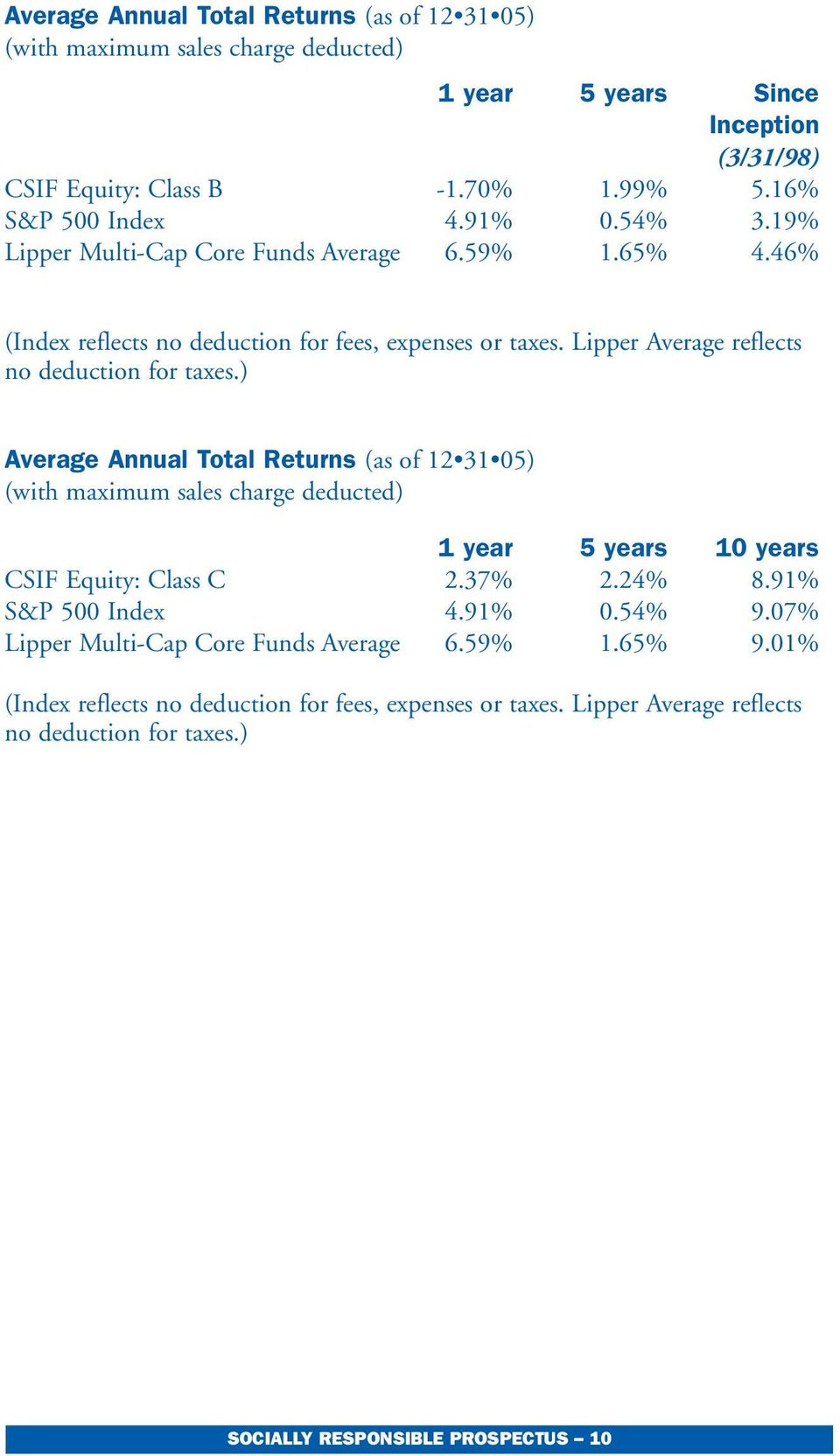
12 CALVERT SOCIAL INDEX FUND Objective Calvert Social Index Fund seeks to match the performance of the Calvert Social Index, which measures the investment return of large- and mid-capitalization stocks. Principal Investment Strategies The Fund employs a passive management strategy designed to track, as closely as possible, the performance of the Calvert Social Index. The Fund uses a replication index method, investing in the common stock of each company in the Index in about the same proportion as represented in the Index itself. Under normal circumstances, the Fund will invest at least 95% of its net assets (including borrowings for investment purposes) in securities contained in the Index. The Fund will provide shareholders with at least 60 days notice before changing this policy. Generally, the Fund sells securities only to reflect a change in the Calvert Social Index. Calvert Social Index The Calvert Social Index measures the performance of those companies that meet the social investment criteria selected from the universe of approximately the 1,000 largest U.S. companies, based on total market capitalization, listed on the NYSE or NASDAQ-AMEX. As of December 31, 2005, the capitalization range of the Index was $808 million to $278 billion, and the weighted average capitalization was $65.4 billion. The Fund seeks to have a weighted average capitalization that approximates that of the Index. As of December 31, 2005, there were 618 companies in the Index, though this number will change over time due to company mergers or changes due to Calvert s evaluation of an issuer s conduct relative to the Fund s social criteria. The Index is reconstituted once a year based on an updated list of the 1000 largest companies. The Index is also reviewed quarterly to adjust for social criteria and other factors. The socially responsible criteria are described in the section Socially Responsible Investment Criteria. Calvert continuously evaluates the performance of companies included in the Index to ensure compliance with these criteria. PRINCIPAL RISKS You could lose money on your investment in the Fund, or the Fund could underperform the stock market for any of the following reasons: The stock market or the Calvert Social Index goes down. An index fund has operating expenses; a market index does not. The Fund - while expected to track its target index as closely as possible while satisfying its investment and social criteria - will not be able to match the performance of the index exactly. SOCIALLY RESPONSIBLE PROSPECTUS 11

13 The possibility of greater risk by investing in medium-sized companies rather than larger, more established companies. Common stocks represent an ownership interest in a company. They may or may not pay dividends or carry voting rights. Common stock occupies the most junior position in a company's capital structure. Debt securities and preferred stocks have rights senior to a company's common stock. Although common stocks have a history of long-term growth in value, their prices fluctuate based on changes in a company's financial condition and on overall market and economic conditions. An investment in the Fund is not a bank deposit and is not insured or guaranteed by the Federal Deposit Insurance Corporation or any other government agency. Calvert Social Index Fund Performance The bar chart and table below show the Fund s annual returns and its long-term performance. The chart and table provide some indication of the risks of investing in the Fund. The chart shows how the performance of the Class A shares has varied from year to year. The table compares the Fund s performance over time to that of the Calvert Social Index. It also shows the Fund s returns compared to the Lipper Multi-Cap Core Funds Average, an average of the annual return of mutual funds that have an investment goal similar to that of the Fund. After-tax returns are calculated using the historical highest individual federal marginal income tax rates, and do not reflect the impact of state and local taxes. Actual after-tax returns depend on your tax situation and may differ from these shown. The after-tax returns shown are not relevant to you if you hold your Fund shares through a tax-deferred arrangement such as a 401(k) plan or individual retirement account. The return after taxes on distributions and sale of Fund shares may be higher than the return before taxes because the calculation assumes that shareholders receive a tax benefit for capital losses incurred on the sale of their shares. After-tax returns are shown only for Class A shares; after-tax returns for other classes will vary. The Fund s past performance does not necessarily indicate how the Fund will perform in the future. The return for each of the Fund s other Classes of shares offered by this prospectus will differ from the Class A returns shown in the bar chart, depending upon the expenses of that Class. The bar chart does not reflect any sales charge that you may be required to pay upon purchase or redemption of the Fund s shares. Any sales charge will reduce your return. The average total return table shows the Fund s returns with the maximum sales charge deducted. No sales charge has been applied to the indices used for comparison in the table. SOCIALLY RESPONSIBLE PROSPECTUS 12
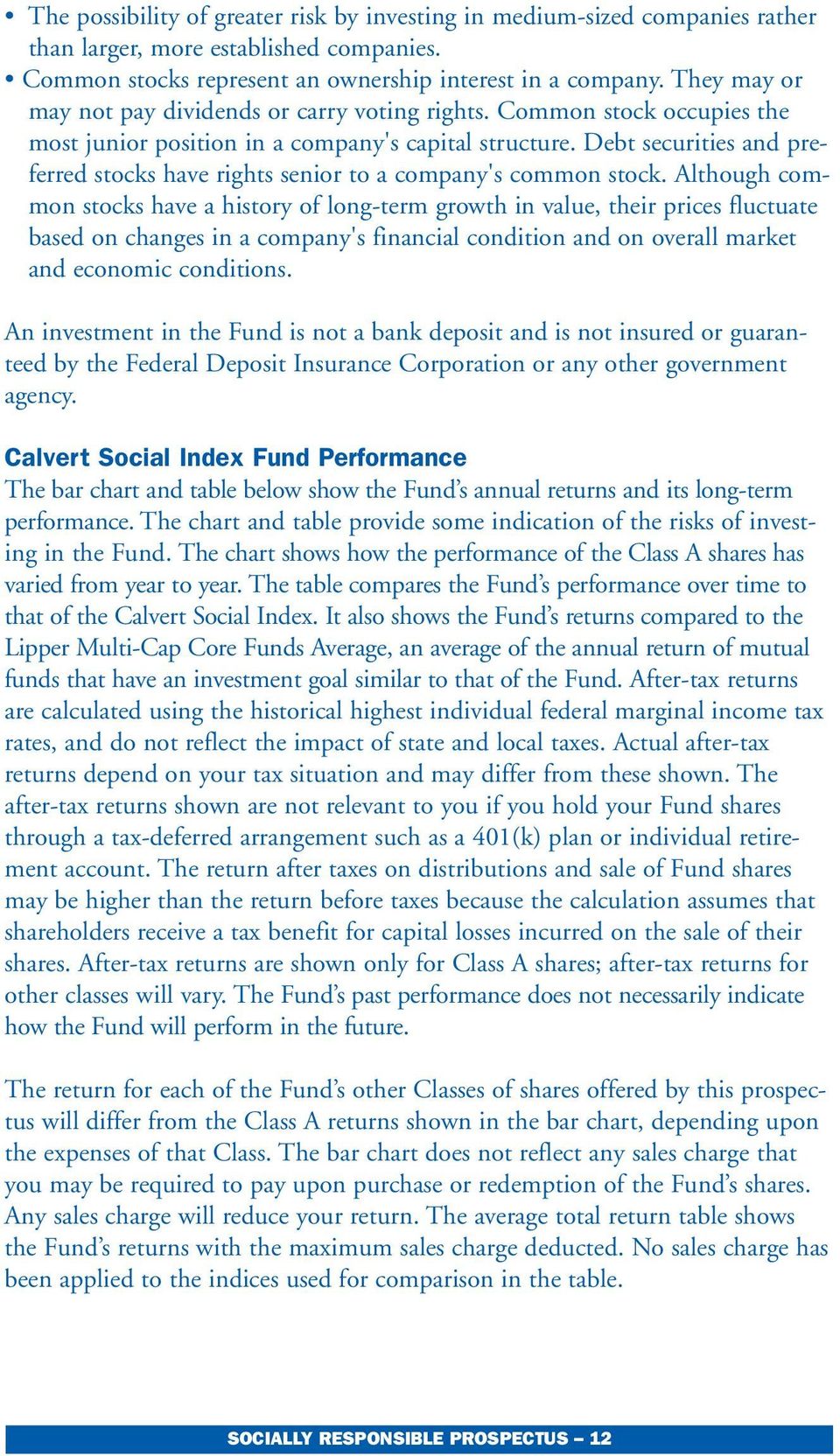
14 Calvert Social Index Fund Year-by-Year Total Return (Class A return at NAV) 30% 29.56% 20% 10% 0% 7.74% 3.07% -10% -20% -30% % % Best Quarter (of periods shown) Q % Worst Quarter (of periods shown) Q % Average Annual Total Returns (as of ) (with maximum sales charge deducted) 1 year 5 year Since Inception (6/30/00) Calvert Social Index Fund Class A: Return before taxes -1.80% -2.40% -4.89% Return after taxes on distributions -1.91% -2.53% -5.03% Return after taxes on distributions and sale of Fund shares -1.02% -2.08% -4.14% Calvert Social Index Fund: Class B -2.90% -2.62% -5.14% Calvert Social Index Fund: Class C 1.10% -2.41% -4.97% Calvert Social Index 3.92% -0.69% -3.29% Lipper Multi-Cap Core Funds Avg. 6.59% 1.65% 0.89% (Index reflects no deduction for fees, expenses or taxes. Lipper Average reflects no deduction for taxes.) SOCIALLY RESPONSIBLE PROSPECTUS 13

15 CSIF ENHANCED EQUITY Objective CSIF Enhanced Equity seeks a total return after expenses which exceeds over time the total return of the Russell 1000 Index. It seeks to obtain this objective while maintaining risk characteristics similar to those of the Russell 1000 Index and through investments in stocks that meet the Fund s investment and social criteria. This objective may be changed by the Fund s Board of Trustees without shareholder approval. Principal Investment Strategies The Fund invests in common stock of U.S. companies that meet the social criteria and creates a portfolio whose characteristics closely resemble the characteristics of the Russell 1000 Index, while emphasizing the stocks which it believes offer the greatest potential for return. Under normal circumstances, the Fund will invest at least 80% of its net assets (including borrowings for investment purposes) in equity securities. Equity securities for purposes of this 80% policy means common stock. The Fund will provide shareholders with at least 60 days notice before changing this 80% policy. The Russell 1000 Index measures the performance of the 1,000 largest U.S. companies based on total market capitalization. The Index is adjusted, or reconstituted, annually. As of the latest reconstitution, the average market capitalization of the Russell 1000 Index was approximately $13 billion. As of December 31, 2005, the capitalization range of the Index was $582 million to $370 billion. Under normal circumstances, the Fund seeks to have a weighted average market capitalization of at least $20 billion. CSIF Enhanced Equity follows an enhanced index management strategy. Instead of passively holding a representative basket of securities designed to match the Russell 1000 Index, the Subadvisor actively uses a proprietary analytical model to attempt to enhance the Fund s performance, relative to the Index. The Fund may purchase stocks not in the Russell 1000 Index, but at least 65% of the Fund s total assets will be invested in stocks that are in the Index. Any investments not in the Index will meet the Fund s social screening criteria and be selected to closely mirror the Index s risk/return characteristics. The Subadvisor rebalances the Fund quarterly to maintain its relative exposure to the Index. The first step of the investment strategy is to identify those stocks in the Russell 1000 Index which meet the Fund's social screening criteria. From this list of stocks, the Subadvisor chooses stocks that closely mirror the Index in terms of various factors such as industry weightings, capitalization, and yield. Even though certain industries may be eliminated from the Fund by the screens, the factor model permits mathematical substitutes which the Subadvisor expects to mimic the return characteristics of the missing industries and stocks. SOCIALLY RESPONSIBLE PROSPECTUS 14

16 The final step in the process is to apply the Subadvisor's proprietary valuation method which attempts to identify the stocks which have the greatest potential for superior performance. Each security identified for potential investment is ranked according to three separate measures: growth, value, and momentum of market sentiment. These three measures are combined to create a single composite score of each stock's attractiveness. The Fund is constructed from securities that meet its social criteria, weighted through a mathematical process that seeks to reduce risk vis-à-vis the Russell 1000 Index. The Subadvisor may choose to sell a security when it no longer appears attractive under this process. Principal Risks You could lose money on your investment in the Fund, or the Fund could underperform the stock market for any of the following reasons: The stock market or the Russell 1000 Index goes down. The individual stocks in the Fund or the enhanced equity modeling portfolio do not perform as well as expected, and/or the Fund's portfolio management practices do not work to achieve their desired result. The Fund has operating expenses; a market index does not. The Fund - while expected to track its target index as closely as possible while satisfying its own investment and social criteria - will not be able to match the performance of the index exactly. Common stocks represent an ownership interest in a company. They may or may not pay dividends or carry voting rights. Common stock occupies the most junior position in a company's capital structure. Debt securities and preferred stocks have rights senior to a company's common stock. Although common stocks have a history of long-term growth in value, their prices fluctuate based on changes in a company's financial condition and on overall market and economic conditions. An investment in the Fund is not a bank deposit and is not insured or guaranteed by the Federal Deposit Insurance Corporation or any other government agency. The Fund is not sponsored, sold, promoted, or endorsed by the Frank Russell Company. Tracking the Index The Subadvisor expects the annual tracking error, relative to the return of the Index before deducting expenses, to be within certain limits established by the Advisor and Subadvisor. The Fund's ability to track the Index will be monitored by analyzing returns to ensure that the returns are reasonably consistent with Index returns. Any deviations of realized returns from the Index which are in excess of those expected will be analyzed for sources of variance. The Fund invests with the philosophy that long-term rewards to investors will SOCIALLY RESPONSIBLE PROSPECTUS 15

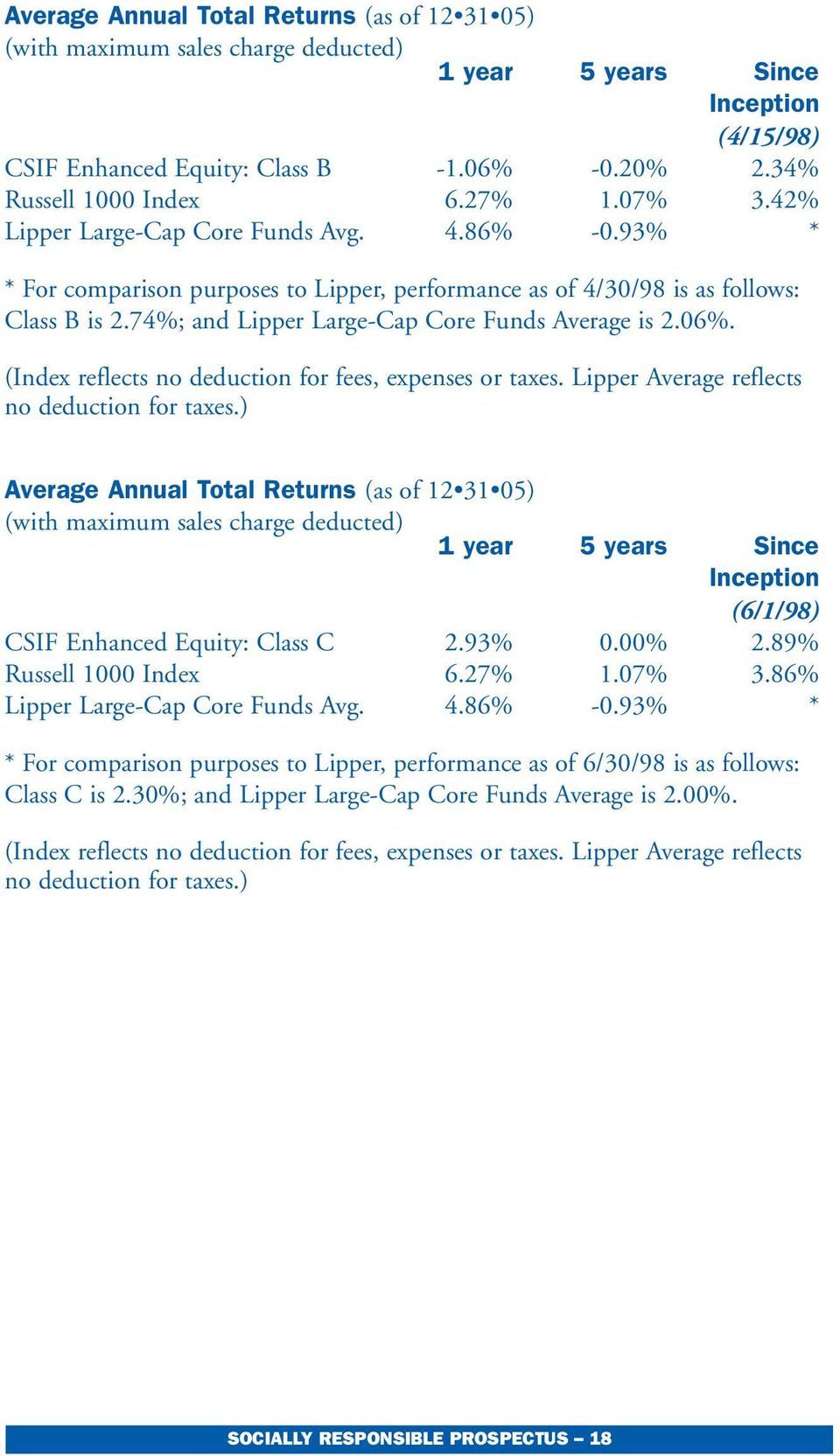
17 come from those organizations whose products, services, and methods enhance the human condition and the traditional American values of individual initiative, equality of opportunity, and cooperative effort. All investments are selected on the basis of their ability to contribute to the dual objectives of financial soundness and societal impact. See "Investment Selection Process." CSIF Enhanced Equity Performance The bar chart and table below show the Fund s annual returns and its long-term performance. The chart and table provide some indication of the risks of investing in the Fund. The chart shows how the performance of the Class A shares has varied from year to year. The table compares the Fund s performance over time to that of the Russell 1000 Index, a widely recognized, unmanaged index of common stock prices. It also shows the Fund s returns compared to the Lipper Large-Cap Core Funds Average, an average of the annual return of mutual funds that have an investment goal similar to that of the Fund. After-tax returns are calculated using the historical highest individual federal marginal income tax rates, and do not reflect the impact of state and local taxes. Actual after-tax returns depend on your tax situation and may differ from these shown. The after-tax returns shown are not relevant to you if you hold your Fund shares through a tax-deferred arrangement such as a 401(k) plan or individual retirement account. The return after taxes on distributions and sale of Fund shares may be higher than the return before taxes because the calculation assumes that shareholders receive a tax benefit for capital losses incurred on the sale of their shares. After-tax returns are shown only for Class A shares; after-tax returns for other classes will vary. The Fund s past performance does not necessarily indicate how the Fund will perform in the future. The return for the Fund s other classes of shares offered by this prospectus will differ from the Class A returns shown in the bar chart, depending upon the expenses of that Class. The bar chart does not reflect any sales charge that you may be required to pay upon purchase or redemption of the Fund s shares. Any sales charge will reduce your return. The average total return table shows the Fund s returns with the maximum sales charge deducted. No sales charge has been applied to the indices used for comparison in the table. SOCIALLY RESPONSIBLE PROSPECTUS 16

18 30% 20% 17.16% CSIF Enhanced Equity Year-by-Year Total Return (Class A return at NAV) 23.82% 10% 0% 9.47% 4.80% -10% -20% -4.28% % % -30% Best Quarter (of periods shown) Q % Worst Quarter (of periods shown) Q % Average Annual Total Returns (as of ) (with maximum sales charge deducted) 1 year 5 years Since Inception (4/15/98) CSIF Enhanced Equity Class A: Return before taxes -0.16% 0.05% 2.80% Return after taxes on distributions -0.71% -0.07% 2.67% Return after taxes on distributions and sale of Fund shares 0.47% 0.03% 2.38% Russell 1000 Index 6.27% 1.07% 3.42% Lipper Large-Cap Core Funds Avg. 4.86% -0.93% * * For comparison purposes to Lipper, performance as of 4/30/98 is as follows: Class A return before taxes is 3.18%; Class A return after taxes on distributions is 2.81%; Class A return after taxes on distributions and sale of Fund shares is 2.50%; and Lipper Large-Cap Core Funds Average is 2.06%. (Index reflects no deduction for fees, expenses or taxes. Lipper Average reflects no deduction for taxes.) SOCIALLY RESPONSIBLE PROSPECTUS 17

19 Average Annual Total Returns (as of ) (with maximum sales charge deducted) 1 year 5 years Since Inception (4/15/98) CSIF Enhanced Equity: Class B -1.06% -0.20% 2.34% Russell 1000 Index 6.27% 1.07% 3.42% Lipper Large-Cap Core Funds Avg. 4.86% -0.93% * * For comparison purposes to Lipper, performance as of 4/30/98 is as follows: Class B is 2.74%; and Lipper Large-Cap Core Funds Average is 2.06%. (Index reflects no deduction for fees, expenses or taxes. Lipper Average reflects no deduction for taxes.) Average Annual Total Returns (as of ) (with maximum sales charge deducted) 1 year 5 years Since Inception (6/1/98) CSIF Enhanced Equity: Class C 2.93% 0.00% 2.89% Russell 1000 Index 6.27% 1.07% 3.86% Lipper Large-Cap Core Funds Avg. 4.86% -0.93% * * For comparison purposes to Lipper, performance as of 6/30/98 is as follows: Class C is 2.30%; and Lipper Large-Cap Core Funds Average is 2.00%. (Index reflects no deduction for fees, expenses or taxes. Lipper Average reflects no deduction for taxes.) SOCIALLY RESPONSIBLE PROSPECTUS 18
20 CALVERT LARGE CAP GROWTH Objective Calvert Large Cap Growth seeks to exceed the stock market total return (primarily through capital appreciation) at a level of total risk roughly equal to that of the stock market over longer periods of time (three years or more). The S&P 500 Index with dividends reinvested serves as a proxy for "stock market" in this objective. Principal Investment Strategies The Fund invests in a diversified portfolio of U.S. common stocks of companies that meet the Fund's investment and social criteria. Under normal circumstances, the Fund will invest at least 80% of its net assets (including borrowings for investment purposes) in large cap companies. The Fund will provide shareholders with at least 60 days notice before changing this 80% policy. The Fund defines "large cap" companies as those whose market capitalization falls within the range of the S&P 500 Index. The S&P 500 Index is reconstituted from time to time. The market capitalization range for the S&P 500 Index was $768 million to $370 billion as of December 31, Under normal circumstances, the Fund seeks to have a weighted average market capitalization of at least $10 billion. The Fund also may purchase stocks outside the S&P 500 Index. The Fund invests in both value and growth companies. Value stocks are those priced cheaply relative to some financial measures of worth. Growth stocks have faster increasing sales and earnings. As part of a secondary portfolio strategy, the Subadvisor may purchase or sell "traditional" (i.e., exchange-traded) stock index options or futures for purposes of hedging, speculation or leverage. The Subadvisor would use these investments only in its effort to keep the long-term average market risk of the Fund roughly equal to the market itself. For example, when market conditions are favorable in the view of the Subadvisor, the Fund may use options and index futures to increase exposure to the market. When market conditions appear unfavorable, the Fund may use options and index futures to reduce exposure to the market. In this regard, to increase market exposure, the Fund may establish long futures positions and buy call options on stock indices. To reduce market exposure, the Fund may buy put options on stock indices and establish short futures positions on stock indices correlated to the Fund s portfolio. At any one point in time however, the Fund s market exposure may be as high as 150% or as low as 50% of the market. The Advisor and Subadvisor do not intend to leverage overall market risk for the long term. The Subadvisor to the Fund purchases and sells securities for the Fund s portfolio based on information derived from its proprietary stock ranking and rating models. Stocks that are rated as sufficiently attractive in the model are subject to purchase. When a holding of the Fund deteriorates in ranking or rating, it is subject to sale. SOCIALLY RESPONSIBLE PROSPECTUS 19

21 The Fund invests with the philosophy that long-term rewards to investors will come from those organizations whose products, services, and methods enhance the human condition and the traditional American values of individual initiative, equality of opportunity, and cooperative effort. All investments are selected on the basis of their ability to contribute to the dual objectives of financial soundness and societal impact. See "Investment Selection Process." Principal Risks You could lose money on your investment in the Fund, or the Fund could underperform, most likely for any of the following reasons: The stock market goes down. The individual stocks in the Fund do not perform as well as expected, and/or the Fund's portfolio management practices do not work to achieve their desired result. Large cap companies may be unable to respond quickly to new competitive challenges such as changes in technology, and also may not be able to attain the high growth rate of successful smaller companies, especially during extended periods of economic expansion. The use of stock index futures and options may increase the volatility of the Fund and may involve a small investment of cash relative to the magnitude of the risk assumed. At any one point in time, the Fund s market exposure may be as high as 150% of the market through the use of stock index futures and options. A stock index future is a contract to buy or sell the cash value of a specific stock index at a specific price by a specified date. An option gives the holder a right but not the obligation to purchase or sell a security at a specified price within a specified time, and a stock index option is an option based on a stock market index (or the cash value thereof). A call option gives the purchaser of the option the right to purchase the underlying security from the writer of the option at a specified price. A put option gives the purchaser of the option the right to sell the underlying security to the writer of the option at a specified exercise price. Stock index futures and options are derivatives. A derivative is an instrument that derives its value from the performance of an underlying financial asset, index or other investment. If changes in a derivative s value do not correspond to changes in the value of the Fund s other investments, the Fund may not fully benefit from or could lose money on the derivative position. Derivatives also can involve risk of loss if the party who issued the derivative defaults on its obligation. In addition, derivatives may be less liquid and more difficult to value. The prices of growth company securities held by the Fund may fall to a greater extent than the overall equity markets due to changing economic, political or market conditions or disappointing growth company earnings results. Growth stocks also generally lack the dividends of some value stocks that can cushion stock prices in a falling market. Common stocks represent an ownership interest in a company. They may or may not pay dividends or carry voting rights. Common stock occupies the SOCIALLY RESPONSIBLE PROSPECTUS 20
22 most junior position in a company's capital structure. Debt securities and preferred stocks have rights senior to a company's common stock. Although common stocks have a history of long-term growth in value, their prices fluctuate based on changes in a company's financial condition and on overall market and economic conditions. An investment in the Fund is not a bank deposit and is not insured or guaranteed by the Federal Deposit Insurance Corporation or any other government agency. Calvert Large Cap Growth Performance* The following bar chart and table show the Fund's annual returns and its long-term performance. The chart shows how the performance of the Fund s shares has varied from year to year. The table compares the Fund's performance over time to that of the Standard & Poor s 500 Index, a widely recognized, unmanaged index of common stock prices. It also compares the Fund s performance to the Lipper Multi-Cap Growth Funds Average, an average of the annual return of mutual funds that have an investment goal similar to that of the Fund. Class A, B and C shares have an actual inception date of 10/31/2000. However, Class I Shares (not offered in this prospectus) have an inception date of 8/5/1994. In the bar chart, and in the table Class A return before and after taxes, performance results before 10/31/2000 are for Class I. Class I shares did not have Rule 12b-1 fees and performance of the Class A would have been lower if Rule 12b-1 fees of Class A had been reflected. After-tax returns for other classes will vary. After-tax returns are calculated using the historical highest individual federal marginal income tax rates, and do not reflect the impact of state and local taxes. Actual after-tax returns depend on your tax situation and may differ from these shown. The after-tax returns shown are not relevant to you if you hold your Fund shares through a tax-deferred arrangement such as a 401(k) plan or individual retirement account. The return after taxes on distributions and sale of Fund shares may be higher than the return before taxes because the calculation assumes that shareholders receive a tax benefit for capital losses incurred on the sale of their shares. The Fund's past performance does not necessarily indicate how the Fund will perform in the future. The return for the Fund's classes of shares offered by this prospectus will differ from the returns shown in the bar chart, depending upon the expenses of that class and any applicable sales charge. The bar chart does not reflect any sales charge that you may be required to pay upon purchase or redemption of the Fund's shares. Any sales charge will reduce your return. The average total return table shows the Fund s returns with the maximum sales charge deducted. No sales charge has been applied to the indices used for comparison in the table. * Pursuant to an Agreement and Plan of Reorganization, the Social Responsibility Portfolio of Bridgeway Fund, Inc. ( Bridgeway ) was reorganized into the Class I Shares of the Calvert Large Cap Growth Fund, which commenced operations on 10/31/2000. The performance results prior to 10/31/2000 for Class A shares of the Calvert Large Cap Growth Fund reflect the performance of Bridgeway since its inception on 8/5/94. SOCIALLY RESPONSIBLE PROSPECTUS 21
23 60% 50% Calvert Large Cap Growth Year-by-Year Total Return (Class A return at NAV) 49.36% 40% 37.79% 38.24% 30% 27.51% 20% 10% 16.21% 16.67% 11.07% 0% -10% -20% % % % -30% Best Quarter (of periods shown) Q % Worst Quarter (of periods shown) Q % Average Annual Total Returns (as of ) (with maximum sales charge deducted) 1 year 5 years 10 years Calvert Large Cap Growth Class A: Return before taxes 5.79% 1.62% 10.81% Return after taxes on distributions 5.79% 1.62% 10.14% Return after taxes on distributions and sale of Fund shares 3.77% 1.38% 9.28% S&P 500 Index 4.91% 0.54% 9.07% Lipper Multi-Cap Growth Funds Avg. 8.81% -2.73% 7.83% (Index reflects no deduction for fees, expenses or taxes. Lipper Average reflects no deduction for taxes.) SOCIALLY RESPONSIBLE PROSPECTUS 22
24 Average Annual Total Returns (as of ) (with maximum sales charge deducted) 1 year 5 years Since Inception (10/31/00) Calvert Large Cap Growth Class B 5.07% 1.44% -0.86% S&P 500 Index 4.91% 0.54% -0.96% Lipper Multi-Cap Growth Funds Avg. 8.81% -2.73% -5.82% (Index reflects no deduction for fees, expenses or taxes. Lipper Average reflects no deduction for taxes.) Average Annual Total Returns (as of ) (with maximum sales charge deducted) 1 year 5 years Since Inception (10/31/00) Calvert Large Cap Growth Class C 9.19% 1.64% -0.58% S&P 500 Index 4.91% 0.54% -0.96% Lipper Multi-Cap Growth Funds Avg. 8.81% -2.73% -5.82% (Index reflects no deduction for fees, expenses or taxes. Lipper Average reflects no deduction for taxes.) SOCIALLY RESPONSIBLE PROSPECTUS 23
25 CALVERT CAPITAL ACCUMULATION Objective Calvert Capital Accumulation seeks to provide long-term capital appreciation by investing primarily in mid-cap stocks that meet the Fund s investment and social criteria. This objective may be changed by the Fund s Board of Directors without shareholder approval. Principal Investment Strategies Investments are primarily in the common stocks of mid-size U.S. companies. Returns in the Fund will be mostly from the changes in the price of the Fund s holdings (capital appreciation). The Fund currently defines mid-cap companies as those whose market capitalization falls within the range of the Russell MidCap Growth Index. The Russell MidCap Growth Index undergoes an annual reconstitution. The market capitalization range for the Russell MidCap Growth Index was $583 million to $19 billion as of December 31, Under normal circumstances, the Fund seeks to have a weighted average market capitalization between $2 billion and $12 billion. The Fund also may purchase stocks outside the Russell MidCap Growth Index. Stocks chosen for the Fund combine growth and value characteristics or offer the opportunity to buy growth at a reasonable price. The Fund may also invest up to 25% of its net assets in foreign securities. The Subadvisor favors companies which have an above market average prospective growth rate, but sell at below market average valuations. The Subadvisor evaluates each stock in terms of its growth potential, the return for risk free investments, and the risk and reward potential for the company to determine a reasonable price for the stock. The Subadvisor may elect to sell a security when deteriorating business or financial prospects, excessive valuation, or other factors that conflict with the original rationale that support investing in the company make the investment less attractive. The Fund invests with the philosophy that long-term rewards to investors will come from those organizations whose products, services, and methods enhance the human condition and the traditional American values of individual initiative, equality of opportunity, and cooperative effort. All investments are selected on the basis of their ability to contribute to the dual objectives of financial soundness and societal impact. See "Investment Selection Process." Principal Risks You could lose money on your investment in the Fund, or the Fund could underperform for any of the following reasons: SOCIALLY RESPONSIBLE PROSPECTUS 24
26 The stock market goes down. The individual stocks in the Fund do not perform as well as expected, and/or the Fund's portfolio management practices do not work to achieve their desired result. The possibility of greater risk by investing in medium-sized companies rather than larger, more established companies. The Fund is non-diversified. Compared to other funds, the Fund may invest more of its assets in a smaller number of companies. Gains or losses on a single stock may have greater impact on the Fund. Investment in foreign securities involves additional risks relating to political, social and economic developments abroad. Other risks from these investments result from the differences between the regulations to which U.S. and foreign issuers and markets are subject, the potential for foreign markets to be less liquid than U.S. markets, and the currency risk associated with securities that trade in currencies other than the U.S. dollar. Common stocks represent an ownership interest in a company. They may or may not pay dividends or carry voting rights. Common stock occupies the most junior position in a company's capital structure. Debt securities and preferred stocks have rights senior to a company's common stock. Although common stocks have a history of long-term growth in value, their prices fluctuate based on changes in a company's financial condition and on overall market and economic conditions. An investment in the Fund is not a bank deposit and is not insured or guaranteed by the Federal Deposit Insurance Corporation or any other government agency. Calvert Capital Accumulation Performance The bar chart and table below show the Fund s annual returns and its long-term performance. The chart and table provide some indication of the risks of investing in the Fund. The chart shows how the performance of the Fund s Class A shares has varied from year to year. The table compares the Fund s performance over time to that of the Russell Midcap Growth Index. It also shows the Fund s returns compared to the Lipper Mid-Cap Growth Funds Average, an average of the annual return of mutual funds that have an investment goal similar to that of the Fund. After-tax returns are calculated using the historical highest individual federal marginal income tax rates, and do not reflect the impact of state and local taxes. Actual after-tax returns depend on your tax situation and may differ from these shown. The after-tax returns shown are not relevant to you if you hold your Fund shares through a tax-deferred arrangement such as a 401(k) plan or individual retirement account. The return after taxes on distributions and sale of Fund shares may be higher than the return before taxes because the calculation assumes that shareholders receive a tax benefit for capital losses incurred on the sale of their shares. After-tax returns are shown only for Class A shares; aftertax returns for other classes will vary. The Fund s past performance does not necessarily indicate how the Fund will perform in the future. The return for the Fund s other classes of shares offered by this prospectus will differ from the Class A returns shown in the bar chart, depending upon the SOCIALLY RESPONSIBLE PROSPECTUS 25
27 expenses of that Class. The bar chart does not reflect any sales charge that you may be required to pay upon purchase or redemption of the Fund s shares. Any sales charge will reduce your return. The average total return table shows the Fund s returns with the maximum sales charge deducted. No sales charge has been applied to the indices used for comparison in the table. SOCIALLY RESPONSIBLE PROSPECTUS 26
28 40% 30% 20% 9.37% 10% Calvert Capital Accumulation Year-by-Year Total Return (Class A return at NAV) 22.02% 29.35% 6.15% 10.15% 30.55% 8.50% 0% -10% -20% % -0.38% -30% -40% % Best Quarter (of periods shown) Q % Worst Quarter (of periods shown) Q % Average Annual Total Returns (as of ) (with maximum sales charge deducted) 1 year 5 years 10 years Calvert Capital Accumulation Class A: Return before taxes -5.11% -3.57% 5.35% Return after taxes on distributions -5.11% -3.57% 4.28% Return after taxes on distributions and sale of Fund shares -3.32% -3.00% 4.21% Russell Midcap Growth Index 12.10% 1.38% 9.27% Lipper Mid-Cap Growth Funds Avg. 9.79% -0.48% 8.05% (Index reflects no deduction for fees, expenses or taxes. Lipper Average reflects no deduction for taxes.) SOCIALLY RESPONSIBLE PROSPECTUS 27
29 Average Annual Total Returns (as of ) (with maximum sales charge deducted) 1 year 5 years Since Inception (3/31/98) Capital Accumulation: Class B -6.15% -3.68% 0.88% Russell Midcap Growth Index 12.10% 1.38% 5.42% Lipper Mid-Cap Growth Funds Avg. 9.79% -0.48% 4.84% (Index reflects no deduction for fees, expenses or taxes. Lipper Average reflects no deduction for taxes.) Average Annual Total Returns (as of ) (with maximum sales charge deducted) 1 year 5 years 10 years Capital Accumulation: Class C -2.10% -3.42% 4.94% Russell Midcap Growth Index 12.10% 1.38% 9.27% Lipper Mid-Cap Growth Funds Avg. 9.79% -0.48% 8.05% (Index reflects no deduction for fees, expenses or taxes. Lipper Average reflects no deduction for taxes.) SOCIALLY RESPONSIBLE PROSPECTUS 28
30 CALVERT WORLD VALUES (CWVF) INTERNATIONAL EQUITY Objective CWVF International Equity seeks to provide a high total return consistent with reasonable risk by investing primarily in a diversified portfolio of stocks that meet the Fund s investment and social criteria. Principal Investment Strategies Under normal circumstances, the Fund will invest at least 80% of its net assets (including borrowings for investment purposes) in equity securities of foreign companies. Equity securities for purposes of this 80% policy means common and preferred stock and the depositary receipts on such shares. The Fund will provide shareholders with at least 60 days notice before changing this 80% policy. The Fund invests primarily in the common and preferred stocks of non-u.s. large cap companies using a core investment approach. The Fund defines "non- U.S. large cap" companies as those whose market capitalization falls within the range of the Morgan Stanley Capital International (MSCI) EAFE Index. The MSCI EAFE Index undergoes a quarterly reconstitution. The market capitalization range for the MSCI EAFE Index was $102 million to $219 billion as of December 31, Under normal circumstances, the Fund seeks to have a weighted average market capitalization of at least $10 billion. The Fund will generally hold stocks of companies from the constituent countries of the MSCI EAFE Index, but may opportunistically invest in other countries, including some emerging markets stocks. The Subadvisor uses an investment process that focuses on deriving returns from individual stock selection (bottom-up). The Subadvisor creates original fundamental research on a broad range of non-u.s. securities and applies a set of quantitative screening models to identify stocks that are expected to provide returns that are superior to that of the benchmark. These models evaluate stocks based on fundamental valuation judgments and market activity. The Subadvisor constructs the portfolio in a manner that attempts to control the level of risk in the portfolio, relative to the benchmark, MSCI s EAFE Index. As stocks improve or decline in rating over successive periodic model evaluations, they are gradually added to or sold from the portfolio. No more than 5% of the Fund s net assets will be invested in U.S. companies (excluding High Social Impact and Special Equities investments). The Fund invests with the philosophy that long-term rewards to investors will come from those organizations whose products, services, and methods enhance the human condition and the traditional American values of individual initiative, equality of opportunity, and cooperative effort. All investments are selected SOCIALLY RESPONSIBLE PROSPECTUS 29
31 on the basis of their ability to contribute to the dual objectives of financial soundness and societal impact. See "Investment Selection Process." Principal Risks You could lose money on your investment in the Fund, or the Fund could underperform for any of the following reasons: The stock markets go down (including markets outside the U.S.) The individual stocks in the Fund do not perform as well as expected, and/or the Fund's portfolio management practices do not work to achieve their desired result. Investment in foreign securities involves additional risks relating to political, social and economic developments abroad. Other risks from these investments result from the differences between the regulations to which U.S. and foreign issuers and markets are subject, the potential for foreign markets to be less liquid than U.S. markets, and the currency risk associated with securities that trade in currencies other than the U.S. dollar. Investment in emerging market securities involves greater risk than that associated with investment in the foreign securities of developed foreign countries. These risks include volatile currency exchange rates, periods of high inflation, increased risk of default, greater social, economic and political uncertainty and instability, less governmental supervision and regulation of securities markets, weaker auditing and financial reporting standards, lack of liquidity in the markets, and the significantly smaller market capitalizations of emerging market issuers. Common stocks represent an ownership interest in a company. They may or may not pay dividends or carry voting rights. Common stock occupies the most junior position in a company's capital structure. Debt securities and preferred stocks have rights senior to a company's common stock. Although common stocks have a history of long-term growth in value, their prices fluctuate based on changes in a company's financial condition and on overall market and economic conditions. An investment in the Fund is not a bank deposit and is not insured or guaranteed by the Federal Deposit Insurance Corporation or any other government agency. CWVF International Equity Performance The bar chart and table below show the Fund s annual returns and its long-term performance. The chart and table provide some indication of the risks of investing in the Fund. The chart shows how the performance of the Class A shares has varied from year to year. The table compares the Fund s performance over time to that of the MSCI EAFE Index. This is a widely recognized, unmanaged index of common stock prices around the world. It also shows the Fund s returns compared to the Lipper International Multi-Cap Core Funds Average, an average of the annual return of mutual funds that have an investment goal similar to that SOCIALLY RESPONSIBLE PROSPECTUS 30
32 of the Fund. After-tax returns are calculated using the historical highest individual federal marginal income tax rates, and do not reflect the impact of state and local taxes. Actual after-tax returns depend on your tax situation and may differ from these shown. The after-tax returns shown are not relevant to you if you hold your Fund shares through a tax-deferred arrangement such as a 401(k) plan or individual retirement account. The return after taxes on distributions and sale of Fund shares may be higher than the return before taxes because the calculation assumes that shareholders receive a tax benefit for capital losses incurred on the sale of their shares. After-tax returns are shown only for Class A shares; aftertax returns for other classes will vary. The Fund s past performance does not necessarily indicate how the Fund will perform in the future. The return for the Fund s other Classes of shares offered by this prospectus will differ from the Class A returns shown in the bar chart, depending upon the expenses of that Class. The bar chart does not reflect any sales charge that you may be required to pay upon purchase or redemption of the Fund s shares. Any sales charge will reduce your return. The average total return table shows the Fund s returns with the maximum sales charge deducted. No sales charge has been applied to the indices used for comparison in the table. SOCIALLY RESPONSIBLE PROSPECTUS 31
33 40% CWVF International Equity Year-by-Year Total Return (Class A return at NAV) 30% 30.13% 29.00% 20% 10% 12.02% 6.57% 16.10% 17.25% 11.09% 0% -10% -20% % % % -30% Best Quarter (of periods shown) Q % Worst Quarter (of periods shown) Q % Average Annual Total Returns (as of ) (with maximum sales charge deducted) 1 year 5 years 10 years CWVF International Equity Class A: Return before taxes 5.80% 1.17% 4.62% Return after taxes on distributions 5.67% 1.04% 3.76% Return after taxes on distributions and sale of Fund shares 3.93% 0.95% 3.59% MSCI EAFE Index 14.02% 4.94% 6.18% Lipper International Multi-Cap Core Funds Average 14.85% 4.56% 7.55% (Index reflects no deduction for fees, expenses or taxes. Lipper Average reflects no deduction for taxes.) SOCIALLY RESPONSIBLE PROSPECTUS 32
34 Average Annual Total Returns (as of ) (with maximum sales charge deducted) 1 year 5 years Since Inception (3/31/98) CWVF International Equity: Class B 4.87% 0.68% 1.07% MSCI EAFE Index GD 14.02% 4.94% 5.02% Lipper International Multi-Cap Core Funds Average 14.85% 4.56% 5.03% (Index reflects no deduction for fees, expenses or taxes. Lipper Average reflects no deduction for taxes.) Average Annual Total Returns (as of ) (with maximum sales charge deducted) 1 year 5 years 10 years CWVF International Equity: Class C 9.14% 1.17% 4.09% MSCI EAFE Index GD 14.02% 4.94% 6.18% Lipper International Multi-Cap Core Funds Average 14.85% 4.56% 7.55% (Index reflects no deduction for fees, expenses or taxes. Lipper Average reflects no deduction for taxes.) SOCIALLY RESPONSIBLE PROSPECTUS 33
35 CALVERT NEW VISION SMALL CAP Objective Calvert New Vision Small Cap seeks to provide long-term capital appreciation by investing primarily in small-cap stocks of U.S. companies that meet the Fund s investment and social criteria. This objective may be changed by the Fund s Board of Trustees without shareholder approval. Principal Investment Strategies At least 80% of the Fund s net assets (including borrowings for investment purposes) will be invested in the common stocks of small-cap companies. The Fund will provide shareholders with at least 60 days notice before changing this 80% policy. Returns in the Fund will be mostly from the changes in the price of the Fund s holdings (capital appreciation). The Fund currently defines small-cap companies as those with market capitalization of $2 billion or less at the time the Fund initially invests. The Subadvisor may elect to sell a security when deteriorating business or financial prospects, excessive valuation, or other factors that conflict with the original rationale that support investing in the company make the investment less attractive. The Fund invests with the philosophy that long-term rewards to investors will come from those organizations whose products, services, and methods enhance the human condition and the traditional American values of individual initiative, equality of opportunity, and cooperative effort. All investments are selected on the basis of their ability to contribute to the dual objectives of financial soundness and societal impact. See "Investment Selection Process." Principal Risks You could lose money on your investment in the Fund, or the Fund could underperform for any of the following reasons: The stock market goes down. The individual stocks in the Fund do not perform as well as expected, and/or the Fund's portfolio management practices do not work to achieve their desired result. Prices of small-cap stocks may respond to market activity differently than larger, more established companies and can be more volatile than those of larger issuers. The prices of micro-cap securities are generally even more volatile and their markets are even less liquid relative to small-cap, mid-cap and large-cap securities. Therefore, the Fund may involve considerably more risk of loss and its returns may differ significantly from funds that do not invest in micro-cap securities. Common stocks represent an ownership interest in a company. They may or SOCIALLY RESPONSIBLE PROSPECTUS 34
36 may not pay dividends or carry voting rights. Common stock occupies the most junior position in a company's capital structure. Debt securities and preferred stocks have rights senior to a company's common stock. Although common stocks have a history of long-term growth in value, their prices fluctuate based on changes in a company's financial condition and on overall market and economic conditions. An investment in the Fund is not a bank deposit and is not insured or guaranteed by the Federal Deposit Insurance Corporation or any other government agency. Calvert New Vision Small Cap Performance The bar chart and table below show the Fund s annual returns and its long-term performance. The chart and table provide some indication of the risks of investing in the Fund. The chart shows how the performance of the Class A shares has varied from year to year. The table compares the Fund s performance over time to that of the Russell 2000 Index. This is a widely recognized, unmanaged index of common stock prices. It also shows the Fund s returns compared to the Lipper Small-Cap Core Funds Average, an average of the annual return of mutual funds that have an investment goal similar to that of the Fund. After-tax returns are calculated using the historical highest individual federal marginal income tax rates, and do not reflect the impact of state and local taxes. Actual after-tax returns depend on your tax situation and may differ from these shown. The after-tax returns shown are not relevant to you if you hold your Fund shares through a tax-deferred arrangement such as a 401(k) plan or individual retirement account. The return after taxes on distributions and sale of Fund shares may be higher than the return before taxes because the calculation assumes that shareholders receive a tax benefit for capital losses incurred on the sale of their shares. After-tax returns are shown only for Class A shares; after-tax returns for other classes will vary. The Fund s past performance does not necessarily indicate how the Fund will perform in the future. The return for the Fund s other Classes of shares offered by this prospectus will differ from the Class A returns shown in the bar chart, depending upon the expenses of that Class. The bar chart does not reflect any sales charge that you may be required to pay upon purchase or redemption of the Fund s shares. Any sales charge will reduce your return. The average total return table shows the Fund s returns with the maximum sales charge deducted. No sales charge has been applied to the indices used for comparison in the table. SOCIALLY RESPONSIBLE PROSPECTUS 35
37 40% Calvert New Vision Small Cap Year-by-Year Total Return (Class A return at NAV) 36.91% 30% 20% 10% 0% 23.03% 10.23% 7.62% 9.03% -10% -9.43% -8.85% -20% % -30% Best Quarter (of periods shown) Q % Worst Quarter (of periods shown) Q % Average Annual Total Returns (as of ) (with maximum sales charge deducted) 1 year 5 years Since Inception (1/31/97) Calvert New Vision Small Cap Class A: Return before taxes % 1.97% 3.45% Return after taxes on distributions % 1.38% 2.73% Return after taxes on distributions and sale of Fund shares -6.81% 1.57% 2.66% Russell 2000 Index 4.55% 8.22% 8.33% Lipper Small-Cap Core Funds Avg. 6.42% 9.15% 9.49% (Index reflects no deduction for fees, expenses or taxes. Lipper Average reflects no deduction for taxes.) SOCIALLY RESPONSIBLE PROSPECTUS 36
38 Average Annual Total Returns (as of ) (with maximum sales charge deducted) 1 year 5 years Since Inception (3/31/98) Calvert New Vision Small Cap: Class B % 1.78% 2.56% Russell 2000 Index TR 4.55% 8.22% 5.78% Lipper Small-Cap Core Funds Avg. 6.42% 9.15% 7.21% (Index reflects no deduction for fees, expenses or taxes. Lipper Average reflects no deduction for taxes.) Average Annual Total Returns (as of ) (with maximum sales charge deducted) 1 year 5 years Since Inception (1/31/97) Calvert New Vision Small Cap: Class C % 2.11% 3.22% Russell 2000 Index TR 4.55% 8.22% 8.33% Lipper Small-Cap Core Funds Avg. 6.42% 9.15% 9.49% (Index reflects no deduction for fees, expenses or taxes. Lipper Average reflects no deduction for taxes.) SOCIALLY RESPONSIBLE PROSPECTUS 37
39 CALVERT SMALL CAP VALUE Objective Calvert Small Cap Value seeks to provide long-term capital appreciation primarily through investment in small company U.S. common stocks that are trading at prices below what are believed to be their intrinsic value. This objective may be changed by the Fund's Board of Directors without shareholder approval. Principal Investment Strategies The Fund will offer opportunities for long-term capital appreciation with a moderate degree of risk through a mix of smaller company stocks that meet the Fund s investment and social criteria. Under normal circumstances, at least 80% of the Fund s net assets (including borrowings for investment purposes) will be invested in the common stocks of small U.S. companies. The Fund will provide shareholders with at least 60 days notice before changing this 80% policy. Calvert quantifies small companies as having a market capitalization of $2 billion or less at the time of initial purchase. The Fund identifies the common stocks of undervalued companies with long-term growth potential. Returns in the Fund will be mostly from the changes in the price of the Fund s holdings (capital appreciation). Generally, the Advisor sells when a stock s target price is reached, when the issuer or industry suffers negative changes, or when there is a change in the investment criteria that prompted the initial purchase. The Fund invests with the philosophy that long-term rewards to investors will come from those organizations whose products, services, and methods enhance the human condition and what it views as the traditional American values of individual initiative, equality of opportunity, and cooperative effort. All investments are selected on the basis of their ability to contribute to the dual objectives of financial soundness and societal impact. See "Investment Selection Process." Principal Risks You could lose money on your investment in the Fund, or the Fund could underperform for any of the following reasons: The stock market goes down. The individual stocks in the Fund do not perform as well as expected, and/or the Fund's portfolio management practices do not work to achieve their desired result. The market may not recognize a security's intrinsic value for a long time or that a stock judged to be undervalued may actually be appropriately priced. Prices of small-cap stocks may respond to market activity differently than larger, more established companies, and can be more volatile than those of larger issuers. SOCIALLY RESPONSIBLE PROSPECTUS 38
40 The prices of micro-cap securities are generally even more volatile and their markets are even less liquid relative to small-cap, mid-cap and large-cap securities. Therefore, the Fund may involve considerably more risk of loss and its returns may differ significantly from funds that do not invest in micro-cap securities. Common stocks represent an ownership interest in a company. They may or may not pay dividends or carry voting rights. Common stock occupies the most junior position in a company's capital structure. Debt securities and preferred stocks have rights senior to a company's common stock. Although common stocks have a history of long-term growth in value, their prices fluctuate based on changes in a company's financial condition and on overall market and economic conditions. An investment in the Fund is not a bank deposit and is not insured or guaranteed by the Federal Deposit Insurance Corporation or any other government agency. Calvert Small Cap Value Performance The bar chart and table below show the Fund s annual returns and its long-term performance. The chart and table provide some indication of the risks of investing in the Fund. The chart shows the performance of the Fund s Class A shares for the past calendar year. The table compares the Fund s performance over time to that of the Russell 2000 Value Index. It also shows the Fund s returns compared to the Lipper Small-Cap Value Funds Average, an average of the annual return of mutual funds that have an investment goal similar to that of the Fund. After-tax returns are calculated using the historical highest individual federal marginal income tax rates, and do not reflect the impact of state and local taxes. Actual after-tax returns depend on your tax situation and may differ from these shown. The after-tax returns shown are not relevant to you if you hold your Fund shares through a tax-deferred arrangement such as a 401(k) plan or individual retirement account. The return after taxes on distributions and sale of Fund shares may be higher than the return before taxes because the calculation assumes that shareholders receive a tax benefit for capital losses incurred on the sale of their shares. After-tax returns are shown only for Class A shares; after-tax returns for other classes will vary. The Fund s past performance does not necessarily indicate how the Fund will perform in the future. The return for the Fund s other class of shares offered by this prospectus will differ from the Class A returns shown in the bar chart, depending upon the expenses of that Class. The bar chart does not reflect any sales charge that you may be required to pay upon purchase or redemption of the Fund s shares. Any sales charge will reduce your return. The average total return table shows the Fund s returns with the maximum sales charge deducted. No sales charge has been applied to the indices used for comparison in the table. SOCIALLY RESPONSIBLE PROSPECTUS 39
41 30% Calvert Small Cap Value Year-by-Year Total Return (Class A return at NAV) 20% 10% 0% -10% -5.97% 2005 Best Quarter (of periods shown) Q % Worst Quarter (of periods shown) Q % Average Annual Total Returns (as of ) (with maximum sales charge deducted) 1 year Since Inception (10/01/04) Small Cap Value Class A: Return before taxes % -1.44% Return after taxes on distributions % -1.45% Return after taxes on distributions and sale of Fund shares -6.78% -1.23% Russell 2000 Value Index 4.71% 12.72% Lipper Small-Cap Value Funds Avg. 6.16% * (Index reflects no deduction for fees, expenses or taxes. Lipper Average reflects no deduction for taxes.) * For comparison purposes to Lipper, performance as of 10/31/04 is as follows: Class A return before taxes is -1.11%; Class A return after taxes on distributions is -1.12%; Class A return after taxes on distributions and sale of Fund shares is -0.95%; and Lipper Small-Cap Value Funds Average is 15.44%. SOCIALLY RESPONSIBLE PROSPECTUS 40
42 There are no performance tables for Class C of the Fund because the Class has had less than one calendar year of operations. SOCIALLY RESPONSIBLE PROSPECTUS 41
43 CALVERT MID CAP VALUE Objective Calvert Mid Cap Value will seek primarily to provide long-term capital appreciation through investment in mid-cap U.S. common stocks that are trading at prices below what are believed to be their intrinsic value. This objective may be changed by the Fund's Board of Directors without shareholder approval. Principal Investment Strategies The Fund will offer opportunities for long-term capital appreciation with a moderate degree of risk through a mix of mid-sized company stocks that meet the Fund s investment and social criteria. Under normal circumstances, at least 80% of the Fund s net assets (including borrowings for investment purposes) will be invested in the common stocks of mid-size companies. The Fund will provide shareholders with at least 60 days notice before changing this 80% policy. Calvert quantifies mid-size companies as those within the range of market capitalizations of the Russell MidCap Value Index where companies have a capitalization of $582 million to $19 billion as of December 31, Under normal circumstances, the Fund seeks to have a weighted average market capitalization of between $2 and $10 billion. The Advisor defines the mid cap category based upon the constitution of the Russell MidCap Value Index, which had the market capitalization range stated above. The Russell MidCap Value Index undergoes an annual reconstitution. The annual index reconstitution as well as the general nature of an index means that the constitution of the Russell MidCap Value Index will vary due to market changes, which can also affect the market capitalization range. Any changes to the constitution and market capitalization of the Russell MidCap Value Index will cause the Advisor s universe of stocks and range of market capitalizations to change accordingly. The Advisor also may purchase companies outside of the Russell Mid-Cap Value Index. Returns in the Fund will be mostly from the changes in the price of the Fund s holdings (capital appreciation). Generally, the Advisor sells when a stock s target price is reached, when the issuer or industry suffers negative changes, or when there is a change in the investment criteria that prompted the initial purchase. The Fund invests with the philosophy that long-term rewards to investors will come from those organizations whose products, services, and methods enhance the human condition and the traditional American values of individual initiative, equality of opportunity, and cooperative effort. All investments are selected on the basis of their ability to contribute to the dual objectives of financial soundness and societal impact. See "Investment Selection Process." SOCIALLY RESPONSIBLE PROSPECTUS 42
44 Principal Risks You could lose money on your investment in the Fund, or the Fund could underperform for any of the following reasons: The stock market goes down. The individual stocks in the Fund do not perform as well as expected, and/or the Fund's portfolio management practices might not work to achieve their desired result. The market may not recognize a security's intrinsic value for a long time or that a stock judged to be undervalued may actually be appropriately priced. The possibility of greater risk by investing in medium-sized companies rather than larger, more established companies. Prices of small-cap and mid-cap stocks may respond to market activity differently than larger, more established companies, and can be more volatile than those of larger issuers. Common stocks represent an ownership interest in a company. They may or may not pay dividends or carry voting rights. Common stock occupies the most junior position in a company's capital structure. Debt securities and preferred stocks have rights senior to a company's common stock. Although common stocks have a history of long-term growth in value, their prices fluctuate based on changes in a company's financial condition and on overall market and economic conditions. An investment in the Fund is not a bank deposit and is not insured or guaranteed by the Federal Deposit Insurance Corporation or any other government agency. Calvert Mid Cap Value Performance The bar chart and table below show the Fund s annual returns and its long-term performance. The chart and table provide some indication of the risks of investing in the Fund. The chart shows the performance of the Fund s Class A shares for the past calendar year. The table compares the Fund s performance over time to that of the Russell Mid Cap Value Index. It also shows the Fund s returns compared to the Lipper Mid-Cap Value Funds Average, an average of the annual return of mutual funds that have an investment goal similar to that of the Fund. After-tax returns are calculated using the historical highest individual federal marginal income tax rates, and do not reflect the impact of state and local taxes. Actual after-tax returns depend on your tax situation and may differ from these shown. The after-tax returns shown are not relevant to you if you hold your Fund shares through a tax-deferred arrangement such as a 401(k) plan or individual retirement account. The return after taxes on distributions and sale of Fund shares may be higher than the return before taxes because the calculation assumes that shareholders receive a tax benefit for capital losses incurred on the sale of their shares. After-tax returns are shown only for Class A shares; after-tax SOCIALLY RESPONSIBLE PROSPECTUS 43
45 returns for other classes will vary. The Fund s past performance does not necessarily indicate how the Fund will perform in the future. The return for the Fund s other class of shares offered by this prospectus will differ from the Class A returns shown in the bar chart, depending upon the expenses of that Class. The bar chart does not reflect any sales charge that you may be required to pay upon purchase or redemption of the Fund s shares. Any sales charge will reduce your return. The average total return table shows the Fund s returns with the maximum sales charge deducted. No sales charge has been applied to the indices used for comparison in the table. SOCIALLY RESPONSIBLE PROSPECTUS 44
46 30% Calvert Mid Cap Value Year-by-Year Total Return (Class A return at NAV) 20% 10% 4.56% 0% -10% 2005 Best Quarter (of periods shown) Q % Worst Quarter (of periods shown) Q % Average Annual Total Returns (as of ) (with maximum sales charge deducted) 1 year Since Inception (10/01/04) Mid Cap Value Class A: Return before taxes -0.40% 8.40% Return after taxes on distributions -0.80% 8.04% Return after taxes on distributions and sale of Fund shares -0.19% 6.96% Russell Mid Cap Value Index 12.65% 20.54% Lipper Mid-Cap Value Funds Avg. 9.15% * (Index reflects no deduction for fees, expenses or taxes. Lipper Average reflects no deduction for taxes.) * For comparison purposes to Lipper, performance as of 10/31/04 is as follows: Class A return before taxes is 8.02%; Class A return after taxes on distributions is 7.65%; Class A return after taxes on distributions and sale of Fund shares is 6.64%; and Lipper Mid-Cap Value Funds Average is 17.48%. SOCIALLY RESPONSIBLE PROSPECTUS 45
47 There are no performance tables for Class C of the Fund because the Class has had less than one calendar year of operations. SOCIALLY RESPONSIBLE PROSPECTUS 46
48 CSIF BOND Objective CSIF Bond seeks to provide as high a level of current income as is consistent with prudent investment risk and preservation of capital through investment in bonds and other straight debt securities meeting the Fund s investment and social criteria. Principal Investment Strategies The Fund uses an active strategy, seeking relative value to earn incremental income. Under normal circumstances, the Fund invests at least 80% of its net assets (including borrowings for investment purposes) in fixed-income securities. The Fund will provide shareholders with at least 60 days notice before changing this 80% policy. At least 65% of the Fund s net assets will be invested in investment grade debt securities rated A or above. A debt security is investment grade when assigned a credit quality rating of BBB or higher by Standard & Poor s or an equivalent rating by a nationally recognized statistical rating organization ( NRSRO ), including Moody s Investors Service or Fitch Ratings, or if unrated, considered to be of comparable credit quality by the Fund s Advisor. There is no limit on the amount of unrated securities that may be purchased. With a change in rating of a debt security, the Advisor will review the fundamentals with the credit research team and determine its position on the credit, given its fundamental outlook for the credit and the price at which the bonds now trade. This is consistent with the Advisor s relative value approach to investing in all securities. A downgrade/upgrade is not an automatic signal to sell/buy. The Fund invests principally in bonds issued by U.S. corporations, U.S. municipalities and U.S. agencies, the Federal National Mortgage Association and the Federal Home Loan Mortgage Corporation. The Fund also can invest in assetbacked securities of U.S. issuers. The Fund may invest in mortgage-backed securities, which represent interests in pools of mortgage loans assembled for sale to investors by various U.S. governmental agencies, government-related organizations and private issuers. These investments may include mortgage-related derivative securities such as collateralized mortgage obligations ( CMOs ).The holder of an interest in a CMO is entitled to receive specified cash flows from a pool of mortgages. Depending upon the category of CMO purchased, the holder may be entitled to payment before the cash flow from the pool is used to fund other CMOs or, alternatively, the holder may be paid only after the cash flow has been used to fund other CMOs first. SOCIALLY RESPONSIBLE PROSPECTUS 47
49 The Fund may invest up to 35% of its net assets in below-investment grade debt securities (commonly known as junk bonds ), including bonds rated in default. A debt security is below investment grade when assigned a credit quality rating below BBB by Standard & Poor s or an equivalent rating by an NRSRO, or if unrated, considered to be of comparable credit quality by the Fund s Advisor. Junk bonds are considered speculative securities. The Fund may also invest up to 25% of its net assets in foreign debt securities. Foreign debt securities include American Depositary Receipts ( ADRs ), which are certificates issued by a U.S. bank and traded in the U.S. as domestic shares. The certificates represent the number of foreign securities the U.S. bank holds in the country of origin. The Fund s investments may have all types of interest rate payments and reset terms, including fixed rate, adjustable rate, zero coupon, contingent, deferred, payment-in-kind and auction rate features. The Fund will invest in instruments with principal payments that are both fixed and variable. The Fund employs an active style that seeks to position the Fund with securities that offer the greatest price appreciation while minimizing risk. The active style can result in higher turnover, exceeding 100%, and may cause the Fund to have a relatively high amount of short-term capital gains, which are taxable to you at the ordinary income tax rate, and may translate to higher transaction costs. See the Investment Practices Table and the SAI for further discussion of these types of investments. The sell discipline is one that seeks to maximize relative value by liquidating securities that have outperformed their comparables, swapping them for cheaper securities with more upside potential and by reducing portfolio risk by selling securities that, in the Advisor s opinion, have weakened, when considering credit risk and the overall economic outlook. The Fund invests with the philosophy that long-term rewards to investors will come from those organizations whose products, services, and methods enhance the human condition and the traditional American values of individual initiative, equality of opportunity, and cooperative effort. All investments are selected on the basis of their ability to contribute to the dual objectives of financial soundness and social impact. See "Investment Selection Process." SOCIALLY RESPONSIBLE PROSPECTUS 48
50 Principal Risks You could lose money on your investment in the Fund, or the Fund could underperform, for any of the following reasons: The market prices of bonds decline. The credit quality of the securities deteriorates, which could lead to default or bankruptcy of the issuer, where the issuer becomes unable to pay its obligations when due. The Federal National Mortgage Association and the Federal Home Loan Mortgage Corporation issue debt and mortgage backed securities commonly known as Fannie Maes and Freddie Macs, respectively. Securities issued by government-sponsored enterprises ( GSEs ) such as Fannie Mae and Freddie Mac are neither insured nor guaranteed by the U.S. Treasury and are not backed by the full faith and credit of the U.S. Government. Such securities are only supported by the credit of the GSE. Mortgage-backed securities are subject to the risk of prepayment, where unanticipated prepayments may occur (usually in response to a reduction in interest rates), reducing the value of a mortgage-backed security. The Fund must then reinvest those assets at the current market rate, which may be lower. Mortgage-backed securities are also subject to the risk of extension, where an unexpected rise in interest rates will extend the life of a mortgage-backed security beyond the expected prepayment time, typically reducing the security s value. The individual bonds in the Fund do not perform as well as expected, due to credit, political or other risks and/or the Fund s portfolio management practices do not work to achieve their desired result. There is the risk that changes in interest rates will adversely affect the value of an investor s securities. The Advisor's allocation among different sectors of the bond market does not perform as well as expected. The Fund is non-diversified. Compared to other funds, the Fund may invest more of its assets in a smaller number of companies. Gains or losses on a single bond may have greater impact on the Fund. The Fund may be subject to currency risk, which may be hedged or unhedged. Unhedged currency exposure may result in gains or losses as a result of a change in the relationship between the U.S. dollar and the respective foreign currency. Investments in junk bonds can involve a substantial risk of loss. Junk bonds are considered to be speculative with respect to the issuer s ability to pay interest and principal. These securities, which are rated below investment grade, have a higher risk of issuer default, are subject to greater price volatility and may be illiquid. SOCIALLY RESPONSIBLE PROSPECTUS 49
51 For the bonds in default (rated D by Standard & Poor s or the equivalent by an NRSRO) held in the Fund, there is a significant risk of not achieving full recovery. For corporate and municipal bonds as well as for collateralized loan obligations and collateralized debt obligations held in the Fund, there is credit risk in addition to the interest rate risk that affects all fixed-income securities. For the foreign debt securities held in the Fund, there are additional risks relating to political, social, and economic developments abroad. Other risks from these investments result from the differences between the regulations to which U.S. and foreign issuers and markets are subject, the potential for foreign markets to be less liquid than U.S. markets and the currency risk associated with securities that trade in currencies other than the U.S. dollar. American Depository Receipts (ADRs) are certificates evidencing ownership of shares of a foreign issuer. ADRs are U.S. dollar-denominated and traded in the U.S. on exchanges or over the counter, and the Fund may invest in either sponsored or unsponsored ADRs. A sponsored ADR is preferable as the company is then subject to U.S. reporting requirements and will pay the costs of distributing dividends and materials. With an unsponsored ADR, the U.S. bank will recover costs from the movement of shares and dividends. Normally, less information is available on unsponsored ADRs. The risks of ADRs include many of the risks associated with investing directly in foreign securities such as individual country risk (i.e., political and economic) and currency risk. An investment in the Fund is not a bank deposit and is not insured or guaranteed by the Federal Deposit Insurance Corporation or any other government agency. CSIF Bond Performance The bar chart and table below show the Fund s annual returns and its long-term performance. The chart and table provide some indication of the risks of investing in the Fund. The chart shows how the performance of the Class A shares has varied from year to year. The table compares the Fund s performance over time to that of the Lehman U.S. Credit Index, a widely recognized unmanaged index of bond prices. It also shows the Fund s returns compared to the Lipper Corporate Debt Funds A-Rated Average, an average of the annual return of mutual funds that have an investment goal similar to that of the Fund. After-tax returns are calculated using the historical highest individual federal marginal income tax rates, and do not reflect the impact of state and local taxes. Actual after-tax returns depend on your tax situation and may differ from these shown. The after-tax returns shown are not relevant to you if you hold your Fund shares through a tax-deferred arrangement such as a 401(k) plan or individual retire- SOCIALLY RESPONSIBLE PROSPECTUS 50
52 ment account. The return after taxes on distributions and sale of Fund shares may be higher than the return before taxes because the calculation assumes that shareholders receive a tax benefit for capital losses incurred on the sale of their shares. After-tax returns are shown only for Class A shares; after-tax returns for other classes will vary. The Fund s past performance does not necessarily indicate how the Fund will perform in the future. The return for the Fund s other Classes of shares offered by this prospectus will differ from the Class A returns shown in the bar chart, depending upon the expenses of that Class. The bar chart does not reflect any sales charge that you may be required to pay upon purchase or redemption of the Fund s shares. Any sales charge will reduce your return. The average total return table shows the Fund s returns with the maximum sales charge deducted. No sales charge has been applied to the indices used for comparison in the table. SOCIALLY RESPONSIBLE PROSPECTUS 51
53 30% CSIF Bond Year-by-Year Total Return (Class A return at NAV) 20% 13.39% 10% 0% 2.92% 9.87% 6.13% 0.68% 5.95% 6.15% 8.18% 5.94% 4.51% -10% Best Quarter (of periods shown) Q % Worst Quarter (of periods shown) Q % Average Annual Total Returns (as of ) (with maximum sales charge deducted) 1 year 5 years 10 years CSIF Bond Class A: Return before taxes 0.60% 6.77% 5.92% Return after taxes on distributions 0.17% 5.95% 5.35% Return after taxes on distributions and sale of Fund shares 1.70% 5.94% 5.44% Lehman U.S. Credit Index 1.96% 7.11% 6.46% Lipper Corporate Debt Funds A-Rated Average 1.90% 5.45% 5.46% (Index reflects no deduction for fees, expenses or taxes. Lipper Average reflects no deduction for taxes.) SOCIALLY RESPONSIBLE PROSPECTUS 52
54 Average Annual Total Returns (as of ) (with maximum sales charge deducted) 1 year 5 years Since Inception (3/31/98) CSIF Bond: Class B -0.51% 6.60% 5.25% Lehman U.S. Credit Index 1.96% 7.11% 6.40% Lipper Corporate Debt Funds A-Rated Average 1.90% 5.45% 5.25% (Index reflects no deduction for fees, expenses or taxes. Lipper Average reflects no deduction for taxes.) Average Annual Total Returns (as of ) (with maximum sales charge deducted) 1 year 5 years Since Inception (6/1/98) CSIF Bond: Class C 2.56% 6.57% 5.10% Lehman U.S. Credit Index 1.96% 7.11% 6.26% Lipper Corporate Debt Funds A-Rated Average 1.90% 5.45% * *For comparison purposes to Lipper, performance for Class C as of 6/30/98 is 5.12%; and the performance for the Lipper Corporate Debt Funds A-Rated Average is 5.09%. (Index reflects no deduction for fees, expenses or taxes. Lipper Average reflects no deduction for taxes.) SOCIALLY RESPONSIBLE PROSPECTUS 53
55 CSIF MONEY MARKET Objective CSIF Money Market seeks to provide the highest level of current income, consistent with liquidity, safety and security of capital, through investment in money market instruments meeting the Fund s investment and social criteria. Principal Investment Strategies The Fund invests in high quality, money market instruments, such as commercial paper, variable rate demand notes, corporate, agency and taxable municipal obligations. All investments must comply with the SEC s money market fund requirements per Rule 2a-7 of the Investment Company Act of The Fund invests with the philosophy that long-term rewards to investors will come from those organizations whose products, services, and methods enhance the human condition and the traditional American values of individual initiative, equality of opportunity, and cooperative effort. All investments are selected on the basis of their ability to contribute to the dual objectives of financial soundness and societal impact. See "Investment Selection Process." Principal Risks The Fund s yield will change in response to market interest rates. In general, as market rates go up so will the Fund s yield, and vice versa. Although the Fund tries to keep the value of its shares constant at $1.00 per share, changes in market rates, and or sudden credit deterioration of a holding could cause the value to decrease. Note: securities issued by government-sponsored entities such as Fannie Mae and Freddie Mac are neither insured nor guaranteed by the U.S. Treasury and are not backed by the full faith and credit of the U.S. Government. The Fund limits the amount it invests in any one issuer to try to lessen its exposure. An investment in the Fund is not a bank deposit and is not insured or guaranteed by the Federal Deposit Insurance Corporation or any other government agency. Although the Fund seeks to preserve the value of your investment at $1.00 per share, it is possible to lose money by investing in the Fund. SOCIALLY RESPONSIBLE PROSPECTUS 54
56 CSIF Money Market Performance The bar chart and table below show the Fund s annual returns and its long-term performance. The chart and table provide some indication of the risks of investing in the Fund. The chart shows how the performance has varied from year to year. The table compares the Fund s returns over time to the Lipper Money Market Instrument Funds Average, an average of the annual return of mutual funds that have an investment goal similar to that of the Fund. The Fund s past performance does not necessarily indicate how the Fund will perform in the future. 10% CSIF Money Market Year-by-Year Total Return 5.81% 5% 4.83% 4.95% 4.93% 4.62% 3.57% 2.48% 0% 1.25% 0.49% 0.64% Best Quarter (of periods shown) Q % Worst Quarter (of periods shown) Q % Average Annual Total Returns (as of ) 1 year 5 years 10 years CSIF Money Market 2.48% 1.68% 3.34% Lipper Money Market Instrument Funds Average 2.37% 1.59% 3.32% For current yield information, call , or visit Calvert s website at SOCIALLY RESPONSIBLE PROSPECTUS 55
57 Fees and Expenses This table describes the fees and expenses that you may pay if you buy and hold shares of a Fund. Shareholder fees are paid directly from your account; annual Fund operating expenses are deducted from Fund assets. CSIF Balanced Shareholder Fees (fees paid directly from your account) Class A Class B Class C Maximum sales charge (load) imposed on purchases 4.75% None None (as a percentage of offering price) Maximum deferred sales charge (load) (as a percentage of purchase None 1 5% 2 1% 3 or redemption proceeds, whichever is lower) Redemption fee 4 2% 2% 2% (as a % of redemption proceeds) Note: Redemption fee applies only to redemptions, including exchanges, within 30 days of purchase. Annual Fund Operating Expenses 6 (deducted from fund assets) Management fees 0.70% 0.70% 0.70% Distribution and service (12b-1) fees 0.24% 1.00% 1.00% Other expenses 0.28% 0.50% 0.46% Total annual fund operating expenses 1.22% 2.20% 2.16% SOCIALLY RESPONSIBLE PROSPECTUS 56
58 CSIF Equity Shareholder Fees (fees paid directly from your account) Class A Class B Class C Maximum sales charge (load) imposed on purchases 4.75% None None (as a percentage of offering price) Maximum deferred sales charge (load) (as a percentage of purchase None 1 5% 2 1% 3 or redemption proceeds, whichever is lower) Redemption fee 4 2% 2% 2% (as a % of redemption proceeds) Note: Redemption fee applies only to redemptions, including exchanges, within 30 days of purchase. Annual Fund Operating Expenses 6 (deducted from fund assets) Management fees 0.70% 0.70% 0.70% Distribution and service (12b-1) fees 0.25% 1.00% 1.00% Other expenses 0.30% 0.39% 0.31% Total annual fund operating expenses 1.25% 2.09% 2.01% SOCIALLY RESPONSIBLE PROSPECTUS 57
59 Calvert Social Index Fund Shareholder Fees (fees paid directly from your account) Class A Class B Class C Maximum sales charge (load) imposed on purchases 4.75% None None (as a percentage of offering price) Maximum deferred sales charge (load) (as a percentage of purchase None 1 5% 2 1% 3 or redemption proceeds, whichever is lower) Redemption fee 4 2% 2% 2% (as a % of redemption proceeds) Note: Redemption fee applies only to redemptions, including exchanges, within 30 days of purchase. Low balance fee (applies only to Calvert Social Index Fund for regular accounts under $5,000; $15/year $15/year $15/year IRA accounts under $1,000) Annual Fund Operating Expenses 6 (deducted from fund assets) Management fees 0.45% 0.45% 0.45% Distribution and service (12b-1) fees 0.25% 1.00% 1.00% Other expenses 0.64% 0.98% 0.85% Total annual fund operating expenses 1.34% 2.43% 2.30% Less fee waiver and/or expense reimbursement 7 (0.59%) (0.68%) (0.55%) Net expenses 0.75% 1.75% 1.75% SOCIALLY RESPONSIBLE PROSPECTUS 58
60 CSIF Enhanced Equity Shareholder Fees (fees paid directly from your account) Class A Class B Class C Maximum sales charge (load) imposed on purchases 4.75% None None (as a percentage of offering price) Maximum deferred sales charge (load) (as a percentage of purchase None 1 5% 2 1% 3 or redemption proceeds, whichever is lower) Redemption fee 4 2% 2% 2% (as a % of redemption proceeds) Note: Redemption fee applies only to redemptions, including exchanges, within 30 days of purchase. Low balance fee (applies only to Enhanced Equity $15/year $15/year $15/year regular accounts under $5,000 and IRA accounts under $1,000) Annual Fund Operating Expenses 6,9 (deducted from fund assets) Management fees 0.75% 0.75% 0.75% Distribution and service (12b-1) fees 0.25% 1.00% 1.00% Other expenses 0.38% 0.57% 0.53% Total annual fund operating expenses 1.38% 2.32% 2.28% SOCIALLY RESPONSIBLE PROSPECTUS 59
61 Calvert Large Cap Growth Shareholder Fees (fees paid directly from your account) Class A Class B Class C Maximum sales charge (load) imposed on purchases 4.75% None None (as a percentage of offering price) Maximum deferred sales charge (load) (as a percentage of purchase None 1 5% 2 1% 3 or redemption proceeds, whichever is lower) Redemption fee 4 2% 2% 2% (as a % of redemption proceeds) Note: Redemption fee applies only to redemptions, including exchanges, within 30 days of purchase. Low balance fee $15/year $15/year $15/year (applies only to Large Cap Growth for all accounts under $1,000) Annual Fund Operating Expenses 6,7,8 (deducted from fund assets) Management fees 0.97% 0.97% 0.97% Distribution and service (12b-1) fees 0.25% 1.00% 1.00% Other expenses 0.34% 0.50% 0.42% Total annual fund operating expenses 1.56% 2.47% 2.39% SOCIALLY RESPONSIBLE PROSPECTUS 60
62 Calvert Capital Accumulation Shareholder Fees (fees paid directly from your account) Class A Class B Class C Maximum sales charge (load) imposed on purchases 4.75% None None (as a percentage of offering price) Maximum deferred sales charge (load) (as a percentage of purchase None 1 5% 2 1% 3 or redemption proceeds, whichever is lower) Redemption fee 4 2% 2% 2% (as a % of redemption proceeds) Note: Redemption fee applies only to redemptions, including exchanges, within 30 days of purchase. Annual Fund Operating Expenses 6 (deducted from fund assets) Management fees 0.90% 0.90% 0.90% Distribution and service (12b-1) fees 0.35% 1.00% 1.00% Other expenses 0.43% 0.64% 0.59% Total annual fund operating expenses 1.68% 2.54% 2.49% SOCIALLY RESPONSIBLE PROSPECTUS 61
63 CWVF International Equity Shareholder Fees (fees paid directly from your account) Class A Class B Class C Maximum sales charge (load) imposed on purchases 4.75% None None (as a percentage of offering price) Maximum deferred sales charge (load) (as a percentage of purchase None 1 5% 2 1% 3 or redemption proceeds, whichever is lower) Redemption fee 4 2% 2% 2% (as a % of redemption proceeds) Note: Redemption fee applies only to redemptions, including exchanges, within 30 days of purchase. Annual Fund Operating Expenses 6 (deducted from fund assets) Management fees 1.09% 1.09% 1.09% Distribution and service (12b-1) fees 0.25% 1.00% 1.00% Other expenses 0.52% 0.83% 0.66% Total annual fund operating expenses 1.86% 2.92% 2.75% SOCIALLY RESPONSIBLE PROSPECTUS 62
64 Calvert New Vision Small Cap Shareholder Fees (fees paid directly from your account) Class A Class B Class C Maximum sales charge (load) imposed on purchases 4.75% None None (as a percentage of offering price) Maximum deferred sales charge (load) (as a percentage of purchase None 1 5% 2 1% 3 or redemption proceeds, whichever is lower) Redemption fee 4 2% 2% 2% (as a % of redemption proceeds) Note: Redemption fee applies only to redemptions, including exchanges, within 30 days of purchase. Annual Fund Operating Expenses 6 (deducted from fund assets) Management fees 1.00% 1.00% 1.00% Distribution and service (12b-1) fees 0.25% 1.00% 1.00% Other expenses 0.46% 0.61% 0.50% Total annual fund operating expenses 1.71% 2.61% 2.50% SOCIALLY RESPONSIBLE PROSPECTUS 63
65 Calvert Small Cap Value Shareholder Fees (fees paid directly from your account) Class A Class B Class C Maximum sales charge (load) imposed on purchases 4.75% None None (as a percentage of offering price) Maximum deferred sales charge (load) (as a percentage of purchase None 1 5% 2 1% 3 or redemption proceeds, whichever is lower) Redemption fee 4 2% 2% 2% (as a % of redemption proceeds) Note: Redemption fee applies only to redemptions, including exchanges, within 30 days of purchase. Annual Fund Operating Expenses 6 (deducted from fund assets) Management fees 1.00% 1.00% 1.00% Distribution and service (12b-1) fees 0.25% 1.00% 1.00% Other expenses 1.15% 0.98% 0.98% Total annual fund operating expenses 2.40% 2.98% 2.98% Less fee waiver and/or expense reimbursement 7 (0.71%) (0.29%) (0.29%) Net expenses 1.69% 2.69% 2.69% SOCIALLY RESPONSIBLE PROSPECTUS 64
66 Calvert Mid Cap Value Shareholder Fees (fees paid drectly from your account) Class A Class B Class C Maximum sales charge (load) imposed on purchases 4.75% None None (as a percentage of offering price) Maximum deferred sales charge (load) (as a percentage of purchase None 1 5% 2 1% 3 or redemption proceeds, whichever is lower) Redemption fee 4 2% 2% 2% (as a % of redemption proceeds) Note: Redemption fee applies only to redemptions, including exchanges, within 30 days of purchase. Annual Fund Operating Expenses 6 (deducted from fund assets) Management fees 0.90% 0.90% 0.90% Distribution and service (12b-1) fees 0.25% 1.00% 1.00% Other expenses 1.14% 0.98% 0.98% Total annual fund operating expenses 2.29% 2.88% 2.88% Less fee waiver and/or expense reimbursement 7 (0.70%) (0.29%) (0.29%) Net expenses 1.59% 2.59% 2.59% SOCIALLY RESPONSIBLE PROSPECTUS 65
67 CSIF Bond Shareholder Fees (fees paid directly from your account) Class A Class B Class C Maximum sales charge (load) imposed on purchases 3.75% None None (as a percentage of offering price) Maximum deferred sales charge (load) (as a percentage of purchase None 1 4% 5 1% 3 or redemption proceeds, whichever is lower) Redemption fee 4 2% 2% 2% (as a % of redemption proceeds) Note: Redemption fee applies only to redemptions, including exchanges, within 30 days of purchase. Annual Fund Operating Expenses 6 (deducted from fund assets) Management fees 0.65% 0.65% 0.65% Distribution and service (12b-1) fees 0.20% 1.00% 1.00% Other expenses 0.31% 0.46% 0.39% Total annual fund operating expenses 1.16% 2.11% 2.04% SOCIALLY RESPONSIBLE PROSPECTUS 66
68 CSIF Money Market Shareholder Fees (fees paid directly from your account) Maximum sales charge (load) imposed on purchases (as a percentage of offering price) Maximum deferred sales charge (load) (as a percentage of purchase or redemption proceeds, whichever is lower) Low balance fee (for accounts under $1,000) Class O None None $3/mo. Annual Fund Operating Expenses 6 (deducted from fund assets) Management fees 0.50% Distribution and service (12b-1) fees 0.00% Other expenses 0.41% Total annual fund operating expenses 0.91% Less fee waiver and/or expense reimbursement 7 (0.035%) Net Expenses 0.875% Explanation of Fees and Expenses Table 1 Purchases of Class A shares for accounts with $1 million or more are not subject to front-end sales charges, but may be subject to a 0.80% contingent deferred sales charge on shares redeemed within 1 year of purchase. (See How to Buy Shares Class A). 2 A contingent deferred sales charge is imposed on the proceeds of Class B shares redeemed within 6 years, subject to certain exceptions. The charge is a percentage of net asset value at the time of purchase or redemption, whichever is less, and declines from 5% in the first year that shares are held, to 4% in the second and third year, 3% in the fourth year, 2% in the fifth year, and 1% in the sixth year. There is no charge on redemptions of Class B shares held for more than six years. Class B shareholders in CSIF Equity who acquired their shares pursuant to the reorganization of the Delaware Social Awareness Fund are subject to a different Class B contingent deferred sales charge schedule. See How to Buy Shares/Choosing a Share Class/Class B and Calculation of Contingent Deferred Sales Charge. 3 A contingent deferred sales charge of 1% is imposed on the proceeds of Class C shares redeemed within one year, subject to certain exceptions. The charge is a percentage of net asset value at the time of purchase or redemption, whichever is less. See Calculation of Contingent Deferred Sales Charge. 4 The redemption fee applies to redemptions, including exchanges, within 30 days of purchase. The fee will not be charged directly on certain retirement account platforms and other similar omnibus-type accounts, but rather on their participants by the subtransfer agent and remitted to the Fund. The fee is deducted from the redemption proceeds. It is payable to the Class of the Fund from which the redemption is made and is accounted for as an addition to paid-in-capital. This fee is intended to ensure that the portfolio trading costs are borne by investors making the transactions and not by shareholders already in the Fund. See How to Sell Shares - Redemption Fee for situations where the fee may be waived. SOCIALLY RESPONSIBLE PROSPECTUS 67
69 5 A contingent deferred sales charge is imposed on the proceeds of Class B shares of CSIF Bond redeemed within 4 years, subject to certain exceptions. The charge is a percentage of net asset value at the time of purchase or redemption, whichever is less, and declines from 4% in the first year that shares are held, to 3% in the second, 2% in the third year, and 1% in the fourth year. There is no charge on redemptions of Class B shares held for more than four years. See Calculation of Contingent Deferred Sales Charge. 6 Annual fund operating expenses are based on expenses for the Fund s most recent fiscal year unless otherwise noted. Expenses for Class B and Class C for both Calvert Small Cap Value and Calvert Mid Cap Value are based on estimates for the current fiscal year. Management fees include the Subadvisory fees paid by the Advisor ( Calvert ), or in the case of Calvert Large Cap Growth, paid by the Fund, to the Subadvisors, and the administrative fee paid by the Fund to Calvert Administrative Services Company, an affiliate of Calvert. The subadvisory fees for Calvert Large Cap Growth are subject to a performance adjustment, which could cause the fee to be as high as 0.70% or as low as 0.20%, depending on the Fund's performance relative to the S&P 500 Index. 7 Calvert has agreed to contractually limit net annual fund operating expenses through January 31, Only the Board of Trustees/Directors of the applicable Fund may terminate the Fund s expense cap for the contractual period. Net operating expenses will not exceed the following: for CSIF Money Market, 0.875%; for Calvert Social Index Fund, 0.75% for Class A, 1.75% for Class B, and 1.75% for Class C; for Calvert Large Cap Growth, 1.50% for Class A, and 2.50% for Class C; for Calvert Small Cap Value, 1.69% for Class A, and 2.69% for Class C; and for Calvert Mid Cap Value Fund, 1.59% for Class A, and 2.59% for Class C. The example on the following page reflects these expense limits but only through the contractual date. Under the terms of the contractual expense limitation, operating expenses do not include interest expense, brokerage commissions, extraordinary expenses, performance fee adjustments and taxes. Each Fund has an expense offset arrangement with the custodian bank whereby the custodian and transfer agent fees may be paid indirectly by credits on the Fund s uninvested cash balances. These credits are used to reduce the Fund s expenses. Under those circumstances where the Advisor has provided to the Fund a contractual expense limitation, and to the extent any expense offset credits are earned, the Advisor benefits from the expense offset arrangement and the Advisor s obligation under the contractual limitation is reduced by the credits earned. Expense offset credits, if applicable, are included in the line item Less fee waiver and/or expense reimbursement. The amount of this credit received by the Fund, if any, during the most recent fiscal year is reflected in the Financial Highlights Section, as the difference between line item "Expenses Before Offset" and "Net Expenses". The amount the Advisor benefited from the credit did not exceed 0.02% for any Fund, except for Calvert Small Cap Value and Calvert Mid Cap Value, which earned 0.11% and 0.10%, respectively, for the most recent fiscal year. See Statement of Additional Information "Investment Advisor and Subadvisors". 8 The contractual expense cap is exclusive of any performance fee adjustment. The amounts shown in the table reflect a positive 0.07% performance fee adjustment. The maximum performance fee adjustment is 0.25%. Accordingly, assuming no change in assets, the adjustment would have the effect of raising net expenses to a maximum of 1.75% on Class A, 2.75% on Class B and 2.75% on Class C. 9 Calvert voluntarily waives 0.10% of its annual advisory fee based on the average daily net assets of CSIF Enhanced Equity. This waiver is contingent upon the continued service by SSgA Funds Management, Inc. as Subadvisor to the Fund at an annual fee of 25 basis points, and Calvert may cease this waiver at any time. The total annual fund operating expenses do not reflect expense waiver/reimbursements. Net of current expense waiver/reimbursement and offsets, the expenses of Class A, B and C were 1.27%, 2.21% and 2.17%, respectively, for the fiscal year ended September 30, SOCIALLY RESPONSIBLE PROSPECTUS 68
70 Example This example is intended to help you compare the cost of investing in a Fund with the cost of investing in other mutual funds. The example assumes that: You invest $10,000 in the Fund for the time periods indicated; Your investment has a 5% return each year; and The Fund s operating expenses remain the same. The expense example for Calvert Large Cap Growth reflects a positive 0.07% performance fee adjustment for all years shown, based on the most recent fiscal year's results. Although your actual costs may be higher or lower, under these assumptions your costs would be: Number of Years Investment is Held Class A Class B (with redemption) Class B (no redemption) Class C (with redemption) Class C (no redemption) CSIF Balanced 1 $593 $723 $223 $319 $ , ,113 1,380 1,180 1,159 1, ,882 2,286 2,286 2,493 2,493 CSIF Equity , ,129 1,324 1,124 1,083 1, ,915 2,206 2,206 2,338 2,338 Calvert Social Index Fund , ,120 1,434 1,234 1,180 1, ,962 2,443 2,443 2,593 2,593 CSIF Enhanced Equity , ,194 1,440 1,240 1,220 1, ,054 2,421 2,421 2,615 2,615 Calvert Large Cap Growth , ,285 1,516 1,316 1,275 1, ,243 2,582 2,582 2,726 2,726 SOCIALLY RESPONSIBLE PROSPECTUS 69
71 Class A Class B (with redemption) Class B (no redemption) Calvert Capital Accumulation 1 $638 $757 $257 $352 $ , ,344 1,550 1,350 1,326 1, ,368 2,665 2,665 2,826 2,826 CWVF International Equity ,032 1, ,433 1,738 1,538 1,454 1, ,551 2,992 2,992 3,080 3,080 Calvert New Vision Small Cap , ,359 1,585 1,385 1,331 1, ,398 2,725 2,725 2,836 2,836 Calvert Small Cap Value ,123 1, ,634 1,742 1,542 1,542 1, ,030 3,143 3,143 3,279 3,279 Calvert Mid Cap Value ,092 1, ,581 1,693 1,493 1,493 1, ,924 3,044 3,044 3,184 3,184 CSIF Bond ,134 1,134 1,098 1, ,731 1,975 1,975 2,369 2,369 CSIF Money Market (Class O) 1 $ ,116 SOCIALLY RESPONSIBLE PROSPECTUS 70 Class C (with redemption) Class C (no redemption)
72 PRINCIPAL INVESTMENT STRATEGIES AND RISKS The most concise description of each Fund s principal investment strategies and associated risks is under the earlier summary for each Fund. On the following pages are brief descriptions of these principal investment strategies and techniques, along with their risks. For each of the investment strategies listed, the table below shows each Fund s limitations as a percentage of its assets and the principal types of risk involved. (See the pages following the table for a description of the types of risks). Numbers in this table show maximum allowable amount only; for actual usage, consult the Fund s annual/semi-annual reports. Key to Table Fund currently uses as a principal investment strategy Permitted, but not a principal investment strategy (% of assets allowable, if restricted) Not permitted xn Allowed up to x% of Fund s net assets xt Allowed up to x% of Fund s total assets NA Not applicable to this type of fund SOCIALLY RESPONSIBLE PROSPECTUS 71
73 CSIF Money Market CSIF Bond Calvert Mid Cap Value Calvert Small Cap Value Calvert New Vision Small Cap CWVF International Equity Calvert Capital Accumulation Calvert Large Cap Growth CSIF Enhanced Equity Calvert Social Index Fund CSIF Equity CSIF Balanced NA Investment Strategies Active Trading Strategy/Turnover involves selling a security soon after purchase. An active trading strategy causes a fund to have higher portfolio turnover compared to other funds and higher transaction costs, such as commissions and custodian and settlement fees, and may increase your tax liability. Risks: Opportunity, Market and Transaction. Temporary Defensive Positions. During adverse market, economic or political conditions, the Fund may depart from its principal investment strategies by increasing its investment in short-term interest-bearing securities. During times of any temporary defensive position, a Fund may not be able to achieve its investment objective. Risks: Opportunity. SOCIALLY RESPONSIBLE PROSPECTUS 72
74 Conventional Securities Stocks in General The Fund is subject to stock market risk. Stock prices overall may decline over short or even long periods. The Fund is also subject to investment style risk, which is the chance that returns from the type of stocks it purchases (large-cap, mid-cap, growth, value, etc.) will trail returns from other asset classes or the overall stock market. Each type of stock tends to go through cycles of doing better or worse than the stock market in general. Finally, individual stocks may lose value for a variety of reasons, even when the overall stock market has increased. Risks: Market. NA NA SOCIALLY RESPONSIBLE PROSPECTUS 73
75 CSIF Money Market CSIF Bond Calvert Mid Cap Value Calvert Small Cap Value Calvert New Vision Small Cap CWVF International Equity Calvert Capital Accumulation Calvert Large Cap Growth CSIF Enhanced Equity Calvert Social Index Fund CSIF Equity CSIF Balanced 25N 25N 5N 1 10N 25N 15T 2 10N 10N 25N NA NA NA NA NA NA Conventional Securities (cont d) Foreign Securities. Securities issued by companies whose principal place of business is located outside the U.S. For funds that may invest in debt, this includes debt instruments denominated in other currencies such as Eurobonds. Risks: Market, Currency, Transaction, Liquidity, Information and Political. Small cap stocks. Investing in small companies involves greater risk than with more established companies. Small cap stock prices are more volatile and the companies often have limited product lines, markets, financial resources, and management experience. Risks: Market, Liquidity and Information. Investment grade bonds. Bonds rated BBB/Baa or higher by an NRSRO or comparable unrated bonds. Risks: Interest Rate, Market and Credit. SOCIALLY RESPONSIBLE PROSPECTUS 74
76 Conventional Securities (cont d) Below-investment grade bonds. Bonds rated below BBB/Baa or comparable unrated bonds are considered junk bonds. They are subject to greater credit and market risk than investment grade bonds. Risks: Credit, Market, Interest Rate, Liquidity and Information. Unrated debt securities. Bonds that have not been rated by an NRSRO; the Advisor has determined the credit quality based on its own research. Risks: Credit, Market, Interest Rate, Liquidity and Information. Illiquid securities. Securities which cannot be readily sold because there is no active market. Special Equities (venture capital private placements) and High Social Impact Investments are illiquid. Risks: Liquidity, Market and Transaction. 15N 3 15N 3 NA 3 NA 10N 3 5N 3 5N 3 35N 3 NA NA 4 15N 15N 15N 15N 15N 15N 15N 15N 15N 15N 15N 10N SOCIALLY RESPONSIBLE PROSPECTUS 75
77 CSIF Money Market CSIF Bond Calvert Mid Cap Value Calvert Small Cap Value Calvert New Vision Small Cap CWVF International Equity Calvert Capital Accumulation Calvert Large Cap Growth CSIF Enhanced Equity Calvert Social Index Fund CSIF Equity CSIF Balanced Unleveraged Derivative Securities Asset-backed securities. Securities are backed by unsecured debt, such as automobile loans, home equity loans, equipment or computer leases, or credit card debt. These securities are often guaranteed or over-collateralized to enhance their credit quality. Risks: Credit, Interest Rate and Liquidity. Mortgage-backed securities. Securities are backed by pools of mortgages, including senior classes of collateralized mortgage obligations (CMOs). Risks: Credit, Extension, Prepayment, Liquidity and Interest Rate. Currency contracts. Contracts involving the right or obligation to buy or sell a given amount of foreign currency at a specified price and future date. Risks: Currency, Leverage, Correlation, Liquidity and Opportunity. NA NA 4 NA NA 4 NA NA 5T 5T NA SOCIALLY RESPONSIBLE PROSPECTUS 76
78 Leveraged Derivative Instruments Options on securities and indices. Contracts giving the holder the right but not the obligation to purchase or sell a security (or the cash value, in the case of an option on an index) at a specified price within a specified time. In the case of selling (writing) options, the Fund will write call options only if it already owns the security (if it is covered ). Risks: Interest Rate, Currency, Market, Leverage, Correlation, Liquidity, Credit and Opportunity. Futures contract. Agreement to buy or sell a specific amount of a commodity or financial instrument at a particular price on a specific future date. Risks: Interest Rate, Currency, Market, Leverage, Correlation, Liquidity and Opportunity. 5T 5 5T 5 NA 5T 5 7 5T 5 5T 5 5T 5 5T 5 5T 5 5T 5 NA 5N 6 5N 6 5N 6 5N 6 8 5N 6 5N 6 5N 6 5N 6 5N 6 5N 6 NA 1 Calvert Social Index Fund may invest in foreign securities to the extent necessary to carry out its investment strategy of holding all of the stocks that comprise the Index. The Index (and hence the Fund) may include securities issued by companies located outside the U.S. but only if they are traded primarily on the NYSE or AMEX/NASDAQ. 2 Calvert New Vision Small Cap may invest only in American Depository Receipts (ADRs) dollar-denominated receipts representing shares of a foreign issuer. ADRs are traded on U.S. exchanges. See the SAI. 3 Excludes any high social impact investments. 4 Must be money-market fund eligible under SEC Rule 2a-7. 5 Based on net premium payments. 6 Based on initial margin required to establish position. 7 Up to 5% of total assets based on net premium payments. 8 Up to 5% of net assets based on initial margin required to establish the position. SOCIALLY RESPONSIBLE PROSPECTUS 77
79 The Funds have additional investment policies and restrictions (for example, repurchase agreements, borrowing, pledging, reverse repurchase agreements, securities lending, when-issued securities, swap agreements and short sales). These policies and restrictions are discussed in the Statement of Additional Information ( SAI ). Glossary of Investment Risk Type Correlation risk This occurs when a Fund hedges - uses one investment to offset the Fund s position in another. If the two investments do not behave in relation to one another the way Fund managers expect them to, then unexpected or undesired results may occur. For example, a hedge may eliminate or reduce gains as well as offset losses. Credit risk The risk that the issuer of a security or the counterparty to an investment contract may default or become unable to pay its obligations when due. Currency risk Currency risk occurs when a Fund buys, sells or holds a security denominated in foreign currency. Foreign currencies float in value against the U.S. dollar. Adverse changes in foreign currency values can cause investment losses when a Fund s investments are converted to U.S. dollars. Extension risk The risk that an unexpected rise in interest rates will extend the life of a mortgage-backed security beyond the expected prepayment time, typically reducing the security s value. Information risk The risk that information about a security or issuer or the market might not be available, complete, accurate, or comparable. Interest rate risk The risk that changes in interest rates will adversely affect the value of an investor s securities. When interest rates rise, the value of fixed-income securities will generally fall. Conversely, a drop in interest rates will generally cause an increase in the value of fixed-income securities. Longer-term securities and zero coupon/ stripped coupon securities ( strips ) are subject to greater interest rate risk. Leverage risk The risk that occurs in some securities or techniques which tend to magnify the effect of small changes in an index or a market. This can result in a loss that exceeds the amount actually invested. SOCIALLY RESPONSIBLE PROSPECTUS 78
80 Liquidity risk The risk that occurs when investments cannot be readily sold. A Fund may have to accept a less-than-desirable price to complete the sale of an illiquid security or may not be able to sell it at all. Market risk The risk that securities prices in a market, a sector or an industry will fluctuate, and that such movements might reduce an investment s value. Opportunity risk The risk of missing out on an investment opportunity because the assets needed to take advantage of it are committed to less advantageous investments or strategies. Political risk The risk that may occur when the value of a foreign investment may be adversely affected by nationalization, taxation, war, government instability or other economic or political actions or factors. Prepayment risk The risk that unanticipated prepayments may occur, reducing the value of a mortgage-backed security. The Fund must then reinvest those assets at the current market rate which may be lower. Transaction risk The risk that a Fund may be delayed or unable to settle a transaction or that commissions and settlement expenses may be higher than usual. What is Indexing? (Calvert Social Index Fund) An index is an unmanaged group of securities whose overall performance is used as a standard to measure investment performance. An index (or passively managed ) fund tries to match, as closely as possible, the performance of an established target index. Index funds are not actively managed by investment advisors who buy and sell securities based on research and analysis in an attempt to outperform a particular benchmark or the market as a whole. Rather, index funds simply attempt to mirror what the target index does, for better or for worse. The socially responsible criteria used by the Calvert Social Index may result in economic sector weightings that are significantly different from those of the overall market. To track its target index as closely as possible, the Fund attempts to remain fully invested in stocks. To help stay fully invested, and to reduce transaction costs, the Fund may invest to a limited extent in stock futures contracts, or other registered investment companies. The Fund may purchase U.S. Treasury SOCIALLY RESPONSIBLE PROSPECTUS 79
81 securities in connection with its hedging activities. The Fund uses a replication method of indexing. If assets should ever decline to below $20 million, it may use the sampling method. Although index funds by their nature tend to be tax-efficient investment vehicles, the Fund generally is managed without regard to tax ramifications. INVESTMENT SELECTION PROCESS Investments are selected on the basis of their ability to contribute to the dual objectives of financial soundness and social criteria. Potential investments for a Fund are first selected for financial soundness and then evaluated according to that Fund s social criteria. To the greatest extent possible, the Funds seek to invest in companies that exhibit positive accomplishments with respect to one or more of the social criteria. Investments for a Fund must meet the minimum standards for all of the Fund s financial and social criteria. Investments in fixed income securities for Calvert s socially screened funds may be made prior to the application of social analysis, due to the nature of fixed income market, where unlike equities, fixed income securities are not available on exchange traded markets, and the window of availability may not be sufficient to permit Calvert to perform social analysis prior to purchase. However, following purchase, the fixed income security is immediately evaluated according to the Fund s social criteria and if it is not found to meet the minimum standards for the Fund s social criteria, the security must be sold as soon as is possible, at a time that is in the best interests of the shareholders. Investment decisions on whether a company meets that Fund s social criteria apply to all securities issued by that company. In rare instances, however, different decisions can be made on a company s equity and its debt. Although each Fund s social criteria tend to limit the availability of investment opportunities more than is customary with other investment companies, Calvert and the Subadvisors of the Funds believe there are sufficient investment opportunities to permit full investment among issuers which satisfy each Fund s investment and social objectives. The selection of an investment by a Fund does not constitute endorsement or validation by that Fund, nor does the exclusion of an investment necessarily reflect failure to satisfy the Fund s social criteria. Investors are invited to send a brief description of companies they believe might be suitable for investment. SOCIALLY RESPONSIBLE PROSPECTUS 80
82 Socially Responsible Investment Criteria The Funds invest in accordance with the philosophy that long-term rewards to investors will come from those organizations whose products, services, and methods enhance the human condition and the traditional American values of individual initiative, equality of opportunity and cooperative effort. In addition, we believe that there are long-term benefits in an investment philosophy that demonstrates concern for the environment, labor relations, human rights and community relations. Calvert believes that those enterprises that exhibit a social awareness in these issues should be better prepared to meet future societal needs. By responding to social concerns, these enterprises should not only avoid the liability that may be incurred when a product or service is determined to have a negative social impact or has outlived its usefulness, but also be better positioned to develop opportunities to make a profitable contribution to society. These enterprises should be ready to respond to external demands and ensure that over the longer term they will be viable to seek to provide a positive return to both investors and society as a whole. Each Fund has developed social investment criteria, detailed below. These criteria represent standards of behavior which few, if any, organizations totally satisfy. As a matter of practice, evaluation of a particular organization in the context of these criteria will involve subjective judgment by Calvert and the Subadvisors. All social criteria may be changed by the Board of Trustees/Directors without shareholder approval. CSIF Portfolios, Calvert Capital Accumulation, Calvert Social Index Fund, Calvert Large Cap Growth, Calvert New Vision Small Cap, Calvert Small Cap Value and Calvert Mid Cap Value: The Funds seek to invest in companies that: Have good environmental compliance and performance records, develop and market innovative products and services, and embrace and advance sustainable development. Provide safe and healthy work environments; negotiate fairly with their workers; treat their employees with dignity and respect; and provide opportunities for women, minorities, and others who have been discriminated against or denied equal opportunities. Are responsible corporate citizens abroad, as well as at home, by developing and observing appropriate human rights standards. Respect indigenous peoples and their territories, cultures, environment, and SOCIALLY RESPONSIBLE PROSPECTUS 81
83 livelihood. Produce or market products and services that are safe and enhance the health or quality of life of consumers. Contribute to the quality of life in the communities where they operate, such as through corporate philanthropy and employee volunteerism. Have sound corporate governance and business ethics policies and practices, including independent and diverse boards, independent auditors, respect for shareholder rights, and good legal and regulatory compliance records. The Funds seek to avoid investing in companies that: Are the subject of serious labor related actions by federal, state or local regulatory agencies. Have recent significant environmental fines or violations; are significantly responsible for environmental accidents; or own or operate nuclear power plants or have substantial contracts to supply key components in the nuclear power process. Have serious and persistent human rights problems or directly support governments that systematically deny human rights. Have a pattern and practice of violating the rights of indigenous peoples. Develop genetically-modified organisms for environmental release without countervailing social benefits such as demonstrating leadership in promoting safety, labeling, protection of indigenous rights, the interests of organic farmers and the interests of developing countries generally. Abuse animals, cause unnecessary suffering and death of animals, or whose operations involve the exploitation or mistreatment of animals. Manufacture tobacco products. Are significantly involved in the manufacture of weapons. Are significantly involved in the manufacture of alcoholic beverages. Have direct involvement in gambling operations. Have poor corporate governance or engage in harmful or unethical business practices. SOCIALLY RESPONSIBLE PROSPECTUS 82
84 With respect to U.S. government securities, CSIF invests primarily in debt obligations issued or guaranteed by agencies or instrumentalities of the U.S. Government whose purposes further, or are compatible with, the Fund s social criteria, such as obligations of the Student Loan Marketing Association, rather than general obligations of the U.S. Government, such as Treasury securities. CWVF International Equity The spirit of CWVF International Equity s social criteria is similar to CSIF, but the application of the social analysis is significantly different. International investing brings unique challenges in terms of corporate disclosure, regulatory structures, environmental standards, and differing national and cultural priorities. Due to these factors, the CWVF International Equity social investment standards are less stringent than those of CSIF. CWVF International Equity seeks to invest in companies that: Take positive steps to improve environmental management and performance, and provide innovative and forward-looking solutions to environmental problems through their products and services. Have positive labor practices, including hiring and promoting women and ethnic minorities; respecting the right to form unions and bargain collectively; complying, at a minimum, with domestic hour and wage laws; and providing good health and safety standards. We consider the International Labor Organization s basic conventions on worker rights as a guideline for our labor criteria. Are responsible corporate citizens abroad, as well as at home, by developing and observing appropriate human rights standards. Respect indigenous peoples and their territories, cultures, environment, and livelihood. Produce or market products and services that are safe and enhance the health or quality of life of consumers. Contribute to the quality of life in the communities where they operate, such as through corporate philanthropy and employee volunteerism. Have sound corporate governance and business ethics policies and practices, including independent and diverse boards, independent auditors, respect for shareholder rights, and good legal and regulatory compliance records. CWVF International Equity seeks to avoid investing in companies that: Directly contribute to the systematic denial of basic human rights. SOCIALLY RESPONSIBLE PROSPECTUS 83
85 Demonstrate a pattern of employing forced, compulsory or child labor. Have poor environmental compliance and performance records and lack programs and policies to address environmental impacts; or whose business or operations threaten environmental sustainability; or own or operate nuclear power plants or have substantial contracts to supply key components in the nuclear power process. Have poor corporate governance or engage in harmful or unethical business practices. Develop genetically-modified organisms for environmental release without countervailing social benefits such as demonstrating leadership in promoting safety, labeling, protection of indigenous rights, the interests of organic farmers and the interests of developing countries generally. Derive more than 10% of revenues from the production of weapons systems. Derive more than 10% of revenues from the production of tobacco or alcohol products. Special Investment Programs As part of Calvert s and Fund shareholders ongoing commitment to providing and fostering innovative initiatives, those Funds invest a small percentage of their respective assets in special investment programs High Social Impact Investments, Special Equities, and the Calvert Manager Discovery Program. High Social Impact Investments CSIF Balanced, CSIF Bond and CSIF Equity, CWVF International Equity, Calvert Capital Accumulation, Calvert New Vision Small Cap, Calvert Social Index Fund, Calvert Large Cap Growth, Calvert Small Cap Value and Calvert Mid Cap Value High Social Impact Investments is a program that targets a percentage of the Fund s assets (up to 1% for each of CSIF Balanced, CSIF Equity and CSIF Bond, Calvert Social Index Fund, Calvert Large Cap Growth, Calvert New Vision Small Cap, Calvert Small Cap Value and Calvert Mid Cap Value and up to 3% for each of CWVF International Equity and Calvert Capital Accumulation) to directly support the growth of community-based organizations for the purposes of promoting business creation, housing development, and economic and social development of urban and rural communities. These types of investments offer a rate of return below the then-prevailing market rate, and are considered illiquid, unrated and below-investment grade. They also involve a greater risk of default or price decline than investment grade securities. However, the Funds believe that these investments have a significant social return through their impact in our local communities. A Fund s High Social Impact Investments are valued under the direction of the Fund s Board. SOCIALLY RESPONSIBLE PROSPECTUS 84
86 Pursuant to an exemptive order, the Funds invest those assets allocated for investment in high social impact investments through the purchase of Community Investment Notes issued by the Calvert Social Investment Foundation. The Calvert Social Investment Foundation is a non-profit organization, legally distinct from the Funds and Calvert Group, Ltd., organized as a charitable and educational foundation for the purpose of increasing public awareness and knowledge of the concept of socially responsible investing. It has instituted the Calvert Community Investments program to raise assets from individual and institutional investors and then invest these assets directly in non-profit or notfor-profit community development organizations and community development banks that focus on low income housing, economic development and business development in urban and rural communities. The Funds may also invest directly in high social impact issuers. Investments in High Social Impact Investments may hinder the Calvert Social Index Fund s ability to track the Index. For this reason, the Fund limits the amount of such investments to only 1% of Fund assets, and will not engage in this program until reaching $50 million in assets. Special Equities CSIF Balanced, CSIF Equity, CWVF International Equity, Calvert Capital Accumulation, Calvert Large Cap Growth and Calvert Social Index Each of these funds has a Special Equities investment program that allows the Fund to promote especially promising approaches to social goals through privately placed investments. The investments are generally venture capital privately placed investments in small, untried enterprises. These include pre-ipo companies and private funds. The Special Equities Committee of each Fund identifies, evaluates, and selects the Special Equities investments. Special Equities involve a high degree of risk they are subject to liquidity, information and, if a debt investment, credit risk. A Fund s Special Equities are valued under the direction of the Fund s Board. Calvert Social Index Fund may engage in this program upon reaching $50 million in assets and its Special Equities investments will be limited to 1% of its assets once it commences the program. Pursuant to approval by the Board of Trustees/Directors of each Fund, the Special Equities Committee of each Fund has retained Stephen Moody and Jean-Luc Park as consultants to administer the Special Equities Program. Manager Discovery Program As part of Calvert s and CSIF shareholders ongoing commitment to promoting equal opportunity, Calvert has introduced the Manager Discovery Program as a component of CSIF Balanced. The program allocates up to 5% of CSIF Balanced s SOCIALLY RESPONSIBLE PROSPECTUS 85
87 assets to strong-performing yet often overlooked minority and women-owned money management firms. These firms must have a proven track record and investment discipline that mirror the investment objectives of the equity portion of CSIF Balanced. The Manager Discovery Program seeks to bring a dynamic new perspective to CSIF Balanced, while maintaining Calvert s long-standing commitment to seeking financial performance and societal impact. Shareholder Advocacy and Social Responsibility As each Fund s investment advisor, Calvert takes a proactive role to make a tangible positive contribution to our society and that of future generations. Calvert seeks to positively influence corporate behavior through its role as a shareholder by moving companies toward higher standards of social and environmental responsibility. Calvert s activities may include but are not limited to: Dialogue with companies Calvert regularly initiates dialogue with company management as part of its social research process. After a Fund has become a shareholder, Calvert often continues its dialogue with management through phone calls, letters and in-person meetings. Through its interaction, Calvert learns about management s successes and challenges and presses for improvement on issues of concern. Proxy voting As a shareholder in the various portfolio companies, the Fund is guaranteed an opportunity each year to express its views on issues of corporate governance and social responsibility at annual stockholder meetings. Calvert takes its voting responsibility seriously and votes all proxies consistent with the financial and social objectives of the Fund. Shareholder resolutions Calvert proposes resolutions on a variety of social issues. It files shareholder resolutions when its dialogue with corporate management proves unsuccessful to encourage a company to take action. In most cases, Calvert s efforts have led to negotiated settlements with positive results for shareholders and companies alike. For example, one of its shareholder resolutions resulted in the company s first-ever disclosure of its equal employment policies, programs and workforce demographics. ABOUT CALVERT Calvert Asset Management Company, Inc. (Calvert), 4550 Montgomery Avenue, Suite 1000N, Bethesda, MD 20814, is the Funds investment advisor. Calvert provides the Funds with investment supervision and management and office space, furnishes executive and other personnel to the Funds, and pays the salaries and fees of all Trustees/Directors who are affiliated persons of and employed by Calvert. It has been managing mutual funds since Calvert is the investment advisor for over 30 mutual fund portfolios, including the first and largest family of socially screened funds. As of December 31, 2005, Calvert SOCIALLY RESPONSIBLE PROSPECTUS 86
88 had over $11 billion in assets under management. Advisor, Subadvisors and Portfolio Managers Information is provided below identifying each individual and or member of a team who is employed by or associated with the Advisor and respective Subadvisor of each Fund, and who is primarily (and jointly, as applicable) responsible for the dayto-day management of the Fund (each a Portfolio Manager ). The SAI provides additional information about each Portfolio Manager s management of other accounts, compensation and ownership of securities in the respective Fund. CSIF Balanced Calvert Asset Management Company, Inc. See About Calvert Above. Steve Falci, Calvert s Chief Investment Officer for Equities, handles the allocation of assets and Portfolio Managers for CSIF Balanced. Gregory Habeeb and Matt Nottingham, CFA, manage the day-to-day investment of the fixed-income investments of CSIF Balanced. Name of Portfolio Manager Title Length of Service with Advisor Business Experience During Last 5 Years Role on Management Team Steve Falci Chief Investment Officer, Equities, and Senior Vice President 2 years : Senior Portfolio Manager, Mellon Equity Associates : CIO, Equities, Calvert Asset and Portfolio Manager Allocations for CSIF Balanced Mr. Falci has 18 years of experience in the securities industry. SOCIALLY RESPONSIBLE PROSPECTUS 87
89 Fixed Income Investments of CSIF Balanced Calvert Asset Management Company, Inc. Name of Portfolio Manager Title Length of Service with Advisor Business Experience During Last 5 Years Role on Management Team Gregory Habeeb Senior Vice President, Portfolio Manager Since January 1997 Lead Portfolio Manager of Calvert s taxable fixed-income funds since 1997 Lead Portfolio Manager Mr. Habeeb has over 20 years of experience as an analyst, trader and portfolio manager. Matt Nottingham, CFA Portfolio Manager Since July 1999 Co-lead portfolio manager of Calvert s taxable fixed-income funds since 2001 Co-Portfolio Manager Mr. Nottingham has 11 years of experience as an analyst, trader and portfolio manager. Equity Investments of CSIF Balanced New Amsterdam Partners, LLC (New Amsterdam), 475 Park Avenue South, 20th Floor, New York, New York 10016, has managed a portion of the equity assets of CSIF Balanced since June 30, Name of Portfolio Manager Title Length of Service with Subadvisory Firm Business Experience During Last 5 Years Role on Management Team Michelle Clayman, CFA Managing Partner, Chief Investment Officer 19 years New Amsterdam Partners LLC Ms. Clayman founded the firm in Portfolio Manager SOCIALLY RESPONSIBLE PROSPECTUS 88
90 Nathaniel Paull, CFA Partner, Senior Portfolio Manager 9 years New Amsterdam Partners LLC Portfolio Manager Profit Investment Management (Profit), 8720 Georgia Avenue, Suite 808, Silver Spring, Maryland 20910, has managed a portion of the equity assets of CSIF Balanced since October Profit is a part of Calvert s Manager Discovery Program. Name of Portfolio Manager Title Length of Service with Subadvisory Firm Business Experience During Last 5 Years Role on Management Team Eugene A. Profit President 9 years Profit Investment Management Portfolio Manager SSgA Funds Management, Inc. (SSgA FM), One Lincoln Street, Boston, MA 02111, is a subsidiary of State Street Corporation. SSgA FM has managed equity assets in CSIF Balanced since March SSgA FM is the successor to State Street Global Advisors (SSgA), a division of State Street Bank & Trust Company. Name of Portfolio Manager Title Length of Service with Subadvisory Firm Business Experience During Last 5 Years Role on Management Team Arlene Rockefeller Managing Director of Equities 22 Years with affiliates; with SSgA FM since inception on April 30, : Leader of the Evaluation Group as well as Portfolio Manager in the Enhanced Equities Group : Director of the Global Enhanced Equities Group as well as a Senior Portfolio Manager within the Group. Ms. Rockefeller is responsible for direction of the Enhanced Equities Group. She takes part in the research process of SSgA FM s stock-ranking models and reviews portfolios in an oversight role to ensure compliance with client objectives and guidelines. SOCIALLY RESPONSIBLE PROSPECTUS 89
91 2004: Named Managing Director of Equities. Continues to act as Director of the Global Enhanced Equities Group and a Senior Portfolio Manager within the Enhanced Equities Group. Ric Thomas Portfolio Manager 6 Years with affiliates; with SSgA FM since inception on April 30, Portfolio Manager in the Enhanced Equities Group. Mr. Thomas focuses on managing both large-cap and small-cap strategies as well as providing research on SSgA s stock-ranking models. Union Heritage Capital Management, LLC (Union Heritage), 211 West Fort Street, Suite 615, Detroit, Michigan, 48226, has managed a portion of the equity assets of CSIF Balanced since June Union Heritage is part of Calvert s Manager Discovery Program. Name of Portfolio Manager Title Length of Service with Subadvisory Firm Business Experience During Last 5 Years Role on Management Team Derek Batts Managing Member, Portfolio Manager 15 years Union Heritage Capital Management. Mr. Batts was one of the founders of the firm. Portfolio Manager SOCIALLY RESPONSIBLE PROSPECTUS 90
92 CSIF Equity Atlanta Capital Management Company, L.L.C. (Atlanta Capital), Two Midtown Plaza, Suite 1600, 1349 West Peachtree Street, Atlanta, GA 30309, has managed CSIF Equity since September Name of Portfolio Manager Title Length of Service with Subadvisory Firm Business Experience During Last 5 Years Role on Management Team Daniel W. Boone, III, CFA Managing Partner 30 years Atlanta Capital Management Lead Portfolio Manager Marilyn R. Irvin Senior Vice President/ Principal 16 years Atlanta Capital Management Portfolio Manager William R. Hackney III Managing Partner 10 years Atlanta Capital Management Portfolio Manager Paul J. Marshall Vice President/ Direcctor of Research 5 years Atlanta Capital Management Portfolio Manager Calvert Social Index Fund World Asset Management, L.L.C. (World), 255 E. Brown St., Birmingham, MI 48009, is the Subadvisor for the Calvert Social Index Fund. World has been in the index business since the mid 1970s and specializes in passive portfolio management technique. It has managed the Fund since inception. Name of Portfolio Manager Title Length of Service with Subadvisory Firm Business Experience During Last 5 Years Role on Management Team Kenneth A. Schluchter, III Director, Domestic Investments 10 Years World Asset Management Portfolio Manager Kevin K. Yousif Sr. Senior Portfolio Manager 5 Years World Asset Management Portfolio Manager SOCIALLY RESPONSIBLE PROSPECTUS 91
93 CSIF Enhanced Equity SSgA Funds Management, Inc. (SSgA FM), One Lincoln Street, Boston, MA 02111, is a subsidiary of State Street Corporation. SSgA FM has managed CSIF Enhanced Equity since its inception in April SSgA FM is the successor to State Street Global Advisors (SSgA), a division of State Street Bank & Trust Company. Arlene Rockefeller and Ric Thomas are SSgA s FM s Portfolio Managers for CSIF Enhanced Equity. Please see the information presented above with respect to SSgA FM s management of CSIF Balanced regarding these Portfolio Managers titles, length of service with the Subadvisory firm, business experience during the last five years and role on the management team. Calvert Large Cap Growth Bridgeway Capital Management, Inc. (Bridgeway), 5615 Kirby Drive, Suite 518, Houston Texas , has managed Calvert Large Cap Growth (previously the Bridgeway Fund, Inc. Social Responsibility Portfolio) since its inception in Name of Portfolio Manager Title Length of Service with Subadvisory Firm Business Experience During Last 5 Years Role on Management Team John N.R. Montgomery President 12 years Bridgeway Capital Management Portfolio Manager Calvert Capital Accumulation New Amsterdam Partners, LLC (New Amsterdam), 475 Park Avenue South, 20th Floor, New York, New York 10016, has managed the assets of Calvert Capital Accumulation, since September 2005 Michelle Clayman and Nathaniel Paull are New Amsterdam s Portfolio Managers for Calvert Capital Accumulation. Please see the information presented above with respect to New Amsterdam s management of CSIF Balanced regarding these Portfolio Managers titles, length of service with the Subadvisory firm, business experience during the last five years and role on the management team. SOCIALLY RESPONSIBLE PROSPECTUS 92
94 CWVF International Equity Acadian Asset Management, Inc. ( Acadian ), One Post Office Square, 20th Floor, Boston, MA 02109, has managed the assets of the Portfolio since March 13, The firm has been in business since 1986 and focuses specifically on international equity management. The firm is a subsidiary of Old Mutual plc. Name of Portfolio Manager Title Length of Service with Subadvisory Firm Business Experience During Last 5 Years Role on Management Team Raymond F. Mui Senior Vice President and Portfolio Manager Since 1991 Senior Vice President and Portfolio Manager Portfolio Manager Brian K. Wolahan Senior Vice President and Portfolio Manager Since 1990 Senior Vice President and Portfolio Manager Portfolio Manager Calvert New Vision Small Cap Renaissance Investment Management (Renaissance), 625 Eden Park Drive, Suite 1200, Cincinnati, OH 45202, has managed Calvert New Vision Small Cap since June The firm is a conservative, high quality growth manager. They utilize disciplined and systematic methods for indentifying attractive growth companies with strong business and earnings momentum trading at reasonable valuations. Name of Portfolio Manager Title Length of Service with Subadvisory Firm Business Experience During Last 5 Years Role on Management Team Paul A. Radomski, CPA, CFA Managing Partner 18 years Renaissance Investment Management Portfolio Manager SOCIALLY RESPONSIBLE PROSPECTUS 93
95 Michael E. Schroer, CFA Managing Partner and Chief Investment Officer 21 years Renaissance Investment Management Portfolio Manager Calvert Small Cap Value and Calvert Mid Cap Value Channing Capital Management, LLC (Channing), 10 South LaSalle Street, Suite 2650, Chicago, IL 60603, has managed both Calvert Small Cap Value and Calvert Mid Cap Value since their inception in October Name of Portfolio Manager Title Length of Service with Subadvisory Firm Business Experience During Last 5 Years Role on Management Team Eric T. McKissack, CFA Founding Principal, Chief Executive Officer 2 years Channing Capital Management (2003-Present); Ariel Capital Management, LLC Portfolio Manager Wendell E. Mackey, CFA Founding Principal, Director of Investments 2 years Channing Capital Management, (2003-Present); Valenzuela Capital Partners, LLC Portfolio Manager SOCIALLY RESPONSIBLE PROSPECTUS 94
96 CSIF Bond Calvert Asset Management Company, Inc. Gregory Habeeb and Matt Nottingham, CFA, are the Portfolio Managers for CSIF Bond. Please see the information presented above with respect to Calvert s management of the fixed income investments of CSIF Balanced regarding these Portfolio Managers titles, length of service with Calvert, business experience during the last five years and role on the management team. Each of the Funds has obtained an exemptive order from the SEC to permit the Fund, pursuant to approval by the Board of Trustees/Directors, to enter into and materially amend contracts with the Fund's Subadvisor without shareholder approval. See "Investment Advisor and Subadvisor" in the SAI for further details. SOCIALLY RESPONSIBLE PROSPECTUS 95
97 Advisory Fees The following table shows the aggregate annual advisory fee paid by each Fund for the most recent fiscal year as a percentage of that Fund s average daily net assets. This figure is the total of all advisory fees (paid to Calvert) and subadvisory fees, if any, paid directly by the Fund. (Subadvisory fees paid by Calvert to a Subadvisor are reflected in the total advisory fees paid by the Fund to Calvert.) Note, the advisory fee does not include any administrative service fees. Fund Advisory Fee CSIF Balanced 0.422% CSIF Equity 0.50% Calvert Social Index Fund 0.225% CSIF Enhanced Equity 0.50% 1 Calvert Large Cap Growth 0.77% 2 Calvert Capital Accumulation 0.65% CWVF International Equity 0.74% Calvert New Vision Small Cap 0.75% Calvert Small Cap Value 0.75% Calvert Mid Cap Value 0.65% CSIF Bond 0.35% CSIF Money Market 0.30% 1 Contractual advisory fee is 0.60%; the Advisor voluntarily waived 0.10% of its fee. 2 This includes a 0.45% subadvisory fee the Fund pays directly to the Subadvisor. The Subadvisor may earn (or have its base fee reduced by) a performance fee adjustment ("Performance Fee"), which shall vary with the Fund's performance over a "performance period" as compared to a "benchmark index" and will range from a minimum of -0.25% to a maximum of +0.25% based on the extent to which performance exceeds or trails the S&P 500 Index. The performance rate adjustment is 5.00% times the difference between the performance of the Fund and that of the benchmark index, except that there is no performance adjustment if the difference between the Fund performance and the benchmark index performance is less than or equal to 2%. The performance period is the most recent one-year period ending on the last day of the previous month that the New York Stock Exchange was open for trading. For purposes of calculating the base fee, net assets are averaged over the most recent month of the rolling one-year period. For purposes of calculating the performance fee, net assets are averaged over the rolling one-year performance period. A discussion regarding the basis for the approval by the Board of Trustees/Directors of the Funds of the investment advisory agreement and any applicable subadvisory agreement with respect to each Fund (except Calvert Small Cap Value and Calvert Mid Cap Value, and except the subadvisory agreements for Calvert Capital Accumulation and Calvert New Vision Small Cap) is available in the Semi-Annual Report of the applicable Fund for the six months ended March 31, 2005 or a more recent Semi-Annual Report of such Fund, when available. A discussion regarding the basis for the approval by the Board of Trustees/Directors of the investment advisory agreement and the subadvisory agreement with respect to each of Calvert Small Cap Value and Calvert Mid Cap Value, and the basis for approval by the Trustees/Directors of new investment subadvisory agreements with respect to each of Calvert Capital Accumulation and Calvert New Vision Small Cap, is available in the respective Annual Report of each of those Funds for the year ended September 30, SOCIALLY RESPONSIBLE PROSPECTUS 96
98 HOW TO BUY SHARES Getting Started Before You Open an Account You have a few decisions to make before you open an account in a mutual fund. First, decide which fund or funds best suits your needs and your goals. Second, decide what kind of account you want to open. Calvert offers individual, joint, trust, Uniform Gifts/Transfers to Minor Accounts, Traditional and Roth IRAs, Coverdell Education Savings Accounts, Qualified Profit- Sharing and Money Purchase Plans, SIMPLE IRAs, SEP-IRAs, 403(b)(7) accounts, and several other types of accounts. Minimum investments are lower for the retirement plans. Then, decide which Class of shares is best for you. You should make this decision carefully, based on: the amount you wish to invest; the length of time you plan to keep the investment; and the Class expenses. SOCIALLY RESPONSIBLE PROSPECTUS 97
99 Choosing a Share Class CSIF Money Market offers only one class of shares (Class O), which is sold without a sales charge. The other Funds offer three different Classes (Class A, B, and C) through this prospectus. This chart shows the difference in the Classes and the general types of investors who may be interested in each Class (Note: the sales charge you pay may differ slightly from the sales charge rate shown below due to rounding calculations): Class A: Front-End Sales Charge For all investors, particularly those investing a substantial amount who plan to hold the shares for a long period of time. Sales charge on each purchase of 4.75% or less (3.75% or less for CSIF Bond), depending on the amount you invest. Class A shares have annual 12b-1 fee of up to 0.35%. Class B: Deferred Sales Charge for 6 years (4 years for CSIF Bond) For investors who plan to hold the shares at least 6 years (4 for CSIF Bond). The expenses of this class are higher than Class A, because of the 12b-1 fee. No sales charge on each purchase, but if you sell your shares within 6 years, you will pay a deferred sales charge of 5% or less on shares you sell (4% or less on shares of CSIF Bond you sell within 4 years of purchase). Class B shares have an annual 12b-1 fee of 1.00%. Class C: Deferred Sales Charge for 1 year For investors who are investing for at least one year, but less than six years. The expenses of this Class are higher than Class A, because of the 12b-1 fee. No sales charge on each purchase, but if you sell shares within 1 year, then you will pay a deferred sales charge of 1% at that time. Class C shares have an annual 12b-1 fee of 1.00%. Class A shares have lower annual expenses than Class B and C due to a lower 12b-1 fee. Your shares will automatically convert to Class A shares after 8 years (6 years for CSIF Bond), reducing your future annual expenses. Class C shares have higher annual expenses than Class A and there is no automatic conversion to Class A. SOCIALLY RESPONSIBLE PROSPECTUS 98
100 Once the total balance of your existing Class B holdings of Calvert s funds reaches or exceeds $100,000, you should make future investments in Class A or Class C shares, rather than Class B, since you will qualify for Class A sales load breakpoints/discount. When the total balance of your existing Class C holdings of Calvert s funds reaches or exceeds $500,000 you should make future investments in Class A Shares since you will qualify to purchase Class A Shares at a reduced sales load. Class A If you choose Class A, you will pay a sales charge at the time of each purchase. Shares acquired through reinvestment of dividends or capital gain distributions are not subject to an initial sales charge. This table shows the charges both as a percentage of offering price and as a percentage of the amount you invest. The term offering price includes the front-end sales charge. If you invest more, the percentage rate of sales charge will be lower. For example, if you invest more than $50,000 in CSIF Balanced, or if your cumulative purchases or the value in your account is more than $50,000, 4 then the sales charge is reduced to 3.75%. CSIF Balanced, Equity, Enhanced Equity; Calvert Capital Accumulation CWVF International Equity Calvert New Vision Small Cap Calvert Social Index Fund CSIF Bond Calvert Large Cap Growth Calvert Small Cap Value Calvert Mid Cap Value Your investment in Sales Charge % % of Amt. Sales Charge % % of Amt. Class A shares of offering price Invested of offering price Invested Less than $50, % 4.99% 3.75% 3.90% $50,000 but less than $100, % 3.90% 3.00% 3.09% $100,000 but less than $250, % 2.83% 2.25% 2.30% $250,000 but less than $500, % 1.78% 1.75% 1.78% $500,000 but less than $1,000, % 1.01% 1.00% 1.01% $1,000,000 and over None 5 None 5 None 5 None 5 4 This is called Rights of Accumulation. The sales charge is calculated by taking into account not only the dollar amount of the new purchase of shares, but also the current value of shares you have previously purchased in Calvert Funds that impose sales charges. 5 Purchases of Class A shares at NAV for accounts with $1,000,000 or more on which a finder s fee has been paid by Calvert Distributors, Inc. are subject to a one-year CDSC of 0.80%. See the Calculation of Contingent Deferred Sales Charge and Waiver of Sales Charges. The Class A front-end sales charge may be waived for certain purchases or investors, such as participants in certain group retirement plans or other qualified groups and clients of certain investment advisers. SOCIALLY RESPONSIBLE PROSPECTUS 99
101 Class B If you choose Class B, there is no front-end sales charge like Class A, but if you sell the shares within the first 6 years (or 4 years for CSIF Bond), you will have to pay a contingent deferred sales charge ( CDSC ). This means that you do not have to pay the sales charge unless you sell your shares within the first 6 years after purchase (or 4 years for CSIF Bond). Keep in mind that the longer you hold the shares, the less you will have to pay in deferred sales charges. Shares acquired through reinvestment of dividends or capital gain distributions are not subject to a contingent deferred sales charge. CSIF Balanced, Equity*, Enhanced Equity; Calvert Capital Accumulation CWVF International Equity Calvert New Vision Small Cap; Calvert Social Index Fund Calvert Large Cap Growth Calvert Small Cap Value Calvert Mid Cap Value CSIF Bond Time Since Purchase CDSC CDSC 1st year 5% 4% 2nd year 4% 3% 3rd year 4% 2% 4th year 3% 1% 5th year 2% None 6th year 1% None After 6 years None None * The following schedule applies to Class B shareholders of CSIF Equity who acquired their shares pursuant to the reorganization of the Delaware Social Awareness Fund: 4.00% during the first year, 3.25% during the second year, 2.75% during the third year, 2.25% during the fourth and fifth years, 1.50% during the sixth year and 0% thereafter. SOCIALLY RESPONSIBLE PROSPECTUS 100
102 Calculation of Contingent Deferred Sales Charge and Waiver of Sales Charges The CDSC will not be charged on shares you received as dividends or from capital gains distributions or on any capital appreciation (gain in the value) of shares that are sold. Shares that are not subject to the CDSC will be redeemed first, followed by shares you have held the longest. The CDSC is calculated by determining the share value at both the time of purchase and redemption and then multiplying whichever value is less by the percentage that applies as shown above. For example, if you invested $5,000 in CSIF Equity Class B shares three years ago, and your investment is now worth $5,750, the CDSC will be calculated by taking the lesser of the two values ($5,000), and multiplying it by 4%, for a CDSC of $200. If you choose to sell only part of your shares, the capital appreciation for those shares only is included in the calculation, rather than the capital appreciation for the entire account. The CDSC on Class B Shares will be waived in the following circumstances: Redemption upon the death or disability of the shareholder, plan participant, or beneficiary. Disability means a total disability as evidenced by a determination by the U.S. Social Security Administration. Minimum required distributions from retirement plan accounts for shareholders 70 1 /2 and older. The maximum amount subject to this waiver is based only upon the shareholder s Calvert retirement accounts. The return of an excess contribution or deferral amounts, pursuant to sections 408(d)(4) or (5), 401(k)(8), 402(g)(2), or 401(m)(6) of the Internal Revenue Code ( Code ) of 1986, as amended. Involuntary redemptions of accounts under procedures set forth by the Fund s Board of Trustees/Directors. A single annual withdrawal under a systematic withdrawal plan of up to 10% per year of the shareholder s account balance, but no sooner than nine months from purchase date or within 30 days of a redemption.this systematic withdrawal plan requires a minimum account balance of $50,000 to be established. If the selling broker/dealer has an agreement with Calvert Distributors, Inc. ( CDI ), the Funds distributor, to sell such shares for omnibus retirement account platforms and without a CDSC upon the redemption of the shares. (For more information on the agreement, see Exhibit A, Service Fees and Arrangements with Broker/Dealers.) Ask your broker/dealer if this waiver applies to you (generally, applicable only to 401(k) and 403(b) platforms). NOTE: Class B shares may not always present the most cost efficient option to shareholders in comparison with Class A shares. Consider the classes of shares carefully to determine which Class is most suitable for you. SOCIALLY RESPONSIBLE PROSPECTUS 101
103 Class C If you choose Class C, there is no front-end sales charge like Class A, but if you sell the shares within the first year, you will have to pay a 1% CDSC. Shares acquired through reinvestment of dividends or capital gain distributions are not subject to a contingent deferred sales charge. Class C may be a good choice for you if you plan to buy shares and hold them for at least 1 year, but not more than five or six years. The CDSC on Class C Shares will be waived if the shares were sold by a broker/dealer that has an agreement with CDI to sell such shares for omnibus retirement account platforms and without a CDSC upon the redemption of the shares. (For more information on the agreement, see Exhibit A, Service Fees and Arrangements with Broker/Dealers. ) Ask your broker/dealer if this CDSC waiver applies to you (generally, applicable only to 401(k) and 403(b) platforms). Reduced Sales Charges You may qualify for a reduced sales charge (sales load breakpoints/discount) through several purchase plans available. You must notify your broker/dealer or the Fund at the time of purchase to take advantage of the reduced sales charge. If you do not let your broker/dealer or Fund know that you are eligible for a reduction, you may not receive a reduced sales charge to which you are otherwise entitled. In order to determine your eligibility to receive a reduced sales charge, it may be necessary for you to provide your broker/dealer or Fund with information and records (including account statements) of all relevant accounts invested in Calvert Funds. Information regarding sales load breakpoints/discounts is available on Calvert s website at Rights of Accumulation can be applied to several accounts In determining the applicable Class A sales load breakpoints/discount you may take into account the current value of your existing holdings of any class of Calvert s nonmoney market funds, including shares held by your family group or other qualified group* and through your retirement plan(s). In order to determine your eligibility to receive a sales charge discount, it may be necessary for you to provide your broker/dealer or Fund with information and records (including account statements) of all relevant accounts invested in Calvert Funds. Shares could then be purchased at the reduced sales charge which applies to the entire group; that is, the current value of shares previously purchased and currently held by all the members of the group. * A family group includes a spouse, parent, stepparent, grandparent, child, stepchild, grandchild, sibling, father-in-law, mother-in-law, brother-in-law, or sister-in-law, including trusts and estates on which such persons are signatories. SOCIALLY RESPONSIBLE PROSPECTUS 102
104 Statement of Intention You may reduce your Class A sales charge by establishing a statement of intention ( Statement ). A Statement allows you to combine all Calvert Funds (excluding money market funds) purchases of all share classes you intend to make over a 13-month period to determine the applicable sales charge. At your request, purchases made during the previous 90 days may be included. A portion of your account will be held in escrow to cover additional Class A sales charges that may be due if your total investments over the 13-month period do not qualify for the applicable sales charge reduction. In this regard, shares equal to 5% of the dollar amount specified in the Statement will be held in escrow in shares (computed to the nearest full share) of the Fund by the Transfer Agent. All dividends and any capital gains distribution on the escrowed shares will be credited to your account. If the total minimum investment specified under the Statement is completed within a thirteen-month period, escrowed shares will be promptly released to you. However, shares disposed of prior to completion of the purchase requirement under the Statement will be deducted from the amount required to complete the investment commitment. Upon expiration of the Statement period, if the total purchases pursuant to the Statement are less than the amount specified in the Statement as the intended aggregate purchases, Calvert Distributors, Inc. ("CDI") will debit the difference between the lower sales charge you paid and the dollar amount of sales charges which you would have paid if the total amount purchased had been made at a single time from your account. Full shares, if any, remaining in escrow after the aforementioned adjustment will be released and, upon request, remitted to you. The Statement may be revised upward at any time during the Statement period, and such a revision will be treated as a new Statement, except that the Statement period during which the purchase must be made will remain unchanged and there will be no retroactive reduction of the sales charges paid on prior purchases. Your first purchase of shares at a reduced sales charge under a Statement indicates acceptance of these terms. Retirement Plans Under Section 457, Section 403(b)(7), or Section 401(k) There is no sales charge on shares purchased for the benefit of a retirement plan under section 457 of the Internal Revenue Code of 1986, as amended ( Code ). There is no sales charge on shares purchased for the benefit of a retirement plan qualifying under section 403(b) or 401(k) of the Code if, at the time of purchase: (i) Calvert has been notified in writing that the 403(b) or 401(k) plan has at least 300 eligible employees and is not sponsored by a K-12 school district; or SOCIALLY RESPONSIBLE PROSPECTUS 103
105 (ii) the cost or current value of shares a 401(k) plan has in Calvert Funds (except money market funds) is at least $1 million. Neither the Funds, nor CDI, nor any affiliate thereof will reimburse a plan or participant for any sales charges paid prior to receipt and confirmation by CDI of such required written communication. Plan administrators should send requests for the waiver of sales charges based on the above conditions to: Calvert Retirement Plans, 4550 Montgomery Avenue, Suite 1000N, Bethesda, Maryland College Savings Plans under Section 529 There is no sales charge on shares purchased for the D.C. College Savings Plan if, at the time of purchase, the owner of the savings plan account is (i) a District of Columbia resident, or (ii) a participant in payroll deduction to the D.C. College Savings Plan of a business with at least 300 employees. There is no sales charge imposed by Calvert on shares purchased by Delaware Investments for its omnibus account established for the Pennsylvania TAP 529 Investment Plan. Other Circumstances There is no sales charge on shares of any Calvert Fund sold to or constituting the following: current or retired Directors, Trustees, or Officers of the Calvert Funds or Calvert and its affiliates; employees of Calvert and its affiliates; or their family members; Directors, officers, and employees of any subadvisor for the Calvert Family of Funds, employees of broker/dealers distributing the Fund's shares and immediate family members of the subadvisor, or broker/dealer; (iii) purchases made through a Registered Investment Advisor; trust departments of banks or savings institutions for trust clients of such bank or institution, and purchases through a broker/dealer maintaining an omnibus account with a Fund, provided the purchases are made by: (a) investment advisors or financial planners placing trades for their own accounts (or the accounts of their clients) and who charge a management, consulting, or other fee for their services; (b) clients of such investment advisors or financial planners who place trades for their own accounts if such accounts are linked to the master account of such investment advisor or financial planner on the books and records of the broker/dealer or agent; or (c) retirement and deferred compensation plans and trusts, including, but not limited to, those defined in section 401(a) or section 403(b) of the Code, and "rabbi trusts." Established Accounts Shares of CSIF Balanced may be sold at net asset value to you if your account was established on or before July 17, SOCIALLY RESPONSIBLE PROSPECTUS 104
106 Dividends and Capital Gain Distributions from other Calvert Funds You may prearrange to have your dividends and capital gain distributions from another Calvert Fund automatically invested in another Calvert Fund account with no additional sales charge. Purchases made at NAV Except for money market funds, if you make a purchase at NAV, you may exchange that amount to another Calvert Fund at no additional sales charge. Reinstatement Privilege If you redeem Class A or B shares and then within 90 days decide to reinvest in any Calvert Fund, you may reinvest in Class A of the Fund at the net asset value next computed after the reinvestment order is received, without a sales charge. Proceeds from Class B share redemptions where a contingent deferred sales charge was charged will be reinvested in Class A shares. In order to take advantage of this privilege, you must notify the Fund or broker/dealer at the time of the repurchase. Each Fund reserves the right to modify or eliminate this privilege. A "qualified group" is one which: 1. has been in existence for more than six months, and 2. has a purpose other than acquiring shares at a discount, and 3. satisfies uniform criteria which enable CDI and broker/dealers offering shares to realize economies of scale in distributing such shares. A qualified group must have more than 10 members, must be available to arrange for group meetings between representatives of CDI or broker/dealers distributing shares, must agree to include sales and other materials related to the Funds in its publications and mailings to members at reduced or no cost to CDI or broker/dealers. Distribution and Service Fees Each Fund has adopted a plan under Rule 12b-1 of the Investment Company Act of 1940 that allows the Fund to pay distribution fees for the sale and distribution of its shares. The distribution plan also pays service fees to persons (such as your financial professional) for services provided to shareholders. See Method of Distribution in the SAI for further discussion of these services. Because these fees are paid out of a Fund s assets on an ongoing basis, over time, these fees will increase the cost of your investment and may cost you more than paying other types of sales charges. Please see Exhibit A for more service fee and other information regarding arrangements with broker/dealers. The table below shows the maximum annual percentage payable under the distribution plan, and the amount actually paid by each Fund for the most recent fiscal year. The fees are based on average daily net assets by particular Class. SOCIALLY RESPONSIBLE PROSPECTUS 105
107 CSIF Money Market 0.25%/0.00% Maximum Payable under Plan/Amount Actually Paid Class A Class B Class C CSIF Balanced 0.35%/0.24% 1.00%/1.00%* 1.00%/1.00%* CSIF Equity 0.35%/0.25% 1.00%/1.00%* 1.00%/1.00%* Calvert Social Index Fund 0.25%/0.25% 1.00%/1.00%* 1.00%/1.00%* CSIF Enhanced Equity 0.25%/0.25% 1.00%/1.00%* 1.00%/1.00%* Calvert Large Cap Growth 0.25%/0.25% 1.00%/1.00%* 1.00%/1.00%* Capital Accumulation 0.35%/0.35% 1.00%/1.00%* 1.00%/1.00%* CWVF International Equity 0.35%/0.25% 1.00%/1.00%* 1.00%/1.00%* New Vision Small Cap 0.25%/0.25% 1.00%/1.00%* 1.00%/1.00%* Calvert Small Cap Value 0.35%/0.25% 1.00%/N/A 1.00%/1.00%* Calvert Mid Cap Value 0.35%/0.25% 1.00%/N/A 1.00%/1.00%* CSIF Bond 0.35%/0.20% 1.00%/1.00%* 1.00%/1.00%* * For Classes B and C, 0.75% of the Fund s average daily net assets is paid for distribution services and 0.25% is paid for shareholder services. SOCIALLY RESPONSIBLE PROSPECTUS 106
108 Next Step Account Application Complete and sign an application for each new account. When multiple classes of shares are offered, please specify which class you wish to purchase. For more information, contact your financial professional or our shareholder services department at Minimum To Open an Account CSIF Balanced $1,000 CSIF Equity $1,000 CSIF Bond $1,000 CSIF Money Market $1,000 Calvert Small Cap Value $1,000 Calvert Mid Cap Value $1,000 Calvert Large Cap Growth $2,000 CWVF International Equity $2,000 Capital Accumulation $2,000 New Vision Small Cap $2,000 CSIF Enhanced Equity $5,000 Calvert Social Index Fund $5,000 ($2,000 for IRAs) Minimum additional investments $250; The Funds may charge a $2 service fee on purchases of less than $250. A Fund may waive minimums and any applicable service fees for initial and subsequent purchases for investors who purchase shares through certain omnibus accounts. Please make your check payable to the Fund and mail it to: New Accounts Subsequent investments (include application): (include investment slip): Calvert Calvert P.O. Box P.O. Box Kansas City, MO Kansas City, MO By Registered, Certified, or Overnight Mail Calvert c/o BFDS 330 West 9th Street Kansas City, MO Federal regulations require all financial institutions to obtain, verify and record information that identifies each person who opens an account. Each Fund requires your name, date of birth, residential street address or principal place of SOCIALLY RESPONSIBLE PROSPECTUS 107
109 business, social security number, employer identification number or other governmental issued identification when you open an account in order to verify your identity. A Fund may place limits on account transactions while it is in the process of attempting to verify your identity. If the Fund is unable to verify your identity, the Fund may be required to redeem your shares and close your account. IMPORTANT HOW SHARES ARE PRICED The price of shares is based on each Fund s net asset value ( NAV ). NAV is computed by adding the value of a Fund s securities holdings plus other assets, subtracting liabilities, and then dividing the result by the number of shares outstanding. If a Fund has more than one class of shares, the NAV of each class will be different, depending on the number of shares outstanding for each class. Generally, portfolio securities and other assets are valued based on market quotations, except that all securities held by CSIF Money Market are valued according to the amortized cost method, which is intended to stabilize the NAV at $1 per share. Debt securities are valued utilizing the average of bid prices or at bid prices based on a matrix system (which considers such factors as security prices, yields, maturities and ratings) furnished by dealers through an independent pricing service. Debt securities that will mature in 60 days or less are valued at amortized cost, which approximates fair value. The Advisor determines when a market quotation is not readily available or reliable for a particular security. Investments for which market quotations are not readily available or reliable are fair valued by a fair value team consisting of officers of a Fund and of the Advisor, as determined in good faith under consistently applied procedures under the general supervision of the Board of Trustees/Directors. No single standard exists for determining fair value, which depends on the circumstances of each investment, but in general fair value is deemed to be the amount an owner might reasonably expect to receive for a security upon its current sale. In making a fair value determination, a Board generally considers a variety of qualitative and quantitative factors relevant to the particular security or type of security. These factors are subject to change over time and are reviewed periodically to ascertain whether there are changes in the particular circumstances affecting an investment which may warrant a change in either the valuation methodology for the investment, or the fair value derived from that methodology, or both. The general factors considered typically include for example, fundamental analytical data relating to the investment, the nature and duration of restrictions, if any, on the security, and the forces that influence the market in which the security is purchased and sold, as well as the type of security, the size of the holding and numerous other specific factors. Foreign securities are valued SOCIALLY RESPONSIBLE PROSPECTUS 108
110 based on quotations from the principal market in which such securities are normally traded. If events occur after the close of the principal market in which securities are traded, and before the close of business of the Fund, that are expected to materially affect the value of those securities, then they are valued at their fair value taking these events into account. For assistance in making fair value determinations, the Board of CWVF International Equity has retained a third-party fair value pricing service to quantitatively value holdings of the Fund that trade on foreign exchanges. From time to time, market moves in the U.S. subsequent to the close of those local markets but prior to the Fund s official pricing time of 4 p.m. Eastern Time may cause those local market prices to not be representative of what a reasonable investor would pay for those securities. Factors that may influence this process include changes in U.S. market index values, price movements in futures contracts based on foreign markets that trade in the U.S., and changes in industry or economic sector indices. In the event of such market movements in excess of specified parameters, the Fund s service providers quantitatively estimate the fair value of each affected security. The values assigned to fair value investments are based on available information and do not necessarily represent amounts that might ultimately be realized. Further, because of the inherent uncertainty of valuation, the fair values may differ significantly from the value that would have been used had a ready market for the investment existed, and these differences could be material. The NAV is calculated as of the close of each business day, which coincides with the closing of the regular session of the New York Stock Exchange ( NYSE ) (generally 4 p.m. ET). Each Fund is open for business each day the NYSE is open. Please note that there are some federal holidays, however, such as Columbus Day and Veterans Day, when the NYSE is open and the Fund is open but federal wires and check purchases cannot be received because the banks and post offices are closed. Some Funds hold securities that are primarily listed on foreign exchanges that trade on days when the NYSE is closed. These Funds do not price shares on days when the NYSE is closed, even if foreign markets may be open. As a result, the value of the Fund s shares may change on days when you will not be able to buy or sell your shares. WHEN YOUR ACCOUNT WILL BE CREDITED Your purchase will be processed at the next NAV calculated after your order is received and in good order, as defined below. All of your purchases must be made in U.S. dollars. No cash or third-party checks will be accepted. No credit card or credit loan checks will be accepted. Each Fund reserves the right to suspend the offering of shares for a period of time or to reject any specific purchase SOCIALLY RESPONSIBLE PROSPECTUS 109
111 order. All purchase orders must be sent to the Transfer Agent; however, as a convenience, check purchases received at Calvert s office in Bethesda, Maryland, will be sent by overnight delivery to the Transfer Agent and will be credited the next business day upon receipt. Any check purchase received without an investment slip may cause delayed crediting. Any purchase less than the $250 minimum for subsequent investments may be charged a service fee of $2. If your check does not clear your bank, your purchase will be canceled and you will be charged a $25 fee plus any costs incurred. All purchases will be confirmed and credited to your account in full and fractional shares (rounded to the nearest 1/1000th of a share). See Request in Good Order. CSIF Money Market Your purchase will be credited at the net asset value calculated after your order is received and accepted. If the Transfer Agent receives your wire purchase by 5 p.m. ET, your account will begin earning dividends on the next business day. Exchanges begin earning dividends the next business day after the exchange request is received by mail or telephone. Purchases received by check will begin earning dividends the next business day after they are credited to the account. OTHER CALVERT FEATURES / POLICIES Calvert Information Network For 24 hour performance and account information call or visit You can obtain current performance and pricing information, verify account balances, and authorize certain transactions with the convenience of one phone call, 24 hours a day. Note: The information on our website is not incorporated by reference into this prospectus; our website address is included as an inactive textual reference only. Account Services By signing up for services when you open your account, you avoid having to obtain a signature guarantee. If you wish to add services at a later date, the Funds require a signature guarantee to verify your signature, which may be obtained from any bank, trust company and savings and loan association, credit union, broker-dealer firm or member of a domestic stock exchange. A notary public cannot provide a signature guarantee. Calvert Money Controller Calvert Money Controller allows you to purchase or sell shares by electronic funds transfer without the time delay of mailing a check or the added expense of a wire. Use this service to transfer up to $300,000 electronically. Allow one or two business days after you place your request for the transfer to take place. Money transferred to purchase new shares will be subject to a hold of up to 10 SOCIALLY RESPONSIBLE PROSPECTUS 110
112 business days before redemption requests are honored. Transaction requests must be received by 4 p.m. ET. You may request this service on your initial account application. Calvert Money Controller transactions returned for insufficient funds will incur a $25 charge. Telephone Transactions You may purchase, redeem, or exchange shares, wire funds and use Calvert Money Controller by telephone if you have pre-authorized service instructions. You receive telephone privileges automatically when you open your account unless you elect otherwise. For our mutual protection, the Funds, the shareholder servicing agent and their affiliates use precautions such as verifying shareholder identity and recording telephone calls to confirm instructions given by phone. A confirmation statement is sent for these transactions; please review this statement and verify the accuracy of your transaction immediately. Exchanges Calvert offers a wide variety of investment options that include common stock funds, tax-exempt and corporate bond funds, and money market funds (call your broker/dealer or Calvert representative for more information). We make it easy for you to purchase shares in other Calvert Funds if your investment goals change. The exchange privilege offers flexibility by allowing you to exchange shares on which you have already paid a sales charge from one mutual fund to another at no additional charge. Complete and sign an account application, taking care to register your new account in the same name and taxpayer identification number as your existing Calvert account(s). Exchange instructions may then be given by telephone if telephone redemptions have been authorized and the shares are not in certificate form. Before you make an exchange, please note the following: Each exchange represents the sale of shares of one Fund and the purchase of shares of another. Therefore, you could realize a taxable gain or loss. You may exchange shares acquired by reinvestment of dividends or distributions into another Calvert Fund at no additional charge. Shares may only be exchanged for shares of the same class of another Calvert Fund. No CDSC is imposed on exchanges of shares subject to a CDSC at the time of the exchange. The applicable CDSC is imposed at the time the shares acquired by the exchange are redeemed. SOCIALLY RESPONSIBLE PROSPECTUS 111
113 Exchange requests will not be accepted on any day when Calvert is open but the Fund s custodian bank is closed (e.g., Columbus Day and Veteran s Day); these exchange requests will be processed the next day the Fund s custodian bank is open. Each Fund reserves the right to terminate or modify the exchange privilege with 60 days written notice. Market Timing Policy In general, the Funds are designed for long-term investment and not as frequent or short-term trading ( market timing ) vehicles. The Funds discourage frequent purchases and redemptions of fund shares by fund shareholders. Further, the Funds do not accommodate frequent purchases and redemptions of fund shares by fund shareholders. Accordingly, each Fund s Board of Trustees/Directors has adopted policies and procedures in an effort to detect and prevent market timing in the Fund. The Funds believe that market timing activity is not in the best interest of shareholders. Market timing can be disruptive to the portfolio management process and may adversely impact the ability of the Advisor and Subadvisor(s) to implement a Fund s investment strategies. In addition, market timing can disrupt the management of a Fund and raise its expenses through: increased trading and transaction costs; forced and unplanned portfolio turnover; time-zone arbitration for securities traded on foreign markets; and large asset swings that decrease a Fund s ability to provide maximum investment return to all shareholders. This in turn can have an adverse effect on Fund performance. In addition to seeking to limit market timing by imposition of redemption fees, a Fund or Calvert at its discretion may reject any purchase or exchange request it believes to be market timing. As stated under How to Sell Shares in this prospectus, retirement plan omnibus accounts maintained by a retirement plan service provider that (1) does not have the systematic capability of assessing the redemption fee at the individual or participant account level or (2) implements its own policies and procedures to detect and prevent market timing that are acceptable to the Fund's Board of Trustees/Directors, are exempt from the redemption fee. If a significant percentage of a Fund s shareholder accounts are held through retirement plan omnibus accounts that are not subject to the redemption fee, then the Fund would be more susceptible to the risks of market timing activity in the Fund. Even if a retirement plan omnibus account is exempt from the redemption fee, if a Fund or its Transfer Agent or shareholder servicing agent suspects there is market timing activity in the account, Calvert will seek full cooperation from the service provider maintaining the account to identify the underlying participant. Calvert expects the service provider to take immediate action to stop any further market timing activity in the Fund by such participant(s) or plan, or else the Fund will be withdrawn as an investment option for that account. SOCIALLY RESPONSIBLE PROSPECTUS 112
114 There is no guarantee that Calvert will detect or prevent market timing activity. Note: This Market Timing Policy does not apply to CSIF Money Market. Each Fund and CDI reserve the right at any time to reject or cancel any part of any purchase or exchange order (purchase side only). Orders are canceled within one business day, and the purchase price is returned to the investor. Each Fund and CDI also may: modify any terms or conditions of purchase of shares of any Fund (upon prior notice); or withdraw all or any part of the offering made by this prospectus. Electronic Delivery of Prospectuses and Shareholder Reports You may request to receive electronic delivery of Fund prospectuses and annual and semi-annual reports. Combined General Mailings (Householding) Multiple accounts with the same social security number will receive one mailing per household of information such as prospectuses and semi-annual and annual reports. Call customer service at to request further grouping of accounts to receive fewer mailings, or to request that each account still receive a separate mailing. Separate statements will be generated for each separate account and will be mailed in one envelope for each combination above. Special Services and Charges Each Fund pays for shareholder services but not for special services that are required by a few shareholders, such as a request for a historical transcript of an account or a stop payment on a draft. You may be required to pay a fee for these special services; for example, the fee for stop payments is $25. CSIF Money Market will charge a service fee of $25 for drafts returned for insufficient or uncollected funds. If you are purchasing shares through a program of services offered by a broker/dealer or other financial institution, you should read the program materials together with this prospectus. Certain features may be modified in these programs. Investors may be charged a fee if they effect transactions in Fund shares through a broker/dealer or other agent. Minimum Account Balance / Low Balance Fee Please maintain a balance in each of your Fund accounts of at least $1,000 per class ($5,000 for CSIF Enhanced Equity and Calvert Social Index Fund). If the balance in your account falls below the minimum during a month, a low balance fee will be charged to your account (CSIF Money Market, $3/month; CSIF Enhanced Equity, Calvert Large Cap Growth and Calvert Social Index Fund $15/year). SOCIALLY RESPONSIBLE PROSPECTUS 113
115 If the balance in your account falls below the minimum during a month, the account may be closed and the proceeds mailed to the address of record. You will receive notice that your account is below the minimum and will be closed if the balance is not brought up to the required minimum within 30 days. DIVIDENDS, CAPITAL GAINS, AND TAXES Each Fund pays dividends from its net investment income as shown below. Net investment income consists of interest income and dividends declared and paid on investments, less expenses. Distributions of net short-term capital gains (treated as dividends for tax purposes) and net long-term capital gains, if any, are normally paid once a year; however, the Funds do not anticipate making any such distributions unless available capital loss carryovers have been used or have expired. Dividend and distribution payments will vary between classes. CSIF Money Market Accrued daily, paid monthly CSIF Bond Paid monthly CSIF Balanced Paid quarterly CSIF Equity Paid annually Calvert Social Index Fund Paid annually CSIF Enhanced Equity Paid annually Calvert Large Cap Growth Paid annually Capital Accumulation Paid annually CWVF International Equity Paid annually New Vision Small Cap Paid annually Calvert Small Cap Value Paid annually Calvert Mid Cap Value Paid annually Dividend Payment Options Dividends and any distributions are automatically reinvested in the same Fund at NAV (without sales charge), unless you elect to have amounts of $10 or more paid in cash (by check or by Calvert Money Controller). Dividends and distributions from any Calvert Fund may be automatically invested in an identically registered account in any other Calvert Fund at NAV. If reinvested in the same account, new shares will be purchased at NAV on the reinvestment date, which is generally 1 to 3 days prior to the payment date. You must notify a Fund in writing to change your payment options. If you elect to have dividends and/or distributions paid in cash, and the U.S. Postal Service returns the check as undeliverable, it, as well as future dividends and distributions, will be reinvested in additional shares. No dividends will accrue on amounts represented by uncashed distribution or redemption checks. Buying a Dividend (Not Applicable to Money Market Funds) At the time of purchase, the share price of each class may reflect undistributed income, capital gains or unrealized appreciation of securities. Any income or SOCIALLY RESPONSIBLE PROSPECTUS 114
116 capital gains from these amounts which are later distributed to you are fully taxable. On the record date for a distribution, share value is reduced by the amount of the distribution. If you buy shares just before the record date ( buying a dividend ), you will pay the full price for the shares and then receive a portion of the price back as a taxable distribution. Federal Taxes In January, your Fund will mail Form 1099-DIV indicating the federal tax status of dividends and any capital gain distributions paid to you during the past year. Generally, dividends and distributions are taxable in the year they are paid. However, any dividends and distributions paid in January but declared during the prior three months are taxable in the year declared. Dividends and distributions are taxable to you regardless of whether they are taken in cash or reinvested. Dividends, including short-term capital gains, are taxable as ordinary income. Distributions from long-term capital gains are taxable as long-term capital gains, regardless of how long you have owned shares. For Non-Money Market Funds You may realize a capital gain or loss when you sell or exchange shares. This capital gain or loss will be short- or long-term, depending on how long you have owned the shares which were sold. In January, the Funds whose shares you have sold or exchanged in the past year will mail Form 1099-B indicating the total amount of all such sales, including exchanges. You should keep your annual year-end account statements to determine the cost (basis) of the shares to report on your tax returns. Other Tax Information In addition to federal taxes, you may be subject to state or local taxes on your investment, depending on the laws in your area. You will be notified to the extent, if any, that dividends reflect interest received from U.S. Government securities. Such dividends may be exempt from certain state income taxes. If you invest in CWVF International Equity, you may receive additonal information regarding foreign source income and foreign taxes to assist in your calculation of foreign tax credits. Taxpayer Identification Number If we do not have your correct Social Security or Taxpayer Identification Number ( TIN ) and a signed certified application or Form W-9, Federal law requires us to withhold 28% of your reportable dividends, and possibly 28% of certain redemptions. In addition, you may be subject to a fine by the Internal Revenue Service. You will also be prohibited from opening another account by exchange. If this TIN information is not received within 60 days after your account is established, your account may be redeemed (closed) at the current NAV on the date of redemption. Calvert reserves the right to reject any new account or any purchase order for failure to supply a certified TIN. SOCIALLY RESPONSIBLE PROSPECTUS 115
117 HOW TO SELL SHARES You may redeem all or a portion of your shares on any day your Fund is open for business, provided the amount requested is not on hold. When you purchase by check or with Calvert Money Controller (electronic funds transfer), the purchase will be on hold for up to 10 business days from the date of receipt. During the hold period, redemption proceeds will not be sent until the Transfer Agent is reasonably satisfied that the purchase payment has been collected. Drafts written on CSIF Money Market during the hold period will be returned for uncollected funds. Your shares will be redeemed at the next NAV calculated after your redemption request is received by the Transfer Agent in good order (less any applicable CDSC and redemption fee). The proceeds will normally be sent to you on the next business day, but if making immediate payment could adversely affect your Fund, it may take up to seven (7) days to make payment. Calvert Money Controller redemptions generally will be credited to your bank account by the second business day after your phone call. A Fund has the right to redeem shares in assets other than cash for redemption amounts exceeding, in any 90- day period, $250,000 or 1% of the net asset value of the affected Fund, whichever is less, by making redemptions-in-kind (distributions of a pro rata share of the portfolio securities, rather than cash). A redemption-in-kind transfers the transaction costs associated with redeeming the security from a Fund to the shareholder. The shareholder will also bear any market risks associated with the security until the security can be sold. Each Fund reserves the right to suspend or postpone redemptions during any period when: (a) trading on the NYSE is restricted, as determined by the SEC, or the NYSE is closed all day for other than customary weekend and holiday closings; (b) the SEC has granted an order to the Fund permitting such suspension; or (c) an emergency, as determined by the SEC, exists, making disposal of portfolio securities or valuation of net assets of the Fund not reasonably practicable. Please note that there are some federal holidays, however, such as Columbus Day and Veterans Day, when the NYSE is open and the Fund is open but redemptions cannot be mailed or wired because the post offices and banks are closed. Follow these suggestions to ensure timely processing of your redemption request: By Telephone You may redeem shares from your account by telephone and have your money mailed to your address of record or electronically transferred or wired to a bank you have previously authorized. A charge of $5 may be imposed on wire transfers of less than $1,000. Written Requests Send your written requests to: Calvert, P.O. Box , Kansas City, MO Your letter should include your account number and fund/class and the number SOCIALLY RESPONSIBLE PROSPECTUS 116
118 of shares or the dollar amount you are redeeming. Please provide a daytime telephone number, if possible, for us to call if we have questions. If the money is being sent to a new bank, person, or address other than the address of record, your letter must be signature guaranteed. Draftwriting (CSIF Money Market only) You may redeem shares in your CSIF Money Market account by writing a draft for at least $250. If you complete and return the signature card for draftwriting, CSIF Money Market will mail bank drafts to you, printed with your name and address. Drafts may not be ordered until your initial purchase has cleared. Calvert will provide printed drafts (checks). You may not print your own. Any customer-printed checks will not be honored and will be returned without notice. CSIF Money Market will charge a service fee of $25 for drafts returned for insufficient or uncollected funds and for any stop payment on drafts. As a service to shareholders, shares may be automatically transferred between your Calvert money market accounts to cover drafts you have written. The signature of only one authorized signer is required to honor a draft. Systematic Check Redemptions If you maintain an account with a balance of $10,000 or more, you may have up to two (2) redemption checks for a fixed amount mailed to you at your address of record on the 15th of the month, simply by sending a letter with all information, including your account number, and the dollar amount ($100 minimum). If you would like a regular check mailed to another person or place, your letter must be signature guaranteed. Unless they otherwise qualify for a waiver, Class B or Class C shares redeemed by Systematic Check Redemption will be subject to the Contingent Deferred Sales Charge. Corporations and Associations Your letter of instruction and corporate resolution should be signed by person(s) authorized to act on the account, accompanied by signature guarantee(s). Trusts Your letter of instruction should be signed by the Trustee(s) (as Trustee(s)), with a signature guarantee. (If the Trustee s name is not registered on your account, please provide a copy of the trust document, certified within the last 60 days). Through your Broker/Dealer Your broker/dealer must receive your request before the close of regular trading on the NYSE to receive that day s NAV. Your broker/dealer will be responsible for furnishing all necessary documentation to Calvert and may charge you for services provided. SOCIALLY RESPONSIBLE PROSPECTUS 117
119 Request in Good Order All requests (both purchase orders and redemption requests) must be received by the Transfer Agent in good order. This means that your request must include: The Fund name and account number. The amount of the transaction (in dollars or shares). Signatures of all owners exactly as registered on the account (for mail requests). Signature guarantees (if required).* Any supporting legal documentation that may be required. Any outstanding certificates representing shares to be redeemed. *For instance, a signature guarantee must be provided by all registered account shareholders when redemption proceeds are sent to a different person or address. A signature guarantee can be obtained from most commercial and savings banks, credit unions, trust companies, or member firms of a U.S. stock exchange. Please note: Notarization is not the equivalent of a signature guarantee. Transactions are processed at the next determined share price after the Transfer Agent has received all required information. Purchase and Redemption of Shares Through a Financial Intermediary Each Fund has authorized one or more broker/dealers to accept on its behalf purchase and redemption orders. Such broker/dealers are authorized to designate other intermediaries to accept purchase and redemption orders on the Fund's behalf. The Fund will be deemed to have received a purchase or redemption order when an authorized broker/dealer, or if applicable, a broker/dealer's authorized designee, accepts the order in good order. The customer orders will be priced at the Fund's NAV next computed after they are accepted by an authorized broker/dealer or the broker/dealer's authorized designee. Redemption Fee Each Fund (except CSIF Money Market) charges a 2% redemption fee on redemptions, including exchanges, within 30 days of purchase into that Fund. The redemption fee will only be waived in the following circumstances: Redemption upon the death or disability of the shareholder, plan participant, or beneficiary. Disability means a total disability as evidenced by a determination by the U.S. Social Security Administration. Minimum required distributions from retirement plan accounts for shareholders 70 1 /2 and older. The maximum amount subject to this waiver is based only upon the shareholder s Calvert retirement accounts. The return of an excess contribution or deferral amounts, pursuant to sections SOCIALLY RESPONSIBLE PROSPECTUS 118
120 408(d)(4) or (5), 401(k)(8), 402(g)(2), or 401(m)(6) of the Internal Revenue Code. Involuntary redemptions of accounts under procedures set forth by a Fund s Board of Trustees/Directors. Redemption for the reallocation of purchases received under a systematic investment plan for rebalancing purposes (but no more than quarterly), or by a discretionary platform for mutual fund wrap programs for rebalancing purposes (but no more than quarterly). Redemption of shares purchased with reinvested dividends or capital gain distributions. Shares transferred from one retirement plan to another in the same Fund. Shares redeemed as part of a retirement plan termination or restructuring. Exchange or redemption transactions by accounts that the Fund or its Transfer Agent reasonably believes are maintained in a retirement plan omnibus account by a retirement plan service provider that either (i) does not have the systematic capability of assessing the redemption fee at the individual or participant account level or (ii) implements its own policies and procedures to detect and prevent market timing that are acceptable to the Fund's Board of Trustees/Directors. For this purpose, a retirement plan omnibus account is a Fund account where the ownership of, or interest in, Fund shares by more than one individual or participant is held through the account and the subaccounting for such Fund account is done by the retirement plan service provider, not the Fund s transfer agent. For shares held through an intermediary in an omnibus account, Calvert relies on the intermediary to assess the redemption fee on underlying shareholder accounts. Calvert seeks to identify intermediaries establishing omnibus accounts and to enter into agreements requiring the intermediary to assess the redemption fee. There are no assurances that Calvert will be successful in identifying all intermediaries or that intermediaries will properly assess the fee. FINANCIAL HIGHLIGHTS The financial highlights table is intended to help you understand the Funds financial performance for the past five (5) fiscal years (or if shorter, the period of the Fund s operations). The Funds fiscal year end is September 30. Certain information reflects financial results for a single share, by Fund and Class. The total returns in the table represent the rate that an investor would have earned (or lost) on an investment in a Fund (assuming reinvestment of all dividends and distributions), and does not reflect any applicable front- or back-end sales charge. The information has been derived from the Fund s financial statements, which for 2002 through 2005 were audited by KPMG LLP. Their report, along with a Fund s financial statements, is included in the Fund s annual report, which is available upon request. The information for the year ended September 30, 2001, was audited by other auditors. SOCIALLY RESPONSIBLE PROSPECTUS 119
121 CSIF BALANCED FINANCIAL HIGHLIGHTS YEARS ENDED CLASS A SHARES SEPTEMBER 30, SEPTEMBER 30, Net asset value, beginning $26.13 $24.35 Income from investment operations Net investment income Net realized and unrealized gain (loss) Total from investment operations Distributions from Net investment income (.40) (.35) Total distributions (.40) (.35) Total increase (decrease) in net asset value Net asset value, ending $28.25 $26.13 Total return* % 8.77% Ratios to average net assets: A Net investment income % 1.37% Total expenses % 1.25% Expenses before offsets % 1.25% Net expenses % 1.25% Portfolio turnover % 106% Net assets, ending (in thousands) $517,840 $486,255 YEARS ENDED CLASS A SHARES SEPTEMBER 30, SEPTEMBER 30, SEPTEMBER 30, Net asset value, beginning $21.44 $24.48 $33.23 Income from investment operations Net investment income Net realized and unrealized gain (loss) (3.04) (6.37) Total from investment operations (2.48) (5.53) Distributions from Net investment income (.34) (.56) (.82) Net realized gains (2.40) Total distributions (.34) (.56) (3.22) Total increase (decrease) in net asset value (3.04) (8.75) Net asset value, ending $24.35 $21.44 $24.48 Total return* % (10.38%) (17.74%) Ratios to average net assets: A Net investment income % 2.23% 2.98% Total expenses % 1.25% 1.20% Expenses before offsets % 1.25% 1.20% Net expenses % 1.25% 1.19% Portfolio turnover % 192% 214% Net assets, ending (in thousands) $480,201 $458,947 $532,008 See notes to financial highlights. SOCIALLY RESPONSIBLE PROSPECTUS 120
122 CSIF BALANCED FINANCIAL HIGHLIGHTS YEARS ENDED CLASS B SHARES SEPTEMBER 30, SEPTEMBER 30, Net asset value, beginning $25.94 $24.18 Income from investment operations Net investment income Net realized and unrealized gain (loss) Total from investment operations Distributions from Net investment income (.12) (.09) Total distributions (.12) (.09) Total increase (decrease) in net asset value Net asset value, ending $28.05 $25.94 Total return* % 7.63% Ratios to average net assets: A Net investment income %.34% Total expenses % 2.27% Expenses before offsets % 2.27% Net expenses % 2.26% Portfolio turnover % 106% Net assets, ending (in thousands) $28,592 $24,839 YEARS ENDED CLASS B SHARES SEPTEMBER 30, SEPTEMBER 30, SEPTEMBER 30, Net asset value, beginning $21.31 $24.33 $33.02 Income from investment operations Net investment income Net realized and unrealized gain (loss) (3.01) (6.32) Total from investment operations (2.72) (5.76) Distributions from Net investment income (.12) (.30) (.53) Net realized gains (2.40) Total distributions (.12) (.30) (2.93) Total increase (decrease) in net asset value (3.02) (8.69) Net asset value, ending $24.18 $21.31 $24.33 Total return* % (11.31%) (18.54%) Ratios to average net assets: A Net investment income % 1.17% 1.95% Total expenses % 2.31% 2.22% Expenses before offsets % 2.31% 2.22% Net expenses % 2.31% 2.20% Portfolio turnover % 192% 214% Net assets, ending (in thousands) $19,670 $14,805 $14,361 See notes to financial highlights. SOCIALLY RESPONSIBLE PROSPECTUS 121
123 CSIF BALANCED FINANCIAL HIGHLIGHTS YEARS ENDED CLASS C SHARES SEPTEMBER 30, SEPTEMBER 30, Net asset value, beginning $25.70 $23.95 Income from investment operations Net investment income Net realized and unrealized gain (loss) Total from investment operations Distributions from Net investment income (.13) (.10) Total distributions (.13) (.10) Total increase (decrease) in net asset value Net asset value, ending $27.79 $25.70 Total return* % 7.71% Ratios to average net assets: A Net investment income %.39% Total expenses % 2.22% Expenses before offsets % 2.22% Net expenses % 2.22% Portfolio turnover % 106% Net assets, ending (in thousands) $25,980 $21,819 YEARS ENDED CLASS C SHARES SEPTEMBER 30, SEPTEMBER 30, SEPTEMBER 30, Net asset value, beginning $21.12 $24.10 $32.74 Income from investment operations Net investment income Net realized and unrealized gain (loss) (2.96) (6.29) Total from investment operations (2.67) (5.73) Distributions from Net investment income (.12) (.31) (.51) Net realized gains (2.40) Total distributions (.12) (.31) (2.91) Total increase (decrease) in net asset value (2.98) (8.64) Net asset value, ending $23.95 $21.12 $24.10 Total return* % (11.25%) (18.60%) Ratios to average net assets: A Net investment income % 1.20% 1.98% Total expenses % 2.29% 2.19% Expenses before offsets % 2.29% 2.19% Net expenses % 2.28% 2.18% Portfolio turnover % 192% 214% Net assets, ending (in thousands) $16,585 $12,626 $12,889 See notes to financial highlights. SOCIALLY RESPONSIBLE PROSPECTUS 122
124 CSIF EQUITY FINANCIAL HIGHLIGHTS YEARS ENDED CLASS A SHARES SEPTEMBER 30, SEPTEMBER 30, Net asset value, beginning $31.63 $29.43 Income from investment operations Net investment income (loss) (.09) Net realized and unrealized gain (loss) Total from investment operations Total increase (decrease) in net asset value Net asset value, ending $35.38 $31.63 Total return* % 7.48% Ratios to average net assets: A Net investment income (loss) % (.32%) Total expenses % 1.25% Expenses before offsets % 1.25% Net expenses % 1.24% Portfolio turnover % 17% Net assets, ending (in thousands) $858,873 $695,472 YEARS ENDED CLASS A SHARES SEPTEMBER 30, SEPTEMBER 30, SEPTEMBER 30, Net asset value, beginning $23.84 $27.72 $33.05 Income from investment operations Net investment income (loss) (.06) (.04) (.02) Net realized and unrealized gain (loss) (2.96) (3.68) Total from investment operations (3.00) (3.70) Distributions from Net realized gains (.02) (.88) (1.63) Total increase (decrease) in net asset value (3.88) (5.33) Net asset value, ending $29.43 $23.84 $27.72 Total return* % (11.58%) (11.82%) Ratios to average net assets: A Net investment income (loss) (.26%) (.12%) (.07%) Total expenses % 1.29% 1.26% Expenses before offsets % 1.29% 1.26% Net expenses % 1.29% 1.24% Portfolio turnover % 28% 43% Net assets, ending (in thousands) $530,322 $326,112 $252,068 See notes to financial highlights. SOCIALLY RESPONSIBLE PROSPECTUS 123
125 CSIF EQUITY FINANCIAL HIGHLIGHTS YEARS ENDED CLASS B SHARES SEPTEMBER 30, SEPTEMBER 30, Net asset value, beginning $29.61 $27.78 Income from investment operations Net investment income (loss) (0.24) (.33) Net realized and unrealized gain (loss) Total from investment operations Total increase (decrease) in net asset value Net asset value, ending $29.61 Total return* % 6.59% Ratios to average net assets: A Net investment income (loss) (.77%) (1.16%) Total expenses % 2.09% Expenses before offsets % 2.09% Net expenses % 2.08% Portfolio turnover % 17% Net assets, ending (in thousands) $105,189 $86,242 YEARS ENDED CLASS B SHARES SEPTEMBER 30, SEPTEMBER 30, SEPTEMBER 30, Net asset value, beginning $22.70 $26.67 $32.17 Income from investment operations Net investment income (loss) (.25) (.24) (.24) Net realized and unrealized gain (loss) (2.85) (3.63) Total from investment operations (3.09) (3.87) Distributions from Net realized gains (.02) (.88) (1.63) Total increase (decrease) in net asset value (3.97) (5.50) Net asset value, ending $27.78 $22.70 $26.67 Total return* % (12.39%) (12.71%) Ratios to average net assets: A Net investment income (loss) (1.12%) (1.02%) (1.00%) Total expenses % 2.19% 2.20% Expenses before offsets % 2.19% 2.20% Net expenses % 2.19% 2.17% Portfolio turnover % 28% 43% Net assets, ending (in thousands) $70,824 $43,091 $30,015 See notes to financial highlights. SOCIALLY RESPONSIBLE PROSPECTUS 124
126 CSIF EQUITY FINANCIAL HIGHLIGHTS YEARS ENDED CLASS C SHARES SEPTEMBER 30, SEPTEMBER 30, Net asset value, beginning $27.64 $25.92 Income from investment operations. Net investment income (loss) (.20) (.27) Net realized and unrealized gain (loss) Total from investment operations Total increase (decrease) in net asset value Net asset value, ending $30.68 $27.64 Total return* % 6.64% Ratios to average net assets: A Net investment income (loss) (.69%) (1.09%) Total expenses % 2.03% Expenses before offsets % 2.03% Net expenses % 2.03% Portfolio turnover % 17% Net assets, ending (in thousands) $107,305 $86,514 YEARS ENDED CLASS C SHARES SEPTEMBER 30, SEPTEMBER 30, SEPTEMBER 30, Net asset value, beginning $21.17 $24.91 $30.13 Income from investment operations. Net investment income (loss) (.22) (.21) (.22) Net realized and unrealized gain (loss) (2.65) (3.37) Total from investment operations (2.86) (3.59) Distributions from Net realized gains (.02) (.88) (1.63) Total increase (decrease) in net asset value (3.74) (5.22) Net asset value, ending $25.92 $21.17 $24.91 Total return* % (12.34%) (12.63%) Ratios to average net assets: A Net investment income (loss) (1.06%) (.96%) (.94%) Total expenses % 2.14% 2.14% Expenses before offsets % 2.14% 2.14% Net expenses % 2.13% 2.11% Portfolio turnover % 28% 43% Net assets, ending (in thousands) $61,897 $37,109 $26,455 See notes to financial highlights. SOCIALLY RESPONSIBLE PROSPECTUS 125
127 CALVERT SOCIAL INDEX FUND FINANCIAL HIGHLIGHTS YEARS ENDED CLASS A SHARES SEPTEMBER 30, SEPTEMBER 30, 2005 (z) 2004 (z) Net asset value, beginning $10.43 $9.55 Income from investment operations Net investment income Net realized and unrealized gain (loss) Total from investment operations Distributions from: Net investment income (.11) (.05) Total distributions (.11) (.05) Total increase (decrease) in net asset value Net asset value, ending $11.29 $10.43 Total return* % 9.73% Ratios to average net assets: A Net investment income %.64% Total expenses % 1.48% Expenses before offsets %.77% Net expenses %.75% Portfolio turnover % 14% Net assets, ending (in thousands) $44,108 $39,684 YEARS ENDED CLASS A SHARES SEPTEMBER 30, SEPTEMBER 30, SEPTEMBER 30, Net asset value, beginning $7.50 $9.68 $14.78 Income from investment operations Net investment income Net realized and unrealized gain (loss) (2.17) (5.10) Total from investment operations (2.14) (5.06) Distributions from: Net investment income (.03) (.04) (.04) Total distributions (.03) (.04) (.04) Total increase (decrease) in net asset value (2.18) (5.10) Net asset value, ending $9.55 $7.50 $9.68 Total return* % (22.27%) (34.31%) Ratios to average net assets: A Net investment income %.36%.33% Total expenses % 1.65% 1.84% Expenses before offsets %.77%.85% Net expenses %.75%.75% Portfolio turnover % 9% 13% Net assets, ending (in thousands) $27,802 $17,663 $18,614 See notes to financial highlights. SOCIALLY RESPONSIBLE PROSPECTUS 126
128 CALVERT SOCIAL INDEX FUND FINANCIAL HIGHLIGHTS YEARS ENDED CLASS B SHARES SEPTEMBER 30, SEPTEMBER 30, 2005 (z) 2004 (z) Net asset value, beginning $10.05 $9.30 Income from investment operations Net investment income (loss) (.03) Net realized and unrealized gain (loss) Total from investment operations Distributions from: Net investment income (.01) (.05) Total distributions (.01) (.05) Total increase (decrease) in net asset value Net asset value, ending $10.87 $10.05 Total return* % 8.57% Ratios to average net assets: A Net investment income (loss) % (.36%) Total expenses % 2.61% Expenses before offsets % 1.77% Net expenses % 1.75% Portfolio turnover % 14% Net assets, ending (in thousands) $4,623 $4,072 YEARS ENDED CLASS B SHARES SEPTEMBER 30, SEPTEMBER 30, SEPTEMBER 30, Net asset value, beginning $7.38 $9.60 $14.77 Income from investment operations Net investment income (loss) (.03) (.07) Net realized and unrealized gain (loss) (2.18) (5.09) Total from investment operations (2.21) (5.16) Distributions from: Net investment income (.03) (.01) (.01) Total distributions (.03) (.01) (.01) Total increase (decrease) in net asset value (2.22) (5.17) Net asset value, ending $9.30 $7.38 $9.60 Total return* % (23.05%) (34.96%) Ratios to average net assets: A Net investment income (loss) (.37%) (.62%) (.66%) Total expenses % 3.44% 5.67% Expenses before offsets % 1.77% 1.85% Net expenses % 1.75% 1.75% Portfolio turnover % 9% 13% Net assets, ending (in thousands) $2,369 $1,164 $860 See notes to financial highlights. SOCIALLY RESPONSIBLE PROSPECTUS 127
129 CALVERT SOCIAL INDEX FUND FINANCIAL HIGHLIGHTS YEARS ENDED CLASS C SHARES SEPTEMBER 30, SEPTEMBER 30, 2005 (z) 2004 (z) Net asset value, beginning $10.05 $9.29 Income from investment operations Net investment income (loss) (.03) Net realized and unrealized gain (loss) Total from investment operations Distributions from: Net investment income (.01) (.05) Total distributions (.01) (.05) Total increase (decrease) in net asset value Net asset value, ending $10.86 $10.05 Total return* % 8.69% Ratios to average net assets: A Net investment income (loss) % (.36%) Total expenses % 2.46% Expenses before offsets % 1.77% Net expenses % 1.75% Portfolio turnover % 14% Net assets, ending (in thousands) $5,542 $4,896 YEARS ENDED CLASS C SHARES SEPTEMBER 30, SEPTEMBER 30, SEPTEMBER 30, Net asset value, beginning $7.37 $9.58 $14.76 Income from investment operations Net investment income (loss) (.04) (.07) Net realized and unrealized gain (loss) (2.16) (5.09) Total from investment operations (2.20) (5.16) Distributions from: Net investment income (.03) (.01) (.02) Total distributions (.03) (.01) (.02) Total increase (decrease) in net asset value (2.21) (5.18) Net asset value, ending $9.29 $7.37 $9.58 Total return* % (23.00%) (35.01%) Ratios to average net assets: A Net investment income (loss) (.36%) (.63%) (.67%) Total expenses % 2.93% 4.32% Expenses before offsets % 1.77% 1.85% Net expenses % 1.75% 1.75% Portfolio turnover % 9% 13% Net assets, ending (in thousands) $2,534 $1,391 $1,318 See notes to financial highlights. SOCIALLY RESPONSIBLE PROSPECTUS 128
130 CSIF ENHANCED EQUITY FINANCIAL HIGHLIGHTS YEARS ENDED CLASS A SHARES SEPTEMBER 30, SEPTEMBER 30, Net asset value, beginning $16.96 $15.17 Income from investment operations Net investment income (loss) Net realized and unrealized gain (loss) Total from investment operations Distributions from Net investment income (.07) Total increase (decrease) in net asset value Net asset value, ending $18.76 $16.96 Total return* % (r) 11.80% Ratios to average net assets: A Net investment income (loss) %.19% Total expenses % 1.43% Expenses before offsets % 1.43% Net expenses % 1.41% Portfolio turnover % 13% Net assets, ending (in thousands) $54,618 $55,253 YEARS ENDED CLASS A SHARES SEPTEMBER 30, SEPTEMBER 30, SEPTEMBER 30, Net asset value, beginning $12.24 $14.64 $19.91 Income from investment operations Net investment income (loss) (.01) Net realized and unrealized gain (loss) (2.41) (5.12) Total from investment operations (2.40) (5.13) Distributions from Net investment income Net realized gain (.14) Total distributions (.14) Total increase (decrease) in net asset value (2.40) (5.27) Net asset value, ending $15.17 $12.24 $14.64 Total return* % (16.37%) (25.93%) Ratios to average net assets: A Net investment income (loss) %.09% (.06%) Total expenses % 1.46% 1.43% Expenses before offsets % 1.27% 1.32% Net expenses % 1.25% 1.25% Portfolio turnover % 36% 39% Net assets, ending (in thousands) $39,145 $26,842 $30,525 See notes to financial highlights. SOCIALLY RESPONSIBLE PROSPECTUS 129
131 CSIF ENHANCED EQUITY FINANCIAL HIGHLIGHTS YEARS ENDED CLASS B SHARES SEPTEMBER 30, SEPTEMBER 30, Net asset value, beginning $15.84 $14.30 Income from investment operations Net investment income (loss) (.05) (.12) Net realized and unrealized gain (loss) Total from investment operations Total increase (decrease) in net asset value Net asset value, ending $17.43 $15.84 Total return* % (r) 10.77% Ratios to average net assets: A Net investment income (loss) (.31%) (.75%) Total expenses % 2.37% Expenses before offsets % 2.37% Net expenses % 2.36% Portfolio turnover % 13% Net assets, ending (in thousands) $9,043 $8,391 YEARS ENDED CLASS B SHARES SEPTEMBER 30, SEPTEMBER 30, SEPTEMBER 30, Net asset value, beginning $11.67 $14.12 $19.41 Income from investment operations Net investment income (loss) (.10) (.16) (.20) Net realized and unrealized gain (loss) (2.29) (4.95) Total from investment operations (2.45) (5.15) Distributions from Net realized gain (.14) Total increase (decrease) in net asset value (2.45) (5.29) Net asset value, ending $14.30 $11.67 $14.12 Total return* % (17.33%) (26.70%) Ratios to average net assets: A Net investment income (loss) (.82%) (1.11%) (1.18%) Total expenses % 2.47% 2.42% Expenses before offsets % 2.47% 2.42% Net expenses % 2.45% 2.36% Portfolio turnover % 36% 39% Net assets, ending (in thousands) $6,936 $4,980 $5,488 See notes to financial highlights. SOCIALLY RESPONSIBLE PROSPECTUS 130
132 CSIF ENHANCED EQUITY FINANCIAL HIGHLIGHTS YEARS ENDED CLASS C SHARES SEPTEMBER 30, SEPTEMBER 30, Net asset value, beginning $15.90 $14.35 Income from investment operations Net investment income (loss) (.05) (.10) Net realized and unrealized gain (loss) Total from investment operations Total increase (decrease) in net asset value Net asset value, ending $17.50 $15.90 Total return* % (r) 10.80% Ratios to average net assets: A Net investment income (loss) (.29%) (.72%) Total expenses % 2.34% Expenses before offsets % 2.34% Net expenses % 2.32% Portfolio turnover % 13% Net assets, ending (in thousands) $7,344 $6,038 YEARS ENDED CLASS C SHARES SEPTEMBER 30, SEPTEMBER 30, SEPTEMBER 30, Net asset value, beginning $11.71 $14.16 $19.48 Income from investment operations Net investment income (loss) (.10) (.16) (.19) Net realized and unrealized gain (loss) (2.29) (4.99) Total from investment operations (2.45) (5.18) Distributions from Net realized gain (.14) Total increase (decrease) in net asset value (2.45) (5.32) Net asset value, ending $14.35 $11.71 $14.16 Total return* % (17.28%) (26.76%) Ratios to average net assets: A Net investment income (loss) (.83%) (1.10%) (1.14%) Total expenses % 2.47% 2.38% Expenses before offsets % 2.47% 2.38% Net expenses % 2.45% 2.32% Portfolio turnover % 36% 39% Net assets, ending (in thousands) $4,433 $3,060 $3,376 See notes to financial highlights. SOCIALLY RESPONSIBLE PROSPECTUS 131
133 CALVERT LARGE CAP GROWTH FINANCIAL HIGHLIGHTS YEARS ENDED CLASS A SHARES SEPTEMBER 30, SEPTEMBER 30, SEPTEMBER 30, Net asset value, beginning $24.37 $21.09 $16.25 Income from investment operations Net investment income (loss) (.12) (.10) (.16) Net realized and unrealized gain (loss) Total from investment operations Total increase (decrease) in net asset value Net asset value, ending $29.32 $24.37 $21.09 Total return* % 15.55% 29.78% Ratios to average net assets: A Net investment income (loss) (.72%) (.87%) (1.07%) Total expenses % 1.85% 2.53% Expenses before offsets % 1.62% 1.70% Net expenses % 1.61% 1.68% Portfolio turnover % 56% 78% Net assets, ending (in thousands) $373,113 $97,781 $18,139 PERIODS ENDED CLASS A SHARES SEPTEMBER 30, SEPTEMBER 30 JUNE 30, ## 2001# Net asset value, beginning $19.19 $23.27 $29.87 Income from investment operations Net investment income (loss) (.10) (.02) (.08) Net realized and unrealized gain (loss) (2.84) (4.06) (6.52) Total from investment operations (2.94) (4.08) (6.60) Total increase (decrease) in net asset value (2.94) (4.08) (6.60) Net asset value, ending $16.25 $19.19 $23.27 Total return* (15.32%) (17.53%) (22.10%) Ratios to average net assets: A Net investment income (loss) (.64%) (.61%) (a) (.54%) (a) Total expenses % 2.62% (a) 3.02% (a) Expenses before offsets % 1.39% (a) 1.42% (a) Net expenses % 1.30% (a) 1.37% (a) Portfolio turnover % 31% 122% Net assets, ending (in thousands) $8,758 $6,915 $7,318 See notes to financial highlights. SOCIALLY RESPONSIBLE PROSPECTUS 132
134 CALVERT LARGE CAP GROWTH FINANCIAL HIGHLIGHTS YEARS ENDED CLASS B SHARES SEPTEMBER 30, SEPTEMBER 30, SEPTEMBER 30, Net asset value, beginning $23.47 $20.50 $15.96 Income from investment operations Net investment income (loss) (.32) (.29) (.28) Net realized and unrealized gain (loss) Total from investment operations Total increase (decrease) in net asset value Net asset value, ending $27.97 $23.47 $20.50 Total return* % 14.49% 28.45% Ratios to average net assets: A Net investment income (loss) (1.62%) (1.89%) (2.07%) Total expenses % 2.76% 3.51% Expenses before offsets % 2.62% 2.70% Net expenses % 2.61% 2.68% Portfolio turnover % 56% 78% Net assets, ending (in thousands) $29,861 $12,614 $4,705 PERIODS ENDED CLASS B SHARES SEPTEMBER 30, SEPTEMBER 30, JUNE 30, ## 2001# Net asset value, beginning $19.04 $23.15 $29.87 Income from investment operations Net investment income (loss) (.25) (.05) (.21) Net realized and unrealized gain (loss) (2.83) (4.06) (6.51) Total from investment operations (3.08) (4.11) (6.72) Total increase (decrease) in net asset value (3.08) (4.11) (6.72) Net asset value, ending $15.96 $19.04 $23.15 Total return* (16.18%) (17.75%) (22.50%) Ratios to average net assets: A Net investment income (loss) (1.64%) (1.60%) (a) (1.55%) (a) Total expenses % 4.19% (a) 6.17% (a) Expenses before offsets % 2.39% (a) 2.42% (a) Net expenses % 2.30% (a) 2.37% (a) Portfolio turnover % 31% 122% Net assets, ending (in thousands) $2,074 $1,445 $1,372 See notes to financial highlights. SOCIALLY RESPONSIBLE PROSPECTUS 133
135 CALVERT LARGE CAP GROWTH FINANCIAL HIGHLIGHTS YEARS ENDED CLASS C SHARES SEPTEMBER 30, SEPTEMBER 30, SEPTEMBER 30, Net asset value, beginning $23.55 $20.59 $16.02 Income from investment operations Net investment income (loss) (.25) (.24) (.26) Net realized and unrealized gain (loss) Total from investment operations Total increase (decrease) in net asset value Net asset value, ending $28.10 $23.55 $20.59 Total return* % 14.38% 28.53% Ratios to average net assets: A Net investment income (loss) (1.54%) (1.88%) (2.08%) Total expenses % 2.74% 3.78% Expenses before offsets % 2.62% 2.70% Net expenses % 2.61% 2.68% Portfolio turnover % 56% 78% Net assets, ending (in thousands) $41,036 $11,288 $2,635 PERIODS ENDED CLASS C SHARES SEPTEMBER 30, SEPTEMBER 30, JUNE 30, ## 2001# Net asset value, beginning $19.12 $23.24 $29.87 Income from investment operations Net investment income (loss) (.24) (.06) (.21) Net realized and unrealized gain (loss) (2.86) (4.06) (6.42) Total from investment operations (3.10) (4.12) (6.63) Total increase (decrease) in net asset value (3.10) (4.12) (6.63) Net asset value, ending $16.02 $19.12 $23.24 Total return* (16.21%) (17.73%) (22.20%) Ratios to average net assets: A Net investment income (loss) (1.64%) (1.62%) (a) (1.50%) (a) Total expenses % 5.14% (a) 5.75% (a) Expenses before offsets % 2.39% (a) 2.42% (a) Net expenses % 2.30% (a) 2.37% (a) Portfolio turnover % 31% 122% Net assets, ending (in thousands) $1,234 $691 $743 See notes to financial highlights. SOCIALLY RESPONSIBLE PROSPECTUS 134
136 CALVERT CAPITAL ACCUMULATION FINANCIAL HIGHLIGHTS YEARS ENDED CLASS A SHARES SEPTEMBER 30, SEPTEMBER 30, Net asset value, beginning $21.60 $19.82 Income from investment operations Net investment income (loss) (.31) (.32) Net realized and unrealized gain (loss) Total from investment operations Total increase (decrease) in net asset value Net asset value, ending $23.42 $21.60 Total return* % 8.98% Ratios to average net assets: A Net investment income (loss) (1.26%) (1.41%) Total expenses % 1.73% Expenses before offsets % 1.73% Net expenses % 1.72% Portfolio turnover % 101% Net assets, ending (in thousands) $110,970 $111,520 YEARS ENDED CLASS A SHARES SEPTEMBER 30, SEPTEMBER 30, SEPTEMBER 30, Net asset value, beginning $15.79 $19.35 $36.34 Income from investment operations Net investment income (loss) (.26) (.29) (.14) Net realized and unrealized gain (loss) (3.26) (11.61) Total from investment operations (3.55) (11.75) Distributions from Net realized gain (.01) (5.24) Total distributions (.01) (5.24) Total increase (decrease) in net asset value (3.56) (16.99) Net asset value, ending $19.82 $15.79 $19.35 Total return* % (18.36%) (36.60%) Ratios to average net assets: A Net investment income (loss) (1.48%) (1.47%) (1.18%) Total expenses % 1.74% 1.69% Expenses before offsets % 1.74% 1.69% Net expenses % 1.73% 1.64% Portfolio turnover % 93% 71% Net assets, ending (in thousands) $104,878 $83,643 $105,151 See notes to financial highlights. SOCIALLY RESPONSIBLE PROSPECTUS 135
137 CALVERT CAPITAL ACCUMULATION FINANCIAL HIGHLIGHTS YEARS ENDED CLASS B SHARES SEPTEMBER 30, SEPTEMBER 30, Net asset value, beginning $20.24 $18.73 Income from investment operations Net investment income (loss) (.49) (.48) Net realized and unrealized gain (loss) Total from investment operations Total increase (decrease) in net asset value Net asset value, ending $21.76 $20.24 Total return* % 8.06% Ratios to average net assets: A Net investment income (loss) (2.12%) (2.28%) Total expenses % 2.60% Expenses before offsets % 2.60% Net expenses % 2.59% Portfolio turnover % 101% Net assets, ending (in thousands) $16,503 $16,936 YEARS ENDED CLASS B SHARES SEPTEMBER 30, SEPTEMBER 30, SEPTEMBER 30, Net asset value, beginning $15.07 $18.64 $35.47 Income from investment operations Net investment income (loss) (.39) (.44) (.24) Net realized and unrealized gain (loss) (3.12) (11.35) Total from investment operations (3.56) (11.59) Distributions from Net realized gain (.01) (5.24) Total distributions (.01) (5.24) Total increase (decrease) in net asset value (3.57) (16.83) Net asset value, ending $18.73 $15.07 $18.64 Total return* % (19.11%) (37.12%) Ratios to average net assets: A Net investment income (loss) (2.45%) (2.38%) (2.04%) Total expenses % 2.65% 2.56% Expenses before offsets % 2.65% 2.56% Net expenses % 2.64% 2.50% Portfolio turnover % 93% 71% Net assets, ending (in thousands) $15,152 $11,534 $13,914 See notes to financial highlights. SOCIALLY RESPONSIBLE PROSPECTUS 136
138 CALVERT CAPITAL ACCUMULATION FINANCIAL HIGHLIGHTS YEARS ENDED CLASS C SHARES SEPTEMBER 30, SEPTEMBER 30, Net asset value, beginning $19.62 $18.15 Income from investment operations Net investment income (loss) (.44) (.43) Net realized and unrealized gain (loss) Total from investment operations Total increase (decrease) in net asset value Net asset value, ending $21.10 $19.62 Total return* % 8.10% Ratios to average net assets: A Net investment income (loss) (2.07%) (2.23%) Total expenses % 2.55% Expenses before offsets % 2.55% Net expenses % 2.54% Portfolio turnover % 101% Net assets, ending (in thousands) $14,038 $12,914 YEARS ENDED CLASS C SHARES SEPTEMBER 30, SEPTEMBER 30, SEPTEMBER 30, Net asset value, beginning $14.59 $18.02 $34.48 Income from investment operations Net investment income (loss) (.37) (.42) (.22) Net realized and unrealized gain (loss) (3.00) (11.00) Total from investment operations (3.42) (11.22) Distributions from Net realized gain (.01) (5.24) Total distributions (.01) (5.24) Total increase (decrease) in net asset value (3.43) (16.46) Net asset value, ending $18.15 $14.59 $18.02 Total return* % (18.99%) (37.11%) Ratios to average net assets: A Net investment income (loss) (2.35%) (2.32%) (1.98%) Total expenses % 2.59% 2.49% Expenses before offsets % 2.59% 2.49% Net expenses % 2.58% 2.44% Portfolio turnover % 93% 71% Net assets, ending (in thousands) $10,896 $8,365 $9,757 See notes to financial highlights. SOCIALLY RESPONSIBLE PROSPECTUS 137
139 CALVERT WORLD VALUES INTERNATIONAL EQUITY FINANCIAL HIGHLIGHTS YEARS ENDED CLASS A SHARES SEPTEMBER 30, SEPTEMBER 30, (z) Net asset value, beginning $16.60 $14.55 Income from investment operations Net investment income (loss) Net realized and unrealized gain (loss) Total from investment operations Distributions from Net investment income (.11) (.17) Net realized gains Total distributions (.11) (.17) Total increase (decrease) in net asset value Net asset value, ending $20.29 $16.60 Total return* % 15.30% Ratios to average net assets: A Net investment income (loss) %.60% Total expenses % 1.97% Expenses before offsets % 1.97% Net expenses % 1.96% Portfolio turnover % 72% Net assets, ending (in thousands) $297,151 $213,524 YEARS ENDED CLASS A SHARES SEPTEMBER 30, SEPTEMBER 30, SEPTEMBER 30, Net asset value, beginning $11.99 $13.65 $21.77 Income from investment operations Net investment income (loss) Net realized and unrealized gain (loss) (1.59) (6.75) Total from investment operations (1.58) (6.74) Distributions from Net investment income (.06) Net realized gains (.08) (1.38) Total distributions (.06) (.08) (1.38) Total increase (decrease) in net asset value (1.66) (8.12) Net asset value, ending $14.55 $11.99 $13.65 Total return* % (11.69%) (32.93%) Ratios to average net assets: A Net investment income (loss) %.06%.07% Total expenses % 2.02% 1.85% Expenses before offsets % 2.00% 1.85% Net expenses % 1.99% 1.83% Portfolio turnover % 106% 93% Net assets, ending (in thousands) $162,699 $129,887 $152,278 See notes to financial highlights. SOCIALLY RESPONSIBLE PROSPECTUS 138
140 CALVERT WORLD VALUES INTERNATIONAL EQUITY FINANCIAL HIGHLIGHTS YEARS ENDED CLASS B SHARES SEPTEMBER 30, SEPTEMBER 30, (z) Net asset value, beginning $15.30 $13.57 Income from investment operations Net investment income (loss) (.08) Net realized and unrealized gain (loss) Total from investment operations Distributions from: Net investment income (.16) Net realized gains Total distributions (.16) Total increase (decrease) in net asset value Net asset value, ending $18.61 $15.30 Total return* % 13.95% Ratios to average net assets: A Net investment income (loss) % (.54%) Total expenses % 3.14% Expenses before offsets % 3.14% Net expenses % 3.13% Portfolio turnover % 72% Net assets, ending (in thousands) $14,232 $8,934 YEARS ENDED CLASS B SHARES SEPTEMBER 30, SEPTEMBER 30, SEPTEMBER 30, Net asset value, beginning $11.33 $13.09 $21.20 Income from investment operations Net investment income (loss) (.08) (.16) (.18) Net realized and unrealized gain (loss) (1.52) (6.55) Total from investment operations (1.68) (6.73) Distributions from: Net investment income (.06) Net realized gains (.08) (1.38) Total distributions (.06) (.08) (1.38) Total increase (decrease) in net asset value (1.76) (8.11) Net asset value, ending $13.57 $11.33 $13.09 Total return* % (12.96%) (33.82%) Ratios to average net assets: A Net investment income (loss) (.64%) (1.22%) (1.13%) Total expenses % 3.33% 3.08% Expenses before offsets % 3.31% 3.08% Net expenses % 3.31% 3.06% Portfolio turnover % 106% 93% Net assets, ending (in thousands) $6,176 $4,424 $4,542 See notes to financial highlights. SOCIALLY RESPONSIBLE PROSPECTUS 139
141 CALVERT WORLD VALUES INTERNATIONAL EQUITY FINANCIAL HIGHLIGHTS YEARS ENDED CLASS C SHARES SEPTEMBER 30, SEPTEMBER 30, (z) Net asset value, beginning $14.91 $13.18 Income from investment operations Net investment income (loss) (.04) Net realized and unrealized gain (loss) Total from investment operations Distributions from: Net investment income (.15) Net realized gains Total distributions (.15) Total increase (decrease) in net asset value Net asset value, ending $18.18 $14.91 Total return* % 14.33% Ratios to average net assets: A Net investment income (loss) % (.25%) Total expenses % 2.85% Expenses before offsets % 2.85% Net expenses % 2.84% Portfolio turnover % 72% Net assets, ending (in thousands) $22,856 $14,533 YEARS ENDED CLASS C SHARES SEPTEMBER 30, SEPTEMBER 30, SEPTEMBER 30, Net asset value, beginning $10.97 $12.64 $20.46 Income from investment operations Net investment income (loss) (.03) (.12) (.14) Net realized and unrealized gain (loss) (1.47) (6.30) Total from investment operations (1.59) (6.44) Distributions from Net investment income (.06) Net realized gains (.08) (1.38) Total distributions (.06) (.08) (1.38) Total increase (decrease) in net asset value (1.67) (7.82) Net asset value, ending $13.18 $10.97 $12.64 Total return* % (12.71%) (33.62%) Ratios to average net assets: A Net investment income (loss) (.27%) (.95%) (.89%) Total expenses % 3.05% 2.81% Expenses before offsets % 3.04% 2.81% Net expenses % 3.03% 2.79% Portfolio turnover % 106% 93% Net assets, ending (in thousands) $9,764 $7,021 $7,434 See notes to financial highlights. SOCIALLY RESPONSIBLE PROSPECTUS 140
142 CALVERT NEW VISION SMALL CAP FINANCIAL HIGHLIGHTS YEARS ENDED CLASS A SHARES SEPTEMBER 30, SEPTEMBER 30, Net asset value, beginning $18.70 $16.43 Income from investment operations Net investment income (loss) (.06) (.10) Net realized and unrealized gain (loss) Total from investment operations Distributions from Net investment income Net realized gain (.61) Total distributions (.61) Total increase (decrease) in net asset value (.45) 2.27 Net asset value, ending $18.25 $18.70 Total return* % 13.82% Ratios to average net assets: A Net investment income (loss) (0.28%) (0.53%) Total expenses % 1.69% Expenses before offsets % 1.69% Net expenses % 1.68% Portfolio turnover % 54% Net assets, ending (in thousands) $172,540 $214,143 YEARS ENDED CLASS A SHARES SEPTEMBER 30, SEPTEMBER 30, SEPTEMBER 30, Net asset value, beginning $13.61 $15.39 $18.43 Income from investment operations Net investment income (loss) (.15).19 (.11) Net realized and unrealized gain (loss) (1.60) (1.51) Total from investment operations (1.41) (1.62) Distributions from Net investment income (.13) Net realized gain (.01) (.37) (1.42) Total distributions (.14) (.37) (1.42) Total increase (decrease) in net asset value (1.78) (3.04) Net asset value, ending $16.43 $13.61 $15.39 Total return* % (9.65%) (8.99%) Ratios to average net assets: A Net investment income (loss) (1.03%) 1.11% (.66%) Total expenses % 1.70% 1.76% Expenses before offsets % 1.70% 1.72% Net expenses % 1.70% 1.63% Portfolio turnover % 41% 66% Net assets, ending (in thousands) $157,611 $109,207 $84,979 See notes to financial highlights. SOCIALLY RESPONSIBLE PROSPECTUS 141
143 CALVERT NEW VISION SMALL CAP FINANCIAL HIGHLIGHTS YEARS ENDED CLASS B SHARES SEPTEMBER 30, SEPTEMBER 30, Net asset value, beginning $17.45 $15.47 Income from investment operations Net investment income (loss) (.24) (.24) Net realized and unrealized gain (loss) Total from investment operations (.00) 1.98 Distributions from Net investment income Net realized gain (.61) Total distributions (.61) Total increase (decrease) in net asset value (.61) 1.98 Net asset value, ending $16.84 $17.45 Total return* (0.25%) 12.80% Ratios to average net assets: A Net investment income (loss) (1.18%) (1.42%) Total expenses % 2.58% Expenses before offsets % 2.58% Net expenses % 2.57% Portfolio turnover % 54% Net assets, ending (in thousands) $20,309 $26,089 YEARS ENDED CLASS B SHARES SEPTEMBER 30, SEPTEMBER 30, SEPTEMBER 30, Net asset value, beginning $12.94 $14.80 $17.96 Income from investment operations Net investment income (loss) (.22).03 (.27) Net realized and unrealized gain (loss) (1.52) (1.47) Total from investment operations (1.49) (1.74) Distributions from Net investment income (.12) Net realized gain (.01) (.37) (1.42) Total distributions (.13) (.37) (1.42) Total increase (decrease) in net asset value (1.86) (3.16) Net asset value, ending $15.47 $12.94 $14.80 Total return* % (10.59%) (9.96%) Ratios to average net assets: A Net investment income (loss) (2.02%).18% (1.74%) Total expenses % 2.76% 2.87% Expenses before offsets % 2.76% 2.82% Net expenses % 2.76% 2.71% Portfolio turnover % 41% 66% Net assets, ending (in thousands) $19,522 $11,878 $6,477 See notes to financial highlights. SOCIALLY RESPONSIBLE PROSPECTUS 142
144 CALVERT NEW VISION SMALL CAP FINANCIAL HIGHLIGHTS YEARS ENDED CLASS C SHARES SEPTEMBER 30, SEPTEMBER 30, Net asset value, beginning $17.57 $15.57 Income from investment operations Net investment income (loss) (.21) (.21) Net realized and unrealized gain (loss) Total from investment operations Distributions from Net investment income Net realized gain (.61) Total distributions (.61) Total increase (decrease) in net asset value (.59) 2.00 Net asset value, ending $16.98 $17.57 Total return* (0.13%) 12.85% Ratios to average net assets: A Net investment income (loss) (1.06%) (1.33%) Total expenses % 2.49% Expenses before offsets % 2.49% Net expenses % 2.48% Portfolio turnover % 54% Net assets, ending (in thousands) $23,131 $27,501 YEARS ENDED CLASS C SHARES SEPTEMBER 30, SEPTEMBER 30, SEPTEMBER 30, Net asset value, beginning $13.00 $14.85 $17.99 Income from investment operations Net investment income (loss) (.23).04 (.24) Net realized and unrealized gain (loss) (1.52) (1.48) Total from investment operations (1.48) (1.72) Distributions from Net investment income (.12) Net realized gain (.01) (.37) (1.42) Total distributions (.13) (.37) (1.42) Total increase (decrease) in net asset value (1.85) (3.14) Net asset value, ending $15.57 $13.00 $14.85 Total return* % (10.49%) (9.83%) Ratios to average net assets: A Net investment income (loss) (1.89%) 0.27% (1.56%) Total expenses % 2.60% 2.69% Expenses before offsets % 2.60% 2.65% Net expenses % 2.59% 2.54% Portfolio turnover % 41% 66% Net assets, ending (in thousands) $19,092 $13,260 $8,489 See notes to financial highlights. SOCIALLY RESPONSIBLE PROSPECTUS 143
145 CALVERT SMALL CAP VALUE FINANCIAL HIGHLIGHTS CLASS A SHARES YEAR ENDED SEPTEMBER 30, 2005 (S)(Z) Net asset value, beginning $15.00 Income from investment operations Net investment income (.15) Net realized and unrealized gain (loss) Total from investment operations Total increase (decrease) in net asset value Net asset value, ending $16.16 Total return* % Ratios to average net assets: A Net investment income (1.01%) (a) Total expenses % (a) Expenses before offsets % (a) Net expenses % (a) Portfolio turnover % Net assets, ending (in thousands) $19,060 CLASS C SHARES PERIOD ENDED SEPTEMBER 30, 2005 (T)(Z) Net asset value, beginning $15.70 Income from investment operations Net investment income (.13) Net realized and unrealized gain (loss) Total from investment operations Total increase (decrease) in net asset value Net asset value, ending $16.09 Total return* % Ratios to average net assets: A Net investment income (2.04%) (a) Total expenses % (a) Expenses before offsets % (a) Net expenses % (a) Portfolio turnover % Net assets, ending (in thousands) $203 See notes to financial highlights. SOCIALLY RESPONSIBLE PROSPECTUS 144
146 CALVERT MID CAP VALUE FINANCIAL HIGHLIGHTS CLASS A SHARES YEAR ENDED, SEPTEMBER 30, 2005(S)(Z) Net asset value, beginning $15.00 Income from investment operations Net investment income (.14) Net realized and unrealized gain (loss) Total from investment operations Total increase (decrease) in net asset value Net asset value, ending $17.16 Total return* % Ratios to average net assets: A Net investment income (.89%) (a) Total expenses % (a) Expenses before offsets % (a) Net expenses % (a) Portfolio turnover % Net assets, ending (in thousands) $19,362 CLASS C SHARES PERIOD ENDED, SEPTEMBER 30, 2005(T)(Z) Net asset value, beginning $16.62 Income from investment operations Net investment income (.13) Net realized and unrealized gain (loss) Total from investment operations Total increase (decrease) in net asset value Net asset value, ending $17.09 Total return* % Ratios to average net assets: A Net investment income (1.86%) (a) Total expenses % (a) Expenses before offsets % (a) Net expenses % (a) Portfolio turnover % Net assets, ending (in thousands) $382 See notes to financial highlights. SOCIALLY RESPONSIBLE PROSPECTUS 145
147 CSIF BOND FINANCIAL HIGHLIGHTS YEARS ENDED CLASS A SHARES SEPTEMBER 30, SEPTEMBER 30, Net asset value, beginning $16.33 $16.29 Income from investment operations Net investment income Net realized and unrealized gain (loss) Total from investment operations Distributions from Net investment income (.48) (.45) Net realized gains (.46) (.44) Total distributions (.94) (.89) Total increase (decrease) in net asset value (0.15) 0.04 Net asset value, ending $16.18 $16.33 Total return* % 5.97% Ratios to average net assets: A Net investment income % 2.82% Total expenses % 1.19% Expenses before offsets % 1.19% Net expenses % 1.18% Portfolio turnover % 244% Net assets, ending (in thousands) $237,396 $172,470 YEARS ENDED CLASS A SHARES SEPTEMBER 30, SEPTEMBER 30, SEPTEMBER 30, Net asset value, beginning $15.80 $16.38 $15.38 Income from investment operations Net investment income Net realized and unrealized gain (loss) (.01).99 Total from investment operations Distributions from Net investment income (.56) (.82) (1.00) Net realized gains (.20) (.55) Total distributions (.76) (1.37) (1.00) Total increase (decrease) in net asset value (.58) 1.00 Net asset value, ending $16.29 $15.80 $16.38 Total return* % 5.18% 13.46% Ratios to average net assets: A Net investment income % 5.07% 6.32% Total expenses % 1.19% 1.19% Expenses before offsets % 1.19% 1.19% Net expenses % 1.18% 1.17% Portfolio turnover % 607% 955% Net assets, ending (in thousands) $148,791 $128,077 $96,736 See notes to financial highlights. SOCIALLY RESPONSIBLE PROSPECTUS 146
148 CSIF BOND FINANCIAL HIGHLIGHTS YEARS ENDED CLASS B SHARES SEPTEMBER 30, SEPTEMBER 30, Net asset value, beginning $16.27 $16.22 Income from investment operations Net investment income Net realized and unrealized gain (loss) Total from investment operations Distributions from Net investment income (.33) (.31) Net realized gains (.46) (.44) Total distributions (.79) (.75) Total increase (decrease) in net asset value (.16).05 Net asset value, ending $16.11 $16.27 Total return* % 5.11% Ratios to average net assets: A Net investment income % 1.93% Total expenses % 2.09% Expenses before offsets % 2.09% Net expenses % 2.08% Portfolio turnover % 244% Net assets, ending (in thousands) $18,559 $17,605 SOCIALLY RESPONSIBLE PROSPECTUS 147 YEARS ENDED CLASS B SHARES SEPTEMBER 30, SEPTEMBER 30, SEPTEMBER 30, Net asset value, beginning $15.75 $16.32 $15.33 Income from investment operations Net investment income Net realized and unrealized gain (loss) Total from investment operations Distributions from Net investment income (.42) (.67) (0.84) Net realized gains (.20) (.55) Total distributions (.62) (1.22) (0.84) Total increase (decrease) in net asset value (.57) 0.99 Net asset value, ending $16.22 $15.75 $16.32 Total return* % 4.26% 12.31% Ratios to average net assets: A Net investment income % 4.10% 5.21% Total expenses % 2.13% 2.19% Expenses before offsets % 2.13% 2.19% Net expenses % 2.12% 2.17% Portfolio turnover % 607% 955% Net assets, ending (in thousands) $18,860 $14,305 $8,046 See notes to financial highlights.
149 CSIF BOND FINANCIAL HIGHLIGHTS YEARS ENDED CLASS C SHARES SEPTEMBER 30, SEPTEMBER 30, Net asset value, beginning $16.25 $16.21 Income from investment operations Net investment income Net realized and unrealized gain (loss) Total from investment operations Distributions from Net investment income (.34) (.31) Net realized gains (.46) (.44) Total distributions (.80) (.75) Total increase (decrease) in net asset value (.16).04 Net asset value, ending $16.09 $16.25 Total return* % 5.06% Ratios to average net assets: A Net investment income % 1.94% Total expenses % 2.07% Expenses before offsets % 2.07% Net expenses % 2.06% Portfolio turnover % 244% Net assets, ending (in thousands) $19,276 $13,130 SOCIALLY RESPONSIBLE PROSPECTUS 148 YEARS ENDED CLASS C SHARES SEPTEMBER 30, SEPTEMBER 30, SEPTEMBER 30, Net asset value, beginning $15.73 $16.30 $15.31 Income from investment operations Net investment income Net realized and unrealized gain (loss) Total from investment operations Distributions from Net investment income (.42) (.66) (.81) Net realized gains (.20) (.55) Total distributions (.62) (1.21) (.81) Total increase (decrease) in net asset value (.57).99 Net asset value, ending $16.21 $15.73 $16.30 Total return* % 4.24% 12.06% Ratios to average net assets: A Net investment income % 4.07% 5.10% Total expenses % 2.13% 2.38% Expenses before offsets % 2.13% 2.38% Net expenses % 2.12% 2.36% Portfolio turnover % 607% 955% Net assets, ending (in thousands) $11,320 $9,278 $3,524 See notes to financial highlights.
150 CSIF MONEY MARKET FINANCIAL HIGHLIGHTS YEARS ENDED CLASS O SHARES SEPTEMBER 30, SEPTEMBER 30, Net asset value, beginning $1.00 $1.00 Income from investment operations Net investment income Distributions from Net investment income (.019) (.004) Net asset value, ending $1.00 $1.00 Total return* %.44% Ratios to average net assets: A Net investment income %.44% Total expenses %.91% Expenses before offsets %.88% Net expenses %.87% Net assets, ending (in thousands) $160,218 $169,916 YEARS ENDED CLASS O SHARES SEPTEMBER 30, SEPTEMBER 30, SEPTEMBER 30, Net asset value, beginning $1.00 $1.00 $1.00 Income from investment operations Net investment income Distributions from Net investment income (.006) (.015) (.045) Net asset value, ending $1.00 $1.00 $1.00 Total return* % 1.49% 4.63% Ratios to average net assets: A Net investment income % 1.48% 4.52% Total expenses %.89%.84% Expenses before offsets %.88%.84% Net expenses %.87%.83% Net assets, ending (in thousands) $181,788 $192,680 $206,061 See notes to financial highlights. SOCIALLY RESPONSIBLE PROSPECTUS 149
151 NOTES TO FINANCIAL HIGHLIGHTS A Total expenses do not reflect amounts reimbursed and/or waived by the advisor or reductions from expense offset arrangements. Expenses before offsets reflect expenses after reimbursement and/or waiver by the Advisor but prior to reductions from expense offset arrangements. Net expenses are net of all reductions and represent the net expenses paid by the Portfolio. * Total return is not annualized for periods less than one year and does not reflect deduction of any front-end or deferred sales charge. (a) Annualized. (r) Total return would have been 10.86%, 9.79% and 9.81% for Classes A, B and C, respectively, of CSIF Enhanced Equity, without the payment by affiliate. (s) From October 1, 2004 inception. (t) From April 1, 2005 inception. (z) Per share figures are calculated using the Average Shares Method. # From October 31, 2000 inception. # # Three month audited period. SOCIALLY RESPONSIBLE PROSPECTUS 150
152 EXHIBIT A Service Fees and Arrangements with Broker/Dealers Calvert Distributors, Inc., each Fund s principal underwriter, pays broker/dealers a commission, or reallowance (expressed as a percentage of the offering price for Class A, and a percentage of amount invested for Class B and C), when you purchase shares of non-money market funds. CDI also pays broker/dealers an ongoing service fee while you own shares of that Fund (expressed as an annual percentage rate of average daily net assets held in Calvert accounts by that dealer). The table below shows the amount of payment which differs depending on the Class. Maximum Commission/Service Fees CSIF Money Market None/0.05% Class A* Class B** Class C*** CSIF Balanced 4.00%/0.25% 4.00%/0.25% 1.00%/1.00% CSIF Equity 4.00%/0.25% 4.00%/0.25% 1.00%/1.00% Calvert Social Index Fund 4.00%/0.25% 4.00%/0.25% 1.00%/1.00% CSIF Enhanced Equity 4.00%/0.25% 4.00%/0.25% 1.00%/1.00% Calvert Large Cap Growth 4.00%/0.25% 4.00%/0.25% 1.00%/1.00% Capital Accumulation 4.00%/0.25% 4.00%/0.25% 1.00%/1.00% CWVF International Equity 4.00%/0.25% 4.00%/0.25% 1.00%/1.00% New Vision Small Cap 4.00%/0.25% 4.00%/0.25% 1.00%/1.00% Calvert Small Cap Value 4.00%/0.25% N/A 1.00%/1.00% Calvert Mid Cap Value 4.00%/0.25% N/A 1.00%/1.00% CSIF Bond 3.00%/0.25% 3.00%/0.25% 1.00%/1.00% *Class A service fee begins to accrue in 1st month after purchase. **Class B service fee begins to accrue in 13th month. ***Class C pays broker/dealers a service fee of 0.25% and additional compensation of 0.75% for a total annual percentage rate of 1%. These fees begin to accrue in 13th month. Note: If the selling broker/dealer has an agreement with CDI to sell Class B and Class C shares for omnibus retirement account platforms and without a CDSC upon the redemption of the shares, CDI does not pay the selling broker/dealer a commission but does pay the selling broker/dealer a service fee and additional compensation totaling 1.00%, which may begin in the first month, rather than in the 13th month after sale. During special sales promotions, CDI may reallow to broker/dealers the full Class A front-end sales charge. CDI may also pay additional concessions, including de minimis non-cash promotional incentives, such as de minimis merchandise or trips, to broker/dealers employing registered representatives who have sold or are expected to sell a minimum dollar amount of shares of a Fund and/or SOCIALLY RESPONSIBLE PROSPECTUS 151
153 shares of other Funds underwritten by CDI. CDI may make expense reimbursements for special training of a broker/dealer s registered representatives, advertising or equipment, or to defray the expenses of sales contests. Calvert, CDI, or their affiliates may pay, from their own resources, certain broker/dealers and/or other persons, for the sale and distribution of the securities or for services to the Fund. These amounts may be significant. Payments may include additional compensation beyond the regularly scheduled rates, and finder s fees. CDI may pay broker/dealers a finder s fee on Class A shares purchased at NAV in accounts with $1 million or more (excluding CSIF Money Market.) The finder s fee is 0.80% of the purchase NAV amount on the first $2 million, 0.64% on $2 to $3 million, 0.40% on $3 to $50 million, 0.20% on $50 to $100 million, and 0.12% over $100 million. If a finder's fee is paid, and some or all of the purchase is exchanged into another Calvert Fund with a lower finder's fee within one year, then CDI will recoup the difference in the finder's fee from the broker/dealer. Purchases of shares at NAV for accounts on which a finder's fee has been paid are subject to a one-year CDSC of 0.80%. All payments will be in compliance with the rules of the National Association of Securities Dealers, Inc. SOCIALLY RESPONSIBLE PROSPECTUS 152
154 To Open an Account: Performance and Prices: Calvert Information Network 24 hours, 7 days a week Service for Existing Accounts: Shareholders Brokers TDD for Hearing-Impaired: Registered, Certified or Overnight Mail: Calvert c/o BFDS 330 West 9th Street Kansas City, MO Calvert Web-Site Address: PRINCIPAL UNDERWRITER Calvert Distributors, Inc Montgomery Avenue Suite 1000N Bethesda, MD Calvert Office: 4550 Montgomery Avenue Suite 1000N Bethesda, MD SOCIALLY RESPONSIBLE PROSPECTUS 153
155 This page intentionally left blank.
156 This page intentionally left blank.
157 This page intentionally left blank.
158 For investors who want more information about the Funds, the following documents are available free upon request: Annual/Semi-Annual Reports: Additional information about each Fund s investments is available in the Fund s Annual and Semi-Annual reports to shareholders. In each Fund s annual report (except for CSIF Money Market), you will find a discussion of the market conditions and investment strategies that significantly affected the Fund s performance during its last fiscal year. Statement of Additional Information (SAI): The SAI for each Fund provides more detailed information about the Fund, including a description of each Fund s policies and procedures with respect to the disclosure of its portfolio holdings. The SAI is incorporated into this prospectus by reference. You can get free copies of reports and SAIs, request other information and discuss your questions about the Funds by contacting your financial professional, or the Funds at: Calvert Group, Ltd Montgomery Ave. Suite 1000N Bethesda, MD Telephone: The Funds SAIs and Annual and Semi-Annual Reports are available free of charge, on Calvert s website at the Internet address listed below: Calvert Web-Site You can review and copy information about a Fund (including the SAI) at the SEC s Public Reference Room in Washington, D.C. Information on the operation of the public reference room may be obtained by calling the SEC at Reports and other information about the Funds are available on the EDGAR database on the SEC's Internet site at Copies of this information may also be obtained, upon payment of a duplicating fee, by electronic request at [email protected], or by writing to the Public Reference Section of the SEC, Washington, D.C Investment Company Act file: no (CSIF) no (CWVF International Equity and Calvert Capital Accumulation) no (Calvert New Vision Small Cap) no (Calvert Social Index Fund) no (Calvert Large Cap Growth, Calvert Small Cap Value and Calvert Mid Cap Value) E Printed on recycled paper using soy inks
SUPPLEMENT TO CALVERT VP NATURAL RESOURCES PORTFOLIO. Calvert Variable Products Portfolios Prospectus (Calvert VP Index Portfolios) dated May 1, 2016
 SUPPLEMENT TO CALVERT VP NATURAL RESOURCES PORTFOLIO Calvert Variable Products Portfolios Prospectus (Calvert VP Index Portfolios) dated May 1, 2016 Calvert VP Natural Resources Portfolio Summary Prospectus
ALLOCATION STRATEGIES A, C, & I SHARES PROSPECTUS August 1, 2015
 ALLOCATION STRATEGIES A, C, & I SHARES PROSPECTUS August 1, 2015 Investment Adviser: RidgeWorth Investments A Shares C Shares I Shares Aggressive Growth Allocation Strategy SLAAX CLVLX CVMGX Conservative
Morgan Stanley Institutional Fund Trust
 INVESTMENT MANAGEMENT Morgan Stanley Institutional Fund Trust U.S. Equity Portfolios U.S. Mid Cap Value Portfolio U.S. Small Cap Value Portfolio Value Portfolio Prospectus Share Class and Ticker Symbol
PROSPECTUS MAY 1, 2015
 PROSPECTUS MAY 1, 2015 PARNASSUS FUNDS Parnassus Fund SM Investor Shares - PARNX Institutional Shares - PFPRX Parnassus Core Equity Fund SM Investor Shares - PRBLX Institutional Shares - PRILX Parnassus
Retirement Balanced Fund
 SUMMARY PROSPECTUS TRRIX October 1, 2015 T. Rowe Price Retirement Balanced Fund A fund designed for retired investors seeking capital growth and income through investments in a combination of T. Rowe Price
Balanced Fund RPBAX. T. Rowe Price SUMMARY PROSPECTUS
 SUMMARY PROSPECTUS RPBAX May 1, 2016 T. Rowe Price Balanced Fund A fund seeking capital growth and current income through a portfolio of approximately 65% stocks and 35% fixed income securities. Before
Brown Advisory Strategic Bond Fund Class/Ticker: Institutional Shares / (Not Available for Sale)
 Summary Prospectus October 30, 2015 Brown Advisory Strategic Bond Fund Class/Ticker: Institutional Shares / (Not Available for Sale) Before you invest, you may want to review the Fund s Prospectus, which
Federated Quality Bond Fund II
 Summary Prospectus April 30, 2015 Share Class Primary Federated Quality Bond Fund II A Portfolio of Federated Insurance Series Before you invest, you may want to review the Fund s Prospectus, which contains
FREE MARKET U.S. EQUITY FUND FREE MARKET INTERNATIONAL EQUITY FUND FREE MARKET FIXED INCOME FUND of THE RBB FUND, INC. PROSPECTUS.
 FREE MARKET U.S. EQUITY FUND FREE MARKET INTERNATIONAL EQUITY FUND FREE MARKET FIXED INCOME FUND of THE RBB FUND, INC. PROSPECTUS December 31, 2014 Investment Adviser: MATSON MONEY, INC. 5955 Deerfield
T. Rowe Price Target Retirement 2030 Fund Advisor Class
 T. Rowe Price Target Retirement 2030 Fund Advisor Class Supplement to Summary Prospectus Dated October 1, 2015 Effective February 1, 2016, the T. Rowe Price Mid-Cap Index Fund and the T. Rowe Price Small-Cap
JPMORGAN VALUE OPPORTUNITIES FUND, INC. JPMORGAN TRUST II JPMorgan Large Cap Value Fund (All Share Classes)
 JPMORGAN VALUE OPPORTUNITIES FUND, INC. JPMORGAN TRUST II JPMorgan Large Cap Value Fund (All Share Classes) Supplement dated October 15, 2013 to the Summary Prospectuses dated November 1, 2012, as supplemented
JPMorgan U.S. Equity Fund
 Prospectus J.P. Morgan U.S. Equity Funds Institutional Class Shares November 1, 2009 JPMorgan Disciplined Equity Fund JPMorgan Diversified Fund JPMorgan Mid Cap Value Fund JPMorgan Small Cap Growth Fund
GNMA Fund PRGMX. T. Rowe Price SUMMARY PROSPECTUS
 SUMMARY PROSPECTUS PRGMX October 1, 2015 T. Rowe Price GNMA Fund A bond fund seeking income and high overall credit quality through investments in mortgage-backed securities issued by the Government National
New Horizons Fund PRNHX. T. Rowe Price SUMMARY PROSPECTUS
 SUMMARY PROSPECTUS PRNHX May 1, 2015 T. Rowe Price New Horizons Fund An aggressive stock fund seeking long-term capital growth primarily through investments in small, rapidly growing companies. Before
SUMMARY PROSPECTUS. TCW High Yield Bond Fund FEBRUARY 29 I SHARE: TGHYX N SHARE: TGHNX
 TCW High Yield Bond Fund I SHARE: TGHYX N SHARE: TGHNX 20 6 FEBRUARY 29 SUMMARY PROSPECTUS Before you invest, you may want to review the Fund s Prospectus which contain more information about the Fund
Federated Total Return Government Bond Fund
 Summary Prospectus April 30, 2016 Share Class Institutional Service Ticker FTRGX FTGSX Federated Total Return Government Bond Fund Before you invest, you may want to review the Fund s Prospectus, which
SPDR S&P 400 Mid Cap Value ETF
 SPDR S&P 400 Mid Cap Value ETF Summary Prospectus-October 31, 2015 Before you invest in the SPDR S&P 400 Mid Cap Value ETF (the Fund ), you may want to review the Fund's prospectus and statement of additional
Federated High Income Bond Fund II
 Summary Prospectus April 30, 2016 Share Class Primary Federated High Income Bond Fund II A Portfolio of Federated Insurance Series Before you invest, you may want to review the Fund s Prospectus, which
BRANDES. Brandes Core Plus Fixed Income Fund Class A BCPAX Class E BCPEX Class I BCPIX. Brandes Credit Focus Yield Fund Class A BCFAX Class I BCFIX
 BRANDES Brandes Core Plus Fixed Income Fund Class A BCPAX Class E BCPEX Class I BCPIX Brandes Credit Focus Yield Fund Class A BCFAX Class I BCFIX Prospectus January 30, 2015 The U.S. Securities and Exchange
Each Reorganization identified above is subject to certain conditions, including approval by shareholders of the applicable Target Fund.
 Filed pursuant to Rule 497(e) File Nos. 033-19228 and 811-05443 CALAMOS INVESTMENT TRUST Supplement dated July 1, 2016 to the CALAMOS FAMILY OF FUNDS Summary Prospectuses for Class A, B and C and Class
The following replaces similar text in the Investing With Vanguard section:
 Vanguard Funds Supplement to the Prospectus Prospectus Text Changes The following replaces similar text for the second bullet point under the heading Frequent Trading or Market-Timing in the More on the
T. Rowe Price International Stock Portfolio
 T. Rowe Price International Stock Portfolio Supplement to Summary Prospectus Dated May 1, 2014 The portfolio manager table under Management is supplemented as follows: Effective April 1, 2015, Richard
SUMMARY PROSPECTUS CALVERT GLOBAL ENERGY SOLUTIONS FUND INVESTMENT OBJECTIVE FEES AND EXPENSES OF THE FUND. Example. Portfolio Turnover
 SUMMARY PROSPECTUS February 1, 2016 CALVERT GLOBAL ENERGY SOLUTIONS FUND Class (Ticker): A (CGAEX) C (CGACX) Link to Prospectus (Table of Contents) Y (CGAYX) Link to Statement of Additional Information
Leader Short-Term Bond Fund. Leader Total Return Fund
 Leader Short-Term Bond Fund Institutional Shares: Investor Shares: Class A Shares: Class C Shares: LCCIX LCCMX LCAMX LCMCX Leader Total Return Fund Institutional Shares: Investor Shares: Class A Shares:
Federated Managed Volatility Fund II
 Summary Prospectus April 30, 2015 Federated Managed Volatility Fund II A Portfolio of Federated Insurance Series Before you invest, you may want to review the Fund s Prospectus, which contains more information
MML SERIES INVESTMENT FUND
 This Prospectus describes the following Funds. MML SERIES INVESTMENT FUND MML Money Market Fund seeks to maximize current income, preserve capital and maintain liquidity by investing in money market instruments.
DFA INVESTMENT DIMENSIONS GROUP INC.
 PROSPECTUS February 28, 2015 Please carefully read the important information it contains before investing. DFA INVESTMENT DIMENSIONS GROUP INC. DFA ONE-YEAR FIXED INCOME PORTFOLIO Ticker: DFIHX DFA TWO-YEAR
Nuveen Tactical Market Opportunities Fund
 Nuveen Tactical Market Opportunities Fund Summary Prospectus January 29, 2016 Ticker: Class A NTMAX, Class C NTMCX, Class I FGTYX This summary prospectus is designed to provide investors with key Fund
SUMMARY PROSPECTUS MAY 1, 2015
 SUMMARY PROSPECTUS MAY 1, 2015 > Link to Prospectus > Link to Statement of Additional Information P ARNASSUS CORE EQUITY FUND SM Investor Shares: PRBLX Institutional Shares: PRILX Before you invest, you
Federated New York Municipal Income Fund
 Summary Prospectus October 31, 2015 Share Class A B Ticker NYIFX NYIBX Federated New York Municipal Income Fund A Portfolio of Federated Municipal Securities Income Trust Before you invest, you may want
Vanguard U.S. Stock ETFs Prospectus
 Vanguard U.S. Stock ETFs Prospectus April 27, 2016 Exchange-traded fund shares that are not individually redeemable and are listed on NYSE Arca Vanguard Total Stock Market Index Fund ETF Shares (VTI) Vanguard
Vanguard Target Retirement Funds
 Vanguard Target Retirement Funds Supplement to the Prospectus Dated January 27, 2014 Prospectus Text Changes The Average Annual Total Returns table for Vanguard Target Retirement Income Fund is replaced
1 Year 3 Years 5 Years 10 Years
 Summary Prospectus Gerstein Fisher Multi-Factor International Growth Equity Fund Trading Symbol: GFIGX March 30, 2015 Before you invest, you may want to review the Fund s prospectus, which contains more
BOND FUNDS L SHARES. October 1, 2004
 BOND FUNDS A SHARES L SHARES October 1, 2004 CLASSIC INSTITUTIONAL U.S. GOVERNMENT SECURITIES SUPER SHORT INCOME PLUS FUND FLORIDA TAX-EXEMPT BOND FUND GEORGIA TAX-EXEMPT BOND FUND HIGH INCOME FUND INVESTMENT
Dow Jones Target Date Funds
 Wells Fargo Advantage Funds July 1, 2015 Dow Jones Target Date Funds Prospectus Classes A, B, C Target Today Fund Class A STWRX, Class B WFOKX, Class C WFODX Target 2010 Fund Class A STNRX, Class B SPTBX,
Federated Government Cash Series
 Summary Prospectus July 31, 2014 Ticker CTGXX Federated Government Cash Series A Portfolio of Cash Trust Series, Inc. Before you invest, you may want to review the Fund s Prospectus, which contains more
EP Asia Small Companies Fund EP Latin America Fund EP China Fund Each a series of Investment Managers Series Trust
 EP Asia Small Companies Fund EP Latin America Fund EP China Fund Each a series of Investment Managers Series Trust Supplement dated June 30, 2015, to the Summary Prospectus dated March 5, 2015, and the
Edward Jones Money Market Fund
 Edward Jones Money Market Fund S U M M A R Y P R O S P E C T U S April 30, 2015 INVESTMENT SHARES (TICKER JNSXX) RETIREMENT SHARES (TICKER JRSXX) Before you invest, you may want to review the Fund s Prospectus,
ADVISORSHARES YIELDPRO ETF (NASDAQ Ticker: YPRO) SUMMARY PROSPECTUS November 1, 2015
 ADVISORSHARES YIELDPRO ETF (NASDAQ Ticker: YPRO) SUMMARY PROSPECTUS November 1, 2015 Before you invest in the AdvisorShares Fund, you may want to review the Fund s prospectus and statement of additional
Seix Total Return Bond Fund
 Summary Prospectus Seix Total Return Bond Fund AUGUST 1, 2015 (AS REVISED FEBRUARY 1, 2016) Class / Ticker Symbol A / CBPSX R / SCBLX I / SAMFX IS / SAMZX Before you invest, you may want to review the
Catalyst/Princeton Floating Rate Income Fund Class A: CFRAX Class C: CFRCX Class I: CFRIX SUMMARY PROSPECTUS NOVEMBER 1, 2015
 Catalyst/Princeton Floating Rate Income Fund Class A: CFRAX Class C: CFRCX Class I: CFRIX SUMMARY PROSPECTUS NOVEMBER 1, 2015 Before you invest, you may want to review the Fund s complete prospectus, which
J.P. MORGAN SPECIALTY FUNDS. JPMorgan U.S. Real Estate Fund (All Share Classes) (a series of JPMorgan Trust II)
 J.P. MORGAN SPECIALTY FUNDS JPMorgan U.S. Real Estate Fund (All Share Classes) (a series of JPMorgan Trust II) Supplement dated November 12, 2013 to the Prospectus and Summary Prospectus dated May 1, 2013,
SPDR Wells Fargo Preferred Stock ETF
 SPDR Wells Fargo Preferred Stock ETF Summary Prospectus-October 31, 2015 PSK (NYSE Ticker) Before you invest in the SPDR Wells Fargo Preferred Stock ETF (the Fund ), you may want to review the Fund's prospectus
STEWARD FUNDS MANAGING WEALTH, PROTECTING VALUES SOCIALLY RESPONSIBLE SCREENED FUNDS. PROSPECTUS August 28, 2015
 STEWARD FUNDS MANAGING WEALTH, PROTECTING VALUES SOCIALLY RESPONSIBLE SCREENED FUNDS Steward Large Cap Enhanced Index Fund Individual Class SEEKX Institutional Class SEECX Steward Small-Mid Cap Enhanced
Federated Max-Cap Index Fund
 Summary Prospectus December 31, 2015 Share Class C R Institutional Service Ticker MXCCX FMXKX FISPX FMXSX Federated Max-Cap Index Fund A Portfolio of Federated Index Trust Before you invest, you may want
SUMMARY PROSPECTUS. TCW Emerging Markets Multi-Asset Opportunities Fund FEBRUARY 29 I SHARE: TGMAX N SHARE: TGMEX
 TCW Emerging Markets Multi-Asset Opportunities Fund I SHARE: TGMAX N SHARE: TGMEX 20 6 FEBRUARY 29 SUMMARY PROSPECTUS Before you invest, you may want to review the Fund s Prospectus which contain more
Janus Investment Fund
 February 27, 2009 Growth & Core Janus Balanced Fund Janus Contrarian Fund Janus Enterprise Fund Janus Fund Janus Growth and Income Fund Janus Orion Fund Janus Research Core Fund (formerly named Janus Fundamental
Summary Prospectus August 28, 2015, as revised September 21, 2015
 EXCHANGE TRADED CONCEPTS TRUST ROBO Global TM Robotics and Automation Index ETF Summary Prospectus August 28, 2015, as revised September 21, 2015 Principal Listing Exchange for the Fund: NASDAQ Stock Market
(expenses that you pay each year as a percentage of the value of your investment)
 July 31, 2015 SUMMARY PROSPECTUS SAAT Core Market Strategy Allocation Fund (SKTAX) Class A Before you invest, you may want to review the Fund s prospectus, which contains information about the Fund and
UBS RMA Money Market Portfolio U.S. Government Portfolio Tax-Free Fund California Municipal Money Fund New York Municipal Money Fund
 Money Market Funds Prospectus UBS RMA Money Market Portfolio U.S. Government Portfolio Tax-Free Fund California Municipal Money Fund New York Municipal Money Fund Prospectus August 28, 2015 Ticker symbols:
RBC Money Market Funds Prospectus
 RBC Money Market Funds Prospectus November 25, 2015 Prime Money Market Fund RBC Institutional Class 1: RBC Institutional Class 2: RBC Select Class: RBC Reserve Class: RBC Investor Class: TPNXX TKIXX TKSXX
Nuveen NWQ Global Equity Income Fund
 Nuveen NWQ Global Equity Income Fund Summary Prospectus October 30, 2015, as supplemented June 1, 2016 Ticker: Class A NQGAX, Class C NQGCX, Class I NQGIX This summary prospectus is designed to provide
Evergreen INSTITUTIONAL MONEY MARKET FUNDS. Prospectus July 1, 2009
 Evergreen INSTITUTIONAL MONEY MARKET FUNDS Prospectus July 1, 2009 Evergreen Institutional 100% Treasury Money Market Fund Evergreen Institutional Money Market Fund Evergreen Institutional Municipal Money
May 1, 2015 as amended June 1, 2015
 INSTITUTIONAL INVESTOR May 1, 2015 as amended June 1, 2015 DATE TARGET FUNDS MyDestination 2005 Fund MyDestination 2015 Fund MyDestination 2025 Fund MyDestination 2035 Fund MyDestination 2045 Fund MyDestination
Insurance Dedicated Funds: Variable Insurance Trusts
 At a Glance September 2015 Insurance Dedicated Funds: Variable Insurance Trusts Our goal at GSAM is to meet the financial goals of investors worldwide, now and in the future, with innovative investment
Emerging Markets Bond Fund Emerging Markets Corporate Bond Fund Emerging Markets Local Currency Bond Fund International Bond Fund
 PROSPECTUS PREMX TRECX PRELX RPIBX T. Rowe Price Emerging Markets Bond Fund Emerging Markets Corporate Bond Fund Emerging Markets Local Currency Bond Fund International Bond Fund May 1, 2016 A choice of
General Money Market Funds
 General Money Market Funds Prospectus April 1, 2014 Class A General Money Market Fund, Inc. (GMMXX) General Government Securities Money Market Fund (GGSXX) General Treasury Prime Money Market Fund (GTAXX)
STATE FARM MUTUAL FUND TRUST
 STATE FARM MUTUAL FUND TRUST Supplement dated December 30, 2015 to the Prospectus dated May 1, 2015 of State Farm Mutual Fund Trust for Class A, Class B, Legacy Class A and Legacy Class B shares (the Prospectus
LVIP Dimensional Non-U.S. Equity RPM Fund. Summary Prospectus April 30, 2013
 LVIP Dimensional Non-U.S. Equity RPM Fund (formerly LVIP Dimensional Non-U.S. Equity Fund) (Standard and Service Class) Summary Prospectus April 30, 2013 Before you invest, you may want to review the Fund
Vanguard S&P ETFs Prospectus
 Vanguard S&P ETFs Prospectus December 14, 2015 Exchange-traded fund shares that are not individually redeemable and are listed on NYSE Arca Vanguard S&P 500 Value Index Fund ETF Shares (VOOV) Vanguard
Lord Abbett High Yield Fund
 SUMMARY PROSPECTUS Lord Abbett High Yield Fund APRIL 1, 2015 CLASS/TICKER CLASS A... LHYAX CLASS I... LAHYX CLASS R4... TBD CLASS B... LHYBX CLASS P... LHYPX CLASS R5... TBD CLASS C... LHYCX CLASS R2...
Redemption of Shares Class A Sales Charge Waivers beginning on page 37 of the Fund s Statement of Additional Information.
 USA Mutuals Takeover Targets Fund Trading Symbols: Institutional Class Shares (TOTIX) Investor Class Shares (TOTNX) Class A Shares (TOTAX) Class C Shares (TOTCX) Summary Prospectus July 29, 2015 Before
City National Rochdale Intermediate Fixed Income Fund a series of City National Rochdale Funds
 City National Rochdale Intermediate Fixed Income Fund a series of City National Rochdale Funds SUMMARY PROSPECTUS DATED JANUARY 31, 2015, AS SUPPLEMENTED MAY 1, 2015 Class: Class N Institutional Class
UBS RMA Money Market Portfolio U.S. Government Portfolio Tax-Free Fund California Municipal Money Fund New York Municipal Money Fund
 Money Market Funds Prospectus and SAI Supplement UBS RMA Money Market Portfolio U.S. Government Portfolio Tax-Free Fund California Municipal Money Fund New York Municipal Money Fund Supplement to the Prospectus
MainStay VP Janus Balanced Portfolio
 Summary Prospectus May 1, 2015 MainStay VP Janus Balanced Portfolio To Statutory Prospectus To Statement of Additional Information Before you invest, you may want to review the Portfolio's Prospectus,
Fund Name Class A Class B Class C Class I
 Mutual Funds Prospectus August 31, 2011 Nuveen Municipal Bond Funds Dependable, tax-free income because it s not what you earn, it s what you keep. Class / Ticker Symbol Fund Name Class A Class B Class
EATON VANCE HEXAVEST GLOBAL EQUITY FUND Supplement to Summary Prospectus dated December 1, 2015
 EATON VANCE HEXAVEST GLOBAL EQUITY FUND Supplement to Summary Prospectus dated December 1, 2015 1. The following replaces Fees and Expenses of the Fund : Fees and Expenses of the Fund This table describes
City National Rochdale High Yield Bond Fund a series of City National Rochdale Funds
 City National Rochdale High Yield Bond Fund a series of City National Rochdale Funds SUMMARY PROSPECTUS DATED JANUARY 31, 2015, AS SUPPLEMENTED MAY 1, 2015 Class: Institutional Class Servicing Class Class
Nuveen Real Estate Securities Fund
 Nuveen Real Estate Securities Fund Summary Prospectus April 30, 2015 Ticker: Class A FREAX, Class C FRLCX, Class R3 FRSSX, Class R6 FREGX, Class I FARCX This summary prospectus is designed to provide investors
Bond Fund of the TIAA-CREF Life Funds
 Summary Prospectus MAY 1, 2015 Bond Fund of the TIAA-CREF Life Funds Ticker: TLBDX Before you invest, you may want to review the Fund s prospectus, which contains more information about the Fund and its
How To Invest In American Funds Insurance Series Portfolio Series
 American Funds Insurance Series Portfolio Series Prospectus May 1, 2015 Class 4 shares American Funds Global Growth Portfolio American Funds Growth and Income Portfolio Class P2 shares American Funds Managed
John Hancock Bond Trust. John Hancock Focused High Yield Fund (the fund )
 John Hancock Bond Trust John Hancock Focused High Yield Fund (the fund ) Supplement dated June 24, 2016 to the current Summary Prospectus, as may be supplemented The following information supplements and
PowerShares Smart Beta Income Portfolio 2016-1 PowerShares Smart Beta Growth & Income Portfolio 2016-1 PowerShares Smart Beta Growth Portfolio 2016-1
 PowerShares Smart Beta Income Portfolio 2016-1 PowerShares Smart Beta Growth & Income Portfolio 2016-1 PowerShares Smart Beta Growth Portfolio 2016-1 The unit investment trusts named above (the Portfolios
Spectrum Growth Fund Spectrum Income Fund Spectrum International Fund
 PROSPECTUS PRSGX RPSIX PSILX T. Rowe Price Spectrum Growth Fund Spectrum Income Fund Spectrum International Fund May 1, 2016 Three broadly diversified growth, income, and international funds that invest
Small to Mid Cap Stock Funds
 Wells Fargo Advantage Funds August 1, 2014 Small to Mid Cap Stock Funds Prospectus Institutional Class Intrinsic Small Cap Value Fund WFSSX Small Cap Value Fund WFSVX Small/Mid Cap Value Fund WWMSX Special
Federated Managed Tail Risk Fund II
 Summary Prospectus April 30, 2015 Share Class Primary Federated Managed Tail Risk Fund II A Portfolio of Federated Insurance Series Before you invest, you may want to review the Fund s Prospectus, which
Important Information about Closed-End Funds and Unit Investment Trusts
 Robert W. Baird & Co. Incorporated Important Information about Closed-End Funds and Unit Investment Trusts Baird has prepared this document to help you understand the characteristics and risks associated
SPDR S&P Software & Services ETF
 SPDR S&P Software & Services ETF Summary Prospectus-October 31, 2015 XSW (NYSE Ticker) Before you invest in the SPDR S&P Software & Services ETF (the Fund ), you may want to review the Fund's prospectus
2016 Summary Prospectus
 March 1, 2016 Global X Permanent ETF NYSE Arca, Inc: PERM 2016 Summary Prospectus Before you invest, you may want to review the Fund's prospectus, which contains more information about the Fund and its
Nuveen Intelligent Risk Conservative Allocation Fund will be liquidated after the close of business on June 24, 2016.
 NUVEEN INTELLIGENT RISK CONSERVATIVE ALLOCATION FUND SUPPLEMENT DATED APRIL 18, 2016 TO THE SUMMARY PROSPECTUS DATED DECEMBER 31, 2015 Nuveen Intelligent Risk Conservative Allocation Fund will be liquidated
PureFunds TM ISE Big Data ETF Trading Symbol: BDAT Listed on NYSE Arca. Summary Prospectus January 31, 2016. www.pureetfs.com
 PureFunds TM ISE Big Data ETF Trading Symbol: BDAT Listed on NYSE Arca Summary Prospectus January 31, 2016 www.pureetfs.com Before you invest, you may want to review the PureFunds TM ISE Big Data ETF s
HATTERAS DISCIPLINED OPPORTUNITY FUND CLASS A a series of Hatteras Alternative Mutual Funds Trust. December 3, 2015
 HATTERAS DISCIPLINED OPPORTUNITY FUND CLASS A a series of Hatteras Alternative Mutual Funds Trust December 3, 2015 Supplement to the Summary Prospectus, Prospectus, and Statement of Additional Information
Important Notice Regarding Change in Investment Policy PROSHARES TRUST. ProShares Inflation Expectations ETF
 Important Notice Regarding Change in Investment Policy PROSHARES TRUST ProShares Inflation Expectations ETF Supplement dated May 5, 2016 to the Fund s Summary Prospectus, Statutory Prospectus and Statement
Pioneer Funds. Supplement to the Summary Prospectuses, as in effect and as may be amended from time to time, for: May 1, 2015
 Pioneer Funds May 1, 2015 Supplement to the Summary Prospectuses, as in effect and as may be amended from time to time, for: Fund Pioneer Absolute Return Bond Fund Pioneer AMT-Free Municipal Fund Pioneer
Summary Prospectus September 28, 2015 PNC S&P 500 Index Fund Class A PIIAX Class C PPICX Class I PSXIX Class R4 PSPEX Class R5 PSFFX
 Summary Prospectus September 28, 2015 PNC S&P 500 Index Fund Class A PIIAX Class C PPICX Class I PSXIX Class R4 PSPEX Class R5 PSFFX Before you invest, you may want to review the Fund s Prospectus, which
GLOSSARY OF INVESTMENT-RELATED TERMS FOR NATIONAL ELECTRICAL ANNUITY PLAN PARTICIPANTS
 GLOSSARY OF INVESTMENT-RELATED TERMS FOR NATIONAL ELECTRICAL ANNUITY PLAN PARTICIPANTS General Information This Glossary of Investment-Related Terms for National Electrical Annuity Plan Participants (the
Balanced fund: A mutual fund with a mix of stocks and bonds. It offers safety of principal, regular income and modest growth.
 Wealth for Life Glossary Aggressive growth fund: A mutual fund that aims for the highest capital gains. They often invest in smaller emerging companies that offer maximum growth potential. Adjustable Rate
Federated Mid-Cap Index Fund
 Summary Prospectus December 31, 2015 Share Class Institutional Service Ticker FMCRX FMDCX Federated Mid-Cap Index Fund A Portfolio of Federated Index Trust Before you invest, you may want to review the
SUMMARY PROSPECTUS SDIT Short-Duration Government Fund (TCSGX) Class A
 May 31, 2016 SUMMARY PROSPECTUS SDIT Short-Duration Government Fund (TCSGX) Class A Before you invest, you may want to review the Fund s Prospectus, which contains information about the Fund and its risks.