
Leader Short-Term Bond Fund. Leader Total Return Fund
|
|
|
- Sydney Fowler
- 10 years ago
- Views:
Transcription
1 Leader Short-Term Bond Fund Institutional Shares: Investor Shares: Class A Shares: Class C Shares: LCCIX LCCMX LCAMX LCMCX Leader Total Return Fund Institutional Shares: Investor Shares: Class A Shares: Class C Shares: LCTIX LCTRX LCATX LCCTX PROSPECTUS September 28, 2014 Advised by: Leader Capital Corp. 919 NE 19th Ave., Suite 200 Portland, OR This Prospectus provides important information about the Funds that you should know before investing. Please read it carefully and keep it for future reference. These securities have not been approved or disapproved by the Securities and Exchange Commission nor has the Securities and Exchange Commission passed upon the accuracy or adequacy of this Prospectus. Any representation to the contrary is a criminal offense.

2 TABLE OF CONTENTS LEADER SHORT-TERM BOND FUND SUMMARY 1 Investment Objectives 1 Fees and Expenses of the Fund 1 Principal Investment Strategies 2 Principal Investment Risks 3 Performance Information 5 Investment Advisor 6 Investment Advisor Portfolio Managers 6 Purchase and Sale of Fund Shares 6 Tax Information 6 Payments to Broker-Dealers and Other Financial Intermediaries 6 LEADER TOTAL RETURN FUND SUMMARY 7 Investment Objectives 7 Fees and Expenses of the Fund 7 Principal Investment Strategies 8 Principal Investment Risks 9 Performance Information 10 Investment Advisor 11 Investment Advisor Portfolio Managers 11 Purchase and Sale of Fund Shares 11 Tax Information 11 Payments to Broker-Dealers and Other Financial Intermediaries 11 ADDITIONAL INFORMATION ABOUT PRINCIPAL INVESTMENT STRATEGIES AND RELATED RISKS 12 Investment Objectives 12 Principal Investment Strategies 12 Principal Investment Risks 14 Temporary Investments 19 Portfolio Holdings Disclosure 19 MANAGEMENT 20 Investment Advisor 20 Investment Advisor Portfolio Manager 20 HOW SHARES ARE PRICED 22 HOW TO PURCHASE SHARES 23 Purchasing Shares 25 Minimum and Additional Investment Amounts 27 When Order is Processed 27 Retirement Plans 27 HOW TO REDEEM SHARES 28 Redeeming Shares 28 Redemptions in Kind 29 When Redemptions are Sent 29 Exchanging Shares 29 When You Need Medallion Signature Guarantees 30 Retirement Plans 30 Low Balances 30 FREQUENT PURCHASES AND REDEMPTIONS OF FUND SHARES 30 TAX STATUS, DIVIDENDS AND DISTRIBUTIONS 31 DISTRIBUTION OF SHARES 32 Distributor 32 Distribution (12b-1) and Shareholder Servicing Fees 32 Additional Compensation to Financial Intermediaries 33 Householding 33 FINANCIAL HIGHLIGHTS 34 Privacy Notice 40

3 LEADER SHORT-TERM BOND FUND SUMMARY Investment Objectives: The primary investment objective of the Leader Short-Term Bond Fund (the Fund ) is to deliver a high level of current income, with a secondary objective of capital appreciation. Fees and Expenses of the Fund: The following table describes the fees and expenses that you may pay if you buy and hold shares of the Fund. You may qualify for sales charge discounts on purchases of Class A shares if you and your family invest, or agree to invest in the future, at least $50,000 in the Fund. More information about these and other discounts is available from your financial professional and in How to Purchase Shares on page 23 of the Fund s Prospectus. Shareholder Fees (fees paid directly from your investment) Institutional Shares Investor Shares Class A Shares Class C Shares Maximum Sales Charge (Load) Imposed on Purchases (as a % of offering price) None None 3.50% None Maximum Deferred Sales Charge (Load) (as a % of the lower of original purchase price or redemption proceeds) None None None 1.00% Maximum Sales Charge (Load) Imposed on Reinvested Dividends and other Distributions None None None None Redemption Fee (as a percentage of amount redeemed) None None None None Annual Fund Operating Expenses (expenses that you pay each year as a percentage of the value of your investment) Management Fees 0.75% 0.75% 0.75% 0.75% Distribution and/or Service (12b-1) Fees None 0.50% 0.50% 1.00% Other Expenses 0.19% 0.19% 0.19% 0.19% Acquired Fund Fees and Expenses (1) 0.01% 0.01% 0.01% 0.01% Total Annual Fund Operating Expenses 0.95% 1.45% 1.45% 1.95% (1) Acquired Fund Fees and Expenses are the indirect costs of investing in other investment companies. The operating expenses in this fee table will not correlate to the expense ratio in the Fund s financial highlights because the financial highlights include only the direct operating expenses incurred by the Fund. Example: This Example is intended to help you compare the cost of investing in the Fund with the cost of investing in other mutual funds. The Example assumes that you invest $10,000 in the Fund for the time periods indicated and then redeem all of your shares at the end of those periods. The Example also assumes that your investment has a 5% return each year and that the Fund's operating expenses remain the same. Although your actual costs may be higher or lower, based upon these assumptions your costs would be: Class 1 Year 3 Years 5 Years 10 Years Institutional Shares $97 $303 $525 $1,166 Investor Shares $148 $459 $792 $1,735 Class A Shares $492 $793 $1,114 $2,025 Class C Shares $298 $612 $1,052 $2,275 Portfolio Turnover: The Fund pays transaction costs, such as commissions, when it buys and sells securities (or turns over its portfolio). A higher portfolio turnover may indicate higher transaction costs and may result in higher taxes when Fund shares are held in a taxable account. These costs, which are not reflected in annual fund operating expenses or in the Example, affect the Fund s performance. During the most recent fiscal year, the Fund's portfolio turnover rate was 85.13% of the average value of its portfolio. 1

4 Principal Investment Strategies: The Fund expects to achieve its objectives by investing in a portfolio of investment grade debt securities and non-investment grade (also known as junk bonds ) debt securities, both domestic and foreign. Fixed income securities in which the Fund may invest include foreign and domestic bonds, notes, corporate debt, government securities, strips and municipal securities. The Fund s effective average duration will normally be three years or less. The Fund also may hold cash or cash equivalents, and it may enter into repurchase agreements. Leader Capital Corp., (the Advisor ) utilizes a fundamental top-down analysis, meaning the Advisor analyzes the economy, interest rate cycles, the supply and demand for credit and the characteristics of individual securities in making investment selections. Under normal circumstances, the Fund will invest at least 80% of its assets in fixed income securities. This policy may not be changed without at least 60 days advance notice to shareholders in writing. The Fund may invest up to 30% of its assets in lower-quality, high yield bonds rated B or higher by Moody s Investors Service, Standard & Poor s Ratings Group or other Nationally Recognized Statistical Rating Organization ( NRSRO ) or, if unrated by such NRSROs, determined by the Advisor to be of comparable quality. The Fund also may invest in bonds with the potential for capital appreciation. The Fund may invest up to 20% of its assets, determined at the time of investment, in foreign fixed income securities denominated in foreign currencies. Foreign fixed income securities may be investment grade, below investment grade or unrated. The Fund may use options and credit default swaps to manage investment risk and liquidity. The Fund may invest up to 20% of its assets in cash, cash equivalents and fixed income securities other than as described above. By keeping some cash or cash equivalents, the Fund may avoid realizing gains and losses from selling investments when there are shareholder redemptions. However, the Fund may have difficulty meeting its investment objectives when holding a significant cash position. Floating- and variable-rate securities will be considered as cash equivalents. The Advisor will consider a floating- or variable-rate security to have a maturity equal to its stated maturity (or redemption date if it has been called for redemption), except that it may consider: (1) variable-rate securities to have a maturity equal to the period remaining until the next readjustment in the interest rate, unless subject to a demand feature; (2) variable-rate securities subject to a demand feature to have a remaining maturity equal to the longer of (a) the next readjustment in the interest rate or (b) the period remaining until the principal can be recovered through demand; and (3) floatingrate securities subject to a demand feature to have a maturity equal to the period remaining until the principal can be recovered through demand. Variable- and floating-rate securities generally are subject to less principal fluctuation than securities without these attributes. As noted above, the Fund s effective average duration will normally be three years or less. Effective duration is a measure of a fixed income security s average life that reflects the present value of the security s cash flow, and accordingly, is a measure of price sensitivity to interest rate changes. Effective duration is expressed in years, like maturity, but it is a better indicator of price sensitivity than maturity because it takes into account the time value of cash flows generated over the security s life. Future interest and principal payments are discounted to reflect their present value and then are multiplied by the number of years they will be received to produce a value expressed in years. You can estimate the effect of interest rates on a fixed income fund s share price by multiplying the fund s effective duration by an expected change in interest rates. For example, the share price of a fixed income fund with an effective duration of three years would be expected to fall approximately 3% if interest rates rose by one percentage point. The Advisor may sell a security if its value becomes unattractive, such as when its fundamentals deteriorate or when other investment opportunities exist that may have more attractive yields. 2

5 Principal Investment Risks: As with all mutual funds, there is the risk that you could lose money through your investment in the Fund. Many factors affect the Fund's net asset value and performance. Interest Rate Risk. The value of the Fund may fluctuate based on changes in interest rates and market conditions. As interest rates rise, the value of income producing instruments may decrease. This risk increases as the term of the note increases. Income earned on floating- or variable-rate securities will vary as interest rates decrease or increase. Variable- and floating-rate securities generally are less susceptible to interest rates than fixed-rate obligations. However, the interest rates on variable-rate securities, as well as certain floating-rate securities whose interest rates are reset only periodically, can fluctuate in value as a result of interest rate changes when there is an imperfect correlation between the interest rates on the securities and prevailing market interest rates. Credit Risk. The issuer of a fixed income security may not be able to make interest or principal payments when due. Generally, the lower the credit rating of a security, the greater the risk is that the issuer will default on its obligation. Credit risks associated with Auction Rate Securities ( ARS ) mirror those of other bond issues in terms of default risk associated with the issuers. Because ARS do not carry a put feature allowing the bondholder to require the purchase of the bonds by the issuer or a third party, they are very sensitive to changes in credit ratings and normally require the highest ratings (e.g., AAA/Aaa) to make them marketable. High-Yield Bond Risk. Lower-quality bonds, known as high-yield bonds or junk bonds, present a significant risk for loss of principal and interest. These bonds offer the potential for higher return, but also involve greater risk than bonds of higher quality, including an increased possibility that the bond s issuer, obligor or guarantor may not be able to make its payments of interest and principal (credit quality risk). If that happens, the value of the bond may decrease, and the Fund s share price may decrease and its income distribution may be reduced. An economic downturn or period of rising interest rates (interest rate risk) could adversely affect the market for these bonds and reduce the Fund s ability to sell its bonds (liquidity risk). The lack of a liquid market for these bonds could decrease the Fund s share price. The ability of governments to repay their obligations is adversely impacted by default, insolvency, bankruptcy or by political instability, including authoritarian and/or military involvement in governmental decision-making, armed conflict, civil war, social instability and the impact of these events and circumstances on a country s economy and its government's revenues. Therefore, government bonds can present a significant risk. Governments may also repudiate their debts in spite of their ability to pay. A Fund's ability to recover from a defaulting government is limited because that same government may block access to court-mandated legal remedies or other means of recovery. Management Risk. The strategy used by the Advisor may fail to produce the intended results. The ability of the Fund to meet its investment objectives is directly related to the Advisor s investment strategies for the Fund. Your investment in the Fund varies with the effectiveness of the Advisor s research, analysis and asset allocation among portfolio securities. If the Advisor s investment strategies do not produce the expected results, your investment could be diminished or even lost. Foreign Risk. Foreign investments involve additional risks not typically associated with investing in U.S. Government securities and/or securities of domestic companies, including currency rate fluctuations, political and economic instability, differences in financial reporting standards and less strict regulation of securities markets. Securities subject to these risks may be less liquid than those that are not subject to these risks. 3

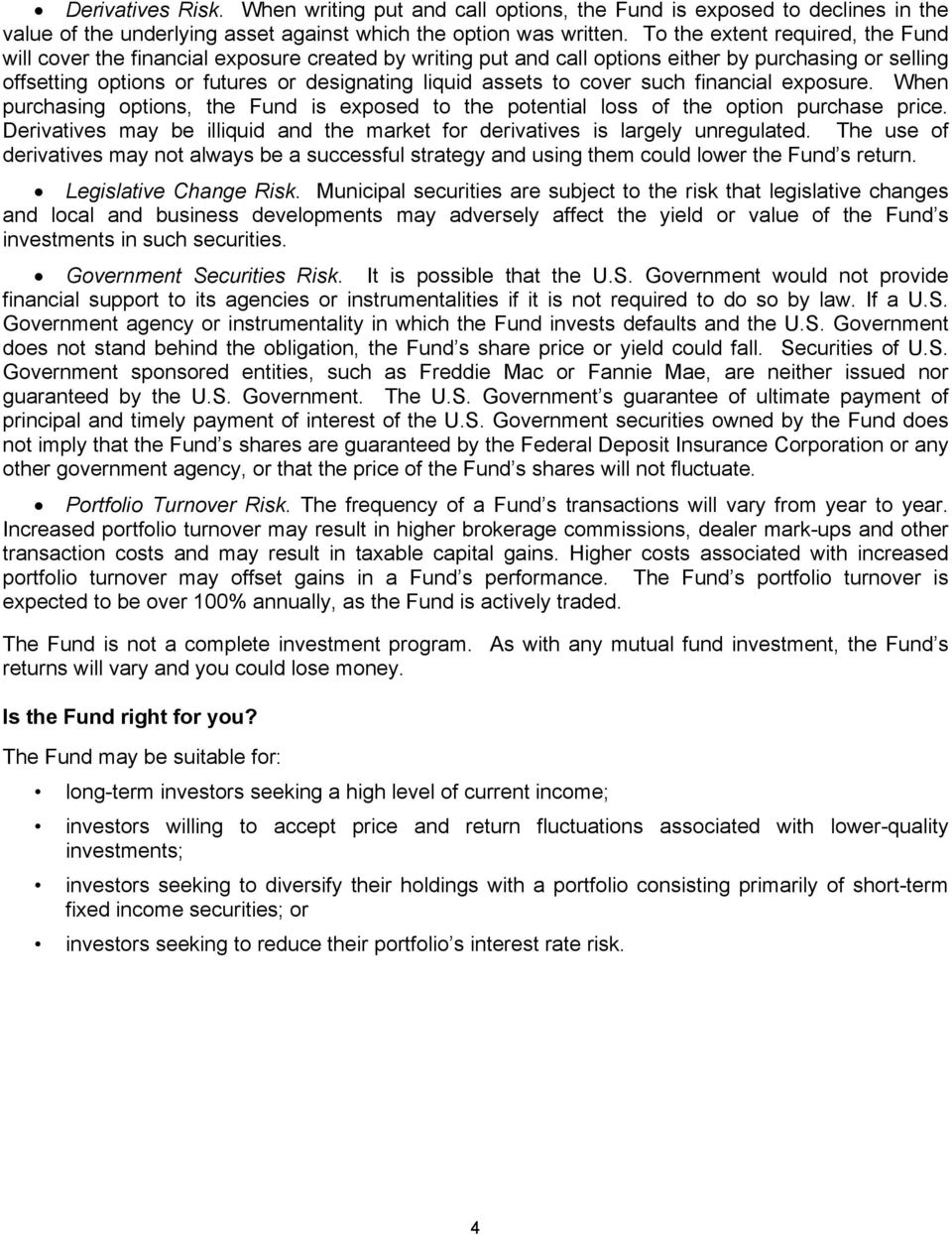
6 Derivatives Risk. When writing put and call options, the Fund is exposed to declines in the value of the underlying asset against which the option was written. To the extent required, the Fund will cover the financial exposure created by writing put and call options either by purchasing or selling offsetting options or futures or designating liquid assets to cover such financial exposure. When purchasing options, the Fund is exposed to the potential loss of the option purchase price. Derivatives may be illiquid and the market for derivatives is largely unregulated. The use of derivatives may not always be a successful strategy and using them could lower the Fund s return. Legislative Change Risk. Municipal securities are subject to the risk that legislative changes and local and business developments may adversely affect the yield or value of the Fund s investments in such securities. Government Securities Risk. It is possible that the U.S. Government would not provide financial support to its agencies or instrumentalities if it is not required to do so by law. If a U.S. Government agency or instrumentality in which the Fund invests defaults and the U.S. Government does not stand behind the obligation, the Fund s share price or yield could fall. Securities of U.S. Government sponsored entities, such as Freddie Mac or Fannie Mae, are neither issued nor guaranteed by the U.S. Government. The U.S. Government s guarantee of ultimate payment of principal and timely payment of interest of the U.S. Government securities owned by the Fund does not imply that the Fund s shares are guaranteed by the Federal Deposit Insurance Corporation or any other government agency, or that the price of the Fund s shares will not fluctuate. Portfolio Turnover Risk. The frequency of a Fund s transactions will vary from year to year. Increased portfolio turnover may result in higher brokerage commissions, dealer mark-ups and other transaction costs and may result in taxable capital gains. Higher costs associated with increased portfolio turnover may offset gains in a Fund s performance. The Fund s portfolio turnover is expected to be over 100% annually, as the Fund is actively traded. The Fund is not a complete investment program. As with any mutual fund investment, the Fund s returns will vary and you could lose money. Is the Fund right for you? The Fund may be suitable for: long-term investors seeking a high level of current income; investors willing to accept price and return fluctuations associated with lower-quality investments; investors seeking to diversify their holdings with a portfolio consisting primarily of short-term fixed income securities; or investors seeking to reduce their portfolio s interest rate risk. 4
7 Performance: The bar chart and table set out below help show the returns and risks of investing in the Fund. The bar chart shows the annual returns of the Fund's Investor Class shares for each calendar year since the Fund's inception. Returns would be higher for the Institutional Class shares. The performance table compares the performance of the Fund's shares over time to the performance of the Merrill Lynch 1-3 Year Government/Corporate Index. You should be aware that the Fund's past performance (before and after taxes) may not be an indication of how the Fund will perform in the future. Updated performance information is available at no cost by visiting or by calling (800) Investor Class Calendar Year Returns as of December 31 Best Quarter: 2 nd Quarter % Worst Quarter: 3 rd Quarter 2008 (5.03)% The Fund's Investor Class shares had a total return of 2.90% during the period January 1, 2014 to June 30, Average Annual Total Returns (For the periods ended December 31, 2013) One Year Five Year Since Inception* Investor Class Return Before Taxes 4.93% 5.73% 4.16% Investor Class Return After Taxes on Distributions Investor Class Return After Taxes on Distributions and Sale of Fund Shares 3.18% 4.41% 2.66% 2.77% 3.95% 2.64% Institutional Class Return Before Taxes 5.50% 6.25% 6.68%** Class A Return Before Taxes 4.93% 5.73% 4.16% Class C Return Before Taxes 4.38% % Merrill Lynch 1-3 Year Government/ Corporate Index 0.70% 2.07% 2.48% Barclays U.S. Aggregate Bond Index -2.02% 4.44% 4.64% * Inception date for Investor Class was July 14, **Inception date for Institutional Class was October 31,

8 After tax returns are calculated using the historical highest individual federal marginal income tax rates and do not reflect the effect of state and local taxes. Actual after-tax returns depend on an investor s tax situation and may differ from those shown, and after-tax returns shown are not relevant to investors who hold shares of the Fund through tax-deferred arrangements, such as 401(k) plans or individual retirement accounts ( IRAs ). After-tax returns are shown for only Investor Class shares, and after-tax returns for other classes will vary. The Merrill Lynch 1-3 Year Government/Corporate Index is an index tracking short-term U.S. government and corporate securities with maturities between 1 and 2.99 years. The index is produced by Merrill Lynch Pierce Fenner & Smith. The index does not reflect the deduction of fees, expenses or taxes that mutual fund investors bear. Unlike a mutual fund, an index does not reflect any trading costs or management fees. Investors cannot directly invest in an index. The Barclays U.S. Aggregate Bond Index is a market capitalization-weighted index, meaning the securities in the index are weighted according to the market size of each bond type. Most U.S. traded investment grade bonds are represented. Municipal bonds and Treasury Inflation-Protected Securities are excluded, due to tax treatment issues. The index includes Treasury securities, Government agency bonds, mortgage-backed bonds, corporate bonds, and a small amount of foreign bonds traded in U.S. Unlike a mutual fund, an index does not reflect any trading costs or management fees. Investors cannot directly invest in an index. Investment Advisor: Leader Capital Corp. is the Fund s investment advisor. Investment Advisor Portfolio Managers: John E. Lekas, founder of Leader Capital Corp., has been the Fund's portfolio manager since it commenced operations in July Scott Carmack, Assistant Portfolio Manager of the Advisor, became co-portfolio manager of the Fund in January Purchase and Sale of Fund Shares: For Institutional Class shares, the minimum initial investment amount for an account is $2,000,000. There is no minimum for subsequent investments. For Investor Class, Class A, and Class C shares, the minimum initial investment amount for all accounts (including IRAs) is $2,500 and the minimum subsequent investment is $100. You may purchase and redeem shares of the Fund on any day that the New York Stock Exchange is open. Redemption requests may be made in writing, by telephone, or through a financial intermediary and will be paid by ACH, check or wire transfer. Tax Information: Dividends and capital gain distributions you receive from the Fund, whether you reinvest your distributions in additional Fund shares or receive them in cash, are taxable to you at either ordinary income or capital gains tax rates unless you are investing through a tax-deferred plan such as an IRA or 401(k) plan. Payments to Broker-Dealers and Other Financial Intermediaries: If you purchase shares of the Fund through a broker-dealer or other financial intermediary (such as a bank), the Fund and its related companies may pay the intermediary for the sale of Fund shares and related services. These payments may create a conflict of interest by influencing the broker-dealer or other intermediary and your salesperson to recommend the Fund over another investment. Ask your salesperson or visit your financial intermediary's website for more information. 6
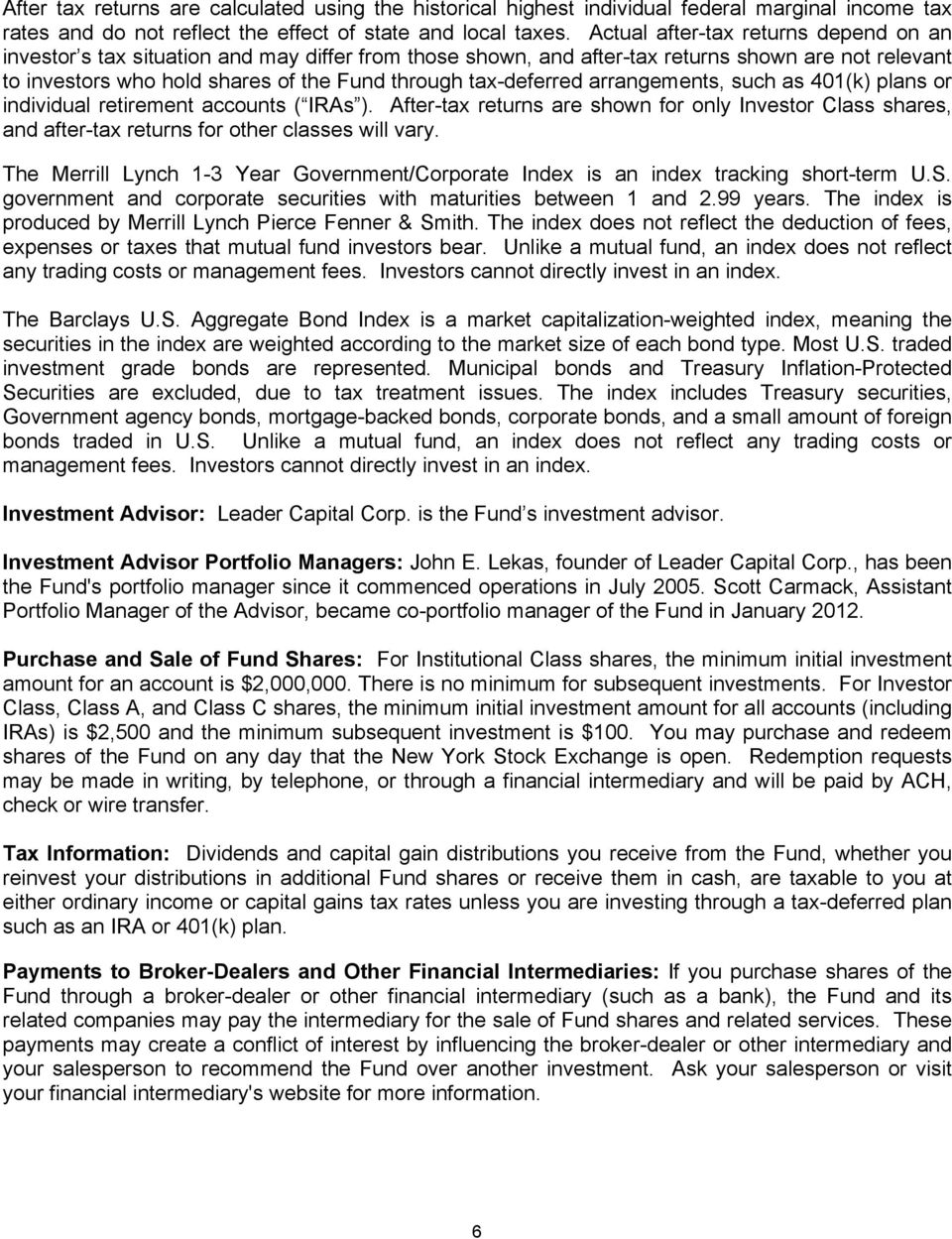
9 LEADER TOTAL RETURN FUND SUMMARY Investment Objective: The investment objective of the Leader Total Return Fund (the Fund ) is to seek income and capital appreciation to produce a high total return. Fees and Expenses of the Fund: The following table describes the fees and expenses that you may pay if you buy and hold shares of the Fund. You may qualify for sales charge discounts on purchases of Class A shares if you and your family invest, or agree to invest in the future, at least $50,000 in the Fund. More information about these and other discounts is available from your financial professional and in How to Purchase Shares on page 23 of the Fund's Prospectus. Shareholder Fees (fees paid directly from your investment) Maximum Sales Charge (Load) Imposed on Purchases (as a % of offering price) Maximum Deferred Sales Charge (Load) (as a % of the lower of original purchase price or redemption proceeds) Maximum Sales Charge (Load) Imposed on Reinvested Dividends and other Distributions Institutional Shares Investor Shares Class A Shares Class C Shares None None 3.50% None None None None 1.00% None None None None Redemption Fee (as a percentage of amount redeemed) None None None None Annual Fund Operating Expenses (expenses that you pay each year as a percentage of the value of your investment) Management Fees 0.75% 0.75% 0.75% 0.75% Distribution and/or Service (12b-1) Fees None 0.50% 0.50% 1.00% Other Expenses 0.44% 0.44% 0.44% 0.44% Acquired Fund Fees and Expenses (1) 0.08% 0.08% 0.08% 0.08% Total Annual Fund Operating Expenses 1.27% 1.77% 1.77% 2.27% (1) Acquired Fund Fees and Expenses are the indirect costs of investing in other investment companies. The operating expenses in this fee table will not correlate to the expense ratio in the Fund's financial highlights because the financial statements include only the direct operating expenses incurred by the Fund. Example: This Example is intended to help you compare the cost of investing in the Fund with the cost of investing in other mutual funds. The Example assumes that you invest $10,000 in the Fund for the time periods indicated and then redeem all of your shares at the end of those periods. The Example also assumes that your investment has a 5% return each year and that the Fund's operating expenses remain the same. Although your actual costs may be higher or lower, based upon these assumptions your costs would be: Class 1 Year 3 Years 5 Years 10 Years Institutional Shares $129 $403 $697 $1,534 Investor Shares $180 $557 $959 $2,084 Class A Shares $524 $888 $1,276 $2,361 Class C Shares $330 $709 $1,215 $2,605 7
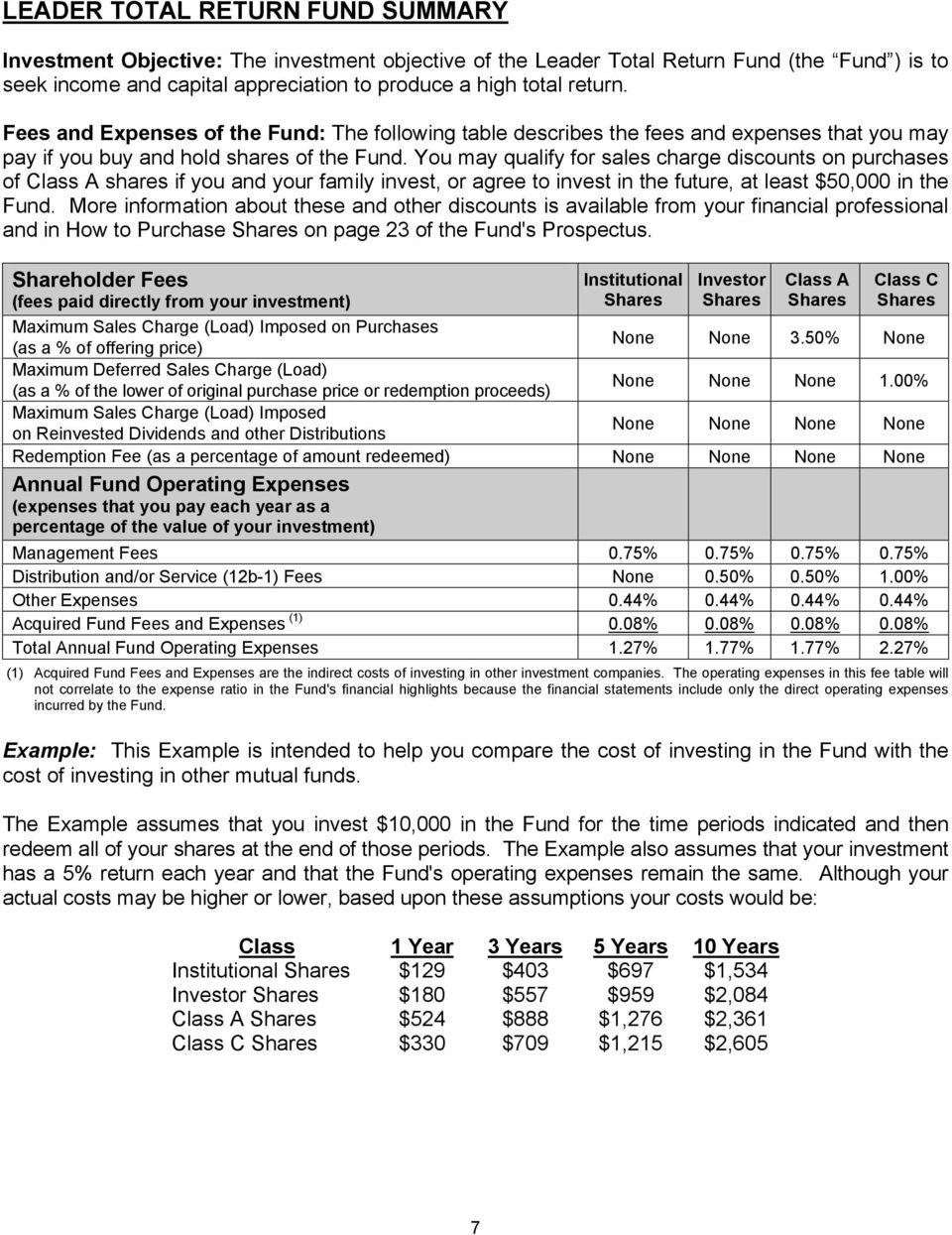
10 Portfolio Turnover: The Fund pays transaction costs, such as commissions, when it buys and sells securities (or turns over its portfolio). A higher portfolio turnover may indicate higher transaction costs and may result in higher taxes when Fund shares are held in a taxable account. These costs, which are not reflected in annual fund operating expenses or in the Example, affect the Fund's performance. During the most recent fiscal year, the Fund's portfolio turnover rate was 93.44% of the average value of its portfolio. Principal Investment Strategies: The Fund seeks to achieve its investment objective by investing primarily in domestic and foreign fixed income securities of various maturities and credit qualities that are denominated in U.S. dollars or foreign currencies. Fixed income security types include bonds, notes, debentures and other evidence of indebtedness issued by corporations, governments and their agencies or instrumentalities as well as mortgage-backed and asset-backed securities. Individual securities are purchased without restriction as to maturity or duration; however, the average portfolio duration normally varies within two years of the duration of the Barclays Capital U.S. Aggregate Intermediate Bond Index (formerly named the Lehman Brothers U.S. Aggregate Index), which as of July 31, 2013 was 4.34 years. Duration is a measure of the expected life of a fixed income security that is used to determine the sensitivity of a security's price to changes in interest rates. The Fund invests primarily in investment-grade securities, but may invest up to 40% of its total assets in high yield securities (commonly referred to as junk bonds ). The Fund defines junk bonds as those rated lower than Baa3 by Moody's Investors Service ( Moody's ) or lower than BBB- by Standard and Poor's Rating Group ( S&P ), or, if unrated, determined by the Advisor to be of similar credit quality. However, the Fund restricts its junk bond purchases to those rated B3 or higher by Moody's or B- or higher by S&P, or, if unrated, determined by the advisor to be of comparable quality. The Fund invests primarily in U.S. dollar denominated securities, but may invest up to 30% of its total assets in securities denominated in foreign currencies, whether issued by U.S. or foreign entities. Foreign issues denominated in U.S. dollars will be excluded from the 30% allocation limit. The Advisor allocates Fund assets among various fixed income sectors, maturities and specific issues using an opportunistic approach by assessing risk and reward among fixed income peer groups. Sector selection focuses on identifying portions of the fixed income market that the advisor believes offer the highest yield, or expected capital appreciation from interest rate declines or currency exchange rate gains. Maturity or yield curve management focuses on selecting securities with maturities that have the highest yield and/or highest potential capital appreciation, when compared to securities with shorter or longer maturities. Security selection focuses on identifying specific securities that offer the highest yield or expected capital appreciation when compared to a peer group of securities with similar credit quality and maturity. The Advisor buys securities for either or both their interest income and their potential for capital appreciation, generally resulting from decreases in interest rates, foreign currency appreciation, or improving credit fundamentals for a particular sector or security. The Advisor may sell a security if its value becomes unattractive, such as when its fundamentals deteriorate or when other investment opportunities exist that may have more attractive yields. The Advisor may engage in frequent buying and selling of securities to achieve the Fund's investment objective. 8
11 Principal Investment Risks: As with all mutual funds, there is the risk that you could lose money through your investment in the Fund. Many factors affect the Fund's net asset value and performance. Credit Risk. Issuers may not make interest and principal payments on securities held by the Fund, resulting in losses to the Fund. In addition, the credit quality of securities held by the Fund may be lowered if an issuer's financial condition changes. Lower credit quality may lead to greater volatility in the price of a security and lower liquidity making it difficult for the Fund to sell the security. Currency Risk. Currency trading risks include market risk, credit risk and country risk. Market risk results from adverse changes in exchange rates in the currencies the Fund is long or short. Credit risk results because a currency-trade counterparty may default. Country risk arises because a government may interfere with transactions in its currency. Foreign Risk. Foreign securities expose the Fund to greater risks because their value depends on issues other than the performance of the U.S. economy and U.S. companies and may include unfavorable changes in foreign exchange rates. Investing in emerging markets imposes risks different from, or greater than, risks of investing in foreign developed countries. High-Yield Bond Risk. Lower-quality bonds, known as high-yield or junk bonds, present greater risk than bonds of higher quality, including an increased risk of default. An economic downturn or period of rising interest rates could adversely affect the market for these bonds and reduce the Fund's ability to sell its bonds. The lack of a liquid market for these bonds could decrease the Fund's share price. The ability of governments to repay their obligations is adversely impacted by default, insolvency, bankruptcy or by political instability, including authoritarian and/or military involvement in governmental decision-making, armed conflict, civil war, social instability and the impact of these events and circumstances on a country s economy and its government's revenues. Therefore, government bonds can present a significant risk. Governments may also repudiate their debts in spite of their ability to pay. A Fund's ability to recover from a defaulting government is limited because that same government may block access to court-mandated legal remedies or other means of recovery. Interest Rate Risk. The value of fixed income securities decline when interest rates rise. Issuer-Specific Risk. The value of a specific security can be more volatile than the market as a whole and can perform differently from the value of the market as a whole. Liquidity Risk. Some securities may have few market-makers and low trading volume, which tends to increase transaction costs and may make it difficult for the Fund to dispose of a security at all or at a price which represents current or fair market value. Management Risk. The advisor's judgments about the attractiveness, value and potential appreciation of particular security in which the Fund invests may prove to be incorrect and may not produce the desired results. Market Risk. Overall fixed income market risks may affect the value of individual securities in which the Fund invests. Factors such as global interest rate levels, economic growth, market conditions and political events affect the fixed income securities markets. When the value of the Fund's investments goes down, your investment in the Fund decreases in value and you could lose money. Mortgage-Backed and Asset-Backed Risk. The default rate on underlying mortgage loans or asset loans may be higher than anticipated, potentially reducing payments to the Fund. Default rates are sensitive to overall economic conditions such as unemployment, wage levels and economic growth rates. Mortgage-backed securities are susceptible maturity risk because issuers of securities held by the Fund are able to prepay principal due on these securities, particularly during periods of declining interest rates. Portfolio Turnover Risk. Increased portfolio turnover may result in higher brokerage commissions, dealer mark-ups and other transaction costs and may result in taxable capital gains. 9
12 Performance: The bar chart and table set out below help show the returns and risks of investing in the Fund. The bar chart shows the annual returns of the Fund's Investor Class shares for each calendar year since the Fund's inception. Returns would be higher for the Institutional Class shares. The performance table compares the performance of the Fund's shares over time to the performance of the Barclays U.S. Aggregate Bond Index. You should be aware that the Fund's past performance (before and after taxes) may not be an indication of how the Fund will perform in the future. Updated performance information is available at no cost by visiting or by calling (800) Investor Class Calendar Year Returns as of December 31 Best Quarter: 1 st Quarter % Worst Quarter: 3 rd Quarter 2011 (6.73)% The Fund's Investor Class shares had a total return of 5.98% during the period January 1, 2014 to June 30, Average Annual Total Returns (For the periods ended December 31, 2013) One Year Since Inception (7/30/10) Investor Class Return Before Taxes 8.90% 6.95% Investor Class Return After Taxes on Distributions Investor Class Return After Taxes on Distributions and Sale of Fund Shares 7.26% 5.32% 5.07% 4.72% Institutional Class Return Before Taxes 9.39% 7.35% Class A Return Before Taxes 4.98% 7.04% Class C Return Before Taxes 8.41% 10.99% Barclays Aggregate Bond Index (2.02)% 2.88% After tax returns are calculated using the historical highest individual federal marginal income tax rates and do not reflect the effect of state and local taxes. Actual after-tax returns depend on an investor s tax situation and may differ from those shown, and after-tax returns shown are not relevant to investors who hold shares of the Fund through tax-deferred arrangements, such as 401(k) plans or IRAs. After-tax returns are shown for only Investor Class shares, and after-tax returns for other classes will vary. 10

13 The Barclays U.S. Aggregate Bond Index is a market capitalization-weighted index, meaning the securities in the index are weighted according to the market size of each bond type. Most U.S. traded investment grade bonds are represented. Municipal bonds and Treasury Inflation-Protected Securities are excluded, due to tax treatment issues. The index includes Treasury securities, Government agency bonds, mortgage-backed bonds, corporate bonds, and a small amount of foreign bonds traded in U.S. Unlike a mutual fund, an index does not reflect any trading costs or management fees. Investors cannot directly invest in an index. Investment Advisor: Leader Capital Corp. is the Fund's investment advisor. Investment Advisor Portfolio Managers: John E. Lekas, founder of Leader Capital Corp., has been the Fund's portfolio manager since it commenced operations in Scott Carmack, Assistant Portfolio Manager of the Advisor, became co-portfolio manager of the Fund in January Purchase and Sale of Fund Shares: For Institutional Class shares, the minimum initial investment amount for all accounts (including IRAs) is $2,000,000. There is no minimum for subsequent investments. For Investor Class, Class A and Class C shares, the minimum initial investment amount for all accounts (including IRAs) is $2,500 and the minimum subsequent investment is $100. You may purchase and redeem shares of the Fund on any day that the New York Stock Exchange is open. Redemption requests may be made in writing, by telephone, or through a financial intermediary and will be paid by ACH, check or wire transfer. Tax Information: Dividends and capital gain distributions you receive from the Fund, whether you reinvest your distributions in additional Fund shares or receive them in cash, are taxable to you at either ordinary income or capital gains tax rates unless you are investing through a tax-deferred plan such as an IRA or 401(k) plan. Payments to Broker-Dealers and Other Financial Intermediaries: If you purchase shares of the Fund through a broker-dealer or other financial intermediary (such as a bank), the Fund and its related companies may pay the intermediary for the sale of Fund shares and related services. These payments may create a conflict of interest by influencing the broker-dealer or other intermediary and your salesperson to recommend the Fund over another investment. Ask your salesperson or visit your financial intermediary's website for more information. 11

14 ADDITIONAL INFORMATION ABOUT PRINCIPAL INVESTMENT STRATEGIES AND RELATED RISKS Investment Objectives: The primary investment objective of the Leader Short-Term Bond Fund is to deliver a high level of current income, with a secondary objective of capital appreciation. The Fund's investment objective is not fundamental, and may be changed by the Board of Trustees without shareholder approval. The investment objectives, strategies and policies described above may be changed without the approval of the Fund s shareholders upon 60 days written notice to shareholders. However, the Fund will not change its investment objective or its investment policy of investing at least 80% of its assets in fixed income securities without changing the name of the Fund and providing shareholders with at least 60 days advance notice in writing. The investment objective of the Leader Total Return Fund is to seek income and capital appreciation to produce a high total return. The Fund's investment objective is not a fundamental policy, and may be changed by the Board of Trustees without shareholder approval upon 60 days written notice. Principal Investment Strategies: Leader Short-Term Bond Fund The Fund expects to achieve its objectives by investing in a portfolio of investment grade and noninvestment grade debt securities, both domestic and foreign. Fixed income securities in which the Fund may invest include foreign and domestic bonds, notes, corporate debt, government securities, strips and municipal securities. The Fund s effective average duration will normally be three years or less. The Fund also may hold cash or cash equivalents, and it may enter into repurchase agreements. The Advisor utilizes a fundamental top-down analysis, meaning the Advisor analyzes the economy, interest rate cycles, the supply and demand for credit and the characteristics of individual securities in making investment selections. Under normal circumstances, the Fund will invest at least 80% of its assets in fixed income securities. This policy may not be changed without at least 60 days advance notice to shareholders in writing. The Fund may invest up to 30% of its assets in lower-quality, high yield bonds rated B or higher by Moody s Investors Service, Standard & Poor s Ratings Group or other Nationally Recognized Statistical Rating Organization ( NRSRO ) or, if unrated by such NRSROs, determined by the Advisor to be of comparable quality. The Fund also may invest in bonds with the potential for capital appreciation by purchasing these bonds at a larger discount from par value. The Fund may invest up to 20% of its assets, determined at the time of investment, in foreign fixed income securities denominated in foreign currencies. Foreign fixed income securities may be investment grade, below investment grade or unrated. The Fund may use options and credit default swaps to manage investment risk and liquidity. The Fund may invest up to 20% of its assets in cash, cash equivalents and fixed income securities other than as described above. By keeping some cash or cash equivalents, the Fund may avoid realizing gains and losses from selling investments when there are shareholder redemptions. However, the Fund may have difficulty meeting its investment objectives when holding a significant cash position. Floating- and variable-rate securities will be considered as cash equivalents. 12
15 The Advisor will consider a floating- or variable-rate security to have a maturity equal to its stated maturity (or redemption date if it has been called for redemption), except that it may consider: (1) variable-rate securities to have a maturity equal to the period remaining until the next readjustment in the interest rate, unless subject to a demand feature; (2) variable-rate securities subject to a demand feature to have a remaining maturity equal to the longer of (a) the next readjustment in the interest rate or (b) the period remaining until the principal can be recovered through demand; and (3) floatingrate securities subject to a demand feature to have a maturity equal to the period remaining until the principal can be recovered through demand. Variable- and floating-rate securities generally are subject to less principal fluctuation than securities without these attributes. As noted above, the Fund s effective average duration will normally be three years or less. Effective duration is a measure of a fixed income security s average life that reflects the present value of the security s cash flow, and accordingly, is a measure of price sensitivity to interest rate changes. Effective duration is expressed in years, like maturity, but it is a better indicator of price sensitivity than maturity because it takes into account the time value of cash flows generated over the security s life. Future interest and principal payments are discounted to reflect their present value and then are multiplied by the number of years they will be received to produce a value expressed in years. You can estimate the effect of interest rates on a fixed income fund s share price by multiplying the fund s effective duration by an expected change in interest rates. For example, the share price of a fixed income fund with an effective duration of three years would be expected to fall approximately 3% if interest rates rose by one percentage point. The Advisor may sell a security if its value becomes unattractive, such as when its fundamentals deteriorate or when other investment opportunities exist that may have more attractive yields. The Fund s annual portfolio turnover rate indicates changes in its portfolio investments. The Advisor will sell a security when appropriate and consistent with the Fund s investment objectives and policies, regardless of the effect on the Fund s portfolio turnover rate. Please note that buying and selling securities generally involves some expense to the Fund, such as broker commissions and other transaction costs. A high turnover rate in any year will result in payment by the Fund of aboveaverage transaction costs and could generate capital gains that must be distributed to shareholders as short-term capital gains taxed at ordinary income rates. The Fund s portfolio turnover rate for the fiscal year ended May 31, 2013 was approximately %; however, the Fund cannot accurately predict its future annual portfolio turnover rate. Portfolio turnover may vary substantially from year to year since portfolio adjustments are made when conditions affecting relevant markets, particular industries or individual issues warrant such action. In addition, portfolio turnover may also be affected by sales of portfolio securities necessary to meet cash requirements for redemptions of shares. Leader Total Return Fund The Fund seeks to achieve its investment objective by investing primarily in domestic and foreign fixed income securities of various maturities and credit qualities that are denominated in U.S. dollars or foreign currencies. Fixed income security types include bonds, notes, debentures and other evidence of indebtedness issued by corporations, governments and their agencies or instrumentalities as well as mortgage-backed and asset-backed securities. Individual securities are purchased without restriction as to maturity or duration; however, the average portfolio duration normally varies within two years of the duration of the Barclays Capital U.S. Aggregate Intermediate Bond Index (formerly named the Lehman Brothers U.S. Aggregate Index), which as of July 31, 2013 was 4.34 years. Duration is a measure of the expected life of a fixed income security that is used to determine the sensitivity of a security's price to changes in interest rates. The longer a security's duration, the more sensitive it will be to changes in interest rates. 13

16 The Fund invests primarily in investment-grade securities, but may invest up to 40% of its total assets in high yield securities (commonly referred to as junk bonds ). The Fund defines junk bonds as those rated lower than Baa3 by Moody's Investors Service ( Moody's ) or lower than BBB- by Standard and Poor's Rating Group ( S&P ), or, if unrated, determined by the advisor to be of similar credit quality. However, the Fund restricts its junk bond purchases to those rated B3 or higher by Moody's or B- or higher by S&P, or, if unrated, determined by the advisor to be of comparable quality. The Fund invests primarily in U.S. dollar denominated securities, but may invest up to 30% of its total assets in securities denominated in foreign currencies, whether issued by U.S. or foreign entities. Foreign issues denominated in U.S. dollars will be excluded from the 30% allocation limit. The advisor allocates Fund assets among various fixed income sectors, maturities and specific issues using an opportunistic approach by assessing risk and reward among fixed income peer groups. Sector selection focuses on identifying portions of the fixed income market that the advisor believes offer the highest yield or expected capital appreciation based upon both credit risk, as measured by the Moody's and/or S&P rating; and on the advisor's business cycle and exchange rate forecast. Maturity or yield curve management focuses on selecting securities with maturities that the advisor believes have the highest yield and/or highest potential capital appreciation, when compared to securities with shorter or longer maturities. Security selection focuses on identifying specific securities that offer the highest yield or expected capital appreciation when compared to a peer group of securities with similar credit quality and maturity. The advisor buys securities for either or both their interest income and their potential for capital appreciation, generally resulting from decreases in interest rates, foreign currency appreciation, or improving credit fundamentals for a particular sector or security. The advisor may sell a security if its value becomes unattractive, such as when its fundamentals deteriorate or when other investment opportunities exist that may have more attractive yields. The advisor may engage in frequent buying and selling of securities to achieve the Fund's investment objective. Principal Investment Risks: Leader Short-Term Bond Fund Interest Rate Risk. The value of the Fund may fluctuate based on changes in interest rates and market conditions. As interest rates rise, the value of income producing instruments may decrease. This risk increases as the term of the note increases. Income earned on floating- or variable-rate securities will vary as interest rates decrease or increase. Variable- and floating-rate securities generally are less susceptible to interest rates than fixed-rate obligations. However, the interest rates on variable-rate securities, as well as certain floating-rate securities whose interest rates are reset only periodically, can fluctuate in value as a result of interest rate changes when there is an imperfect correlation between the interest rates on the securities and prevailing market interest rates. Credit Risk. The issuer of a fixed income security may not be able to make interest or principal payments when due. Generally, the lower the credit rating of a security, the greater the risk is that the issuer will default on its obligation. Credit risks associated with Auction Rate Securities ( ARS ) mirror those of other bond issues in terms of default risk associated with the issuers. Because ARS do not carry a put feature allowing the bondholder to require the purchase of the bonds by the issuer or a third party, they are very sensitive to changes in credit ratings and normally require the highest ratings (e.g., AAA/Aaa) to make them marketable. 14

17 High Yield Bond Risk. Lower-quality bonds, known as high yield bonds or junk bonds, present a significant risk for loss of principal and interest. These bonds offer the potential for higher return, but also involve greater risk than bonds of higher quality, including an increased possibility that the bond s issuer, obligor or guarantor may not be able to make its payments of interest and principal (credit quality risk). If that happens, the value of the bond may decrease, and the Fund s share price may decrease and its income distribution may be reduced. An economic downturn or period of rising interest rates (interest rate risk) could adversely affect the market for these bonds and reduce the Fund s ability to sell its bonds (liquidity risk). The lack of a liquid market for these bonds could decrease the Fund s share price. The ability of governments to repay their obligations is adversely impacted by default, insolvency, bankruptcy or by political instability, including authoritarian and/or military involvement in governmental decision-making, armed conflict, civil war, social instability and the impact of these events and circumstances on a country s economy and its government's revenues. Therefore, government bonds can present a significant risk. Governments may also repudiate their debts in spite of their ability to pay. A Fund's ability to recover from a defaulting government is limited because that same government may block access to court-mandated legal remedies or other means of recovery. Management Risk. The strategy used by the Advisor may fail to produce the intended results. The ability of the Fund to meet its investment objectives is directly related to the Advisor s investment strategies for the Fund. Your investment in the Fund varies with the effectiveness of the Advisor s research, analysis and asset allocation among portfolio securities. If the Advisor s investment strategies do not produce the expected results, your investment could be diminished or even lost. Foreign Risk. Foreign investments involve additional risks not typically associated with investing in U.S. Government securities and/or securities of domestic companies, including currency rate fluctuations, political and economic instability, differences in financial reporting standards and less strict regulation of securities markets. Securities subject to these risks may be less liquid than those that are not subject to these risks. Derivatives Risk. When writing put and call options, the Fund is exposed to declines in the value of the underlying asset against which the option was written. To the extent required, the Fund will cover the financial exposure created by writing put and call options either by purchasing or selling offsetting options or futures or designating liquid assets to cover such financial exposure. When purchasing options, the Fund is exposed to the potential loss of the option purchase price. Derivatives may be illiquid and the market for derivatives is largely unregulated. The use of derivatives may not always be a successful strategy and using them could lower the Fund s return. Legislative Change Risk. Municipal securities are subject to the risk that legislative changes and local and business developments may adversely affect the yield or value of the Fund s investments in such securities. Government Securities Risk. It is possible that the U.S. Government would not provide financial support to its agencies or instrumentalities if it is not required to do so by law. If a U.S. Government agency or instrumentality in which the Fund invests defaults and the U.S. Government does not stand behind the obligation, the Fund s share price or yield could fall. Securities of U.S. Government sponsored entities, such as Freddie Mac or Fannie Mae, are neither issued nor guaranteed by the U.S. Government. The U.S. Government s guarantee of ultimate payment of principal and timely payment of interest of the U.S. Government securities owned by the Fund does not imply that the Fund s shares are guaranteed by the Federal Deposit Insurance Corporation or any other government agency, or that the price of the Fund s shares will not fluctuate. Portfolio Turnover Risk. The frequency of a Fund s transactions will vary from year to year. Increased portfolio turnover may result in higher brokerage commissions, dealer mark-ups and other transaction costs and may result in taxable capital gains. Higher costs associated with increased portfolio turnover may offset gains in a Fund s performance. The Fund s portfolio turnover is expected to be over 100% annually, as the Fund is actively traded. The Fund is not a complete investment program. As with any mutual fund investment, the Fund s returns will vary and you could lose money. 15
18 Leader Total Return Fund Credit Risk. There is a risk that issuers will not make payments on securities held by the Fund, resulting in losses to the Fund. In addition, the credit quality of securities held by the Fund may be lowered if an issuer's financial condition changes. Lower credit quality may lead to greater volatility in the price of a security and in shares of the Fund. Lower credit quality also may affect liquidity and make it difficult for the Fund to sell the security. The Fund may invest, directly or indirectly, in junk bonds. High yield fixed-income securities (also known as junk bonds ) are considered speculative with respect to the issuer's capacity to pay interest and repay principal in accordance with the terms of the obligations. This means that, compared to issuers of higher rated securities, issuers of medium and lower rated securities are less likely to have the capacity to pay interest and repay principal when due in the event of adverse business, financial or economic conditions and/or may be in default or not current in the payment of interest or principal. The market values of medium- and lower-rated securities tend to be more sensitive to company-specific developments and changes in economic conditions than higher-rated securities. The companies that issue these securities often are highly leveraged, and their ability to service their debt obligations during an economic downturn or periods of rising interest rates may be impaired. In addition, these companies may not have access to more traditional methods of financing, and may be unable to repay debt at maturity by refinancing. The risk of loss due to default in payment of interest or principal by these issuers is significantly greater than with higher-rated securities because medium- and lower-rated securities generally are unsecured and subordinated to senior debt. Default, or the market's perception that an issuer is likely to default, could reduce the value and liquidity of securities held by the Fund, thereby reducing the value of your investment in Fund shares. In addition, default may cause the Fund to incur expenses in seeking recovery of principal or interest on its portfolio holdings. Currency Risk. Foreign currency investing through non-u.s. dollar denominated investments involves significant risks, including market risk, interest rate risk, country risk, counterparty credit risk and short sale risk. Market risk results from the price movement of foreign currency values in response to shifting market supply and demand. Since exchange rate changes can readily move in one direction, a currency position carried overnight or over a number of days may involve greater risk than one carried a few minutes or hours. Interest rate risk arises whenever a country changes its stated interest rate target associated with its currency. Country risk arises because virtually every country has interfered with international transactions in its currency. Interference has taken the form of regulation of the local exchange market, restrictions on foreign investment by residents or limits on inflows of investment funds from abroad. Restrictions on the exchange market or on international transactions are intended to affect the level or movement of the exchange rate. This risk could include the country issuing a new currency, effectively making the old currency worthless. Foreign Risk. The Fund could be subject to greater risks because the Fund's performance may depend on factors other than the performance of securities of U.S. issuers. Changes in foreign economies and political climates are more likely to affect the Fund than a mutual fund that invests exclusively in U.S. dollars and U.S. Issuers. The value of foreign currency denominated securities or foreign currency contracts is also affected by the value of the local currency relative to the U.S. dollar. There may also be less government supervision of foreign markets, resulting in non-uniform accounting practices and less publicly available information about issuers of foreign currency denominated securities. The value of foreign investments, including foreign currency denominated investments, may be affected by changes in exchange control regulations, application of foreign tax laws (including withholding tax), changes in governmental administration or economic or monetary policy (in this country or abroad) or changed circumstances in dealings between nations. In addition, foreign brokerage commissions, custody fees and other costs of investing in foreign securities are generally higher than in the United States. Investments in foreign issues, whether denominated in U.S. dollars or foreign currencies, could be affected by other factors not present in the United States, including expropriation, armed conflict, confiscatory taxation, and potential difficulties in enforcing contractual obligations. 16
19 High-Yield Bond Risk. Lower-quality bonds, known as high-yield or junk bonds, present a significant risk for loss of principal and interest. These bonds offer the potential for higher return, but also involve greater risk than bonds of higher quality, including an increased possibility that the bond's issuer, obligor or guarantor may not be able to make its payments of interest and principal (credit quality risk). If that happens, the value of the bond may decrease, and the Fund's share price may decrease and its income distribution may be reduced. An economic downturn or period of rising interest rates (interest rate risk) could adversely affect the market for these bonds and reduce the Fund's ability to sell its bonds (liquidity risk). Such securities may also include Rule 144A securities, which are subject to resale restrictions. The lack of a liquid market for these bonds could decrease the Fund's share price. The ability of governments to repay their obligations is adversely impacted by default, insolvency, bankruptcy or by political instability, including authoritarian and/or military involvement in governmental decision-making, armed conflict, civil war, social instability and the impact of these events and circumstances on a country s economy and its government's revenues. Therefore, government bonds can present a significant risk. Governments may also repudiate their debts in spite of their ability to pay. A Fund's ability to recover from a defaulting government is limited because that same government may block access to court-mandated legal remedies or other means of recovery. Interest Rate Risk. When the Fund invests in fixed income securities, the value of your investment in the Fund will fluctuate with changes in interest rates. Typically, a rise in interest rates causes a decline in the value of the fixed income securities owned by the Fund. In general, the market price of debt securities with longer maturities will increase or decrease more in response to changes in interest rates than shorter-term securities. Issuer-Specific Risk. The value of a specific security can be more volatile than the market as a whole and can perform differently from the value of the market as a whole. The value of securities of smaller sized issuers can be more volatile than that of larger issuers. The value of certain types of securities can be more volatile due to increased sensitivity to adverse issuer, political, regulatory, market, or economic developments. Liquidity Risk. Liquidity risk is the risk that a security cannot be sold or replaced quickly at or very close to its market value. The Fund's ability to sell a position in a security prior to maturity depends, in part, on the existence of a liquid secondary market for such a security. Some securities may have few market-makers and low trading volume, which tends to increase transaction costs and may make it difficult for the Fund to dispose of a security at all or at a price which represents current or fair market value. Management Risk. The advisor's judgments about the attractiveness, value and potential appreciation of particular security in which the Fund invests may prove to be incorrect and may not produce the desired results. Market Risk. The net asset value of the Fund will fluctuate based on changes in the value of the securities in which the Fund invests. The Fund invests in securities which may be more volatile and carry more risk than some other forms of investment. The price of securities fall because of economic or political changes. Security prices in general may decline over short or even extended periods of time. Market prices of securities and broad market segments may be adversely affected by a prominent issuer having experienced losses or by the lack of earnings or such an issuer's failure to meet the market's expectations with respect to new products or services, or even by factors wholly unrelated to the value or condition of the issuer, such as changes in economic growth rates. Mortgage-Backed and Asset-Backed Risk. Mortgage-Backed ( MBS ) and asset-backed securities ( ABS ) are subject to certain additional risks. The default rate on underlying mortgage loans or asset loans may be higher than anticipated, potentially reducing payments to the Fund. Default rates are sensitive to overall economic conditions such as unemployment, wage levels and economic growth rates. MBS are susceptible maturity risk because issuers of securities held by the Fund are able to prepay principal due on these securities, particularly during periods of declining 17

20 interest rates. Securities subject to prepayment risk generally offer less potential for gains when interest rates decline, and may offer a greater potential for loss when interest rates rise. When interest rates decline, borrowers may pay off their mortgages sooner than expected. This can reduce the returns of the Fund because the Fund may have to reinvest that money at the lower prevailing interest rates. Prepayment risk as well as the risk that the structure of certain MBS may make their reaction to interest rates and other factors difficult to predict, making their prices volatile. Generally, rising interest rates tend to be associated with longer MBS maturities because borrower prepayment rates tend to decline when rates rise. As a result, in a period of rising interest rates, MBS exhibit additional volatility, known as extension risk. ABS are also subject to maturity risk, although to a much smaller degree. Portfolio Turnover Risk. Portfolio turnover refers to the rate at which the securities held by the Fund are replaced. The higher the rate, the higher the transactional and brokerage costs associated with the turnover, which may reduce the Fund's return unless the securities traded can be bought and sold without corresponding commission costs. Active trading of securities may also increase the Fund's realized capital gains or losses, which may affect the taxes you pay as a Fund shareholder. Non-Principal Investment Strategies and Risks: Leveraged Exchange-Traded Equity Funds (both Funds). The Advisor may also seek to invest in the equity market through equity index-based exchange-traded funds ( ETFs ) when it believes that the potential returns are favorable, based on factors such as valuation and the economic growth in the economy. An equity index-based ETF seeks to track the performance of a particular index by holding in its portfolio either the contents of the index or a representative sample of the securities in the index. Leveraged equity ETFs are designed to increase or decrease in value by a multiple of their reference equity index (e.g. S&P 500, Dow Jones Industrial Average, NASDAQ 100 or Russell 2000) when it increases or decreases in value. Leverage may be up to 3 times. An ETF with 3 times leverage is designed to produce daily returns, before fees and expenses, of 3 times that of the underlying equity index. For, example, if the S&P 500 returned 1% on a specific day, an S&P 500-linked 3 times leveraged ETF would be expected to return 3% that day, less fees and expense of the ETF. Unlike typical open-end mutual funds, ETFs do not sell or redeem their individual shares at net asset value. Instead, ETFs sell and redeem their shares at NAV only in large blocks (such as 50,000 shares). In addition, ETF shares are listed for trading on national exchanges, which allows investors to purchase and sell individual ETF shares among themselves at market prices throughout the day. Leveraged equity ETFs may cause the Funds to suffer significant losses because of the returnmagnifying effect of leverage. ETFs are subject to investment advisory and other expenses, which will be indirectly paid by the Funds. Additionally, investments in ETFs are subject to brokerage and other trading costs, which will result in greater expenses to the Funds. As a result, your cost of investing in the Funds will be higher than the cost of investing directly in ETFs and may be higher than other mutual funds that invest exclusively in stocks and bonds. Because ETFs are listed on national stock exchanges and are traded like stocks listed on an exchange, ETF shares may trade at a discount to or a premium above net asset value if there is a limited market in such shares. Also, because the value of ETF shares depends on the demand in the market, the Advisor may not be able to liquidate the Funds holdings at the most optimal time, adversely affecting the Funds performance. Foreign Currency Forward Contracts (both Funds). The Fund may enter into foreign currency forward contracts in order to hedge its exposure to changes in foreign currency exchange rates on its foreign portfolio holdings or as a part of an investment strategy where the Advisor seeks profits by forecasting short-term movements in exchange rates. When executing forward contracts, the Fund is obligated to buy or sell a foreign currency at a specified rate on a certain date in the future. With respect to sales of forwards contracts, the Fund would incur a loss if the value of the contract 18

21 increases between the date the forward contract is opened and the date the forward contract is closed. The Fund realizes a gain if the value of the contract decreases between those dates. With respect to purchases of forward contracts, the Fund would incur a loss if the value of the contract decreases between the date the forward contract is opened and the date the forward contract is closed. The Fund realizes a gain if the value of the contract increases between those dates. The Fund's investment in foreign currency forward contracts subjects the Fund to risks that include market risk, credit risk and country risk. Market risk results from adverse changes in exchange rates. Credit risk results because a currency-trade counterparty may default or may be unwilling or unable to complete a transaction in accordance with its terms and conditions. However, losses to the Fund would typically be limited to the unrealized gain on each defaulted open contract. Country risk arises because a government may interfere with transactions in its currency, making it difficult or impossible for the Fund to close out a position at a time the Advisor considers optimal. Additionally, even a small investment in a foreign currency forward contract may give rise to leverage risk, and can have a significant impact on the Fund's performance. Temporary Investments: To respond to adverse market, economic, political or other conditions, each Fund may invest 100% of its total assets, without limitation, in high-quality short-term debt securities and money market instruments. These short-term debt securities and money market instruments include: shares of money market mutual funds, commercial paper, certificates of deposit, bankers' acceptances, U.S. Government securities and repurchase agreements. While the Fund is in a defensive position, the opportunity to achieve its investment objective will be limited. Furthermore, to the extent that the Fund invests in money market mutual funds for cash positions, there will be some duplication of expenses because the Fund pays its pro-rata portion of such money market funds' advisory fees and operational fees. Each Fund may also invest a substantial portion of its assets in such instruments at any time to maintain liquidity or pending selection of investments in accordance with its policies. Portfolio Holdings Disclosure: A description of the Funds' policies regarding the release of portfolio holdings information is available in the Funds Statement of Additional Information. Each Fund will post a complete list of its portfolio holdings as of the last day of each fiscal quarter or semiannual period within 60 days following the end of such period on its website at Each Fund's portfolio holdings will remain available on its website at least until the next quarterly update. Shareholders may request portfolio holdings schedules at no charge by calling Leader Short-Term Bond Fund s Investor Class shares commenced operations on January 19, 2007, and the Original Fund commenced operations on July 14, Institutional Class shares commenced operations on October 31, The Fund has the same investment objectives and strategies and substantially the same investment policies as the Original Fund and the Predecessor Fund. The Fund was reorganized at the close of business on October 17, 2008 from a series of the Trust for Professional Managers, a Delaware statutory trust (the Predecessor Fund ) to a series of Northern Lights Fund Trust, also a Delaware statutory trust (the Reorganization ). Shareholders of the Predecessor Fund received Investor Class shares of the Fund in the Reorganization. The Predecessor Fund commenced operations on January 19, The Predecessor Fund is the successor to a series of Unified Series Trust (the Original Fund ), which commenced operations on July 14, Information shown includes performance of the Predecessor Fund and the Original Fund. 19
22 MANAGEMENT Investment Advisor: Leader Capital Corp., 919 NE 19th Ave., Suite 200, Portland, OR 97232, serves as investment advisor to both Funds. John E. Lekas is the President of the Advisor, which he founded in The Advisor implements each Fund's overall investment strategies, identifies securities for investment, determines when securities should be purchased or sold, selects brokers or dealers to execute transactions for each Fund's portfolio and votes any proxies solicited by portfolio companies. Pursuant to an advisory agreement between the Fund and Leader Capital Corp., the Advisor is entitled to receive, on a monthly basis, an annual advisory fee equal to 0.75% on the first $1.25 billion of the average daily net assets and then 0.70% on assets greater than $1.25 billion of the Leader Short-Term Bond Fund and 0.75% of the average daily net assets of the Leader Total Return Fund. For the fiscal year ended May 31, 2014, the Leader Short Term Bond Fund paid an investment advisory fee to the Advisor at an annual rate of 0.75% the average daily net assets of the Fund. For the fiscal year ended May 31, 2014, the Leader Total Return Fund incurred an investment advisory fee to the Advisor at an annual rate of 0.75% the average daily net assets of the Fund. Additionally, the Adviser recouped an amount equal to 0.15% of the average daily net assets of the Leader Total Return Fund pursuant to the expense limitation agreement between the Fund and the Adviser. The Advisor (not the Fund) may pay certain financial institutions (which may include banks, credit unions, brokers, securities dealers and other industry professionals) a fee for providing distributionrelated services and/or for performing certain administrative servicing functions for Fund shareholders, to the extent these institutions are allowed to do so by applicable statute, rule or regulation. A discussion regarding the basis for the Board of Trustees approval of the advisory agreement is included in the Funds annual report dated May 31, Investment Advisor Portfolio Managers: John E. Lekas serves as the portfolio manager and is, together with Scott Carmack, responsible for the investment decisions of each Fund, as he did for Leader Short-Term Bond s Predecessor Fund and the Original Fund. He has 20 years experience as an investment professional. Prior to founding the Advisor in 1997, Mr. Lekas served as a portfolio manager at Smith Barney where he focused on discretionary management of bond portfolios worth over $200 million. He received a bachelor's degree in finance from the University of Oregon. Scott Carmack was an Assistant Portfolio Manager for the Advisor and joined Leader Capital Corp in February Prior to joining Leader Capital Corp, he was a proprietary trader at the following firms: Chimera Securities from May 2010 to January 2011, Assent LLC from September 2006 to May 2010 and Evolution LLC from September 2003 to September Mr. Carmack also served as Analyst, Private Bank for JP Morgan Chase from July 2001 to September Mr. Carmack graduated with honors from Harvard University in 2001, where he was a member of the Varsity Baseball Team and concentrated in Economics. The Funds' Statement of Additional Information provides information about Mr. Lekas' and Mr. Carmack s compensation structure, other accounts managed by them and their ownership interests in shares of the Funds. Leader Total Return Fund s Prior Performance Information: The Advisor has been responsible for managing separate accounts for clients, a portion of which have been invested using the same strategy as the Leader Total Return Fund (the Total Return Strategy ) This strategy employs the same features of the Fund's principal investment strategies including investing primarily in domestic and foreign fixed income securities of various maturities and credit qualities that are denominated in U.S. dollars or foreign currencies, where fixed income security types include bonds, notes, debentures and other evidence of indebtedness issued by corporations, governments and their agencies or instrumentalities as well as mortgage-backed and asset-backed securities using the Advisor's investment principles. Consequently, this Total Return Strategy is substantially similar to the strategy employed by the Fund. 20
23 The advisor had full discretionary authority over the selection of investments for those Total Return Strategy accounts, and intends to use substantially the same goals and style of investment management in managing the Fund. The Leader Total Return Fund has substantially the same investment objective, policies and strategies as the Total Return Strategy accounts. The information for the Total Return Strategy accounts, which includes all substantially similar accounts, is provided to show the past performance of those accounts as measured against the specified benchmark index. The performance of the Total Return Strategy accounts does not represent the historical performance of the Fund, and should not be considered indicative of future performance of the Fund. Future results will differ from past results because of differences in future behavior of the various investment markets, in brokerage commissions, account expenses, the size of positions taken in relation to account size and diversification of securities, and the timing of purchases and sales, among other things. In addition, the Total Return Strategy accounts are not subject to certain investment limitations and other restriction imposed by the Investment Company Act of 1940, as amended (the 1940 Act and the Internal Revenue Code which, if applicable, might have adversely affected the performance of the Total Return Strategy accounts during the periods shown. Performance of the Fund for future periods will definitely vary, and some months and some quarters will result in negative performance; indeed, some future years may have negative performance. The expenses of the Fund are higher than those of the Total Return Strategy accounts and the returns presented below would be lower if the expenses of the Fund were used. Year-by-Year Annual Total Return Total Return Strategy Accounts Composite (For the years ended December 31 st ) % 80.00% 60.00% 40.00% 39.84% 20.00% 7.03% 16.85% 16.92% 0.00% % During the period shown, the highest return for a quarter was 20.73% (2 nd quarter, 2001); and the lowest return was -5.93% (2 nd quarter, 2002). 21
24 Total Return Strategy Accounts Composite Average Annual Total Returns For the periods ended June 30, Year Since Inception ( ) Total Return Strategy Accounts (reflects deduction of actual expenses) % 11.54% Barclays Capital U.S. Aggregate Bond Index % 7.08% 1 As of June 30, 2005, the Total Return Accounts totaled approximately $15 million. 2 The Barclays Capital U.S. Aggregate Bond Index is a market capitalization-weighted index, meaning the securities in the index are weighted according to the market size of each bond type. Most U.S. traded investment grade bonds are represented. Municipal bonds and Treasury Inflation-Protected Securities are excluded, due to tax treatment issues. The index includes Treasury securities, Government agency bonds, mortgage-backed bonds, corporate bonds, and a small amount of foreign bonds traded in U.S. Unlike a mutual fund, an index does not reflect any trading costs or management fees. Investors cannot directly invest in an index. HOW SHARES ARE PRICED The net asset value ( NAV ) of each class of each Fund shares is determined at 4:00 p.m. (Eastern time) on each day the New York Stock Exchange ( NYSE ) is open for business. NAV is computed by determining the aggregate market value of all assets of the Fund less its liabilities divided by the total number of each Fund's shares outstanding ((asset-liabilities)/number of shares=nav) attributable to each share class. The NYSE is closed on weekends and New Year s Day, Martin Luther King, Jr. Day, Presidents Day, Good Friday, Memorial Day, Independence Day, Labor Day, Thanksgiving Day and Christmas Day. The NAV takes into account the expenses and fees of each Fund, including investment advisory, administration, and any distribution fees, which are accrued daily. The determination of NAV of each Fund for a particular day is applicable to all applications for the purchase of shares, as well as all requests for the redemption of shares, received by each Fund (or an authorized broker or agent, or its authorized designee) before the close of trading on the NYSE on that day. Generally, securities are valued each day at the last quoted sales price on each security's principal exchange. Securities traded or dealt in upon one or more securities exchanges (whether domestic or foreign) for which market quotations are readily available and not subject to restrictions against resale shall be valued at the last quoted sales price on the primary exchange or, in the absence of a sale on the primary exchange, at the mean between the current bid and ask prices on such exchange. Securities primarily traded in the National Association of Securities Dealers' Automated Quotation System ( NASDAQ ) National Market System for which market quotations are readily available shall be valued using the NASDAQ Official Closing Price. If market quotations are not readily available, securities will be valued at their fair market value as determined using the fair value procedures approved by the Board. In these cases, each Fund's NAV will reflect certain portfolio securities' fair value rather than their market price. Fair value pricing involves subjective judgments and it is possible that the fair value determined for a security may be materially different than the value that could be realized upon the sale of that security. The fair value prices can differ from market prices when they become available or when a price becomes available. The Board has delegated execution of these procedures to a fair value team composed of one or more representatives from each of the (i) Trust, (ii) administrator, and (iii) Advisor. The team may also enlist third party consultants such as 22
25 an audit firm or financial officer of a security issuer on an as-needed basis to assist in determining a security-specific fair value. The Board reviews and ratifies the execution of this process and the resultant fair value prices at least quarterly to assure the process produces reliable results. Each Fund may use independent pricing services to assist in calculating the value of the Fund's securities. Although not part of the Advisor's principal investment strategy, since each Fund may invest in foreign securities that are primarily listed on foreign exchanges that may trade on weekends or other days when the Fund does not price its shares, the value of the Fund's portfolio may change on days when you may not be able to buy or sell Fund shares. In computing the NAV of each Fund, the Advisor values foreign securities held by each Fund at the latest closing price on the exchange in which they are traded immediately prior to closing of the NYSE. Prices of foreign securities quoted in foreign currencies are translated into U.S. dollars at current rates. If events materially affecting the value of a security in each Fund's portfolio occur before the Fund prices its shares, the security will be valued at fair value. For example, if trading in a portfolio security is halted and does not resume before the Fund calculates its NAV, the Advisor may need to price the security using the Fund's fair value pricing guidelines. Without a fair value price, short-term traders could take advantage of the arbitrage opportunity and dilute the NAV of long-term investors. Fair valuation of each Fund's portfolio securities can serve to reduce arbitrage opportunities available to short-term traders, but there is no assurance that fair value pricing policies will prevent dilution of the Fund's NAV by short-term traders. With respect to any portion of each Fund's assets that are invested in one or more open-end management investment companies that are registered under the 1940 Act, each Fund's NAV is calculated based upon the net asset values of the registered open-end management investment companies in which each Fund invests, and the prospectuses for these companies explain the circumstances under which those companies will use fair value pricing and the effects of using fair value pricing. HOW TO PURCHASE SHARES The Funds each offer four classes of shares: Class A, Class C, Institutional Class and Investor Class. The main difference between the share classes are the minimum investment, ongoing fees and sales charges. Class A, Class C and Investor Class shares, for both funds, pay an annual fee of 0.50%, 1.00% and 0.50%, respectively, for distribution expenses pursuant to a plan under Rule 12b-1, and Institutional Class shares do not pay such fees. Class A Shares: Class A shares of each Fund are offered at their public offering price, which is net asset value per share plus the applicable sales charge. The sales charge varies, depending on how much you invest. There are no sales charges on reinvested distributions. The Fund reserves the right to waive sales charges. The following sales charges apply to your purchases of Class A shares of a Fund: Sales Charge Sales Charge Amount Invested as a % as a % Dealer of Offering of Amount Reallowance Price (1) Invested Less than $50, % 3.63% 3.50% $50,000 but less than $250, % 2.56% 2.50% $250,000 but less than $500, % 1.52% 1.50% $500,000 or more None None None (1) Offering price includes the front-end sales load. The sales charge you pay may differ slightly from the amount set forth above because of rounding that occurs in the calculations used to determine your sales charge. 23
26 You may be able to buy Class A Shares without a sales charge (i.e. load-waived ) when you are: reinvesting dividends or distributions; participating in an investment advisory or agency commission program under which you pay a fee to an investment advisor or other firm for portfolio management or brokerage services; exchanging an investment in Class A Shares of another fund for an investment in the Fund; a current or former director or trustee of the Fund; an employee (including the employee s spouse, domestic partner, children, grandchildren, parents, grandparents, siblings, and any independent of the employee, as defined in Section 152 of the Internal Revenue Code) of the Fund s advisor or its affiliates or of a broker-dealer authorized to sell shares of the fund; Participants in certain wrap-fee or asset allocation programs or other fee-based arrangements sponsored by broker-dealers and other financial institutions that have entered into agreements with the Distributor. purchasing shares through the Fund s advisor; or purchasing shares through a financial services firm (such as a broker-dealer, investment advisor or financial institution) that has a special arrangement with the Fund. Right of Accumulation: For the purposes of determining the applicable reduced sales charge, the right of accumulation allows you to include prior purchases of Class A shares of the Fund as part of your current investment as well as reinvested dividends. To qualify for this option, you must be either: an individual; an individual and spouse purchasing shares for your own account or trust or custodial accounts for your minor children; or a fiduciary purchasing for any one trust, estate or fiduciary account, including employee benefit plans created under Sections 401, 403 or 457 of the Internal Revenue Code, including related plans of the same employer. If you plan to rely on this right of accumulation, you must notify your financial advisor or the Fund s transfer agent, at the time of your purchase. You will need to give your financial advisor or the Funds transfer agent your account numbers. Existing holdings of family members or other related accounts of a shareholder may be combined for purposes of determining eligibility. If applicable, you will need to provide the account numbers of your spouse and your minor children as well as the ages of your minor children. Letter of Intent: The letter of intent allows you to count all investments within a 13-month period in Class A shares of the Fund as if you were making them all at once for the purposes of calculating the applicable reduced sales charges. The minimum initial investment under a letter of intent is 5% of the total letter of intent amount. The letter of intent does not preclude the Fund from discontinuing sales of its shares. You may include a purchase not originally made pursuant to a letter of intent under a letter of intent entered into within 90 days of the original purchase. To determine the applicable sales charge reduction, you may also include (1) the cost of shares of the Fund which were previously purchased at a price including a front end sales charge during the 90-day period prior to the Funds transfer agent receiving the letter of intent, and (2) the historical cost of shares of other Funds you currently own acquired in exchange for shares the Fund purchased during that period at a price including a front-end sales charge. You may combine purchases and exchanges by family members 24
27 (limited to spouse and children, under the age of 21, living in the same household). You should retain any records necessary to substantiate historical costs because the Fund, the transfer agent and any financial intermediaries may not maintain this information. Shares acquired through reinvestment of dividends are not aggregated to achieve the stated investment goal. Class C Shares: Class C shares of each Fund are sold at NAV without an initial sales charge. This means that 100% of your initial investment is placed into shares of the Fund. Class C shares pay up to 1.00% on an annualized basis of the average daily net assets as reimbursement or compensation for service and distribution-related activities with respect to the Fund and/or shareholder services. Over time, fees paid under this distribution and service plan will increase the cost of a Class C shareholder s investment and may cost more than other types of sales charges. The Advisor will advance to, or reimburse, the Fund up to 1.00% in connection with 12b-1 fees advanced to authorized broker-dealers on purchases of Class C shares. However, when the Advisor makes such a payment, the respective Class C shares are subject to a contingent deferred sales charge ( CDSC ) on shares redeemed prior to the first 12 months after their purchase in the amount advanced to recover commissions paid to your broker-dealer. Purchasing Shares: You may purchase shares of a Fund by sending a completed application form to the following address: via Regular Mail: Leader Short-Term Bond Fund or Leader Total Return Fund c/o Gemini Fund Services, LLC P.O. Box Omaha, Nebraska or Overnight Mail: Leader Short-Term Bond Fund or Leader Total Return Fund c/o Gemini Fund Services, LLC Wright Street, Suite 2 Omaha, Nebraska The USA PATRIOT Act requires financial institutions, including the Funds, to adopt certain policies and programs to prevent money-laundering activities, including procedures to verify the identity of customers opening new accounts. As requested on the Application, you should supply your full name, date of birth, social security number and permanent street address. Mailing addresses containing a P.O. Box will not be accepted. This information will assist a Fund in verifying your identity. Until such verification is made, the Fund may temporarily limit additional share purchases. In addition, the Funds may limit additional share purchases or close an account if it is unable to verify a shareholder s identity. As required by law, the Fund may employ various procedures, such as comparing the information to fraud databases or requesting additional information or documentation from you, to ensure that the information supplied by you is correct. Purchase through Brokers: You may invest in the Funds through brokers or agents who have entered into selling agreements with the Funds' distributor. The brokers and agents are authorized to receive purchase and redemption orders on behalf of the Funds. Each Fund will be deemed to have received a purchase or redemption order when an authorized broker or its designee receives the order. The broker or agent may set their own initial and subsequent investment minimums. You may be charged a fee if you use a broker or agent to buy or redeem shares of the Funds. Finally, various servicing agents use procedures and impose restrictions that may be in addition to, or different from those applicable to investors purchasing shares directly from a Fund. You should carefully read the program materials provided to you by your servicing agent. 25
28 Purchase by Wire: If you wish to wire money to make an investment in a Fund, please call the Fund at for wiring instructions and to notify the Fund that a wire transfer is coming. Any commercial bank can transfer same-day funds via wire. The Fund will normally accept wired funds for investment on the day received if they are received by the Funds designated bank before the close of regular trading on the NYSE. Your bank may charge you a fee for wiring same-day funds. Automatic Investment Plan: You may participate in the Funds Automatic Investment Plan, an investment plan that automatically moves money from your bank account and invests it in the Funds through the use of electronic funds transfers or automatic bank drafts. You may elect to make subsequent investments by transfers of a minimum of $100 on specified days of each month into your established Fund account for the Leader Short-Term Bond Fund. You may elect to make subsequent investments by transfers of a minimum of $25 on specified days of each month into your established Fund account for the Leader Total Return Fund. Please contact the Funds at for more information about the Funds Automatic Investment Plan. Institutional Shares: Institutional Shares are sold without any initial sales charge to the following: 1) Accounts for which the Advisor or any of its affiliates act as fiduciary, agent, investment Advisor or custodian and clients of the Advisor s affiliates. 2) Institutional investors (such as qualified retirement plans, wrap fee plans and other programs charging asset-based fees) with a minimum initial investment of $2,000,000 that have received authorization from the Advisor. 3) Advisory clients of a registered investment advisor with a fee-based asset management account. 4) Any accounts established on behalf of registered investment advisors or their clients by brokerdealers that charge a transaction fee and that have entered into agreements with the Advisor. For these purposes, immediate family is defined to include a person s spouse, parents and children. The initial investment minimum may be waived for persons affiliated with the Advisor and its affiliated entities. All share classes may not be available for purchase in every state. Voluntary Conversion: Shareholders may be able to convert shares into Institutional Class shares of a Fund, which have a lower expense ratio, provided certain conditions are met. This conversion feature is intended for shares held through a financial intermediary offering a fee-based or wrap fee program that has an agreement with the Adviser or the Distributor for this purpose. In such instances, Class A, Class C or Investor Class shares may be converted under certain circumstances. Generally, Class C Shares are not eligible for conversion until the applicable CDSC period has expired. Please contact your financial intermediary for additional information. Not all share classes are available through all financial intermediaries. If shares of the Fund are converted to a different share class of the Fund, the transaction will be based on the respective NAV of each class as of the trade date of the conversion. Consequently a shareholder may receive fewer shares than originally owned, depending on that day s NAVs. 26
29 Minimum and Additional Investment Amounts: For Institutional Class shares, the minimum initial investment amount for an account is $2,000,000. There is no minimum for subsequent investments. For Investor Class, Class A and Class C shares, the minimum initial investment amount for all accounts is $2,500 and the minimum subsequent investment is $100. The minimum initial investment for each share class may be waived for clients of the Funds Advisor and accounts related to such Advisor clients. Lower minimum initial and additional investments may also be applicable if the shares are purchased through a financial intermediary or retirement account. There is no minimum investment requirement when you are buying shares by reinvesting dividends and distributions from the Funds. Each Fund, however, reserves the right, in its sole discretion, to reject any application to purchase shares. Applications will not be accepted unless they are accompanied by a check drawn on a U.S. bank, savings and loan, or credit union in U.S. funds for the full amount of the shares to be purchased. After you open an account, you may purchase additional shares by sending a check together with written instructions stating the name(s) on the account and the account number, to the above address. Make all checks payable to the applicable Fund. Neither Fund will accept payment in cash, including cashier s checks or money orders. Also, to prevent check fraud, the Funds will not accept third party checks, U.S. Treasury checks, credit card checks or starter checks for the purchase of shares. Note: Gemini Fund Services, LLC, the Funds transfer agent, (the Transfer Agent ) will charge a $25 fee against a shareholder s account, in addition to any loss sustained by a Fund, for any check returned to the transfer agent for insufficient funds. When Order is Processed: All shares will be purchased at the NAV per share next determined after the Funds receives your application or request in good order. All requests received in good order by the Funds before 4:00 p.m. (Eastern time) will be processed on that same day. Requests received after 4:00 p.m. will be processed on the next business day. Good Order: When making a purchase request, make sure your request is in good order. Good order means your purchase request includes: the name of the Fund and share class the dollar amount of shares to be purchased a completed purchase application or investment stub check payable to the Leader Short-Term Bond Fund or Leader Total Return Fund Retirement Plans: You may purchase shares of a Fund for your individual retirement plans. Please call the Funds at for the most current listing and appropriate disclosure documentation on how to open a retirement account. 27
30 HOW TO REDEEM SHARES Redeeming Shares: You may redeem all or any portion of the shares credited to your account by submitting a written request for redemption to: via Regular Mail: Leader Short-Term Bond Fund or Leader Total Return Fund c/o Gemini Fund Services, LLC P.O. Box Omaha, Nebraska or Overnight Mail: Leader Short-Term Bond Fund or Leader Total Return Fund c/o Gemini Fund Services, LLC Wright Street, Suite 2 Omaha, Nebraska Redemptions by Telephone: The telephone redemption privilege is automatically available to all new accounts except retirement accounts. If you do not want the telephone redemption privilege, you must indicate this in the appropriate area on your account application or you must write to the Funds and instruct it to remove this privilege from your account. The proceeds will be sent by mail to the address designated on your account or wired directly to your existing account in a bank or brokerage firm in the United States as designated on your application. To redeem by telephone, call The redemption proceeds normally will be sent by mail or by wire within three business days after receipt of your telephone instructions. IRA accounts are not redeemable by telephone. You may redeem shares telephonically up to $100,000. The Funds reserve the right to suspend the telephone redemption privileges with respect to your account if the name(s) or the address on the account has been changed within the previous 30 days. Neither the Funds, the Transfer Agent, nor their respective affiliates will be liable for complying with telephone instructions they reasonably believe to be genuine or for any loss, damage, cost or expenses in acting on such telephone instructions and you will be required to bear the risk of any such loss. The Funds or the transfer agent, or both, will employ reasonable procedures to determine that telephone instructions are genuine. If the Funds and/or the transfer agent do not employ these procedures, they may be liable to you for losses due to unauthorized or fraudulent instructions. These procedures may include, among others, requiring forms of personal identification prior to acting upon telephone instructions, providing written confirmation of the transactions and/or tape recording telephone instructions. Redemptions through Broker: If shares of a Fund are held by a broker-dealer, financial institution or other servicing agent, you must contact that servicing agent to redeem shares of the Fund. The servicing agent may charge a fee for this service. Redemptions by Wire: You may request that your redemption proceeds be wired directly to your bank account. The Funds transfer agent imposes a $15 fee for each wire redemption and deducts the fee directly from your account. Your bank may also impose a fee for the incoming wire. Automatic Withdrawal Plan: If your individual account, IRA or other qualified plan account has a current account value of at least $10,000 for Investor Class shares or $3 million for Institutional Class shares, you may participate in the Funds Automatic Withdrawal Plan, an investment plan that automatically moves money to your bank account from a Fund through the use of electronic funds transfers. You may elect to make subsequent withdrawals by transfers of a minimum of $100 on specified days of each month into your established bank account. Please contact the Funds at for more information about the Funds Automatic Withdrawal Plan. 28
31 Redemptions in Kind: Each Fund reserves the right to honor requests for redemption or repurchase orders made by a shareholder during any 90-day period by making payment in whole or in part in portfolio securities ( redemption in kind ) if the amount of such a request is large enough to affect operations (if the request is greater than the lesser of $250,000 or 1% of the Fund s net assets at the beginning of the 90-day period). The securities will be chosen by the Fund and valued using the same procedures as used in calculating the Fund s NAV. A shareholder will be exposed to market risk until these securities are converted to cash and may incur transaction expenses in converting these securities to cash. When Redemptions are Sent: Once a Fund receives your redemption request in good order as described below, it will issue a check based on the next determined NAV following your redemption request. The redemption proceeds normally will be sent by mail or by wire within three business days after receipt of a request in good order. If you purchase shares using a check and soon after request a redemption, your redemption proceeds will not be sent until the check used for your purchase has cleared your bank (usually within 10 days). Good Order: Your redemption request will be processed if it is in good order. To be in good order, the following conditions must be satisfied: The request should be in writing, unless redeeming by telephone, indicating the number of shares or dollar amount to be redeemed; The request must identify your account number; The request should be signed by you and any other person listed on the account, exactly as the shares are registered; and If you request that the redemption proceeds be sent to a person, bank or an address other than that of record or paid to someone other than the record owner(s), or if the address was changed within the last 30 days, or if the proceeds of a requested redemption exceed $100,000, the signature(s) on the request must be medallion signature guaranteed by an eligible signature guarantor. Exchanging Shares: Shares of a Fund may be exchanged without payment of any exchange fee for shares of the other Fund of the same class at their respective net asset values. An exchange of shares is treated for federal income tax purposes as a redemption (sale) of shares given in exchange by the shareholder, and an exchanging shareholder may, therefore, realize a taxable gain or loss in connection with the exchange. With regard to redemptions and exchanges made by telephone, the Funds Transfer Agent will request personal or other identifying information to confirm that the instructions received from shareholders or their account representatives are genuine. Calls may be recorded. For your protection, we may delay a transaction or not implement one if we are not reasonably satisfied that the instructions are genuine. If this occurs, we will not be liable for any loss. The Fund and the transfer agent also will not be liable for any losses if they follow instruction by phone that they reasonably believe are genuine or if an investor is unable to execute a transaction by phone. Limitations on Exchanges. The Funds believe that use of the exchange privilege by investors utilizing market-timing strategies adversely affects the Funds and their shareholders. Therefore, the Funds generally will not honor requests for exchanges by shareholders who identify themselves or are identified as market timers. Market timers are investors who repeatedly make exchanges within a short period of time. The Funds reserve the right to suspend, limit or terminate the exchange privilege of an investor who uses the exchange privilege more than six times during any twelve month period, or in the Funds opinion, engages in excessive trading that would be disadvantageous to the Funds or their shareholders. In those emergency circumstances wherein the SEC authorizes funds to do so, the Funds reserve the right to change or temporarily suspend the exchange privilege. 29
32 When You Need Medallion Signature Guarantees: If you wish to change the bank or brokerage account that you have designated on your account, you may do so at any time by writing to the Fund with your signature guaranteed. A medallion signature guarantee assures that a signature is genuine and protects you from unauthorized account transfers. You will need your signature guaranteed if: you request a redemption to be made payable to a person not on record with the Fund; you request that a redemption be mailed to an address other than that on record with the Fund; the proceeds of a requested redemption exceed $100,000; any redemption is transmitted by federal wire transfer to a bank other than the bank of record; or your address was changed within 30 days of your redemption request. Signatures may be guaranteed by any eligible guarantor institution (including banks, brokers and dealers, credit unions, national securities exchanges, registered securities associations, clearing agencies and savings associations). Further documentation will be required to change the designated account if shares are held by a corporation, fiduciary or other organization. A notary public cannot guarantee signatures. Retirement Plans: If you own an IRA or other retirement plan, you must indicate on your redemption request whether the Fund should withhold federal income tax. Unless you elect in your redemption request that you do not want to have federal tax withheld, the redemption will be subject to withholding. Low Balances: If at any time your account balance in a Fund falls below $2,500 for Class A, Class C and Investor Class shares or $2 million for Institutional Class shares, the Fund may notify you that, unless the account is brought up to the applicable minimum within 60 days of the notice, your account could be closed. After the notice period, the Fund may redeem all of your shares and close your account by sending you a check to the address of record. Your account will not be closed if the account balance drops below the applicable minimum due to a decline in NAV. FREQUENT PURCHASES AND REDEMPTIONS OF FUND SHARES Each Fund discourages and does not accommodate market timing. Frequent trading into and out of a Fund can harm all Fund shareholders by disrupting the Fund s investment strategies, increasing Fund expenses, decreasing tax efficiency and diluting the value of shares held by long-term shareholders. Each Fund is designed for long-term investors and is not intended for market timing or other disruptive trading activities. Accordingly, the Funds Board has approved policies that seek to curb these disruptive activities while recognizing that shareholders may have a legitimate need to adjust their Fund investments as their financial needs or circumstances change. The Funds currently use several methods to reduce the risk of market timing. These methods include: Committing staff to review, on a continuing basis, recent trading activity in order to identify trading activity that may be contrary to the Funds Market Timing Trading Policy; Reject or limit specific purchase requests; and Reject purchase requests from certain investors. Though these methods involve judgments that are inherently subjective and involve some selectivity in their application, the Funds seek to make judgments and applications that are consistent with the interests of the Funds shareholders. 30
33 Each Fund reserves the right to reject or restrict purchase or exchange requests for any reason, particularly when the shareholder s trading activity suggests that the shareholder may be engaged in market timing or other disruptive trading activities. Neither the Funds nor the Advisor will be liable for any losses resulting from rejected purchase or exchange orders. The Advisor may also bar an investor who has violated these policies (and the investor s financial advisor) from opening new accounts with the Funds. Although the Funds attempt to limit disruptive trading activities, some investors use a variety of strategies to hide their identities and their trading practices. There can be no guarantee that the Funds will be able to identify or limit these activities. Omnibus account arrangements are common forms of holding shares of the Funds. While the Funds will encourage financial intermediaries to apply the Funds Market Timing Trading Policy to their customers who invest indirectly in the Funds, the Funds are limited in its ability to monitor the trading activity or enforce the Funds Market Timing Trading Policy with respect to customers of financial intermediaries. For example, should it occur, a Fund may not be able to detect market timing that may be facilitated by financial intermediaries or made difficult to identify in the omnibus accounts used by those intermediaries for aggregated purchases, exchanges and redemptions on behalf of all their customers. More specifically, unless the financial intermediaries have the ability to apply the Funds Market Timing Trading Policy to their customers through such methods as implementing short-term trading limitations or restrictions and monitoring trading activity for what might be market timing, the Funds may not be able to determine whether trading by customers of financial intermediaries is contrary to the Funds Market Timing Trading Policy. Brokers maintaining omnibus accounts with the Funds have agreed to provide shareholder transaction information to the extent known to the broker to the Fund upon request. If the Funds or their transfer agent or shareholder servicing agent suspects there is market timing activity in the account, the Funds will seek full cooperation from the service provider maintaining the account to identify the underlying participant. At the request of the Advisor, the service providers may take immediate action to stop any further shortterm trading by such participants. TAX STATUS, DIVIDENDS AND DISTRIBUTIONS Any sale or exchange of a Fund s shares may generate tax liability (unless you are a tax-exempt investor or your investment is in a qualified retirement account). When you redeem your shares you may realize a taxable gain or loss. This is measured by the difference between the proceeds of the sale and the tax basis for the shares you sold. (To aid in computing your tax basis, you generally should retain your account statements for the period that you hold shares in the Fund.) Each Fund intends to distribute substantially all of its net investment income monthly and net capital gains annually. Both distributions will be reinvested in shares of the Fund unless you elect to receive cash. Dividends from net investment income (including any excess of net short-term capital gain over net long-term capital loss) are taxable to investors as ordinary income, while distributions of net capital gain (the excess of net long-term capital gain over net short-term capital loss) are generally taxable as long-term capital gain, regardless of your holding period for the shares. Any dividends or capital gain distributions you receive from a Fund will normally be taxable to you when made, regardless of whether you reinvest dividends or capital gain distributions or receive them in cash. Each year each Fund will inform you of the amount and type of your distributions. IRAs and other qualified retirement plans are exempt from federal income taxation until retirement proceeds are paid out to the participant. Your redemptions, including exchanges, may result in a capital gain or loss for federal tax purposes. A capital gain or loss on your investment is the difference between the cost of your shares, including any sales charges, and the amount you receive when you sell them. 31
34 On the account application, you will be asked to certify that your social security number or taxpayer identification number is correct and that you are not subject to backup withholding for failing to report income to the IRS. If you are subject to backup withholding or you did not certify your taxpayer identification number, the IRS requires a Fund to withhold a percentage of any dividend, redemption or exchange proceeds. Each Fund reserves the right to reject any application that does not include a certified social security or taxpayer identification number. If you do not have a social security number, you should indicate on the purchase form that your application to obtain a number is pending. Each Fund is required to withhold taxes if a number is not delivered to the Fund within seven days. This summary is not intended to be and should not be construed to be legal or tax advice. You should consult your own tax advisors to determine the tax consequences of owning the Funds shares. DISTRIBUTION OF SHARES Distributor: Foreside Distribution Services, L.P., (the Distributor ) located at Three Canal Plaza, Suite 100, Portland, ME 04101, serves as distributor of the shares of each Fund. The Distributor is a registered broker-dealer and member of the Financial Industry Regulatory Authority, Inc. Shares of the Funds are offered on a continuous basis. Distribution (12b-1) and Shareholder Servicing Fees: The Trust, with respect to each Fund, has adopted the Trust s Master Distribution and Shareholder Servicing Plan for Class A, Class C, and Investor Class shares (the Plan ) pursuant to Rule 12b-1 of the 1940 Act which allows each Fund to pay the Fund s distributor an annual fee for distribution and shareholder servicing expenses of 0.50%, 1.00%, and 0.50% of Fund s average daily net assets attributable to Class A, Class C, and Investor Class shares, respectively. The Funds Distributor and other entities are paid pursuant to the Plan, for distribution and shareholder servicing provided and the expenses borne by the Distributor and others in the distribution of Investor Class, Class A, and Class C Fund shares, including the payment of commissions for sales of the shares and incentive compensation to and expenses of dealers and others who engage in or support distribution of shares or who service shareholder accounts, including overhead and telephone expenses; printing and distribution of prospectuses and reports used in connection with the offering of the Fund s Investor Class shares to other than current shareholders; and preparation, printing and distribution of sales literature and advertising materials. In addition, the Distributor or other entities may utilize fees paid pursuant to the Plan to compensate dealers or other entities for their opportunity costs in advancing such amounts, which compensation would be in the form of a carrying charge on any un-reimbursed expenses. You should be aware that if you had your shares for a substantial period of time, you may indirectly pay more than the economic equivalent of the maximum front-end sales charge allowed by the Financial Industry Regulation Authority due to the recurring nature of distribution (12b-1) fees. 32
35 Additional Compensation to Financial Intermediaries: The Funds Distributor, its affiliates, and the Fund s Adviser and its affiliates may each, at its own expense and out of its own assets including their legitimate profits from Fund-related activities, provide additional cash payments to financial intermediaries who sell shares of the Fund. Financial intermediaries include brokers, financial planners, banks, insurance companies, retirement or 401(k) plan administrators and others. These payments may be in addition to the Rule 12b-1 fees that are disclosed elsewhere in this Prospectus. These payments are generally made to financial intermediaries that provide shareholder or administrative services, or marketing support. Marketing support may include access to sales meetings, sales representatives and financial intermediary management representatives, inclusion of the Funds on a sales list, including a preferred or select sales list, or other sales programs. These payments also may be made as an expense reimbursement in cases where the financial intermediary provides shareholder services to Fund shareholders. The Advisor may, from time to time, provide promotional incentives to certain investment firms. Such incentives may, at the Advisor s discretion, be limited to investment firms who allow their individual selling representatives to participate in such additional commissions. Householding: To reduce expenses, only one copy of the prospectus and each annual and semiannual report will be mailed to those addresses shared by two or more accounts. If you wish to receive individual copies of these documents, please call the Funds at on days the Fund is open for business or contact your financial institution. The Funds will begin sending you individual copies thirty days after receiving your request. 33
36 FINANCIAL HIGHLIGHTS The financial highlights table is intended to help you better understand a Fund s financial performance. The Leader Short-Term Bond Fund is a continuation of the Predecessor Fund and, therefore, the financial information includes results of the Predecessor Fund. Certain information reflects financial results for a single Fund share. Total return represents the rate you would have earned (or lost) on an investment in a class of a Fund, assuming reinvestment of all dividends and distributions. The information for each Fund has been derived from the financial statements audited by BBD, LLP, whose report, along with the Funds financial statements, are included in the Funds May 31, 2014 annual report, which is available upon request. Leader Short-Term Bond Fund Investor Class Per Share Data and Ratios for a Share of Beneficial Interest Outstanding Throughout Each Period Year Ended May 31, Net asset value, beginning of year $9.87 $9.46 $9.82 $9.65 $9.43 Activity from investment operations: Net investment income (1) Net realized and unrealized gain (loss) on investments (0.41) Total from investment operations (0.13) Less distributions from: Net investment income (0.28) (0.30) (0.21) (0.24) (0.35) Net realized gains - - (0.02) (0.17) (0.13) Total distributions (0.28) (0.30) (0.23) (0.41) (0.48) Net asset value, end of year $10.10 $9.87 $9.46 $9.82 $9.65 Total Return (2) 5.27% 7.60% (1.23)% 6.12% 7.55% Net assets, end of year (000 s) $437,626 $253,253 $207,442 $268,667 $185,671 Ratio of gross expenses to average net assets: (3) 1.44% 1.47% 1.47% 1.45% 1.51% Ratio of net expenses to average net assets: (3) 1.44% 1.47% 1.47% 1.45% 1.58% (4.5) Ratio of net investment income to average net assets (3) 2.48% 2.75% 2.95% 2.50% 2.50% Ratio of net investment income to average net assets pre recapture (3) 2.48% 2.75% 2.95% 2.50% 2.57% (4) Portfolio Turnover Rate 85.13% % % % % (1) Per shares amounts calculated using the average share method, which appropriately presents the per share data for the year. (2) Total return in the above table represents the rate that the investor would have earned or lost on an investment in the Fund, assuming reinvestment of dividends and does not reflect any sales loads for the years ended May 31, (3) The ratios shown do not include the Fund s proportionate shares of the expenses of the underlying funds in which the Fund invests. (4) Inclusive of Advisor s recapture of waived/reimbursed fees from prior periods. (5) The ratio shown includes litigation expenses that are outside the Fund s expense limitation of 1.85%. 34
37 Leader Short-Term Bond Fund Institutional Class Per Share Data and Ratios for a Share of Beneficial Interest Outstanding Throughout Each Period Year Ended May 31, Net asset value, beginning of period $9.95 $9.53 $9.89 $9.72 $9.48 Activity from investment operations: Net investment income (1) Net realized and unrealized gain (loss) on investments 0.26 (0.45) (0.40) Total from investment operations (0.08) Less distributions from: Net investment income (0.34) (0.35) (0.26) (0.29) (0.38) Net realized gains - - (0.02) (0.17) (0.13) Total distributions (0.34) (0.35) (0.28) (0.46) (0.51) Net asset value, end of period $10.17 $9.95 $9.53 $9.89 $9.72 Total Return (2) 5.75% 8.22% (0.72)% 6.61% 8.08% Net assets, end of period (000 s) $580,621 $211,779 $126,082 $231,047 $132,513 Ratio of gross expenses to average net assets: (3) 0.94% 0.97% 0.97% 0.95% 1.01% Ratio of net expenses to average net assets: (3) 0.94% 0.97% 0.97% 0.95% 1.02% Ratio of net investment income to average net assets (3) 2.97% 3.25% 3.41% 3.01% 2.97% Ratio of net investment income to average net assets pre recapture (3) 2.97% 3.25% 3.41% 3.01% 2.97% (4,5) (4) Portfolio turnover rate 85.13% % % % % (1) Per shares amounts calculated using the average share method, which appropriately presents the per share data for the period. (2) Total return in the above table represents the rate that the investor would have earned or lost on an investment in the Fund, assuming reinvestment of dividends. (3) The ratios shown do not include the Fund s proportionate shares of the expenses of the underlying funds in which the Fund invests. (4) Inclusive of the Advisor s recapture of waived/ reimbursed fees from prior periods. (5) The ratio shown includes litigation expenses that are outside the Fund s expense limitation of 1.35%. 35
38 Leader Short-Term Bond Fund Per Share Data and Ratios for a Share of Beneficial Interest Outstanding Throughout the Period Class A Class C Year Ended May 31, 2014 Year Ended May 31, 2013 Period Ended May 31, 2012 (1) Year Ended May 31, 2014 Period Ended May 31, 2013 (2) Net asset value, beginning of period $9.86 $9.46 $9.54 $9.89 $9.58 Activity from investment operations: Net investment income (3) Net realized and unrealized gain (loss) on investments (0.13) Total from investment operations (0.08) Less distributions from: Net investment income (0.29) (0.31) - (0.23) (0.17) Net realized gains Total distributions (0.29) (0.31) - (0.23) (0.17) Net asset value, end of period $10.08 $9.86 $9.46 $10.12 $9.89 Total return (4) 5.27% 7.66% (0.84)% (5) 4.70% 5.02% (5) Net assets, end of period (in 000s) $57,036 $2,178 $34 $15,951 $5,516 Ratio of gross expenses to average net assets (6) 1.44% 1.47% 1.56% (7) 1.94% 1.97% (7) Ratio of net expenses to average net assets (6) 1.44% 1.47% 1.56% (7) 1.94% 1.97% (7) Ratio of net investment income to average net assets (6) 2.43% 2.75% 4.17% (7) 1.96% 2.25% (7) Ratio of net investment income to average net assets- pre waiver (6) 2.43% 2.75% 4.17% (7) 1.96% 2.25% (7) Portfolio Turnover Rate 85.13% % % (5) 85.13% % (5) (1) Class A Shares commenced operations on March 21, (2) Class C Shares commenced operations on August 8, (3) Per shares amounts calculated using the average share method, which appropriately presents the per share data for the year or period. (4) Total returns in the above table represents the rate that the investor would have earned or lost on an investment in the Fund, assuming reinvestment of dividends. Class A total return does not reflect the applicable sales load. (5) Not annualized. (6) The ratios shown do not include the Fund s proportionate shares of the expenses of the underlying funds in which the Fund invests. (7) Annualized. 36
39 Leader Total Return Fund Per Share Data and Ratios for a Share of Beneficial Interest Outstanding Throughout the Period Investor Class Year Ended May 31, Period Ended May 31, 2011 (1) Net asset value, beginning of period $10.89 $9.78 $10.39 $10.00 Activity from investment operations: Net investment income (2) Net realized and unrealized gain (loss) on investments (0.66) 0.31 Total from investment operations (0.28) 0.61 Paid-in-capital from redemption fees (3) Less distributions from: Net investment income (0.37) (0.52) (0.31) (0.19) Net realized gains (0.12) - (0.05) (0.06) Total distributions (0.49) (0.52) (0.36) (0.25) Net asset value, end of period $11.36 $10.89 $9.78 $10.39 Total Return (4) 9.08% 17.16% (2.36)% 6.52% (5) Net assets, end of period (000 s) $83,688 $11,233 $7,248 $6,064 Ratio of gross expenses to average net assets: (6) 1.69% 2.33% 2.25% 3.41% Ratio of net expenses to average net assets: (6) 1.84% Ratio of net investment (8) 1.85% 1.85% 1.85% income (loss) to average net assets: (6) 3.19% 3.63% 3.80% 3.57% Ratio of net investment income to average net assets pre waiver/ recoupment (6) 3.34% (8) 3.15% 3.40% 2.01% Portfolio turnover rate 93.44% % % % (7) (7) (7) (7) (5) (1) Investor Class and Institutional Class commenced operations on July 30, (2) Per shares amounts calculated using the average share method, which appropriately presents the per share data for the period. (3) Amount represents less than $.01 per share. (4) Total return in the above table represents the rate that the investor would have earned or lost on an investment in the Fund, assuming reinvestment of dividends. (5) Not annualized. (6) The ratios shown do not include the Fund s proportionate shares of the expenses of the underlying funds in which the Fund invests. (7) Annualized. (8) Inclusive of Advisor s recapture of waived/ reimbursed fees from prior periods. 37
40 Leader Total Return Fund Per Share Data and Ratios for a Share of Beneficial Interest Outstanding Throughout the Period Institutional Class Year Ended May 31, Period Ended May 31, 2011 (1) Net asset value, beginning of period $10.85 $9.75 $10.37 $10.00 Activity from investment operations: Net investment income (2) Net realized and unrealized gain (loss) on investments (0.67) 0.25 Total from investment operations (0.24) 0.61 Paid-in-capital from redemption fees (3) Less distributions from: Net investment income (0.43) (0.58) (0.36) (0.21) Net realized gains (0.12) - (0.05) (0.06) Total distributions (0.55) (0.58) (0.41) (0.27) Net asset value, end of period $11.31 $10.85 $9.75 $10.37 Total Return (4) 9.63% 17.76% (1.99)% 6.61% (5) Net assets, end of period (000 s) $111,952 $15,706 $6,574 $6,019 Ratio of gross expenses to average net assets: (6) 1.19% 1.83% 1.75% 3.13% Ratio of net expenses to average net assets: (6) 1.34% Ratio of net investment (8) 1.35% 1.35% 1.35% income (loss) to average net assets: (6) 3.72% 4.13% 4.28% 4.23% Ratio of net investment income to average net assets pre waiver/ recoupment (6) 3.87% (8) 3.65% 3.88% 2.45% Portfolio turnover rate 93.44% % % % (7) (7) (7) (7) (5) (1) Investor Class and Institutional Class commenced operations on July 30, (2) Per shares amounts calculated using the average share method, which appropriately presents the per share data for the period. (3) Amount represents less than $.01 per share. (4) Total return in the above table represents the rate that the investor would have earned or lost on an investment in the Fund, assuming reinvestment of dividends. (5) Not annualized. (6) The ratios shown do not include the Fund s proportionate shares of the expenses of the underlying funds in which the Fund invests. (7) Annualized. (8) Inclusive of Advisor s recapture of waived/ reimbursed fees from prior periods. 38
41 Leader Total Return Fund Per Share Data and Ratios for a Share of Beneficial Interest Outstanding Throughout the Period Class A Class C Year Ended May 31, 2014 Year Ended May 31, 2013 Period Ended May 31, 2012 (1) Year Ended May 31, 2014 Period Ended May 31, 2013 (2) Net asset value, beginning of period $10.88 $9.78 $10.11 $10.96 $10.03 Activity from investment operations: Net investment income (3) Net realized and unrealized gain (loss) on investments (0.43) Total from investment operations (0.33) Paid-in-capital from redemption fees (4) 0.00 (4) (4) Less distributions from: Net investment income (0.37) (0.53) - (0.32) (0.29) Net realized gains (0.12) - - (0.12) - Total distributions (0.49) (0.53) - (0.44) (0.29) Net asset value, end of period $11.34 $10.88 $9.78 $11.43 $10.96 Total return (5) 9.06% 17.14% (3.26)% (6) 8.55% 12.29% (6) Net assets, end of period (000s) $27,467 $343 $10 $8,914 $950 Ratio of gross expenses to average net assets (7) 1.69% 2.33% 2.38% (8) 2.19% 2.83% (8) Ratio of net expenses to average net assets (7) 1.84% (9) 1.85% 1.85% (8) 2.34% (9) 2.35% (8) Ratio of net investment income to average net assets (7) 3.22% 3.63% 4.98% (8) 2.73% 3.13% (8) Ratio of net investment income to average net assetspre waiver/ recoupment (7) 3.37% (9) 3.15% 4.45% (8) 2.88% (9) 2.65% (8) Portfolio Turnover Rate 93.44% % % (6) 93.44% % (6) (1) Class A Shares commenced operations on March 21, (2) Class C Shares commenced operations on August 8, (3) Per shares amounts calculated using the average share method, which appropriately presents the per share data for the period. (4) Amount represents less than $0.01 per share. (5) Total returns in the above table represents the rate that the investor would have earned or lost on an investment in the Fund, assuming reinvestment of dividends. Class A total return does not reflect the applicable sales load. (6) Not annualized. (7) The ratios shown do not include the Fund s proportionate shares of the expenses of the underlying funds in which the Fund invests. (8) Annualized. (9) Inclusive of Advisor s recapture of waived/ reimbursed fees from prior periods. 39
42 FACTS Why? What? How? Privacy Notice Rev. February 2014 WHAT DOES NORTHERN LIGHTS FUND TRUST DO WITH YOUR PERSONAL INFORMATION? Financial companies choose how they share your personal information. Federal law gives consumers the right to limit some, but not all sharing. Federal law also requires us to tell you how we collect, share, and protect your personal information. Please read this notice carefully to understand what we do. The types of personal information we collect and share depends on the product or service that you have with us. This information can include: Social Security number and wire transfer instructions account transactions and transaction history investment experience and purchase history When you are no longer our customer, we continue to share your information as described in this notice. All financial companies need to share customers personal information to run their everyday business. In the section below, we list the reasons financial companies can share their customers personal information; the reasons Northern Lights Fund Trust chooses to share; and whether you can limit this sharing. Reasons we can share your personal information: For our everyday business purposes - such as to process your transactions, maintain your account(s), respond to court orders and legal investigations, or report to credit bureaus. Does Northern Lights Fund Trust share information? YES Can you limit this sharing? NO For our marketing purposes - to offer our products and services to you. For joint marketing with other financial companies. For our affiliates everyday business purposes - information about your transactions and records. For our affiliates everyday business purposes - information about your credit worthiness. NO NO NO NO We don t share We don t share We don t share We don t share For nonaffiliates to market to you NO We don t share QUESTIONS? Call
43 What we do: How does Northern Lights Fund Trust protect my personal information? How does Northern Lights Fund Trust collect my personal information? Why can t I limit all sharing? Definitions Affiliates Nonaffiliates Joint marketing To protect your personal information from unauthorized access and use, we use security measures that comply with federal law. These measures include computer safeguards and secured files and buildings. Our service providers are held accountable for adhering to strict policies and procedures to prevent any misuse of your nonpublic personal information. We collect your personal information, for example, when you open an account or deposit money direct us to buy securities or direct us to sell your securities seek advice about your investments We also collect your personal information from others, such as credit bureaus, affiliates, or other companies. Federal law gives you the right to limit only: sharing for affiliates everyday business purposes information about your creditworthiness. affiliates from using your information to market to you. sharing for nonaffiliates to market to you. State laws and individual companies may give you additional rights to limit sharing. Companies related by common ownership or control. They can be financial and nonfinancial companies. Northern Lights Fund Trust does not share with our affiliates. Companies not related by common ownership or control. They can be financial and nonfinancial companies. Northern Lights Fund Trust does not share with nonaffiliates so they can market to you. A formal agreement between nonaffiliated financial companies that together market financial products or services to you. Northern Lights Fund Trust doesn t jointly market. 41
44 Leader Short-Term Bond Fund Leader Total Return Fund Advisor Distributor Legal Counsel Transfer Agent Custodian Independent Registered Public Accounting Firm Leader Capital Corp. 919 NE 19 th Ave., Suite 200 Portland, OR Foreside Distribution Services, L.P. Three Canal Plaza, Suite 100 Portland, ME Thompson Hine LLP 41 South High Street, Suite 1700 Columbus, Ohio Gemini Fund Services, LLC Wright Street, Suite 2 Omaha, NE Fifth Third Bank 38 Fountain Square Plaza Cincinnati, OH BBD, LLP 1835 Market Street, 26 th Floor Philadelphia, PA Additional information about the Funds is included in the Funds Statement of Additional Information dated September 30, 2014 (the SAI ). The SAI is incorporated into this Prospectus by reference (i.e., legally made a part of this Prospectus). The SAI provides more details about the Funds policies and management. Additional information about the Funds investments is available in the Funds Annual and Semi-Annual Reports to Shareholders. In the Funds Annual Report, you will find a discussion of the market conditions and investment strategies that significantly affected the Funds performance during its last fiscal year. To obtain a free copy of the SAI and the Annual and Semi-Annual Reports to Shareholders, or other information about the Funds, or to make shareholder inquiries about the Funds, please call or visit You may also write to: Leader Short-Term Bond Fund or Leader Total Return Fund c/o Gemini Fund Services, LLC Wright Street Omaha, Nebraska You may review and obtain copies of the Funds information (including the SAI) at the SEC Public Reference Room in Washington, D.C. Please call for information relating to the operation of the Public Reference Room. Reports and other information about the Funds are available on the EDGAR Database on the SEC s Internet site at Copies of the information may be obtained, after paying a duplicating fee, by electronic request at the following address: [email protected], or by writing the Public Reference Section, Securities and Exchange Commission, 100 F Street, N.E. Washington, D.C Investment Company Act File Number:
ALLOCATION STRATEGIES A, C, & I SHARES PROSPECTUS August 1, 2015
 ALLOCATION STRATEGIES A, C, & I SHARES PROSPECTUS August 1, 2015 Investment Adviser: RidgeWorth Investments A Shares C Shares I Shares Aggressive Growth Allocation Strategy SLAAX CLVLX CVMGX Conservative
Seix Total Return Bond Fund
 Summary Prospectus Seix Total Return Bond Fund AUGUST 1, 2015 (AS REVISED FEBRUARY 1, 2016) Class / Ticker Symbol A / CBPSX R / SCBLX I / SAMFX IS / SAMZX Before you invest, you may want to review the
Catalyst/Princeton Floating Rate Income Fund Class A: CFRAX Class C: CFRCX Class I: CFRIX SUMMARY PROSPECTUS NOVEMBER 1, 2015
 Catalyst/Princeton Floating Rate Income Fund Class A: CFRAX Class C: CFRCX Class I: CFRIX SUMMARY PROSPECTUS NOVEMBER 1, 2015 Before you invest, you may want to review the Fund s complete prospectus, which
Brown Advisory Strategic Bond Fund Class/Ticker: Institutional Shares / (Not Available for Sale)
 Summary Prospectus October 30, 2015 Brown Advisory Strategic Bond Fund Class/Ticker: Institutional Shares / (Not Available for Sale) Before you invest, you may want to review the Fund s Prospectus, which
RBC Money Market Funds Prospectus
 RBC Money Market Funds Prospectus November 25, 2015 Prime Money Market Fund RBC Institutional Class 1: RBC Institutional Class 2: RBC Select Class: RBC Reserve Class: RBC Investor Class: TPNXX TKIXX TKSXX
City National Rochdale Intermediate Fixed Income Fund a series of City National Rochdale Funds
 City National Rochdale Intermediate Fixed Income Fund a series of City National Rochdale Funds SUMMARY PROSPECTUS DATED JANUARY 31, 2015, AS SUPPLEMENTED MAY 1, 2015 Class: Class N Institutional Class
BRANDES. Brandes Core Plus Fixed Income Fund Class A BCPAX Class E BCPEX Class I BCPIX. Brandes Credit Focus Yield Fund Class A BCFAX Class I BCFIX
 BRANDES Brandes Core Plus Fixed Income Fund Class A BCPAX Class E BCPEX Class I BCPIX Brandes Credit Focus Yield Fund Class A BCFAX Class I BCFIX Prospectus January 30, 2015 The U.S. Securities and Exchange
Federated New York Municipal Income Fund
 Summary Prospectus October 31, 2015 Share Class A B Ticker NYIFX NYIBX Federated New York Municipal Income Fund A Portfolio of Federated Municipal Securities Income Trust Before you invest, you may want
DFA INVESTMENT DIMENSIONS GROUP INC.
 PROSPECTUS February 28, 2015 Please carefully read the important information it contains before investing. DFA INVESTMENT DIMENSIONS GROUP INC. DFA ONE-YEAR FIXED INCOME PORTFOLIO Ticker: DFIHX DFA TWO-YEAR
Bond Fund of the TIAA-CREF Life Funds
 Summary Prospectus MAY 1, 2015 Bond Fund of the TIAA-CREF Life Funds Ticker: TLBDX Before you invest, you may want to review the Fund s prospectus, which contains more information about the Fund and its
TD ASSET MANAGEMENT USA FUNDS INC. TDAM U.S. Equity Shareholder Yield Fund. TDAM U.S. Large Cap Core Equity Fund
 TD ASSET MANAGEMENT USA FUNDS INC. TDAM U.S. Equity Shareholder Yield Fund TDAM U.S. Large Cap Core Equity Fund TDAM Global Equity Shareholder Yield Fund TDAM Global All Cap Fund TDAM U.S. Small-Mid Cap
Balanced Fund RPBAX. T. Rowe Price SUMMARY PROSPECTUS
 SUMMARY PROSPECTUS RPBAX May 1, 2016 T. Rowe Price Balanced Fund A fund seeking capital growth and current income through a portfolio of approximately 65% stocks and 35% fixed income securities. Before
GNMA Fund PRGMX. T. Rowe Price SUMMARY PROSPECTUS
 SUMMARY PROSPECTUS PRGMX October 1, 2015 T. Rowe Price GNMA Fund A bond fund seeking income and high overall credit quality through investments in mortgage-backed securities issued by the Government National
Emerging Markets Bond Fund Emerging Markets Corporate Bond Fund Emerging Markets Local Currency Bond Fund International Bond Fund
 PROSPECTUS PREMX TRECX PRELX RPIBX T. Rowe Price Emerging Markets Bond Fund Emerging Markets Corporate Bond Fund Emerging Markets Local Currency Bond Fund International Bond Fund May 1, 2016 A choice of
Retirement Balanced Fund
 SUMMARY PROSPECTUS TRRIX October 1, 2015 T. Rowe Price Retirement Balanced Fund A fund designed for retired investors seeking capital growth and income through investments in a combination of T. Rowe Price
INVESTMENT OBJECTIVE The Fund s investment objective is to generate current income consistent with preservation of capital.
 SUMMARY PROSPECTUS January 31, 2013 AllianceBernstein Global Bond Fund Ticker: Class A ANAGX; Class B ANABX; Class C ANACX; Advisor Class ANAYX; Class R ANARX; Class K ANAKX; Class I ANAIX Before you invest,
City National Rochdale High Yield Bond Fund a series of City National Rochdale Funds
 City National Rochdale High Yield Bond Fund a series of City National Rochdale Funds SUMMARY PROSPECTUS DATED JANUARY 31, 2015, AS SUPPLEMENTED MAY 1, 2015 Class: Institutional Class Servicing Class Class
Nuveen Intelligent Risk Conservative Allocation Fund will be liquidated after the close of business on June 24, 2016.
 NUVEEN INTELLIGENT RISK CONSERVATIVE ALLOCATION FUND SUPPLEMENT DATED APRIL 18, 2016 TO THE SUMMARY PROSPECTUS DATED DECEMBER 31, 2015 Nuveen Intelligent Risk Conservative Allocation Fund will be liquidated
Janus Investment Fund
 October 26, 2012 Class A Shares Ticker Class C Shares Ticker Class S Shares Ticker Class I Shares Ticker Class N Shares Ticker Class R Shares Ticker Class T Shares Ticker Fixed Income Janus Flexible Bond
MainStay VP Janus Balanced Portfolio
 Summary Prospectus May 1, 2015 MainStay VP Janus Balanced Portfolio To Statutory Prospectus To Statement of Additional Information Before you invest, you may want to review the Portfolio's Prospectus,
Lord Abbett High Yield Fund
 SUMMARY PROSPECTUS Lord Abbett High Yield Fund APRIL 1, 2015 CLASS/TICKER CLASS A... LHYAX CLASS I... LAHYX CLASS R4... TBD CLASS B... LHYBX CLASS P... LHYPX CLASS R5... TBD CLASS C... LHYCX CLASS R2...
The Bond Fund of America
 The Bond Fund of America Summary prospectus March 1, 2015 Class A B C F-1 F-2 529-A 529-B 529-C 529-E ABNDX BFABX BFACX BFAFX ABNFX CFAAX CFABX CFACX CFAEX 529-F-1 R-1 R-2 R-2E R-3 R-4 R-5 R-6 CFAFX RBFAX
Evergreen INSTITUTIONAL MONEY MARKET FUNDS. Prospectus July 1, 2009
 Evergreen INSTITUTIONAL MONEY MARKET FUNDS Prospectus July 1, 2009 Evergreen Institutional 100% Treasury Money Market Fund Evergreen Institutional Money Market Fund Evergreen Institutional Municipal Money
Federated High Income Bond Fund II
 Summary Prospectus April 30, 2016 Share Class Primary Federated High Income Bond Fund II A Portfolio of Federated Insurance Series Before you invest, you may want to review the Fund s Prospectus, which
John Hancock Bond Trust. John Hancock Focused High Yield Fund (the fund )
 John Hancock Bond Trust John Hancock Focused High Yield Fund (the fund ) Supplement dated June 24, 2016 to the current Summary Prospectus, as may be supplemented The following information supplements and
BTS BOND ASSET ALLOCATION FUND
 BTS BOND ASSET ALLOCATION FUND CLASS A SHARES: BTSAX CLASS C SHARES: BTSCX BTS HEDGED INCOME FUND CLASS A SHARES: BDIAX CLASS C SHARES: BDICX BTS TACTICAL FIXED INCOME FUND CLASS A SHARES: BTFAX CLASS
Vanguard Target Retirement Funds
 Vanguard Target Retirement Funds Supplement to the Prospectus Dated January 27, 2014 Prospectus Text Changes The Average Annual Total Returns table for Vanguard Target Retirement Income Fund is replaced
OAKTREE HIGH YIELD BOND FUND
 OAKTREE HIGH YIELD BOND FUND Institutional Class OHYIX Advisor Class OHYDX Before you invest, you may want to review the Fund s prospectus, which contains more information about the Fund and its risks.
FREE MARKET U.S. EQUITY FUND FREE MARKET INTERNATIONAL EQUITY FUND FREE MARKET FIXED INCOME FUND of THE RBB FUND, INC. PROSPECTUS.
 FREE MARKET U.S. EQUITY FUND FREE MARKET INTERNATIONAL EQUITY FUND FREE MARKET FIXED INCOME FUND of THE RBB FUND, INC. PROSPECTUS December 31, 2014 Investment Adviser: MATSON MONEY, INC. 5955 Deerfield
EAGLE CAPITAL APPRECIATION FUND EAGLE SERIES TRUST Eagle Investment Grade Bond Fund
 EAGLE CAPITAL APPRECIATION FUND EAGLE SERIES TRUST Eagle Investment Grade Bond Fund SUPPLEMENT DATED JUNE 26, 2015, TO THE PROSPECTUS AND SUMMARY PROSPECTUS DATED MARCH 1, 2015, AS SUPPLEMENTED APRIL 9,
Nuveen Tactical Market Opportunities Fund
 Nuveen Tactical Market Opportunities Fund Summary Prospectus January 29, 2016 Ticker: Class A NTMAX, Class C NTMCX, Class I FGTYX This summary prospectus is designed to provide investors with key Fund
BOND FUNDS L SHARES. October 1, 2004
 BOND FUNDS A SHARES L SHARES October 1, 2004 CLASSIC INSTITUTIONAL U.S. GOVERNMENT SECURITIES SUPER SHORT INCOME PLUS FUND FLORIDA TAX-EXEMPT BOND FUND GEORGIA TAX-EXEMPT BOND FUND HIGH INCOME FUND INVESTMENT
Daily Income Fund Retail Class Shares ( Retail Shares )
 Daily Income Fund Retail Class Shares ( Retail Shares ) Money Market Portfolio Ticker Symbol: DRTXX U.S. Treasury Portfolio No Ticker Symbol U.S. Government Portfolio Ticker Symbol: DREXX Municipal Portfolio
(expenses that you pay each year as a percentage of the value of your investment)
 July 31, 2015 SUMMARY PROSPECTUS SAAT Core Market Strategy Allocation Fund (SKTAX) Class A Before you invest, you may want to review the Fund s prospectus, which contains information about the Fund and
Dow Jones Target Date Funds
 Wells Fargo Advantage Funds July 1, 2015 Dow Jones Target Date Funds Prospectus Classes A, B, C Target Today Fund Class A STWRX, Class B WFOKX, Class C WFODX Target 2010 Fund Class A STNRX, Class B SPTBX,
Federated Quality Bond Fund II
 Summary Prospectus April 30, 2015 Share Class Primary Federated Quality Bond Fund II A Portfolio of Federated Insurance Series Before you invest, you may want to review the Fund s Prospectus, which contains
WST ASSET MANAGER U.S. EQUITY FUND
 Prospectus December 18, 2015 WST ASSET MANAGER U.S. EQUITY FUND Investor Shares (Ticker Symbol: WSTEX) Institutional Shares (Ticker Symbol: WSTIX) WST ASSET MANAGER U.S. BOND FUND Investor Shares (Ticker
Catalyst Insider Buying Fund CLASS A: INSAX CLASS C: INSCX CLASS I: INSIX SUMMARY PROSPECTUS NOVEMBER 1, 2014
 Catalyst Insider Buying Fund CLASS A: INSAX CLASS C: INSCX CLASS I: INSIX SUMMARY PROSPECTUS NOVEMBER 1, 2014 Before you invest, you may want to review the Fund s complete prospectus, which contains more
T. Rowe Price Target Retirement 2030 Fund Advisor Class
 T. Rowe Price Target Retirement 2030 Fund Advisor Class Supplement to Summary Prospectus Dated October 1, 2015 Effective February 1, 2016, the T. Rowe Price Mid-Cap Index Fund and the T. Rowe Price Small-Cap
Prospectus Socially Responsible Funds
 Prospectus Socially Responsible Funds Calvert Social Investment Fund (CSIF) Balanced Portfolio Equity Portfolio Enhanced Equity Portfolio Bond Portfolio Money Market Portfolio Calvert Social Index Fund
SUMMARY PROSPECTUS. TCW High Yield Bond Fund FEBRUARY 29 I SHARE: TGHYX N SHARE: TGHNX
 TCW High Yield Bond Fund I SHARE: TGHYX N SHARE: TGHNX 20 6 FEBRUARY 29 SUMMARY PROSPECTUS Before you invest, you may want to review the Fund s Prospectus which contain more information about the Fund
UBS RMA Money Market Portfolio U.S. Government Portfolio Tax-Free Fund California Municipal Money Fund New York Municipal Money Fund
 Money Market Funds Prospectus UBS RMA Money Market Portfolio U.S. Government Portfolio Tax-Free Fund California Municipal Money Fund New York Municipal Money Fund Prospectus August 28, 2015 Ticker symbols:
City National Rochdale Municipal High Income Fund a series of City National Rochdale Funds
 City National Rochdale Municipal High Income Fund a series of City National Rochdale Funds SUMMARY PROSPECTUS DATED JANUARY 31, 2016 Class: Servicing Class Class N Ticker: (CNRMX) (CNRNX) Before you invest,
Target Retirement Funds
 Prospectus March 1, 2015 Target Retirement Funds Institutional Class Administrative Class Investor Class Harbor Target Retirement Income Fund HARAX HARBX HARCX Harbor Target Retirement 2015 Fund HARGX
BBIF Government Securities Fund BBIF Tax-Exempt Fund. Shareholders should retain this Supplement for future reference.
 BBIF Government Securities Fund BBIF Tax-Exempt Fund Supplement dated April 22, 2016 to the Prospectus, Summary Prospectuses and Statement of Additional Information of the Funds, dated January 4, 2016
Lord Abbett High Yield Municipal Bond Fund
 SUMMARY PROSPECTUS Lord Abbett High Yield Municipal Bond Fund FEBRUARY 1, 2016 CLASS/TICKER CLASS A... HYMAX CLASS C... HYMCX CLASS I... HYMIX CLASS B... HYMBX CLASS F... HYMFX CLASS P... HYMPX Before
American Funds Insurance Series. U.S. Government/ AAA-Rated Securities Fund. Summary prospectus Class 3 shares May 1, 2016
 American Funds Insurance Series U.S. Government/ AAA-Rated Securities Fund Summary prospectus Class 3 shares May 1, 2016 Before you invest, you may want to review the fund s prospectus and statement of
Managed Account Series BlackRock U.S. Mortgage Portfolio (the Fund )
 Minimum Initial Investment Minimum Additional Investment Managed Account Series BlackRock U.S. Mortgage Portfolio (the Fund ) Supplement dated August 28, 2015 to the Summary Prospectus of the Fund This
BTS TACTICAL FIXED INCOME FUND
 BTS TACTICAL FIXED INCOME FUND CLASS A SHARES: BTFAX CLASS C SHARES: BTFCX CLASS R SHARES: BTFRX PROSPECTUS APRIL 30, 2015 ADVISED BY: BTS ASSET MANAGEMENT, INC. 420 BEDFORD STREET, OFFICE SUITE 340 LEXINGTON,
New Horizons Fund PRNHX. T. Rowe Price SUMMARY PROSPECTUS
 SUMMARY PROSPECTUS PRNHX May 1, 2015 T. Rowe Price New Horizons Fund An aggressive stock fund seeking long-term capital growth primarily through investments in small, rapidly growing companies. Before
J.P. MORGAN SPECIALTY FUNDS. JPMorgan U.S. Real Estate Fund (All Share Classes) (a series of JPMorgan Trust II)
 J.P. MORGAN SPECIALTY FUNDS JPMorgan U.S. Real Estate Fund (All Share Classes) (a series of JPMorgan Trust II) Supplement dated November 12, 2013 to the Prospectus and Summary Prospectus dated May 1, 2013,
Daily Income Fund Retail Class Shares ( Retail Shares )
 Daily Income Fund Retail Class Shares ( Retail Shares ) Money Market Portfolio Ticker Symbol: DRTXX U.S. Treasury Portfolio No Ticker Symbol U.S. Government Portfolio Ticker Symbol: DREXX Municipal Portfolio
PIMCO Foreign Bond Fund (U.S. Dollar- Hedged)
 Your Global Investment Authority PIMCO Foreign Bond Fund (U.S. Dollar- Hedged) SUMMARY PROSPECTUS July 31, 2015 (as supplemented December 1, 2015) Share Class: Inst P Admin D A C R Ticker: PFORX PFBPX
Fund Name Class A Class B Class C Class I
 Mutual Funds Prospectus August 31, 2011 Nuveen Municipal Bond Funds Dependable, tax-free income because it s not what you earn, it s what you keep. Class / Ticker Symbol Fund Name Class A Class B Class
HSBC Funds Prospectus February 27, 2015
 HSBC Global Asset Management (USA) Inc. HSBC Funds Prospectus February 27, 2015 EMERGING MARKETS FUNDS Class A Class I Class S HSBC Emerging Markets Debt Fund HCGAX HCGIX HBESX HSBC Emerging Markets Local
General Money Market Funds
 General Money Market Funds Prospectus April 1, 2014 Class A General Money Market Fund, Inc. (GMMXX) General Government Securities Money Market Fund (GGSXX) General Treasury Prime Money Market Fund (GTAXX)
STEWARD FUNDS MANAGING WEALTH, PROTECTING VALUES SOCIALLY RESPONSIBLE SCREENED FUNDS. PROSPECTUS August 28, 2015
 STEWARD FUNDS MANAGING WEALTH, PROTECTING VALUES SOCIALLY RESPONSIBLE SCREENED FUNDS Steward Large Cap Enhanced Index Fund Individual Class SEEKX Institutional Class SEECX Steward Small-Mid Cap Enhanced
May 1, 2015 as amended June 1, 2015
 INSTITUTIONAL INVESTOR May 1, 2015 as amended June 1, 2015 DATE TARGET FUNDS MyDestination 2005 Fund MyDestination 2015 Fund MyDestination 2025 Fund MyDestination 2035 Fund MyDestination 2045 Fund MyDestination
UBS RMA Money Market Portfolio U.S. Government Portfolio Tax-Free Fund California Municipal Money Fund New York Municipal Money Fund
 Money Market Funds Prospectus and SAI Supplement UBS RMA Money Market Portfolio U.S. Government Portfolio Tax-Free Fund California Municipal Money Fund New York Municipal Money Fund Supplement to the Prospectus
Class / Ticker Symbol Fund Name Class A Class C Class C1 Class I
 Mutual Funds Prospectus August 31, 2011 Nuveen Municipal Bond Funds Dependable, tax-free income because it s not what you earn, it s what you keep. Class / Ticker Symbol Fund Name Class A Class C Class
ALPINE HIGH YIELD MANAGED DURATION MUNICIPAL FUND, A SERIES OF ALPINE INCOME TRUST
 ALPINE HIGH YIELD MANAGED DURATION MUNICIPAL FUND, A SERIES OF ALPINE INCOME TRUST SUPPLEMENT DATED APRIL 4, 2016 TO THE SUMMARY PROSPECTUS DATED FEBRUARY 29, 2016 The following replaces the fee table
SUMMARY PROSPECTUS SDIT Short-Duration Government Fund (TCSGX) Class A
 May 31, 2016 SUMMARY PROSPECTUS SDIT Short-Duration Government Fund (TCSGX) Class A Before you invest, you may want to review the Fund s Prospectus, which contains information about the Fund and its risks.
Summary Prospectus Supplement dated January 12, 2016. Invesco Equity and Income Fund
 VK-EQI SUM SUP-1 011216 Summary Prospectus Supplement dated January 12, 2016 The purpose of this mailing is to provide you with changes to the current Summary Prospectuses for A, B, C, R, Y, R5 and R6
JPMorgan U.S. Equity Fund
 Prospectus J.P. Morgan U.S. Equity Funds Institutional Class Shares November 1, 2009 JPMorgan Disciplined Equity Fund JPMorgan Diversified Fund JPMorgan Mid Cap Value Fund JPMorgan Small Cap Growth Fund
The Fund s investment objective is to seek to provide a level of current income consistent with limited price volatility.
 SUMMARY PROSPECTUS June 30, 2016 DoubleLine Ultra Short Bond Fund DoubleLine F U N D S Share Class (Ticker): Class I (DBULX) Class N (DLUSX) Before you invest, you may wish to review the Fund s Prospectus,
ADVISORSHARES YIELDPRO ETF (NASDAQ Ticker: YPRO) SUMMARY PROSPECTUS November 1, 2015
 ADVISORSHARES YIELDPRO ETF (NASDAQ Ticker: YPRO) SUMMARY PROSPECTUS November 1, 2015 Before you invest in the AdvisorShares Fund, you may want to review the Fund s prospectus and statement of additional
T. Rowe Price International Stock Portfolio
 T. Rowe Price International Stock Portfolio Supplement to Summary Prospectus Dated May 1, 2014 The portfolio manager table under Management is supplemented as follows: Effective April 1, 2015, Richard
Federated Government Cash Series
 Summary Prospectus July 31, 2014 Ticker CTGXX Federated Government Cash Series A Portfolio of Cash Trust Series, Inc. Before you invest, you may want to review the Fund s Prospectus, which contains more
SUMMARY PROSPECTUS. TCW Emerging Markets Multi-Asset Opportunities Fund FEBRUARY 29 I SHARE: TGMAX N SHARE: TGMEX
 TCW Emerging Markets Multi-Asset Opportunities Fund I SHARE: TGMAX N SHARE: TGMEX 20 6 FEBRUARY 29 SUMMARY PROSPECTUS Before you invest, you may want to review the Fund s Prospectus which contain more
Brown Advisory WMC Strategic European Equity Fund Class/Ticker: Institutional Shares / BAFHX Investor Shares / BIAHX Advisor Shares / BAHAX
 Summary Prospectus October 30, 2015 Brown Advisory WMC Strategic European Equity Fund Class/Ticker: Institutional Shares / BAFHX Investor Shares / BIAHX Advisor Shares / BAHAX Before you invest, you may
Federated Total Return Government Bond Fund
 Summary Prospectus April 30, 2016 Share Class Institutional Service Ticker FTRGX FTGSX Federated Total Return Government Bond Fund Before you invest, you may want to review the Fund s Prospectus, which
Federated Max-Cap Index Fund
 Summary Prospectus December 31, 2015 Share Class C R Institutional Service Ticker MXCCX FMXKX FISPX FMXSX Federated Max-Cap Index Fund A Portfolio of Federated Index Trust Before you invest, you may want
ADVISORSHARES TRUST. AdvisorShares Pacific Asset Enhanced Floating Rate ETF NYSE Arca Ticker: FLRT
 ADVISORSHARES TRUST AdvisorShares Pacific Asset Enhanced Floating Rate ETF NYSE Arca Ticker: FLRT Supplement dated February 26, 2016 to the Summary Prospectus, Prospectus, and Statement of Additional Information
GOLDMAN SACHS VARIABLE INSURANCE TRUST
 GOLDMAN SACHS VARIABLE INSURANCE TRUST Institutional and Service Shares of the Goldman Sachs Money Market Fund (the Fund ) Supplement dated July 29, 2015 to the Prospectuses and Summary Prospectuses, each
Summary Prospectus September 28, 2015 PNC S&P 500 Index Fund Class A PIIAX Class C PPICX Class I PSXIX Class R4 PSPEX Class R5 PSFFX
 Summary Prospectus September 28, 2015 PNC S&P 500 Index Fund Class A PIIAX Class C PPICX Class I PSXIX Class R4 PSPEX Class R5 PSFFX Before you invest, you may want to review the Fund s Prospectus, which
INVESTMENT OBJECTIVE The Fund s investment objective is to seek to maximize total returns from price appreciation and income.
 SUMMARY PROSPECTUS January 31, 2013 AllianceBernstein High Income Fund Ticker: Class A AGDAX; Class B AGDBX; Class C AGDCX; Advisor Class AGDYX; Class R AGDRX; Class K AGDKX; Class I AGDIX Before you invest,
Pioneer Funds. Supplement to the Summary Prospectuses, as in effect and as may be amended from time to time, for: May 1, 2015
 Pioneer Funds May 1, 2015 Supplement to the Summary Prospectuses, as in effect and as may be amended from time to time, for: Fund Pioneer Absolute Return Bond Fund Pioneer AMT-Free Municipal Fund Pioneer
Janus Investment Fund
 January 28, 2013 Class A Shares Ticker Class C Shares Ticker Class S Shares Ticker Class I Shares Ticker Class N Shares Ticker Class R Shares Ticker Class T Shares Ticker Global & International Janus Asia
Each Reorganization identified above is subject to certain conditions, including approval by shareholders of the applicable Target Fund.
 Filed pursuant to Rule 497(e) File Nos. 033-19228 and 811-05443 CALAMOS INVESTMENT TRUST Supplement dated July 1, 2016 to the CALAMOS FAMILY OF FUNDS Summary Prospectuses for Class A, B and C and Class
CNI CHARTER FUNDS. Dividend & Income Fund Class N. Intermediate Fixed Income Fund Class N. Fixed Income Opportunities Fund Class N
 CNI CHARTER FUNDS Dividend & Income Fund Class N Intermediate Fixed Income Fund Class N Fixed Income Opportunities Fund Class N Emerging Markets Fund Class N Supplement dated February 26, 2013, to the
Advantus Short Duration Bond Fund. Advantus Strategic Dividend Income Fund. Advantus Dynamic Managed Volatility Fund
 Advantus Short Duration Bond Fund Investor Class Shares ABSNX Institutional Class Shares VBSIX Advantus Strategic Dividend Income Fund Class A Shares ASDNX Institutional Class Shares VSDIX Advantus Dynamic
Nuveen NWQ Global Equity Income Fund
 Nuveen NWQ Global Equity Income Fund Summary Prospectus October 30, 2015, as supplemented June 1, 2016 Ticker: Class A NQGAX, Class C NQGCX, Class I NQGIX This summary prospectus is designed to provide
SPDR Wells Fargo Preferred Stock ETF
 SPDR Wells Fargo Preferred Stock ETF Summary Prospectus-October 31, 2015 PSK (NYSE Ticker) Before you invest in the SPDR Wells Fargo Preferred Stock ETF (the Fund ), you may want to review the Fund's prospectus
SUMMARY PROSPECTUS. BlackRock Liquidity Funds Select Shares California Money Fund Select: BCBXX FEBRUARY 29, 2016
 FEBRUARY 29, 2016 SUMMARY PROSPECTUS BlackRock Liquidity Funds Select Shares California Money Fund Select: BCBXX Before you invest, you may want to review the Fund s prospectus, which contains more information
Nuveen Real Estate Securities Fund
 Nuveen Real Estate Securities Fund Summary Prospectus April 30, 2015 Ticker: Class A FREAX, Class C FRLCX, Class R3 FRSSX, Class R6 FREGX, Class I FARCX This summary prospectus is designed to provide investors
1 Year 3 Years 5 Years 10 Years
 Summary Prospectus Gerstein Fisher Multi-Factor International Growth Equity Fund Trading Symbol: GFIGX March 30, 2015 Before you invest, you may want to review the Fund s prospectus, which contains more
JPMorgan Insurance Trust Class 1 Shares
 Prospectus JPMorgan Insurance Trust Class 1 Shares May 1, 2016 JPMorgan Insurance Trust Core Bond Portfolio* * The Portfolio does not have an exchange ticker symbol. The Securities and Exchange Commission