
STEWARD FUNDS MANAGING WEALTH, PROTECTING VALUES SOCIALLY RESPONSIBLE SCREENED FUNDS. PROSPECTUS August 28, 2015
|
|
|
- Marybeth Greene
- 10 years ago
- Views:
Transcription
1 STEWARD FUNDS MANAGING WEALTH, PROTECTING VALUES SOCIALLY RESPONSIBLE SCREENED FUNDS Steward Large Cap Enhanced Index Fund Individual Class SEEKX Institutional Class SEECX Steward Small-Mid Cap Enhanced Index Fund Individual Class TRDFX Institutional Class SCECX Steward Global Equity Income Fund Individual Class SGIDX Institutional Class SGISX Steward International Enhanced Index Fund Individual Class SNTKX Institutional Class SNTCX Steward Select Bond Fund Individual Class SEAKX Institutional Class SEACX PROSPECTUS August 28, 2015 The Securities and Exchange Commission has not approved or disapproved the shares described in this Prospectus or determined if this Prospectus is truthful or complete. Any representation to the contrary is a criminal offense.
2

3 STEWARD FUNDS Steward Large Cap Enhanced Index Fund Steward Small-Mid Cap Enhanced Index Fund Steward Global Equity Income Fund Steward International Enhanced Index Fund Steward Select Bond Fund PROSPECTUS August 28, 2015 The Securities and Exchange Commission has not approved or disapproved the shares described in this Prospectus or determined if this Prospectus is truthful or complete. Any representation to the contrary is a criminal offense.
4 (This page intentionally left blank.)

5 TABLE OF CONTENTS THE STEWARD FUNDS Steward Large Cap Enhanced Index Fund... 1 Investment Objective... 1 Fees and Expenses... 1 Principal Investment Strategies... 2 Principal Risks... 3 Performance... 3 Steward Small-Mid Cap Enhanced Index Fund... 5 Investment Objective... 5 Fees and Expenses... 5 Principal Investment Strategies... 6 Principal Risks... 6 Performance... 7 Steward Global Equity Income Fund... 9 Investment Objective... 9 Fees and Expenses... 9 Principal Investment Strategies Principal Risks Performance Steward International Enhanced Index Fund Investment Objective Fees and Expenses Principal Investment Strategies Principal Risks Performance Steward Select Bond Fund Investment Objective Fees and Expenses Principal Investment Strategies Principal Risks Performance Minimum Investment Sale of Fund Shares Tax Information Payments to Financial Intermediaries Socially Responsible Investing Fund Details Management Buying and Selling Fund Shares Redeeming Fund Shares Exchanging Fund Shares Distributor; Service and Distribution Plan; Administrative Services Plan Dividends, Distributions and Taxes Financial Highlights FOR MORE INFORMATION Back Cover
6 (This page intentionally left blank.)

7 STEWARD LARGE CAP ENHANCED INDEX FUND Individual Class and Institutional Class Investment Objective: To provide long-term capital appreciation. Fees and Expenses of the Fund The following table describes the fees and expenses that you may pay if you buy and hold shares of the Fund. SHAREHOLDER FEES (fees paid directly from your investment) Individual Class Institutional Class Maximum sales charge (load) imposed on 0.00% 0.00% purchases Maximum deferred sales charge 0.00% 0.00% Maximum sales charge (load) imposed on 0.00% 0.00% reinvested dividends and other distributions Maximum account fee (imposed on any $12.00 $12.00 account that has been open for at least a year and has a net asset value of less than $200) ANNUAL FUND OPERATING EXPENSES (expenses that you pay each year as a percentage of the value of your investment) Individual Class Institutional Class Management fees 0.15% 0.15% Distribution (12b-1) fees 0.25% None Other expenses 0.46% 0.35% Total annual Fund operating expenses 0.86% 0.50% Example This example can help you compare the cost of investing in the Fund with the cost of investing in other mutual funds. It assumes: You invest $10,000 for the periods shown; Your investment has a 5% return each year; and The Fund s operating expenses remain the same. Although your actual costs may be higher or lower, based on these assumptions your costs would be: 1 Year 3 Years 5 Years 10 Years Individual Class $88 $274 $477 $1,060 Institutional Class $51 $160 $280 $ 628 1

8 Portfolio Turnover The Fund pays transaction costs, such as commissions, when it buys and sells securities (or turns over its portfolio). A higher portfolio turnover rate may indicate higher transaction costs and may result in higher taxes when Fund shares are held in a taxable account. These costs, which are not reflected in annual fund operating expenses or in the Example, affect the Fund s performance. During the most recent fiscal year, the Fund s portfolio turnover rate was 33% of the average value of its portfolio. Principal Investment Strategies The Fund is not a passively managed index Fund. The Fund pursues its objective by seeking to enhance its performance over that of its primary benchmark index by 1) changing the relative weighting in the Fund s portfolio of growth versus value style securities in the index (style tilt) and 2) utilizing computer-aided, quantitative analysis of valuation, growth, dividend yield, industry and other factors to attempt to compensate for the exclusion of certain index securities due to the Fund s socially responsible investment policies. Under normal circumstances, the Fund will invest at least 80% of its assets in the securities of companies included in the Fund s benchmark.* The Fund s benchmark index is a widely recognized broad-based large cap index, as designated by the Fund s Board of Directors ( Board ) from time to time, and is the same index identified in the Average Annual Total Returns table, below. The Fund s investments are allocated in an attempt to match the characteristics of a blend of the benchmark and varied weightings from time to time of two indexes that are subcomponents of the benchmark: a large cap growth index and a large cap value index. Under normal circumstances, the Fund will invest at least 80% of its assets in securities of large cap companies.* Large cap companies are defined by the market capitalization range of the Fund s benchmark index from time to time. For the Fund s current benchmark index, this market capitalization range, as of July 31, 2015 is $2.574 billion to $ billion. The companies included in the benchmark index represent a broad spectrum of the U.S. economy and are generally U.S. issuers. In addition to its investment in securities of companies included in the benchmark index, the Fund may invest up to 5% of its total assets in securities of non-u.s. issuers not generally included in the benchmark index. Also, the Fund may not invest more than 2% of its total assets in securities of companies in emerging market countries. In the event of changes to the companies included in the benchmark index, changes in the portfolio manager s evaluation of the relative performance of growth versus value style securities, or the development of a material misweighting, the portfolio manager will rebalance the portfolio in an attempt to match the characteristics of a blend of its benchmark index and varied weighting from time to time of two indices that are subcomponents of the benchmark: a large cap growth index and a large cap value index. Because the Fund uses its best efforts to avoid investments in companies that do not pass the socially responsible screening criteria, it will divest itself, in a timely manner, of securities that are subsequently added to the list of prohibited securities. Socially Responsible Investing. The Fund uses its best efforts to avoid investing in companies that are materially involved with pornography, abortion, alcohol, gambling or tobacco, although it may invest up to 5% of its total assets in certain collective investment vehicles or derivatives that may include prohibited companies. * The 80% is measured as of the time of investment and is applied to the value of the Fund s net assets plus the amount of any borrowings for investment purposes. For purposes of this limit, investments include those made directly or through other investment companies that have substantially similar 80% policies. The Fund will provide shareholders with at least 60 days prior notice of any change in this policy. 2
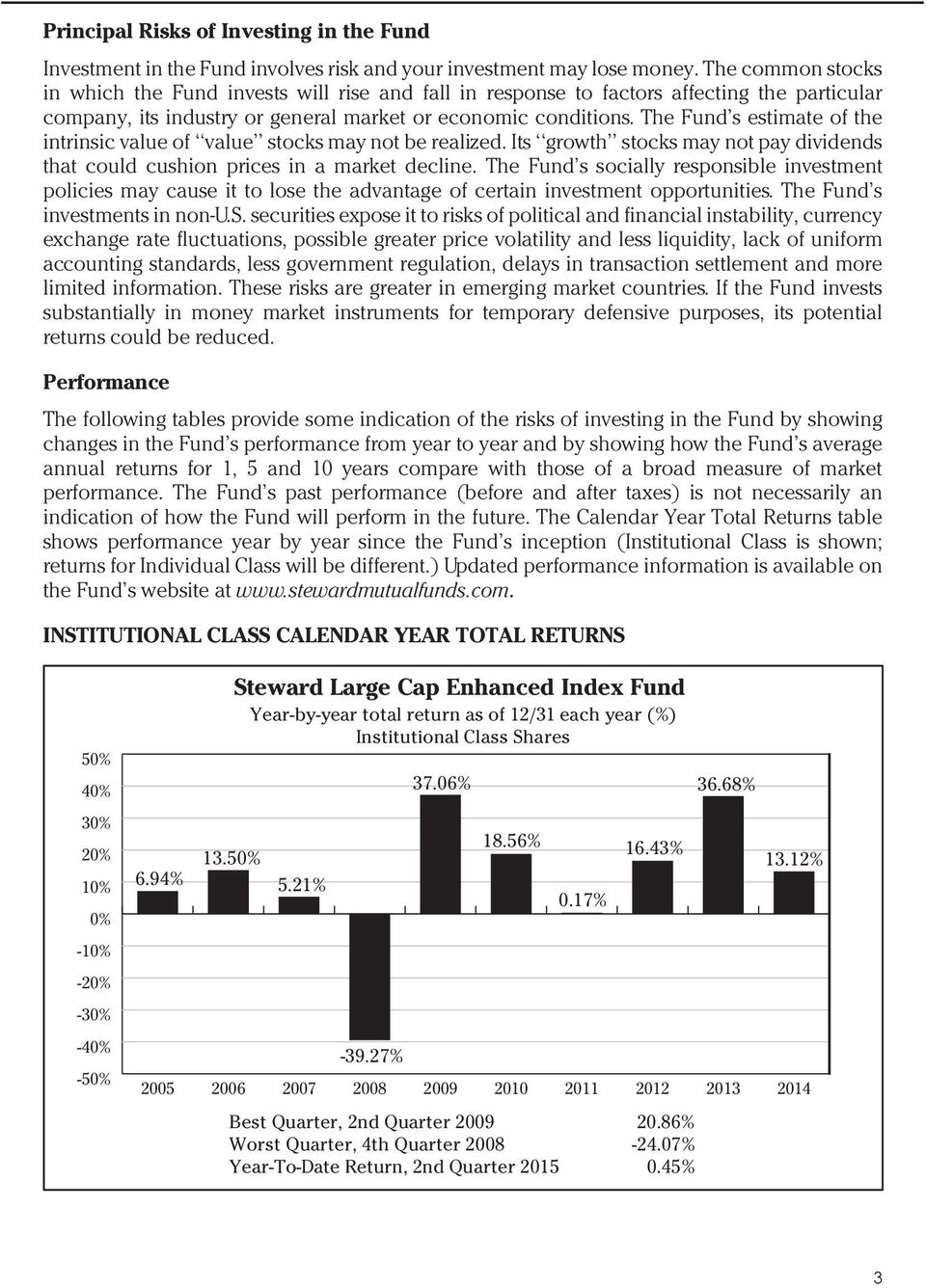
9 Principal Risks of Investing in the Fund Investment in the Fund involves risk and your investment may lose money. The common stocks in which the Fund invests will rise and fall in response to factors affecting the particular company, its industry or general market or economic conditions. The Fund s estimate of the intrinsic value of value stocks may not be realized. Its growth stocks may not pay dividends that could cushion prices in a market decline. The Fund s socially responsible investment policies may cause it to lose the advantage of certain investment opportunities. The Fund s investments in non-u.s. securities expose it to risks of political and financial instability, currency exchange rate fluctuations, possible greater price volatility and less liquidity, lack of uniform accounting standards, less government regulation, delays in transaction settlement and more limited information. These risks are greater in emerging market countries. If the Fund invests substantially in money market instruments for temporary defensive purposes, its potential returns could be reduced. Performance The following tables provide some indication of the risks of investing in the Fund by showing changes in the Fund s performance from year to year and by showing how the Fund s average annual returns for 1, 5 and 10 years compare with those of a broad measure of market performance. The Fund s past performance (before and after taxes) is not necessarily an indication of how the Fund will perform in the future. The Calendar Year Total Returns table shows performance year by year since the Fund s inception (Institutional Class is shown; returns for Individual Class will be different.) Updated performance information is available on the Fund s website at INSTITUTIONAL CLASS CALENDAR YEAR TOTAL RETURNS 50% 40% 30% 20% 10% 0% -10% -20% -30% -40% -50% 6.94% % 2006 Steward Large Cap Enhanced Index Fund Year-by-year total return as of 12/31 each year (%) Institutional Class Shares 5.21% % % % % % 2012 Best Quarter, 2nd Quarter % Worst Quarter, 4th Quarter % Year-To-Date Return, 2nd Quarter % 36.68% %
10 The following table illustrates the impact of taxes on the Fund s returns (Institutional Class is shown; returns for Individual Class will be different). After-tax returns are calculated using the historical highest individual federal marginal income tax rates and do not reflect the impact of state and local taxes. After-tax returns depend on your own tax situation and may be different from those shown. This information does not apply if your Fund shares are held in a tax-deferred account such as an individual retirement account or 401(k) plan. AVERAGE ANNUAL TOTAL RETURNS For the periods ended December 31, Year 5 Years 10 Years Return Before Taxes 13.12% 16.41% 8.56% Return After Taxes on Distributions 11.12% 15.35% 7.65% Return After Taxes on Distributions and Sale 8.92% 13.23% 6.91% of Fund Shares Standard & Poor s 500 Index (reflects no deduction for fees, expenses or taxes) 13.69% 15.45% 7.67% MANAGEMENT Capstone Asset Management Company ( CAMCO ) is the Fund s investment adviser. The Fund s co-portfolio managers are John Wolf and Mel Cody, who are both Senior Vice Presidents and Equity Portfolio Managers of CAMCO. Mr. Wolf has served as the Fund s portfolio manager since Mr. Cody was approved as co-portfolio manager effective March 13, For important information about purchase and sale of Fund shares, please turn to Minimum Investment, page 22, and Sale of Fund Shares, page 22. For tax information, please turn to Tax Information, page 22. For important information on financial intermediary compensation, please turn to Payments to Financial Intermediaries, page 22. 4

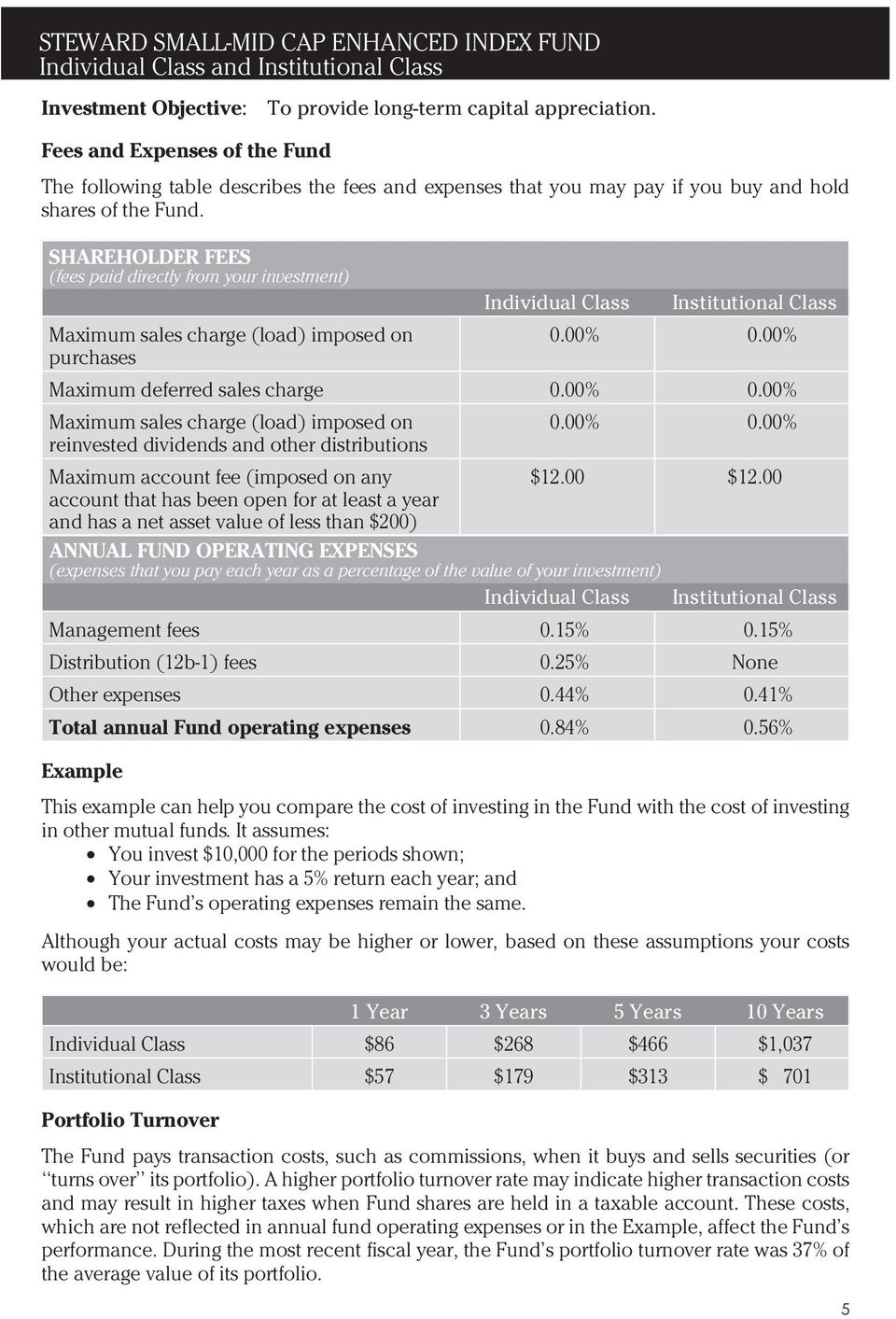
11 STEWARD SMALL-MID CAP ENHANCED INDEX FUND Individual Class and Institutional Class Investment Objective: To provide long-term capital appreciation. Fees and Expenses of the Fund The following table describes the fees and expenses that you may pay if you buy and hold shares of the Fund. SHAREHOLDER FEES (fees paid directly from your investment) Individual Class Institutional Class Maximum sales charge (load) imposed on 0.00% 0.00% purchases Maximum deferred sales charge 0.00% 0.00% Maximum sales charge (load) imposed on 0.00% 0.00% reinvested dividends and other distributions Maximum account fee (imposed on any $12.00 $12.00 account that has been open for at least a year and has a net asset value of less than $200) ANNUAL FUND OPERATING EXPENSES (expenses that you pay each year as a percentage of the value of your investment) Individual Class Institutional Class Management fees 0.15% 0.15% Distribution (12b-1) fees 0.25% None Other expenses 0.44% 0.41% Total annual Fund operating expenses 0.84% 0.56% Example This example can help you compare the cost of investing in the Fund with the cost of investing in other mutual funds. It assumes: You invest $10,000 for the periods shown; Your investment has a 5% return each year; and The Fund s operating expenses remain the same. Although your actual costs may be higher or lower, based on these assumptions your costs would be: 1 Year 3 Years 5 Years 10 Years Individual Class $86 $268 $466 $1,037 Institutional Class $57 $179 $313 $ 701 Portfolio Turnover The Fund pays transaction costs, such as commissions, when it buys and sells securities (or turns over its portfolio). A higher portfolio turnover rate may indicate higher transaction costs and may result in higher taxes when Fund shares are held in a taxable account. These costs, which are not reflected in annual fund operating expenses or in the Example, affect the Fund s performance. During the most recent fiscal year, the Fund s portfolio turnover rate was 37% of the average value of its portfolio. 5
12 Principal Investment Strategies The Fund is not a passively managed index Fund. The Fund pursues its objective by seeking to enhance its performance over that of its benchmark index by 1) changing the relative weighting in the Fund s portfolio of growth versus value style securities in the index (style tilt) and 2) utilizing computer-aided, quantitative analysis of valuation, growth, dividend yield, industry and other factors to attempt to compensate for the exclusion of certain index securities due to the Fund s socially responsible investment policies. Under normal circumstances, the Fund will invest at least 80% of its assets in the securities of companies included in the Fund s benchmark.* The Fund s benchmark index is a widely recognized broad-based small-mid cap index, as designated by the Fund s Board of Directors ( Board ) from time to time, and is the same index identified in the Average Annual Total Returns table, below. The Fund s investments are allocated in an attempt to match the characteristics of a blend of the benchmark and varied weightings from time to time of two indexes that are subcomponents of the benchmark: a small-mid cap growth index and a small-mid cap value index. Under normal circumstances, the Fund will invest at least 80% of its assets in the securities of small- to mid-cap companies.* Small- to mid-cap companies are defined by the market capitalization range of the Fund s benchmark index from time to time. For the Fund s current benchmark index, this market capitalization range, as of July 31, 2015, is $ million to $ billion. The companies included in the benchmark index represent a broad spectrum of the U.S. economy and are generally U.S. issuers. In addition to its investment in securities of companies included in the benchmark index, the Fund may invest up to 5% of its total assets in securities of non-u.s. issuers not generally included in the benchmark index. Also, the Fund may not invest more than 2% of its total assets in securities of companies in emerging market countries. In the event of changes to the companies included in the benchmark index, changes in the portfolio manager s evaluation of the relative performance of growth versus value style securities, or the development of a material misweighting, the portfolio manager will rebalance the portfolio in an attempt to match the characteristics of a blend of its benchmark index and varied weighting from time to time of two indices that are subcomponents of the benchmark: a small-mid cap growth index and a small-mid cap value index. Because the Fund uses its best efforts to avoid investments in companies that do not pass the socially responsible screening criteria, it will divest itself, in a timely manner, of securities that are subsequently added to the list of prohibited securities. Socially Responsible Investing. The Fund uses its best efforts to avoid investing in companies that are materially involved with pornography, abortion, alcohol, gambling or tobacco, although it may invest up to 5% of its total assets in certain collective investment vehicles or derivatives that may include prohibited companies. Principal Risks of Investing in the Fund Investment in the Fund involves risk and your investment may lose money. The common stocks in which the Fund invests will rise and fall in response to factors affecting the particular company, its industry or general market or economic conditions. The Fund s estimate of the intrinsic value of value stocks may not be realized. Its growth stocks may not pay dividends that could cushion prices in a market decline. The Fund s socially responsible investment policies may cause it to lose the advantage of certain investment opportunities. The small- and * The 80% is measured as of the time of investment and is applied to the value of the Fund s net assets plus the amount of any borrowings for investment purposes. For purposes of this limit, investments include those made directly or through other investment companies that have substantially similar 80% policies. The Fund will provide shareholders with at least 60 days prior notice of any change in this policy. 6

13 mid-cap companies in which the Fund may invest may have limited track records, narrower markets, more limited managerial and financial resources and less diversified products, exposing the Fund to greater share price volatility. While all investments involve risk, microcap stocks are among the most risky. Many microcap companies are new and have no proven track record. Some of these companies have no assets, operations, or revenues. Others have products and services that are still in development or have yet to be tested in the market. Another risk that pertains to microcap stocks involves the low volumes of trades. Because many microcap stocks trade in low volumes, any size of trade can have a large percentage impact on the price of the stock. The Fund s investments in non-u.s. securities expose it to risks of political and financial instability, currency exchange rate fluctuations, possible greater price volatility and less liquidity, lack of uniform accounting standards, less government regulation, delays in transaction settlement and more limited information. These risks are greater in emerging market countries. If the Fund invests substantially in money market instruments for temporary defensive purposes, its potential returns could be reduced. Performance The following tables provide some indication of the risks of investing in the Fund by showing changes in the Fund s performance from year to year and by showing how the Fund s average annual returns for 1, 5 and 10 years compare with those of a broad measure of market performance. The Fund s past performance (before and after taxes) is not necessarily an indication of how the Fund will perform in the future. The Calendar Year Total Returns table shows performance for each of the last 10 calendar years (Individual Class is shown; returns for Institutional Class will be different.) Updated performance information is available on the Fund s website at INDIVIDUAL CLASS CALENDAR YEAR TOTAL RETURNS 50% 40% 30% 20% 10% 0% -10% 3.19% Steward Small-Mid Cap Enhanced Index Fund Year-by-year total return as of 12/31 each year (%) Individual Class Shares 14.66% -2.09% 42.02% 27.05% -1.63% 16.49% 37.02% 5.32% -20% -30% -40% % -50% Best Quarter, 2nd Quarter % Worst Quarter, 4th Quarter % Year-To-Date Return, 2nd Quarter % 7

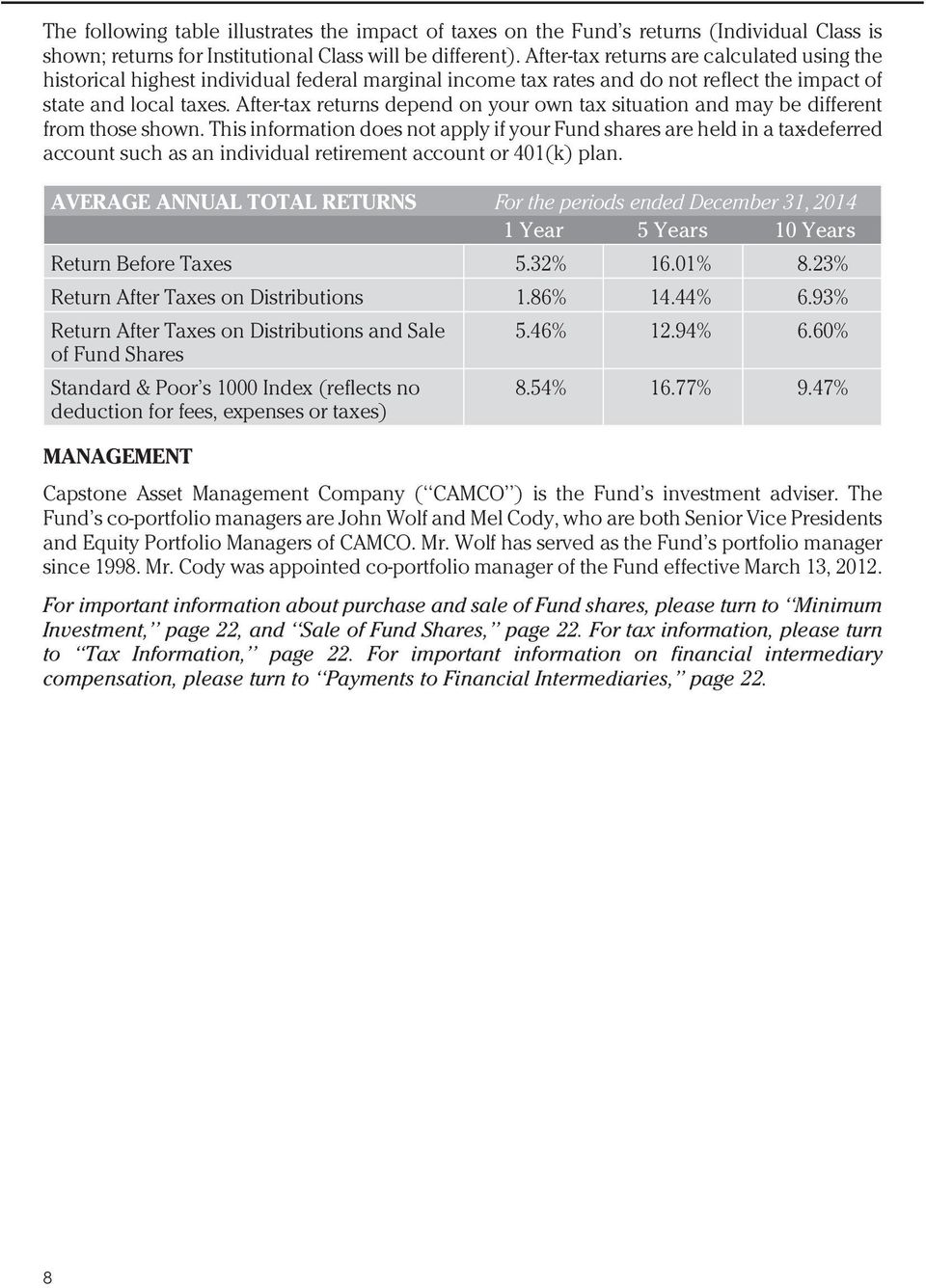
14 The following table illustrates the impact of taxes on the Fund s returns (Individual Class is shown; returns for Institutional Class will be different). After-tax returns are calculated using the historical highest individual federal marginal income tax rates and do not reflect the impact of state and local taxes. After-tax returns depend on your own tax situation and may be different from those shown. This information does not apply if your Fund shares are held in a tax-deferred account such as an individual retirement account or 401(k) plan. AVERAGE ANNUAL TOTAL RETURNS For the periods ended December 31, Year 5 Years 10 Years Return Before Taxes 5.32% 16.01% 8.23% Return After Taxes on Distributions 1.86% 14.44% 6.93% Return After Taxes on Distributions and Sale 5.46% 12.94% 6.60% of Fund Shares Standard & Poor s 1000 Index (reflects no deduction for fees, expenses or taxes) 8.54% 16.77% 9.47% MANAGEMENT Capstone Asset Management Company ( CAMCO ) is the Fund s investment adviser. The Fund s co-portfolio managers are John Wolf and Mel Cody, who are both Senior Vice Presidents and Equity Portfolio Managers of CAMCO. Mr. Wolf has served as the Fund s portfolio manager since Mr. Cody was appointed co-portfolio manager of the Fund effective March 13, For important information about purchase and sale of Fund shares, please turn to Minimum Investment, page 22, and Sale of Fund Shares, page 22. For tax information, please turn to Tax Information, page 22. For important information on financial intermediary compensation, please turn to Payments to Financial Intermediaries, page 22. 8
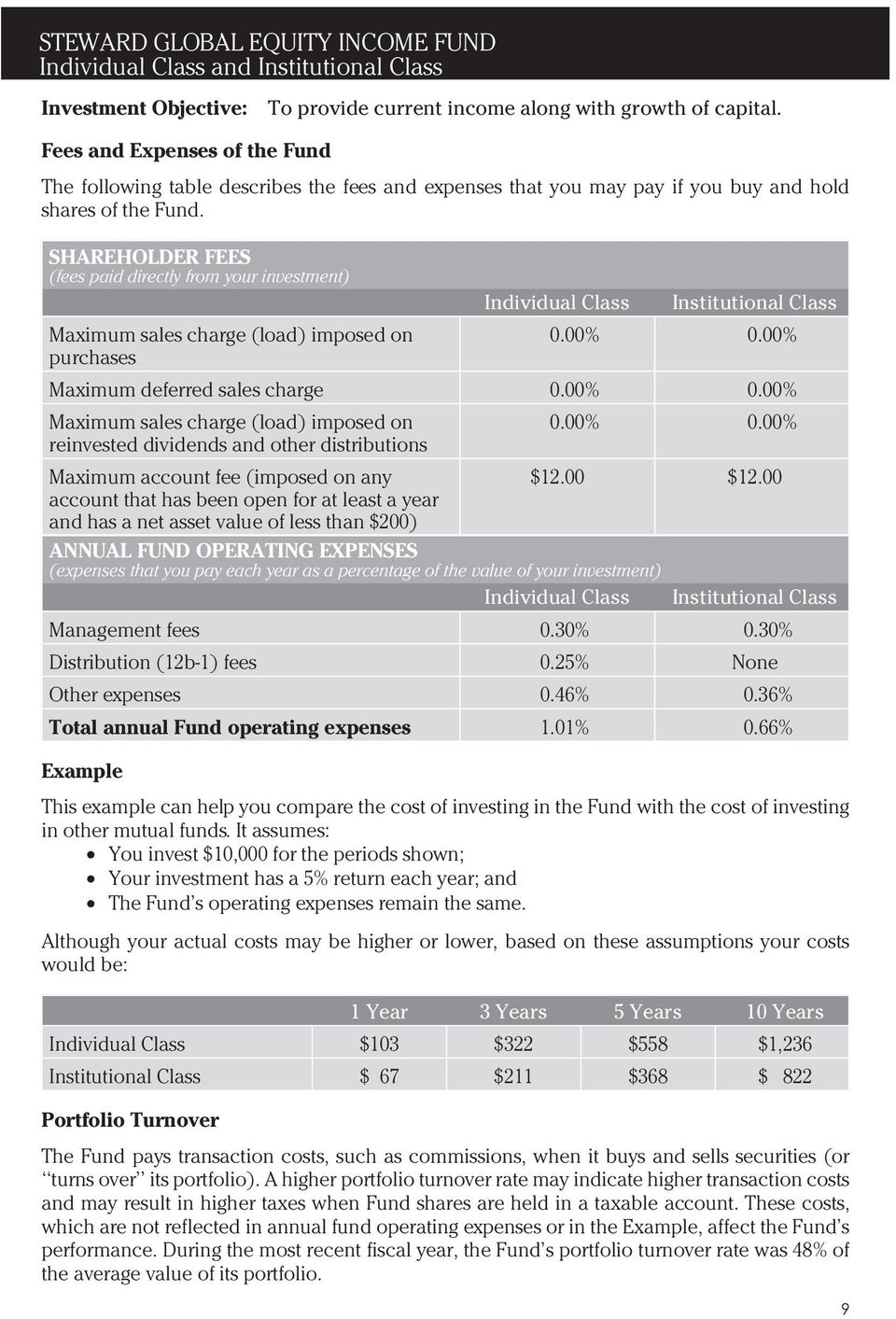
15 STEWARD GLOBAL EQUITY INCOME FUND Individual Class and Institutional Class Investment Objective: To provide current income along with growth of capital. Fees and Expenses of the Fund The following table describes the fees and expenses that you may pay if you buy and hold shares of the Fund. SHAREHOLDER FEES (fees paid directly from your investment) Individual Class Institutional Class Maximum sales charge (load) imposed on 0.00% 0.00% purchases Maximum deferred sales charge 0.00% 0.00% Maximum sales charge (load) imposed on 0.00% 0.00% reinvested dividends and other distributions Maximum account fee (imposed on any $12.00 $12.00 account that has been open for at least a year and has a net asset value of less than $200) ANNUAL FUND OPERATING EXPENSES (expenses that you pay each year as a percentage of the value of your investment) Individual Class Institutional Class Management fees 0.30% 0.30% Distribution (12b-1) fees 0.25% None Other expenses 0.46% 0.36% Total annual Fund operating expenses 1.01% 0.66% Example This example can help you compare the cost of investing in the Fund with the cost of investing in other mutual funds. It assumes: You invest $10,000 for the periods shown; Your investment has a 5% return each year; and The Fund s operating expenses remain the same. Although your actual costs may be higher or lower, based on these assumptions your costs would be: 1 Year 3 Years 5 Years 10 Years Individual Class $103 $322 $558 $1,236 Institutional Class $ 67 $211 $368 $ 822 Portfolio Turnover The Fund pays transaction costs, such as commissions, when it buys and sells securities (or turns over its portfolio). A higher portfolio turnover rate may indicate higher transaction costs and may result in higher taxes when Fund shares are held in a taxable account. These costs, which are not reflected in annual fund operating expenses or in the Example, affect the Fund s performance. During the most recent fiscal year, the Fund s portfolio turnover rate was 48% of the average value of its portfolio. 9
16 Principal Investment Strategies The Fund pursues its investment objective through investment in U.S. and non-u.s. dividend-paying stocks that have demonstrated above-median yield and a positive trend in dividend and earnings growth. The Fund invests primarily in common stocks of companies that represent a broad spectrum of the global economy and a range of market capitalizations, including large-cap, mid-cap and small-cap. The Fund may also invest in other investment companies. The Fund will normally invest at least 80% of its assets in dividend-paying securities.* The Fund will generally seek to have 40% of its assets, and, under normal market conditions, no less than 30% of its assets, invested in securities of non-u.s. issuers. Its investments will normally be in the form of depositary receipts ( DRs ). The Fund s DR investments will primarily be sponsored, but the Fund may, on occasion, invest in unsponsored DRs when appropriate sponsored DRs are not available. The Fund is a quantitatively managed portfolio. When a security fails the quantitative screening process, the security will be sold. Because the Fund uses its best efforts to avoid investing in companies that do not pass the socially responsible screening criteria, it will divest itself, in a timely manner, of securities that are subsequently added to the list of prohibited companies. The Fund will normally invest at least 80% of its assets in equity securities.* The Fund may invest up to 80% of its total assets in securities of non-u.s. issuers and no more than 40% of its total assets in securities of companies in emerging market countries. Socially Responsible Investing. The Fund uses its best efforts to avoid investing in companies that are materially involved with pornography, abortion, alcohol, gambling or tobacco, although it may invest up to 5% of its total assets in certain collective investment vehicles or derivatives that may include prohibited companies. Principal Risks of Investing in the Fund Investment in the Fund involves risk and your investment may lose money. The common stocks in which the Fund invests will rise and fall in response to factors affecting the particular company, its industry or general market or economic conditions. The Fund s socially responsible investment policies may cause it to lose the advantage of certain investment opportunities. The Fund s investments in non-u.s. securities expose it to risks of political and financial instability, currency exchange rate fluctuations, possible greater price volatility and less liquidity, lack of uniform accounting standards, less government regulation, delays in transaction settlement and more limited information. These risks are greater in emerging market countries. The Fund s investments in unsponsored DRs may involve additional expenses, legal uncertainties, less available information and delays in receipt of dividends and reports. The small- and mid-cap companies in which the Fund may invest may have limited track records, narrower markets, more limited managerial and financial resources and less diversified products, exposing the Fund to greater share price volatility. If the Fund invests substantially in money market instruments for temporary defensive purposes, its potential returns could be reduced. * The 80% is measured as of the time of investment and is applied to the value of the Fund s net assets plus the amount of any borrowings for investment purposes. For purposes of this limit, investments include those made directly or through other investment companies that have substantially similar 80% policies. The Fund will provide shareholders with at least 60 days prior notice of any change in this policy. 10

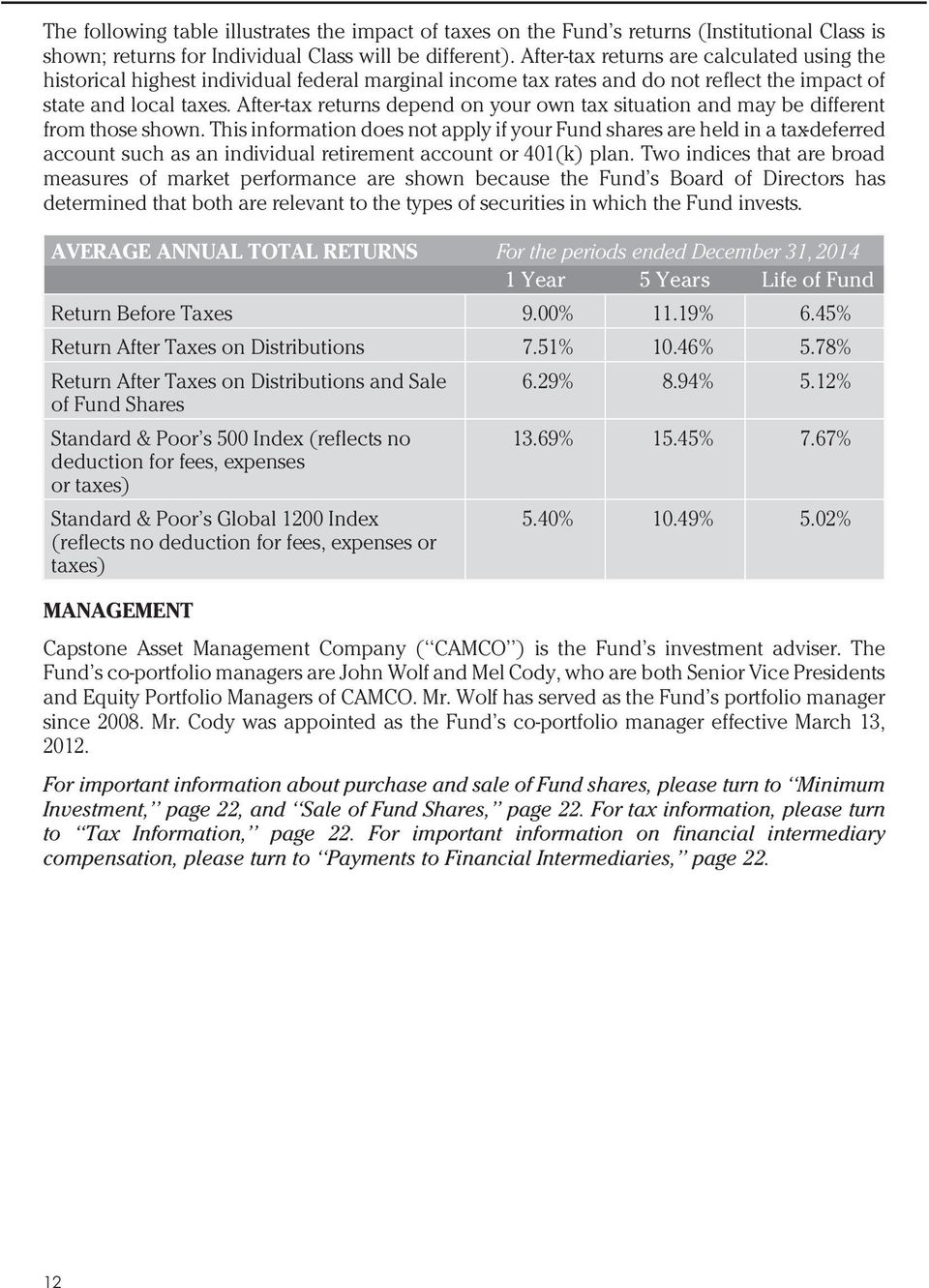
17 Performance The following tables provide some indication of the risks of investing in the Fund by illustrating how the Fund s average annual returns for 1 and 5 years and life of the Fund compare with those of two broad measures of market performance. The Fund s past performance (before and after taxes) is not necessarily an indication of how the Fund will perform in the future. The Calendar Year Total Returns table shows performance for the Fund s calendar years since inception (Institutional Class is shown; returns for Individual Class will be different.) Updated performance information is available on the Fund s website at INSTITUTIONAL CLASS CALENDAR YEAR TOTAL RETURNS 30% 25% 20% 26.06% Steward Global Equity Income Fund Year-by-year total return as of 12/31 each year (%) Institutional Class Shares* 20.74% 15% 10% 11.92% 9.54% 9.00% 5% 5.31% 0% Best Quarter, 3rd Quarter % Worst Quarter, 1st Quarter % Year-To-Date Return, 2nd Quarter % * Inception date was April 1,

18 The following table illustrates the impact of taxes on the Fund s returns (Institutional Class is shown; returns for Individual Class will be different). After-tax returns are calculated using the historical highest individual federal marginal income tax rates and do not reflect the impact of state and local taxes. After-tax returns depend on your own tax situation and may be different from those shown. This information does not apply if your Fund shares are held in a tax-deferred account such as an individual retirement account or 401(k) plan. Two indices that are broad measures of market performance are shown because the Fund s Board of Directors has determined that both are relevant to the types of securities in which the Fund invests. AVERAGE ANNUAL TOTAL RETURNS For the periods ended December 31, Year 5 Years Life of Fund Return Before Taxes 9.00% 11.19% 6.45% Return After Taxes on Distributions 7.51% 10.46% 5.78% Return After Taxes on Distributions and Sale 6.29% 8.94% 5.12% of Fund Shares Standard & Poor s 500 Index (reflects no deduction for fees, expenses or taxes) 13.69% 15.45% 7.67% Standard & Poor s Global 1200 Index (reflects no deduction for fees, expenses or taxes) 5.40% 10.49% 5.02% MANAGEMENT Capstone Asset Management Company ( CAMCO ) is the Fund s investment adviser. The Fund s co-portfolio managers are John Wolf and Mel Cody, who are both Senior Vice Presidents and Equity Portfolio Managers of CAMCO. Mr. Wolf has served as the Fund s portfolio manager since Mr. Cody was appointed as the Fund s co-portfolio manager effective March 13, For important information about purchase and sale of Fund shares, please turn to Minimum Investment, page 22, and Sale of Fund Shares, page 22. For tax information, please turn to Tax Information, page 22. For important information on financial intermediary compensation, please turn to Payments to Financial Intermediaries, page
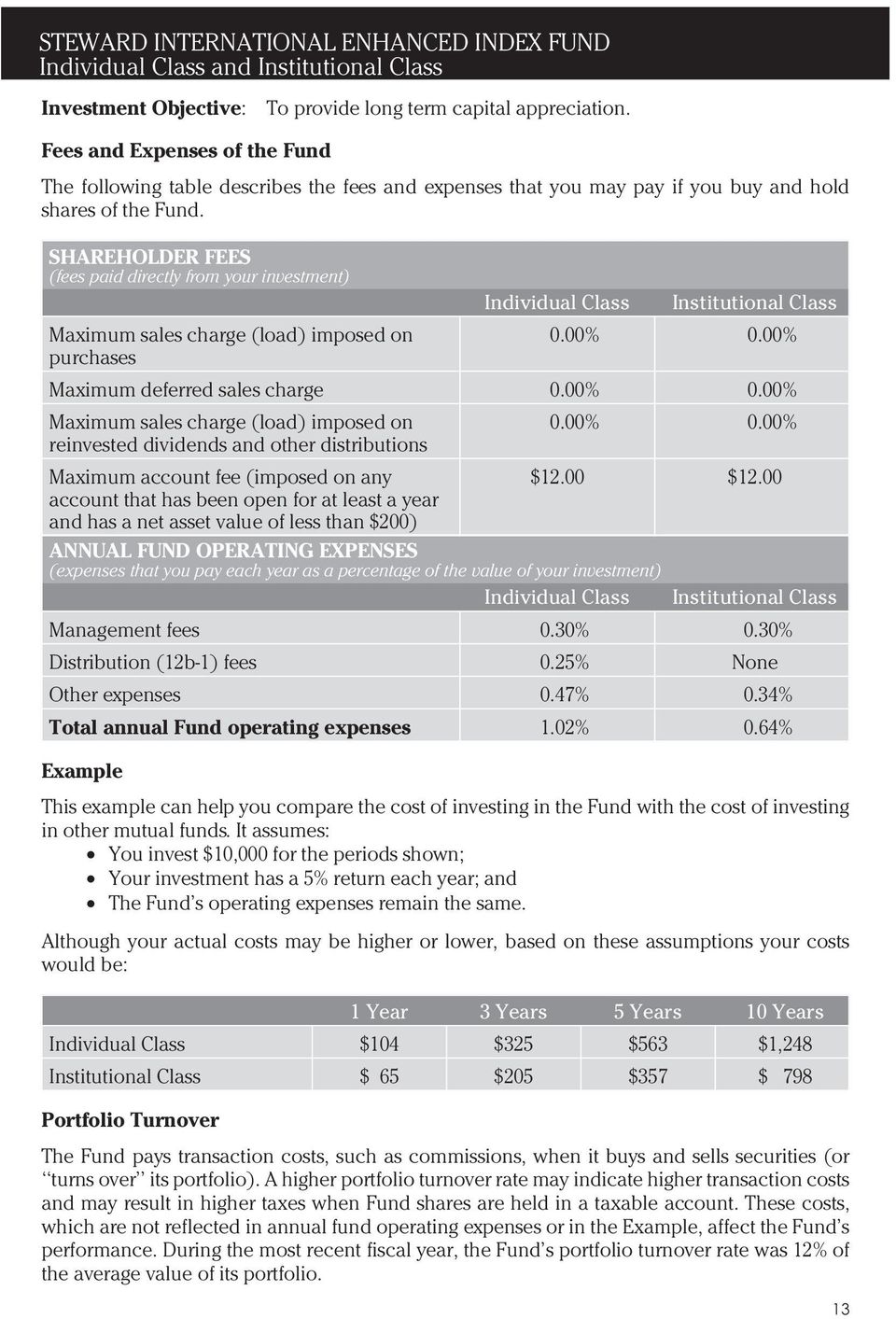
19 STEWARD INTERNATIONAL ENHANCED INDEX FUND Individual Class and Institutional Class Investment Objective: To provide long term capital appreciation. Fees and Expenses of the Fund The following table describes the fees and expenses that you may pay if you buy and hold shares of the Fund. SHAREHOLDER FEES (fees paid directly from your investment) Individual Class Institutional Class Maximum sales charge (load) imposed on 0.00% 0.00% purchases Maximum deferred sales charge 0.00% 0.00% Maximum sales charge (load) imposed on 0.00% 0.00% reinvested dividends and other distributions Maximum account fee (imposed on any $12.00 $12.00 account that has been open for at least a year and has a net asset value of less than $200) ANNUAL FUND OPERATING EXPENSES (expenses that you pay each year as a percentage of the value of your investment) Individual Class Institutional Class Management fees 0.30% 0.30% Distribution (12b-1) fees 0.25% None Other expenses 0.47% 0.34% Total annual Fund operating expenses 1.02% 0.64% Example This example can help you compare the cost of investing in the Fund with the cost of investing in other mutual funds. It assumes: You invest $10,000 for the periods shown; Your investment has a 5% return each year; and The Fund s operating expenses remain the same. Although your actual costs may be higher or lower, based on these assumptions your costs would be: 1 Year 3 Years 5 Years 10 Years Individual Class $104 $325 $563 $1,248 Institutional Class $ 65 $205 $357 $ 798 Portfolio Turnover The Fund pays transaction costs, such as commissions, when it buys and sells securities (or turns over its portfolio). A higher portfolio turnover rate may indicate higher transaction costs and may result in higher taxes when Fund shares are held in a taxable account. These costs, which are not reflected in annual fund operating expenses or in the Example, affect the Fund s performance. During the most recent fiscal year, the Fund s portfolio turnover rate was 12% of the average value of its portfolio. 13
20 Principal Investment Strategies The Fund is not a passively managed index Fund. The Fund pursues its objective by seeking to enhance its performance over that of its primary benchmark index by 1) changing the relative weighting in the Fund s portfolio of equity securities of developed market companies and of emerging market companies, and 2) utilizing computer-aided, quantitative analysis of valuation, growth, dividend yield, industry and other factors to attempt to compensate for the exclusion of certain index securities due to the Fund s socially responsible investment policies. Under normal circumstances, the Fund will invest at least 80% of its assets in the securities of companies included in the Fund s primary benchmark.* The Fund s primary benchmark index is a blend of widely-recognized broad-based indexes representing both developed and emerging non-u.s. markets, as designated by the Fund s Board of Directors ( Board ) from time to time, and is the same index identified in the Average Annual Total Returns table, below. Under normal circumstances, the Fund will invest at least 80% of its assets in the securities of non-u.s. companies.* The Fund s investments are allocated in an attempt to match the characteristics of a blend of the primary benchmark with varied weightings from time to time of a secondary broad-based index that includes only securities of issuers in emerging market countries. An emerging market country is any country that has been determined by an international organization, such as the World Bank, to have a low to middle income economy. Generally, at least 80% of the Fund s total assets will be in investments in the form of depositary receipts ( DRs ) representing securities of companies located or domiciled outside of the United States.* These DRs will primarily be sponsored, but the Fund may, on occasion, invest in unsponsored DRs when appropriate sponsored DRs are not available. The Fund will invest in securities of issuers throughout the world, and, under normal conditions, substantially all its non-cash assets will be invested in securities of non-u.s. issuers. The Fund may invest up to 40% of its assets in securities of issuers in emerging market countries. If a material misweighting develops, the portfolio manager seeks to rebalance the portfolio in an attempt to match the characteristics of a blend of the primary benchmark and varied weighting from time to time of a secondary benchmark that includes only securities of issuers in emerging market countries. Because the Fund uses its best efforts to avoid investments in companies that do not pass the socially responsible screening criteria, it will divest itself, in a timely manner, of securities that are subsequently added to the list of prohibited securities. Socially Responsible Investing. The Fund uses its best efforts to avoid investing in companies that are materially involved with pornography, abortion, alcohol, gambling or tobacco, although it may invest up to 5% of its total assets in certain collective investment vehicles or derivatives that may include prohibited companies. Principal Risks of Investing in the Fund Investment in the Fund involves risk and your investment may lose money. The common stocks in which the Fund invests will rise and fall in response to factors affecting the particular company, its industry or general market or economic conditions. The Fund s socially responsible investment policies may cause it to lose the advantage of certain investment opportunities. The Fund s investments in non-u.s. securities expose it to risks of political and financial instability, currency exchange rate fluctuations, possible greater price volatility and less liquidity, lack of uniform accounting standards, less government regulation, delays in * The 80% is measured as of the time of investment and is applied to the value of the Fund s net assets plus the amount of any borrowings for investment purposes. For purposes of this limit, investments include those made directly or through other investment companies that have substantially similar 80% policies. The Fund will provide shareholders with at least 60 days prior notice of any change in this policy. 14

21 transaction settlement and more limited information. These risks are greater in emerging market countries. The Fund s investments in unsponsored DRs may involve additional expenses, legal uncertainties, less available information and delays in receipt of dividends and reports. The small- and mid-cap companies in which the Fund may invest may have limited track records, narrower markets, more limited managerial and financial resources and less diversified products, exposing the Fund to greater share price volatility. If the Fund invests substantially in money market instruments for temporary defensive purposes, its potential returns could be reduced. Performance The following tables provide some indication of the risks of investing in the Fund by showing changes in the Fund s performance from year to year and by showing how the Fund s average annual return for 1 and 5 years and life of the Fund compares with that of a broad measure of market performance. The Fund s past performance (before and after taxes) is not necessarily an indication of how the Fund will perform in the future. Each table shows performance of Institutional Class; returns for Individual Class will be different. Updated performance information is available on the Fund s website at INSTITUTIONAL CLASS CALENDAR YEAR TOTAL RETURNS 50% 40% 30% 20% 10% 0% -10% -20% -30% 15.23% Steward International Enhanced Index Fund Year-by-year total return as of 12/31 each year (%) Institutional Class Shares* 39.71% 7.06% % 12.34% 9.49% -40% -50% % Best Quarter, 2nd Quarter % Worst Quarter, 4th Quarter % Year-To-Date Return, 2nd Quarter % * Inception date was February 28, %
22 The following table illustrates the impact of taxes on the Fund s returns (Institutional Class is shown; returns for Individual Class will be different). After-tax returns are calculated using the historical highest individual federal marginal income tax rates and do not reflect the impact of state and local taxes. After-tax returns depend on your own tax situation and may be different from those shown. This information does not apply if your Fund shares are held in a tax-deferred account such as an individual retirement account or 401(k) plan. AVERAGE ANNUAL TOTAL RETURNS For the periods ended December 31, Year 5 Years Life of the Fund Return Before Taxes -5.34% 1.59% 1.21% Return After Taxes on Distributions -5.90% 1.15% 0.64% Return After Taxes on Distributions and Sale -2.33% 1.38% 1.09% of Fund Shares S&P ADR Index (reflects no deduction for fees, expenses or taxes) -4.26% 10.49% 3.14% MANAGEMENT Capstone Asset Management Company ( CAMCO ) is the Fund s investment adviser. The Fund s co-portfolio managers are John Wolf and Mel Cody, who are both Senior Vice Presidents and Equity Portfolio Managers of CAMCO. Mr. Wolf has served as the Fund s portfolio manager since Mr. Cody was added as co-portfolio manager of the Fund effective March 13, For important information about purchase and sale of Fund shares, please turn to Minimum Investment, page 22, and Sale of Fund Shares, page 22. For tax information, please turn to Tax Information, page 22. For important information on financial intermediary compensation, please turn to Payments to Financial Intermediaries, page
23 STEWARD SELECT BOND FUND Individual Class and Institutional Class Investment Objective: To provide high current income with capital appreciation. Fees and Expenses of the Fund The following table describes the fees and expenses that you may pay if you buy and hold shares of the Fund. SHAREHOLDER FEES (fees paid directly from your investment) Individual Class Institutional Class Maximum sales charge (load) imposed on 0.00% 0.00% purchases Maximum deferred sales charge 0.00% 0.00% Maximum sales charge (load) imposed on 0.00% 0.00% reinvested dividends and other distributions Maximum account fee (imposed on any $12.00 $12.00 account that has been open for at least a year and has a net asset value of less than $200) ANNUAL FUND OPERATING EXPENSES (expenses that you pay each year as a percentage of the value of your investment) Individual Class Institutional Class Management fees 0.25% 0.25% Distribution (12b-1) fees 0.25% None Other expenses 0.46% 0.37% Total annual Fund operating expenses 0.96% 0.62% Example This example can help you compare the cost of investing in the Fund with the cost of investing in other mutual funds. It assumes: You invest $10,000 for the periods shown; Your investment has a 5% return each year; and The Fund s operating expenses remain the same. Although your actual costs may be higher or lower, based on these assumptions your costs would be: 1 Year 3 Years 5 Years 10 Years Individual Class $98 $306 $531 $1,178 Institutional Class $63 $199 $346 $ 774 Portfolio Turnover The Fund pays transaction costs, such as commissions, when it buys and sells securities (or turns over its portfolio). A higher portfolio turnover rate may indicate higher transaction costs and may result in higher taxes when Fund shares are held in a taxable account. These costs, which are not reflected in annual fund operating expenses or in the Example, affect the Fund s performance. During the most recent fiscal year, the Fund s portfolio turnover rate was 13% of the average value of its portfolio. 17
24 Principal Investment Strategies The Fund invests primarily in fixed income securities, including, but not limited to, corporate bonds, mortgage-backed securities and government and agency bonds and notes. These obligations may include U.S. dollar-denominated instruments issued in the U.S. by foreign banks and branches and foreign corporations. Other security types may include fixed-rate preferred stock and municipal bonds. Normally, the Fund will invest at least 80% of its assets in these types of instruments.* The Fund will invest only in securities rated investment grade (Baa/BBB or better) by Moody s Investor Service or Standard & Poor s or comparably rated by another nationally recognized statistical rating organization, or be determined to be of comparable quality (investment grade) by CAMCO at the time of purchase based on the security s characteristics, the entity s financial status, and any other available information. The Fund may also invest in other investment companies. The Fund will not purchase a security if as a result more than 15% of the Fund s net assets would be invested in securities that would be deemed to be illiquid. Illiquid securities are likely to consist primarily of debt securities and mortgages of churches, colleges, schools and other non-profit organizations that are not rated by nationally recognized statistical rating organization but are determined by CAMCO to be investment grade. The Fund may invest up to 5% of its total assets in U.S. dollar-denominated debt securities of non-u.s. issuers. Also, the Fund may not invest more than 2% of its total assets in U.S. dollar-denominated debt securities of companies in emerging market countries. The Fund s investments may have fixed variable or floating interest rates, with small portions of its portfolio in cash or short-term money market instruments. The Fund may purchase instruments on a when-issued or forward commitment basis, meaning that the Fund agrees to purchase the securities at a fixed price at a future date beyond customary settlement time. In order to construct the most appropriate portfolio to realize the Fund s objective, the Fund s managers will seek to balance three primary portfolio characteristics of duration, yield curve structure and sector allocations. When the managers believe that future U.S. interest rates will trend to higher levels (largely, but not entirely, due to an expected increase in general economic activity producing a change in Federal Reserve Bank policy), they will create portfolio durations less than those stated for index benchmarks. When they believe that future U.S. interest rates will trend to lower levels (largely, but not entirely, due to an expected decrease in general economic activity producing a change in Federal Reserve Bank policy), they will create portfolio durations greater than those stated for index benchmarks. Except during periods of extraordinary volatility, duration levels will be targeted within eighty percent of benchmarks. Contributing to duration target decisions is a view of future inflationary price pressures which also determine Fed policymaking expectations. Other factors such as liquidity, credit concerns and relative yield levels may also direct how duration is created across sectors and may inhibit, or augment, how portfolio duration targets are selected. Yield curve decisions as to where investments should be concentrated begin with a bias toward intermediate maturities. The core of portfolio holdings will therefore be dominated, in most instances, at the heart of the yield curve. Allocations to very short maturities or very long maturities go hand-in-hand with targeted duration decisions. When the managers believe the trend for nominal interest rates will be higher, shorter-term securities will be favored over long-dated securities to complete our portfolio s profile. When they believe the trend for nominal interest rates will be lower, longer-term issues will be favored over shorter. * The 80% is measured as of the time of investment and is applied to the value of the Fund s net assets plus the amount of any borrowings for investment purposes. For purposes of this limit, investments include those made directly or through other investment companies that have substantially similar 80% policies. The Fund will provide shareholders with at least 60 days prior notice of any change in this policy. 18
25 Investments in U.S. Treasury issues, in lieu of agency and/or corporate issues, are generally determined by the demand for safety and liquidity of these investments. Corporate sectors are under-weighted when the managers believe that slowing economic activity will put increased stress on corporate balance sheets and produce potential credit downgrades or other credit events, resulting in widening credit yield spreads. Subject to limits of the Fund s concentration policy, which prevents the Fund from investing 25% or more in any one industry or group of industries, corporate sectors are over-weighted when the managers believe that increasing economic activity will improve corporate balance sheets and produce potential credit upgrades or other credit events inducing the tightening credit yield spreads. Individual debt securities of any maturity may be purchased. Portfolio sales are determined in a variety of ways, including but not limited to strategic adjustments, yield enhancement replacements, current news shocks and credit deteriorations. Socially Responsible Investing. The Fund uses its best efforts to avoid investing in companies that are materially involved with pornography, abortion, alcohol, gambling or tobacco although it may invest up to 5% of its total assets in certain collective investment vehicles or derivatives that may include prohibited companies. Principal Risks of Investing in the Fund Investment in the Fund involves risk and your investment may lose money. The prices of fixed income securities in which the Fund invests will rise and fall in response to interest rate changes and changes in the credit rating, or default, of the issuer. Lower rated bonds and bonds with longer final maturities generally have higher credit risks. Variable and floating rate securities, although less sensitive to interest rate changes, may decline in value if their interest rates do not rise as quickly, or as much, as general interest rates. Also, if general market interest rates decline, the yield on these instruments will decline. Because the Fund prices its assets and determines its share value on each business day based on current market prices (see Share Price ), a shareholder cannot avoid loss by holding a bond to maturity, as might be possible for an investor who invests in individual bonds rather than in Fund shares. Securities rated Baa/BBB (or comparably) are considered to have speculative characteristics. Ratings also may be unreliable, due to conflicts of interest between the rating agencies and the issuers and the lag between an event requiring a rating downgrade and the actual rating downgrade. Investments in securities of U.S. government agencies and instrumentalities have varying degrees of U.S. government backing and thus have risk of loss of principal, interest or default. Actions and statements of national and international government and economic policy institutions can, among other things, affect interest rates and trading volume of debt obligations, in addition to broader economic effects. Instruments of foreign banks and branches and foreign corporations are subject to different types of regulation, accounting and recordkeeping requirements, and information about them may be harder to obtain. Dollar-denominated instruments of foreign government or government-related entities may have similar risks and may not be supported as to payment of principal and interest by the relevant government. The Fund s socially responsible investment policies may cause it to lose the advantage of certain investment opportunities. The illiquid securities in which the Fund may invest may not be able to be sold at an advantageous time or price. To the extent securities of any one industry or group of industries comprises close to 25% of the Fund s benchmark, the Fund may be limited in its ability to overweight with respect to that industry or industry group, due to its fundamental policy on concentration. The Fund s investments in church mortgage bonds and loans will generally be illiquid and unrated and involve limited availability of information. Thus, they can be difficult to value properly, particularly in distressed situations, such as the weak real estate and employment conditions prevailing in recent years. These securities are negatively affected by declines in real estate values. To the extent churches rely 19
26 on their congregations for funds to make interest and principal payments on their obligations, unemployment and reduction in congregation size negatively affect the ability of churches to honor their obligations and may negatively affect property maintenance and, thus, the value of the property backing the security. The securities may also be invalidated or subordinated by a court to interests of other creditors. The Fund s mortgage-related investments, including its church mortgage bonds and loans, also involve the risk of default, delay or reduction of interest payments, and collateral that can be illiquid. Mortgage-related securities also tend to be more sensitive to interest rate changes, since rising interest rates tend to extend these securities duration. If interest rates decline, mortgage-related securities may be subject to prepayment, which could reduce the Fund s returns as it reinvests prepayment proceeds at lower rates. Mortgage-related securities are also negatively affected by declines in property values. If the Fund invests substantially in money market instruments for temporary defensive purposes, its potential returns could be reduced. Performance The following tables provide some indication of the risks of investing in the Fund by showing changes in the Fund s performance from year to year and by showing how the Fund s average annual returns for 1, 5 and 10 years compare with those of a broad measure of market performance. The Fund s past performance (before and after taxes) is not necessarily an indication of how the Fund will perform in the future. Each table shows performance of Institutional Class; returns for Individual Class will be different. Updated performance information is available on the Fund s website at INSTITUTIONAL CLASS CALENDAR YEAR TOTAL RETURNS 8% Steward Select Bond Fund Year-by-year total return as of 12/31 each year (%) Institutional Class Shares 6% 4% 3.48% 5.77% 5.72% 3.53% 5.16% 3.25% 4.08% 3.79% 2% 1.25% 0% -2% -2.10% -4% Best Quarter, 3rd Quarter % Worst Quarter, 2nd Quarter % Year-To-Date Return, 2nd Quarter % 20
27 The following table illustrates the impact of taxes on the Fund s returns (Institutional Class is used for the illustration; numbers for Individual Class will be different). After-tax returns are calculated using the historical highest individual federal marginal income tax rates and do not reflect the impact of state and local taxes. After-tax returns depend on your own tax situation and may be different from those shown. This information does not apply if your Fund shares are held in a tax-deferred account such as an individual retirement account or 401(k) plan. AVERAGE ANNUAL TOTAL RETURNS For the periods ended December 31, Year 5 Years 10 Years Return Before Taxes 3.79% 2.80% 3.37% Return After Taxes on Distributions 2.80% 1.74% 2.11% Return After Taxes on Distributions and Sale 2.14% 1.74% 2.12% of Fund Shares Barclays Capital US Government/Credit Bond Index (reflects no deduction for fees, expenses or taxes) 6.01% 4.69% 4.70% MANAGEMENT Capstone Asset Management Company ( CAMCO ) is the Fund s investment adviser. Victoria Fernandez has served as the Fund s senior portfolio manager since January 1, She is assisted by Claude Cody and Edward Jaroski. Mr. Cody, who has served as the Fund s co-portfolio manager since August 24, 2010, is Senior Vice President of CAMCO and his primary function is performing research. Mr. Jaroski, who has served as the Fund s co-portfolio manager since October 21, 2011, is President and a director of the Funds, CAMCO and the Funds distributor, Capstone Asset Planning Company. For important information about purchase and sale of Fund shares, please turn to Minimum Investment, page 22, and Sale of Fund Shares, page 22. For tax information, please turn to Tax Information, page 22. For important information on financial intermediary compensation, please turn to Payments to Financial Intermediaries, page
28 MINIMUM INVESTMENT Individual Class The minimum initial investment is $200 per Fund, except for continuous investment plans which have no minimum. There is no minimum for subsequent purchases, except that the minimum for subsequent telephone purchase per Fund is $1,000. Institutional Class The minimum initial aggregate investment in the Funds is $100,000 with no minimum per Fund, except that for Charitable Trusts or Grantor Trusts for which a charitable organization serves as trustee, the minimum initial per Fund investment is $25,000. The minimum subsequent per Fund investment is $1,000, except that the minimum per Fund subsequent telephone purchase is $50,000. The foregoing minimum investment requirements may be waived in the case of certain third-party subaccounting arrangements. SALE OF FUND SHARES Fund shares may be redeemed at their net asset value per share on any business day through authorized dealers, or by writing to the Funds transfer agent. Redemptions in the amount of at least $1,000 may be wired. You may also arrange for periodic withdrawals of at least $50 if you have invested at least $5,000 in a Fund. TAX INFORMATION The Funds intend to make distributions that may be taxed as ordinary income or capital gains. PAYMENTS TO FINANCIAL INTERMEDIARIES If you purchase Fund shares through a broker-dealer or other financial intermediary (such as a bank), the Fund and its related companies may pay the intermediary for the sale of Fund shares and related services. These payments may create a conflict of interest by influencing the broker-dealer or other intermediary and your salesperson to recommend the Fund over another investment. Ask your salesperson or visit your financial intermediary s website for more information. 22
29 SOCIALLY RESPONSIBLE INVESTING The Funds described in this prospectus offer investors the opportunity to pursue investment goals while being consistent with socially responsible policies favored by many Christians, but not necessarily by any particular Christian denomination. Thus, in pursuing their investment objectives, each Fund applies a comprehensive set of socially responsible screens to all its investments. Among other investment restrictions, the Funds use their best efforts to avoid investing in companies that are recognized as being materially involved with pornography, abortion, alcohol, gambling or tobacco although a Fund may invest up to 5% of its gross assets in certain collective investment vehicles or derivatives that may include prohibited companies. The Funds may apply additional values screening criteria that are deemed by the Funds Board of Directors, in consultation with CFS Consulting Services, LLC (see Consultant, below), to be consistent with values favored by many Christians, although not necessarily by any particular Christian denomination. If a company already held by a Fund is added to the list of prohibited companies, the Fund will generally sell the securities of such company, although the sale may be delayed if such securities are illiquid or if the Fund s investment adviser determines that an immediate sale would have a negative tax or other effect on the Fund. Consultant The Board has retained CFS Consulting Services, LLC ( CCS ) as a consultant to the Board regarding the Steward Funds socially responsible investing. CCS is a subsidiary of Capstone Financial Services, Inc., parent of CAMCO. CCS (including its organizational predecessor) was a pioneer in the development of social values-based investing methodology as one of the first investment research firms exclusively dedicated to social values-based investing data and analysis. For its services to the Board, CCS receives monthly fees from the Funds, based on their aggregate average daily net assets, at the maximum annual rate of 0.08% of the first $500 million of such assets, 0.05% of the next $500 million, 0.02% of aggregate assets over $1 billion. The Board, in consultation with CCS, has sole responsibility for approving the list of companies whose securities are prohibited investments for the Funds, for approving any changes to such list, and for assuring that such list and any such changes are provided to CAMCO. Subject to these investment prohibitions, CAMCO has sole responsibility for determining which securities a Fund will buy, sell or hold. 23
30 FUND DETAILS The Steward Funds This Prospectus describes the investment objectives, strategies and risks of each of the Funds. The investment objective of Steward Small-Mid Cap Enhanced Index Fund is fundamental and may not be changed without shareholder approval. The investment objectives of the other Funds are not fundamental and may be changed without shareholder approval. Each Fund offers two classes of shares Individual Class shares and Institutional Class shares, which are different in terms of expenses and minimum investments. (See Fees and Expenses and Buying and Selling Fund Share, below.) Following is more detailed information about the investment strategies and risks of investing in each of the Funds. STEWARD LARGE CAP ENHANCED INDEX FUND Investment Objective: To provide long-term capital appreciation. Principal Investment Strategies The Fund is not a passively managed index Fund. The Fund pursues its objective by seeking to enhance its performance over that of its primary benchmark index by 1) changing the relative weighting in the Fund s portfolio of growth versus value style securities in the index (style tilt) and 2) utilizing computer-aided, quantitative analysis of valuation, growth, dividend yield, industry and other factors to attempt to compensate for the exclusion of certain index securities due to the Fund s socially responsible investment policies. Under normal circumstances, the Fund will invest at least 80% of its assets in the securities of companies included in the Fund s benchmark.* The Fund s benchmark index is a widely recognized broad-based large cap index, as designated by the Fund s Board of Directors ( Board ) from time to time, and is the same index identified in the Average Annual Total Returns table, seen previously. The Fund s investments are allocated in an attempt to match the characteristics of a blend of the benchmark and varied weightings from time to time of two indexes that are subcomponents of the benchmark: a large cap growth index and a large cap value index. Under normal circumstances, the Fund will invest at least 80% of its assets in securities of large cap companies.* Large cap companies are defined by the market capitalization range of the Fund s benchmark index from time to time. For the Fund s current benchmark index, this market capitalization range, as of July 31, 2015 is $2.574 billion to $ billion. The companies included in the benchmark index represent a broad spectrum of the U.S. economy and are generally U.S. issuers. In addition to its investment in securities of companies included in the benchmark index, the Fund may invest up to 5% of its total assets in securities of non-u.s. issuers not generally included in the benchmark index. Also, the Fund may not invest more than 2% of its total assets in securities of companies in emerging market countries. In the event of changes to the companies included in the benchmark index, changes in the portfolio manager s evaluation of the relative performance of growth versus value style securities, or the development of a material misweighting, the portfolio manager will rebalance the portfolio in an attempt to match the characteristics of a blend of its benchmark index and varied weighting from time to time of two indices that are subcomponents of the benchmark: a large cap growth index and a large cap value index. Because the Fund uses its best efforts to * The 80% is measured as of the time of investment and is applied to the value of the Fund s net assets plus the amount of any borrowings for investment purposes. For purposes of this limit, investments include those made directly or through other investment companies that have substantially similar 80% policies. The Fund will provide shareholders with at least 60 days prior notice of any change in this policy. 24
31 avoid investments in companies that do not pass the socially responsible screening criteria, it will divest itself, in a timely manner, of securities that are subsequently added to the list of prohibited securities. Non-Principal Investment Practices The Fund may lend its portfolio securities in an amount up to one-third of its total assets to earn income. These loans may be terminated at any time. The Fund will receive either cash or U.S. Government debt obligations as collateral. From time to time, the Fund may take temporary defensive positions that may be inconsistent with its principal investment policies in an attempt to respond to adverse market, economic, political or other conditions. If this occurs, the Fund may not achieve its investment objective during such times. Principal Risks Investment in the Fund involves risk. There can be no assurance that the Fund will achieve its investment objective. You can lose money on your investment in the Fund. When you sell your Fund shares, they may be worth less than you paid for them. The Fund, by itself, does not constitute a balanced investment program. The Fund may not achieve its objective if CAMCO s expectations regarding particular securities or markets are not met. The value of shares of the Fund will be influenced by market conditions as well as by the performance of the securities in which the Fund invests. The Fund s performance may be better or worse than that of funds with similar investment policies. The Fund s performance is also likely to be different from that of funds that use different strategies for selecting investments. If the Fund invests a substantial portion of its assets in money market instruments, repurchase agreements or U.S. Government securities, including during periods during which the Fund is investing for temporary defensive purposes, the Fund s potential returns could be reduced. Other risks of investing in the Fund are as follows: Socially Responsible Screening Policies In avoiding investments that are inconsistent with the Fund s socially responsible screening policies, the Fund may not achieve the same level of performance as it would have without the application of the screening process. If the Fund has invested in a company that is later discovered to be in violation of the screening criteria and liquidation of that security is required, this could result in a loss to the Fund. Further, the Fund s socially responsible screening policies may prevent the Fund from investing in an otherwise attractive investment opportunity. Equity Securities The value of equity securities will rise and fall in response to the activities of the companies that issued the securities, general market conditions and/or economic conditions. If an issuer is liquidated or declares bankruptcy, the claims of owners of the issuer s bonds will take precedence over the claims of owners of its equity securities. Value Stocks Investments in value stocks are subject to risks of equity securities, as well as the risks that (i) their intrinsic values may never be realized by the market or (ii) such stock may turn out not to have been undervalued. Security Selection and Market Risk Particular stocks selected for the Fund may under-perform the market or other funds with similar objectives. The value of the Fund s investments may also change with general market conditions. 25
32 Convertible and Preferred Securities Convertible and preferred stocks, which have some characteristics of both equity securities (see above) and fixed income securities, also entail, to some extent, the risks of each. Fixed income securities entail the risk that their values tend to fluctuate inversely with changes in interest rates. Also, changes in the financial strength of the issuer, or its creditworthiness, can affect the value of the securities it issues. Growth Stocks Investments in growth stocks are subject to the risks of equity securities. Growth company stocks may provide minimal dividends that could otherwise cushion stock prices in a market decline. The value of growth company stocks may rise and fall significantly based, in part, on investors perceptions of the company, rather than on fundamental analysis of the stocks. Market-Oriented Investments Market-oriented investments are generally subject to the risks of equity securities, as well as the risk associated with growth and value stocks. Repurchase Agreements Under a repurchase agreement, a bank or broker sells securities to the Fund and agrees to repurchase them at the Fund s cost plus interest. If the value of such securities declines and the bank or broker defaults on its repurchase obligation, the Fund could incur a loss. Securities Lending Risk If a borrower of the Fund s securities fails financially, the Fund s recovery of the loaned securities may be delayed or the Fund may lose its rights to the collateral, which could result in a loss to the Fund. Investment in Other Investment Companies or Real Estate Investment Trusts The Fund may invest in shares of other investment companies or real estate investment trusts ( funds ). The Fund bears a proportional share of the expenses of such other funds, which are in addition to those of the Fund. For example, the Fund will bear a portion of such other funds investment advisory fees, although the fees paid by the Fund to CAMCO will not be proportionally reduced. Foreign Securities Investments in securities of issuers in foreign countries involve risks not associated with domestic investments. These risks include, but are not limited to: (1) political and financial instability; (2) currency exchange rate fluctuations; (3) greater price volatility and less liquidity in particular securities and in certain foreign markets; (4) lack of uniform accounting, auditing and financial reporting standards; (5) less government regulation and supervision of some foreign stock exchanges, brokers and listed companies; (6) delays in transaction settlement in certain foreign markets; and (7) less availability of information. Emerging Market Securities Securities of issuers in emerging and developing countries raise additional risks relative to investments in developed country issuers, including exposure to less mature and diversified economies and to less stable market and political systems, as well as to possible currency transfer restrictions, delays and disruptions in settlement of transactions, and higher volatility than is found in developed countries. Depositary Receipts ( DRs ) Investments in foreign securities may be in the form of Depositary Receipts, which are dollar-denominated instruments representing securities of non-u.s. issuers that are traded in various markets. Investments in unsponsored DRs (those that are not sponsored by the issuer or a representative of the issuer) involve certain risks not present with sponsored DRs. Investors in unsponsored DRs typically incur expenses not associated with sponsored DRs, such as expenses associated with certificate transfer, custody and dividend payment. For an un-sponsored DR there may be several depositaries with no defined legal obligations to the issuer. Duplicate depositaries may lead to marketplace 26
33 confusion since there would be no central source of information. There can also be greater delays in delivery of dividends and reports to investors than with sponsored DRs. Issuer Risk The value of a security may decline for a number of reasons that directly relate to the issuer, such as management performance, financial leverage and reduced demand for the issuer s goods or services. Management Risk The Fund is subject to management risk because it is an actively managed investment portfolio. CAMCO will apply investment techniques and risk analyses in making investment decisions for the Fund, but there can be no guarantee that these will produce the desired results. Portfolio Holdings A description of the Fund s policies and procedures regarding disclosure of its portfolio securities is available in the Funds Statement of Additional Information dated August 28, In addition, the Fund s portfolio holdings may be viewed on the Fund s website at The portfolio holdings are posted within 30 days after the end of each month. 27
34 STEWARD SMALL-MID CAP ENHANCED INDEX FUND Investment Objective: To provide long-term capital appreciation. Principal Investment Strategies The Fund is not a passively managed index Fund. The Fund pursues its objective by seeking to enhance its performance over that of its benchmark index by 1) changing the relative weighting in the Fund s portfolio of growth versus value style securities in the index (style tilt) and 2) utilizing computer-aided, quantitative analysis of valuation, growth, dividend yield, industry and other factors to attempt to compensate for the exclusion of certain index securities due to the Fund s socially responsible investment policies. Under normal circumstances, the Fund will invest at least 80% of its assets in the securities of companies included in the Fund s benchmark.* The Fund s benchmark index is a widely recognized broad-based small-mid-cap index, as designated by the Fund s Board of Directors ( Board ) from time to time, and is the same index identified in the Average Annual Total Returns table, seen previously. The Fund s investments are allocated in an attempt to match the characteristics of a blend of the benchmark and varied weightings from time to time of two indexes that are subcomponents of the benchmark: a small-mid cap growth index and a small-mid cap value index. Under normal circumstances, the Fund will invest at least 80% of its assets in the securities of small- to mid-cap companies.* Small- to mid-cap companies are defined by the market capitalization range of the Fund s benchmark index from time to time. For the Fund s current benchmark index, this market capitalization range, as of July 31, 2015, is $ million to $ billion. The companies included in the benchmark index represent a broad spectrum of the U.S. economy and are generally U.S. issuers. In addition to its investment in securities of companies included in the benchmark index, the Fund may invest up to 5% of its total assets in securities on non-u.s. issuers not included in the benchmark index. Also, the Fund may not invest more than 2% of its total assets in securities of companies in emerging market countries. In the event of changes to the companies included in the benchmark index, changes in the portfolio manager s evaluation of the relative performance of growth versus value style securities, or the development of a material misweighting, the portfolio manager will rebalance the portfolio in an attempt to match the characteristics of a blend of its benchmark index and varied weighting from time to time of two indices that are subcomponents of the benchmark: a small-mid cap growth index and a small-mid cap value index. Because the Fund uses its best efforts to avoid investments in companies that do not pass the socially responsible screening criteria, it will divest itself, in a timely manner, of securities that are subsequently added to the list of prohibited securities. Non-Principal Investment Practices The Fund may lend its portfolio securities in an amount up to one-third of its total assets to earn income. These loans may be terminated at any time. The Fund will receive either cash or U.S. Government debt obligations as collateral. From time to time, the Fund may take temporary defensive positions that may be inconsistent with its principal investment policies in an attempt to respond to adverse market, economic, political or other conditions. If this occurs, the Fund may not achieve its investment objective during such times. * The 80% is measured as of the time of investment and is applied to the value of the Fund s net assets plus the amount of any borrowings for investment purposes. For purposes of this limit, investments include those made directly or through other investment companies that have substantially similar 80% policies. The Fund will provide shareholders with at least 60 days prior notice of any change in this policy. 28
35 Principal Risks Investment in the Fund involves risk. There can be no assurance that the Fund will achieve its investment objective. You can lose money on your investment in the Fund. When you sell your Fund shares, they may be worth less than you paid for them. The Fund, by itself, does not constitute a balanced investment program. The Fund may not achieve its objective if CAMCO s expectations regarding particular securities or markets are not met. The value of shares of the Fund will be influenced by market conditions as well as by the performance of the securities in which the Fund invests. The Fund s performance may be better or worse than that of funds with similar investment policies. The Fund s performance is also likely to differ from that of funds that use different strategies for selecting investments. If the Fund invests a substantial portion of its assets in money market instruments, repurchase agreements or U.S. Government securities, including during periods when the Fund is investing for temporary defensive purposes, the Fund s potential returns could be reduced. Other risks of investing in the Fund are as follows: Socially Responsible Screening Policies In avoiding investments that are inconsistent with the Fund s socially responsible screening policies, the Fund may not achieve the same level of performance as it would have without the application of the screening process. If the Fund has invested in a company that is later discovered to be in violation of the screening criteria and liquidation of that security is required, this could result in a loss to the Fund. Further, the Fund s socially responsible screening policies may prevent the Fund from investing in an otherwise attractive investment opportunity. Equity Securities The value of equity securities will rise and fall in response to the activities of the companies that issued the securities, general market conditions and/or economic conditions. If an issuer is liquidated or declares bankruptcy, the claims of owners of the issuer s bonds will take precedence over the claims of owners of its equity securities. Securities of Small- and Mid-Cap Companies Investments in small- and mid-cap companies are subject to the risks of equity securities. Investment in mid-cap companies may involve greater risks than securities of large-cap companies because mid-cap companies generally have a limited track record. Mid-cap companies often have narrower markets, more limited managerial and financial resources and a less diversified product offering than larger, more established companies. As a result of these factors, the prices of these securities can be more volatile, which may increase the volatility of the Fund s portfolio. For small-cap companies, these risks are increased. MicroCap Companies While all investments involve risk, microcap stocks are among the most risky. Many microcap companies are new and have no proven track record. Some of these companies have no assets, operations, or revenues. Others have products and services that are still in development or have yet to be tested in the market. Another risk that pertains to microcap stocks involves the low volumes of trades. Because many microcap stocks trade in low volumes, any size of trade can have a large percentage impact on the price of the stock. 29
36 Security Selection and Market Risk Particular stocks selected for the Fund may under-perform the market or other funds with similar objectives. The value of the Fund s investments may also change with general market conditions. Convertible and Preferred Securities Convertible and preferred stocks, which have some characteristics of both equity securities (see above) and fixed income securities, also entail, to some extent, the risks of each. Fixed income securities entail the risk that their values tend to fluctuate inversely with changes in interest rates. Also, changes in the financial strength of the issuer, or its creditworthiness, can affect the value of the securities it issues. Value Stocks Investments in value stocks are subject to risks of equity securities, as well as the risks that (i) their intrinsic values may never be realized by the market or (ii) such stock may turn out not to have been undervalued. Growth Stocks Investments in growth stocks are subject to the risks of equity securities. Growth company stocks may provide minimal dividends that could otherwise cushion stock prices in a market decline. The value of growth company stocks may rise and fall significantly based, in part, on investors perceptions of the company, rather than on fundamental analysis of the stocks. Market-Oriented Investments Market-oriented investments are generally subject to the risks of equity securities, as well as the risks associated with growth and value stocks. Management Risk The Fund is subject to management risk because it is an actively managed investment portfolio. CAMCO will apply investment techniques and risk analyses in making investment decisions for the Fund, but there can be no guarantee that these will produce the desired results. Issuer Risk The value of a security may decline for a number of reasons that directly relate to the issuer, such as management performance, financial leverage and reduced demand for the issuer s goods or services. Investment in Other Investment Companies or Real Estate Investment Trusts The Fund may invest in shares of other investment companies or real estate investment trusts ( funds ). The Fund bears a proportional share of the expenses of such other funds, which are in addition to those of the Fund. For example, the Fund will bear a portion of such other funds investment advisory fees, although the fees paid by the Fund to CAMCO will not be proportionally reduced. Foreign Securities Investments in securities of issuers in foreign countries involve risks not associated with domestic investments. These risks include, but are not limited to: (1) political and financial instability; (2) currency exchange rate fluctuations; (3) greater price volatility and less liquidity in particular securities and in certain foreign markets; (4) lack of uniform accounting, auditing and financial reporting standards; (5) less government regulation and supervision of some foreign stock exchanges, brokers and listed companies; (6) delays in transaction settlement in certain foreign markets; and (7) less availability of information. Emerging Market Securities Securities of issuers in emerging and developing countries raise additional risks relative to investments in developed country issuers, including exposure to less mature and diversified economies and to less stable market and political systems, as well as to possible currency transfer restrictions, delays and disruptions in settlement of transactions, and higher volatility than is found in developed countries. 30
37 Depositary Receipts ( DRs ) Investments in foreign securities may be in the form of Depositary Receipts, which are dollar-denominated instruments representing securities of non-u.s. issuers that are traded in various markets. Investments in unsponsored DRs (those that are not sponsored by the issuer or a representative of the issuer) involve certain risks not present with sponsored DRs. Investors in unsponsored DRs typically incur expenses not associated with sponsored DRs, such as expenses associated with certificate transfer, custody and dividend payment. For an un-sponsored DR there may be several depositaries with no defined legal obligations to the issuer. Duplicate depositaries may lead to marketplace confusion since there would be no central source of information. There can also be greater delays in delivery of dividends and reports to investors than with sponsored DRs. Securities Lending Risk If a borrower of the Fund s securities fails financially, the Fund s recovery of the loaned securities may be delayed or the Fund may lose its rights to the collateral which could result in a loss to the Fund. Repurchase Agreements Under a repurchase agreement, a bank or broker sells securities to the Fund and agrees to repurchase them at the Fund s cost plus interest. If the value of the securities declines and the bank or broker defaults on its repurchase obligation, the Fund could incur a loss. Portfolio Holdings A description of the Fund s policies and procedures regarding disclosure of its portfolio securities holdings is available in the Fund s Statement of Additional Information dated August 28, In addition, the Funds portfolio holdings may be viewed on the Fund s website at The portfolio holdings are posted within 30 days after the end of each month. 31
38 STEWARD GLOBAL EQUITY INCOME FUND Investment Objective: To provide current income along with growth of capital. Principal Investment Strategies The Steward Global Equity Income Fund ( Fund ) pursues its investment objective through investment in U.S. and non-u.s. dividend-paying stocks that have demonstrated above-median yield and a positive trend in dividend and earnings growth. The Fund invests primarily in common stocks of companies that represent a broad spectrum of the global economy and a range of market capitalizations, including large-cap, mid-cap and small-cap. The Fund may also invest in other investment companies. The Fund will invest in dividend-paying securities of issuers throughout the world and the Fund will generally seek to have 40% of its assets, and, under normal market conditions, no less than 30% of its assets, invested in securities of non-u.s. issuers. The Fund s non-u.s. investments will be primarily in the form of depositary receipts ( DRs ), which are U.S. dollar-denominated instruments representing securities of non-u.s. issuers that are traded in the U.S. or in non-u.s. markets. The Fund s DR investments will primarily be sponsored, but the Fund may, on occasion, invest in unsponsored DRs when appropriate sponsored DRs are not available. The benchmark selected by the Board will be a widely recognized equity index. In managing the Fund, Capstone Asset Management Company, ( CAMCO ), as investment adviser to the Fund, employs a four-step process that combines this dividend income style with relative risk-controlled portfolio construction and the Fund s socially responsible screening policies. CAMCO initially creates an investment universe comprised of dividend-paying domestic and international stocks drawn from widely recognized equity indices. First, CAMCO identifies securities having dividend yields above their sector medians. Then those securities are screened for positive dividend and earnings growth. Second, the remaining universe is screened in accordance with the Fund s socially responsible policies, and those companies failing to meet these criteria are removed. Third, a relative risk-controlled portfolio is constructed that attempts to match the characteristics of the widely recognized equity index selected by the Board. Finally, a review of the portfolio securities with respect to their latest fundamental information is conducted. Any security that fails the review is removed and the portfolio construction is repeated until all holdings satisfy the review process. Under normal market conditions, the Fund will invest at least 80% (measured at the time of investment) of the value of its net assets, plus the amount of any borrowings for investment purposes, either directly or through other investment companies, in dividend paying securities. The Fund will also, under normal market conditions, invest at least 80% (measured at the time of investment) of the value of its net assets, plus the amount of any borrowings for investment purposes, either directly, or through other investment companies, in equity securities. (Any such other investment company will also have similar policies to invest at least 80% of the value of its net assets, plus the amount of any borrowings for investment purposes, in (a) dividend paying securities and (b) equity securities.) The Fund will provide shareholders with at least 60 days prior notice of any change in these policies. The Fund may invest up to 80% of its total assets in securities of non-u.s. issuers and no more than 40% of its total assets in securities of companies in emerging market countries. 32
39 Non-Principal Investment Practices The Fund may lend its portfolio securities in an amount up to one-third of its total assets to earn income. These loans may be terminated at any time. The Fund will receive either cash or U.S. Government debt obligations as collateral. From time to time, the Fund may take temporary defensive positions that may be inconsistent with its principal investment policies in an attempt to respond to adverse market, economic, political or other conditions. If this occurs, the Fund may not achieve its investment objective during such times. Principal Risks Investment in the Fund involves risk. There can be no assurance that the Fund will achieve its investment objective. You can lose money on your investment in the Fund. When you sell your Fund shares, they may be worth less than you paid for them. The Fund, by itself, does not constitute a balanced investment program. The Fund may not achieve its objective if CAMCO s expectations regarding particular securities or markets are not met. The value of shares of the Fund will be influenced by market conditions as well as by the performance of the securities in which the Fund invests. The Fund s performance may be better or worse than funds with similar investment policies. The Fund s performance is also likely to differ from that of funds that use different strategies for selecting investments. Although the Fund may invest in equity securities of companies across all market capitalizations, in the event the Fund invests more heavily in smaller companies its risks will increase and changes in its share price may become more sudden or more erratic. (See Securities of Small- and Mid-Cap Companies, below) If the Fund invests a substantial portion of its assets in money market instruments, repurchase agreements or U.S. Government securities, including during periods when the Fund is investing for temporary defensive purposes, the Fund s potential returns could be reduced. Other risks of investing in the Fund are as follows: Socially Responsible Screening Policies In avoiding investments that are inconsistent with the Fund s socially responsible screening policies, the Fund may not achieve the same level of performance as it would have without the application of the screening process. If the Fund has invested in a company that is later discovered to be in violation of the screening criteria and liquidation of that security is required, this could result in a loss to the Fund. Further, the Fund s socially responsible screening policies may prevent the Fund from investing in an otherwise attractive investment opportunity. Equity Securities The value of equity securities will rise and fall in response to the activities of the companies that issued the securities, general market conditions and/or economic conditions. If an issuer is liquidated or declares bankruptcy, the claims of owners of the issuer s bonds will take precedence over the claims of owners of its equity securities. Foreign Securities Investments in securities of issuers in foreign countries involve risks not associated with domestic investments. These risks include, but are not limited to: (1) political and financial instability; (2) currency exchange rate fluctuations; (3) greater price volatility and less liquidity in particular securities and in certain foreign markets; (4) lack of uniform accounting, auditing and financial reporting standards; (5) less government regulation and supervision of some foreign stock exchanges, brokers and listed companies; and (6) less availability of information. 33
40 Emerging Market Securities Securities of issuers in emerging and developing countries raise additional risks relative to investments in developed country issuers, including exposure to less mature and diversified economies and to less stable market and political systems, as well as to possible currency transfer restrictions, delays and disruptions in settlement of transactions, and higher volatility than is found in developed countries. Depositary Receipts ( DRs ) Investments in unsponsored DRs (those that are not sponsored by the issuer or a representative of the issuer) involve certain risks not present with sponsored DRs. Investors in unsponsored DRs typically incur expenses not associated with sponsored DRs, such as expenses associated with certificate transfer, custody and dividend payment. For an un-sponsored DR there may be several depositaries with no defined legal obligations to the issuer. Duplicate depositaries may lead to marketplace confusion since there would be no central source of information. There can also be greater delays in delivery of dividends and reports to investors than with sponsored DRs. Foreign Currency Risk Investments in foreign securities involves the risk that the currencies in which those instruments are denominated will decline in value relative to the U.S. dollar, or, in the case of hedging positions, that the U.S. dollar will decline relative to the currency being hedged. Currency rates in foreign countries may fluctuate significantly over short periods of time for a number of reasons, including changes in interest rates, intervention (or the failure to intervene) by U.S. or foreign governments, central banks or supranational entities such as the International Monetary Fund, or by the imposition of currency controls or other political developments in the U.S. or abroad. As a result, the Fund s investments in foreign currency-denominated securities may reduce the returns of the Fund. Although the Fund s investments will be primarily in the form of DRs which are U.S. dollar-denominated, fluctuations in the value of the currencies in which the securities underlying such instruments are denominated may also affect the value of the DR. Value Stocks Investments in value stocks are subject to risks of equity securities, as well as the risks that (i) their intrinsic values may never be realized by the market or (ii) such stock, may turn out not to have been undervalued. Security Selection and Market Risk Particular stocks selected for the Fund may under-perform the market or other funds with similar objectives. The value of the Fund s investments may also change with general market conditions. Convertible and Preferred Securities Convertible and preferred stocks, which have some characteristics of both equity securities (see above) and fixed income securities, also entail, to some extent, the risks of each. Fixed income securities entail the risk that their values tend to fluctuate inversely with changes in interest rates. Also, changes in the financial strength of the issuer, or its creditworthiness, can affect the value of the securities it issues. Growth Stocks Investments in growth stocks are subject to the risks of equity securities. Growth company stocks may provide minimal dividends that could otherwise cushion stock prices in a market decline. The value of growth company stocks may rise and fall significantly based, in part, on investors perceptions of the company, rather than on fundamental analysis of the stocks. Market-Oriented Investments Market-oriented investments are generally subject to the risks of equity securities, as well as risks associated with growth and value stocks. 34
41 Securities of Small- and Mid-Cap Companies Investments in small- and mid-cap companies are subject to the risks of equity securities. Investment in mid-cap companies may involve greater risks than securities of large-cap companies because mid-cap companies generally have a limited track record. Mid-cap companies often have narrower markets, more limited managerial and financial resources and a less diversified product offering than larger, more established companies. As a result of these factors, the prices of these securities can be more volatile, which may increase the volatility of the Fund s portfolio. For small-cap companies, these risks are increased. Investment in Other Investment Companies or Real Estate Investment Trusts The Fund may invest in shares of other investment companies or real estate investment trusts ( funds ). The Fund bears a proportional share of the expenses of such other funds, which are in addition to those of the Fund. For example, the Fund will bear a portion of such other funds investment advisory fees, although the fees paid by the Fund to CAMCO will not be proportionally reduced. Issuer Risk The value of a security may decline for a number of reasons that directly relate to the issuer, such as management performance, financial leverage and reduced demand for the issuer s goods or services. Management Risk The Fund is subject to management risk because it is an actively managed investment portfolio. CAMCO will apply investment techniques and risk analyses in making investment decisions for the Fund, but there can be no guarantee that these will produce the desired results. Repurchase Agreements Under a repurchase agreement, a bank or broker sells securities to the Fund and agrees to repurchase them at the Fund s cost plus interest. If the value of the securities declines and the bank or broker defaults on its repurchase obligation, the Fund could incur a loss. Securities Lending Risk If a borrower of the Fund s securities fails financially, the Fund s recovery of the loaned securities may be delayed or the Fund may lose its rights to the collateral, which could result in a loss to the Fund. Portfolio Holdings A description of the Fund s policies and procedures regarding disclosure of its portfolio securities is available in the Fund s Statement of Additional Information dated August 28, In addition, the Fund s portfolio holdings may be viewed on the Fund s website at The portfolio holdings are posted within 30 days after the end of each month. 35
42 STEWARD INTERNATIONAL ENHANCED INDEX FUND Investment Objective: To Provide Long Term Capital Appreciation. Principal Investment Strategies The Fund is not a passively managed index Fund. The Fund pursues its objective by seeking to enhance its performance over that of its primary benchmark index by 1) changing the relative weighting in the Fund s portfolio of equity securities of developed market companies and of emerging market companies, and 2) utilizing computer-aided, quantitative analysis of valuation, growth, dividend yield, industry and other factors to attempt to compensate for the exclusion of certain index securities due to the Fund s socially responsible investment policies. Under normal circumstances, the Fund will invest at least 80% of its assets in the securities of companies included in the Fund s primary benchmark.* The Fund s primary benchmark index is a blend of widely-recognized broad-based indexes representing both developed and emerging non-u.s. markets, as designated by the Fund s Board of Directors ( Board ) from time to time, and is the same index identified in the Average Annual Total Returns table, seen previously. Under normal circumstances, the Fund will invest at least 80% of its assets in the securities of non-u.s. companies.* The Fund s investments are allocated in an attempt to match the characteristics of a blend of the primary benchmark with varied weightings from time to time of a secondary broad-based index that includes only securities of issuers in emerging market countries. An emerging market country is any country that has been determined by an international organization, such as the World Bank, to have a low to middle income economy. Generally, at least 80% of the Fund s total assets will be in investments in the form of depositary receipts ( DRs ) representing securities of companies located or domiciled outside of the United States. These DRs will primarily be sponsored, but the Fund may, on occasion, invest in unsponsored DRs when appropriate sponsored DRs are not available. The Fund will invest in securities of issuers throughout the world, and, under normal conditions, substantially all its non-cash assets will be invested in securities of non-u.s. issuers. The Fund may invest up to 40% of its assets in securities of issuers in emerging market countries. If a material misweighting develops, the portfolio manager seeks to rebalance the portfolio in an attempt to match the characteristics of a blend of the primary benchmark and varied weighting from time to time of a secondary benchmark that includes only securities of issuers in emerging market countries. Because the Fund uses its best efforts to avoid investments in companies that do not pass the socially responsible screening criteria, it will divest itself, in a timely manner, of securities that are subsequently added to the list of prohibited securities. Non-Principal Investment Practices The Fund may lend its portfolio securities in an amount up to one-third of its total assets to earn income. These loans may be terminated at any time. The Fund will receive either cash or U.S. Government debt obligations as collateral. From time to time, the Fund may take temporary defensive positions that may be inconsistent with its principal investment policies in an attempt to respond to adverse market, economic, political or other conditions. If this occurs, the Fund may not achieve its investment objective during such times. * The 80% is measured as of the time of investment and is applied to the value of the Fund s net assets plus the amount of any borrowings for investment purposes. For purposes of this limit, investments include those made directly or through other investment companies that have substantially similar 80% policies. The Fund will provide shareholders with at least 60 days prior notice of any change in this policy. 36
43 Principal Risks Investment in the Fund involves risk. There can be no assurance that the Fund will achieve its investment objective. You can lose money on your investment in the Fund. When you sell your Fund shares, they may be worth less than you paid for them. The Fund, by itself, does not constitute a balanced investment program. The Fund may not achieve its objective if CAMCO s expectations regarding particular securities or markets are not met. The value of shares of the Fund will be influenced by market conditions as well as by the performance of the securities in which the Fund invests. The Fund s performance may be better or worse than that of funds with similar investment policies. The Fund s performance is also likely to differ from that of funds that use different strategies for selecting investments. Although the Fund may invest in equity securities of companies across all market capitalizations, in the event the Fund invests more heavily in smaller companies its risks will increase and changes in its share price may become more sudden or more erratic. (See Securities of Small- and Mid-Cap Companies, below) If the Fund invests a substantial portion of its assets in money market instruments, repurchase agreements or U.S. Government securities, including during periods when the Fund is investing for temporary defensive purposes, the Fund s potential returns could be reduced. Other risks of investing in the Fund are as follows: Socially Responsible Screening Policies In avoiding investments that are inconsistent with the Fund s socially responsible screening policies, the Fund may not achieve the same level of performance as it would have without the application of the screening process. If the Fund has invested in a company that is later discovered to be in violation of the screening criteria and liquidation of that security is required, this could result in a loss to the Fund. Further, the Fund s socially responsible screening policies may prevent the Fund from investing in an otherwise attractive investment opportunity. Equity Securities The value of equity securities will rise and fall in response to the activities of the companies that issued the securities, general market conditions and/or economic conditions. If an issuer is liquidated or declares bankruptcy, the claims of owners of the issuer s bonds will take precedence over the claims of owners of its equity securities. Foreign Securities Investments in securities of issuers in foreign countries involves risks not associated with domestic investments. These risks include, but are not limited to: (1) political and financial instability; (2) currency exchange rate fluctuations; (3) greater price volatility and less liquidity in particular securities and in certain foreign markets; (4) lack of uniform accounting, auditing and financial reporting standards; (5) less government regulation and supervision of some foreign stock exchanges, brokers and listed companies; (6) delays in transaction settlement in certain foreign markets; and (7) less availability of information. Emerging Market Securities Securities of issuers in emerging and developing countries raise additional risks relative to investments in developed country issuers, including exposure to less mature and diversified economies and to less stable market and political systems, as well as to possible currency transfer restrictions, delays and disruptions in settlement of transactions, and higher volatility than is found in developed countries. Depositary Receipts ( DRs ) Investments in unsponsored DRs (those that are not sponsored by the issuer or a representative of the issuer) involve certain risks not present with sponsored DRs. Investors in unsponsored DRs typically involve expenses not associated with sponsored DRs, such as expenses associated with certificate transfer, custody and dividend 37
44 payment. For an un-sponsored DR there may be several depositaries with no defined legal obligations to the issuer. Duplicate depositaries may lead to marketplace confusion since there would be no central source of information. There can also be greater delays in delivery of dividends and reports to investors than with sponsored DRs. DRs may be issued with respect to securities of issuers in emerging market countries. Foreign Currency Risk Investments in foreign securities involves the risk that the currencies in which those instruments are denominated will decline in value relative to the U.S. dollar, or, in the case of hedging positions, that the U.S. dollar will decline relative to the currency being hedged. Currency rates in foreign countries may fluctuate significantly over short periods of time for a number of reasons, including changes in interest rates, intervention (or the failure to intervene) by U.S. or foreign governments, central banks or supranational entities such as the International Monetary Fund, or by the imposition of currency controls or other political developments in the U.S. or abroad. As a result, the Fund s investments in foreign currency-denominated securities may reduce the returns of the Fund. Although the Fund s investments will be primarily in the form of DRs which are U.S. dollar-denominated, fluctuations in the value of the currencies in which the securities underlying such instruments are denominated may also affect the value of the DR. Value Stocks Investments in value stocks are subject to risks of equity securities, as well as the risks that (i) their intrinsic values may never be realized by the market or (ii) such stock, may turn out not to have been undervalued. Security Selection and Market Risk Particular stocks selected for the Fund may under-perform the market or other funds with similar objectives. The value of the Fund s investments may also change with general market conditions. Convertible and Preferred Securities Convertible and preferred stocks, which have some characteristics of both equity securities (see above) and fixed income securities, also entail, to some extent, the risks of each. Fixed income securities entail the risk that their values tend to fluctuate inversely with changes in interest rates. Also, changes in the financial strength of the issuer, or its creditworthiness, can affect the value of the securities it issues. Growth Stocks Investments in growth stocks are subject to the risks of equity securities. Growth company stocks may provide minimal dividends that could otherwise cushion stock prices in a market decline. The value of growth company stocks may rise and fall significantly based, in part, on investors perceptions of the company, rather than on fundamental analysis of the stocks. Market-Oriented Investments Market-oriented investments are generally subject to the risks of equity securities, as well as risks associated with growth and value stocks. Securities of Small- and Mid-Cap Companies Investments in small- and mid-cap companies are subject to the risks of equity securities. Investment in mid-cap companies may involve greater risks than securities of large-cap companies because mid-cap companies generally have a limited track record. Mid-cap companies often have narrower markets, more limited managerial and financial resources and a less diversified product offering than larger, more established companies. As a result of these factors, the prices of these securities can be more volatile, which may increase the volatility of the Fund s portfolio. For small-cap companies, these risks are increased. 38
45 Investment in Other Investment Companies or Real Estate Investment Trusts The Fund may invest in shares of other investment companies or real estate investment trusts ( funds ). The Fund bears a proportional share of the expenses of such other funds, which are in addition to those of the Fund. For example, the Fund will bear a portion of such other funds investment advisory fees, although the fees paid by the Fund to CAMCO will not be proportionally reduced. Issuer Risk The value of a security may decline for a number of reasons that directly relate to the issuer, such as management performance, financial leverage and reduced demand for the issuer s goods or services. Management Risk The Fund is subject to management risk because it is an actively managed investment portfolio. CAMCO will apply investment techniques and risk analyses in making investment decisions for the Fund, but there can be no guarantee that these will produce the desired results. Repurchase Agreements Under a repurchase agreement, a bank or broker sells securities to the Fund and agrees to repurchase them at the Fund s cost plus interest. If the value of the securities declines and the bank or broker defaults on its repurchase obligation, the Fund could incur a loss. Securities Lending Risk If a borrower of the Fund s securities fails financially, the Fund s recovery of the loaned securities may be delayed or the Fund may lose its rights to the collateral, which could result in a loss to the Fund. Portfolio Holdings A description of the Fund s policies and procedures regarding disclosure of its portfolio securities is available in the Fund s Statement of Additional Information dated August 28, In addition, the Fund s portfolio holdings may be viewed on the Fund s website at Portfolio holdings are posted within 30 days after the end of each month. 39
46 STEWARD SELECT BOND FUND Investment Objective: To provide high current income with capital appreciation. Principal Investment Strategies The Steward Select Bond Fund ( Fund ) invests primarily in fixed income securities, including, but not limited to, corporate bonds, mortgage-backed securities and government and agency bonds and notes, subject to limitations of the Fund s socially responsible screening policies. These obligations may include U.S. dollar-denominated instruments issued in the U.S. by foreign banks and branches and foreign corporations. Other security types may include fixed-rate preferred stock and municipal bonds. Normally, the Fund will invest at least 80% (measured at the time of investment) of the value of its net assets, plus the amount of any borrowings for investment purposes, either directly or through other investment companies, in these types of instruments. (Any such other investment company will also have a policy to invest at least 80% of the value of its net assets, plus the amount of any borrowings for investment purposes, in such instruments.) The Fund will give shareholders at least 60 days prior notice of any change in this policy. The Fund may also invest in other investment companies. The Fund will not purchase a security if, as a result, more than 15% of the Fund s net assets would be invested in illiquid securities. Illiquid securities are likely to consist primarily of debt securities and mortgages of churches, colleges, schools and other non-profit organizations. The Fund may invest up to 5% of its total assets in U.S. dollar denominated debt securities of non-u.s. issuers and no more than 2% of its total assets in U.S. dollar denominated debt securities of companies in emerging market countries. The instruments in which the Fund invests may have fixed, variable or floating rates of interest, with small portions of its portfolio in cash or short-term money market instruments, including repurchase agreements. The Fund may purchase securities on a when-issued or forward commitment basis, meaning that the Fund agrees to purchase the securities for a fixed price at a future date beyond customary settlement time. In an effort to achieve the Fund s stated objective Capstone Asset Management Company ( CAMCO ), as investment adviser to the Fund, will: Monitor economic, demographic and political indicators to identify short-term and long-term trends in interest rates. Determine the appropriate maturity/duration range for the Fund relative to the market. The Fund s benchmark index will be selected from time to time by the Fund s Board. Provide diversification through investment in multiple industry and asset sectors, subject to the Fund s socially responsible screening policies. Invest only in securities rated investment grade (Baa/BBB or better) by Moody s or Standard and Poor s or those comparably rated by another Nationally Recognized Statistical Rating Organization ( NRSRO ) or determined to be of comparable quality (investment grade) by CAMCO at time of purchase based on the security s characteristics, the entity s financial status, and any other available information. (See Principal Risks, below.) The Fund will normally sell a security when it no longer represents a good value, when more attractive risk/return potential exists in an alternative position, or when the security no longer fits within the strategy of the portfolio. 40
47 The Fund may lend its portfolio securities in an amount up to one-third of its total assets to earn income. These loans may be terminated at any time. The Fund will receive either cash or U.S. Government debt obligations as collateral. From time to time, the Fund may take temporary defensive positions that may be inconsistent with its principal investment policies in an attempt to respond to adverse market, economic, political or other conditions. If this occurs, the Fund may not achieve its investment objective during such times. Principal Risks Investment in the Fund involves risk. There can be no assurance that the Fund will achieve its investment objective. You can lose money on your investment in the Fund. When you sell your Fund shares, they may be worth less than you paid for them. The Fund, by itself, does not constitute a balanced investment program. The value of shares of the Fund will be influenced by market conditions as well as by the value of the securities in which the Fund invests. The Fund s performance may be better or worse than that of funds with similar investment policies. The Fund s performance is also likely to differ from that of funds that use different strategies for selecting investments. The Fund is not a bank deposit and is not insured or guaranteed by the Federal Deposit Insurance Corporation or by any other government agency. Other principal risks of investing in the Fund which could adversely affect its net asset value, yield and total return are as follows: Socially Responsible Screening Policies In avoiding investments that are inconsistent with the Fund s socially responsible screening policies, the Fund may not achieve the same level of performance as it would have without the application of the screening process. If the Fund has invested in a company that is later discovered to be in violation of the screening criteria and liquidation of that security is required, this could result in a loss to the Fund. Further, the Fund s socially responsible screening policies may prevent the Fund from investing in an otherwise attractive investment opportunity. Fixed-Income Securities Prices of fixed-income securities rise and fall in response to interest rate changes. Generally, when interest rates rise, prices of fixed-income securities fall. The longer the duration of the security, the more sensitive the security is to this risk. If a note has a duration of one year, then a 1% increase in interest rates would reduce the value of a $100 note by approximately one dollar. There is also a risk that fixed income securities will be downgraded in credit rating or go into default. Lower-rated bonds, and bonds with longer final maturities, generally have higher credit risks. Variable and Floating Rate Securities Although these instruments are generally less sensitive to interest rate changes than fixed-rate instruments, their value may decline if their interest rates do not rise as quickly, or as much, as general interest rates. Also, if general market rates of interest decline, the yield on these instruments will also decline, which will negatively affect the net asset value of the Fund s shares. BBB/Baa Securities Obligations rated BBB by S&P or Baa by Moody s, or rated comparable by another nationally recognized statistical ratings organization, or deemed of comparable quality by CAMCO, are considered to have speculative characteristics. If an issuer of fixed income securities defaults on its obligations to pay interest and repay principal, or a bond s credit rating is downgraded, the Fund could lose money. 41
48 U.S. Government Securities The value of fixed-income securities issued or guaranteed by a U.S. government or government agency will tend to fall as interest rates increase. Because instruments of U.S. Government agencies have various degrees of U.S. Government backing, there can be no assurance that the U.S. government will provide financial support to certain U.S. government agencies or instrumentalities since it may not be obligated to do so by law. Thus, instruments issued by U.S. government agencies or instrumentalities may involve risk of loss of principal and interest. Instruments issued by non-u.s. governments are also subject to risk of default. National and International Government and Economic Policies Actions and statements of national and international government and economic policy institutions can have effects, which can be substantial, on interest rates and other factors affecting debt obligations, such as trading volume, in addition to broader economic effects. Instruments of Foreign Banks and Branches and Foreign Corporations, Including Yankee Bonds Non-U.S. corporations and banks issuing dollar denominated instruments in the United States (i.e. Yankee Bonds) are not necessarily subject to the same regulatory requirements that apply to U.S. corporations and banks, such as accounting, auditing and recordkeeping standards, the public availability of information and, for banks, reserve requirements, loan limitations and examinations. This adds to the analytical complexity of these securities and may increase the possibility that a non-u.s. corporation or bank may become insolvent or otherwise unable to fulfill its obligations on these instruments. Foreign Government Securities Dollar-denominated instruments issued by foreign governments, foreign government agencies, foreign semi-governmental entities, or entities whose purpose is to restructure outstanding foreign government securities may not be supported as to payment of principal or interest by the particular foreign government. The issuers of these instruments are not necessarily subject to the same regulatory, accounting, auditing and recordkeeping standards as would be similar U.S. government or agency instruments, and information on such foreign instruments may be more difficult to obtain. Repurchase Agreements Under a repurchase agreement, a bank or broker sells securities to the Fund and agrees to repurchase them at the Fund s cost plus interest. If the value of such securities declines and the bank or broker defaults on its repurchase obligation, the Fund could incur a loss. Securities Lending Risk If a borrower of the Fund s securities fails financially, the Fund s recovery of the loaned securities may be delayed or the Fund may lose its rights to the collateral, which could result in a loss to the Fund. Investment in Other Investment Companies or Real Estate Investment Trusts The Fund may invest in shares of other investment companies or real estate investment trusts ( funds ). The Fund bears a proportional share of the expenses of such other funds, which are in addition to those of the Fund. For example, the Fund will bear a portion of such other funds investment advisory fees, although the fees paid by the Fund to CAMCO will not be proportionally reduced. 42
49 Investment in Illiquid Investments Liquidity risk exists when particular investments are difficult to purchase or sell. The Fund s investments in illiquid securities may reduce the Fund s returns because the Fund may be unable to sell the illiquid securities at an advantageous time or price. When the Fund owns mortgage-related illiquid securities, there is additional risk arising from the illiquidity of the underlying real estate collateral for such securities. Illiquid securities can also be difficult to value, so there can be no assurance that the Fund can sell the securities at the price at which it is valuing them in determining net asset value. (See also Church Mortgage Bonds and Loans and Mortgage Risk, below.) Church Mortgage Bonds and Loans Investments in mortgage bonds issued by church-related organizations and loans of such organizations typically do not have an active trading market, and are thus generally illiquid. (See Investment in Illiquid Securities ). There is limited information publicly available about these investments and they are not generally rated by any nationally recognized statistical rating organization. Because the market for these instruments is limited, prices may be volatile. These instruments may also be invalidated or subordinated by a court to interests of other creditors. They will also be affected negatively by declines in real estate values. Declines in their congregations, or in the employment of congregation members, will negatively affect the ability of these issuers to raise cash to properly maintain the property and to honor their obligations under the bonds and loans. Thus, these instruments have been negatively affected by the weak real estate and employment conditions of recent years. These instruments are also subject to fixed income security risks, described above, and to mortgage risks, described below. Issuer Risk The value of a security may decline for a number of reasons that directly relate to the issuer, such as management performance, financial leverage and reduced demand for the issuer s goods or services. Mortgage Risk When the Fund purchases mortgages or mortgage-related securities, it is subject to certain additional risks. Declines in the value of property backing these securities will negatively affect the quality of these securities and could reduce the ability of the issuer to sell the property to satisfy its outstanding obligations. The value of the property can be negatively affected by a number of factors, including changes in the neighborhood, factors affecting the particular property or the real estate market generally and poor property maintenance. Rising interest rates tend to extend the duration of mortgages and mortgage-related securities, making them more sensitive to changes in interest rates. As a result, in a period of rising interest rates, the Fund may exhibit additional volatility if it holds mortgages or mortgage-related securities. This is known as extension risk. In addition, mortgages and mortgage-related securities are subject to prepayment risk. When interest rates decline, borrowers may pay off their mortgages sooner than expected. This can reduce the returns of the Fund because it will have to reinvest that money at the lower prevailing interest rates. Mortgage-related securities are also subject to the risk that the borrower may fail to make scheduled sinking fund payments or may default and that collateral for the mortgage may be inadequate or the terms of the mortgage may be revised. There may also be delays in receiving interest payments and in realizing collateral for these instruments. Finally, there is the risk that illiquidity in the market for mortgage-related securities will make it difficult for the Fund to dispose of these instruments or will seriously reduce their sale price. 43
50 Management Risk The Fund is subject to management risk because it is an actively managed investment portfolio. CAMCO will apply investment techniques and risk analyses in making investment decisions for the Fund, but there can be no guarantee that these will produce the desired results. Fund Pooled Investment Risk The Fund prices its assets and determines its share value on each business day (see Share Price ), reflecting changes in the market values of its portfolio securities and other assets on that day. The Fund s net asset value per share can decrease significantly if, for example, the interest rates on bonds being newly issued in the market are higher than bonds of comparable quality held by the Fund. By contrast, if an investor holds an individual bond having such lower interest rate, he or she may avoid principal loss by holding the bond to maturity, assuming the continuing health of the issuer. Portfolio Holdings A description of the Fund s policies and procedures regarding disclosure of its portfolio securities is available in the Funds Statement of Additional Information dated August 28, In addition, the Funds portfolio holdings may be viewed on the Fund s website at The portfolio holdings are posted within 30 days after the end of each month. 44
51 MANAGEMENT Investment Adviser Capstone Asset Management Company ( CAMCO ), a wholly-owned subsidiary of Capstone Financial Services, Inc., located at 3700 West Sam Houston Parkway South, Suite 250, Houston, Texas 77042, acts as investment adviser for each of the Funds. CAMCO provides investment management services to investment companies, and provides investment management services to pension and profit-sharing accounts, corporations and individuals. As of the date of this prospectus, CAMCO manages over $4.9 billion in assets. As compensation for CAMCO s services as investment adviser, the Funds paid the following fees to CAMCO, as a percentage of each particular Fund s average daily net assets for the fiscal year ended April 30, 2015: Steward Large Cap Enhanced Index Fund, 0.15%; Steward International Enhanced Index Fund, 0.30%; Steward Small-Mid Cap Enhanced Index Fund 0.15%; Steward Select Bond Fund, 0.25%; and Steward Global Equity Income Fund, 0.30%. A discussion of the basis for the approval of the Funds investment advisory contract is available in the Funds Annual Report dated April 30, Portfolio Managers The Co-Portfolio Managers for Steward Large Cap Enhanced Index Fund, Steward Small-Mid Cap Enhanced Index Fund, Steward Global Equity Income Fund and Steward International Enhanced Index Fund are John R. Wolf and Mel Cody. Mr. Wolf and Mr. Cody are both Senior Vice Presidents and Equity Portfolio Managers of CAMCO in addition to being members of CAMCO s Investment Policy Committee. Mr. Wolf began his career in 1983 with the Dreyfus Corporation and in 1987 joined Oppenheimer Capital as an accounting manager supervising both equity and fixed income mutual funds. In 1992, Mr. Wolf joined New Castle Advisers, which managed fixed income portfolios and mutual funds. In 1996, New Castle Advisers was acquired by Capstone where Mr. Wolf serves in his current capacity. Mr. Wolf received his Bachelor s Degree from Hofstra University and his Master s Degree from Manhattan College. Mr. Cody has over twenty-five years experience as a securities analyst and portfolio manager. He was Vice President of Institutional Research for Sanders Morris Harris for approximately ten years and has also worked as a portfolio manager and analyst for USAA Investment Management Company and American General. He joined CAMCO as a Senior Vice President and Equity Portfolio Manager in Victoria Fernandez has been the senior portfolio manager for Steward Select Bond Fund since January 1, 2014, with Claude Cody and Edward Jaroski serving in supporting roles. Ms. Fernandez, a Rice University graduate, was previously a Portfolio Manager and Head of Fixed Income Trading with Fayez, Sarofim & Co. where she had been employed for 18 years and was involved in all aspects of the fixed income portfolio management process. Mr. Jaroski is the Chairman and President of the Funds, of the Funds distributor, Capstone Asset Planning Company, and of the Funds Investment Advisor, Capstone Asset Management Company (CAMCO) and has served in those capacities since the inception of each entity. Mr. Jaroski began his career in 1969 and has over 43 years of fixed income experience in the financial services industry. Mr. Cody s primary function is performing research. Mr. Cody began his investment career in 1976 as a securities analyst for American General Insurance Company in Houston. Later he was promoted to portfolio manager in the equity department. After American General, Mr. Cody managed fixed income and equity portfolios for a variety of financial institutions that included pension funds, savings institutions, insurance companies and mutual funds. Previously, he was a Senior Portfolio Manager at AIM Management and was responsible for the AIM Balanced Fund. Mr. Cody joined Capstone Asset Management Company in Mr. Cody has served as a portfolio manager for the Capstone Church Capital Fund since January 2010 and he became a co-portfolio manager of the Steward Select Bond Fund on 45
52 August 24, He received his MBA from The University of Texas and BA from Vanderbilt University. Mr. Jaroski received his BBA from Temple University and has achieved the professional designations of Chartered Life Underwriter (CLU), Chartered Financial Consultant (ChFC) and Fellow Life Management Institute (FLMI). Ms. Fernandez and Mr. Cody are both Senior Vice Presidents of CAMCO, while all three are Fixed Income Portfolio Managers and members of the Investment Policy Committee of CAMCO. The Funds Statement of Additional Information provides additional information about each Portfolio Manager s compensation, other accounts managed by such Portfolio Manager, and such Portfolio Manager s ownership of securities in the Fund for which he provides portfolio management services. Administrator, Compliance, Class Action/Fair Fund Service Provider and Chief Compliance Officer CFS Consulting Services, LLC ( CCS ) acts as administrator for each Fund. For its services as administrator, CCS receives a monthly fee from each Fund calculated at the annual rate of 0.075% on the first $500 million of the Funds aggregate average daily net assets. The rate declines to 0.03% of the Funds aggregate average daily net assets in excess of $500 million. Pursuant to a compliance services agreement, CCS also provides regulatory compliance services for the Funds. For these services, CCS receives a monthly fee from each Fund, calculated at an annual rate of 0.025% of the first $500 million of the average daily net assets of each Fund, 0.020% of the next $500 million and 0.015% of assets over $1 billion. The Agreement also provides for reimbursement to CCS of reasonable expenses incurred by CCS related to travel outside the Houston, Texas area in connection with providing services under the Agreement. A separate Chief Compliance Officer agreement covers the services of the Funds Chief Compliance Officer ( CCO ). The CCO Agreement provides for an annual base fee related to the number of Funds. This fee currently totals $72,000 for the Steward Funds. The aggregate fee is payable in monthly installments allocated among the Funds on the basis of their relative net assets as of the end of the particular month. For its services in class action and Securities and Exchange Commission Fair Fund claim preparations, CCS receives 3% of net proceeds to the Funds in class action claims and 6% of amounts received from Securities and Exchange Commission Fair Fund claims. 46
53 BUYING AND SELLING FUND SHARES Share Price The purchase and redemption price for shares of each class of a Fund is the per share net asset value ( NAV ) for that class that is next determined after your purchase or sale order is received by the Fund, transfer agent or authorized dealer. NAV is generally calculated as of the close of regular trading on the New York Stock Exchange ( Exchange ), normally 4:00 p.m. Eastern Time, on each day the Exchange is open for trading, provided that certain derivatives are priced as of 4:15 p.m. Eastern Time. The Funds do not price their shares on days the Exchange is closed for trading normally, weekends, national holidays and Good Friday. In addition to days the Exchange is closed for trading, Steward Select Bond Fund does not price its shares on days the bond markets are closed for trading. Such additional days are normally Columbus Day and Veteran s Day. NAV of a class reflects the aggregate assets less the liabilities attributable to that class. The price of equity securities is determined by (i) valuing securities listed on an exchange at the last reported sale price, or, if there has been no sale that day, at the mean between the last reported bid and asked prices, (ii) by valuing securities traded on the NASDAQ market, at the Nasdaq Official Closing Price, if available, otherwise at the last reported sale price, or, if there has been no sale that day, at the mean between the last reported bid and asked prices, (iii) valuing other equity securities at the mean between the last reported bid and asked prices and (iv) valuing any securities for which market quotations are not readily available and any other assets at fair value as determined in good faith by the Board. Debt securities (other than short-term obligations) including listed issues, are valued at the bid price on the basis of valuations furnished by a pricing service which utilizes electronic data processing techniques to determine valuations for normal institutional size trading units of debt securities, without exclusive reliance upon exchange or over-the-counter prices. Short-term securities (those with remaining maturities of 60 days or less) are valued at amortized cost, when amortized cost is approximately the same as the fair value of the security as determined by using market-based data and issuer-specific developments. Each of these methods has been determined in good faith by the Board to represent fair value for the affected securities. In the event a price for a particular security is not available, or the available price is believed by a Fund s Adviser to be inaccurate, the security will be priced at its fair value in accordance with procedures approved by the Board, which in certain cases require involvement of the Valuation Committee of the Board. It cannot be assured that any such fair value determination represents the price at which the particular securities could be sold during the period in which such fair value prices are used to determine the value of the Fund s assets. Thus, during periods when one or more of a Fund s securities are valued at fair value, there is the risk that sales and redemptions of Fund shares at prices based on these values may dilute or increase the economic interests of remaining shareholders. A Fund may invest in non-u.s. securities that trade in foreign markets where closing prices are established prior to the time closing prices are established for U.S.-traded securities. If an event were to occur after the value of a Fund portfolio security was so established but before the Fund s net asset value per share is determined that is likely to change materially the value of said portfolio security and therefore change the Fund s net asset value, the Fund investment would be valued in accordance with fair value procedures established by the Board. Additionally, because non-u.s. markets may be open on days and at times when U.S. markets are closed, the value of shares of a Fund that invests in such securities can change on days when shareholders are not able to buy or sell Fund shares. For information on minimum investments, see Minimum Investment, page
54 Share Certificates The Funds will not issue certificates representing shares. Telephone Transactions Unless declined on the Investment Application, the Funds are authorized to accept orders for additional purchases, redemptions and exchanges by phone. You will be liable for any fraudulent order as long as the Funds have taken reasonable steps to assure that the order was proper. Also note that, during unusual market conditions, you may experience delays in placing telephone orders. In that event, you should try one of the alternative procedures described below. PURCHASING FUND SHARES You may use any of the following methods to purchase Fund shares: Through Authorized Dealers. You may place your order through any dealer authorized to take orders for the Funds. (An authorized dealer is one that has entered into a selling agreement with the Fund s distributor. A dealer that has not entered into such an agreement is not authorized to sell shares of the Fund.) If the order is received by the authorized dealer by 4:00 p.m. Eastern Time, you will receive that day s NAV. Orders received subsequent to 4:00 p.m. Eastern Time will receive the NAV per share next determined. It is the dealer s responsibility to transmit orders timely. Through the Distributor. You may place orders directly with the Funds distributor by mailing a completed Investment Application with a check or other negotiable bank draft payable to Steward Funds, to the Funds Transfer Agent: Transfer Agent s Address Steward Funds c/o SunGard Investor Services, LLC P.O. Box Columbus, OH Remember to make your check in an amount no less than any applicable minimum noted under the Minimum Investment section on page 22. Unless NSCC traded, funding is due on a T+1 basis. Payment for orders placed with the Transfer Agent must be received by the Transfer Agent within three business days after the order was placed. Otherwise, you will be liable for any losses resulting from your purchase order. Checks from third parties will not be accepted. Subsequent investments may be mailed to the same address. Confirmations of each purchase and transaction in the account are sent to the shareholder s address of record. Investing By Wire Transfer. You may purchase shares by wire transfer if you have an account with a commercial bank that is a member of the Federal Reserve System. Your bank may charge a fee for this service. For an initial investment by wire transfer, you must first call the Funds Transfer Agent at to be assigned a Fund account number and to receive wire instructions. You must follow up your wire transfer with a completed Investment Application. An application may be obtained by calling or by visiting the Funds website at Mail the application to the Transfer Agent s address (see above). 48
55 Subsequent investments may also be made by wire transfer at any time by following the above procedures. The wire transfer must include your name and your Fund account number. In-Kind Purchases A Fund may issue its shares in exchange for securities held by the purchaser, when approved by the Board, in its sole discretion, or pursuant to procedures adopted by the Board, if any, following a determination that (a) such in-kind exchange is advisable under the circumstances and (b) the securities to be exchanged are consistent with the Fund s investment objective and policies. The value of securities to be so exchanged will be determined on the day of the exchange in accordance with the Fund s policies for valuing its portfolio securities and the Fund will issue shares to the purchaser, valued on the day of the exchange, in an amount equal to the value of the exchanged securities, as so determined. A Fund will not accept securities for in-kind purchase of shares unless the Fund s investment adviser determines that the value of such securities can be calculated under the Fund s regular procedures for valuing its portfolio securities. A Fund also generally will not accept securities that are subject to restrictions on resale. As of the time of the exchange, all dividends, distributions and subscription or other rights will become the property of the Fund in question, along with the securities. Fund shares purchased in exchange for securities, as described in this paragraph, generally cannot be redeemed for fifteen days following the in-kind purchase to allow time for the transfer to settle. Telephone Investment After you have opened your account, you may make additional investments by telephone unless you declined that option on your Investment Application. You may place a telephone order by calling the Transfer Agent at The minimum telephone purchase for Individual Class shares is $1,000 and the maximum is five times the NAV of your shares held, for which payment has been received, on the day preceding your order. For Institutional Class shares, the minimum telephone purchase is $50,000 and the maximum is five times the NAV of your shares held, for which payment has been received, on the day preceding your order. Your telephone purchase will be priced at the NAV next determined after your call. Payment for your order must be received within three business days. Mail your payment to the Transfer Agent s address (see above). If your payment is not received within three business days, you will be liable for any losses caused by your purchase. Electronic Purchases If your bank is a U.S. bank that participates in the Automated Clearing House (ACH), you may elect to make subsequent investments through ACH. Complete the Banking Services option on the Investment Application or call Your account can generally be set up for electronic purchases within 15 days. Your bank or broker may charge for this service. Wire transfers (see Investing by Wire Transfer, above) allow financial institutions to send funds to each other, almost instantaneously. With an electronic purchase or sale, the transaction is made through ACH and may take up to eight days to clear. There is generally no fee for ACH transactions. 49
56 Pre-Authorized Investment If you hold or are purchasing Individual Class shares, you may arrange to make regular monthly investments of at least $25 automatically from your bank account by completing the Automatic Investment Plan option on the Investment Application. Tax-Deferred Retirement Plans Fund shares may be used for virtually all types of tax-deferred retirement plans, including traditional and Roth Individual Retirement Accounts ( IRAs ), Coverdell Education Savings Accounts and Simplified Employee Pension Plans. For more information, call Frequent Transactions The Funds Board of Directors has determined, based on the Funds experience, that the Funds are not likely to attract abusive short-term traders due to the fact that the Funds portfolio securities are primarily traded in U.S. markets and do not offer attractive opportunities to profit from short-term trading. Accordingly, the Board has determined to permit short-term trading and not to impose a redemption fee on short-term trades at this time. To the extent that short-term trading does occur, such trading may result in additional costs for the Funds. Any future changes to the Funds policies and procedures regarding frequent transactions will be disclosed in an amendment or supplement to the Funds Prospectus. Customer Identification Information To help the government fight the funding of terrorism and money laundering activities, federal law requires all financial institutions to obtain, verify and record information that identifies each person who opens a new account, and to determine whether such person s name appears on government lists of known or suspected terrorists and terrorist organizations. As a result, the Funds must obtain the following information for each person that opens a new account: Name; Date of birth (for individuals); Residential or business street address (although post office boxes are still permitted for mailing); and Social security number, taxpayer identification number, or other identifying number. You may also be asked for a copy of your driver s license, passport or other identifying document in order to verify your identity. In addition, it may be necessary to verify your identify by cross-referencing your identification information with a consumer report or other electronic database. Additional information may be required to open accounts for corporations and other entities. Federal law prohibits the Funds and other financial institutions from opening a new account unless they receive the minimum identifying information listed above. After an account is opened, the Funds may restrict your ability to purchase additional shares until your identity is verified. The Funds may close your account or take other appropriate action if they are unable to verify your identity within a reasonable time. If your account is closed for this reason, your shares will be redeemed at the NAV next calculated after the account is closed. 50
57 REDEEMING FUND SHARES The price to sell one share of each Fund is the Fund s NAV. You may redeem your Fund shares on any business day using one of the following procedures: Through Authorized Dealers. You may request a redemption through any broker-dealer authorized to take orders for the Fund. The broker-dealer will place the redemption order by telephone or facsimile directly with the Funds Transfer Agent and your share price will be the NAV next determined after the order is received. The Funds do not charge a fee for these redemptions, but a dealer may impose a charge for this service. Redemption proceeds will be paid within three days after the Transfer Agent receives a redemption order in proper form. Through the Transfer Agent. You may redeem your Fund shares by writing to the Transfer Agent s address (see Purchasing Fund Shares, above). You will generally receive a check for your redemption amount within a week after your request is received. The Funds do not charge any fee for redemptions. Certain transactions will require a signature guarantee or validation. See Signature Verification for Certain Transactions, page 53. Redemption of Shares Purchased by Check. Redemptions of amounts purchased by check may be withheld until the purchase check has cleared, which may take up to 15 days from the purchase date. Expedited Redemption If you want to redeem at least $1,000 of Fund shares and have not declined banking services on the Investment Application currently on file with the Transfer Agent, you may request that your redemption proceeds be mailed or wired to a broker-dealer or commercial bank that you previously designated on the Investment Application by calling the Transfer Agent at Redemption proceeds will be forwarded the next day to the designated entity. You are urged to place your redemption request early in the day to permit efficient management of the Funds cash reserves. The Funds do not impose a special fee for this service. However, they (and their service providers) reserve the right to modify or not to offer this service in the future. They will attempt to give shareholders reasonable notice of any such change. Systematic Withdrawal If you hold Individual Class shares, you may arrange for periodic withdrawals of $50 or more if you have invested at least $5,000 in a Fund. Your withdrawals under this plan may be monthly, quarterly, semi-annually or annually. If you elect this plan, you must elect to have all your dividends and distributions reinvested in shares of the particular Fund. Note that payments under this plan come from redemptions of your Fund shares. The payments do not represent a yield from a Fund and may be a return of capital, thus depleting your investment. Payments under this plan will terminate when all your shares have been redeemed. The number of payments you receive will depend on the size of your investment, the amount and frequency of your withdrawals, and the yield and share price of the Fund, which can be expected to fluctuate. You may terminate this plan at any time by writing to the Transfer Agent. You continue to have the right to redeem your shares at any time. The cost of the plan is borne by the Funds and there is no direct charge to you. 51
58 Redemption in Kind If you request a redemption in excess of $1 million, each Fund reserves the right to pay any portion of the redemption proceeds in securities from the Fund s portfolio rather than in cash, in accordance with applicable legal requirements. In that case, you will bear any brokerage costs imposed when you sell those securities and you will bear the market risk on those securities until you sell them. To the extent practicable, the Fund will use only liquid securities for redemptions in kind. If the applicable Adviser determines that it is in the best interests of a Fund to include illiquid securities in a redemption in kind, the redeeming shareholder may have difficulty selling such securities at a price representing their fair value. Redemption Suspensions or Delays Although you may normally redeem your shares at any time, redemptions may not be permitted at times when the New York Stock Exchange is closed for unusual circumstances, when trading on such exchange is restricted, or when the Securities and Exchange Commission allows redemptions to be suspended. Redemption of Small Accounts Because it is costly to other shareholders of a Fund to maintain small accounts, each of the Funds reserves the right to automatically redeem shares and close your account when it falls below the applicable minimum specified under Minimum Investment, above, due to your redemptions or exchanges. Before a Fund automatically redeems your account, you will be notified and given 60 days in which to make additional investments sufficient to bring your account to the required minimum and thus avoid having your shares redeemed. An automatic redemption, as a sale of your Fund shares, may have tax consequences. Small Account Fee On or about December 1 of each year, an annual $12 fee will be deducted from each shareholder account in a Fund that, on the day the fee is deducted, has been open for more than one year and has a net asset value of less than $200. The fee, which is paid to the applicable Fund, will apply separately to each account in the Fund that meets such criteria. 52
59 EXCHANGING FUND SHARES (SEE ALSO REDEEMING FUND SHARES ) You may exchange your shares of a Fund for shares of the same class of another Fund at a price based on the respective NAVs of each Fund. There is no sales charge or other fee. Please read the information in the Funds prospectus concerning the Fund into which you wish to exchange. Your exchange must satisfy the applicable minimum investment and other requirements for the class of shares of the Fund into which you wish to exchange. The Fund into which you are exchanging must be available for sale in your state, and the exchange privilege may be amended or terminated upon 60 days notice to shareholders. You may place an exchange order by: mailing your exchange order to the Transfer Agent s address. telephoning Telephone exchange orders may be placed from 8:00 a.m. to 4:00 p.m. Eastern Time on any business day. You may decline this option on the Investment Application. Remember that your exchange involves a sale of shares, with possible tax consequences. See Dividends, Distributions and Taxes, below. Signature Verification for Certain Transactions Signature Guarantees. To protect you and the Funds against fraud, certain redemption options will require a medallion signature guarantee. A medallion signature guarantee verifies the authenticity of your signature. You can obtain one from most banking institutions or securities brokers participating in a Medallion Program recognized by the Securities Transfer Association, but not from a notary public. The acceptable Medallion programs are Securities Transfer Agents Medallion Program (STAMP), Stock Exchange Medallion Program (SEMP), or the New York Stock Exchange, Inc. Medallion Program (NYSE MSP). The Transfer Agent reserves the right to reject a signature guarantee if it is not provided by an acceptable Medallion guarantor. The Transfer Agent will need written instructions signed by all registered owners, with a medallion signature guarantee for each owner, for any of the following: A change to a shareholder s record name without supporting documentation (such as a marriage certificate, divorce decree, etc); A redemption from an account for which the address or account registration has changed within the last 10 business days; A request to send redemption and distribution proceeds to any person, address, brokerage firm or bank account not on record; A request to send redemption and distribution proceeds to an account with a different registration (name or ownership) from yours; An addition or change to ACH or wire instructions; telephone redemption or exchange options; or any other election in connection with your account. The transfer agent reserves the right to waive signature guarantee requirements, require a signature guarantee under other circumstances or reject or delay a redemption if the signature guarantee is not in good form. Faxed signature guarantees are generally not accepted. A notary public cannot provide a signature guarantee. 53
60 Signature Validation Program. The Signature Validation Program (SVP) is intended to provide validation of authorized signatures for those transactions considered non-financial (i.e. do not involve the sale, redemption or transfer of securities). The purpose of the SVP stamp on a document is to authenticate your signature and to confirm that you have the authority to provide the instructions in the document. This stamp may be obtained from eligible members of a Medallion Signature Guarantee Program (see above) or other eligible guarantor institutions in accordance with SVP. Eligible guarantor institutions generally include banks, broker/dealers, credit unions, members of national securities exchanges, registered securities associations, clearing agencies and savings associations. You should verify with the institution that they are an eligible guarantor institution prior to signing. A notary public cannot provide an SVP stamp. The Fund accepts an SVP stamp or a Medallion Signature Guarantee stamp if you request any of the following non-financial transactions: A change of name; Add/Change banking instructions; Add/Change beneficiaries; Add/Change authorized account traders; Adding a Power of Attorney; Add/Change Trustee; UTMA/UGMA custodian change. DISTRIBUTOR; SERVICE AND DISTRIBUTION PLAN; ADMINISTRATIVE SERVICES PLAN Capstone Asset Planning Company ( CAPCO ), an affiliate of CAMCO, serves as the Funds distributor. Each of the Funds has adopted, for its Individual Class shares, a Service and Distribution Plan ( Plan ) pursuant to Rule 12b-1 under the Investment Company Act of The Plan allows each Fund, out of assets attributable to Individual Class shares, to compensate CAPCO at an annual rate of 0.25% for its services in connection with the sale and distribution of Individual Class shares and for services to Individual Class shareholders. Because these fees are paid out of Individual Class assets on an on-going basis, over time these fees will increase the cost of your investment in Individual Class shares and may cost you more than paying other types of sales charges. Each Fund has also adopted an Administrative Services Plan with respect to its Individual Class shares. The Administrative Services Plan provides that each Fund, out of assets attributable to its Individual Class shares, shall compensate CAPCO to cover the costs of payments to certain third-party shareholder service providers related to the administration of group accounts in which Fund shareholders participate. The amount of such payments may not exceed, on an annual basis, 0.10% of the average daily net assets of a Fund s Individual Class shares. The fee is in addition to fees payable by Individual Class shares pursuant to the Service and Distribution Plan. 54
61 DIVIDENDS, DISTRIBUTIONS AND TAXES Dividends and Distributions. Each Fund distributes substantially all of its net investment income and net realized capital gains to shareholders each year, and pays its dividends and other distributions in additional shares of the Fund, with no sales charge. However, you may elect on the Investment Application to: Option # 1 receive income dividends in cash and capital gain distributions in additional Fund shares; or Option # 2 receive all dividend and capital gain distributions in cash; or Option #3 receive capital gain distributions in cash and income dividends in additional shares. Each Fund intends to declare and pay any income dividends quarterly. Capital gains, if any, will be paid at least annually, generally in December. Tax Treatment of Dividends, Distributions and Redemptions. If you hold shares through a tax-deferred account (such as a retirement plan), you generally will not owe tax until you receive a distribution from the account. If you are a taxable investor, you will generally be subject to federal income tax each year on dividend and distribution payments you receive from the Funds, as well as on any gain realized when you sell (redeem) or exchange shares of a Fund. This is true whether you reinvest your distributions in additional shares or receive them in cash. Any long-term capital gains distributed by a Fund are taxable to you as long-term capital gains no matter how long you have owned your shares. If you are an individual investor, a portion of the dividends you receive from a Fund may be treated as qualified dividend income which is taxable to individuals at the same rates that are applicable to long-term capital gains. A Fund distribution is treated as qualified dividend income to the extent that the Fund receives dividend income from taxable domestic corporations and certain qualified foreign corporations, provided that certain holding period and other requirements are met. Fund distributions generally will not qualify as qualified dividend income to the extent attributable to interest, capital gains, REIT distributions and, in many cases, distributions from non-u.s. corporations. When you sell or exchange shares, you may have a capital gain or loss. The tax rate on any gain from the sale or exchange of your shares depends on how long you have held your shares. Gain or loss realized shares held more than one year is generally long-term. Any loss you incur if you sell or exchange shares that you have held for six months or less will be treated as a long-term capital loss, but only to the extent that the Fund has paid you long-term capital gain dividends with respect to those shares during that period. The Funds will notify you each year, generally in January, which amounts of your dividend and distribution payments are subject to taxation as ordinary income, qualified dividend income or as long-term capital gain. Distributions that are declared in December but paid in January are taxable as if they were paid in December. The Funds make no representation or warranty as to the amount or variability of each Fund s capital gains distributions, which may vary as a function of several factors including, but not limited to, prevailing dividend yield levels, general market conditions, and shareholders redemption patterns. 55
62 Fund distributions and gains from the sale or exchange of your shares will generally be subject to state and local income tax. Non-U.S. investors may be subject to U.S. withholding and estate tax. Steward Global Equity Income Fund and Steward International Enhanced Index Fund may occasionally invest in securities of issuers in certain foreign countries. A Fund may have taxes withheld on the income received from those securities. By law, a Fund must withhold the legally required amount of your distributions and proceeds if you do not provide your correct taxpayer identification number, or certify that such number is correct, or if the IRS instructs the Fund to do so. THE TAX DISCUSSION SET FORTH ABOVE IS INCLUDED FOR GENERAL INFORMATION ONLY. YOU SHOULD CONSULT YOUR OWN TAX ADVISER CONCERNING THE FEDERAL, STATE, LOCAL OR FOREIGN TAX CONSEQUENCES OF AN INVESTMENT IN A FUND. ADDITIONAL INFORMATION ON THESE AND OTHER TAX MATTERS RELATING TO EACH FUND AND ITS SHAREHOLDERS IS INCLUDED IN THE SECTION ENTITLED TAXES IN THE STATEMENT OF ADDITIONAL INFORMATION. FINANCIAL HIGHLIGHTS The following highlights tables are intended to help you understand the financial performance of each of the Steward Large Cap Enhanced Index Fund, the Steward Small Mid-Cap Enhanced Index Fund, the Steward International Enhanced Index Fund, the Steward Select Bond Fund, and the Steward Global Equity Income Fund for the past five years. The Total Return numbers for a Fund represent the rate that an investor would have earned (or lost) on an investment in such Fund (assuming reinvestment of all dividends and distributions). The information for the periods ended April 30, 2015, 2014, 2013, 2012 and 2011 has been audited by Cohen Fund Audit Services, Ltd., the Funds independent registered public accounting firm, whose report, along with each such Fund s financial statements, is included in the Funds annual report for the fiscal year ended April 30, 2015, which is available on request. (See How to Get More Information, below.) 56
63 (This page intentionally left blank.)
64 STEWARD FUNDS FINANCIAL HIGHLIGHTS Net Asset Value, Beginning of Period Net Investment Income/ (Loss) Investment Operations: Distributions: Ratios/Supplementary Data: Net Realized and Unrealized Gains/ (Losses) from Investments Total from Investment Operations Net Investment Income Net Realized Gains from Total Investments Distributions Net Asset Value, End of Period Total Return Net Assets, End of Period (000 s) Ratio of Expenses to Average Net Assets Ratio of Net Investment Income/ (Loss) to Average Net Assets Individual Class Steward Large Cap Enhanced Index Fund Year ended April 30, 2015 $ $(0.34) (2.45) (2.79) $ % $50, % 0.97% 33% Year ended April 30, (0.34) (2.70) (3.04) % 34, % 0.96% 30% Year ended April 30, (0.32) (0.41) (0.73) % 20, % 1.08% 26% Year ended April 30, (0.24) (0.24) % 18, % 0.91% 20% Year ended April 30, (0.19) (0.19) % 20, % 0.72% 22% Steward Small-Mid Cap Enhanced Index Fund Year ended April 30, 2015 $ (0.08) (2.12) (2.20) $ % $60, % 0.50% 37% Year ended April 30, (0.06) (1.18) (1.24) % 55, % 0.42% 29% Year ended April 30, (0.10) (0.89) (0.99) % 47, % 0.58% 25% Year ended April 30, (0.22) (0.19) (0.03) (0.44) (0.47) (0.99)% 44, % 0.24% 26% Year ended April 30, (0.03) (0.03) % 48, % 0.15% 24% Steward International Enhanced Index Fund Year ended April 30, 2015 $ (0.71) (0.30) (0.54) (0.54) $22.22 (1.41)% 15, % 1.84% 12% Year ended April 30, (0.53) (0.53) % $14, % 3.09% 11% Year ended April 30, (0.44) (0.44) % 11, % 2.21% 15% Year ended April 30, (4.11) (3.63) (0.48) (0.48) (14.51)% 9, % 2.26% 9% Year ended April 30, (0.38) (0.38) % 11, % 1.73% 17% Steward Select Bond Fund Year ended April 30, 2015 $ (0.46) (0.46) $ % $15, % 1.83% 13% Year ended April 30, (0.85) (0.42) (0.48) (0.48) (1.60)% 13, % 1.78% 13% Year ended April 30, (0.61) (0.61) % 11, % 1.96% 29% Year ended April 30, (0.67) (0.67) % 11, % 2.40% 30% Year ended April 30, (0.74) (0.74) % 14, % 2.51% 38% Steward Global Equity Income Fund Year ended April 30, 2015 $ (0.62) (1.04) (1.66) $ % $27, % 2.11% 48% Year ended April 30, (0.67) (0.67) % 21, % 2.36% 40% Year ended April 30, (0.61) (0.61) % 16, % 2.45% 41% Year ended April 30, (0.54) (0.54) % 13, % 2.47% 51% Year ended April 30, (0.52) (0.52) % 10, % 2.29% 38% Portfolio Turnover Rate (a) (a) Portfolio turnover is calculated on the basis of the Fund, as a whole, without distinguishing between the classes of shares issued
65 STEWARD FUNDS FINANCIAL HIGHLIGHTS Net Asset Value, Beginning of Period Net Investment Income/ (Loss) Investment Operations: Distributions: Ratios/Supplementary Data: Net Realized and Unrealized Gains/ (Losses) from Investments Total from Investment Operations Net Investment Income Net Realized Gains from Total Investments Distributions Net Asset Value, End of Period Total Return Net Assets, End of Period (000 s) Ratio of Expenses to Average Net Assets Ratio of Net Investment Income/ (Loss) to Average Net Assets Institutional Class Steward Large Cap Enhanced Index Fund Year ended April 30, 2015 $ (0.48) (2.45) (2.93) $ % $292, % 1.30% 33% Year ended April 30, (0.45) (2.70) (3.15) % 175, % 1.33% 30% Year ended April 30, (0.42) (0.41) (0.83) % 163, % 1.43% 26% Year ended April 30, (0.33) (0.33) % 150, % 1.26% 20% Year ended April 30, (0.27) (0.27) % 156, % 1.06% 22% Steward Small-Mid Cap Enhanced Index Fund Year ended April 30, 2015 $ (0.12) (2.12) (2.24) $ % $ 93, % 0.78% 37% Year ended April 30, (0.10) (1.18) (1.28) % 70, % 0.70% 29% Year ended April 30, (0.12) (0.89) (1.01) % 62, % 0.85% 25% Year ended April 30, (0.22) (0.16) (0.06) (0.44) (0.50) (0.71)% 57, % 0.50% 26% Year ended April 30, (0.06) (0.06) % 60, % 0.43% 24% Steward International Enhanced Index Fund Year ended April 30, 2015 $ (0.65) (0.21) (0.62) (0.62) $22.28 (1.01)% $286, % 1.95% 12% Year ended April 30, (0.61) (0.61) % 99, % 3.40% 11% Year ended April 30, (0.51) (0.51) % 87, % 2.57% 15% Year ended April 30, (4.12) (3.57) (0.55) (0.55) (14.20)% 85, % 2.60% 9% Year ended April 30, (0.45) (0.45) % 87, % 2.13% 17% Steward Select Bond Fund Year ended April 30, 2015 $ (0.55) (0.55) $ % $138, % 2.19% 13% Year ended April 30, (0.85) (0.32) (0.56) (0.56) (1.20)% 132, % 2.14% 13% Year ended April 30, (0.70) (0.70) % 129, % 2.32% 29% Year ended April 30, (0.76) (0.76) % 124, % 2.76% 30% Year ended April 30, (0.82) (0.82) % 129, % 2.87% 38% Steward Global Equity Income Fund Year ended April 30, 2015 $ (0.73) (1.04) (1.77) $ % $140, % 2.46% 48% Year ended April 30, (0.76) (0.76) % 133, % 2.74% 40% Year ended April 30, (0.69) (0.69) % 124, % 2.80% 41% Year ended April 30, (0.63) (0.63) % 111, % 2.83% 51% Year ended April 30, (0.59) (0.59) % 103, % 2.62% 38% Portfolio Turnover Rate (a) (a) Portfolio turnover is calculated on the basis of the Fund, as a whole, without distinguishing between the classes of shares issued
66 HOW TO GET MORE INFORMATION Further information about the Funds is contained in the Statement of Additional Information ( SAI ). The SAI contains more detail about some of the matters discussed in this Prospectus. The SAI is incorporated into the Prospectus by reference. Additional information about each Fund s investments is available in the Funds annual and semi-annual reports to shareholders. In the Funds annual report, you will find a discussion of the market conditions and investment strategies that significantly affected each Fund s investment performance during its last fiscal year. You may obtain free copies of the SAI, reports or other information about the Funds or your account by calling You may also visit the Funds website at where information is available. Visit us online at You may also get free copies of the SAI, reports or other information about the Funds directly from the Securities and Exchange Commission ( SEC ) by visiting the SEC s public reference room in Washington, D.C. (Call or [email protected] for information). Alternatively, you may send a written request, plus a duplicating fee, to the SEC s Public Reference Section, Washington, D.C or by making a request by to [email protected]. The Investment Company Act File Number with the SEC for Steward Small-Mid Cap Enhanced Index Fund is: The Investment Company Act File Number with the SEC for all the other Funds is Distributed by: Capstone Asset Planning Company 3700 West Sam Houston Parkway South, Suite 250 Houston, Texas [email protected] For more complete information about the Steward Mutual Funds, including charges and expenses, contact the Distributor to receive a prospectus. Please read it carefully before you invest or send money. MANAGING WEALTH, PROTECTING VALUES SOCIALLY RESPONSIBLE SCREENED FUNDS
Retirement Balanced Fund
 SUMMARY PROSPECTUS TRRIX October 1, 2015 T. Rowe Price Retirement Balanced Fund A fund designed for retired investors seeking capital growth and income through investments in a combination of T. Rowe Price
ALLOCATION STRATEGIES A, C, & I SHARES PROSPECTUS August 1, 2015
 ALLOCATION STRATEGIES A, C, & I SHARES PROSPECTUS August 1, 2015 Investment Adviser: RidgeWorth Investments A Shares C Shares I Shares Aggressive Growth Allocation Strategy SLAAX CLVLX CVMGX Conservative
Balanced Fund RPBAX. T. Rowe Price SUMMARY PROSPECTUS
 SUMMARY PROSPECTUS RPBAX May 1, 2016 T. Rowe Price Balanced Fund A fund seeking capital growth and current income through a portfolio of approximately 65% stocks and 35% fixed income securities. Before
FREE MARKET U.S. EQUITY FUND FREE MARKET INTERNATIONAL EQUITY FUND FREE MARKET FIXED INCOME FUND of THE RBB FUND, INC. PROSPECTUS.
 FREE MARKET U.S. EQUITY FUND FREE MARKET INTERNATIONAL EQUITY FUND FREE MARKET FIXED INCOME FUND of THE RBB FUND, INC. PROSPECTUS December 31, 2014 Investment Adviser: MATSON MONEY, INC. 5955 Deerfield
T. Rowe Price Target Retirement 2030 Fund Advisor Class
 T. Rowe Price Target Retirement 2030 Fund Advisor Class Supplement to Summary Prospectus Dated October 1, 2015 Effective February 1, 2016, the T. Rowe Price Mid-Cap Index Fund and the T. Rowe Price Small-Cap
SUMMARY PROSPECTUS. TCW High Yield Bond Fund FEBRUARY 29 I SHARE: TGHYX N SHARE: TGHNX
 TCW High Yield Bond Fund I SHARE: TGHYX N SHARE: TGHNX 20 6 FEBRUARY 29 SUMMARY PROSPECTUS Before you invest, you may want to review the Fund s Prospectus which contain more information about the Fund
Seix Total Return Bond Fund
 Summary Prospectus Seix Total Return Bond Fund AUGUST 1, 2015 (AS REVISED FEBRUARY 1, 2016) Class / Ticker Symbol A / CBPSX R / SCBLX I / SAMFX IS / SAMZX Before you invest, you may want to review the
BRANDES. Brandes Core Plus Fixed Income Fund Class A BCPAX Class E BCPEX Class I BCPIX. Brandes Credit Focus Yield Fund Class A BCFAX Class I BCFIX
 BRANDES Brandes Core Plus Fixed Income Fund Class A BCPAX Class E BCPEX Class I BCPIX Brandes Credit Focus Yield Fund Class A BCFAX Class I BCFIX Prospectus January 30, 2015 The U.S. Securities and Exchange
GNMA Fund PRGMX. T. Rowe Price SUMMARY PROSPECTUS
 SUMMARY PROSPECTUS PRGMX October 1, 2015 T. Rowe Price GNMA Fund A bond fund seeking income and high overall credit quality through investments in mortgage-backed securities issued by the Government National
City National Rochdale Intermediate Fixed Income Fund a series of City National Rochdale Funds
 City National Rochdale Intermediate Fixed Income Fund a series of City National Rochdale Funds SUMMARY PROSPECTUS DATED JANUARY 31, 2015, AS SUPPLEMENTED MAY 1, 2015 Class: Class N Institutional Class
City National Rochdale High Yield Bond Fund a series of City National Rochdale Funds
 City National Rochdale High Yield Bond Fund a series of City National Rochdale Funds SUMMARY PROSPECTUS DATED JANUARY 31, 2015, AS SUPPLEMENTED MAY 1, 2015 Class: Institutional Class Servicing Class Class
1 Year 3 Years 5 Years 10 Years
 Summary Prospectus Gerstein Fisher Multi-Factor International Growth Equity Fund Trading Symbol: GFIGX March 30, 2015 Before you invest, you may want to review the Fund s prospectus, which contains more
JPMorgan U.S. Equity Fund
 Prospectus J.P. Morgan U.S. Equity Funds Institutional Class Shares November 1, 2009 JPMorgan Disciplined Equity Fund JPMorgan Diversified Fund JPMorgan Mid Cap Value Fund JPMorgan Small Cap Growth Fund
Emerging Markets Bond Fund Emerging Markets Corporate Bond Fund Emerging Markets Local Currency Bond Fund International Bond Fund
 PROSPECTUS PREMX TRECX PRELX RPIBX T. Rowe Price Emerging Markets Bond Fund Emerging Markets Corporate Bond Fund Emerging Markets Local Currency Bond Fund International Bond Fund May 1, 2016 A choice of
Bond Fund of the TIAA-CREF Life Funds
 Summary Prospectus MAY 1, 2015 Bond Fund of the TIAA-CREF Life Funds Ticker: TLBDX Before you invest, you may want to review the Fund s prospectus, which contains more information about the Fund and its
New Horizons Fund PRNHX. T. Rowe Price SUMMARY PROSPECTUS
 SUMMARY PROSPECTUS PRNHX May 1, 2015 T. Rowe Price New Horizons Fund An aggressive stock fund seeking long-term capital growth primarily through investments in small, rapidly growing companies. Before
PROSPECTUS MAY 1, 2015
 PROSPECTUS MAY 1, 2015 PARNASSUS FUNDS Parnassus Fund SM Investor Shares - PARNX Institutional Shares - PFPRX Parnassus Core Equity Fund SM Investor Shares - PRBLX Institutional Shares - PRILX Parnassus
Federated New York Municipal Income Fund
 Summary Prospectus October 31, 2015 Share Class A B Ticker NYIFX NYIBX Federated New York Municipal Income Fund A Portfolio of Federated Municipal Securities Income Trust Before you invest, you may want
Leader Short-Term Bond Fund. Leader Total Return Fund
 Leader Short-Term Bond Fund Institutional Shares: Investor Shares: Class A Shares: Class C Shares: LCCIX LCCMX LCAMX LCMCX Leader Total Return Fund Institutional Shares: Investor Shares: Class A Shares:
Evergreen INSTITUTIONAL MONEY MARKET FUNDS. Prospectus July 1, 2009
 Evergreen INSTITUTIONAL MONEY MARKET FUNDS Prospectus July 1, 2009 Evergreen Institutional 100% Treasury Money Market Fund Evergreen Institutional Money Market Fund Evergreen Institutional Municipal Money
Prospectus Socially Responsible Funds
 Prospectus Socially Responsible Funds Calvert Social Investment Fund (CSIF) Balanced Portfolio Equity Portfolio Enhanced Equity Portfolio Bond Portfolio Money Market Portfolio Calvert Social Index Fund
Redemption of Shares Class A Sales Charge Waivers beginning on page 37 of the Fund s Statement of Additional Information.
 USA Mutuals Barrier Fund Trading Symbols: Institutional Class Shares VICVX Investor Class Shares VICEX Class A Shares VICAX Class C Shares VICCX Summary Prospectus July 29, 2015 Before you invest, you
Lord Abbett High Yield Fund
 SUMMARY PROSPECTUS Lord Abbett High Yield Fund APRIL 1, 2015 CLASS/TICKER CLASS A... LHYAX CLASS I... LAHYX CLASS R4... TBD CLASS B... LHYBX CLASS P... LHYPX CLASS R5... TBD CLASS C... LHYCX CLASS R2...
MainStay VP Janus Balanced Portfolio
 Summary Prospectus May 1, 2015 MainStay VP Janus Balanced Portfolio To Statutory Prospectus To Statement of Additional Information Before you invest, you may want to review the Portfolio's Prospectus,
EAGLE CAPITAL APPRECIATION FUND EAGLE SERIES TRUST Eagle Investment Grade Bond Fund
 EAGLE CAPITAL APPRECIATION FUND EAGLE SERIES TRUST Eagle Investment Grade Bond Fund SUPPLEMENT DATED JUNE 26, 2015, TO THE PROSPECTUS AND SUMMARY PROSPECTUS DATED MARCH 1, 2015, AS SUPPLEMENTED APRIL 9,
BOND FUNDS L SHARES. October 1, 2004
 BOND FUNDS A SHARES L SHARES October 1, 2004 CLASSIC INSTITUTIONAL U.S. GOVERNMENT SECURITIES SUPER SHORT INCOME PLUS FUND FLORIDA TAX-EXEMPT BOND FUND GEORGIA TAX-EXEMPT BOND FUND HIGH INCOME FUND INVESTMENT
Each Reorganization identified above is subject to certain conditions, including approval by shareholders of the applicable Target Fund.
 Filed pursuant to Rule 497(e) File Nos. 033-19228 and 811-05443 CALAMOS INVESTMENT TRUST Supplement dated July 1, 2016 to the CALAMOS FAMILY OF FUNDS Summary Prospectuses for Class A, B and C and Class
J.P. MORGAN SPECIALTY FUNDS. JPMorgan U.S. Real Estate Fund (All Share Classes) (a series of JPMorgan Trust II)
 J.P. MORGAN SPECIALTY FUNDS JPMorgan U.S. Real Estate Fund (All Share Classes) (a series of JPMorgan Trust II) Supplement dated November 12, 2013 to the Prospectus and Summary Prospectus dated May 1, 2013,
DFA INVESTMENT DIMENSIONS GROUP INC.
 PROSPECTUS February 28, 2015 Please carefully read the important information it contains before investing. DFA INVESTMENT DIMENSIONS GROUP INC. DFA ONE-YEAR FIXED INCOME PORTFOLIO Ticker: DFIHX DFA TWO-YEAR
PIMCO Foreign Bond Fund (U.S. Dollar- Hedged)
 Your Global Investment Authority PIMCO Foreign Bond Fund (U.S. Dollar- Hedged) SUMMARY PROSPECTUS July 31, 2015 (as supplemented December 1, 2015) Share Class: Inst P Admin D A C R Ticker: PFORX PFBPX
Redemption of Shares Class A Sales Charge Waivers beginning on page 37 of the Fund s Statement of Additional Information.
 USA Mutuals Takeover Targets Fund Trading Symbols: Institutional Class Shares (TOTIX) Investor Class Shares (TOTNX) Class A Shares (TOTAX) Class C Shares (TOTCX) Summary Prospectus July 29, 2015 Before
Class / Ticker Symbol Fund Name Class A Class C Class C1 Class I
 Mutual Funds Prospectus August 31, 2011 Nuveen Municipal Bond Funds Dependable, tax-free income because it s not what you earn, it s what you keep. Class / Ticker Symbol Fund Name Class A Class C Class
Nuveen Real Estate Securities Fund
 Nuveen Real Estate Securities Fund Summary Prospectus April 30, 2015 Ticker: Class A FREAX, Class C FRLCX, Class R3 FRSSX, Class R6 FREGX, Class I FARCX This summary prospectus is designed to provide investors
City National Rochdale Municipal High Income Fund a series of City National Rochdale Funds
 City National Rochdale Municipal High Income Fund a series of City National Rochdale Funds SUMMARY PROSPECTUS DATED JANUARY 31, 2016 Class: Servicing Class Class N Ticker: (CNRMX) (CNRNX) Before you invest,
Brown Advisory Strategic Bond Fund Class/Ticker: Institutional Shares / (Not Available for Sale)
 Summary Prospectus October 30, 2015 Brown Advisory Strategic Bond Fund Class/Ticker: Institutional Shares / (Not Available for Sale) Before you invest, you may want to review the Fund s Prospectus, which
RBC Money Market Funds Prospectus
 RBC Money Market Funds Prospectus November 25, 2015 Prime Money Market Fund RBC Institutional Class 1: RBC Institutional Class 2: RBC Select Class: RBC Reserve Class: RBC Investor Class: TPNXX TKIXX TKSXX
INVESTMENT OBJECTIVE The Fund s investment objective is to generate current income consistent with preservation of capital.
 SUMMARY PROSPECTUS January 31, 2013 AllianceBernstein Global Bond Fund Ticker: Class A ANAGX; Class B ANABX; Class C ANACX; Advisor Class ANAYX; Class R ANARX; Class K ANAKX; Class I ANAIX Before you invest,
(expenses that you pay each year as a percentage of the value of your investment)
 July 31, 2015 SUMMARY PROSPECTUS SAAT Core Market Strategy Allocation Fund (SKTAX) Class A Before you invest, you may want to review the Fund s prospectus, which contains information about the Fund and
T. Rowe Price International Stock Portfolio
 T. Rowe Price International Stock Portfolio Supplement to Summary Prospectus Dated May 1, 2014 The portfolio manager table under Management is supplemented as follows: Effective April 1, 2015, Richard
Catalyst/Princeton Floating Rate Income Fund Class A: CFRAX Class C: CFRCX Class I: CFRIX SUMMARY PROSPECTUS NOVEMBER 1, 2015
 Catalyst/Princeton Floating Rate Income Fund Class A: CFRAX Class C: CFRCX Class I: CFRIX SUMMARY PROSPECTUS NOVEMBER 1, 2015 Before you invest, you may want to review the Fund s complete prospectus, which
Target Retirement Funds
 Prospectus March 1, 2015 Target Retirement Funds Institutional Class Administrative Class Investor Class Harbor Target Retirement Income Fund HARAX HARBX HARCX Harbor Target Retirement 2015 Fund HARGX
Spectrum Growth Fund Spectrum Income Fund Spectrum International Fund
 PROSPECTUS PRSGX RPSIX PSILX T. Rowe Price Spectrum Growth Fund Spectrum Income Fund Spectrum International Fund May 1, 2016 Three broadly diversified growth, income, and international funds that invest
Nuveen Intelligent Risk Conservative Allocation Fund will be liquidated after the close of business on June 24, 2016.
 NUVEEN INTELLIGENT RISK CONSERVATIVE ALLOCATION FUND SUPPLEMENT DATED APRIL 18, 2016 TO THE SUMMARY PROSPECTUS DATED DECEMBER 31, 2015 Nuveen Intelligent Risk Conservative Allocation Fund will be liquidated
May 1, 2015 as amended June 1, 2015
 INSTITUTIONAL INVESTOR May 1, 2015 as amended June 1, 2015 DATE TARGET FUNDS MyDestination 2005 Fund MyDestination 2015 Fund MyDestination 2025 Fund MyDestination 2035 Fund MyDestination 2045 Fund MyDestination
Brown Advisory WMC Strategic European Equity Fund Class/Ticker: Institutional Shares / BAFHX Investor Shares / BIAHX Advisor Shares / BAHAX
 Summary Prospectus October 30, 2015 Brown Advisory WMC Strategic European Equity Fund Class/Ticker: Institutional Shares / BAFHX Investor Shares / BIAHX Advisor Shares / BAHAX Before you invest, you may
The Bond Fund of America
 The Bond Fund of America Summary prospectus March 1, 2015 Class A B C F-1 F-2 529-A 529-B 529-C 529-E ABNDX BFABX BFACX BFAFX ABNFX CFAAX CFABX CFACX CFAEX 529-F-1 R-1 R-2 R-2E R-3 R-4 R-5 R-6 CFAFX RBFAX
Nuveen Tactical Market Opportunities Fund
 Nuveen Tactical Market Opportunities Fund Summary Prospectus January 29, 2016 Ticker: Class A NTMAX, Class C NTMCX, Class I FGTYX This summary prospectus is designed to provide investors with key Fund
Important Information about Closed-End Funds and Unit Investment Trusts
 Robert W. Baird & Co. Incorporated Important Information about Closed-End Funds and Unit Investment Trusts Baird has prepared this document to help you understand the characteristics and risks associated
SPDR Wells Fargo Preferred Stock ETF
 SPDR Wells Fargo Preferred Stock ETF Summary Prospectus-October 31, 2015 PSK (NYSE Ticker) Before you invest in the SPDR Wells Fargo Preferred Stock ETF (the Fund ), you may want to review the Fund's prospectus
Lord Abbett High Yield Municipal Bond Fund
 SUMMARY PROSPECTUS Lord Abbett High Yield Municipal Bond Fund FEBRUARY 1, 2016 CLASS/TICKER CLASS A... HYMAX CLASS C... HYMCX CLASS I... HYMIX CLASS B... HYMBX CLASS F... HYMFX CLASS P... HYMPX Before
Morgan Stanley Institutional Fund Trust
 INVESTMENT MANAGEMENT Morgan Stanley Institutional Fund Trust U.S. Equity Portfolios U.S. Mid Cap Value Portfolio U.S. Small Cap Value Portfolio Value Portfolio Prospectus Share Class and Ticker Symbol
Janus Investment Fund
 October 26, 2012 Class A Shares Ticker Class C Shares Ticker Class S Shares Ticker Class I Shares Ticker Class N Shares Ticker Class R Shares Ticker Class T Shares Ticker Fixed Income Janus Flexible Bond
TD ASSET MANAGEMENT USA FUNDS INC. TDAM U.S. Equity Shareholder Yield Fund. TDAM U.S. Large Cap Core Equity Fund
 TD ASSET MANAGEMENT USA FUNDS INC. TDAM U.S. Equity Shareholder Yield Fund TDAM U.S. Large Cap Core Equity Fund TDAM Global Equity Shareholder Yield Fund TDAM Global All Cap Fund TDAM U.S. Small-Mid Cap
The BNY Mellon Funds. P R O S P E C T U S December 31, 2015. Not FDIC-Insured Not Bank Guaranteed May Lose Value
 The BNY Mellon Funds Funds Ticker Symbols Class M shares Investor shares BNY Mellon Large Cap Stock Fund MPLCX MILCX BNY Mellon Large Cap Market Opportunities Fund MMOMX MMOIX BNY Mellon Tax-Sensitive
John Hancock Bond Trust. John Hancock Focused High Yield Fund (the fund )
 John Hancock Bond Trust John Hancock Focused High Yield Fund (the fund ) Supplement dated June 24, 2016 to the current Summary Prospectus, as may be supplemented The following information supplements and
Federated Quality Bond Fund II
 Summary Prospectus April 30, 2015 Share Class Primary Federated Quality Bond Fund II A Portfolio of Federated Insurance Series Before you invest, you may want to review the Fund s Prospectus, which contains
Daily Income Fund Retail Class Shares ( Retail Shares )
 Daily Income Fund Retail Class Shares ( Retail Shares ) Money Market Portfolio Ticker Symbol: DRTXX U.S. Treasury Portfolio No Ticker Symbol U.S. Government Portfolio Ticker Symbol: DREXX Municipal Portfolio
Principal Funds, Inc. R-1 Class R-2 Class R-3 Class R-4 Class R-5 Class Prospectus
 Principal Funds, Inc. R-1 Class R-2 Class R-3 Class R-4 Class R-5 Class Prospectus March 1, 2011 PRINCIPAL FUNDS, INC. R-1 CLASS SHARES R-3 CLASS SHARES R-5 CLASS SHARES R-2 CLASS SHARES R-4 CLASS SHARES
Nuveen NWQ Global Equity Income Fund
 Nuveen NWQ Global Equity Income Fund Summary Prospectus October 30, 2015, as supplemented June 1, 2016 Ticker: Class A NQGAX, Class C NQGCX, Class I NQGIX This summary prospectus is designed to provide
SUMMARY PROSPECTUS MAY 1, 2015
 SUMMARY PROSPECTUS MAY 1, 2015 > Link to Prospectus > Link to Statement of Additional Information P ARNASSUS CORE EQUITY FUND SM Investor Shares: PRBLX Institutional Shares: PRILX Before you invest, you
EATON VANCE HEXAVEST GLOBAL EQUITY FUND Supplement to Summary Prospectus dated December 1, 2015
 EATON VANCE HEXAVEST GLOBAL EQUITY FUND Supplement to Summary Prospectus dated December 1, 2015 1. The following replaces Fees and Expenses of the Fund : Fees and Expenses of the Fund This table describes
Pioneer Funds. Supplement to the Summary Prospectuses, as in effect and as may be amended from time to time, for: May 1, 2015
 Pioneer Funds May 1, 2015 Supplement to the Summary Prospectuses, as in effect and as may be amended from time to time, for: Fund Pioneer Absolute Return Bond Fund Pioneer AMT-Free Municipal Fund Pioneer
Prospectus D ODGE & COX F UNDS. Stock Fund (DODGX) Global Stock Fund (DODWX) International Stock Fund (DODFX) Balanced Fund (DODBX)
 D ODGE & COX F UNDS May 1, 2015 Link to Statement of Additional Information Prospectus Stock Fund (DODGX) ESTABLISHED 1965 Global Stock Fund (DODWX) ESTABLISHED 2008 International Stock Fund (DODFX) ESTABLISHED
Dreyfus New York Tax Exempt Funds
 Dreyfus New York Tax Exempt Funds Prospectus October 1, 2012 Dreyfus New York AMT-Free Municipal Money Market Fund (DNYXX) Dreyfus New York Tax Exempt Bond Fund, Inc. (DRNYX) As with all mutual funds,
OAKTREE HIGH YIELD BOND FUND
 OAKTREE HIGH YIELD BOND FUND Institutional Class OHYIX Advisor Class OHYDX Before you invest, you may want to review the Fund s prospectus, which contains more information about the Fund and its risks.
Federated Max-Cap Index Fund
 Summary Prospectus December 31, 2015 Share Class C R Institutional Service Ticker MXCCX FMXKX FISPX FMXSX Federated Max-Cap Index Fund A Portfolio of Federated Index Trust Before you invest, you may want
JPMORGAN VALUE OPPORTUNITIES FUND, INC. JPMORGAN TRUST II JPMorgan Large Cap Value Fund (All Share Classes)
 JPMORGAN VALUE OPPORTUNITIES FUND, INC. JPMORGAN TRUST II JPMorgan Large Cap Value Fund (All Share Classes) Supplement dated October 15, 2013 to the Summary Prospectuses dated November 1, 2012, as supplemented
Summary Prospectus Supplement dated January 12, 2016. Invesco Equity and Income Fund
 VK-EQI SUM SUP-1 011216 Summary Prospectus Supplement dated January 12, 2016 The purpose of this mailing is to provide you with changes to the current Summary Prospectuses for A, B, C, R, Y, R5 and R6
SUMMARY PROSPECTUS. TCW Emerging Markets Multi-Asset Opportunities Fund FEBRUARY 29 I SHARE: TGMAX N SHARE: TGMEX
 TCW Emerging Markets Multi-Asset Opportunities Fund I SHARE: TGMAX N SHARE: TGMEX 20 6 FEBRUARY 29 SUMMARY PROSPECTUS Before you invest, you may want to review the Fund s Prospectus which contain more
SPDR S&P 400 Mid Cap Value ETF
 SPDR S&P 400 Mid Cap Value ETF Summary Prospectus-October 31, 2015 Before you invest in the SPDR S&P 400 Mid Cap Value ETF (the Fund ), you may want to review the Fund's prospectus and statement of additional
Federated High Income Bond Fund II
 Summary Prospectus April 30, 2016 Share Class Primary Federated High Income Bond Fund II A Portfolio of Federated Insurance Series Before you invest, you may want to review the Fund s Prospectus, which
SUPPLEMENT TO CALVERT VP NATURAL RESOURCES PORTFOLIO. Calvert Variable Products Portfolios Prospectus (Calvert VP Index Portfolios) dated May 1, 2016
 SUPPLEMENT TO CALVERT VP NATURAL RESOURCES PORTFOLIO Calvert Variable Products Portfolios Prospectus (Calvert VP Index Portfolios) dated May 1, 2016 Calvert VP Natural Resources Portfolio Summary Prospectus
STATE FARM MUTUAL FUND TRUST
 STATE FARM MUTUAL FUND TRUST Supplement dated December 30, 2015 to the Prospectus dated May 1, 2015 of State Farm Mutual Fund Trust for Class A, Class B, Legacy Class A and Legacy Class B shares (the Prospectus
Small to Mid Cap Stock Funds
 Wells Fargo Advantage Funds August 1, 2014 Small to Mid Cap Stock Funds Prospectus Institutional Class Intrinsic Small Cap Value Fund WFSSX Small Cap Value Fund WFSVX Small/Mid Cap Value Fund WWMSX Special
Advantus Short Duration Bond Fund. Advantus Strategic Dividend Income Fund. Advantus Dynamic Managed Volatility Fund
 Advantus Short Duration Bond Fund Investor Class Shares ABSNX Institutional Class Shares VBSIX Advantus Strategic Dividend Income Fund Class A Shares ASDNX Institutional Class Shares VSDIX Advantus Dynamic
Insurance Dedicated Funds: Variable Insurance Trusts
 At a Glance September 2015 Insurance Dedicated Funds: Variable Insurance Trusts Our goal at GSAM is to meet the financial goals of investors worldwide, now and in the future, with innovative investment
WST ASSET MANAGER U.S. EQUITY FUND
 Prospectus December 18, 2015 WST ASSET MANAGER U.S. EQUITY FUND Investor Shares (Ticker Symbol: WSTEX) Institutional Shares (Ticker Symbol: WSTIX) WST ASSET MANAGER U.S. BOND FUND Investor Shares (Ticker
How To Invest In American Funds Insurance Series Portfolio Series
 American Funds Insurance Series Portfolio Series Prospectus May 1, 2015 Class 4 shares American Funds Global Growth Portfolio American Funds Growth and Income Portfolio Class P2 shares American Funds Managed
General Money Market Funds
 General Money Market Funds Prospectus April 1, 2014 Class A General Money Market Fund, Inc. (GMMXX) General Government Securities Money Market Fund (GGSXX) General Treasury Prime Money Market Fund (GTAXX)
PRMDX MDXBX TMDXX. T. Rowe Price. Maryland Short-Term Tax-Free Bond Fund Maryland Tax-Free Bond Fund Maryland Tax-Free Money Fund PROSPECTUS
 PROSPECTUS PRMDX MDXBX TMDXX T. Rowe Price Maryland Short-Term Tax-Free Bond Fund Maryland Tax-Free Bond Fund Maryland Tax-Free Money Fund July 1, 2016 A short-term bond fund, longer-term bond fund, and
SUMMARY PROSPECTUS CALVERT GLOBAL ENERGY SOLUTIONS FUND INVESTMENT OBJECTIVE FEES AND EXPENSES OF THE FUND. Example. Portfolio Turnover
 SUMMARY PROSPECTUS February 1, 2016 CALVERT GLOBAL ENERGY SOLUTIONS FUND Class (Ticker): A (CGAEX) C (CGACX) Link to Prospectus (Table of Contents) Y (CGAYX) Link to Statement of Additional Information
BLACKROCK FUNDS SM BlackRock Emerging Markets Long/Short Equity Fund (the Fund )
 BLACKROCK FUNDS SM BlackRock Emerging Markets Long/Short Equity Fund (the Fund ) Supplement dated May 6, 2016 to the Fund s Summary Prospectus and Prospectus, each dated November 27, 2015 Effective immediately,
The Advisors Inner Circle Fund. Westwood LargeCap Value Fund. Summary Prospectus March 1, 2015 Ticker: Institutional Shares WHGLX
 The Advisors Inner Circle Fund Westwood LargeCap Value Fund Summary Prospectus March 1, 2015 Ticker: Institutional Shares WHGLX Before you invest, you may want to review the Fund s complete prospectus,
Dow Jones Target Date Funds
 Wells Fargo Advantage Funds July 1, 2015 Dow Jones Target Date Funds Prospectus Classes A, B, C Target Today Fund Class A STWRX, Class B WFOKX, Class C WFODX Target 2010 Fund Class A STNRX, Class B SPTBX,
COMPANY OF NEW YORK ML of New York Variable Annuity Separate Account A Supplement Dated January 17, 2014 to the Prospectus For MERRILL LYNCH INVESTOR
 TRANSAMERICA ADVISORS LIFE INSURANCE COMPANY Merrill Lynch Life Variable Annuity Separate Account A Supplement Dated January 17, 2014 to the Prospectus For MERRILL LYNCH INVESTOR CHOICE ANNUITY (INVESTOR
UBS RMA Money Market Portfolio U.S. Government Portfolio Tax-Free Fund California Municipal Money Fund New York Municipal Money Fund
 Money Market Funds Prospectus UBS RMA Money Market Portfolio U.S. Government Portfolio Tax-Free Fund California Municipal Money Fund New York Municipal Money Fund Prospectus August 28, 2015 Ticker symbols:
Federated Total Return Government Bond Fund
 Summary Prospectus April 30, 2016 Share Class Institutional Service Ticker FTRGX FTGSX Federated Total Return Government Bond Fund Before you invest, you may want to review the Fund s Prospectus, which
ALPINE HIGH YIELD MANAGED DURATION MUNICIPAL FUND, A SERIES OF ALPINE INCOME TRUST
 ALPINE HIGH YIELD MANAGED DURATION MUNICIPAL FUND, A SERIES OF ALPINE INCOME TRUST SUPPLEMENT DATED APRIL 4, 2016 TO THE SUMMARY PROSPECTUS DATED FEBRUARY 29, 2016 The following replaces the fee table
Federated Government Cash Series
 Summary Prospectus July 31, 2014 Ticker CTGXX Federated Government Cash Series A Portfolio of Cash Trust Series, Inc. Before you invest, you may want to review the Fund s Prospectus, which contains more
The following replaces similar text in the Investing With Vanguard section:
 Vanguard Funds Supplement to the Prospectus Prospectus Text Changes The following replaces similar text for the second bullet point under the heading Frequent Trading or Market-Timing in the More on the
EP Asia Small Companies Fund EP Latin America Fund EP China Fund Each a series of Investment Managers Series Trust
 EP Asia Small Companies Fund EP Latin America Fund EP China Fund Each a series of Investment Managers Series Trust Supplement dated June 30, 2015, to the Summary Prospectus dated March 5, 2015, and the