
Morgan Stanley Institutional Fund Trust
|
|
|
- Gwen Greene
- 10 years ago
- Views:
Transcription
1 INVESTMENT MANAGEMENT Morgan Stanley Institutional Fund Trust U.S. Equity Portfolios U.S. Mid Cap Value Portfolio U.S. Small Cap Value Portfolio Value Portfolio Prospectus Share Class and Ticker Symbol Portfolio Class I Investment Class Class P U.S. Mid Cap Value Portfolio MPMVX MPMIX MMCAX U.S. Small Cap Value Portfolio MPSCX MCVAX Value Portfolio MPVLX MPVIX MPVAX January 29, 2010 The Securities and Exchange Commission has not approved or disapproved these securities or passed upon the adequacy of this Prospectus. Any representation to the contrary is a criminal offense.
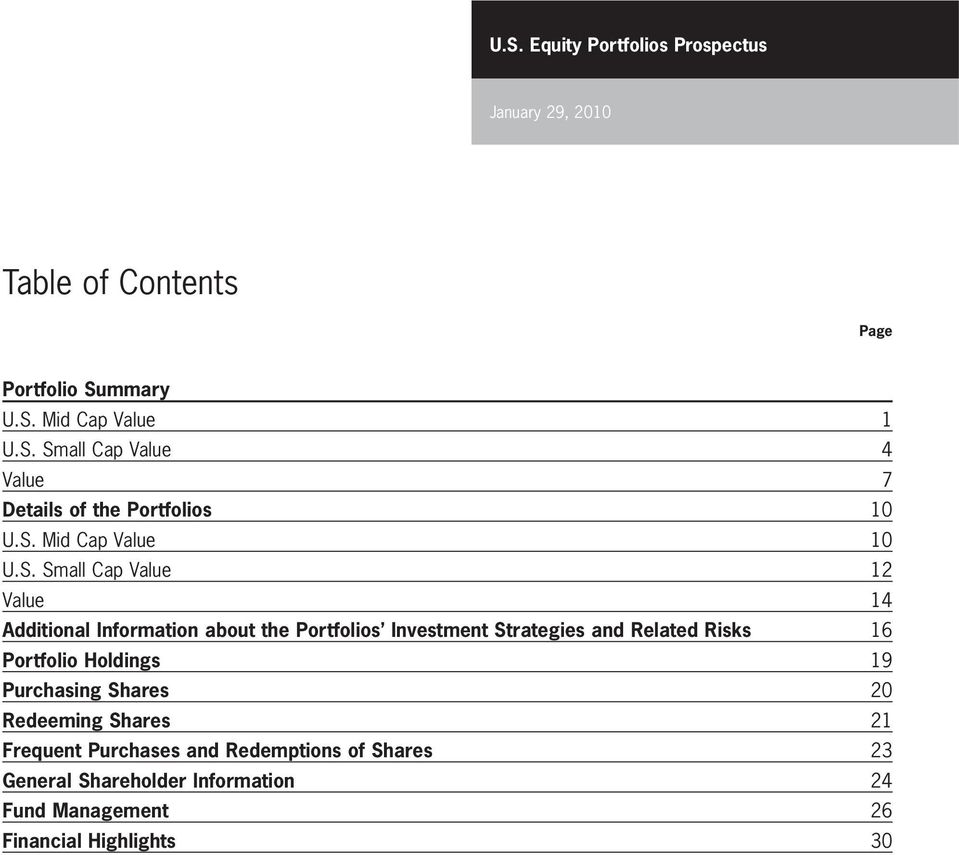
2 U.S. Equity Portfolios Prospectus January 29, 2010 Table of Contents Page Portfolio Summary U.S. Mid Cap Value 1 U.S. Small Cap Value 4 Value 7 Details of the Portfolios 10 U.S. Mid Cap Value 10 U.S. Small Cap Value 12 Value 14 Additional Information about the Portfolios Investment Strategies and Related Risks 16 Portfolio Holdings 19 Purchasing Shares 20 Redeeming Shares 21 Frequent Purchases and Redemptions of Shares 23 General Shareholder Information 24 Fund Management 26 Financial Highlights 30
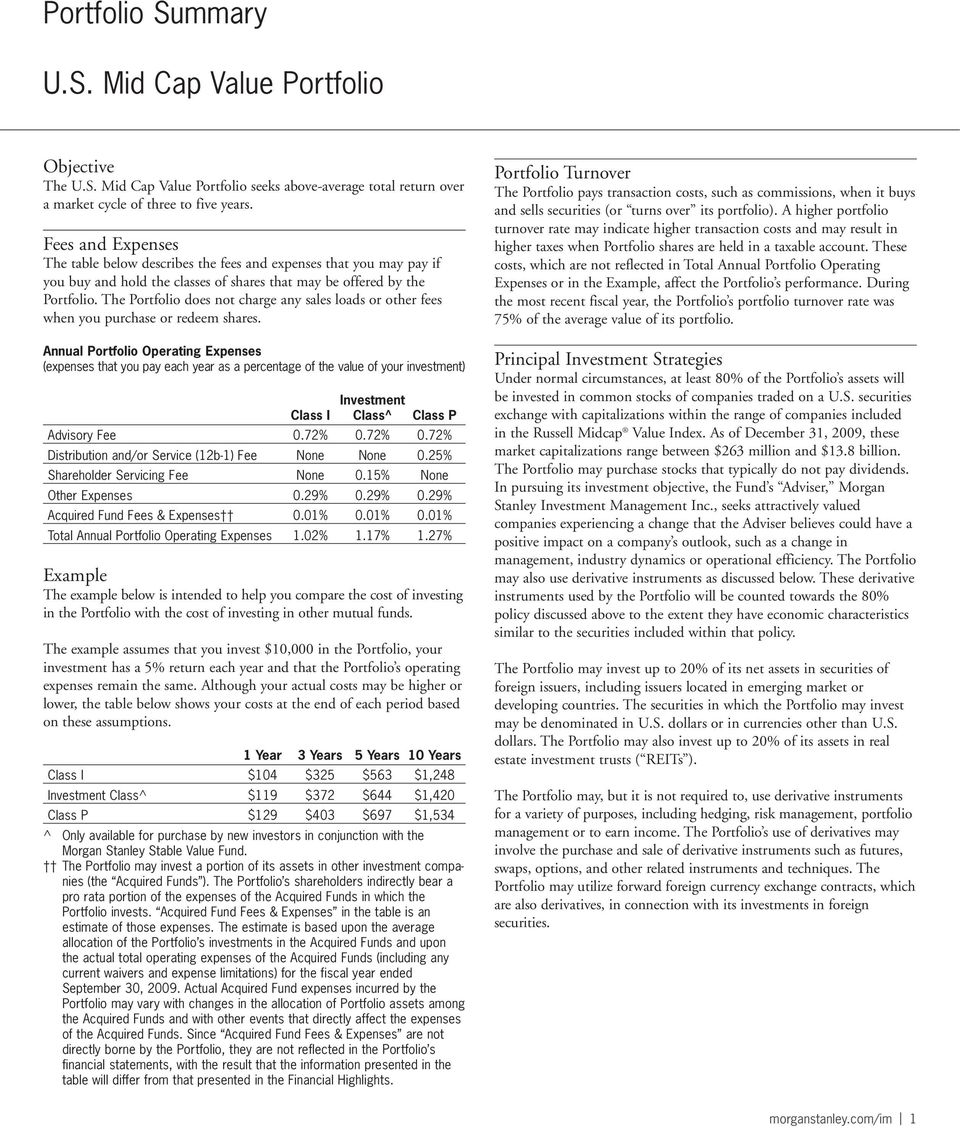
3 Portfolio Summary U.S. Mid Cap Value Portfolio Objective The U.S. Mid Cap Value Portfolio seeks above-average total return over a market cycle of three to five years. Fees and Expenses The table below describes the fees and expenses that you may pay if you buy and hold the classes of shares that may be offered by the Portfolio. The Portfolio does not charge any sales loads or other fees when you purchase or redeem shares. Annual Portfolio Operating Expenses (expenses that you pay each year as a percentage of the value of your investment) Investment Class I Class^ Class P Advisory Fee 0.72% 0.72% 0.72% Distribution and/or Service (12b-1) Fee None None 0.25% Shareholder Servicing Fee None 0.15% None Other Expenses 0.29% 0.29% 0.29% Acquired Fund Fees & Expenses 0.01% 0.01% 0.01% Total Annual Portfolio Operating Expenses 1.02% 1.17% 1.27% Example The example below is intended to help you compare the cost of investing in the Portfolio with the cost of investing in other mutual funds. The example assumes that you invest $10,000 in the Portfolio, your investment has a 5% return each year and that the Portfolio s operating expenses remain the same. Although your actual costs may be higher or lower, the table below shows your costs at the end of each period based on these assumptions. 1 Year 3 Years 5 Years 10 Years Class I $104 $325 $563 $1,248 Investment Class^ $119 $372 $644 $1,420 Class P $129 $403 $697 $1,534 ^ Only available for purchase by new investors in conjunction with the Morgan Stanley Stable Value Fund. The Portfolio may invest a portion of its assets in other investment companies (the Acquired Funds ). The Portfolio s shareholders indirectly bear a pro rata portion of the expenses of the Acquired Funds in which the Portfolio invests. Acquired Fund Fees & Expenses in the table is an estimate of those expenses. The estimate is based upon the average allocation of the Portfolio s investments in the Acquired Funds and upon the actual total operating expenses of the Acquired Funds (including any current waivers and expense limitations) for the fiscal year ended September 30, Actual Acquired Fund expenses incurred by the Portfolio may vary with changes in the allocation of Portfolio assets among the Acquired Funds and with other events that directly affect the expenses of the Acquired Funds. Since Acquired Fund Fees & Expenses are not directly borne by the Portfolio, they are not reflected in the Portfolio s financial statements, with the result that the information presented in the table will differ from that presented in the Financial Highlights. Portfolio Turnover The Portfolio pays transaction costs, such as commissions, when it buys and sells securities (or turns over its portfolio). A higher portfolio turnover rate may indicate higher transaction costs and may result in higher taxes when Portfolio shares are held in a taxable account. These costs, which are not reflected in Total Annual Portfolio Operating Expenses or in the Example, affect the Portfolio s performance. During the most recent fiscal year, the Portfolio s portfolio turnover rate was 75% of the average value of its portfolio. Principal Investment Strategies Under normal circumstances, at least 80% of the Portfolio s assets will be invested in common stocks of companies traded on a U.S. securities exchange with capitalizations within the range of companies included in the Russell Midcap Value Index. As of December 31, 2009, these market capitalizations range between $263 million and $13.8 billion. The Portfolio may purchase stocks that typically do not pay dividends. In pursuing its investment objective, the Fund s Adviser, Morgan Stanley Investment Management Inc., seeks attractively valued companies experiencing a change that the Adviser believes could have a positive impact on a company s outlook, such as a change in management, industry dynamics or operational efficiency. The Portfolio may also use derivative instruments as discussed below. These derivative instruments used by the Portfolio will be counted towards the 80% policy discussed above to the extent they have economic characteristics similar to the securities included within that policy. The Portfolio may invest up to 20% of its net assets in securities of foreign issuers, including issuers located in emerging market or developing countries. The securities in which the Portfolio may invest may be denominated in U.S. dollars or in currencies other than U.S. dollars. The Portfolio may also invest up to 20% of its assets in real estate investment trusts ( REITs ). The Portfolio may, but it is not required to, use derivative instruments for a variety of purposes, including hedging, risk management, portfolio management or to earn income. The Portfolio s use of derivatives may involve the purchase and sale of derivative instruments such as futures, swaps, options, and other related instruments and techniques. The Portfolio may utilize forward foreign currency exchange contracts, which are also derivatives, in connection with its investments in foreign securities. morganstanley.com/im 1
4 Principal Risks An investment in the Portfolio is subject to risks, and you could lose money on your investment in the Portfolio. There can be no assurance that the Portfolio will achieve its investment objective. An investment in the Portfolio is not a deposit of any bank or other insured depository institution and is not insured or guaranteed by the Federal Deposit Insurance Corporation or any other government agency. The Portfolio s principal investment strategies are subject to the following principal risks: Performance Information The bar chart and table below provide some indication of the risks of investing in the Portfolio by showing changes in the Portfolio s performance from year-to-year and by showing how the Portfolio s average annual returns for the past 1, 5 and 10 year periods and since inception compare with those of indices of similar securities, over time. The Portfolio s past performance, before and after taxes, is not necessarily an indication of how the Portfolio will perform in the future. Updated performance information is available online at Common Stock. In general, stock values fluctuate, and sometimes widely fluctuate, in response to activities specific to the company as well as general market, economic and political conditions. Annual Total Returns Calendar Years 60% Mid Capitalization Companies. Investments in mid cap companies may involve greater risk than investments in larger, more established companies. The securities issued by mid cap companies may be less liquid, and such companies may have more limited markets, financial resources and product lines, and may lack the depth of management of larger companies % % % Value Investing Style. The Portfolio emphasizes a value style of investing, which focuses on undervalued companies with characteristics for improved valuations. This style of investing is subject to the risk that the valuations never improve or that the returns on value equity securities are less than returns on other styles of investing or the overall stock market. Value stocks also may decline in price, even though in theory they are already underpriced. Foreign and Emerging Market Securities. Investments in foreign markets entail special risks such as currency, political, economic and market risks. There also may be greater market volatility, less reliable financial information, higher transaction and custody costs, decreased market liquidity and less government and exchange regulation associated with investments in foreign markets. The risks of investing in emerging market countries are greater than risks associated with investments in foreign developed countries. In addition, the Portfolio s investments may be denominated in foreign currencies and therefore, changes in the value of a country s currency compared to the U.S. dollar may affect the value of the Portfolio s investments. REITs. REITs are susceptible to risks associated with the ownership of real estate and the real estate industry in general. In addition, investments in REITs may involve duplication of management fees and certain other expenses. REITs are also subject to certain provisions under federal tax law and the failure of a company to qualify as a REIT could have adverse consequences for the Portfolio. Derivatives. A derivative instrument often has risks similar to its underlying instrument and may have additional risks, including imperfect correlation between the value of the derivative and the underlying instrument, risks of default by the other party to certain transactions, magnification of losses incurred due to changes in the market value of the securities, instruments, indices or interest rates to which they relate, and risks that the transactions may not be liquid. Certain derivative transactions may give rise to a form of leverage. Leverage magnifies the potential for gain and the risk of loss. -20% -40% The bar chart shows the performance of the Portfolio s Class I shares yearby-year and best and worst performance for a quarter; the performance of the other Classes will differ because the Classes have different ongoing fees. High Quarter 9/30/ % Low Quarter 12/31/ % Average Annual Total Returns (as of 12/31/09) Past Past Past Since One Year Five Years Ten Years Inception Class I 1 Return before Taxes 41.41% 5.29% 4.98% 12.56% Class I Return after Taxes on Distributions 42.05% 5.27% 4.36% 10.72% Class I Return after Taxes on Distributions and Sale of Fund Shares 27.99% 4.68% 3.97% 10.10% Investment Class 1 Return before Taxes 41.26% 5.15% 4.84% 10.06% Class P 1 Return before Taxes 41.05% 4.94% 4.67% 5.85% Russell Midcap Value Index (reflects no deduction for fees, expenses or taxes) % 1.98% 7.58% 10.94% 4 Lipper Mid-Cap Value Funds Index (reflects no deduction for taxes) % 1.89% 6.28% 9.08% 4 1 Class I commenced operations on December 30, Investment Class commenced operations on May 10, Class P commenced operations on July 17, The Russell Midcap Value Index measures the performance of the mid-cap value segment of the U.S. equity universe. It includes those Russell Midcap Index companies with lower price-to-book ratios and lower forecasted growth values. The Russell Midcap Index is a subset of the Russell 1000 Index and includes approximately 800 of the smallest securities in the Russell 1000 Index, which in turn consists of approximately 1,000 of the largest U.S. securities based on a combination of market capitalization and current index membership. An index is a hypothetical measure of performance based on the fluctuations in the value of securities that make 2

5 up a particular market. An index does not show actual investment returns. Payment of management or brokerage fees or taxes would lower an index s performance. An index is unmanaged and should not be considered an investment. 3 The Lipper Mid-Cap Value Funds Index is an equally weighted performance index of the largest qualifying funds (based on net assets) in the Lipper Mid-Cap Value Funds classification. The Index, which is adjusted for capital gains distributions and income dividends, is unmanaged and should not be considered an investment. There are currently 30 funds represented in this Index. As of the date of this Prospectus, the Portfolio is in the Lipper Mid-Cap Value Funds classification. 4 Since Inception reflects the inception date of Class I. The after-tax returns shown in the table above are only for the Portfolio s Class I shares and are calculated using the historical highest individual federal marginal income tax rates during the period shown and do not reflect the impact of state and local taxes. After-tax returns for the Portfolio s other Class will vary from Class I shares returns. Actual after-tax returns depend on the investor s tax situation and may differ from those shown, and after-tax returns are not relevant to investors who hold their Portfolio shares through tax deferred arrangements such as 401(k) plans or individual retirement accounts. After-tax returns may be higher than before-tax returns due to foreign tax credits and/or an assumed benefit from capital losses that would have been realized had Portfolio shares been sold at the end of the relevant periods, as applicable. Investment Adviser Adviser. Morgan Stanley Investment Management Inc. Portfolio Managers. The Portfolio is managed by members of the Equity Income team. Information about the current members of the Equity Income team jointly and primarily responsible for the day-today management of the Portfolio is shown below: Date Began Managing Name Title with Adviser Portfolio Thomas R. Copper Managing Director December 2005 John Mazanec Executive Director June 2008 Thomas B. Bastian Managing Director September 2003 Mary Jayne Maly Managing Director July 2008 James O. Roeder Managing Director September 2003 Mark J. Laskin Executive Director January 2007 Sergio Marcheli Executive Director September 2003 Fund shares may be purchased or sold directly through Morgan Stanley Institutional Fund Trust (the Fund ) or by contacting your financial intermediary. To purchase and sell Fund shares directly through the Fund, provide a completed Account Registration Form to Morgan Stanley Institutional Fund Trust, c/o Morgan Stanley Services Company Inc., P.O. Box , Kansas City, MO You may obtain an Account Registration Form by calling Morgan Stanley Services Company Inc. ( Morgan Stanley Services ), the Fund s transfer agent at You may sell Fund shares, if authorized, by calling the telephone number listed above. You may also purchase Fund shares by wiring Federal Funds to JPMorgan Chase Bank, N.A. (the Custodian ). For more information, please refer to the Purchasing Shares and Redeeming Shares sections beginning on pages 20 and 21, respectively, of this Prospectus. Tax Information The Portfolio intends to make distributions that may be taxed as ordinary income or capital gains, unless you are investing through a tax-deferred arrangement, such as a 401(k) plan or an individual retirement account. Payments to Broker-Dealers and Other Financial Intermediaries If you purchase the Portfolio through a broker-dealer or other financial intermediary (such as a bank), which may be affiliated or unaffiliated with the Adviser, the Adviser and/or the Portfolio s distributor may pay (out of their own funds and not as an expense of the Portfolio) the intermediary for the sale of Portfolio shares and related services. These payments, which may be significant in amount, may create a conflict of interest by influencing the broker-dealer or other intermediary and your salesperson to recommend the Portfolio over another investment. Ask your salesperson or visit your financial intermediary s web site for more information. Purchase and Sale of Fund Shares The Portfolio offers investors three Classes of shares: Class I, Investment Class and Class P. The minimum initial investment generally is $5,000,000 for Class I shares and $1,000,000 for each of Investment Class shares and Class P shares of the Portfolio. You may not be subject to the minimum investment requirements under certain circumstances. For more information, please refer to the Purchasing Shares Share Class Arrangements and Other Purchase Information sections beginning on pages 20 and 21, respectively, of this Prospectus. Fund shares will be sold at the net asset value per share ( NAV ) next determined after we receive your redemption request. The NAV of the Portfolio is determined as of the close of the New York Stock Exchange ( NYSE ) (normally 4:00 p.m. Eastern Time) generally on each day the NYSE is open for business. morganstanley.com/im 3

6 Portfolio Summary U.S. Small Cap Value Portfolio Objective The U.S. Small Cap Value Portfolio seeks above-average total return over a market cycle of three to five years. Fees and Expenses The table below describes the fees and expenses that you may pay if you buy and hold the classes of shares that may be offered by the Portfolio. Shareholder Fees (fees paid directly from your investment) Class I Class P Redemption Fees* 2.00% 2.00% Annual Portfolio Operating Expenses (expenses that you pay each year as a percentage of the value of your investment) Class I Class P Advisory Fee 0.669% 0.669% Distribution and/or Service (12b-1) Fee None 0.25% Other Expenses 0.20% 0.20% Total Annual Portfolio Operating Expenses 0.87% 1.12% Example The example below is intended to help you compare the cost of investing in the Portfolio with the cost of investing in other mutual funds. The example assumes that you invest $10,000 in the Portfolio, your investment has a 5% return each year and that the Portfolio s operating expenses remain the same. Although your actual costs may be higher or lower, the table below shows your costs at the end of each period based on these assumptions. 1 Year 3 Years 5 Years 10 Years Class I $ 89 $278 $482 $1,073 Class P $114 $356 $617 $1,363 * Payable to the Portfolio on shares redeemed within 30 days of purchase. See Redeeming Shares and General Shareholder Information for more information on redemption fees. Redemption fees are a percentage of the amount redeemed. The Portfolio may invest a portion of its assets in other investment companies (the Acquired Funds ). The Portfolio s shareholders indirectly bear a pro rata portion of the expenses of the Acquired Funds in which the Portfolio invests. The Portfolio estimates that these expenses constituted less than 0.01% of the Portfolio s average net assets for the fiscal year ended September 30, The Portfolio s estimated indirect expense from investing in the Acquired Funds is based upon the average allocation of the Portfolio s investments in the Acquired Funds and upon the actual total operating expenses of the Acquired Funds (including any current waivers and expense limitations) for the fiscal year ended September 30, Actual Acquired Fund expenses incurred by the Portfolio may vary with changes in the allocation of Portfolio assets among the Acquired Funds and with other events that directly affect the expenses of the Acquired Funds. Portfolio Turnover The Portfolio pays transaction costs, such as commissions, when it buys and sells securities (or turns over its portfolio). A higher portfolio turnover rate may indicate higher transaction costs and may result in higher taxes when Portfolio shares are held in a taxable account. These costs, which are not reflected in Total Annual Portfolio Operating Expenses or in the Example, affect the Portfolio s performance. During the most recent fiscal year, the Portfolio s portfolio turnover rate was 53% of the average value of its portfolio. Principal Investment Strategies Under normal circumstances, at least 80% of the Portfolio s assets will be invested in common stocks of small cap companies traded on a U.S. securities exchange. Under current market conditions, the Fund s Adviser, Morgan Stanley Investment Management Inc., considers a company to be a small cap company if it has a total market capitalization at the time of purchase of $100 million to $2 billion or the high end of the range of companies represented in the Russell 2000 Value Index. The Adviser analyzes securities to identify stocks that are believed to be undervalued relative to the market place or similar companies. For most sectors, sector weightings normally are kept within 10% of those of the Russell 2000 Value Index. There are currently more than ten sectors represented in the Russell 2000 Value Index including technology, consumer discretionary, health care, energy and producer durables. The Portfolio may also use derivative instruments as discussed below. These derivative instruments will be counted towards the 80% policy discussed above to the extent they have economic characteristics similar to the securities included within that policy. The Portfolio may, but it is not required to, use derivative instruments for a variety of purposes, including hedging, risk management, portfolio management or to earn income. The Portfolio s use of derivatives may involve the purchase and sale of derivative instruments such as futures, swaps, and other related instruments and techniques. The Portfolio may utilize forward foreign currency exchange contracts, which are also derivatives, in connection with its investments in foreign securities. 4

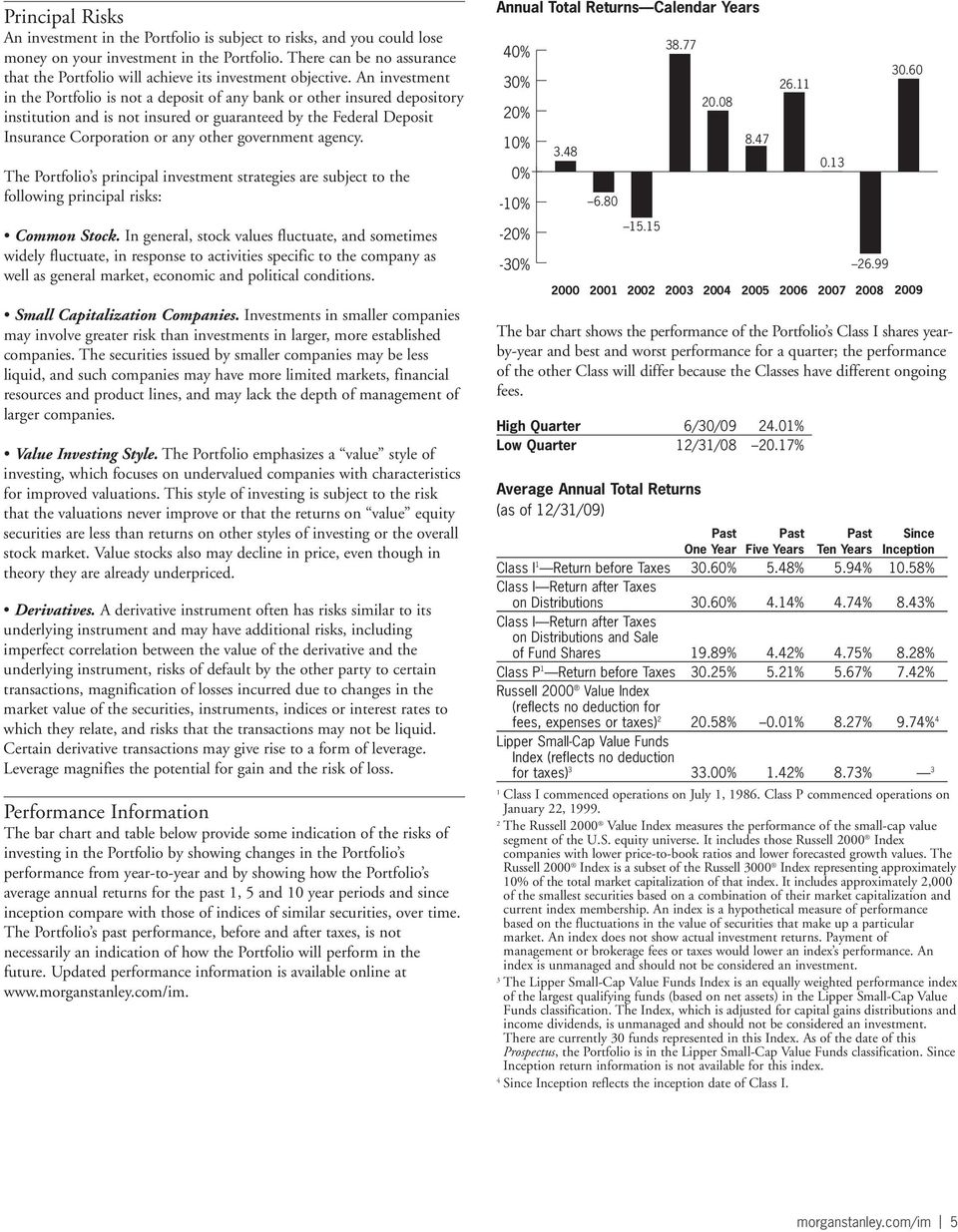
7 Principal Risks An investment in the Portfolio is subject to risks, and you could lose money on your investment in the Portfolio. There can be no assurance that the Portfolio will achieve its investment objective. An investment in the Portfolio is not a deposit of any bank or other insured depository institution and is not insured or guaranteed by the Federal Deposit Insurance Corporation or any other government agency. The Portfolio s principal investment strategies are subject to the following principal risks: Common Stock. In general, stock values fluctuate, and sometimes widely fluctuate, in response to activities specific to the company as well as general market, economic and political conditions. Small Capitalization Companies. Investments in smaller companies may involve greater risk than investments in larger, more established companies. The securities issued by smaller companies may be less liquid, and such companies may have more limited markets, financial resources and product lines, and may lack the depth of management of larger companies. Value Investing Style. The Portfolio emphasizes a value style of investing, which focuses on undervalued companies with characteristics for improved valuations. This style of investing is subject to the risk that the valuations never improve or that the returns on value equity securities are less than returns on other styles of investing or the overall stock market. Value stocks also may decline in price, even though in theory they are already underpriced. Derivatives. A derivative instrument often has risks similar to its underlying instrument and may have additional risks, including imperfect correlation between the value of the derivative and the underlying instrument, risks of default by the other party to certain transactions, magnification of losses incurred due to changes in the market value of the securities, instruments, indices or interest rates to which they relate, and risks that the transactions may not be liquid. Certain derivative transactions may give rise to a form of leverage. Leverage magnifies the potential for gain and the risk of loss. Performance Information The bar chart and table below provide some indication of the risks of investing in the Portfolio by showing changes in the Portfolio s performance from year-to-year and by showing how the Portfolio s average annual returns for the past 1, 5 and 10 year periods and since inception compare with those of indices of similar securities, over time. The Portfolio s past performance, before and after taxes, is not necessarily an indication of how the Portfolio will perform in the future. Updated performance information is available online at Annual Total Returns Calendar Years 40% 30% 20% 10% 0% -10% -20% -30% The bar chart shows the performance of the Portfolio s Class I shares yearby-year and best and worst performance for a quarter; the performance of the other Class will differ because the Classes have different ongoing fees. High Quarter 6/30/ % Low Quarter 12/31/ % Average Annual Total Returns (as of 12/31/09) Past Past Past Since One Year Five Years Ten Years Inception Class I 1 Return before Taxes 30.60% 5.48% 5.94% 10.58% Class I Return after Taxes on Distributions 30.60% 4.14% 4.74% 8.43% Class I Return after Taxes on Distributions and Sale of Fund Shares 19.89% 4.42% 4.75% 8.28% Class P 1 Return before Taxes 30.25% 5.21% 5.67% 7.42% Russell 2000 Value Index (reflects no deduction for fees, expenses or taxes) % 0.01% 8.27% 9.74% 4 Lipper Small-Cap Value Funds Index (reflects no deduction for taxes) % 1.42% 8.73% 3 1 Class I commenced operations on July 1, Class P commenced operations on January 22, The Russell 2000 Value Index measures the performance of the small-cap value segment of the U.S. equity universe. It includes those Russell 2000 Index companies with lower price-to-book ratios and lower forecasted growth values. The Russell 2000 Index is a subset of the Russell 3000 Index representing approximately 10% of the total market capitalization of that index. It includes approximately 2,000 of the smallest securities based on a combination of their market capitalization and current index membership. An index is a hypothetical measure of performance based on the fluctuations in the value of securities that make up a particular market. An index does not show actual investment returns. Payment of management or brokerage fees or taxes would lower an index s performance. An index is unmanaged and should not be considered an investment. 3 The Lipper Small-Cap Value Funds Index is an equally weighted performance index of the largest qualifying funds (based on net assets) in the Lipper Small-Cap Value Funds classification. The Index, which is adjusted for capital gains distributions and income dividends, is unmanaged and should not be considered an investment. There are currently 30 funds represented in this Index. As of the date of this Prospectus, the Portfolio is in the Lipper Small-Cap Value Funds classification. Since Inception return information is not available for this index. 4 Since Inception reflects the inception date of Class I. morganstanley.com/im 5
8 The after-tax returns shown in the table above are only for the Portfolio s Class I shares and are calculated using the historical highest individual federal marginal income tax rates during the period shown and do not reflect the impact of state and local taxes. After-tax returns for the Portfolio s other Class will vary from Class I shares returns. Actual after-tax returns depend on the investor s tax situation and may differ from those shown, and after-tax returns are not relevant to investors who hold their Portfolio shares through tax deferred arrangements such as 401(k) plans or individual retirement accounts. After-tax returns may be higher than before-tax returns due to foreign tax credits and/or an assumed benefit from capital losses that would have been realized had Portfolio shares been sold at the end of the relevant periods, as applicable. Investment Adviser Adviser. Morgan Stanley Investment Management Inc. Portfolio Managers. The Portfolio is managed by members of the Small/Mid Cap Value team. Information about the current members of the Small/Mid Cap Value team jointly and primarily responsible for the day-to-day management of the Portfolio is shown below: Tax Information The Portfolio intends to make distributions that may be taxed as ordinary income or capital gains, unless you are investing through a tax-deferred arrangement, such as a 401(k) plan or an individual retirement account. Payments to Broker-Dealers and Other Financial Intermediaries If you purchase the Portfolio through a broker-dealer or other financial intermediary (such as a bank), which may be affiliated or unaffiliated with the Adviser, the Adviser and/or the Portfolio s distributor may pay (out of their own funds and not as an expense of the Portfolio) the intermediary for the sale of Portfolio shares and related services. These payments, which may be significant in amount, may create a conflict of interest by influencing the broker-dealer or other intermediary and your salesperson to recommend the Portfolio over another investment. Ask your salesperson or visit your financial intermediary s web site for more information. Date Began Managing Name Title with Adviser Portfolio Richard Glass Managing Director September 2003 Alexander Yaggy Executive Director January 2006 Purchase and Sale of Fund Shares The Portfolio offers investors two Classes of shares: Classes I and P. The minimum initial investment generally is $5,000,000 for Class I shares and $1,000,000 for Class P shares of the Portfolio. You may not be subject to the minimum investment requirements under certain circumstances. For more information, please refer to the Purchasing Shares Share Class Arrangements and Other Purchase Information sections beginning on pages 20 and 21, respectively, of this Prospectus. Fund shares will be sold at the net asset value per share ( NAV ) next determined after we receive your redemption request. The NAV of the Portfolio is determined as of the close of the New York Stock Exchange ( NYSE ) (normally 4:00 p.m. Eastern Time) generally on each day the NYSE is open for business. Fund shares may be purchased or sold directly through Morgan Stanley Institutional Fund Trust (the Fund ) or by contacting your financial intermediary. To purchase and sell Fund shares directly through the Fund, provide a completed Account Registration Form to Morgan Stanley Institutional Fund Trust, c/o Morgan Stanley Services Company Inc., P.O. Box , Kansas City, MO You may obtain an Account Registration Form by calling Morgan Stanley Services Company Inc. ( Morgan Stanley Services ), the Fund s transfer agent at You may sell Fund shares, if authorized, by calling the telephone number listed above. You may also purchase Fund shares by wiring Federal Funds to JPMorgan Chase Bank, N.A. (the Custodian ). For more information, please refer to the Purchasing Shares and Redeeming Shares sections beginning on pages 20 and 21, respectively, of this Prospectus. 6
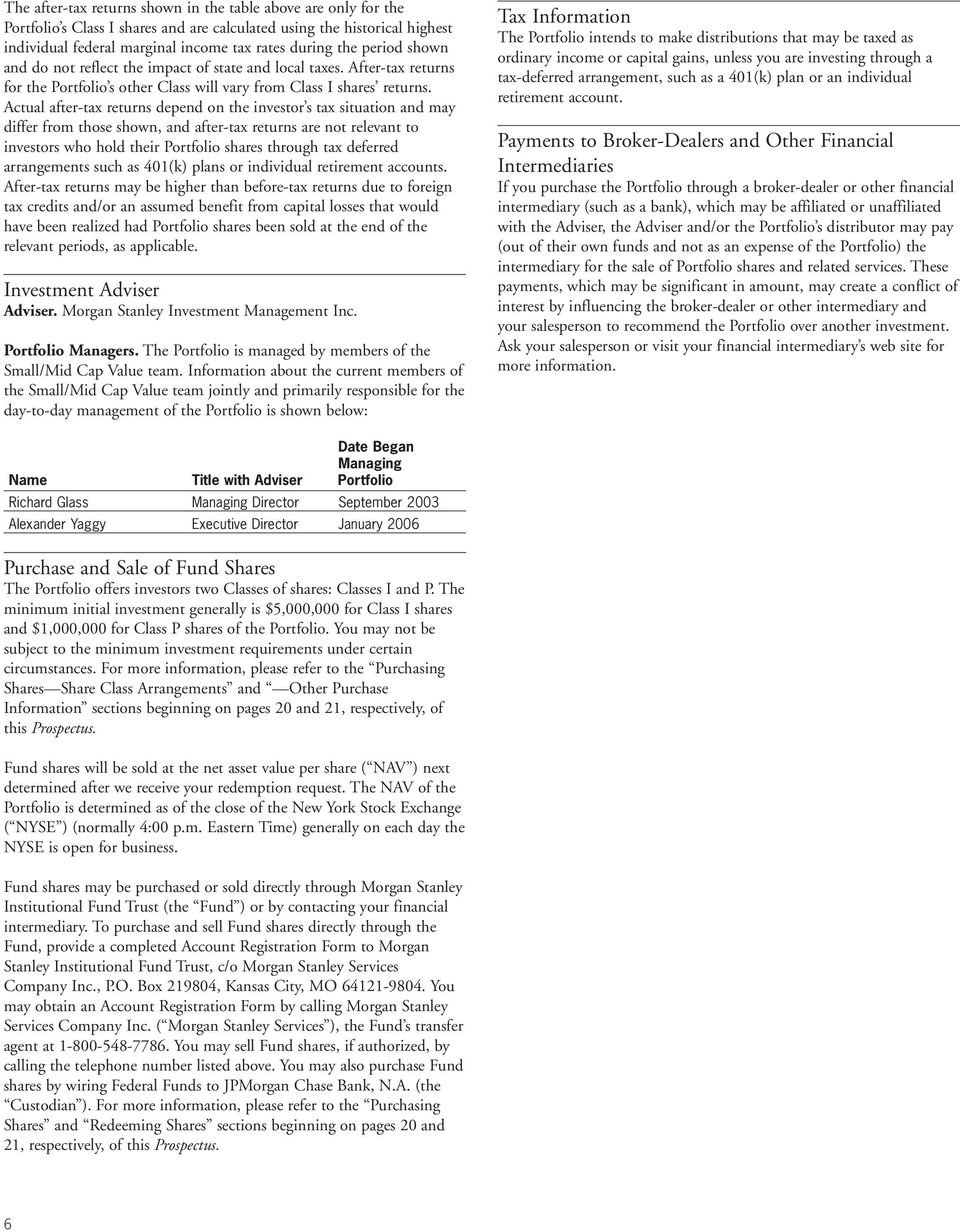
9 Portfolio Summary Value Portfolio Objective The Value Portfolio seeks above-average total return over a market cycle of three to five years. Fees and Expenses The table below describes the fees and expenses that you may pay if you buy and hold the classes of shares that may be offered by the Portfolio. The Portfolio does not charge any sales loads or other fees when you purchase or redeem shares. Annual Portfolio Operating Expenses (expenses that you pay each year as a percentage of the value of your investment) Investment Class I Class^ Class P Advisory Fee 0.50% 0.50% 0.50% Distribution and/or Service (12b-1) Fee None None 0.25% Shareholder Servicing Fee None 0.15% None Other Expenses 0.26% 0.26% 0.26% Total Annual Portfolio Operating Expenses 0.76% 0.91% 1.01% Example The example below is intended to help you compare the cost of investing in the Portfolio with the cost of investing in other mutual funds. The example assumes that you invest $10,000 in the Portfolio, your investment has a 5% return each year and that the Portfolio s operating expenses remain the same. Although your actual costs may be higher or lower, the table below shows your costs at the end of each period based on these assumptions. 1 Year 3 Years 5 Years 10 Years Class I $ 78 $243 $422 $ 942 Investment Class^ $ 93 $290 $504 $1,120 Class P $103 $322 $558 $1,236 ^ Only available for purchase by new investors in conjunction with the Morgan Stanley Stable Value Fund. As of the date of this Prospectus, the Investment Class of the Portfolio is not operational. Other Expenses are based on estimated amounts. The Portfolio may invest a portion of its assets in other investment companies (the Acquired Funds ). The Portfolio s shareholders indirectly bear a pro rata portion of the expenses of the Acquired Funds in which the Portfolio invests. The Portfolio estimates that these expenses constituted less than 0.01% of the Portfolio s average net assets for the fiscal year ended September 30, The Portfolio s estimated indirect expense from investing in the Acquired Funds is based upon the average allocation of the Portfolio s investments in the Acquired Funds and upon the actual total operating expenses of the Acquired Funds (including any current waivers and expense limitations) for the fiscal year ended September 30, Actual Acquired Fund expenses incurred by the Portfolio may vary with changes in the allocation of Portfolio assets among the Acquired Funds and with other events that directly affect the expenses of the Acquired Funds. As of the date of this Prospectus, the Investment Class of the Portfolio is not operational. The figures shown reflect the expenses of the Portfolio s Class I and includes the 0.15% shareholder servicing fee applicable to the Investment Class. Portfolio Turnover The Portfolio pays transaction costs, such as commissions, when it buys and sells securities (or turns over its portfolio). A higher portfolio turnover rate may indicate higher transaction costs and may result in higher taxes when Portfolio shares are held in a taxable account. These costs, which are not reflected in Total Annual Portfolio Operating Expenses or in the Example, affect the Portfolio s performance. During the most recent fiscal year, the Portfolio s portfolio turnover rate was 48% of the average value of its portfolio. Principal Investment Strategies The Portfolio invests primarily in common stocks of companies with capitalizations generally greater than $1 billion. The Portfolio emphasizes a value style of investing, seeking well established companies that appear undervalued and currently are not being recognized within the market place. The Portfolio may purchase stocks that do not pay dividends. The Fund s Adviser, Morgan Stanley Investment Management Inc., begins with a universe of companies that have attributes that may qualify them as value companies. The Adviser then screens these companies for liquidity and relative value and evaluates the companies relative to competitive and market conditions within each industry. The Adviser then conducts a fundamental analysis of each company to identify those companies believed to be attractively valued relative to other companies within the industry. The Portfolio may invest, to a limited extent, in equity securities of foreign issuers, including issuers located in emerging market or developing countries and may also invest in securities of foreign companies that are listed in the United States on a national exchange. The securities in which the Portfolio may invest may be denominated in U.S. dollars or in currencies other than U.S. dollars. Principal Risks An investment in the Portfolio is subject to risks, and you could lose money on your investment in the Portfolio. There can be no assurance that the Portfolio will achieve its investment objective. An investment in the Portfolio is not a deposit of any bank or other insured depository institution and is not insured or guaranteed by the Federal Deposit Insurance Corporation or any other government agency. The Portfolio s principal investment strategies are subject to the following principal risks: Common Stock. In general, stock values fluctuate, and sometimes widely fluctuate, in response to activities specific to the company as well as general market, economic and political conditions. morganstanley.com/im 7

10 Value Investing Style. The Portfolio emphasizes a value style of investing, which focuses on undervalued companies with characteristics for improved valuations. This style of investing is subject to the risk that the valuations never improve or that the returns on value equity securities are less than returns on other styles of investing or the overall stock market. Value stocks also may decline in price, even though in theory they are already underpriced. Foreign and Emerging Market Securities. Investments in foreign markets entail special risks such as currency, political, economic and market risks. There also may be greater market volatility, less reliable financial information, higher transaction and custody costs, decreased market liquidity and less government and exchange regulation associated with investments in foreign markets. The risks of investing in emerging market countries are greater than risks associated with investments in foreign developed countries. In addition, the Portfolio s investments may be denominated in foreign currencies and therefore, changes in the value of a country s currency compared to the U.S. dollar may affect the value of the Portfolio s investments. Performance Information The bar chart and table below provide some indication of the risks of investing in the Portfolio by showing changes in the Portfolio s performance from year-to-year and by showing how the Portfolio s average annual returns for the past 1, 5 and 10 year periods and since inception compare with those of indices of similar securities, over time. The Portfolio s past performance, before and after taxes, is not necessarily an indication of how the Portfolio will perform in the future. Updated performance information is available online at Annual Total Returns Calendar Years 40% 30% 20% 10% 0% -10% -20% -30% -40% -50% The bar chart shows the performance of the Portfolio s Class I shares yearby-year and best and worst performance for a quarter; the performance of the other Classes will differ because the Classes have different ongoing fees. Average Annual Total Returns (as of 12/31/09) Past Past Past Since One Year Five Years Ten Years Inception Class I 1 Return before Taxes 38.63% 1.14% 5.31% 11.09% Class I Return after Taxes on Distributions 39.87% 0.35% 4.69% 8.39% Class I Return after Taxes on Distributions and Sale of Fund Shares 26.98% 1.21% 4.65% 8.38% Class P 1 Return before Taxes 38.18% 0.88% 5.05% 6.59% Russell 1000 Value Index (reflects no deduction for fees, expenses or taxes) 2, % 0.25% 2.47% 10.94% 6 S&P 500 Index (reflects no deduction for fees, expenses or taxes) 3, % 0.42% 0.95% 10.47% 6 Lipper Large-Cap Value Funds Index (reflects no deduction for taxes) % 0.28% 0.85% 9.89% 6 1 Class I commenced operations on November 5, Class P commenced operations on July 17, The Russell 1000 Value Index measures the performance of the large-cap value segment of the U.S. equity universe. It includes those Russell 1000 Index companies with lower price-to-book ratios and lower expected growth values. The Russell 1000 Index is an index of approximately 1,000 of the largest U.S. securities based on a combination of market capitalization and current index membership. 3 The Standard & Poor s 500 Index (S&P 500 ) measures the performance of the large-cap segment of the U.S. equities market, covering approximately 75% of the U.S. equities market. The Index includes 500 leading companies in leading industries of the U.S. economy. 4 An index is a hypothetical measure of performance based on the fluctuations in the value of securities that make up a particular market. An index does not show actual investment returns. Payment of management or brokerage fees or taxes would lower an index s performance. An index is unmanaged and should not be considered an investment. 5 The Lipper Large-Cap Value Funds Index is an equally weighted performance index of the largest qualifying funds (based on net assets) in the Lipper Large-Cap Value Funds classification. The Index, which is adjusted for capital gains distributions and income dividends, is unmanaged and should not be considered an investment. There are currently 30 funds represented in this Index. As of the date of this Prospectus, the Portfolio is in the Lipper Large-Cap Value Funds classification. 6 Since Inception reflects the inception date of Class I. The after-tax returns shown in the table above are only for the Portfolio s Class I shares and are calculated using the historical highest individual federal marginal income tax rates during the period shown and do not reflect the impact of state and local taxes. After-tax returns for the Portfolio s other Class will vary from Class I shares returns. Actual after-tax returns depend on the investor s tax situation and may differ from those shown, and after-tax returns are not relevant to investors who hold their Portfolio shares through tax deferred arrangements such as 401(k) plans or individual retirement accounts. After-tax returns may be higher than before-tax returns due to foreign tax credits and/or an assumed benefit from capital losses that would have been realized had Portfolio shares been sold at the end of the relevant periods, as applicable. High Quarter 6/30/ % Low Quarter 9/30/ % 8
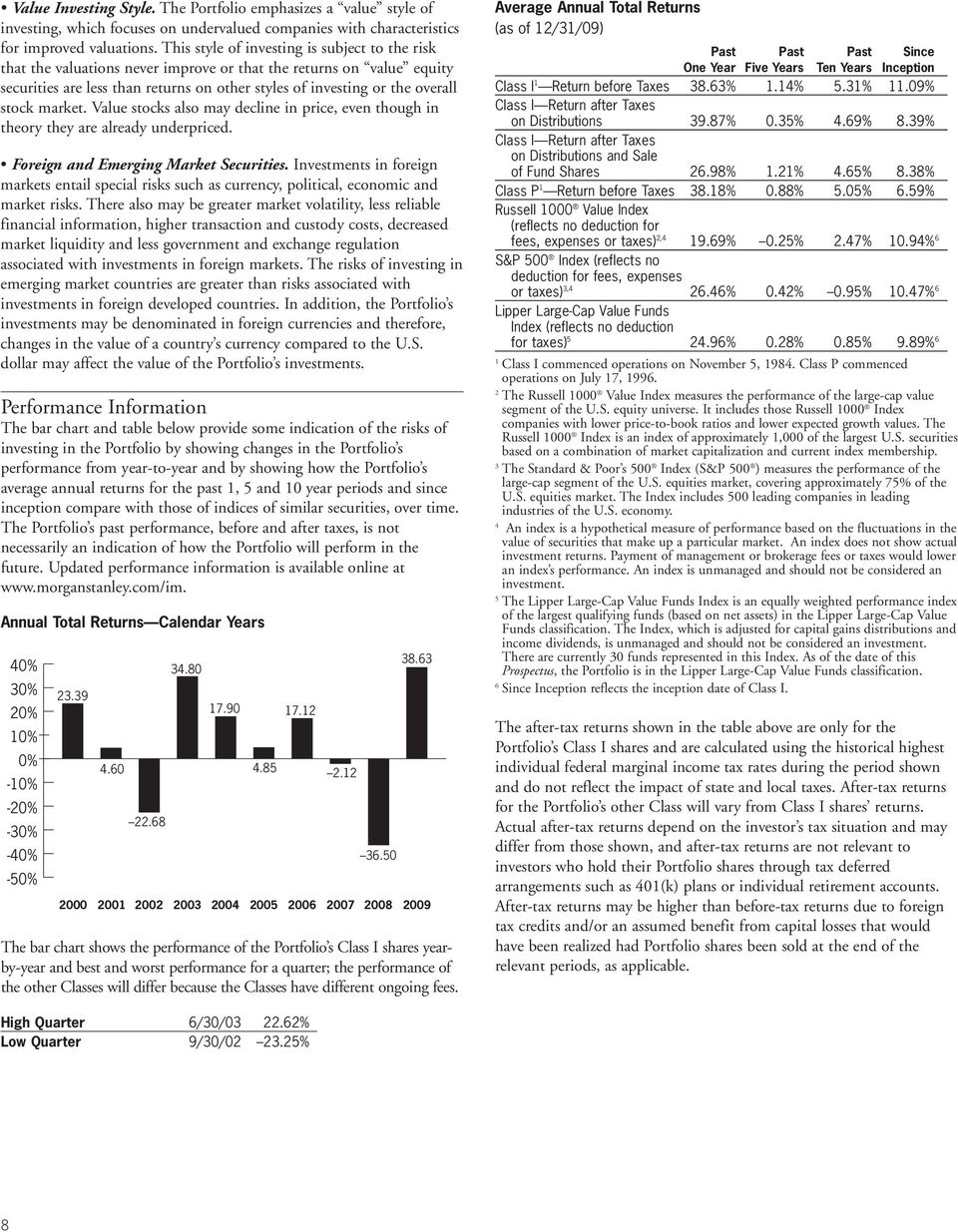
11 Investment Adviser Adviser. Morgan Stanley Investment Management Inc. Portfolio Managers. The Portfolio is managed by members of the Multi-Cap Value team. Information about the current members of the Multi-Cap Value team jointly and primarily responsible for the day-today management of the Portfolio is shown below: Date Began Managing Name Title with Adviser Portfolio Jason S. Leder Managing Director September 2003 Kevin C. Holt Managing Director September 2003 James N. Warwick Executive Director July 2007 Devin E. Armstrong Executive Director July 2007 Payments to Broker-Dealers and Other Financial Intermediaries If you purchase the Portfolio through a broker-dealer or other financial intermediary (such as a bank), which may be affiliated or unaffiliated with the Adviser, the Adviser and/or the Portfolio s distributor may pay (out of their own funds and not as an expense of the Portfolio) the intermediary for the sale of Portfolio shares and related services. These payments, which may be significant in amount, may create a conflict of interest by influencing the broker-dealer or other intermediary and your salesperson to recommend the Portfolio over another investment. Ask your salesperson or visit your financial intermediary s web site for more information. Purchase and Sale of Fund Shares The Portfolio offers investors three Classes of shares: Class I, Investment Class and Class P. The minimum initial investment generally is $5,000,000 for Class I shares and $1,000,000 for each of Investment Class shares and Class P shares of the Portfolio. You may not be subject to the minimum investment requirements under certain circumstances. For more information, please refer to the Purchasing Shares Share Class Arrangements and Other Purchase Information sections beginning on pages 20 and 21, respectively, of this Prospectus. Fund shares will be sold at the net asset value per share ( NAV ) next determined after we receive your redemption request. The NAV of the Portfolio is determined as of the close of the New York Stock Exchange ( NYSE ) (normally 4:00 p.m. Eastern Time) generally on each day the NYSE is open for business. Fund shares may be purchased or sold directly through Morgan Stanley Institutional Fund Trust (the Fund ) or by contacting your financial intermediary. To purchase and sell Fund shares directly through the Fund, provide a completed Account Registration Form to Morgan Stanley Institutional Fund Trust, c/o Morgan Stanley Services Company Inc., P.O. Box , Kansas City, MO You may obtain an Account Registration Form by calling Morgan Stanley Services Company Inc. ( Morgan Stanley Services ), the Fund s transfer agent at You may sell Fund shares, if authorized, by calling the telephone number listed above. You may also purchase Fund shares by wiring Federal Funds to JPMorgan Chase Bank, N.A. (the Custodian ). For more information, please refer to the Purchasing Shares and Redeeming Shares sections beginning on pages 20 and 21, respectively, of this Prospectus. Tax Information The Portfolio intends to make distributions that may be taxed as ordinary income or capital gains, unless you are investing through a tax-deferred arrangement, such as a 401(k) plan or an individual retirement account. morganstanley.com/im 9

12 Details of the Portfolios U.S. Mid Cap Value Portfolio Objective The U.S. Mid Cap Value Portfolio seeks above-average total return over a market cycle of three to five years. Approach The Portfolio invests primarily in common stocks of companies traded on a U.S. securities exchange with capitalizations generally in the range of companies included in the Russell Midcap Value Index. The Portfolio may purchase stocks that typically do not pay dividends. Process The Adviser seeks attractively valued companies experiencing a change that the Adviser believes could have a positive impact on a company s outlook, such as a change in management, industry dynamics or operational efficiency. In determining whether securities should be sold, the Adviser considers factors such as appreciation to fair value, fundamental change in the company or changes in economic or market trends. Under normal circumstances, at least 80% of the Portfolio s assets will be invested in common stocks of companies traded on a U.S. securities exchange with capitalizations within the range of companies included in the Russell Midcap Value Index. This policy may be changed without shareholder approval; however, you would be notified in writing of any changes. As of December 31, 2009, these market capitalizations range between $263 million and $13.8 billion. In addition, the Portfolio may invest in convertible securities. The Portfolio may also use derivative instruments as discussed below. These derivative instruments will be counted toward the 80% policy discussed above to the extent they have economic characteristics similar to the securities included within that policy. The Portfolio may invest up to 20% of its total assets in securities of foreign issuers, including issuers located in emerging market or developing countries. This percentage limitation however, does not apply to securities of foreign companies that are listed in the United States on a national exchange. The securities in which the Portfolio may invest may be denominated in U.S. dollars or in currencies other than U.S. dollars. The Portfolio may invest up to 20% of its net assets in REITs. The Portfolio may, but it is not required to, use derivative instruments for a variety of purposes, including hedging, risk management, portfolio management or to earn income. Derivatives are financial instruments whose value is based on the value of another underlying asset, interest rate, index or financial instrument. The Portfolio s use of derivatives may involve the purchase and sale of derivative instruments such as futures, swaps, options, and other related instruments and techniques. The Portfolio may utilize forward foreign currency exchange contracts, which are also derivatives, in connection with its investments in foreign securities. Principal Risks The Portfolio s principal investment strategies are subject to the following principal risks: The Portfolio is subject to various risks that could adversely affect its NAV and total return. It is possible for an investor to lose money by investing in the Portfolio. The prices of common stocks rise and fall in response to events that affect entire financial markets or industries, and to events that affect a particular issuer. Investments in mid cap companies may involve greater risk than investments in larger, more established companies. The securities issued by mid cap companies may be less liquid and their prices subject to more abrupt or erratic price movements. In addition, mid cap companies may have more limited markets, financial resources and product lines, and may lack the depth of management of larger companies. The Adviser s perception that a stock is under- or over-valued may not be accurate or may not be realized. At times, the Portfolio s guideline for sector weightings may result in significant exposure to one or more market sectors. The Portfolio emphasizes a value style of investing, which focuses on undervalued companies with characteristics for improved valuations. This style of investing is subject to the risk that the valuations never improve or that the returns on value equity securities are less than returns on other styles of investing or the overall stock market. Value stocks also may decline in price, even though in theory they are already underpriced. Different types of stocks tend to shift in 10

13 U.S. Equity Portfolios Prospectus January 29, 2010 U.S. Mid Cap Value Portfolio (Cont d) and out of favor depending on market and economic conditions and the Portfolio s performance may sometimes be lower or higher than that of other types of funds (such as those emphasizing growth stocks). Investing in the securities of foreign issuers, particularly those located in emerging market or developing countries, entails the risk that news and events unique to a country or region will affect those markets and their issuers. These same events will not necessarily have an effect on the U.S. economy or similar issuers located in the United States. The Portfolio s investments may be denominated in foreign currencies. As a result, changes in the value of a country s currency compared to the U.S. dollar may affect the value of the Portfolio s investments. These changes may occur separately from and in response to events that do not otherwise affect the value of the security in the issuer s home country. The Adviser may invest in certain instruments, such as derivatives, and may use certain techniques, such as hedging, to manage these risks. However, the Adviser cannot guarantee that it will be practical to hedge these risks in certain markets or under particular conditions or that it will succeed in doing so. REITs pool investors funds for investments primarily in commercial real estate properties. Like mutual funds, REITs have expenses, including advisory and administration fees, that are paid by their shareholders. As a result, shareholders will absorb duplicate levels of fees when the Portfolio invests in REITs. The performance of any Portfolio REIT holdings ultimately depends on the types of real property in which the REITs invest and how well the property is managed. A general downturn in real estate values also can hurt REIT performance. In addition, REITs are subject to certain provisions under federal tax law. The failure of a company to qualify as a REIT could have adverse consequences for the Portfolio, including significantly reducing return to the Portfolio on its investment in such company. A derivative instrument often has risks similar to its underlying instrument and may have additional risks, including imperfect correlation between the value of the derivative and the underlying instrument, risks of default by the other party to certain transactions, magnification of losses incurred due to changes in the market value of the securities, instruments, indices or interest rates to which they relate, and risks that the transactions may not be liquid. Certain derivative transactions may give rise to a form of leverage. Leverage magnifies the potential for gain and the risk of loss. Please see Additional Information about the Portfolios Investment Strategies and Related Risks for further information about these and other risks of investing in the Portfolio. 11
14 January 29, 2010 U.S. Small Cap Value Portfolio Objective The U.S. Small Cap Value Portfolio seeks above-average total return over a market cycle of three to five years. Approach The Portfolio invests primarily in common stocks of small capitalization companies traded on a U.S. securities exchange. The Portfolio may purchase stocks that typically do not pay dividends. Process The Adviser analyzes securities to identify stocks that are believed to be undervalued relative to the market place or similar companies. For most sectors, sector weightings normally are kept within 10% of those of the Russell 2000 Value Index. For example, if the energy sector represents 15% of the Russell 2000 Value Index, then, as a general matter, the energy sector would represent between 5 to 25% of total Portfolio assets. There are currently more than ten sectors represented in the Russell 2000 Value Index including technology, consumer discretionary, health care, energy and producer durables. In determining whether securities should be sold, the Adviser considers factors such as high valuation relative to other investment opportunities or the market place and deteriorating fundamentals. Under normal circumstances, at least 80% of the Portfolio s assets will be invested in common stocks of small cap companies traded on a U.S. securities exchange. This policy may be changed without shareholder approval; however, you would be notified in writing of any changes. Under current market conditions, the Adviser considers a company to be a small cap company if it has a total market capitalization at the time of purchase of $100 million to $2 billion or the high end of the range of companies represented in the Russell 2000 Value Index. The market capitalization limit is subject to adjustment annually based upon the Adviser s assessment as to the capitalization range of companies which possess the fundamental characteristics of small cap companies. In addition, the Portfolio may invest in convertible securities. The Portfolio may also use derivative instruments as discussed below. These derivative instruments will be counted toward the 80% policy discussed above to the extent they have economic characteristics similar to the securities included within that policy. The Portfolio may invest up to 10% of its assets in REITs. The Portfolio may invest up to 10% of its assets in securities of foreign issuers, including issuers located in emerging market or developing countries. The securities in which the Portfolio may invest may be denominated in U.S. dollars or in currencies other than U.S. dollars. The Portfolio may, but it is not required to, use derivative instruments for a variety of purposes, including hedging, risk management, portfolio management or to earn income. Derivatives are financial instruments whose value is based on the value of another underlying asset, interest rate, index or financial instrument. The Portfolio s use of derivatives may involve the purchase and sale of derivative instruments such as futures, swaps, and other related instruments and techniques. The Portfolio may utilize forward foreign currency exchange contracts, which are also derivatives, in connection with its investments in foreign securities. Principal Risks The Portfolio s principal investment strategies are subject to the following principal risks: The Portfolio is subject to various risks that could adversely affect its NAV and total return. It is possible for an investor to lose money by investing in the Portfolio. The prices of common stocks rise and fall in response to events that affect entire financial markets or industries, and to events that affect a particular issuer. Investments in smaller companies may involve greater risk than investments in larger, more established companies. The securities issued by smaller companies may be less liquid and their prices subject to more abrupt or erratic price movements. In addition, smaller companies may have more limited markets, financial resources and product lines, and may lack the depth of management of larger companies. The Adviser s perception that a stock is under- or over-valued may not be accurate or may not be realized. At times, the Portfolio s guideline for sector weightings may result in significant exposure to one or more market sectors. The Portfolio emphasizes a value style of investing, which focuses on undervalued companies with characteristics for improved valuations. This style of 12

15 U.S. Equity Portfolios Prospectus January 29, 2010 U.S. Small Cap Value Portfolio (Cont d) investing is subject to the risk that the valuations never improve or that the returns on value equity securities are less than returns on other styles of investing or the overall stock market. Value stocks also may decline in price, even though in theory they are already underpriced. Different types of stocks tend to shift in and out of favor depending on market and economic conditions and the Portfolio s performance may sometimes be lower or higher than that of other types of funds (such as those emphasizing growth stocks). REITs pool investors funds for investments primarily in real estate properties. Like mutual funds, REITs have expenses, including advisory and administration fees, that are paid by their shareholders. As a result, shareholders will absorb duplicate levels of fees when the Portfolio invests in REITs. The performance of any Portfolio REIT holdings ultimately depends on the types of real property in which the REITs invest and how well the property is managed. A general downturn in real estate values also can hurt REIT performance. In addition, REITs are subject to certain provisions under federal tax law. The failure of a company to qualify as a REIT could have adverse consequences for the Portfolio, including significantly reducing return to the Portfolio on its investment in such company. Investing in the securities of foreign issuers, particularly those located in emerging markets, entails the risk that news and events unique to a country or region will affect those markets and their issuers. These same events will not necessarily have an effect on the U.S. economy or similar issuers located in the United States. The Portfolio s investments may be denominated in foreign currencies. As a result, changes in the value of a country s currency compared to the U.S. dollar may affect the value of the Portfolio s investments. These changes may occur separately from and in response to events that do not otherwise affect the value of the security in the issuer s home country. A derivative instrument often has risks similar to its underlying instrument and may have additional risks, including imperfect correlation between the value of the derivative and the underlying instrument, risks of default by the other party to certain transactions, magnification of losses incurred due to changes in the market value of the securities, instruments, indices or interest rates to which they relate, and risks that the transactions may not be liquid. Certain derivative transactions may give rise to a form of leverage. Leverage magnifies the potential for gain and the risk of loss. Please see Additional Information about the Portfolios Investment Strategies and Related Risks for further information about these and other risks of investing in the Portfolio. 13

16 January 29, 2010 Value Portfolio Objective The Value Portfolio seeks above-average total return over a market cycle of three to five years. Approach The Portfolio invests primarily in common stocks of companies with capitalizations generally greater than $1 billion. The Portfolio emphasizes a value style of investing, seeking well established companies that appear undervalued and currently are not being recognized within the market place. The Portfolio may purchase stocks that do not pay dividends. The Portfolio may invest, to a limited extent, in equity securities of foreign issuers, including issuers located in emerging market or developing countries, and may also invest in securities of foreign companies that are listed in the United States on a national exchange. The securities in which the Portfolio may invest may be denominated in U.S. dollars or in currencies other than U.S. dollars. Process The Adviser begins with a universe of companies that have attributes that may qualify them as value companies. The Adviser then screens these companies for liquidity and then relative value using an appropriate valuation measure for each sector or industry. The Adviser evaluates the companies relative to competitive and market conditions within each industry. The Adviser then conducts a fundamental analysis of each company to identify those companies believed to be attractively valued relative to other companies within the industry. In determining whether securities should be sold, the Adviser considers fair valuations and deteriorating fundamentals. The Portfolio may invest up to 10% of its net assets in REITs. In addition, the Portfolio may invest in convertible securities. Principal Risks The Portfolio s principal investment strategies are subject to the following principal risks: The Portfolio is subject to various risks that could adversely affect its NAV and total return. It is possible for an investor to lose money by investing in the Portfolio. The prices of common stocks rise and fall in response to events that affect entire financial markets or industries, and to events that affect a particular issuer. Investments in smaller companies may involve greater risk than investments in larger, more established companies. The securities issued by smaller companies may be less liquid and their prices subject to more abrupt or erratic price movements. In addition, smaller companies may have more limited markets, financial resources and product lines, and may lack the depth of management of larger companies. The Adviser s perception that a stock is under- or over-valued may not be accurate or may not be realized. The Portfolio emphasizes a value style of investing, which focuses on undervalued companies with characteristics for improved valuations. This style of investing is subject to the risk that the valuations never improve or that the returns on value equity securities are less than returns on other styles of investing or the overall stock market. Value stocks also may decline in price, even though in theory they are already underpriced. Different types of stocks tend to shift in and out of favor depending on market and economic conditions and the Portfolio s performance may sometimes be lower or higher than that of other types of funds (such as those emphasizing growth stocks). Investing in the securities of foreign issuers, particularly those located in emerging market or developing countries, entails the risk that news and events unique to a country or region will affect those markets and their issuers. These same events will not necessarily have an effect on the U.S. economy or similar issuers located in the United States. The Portfolio s investments may be denominated in foreign currencies. As a result, changes in the value of a country s currency compared to the U.S. dollar may affect the value of the Portfolio s investments. These changes may occur separately from and in response to events that do not otherwise affect the value of the security in the issuer s home country. The Adviser may invest in certain instruments, such as derivatives, and may use certain techniques, such as hedging, to manage these risks. However, the Adviser cannot guarantee that it will be practical to hedge these risks in certain markets or under particular conditions or that it will succeed in doing so. 14

17 U.S. Equity Portfolios Prospectus January 29, 2010 Value Portfolio (Cont d) REITs pool investors funds for investments primarily in commercial real estate properties. Like mutual funds, REITs have expenses, including advisory and administration fees, that are paid by their shareholders. As a result, shareholders will absorb duplicate levels of fees when the Portfolio invests in REITs. The performance of any Portfolio REIT holdings ultimately depends on the types of real property in which the REITs invest and how well the property is managed. A general downturn in real estate values also can hurt REIT performance. In addition, REITs are subject to certain provisions under federal tax law. The failure of a company to qualify as a REIT could have adverse consequences for the Portfolio, including significantly reducing return to the Portfolio on its investment in such company. Please see Additional Information about the Portfolios Investment Strategies and Related Risks for further information about these and other risks of investing in the Portfolio. 15

18 January 29, 2010 Additional Information about the Portfolios Investment Strategies and Related Risks This section discusses additional information relating to the Portfolios investment strategies, other types of investments that the Portfolios may make and related risk factors. The Portfolios investment practices and limitations are also described in more detail in the Statement of Additional Information ( SAI ), which is incorporated by reference and legally is a part of this Prospectus. For details on how to obtain a copy of the SAI and other reports and information, see the back cover of this Prospectus. Equity Securities Equity securities include common stock, preferred stock, convertible securities, American Depositary Receipts ( ADRs ), rights, warrants and shares of investment companies. The Portfolios may invest in equity securities that are publicly traded on securities exchanges or overthe-counter or in equity securities that are not publicly traded. Securities that are not publicly traded may be more difficult to sell and their value may fluctuate more dramatically than other securities. For purposes of these Portfolios, companies traded on a U.S. exchange include companies listed on Nasdaq. ADRs are U.S. dollar-denominated securities that represent claims to shares of foreign stocks. The Portfolios treat ADRs as U.S. securities for purposes of foreign investment limitations. Growth stocks generally have higher growth rates, betas and price/earnings ratios, and lower yields than the stock market in general as measured by an appropriate stock market index. Value stocks are stocks that are deemed by the Adviser to be undervalued relative to the stock market in general. The Adviser makes value decisions guided by the appropriate market index, based on value characteristics such as price/earnings and price/book ratios. Value stocks generally are dividend paying common stocks. However, non-dividend paying stocks also may be selected for their value characteristics. A convertible security is a bond, debenture, note, preferred stock, right, warrant or other security that may be converted into or exchanged for a prescribed amount of common stock or other security of the same or a different issuer or into cash within a particular period of time at a specified price or formula. A convertible security generally entitles the holder to receive interest paid or accrued on debt securities or the dividend paid on preferred stock until the convertible security matures or is redeemed, converted or exchanged. Before conversion, convertible securities generally have characteristics similar to both debt and equity securities. The value of convertible securities tends to decline as interest rates rise and, because of the conversion feature, tends to vary with fluctuations in the market value of the underlying securities. Convertible securities ordinarily provide a stream of income with generally higher yields than those of common stock of the same or similar issuers. Convertible securities generally rank senior to common stock in a corporation s capital structure but are usually subordinated to comparable nonconvertible securities. Convertible securities generally do not participate directly in any dividend increases or decreases of the underlying securities although the market prices of convertible securities may be affected by any dividend changes or other changes in the underlying securities. IPOs The Portfolios may purchase shares issued as part of, or a short period after, companies initial public offerings ( IPOs ), and may at times dispose of those shares shortly after their acquisition. A Portfolio s purchase of shares issued in IPOs exposes it to the risks associated with companies that have little operating history as public companies, as well as to the risks inherent in those sectors of the market where these new issuers operate. The market for IPO issuers has been volatile, and share prices of newly-public companies have fluctuated in significant amounts over short periods of time. The purchase of shares issued in IPOs may have a greater impact upon the Portfolio s total returns during any period that the Portfolio has a small asset base. As a Portfolio s assets grow, any impact of IPO investments on the Portfolio s total return may decline. Fixed Income Securities Fixed income securities are securities that pay a fixed or a variable rate of interest until a stated maturity date. Fixed income securities include U.S. government securities, securities issued by federal or federally 16

19 U.S. Equity Portfolios Prospectus January 29, 2010 sponsored agencies and instrumentalities ( agencies ), corporate bonds and notes, asset-backed securities, mortgage securities, high yield securities, municipal bonds, loan participations and assignments, zero coupon bonds, convertible securities, Eurobonds, Brady Bonds, Yankee Bonds, repurchase agreements, commercial paper and cash equivalents. These securities are subject to risks related to changes in interest rates and in the financial health or credit rating of the issuers. The maturity and duration of a fixed income instrument also affects the extent to which the price of the security will change in response to these and other factors. Longer term securities tend to experience larger price changes than shorter term securities because they are more sensitive to changes in interest rates or in the credit ratings of the issuers. Fixed income securities may be called (i.e., redeemed by the issuer) prior to final maturity. If a callable security is called, a Portfolio may have to reinvest the proceeds at a lower rate of interest. Duration The average duration of a portfolio of fixed income securities represents its exposure to changing interest rates. A Portfolio with a lower average duration generally will experience less price volatility in response to changes in interest rates than a Portfolio with a higher average duration. Foreign Securities Foreign issuers generally are subject to different accounting, auditing and financial reporting standards than U.S. issuers. There may be less information available to the public about foreign issuers. Securities of foreign issuers can be less liquid and experience greater price movements. In some foreign countries, there is also the risk of government expropriation, excessive taxation, political or social instability, the imposition of currency controls, or diplomatic developments that could affect an investing portfolio s investment. There also can be difficulty obtaining and enforcing judgments against issuers in foreign countries. Foreign stock exchanges, broker-dealers and listed issuers may be subject to less government regulation and oversight. The cost of investing in foreign securities, including brokerage commissions and custodial expenses, can be higher than in the United States. In connection with their investments in foreign securities, certain Portfolios also may enter into contracts with banks, brokers or dealers to purchase or sell securities or foreign currencies at a future date ( forward contracts ). A foreign currency forward contract is a negotiated agreement between the contracting parties to exchange a specified amount of currency at a specified future time at a specified rate. The rate can be higher or lower than the spot rate between the currencies that are the subject of the contract. Forward foreign currency exchange contracts may be used to protect against uncertainty in the level of future foreign currency exchange rates or to gain or modify exposure to a particular currency. In addition, a Portfolio may use cross currency hedging or proxy hedging with respect to currencies in which the Portfolio has or expects to have portfolio or currency exposure. Cross currency hedges involve the sale of one currency against the positive exposure to a different currency and may be used for hedging purposes or to establish an active exposure to the exchange rate between any two currencies. Hedging a Portfolio s currency risks involves the risk of mismatching the Portfolio s objectives under a forward or futures contract with the value of securities denominated in a particular currency. Furthermore, such transactions reduce or preclude the opportunity for gain if the value of the currency should move in the direction opposite to the position taken. There is an additional risk to the effect that currency contracts create exposure to currencies in which a Portfolio s securities are not denominated. Unanticipated changes in currency prices may result in poorer overall performance for a Portfolio than if it had not entered into such contracts. Foreign Currency The Portfolios investments may be denominated in foreign currencies. The value of foreign currencies fluctuates relative to the value of the U.S. dollar. Since the Portfolios may invest in such non-u.s. dollardenominated securities, and therefore may convert the value of such securities into U.S. dollars, changes in currency exchange rates can increase or decrease the U.S. dollar value of the Portfolios assets. The Adviser may use derivatives to reduce this risk. The Adviser may in its discretion choose not to hedge against currency risk. In addition, certain market conditions may make it impossible or uneconomical to hedge against currency risk. 17
20 January 29, 2010 Emerging Market Securities Investing in emerging market securities enhances the risks of foreign investing. In addition, emerging market securities generally are less liquid and subject to wider price and currency fluctuations than securities issued in more developed countries. In certain countries, the market may be dominated by a few issuers or sectors. Investment funds and structured investments are mechanisms for U.S. and other investors to invest in certain emerging markets that have laws precluding or limiting direct investments by foreign investors. Derivatives Certain Portfolios may, but are not required to, use derivative instruments for a variety of purposes, including hedging, risk management, portfolio management or to earn income. Derivatives are financial instruments whose value is based on the value of another underlying asset, interest rate, index or financial instrument. A derivative instrument often has risks similar to its underlying instrument and may have additional risks, including imperfect correlation between the value of the derivative and the underlying instrument, risks of default by the other party to certain transactions, magnification of losses incurred due to changes in the market value of the securities, instruments, indices or interest rates to which they relate, and risks that the transactions may not be liquid. The use of derivatives involves risks that are different from, and possibly greater than, the risks associated with other portfolio investments. Derivatives may involve the use of highly specialized instruments that require investment techniques and risk analyses different from those associated with other portfolio investments. Certain derivative transactions may give rise to a form of leverage. Leverage magnifies the potential for gain and the risk of loss. Leverage associated with derivative transactions may cause a Portfolio to liquidate portfolio positions when it may not be advantageous to do so to satisfy its obligations or to meet earmarking or segregation requirements, pursuant to applicable U.S. Securities and Exchange Commission (the Commission ) rules and regulations, or may cause a Portfolio to be more volatile than if the Portfolio had not been leveraged. Although the Adviser seeks to use derivatives to further a Portfolio s investment objectives, there is no assurance that the use of derivatives will achieve this result. The derivative instruments and techniques that certain Portfolios may principally use include: Futures. A futures contract is a standardized agreement between two parties to buy or sell a specific quantity of an underlying instrument at a specific price at a specific future time. The value of a futures contract tends to increase and decrease in tandem with the value of the underlying instrument. Futures contracts are bilateral agreements, with both the purchaser and the seller equally obligated to complete the transaction. Depending on the terms of the particular contract, futures contracts are settled through either physical delivery of the underlying instrument on the settlement date or by payment of a cash settlement amount on the settlement date. A decision as to whether, when and how to use futures involves the exercise of skill and judgment and even a well conceived futures transaction may be unsuccessful because of market behavior or unexpected events. In addition to the derivatives risks discussed above, the prices of futures can be highly volatile, using futures can lower total return, and the potential loss from futures can exceed a Portfolio s initial investment in such contracts. Options. If a Portfolio buys an option, it buys a legal contract giving it the right to buy or sell a specific amount of the underlying instrument or futures contract on the underlying instrument at an agreed upon price typically in exchange for a premium paid by the Portfolio. If a Portfolio sells an option, it sells to another person the right to buy from or sell to the Portfolio a specific amount of the underlying instrument or futures contract on the underlying instrument at an agreed upon price typically in exchange for a premium received by the Portfolio. A decision as to whether, when and how to use options involves the exercise of skill and judgment and even a well conceived option transaction may be unsuccessful because of market behavior or unexpected events. The prices of options can be highly volatile and the use of options can lower total returns. 18

21 U.S. Equity Portfolios Prospectus January 29, 2010 Swaps. A swap contract is an agreement between two parties pursuant to which the parties exchange payments at specified dates on the basis of a specified notional amount, with the payments calculated by reference to specified securities, indexes, reference rates, currencies or other instruments. Most swap agreements provide that when the period payment dates for both parties are the same, the payments are made on a net basis (i.e., the two payment streams are netted out, with only the net amount paid by one party to the other). A Portfolio s obligations or rights under a swap contract entered into on a net basis will generally be equal only to the net amount to be paid or received under the agreement, based on the relative values of the positions held by each counterparty. Swap agreements are not entered into or traded on exchanges and there is no central clearing or guaranty function for swaps. Therefore, swaps are subject to credit risk or the risk of default or non-performance by the counterparty. Swaps could result in losses if interest rate or foreign currency exchange rates or credit quality changes are not correctly anticipated by a Portfolio or if the reference index, security or investments do not perform as expected. Temporary Defensive Investments When the Adviser believes that changes in economic, financial or political conditions warrant, each Portfolio may invest without limit in fixed income securities for temporary defensive purposes that may be inconsistent with the Portfolio s principal investment strategies, as described in the SAI. If the Adviser incorrectly predicts the effects of these changes, the defensive investments may adversely affect the Portfolio s performance. Using defensive investments could cause a Portfolio to fail to meet its investment objective. Portfolio Holdings A description of the policies and procedures of Fund with respect to the disclosure of each Portfolio s securities is available in the Fund s SAI. 19
22 January 29, 2010 Purchasing Shares Share Class Arrangements The minimum initial investment generally is $5,000,000 for Class I shares, $1,000,000 for Investment Class shares and $1,000,000 for Class P shares of the Portfolios, as applicable. Investment Class shares are only available for purchase by new investors in conjunction with the Morgan Stanley Stable Value Fund. Class I shares are not subject to either a distribution fee or a shareholder servicing fee. Investment Class shares are subject to a monthly shareholder servicing fee at an annual rate of up to 0.15% of each Portfolio s average daily net assets attributable to Investment Class shares. Class P shares are subject to a monthly service fee at an annual rate of up to 0.25% of each Portfolio s average daily net assets attributable to Class P shares. General Shares of each Portfolio may be purchased directly from the Fund or through a financial intermediary. Investors purchasing shares through a financial intermediary may be charged a transaction-based or other fee by the financial intermediary for its services. If you are purchasing shares through a financial intermediary, please consult your intermediary for purchase instructions. Shares of each Portfolio may, in the Fund s discretion, be purchased with investment securities (in lieu of, or in conjunction with, cash) acceptable to the Fund. The securities would be accepted by the Fund at their market value in return for shares of each Portfolio. Shares of each Portfolio may be purchased at the NAV next determined after we receive your purchase order. To help the government fight the funding of terrorism and money laundering activities, federal law requires all financial institutions to obtain, verify and record information that identifies each person who opens an account. What this means to you is that when you open an account, we will ask your name, address, date of birth and other information that will allow us to identify you. If we are unable to verify your identity, we reserve the right to restrict additional transactions and/or liquidate your account at the next calculated NAV after your account is closed (less any applicable sales/account charges and/or tax penalties) or take any other action required by law. In accordance with federal law requirements, the Fund has implemented an anti-money laundering compliance program, which includes designation of an anti-money laundering compliance officer. Initial Purchase by Mail You may open an account, subject to acceptance by the Fund, by completing and signing an Account Registration Form provided by Morgan Stanley Services, the Fund s transfer agent, which you can obtain by calling Morgan Stanley Services at and mailing it to Morgan Stanley Institutional Fund Trust. c/o Morgan Stanley Services Company Inc., P.O. Box , Kansas City, MO together with a check payable to Morgan Stanley Institutional Fund Trust. Please note that payments to investors who redeem shares purchased by check will not be made until payment of the purchase has been collected, which may take up to eight business days after purchase. You can avoid this delay by purchasing shares by wire. Initial Purchase by Wire You may purchase shares of each Portfolio by wiring Federal Funds (monies credited by a Federal Reserve Bank) to the Custodian. You should forward a completed Account Registration Form to Morgan Stanley Services in advance of the wire. See the section below entitled Valuation of Shares. Instruct your bank to send a Federal Funds wire in a specified amount to the Custodian using the following wire instructions: JPMorgan Chase Bank, N.A. 270 Park Avenue New York, NY ABA # DDA # Attn: Morgan Stanley Institutional Fund Trust Subscription Account Ref: (Portfolio Name, Account Number, Account Name) Additional Investments You may make additional investments of shares at the NAV next determined after the request is received in good order, by mailing a check (payable to Morgan Stanley Institutional Fund Trust) to Morgan Stanley Services at the address noted under Initial Purchase by Mail or by wiring Federal Funds to the Custodian as outlined above. 20
23 U.S. Equity Portfolios Prospectus January 29, 2010 Other Purchase Information The Fund may suspend the offering of shares, or any class of shares, of any Portfolio or reject any purchase orders when we think it is in the best interest of the Fund. The minimum initial investment in Class I shares or Class P shares may be waived for certain investments, including sales through banks, brokerdealers and other financial institutions (including registered investment advisers and financial planners) purchasing shares on behalf of their clients in (i) discretionary and non-discretionary advisory programs, (ii) fund supermarkets, (iii) asset allocation programs or (iv) other programs in which the client pays an asset-based fee for advice or for executing transactions in Portfolio shares or for otherwise participating in the program; certain retirement plans with plan assets of at least $5 million investing directly with the Fund; retirement plans investing through certain retirement plan platforms; certain endowments, foundations and other not for profit entities with at least $5 million of investable assets investing directly with the Fund; certain unit investment trusts sponsored by Morgan Stanley or any of its affiliates; other registered investment companies advised by Morgan Stanley Investment Management or any of its affiliates; Morgan Stanley Investment Management and its affiliates with respect to shares held in connection with certain retirement and deferred compensation programs established for their employees; the independent Trustees of the Fund; and clients who owned Portfolio shares as of December 31, The Fund, in its sole discretion, may waive the minimum initial investment amount for Investment Class shares in certain cases. If the value of your account falls below the minimum initial investment amount for Class I shares, Class P shares or Investment Class shares as a result of share redemptions or you no longer meet one of the waiver criteria set forth above, your account may be subject to involuntary conversion or involuntary redemption. You will be notified prior to any such conversions or redemptions. Certain patterns of past exchanges and/or purchase or sale transactions involving a Portfolio may result in the Fund rejecting, limiting or prohibiting, at its sole discretion and without prior notice, additional purchases and/or exchanges and may result in a shareholder s account being closed. Determinations in this regard may be made based on the frequency or dollar amount of the previous exchanges or purchase or sale transactions. Purchases of a Portfolio s shares will be made in full and fractional shares of the Portfolio calculated to three decimal places. Redeeming Shares You may redeem shares of each Portfolio by mail, or, if authorized, by telephone at no charge. The value of shares redeemed may be more or less than the purchase price, depending on the NAV at the time of redemption. Shares of each Portfolio will be redeemed at the NAV next determined after the request is received in good order. If you are redeeming shares through a financial intermediary, please consult your intermediary for redemption instructions. By Mail Requests should be addressed to Morgan Stanley Institutional Fund Trust, c/o Morgan Stanley Services Company Inc., P.O. Box , Kansas City, MO To be in good order, redemption requests must include the following documentation: (a) A letter of instruction, if required, or a stock assignment specifying the number of shares or dollar amount to be redeemed, signed by all registered owners of the shares in the exact names in which the shares are registered; (b) The share certificates, if issued; (c) Any required signature guarantees; and (d) Other supporting legal documents, if required, in the case of estates, trusts, guardianships, custodianship, corporations, pension and profit sharing plans and other organizations. 21
24 By Telephone You automatically have telephone redemption and exchange privileges unless you indicate otherwise by checking the applicable box on the new account application form or calling Morgan Stanley Services to opt out of such privileges. You may request a redemption of shares by calling the Fund at and requesting that the redemption proceeds be mailed or wired to you. You cannot redeem shares by telephone if you hold share certificates for those shares. For your protection when calling the Fund, we will employ reasonable procedures to confirm that redemption instructions communicated over the telephone are genuine. These procedures may include requiring various forms of personal identification such as name, mailing address, social security number or other tax identification number. Telephone instructions may also be recorded. If reasonable procedures are employed, none of Morgan Stanley, Morgan Stanley Services or the Fund will be liable for following telephone instructions which it reasonably believes to be genuine. Telephone redemptions and exchanges may not be available if you cannot reach Morgan Stanley Services by telephone, whether because all telephone lines are busy or for any other reason; in such case, a shareholder would have to use the Fund s other redemption and exchange procedures described in this Prospectus. During periods of drastic economic or market changes, it is possible that the telephone privileges may be difficult to implement, although this has not been the case with the Fund in the past. To opt out of telephone privileges, please contact Morgan Stanley Services at The Fund will ordinarily pay redemption proceeds within seven business days after receipt of your request. The Fund may suspend the right of redemption or postpone the payment of redemption proceeds at times when the NYSE is closed or under other circumstances in accordance with interpretations or orders of the Commission. If we determine that it is in the best interest of the Fund or Portfolio not to pay redemption proceeds in cash, we may distribute to you securities held by the Portfolio from which you are redeeming. Such in-kind securities may be illiquid and difficult or impossible for a shareholder to sell at a time and at a price that a shareholder would like. If requested, we will pay a portion of your redemption(s) in cash (during any 90 day period) up to the lesser of $250,000 or 1% of the net assets of the Portfolio at the beginning of such period. Redemptions paid in investment securities will give rise to income, gain or loss for income tax purposes in the same manner as redemptions paid in cash. In addition, you may incur brokerage costs and a further gain or loss for income tax purposes when you ultimately sell the securities. Shares of the U.S. Small Cap Value Portfolio redeemed within 30 days of purchase will be subject to a 2% redemption fee, payable to the Portfolio. The redemption fee is designed to protect the Portfolio and its remaining shareholders from the effects of short-term trading. The redemption fee is not imposed on redemptions made: (i) through systematic withdrawal/ exchange plans, (ii) through pre-approved asset allocation programs, (iii) of shares received by reinvesting income dividends or capital gain distributions, (iv) through certain collective trust funds or other pooled vehicles and (v) on behalf of advisory accounts where client allocations are solely at the discretion of the Morgan Stanley Investment Management investment team. The redemption fee is based on, and deducted from, the redemption proceeds. Each time you redeem or exchange shares, the shares held the longest will be redeemed or exchanged first. The redemption fee may not be imposed on transactions that occur through certain omnibus accounts at financial intermediaries. Certain financial intermediaries may apply different methodologies than those described above in assessing redemption fees, may impose their own redemption fee that may differ from the Portfolio s redemption fee or may impose certain trading restrictions to deter market-timing and frequent trading. If you invest in the Portfolio through a financial intermediary, please read that financial intermediary s materials carefully to learn about any other restrictions or fees that may apply. 22
25 U.S. Equity Portfolios Prospectus January 29, 2010 Frequent Purchases and Redemptions of Shares Frequent purchases and redemptions of shares by Portfolio shareholders are referred to as markettiming or short-term trading and may present risks for other shareholders of a Portfolio, which may include, among other things, dilution in the value of a Portfolio s shares held by long-term shareholders, interference with the efficient management of the Portfolio, increased brokerage and administrative costs, incurring unwanted taxable gains and forcing the Portfolio to hold excess levels of cash. In addition, a Portfolio is subject to the risk that market-timers and/or short-term traders may take advantage of time zone differences between the foreign markets on which a Portfolio s securities trade and the time as of which the Portfolio s NAV is calculated ( time-zone arbitrage ). For example, a market-timer may purchase shares of a Portfolio based on events occurring after foreign market closing prices are established, but before the Portfolio s NAV calculation, that are likely to result in higher prices in foreign markets the following day. The market-timer would redeem the Portfolio s shares the next day when the Portfolio s share price would reflect the increased prices in foreign markets for a quick profit at the expense of long-term Portfolio shareholders. Investments in other types of securities also may be susceptible to short-term trading strategies. These investments include securities that are, among other things, thinly traded, traded infrequently or relatively illiquid, which have the risk that the current market price for the securities may not accurately reflect current market values. A shareholder may seek to engage in short-term trading to take advantage of these pricing differences (referred to as price-arbitrage ). The Fund discourages and does not accommodate frequent purchases and redemptions of Portfolio shares by Portfolio shareholders and the Fund s Board of Trustees has adopted policies and procedures with respect to such frequent purchases and redemptions. The Fund s policies with respect to purchases, exchanges and redemptions of shares are described in the Purchasing Shares, General Shareholder Information and Redeeming Shares sections of this Prospectus. Except as described in each of these sections, and with respect to trades that occur through omnibus accounts at intermediaries as described below, the Fund s policies regarding frequent trading of shares are applied uniformly to all shareholders. With respect to trades that occur through omnibus accounts at intermediaries, such as investment advisers, brokerdealers, transfer agents and third party administrators, the Fund (i) has requested assurance that such intermediaries currently selling shares have in place internal policies and procedures reasonably designed to address market-timing concerns and has instructed such intermediaries to notify the Fund immediately if they are unable to comply with such policies and procedures and (ii) requires all prospective intermediaries to agree to cooperate in enforcing the Fund s policies with respect to frequent purchases, exchanges and redemptions of shares. Omnibus accounts generally do not identify customers trading activity to the Fund on an individual ongoing basis. Therefore, with respect to trades that occur through omnibus accounts at financial intermediaries, to some extent, the Fund relies on the financial intermediary to monitor frequent short-term trading within the Fund by the financial intermediary s customers. However, the Fund or the Distributor has entered into agreements with financial intermediaries whereby intermediaries are required to provide certain customer identification and transaction information upon the Fund s request. The Fund may use this information to help identify and prevent market-timing activity in the Fund. There can be no assurance that the Fund will be able to identify or prevent all market-timing activities. 23
26 January 29, 2010 General Shareholder Information Valuation of Shares The price of a Portfolio s shares (NAV) is based on the value of the Portfolio s securities. The NAV of the Portfolios is determined as of the close of the NYSE (normally 4:00 p.m. Eastern Time) on each day the NYSE is open for business. Each Portfolio values its securities at market value. When no market quotations are readily available for securities, including circumstances under which the Adviser determines that a security s market price is not accurate, we will determine the value for those securities in good faith at fair value using methods approved by the Fund s Board of Trustees. In addition, with respect to securities that primarily are listed on foreign exchanges, when an event occurs after the close of such exchanges that is likely to have changed the value of the securities (for example, a percentage change in value of one or more U.S. securities indices in excess of specified thresholds), such securities will be valued at their fair value, as determined under procedures established by the Fund s Board of Trustees. Securities also may be fair valued in the event of a significant development affecting a country or region or an issuer-specific development which is likely to have changed the value of the security. In these cases, a Portfolio s NAV will reflect certain portfolio securities fair value rather than their market price. Fair value pricing involves subjective judgment and it is possible that the fair value determined for a security is materially different than the value that could be realized upon the sale of that security. The NAV of each Class of shares may differ from that of other classes because of class-specific expenses that each class may pay and the shareholder servicing fees charged to Investment Class and Class P shares. Exchange Privilege You may exchange shares of any Portfolio of the Fund for the same Class of shares of other available portfolios of the Fund. In addition, you may exchange each Portfolio s Class P shares for Class P Shares of available portfolios of Morgan Stanley Institutional Fund, Inc. and each Portfolio s Class I shares for Class I Shares of available portfolios of Morgan Stanley Institutional Fund, Inc. Exchanges are based on the shares respective NAVs. To obtain a prospectus for another portfolio, call the Fund at or contact your financial intermediary. If you purchased Portfolio shares through a financial intermediary, certain portfolios may be unavailable for exchange. Contact your financial intermediary to determine which portfolios are available for exchange. See also Other Purchase Information for certain limitations relating to exchanges. You can process your exchange by contacting your financial intermediary. Otherwise, you should send exchange requests by mail to Morgan Stanley Institutional Fund Trust. c/o Morgan Stanley Services Company Inc., P.O. Box , Kansas City, MO Exchange requests can also be made by calling When you exchange for shares of another portfolio, your transaction will be treated the same as an initial purchase. You will be subject to the same minimum initial investment and account size as an initial purchase. The Fund, in its sole discretion, may waive the minimum initial investment amounts in certain cases. An exchange of shares of the U.S. Small Cap Portfolio held for less than 30 days from the date of purchase will be subject to the 2% redemption fee described under the section Redeeming Shares. The Fund may terminate or revise the exchange privilege upon required notice or in certain cases without notice. Tax Considerations As with any investment, you should consider how your Portfolio investment will be taxed. The tax information in this Prospectus is provided as general information. You should consult your own tax professional about the tax consequences of an investment in a Portfolio. Unless your investment in a Portfolio is through a tax-deferred retirement account, such as a 401(k) plan or IRA, you need to be aware of the possible tax consequences when the Portfolio makes distributions and when you sell shares, including an exchange to another Morgan Stanley Fund. 24
27 U.S. Equity Portfolios Prospectus January 29, 2010 Taxation of Distributions. Your distributions normally are subject to federal and state income tax when they are paid, whether you take them in cash or reinvest them in Portfolio shares. A distribution also may be subject to local income tax. Any income dividend distributions and any short-term capital gain distributions are taxable to you as ordinary income. Any long-term capital gain distributions are taxable as long-term capital gains, no matter how long you have owned shares in the Portfolio. Under current law, a portion of the income dividends you receive may be taxed at the same rates as long-term capital gains. However, even if income received in the form of income dividends is taxed at the same rates as longterm capital gains, such income will not be considered long-term capital gains for other federal income tax purposes. For example, you will not be permitted to offset income dividends with capital losses. Short-term capital gain distributions will continue to be taxed at ordinary income rates. Corporate shareholders may be entitled to a dividendsreceived deduction for the portion of dividends they receive which are attributable to dividends received by such portfolios from U.S. corporations. Investment income received by the Portfolios from sources within foreign countries may be subject to foreign income taxes. If more than 50% of a Portfolio s assets are invested in foreign securities at the end of any fiscal year, the Portfolio may elect to pass through to you for foreign tax credit purposes the amount of foreign income taxes that it paid. You will be sent a statement (Internal Revenue Service ( IRS ) Form 1099-DIV) by February of each year showing the taxable distributions paid to you in the previous year. The statement provides information on your dividends and capital gains for tax purposes. Taxation of Sales. Your sale of Portfolio shares normally is subject to federal and state income tax and may result in a taxable gain or loss to you. A sale also may be subject to local income tax. Your exchange of Portfolio shares for shares of another Morgan Stanley Fund is treated for tax purposes like a sale of your original shares and a purchase of your new shares. Thus, the exchange may, like a sale, result in a taxable gain or loss to you and will give you a new tax basis for your shares. When you open your account, you should provide your social security or tax identification number on your investment application. By providing this information, you will avoid being subject to federal backup withholding at a rate of 28% (as of the date of this Prospectus) on taxable distributions and redemption proceeds. Any withheld amount would be sent to the IRS as an advance payment of your taxes due on your income for such year. Dividends and Distributions The Portfolios normally declare dividends and distribute substantially all of their net investment income to shareholders as follows: Class I Portfolio Quarterly Annually U.S. Mid Cap Value U.S. Small Cap Value Value 25
28 January 29, 2010 Investment Class Portfolio Quarterly Annually U.S. Mid Cap Value Value Class P Portfolio Quarterly Annually U.S. Mid Cap Value U.S. Small Cap Value Value If any net gains are realized from the sale of underlying securities, the Portfolios normally distribute the gains with the last distributions for the calendar year. All dividends and distributions are automatically paid in additional shares of the Portfolio unless you elect otherwise. If you want to change how your dividends are paid, you must notify the Fund in writing. Fund Management Adviser Morgan Stanley Investment Management Inc., with principal offices at 522 Fifth Avenue, New York, New York 10036, conducts a worldwide portfolio management business and provides a broad range of portfolio management services to customers in the United States and abroad. Morgan Stanley is the direct parent of the Adviser. Morgan Stanley is a preeminent global financial services firm engaged in securities trading and brokerage activities, as well as providing investment banking, research and analysis, financing and financial advisory services. As of December 31, 2009, the Adviser, together with its affiliated asset management companies, had approximately $395.3 billion in assets under management or supervision. The Adviser makes investment decisions for the Portfolios and places each Portfolio s purchase and sales orders. Each Portfolio, in turn, pays the Adviser an annual advisory fee calculated by applying a quarterly rate. The table below shows the Adviser s annual contractual rates of compensation and the actual rates of compensation as a percentage of each Portfolio s daily net assets for the Fund s 2009 fiscal year. A discussion regarding the basis for the Board of Trustees approval of the investment advisory agreement is available in the Fund s annual report to shareholders for the fiscal year ended September 30,
29 U.S. Equity Portfolios Prospectus January 29, 2010 Adviser s Rates of Compensation FY 2009 Contractual Actual Portfolio Compensation Rate Compensation Rate U.S. Mid Cap Value 0.72% of the portion of the daily net assets not exceeding $1 billion; 0.65% of the portion of the daily net assets exceeding $1 billion 0.72% U.S. Small Cap Value 0.67% of the portion of the daily net assets not exceeding $500 million; 0.645% of the portion of the daily net assets exceeding $500 million but not exceeding $1 billion; 0.62% of the portion of the daily net assets exceeding $1 billion 0.669% Value 0.50% of the portion of the daily net assets not exceeding $1 billion; 0.45% of the portion of the daily net assets exceeding $1 billion but not exceeding $2 billion; 0.40% of the portion of the daily net assets exceeding $2 billion but not exceeding $3 billion; 0.35% of the portion of the daily net assets exceeding $3 billion 0.50% U.S. Mid Cap Value Portfolio The Portfolio s assets are managed by members of the Equity Income team. The team consists of portfolio managers and analysts. Current members of the team jointly and primarily responsible for the day-to-day management of the Portfolio are Thomas R. Copper, a Managing Director of the Adviser, John Mazanec, an Executive Director of the Adviser, Thomas B. Bastian, Mary Jayne Maly and James O. Roeder, each a Managing Director of the Adviser, and Mark J. Laskin and Sergio Marcheli, each an Executive Director of the Adviser. Mr. Copper has been associated with the Adviser in an investment management capacity since Mr. Mazanec has been associated with the Adviser in an investment management capacity since June Prior to June 2008, Mr. Mazanec was a portfolio manager at Wasatch Advisers. Mr. Bastian has been associated with the Adviser in an investment management capacity since Ms. Maly has been associated with the Adviser in an investment management capacity since Mr. Roeder has been associated with the Adviser in an investment management capacity since Mr. Laskin has been associated with the Adviser in an investment management capacity since Mr. Marcheli has been associated with the Adviser in an investment management capacity since Mr. Copper is the lead manager of the Portfolio and Mr. Mazanec is a co-portfolio manager of the Portfolio. Messrs. Bastian, Roeder, Laskin and Ms. Maly assist Messrs. Copper and Mazanec in the management of the Portfolio and Mr. Marcheli manages the cash position in the Portfolio, submits trades and aids in providing research. Mr. Copper is responsible for the execution of the overall strategy of the Portfolio. U.S. Small Cap Value Portfolio The Portfolio s assets are managed by members of the Small/Mid Cap Value team. The team consists of portfolio managers and analysts. Current members of the team who are jointly and primarily responsible for the day-to-day management of the Portfolio are Richard Glass, a Managing Director of the Adviser, and Alexander Yaggy, an Executive Director of the Adviser. Mr. Glass has been associated with the Adviser in an investment management capacity since Mr. Yaggy has been associated with the Adviser in a research capacity since July 2004 and in an investment management capacity since January Mr. Glass is the lead portfolio manager of the Portfolio. Members of the team collaborate to manage the assets of the Portfolio. 27
30 January 29, 2010 Value Portfolio The Portfolio s assets are managed by members of the Multi-Cap Value team. The team consists of portfolio managers and analysts. Current members of the team who are jointly and primarily responsible for the dayto-day management of the Portfolio are Jason S. Leder and Kevin C. Holt, each a Managing Director of the Adviser and James N. Warwick and Devin E. Armstrong, each an Executive Director of the Adviser. Mr. Leder has been associated with the Adviser in an investment management capacity since Mr. Holt has been associated with the Adviser in an investment management capacity since Mr. Warwick has been associated with the Adviser in an investment management capacity since Mr. Armstrong has been associated with the Adviser in a research capacity since 2004 and in an investment management capacity since July Messrs. Leder and Holt are co-lead managers and Messrs. Warwick and Armstrong are co-portfolio managers of the Portfolio. Each team member is responsible for specific sectors. Messrs. Leder and Holt are responsible for the execution of the overall strategy of the Portfolio. The Fund s SAI provides additional information about the portfolio managers compensation structure, other accounts managed by the portfolio managers and the portfolio managers ownership of securities in the Portfolios. The composition of each team may change from time to time. Distributor Shares of the Fund are distributed exclusively through Morgan Stanley Distribution, Inc. ( MSDI ), a wholly-owned subsidiary of the Adviser. MSDI has entered into arrangements with certain financial intermediaries who may accept purchase and redemption orders for shares of certain Portfolios on its behalf. Shareholder Service Plan (Investment Class) The Fund has adopted a Shareholder Service Plan (the Investment Class Service Plan ) for each Portfolio s Investment Class shares. Under the Investment Class Service Plan, each Portfolio pays the Distributor a monthly shareholder servicing fee at an annual rate of up to 0.15% of the Portfolio s average daily net assets attributable to Investment Class shares. The Distributor may compensate other parties for providing shareholder support services to investors who purchase Investment Class shares. Shareholder servicing fees relate solely to the Investment Class of each Portfolio and will reduce the net investment income and total return of the Investment Class shares of these Portfolios. Shareholder Services Plan (Class P) The Fund has adopted a Shareholder Services Plan for each Portfolio s Class P Shares pursuant to Rule 12b-1 under the 1940 Act (the Class P Service Plan ). Under the Class P Service Plan, each Portfolio may pay to the Distributor and other affiliated and unaffiliated broker-dealers, financial institutions and/or intermediaries a monthly service fee at an annual rate of up to 0.25% of the Portfolio s average daily net assets attributable to Class P Shares. The Distributor may direct that all or any part of this fee be paid directly to its affiliates or other broker-dealers, financial institutions and/or intermediaries that provide shareholder services. Over time the shareholder servicing fees will increase the cost of your investment and may cost you more than paying other types of sales charges. Additional Information The Adviser and/or Distributor may pay compensation (out of their own funds and not as an expense of any Portfolio) to certain affiliated or unaffiliated brokers or other service providers in connection with the sale or retention of shares of a Portfolio and/or shareholder servicing. Such compensation may be significant in amount and the prospect of receiving any such additional compensation may provide affiliated or unaffiliated entities with an incentive to favor sales of shares of the Portfolio over other investment options. Any such payments will not change the NAV or the price of Portfolio shares. For more information, please see the Fund s SAI. 28
31 (This page intentionally left blank) 29
32 Financial Highlights The following financial highlights tables are intended to help you understand the financial performance of each Portfolio for the past five years. Certain information reflects financial results for a single Portfolio share. The total returns in the tables represent the rate that an investor would have earned (or lost) on an investment in each Portfolio (assuming reinvestment of all dividends and distributions). Past performance does not indicate future results. The ratio of expenses to average net assets listed in the tables below for each class of shares of a Portfolio are based on the average net assets of the Portfolio for each of the periods listed in the tables. To the extent that a Portfolio s average net assets decrease over the Portfolio s next fiscal year, such expenses can be expected to increase, potentially significantly, because certain fixed costs will be spread over a smaller amount of assets. Class I Net Asset Net Realized Dividend Capital Gain Value, Net and Unrealized Total from Distributions Distributions Beginning Investment Gain (Loss) Investment (net investment (net realized of Period Income on Investments Operations income) gains) U.S. Mid Cap Value Portfolio (Commencement of Class I Operations 12/30/94) 2009 $28.95 $0.31 $(0.93) $(0.62) $(0.31) $ (7.54) (7.26) (0.25) (0.22) (0.20) (0.09) U.S. Small Cap Value Portfolio (Commencement of Class I Operations 7/01/86) 2009 $21.19 $0.04 $(0.13) $(0.09) $(0.19) $(0.80) (3.82) (3.76) (0.06) (3.18) (0.08) (2.90) (0.17) (1.15) (0.01) (2.07) Value Portfolio (Commencement of Class I Operations 11/05/84) 2009 $13.12 $0.22 $(0.07) $ 0.15 $(0.32) $ ^ (4.26) (3.93) (0.35) (1.06) (0.37) (1.79) (0.38) (1.32) (0.28) 30
33 U.S. Equity Portfolios Prospectus January 29, 2010 The financial highlights for the fiscal years ended September 30, 2005, September 30, 2006, September 30, 2007, September 30, 2008 and September 30, 2009 have been audited by Ernst & Young LLP, the Fund s independent registered public accounting firm. Ernst & Young LLP s unqualified report appears in the Fund s Annual Report to Shareholders and is incorporated by reference in the SAI. The Annual Report and each Portfolio s financial statements, as well as the SAI, are available at no cost from the Fund at the toll free number noted on the back cover to this Prospectus. Ratio of Ratio of Net Rebate from Net Assets, Ratio of Investment Morgan Stanley Net Asset End of Expenses Income to Affiliates to Portfolio Total Redemption Value, Total Period to Average Average Average Turnover Distributions fees End of Period Return++ (thousands) Net Assets Net Asset Net Assets Rate $(0.31) $0.00 $28.02 (1.65)% $ 97, %+ 1.41%+ 0.01% 75% (0.25) (20.07) 107, #+ 0.84# (0.22) , (0.20) , N/A 66 (0.09) , N/A 72 $(0.99) $0.00 $ % $527, %+ 0.25%+ 0.01% 53% (3.24) (14.34) 651, (2.98) , (1.32) , N/A 51 (2.08) , N/A 61 $(0.32) $0.00 $ % $ 71, %+ 2.11%+ 0.01% 48% (1.41) (22.51)^ 80, (2.16) , (1.70) , N/A 26 (0.28) , N/A 38 31
34 Investment Class Net Asset Net Realized Dividend Capital Gain Value, Net and Unrealized Total from Distributions Distributions Beginning Investment Gain (Loss) Investment (net investment (net realized of Period Income on Investments Operations income) gains) U.S. Mid Cap Value Portfolio (Commencement of Investment Class Operations 5/10/96) 2009 $28.77 $0.27 $(0.90) $(0.63) $(0.28) $ (7.50) (7.26) (0.24) (0.16) (0.16) (0.04) Class P Net Asset Net Realized Dividend Capital Gain Value, Net and Unrealized Total from Distributions Distributions Beginning Investment Gain (Loss) Investment (net investment (net realized of Period Income on Investments Operations income) gains) U.S. Mid Cap Value Portfolio (Commencement of Class P Operations 7/17/98) 2009 $28.65 $ 0.26 $(0.93) $(0.67) $(0.27) $ (7.61) (7.41) (0.20) (0.15) (0.10) (0.02) U.S. Small Cap Value Portfolio (Commencement of Class P Operations 1/22/99) 2009 $21.05 $(0.04) $(0.09) $(0.13) $(0.15) $(0.80) (3.81) (3.80) (0.00) (3.18) (0.02) (2.90) (0.11) (1.15) (2.07) Value Portfolio (Commencement of Class P Operations 7/17/96) 2009 $13.11 $ 0.19 $(0.08) $ 0.11 $(0.29) $ ^ (4.24) (3.95) (0.31) (1.06) (0.33) (1.79) (0.33) (1.32) (0.23) 32
35 U.S. Equity Portfolios Prospectus January 29, 2010 Ratio of Rebate from Ratio of Net Morgan Net Assets, Ratio of Investment Stanley Net Asset End of Expenses Income to Affiliates Portfolio Total Redemption Value, Total Period to Average Average to Average Turnover Distributions fees End of Period Return++ (thousands) Net Assets Net Assets Net Assets Rate $(0.28) $0.00 $27.86 (1.76)% $4, %+ 1.25%+ 0.01% 75% (0.24) (20.18) 4, (0.16) , (0.16) , N/A 66 (0.04) , N/A 72 Ratio of Rebate from Ratio of Net Morgan Net Assets, Ratio of Investment Stanley Net Asset End of Expenses Income to Affiliates Portfolio Total Redemption Value, Total Period to Average Average to Average Turnover Distributions fees End of Period Return++ (thousands) Net Assets Net Assets Net Assets Rate $(0.27) $0.00 $27.71 (2.28)% $ 29, %+ 1.21%+ 0.01% 75% (0.20) (20.29) 23, (0.15) , (0.10) , N/A 66 (0.02) , N/A 72 $(0.95) $0.00 $ % $ 110, %+ (0.26)%+ 0.01% 53% (3.18) (14.58) 70, #+ 0.02# (2.92) , (0.01) (1.26) , N/A 51 (2.07) , N/A 61 $(0.29) $0.00 $ % $ 108, %+ 1.79%+ 0.01% 48% (1.37) (22.65)^ 103, #+ 1.88# (2.12) , (1.65) , N/A 26 (0.23) ,113, N/A 38 33
36 Class I Notes to the Financial Highlights # For the respective periods ended September 30, the Ratio of Expenses to Average Net Assets and the Ratio of Net Investment Income (Loss) to Average Net Assets, including amounts rebated to the Portfolio, are listed below. Ratio of Expenses to Average Net Assets Before Expense Limitation: Portfolio U.S. Mid Cap Value N/A 0.89%+ N/A N/A N/A Ratio of Net Investment Income (Loss) to Average Net Assets Before Expense Limitation: Portfolio U.S. Mid Cap Value N/A 0.84%+ N/A N/A N/A Per share amount is based on average shares outstanding. Amount is less than $0.005 per share. ++ Calculated based on the net asset value as of the last business day of the period. Performance was positively impacted by approximately 1.16% and 5.35%, for U.S. Mid Cap Value Portfolio and Value Portfolio, respectively, due to the receipt of proceeds from the settlements of class action suits involving primarily one of the U.S. Mid Cap Value Portfolio s and two of the Value Portfolio s past holdings. This was a one-time settlement, and as a result, the impact on the NAV and consequently the performance will not likely be repeated in the future. Had these settlements not occurred, the total return for Class I shares would have been approximately (2.81)% and (3.57)%, for U.S. Mid Cap Value Portfolio and Value Portfolio, respectively. + The Ratios of Expenses and Net Investment Income reflect the rebate of certain Portfolio expenses in connection with the investments in Morgan Stanley affiliates during the period. The effect of the rebate on the ratios is disclosed in the above table as Ratios of Rebate from Morgan Stanley Affiliates to Average Net Assets. Amount is less than 0.005%. ^ During the year, the Value Portfolio received a regulatory settlement from an unaffiliated third party, which had an impact of less than $0.005 on net investment income per share and 0.02% on the total returns for Class I. Investment Class Notes to the Financial Highlights Per share amount is based on average shares outstanding. Amount is less than $0.005 per share. ++ Calculated based on the net asset value as of the last business day of the period. Performance was positively impacted by approximately 1.16% due to the receipt of proceeds from the settlements of class action suits involving primarily one of the U.S. Mid Cap Value Portfolio s past holdings. This was a one-time settlement, and as a result, the impact on the NAV and consequently the performance will not likely be repeated in the future. Had these settlements not occurred, the total return for Investment Class shares would have been approximately (2.92)%. + The Ratios of Expenses and Net Investment Income reflect the rebate of certain Portfolio expenses in connection with the investments in Morgan Stanley affiliates during the period. The effect of the rebate on the ratios is disclosed in the above table as Ratios of Rebate from Morgan Stanley Affiliates to Average Net Assets. Amount is less than 0.005%. 34
37 U.S. Equity Portfolios Prospectus January 29, 2010 Class P Notes to the Financial Highlights # For the respective periods ended September 30, the Ratio of Expenses to Average Net Assets and the Ratio of Net Investment Income (Loss) to Average Net Assets, including amounts rebated to the Portfolio, are listed below. Ratio of Expenses to Average Net Assets Before Expense Limitation: Portfolio U.S. Small Cap Value N/A 1.06%+ N/A N/A N/A Value N/A N/A N/A N/A Ratio of Net Investment Income (Loss) to Average Net Assets Before Expense Limitation: Portfolio U.S. Small Cap Value N/A 0.02%+ N/A N/A N/A Value N/A N/A N/A N/A Per share amount is based on average shares outstanding. Amount is less than $0.005 per share. ++ Calculated based on the net asset value as of the last business day of the period. Performance was positively impacted by approximately 1.16% and 5.33%, for U.S. Mid Cap Value Portfolio and Value Portfolio, respectively, due to the receipt of proceeds from the settlements of class action suits involving primarily one of the U.S. Mid Cap Value Portfolio s and two of the Value Portfolio s past holdings. This was a one-time settlement, and as a result, the impact on the NAV and consequently the performance will not likely be repeated in the future. Had these settlements not occurred, the total return for Class P shares would have been approximately (3.44)% and (3.90)%, for U.S. Mid Cap Value Portfolio and Value Portfolio, respectively. + The Ratios of Expenses and Net Investment Income reflect the rebate of certain Portfolio expenses in connection with the investments in Morgan Stanley affiliates during the period. The effect of the rebate on the ratios is disclosed in the above table as Ratios of Rebate from Morgan Stanley Affiliates to Average Net Assets. Amount is less than 0.005%. ^ During the year, the Value Portfolio received a regulatory settlement from an unaffiliated third party, which had an impact of $0.01 on net investment income per share and 0.02% on total returns for Class P. 35
38 36 (This page intentionally left blank)
39 (This page intentionally left blank) 37
40 Where to Find Additional Information In addition to this Prospectus, the Fund has a Statement of Additional Information, dated January 29, 2010, which contains additional, more detailed information about the Fund and the Portfolios. The Statement of Additional Information is incorporated by reference into this Prospectus and, therefore, legally forms a part of this Prospectus. The Fund publishes Annual and Semi-Annual Reports to Shareholders ( Shareholder Reports ) that contain additional information about each Portfolio s investments. In the Fund s Annual Report to Shareholders, you will find a discussion of the market conditions and the investment strategies that significantly affected each Portfolio s performance during the last fiscal year. For additional Fund information, including information regarding the investments comprising the Portfolios, please call the toll-free number below. You may obtain the Statement of Additional Information and Shareholder Reports without charge by contacting the Fund at the toll-free number below or on our internet site at: If you purchased shares through a financial intermediary, you may also obtain these documents, without charge, by contacting your financial intermediary. Information about the Fund, including the Statement of Additional Information and Shareholder Reports, may be obtained from the Commission in any of the following ways. (1) In person: you may review and copy documents in the Commission s Public Reference Room in Washington D.C. (for information on the operation of the Public Reference Room call ); (2) On-line: you may retrieve information from the Commission s web site at (3) By mail: you may request documents, upon payment of a duplicating fee, by writing to the Securities and Exchange Commission, Public Reference Section, Washington, D.C ; or (4) By you may request documents, upon payment of a duplicating fee, by ing the Commission at the following address: [email protected]. To aid you in obtaining this information, the Fund s Investment Company Act registration number is Morgan Stanley Institutional Fund Trust c/o Morgan Stanley Services Company Inc. P.O, Box Kansas City, MO For Shareholder Inquiries, Prices and Investment Results are available at IFTEQPRO 01/10
Retirement Balanced Fund
 SUMMARY PROSPECTUS TRRIX October 1, 2015 T. Rowe Price Retirement Balanced Fund A fund designed for retired investors seeking capital growth and income through investments in a combination of T. Rowe Price
New Horizons Fund PRNHX. T. Rowe Price SUMMARY PROSPECTUS
 SUMMARY PROSPECTUS PRNHX May 1, 2015 T. Rowe Price New Horizons Fund An aggressive stock fund seeking long-term capital growth primarily through investments in small, rapidly growing companies. Before
Summary Prospectus Supplement dated January 12, 2016. Invesco Equity and Income Fund
 VK-EQI SUM SUP-1 011216 Summary Prospectus Supplement dated January 12, 2016 The purpose of this mailing is to provide you with changes to the current Summary Prospectuses for A, B, C, R, Y, R5 and R6
JPMorgan U.S. Equity Fund
 Prospectus J.P. Morgan U.S. Equity Funds Institutional Class Shares November 1, 2009 JPMorgan Disciplined Equity Fund JPMorgan Diversified Fund JPMorgan Mid Cap Value Fund JPMorgan Small Cap Growth Fund
Nuveen Real Estate Securities Fund
 Nuveen Real Estate Securities Fund Summary Prospectus April 30, 2015 Ticker: Class A FREAX, Class C FRLCX, Class R3 FRSSX, Class R6 FREGX, Class I FARCX This summary prospectus is designed to provide investors
T. Rowe Price Target Retirement 2030 Fund Advisor Class
 T. Rowe Price Target Retirement 2030 Fund Advisor Class Supplement to Summary Prospectus Dated October 1, 2015 Effective February 1, 2016, the T. Rowe Price Mid-Cap Index Fund and the T. Rowe Price Small-Cap
SUMMARY PROSPECTUS. TCW High Yield Bond Fund FEBRUARY 29 I SHARE: TGHYX N SHARE: TGHNX
 TCW High Yield Bond Fund I SHARE: TGHYX N SHARE: TGHNX 20 6 FEBRUARY 29 SUMMARY PROSPECTUS Before you invest, you may want to review the Fund s Prospectus which contain more information about the Fund
JPMORGAN VALUE OPPORTUNITIES FUND, INC. JPMORGAN TRUST II JPMorgan Large Cap Value Fund (All Share Classes)
 JPMORGAN VALUE OPPORTUNITIES FUND, INC. JPMORGAN TRUST II JPMorgan Large Cap Value Fund (All Share Classes) Supplement dated October 15, 2013 to the Summary Prospectuses dated November 1, 2012, as supplemented
(expenses that you pay each year as a percentage of the value of your investment)
 July 31, 2015 SUMMARY PROSPECTUS SAAT Core Market Strategy Allocation Fund (SKTAX) Class A Before you invest, you may want to review the Fund s prospectus, which contains information about the Fund and
FREE MARKET U.S. EQUITY FUND FREE MARKET INTERNATIONAL EQUITY FUND FREE MARKET FIXED INCOME FUND of THE RBB FUND, INC. PROSPECTUS.
 FREE MARKET U.S. EQUITY FUND FREE MARKET INTERNATIONAL EQUITY FUND FREE MARKET FIXED INCOME FUND of THE RBB FUND, INC. PROSPECTUS December 31, 2014 Investment Adviser: MATSON MONEY, INC. 5955 Deerfield
Pioneer Funds. Supplement to the Summary Prospectuses, as in effect and as may be amended from time to time, for: May 1, 2015
 Pioneer Funds May 1, 2015 Supplement to the Summary Prospectuses, as in effect and as may be amended from time to time, for: Fund Pioneer Absolute Return Bond Fund Pioneer AMT-Free Municipal Fund Pioneer
SUMMARY PROSPECTUS CALVERT GLOBAL ENERGY SOLUTIONS FUND INVESTMENT OBJECTIVE FEES AND EXPENSES OF THE FUND. Example. Portfolio Turnover
 SUMMARY PROSPECTUS February 1, 2016 CALVERT GLOBAL ENERGY SOLUTIONS FUND Class (Ticker): A (CGAEX) C (CGACX) Link to Prospectus (Table of Contents) Y (CGAYX) Link to Statement of Additional Information
ALLOCATION STRATEGIES A, C, & I SHARES PROSPECTUS August 1, 2015
 ALLOCATION STRATEGIES A, C, & I SHARES PROSPECTUS August 1, 2015 Investment Adviser: RidgeWorth Investments A Shares C Shares I Shares Aggressive Growth Allocation Strategy SLAAX CLVLX CVMGX Conservative
Prospectus Socially Responsible Funds
 Prospectus Socially Responsible Funds Calvert Social Investment Fund (CSIF) Balanced Portfolio Equity Portfolio Enhanced Equity Portfolio Bond Portfolio Money Market Portfolio Calvert Social Index Fund
Federated Max-Cap Index Fund
 Summary Prospectus December 31, 2015 Share Class C R Institutional Service Ticker MXCCX FMXKX FISPX FMXSX Federated Max-Cap Index Fund A Portfolio of Federated Index Trust Before you invest, you may want
Balanced Fund RPBAX. T. Rowe Price SUMMARY PROSPECTUS
 SUMMARY PROSPECTUS RPBAX May 1, 2016 T. Rowe Price Balanced Fund A fund seeking capital growth and current income through a portfolio of approximately 65% stocks and 35% fixed income securities. Before
Brown Advisory WMC Strategic European Equity Fund Class/Ticker: Institutional Shares / BAFHX Investor Shares / BIAHX Advisor Shares / BAHAX
 Summary Prospectus October 30, 2015 Brown Advisory WMC Strategic European Equity Fund Class/Ticker: Institutional Shares / BAFHX Investor Shares / BIAHX Advisor Shares / BAHAX Before you invest, you may
1 Year 3 Years 5 Years 10 Years
 Summary Prospectus Gerstein Fisher Multi-Factor International Growth Equity Fund Trading Symbol: GFIGX March 30, 2015 Before you invest, you may want to review the Fund s prospectus, which contains more
Emerging Markets Bond Fund Emerging Markets Corporate Bond Fund Emerging Markets Local Currency Bond Fund International Bond Fund
 PROSPECTUS PREMX TRECX PRELX RPIBX T. Rowe Price Emerging Markets Bond Fund Emerging Markets Corporate Bond Fund Emerging Markets Local Currency Bond Fund International Bond Fund May 1, 2016 A choice of
EP Asia Small Companies Fund EP Latin America Fund EP China Fund Each a series of Investment Managers Series Trust
 EP Asia Small Companies Fund EP Latin America Fund EP China Fund Each a series of Investment Managers Series Trust Supplement dated June 30, 2015, to the Summary Prospectus dated March 5, 2015, and the
SPDR S&P 400 Mid Cap Value ETF
 SPDR S&P 400 Mid Cap Value ETF Summary Prospectus-October 31, 2015 Before you invest in the SPDR S&P 400 Mid Cap Value ETF (the Fund ), you may want to review the Fund's prospectus and statement of additional
LVIP Dimensional Non-U.S. Equity RPM Fund. Summary Prospectus April 30, 2013
 LVIP Dimensional Non-U.S. Equity RPM Fund (formerly LVIP Dimensional Non-U.S. Equity Fund) (Standard and Service Class) Summary Prospectus April 30, 2013 Before you invest, you may want to review the Fund
Nuveen NWQ Global Equity Income Fund
 Nuveen NWQ Global Equity Income Fund Summary Prospectus October 30, 2015, as supplemented June 1, 2016 Ticker: Class A NQGAX, Class C NQGCX, Class I NQGIX This summary prospectus is designed to provide
ADVISORSHARES YIELDPRO ETF (NASDAQ Ticker: YPRO) SUMMARY PROSPECTUS November 1, 2015
 ADVISORSHARES YIELDPRO ETF (NASDAQ Ticker: YPRO) SUMMARY PROSPECTUS November 1, 2015 Before you invest in the AdvisorShares Fund, you may want to review the Fund s prospectus and statement of additional
Brown Advisory Strategic Bond Fund Class/Ticker: Institutional Shares / (Not Available for Sale)
 Summary Prospectus October 30, 2015 Brown Advisory Strategic Bond Fund Class/Ticker: Institutional Shares / (Not Available for Sale) Before you invest, you may want to review the Fund s Prospectus, which
Invesco Basic Value Fund
 Prospectus May 2, 2011 Class: A (GTVLX), B (GTVBX), C (GTVCX), R (GTVRX), Y (GTVYX) Invesco Basic Value Fund Go Paperless with edelivery Visit invesco.com/edelivery Invesco Retail SUP-1 050211 Prospectus
EATON VANCE HEXAVEST GLOBAL EQUITY FUND Supplement to Summary Prospectus dated December 1, 2015
 EATON VANCE HEXAVEST GLOBAL EQUITY FUND Supplement to Summary Prospectus dated December 1, 2015 1. The following replaces Fees and Expenses of the Fund : Fees and Expenses of the Fund This table describes
Janus Investment Fund
 January 28, 2013 Class A Shares Ticker Class C Shares Ticker Class S Shares Ticker Class I Shares Ticker Class N Shares Ticker Class R Shares Ticker Class T Shares Ticker Global & International Janus Asia
Each Reorganization identified above is subject to certain conditions, including approval by shareholders of the applicable Target Fund.
 Filed pursuant to Rule 497(e) File Nos. 033-19228 and 811-05443 CALAMOS INVESTMENT TRUST Supplement dated July 1, 2016 to the CALAMOS FAMILY OF FUNDS Summary Prospectuses for Class A, B and C and Class
The Advisors Inner Circle Fund. Westwood LargeCap Value Fund. Summary Prospectus March 1, 2015 Ticker: Institutional Shares WHGLX
 The Advisors Inner Circle Fund Westwood LargeCap Value Fund Summary Prospectus March 1, 2015 Ticker: Institutional Shares WHGLX Before you invest, you may want to review the Fund s complete prospectus,
Nuveen Intelligent Risk Conservative Allocation Fund will be liquidated after the close of business on June 24, 2016.
 NUVEEN INTELLIGENT RISK CONSERVATIVE ALLOCATION FUND SUPPLEMENT DATED APRIL 18, 2016 TO THE SUMMARY PROSPECTUS DATED DECEMBER 31, 2015 Nuveen Intelligent Risk Conservative Allocation Fund will be liquidated
Small to Mid Cap Stock Funds
 Wells Fargo Advantage Funds August 1, 2014 Small to Mid Cap Stock Funds Prospectus Institutional Class Intrinsic Small Cap Value Fund WFSSX Small Cap Value Fund WFSVX Small/Mid Cap Value Fund WWMSX Special
SUPPLEMENT TO CALVERT VP NATURAL RESOURCES PORTFOLIO. Calvert Variable Products Portfolios Prospectus (Calvert VP Index Portfolios) dated May 1, 2016
 SUPPLEMENT TO CALVERT VP NATURAL RESOURCES PORTFOLIO Calvert Variable Products Portfolios Prospectus (Calvert VP Index Portfolios) dated May 1, 2016 Calvert VP Natural Resources Portfolio Summary Prospectus
Catalyst Insider Buying Fund CLASS A: INSAX CLASS C: INSCX CLASS I: INSIX SUMMARY PROSPECTUS NOVEMBER 1, 2014
 Catalyst Insider Buying Fund CLASS A: INSAX CLASS C: INSCX CLASS I: INSIX SUMMARY PROSPECTUS NOVEMBER 1, 2014 Before you invest, you may want to review the Fund s complete prospectus, which contains more
Lazard Retirement Series Prospectus April 29, 2016
 Lazard Retirement Series Prospectus April 29, 2016 Equity Lazard Retirement US Small-Mid Cap Equity Portfolio Service Shares and Investor Shares The Securities and Exchange Commission has not approved
Vanguard U.S. Stock ETFs Prospectus
 Vanguard U.S. Stock ETFs Prospectus April 27, 2016 Exchange-traded fund shares that are not individually redeemable and are listed on NYSE Arca Vanguard Total Stock Market Index Fund ETF Shares (VTI) Vanguard
The following replaces similar text in the Investing With Vanguard section:
 Vanguard Funds Supplement to the Prospectus Prospectus Text Changes The following replaces similar text for the second bullet point under the heading Frequent Trading or Market-Timing in the More on the
Federated New York Municipal Income Fund
 Summary Prospectus October 31, 2015 Share Class A B Ticker NYIFX NYIBX Federated New York Municipal Income Fund A Portfolio of Federated Municipal Securities Income Trust Before you invest, you may want
Principal Funds, Inc. R-1 Class R-2 Class R-3 Class R-4 Class R-5 Class Prospectus
 Principal Funds, Inc. R-1 Class R-2 Class R-3 Class R-4 Class R-5 Class Prospectus March 1, 2011 PRINCIPAL FUNDS, INC. R-1 CLASS SHARES R-3 CLASS SHARES R-5 CLASS SHARES R-2 CLASS SHARES R-4 CLASS SHARES
Nuveen Tactical Market Opportunities Fund
 Nuveen Tactical Market Opportunities Fund Summary Prospectus January 29, 2016 Ticker: Class A NTMAX, Class C NTMCX, Class I FGTYX This summary prospectus is designed to provide investors with key Fund
GNMA Fund PRGMX. T. Rowe Price SUMMARY PROSPECTUS
 SUMMARY PROSPECTUS PRGMX October 1, 2015 T. Rowe Price GNMA Fund A bond fund seeking income and high overall credit quality through investments in mortgage-backed securities issued by the Government National
SUMMARY PROSPECTUS. TCW Emerging Markets Multi-Asset Opportunities Fund FEBRUARY 29 I SHARE: TGMAX N SHARE: TGMEX
 TCW Emerging Markets Multi-Asset Opportunities Fund I SHARE: TGMAX N SHARE: TGMEX 20 6 FEBRUARY 29 SUMMARY PROSPECTUS Before you invest, you may want to review the Fund s Prospectus which contain more
J.P. MORGAN SPECIALTY FUNDS. JPMorgan U.S. Real Estate Fund (All Share Classes) (a series of JPMorgan Trust II)
 J.P. MORGAN SPECIALTY FUNDS JPMorgan U.S. Real Estate Fund (All Share Classes) (a series of JPMorgan Trust II) Supplement dated November 12, 2013 to the Prospectus and Summary Prospectus dated May 1, 2013,
Dow Jones Target Date Funds
 Wells Fargo Advantage Funds July 1, 2015 Dow Jones Target Date Funds Prospectus Classes A, B, C Target Today Fund Class A STWRX, Class B WFOKX, Class C WFODX Target 2010 Fund Class A STNRX, Class B SPTBX,
Federated Mid-Cap Index Fund
 Summary Prospectus December 31, 2015 Share Class Institutional Service Ticker FMCRX FMDCX Federated Mid-Cap Index Fund A Portfolio of Federated Index Trust Before you invest, you may want to review the
STATE FARM MUTUAL FUND TRUST
 STATE FARM MUTUAL FUND TRUST Supplement dated December 30, 2015 to the Prospectus dated May 1, 2015 of State Farm Mutual Fund Trust for Class A, Class B, Legacy Class A and Legacy Class B shares (the Prospectus
Putnam Global Health Care Fund. Summary prospectus 12 30 14
 FUND SYMBOLS CLASS A CLASS B CLASS C CLASS M CLASS R CLASS Y PHSTX PHSBX PCHSX PHLMX PHSRX PHSYX Putnam Global Health Care Fund Summary prospectus 12 30 14 Putnam Global Health Care Fund Before you invest,
PROSPECTUS MAY 1, 2015
 PROSPECTUS MAY 1, 2015 PARNASSUS FUNDS Parnassus Fund SM Investor Shares - PARNX Institutional Shares - PFPRX Parnassus Core Equity Fund SM Investor Shares - PRBLX Institutional Shares - PRILX Parnassus
2016 Summary Prospectus
 March 1, 2016 Global X Permanent ETF NYSE Arca, Inc: PERM 2016 Summary Prospectus Before you invest, you may want to review the Fund's prospectus, which contains more information about the Fund and its
PIMCO Foreign Bond Fund (U.S. Dollar- Hedged)
 Your Global Investment Authority PIMCO Foreign Bond Fund (U.S. Dollar- Hedged) SUMMARY PROSPECTUS July 31, 2015 (as supplemented December 1, 2015) Share Class: Inst P Admin D A C R Ticker: PFORX PFBPX
Summary Prospectus October 28, 2014
 OPPENHEIMER Gold & Special Minerals Fund NYSE Ticker Symbols Class A OPGSX Class B OGMBX Class C OGMCX Class R OGMNX Class Y OGMYX Class I OGMIX Summary Prospectus October 28, 2014 Before you invest, you
City National Rochdale High Yield Bond Fund a series of City National Rochdale Funds
 City National Rochdale High Yield Bond Fund a series of City National Rochdale Funds SUMMARY PROSPECTUS DATED JANUARY 31, 2015, AS SUPPLEMENTED MAY 1, 2015 Class: Institutional Class Servicing Class Class
Vanguard S&P ETFs Prospectus
 Vanguard S&P ETFs Prospectus December 14, 2015 Exchange-traded fund shares that are not individually redeemable and are listed on NYSE Arca Vanguard S&P 500 Value Index Fund ETF Shares (VOOV) Vanguard
T. Rowe Price International Stock Portfolio
 T. Rowe Price International Stock Portfolio Supplement to Summary Prospectus Dated May 1, 2014 The portfolio manager table under Management is supplemented as follows: Effective April 1, 2015, Richard
SPDR Wells Fargo Preferred Stock ETF
 SPDR Wells Fargo Preferred Stock ETF Summary Prospectus-October 31, 2015 PSK (NYSE Ticker) Before you invest in the SPDR Wells Fargo Preferred Stock ETF (the Fund ), you may want to review the Fund's prospectus
SPDR S&P Software & Services ETF
 SPDR S&P Software & Services ETF Summary Prospectus-October 31, 2015 XSW (NYSE Ticker) Before you invest in the SPDR S&P Software & Services ETF (the Fund ), you may want to review the Fund's prospectus
Federated Quality Bond Fund II
 Summary Prospectus April 30, 2015 Share Class Primary Federated Quality Bond Fund II A Portfolio of Federated Insurance Series Before you invest, you may want to review the Fund s Prospectus, which contains
Invesco Equity and Income Fund
 Prospectus December 20, 2013 Class: A (ACEIX), B (ACEQX), C (ACERX), R (ACESX), Y (ACETX) Invesco Equity and Income Fund Go Paperless with edelivery Visit invesco.com/edelivery Prospectus December 20,
INVESTMENT OBJECTIVE The Fund s investment objective is to generate current income consistent with preservation of capital.
 SUMMARY PROSPECTUS January 31, 2013 AllianceBernstein Global Bond Fund Ticker: Class A ANAGX; Class B ANABX; Class C ANACX; Advisor Class ANAYX; Class R ANARX; Class K ANAKX; Class I ANAIX Before you invest,
Deutsche Gold & Precious Metals Fund (formerly DWS Gold & Precious Metals Fund)
 Summary Prospectus March, 205 Deutsche Gold & Precious Metals Fund (formerly DWS Gold & Precious Metals Fund) Class/Ticker A SGDAX B SGDBX C SGDCX INST SGDIX S SCGDX Before you invest, you may want to
BLACKROCK FUNDS SM BlackRock Emerging Markets Long/Short Equity Fund (the Fund )
 BLACKROCK FUNDS SM BlackRock Emerging Markets Long/Short Equity Fund (the Fund ) Supplement dated May 6, 2016 to the Fund s Summary Prospectus and Prospectus, each dated November 27, 2015 Effective immediately,
Deutsche Strategic Equity Long/Short Fund
 Summary Prospectus December 1, 2015 Deutsche Strategic Equity Long/Short Fund Class/Ticker A DSLAX C DSLCX INST DSLIX S DSLSX Before you invest, you may want to review the fund s prospectus, which contains
Spectrum Growth Fund Spectrum Income Fund Spectrum International Fund
 PROSPECTUS PRSGX RPSIX PSILX T. Rowe Price Spectrum Growth Fund Spectrum Income Fund Spectrum International Fund May 1, 2016 Three broadly diversified growth, income, and international funds that invest
Target Retirement Funds
 Prospectus March 1, 2015 Target Retirement Funds Institutional Class Administrative Class Investor Class Harbor Target Retirement Income Fund HARAX HARBX HARCX Harbor Target Retirement 2015 Fund HARGX
EAGLE CAPITAL APPRECIATION FUND EAGLE SERIES TRUST Eagle Investment Grade Bond Fund
 EAGLE CAPITAL APPRECIATION FUND EAGLE SERIES TRUST Eagle Investment Grade Bond Fund SUPPLEMENT DATED JUNE 26, 2015, TO THE PROSPECTUS AND SUMMARY PROSPECTUS DATED MARCH 1, 2015, AS SUPPLEMENTED APRIL 9,
Catalyst/Princeton Floating Rate Income Fund Class A: CFRAX Class C: CFRCX Class I: CFRIX SUMMARY PROSPECTUS NOVEMBER 1, 2015
 Catalyst/Princeton Floating Rate Income Fund Class A: CFRAX Class C: CFRCX Class I: CFRIX SUMMARY PROSPECTUS NOVEMBER 1, 2015 Before you invest, you may want to review the Fund s complete prospectus, which
ADVISORSHARES GARTMAN GOLD/YEN ETF (NYSE Arca Ticker: GYEN) SUMMARY PROSPECTUS November 1, 2015
 ADVISORSHARES GARTMAN GOLD/YEN ETF (NYSE Arca Ticker: GYEN) SUMMARY PROSPECTUS November 1, 2015 Before you invest in the AdvisorShares Fund, you may want to review the Fund s prospectus and statement of
Vanguard Variable Insurance Fund Small Company Growth Portfolio Summary Prospectus
 Vanguard Variable Insurance Fund Small Company Growth Portfolio Summary Prospectus April 30, 2015 The Fund s statutory Prospectus and Statement of Additional Information dated April 30, 2015, as may be
Lord Abbett High Yield Fund
 SUMMARY PROSPECTUS Lord Abbett High Yield Fund APRIL 1, 2015 CLASS/TICKER CLASS A... LHYAX CLASS I... LAHYX CLASS R4... TBD CLASS B... LHYBX CLASS P... LHYPX CLASS R5... TBD CLASS C... LHYCX CLASS R2...
Summary Prospectus September 28, 2015 PNC S&P 500 Index Fund Class A PIIAX Class C PPICX Class I PSXIX Class R4 PSPEX Class R5 PSFFX
 Summary Prospectus September 28, 2015 PNC S&P 500 Index Fund Class A PIIAX Class C PPICX Class I PSXIX Class R4 PSPEX Class R5 PSFFX Before you invest, you may want to review the Fund s Prospectus, which
Federated Total Return Government Bond Fund
 Summary Prospectus April 30, 2016 Share Class Institutional Service Ticker FTRGX FTGSX Federated Total Return Government Bond Fund Before you invest, you may want to review the Fund s Prospectus, which
Vanguard Target Retirement Funds
 Vanguard Target Retirement Funds Supplement to the Prospectus Dated January 27, 2014 Prospectus Text Changes The Average Annual Total Returns table for Vanguard Target Retirement Income Fund is replaced
Federated High Income Bond Fund II
 Summary Prospectus April 30, 2016 Share Class Primary Federated High Income Bond Fund II A Portfolio of Federated Insurance Series Before you invest, you may want to review the Fund s Prospectus, which
General Money Market Funds
 General Money Market Funds Prospectus April 1, 2014 Class A General Money Market Fund, Inc. (GMMXX) General Government Securities Money Market Fund (GGSXX) General Treasury Prime Money Market Fund (GTAXX)
HUSSMAN STRATEGIC GROWTH FUND
 HUSSMAN STRATEGIC GROWTH FUND TICKER SYMBOL: HSGFX The Fund seeks to achieve long-term capital appreciation, with added emphasis on the protection of capital during unfavorable market conditions. It pursues
SUMMARY PROSPECTUS SIT Emerging Markets Equity Fund (SIEMX) Class A
 January 31, 2016 SUMMARY PROSPECTUS SIT Emerging Markets Equity Fund (SIEMX) Class A Before you invest, you may want to review the Fund s prospectus, which contains information about the Fund and its risks.
BOND FUNDS L SHARES. October 1, 2004
 BOND FUNDS A SHARES L SHARES October 1, 2004 CLASSIC INSTITUTIONAL U.S. GOVERNMENT SECURITIES SUPER SHORT INCOME PLUS FUND FLORIDA TAX-EXEMPT BOND FUND GEORGIA TAX-EXEMPT BOND FUND HIGH INCOME FUND INVESTMENT
Class / Ticker Symbol Fund Name Class A Class C Class C1 Class I
 Mutual Funds Prospectus August 31, 2011 Nuveen Municipal Bond Funds Dependable, tax-free income because it s not what you earn, it s what you keep. Class / Ticker Symbol Fund Name Class A Class C Class
ADVISORSHARES TRUST. AdvisorShares Pacific Asset Enhanced Floating Rate ETF NYSE Arca Ticker: FLRT
 ADVISORSHARES TRUST AdvisorShares Pacific Asset Enhanced Floating Rate ETF NYSE Arca Ticker: FLRT Supplement dated February 26, 2016 to the Summary Prospectus, Prospectus, and Statement of Additional Information
SUPPLEMENT TO THE CURRENTLY EFFECTIVE SUMMARY PROSPECTUS
 SUPPLEMENT TO THE CURRENTLY EFFECTIVE SUMMARY PROSPECTUS Deutsche Global Real Estate Securities Fund Effective May 1, 2016, the following information replaces the existing disclosure contained under the
Redemption of Shares Class A Sales Charge Waivers beginning on page 37 of the Fund s Statement of Additional Information.
 USA Mutuals Barrier Fund Trading Symbols: Institutional Class Shares VICVX Investor Class Shares VICEX Class A Shares VICAX Class C Shares VICCX Summary Prospectus July 29, 2015 Before you invest, you
Redemption of Shares Class A Sales Charge Waivers beginning on page 37 of the Fund s Statement of Additional Information.
 USA Mutuals Takeover Targets Fund Trading Symbols: Institutional Class Shares (TOTIX) Investor Class Shares (TOTNX) Class A Shares (TOTAX) Class C Shares (TOTCX) Summary Prospectus July 29, 2015 Before
SUMMARY PROSPECTUS SIPT VP Conservative Strategy Fund (SVPTX) Class II
 April 30, 2016 SUMMARY PROSPECTUS SIPT VP Conservative Strategy Fund (SVPTX) Class II Before you invest, you may want to review the Fund s Prospectus, which contains information about the Fund and its