
Dow Jones Target Date Funds
|
|
|
- Aubrey Hudson
- 10 years ago
- Views:
Transcription
1 Wells Fargo Advantage Funds July 1, 2015 Dow Jones Target Date Funds Prospectus Classes A, B, C Target Today Fund Class A STWRX, Class B WFOKX, Class C WFODX Target 2010 Fund Class A STNRX, Class B SPTBX, Class C WFOCX Target Date 2015 Fund Class A - WFACX Target 2020 Fund Class A STTRX, Class B STPBX, Class C WFLAX Target 2025 Fund Class A - WFAYX Target 2030 Fund Class A STHRX, Class B SGPBX, Class C WFDMX Target 2035 Fund Class A - WFQBX Target 2040 Fund Class A STFRX, Class B SLPBX, Class C WFOFX Target 2045 Fund Class A - WFQVX Target 2050 Fund Class A - WFQAX, Class C - WFQCX Target 2055 Fund Class A - WFQZX Target 2060 Fund Class A - WFAFX, Class C - WFCFX As with all mutual funds, the U.S. Securities and Exchange Commission ("SEC") has not approved or disapproved these securities or passed upon the accuracy or adequacy of this Prospectus. Anyone who tells you otherwise is committing a crime. Fund shares are NOT deposits or other obligations of, or guaranteed by, Wells Fargo Bank, N.A., its affiliates or any other depository institution. Fund shares are not insured or guaranteed by the U.S. Government, the Federal Deposit Insurance Corporation or any other government agency and may lose value.

2 SUPPLEMENT TO PROSPECTUSES AND STATEMENTS OF ADDITIONAL INFORMATION OF WELLS FARGO ADVANTAGE ALLOCATION FUNDS WELLS FARGO ADVANTAGE ALTERNATIVE FUNDS WELLS FARGO ADVANTAGE DOW JONES TARGET DATE FUNDS WELLS FARGO ADVANTAGE DYNAMIC TARGET DATE FUNDS WELLS FARGO ADVANTAGE EQUITY GATEWAY FUNDS WELLS FARGO ADVANTAGE INCOME FUNDS WELLS FARGO ADVANTAGE INTERNATIONAL EQUITY FUNDS WELLS FARGO ADVANTAGE LARGE CAP STOCK FUNDS WELLS FARGO ADVANTAGE MONEY MARKET FUNDS WELLS FARGO ADVANTAGE MUNICIPAL INCOME FUNDS WELLS FARGO ADVANTAGE SMALL TO MID CAP STOCK FUNDS WELLS FARGO ADVANTAGE SPECIALTY FUNDS WELLS FARGO ADVANTAGE WEALTHBUILDER PORTFOLIOS WELLS FARGO ADVANTAGE VARIABLE TRUST FUNDS (Each, a Fund, and together, the Funds ) At a meeting held on August 11 12, 2015, the Boards of Trustees of the Funds approved a change in the names of the Funds whereby each Fund would remove the word Advantage from its name, effective December 15, August 28, 2015 SFAM085/P403SP
3 Table of Contents Fund Summaries Target Today Fund Summary Target 2010 Fund Summary Target 2015 Fund Summary Target 2020 Fund Summary Target 2025 Fund Summary Target 2030 Fund Summary Target 2035 Fund Summary Target 2040 Fund Summary Target 2045 Fund Summary Target 2050 Fund Summary Target 2055 Fund Summary Target 2060 Fund Summary The Funds Key Fund Information Target Date Funds Information on Dow Jones Target Date Indexes Description of Principal Investment Risks Portfolio Holdings Information Management of the Funds The Manager The Sub-Adviser and Portfolio Managers Multi-Manager Arrangement Your Account A Choice of Share Classes Reductions and Waivers of Sales Charges Compensation to Dealers and Shareholder Servicing Agents Pricing Fund Shares How to Open an Account How to Buy Shares How to Sell Shares How to Exchange Shares Account Policies

4 Table of Contents Other Information Distributions Taxes Master/Gateway Structure Additional Performance Information Financial Highlights
5 Target Today Fund Summary Investment Objective The Fund seeks to approximate, before fees and expenses, the total return of the Dow Jones Target Today Index SM. Fees and Expenses These tables are intended to help you understand the various costs and expenses you will pay if you buy and hold shares of the Fund. You may qualify for sales charge discounts if you and your family invest, or agree to invest in the future, at least $50,000 in the aggregate in specified classes of certain Wells Fargo Advantage Funds. More information about these and other discounts is available from your financial professional and in "A Choice of Share Classes" and "Reductions and Waivers of Sales Charges" on pages 89 and 91 of the Prospectus and "Additional Purchase and Redemption Information" on page 58 of the Statement of Additional Information. Shareholder Fees (fees paid directly from your investment) Class A Class B Class C Maximum sales charge (load) imposed on purchases (as a percentage of offering price) 5.75% None None Maximum deferred sales charge (load) (as a percentage of offering price) None % 1.00% 1. Investments of $1 million or more are not subject to a front-end sales charge but generally will be subject to a deferred sales charge of 1.00% if redeemed within 18 months from the date of purchase. Annual Fund Operating Expenses (expenses that you pay each year as a percentage of the value of your investment) 1 Class A Class B Class C Management Fees % 0.20% 0.20% Distribution (12b-1) Fees 0.00% 0.75% 0.75% Other Expenses 0.48% 0.48% 0.48% Acquired Fund Fees and Expenses 0.16% 0.16% 0.16% Total Annual Fund Operating Expenses 0.84% 1.59% 1.59% Fee Waiver 0.08% 0.08% 0.08% Total Annual Fund Operating Expenses After Fee Waiver % 1.51% 1.51% 1. Expenses have been adjusted as necessary from amounts incurred during the Fund's most recent fiscal year to reflect current fees and expenses. 2. The management fee is 0.15%, plus a fee for fund-level administration services previously provided by Wells Fargo Funds Management, LLC under a separate administration agreement. The portion of the management fee attributable to the fee for such fund-level administration services amounted to 0.05% of the Fund's average daily net assets, but did not result in a net increase in Total Annual Fund Operating Expenses. 3. The Manager has contractually committed through June 30, 2016, to waive fees and/or reimburse expenses to the extent necessary to cap the Fund's Total Annual Fund Operating Expenses After Fee Waiver at the amounts shown above. Brokerage commissions, stamp duty fees, interest, taxes, acquired fund fees and expenses, and extraordinary expenses are excluded from the cap. Fees from the underlying master portfolio(s) are included in the cap. After this time, the cap may be increased or the commitment to maintain the cap may be terminated only with the approval of the Board of Trustees. Example of Expenses The example below is intended to help you compare the costs of investing in the Fund with the costs of investing in other mutual funds. The example assumes a $10,000 initial investment, 5% annual total return, and that fees and expenses remain the same as in the tables above. The example also assumes that the Total Annual Fund Operating Expenses After Fee Waiver shown above will only be in place for the length of the current waiver commitment. Although your actual costs may be higher or lower, based on these assumptions your costs would be: Assuming Redemption at End of Period Assuming No Redemption After: Class A Class B Class C Class B Class C 1 Year $648 $654 $254 $154 $154 3 Years $820 $794 $494 $494 $494 5 Years $1,007 $1,058 $858 $858 $ Years $1,546 $1,587 $1,882 $1,587 $1,882 3 Wells Fargo Advantage Funds - Dow Jones Target Date Funds

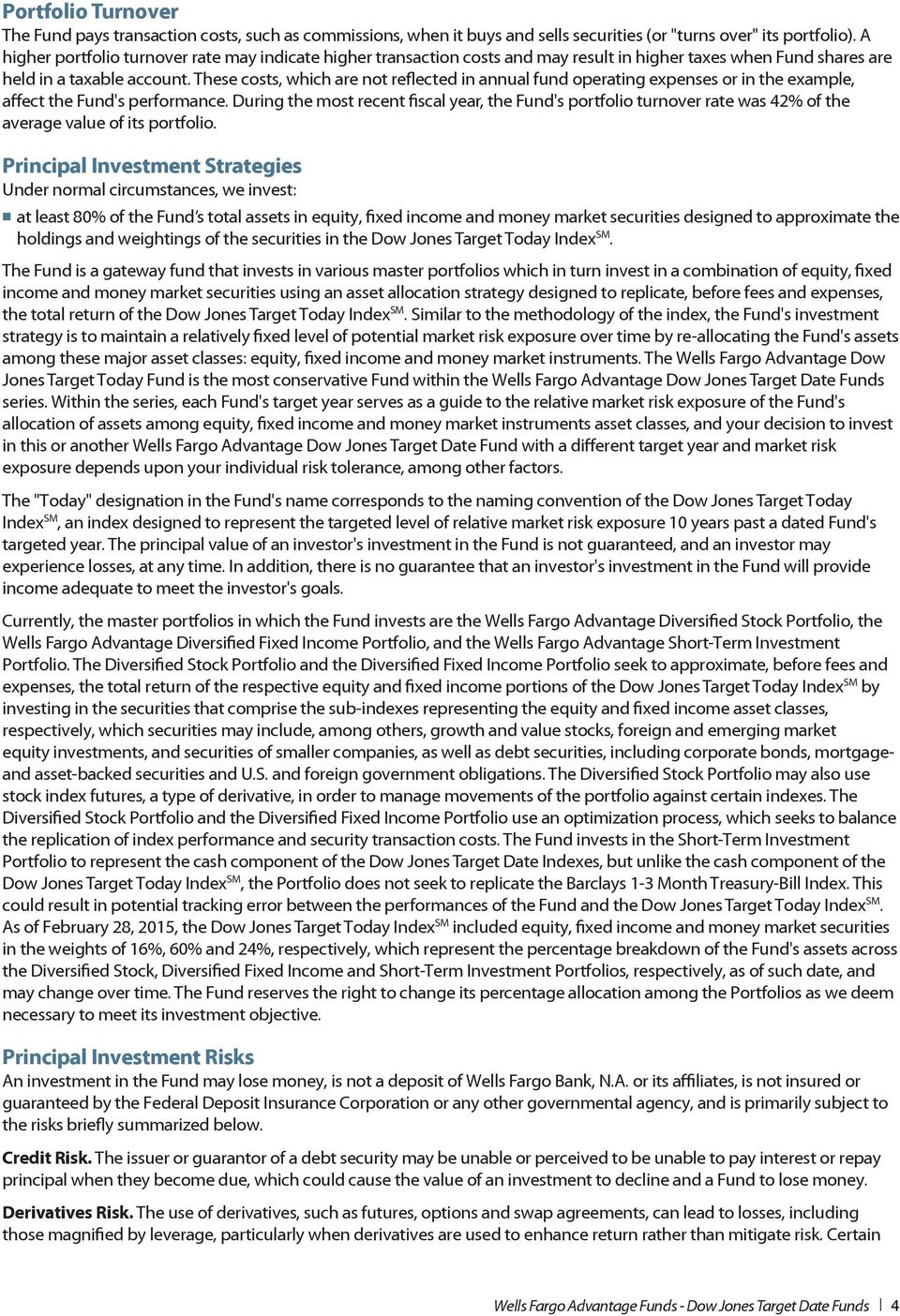
6 Portfolio Turnover The Fund pays transaction costs, such as commissions, when it buys and sells securities (or "turns over" its portfolio). A higher portfolio turnover rate may indicate higher transaction costs and may result in higher taxes when Fund shares are held in a taxable account. These costs, which are not reflected in annual fund operating expenses or in the example, affect the Fund's performance. During the most recent fiscal year, the Fund's portfolio turnover rate was 42% of the average value of its portfolio. Principal Investment Strategies Under normal circumstances, we invest: at least 80% of the Fund s total assets in equity, fixed income and money market securities designed to approximate the holdings and weightings of the securities in the Dow Jones Target Today Index SM. The Fund is a gateway fund that invests in various master portfolios which in turn invest in a combination of equity, fixed income and money market securities using an asset allocation strategy designed to replicate, before fees and expenses, the total return of the Dow Jones Target Today Index SM. Similar to the methodology of the index, the Fund's investment strategy is to maintain a relatively fixed level of potential market risk exposure over time by re-allocating the Fund's assets among these major asset classes: equity, fixed income and money market instruments. The Wells Fargo Advantage Dow Jones Target Today Fund is the most conservative Fund within the Wells Fargo Advantage Dow Jones Target Date Funds series. Within the series, each Fund's target year serves as a guide to the relative market risk exposure of the Fund's allocation of assets among equity, fixed income and money market instruments asset classes, and your decision to invest in this or another Wells Fargo Advantage Dow Jones Target Date Fund with a different target year and market risk exposure depends upon your individual risk tolerance, among other factors. The "Today" designation in the Fund's name corresponds to the naming convention of the Dow Jones Target Today Index SM, an index designed to represent the targeted level of relative market risk exposure 10 years past a dated Fund's targeted year. The principal value of an investor's investment in the Fund is not guaranteed, and an investor may experience losses, at any time. In addition, there is no guarantee that an investor's investment in the Fund will provide income adequate to meet the investor's goals. Currently, the master portfolios in which the Fund invests are the Wells Fargo Advantage Diversified Stock Portfolio, the Wells Fargo Advantage Diversified Fixed Income Portfolio, and the Wells Fargo Advantage Short-Term Investment Portfolio. The Diversified Stock Portfolio and the Diversified Fixed Income Portfolio seek to approximate, before fees and expenses, the total return of the respective equity and fixed income portions of the Dow Jones Target Today Index SM by investing in the securities that comprise the sub-indexes representing the equity and fixed income asset classes, respectively, which securities may include, among others, growth and value stocks, foreign and emerging market equity investments, and securities of smaller companies, as well as debt securities, including corporate bonds, mortgageand asset-backed securities and U.S. and foreign government obligations. The Diversified Stock Portfolio may also use stock index futures, a type of derivative, in order to manage movements of the portfolio against certain indexes. The Diversified Stock Portfolio and the Diversified Fixed Income Portfolio use an optimization process, which seeks to balance the replication of index performance and security transaction costs. The Fund invests in the Short-Term Investment Portfolio to represent the cash component of the Dow Jones Target Date Indexes, but unlike the cash component of the Dow Jones Target Today Index SM, the Portfolio does not seek to replicate the Barclays 1-3 Month Treasury-Bill Index. This could result in potential tracking error between the performances of the Fund and the Dow Jones Target Today Index SM. As of February 28, 2015, the Dow Jones Target Today Index SM included equity, fixed income and money market securities in the weights of 16%, 60% and 24%, respectively, which represent the percentage breakdown of the Fund's assets across the Diversified Stock, Diversified Fixed Income and Short-Term Investment Portfolios, respectively, as of such date, and may change over time. The Fund reserves the right to change its percentage allocation among the Portfolios as we deem necessary to meet its investment objective. Principal Investment Risks An investment in the Fund may lose money, is not a deposit of Wells Fargo Bank, N.A. or its affiliates, is not insured or guaranteed by the Federal Deposit Insurance Corporation or any other governmental agency, and is primarily subject to the risks briefly summarized below. Credit Risk. The issuer or guarantor of a debt security may be unable or perceived to be unable to pay interest or repay principal when they become due, which could cause the value of an investment to decline and a Fund to lose money. Derivatives Risk. The use of derivatives, such as futures, options and swap agreements, can lead to losses, including those magnified by leverage, particularly when derivatives are used to enhance return rather than mitigate risk. Certain Wells Fargo Advantage Funds - Dow Jones Target Date Funds 4
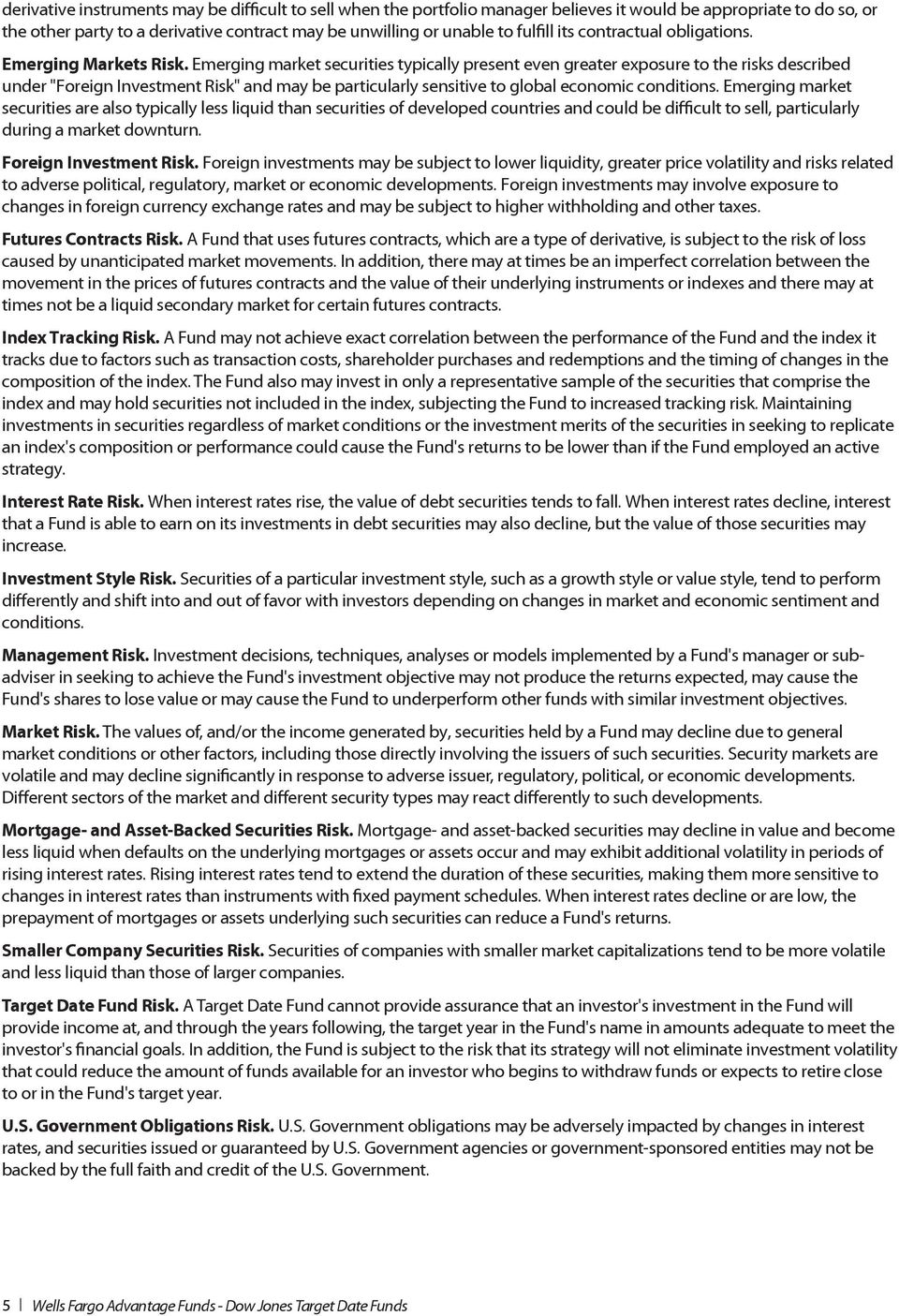
7 derivative instruments may be difficult to sell when the portfolio manager believes it would be appropriate to do so, or the other party to a derivative contract may be unwilling or unable to fulfill its contractual obligations. Emerging Markets Risk. Emerging market securities typically present even greater exposure to the risks described under "Foreign Investment Risk" and may be particularly sensitive to global economic conditions. Emerging market securities are also typically less liquid than securities of developed countries and could be difficult to sell, particularly during a market downturn. Foreign Investment Risk. Foreign investments may be subject to lower liquidity, greater price volatility and risks related to adverse political, regulatory, market or economic developments. Foreign investments may involve exposure to changes in foreign currency exchange rates and may be subject to higher withholding and other taxes. Futures Contracts Risk. A Fund that uses futures contracts, which are a type of derivative, is subject to the risk of loss caused by unanticipated market movements. In addition, there may at times be an imperfect correlation between the movement in the prices of futures contracts and the value of their underlying instruments or indexes and there may at times not be a liquid secondary market for certain futures contracts. Index Tracking Risk. A Fund may not achieve exact correlation between the performance of the Fund and the index it tracks due to factors such as transaction costs, shareholder purchases and redemptions and the timing of changes in the composition of the index. The Fund also may invest in only a representative sample of the securities that comprise the index and may hold securities not included in the index, subjecting the Fund to increased tracking risk. Maintaining investments in securities regardless of market conditions or the investment merits of the securities in seeking to replicate an index's composition or performance could cause the Fund's returns to be lower than if the Fund employed an active strategy. Interest Rate Risk. When interest rates rise, the value of debt securities tends to fall. When interest rates decline, interest that a Fund is able to earn on its investments in debt securities may also decline, but the value of those securities may increase. Investment Style Risk. Securities of a particular investment style, such as a growth style or value style, tend to perform differently and shift into and out of favor with investors depending on changes in market and economic sentiment and conditions. Management Risk. Investment decisions, techniques, analyses or models implemented by a Fund's manager or subadviser in seeking to achieve the Fund's investment objective may not produce the returns expected, may cause the Fund's shares to lose value or may cause the Fund to underperform other funds with similar investment objectives. Market Risk. The values of, and/or the income generated by, securities held by a Fund may decline due to general market conditions or other factors, including those directly involving the issuers of such securities. Security markets are volatile and may decline significantly in response to adverse issuer, regulatory, political, or economic developments. Different sectors of the market and different security types may react differently to such developments. Mortgage- and Asset-Backed Securities Risk. Mortgage- and asset-backed securities may decline in value and become less liquid when defaults on the underlying mortgages or assets occur and may exhibit additional volatility in periods of rising interest rates. Rising interest rates tend to extend the duration of these securities, making them more sensitive to changes in interest rates than instruments with fixed payment schedules. When interest rates decline or are low, the prepayment of mortgages or assets underlying such securities can reduce a Fund's returns. Smaller Company Securities Risk. Securities of companies with smaller market capitalizations tend to be more volatile and less liquid than those of larger companies. Target Date Fund Risk. A Target Date Fund cannot provide assurance that an investor's investment in the Fund will provide income at, and through the years following, the target year in the Fund's name in amounts adequate to meet the investor's financial goals. In addition, the Fund is subject to the risk that its strategy will not eliminate investment volatility that could reduce the amount of funds available for an investor who begins to withdraw funds or expects to retire close to or in the Fund's target year. U.S. Government Obligations Risk. U.S. Government obligations may be adversely impacted by changes in interest rates, and securities issued or guaranteed by U.S. Government agencies or government-sponsored entities may not be backed by the full faith and credit of the U.S. Government. 5 Wells Fargo Advantage Funds - Dow Jones Target Date Funds
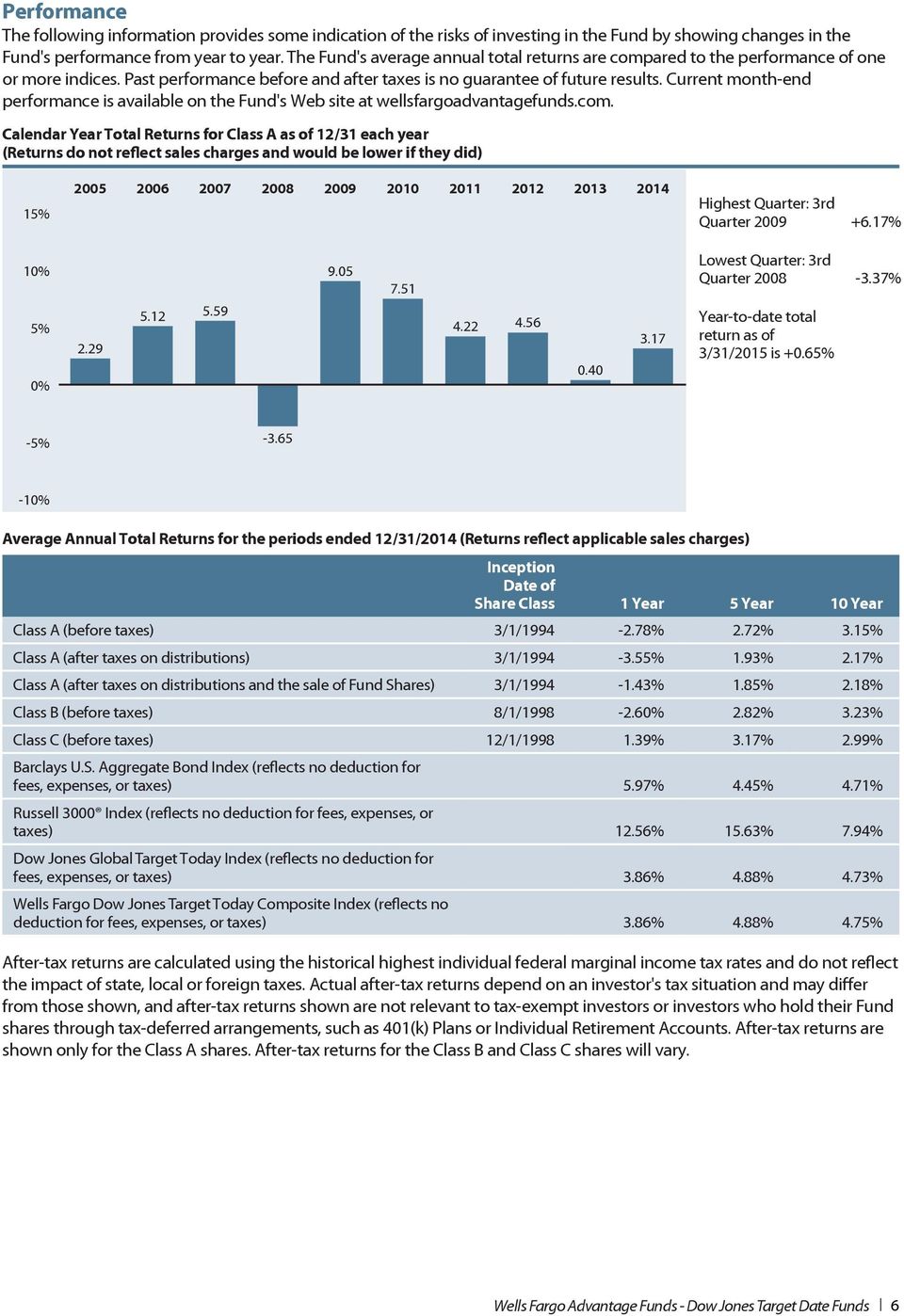
8 Performance The following information provides some indication of the risks of investing in the Fund by showing changes in the Fund's performance from year to year. The Fund's average annual total returns are compared to the performance of one or more indices. Past performance before and after taxes is no guarantee of future results. Current month-end performance is available on the Fund's Web site at wellsfargoadvantagefunds.com. Calendar Year Total Returns for Class A as of 12/31 each year (Returns do not reflect sales charges and would be lower if they did) 15% Highest Quarter: 3rd Quarter % 10% 5% 0% Lowest Quarter: 3rd Quarter % Year-to-date total return as of 3/31/2015 is +0.65% -5% % Average Annual Total Returns for the periods ended 12/31/2014 (Returns reflect applicable sales charges) Inception Date of Share Class 1 Year 5 Year 10 Year Class A (before taxes) 3/1/ % 2.72% 3.15% Class A (after taxes on distributions) 3/1/ % 1.93% 2.17% Class A (after taxes on distributions and the sale of Fund Shares) 3/1/ % 1.85% 2.18% Class B (before taxes) 8/1/ % 2.82% 3.23% Class C (before taxes) 12/1/ % 3.17% 2.99% Barclays U.S. Aggregate Bond Index (reflects no deduction for fees, expenses, or taxes) 5.97% 4.45% 4.71% Russell 3000 Index (reflects no deduction for fees, expenses, or taxes) 12.56% 15.63% 7.94% Dow Jones Global Target Today Index (reflects no deduction for fees, expenses, or taxes) 3.86% 4.88% 4.73% Wells Fargo Dow Jones Target Today Composite Index (reflects no deduction for fees, expenses, or taxes) 3.86% 4.88% 4.75% After-tax returns are calculated using the historical highest individual federal marginal income tax rates and do not reflect the impact of state, local or foreign taxes. Actual after-tax returns depend on an investor's tax situation and may differ from those shown, and after-tax returns shown are not relevant to tax-exempt investors or investors who hold their Fund shares through tax-deferred arrangements, such as 401(k) Plans or Individual Retirement Accounts. After-tax returns are shown only for the Class A shares. After-tax returns for the Class B and Class C shares will vary. Wells Fargo Advantage Funds - Dow Jones Target Date Funds 6
9 Fund Management Manager Sub-Adviser Portfolio Manager, Title/Managed Since Wells Fargo Funds Management, LLC Global Index Advisors, Inc. Rodney H. Alldredge, Portfolio Manager / 2006 James P. Lauder, Portfolio Manager / 2006 Paul T. Torregrosa, PhD, Portfolio Manager / 2010 Purchase and Sale of Fund Shares In general, you can buy or sell shares of the Fund online or by mail, phone or wire on any day the New York Stock Exchange is open for regular trading. You also may buy and sell shares through a financial professional. Minimum Investments Minimum Initial Investment Class A and Class C Regular Accounts: $1,000 IRAs, IRA rollovers, Roth IRAs: $250 UGMA/UTMA accounts: $50 Employer Sponsored Retirement Plans: No Minimum Class B shares are generally closed to new investment. Minimum Additional Investment Regular Accounts, IRAs, IRA rollovers, Roth IRAs: $100 UGMA/UTMA accounts: $50 Employer Sponsored Retirement Plans: No Minimum To Buy or Sell Shares Mail: Wells Fargo Advantage Funds P.O. Box 8266 Boston, MA Online: wellsfargoadvantagefunds.com Phone or Wire: Contact your financial professional. Tax Information Any distributions you receive from the Fund may be taxable as ordinary income or capital gains, except when your investment is in an IRA, 401(k) or other tax advantaged investment plan. However, subsequent withdrawals from such a tax advantaged investment plan may be subject to federal income tax. You should consult your tax adviser about your specific tax situation. Payments to Broker-Dealers and Other Financial Intermediaries If you purchase a Fund through a broker-dealer or other financial intermediary (such as a bank), the Fund and its related companies may pay the intermediary for the sale of Fund shares and related services. These payments may create a conflict of interest by influencing the broker-dealer or other intermediary and your salesperson to recommend the Fund over another investment. Consult your salesperson or visit your financial intermediary's Web site for more information. 7 Wells Fargo Advantage Funds - Dow Jones Target Date Funds

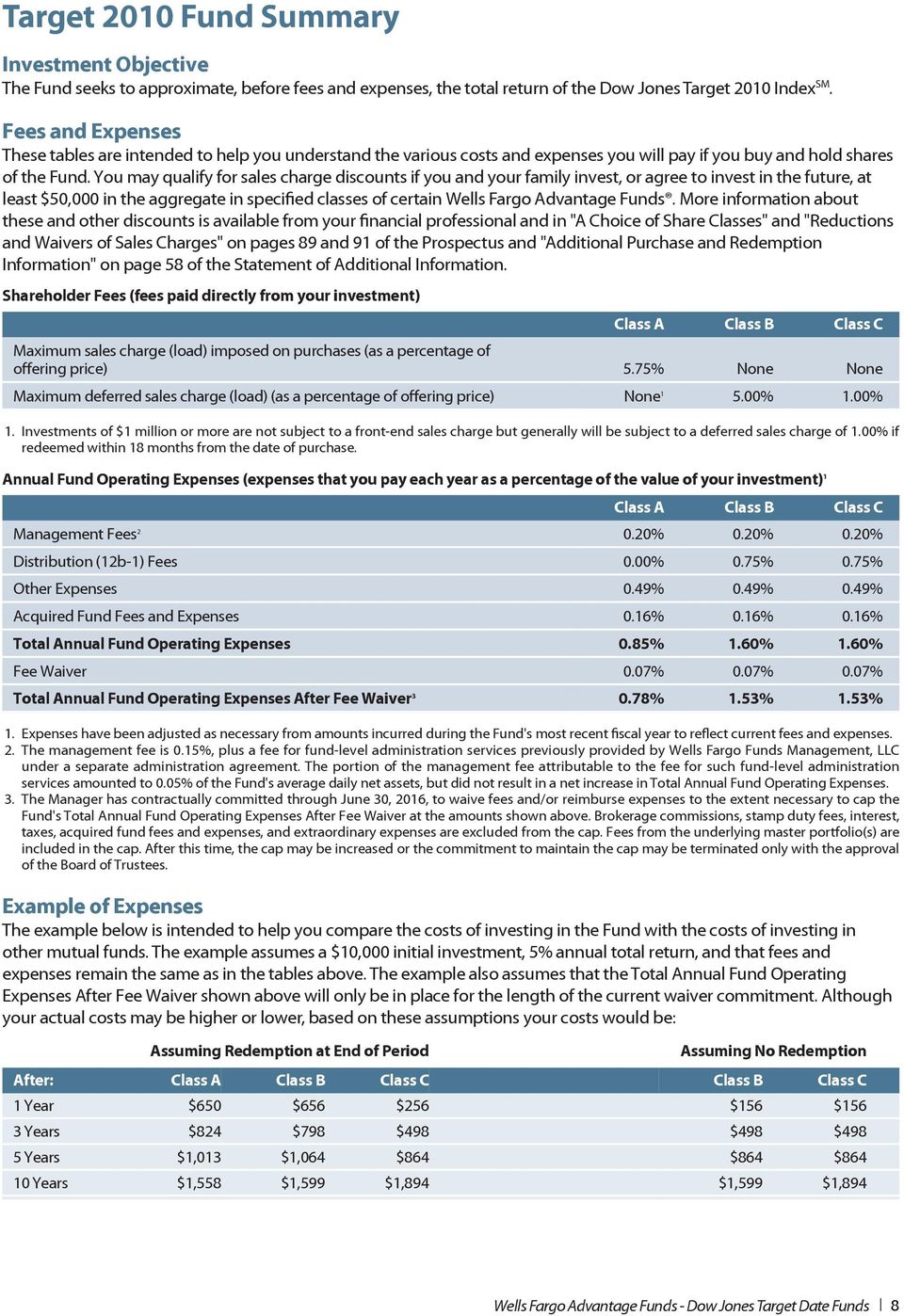
10 Target 2010 Fund Summary Investment Objective The Fund seeks to approximate, before fees and expenses, the total return of the Dow Jones Target 2010 Index SM. Fees and Expenses These tables are intended to help you understand the various costs and expenses you will pay if you buy and hold shares of the Fund. You may qualify for sales charge discounts if you and your family invest, or agree to invest in the future, at least $50,000 in the aggregate in specified classes of certain Wells Fargo Advantage Funds. More information about these and other discounts is available from your financial professional and in "A Choice of Share Classes" and "Reductions and Waivers of Sales Charges" on pages 89 and 91 of the Prospectus and "Additional Purchase and Redemption Information" on page 58 of the Statement of Additional Information. Shareholder Fees (fees paid directly from your investment) Class A Class B Class C Maximum sales charge (load) imposed on purchases (as a percentage of offering price) 5.75% None None Maximum deferred sales charge (load) (as a percentage of offering price) None % 1.00% 1. Investments of $1 million or more are not subject to a front-end sales charge but generally will be subject to a deferred sales charge of 1.00% if redeemed within 18 months from the date of purchase. Annual Fund Operating Expenses (expenses that you pay each year as a percentage of the value of your investment) 1 Class A Class B Class C Management Fees % 0.20% 0.20% Distribution (12b-1) Fees 0.00% 0.75% 0.75% Other Expenses 0.49% 0.49% 0.49% Acquired Fund Fees and Expenses 0.16% 0.16% 0.16% Total Annual Fund Operating Expenses 0.85% 1.60% 1.60% Fee Waiver 0.07% 0.07% 0.07% Total Annual Fund Operating Expenses After Fee Waiver % 1.53% 1.53% 1. Expenses have been adjusted as necessary from amounts incurred during the Fund's most recent fiscal year to reflect current fees and expenses. 2. The management fee is 0.15%, plus a fee for fund-level administration services previously provided by Wells Fargo Funds Management, LLC under a separate administration agreement. The portion of the management fee attributable to the fee for such fund-level administration services amounted to 0.05% of the Fund's average daily net assets, but did not result in a net increase in Total Annual Fund Operating Expenses. 3. The Manager has contractually committed through June 30, 2016, to waive fees and/or reimburse expenses to the extent necessary to cap the Fund's Total Annual Fund Operating Expenses After Fee Waiver at the amounts shown above. Brokerage commissions, stamp duty fees, interest, taxes, acquired fund fees and expenses, and extraordinary expenses are excluded from the cap. Fees from the underlying master portfolio(s) are included in the cap. After this time, the cap may be increased or the commitment to maintain the cap may be terminated only with the approval of the Board of Trustees. Example of Expenses The example below is intended to help you compare the costs of investing in the Fund with the costs of investing in other mutual funds. The example assumes a $10,000 initial investment, 5% annual total return, and that fees and expenses remain the same as in the tables above. The example also assumes that the Total Annual Fund Operating Expenses After Fee Waiver shown above will only be in place for the length of the current waiver commitment. Although your actual costs may be higher or lower, based on these assumptions your costs would be: Assuming Redemption at End of Period Assuming No Redemption After: Class A Class B Class C Class B Class C 1 Year $650 $656 $256 $156 $156 3 Years $824 $798 $498 $498 $498 5 Years $1,013 $1,064 $864 $864 $ Years $1,558 $1,599 $1,894 $1,599 $1,894 Wells Fargo Advantage Funds - Dow Jones Target Date Funds 8
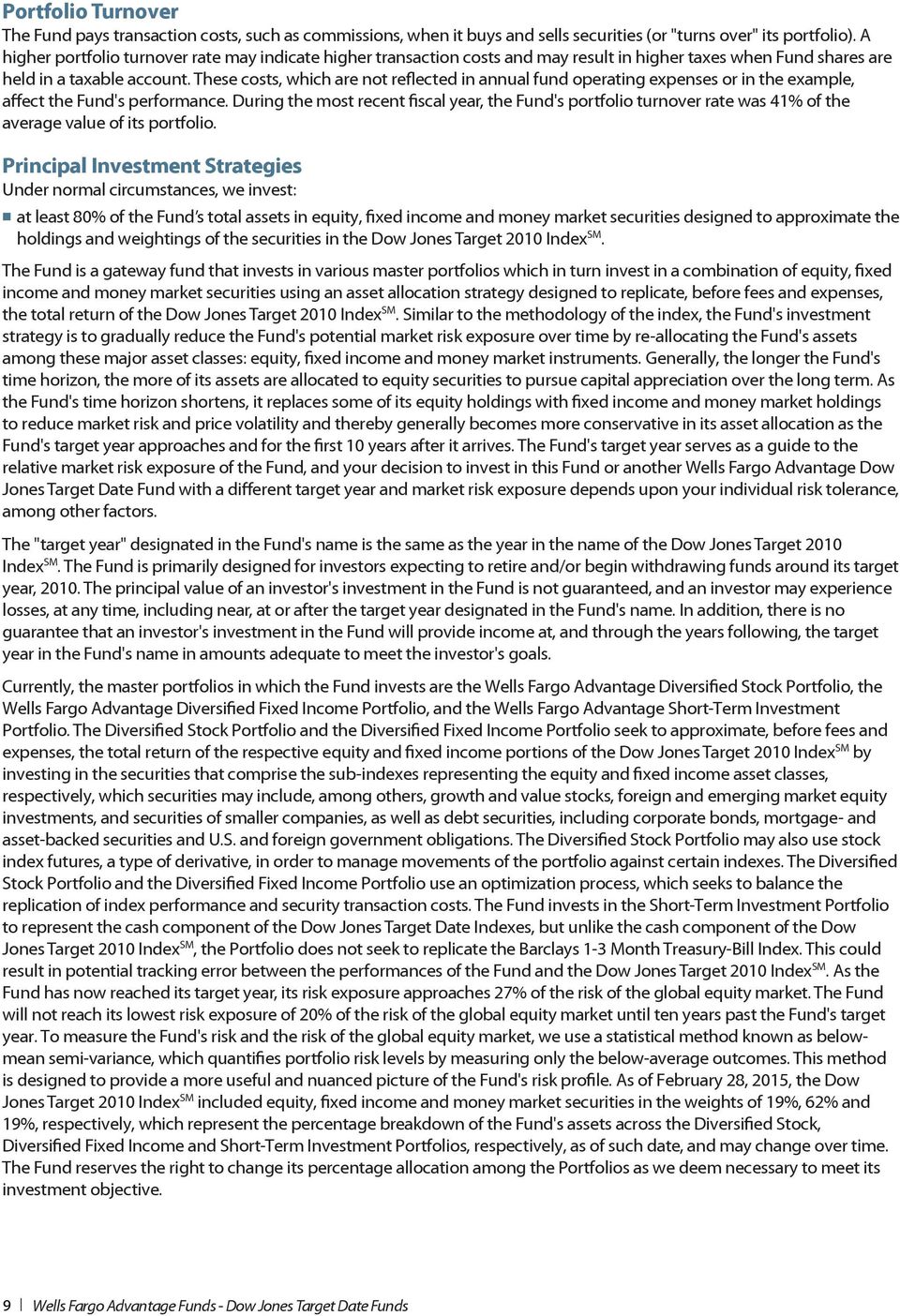
11 Portfolio Turnover The Fund pays transaction costs, such as commissions, when it buys and sells securities (or "turns over" its portfolio). A higher portfolio turnover rate may indicate higher transaction costs and may result in higher taxes when Fund shares are held in a taxable account. These costs, which are not reflected in annual fund operating expenses or in the example, affect the Fund's performance. During the most recent fiscal year, the Fund's portfolio turnover rate was 41% of the average value of its portfolio. Principal Investment Strategies Under normal circumstances, we invest: at least 80% of the Fund s total assets in equity, fixed income and money market securities designed to approximate the holdings and weightings of the securities in the Dow Jones Target 2010 Index SM. The Fund is a gateway fund that invests in various master portfolios which in turn invest in a combination of equity, fixed income and money market securities using an asset allocation strategy designed to replicate, before fees and expenses, the total return of the Dow Jones Target 2010 Index SM. Similar to the methodology of the index, the Fund's investment strategy is to gradually reduce the Fund's potential market risk exposure over time by re-allocating the Fund's assets among these major asset classes: equity, fixed income and money market instruments. Generally, the longer the Fund's time horizon, the more of its assets are allocated to equity securities to pursue capital appreciation over the long term. As the Fund's time horizon shortens, it replaces some of its equity holdings with fixed income and money market holdings to reduce market risk and price volatility and thereby generally becomes more conservative in its asset allocation as the Fund's target year approaches and for the first 10 years after it arrives. The Fund's target year serves as a guide to the relative market risk exposure of the Fund, and your decision to invest in this Fund or another Wells Fargo Advantage Dow Jones Target Date Fund with a different target year and market risk exposure depends upon your individual risk tolerance, among other factors. The "target year" designated in the Fund's name is the same as the year in the name of the Dow Jones Target 2010 Index SM. The Fund is primarily designed for investors expecting to retire and/or begin withdrawing funds around its target year, The principal value of an investor's investment in the Fund is not guaranteed, and an investor may experience losses, at any time, including near, at or after the target year designated in the Fund's name. In addition, there is no guarantee that an investor's investment in the Fund will provide income at, and through the years following, the target year in the Fund's name in amounts adequate to meet the investor's goals. Currently, the master portfolios in which the Fund invests are the Wells Fargo Advantage Diversified Stock Portfolio, the Wells Fargo Advantage Diversified Fixed Income Portfolio, and the Wells Fargo Advantage Short-Term Investment Portfolio. The Diversified Stock Portfolio and the Diversified Fixed Income Portfolio seek to approximate, before fees and expenses, the total return of the respective equity and fixed income portions of the Dow Jones Target 2010 Index SM by investing in the securities that comprise the sub-indexes representing the equity and fixed income asset classes, respectively, which securities may include, among others, growth and value stocks, foreign and emerging market equity investments, and securities of smaller companies, as well as debt securities, including corporate bonds, mortgage- and asset-backed securities and U.S. and foreign government obligations. The Diversified Stock Portfolio may also use stock index futures, a type of derivative, in order to manage movements of the portfolio against certain indexes. The Diversified Stock Portfolio and the Diversified Fixed Income Portfolio use an optimization process, which seeks to balance the replication of index performance and security transaction costs. The Fund invests in the Short-Term Investment Portfolio to represent the cash component of the Dow Jones Target Date Indexes, but unlike the cash component of the Dow Jones Target 2010 Index SM, the Portfolio does not seek to replicate the Barclays 1-3 Month Treasury-Bill Index. This could result in potential tracking error between the performances of the Fund and the Dow Jones Target 2010 Index SM. As the Fund has now reached its target year, its risk exposure approaches 27% of the risk of the global equity market. The Fund will not reach its lowest risk exposure of 20% of the risk of the global equity market until ten years past the Fund's target year. To measure the Fund's risk and the risk of the global equity market, we use a statistical method known as belowmean semi-variance, which quantifies portfolio risk levels by measuring only the below-average outcomes. This method is designed to provide a more useful and nuanced picture of the Fund's risk profile. As of February 28, 2015, the Dow Jones Target 2010 Index SM included equity, fixed income and money market securities in the weights of 19%, 62% and 19%, respectively, which represent the percentage breakdown of the Fund's assets across the Diversified Stock, Diversified Fixed Income and Short-Term Investment Portfolios, respectively, as of such date, and may change over time. The Fund reserves the right to change its percentage allocation among the Portfolios as we deem necessary to meet its investment objective. 9 Wells Fargo Advantage Funds - Dow Jones Target Date Funds
12 Principal Investment Risks An investment in the Fund may lose money, is not a deposit of Wells Fargo Bank, N.A. or its affiliates, is not insured or guaranteed by the Federal Deposit Insurance Corporation or any other governmental agency, and is primarily subject to the risks briefly summarized below. Credit Risk. The issuer or guarantor of a debt security may be unable or perceived to be unable to pay interest or repay principal when they become due, which could cause the value of an investment to decline and a Fund to lose money. Derivatives Risk. The use of derivatives, such as futures, options and swap agreements, can lead to losses, including those magnified by leverage, particularly when derivatives are used to enhance return rather than mitigate risk. Certain derivative instruments may be difficult to sell when the portfolio manager believes it would be appropriate to do so, or the other party to a derivative contract may be unwilling or unable to fulfill its contractual obligations. Emerging Markets Risk. Emerging market securities typically present even greater exposure to the risks described under "Foreign Investment Risk" and may be particularly sensitive to global economic conditions. Emerging market securities are also typically less liquid than securities of developed countries and could be difficult to sell, particularly during a market downturn. Foreign Investment Risk. Foreign investments may be subject to lower liquidity, greater price volatility and risks related to adverse political, regulatory, market or economic developments. Foreign investments may involve exposure to changes in foreign currency exchange rates and may be subject to higher withholding and other taxes. Futures Contracts Risk. A Fund that uses futures contracts, which are a type of derivative, is subject to the risk of loss caused by unanticipated market movements. In addition, there may at times be an imperfect correlation between the movement in the prices of futures contracts and the value of their underlying instruments or indexes and there may at times not be a liquid secondary market for certain futures contracts. Index Tracking Risk. A Fund may not achieve exact correlation between the performance of the Fund and the index it tracks due to factors such as transaction costs, shareholder purchases and redemptions and the timing of changes in the composition of the index. The Fund also may invest in only a representative sample of the securities that comprise the index and may hold securities not included in the index, subjecting the Fund to increased tracking risk. Maintaining investments in securities regardless of market conditions or the investment merits of the securities in seeking to replicate an index's composition or performance could cause the Fund's returns to be lower than if the Fund employed an active strategy. Interest Rate Risk. When interest rates rise, the value of debt securities tends to fall. When interest rates decline, interest that a Fund is able to earn on its investments in debt securities may also decline, but the value of those securities may increase. Wells Fargo Advantage Funds - Dow Jones Target Date Funds 10

13 Investment Style Risk. Securities of a particular investment style, such as a growth style or value style, tend to perform differently and shift into and out of favor with investors depending on changes in market and economic sentiment and conditions. Management Risk. Investment decisions, techniques, analyses or models implemented by a Fund's manager or subadviser in seeking to achieve the Fund's investment objective may not produce the returns expected, may cause the Fund's shares to lose value or may cause the Fund to underperform other funds with similar investment objectives. Market Risk. The values of, and/or the income generated by, securities held by a Fund may decline due to general market conditions or other factors, including those directly involving the issuers of such securities. Security markets are volatile and may decline significantly in response to adverse issuer, regulatory, political, or economic developments. Different sectors of the market and different security types may react differently to such developments. Mortgage- and Asset-Backed Securities Risk. Mortgage- and asset-backed securities may decline in value and become less liquid when defaults on the underlying mortgages or assets occur and may exhibit additional volatility in periods of rising interest rates. Rising interest rates tend to extend the duration of these securities, making them more sensitive to changes in interest rates than instruments with fixed payment schedules. When interest rates decline or are low, the prepayment of mortgages or assets underlying such securities can reduce a Fund's returns. Smaller Company Securities Risk. Securities of companies with smaller market capitalizations tend to be more volatile and less liquid than those of larger companies. Target Date Fund Risk. A Target Date Fund cannot provide assurance that an investor's investment in the Fund will provide income at, and through the years following, the target year in the Fund's name in amounts adequate to meet the investor's financial goals. In addition, the Fund is subject to the risk that its strategy will not eliminate investment volatility that could reduce the amount of funds available for an investor who begins to withdraw funds or expects to retire close to or in the Fund's target year. U.S. Government Obligations Risk. U.S. Government obligations may be adversely impacted by changes in interest rates, and securities issued or guaranteed by U.S. Government agencies or government-sponsored entities may not be backed by the full faith and credit of the U.S. Government. 11 Wells Fargo Advantage Funds - Dow Jones Target Date Funds

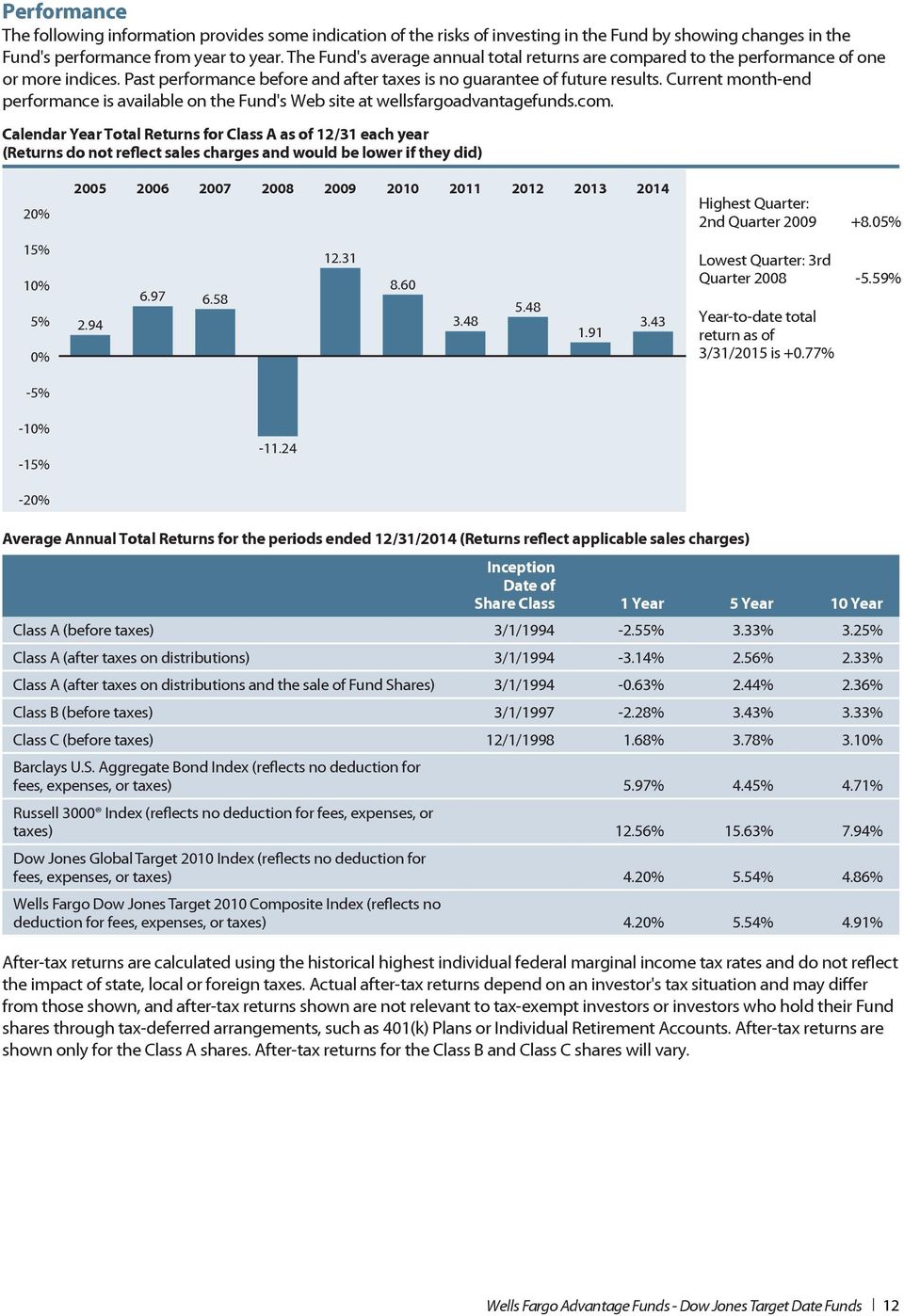
14 Performance The following information provides some indication of the risks of investing in the Fund by showing changes in the Fund's performance from year to year. The Fund's average annual total returns are compared to the performance of one or more indices. Past performance before and after taxes is no guarantee of future results. Current month-end performance is available on the Fund's Web site at wellsfargoadvantagefunds.com. Calendar Year Total Returns for Class A as of 12/31 each year (Returns do not reflect sales charges and would be lower if they did) 20% 15% 10% 5% 0% -5% -10% -15% -20% Highest Quarter: 2nd Quarter % Lowest Quarter: 3rd Quarter % Year-to-date total return as of 3/31/2015 is +0.77% Average Annual Total Returns for the periods ended 12/31/2014 (Returns reflect applicable sales charges) Inception Date of Share Class 1 Year 5 Year 10 Year Class A (before taxes) 3/1/ % 3.33% 3.25% Class A (after taxes on distributions) 3/1/ % 2.56% 2.33% Class A (after taxes on distributions and the sale of Fund Shares) 3/1/ % 2.44% 2.36% Class B (before taxes) 3/1/ % 3.43% 3.33% Class C (before taxes) 12/1/ % 3.78% 3.10% Barclays U.S. Aggregate Bond Index (reflects no deduction for fees, expenses, or taxes) 5.97% 4.45% 4.71% Russell 3000 Index (reflects no deduction for fees, expenses, or taxes) 12.56% 15.63% 7.94% Dow Jones Global Target 2010 Index (reflects no deduction for fees, expenses, or taxes) 4.20% 5.54% 4.86% Wells Fargo Dow Jones Target 2010 Composite Index (reflects no deduction for fees, expenses, or taxes) 4.20% 5.54% 4.91% After-tax returns are calculated using the historical highest individual federal marginal income tax rates and do not reflect the impact of state, local or foreign taxes. Actual after-tax returns depend on an investor's tax situation and may differ from those shown, and after-tax returns shown are not relevant to tax-exempt investors or investors who hold their Fund shares through tax-deferred arrangements, such as 401(k) Plans or Individual Retirement Accounts. After-tax returns are shown only for the Class A shares. After-tax returns for the Class B and Class C shares will vary. Wells Fargo Advantage Funds - Dow Jones Target Date Funds 12
15 Fund Management Manager Sub-Adviser Portfolio Manager, Title/Managed Since Wells Fargo Funds Management, LLC Global Index Advisors, Inc. Rodney H. Alldredge, Portfolio Manager / 2006 James P. Lauder, Portfolio Manager / 2006 Paul T. Torregrosa, PhD, Portfolio Manager / 2010 Purchase and Sale of Fund Shares In general, you can buy or sell shares of the Fund online or by mail, phone or wire on any day the New York Stock Exchange is open for regular trading. You also may buy and sell shares through a financial professional. Minimum Investments Minimum Initial Investment Class A and Class C Regular Accounts: $1,000 IRAs, IRA rollovers, Roth IRAs: $250 UGMA/UTMA accounts: $50 Employer Sponsored Retirement Plans: No Minimum Class B shares are generally closed to new investment. Minimum Additional Investment Regular Accounts, IRAs, IRA rollovers, Roth IRAs: $100 UGMA/UTMA accounts: $50 Employer Sponsored Retirement Plans: No Minimum To Buy or Sell Shares Mail: Wells Fargo Advantage Funds P.O. Box 8266 Boston, MA Online: wellsfargoadvantagefunds.com Phone or Wire: Contact your financial professional. Tax Information Any distributions you receive from the Fund may be taxable as ordinary income or capital gains, except when your investment is in an IRA, 401(k) or other tax advantaged investment plan. However, subsequent withdrawals from such a tax advantaged investment plan may be subject to federal income tax. You should consult your tax adviser about your specific tax situation. Payments to Broker-Dealers and Other Financial Intermediaries If you purchase a Fund through a broker-dealer or other financial intermediary (such as a bank), the Fund and its related companies may pay the intermediary for the sale of Fund shares and related services. These payments may create a conflict of interest by influencing the broker-dealer or other intermediary and your salesperson to recommend the Fund over another investment. Consult your salesperson or visit your financial intermediary's Web site for more information. 13 Wells Fargo Advantage Funds - Dow Jones Target Date Funds

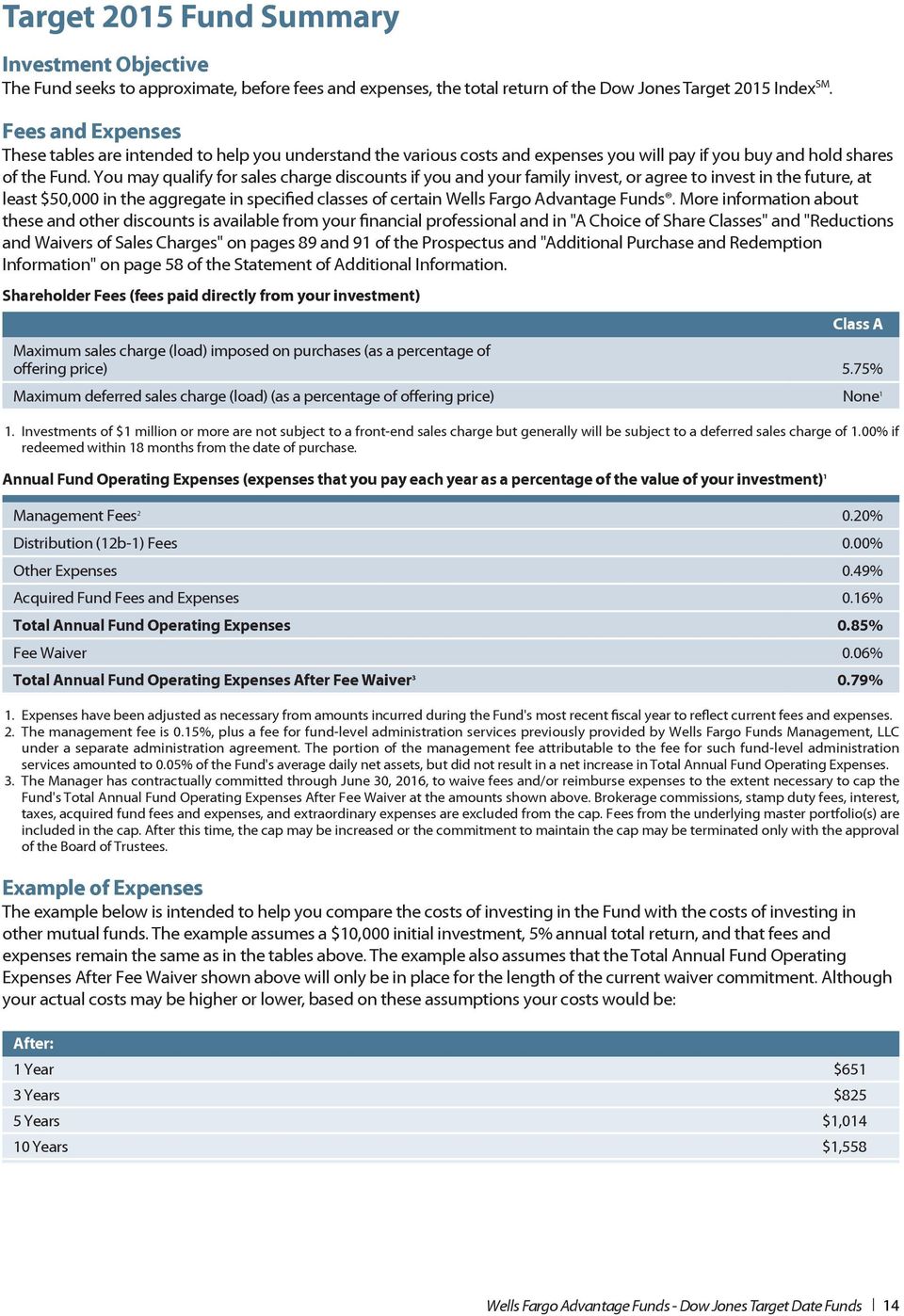
16 Target 2015 Fund Summary Investment Objective The Fund seeks to approximate, before fees and expenses, the total return of the Dow Jones Target 2015 Index SM. Fees and Expenses These tables are intended to help you understand the various costs and expenses you will pay if you buy and hold shares of the Fund. You may qualify for sales charge discounts if you and your family invest, or agree to invest in the future, at least $50,000 in the aggregate in specified classes of certain Wells Fargo Advantage Funds. More information about these and other discounts is available from your financial professional and in "A Choice of Share Classes" and "Reductions and Waivers of Sales Charges" on pages 89 and 91 of the Prospectus and "Additional Purchase and Redemption Information" on page 58 of the Statement of Additional Information. Shareholder Fees (fees paid directly from your investment) Class A Maximum sales charge (load) imposed on purchases (as a percentage of offering price) 5.75% Maximum deferred sales charge (load) (as a percentage of offering price) None 1 1. Investments of $1 million or more are not subject to a front-end sales charge but generally will be subject to a deferred sales charge of 1.00% if redeemed within 18 months from the date of purchase. Annual Fund Operating Expenses (expenses that you pay each year as a percentage of the value of your investment) 1 Management Fees % Distribution (12b-1) Fees 0.00% Other Expenses 0.49% Acquired Fund Fees and Expenses 0.16% Total Annual Fund Operating Expenses 0.85% Fee Waiver 0.06% Total Annual Fund Operating Expenses After Fee Waiver % 1. Expenses have been adjusted as necessary from amounts incurred during the Fund's most recent fiscal year to reflect current fees and expenses. 2. The management fee is 0.15%, plus a fee for fund-level administration services previously provided by Wells Fargo Funds Management, LLC under a separate administration agreement. The portion of the management fee attributable to the fee for such fund-level administration services amounted to 0.05% of the Fund's average daily net assets, but did not result in a net increase in Total Annual Fund Operating Expenses. 3. The Manager has contractually committed through June 30, 2016, to waive fees and/or reimburse expenses to the extent necessary to cap the Fund's Total Annual Fund Operating Expenses After Fee Waiver at the amounts shown above. Brokerage commissions, stamp duty fees, interest, taxes, acquired fund fees and expenses, and extraordinary expenses are excluded from the cap. Fees from the underlying master portfolio(s) are included in the cap. After this time, the cap may be increased or the commitment to maintain the cap may be terminated only with the approval of the Board of Trustees. Example of Expenses The example below is intended to help you compare the costs of investing in the Fund with the costs of investing in other mutual funds. The example assumes a $10,000 initial investment, 5% annual total return, and that fees and expenses remain the same as in the tables above. The example also assumes that the Total Annual Fund Operating Expenses After Fee Waiver shown above will only be in place for the length of the current waiver commitment. Although your actual costs may be higher or lower, based on these assumptions your costs would be: After: 1 Year $651 3 Years $825 5 Years $1, Years $1,558 Wells Fargo Advantage Funds - Dow Jones Target Date Funds 14
17 Portfolio Turnover The Fund pays transaction costs, such as commissions, when it buys and sells securities (or "turns over" its portfolio). A higher portfolio turnover rate may indicate higher transaction costs and may result in higher taxes when Fund shares are held in a taxable account. These costs, which are not reflected in annual fund operating expenses or in the example, affect the Fund's performance. During the most recent fiscal year, the Fund's portfolio turnover rate was 39% of the average value of its portfolio. Principal Investment Strategies Under normal circumstances, we invest: at least 80% of the Fund s total assets in equity, fixed income and money market securities designed to approximate the holdings and weightings of the securities in the Dow Jones Target 2015 Index SM. The Fund is a gateway fund that invests in various master portfolios which in turn invest in a combination of equity, fixed income and money market securities using an asset allocation strategy designed to replicate, before fees and expenses, the total return of the Dow Jones Target 2015 Index SM. Similar to the methodology of the index, the Fund's investment strategy is to gradually reduce the Fund's potential market risk exposure over time by re-allocating the Fund's assets among these major asset classes: equity, fixed income and money market instruments. Generally, the longer the Fund's time horizon, the more of its assets are allocated to equity securities to pursue capital appreciation over the long term. As the Fund's time horizon shortens, it replaces some of its equity holdings with fixed income and money market holdings to reduce market risk and price volatility and thereby generally becomes more conservative in its asset allocation as the Fund's target year approaches and for the first 10 years after it arrives. The Fund's target year serves as a guide to the relative market risk exposure of the Fund, and your decision to invest in this Fund or another Wells Fargo Advantage Dow Jones Target Date Fund with a different target year and market risk exposure depends upon your individual risk tolerance, among other factors. The "target year" designated in the Fund's name is the same as the year in the name of the Dow Jones Target 2015 Index SM. The Fund is primarily designed for investors expecting to retire and/or begin withdrawing funds around its target year, The principal value of an investor's investment in the Fund is not guaranteed, and an investor may experience losses, at any time, including near, at or after the target year designated in the Fund's name. In addition, there is no guarantee that an investor's investment in the Fund will provide income at, and through the years following, the target year in the Fund's name in amounts adequate to meet the investor's goals. Currently, the master portfolios in which the Fund invests are the Wells Fargo Advantage Diversified Stock Portfolio, the Wells Fargo Advantage Diversified Fixed Income Portfolio, and the Wells Fargo Advantage Short-Term Investment Portfolio. The Diversified Stock Portfolio and the Diversified Fixed Income Portfolio seek to approximate, before fees and expenses, the total return of the respective equity and fixed income portions of the Dow Jones Target 2015 Index SM by investing in the securities that comprise the sub-indexes representing the equity and fixed income asset classes, respectively, which securities may include, among others, growth and value stocks, foreign and emerging market equity investments, and securities of smaller companies, as well as debt securities, including corporate bonds, mortgage- and asset-backed securities and U.S. and foreign government obligations. The Diversified Stock Portfolio may also use stock index futures, a type of derivative, in order to manage movements of the portfolio against certain indexes. The Diversified Stock Portfolio and the Diversified Fixed Income Portfolio use an optimization process, which seeks to balance the replication of index performance and security transaction costs. The Fund invests in the Short-Term Investment Portfolio to represent the cash component of the Dow Jones Target Date Indexes, but unlike the cash component of the Dow Jones Target 2015 Index SM, the Portfolio does not seek to replicate the Barclays 1-3 Month Treasury-Bill Index. This could result in potential tracking error between the performances of the Fund and the Dow Jones Target 2015 Index SM. By the time the Fund reaches its target year in 2015, its risk exposure will approach 28% of the risk of the global equity market. The Fund will not reach its lowest risk exposure of 20% of the risk of the global equity market until ten years past the Fund's target year. To measure the Fund's risk and the risk of the global equity market, we use a statistical method known as below-mean semi-variance, which quantifies portfolio risk levels by measuring only the below-average outcomes. This method is designed to provide a more useful and nuanced picture of the Fund's risk profile. As of February 28, 2015, the Dow Jones Target 2015 Index SM included equity, fixed income and money market securities in the weights of 26%, 70% and 4%, respectively, which represent the percentage breakdown of the Fund's assets across the Diversified Stock, Diversified Fixed Income and Short-Term Investment Portfolios, respectively, as of such date, and may change over time. The Fund reserves the right to change its percentage allocation among the Portfolios as we deem necessary to meet its investment objective. 15 Wells Fargo Advantage Funds - Dow Jones Target Date Funds

18 Principal Investment Risks An investment in the Fund may lose money, is not a deposit of Wells Fargo Bank, N.A. or its affiliates, is not insured or guaranteed by the Federal Deposit Insurance Corporation or any other governmental agency, and is primarily subject to the risks briefly summarized below. Credit Risk. The issuer or guarantor of a debt security may be unable or perceived to be unable to pay interest or repay principal when they become due, which could cause the value of an investment to decline and a Fund to lose money. Derivatives Risk. The use of derivatives, such as futures, options and swap agreements, can lead to losses, including those magnified by leverage, particularly when derivatives are used to enhance return rather than mitigate risk. Certain derivative instruments may be difficult to sell when the portfolio manager believes it would be appropriate to do so, or the other party to a derivative contract may be unwilling or unable to fulfill its contractual obligations. Emerging Markets Risk. Emerging market securities typically present even greater exposure to the risks described under "Foreign Investment Risk" and may be particularly sensitive to global economic conditions. Emerging market securities are also typically less liquid than securities of developed countries and could be difficult to sell, particularly during a market downturn. Foreign Investment Risk. Foreign investments may be subject to lower liquidity, greater price volatility and risks related to adverse political, regulatory, market or economic developments. Foreign investments may involve exposure to changes in foreign currency exchange rates and may be subject to higher withholding and other taxes. Futures Contracts Risk. A Fund that uses futures contracts, which are a type of derivative, is subject to the risk of loss caused by unanticipated market movements. In addition, there may at times be an imperfect correlation between the movement in the prices of futures contracts and the value of their underlying instruments or indexes and there may at times not be a liquid secondary market for certain futures contracts. Index Tracking Risk. A Fund may not achieve exact correlation between the performance of the Fund and the index it tracks due to factors such as transaction costs, shareholder purchases and redemptions and the timing of changes in the composition of the index. The Fund also may invest in only a representative sample of the securities that comprise the index and may hold securities not included in the index, subjecting the Fund to increased tracking risk. Maintaining investments in securities regardless of market conditions or the investment merits of the securities in seeking to replicate an index's composition or performance could cause the Fund's returns to be lower than if the Fund employed an active strategy. Interest Rate Risk. When interest rates rise, the value of debt securities tends to fall. When interest rates decline, interest that a Fund is able to earn on its investments in debt securities may also decline, but the value of those securities may increase. Wells Fargo Advantage Funds - Dow Jones Target Date Funds 16

19 Investment Style Risk. Securities of a particular investment style, such as a growth style or value style, tend to perform differently and shift into and out of favor with investors depending on changes in market and economic sentiment and conditions. Management Risk. Investment decisions, techniques, analyses or models implemented by a Fund's manager or subadviser in seeking to achieve the Fund's investment objective may not produce the returns expected, may cause the Fund's shares to lose value or may cause the Fund to underperform other funds with similar investment objectives. Market Risk. The values of, and/or the income generated by, securities held by a Fund may decline due to general market conditions or other factors, including those directly involving the issuers of such securities. Security markets are volatile and may decline significantly in response to adverse issuer, regulatory, political, or economic developments. Different sectors of the market and different security types may react differently to such developments. Mortgage- and Asset-Backed Securities Risk. Mortgage- and asset-backed securities may decline in value and become less liquid when defaults on the underlying mortgages or assets occur and may exhibit additional volatility in periods of rising interest rates. Rising interest rates tend to extend the duration of these securities, making them more sensitive to changes in interest rates than instruments with fixed payment schedules. When interest rates decline or are low, the prepayment of mortgages or assets underlying such securities can reduce a Fund's returns. Smaller Company Securities Risk. Securities of companies with smaller market capitalizations tend to be more volatile and less liquid than those of larger companies. Target Date Fund Risk. A Target Date Fund cannot provide assurance that an investor's investment in the Fund will provide income at, and through the years following, the target year in the Fund's name in amounts adequate to meet the investor's financial goals. In addition, the Fund is subject to the risk that its strategy will not eliminate investment volatility that could reduce the amount of funds available for an investor who begins to withdraw funds or expects to retire close to or in the Fund's target year. U.S. Government Obligations Risk. U.S. Government obligations may be adversely impacted by changes in interest rates, and securities issued or guaranteed by U.S. Government agencies or government-sponsored entities may not be backed by the full faith and credit of the U.S. Government. 17 Wells Fargo Advantage Funds - Dow Jones Target Date Funds
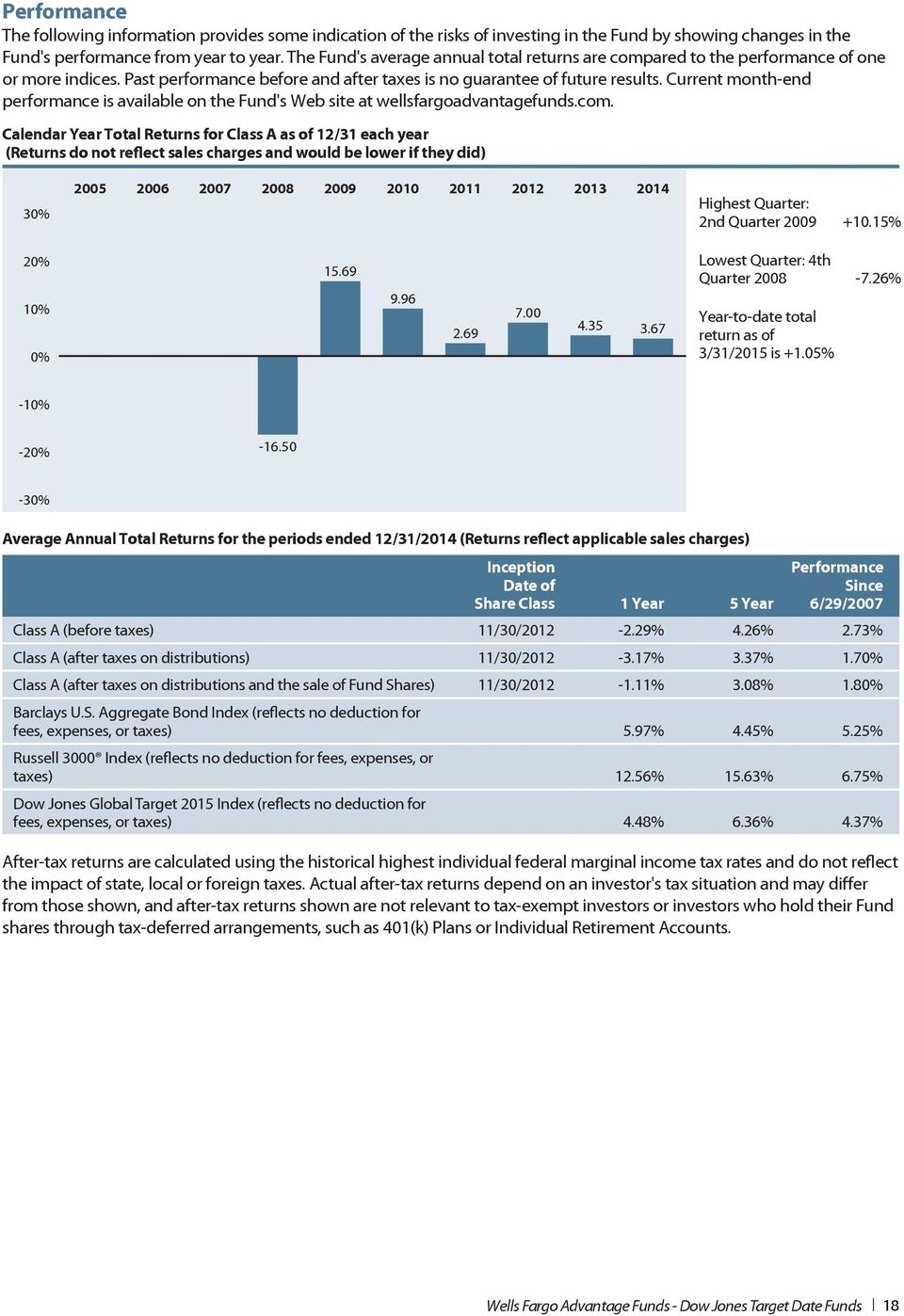
20 Performance The following information provides some indication of the risks of investing in the Fund by showing changes in the Fund's performance from year to year. The Fund's average annual total returns are compared to the performance of one or more indices. Past performance before and after taxes is no guarantee of future results. Current month-end performance is available on the Fund's Web site at wellsfargoadvantagefunds.com. Calendar Year Total Returns for Class A as of 12/31 each year (Returns do not reflect sales charges and would be lower if they did) 30% Highest Quarter: 2nd Quarter % 20% 10% 0% Lowest Quarter: 4th Quarter % Year-to-date total return as of 3/31/2015 is +1.05% -10% -20% % Average Annual Total Returns for the periods ended 12/31/2014 (Returns reflect applicable sales charges) Inception Date of Share Class 1 Year 5 Year Performance Since 6/29/2007 Class A (before taxes) 11/30/ % 4.26% 2.73% Class A (after taxes on distributions) 11/30/ % 3.37% 1.70% Class A (after taxes on distributions and the sale of Fund Shares) 11/30/ % 3.08% 1.80% Barclays U.S. Aggregate Bond Index (reflects no deduction for fees, expenses, or taxes) 5.97% 4.45% 5.25% Russell 3000 Index (reflects no deduction for fees, expenses, or taxes) 12.56% 15.63% 6.75% Dow Jones Global Target 2015 Index (reflects no deduction for fees, expenses, or taxes) 4.48% 6.36% 4.37% After-tax returns are calculated using the historical highest individual federal marginal income tax rates and do not reflect the impact of state, local or foreign taxes. Actual after-tax returns depend on an investor's tax situation and may differ from those shown, and after-tax returns shown are not relevant to tax-exempt investors or investors who hold their Fund shares through tax-deferred arrangements, such as 401(k) Plans or Individual Retirement Accounts. Wells Fargo Advantage Funds - Dow Jones Target Date Funds 18
21 Fund Management Manager Sub-Adviser Portfolio Manager, Title/Managed Since Wells Fargo Funds Management, LLC Global Index Advisors, Inc. Rodney H. Alldredge, Portfolio Manager / 2007 James P. Lauder, Portfolio Manager / 2007 Paul T. Torregrosa, PhD, Portfolio Manager / 2010 Purchase and Sale of Fund Shares In general, you can buy or sell shares of the Fund online or by mail, phone or wire on any day the New York Stock Exchange is open for regular trading. You also may buy and sell shares through a financial professional. Minimum Investments Minimum Initial Investment Class A IRAs, IRA rollovers, Roth IRAs: $250 UGMA/UTMA accounts: $50 Employer Sponsored Retirement Plans: No Minimum Minimum Additional Investment Regular Accounts, IRAs, IRA rollovers, Roth IRAs: $100 UGMA/UTMA accounts: $50 Employer Sponsored Retirement Plans: No Minimum To Buy or Sell Shares Mail: Wells Fargo Advantage Funds P.O. Box 8266 Boston, MA Online: wellsfargoadvantagefunds.com Phone or Wire: Contact your financial professional. Tax Information Any distributions you receive from the Fund may be taxable as ordinary income or capital gains, except when your investment is in an IRA, 401(k) or other tax advantaged investment plan. However, subsequent withdrawals from such a tax advantaged investment plan may be subject to federal income tax. You should consult your tax adviser about your specific tax situation. Payments to Broker-Dealers and Other Financial Intermediaries If you purchase a Fund through a broker-dealer or other financial intermediary (such as a bank), the Fund and its related companies may pay the intermediary for the sale of Fund shares and related services. These payments may create a conflict of interest by influencing the broker-dealer or other intermediary and your salesperson to recommend the Fund over another investment. Consult your salesperson or visit your financial intermediary's Web site for more information. 19 Wells Fargo Advantage Funds - Dow Jones Target Date Funds
22 Target 2020 Fund Summary Investment Objective The Fund seeks to approximate, before fees and expenses, the total return of the Dow Jones Target 2020 Index SM. Fees and Expenses These tables are intended to help you understand the various costs and expenses you will pay if you buy and hold shares of the Fund. You may qualify for sales charge discounts if you and your family invest, or agree to invest in the future, at least $50,000 in the aggregate in specified classes of certain Wells Fargo Advantage Funds. More information about these and other discounts is available from your financial professional and in "A Choice of Share Classes" and "Reductions and Waivers of Sales Charges" on pages 89 and 91 of the Prospectus and "Additional Purchase and Redemption Information" on page 58 of the Statement of Additional Information. Shareholder Fees (fees paid directly from your investment) Class A Class B Class C Maximum sales charge (load) imposed on purchases (as a percentage of offering price) 5.75% None None Maximum deferred sales charge (load) (as a percentage of offering price) None % 1.00% 1. Investments of $1 million or more are not subject to a front-end sales charge but generally will be subject to a deferred sales charge of 1.00% if redeemed within 18 months from the date of purchase. Annual Fund Operating Expenses (expenses that you pay each year as a percentage of the value of your investment) 1 Class A Class B Class C Management Fees % 0.20% 0.20% Distribution (12b-1) Fees 0.00% 0.75% 0.75% Other Expenses 0.47% 0.47% 0.47% Acquired Fund Fees and Expenses 0.16% 0.16% 0.16% Total Annual Fund Operating Expenses 0.83% 1.58% 1.58% Fee Waiver 0.02% 0.02% 0.02% Total Annual Fund Operating Expenses After Fee Waiver % 1.56% 1.56% 1. Expenses have been adjusted as necessary from amounts incurred during the Fund's most recent fiscal year to reflect current fees and expenses. 2. The management fee is 0.15%, plus a fee for fund-level administration services previously provided by Wells Fargo Funds Management, LLC under a separate administration agreement. The portion of the management fee attributable to the fee for such fund-level administration services amounted to 0.05% of the Fund's average daily net assets, but did not result in a net increase in Total Annual Fund Operating Expenses. 3. The Manager has contractually committed through June 30, 2016, to waive fees and/or reimburse expenses to the extent necessary to cap the Fund's Total Annual Fund Operating Expenses After Fee Waiver at the amounts shown above. Brokerage commissions, stamp duty fees, interest, taxes, acquired fund fees and expenses, and extraordinary expenses are excluded from the cap. Fees from the underlying master portfolio(s) are included in the cap. After this time, the cap may be increased or the commitment to maintain the cap may be terminated only with the approval of the Board of Trustees. Example of Expenses The example below is intended to help you compare the costs of investing in the Fund with the costs of investing in other mutual funds. The example assumes a $10,000 initial investment, 5% annual total return, and that fees and expenses remain the same as in the tables above. The example also assumes that the Total Annual Fund Operating Expenses After Fee Waiver shown above will only be in place for the length of the current waiver commitment. Although your actual costs may be higher or lower, based on these assumptions your costs would be: Assuming Redemption at End of Period Assuming No Redemption After: Class A Class B Class C Class B Class C 1 Year $653 $659 $259 $159 $159 3 Years $823 $797 $497 $497 $497 5 Years $1,007 $1,059 $859 $859 $ Years $1,540 $1,581 $1,877 $1,581 $1,877 Wells Fargo Advantage Funds - Dow Jones Target Date Funds 20
23 Portfolio Turnover The Fund pays transaction costs, such as commissions, when it buys and sells securities (or "turns over" its portfolio). A higher portfolio turnover rate may indicate higher transaction costs and may result in higher taxes when Fund shares are held in a taxable account. These costs, which are not reflected in annual fund operating expenses or in the example, affect the Fund's performance. During the most recent fiscal year, the Fund's portfolio turnover rate was 36% of the average value of its portfolio. Principal Investment Strategies Under normal circumstances, we invest: at least 80% of the Fund s total assets in equity, fixed income and money market securities designed to approximate the holdings and weightings of the securities in the Dow Jones Target 2020 Index SM. The Fund is a gateway fund that invests in various master portfolios which in turn invest in a combination of equity, fixed income and money market securities using an asset allocation strategy designed to replicate, before fees and expenses, the total return of the Dow Jones Target 2020 Index SM. Similar to the methodology of the index, the Fund's investment strategy is to gradually reduce the Fund's potential market risk exposure over time by re-allocating the Fund's assets among these major asset classes: equity, fixed income and money market instruments. Generally, the longer the Fund's time horizon, the more of its assets are allocated to equity securities to pursue capital appreciation over the long term. As the Fund's time horizon shortens, it replaces some of its equity holdings with fixed income and money market holdings to reduce market risk and price volatility and thereby generally becomes more conservative in its asset allocation as the Fund's target year approaches and for the first 10 years after it arrives. The Fund's target year serves as a guide to the relative market risk exposure of the Fund, and your decision to invest in this Fund or another Wells Fargo Advantage Dow Jones Target Date Fund with a different target year and market risk exposure depends upon your individual risk tolerance, among other factors. The "target year" designated in the Fund's name is the same as the year in the name of the Dow Jones Target 2020 Index SM. The Fund is primarily designed for investors expecting to retire and/or begin withdrawing funds around its target year, The principal value of an investor's investment in the Fund is not guaranteed, and an investor may experience losses, at any time, including near, at or after the target year designated in the Fund's name. In addition, there is no guarantee that an investor's investment in the Fund will provide income at, and through the years following, the target year in the Fund's name in amounts adequate to meet the investor's goals. Currently, the master portfolios in which the Fund invests are the Wells Fargo Advantage Diversified Stock Portfolio, the Wells Fargo Advantage Diversified Fixed Income Portfolio, and the Wells Fargo Advantage Short-Term Investment Portfolio. The Diversified Stock Portfolio and the Diversified Fixed Income Portfolio seek to approximate, before fees and expenses, the total return of the respective equity and fixed income portions of the Dow Jones Target 2020 Index SM by investing in the securities that comprise the sub-indexes representing the equity and fixed income asset classes, respectively, which securities may include, among others, growth and value stocks, foreign and emerging market equity investments, and securities of smaller companies, as well as debt securities, including corporate bonds, mortgageand asset-backed securities and U.S. and foreign government obligations. The Diversified Stock Portfolio may also use stock index futures, a type of derivative, in order to manage movements of the portfolio against certain indexes. The Diversified Stock Portfolio and the Diversified Fixed Income Portfolio use an optimization process, which seeks to balance the replication of index performance and security transaction costs. The Fund invests in the Short-Term Investment Portfolio to represent the cash component of the Dow Jones Target Date Indexes, but unlike the cash component of the Dow Jones Target 2020 Index SM, the Portfolio does not seek to replicate the Barclays 1-3 Month Treasury-Bill Index. This could result in potential tracking error between the performances of the Fund and the Dow Jones Target 2020 Index SM. By the time the Fund reaches its target year in 2020, its risk exposure will approach 28% of the risk of the global equity market. The Fund will not reach its lowest risk exposure of 20% of the risk of the global equity market until ten years past the Fund's target year. To measure the Fund's risk and the risk of the global equity market, we use a statistical method known as below-mean semi-variance, which quantifies portfolio risk levels by measuring only the below-average outcomes. This method is designed to provide a more useful and nuanced picture of the Fund's risk profile. As of February 28, 2015, the Dow Jones Target 2020 Index SM included equity, fixed income and money market securities in the weights of 36%, 60% and 4%, respectively, which represent the percentage breakdown of the Fund's assets across the Diversified Stock, Diversified Fixed Income and Short-Term Investment Portfolios, respectively, as of such date, and may change over time. The Fund reserves the right to change its percentage allocation among the Portfolios as we deem necessary to meet its investment objective. 21 Wells Fargo Advantage Funds - Dow Jones Target Date Funds
24 Principal Investment Risks An investment in the Fund may lose money, is not a deposit of Wells Fargo Bank, N.A. or its affiliates, is not insured or guaranteed by the Federal Deposit Insurance Corporation or any other governmental agency, and is primarily subject to the risks briefly summarized below. Credit Risk. The issuer or guarantor of a debt security may be unable or perceived to be unable to pay interest or repay principal when they become due, which could cause the value of an investment to decline and a Fund to lose money. Derivatives Risk. The use of derivatives, such as futures, options and swap agreements, can lead to losses, including those magnified by leverage, particularly when derivatives are used to enhance return rather than mitigate risk. Certain derivative instruments may be difficult to sell when the portfolio manager believes it would be appropriate to do so, or the other party to a derivative contract may be unwilling or unable to fulfill its contractual obligations. Emerging Markets Risk. Emerging market securities typically present even greater exposure to the risks described under "Foreign Investment Risk" and may be particularly sensitive to global economic conditions. Emerging market securities are also typically less liquid than securities of developed countries and could be difficult to sell, particularly during a market downturn. Foreign Investment Risk. Foreign investments may be subject to lower liquidity, greater price volatility and risks related to adverse political, regulatory, market or economic developments. Foreign investments may involve exposure to changes in foreign currency exchange rates and may be subject to higher withholding and other taxes. Futures Contracts Risk. A Fund that uses futures contracts, which are a type of derivative, is subject to the risk of loss caused by unanticipated market movements. In addition, there may at times be an imperfect correlation between the movement in the prices of futures contracts and the value of their underlying instruments or indexes and there may at times not be a liquid secondary market for certain futures contracts. Index Tracking Risk. A Fund may not achieve exact correlation between the performance of the Fund and the index it tracks due to factors such as transaction costs, shareholder purchases and redemptions and the timing of changes in the composition of the index. The Fund also may invest in only a representative sample of the securities that comprise the index and may hold securities not included in the index, subjecting the Fund to increased tracking risk. Maintaining investments in securities regardless of market conditions or the investment merits of the securities in seeking to replicate an index's composition or performance could cause the Fund's returns to be lower than if the Fund employed an active strategy. Interest Rate Risk. When interest rates rise, the value of debt securities tends to fall. When interest rates decline, interest that a Fund is able to earn on its investments in debt securities may also decline, but the value of those securities may increase. Wells Fargo Advantage Funds - Dow Jones Target Date Funds 22
25 Investment Style Risk. Securities of a particular investment style, such as a growth style or value style, tend to perform differently and shift into and out of favor with investors depending on changes in market and economic sentiment and conditions. Management Risk. Investment decisions, techniques, analyses or models implemented by a Fund's manager or subadviser in seeking to achieve the Fund's investment objective may not produce the returns expected, may cause the Fund's shares to lose value or may cause the Fund to underperform other funds with similar investment objectives. Market Risk. The values of, and/or the income generated by, securities held by a Fund may decline due to general market conditions or other factors, including those directly involving the issuers of such securities. Security markets are volatile and may decline significantly in response to adverse issuer, regulatory, political, or economic developments. Different sectors of the market and different security types may react differently to such developments. Mortgage- and Asset-Backed Securities Risk. Mortgage- and asset-backed securities may decline in value and become less liquid when defaults on the underlying mortgages or assets occur and may exhibit additional volatility in periods of rising interest rates. Rising interest rates tend to extend the duration of these securities, making them more sensitive to changes in interest rates than instruments with fixed payment schedules. When interest rates decline or are low, the prepayment of mortgages or assets underlying such securities can reduce a Fund's returns. Smaller Company Securities Risk. Securities of companies with smaller market capitalizations tend to be more volatile and less liquid than those of larger companies. Target Date Fund Risk. A Target Date Fund cannot provide assurance that an investor's investment in the Fund will provide income at, and through the years following, the target year in the Fund's name in amounts adequate to meet the investor's financial goals. In addition, the Fund is subject to the risk that its strategy will not eliminate investment volatility that could reduce the amount of funds available for an investor who begins to withdraw funds or expects to retire close to or in the Fund's target year. U.S. Government Obligations Risk. U.S. Government obligations may be adversely impacted by changes in interest rates, and securities issued or guaranteed by U.S. Government agencies or government-sponsored entities may not be backed by the full faith and credit of the U.S. Government. 23 Wells Fargo Advantage Funds - Dow Jones Target Date Funds
26 Performance The following information provides some indication of the risks of investing in the Fund by showing changes in the Fund's performance from year to year. The Fund's average annual total returns are compared to the performance of one or more indices. Past performance before and after taxes is no guarantee of future results. Current month-end performance is available on the Fund's Web site at wellsfargoadvantagefunds.com. Calendar Year Total Returns for Class A as of 12/31 each year (Returns do not reflect sales charges and would be lower if they did) 30% 20% 10% 0% -10% Highest Quarter: 2nd Quarter % Lowest Quarter: 4th Quarter % Year-to-date total return as of 3/31/2015 is +1.33% -20% -30% % Average Annual Total Returns for the periods ended 12/31/2014 (Returns reflect applicable sales charges) Inception Date of Share Class 1 Year 5 Year 10 Year Class A (before taxes) 3/1/ % 5.22% 3.94% Class A (after taxes on distributions) 3/1/ % 4.52% 3.12% Class A (after taxes on distributions and the sale of Fund Shares) 3/1/ % 3.98% 2.99% Class B (before taxes) 3/1/ % 5.33% 4.01% Class C (before taxes) 12/1/ % 5.67% 3.78% Barclays U.S. Aggregate Bond Index (reflects no deduction for fees, expenses, or taxes) 5.97% 4.45% 4.71% Russell 3000 Index (reflects no deduction for fees, expenses, or taxes) 12.56% 15.63% 7.94% Dow Jones Global Target 2020 Index (reflects no deduction for fees, expenses, or taxes) 4.81% 7.44% 5.74% Wells Fargo Dow Jones Target 2020 Composite Index (reflects no deduction for fees, expenses, or taxes) 4.81% 7.44% 5.54% After-tax returns are calculated using the historical highest individual federal marginal income tax rates and do not reflect the impact of state, local or foreign taxes. Actual after-tax returns depend on an investor's tax situation and may differ from those shown, and after-tax returns shown are not relevant to tax-exempt investors or investors who hold their Fund shares through tax-deferred arrangements, such as 401(k) Plans or Individual Retirement Accounts. After-tax returns are shown only for the Class A shares. After-tax returns for the Class B and Class C shares will vary. Wells Fargo Advantage Funds - Dow Jones Target Date Funds 24
27 Fund Management Manager Sub-Adviser Portfolio Manager, Title/Managed Since Wells Fargo Funds Management, LLC Global Index Advisors, Inc. Rodney H. Alldredge, Portfolio Manager / 2006 James P. Lauder, Portfolio Manager / 2006 Paul T. Torregrosa, PhD, Portfolio Manager / 2010 Purchase and Sale of Fund Shares In general, you can buy or sell shares of the Fund online or by mail, phone or wire on any day the New York Stock Exchange is open for regular trading. You also may buy and sell shares through a financial professional. Minimum Investments Minimum Initial Investment Class A and Class C Regular Accounts: $1,000 IRAs, IRA rollovers, Roth IRAs: $250 UGMA/UTMA accounts: $50 Employer Sponsored Retirement Plans: No Minimum Class B shares are generally closed to new investment. Minimum Additional Investment Regular Accounts, IRAs, IRA rollovers, Roth IRAs: $100 UGMA/UTMA accounts: $50 Employer Sponsored Retirement Plans: No Minimum To Buy or Sell Shares Mail: Wells Fargo Advantage Funds P.O. Box 8266 Boston, MA Online: wellsfargoadvantagefunds.com Phone or Wire: Contact your financial professional. Tax Information Any distributions you receive from the Fund may be taxable as ordinary income or capital gains, except when your investment is in an IRA, 401(k) or other tax advantaged investment plan. However, subsequent withdrawals from such a tax advantaged investment plan may be subject to federal income tax. You should consult your tax adviser about your specific tax situation. Payments to Broker-Dealers and Other Financial Intermediaries If you purchase a Fund through a broker-dealer or other financial intermediary (such as a bank), the Fund and its related companies may pay the intermediary for the sale of Fund shares and related services. These payments may create a conflict of interest by influencing the broker-dealer or other intermediary and your salesperson to recommend the Fund over another investment. Consult your salesperson or visit your financial intermediary's Web site for more information. 25 Wells Fargo Advantage Funds - Dow Jones Target Date Funds
28 Target 2025 Fund Summary Investment Objective The Fund seeks to approximate, before fees and expenses, the total return of the Dow Jones Target 2025 Index SM. Fees and Expenses These tables are intended to help you understand the various costs and expenses you will pay if you buy and hold shares of the Fund. You may qualify for sales charge discounts if you and your family invest, or agree to invest in the future, at least $50,000 in the aggregate in specified classes of certain Wells Fargo Advantage Funds. More information about these and other discounts is available from your financial professional and in "A Choice of Share Classes" and "Reductions and Waivers of Sales Charges" on pages 89 and 91 of the Prospectus and "Additional Purchase and Redemption Information" on page 58 of the Statement of Additional Information. Shareholder Fees (fees paid directly from your investment) Class A Maximum sales charge (load) imposed on purchases (as a percentage of offering price) 5.75% Maximum deferred sales charge (load) (as a percentage of offering price) None 1 1. Investments of $1 million or more are not subject to a front-end sales charge but generally will be subject to a deferred sales charge of 1.00% if redeemed within 18 months from the date of purchase. Annual Fund Operating Expenses (expenses that you pay each year as a percentage of the value of your investment) 1 Management Fees % Distribution (12b-1) Fees 0.00% Other Expenses 0.48% Acquired Fund Fees and Expenses 0.16% Total Annual Fund Operating Expenses 0.84% Fee Waiver 0.03% Total Annual Fund Operating Expenses After Fee Waiver % 1. Expenses have been adjusted as necessary from amounts incurred during the Fund's most recent fiscal year to reflect current fees and expenses. 2. The management fee is 0.15%, plus a fee for fund-level administration services previously provided by Wells Fargo Funds Management, LLC under a separate administration agreement. The portion of the management fee attributable to the fee for such fund-level administration services amounted to 0.05% of the Fund's average daily net assets, but did not result in a net increase in Total Annual Fund Operating Expenses. 3. The Manager has contractually committed through June 30, 2016, to waive fees and/or reimburse expenses to the extent necessary to cap the Fund's Total Annual Fund Operating Expenses After Fee Waiver at the amounts shown above. Brokerage commissions, stamp duty fees, interest, taxes, acquired fund fees and expenses, and extraordinary expenses are excluded from the cap. Fees from the underlying master portfolio(s) are included in the cap. After this time, the cap may be increased or the commitment to maintain the cap may be terminated only with the approval of the Board of Trustees. Example of Expenses The example below is intended to help you compare the costs of investing in the Fund with the costs of investing in other mutual funds. The example assumes a $10,000 initial investment, 5% annual total return, and that fees and expenses remain the same as in the tables above. The example also assumes that the Total Annual Fund Operating Expenses After Fee Waiver shown above will only be in place for the length of the current waiver commitment. Although your actual costs may be higher or lower, based on these assumptions your costs would be: After: 1 Year $653 3 Years $825 5 Years $1, Years $1,550 Wells Fargo Advantage Funds - Dow Jones Target Date Funds 26
29 Portfolio Turnover The Fund pays transaction costs, such as commissions, when it buys and sells securities (or "turns over" its portfolio). A higher portfolio turnover rate may indicate higher transaction costs and may result in higher taxes when Fund shares are held in a taxable account. These costs, which are not reflected in annual fund operating expenses or in the example, affect the Fund's performance. During the most recent fiscal year, the Fund's portfolio turnover rate was 31% of the average value of its portfolio. Principal Investment Strategies Under normal circumstances, we invest: at least 80% of the Fund s total assets in equity, fixed income and money market securities designed to approximate the holdings and weightings of the securities in the Dow Jones Target 2025 Index SM. The Fund is a gateway fund that invests in various master portfolios which in turn invest in a combination of equity, fixed income and money market securities using an asset allocation strategy designed to replicate, before fees and expenses, the total return of the Dow Jones Target 2025 Index SM. Similar to the methodology of the index, the Fund's investment strategy is to gradually reduce the Fund's potential market risk exposure over time by re-allocating the Fund's assets among these major asset classes: equity, fixed income and money market instruments. Generally, the longer the Fund's time horizon, the more of its assets are allocated to equity securities to pursue capital appreciation over the long term. As the Fund's time horizon shortens, it replaces some of its equity holdings with fixed income and money market holdings to reduce market risk and price volatility and thereby generally becomes more conservative in its asset allocation as the Fund's target year approaches and for the first 10 years after it arrives. The Fund's target year serves as a guide to the relative market risk exposure of the Fund, and your decision to invest in this Fund or another Wells Fargo Advantage Dow Jones Target Date Fund with a different target year and market risk exposure depends upon your individual risk tolerance, among other factors. The "target year" designated in the Fund's name is the same as the year in the name of the Dow Jones Target 2025 Index SM. The Fund is primarily designed for investors expecting to retire and/or begin withdrawing funds around its target year, The principal value of an investor's investment in the Fund is not guaranteed, and an investor may experience losses, at any time, including near, at or after the target year designated in the Fund's name. In addition, there is no guarantee that an investor's investment in the Fund will provide income at, and through the years following, the target year in the Fund's name in amounts adequate to meet the investor's goals. Currently, the master portfolios in which the Fund invests are the Wells Fargo Advantage Diversified Stock Portfolio, the Wells Fargo Advantage Diversified Fixed Income Portfolio, and the Wells Fargo Advantage Short-Term Investment Portfolio. The Diversified Stock Portfolio and the Diversified Fixed Income Portfolio seek to approximate, before fees and expenses, the total return of the respective equity and fixed income portions of the Dow Jones Target 2025 Index SM by investing in the securities that comprise the sub-indexes representing the equity and fixed income asset classes, respectively, which securities may include, among others, growth and value stocks, foreign and emerging market equity investments, and securities of smaller companies, as well as debt securities, including corporate bonds, mortgageand asset-backed securities and U.S. and foreign government obligations. The Diversified Stock Portfolio may also use stock index futures, a type of derivative, in order to manage movements of the portfolio against certain indexes. The Diversified Stock Portfolio and the Diversified Fixed Income Portfolio use an optimization process, which seeks to balance the replication of index performance and security transaction costs. The Fund invests in the Short-Term Investment Portfolio to represent the cash component of the Dow Jones Target Date Indexes, but unlike the cash component of the Dow Jones Target 2025 Index SM, the Portfolio does not seek to replicate the Barclays 1-3 Month Treasury-Bill Index. This could result in potential tracking error between the performances of the Fund and the Dow Jones Target 2025 Index SM. By the time the Fund reaches its target year in 2025, its risk exposure will approach 28% of the risk of the global equity market. The Fund will not reach its lowest risk exposure of 20% of the risk of the global equity market until ten years past the Fund's target year. To measure the Fund's risk and the risk of the global equity market, we use a statistical method known as below-mean semi-variance, which quantifies portfolio risk levels by measuring only the below-average outcomes. This method is designed to provide a more useful and nuanced picture of the Fund's risk profile. As of February 28, 2015, the Dow Jones Target 2025 Index SM included equity, fixed income and money market securities in the weights of 49%, 47% and 4%, respectively, which represent the percentage breakdown of the Fund's assets across the Diversified Stock, Diversified Fixed Income and Short-Term Investment Portfolios, respectively, as of such date, and may change over time. The Fund reserves the right to change its percentage allocation among the Portfolios as we deem necessary to meet its investment objective. 27 Wells Fargo Advantage Funds - Dow Jones Target Date Funds
30 Principal Investment Risks An investment in the Fund may lose money, is not a deposit of Wells Fargo Bank, N.A. or its affiliates, is not insured or guaranteed by the Federal Deposit Insurance Corporation or any other governmental agency, and is primarily subject to the risks briefly summarized below. Credit Risk. The issuer or guarantor of a debt security may be unable or perceived to be unable to pay interest or repay principal when they become due, which could cause the value of an investment to decline and a Fund to lose money. Derivatives Risk. The use of derivatives, such as futures, options and swap agreements, can lead to losses, including those magnified by leverage, particularly when derivatives are used to enhance return rather than mitigate risk. Certain derivative instruments may be difficult to sell when the portfolio manager believes it would be appropriate to do so, or the other party to a derivative contract may be unwilling or unable to fulfill its contractual obligations. Emerging Markets Risk. Emerging market securities typically present even greater exposure to the risks described under "Foreign Investment Risk" and may be particularly sensitive to global economic conditions. Emerging market securities are also typically less liquid than securities of developed countries and could be difficult to sell, particularly during a market downturn. Foreign Investment Risk. Foreign investments may be subject to lower liquidity, greater price volatility and risks related to adverse political, regulatory, market or economic developments. Foreign investments may involve exposure to changes in foreign currency exchange rates and may be subject to higher withholding and other taxes. Futures Contracts Risk. A Fund that uses futures contracts, which are a type of derivative, is subject to the risk of loss caused by unanticipated market movements. In addition, there may at times be an imperfect correlation between the movement in the prices of futures contracts and the value of their underlying instruments or indexes and there may at times not be a liquid secondary market for certain futures contracts. Index Tracking Risk. A Fund may not achieve exact correlation between the performance of the Fund and the index it tracks due to factors such as transaction costs, shareholder purchases and redemptions and the timing of changes in the composition of the index. The Fund also may invest in only a representative sample of the securities that comprise the index and may hold securities not included in the index, subjecting the Fund to increased tracking risk. Maintaining investments in securities regardless of market conditions or the investment merits of the securities in seeking to replicate an index's composition or performance could cause the Fund's returns to be lower than if the Fund employed an active strategy. Interest Rate Risk. When interest rates rise, the value of debt securities tends to fall. When interest rates decline, interest that a Fund is able to earn on its investments in debt securities may also decline, but the value of those securities may increase. Wells Fargo Advantage Funds - Dow Jones Target Date Funds 28
31 Investment Style Risk. Securities of a particular investment style, such as a growth style or value style, tend to perform differently and shift into and out of favor with investors depending on changes in market and economic sentiment and conditions. Management Risk. Investment decisions, techniques, analyses or models implemented by a Fund's manager or subadviser in seeking to achieve the Fund's investment objective may not produce the returns expected, may cause the Fund's shares to lose value or may cause the Fund to underperform other funds with similar investment objectives. Market Risk. The values of, and/or the income generated by, securities held by a Fund may decline due to general market conditions or other factors, including those directly involving the issuers of such securities. Security markets are volatile and may decline significantly in response to adverse issuer, regulatory, political, or economic developments. Different sectors of the market and different security types may react differently to such developments. Mortgage- and Asset-Backed Securities Risk. Mortgage- and asset-backed securities may decline in value and become less liquid when defaults on the underlying mortgages or assets occur and may exhibit additional volatility in periods of rising interest rates. Rising interest rates tend to extend the duration of these securities, making them more sensitive to changes in interest rates than instruments with fixed payment schedules. When interest rates decline or are low, the prepayment of mortgages or assets underlying such securities can reduce a Fund's returns. Smaller Company Securities Risk. Securities of companies with smaller market capitalizations tend to be more volatile and less liquid than those of larger companies. Target Date Fund Risk. A Target Date Fund cannot provide assurance that an investor's investment in the Fund will provide income at, and through the years following, the target year in the Fund's name in amounts adequate to meet the investor's financial goals. In addition, the Fund is subject to the risk that its strategy will not eliminate investment volatility that could reduce the amount of funds available for an investor who begins to withdraw funds or expects to retire close to or in the Fund's target year. U.S. Government Obligations Risk. U.S. Government obligations may be adversely impacted by changes in interest rates, and securities issued or guaranteed by U.S. Government agencies or government-sponsored entities may not be backed by the full faith and credit of the U.S. Government. 29 Wells Fargo Advantage Funds - Dow Jones Target Date Funds
32 Performance The following information provides some indication of the risks of investing in the Fund by showing changes in the Fund's performance from year to year. The Fund's average annual total returns are compared to the performance of one or more indices. Past performance before and after taxes is no guarantee of future results. Current month-end performance is available on the Fund's Web site at wellsfargoadvantagefunds.com. Calendar Year Total Returns for Class A as of 12/31 each year (Returns do not reflect sales charges and would be lower if they did) 40% 30% 20% 10% 0% -10% -20% -30% -40% Highest Quarter: 2nd Quarter % Lowest Quarter: 4th Quarter % Year-to-date total return as of 3/31/2015 is +1.78% Average Annual Total Returns for the periods ended 12/31/2014 (Returns reflect applicable sales charges) Inception Date of Share Class 1 Year 5 Year Performance Since 6/29/2007 Class A (before taxes) 11/30/ % 6.46% 2.90% Class A (after taxes on distributions) 11/30/ % 5.36% 2.02% Class A (after taxes on distributions and the sale of Fund Shares) 11/30/ % 4.82% 2.05% Barclays U.S. Aggregate Bond Index (reflects no deduction for fees, expenses, or taxes) 5.97% 4.45% 5.25% Russell 3000 Index (reflects no deduction for fees, expenses, or taxes) 12.56% 15.63% 6.75% Dow Jones Global Target 2025 Index (reflects no deduction for fees, expenses, or taxes) 5.14% 8.58% 4.47% After-tax returns are calculated using the historical highest individual federal marginal income tax rates and do not reflect the impact of state, local or foreign taxes. Actual after-tax returns depend on an investor's tax situation and may differ from those shown, and after-tax returns shown are not relevant to tax-exempt investors or investors who hold their Fund shares through tax-deferred arrangements, such as 401(k) Plans or Individual Retirement Accounts. Wells Fargo Advantage Funds - Dow Jones Target Date Funds 30
33 Fund Management Manager Sub-Adviser Portfolio Manager, Title/Managed Since Wells Fargo Funds Management, LLC Global Index Advisors, Inc. Rodney H. Alldredge, Portfolio Manager / 2007 James P. Lauder, Portfolio Manager / 2007 Paul T. Torregrosa, PhD, Portfolio Manager / 2010 Purchase and Sale of Fund Shares In general, you can buy or sell shares of the Fund online or by mail, phone or wire on any day the New York Stock Exchange is open for regular trading. You also may buy and sell shares through a financial professional. Minimum Investments Minimum Initial Investment Class A IRAs, IRA rollovers, Roth IRAs: $250 UGMA/UTMA accounts: $50 Employer Sponsored Retirement Plans: No Minimum Minimum Additional Investment Regular Accounts, IRAs, IRA rollovers, Roth IRAs: $100 UGMA/UTMA accounts: $50 Employer Sponsored Retirement Plans: No Minimum To Buy or Sell Shares Mail: Wells Fargo Advantage Funds P.O. Box 8266 Boston, MA Online: wellsfargoadvantagefunds.com Phone or Wire: Contact your financial professional. Tax Information Any distributions you receive from the Fund may be taxable as ordinary income or capital gains, except when your investment is in an IRA, 401(k) or other tax advantaged investment plan. However, subsequent withdrawals from such a tax advantaged investment plan may be subject to federal income tax. You should consult your tax adviser about your specific tax situation. Payments to Broker-Dealers and Other Financial Intermediaries If you purchase a Fund through a broker-dealer or other financial intermediary (such as a bank), the Fund and its related companies may pay the intermediary for the sale of Fund shares and related services. These payments may create a conflict of interest by influencing the broker-dealer or other intermediary and your salesperson to recommend the Fund over another investment. Consult your salesperson or visit your financial intermediary's Web site for more information. 31 Wells Fargo Advantage Funds - Dow Jones Target Date Funds
34 Target 2030 Fund Summary Investment Objective The Fund seeks to approximate, before fees and expenses, the total return of the Dow Jones Target 2030 Index SM. Fees and Expenses These tables are intended to help you understand the various costs and expenses you will pay if you buy and hold shares of the Fund. You may qualify for sales charge discounts if you and your family invest, or agree to invest in the future, at least $50,000 in the aggregate in specified classes of certain Wells Fargo Advantage Funds. More information about these and other discounts is available from your financial professional and in "A Choice of Share Classes" and "Reductions and Waivers of Sales Charges" on pages 89 and 91 of the Prospectus and "Additional Purchase and Redemption Information" on page 58 of the Statement of Additional Information. Shareholder Fees (fees paid directly from your investment) Class A Class B Class C Maximum sales charge (load) imposed on purchases (as a percentage of offering price) 5.75% None None Maximum deferred sales charge (load) (as a percentage of offering price) None % 1.00% 1. Investments of $1 million or more are not subject to a front-end sales charge but generally will be subject to a deferred sales charge of 1.00% if redeemed within 18 months from the date of purchase. Annual Fund Operating Expenses (expenses that you pay each year as a percentage of the value of your investment) 1 Class A Class B Class C Management Fees % 0.20% 0.20% Distribution (12b-1) Fees 0.00% 0.75% 0.75% Other Expenses 0.47% 0.47% 0.47% Acquired Fund Fees and Expenses 0.16% 0.16% 0.16% Total Annual Fund Operating Expenses 0.83% 1.58% 1.58% Fee Waiver 0.01% 0.01% 0.01% Total Annual Fund Operating Expenses After Fee Waiver % 1.57% 1.57% 1. Expenses have been adjusted as necessary from amounts incurred during the Fund's most recent fiscal year to reflect current fees and expenses. 2. The management fee is 0.15%, plus a fee for fund-level administration services previously provided by Wells Fargo Funds Management, LLC under a separate administration agreement. The portion of the management fee attributable to the fee for such fund-level administration services amounted to 0.05% of the Fund's average daily net assets, but did not result in a net increase in Total Annual Fund Operating Expenses. 3. The Manager has contractually committed through June 30, 2016, to waive fees and/or reimburse expenses to the extent necessary to cap the Fund's Total Annual Fund Operating Expenses After Fee Waiver at the amounts shown above. Brokerage commissions, stamp duty fees, interest, taxes, acquired fund fees and expenses, and extraordinary expenses are excluded from the cap. Fees from the underlying master portfolio(s) are included in the cap. After this time, the cap may be increased or the commitment to maintain the cap may be terminated only with the approval of the Board of Trustees. Example of Expenses The example below is intended to help you compare the costs of investing in the Fund with the costs of investing in other mutual funds. The example assumes a $10,000 initial investment, 5% annual total return, and that fees and expenses remain the same as in the tables above. The example also assumes that the Total Annual Fund Operating Expenses After Fee Waiver shown above will only be in place for the length of the current waiver commitment. Although your actual costs may be higher or lower, based on these assumptions your costs would be: Assuming Redemption at End of Period Assuming No Redemption After: Class A Class B Class C Class B Class C 1 Year $654 $660 $260 $160 $160 3 Years $824 $798 $498 $498 $498 5 Years $1,008 $1,059 $859 $859 $ Years $1,541 $1,582 $1,877 $1,582 $1,877 Wells Fargo Advantage Funds - Dow Jones Target Date Funds 32
35 Portfolio Turnover The Fund pays transaction costs, such as commissions, when it buys and sells securities (or "turns over" its portfolio). A higher portfolio turnover rate may indicate higher transaction costs and may result in higher taxes when Fund shares are held in a taxable account. These costs, which are not reflected in annual fund operating expenses or in the example, affect the Fund's performance. During the most recent fiscal year, the Fund's portfolio turnover rate was 26% of the average value of its portfolio. Principal Investment Strategies Under normal circumstances, we invest: at least 80% of the Fund s total assets in equity, fixed income and money market securities designed to approximate the holdings and weightings of the securities in the Dow Jones Target 2030 Index SM. The Fund is a gateway fund that invests in various master portfolios which in turn invest in a combination of equity, fixed income and money market securities using an asset allocation strategy designed to replicate, before fees and expenses, the total return of the Dow Jones Target 2030 Index SM. Similar to the methodology of the index, the Fund's investment strategy is to gradually reduce the Fund's potential market risk exposure over time by re-allocating the Fund's assets among these major asset classes: equity, fixed income and money market instruments. Generally, the longer the Fund's time horizon, the more of its assets are allocated to equity securities to pursue capital appreciation over the long term. As the Fund's time horizon shortens, it replaces some of its equity holdings with fixed income and money market holdings to reduce market risk and price volatility and thereby generally becomes more conservative in its asset allocation as the Fund's target year approaches and for the first 10 years after it arrives. The Fund's target year serves as a guide to the relative market risk exposure of the Fund, and your decision to invest in this Fund or another Wells Fargo Advantage Dow Jones Target Date Fund with a different target year and market risk exposure depends upon your individual risk tolerance, among other factors. The "target year" designated in the Fund's name is the same as the year in the name of the Dow Jones Target 2030 Index SM. The Fund is primarily designed for investors expecting to retire and/or begin withdrawing funds around its target year, The principal value of an investor's investment in the Fund is not guaranteed, and an investor may experience losses, at any time, including near, at or after the target year designated in the Fund's name. In addition, there is no guarantee that an investor's investment in the Fund will provide income at, and through the years following, the target year in the Fund's name in amounts adequate to meet the investor's goals. Currently, the master portfolios in which the Fund invests are the Wells Fargo Advantage Diversified Stock Portfolio, the Wells Fargo Advantage Diversified Fixed Income Portfolio, and the Wells Fargo Advantage Short-Term Investment Portfolio. The Diversified Stock Portfolio and the Diversified Fixed Income Portfolio seek to approximate, before fees and expenses, the total return of the respective equity and fixed income portions of the Dow Jones Target 2030 Index SM by investing in the securities that comprise the sub-indexes representing the equity and fixed income asset classes, respectively, which securities may include, among others, growth and value stocks, foreign and emerging market equity investments, and securities of smaller companies, as well as debt securities, including corporate bonds, mortgage- and asset-backed securities and U.S. and foreign government obligations. The Diversified Stock Portfolio may also use stock index futures, a type of derivative, in order to manage movements of the portfolio against certain indexes. The Diversified Stock Portfolio and the Diversified Fixed Income Portfolio use an optimization process, which seeks to balance the replication of index performance and security transaction costs. The Fund invests in the Short-Term Investment Portfolio to represent the cash component of the Dow Jones Target Date Indexes, but unlike the cash component of the Dow Jones Target 2030 Index SM, the Portfolio does not seek to replicate the Barclays 1-3 Month Treasury-Bill Index. This could result in potential tracking error between the performances of the Fund and the Dow Jones Target 2030 Index SM. By the time the Fund reaches its target year in 2030, its risk exposure will approach 28% of the risk of the global equity market. The Fund will not reach its lowest risk exposure of 20% of the risk of the global equity market until ten years past the Fund's target year. To measure the Fund's risk and the risk of the global equity market, we use a statistical method known as below-mean semi-variance, which quantifies portfolio risk levels by measuring only the below-average outcomes. This method is designed to provide a more useful and nuanced picture of the Fund's risk profile. As of February 28, 2015, the Dow Jones Target 2030 Index SM included equity, fixed income and money market securities in the weights of 63%, 34% and 4%, respectively, which represent the percentage breakdown of the Fund's assets across the Diversified Stock, Diversified Fixed Income and Short-Term Investment Portfolios, respectively, as of such date, and may change over time. The Fund reserves the right to change its percentage allocation among the Portfolios as we deem necessary to meet its investment objective. 33 Wells Fargo Advantage Funds - Dow Jones Target Date Funds
36 Principal Investment Risks An investment in the Fund may lose money, is not a deposit of Wells Fargo Bank, N.A. or its affiliates, is not insured or guaranteed by the Federal Deposit Insurance Corporation or any other governmental agency, and is primarily subject to the risks briefly summarized below. Credit Risk. The issuer or guarantor of a debt security may be unable or perceived to be unable to pay interest or repay principal when they become due, which could cause the value of an investment to decline and a Fund to lose money. Derivatives Risk. The use of derivatives, such as futures, options and swap agreements, can lead to losses, including those magnified by leverage, particularly when derivatives are used to enhance return rather than mitigate risk. Certain derivative instruments may be difficult to sell when the portfolio manager believes it would be appropriate to do so, or the other party to a derivative contract may be unwilling or unable to fulfill its contractual obligations. Emerging Markets Risk. Emerging market securities typically present even greater exposure to the risks described under "Foreign Investment Risk" and may be particularly sensitive to global economic conditions. Emerging market securities are also typically less liquid than securities of developed countries and could be difficult to sell, particularly during a market downturn. Foreign Investment Risk. Foreign investments may be subject to lower liquidity, greater price volatility and risks related to adverse political, regulatory, market or economic developments. Foreign investments may involve exposure to changes in foreign currency exchange rates and may be subject to higher withholding and other taxes. Futures Contracts Risk. A Fund that uses futures contracts, which are a type of derivative, is subject to the risk of loss caused by unanticipated market movements. In addition, there may at times be an imperfect correlation between the movement in the prices of futures contracts and the value of their underlying instruments or indexes and there may at times not be a liquid secondary market for certain futures contracts. Index Tracking Risk. A Fund may not achieve exact correlation between the performance of the Fund and the index it tracks due to factors such as transaction costs, shareholder purchases and redemptions and the timing of changes in the composition of the index. The Fund also may invest in only a representative sample of the securities that comprise the index and may hold securities not included in the index, subjecting the Fund to increased tracking risk. Maintaining investments in securities regardless of market conditions or the investment merits of the securities in seeking to replicate an index's composition or performance could cause the Fund's returns to be lower than if the Fund employed an active strategy. Interest Rate Risk. When interest rates rise, the value of debt securities tends to fall. When interest rates decline, interest that a Fund is able to earn on its investments in debt securities may also decline, but the value of those securities may increase. Wells Fargo Advantage Funds - Dow Jones Target Date Funds 34
37 Investment Style Risk. Securities of a particular investment style, such as a growth style or value style, tend to perform differently and shift into and out of favor with investors depending on changes in market and economic sentiment and conditions. Management Risk. Investment decisions, techniques, analyses or models implemented by a Fund's manager or subadviser in seeking to achieve the Fund's investment objective may not produce the returns expected, may cause the Fund's shares to lose value or may cause the Fund to underperform other funds with similar investment objectives. Market Risk. The values of, and/or the income generated by, securities held by a Fund may decline due to general market conditions or other factors, including those directly involving the issuers of such securities. Security markets are volatile and may decline significantly in response to adverse issuer, regulatory, political, or economic developments. Different sectors of the market and different security types may react differently to such developments. Mortgage- and Asset-Backed Securities Risk. Mortgage- and asset-backed securities may decline in value and become less liquid when defaults on the underlying mortgages or assets occur and may exhibit additional volatility in periods of rising interest rates. Rising interest rates tend to extend the duration of these securities, making them more sensitive to changes in interest rates than instruments with fixed payment schedules. When interest rates decline or are low, the prepayment of mortgages or assets underlying such securities can reduce a Fund's returns. Smaller Company Securities Risk. Securities of companies with smaller market capitalizations tend to be more volatile and less liquid than those of larger companies. Target Date Fund Risk. A Target Date Fund cannot provide assurance that an investor's investment in the Fund will provide income at, and through the years following, the target year in the Fund's name in amounts adequate to meet the investor's financial goals. In addition, the Fund is subject to the risk that its strategy will not eliminate investment volatility that could reduce the amount of funds available for an investor who begins to withdraw funds or expects to retire close to or in the Fund's target year. U.S. Government Obligations Risk. U.S. Government obligations may be adversely impacted by changes in interest rates, and securities issued or guaranteed by U.S. Government agencies or government-sponsored entities may not be backed by the full faith and credit of the U.S. Government. 35 Wells Fargo Advantage Funds - Dow Jones Target Date Funds
38 Performance The following information provides some indication of the risks of investing in the Fund by showing changes in the Fund's performance from year to year. The Fund's average annual total returns are compared to the performance of one or more indices. Past performance before and after taxes is no guarantee of future results. Current month-end performance is available on the Fund's Web site at wellsfargoadvantagefunds.com. Calendar Year Total Returns for Class A as of 12/31 each year (Returns do not reflect sales charges and would be lower if they did) 60% Highest Quarter: 2nd Quarter % 40% Lowest Quarter: 4th Quarter % 20% 0% Year-to-date total return as of 3/31/2015 is +2.30% -20% -40% % Average Annual Total Returns for the periods ended 12/31/2014 (Returns reflect applicable sales charges) Inception Date of Share Class 1 Year 5 Year 10 Year Class A (before taxes) 3/1/ % 7.34% 4.66% Class A (after taxes on distributions) 3/1/ % 6.58% 3.86% Class A (after taxes on distributions and the sale of Fund Shares) 3/1/ % 5.68% 3.63% Class B (before taxes) 3/1/ % 7.51% 4.73% Class C (before taxes) 12/1/ % 7.83% 4.49% Barclays U.S. Aggregate Bond Index (reflects no deduction for fees, expenses, or taxes) 5.97% 4.45% 4.71% Russell 3000 Index (reflects no deduction for fees, expenses, or taxes) 12.56% 15.63% 7.94% Dow Jones Global Target 2030 Index (reflects no deduction for fees, expenses, or taxes) 5.50% 9.61% 6.74% Wells Fargo Dow Jones Target 2030 Composite Index (reflects no deduction for fees, expenses, or taxes) 5.50% 9.61% 6.31% After-tax returns are calculated using the historical highest individual federal marginal income tax rates and do not reflect the impact of state, local or foreign taxes. Actual after-tax returns depend on an investor's tax situation and may differ from those shown, and after-tax returns shown are not relevant to tax-exempt investors or investors who hold their Fund shares through tax-deferred arrangements, such as 401(k) Plans or Individual Retirement Accounts. After-tax returns are shown only for the Class A shares. After-tax returns for the Class B and Class C shares will vary. Wells Fargo Advantage Funds - Dow Jones Target Date Funds 36
39 Fund Management Manager Sub-Adviser Portfolio Manager, Title/Managed Since Wells Fargo Funds Management, LLC Global Index Advisors, Inc. Rodney H. Alldredge, Portfolio Manager / 2006 James P. Lauder, Portfolio Manager / 2006 Paul T. Torregrosa, PhD, Portfolio Manager / 2010 Purchase and Sale of Fund Shares In general, you can buy or sell shares of the Fund online or by mail, phone or wire on any day the New York Stock Exchange is open for regular trading. You also may buy and sell shares through a financial professional. Minimum Investments Minimum Initial Investment Class A and Class C Regular Accounts: $1,000 IRAs, IRA rollovers, Roth IRAs: $250 UGMA/UTMA accounts: $50 Employer Sponsored Retirement Plans: No Minimum Class B shares are generally closed to new investment. Minimum Additional Investment Regular Accounts, IRAs, IRA rollovers, Roth IRAs: $100 UGMA/UTMA accounts: $50 Employer Sponsored Retirement Plans: No Minimum To Buy or Sell Shares Mail: Wells Fargo Advantage Funds P.O. Box 8266 Boston, MA Online: wellsfargoadvantagefunds.com Phone or Wire: Contact your financial professional. Tax Information Any distributions you receive from the Fund may be taxable as ordinary income or capital gains, except when your investment is in an IRA, 401(k) or other tax advantaged investment plan. However, subsequent withdrawals from such a tax advantaged investment plan may be subject to federal income tax. You should consult your tax adviser about your specific tax situation. Payments to Broker-Dealers and Other Financial Intermediaries If you purchase a Fund through a broker-dealer or other financial intermediary (such as a bank), the Fund and its related companies may pay the intermediary for the sale of Fund shares and related services. These payments may create a conflict of interest by influencing the broker-dealer or other intermediary and your salesperson to recommend the Fund over another investment. Consult your salesperson or visit your financial intermediary's Web site for more information. 37 Wells Fargo Advantage Funds - Dow Jones Target Date Funds
40 Target 2035 Fund Summary Investment Objective The Fund seeks to approximate, before fees and expenses, the total return of the Dow Jones Target 2035 Index SM. Fees and Expenses These tables are intended to help you understand the various costs and expenses you will pay if you buy and hold shares of the Fund. You may qualify for sales charge discounts if you and your family invest, or agree to invest in the future, at least $50,000 in the aggregate in specified classes of certain Wells Fargo Advantage Funds. More information about these and other discounts is available from your financial professional and in "A Choice of Share Classes" and "Reductions and Waivers of Sales Charges" on pages 89 and 91 of the Prospectus and "Additional Purchase and Redemption Information" on page 58 of the Statement of Additional Information. Shareholder Fees (fees paid directly from your investment) Class A Maximum sales charge (load) imposed on purchases (as a percentage of offering price) 5.75% Maximum deferred sales charge (load) (as a percentage of offering price) None 1 1. Investments of $1 million or more are not subject to a front-end sales charge but generally will be subject to a deferred sales charge of 1.00% if redeemed within 18 months from the date of purchase. Annual Fund Operating Expenses (expenses that you pay each year as a percentage of the value of your investment) 1 Management Fees % Distribution (12b-1) Fees 0.00% Other Expenses 0.48% Acquired Fund Fees and Expenses 0.16% Total Annual Fund Operating Expenses 0.84% Fee Waiver 0.01% Total Annual Fund Operating Expenses After Fee Waiver % 1. Expenses have been adjusted as necessary from amounts incurred during the Fund's most recent fiscal year to reflect current fees and expenses. 2. The management fee is 0.15%, plus a fee for fund-level administration services previously provided by Wells Fargo Funds Management, LLC under a separate administration agreement. The portion of the management fee attributable to the fee for such fund-level administration services amounted to 0.05% of the Fund's average daily net assets, but did not result in a net increase in Total Annual Fund Operating Expenses. 3. The Manager has contractually committed through June 30, 2016, to waive fees and/or reimburse expenses to the extent necessary to cap the Fund's Total Annual Fund Operating Expenses After Fee Waiver at the amounts shown above. Brokerage commissions, stamp duty fees, interest, taxes, acquired fund fees and expenses, and extraordinary expenses are excluded from the cap. Fees from the underlying master portfolio(s) are included in the cap. After this time, the cap may be increased or the commitment to maintain the cap may be terminated only with the approval of the Board of Trustees. Example of Expenses The example below is intended to help you compare the costs of investing in the Fund with the costs of investing in other mutual funds. The example assumes a $10,000 initial investment, 5% annual total return, and that fees and expenses remain the same as in the tables above. The example also assumes that the Total Annual Fund Operating Expenses After Fee Waiver shown above will only be in place for the length of the current waiver commitment. Although your actual costs may be higher or lower, based on these assumptions your costs would be: After: 1 Year $655 3 Years $827 5 Years $1, Years $1,552 Wells Fargo Advantage Funds - Dow Jones Target Date Funds 38
41 Portfolio Turnover The Fund pays transaction costs, such as commissions, when it buys and sells securities (or "turns over" its portfolio). A higher portfolio turnover rate may indicate higher transaction costs and may result in higher taxes when Fund shares are held in a taxable account. These costs, which are not reflected in annual fund operating expenses or in the example, affect the Fund's performance. During the most recent fiscal year, the Fund's portfolio turnover rate was 22% of the average value of its portfolio. Principal Investment Strategies Under normal circumstances, we invest: at least 80% of the Fund s total assets in equity, fixed income and money market securities designed to approximate the holdings and weightings of the securities in the Dow Jones Target 2035 Index SM. The Fund is a gateway fund that invests in various master portfolios which in turn invest in a combination of equity, fixed income and money market securities using an asset allocation strategy designed to replicate, before fees and expenses, the total return of the Dow Jones Target 2035 Index SM. Similar to the methodology of the index, the Fund's investment strategy is to gradually reduce the Fund's potential market risk exposure over time by re-allocating the Fund's assets among these major asset classes: equity, fixed income and money market instruments. Generally, the longer the Fund's time horizon, the more of its assets are allocated to equity securities to pursue capital appreciation over the long term. As the Fund's time horizon shortens, it replaces some of its equity holdings with fixed income and money market holdings to reduce market risk and price volatility and thereby generally becomes more conservative in its asset allocation as the Fund's target year approaches and for the first 10 years after it arrives. The Fund's target year serves as a guide to the relative market risk exposure of the Fund, and your decision to invest in this Fund or another Wells Fargo Advantage Dow Jones Target Date Fund with a different target year and market risk exposure depends upon your individual risk tolerance, among other factors. The "target year" designated in the Fund's name is the same as the year in the name of the Dow Jones Target 2035 Index SM. The Fund is primarily designed for investors expecting to retire and/or begin withdrawing funds around its target year, The principal value of an investor's investment in the Fund is not guaranteed, and an investor may experience losses, at any time, including near, at or after the target year designated in the Fund's name. In addition, there is no guarantee that an investor's investment in the Fund will provide income at, and through the years following, the target year in the Fund's name in amounts adequate to meet the investor's goals. Currently, the master portfolios in which the Fund invests are the Wells Fargo Advantage Diversified Stock Portfolio, the Wells Fargo Advantage Diversified Fixed Income Portfolio, and the Wells Fargo Advantage Short-Term Investment Portfolio. The Diversified Stock Portfolio and the Diversified Fixed Income Portfolio seek to approximate, before fees and expenses, the total return of the respective equity and fixed income portions of the Dow Jones Target 2035 Index SM by investing in the securities that comprise the sub-indexes representing the equity and fixed income asset classes, respectively, which securities may include, among others, growth and value stocks, foreign and emerging market equity investments, and securities of smaller companies, as well as debt securities, including corporate bonds, mortgage- and asset-backed securities and U.S. and foreign government obligations. The Diversified Stock Portfolio may also use stock index futures, a type of derivative, in order to manage movements of the portfolio against certain indexes. The Diversified Stock Portfolio and the Diversified Fixed Income Portfolio use an optimization process, which seeks to balance the replication of index performance and security transaction costs. The Fund invests in the Short-Term Investment Portfolio to represent the cash component of the Dow Jones Target Date Indexes, but unlike the cash component of the Dow Jones Target 2035 Index SM, the Portfolio does not seek to replicate the Barclays 1-3 Month Treasury-Bill Index. This could result in potential tracking error between the performances of the Fund and the Dow Jones Target 2035 Index SM. By the time the Fund reaches its target year in 2035, its risk exposure will approach 28% of the risk of the global equity market. The Fund will not reach its lowest risk exposure of 20% of the risk of the global equity market until ten years past the Fund's target year. To measure the Fund's risk and the risk of the global equity market, we use a statistical method known as below-mean semi-variance, which quantifies portfolio risk levels by measuring only the below-average outcomes. This method is designed to provide a more useful and nuanced picture of the Fund's risk profile. As of February 28, 2015, the Dow Jones Target 2035 Index SM included equity, fixed income and money market securities in the weights of 74%, 22% and 4%, respectively, which represent the percentage breakdown of the Fund's assets across the Diversified Stock, Diversified Fixed Income and Short-Term Investment Portfolios, respectively, as of such date, and may change over time. The Fund reserves the right to change its percentage allocation among the Portfolios as we deem necessary to meet its investment objective. 39 Wells Fargo Advantage Funds - Dow Jones Target Date Funds
42 Principal Investment Risks An investment in the Fund may lose money, is not a deposit of Wells Fargo Bank, N.A. or its affiliates, is not insured or guaranteed by the Federal Deposit Insurance Corporation or any other governmental agency, and is primarily subject to the risks briefly summarized below. Credit Risk. The issuer or guarantor of a debt security may be unable or perceived to be unable to pay interest or repay principal when they become due, which could cause the value of an investment to decline and a Fund to lose money. Derivatives Risk. The use of derivatives, such as futures, options and swap agreements, can lead to losses, including those magnified by leverage, particularly when derivatives are used to enhance return rather than mitigate risk. Certain derivative instruments may be difficult to sell when the portfolio manager believes it would be appropriate to do so, or the other party to a derivative contract may be unwilling or unable to fulfill its contractual obligations. Emerging Markets Risk. Emerging market securities typically present even greater exposure to the risks described under "Foreign Investment Risk" and may be particularly sensitive to global economic conditions. Emerging market securities are also typically less liquid than securities of developed countries and could be difficult to sell, particularly during a market downturn. Foreign Investment Risk. Foreign investments may be subject to lower liquidity, greater price volatility and risks related to adverse political, regulatory, market or economic developments. Foreign investments may involve exposure to changes in foreign currency exchange rates and may be subject to higher withholding and other taxes. Futures Contracts Risk. A Fund that uses futures contracts, which are a type of derivative, is subject to the risk of loss caused by unanticipated market movements. In addition, there may at times be an imperfect correlation between the movement in the prices of futures contracts and the value of their underlying instruments or indexes and there may at times not be a liquid secondary market for certain futures contracts. Index Tracking Risk. A Fund may not achieve exact correlation between the performance of the Fund and the index it tracks due to factors such as transaction costs, shareholder purchases and redemptions and the timing of changes in the composition of the index. The Fund also may invest in only a representative sample of the securities that comprise the index and may hold securities not included in the index, subjecting the Fund to increased tracking risk. Maintaining investments in securities regardless of market conditions or the investment merits of the securities in seeking to replicate an index's composition or performance could cause the Fund's returns to be lower than if the Fund employed an active strategy. Interest Rate Risk. When interest rates rise, the value of debt securities tends to fall. When interest rates decline, interest that a Fund is able to earn on its investments in debt securities may also decline, but the value of those securities may increase. Wells Fargo Advantage Funds - Dow Jones Target Date Funds 40
43 Investment Style Risk. Securities of a particular investment style, such as a growth style or value style, tend to perform differently and shift into and out of favor with investors depending on changes in market and economic sentiment and conditions. Management Risk. Investment decisions, techniques, analyses or models implemented by a Fund's manager or subadviser in seeking to achieve the Fund's investment objective may not produce the returns expected, may cause the Fund's shares to lose value or may cause the Fund to underperform other funds with similar investment objectives. Market Risk. The values of, and/or the income generated by, securities held by a Fund may decline due to general market conditions or other factors, including those directly involving the issuers of such securities. Security markets are volatile and may decline significantly in response to adverse issuer, regulatory, political, or economic developments. Different sectors of the market and different security types may react differently to such developments. Mortgage- and Asset-Backed Securities Risk. Mortgage- and asset-backed securities may decline in value and become less liquid when defaults on the underlying mortgages or assets occur and may exhibit additional volatility in periods of rising interest rates. Rising interest rates tend to extend the duration of these securities, making them more sensitive to changes in interest rates than instruments with fixed payment schedules. When interest rates decline or are low, the prepayment of mortgages or assets underlying such securities can reduce a Fund's returns. Smaller Company Securities Risk. Securities of companies with smaller market capitalizations tend to be more volatile and less liquid than those of larger companies. Target Date Fund Risk. A Target Date Fund cannot provide assurance that an investor's investment in the Fund will provide income at, and through the years following, the target year in the Fund's name in amounts adequate to meet the investor's financial goals. In addition, the Fund is subject to the risk that its strategy will not eliminate investment volatility that could reduce the amount of funds available for an investor who begins to withdraw funds or expects to retire close to or in the Fund's target year. U.S. Government Obligations Risk. U.S. Government obligations may be adversely impacted by changes in interest rates, and securities issued or guaranteed by U.S. Government agencies or government-sponsored entities may not be backed by the full faith and credit of the U.S. Government. 41 Wells Fargo Advantage Funds - Dow Jones Target Date Funds
44 Performance The following information provides some indication of the risks of investing in the Fund by showing changes in the Fund's performance from year to year. The Fund's average annual total returns are compared to the performance of one or more indices. Past performance before and after taxes is no guarantee of future results. Current month-end performance is available on the Fund's Web site at wellsfargoadvantagefunds.com. Calendar Year Total Returns for Class A as of 12/31 each year (Returns do not reflect sales charges and would be lower if they did) 60% Highest Quarter: 2nd Quarter % 40% 20% 0% Lowest Quarter: 4th Quarter % Year-to-date total return as of 3/31/2015 is +2.65% -20% -40% % Average Annual Total Returns for the periods ended 12/31/2014 (Returns reflect applicable sales charges) Inception Date of Share Class 1 Year 5 Year Performance Since 6/29/2007 Class A (before taxes) 11/30/ % 8.29% 3.25% Class A (after taxes on distributions) 11/30/ % 7.29% 2.51% Class A (after taxes on distributions and the sale of Fund Shares) 11/30/ % 6.34% 2.39% Barclays U.S. Aggregate Bond Index (reflects no deduction for fees, expenses, or taxes) 5.97% 4.45% 5.25% Russell 3000 Index (reflects no deduction for fees, expenses, or taxes) 12.56% 15.63% 6.75% Dow Jones Global Target 2035 Index (reflects no deduction for fees, expenses, or taxes) 5.80% 10.47% 4.71% After-tax returns are calculated using the historical highest individual federal marginal income tax rates and do not reflect the impact of state, local or foreign taxes. Actual after-tax returns depend on an investor's tax situation and may differ from those shown, and after-tax returns shown are not relevant to tax-exempt investors or investors who hold their Fund shares through tax-deferred arrangements, such as 401(k) Plans or Individual Retirement Accounts. Wells Fargo Advantage Funds - Dow Jones Target Date Funds 42
45 Fund Management Manager Sub-Adviser Portfolio Manager, Title/Managed Since Wells Fargo Funds Management, LLC Global Index Advisors, Inc. Rodney H. Alldredge, Portfolio Manager / 2007 James P. Lauder, Portfolio Manager / 2007 Paul T. Torregrosa, PhD, Portfolio Manager / 2010 Purchase and Sale of Fund Shares In general, you can buy or sell shares of the Fund online or by mail, phone or wire on any day the New York Stock Exchange is open for regular trading. You also may buy and sell shares through a financial professional. Minimum Investments Minimum Initial Investment Class A IRAs, IRA rollovers, Roth IRAs: $250 UGMA/UTMA accounts: $50 Employer Sponsored Retirement Plans: No Minimum Minimum Additional Investment Regular Accounts, IRAs, IRA rollovers, Roth IRAs: $100 UGMA/UTMA accounts: $50 Employer Sponsored Retirement Plans: No Minimum To Buy or Sell Shares Mail: Wells Fargo Advantage Funds P.O. Box 8266 Boston, MA Online: wellsfargoadvantagefunds.com Phone or Wire: Contact your financial professional. Tax Information Any distributions you receive from the Fund may be taxable as ordinary income or capital gains, except when your investment is in an IRA, 401(k) or other tax advantaged investment plan. However, subsequent withdrawals from such a tax advantaged investment plan may be subject to federal income tax. You should consult your tax adviser about your specific tax situation. Payments to Broker-Dealers and Other Financial Intermediaries If you purchase a Fund through a broker-dealer or other financial intermediary (such as a bank), the Fund and its related companies may pay the intermediary for the sale of Fund shares and related services. These payments may create a conflict of interest by influencing the broker-dealer or other intermediary and your salesperson to recommend the Fund over another investment. Consult your salesperson or visit your financial intermediary's Web site for more information. 43 Wells Fargo Advantage Funds - Dow Jones Target Date Funds
46 Target 2040 Fund Summary Investment Objective The Fund seeks to approximate, before fees and expenses, the total return of the Dow Jones Target 2040 Index SM. Fees and Expenses These tables are intended to help you understand the various costs and expenses you will pay if you buy and hold shares of the Fund. You may qualify for sales charge discounts if you and your family invest, or agree to invest in the future, at least $50,000 in the aggregate in specified classes of certain Wells Fargo Advantage Funds. More information about these and other discounts is available from your financial professional and in "A Choice of Share Classes" and "Reductions and Waivers of Sales Charges" on pages 89 and 91 of the Prospectus and "Additional Purchase and Redemption Information" on page 58 of the Statement of Additional Information. Shareholder Fees (fees paid directly from your investment) Class A Class B Class C Maximum sales charge (load) imposed on purchases (as a percentage of offering price) 5.75% None None Maximum deferred sales charge (load) (as a percentage of offering price) None % 1.00% 1. Investments of $1 million or more are not subject to a front-end sales charge but generally will be subject to a deferred sales charge of 1.00% if redeemed within 18 months from the date of purchase. Annual Fund Operating Expenses (expenses that you pay each year as a percentage of the value of your investment) 1 Class A Class B Class C Management Fees % 0.20% 0.20% Distribution (12b-1) Fees 0.00% 0.75% 0.75% Other Expenses 0.48% 0.48% 0.48% Acquired Fund Fees and Expenses 0.16% 0.16% 0.16% Total Annual Fund Operating Expenses 0.84% 1.59% 1.59% Fee Waiver 0.01% 0.01% 0.01% Total Annual Fund Operating Expenses After Fee Waiver % 1.58% 1.58% 1. Expenses have been adjusted as necessary from amounts incurred during the Fund's most recent fiscal year to reflect current fees and expenses. 2. The management fee is 0.15%, plus a fee for fund-level administration services previously provided by Wells Fargo Funds Management, LLC under a separate administration agreement. The portion of the management fee attributable to the fee for such fund-level administration services amounted to 0.05% of the Fund's average daily net assets, but did not result in a net increase in Total Annual Fund Operating Expenses. 3. The Manager has contractually committed through June 30, 2016, to waive fees and/or reimburse expenses to the extent necessary to cap the Fund's Total Annual Fund Operating Expenses After Fee Waiver at the amounts shown above. Brokerage commissions, stamp duty fees, interest, taxes, acquired fund fees and expenses, and extraordinary expenses are excluded from the cap. Fees from the underlying master portfolio(s) are included in the cap. After this time, the cap may be increased or the commitment to maintain the cap may be terminated only with the approval of the Board of Trustees. Example of Expenses The example below is intended to help you compare the costs of investing in the Fund with the costs of investing in other mutual funds. The example assumes a $10,000 initial investment, 5% annual total return, and that fees and expenses remain the same as in the tables above. The example also assumes that the Total Annual Fund Operating Expenses After Fee Waiver shown above will only be in place for the length of the current waiver commitment. Although your actual costs may be higher or lower, based on these assumptions your costs would be: Assuming Redemption at End of Period Assuming No Redemption After: Class A Class B Class C Class B Class C 1 Year $655 $661 $261 $161 $161 3 Years $827 $801 $501 $501 $501 5 Years $1,013 $1,065 $865 $865 $ Years $1,552 $1,593 $1,888 $1,593 $1,888 Wells Fargo Advantage Funds - Dow Jones Target Date Funds 44
47 Portfolio Turnover The Fund pays transaction costs, such as commissions, when it buys and sells securities (or "turns over" its portfolio). A higher portfolio turnover rate may indicate higher transaction costs and may result in higher taxes when Fund shares are held in a taxable account. These costs, which are not reflected in annual fund operating expenses or in the example, affect the Fund's performance. During the most recent fiscal year, the Fund's portfolio turnover rate was 18% of the average value of its portfolio. Principal Investment Strategies Under normal circumstances, we invest: at least 80% of the Fund s total assets in equity, fixed income and money market securities designed to approximate the holdings and weightings of the securities in the Dow Jones Target 2040 Index SM. The Fund is a gateway fund that invests in various master portfolios which in turn invest in a combination of equity, fixed income and money market securities using an asset allocation strategy designed to replicate, before fees and expenses, the total return of the Dow Jones Target 2040 Index SM. Similar to the methodology of the index, the Fund's investment strategy is to gradually reduce the Fund's potential market risk exposure over time by re-allocating the Fund's assets among these major asset classes: equity, fixed income and money market instruments. Generally, the longer the Fund's time horizon, the more of its assets are allocated to equity securities to pursue capital appreciation over the long term. As the Fund's time horizon shortens, it replaces some of its equity holdings with fixed income and money market holdings to reduce market risk and price volatility and thereby generally becomes more conservative in its asset allocation as the Fund's target year approaches and for the first 10 years after it arrives. The Fund's target year serves as a guide to the relative market risk exposure of the Fund, and your decision to invest in this Fund or another Wells Fargo Advantage Dow Jones Target Date Fund with a different target year and market risk exposure depends upon your individual risk tolerance, among other factors. The "target year" designated in the Fund's name is the same as the year in the name of the Dow Jones Target 2040 Index SM. The Fund is primarily designed for investors expecting to retire and/or begin withdrawing funds around its target year, The principal value of an investor's investment in the Fund is not guaranteed, and an investor may experience losses, at any time, including near, at or after the target year designated in the Fund's name. In addition, there is no guarantee that an investor's investment in the Fund will provide income at, and through the years following, the target year in the Fund's name in amounts adequate to meet the investor's goals. Currently, the master portfolios in which the Fund invests are the Wells Fargo Advantage Diversified Stock Portfolio, the Wells Fargo Advantage Diversified Fixed Income Portfolio, and the Wells Fargo Advantage Short-Term Investment Portfolio. The Diversified Stock Portfolio and the Diversified Fixed Income Portfolio seek to approximate, before fees and expenses, the total return of the respective equity and fixed income portions of the Dow Jones Target 2040 Index SM by investing in the securities that comprise the sub-indexes representing the equity and fixed income asset classes, respectively, which securities may include, among others, growth and value stocks, foreign and emerging market equity investments, and securities of smaller companies, as well as debt securities, including corporate bonds, mortgage- and asset-backed securities and U.S. and foreign government obligations. The Diversified Stock Portfolio may also use stock index futures, a type of derivative, in order to manage movements of the portfolio against certain indexes. The Diversified Stock Portfolio and the Diversified Fixed Income Portfolio use an optimization process, which seeks to balance the replication of index performance and security transaction costs. The Fund invests in the Short-Term Investment Portfolio to represent the cash component of the Dow Jones Target Date Indexes, but unlike the cash component of the Dow Jones Target 2040 Index SM, the Portfolio does not seek to replicate the Barclays 1-3 Month Treasury-Bill Index. This could result in potential tracking error between the performances of the Fund and the Dow Jones Target 2040 Index SM. By the time the Fund reaches its target year in 2040, its risk exposure will approach 28% of the risk of the global equity market. The Fund will not reach its lowest risk exposure of 20% of the risk of the global equity market until ten years past the Fund's target year. To measure the Fund's risk and the risk of the global equity market, we use a statistical method known as below-mean semi-variance, which quantifies portfolio risk levels by measuring only the below-average outcomes. This method is designed to provide a more useful and nuanced picture of the Fund's risk profile. As of February 28, 2015, the Dow Jones Target 2040 Index SM included equity, fixed income and money market securities in the weights of 83%, 13% and 4%, respectively, which represent the percentage breakdown of the Fund's assets across the Diversified Stock, Diversified Fixed Income and Short-Term Investment Portfolios, respectively, as of such date, and may change over time. The Fund reserves the right to change its percentage allocation among the Portfolios as we deem necessary to meet its investment objective. 45 Wells Fargo Advantage Funds - Dow Jones Target Date Funds
48 Principal Investment Risks An investment in the Fund may lose money, is not a deposit of Wells Fargo Bank, N.A. or its affiliates, is not insured or guaranteed by the Federal Deposit Insurance Corporation or any other governmental agency, and is primarily subject to the risks briefly summarized below. Credit Risk. The issuer or guarantor of a debt security may be unable or perceived to be unable to pay interest or repay principal when they become due, which could cause the value of an investment to decline and a Fund to lose money. Derivatives Risk. The use of derivatives, such as futures, options and swap agreements, can lead to losses, including those magnified by leverage, particularly when derivatives are used to enhance return rather than mitigate risk. Certain derivative instruments may be difficult to sell when the portfolio manager believes it would be appropriate to do so, or the other party to a derivative contract may be unwilling or unable to fulfill its contractual obligations. Emerging Markets Risk. Emerging market securities typically present even greater exposure to the risks described under "Foreign Investment Risk" and may be particularly sensitive to global economic conditions. Emerging market securities are also typically less liquid than securities of developed countries and could be difficult to sell, particularly during a market downturn. Foreign Investment Risk. Foreign investments may be subject to lower liquidity, greater price volatility and risks related to adverse political, regulatory, market or economic developments. Foreign investments may involve exposure to changes in foreign currency exchange rates and may be subject to higher withholding and other taxes. Futures Contracts Risk. A Fund that uses futures contracts, which are a type of derivative, is subject to the risk of loss caused by unanticipated market movements. In addition, there may at times be an imperfect correlation between the movement in the prices of futures contracts and the value of their underlying instruments or indexes and there may at times not be a liquid secondary market for certain futures contracts. Index Tracking Risk. A Fund may not achieve exact correlation between the performance of the Fund and the index it tracks due to factors such as transaction costs, shareholder purchases and redemptions and the timing of changes in the composition of the index. The Fund also may invest in only a representative sample of the securities that comprise the index and may hold securities not included in the index, subjecting the Fund to increased tracking risk. Maintaining investments in securities regardless of market conditions or the investment merits of the securities in seeking to replicate an index's composition or performance could cause the Fund's returns to be lower than if the Fund employed an active strategy. Interest Rate Risk. When interest rates rise, the value of debt securities tends to fall. When interest rates decline, interest that a Fund is able to earn on its investments in debt securities may also decline, but the value of those securities may increase. Wells Fargo Advantage Funds - Dow Jones Target Date Funds 46
49 Investment Style Risk. Securities of a particular investment style, such as a growth style or value style, tend to perform differently and shift into and out of favor with investors depending on changes in market and economic sentiment and conditions. Management Risk. Investment decisions, techniques, analyses or models implemented by a Fund's manager or subadviser in seeking to achieve the Fund's investment objective may not produce the returns expected, may cause the Fund's shares to lose value or may cause the Fund to underperform other funds with similar investment objectives. Market Risk. The values of, and/or the income generated by, securities held by a Fund may decline due to general market conditions or other factors, including those directly involving the issuers of such securities. Security markets are volatile and may decline significantly in response to adverse issuer, regulatory, political, or economic developments. Different sectors of the market and different security types may react differently to such developments. Mortgage- and Asset-Backed Securities Risk. Mortgage- and asset-backed securities may decline in value and become less liquid when defaults on the underlying mortgages or assets occur and may exhibit additional volatility in periods of rising interest rates. Rising interest rates tend to extend the duration of these securities, making them more sensitive to changes in interest rates than instruments with fixed payment schedules. When interest rates decline or are low, the prepayment of mortgages or assets underlying such securities can reduce a Fund's returns. Smaller Company Securities Risk. Securities of companies with smaller market capitalizations tend to be more volatile and less liquid than those of larger companies. Target Date Fund Risk. A Target Date Fund cannot provide assurance that an investor's investment in the Fund will provide income at, and through the years following, the target year in the Fund's name in amounts adequate to meet the investor's financial goals. In addition, the Fund is subject to the risk that its strategy will not eliminate investment volatility that could reduce the amount of funds available for an investor who begins to withdraw funds or expects to retire close to or in the Fund's target year. U.S. Government Obligations Risk. U.S. Government obligations may be adversely impacted by changes in interest rates, and securities issued or guaranteed by U.S. Government agencies or government-sponsored entities may not be backed by the full faith and credit of the U.S. Government. 47 Wells Fargo Advantage Funds - Dow Jones Target Date Funds
50 Performance The following information provides some indication of the risks of investing in the Fund by showing changes in the Fund's performance from year to year. The Fund's average annual total returns are compared to the performance of one or more indices. Past performance before and after taxes is no guarantee of future results. Current month-end performance is available on the Fund's Web site at wellsfargoadvantagefunds.com. Calendar Year Total Returns for Class A as of 12/31 each year (Returns do not reflect sales charges and would be lower if they did) 60% Highest Quarter: 2nd Quarter % 40% 20% 0% Lowest Quarter: 4th Quarter % Year-to-date total return as of 3/31/2015 is +3.02% -20% -40% % Average Annual Total Returns for the periods ended 12/31/2014 (Returns reflect applicable sales charges) Inception Date of Share Class 1 Year 5 Year 10 Year Class A (before taxes) 3/1/ % 8.79% 5.29% Class A (after taxes on distributions) 3/1/ % 7.99% 4.49% Class A (after taxes on distributions and the sale of Fund Shares) 3/1/ % 6.87% 4.14% Class B (before taxes) 3/1/ % 8.98% 5.35% Class C (before taxes) 7/1/ % 9.27% 5.13% Barclays U.S. Aggregate Bond Index (reflects no deduction for fees, expenses, or taxes) 5.97% 4.45% 4.71% Russell 3000 Index (reflects no deduction for fees, expenses, or taxes) 12.56% 15.63% 7.94% Dow Jones Global Target 2040 Index (reflects no deduction for fees, expenses, or taxes) 6.03% 11.08% 7.32% Wells Fargo Dow Jones Target 2040 Composite Index (reflects no deduction for fees, expenses, or taxes) 6.03% 11.08% 6.85% After-tax returns are calculated using the historical highest individual federal marginal income tax rates and do not reflect the impact of state, local or foreign taxes. Actual after-tax returns depend on an investor's tax situation and may differ from those shown, and after-tax returns shown are not relevant to tax-exempt investors or investors who hold their Fund shares through tax-deferred arrangements, such as 401(k) Plans or Individual Retirement Accounts. After-tax returns are shown only for the Class A shares. After-tax returns for the Class B and Class C shares will vary. Wells Fargo Advantage Funds - Dow Jones Target Date Funds 48
51 Fund Management Manager Sub-Adviser Portfolio Manager, Title/Managed Since Wells Fargo Funds Management, LLC Global Index Advisors, Inc. Rodney H. Alldredge, Portfolio Manager / 2006 James P. Lauder, Portfolio Manager / 2006 Paul T. Torregrosa, PhD, Portfolio Manager / 2010 Purchase and Sale of Fund Shares In general, you can buy or sell shares of the Fund online or by mail, phone or wire on any day the New York Stock Exchange is open for regular trading. You also may buy and sell shares through a financial professional. Minimum Investments Minimum Initial Investment Class A and Class C Regular Accounts: $1,000 IRAs, IRA rollovers, Roth IRAs: $250 UGMA/UTMA accounts: $50 Employer Sponsored Retirement Plans: No Minimum Class B shares are generally closed to new investment. Minimum Additional Investment Regular Accounts, IRAs, IRA rollovers, Roth IRAs: $100 UGMA/UTMA accounts: $50 Employer Sponsored Retirement Plans: No Minimum To Buy or Sell Shares Mail: Wells Fargo Advantage Funds P.O. Box 8266 Boston, MA Online: wellsfargoadvantagefunds.com Phone or Wire: Contact your financial professional. Tax Information Any distributions you receive from the Fund may be taxable as ordinary income or capital gains, except when your investment is in an IRA, 401(k) or other tax advantaged investment plan. However, subsequent withdrawals from such a tax advantaged investment plan may be subject to federal income tax. You should consult your tax adviser about your specific tax situation. Payments to Broker-Dealers and Other Financial Intermediaries If you purchase a Fund through a broker-dealer or other financial intermediary (such as a bank), the Fund and its related companies may pay the intermediary for the sale of Fund shares and related services. These payments may create a conflict of interest by influencing the broker-dealer or other intermediary and your salesperson to recommend the Fund over another investment. Consult your salesperson or visit your financial intermediary's Web site for more information. 49 Wells Fargo Advantage Funds - Dow Jones Target Date Funds
52 Target 2045 Fund Summary Investment Objective The Fund seeks to approximate, before fees and expenses, the total return of the Dow Jones Target 2045 Index SM. Fees and Expenses These tables are intended to help you understand the various costs and expenses you will pay if you buy and hold shares of the Fund. You may qualify for sales charge discounts if you and your family invest, or agree to invest in the future, at least $50,000 in the aggregate in specified classes of certain Wells Fargo Advantage Funds. More information about these and other discounts is available from your financial professional and in "A Choice of Share Classes" and "Reductions and Waivers of Sales Charges" on pages 89 and 91 of the Prospectus and "Additional Purchase and Redemption Information" on page 58 of the Statement of Additional Information. Shareholder Fees (fees paid directly from your investment) Class A Maximum sales charge (load) imposed on purchases (as a percentage of offering price) 5.75% Maximum deferred sales charge (load) (as a percentage of offering price) None 1 1. Investments of $1 million or more are not subject to a front-end sales charge but generally will be subject to a deferred sales charge of 1.00% if redeemed within 18 months from the date of purchase. Annual Fund Operating Expenses (expenses that you pay each year as a percentage of the value of your investment) 1 Management Fees % Distribution (12b-1) Fees 0.00% Other Expenses 0.49% Acquired Fund Fees and Expenses 0.16% Total Annual Fund Operating Expenses 0.85% Fee Waiver 0.02% Total Annual Fund Operating Expenses After Fee Waiver % 1. Expenses have been adjusted as necessary from amounts incurred during the Fund's most recent fiscal year to reflect current fees and expenses. 2. The management fee is 0.15%, plus a fee for fund-level administration services previously provided by Wells Fargo Funds Management, LLC under a separate administration agreement. The portion of the management fee attributable to the fee for such fund-level administration services amounted to 0.05% of the Fund's average daily net assets, but did not result in a net increase in Total Annual Fund Operating Expenses. 3. The Manager has contractually committed through June 30, 2016, to waive fees and/or reimburse expenses to the extent necessary to cap the Fund's Total Annual Fund Operating Expenses After Fee Waiver at the amounts shown above. Brokerage commissions, stamp duty fees, interest, taxes, acquired fund fees and expenses, and extraordinary expenses are excluded from the cap. Fees from the underlying master portfolio(s) are included in the cap. After this time, the cap may be increased or the commitment to maintain the cap may be terminated only with the approval of the Board of Trustees. Example of Expenses The example below is intended to help you compare the costs of investing in the Fund with the costs of investing in other mutual funds. The example assumes a $10,000 initial investment, 5% annual total return, and that fees and expenses remain the same as in the tables above. The example also assumes that the Total Annual Fund Operating Expenses After Fee Waiver shown above will only be in place for the length of the current waiver commitment. Although your actual costs may be higher or lower, based on these assumptions your costs would be: After: 1 Year $655 3 Years $829 5 Years $1, Years $1,562 Wells Fargo Advantage Funds - Dow Jones Target Date Funds 50
53 Portfolio Turnover The Fund pays transaction costs, such as commissions, when it buys and sells securities (or "turns over" its portfolio). A higher portfolio turnover rate may indicate higher transaction costs and may result in higher taxes when Fund shares are held in a taxable account. These costs, which are not reflected in annual fund operating expenses or in the example, affect the Fund's performance. During the most recent fiscal year, the Fund's portfolio turnover rate was 16% of the average value of its portfolio. Principal Investment Strategies Under normal circumstances, we invest: at least 80% of the Fund s total assets in equity, fixed income and money market securities designed to approximate the holdings and weightings of the securities in the Dow Jones Target 2045 Index SM. The Fund is a gateway fund that invests in various master portfolios which in turn invest in a combination of equity, fixed income and money market securities using an asset allocation strategy designed to replicate, before fees and expenses, the total return of the Dow Jones Target 2045 Index SM. Similar to the methodology of the index, the Fund's investment strategy is to gradually reduce the Fund's potential market risk exposure over time by re-allocating the Fund's assets among these major asset classes: equity, fixed income and money market instruments. Generally, the longer the Fund's time horizon, the more of its assets are allocated to equity securities to pursue capital appreciation over the long term. As the Fund's time horizon shortens, it replaces some of its equity holdings with fixed income and money market holdings to reduce market risk and price volatility and thereby generally becomes more conservative in its asset allocation as the Fund's target year approaches and for the first 10 years after it arrives. The Fund's target year serves as a guide to the relative market risk exposure of the Fund, and your decision to invest in this Fund or another Wells Fargo Advantage Dow Jones Target Date Fund with a different target year and market risk exposure depends upon your individual risk tolerance, among other factors. The "target year" designated in the Fund's name is the same as the year in the name of the Dow Jones Target 2045 Index SM. The Fund is primarily designed for investors expecting to retire and/or begin withdrawing funds around its target year, The principal value of an investor's investment in the Fund is not guaranteed, and an investor may experience losses, at any time, including near, at or after the target year designated in the Fund's name. In addition, there is no guarantee that an investor's investment in the Fund will provide income at, and through the years following, the target year in the Fund's name in amounts adequate to meet the investor's goals. Currently, the master portfolios in which the Fund invests are the Wells Fargo Advantage Diversified Stock Portfolio, the Wells Fargo Advantage Diversified Fixed Income Portfolio, and the Wells Fargo Advantage Short-Term Investment Portfolio. The Diversified Stock Portfolio and the Diversified Fixed Income Portfolio seek to approximate, before fees and expenses, the total return of the respective equity and fixed income portions of the Dow Jones Target 2045 Index SM by investing in the securities that comprise the sub-indexes representing the equity and fixed income asset classes, respectively, which securities may include, among others, growth and value stocks, foreign and emerging market equity investments, and securities of smaller companies, as well as debt securities, including corporate bonds, mortgage- and asset-backed securities and U.S. and foreign government obligations. The Diversified Stock Portfolio may also use stock index futures, a type of derivative, in order to manage movements of the portfolio against certain indexes. The Diversified Stock Portfolio and the Diversified Fixed Income Portfolio use an optimization process, which seeks to balance the replication of index performance and security transaction costs. The Fund invests in the Short-Term Investment Portfolio to represent the cash component of the Dow Jones Target Date Indexes, but unlike the cash component of the Dow Jones Target 2045 Index SM, the Portfolio does not seek to replicate the Barclays 1-3 Month Treasury-Bill Index. This could result in potential tracking error between the performances of the Fund and the Dow Jones Target 2045 Index SM. By the time the Fund reaches its target year in 2045, its risk exposure will approach 28% of the risk of the global equity market. The Fund will not reach its lowest risk exposure of 20% of the risk of the global equity market until ten years past the Fund's target year. To measure the Fund's risk and the risk of the global equity market, we use a statistical method known as below-mean semi-variance, which quantifies portfolio risk levels by measuring only the below-average outcomes. This method is designed to provide a more useful and nuanced picture of the Fund's risk profile. As of February 28, 2014, the Dow Jones Target 2045 Index SM included equity, fixed income and money market securities in the weights of 89%, 7% and 4%, respectively, which represent the percentage breakdown of the Fund's assets across the Diversified Stock, Diversified Fixed Income and Short-Term Investment Portfolios, respectively, as of such date, and may change over time. The Fund reserves the right to change its percentage allocation among the Portfolios as we deem necessary to meet its investment objective. 51 Wells Fargo Advantage Funds - Dow Jones Target Date Funds
54 Principal Investment Risks An investment in the Fund may lose money, is not a deposit of Wells Fargo Bank, N.A. or its affiliates, is not insured or guaranteed by the Federal Deposit Insurance Corporation or any other governmental agency, and is primarily subject to the risks briefly summarized below. Credit Risk. The issuer or guarantor of a debt security may be unable or perceived to be unable to pay interest or repay principal when they become due, which could cause the value of an investment to decline and a Fund to lose money. Derivatives Risk. The use of derivatives, such as futures, options and swap agreements, can lead to losses, including those magnified by leverage, particularly when derivatives are used to enhance return rather than mitigate risk. Certain derivative instruments may be difficult to sell when the portfolio manager believes it would be appropriate to do so, or the other party to a derivative contract may be unwilling or unable to fulfill its contractual obligations. Emerging Markets Risk. Emerging market securities typically present even greater exposure to the risks described under "Foreign Investment Risk" and may be particularly sensitive to global economic conditions. Emerging market securities are also typically less liquid than securities of developed countries and could be difficult to sell, particularly during a market downturn. Foreign Investment Risk. Foreign investments may be subject to lower liquidity, greater price volatility and risks related to adverse political, regulatory, market or economic developments. Foreign investments may involve exposure to changes in foreign currency exchange rates and may be subject to higher withholding and other taxes. Futures Contracts Risk. A Fund that uses futures contracts, which are a type of derivative, is subject to the risk of loss caused by unanticipated market movements. In addition, there may at times be an imperfect correlation between the movement in the prices of futures contracts and the value of their underlying instruments or indexes and there may at times not be a liquid secondary market for certain futures contracts. Index Tracking Risk. A Fund may not achieve exact correlation between the performance of the Fund and the index it tracks due to factors such as transaction costs, shareholder purchases and redemptions and the timing of changes in the composition of the index. The Fund also may invest in only a representative sample of the securities that comprise the index and may hold securities not included in the index, subjecting the Fund to increased tracking risk. Maintaining investments in securities regardless of market conditions or the investment merits of the securities in seeking to replicate an index's composition or performance could cause the Fund's returns to be lower than if the Fund employed an active strategy. Interest Rate Risk. When interest rates rise, the value of debt securities tends to fall. When interest rates decline, interest that a Fund is able to earn on its investments in debt securities may also decline, but the value of those securities may increase. Wells Fargo Advantage Funds - Dow Jones Target Date Funds 52
55 Investment Style Risk. Securities of a particular investment style, such as a growth style or value style, tend to perform differently and shift into and out of favor with investors depending on changes in market and economic sentiment and conditions. Management Risk. Investment decisions, techniques, analyses or models implemented by a Fund's manager or subadviser in seeking to achieve the Fund's investment objective may not produce the returns expected, may cause the Fund's shares to lose value or may cause the Fund to underperform other funds with similar investment objectives. Market Risk. The values of, and/or the income generated by, securities held by a Fund may decline due to general market conditions or other factors, including those directly involving the issuers of such securities. Security markets are volatile and may decline significantly in response to adverse issuer, regulatory, political, or economic developments. Different sectors of the market and different security types may react differently to such developments. Mortgage- and Asset-Backed Securities Risk. Mortgage- and asset-backed securities may decline in value and become less liquid when defaults on the underlying mortgages or assets occur and may exhibit additional volatility in periods of rising interest rates. Rising interest rates tend to extend the duration of these securities, making them more sensitive to changes in interest rates than instruments with fixed payment schedules. When interest rates decline or are low, the prepayment of mortgages or assets underlying such securities can reduce a Fund's returns. Smaller Company Securities Risk. Securities of companies with smaller market capitalizations tend to be more volatile and less liquid than those of larger companies. Target Date Fund Risk. A Target Date Fund cannot provide assurance that an investor's investment in the Fund will provide income at, and through the years following, the target year in the Fund's name in amounts adequate to meet the investor's financial goals. In addition, the Fund is subject to the risk that its strategy will not eliminate investment volatility that could reduce the amount of funds available for an investor who begins to withdraw funds or expects to retire close to or in the Fund's target year. U.S. Government Obligations Risk. U.S. Government obligations may be adversely impacted by changes in interest rates, and securities issued or guaranteed by U.S. Government agencies or government-sponsored entities may not be backed by the full faith and credit of the U.S. Government. 53 Wells Fargo Advantage Funds - Dow Jones Target Date Funds
56 Performance The following information provides some indication of the risks of investing in the Fund by showing changes in the Fund's performance from year to year. The Fund's average annual total returns are compared to the performance of one or more indices. Past performance before and after taxes is no guarantee of future results. Current month-end performance is available on the Fund's Web site at wellsfargoadvantagefunds.com. Calendar Year Total Returns for Class A as of 12/31 each year (Returns do not reflect sales charges and would be lower if they did) 60% Highest Quarter: 2nd Quarter % 40% 20% 0% Lowest Quarter: 4th Quarter % Year-to-date total return as of 3/31/2015 is +3.23% -20% -40% % Average Annual Total Returns for the periods ended 12/31/2014 (Returns reflect applicable sales charges) Inception Date of Share Class 1 Year 5 Year Performance Since 6/29/2007 Class A (before taxes) 11/30/ % 9.19% 3.67% Class A (after taxes on distributions) 11/30/ % 8.21% 2.96% Class A (after taxes on distributions and the sale of Fund Shares) 11/30/ % 7.05% 2.73% Barclays U.S. Aggregate Bond Index (reflects no deduction for fees, expenses, or taxes) 5.97% 4.45% 5.25% Russell 3000 Index (reflects no deduction for fees, expenses, or taxes) 12.56% 15.63% 6.75% Dow Jones Global Target 2045 Index (reflects no deduction for fees, expenses, or taxes) 6.16% 11.39% 5.09% After-tax returns are calculated using the historical highest individual federal marginal income tax rates and do not reflect the impact of state, local or foreign taxes. Actual after-tax returns depend on an investor's tax situation and may differ from those shown, and after-tax returns shown are not relevant to tax-exempt investors or investors who hold their Fund shares through tax-deferred arrangements, such as 401(k) Plans or Individual Retirement Accounts. Wells Fargo Advantage Funds - Dow Jones Target Date Funds 54
57 Fund Management Manager Sub-Adviser Portfolio Manager, Title/Managed Since Wells Fargo Funds Management, LLC Global Index Advisors, Inc. Rodney H. Alldredge, Portfolio Manager / 2007 James P. Lauder, Portfolio Manager / 2007 Paul T. Torregrosa, PhD, Portfolio Manager / 2010 Purchase and Sale of Fund Shares In general, you can buy or sell shares of the Fund online or by mail, phone or wire on any day the New York Stock Exchange is open for regular trading. You also may buy and sell shares through a financial professional. Minimum Investments Minimum Initial Investment Class A IRAs, IRA rollovers, Roth IRAs: $250 UGMA/UTMA accounts: $50 Employer Sponsored Retirement Plans: No Minimum Minimum Additional Investment Regular Accounts, IRAs, IRA rollovers, Roth IRAs: $100 UGMA/UTMA accounts: $50 Employer Sponsored Retirement Plans: No Minimum To Buy or Sell Shares Mail: Wells Fargo Advantage Funds P.O. Box 8266 Boston, MA Online: wellsfargoadvantagefunds.com Phone or Wire: Contact your financial professional. Tax Information Any distributions you receive from the Fund may be taxable as ordinary income or capital gains, except when your investment is in an IRA, 401(k) or other tax advantaged investment plan. However, subsequent withdrawals from such a tax advantaged investment plan may be subject to federal income tax. You should consult your tax adviser about your specific tax situation. Payments to Broker-Dealers and Other Financial Intermediaries If you purchase a Fund through a broker-dealer or other financial intermediary (such as a bank), the Fund and its related companies may pay the intermediary for the sale of Fund shares and related services. These payments may create a conflict of interest by influencing the broker-dealer or other intermediary and your salesperson to recommend the Fund over another investment. Consult your salesperson or visit your financial intermediary's Web site for more information. 55 Wells Fargo Advantage Funds - Dow Jones Target Date Funds
58 Target 2050 Fund Summary Investment Objective The Fund seeks to approximate, before fees and expenses, the total return of the Dow Jones Target 2050 Index SM. Fees and Expenses These tables are intended to help you understand the various costs and expenses you will pay if you buy and hold shares of the Fund. You may qualify for sales charge discounts if you and your family invest, or agree to invest in the future, at least $50,000 in the aggregate in specified classes of certain Wells Fargo Advantage Funds. More information about these and other discounts is available from your financial professional and in "A Choice of Share Classes" and "Reductions and Waivers of Sales Charges" on pages 89 and 91 of the Prospectus and "Additional Purchase and Redemption Information" on page 58 of the Statement of Additional Information. Shareholder Fees (fees paid directly from your investment) Class A Class C Maximum sales charge (load) imposed on purchases (as a percentage of offering price) 5.75% None Maximum deferred sales charge (load) (as a percentage of offering price) None % 1. Investments of $1 million or more are not subject to a front-end sales charge but generally will be subject to a deferred sales charge of 1.00% if redeemed within 18 months from the date of purchase. Annual Fund Operating Expenses (expenses that you pay each year as a percentage of the value of your investment) 1 Class A Class C Management Fees % 0.20% Distribution (12b-1) Fees 0.00% 0.75% Other Expenses 0.48% 0.48% Acquired Fund Fees and Expenses 0.16% 0.16% Total Annual Fund Operating Expenses 0.84% 1.59% Fee Waivers 0.01% 0.01% Total Annual Fund Operating Expenses After Fee Waiver % 1.58% 1. Expenses have been adjusted as necessary from amounts incurred during the Fund's most recent fiscal year to reflect current fees and expenses. 2. The management fee is 0.15%, plus a fee for fund-level administration services previously provided by Wells Fargo Funds Management, LLC under a separate administration agreement. The portion of the management fee attributable to the fee for such fund-level administration services amounted to 0.05% of the Fund's average daily net assets, but did not result in a net increase in Total Annual Fund Operating Expenses. 3. The Manager has contractually committed through June 30, 2016, to waive fees and/or reimburse expenses to the extent necessary to cap the Fund's Total Annual Fund Operating Expenses After Fee Waiver at the amounts shown above. Brokerage commissions, stamp duty fees, interest, taxes, acquired fund fees and expenses, and extraordinary expenses are excluded from the cap. Fees from the underlying master portfolio(s) are included in the cap. After this time, the cap may be increased or the commitment to maintain the cap may be terminated only with the approval of the Board of Trustees. Example of Expenses The example below is intended to help you compare the costs of investing in the Fund with the costs of investing in other mutual funds. The example assumes a $10,000 initial investment, 5% annual total return, and that fees and expenses remain the same as in the tables above. The example also assumes that the Total Annual Fund Operating Expenses After Fee Waiver shown above will only be in place for the length of the current waiver commitment. Although your actual costs may be higher or lower, based on these assumptions your costs would be: Assuming Redemption at End of Period Assuming No Redemption After: Class A Class C Class C 1 Year $655 $261 $161 3 Years $827 $501 $501 5 Years $1,013 $865 $ Years $1,552 $1,888 $1,888 Wells Fargo Advantage Funds - Dow Jones Target Date Funds 56
59 Portfolio Turnover The Fund pays transaction costs, such as commissions, when it buys and sells securities (or "turns over" its portfolio). A higher portfolio turnover rate may indicate higher transaction costs and may result in higher taxes when Fund shares are held in a taxable account. These costs, which are not reflected in annual fund operating expenses or in the example, affect the Fund's performance. During the most recent fiscal year, the Fund's portfolio turnover rate was 16% of the average value of its portfolio. Principal Investment Strategies Under normal circumstances, we invest: at least 80% of the Fund s total assets in equity, fixed income and money market securities designed to approximate the holdings and weightings of the securities in the Dow Jones Target 2050 Index SM. The Fund is a gateway fund that invests in various master portfolios which in turn invest in a combination of equity, fixed income and money market securities using an asset allocation strategy designed to replicate, before fees and expenses, the total return of the Dow Jones Target 2050 Index SM. Similar to the methodology of the index, the Fund's investment strategy is to gradually reduce the Fund's potential market risk exposure over time by re-allocating the Fund's assets among these major asset classes: equity, fixed income and money market instruments. Generally, the longer the Fund's time horizon, the more of its assets are allocated to equity securities to pursue capital appreciation over the long term. As the Fund's time horizon shortens, it replaces some of its equity holdings with fixed income and money market holdings to reduce market risk and price volatility and thereby generally becomes more conservative in its asset allocation as the Fund's target year approaches and for the first 10 years after it arrives. The Fund's target year serves as a guide to the relative market risk exposure of the Fund, and your decision to invest in this Fund or another Wells Fargo Advantage Dow Jones Target Date Fund with a different target year and market risk exposure depends upon your individual risk tolerance, among other factors. The "target year" designated in the Fund's name is the same as the year in the name of the Dow Jones Target 2050 Index SM. The Fund is primarily designed for investors expecting to retire and/or begin withdrawing funds around its target year, The principal value of an investor's investment in the Fund is not guaranteed, and an investor may experience losses, at any time, including near, at or after the target year designated in the Fund's name. In addition, there is no guarantee that an investor's investment in the Fund will provide income at, and through the years following, the target year in the Fund's name in amounts adequate to meet the investor's goals. Currently, the master portfolios in which the Fund invests are the Wells Fargo Advantage Diversified Stock Portfolio, the Wells Fargo Advantage Diversified Fixed Income Portfolio, and the Wells Fargo Advantage Short-Term Investment Portfolio. The Diversified Stock Portfolio and the Diversified Fixed Income Portfolio seek to approximate, before fees and expenses, the total return of the respective equity and fixed income portions of the Dow Jones Target 2050 Index SM by investing in the securities that comprise the sub-indexes representing the equity and fixed income asset classes, respectively, which securities may include, among others, growth and value stocks, foreign and emerging market equity investments, and securities of smaller companies, as well as debt securities, including corporate bonds, mortgage- and asset-backed securities and U.S. and foreign government obligations. The Diversified Stock Portfolio may also use stock index futures, a type of derivative, in order to manage movements of the portfolio against certain indexes. The Diversified Stock Portfolio and the Diversified Fixed Income Portfolio use an optimization process, which seeks to balance the replication of index performance and security transaction costs. The Fund invests in the Short-Term Investment Portfolio to represent the cash component of the Dow Jones Target Date Indexes, but unlike the cash component of the Dow Jones Target 2050 Index SM, the Portfolio does not seek to replicate the Barclays 1-3 Month Treasury-Bill Index. This could result in potential tracking error between the performances of the Fund and the Dow Jones Target 2050 Index SM. By the time the Fund reaches its target year in 2050, its risk exposure will approach 28% of the risk of the global equity market. The Fund will not reach its lowest risk exposure of 20% of the risk of the global equity market until ten years past the Fund's target year. To measure the Fund's risk and the risk of the global equity market, we use a statistical method known as below-mean semi-variance, which quantifies portfolio risk levels by measuring only the below-average outcomes. This method is designed to provide a more useful and nuanced picture of the Fund's risk profile. As of February 28, 2015, the Dow Jones Target 2050 Index SM included equity, fixed income and money market securities in the weights of 90%, 6% and 4%, respectively, which represent the percentage breakdown of the Fund's assets across the Diversified Stock, Diversified Fixed Income and Short-Term Investment Portfolios, respectively, as of such date, and may change over time. The Fund reserves the right to change its percentage allocation among the Portfolios as we deem necessary to meet its investment objective. 57 Wells Fargo Advantage Funds - Dow Jones Target Date Funds
60 Principal Investment Risks An investment in the Fund may lose money, is not a deposit of Wells Fargo Bank, N.A. or its affiliates, is not insured or guaranteed by the Federal Deposit Insurance Corporation or any other governmental agency, and is primarily subject to the risks briefly summarized below. Credit Risk. The issuer or guarantor of a debt security may be unable or perceived to be unable to pay interest or repay principal when they become due, which could cause the value of an investment to decline and a Fund to lose money. Derivatives Risk. The use of derivatives, such as futures, options and swap agreements, can lead to losses, including those magnified by leverage, particularly when derivatives are used to enhance return rather than mitigate risk. Certain derivative instruments may be difficult to sell when the portfolio manager believes it would be appropriate to do so, or the other party to a derivative contract may be unwilling or unable to fulfill its contractual obligations. Emerging Markets Risk. Emerging market securities typically present even greater exposure to the risks described under "Foreign Investment Risk" and may be particularly sensitive to global economic conditions. Emerging market securities are also typically less liquid than securities of developed countries and could be difficult to sell, particularly during a market downturn. Foreign Investment Risk. Foreign investments may be subject to lower liquidity, greater price volatility and risks related to adverse political, regulatory, market or economic developments. Foreign investments may involve exposure to changes in foreign currency exchange rates and may be subject to higher withholding and other taxes. Futures Contracts Risk. A Fund that uses futures contracts, which are a type of derivative, is subject to the risk of loss caused by unanticipated market movements. In addition, there may at times be an imperfect correlation between the movement in the prices of futures contracts and the value of their underlying instruments or indexes and there may at times not be a liquid secondary market for certain futures contracts. Index Tracking Risk. A Fund may not achieve exact correlation between the performance of the Fund and the index it tracks due to factors such as transaction costs, shareholder purchases and redemptions and the timing of changes in the composition of the index. The Fund also may invest in only a representative sample of the securities that comprise the index and may hold securities not included in the index, subjecting the Fund to increased tracking risk. Maintaining investments in securities regardless of market conditions or the investment merits of the securities in seeking to replicate an index's composition or performance could cause the Fund's returns to be lower than if the Fund employed an active strategy. Interest Rate Risk. When interest rates rise, the value of debt securities tends to fall. When interest rates decline, interest that a Fund is able to earn on its investments in debt securities may also decline, but the value of those securities may increase. Wells Fargo Advantage Funds - Dow Jones Target Date Funds 58
61 Investment Style Risk. Securities of a particular investment style, such as a growth style or value style, tend to perform differently and shift into and out of favor with investors depending on changes in market and economic sentiment and conditions. Management Risk. Investment decisions, techniques, analyses or models implemented by a Fund's manager or subadviser in seeking to achieve the Fund's investment objective may not produce the returns expected, may cause the Fund's shares to lose value or may cause the Fund to underperform other funds with similar investment objectives. Market Risk. The values of, and/or the income generated by, securities held by a Fund may decline due to general market conditions or other factors, including those directly involving the issuers of such securities. Security markets are volatile and may decline significantly in response to adverse issuer, regulatory, political, or economic developments. Different sectors of the market and different security types may react differently to such developments. Mortgage- and Asset-Backed Securities Risk. Mortgage- and asset-backed securities may decline in value and become less liquid when defaults on the underlying mortgages or assets occur and may exhibit additional volatility in periods of rising interest rates. Rising interest rates tend to extend the duration of these securities, making them more sensitive to changes in interest rates than instruments with fixed payment schedules. When interest rates decline or are low, the prepayment of mortgages or assets underlying such securities can reduce a Fund's returns. Smaller Company Securities Risk. Securities of companies with smaller market capitalizations tend to be more volatile and less liquid than those of larger companies. Target Date Fund Risk. A Target Date Fund cannot provide assurance that an investor's investment in the Fund will provide income at, and through the years following, the target year in the Fund's name in amounts adequate to meet the investor's financial goals. In addition, the Fund is subject to the risk that its strategy will not eliminate investment volatility that could reduce the amount of funds available for an investor who begins to withdraw funds or expects to retire close to or in the Fund's target year. U.S. Government Obligations Risk. U.S. Government obligations may be adversely impacted by changes in interest rates, and securities issued or guaranteed by U.S. Government agencies or government-sponsored entities may not be backed by the full faith and credit of the U.S. Government. 59 Wells Fargo Advantage Funds - Dow Jones Target Date Funds
62 Performance The following information provides some indication of the risks of investing in the Fund by showing changes in the Fund's performance from year to year. The Fund's average annual total returns are compared to the performance of one or more indices. Past performance before and after taxes is no guarantee of future results. Current month-end performance is available on the Fund's Web site at wellsfargoadvantagefunds.com. Calendar Year Total Returns for Class A as of 12/31 each year (Returns do not reflect sales charges and would be lower if they did) 60% Highest Quarter: 2nd Quarter % 40% 20% 0% Lowest Quarter: 4th Quarter % Year-to-date total return as of 3/31/2015 is +3.29% -20% -40% % Average Annual Total Returns for the periods ended 12/31/2014 (Returns reflect applicable sales charges) Inception Date of Share Class 1 Year 5 Year Performance Since 6/29/2007 Class A (before taxes) 11/30/ % 9.26% 3.67% Class A (after taxes on distributions) 11/30/ % 8.04% 2.81% Class A (after taxes on distributions and the sale of Fund Shares) 11/30/ % 7.05% 2.69% Class C (before taxes) 11/30/ % 9.74% 3.71% Barclays U.S. Aggregate Bond Index (reflects no deduction for fees, expenses, or taxes) 5.97% 4.45% 5.25% Russell 3000 Index (reflects no deduction for fees, expenses, or taxes) 12.56% 15.63% 6.75% Dow Jones Global Target 2050 Index (reflects no deduction for fees, expenses, or taxes) 6.19% 11.43% 5.11% After-tax returns are calculated using the historical highest individual federal marginal income tax rates and do not reflect the impact of state, local or foreign taxes. Actual after-tax returns depend on an investor's tax situation and may differ from those shown, and after-tax returns shown are not relevant to tax-exempt investors or investors who hold their Fund shares through tax-deferred arrangements, such as 401(k) Plans or Individual Retirement Accounts. After-tax returns are shown only for the Class A shares. After-tax returns for the Class C shares will vary. Wells Fargo Advantage Funds - Dow Jones Target Date Funds 60
63 Fund Management Manager Sub-Adviser Portfolio Manager, Title/Managed Since Wells Fargo Funds Management, LLC Global Index Advisors, Inc. Rodney H. Alldredge, Portfolio Manager / 2007 James P. Lauder, Portfolio Manager / 2007 Paul T. Torregrosa, PhD, Portfolio Manager / 2010 Purchase and Sale of Fund Shares In general, you can buy or sell shares of the Fund online or by mail, phone or wire on any day the New York Stock Exchange is open for regular trading. You also may buy and sell shares through a financial professional. Minimum Investments Minimum Initial Investment Class A and Class C Regular Accounts: $1,000 IRAs, IRA rollovers, Roth IRAs: $250 UGMA/UTMA accounts: $50 Employer Sponsored Retirement Plans: No Minimum Minimum Additional Investment Regular Accounts, IRAs, IRA rollovers, Roth IRAs: $100 UGMA/UTMA accounts: $50 Employer Sponsored Retirement Plans: No Minimum To Buy or Sell Shares Mail: Wells Fargo Advantage Funds P.O. Box 8266 Boston, MA Online: wellsfargoadvantagefunds.com Phone or Wire: Contact your financial professional. Tax Information Any distributions you receive from the Fund may be taxable as ordinary income or capital gains, except when your investment is in an IRA, 401(k) or other tax advantaged investment plan. However, subsequent withdrawals from such a tax advantaged investment plan may be subject to federal income tax. You should consult your tax adviser about your specific tax situation. Payments to Broker-Dealers and Other Financial Intermediaries If you purchase a Fund through a broker-dealer or other financial intermediary (such as a bank), the Fund and its related companies may pay the intermediary for the sale of Fund shares and related services. These payments may create a conflict of interest by influencing the broker-dealer or other intermediary and your salesperson to recommend the Fund over another investment. Consult your salesperson or visit your financial intermediary's Web site for more information. 61 Wells Fargo Advantage Funds - Dow Jones Target Date Funds
64 Target 2055 Fund Summary Investment Objective The Fund seeks to approximate, before fees and expenses, the total return of the Dow Jones Target 2055 Index SM. Fees and Expenses These tables are intended to help you understand the various costs and expenses you will pay if you buy and hold shares of the Fund. You may qualify for sales charge discounts if you and your family invest, or agree to invest in the future, at least $50,000 in the aggregate in specified classes of certain Wells Fargo Advantage Funds. More information about these and other discounts is available from your financial professional and in "A Choice of Share Classes" and "Reductions and Waivers of Sales Charges" on pages 89 and 91 of the Prospectus and "Additional Purchase and Redemption Information" on page 58 of the Statement of Additional Information. Shareholder Fees (fees paid directly from your investment) Class A Maximum sales charge (load) imposed on purchases (as a percentage of offering price) 5.75% Maximum deferred sales charge (load) (as a percentage of offering price) None 1 1. Investments of $1 million or more are not subject to a front-end sales charge but generally will be subject to a deferred sales charge of 1.00% if redeemed within 18 months from the date of purchase. Annual Fund Operating Expenses (expenses that you pay each year as a percentage of the value of your investment) 1 Management Fees % Distribution (12b-1) Fees 0.00% Other Expenses 0.56% Acquired Fund Fees and Expenses 0.16% Total Annual Fund Operating Expenses 0.92% Fee Waiver 0.09% Total Annual Fund Operating Expenses After Fee Waiver % 1. Expenses have been adjusted as necessary from amounts incurred during the Fund's most recent fiscal year to reflect current fees and expenses. 2. The management fee is 0.15%, plus a fee for fund-level administration services previously provided by Wells Fargo Funds Management, LLC under a separate administration agreement. The portion of the management fee attributable to the fee for such fund-level administration services amounted to 0.05% of the Fund's average daily net assets, but did not result in a net increase in Total Annual Fund Operating Expenses. 3. The Manager has contractually committed through June 30, 2016, to waive fees and/or reimburse expenses to the extent necessary to cap the Fund's Total Annual Fund Operating Expenses After Fee Waiver at the amounts shown above. Brokerage commissions, stamp duty fees, interest, taxes, acquired fund fees and expenses, and extraordinary expenses are excluded from the cap. Fees from the underlying master portfolio(s) are included in the cap. After this time, the cap may be increased or the commitment to maintain the cap may be terminated only with the approval of the Board of Trustees. Example of Expenses The example below is intended to help you compare the costs of investing in the Fund with the costs of investing in other mutual funds. The example assumes a $10,000 initial investment, 5% annual total return, and that fees and expenses remain the same as in the tables above. The example also assumes that the Total Annual Fund Operating Expenses After Fee Waiver shown above will only be in place for the length of the current waiver commitment. Although your actual costs may be higher or lower, based on these assumptions your costs would be: After: 1 Year $655 3 Years $843 5 Years $1, Years $1,633 Wells Fargo Advantage Funds - Dow Jones Target Date Funds 62
65 Portfolio Turnover The Fund pays transaction costs, such as commissions, when it buys and sells securities (or "turns over" its portfolio). A higher portfolio turnover rate may indicate higher transaction costs and may result in higher taxes when Fund shares are held in a taxable account. These costs, which are not reflected in annual fund operating expenses or in the example, affect the Fund's performance. During the most recent fiscal year, the Fund's portfolio turnover rate was 16% of the average value of its portfolio. Principal Investment Strategies Under normal circumstances, we invest: at least 80% of the Fund s total assets in equity, fixed income and money market securities designed to approximate the holdings and weightings of the securities in the Dow Jones Target 2055 Index SM. The Fund is a gateway fund that invests in various master portfolios which in turn invest in a combination of equity, fixed income and money market securities using an asset allocation strategy designed to replicate, before fees and expenses, the total return of the Dow Jones Target 2055 Index SM. Similar to the methodology of the index, the Fund's investment strategy is to gradually reduce the Fund's potential market risk exposure over time by re-allocating the Fund's assets among these major asset classes: equity, fixed income and money market instruments. Generally, the longer the Fund's time horizon, the more of its assets are allocated to equity securities to pursue capital appreciation over the long term. As the Fund's time horizon shortens, it replaces some of its equity holdings with fixed income and money market holdings to reduce market risk and price volatility and thereby generally becomes more conservative in its asset allocation as the Fund's target year approaches and for the first 10 years after it arrives. The Fund's target year serves as a guide to the relative market risk exposure of the Fund, and your decision to invest in this Fund or another Wells Fargo Advantage Dow Jones Target Date Fund with a different target year and market risk exposure depends upon your individual risk tolerance, among other factors. The "target year" designated in the Fund's name is the same as the year in the name of the Dow Jones Target 2055 Index SM. The Fund is primarily designed for investors expecting to retire and/or begin withdrawing funds around its target year, The principal value of an investor's investment in the Fund is not guaranteed, and an investor may experience losses, at any time, including near, at or after the target year designated in the Fund's name. In addition, there is no guarantee that an investor's investment in the Fund will provide income at, and through the years following, the target year in the Fund's name in amounts adequate to meet the investor's goals. Currently, the master portfolios in which the Fund invests are the Wells Fargo Advantage Diversified Stock Portfolio, the Wells Fargo Advantage Diversified Fixed Income Portfolio, and the Wells Fargo Advantage Short-Term Investment Portfolio. The Diversified Stock Portfolio and the Diversified Fixed Income Portfolio seek to approximate, before fees and expenses, the total return of the respective equity and fixed income portions of the Dow Jones Target 2055 Index SM by investing in the securities that comprise the sub-indexes representing the equity and fixed income asset classes, respectively, which securities may include, among others, growth and value stocks, foreign and emerging market equity investments, and securities of smaller companies, as well as debt securities, including corporate bonds, mortgage- and asset-backed securities and U.S. and foreign government obligations. The Diversified Stock Portfolio may also use stock index futures, a type of derivative, in order to manage movements of the portfolio against certain indexes. The Diversified Stock Portfolio and the Diversified Fixed Income Portfolio use an optimization process, which seeks to balance the replication of index performance and security transaction costs. The Fund invests in the Short-Term Investment Portfolio to represent the cash component of the Dow Jones Target Date Indexes, but unlike the cash component of the Dow Jones Target 2055 Index SM, the Portfolio does not seek to replicate the Barclays 1-3 Month Treasury-Bill Index. This could result in potential tracking error between the performances of the Fund and the Dow Jones Target 2055 Index SM. By the time the Fund reaches its target year in 2055, its risk exposure will approach 28% of the risk of the global equity market. The Fund will not reach its lowest risk exposure of 20% of the risk of the global equity market until ten years past the Fund's target year. To measure the Fund's risk and the risk of the global equity market, we use a statistical method known as below-mean semi-variance, which quantifies portfolio risk levels by measuring only the below-average outcomes. This method is designed to provide a more useful and nuanced picture of the Fund's risk profile. As of February 28, 2015, the Dow Jones Target 2055 Index SM included equity, fixed income and money market securities in the weights of 90%, 6% and 4%, respectively, which represent the percentage breakdown of the Fund's assets across the Diversified Stock, Diversified Fixed Income and Short-Term Investment Portfolios, respectively, as of such date, and may change over time. The Fund reserves the right to change its percentage allocation among the Portfolios as we deem necessary to meet its investment objective. 63 Wells Fargo Advantage Funds - Dow Jones Target Date Funds
66 Principal Investment Risks An investment in the Fund may lose money, is not a deposit of Wells Fargo Bank, N.A. or its affiliates, is not insured or guaranteed by the Federal Deposit Insurance Corporation or any other governmental agency, and is primarily subject to the risks briefly summarized below. Credit Risk. The issuer or guarantor of a debt security may be unable or perceived to be unable to pay interest or repay principal when they become due, which could cause the value of an investment to decline and a Fund to lose money. Derivatives Risk. The use of derivatives, such as futures, options and swap agreements, can lead to losses, including those magnified by leverage, particularly when derivatives are used to enhance return rather than mitigate risk. Certain derivative instruments may be difficult to sell when the portfolio manager believes it would be appropriate to do so, or the other party to a derivative contract may be unwilling or unable to fulfill its contractual obligations. Emerging Markets Risk. Emerging market securities typically present even greater exposure to the risks described under "Foreign Investment Risk" and may be particularly sensitive to global economic conditions. Emerging market securities are also typically less liquid than securities of developed countries and could be difficult to sell, particularly during a market downturn. Foreign Investment Risk. Foreign investments may be subject to lower liquidity, greater price volatility and risks related to adverse political, regulatory, market or economic developments. Foreign investments may involve exposure to changes in foreign currency exchange rates and may be subject to higher withholding and other taxes. Futures Contracts Risk. A Fund that uses futures contracts, which are a type of derivative, is subject to the risk of loss caused by unanticipated market movements. In addition, there may at times be an imperfect correlation between the movement in the prices of futures contracts and the value of their underlying instruments or indexes and there may at times not be a liquid secondary market for certain futures contracts. Index Tracking Risk. A Fund may not achieve exact correlation between the performance of the Fund and the index it tracks due to factors such as transaction costs, shareholder purchases and redemptions and the timing of changes in the composition of the index. The Fund also may invest in only a representative sample of the securities that comprise the index and may hold securities not included in the index, subjecting the Fund to increased tracking risk. Maintaining investments in securities regardless of market conditions or the investment merits of the securities in seeking to replicate an index's composition or performance could cause the Fund's returns to be lower than if the Fund employed an active strategy. Interest Rate Risk. When interest rates rise, the value of debt securities tends to fall. When interest rates decline, interest that a Fund is able to earn on its investments in debt securities may also decline, but the value of those securities may increase. Wells Fargo Advantage Funds - Dow Jones Target Date Funds 64
67 Investment Style Risk. Securities of a particular investment style, such as a growth style or value style, tend to perform differently and shift into and out of favor with investors depending on changes in market and economic sentiment and conditions. Management Risk. Investment decisions, techniques, analyses or models implemented by a Fund's manager or subadviser in seeking to achieve the Fund's investment objective may not produce the returns expected, may cause the Fund's shares to lose value or may cause the Fund to underperform other funds with similar investment objectives. Market Risk. The values of, and/or the income generated by, securities held by a Fund may decline due to general market conditions or other factors, including those directly involving the issuers of such securities. Security markets are volatile and may decline significantly in response to adverse issuer, regulatory, political, or economic developments. Different sectors of the market and different security types may react differently to such developments. Mortgage- and Asset-Backed Securities Risk. Mortgage- and asset-backed securities may decline in value and become less liquid when defaults on the underlying mortgages or assets occur and may exhibit additional volatility in periods of rising interest rates. Rising interest rates tend to extend the duration of these securities, making them more sensitive to changes in interest rates than instruments with fixed payment schedules. When interest rates decline or are low, the prepayment of mortgages or assets underlying such securities can reduce a Fund's returns. Smaller Company Securities Risk. Securities of companies with smaller market capitalizations tend to be more volatile and less liquid than those of larger companies. Target Date Fund Risk. A Target Date Fund cannot provide assurance that an investor's investment in the Fund will provide income at, and through the years following, the target year in the Fund's name in amounts adequate to meet the investor's financial goals. In addition, the Fund is subject to the risk that its strategy will not eliminate investment volatility that could reduce the amount of funds available for an investor who begins to withdraw funds or expects to retire close to or in the Fund's target year. U.S. Government Obligations Risk. U.S. Government obligations may be adversely impacted by changes in interest rates, and securities issued or guaranteed by U.S. Government agencies or government-sponsored entities may not be backed by the full faith and credit of the U.S. Government. 65 Wells Fargo Advantage Funds - Dow Jones Target Date Funds
68 Performance The following information provides some indication of the risks of investing in the Fund by showing changes in the Fund's performance from year to year. The Fund's average annual total returns are compared to the performance of one or more indices. Past performance before and after taxes is no guarantee of future results. Current month-end performance is available on the Fund's Web site at wellsfargoadvantagefunds.com. Calendar Year Total Returns for Class A as of 12/31 each year (Returns do not reflect sales charges and would be lower if they did) 30% 25% 20% 15% Highest Quarter: 1st Quarter % Lowest Quarter: 2nd Quarter % Year-to-date total return as of 3/31/2015 is +3.25% 10% 5% % Average Annual Total Returns for the periods ended 12/31/2014 (Returns reflect applicable sales charges) Inception Date of Share Class 1 Year 5 Year Performance Since 6/30/2011 Class A (before taxes) 11/30/ % N/A 7.22% Class A (after taxes on distributions) 11/30/ % N/A 6.69% Class A (after taxes on distributions and the sale of Fund Shares) 11/30/ % N/A 5.48% Barclays U.S. Aggregate Bond Index (reflects no deduction for fees, expenses, or taxes) 5.97% N/A 3.70% Russell 3000 Index (reflects no deduction for fees, expenses, or taxes) 12.56% N/A 15.61% Dow Jones Global Target 2055 Index (reflects no deduction for fees, expenses, or taxes) 6.19% N/A 9.74% After-tax returns are calculated using the historical highest individual federal marginal income tax rates and do not reflect the impact of state, local or foreign taxes. Actual after-tax returns depend on an investor's tax situation and may differ from those shown, and after-tax returns shown are not relevant to tax-exempt investors or investors who hold their Fund shares through tax-deferred arrangements, such as 401(k) Plans or Individual Retirement Accounts. Wells Fargo Advantage Funds - Dow Jones Target Date Funds 66
69 Fund Management Manager Sub-Adviser Portfolio Manager, Title/Managed Since Wells Fargo Funds Management, LLC Global Index Advisors, Inc. Rodney H. Alldredge, Portfolio Manager / 2011 James P. Lauder, Portfolio Manager / 2011 Paul T. Torregrosa, PhD, Portfolio Manager / 2011 Purchase and Sale of Fund Shares In general, you can buy or sell shares of the Fund online or by mail, phone or wire on any day the New York Stock Exchange is open for regular trading. You also may buy and sell shares through a financial professional. Minimum Investments Minimum Initial Investment Class A IRAs, IRA rollovers, Roth IRAs: $250 UGMA/UTMA accounts: $50 Employer Sponsored Retirement Plans: No Minimum Minimum Additional Investment Regular Accounts, IRAs, IRA rollovers, Roth IRAs: $100 UGMA/UTMA accounts: $50 Employer Sponsored Retirement Plans: No Minimum To Buy or Sell Shares Mail: Wells Fargo Advantage Funds P.O. Box 8266 Boston, MA Online: wellsfargoadvantagefunds.com Phone or Wire: Contact your financial professional. Tax Information Any distributions you receive from the Fund may be taxable as ordinary income or capital gains, except when your investment is in an IRA, 401(k) or other tax advantaged investment plan. However, subsequent withdrawals from such a tax advantaged investment plan may be subject to federal income tax. You should consult your tax adviser about your specific tax situation. Payments to Broker-Dealers and Other Financial Intermediaries If you purchase a Fund through a broker-dealer or other financial intermediary (such as a bank), the Fund and its related companies may pay the intermediary for the sale of Fund shares and related services. These payments may create a conflict of interest by influencing the broker-dealer or other intermediary and your salesperson to recommend the Fund over another investment. Consult your salesperson or visit your financial intermediary's Web site for more information. 67 Wells Fargo Advantage Funds - Dow Jones Target Date Funds
70 Target 2060 Fund Summary Investment Objective The Fund seeks to approximate, before fees and expenses, the total return of the Dow Jones Target 2060 Index SM. Fees and Expenses These tables are intended to help you understand the various costs and expenses you will pay if you buy and hold shares of the Fund. You may qualify for sales charge discounts if you and your family invest, or agree to invest in the future, at least $50,000 in the aggregate in specified classes of certain Wells Fargo Advantage Funds. More information about these and other discounts is available from your financial professional and in "A Choice of Share Classes" and "Reductions and Waivers of Sales Charges" on pages 89 and 91 of the Prospectus and "Additional Purchase and Redemption Information" on page 58 of the Statement of Additional Information. Shareholder Fees (fees paid directly from your investment) Class A Class C Maximum sales charge (load) imposed on purchases (as a percentage of offering price) 5.75% None Maximum deferred sales charge (load) (as a percentage of offering price) None % 1. Investments of $1 million or more are not subject to a front-end sales charge but generally will be subject to a deferred sales charge of 1.00% if redeemed within 18 months from the date of purchase. Annual Fund Operating Expenses (expenses that you pay each year as a percentage of the value of your investment) Class A Class C Management Fees 0.20% 0.20% Distribution (12b-1) Fees 0.00% 0.75% Other Expenses 0.59% 0.59% Acquired Fund Fees and Expenses 0.16% 0.16% Total Annual Fund Operating Expenses 0.95% 1.70% Fee Waivers 0.12% 0.12% Total Annual Fund Operating Expenses After Fee Waiver % 1.58% 1. The Manager has contractually committed through June 30, 2016, to waive fees and/or reimburse expenses to the extent necessary to cap the Fund's Total Annual Fund Operating Expenses After Fee Waiver at the amounts shown above. Brokerage commissions, stamp duty fees, interest, taxes, acquired fund fees and expenses, and extraordinary expenses are excluded from the cap. Fees from the underlying master portfolio(s) are included in the cap. After this time, the cap may be increased or the commitment to maintain the cap may be terminated only with the approval of the Board of Trustees. Example of Expenses The example below is intended to help you compare the costs of investing in the Fund with the costs of investing in other mutual funds. The example assumes a $10,000 initial investment, 5% annual total return, and that fees and expenses remain the same as in the tables above. The example also assumes that the Total Annual Fund Operating Expenses After Fee Waiver shown above will only be in place for the length of the current waiver commitment. Although your actual costs may be higher or lower, based on these assumptions your costs would be: Assuming Redemption at End of Period Assuming No Redemption After: Class A Class C Class C 1 Year $655 $261 $161 3 Years $849 $524 $524 Portfolio Turnover The Fund pays transaction costs, such as commissions, when it buys and sells securities (or "turns over" its portfolio). A higher portfolio turnover rate may indicate higher transaction costs and may result in higher taxes when Fund shares are held in a taxable account. These costs, which are not reflected in annual fund operating expenses or in the example, affect the Fund's performance. Since the Fund commenced operations on or around the date of this Prospectus, no history of the portfolio turnover rate is available. Wells Fargo Advantage Funds - Dow Jones Target Date Funds 68
71 Principal Investment Strategies Under normal circumstances, we invest: at least 80% of the Fund s total assets in equity, fixed income and money market securities designed to approximate the holdings and weightings of the securities in the Dow Jones Target 2060 Index SM. The Fund is a gateway fund that invests in various master portfolios which in turn invest in a combination of equity, fixed income and money market securities using an asset allocation strategy designed to replicate, before fees and expenses, the total return of the Dow Jones Target 2060 Index SM. Similar to the methodology of the index, the Fund's investment strategy is to gradually reduce the Fund's potential market risk exposure over time by re-allocating the Fund's assets among these major asset classes: equity, fixed income and money market instruments. Generally, the longer the Fund's time horizon, the more of its assets are allocated to equity securities to pursue capital appreciation over the long term. As the Fund's time horizon shortens, it replaces some of its equity holdings with fixed income and money market holdings to reduce market risk and price volatility and thereby generally becomes more conservative in its asset allocation as the Fund's target year approaches and for the first 10 years after it arrives. The Fund's target year serves as a guide to the relative market risk exposure of the Fund, and your decision to invest in this Fund or another Wells Fargo Advantage Dow Jones Target Date Fund with a different target year and market risk exposure depends upon your individual risk tolerance, among other factors. The "target year" designated in the Fund's name is the same as the year in the name of the Dow Jones Target 2060 Index SM.The Fund is primarily designed for investors expecting to retire and/or begin withdrawing funds around its target year, The principal value of an investor's investment in the Fund is not guaranteed, and an investor may experience losses, at any time, including near, at or after the target year designated in the Fund's name. In addition, there is no guarantee that an investor's investment in the Fund will provide income at, and through the years following, the target year in the Fund's name in amounts adequate to meet the investor's goals. Currently, the master portfolios in which the Fund invests are the Wells Fargo Advantage Diversified Stock Portfolio, the Wells Fargo Advantage Diversified Fixed Income Portfolio, and the Wells Fargo Advantage Short-Term Investment Portfolio. The Diversified Stock Portfolio and the Diversified Fixed Income Portfolio seek to approximate, before fees and expenses, the total return of the respective equity and fixed income portions of the Dow Jones Target 2060 Index SM by investing in the securities that comprise the sub-indexes representing the equity and fixed income asset classes, respectively, which securities may include, among others, growth and value stocks, foreign and emerging market equity investments, and securities of smaller companies, as well as debt securities, including corporate bonds, mortgage- and asset-backed securities and U.S. and foreign government obligations. The Diversified Stock Portfolio may also use stock index futures, a type of derivative, in order to manage movements of the portfolio against certain indexes. The Diversified Stock Portfolio and the Diversified Fixed Income Portfolio use an optimization process, which seeks to balance the replication of index performance and security transaction costs. The Fund invests in the Short-Term Investment Portfolio to represent the cash component of the Dow Jones Target Date Indexes, but unlike the cash component of the Dow Jones Target 2060 Index SM, the Portfolio does not seek to replicate the Barclays 1-3 Month Treasury-Bill Index. This could result in potential tracking error between the performances of the Fund and the Dow Jones Target 2060 Index SM. By the time the Fund reaches its target year in 2060, its risk exposure will approach 28% of the risk of the global equity market. The Fund will not reach its lowest risk exposure of 20% of the risk of the global equity market until ten years past the Fund's target year. To measure the Fund's risk and the risk of the global equity market, we use a statistical method known as below-mean semi-variance, which quantifies portfolio risk levels by measuring only the below-average outcomes. This method is designed to provide a more useful and nuanced picture of the Fund's risk profile. As of February 28, 2015, the Dow Jones Target 2060 Index SM included equity, fixed income and money market securities in the weights of 90%, 6% and 4%, respectively, which represent the percentage breakdown of the Fund's assets across the Diversified Stock, Diversified Fixed Income and Short-Term Investment Portfolios, respectively, as of such date, and may change over time. The Fund reserves the right to change its percentage allocation among the Portfolios as we deem necessary to meet its investment objective. 69 Wells Fargo Advantage Funds - Dow Jones Target Date Funds
72 Principal Investment Risks An investment in the Fund may lose money, is not a deposit of Wells Fargo Bank, N.A. or its affiliates, is not insured or guaranteed by the Federal Deposit Insurance Corporation or any other governmental agency, and is primarily subject to the risks briefly summarized below. Credit Risk. The issuer or guarantor of a debt security may be unable or perceived to be unable to pay interest or repay principal when they become due, which could cause the value of an investment to decline and a Fund to lose money. Derivatives Risk. The use of derivatives, such as futures, options and swap agreements, can lead to losses, including those magnified by leverage, particularly when derivatives are used to enhance return rather than mitigate risk. Certain derivative instruments may be difficult to sell when the portfolio manager believes it would be appropriate to do so, or the other party to a derivative contract may be unwilling or unable to fulfill its contractual obligations. Emerging Markets Risk. Emerging market securities typically present even greater exposure to the risks described under "Foreign Investment Risk" and may be particularly sensitive to global economic conditions. Emerging market securities are also typically less liquid than securities of developed countries and could be difficult to sell, particularly during a market downturn. Foreign Investment Risk. Foreign investments may be subject to lower liquidity, greater price volatility and risks related to adverse political, regulatory, market or economic developments. Foreign investments may involve exposure to changes in foreign currency exchange rates and may be subject to higher withholding and other taxes. Futures Contracts Risk. A Fund that uses futures contracts, which are a type of derivative, is subject to the risk of loss caused by unanticipated market movements. In addition, there may at times be an imperfect correlation between the movement in the prices of futures contracts and the value of their underlying instruments or indexes and there may at times not be a liquid secondary market for certain futures contracts. Index Tracking Risk. A Fund may not achieve exact correlation between the performance of the Fund and the index it tracks due to factors such as transaction costs, shareholder purchases and redemptions and the timing of changes in the composition of the index. The Fund also may invest in only a representative sample of the securities that comprise the index and may hold securities not included in the index, subjecting the Fund to increased tracking risk. Maintaining investments in securities regardless of market conditions or the investment merits of the securities in seeking to replicate an index's composition or performance could cause the Fund's returns to be lower than if the Fund employed an active strategy. Interest Rate Risk. When interest rates rise, the value of debt securities tends to fall. When interest rates decline, interest that a Fund is able to earn on its investments in debt securities may also decline, but the value of those securities may increase. Wells Fargo Advantage Funds - Dow Jones Target Date Funds 70
73 Investment Style Risk. Securities of a particular investment style, such as a growth style or value style, tend to perform differently and shift into and out of favor with investors depending on changes in market and economic sentiment and conditions. Management Risk. Investment decisions, techniques, analyses or models implemented by a Fund's manager or subadviser in seeking to achieve the Fund's investment objective may not produce the returns expected, may cause the Fund's shares to lose value or may cause the Fund to underperform other funds with similar investment objectives. Market Risk. The values of, and/or the income generated by, securities held by a Fund may decline due to general market conditions or other factors, including those directly involving the issuers of such securities. Security markets are volatile and may decline significantly in response to adverse issuer, regulatory, political, or economic developments. Different sectors of the market and different security types may react differently to such developments. Mortgage- and Asset-Backed Securities Risk. Mortgage- and asset-backed securities may decline in value and become less liquid when defaults on the underlying mortgages or assets occur and may exhibit additional volatility in periods of rising interest rates. Rising interest rates tend to extend the duration of these securities, making them more sensitive to changes in interest rates than instruments with fixed payment schedules. When interest rates decline or are low, the prepayment of mortgages or assets underlying such securities can reduce a Fund's returns. New Fund Risk. The Fund is a new fund, with a limited or no operating history and a small asset base. There can be no assurance that the Fund will grow to or maintain a viable size. Due to the Fund's small asset base, certain of the Fund's expenses and its portfolio transaction costs may be higher than those of a fund with a larger asset base. To the extent that the Fund does not grow to or maintain a viable size, it may be liquidated, and the expenses, timing and tax consequences of such liquidation may not be favorable to some shareholders. Regulatory Risk. Pursuant to section 619 of the Dodd-Frank Wall Street Reform and Consumer Protection Act and certain rules promulgated thereunder (collectively known as the "Volcker Rule"), if the Manager and/or its affiliates own 25% or more of the outstanding shares of the Fund more than one year after the Fund's inception date (or such longer period as may be permitted by the Federal Reserve), the Fund will be subject to restrictions on trading that will adversely impact the Fund's ability to execute its investment strategy. Should this occur, the Fund may decide to liquidate, or the Manager and/or its affiliates may be required to reduce their ownership interests in the Fund, either of which may result in gains or losses, increased transaction costs and adverse tax consequences. Smaller Company Securities Risk. Securities of companies with smaller market capitalizations tend to be more volatile and less liquid than those of larger companies. Target Date Fund Risk. A Target Date Fund cannot provide assurance that an investor's investment in the Fund will provide income at, and through the years following, the target year in the Fund's name in amounts adequate to meet the investor's financial goals. In addition, the Fund is subject to the risk that its strategy will not eliminate investment volatility that could reduce the amount of funds available for an investor who begins to withdraw funds or expects to retire close to or in the Fund's target year. U.S. Government Obligations Risk. U.S. Government obligations may be adversely impacted by changes in interest rates, and securities issued or guaranteed by U.S. Government agencies or government-sponsored entities may not be backed by the full faith and credit of the U.S. Government. Performance Since the Fund does not have annual returns for at least one calendar year, no performance information is shown. 71 Wells Fargo Advantage Funds - Dow Jones Target Date Funds
74 Fund Management Manager Sub-Adviser Portfolio Manager, Title/Managed Since Wells Fargo Funds Management, LLC Global Index Advisors, Inc. Rodney H. Alldredge, Portfolio Manager / 2015 James P. Lauder, Portfolio Manager / 2015 Paul T. Torregrosa, PhD, Portfolio Manager / 2015 Purchase and Sale of Fund Shares In general, you can buy or sell shares of the Fund online or by mail, phone or wire on any day the New York Stock Exchange is open for regular trading. You also may buy and sell shares through a financial professional. Buying Fund Shares Minimum Initial Investment Regular Accounts: $1,000 IRAs, IRA Rollovers, Roth IRAs: $250 UGMA/UTMA Accounts: $50 Employer Sponsored Retirement Plans: No Minimum Minimum Additional Investment Regular Accounts, IRAs, IRA Rollovers, Roth IRAs: $100 UGMA/UTMA Accounts: $50 Employer Sponsored Retirement Plans: No Minimum To Place Orders or Redeem Shares Mail: Wells Fargo Advantage Funds P.O. Box 8266 Boston, MA Online: wellsfargoadvantagefunds.com Phone or Wire: Contact your financial professional. Tax Information Any distributions you receive from the Fund may be taxable as ordinary income or capital gains, except when your investment is in an IRA, 401(k) or other tax advantaged investment plan. However, subsequent withdrawals from such a tax advantaged investment plan may be subject to federal income tax. You should consult your tax adviser about your specific tax situation. Payments to Broker-Dealers and Other Financial Intermediaries If you purchase a Fund through a broker-dealer or other financial intermediary (such as a bank), the Fund and its related companies may pay the intermediary for the sale of Fund shares and related services. These payments may create a conflict of interest by influencing the broker-dealer or other intermediary and your salesperson to recommend the Fund over another investment. Consult your salesperson or visit your financial intermediary's Web site for more information. Wells Fargo Advantage Funds - Dow Jones Target Date Funds 72
75 Throughout this Prospectus, the Wells Fargo Advantage Dow Jones Target Today Fund SM is referred to as the Target Today Fund; the Wells Fargo Advantage Dow Jones Target 2010 Fund SM is referred to as the Target 2010 Fund; the Wells Fargo Advantage Dow Jones Target 2015 Fund SM is referred to as the Target 2015 Fund; the Wells Fargo Advantage Dow Jones Target 2020 Fund SM is referred to as the Target 2020 Fund; the Wells Fargo Advantage Dow Jones Target 2025 Fund SM is referred to as the Target 2025 Fund; the Wells Fargo Advantage Dow Jones Target 2030 Fund SM is referred to as the Target 2030 Fund; the Wells Fargo Advantage Dow Jones Target 2035 Fund SM is referred to as the Target 2035 Fund; the Wells Fargo Advantage Dow Jones Target 2040 Fund SM is referred to as the Target 2040 Fund; the Wells Fargo Advantage Dow Jones Target 2045 Fund SM is referred to as the Target 2045 Fund; the Wells Fargo Advantage Dow Jones Target 2050 Fund SM is referred to as the Target 2050 Fund; the Wells Fargo Advantage Dow Jones Target 2055 Fund SM is referred to as the Target 2055 Fund; the Wells Fargo Advantage Dow Jones Target 2060 Fund SM is referred to as the Target 2060 Fund; and collectively the Funds are referred to as the Target Date Funds. 73 Wells Fargo Advantage Funds - Dow Jones Target Date Funds
76 Key Fund Information This Prospectus contains information about one or more Funds within the Wells Fargo Advantage Funds family and is designed to provide you with important information to help you with your investment decisions. Please read it carefully and keep it for future reference. In this Prospectus, "we" generally refers to Wells Fargo Funds Management, LLC ("Funds Management"), the relevant subadviser(s), if applicable, or the portfolio manager(s). "We" may also refer to a Fund's other service providers. "You" refers to the shareholder or potential investor. Investment Objective and Principal Investment Strategies The investment objective of each Fund in this Prospectus is non-fundamental; that is, it can be changed by a vote of the Board of Trustees ("Board") alone. The objective and strategies description for each Fund tells you: what the Fund is trying to achieve; how we intend to invest your money; and what makes the Fund different from the other Funds offered in this Prospectus. This section also provides a summary of each Fund's principal investment and policies and practices. Unless otherwise indicated, these investment policies and practices apply on an ongoing basis. Principal Investment Risks This section lists the principal investment risks for each Fund and indirectly, the principal investment risks for the master portfolios in which each Fund invests. A complete description of these and other risks is found in the "Description of Principal Investment Risks" section. It is possible to lose money by investing in a Fund. Portfolio Asset Allocations This section provides a percentage breakdown of a Fund's assets across different master portfolios. Master/Gateway Structure The Funds are gateway funds in a Master/Gateway structure. This structure is more commonly known as a master/feeder structure. In this structure, a gateway or feeder fund invests substantially all of its assets in one or more master portfolios or other Funds of Wells Fargo Advantage Funds, and may invest directly in securities, to achieve its investment objective. Multiple gateway funds investing in the same master portfolio or Fund can enhance their investment opportunities and reduce their expense ratios by sharing the costs and benefits of a larger pool of assets. References to the investment activities of a gateway fund are intended to refer to the investment activities of the master portfolio(s) in which it invests. Wells Fargo Advantage Funds - Dow Jones Target Date Funds 74
77 Target Date Funds Manager Sub-Adviser Portfolio Managers Wells Fargo Funds Management, LLC Global Index Advisors, Inc. Rodney H. Alldredge James P. Lauder Paul T. Torregrosa Target Today Fund Fund Inception: 3/1/1994 Class A - Ticker: STWRX; Fund Number: 701 Class B - Ticker: WFOKX; Fund Number: 171 Class C - Ticker: WFODX; Fund Number: 501 Target 2010 Fund Fund Inception: 3/1/1994 Class A - Ticker: STNRX; Fund Number: 702 Class B - Ticker: SPTBX; Fund Number: 172 Class C - Ticker: WFOCX; Fund Number: 502 Target 2015 Fund Fund Inception: 6/29/2007 Class A - Ticker:WFACX; Fund Number: 3359 Target 2020 Fund Fund Inception: 3/1/1994 Class A - Ticker: STTRX; Fund Number: 703 Class B - Ticker: STPBX; Fund Number: 173 Class C - Ticker: WFLAX; Fund Number: 503 Target 2025 Fund Fund Inception: 6/29/2007 Class A - Ticker:WFAYX; Fund Number: 3360 Target 2030 Fund Fund Inception: 3/1/1994 Class A - Ticker: STHRX; Fund Number: 704 Class B - Ticker: SGPBX; Fund Number: 174 Class C - Ticker: WFDMX; Fund Number: 504 Target 2035 Fund Fund Inception: 6/29/2007 Class A - Ticker:WFQBX; Fund Number: 3361 Target 2040 Fund Fund Inception: 3/1/1994 Class A - Ticker: STFRX; Fund Number: 705 Class B - Ticker: SLPBX; Fund Number: 175 Class C - Ticker: WFOFX; Fund Number: 505 Target 2045 Fund Fund Inception: 6/29/2007 Class A - Ticker:WFQVX; Fund Number: 3362 Target 2050 Fund Fund Inception: 6/29/2007 Class A - Ticker:WFQAX; Fund Number: 3358 Class C - Ticker:WFQCX; Fund Number: 3355 Target 2055 Fund Fund Inception: 6/30/2011 Class A - Ticker:WFQZX; Fund Number: 3363 Target 2060 Fund Fund Inception: 6/30/2015 Class A - Ticker: WFAFX; Fund Number: 3380 Class C - Ticker: WFCFX; Fund Number: 3572 Investment Objective Each Fund's objective is to approximate, before fees and expenses, the total return of the appropriate Dow Jones Target Date Index. Specifically: The Target Today Fund seeks to approximate, before fees and expenses, the total return of the Dow Jones Target Today Index SM. The Target 2010 Fund seeks to approximate, before fees and expenses, the total return of the Dow Jones Target 2010 Index SM. The Target 2015 Fund seeks to approximate, before fees and expenses, the total return of the Dow Jones Target 2015 Index SM. The Target 2020 Fund seeks to approximate, before fees and expenses, the total return of the Dow Jones Target 2020 Index SM. The Target 2025 Fund seeks to approximate, before fees and expenses, the total return of the Dow Jones Target 2025 Index SM. The Target 2030 Fund seeks to approximate, before fees and expenses, the total return of the Dow Jones Target 2030 Index SM. The Target 2035 Fund seeks to approximate, before fees and expenses, the total return of the Dow Jones Target 2035 Index SM. The Target 2040 Fund seeks to approximate, before fees and expenses, the total return of the Dow Jones Target 2040 Index SM. 75 Wells Fargo Advantage Funds - Dow Jones Target Date Funds
78 The Target 2045 Fund seeks to approximate, before fees and expenses, the total return of the Dow Jones Target 2045 Index SM. The Target 2050 Fund seeks to approximate, before fees and expenses, the total return of the Dow Jones Target 2050 Index SM. The Target 2055 Fund seeks to approximate, before fees and expenses, the total return of the Dow Jones Target 2055 Index SM. The Target 2060 Fund seeks to approximate, before fees and expenses, the total return of the Dow Jones Target 2060 Index SM. Each Fund's Board of Trustees can change these investment objectives without a shareholder vote. Principal Investment Strategies Under normal circumstances, we invest: at least 80% of each Fund s total assets in equity, fixed income and money market securities designed to approximate the holdings and weightings of the securities in the appropriate Dow Jones Target Date Index. Each Fund is a gateway fund that invests in various master portfolios which in turn invest in a combination of equity, fixed income and money market securities using an asset allocation strategy designed to replicate, before fees and expenses, the total return of a Dow Jones Target Date Index that has the same target year as the Fund. Similar to the methodology of the Dow Jones Target Date Indexes, each Fund's investment strategy is to gradually reduce the Fund's potential market risk exposure over time by re-allocating the Funds' assets among these major asset classes: equity, fixed income and money market instruments. Funds with longer time horizons generally allocate more of their assets to equity securities to pursue capital appreciation over the long term. Funds with shorter time horizons replace some of their equity holdings with fixed income and money market holdings to reduce market risk and price volatility. Each Fund's allocation among the three major asset classes generally becomes more conservative in its asset allocation as the Fund's target year approaches and for the first 10 years after it arrives. Each Fund's target year serves as a guide to the relative market risk exposure of the Fund. For instance, the Target 2060 Fund has the most aggressive asset allocation of the Funds and the Target Today Fund has the most conservative asset allocation of the Funds. If you have a low risk tolerance, you may not wish to invest in the Target 2060 Fund, even if you intend to begin withdrawing a portion or all of your investment in the Fund in the year Conversely, you may feel comfortable choosing a more aggressive Fund for a near-term investment goal if you have a higher risk tolerance. The "target year" designated in a Fund's name is the same as the year in the name of its corresponding Dow Jones Target Date Index. The Fund is primarily designed for investors expecting to retire and/or begin withdrawing funds around its target year. The principal value of an investor's investment in a Fund is not guaranteed, and an investor may experience losses, at any time, including near, at or after the target year designated in the Fund's name. In addition, there is no guarantee that an investor's investment in a Fund will provide income at, and through the years following, the target year in amounts adequate to meet the investor's goals. Currently, the master portfolios in which the Funds invest are the Wells Fargo Advantage Diversified Stock Portfolio, the Wells Fargo Advantage Diversified Fixed Income Portfolio, and the Wells Fargo Advantage Short-Term Investment Portfolio. The Diversified Stock Portfolio seeks to approximate, before fees and expenses, the total return of the equity portion of the Dow Jones Target Date Indexes by investing in the securities that comprise the sub-indexes representing the equity asset class, which securities may include, among others, growth and value stocks, foreign and emerging market equity investments, and securities of smaller companies. The Diversified Stock Portfolio may also use stock index futures, a type of derivative, in order to manage movements of the portfolio against certain indexes. The Diversified Fixed Income Portfolio seeks to approximate, before fees and expenses, the total return of the fixed income portion of the Dow Jones Target Date Indexes by investing in the securities that comprise the sub-indexes representing the fixed income asset class, which securities may include, among others, debt securities, including corporate bonds, mortgage- and assetbacked securities, U.S. and foreign government obligations and derivatives. The Diversified Stock Portfolio and the Diversified Fixed Income Portfolio use an optimization process, which seeks to balance the replication of index performance and security transaction costs. Using a statistical sampling technique, each of these master portfolios purchases the most liquid securities in the index, in approximately the same proportion as the index. To replicate the performance of the less liquid securities, each of these master portfolios attempts to match the industry and risk characteristics of those securities, without incurring the transaction costs associated with purchasing every security in the index. This approach attempts to balance the goal of replicating index performance against the goal of managing transaction costs. The Funds invest in the Short-Term Investment Portfolio to represent the cash component of the Dow Jones Target Date Indexes. The Short-Term Investment Portfolio invests in high-quality money market instruments, including U.S. Wells Fargo Advantage Funds - Dow Jones Target Date Funds 76
79 Government obligations, obligations of foreign and domestic banks, short-term corporate debt securities and repurchase agreements. Unlike the cash component of the Dow Jones Target Date Indexes, the Short-Term Investment Portfolio does not seek to replicate the Barclays 1-3 Month Treasury-Bill Index. This could result in potential tracking error between the performances of the Funds and the Dow Jones Target Date Indexes. Although they do not currently intend to do so, the Funds reserve the right to invest in more or fewer master portfolios, in other Wells Fargo Advantage Funds, or directly in a portfolio of securities. Principal Investment Risks The principal value of an investor's investment in a Fund is not guaranteed at any time, including in the target year designated in the Fund's name. In addition, each Fund is primarily subject to the risks mentioned below to the extent that each Fund is exposed to these risks depending on its asset allocation and target year: Credit Risk Derivatives Risk Emerging Markets Risk Foreign Investment Risk Futures Contracts Risk Index Tracking Risk Interest Rate Risk Investment Style Risk Management Risk Market Risk Mortgage- and Asset-Backed Securities Risk New Fund Risk (Target 2060 Fund) Regulatory Risk (Target 2060 Fund) Smaller Company Securities Risk Target Date Fund Risk U.S. Government Obligations Risk These and other risks could cause you to lose money in your investment in the Fund and could adversely affect the Fund's net asset value, yield and total return. These risks are described in the "Description of Principal Investment Risks" section. 77 Wells Fargo Advantage Funds - Dow Jones Target Date Funds
80 Risk Tolerance Two general rules of investing have shaped the Funds' strategies: (1) Higher investment returns usually go hand-in-hand with higher risk. Put another way, the greater an investment's potential return, the greater its potential for loss. Historically, for example, stocks have outperformed bonds, but the worst year for stocks on record was much worse than the worst year for bonds; and (2) Generally, the longer an investor's time horizon, the greater the capacity or ability to withstand market volatility because there is more time to recoup any losses that might be incurred. As illustrated by the line graph below, the Target Date Funds with longer time horizons are subject to more risk. This normally gives investors the potential for greater returns in the early years of a Fund than in the years immediately preceding or after the Fund's target date. As a Fund approaches its target year, and its investors have less time to recover from market declines, the Fund reduces its risk exposure. This reduction in risk exposure is intended to help secure the value of your investment as the time nears for you to begin withdrawing a portion or all of it. The graph below shows the relative amount of potential equity risk that each Fund is expected to assume given its time horizon. To measure the Fund's risk and the risk of the global equity market, we use a statistical method known as below-mean semi-variance, which quantifies portfolio risk levels by measuring only the below-average outcomes. This method is designed to provide a more useful and nuanced picture of the Fund's risk profile. Information is presented as of February 28, When and After a Fund Reaches its Target Year As illustrated above, by the time a Fund reaches its target year, its risk exposure will approach 28% of the risk of the global equity market. A Fund will not reach its lowest risk exposure of 20% of the risk of the global equity market until ten years past the Fund's target year. During the ten-year period after the Fund's target year, the Fund will increasingly resemble the Target Today Fund. At the end of the ten-year period, we will likely combine the Fund with the Target Today Fund. Wells Fargo Advantage Funds - Dow Jones Target Date Funds 78
81 Portfolio Asset Allocations Each Fund's asset allocation is determined using the index methodology described in the "Information on Dow Jones Target Date Indexes" section, which results in a systematic reduction in potential market risk exposure over time as illustrated in the line graph above. This methodology provides you with higher exposure to market risk in the early years of investing and lower exposure to market risk in the years near the Fund's target year and 10 years thereafter. Each Fund reserves the right to adjust its market risk exposure upward or downward to meet its investment objective. As of February 28, 2015, the Dow Jones Target Date Indexes included equity, fixed income and money market securities in the weights shown in the table below. The weightings of the indexes in equity, fixed income and money market securities shown in the table below represent a percentage breakdown of each corresponding Fund's assets across the Diversified Stock, Diversified Fixed Income and Short-Term Investment Portfolios, respectively, as of such date, and may change over time. The percentage risk of the global equity market to which the Fund is exposed will not necessarily be the same as, and will typically be greater than, the Fund's percentage investment in the Diversified Stock Portfolio in order to account for the risks associated with investments in fixed income and money market securities. Each Fund reserves the right to change its percentage allocation in the Diversified Stock Portfolio, Diversified Fixed Income Portfolio and Short-Term Investment Portfolio as we deem necessary to meet its investment objective. Equity Securities Fixed Income Securities Money Market Securities Dow Jones Target Today Index 16% 60% 24% Dow Jones Target 2010 Index 19% 62% 19% Dow Jones Target 2015 Index 26% 70% 4% Dow Jones Target 2020 Index 36% 60% 4% Dow Jones Target 2025 Index 49% 47% 4% Dow Jones Target 2030 Index 63% 34% 4% Dow Jones Target 2035 Index 74% 22% 4% Dow Jones Target 2040 Index 83% 13% 4% Dow Jones Target 2045 Index 89% 7% 4% Dow Jones Target 2050 Index 90% 6% 4% Dow Jones Target 2055 Index 90% 6% 4% Dow Jones Target 2060 Index 90% 6% 4% 79 Wells Fargo Advantage Funds - Dow Jones Target Date Funds
82 Information on Dow Jones Target Date Indexes Index Performance While the objective of each Fund is to replicate, before fees and expenses, the total return of its target index, the performance shown for each target index is not the past performance of the corresponding Wells Fargo Advantage Dow Jones Target Date Fund or any other investment. Index performance does not include any fees and expenses associated with investing, including management fees and brokerage costs, and would be lower if it did. Past index performance is no guarantee of future results, either for the index or for any mutual fund. You cannot invest directly in an index. Index Methodology The Dow Jones Target Date Indexes are a series of Indexes designed as benchmarks for multi-asset class portfolios with market risk profiles that become more conservative over time. Each Index is a blend of sub-indexes representing three major asset classes: equity securities, fixed income securities and money market instruments. The allocation of each Index generally becomes more conservative as the Index's time horizon becomes shorter. The Index weightings among the major asset classes are adjusted monthly based on a published set of Index rules. The Indexes with longer time horizons have higher allocations to equity securities, while the Indexes with shorter time horizons replace some of their stock allocations with allocations to fixed income securities and money market instruments. Each Dow Jones Target Date Index is comprised of a set of equity, bond and cash sub-indexes. The equity component is represented by the Dow Jones U.S. Style Indexes (sub-indexes numbers 1 through 6 in the table on the next page), Dow Jones Asia/Pacific Developed Index, Dow Jones Europe/Canada/Middle East Developed Index and Dow Jones Emerging Markets Large-Cap Total Stock Market (TSM) Specialty Index. The bond component is represented by the Barclays U.S. Government Bond, U.S. Corporate Investment Grade Bond, U.S. Mortgage Backed Securities and Global Treasury: Majors Ex U.S. Indexes. Finally, the cash component is represented by the Barclays U.S. Treasury Bills: 1-3 Months Index. The equity asset class is currently comprised of nine sub-asset classes; the fixed income asset class is currently comprised of four sub-asset classes; the money market asset class is currently comprised of one sub-asset class. Each sub-asset class is represented by an underlying index and is equally weighted with other sub-asset classes within its major asset class. The market risk of each Dow Jones Target Date Index will gradually decline over a period of years by changing its allocation among the three major asset classes and not by excluding any asset classes or sub-asset classes or by changing allocations among sub-asset classes. The sub-asset classes that currently comprise each major asset class of the Dow Jones Target Date Indexes are detailed in the table below: Wells Fargo Advantage Funds - Dow Jones Target Date Funds 80
83 Major Asset Classes Equity Component Fixed Income Component Money Market Component Sub-Asset Classes 1 1. Dow Jones U.S. Large-Cap Growth Index 2. Dow Jones U.S. Large-Cap Value Index 3. Dow Jones U.S. Mid-Cap Growth Index 4. Dow Jones U.S. Mid-Cap Value Index 5. Dow Jones U.S. Small-Cap Growth Index 6. Dow Jones U.S. Small-Cap Value Index 7. Dow Jones Asia/Pacific Developed Index 8. Dow Jones Europe/ Canada/Middle East Developed Index 9. Dow Jones Emerging Markets Large-Cap Total Stock Market (TSM) Specialty Index 1. Barclays U.S. Government Bond Index 2. Barclays U.S. Corporate Investment Grade Bond Index 3. Barclays U.S. Mortgage Backed Securities Index 4. Barclays Global Treasury: Majors Ex US Index 1. Barclays U.S. Treasury Bills: 1-3 Months Index 1. Additional information about the sub-indexes comprising the sub-asset classes is available in the Statement of Additional Information. Each Dow Jones Target Date Index will exhibit higher market risk in its early years and lower market risk in the years approaching its target year. At more than 35 years prior to the target year, the Index's targeted risk level is set at 90% of the risk of the global equity market. The global equity market is measured by the sub-indexes comprising the equity component of the Dow Jones Target Date Indexes. The major asset classes are rebalanced monthly within the Index to create an efficient asset allocation that maintains a targeted 90% risk level. At 35 years before the target year, each Index will begin to gradually reduce market risk. A new targeted risk level is calculated each month as a function of the current risk of the equity component and the number of months remaining to the Index's target year. The monthly risk reductions continue until the Index reflects 20% of the risk of the global equity market, on December 1 of the year ten years after the Index's target year. Once an Index reaches that date, it always reflects 20% of the risk of the global equity market. 81 Wells Fargo Advantage Funds - Dow Jones Target Date Funds
84 Description of Principal Investment Risks Understanding the risks involved in mutual fund investing will help you make an informed decision that takes into account your risk tolerance and preferences. The risks that are most likely to have a material effect on a particular Fund as a whole are called "principal risks." The principal risks for each Fund and indirectly, the principal risk factors for the master portfolios in which the Fund invests, have been previously identified and are described below. Additional information about the principal risks is included in the Statement of Additional Information. Credit Risk The issuer or guarantor of a debt security may be unable or perceived to be unable to pay interest or repay principal when they become due. In these instances, the value of an investment could decline and the Fund could lose money. Credit risk increases as an issuer's credit quality declines. Derivatives Risk The use of derivatives, such as futures, options and swap agreements, presents risks different from, and possibly greater than, the risks associated with investing directly in traditional securities. The use of derivatives can lead to losses because of adverse movements in the price or value of the derivatives' underlying assets, indexes or rates and the derivatives themselves, which may be magnified by certain features of the derivatives. These risks are heightened when derivatives are used to enhance a Fund's return or as a substitute for a position or security, rather than solely to hedge (or mitigate) the risk of a position or security held by the Fund. The success of the a derivative strategy will be affected by the portfolio manager's ability to assess and predict market or economic developments and their impact on the derivatives' underlying assets, indexes or rates and the derivatives themselves. Certain derivative instruments may become illiquid and, as a result, may be difficult to sell when the portfolio manager believes it would be appropriate to do so. Certain derivatives create leverage, which can magnify the impact of a decline in the value of their underlying assets, indexes or rates and increase the volatility of the Fund's net asset value. Certain derivatives (e.g., over-the-counter swaps) are also subject to the risk that the counterparty to the derivative contract will be unwilling or unable to fulfill its contractual obligations, which may cause a Fund to lose money, suffer delays or incur costs arising from holding or selling an underlying asset. Changes in laws or regulations may make the use of derivatives more costly, may limit the availability of derivatives, or may otherwise adversely affect the use, value or performance of derivatives. Emerging Markets Risk Emerging market securities typically present even greater exposure to the risks described under "Foreign Investment Risk" and may be particularly sensitive to global economic conditions. For example, emerging market countries are typically more dependent on exports and are therefore more vulnerable to recessions in other countries. Emerging markets tend to have less developed legal and financial systems and a smaller market capitalization than markets in developed countries. Some emerging markets are subject to greater political instability. Additionally, emerging markets may have more volatile currencies and be more sensitive than developed markets to a variety of economic factors, including inflation. Emerging market securities are also typically less liquid than securities of developed countries and could be difficult to sell, particularly during a market downturn. Foreign Investment Risk Foreign investments may be subject to lower liquidity, greater price volatility and risks related to adverse political, regulatory, market or economic developments. Foreign companies may be subject to significantly higher levels of taxation than U.S. companies, including potentially confiscatory levels of taxation, thereby reducing the earnings potential of such foreign companies. Foreign investments may involve exposure to changes in foreign currency exchange rates. Such changes may reduce the U.S. dollar value of the investments. Foreign investments may be subject to additional risks such as potentially higher withholding and other taxes, and may also be subject to greater trade settlement, custodial, and other operational risks than domestic investments. Certain foreign markets may also be characterized by less stringent investor protection and disclosure standards. Futures Contracts Risk A Fund that uses futures contracts, which are a type of derivative, is subject to the risk of loss caused by unanticipated market movements. In addition, there may at times be an imperfect correlation between the movement in the prices of futures contracts and the value of their underlying instruments or indexes and there may at times not be a liquid secondary market for certain futures contracts. Index Tracking Risk A Fund may not achieve exact correlation between the performance of the Fund and the index it tracks due to factors Wells Fargo Advantage Funds - Dow Jones Target Date Funds 82
85 such as transaction costs, shareholder purchases and redemptions and the timing of changes in the composition of the index. The Fund may invest in only a representative sample of the securities that comprise the index and may hold securities not included in the index, subjecting the Fund to increased tracking risk. Maintaining investments in securities regardless of market conditions or the investment merits of the securities in seeking to replicate an index's composition or performance could cause the Fund's returns to be lower than if the Fund employed an active strategy. Interest Rate Risk When interest rates rise, the value of debt securities tends to fall. The longer the terms of the debt securities held by a Fund, the more the Fund is subject to this risk. If interest rates decline, interest that the Fund is able to earn on its investments in debt securities may also decline, which could cause the Fund to reduce the dividends it pays to shareholders, but the value of those securities may increase. Some debt securities give the issuers the option to call, redeem or prepay the securities before their maturity dates. If an issuer calls, redeems or prepays a debt security during a time of declining interest rates, the Fund might have to reinvest the proceeds in a security offering a lower yield, and therefore might not benefit from any increase in value as a result of declining interest rates. Changes in market conditions and government policies may lead to periods of heightened volatility in the debt securities market, reduced liquidity for certain Fund investments and an increase in Fund redemptions. Interest rate changes and their impact on the Fund and its share price can be sudden and unpredictable. Investment Style Risk Securities of a particular investment style, such as a growth style or value style, tend to perform differently and shift into and out of favor with investors depending on changes in market and economic sentiment and conditions. As a result, a Fund's performance may at times be worse than the performance of other mutual funds that invest more broadly or in securities of a different investment style. Management Risk Investment decisions, techniques, analyses or models implemented by a Fund's manager or sub-adviser in seeking to achieve the Fund's investment objective may not produce the returns expected, may cause the Fund's shares to lose value or may cause the Fund to underperform other funds with similar investment objectives. Market Risk The values of, and/or the income generated by, securities held by a Fund may decline due to general market conditions or other factors, including those directly involving the issuers of such securities. Security markets are volatile and may decline significantly in response to adverse issuer, regulatory, political, or economic developments. Different sectors of the market and different security types may react differently to such developments. Mortgage- and Asset-Backed Securities Risk Mortgage- and asset-backed securities are subject to risk of default on the underlying mortgages or assets, particularly during periods of economic downturn. Defaults on the underlying mortgages or assets may cause such securities to decline in value and become less liquid. Rising interest rates tend to extend the duration of these securities, making them more sensitive to changes in interest rates than instruments with fixed payment schedules. As a result, in a period of rising interest rates, these securities may exhibit additional volatility. When interest rates decline or are low, borrowers may pay off their mortgage or other debts sooner than expected, which can reduce the returns of a Fund. Funds that may enter into mortgage dollar roll transactions are subject to the risk that the market value of the securities that are required to be repurchased in the future may decline below the agreed upon repurchase price. They also involve the risk that the party to whom the securities are sold may become insolvent, limiting the fund's ability to repurchase securities at the agreed upon price. New Fund Risk The Fund is a new fund, with a limited or no operating history and a small asset base. There can be no assurance that the Fund will grow to or maintain a viable size. Due to the Fund's small asset base, certain of the Fund's expenses and its portfolio transaction costs may be higher than those of a fund with a larger asset base. To the extent that the Fund does not grow to or maintain a viable size, it may be liquidated, and the expenses, timing and tax consequences of such liquidation may not be favorable to some shareholders. Regulatory Risk Pursuant to section 619 of the Dodd-Frank Wall Street Reform and Consumer Protection Act and certain rules promulgated thereunder (collectively known as the "Volcker Rule"), if the Manager and/or its affiliates own 25% or more of the outstanding shares of the Fund more than one year after the Fund's inception date (or such longer period as may be permitted by the Federal Reserve), the Fund will be subject to restrictions on trading that will adversely impact the Fund's ability to execute its investment strategy. Should this occur, the Fund may decide to liquidate, or the Manager 83 Wells Fargo Advantage Funds - Dow Jones Target Date Funds
86 and/or its affiliates may be required to reduce their ownership interests in the Fund, either of which may result in gains or losses, increased transaction costs and adverse tax consequences. Smaller Company Securities Risk Securities of companies with smaller market capitalizations tend to be more volatile and less liquid than those of larger companies. Smaller companies may have no or relatively short operating histories, limited financial resources or may be newly public companies. Some of these companies have aggressive capital structures, including high debt levels, or are involved in rapidly growing or changing industries and/or new technologies. Target Date Fund Risk A Target Date Fund cannot provide assurance that an investor's investment in the Fund will provide income at, and through the years following, the target year in the Fund's name in amounts adequate to meet the investor's financial goals. This risk is greater for an investor who begins to withdraw a portion or all of his or her investment in the Fund significantly before or after the Fund's target year. In addition, the Fund is subject to the risk that its strategy will not eliminate investment volatility that could reduce the amount of funds available for an investor who begins to withdraw funds or expects to retire close to or in the Fund's target year. U.S. Government Obligations Risk U.S. Government obligations may be adversely impacted by changes in interest rates, and securities issued or guaranteed by U.S. Government agencies or government-sponsored entities may not be backed by the full faith and credit of the U.S. Government. If a government-sponsored entity is unable to meet its obligations or its creditworthiness declines, the performance of a Fund that holds securities issued or guaranteed by the entity will be adversely impacted. Wells Fargo Advantage Funds - Dow Jones Target Date Funds 84
87 Portfolio Holdings Information A description of the Wells Fargo Advantage Funds' policies and procedures with respect to disclosure of the Wells Fargo Advantage Funds' portfolio holdings is available in the Funds' Statement of Additional Information. In addition, Funds Management will, from time to time, include portfolio holdings information in periodic commentaries for certain Funds. The substance of the information contained in such commentaries will also be posted to the Funds' Web site at wellsfargoadvantagefunds.com. 85 Wells Fargo Advantage Funds - Dow Jones Target Date Funds
88 Management of the Funds The Manager Wells Fargo Funds Management, LLC ("Funds Management"), headquartered at 525 Market Street, San Francisco, CA 94105, provides advisory and Fund-level administrative services to the Funds pursuant to an investment management agreement (the "Management Agreement"). Funds Management is a wholly owned subsidiary of Wells Fargo & Company, a publicly traded diversified financial services company that provides banking, insurance, investment, mortgage and consumer financial services. Funds Management is a registered investment adviser that provides investment management services for registered mutual funds, closed-end funds and other funds and accounts. Funds Management is responsible for implementing the investment objectives and strategies of the Funds. To assist Funds Management in performing these responsibilities, Funds Management has contracted with one or more subadvisers to provide day-to-day portfolio management services to the Funds. Funds Management employs a team of investment professionals who identify and recommend the initial hiring of each Fund's sub-adviser(s) and supervise and monitor the activities of the sub-adviser(s) on an ongoing basis. Funds Management retains overall responsibility for the investment activities of the Funds. Funds Management's investment professionals review and analyze each Fund's performance, including relative to peer funds, and monitor each Fund's compliance with its investment objective and strategies. Funds Management is responsible for reporting to the Board on investment performance and other matters affecting the Funds. When appropriate, Funds Management recommends to the Board enhancements to Fund features, including changes to Fund investment objectives, strategies and policies. Funds Management also communicates with shareholders and intermediaries about Fund performance and features. Funds Management is also responsible for providing Fund-level administrative services, which include, among others, providing such services in connection with the Funds' operations; developing and implementing procedures for monitoring compliance with regulatory requirements and compliance with the Funds' investment objectives, policies and restrictions; and providing any other Fund-level administrative services reasonably necessary for the operation of the Funds other than those services that are provided by the Funds' transfer and dividend disbursing agent, custodian, and fund accountant. For providing these investment management services, Funds Management is entitled to receive the fees disclosed in the row captioned "Management Fees" in each Fund's table of Annual Fund Operating Expenses. Funds Management compensates each sub-adviser from the fees Funds Management receives for its services pursuant to the Management Agreement. A discussion regarding the basis for the Board's approval of the Management Agreement and sub-advisory agreements will be included in the Funds' semi-annual report for the six-month period ended August 31st. Prior to July 1, 2015, Funds Management provided advisory services to the Funds pursuant to an investment advisory agreement ("Advisory Agreement"). The Management Agreement, which became effective July 1, 2015, combines the terms of the Advisory Agreement with the terms of the Funds' prior Amended and Restated Administration Agreement applicable to Fund-level administrative services. For a Fund's most recent fiscal year end, the advisory fee paid to Funds Management pursuant to the Advisory Agreement, net of any applicable waivers and reimbursements, was as follows: Advisory Fees Paid Wells Fargo Advantage Dow Jones Target Today Fund 0.04% Wells Fargo Advantage Dow Jones Target 2010 Fund 0.06% Wells Fargo Advantage Dow Jones Target 2015 Fund 0.07% Wells Fargo Advantage Dow Jones Target 2020 Fund 0.11% Wells Fargo Advantage Dow Jones Target 2025 Fund 0.10% Wells Fargo Advantage Dow Jones Target 2030 Fund 0.12% Wells Fargo Advantage Dow Jones Target 2035 Fund 0.12% Wells Fargo Advantage Dow Jones Target 2040 Fund 0.12% Wells Fargo Advantage Dow Jones Target 2045 Fund 0.11% As a % of average daily net assets Wells Fargo Advantage Funds - Dow Jones Target Date Funds 86
89 Advisory Fees Paid Wells Fargo Advantage Dow Jones Target 2050 Fund 0.12% Wells Fargo Advantage Dow Jones Target 2055 Fund 0.03% As a % of average daily net assets As compensation for its services under the Management Agreement, Funds Management is entitled to receive a monthly fee at the annual rates indicated below based on the Dow Jones Target 2060 Fund's average daily net assets: Management Fee First $5 billion 0.20% Next $5 billion 0.19% Over $10 billion 0.18% 87 Wells Fargo Advantage Funds - Dow Jones Target Date Funds
90 The Sub-Adviser and Portfolio Managers The following sub-adviser and portfolio managers provide day-to-day portfolio management services to the Funds. These services include making purchases and sales of securities and other investment assets for the Funds, selecting broker-dealers, negotiating brokerage commission rates and maintaining portfolio transaction records. Each sub-adviser is compensated for its services by Funds Management from the fees Funds Management receives for its services as investment manager to the Funds. The Statement of Additional Information provides additional information about the portfolio managers' compensation, other accounts managed by the portfolio managers and the portfolio managers' ownership of securities in the Funds. For information regarding the sub-advisers that perform day-to-day portfolio management activities for the master portfolios in which the Funds invests, see "The Sub-Advisers for the Master Portfolios" under the "Master/Gateway Structure" section. Global Index Advisors, Inc. ("GIA"), a registered investment adviser located at 29 North Park Square, Suite 201, Marietta, GA 30060, serves as a sub-adviser and provides portfolio management services to one or more Funds. GIA, through its relationships with Dow Jones Indexes and State Street Global Advisors, offers a series of collective Dow Jones Portfolio Index Funds. Rodney H. Alldredge James P. Lauder Paul T. Torregrosa, PhD Mr. Alldredge co-founded GIA in 1994 and currently serves as Portfolio Manager and Director of Portfolio Operations. Mr. Lauder joined GIA in 2002 and currently serves as Portfolio Manager and Chief Executive Officer of GIA. Mr.Torregrosa joined GIA in 2007 and currently serves as Portfolio Manager and Director of Research. Multi-Manager Arrangement The Funds and Funds Management have obtained an exemptive order from the SEC that permits Funds Management, subject to Board approval, to select certain sub-advisers and enter into or amend sub-advisory agreements with them, without obtaining shareholder approval. The SEC order extends to sub-advisers that are not otherwise affiliated with Funds Management or the Funds, as well as sub-advisers that are wholly-owned subsidiaries of Funds Management or of a company that wholly owns Funds Management ("Multi-Manager Sub-Advisers"). Pursuant to the order, Funds Management, with Board approval, may hire or replace Multi-Manager Sub-Advisers for each Fund that is eligible to rely on the order. Funds Management, subject to Board oversight, has the responsibility to oversee Multi-Manager Sub-Advisers and to recommend their hiring, termination and replacement. If a new sub-adviser is hired for a Fund pursuant to the order, the Fund is required to notify shareholders within 90 days. The Funds that are eligible to rely on the order are not required to disclose the individual fees that Funds Management pays to a Multi- Manager Sub-Adviser. Wells Fargo Advantage Funds - Dow Jones Target Date Funds 88
91 A Choice of Share Classes After choosing a Fund, your next most important choice will be which share class to buy. The table below summarizes the features of the classes of shares available through this Prospectus. Specific Fund charges may vary, so you should review each Fund's fee table as well as the sales charge schedules that follow. Finally, you should review the "Reductions and Waivers of Sales Charges" section of the Prospectus before making your decision as to which share class to buy. Class A Class B 1 Class C Initial Sales Charge 5.75% None. Your entire investment goes to work immediately. Contingent deferred sales charge (CDSC) Ongoing distribution (12b-1) fees Purchase maximum Annual Expenses None (except that a charge of 1% applies to certain redemptions made within eighteen months, following purchases of $1 million or more without an initial sales charge). 5% and declines until it reaches 0% at the beginning of the 7th year. None. 0.75% 0.75% None. Volume reductions given upon providing adequate proof of eligibility. Lower ongoing expenses than Classes B and C. $100,000 $1,000,000 Higher ongoing expenses than Class A because of higher 12b-1 fees. Conversion feature Not applicable. Yes. Converts to Class A shares after a certain number of years depending on the Fund, so annual expenses decrease. None. Your entire investment goes to work immediately. 1% if shares are sold within one year after purchase. Higher ongoing expenses than Class A because of higher 12b-1 fees. No. Does not convert to Class A shares, so annual expenses do not decrease. 1. Class B shares are closed to new investors and additional investments from existing shareholders, except in connection with the reinvestment of any distributions and permitted exchanges and in connection with the closing of a reorganization. For Class B shares currently outstanding and Class B shares acquired upon reinvestment of dividends, all Class B share attributes, including associated CDSC schedules, conversion features, any applicable CDSC waivers, and distribution plan and shareholder services plan fees, will continue in effect. Information regarding the Funds' sales charges, breakpoints, and waivers is available free of charge on our Web site at wellsfargoadvantagefunds.com. You may wish to discuss this choice with your financial consultant. 89 Wells Fargo Advantage Funds - Dow Jones Target Date Funds
92 Class A Shares Sales Charge Schedule If you choose to buy Class A shares, you will pay the public offering price (POP) which is the net asset value (NAV) plus the applicable sales charge. Since sales charges are reduced for Class A share purchases above certain dollar amounts, known as "breakpoint levels," the POP is lower for these purchases. The dollar amount of the sales charge is the difference between the POP of the shares purchased (based on the applicable sales charge in the table below) and the NAV of those shares. Because of rounding in the calculation of the POP, the actual sales charge you pay may be more or less than that calculated using the percentages shown below. Class A Shares Sales Charge Schedule Amount of Purchase Front-end Sales Charge As % of Public Offering Price Front-end Sales Charge As % of Net Amount Invested Less than $50, % 6.10% 5.00% $50,000 - $99, % 4.99% 4.00% $100,000 - $249, % 3.90% 3.00% $250,000 - $499, % 2.83% 2.25% $500,000 - $999, % 2.04% 1.75% $1,000,000 and over % 0.00% 1.00% Dealer Reallowance As % of Public Offering Price 1. We will assess a 1.00% CDSC on Class A share purchases of $1,000,000 or more if they are redeemed within eighteen months from the date of purchase. Certain exceptions apply (see "CDSC Waivers"). The CDSC percentage you pay is applied to the NAV of the shares on the date of original purchase. Class B Shares Sales Charges Class B shares are closed to new investors and additional investments from existing shareholders, except that existing shareholders of Class B shares may reinvest any distributions into Class B shares and exchange their Class B shares for Class B shares of other Wells Fargo Advantage Funds (as permitted by our exchange policy) and specified persons may acquire Class B shares of a Fund in connection with the closing of a reorganization. No new or subsequent investments, including through automatic investment plans, will be allowed in Class B shares of the Funds, except through a distribution reinvestment or permitted exchange or in connection with the closing of a reorganization. For Class B shares currently outstanding and Class B shares acquired upon reinvestment of dividends, all Class B shares attributes, including associated CDSC schedules, conversion features, any applicable CDSC waivers, and distribution plan and shareholder services plan fees, will continue in effect. You will not be assessed a CDSC on Fund shares you redeem that were purchased with reinvested distributions. Class B share exchanges will not trigger the CDSC and the new shares will continue to age according to their original schedule and will be charged the CDSC applicable to the original shares upon redemption. If you exchange Class B shares received in a reorganization for Class B shares of another Fund, you will retain the CDSC schedules of your exchanged shares. Class C Shares Sales Charges If you choose Class C shares, you buy them at NAV and agree that if you redeem your shares within one year of the purchase date, you will pay a CDSC of 1.00%. At the time of purchase, the Fund's distributor pays sales commissions of up to 1.00% of the purchase price to selling agents and up to 1.00% annually thereafter. The CDSC percentage you pay is applied to the NAV of the shares on the date of original purchase. For Class C shares received in a reorganization, your date of purchase is the original purchase date of your predecessor Fund. To determine whether the CDSC applies to a redemption, the Fund will first redeem shares acquired by reinvestment of any distributions and then will redeem shares in the order in which they were purchased (such that shares held the longest are redeemed first). Class C shares do not convert to Class A shares, and therefore continue to pay higher ongoing expenses. Wells Fargo Advantage Funds - Dow Jones Target Date Funds 90
93 Reductions and Waivers of Sales Charges Generally, we offer more sales charge reductions or waivers for Class A shares than for Class B and Class C shares, particularly if you intend to invest greater amounts. You should consider whether you are eligible for any of the potential reductions or waivers when you are deciding which share class to buy. Consult the Statement of Additional Information for further details regarding reductions and waivers of sales charges, which we may change from time to time. Class A Shares Sales Charge Reductions and Waivers You can pay a lower or no sales charge for the following types of purchases. If you believe you are eligible for any of the following reductions or waivers, it is up to you to ask the selling agent or shareholder servicing agent for the reduction or waiver and to provide appropriate proof of eligibility. You pay no sales charges on Fund shares you buy with reinvested distributions. You pay a lower sales charge if you are investing an amount over a breakpoint level. See Class A Shares Sales Charge Schedule above. You pay no sales charges on Fund shares you purchase with the proceeds of a redemption of either Class A or Class B shares of the same Fund within 90 days of the date of redemption. Subject to the Fund s policy regarding frequent purchases and redemptions of Fund shares, you may not be able to exercise this provision for the first 30 days after your redemption. Systematic transactions through the automatic investment plan, the automatic exchange plan and the systematic withdrawal plan are excluded from this provision. By signing a Letter of Intent (LOI) prior to purchase, you pay a lower sales charge now in exchange for promising to invest an amount over a specified breakpoint within the next 13 months. Purchases made prior to signing the LOI as well as reinvested dividends and capital gains do not count as purchases made during this period. We will hold in escrow shares equal to approximately 5% of the amount you say you intend to buy. If you do not invest the amount specified in the LOI before the expiration date, we will redeem enough escrowed shares to pay the difference between the reduced sales load you paid and the sales load you should have paid. Otherwise, we will release the escrowed shares when you have invested the agreed amount. Rights of Accumulation (ROA) allow you to combine Class A, Class B, Class C and WealthBuilder Portfolio shares of any Wells Fargo Advantage Fund already owned (excluding Wells Fargo Advantage money market fund shares, unless you notify us that you previously paid a sales load on these assets) in order to reach breakpoint levels and to qualify for sales load discounts on subsequent purchases of Class A or WealthBuilder Portfolio shares. The purchase amount used in determining the sales charge on your purchase will be calculated by multiplying the maximum public offering price by the number of Class A, Class B, Class C and WealthBuilder Portfolio shares of any Wells Fargo Advantage Fund already owned and adding the dollar amount of your current purchase. How a Letter of Intent Can Save You Money! If you plan to invest, for example, $100,000 in a Wells Fargo Advantage Fund in installments over the next year, by signing a letter of intent you would pay only 3.75% sales load on the entire purchase. Otherwise, you would pay 5.75% on the first $49,999, then 4.75% on the next $50,000! 91 Wells Fargo Advantage Funds - Dow Jones Target Date Funds
94 Accounts That Can Be Aggregated You may aggregate the following types of accounts indicated below to qualify for a volume discount: Can this type of account be aggregated? Yes No Individual accounts 4 Joint accounts 4 UGMA/UTMA accounts 4 Trust accounts over which the shareholder has individual or shared authority 4 Solely owned business accounts 4 Retirement Plans Traditional and Roth IRAs 4 SEP IRAs 4 SIMPLE IRAs that use the Wells Fargo Advantage Funds prototype agreement 1 4 SIMPLE IRAs that do not use the Wells Fargo Advantage Funds prototype agreement 4 Group Retirement Plans 4 Other Accounts 529 Plan accounts 1 4 Accounts held through other brokerage firms 4 1. These accounts may be aggregated at the plan level for purposes of establishing eligibility for volume discounts. When plan assets in Fund Class A, Class B, Class C and WealthBuilder Portfolio shares (excluding Wells Fargo Advantage money market fund shares) reach a breakpoint, all plan participants benefit from the reduced sales charge. Participant accounts will not be aggregated with personal accounts. Based on the above chart, if you believe that you own shares in one or more accounts that can be combined with your current purchase to achieve a sales charge breakpoint, you must, at the time of your purchase specifically identify those shares to your selling agent or shareholder servicing agent. For an account to qualify for a volume discount, it must be registered in the name of, or held for, the shareholder, his or her spouse or domestic partner, as recognized by applicable state law, or his or her children under the age of 21. Class A shares purchased at NAV will not be aggregated with other shares for purposes of receiving a volume discount. Class A Shares Sales Charge Waivers for Certain Parties We reserve the right to enter into agreements that reduce or waive sales charges for groups or classes of shareholders. If you own Fund shares as part of another account or package such as an IRA or a sweep account, you should read the materials for that account. Those terms may supercede the terms and conditions discussed here. If you fall into any of the following categories, you can buy Class A shares at NAV: Current and retired employees, directors/trustees and officers of: 1) Wells Fargo Advantage Funds (including any predecessor funds); 2) Wells Fargo & Company and its affiliates; and 3) family members (spouse, domestic partner, parents, grandparents, children, grandchildren and siblings (including step and in-law)) of any of the above. Current employees of: 1) the Fund s transfer agent; 2) broker-dealers who act as selling agents; 3) family members (spouse, domestic partner, parents, grandparents, children, grandchildren and siblings (including step and in-law)) of any of the above; and 4) each Fund s sub-adviser, but only for the Fund(s) for which such sub-adviser provides investment advisory services. Qualified registered investment advisers who buy through a broker-dealer or service agent who has entered into an agreement with the Fund s distributor that allows for load-waived Class A purchases. Investment companies exchanging shares or selling assets pursuant to a reorganization, merger, acquisition, or exchange offer to which the Fund is a party. Section 529 college savings plan accounts. Insurance company separate accounts. Fund of Funds, including those advised by Funds Management (Wells Fargo Advantage WealthBuilder Portfolios SM ), subject to review and approval by Funds Management. Group employer-sponsored retirement and deferred compensation plans and group employer-sponsored employee benefit plans (including health savings accounts) and trusts used to fund those plans. Traditional IRAs, Roth IRAs, SEPs, Wells Fargo Advantage Funds - Dow Jones Target Date Funds 92
95 SARSEPs, SIMPLE IRAs, Keogh plans, individual 401(k) plans, individual 403(b) plans as well as shares held in commission-based broker-dealer accounts do not qualify under this waiver. Investors who purchase shares that are to be included in certain wrap accounts, including such specified investors who trade through an omnibus account maintained with a Fund by a broker-dealer. Effective upon the conversion of Investor Class shares to Class A shares, expected to occur on or about the close of business on October 23, 2015, former Investor Class shareholders of a Wells Fargo Advantage Fund whose shares were converted to Class A shares, provided such shareholders held their shares directly with the Funds at the time of conversion or move their shares from an intermediary account to a direct-to-fund account within 90 days of the conversion. Effective October 1, 2015, investors who purchase shares through a self-directed brokerage account program offered by a financial intermediary that has entered into an agreement with the Fund s distributor. Financial intermediaries offering such programs may or may not charge transaction fees. Effective October 1, 2015, investors opening IRA accounts with assets directly transferred from a qualified retirement plan using Wells Fargo Institutional Retirement Trust or another Wells Fargo affiliate for recordkeeping services. For such IRAs to qualify, a Wells Fargo-affiliated entity must hold the account directly on the books of the Fund s transfer agent, and the services of another financial intermediary may not be utilized with respect to the IRA. CDSC Waivers You will not be assessed a CDSC on Fund shares you redeem that were purchased with reinvested distributions. We waive the CDSC for all redemptions made because of scheduled (Internal Revenue Code Section 72(t)(2) withdrawal schedule) or mandatory distributions (withdrawals generally made after age 70½ according to Internal Revenue Service guidelines) from traditional IRAs and certain other retirement plans. (See your retirement plan information for details.) We waive the CDSC for redemptions made in the event of the last surviving shareholder s death or for a disability suffered after purchasing shares. ( Disabled is defined in Internal Revenue Code Section 72(m)(7).) We waive the CDSC for redemptions made at the direction of Funds Management in order to, for example, complete a merger or effect a Fund liquidation. We waive the Class C shares CDSC for redemptions by employer-sponsored retirement plans where the dealer of record waived its commission at the time of purchase. We also reserve the right to enter into agreements that reduce or eliminate sales charges for groups or classes of shareholders, or for Fund shares included in other investment plans such as "wrap accounts." If you own Fund shares as part of another account or package, such as an IRA or a sweep account, you should read the terms and conditions that apply for that account. Those terms and conditions may supercede the terms and conditions discussed here. Contact your selling agent for further information. 93 Wells Fargo Advantage Funds - Dow Jones Target Date Funds
96 Compensation to Dealers and Shareholder Servicing Agents Distribution Plan Each Fund has adopted a Distribution Plan (12b-1 Plan) pursuant to Rule 12b-1 under the Investment Company Act of 1940 (the "1940 Act"), for the Class B and Class C shares. The 12b-1 Plan authorizes the payment of all or part of the cost of preparing and distributing prospectuses and distribution-related services. The 12b-1 Plan also provides that, if and to the extent any shareholder servicing payments are recharacterized as payments for distribution-related services, they are approved and payable under the 12b-1 Plan. Fees paid under the 12b-1 Plan by Class B shares that are closed to new investors and additional investments (except in connection with reinvestment of any distributions and permitted exchanges) primarily cover past sales and distribution services, as well as ongoing services to shareholders. The fees paid under this 12b-1 Plan are as follows: Fund Class B Class C Target Today Fund 0.75% 0.75% Target 2010 Fund 0.75% 0.75% Target 2020 Fund 0.75% 0.75% Target 2030 Fund 0.75% 0.75% Target 2040 Fund 0.75% 0.75% Target 2050 Fund N/A 0.75% Target 2060 Fund N/A 0.75% These fees are paid out of each Class's assets on an ongoing basis. Over time, these fees will increase the cost of your investment and may cost you more than other types of sales charges. Shareholder Servicing Plan The Funds have a shareholder servicing plan. Under this plan, various shareholder servicing agents have been authorized to process purchase and redemption requests, to service shareholder accounts, and to provide other related services for each Class of the Fund. For these services, each Class pays an annual fee of up to 0.25% of its average daily net assets. Additional Payments to Dealers In addition to dealer reallowances and payments made by each Fund for distribution and shareholder servicing, the Fund's manager, the distributor or their affiliates make additional payments ("Additional Payments") to certain selling or shareholder servicing agents for the Fund, which include broker-dealers and 401(k) service providers and recordkeepers. These Additional Payments are made in connection with the sale and distribution of shares of the Fund or for services to the Fund and its shareholders. These Additional Payments, which may be significant, are paid by the Fund's manager, the distributor or their affiliates, out of their revenues, which generally come directly or indirectly from fees paid by the entire Fund complex. In return for these Additional Payments, each Fund's manager and distributor expect the Fund to receive certain marketing or servicing advantages that are not generally available to mutual funds that do not make such payments. Such advantages are expected to include, without limitation, placement of the Fund on a list of mutual funds offered as investment options to the selling agent's clients (sometimes referred to as "Shelf Space"); access to the selling agent's registered representatives; and/or ability to assist in training and educating the selling agent's registered representatives. Certain selling or shareholder servicing agents receive these Additional Payments to supplement amounts payable by the Fund under the shareholder servicing plans. In exchange, these agents provide services including, but not limited to, establishing and maintaining accounts and records; answering inquiries regarding purchases, exchanges and redemptions; processing and verifying purchase, redemption and exchange transactions; furnishing account statements and confirmations of transactions; processing and mailing monthly statements, prospectuses, shareholder reports and other SEC-required communications; and providing the types of services that might typically be provided by each Fund's transfer agent (e.g., the maintenance of omnibus or omnibus-like accounts, the use of the National Securities Clearing Corporation for the transmission of transaction information and the transmission of shareholder mailings). The Additional Payments may create potential conflicts of interest between an investor and a selling agent who is recommending a particular mutual fund over other mutual funds. Before investing, you should consult with your financial consultant and review carefully any disclosure by the selling agent as to what monies they receive from mutual fund advisers and distributors, as well as how your financial consultant is compensated. Wells Fargo Advantage Funds - Dow Jones Target Date Funds 94
97 The Additional Payments are typically paid in fixed dollar amounts, or based on the number of customer accounts maintained by the selling or shareholder servicing agent, or based on a percentage of sales and/or assets under management, or a combination of the above. The Additional Payments are either up-front or ongoing or both. The Additional Payments differ among selling and shareholder servicing agents. Additional Payments to a selling agent that is compensated based on its customers' assets typically range between 0.05% and 0.30% in a given year of assets invested in a Fund by the selling agent's customers. Additional Payments to a selling agent that is compensated based on a percentage of sales typically range between 0.10% and 0.15% of the gross sales of a Fund attributable to the selling agent. In addition, representatives of each Fund's distributor visit selling agents on a regular basis to educate their registered representatives and to encourage the sale of Fund shares. The costs associated with such visits may be paid for by the Fund's manager, distributor, or their affiliates, subject to applicable FINRA regulations. More information on the FINRA member firms that have received the Additional Payments described in this section is available in the Statement of Additional Information, which is on file with the SEC and is also available on the Wells Fargo Advantage Funds website at wellsfargoadvantagefunds.com. 95 Wells Fargo Advantage Funds - Dow Jones Target Date Funds
98 Pricing Fund Shares A Fund's NAV is the value of a single share. The NAV is normally calculated as of the close of regular trading on the New York Stock Exchange ("NYSE") (generally 4:00 p.m. Eastern time) on each day that the NYSE is open. To calculate the NAV of a Fund's shares, the Fund's assets are valued and totaled, liabilities are subtracted, and the balance, called net assets, is divided by the number of shares outstanding. The NAV is calculated separately for each class of shares of a multiple-class Fund. The price at which a purchase or redemption request is processed is based on the next NAV calculated after the request is received in good order. NAV is not calculated, and purchase and redemption requests are not processed, on days that the NYSE is closed for trading. To the extent that a Fund's assets are traded in other markets on days when the NYSE is not open for regular trading, the value of the Fund's assets may be affected on days when you are unable to buy or sell Fund shares. Conversely, trading in some of a Fund's assets may not occur on days when the NYSE is open for regular trading. With respect to any portion of a Fund's assets that may be invested in other mutual funds, the value of the Fund's shares is based on the NAV of the shares of the other mutual funds in which the Fund invests. The valuation methods used by mutual funds in pricing their shares, including the circumstances under which they will use fair value pricing and the effects of using fair value pricing, are included in the prospectuses of such funds. To the extent a Fund invests a portion of its assets in non-registered investment vehicles, the Fund's interests in the non-registered vehicles are fair valued at NAV. With respect to a Fund's assets invested directly in securities, the Fund's investments are generally valued at current market prices. Equity securities, options and futures are generally valued at the official closing price or, if none, the last reported sales price on the primary exchange or market on which they are listed (closing price). Equity securities that are not traded primarily on an exchange are generally valued at the quoted bid price obtained from a broker-dealer. Debt securities acquired with maturities exceeding 60 days are generally valued at the evaluated bid price provided by a pricing service. Debt securities acquired with maturities of 60 days or less are generally valued at amortized cost. We are required to depart from these general valuation methods and use fair value pricing methods to determine the values of certain investments if we believe that the closing price or the quoted bid price of a security, including a security that trades primarily on a foreign exchange, does not accurately reflect its current market value at the time as of which a Fund calculates its NAV. The closing price or the quoted bid price of a security may not reflect its current market value if, among other things, a significant event occurs after the closing price or quoted bid price but before the time as of which a Fund calculates its NAV that materially affects the value of the security. We use various criteria, including a systemic evaluation of U.S. market moves after the close of foreign markets, in deciding whether a foreign security's market price is still reliable and, if not, what fair market value to assign to the security. In addition, we use fair value pricing to determine the value of investments in securities and other assets, including illiquid securities, for which current market quotations or evaluated prices from a pricing service or broker-dealer are not readily available. The fair value of a Fund's securities and other assets is determined in good faith pursuant to policies and procedures adopted by the Fund's Board of Trustees. In light of the judgment involved in making fair value decisions, there can be no assurance that a fair value assigned to a particular security is accurate or that it reflects the price that the Fund could obtain for such security if it were to sell the security at the time as of which fair value pricing is determined. Such fair value pricing may result in NAVs that are higher or lower than NAVs based on the closing price or quoted bid price. See the Statement of Additional Information for additional details regarding the determination of NAVs. Wells Fargo Advantage Funds - Dow Jones Target Date Funds 96
99 How to Open an Account You can open a Wells Fargo Advantage Funds account through any of the following means: directly with the Fund. Complete a Wells Fargo Advantage Funds application, which you may obtain by visiting our Web site at wellsfargoadvantagefunds.com or by calling Investor Services at Be sure to indicate the Fund name and the share class into which you intend to invest when completing the application; through a brokerage account with an approved selling agent; or through certain retirement, benefit and pension plans or certain packaged investment products. (Please contact the providers of the plan or product for instructions.) 97 Wells Fargo Advantage Funds - Dow Jones Target Date Funds
100 How to Buy Shares This section explains how you can buy shares directly from Wells Fargo Advantage Funds. If you're opening a new account, an account application is available on-line at wellsfargoadvantagefunds.com or by calling Investor Services at For Fund shares held through brokerage and other types of accounts, please consult your selling agent. Minimum Investments Initial Purchase Subsequent Purchases Regular accounts IRAs, IRA rollovers, Roth IRAs UGMA/UTMA accounts Employer Sponsored Retirement Plans $1,000 $250 $50 No minimum $100 $100 $50 No minimum Buying Shares Opening an Account Adding to an Account Online A new account may not be opened online unless you have another Wells Fargo Advantage Fund account with your bank information on file. If you do not currently have an account, refer to the section on buying shares by mail or wire. To buy additional shares or buy shares of a new Fund, visit wellsfargoadvantagefunds.com. Subsequent online purchases have a minimum of $100 and a maximum of $100,000. You may be eligible for an exception to this maximum. Please call Investor Services at for more information. By Mail By Telephone Complete and sign your account application. Mail the application with your check made payable to the Wells Fargo Advantage Funds to Investor Services at: Regular Mail Wells Fargo Advantage Funds P.O. Box 8266 Boston, MA Overnight Only Wells Fargo Advantage Funds c/o Boston Financial Data Services 30 Dan Road Canton, MA A new account may not be opened by telephone unless you have another Wells Fargo Advantage Fund account with your bank information on file. If you do not currently have an account, refer to the section on buying shares by mail or wire. Enclose a voided check (for checking accounts) or a deposit slip (savings accounts). Alternatively, include a note with your name, the Fund name, and your account number. Mail the deposit slip or note with your check made payable to the Fund to the address on the left. To buy additional shares or to buy shares of a new Fund call: Investor Services at or for the automated phone system. By Wire Through Your Investment Representative Complete, sign and mail your account application (refer to the section on buying shares by mail) Provide the following instructions to your financial institution: Receiving bank: State Street Bank & Trust Company, Boston, MA Bank ABA/routing number: Bank account number: For credit to: Wells Fargo Advantage Funds For further credit to: [Your name (as registered on your fund account) and your fund and account number] Contact your investment representative. To buy additional shares, instruct your bank or financial institution to use the same wire instructions shown to the left. Contact your investment representative. Wells Fargo Advantage Funds - Dow Jones Target Date Funds 98
101 General Notes for Buying Shares Proper Form. If the transfer agent receives your new account application or purchase request in proper form before the close of the NYSE, your transaction will be priced at that day s NAV. If your new account application or purchase request is received in proper form after the close of trading on the NYSE, your transaction will be priced at the next business day s NAV. If your new account application or purchase request is not in proper form, additional documentation may be required to process your transaction. Earning Distributions. You are eligible to earn distributions beginning on the business day after the transfer agent receives your purchase in proper form. U.S. Dollars Only. All payments must be made in U.S. dollars and all checks must be drawn on U.S. banks. Insufficient Funds. You will be charged a $25.00 fee for every check or Electronic Funds Transfer that is returned to us as unpaid. No Fund Named. When all or a portion of a payment is received for investment without a clear Fund designation, we may direct the undesignated portion or the entire amount, as applicable, into the Wells Fargo Advantage Money Market Fund. We will treat your inaction as approval of this purchase until you later direct us to sell or exchange these shares of the Money Market Fund, at the next NAV calculated after we receive your order in proper form. Right to Refuse an Order. We reserve the right to refuse or cancel a purchase or exchange order for any reason, including if we believe that doing so would be in the best interests of a Fund and its shareholders. Minimum Initial and Subsequent Investment Waivers. We allow a reduced minimum initial investment of $50 if you sign up for at least a $50 monthly automatic investment purchase plan. If you opened your account with the set minimum amount shown in the above chart, we allow reduced subsequent purchases for a minimum of $50 a month if you purchase through an automatic investment plan. We may also waive or reduce the minimum initial and subsequent investment amounts for purchases made through certain retirement, benefit and pension plans, certain packaged investment products, or for certain classes of shareholders as permitted by the SEC. Check specific disclosure statements and applications for the program through which you intend to invest. Other Share Classes. You may be eligible to invest in one or more classes of shares offered by a Fund. Each of the Fund s share classes bears varying expenses and may differ in other features. Consult your financial intermediary for more information regarding the Fund s available share classes. Special Considerations When Investing Through Financial Intermediaries If a financial intermediary purchases shares on your behalf, you should understand the following: Minimum Investments and Other Terms of Your Account. Share purchases are made through a customer account at your financial intermediary following that firm s terms. Financial intermediaries may require different minimum investment amounts. Please consult an account representative from your financial intermediary for specifics. Records are Held in Financial Intermediary s Name. Financial intermediaries are usually the holders of record for shares held through their customer accounts. The financial intermediaries maintain records reflecting their customers beneficial ownership of the shares. Purchase/Redemption Orders. Financial intermediaries are responsible for transmitting their customers purchase and redemption orders to a Fund and for delivering required payment on a timely basis. Shareholder Communications. Financial intermediaries are responsible for delivering shareholder communications and voting information from a Fund, and for transmitting shareholder voting instructions to a Fund. The information provided in this Prospectus is not intended for distribution to, or use by, any person or entity in any non- U.S. jurisdiction or country where such distribution or use would be contrary to law or regulation, or which would subject Fund shares to any registration requirement within such jurisdiction or country. The Funds are distributed by Wells Fargo Funds Distributor, LLC, a member of FINRA/SIPC, and an affiliate of Wells Fargo & Company. Securities Investor Protection Corporation ("SIPC") information and brochure are available at SIPC.org or by calling SIPC at (202) Wells Fargo Advantage Funds - Dow Jones Target Date Funds
102 How to Sell Shares The following section explains how you can sell shares held directly through an account with Wells Fargo Advantage Funds. For Fund shares held through brokerage or other types of accounts, please consult your selling agent. Selling Shares Online By Mail To Sell Some or All of Your Shares Visit our Web site at wellsfargoadvantagefunds.com. Redemptions requested online are limited to a maximum of $100,000. You may be eligible for an exception to this maximum. Please call Investor Services at for more information. Send a Letter of Instruction providing your name, account number, the Fund from which you wish to redeem and the dollar amount you wish to receive (or write Full Redemption to redeem your remaining account balance) to the address below. Make sure all account owners sign the request exactly as their names appear on the account application. A Medallion guarantee may be required under certain circumstances (see General Notes for Selling Shares ). Regular Mail Wells Fargo Advantage Funds P.O. Box 8266 Boston, MA Overnight Only Wells Fargo Advantage Funds c/o Boston Financial Data Services 30 Dan Road Canton, MA By Wire To arrange for a Federal Funds wire, call Be prepared to provide information on the commercial bank that is a member of the Federal Reserve wire system. Wire requests are sent to your bank account next business day if your request to redeem is received before the NYSE close. By Telephone/ Electronic Funds Transfer (EFT) Call an Investor Services representative at or use the automated phone system Telephone privileges are automatically made available to you unless you specifically decline them on your account application or subsequently in writing. Redemption requests may not be made by phone if the address on your account was changed in the last 15 days. In this event, you must request your redemption by mail (refer to the section on selling shares by mail). A check will be mailed to the address on record (if there have been no changes communicated to us within the last 15 days) or transferred to a linked bank account. Transfers made to a Wells Fargo Bank account are made available sooner than transfers to an unaffiliated institution. Redemptions processed by EFT to a linked Wells Fargo Bank account occur same day for Wells Fargo Advantage money market funds, and next day for all other Wells Fargo Advantage Funds. Redemptions to any other linked bank account may post in two business days. Please check with your financial institution for timing of posting and availability of funds. Note: Telephone transactions such as redemption requests made over the phone generally require only one of the account owners to call unless you have instructed us otherwise. Through Your Investment Representative Contact your investment representative. Wells Fargo Advantage Funds - Dow Jones Target Date Funds 100
103 General Notes For Selling Shares Proper Form. If the transfer agent receives your request to sell shares in proper form before the close of the NYSE, your transaction will be priced at that day s NAV. If your request to sell shares is received in proper form after the close of trading on the NYSE, it will be priced at the next business day s NAV. If your request is not in proper form, additional documentation may be required to sell your shares. CDSC Fees. Your redemption proceeds are net of any applicable CDSC fees. Form of Redemption Proceeds. You may request that your redemption proceeds be sent to you by check, by EFT into a bank account, or by wire. Please call Investor Services regarding requirements for linking bank accounts or for wiring funds. Although generally we pay redemption requests in cash, we reserve the right to determine in our sole discretion, whether to satisfy redemption requests by making payment in securities (known as a redemption in kind). In such case, we may pay all or part of the redemption in securities of equal value as permitted under the 1940 Act, and the rules thereunder. The redeeming shareholder should expect to incur transaction costs upon the disposition of the securities received. Earning Distributions. Your shares are eligible to earn distributions through the date of redemption. If you redeem shares on a Friday or prior to a holiday, your shares will continue to be eligible to earn distributions until the next business day. Telephone/Online Redemptions. We will take reasonable steps to confirm that telephone and online instructions are genuine. For example, we require proof of your identification, such as a Taxpayer Identification Number or username and password, before we will act on instructions received by telephone or online. We will not be liable for any losses incurred if we follow telephone or online instructions we reasonably believe to be genuine. Your call may be recorded. Right to Delay Payment. We normally will send out checks within one business day, and in any event no more than seven days, after we accept your request to redeem. If you wish to redeem shares purchased by check or Electronic Funds Transfer within seven days of purchase, you may need to resubmit your redemption request if your payment has not yet cleared. Our ability to determine with reasonable certainty that investments have been finally collected is greater for investments coming from accounts with banks affiliated with Funds Management than it is for investments coming from accounts with unaffiliated banks. Redemption payments also may be delayed under extraordinary circumstances or as permitted by the SEC in order to protect remaining shareholders. Such extraordinary circumstances are discussed further in the Statement of Additional Information. Retirement Plans and Other Products. If you purchased shares through a packaged investment product or retirement plan, read the directions for selling shares provided by the product or plan. There may be special requirements that supercede the directions in this Prospectus. Medallion Guarantees. Medallion guarantees are only required for mailed redemption requests under the following circumstances: (1) if the address on your account was changed within the last 15 days; (2) if the amount of the redemption exceeds $100,000 and includes bank account information that is not currently on file with Wells Fargo Advantage Funds or if all of the owners of your Wells Fargo Advantage Fund account are not included in the registration of the bank account provided; or (3) if the redemption is made payable to a third party. You can get a Medallion guarantee at a financial institution such as a bank or brokerage house. We do not accept notarized signatures. 101 Wells Fargo Advantage Funds - Dow Jones Target Date Funds
104 How to Exchange Shares Exchanges between Wells Fargo Advantage Funds involve two transactions: (1) a sale of shares of one Fund; and (2) the purchase of shares of another. In general, the same rules and procedures that apply to sales and purchases apply to exchanges. There are, however, additional factors you should keep in mind while making or considering an exchange: In general, exchanges may be made between like share classes of any Wells Fargo Advantage Fund offered to the general public for investment (i.e., a Fund not closed to new accounts), with the following exception: Class A shares of non-money market funds may also be exchanged for Service Class shares of any money market fund. Same-fund exchanges between share classes are permitted subject to the following conditions: (1) exchanges out of Class A and Class C shares would not be allowed if shares are subject to a CDSC; (2) for exchanges into Class A shares, the shareholder must meet all qualifications to purchase Class A shares at net asset value based on current prospectus guidelines; and (3) the shareholder must meet the eligibility guidelines of the class being purchased in the exchange. An exchange request will be processed on the same business day, provided that both Funds are open at the time the request is received. If one or both Funds are closed, the exchange will be processed on the following business day. You should carefully read the prospectus for the Wells Fargo Advantage Fund into which you wish to exchange. Every exchange involves selling Fund shares, which may produce a capital gain or loss for tax purposes. If you are making an initial investment into a Fund through an exchange, you must exchange at least the minimum initial purchase amount for the new Fund, unless your balance has fallen below that amount due to investment performance. Any exchange between two Wells Fargo Advantage Funds must meet the minimum subsequent purchase amounts. Class B and Class C share exchanges will not trigger the CDSC. The new shares will continue to age according to their original schedule and will be charged the CDSC applicable to the original shares upon redemption. Generally, we will notify you at least 60 days in advance of any changes in our exchange policy. Frequent Purchases and Redemptions of Fund Shares Wells Fargo Advantage Funds reserves the right to reject any purchase or exchange order for any reason. Purchases or exchanges that a Fund determines could harm the Fund may be rejected. Excessive trading by Fund shareholders can negatively impact a Fund and its long-term shareholders in several ways, including disrupting Fund investment strategies, increasing transaction costs, decreasing tax efficiency, and diluting the value of shares held by long-term shareholders. Excessive trading in Fund shares can negatively impact a Fund's longterm performance by requiring it to maintain more assets in cash or to liquidate portfolio holdings at a disadvantageous time. Certain Funds may be more susceptible than others to these negative effects. For example, Funds that have a greater percentage of their investments in non-u.s. securities may be more susceptible than other Funds to arbitrage opportunities resulting from pricing variations due to time zone differences across international financial markets. Similarly, Funds that have a greater percentage of their investments in small company securities may be more susceptible than other Funds to arbitrage opportunities due to the less liquid nature of small company securities. Both types of Funds also may incur higher transaction costs in liquidating portfolio holdings to meet excessive redemption levels. Fair value pricing may reduce these arbitrage opportunities, thereby reducing some of the negative effects of excessive trading. Wells Fargo Advantage Funds, other than the Adjustable Rate Government Fund, Conservative Income Fund, Ultra Short-Term Income Fund and Ultra Short-Term Municipal Income Fund ("Ultra-Short Funds") and the money market funds, (the "Covered Funds"). The Covered Funds are not designed to serve as vehicles for frequent trading. The Covered Funds actively discourage and take steps to prevent the portfolio disruption and negative effects on longterm shareholders that can result from excessive trading activity by Covered Fund shareholders. The Board has approved the Covered Funds' policies and procedures, which provide, among other things, that Funds Management may deem trading activity to be excessive if it determines that such trading activity would likely be disruptive to a Covered Fund by increasing expenses or lowering returns. In this regard, the Covered Funds take steps to avoid accommodating frequent purchases and redemptions of shares by Covered Fund shareholders. Funds Management monitors available shareholder trading information across all Covered Funds on a daily basis. If a shareholder redeems $5,000 or more (including redemptions that are part of an exchange transaction) from a Covered Fund, that shareholder is "blocked" from purchasing shares of that Covered Fund (including purchases that are part of an exchange transaction) for 30 calendar days after the redemption. This policy does not apply to: Money market funds; Ultra-Short Funds; Wells Fargo Advantage Funds - Dow Jones Target Date Funds 102
105 Dividend reinvestments; Systematic investments or exchanges where the financial intermediary maintaining the shareholder account identifies the transaction as a systematic redemption or purchase at the time of the transaction; Rebalancing transactions within certain asset allocation or wrap programs where the financial intermediary maintaining a shareholder account is able to identify the transaction as part of an asset allocation program approved by Funds Management; Transactions initiated by a fund of funds or Section 529 Plan into an underlying fund investment; Permitted exchanges between share classes of the same Fund; Certain transactions involving participants in employer-sponsored retirement plans, including: participant withdrawals due to mandatory distributions, rollovers and hardships, withdrawals of shares acquired by participants through payroll deductions, and shares acquired or sold by a participant in connection with plan loans; and Purchases below $5,000 (including purchases that are part of an exchange transaction). The money market funds and the Ultra-Short Funds. Because the money market funds and Ultra-Short Funds are often used for short-term investments, they are designed to accommodate more frequent purchases and redemptions than the Covered Funds. As a result, the money market funds and Ultra-Short Funds do not anticipate that frequent purchases and redemptions, under normal circumstances, will have significant adverse consequences to the money market funds or Ultra-Short Funds or their shareholders. Although the money market funds and Ultra-Short Funds do not prohibit frequent trading, Funds Management will seek to prevent an investor from utilizing the money market funds and Ultra-Short Funds to facilitate frequent purchases and redemptions of shares in the Covered Funds in contravention of the policies and procedures adopted by the Covered Funds. All Wells Fargo Advantage Funds. In addition, Funds Management reserves the right to accept purchases, redemptions and exchanges made in excess of applicable trading restrictions in designated accounts held by Funds Management or its affiliate that are used at all times exclusively for addressing operational matters related to shareholder accounts, such as testing of account functions, and are maintained at low balances that do not exceed specified dollar amount limitations. In the event that an asset allocation or "wrap" program is unable to implement the policy outlined above, Funds Management may grant a program-level exception to this policy. A financial intermediary relying on the exception is required to provide Funds Management with specific information regarding its program and ongoing information about its program upon request. A financial intermediary through whom you may purchase shares of the Fund may independently attempt to identify excessive trading and take steps to deter such activity. As a result, a financial intermediary may on its own limit or permit trading activity of its customers who invest in Fund shares using standards different from the standards used by Funds Management and discussed in this Prospectus. Funds Management may permit a financial intermediary to enforce its own internal policies and procedures concerning frequent trading rather than the policies set forth above in instances where Funds Management reasonably believes that the intermediary's policies and procedures effectively discourage disruptive trading activity. If you purchase Fund shares through a financial intermediary, you should contact the intermediary for more information about whether and how restrictions or limitations on trading activity will be applied to your account. 103 Wells Fargo Advantage Funds - Dow Jones Target Date Funds
106 Account Policies Automatic Plans These plans help you conveniently purchase and/or redeem shares each month. Once you select a plan, tell us the day of the month you would like the transaction to occur. If you do not specify a date, we will process the transaction on or about the 25th day of the month. Call Investor Services at for more information. Automatic Investment Plan With this plan, you can regularly purchase shares of a Wells Fargo Advantage Fund with money automatically transferred from a linked bank account. Automatic Exchange Plan With this plan, you can regularly exchange shares of a Wells Fargo Advantage Fund you own for shares of another Wells Fargo Advantage Fund. See the How to Exchange Shares section of this Prospectus for the conditions that apply to your shares. In addition, each transaction in an Automatic Exchange Plan must be for a minimum of $100. This feature may not be available for certain types of accounts. Systematic Withdrawal Plan With this plan, you can regularly redeem shares and receive the proceeds by check or by transfer to a linked bank account. To participate in this plan, you: must have a Fund account valued at $10,000 or more; must request a minimum redemption of $100; must have your distributions reinvested; and may not simultaneously participate in the Automatic Investment Plan, unless your account is a Money Market Fund or an Ultra Short-Term Bond Fund (Ultra Short-Term Income Fund or Ultra Short-Term Municipal Income Fund). Payroll Direct Deposit With this plan, you may transfer all or a portion of your paycheck, social security check, military allotment, or annuity payment for investment into the Fund of your choice. It generally takes about ten business days to establish a plan once we have received your instructions. It generally takes about five business days to change or cancel participation in a plan. We may automatically cancel your plan if the linked bank account you specified is closed, or for other reasons. Householding To help keep Fund expenses low, a single copy of a prospectus or shareholder report may be sent to shareholders of the same household. If your household currently receives a single copy of a prospectus or shareholder report and you would prefer to receive multiple copies, please contact your financial intermediary. Retirement Accounts We offer a variety of retirement accounts for individuals and small businesses. Please call for information on: Individual Retirement Plans, including Traditional IRAs and Roth IRAs. Qualified Retirement Plans, including Simple IRAs and SEP IRAs. There may be special distribution requirements for a retirement account, such as required distributions or mandatory Federal income tax withholdings. For more information, call the number listed above. For retirement accounts held directly with the Fund, certain fees may apply, including an annual account maintenance fee. Small Account Redemptions We reserve the right to redeem certain accounts that fall below the minimum initial investment amount as the result of shareholder redemptions (as opposed to market movement). Before doing so, we will give you approximately 60 days to bring your account above the minimum investment amount. Please call Investor Services at or contact your selling agent for further details. Statements and Confirmations Statements summarizing activity in your account are mailed quarterly. Confirmations are mailed following each purchase, sale, exchange, or transfer of Fund shares, except generally for Automatic Investment Plan transactions, Systematic Withdrawal Plan transactions using Electronic Funds Transfer, and purchases of new shares through the automatic reinvestment of distributions. Upon your request and for the applicable fee, you may obtain a reprint of an account statement. Please call Investor Services at for more information. Electronic Delivery of Fund Documents You may elect to receive your Fund prospectuses, shareholder reports and other Fund documents electronically in lieu of paper form by enrolling on the Fund's Web site at wellsfargo.com/advantagedelivery. If you make this election, you will be notified by when the most recent Fund documents are available for electronic viewing and downloading. Wells Fargo Advantage Funds - Dow Jones Target Date Funds 104
107 To receive Fund documents electronically, you must have an account and an internet browser that meets the requirements described in the Privacy & Security section of the Fund's Web site at wellsfargoadvantagefunds.com. You may change your electronic delivery preferences or revoke your election to receive Fund documents electronically at any time by visiting wellsfargo.com/advantagedelivery. Statement Inquiries Contact us in writing regarding any errors or discrepancies noted on your account statement within 60 days after the date of the statement confirming a transaction. We may deny your ability to refute a transaction if we do not hear from you within those 60 days. Transaction Authorizations Telephone, electronic, and clearing agency privileges allow us to accept transaction instructions by anyone representing themselves as the shareholder and who provides reasonable confirmation of their identity. Neither we nor Wells Fargo Advantage Funds will be liable for any losses incurred if we follow such instructions we reasonably believe to be genuine. For transactions through the automated phone system and our Web site, we will assign personal identification numbers (PINs) and/or passwords to help protect your account information. To safeguard your account, please keep your PINs and passwords confidential. Contact us immediately if you believe there is a discrepancy on your confirmation statement or if you believe someone has obtained unauthorized access to your account, PIN or password. USA PATRIOT Act In compliance with the USA PATRIOT Act, all financial institutions (including mutual funds) at the time an account is opened, are required to obtain, verify and record the following information for all registered owners or others who may be authorized to act on the account: full name, date of birth, taxpayer identification number (usually your Social Security Number), and permanent street address. Corporate, trust and other entity accounts require additional documentation. This information will be used to verify your identity. We will return your application if any of this information is missing, and we may request additional information from you for verification purposes. In the rare event that we are unable to verify your identity, we reserve the right to redeem your account at the current day's NAV. You will be responsible for any losses, taxes, expenses, fees, or other results of such a redemption. 105 Wells Fargo Advantage Funds - Dow Jones Target Date Funds
108 Distributions The Funds generally make distributions of investment income, if any, quarterly and any realized net capital gains at least annually. Please contact your institution for distribution options. Remember, distributions have the effect of reducing the NAV per share by the amount distributed. We offer the following distribution options. To change your current option for payment of distributions, please call Automatic Reinvestment Option Allows you to buy new shares of the same class of the Fund that generated the distributions. The new shares are purchased at NAV generally on the day the distribution is paid. This option is automatically assigned to your account unless you specify another option. Check Payment Option Allows you to have checks for distributions mailed to your address of record or to another name and address which you have specified in written instructions. A medallion guarantee may also be required. If checks remain uncashed for six months or are undeliverable by the Post Office, we will reinvest the distributions at the earliest date possible, and future distributions will be automatically reinvested. Bank Account Payment Option Allows you to receive distributions directly in a checking or savings account through Electronic Funds Transfer. The bank account must be linked to your Wells Fargo Advantage Fund account. Any distribution returned to us due to an invalid banking instruction will be sent to your address of record by check at the earliest date possible, and future distributions will be automatically reinvested. Directed Distribution Purchase Option Allows you to buy shares of a different Wells Fargo Advantage Fund of the same share class. The new shares are purchased at NAV generally on the day the distribution is paid. In order to establish this option, you need to identify the Fund and account the distributions are coming from, and the Fund and account to which the distributions are being directed. You must meet any required minimum purchases in both Funds prior to establishing this option. Taxes The following discussion regarding federal income taxes is based on laws that were in effect as of the date of this Prospectus and summarizes only some of the important federal income tax considerations affecting a Fund and you as a shareholder. It does not apply to foreign or tax-exempt shareholders or those holding Fund shares through a taxadvantaged account, such as a 401(k) Plan or IRA. This discussion is not intended as a substitute for careful tax planning. You should consult your tax adviser about your specific tax situation. Please see the Statement of Additional Information for additional federal income tax information. We will pass on to a Fund's shareholders substantially all of the Fund's net investment income and realized net capital gains, if any. Distributions from a Fund's ordinary income and net short-term capital gain, if any, generally will be taxable to you as ordinary income. Distributions from a Fund's net long-term capital gain, if any, generally will be taxable to you as long-term capital gain. Corporate shareholders may be able to deduct a portion of their distributions when determining their taxable income. The American Taxpayer Relief Act of 2012 extended certain tax rates except those that applied to individual taxpayers with taxable incomes above $400,000 ($450,000 for married taxpayers, $425,000 for heads of households). Taxpayers that are not in the new highest tax bracket continue to be subject to a maximum 15% rate of tax on long-term capital gains and qualified dividends. For taxpayers in the new highest tax bracket, the maximum tax rate on long-term capital gains and qualified dividends will be 20%. Beginning in 2013, U.S. individuals with income exceeding $200,000 ($250,000 if married and filing jointly), a new 3.8% Medicare contribution tax will apply on "net investment income," including interest, dividends, and capital gains. Distributions from a Fund normally will be taxable to you when paid, whether you take distributions in cash or automatically reinvest them in additional Fund shares. Following the end of each year, we will notify you of the federal income tax status of your distributions for the year. If you buy shares of a Fund shortly before it makes a taxable distribution, your distribution will, in effect, be a taxable return of part of your investment. Similarly, if you buy shares of a Fund when it holds appreciated securities, you will Wells Fargo Advantage Funds - Dow Jones Target Date Funds 106
109 receive a taxable return of part of your investment if and when the Fund sells the appreciated securities and distributes the gain. The Fund has built up, or has the potential to build up, high levels of unrealized appreciation. Your redemptions (including redemptions in-kind) and exchanges of Fund shares ordinarily will result in a taxable capital gain or loss, depending on the amount you receive for your shares (or are deemed to receive in the case of exchanges) and the amount you paid (or are deemed to have paid) for them. Such capital gain or loss generally will be long-term capital gain or loss if you have held your redeemed or exchanged Fund shares for more than one year at the time of redemption or exchange. In certain circumstances, losses realized on the redemption or exchange of Fund shares may be disallowed. In certain circumstances, Fund shareholders may be subject to backup withholding taxes. 107 Wells Fargo Advantage Funds - Dow Jones Target Date Funds
110 Master/Gateway Structure Each Fund is a gateway fund in a Master/Gateway structure. This structure is more commonly known as a master/feeder structure. In this structure, a gateway or feeder fund invests substantially all of its assets in one or more master portfolios of Wells Fargo Master Trust or other stand-alone funds of Wells Fargo Advantage Funds whose objectives and investment strategies are consistent with the gateway fund's investment objective and strategies. Through this structure, a gateway fund can enhance its investment opportunities and reduce its expenses by sharing the costs and benefits of a larger pool of assets. Master portfolios offer their shares to multiple gateway funds and other master portfolios rather than directly to the public. Certain administrative and other fees and expenses are charged to both the gateway fund and the master portfolio(s). The services provided and fees charged to a gateway fund are in addition to and not duplicative of the services provided and fees charged to the master portfolios. Fees relating to investments in other stand-alone funds are waived to the extent that they are duplicative, or would exceed certain defined limits. Description of Master Portfolios The following table lists the master portfolio(s) in which the Funds invest. Each Portfolio's investment objective is provided followed by a description of the Portfolio's investment strategies. Master Portfolio Diversified Fixed Income Portfolio Investment Objective and Principal Investment Strategies Investment Objective: The Portfolio seeks to approximate the total return of the fixed income portion of the Dow Jones Target Date Indexes. Principal Investment Strategies: Under normal circumstances, the Adviser invests: at least 80% of the Portfolio s net assets in fixed income securities. The Portfolio invests principally in securities comprising the fixed income portion of the Dow Jones Target Date Indexes. The Adviser attempts to achieve a correlation of at least 95% between the performance of the fixed income portion of the Dow Jones Target Date Indexes and the Portfolio's investment results, before expenses. The fixed income portion is represented by the Barclays Government Bond Index, Barclays Corporate Bond Index, Barclays Mortgage Bond Index, and Barclays Majors (ex U.S.) Index. The Portfolio seeks to approximate, before expenses, the total return of the fixed income portion of the Dow Jones Target Date Indexes by investing in the securities that comprise the sub-indexes representing the fixed income asset class. These fixed income sub-indexes include exposure to non-u.s. Treasury bonds, U.S. Treasury bonds, U.S. Agency debt, U.S.- dollar denominated corporate debt, and U.S. Agency mortgage-backed securities with a weighted average maturity of at least one year. The Portfolio uses an optimization process which seeks to balance the replication of index performance and security transaction costs. Using a statistical sampling technique, the Portfolio purchases the most liquid securities in the index in approximately the same proportion as the index. To replicate the performance of the less liquid securities, the Portfolio attempts to match the industry and risk characteristics of those securities, without incurring the transaction costs associated with purchasing every security in the index. This approach attempts to balance the goal of maximizing the replication of index performance, against the goal of trying to manage transaction costs. The Adviser may actively trade portfolio securities. Wells Fargo Advantage Funds - Dow Jones Target Date Funds 108
111 Master Portfolio Diversified Stock Portfolio Short-Term Investment Portfolio Investment Objective and Principal Investment Strategies Investment Objective: The Portfolio seeks to approximate the total return (consisting of income and capital appreciation) of the equity portion of the Dow Jones Target Date Indexes. Principal Investment Strategies: Under normal circumstances, the Adviser invests: at least 80% of the Portfolio s net assets in equity securities. The Portfolio invests principally in securities comprising the equity portion of the Dow Jones Target Date Indexes. The Adviser attempts to achieve a correlation of at least 95% between the performance of the equity portion of the Dow Jones Target Date Indexes and the Portfolio's investment results, before expenses. The equity portion is represented by the Dow Jones U.S. Large-Cap Growth Index, Dow Jones U.S. Large-Cap Value Index, Dow Jones U.S. Mid-Cap Growth Index, Dow Jones U.S. Mid-Cap Value Index, Dow Jones U.S. Small-Cap Growth Index, Dow Jones U.S. Small-Cap Value Index, Dow Jones Europe/Canada/Middle East Developed Markets Index, Dow Jones Asia/Pacific Developed Markets Index, and Dow Jones Emerging Markets Large-Cap TSM Specialty Index. The Portfolio seeks to approximate, before expenses, the total return of the equity portion of the Dow Jones Target Date Indexes by investing in the securities that comprise the subindexes representing the equity asset class. The sub-indexes include exposure to large, mid and small cap U.S. securities as well as securities in international developed and emerging markets. The Portfolio uses an optimization process, which seeks to balance the replication of index performance and security transaction costs. Using a statistical sampling technique, the Portfolio purchases the most liquid securities in the index, in approximately the same proportion as the index. To replicate the performance of the less liquid securities, the Portfolio attempts to match the industry and risk characteristics of those securities, without incurring the transaction costs associated with purchasing every security in the index. This approach attempts to balance the goal of maximizing the replication of index performance, against the goal of trying to manage transaction costs. Furthermore, the Adviser may use derivatives, such as stock index futures, in order to manage movements of the Portfolio against certain indexes. The Adviser may actively trade portfolio securities. Investment Objective: The Portfolio seeks current income while preserving capital and liquidity. Principal Investment Strategies: Under normal circumstances, the Adviser invests: exclusively in high-quality, short-term U.S. dollar-denominated money market instruments of domestic and foreign issuers. The Adviser actively manages a portfolio of high-quality, short-term, U.S. dollardenominated money market instruments. The Adviser will only purchase First Tier securities. These include, but are not limited to, bank obligations such as time deposits and certificates of deposit, government securities, asset-backed securities, commercial paper, corporate bonds, municipal securities and repurchase agreements. These investments may have fixed, floating, or variable rates of interest and may be obligations of U.S. or foreign issuers. The Adviser may invest more than 25% of the Portfolio's total assets in U.S. dollar-denominated obligations of U.S. banks. The Sub-Advisers for the Master Portfolios The sub-advisers for the master portfolios are compensated for their services by Funds Management from the fees Funds Management receives for its services as adviser to the master portfolios. SSGA Funds Management, Inc. ("SSGA FM"), a Massachusetts corporation and a wholly owned subsidiary of State Street Corporation, a publicly held bank holding company is located at State Street Financial Center, One Lincoln Street, Boston, MA and serves as the sub-adviser to one or more Funds. Accordingly, SSGA FM provides portfolio management services to the Funds. State Street Global Advisors, consisting of SSGA FM and other advisory affiliates of State Street Corporation, is the investment management arm of State Street Corporation. Wells Capital Management Incorporated ("Wells Capital Management"), a registered investment adviser located at 525 Market Street, San Francisco, CA 94105, serves as a sub-adviser and provides portfolio management services to one or more Funds. Wells Capital Management, an affiliate of Funds Management and indirect wholly owned subsidiary of Wells Fargo & Company, is a multi-boutique asset management firm committed to delivering superior investment services to institutional clients. 109 Wells Fargo Advantage Funds - Dow Jones Target Date Funds
112 Additional Performance Information This section contains additional information regarding the performance of the Funds. The sub-section below titled "Index Descriptions" defines the market indices that are referenced in the Fund Summaries. The sub-section below titled "Share Class Performance" provides additional information about share class performance. Index Descriptions The "Average Annual Total Returns" table in each Fund's Fund Summary compares the Fund's returns with those of at least one broad-based market index. Below are descriptions of each such index. You cannot invest directly in an index. The performance history shown for an index may be shorter than that of certain funds. Barclays U.S. Aggregate Bond Index Dow Jones Global Target Today Index Dow Jones Global Target 2010 Index Dow Jones Global Target 2015 Index Dow Jones Global Target 2020 Index Dow Jones Global Target 2025 Index The Barclays U.S. Aggregate Bond Index is composed of the Barclays U.S. Government/Credit Index and the Barclays U.S. Mortgage-Backed Securities Index, and includes Treasury issues, agency issues, corporate bond issues, and mortgage-backed securities. The Dow Jones Target Date Indexes (each an "Index" or collectively the "Indexes") are a series of indexes designed as benchmarks for multi-asset class portfolios with market risk profiles that become more conservative over time. The Index weightings among the major asset classes are adjusted monthly based on a published set of Index rules. The Indexes with longer time horizons have higher allocations to equity securities, while the Indexes with shorter time horizons replace some of their stock allocations with allocations to fixed income securities and money market instruments. See the "Information on Dow Jones Target Date Indexes" section for further information. The Dow Jones Target Date Indexes (each an "Index" or collectively the "Indexes") are a series of indexes designed as benchmarks for multi-asset class portfolios with market risk profiles that become more conservative over time. The Index weightings among the major asset classes are adjusted monthly based on a published set of Index rules.the Indexes with longer time horizons have higher allocations to equity securities, while the Indexes with shorter time horizons replace some of their stock allocations with allocations to fixed income securities and money market instruments. See the "Information on Dow Jones Target Date Indexes" section for further information. The Dow Jones Target Date Indexes (each an "Index" or collectively the "Indexes") are a series of indexes designed as benchmarks for multi-asset class portfolios with market risk profiles that become more conservative over time. The Index weightings among the major asset classes are adjusted monthly based on a published set of Index rules. The Indexes with longer time horizons have higher allocations to equity securities, while the Indexes with shorter time horizons replace some of their stock allocations with allocations to fixed income securities and money market instruments. See the "Information on Dow Jones Target Date Indexes" section for further information. The Dow Jones Target Date Indexes (each an "Index" or collectively the "Indexes") are a series of indexes designed as benchmarks for multi-asset class portfolios with market risk profiles that become more conservative over time. The Index weightings among the major asset classes are adjusted monthly based on a published set of Index rules. The Indexes with longer time horizons have higher allocations to equity securities, while the Indexes with shorter time horizons replace some of their stock allocations with allocations to fixed income securities and money market instruments. See the "Information on Dow Jones Target Date Indexes" section for further information. The Dow Jones Target Date Indexes (each an "Index" or collectively the "Indexes") are a series of indexes designed as benchmarks for multi-asset class portfolios with market risk profiles that become more conservative over time. The Index weightings among the major asset classes are adjusted monthly based on a published set of Index rules. The Indexes with longer time horizons have higher allocations to equity securities, while the Indexes with shorter time horizons replace some of their stock allocations with allocations to fixed income securities and money market instruments. See the "Information on Dow Jones Target Date Indexes" section for further information. Wells Fargo Advantage Funds - Dow Jones Target Date Funds 110
113 Dow Jones Global Target 2030 Index Dow Jones Global Target 2035 Index Dow Jones Global Target 2040 Index Dow Jones Global Target 2045 Index Dow Jones Global Target 2050 Index Dow Jones Global Target 2055 Index Dow Jones Global Target 2060 Index Russell 3000 Index The Dow Jones Target Date Indexes (each an "Index" or collectively the "Indexes") are a series of indexes designed as benchmarks for multi-asset class portfolios with market risk profiles that become more conservative over time. The Index weightings among the major asset classes are adjusted monthly based on a published set of Index rules. The Indexes with longer time horizons have higher allocations to equity securities, while the Indexes with shorter time horizons replace some of their stock allocations with allocations to fixed income securities and money market instruments. See the "Information on Dow Jones Target Date Indexes" section for further information. The Dow Jones Target Date Indexes (each an "Index" or collectively the "Indexes") are a series of indexes designed as benchmarks for multi-asset class portfolios with market risk profiles that become more conservative over time. The Index weightings among the major asset classes are adjusted monthly based on a published set of Index rules. The Indexes with longer time horizons have higher allocations to equity securities, while the Indexes with shorter time horizons replace some of their stock allocations with allocations to fixed income securities and money market instruments. See the "Information on Dow Jones Target Date Indexes" section for further information. The Dow Jones Target Date Indexes (each an "Index" or collectively the "Indexes") are a series of indexes designed as benchmarks for multi-asset class portfolios with market risk profiles that become more conservative over time. The Index weightings among the major asset classes are adjusted monthly based on a published set of Index rules. The Indexes with longer time horizons have higher allocations to equity securities, while the Indexes with shorter time horizons replace some of their stock allocations with allocations to fixed income securities and money market instruments. See the "Information on Dow Jones Target Date Indexes" section for further information. The Dow Jones Target Date Indexes (each an "Index" or collectively the "Indexes") are a series of indexes designed as benchmarks for multi-asset class portfolios with market risk profiles that become more conservative over time. The Index weightings among the major asset classes are adjusted monthly based on a published set of Index rules. The Indexes with longer time horizons have higher allocations to equity securities, while the Indexes with shorter time horizons replace some of their stock allocations with allocations to fixed income securities and money market instruments. See the "Information on Dow Jones Target Date Indexes" section for further information. The Dow Jones Target Date Indexes (each an "Index" or collectively the "Indexes") are a series of indexes designed as benchmarks for multi-asset class portfolios with market risk profiles that become more conservative over time. The Index weightings among the major asset classes are adjusted monthly based on a published set of Index rules. The Indexes with longer time horizons have higher allocations to equity securities, while the Indexes with shorter time horizons replace some of their stock allocations with allocations to fixed income securities and money market instruments. See the "Information on Dow Jones Target Date Indexes" section for further information. The Dow Jones Target Date Indexes (each an "Index" or collectively the "Indexes") are a series of indexes designed as benchmarks for multi-asset class portfolios with market risk profiles that become more conservative over time. The Index weightings among the major asset classes are adjusted monthly based on a published set of Index rules. The Indexes with longer time horizons have higher allocations to equity securities, while the Indexes with shorter time horizons replace some of their stock allocations with allocations to fixed income securities and money market instruments. See the "Information on Dow Jones Target Date Indexes" section for further information. The Dow Jones Target Date Indexes (each an "Index" or collectively the "Indexes") are a series of indexes designed as benchmarks for multi-asset class portfolios with market risk profiles that become more conservative over time. The Index weightings among the major asset classes are adjusted monthly based on a published set of Index rules. The Indexes with longer time horizons have higher allocations to equity securities, while the Indexes with shorter time horizons replace some of their stock allocations with allocations to fixed income securities and money market instruments. See the "Information on Dow Jones Target Date Indexes" section for further information. The Russell 3000 Index measures the performance of the 3,000 largest U.S. companies based on total market capitalization, which represents approximately 98% of the investable U.S. equity market. Share Class Performance The following provides additional information about the performance history of the Funds contained in this prospectus, including information regarding predecessor funds, if any, and whether performance information presented is based on the history of an older share class. 111 Wells Fargo Advantage Funds - Dow Jones Target Date Funds
114 Target 2015 Fund - Historical performance shown for Class A shares prior to their inception reflects the performance of Class R6 shares and has been adjusted to reflect the higher expenses applicable to Class A shares. Target 2025 Fund - Historical performance shown for Class A shares prior to their inception reflects the performance of Class R6 shares and has been adjusted to reflect the higher expenses applicable to Class A shares. Target 2035 Fund - Historical performance shown for Class A shares prior to their inception reflects the performance of Class R6 shares and has been adjusted to reflect the higher expenses applicable to Class A shares. Target 2045 Fund - Historical performance shown for Class A shares prior to their inception reflects the performance of Class R6 shares and has been adjusted to reflect the higher expenses applicable to Class A shares. Target 2050 Fund - Historical performance shown for Class A and Class C shares prior to their inception reflects the performance of Class R6 shares and has been adjusted to reflect the higher expenses applicable to Class A and Class C shares. Target 2055 Fund - Historical performance shown for Class A shares prior to their inception reflects the performance of Class R6 shares and has been adjusted to reflect the higher expenses applicable to Class A shares. A Fund's past performance is no guarantee of future results. A Fund's investment results will fluctuate over time, and any representation of the Fund's returns for any past period should not be considered as a representation of what the Fund's returns may be in any future period. The Fund's annual and semi-annual reports contain additional performance information and are available upon request, without charge, by calling the telephone number listed on the back cover page of this Prospectus. Wells Fargo Advantage Funds - Dow Jones Target Date Funds 112
115 Financial Highlights The following tables are intended to help you understand a Fund's financial performance for the past five years (or since inception, if shorter). Certain information reflects financial results for a single Fund share. Total returns represent the rate you would have earned (or lost) on an investment in each Fund (assuming reinvestment of all distributions). The information in the following tables has been derived from the Funds' financial statements, which have been audited by KPMG LLP, the Funds' independent registered public accounting firm, whose report, along with each Fund's financial statements, is also included in each Fund's annual report, a copy of which is available upon request. Target Today Fund For a share outstanding throughout each period Year ended February 28 Class A Net asset value, beginning of period $ $ $ $ $ Net investment income Net realized and unrealized gains (losses) on investments Total from investment operations Distribution to shareholders from Net investment income Net realized gains Total distributions to shareholders Net asset value, end of period $ $ $ $ $ Total return % 2.67% 2.15% 5.47% 7.56% Ratio to average net assets (annualized) Net investment income % 1.29% 1.39% 1.69% 1.82% Gross expenses % 1.01% 1.08% 1.08% 1.10% Net expenses % 0.85% 0.96% 0.96% 0.97% Supplemental data Portfolio turnover rate 5 42% 40% 39% 46% 51% Net assets at end of period (000s omitted) $ 15,537 $ 17,467 $ 19,815 $ 21,822 $ 22, Year ended February Calculated based upon average shares outstanding 3. Includes net expenses allocated from the affiliated Master Portfolios in which the Fund invests. 4. Total return calculations do not include any sales charges. Returns for periods of less than one year are not annualized. 5. Portfolio turnover rate is calculated by aggregating the results of multiplying the Fund's investment percentage in the respective affiliated Master Portfolio by the corresponding affiliated Master Portfolio's portfolio turnover rate. 113 Wells Fargo Advantage Funds - Dow Jones Target Date Funds
116 Target Today Fund For a share outstanding throughout each period Year ended February 28 Class B Net asset value, beginning of period $ $ $ $ $ Net investment income Net realized and unrealized gains (losses) on investments Total from investment operations Distribution to shareholders from Net investment income Net realized gains Total distributions to shareholders Net asset value, end of period $ $ $ $ $ Total return % 1.90% 1.39% 4.73% 6.78% Ratio to average net assets (annualized) Net investment income % 0.62% 0.66% 0.97% 1.08% Gross expenses % 1.76% 1.82% 1.82% 1.85% Net expenses % 1.61% 1.71% 1.70% 1.72% Supplemental data Portfolio turnover rate 5 42% 40% 39% 46% 51% Net assets at end of period (000s omitted) $ 11 $ 51 $ 108 $ 242 $ Year ended February Calculated based upon average shares outstanding 3. Includes net expenses allocated from the affiliated Master Portfolios in which the Fund invests. 4. Total return calculations do not include any sales charges. Returns for periods of less than one year are not annualized. 5. Portfolio turnover rate is calculated by aggregating the results of multiplying the Fund's investment percentage in the respective affiliated Master Portfolio by the corresponding affiliated Master Portfolio's portfolio turnover rate. Wells Fargo Advantage Funds - Dow Jones Target Date Funds 114
117 Target Today Fund For a share outstanding throughout each period Year ended February 28 Class C Net asset value, beginning of period $ $ $ $ $ Net investment income Net realized and unrealized gains (losses) on investments Total from investment operations Distribution to shareholders from Net investment income Net realized gains Total distributions to shareholders Net asset value, end of period $ $ $ $ $ Total return % 1.89% 1.36% 4.81% 6.69% Ratio to average net assets (annualized) Net investment income % 0.54% 0.64% 0.94% 1.07% Gross expenses % 1.76% 1.83% 1.83% 1.85% Net expenses % 1.60% 1.71% 1.71% 1.72% Supplemental data Portfolio turnover rate 5 42% 40% 39% 46% 51% Net assets at end of period (000s omitted) $ 3,471 $ 4,287 $ 4,945 $ 5,100 $ 5, Year ended February Calculated based upon average shares outstanding 3. Includes net expenses allocated from the affiliated Master Portfolios in which the Fund invests. 4. Total return calculations do not include any sales charges. Returns for periods of less than one year are not annualized. 5. Portfolio turnover rate is calculated by aggregating the results of multiplying the Fund's investment percentage in the respective affiliated Master Portfolio by the corresponding affiliated Master Portfolio's portfolio turnover rate. 115 Wells Fargo Advantage Funds - Dow Jones Target Date Funds
118 Target 2010 Fund For a share outstanding throughout each period Year ended February 28 Class A Net asset value, beginning of period $ $ $ $ $ Net investment income Net realized and unrealized gains (losses) on investments Total from investment operations Distribution to shareholders from Net investment income Net realized gains Total distributions to shareholders Net asset value, end of period $ $ $ $ $ Total return % 3.87% 2.92% 5.05% 9.24% Ratio to average net assets (annualized) Net investment income % 1.39% 1.39% 1.63% 1.72% Gross expenses % 1.02% 1.08% 1.08% 1.10% Net expenses % 0.87% 0.99% 0.99% 1.00% Supplemental data Portfolio turnover rate 5 41% 40% 37% 43% 47% Net assets at end of period (000s omitted) $ 26,753 $ 32,012 $ 36,462 $ 39,691 $ 42, Year ended February Calculated based upon average shares outstanding 3. Includes net expenses allocated from the affiliated Master Portfolios in which the Fund invests. 4. Total return calculations do not include any sales charges. Returns for periods of less than one year are not annualized. 5. Portfolio turnover rate is calculated by aggregating the results of multiplying the Fund's investment percentage in the respective affiliated Master Portfolio by the corresponding affiliated Master Portfolio's portfolio turnover rate. Wells Fargo Advantage Funds - Dow Jones Target Date Funds 116
119 Target 2010 Fund For a share outstanding throughout each period Year ended February 28 Class B Net asset value, beginning of period $ $ $ $ $ Net investment income Net realized and unrealized gains (losses) on investments Total from investment operations Distribution to shareholders from Net investment income Net realized gains Total distributions to shareholders Net asset value, end of period $ $ $ $ $ Total return % 3.05% 2.12% 4.35% 8.45% Ratio to average net assets (annualized) Net investment income % 0.62% 0.67% 0.90% 0.98% Gross expenses % 1.77% 1.83% 1.83% 1.85% Net expenses % 1.63% 1.74% 1.74% 1.75% Supplemental data Portfolio turnover rate 5 41% 40% 37% 43% 47% Net assets at end of period (000s omitted) $ 11 $ 118 $ 341 $ 748 $ 1, Year ended February Calculated based upon average shares outstanding 3. Includes net expenses allocated from the affiliated Master Portfolios in which the Fund invests. 4. Total return calculations do not include any sales charges. Returns for periods of less than one year are not annualized. 5. Portfolio turnover rate is calculated by aggregating the results of multiplying the Fund's investment percentage in the respective affiliated Master Portfolio by the corresponding affiliated Master Portfolio's portfolio turnover rate. 117 Wells Fargo Advantage Funds - Dow Jones Target Date Funds
120 Target 2010 Fund For a share outstanding throughout each period Year ended February 28 Class C Net asset value, beginning of period $ $ $ $ $ Net investment income Net realized and unrealized gains (losses) on investments Total from investment operations Distribution to shareholders from Net investment income Net realized gains Total distributions to shareholders Net asset value, end of period $ $ $ $ $ Total return % 3.07% 2.10% 4.28% 8.48% Ratio to average net assets (annualized) Net investment income % 0.64% 0.64% 0.88% 0.96% Gross expenses % 1.77% 1.83% 1.83% 1.85% Net expenses % 1.62% 1.74% 1.74% 1.75% Supplemental data Portfolio turnover rate 5 41% 40% 37% 43% 47% Net assets at end of period (000s omitted) $ 2,781 $ 2,952 $ 3,269 $ 3,323 $ 3, Year ended February Calculated based upon average shares outstanding 3. Includes net expenses allocated from the affiliated Master Portfolios in which the Fund invests. 4. Total return calculations do not include any sales charges. Returns for periods of less than one year are not annualized. 5. Portfolio turnover rate is calculated by aggregating the results of multiplying the Fund's investment percentage in the respective affiliated Master Portfolio by the corresponding affiliated Master Portfolio's portfolio turnover rate. Wells Fargo Advantage Funds - Dow Jones Target Date Funds 118
121 Target 2015 Fund For a share outstanding throughout each period Year ended February 28 Class A Net asset value, beginning of period $ $ $ Net investment income Net realized and unrealized gains (losses) on investments Total from investment operations Distribution to shareholders from Net investment income Net realized gain Total distributions to shareholders Net asset value, end of period $ $ $ Total return % 5.56% 1.60% Ratio to average net assets (annualized) Net investment income % 1.45% 1.28% Gross expenses % 0.99% 1.05% Net expenses % 0.84% 0.84% Supplemental data Portfolio turnover rate 5 39% 38% 35% Net assets at end of period (000s omitted) $ 1,947 $ 332 $ For the period from November 30, 2012 (commencement of class operations) to February 28, Calculated based upon average shares outstanding 3. Includes net expenses allocated from the affiliated Master Portfolios in which the Fund invests. 4. Total return calculations do not include any sales charges. Returns for periods of less than one year are not annualized. 5. Portfolio turnover rate is calculated by aggregating the results of multiplying the Fund's investment percentage in the respective affiliated Master Portfolio by the corresponding affiliated Master Portfolio's portfolio turnover rate. 119 Wells Fargo Advantage Funds - Dow Jones Target Date Funds
122 Target 2020 Fund For a share outstanding throughout each period Year ended February 28 Class A Net asset value, beginning of period $ $ $ $ $ Net investment income Net realized and unrealized gains (losses) on investments Total from investment operations Distribution to shareholders from Net investment income Net realized gains Total distributions to shareholders Net asset value, end of period $ $ $ $ $ Total return % 8.16% 5.00% 3.97% 13.41% Ratio to average net assets (annualized) Net investment income % 1.32% 1.36% 1.45% 1.46% Gross expenses % 0.98% 1.06% 1.05% 1.08% Net expenses % 0.90% 1.01% 1.01% 1.02% Supplemental data Portfolio turnover rate 5 36% 35% 32% 35% 39% Net assets at end of period (000s omitted) $ 64,808 $ 75,871 $ 74,720 $ 74,955 $ 77, Year ended February Calculated based upon average shares outstanding 3. Includes net expenses allocated from the affiliated Master Portfolios in which the Fund invests. 4. Total return calculations do not include any sales charges. Returns for periods of less than one year are not annualized. 5. Portfolio turnover rate is calculated by aggregating the results of multiplying the Fund's investment percentage in the respective affiliated Master Portfolio by the corresponding affiliated Master Portfolio's portfolio turnover rate. Wells Fargo Advantage Funds - Dow Jones Target Date Funds 120
123 Target 2020 Fund For a share outstanding throughout each period Year ended February 28 Class B Net asset value, beginning of period $ $ $ $ $ Net investment income Net realized and unrealized gains (losses) on investments Total from investment operations Distribution to shareholders from Net investment income Net realized gains Total distributions to shareholders Net asset value, end of period $ $ $ $ $ Total return % 7.34% 4.27% 3.11% 12.57% Ratio to average net assets (annualized) Net investment income % 0.58% 0.63% 0.78% 0.73% Gross expenses % 1.74% 1.81% 1.80% 1.83% Net expenses % 1.66% 1.76% 1.76% 1.77% Supplemental data Portfolio turnover rate 5 36% 35% 32% 35% 39% Net assets at end of period (000s omitted) $ 108 $ 238 $ 599 $ 1,048 $ 2, Year ended February Calculated based upon average shares outstanding 3. Includes net expenses allocated from the affiliated Master Portfolios in which the Fund invests. 4. Total return calculations do not include any sales charges. Returns for periods of less than one year are not annualized. 5. Portfolio turnover rate is calculated by aggregating the results of multiplying the Fund's investment percentage in the respective affiliated Master Portfolio by the corresponding affiliated Master Portfolio's portfolio turnover rate. 121 Wells Fargo Advantage Funds - Dow Jones Target Date Funds
124 Target 2020 Fund For a share outstanding throughout each period Year ended February 28 Class C Net asset value, beginning of period $ $ $ $ $ Net investment income Net realized and unrealized gains (losses) on investments Total from investment operations Distribution to shareholders from Net investment income Net realized gains Total distributions to shareholders Net asset value, end of period $ $ $ $ $ Total return % 7.36% 4.28% 3.14% 12.65% Ratio to average net assets (annualized) Net investment income % 0.57% 0.61% 0.68% 0.70% Gross expenses % 1.73% 1.81% 1.81% 1.83% Net expenses % 1.65% 1.76% 1.76% 1.77% Supplemental data Portfolio turnover rate 4 36% 35% 32% 35% 39% Net assets at end of period (000s omitted) $ 5,509 $ 5,208 $ 4,514 $ 4,600 $ 3, Year ended February Includes net expenses allocated from the affiliated Master Portfolios in which the Fund invests. 3. Total return calculations do not include any sales charges. Returns for periods of less than one year are not annualized. 4. Portfolio turnover rate is calculated by aggregating the results of multiplying the Fund's investment percentage in the respective affiliated Master Portfolio by the corresponding affiliated Master Portfolio's portfolio turnover rate. Wells Fargo Advantage Funds - Dow Jones Target Date Funds 122
125 Target 2025 Fund For a share outstanding throughout each period Year ended February 28 Class A Net asset value, beginning of period $ $ 9.95 $ 9.83 Net investment income Net realized and unrealized gains (losses) on investments Total from investment operations Distribution to shareholders from Net investment income Net realized gain Total distributions to shareholders Net asset value, end of period $ $ $ 9.95 Total return % 10.99% 3.92% Ratio to average net assets (annualized) Net investment income % 1.28% 1.01% Gross expenses % 0.97% 1.06% Net expenses % 0.86% 0.86% Supplemental data Portfolio turnover rate 4 31% 32% 28% Net assets at end of period (000s omitted) $ 3,193 $ 1,379 $ For the period from November 30, 2012 (commencement of class operations) to February 28, Calculated based upon average shares outstanding 3. Includes net expenses allocated from the affiliated Master Portfolios in which the Fund invests. 4. Total return calculations do not include any sales charges. Returns for periods of less than one year are not annualized. 5. Portfolio turnover rate is calculated by aggregating the results of multiplying the Fund's investment percentage in the respective affiliated Master Portfolio by the corresponding affiliated Master Portfolio's portfolio turnover rate. 123 Wells Fargo Advantage Funds - Dow Jones Target Date Funds
126 Target 2030 Fund For a share outstanding throughout each period Year ended February 28 Class A Net asset value, beginning of period $ $ $ $ $ Net investment income Net realized and unrealized gains (losses) on investments Total from investment operations Distribution to shareholders from Net investment income Net realized gains Total distributions to shareholders Net asset value, end of period $ $ $ $ $ Total return % 13.52% 7.28% 2.27% 18.71% Ratio to average net assets (annualized) Net investment income % 1.22% 1.29% 1.21% 1.15% Gross expenses % 0.98% 1.06% 1.06% 1.09% Net expenses % 0.91% 1.02% 1.02% 1.03% Supplemental data Portfolio turnover rate 5 26% 29% 25% 26% 28% Net assets at end of period (000s omitted) $ 60,747 $ 65,634 $ 60,857 $ 60,087 $ 62, Year ended February Calculated based upon average shares outstanding 3. Includes net expenses allocated from the affiliated Master Portfolios in which the Fund invests. 4. Total return calculations do not include any sales charges. Returns for periods of less than one year are not annualized. 5. Portfolio turnover rate is calculated by aggregating the results of multiplying the Fund's investment percentage in the respective affiliated Master Portfolio by the corresponding affiliated Master Portfolio's portfolio turnover rate. Wells Fargo Advantage Funds - Dow Jones Target Date Funds 124
127 Target 2030 Fund For a share outstanding throughout each period Year ended February 28 Class B Net asset value, beginning of period $ $ $ $ $ Net investment income Net realized and unrealized gains (losses) on investments Total from investment operations Distribution to shareholders from Net investment income Net realized gains Total distributions to shareholders Net asset value, end of period $ $ $ $ $ Total return % 12.65% 6.54% 1.43% 17.88% Ratio to average net assets (annualized) Net investment income % 0.50% 0.57% 0.50% 0.42% Gross expenses % 1.74% 1.81% 1.81% 1.84% Net expenses % 1.67% 1.77% 1.77% 1.78% Supplemental data Portfolio turnover rate 5 26% 29% 25% 26% 28% Net assets at end of period (000s omitted) $ 117 $ 290 $ 463 $ 872 $ 1, Year ended February Calculated based upon average shares outstanding 3. Includes net expenses allocated from the affiliated Master Portfolios in which the Fund invests. 4. Total return calculations do not include any sales charges. Returns for periods of less than one year are not annualized. 5. Portfolio turnover rate is calculated by aggregating the results of multiplying the Fund's investment percentage in the respective affiliated Master Portfolio by the corresponding affiliated Master Portfolio's portfolio turnover rate. 125 Wells Fargo Advantage Funds - Dow Jones Target Date Funds
128 Target 2030 Fund For a share outstanding throughout each period Year ended February 28 Class C Net asset value, beginning of period $ $ $ $ $ Net investment income Net realized and unrealized gains (losses) on investments Total from investment operations Distribution to shareholders from Net investment income Net realized gains Total distributions to shareholders Net asset value, end of period $ $ $ $ $ Total return % 12.64% 6.52% 1.47% 17.80% Ratio to average net assets (annualized) Net investment income % 0.47% 0.53% 0.45% 0.38% Gross expenses % 1.73% 1.82% 1.82% 1.84% Net expenses % 1.66% 1.77% 1.77% 1.78% Supplemental data Portfolio turnover rate 5 26% 29% 25% 26% 28% Net assets at end of period (000s omitted) $ 5,020 $ 4,097 $ 3,465 $ 3,120 $ 2, Year ended February Calculated based upon average shares outstanding 3. Includes net expenses allocated from the affiliated Master Portfolios in which the Fund invests. 4. Total return calculations do not include any sales charges. Returns for periods of less than one year are not annualized. 5. Portfolio turnover rate is calculated by aggregating the results of multiplying the Fund's investment percentage in the respective affiliated Master Portfolio by the corresponding affiliated Master Portfolio's portfolio turnover rate. Wells Fargo Advantage Funds - Dow Jones Target Date Funds 126
129 Target 2035 Fund For a share outstanding throughout each period Year ended February 28 Class A Net asset value, beginning of period $ $ 9.99 $ 9.60 Net investment income Net realized and unrealized gains (losses) on investments Total from investment operations Distribution to shareholders from Net investment income Net realized gain Total distributions to shareholders Net asset value, end of period $ $ $ 9.99 Total return % 15.82% 6.36% Ratio to average net assets (annualized) Net investment income % 1.11% 1.04% Gross expenses % 0.98% 1.07% Net expenses % 0.88% 0.88% Supplemental data Portfolio turnover rate 5 22% 26% 22% Net assets at end of period (000s omitted) $ 1,677 $ 532 $ For the period from November 30, 2012 (commencement of class operations) to February 28, Calculated based upon average shares outstanding 3. Includes net expenses allocated from the affiliated Master Portfolios in which the Fund invests. 4. Total return calculations do not include any sales charges. Returns for periods of less than one year are not annualized. 5. Portfolio turnover rate is calculated by aggregating the results of multiplying the Fund's investment percentage in the respective affiliated Master Portfolio by the corresponding affiliated Master Portfolio's portfolio turnover rate. 127 Wells Fargo Advantage Funds - Dow Jones Target Date Funds
130 Target 2040 Fund For a share outstanding throughout each period Year ended February 28 Class A Net asset value, beginning of period $ $ $ $ $ Net investment income Net realized and unrealized gains (losses) on investments Total from investment operations Distribution to shareholders from Net investment income Net realized gains Total distributions to shareholders Net asset value, end of period $ $ $ $ $ Total return % 17.54% 8.99% 0.85% 21.98% Ratio to average net assets (annualized) Net investment income % 1.15% 1.25% 1.06% 0.95% Gross expenses % 0.99% 1.08% 1.08% 1.10% Net expenses % 0.92% 1.03% 1.03% 1.04% Supplemental data Portfolio turnover rate 4 18% 25% 20% 20% 21% Net assets at end of period (000s omitted) $ 111,874 $ 114,233 $ 104,836 $ 103,841 $ 113, Year ended February Includes net expenses allocated from the affiliated Master Portfolios in which the Fund invests. 3. Total return calculations do not include any sales charges. Returns for periods of less than one year are not annualized. 4. Portfolio turnover rate is calculated by aggregating the results of multiplying the Fund's investment percentage in the respective affiliated Master Portfolio by the corresponding affiliated Master Portfolio's portfolio turnover rate. Wells Fargo Advantage Funds - Dow Jones Target Date Funds 128
131 Target 2040 Fund For a share outstanding throughout each period Year ended February 28 Class B Net asset value, beginning of period $ $ $ $ $ Net investment income Net realized and unrealized gains (losses) on investments Total from investment operations Distribution to shareholders from Net investment income Net realized gains Total distributions to shareholders Net asset value, end of period $ $ $ $ $ Total return % 16.63% 8.15% 0.12% 21.08% Ratio to average net assets (annualized) Net investment income % 0.42% 0.54% 0.34% 0.23% Gross expenses % 1.75% 1.83% 1.83% 1.86% Net expenses % 1.68% 1.78% 1.78% 1.79% Supplemental data Portfolio turnover rate 5 18% 25% 20% 20% 21% Net assets at end of period (000s omitted) $ 87 $ 344 $ 747 $ 1,564 $ 2, Year ended February Calculated based upon average shares outstanding 3. Includes net expenses allocated from the affiliated Master Portfolios in which the Fund invests. 4. Total return calculations do not include any sales charges. Returns for periods of less than one year are not annualized. 5. Portfolio turnover rate is calculated by aggregating the results of multiplying the Fund's investment percentage in the respective affiliated Master Portfolio by the corresponding affiliated Master Portfolio's portfolio turnover rate. 129 Wells Fargo Advantage Funds - Dow Jones Target Date Funds
132 Target 2040 Fund For a share outstanding throughout each period Year ended February 28 Class C Net asset value, beginning of period $ $ $ $ $ Net investment income Net realized and unrealized gains (losses) on investments Total from investment operations Distribution to shareholders from Net investment income Net realized gains Total distributions to shareholders Net asset value, end of period $ $ $ $ $ Total return % 16.68% 8.18% 0.14% 21.08% Ratio to average net assets (annualized) Net investment income % 0.40% 0.50% 0.30% 0.19% Gross expenses % 1.74% 1.83% 1.83% 1.85% Net expenses % 1.67% 1.78% 1.78% 1.79% Supplemental data Portfolio turnover rate 5 18% 25% 20% 20% 21% Net assets at end of period (000s omitted) $ 5,747 $ 4,813 $ 4,040 $ 3,623 $ 3, Year ended February Calculated based upon average shares outstanding 3. Includes net expenses allocated from the affiliated Master Portfolios in which the Fund invests. 4. Total return calculations do not include any sales charges. Returns for periods of less than one year are not annualized. 5. Portfolio turnover rate is calculated by aggregating the results of multiplying the Fund's investment percentage in the respective affiliated Master Portfolio by the corresponding affiliated Master Portfolio's portfolio turnover rate. Wells Fargo Advantage Funds - Dow Jones Target Date Funds 130
133 Target 2045 Fund For a share outstanding throughout each period Year ended February 28 Class A Net asset value, beginning of period $ $ $ 9.64 Net investment income Net realized and unrealized gains (losses) on investments Total from investment operations Distribution to shareholders from Net investment income Net realized gain Total distributions to shareholders Net asset value, end of period $ $ $ Total return % 18.54% 7.41% Ratio to average net assets (annualized) Net investment income % 1.09% 1.08% Gross expenses % 1.01% 1.10% Net expenses % 0.88% 0.88% Supplemental data Portfolio turnover rate 5 16% 24% 19% Net assets at end of period (000s omitted) $ 793 $ 167 $ For the period from November 30, 2012 (commencement of class operations) to February 28, Calculated based upon average shares outstanding 3. Includes net expenses allocated from the affiliated Master Portfolios in which the Fund invests. 4. Total return calculations do not include any sales charges. Returns for periods of less than one year are not annualized. 5. Portfolio turnover rate is calculated by aggregating the results of multiplying the Fund's investment percentage in the respective affiliated Master Portfolio by the corresponding affiliated Master Portfolio's portfolio turnover rate. 131 Wells Fargo Advantage Funds - Dow Jones Target Date Funds
134 Target 2050 Fund For a share outstanding throughout each period Year ended February 28 Class A Net asset value, beginning of period $ $ 9.72 $ 9.29 Net investment income Net realized and unrealized gains (losses) on investments Total from investment operations Distribution to shareholders from Net investment income Net realized gain Total distributions to shareholders Net asset value, end of period $ $ $ 9.72 Total return % 18.62% 7.49% Ratio to average net assets (annualized) Net investment income % 1.00% 1.07% Gross expenses % 0.98% 1.05% Net expenses % 0.88% 0.88% Supplemental data Portfolio turnover rate 4 16% 23% 19% Net assets at end of period (000s omitted) $ 1,629 $ 210 $ For the period from November 30, 2012 (commencement of class operations) to February 28, Includes net expenses allocated from the affiliated Master Portfolios in which the Fund invests. 3. Total return calculations do not include any sales charges. Returns for periods of less than one year are not annualized. 4. Portfolio turnover rate is calculated by aggregating the results of multiplying the Fund's investment percentage in the respective affiliated Master Portfolio by the corresponding affiliated Master Portfolio's portfolio turnover rate. Wells Fargo Advantage Funds - Dow Jones Target Date Funds 132
135 Target 2050 Fund For a share outstanding throughout each period Year ended February 28 Class C Net asset value, beginning of period $ $ 9.71 $ 9.29 Net investment income Net realized and unrealized gains (losses) on investments Total from investment operations Distribution to shareholders from Net investment income Net realized gain Total distributions to shareholders Net asset value, end of period $ $ $ 9.71 Total return % 17.68% 7.31% Ratio to average net assets (annualized) Net investment income % 0.39% 0.16% Gross expenses % 1.73% 1.81% Net expenses % 1.63% 1.63% Supplemental data Portfolio turnover rate 4 16% 23% 19% Net assets at end of period (000s omitted) $ 737 $ 163 $ For the period from November 30, 2012 (commencement of class operations) to February 28, Includes net expenses allocated from the affiliated Master Portfolios in which the Fund invests. 3. Total return calculations do not include any sales charges. Returns for periods of less than one year are not annualized. 4. Portfolio turnover rate is calculated by aggregating the results of multiplying the Fund's investment percentage in the respective affiliated Master Portfolio by the corresponding affiliated Master Portfolio's portfolio turnover rate. 133 Wells Fargo Advantage Funds - Dow Jones Target Date Funds
136 Target 2055 Fund For a share outstanding throughout each period Year ended February 28 Class A Net asset value, beginning of period $ $ $ Net investment income Net realized and unrealized gains (losses) on investments Total from investment operations Distribution to shareholders from Net investment income Net realized gains Total distributions to shareholders Net asset value, end of period $ $ $ Total return % 18.69% 7.39% Ratio to average net assets (annualized) Net investment income % 1.10% 1.05% Gross expenses % 1.19% 1.44% Net expenses % 0.88% 0.88% Supplemental data Portfolio turnover rate 5 16% 23% 19% Net assets at end of period (000s omitted) $ 565 $ 66 $ For the period from November 30, 2012 (commencement of class operations) to February 28, Calculated based upon average shares outstanding 3. Includes net expenses allocated from the affiliated Master Portfolios in which the Fund invests. 4. Total return calculations do not include any sales charges. Returns for periods of less than one year are not annualized. 5. Portfolio turnover rate is calculated by aggregating the results of multiplying the Fund's investment percentage in the respective affiliated Master Portfolio by the corresponding affiliated Master Portfolio's portfolio turnover rate. Wells Fargo Advantage Funds - Dow Jones Target Date Funds 134
137 Target 2060 Fund Since the Fund commenced operations on or around the date of this Prospectus, financial highlights are not available for the Fund. 135 Wells Fargo Advantage Funds - Dow Jones Target Date Funds
138 The "Dow Jones Target Date Indexes SM " (the "Indexes") are products of S&P Dow Jones Indices LLC ("SPDJI"), and have been licensed for use by Global Index Advisors, Inc. and Wells Fargo Funds Management, LLC. Standard & Poor's and S&P are registered trademarks of Standard & Poor's Financial Services LLC ("S&P") and Dow Jones is a registered trademark of Dow Jones Trademark Holdings LLC ("Dow Jones"). The Wells Fargo Advantage Dow Jones Target Date Funds are not sponsored, endorsed, sold or promoted by SPDJI, Dow Jones, S&P or any of their respective affiliates (collectively, "S&P Dow Jones Indices"). S&P Dow Jones Indices makes no representation or warranty, express or implied, to the shareholders of the Wells Fargo Advantage Dow Jones Target Date Funds or any member of the public regarding the advisability of investing in securities generally or in the Wells Fargo Advantage Dow Jones Target Date Funds particularly or the ability of the Dow Jones Target Date Indexes SM to track general market performance. S&P Dow Jones Indices only relationship to Global Index Advisors, Inc. and Wells Fargo Funds Management, LLC with respect to the Dow Jones Target Date Indexes SM is the licensing of the Index and certain trademarks, service marks and/or trade names of S&P Dow Jones Indices and/or its licensors. The Dow Jones Target Date Indexes SM are determined, composed and calculated by S&P Dow Jones Indices without regard to Global Index Advisors, Inc. and Wells Fargo Funds Management, LLC or the the Wells Fargo Advantage Dow Jones Target Date Funds. S&P Dow Jones Indices have no obligation to take the needs of Global Index Advisors, Inc. and Wells Fargo Funds Management, LLC or the shareholders of the Wells Fargo Advantage Dow Jones Target Date Funds into consideration in determining, composing or calculating the Dow Jones Target Date Indexes SM. S&P Dow Jones Indices are not responsible for and have not participated in the determination of the prices of, and amount of shares issued by the Wells Fargo Advantage Dow Jones Target Date Funds or the timing of the issuance or sale of shares of the Wells Fargo Advantage Dow Jones Target Date Funds or in the determination or calculation of the equation by which shares of the Wells Fargo Advantage Dow Jones Target Date Funds are to be converted into cash, surrendered or redeemed, as the case may be. S&P Dow Jones Indices have no obligation or liability in connection with the administration, marketing or trading of the Wells Fargo Advantage Dow Jones Target Date Funds. There is no assurance that investment products based on the Dow Jones Target Date Indexes SM will accurately track index performance or provide positive investment returns. S&P Dow Jones Indices LLC is not an investment advisor. Inclusion of a security within an index is not a recommendation by S&P Dow Jones Indices to buy, sell, or hold such security, nor is it considered to be investment advice. S&P DOW JONES INDICES DOES NOT GUARANTEE THE ADEQUACY, ACCURACY, TIMELINESS AND/OR THE COMPLETENESS OF THE INDEXES OR ANY DATA RELATED THERETO OR ANY COMMUNICATION, INCLUDING BUT NOT LIMITED TO, ORAL OR WRITTEN COMMUNICATION (INCLUDING ELECTRONIC COMMUNICATIONS) WITH RESPECT THERETO. S&P DOW JONES INDICES SHALL NOT BE SUBJECT TO ANY DAMAGES OR LIABILITY FOR ANY ERRORS, OMISSIONS, OR DELAYS THEREIN. S&P DOW JONES INDICES MAKE NO EXPRESS OR IMPLIED WARRANTIES, AND EXPRESSLY DISCLAIMS ALL WARRANTIES, OF MERCHANTABILITY OR FITNESS FOR A PARTICULAR PURPOSE OR USE OR AS TO RESULTS TO BE OBTAINED BY GLOBAL INDEX ADVISORS, INC., WELLS FARGO FUNDS MANAGEMENT, LLC, SHAREHOLDERS OF THE WELLS FARGO ADVANTAGE DOW JONES TARGET DATE FUNDS, OR ANY OTHER PERSON OR ENTITY FROM THE USE OF THE INDEXES OR WITH RESPECT TO ANY DATA RELATED THERETO. WITHOUT LIMITING ANY OF THE FOREGOING, IN NO EVENT WHATSOEVER SHALL S&P DOW JONES INDICES BE LIABLE FOR ANY INDIRECT, SPECIAL, INCIDENTAL, PUNITIVE, OR CONSEQUENTIAL DAMAGES INCLUDING BUT NOT LIMITED TO, LOSS OF PROFITS, TRADING LOSSES, LOST TIME OR GOODWILL, EVEN IF THEY HAVE BEEN ADVISED OF THE POSSIBLITY OF SUCH DAMAGES, WHETHER IN CONTRACT, TORT, STRICT LIABILITY, OR OTHERWISE. THERE ARE NO THIRD PARTY BENEFICIARIES OF ANY AGREEMENTS OR ARRANGEMENTS BETWEEN S&P DOW JONES INDICES AND GLOBAL INDEX ADVISORS, INC. OR WELLS FARGO FUNDS MANAGEMENT, LLC, OTHER THAN THE LICENSORS OF S&P DOW JONES INDICES. Wells Fargo Advantage Funds - Dow Jones Target Date Funds 136
139 Notes 137 Wells Fargo Advantage Funds - Dow Jones Target Date Funds
140 Notes Wells Fargo Advantage Funds - Dow Jones Target Date Funds 138
141 FOR MORE INFORMATION More information on a Fund is available free upon request, including the following documents: Statement of Additional Information ("SAI") Supplements the disclosures made by this Prospectus. The SAI, which has been filed with the SEC, is incorporated by reference into this Prospectus and therefore is legally part of this Prospectus. Annual/Semi-Annual Reports Provide financial and other important information, including a discussion of the market conditions and investment strategies that significantly affected Fund performance over the reporting period. To obtain copies of the above documents or for more information about Wells Fargo Advantage Funds, contact us: By telephone: Individual Investors: Retail Investment Professionals: Institutional Investment Professionals: By [email protected] By mail: Wells Fargo Advantage Funds P.O. Box 8266 Boston, MA Online: wellsfargoadvantagefunds.com From the SEC: Visit the SEC's Public Reference Room in Washington, DC (phone for operational information for the SEC's Public Reference Room) or the SEC's Web site at sec.gov. To obtain information for a fee, write or SEC's Public Reference Section 100 "F" Street, NE Washington, DC [email protected] 2015 Wells Fargo Funds Management, LLC. All rights reserved 075TDR/P ICA Reg. No
Small to Mid Cap Stock Funds
 Wells Fargo Advantage Funds August 1, 2014 Small to Mid Cap Stock Funds Prospectus Institutional Class Intrinsic Small Cap Value Fund WFSSX Small Cap Value Fund WFSVX Small/Mid Cap Value Fund WWMSX Special
Government Money Market Fund Summary
 Government Money Market Fund Summary Class/Ticker: Institutional Class - GVIXX Summary Prospectus July 1, 2015 Link to Prospectus Link to SAI Before you invest, you may want to review the Fund's prospectus,
Brown Advisory Strategic Bond Fund Class/Ticker: Institutional Shares / (Not Available for Sale)
 Summary Prospectus October 30, 2015 Brown Advisory Strategic Bond Fund Class/Ticker: Institutional Shares / (Not Available for Sale) Before you invest, you may want to review the Fund s Prospectus, which
Summary Prospectus September 28, 2015 PNC S&P 500 Index Fund Class A PIIAX Class C PPICX Class I PSXIX Class R4 PSPEX Class R5 PSFFX
 Summary Prospectus September 28, 2015 PNC S&P 500 Index Fund Class A PIIAX Class C PPICX Class I PSXIX Class R4 PSPEX Class R5 PSFFX Before you invest, you may want to review the Fund s Prospectus, which
Target Retirement Funds
 Prospectus March 1, 2015 Target Retirement Funds Institutional Class Administrative Class Investor Class Harbor Target Retirement Income Fund HARAX HARBX HARCX Harbor Target Retirement 2015 Fund HARGX
Nuveen Intelligent Risk Conservative Allocation Fund will be liquidated after the close of business on June 24, 2016.
 NUVEEN INTELLIGENT RISK CONSERVATIVE ALLOCATION FUND SUPPLEMENT DATED APRIL 18, 2016 TO THE SUMMARY PROSPECTUS DATED DECEMBER 31, 2015 Nuveen Intelligent Risk Conservative Allocation Fund will be liquidated
SUMMARY PROSPECTUS. TCW High Yield Bond Fund FEBRUARY 29 I SHARE: TGHYX N SHARE: TGHNX
 TCW High Yield Bond Fund I SHARE: TGHYX N SHARE: TGHNX 20 6 FEBRUARY 29 SUMMARY PROSPECTUS Before you invest, you may want to review the Fund s Prospectus which contain more information about the Fund
Catalyst/Princeton Floating Rate Income Fund Class A: CFRAX Class C: CFRCX Class I: CFRIX SUMMARY PROSPECTUS NOVEMBER 1, 2015
 Catalyst/Princeton Floating Rate Income Fund Class A: CFRAX Class C: CFRCX Class I: CFRIX SUMMARY PROSPECTUS NOVEMBER 1, 2015 Before you invest, you may want to review the Fund s complete prospectus, which
EAGLE CAPITAL APPRECIATION FUND EAGLE SERIES TRUST Eagle Investment Grade Bond Fund
 EAGLE CAPITAL APPRECIATION FUND EAGLE SERIES TRUST Eagle Investment Grade Bond Fund SUPPLEMENT DATED JUNE 26, 2015, TO THE PROSPECTUS AND SUMMARY PROSPECTUS DATED MARCH 1, 2015, AS SUPPLEMENTED APRIL 9,
BRANDES. Brandes Core Plus Fixed Income Fund Class A BCPAX Class E BCPEX Class I BCPIX. Brandes Credit Focus Yield Fund Class A BCFAX Class I BCFIX
 BRANDES Brandes Core Plus Fixed Income Fund Class A BCPAX Class E BCPEX Class I BCPIX Brandes Credit Focus Yield Fund Class A BCFAX Class I BCFIX Prospectus January 30, 2015 The U.S. Securities and Exchange
Brown Advisory WMC Strategic European Equity Fund Class/Ticker: Institutional Shares / BAFHX Investor Shares / BIAHX Advisor Shares / BAHAX
 Summary Prospectus October 30, 2015 Brown Advisory WMC Strategic European Equity Fund Class/Ticker: Institutional Shares / BAFHX Investor Shares / BIAHX Advisor Shares / BAHAX Before you invest, you may
ALLOCATION STRATEGIES A, C, & I SHARES PROSPECTUS August 1, 2015
 ALLOCATION STRATEGIES A, C, & I SHARES PROSPECTUS August 1, 2015 Investment Adviser: RidgeWorth Investments A Shares C Shares I Shares Aggressive Growth Allocation Strategy SLAAX CLVLX CVMGX Conservative
PIMCO Foreign Bond Fund (U.S. Dollar- Hedged)
 Your Global Investment Authority PIMCO Foreign Bond Fund (U.S. Dollar- Hedged) SUMMARY PROSPECTUS July 31, 2015 (as supplemented December 1, 2015) Share Class: Inst P Admin D A C R Ticker: PFORX PFBPX
JPMORGAN VALUE OPPORTUNITIES FUND, INC. JPMORGAN TRUST II JPMorgan Large Cap Value Fund (All Share Classes)
 JPMORGAN VALUE OPPORTUNITIES FUND, INC. JPMORGAN TRUST II JPMorgan Large Cap Value Fund (All Share Classes) Supplement dated October 15, 2013 to the Summary Prospectuses dated November 1, 2012, as supplemented
T. Rowe Price Target Retirement 2030 Fund Advisor Class
 T. Rowe Price Target Retirement 2030 Fund Advisor Class Supplement to Summary Prospectus Dated October 1, 2015 Effective February 1, 2016, the T. Rowe Price Mid-Cap Index Fund and the T. Rowe Price Small-Cap
FREE MARKET U.S. EQUITY FUND FREE MARKET INTERNATIONAL EQUITY FUND FREE MARKET FIXED INCOME FUND of THE RBB FUND, INC. PROSPECTUS.
 FREE MARKET U.S. EQUITY FUND FREE MARKET INTERNATIONAL EQUITY FUND FREE MARKET FIXED INCOME FUND of THE RBB FUND, INC. PROSPECTUS December 31, 2014 Investment Adviser: MATSON MONEY, INC. 5955 Deerfield
Redemption of Shares Class A Sales Charge Waivers beginning on page 37 of the Fund s Statement of Additional Information.
 USA Mutuals Takeover Targets Fund Trading Symbols: Institutional Class Shares (TOTIX) Investor Class Shares (TOTNX) Class A Shares (TOTAX) Class C Shares (TOTCX) Summary Prospectus July 29, 2015 Before
BLACKROCK FUNDS SM BlackRock Emerging Markets Long/Short Equity Fund (the Fund )
 BLACKROCK FUNDS SM BlackRock Emerging Markets Long/Short Equity Fund (the Fund ) Supplement dated May 6, 2016 to the Fund s Summary Prospectus and Prospectus, each dated November 27, 2015 Effective immediately,
Nuveen Tactical Market Opportunities Fund
 Nuveen Tactical Market Opportunities Fund Summary Prospectus January 29, 2016 Ticker: Class A NTMAX, Class C NTMCX, Class I FGTYX This summary prospectus is designed to provide investors with key Fund
Retirement Balanced Fund
 SUMMARY PROSPECTUS TRRIX October 1, 2015 T. Rowe Price Retirement Balanced Fund A fund designed for retired investors seeking capital growth and income through investments in a combination of T. Rowe Price
Nuveen NWQ Global Equity Income Fund
 Nuveen NWQ Global Equity Income Fund Summary Prospectus October 30, 2015, as supplemented June 1, 2016 Ticker: Class A NQGAX, Class C NQGCX, Class I NQGIX This summary prospectus is designed to provide
Fund Name Class A Class B Class C Class I
 Mutual Funds Prospectus August 31, 2011 Nuveen Municipal Bond Funds Dependable, tax-free income because it s not what you earn, it s what you keep. Class / Ticker Symbol Fund Name Class A Class B Class
Balanced Fund RPBAX. T. Rowe Price SUMMARY PROSPECTUS
 SUMMARY PROSPECTUS RPBAX May 1, 2016 T. Rowe Price Balanced Fund A fund seeking capital growth and current income through a portfolio of approximately 65% stocks and 35% fixed income securities. Before
GNMA Fund PRGMX. T. Rowe Price SUMMARY PROSPECTUS
 SUMMARY PROSPECTUS PRGMX October 1, 2015 T. Rowe Price GNMA Fund A bond fund seeking income and high overall credit quality through investments in mortgage-backed securities issued by the Government National
Catalyst Insider Buying Fund CLASS A: INSAX CLASS C: INSCX CLASS I: INSIX SUMMARY PROSPECTUS NOVEMBER 1, 2014
 Catalyst Insider Buying Fund CLASS A: INSAX CLASS C: INSCX CLASS I: INSIX SUMMARY PROSPECTUS NOVEMBER 1, 2014 Before you invest, you may want to review the Fund s complete prospectus, which contains more
New Horizons Fund PRNHX. T. Rowe Price SUMMARY PROSPECTUS
 SUMMARY PROSPECTUS PRNHX May 1, 2015 T. Rowe Price New Horizons Fund An aggressive stock fund seeking long-term capital growth primarily through investments in small, rapidly growing companies. Before
EATON VANCE HEXAVEST GLOBAL EQUITY FUND Supplement to Summary Prospectus dated December 1, 2015
 EATON VANCE HEXAVEST GLOBAL EQUITY FUND Supplement to Summary Prospectus dated December 1, 2015 1. The following replaces Fees and Expenses of the Fund : Fees and Expenses of the Fund This table describes
Bond Fund of the TIAA-CREF Life Funds
 Summary Prospectus MAY 1, 2015 Bond Fund of the TIAA-CREF Life Funds Ticker: TLBDX Before you invest, you may want to review the Fund s prospectus, which contains more information about the Fund and its
Vanguard Target Retirement Funds
 Vanguard Target Retirement Funds Supplement to the Prospectus Dated January 27, 2014 Prospectus Text Changes The Average Annual Total Returns table for Vanguard Target Retirement Income Fund is replaced
Redemption of Shares Class A Sales Charge Waivers beginning on page 37 of the Fund s Statement of Additional Information.
 USA Mutuals Barrier Fund Trading Symbols: Institutional Class Shares VICVX Investor Class Shares VICEX Class A Shares VICAX Class C Shares VICCX Summary Prospectus July 29, 2015 Before you invest, you
RBC Money Market Funds Prospectus
 RBC Money Market Funds Prospectus November 25, 2015 Prime Money Market Fund RBC Institutional Class 1: RBC Institutional Class 2: RBC Select Class: RBC Reserve Class: RBC Investor Class: TPNXX TKIXX TKSXX
J.P. MORGAN SPECIALTY FUNDS. JPMorgan U.S. Real Estate Fund (All Share Classes) (a series of JPMorgan Trust II)
 J.P. MORGAN SPECIALTY FUNDS JPMorgan U.S. Real Estate Fund (All Share Classes) (a series of JPMorgan Trust II) Supplement dated November 12, 2013 to the Prospectus and Summary Prospectus dated May 1, 2013,
Seix Total Return Bond Fund
 Summary Prospectus Seix Total Return Bond Fund AUGUST 1, 2015 (AS REVISED FEBRUARY 1, 2016) Class / Ticker Symbol A / CBPSX R / SCBLX I / SAMFX IS / SAMZX Before you invest, you may want to review the
Class / Ticker Symbol Fund Name Class A Class C Class C1 Class I
 Mutual Funds Prospectus August 31, 2011 Nuveen Municipal Bond Funds Dependable, tax-free income because it s not what you earn, it s what you keep. Class / Ticker Symbol Fund Name Class A Class C Class
Pioneer Funds. Supplement to the Summary Prospectuses, as in effect and as may be amended from time to time, for: May 1, 2015
 Pioneer Funds May 1, 2015 Supplement to the Summary Prospectuses, as in effect and as may be amended from time to time, for: Fund Pioneer Absolute Return Bond Fund Pioneer AMT-Free Municipal Fund Pioneer
Federated New York Municipal Income Fund
 Summary Prospectus October 31, 2015 Share Class A B Ticker NYIFX NYIBX Federated New York Municipal Income Fund A Portfolio of Federated Municipal Securities Income Trust Before you invest, you may want
HATTERAS DISCIPLINED OPPORTUNITY FUND CLASS A a series of Hatteras Alternative Mutual Funds Trust. December 3, 2015
 HATTERAS DISCIPLINED OPPORTUNITY FUND CLASS A a series of Hatteras Alternative Mutual Funds Trust December 3, 2015 Supplement to the Summary Prospectus, Prospectus, and Statement of Additional Information
ADVISORSHARES YIELDPRO ETF (NASDAQ Ticker: YPRO) SUMMARY PROSPECTUS November 1, 2015
 ADVISORSHARES YIELDPRO ETF (NASDAQ Ticker: YPRO) SUMMARY PROSPECTUS November 1, 2015 Before you invest in the AdvisorShares Fund, you may want to review the Fund s prospectus and statement of additional
Lord Abbett High Yield Municipal Bond Fund
 SUMMARY PROSPECTUS Lord Abbett High Yield Municipal Bond Fund FEBRUARY 1, 2016 CLASS/TICKER CLASS A... HYMAX CLASS C... HYMCX CLASS I... HYMIX CLASS B... HYMBX CLASS F... HYMFX CLASS P... HYMPX Before
INVESTMENT OBJECTIVE The Fund s investment objective is to generate current income consistent with preservation of capital.
 SUMMARY PROSPECTUS January 31, 2013 AllianceBernstein Global Bond Fund Ticker: Class A ANAGX; Class B ANABX; Class C ANACX; Advisor Class ANAYX; Class R ANARX; Class K ANAKX; Class I ANAIX Before you invest,
Putnam Global Health Care Fund. Summary prospectus 12 30 14
 FUND SYMBOLS CLASS A CLASS B CLASS C CLASS M CLASS R CLASS Y PHSTX PHSBX PCHSX PHLMX PHSRX PHSYX Putnam Global Health Care Fund Summary prospectus 12 30 14 Putnam Global Health Care Fund Before you invest,
JPMorgan U.S. Equity Fund
 Prospectus J.P. Morgan U.S. Equity Funds Institutional Class Shares November 1, 2009 JPMorgan Disciplined Equity Fund JPMorgan Diversified Fund JPMorgan Mid Cap Value Fund JPMorgan Small Cap Growth Fund
Janus Investment Fund
 October 26, 2012 Class A Shares Ticker Class C Shares Ticker Class S Shares Ticker Class I Shares Ticker Class N Shares Ticker Class R Shares Ticker Class T Shares Ticker Fixed Income Janus Flexible Bond
Federated Max-Cap Index Fund
 Summary Prospectus December 31, 2015 Share Class C R Institutional Service Ticker MXCCX FMXKX FISPX FMXSX Federated Max-Cap Index Fund A Portfolio of Federated Index Trust Before you invest, you may want
SPDR Wells Fargo Preferred Stock ETF
 SPDR Wells Fargo Preferred Stock ETF Summary Prospectus-October 31, 2015 PSK (NYSE Ticker) Before you invest in the SPDR Wells Fargo Preferred Stock ETF (the Fund ), you may want to review the Fund's prospectus
Emerging Markets Bond Fund Emerging Markets Corporate Bond Fund Emerging Markets Local Currency Bond Fund International Bond Fund
 PROSPECTUS PREMX TRECX PRELX RPIBX T. Rowe Price Emerging Markets Bond Fund Emerging Markets Corporate Bond Fund Emerging Markets Local Currency Bond Fund International Bond Fund May 1, 2016 A choice of
Leader Short-Term Bond Fund. Leader Total Return Fund
 Leader Short-Term Bond Fund Institutional Shares: Investor Shares: Class A Shares: Class C Shares: LCCIX LCCMX LCAMX LCMCX Leader Total Return Fund Institutional Shares: Investor Shares: Class A Shares:
(expenses that you pay each year as a percentage of the value of your investment)
 July 31, 2015 SUMMARY PROSPECTUS SAAT Core Market Strategy Allocation Fund (SKTAX) Class A Before you invest, you may want to review the Fund s prospectus, which contains information about the Fund and
The Bond Fund of America
 The Bond Fund of America Summary prospectus March 1, 2015 Class A B C F-1 F-2 529-A 529-B 529-C 529-E ABNDX BFABX BFACX BFAFX ABNFX CFAAX CFABX CFACX CFAEX 529-F-1 R-1 R-2 R-2E R-3 R-4 R-5 R-6 CFAFX RBFAX
SPDR S&P 400 Mid Cap Value ETF
 SPDR S&P 400 Mid Cap Value ETF Summary Prospectus-October 31, 2015 Before you invest in the SPDR S&P 400 Mid Cap Value ETF (the Fund ), you may want to review the Fund's prospectus and statement of additional
1 Year 3 Years 5 Years 10 Years
 Summary Prospectus Gerstein Fisher Multi-Factor International Growth Equity Fund Trading Symbol: GFIGX March 30, 2015 Before you invest, you may want to review the Fund s prospectus, which contains more
Nuveen Real Estate Securities Fund
 Nuveen Real Estate Securities Fund Summary Prospectus April 30, 2015 Ticker: Class A FREAX, Class C FRLCX, Class R3 FRSSX, Class R6 FREGX, Class I FARCX This summary prospectus is designed to provide investors
John Hancock Bond Trust. John Hancock Focused High Yield Fund (the fund )
 John Hancock Bond Trust John Hancock Focused High Yield Fund (the fund ) Supplement dated June 24, 2016 to the current Summary Prospectus, as may be supplemented The following information supplements and
City National Rochdale High Yield Bond Fund a series of City National Rochdale Funds
 City National Rochdale High Yield Bond Fund a series of City National Rochdale Funds SUMMARY PROSPECTUS DATED JANUARY 31, 2015, AS SUPPLEMENTED MAY 1, 2015 Class: Institutional Class Servicing Class Class
Janus Investment Fund
 January 28, 2013 Class A Shares Ticker Class C Shares Ticker Class S Shares Ticker Class I Shares Ticker Class N Shares Ticker Class R Shares Ticker Class T Shares Ticker Global & International Janus Asia
Lord Abbett High Yield Fund
 SUMMARY PROSPECTUS Lord Abbett High Yield Fund APRIL 1, 2015 CLASS/TICKER CLASS A... LHYAX CLASS I... LAHYX CLASS R4... TBD CLASS B... LHYBX CLASS P... LHYPX CLASS R5... TBD CLASS C... LHYCX CLASS R2...
Summary Prospectus Supplement dated January 12, 2016. Invesco Equity and Income Fund
 VK-EQI SUM SUP-1 011216 Summary Prospectus Supplement dated January 12, 2016 The purpose of this mailing is to provide you with changes to the current Summary Prospectuses for A, B, C, R, Y, R5 and R6
Morgan Stanley Institutional Fund Trust
 INVESTMENT MANAGEMENT Morgan Stanley Institutional Fund Trust U.S. Equity Portfolios U.S. Mid Cap Value Portfolio U.S. Small Cap Value Portfolio Value Portfolio Prospectus Share Class and Ticker Symbol
May 1, 2015 as amended June 1, 2015
 INSTITUTIONAL INVESTOR May 1, 2015 as amended June 1, 2015 DATE TARGET FUNDS MyDestination 2005 Fund MyDestination 2015 Fund MyDestination 2025 Fund MyDestination 2035 Fund MyDestination 2045 Fund MyDestination
OAKTREE HIGH YIELD BOND FUND
 OAKTREE HIGH YIELD BOND FUND Institutional Class OHYIX Advisor Class OHYDX Before you invest, you may want to review the Fund s prospectus, which contains more information about the Fund and its risks.
Deutsche Gold & Precious Metals Fund (formerly DWS Gold & Precious Metals Fund)
 Summary Prospectus March, 205 Deutsche Gold & Precious Metals Fund (formerly DWS Gold & Precious Metals Fund) Class/Ticker A SGDAX B SGDBX C SGDCX INST SGDIX S SCGDX Before you invest, you may want to
Managed Account Series BlackRock U.S. Mortgage Portfolio (the Fund )
 Minimum Initial Investment Minimum Additional Investment Managed Account Series BlackRock U.S. Mortgage Portfolio (the Fund ) Supplement dated August 28, 2015 to the Summary Prospectus of the Fund This
Advantus Short Duration Bond Fund. Advantus Strategic Dividend Income Fund. Advantus Dynamic Managed Volatility Fund
 Advantus Short Duration Bond Fund Investor Class Shares ABSNX Institutional Class Shares VBSIX Advantus Strategic Dividend Income Fund Class A Shares ASDNX Institutional Class Shares VSDIX Advantus Dynamic
UBS RMA Money Market Portfolio U.S. Government Portfolio Tax-Free Fund California Municipal Money Fund New York Municipal Money Fund
 Money Market Funds Prospectus UBS RMA Money Market Portfolio U.S. Government Portfolio Tax-Free Fund California Municipal Money Fund New York Municipal Money Fund Prospectus August 28, 2015 Ticker symbols:
Summary Prospectus October 28, 2014
 OPPENHEIMER Gold & Special Minerals Fund NYSE Ticker Symbols Class A OPGSX Class B OGMBX Class C OGMCX Class R OGMNX Class Y OGMYX Class I OGMIX Summary Prospectus October 28, 2014 Before you invest, you
Wells Fargo Advantage Dow Jones Target Date Funds SM
 Wells Fargo Advantage Dow Jones Target Date Funds SM Annual Report February 28, 2015 Wells Fargo Advantage Dow Jones Target Today Fund SM Wells Fargo Advantage Dow Jones Target 2010 Fund SM Wells Fargo
John Hancock Retirement Choices at 2045 Portfolio
 CLICK HERE FOR PROSPECTUS CLICK HERE FOR THE STATEMENT OF ADDITIONAL INFORMATION John Hancock Retirement Choices at 2045 Portfolio (FORMERLY JOHN HANCOCK RETIREMENT 2045 PORTFOLIO) SUMMARY PROSPECTUS 12
SUPPLEMENT TO THE CURRENTLY EFFECTIVE SUMMARY PROSPECTUS
 SUPPLEMENT TO THE CURRENTLY EFFECTIVE SUMMARY PROSPECTUS Deutsche Global Real Estate Securities Fund Effective May 1, 2016, the following information replaces the existing disclosure contained under the
TD ASSET MANAGEMENT USA FUNDS INC. TDAM U.S. Equity Shareholder Yield Fund. TDAM U.S. Large Cap Core Equity Fund
 TD ASSET MANAGEMENT USA FUNDS INC. TDAM U.S. Equity Shareholder Yield Fund TDAM U.S. Large Cap Core Equity Fund TDAM Global Equity Shareholder Yield Fund TDAM Global All Cap Fund TDAM U.S. Small-Mid Cap
Each Reorganization identified above is subject to certain conditions, including approval by shareholders of the applicable Target Fund.
 Filed pursuant to Rule 497(e) File Nos. 033-19228 and 811-05443 CALAMOS INVESTMENT TRUST Supplement dated July 1, 2016 to the CALAMOS FAMILY OF FUNDS Summary Prospectuses for Class A, B and C and Class
WST ASSET MANAGER U.S. EQUITY FUND
 Prospectus December 18, 2015 WST ASSET MANAGER U.S. EQUITY FUND Investor Shares (Ticker Symbol: WSTEX) Institutional Shares (Ticker Symbol: WSTIX) WST ASSET MANAGER U.S. BOND FUND Investor Shares (Ticker
Federated Quality Bond Fund II
 Summary Prospectus April 30, 2015 Share Class Primary Federated Quality Bond Fund II A Portfolio of Federated Insurance Series Before you invest, you may want to review the Fund s Prospectus, which contains
RevenueShares ETF Trust
 RevenueShares ETF Trust SUMMARY PROSPECTUS NOVEMBER 3, 2015 RevenueShares ADR Fund This summary prospectus is designed to provide investors with key fund information in a clear and concise format. Before
Daily Income Fund Retail Class Shares ( Retail Shares )
 Daily Income Fund Retail Class Shares ( Retail Shares ) Money Market Portfolio Ticker Symbol: DRTXX U.S. Treasury Portfolio No Ticker Symbol U.S. Government Portfolio Ticker Symbol: DREXX Municipal Portfolio
KKM ARMOR Fund Class A Shares (Symbol: RMRAX) Class I Shares (Symbol: RMRIX)
 KKM ARMOR Fund Class A Shares (Symbol: RMRAX) Class I Shares (Symbol: RMRIX) KKM U.S. Equity ARMOR Fund Class A Shares (Symbol: UMRAX) Class I Shares (Symbol: UMRIX) Prospectus June 2, 2014 The U.S. Securities
EP Asia Small Companies Fund EP Latin America Fund EP China Fund Each a series of Investment Managers Series Trust
 EP Asia Small Companies Fund EP Latin America Fund EP China Fund Each a series of Investment Managers Series Trust Supplement dated June 30, 2015, to the Summary Prospectus dated March 5, 2015, and the
BRANDES INTERNATIONAL EQUITY FUND. Summary Prospectus
 BRANDES INTERNATIONAL EQUITY FUND Summary Prospectus Class I Ticker Symbol: BIIEX Class E Ticker Symbol: BIEEX Class A Ticker Symbol: BIEAX Class C Ticker Symbol: BIECX Class R6 Ticker Symbol: BIERX February
ADVISORSHARES GARTMAN GOLD/YEN ETF (NYSE Arca Ticker: GYEN) SUMMARY PROSPECTUS November 1, 2015
 ADVISORSHARES GARTMAN GOLD/YEN ETF (NYSE Arca Ticker: GYEN) SUMMARY PROSPECTUS November 1, 2015 Before you invest in the AdvisorShares Fund, you may want to review the Fund s prospectus and statement of
SUMMARY PROSPECTUS. BlackRock Funds SM. Service Shares BlackRock Science & Technology Opportunities Portfolio Service: BSTSX JANUARY 28, 2016
 JANUARY 28, 2016 SUMMARY PROSPECTUS BlackRock Funds SM Service Shares BlackRock Science & Technology Opportunities Portfolio Service: BSTSX Before you invest, you may want to review the Fund s prospectus,
SPDR Nuveen S&P High Yield Municipal Bond ETF
 SPDR Nuveen S&P High Yield Municipal Bond ETF Summary Prospectus-October 31, 2015 HYMB (NYSE Ticker) Before you invest in the SPDR Nuveen S&P High Yield Municipal Bond ETF (the Fund ), you may want to
City National Rochdale Intermediate Fixed Income Fund a series of City National Rochdale Funds
 City National Rochdale Intermediate Fixed Income Fund a series of City National Rochdale Funds SUMMARY PROSPECTUS DATED JANUARY 31, 2015, AS SUPPLEMENTED MAY 1, 2015 Class: Class N Institutional Class
SUMMARY PROSPECTUS SUPPLEMENT
 DIVERSIFIED ASSETS PORTFOLIO SUMMARY PROSPECTUS SUPPLEMENT NORTHERN INSTITUTIONAL FUNDS DIVERSIFIED ASSETS PORTFOLIO SHARES SUPPLEMENT DATED MAY 27, 2016 TO SUMMARY PROSPECTUS DATED APRIL 1, 2016 The Summary
The Fund s investment objective is to seek to provide a level of current income consistent with limited price volatility.
 SUMMARY PROSPECTUS June 30, 2016 DoubleLine Ultra Short Bond Fund DoubleLine F U N D S Share Class (Ticker): Class I (DBULX) Class N (DLUSX) Before you invest, you may wish to review the Fund s Prospectus,