
BOND FUNDS L SHARES. October 1, 2004
|
|
|
- Lionel Carr
- 5 years ago
- Views:
From this document you will learn the answers to the following questions:
What is the name of the Fund?
Transcription
1 BOND FUNDS A SHARES L SHARES October 1, 2004 CLASSIC INSTITUTIONAL U.S. GOVERNMENT SECURITIES SUPER SHORT INCOME PLUS FUND FLORIDA TAX-EXEMPT BOND FUND GEORGIA TAX-EXEMPT BOND FUND HIGH INCOME FUND INVESTMENT GRADE BOND FUND INVESTMENT GRADE TAX-EXEMPT BOND FUND LIMITED-TERM FEDERAL MORTGAGE SECURITIES FUND MARYLAND MUNICIPAL BOND FUND SHORT-TERM BOND FUND SHORT-TERM U.S. TREASURY SECURITIES FUND STRATEGIC INCOME FUND U.S. GOVERNMENT SECURITIES FUND VIRGINIA INTERMEDIATE MUNICIPAL BOND FUND VIRGINIA MUNICIPAL BOND FUND INVESTMENT ADVISER: TRUSCO CAPITAL MANAGEMENT, INC. (the "Adviser")

2 PROSPECTUS ABOUT THIS PROSPECTUS Choosing A Shares or L Shares The STI Classic Funds is a mutual fund family that offers shares in separate investment portfolios that have individual investment goals and strategies. This prospectus gives you important information about the A Shares and L Shares of the Bond Funds (Funds) that you should know before investing. Please read this prospectus and keep it for future reference. A Shares and L Shares have different expenses and other characteristics, allowing you to choose the class that best suits your needs. You should consider the amount you want to invest, how long you plan to have it invested, and whether you plan to make additional investments. A Shares L Shares ) Front-end sales charge ) Contingent deferred sales charge ) 12b-1 fees ) Higher 12b-1 fees ) $2,000 minimum initial investment ) $5,000 minimum initial investment This prospectus has been arranged into different sections so that you can easily review this important information. On the next page, there is some general information you should know about risk and return that is common to each of the Funds. For more detailed information about each Fund, please see: CLASSIC INSTITUTIONAL U.S. GOVERNMENT SECURITIES SUPER SHORT INCOME PLUS FUND FLORIDA TAX-EXEMPT BOND FUND GEORGIA TAX-EXEMPT BOND FUND HIGH INCOME FUND INVESTMENT GRADE BOND FUND INVESTMENT GRADE TAX-EXEMPT BOND FUND LIMITED-TERM FEDERAL MORTGAGE SECURITIES FUND MARYLAND MUNICIPAL BOND FUND SHORT-TERM BOND FUND SHORT-TERM U.S. TREASURY SECURITIES FUND STRATEGIC INCOME FUND INSIDE BACK COVER U.S. GOVERNMENT SECURITIES FUND VIRGINIA INTERMEDIATE MUNICIPAL BOND FUND VIRGINIA MUNICIPAL BOND FUND MORE INFORMATION ABOUT RISK MORE INFORMATION ABOUT FUND INVESTMENTS INVESTMENT ADVISER PORTFOLIO MANAGERS PURCHASING, SELLING AND EXCHANGING FUND SHARES DIVIDENDS AND DISTRIBUTIONS TAXES FINANCIAL HIGHLIGHTS PRIVACY POLICY BACK COVER HOW TO OBTAIN MORE INFORMATION ABOUT THE STI CLASSIC FUNDS Fund Summary Investment Strategy What are the principal risks of investing? Performance Information What is an Index? October 1, 2004 Fund Fees and Expenses More Information About Fund Investments Investment Adviser Purchasing, Selling and Exchanging Fund Shares Sales Charges
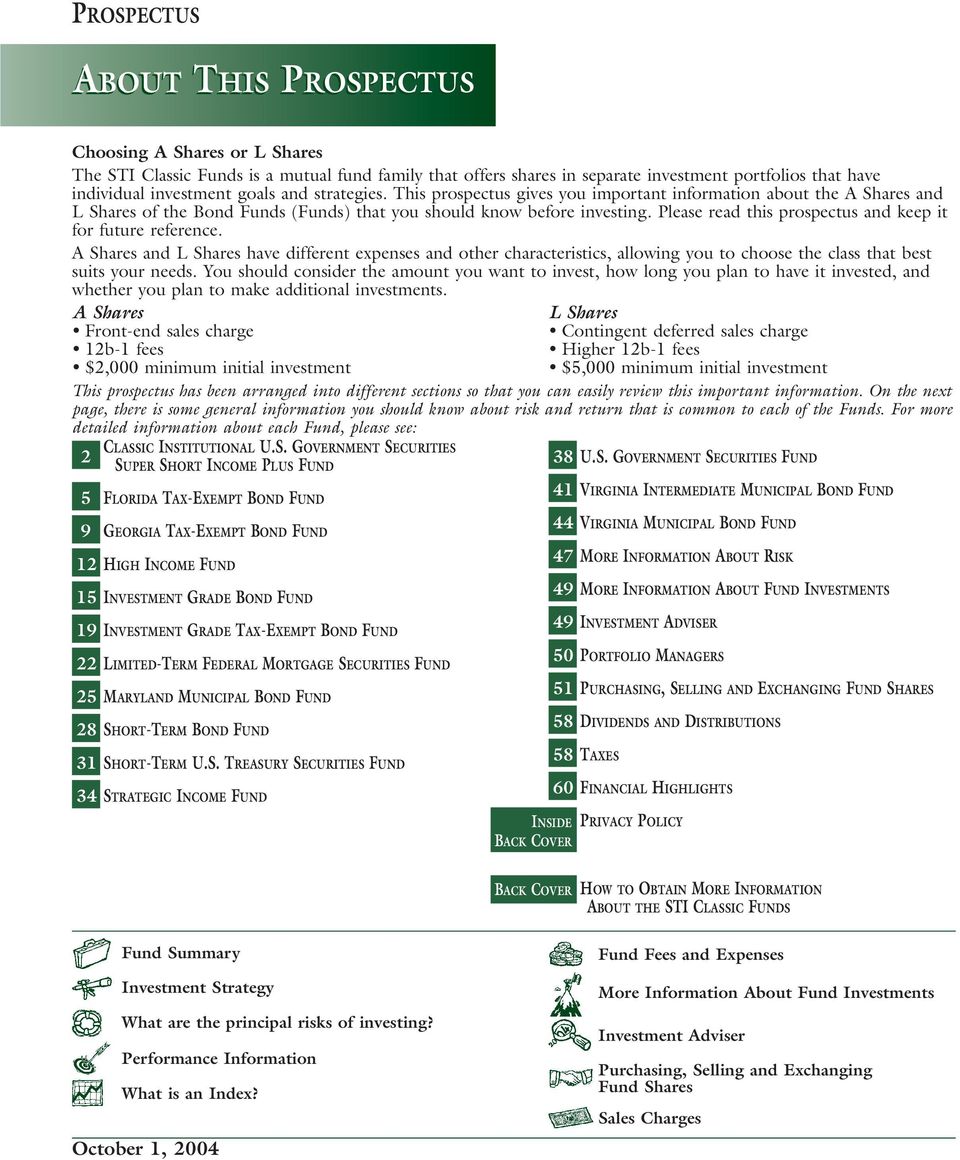
3 PROSPECTUS 1 CUSIP/TICKER SYMBOLS Fund Name Class Inception* Ticker CUSIP Classic Institutional U.S. Government Securities Super Short Income Plus Fund L Shares 4/16/03 CUSFX Florida Tax-Exempt Bond Fund A Shares 1/18/94 SFLTX Florida Tax-Exempt Bond Fund L Shares 6/1/95 SCFEX Georgia Tax-Exempt Bond Fund A Shares 1/19/94 SGTEX Georgia Tax-Exempt Bond Fund L Shares 6/6/95 SCGTX High Income Fund A Shares 9/30/03 SAHIX High Income Fund L Shares 5/4/94 STHIX Investment Grade Bond Fund A Shares 6/11/92 STGIX Investment Grade Bond Fund L Shares 6/7/95 SCIGX Investment Grade Tax-Exempt Bond Fund A Shares 6/9/92 SISIX Investment Grade Tax-Exempt Bond Fund L Shares 6/1/95 SCITX Limited-Term Federal Mortgage Securities Fund A Shares 7/18/94 SLTMX Limited-Term Federal Mortgage Securities Fund L Shares 6/7/95 SCLFX Maryland Municipal Bond Fund A Shares 9/30/03 SMMAX Maryland Municipal Bond Fund L Shares 4/25/96 CMDBX Short-Term Bond Fund A Shares 3/22/93 STSBX Short-Term Bond Fund L Shares 6/20/95 SCBSX Short-Term U.S. Treasury Securities Fund A Shares 3/18/93 STSFX Short-Term U.S. Treasury Securities Fund L Shares 6/22/95 SSUSX Strategic Income Fund A Shares 9/30/03 SAINX Strategic Income Fund L Shares 11/30/01 STIFX U.S. Government Securities Fund A Shares 6/6/94 SCUSX U.S. Government Securities Fund L Shares 6/7/95 SGUSX Virginia Intermediate Municipal Bond Fund A Shares 5/5/93 CVIAX Virginia Intermediate Municipal Bond Fund L Shares 9/30/03 SVILX Virginia Municipal Bond Fund A Shares 9/30/03 SVIAX Virginia Municipal Bond Fund L Shares 4/14/95 CVMBX * The performance included under Performance Information may include the performance of other classes of the Fund and/or predecessors of the Fund. RISK/RETURN INFORMATION COMMON TO THE STI CLASSIC FUNDS Each Fund is a mutual fund. A mutual fund pools shareholders money and, using professional investment managers, invests it in securities. Each Fund has its own investment goal and strategies for reaching that goal. The Adviser invests Fund assets in a way that it believes will help a Fund achieve its goal. Still, investing in each Fund involves risk and there is no guarantee that a Fund will achieve its goal. The Adviser s judgments about the markets, the economy or companies may not anticipate actual market movements, economic conditions or company performance, and these judgments may affect the return on your investment. In fact, no matter how good a job the Adviser does, you could lose money on your investment in the Fund, just as you could with other investments. A Fund share is not a bank deposit and it is not insured or guaranteed by the FDIC or any government agency. The value of your investment in a Fund is based on the market prices of the securities the Fund holds. These prices change daily due to economic and other events that affect particular companies and other issuers. These price movements, sometimes called volatility, may be greater or lesser depending on the types of securities a Fund owns and the markets in which they trade. The effect on a Fund of a change in the value of a single security will depend on how widely the Fund diversifies its holdings.
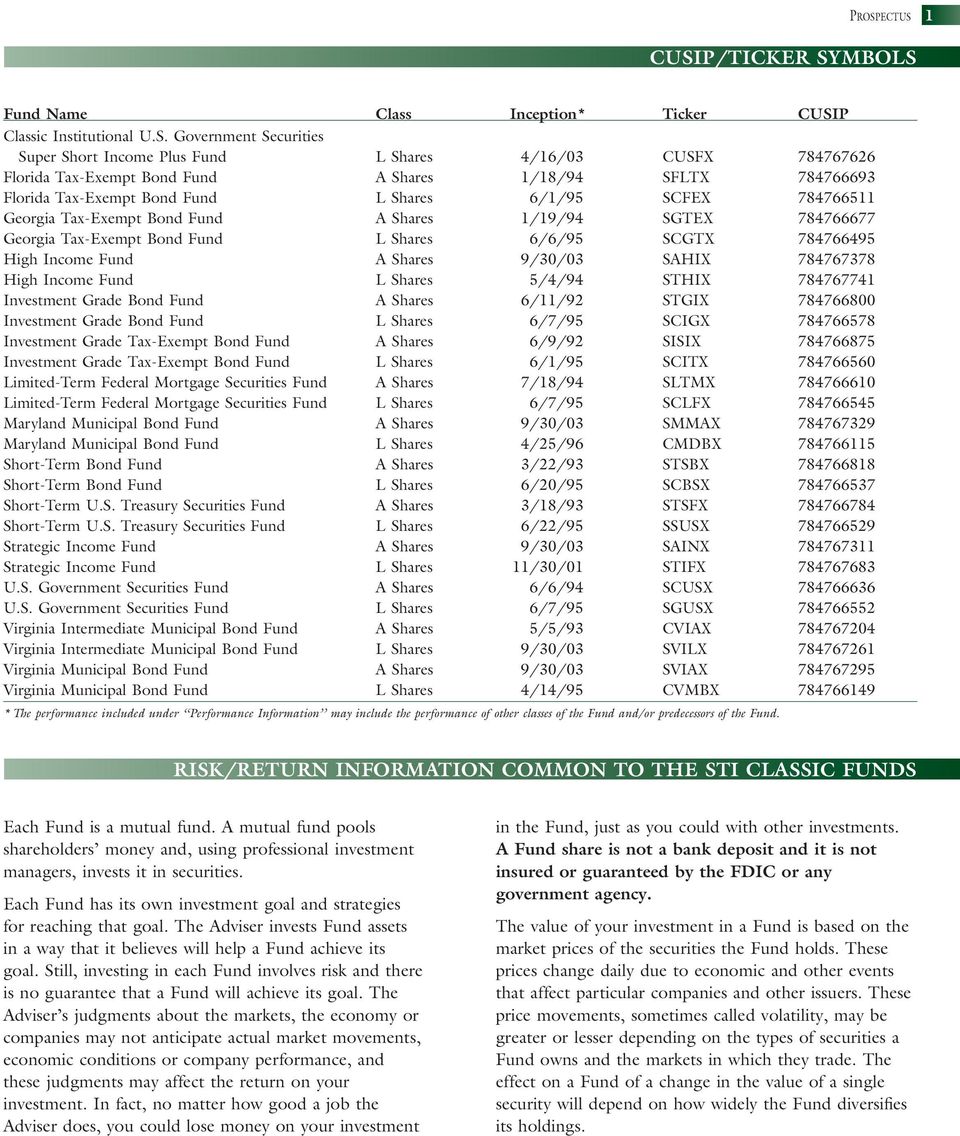
4 2 PROSPECTUS CLASSIC INSTITUTIONAL U.S. GOVERNMENT SECURITIES SUPER SHORT INCOME PLUS FUND Fund Summary Investment Goal Investment Focus Share Price Volatility Principal Investment Strategy Investor Profile High current income consistent with preserving capital and maintaining liquidity Short duration U.S. government securities Low Attempts to identify short duration U.S. government securities that offer a comparably better return potential and yield than money market funds Conservative investors seeking to maximize income consistent with limited share price volatility and the relative safety of U.S. government securities Investment Strategy Under normal circumstances, the Classic Institutional U.S. Government Securities Super Short Income Plus Fund invests at least 80% of its net assets in short duration U.S. Treasury securities, U.S. agency securities, U.S. agency mortgage-backed securities, repurchase agreements, and U.S. government securities. The Fund normally expects to maintain an average effective duration between three months and one year. Individual purchases will generally be limited to securities with a maturity/average life of less than three years. In selecting investments for the Fund, the Adviser attempts to maximize income by identifying securities that offer an acceptable yield for a given maturity. Most securities are purchased with the intent to hold to maturity. However, circumstances may warrant or require that securities be sold prior to maturity. In addition, in order to implement its investment strategy, the Fund may buy or sell, to a limited extent, derivative instruments (such as futures, options, and swaps) to use as a substitute for a purchase or sale of a position in the underlying assets and/or as part of a strategy designed to reduce exposure to other risks, such as interest rate risk. What are the principal risks of investing in this Fund? The price per share (net asset value or NAV) of the Fund will fluctuate depending on general changes in interest rates as well as changes in the yields of the specific securities in the Fund. General (or macro) changes in interest rates may be a result of economic developments or Federal Reserve policy. In general, the NAV of the Fund will rise when interest rates fall, and likewise, the NAV of the Fund will fall when interest rates rise. An objective of the Fund is to minimize NAV fluctuation by (a) maintaining the Fund average weighted duration between three months and one year and (b) investing the Fund in U.S. government and agency securities. The prices of the Fund s fixed income securities respond to economic developments, particularly interest rate changes, as well as to perceptions about the creditworthiness of individual issuers, including governments. Generally, the Fund s fixed income securities will decrease in value if interest rates rise and increase in value if interest rates fall. Also, longer-term securities are generally more volatile than shorter-term securities, so the average maturity or duration of these securities affects risk. The Fund is also subject to the risk that U.S. government debt securities may underperform other segments of the fixed income market or the fixed income market as a whole. Mortgage-backed securities are fixed income securities representing an interest in a pool of underlying mortgage loans. Mortgage-backed securities are sensitive to changes in interest rates, but may respond to these changes differently from other fixed income securities due to the possibility of prepayment of the underlying mortgage loans. As a result, it may not be possible to determine in advance the actual maturity date or average life of a mortgage-backed security. Rising interest rates tend to discourage refinancings, with the result that the average life and volatility of the security will increase, exacerbating its decrease in market price. When interest rates fall, however, mortgage-backed securities may not gain as much in market value because of the expectation of additional mortgage prepayments that must be reinvested at lower interest rates. Prepayment risk may make it difficult to calculate the average maturity of the portfolio of mortgage-backed securities and, therefore, to assess the volatility risk of the Fund. Although the Fund s U.S. government securities are considered to be among the safest investments, they are not guaranteed against price movements due to changing interest rates. Obligations issued by some U.S. government agencies are backed by the U.S. Treasury, while others are backed solely by the ability of the agency to borrow from the U.S. Treasury or by the agency s own resources. For information about the risks involved when investing in derivatives, see More Information About Risk.
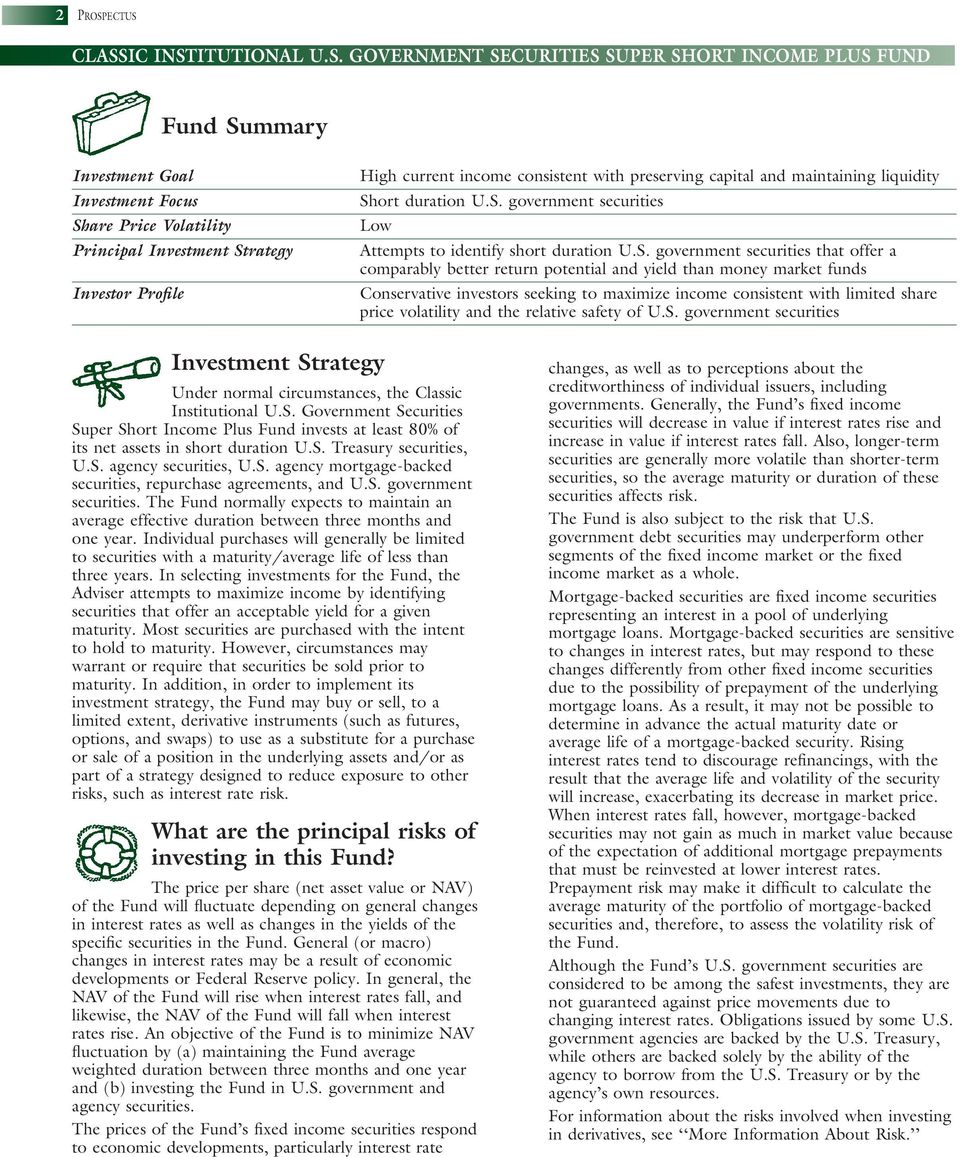
5 PROSPECTUS 3 CLASSIC INSTITUTIONAL U.S. GOVERNMENT SECURITIES SUPER SHORT INCOME PLUS FUND Performance Information This table compares the Fund s average annual total returns for the periods ended December 31, 2003, to those of the Citigroup 6-Month Treasury Bill Index, imoneynet Government Institutional Average, and Lipper Ultra- Short Obligation Funds Average. These returns reflect applicable sales charges and assumes shareholders redeem all of their shares at the end of the period indicated. The bar chart and the performance table that follow illustrate the risks and volatility of an investment in the Fund. Of course, the Fund s past performance does not necessarily indicate how the Fund will perform in the future. L Shares were offered beginning April 16, Performance between April 11, 2002 and April 16, 2003 is that of Institutional Shares of the Fund, and has not been adjusted to reflect L Share expenses. If it had been, performance would have been lower. Average Annual Total Returns After-tax returns are calculated using the historical highest individual federal marginal income tax rates and do not reflect the impact of state and local taxes. Your This bar chart shows changes in the performance of the actual after-tax returns will depend on your tax situation Fund s L Shares for the last year.* The chart does not and may differ from those shown. After-tax returns reflect sales charges. If sales charges had been reflected, shown are not relevant to investors who hold their returns would be less than those shown. Fund shares through tax-deferred arrangements, such as (k) plans or individual retirement accounts. L Shares 1 Year Since Inception* Before Taxes 0.63% 1.98% % After Taxes on -10 Distributions 0.04% 1.19% -20 After Taxes on Distributions and Sale of Fund Shares 0.35% 1.19% Best Quarter Worst Quarter Citigroup 6-Month Treasury 0.52% 0.13% Bill Index 1.18% 1.45% (3/30/03) (6/30/03) imoneynet, Inc. Government * The performance information shown above is based on a calendar year. The Fund s total return from 1/1/04 to 6/30/04 was 0.33%. Institutional Average 0.75% 1.00% Lipper Ultra-Short Obligation Funds Average 1.50% 2.11% * Since inception of the Institutional Shares on April 11, Benchmark returns since March 31, 2002 (benchmark returns available only on a month end basis).
6 4 PROSPECTUS CLASSIC INSTITUTIONAL U.S. GOVERNMENT SECURITIES SUPER SHORT INCOME PLUS FUND Institutional Average is a widely-recognized composite of money market funds that invest in U.S. Treasury bills, repurchase agreements or securities issued by agencies of the U.S. Government. The number of funds in the Average varies. The Lipper Ultra-Short Obligation Funds Average consists of funds that invest at least 65% of their assets in investment grade debt issues, or better, and maintain a portfolio dollar- weighted average maturity between 91 days and 365 days. The number of Funds in the Average varies. What is an Index? An index measures the market prices of a specific group of securities in a particular market or market sector. You cannot invest directly in an index. Unlike a mutual fund, an index does not have an investment adviser and does not pay any commissions or expenses. If an index had expenses, its performance would be lower. The Citigroup 6-Month Treasury Bill Index is a widely-recognized index of the 6 month U.S. Treasury Bills. imoneynet, Inc. Government Fund Fees and Expenses This table describes the Fund s fees and expenses that you may pay if you buy and hold Fund shares. You do not pay a sales charge when you purchase the Fund s L Shares. In addition, the contingent deferred sales charge (CDSC) normally imposed on L Shares has been waived. Shareholder Fees (fees paid directly from your investment) L Shares Maximum Deferred Sales Charge (Load) (as a percentage of net asset value)* None Redemption Fee (as a percentage of net asset value)** 2.00% * See Waiver of Contingent Deferred Sales Charge. ** This redemption fee may be imposed if you redeem or exchange your shares within ninety days of purchase. See Market Timers. Annual Fund Operating Expenses (expenses deducted from Fund assets) L Shares Investment Advisory Fees 0.40% Distribution and Service (12b-1) Fees 0.40% Other Expenses* 0.06% Total Annual Operating Expenses** 0.86% * The expense information in the table has been restated to reflect current fees. ** The Adviser or the Distributor may waive a portion of their fees in order to limit the total operating expenses to the level set forth below. The Adviser or the Distributor may discontinue all or a part of these fee waivers at any time. Classic Institutional U.S. Government Securities Super Short Income Plus Fund L Shares 0.47% Example This Example is intended to help you compare the cost of investing in the Fund with the cost of investing in other mutual funds. The Example assumes that you invest $10,000 in the Fund for the time periods indicated and that you sell your shares at the end of the period. The Example also assumes that each year your investment has a 5% return, Fund operating expenses remain the same and you reinvest all dividends and distributions. Although your actual costs and returns might be different, your approximate costs of investing $10,000 in the Fund would be: 1 Year 3 Years $ 88 $274 Fund Expenses Every mutual fund has operating expenses to pay for professional advisory, shareholder, distribution, administration and custody services. The Fund s expenses in the table above are shown as a percentage of the Fund s net assets. These expenses are deducted from Fund assets. For more information about these fees, see Investment Adviser and Distribution of Fund Shares.
7 PROSPECTUS 5 FLORIDA TAX-EXEMPT BOND FUND Fund Summary Investment Goal Investment Focus Share Price Volatility Principal Investment Strategy Investor Profile Current income exempt from federal income taxes for Florida residents with shares themselves expected to be exempt from the Florida intangible personal property tax Florida municipal securities Moderate Attempts to invest more Fund assets in undervalued sectors and less in overvalued ones Florida residents who want income exempt from federal income taxes Investment Strategy The Florida Tax-Exempt Bond Fund invests at least 80% of its net assets in municipal securities with income exempt from federal income taxes, and the shares themselves are expected to be exempt from the Florida intangible personal property tax. Issuers of these securities can be located in Florida, Puerto Rico and other U.S. territories and possessions. In addition, up to 20% of the Fund s assets may be invested in securities subject to the alternative minimum tax or in certain taxable debt securities. In selecting investments for the Fund, the Adviser tries to limit risk as much as possible. Based on the Adviser s analysis of municipalities, credit risk, market trends and investment cycles, the Adviser attempts to invest more of the Fund s assets in undervalued market sectors and less in overvalued sectors. The Adviser tries to diversify the Fund s holdings within Florida. The Adviser also tries to identify and invest in municipal issuers with improving credit and avoid those with deteriorating credit. The Adviser anticipates that the Fund s average weighted maturity will range from 6 to 25 years. Under certain circumstances, such as a national financial emergency or a temporary decline in availability of Florida obligations, up to 20% of the Fund s assets may be invested in securities subject to the Florida intangible personal property tax and/or securities that generate income subject to federal personal income taxes. These securities may include short-term municipal securities outside Florida or certain taxable fixed income securities. In addition, in order to implement its investment strategy, the Fund may buy or sell, to a limited extent, derivative instruments (such as futures, options, and swaps) to use as a substitute for a purchase or sale of a position in the underlying assets and/or as part of a strategy designed to reduce exposure to other risks, such as interest rate risk. What are the principal risks of investing in this Fund? The prices of the Fund s fixed income securities respond to economic developments, particularly interest rate changes, as well as to perceptions about the creditworthiness of individual issuers, including governments. Generally, the Fund s fixed income securities will decrease in value if interest rates rise and vice versa, and the volatility of lower-rated securities is even greater than that of higher-rated securities. Also, longer-term securities are generally more volatile, so the average maturity or duration of these securities affects risk. There may be economic or political changes that impact the ability of municipal issuers to repay principal and to make interest payments on municipal securities. Changes in the financial condition or credit rating of municipal issuers also may adversely affect the value of the Fund s securities. The Fund s concentration of investments in securities of issuers located in Florida subjects the Fund to economic and government policies of Florida. For information about the risks involved when investing in derivatives, see More Information About Risk.
8 6 PROSPECTUS FLORIDA TAX-EXEMPT BOND FUND A Shares 1 Year 5 Years Since Inception* Performance Information The bar chart and the performance table Before Taxes 0.10% 4.41% 5.31% that follow illustrate the risks and volatility of an investment in the Fund. Of course, the Fund s past performance does not necessarily indicate how the After Taxes Fund will perform in the future. on Distributions 0.28% 4.22% 5.13% This bar chart shows changes in the performance of the Fund s A Shares from year to year.* The chart does not After Taxes on reflect sales charges. If sales charges had been reflected, Distributions and returns would be less than those shown. Sale of Fund Shares 1.30% 4.19% 5.02% 20 Lehman Brothers 15.70% 10-Year Municipal % Bond Index (reflects 10.23% 10 no deduction for 7.60% 5.94% fees, expenses 3.73% 3.56% 3.97% 5 or taxes) 5.70% 5.91% 6.05% 0 Lipper Florida Municipal Debt -2.41% -5 Funds Objective (reflects no Best Quarter Worst Quarter deduction for taxes) 4.35% 4.44% 4.98% 6.13% 2.35% * Since inception of the A Shares on January 18, Benchmark (3/31/95) (6/30/99) returns since January 31, 1994 (benchmark returns available only on * The performance information shown above is based on a calendar year. a month end basis). The Fund s total return from 1/1/04 to 6/30/04 was 1.79%. L Shares 1 Year 5 Years Since Inception* Average Annual Total Returns Before Taxes 1.47% 4.69% 5.24% This table compares the Fund s average annual total returns for the periods ended December 31, 2003, to those Lehman Brothers of the Lehman Brothers 10-Year Municipal Bond Index 10-Year Municipal and the Lipper Florida Municipal Debt Funds Objective. Bond Index (reflects These returns reflect applicable sales charges and assumes no deduction for shareholders redeem all of their shares at the end of the fees, expenses period indicated. or taxes) 5.70% 5.91% 6.55% After-tax returns are calculated using the historical Lipper Florida highest individual federal marginal income tax rates and Municipal Debt do not reflect the impact of state and local taxes. Your Funds Objective actual after-tax returns will depend on your tax situation (reflects no and may differ from those shown. After-tax returns deduction for taxes) 4.35% 4.44% 5.44% shown are not relevant to investors who hold their Fund shares through tax-deferred arrangements, such as * Since inception of the L Shares on June 1, Benchmark returns 401(k) plans or individual retirement accounts. After-tax since May 31, 1995 (benchmark returns available only on a month returns are shown for only the A Shares. After-tax end basis). returns for other classes will vary.
9 PROSPECTUS 7 FLORIDA TAX-EXEMPT BOND FUND What is an Index? An index measures the market prices of a specific group of securities in a particular market or market sector. You cannot invest directly in an index. Unlike a mutual fund, an index does not have an investment adviser and does not pay any commissions or expenses. If an index had expenses, its performance would be lower. The Lehman Brothers 10-Year Municipal Bond Index is a widely-recognized index of long-term investment grade tax-exempt bonds. The Index includes general obligation bonds, revenue bonds, insured bonds and prefunded bonds with maturities between 8 and 12 years. The Index represents various market sectors and geographic locations. The Lipper Florida Municipal Debt Funds Objective is a composite index of mutual funds with investment goals similar to the Fund s goals. It reports the average return of the Florida intermediate-term municipal bond mutual funds tracked by Lipper Analytical Services, Inc. The number of funds in the Objective varies. Fund Fees and Expenses This table describes the Fund s fees and expenses that you may pay if you buy and hold Fund shares. Shareholder Fees (fees paid directly from your investment) A Shares L Shares Maximum Sales Charge Imposed on Purchases (as a percentage of offering price)* 3.75% None Maximum Deferred Sales Charge (as a percentage of net asset value)** None 2.00% Redemption Fee (as a percentage of net asset value)*** 2.00% 2.00% * This sales charge varies depending upon how much you invest. You may buy A Shares in amounts of $1,000,000 or more at net asset value (without an initial sales charge), but if you redeem those shares within one year of your purchase, you will pay a deferred sales charge of 1.00%. See Sales Charges. ** This sales charge is imposed if you sell L Shares within one year of your purchase. See Sales Charges. *** This redemption fee may be imposed if you redeem or exchange your shares within ninety days of purchase. See Market Timers. Annual Fund Operating Expenses (expenses deducted from Fund assets) A Shares L Shares Investment Advisory Fees 0.65% 0.65% Distribution and Service (12b-1) Fees 0.18% 1.00% Other Expenses* 0.06% 0.06% Total Annual Operating Expenses** 0.89% 1.71% * The expense information in the table has been restated to reflect current fees. ** The Adviser or the Distributor may waive a portion of their fees in order to limit the total operating expenses to the levels set forth below. The Adviser or the Distributor may discontinue all or a part of these fee waivers at any time. Florida Tax-Exempt Bond Fund A Shares 0.86% Florida Tax-Exempt Bond Fund L Shares 1.42%
10 8 PROSPECTUS FLORIDA TAX-EXEMPT BOND FUND Example This Example is intended to help you compare the cost of investing in the Fund with the cost of investing in other mutual funds. The Example assumes that you invest $10,000 in the Fund for the time periods indicated. The Example also assumes that each year your investment has a 5% return, Fund operating expenses remain the same and you reinvest all dividends and distributions. Although your actual costs and returns might be different, your approximate costs of investing $10,000 in the Fund would be: If you sell your shares at the end of the period: 1 Year 3 Years 5 Years 10 Years A Shares $462 $648 $850 $1,430 L Shares $374 $539 $928 $2,019 If you do not sell your shares at the end of the period: 1 Year 3 Years 5 Years 10 Years A Shares $462 $648 $850 $1,430 L Shares $174 $539 $928 $2,019 Fund Expenses Every mutual fund has operating expenses to pay for professional advisory, shareholder, distribution, administration and custody services. The Fund s expenses in the table above are shown as a percentage of the Fund s net assets. These expenses are deducted from Fund assets. For more information about these fees, see Investment Adviser and Distribution of Fund Shares.

11 PROSPECTUS 9 GEORGIA TAX-EXEMPT BOND FUND Fund Summary Investment Goal Investment Focus Share Price Volatility Principal Investment Strategy Investor Profile Current income exempt from federal and state income taxes for Georgia residents without undue risk Georgia municipal securities Moderate Attempts to invest more Fund assets in undervalued sectors and less in overvalued ones Georgia residents who want income exempt from federal and state income taxes Investment Strategy There may be economic or political changes that impact The Georgia Tax-Exempt Bond Fund the ability of municipal issuers to repay principal and to invests at least 80% of its net assets in make interest payments on municipal securities. Changes municipal securities with income exempt from federal and in the financial condition or credit rating of municipal Georgia income taxes. Issuers of these securities can be issuers also may adversely affect the value of the Fund s located in Georgia, Puerto Rico and other U.S. securities. territories and possessions. In addition, up to 20% of the The Fund s concentration of investments in securities of Fund s assets may be invested in securities subject to the issuers located in Georgia subjects the Fund to alternative minimum tax or in certain taxable debt economic conditions and government policies within securities. In selecting investments for the Fund, the Georgia. Adviser tries to limit risk as much as possible. Based on the Adviser s analysis of municipalities, credit risk, market For information about the risks involved when investing trends and investment cycles, the Adviser attempts to in derivatives, see More Information About Risk. invest more of the Fund s assets in undervalued market sectors and less in overvalued sectors. The Adviser tries to diversify the Fund s holdings within Georgia. The Performance Information Adviser also tries to identify and invest in municipal The bar chart and the performance table issuers with improving credit and avoid those with that follow illustrate the risks and volatility deteriorating credit. The Adviser anticipates that the of an investment in the Fund. Of course, the Fund s Fund s average weighted maturity will range from 6 to past performance does not necessarily indicate how the 25 years. In addition, in order to implement its Fund will perform in the future. investment strategy, the Fund may buy or sell, to a limited extent, derivative instruments (such as futures, This bar chart shows changes in the performance of the options, and swaps) to use as a substitute for a purchase Fund s A Shares from year to year.* The chart does not or sale of a position in the underlying assets and/or as reflect sales charges. If sales charges had been reflected, part of a strategy designed to reduce exposure to other returns would be less than those shown. risks, such as interest rate risk. 20 What are the principal risks of investing in this Fund? The prices of the Fund s fixed income 3.43% 4.00% 3.63% 5 securities respond to economic developments, particularly interest rate changes, as well as to 0 perceptions about the creditworthiness of individual -2.49% issuers, including governments. Generally, the Fund s fixed income securities will decrease in value if interest rates rise and vice versa, and the volatility of lower-rated Best Quarter Worst Quarter securities is even greater than that of higher-rated 4.84% 2.35% securities. Also, longer-term securities are generally (3/31/95) (6/30/99) more volatile, so the average maturity or duration of * The performance information shown above is based on a calendar year. these securities affects risk. The Fund s total return from 1/1/04 to 6/30/04 was 1.84% % 7.96% 5.47% 9.30% 8.94%
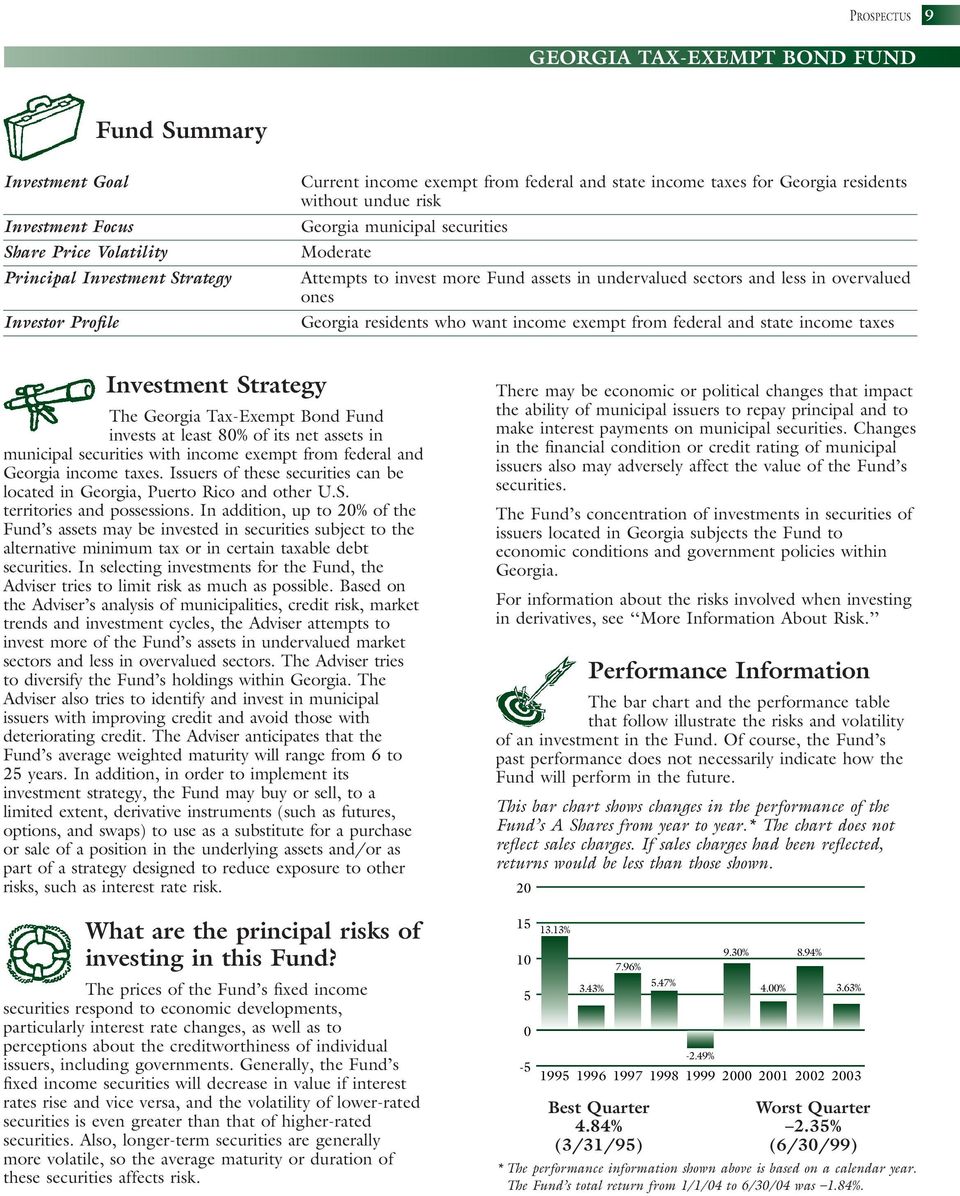
12 10 PROSPECTUS GEORGIA TAX-EXEMPT BOND FUND Average Annual Total Returns L Shares 1 Year 5 Years Since Inception* This table compares the Fund s average annual total Before Taxes returns for the periods ended December 31, 2003, to those of the Lehman Brothers 10-Year Municipal Bond Index Lehman Brothers 1.21% 4.10% 4.66% and the Lipper Georgia Municipal Debt Funds Objective. 10-Year Municipal These returns reflect applicable sales charges and assumes Bond Index (reflects shareholders redeem all of their shares at the end of the no deduction for fees, period indicated. expenses or taxes) 5.70% 5.91% 6.55% After-tax returns are calculated using the historical Lipper Georgia highest individual federal marginal income tax rates and Municipal Debt do not reflect the impact of state and local taxes. Your Funds Objective actual after-tax returns will depend on your tax situation (reflects no deduction and may differ from those shown. After-tax returns for taxes) 4.61% 4.68% 5.63% shown are not relevant to investors who hold their Fund shares through tax-deferred arrangements, such as * Since inception of the L Shares on June 6, Benchmark returns 401(k) plans or individual retirement accounts. After-tax since May 31, 1995 (benchmark returns available only a month end returns are shown for only the A Shares. After-tax basis). returns for other classes will vary. A Shares 1 Year 5 Years Since Inception* What is an Index? Before Taxes 0.21% 3.79% 4.33% An index measures the market prices of a specific group of securities in a particular market or market sector. You cannot invest directly in an index. Unlike a mutual fund, an index does not have After Taxes on an investment adviser and does not pay any commissions Distributions 0.31% 3.75% 4.27% or expenses. If an index had expenses, its performance would be lower. The Lehman Brothers 10-Year After Taxes on Municipal Bond Index is a widely-recognized index of Distributions and Sale long-term investment grade tax-exempt bonds. The of Fund Shares 1.08% 3.73% 4.22% Index includes general obligation bonds, revenue bonds, insured bonds and prefunded bonds with maturities Lehman Brothers between 8 and 12 years. The Index represents various 10-Year Municipal market sectors and geographic locations. The Lipper Bond Index (reflects Georgia Municipal Debt Funds Objective is a composite no deduction for fees, index of mutual funds with investment goals similar to expenses or taxes) 5.70% 5.91% 6.05% the Fund s goals. It reports the average return of the Georgia intermediate-term municipal bond mutual funds Lipper Georgia tracked by Lipper Analytical Services, Inc. The number Municipal Debt of funds in the Objective varies. Funds Objective (reflects no deduction for taxes) 4.61% 4.68% 4.93% * Since inception of the A Shares on January 19, Benchmark returns since January 31, 1994 (benchmark returns available only on a month end basis).

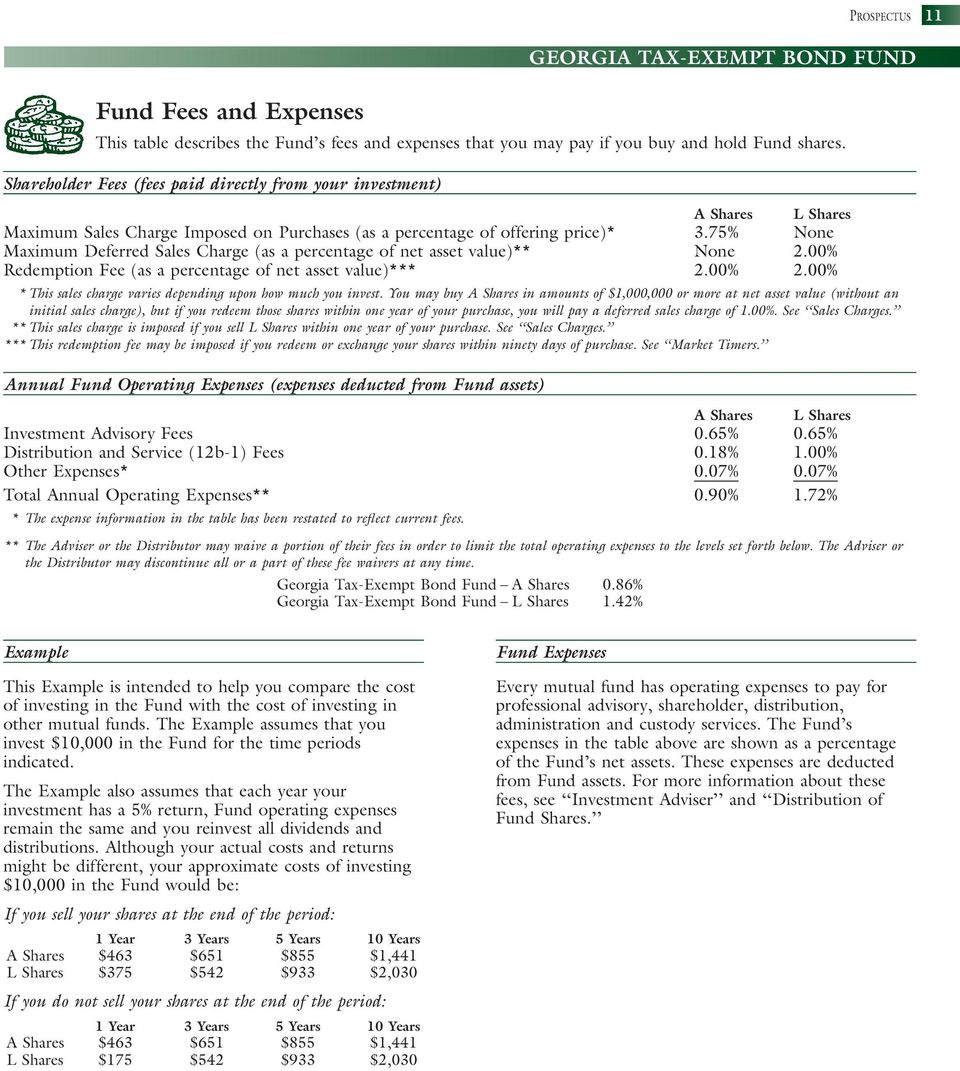
13 PROSPECTUS 11 Fund Fees and Expenses This table describes the Fund s fees and expenses that you may pay if you buy and hold Fund shares. Shareholder Fees (fees paid directly from your investment) A Shares L Shares Maximum Sales Charge Imposed on Purchases (as a percentage of offering price)* 3.75% None Maximum Deferred Sales Charge (as a percentage of net asset value)** None 2.00% Redemption Fee (as a percentage of net asset value)*** 2.00% 2.00% * This sales charge varies depending upon how much you invest. You may buy A Shares in amounts of $1,000,000 or more at net asset value (without an initial sales charge), but if you redeem those shares within one year of your purchase, you will pay a deferred sales charge of 1.00%. See Sales Charges. ** This sales charge is imposed if you sell L Shares within one year of your purchase. See Sales Charges. *** This redemption fee may be imposed if you redeem or exchange your shares within ninety days of purchase. See Market Timers. Annual Fund Operating Expenses (expenses deducted from Fund assets) GEORGIA TAX-EXEMPT BOND FUND A Shares L Shares Investment Advisory Fees 0.65% 0.65% Distribution and Service (12b-1) Fees 0.18% 1.00% Other Expenses* 0.07% 0.07% Total Annual Operating Expenses** 0.90% 1.72% * The expense information in the table has been restated to reflect current fees. ** The Adviser or the Distributor may waive a portion of their fees in order to limit the total operating expenses to the levels set forth below. The Adviser or the Distributor may discontinue all or a part of these fee waivers at any time. Georgia Tax-Exempt Bond Fund A Shares 0.86% Georgia Tax-Exempt Bond Fund L Shares 1.42% Example This Example is intended to help you compare the cost of investing in the Fund with the cost of investing in other mutual funds. The Example assumes that you invest $10,000 in the Fund for the time periods indicated. The Example also assumes that each year your investment has a 5% return, Fund operating expenses remain the same and you reinvest all dividends and distributions. Although your actual costs and returns might be different, your approximate costs of investing $10,000 in the Fund would be: If you sell your shares at the end of the period: 1 Year 3 Years 5 Years 10 Years A Shares $463 $651 $855 $1,441 L Shares $375 $542 $933 $2,030 If you do not sell your shares at the end of the period: 1 Year 3 Years 5 Years 10 Years A Shares $463 $651 $855 $1,441 L Shares $175 $542 $933 $2,030 Fund Expenses Every mutual fund has operating expenses to pay for professional advisory, shareholder, distribution, administration and custody services. The Fund s expenses in the table above are shown as a percentage of the Fund s net assets. These expenses are deducted from Fund assets. For more information about these fees, see Investment Adviser and Distribution of Fund Shares.
14 12 PROSPECTUS HIGH INCOME FUND Fund Summary Investment Goals Primary Secondary Investment Focus Share Price Volatility Principal Investment Strategy Investor Profile High current income Total return High yield corporate, government, and other debt instruments of U.S. and non U.S. issuers High Attempts to identify lower-rated securities offering high current income of issuers generating adequate cash flow to meet their obligations Investors who seek high current income and who are willing to accept greater share price volatility through investment in high yield, below investment grade debt instruments Investment Strategy The High Income Fund invests primarily in a diversified portfolio of higher yielding, lower rated income producing securities of U.S. and non-u.s. issuers. The Fund will invest at least 65%, and may invest up to 100%, of its assets in securities rated as non-investment grade by Moody s Investor Services, Inc. or by Standard & Poor s Rating Services or in unrated securities if, in the Adviser s opinion, they are of comparable quality. Such securities are commonly known as junk bonds and offer greater risks than investment grade bonds (i.e., rated BBB or above by S&P or Baa3 or above by Moody s). In selecting debt securities for the Fund the Adviser seeks out companies with good fundamentals and performing prospects that are currently out of favor with investors. The primary basis for security selection is the potential income offered by the security relative to the Adviser s assessment of the issuer s ability to generate the cash flow required to meet its obligation. The Adviser employs a bottom-up approach, identifying investment opportunities based on the underlying financial and economic fundamentals of the specific issuer. Due to its investment strategy, the Fund may buy and sell securities frequently, which may result in higher transaction costs and additional capital gains tax liabilities. In addition, in order to implement its investment strategy, the Fund may buy or sell, to a limited extent, derivative instruments (such as futures, options, and swaps) to use as a substitute for a purchase or sale of a position in the underlying assets and/or as part of a strategy designed to reduce exposure to other risks, such as interest rate risk. What are the principal risks of investing in this Fund? The prices of the Fund s fixed income securities respond to economic developments, particularly interest rate changes, as well as to perceptions about the creditworthiness of individual issuers, including governments. Generally, the Fund s fixed income securities will decrease in value if interest rates rise and vice versa, and the volatility of lower-rated securities is even greater than that of higher-rated securities. Also, longer-term securities are generally more volatile, so the average maturity or duration of these securities affects risk. High yield securities involve greater risks of default or downgrade and are more volatile than investment grade securities. Junk bonds involve greater risk of default or price declines than investment grade securities due to actual or perceived changes in an issuer s creditworthiness. In addition, issuers of junk bonds may be more susceptible than other issuers to economic downturns. Junk bonds are subject to the risk that the issuer may not be able to pay interest or dividends and ultimately to repay principal upon maturity. Discontinuation of these payments could substantially adversely affect the market value of the security. Investing in foreign countries poses additional risks since political and economic events unique to a country or region will affect those markets and their issuers. These events will not necessarily affect the U.S. economy or similar issuers located in the United States. In addition, investments in foreign countries are generally denominated in a foreign currency. As a result, changes in the value of those currencies compared to the U.S. dollar may affect (positively or negatively) the value of a Fund s investments. These currency movements may happen separately from and in response to events that do not otherwise affect the value of the security in the
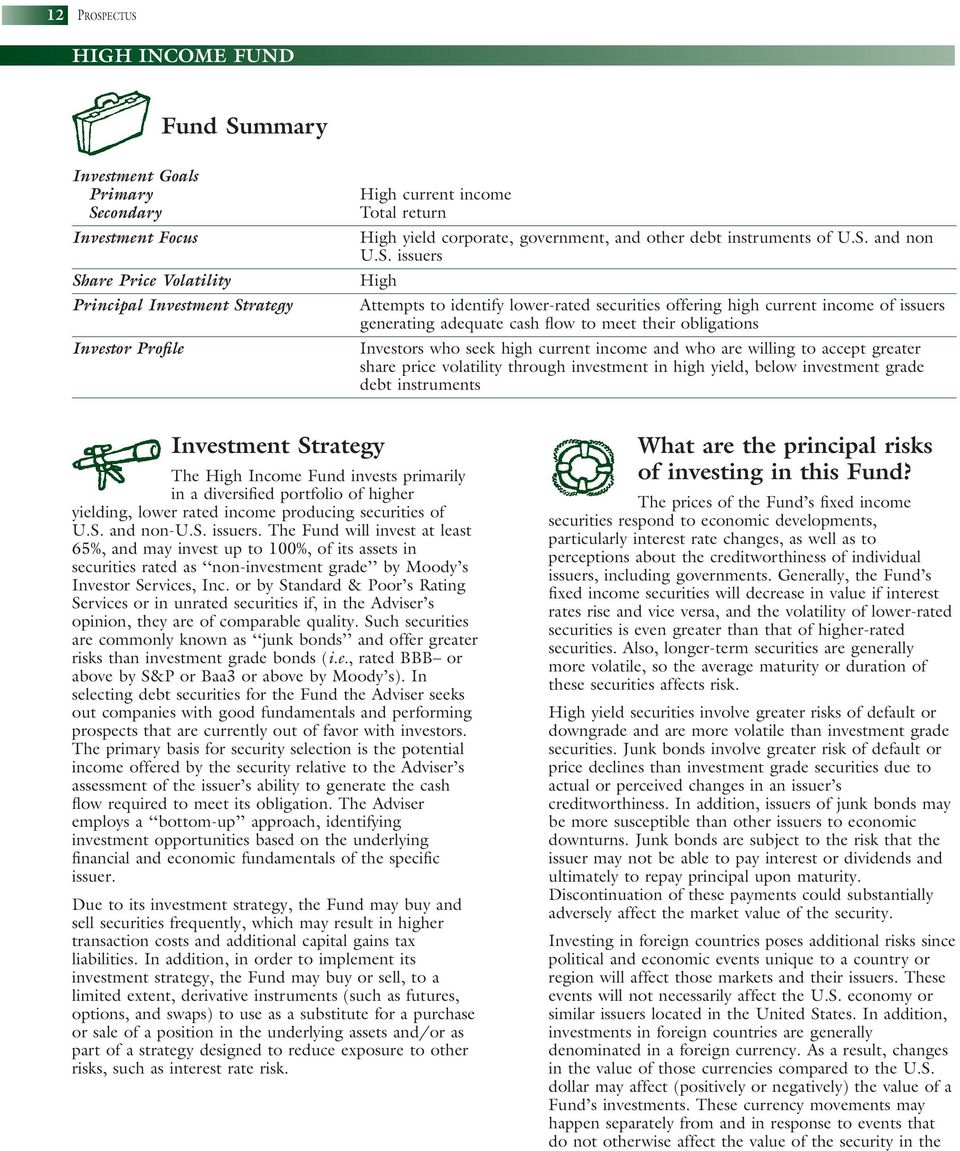
15 PROSPECTUS 13 HIGH INCOME FUND issuer s home country. These various risks will be even greater for investments in emerging market countries since political turmoil and rapid changes in economic conditions are more likely to occur in these countries. For information about the risks involved when investing in derivatives, see More Information About Risk. Performance Information The bar chart and the performance table that follow illustrate the risks and volatility of an investment in the Fund. Of course, the Fund s past performance does not necessarily indicate how the Fund will perform in the future. The periods prior to March 28, 2000 represent the performance of the ESC Strategic Income Fund, the Fund s predecessor. This bar chart shows changes in the performance of the Fund s L Shares from year to year.* The chart does not reflect sales charges. If sales charges had been reflected, returns would be less than those shown % 5.84% 5.05% 4.43% 1.28% -9.46% 5.55% -3.75% 24.83% Best Quarter Worst Quarter 8.56% 9.92% (6/30/03) (3/31/00) * The performance information shown above is based on a calendar year. The Fund s total return from 1/1/04 to 6/30/04 was 1.06%. Average Annual Total Returns This table compares the Fund s average annual total returns for the periods ended December 31, 2003, to those of the Lehman Brothers U.S. Corporate High Yield Bond Index. These returns reflect applicable sales charges and assumes shareholders redeem all of their shares at the end of the period indicated. After-tax returns are calculated using the historical highest individual federal marginal income tax rates and do not reflect the impact of state and local taxes. Your actual after-tax returns will depend on your tax situation and may differ from those shown. After-tax returns shown are not relevant to investors who hold their Fund shares through tax-deferred arrangements, such as 401(k) plans or individual retirement accounts. L Shares 1 Year 5 Years Since Inception* Before Taxes 22.83% 3.06% 4.50% After Taxes on Distributions 19.51% 0.03% 1.63% After Taxes on Distributions and Sale of Fund Shares 14.63% 0.67% 2.01% Lehman Brothers U.S. Corporate High Yield Bond Index (reflects no deduction for fees, expenses or taxes) 28.97% 5.23% 7.43% * Since inception of the L Shares on May 4, Benchmark returns since April 30, 1994 (benchmark returns available only a month end basis). What is an Index? An index measures the market prices of a specific group of securities in a particular market or market sector. You cannot invest directly in an index. Unlike a mutual fund, an index does not have an investment adviser and does not pay any commissions or expenses. If an index had expenses, its performance would be lower. The Lehman Brothers U.S. Corporate High Yield Bond Index is a widely-recognized, market value-weighted (higher market value bonds have more influence than lower market value bonds) index which covers the universe of fixed rate, non-investment grade debt.
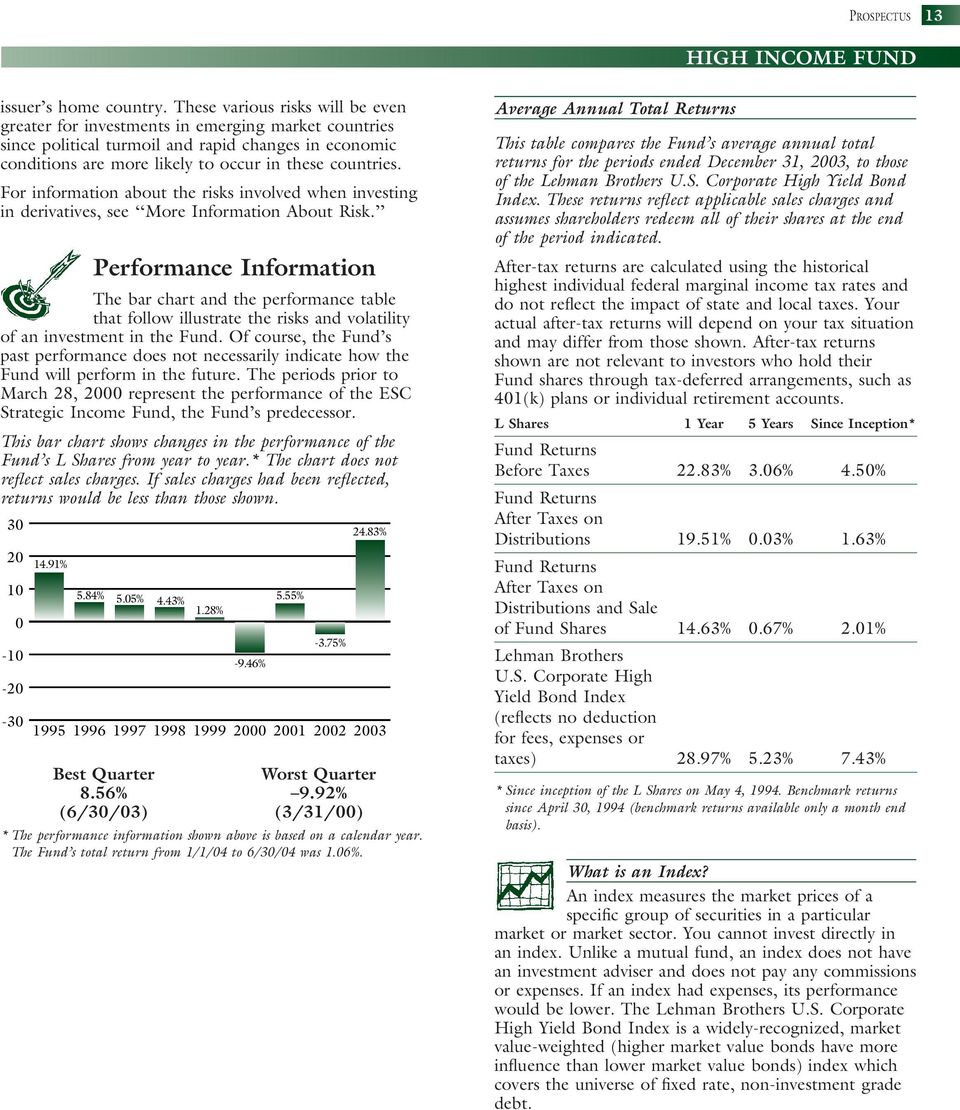
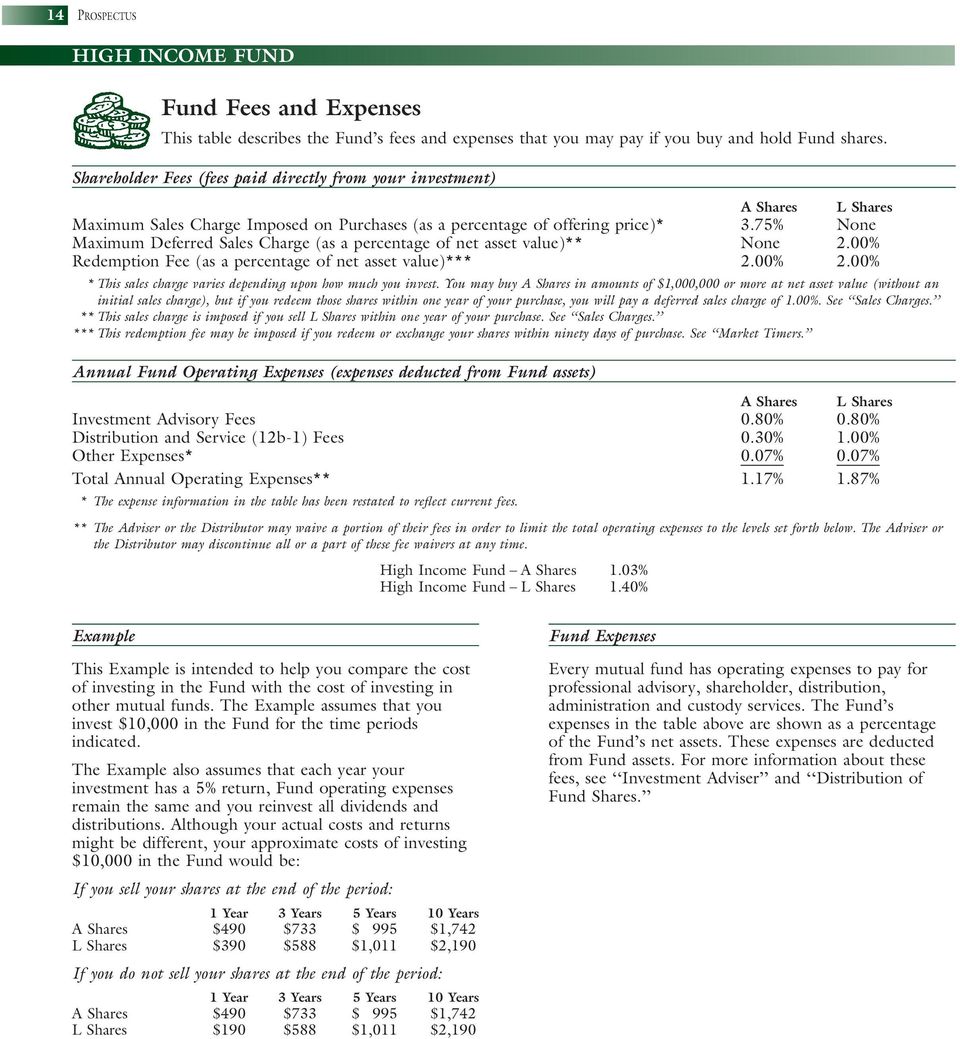
16 14 PROSPECTUS HIGH INCOME FUND Fund Fees and Expenses This table describes the Fund s fees and expenses that you may pay if you buy and hold Fund shares. Shareholder Fees (fees paid directly from your investment) A Shares L Shares Maximum Sales Charge Imposed on Purchases (as a percentage of offering price)* 3.75% None Maximum Deferred Sales Charge (as a percentage of net asset value)** None 2.00% Redemption Fee (as a percentage of net asset value)*** 2.00% 2.00% * This sales charge varies depending upon how much you invest. You may buy A Shares in amounts of $1,000,000 or more at net asset value (without an initial sales charge), but if you redeem those shares within one year of your purchase, you will pay a deferred sales charge of 1.00%. See Sales Charges. ** This sales charge is imposed if you sell L Shares within one year of your purchase. See Sales Charges. *** This redemption fee may be imposed if you redeem or exchange your shares within ninety days of purchase. See Market Timers. Annual Fund Operating Expenses (expenses deducted from Fund assets) A Shares L Shares Investment Advisory Fees 0.80% 0.80% Distribution and Service (12b-1) Fees 0.30% 1.00% Other Expenses* 0.07% 0.07% Total Annual Operating Expenses** 1.17% 1.87% * The expense information in the table has been restated to reflect current fees. ** The Adviser or the Distributor may waive a portion of their fees in order to limit the total operating expenses to the levels set forth below. The Adviser or the Distributor may discontinue all or a part of these fee waivers at any time. High Income Fund A Shares 1.03% High Income Fund L Shares 1.40% Example This Example is intended to help you compare the cost of investing in the Fund with the cost of investing in other mutual funds. The Example assumes that you invest $10,000 in the Fund for the time periods indicated. The Example also assumes that each year your investment has a 5% return, Fund operating expenses remain the same and you reinvest all dividends and distributions. Although your actual costs and returns might be different, your approximate costs of investing $10,000 in the Fund would be: If you sell your shares at the end of the period: 1 Year 3 Years 5 Years 10 Years A Shares $490 $733 $ 995 $1,742 L Shares $390 $588 $1,011 $2,190 If you do not sell your shares at the end of the period: 1 Year 3 Years 5 Years 10 Years A Shares $490 $733 $ 995 $1,742 L Shares $190 $588 $1,011 $2,190 Fund Expenses Every mutual fund has operating expenses to pay for professional advisory, shareholder, distribution, administration and custody services. The Fund s expenses in the table above are shown as a percentage of the Fund s net assets. These expenses are deducted from Fund assets. For more information about these fees, see Investment Adviser and Distribution of Fund Shares.
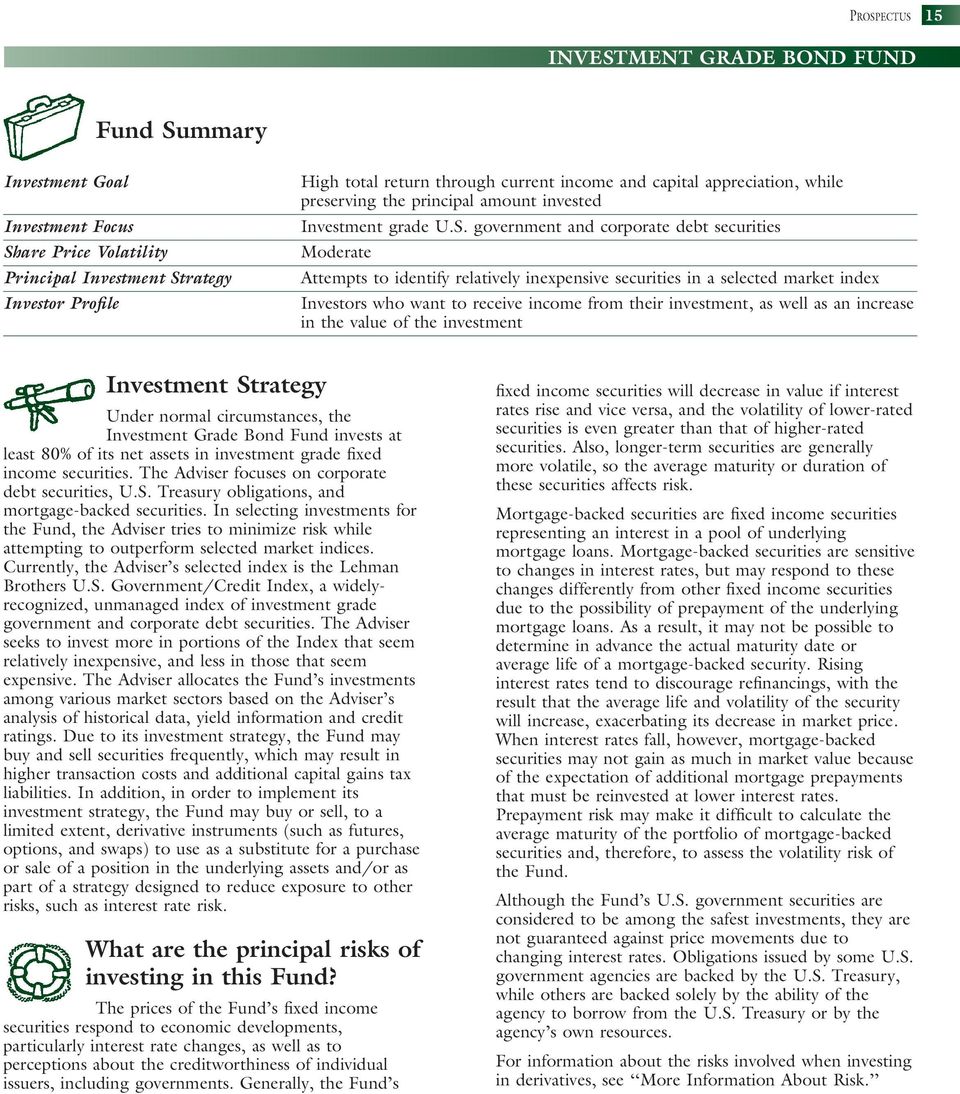
17 PROSPECTUS 15 INVESTMENT GRADE BOND FUND Fund Summary Investment Goal Investment Focus Share Price Volatility Principal Investment Strategy Investor Profile High total return through current income and capital appreciation, while preserving the principal amount invested Investment grade U.S. government and corporate debt securities Moderate Attempts to identify relatively inexpensive securities in a selected market index Investors who want to receive income from their investment, as well as an increase in the value of the investment Investment Strategy Under normal circumstances, the Investment Grade Bond Fund invests at least 80% of its net assets in investment grade fixed income securities. The Adviser focuses on corporate debt securities, U.S. Treasury obligations, and mortgage-backed securities. In selecting investments for the Fund, the Adviser tries to minimize risk while attempting to outperform selected market indices. Currently, the Adviser s selected index is the Lehman Brothers U.S. Government/Credit Index, a widelyrecognized, unmanaged index of investment grade government and corporate debt securities. The Adviser seeks to invest more in portions of the Index that seem relatively inexpensive, and less in those that seem expensive. The Adviser allocates the Fund s investments among various market sectors based on the Adviser s analysis of historical data, yield information and credit ratings. Due to its investment strategy, the Fund may buy and sell securities frequently, which may result in higher transaction costs and additional capital gains tax liabilities. In addition, in order to implement its investment strategy, the Fund may buy or sell, to a limited extent, derivative instruments (such as futures, options, and swaps) to use as a substitute for a purchase or sale of a position in the underlying assets and/or as part of a strategy designed to reduce exposure to other risks, such as interest rate risk. What are the principal risks of investing in this Fund? The prices of the Fund s fixed income securities respond to economic developments, particularly interest rate changes, as well as to perceptions about the creditworthiness of individual issuers, including governments. Generally, the Fund s fixed income securities will decrease in value if interest rates rise and vice versa, and the volatility of lower-rated securities is even greater than that of higher-rated securities. Also, longer-term securities are generally more volatile, so the average maturity or duration of these securities affects risk. Mortgage-backed securities are fixed income securities representing an interest in a pool of underlying mortgage loans. Mortgage-backed securities are sensitive to changes in interest rates, but may respond to these changes differently from other fixed income securities due to the possibility of prepayment of the underlying mortgage loans. As a result, it may not be possible to determine in advance the actual maturity date or average life of a mortgage-backed security. Rising interest rates tend to discourage refinancings, with the result that the average life and volatility of the security will increase, exacerbating its decrease in market price. When interest rates fall, however, mortgage-backed securities may not gain as much in market value because of the expectation of additional mortgage prepayments that must be reinvested at lower interest rates. Prepayment risk may make it difficult to calculate the average maturity of the portfolio of mortgage-backed securities and, therefore, to assess the volatility risk of the Fund. Although the Fund s U.S. government securities are considered to be among the safest investments, they are not guaranteed against price movements due to changing interest rates. Obligations issued by some U.S. government agencies are backed by the U.S. Treasury, while others are backed solely by the ability of the agency to borrow from the U.S. Treasury or by the agency s own resources. For information about the risks involved when investing in derivatives, see More Information About Risk.
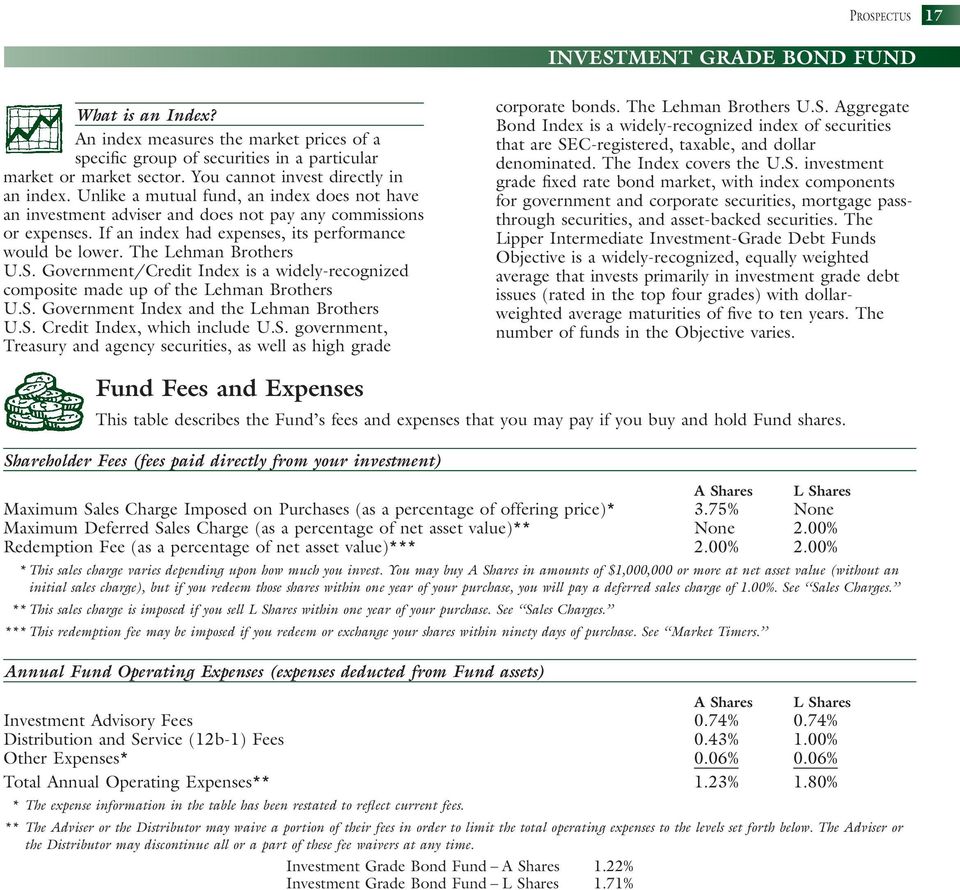
18 16 PROSPECTUS INVESTMENT GRADE BOND FUND Performance Information A Shares 1 Year 5 Years 10 Years The bar chart and the performance table Before Taxes 0.57% 3.76% 5.06% that follow illustrate the risks and volatility of an investment in the Fund. Of course, the Fund s past performance does not necessarily indicate how the After Taxes on Fund will perform in the future. Distributions 1.72% 1.87% 2.95% This bar chart shows changes in the performance of the Fund s A Shares from year to year.* The chart does not After Taxes on reflect sales charges. If sales charges had been reflected, Distributions and returns would be less than those shown. Sale of Fund Shares 0.38% 2.00% 2.97% % Lehman Brothers 15 U.S. Government/ Credit Index (reflects 8.64% 8.79% 8.68% 10 no deduction for fees, 6.13% 6.99% 3.28% expenses or taxes) % Lehman Brothers 4.67% 6.66% 6.98% 0 U.S. Aggregate Bond -1.93% Index (reflects no % deduction for fees, -10 expenses or taxes) 4.10% 6.62% 6.95% Lipper Intermediate Best Quarter Worst Quarter Investment-Grade 6.02% 2.67% Debt Funds Objective (6/30/95) (3/31/94) (reflects no deduction * The performance information shown above is based on a calendar year. for taxes) 4.56% 5.81% 6.16% The Fund s total return from 1/1/04 to 6/30/04 was 0.77%. L Shares 1 Year 5 Years Since Inception* Average Annual Total Returns Before Taxes 0.78% 4.06% 5.13% This table compares the Fund s average annual total returns for the periods ended December 31, 2003, to those Lehman Brothers of the Lehman Brothers U.S. Government/Credit Index, U.S. Government/ the Lehman Brothers U.S. Aggregate Bond Index and the Credit Index (reflects Lipper Intermediate Investment-Grade Debt Funds no deduction for fees, Objective. These returns reflect applicable sales charges and expenses or taxes) 4.67% 6.66% 7.33% assumes shareholders redeem all of their shares at the end Lehman Brothers of the period indicated. U.S. Aggregate Bond After-tax returns are calculated using the historical Index (reflects no highest individual federal marginal income tax rates and deduction for fees, do not reflect the impact of state and local taxes. Your expenses or taxes) 4.10% 6.62% 7.24% actual after-tax returns will depend on your tax situation and may differ from those shown. After-tax returns Lipper Intermediate shown are not relevant to investors who hold their Investment-Grade Fund shares through tax-deferred arrangements, such as Debt Funds Objective 401(k) plans or individual retirement accounts. After-tax (reflects no deduction returns are shown for only the A Shares. After-tax for taxes) 4.56% 5.81% 6.39% returns for other classes will vary. * Since inception of the L Shares on June 7, Benchmark returns since May 31, 1995 (benchmark returns available only on a month end basis).

19 PROSPECTUS 17 INVESTMENT GRADE BOND FUND corporate bonds. The Lehman Brothers U.S. Aggregate Bond Index is a widely-recognized index of securities that are SEC-registered, taxable, and dollar denominated. The Index covers the U.S. investment grade fixed rate bond market, with index components for government and corporate securities, mortgage pass- through securities, and asset-backed securities. The Lipper Intermediate Investment-Grade Debt Funds Objective is a widely-recognized, equally weighted average that invests primarily in investment grade debt issues (rated in the top four grades) with dollarweighted average maturities of five to ten years. The number of funds in the Objective varies. What is an Index? An index measures the market prices of a specific group of securities in a particular market or market sector. You cannot invest directly in an index. Unlike a mutual fund, an index does not have an investment adviser and does not pay any commissions or expenses. If an index had expenses, its performance would be lower. The Lehman Brothers U.S. Government/Credit Index is a widely-recognized composite made up of the Lehman Brothers U.S. Government Index and the Lehman Brothers U.S. Credit Index, which include U.S. government, Treasury and agency securities, as well as high grade Fund Fees and Expenses This table describes the Fund s fees and expenses that you may pay if you buy and hold Fund shares. Shareholder Fees (fees paid directly from your investment) A Shares L Shares Maximum Sales Charge Imposed on Purchases (as a percentage of offering price)* 3.75% None Maximum Deferred Sales Charge (as a percentage of net asset value)** None 2.00% Redemption Fee (as a percentage of net asset value)*** 2.00% 2.00% * This sales charge varies depending upon how much you invest. You may buy A Shares in amounts of $1,000,000 or more at net asset value (without an initial sales charge), but if you redeem those shares within one year of your purchase, you will pay a deferred sales charge of 1.00%. See Sales Charges. ** This sales charge is imposed if you sell L Shares within one year of your purchase. See Sales Charges. *** This redemption fee may be imposed if you redeem or exchange your shares within ninety days of purchase. See Market Timers. Annual Fund Operating Expenses (expenses deducted from Fund assets) A Shares L Shares Investment Advisory Fees 0.74% 0.74% Distribution and Service (12b-1) Fees 0.43% 1.00% Other Expenses* 0.06% 0.06% Total Annual Operating Expenses** 1.23% 1.80% * The expense information in the table has been restated to reflect current fees. ** The Adviser or the Distributor may waive a portion of their fees in order to limit the total operating expenses to the levels set forth below. The Adviser or the Distributor may discontinue all or a part of these fee waivers at any time. Investment Grade Bond Fund A Shares 1.22% Investment Grade Bond Fund L Shares 1.71%
20 18 PROSPECTUS INVESTMENT GRADE BOND FUND Example This Example is intended to help you compare the cost of investing in the Fund with the cost of investing in other mutual funds. The Example assumes that you invest $10,000 in the Fund for the time periods indicated. The Example also assumes that each year your investment has a 5% return, Fund operating expenses remain the same and you reinvest all dividends and distributions. Although your actual costs and returns might be different, your approximate costs of investing $10,000 in the Fund would be: If you sell your shares at the end of the period: 1 Year 3 Years 5 Years 10 Years A Shares $496 $751 $1,025 $1,808 L Shares $383 $566 $ 975 $2,116 If you do not sell your shares at the end of the period: 1 Year 3 Years 5 Years 10 Years A Shares $496 $751 $1,025 $1,808 L Shares $183 $566 $ 975 $2,116 Fund Expenses Every mutual fund has operating expenses to pay for professional advisory, shareholder, distribution, administration and custody services. The Fund s expenses in the table above are shown as a percentage of the Fund s net assets. These expenses are deducted from Fund assets. For more information about these fees, see Investment Adviser and Distribution of Fund Shares.

21 PROSPECTUS 19 INVESTMENT GRADE TAX-EXEMPT BOND FUND Fund Summary Investment Goal Investment Focus Share Price Volatility Principal Investment Strategy Investor Profile High total return through (i) current income that is exempt from federal income taxes and (ii) capital appreciation, while preserving the principal amount invested Investment grade municipal securities Moderate Attempts to invest more Fund assets in undervalued sectors and less in overvalued ones Investors who want to receive tax-free current income and an increase in the value of their investment Investment Strategy The Investment Grade Tax-Exempt Bond Fund invests at least 80% of its net assets in investment grade tax-exempt obligations, like municipal securities. The issuers of these securities may be located in any U.S. state, territory or possession. In addition, up to 20% of the Fund may be invested in securities subject to the alternative minimum tax or in certain taxable debt securities. In selecting investments for the Fund, the Adviser tries to limit risk as much as possible. Based on the Adviser s analysis of municipalities, credit risk, market trends and investment cycles, the Adviser attempts to invest more of the Fund s assets in undervalued market sectors and less in overvalued sectors. The Adviser also tries to identify and invest in municipal issuers with improving credit and avoid those with deteriorating credit. The Adviser anticipates that the Fund s average weighted maturity will range from 4 to 10 years. Due to its investment strategy, the Fund may buy and sell securities frequently, which may result in higher transaction costs and additional capital gains tax liabilities. In addition, in order to implement its investment strategy, the Fund may buy or sell, to a limited extent, derivative instruments (such as futures, options, and swaps) to use as a substitute for a purchase or sale of a position in the underlying assets and/or as part of a strategy designed to reduce exposure to other risks, such as interest rate risk. What are the principal risks of investing in this Fund? securities. Also, longer-term securities are generally more volatile, so the average maturity or duration of these securities affects risk. There may be economic or political changes that impact the ability of municipal issuers to repay principal and to make interest payments on municipal securities. Changes in the financial condition or credit rating of municipal issuers also may adversely affect the value of the Fund s securities. For information about the risks involved when investing in derivatives, see More Information About Risk. Performance Information The bar chart and the performance table that follow illustrate the risks and volatility of an investment in the Fund. Of course, the Fund s past performance does not necessarily indicate how the Fund will perform in the future. This bar chart shows changes in the performance of the Fund s A Shares from year to year.* The chart does not reflect sales charges. If sales charges had been reflected, returns would be less than those shown. The prices of the Fund s fixed income -0.60% -0.75% securities respond to economic developments, particularly interest rate changes, as well as to perceptions about the creditworthiness of individual Best Quarter Worst Quarter issuers, including governments. Generally, the Fund s 5.87% 3.14% fixed income securities will decrease in value if interest (3/31/95) (3/31/94) rates rise and vice versa, and the volatility of lower-rated * The performance information shown above is based on a calendar year. securities is even greater than that of higher-rated The Fund s total return from 1/1/04 to 6/30/04 was 0.62% % 4.99% 7.36% 6.73% 10.41% 5.09% 9.92% 3.97%
22 20 PROSPECTUS INVESTMENT GRADE TAX-EXEMPT BOND FUND Average Annual Total Returns L Shares 1 Year 5 Years Since Inception* This table compares the Fund s average total returns for Before Taxes 1.57% 5.16% 5.65% the periods ended December 31, 2003, to those of the Lehman Brothers 5-Year Municipal Bond Index and the Lehman Brothers Lipper Intermediate Municipal Debt Funds Objective. 5-Year Municipal Bond These returns reflect applicable sales charges and assumes Index (reflects no shareholders redeem all of their shares at the end of the deduction for fees, period indicated. expenses or taxes) 4.13% 5.57% 5.71% Lipper Intermediate After-tax returns are calculated using the historical Municipal Debt Funds highest individual federal marginal income tax rates and Objective (reflects no do not reflect the impact of state and local taxes. Your deduction for taxes) 4.00% 4.87% 5.37% actual after-tax returns will depend on your tax situation and may differ from those shown. After-tax returns * Since inception of the L Shares on June 1, Benchmark returns shown are not relevant to investors who hold their since May 31, 1995 (benchmark returns available only on a month Fund shares through tax-deferred arrangements, such as end basis). 401(k) plans or individual retirement accounts. After-tax returns are shown for only the A Shares. After-tax What is an Index? returns for other classes will vary. An index measures the market prices of a A Shares 1 Year 5 Years 10 Years specific group of securities in a particular market or market sector. You cannot invest directly in Before Taxes 0.04% 4.84% 5.66% an index. Unlike a mutual fund, an index does not have After an investment adviser and does not pay any commissions Taxes on Distributions 0.59% 4.10% 4.74% or expenses. If an index had expenses, its performance would be lower. The Lehman Brothers 5-Year After Municipal Bond Index is a widely-recognized index of Taxes on Distributions intermediate investment grade tax-exempt bonds. The and Sale of Fund Index includes general obligation bonds, revenue bonds, Shares 0.80% 4.09% 4.70% insured bonds and prefunded bonds with maturities Lehman Brothers between 4 and 6 years. The Lipper Intermediate 5-Year Municipal Bond Municipal Debt Funds Objective is a composite of Index (reflects no mutual funds with investment goals similar to the deduction for fees, Fund s goals. It reports the average return of the expenses or taxes) 4.13% 5.57% 5.42% intermediate term municipal bond mutual funds tracked Lipper Intermediate by Lipper Analytical Services, Inc. The number of funds Municipal Debt Funds in the Objective varies. Objective (reflects no deduction for taxes) 4.00% 4.87% 5.08%
23 PROSPECTUS 21 Fund Fees and Expenses This table describes the Fund s fees and expenses that you may pay if you buy and hold Fund shares. Shareholder Fees (fees paid directly from your investment) A Shares L Shares Maximum Sales Charge Imposed on Purchases (as a percentage of offering price)* 3.75% None Maximum Deferred Sales Charge (as a percentage of net asset value)** None 2.00% Redemption Fee (as a percentage of net asset value)*** 2.00% 2.00% * This sales charge varies depending upon how much you invest. You may buy A Shares in amounts of $1,000,000 or more at net asset value (without an initial sales charge), but if you redeem those shares within one year of your purchase, you will pay a deferred sales charge of 1.00%. See Sales Charges. ** This sales charge is imposed if you sell L Shares within one year of your purchase. See Sales Charges. *** This redemption fee may be imposed if you redeem or exchange your shares within ninety days of purchase. See Market Timers. Annual Fund Operating Expenses (expenses deducted from Fund assets) INVESTMENT GRADE TAX-EXEMPT BOND FUND A Shares L Shares Investment Advisory Fees 0.74% 0.74% Distribution and Service (12b-1) Fees 0.43% 1.00% Other Expenses* 0.06% 0.06% Total Annual Operating Expenses** 1.23% 1.80% * The expense information in the table has been restated to reflect current fees. ** The Adviser or the Distributor may waive a portion of their fees in order to limit the total operating expenses to the levels set forth below. The Adviser or the Distributor may discontinue all or a part of these fee waivers at any time. Investment Grade Tax-Exempt Bond Fund A Shares 1.22% Investment Grade Tax-Exempt Bond Fund L Shares 1.70% Example This Example is intended to help you compare the cost of investing in the Fund with the cost of investing in other mutual funds. The Example assumes that you invest $10,000 in the Fund for the time periods indicated. The Example also assumes that each year your investment has a 5% return, Fund operating expenses remain the same and you reinvest all dividends and distributions. Although your actual costs and returns might be different, your approximate costs of investing $10,000 in the Fund would be: If you sell your shares at the end of the period: 1 Year 3 Years 5 Years 10 Years A Shares $496 $751 $1,025 $1,808 L Shares $383 $566 $ 975 $2,116 If you do not sell your shares at the end of the period: 1 Year 3 Years 5 Years 10 Years A Shares $496 $751 $1,025 $1,808 L Shares $183 $566 $ 975 $2,116 Fund Expenses Every mutual fund has operating expenses to pay for professional advisory, shareholder, distribution, administration and custody services. The Fund s expenses in the table above are shown as a percentage of the Fund s net assets. These expenses are deducted from Fund assets. For more information about these fees, see Investment Adviser and Distribution of Fund Shares.
24 22 PROSPECTUS LIMITED-TERM FEDERAL MORTGAGE SECURITIES FUND Fund Summary Investment Goal Investment Focus Share Price Volatility Principal Investment Strategy Investor Profile High current income, while preserving capital Mortgage-backed securities Low Attempts to identify securities that are less prone to prepayment risk Conservative investors who want to receive income from their investment Investment Strategy Under normal circumstances, the Limited- Term Federal Mortgage Securities Fund invests at least 80% of its net assets in U.S. government agency mortgage-backed securities, such as Fannie Mae, GNMA and collateralized mortgage obligations. In selecting investments for the Fund, the Adviser tries to identify securities that the Adviser expects to perform well in rising and falling markets. The Adviser also attempts to reduce the risk that the underlying mortgages are prepaid by focusing on securities that it believes are less prone to this risk. For example, Fannie Mae or GNMA securities that were issued years ago may be less prone to prepayment risk because there have been many opportunities for prepayment, but few have occurred. Due to its investment strategy, the Fund may buy and sell securities frequently, which may result in higher transaction costs and additional capital gains tax liabilities. In addition, in order to implement its investment strategy, the Fund may buy or sell, to a limited extent, derivative instruments (such as futures, options, and swaps) to use as a substitute for a purchase or sale of a position in the underlying assets and/or as part of a strategy designed to reduce exposure to other risks, such as interest rate risk. What are the principal risks of investing in this Fund? The prices of the Fund s fixed income securities respond to economic developments, particularly interest rate changes, as well as to perceptions about the creditworthiness of individual issuers, including governments. Generally, the Fund s fixed income securities will decrease in value if interest rates rise and vice versa, and the volatility of lower-rated securities is even greater than that of higher-rated securities. Also, longer-term securities are generally more volatile, so the average maturity or duration of these securities affects risk. The Fund is also subject to the risk that mortgage- backed securities may underperform other segments of the fixed income market or the fixed income market as a whole. Mortgage-backed securities are fixed income securities representing an interest in a pool of underlying mortgage loans. Mortgage-backed securities are sensitive to changes in interest rates, but may respond to these changes differently from other fixed income securities due to the possibility of prepayment of the underlying mortgage loans. As a result, it may not be possible to determine in advance the actual maturity date or average life of a mortgage-backed security. Rising interest rates tend to discourage refinancings, with the result that the average life and volatility of the security will increase, exacerbating its decrease in market price. When interest rates fall, however, mortgage-backed securities may not gain as much in market value because of the expectation of additional mortgage prepayments that must be reinvested at lower interest rates. Prepayment risk may make it difficult to calculate the average maturity of the portfolio of mortgage-backed securities and, therefore, to assess the volatility risk of the Fund. Although the Fund s U.S. government securities are considered to be among the safest investments, they are not guaranteed against price movements due to changing interest rates. Obligations issued by some U.S. government agencies are backed by the U.S. Treasury, while others are backed solely by the ability of the agency to borrow from the U.S. Treasury or by the agency s own resources. For information about the risks involved when investing in derivatives, see More Information About Risk.
25 PROSPECTUS 23 LIMITED-TERM FEDERAL MORTGAGE SECURITIES FUND Performance Information Class A Shares 1 Year 5 Years Since Inception* The bar chart and the performance table Before Taxes 1.38% 4.38% 5.43% that follow illustrate the risks and volatility of an investment in the Fund. Of course, the Fund s past performance does not necessarily indicate how the After Taxes on Fund will perform in the future. Distributions 2.34% 2.62% 3.31% This bar chart shows changes in the performance of the Fund s A Shares from year to year.* The chart does not After Taxes on reflect sales charges. If sales charges had been reflected, Distributions and returns would be less than those shown. Sale of Fund Shares 0.90% 2.63% 3.29% 15 Merrill Lynch 12.02% 1-5 Year AAA U.S. Treasuries/ 10 Agencies Index 8.29% (reflects no 6.37% 6.73% 7.14% 7.23% deduction for fees, % expenses or taxes) 2.15% 5.82% 6.42% Merrill Lynch 0.96% 1.16% 1-5 Year 0 U.S. Treasuries Index (reflects no deduction for fees, Best Quarter Worst Quarter expenses or taxes) 4.20% 1.00% 2.06% 5.72% 6.38% (9/30/01) (9/30/03) * Since inception of the A Shares on July 18, Benchmark returns * The performance information shown above is based on a calendar year. since July 31, 1994 (benchmark returns available only on a month end The Fund s total return from 1/1/04 to 6/30/04 was 0.15%. basis). Average Annual Total Returns Class L Shares 1 Year 5 Years Since Inception* This table compares the Fund s average annual total returns for the periods ended December 31, 2003, to those Before Taxes 1.17% 4.59% 5.06% of the Merrill Lynch 1-5 Year AAA U.S. Treasuries/ Merrill Lynch Agencies Index and the Merrill Lynch 1-5 Year 1-5 Year AAA U.S. Treasuries Index. These returns reflect applicable U.S. Treasuries/ sales charges and assumes shareholders redeem all of their Agencies Index shares at the end of the period indicated. (reflects no After-tax returns are calculated using the historical deduction for fees, highest individual federal marginal income tax rates and expenses or taxes) 2.15% 5.82% 6.23% do not reflect the impact of state and local taxes. Your actual after-tax returns will depend on your tax situation Merrill Lynch and may differ from those shown. After-tax returns 1-5 Year shown are not relevant to investors who hold their U.S. Treasuries Fund shares through tax-deferred arrangements, such as Index (reflects no 401(k) plans or individual retirement accounts. After-tax deduction for fees, returns are shown for only the A Shares. After-tax expenses or taxes) 2.06% 5.72% 6.18% returns for other classes will vary. * Since inception of the L Shares on June 7, Benchmark returns since May 31, 1995 (benchmark returns available only on a month end basis).
26 24 PROSPECTUS LIMITED-TERM FEDERAL MORTGAGE SECURITIES FUND What is an Index? U.S. government and agency bonds that have a minimum issue size of $150 million. The current An index measures the market prices of a market value of the Index is $1.50 trillion with a specific group of securities in a particular duration of 2.06 years and a yield to maturity of 2.48%. market or market sector. You cannot invest directly in The Merrill Lynch 1-5 Year U.S. Treasuries Index is a an index. Unlike a mutual fund, an index does not have widely-recognized, capitalization-weighted (companies an investment adviser and does not pay any commissions with larger market capitalizations have more influence or expenses. If an index had expenses, its performance than those with smaller market capitalizations) index of would be lower. The Merrill Lynch 1-5 Year AAA U.S. Treasury securities with maturities of 1 year or U.S. Treasuries/Agencies Index includes greater and no more than 5 years. Fund Fees and Expenses This table describes the Fund s fees and expenses that you may pay if you buy and hold Fund shares. Shareholder Fees (fees paid directly from your investment) A Shares L Shares Maximum Sales Charge Imposed on Purchases (as a percentage of offering price)* 2.50% None Maximum Deferred Sales Charge (as a percentage of net asset value)** None 2.00% Redemption Fee (as a percentage of net asset value)*** 2.00% 2.00% * This sales charge varies depending upon how much you invest. You may buy A Shares in amounts of $1,000,000 or more at net asset value (without an initial sales charge), but if you redeem those shares within one year of your purchase, you will pay a deferred sales charge of 1.00%. See Sales Charges. ** This sales charge is imposed if you sell L Shares within one year of your purchase. See Sales Charges. *** This redemption fee may be imposed if you redeem or exchange your shares within ninety days of purchase. See Market Timers. Annual Fund Operating Expenses (expenses deducted from Fund assets) A Shares L Shares Investment Advisory Fees 0.65% 0.65% Distribution and Service (12b-1) Fees 0.23% 1.00% Other Expenses* 0.06% 0.06% Total Annual Operating Expenses** 0.94% 1.71% * The expense information in the table has been restated to reflect current fees. ** The Adviser or the Distributor may waive a portion of their fees in order to limit the total operating expenses to the levels set forth below. The Adviser or the Distributor may discontinue all or a part of these fee waivers at any time. Example This Example is intended to help you compare the cost of investing in the Fund with the cost of investing in other mutual funds. The Example assumes that you invest $10,000 in the Fund for the time periods indicated. The Example also assumes that each year your investment has a 5% return, Fund operating expenses remain the same and you reinvest all dividends and distributions. Although your actual costs and returns might be different, your approximate costs of investing $10,000 in the Fund would be: If you sell your shares at the end of the period: 1 Year 3 Years 5 Years 10 Years A Shares $344 $542 $757 $1,376 L Shares $374 $539 $928 $2,019 If you do not sell your shares at the end of the period: 1 Year 3 Years 5 Years 10 Years A Shares $344 $542 $757 $1,376 L Shares $174 $539 $928 $2,019 Limited-Term Federal Mortgage Securities Fund A Shares 0.91% Limited-Term Federal Mortgage Securities Fund L Shares 1.31% Fund Expenses Every mutual fund has operating expenses to pay for professional advisory, shareholder, distribution, administration and custody services. The Fund s expenses in the table above are shown as a percentage of the Fund s net assets. These expenses are deducted from Fund assets. For more information about these fees, see Investment Adviser and Distribution of Fund Shares.
27 PROSPECTUS 25 MARYLAND MUNICIPAL BOND FUND Fund Summary Investment Goal Investment Focus Share Price Volatility Principal Investment Strategy Investor Profile High current income exempt from federal and Maryland income tax, consistent with preservation of capital Maryland municipal securities Moderate Invests primarily in investment grade municipal securities Maryland residents who want income exempt from federal and state income taxes Investment Strategy Under normal circumstances, the Maryland Municipal Bond Fund invests at least 80% of its net assets in municipal securities, including securities subject to the alternative minimum tax, with income exempt from federal and Maryland income taxes. In addition, up to 20% of the Fund s assets may be invested in certain taxable debt securities. Issuers of these securities can be located in Maryland, Puerto Rico and other U.S. territories and possessions. In selecting investments for the Fund, the Adviser tries to limit risk by buying investment grade securities. There are no limits on the Fund s average weighted maturity or on the remaining maturities of individual securities. In addition, in order to implement its investment strategy, the Fund may buy or sell, to a limited extent, derivative instruments (such as futures, options, and swaps) to use as a substitute for a purchase or sale of a position in the underlying assets and/or as part of a strategy designed to reduce exposure to other risks, such as interest rate risk. What are the principal risks of investing in this Fund? The prices of the Fund s fixed income securities respond to economic developments, particularly interest rate changes, as well as to perceptions about the creditworthiness of individual issuers, including governments. Generally, the Fund s fixed income securities will decrease in value if interest rates rise and vice versa, and the volatility of lower-rated securities is even greater than that of higher-rated securities. Also, longer-term securities are generally more volatile, so the average maturity or duration of these securities affects risk. Fund to economic and government policies of Maryland. The Fund is non-diversified, which means that it may invest in the securities of relatively few issuers. As a result, the Fund may be more susceptible to a single adverse economic or regulatory occurrence affecting one or more of these issuers, and may experience increased volatility due to its investments in those securities. For information about the risks involved when investing in derivatives, see More Information About Risk. Performance Information The bar chart and the performance table that follow illustrate the risks and volatility of an investment in the Fund. Of course, the Fund s past performance does not necessarily indicate how the Fund will perform in the future. This bar chart shows changes in the performance of the Fund s L Shares from year to year.* The chart does not reflect sales charges. If sales charges had been reflected, returns would be less than those shown. There may be economic or political changes that impact the ability of municipal issuers to repay principal and to Best Quarter Worst Quarter make interest payments on municipal securities. Changes 3.98% 1.74% in the financial condition or credit rating of municipal (9/30/02) (9/30/99) issuers also may adversely affect the value of the Fund s * The performance information shown above is based on a calendar year. securities. The Fund s concentration of investments in The Fund s total return from 1/1/04 to 6/30/04 was 1.15%. securities of issuers located in Maryland subjects the % % % % % % % 2003
28 26 PROSPECTUS MARYLAND MUNICIPAL BOND FUND Average Annual Total Returns What is an Index? An index measures the market prices of a This table compares the Fund s average annual total specific group of securities in a particular returns for the periods ended December 31, 2003, to those market or market sector. You cannot invest directly in of the Lehman Brothers 10-Year Municipal Bond Index an index. Unlike a mutual fund, an index does not have and the Lipper Maryland Municipal Debt Funds an investment adviser and does not pay any commissions Objective. These returns reflect applicable sales charges and or expenses. If an index had expenses, its performance assumes shareholders redeem all of their shares at the end would be lower. The Lehman Brothers 10-Year of the period indicated. Municipal Bond Index is a widely-recognized index of After-tax returns are calculated using the historical long-term investment grade tax-exempt bonds. The highest individual federal marginal income tax rates and Index includes general obligation bonds, revenue bonds, do not reflect the impact of state and local taxes. Your insured bonds and prefunded bonds with maturities actual after-tax returns will depend on your tax situation between 8 and 12 years. The Index represents various and may differ from those shown. After-tax returns market sectors and geographic locations. The Lipper shown are not relevant to investors who hold their Maryland Municipal Debt Funds Objective is an average Fund shares through tax-deferred arrangements, such as of funds that limit their assets to those securities that 401(k) plans or individual retirement accounts. are exempt from taxation in a specified state (double tax-exempt) or city (triple tax-exempt). The number of L Shares 1 Year 5 Years Since Inception* funds in the Objective varies. Before Taxes 1.27% 4.05% 4.79% After Taxes on Distributions 0.91% 3.97% 4.73% After Taxes on Distributions and Sale of Fund Shares 2.00% 3.87% 4.56% Lehman Brothers 10-Year Municipal Bond Index (reflects no deduction for fees, expenses or taxes) 5.70% 5.91% 6.67% Lipper Maryland Municipal Debt Funds Objective (reflects no deduction for taxes) 4.10% 4.50% 5.43% * Since inception of the L Shares on April 25, Benchmark returns since April 30, 1996 (benchmark returns available only on a month end basis).
29 PROSPECTUS 27 Fund Fees and Expenses This table describes the Fund s fees and expenses that you may pay if you buy and hold Fund shares. Shareholder Fees (fees paid directly from your investment) A Shares L Shares Maximum Sales Charge Imposed on Purchases (as a percentage of offering price)* 3.75% None Maximum Deferred Sales Charge (as a percentage of net asset value)** None 2.00% Redemption Fee (as a percentage of net asset value)*** 2.00% 2.00% * This sales charge varies depending upon how much you invest. You may buy A Shares in amounts of $1,000,000 or more at net asset value (without an initial sales charge), but if you redeem those shares within one year of your purchase, you will pay a deferred sales charge of 1.00%. See Sales Charges. ** This sales charge is imposed if you sell L Shares within one year of your purchase. See Sales Charges. *** This redemption fee may be imposed if you redeem or exchange your shares within ninety days of purchase. See Market Timers. Annual Fund Operating Expenses (expenses deducted from Fund assets) A Shares L Shares Investment Advisory Fees 0.65% 0.65% Distribution and Service (12b-1) Fees 0.15% 1.00% Other Expenses* 0.11% 0.11% Total Annual Operating Expenses** 0.91% 1.76% * The expense information in the table has been restated to reflect current fees. ** The Adviser or the Distributor may waive a portion of their fees in order to limit the total operating expenses to the levels set forth below. The Adviser or the Distributor may discontinue all or a part of these fee waivers at any time. Maryland Municipal Bond Fund A Shares 0.83% Maryland Municipal Bond Fund L Shares 1.64% MARYLAND MUNICIPAL BOND FUND Example This Example is intended to help you compare the cost of investing in the Fund with the cost of investing in other mutual funds. The Example assumes that you invest $10,000 in the Fund for the time periods indicated. The Example also assumes that each year your investment has a 5% return, Fund operating expenses remain the same and you reinvest all dividends and distributions. Although your actual costs and returns might be different, your approximate costs of investing $10,000 in the Fund would be: If you sell your shares at the end of the period: 1 Year 3 Years 5 Years 10 Years A Shares $464 $654 $860 $1,453 L Shares $379 $554 $954 $2,073 If you do not sell your shares at the end of the period: 1 Year 3 Years 5 Years 10 Years A Shares $464 $654 $860 $1,453 L Shares $179 $554 $954 $2,073 Fund Expenses Every mutual fund has operating expenses to pay for professional advisory, shareholder, distribution, administration and custody services. The Fund s expenses in the table above are shown as a percentage of the Fund s net assets. These expenses are deducted from Fund assets. For more information about these fees, see Investment Adviser and Distribution of Fund Shares.
30 28 PROSPECTUS SHORT-TERM BOND FUND Fund Summary Investment Goal Investment Focus Share Price Volatility Principal Investment Strategy Investor Profile High current income, while preserving capital Investment grade U.S. government and corporate debt securities Low Attempts to identify securities that offer a comparably better return than similar securities for a given level of credit risk Income oriented investors who are willing to accept increased risk for the possibility of returns greater than money market investing Investment Strategy What are the principal risks of investing in this Fund? The prices of the Fund s fixed income securities respond to economic developments, particularly interest rate changes, as well as to perceptions about the creditworthiness of individual issuers, including governments. Generally, the Fund s fixed income securities will decrease in value if interest rates rise and vice versa, and the volatility of lower-rated Under normal circumstances, the Short- Term Bond Fund invests at least 80% of its net assets in a diversified portfolio of short- to medium-term investment grade U.S. Treasury, corporate debt, mortgage-backed and asset-backed securities. The Fund expects that it will normally maintain an effective maturity of 3 years or less. In selecting investments for the Fund, the Adviser attempts to identify securities that offer a comparably better investment return for a given level of credit risk. For example, short-term bonds generally have better returns than money market instruments, with a fairly modest increase in credit risk and/or volatility. The Adviser manages the Fund from a total return perspective. That is, the Adviser makes day-to-day investment decisions for the Fund with a view towards maximizing returns. The Adviser analyzes yields, market sectors and credit risk in an effort to identify attractive investments with the best risk/reward trade-off. Due to its investment strategy, the Fund may buy and sell securities frequently, which may result in higher transaction costs and additional capital gains tax liabilities. In addition, in order to implement its investment strategy, the Fund may buy or sell, to a limited extent, derivative instruments (such as futures, options, and swaps) to use as a substitute for a purchase or sale of a position in the underlying assets and/or as part of a strategy designed to reduce exposure to other risks, such as interest rate risk. securities is even greater than that of higher-rated securities. Also, longer-term securities are generally more volatile, so the average maturity or duration of these securities affects risk. Mortgage-backed and asset-backed securities are fixed income securities representing an interest in a pool of underlying mortgage loans or underlying assets such as truck and auto loans, leases and credit card receivables. Mortgage-backed and asset-backed securities are sensitive to changes in interest rates, but may respond to these changes differently from other fixed income securities due to the possibility of prepayment of the underlying mortgage loan, receivables or other assets underlying these securities. As a result, it may not be possible to determine in advance the actual maturity date or average life of a mortgage-backed or asset- backed security. Rising interest rates tend to discourage refinancings, with the result that the average life and volatility of the security will increase, exacerbating its decrease in the market place. When interest rates fall, however, mortgage-backed and asset-backed securities may not gain as much in market value because of the expectation of additional mortgage prepayment or prepayment of the underlying asset that must be reinvested at lower interest rates. Prepayment risk may make it difficult to calculate the average maturity of the portfolio of mortgage-backed or asset-backed securities and, therefore, to assess the volatility risk of the Fund. Although the Fund s U.S. government securities are considered to be among the safest investments, they are not guaranteed against price movements due to changing interest rates. Obligations issued by some U.S. government agencies are backed by the U.S. Treasury, while others are backed solely by the ability of the agency to borrow from the U.S. Treasury or by the agency s own resources. For information about the risks involved when investing in derivatives, see More Information About Risk.
31 PROSPECTUS 29 SHORT-TERM BOND FUND Performance Information A Shares 1 Year 5 Years 10 Years The bar chart and the performance table Before Taxes 0.30% 3.59% 4.57% that follow illustrate the risks and volatility of an investment in the Fund. Of course, the Fund s past performance does not necessarily indicate how the After Taxes on Fund will perform in the future. Distributions 0.57% 1.88% 2.64% This bar chart shows changes in the performance of the Fund s A Shares from year to year.* The chart does not After Taxes on reflect sales charges. If sales charges had been reflected, Distributions and Sale of returns would be less than those shown. Fund Shares 0.19% 1.98% 2.67% 15 Citigroup 1-3 Year 11.68% Government/Credit Index 10 (reflects no deduction for 7.33% fees, expenses or taxes) 2.88% 5.86% 5.93% % 7.39% % Since 2.47% 2.30% L Shares 1 Year 5 Years Inception* 0.76% % Before Taxes 0.14% 3.67% 4.49% Citigroup 1-3 Year Government/Credit Index (reflects no deduction for Best Quarter Worst Quarter 3.81% 0.79% fees, expenses or taxes) 2.88% 5.86% 6.13% (6/30/95) (12/31/01) * Since inception of the L Shares on June 20, Benchmark returns since June 30, 1995 (benchmark returns available only on a month * The performance information shown above is based on a calendar year. end basis). The Fund s total return from 1/1/04 to 6/30/04 was 0.26%. Average Annual Total Returns This table compares the Fund s average annual total returns for the periods ended December 31, 2003, to those of the Citigroup 1-3 Year Government/Credit Index. These returns reflect applicable sales charges and assumes shareholders redeem all of their shares at the end of the period indicated. After-tax returns are calculated using the historical highest individual federal marginal income tax rates and do not reflect the impact of state and local taxes. Your actual after-tax returns will depend on your tax situation and may differ from those shown. After-tax returns shown are not relevant to investors who hold their Fund shares through tax-deferred arrangements, such as 401(k) plans or individual retirement accounts. After-tax returns are shown for only the A Shares. After-tax returns for other classes will vary. What is an Index? An index measures the market prices of a specific group of securities in a particular market or market sector. You cannot invest directly in an index. Unlike a mutual fund, an index does not have an investment adviser and does not pay any commissions or expenses. If an index had expenses, its performance would be lower. The Citigroup 1-3 Year Government/ Credit Index is a widely-recognized index of U.S. Treasury securities, government agency obligations, and corporate debt securities rated at least investment grade (BBB). The securities in the Index have maturities of 1 year or greater and less than 3 years.
32 30 PROSPECTUS SHORT-TERM BOND FUND Fund Fees and Expenses This table describes the Fund s fees and expenses that you may pay if you buy and hold Fund shares. Shareholder Fees (fees paid directly from your investment) A Shares L Shares Maximum Sales Charge Imposed on Purchases (as a percentage of offering price)* 2.00% None Maximum Deferred Sales Charge (as a percentage of net asset value)** None 2.00% Redemption Fee (as a percentage of net asset value)*** 2.00% 2.00% * This sales charge varies depending upon how much you invest. You may buy A Shares in amounts of $1,000,000 or more at net asset value (without an initial sales charge), but if you redeem those shares within one year of your purchase, you will pay a deferred sales charge of 1.00%. See Sales Charges. ** This sales charge is imposed if you sell L Shares within one year of your purchase. See Sales Charges. *** This redemption fee may be imposed if you redeem or exchange your shares within ninety days of purchase. See Market Timers. Annual Fund Operating Expenses (expenses deducted from Fund assets) A Shares L Shares Investment Advisory Fees 0.65% 0.65% Distribution and Service (12b-1) Fees 0.23% 1.00% Other Expenses* 0.06% 0.06% Total Annual Operating Expenses** 0.94% 1.71% * The expense information in the table has been restated to reflect current fees. ** The Adviser or the Distributor may waive a portion of their fees in order to limit the total operating expenses to the levels set forth below. The Adviser or the Distributor may discontinue all or a part of these fee waivers at any time. Short-Term Bond Fund A Shares 0.90% Short-Term Bond Fund L Shares 1.26% Example Fund Expenses This Example is intended to help you compare the cost of Every mutual fund has operating expenses to pay for investing in the Fund with the cost of investing in other professional advisory, shareholder, distribution, mutual funds. The Example assumes that you invest administration and custody services. The Fund s expenses $10,000 in the Fund for the time periods indicated. in the table above are shown as a percentage of the Fund s net assets. These expenses are deducted from Fund The Example also assumes that each year your assets. For more information about these fees, see investment has a 5% return, Fund operating expenses Investment Adviser and Distribution of Fund Shares. remain the same and you reinvest all dividends and distributions. Although your actual costs and returns might be different, your approximate costs of investing $10,000 in the Fund would be: If you sell your shares at the end of the period: 1 Year 3 Years 5 Years 10 Years A Shares $294 $494 $ 710 $1,332 L Shares $374 $539 $ 928 $2,019 If you do not sell your shares at the end of the period: 1 Year 3 Years 5 Years 10 Years A Shares $294 $494 $ 710 $1,332 L Shares $174 $539 $ 928 $2,019
33 PROSPECTUS 31 SHORT-TERM U.S. TREASURY SECURITIES FUND Fund Summary Investment Goal Investment Focus Share Price Volatility Principal Investment Strategy Investor Profile High current income, while preserving capital Short-term U.S. Treasury securities Low Attempts to identify Treasury securities with maturities that offer a comparably better return potential and yield than either shorter maturity or longer maturity securities for a given level of interest rate risk Income oriented investors who are willing to accept increased risk for the possibility of returns greater than money market investing Investment Strategy the fixed income market or the fixed income market as a The Short-Term U.S. Treasury Securities whole. Fund invests exclusively in short-term U.S. Although the Fund s U.S. Treasury securities are Treasury securities (those with remaining maturities of considered to be among the safest investments, they are 3 years or less) and shares of registered money market not guaranteed against price movements due to funds that invest in the foregoing. The Fund intends to changing interest rates. maintain an average weighted maturity from 1 to 2 years. The Fund offers investors the opportunity to For information about the risks involved when investing capture the advantage of investing in short-term bonds in derivatives, see More Information About Risk. over money market instruments. Generally, short-term bonds offer a comparably better return than money market instruments, with a modest increase in interest Performance Information rate risk. The Adviser manages the Fund from a total The bar chart and the performance table return perspective. That is, the Adviser makes day-to- that follow illustrate the risks and volatility day investment decisions for the Fund with a view of an investment in the Fund. Of course, the Fund s toward maximizing returns and yield. The Adviser tries past performance does not necessarily indicate how the to select those U.S. Treasury securities that offer the Fund will perform in the future. best risk/reward trade-off. In addition, in order to implement its investment strategy, the Fund may buy or This bar chart shows changes in the performance of the sell, to a limited extent, derivative instruments (such as Fund s A Shares from year to year.* The chart does not futures, options, and swaps) to use as a substitute for a reflect sales charges. If sales charges had been reflected, purchase or sale of a position in the underlying assets returns would be less than those shown. and/or as part of a strategy designed to reduce exposure to other risks, such as interest rate risk. 10 What are the principal risks of investing in this Fund? The prices of the Fund s fixed income 4 securities respond to economic developments, 2.55% particularly interest rate changes, as well as to perceptions about the creditworthiness of individual % 1.20% issuers, including governments. Generally, the Fund s fixed income securities will decrease in value if interest rates rise and vice versa, and the volatility of lower-rated securities is even greater than that of higher-rated Best Quarter Worst Quarter securities. Also, longer-term securities are generally 2.60% 0.23% more volatile, so the average maturity or duration of (3/31/95) (3/31/02) these securities affects risk. * The performance information shown above is based on a calendar year. The Fund is also subject to the risk that short-term U.S. The Fund s total return from 1/1/04 to 6/30/04 was 0.44%. Treasury securities may underperform other segments of % 4.38% 5.70% 6.09% 6.48% 6.39% 4.36%
34 32 PROSPECTUS SHORT-TERM U.S. TREASURY SECURITIES FUND Average Annual Total Returns L Shares 1 Year 5 Years Since Inception* This table compares the Fund s average annual total Before Taxes returns for the periods ended December 31, 2003, to those of the Citigroup 1-3 Year Treasury Index and the Citigroup 1-3 Year 1.12% 3.94% 4.46% Citigroup 6-Month Treasury Bill Index. These returns Treasury Index reflect applicable sales charges and assumes shareholders (reflects no redeem all of their shares at the end of the period deduction for fees, indicated. expenses or taxes) 1.88% 5.37% 5.82% After-tax returns are calculated using the historical Citigroup 6-Month highest individual federal marginal income tax rates and Treasury Bill Index do not reflect the impact of state and local taxes. Your (reflects no actual after-tax returns will depend on your tax situation deduction for fees, and may differ from those shown. After-tax returns expenses or taxes) 1.18% 3.67% 4.39% shown are not relevant to investors who hold their Fund shares through tax-deferred arrangements, such as * Since inception of the L Shares on June 22, Benchmark returns 401(k) plans or individual retirement accounts. After-tax since June 30, 1995 (benchmark returns available only on a month returns are shown for only the A Shares. After-tax end basis). returns for other classes will vary. A Shares 1 Year 5 Years 10 Years What is an Index? Before Taxes 0.22% 3.97% 4.55% An index measures the market prices of a specific group of securities in a particular market or market sector. You cannot invest directly in an index. Unlike a mutual fund, an index does not have After Taxes an investment adviser and does not pay any commissions on Distributions 0.54% 2.46% 2.80% or expenses. If an index had expenses, its performance would be lower. The Citigroup 1-3 Year Treasury Index After Taxes on is a widely-recognized index of U.S. Treasury securities Distributions and Sale of with maturities of one year or greater and less than Fund Shares 0.27% 2.45% 2.78% three years. The Citigroup 6-Month Treasury Bill Index is a widely-recognized index of the 6 month U.S. Citigroup 1-3 Year Treasury Treasury Bills. Index (reflects no deduction for fees, expenses or taxes) 1.88% 5.37% 5.65% Citigroup 6-Month Treasury Bill Index (reflects no deduction for fees, expenses or taxes) 1.18% 3.67% 4.47%
35 PROSPECTUS 33 Fund Fees and Expenses This table describes the Fund s fees and expenses that you may pay if you buy and hold Fund shares. Shareholder Fees (fees paid directly from your investment) A Shares L Shares Maximum Sales Charge Imposed on Purchases (as a percentage of offering price)* 1.00% None Maximum Deferred Sales Charge (as a percentage of net asset value)** None 2.00% Redemption Fee (as a percentage of net asset value)*** 2.00% 2.00% * This sales charge varies depending upon how much you invest. You may buy A Shares in amounts of $1,000,000 or more at net asset value (without an initial sales charge), but if you redeem those shares within one year of your purchase, you will pay a deferred sales charge of 1.00%. See Sales Charges. ** This sales charge is imposed if you sell L Shares within one year of your purchase. See Sales Charges. *** This redemption fee may be imposed if you redeem or exchange your shares within ninety days of purchase. See Market Timers. Annual Fund Operating Expenses (expenses deducted from Fund assets) SHORT-TERM U.S. TREASURY SECURITIES FUND A Shares L Shares Investment Advisory Fees 0.65% 0.65% Distribution and Service (12b-1) Fees 0.18% 1.00% Other Expenses* 0.07% 0.07% Total Annual Operating Expenses** 0.90% 1.72% * The expense information in the table has been restated to reflect current fees. ** The Adviser or the Distributor may waive a portion of their fees in order to limit the total operating expenses to the levels set forth below. The Adviser or the Distributor may discontinue all or a part of these fee waivers at any time. Short-Term U.S. Treasury Securities Fund A Shares 0.85% Short-Term U.S. Treasury Securities Fund L Shares 1.11% Example This Example is intended to help you compare the cost of investing in the Fund with the cost of investing in other mutual funds. The Example assumes that you invest $10,000 in the Fund for the time periods indicated. The Example also assumes that each year your investment has a 5% return, Fund operating expenses remain the same and you reinvest all dividends and distributions. Although your actual costs and returns might be different, your approximate costs of investing $10,000 in the Fund would be: If you sell your shares at the end of the period: 1 Year 3 Years 5 Years 10 Years A Shares $191 $384 $593 $1,197 L Shares $375 $542 $933 $2,030 If you do not sell your shares at the end of the period: 1 Year 3 Years 5 Years 10 Years A Shares $191 $384 $593 $1,197 L Shares $175 $542 $933 $2,030 Fund Expenses Every mutual fund has operating expenses to pay for professional advisory, shareholder, distribution, administration and custody services. The Fund s expenses in the table above are shown as a percentage of the Fund s net assets. These expenses are deducted from Fund assets. For more information about these fees, see Investment Adviser and Distribution of Fund Shares.
36 34 PROSPECTUS STRATEGIC INCOME FUND Fund Summary Investment Goals Primary Secondary Investment Focus Share Price Volatility Principal Investment Strategy Investor Profile Current income Preservation of capital High yield corporate, government, and other debt instruments of U.S. and non U.S. issuers Moderate Attempts to increase income while reducing share price volatility through diversification across three major sectors of the fixed income market Investors who seek high current income with reduced risk of share price volatility Investment Strategy The Strategic Income Fund invests primarily in a diversified portfolio of high yield corporate, U.S. government and international bonds. The Fund will maintain a minimum average credit quality rating of BBB. The Fund will invest at least 15%, but not more than 60%, of its assets in a particular sector. In selecting debt securities for the Fund the Adviser seeks out companies with good fundamentals and performing prospects that are currently out of favor with investors. The primary basis for security selection is the potential income offered by the security relative to the Adviser s assessment of the issuer s ability to generate the cash flow required to meet its obligation. The Adviser employs a bottomup approach, identifying investment opportunities based on the underlying financial and economic fundamentals of the specific issuer. Due to its investment strategy, the Fund may buy and sell securities frequently, which may result in higher transaction costs and additional capital gains tax liabilities. In addition, in order to implement its investment strategy, the Fund may buy or sell, to a limited extent, derivative instruments (such as futures, options, and swaps) to use as a substitute for a purchase or sale of a position in the underlying assets and/or as part of a strategy designed to reduce exposure to other risks, such as interest rate risk. What are the principal risks of investing in this Fund? The prices of the Fund s fixed income securities respond to economic developments, particularly interest rate changes, as well as to perceptions about the creditworthiness of individual issuers, including governments. Generally, the Fund s fixed income securities will decrease in value if interest rates rise and vice versa, and the volatility of lower-rated securities is even greater than that of higher-rated securities. Also, longer-term securities are generally more volatile, so the average maturity or duration of these securities affects risk. High yield securities involve greater risks of default or downgrade and are more volatile than investment grade securities. Junk bonds involve greater risk of default or price declines than investment grade securities due to actual or perceived changes in an issuer s creditworthiness. In addition, issuers of junk bonds may be more susceptible than other issuers to economic downturns. Junk bonds are subject to the risk that the issuer may not be able to pay interest or dividends and ultimately to repay principal upon maturity. Discontinuation of these payments could substantially adversely affect the market value of the security. Investing in foreign countries poses additional risks since political and economic events unique to a country or region will affect those markets and their issuers. These events will not necessarily affect the U.S. economy or similar issuers located in the United States. In addition, investments in foreign countries are generally denominated in a foreign currency. As a result, changes in the value of those currencies compared to the U.S. dollar may affect (positively or negatively) the value of a Fund s investments. These currency movements may happen separately from and in response to events that do not otherwise affect the value of the security in the issuer s home country. These various risks will be even greater for investments in emerging market countries since political turmoil and rapid changes in economic conditions are more likely to occur in these countries. For information about the risks involved when investing in derivatives, see More Information About Risk.
37 PROSPECTUS 35 STRATEGIC INCOME FUND L Shares 1 Year Since Inception* Performance Information The bar chart and the performance table Before Taxes 8.91% 6.16% that follow illustrate the risks and volatility of an investment in the Fund. Of course, the Fund s past performance does not necessarily indicate how the After Taxes on Fund will perform in the future. Distributions 6.82% 4.00% This bar chart shows the changes in performance of the Fund s L Shares from year to year.* The chart does not After Taxes on reflect sales charges. If sales charges had been reflected, Distributions and Sale returns would be less than those shown. of Fund Shares 5.78% 3.92% % Hybrid 34/33/33 Blend of the Following Market Benchmarks 10.27% 7.25% 10 Merrill Lynch AAA U.S. Treasury/Agency Master Index (reflects no 5 deduction for fees, expenses 3.08% or taxes) 2.36% 6.01% Merrill Lynch U.S. High Yield Master II Index (reflects no deduction for Best Quarter Worst Quarter fees, expenses or taxes) 28.15% 11.19% 4.96% 1.00% Merrill Lynch Global (6/30/03) (6/30/02) Government Bond II ex * The performance information shown above is based on a calendar year. U.S. Index (reflects no The Fund s total return from 1/1/04 to 6/30/04 was 0.41%. deduction for fees, expenses or taxes) 1.90% 3.98% Average Annual Total Returns * Since inception of the L Shares on November 30, This table compares the Fund s average annual total returns for the periods ended December 31, 2003, to those of a Hybrid 34/33/33 Blend of the Merrill Lynch AAA U.S. Treasury/Agency Master Index, Merrill Lynch U.S. High Yield Master II Index and the Merrill Lynch Global Government Bond II ex U.S. Index. These returns reflect applicable sales charges and assumes shareholders redeem all of their shares at the end of the period indicated. After-tax returns are calculated using the historical highest individual federal marginal income tax rates and do not reflect the impact of state and local taxes. Your actual after-tax returns will depend on your tax situation and may differ from those shown. After-tax returns shown are not relevant to investors who hold their Fund shares through tax-deferred arrangements, such as 401(k) plans or individual retirement accounts.
38 36 PROSPECTUS STRATEGIC INCOME FUND What is an Index? An index measures the market prices of a specific group of securities in a particular market or market sector. You cannot invest directly in an index. Unlike a mutual fund, an index does not have an investment adviser and does not pay any commissions or expenses. If an index had expenses, its performance would be lower. The Merrill Lynch AAA U.S. Treasury/Agency Master Index is a widelyrecognized U.S. government index that tracks the performance of the combined U.S. Treasury and U.S. agency markets. It includes U.S. dollardenominated, U.S. Treasury and U.S. agency bonds, issued in the U.S. domestic bond market, having at least one year remaining term to maturity, a fixed coupon schedule and a minimum amount outstanding of $1 billion for U.S. Treasuries and $150 million for U.S. agencies. The Merrill Lynch U.S. High Yield Master II Index is a widely-recognized, market-value weighted (higher market value bonds have more influence than lower market value bonds) index that tracks the performance of below investment grade U.S. dollar-denominated corporate bonds publicly issued in the U.S. domestic market. The Merrill Lynch Global Government Bond II ex U.S. Index is a widelyrecognized subset of the Merrill Lynch Global Government Bond Index including Belgian, Danish, Irish, Italian, New Zealand, Portuguese, Spanish, and Swedish returns. The Merrill Lynch Global Government Bond Index is a widely-recognized, broad-based index consisting of various maturities comprising Australian, Canadian, Dutch, French, German, Japanese, Swiss, U.K., and U.S. individual country returns. Fund Fees and Expenses This table describes the Fund s fees and expenses that you may pay if you buy and hold Fund shares. Shareholder Fees (fees paid directly from your investment) A Shares L Shares Maximum Sales Charge Imposed on Purchases (as a percentage of offering price)* 3.75% None Maximum Deferred Sales Charge (as a percentage of net asset value)** None 2.00% Redemption Fee (as a percentage of net asset value)*** 2.00% 2.00% * This sales charge varies depending upon how much you invest. You may buy A Shares in amounts of $1,000,000 or more at net asset value (without an initial sales charge), but if you redeem those shares within one year of your purchase, you will pay a deferred sales charge of 1.00%. See Sales Charges. ** This sales charge is imposed if you sell L Shares within one year of your purchase. See Sales Charges. *** This redemption fee may be imposed if you redeem or exchange your shares within ninety days of purchase. See Market Timers. Annual Fund Operating Expenses (expenses deducted from Fund assets) A Shares L Shares Investment Advisory Fees 0.85% 0.85% Distribution and Service (12b-1) Fees 0.35% 1.00% Other Expenses* 0.11% 0.11% Total Annual Operating Expenses** 1.31% 1.96% * The expense information in the table has been restated to reflect current fees. ** The Adviser or the Distributor may waive a portion of their fees in order to limit the total operating expenses to the levels set forth below. The Adviser or the Distributor may discontinue all or a part of these fee waivers at any time. Strategic Income Fund A Shares 1.15% Strategic Income Fund L Shares 1.43%
39 PROSPECTUS 37 STRATEGIC INCOME FUND Example This Example is intended to help you compare the cost of investing in the Fund with the cost of investing in other mutual funds. The Example assumes that you invest $10,000 in the Fund for the time periods indicated. The Example also assumes that each year your investment has a 5% return and Fund operating expenses remain the same. Although your actual costs and returns might be different, your approximate costs of investing $10,000 in the Fund would be: If you sell your shares at the end of the period: 1 Year 3 Years 5 Years 10 Years A Shares $503 $775 $1,066 $1,895 L Shares $399 $615 $1,057 $2,285 If you do not sell your shares at the end of the period: 1 Year 3 Years 5 Years 10 Years A Shares $503 $775 $1,066 $1,895 L Shares $199 $615 $1,057 $2,285 Fund Expenses Every mutual fund has operating expenses to pay for professional advisory, shareholder, distribution, administration and custody services. The Fund s expenses in the table above are shown as a percentage of the Fund s net assets. These expenses are deducted from Fund assets. For more information about these fees, see Investment Adviser and Distribution of Fund Shares.
40 38 PROSPECTUS U.S. GOVERNMENT SECURITIES FUND Fund Summary Investment Goal Investment Focus Share Price Volatility Principal Investment Strategy Investor Profile High current income, while preserving capital Mortgage-backed securities and U.S. Treasury obligations Low to moderate Attempts to increase income without adding undue risk Conservative investors who want to receive income from their investment Investment Strategy The U.S. Government Securities Fund invests at least 80% of its net assets in U.S. government debt securities, such as mortgage-backed securities and U.S. Treasury obligations. In an attempt to provide a consistently high dividend without adding undue risk, the Fund focuses its investments in mortgage-backed securities. The effective average weighted maturity of the Fund s portfolio will typically range between 4 and 10 years. In addition, in order to implement its investment strategy, the Fund may buy or sell, to a limited extent, derivative instruments (such as futures, options, and swaps) to use as a substitute for a purchase or sale of a position in the underlying assets and/or as part of a strategy designed to reduce exposure to other risks, such as interest rate risk. What are the principal risks of investing in this Fund? gain as much in market value because of the expectation of additional mortgage prepayments that must be reinvested at lower interest rates. Prepayment risk may make it difficult to calculate the average maturity of the portfolio of mortgage-backed securities and, therefore, to assess the volatility risk of the Fund. Although the Fund s U.S. government securities are considered to be among the safest investments, they are not guaranteed against price movements due to changing interest rates. Obligations issued by some U.S. government agencies are backed by the U.S. Treasury, while others are backed solely by the ability of the agency to borrow from the U.S. Treasury or by the agency s own resources. For information about the risks involved when investing in derivatives, see More Information About Risk. Performance Information The prices of the Fund s fixed income The bar chart and the performance table securities respond to economic developments, that follow illustrate the risks and volatility particularly interest rate changes, as well as to of an investment in the Fund. Of course, the Fund s perceptions about the creditworthiness of individual past performance does not necessarily indicate how the issuers, including governments. Generally, the Fund s Fund will perform in the future. fixed income securities will decrease in value if interest This bar chart shows changes in the performance of the rates rise and vice versa, and the volatility of lower-rated Fund s A Shares from year to year.* The chart does not securities is even greater than that of higher-rated reflect sales charges. If sales charges had been reflected, securities. Also, longer-term securities are generally returns would be less than those shown. more volatile, so the average maturity or duration of these securities affects risk % The Fund is also subject to the risk that U.S. government debt securities may underperform other 15 segments of the fixed income market or the fixed 10.50% 8.60% 9.23% income market as a whole % 6.61% Mortgage-backed securities are fixed income securities representing an interest in a pool of underlying mortgage % loans. Mortgage-backed securities are sensitive to changes 0.87% in interest rates, but may respond to these changes 0 differently from other fixed income securities due to the -1.49% possibility of prepayment of the underlying mortgage loans. As a result, it may not be possible to determine in advance the actual maturity date or average life of a mortgage-backed security. Rising interest rates tend to Best Quarter Worst Quarter discourage refinancings, with the result that the average 5.81% 2.31% life and volatility of the security will increase, (6/30/95) (3/31/96) exacerbating its decrease in market price. When interest * The performance information shown above is based on a calendar year. rates fall, however, mortgage-backed securities may not The Fund s total return from 1/1/04 to 6/30/04 was 0.34%.
41 PROSPECTUS 39 U.S. GOVERNMENT SECURITIES FUND Average Annual Total Returns L Shares 1 Year 5 Years Since Inception* This table compares the Fund s average total returns for Before Taxes the periods ended December 31, 2003, to those of the Merrill Lynch Government/Mortgage Custom Index and Merrill Lynch 1.68% 4.52% 5.21% the Lehman Brothers Intermediate U.S. Government Government/ Bond Index. These returns reflect applicable sales charges Mortgage Custom and assumes shareholders redeem all of their shares at the Index (reflects no end of the period indicated. deduction for fees, After-tax returns are calculated using the historical expenses or taxes) 2.84% 6.46% 7.11% highest individual federal marginal income tax rates and Lehman Brothers do not reflect the impact of state and local taxes. Your Intermediate actual after-tax returns will depend on your tax situation U.S. Government and may differ from those shown. After-tax returns Bond Index (reflects shown are not relevant to investors who hold their Fund shares through tax-deferred arrangements, such as no deduction for fees, 401(k) plans or individual retirement accounts. After-tax expenses or taxes) 2.29% 6.18% 6.62% returns are shown for only the A Shares. After-tax * Since inception of the L Shares on June 7, Benchmark returns returns for other classes will vary. since May 31, 1995 (benchmark returns available only on a month A Shares 1 Year 5 Years Since Inception* end basis). Before Taxes 2.89% 4.25% 5.67% After Taxes on Distributions 4.04% 2.26% 3.49% After Taxes on Distributions and Sale of Fund Shares 1.85% 2.37% 3.47% Merrill Lynch Government/ Mortgage Custom Index (reflects no deduction for fees, expenses or taxes) 2.84% 6.46% 7.53% What is an Index? An index measures the market prices of a specific group of securities in a particular market or market sector. You cannot invest directly in an index. Unlike a mutual fund, an index does not have an investment adviser and does not pay any commissions or expenses. If an index had expenses, its performance would be lower. The Merrill Lynch Government/ Mortgage Custom Index is a synthetic index created by combining, at their respective market weights (i) the Merrill Lynch Government Master Index, which is a widely-recognized index comprised of U.S. Treasury securities and U.S. government agency securities with a maturity of at least 1 year; and (ii) the Merrill Lynch Mortgage Master Index, which is a widely-recognized index comprised of mortgage-backed securities including 15 and 30 year single family mortgages in addition to aggregated pooled mortgages. The Lehman Brothers Intermediate U.S. Government Bond Index is a widelyrecognized, market value-weighted (higher market value bonds have more influence than lower market value bonds) index of U.S. Treasury securities, Lehman Brothers Intermediate U.S. Government Bond Index (reflects no deduction for fees, expenses or taxes) 2.29% 6.18% 6.87% U.S. government agency obligations, and corporate debt backed by the U.S. Government, fixed-rate * Since inception of the A Shares on June 6, Benchmark returns nonconvertible corporate debt securities, Yankee bonds, since May 31, 1994 (benchmark returns available only on a month and nonconvertible debt securities issued by or end basis). guaranteed by foreign governments and agencies. All securities in the Index are rated investment grade (BBB) or higher, with maturities of at least 1 year.
42 40 PROSPECTUS U.S. GOVERNMENT SECURITIES FUND Fund Fees and Expenses This table describes the Fund s fees and expenses that you may pay if you buy and hold Fund shares. Shareholder Fees (fees paid directly from your investment) A Shares L Shares Maximum Sales Charge Imposed on Purchases (as a percentage of offering price)* 3.75% None Maximum Deferred Sales Charge (as a percentage of net asset value)** None 2.00% Redemption Fee (as a percentage of net asset value)*** 2.00% 2.00% * This sales charge varies depending upon how much you invest. You may buy A Shares in amounts of $1,000,000 or more at net asset value (without an initial sales charge), but if you redeem those shares within one year of your purchase, you will pay a deferred sales charge of 1.00%. See Sales Charges. ** This sales charge is imposed if you sell L Shares within one year of your purchase. See Sales Charges. *** This redemption fee may be imposed if you redeem or exchange your shares within ninety days of purchase. See Market Timers. Annual Fund Operating Expenses (expenses deducted from Fund assets) A Shares L Shares Investment Advisory Fees 0.74% 0.74% Distribution and Service (12b-1) Fees 0.38% 1.00% Other Expenses* 0.06% 0.06% Total Annual Operating Expenses** 1.18% 1.80% * The expense information in the table has been restated to reflect current fees. ** The Adviser or the Distributor may waive a portion of their fees in order to limit the L Share total operating expenses to the level set forth below. The Adviser or the Distributor may discontinue all or a part of these fee waivers at any time. U.S. Government Securities Fund L Shares 1.73% Example This Example is intended to help you compare the cost of investing in the Fund with the cost of investing in other mutual funds. The Example assumes that you invest $10,000 in the Fund for the time periods indicated. The Example also assumes that each year your investment has a 5% return, Fund operating expenses remain the same and you reinvest all dividends and distributions. Although your actual costs and returns might be different, your approximate costs of investing $10,000 in the Fund would be: If you sell your shares at the end of the period: 1 Year 3 Years 5 Years 10 Years A Shares $491 $736 $1,000 $1,753 L Shares $383 $566 $ 975 $2,116 If you do not sell your shares at the end of the period: 1 Year 3 Years 5 Years 10 Years A Shares $491 $736 $1,000 $1,753 L Shares $183 $566 $ 975 $2,116 Fund Expenses Every mutual fund has operating expenses to pay for professional advisory, shareholder, distribution, administration and custody services. The Fund s expenses in the table above are shown as a percentage of the Fund s net assets. These expenses are deducted from Fund assets. For more information about these fees, see Investment Adviser and Distribution of Fund Shares.
43 PROSPECTUS 41 VIRGINIA INTERMEDIATE MUNICIPAL BOND FUND Fund Summary Investment Goal Investment Focus Share Price Volatility Principal Investment Strategy Investor Profile High current income exempt from federal and Virginia income tax, consistent with preservation of capital Virginia municipal securities Low Attempts to limit risk by investing in investment grade municipal securities with an intermediate average maturity Virginia residents who want income exempt from federal and state income taxes Investment Strategy Under normal circumstances, the Virginia Intermediate Municipal Bond Fund invests at least 80% of its net assets in municipal securities, including securities subject to the alternative minimum tax, with income exempt from federal and Virginia income taxes. In addition, up to 20% of the Fund s assets may be invested in certain taxable debt securities. Issuers of these securities can be located in Virginia, Puerto Rico and other U.S. territories and possessions. In selecting investments for the Fund, the Adviser tries to limit risk by buying investment grade securities. The Adviser also considers stability and growth of principal. The Adviser expects that the Fund s average weighted maturity will range from 5 to 10 years but there is no limit on the maturities of individual securities. In addition, in order to implement its investment strategy, the Fund may buy or sell, to a limited extent, derivative instruments (such as futures, options, and swaps) to use as a substitute for a purchase or sale of a position in the underlying assets and/or as part of a strategy designed to reduce exposure to other risks, such as interest rate risk. What are the principal risks of investing in this Fund? The Fund is non-diversified, which means that it may invest in the securities of relatively few issuers. As a result, the Fund may be more susceptible to a single adverse economic or regulatory occurrence affecting one or more of these issuers, and may experience increased volatility due to its investments in those securities. The Fund s concentration of investments in securities of issuers located in Virginia subjects the Fund to economic and government policies of Virginia. For information about the risks involved when investing in derivatives, see More Information About Risk. Performance Information The bar chart and the performance table that follow illustrate the risks and volatility of an investment in the Fund. Of course, the Fund s past performance does not necessarily indicate how the Fund will perform in the future. This bar chart shows changes in the performance of the Fund s A Shares from year to year.* The chart does not reflect sales charges. If sales charges had been reflected, returns would be less than those shown % The prices of the Fund s fixed income 15 securities respond to economic developments, 9.35% particularly interest rate changes, as well as to % 7.83% perceptions about the creditworthiness of individual 5.32% 4.50% 3.78% issuers, including governments. Generally, the Fund s % fixed income securities will decrease in value if interest rates rise and vice versa, and the volatility of lower-rated 0 securities is even greater than that of higher-rated -2.43% -5 securities. Also, longer-term securities are generally -6.47% more volatile, so the average maturity or duration of -10 these securities affects risk There may be economic or political changes that impact Best Quarter Worst Quarter the ability of municipal issuers to repay principal and to 6.10% 6.72% make interest payments on municipal securities. Changes (3/31/95) (3/31/94) in the financial condition or credit rating of municipal * The performance information shown above is based on a calendar year. issuers also may adversely affect the value of the Fund s The Fund s total return from 1/1/04 to 6/30/04 was 1.04%. securities. 20
44 42 PROSPECTUS VIRGINIA INTERMEDIATE MUNICIPAL BOND FUND Average Annual Total Returns This table compares the Fund s average annual total returns for the periods ended December 31, 2003, to those of the Lehman Brothers 5-Year Municipal Bond Index and the Lipper Other States Intermediate Municipal Debt Funds Objective. These returns reflect applicable sales charges and assumes shareholders redeem all of their shares at the end of the period indicated. After-tax returns are calculated using the historical highest individual federal marginal income tax rates and do not reflect the impact of state and local taxes. Your actual after-tax returns will depend on your tax situation and may differ from those shown. After-tax returns shown are not relevant to investors who hold their Fund shares through tax-deferred arrangements, such as 401(k) plans or individual retirement accounts. A Shares 1 Year 5 Years 10 Years Before Taxes 0.14% 3.74% 4.09% After Taxes on Distributions 0.28% 3.64% 4.02% After Taxes on Distributions and Sale of Fund Shares 1.17% 3.71% 4.05% Lehman Brothers 5-Year Municipal Bond Index (reflects no deduction for fees, expenses or taxes) 4.13% 5.57% 5.42% Lipper Other States Intermediate Municipal Debt Funds Objective (reflects no deduction for taxes) 3.72% 4.43% 4.58% What is an Index? An index measures the market prices of a specific group of securities in a particular market or market sector. You cannot invest directly in an index. Unlike a mutual fund, an index does not have an investment adviser and does not pay any commissions or expenses. If an index had expenses, its performance would be lower. The Lehman Brothers 5-Year Municipal Bond Index is a widely-recognized index composed of tax-exempt bonds with maturities ranging between 4 and 6 years. The Lipper Other States Intermediate Municipal Debt Funds Objective is an average of funds that invest in municipal debt issues with dollar-weighted average maturities of five to ten years and are exempt from taxation on a specified city or state basis. The number of funds in the Objective varies.
45 PROSPECTUS 43 Fund Fees and Expenses This table describes the Fund s fees and expenses that you may pay if you buy and hold Fund shares. Shareholder Fees (fees paid directly from your investment) A Shares L Shares Maximum Sales Charge Imposed on Purchases (as a percentage of offering price)* 3.75% None Maximum Deferred Sales Charge (as a percentage of net asset value)** None 2.00% Redemption Fee (as a percentage of net asset value)*** 2.00% 2.00% * This sales charge varies depending upon how much you invest. You may buy A Shares in amounts of $1,000,000 or more at net asset value (without an initial sales charge), but if you redeem those shares within one year of your purchase, you will pay a deferred sales charge of 1.00%. See Sales Charges. ** This sales charge is imposed if you sell L Shares within one year of your purchase. See Sales Charges. *** This redemption fee may be imposed if you redeem or exchange your shares within ninety days of purchase. See Market Timers. Annual Fund Operating Expenses (expenses deducted from Fund assets) VIRGINIA INTERMEDIATE MUNICIPAL BOND FUND A Shares L Shares Investment Advisory Fees 0.65% 0.65% Distribution and Service (12b-1) Fees 0.15% 1.00% Other Expenses* 0.06% 0.06% Total Annual Operating Expenses** 0.86% 1.71% * The expense information in the table has been restated to reflect current fees. ** The Adviser or the Distributor may waive a portion of their fees in order to limit the total operating expenses to the levels set forth below. The Adviser or the Distributor may discontinue all or a part of these fee waivers at any time. Virginia Intermediate Municipal Bond Fund A Shares 0.79% Virginia Intermediate Municipal Bond Fund L Shares 1.55% Example This Example is intended to help you compare the cost of investing in the Fund with the cost of investing in other mutual funds. The Example assumes that you invest $10,000 in the Fund for the time periods indicated. The Example also assumes that each year your investment has a 5% return, Fund operating expenses remain the same and you reinvest all dividends and distributions. Although your actual costs and returns might be different, your approximate costs of investing $10,000 in the Fund would be: If you sell your shares at the end of the period: 1 Year 3 Years 5 Years 10 Years A Shares $459 $639 $834 $1,396 L Shares $374 $539 $928 $2,019 If you do not sell your shares at the end of the period: 1 Year 3 Years 5 Years 10 Years A Shares $459 $639 $834 $1,396 L Shares $174 $539 $928 $2,019 Fund Expenses Every mutual fund has operating expenses to pay for professional advisory, shareholder, distribution, administration and custody services. The Fund s expenses in the table above are shown as a percentage of the Fund s net assets. These expenses are deducted from Fund assets. For more information about these fees, see Investment Adviser and Distribution of Fund Shares.
46 44 PROSPECTUS VIRGINIA MUNICIPAL BOND FUND Fund Summary Investment Goal Investment Focus Share Price Volatility Principal Investment Strategy Investor Profile High current income exempt from federal and Virginia income taxes, consistent with preservation of capital Virginia municipal securities Moderate Invests primarily in investment grade municipal securities Virginia residents who want income exempt from federal and state income taxes Investment Strategy Under normal circumstances, the Virginia Municipal Bond Fund invests substantially all of its assets in municipal securities, including securities subject to the alternative minimum tax, with income exempt from federal and Virginia income taxes. Issuers of these securities can be located in Virginia, Puerto Rico and other U.S. territories and possessions. In selecting investments for the Fund, the Adviser tries to limit risk by buying investment grade securities. There are no limits on the Fund s average weighted maturity or on the remaining maturities of individual securities. In addition, in order to implement its investment strategy, the Fund may buy or sell, to a limited extent, derivative instruments (such as futures, options, and swaps) to use as a substitute for a purchase or sale of a position in the underlying assets and/or as part of a strategy designed to reduce exposure to other risks, such as interest rate risk. What are the principal risks of investing in this Fund? The prices of the Fund s fixed income securities respond to economic developments, particularly interest rate changes, as well as to perceptions about the creditworthiness of individual issuers, including governments. Generally, the Fund s fixed income securities will decrease in value if interest rates rise and vice versa, and the volatility of lower-rated securities is even greater than that of higher-rated securities. Also, longer-term securities are generally more volatile, so the average maturity or duration of these securities affects risk. result, the Fund may be more susceptible to a single adverse economic or regulatory occurrence affecting one or more of these issuers, and may experience increased volatility due to its investments in those securities. The Fund s concentration of investments in securities of issuers located in Virginia subjects the Fund to economic conditions and government policies of Virginia. For information about the risks involved when investing in derivatives, see More Information About Risk. Performance Information The bar chart and the performance table that follow illustrate the risks and volatility of an investment in the Fund. Of course, the Fund s past performance does not necessarily indicate how the Fund will perform in the future. This bar chart shows changes in the performance of the Fund s L Shares from year to year.* The chart does not reflect sales charges. If sales charges had been reflected, returns would be less than those shown % % % % % % % % 2003 There may be economic or political changes that impact Best Quarter Worst Quarter the ability of municipal issuers to repay principal and to 4.48% 2.93% make interest payments on municipal securities. Changes (9/30/02) (3/31/96) in the financial condition or credit rating of municipal * The performance information shown above is based on a calendar year. issuers also may adversely affect the value of the Fund s The Fund s total return from 1/1/04 to 6/30/04 was 1.49%. securities. The Fund is non-diversified, which means that it may invest in the securities of relatively few issuers. As a
47 PROSPECTUS 45 VIRGINIA MUNICIPAL BOND FUND Average Annual Total Returns This table compares the Fund s average annual total returns for the periods ended December 31, 2003, to those of the Lehman Brothers 10-Year Municipal Bond Index and the Lipper Virginia Municipal Debt Funds Objective. These returns reflect applicable sales charges and assumes shareholders redeem all of their shares at the end of the period indicated. After-tax returns are calculated using the historical highest individual federal marginal income tax rates and do not reflect the impact of state and local taxes. Your actual after-tax returns will depend on your tax situation and may differ from those shown. After-tax returns shown are not relevant to investors who hold their Fund shares through tax-deferred arrangements, such as 401(k) plans or individual retirement accounts. L Shares 1 Year 5 Years Since Inception* Before Taxes 1.35% 3.82% 4.60% After Taxes on Distributions 0.97% 3.73% 4.48% After Taxes on Distributions and Sale of Fund Shares 2.19% 3.70% 4.39% Lehman Brothers 10-Year Municipal Bond Index (reflects no deduction for fees, expenses or taxes) 5.70% 5.91% 6.81% Lipper Virginia Municipal Debt Funds Objective (reflects no deduction for taxes) 4.61% 4.59% 5.80% What is an Index? An index measures the market prices of a specific group of securities in a particular market or market sector. You cannot invest directly in an index. Unlike a mutual fund, an index does not have an investment adviser and does not pay any commissions or expenses. If an index had expenses, its performance would be lower. The Lehman Brothers 10-Year Municipal Bond Index is a widely-recognized index of long-term investment grade tax-exempt bonds. The Index includes general obligation bonds, revenue bonds, insured bonds and prefunded bonds with maturities between 8 and 12 years. The Index represents various market sectors and geographic locations. The Lipper Virginia Municipal Debt Funds Objective is a composite index of mutual funds with investment goals similar to the Fund s goals. It reports the average return of the Virginia intermediate-term municipal bond mutual funds tracked by Lipper Analytical Services, Inc. The number of funds in the Objective varies. * Since inception of the L Shares on April 14, Benchmark returns since March 31, 1995 (benchmark returns available only on a month end basis).
48 46 PROSPECTUS VIRGINIA MUNICIPAL BOND FUND Fund Fees and Expenses This table describes the Fund s fees and expenses that you may pay if you buy and hold Fund shares. Shareholder Fees (fees paid directly from your investment) A Shares L Shares Maximum Sales Charge Imposed on Purchases (as a percentage of offering price)* 3.75% None Maximum Deferred Sales Charge (as a percentage of net asset value)** None 2.00% Redemption Fee (as a percentage of net asset value)*** 2.00% 2.00% * This sales charge varies depending upon how much you invest. You may buy A Shares in amounts of $1,000,000 or more at net asset value (without an initial sales charge), but if you redeem those shares within one year of your purchase, you will pay a deferred sales charge of 1.00%. See Sales Charges. ** This sales charge is imposed if you sell L Shares within one year of your purchase. See Sales Charges. *** This redemption fee may be imposed if you redeem or exchange your shares within ninety days of purchase. See Market Timers. Annual Fund Operating Expenses (expenses deducted from Fund assets) A Shares L Shares Investment Advisory Fees 0.65% 0.65% Distribution and Service (12b-1) Fees 0.15% 1.00% Other Expenses* 0.08% 0.08% Total Annual Operating Expenses** 0.88% 1.73% * The expense information in the table has been restated to reflect current fees. ** The Adviser or the Distributor may waive a portion of their fees in order to limit the L share total operating expenses to the level set forth below. The Adviser or the Distributor may discontinue all or a part of these fee waivers at any time. Virginia Municipal Bond Fund L Shares 1.70% Example This Example is intended to help you compare the cost of investing in the Fund with the cost of investing in other mutual funds. The Example assumes that you invest $10,000 in the Fund for the time periods indicated. The Example also assumes that each year your investment has a 5% return, Fund operating expenses remain the same and you reinvest all dividends and distributions. Although your actual costs and returns might be different, your approximate costs of investing $10,000 in the Fund would be: If you sell your shares at the end of the period: 1 Year 3 Years 5 Years 10 Years A Shares $461 $645 $844 $1,419 L Shares $376 $545 $939 $2,041 If you do not sell your shares at the end of the period: 1 Year 3 Years 5 Years 10 Years A Shares $461 $645 $844 $1,419 L Shares $176 $545 $939 $2,041 Fund Expenses Every mutual fund has operating expenses to pay for professional advisory, shareholder, distribution, administration and custody services. The Fund s expenses in the table above are shown as a percentage of the Fund s net assets. These expenses are deducted from Fund assets. For more information about these fees, see Investment Adviser and Distribution of Fund Shares.
49 PROSPECTUS 47 More Information About Risk investments underlying the options, buying and selling put and call options can be more speculative than investing directly in securities. Derivatives Risk All Funds Exchange Traded Fund Risk Derivatives may involve risks different from, and All Funds possibly greater than, those of traditional investments. A The Funds may purchase shares of exchange-traded Fund may use derivatives (such as futures, options, and funds ( ETFs ) to temporarily gain exposure to a swaps) to attempt to achieve its investment objective particular portion of the market while awaiting an and offset certain investment risks, while at the same opportunity to purchase securities directly. ETFs are time maintaining liquidity. These positions may be investment companies that are bought and sold on a established for hedging or non-hedging purposes. Risks securities exchange. An ETF holds a portfolio of associated with the use of derivatives include those securities designed to track a particular market segment associated with hedging and leveraging activities: or index. ETFs, like mutual funds, have expenses associated with their operation, including advisory fees. ) The success of a hedging strategy may depend on an When the Fund invests in an ETF, in addition to ability to predict movements in the prices of directly bearing expenses associated with its own individual securities, fluctuations in markets, and operations, it will bear a pro rata portion of the ETF s movements in interest rates. expense. The risks of owning shares of an ETF generally ) The Fund experiencing losses over certain ranges in reflect the risks of owning the underlying securities the the market that exceed losses experienced by a fund ETF is designed to track, although lack of liquidity in that does not use derivatives. an ETF could result in being more volatile than the ) There may be an imperfect or no correlation between underlying portfolio of securities. In addition, because the changes in market value of the securities held by of ETF expenses, compared to owning the underlying the Fund and the prices of derivatives. securities directly, it may be more costly to own an ETF. ) There may not be a liquid secondary market for derivatives. Fixed Income Risk ) Trading restrictions or limitations may be imposed by an exchange. ) Government regulations may restrict trading in derivatives. ) The other party to an agreement (e.g., options or swaps) may default; however, in certain circumstances, such counter-party risk may be reduced by having an organization with very good credit act as intermediary. Because options premiums paid or received by the Funds are small in relation to the market value of the All Funds MORE INFORMATION ABOUT RISK The market value of fixed income investments changes in response to interest rate changes and other factors. During periods of falling interest rates, the values of outstanding fixed income securities generally rise. Moreover, while securities with longer maturities tend to produce higher yields, the prices of longer maturity securities are also subject to greater market fluctuations as a result of changes in interest rates. In addition to these fundamental risks, different types of fixed income
50 48 PROSPECTUS MORE INFORMATION ABOUT RISK Investments in securities of foreign companies or governments can be more volatile than investments in U.S. companies or governments. Diplomatic, political, or economic developments, including nationalization or appropriation, could affect investments in foreign countries. Foreign securities markets generally have less trading volume and less liquidity than U.S. markets. In addition, the value of securities denominated in foreign currencies, and of dividends from such securities, can change significantly when foreign currencies strengthen or weaken relative to the U.S. dollar. Foreign companies or governments generally are not subject to uniform accounting, auditing, and financial reporting standards comparable to those applicable to domestic U.S. companies or governments. Transaction costs are generally higher than those in the U.S. and expenses for custodial arrangements of foreign securities may be somewhat greater than typical expenses for custodial arrangements of similar U.S. securities. Some foreign governments levy withholding taxes against dividend and interest income. Although in some countries a portion of these taxes are recoverable, the non- recovered portion will reduce the income received from the securities comprising the portfolio. securities may be subject to the following additional risks: Credit Risk Florida Tax-Exempt Bond Fund Georgia Tax-Exempt Bond Fund Investment Grade Bond Fund Investment Grade Tax-Exempt Bond Fund Maryland Municipal Bond Fund Short-Term Bond Fund Virginia Intermediate Municipal Bond Fund Virginia Municipal Bond Fund The possibility that an issuer will be unable to make timely payments of either principal or interest. Municipal Issuer Risk Florida Tax-Exempt Bond Fund Georgia Tax-Exempt Bond Fund Investment Grade Tax-Exempt Bond Fund Maryland Municipal Bond Fund Virginia Intermediate Municipal Bond Fund Virginia Municipal Bond Fund There may be economic or political changes that impact the ability of municipal issuers to repay principal and to make interest payments on municipal securities. Changes to the financial condition or credit rating of municipal issuers may also adversely affect the value of a Fund s municipal securities. Constitutional or legislative limits on borrowing by municipal issuers may result in reduced supplies of municipal securities. Moreover, certain municipal securities are backed only by a municipal issuer s ability to levy and collect taxes. In addition, a Fund s concentration of investments in issuers located in a single state makes the Fund more susceptible to adverse political or economic developments affecting that state. The Fund also may be riskier than mutual funds that buy securities of issuers in numerous states. Foreign Security Risks Classic Institutional U.S. Government Securities Super Short Income Plus Fund High Income Fund Strategic Income Fund Regional Risk Florida Tax-Exempt Bond Fund Georgia Tax-Exempt Bond Fund Maryland Municipal Bond Fund Virginia Intermediate Municipal Bond Fund Virginia Municipal Bond Fund To the extent that a Fund s investments are concentrated in a specific geographic region, a Fund may be subject to the political and other developments affecting that region. Regional economies are often closely interrelated, and political and economic developments affecting one region, country or state often affect other regions, countries or states, thus subjecting a Fund to additional risks.
51 PROSPECTUS 49 More Information About Fund Investments period ended May 31, 2004, the Adviser received advisory fees of: Classic Institutional U.S. Government This prospectus describes the Funds primary strategies, and the Funds will normally invest Securities Super Short Income Plus Fund 0.12% in the types of securities described in this prospectus. Florida Tax-Exempt Bond Fund 0.61% However, in addition to the investments and strategies Georgia Tax-Exempt Bond Fund 0.61% described in this prospectus, each Fund also may invest High Income Fund 0.65% in other securities, use other strategies and engage in Investment Grade Bond Fund 0.72% other investment practices. These investments and Investment Grade Tax-Exempt Bond Fund 0.71% Limited-Term Federal Mortgage Securities strategies, as well as those described in this prospectus, Fund 0.60% are described in detail in the Statement of Additional Maryland Municipal Bond Fund 0.57% Information. Short-Term Bond Fund 0.60% The investments and strategies described in this Short-Term U.S. Treasury Securities Fund 0.59% prospectus are those that the Funds use under normal Strategic Income Fund 0.75% conditions. During unusual economic or market U.S. Government Securities Fund 0.71% Virginia Intermediate Municipal Bond Fund 0.65% conditions, or for temporary defensive or liquidity Virginia Municipal Bond Fund 0.65% purposes, each Fund may invest up to 100% of its assets in cash, money market instruments, repurchase The Adviser is responsible for making investment agreements and short-term obligations that would not decisions for the Funds and continuously reviews, ordinarily be consistent with a Fund s objectives. In supervises and administers each Fund s respective addition, the Classic Institutional U.S. Government investment program. The Board of Trustees supervises Securities Super Short Income Plus Fund, Florida Taxmust the Adviser and establishes policies that the Adviser Exempt Bond Fund, Georgia Tax-Exempt Bond Fund, follow in its management activities. Investment Grade Bond Fund, Investment Grade Tax- The Adviser may use its affiliates as brokers for Fund Exempt Bond Fund, Limited-Term Federal Mortgage transactions. Securities Fund, Short-Term Bond Fund, Short-Term U.S. Treasury Securities Fund, Virginia Intermediate The Securities and Exchange Commission (SEC) Municipal Bond Fund and the U.S. Government recently adopted new rules and rule amendments under Securities Fund each may shorten its average weighted the Investment Advisers Act of 1940 that address an maturity to as little as 90 days. A Fund will do so only investment adviser s fiduciary obligation to its clients if the Adviser believes that the risk of loss outweighs the when the adviser has authority to vote their proxies. opportunity for higher income. Of course, a Fund Under the current contractual agreement, the Adviser is cannot guarantee that it will achieve its investment goal. authorized to vote proxies on behalf of each Fund. Investment Adviser Trusco Capital Management, Inc., 50 Hurt Plaza, Suite 1400, Atlanta, Georgia 30303, serves as the investment adviser to the Funds. As of June 30, 2004, Trusco had approximately $66.7 billion in assets under management. For the fiscal MORE INFORMATION ABOUT FUND INVESTMENTS Information regarding the Adviser s, and thus each Fund s, Proxy Voting Policies and Procedures are provided in the Statement of Additional Information. A copy of the Funds Proxy Voting Policies and Procedures may be obtained by contacting the STI Classic Funds at , Option 5, or by visiting
52 50 PROSPECTUS PORTFOLIO MANAGERS Portfolio Managers Each of the Funds is managed by co-portfolio managers or by a portfolio manager who is supported by a backup portfolio manager. Mr. Joseph Calabrese, CFA, has served as Managing Director since joining Trusco in May He has comanaged the Limited-Term Federal Mortgage Securities Fund and the U.S. Government Securities Fund since July Prior to joining Trusco, Mr. Calabrese served as Senior Portfolio Manager of Seix Investment Advisors, Inc. from May 1997 to May He has more than 17 years of investment experience. Mr. George E. Calvert, Jr., has served as Vice President of Trusco since August He has managed the Maryland Municipal Bond Fund, Virginia Municipal Bond Fund and the Virginia Intermediate Municipal Bond Fund since August Prior to joining Trusco, Mr. Calvert served as a fixed income trader from 1998 to 2000 for Tredegar Trust Company. He also served as Vice President, Investment Division, of Central Fidelity Bank from 1988 to Mr. Calvert has more than 26 years of investment experience. Mr. Chris Carter, CFA, has served as a Vice President since joining Trusco in July He has managed the Georgia Tax-Exempt Bond Fund since August Prior to joining Trusco, Mr. Carter served as a Portfolio Manager and Fixed Income Trader of Evergreen Asset Management Company from January 2002 to July 2003, after serving as a Portfolio Manager and Fixed Income Trader of Wachovia Asset Management from September 1998 to January Prior to joining Wachovia Asset Management, he served as an Assistant Portfolio Manager and Trader for Wachovia Bank, N.A. from October 1994 to September He has more than 13 years of investment experience. Mr. Robert W. Corner has served as Managing Director of Trusco since September He has co-managed the Classic Institutional U.S. Government Securities Super Short Income Plus Fund since July 2004, after managing it since it began operating in April Mr. Corner has also co-managed the Short-Term Bond Fund since January He has more than 17 years of investment experience. Mr. George Goudelias has served as Managing Director since joining Trusco in May He has co-managed the High Income Fund since July Prior to joining Trusco, Mr. Goudelias served as Director of High Yield Research of Seix Investment Advisors, Inc. from February 2001 to May Prior to joining Seix, Mr. Goudelias was employed at JP Morgan Securities, Inc. as a Senior High Yield Research Analyst from July 1998 to February He has more than 18 years of investment experience. Mr. Michael McEachern, CFA, has served as Managing Director since joining Trusco in May He has comanaged the High Income Fund and the Strategic Income Fund since July Prior to joining Trusco, Mr. McEachern served as Senior Portfolio Manager of Seix Investment Advisors, Inc. from June 1997 to May He has more than 19 years of investment experience. Mr. H. Rick Nelson has served as Managing Director of Trusco since March He has co-managed the Short-Term Bond Fund since January 2003 and the Classic Institutional U.S. Government Securities Super Short Income Plus Fund since July Prior to joining Trusco, Mr. Nelson served as Senior Vice President at Wachovia Asset Management from June 1985 to March He has more than 22 years of investment experience. Mr. Ronald Schwartz, CFA, has served as Managing Director of Trusco since July 2000, after serving as Managing Director of STI since He has managed the Florida Tax-Exempt Bond Fund since it began operating in January 1994 and the Investment Grade Tax-Exempt Bond Fund since it began operating in June He has more than 23 years of investment experience. Mr. John Talty, CFA, has served as Executive Vice President since joining Trusco in May He has comanaged the Investment Grade Bond Fund, Limited- Term Federal Mortgage Securities Fund, and U.S. Government Securities Fund since July Prior to joining Trusco, Mr. Talty served as President and Senior Portfolio Manager of Seix Investment Advisors, Inc. from January 1993 to May He has more than 23 years of investment experience. Mr. Perry Troisi has served as Managing Director since joining Trusco in May He has co-managed the Investment Grade Bond Fund since July Prior to joining Trusco, Mr. Troisi served as Senior Portfolio Manager of Seix from November 1999 to May 2004, after serving as a Fixed Income Portfolio Manager at GRE Insurance Group form February 1996 to July He has more than 18 years of investment experience. Mr. Adrien Webb, CFA, has served as Managing Director since joining Trusco in May He has comanaged the Strategic Income Fund since October
53 PROSPECTUS 51 PURCHASING, SELLING AND EXCHANGING FUND SHARES Prior to joining Trusco, Mr. Webb served as When Can You Purchase Shares? Senior Portfolio Manager of Seix Investment Advisors, Inc. from May 2000 to May 2004, after serving as Vice You may purchase shares on any day that the New York President, Fixed Income, at Conning Asset Management Stock Exchange (NYSE) is open for business (a Business from June 1995 to May He has more than Day). 9 years of investment experience. The price per share (the offering price) will be the net Mr. David S. Yealy joined Trusco in Mr. Yealy asset value per share (NAV) next determined after the has served as Managing Director of Trusco since July Funds receive your purchase order. Each Fund calculates 2000, after serving as Vice President of Trusco since its NAV once each Business Day at the regularly- September He has managed the Short-Term scheduled close of normal trading on the NYSE U.S. Treasury Securities Fund since July He (normally, 4:00 p.m., Eastern time). So, for you to has more than 19 years of investment experience. receive the current Business Day s NAV, a Fund must receive your purchase order in proper form before 4:00 p.m., Eastern time. If the NYSE closes early such as on days in advance of certain holidays the Funds reserve the right to calculate NAV as of the Purchasing, Selling and Exchanging Fund Shares This section tells you how to purchase, sell (sometimes called redeem ) or exchange A Shares and L Shares of the Funds. earlier closing time. The Funds will not accept orders that request a particular day or price for the transaction or any other special conditions. You may have to transmit your purchase, sale and How to Purchase Fund Shares exchange requests to SunTrust or other financial institutions at an earlier time for your transaction to Your investment professional can assist you in opening a become effective that day. This allows the financial brokerage account that will be used for all transactions institution time to process your request and transmit regarding the purchase of STI Classic Funds. Once your it to the administrator or transfer agent in time to account is established, you may buy shares of the Funds meet the above stated Fund cut-off times. For more by: information about how to purchase, sell or exchange ) Mail* Fund shares, including specific SunTrust or other ) Telephone ( ) financial institutions internal order entry cut-off times, please contact your financial institution ) Wire directly. ) Automated Clearing House (ACH) * The Funds do not accept cash as payment for Fund shares. How the Funds Calculate NAV You may also buy shares through investment representatives of certain correspondent banks of SunTrust Banks, Inc. (SunTrust) and other financial institutions that are authorized to place transactions in Fund shares for their customers. Please contact your financial institution directly and follow its procedures for Fund share transactions. Your broker or institution may charge a fee for its services, in addition to the fees charged by a Fund. You will also generally have to address your correspondence or questions regarding a Fund to your institution. A Fund may reject any purchase order if it is determined that accepting the order would not be in the best interests of the STI Classic Funds or its shareholders. In calculating NAV, a Fund generally values its investment portfolio at market price. If market prices are unavailable or the Adviser determines in good faith that the market price is unreliable, fair value prices may be determined in good faith using methods approved by the Board of Trustees. Certain Funds may hold securities that are listed on foreign exchanges. These securities may trade on weekends or other days when the Fund does not calculate NAV. As a result, the NAV of these investments may change on days when you cannot purchase or sell Fund shares. Net Asset Value NAV for one Fund share is the value of that share s portion of the net assets of the Fund.
54 52 PROSPECTUS PURCHASING, SELLING AND EXCHANGING FUND SHARES Minimum/Maximum Purchases To purchase shares for the first time, you must invest in any Fund (with the exception of the Classic Institutional U.S. Government Securities Super Short Income Plus Fund) at least: Class Dollar Amount A Shares $2,000 L Shares (with the exception of the Classic Institutional U.S. Government Securities $5,000 ($2,000 for IRA or Super Short Income other tax qualified Plus Fund) accounts) To purchase shares of the Classic Institutional U.S. Government Securities Super Short Income Plus Fund for the first time, you must invest at least: Class Dollar Amount L Shares $50,000 Purchases of L Shares of the Short-Term U.S. Treasury Securities Fund requested in an amount of $100,000 or more will be automatically made in A Shares of that Fund. Purchases of L Shares of the Limited-Term Federal Mortgage Securities Fund or the Short-Term Bond Fund requested in an amount of $250,000 or more will be automatically made in A Shares of that Fund. Purchases of L Shares of any other Fund (with the exception of the Classic Institutional U.S. Government Securities Super Short Income Plus Fund) requested in an amount of $1,000,000 or more will be automatically made in A Shares of that Fund. Your subsequent investments in any Fund must be made in amounts of at least $1,000 or, if you pay by a statement coupon, $100. A Fund may accept investments of smaller amounts for either class of shares at its discretion. FUNDLINK FUNDLINK is a telephone activated service that allows you to transfer money quickly and easily between the STI Classic Funds and your SunTrust bank account(s). To use FUNDLINK, you must first contact your SunTrust Bank Investment Consultant and complete the FUNDLINK application and authorization agreements. Once you have signed up to use FUNDLINK, simply call SunTrust at to complete all of your purchase and redemption transactions. Systematic Investment Plan If you have a checking or savings account with a SunTrust affiliate bank, you may purchase shares of either class automatically through regular deductions from your account. With a $500 minimum initial investment ($50,000 for the Classic Institutional U.S. Government Securities Super Short Income Plus Fund), you may begin regularly-scheduled investments from $50 to $100,000 once or twice a month. If you are buying L Shares, you should plan on investing at least $5,000 per Fund ($50,000 for the Classic Institutional U.S. Government Securities Super Short Income Plus Fund) during the first two years. The Distributor may close your account if you do not meet this minimum investment requirement at the end of two years. Customer Identification Foreign Investors The Funds do not generally accept investments by non- U.S. persons. Non-U.S. persons may be permitted to invest in the Funds subject to the satisfaction of enhanced due diligence. Customer Identification and Verification To help the government fight the funding of terrorism and money laundering activities, federal law requires all financial institutions to obtain, verify, and record information that identifies each person who opens an account. When you open an account, you will be asked to provide your name, address, date of birth, and other information that will allow us to identify you. This information will be verified to ensure the identity of all persons opening a mutual fund account. In certain instances, the Funds are required to collect documents to fulfill its legal obligation. Documents provided in connection with your application will be used solely to establish and verify a customer s identity. The Funds are required by law to reject your new account application if the required identifying information is not provided. Attempts to collect the missing information required on the application will be performed by either contacting you or, if applicable, your broker. If this information is unable to be obtained within a timeframe established in the sole discretion of the Funds, your application will be rejected.
55 PROSPECTUS 53 PURCHASING, SELLING AND EXCHANGING FUND SHARES Upon receipt of your application in proper form (or High Income Fund upon receipt of all identifying information required on Investment Grade Bond Fund the application), your investment will be accepted and Investment Grade Tax-Exempt Bond Fund your order will be processed at the NAV per share next- Maryland Municipal Bond Fund determined. Strategic Income Fund However, the Funds reserve the right to close your U.S. Government Securities Fund account at the then-current day s price if the Funds are Virginia Intermediate Municipal Bond Fund unable to verify your identity. Attempts to verify your Virginia Municipal Bond Fund identity will be performed within a timeframe Your Sales Charge Your Sales Charge established in the sole discretion of the Funds. If the as a Percentage of as a Percentage of Funds are unable to verify your identity, the Funds If Your Investment is: Offering Price* Your Net Investment reserve the right to liquidate your account at the thencurrent Less than $100, % 3.90% day s price and remit proceeds to you via check. $100,000 but less The Funds reserve the further right to hold your than $250, % 3.36% proceeds until your original check clears the bank. In $250,000 but less such an instance, you may be subject to a gain or loss than $1,000, % 2.56% on Fund shares and will be subject to corresponding tax $1,000,000 and over None None implications. * The Distributor may pay a percentage of the offering price as a Anti-Money Laundering Program commission to broker-dealers. While investments over $1,000,000 are not subject to a front-end sales charge, the Distributor may pay dealer Customer identification and verification is part of the commissions ranging from 0.25% to 1.00%. Funds overall obligation to deter money laundering Limited-Term Federal Mortgage Securities Fund under federal law. The Funds have adopted an Anti- Your Sales Charge Your Sales Charge Money Laundering Compliance Program designed to as a Percentage of as a Percentage of If Your Investment is: Offering Price* Your Net Investment prevent the Funds from being used for money laundering or the financing of terrorist activities. In this Less than $100, % 2.50% regard, the Funds reserve the right to (i) refuse, cancel $100,000 but less or rescind any purchase or exchange order, (ii) freeze than $250, % 1.78% any account and/or suspend account services, or $250,000 but less (iii) involuntarily redeem your account in cases of than $1,000, % 1.27% threatening conduct or suspected fraudulent or illegal $1,000,000 and over None None activity. These actions will be taken when, in the sole * The Distributor may pay a percentage of the offering price as a discretion of Fund management, they are deemed to be commission to broker-dealers. While investments over $1,000,000 are in the best interest of the Funds or in cases when the not subject to a front-end sales charge, the Distributor may pay dealer Funds are requested or compelled to do so by commissions ranging from 0.25% to 1.00%. governmental or law enforcement authority. Short-Term Bond Fund Your Sales Charge Your Sales Charge as a Percentage of as a Percentage of Sales Charges If Your Investment is: Offering Price* Your Net Investment Less than $100, % 2.04% Front-End Sales Charges A Shares $100,000 but less than $250, % 1.52% The offering price of A Shares is the NAV next $250,000 but less calculated after a Fund receives your request, plus the than $1,000, % 1.01% front-end sales charge. $1,000,000 and over None None The amount of any front-end sales charge included in * The Distributor may pay a percentage of the offering price as a your offering price varies, depending on the amount of commission to broker-dealers. While investments over $1,000,000 are your investment: not subject to a front-end sales charge, the Distributor may pay dealer commissions ranging from 0.25% to 1.00%. Florida Tax-Exempt Bond Fund Georgia Tax-Exempt Bond Fund
56 54 PROSPECTUS PURCHASING, SELLING AND EXCHANGING FUND SHARES Short-Term U.S. Treasury Securities Fund Your Sales Charge Your Sales Charge as a Percentage of as a Percentage of If Your Investment is: Offering Price* Your Net Investment Less than $100, % 1.01% $100,000 but less than $250, % 0.76% $250,000 but less than $1,000, % 0.50% $1,000,000 and over None None * The Distributor may pay a percentage of the offering price as a commission to broker-dealers. While investments over $1,000,000 are not subject to a front-end sales charge, the Distributor may pay dealer commissions ranging from 0.25% to 1.00%. Investments of $1,000,000 or more. You do not pay an initial sales charge when you buy $1,000,000 or more of A Shares (excluding A Shares of STI Classic Money Market Funds) in either a single investment or through our rights of accumulation, letter of intent, or combined purchase/quantity discount programs. However, you will pay a deferred sales charge of 1.00% if you redeem any of these A Shares within one year of purchase. The deferred sales charge is calculated based on the lessor of (1) the NAV of the shares at the time of purchase or (2) NAV of the shares next calculated after the Fund receives your sales request. The deferred sales charge does not apply to shares you purchase through the reinvestment of dividends or capital gains distributions. fiduciary, administrative, custodial or investment advisory capacity is closed; or ) through dealers, retirement plans, asset allocation programs and financial institutions that, under their dealer agreements with the Distributor or otherwise, do not receive any portion of the front-end sales charge. Repurchase of A Shares You may repurchase any amount of A Shares of any Fund at NAV (without the normal front-end sales charge), up to the limit of the value of any amount of A Shares (other than those which were purchased with reinvested dividends and distributions) that you redeemed within the past 180 days. In effect, this allows you to reacquire shares that you may have had to redeem, without re-paying the front-end sales charge. Such repurchases may be subject to special tax rules. See the section on Taxes in the Statement of Additional Information for more information. To exercise this privilege, the Funds must receive your purchase order within 180 days of your redemption. In addition, you must notify the Fund when you send in your purchase order that you are repurchasing shares. Reduced Sales Charges A Shares Rights of Accumulation. In calculating the appropriate sales charge rate, this right allows you to add the market value (at the close of business on the day of the current Waiver of Front-End Sales Charge A Shares purchase) of the A Shares you already own to the amount that you are currently purchasing. The Funds The front-end sales charge will be waived on A Shares will combine the value of your current purchases with purchased: the current value of any A Shares you purchased ) through reinvestment of dividends and distributions; previously for (i) your account, (ii) your spouse s ) through a SunTrust Securities, Inc. asset allocation account, (iii) a joint account with your spouse, or account; (iv) your minor children s trust or custodial accounts. A ) by persons repurchasing shares they redeemed within fiduciary purchasing shares for the same fiduciary the last 180 days (see Repurchase of A Shares ); account, trust or estate may also use this right of accumulation. The Funds will only consider the market ) by employees, and members of their immediate family value of A Shares purchased previously that were sold (spouse, mother, father, mother-in-law, father-in-law, subject to a sales charge. To be entitled to a reduced and children (including step-children) under the age sales charge based on shares already owned, you must of 21 years), of SunTrust and its affiliates; ask the Funds for the reduction at the time of purchase. ) by persons reinvesting distributions from qualified You may be required to provide the Funds with your employee benefit retirement plans and rollovers from account number(s), account name(s), and copies of the individual retirement accounts (IRAs) previously with account statements, and, if applicable, the account the Trust department of a bank affiliated with number(s), account name(s), and copies of the account SunTrust; statements, for your spouse and/or children (and ) by persons investing an amount less than or equal to provide the children s ages). Your financial institution the value of an account distribution when an account may require documentation or other information in for which a bank affiliated with SunTrust acted in a order to verify your eligibility for a reduced sales charge.
57 PROSPECTUS 55 PURCHASING, SELLING AND EXCHANGING FUND SHARES The Funds may amend or terminate this right of next calculated NAV. But if you sell your shares within accumulation at any time. the first year after your purchase, you will pay a CDSC equal to 2.00% for either (1) the NAV of the shares at Letter of Intent. You may purchase A Shares at the the time of purchase, or (2) NAV of the shares next sales charge rate applicable to the total amount of the calculated after the Fund receives your sale request, purchases you intend to make over a 13-month period. whichever is less. The sales charge does not apply to In other words, a Letter of Intent allows you to shares you purchase through the reinvestment of purchase A Shares of a Fund over a 13-month period dividends or capital gains distributions. So, you never and receive the same sales charge as if you had pay a deferred sales charge on any increase in your purchased all the shares at the same time. The Funds investment above the initial offering price. This sales will only consider the value of A Shares sold subject to a charge does not apply to the exchange of L Shares of sales charge. As a result, shares of the A Shares one Fund for L Shares of another Fund. purchased with dividends or distributions will not be included in the calculation. To be entitled to a reduced Waiver of CDSC sales charge based on shares you intend to purchase The CDSC will be waived if you sell your L Shares for over the 13-month period, you must send the Funds a the following reasons: Letter of Intent. In calculating the total amount of purchases you may include in your letter purchases ) to make certain withdrawals from a retirement plan made up to 90 days before the date of the Letter. The (not including IRAs); 13-month period begins on the date of the first ) because of death or disability; or purchase, including those purchases made in the 90-day ) for certain payments under the Systematic Withdrawal period before the date of the Letter. Please note that Plan up to 12% annually of the value of your shares the purchase price of these prior purchases will not be of each Fund held at the time of the withdrawal (the adjusted. Systematic Withdrawal Plan is discussed later in more You are not legally bound by the terms of your Letter detail). of Intent to purchase the amount of your shares stated If you sell your L Shares of the Classic Institutional in the Letter. The Letter does, however, authorize the U.S. Government Securities Super Short Income Plus Fund to hold in escrow 3.75% of the total amount you Fund you will not pay a CDSC. For more information intend to purchase. If you do not complete the total see How to Exchange Your Shares. intended purchase at the end of the 13-month period, the Fund s transfer agent will redeem the necessary portion of the escrowed shares to make up the Offering Price of Fund Shares difference between the reduced rate sales charge (based The offering price of A Shares is the NAV next on the amount you intended to purchase) and the sales calculated after the transfer agent receives your request, charge that would normally apply (based on the actual plus the front-end sales load. The offering price of amount you purchased). L Shares is simply the next calculated NAV. Combined Purchase/Quantity Discount Privilege. When calculating the appropriate sales charge rate, the How to Sell Your Fund Shares Fund will combine same day purchases of A Shares (that If you own your shares through a brokerage account are subject to a sales charge) made by you, your spouse with SunTrust, you may sell your shares on any Business and your minor children (under age 21). This Day by contacting SunTrust Securities directly by mail combination also applies to A Shares you purchase with or telephone at The minimum a Letter of Intent. amount for telephone redemptions is $1,000. You can also obtain this information about sales charges, If you own your shares through an account with a rights of accumulation and letters of intent on the broker or other institution, contact that broker or Funds website at institution to sell your shares. Your broker or institution may charge a fee for its services, in addition to the fees Contingent Deferred Sales Charges (CDSC) charged by the Fund. L Shares If you would like to sell $25,000 or more of your You do not pay a sales charge when you purchase shares, please notify the Fund in writing and include a L Shares. The offering price of L Shares is simply the
58 56 PROSPECTUS PURCHASING, SELLING AND EXCHANGING FUND SHARES signature guarantee by a bank or other financial institution (a notarized signature is not sufficient). The sale price of each share will be the next NAV determined after the Fund receives your request less, in the case of L Shares, any applicable deferred sales charge. Systematic Withdrawal Plan If you have at least $10,000 in your account, you may use the systematic withdrawal plan. Under the plan you may arrange monthly, quarterly, semi-annual or annual automatic withdrawals of at least $50 from any Fund. The proceeds of each withdrawal will be mailed to you by check or, if you have a checking or savings account with a SunTrust affiliates bank, electronically transferred to your account. Classic Institutional U.S. Government Securities Super Short Income Plus Fund) are: Class A Shares L Shares Dollar Amount $2,000 ($5,000 for Strategic Income Fund) $5,000 ($2,000 for IRA or other tax qualified accounts) The account balance minimum for the Classic Institutional U.S. Government Securities Super Short Income Plus Fund is: Class Dollar Amount L Shares $50,000 But, the Funds will always give you at least 60 days written notice to give you time to add to your account and avoid the sale of your shares. Suspension of Your Right to Sell Your Shares Receiving Your Money A Fund may suspend your right to sell your shares if the Normally, the Funds will send your sale proceeds within NYSE restricts trading, the SEC declares an emergency five Business Days after a Fund receives your request, or for other reasons approved by the SEC. More but may take up to seven days. Your proceeds can be information about this is in the Statement of Additional wired to your bank account (subject to a $7.00 fee) or Information. sent to you by check. If you recently purchased your shares by check or through ACH, redemption How to Exchange Your Shares proceeds may not be available until your check has You may exchange your shares on any Business Day by cleared (which may take up to 15 Business Days). contacting SunTrust Securities or your financial institution by mail or telephone. Exchange requests Redemptions in Kind must be for an amount of at least $1,000. The Funds generally pay sale (redemption) proceeds in The exchange privilege is not intended as a vehicle for cash. However, under unusual conditions that make the short-term trading. Excessive exchange activity may payment of cash unwise (and for the protection of the interfere with Fund management and may have an Funds remaining shareholders), the Funds might pay all adverse effect on all shareholders. In order to limit or part of your redemption proceeds in liquid securities excessive exchange activity and in other circumstances with a market value equal to the redemption price where it is in the best interests of a Fund, all Funds (redemption in kind). It is highly unlikely that your reserve the right to revise or terminate the exchange shares would ever be redeemed in kind, but if they were privilege, limit the amount or number of exchanges or you would probably have to pay transaction costs to sell reject any exchange or restrict or refuse purchases if the securities distributed to you, as well as taxes on any (1) a Fund or its manager(s) believes the Fund would capital gains from the sale as with any redemption. be harmed or unable to invest effectively, or (2) a Fund receives or anticipates orders that may dramatically affect Involuntary Sales of Your Shares the Fund as outlined under Market Timers as defined If your account balance drops below the required later in this prospectus. minimum you may be required to sell your shares. The If you recently purchased shares by check or through account balance minimums (with the exception of the ACH, you may not be able to exchange your shares until your check has cleared (which may take up to 15 Business Days). This exchange privilege may be changed or canceled at any time upon 60 days notice.
59 PROSPECTUS 57 PURCHASING, SELLING AND EXCHANGING FUND SHARES Exchanges When you exchange shares, you are really selling your shares and buying other Fund shares. So, your sale price and purchase price will be based on the NAV next calculated after the Fund(s) receives your exchange request. A Shares You may exchange A Shares of any Fund for A Shares of any other Fund. If you exchange shares that you purchased without a sales charge or with a lower sales charge into a Fund with a sales charge or with a higher sales charge, the exchange is subject to an incremental sales charge (e.g., the difference between the lower and higher applicable sales charges). If you exchange shares into a Fund with the same, lower or no sales charge there is no incremental sales charge for the exchange. L Shares You may exchange L Shares of any Fund for L Shares of any other Fund. For purposes of computing the CDSC applicable to L Shares, the length of time you have owned your shares will be measured from the original date of purchase and will not be affected by any exchange. However, if you exchange L Shares of any STI Classic Fund for L Shares of the STI Classic Institutional U.S. Government Securities Super Short Income Plus Fund, you must first pay any applicable CDSC for the shares you are selling. Similarly, if you exchange L Shares of the STI Classic Institutional U.S. Government Securities Super Short Income Plus Fund for L Shares of any other STI Classic Fund, any CDSC for the Fund you are exchanging into will be computed from the date of the exchange. Telephone Transactions Purchasing, selling and exchanging Fund shares over the telephone is extremely convenient, but not without risk. Although the Funds have certain safeguards and procedures to confirm the identity of callers and the authenticity of instructions, the Funds are not responsible for any losses or costs incurred by following telephone instructions the Funds reasonably believe to be genuine. If you or your financial institution transact with the Funds over the telephone, you will generally bear the risk of any loss. The Funds reserve the right to modify, suspend or terminate telephone transaction privileges at any time. Market Timers It is the policy of the Funds to discourage investments by Market Timers. Short-term or excessive trading into and out of a Fund may harm long-term shareholders by disrupting the Adviser s investment strategy and by increasing Fund expenses. These increased expenses may reduce total return for long-term shareholders who are not responsible for generating such expenses. Accordingly, any Fund may restrict or refuse purchase or exchange requests by Market Timers or investors who seem to follow a short-term trading pattern that may adversely affect a Fund. You may be classified as a Market Timer if you: ) Request two substantial full-cycle transactions (either a purchase and redemption, or an exchange in and out) of any Fund within 14 days; or ) Request three substantial full-cycle transactions (either a purchase and redemption, or an exchange in and out) during any 90 day continuous period. Anyone considered to be a Market Timer by the Fund, its manager(s) or a shareholder servicing agent will be notified in writing of their designation as a Market Timer. Market Timers who redeem or exchange their shares out of any Fund within 90 days of purchase may be charged a redemption fee of up to 2% of redemption proceeds, which will automatically be paid to the Fund. This redemption fee does not apply to 401(k)/403(b) type participant accounts, Systematic Withdrawal Plan accounts, SunTrust Securities asset allocation accounts or accounts held through an omnibus arrangement because information may not be available regarding beneficial owners. Dealers who purchase A Shares or L Shares on behalf of Market Timers, including Market Timers with shares held through an omnibus account, may not be eligible to receive any dealer commissions and also may not be eligible to receive 12b-1 fees from the original date of purchase. Further, the Funds reserve the right to refuse any purchase or exchange requests by any investor at any time. In addition to the previously mentioned initiatives to discourage market timing, the Funds intend to continually evaluate and, if practical, implement other measures to deter market timing. Distribution of Fund Shares Each Fund has adopted a distribution plan that allows the Fund to pay distribution and service fees for the sale and distribution of its shares, and for services provided to shareholders. Because these fees are paid out of a Fund s assets continuously, over time these fees will increase the cost of your investment and may cost you more than paying other types of sales charges. While L Shares are sold without any initial sales charge, the distributor may pay at the time of sale up to 2% of the amount invested to broker-dealers and other
60 58 PROSPECTUS DIVIDENDS, DISTRIBUTIONS AND TAXES financial intermediaries who sell L Shares. Through the distribution plan, the distributor is reimbursed for these payments, as well as other distribution related services provided by the distributor. Maximum distribution fees, as a percentage of average daily net assets are as follows: For A Shares: Florida Tax-Exempt Bond Fund 0.18% Georgia Tax-Exempt Bond Fund 0.18% High Income Fund 0.30% Investment Grade Bond Fund 0.43% Investment Grade Tax-Exempt Bond Fund 0.43% Limited-Term Federal Mortgage Securities Fund 0.23% Maryland Municipal Bond Fund 0.15% Short-Term Bond Fund 0.23% Short-Term U.S. Treasury Securities Fund 0.18% Strategic Income Fund 0.35% U.S. Government Securities Fund 0.38% Virginia Intermediate Municipal Bond Fund 0.15% Virginia Municipal Bond Fund 0.15% For L Shares, the maximum distribution fee (with the exception of the Classic Institutional U.S. Government Securities Super Short Income Plus Fund) is 1.00% of the average daily net assets of each Fund. The maximum distribution fee for the Classic Institutional U.S. Government Securities Super Short Income Plus Fund is 0.40%. The distributor may provide financial assistance in connection with pre-approved seminars, conferences and advertising to the extent permitted by applicable state or self-regulatory agencies, such as the National Association of Securities Dealers. From its own assets, the Adviser, the distributor or their affiliates may make payments based on gross sales and current assets to selected brokerage firms or institutions. The amount of these payments may be substantial. The minimum aggregate sales required for eligibility for such payments, and the factors in selecting the brokerage firms and institutions to which they will be made, are determined from time to time by the Adviser or the distributor. In addition, the Adviser, the distributor or their affiliates may pay fees, from their own assets, to brokers, banks, financial advisers, retirement plan service providers and other financial intermediaries for providing distribution-related or shareholder services, in addition to fees that may be paid by the Funds for these purposes. Dividends and Distributions Each Fund declares dividends daily and pays these dividends monthly. Each Fund makes distributions of its net realized capital gains, if any, at least annually. If you own Fund shares on a Fund s record date, you will be entitled to receive the distribution. You will receive dividends and distributions in the form of additional Fund shares unless you elect to receive payment in cash. To elect cash payment, you must notify the Fund in writing prior to the date of the distribution. Your election will be effective for dividends and distributions paid after the Fund receives your written notice. To cancel your election, simply send the Fund written notice. Taxes Please consult your tax advisor regarding your specific questions about federal, state and local income taxes. Below the Funds have summarized some important tax issues that affect the Funds and their shareholders. This summary is based on current tax laws, which may change. Each Fund will distribute substantially all of its net investment income and its net realized capital gains, if any, at least annually. The dividends and distributions you receive may be subject to federal, state and local
61 PROSPECTUS 59 DIVIDENDS, DISTRIBUTIONS AND TAXES taxation, depending upon your tax situation. Distributions you receive from a Fund may be taxable whether or not you reinvest them. Income distributions are generally taxable at ordinary income tax rates and will not qualify for the reduced tax rates on qualifying dividend income. Long-term capital gains are currently taxed at a maximum rate of 15%. Capital gains distributions are generally taxable at the rates applicable to long-term capital gains. Absent further legislation, the maximum 15% tax rate on long-term capital gains will cease to apply to taxable years beginning after December 31, Each sale or exchange of Fund shares may be a taxable event. For tax purposes, an exchange of your Fund shares for shares of another STI Classic Fund is the same as a sale. If you have a tax-advantaged or other retirement account you will generally not be subject to federal taxation on income and capital gain distributions until you begin receiving your distributions from your retirement account. You should consult your tax advisor regarding the rules governing your own retirement plan. The Florida Tax-Exempt Bond Fund, Georgia Tax- Exempt Bond Fund, Maryland Municipal Bond Fund, Virginia Intermediate Municipal Bond Fund and Virginia Municipal Bond Fund intend to distribute federally tax- exempt income. Each Fund may invest a portion of its assets in securities that generate taxable income for federal or state income taxes. Income exempt from federal tax may be subject to state and local taxes. Any capital gains distributed by these Funds may be taxable. While shareholders of state specific Funds may receive distributions that are exempt from that particular state s income tax, such distributions may be taxable in other states where the shareholder files tax returns. Except for those certain Funds that expect to distribute federally tax-exempt income (described above), the Funds expect to distribute primarily ordinary income dividends currently taxable at a maximum rate of 35%. The Short-Term U.S. Treasury Securities Fund and the U.S. Government Securities Fund each expect that a substantial portion of Fund distributions will represent interest earned on U.S. obligations, while the Investment Grade Bond Fund and the Short-Term Bond Fund expect that some portion of each Fund s distributions will be so derived. Many states grant tax-free status to dividends paid from interest earned on direct obligations of the U.S. government, subject to certain limitations. More information about taxes is in the Statement of Additional Information.
62 60 PROSPECTUS FINANCIAL HIGHLIGHTS Financial Highlights The financial highlights table is intended to help you understand a Fund s financial performance for the period of the Fund s (and its predecessor s) operations. Certain information reflects financial results for a single Fund share. The total returns in the table represent the rate that an investor would have earned (or lost) on an investment in the Fund (assuming reinvestment of all dividends and distributions). The information provided below for the periods ended May 31, 2002, 2003 and 2004 has been audited by PricewaterhouseCoopers LLP. The information for prior periods has been audited by predecessor independent accounting firms, one of which has ceased operations. The auditor s report for each such period, along with the Funds financial statements and related notes, are included in the Annual Reports to Shareholders for such periods. The 2004 Annual Report is available upon request and without charge by calling The 2004 Annual Report is incorporated by reference into the Statement of Additional Information. For the Years Ended May 31, (unless otherwise indicated) For a Share Outstanding Throughout the Periods Net Realized Net Asset Net and Unrealized Dividends Distributions Value, Beginning Investment Gains (Losses) Total from from Net from Realized Total Dividends of Period Income on Investments Operations Investment Income Capital Gains and Distributions Classic Institutional U.S. Government Securities Super Short Income Plus Fund L Shares 2004 ****** $10.01 $0.10 $(0.05) $ 0.05 $(0.13) $ $(0.13) 2003(1) *** (0.02) (0.02) Florida Tax-Exempt Bond Fund A Shares 2004 ****** $11.69 $0.30 $(0.56) $(0.26) $(0.30) $(0.20) $(0.50) 2003 ****** (0.38) (0.05) (0.43) 2002 ****** (0.38) (0.06) (0.44) 2001 ****** (0.42) (0.42) 2000 ****** (0.49) (0.07) (0.42) (0.04) (0.46) L Shares 2004 ****** $11.71 $0.24 $(0.55) $(0.31) $(0.24) $(0.20) $(0.44) 2003 ****** (0.32) (0.05) (0.37) 2002 ****** (0.32) (0.06) (0.38) 2001 ****** (0.37) (0.37) 2000 ****** (0.49) (0.13) (0.36) (0.04) (0.40) Georgia Tax-Exempt Bond Fund A Shares 2004 ****** $10.90 $0.32 $(0.58) $(0.26) $(0.32) $(0.07) $(0.39) 2003 ****** (0.35) (0.35) 2002 ****** (0.37) (0.37) 2001 ****** (0.38) (0.38) 2000 ****** (0.50) (0.12) (0.38) (0.04) (0.42) L Shares 2004 ****** $10.90 $0.27 $(0.58) $(0.31) $(0.27) $(0.07) $(0.34) 2003 ****** (0.30) (0.30) 2002 ****** (0.32) (0.32) 2001 ****** (0.33) (0.33) 2000 ****** (0.49) (0.16) (0.33) (0.04) (0.37) High Income Fund(A) A Shares 2004(2) *** $ 7.39 $0.35 $(0.01) $ 0.34 $(0.35) $ $(0.35) L Shares 2004 ****** $ 7.16 $0.57 $ 0.22 $ 0.79 $(0.57) $ $(0.57) 2003 ****** (0.09) 0.48 (0.57) (0.57) 2002 ****** (0.44) 0.11 (0.55) (0.55) 2001 ****** (0.19) 0.36 (0.55) (0.55) 2000(3) *** (0.10) (0.01) (0.09) (0.09) For the year ended March 31: 2000 ****** (1.85) (0.98) (0.81) (0.81) Returns are for the period indicated and have not been annualized. Total return figures do not reflect applicable sales loads. Returns shown do not reflect the deduction of taxes the shareholder would pay on Fund distributions or redemption of Fund shares. Per share data calculated using average shares method. (1) Commenced operations on April 16, All ratios for the period have been annualized. (2) A shares commenced operations on October 27, All ratios for the period have been annualized. (3) For the two month period ended May 31, All ratios for the period have been annualized. (A) On March 28, 2000, the ESC Strategic Income Fund exchanged all of its assets and certain liabilities for shares of the High Income Fund. The ESC Strategic Income Fund is the accounting survivor in this transaction, and as a result, its basis of accounting for assets and liabilities and its operating results for the periods prior to March 28, 2000 have been carried forward in these financial highlights. Subsequent to the merger, the High Income Fund changed its fiscal year end to May 31. Amounts designated as are either $0 or have been rounded to $0.
63 PROSPECTUS 61 FINANCIAL HIGHLIGHTS Ratio of Expenses Ratio of Net to Average Net Net Assets, Ratio of Net Investment Income Assets (Excluding Net Asset Value, Total End of Expenses to to Average Waivers and Portfolio End of Period Return Period (000) Average Net Assets Net Assets Reimbursements) Turnover Rate $ % $38, % 1.01% 0.94% 109% , $10.93 (2.28)% $ 5, % 2.62% 1.13% 56% , , , (0.68) 2, $10.96 (2.68)% $19, % 2.14% 1.81% 56% , , , (1.17) 9, $10.25 (2.39)% $ 2, % 3.06% 1.36% 100% , , , (1.26) 2, $10.25 (2.87)% $13, % 2.55% 1.84% 100% , , , (1.59) 8, $ % $ 1, % 7.80% 1.88% 49% $ ,23% $75, % 7.62% 1.98% 49% , , , (0.13) 3, (10.84) 2,
64 62 PROSPECTUS FINANCIAL HIGHLIGHTS For the Years Ended May 31, (unless otherwise indicated) For a Share Outstanding Throughout the Periods Net Realized Net Asset Net and Unrealized Dividends Distributions Value, Beginning Investment Gains (Losses) Total from from Net from Realized Total Dividends of Period Income on Investments Operations Investment Income Capital Gains and Distributions Investment Grade Bond Fund A Shares 2004 ****** $10.94 $0.31 $(0.60) $(0.29) $(0.34) $ $(0.34) 2003 ****** (0.42) (0.42) 2002 ****** (0.48) (0.48) 2001 ****** (0.57) (0.57) 2000 ****** (0.78) (0.21) (0.57) (0.57) L Shares 2004 ****** $10.95 $0.25 $(0.60) $(0.35) $(0.29) $ $(0.29) 2003 ****** (0.37) (0.37) 2002 ****** (0.42) (0.42) 2001 ****** (0.53) (0.53) 2000 ****** (0.78) (0.26) (0.52) (0.52) Investment Grade Tax-Exempt Bond Fund A Shares 2004 ****** $12.03 $0.23 $(0.33) $(0.10) $(0.22) $(0.25) $(0.47) 2003 ****** (0.25) (0.46) (0.71) 2002 ****** (0.29) (0.27) (0.56) 2001 ****** (0.40) (0.40) 2000 ****** (0.30) 0.09 (0.39) (0.14) (0.53) L Shares 2004 ****** $12.01 $0.17 $(0.32) $(0.15) $(0.17) $(0.25) $(0.42) 2003 ****** (0.20) (0.46) (0.66) 2002 ****** (0.24) (0.27) (0.51) 2001 ****** (0.34) (0.34) 2000 ****** (0.29) 0.05 (0.34) (0.14) (0.48) Returns are for the period indicated and have not been annualized. Total return figures do not reflect applicable sales loads. Returns shown do not reflect the deduction of taxes the shareholder would pay on Fund distributions or redemption of Fund shares. Per share data was calculated using the average shares method. Amounts designated as are either $0 or have been rounded to $0.
65 PROSPECTUS 63 FINANCIAL HIGHLIGHTS Ratio of Expenses Ratio of Net to Average Net Net Assets, Ratio of Net Investment Income Assets (Excluding Net Asset Value, Total End of Expenses to to Average Waivers and Portfolio End of Period Return Period (000) Average Net Assets Net Assets Reimbursements) Turnover Rate $10.31 (2.70)% $31, % 2.90% 1.38% 119% , , , (2.17) 22, $10.31 (3.27)% $24, % 2.40% 2.00% 119% , , , (2.63) 20, $11.46 (0.85)% $19, % 1.92% 1.36% 242% , , , , $11.44 (1.33)% $22, % 1.45% 1.92% 242% , , , ,
66 64 PROSPECTUS FINANCIAL HIGHLIGHTS For the Years Ended May 31, (unless otherwise indicated) For a Share Outstanding Throughout the Periods Net Realized Net Asset Net and Unrealized Dividends Distributions Value, Beginning Investment Gains (Losses) Total from from Net from Realized Total Dividends of Period Income on Investments Operations Investment Income Capital Gains and Distributions Limited-Term Federal Mortgage Securities Fund A Shares 2004 ****** $10.57 $0.21 $(0.35) $(0.14) $(0.27) $ $(0.27) 2003 ****** (0.39) (0.01) (0.40) 2002 ****** (0.40) (0.02) (0.42) 2001 ****** (0.53) (0.53) 2000 ****** (0.33) 0.19 (0.52) (0.52) L Shares 2004 ****** $10.59 $0.17 $(0.35) $(0.18) $(0.23) $ $(0.23) 2003 ****** (0.35) (0.01) (0.36) 2002 ****** (0.37) (0.02) (0.39) 2001 ****** (0.50) (0.50) 2000 ****** (0.32) 0.17 (0.49) (0.49) Maryland Municipal Bond Fund L Shares 2004 ****** $10.96 $0.26 $(0.47) $(0.21) $(0.26) $(0.20) $(0.46) 2003 ****** (0.27) (0.01) (0.28) 2002 ****** (0.29) (0.29) 2001 ****** (0.33) (0.33) 2000 ****** (0.60) (0.27) (0.33) (0.33) Returns are for the period indicated and have not been annualized. Total return figures do not reflect applicable sales loads. Returns shown do not reflect the deduction of taxes the shareholder would pay on Fund distributions or redemption of Fund shares. Per share data were calculated using the average shares method. Amounts designated as are either $0 or have been rounded to $0.
67 PROSPECTUS 65 FINANCIAL HIGHLIGHTS Ratio of Expenses Ratio of Net to Average Net Net Assets, Ratio of Net Investment Income Assets (Excluding Net Asset Value, Total End of Expenses to to Average Waivers and Portfolio End of Period Return Period (000) Average Net Assets Net Assets Reimbursements) Turnover Rate $10.16 (1.36)% $ 9, % 2.06% 1.17% 146% , , , $10.18 (1.71)% $ 70, % 1.68% 1.82% 146% , , , , $10.29 (1.97)% $ 18, % 2.46% 1.82% 15% , , , (2.66) 6,
68 66 PROSPECTUS FINANCIAL HIGHLIGHTS For the Years Ended May 31, (unless otherwise indicated) For a Share Outstanding Throughout the Periods Net Realized Net Asset Net and Unrealized Dividends Distributions Value, Beginning Investment Gains (Losses) Total from from Net from Realized Total Dividends of Period Income on Investments Operations Investment Income Capital Gains and Distributions Short-Term Bond Fund A Shares 2004 ****** $10.07 $0.22(1) $(0.20)(1) $ 0.02 $(0.22) $ $(0.22) 2003 ****** (0.31) (0.31) 2002 ****** (0.02) 0.42 (0.44) (0.44) 2001 ****** (0.54) (0.54) 2000 ****** (0.25) 0.26 (0.51) (0.01) (0.52) L Shares 2004 ****** $10.06 $0.19(1) $(0.20)(1) $(0.01) $(0.19) $ $(0.19) 2003 ****** (0.28) (0.28) 2002 ****** (0.03) 0.37 (0.40) (0.40) 2001 ****** (0.52) (0.52) 2000 ****** (0.25) 0.23 (0.48) (0.01) (0.49) Short-Term U.S. Treasury Securities Fund A Shares 2004 ****** $10.35 $0.12(1) $(0.13)(1) $(0.01) $(0.12) $(0.12) $(0.24) 2003 ****** (0.20) (0.06) (0.26) 2002 ****** (0.35) (0.03) (0.38) 2001 ****** (0.48) (0.48) 2000 ****** (0.10) 0.35 (0.45) (0.45) L Shares 2004 ****** $10.34 $0.10(1) $(0.13)(1) $(0.03) $(0.10) $(0.12) $(0.22) 2003 ****** (0.17) (0.06) (0.23) 2002 ****** (0.33) (0.03) (0.36) 2001 ****** (0.46) (0.46) 2000 ****** (0.10) 0.32 (0.42) (0.42) Strategic Income Fund A Shares 2004(3) *** $ 9.93 $0.33(1) $(0.07)(1) $ 0.26 $(0.31) $(0.06) $(0.37) L Shares 2004 ****** $ 9.99 $0.50(1) $(0.14)(1) $ 0.36 $(0.48) $(0.06) $(0.54) 2003 ****** (0.57) (0.57) 2002(2) *** (0.20) 0.05 (0.25) (0.25) Returns are for the period indicated and have not been annualized. Total return figures do not reflect applicable sales loads. Returns shown do not reflect the deduction of taxes the shareholder would pay on Fund distributions or redemption of Fund shares. (1) Per share data was calculated using the average shares method. (2) Commenced operations on November 30, All ratios for the period have been annualized. (3) A shares commenced operations on October 8, All ratios for the period have been annualized. Amounts designated as are either $0 or have been rounded to $0.
69 PROSPECTUS 67 FINANCIAL HIGHLIGHTS Ratio of Expenses Ratio of Net to Average Net Net Assets, Ratio of Net Investment Income Assets (Excluding Net Asset Value, Total End of Expenses to to Average Waivers and Portfolio End of Period Return Period (000) Average Net Assets Net Assets Reimbursements) Turnover Rate $ % $ 5, % 2.21% 1.21% 66% , , , , $ 9.86 (0.11)% $ 23, % 1.87% 1.87% 66% , , , , $10.10 (0.06)% $ 12, % 1.20% 1.06% 131% , , , , $10.09 (0.30)% $ 62, % 0.97% 1.82% 131% , , , , $ % $ 4, % 5.15% 1.60% 95% $ % $117, % 4.98% 2.03% 95% , ,
70 68 PROSPECTUS FINANCIAL HIGHLIGHTS For the Years Ended May 31, (unless otherwise indicated) For a Share Outstanding Throughout the Periods Net Realized Net Asset Net and Unrealized Dividends Distributions Value, Beginning Investment Gains (Losses) Total from from Net from Realized Total Dividends of Period Income on Investments Operations Investment Income Capital Gains and Distributions U.S. Government Securities Fund A Shares 2004 ****** $10.93 $0.27(1) $(0.50)(1) $(0.23) $(0.31) $(0.04) $(0.35) 2003 ****** (0.42) (0.03) (0.45) 2002 ****** (0.50) (0.17) (0.67) 2001 ****** (0.54) (0.54) 2000 ****** (0.42) 0.12 (0.54) (0.54) L Shares 2004 ****** $10.93 $0.22(1) $(0.50)(1) $(0.28) $(0.26) $(0.04) $(0.30) 2003 ****** (0.36) (0.03) (0.39) 2002 ****** (0.45) (0.17) (0.62) 2001 ****** (0.49) (0.49) 2000 ****** (0.42) 0.07 (0.49) (0.49) Virginia Intermediate Municipal Bond Fund A Shares 2004 ****** $10.68 $0.33(1) $(0.44)(1) $(0.11) $(0.33) $(0.09) $(0.42) 2003 ****** (0.36) (0.10) (0.46) 2002 ****** (0.40) (0.40) 2001 ****** (0.42) (0.42) 2000 ****** (0.56) (0.14) (0.42) (0.05) (0.47) Virginia Municipal Bond Fund(A) A Shares 2004(2) *** $10.28 $0.02(1) $ 0.09(1) $ 0.11 $(0.02) $ $(0.02) L Shares 2004 ****** $11.13 $0.27(1) $(0.48)(1) $(0.21) $(0.27) $(0.23) $(0.50) 2003 ****** (0.29) (0.03) (0.32) 2002 ****** (0.31) (0.31) 2001 ****** (0.35) (0.35) 2000 ****** (0.79) (0.43) (0.36) (0.01) (0.37) Returns are for the period indicated and have not been annualized. Total return figures do not reflect applicable sales loads. The performance in the above table does not reflect the deduction of taxes the shareholder would pay on Fund distributions or redemption of Fund shares. Ratio reflects the impact of the initial low level of average net assets associated with commencement of operations (1) Per share data was calculated using the average shares method. (2) A shares commenced operations on May 11, All ratios for the period have been annualized. Amounts designated as are either $0 or have been rounded to $0.
71 PROSPECTUS 69 FINANCIAL HIGHLIGHTS Ratio of Expenses Ratio of Net to Average Net Net Assets, Ratio of Net Investment Income Assets (Excluding Net Asset Value, Total End of Expenses to to Average Waivers and Portfolio End of Period Return Period (000) Average Net Assets Net Assets Reimbursements) Turnover Rate $10.35 (2.17)% $ 8, % 2.54% 1.52% 240% , , , , $10.35 (2.67)% $18, % 2.04% 1.97% 240% , , , , $10.15 (1.04)% $10, % 3.19% 1.04% 26% , , , (1.24) 6, $ % $ % 3.95% 71.10% 33% $10.42 (1.90)% $ 9, % 2.54% 1.86% 33% , , , (4.13) 5,
72 [THIS PAGE INTENTIONALLY LEFT BLANK]
73 [THIS PAGE INTENTIONALLY LEFT BLANK]
74 [THIS PAGE INTENTIONALLY LEFT BLANK]
75 PRIVACY POLICY STI Classic Funds Our Privacy Policy. At the STI Classic Funds, we recognize the sensitive nature of your personal financial information, and take every precaution to protect your privacy. In providing services to you as an individual who owns or is considering investing in shares of the STI Classic Funds, we collect certain nonpublic personal information about you. Our policy is to keep this information strictly safeguarded and confidential, and to use or disclose it only as necessary to provide services to you or as otherwise required or permitted by law. When you entrust us with your financial information, you can be certain it will be used only within our strict guidelines. Our privacy policy and practices apply equally to nonpublic personal information about former shareholders and individuals who have inquired about the STI Classic Funds. Information We Collect. Nonpublic personal information is personally identifiable financial information about you as an individual or your family. The kinds of nonpublic personal information we have about you may include the information you provide us on your account application or in telephone calls or correspondence with us, information about your transactions in and holdings of STI Classic Fund shares, and information about how you vote your shares. Information We Disclose. We disclose nonpublic personal information about you to companies that provide necessary services to the Fund, such as the Fund s transfer agent, distributor, administrator or investment adviser, to affiliates of the STI Classic Funds, or as may otherwise be permitted or required by law or authorized by you. How We Safeguard Your Information. We restrict access to nonpublic personal information about you to those persons who need to know that information to provide services to you or who are permitted by law to receive it. We maintain strict internal policies against unauthorized disclosure or use of customer information. If you have any questions regarding the STI Classic Funds Privacy Policy, please call
76 HOW TO OBTAIN MORE INFORMATION ABOUT THE STI CLASSIC FUNDS Investment Adviser Trusco Capital Management, Inc. 50 Hurt Plaza Suite 1400 Atlanta, Georgia Distributor BISYS Fund Services, Limited Partnership 3435 Stelzer Road Columbus, Ohio Legal Counsel Morgan, Lewis & Bockius LLP More information about the Funds is available without charge through the following: Statement of Additional Information (SAI) The SAI includes detailed information about the STI Classic Funds. The SAI is on file with the SEC and is incorporated by reference into this prospectus. This means that the SAI, for legal purposes, is a part of this prospectus. Annual and Semi-Annual Reports These reports list each Fund s holdings and contain information from the Funds managers about strategies and recent market conditions and trends and their impact on Fund performance. The reports also contain detailed financial information about the Funds. To Obtain an SAI, Annual or Semi-Annual Report, or More Information: By Telephone: Call By Mail: Write to the Funds STI Classic Funds BISYS Fund Services, Limited Partnership 3435 Stelzer Road Columbus, Ohio From the Funds Website: From the SEC: You can also obtain the SAI or the Annual and Semi-Annual reports, as well as other information about the STI Classic Funds, from the EDGAR Database on the SEC s website ( You may review and copy documents at the SEC Public Reference Room in Washington, DC (for information on the operation of the Public Reference Room, call ). You may request documents by mail from the SEC, upon payment of a duplicating fee, by writing to: Securities and Exchange Commission, Public Reference Section, Washington, DC You may also obtain this information, upon payment of a duplicating fee, by ing the SEC at [email protected]. The STI Classic Funds Investment Company Act registration number is STIPUALB1004
City National Rochdale Intermediate Fixed Income Fund a series of City National Rochdale Funds
 City National Rochdale Intermediate Fixed Income Fund a series of City National Rochdale Funds SUMMARY PROSPECTUS DATED JANUARY 31, 2015, AS SUPPLEMENTED MAY 1, 2015 Class: Class N Institutional Class
Seix Total Return Bond Fund
 Summary Prospectus Seix Total Return Bond Fund AUGUST 1, 2015 (AS REVISED FEBRUARY 1, 2016) Class / Ticker Symbol A / CBPSX R / SCBLX I / SAMFX IS / SAMZX Before you invest, you may want to review the
City National Rochdale Municipal High Income Fund a series of City National Rochdale Funds
 City National Rochdale Municipal High Income Fund a series of City National Rochdale Funds SUMMARY PROSPECTUS DATED JANUARY 31, 2016 Class: Servicing Class Class N Ticker: (CNRMX) (CNRNX) Before you invest,
ALLOCATION STRATEGIES A, C, & I SHARES PROSPECTUS August 1, 2015
 ALLOCATION STRATEGIES A, C, & I SHARES PROSPECTUS August 1, 2015 Investment Adviser: RidgeWorth Investments A Shares C Shares I Shares Aggressive Growth Allocation Strategy SLAAX CLVLX CVMGX Conservative
EAGLE CAPITAL APPRECIATION FUND EAGLE SERIES TRUST Eagle Investment Grade Bond Fund
 EAGLE CAPITAL APPRECIATION FUND EAGLE SERIES TRUST Eagle Investment Grade Bond Fund SUPPLEMENT DATED JUNE 26, 2015, TO THE PROSPECTUS AND SUMMARY PROSPECTUS DATED MARCH 1, 2015, AS SUPPLEMENTED APRIL 9,
Balanced Fund RPBAX. T. Rowe Price SUMMARY PROSPECTUS
 SUMMARY PROSPECTUS RPBAX May 1, 2016 T. Rowe Price Balanced Fund A fund seeking capital growth and current income through a portfolio of approximately 65% stocks and 35% fixed income securities. Before
City National Rochdale High Yield Bond Fund a series of City National Rochdale Funds
 City National Rochdale High Yield Bond Fund a series of City National Rochdale Funds SUMMARY PROSPECTUS DATED JANUARY 31, 2015, AS SUPPLEMENTED MAY 1, 2015 Class: Institutional Class Servicing Class Class
Bond Fund of the TIAA-CREF Life Funds
 Summary Prospectus MAY 1, 2015 Bond Fund of the TIAA-CREF Life Funds Ticker: TLBDX Before you invest, you may want to review the Fund s prospectus, which contains more information about the Fund and its
Federated New York Municipal Income Fund
 Summary Prospectus October 31, 2015 Share Class A B Ticker NYIFX NYIBX Federated New York Municipal Income Fund A Portfolio of Federated Municipal Securities Income Trust Before you invest, you may want
Brown Advisory Strategic Bond Fund Class/Ticker: Institutional Shares / (Not Available for Sale)
 Summary Prospectus October 30, 2015 Brown Advisory Strategic Bond Fund Class/Ticker: Institutional Shares / (Not Available for Sale) Before you invest, you may want to review the Fund s Prospectus, which
Lord Abbett High Yield Fund
 SUMMARY PROSPECTUS Lord Abbett High Yield Fund APRIL 1, 2015 CLASS/TICKER CLASS A... LHYAX CLASS I... LAHYX CLASS R4... TBD CLASS B... LHYBX CLASS P... LHYPX CLASS R5... TBD CLASS C... LHYCX CLASS R2...
Lord Abbett High Yield Municipal Bond Fund
 SUMMARY PROSPECTUS Lord Abbett High Yield Municipal Bond Fund FEBRUARY 1, 2016 CLASS/TICKER CLASS A... HYMAX CLASS C... HYMCX CLASS I... HYMIX CLASS B... HYMBX CLASS F... HYMFX CLASS P... HYMPX Before
The Bond Fund of America
 The Bond Fund of America Summary prospectus March 1, 2015 Class A B C F-1 F-2 529-A 529-B 529-C 529-E ABNDX BFABX BFACX BFAFX ABNFX CFAAX CFABX CFACX CFAEX 529-F-1 R-1 R-2 R-2E R-3 R-4 R-5 R-6 CFAFX RBFAX
Emerging Markets Bond Fund Emerging Markets Corporate Bond Fund Emerging Markets Local Currency Bond Fund International Bond Fund
 PROSPECTUS PREMX TRECX PRELX RPIBX T. Rowe Price Emerging Markets Bond Fund Emerging Markets Corporate Bond Fund Emerging Markets Local Currency Bond Fund International Bond Fund May 1, 2016 A choice of
TD ASSET MANAGEMENT USA FUNDS INC. TDAM U.S. Equity Shareholder Yield Fund. TDAM U.S. Large Cap Core Equity Fund
 TD ASSET MANAGEMENT USA FUNDS INC. TDAM U.S. Equity Shareholder Yield Fund TDAM U.S. Large Cap Core Equity Fund TDAM Global Equity Shareholder Yield Fund TDAM Global All Cap Fund TDAM U.S. Small-Mid Cap
Nuveen Intelligent Risk Conservative Allocation Fund will be liquidated after the close of business on June 24, 2016.
 NUVEEN INTELLIGENT RISK CONSERVATIVE ALLOCATION FUND SUPPLEMENT DATED APRIL 18, 2016 TO THE SUMMARY PROSPECTUS DATED DECEMBER 31, 2015 Nuveen Intelligent Risk Conservative Allocation Fund will be liquidated
UBS RMA Money Market Portfolio U.S. Government Portfolio Tax-Free Fund California Municipal Money Fund New York Municipal Money Fund
 Money Market Funds Prospectus UBS RMA Money Market Portfolio U.S. Government Portfolio Tax-Free Fund California Municipal Money Fund New York Municipal Money Fund Prospectus August 28, 2015 Ticker symbols:
GNMA Fund PRGMX. T. Rowe Price SUMMARY PROSPECTUS
 SUMMARY PROSPECTUS PRGMX October 1, 2015 T. Rowe Price GNMA Fund A bond fund seeking income and high overall credit quality through investments in mortgage-backed securities issued by the Government National
JPMorgan U.S. Equity Fund
 Prospectus J.P. Morgan U.S. Equity Funds Institutional Class Shares November 1, 2009 JPMorgan Disciplined Equity Fund JPMorgan Diversified Fund JPMorgan Mid Cap Value Fund JPMorgan Small Cap Growth Fund
(expenses that you pay each year as a percentage of the value of your investment)
 July 31, 2015 SUMMARY PROSPECTUS SAAT Core Market Strategy Allocation Fund (SKTAX) Class A Before you invest, you may want to review the Fund s prospectus, which contains information about the Fund and
ALPINE HIGH YIELD MANAGED DURATION MUNICIPAL FUND, A SERIES OF ALPINE INCOME TRUST
 ALPINE HIGH YIELD MANAGED DURATION MUNICIPAL FUND, A SERIES OF ALPINE INCOME TRUST SUPPLEMENT DATED APRIL 4, 2016 TO THE SUMMARY PROSPECTUS DATED FEBRUARY 29, 2016 The following replaces the fee table
John Hancock Bond Trust. John Hancock Focused High Yield Fund (the fund )
 John Hancock Bond Trust John Hancock Focused High Yield Fund (the fund ) Supplement dated June 24, 2016 to the current Summary Prospectus, as may be supplemented The following information supplements and
OAKTREE HIGH YIELD BOND FUND
 OAKTREE HIGH YIELD BOND FUND Institutional Class OHYIX Advisor Class OHYDX Before you invest, you may want to review the Fund s prospectus, which contains more information about the Fund and its risks.
DFA INVESTMENT DIMENSIONS GROUP INC.
 PROSPECTUS February 28, 2015 Please carefully read the important information it contains before investing. DFA INVESTMENT DIMENSIONS GROUP INC. DFA ONE-YEAR FIXED INCOME PORTFOLIO Ticker: DFIHX DFA TWO-YEAR
BRANDES. Brandes Core Plus Fixed Income Fund Class A BCPAX Class E BCPEX Class I BCPIX. Brandes Credit Focus Yield Fund Class A BCFAX Class I BCFIX
 BRANDES Brandes Core Plus Fixed Income Fund Class A BCPAX Class E BCPEX Class I BCPIX Brandes Credit Focus Yield Fund Class A BCFAX Class I BCFIX Prospectus January 30, 2015 The U.S. Securities and Exchange
Leader Short-Term Bond Fund. Leader Total Return Fund
 Leader Short-Term Bond Fund Institutional Shares: Investor Shares: Class A Shares: Class C Shares: LCCIX LCCMX LCAMX LCMCX Leader Total Return Fund Institutional Shares: Investor Shares: Class A Shares:
UBS RMA Money Market Portfolio U.S. Government Portfolio Tax-Free Fund California Municipal Money Fund New York Municipal Money Fund
 Money Market Funds Prospectus and SAI Supplement UBS RMA Money Market Portfolio U.S. Government Portfolio Tax-Free Fund California Municipal Money Fund New York Municipal Money Fund Supplement to the Prospectus
Bond Mutual Funds. a guide to. A bond mutual fund is an investment company. that pools money from shareholders and invests
 a guide to Bond Mutual Funds A bond mutual fund is an investment company that pools money from shareholders and invests primarily in a diversified portfolio of bonds. Table of Contents What Is a Bond?...
PIMCO Foreign Bond Fund (U.S. Dollar- Hedged)
 Your Global Investment Authority PIMCO Foreign Bond Fund (U.S. Dollar- Hedged) SUMMARY PROSPECTUS July 31, 2015 (as supplemented December 1, 2015) Share Class: Inst P Admin D A C R Ticker: PFORX PFBPX
Nuveen Tactical Market Opportunities Fund
 Nuveen Tactical Market Opportunities Fund Summary Prospectus January 29, 2016 Ticker: Class A NTMAX, Class C NTMCX, Class I FGTYX This summary prospectus is designed to provide investors with key Fund
INVESTMENT OBJECTIVE The Fund s investment objective is to generate current income consistent with preservation of capital.
 SUMMARY PROSPECTUS January 31, 2013 AllianceBernstein Global Bond Fund Ticker: Class A ANAGX; Class B ANABX; Class C ANACX; Advisor Class ANAYX; Class R ANARX; Class K ANAKX; Class I ANAIX Before you invest,
Class / Ticker Symbol Fund Name Class A Class C Class C1 Class I
 Mutual Funds Prospectus August 31, 2011 Nuveen Municipal Bond Funds Dependable, tax-free income because it s not what you earn, it s what you keep. Class / Ticker Symbol Fund Name Class A Class C Class
Pioneer Funds. Supplement to the Summary Prospectuses, as in effect and as may be amended from time to time, for: May 1, 2015
 Pioneer Funds May 1, 2015 Supplement to the Summary Prospectuses, as in effect and as may be amended from time to time, for: Fund Pioneer Absolute Return Bond Fund Pioneer AMT-Free Municipal Fund Pioneer
T. Rowe Price Target Retirement 2030 Fund Advisor Class
 T. Rowe Price Target Retirement 2030 Fund Advisor Class Supplement to Summary Prospectus Dated October 1, 2015 Effective February 1, 2016, the T. Rowe Price Mid-Cap Index Fund and the T. Rowe Price Small-Cap
Fund Name Class A Class B Class C Class I
 Mutual Funds Prospectus August 31, 2011 Nuveen Municipal Bond Funds Dependable, tax-free income because it s not what you earn, it s what you keep. Class / Ticker Symbol Fund Name Class A Class B Class
Catalyst/Princeton Floating Rate Income Fund Class A: CFRAX Class C: CFRCX Class I: CFRIX SUMMARY PROSPECTUS NOVEMBER 1, 2015
 Catalyst/Princeton Floating Rate Income Fund Class A: CFRAX Class C: CFRCX Class I: CFRIX SUMMARY PROSPECTUS NOVEMBER 1, 2015 Before you invest, you may want to review the Fund s complete prospectus, which
FREE MARKET U.S. EQUITY FUND FREE MARKET INTERNATIONAL EQUITY FUND FREE MARKET FIXED INCOME FUND of THE RBB FUND, INC. PROSPECTUS.
 FREE MARKET U.S. EQUITY FUND FREE MARKET INTERNATIONAL EQUITY FUND FREE MARKET FIXED INCOME FUND of THE RBB FUND, INC. PROSPECTUS December 31, 2014 Investment Adviser: MATSON MONEY, INC. 5955 Deerfield
WST ASSET MANAGER U.S. EQUITY FUND
 Prospectus December 18, 2015 WST ASSET MANAGER U.S. EQUITY FUND Investor Shares (Ticker Symbol: WSTEX) Institutional Shares (Ticker Symbol: WSTIX) WST ASSET MANAGER U.S. BOND FUND Investor Shares (Ticker
Fund Name Class A Class B Class C Class I. Nuveen Arizona Municipal Bond Fund FAZTX FAZBX FAZCX NMARX
 Mutual Funds Prospectus September 30, 2011 Nuveen Municipal Bond Funds Dependable, tax-free income because it s not what you earn, it s what you keep. Class / Ticker Symbol Fund Name Class A Class B Class
MainStay VP Janus Balanced Portfolio
 Summary Prospectus May 1, 2015 MainStay VP Janus Balanced Portfolio To Statutory Prospectus To Statement of Additional Information Before you invest, you may want to review the Portfolio's Prospectus,
Retirement Balanced Fund
 SUMMARY PROSPECTUS TRRIX October 1, 2015 T. Rowe Price Retirement Balanced Fund A fund designed for retired investors seeking capital growth and income through investments in a combination of T. Rowe Price
RBC Money Market Funds Prospectus
 RBC Money Market Funds Prospectus November 25, 2015 Prime Money Market Fund RBC Institutional Class 1: RBC Institutional Class 2: RBC Select Class: RBC Reserve Class: RBC Investor Class: TPNXX TKIXX TKSXX
General Money Market Funds
 General Money Market Funds Prospectus April 1, 2014 Class A General Money Market Fund, Inc. (GMMXX) General Government Securities Money Market Fund (GGSXX) General Treasury Prime Money Market Fund (GTAXX)
Daily Income Fund Retail Class Shares ( Retail Shares )
 Daily Income Fund Retail Class Shares ( Retail Shares ) Money Market Portfolio Ticker Symbol: DRTXX U.S. Treasury Portfolio No Ticker Symbol U.S. Government Portfolio Ticker Symbol: DREXX Municipal Portfolio
Evergreen INSTITUTIONAL MONEY MARKET FUNDS. Prospectus July 1, 2009
 Evergreen INSTITUTIONAL MONEY MARKET FUNDS Prospectus July 1, 2009 Evergreen Institutional 100% Treasury Money Market Fund Evergreen Institutional Money Market Fund Evergreen Institutional Municipal Money
SUMMARY PROSPECTUS. TCW High Yield Bond Fund FEBRUARY 29 I SHARE: TGHYX N SHARE: TGHNX
 TCW High Yield Bond Fund I SHARE: TGHYX N SHARE: TGHNX 20 6 FEBRUARY 29 SUMMARY PROSPECTUS Before you invest, you may want to review the Fund s Prospectus which contain more information about the Fund
J.P. MORGAN SPECIALTY FUNDS. JPMorgan U.S. Real Estate Fund (All Share Classes) (a series of JPMorgan Trust II)
 J.P. MORGAN SPECIALTY FUNDS JPMorgan U.S. Real Estate Fund (All Share Classes) (a series of JPMorgan Trust II) Supplement dated November 12, 2013 to the Prospectus and Summary Prospectus dated May 1, 2013,
SPDR Nuveen S&P High Yield Municipal Bond ETF
 SPDR Nuveen S&P High Yield Municipal Bond ETF Summary Prospectus-October 31, 2015 HYMB (NYSE Ticker) Before you invest in the SPDR Nuveen S&P High Yield Municipal Bond ETF (the Fund ), you may want to
Prospectus Socially Responsible Funds
 Prospectus Socially Responsible Funds Calvert Social Investment Fund (CSIF) Balanced Portfolio Equity Portfolio Enhanced Equity Portfolio Bond Portfolio Money Market Portfolio Calvert Social Index Fund
Nuveen NWQ Global Equity Income Fund
 Nuveen NWQ Global Equity Income Fund Summary Prospectus October 30, 2015, as supplemented June 1, 2016 Ticker: Class A NQGAX, Class C NQGCX, Class I NQGIX This summary prospectus is designed to provide
PRMDX MDXBX TMDXX. T. Rowe Price. Maryland Short-Term Tax-Free Bond Fund Maryland Tax-Free Bond Fund Maryland Tax-Free Money Fund PROSPECTUS
 PROSPECTUS PRMDX MDXBX TMDXX T. Rowe Price Maryland Short-Term Tax-Free Bond Fund Maryland Tax-Free Bond Fund Maryland Tax-Free Money Fund July 1, 2016 A short-term bond fund, longer-term bond fund, and
STEWARD FUNDS MANAGING WEALTH, PROTECTING VALUES SOCIALLY RESPONSIBLE SCREENED FUNDS. PROSPECTUS August 28, 2015
 STEWARD FUNDS MANAGING WEALTH, PROTECTING VALUES SOCIALLY RESPONSIBLE SCREENED FUNDS Steward Large Cap Enhanced Index Fund Individual Class SEEKX Institutional Class SEECX Steward Small-Mid Cap Enhanced
SUMMARY PROSPECTUS SDIT Short-Duration Government Fund (TCSGX) Class A
 May 31, 2016 SUMMARY PROSPECTUS SDIT Short-Duration Government Fund (TCSGX) Class A Before you invest, you may want to review the Fund s Prospectus, which contains information about the Fund and its risks.
Janus Investment Fund
 October 26, 2012 Class A Shares Ticker Class C Shares Ticker Class S Shares Ticker Class I Shares Ticker Class N Shares Ticker Class R Shares Ticker Class T Shares Ticker Fixed Income Janus Flexible Bond
Summary Prospectus Supplement dated January 12, 2016. Invesco Equity and Income Fund
 VK-EQI SUM SUP-1 011216 Summary Prospectus Supplement dated January 12, 2016 The purpose of this mailing is to provide you with changes to the current Summary Prospectuses for A, B, C, R, Y, R5 and R6
SUP-0115-0216 AB BOND FUNDS -AB
 SUP-0115-0216 AB BOND FUNDS -AB Credit Long/Short Portfolio -AB High Yield Portfolio -AB Intermediate Bond Portfolio -AB Limited Duration High Income Portfolio -AB Tax-Aware Fixed Income Portfolio -AB
Managed Account Series BlackRock U.S. Mortgage Portfolio (the Fund )
 Minimum Initial Investment Minimum Additional Investment Managed Account Series BlackRock U.S. Mortgage Portfolio (the Fund ) Supplement dated August 28, 2015 to the Summary Prospectus of the Fund This
Vanguard Municipal Bond Funds Prospectus
 Vanguard Municipal Bond Funds Prospectus February 24, 2012 Investor Shares & Admiral Shares Vanguard Tax-Exempt Money Market Fund Investor Shares (VMSXX) Vanguard Short-Term Tax-Exempt Fund Investor Shares
Morgan Stanley Institutional Fund Trust
 INVESTMENT MANAGEMENT Morgan Stanley Institutional Fund Trust U.S. Equity Portfolios U.S. Mid Cap Value Portfolio U.S. Small Cap Value Portfolio Value Portfolio Prospectus Share Class and Ticker Symbol
Nuveen Real Estate Securities Fund
 Nuveen Real Estate Securities Fund Summary Prospectus April 30, 2015 Ticker: Class A FREAX, Class C FRLCX, Class R3 FRSSX, Class R6 FREGX, Class I FARCX This summary prospectus is designed to provide investors
GOLDMAN SACHS VARIABLE INSURANCE TRUST
 GOLDMAN SACHS VARIABLE INSURANCE TRUST Institutional and Service Shares of the Goldman Sachs Money Market Fund (the Fund ) Supplement dated July 29, 2015 to the Prospectuses and Summary Prospectuses, each
Federated High Income Bond Fund II
 Summary Prospectus April 30, 2016 Share Class Primary Federated High Income Bond Fund II A Portfolio of Federated Insurance Series Before you invest, you may want to review the Fund s Prospectus, which
New Horizons Fund PRNHX. T. Rowe Price SUMMARY PROSPECTUS
 SUMMARY PROSPECTUS PRNHX May 1, 2015 T. Rowe Price New Horizons Fund An aggressive stock fund seeking long-term capital growth primarily through investments in small, rapidly growing companies. Before
SUMMARY PROSPECTUS SIPT VP Conservative Strategy Fund (SVPTX) Class II
 April 30, 2016 SUMMARY PROSPECTUS SIPT VP Conservative Strategy Fund (SVPTX) Class II Before you invest, you may want to review the Fund s Prospectus, which contains information about the Fund and its
Important Information about Closed-End Funds and Unit Investment Trusts
 Robert W. Baird & Co. Incorporated Important Information about Closed-End Funds and Unit Investment Trusts Baird has prepared this document to help you understand the characteristics and risks associated
Guide to mutual fund investing. Start with the basics
 Guide to mutual fund investing Start with the basics Pursue your financial goals Why do you invest? For a rainy day? A secure retirement? Funding a college tuition? Having a specific goal in mind will
American Funds Insurance Series. U.S. Government/ AAA-Rated Securities Fund. Summary prospectus Class 3 shares May 1, 2016
 American Funds Insurance Series U.S. Government/ AAA-Rated Securities Fund Summary prospectus Class 3 shares May 1, 2016 Before you invest, you may want to review the fund s prospectus and statement of
INVESTMENT OBJECTIVE The Fund s investment objective is to seek to maximize total returns from price appreciation and income.
 SUMMARY PROSPECTUS January 31, 2013 AllianceBernstein High Income Fund Ticker: Class A AGDAX; Class B AGDBX; Class C AGDCX; Advisor Class AGDYX; Class R AGDRX; Class K AGDKX; Class I AGDIX Before you invest,
Target Retirement Funds
 Prospectus March 1, 2015 Target Retirement Funds Institutional Class Administrative Class Investor Class Harbor Target Retirement Income Fund HARAX HARBX HARCX Harbor Target Retirement 2015 Fund HARGX
T. Rowe Price International Stock Portfolio
 T. Rowe Price International Stock Portfolio Supplement to Summary Prospectus Dated May 1, 2014 The portfolio manager table under Management is supplemented as follows: Effective April 1, 2015, Richard
MML SERIES INVESTMENT FUND
 This Prospectus describes the following Funds. MML SERIES INVESTMENT FUND MML Money Market Fund seeks to maximize current income, preserve capital and maintain liquidity by investing in money market instruments.
JPMORGAN VALUE OPPORTUNITIES FUND, INC. JPMORGAN TRUST II JPMorgan Large Cap Value Fund (All Share Classes)
 JPMORGAN VALUE OPPORTUNITIES FUND, INC. JPMORGAN TRUST II JPMorgan Large Cap Value Fund (All Share Classes) Supplement dated October 15, 2013 to the Summary Prospectuses dated November 1, 2012, as supplemented
Access Capital Community Investment Fund Prospectus
 Access Capital Community Investment Fund Prospectus January 28, 2016 Class A: Class I: ACASX ACCSX As with all mutual funds, the U.S. Securities and Exchange Commission has not approved or disapproved
BBIF Government Securities Fund BBIF Tax-Exempt Fund. Shareholders should retain this Supplement for future reference.
 BBIF Government Securities Fund BBIF Tax-Exempt Fund Supplement dated April 22, 2016 to the Prospectus, Summary Prospectuses and Statement of Additional Information of the Funds, dated January 4, 2016
Federated Quality Bond Fund II
 Summary Prospectus April 30, 2015 Share Class Primary Federated Quality Bond Fund II A Portfolio of Federated Insurance Series Before you invest, you may want to review the Fund s Prospectus, which contains
Daily Income Fund Retail Class Shares ( Retail Shares )
 Daily Income Fund Retail Class Shares ( Retail Shares ) Money Market Portfolio Ticker Symbol: DRTXX U.S. Treasury Portfolio No Ticker Symbol U.S. Government Portfolio Ticker Symbol: DREXX Municipal Portfolio
May 1, 2015 as amended June 1, 2015
 INSTITUTIONAL INVESTOR May 1, 2015 as amended June 1, 2015 DATE TARGET FUNDS MyDestination 2005 Fund MyDestination 2015 Fund MyDestination 2025 Fund MyDestination 2035 Fund MyDestination 2045 Fund MyDestination
Federated Municipal Obligations Fund
 Summary Prospectus June 2, 2015 Share Class Cash Series Ticker MFSXX Federated Municipal Obligations Fund A Portfolio of Money Market Obligations Trust Before you invest, you may want to review the Fund
SUMMARY PROSPECTUS CALVERT GLOBAL ENERGY SOLUTIONS FUND INVESTMENT OBJECTIVE FEES AND EXPENSES OF THE FUND. Example. Portfolio Turnover
 SUMMARY PROSPECTUS February 1, 2016 CALVERT GLOBAL ENERGY SOLUTIONS FUND Class (Ticker): A (CGAEX) C (CGACX) Link to Prospectus (Table of Contents) Y (CGAYX) Link to Statement of Additional Information
Vanguard Target Retirement Funds
 Vanguard Target Retirement Funds Supplement to the Prospectus Dated January 27, 2014 Prospectus Text Changes The Average Annual Total Returns table for Vanguard Target Retirement Income Fund is replaced
Vanguard Money Market Funds Prospectus
 Vanguard Money Market Funds Prospectus December 14, 2015 Investor Shares Vanguard Prime Money Market Fund Investor Shares (VMMXX) Vanguard Federal Money Market Fund Investor Shares (VMFXX) Vanguard Treasury
Redemption of Shares Class A Sales Charge Waivers beginning on page 37 of the Fund s Statement of Additional Information.
 USA Mutuals Barrier Fund Trading Symbols: Institutional Class Shares VICVX Investor Class Shares VICEX Class A Shares VICAX Class C Shares VICCX Summary Prospectus July 29, 2015 Before you invest, you
1 Year 3 Years 5 Years 10 Years
 Summary Prospectus Gerstein Fisher Multi-Factor International Growth Equity Fund Trading Symbol: GFIGX March 30, 2015 Before you invest, you may want to review the Fund s prospectus, which contains more
New York Tax-Free Bond Fund New York Tax-Free Money Fund
 PROSPECTUS PRNYX NYTXX T. Rowe Price New York Tax-Free Bond Fund New York Tax-Free Money Fund July 1, 2015 A longer-term bond fund and a money fund seeking income exempt from federal, New York state, and
Federated Total Return Government Bond Fund
 Summary Prospectus April 30, 2016 Share Class Institutional Service Ticker FTRGX FTGSX Federated Total Return Government Bond Fund Before you invest, you may want to review the Fund s Prospectus, which
SPDR Wells Fargo Preferred Stock ETF
 SPDR Wells Fargo Preferred Stock ETF Summary Prospectus-October 31, 2015 PSK (NYSE Ticker) Before you invest in the SPDR Wells Fargo Preferred Stock ETF (the Fund ), you may want to review the Fund's prospectus