
General Money Market Funds
|
|
|
- Gavin Park
- 10 years ago
- Views:
Transcription
1 General Money Market Funds Prospectus April 1, 2014 Class A General Money Market Fund, Inc. (GMMXX) General Government Securities Money Market Fund (GGSXX) General Treasury Prime Money Market Fund (GTAXX) General Municipal Money Market Fund (GTMXX) General California Municipal Money Market Fund (GCAXX) General New York Municipal Money Market Fund (GNMXX) As with all mutual funds, the Securities and Exchange Commission has not approved or disapproved these securities or passed upon the adequacy of this prospectus. Any representation to the contrary is a criminal offense.
2 Contents Fund Summary General Money Market Fund, Inc. 1 General Government Securities Money Market Fund 4 General Treasury Prime Money Market Fund 7 General Municipal Money Market Fund 10 General California Municipal Money Market Fund 13 General New York Municipal Money Market Fund 16 Fund Details Goal and Approach 19 Investment Risks 22 Management 23 Shareholder Guide Buying and Selling Shares 25 General Policies 27 Distributions and Taxes 28 Services for Fund Investors 28 Financial Highlights 30 For More Information See back cover.
3 Fund Summary General Money Market Fund, Inc. Investment Objective The fund seeks as high a level of current income as is consistent with the preservation of capital. Fees and Expenses This table describes the fees and expenses that you may pay if you buy and hold shares of the fund. Annual Fund Operating Expenses (expenses that you pay each year as a percentage of the value of your investment) Management fees 0.50 Distribution and/or service (12b-1) fees 0.20 Other expenses (including shareholder services fees) 0.03 Total annual fund operating expenses 0.73 Example The Example is intended to help you compare the cost of investing in the fund with the cost of investing in other mutual funds. The Example assumes that you invest $10,000 in the fund for the time periods indicated and then redeem all of your shares at the end of those periods. The Example also assumes that your investment has a 5% return each year and that the fund's operating expenses remain the same. Although your actual costs may be higher or lower, based on these assumptions your costs would be: 1 Year 3 Years 5 Years 10 Years $75 $233 $406 $906 Principal Investment Strategy As a money market fund, the fund is subject to the maturity, quality, liquidity and diversification requirements of Rule 2a-7 under the Investment Company Act of 1940, as amended, which are designed to help money market funds maintain a stable share price of $1.00. To pursue its goal, the fund normally invests in a diversified portfolio of high quality, short-term, dollar-denominated debt securities, including securities issued or guaranteed as to principal and interest by the U.S. government or its agencies or instrumentalities, certificates of deposit, time deposits, bankers' acceptances and other short-term securities issued by domestic or foreign banks or thrifts or their subsidiaries or branches, repurchase agreements, including triparty repurchase agreements, asset-backed securities, domestic and foreign commercial paper and other short-term corporate obligations and obligations issued or guaranteed by one or more foreign governments or any of their political subdivisions or agencies. Normally, the fund invests at least 25% of its net assets in domestic or dollar-denominated foreign bank obligations. Principal Risks An investment in the fund is not insured or guaranteed by the Federal Deposit Insurance Corporation (FDIC) or any other government agency. Although the fund seeks to preserve the value of your investment at $1.00 per share, it is possible to lose money by investing in the fund. The fund's yield will fluctuate as the short-term securities in its portfolio mature and the proceeds are reinvested in securities with different interest rates. Additionally, while the fund has maintained a constant share price since inception, and will continue to try to do so, neither The Dreyfus Corporation nor its affiliates are required to make a capital infusion, enter into a capital support agreement or take other actions to prevent the fund's share price from falling below $1.00. The following are the principal risks that could reduce the fund's income level and/or share price: 1

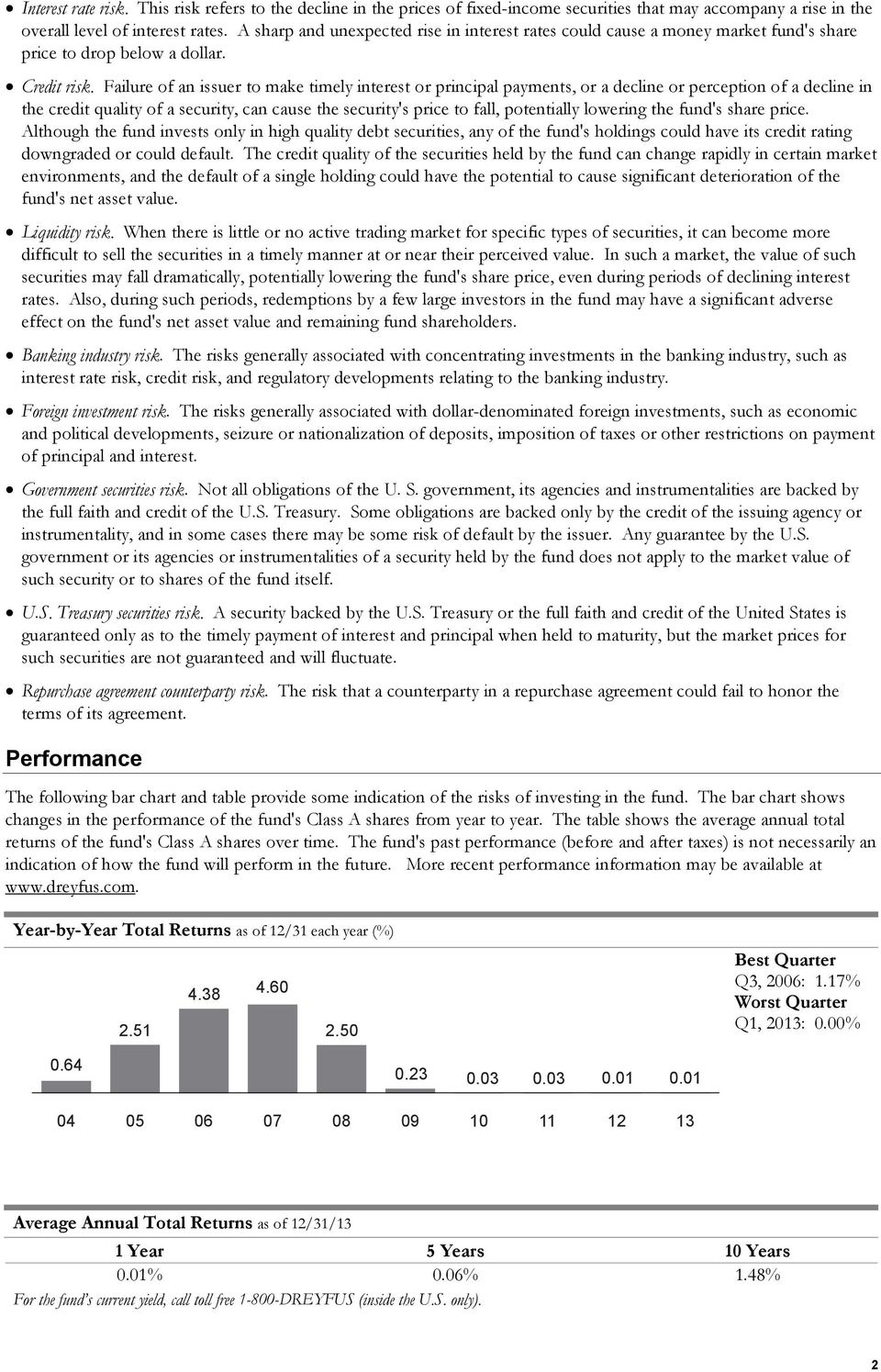
4 Interest rate risk. This risk refers to the decline in the prices of fixed-income securities that may accompany a rise in the overall level of interest rates. A sharp and unexpected rise in interest rates could cause a money market fund's share price to drop below a dollar. Credit risk. Failure of an issuer to make timely interest or principal payments, or a decline or perception of a decline in the credit quality of a security, can cause the security's price to fall, potentially lowering the fund's share price. Although the fund invests only in high quality debt securities, any of the fund's holdings could have its credit rating downgraded or could default. The credit quality of the securities held by the fund can change rapidly in certain market environments, and the default of a single holding could have the potential to cause significant deterioration of the fund's net asset value. Liquidity risk. When there is little or no active trading market for specific types of securities, it can become more difficult to sell the securities in a timely manner at or near their perceived value. In such a market, the value of such securities may fall dramatically, potentially lowering the fund's share price, even during periods of declining interest rates. Also, during such periods, redemptions by a few large investors in the fund may have a significant adverse effect on the fund's net asset value and remaining fund shareholders. Banking industry risk. The risks generally associated with concentrating investments in the banking industry, such as interest rate risk, credit risk, and regulatory developments relating to the banking industry. Foreign investment risk. The risks generally associated with dollar-denominated foreign investments, such as economic and political developments, seizure or nationalization of deposits, imposition of taxes or other restrictions on payment of principal and interest. Government securities risk. Not all obligations of the U. S. government, its agencies and instrumentalities are backed by the full faith and credit of the U.S. Treasury. Some obligations are backed only by the credit of the issuing agency or instrumentality, and in some cases there may be some risk of default by the issuer. Any guarantee by the U.S. government or its agencies or instrumentalities of a security held by the fund does not apply to the market value of such security or to shares of the fund itself. U.S. Treasury securities risk. A security backed by the U.S. Treasury or the full faith and credit of the United States is guaranteed only as to the timely payment of interest and principal when held to maturity, but the market prices for such securities are not guaranteed and will fluctuate. Repurchase agreement counterparty risk. The risk that a counterparty in a repurchase agreement could fail to honor the terms of its agreement. Performance The following bar chart and table provide some indication of the risks of investing in the fund. The bar chart shows changes in the performance of the fund's Class A shares from year to year. The table shows the average annual total returns of the fund's Class A shares over time. The fund's past performance (before and after taxes) is not necessarily an indication of how the fund will perform in the future. More recent performance information may be available at Year-by-Year Total Returns as of 12/31 each year (%) Best Quarter Q3, 2006: 1.17% Worst Quarter Q1, 2013: 0.00% Average Annual Total Returns as of 12/31/13 1 Year 5 Years 10 Years 0.01% 0.06% 1.48% For the fund s current yield, call toll free DREYFUS (inside the U.S. only). 2
5 Portfolio Management The fund's investment adviser is The Dreyfus Corporation. Purchase and Sale of Fund Shares In general, the fund's minimum initial investment is $2,500 and the minimum subsequent investment is $100. You may sell (redeem) your shares on any business day by calling DREYFUS (inside the U.S. only) or by visiting If you invested in the fund through a third party, such as a bank, broker-dealer or financial adviser, you may mail your request to sell shares to Dreyfus Institutional Department, P.O. Box 9882, Providence, Rhode Island If you invested directly through the fund, you may mail your request to sell shares to Dreyfus Shareholder Services, P.O. Box 9879, Providence, Rhode Island Tax Information The fund's distributions are taxable as ordinary income or capital gains, except when your investment is through an IRA, 401(k) plan or other tax-advantaged investment plan (in which case you may be taxed upon withdrawal of your investment from such account). Payments to Broker-Dealers and Other Financial Intermediaries If you purchase shares through a broker-dealer or other financial intermediary (such as a bank), the fund and its related companies may pay the intermediary for the sale of fund shares and related services. These payments may create a conflict of interest by influencing the broker-dealer or other intermediary and your salesperson to recommend the fund over another investment. Ask your salesperson or visit your financial intermediary's website for more information. 3
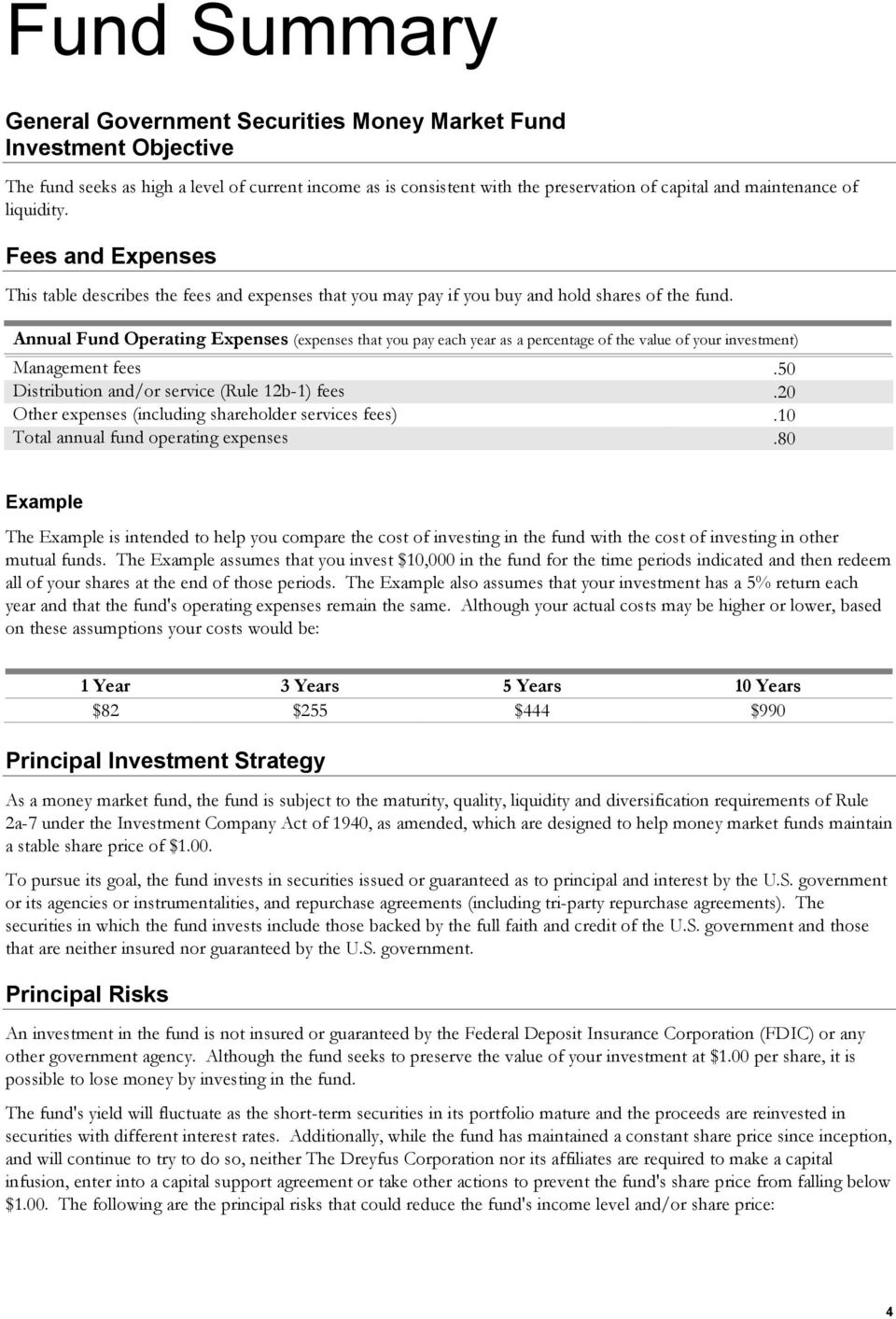
6 Fund Summary General Government Securities Money Market Fund Investment Objective The fund seeks as high a level of current income as is consistent with the preservation of capital and maintenance of liquidity. Fees and Expenses This table describes the fees and expenses that you may pay if you buy and hold shares of the fund. Annual Fund Operating Expenses (expenses that you pay each year as a percentage of the value of your investment) Management fees.50 Distribution and/or service (Rule 12b-1) fees.20 Other expenses (including shareholder services fees).10 Total annual fund operating expenses.80 Example The Example is intended to help you compare the cost of investing in the fund with the cost of investing in other mutual funds. The Example assumes that you invest $10,000 in the fund for the time periods indicated and then redeem all of your shares at the end of those periods. The Example also assumes that your investment has a 5% return each year and that the fund's operating expenses remain the same. Although your actual costs may be higher or lower, based on these assumptions your costs would be: 1 Year 3 Years 5 Years 10 Years $82 $255 $444 $990 Principal Investment Strategy As a money market fund, the fund is subject to the maturity, quality, liquidity and diversification requirements of Rule 2a-7 under the Investment Company Act of 1940, as amended, which are designed to help money market funds maintain a stable share price of $1.00. To pursue its goal, the fund invests in securities issued or guaranteed as to principal and interest by the U.S. government or its agencies or instrumentalities, and repurchase agreements (including tri-party repurchase agreements). The securities in which the fund invests include those backed by the full faith and credit of the U.S. government and those that are neither insured nor guaranteed by the U.S. government. Principal Risks An investment in the fund is not insured or guaranteed by the Federal Deposit Insurance Corporation (FDIC) or any other government agency. Although the fund seeks to preserve the value of your investment at $1.00 per share, it is possible to lose money by investing in the fund. The fund's yield will fluctuate as the short-term securities in its portfolio mature and the proceeds are reinvested in securities with different interest rates. Additionally, while the fund has maintained a constant share price since inception, and will continue to try to do so, neither The Dreyfus Corporation nor its affiliates are required to make a capital infusion, enter into a capital support agreement or take other actions to prevent the fund's share price from falling below $1.00. The following are the principal risks that could reduce the fund's income level and/or share price: 4
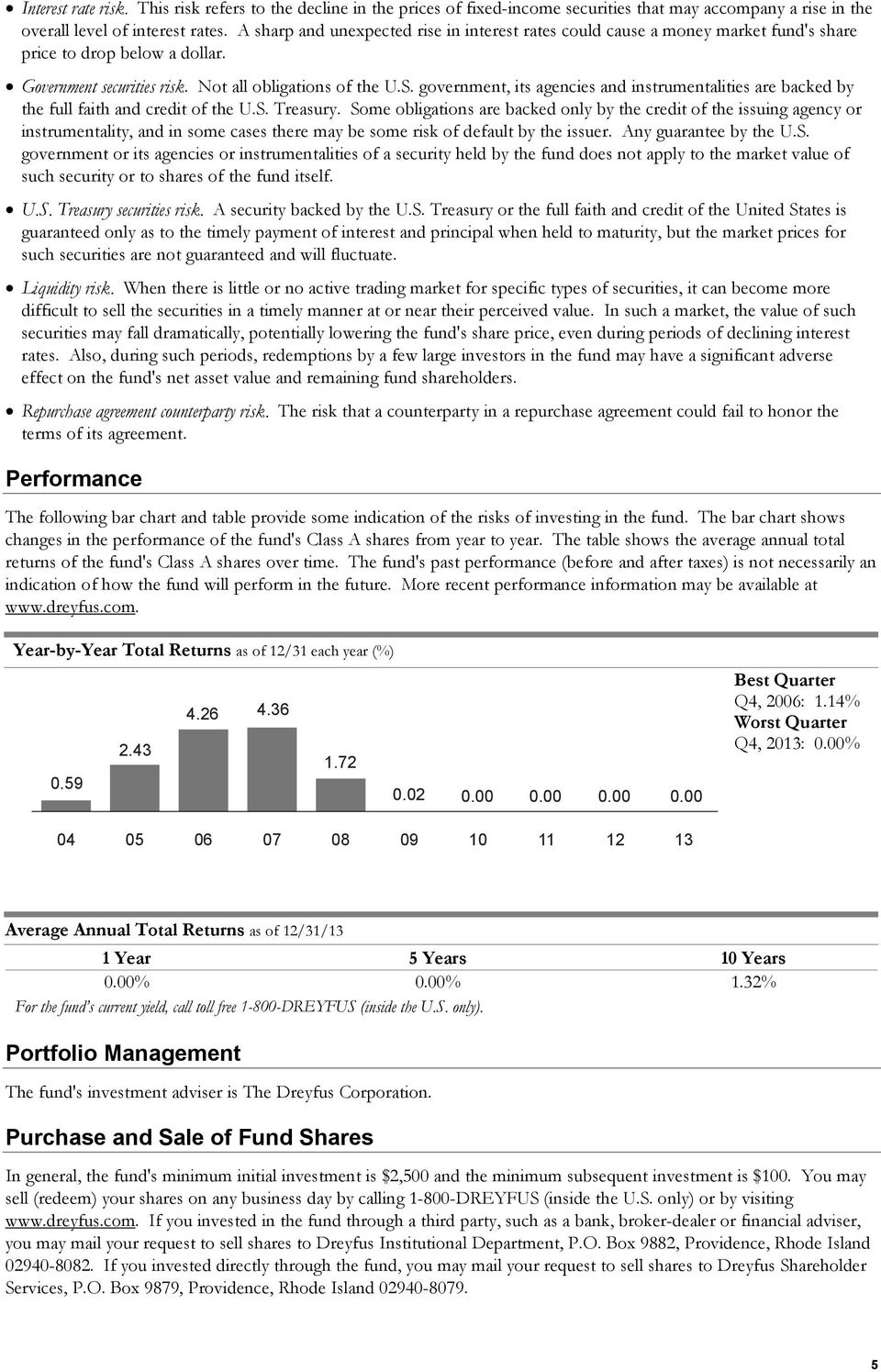
7 Interest rate risk. This risk refers to the decline in the prices of fixed-income securities that may accompany a rise in the overall level of interest rates. A sharp and unexpected rise in interest rates could cause a money market fund's share price to drop below a dollar. Government securities risk. Not all obligations of the U.S. government, its agencies and instrumentalities are backed by the full faith and credit of the U.S. Treasury. Some obligations are backed only by the credit of the issuing agency or instrumentality, and in some cases there may be some risk of default by the issuer. Any guarantee by the U.S. government or its agencies or instrumentalities of a security held by the fund does not apply to the market value of such security or to shares of the fund itself. U.S. Treasury securities risk. A security backed by the U.S. Treasury or the full faith and credit of the United States is guaranteed only as to the timely payment of interest and principal when held to maturity, but the market prices for such securities are not guaranteed and will fluctuate. Liquidity risk. When there is little or no active trading market for specific types of securities, it can become more difficult to sell the securities in a timely manner at or near their perceived value. In such a market, the value of such securities may fall dramatically, potentially lowering the fund's share price, even during periods of declining interest rates. Also, during such periods, redemptions by a few large investors in the fund may have a significant adverse effect on the fund's net asset value and remaining fund shareholders. Repurchase agreement counterparty risk. The risk that a counterparty in a repurchase agreement could fail to honor the terms of its agreement. Performance The following bar chart and table provide some indication of the risks of investing in the fund. The bar chart shows changes in the performance of the fund's Class A shares from year to year. The table shows the average annual total returns of the fund's Class A shares over time. The fund's past performance (before and after taxes) is not necessarily an indication of how the fund will perform in the future. More recent performance information may be available at Year-by-Year Total Returns as of 12/31 each year (%) Best Quarter Q4, 2006: 1.14% Worst Quarter Q4, 2013: 0.00% Average Annual Total Returns as of 12/31/13 1 Year 5 Years 10 Years 0.00% 0.00% 1.32% For the fund s current yield, call toll free DREYFUS (inside the U.S. only). Portfolio Management The fund's investment adviser is The Dreyfus Corporation. Purchase and Sale of Fund Shares In general, the fund's minimum initial investment is $2,500 and the minimum subsequent investment is $100. You may sell (redeem) your shares on any business day by calling DREYFUS (inside the U.S. only) or by visiting If you invested in the fund through a third party, such as a bank, broker-dealer or financial adviser, you may mail your request to sell shares to Dreyfus Institutional Department, P.O. Box 9882, Providence, Rhode Island If you invested directly through the fund, you may mail your request to sell shares to Dreyfus Shareholder Services, P.O. Box 9879, Providence, Rhode Island
8 Tax Information The fund's distributions are taxable as ordinary income or capital gains, except when your investment is through an IRA, 401(k) plan or other tax-advantaged investment plan (in which case you may be taxed upon withdrawal of your investment from such account). Payments to Broker-Dealers and Other Financial Intermediaries If you purchase shares through a broker-dealer or other financial intermediary (such as a bank), the fund and its related companies may pay the intermediary for the sale of fund shares and related services. These payments may create a conflict of interest by influencing the broker-dealer or other intermediary and your salesperson to recommend the fund over another investment. Ask your salesperson or visit your financial intermediary's website for more information. 6

9 Fund Summary General Treasury Prime Money Market Fund Investment Objective The fund seeks as high a level of current income as is consistent with the preservation of capital and maintenance of liquidity. Fees and Expenses This table describes the fees and expenses that you may pay if you buy and hold shares of the fund. Annual Fund Operating Expenses (expenses that you pay each year as a percentage of the value of your investment) Management fees.50 Distribution and/or service (Rule 12b-1) fees.20 Other expenses (including shareholder services fees).03 Total annual fund operating expenses.73 Example The Example is intended to help you compare the cost of investing in the fund with the cost of investing in other mutual funds. The Example assumes that you invest $10,000 in the fund for the time periods indicated and then redeem all of your shares at the end of those periods. The Example also assumes that your investment has a 5% return each year and that the fund's operating expenses remain the same. Although your actual costs may be higher or lower, based on these assumptions your costs would be: 1 Year 3 Years 5 Years 10 Years $75 $233 $406 $906 Principal Investment Strategy As a money market fund, the fund is subject to the maturity, quality, liquidity and diversification requirements of Rule 2a-7 under the Investment Company Act of 1940, as amended, which are designed to help money market funds maintain a stable share price of $1.00. To pursue its goal, the fund normally invests substantially all of its net assets in U.S. Treasury securities. Principal Risks An investment in the fund is not insured or guaranteed by the Federal Deposit Insurance Corporation (FDIC) or any other government agency. Although the fund seeks to preserve the value of your investment at $1.00 per share, it is possible to lose money by investing in the fund. The fund's yield will fluctuate as the short-term securities in its portfolio mature and the proceeds are reinvested in securities with different interest rates. Additionally, while the fund has maintained a constant share price since inception, and will continue to try to do so, neither The Dreyfus Corporation nor its affiliates are required to make a capital infusion, enter into a capital support agreement or take other actions to prevent the fund's share price from falling below $1.00. The following are the principal risks that could reduce the fund's income level and/or share price: Interest rate risk. This risk refers to the decline in the prices of fixed-income securities that may accompany a rise in the overall level of interest rates. A sharp and unexpected rise in interest rates could cause a money market fund's share price to drop below a dollar. 7

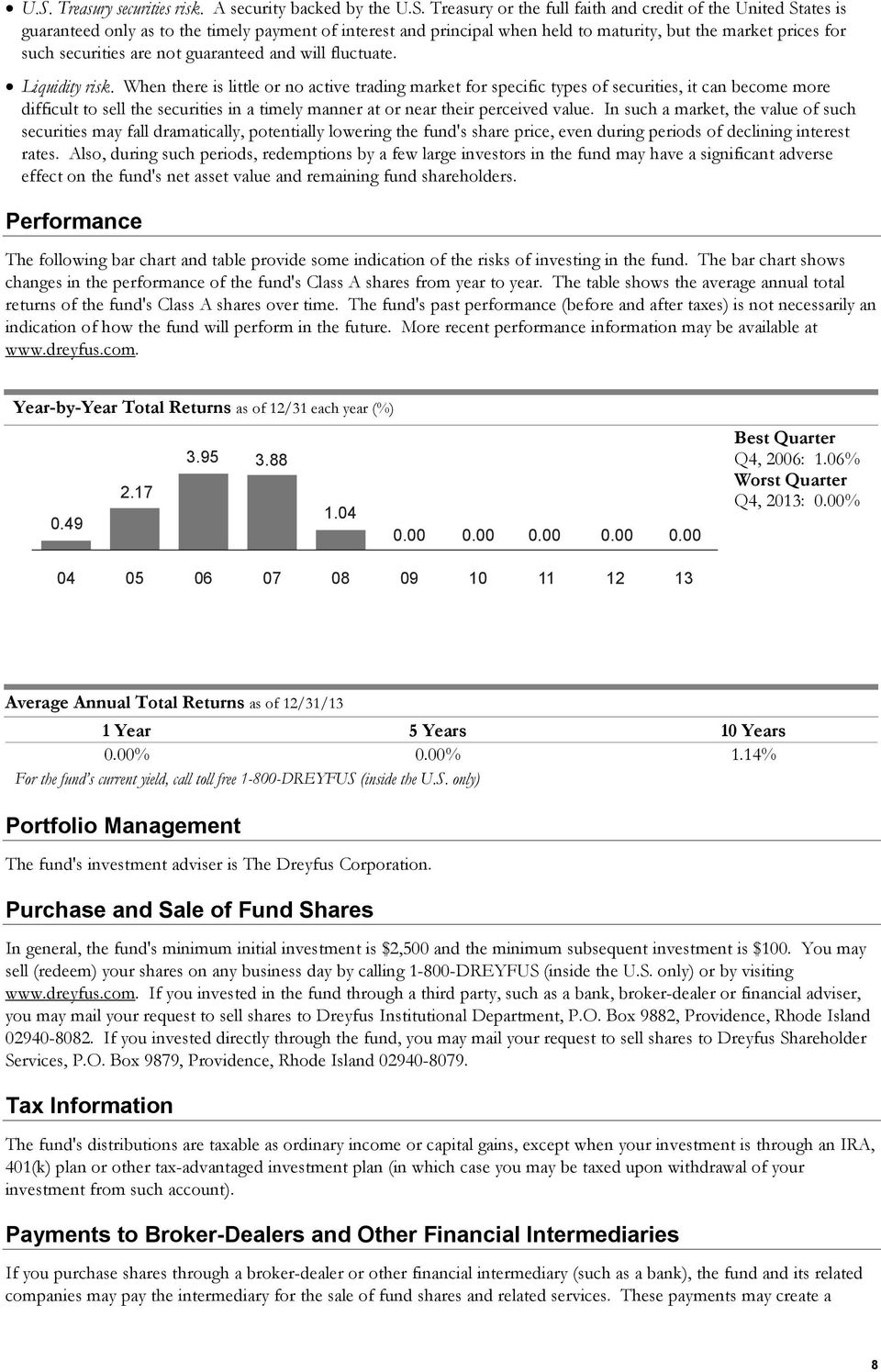
10 U.S. Treasury securities risk. A security backed by the U.S. Treasury or the full faith and credit of the United States is guaranteed only as to the timely payment of interest and principal when held to maturity, but the market prices for such securities are not guaranteed and will fluctuate. Liquidity risk. When there is little or no active trading market for specific types of securities, it can become more difficult to sell the securities in a timely manner at or near their perceived value. In such a market, the value of such securities may fall dramatically, potentially lowering the fund's share price, even during periods of declining interest rates. Also, during such periods, redemptions by a few large investors in the fund may have a significant adverse effect on the fund's net asset value and remaining fund shareholders. Performance The following bar chart and table provide some indication of the risks of investing in the fund. The bar chart shows changes in the performance of the fund's Class A shares from year to year. The table shows the average annual total returns of the fund's Class A shares over time. The fund's past performance (before and after taxes) is not necessarily an indication of how the fund will perform in the future. More recent performance information may be available at Year-by-Year Total Returns as of 12/31 each year (%) Best Quarter Q4, 2006: 1.06% Worst Quarter Q4, 2013: 0.00% Average Annual Total Returns as of 12/31/13 1 Year 5 Years 10 Years 0.00% 0.00% 1.14% For the fund s current yield, call toll free DREYFUS (inside the U.S. only) Portfolio Management The fund's investment adviser is The Dreyfus Corporation. Purchase and Sale of Fund Shares In general, the fund's minimum initial investment is $2,500 and the minimum subsequent investment is $100. You may sell (redeem) your shares on any business day by calling DREYFUS (inside the U.S. only) or by visiting If you invested in the fund through a third party, such as a bank, broker-dealer or financial adviser, you may mail your request to sell shares to Dreyfus Institutional Department, P.O. Box 9882, Providence, Rhode Island If you invested directly through the fund, you may mail your request to sell shares to Dreyfus Shareholder Services, P.O. Box 9879, Providence, Rhode Island Tax Information The fund's distributions are taxable as ordinary income or capital gains, except when your investment is through an IRA, 401(k) plan or other tax-advantaged investment plan (in which case you may be taxed upon withdrawal of your investment from such account). Payments to Broker-Dealers and Other Financial Intermediaries If you purchase shares through a broker-dealer or other financial intermediary (such as a bank), the fund and its related companies may pay the intermediary for the sale of fund shares and related services. These payments may create a 8
11 conflict of interest by influencing the broker-dealer or other intermediary and your salesperson to recommend the fund over another investment. Ask your salesperson or visit your financial intermediary's website for more information. 9

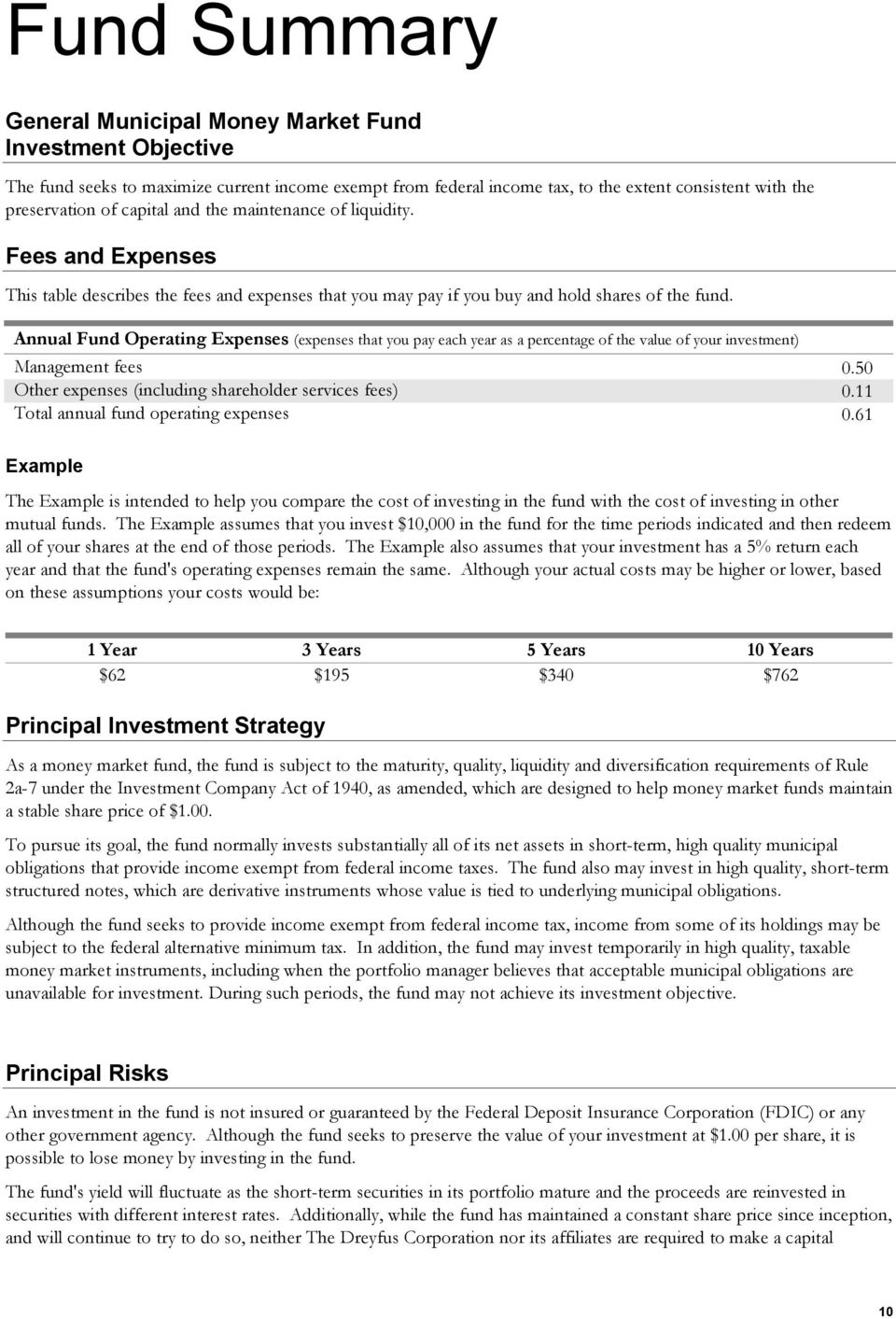
12 Fund Summary General Municipal Money Market Fund Investment Objective The fund seeks to maximize current income exempt from federal income tax, to the extent consistent with the preservation of capital and the maintenance of liquidity. Fees and Expenses This table describes the fees and expenses that you may pay if you buy and hold shares of the fund. Annual Fund Operating Expenses (expenses that you pay each year as a percentage of the value of your investment) Management fees 0.50 Other expenses (including shareholder services fees) 0.11 Total annual fund operating expenses 0.61 Example The Example is intended to help you compare the cost of investing in the fund with the cost of investing in other mutual funds. The Example assumes that you invest $10,000 in the fund for the time periods indicated and then redeem all of your shares at the end of those periods. The Example also assumes that your investment has a 5% return each year and that the fund's operating expenses remain the same. Although your actual costs may be higher or lower, based on these assumptions your costs would be: 1 Year 3 Years 5 Years 10 Years $62 $195 $340 $762 Principal Investment Strategy As a money market fund, the fund is subject to the maturity, quality, liquidity and diversification requirements of Rule 2a-7 under the Investment Company Act of 1940, as amended, which are designed to help money market funds maintain a stable share price of $1.00. To pursue its goal, the fund normally invests substantially all of its net assets in short-term, high quality municipal obligations that provide income exempt from federal income taxes. The fund also may invest in high quality, short-term structured notes, which are derivative instruments whose value is tied to underlying municipal obligations. Although the fund seeks to provide income exempt from federal income tax, income from some of its holdings may be subject to the federal alternative minimum tax. In addition, the fund may invest temporarily in high quality, taxable money market instruments, including when the portfolio manager believes that acceptable municipal obligations are unavailable for investment. During such periods, the fund may not achieve its investment objective. Principal Risks An investment in the fund is not insured or guaranteed by the Federal Deposit Insurance Corporation (FDIC) or any other government agency. Although the fund seeks to preserve the value of your investment at $1.00 per share, it is possible to lose money by investing in the fund. The fund's yield will fluctuate as the short-term securities in its portfolio mature and the proceeds are reinvested in securities with different interest rates. Additionally, while the fund has maintained a constant share price since inception, and will continue to try to do so, neither The Dreyfus Corporation nor its affiliates are required to make a capital 10
13 infusion, enter into a capital support agreement or take other actions to prevent the fund's share price from falling below $1.00. The following are the principal risks that could reduce the fund's income level and/or share price: Interest rate risk. This risk refers to the decline in the prices of fixed-income securities that may accompany a rise in the overall level of interest rates. A sharp and unexpected rise in interest rates could cause a money market fund's share price to drop below a dollar. Credit risk. Failure of an issuer to make timely interest or principal payments, or a decline or perception of a decline in the credit quality of a security, can cause the security's price to fall, potentially lowering the fund's share price. Although the fund invests only in high quality debt securities, any of the fund's holdings could have its credit rating downgraded or could default. The credit quality of the securities held by the fund can change rapidly in certain market environments, and the default of a single holding could have the potential to cause significant deterioration of the fund's net asset value. Liquidity risk. When there is little or no active trading market for specific types of securities, it can become more difficult to sell the securities in a timely manner at or near their perceived value. In such a market, the value of such securities may fall dramatically, potentially lowering the fund's share price, even during periods of declining interest rates. Also, during such periods, redemptions by a few large investors in the fund may have a significant adverse effect on the fund's net asset value and remaining fund shareholders. Municipal securities risk. The amount of public information available about municipal securities is generally less than that for corporate equities or bonds. Special factors, such as legislative changes, and state and local economic and business developments, may adversely affect the yield and/or value of the fund's investments in municipal securities. Other factors include the general conditions of the municipal securities market, the size of the particular offering, the maturity of the obligation and the rating of the issue. Changes in economic, business or political conditions relating to a particular municipal project, municipality, or state, territory or possession of the United States in which the fund invests may have an impact on the fund's share price. Tax risk. To be tax-exempt, municipal obligations generally must meet certain regulatory requirements. If any such municipal obligation fails to meet these regulatory requirements, the interest received by the fund from its investment in such obligations and distributed to fund shareholders will be taxable. Structured notes risk. Structured notes, a type of derivative instrument, can be volatile, and the possibility of default by the financial institution or counterparty may be greater for these securities than for other types of money market instruments. Structured notes typically are purchased in privately negotiated transactions from financial institutions and, thus, an active trading market for such instruments may not exist. Performance The following bar chart and table provide some indication of the risks of investing in the fund. The bar chart shows changes in the performance of the fund's Class A shares from year to year. The table shows the average annual total returns of the fund's Class A shares over time. The fund's past performance (before and after taxes) is not necessarily an indication of how the fund will perform in the future. More recent performance information may be available at Year-by-Year Total Returns as of 12/31 each year (%) Best Quarter Q3, 2007: 0.79% Worst Quarter Q4, 2013: 0.00% Average Annual Total Returns as of 12/31/13 1 Year 5 Years 10 Years 0.00% 0.06% 1.09% For the fund s current yield, call toll free DREYFUS (inside the U.S. only). 11

14 Portfolio Management The fund's investment adviser is The Dreyfus Corporation. Purchase and Sale of Fund Shares In general, the fund's minimum initial investment is $2,500 and the minimum subsequent investment is $100. You may sell (redeem) your shares on any business day by calling DREYFUS (inside the U.S. only) or by visiting If you invested in the fund through a third party, such as a bank, broker-dealer or financial adviser, you may mail your request to sell shares to Dreyfus Institutional Department, P.O. Box 9882, Providence, Rhode Island If you invested directly through the fund, you may mail your request to sell shares to Dreyfus Shareholder Services, P.O. Box 9879, Providence, Rhode Island Tax Information The fund anticipates that virtually all dividends paid by the fund will be exempt from federal income taxes. However, for federal tax purposes, certain distributions, such as distributions of short-term capital gains, are taxable as ordinary income, while long-term capital gains are taxable as capital gains. Payments to Broker-Dealers and Other Financial Intermediaries If you purchase shares through a broker-dealer or other financial intermediary (such as a bank), the fund and its related companies may pay the intermediary for the sale of fund shares and related services. These payments may create a conflict of interest by influencing the broker-dealer or other intermediary and your salesperson to recommend the fund over another investment. Ask your salesperson or visit your financial intermediary's website for more information. 12
15 Fund Summary General California Municipal Money Market Fund Investment Objective The fund seeks to maximize current income exempt from federal and California state income taxes, to the extent consistent with the preservation of capital and the maintenance of liquidity. Fees and Expenses This table describes the fees and expenses that you may pay if you buy and hold shares of the fund. Annual Fund Operating Expenses (expenses that you pay each year as a percentage of the value of your investment) Management fees 0.50 Other expenses (including shareholder services fees) 0.16 Total annual fund operating expenses 0.66 Example The Example is intended to help you compare the cost of investing in the fund with the cost of investing in other mutual funds. The Example assumes that you invest $10,000 in the fund for the time periods indicated and then redeem all of your shares at the end of those periods. The Example also assumes that your investment has a 5% return each year and that the fund's operating expenses remain the same. Although your actual costs may be higher or lower, based on these assumptions your costs would be: 1 Year 3 Years 5 Years 10 Years $67 $211 $368 $822 Principal Investment Strategy As a money market fund, the fund is subject to the maturity, quality, liquidity and diversification requirements of Rule 2a-7 under the Investment Company Act of 1940, as amended, which are designed to help money market funds maintain a stable share price of $1.00. To pursue its goal, the fund normally invests substantially all of its net assets in short-term, high quality municipal obligations that provide income exempt from federal and California state income taxes. The fund also may invest in high quality, short-term structured notes, which are derivative instruments whose value is tied to underlying municipal obligations. Although the fund seeks to provide income exempt from federal and California state income taxes, the fund may invest temporarily in high quality, taxable money market instruments and/or municipal obligations that pay income exempt only from federal income tax, including when the portfolio manager believes acceptable California municipal obligations are not available for investment. During such periods, the fund may not achieve its investment objective. In addition, income from some of the fund's holdings may be subject to the federal alternative minimum tax. Principal Risks An investment in the fund is not insured or guaranteed by the Federal Deposit Insurance Corporation (FDIC) or any other government agency. Although the fund seeks to preserve the value of your investment at $1.00 per share, it is possible to lose money by investing in the fund. The fund's yield will fluctuate as the short-term securities in its portfolio mature and the proceeds are reinvested in securities with different interest rates. Additionally, while the fund has maintained a constant share price since inception, and will continue to try to do so, neither The Dreyfus Corporation nor its affiliates are required to make a capital 13
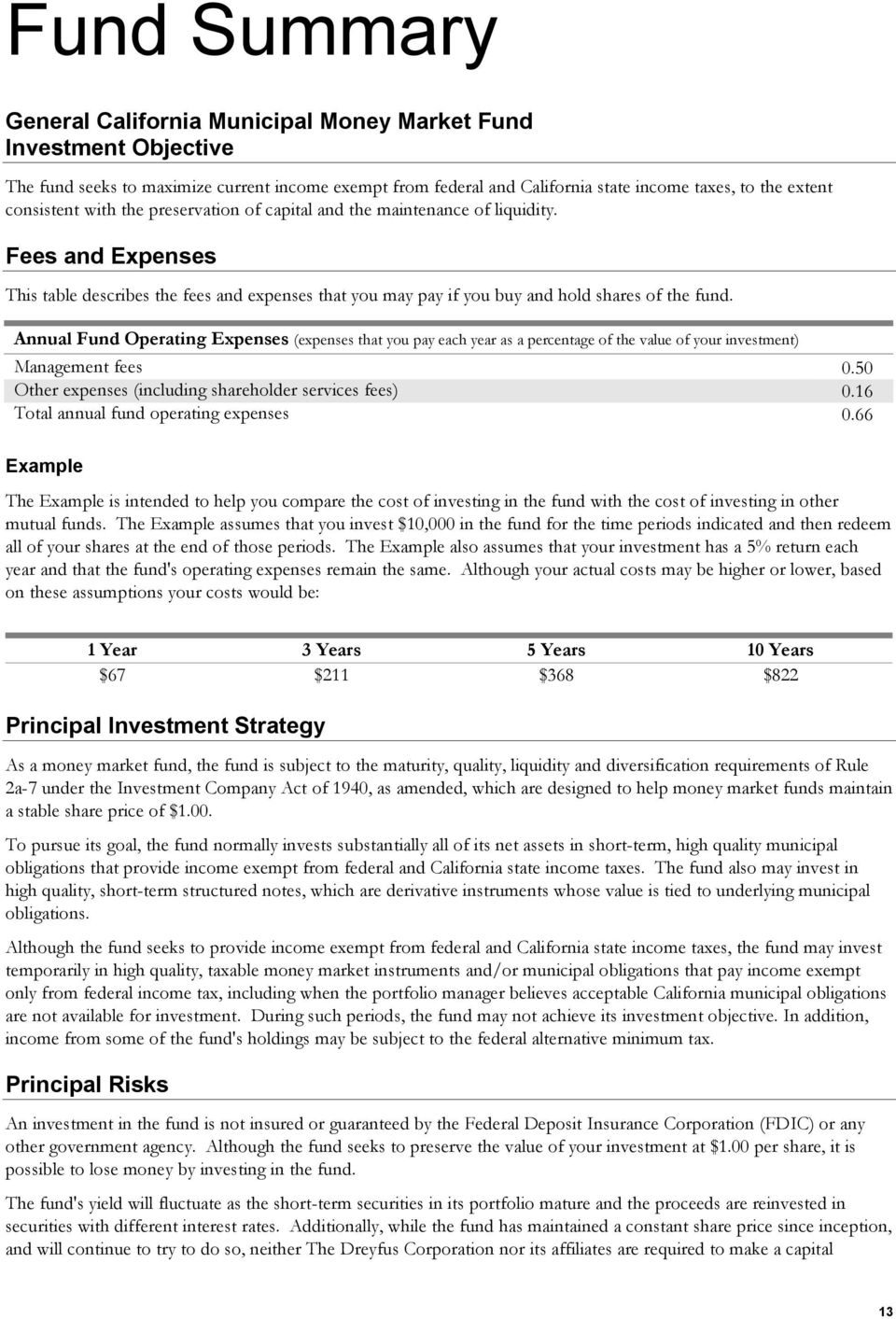
16 infusion, enter into a capital support agreement or take other actions to prevent the fund's share price from falling below $1.00. The following are the principal risks that could reduce the fund's income level and/or share price: Interest rate risk. This risk refers to the decline in the prices of fixed-income securities that may accompany a rise in the overall level of interest rates. A sharp and unexpected rise in interest rates could cause a money market fund's share price to drop below a dollar. Credit risk. Failure of an issuer to make timely interest or principal payments, or a decline or perception of a decline in the credit quality of a security, can cause the security's price to fall, potentially lowering the fund's share price. Although the fund invests only in high quality debt securities, any of the fund's holdings could have its credit rating downgraded or could default. The credit quality of the securities held by the fund can change rapidly in certain market environments, and the default of a single holding could have the potential to cause significant deterioration of the fund's net asset value. Liquidity risk. When there is little or no active trading market for specific types of securities, it can become more difficult to sell the securities in a timely manner at or near their perceived value. In such a market, the value of such securities may fall dramatically, potentially lowering the fund's share price, even during periods of declining interest rates. Also, during such periods, redemptions by a few large investors in the fund may have a significant adverse effect on the fund's net asset value and remaining fund shareholders. Municipal securities risk. The amount of public information available about municipal securities is generally less than that for corporate equities or bonds. Special factors, such as legislative changes, and state and local economic and business developments, may adversely affect the yield and/or value of the fund's investments in municipal securities. Other factors include the general conditions of the municipal securities market, the size of the particular offering, the maturity of the obligation and the rating of the issue. Changes in economic, business or political conditions relating to a particular municipal project, municipality, or state, territory or possession of the United States in which the fund invests may have an impact on the fund's share price. Tax risk. To be tax-exempt, municipal obligations generally must meet certain regulatory requirements. If any such municipal obligation fails to meet these regulatory requirements, the interest received by the fund from its investment in such obligations and distributed to fund shareholders will be taxable. Structured notes risk. Structured notes, a type of derivative instrument, can be volatile, and the possibility of default by the financial institution or counterparty may be greater for these securities than for other types of money market instruments. Structured notes typically are purchased in privately negotiated transactions from financial institutions and, thus, an active trading market for such instruments may not exist. State-specific risk. The fund is subject to the risk that California's economy, and the revenues underlying its municipal obligations, may decline. Investing primarily in a single state makes the fund more sensitive to risks specific to the state and may magnify other risks. Non-diversification risk. The fund is non-diversified, which means that the fund may invest a relatively high percentage of its assets in a limited number of issuers. Therefore, the fund's performance may be more vulnerable to changes in the market value of a single issuer or a group of issuers and more susceptible to risks associated with a single economic, political or regulatory occurrence than a diversified fund. Performance The following bar chart and table provide some indication of the risks of investing in the fund. The bar chart shows changes in the performance of the fund's Class A shares from year to year. The table shows the average annual total returns of the fund's Class A shares over time. The fund's past performance (before and after taxes) is not necessarily an indication of how the fund will perform in the future. More recent performance information may be available at 14
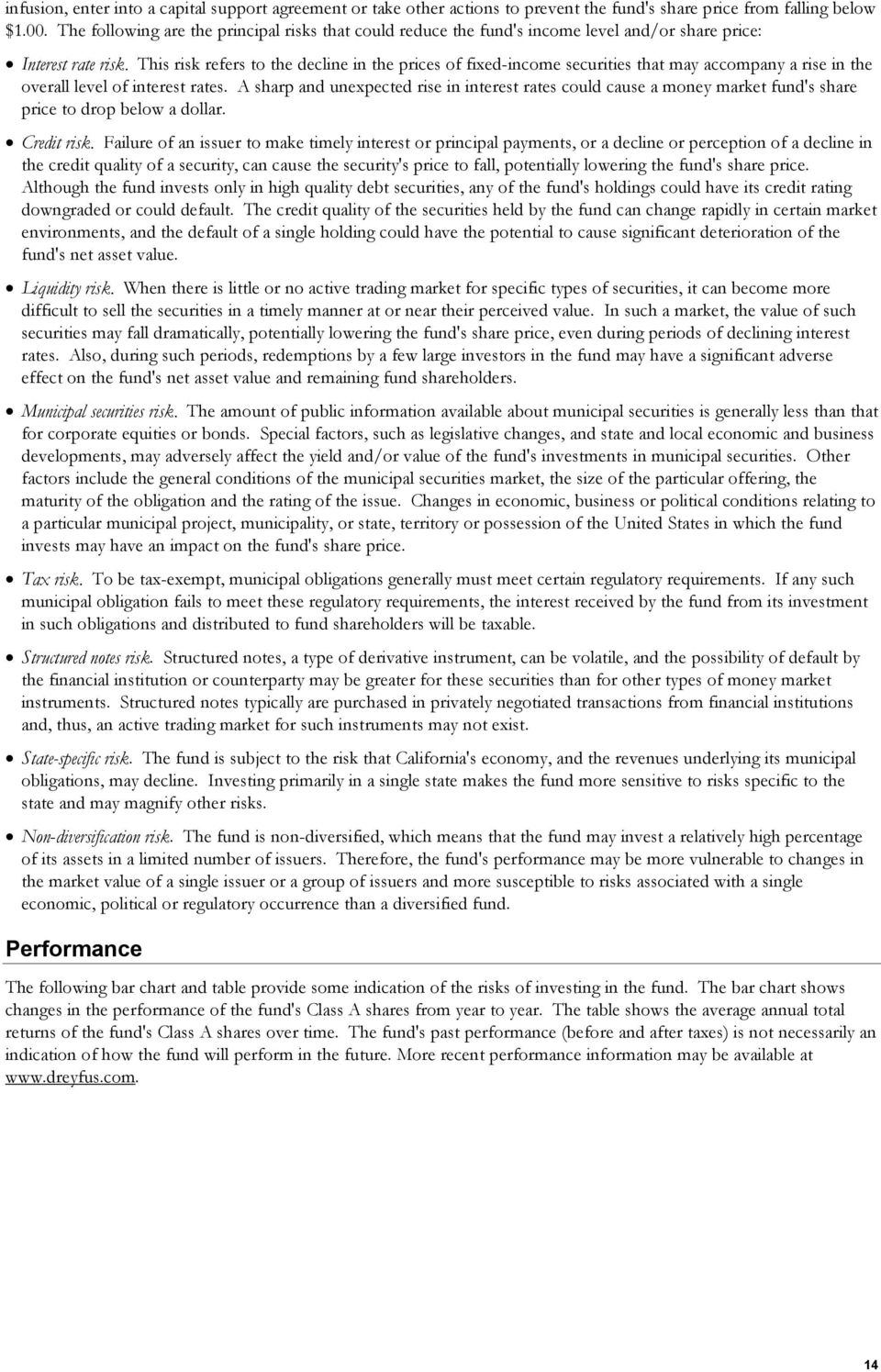
17 Year-by-Year Total Returns as of 12/31 each year (%) Best Quarter Q3, 2007: 0.80% Worst Quarter Q4, 2013: 0.00% Average Annual Total Returns as of 12/31/13 1 Year 5 Years 10 Years 0.00% 0.04% 1.04% For the fund s current yield, call toll free DREYFUS (inside the U.S. only). Portfolio Management The fund's investment adviser is The Dreyfus Corporation. Purchase and Sale of Fund Shares In general, the fund's minimum initial investment is $2,500 and the minimum subsequent investment is $100. You may sell (redeem) your shares on any business day by calling DREYFUS (inside the U.S. only) or by visiting If you invested in the fund through a third party, such as a bank, broker-dealer or financial adviser, you may mail your request to sell shares to Dreyfus Institutional Department, P.O. Box 9882, Providence, Rhode Island If you invested directly through the fund, you may mail your request to sell shares to Dreyfus Shareholder Services, P.O. Box 9879, Providence, Rhode Island Tax Information The fund anticipates that virtually all dividends paid by the fund will be exempt from federal and California state personal income taxes. However, for federal tax purposes, certain distributions, such as distributions of short-term capital gains, are taxable as ordinary income, while long-term capital gains are taxable as capital gains. Payments to Broker-Dealers and Other Financial Intermediaries If you purchase shares through a broker-dealer or other financial intermediary (such as a bank), the fund and its related companies may pay the intermediary for the sale of fund shares and related services. These payments may create a conflict of interest by influencing the broker-dealer or other intermediary and your salesperson to recommend the fund over another investment. Ask your salesperson or visit your financial intermediary's website for more information. 15
18 Fund Summary General New York Municipal Money Market Fund Investment Objective The fund seeks to maximize current income exempt from federal, New York state and New York city income taxes, to the extent consistent with the preservation of capital and the maintenance of liquidity. Fees and Expenses This table describes the fees and expenses that you may pay if you buy and hold shares of the fund. Annual Fund Operating Expenses (expenses that you pay each year as a percentage of the value of your investment) Management fees 0.50 Other expenses (including shareholder services fees) 0.21 Total annual fund operating expenses 0.71 Example The Example is intended to help you compare the cost of investing in the fund with the cost of investing in other mutual funds. The Example assumes that you invest $10,000 in the fund for the time periods indicated and then redeem all of your shares at the end of those periods. The Example also assumes that your investment has a 5% return each year and that the fund's operating expenses remain the same. Although your actual costs may be higher or lower, based on these assumptions your costs would be: 1 Year 3 Years 5 Years 10 Years $73 $227 $395 $883 Principal Investment Strategy As a money market fund, the fund is subject to the maturity, quality, liquidity and diversification requirements of Rule 2a-7 under the Investment Company Act of 1940, as amended, which are designed to help money market funds maintain a stable share price of $1.00. To pursue its goal, the fund normally invests substantially all of its net assets in short-term, high quality municipal obligations that provide income exempt from federal, New York state and New York city income taxes. The fund also may invest in high quality, short-term structured notes, which are derivative instruments whose value is tied to underlying municipal obligations. Although the fund seeks to provide income exempt from federal, New York state and New York city income taxes, the fund may invest temporarily in high quality, taxable money market instruments and/or municipal obligations that pay income exempt only from federal income tax, including when the portfolio manager believes acceptable New York municipal obligations are not available for investment. During such periods, the fund may not achieve its investment objective. In addition, income from some of the fund's holdings may be subject to the federal alternative minimum tax. Principal Risks An investment in the fund is not insured or guaranteed by the Federal Deposit Insurance Corporation (FDIC) or any other government agency. Although the fund seeks to preserve the value of your investment at $1.00 per share, it is possible to lose money by investing in the fund. The fund's yield will fluctuate as the short-term securities in its portfolio mature and the proceeds are reinvested in securities with different interest rates. Additionally, while the fund has maintained a constant share price since inception, and will continue to try to do so, neither The Dreyfus Corporation nor its affiliates are required to make a capital 16
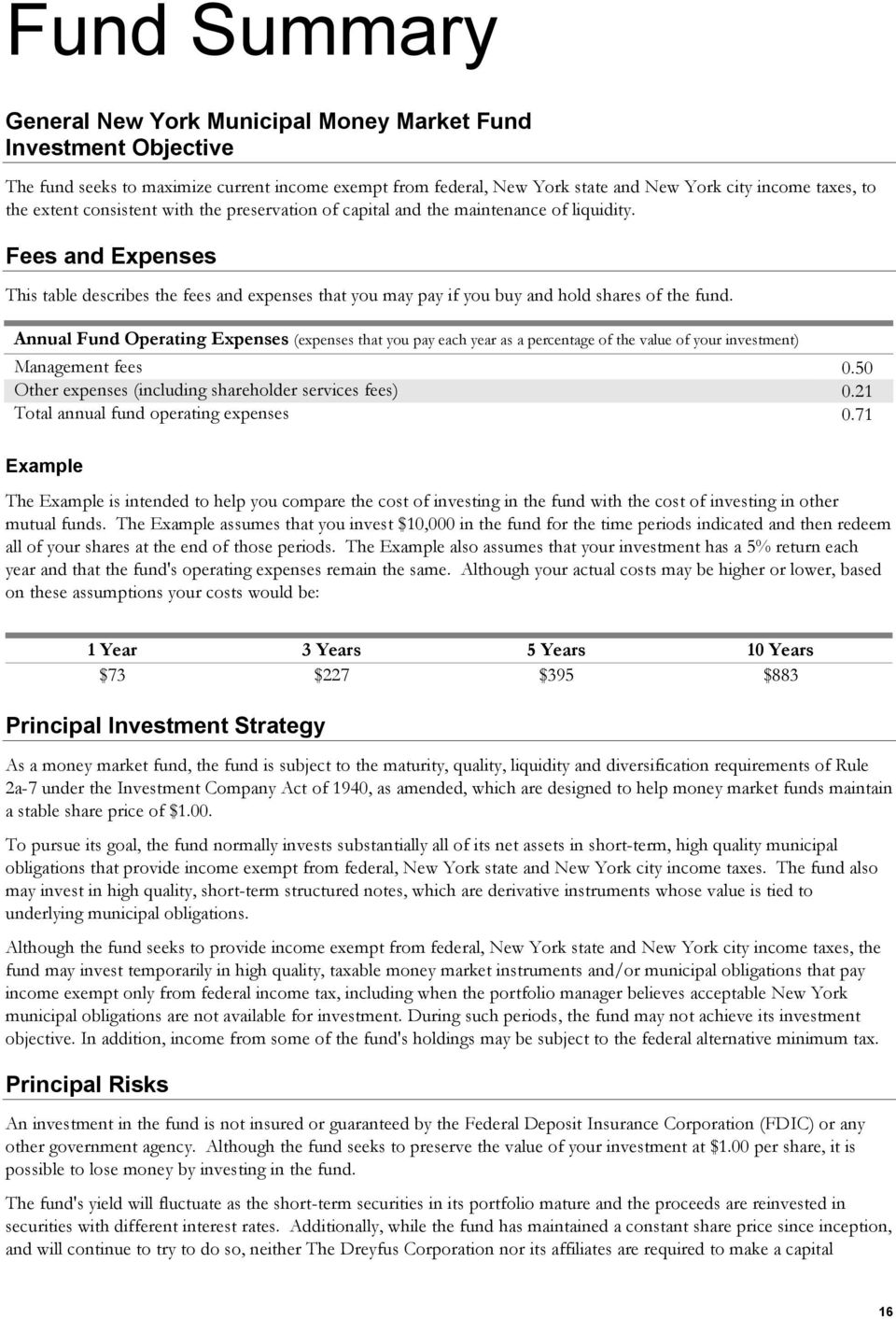
19 infusion, enter into a capital support agreement or take other actions to prevent the fund's share price from falling below $1.00. The following are the principal risks that could reduce the fund's income level and/or share price: Interest rate risk. This risk refers to the decline in the prices of fixed-income securities that may accompany a rise in the overall level of interest rates. A sharp and unexpected rise in interest rates could cause a money market fund's share price to drop below a dollar. Credit risk. Failure of an issuer to make timely interest or principal payments, or a decline or perception of a decline in the credit quality of a security, can cause the security's price to fall, potentially lowering the fund's share price. Although the fund invests only in high quality debt securities, any of the fund's holdings could have its credit rating downgraded or could default. The credit quality of the securities held by the fund can change rapidly in certain market environments, and the default of a single holding could have the potential to cause significant deterioration of the fund's net asset value. Liquidity risk. When there is little or no active trading market for specific types of securities, it can become more difficult to sell the securities in a timely manner at or near their perceived value. In such a market, the value of such securities may fall dramatically, potentially lowering the fund's share price, even during periods of declining interest rates. Also, during such periods, redemptions by a few large investors in the fund may have a significant adverse effect on the fund's net asset value and remaining fund shareholders. Municipal securities risk. The amount of public information available about municipal securities is generally less than that for corporate equities or bonds. Special factors, such as legislative changes, and state and local economic and business developments, may adversely affect the yield and/or value of the fund's investments in municipal securities. Other factors include the general conditions of the municipal securities market, the size of the particular offering, the maturity of the obligation and the rating of the issue. Changes in economic, business or political conditions relating to a particular municipal project, municipality, or state, territory or possession of the United States in which the fund invests may have an impact on the fund's share price. Tax risk. To be tax-exempt, municipal obligations generally must meet certain regulatory requirements. If any such municipal obligation fails to meet these regulatory requirements, the interest received by the fund from its investment in such obligations and distributed to fund shareholders will be taxable. Structured notes risk. Structured notes, a type of derivative instrument, can be volatile, and the possibility of default by the financial institution or counterparty may be greater for these securities than for other types of money market instruments. Structured notes typically are purchased in privately negotiated transactions from financial institutions and, thus, an active trading market for instruments may not exist. State-specific risk. The fund is subject to the risk that New York's economy, and the revenues underlying its municipal obligations, may decline. Investing primarily in a single state makes the fund more sensitive to risks specific to the state and may magnify other risks. Non-diversification risk. The fund is non-diversified, which means that the fund may invest a relatively high percentage of its assets in a limited number of issuers. Therefore, the fund's performance may be more vulnerable to changes in the market value of a single issuer or group of issuers and more susceptible to risks associated with a single economic, political or regulatory occurrence than a diversified fund. Performance The following bar chart and table provide some indication of the risks of investing in the fund. The bar chart shows changes in the performance of the fund's Class A shares from year to year. The table shows the average annual total returns of the fund's Class A shares over time. The fund's past performance (before and after taxes) is not necessarily an indication of how the fund will perform in the future. More recent performance information may be available at 17
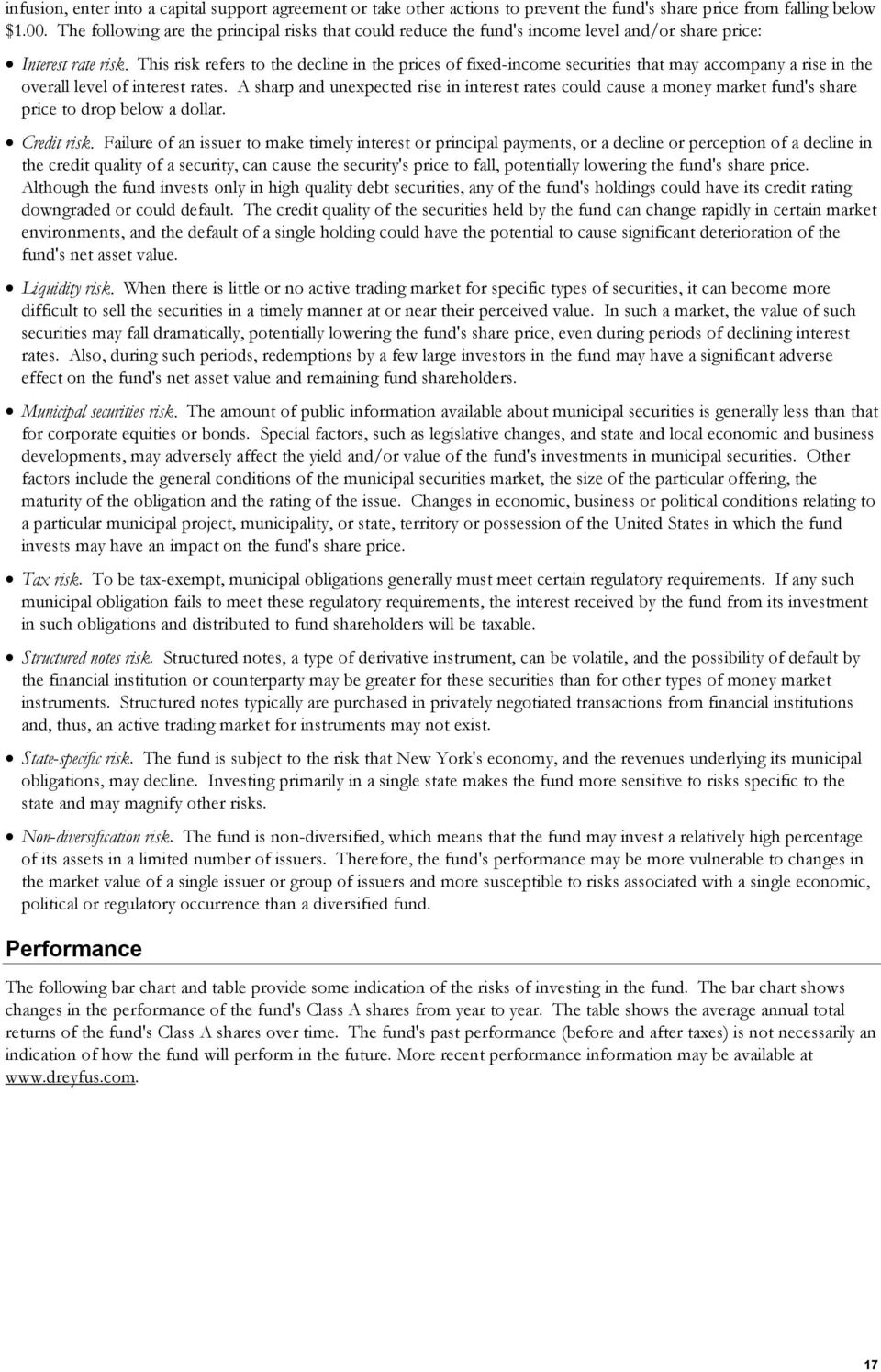
20 Year-by-Year Total Returns as of 12/31 each year (%) Best Quarter Q3, 2007: 0.78% Worst Quarter Q3, 2013: 0.00% Average Annual Total Returns as of 12/31/13 1 Year 5 Years 10 Years 0.00% 0.06 % 1.05% For the fund's current yield, call toll free DREYFUS (inside the U.S. only). Portfolio Management The fund's investment adviser is The Dreyfus Corporation. Purchase and Sale of Fund Shares In general, the fund's minimum initial investment is $2,500 and the minimum subsequent investment is $100. You may sell (redeem) your shares on any business day by calling DREYFUS (inside the U.S. only) or by visiting If you invested in the fund through a third party, such as a bank, broker-dealer or financial adviser, you may mail your request to sell shares to Dreyfus Institutional Department, P.O. Box 9882, Providence, Rhode Island If you invested directly through the fund, you may mail your request to sell shares to Dreyfus Shareholder Services, P.O. Box 9879, Providence, Rhode Island Tax Information The fund anticipates that virtually all dividends paid by the fund will be exempt from federal, New York state and New York city personal income taxes. However, for federal tax purposes, certain distributions, such as distributions of shortterm capital gains, are taxable as ordinary income, while long-term capital gains are taxable as capital gains. Payments to Broker-Dealers and Other Financial Intermediaries If you purchase shares through a broker-dealer or other financial intermediary (such as a bank), the fund and its related companies may pay the intermediary for the sale of fund shares and related services. These payments may create a conflict of interest by influencing the broker-dealer or other intermediary and your salesperson to recommend the fund over another investment. Ask your salesperson or visit your financial intermediary's website for more information. 18
21 Fund Details General Money Market Fund, Inc. Goal and Approach The fund seeks as high a level of current income as is consistent with the preservation of capital. As a money market fund, the fund is subject to the maturity, quality, liquidity and diversification requirements of Rule 2a-7 under the Investment Company Act of 1940, as amended, which are designed to help money market funds maintain a stable share price of $1.00. To pursue its goal, the fund normally invests in a diversified portfolio of high quality, short-term, dollar-denominated debt securities, including: securities issued or guaranteed as to principal and interest by the U.S. government or its agencies or instrumentalities certificates of deposit, time deposits, bankers' acceptances and other short-term securities issued by domestic or foreign banks or thrifts or their subsidiaries or branches repurchase agreements, including tri-party repurchase agreements asset-backed securities domestic and dollar-denominated foreign commercial paper, and other short-term corporate obligations, including those with floating or variable rates of interest obligations issued or guaranteed by one or more foreign governments or any of their political subdivisions or agencies Normally, the fund invests at least 25% of its net assets in domestic or dollar-denominated foreign bank obligations. While the fund generally invests solely in securities with the highest credit rating or the unrated equivalent as determined by The Dreyfus Corporation, it may invest up to 3% of its assets in securities with the second-highest credit rating that mature in 45 days or less. The fund is required to hold at least 30% of its assets in cash, U.S. Treasury securities, certain other government securities with remaining maturities of 60 days or less, or securities that can readily be converted into cash within five business days. In addition, the fund is required to hold at least 10% of its assets in cash, U.S. Treasury securities, or securities that can readily be converted into cash within one business day. The maximum weighted average maturity of the fund's portfolio is 60 days and the maximum weighted average life to maturity of the fund's portfolio is 120 days. In response to liquidity needs or unusual market conditions, the fund may hold all or a significant portion of its total assets in cash for temporary defensive purposes. This may result in a lower current yield and prevent the fund from achieving its investment objective. General Government Securities Money Market Fund Goal and Approach The fund seeks as high a level of current income as is consistent with the preservation of capital and the maintenance of liquidity. As a money market fund, the fund is subject to the maturity, quality, liquidity and diversification requirements of Rule 2a-7 under the Investment Company Act of 1940, as amended, which are designed to help money market funds maintain a stable share price of $1.00. To pursue its goal, the fund invests in securities issued or guaranteed as to principal and interest by the U.S. government or its agencies or instrumentalities, and repurchase agreements (including tri-party repurchase agreements). The securities in which the fund invests include those backed by the full faith and credit of the U.S. government and those that are neither insured nor guaranteed by the U.S. government. The fund is required to hold at least 30% of its assets in cash, U.S. Treasury securities, certain other government securities with remaining maturities of 60 days or less, or securities that can readily be converted into cash within five business days. In addition, the fund is required to hold at least 10% of its assets in cash, U.S. Treasury securities, or 19
22 securities that can readily be converted into cash within one business day. The maximum weighted average maturity of the fund's portfolio is 60 days and the maximum weighted average life to maturity of the fund's portfolio is 120 days. In response to liquidity needs or unusual market conditions, the fund may hold all or a significant portion of its total assets in cash for temporary defensive purposes. This may result in a lower current yield and prevent the fund from achieving its investment objective. General Treasury Prime Money Market Fund Goal and Approach The fund seeks as high a level of current income as is consistent with the preservation of capital and maintenance of liquidity. As a money market fund, the fund is subject to the maturity, quality, liquidity and diversification requirements of Rule 2a-7 under the Investment Company Act of 1940, as amended, which are designed to help money market funds maintain a stable share price of $1.00. To pursue its goal, the fund normally invests substantially all of its net assets in U.S. Treasury securities. The fund is required to hold at least 30% of its assets in cash, U.S. Treasury securities, certain other government securities with remaining maturities of 60 days or less, or securities that can readily be converted into cash within five business days. In addition, the fund is required to hold at least 10% of its assets in cash, U.S. Treasury securities, or securities that can readily be converted into cash within one business day. The maximum weighted average maturity of the fund's portfolio is 60 days and the maximum weighted average life to maturity of the fund's portfolio is 120 days. In response to liquidity needs or unusual market conditions, the fund may hold all or a significant portion of its total assets in cash for temporary defensive purposes. This may result in a lower current yield and prevent the fund from achieving its investment objective. General Municipal Money Market Fund Goal and Approach The fund seeks to maximize current income exempt from federal income taxes, to the extent consistent with the preservation of capital and the maintenance of liquidity. As a money market fund, the fund is subject to the maturity, quality, liquidity and diversification requirements of Rule 2a-7 under the Investment Company Act of 1940, as amended, which are designed to help money market funds maintain a stable share price of $1.00. To pursue its goal, the fund normally invests substantially all of its net assets in short-term, high quality municipal obligations that provide income exempt from federal income taxes. The fund also may invest in high quality, short-term structured notes, which are derivative instruments whose value is tied to underlying municipal obligations. While the fund generally invests solely in securities with the highest credit rating or the unrated equivalent as determined by Dreyfus, it may invest up to 3% of its assets in securities with the second-highest credit rating that mature in 45 days or less. The fund is required to hold at least 30% of its assets in cash, U.S. Treasury securities, certain other government securities with remaining maturities of 60 days or less, or securities that can readily be converted into cash within five business days. The maximum weighted average maturity of the fund's portfolio is 60 days and the maximum weighted average life to maturity of the fund's portfolio is 120 days. Although the fund seeks to provide income exempt from federal income taxes, income from some of the fund's holdings may be subject to the federal alternative minimum tax. In addition, the fund may invest temporarily in high quality, taxable money market instruments, including when the portfolio manager believes acceptable municipal obligations are not available for investment. During such periods, the fund may not achieve its investment objective. In response to liquidity needs or unusual market conditions, the fund may hold all or a significant portion of its total assets in cash for temporary defensive purposes. This may result in a lower current yield and prevent the fund from achieving its investment objective. General California Municipal Money Market Fund Goal and Approach The fund seeks to maximize current income exempt from federal and California state income taxes, to the extent consistent with the preservation of capital and the maintenance of liquidity. As a money market fund, the fund is subject to the maturity, quality, liquidity and diversification requirements of Rule 2a-7 under the Investment Company Act of 1940, as amended, which are designed to help money market funds maintain a stable share price of $
23 To pursue its goal, the fund normally invests substantially all of its net assets in short-term, high quality municipal obligations that provide income exempt from federal and California state income taxes. The fund also may invest in high quality, short-term structured notes, which are derivative instruments whose value is tied to underlying municipal obligations. While the fund generally invests solely in securities with the highest credit rating or the unrated equivalent as determined by Dreyfus, it may invest up to 3% of its assets in securities with the second-highest credit rating that mature in 45 days or less. The fund is required to hold at least 30% of its assets in cash, U.S. Treasury securities, certain other government securities with remaining maturities of 60 days or less, or securities that can readily be converted into cash within five business days. The maximum weighted average maturity of the fund's portfolio is 60 days and the maximum weighted average life to maturity of the fund's portfolio is 120 days. Although the fund seeks to provide income exempt from federal and California state income taxes, income from some of the fund's holdings may be subject to the federal alternative minimum tax. In addition, the fund may invest temporarily in high quality, taxable money market instruments and/or municipal obligations that pay income exempt only from federal income tax, including when the portfolio manager believes acceptable California municipal obligations are not available for investment. During such periods, the fund may not achieve its investment objective. In response to liquidity needs or unusual market conditions, the fund may hold all or a significant portion of its total assets in cash for temporary defensive purposes. This may result in a lower current yield and prevent the fund from achieving its investment objective. The fund is non-diversified. General New York Municipal Money Market Fund Goal and Approach The fund seeks to maximize current income exempt from federal, New York state and New York city income taxes, to the extent consistent with the preservation of capital and the maintenance of liquidity. As a money market fund, the fund is subject to the maturity, quality, liquidity and diversification requirements of Rule 2a-7 under the Investment Company Act of 1940, as amended, which are designed to help money market funds maintain a stable share price of $1.00. To pursue its goal, the fund normally invests substantially all of its net assets in short-term, high quality municipal obligations that provide income exempt from federal, New York state and New York city income taxes. The fund also may invest in high quality, short-term structured notes, which are derivative instruments whose value is tied to underlying municipal obligations. While the fund generally invests solely in securities with the highest credit rating or the unrated equivalent as determined by Dreyfus, it may invest up to 3% of its assets in securities with the second-highest credit rating that mature in 45 days or less. The fund is required to hold at least 30% of its assets in cash, U.S. Treasury securities, certain other government securities with remaining maturities of 60 days or less, or securities that can readily be converted into cash within five business days. The maximum weighted average maturity of the fund's portfolio is 60 days and the maximum weighted average life to maturity of the fund's portfolio is 120 days. Although the fund seeks to provide income exempt from federal, New York state and New York city income taxes, income from some of the fund's holdings may be subject to the federal alternative minimum tax. In addition, the fund may invest temporarily in high quality, taxable money market instruments and/or municipal obligations that pay income exempt only from federal income tax, including when the portfolio manager believes acceptable New York municipal obligations are not available for investment. During such periods, the fund may not achieve its investment objective. In response to liquidity needs or unusual market conditions, the fund may hold all or a significant portion of its total assets in cash for temporary defensive purposes. This may result in a lower current yield and prevent the fund from achieving its investment objective. The fund is non-diversified. 21
24 Investment Risks An investment in the fund is not insured or guaranteed by the FDIC or any other government agency. Although the fund seeks to preserve the value of your investment at $1.00 per share, it is possible to lose money by investing in the fund. The fund's yield will fluctuate as the short-term securities in its portfolio mature and the proceeds are reinvested in securities with different interest rates. Additionally, while the fund has maintained a constant share price since inception, and will continue to try to do so, neither The Dreyfus Corporation nor its affiliates are required to make a capital infusion, enter into a capital support agreement or take other actions to prevent the fund's share price from falling below $1.00. The following are the principal risks that could reduce the fund's income level and/or share price: Interest rate risk. This risk refers to the decline in the prices of fixed-income securities that may accompany a rise in the overall level of interest rates. A sharp and unexpected rise in interest rates could cause a money market fund's share price to drop below a dollar. The fund's yield will vary; it is not fixed for a specific period like the yield on a bank certificate of deposit. However, the extremely short maturities of the securities held in money market portfolios - a means of achieving an overall fund objective of principal safety - reduces their potential for price fluctuation. A low interest rate environment may prevent the fund from providing a positive yield or paying fund expenses out of fund assets and could impair the fund's ability to maintain a stable net asset value. Liquidity risk. When there is little or no active trading market for specific types of securities, it can become more difficult to sell the securities in a timely manner at or near their perceived value. In such a market, the value of such securities may fall dramatically, potentially lowering the fund's share price, even during periods of declining interest rates. Also, during such periods, redemptions by a few large investors in the fund may have a significant adverse effect on the fund's net asset value and remaining fund shareholders. Risks Applicable to General Money Market Fund, General Municipal Money Market Fund, General California Municipal Money Market Fund and General New York Municipal Money Market Fund: Credit risk. Failure of an issuer to make timely interest or principal payments, or a decline or perception of a decline in the credit quality of a security, can cause the security's price to fall, potentially lowering the fund's share price. Although the fund invests only in high quality debt securities, any of the fund's holdings could have its credit rating downgraded or could default. The credit quality of the securities held by the fund can change rapidly in certain market environments, and the default of a single holding could have the potential to cause significant deterioration of the fund's net asset value. Risks Applicable to General Money Market Fund only: Banking industry risk. The risks generally associated with concentrating investments in the banking industry, such as interest rate risk, credit risk, and regulatory developments relating to the banking industry. Foreign investment risk. The risks generally associated with dollar-denominated foreign investments, such as economic and political developments, seizure or nationalization of deposits, imposition of taxes or other restrictions on payment of principal and interest. Risks Applicable to Funds That May Invest in U.S. Treasury Securities and/or U.S. Government Securities: U.S. Treasury securities risk. A security backed by the U.S. Treasury or the full faith and credit of the United States is guaranteed only as to the timely payment of interest and principal when held to maturity, but the market prices for such securities are not guaranteed and will fluctuate. Because U.S. Treasury securities trade actively outside the United States, their prices may rise and fall as changes in global economic conditions affect the demand for these securities. Government securities risk. Not all obligations of the U.S. government, its agencies and instrumentalities are backed by the full faith and credit of the U.S. Treasury. Some obligations are backed only by the credit of the issuing agency or instrumentality, and in some cases there may be some risk of default by the issuer. Any guarantee by the U.S. government or its agencies or instrumentalities of a security held by the fund does not apply to the market value of such security or to shares of the fund itself. A security backed by the U.S. Treasury or the full faith and credit of the United States is guaranteed only as to the timely payment of interest and principal when held to maturity. In addition, because many types of U.S. government securities trade actively outside the United States, their prices may rise and fall as changes in global economic conditions affect the demand for these securities. Risks Applicable to Funds That May Enter Into Repurchase Agreements: Repurchase agreement counterparty risk. The risk that a counterparty in a repurchase agreement could fail to honor the terms of its agreement. Risks Applicable to Municipal Money Market Funds: 22
25 Municipal securities risk. The amount of public information available about municipal securities is generally less than that for corporate equities or bonds. Special factors, such as legislative changes, and state and local economic and business developments, may adversely affect the yield and/or value of the fund's investments in municipal securities. Other factors include the general conditions of the municipal securities market, the size of the particular offering, the maturity of the obligation and the rating of the issue. Changes in economic, business or political conditions relating to a particular municipal project, municipality, or state, territory or possession of the United States in which the fund invests may have an impact on the fund's share price. Structured notes risk. Structured notes, a type of derivative instrument, can be volatile, and the possibility of default by the financial institution or counterparty may be greater for these instruments than for other types of money market instruments. Structured notes typically are purchased in privately negotiated transactions from financial institutions and, thus, an active trading market for such instruments may not exist. Tax risk. To be tax-exempt, municipal obligations generally must meet certain regulatory requirements. If any such municipal obligation fails to meet these regulatory requirements, the interest received by the fund from its investment in such obligations and distributed to fund shareholders will be taxable. Risks Applicable to General California Municipal Money Market Fund and General New York Municipal Money Market Fund: State-specific risk. The fund is subject to the risk that a state's economy, and the revenues underlying its municipal obligations, may decline. Investing primarily in a single state makes the fund more sensitive to risks specific to the state and may magnify other risks. Non-diversification risk. The fund is non-diversified, which means that the fund may invest a relatively high percentage of its assets in a limited number of issuers. Therefore, the fund's performance may be more vulnerable to changes in the market value of a single issuer or group of issuers and more susceptible to risks associated with a single economic, political or regulatory occurrence than a diversified fund. Management The investment adviser for the fund is The Dreyfus Corporation, 200 Park Avenue, New York, New York Founded in 1947, Dreyfus manages approximately $265 billion in 167 mutual fund portfolios. Each fund has agreed to pay Dreyfus a management fee at the annual rate of 0.50% of the fund's average daily net assets. For the past fiscal year, General Municipal Money Market Fund and General New York Municipal Money Market Fund paid Dreyfus a monthly management fee at the effective annual rate of 0.05% and 0.01%, respectively. Dreyfus waived receipt of its management fee for General Money Market Fund, General Government Securities Money Market Fund, General Treasury Prime Money Market Fund and General California Municipal Money Market Fund pursuant to an undertaking in effect. A discussion regarding the basis for the board's approving each fund's management agreement with Dreyfus is available in the fund's annual report for the fiscal year ended November 30, Dreyfus is the primary mutual fund business of The Bank of New York Mellon Corporation (BNY Mellon), a global financial services company focused on helping clients manage and service their financial assets, operating in 35 countries and serving more than 100 markets. BNY Mellon is a leading investment management and investment services company, uniquely focused to help clients manage and move their financial assets in the rapidly changing global marketplace. BNY Mellon has $27.6 trillion in assets under custody and administration and $1.6 trillion in assets under management. BNY Mellon is the corporate brand of The Bank of New York Mellon Corporation. BNY Mellon Investment Management is one of the world's leading investment management organizations, and one of the top U.S. wealth managers, encompassing BNY Mellon's affiliated investment management firms, wealth management services and global distribution companies. Additional information is available at The Dreyfus asset management philosophy is based on the belief that discipline and consistency are important to investment success. For each fund, Dreyfus seeks to establish clear guidelines for portfolio management and to be systematic in making decisions. This approach is designed to provide each fund with a distinct, stable identity. MBSC Securities Corporation (MBSC), a wholly-owned subsidiary of Dreyfus, serves as distributor of the fund and of the other funds in the Dreyfus Family of Funds. Any Rule 12b-1 fees and shareholder services fees, as applicable, are paid to MBSC for financing the sale and distribution of fund shares and for providing shareholder account service and maintenance, respectively. Dreyfus or MBSC may provide cash payments out of its own resources to financial intermediaries that sell shares of funds in the Dreyfus Family of Funds or provide other services. Such payments are separate from any sales charges, 12b-1 fees and/or shareholder services fees or other expenses that may be paid by a fund to those intermediaries. Because those payments are not made by fund shareholders or the fund, the fund's total expense ratio will not be affected by any such payments. These payments may be made to intermediaries, including affiliates, that provide shareholder servicing, sub-administration, recordkeeping and/or sub-transfer agency services, 23
26 marketing support and/or access to sales meetings, sales representatives and management representatives of the financial intermediary. Cash compensation also may be paid from Dreyfus' or MBSC's own resources to intermediaries for inclusion of a fund on a sales list, including a preferred or select sales list or in other sales programs. These payments sometimes are referred to as "revenue sharing." From time to time, Dreyfus or MBSC also may provide cash or noncash compensation to financial intermediaries or their representatives in the form of occasional gifts; occasional meals, tickets or other entertainment; support for due diligence trips; educational conference sponsorships; support for recognition programs; technology or infrastructure support; and other forms of cash or non-cash compensation permissible under broker-dealer regulations. In some cases, these payments or compensation may create an incentive for a financial intermediary or its employees to recommend or sell shares of the fund to you. Please contact your financial representative for details about any payments they or their firm may receive in connection with the sale of fund shares or the provision of services to the fund. Class A shares of each fund are subject to an annual shareholder services fee of up to 0.25% to reimburse the fund's distributor for shareholder account service and maintenance expenses. Class A shares of General Money Market Fund, General Government Securities Money Market Fund and General Treasury Prime Money Market Fund are subject to an annual Rule 12b-1 fee of 0.20% of the value of the fund's average daily net assets attributable to Class A paid to the fund's distributor for distributing Class A shares, servicing shareholder accounts and advertising and marketing relating to Class A shares of the fund. Because this fee is paid out of the fund's assets on an ongoing basis, over time it will increase the cost of your investment and may cost you more than paying other types of sales charges. The fund, Dreyfus and MBSC have each adopted a code of ethics that permits its personnel, subject to such code, to invest in securities, including securities that may be purchased or held by the fund. Each code of ethics restricts the personal securities transactions of employees, and requires portfolio managers and other investment personnel to comply with the code's preclearance and disclosure procedures. The primary purpose of the respective codes is to ensure that personal trading by employees does not disadvantage any fund managed by Dreyfus or its affiliates. 24
27 Shareholder Guide Buying and Selling Shares Your price for Class A shares is the net asset value per share (NAV). The fund's portfolio securities are valued at amortized cost, which does not take into account unrealized gains or losses. As a result, portfolio securities are valued at their acquisition cost, adjusted over time based on the discounts or premiums reflected in their purchase price. Each fund uses the amortized cost method of valuation method pursuant to Rule 2a-7 under the Investment Company Act of 1940, as amended, in order to be able to price its shares at $1.00 per share. In accordance with Rule 2a-7, each fund is subject to certain maturity, liquidity, quality and diversification requirements to help maintain the $1.00 share price. When calculating its NAV, a fund compares the NAV using amortized cost to its NAV using available market quotations or market equivalents which generally are provided by an independent pricing service approved by the fund's board. The pricing service's procedures are reviewed under the general supervision of the board. Applicable to General Money Market Fund and General Government Securities Money Market Fund only: Your price for fund shares is the fund's NAV per share for the class of shares you purchase, which is generally calculated at 5:00 p.m. on days the New York Stock Exchange or the fund's transfer agent is open for regular business. Your order will be priced at the next NAV calculated after your order is received in proper form by the fund's transfer agent or other authorized entity. If an order in proper form is made prior to 5:00 p.m., and Federal Funds are received by 6:00 p.m., the shares will be purchased at the NAV determined at 5:00 p.m. and will receive the dividend declared that day. Applicable to General California Municipal Money Market Fund, General Municipal Money Market Fund, General New York Municipal Money Market Fund and General Treasury Prime Money Market Fund only: Your price for fund shares is the fund's NAV per share for the class of shares you purchase, which is generally calculated at 3:00 p.m. on days the New York Stock Exchange or the fund's transfer agent is open for regular business. Your order will be priced at the next NAV calculated after your order is received in proper form by the fund's transfer agent or other authorized entity. If an order in proper form is made prior to 3:00 p.m., and Federal Funds are received by 4:00 p.m., or, as to General Treasury Prime Money Market Fund, 6:00 p.m., the shares will be purchased at the NAV determined at 3:00 p.m. and will receive the dividend declared that day. All times are Eastern time. How to Buy Shares General Funds are designed primarily for people who are investing through a third party such as a bank, broker-dealer or financial adviser. Third parties with whom you open a fund account may impose policies, limitations and fees which are different than those described herein. The funds offer another class of shares, which is described in a separate prospectus. Third parties purchasing fund shares on behalf of their clients determine which class of shares is suitable for their clients. Consult a representative of your plan or financial institution for further information. Because the municipal money market funds seek tax-exempt income, they are not recommended for purchase in IRAs or other qualified retirement plans. By Mail Regular Accounts. To open a regular account, complete an application and mail it, together with a check payable to The Dreyfus Family of Funds, to the appropriate address below. To purchase additional shares in a regular account, mail a check payable to The Dreyfus Family of Funds (with your account number on your check), together with an investment slip, to the appropriate address below. By Mail IRA Accounts. To open an IRA account or make additional investments in an IRA account, be sure to specify the fund name and the year for which the contribution is being made. When opening a new account include a 25
28 completed IRA application, and when making additional investments include an investment slip. Make checks payable to The Dreyfus Family of Funds, and mail to the appropriate address below. Mailing Address. If you are investing directly through the fund, mail to: Dreyfus Shareholder Services P.O. Box 9879 Providence, Rhode Island If you are investing through a third party, such as a bank, broker-dealer or financial adviser, or in a 401(k) or other retirement plan, mail to: Dreyfus Institutional Department P.O. Box 9882 Providence, Rhode Island Electronic Check or Wire. To purchase shares in a regular or IRA account by wire or electronic check, please call DREYFUS (inside the U.S. only) for more information. Dreyfus TeleTransfer. To purchase additional shares in a regular or IRA account by Dreyfus TeleTransfer, which will transfer money from a pre-designated bank account, request the account service on your application. Call us at DREYFUS (inside the U.S. only) or visit to request your transaction. Automatically. You may purchase additional shares in a regular or IRA account by selecting one of Dreyfus' automatic investment services made available to the fund on your account application or service application. See "Services for Fund Investors." The minimum initial and subsequent investment for regular accounts is $2,500 and $100, respectively. The minimum initial investment for IRAs is $750, with no minimum subsequent investment. The minimum initial investment for education savings accounts is $500, with no minimum subsequent investment. The minimum initial and subsequent investment for Dreyfus automatic investment plans is $100. Subsequent investments made through Dreyfus TeleTransfer are subject to a $100 minimum and a $150,000 maximum. All investments must be in U.S. dollars. Thirdparty checks, cash, travelers' checks or money orders will not be accepted. You may be charged a fee for any check that does not clear. How to Sell Shares You may sell (redeem) shares at any time. Your shares will be sold at the next NAV calculated after your order is received in proper form by the fund's transfer agent or other authorized entity. Any certificates representing fund shares being sold must be returned with your redemption request. Your order will be processed promptly and you will generally receive the proceeds within a week. Before selling or writing a check against shares recently purchased by check, Dreyfus TeleTransfer or Automatic Asset Builder, please note that: if you send a written request to sell such shares, the fund may delay selling the shares for up to eight business days following the purchase of those shares the fund will not honor redemption checks, or process wire, telephone, online or Dreyfus TeleTransfer redemption requests, for up to eight business days following the purchase of those shares By Mail Regular Accounts. To redeem shares in a regular account by mail, send a letter of instruction that includes your name, your account number, the name of the fund, the dollar amount to be redeemed and how and where to send the proceeds. Mail your request to the appropriate address below. By Mail IRA Accounts. To redeem shares in an IRA account by mail, send a letter of instruction that includes all of the same information for regular accounts and indicate whether the distribution is qualified or premature and whether the 10% TEFRA should be withheld. Mail your request to the appropriate address below. Mailing Address. If you invested directly through the fund, mail to: Dreyfus Shareholder Services P.O. Box 9879 Providence, Rhode Island If you invested through a third party, such as a bank, broker-dealer or financial adviser, or in a 401(k) or other retirement plan, mail to: 26
29 Dreyfus Institutional Department P.O. Box 9882 Providence, Rhode Island A medallion signature guarantee is required for some written sell orders. These include: amounts of $10,000 or more on accounts whose address has been changed within the last 30 days requests to send the proceeds to a different payee or address amounts of $100,000 or more A medallion signature guarantee helps protect against fraud. You can obtain one from most banks or securities dealers, but not from a notary public. For joint accounts, each signature must be guaranteed. Please call to ensure that your medallion signature guarantee will be processed correctly. Telephone or Online. To redeem shares by telephone or online call DREYFUS (inside the U.S. only) or, for regular accounts, visit to request your transaction. A check will be mailed to your address of record or you may request a wire or electronic check (Dreyfus TeleTransfer). For wires or Dreyfus TeleTransfer, be sure that the fund has your bank account information on file. Proceeds will be wired or sent by electronic check to your bank account. By calling DREYFUS (inside the U.S. only) you may speak to a Dreyfus representative and request that redemption proceeds be paid by check and mailed to your address of record (maximum $250,000 per day). You may request that redemption proceeds be sent to your bank by wire (minimum $1,000) or by Dreyfus TeleTransfer (minimum $500). There is a $100,000 per day limit on redemption requests made online through or through Dreyfus Express automated account access system. Automatically. You may sell shares in a regular account by completing a Dreyfus Automatic Withdrawal Form which you can obtain by calling DREYFUS (inside the U.S. only), visiting or contacting your financial representative. For instructions on how to establish automatic withdrawals to sell shares in an IRA account, please call DREYFUS (inside the U.S. only) or contact your financial representative. General Policies Unless you decline teleservice privileges on your application, the fund's transfer agent is authorized to act on telephone or online instructions from any person representing himself or herself to be you and reasonably believed by the transfer agent to be genuine. You may be responsible for any fraudulent telephone or online order as long as the fund's transfer agent takes reasonable measures to confirm that instructions are genuine. Money market funds generally are used by investors for short-term investments, often in place of bank checking or savings accounts, or for cash management purposes. Investors value the ability to add and withdraw their funds quickly, without restriction. For this reason, although Dreyfus discourages excessive trading and other abusive trading practices, the funds have not adopted policies and procedures, or imposed redemption fees or other restrictions such as minimum holding periods, to deter frequent purchases and redemptions of fund shares. Dreyfus also believes that money market funds, such as the funds, are not targets of abusive trading practices, because money market funds seek to maintain a $1.00 per share price and typically do not fluctuate in value based on market prices. However, frequent purchases and redemptions of the funds' shares could increase the relevant fund's transaction costs, such as market spreads and custodial fees, and may interfere with the efficient management of the fund's portfolio, which could detract from the fund's performance. Accordingly, each fund reserves the right to reject any purchase or exchange request in whole or in part. Funds in the Dreyfus Family of Funds that are not money market mutual funds have approved policies and procedures that are intended to discourage and prevent abusive trading practices in those mutual funds, which may apply to exchanges from or into a fund. If you plan to exchange your fund shares for shares of another Dreyfus fund, please read the prospectus of that other Dreyfus fund for more information. Each fund reserves the right to: change or discontinue fund exchanges, or temporarily suspend exchanges during unusual market conditions change its minimum or maximum investment amounts delay sending out redemption proceeds for up to seven days (generally applies only during unusual market conditions or in cases of very large redemptions or excessive trading) "redeem in kind," or make payments in securities rather than cash, if the amount redeemed is large enough to affect fund operations (for example, if it exceeds 1% of the fund's assets) 27
30 Each fund also may process purchase and sale orders and calculate its NAV on days the fund's primary trading markets are open and the fund's management determines to do so. Small Account Policies To offset the relatively higher costs of servicing smaller accounts, General California Municipal Money Market Fund and General New York Municipal Money Market Fund charge regular accounts with balances below $2,000 an annual fee of $12. The fee will be imposed during the fourth quarter of each calendar year. The fee will be waived for: any investor whose aggregate Dreyfus mutual fund investments total at least $25,000; accounts participating in automatic investment programs; and accounts opened through a financial institution. With respect to any fund, if your account falls below $500, the fund may ask you to increase your balance. If it is still below $500 after 45 days, the fund may close your account and send you the proceeds. Distributions and Taxes Each fund earns dividends, interest and other income from its investments, and distributes this income (less expenses) to shareholders as dividends. Each fund also realizes capital gains from its investments, and distributes these gains (less any losses) to shareholders as capital gain distributions. Each fund normally pays dividends once a month and capital gain distributions, if any, annually. Fund dividends and capital gain distributions will be reinvested in the fund unless you instruct the fund otherwise. There are no fees or sales charges on reinvestments. Dividends and other distributions paid by the taxable money market funds are subject to federal income tax on a current basis, and also may be subject to state and local taxes (unless you are investing through a tax-advantaged retirement account, in which case taxes may be deferred). Each municipal money market fund anticipates that virtually all dividends paid by the fund will be exempt from federal and, as to General California Municipal Money Market Fund, California, and as to General New York Municipal Money Market Fund, New York state and New York city, personal income taxes. However, for federal tax purposes, certain distributions, such as distributions of short-term capital gains, are taxable as ordinary income, while long-term capital gains are taxable as capital gains. With respect to General California Municipal Money Market Fund and General New York Municipal Money Market Fund, for California and New York state and city personal income tax purposes, respectively, distributions derived from interest on municipal securities of California and New York issuers, respectively, and from interest on qualifying securities issued by U.S. territories and possessions are generally exempt from tax. Distributions that are federally taxable as ordinary income or capital gains are generally subject to the respective state's personal income taxes. The tax status of any distribution generally is the same regardless of how long you have been in the fund and whether you reinvest your distributions or take them in cash. Your sale of shares, including exchanges into other funds, may result in a capital gain or loss for tax purposes. A capital gain or loss on your investment in the fund generally is the difference between the cost of your shares and the amount you receive when you sell them. The tax status of your distributions will be detailed in your annual tax statement from the fund. Because everyone's tax situation is unique, please consult your tax adviser before investing. Services for Fund Investors Automatic Services Buying or selling shares automatically is easy with the services described below. With each service, you select a schedule and amount, subject to certain restrictions. If you purchase shares through a third party, the third party may impose different restrictions on these services and privileges, or may not make them available at all. For information, call DREYFUS (inside the U.S. only) or your financial representative. Dreyfus Automatic Asset Builder permits you to purchase fund shares (minimum of $100 and maximum of $150,000 per transaction) at regular intervals selected by you. Fund shares are purchased by transferring funds from the bank account designated by you. Dreyfus Payroll Savings Plan permits you to purchase fund shares (minimum of $100 per transaction) automatically through a payroll deduction. Dreyfus Government Direct Deposit permits you to purchase fund shares (minimum of $100 and maximum of $50,000 per transaction) automatically from your federal employment, Social Security or other regular federal government check. 28
31 Dreyfus Dividend Sweep permits you to automatically reinvest dividends and distributions from the fund into another Dreyfus Fund (not available for IRAs). Dreyfus Auto-Exchange Privilege permits you to exchange at regular intervals your fund shares for shares of other Dreyfus Funds. Dreyfus Automatic Withdrawal Plan permits you to make withdrawals (minimum of $50) on a specific day each month, quarter or semi-annual or annual period, provided your account balance is at least $5,000. Fund Exchanges Generally, you can exchange shares worth $500 or more (no minimum for retirement accounts) into shares of the same class, or another class in which you are eligible to invest, of another fund in the Dreyfus Family of Funds. You can request your exchange by calling DREYFUS (inside the U.S. only) or your financial representative. Be sure to read the current prospectus for any fund into which you are exchanging before investing. Any new account established through an exchange generally will have the same privileges as your original account (as long as they are available). There is currently no fee for exchanges, although you may be charged a sales load when exchanging into any fund that has one. Your exchange request will be processed on the same business day it is received in proper form, provided that each fund is open at the time of the request. If the exchange is accepted at a time of day after one or both of the funds is closed (i.e., at a time after the NAV for the fund has been calculated for that business day), the exchange will be processed on the next business day. See the SAI for more information regarding exchanges. Wire Redemption and Dreyfus TeleTransfer Privileges To redeem shares from your Dreyfus Fund account with a phone call (for regular or IRA accounts) or online (for regular accounts only), use the Wire Redemption Privilege or the Dreyfus TeleTransfer Privilege. To purchase additional shares of your Dreyfus Fund account with a phone call (for regular or IRA accounts) or online (for regular accounts only), use the Dreyfus TeleTransfer Privilege. You can set up the Wire Redemption Privilege and Dreyfus TeleTransfer Privilege on your account by providing bank account information and following the instructions on your application or, if your account has already been established, a Shareholder Services Form which you can obtain by calling DREYFUS (inside the U.S. only), visiting or by contacting your financial representative. Shares held in an education savings account may not be redeemed through the Wire Redemption or Dreyfus TeleTransfer Privileges. Account Statements Every Dreyfus Fund investor automatically receives regular account statements. You will also be sent a yearly statement detailing the tax characteristics of any dividends and distributions you have received. Checkwriting Privilege You may write redemption checks against your account in amounts of $500 or more. These checks are free; however, a fee will be charged if you request a stop payment or if the transfer agent cannot honor a redemption check due to insufficient funds or another valid reason. Please do not postdate your checks or use them to close your account. Dreyfus Express Voice-Activated Account Access You can check your Dreyfus account balances, get fund price and performance information, order documents and much more, by calling DREYFUS (inside the U.S. only) and using the Dreyfus Express Voice-Activated System. You may also be able to purchase fund shares and/or transfer money between your Dreyfus Funds using Dreyfus Express. Certain requests require the services of a representative. Dreyfus Advisor Services For investors with a minimum of $100,000 or more in investable assets, Dreyfus Advisor Services is a personalized asset management service. We welcome the opportunity to discuss what we can do, specifically for you. For more information, contact an advisor at Retirement Plans Dreyfus offers a variety of retirement plans, including traditional and Roth IRAs and education savings accounts. Here's where you call for information: For traditional, rollover and Roth IRAs and education savings accounts, call DREYFUS (inside the U.S. only) For SEP-IRAs, Keogh accounts, 401(k) and 403(b) accounts, call
32 Financial Highlights These financial highlights describe the performance of the fund's Class A shares for the fiscal periods indicated. "Total return" shows how much your investment in the fund would have increased (or decreased) during each period, assuming you had reinvested all dividends and distributions. These financial highlights have been derived from the fund's financial statements, which have been audited by Ernst & Young LLP, an independent registered public accounting firm, whose report, along with the fund's financial statements, is included in the annual report, which is available upon request. Year Ended November 30, General Money Market Fund Per Share Data ($): Net asset value, beginning of period Investment Operations: Investment income--net.000 a.000 a.000 a.000 a.003 Distributions: Dividends from investment income--net (.000) a (.000) a (.000) a (.000) a (.003) Net asset value, end of period Total Return (%) Ratios/Supplemental Data (%): Ratio of total expenses to average net assets Ratio of net expenses to average net assets Ratio of net investment income to average net assets Net Assets, end of period ($ x 1,000) 1,808,922 1,763,266 1,824,285 1,693,043 1,683,536 a Amount represents less than $.001 per share. Year Ended November 30, General Government Securities Money Market Fund Per Share Data ($): Net asset value, beginning of period Investment Operations: Investment income--net a Distributions: Dividends from investment income--net a (.000) (.000) (.000) (.000) (.000) Net asset value, end of period Total Return (%).00 b.00 b.00 b.00 b.04 Ratios/Supplemental Data (%): Ratio of total expenses to average net assets Ratio of net expenses to average net assets Ratio of net investment income to average net assets.00 b.00 b.00 b.00 b.04 Net Assets, end of period ($ x 1,000) 43, , ,382 71,370 95,080 a Amount represents less than $.001 per share. b Amount represents less than.01%. 30
33 Financial Highlights (cont'd) Year Ended November 30, General Treasury Prime Money Market Fund Per Share Data ($): Net asset value, beginning of period Investment Operations: Investment income--net a Distributions: Dividends from investment income--net a (.000) (.000) (.000) (.000) (.000) Net asset value, end of period Total Return (%) b Ratios/Supplemental Data (%): Ratio of total expenses to average net assets Ratio of net expenses to average net assets Ratio of net investment income to average net assets b Net Assets, end of period ($ x 1,000) 28, , ,651 48,945 52,156 a Amount represents less than $.001 per share. b Amount represents less than.01%. Year Ended November 30, General Municipal Money Market Fund Per Share Data ($): Net asset value, beginning of period Investment Operations: Investment income--net.000 a.000 a.000 a.000 a.004 Distributions: Dividends from investment income--net (.000) a (.000) a (.000) a (.000) a (.004) Net asset value, end of period Total Return (%).00 b.00 b.00 b.00 b.37 Ratios/Supplemental Data (%): Ratio of total expenses to average net assets Ratio of net expenses to average net assets Ratio of net investment income to average net assets.00 b.00 b.00 b.00 b.37 Net Assets, end of period ($ x 1,000) 49,548 75,520 56,850 64, ,454 a Amount represents less than $.001 per share. b Amount represents less than.01%. 31
34 Financial Highlights (cont'd) Year Ended November 30, General California Municipal Money Market Fund Per Share Data ($): Net asset value, beginning of period Investment Operations: Investment income--net.000 a.000 a.000 a.000 a.002 Distributions: Dividends from investment income--net (.000) a (.000) a (.000) a (.000) a (.002) Net asset value, end of period Total Return (%).00 b.00 b.00 b.00 b.24 Ratios/Supplemental Data (%): Ratio of total expenses to average net assets Ratio of net expenses to average net assets Ratio of net investment income to average net assets.00 b.00 b.00 b.00 b.27 Net Assets, end of period ($ x 1,000) 137, , , , ,776 a Amount represents less than $.001 per share. b Amount represents less than.01%. Year Ended November 30, General New York Municipal Money Market Fund Per Share Data ($): Net asset value, beginning of period Investment Operations: Investment income--net.000 a.000 a.000 a.000 a.004 Distributions: Dividends from investment income--net (.000) a (.000) a (.000) a (.000) a (.004) Net asset value, end of period Total Return (%).00 b.00 b.00 b.00 b.37 Ratios/Supplemental Data (%): Ratio of total expenses to average net assets Ratio of net expenses to average net assets Ratio of net investment income to average net assets.00 b.00 b.00 b.00 b.37 Net Assets, end of period ($ x 1,000) 100, , , , ,576 a Amount represents less than $.001 per share. b Amount represents less than.01%. 32
35 For More Information General Money Market Fund, Inc. SEC file number: General Government Securities Money Market Fund General Treasury Prime Money Market Fund each a series of General Government Securities Money Market Funds, Inc. SEC file number: General California Municipal Money Market Fund SEC file number: General New York Municipal Money Market Fund SEC file number: General Municipal Money Market Fund a series of General Municipal Money Market Funds, Inc. SEC file number: More information on each fund is available free upon request, including the following: Annual/Semiannual Report Describes each fund's performance, lists portfolio holdings and contains a letter from the fund's manager discussing recent market conditions, economic trends and fund strategies that significantly affected the fund's performance during the last fiscal year. The fund's most recent annual and semiannual reports are available at Statement of Additional Information (SAI) Provides more details about a fund and its policies. A current SAI is available at and is on file with the Securities and Exchange Commission (SEC). The SAI is incorporated by reference (and is legally considered part of this prospectus). Portfolio Holdings Dreyfus funds generally disclose their complete schedule of portfolio holdings monthly with a 30-day lag at under Products and Performance. Complete holdings as of the end of the calendar quarter are disclosed 15 days after the end of such quarter. Dreyfus money market funds generally disclose their complete schedule of holdings daily. The schedule of holdings for a fund will remain on the website until the fund files its Form N-Q or Form N-CSR for the period that includes the dates of the posted holdings. A complete description of each fund's policies and procedures with respect to the disclosure of the fund's portfolio securities is available in the fund's SAI and at To obtain information By telephone. Call DREYFUS (inside the U.S. only) By mail. The Dreyfus Family of Funds 144 Glenn Curtiss Boulevard Uniondale, NY By . Send your request to [email protected] On the Internet. Certain fund documents can be viewed online or downloaded from: SEC: Dreyfus: You can also obtain copies, after paying a duplicating fee, by visiting the SEC's Public Reference Room in Washington, DC (for information, call ) or by request to [email protected], or by writing to the SEC's Public Reference Section, Washington, DC MBSC Securities Corporation GEN-P0414A
General Money Market Funds
 D.A. Davidson & Co. member SIPC General Money Market Funds Class B Shares General Money Market Fund, Inc. (GMBXX) General Government Securities Money Market Fund (GSBXX) General Treasury Prime Money Market
Dreyfus BASIC Municipal Money Market Fund
 Dreyfus BASIC Municipal Money Market Fund Prospectus January 1, 2013 Ticker Symbol: DBMXX As with all mutual funds, the Securities and Exchange Commission has not approved or disapproved these securities
Dreyfus New York Tax Exempt Funds
 Dreyfus New York Tax Exempt Funds Prospectus October 1, 2012 Dreyfus New York AMT-Free Municipal Money Market Fund (DNYXX) Dreyfus New York Tax Exempt Bond Fund, Inc. (DRNYX) As with all mutual funds,
Dreyfus Institutional Preferred Plus Money Market Fund
 Dreyfus Institutional Preferred Plus Money Market Fund Prospectus July 31, 2015 As with all mutual funds, the Securities and Exchange Commission has not approved or disapproved these securities or passed
Daily Income Fund Retail Class Shares ( Retail Shares )
 Daily Income Fund Retail Class Shares ( Retail Shares ) Money Market Portfolio Ticker Symbol: DRTXX U.S. Treasury Portfolio No Ticker Symbol U.S. Government Portfolio Ticker Symbol: DREXX Municipal Portfolio
Federated Municipal Obligations Fund
 Summary Prospectus June 2, 2015 Share Class Cash Series Ticker MFSXX Federated Municipal Obligations Fund A Portfolio of Money Market Obligations Trust Before you invest, you may want to review the Fund
RBC Money Market Funds Prospectus
 RBC Money Market Funds Prospectus November 25, 2015 Prime Money Market Fund RBC Institutional Class 1: RBC Institutional Class 2: RBC Select Class: RBC Reserve Class: RBC Investor Class: TPNXX TKIXX TKSXX
Federated New York Municipal Income Fund
 Summary Prospectus October 31, 2015 Share Class A B Ticker NYIFX NYIBX Federated New York Municipal Income Fund A Portfolio of Federated Municipal Securities Income Trust Before you invest, you may want
Daily Income Fund Retail Class Shares ( Retail Shares )
 Daily Income Fund Retail Class Shares ( Retail Shares ) Money Market Portfolio Ticker Symbol: DRTXX U.S. Treasury Portfolio No Ticker Symbol U.S. Government Portfolio Ticker Symbol: DREXX Municipal Portfolio
GOLDMAN SACHS VARIABLE INSURANCE TRUST
 GOLDMAN SACHS VARIABLE INSURANCE TRUST Institutional and Service Shares of the Goldman Sachs Money Market Fund (the Fund ) Supplement dated July 29, 2015 to the Prospectuses and Summary Prospectuses, each
Evergreen INSTITUTIONAL MONEY MARKET FUNDS. Prospectus July 1, 2009
 Evergreen INSTITUTIONAL MONEY MARKET FUNDS Prospectus July 1, 2009 Evergreen Institutional 100% Treasury Money Market Fund Evergreen Institutional Money Market Fund Evergreen Institutional Municipal Money
SUMMARY PROSPECTUS. BlackRock Liquidity Funds Select Shares California Money Fund Select: BCBXX FEBRUARY 29, 2016
 FEBRUARY 29, 2016 SUMMARY PROSPECTUS BlackRock Liquidity Funds Select Shares California Money Fund Select: BCBXX Before you invest, you may want to review the Fund s prospectus, which contains more information
UBS RMA Money Market Portfolio U.S. Government Portfolio Tax-Free Fund California Municipal Money Fund New York Municipal Money Fund
 Money Market Funds Prospectus UBS RMA Money Market Portfolio U.S. Government Portfolio Tax-Free Fund California Municipal Money Fund New York Municipal Money Fund Prospectus August 28, 2015 Ticker symbols:
BBIF Government Securities Fund BBIF Tax-Exempt Fund. Shareholders should retain this Supplement for future reference.
 BBIF Government Securities Fund BBIF Tax-Exempt Fund Supplement dated April 22, 2016 to the Prospectus, Summary Prospectuses and Statement of Additional Information of the Funds, dated January 4, 2016
Federated Government Cash Series
 Summary Prospectus July 31, 2014 Ticker CTGXX Federated Government Cash Series A Portfolio of Cash Trust Series, Inc. Before you invest, you may want to review the Fund s Prospectus, which contains more
Retirement Balanced Fund
 SUMMARY PROSPECTUS TRRIX October 1, 2015 T. Rowe Price Retirement Balanced Fund A fund designed for retired investors seeking capital growth and income through investments in a combination of T. Rowe Price
Federated Quality Bond Fund II
 Summary Prospectus April 30, 2015 Share Class Primary Federated Quality Bond Fund II A Portfolio of Federated Insurance Series Before you invest, you may want to review the Fund s Prospectus, which contains
T. Rowe Price Target Retirement 2030 Fund Advisor Class
 T. Rowe Price Target Retirement 2030 Fund Advisor Class Supplement to Summary Prospectus Dated October 1, 2015 Effective February 1, 2016, the T. Rowe Price Mid-Cap Index Fund and the T. Rowe Price Small-Cap
SUMMARY PROSPECTUS SUPPLEMENT
 DIVERSIFIED ASSETS PORTFOLIO SUMMARY PROSPECTUS SUPPLEMENT NORTHERN INSTITUTIONAL FUNDS DIVERSIFIED ASSETS PORTFOLIO SHARES SUPPLEMENT DATED MAY 27, 2016 TO SUMMARY PROSPECTUS DATED APRIL 1, 2016 The Summary
GOLDMAN SACHS TRUST GOLDMAN SACHS VARIABLE INSURANCE TRUST
 GOLDMAN SACHS TRUST GOLDMAN SACHS VARIABLE INSURANCE TRUST Goldman Sachs Financial Square Funds Goldman Sachs Financial Square Prime Obligations Fund Goldman Sachs Financial Square Money Market Fund Goldman
INVESTMENT OBJECTIVE The Fund s investment objective is to generate current income consistent with preservation of capital.
 SUMMARY PROSPECTUS January 31, 2013 AllianceBernstein Global Bond Fund Ticker: Class A ANAGX; Class B ANABX; Class C ANACX; Advisor Class ANAYX; Class R ANARX; Class K ANAKX; Class I ANAIX Before you invest,
GNMA Fund PRGMX. T. Rowe Price SUMMARY PROSPECTUS
 SUMMARY PROSPECTUS PRGMX October 1, 2015 T. Rowe Price GNMA Fund A bond fund seeking income and high overall credit quality through investments in mortgage-backed securities issued by the Government National
UBS RMA Money Market Portfolio U.S. Government Portfolio Tax-Free Fund California Municipal Money Fund New York Municipal Money Fund
 Money Market Funds Prospectus and SAI Supplement UBS RMA Money Market Portfolio U.S. Government Portfolio Tax-Free Fund California Municipal Money Fund New York Municipal Money Fund Supplement to the Prospectus
Emerging Markets Bond Fund Emerging Markets Corporate Bond Fund Emerging Markets Local Currency Bond Fund International Bond Fund
 PROSPECTUS PREMX TRECX PRELX RPIBX T. Rowe Price Emerging Markets Bond Fund Emerging Markets Corporate Bond Fund Emerging Markets Local Currency Bond Fund International Bond Fund May 1, 2016 A choice of
Balanced Fund RPBAX. T. Rowe Price SUMMARY PROSPECTUS
 SUMMARY PROSPECTUS RPBAX May 1, 2016 T. Rowe Price Balanced Fund A fund seeking capital growth and current income through a portfolio of approximately 65% stocks and 35% fixed income securities. Before
New Horizons Fund PRNHX. T. Rowe Price SUMMARY PROSPECTUS
 SUMMARY PROSPECTUS PRNHX May 1, 2015 T. Rowe Price New Horizons Fund An aggressive stock fund seeking long-term capital growth primarily through investments in small, rapidly growing companies. Before
DFA INVESTMENT DIMENSIONS GROUP INC.
 PROSPECTUS February 28, 2015 Please carefully read the important information it contains before investing. DFA INVESTMENT DIMENSIONS GROUP INC. DFA ONE-YEAR FIXED INCOME PORTFOLIO Ticker: DFIHX DFA TWO-YEAR
ALLOCATION STRATEGIES A, C, & I SHARES PROSPECTUS August 1, 2015
 ALLOCATION STRATEGIES A, C, & I SHARES PROSPECTUS August 1, 2015 Investment Adviser: RidgeWorth Investments A Shares C Shares I Shares Aggressive Growth Allocation Strategy SLAAX CLVLX CVMGX Conservative
SUMMARY PROSPECTUS. TCW High Yield Bond Fund FEBRUARY 29 I SHARE: TGHYX N SHARE: TGHNX
 TCW High Yield Bond Fund I SHARE: TGHYX N SHARE: TGHNX 20 6 FEBRUARY 29 SUMMARY PROSPECTUS Before you invest, you may want to review the Fund s Prospectus which contain more information about the Fund
Government Money Market Fund Summary
 Government Money Market Fund Summary Class/Ticker: Institutional Class - GVIXX Summary Prospectus July 1, 2015 Link to Prospectus Link to SAI Before you invest, you may want to review the Fund's prospectus,
PRMDX MDXBX TMDXX. T. Rowe Price. Maryland Short-Term Tax-Free Bond Fund Maryland Tax-Free Bond Fund Maryland Tax-Free Money Fund PROSPECTUS
 PROSPECTUS PRMDX MDXBX TMDXX T. Rowe Price Maryland Short-Term Tax-Free Bond Fund Maryland Tax-Free Bond Fund Maryland Tax-Free Money Fund July 1, 2016 A short-term bond fund, longer-term bond fund, and
The Bond Fund of America
 The Bond Fund of America Summary prospectus March 1, 2015 Class A B C F-1 F-2 529-A 529-B 529-C 529-E ABNDX BFABX BFACX BFAFX ABNFX CFAAX CFABX CFACX CFAEX 529-F-1 R-1 R-2 R-2E R-3 R-4 R-5 R-6 CFAFX RBFAX
Federated Max-Cap Index Fund
 Summary Prospectus December 31, 2015 Share Class C R Institutional Service Ticker MXCCX FMXKX FISPX FMXSX Federated Max-Cap Index Fund A Portfolio of Federated Index Trust Before you invest, you may want
Edward Jones Money Market Fund
 Edward Jones Money Market Fund S U M M A R Y P R O S P E C T U S April 30, 2015 INVESTMENT SHARES (TICKER JNSXX) RETIREMENT SHARES (TICKER JRSXX) Before you invest, you may want to review the Fund s Prospectus,
Federated U.S. Treasury Cash Reserves
 Prospectus June 30, 2016 Share Class Ticker Institutional UTIXX Service TISXX The information contained herein relates to all classes of the Fund s Shares, as listed above, unless otherwise noted. Federated
T. Rowe Price International Stock Portfolio
 T. Rowe Price International Stock Portfolio Supplement to Summary Prospectus Dated May 1, 2014 The portfolio manager table under Management is supplemented as follows: Effective April 1, 2015, Richard
Seix Total Return Bond Fund
 Summary Prospectus Seix Total Return Bond Fund AUGUST 1, 2015 (AS REVISED FEBRUARY 1, 2016) Class / Ticker Symbol A / CBPSX R / SCBLX I / SAMFX IS / SAMZX Before you invest, you may want to review the
FREE MARKET U.S. EQUITY FUND FREE MARKET INTERNATIONAL EQUITY FUND FREE MARKET FIXED INCOME FUND of THE RBB FUND, INC. PROSPECTUS.
 FREE MARKET U.S. EQUITY FUND FREE MARKET INTERNATIONAL EQUITY FUND FREE MARKET FIXED INCOME FUND of THE RBB FUND, INC. PROSPECTUS December 31, 2014 Investment Adviser: MATSON MONEY, INC. 5955 Deerfield
Catalyst/Princeton Floating Rate Income Fund Class A: CFRAX Class C: CFRCX Class I: CFRIX SUMMARY PROSPECTUS NOVEMBER 1, 2015
 Catalyst/Princeton Floating Rate Income Fund Class A: CFRAX Class C: CFRCX Class I: CFRIX SUMMARY PROSPECTUS NOVEMBER 1, 2015 Before you invest, you may want to review the Fund s complete prospectus, which
City National Rochdale High Yield Bond Fund a series of City National Rochdale Funds
 City National Rochdale High Yield Bond Fund a series of City National Rochdale Funds SUMMARY PROSPECTUS DATED JANUARY 31, 2015, AS SUPPLEMENTED MAY 1, 2015 Class: Institutional Class Servicing Class Class
Lord Abbett High Yield Municipal Bond Fund
 SUMMARY PROSPECTUS Lord Abbett High Yield Municipal Bond Fund FEBRUARY 1, 2016 CLASS/TICKER CLASS A... HYMAX CLASS C... HYMCX CLASS I... HYMIX CLASS B... HYMBX CLASS F... HYMFX CLASS P... HYMPX Before
City National Rochdale Municipal High Income Fund a series of City National Rochdale Funds
 City National Rochdale Municipal High Income Fund a series of City National Rochdale Funds SUMMARY PROSPECTUS DATED JANUARY 31, 2016 Class: Servicing Class Class N Ticker: (CNRMX) (CNRNX) Before you invest,
Brown Advisory Strategic Bond Fund Class/Ticker: Institutional Shares / (Not Available for Sale)
 Summary Prospectus October 30, 2015 Brown Advisory Strategic Bond Fund Class/Ticker: Institutional Shares / (Not Available for Sale) Before you invest, you may want to review the Fund s Prospectus, which
How To Invest In American Funds Insurance Series Portfolio Series
 American Funds Insurance Series Portfolio Series Prospectus May 1, 2015 Class 4 shares American Funds Global Growth Portfolio American Funds Growth and Income Portfolio Class P2 shares American Funds Managed
EAGLE CAPITAL APPRECIATION FUND EAGLE SERIES TRUST Eagle Investment Grade Bond Fund
 EAGLE CAPITAL APPRECIATION FUND EAGLE SERIES TRUST Eagle Investment Grade Bond Fund SUPPLEMENT DATED JUNE 26, 2015, TO THE PROSPECTUS AND SUMMARY PROSPECTUS DATED MARCH 1, 2015, AS SUPPLEMENTED APRIL 9,
John Hancock Bond Trust. John Hancock Focused High Yield Fund (the fund )
 John Hancock Bond Trust John Hancock Focused High Yield Fund (the fund ) Supplement dated June 24, 2016 to the current Summary Prospectus, as may be supplemented The following information supplements and
Class / Ticker Symbol Fund Name Class A Class C Class C1 Class I
 Mutual Funds Prospectus August 31, 2011 Nuveen Municipal Bond Funds Dependable, tax-free income because it s not what you earn, it s what you keep. Class / Ticker Symbol Fund Name Class A Class C Class
Summary Prospectus September 28, 2015 PNC S&P 500 Index Fund Class A PIIAX Class C PPICX Class I PSXIX Class R4 PSPEX Class R5 PSFFX
 Summary Prospectus September 28, 2015 PNC S&P 500 Index Fund Class A PIIAX Class C PPICX Class I PSXIX Class R4 PSPEX Class R5 PSFFX Before you invest, you may want to review the Fund s Prospectus, which
New York Tax-Free Bond Fund New York Tax-Free Money Fund
 PROSPECTUS PRNYX NYTXX T. Rowe Price New York Tax-Free Bond Fund New York Tax-Free Money Fund July 1, 2015 A longer-term bond fund and a money fund seeking income exempt from federal, New York state, and
PIMCO Foreign Bond Fund (U.S. Dollar- Hedged)
 Your Global Investment Authority PIMCO Foreign Bond Fund (U.S. Dollar- Hedged) SUMMARY PROSPECTUS July 31, 2015 (as supplemented December 1, 2015) Share Class: Inst P Admin D A C R Ticker: PFORX PFBPX
Target Retirement Funds
 Prospectus March 1, 2015 Target Retirement Funds Institutional Class Administrative Class Investor Class Harbor Target Retirement Income Fund HARAX HARBX HARCX Harbor Target Retirement 2015 Fund HARGX
SPDR Wells Fargo Preferred Stock ETF
 SPDR Wells Fargo Preferred Stock ETF Summary Prospectus-October 31, 2015 PSK (NYSE Ticker) Before you invest in the SPDR Wells Fargo Preferred Stock ETF (the Fund ), you may want to review the Fund's prospectus
Lord Abbett High Yield Fund
 SUMMARY PROSPECTUS Lord Abbett High Yield Fund APRIL 1, 2015 CLASS/TICKER CLASS A... LHYAX CLASS I... LAHYX CLASS R4... TBD CLASS B... LHYBX CLASS P... LHYPX CLASS R5... TBD CLASS C... LHYCX CLASS R2...
Vanguard Target Retirement Funds
 Vanguard Target Retirement Funds Supplement to the Prospectus Dated January 27, 2014 Prospectus Text Changes The Average Annual Total Returns table for Vanguard Target Retirement Income Fund is replaced
Redemption of Shares Class A Sales Charge Waivers beginning on page 37 of the Fund s Statement of Additional Information.
 USA Mutuals Barrier Fund Trading Symbols: Institutional Class Shares VICVX Investor Class Shares VICEX Class A Shares VICAX Class C Shares VICCX Summary Prospectus July 29, 2015 Before you invest, you
City National Rochdale Intermediate Fixed Income Fund a series of City National Rochdale Funds
 City National Rochdale Intermediate Fixed Income Fund a series of City National Rochdale Funds SUMMARY PROSPECTUS DATED JANUARY 31, 2015, AS SUPPLEMENTED MAY 1, 2015 Class: Class N Institutional Class
Fund Name Class A Class B Class C Class I
 Mutual Funds Prospectus August 31, 2011 Nuveen Municipal Bond Funds Dependable, tax-free income because it s not what you earn, it s what you keep. Class / Ticker Symbol Fund Name Class A Class B Class
MainStay VP Janus Balanced Portfolio
 Summary Prospectus May 1, 2015 MainStay VP Janus Balanced Portfolio To Statutory Prospectus To Statement of Additional Information Before you invest, you may want to review the Portfolio's Prospectus,
Putnam Global Health Care Fund. Summary prospectus 12 30 14
 FUND SYMBOLS CLASS A CLASS B CLASS C CLASS M CLASS R CLASS Y PHSTX PHSBX PCHSX PHLMX PHSRX PHSYX Putnam Global Health Care Fund Summary prospectus 12 30 14 Putnam Global Health Care Fund Before you invest,
Federated High Income Bond Fund II
 Summary Prospectus April 30, 2016 Share Class Primary Federated High Income Bond Fund II A Portfolio of Federated Insurance Series Before you invest, you may want to review the Fund s Prospectus, which
Federated Total Return Government Bond Fund
 Summary Prospectus April 30, 2016 Share Class Institutional Service Ticker FTRGX FTGSX Federated Total Return Government Bond Fund Before you invest, you may want to review the Fund s Prospectus, which
BOND FUNDS L SHARES. October 1, 2004
 BOND FUNDS A SHARES L SHARES October 1, 2004 CLASSIC INSTITUTIONAL U.S. GOVERNMENT SECURITIES SUPER SHORT INCOME PLUS FUND FLORIDA TAX-EXEMPT BOND FUND GEORGIA TAX-EXEMPT BOND FUND HIGH INCOME FUND INVESTMENT
Fund Name Class A Class B Class C Class I. Nuveen Arizona Municipal Bond Fund FAZTX FAZBX FAZCX NMARX
 Mutual Funds Prospectus September 30, 2011 Nuveen Municipal Bond Funds Dependable, tax-free income because it s not what you earn, it s what you keep. Class / Ticker Symbol Fund Name Class A Class B Class
Redemption of Shares Class A Sales Charge Waivers beginning on page 37 of the Fund s Statement of Additional Information.
 USA Mutuals Takeover Targets Fund Trading Symbols: Institutional Class Shares (TOTIX) Investor Class Shares (TOTNX) Class A Shares (TOTAX) Class C Shares (TOTCX) Summary Prospectus July 29, 2015 Before
SPDR S&P Software & Services ETF
 SPDR S&P Software & Services ETF Summary Prospectus-October 31, 2015 XSW (NYSE Ticker) Before you invest in the SPDR S&P Software & Services ETF (the Fund ), you may want to review the Fund's prospectus
Leader Short-Term Bond Fund. Leader Total Return Fund
 Leader Short-Term Bond Fund Institutional Shares: Investor Shares: Class A Shares: Class C Shares: LCCIX LCCMX LCAMX LCMCX Leader Total Return Fund Institutional Shares: Investor Shares: Class A Shares:
Vanguard Money Market Funds Prospectus
 Vanguard Money Market Funds Prospectus December 14, 2015 Investor Shares Vanguard Prime Money Market Fund Investor Shares (VMMXX) Vanguard Federal Money Market Fund Investor Shares (VMFXX) Vanguard Treasury
J.P. MORGAN SPECIALTY FUNDS. JPMorgan U.S. Real Estate Fund (All Share Classes) (a series of JPMorgan Trust II)
 J.P. MORGAN SPECIALTY FUNDS JPMorgan U.S. Real Estate Fund (All Share Classes) (a series of JPMorgan Trust II) Supplement dated November 12, 2013 to the Prospectus and Summary Prospectus dated May 1, 2013,
Deutsche Gold & Precious Metals Fund (formerly DWS Gold & Precious Metals Fund)
 Summary Prospectus March, 205 Deutsche Gold & Precious Metals Fund (formerly DWS Gold & Precious Metals Fund) Class/Ticker A SGDAX B SGDBX C SGDCX INST SGDIX S SCGDX Before you invest, you may want to
ADVISORSHARES YIELDPRO ETF (NASDAQ Ticker: YPRO) SUMMARY PROSPECTUS November 1, 2015
 ADVISORSHARES YIELDPRO ETF (NASDAQ Ticker: YPRO) SUMMARY PROSPECTUS November 1, 2015 Before you invest in the AdvisorShares Fund, you may want to review the Fund s prospectus and statement of additional
(expenses that you pay each year as a percentage of the value of your investment)
 July 31, 2015 SUMMARY PROSPECTUS SAAT Core Market Strategy Allocation Fund (SKTAX) Class A Before you invest, you may want to review the Fund s prospectus, which contains information about the Fund and
Managed Account Series BlackRock U.S. Mortgage Portfolio (the Fund )
 Minimum Initial Investment Minimum Additional Investment Managed Account Series BlackRock U.S. Mortgage Portfolio (the Fund ) Supplement dated August 28, 2015 to the Summary Prospectus of the Fund This
Nuveen Tactical Market Opportunities Fund
 Nuveen Tactical Market Opportunities Fund Summary Prospectus January 29, 2016 Ticker: Class A NTMAX, Class C NTMCX, Class I FGTYX This summary prospectus is designed to provide investors with key Fund
1 Year 3 Years 5 Years 10 Years
 Summary Prospectus Gerstein Fisher Multi-Factor International Growth Equity Fund Trading Symbol: GFIGX March 30, 2015 Before you invest, you may want to review the Fund s prospectus, which contains more
John Hancock Retirement Choices at 2045 Portfolio
 CLICK HERE FOR PROSPECTUS CLICK HERE FOR THE STATEMENT OF ADDITIONAL INFORMATION John Hancock Retirement Choices at 2045 Portfolio (FORMERLY JOHN HANCOCK RETIREMENT 2045 PORTFOLIO) SUMMARY PROSPECTUS 12
BLACKROCK FUNDS SM BlackRock Emerging Markets Long/Short Equity Fund (the Fund )
 BLACKROCK FUNDS SM BlackRock Emerging Markets Long/Short Equity Fund (the Fund ) Supplement dated May 6, 2016 to the Fund s Summary Prospectus and Prospectus, each dated November 27, 2015 Effective immediately,
The Fund s investment objective is to seek to provide a level of current income consistent with limited price volatility.
 SUMMARY PROSPECTUS June 30, 2016 DoubleLine Ultra Short Bond Fund DoubleLine F U N D S Share Class (Ticker): Class I (DBULX) Class N (DLUSX) Before you invest, you may wish to review the Fund s Prospectus,
Summary Prospectus October 28, 2014
 OPPENHEIMER Gold & Special Minerals Fund NYSE Ticker Symbols Class A OPGSX Class B OGMBX Class C OGMCX Class R OGMNX Class Y OGMYX Class I OGMIX Summary Prospectus October 28, 2014 Before you invest, you
Bond Fund of the TIAA-CREF Life Funds
 Summary Prospectus MAY 1, 2015 Bond Fund of the TIAA-CREF Life Funds Ticker: TLBDX Before you invest, you may want to review the Fund s prospectus, which contains more information about the Fund and its
SPDR S&P 400 Mid Cap Value ETF
 SPDR S&P 400 Mid Cap Value ETF Summary Prospectus-October 31, 2015 Before you invest in the SPDR S&P 400 Mid Cap Value ETF (the Fund ), you may want to review the Fund's prospectus and statement of additional
Vanguard Municipal Bond Funds Prospectus
 Vanguard Municipal Bond Funds Prospectus February 24, 2012 Investor Shares & Admiral Shares Vanguard Tax-Exempt Money Market Fund Investor Shares (VMSXX) Vanguard Short-Term Tax-Exempt Fund Investor Shares
SUMMARY PROSPECTUS. TCW Emerging Markets Multi-Asset Opportunities Fund FEBRUARY 29 I SHARE: TGMAX N SHARE: TGMEX
 TCW Emerging Markets Multi-Asset Opportunities Fund I SHARE: TGMAX N SHARE: TGMEX 20 6 FEBRUARY 29 SUMMARY PROSPECTUS Before you invest, you may want to review the Fund s Prospectus which contain more