
WST ASSET MANAGER U.S. EQUITY FUND
|
|
|
- Gilbert Gordon
- 9 years ago
- Views:
Transcription
1 Prospectus December 18, 2015 WST ASSET MANAGER U.S. EQUITY FUND Investor Shares (Ticker Symbol: WSTEX) Institutional Shares (Ticker Symbol: WSTIX) WST ASSET MANAGER U.S. BOND FUND Investor Shares (Ticker Symbol: WAMBX) Institutional Shares (Ticker Symbol: WAMIX) Each a series of the WST Investment Trust These securities have not been approved or disapproved by the Securities and Exchange Commission nor has the Securities and Exchange Commission passed upon the accuracy or adequacy of this prospectus. Any representation to the contrary is a criminal offense.
2 TABLE OF CONTENTS RISK/RETURN SUMMARY: WST ASSET MANAGER - U.S. EQUITY FUND... 1 RISK/RETURN SUMMARY: WST ASSET MANAGER - U.S. BOND FUND... 8 INFORMATION RELEVANT TO BOTH FUNDS INVESTMENT OBJECTIVES, INVESTMENT STRATEGIES AND RELATED RISKS OF THE FUNDS MANAGEMENT OF THE FUNDS INVESTMENT ADVISOR BOARD OF TRUSTEES ADMINISTRATOR AND TRANSFER AGENT DISTRIBUTOR EXPENSES OF THE FUNDS INVESTING IN THE FUNDS MINIMUM INVESTMENT CHOOSING A SHARE CLASS INVESTOR SHARES INSTITUTIONAL SHARES DISTRIBUTION OF SHARES PRICING OF SHARES PURCHASING SHARES EXCHANGING SHARES REDEEMING SHARES FREQUENT TRADING POLICIES BENCHMARK DESCRIPTIONS DISTRIBUTIONS FEDERAL TAXES FINANCIAL HIGHLIGHTS PRIVACY NOTICE ADDITIONAL INFORMATION... Back Cover

3 WST ASSET MANAGER - U.S. EQUITY FUND RISK/RETURN SUMMARY INVESTMENT OBJECTIVE The investment objective of the WST Asset Manager - U.S. Equity Fund (the Equity Fund ) is to seek long-term capital appreciation, while maintaining a secondary emphasis on generating income. FEES AND EXPENSES OF THE EQUITY FUND This table describes the fees and expenses that you may pay if you buy and hold shares of the Equity Fund. Shareholder Fees (fees paid directly from your investment) Investor Shares Institutional Shares Maximum Sales Charge (Load) Imposed on Purchases (as a percentage of offering price)... None None Redemption Fee... None None Exchange Fee... None None Annual Fund Operating Expenses (expenses that you pay each year as a percentage of the value of your investment) Investor Shares Institutional Shares Management Fees % 0.75% Distribution and/or Service (12b-1) Fees % None Other Expenses % 1.09% Acquired Fund Fees and Expenses % 0.40% Total Annual Fund Operating Expenses (1) % 2.24% Management Fee Waivers and Expense Reimbursements (2) 4.46% 0.59% Total Annual Fund Operating Expenses After Management Fee Waivers and Expense Reimbursements (1)(2) % 1.65% (1) Total Annual Fund Operating Expenses and Total Annual Fund Operating Expenses After Management Fee Waivers and Expense Reimbursements will not correlate to the ratios of expenses to the average net assets in the Equity Fund s Financial Highlights, which reflect the operating expenses of the Fund and do not include Acquired Fund Fees and Expenses. (2) Wilbanks, Smith & Thomas Asset Management, LLC (the Advisor ) has entered into an Expense Limitation Agreement with the Equity Fund under which it has agreed to waive or reduce Management Fees and to assume other expenses of the Fund, if necessary, in an amount that limits annual operating expenses (exclusive of interest, taxes, brokerage fees and commissions, extraordinary expenses, Acquired Fund Fees and Expenses and payments, if any, under a Rule 12b-1 Distribution Plan) to not more than 1.25% of the average daily net assets allocable to each Class of the Fund. The Expense Limitation Agreement is currently in effect until January 1, The Expense Limitation Agreement may be terminated by the 1
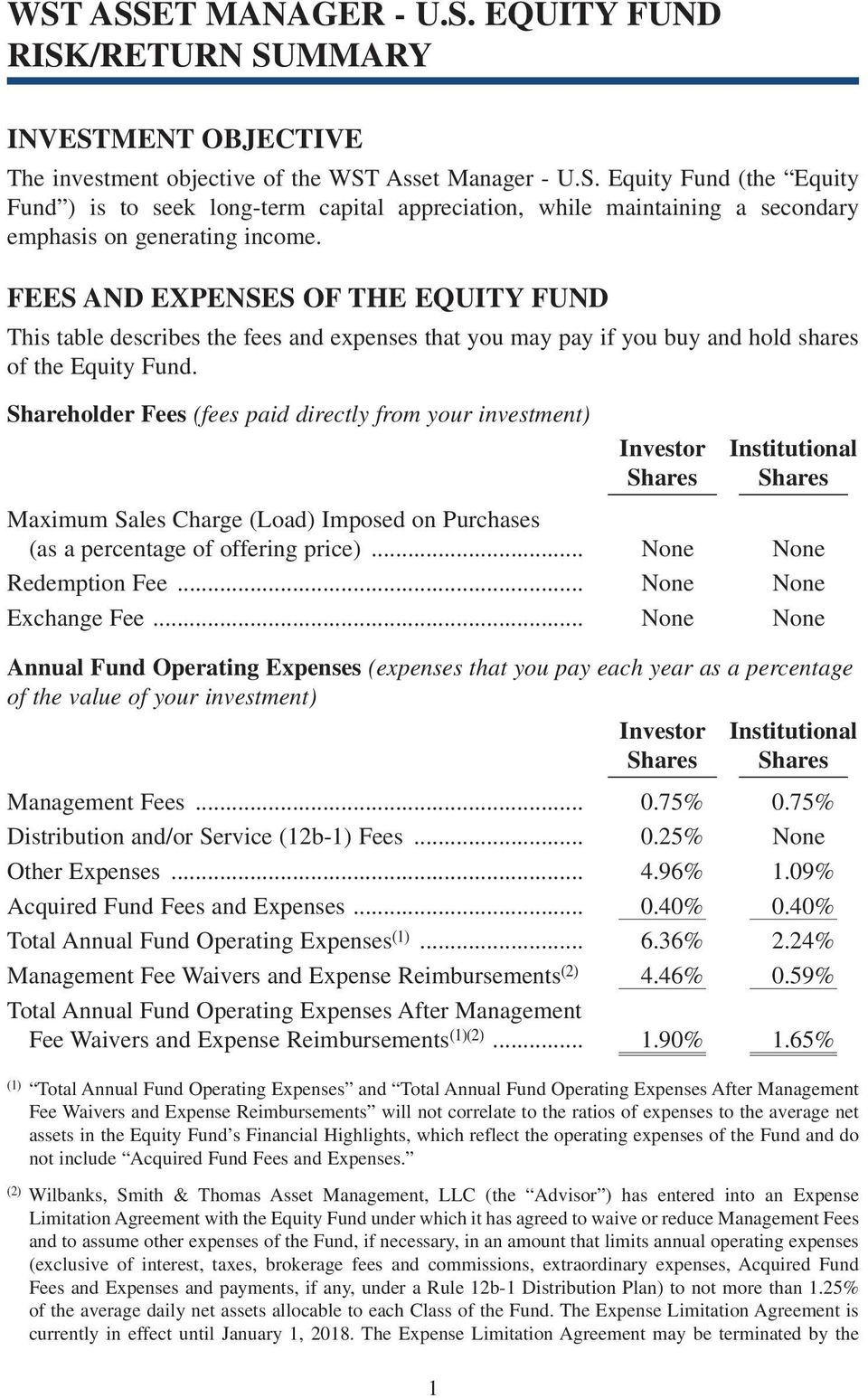
4 WST Investment Trust (the Trust ) or the Advisor at the end of its then-current term upon not less than 90 days notice. The Trust s Board of Trustees (the Board or Trustees ) may terminate the Expense Limitation Agreement at any time. Example This Example is intended to help you compare the cost of investing in shares of the Equity Fund with the cost of investing in other mutual funds. The Example assumes that you invest $10,000 in the Equity Fund for the time periods indicated and then redeem all of your shares at the end of those periods. The Example also assumes that your investment has a 5% return each year and that the Equity Fund s operating expenses remain the same, except the contractual arrangement to waive Management Fees and reimburse expenses remains in effect only until January 1, Although your actual costs may be higher or lower, based on these assumptions your costs would be: 1 Year 3 Years 5 Years 10 Years Investor Shares $193 $1,063 $2,379 $5,515 Institutional Shares $168 $584 $1,089 $2,480 Portfolio Turnover The Equity Fund pays transaction costs, such as commissions, when it buys and sells securities (or turns over its portfolio). A higher portfolio turnover rate may indicate higher transaction costs and may result in higher taxes when Equity Fund shares are held in a taxable account. These costs, which are not reflected in Annual Fund Operating Expenses or in the Example, affect the Equity Fund s performance. During the most recent fiscal year, the Equity Fund s portfolio turnover rate was 150% of the average value of its portfolio. PRINCIPAL INVESTMENT STRATEGIES OF THE EQUITY FUND To achieve its investment objective, the Equity Fund intends to make investments corresponding to those investments in the WST Asset Manager US Equity Index ( WSTE Index ), which is a custom public index created and also managed by the Advisor. The WSTE Index is published daily by Bloomberg under the symbol WSTE and is calculated by S&P Dow Jones Indices. Both the Equity Fund and the WSTE Index use the same proprietary quantitative model (the Equity Investment Model ) developed by the Advisor to make investment decisions and allocate investments among the various primary sectors of the S&P 500 Index ( Sector Investments ), fixed income securities ( Fixed Income Investments ) and gold related securities ( Gold Investments ). The Equity Investment Model is designed to allocate portfolio investments by evaluating asset class correlation, volatility, trends and momentum. To implement this strategy, the Equity Fund primarily invests in exchange traded funds ( ETFs ) or baskets of securities (i.e., groups of securities related by index or sector made available through certain brokers at a discount brokerage rate). 2

5 The Sector Investments in which the Equity Fund may invest will generally be ETFs or baskets of securities representing one or more of the nine primary industry sectors of the S&P 500 Index. Currently, the nine sectors are consumer discretionary, consumer staples, energy, financials, healthcare, industrials, materials, technology and utilities. Fixed Income Investments of the Equity Fund will normally include ETFs or baskets of fixed income securities that are primarily considered investment grade at the time of investment. The underlying securities in the ETFs or baskets comprising the Fixed Income Investments may be issued by various public- or private-sector entities, may have fixed or floating rates and may be of any maturity or duration. Gold Investments are generally in securities of companies (which may be ETFs) that buy and hold physical gold. The Equity Fund does not intend to hold gold directly. Under normal market conditions, the Equity Fund will invest at least 80% of the value of its net assets, plus any borrowing for investment purposes, in Sector Investments (and thus in equity securities of U.S. companies), while a combination of Fixed Income Investments and/or Gold Investments will typically comprise less than 12% of the value of the Fund s net assets. The Equity Fund s investment allocations, determined by the Equity Investment Model, may change frequently and as a result, the Fund expects to engage in frequent portfolio transactions that will likely result in higher portfolio turnover than other mutual funds. Portfolio turnover is a ratio that indicates how often the securities in a mutual fund s portfolio change during the year. A higher portfolio turnover rate indicates a greater number of changes. Under normal circumstances, the anticipated portfolio turnover rate for the Equity Fund is expected to be significantly greater than 100%. The Equity Fund is a fund of funds. The term fund of funds is typically used to describe mutual funds, such as the Equity Fund, whose primary investment strategy involves investing in other investment companies, such as ETFs and other mutual funds. PRINCIPAL RISKS OF THE EQUITY FUND An investment in the Equity Fund is subject to investment risks; therefore you may lose money by investing in the Equity Fund. There can be no assurance that the Equity Fund will be successful in meeting its investment objective. The Equity Fund is not intended to be a complete investment program. Generally, the Equity Fund will be subject to the following principal risks: Market Risk: Market risk refers to the risk that the value of securities in the Equity Fund s portfolio may decline due to daily fluctuations in the securities markets that are generally beyond the Advisor s control, including fluctuation in interest rates, the quality of the Fund s investments, economic conditions, and general equity market conditions. In a declining stock market, stock prices for all companies (including those in the Equity Fund s portfolio) may decline, regardless of their long-term prospects. Investment Model Risk: The share price of the Equity Fund changes daily based on the performance of the securities in which it invests, the selection of which are determined primarily by the Equity Investment Model. The ability of the Equity Fund 3

6 to meet its investment objective is directly related to the ability of the Equity Investment Model to accurately measure market risk or volatility and appropriately react to current and developing market trends. There can be no assurance that the use of the Equity Investment Model will enable the Equity Fund to achieve positive returns or outperform the market, and if the Equity Investment Model and Advisor fail to accurately evaluate market risk or appropriately react to current and developing market conditions, the Fund s share price may be adversely affected. Correlation and Tracking Risk: Correlation and tracking risk refers to the risk that the Equity Fund s performance may vary somewhat from the performance of the index it seeks to track (WSTE Index) due to such factors as the Fund s cash flow, differences in the Fund s expenses and investment limitations, and timing differences associated with additions to and deletions from the index. Risks Related to Fund of Funds Structure: Investments in ETFs and other investment companies (e.g. open end and closed end mutual funds) subject the Equity Fund to paying its proportionate share of fees and expenses from those investments. In other words, by investing in the Equity Fund, you will indirectly bear fees and expenses charged by the underlying ETFs and investment companies in which the Fund invests in addition to the Equity Fund s direct fees and expenses. In addition, under the Investment Company Act of 1940, as amended (the 1940 Act ), the Equity Fund is subject to restrictions that may limit the amount of any particular ETF or other registered investment company that the Fund may own. Risks Related to ETF NAV and Market Price: The market value of an ETF s shares may differ from its net asset value ( NAV ). This difference in price may be due to the fact that the supply and demand in the market for ETF shares at any point in time is not always identical to the supply and demand in the market for the ETF s underlying basket of securities. Accordingly, there may be times when an ETF trades at a premium (creating the risk that the Equity Fund pays more than NAV for an ETF when making a purchase) or discount (creating the risks that the Equity Fund s NAV is reduced for undervalued ETFs it holds, and that the Fund receives less than NAV when selling an ETF). Sector Risk: Sector risk is the possibility that securities within the same group of industries will decline in price due to sector-specific market or economic developments. If the Equity Fund invests more heavily in a particular sector, the value of its shares may be sensitive to factors and economic risks that specifically affect that sector. As a result, the Equity Fund s share price may fluctuate more widely than the value of shares of a mutual fund that invests in a broader range of industries or in different sectors. Additionally, some sectors could be subject to greater government regulation than other sectors, which may impact the share price of companies in these sectors. To the extent the Equity Fund invests a significant portion of its portfolio in securities representing one or more of the primary sectors of the S&P 500 Index, the Fund is more vulnerable to conditions that negatively affect such sectors. Fixed Income Securities Risk: There are risks associated with the potential investment of the Equity Fund s assets in fixed income investments, which include credit risk, interest rate risk, and maturity risk. These risks could affect the value of investments of 4
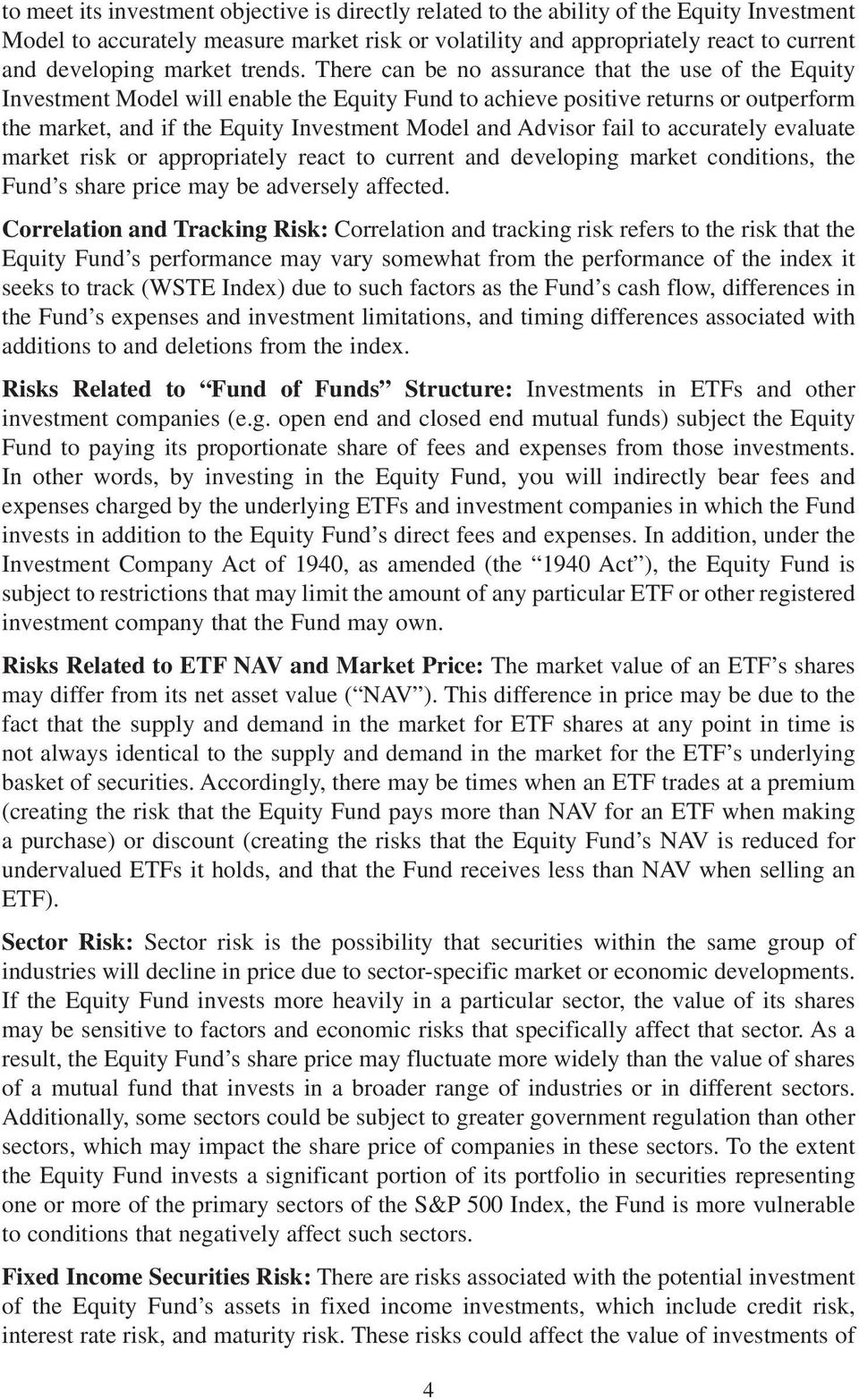
7 the Equity Fund, possibly causing the Fund s share price and total return to be reduced and fluctuate more than other types of investments. Additional information about fixed income risks can be found in the Equity Fund s Statement of Additional Information ( SAI ). Credit Risk. The value of the Equity Fund s fixed income investments is dependent on the creditworthiness of the issuer. A deterioration in the financial condition of an issuer or a deterioration in general economic conditions could cause an issuer to fail to pay principal and interest when due. Interest Rate Risk. The value of the Equity Fund s fixed income investments will generally vary inversely with the direction of prevailing interest rates. Generally when interest rates rise, the value of the Equity Fund s fixed income investments can be expected to decline. Maturity Risk. The value of the Equity Fund s fixed income investments is also dependent on their maturity. Generally, the longer the maturity of a fixed income security, the greater its sensitivity to changes in interest rates. Risks Related to Investing in Floating Rate Notes: Floating rate notes attempt to protect investors against a rise in interest rates, but also carry lower yields than fixed rate notes of the same maturity. The interest rate for a floating rate note resets or adjusts periodically (normally on a daily, monthly, quarterly or semiannual basis by reference to a base lending rate, such as LIBOR). Because rates on floating rate notes reset or adjust only periodically, changes in prevailing interest rates (particularly sudden or significant changes) can cause fluctuations in the value of floating rate notes. Risks Related to Investing in Precious Metals: Risks related to investing in gold include production risks caused by geologic and environmental factors. Furthermore, investments related to precious metals may fluctuate in value sharply over short periods of time and are considered speculative and are affected by a variety of worldwide economic, financial, and political factors. Concentration Risk: To the extent the WSTE Index is concentrated in a particular sector, the Equity Fund will generally also be concentrated in that sector. A fund that concentrates in a particular industry sector could experience greater volatility than funds investing in a broader range of industry sectors. Risks Related to Frequent Trading and Portfolio Turnover: As a result of its trading strategies, the Equity Fund may sell portfolio securities without regard to the length of time they have been held and will likely have a higher portfolio turnover rate than other mutual funds. Since portfolio turnover may involve paying brokerage commissions and other transaction costs, higher turnover generally results in additional Equity Fund expenses. High rates of portfolio turnover may lower the performance of the Equity Fund due to these increased costs and may also result in the realization of short-term capital gains. If the Equity Fund realizes capital gains when portfolio investments are sold, the Fund must generally distribute those gains to shareholders, increasing the Fund s taxable distributions. High rates of portfolio turnover in a given year would likely result in short-term capital gains that are taxed to shareholders at ordinary income tax rates. As a result of its trading strategies, the Equity Fund expects to engage in 5
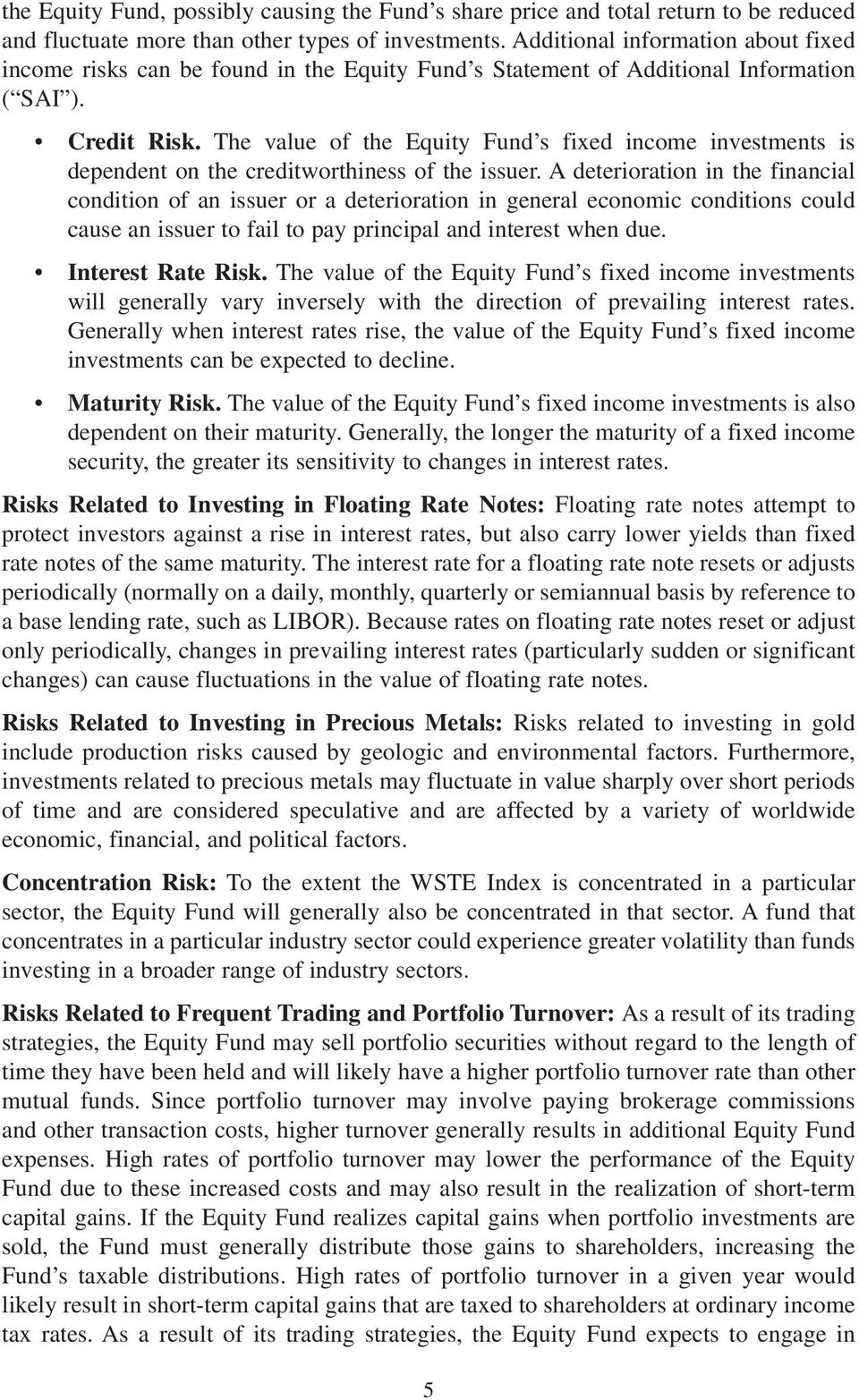
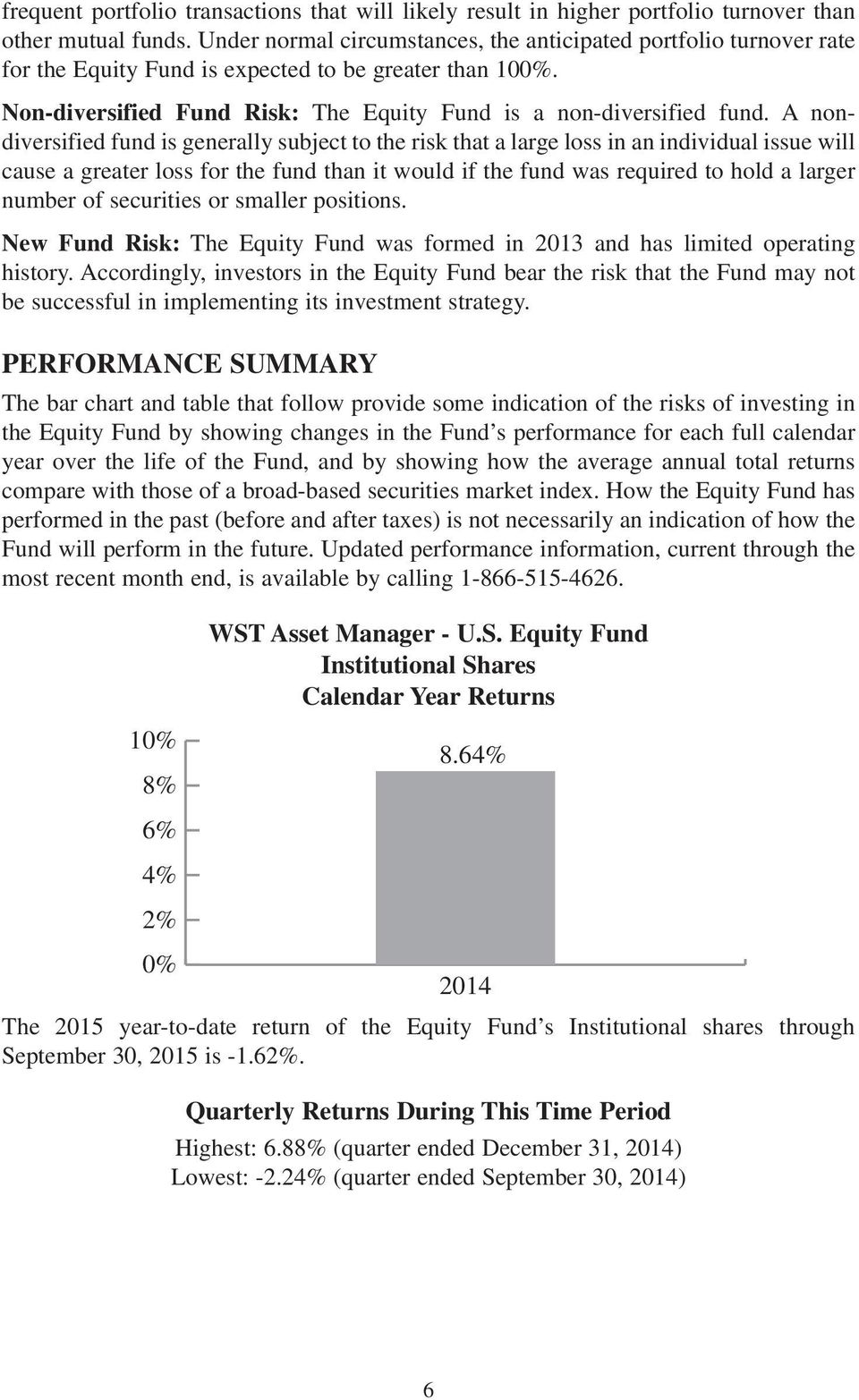
8 frequent portfolio transactions that will likely result in higher portfolio turnover than other mutual funds. Under normal circumstances, the anticipated portfolio turnover rate for the Equity Fund is expected to be greater than 100%. Non-diversified Fund Risk: The Equity Fund is a non-diversified fund. A nondiversified fund is generally subject to the risk that a large loss in an individual issue will cause a greater loss for the fund than it would if the fund was required to hold a larger number of securities or smaller positions. New Fund Risk: The Equity Fund was formed in 2013 and has limited operating history. Accordingly, investors in the Equity Fund bear the risk that the Fund may not be successful in implementing its investment strategy. PERFORMANCE SUMMARY The bar chart and table that follow provide some indication of the risks of investing in the Equity Fund by showing changes in the Fund s performance for each full calendar year over the life of the Fund, and by showing how the average annual total returns compare with those of a broad-based securities market index. How the Equity Fund has performed in the past (before and after taxes) is not necessarily an indication of how the Fund will perform in the future. Updated performance information, current through the most recent month end, is available by calling WST Asset Manager - U.S. Equity Fund Institutional Shares Calendar Year Returns 10% 8% 8.64% 6% 4% 2% 0% 2014 The 2015 year-to-date return of the Equity Fund s Institutional shares through September 30, 2015 is -1.62%. Quarterly Returns During This Time Period Highest: 6.88% (quarter ended December 31, 2014) Lowest: -2.24% (quarter ended September 30, 2014) 6
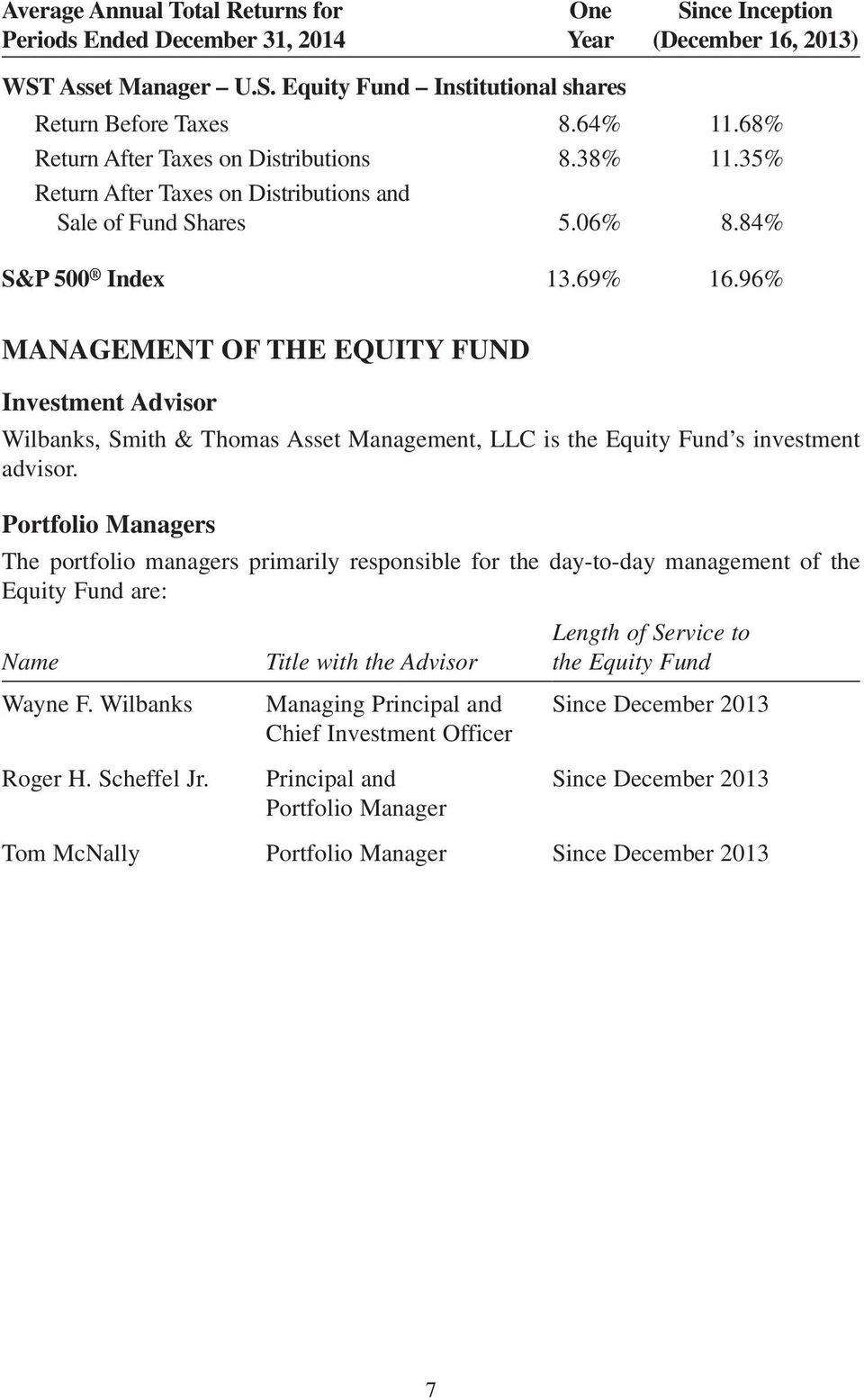
9 Average Annual Total Returns for Periods Ended December 31, 2014 One Year Since Inception (December 16, 2013) WST Asset Manager U.S. Equity Fund Institutional shares Return Before Taxes 8.64% 11.68% Return After Taxes on Distributions 8.38% 11.35% Return After Taxes on Distributions and Sale of Fund Shares 5.06% 8.84% S&P 500 Index 13.69% 16.96% MANAGEMENT OF THE EQUITY FUND Investment Advisor Wilbanks, Smith & Thomas Asset Management, LLC is the Equity Fund s investment advisor. Portfolio Managers The portfolio managers primarily responsible for the day-to-day management of the Equity Fund are: Name Wayne F. Wilbanks Title with the Advisor Managing Principal and Chief Investment Officer Length of Service to the Equity Fund Since December 2013 Roger H. Scheffel Jr. Principal and Portfolio Manager Since December 2013 Tom McNally Portfolio Manager Since December
10 WST ASSET MANAGER - U.S. BOND FUND RISK/RETURN SUMMARY INVESTMENT OBJECTIVE The investment objective of the WST Asset Manager - U.S. Bond Fund (the Bond Fund ) is to seek total return from income and capital appreciation. FEES AND EXPENSES OF THE BOND FUND This table describes the fees and expenses that you may pay if you buy and hold shares of the Bond Fund. Shareholder Fees (fees paid directly from your investment) Investor Shares Institutional Shares Maximum Sales Charge (Load) Imposed on Purchases (as a percentage of offering price)... None None Redemption Fee... None None Exchange Fee... None None Annual Fund Operating Expenses (expenses that you pay each year as a percentage of the value of your investment) Investor Shares Institutional Shares Management Fees % 0.60% Distribution and/or Service (12b-1) Fees % None Other Expenses % 0.51% Acquired Fund Fees and Expenses % 0.28% Total Annual Fund Operating Expenses (1)(2) % 1.39% (1) Total Annual Fund Operating Expenses will not correlate to the ratios of expenses to the average net assets in the Bond Fund s Financial Highlights, which reflect the operating expenses of the Fund and do not include Acquired Fund Fees and Expenses. (2) The Advisor has entered into an Expense Limitation Agreement with the Bond Fund under which it has agreed to waive or reduce Management Fees and to assume other expenses of the Fund, if necessary, in an amount that limits annual operating expenses (exclusive of interest, taxes, brokerage fees and commissions, extraordinary expenses, Acquired Fund Fees and Expenses and payments, if any, under a Rule 12b-1 Distribution Plan) to not more than 1.15% of the average daily net assets allocable to each Class of the Fund. The Expense Limitation Agreement is currently in effect until January 1, The Expense Limitation Agreement may be terminated by the Trust or the Advisor at the end of its then-current term upon not less than 90 days notice. The Trust s Board may terminate the Expense Limitation Agreement at any time. 8

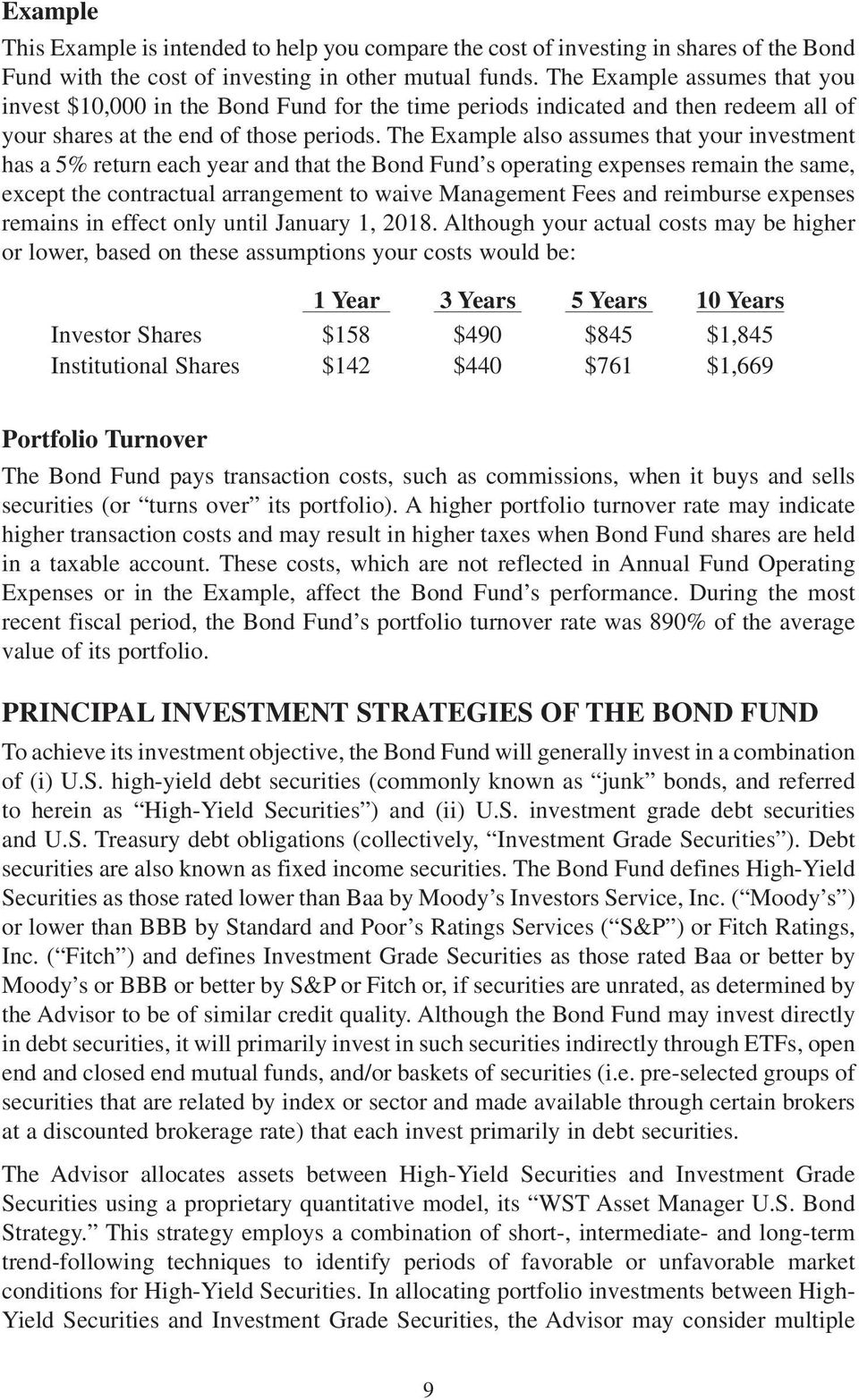
11 Example This Example is intended to help you compare the cost of investing in shares of the Bond Fund with the cost of investing in other mutual funds. The Example assumes that you invest $10,000 in the Bond Fund for the time periods indicated and then redeem all of your shares at the end of those periods. The Example also assumes that your investment has a 5% return each year and that the Bond Fund s operating expenses remain the same, except the contractual arrangement to waive Management Fees and reimburse expenses remains in effect only until January 1, Although your actual costs may be higher or lower, based on these assumptions your costs would be: 1 Year 3 Years 5 Years 10 Years Investor Shares $158 $490 $845 $1,845 Institutional Shares $142 $440 $761 $1,669 Portfolio Turnover The Bond Fund pays transaction costs, such as commissions, when it buys and sells securities (or turns over its portfolio). A higher portfolio turnover rate may indicate higher transaction costs and may result in higher taxes when Bond Fund shares are held in a taxable account. These costs, which are not reflected in Annual Fund Operating Expenses or in the Example, affect the Bond Fund s performance. During the most recent fiscal period, the Bond Fund s portfolio turnover rate was 890% of the average value of its portfolio. PRINCIPAL INVESTMENT STRATEGIES OF THE BOND FUND To achieve its investment objective, the Bond Fund will generally invest in a combination of (i) U.S. high-yield debt securities (commonly known as junk bonds, and referred to herein as High-Yield Securities ) and (ii) U.S. investment grade debt securities and U.S. Treasury debt obligations (collectively, Investment Grade Securities ). Debt securities are also known as fixed income securities. The Bond Fund defines High-Yield Securities as those rated lower than Baa by Moody s Investors Service, Inc. ( Moody s ) or lower than BBB by Standard and Poor s Ratings Services ( S&P ) or Fitch Ratings, Inc. ( Fitch ) and defines Investment Grade Securities as those rated Baa or better by Moody s or BBB or better by S&P or Fitch or, if securities are unrated, as determined by the Advisor to be of similar credit quality. Although the Bond Fund may invest directly in debt securities, it will primarily invest in such securities indirectly through ETFs, open end and closed end mutual funds, and/or baskets of securities (i.e. pre-selected groups of securities that are related by index or sector and made available through certain brokers at a discounted brokerage rate) that each invest primarily in debt securities. The Advisor allocates assets between High-Yield Securities and Investment Grade Securities using a proprietary quantitative model, its WST Asset Manager U.S. Bond Strategy. This strategy employs a combination of short-, intermediate- and long-term trend-following techniques to identify periods of favorable or unfavorable market conditions for High-Yield Securities. In allocating portfolio investments between High- Yield Securities and Investment Grade Securities, the Advisor may consider multiple 9
12 factors, including those related to credit, duration, Federal Reserve policy and the Advisor s expectations for the future course of interest rates and the then-prevailing price and yield levels in the debt market. The Advisor selects securities for their potential for interest income, capital appreciation, or both. The Bond Fund invests without restriction as to issuer credit quality, capitalization or security maturity; however, other than periods when the Fund is invested solely in cash, at least 10% of the Fund s assets will generally be invested in Investment Grade Securities at all times. Under normal circumstances, at least 80% of the Bond Fund s net assets (including the amount of any borrowings for investment purposes) will be invested directly or indirectly in U.S. bonds. The Bond Fund s investment allocations, determined by the WST Asset Manager U.S. Bond Strategy, may change frequently and as a result, the Fund expects to engage in frequent portfolio transactions that will likely result in higher portfolio turnover than other mutual funds. Portfolio turnover is a ratio that indicates how often the securities in a mutual fund s portfolio change during the year. A higher portfolio turnover rate indicates a greater number of changes. Under normal circumstances, the anticipated portfolio turnover rate for the Bond Fund is expected to be significantly greater than 100%. The Bond Fund is a fund of funds. The term fund of funds is typically used to describe mutual funds, such as the Bond Fund, whose primary investment strategy involves investing in other investment companies, such as ETFs and other mutual funds. PRINCIPAL RISKS OF THE BOND FUND An investment in the Bond Fund is subject to investment risks; therefore you may lose money by investing in the Fund. There can be no assurance that the Bond Fund will be successful in meeting its investment objective. The Bond Fund is not intended to be a complete investment program. Generally, the Bond Fund will be subject to the following principal risks: Market Risk: Market risk refers to the risk that the value of securities in the Bond Fund s portfolio may decline due to daily fluctuations in the securities markets that are generally beyond the Advisor s control, including fluctuation in interest rates, the quality of the Fund s investments, economic conditions, and general bond market conditions. Investment Model Risk: The share price of the Bond Fund changes daily based on the performance of the securities in which it invests, the selection of which are determined primarily by the WST Asset Manager U.S. Bond Strategy (the Debt Investment Model ). The ability of the Bond Fund to meet its investment objective is directly related to the ability of the Debt Investment Model to accurately measure market risk or volatility and appropriately react to current and developing market trends. There can be no assurance that the use of the Debt Investment Model will enable the Bond Fund to achieve positive returns or outperform the market. If the Debt Investment Model and Advisor fail to accurately evaluate market risk or appropriately react to current and developing market conditions, the Bond Fund s share price may be adversely affected. 10
13 Income Risk: A primary source of income for the Bond Fund will be derived from the receipt of interest payments from debt securities. An economic downturn or an increase in interest rates may have a negative or adverse effect on an issuer s ability to timely make payments of principal and interest. If the issuer fails to make timely interest and/ or principal payments, then the Bond Fund s current income will be adversely affected and reduced. Interest Rate Risk: The value of the Bond Fund s debt securities will generally vary inversely with the direction of the prevailing interest rates. A rise in interest rates will normally cause the value of debt securities to decrease. Consequently, changes in interest rates may have a significant effect on the Bond Fund, especially if the Fund is holding a significant portion of its assets in debt securities that are particularly sensitive to interest rate fluctuations, such as debt securities with long-term maturities, zero coupon bonds, and debentures. The Bond Fund may be subject to greater risk of rising interest rates due to the current period of historically low interest rates. Credit Risk: Credit risk is the risk that the issuer of a debt security (including corporate, government and mortgage-backed securities) will be unable or unwilling to make timely principal and/or interest payments, or otherwise will be unable or unwilling to honor its financial obligations. If the issuer fails to pay interest, the Bond Fund s income will be reduced. If the issuer fails to repay principal, the value of that debt security and of the Bond Fund s shares may be reduced. To the extent the Bond Fund invests in lower rated debt securities (such as High Yield Securities), the Fund will be subject to a higher level of credit risk than a fund that invests only in the highest rated debt securities. Corporate Debt Securities Risk: The Bond Fund s debt securities investments may include corporate debt securities. Corporate debt obligations purchased by the Bond Fund may be any credit quality, maturity or yield. Accordingly, the Bond Fund s debt securities may include investment grade securities (those rated at least Baa by Moody s, BBB by S&P or Fitch or, if not rated, of equivalent quality in the Advisor s opinion). In addition, the Bond Fund s debt securities may include lower-rated debt securities including, without limitation, high-yield and/or junk bonds rated below Baa by Moody s or BBB by S&P s or Fitch (see Junk Bonds or Lower-rated Securities Risk below). The Bond Fund s fixed income securities investments are subject to risks of non-payment of interest and principal, the risk that bond demand in the marketplace will decrease periodically, and the risk that ratings of the various credit services (and the Advisor s independent assessments of the securities creditworthiness) are or may become inaccurate. U.S. Government Securities Risk: Securities issued by the U.S. government or its agencies are subject to risks related to the creditworthiness of the U.S. government. In addition, such securities may be not be backed by the full faith and credit of the U.S. government, but rather by a right to borrow from the U.S. government or the creditworthiness of the issuer itself. The value of any such securities may fluctuate with changes in credit ratings and market perceptions of the U.S. government and the issuers of the securities, as well as interest rates and other risks applicable to fixed income securities generally. 11
14 Junk Bonds or Lower-Rated Securities Risk: Debt securities rated below Baa by Moody s and BBB by S&P or Fitch are generally considered speculative in nature and are generally subject to greater risks with respect to the non-payment of interest and principal and greater market fluctuations than higher-rated debt securities. Lower-rated debt securities are usually issued by companies without long track records of sales and earnings, or by companies with questionable credit strength. These debt securities are considered below investment-grade. The retail secondary market for these junk bonds may be less liquid than that of higher-rated debt securities, and adverse conditions could make it difficult at times to sell certain securities or could result in lower prices than those used in calculating the Bond Fund s net asset value. These risks can reduce the value of the Bond Fund s shares and the income it earns. Maturity Risk: Maturity risk is another factor that can affect the value of the Bond Fund s debt security holdings. In general, but not in all cases, the longer the maturity of a debt security, the higher its yield and the greater its price sensitivity to changes in interest rates. Conversely, the shorter the maturity, the lower the yield but the greater the price stability. The Bond Fund will be subject to greater maturity risk to extent it is invested in debt securities with longer maturities. Prepayment Risk: Issuers of debt securities in which the Bond Fund may invest may be able to prepay principal due on these securities. Declining interest rates may encourage issuers to pay off their debt obligations sooner than expected. This can reduce the effective maturity of the debt security and lower returns to the Bond Fund especially if the Fund reinvests its assets at a lower prevailing interest rate. Risks Related to ETF and Closed End Fund NAV and Market Price: The market value of the shares of an ETF or closed end fund may differ from its NAV. This difference in price may be due to the fact that the supply and demand in the market for ETF or closed end fund shares at any point in time is not always identical to the supply and demand in the market for the underlying basket of securities held by the ETF or closed end fund. Accordingly, there may be times when an ETF or closed end fund trades at a premium (creating the risk that the Bond Fund pays more than NAV for the ETF or fund when making a purchase) or discount (creating the risks that the Bond Fund s NAV is reduced for undervalued ETFs or closed end funds it holds, and that the Fund receives less than NAV when selling an ETF or closed end fund). Regional and Sector Risk: Regional and sector risk is the risk that if the Bond Fund invests heavily in securities within the same state, region, currency, industry or economic sector, an adverse economic, business or political development may affect the value of the Fund s investments more than if its investments were not so focused. To the extent the Bond Fund invests heavily in securities in any such area that experiences an adverse development, the value of the Fund s portfolio may be negatively affected. Risks Related to Fund of Funds Structure: Investments in ETFs and open end and closed end mutual funds subject the Bond Fund to paying its proportionate share of fees and expenses from those investments. In other words, by investing in the Bond Fund, you will indirectly bear fees and expenses charged by the underlying ETFs and investment companies in which the Fund invests in addition to the Fund s direct fees 12
15 and expenses. In addition, under the 1940 Act, the Bond Fund is subject to restrictions that may limit the amount of any particular ETF or other registered investment company that the Fund may own. Risks Related to Frequent Trading and Portfolio Turnover: As a result of its trading strategies, the Bond Fund may sell portfolio securities without regard to the length of time they have been held and will likely have a higher portfolio turnover rate than other mutual funds. Since portfolio turnover may involve paying brokerage commissions and other transaction costs, higher turnover generally results in additional Fund expenses. High rates of portfolio turnover may lower the performance of the Bond Fund due to these increased costs and may also result in the realization of short-term capital gains. If the Bond Fund realizes capital gains when portfolio investments are sold, the Fund must generally distribute those gains to shareholders, increasing the Fund s taxable distributions. High rates of portfolio turnover in a given year would likely result in short-term capital gains that are taxed to shareholders at ordinary income tax rates. As a result of its trading strategies, the Bond Fund expects to engage in frequent portfolio transactions that will likely result in higher portfolio turnover than other mutual funds. Under normal circumstances, the anticipated portfolio turnover rate for the Bond Fund is expected to be greater than 100%. Non-diversified Fund Risk: The Bond Fund is a non-diversified fund. A non-diversified fund is generally subject to the risk that a large loss in an individual issue will cause a greater loss for the fund than it would if the fund was required to hold a larger number of securities or smaller positions. New Fund Risk: The Bond Fund was formed in 2014 and has limited operating history. Accordingly, investors in the Bond Fund bear the risk that the Fund may not be successful in implementing its investment strategy. PERFORMANCE SUMMARY The Bond Fund is new and does not have a performance history for a full calendar year to report. When the Bond Fund has completed a full calendar year of operations, this section will include information which an investor would find useful in evaluating the risks of investing in the Fund, such as information that shows the Fund s performance from year to year and how the Fund s average annual returns for certain periods compare with those of a broad-based securities market index. How the Bond Fund has performed in the past (before and after taxes) is not necessarily an indication of how the Fund will perform in the future. Updated performance information, current through the most recent month end, is available by calling MANAGEMENT OF THE BOND FUND Investment Advisor Wilbanks, Smith & Thomas Asset Management, LLC is the Bond Fund s investment advisor. 13

16 Portfolio Managers The portfolio managers primarily responsible for the day-to-day management of the Bond Fund are: Name Wayne F. Wilbanks Title with the Advisor Managing Principal and Chief Investment Officer Length of Service to the Bond Fund Since September 2014 Roger H. Scheffel Jr. Principal and Portfolio Manager Since September 2014 Tom McNally Portfolio Manager Since September 2014 INFORMATION RELEVANT TO BOTH FUNDS The following information applies to both the Equity Fund and the Bond Fund (individually a Fund and collectively the Funds ). PURCHASE AND SALE OF FUND SHARES Minimum Initial Investment* $1,000 for Investor Shares; $100,000 for Institutional Shares. Minimum Subsequent Investment* $250 for Investor Shares; $1,000 for Institutional Shares. * The Funds reserve the right to waive or reduce the investment minimums under certain circumstances. General Information You may purchase or redeem (sell) shares of the Funds on each day that the New York Stock Exchange is open for business. Transactions may be initiated by written request, by telephone or through your financial intermediary. Written requests to the Funds should be sent to the Funds, c/o Ultimus Fund Solutions, LLC, P.O. Box 46707, Cincinnati, Ohio For more information about purchasing and redeeming shares, please see How to Buy Share and How to Redeem Shares in the Prospectus or call TAX INFORMATION Each Fund s distributions are generally taxed as ordinary income or capital gains, unless you are investing through a tax-deferred arrangement, such as a 401(k) plan or an IRA. Such tax-deferred arrangements may be taxed later upon withdrawal of monies from those arrangements. 14
17 PAYMENTS TO BROKER-DEALERS AND OTHER FINANCIAL INTERMEDIARIES If you purchase the Funds through a broker-dealer or other financial intermediary (such as a bank), the Funds and their related companies may pay the intermediary for the sale of Fund shares and related services. These payments may create a conflict of interest by influencing the broker-dealer or other intermediary and your salesperson to recommend the Funds over another investment. Ask your salesperson or visit your financial intermediary s website for more information. INVESTMENT OBJECTIVES, INVESTMENT STRATEGIES AND RELATED RISKS OF THE FUNDS INVESTMENT OBJECTIVE OF THE EQUITY FUND The investment objective of the Equity Fund is to seek long-term capital appreciation, while maintaining a secondary emphasis on generating income. The Equity Fund s investment objective may be changed by the Trust s Board without shareholder approval upon at least 60 days prior written notice to the shareholders. PRINCIPAL INVESTMENT STRATEGIES OF THE EQUITY FUND To achieve its investment objective, the Equity Fund intends to make investments corresponding to those investments in the WST Asset Manager US Equity Index ( WSTE Index ), which is a custom public index created and also managed by the Advisor. The WSTE Index is published daily by Bloomberg under the symbol WSTE and is calculated by S&P Dow Jones Indices. Both the Equity Fund and the WSTE Index use the Equity Investment Model developed by the Advisor to make investment decisions and allocate investments among the various primary sectors of the S&P 500 Index ( Sector Investments ), fixed income securities ( Fixed Income Investments ) and gold related securities ( Gold Investments ). The Equity Investment Model is designed to allocate portfolio investments by evaluating asset class correlation, volatility, trends and momentum. To implement this strategy, the Equity Fund primarily invests in ETFs or baskets of securities (i.e., groups of securities related by index or sector made available through certain brokers at a discount brokerage rate). 15
18 Additional Information About the WSTE Index The WSTE Index is a custom public index created by the Advisor and is published by Bloomberg under the symbol WSTE and calculated by S&P Dow Jones Indices LLC, a part of McGraw Hill Financial. The WSTE Index is comprised of Sector Investments, Fixed Income Investments and Gold Investments. The WSTE Index was formed in January 2013 to show the performance of a model portfolio that implements the Advisor s S&P 500 sector rotation strategy (designed to capture the returns of U.S. equity markets) coupled with a risk management strategy (designed to minimize extraordinary downside risk). The WSTE Index is not rebalanced on a set schedule; rather, the Equity Investment Model used by the WSTE Index may cause the investment allocation to change at any time. Because the Advisor manages the WSTE Index and the Equity Fund with the same Equity Investment Model, the Advisor anticipates that the Fund will be able to substantially replicate the performance of the WSTE Index. However, the performance of the WSTE Index will not reflect the Equity Fund s management fees, brokerage fees, acquired fund fees or other expenses incurred by the Fund, and therefore, the Fund may not be able to directly track the performance of the WSTE Index. In addition, the Equity Fund may deviate from tracking the WSTE Index if it is determined that tracking the index is likely to violate applicable legal or regulatory restrictions or could otherwise result in adverse consequences for the Fund. Situations that may cause the Equity Fund to deviate from tracking the WSTE Index include times of large inflows of cash from new investments, the need to hold cash to meet large redemption requests, and the need to satisfy investment limitations or restrictions under applicable securities or tax laws (e.g, restrictions under the 1940 Act or Subchapter M of the Internal Revenue Code). If these situations occur, the Equity Fund will attempt to adjust portfolio investments while investing as close to the Equity Investment Model as possible. Standard & Poor s and S&P are registered trademarks of Standard & Poor s Financial Services LLC, a part of McGraw Hill Financial. Dow Jones is a registered trademark of Dow Jones Trademark Holdings LLC ( Dow Jones ). These trademarks have been licensed to S&P Dow Jones Indices LLC. It is not possible to invest directly in an index. S&P Dow Jones Indices LLC, Dow Jones, S&P and their respective affiliates (collectively S&P Dow Jones Indices ) do not sponsor, endorse, sell, or promote any investment fund or other investment vehicle that is offered by third parties and that seeks to provide an investment return based on the performance of any index. This document does not constitute an offer of services in jurisdictions where S&P Dow Jones Indices does not have the necessary licenses. S&P Dow Jones Indices receives compensation in connection with licensing its indices to third parties. 16
19 The Sector Investments in which the Equity Fund may invest will generally be ETFs or baskets of securities representing one or more of the nine primary industry sectors of the S&P 500 Index. The nine sectors are consumer discretionary, consumer staples, energy, financials, healthcare, industrials, materials, technology and utilities. The Equity Fund will generally not invest in all of the sectors of the S&P 500 Index at any given time, but only in those sectors the Equity Investment Model indicates have the most growth potential. Investments in any single sector will generally be limited to no more than 48% of the Equity Fund s total assets, as measured at the time of purchase. Fixed Income Investments of the Equity Fund will normally include ETFs or baskets of fixed income securities that are primarily considered investment grade at the time of investment. The underlying securities in the ETFs or baskets comprising the Fixed Income Investments may be issued by various public- or private-sector entities, may have fixed or floating rates, and may be of any maturity or duration. Gold Investments are generally in securities of companies (which may be ETFs) that buy and hold physical gold. The Equity Fund does not intend to hold gold directly. Under normal market conditions, the Equity Fund will invest at least 80% of the value of its net assets, plus any borrowing for investment purposes, in Sector Investments (and thus in equity securities of U.S. companies), while a combination of Fixed Income Investments and/or Gold Investments will typically comprise less than 12% of the value of the Fund s net assets. This investment policy may change without shareholder approval upon at least 60 days prior written notice to shareholders. Equity securities include, but are not limited to stocks and ETFs and stock baskets that invest primarily in equity securities. The Equity Fund considers a U.S. company to be one that: (i) is organized under the laws of, or has its principal offices in the United States; (ii) has its principal securities trading market in the United States; (iii) alone or on a consolidated basis derives the highest concentration of its annual revenue or earnings or assets from goods produced, sales made or services performed in the United States; and/or (v) issues securities denominated in U.S. dollars. The Equity Fund s investment allocations, determined by the Equity Investment Model, may change frequently and as a result, the Fund expects to engage in frequent portfolio transactions that will likely result in higher portfolio turnover than other mutual funds. Portfolio turnover is a ratio that indicates how often the securities in a mutual fund s portfolio change during the year. A higher portfolio turnover rate indicates a greater number of changes. Under normal circumstances, the anticipated portfolio turnover rate for the Equity Fund is expected to be significantly greater than 100%. The Equity Fund is a fund of funds. The term fund of funds is typically used to describe mutual funds, such as the Equity Fund, whose primary investment strategy involves investing in other investment companies, such as ETFs and other mutual funds. The Equity Fund is best suited for long-term investors. The Equity Fund will generally sell securities when they no longer fit the desired allocation under the Equity Investment Model or when the Advisor believes more attractive investment opportunities exist. 17

20 PRINCIPAL RISKS OF INVESTING IN THE EQUITY FUND An investment in the Equity Fund is subject to investment risks; therefore you may lose money by investing in the Fund. There can be no assurance that the Equity Fund will be successful in meeting its investment objective. The Equity Fund is not intended to be a complete investment program. Generally, the Equity Fund will be subject to the following principal risks: Market Risk: Market risk refers to the risk that the value of securities in the Equity Fund s portfolio may decline due to daily fluctuations in the securities markets that are generally beyond the Advisor s control, including fluctuation in interest rates, the quality of the Fund s investments, economic conditions, and general equity market conditions. In a declining stock market, stock prices for all companies (including those in the Equity Fund s portfolio) may decline, regardless of their long-term prospects. Investment Model Risk: The share price of the Equity Fund changes daily based on the performance of the securities in which it invests, the selection of which are determined primarily by the Equity Investment Model. The ability of the Equity Fund to meet its investment objective is directly related to the ability of the Equity Investment Model to accurately measure market risk or volatility and appropriately react to current and developing market trends. There can be no assurance that the use of the Equity Investment Model will enable the Equity Fund to achieve positive returns or outperform the market, and if the Equity Investment Model and Advisor fail to accurately evaluate market risk or appropriately react to current and developing market conditions, the Fund s share price may be adversely affected. Correlation and Tracking Risk: Correlation and tracking risk refers to the risk that the Equity Fund s performance may vary somewhat from the performance of the index it seeks to track (i.e., the WSTE Index) due to such factors as the Fund s cash flow, differences in the Fund s expenses and investment limitations, and timing differences associated with additions to and deletions from the index. Risks Related to Fund of Funds Structure: Investments in ETFs and other investment companies (e.g. open end and closed end mutual funds) subject the Equity Fund to paying its proportionate share of fees and expenses from those investments. In addition, under the 1940 Act, the Equity Fund is subject to restrictions that may limit the amount of any particular ETF or other registered investment company that the Fund may own. Since the Equity Fund is a fund of funds, your cost of investing in the Fund will generally be higher than the cost of investing directly in ETFs or other investment companies. By investing in the Equity Fund, you will indirectly bear fees and expenses charged by the underlying ETFs and investment companies in which the Fund invests in addition to the Fund s direct fees and expenses. Furthermore, the use of a fund of funds structure could affect the timing, amount, and character of a fund s distributions and therefore may increase the amount of your tax liability. Under the 1940 Act, the Equity Fund may not acquire shares of an ETF or other investment company if, immediately after such acquisition, the Fund and its affiliated persons would hold more than 3% of the ETF s or investment company s total 18
21 outstanding shares unless (i) the ETF or the Fund has received an order for exemptive relief from the 3% limitation from the Securities and Exchange Commission (the SEC ) that is applicable to the Fund; and (ii) the ETF and the Fund take appropriate steps to comply with any conditions in such order. Accordingly, the 3% limitation may prevent the Equity Fund from allocating its investments in the manner the Advisor considers optimal, or cause the Advisor to select an investment other than that which the Advisor considers optimal. Risks Related to ETF NAV and Market Price: The market value of an ETF s shares may differ from its NAV. This difference in price may be due to the fact that the supply and demand in the market for ETF shares at any point in time is not always identical to the supply and demand in the market for the ETF s underlying basket of securities. Accordingly, there may be times when an ETF trades at a premium (creating the risk that the Equity Fund pays more than NAV for an ETF when making a purchase) or discount (creating the risks that the Equity Fund s NAV is reduced for undervalued ETFs it holds, and that the Fund receives less than NAV when selling an ETF). Sector Risk: Sector risk is the possibility that securities within the same group of industries will decline in price due to sector-specific market or economic developments. If the Equity Fund invests more heavily in a particular sector, the value of its shares may be sensitive to factors and economic risks that specifically affect that sector. As a result, the Equity Fund s share price may fluctuate more widely than the value of shares of a mutual fund that invests in a broader range of industries or in different sectors. Additionally, some sectors could be subject to greater government regulation than other sectors, which may impact the share price of companies in these sectors. To the extent the Equity Fund invests a significant portion of its portfolio in securities representing one or more of the primary sectors of the S&P 500 Index, the Fund is more vulnerable to conditions that negatively affect such sectors. Fixed Income Securities Risk: There are risks associated with the potential investment of the Equity Fund s assets in fixed income investments, which include credit risk, interest rate risk, and maturity risk. These risks could affect the value of investments of the Equity Fund, possibly causing the Fund s share price and total return to be reduced and fluctuate more than other types of investments. Additional information about fixed income risks can be found in the SAI. Credit Risk. The value of the Equity Fund s fixed income investments is dependent on the creditworthiness of the issuer. A deterioration in the financial condition of an issuer or a deterioration in general economic conditions could cause an issuer to fail to pay principal and interest when due. Interest Rate Risk. The value of the Equity Fund s fixed income investments will generally vary inversely with the direction of prevailing interest rates. Generally when interest rates rise, the value of the Equity Fund s fixed income investments can be expected to decline. Maturity Risk. The value of the Equity Fund s fixed income investments is also dependent on their maturity. Generally, the longer the maturity of a fixed income security, the greater its sensitivity to changes in interest rates. 19
22 Risks Related to Investing in Floating Rate Notes: Floating rate notes attempt to protect investors against a rise in interest rates, but also carry lower yields than fixed rate notes of the same maturity. The interest rate for a floating rate note resets or adjusts periodically (normally on a daily, monthly, quarterly or semiannual basis by reference to a base lending rate, such as LIBOR). Because rates on floating rate notes reset or adjust only periodically, changes in prevailing interest rates (particularly sudden or significant changes) can cause fluctuations in the value of floating rate notes. Risks Related to Investing in Precious Metals: Risks related to investing in gold and other precious metals include production risks caused by geologic and environmental factors. Furthermore, investments related to precious metals may fluctuate in value sharply over short periods of time and are considered speculative and are affected by a variety of worldwide economic, financial, and political factors. Concentration Risk: To the extent the WSTE Index is concentrated in a particular sector, the Equity Fund will generally also be concentrated in that sector. A fund that concentrates in a particular industry sector could experience greater volatility than funds investing in a broader range of industry sectors. Risks Related to Frequent Trading and Portfolio Turnover: As a result of its trading strategies, the Equity Fund may sell portfolio securities without regard to the length of time they have been held and will likely have a higher portfolio turnover rate than other mutual funds. Since portfolio turnover may involve paying brokerage commissions and other transaction costs, higher turnover generally results in additional Equity Fund expenses. High rates of portfolio turnover may lower the performance of the Equity Fund due to these increased costs and may also result in the realization of short-term capital gains. If the Equity Fund realizes capital gains when portfolio investments are sold, the Fund must generally distribute those gains to shareholders, increasing the Fund s taxable distributions. High rates of portfolio turnover in a given year would likely result in short-term capital gains that are taxed to shareholders at ordinary income tax rates. Under normal circumstances the anticipated portfolio turnover for the Equity Fund is expected to be greater than 100%. Non-diversified Fund Risk: The Equity Fund is a non-diversified fund. A nondiversified fund is generally subject to the risk that a large loss in an individual issue will cause a greater loss for the fund than it would if the fund was required to hold a larger number of securities or smaller positions. New Fund Risk: The Equity Fund was formed in 2013 and has limited operating history. Accordingly, investors in the Equity Fund bear the risk that the Fund may not be successful in implementing its investment strategy. PRIOR PERFORMANCE OF SEPARATE ACCOUNTS MANAGED BY THE PORTFOLIO MANAGERS Mr. Wilbanks, Mr. Scheffel and Mr. McNally (the co-portfolio managers ) are responsible for managing separate accounts that each invest in separate and distinct strategies for clients of the Advisor. Some of these separate accounts are solely invested in the WST U.S. Equity Strategy that is substantially identical to the U.S. 20
23 Equity Strategy used by the co-portfolio managers to invest Equity Fund assets. The co-portfolio managers have full discretionary authority over the selection of investments for the separate accounts using the WST U.S. Equity Strategy (referred to herein as the WST Accounts ), and use substantially the same goals and style of investment management in managing the Equity Fund. The co-portfolio managers have been primarily responsible for the management of the WST Accounts throughout the entire period presented below. The Equity Fund has substantially the same investment objectives, policies and strategies as the WST Accounts. The performance information shown below is a summary of the performance of all the WST Accounts and is provided to show the past performance of those accounts as measured against the specified benchmark index. The performance of the WST Accounts does not represent the historical performance of the Equity Fund, and should not be considered indicative of future performance of the WST Accounts or the Fund. Future results will differ from past results because of differences in future behavior of the various investment markets, account expenses, the timing of purchases and sales and availably of cash for new investments, among other things. In addition, the WST Accounts are not subject to certain investment limitations and other restrictions imposed by the 1940 Act or Subchapter M of the Internal Revenue Code, which, if applicable, might have adversely affected the performance of the WST Accounts during the periods shown. Performance of the Equity Fund during future periods will definitely vary. The Advisor has provided the information shown below and calculated the performance information as to the WST Accounts. The WST Accounts returns shown include realized and unrealized gains plus income, including accrued income. These returns are presented net of all actual fees and expenses, including advisory fees of approximately 1%, which fees and expenses are lower than the Equity Fund s fees and expenses. Results include the reinvestment of dividends and capital gains. Returns from cash and cash equivalents in the WST Accounts are included in the performance calculations, and the cash and cash equivalents are included in the total assets on which the performance is calculated. The method used to calculate the WST Accounts performance differs from the SEC s standardized method of calculating performance because the WST Accounts did not employ daily valuation, and may produce different results. The data below shows how the performance for the WST Accounts varied over certain time periods. Changes in performance from month to month and other time periods provide some indication of risk. The WST Accounts past performance is not necessarily an indication of how the Equity Fund will perform in the future. The WST Accounts performance would be lower if it was calculated using the Equity Fund s fees and expenses. Average Annual Total Returns For periods ended August 31, 2015 Since Inception 1 Year ( ) WST Accounts % 12.21% S&P Index % 15.30% 21
24 Monthly Performance WST Accounts 1 Year Jan Feb Mar Apr May Jun Jul Aug Sept Oct Nov Dec YTD % 0.47% 0.62% -1.50% 2.86% -0.90% 2.08% -5.81% -2.52% % 5.02% -0.07% -1.27% 1.25% 3.13% -3.96% 3.59% -1.77% 3.97% 3.16% -0.42% 8.82% % 0.91% 4.57% 2.47% 1.45% -1.10% 4.35% -3.73% 3.63% 3.31% 2.76% 2.25% 28.18% S&P Index Year Jan Feb Mar Apr May Jun Jul Aug Sept Oct Nov Dec YTD % 5.75% -1.58% 0.96% 1.29% -1.94% 2.10% -6.03% -2.88% % 4.57% 0.84% 0.74% 2.35% 2.07% -1.38% 4.00% -1.40% 2.44% 2.69% -0.25% 13.69% % 1.36% 3.75% 1.93% 2.34% -1.34% 5.09% -2.90% 3.14% 4.60% 3.05% 2.53% 32.39% 1 As of August 31, 2015, the WST Accounts totaled approximately $200,491, The S&P 500 Index measures the performance of large cap U.S. equities. Unlike mutual funds, the index does not incur expenses. If expenses were deducted, the actual returns of this index would be lower. INVESTMENT OBJECTIVES OF THE BOND FUND The investment objective of the Bond Fund is to seek total return from income and capital appreciation. The Bond Fund s investment objective may be changed by the Trust s Board without shareholder approval upon at least 60 days prior written notice to the shareholders PRINCIPAL INVESTMENT STRATEGIES OF THE BOND FUND To achieve its investment objective, the Bond Fund will generally invest in a combination of (i) High-Yield Securities and (ii) Investment Grade Securities. Debt securities are also known as fixed income securities. The Bond Fund defines High-Yield Securities as those rated lower than Baa by Moody s or lower than BBB by S&P or Fitch and defines Investment Grade Securities as those rated Baa or better by Moody s or BBB or better by S&P or Fitch or, if the securities are unrated, as determined by the Advisor to be of similar credit quality. Although the Bond Fund may invest directly in debt securities, it will primarily invest in such securities indirectly through ETFs, open end and closed end mutual funds, and/or baskets of securities (i.e. pre-selected groups of securities that are related by index or sector and made available through certain brokers at a discounted brokerage rate) that each invest primarily in debt securities. The Advisor allocates assets between High-Yield Securities and Investment Grade Securities using a proprietary quantitative model, its WST Asset Manager U.S. Bond Strategy. This strategy employs a combination of short-, intermediate- and long-term trend-following techniques to identify periods of favorable or unfavorable market conditions for High-Yield Securities. In allocating portfolio investments between High- Yield Securities and Investment Grade Securities, the Advisor may consider multiple factors, including those related to credit, duration, Federal Reserve policy and the 22
25 Advisor s expectations for the future course of interest rates and the then-prevailing price and yield levels in the debt market. The Advisor selects securities for potential for their interest income, capital appreciation, or both. The Bond Fund invests without restriction as to issuer credit quality, capitalization or security maturity; however, other than periods when the Bond Fund is invested solely in cash, at least 10% of the Fund s assets will generally be invested in Investment Grade Securities at all times. Under normal circumstances, at least 80% of the Bond Fund s net assets (including the amount of any borrowings for investment purposes) will be invested directly or indirectly in U.S. bonds. Bond Fund shareholders will be provided with at least 60 days prior notice of any change in the foregoing policy. U.S. bonds include, but are not limited to, debt securities of U.S. companies and ETFs, open end and closed end mutual funds, and baskets of securities that invest primarily in debt securities of U.S. companies or U.S. government securities. The Bond Fund considers a U.S. company to be one that: (i) is organized under the laws of, or has its principal offices in the United States; (ii) has its principal securities trading market in the United States; (iii) alone or on a consolidated basis derives the highest concentration of its annual revenue or earnings or assets from goods produced, sales made or services performed in the United States; and/ or (iv) issues securities denominated in U.S. dollars. The Bond Fund s investment allocations, determined by the WST Asset Manager U.S. Bond Strategy, may change frequently and as a result, the Fund expects to engage in frequent portfolio transactions that will likely result in higher portfolio turnover than other mutual funds. Portfolio turnover is a ratio that indicates how often the securities in a mutual fund s portfolio change during the year. A higher portfolio turnover rate indicates a greater number of changes. Under normal circumstances, the anticipated portfolio turnover rate for the Bond Fund is expected to be significantly greater than 100%. The Bond Fund is a fund of funds. The term fund of funds is typically used to describe mutual funds, such as the Bond Fund, whose primary investment strategy involves investing in other investment companies, such as ETFs and other mutual funds. The Bond Fund will generally sell securities when they no longer fit the desired allocation under the WST Asset Manager U.S. Bond Strategy or when the Advisor believes more attractive investment opportunities exist. PRINCIPAL RISKS OF INVESTING IN THE BOND FUND An investment in the Bond Fund is subject to investment risks; therefore you may lose money by investing in the Fund. There can be no assurance that the Bond Fund will be successful in meeting its investment objective. The Bond Fund is not intended to be a complete investment program. Generally, the Bond Fund will be subject to the following principal risks: Market Risk: Market risk refers to the risk that the value of securities in the Bond Fund s portfolio may decline due to daily fluctuations in the securities markets that are generally beyond the Advisor s control, including fluctuation in interest rates, the quality of the Fund s investments, economic conditions, and general bond market conditions. 23
26 Investment Model Risk: The share price of the Bond Fund changes daily based on the performance of the securities in which it invests, the selection of which are determined primarily by the Debt Investment Model. The ability of the Bond Fund to meet its investment objective is directly related to the ability of the Debt Investment Model to accurately measure market risk or volatility and appropriately react to current and developing market trends. There can be no assurance that the use of the Debt Investment Model will enable the Bond Fund to achieve positive returns or outperform the market. If the Debt Investment Model and Advisor fail to accurately evaluate market risk or appropriately react to current and developing market conditions, the Bond Fund s share price may be adversely affected. Income Risk: A primary source of income for the Bond Fund will be derived from the receipt of interest payments from debt securities. An economic downturn or an increase in interest rates may have a negative or adverse effect on an issuer s ability to timely make payments of principal and interest. If the issuer fails to make timely interest and/ or principal payments, then the Bond Fund s current income will be adversely affected and reduced. Interest Rate Risk: The value of the Bond Fund s debt securities will generally vary inversely with the direction of the prevailing interest rates. A rise in interest rates will normally cause the value of debt securities to decrease. Consequently, changes in interest rates may have a significant effect on the Bond Fund, especially if the Fund is holding a significant portion of its assets in debt securities that are particularly sensitive to interest rate fluctuations, such as debt securities with long-term maturities, zero coupon bonds, and debentures. The Bond Fund may be subject to greater risk of rising interest rates due to the current period of historically low interest rates. Credit Risk: Credit risk is the risk that the issuer of a debt security (including corporate, government and mortgage-backed securities) will be unable or unwilling to make timely principal and/or interest payments, or otherwise will be unable or unwilling to honor its financial obligations. If the issuer fails to pay interest, the Bond Fund s income will be reduced. If the issuer fails to repay principal, the value of that debt security and of the Bond Fund s shares may be reduced. To the extent of the Bond Fund invests in lower rated debt securities (such High Yield Securities), the Fund will be subject to a higher level of credit risk than a fund that invests only in the highest rated debt securities. Corporate Debt Securities Risk: The Bond Fund s debt securities investments may include corporate debt securities. Corporate debt obligations purchased by the Bond Fund may be any credit quality, maturity or yield. Accordingly, the Bond Fund s debt securities may include investment grade securities (those rated at least Baa by Moody s, BBB by S&P or Fitch or, if not rated, of equivalent quality in the Advisor s opinion). In addition, the Bond Fund s debt securities may include lower-rated debt securities including, without limitation, high-yield and/or junk bonds rated below Baa by Moody s or BBB by S&P or Fitch (see Junk Bonds or Lower-rated Securities Risk below). The Bond Fund s fixed income securities investments are subject to risks of non-payment of interest and principal, the risk that bond demand in the marketplace 24
27 will decrease periodically, and the risk that ratings of the various credit services (and the Advisor s independent assessments of the securities creditworthiness) are or may become inaccurate. U.S. Government Securities Risk: Securities issued by the U.S. government or its agencies are subject to risks related to the creditworthiness of the U.S. government. In addition, such securities may be not be backed by the full faith and credit of the U.S. government, but rather by a right to borrow from the U.S. government or the creditworthiness of the issuer itself. The value of any such securities may fluctuate with changes in credit ratings and market perceptions of the U.S. government and the issuers of the securities, as well as interest rates and other risks applicable to fixed income securities generally. Junk Bonds or Lower-Rated Securities Risk: Debt securities rated below Baa by Moody s and BBB by S&P or Fitch are generally considered speculative in nature and are generally subject to greater risks with respect to the non-payment of interest and principal and greater market fluctuations than higher-rated debt securities. Lower-rated debt securities are usually issued by companies without long track records of sales and earnings, or by companies with questionable credit strength. These debt securities are considered below investment-grade. The retail secondary market for these junk bonds may be less liquid than that of higher-rated debt securities, and adverse conditions could make it difficult at times to sell certain securities or could result in lower prices than those used in calculating the Bond Fund s net asset value. These risks can reduce the value of the Bond Fund s shares and the income it earns. Maturity Risk: Maturity risk is another factor that can affect the value of the Bond Fund s debt security holdings. In general, but not in all cases, the longer the maturity of a debt security, the higher its yield and the greater its price sensitivity to changes in interest rates. Conversely, the shorter the maturity, the lower the yield but the greater the price stability. The Bond Fund will be subject to greater maturity risk to extent it is invested in debt securities with longer maturities. Prepayment Risk: Issuers of debt securities in which the Bond Fund may invest may be able to prepay principal due on these securities. Declining interest rates may encourage issuers to pay off their debt obligations sooner than expected. This can reduce the effective maturity of the debt security and lower returns to the Bond Fund especially if the Fund reinvests its assets at a lower prevailing interest rate. Risks Related to ETF and Closed End Fund NAV and Market Price: The market value of the shares of an ETF or closed end fund may differ from its NAV. This difference in price may be due to the fact that the supply and demand in the market for ETF or closed end fund shares at any point in time is not always identical to the supply and demand in the market for the underlying basket of securities held by the ETF or closed end fund. Accordingly, there may be times when an ETF or closed end fund trades at a premium (creating the risk that the Bond Fund pays more than NAV for the ETF or fund when making a purchase) or discount (creating the risks that the Bond Fund s NAV is reduced for undervalued ETFs or closed end funds it holds, and that the Fund receives less than NAV when selling an ETF or closed end fund). 25
28 Regional and Sector Risk: Regional and sector risk is the risk that if the Bond Fund invests heavily in securities within the same state, region, currency, industry or economic sector, an adverse economic, business or political development may affect the value of the Fund s investments more than if its investments were not so focused. To the extent the Bond Fund invests heavily in securities in any such area that experiences an adverse development, the value of the Fund s portfolio may be negatively affected. Risks Related to Fund of Funds Structure: Investments in ETFs and open end and closed end mutual funds subject the Bond Fund to paying its proportionate share of fees and expenses from those investments. In addition, under the 1940 Act, the Bond Fund is subject to restrictions that may limit the amount of any particular ETF or other registered investment company that the Fund may own. Since the Bond Fund is a fund of funds, your cost of investing in the Fund will generally be higher than the cost of investing directly in ETFs or other investment companies. By investing in the Bond Fund, you will indirectly bear fees and expenses charged by the underlying ETFs and investment companies in which the Fund invests in addition to the Fund s direct fees and expenses. Furthermore, the use of a fund of funds structure could affect the timing, amount, and character of a fund s distributions and therefore may increase the amount of your tax liability. Under the 1940 Act, the Bond Fund may not acquire shares of an ETF or other investment company if, immediately after such acquisition, the Fund and its affiliated persons would hold more than 3% of the ETF s or investment company s total outstanding shares unless (i) the ETF or the Fund has received an order for exemptive relief from the 3% limitation from the SEC that is applicable to the Fund; and (ii) the ETF and the Fund take appropriate steps to comply with any conditions in such order. Accordingly, the 3% limitation may prevent the Bond Fund from allocating its investments in the manner the Advisor considers optimal, or cause the Advisor to select an investment other than that which the Advisor considers optimal. Risks Related to Frequent Trading and Portfolio Turnover: As a result of its trading strategies, the Bond Fund may sell portfolio securities without regard to the length of time they have been held and will likely have a higher portfolio turnover rate than other mutual funds. Since portfolio turnover may involve paying brokerage commissions and other transaction costs, higher turnover generally results in additional Fund expenses. High rates of portfolio turnover may lower the performance of the Bond Fund due to these increased costs and may also result in the realization of short-term capital gains. If the Bond Fund realizes capital gains when portfolio investments are sold, the Fund must generally distribute those gains to shareholders, increasing the Fund s taxable distributions. High rates of portfolio turnover in a given year would likely result in short-term capital gains that are taxed to shareholders at ordinary income tax rates. As a result of its trading strategies, the Bond Fund expects to engage in frequent portfolio transactions that will likely result in higher portfolio turnover than other mutual funds. Under normal circumstances, the anticipated portfolio turnover rate for the Bond Fund is expected to be greater than 100%. 26
29 Non-diversified Fund Risk: The Bond Fund is a non-diversified fund. A non-diversified fund is generally subject to the risk that a large loss in an individual issue will cause a greater loss for the fund than it would if the fund was required to hold a larger number of securities or smaller positions. New Fund Risk: The Bond Fund was formed in 2014 and has limited operating history. Accordingly, investors in the Bond Fund bear the risk that the Fund may not be successful in implementing its investment strategy. PRIOR PERFORMANCE OF SEPARATE ACCOUNTS MANAGED BY THE PORTFOLIO MANAGERS Mr. Wilbanks, Mr. Scheffel and Mr. McNally are jointly responsible for managing separate accounts that each invest in separate and distinct strategies for clients of the Advisor. Some of these separate accounts are solely invested in the WST Asset Manager - U.S. Bond Strategy ( WST Asset Manager - U.S. Bond Accounts ). Mr. Wilbanks, Mr. Scheffel and Mr. McNally have full discretionary authority over the selection of investments for those WST Asset Manager - U.S. Bond Accounts, and use substantially the same goals and style of investment management in managing the Bond Fund. The Bond Fund has substantially the same investment objectives, policies and strategies as the WST Asset Manager - U.S. Bond Accounts. The information for the WST Asset Manager - U.S. Bond Accounts is provided to show the past performance of those accounts as measured against certain specified benchmarks. The performance of the WST Asset Manager - U.S. Bond Accounts does not represent the historical performance of the Bond Fund, and should not be considered indicative of future performance of the WST Asset Manager - U.S. Bond Accounts or the Fund. Future results will differ from past results because of differences in future behavior of the various investment markets, account expenses and the timing of purchases and sales, among other things. In addition, the WST Asset Manager - U.S. Bond Accounts are not subject to certain investment limitations and other restrictions imposed by the 1940 Act or Subchapter M of the Internal Revenue Code, which, if applicable, might have adversely affected the performance of the WST Asset Manager - U.S. Bond Accounts during the periods shown. Performance of the Bond Fund during future periods will definitely vary. Some months and some quarters will result in negative performance; indeed, some future years may have negative performance. The Adviser has provided the information shown below and calculated the performance information as to the WST Asset Manager - U.S. Bond Accounts. The WST Asset Manager - U.S. Bond Accounts returns shown include realized and unrealized gains plus income, including accrued income. These returns are presented net of all actual fees and expenses, assuming an advisory fee of 2.00%, which fees and expenses are lower than the Bond Fund s fees and expenses. Results include the reinvestment of dividends and capital gains. Returns from cash and cash equivalents in the WST Asset Manager - U.S. Bond Accounts are included in the performance calculations, and the cash and cash equivalents are included in the total assets on which the performance is calculated. The method used to calculate the WST Asset Manager - U.S. Bond Accounts performance differs from the SEC s standardized method of calculating performance because the WST Asset Manager - U.S. Bond Accounts did not 27
30 employ daily valuation, and may produce different results. The data below shows how the performance for the WST Asset Manager - U.S. Bond Accounts varied over certain time periods. Changes in performance from month to month and other time periods provide some indication of risk. The WST Asset Manager - U.S. Bond Accounts past performance is not necessarily an indication of how the Bond Fund will perform in the future. The WST Asset Manager - U.S. Bond Accounts performance would be lower if it was calculated using the Bond Fund s fees and expenses. Average Annual Total Returns For periods ended August 31, Year 3 Years 5 Years Since Inception 2 WST Asset Manager - U.S. Bond Accounts % 2.60% 4.40% 8.15% Barclay s U.S. Corporate High Yield Bond Index % 4.91% 7.34% -0.85% Barclay s U.S. Aggregate Index % 1.53% 2.98% 4.86% Morningstar Multisector Bond Category % 2.86% 4.46% 4.96% 1 The returns shown reflect changes in share prices and reinvestment of dividends and distributions and are net of all fees and expenses; they do not reflect the deduction of taxes a shareholder would pay on fund distributions, if any, or the redemption of account shares. 2 Mr. Wilbanks and Mr. McNally began managing the WST Asset Manager - U.S. Bond Accounts using the WST U.S. Bond Strategy on April 6, 2006 and Mr. Scheffel began managing the WST Asset Manager - U.S. Bond Accounts using the WST U.S. Bond Strategy on September 18, As of August 31, 2015, the WST Asset Manager - U.S. Bond Accounts totaled approximately $31,936,504. The performance of the WST Asset Manager - U.S. Bond Accounts, which is unaudited, has been computed by the Advisor. Beginning on January 1, 2011, the WST Asset Manager U.S. Bond Accounts began utilizing ETFs. Prior to January 1, 2011, the WST Asset Manager U.S. Bond Accounts used open end mutual funds that traded in high yield bonds substantially similar to the high yield bonds in which the ETFs now trade. All active taxable and non-taxable fully discretionary accounts are included in the performance calculation. Eligible accounts are included in the performance calculation in the month following the month of account inception. Closed accounts are included through the completion of the last full month. Results portrayed reflect the reinvestment of dividends, capital gains and other earnings when appropriate. 4 The Barclay s U.S. Corporate High Yield Bond Index is a broad based unmanaged bond index that is generally considered to be representative of the performance of fixed-rate, non-investment-grade debt. The index return assumes reinvestment of interest. Unlike mutual funds, the index does not incur expenses. If expenses were deducted, the actual returns of this index would be lower. You cannot invest directly in an index and the performance of an index does not represent the performance of any specific investment. 5 The Barclay s U.S. Aggregate Index is a broad based unmanaged bond index that is generally considered to be representative of the performance of the investment grade, U.S. dollar-denominated, fixed-rate taxable bond market. The index return assumes reinvestment of interest. Unlike mutual funds, the index does not incur expenses. If expenses were deducted, the actual returns of this index would be lower. You cannot invest directly in an index and the performance of an index does not represent the performance of any specific investment. 28
31 6 The Morningstar Multisector Bond category measures the average performance, as published by Morningstar, of mutual funds that Morningstar categorizes in its Multisector Bond category. The Morningstar Multisector Bond category includes funds with 80% or more of their assets invested in bonds that seek income by diversifying their assets among several fixed-income sectors, usually U.S. government obligations, foreign bonds, and high-yield domestic debt securities. ADDITIONAL INFORMATION ABOUT THE FUNDS INVESTMENT OBJECTIVES, INVESTMENT STRATEGIES AND RISKS Equity Fund In cases where legal limits prevent the Equity Fund from buying a particular ETF, the Fund may instead invest in other ETFs or other pooled investments. The Equity Fund may also invest in other pooled investments when the Advisor believes they represent more attractive opportunities than similar ETFs. In addition, the Equity Fund may invest in all types of cash positions ( Cash Positions ), such as money market instruments, U.S. Government obligations, commercial paper, repurchase agreements and other cash or cash equivalent positions. Bond Fund In addition to investing in High-Yield Securities and Investment Grade Securities, the Bond Fund may invest in other types of securities, including foreign fixed income securities, mortgage-backed securities and other fixed income related securities. In cases where legal limits prevent the Bond Fund from buying a particular ETF, the Fund may instead invest in other ETFs or other pooled investments. The Bond Fund may also invest in other pooled investments when the Advisor believes they represent more attractive opportunities than similar ETFs. In addition, the Bond Fund may invest in all types of Cash Positions, such as money market instruments, U.S. Government obligations, commercial paper, repurchase agreements and other cash or cash equivalent positions. Related Risks Temporary Defensive Positions. A Fund may, from time to time, take temporary defensive positions that are inconsistent with the Fund s principal investment strategies in an attempt to respond to adverse market, economic, political or other conditions. In such circumstances, the Equity Fund may hold up to 100% of its portfolio in Fixed Income and Gold Investments, or solely in Fixed Income Investments or Cash Positions. Similarly in such circumstances, the Bond Fund may also hold up to 100% of its portfolio in cash and cash equivalent positions. When a Fund takes a temporary defensive position, it may not be able to achieve its investment objective. Additional Information. To the extent the Funds make investments regulated by the Commodities Futures Trading Commission (the CFTC ), the Funds intend to do so in accordance with Rule 4.5 under the Commodity Exchange Act ( CEA ). The Trust, on behalf of each Fund, has filed a notice of eligibility for exclusion from the definition of the term commodity pool operator in accordance with Rule 4.5 and therefore, the Funds are not subject to registration or regulation as a commodity 29
32 pool operator under the CEA. If a Fund is unable to comply with the requirements of Rule 4.5, it may be required to modify its investment strategies or be subject to CFTC registration requirements, either of which may have an adverse effect on the Fund. Whether the Funds are an appropriate investment for an investor will depend largely upon his or her financial resources and individual investment goals and objectives. The Funds may not be appropriate for investors who engage in short-term trading and/or other speculative strategies and styles. Portfolio Holdings and Disclosure Policy. A description of the Funds policies and procedures with respect to the disclosure of portfolio holdings is available on the Funds website ( and in the Funds SAI. MANAGEMENT OF THE FUNDS INVESTMENT ADVISOR The Funds investment advisor is Wilbanks, Smith & Thomas Asset Management, LLC, 150 W. Main, Suite 1700, Norfolk, VA The Advisor serves in that capacity pursuant to an investment advisory agreement with the Trust on behalf of each Fund. Subject to the authority of the Board, the Advisor provides guidance and policy direction in connection with its daily management of the Funds assets. The Advisor is also responsible for the selection of broker-dealers for executing portfolio transactions, subject to the brokerage policies approved by the Board. The Advisor, organized as a Virginia limited liability company in 1990, is controlled by Wayne Wilbanks. In addition to the Funds, the Advisor serves clients including individuals, corporations, non-taxable entities, another mutual fund and other business and private accounts. Portfolio Management Team. The Funds are managed by a portfolio management team consisting of Wayne F. Wilbanks, CFA, Roger H. Scheffel Jr. and Tom McNally, CMT, CFA. Each member of the portfolio management team is jointly and primarily responsible for the day-to-day management of each Fund. Messrs. Wilbanks, Scheffel and McNally have been members of the portfolio management team of the Advisor s WST U.S. Equity strategy since January 1, Messrs. Wilbanks and McNally have been members of the portfolio management team of the Advisor s U.S. Bond strategy since April 6, 2006 and Mr. Scheffel has been a member of the portfolio management team of the Advisor s WST U.S. Bond strategy since September 18, Wayne F. Wilbanks, CFA, has served as Managing Principal and Chief Investment Officer of the Advisor and has chaired its Investment Committee since Prior to founding the Advisor, he co-founded a regional investment advisory firm where he served as Senior Portfolio Manager and Director of Research. He has over 30 years of investment experience and training in both equity and fixed income disciplines. 30
33 Roger H. Scheffel Jr. has served as a Portfolio Manager for the Advisor since 2009 and is a member of that firm s Investment Committee. Since 2009, Mr. Scheffel has also served as the co-portfolio manager for the Advisor s WST Asset Manager Strategies. Before joining the Advisor, Mr. Scheffel worked with UBS. Prior to entering the financial services industry, Mr. Scheffel was a Senior Manager in Ernst & Young s Private Client Services group. Tom McNally, CMT, CFA has served as a Senior Trader of the Advisor since Since 2009, Mr. McNally has also served as the co-portfolio manager for the Advisor s WST Asset Manager Strategies. Mr. McNally is a member of the Advisor s Investment Committee and oversees trading operations. Previously, Mr. McNally was a Portfolio Manager and Senior Analyst at a regional investment advisory firm. Additional information about the portfolio managers compensation, other accounts managed by the portfolio managers, and the portfolio managers ownership of shares of the Funds is available in the SAI. Advisor Compensation. As full compensation for the investment advisory services provided to the Equity Fund, the Advisor receives monthly compensation from the Fund at the annual rate of 0.75% of its average daily net assets. The Advisor waived its entire investment advisory fee with respect to the Equity Fund for the fiscal year ended August 31, As full compensation for the investment advisory services provided to the Bond Fund, the Advisor receives monthly compensation from the Fund at the annual rate of 0.60% of its average daily net assets. Expense Limitation Agreement. The Advisor has entered into an Expense Limitation Agreement with each Fund under which it has agreed to waive its fees and to assume other expenses of the Funds, if necessary, in an amount that limits the annual operating expenses of the Fund (exclusive of interest, taxes, brokerage fees and commissions, extraordinary expenses, Acquired Fund Fees and Expenses and payments, if any, under a Rule 12b-1 Distribution Plan) to not more than 1.25% of the average daily net assets allocable to each Class of the Equity Fund and to not more than 1.15% of the average daily net assets allocable to each Class of the Bond Fund, each until January 1, It is expected that the Expense Limitation Agreements will continue from year-to-year thereafter provided such continuance is approved by the Board. The Expense Limitation Agreements may also be terminated by the Advisor and the Board at the end of the then current term upon not less than 90 days notice to the other party as set forth in each Expense Limitation Agreement. Disclosure Regarding Advisory Agreement Approval. A discussion regarding the basis for the Board s most recent approval of the investment advisory agreements for the Funds including the Board s conclusions with respect thereto, will be available in the Funds Semiannual Report to shareholders for the fiscal period ended February 29, You may obtain a copy of the Funds Semiannual Report, without charge, upon request to the Funds. 31
34 BOARD OF TRUSTEES Each Fund is a series of the Trust, an open-end management investment company organized as a Delaware statutory trust on June 27, The Board supervises the operations of the Funds according to applicable state and federal law and is responsible for the overall management of the Funds business affairs. ADMINISTRATOR AND TRANSFER AGENT Ultimus Fund Solutions, LLC ( Ultimus, the Administrator or the Transfer Agent ), 225 Pictoria Drive, Suite 450, Cincinnati, Ohio 45246, serves as the Funds administrator, transfer agent and fund accounting agent. Management and administrative services provided to the Funds by Ultimus include: (i) providing office space, equipment and officers and clerical personnel, (ii) obtaining valuations, calculating net asset values and performing other accounting, tax and financial services, (iii) recordkeeping, (iv) regulatory, compliance and reporting services, (v) processing shareholder account transactions and disbursing dividends and distributions, and (vi) supervising custodial and other third party services. DISTRIBUTOR Ultimus Fund Distributors, LLC (the Distributor ) is the principal underwriter of the Funds shares and serves as the exclusive agent for the distribution of the Funds shares. The Distributor may sell the Funds shares to or through qualified securities dealers or other approved entities, including, without limitation, sub-distributors, fund supermarkets, wholesalers and other marketing and distribution outlets. EXPENSES OF THE FUNDS In addition to fees payable under the Funds Rule 12b-1 Distribution Plans and the investment advisory fees, the Funds pay all expenses not assumed by the Advisor, including, without limitation: (i) the fees and expenses of the independent registered public accounting firm and legal counsel; (ii) the costs of printing and mailing to shareholders annual and semiannual reports, proxy statements, prospectuses, SAIs and supplements thereto; (iii) fees of the Funds administrator and transfer agent; (iv) bank transaction charges and custodian fees; (v) proxy solicitors fees and expenses; (vi) registration and filing fees; (vii) federal, state or local income or other taxes; (viii) interest; (ix) membership fees of the Investment Company Institute and similar organizations; (x) fidelity bond and liability insurance premiums; and (xi) any extraordinary expenses, such as indemnification payments or damages awarded in litigation or settlements made. 32
35 INVESTING IN THE FUNDS MINIMUM INVESTMENT Investor Shares. The minimum initial investment for Investor Shares of each Fund is $1,000 and the minimum additional investment is $250 (or $100 for those participating in an automatic investment plan). The Funds may, at the Advisor s sole discretion, accept accounts with less than the minimum investment. Institutional Shares. The minimum initial investment for Institutional Shares of each Fund is $100,000 and the minimum additional investment is $1,000 (or $100 for those participating in an automatic investment plan). The minimum initial investment requirement may be waived or reduced for clients of the Advisor and certain brokerdealers or other financial intermediaries that have entered into appropriate arrangements with the Funds, or otherwise by the Advisor in its sole discretion. CHOOSING A SHARE CLASS Through this Prospectus, each Fund is offering two classes of shares: Investor Shares and Institutional Shares (each a Class and collectively the Classes ). Shares of both classes of the Funds are available for purchase at NAV without an initial sales charge. This means that 100% of your initial investment is applied to the purchase of shares. The two Classes of a Fund, which represent interests in the same portfolio of investments and have the same rights, differ primarily in sales charges and the expenses to which they are subject. The decision as to which Class of shares (Investor or Institutional) is more beneficial to you depends on the amount of your investment and how you are purchasing shares of a Fund. This section describes the eligibility requirements and costs associated with investing in the two Classes. INVESTOR SHARES Investor Shares may be purchased directly through the Funds, by any account managed by the Advisor or by any broker-dealer or other financial intermediary authorized to sell shares of the Funds, including some organizations that may charge the Funds and/or the Advisor an asset based fee for services provided to such investors. The minimum initial investment for Investor Shares of each Fund is $1,000 and Investor Shares are subject to an annual 12b-1 fee of up to 0.25% per annum of a Fund s average daily net assets allocable to Investor Shares. INSTITUTIONAL SHARES Institutional Shares may be purchased directly through the Funds, by any account managed by the Advisor or by any broker-dealer or other financial intermediary authorized to sell shares of the Funds. The minimum initial investment for Institutional Shares of each Fund is generally $100,000, which minimum may be waived for clients of the Advisor and certain broker-dealers or other financial intermediaries that have entered into appropriate arrangements with the Funds. Institutional Shares are not subject to a 12b-1 fee. 33
36 DISTRIBUTION OF SHARES Each Fund has adopted a Distribution Plan (the Plan ) for its Investor Shares in accordance with Rule 12b-1 under the 1940 Act that allows it to pay for certain expenses related to the distribution of its shares ( 12b-1 fees ), including, but not limited to, payments to securities dealers and other persons (including the Distributor and its affiliates) who are engaged in the sale of shares of the Funds and who may be advising investors regarding the purchase, sale or retention of Fund shares; expenses of maintaining personnel who engage in or support distribution of shares or who render shareholder support services not otherwise provided by the Transfer Agent or the Trust; expenses of formulating and implementing marketing and promotional activities, including direct mail promotions and mass media advertising; expenses of preparing, printing and distributing sales literature and prospectuses and statements of additional information and reports for recipients other than existing shareholders; expenses of obtaining such information, analysis and reports with respect to marketing and promotional activities as the Trust may, from time to time, deem advisable; and any other expenses related to the distribution of Fund shares. The annual limitation for payment of expenses pursuant to the Plan is 0.25% per annum of each Fund s average daily net assets allocable to Investor Shares. In the event the Plan is terminated by a Fund in accordance with its terms, the Fund will not be required to make any payments for expenses incurred after the date the Plan terminates. Under the terms of the Plan and the Distribution Agreement with the Distributor, the Funds are authorized to make payments to the Distributor which may be retained by the Distributor or may be used to pay or reimburse entities providing distribution and shareholder support services with respect to the Funds Investor Shares. The Distributor may make additional payments to dealers and other persons. Because 12b-1 fees are paid out of a Fund s assets on an ongoing basis, these fees, over time, will increase the cost of your investment and may cost you more than paying other types of sales charges. PRICING OF SHARES The price at which you purchase or redeem shares is based on the next calculation of a Fund s NAV after an order is received in proper form by the Fund. See Purchasing Shares and Redeeming Shares for instructions regarding the proper form for purchase and redemption orders, respectively. The NAV of each Class of shares of the Funds is calculated by dividing the value of the Fund s total assets attributable to that Class, less liabilities (including Fund expenses, which are accrued daily) attributable to that Class, by the total number of outstanding shares of the Class. The NAV of each Fund s class of shares is determined as of the close of regular trading on the New York Stock Exchange ( NYSE ), normally 4:00 p.m. Eastern time, on each day that the NYSE is open for business. Currently, the NYSE is closed on weekends and in recognition of the following holidays: New Year s Day, Martin Luther King, Jr. Day, Presidents Day, Good Friday, Memorial Day, Independence Day, Labor Day, Thanksgiving and Christmas. 34
37 The pricing and valuation of portfolio securities is determined in good faith in accordance with procedures established by, and under the direction of, the Trustees. In determining the value of a Fund s assets, portfolio securities are generally valued at market value using quotations from the primary market in which they are traded. The Funds normally use third party pricing services to obtain market quotations. Securities and assets for which market quotations are not readily available or which cannot be accurately valued using the Funds normal pricing procedures are valued at fair value as determined in good faith under policies approved by the Trustees. Fair value pricing may be used, for example, in situations where (i) portfolio securities, such as securities with small capitalizations, are so thinly traded that there have been no transactions for that stock over an extended period of time; (ii) an event occurs after the close of the exchange on which a portfolio security is principally traded that is likely to change the value of the portfolio security prior to a Fund s NAV calculation; (iii) the exchange on which the portfolio security is principally traded closes early; or (iv) trading of the particular portfolio security is halted during the day and does not resume prior to the Fund s NAV calculation. Pursuant to policies adopted by the Trustees, the Advisor consults with the Funds administrator on a regular basis regarding the need for fair value pricing. The Advisor is responsible for notifying the Trustees (or the Trust s Fair Value Committee) when it believes that fair value pricing is required for a particular security. The Funds policies regarding fair value pricing are intended to result in a calculation of each Fund s NAV that fairly reflects portfolio security values as of the time of pricing. A portfolio security s fair value price may differ from the price next available for that portfolio security using the Funds normal pricing procedures, and the fair value price may differ substantially from the price at which the security may ultimately be traded or sold. If the fair value price differs from the price that would have been determined using the Funds normal pricing procedures, a shareholder may receive more or less proceeds or shares from redemptions or purchases of Fund shares, respectively, than a shareholder would have otherwise received if the portfolio security were priced using the Funds normal pricing procedures. The performance of a Fund may also be affected if a portfolio security s fair value price were to differ from the security s price using the Funds normal pricing procedures. The Trustees monitor and evaluate the Funds use of fair value pricing, and periodically review the results of any fair valuation under the Funds policies. To the extent the assets of a Fund are invested in other open-end investment companies that are registered under the 1940 Act and are not traded on a market, the Fund s NAV is calculated based upon the NAVs reported by such registered open-end investment companies, and the prospectuses for these companies explain the circumstances under which they will use fair value pricing and the effects of using fair value pricing. PURCHASING SHARES Investor Shares of each Fund may be purchased directly through the Funds or through any broker-dealer authorized to sell shares of the Funds. Institutional Shares of each Fund may be purchased directly through the Funds, by any account managed by the Advisor or by any broker-dealer or other financial intermediary authorized to sell shares of the Funds. 35
38 Opening An Account By Mail. To open a new account by mail: Complete and sign the account application. Enclose a check payable to the applicable Fund; reference Investor Shares or Institutional Shares to ensure proper crediting to your account. Mail the application and the check to the Transfer Agent at the following address: WST Funds c/o Ultimus Fund Solutions, LLC P.O. Box Cincinnati, Ohio Payment for shares must be made by check from a U.S. financial institution and payable in U.S. dollars. When shares are purchased by check, the proceeds from the redemption of those shares may not be paid until the purchase check has been converted to federal funds, which could take up to 15 calendar days from the date of purchase. If an order to purchase shares is canceled because your check does not clear, you will be responsible for any resulting losses or other fees incurred by a Fund or the Transfer Agent in the transaction. The Funds do not accept third party checks, checks drawn on non-u.s. financial institutions, cash, drafts, money orders, cashier s checks less than $10,000, traveler s checks, credit card checks, starter checks or post-dated checks. By sending your check to the Funds, please be aware that you are authorizing the Funds to make a one-time electronic debit from your account at the financial institution indicated on your check. Your bank account will be debited as early as the same day the Funds receive your payment in the amount of your check; no additional amount will be added to the total. The transaction will appear on your bank statement. Your original check will be destroyed once processed, and you will not receive your canceled check back. If the Funds cannot post the transaction electronically, you authorize the Funds to present an image copy of your check for payment. By Wire Transfer. To open a new account by wire transfer of federal funds, call the Transfer Agent at A representative will assist you in obtaining an account application, which must be completed, signed and delivered by telecopy or mail to the Transfer Agent before payment by wire may be made. The Funds require advance notification of all wire purchases in order to ensure that the wire is received in proper form and that your account is subsequently credited in a timely fashion for a given trade date. Failure to notify the Transfer Agent prior to the transmittal of the bank wire may result in a delay in purchasing shares of the Funds. An order is considered received when the Funds receive payment by wire in proper form, provided that the completed and signed account application has been accepted by the Transfer Agent and determined to be in proper form. See Opening an Account By Mail above. Your financial institution may charge a fee for wiring funds. 36
39 Through Your Broker or Financial Institution. Shares of the Funds may be purchased through certain brokerage firms and financial institutions that are authorized to accept orders on behalf of the Funds and such organizations may be authorized to designate intermediaries to accept orders on behalf of the Funds. Orders will be priced at the NAV next determined after your order is received by such organization, or its authorized designee, in proper form. These organizations may charge you transaction fees on purchases of Fund shares and may impose other charges or restrictions or account options that differ from those applicable to shareholders who purchase shares directly through the Funds. These organizations may be the shareholders of record of your shares. The Funds are not responsible for ensuring that these organizations carry out their obligations to their customers. Shareholders investing in this manner should look to the organization through which they invest for specific instructions on how to purchase and redeem shares. Additional Investments. Once an account is open, additional purchases of Investor Shares may be made at any time in minimum amounts of $250 and additional purchases of Institutional Shares may be made at any time in minimum amounts of $1,000, except for accounts participating in an automatic investment plan, which must be in amounts of at least $100. Additional purchases may be made: By sending a check, made payable to the applicable Fund, c/o Ultimus Fund Solutions, LLC, P.O. Box 46707, Cincinnati, Ohio Be sure to note your account number on the memo line of your check. The shareholder will be responsible for any fees incurred or losses suffered by a Fund as a result of any check returned for insufficient funds; By wire transfer of federal funds, as described above under Opening an Account By Wire Transfer. Shareholders should call the Transfer Agent at before wiring funds; or Through your brokerage firm or other financial institution. Automatic Investment Plan and Direct Deposit Plans. You may make automatic monthly or quarterly investments in the Funds from your bank, savings and loan or other depository institution account. The minimum investment must be $100 under the automatic investment plan and investments are made on or about the 15th and/or last business day of the month. The Transfer Agent currently pays the costs of this service, but reserves the right, upon 30 days written notice, to make reasonable charges. Your depository institution may impose its own charge for making transfers from your account. Your employer may offer a direct deposit plan which will allow you to have all or a portion of your paycheck transferred automatically to purchase shares of the Funds. Please call for more information about the automatic investment plan and direct deposit plans. Important Information about Procedures for Opening a New Account. To help the government fight the funding of terrorism and money laundering activities, federal law requires all financial institutions to obtain, verify and record information that identifies each person that opens a new account, and to determine whether such person s name 37
40 appears on government lists of known or suspected terrorists and terrorist organizations. As a result, the Funds must obtain the following information for each person that opens a new account: Name; Date of birth (for individuals); Residential or business street address (although post office boxes are still permitted for mailing); and Social security number, taxpayer identification number, or other identifying number. You may also be asked for a copy of your driver s license, passport, or other identifying document in order to verify your identity. In addition, it may be necessary to verify your identity by cross-referencing your identification information with a consumer report or other electronic database. Additional information may be required to open accounts for corporations and other entities. Federal law prohibits the Funds and other financial institutions from opening a new account unless they receive the minimum identifying information listed above. After an account is opened, the Funds may restrict your ability to purchase additional shares until your identity is verified. The Funds also may close your account or take other appropriate action if they are unable to verify your identity within a reasonable time. If your account is closed for this reason, your shares will be redeemed at the NAV next calculated after the account is closed. In that case, your redemption proceeds may be worth more or less than your original investment. The Funds will not be responsible for any loss incurred due to the Funds inability to verify your identity. Additional Information. The Funds reserve the right to reject any purchase request and suspend the offering of their shares at any time. The Funds mail you confirmations of all purchases or redemptions of Fund shares. Certificates representing shares are not issued. EXCHANGING SHARES Shares of each Fund may be exchanged at NAV for shares of the same class of shares of the other Fund. You must meet the minimum investment requirements for the series of the WST Investment Trust ( WSTAM Fund ) into which you are exchanging. The exchange of shares of one WSTAM Fund for shares of another WSTAM Fund is treated, for federal income tax purposes, as a sale on which you may realize a taxable gain or loss. An exchange will be effected at the NAV next determined after receipt of the exchange request in proper form by the Transfer Agent. Exchanges may be made by sending a written request to the Transfer Agent, or by calling Please provide the following information: Your name and telephone number; The exact name of your account and your account number; Taxpayer identification number (usually your Social Security number); 38
41 Dollar value or number of shares to be exchanged; The name of the WSTAM Fund from which the exchange is to be made; and The name of the WSTAM Fund into which the exchange is being made. The registration and taxpayer identification numbers of the two accounts involved in the exchange must be identical. To prevent the abuse of the exchange privilege to the disadvantage of other shareholders, the Funds reserve the right to terminate or modify the exchange privilege upon 60 days notice to shareholders. The Transfer Agent requires personal identification before accepting any exchange request by telephone, and telephone exchange instructions may be recorded. If reasonable procedures are followed by the Transfer Agent, neither the Transfer Agent nor the Funds will be liable for losses due to unauthorized or fraudulent telephone instructions. In the event of drastic economic or market changes, a shareholder may experience difficulty in exchanging shares by telephone. If such a case should occur, sending exchange instructions by mail should be considered. REDEEMING SHARES Shares of each Fund may be redeemed on any day on which the Fund computes its NAV. Shares are redeemed at their NAV next determined after the Transfer Agent receives your redemption request in proper form. Redemption requests may be made by mail or by telephone. By Mail. You may redeem shares by mailing a written request to the applicable Fund, c/o Ultimus Fund Solutions, LLC, P.O. Box 46707, Cincinnati, Ohio Written requests must state the shareholder s name, the name of the Fund, the account number and the shares or dollar amount to be redeemed and be signed exactly as your name appears on the Funds account records. Signature Guarantees. If the shares to be redeemed have a value greater than $50,000, you must have all signatures on written redemption requests guaranteed. If the name(s) or the address on your account has changed within the previous 15 days of your redemption request, or if the payment of the proceeds of a redemption of any amount is to be sent to a person, address or bank account not on record with the Funds, or if you are adding or changing Automated Clearing House ( ACH ) or wire instructions, telephone redemption options or any other election in connection with your account, the request must be made in writing with your signature guaranteed, regardless of the value of the shares being redeemed. The Transfer Agent will accept signatures guaranteed by a domestic bank or trust company, broker, dealer, clearing agency, savings association or other financial institution that participates in the STAMP Medallion signature guarantee program sponsored by the Securities Transfer Association. Signature guarantees from financial institutions that do not participate in the STAMP Medallion signature guarantee program will not be accepted. A notary public cannot provide a signature guarantee. Members of the STAMP Medallion signature guarantee program are subject to dollar limitations which must be considered when requesting their guarantee. The Funds may reject any signature guaranteed transaction if they believe the transaction would otherwise be improper. The Funds and the Transfer Agent reserve the right to require 39
42 signature guarantees on all redemptions. The Transfer Agent has adopted standards for accepting signature guarantees from the above institutions. The Funds and the Transfer Agent reserve the right to amend these standards at any time without notice. Redemption requests by corporate and fiduciary shareholders must be accompanied by appropriate documentation establishing the authority of the person seeking to act on behalf of the account. Forms of resolutions and other documentation to assist in compliance with the Transfer Agent s procedures may be obtained by calling the Transfer Agent. Telephone Redemptions. Unless you specifically decline the telephone redemption privilege on your account application, you may also redeem shares having a value of $50,000 or less by telephone by calling the Transfer Agent at Telephone redemptions may be requested only if the proceeds are to be sent to the shareholder of record and mailed to the address on record with the Funds. Upon request, redemption proceeds of $100 or more may be transferred electronically from an account you maintain with a financial institution by an ACH transaction, and proceeds of $5,000 or more may be transferred by wire, in either case to the account stated on the account application. Shareholders may be charged a fee by the Funds custodian for outgoing wires. Account designations may be changed by sending the Transfer Agent a written request with all signatures guaranteed as described above. The Transfer Agent requires personal identification before accepting any redemption request by telephone, and telephone redemption instructions may be recorded. If reasonable procedures are followed by the Transfer Agent, neither the Transfer Agent nor the Funds will be liable for losses due to unauthorized or fraudulent telephone instructions. In the event of drastic economic or market changes, a shareholder may experience difficulty redeeming shares by telephone. If such a case should occur, redemption by mail should be considered. Through Your Broker or Financial Institution. You may also redeem your shares through a brokerage firm or financial institution that has been authorized to accept orders on behalf of the Funds at the NAV next determined after your order is received by such organization in proper form. NAV is normally determined as of 4:00 p.m., Eastern time. Your brokerage firm or financial institution may require a redemption request to be received at an earlier time during the day in order for your redemption to be effective as of the day the order is received. These organizations may be authorized to designate other intermediaries to act in this capacity. In addition, orders will be deemed to have been received by the Funds when the authorized broker, or broker-authorized designee, receives the redemption order. Such an organization may charge you transaction fees on redemptions of Fund shares and may impose other charges or restrictions or account options that differ from those applicable to shareholders who redeem shares directly through the Transfer Agent. Receiving Payment. The Funds normally make payment for all shares redeemed within 7 days after receipt by the Transfer Agent of a redemption request in proper form. Under unusual circumstances as provided by the rules of the SEC, the Funds may suspend the right of redemption or delay payment of redemption proceeds for more than 7 days. A requested wire of redemption proceeds normally will be sent on the business day 40
43 following a redemption. However, when shares are purchased by check, the proceeds from the redemption of those shares will not be paid until the purchase check has been converted to federal funds, which could take up to 15 calendar days. Systematic Withdrawal Plan. A shareholder who owns Fund shares valued at more than $5,000 at the current offering price may establish a Systematic Withdrawal Plan to receive a monthly or quarterly payment in a stated amount (not less than $100). Each month or quarter, as specified, shares in your account will automatically be redeemed to meet the specified withdrawal amount. The shareholder may establish this service whether dividends and distributions are reinvested in Fund shares or paid in cash. There is currently no charge for this service, but the Transfer Agent reserves the right, upon 30 days written notice, to make reasonable charges. Telephone the Transfer Agent toll-free at for additional information. Redemptions In Kind. The Funds intend under normal circumstances to redeem shares by payment in cash. However, the Funds reserve the right to make redemptions in kind (a payment in portfolio securities rather than cash). Generally, redemption in kind is used when a large redemption request may cause harm to a Fund and its shareholders. In such a case, the Fund may authorize payment to be made in readily marketable portfolio securities of the Fund. Securities delivered in payment of redemptions will be valued at the same value assigned to them in computing the Fund s NAV. When you convert these securities to cash, you will pay brokerage charges. An irrevocable election has been filed pursuant to Rule 18f-1 under the 1940 Act, wherein the Funds must pay redemptions in cash, rather than in kind, to any shareholder of record of a Fund who redeems during any 90-day period, the lesser of (a) $250,000 or (b) 1% of the Fund s net assets at the beginning of such period. Redemption requests in excess of this limit may be satisfied in cash or in kind at the Fund s election. Minimum Account Balance. Due to the high cost of maintaining shareholder accounts, the Funds may involuntarily redeem shares in an account and pay the proceeds to the shareholder if the shareholder s account balance falls below the minimum initial investment required for your type of account due to shareholder redemptions (see Investing in the Funds Minimum Investment above). This does not apply, however, if the balance falls below the minimum solely because of a decline in a Fund s NAV. Before shares are redeemed to close an account, the shareholder is notified in writing and allowed 30 days to purchase additional shares to meet the minimum account balance requirement. FREQUENT TRADING POLICIES Frequent purchases and redemptions of a Fund s shares by a shareholder may harm other Fund shareholders by interfering with the efficient management of the Fund s portfolio, increasing brokerage and administrative costs, and potentially diluting the value of the Fund s shares. The Funds do not accommodate frequent purchases or redemptions of Fund shares. The Board of Trustees has adopted policies and procedures in an effort to detect and prevent market timing in the Funds. The Funds, through their service providers, monitor shareholder trading activity to ensure compliance with the Funds policies. The Funds 41
44 prepare reports illustrating purchase and redemption activity to detect market timing activity. When monitoring shareholder purchases and redemptions, the Funds do not apply a quantitative definition to frequent trading. Instead the Funds use a subjective approach that permits it to reject any purchase orders that it believes may be indicative of market timing or disruptive trading. The right to reject a purchase order applies to any purchase order, including a purchase order placed by financial intermediaries. The Funds may also modify any terms or conditions of purchase of Fund shares or withdraw all or any part of the offering made by this Prospectus. The Funds policies and procedures to prevent market timing are applied uniformly to all shareholders. These actions, in the Board s opinion, should help reduce the risk of abusive trading in the Funds. When financial intermediaries establish omnibus accounts in the Funds for their clients, the Funds may not be able to monitor the individual clients trading activity. The Funds review trading activity at the omnibus account level, and look for activity that may indicate potential Frequent Trading or market timing. If the Funds detect suspicious trading activity, the Funds will seek the assistance of the intermediary to investigate that trading activity and take appropriate action, including prohibiting additional purchases of Fund shares by the intermediary and/or its client. Intermediaries may apply frequent trading policies that differ from those described in this Prospectus. If you invest with the Funds through an intermediary, please read that firm s program materials carefully to learn of any rules or fees that may apply. Although the Funds have taken steps to discourage Frequent Trading of their shares, they cannot guarantee that such trading will not occur. BENCHMARK DESCRIPTIONS The Funds compare their performance to standardized indices or other measures of investment performance. In particular, the Equity Fund has chosen as its benchmark the S&P 500 Total Return Index. The S&P 500 Total Return Index is generally considered to be representative of the performance of common stocks in the United States securities markets. The Bond Fund has chosen as its benchmark the Barclay s U.S. Corporate High Yield Bond Index. The Bond Fund previously compared its performance to the Barclay s U.S. Aggregate Bond Index. The Barclays U.S. Corporate High Yield Bond Index is a broad based unmanaged index that is generally considered to be representative of the performance of fixed-rate, non-investment-grade debt. Because the Bond Fund has a tactical high yield strategy, the Barclay s U.S. Corporate High Yield Bond Index is believed to be a more appropriate broad-based securities market index against which to compare the Fund s performance than the Barclays U.S. Aggregate Bond Index, which represents a broader range of fixed-income securities and is not as representative of the Fund s portfolio. Index returns assume reinvestment of interest. Comparative performance may also be expressed by reference to a ranking prepared by a mutual fund monitoring service or by one or more newspapers, newsletters, or financial periodicals. 42
45 DISTRIBUTIONS Each Fund expects to distribute substantially all of its net investment income and its net realized capital gains at least annually to its shareholders. Absent instructions to pay distributions in cash, distributions will be reinvested automatically in additional Fund shares. FEDERAL TAXES The following information is meant as a general summary for U.S. taxpayers. Additional tax information appears in the SAI. Shareholders should rely on their own tax advisors for advice about the particular federal, state, and local tax consequences of investing in the Funds. Shareholders may elect to receive dividends from net investment income or capital gains distributions, if any, in cash or reinvest them in additional Fund shares. Although a Fund will not be taxed on amounts it distributes, shareholders will generally be taxed on distributions, regardless of whether distributions are paid in cash or reinvested in additional Fund shares. Distributions attributable to net investment income and short-term capital gains are generally taxed as ordinary income, although certain income dividends may be taxed to non-corporate shareholders at long-term capital gains rates. Distributions of long-term capital gains are generally taxed as long-term capital gains, regardless of how long a shareholder has held Fund shares. Distributions may be subject to state and local taxes, as well as federal taxes. Distributions resulting from the sale of foreign currencies and foreign securities, to the extent of foreign exchange gains, are generally taxed as ordinary income or loss. If a Fund pays non-refundable taxes to foreign governments during the year, these taxes will reduce the Fund s net investment income but still may be included in your taxable income. However, you may be able to claim an offsetting tax credit or itemized deduction on your return for your portion of foreign taxes paid by the Fund. In general, a shareholder who sells or redeems Fund shares will realize a capital gain or loss, which will be long-term or short-term, depending upon the shareholder s holding period for the Fund shares. An exchange of shares is treated as a sale and any gain may be subject to tax. As with all mutual funds, the Funds may be required to withhold U.S. federal income tax (presently at the rate of 28%) for all distributions payable to shareholders who fail to provide the Funds with their correct taxpayer identification numbers or to make required certifications, or who have been notified by the IRS that they are subject to backup withholding. Backup withholding is not an additional tax; rather, it is a way in which the IRS ensures it will collect taxes otherwise due. Any amounts withheld may be credited against a shareholder s U.S. federal income tax liability. 43
46 The Emergency Economic Stabilization Act of 2008 requires that mutual fund companies report cost basis information to the IRS on Form 1099-B for any sale of mutual fund shares acquired after January 1, 2012 ( Covered Shares ). Under these regulations, mutual funds must select a default cost basis calculation method and apply that method to the sale of Covered Shares unless an alternate IRS approved method is specifically elected in writing by the shareholder. Average Cost, which is the mutual fund industry standard, has been selected as the Funds default cost basis calculation method. If a shareholder determines that an IRS approved cost basis calculation method other than the Funds default method of Average Cost is more appropriate, the shareholder must contact the Funds at the time of or in advance of the sale of Covered Shares that are to be subject to that alternate election. IRS regulations do not permit the change of a cost basis election on previously executed trades. All Covered Shares purchased in non-retirement accounts are subject to cost basis reporting legislation. Shareholders should consult with their own tax advisors to ensure that distributions and sale of Fund shares are treated appropriately on their income tax returns. FINANCIAL HIGHLIGHTS The financial highlights table is intended to help you understand each Fund s financial performance for the period of the Fund s operations. Certain information reflects financial results for a single Fund share. The total return in the table represents the rate that an investor would have earned on an investment in the Funds (assuming reinvestment of all dividends and distributions). This information has been audited by Cohen Fund Audit Services, Ltd., the Funds independent registered public accounting firm, whose report, along with the Funds financial statements, is included in the Annual Report to shareholders, which may be obtained at no charge by calling the Funds. 44
47 WST ASSET MANAGER - U.S. EQUITY FUND Institutional Shares Per Share Data for a Share Outstanding Throughout each Period Year Ended August 31, 2015 Period Ended August 31, 2014 (a) Net asset value at beginning of period... $ $ Income from investment operations: Net investment income (b) Net realized and unrealized gains on investments Total from investment operations Less distributions: From net investment income... (0.03) (0.02) From net realized gains... (0.07) Total distributions... (0.10) (0.02) Net asset value at end of period... $ $ Total return (c) % 6.97% (d) Net assets at end of period... $ 16,968,909 $ 11,033,685 Ratios/supplementary data: Ratio of total expenses to average net assets (e) % 2.85% (f) Ratio of net expenses to average net assets (e) (g) % 1.25% (f) Ratio of net investment income to average net assets (b) (g) % 0.03% (f) Portfolio turnover rate % 348% (d) (a) Represents the period from the commencement of operations (December 16, 2013) through August 31, (b) Recognition of net investment income by the Equity Fund is affected by the timing of the declaration of the dividends by the underlying investment companies in which the Fund invests. The ratios do not include net investment income or loss of the investment companies in which the Equity Fund invests. (c) Total return is a measure of the change in value of an investment in the Equity Fund over the periods covered, which assumes any dividends and capital gain distributions are reinvested in shares of the Fund. The returns shown do not reflect the deduction of taxes a shareholder would pay on Equity Fund distributions, if any, or the redemption of Fund shares. (d) Not annualized. (e) Ratios do not include expenses of the investment companies in which the Equity Fund invests. (f) Annualized. (g) Ratio was determined after advisory fee waivers and expense reimbursements. 45
48 WST ASSET MANAGER - U.S. EQUITY FUND Investor Shares Per Share Data for a Share Outstanding Throughout each Period Year Ended August 31, 2015 Period Ended August 31, 2014 (a) Net asset value at beginning of period... $ $ Income (loss) from investment operations: Net investment loss (b)... (0.01) (0.01) Net realized and unrealized gains on investments Total from investment operations Less distributions: From net investment income... (0.01) (0.01) From net realized gains... (0.07) Total distributions... (0.08) (0.01) Net asset value at end of period... $ $ Total return (c) % 6.86% (d) Net assets at end of period... $ 1,001,646 $ 410,441 Ratios/supplementary data: Ratio of total expenses to average net assets (e) % 15.21% (f) Ratio of net expenses to average net assets (e) (g) % 1.50% (f) Ratio of net investment loss to average net assets (b) (g)... (0.23%) (0.28%) (f) Portfolio turnover rate % 348% (d) (a) Represents the period from the commencement of operations (December 16, 2013) through August 31, (b) Recognition of net investment loss by the Equity Fund is affected by the timing of the declaration of the dividends by the underlying investment companies in which the Fund invests. The ratios do not include net investment income or loss of the investment companies in which the Equity Fund invests. (c) Total return is a measure of the change in value of an investment in the Equity Fund over the periods covered, which assumes any dividends and capital gain distributions are reinvested in shares of the Fund. The returns shown do not reflect the deduction of taxes a shareholder would pay on Equity Fund distributions, if any, or the redemption of Fund shares. (d) Not annualized. (e) Ratios do not include expenses of the investment companies in which the Equity Fund invests. (f) Annualized. (g) Ratio was determined after advisory fee waivers and expense reimbursements. 46
49 WST ASSET MANAGER - U.S. BOND FUND Institutional Shares Per Share Data for a Share Outstanding Throughout the Period Period Ended August 31, 2015 (a) Net asset value at beginning of period... $ Income (loss) from investment operations: Net investment income (b) Net realized and unrealized losses on investments... (0.27) Total from investment operations... (0.11) Less distributions: From net investment income... (0.15) From net realized gains... (0.00) (c) Return of capital... (0.02) Total distributions... (0.17) Net asset value at end of period... $ 9.72 Total return (d)... (1.11%) (e) Net assets at end of period... $ 14,951,286 Ratios/supplementary data: Ratio of net expenses to average net assets (f)... Ratio of net investment income to average net assets (b)... Portfolio turnover rate % (g) 1.89% (g) 890% (e) (a) Represents the period from the commencement of operations (September 30, 2014) through August 31, (b) Recognition of net investment income by the Bond Fund is affected by the timing of the declaration of the dividends by the underlying investment companies in which the Fund invests. The ratio does not include net investment income or loss of the investment companies in which the Bond Fund invests. (c) Amount rounds to less than $0.01 per share. (d) Total return is a measure of the change in value of an investment in the Bond Fund over the period covered, which assumes any dividends and capital gain distributions are reinvested in shares of the Fund. The return shown does not reflect the deduction of taxes a shareholder would pay on Bond Fund distributions, if any, or the redemption of Fund shares. (e) Not annualized. (f) Ratio does not include expenses of the investment companies in which the Bond Fund invests. (g) Annualized. 47
50 WST ASSET MANAGER - U.S. BOND FUND Investor Shares Per Share Data for a Share Outstanding Throughout the Period Period Ended August 31, 2015 (a) Net asset value at beginning of period... $ Income (loss) from investment operations: Net investment income (b) Net realized and unrealized losses on investments... (0.26) Total from investment operations... (0.12) Less distributions: From net investment income... (0.14) From net realized gains... (0.00) (c) Return of capital... (0.02) Total distributions... (0.16) Net asset value at end of period... $ 9.72 Total return (d)... (1.22%) (e) Net assets at end of period... $ 41,389,162 Ratios/supplementary data: Ratio of net expenses to average net assets (f)... Ratio of net investment income to average net assets (b)... Portfolio turnover rate % (g) 1.69% (g) 890% (e) (a) Represents the period from the commencement of operations (September 30, 2014) through August 31, (b) Recognition of net investment income by the Bond Fund is affected by the timing of the declaration of the dividends by the underlying investment companies in which the Fund invests. The ratio does not include net investment income or loss of the investment companies in which the Bond Fund invests. (c) Amount rounds to less than $0.01 per share. (d) Total return is a measure of the change in value of an investment in the Bond Fund over the period covered, which assumes any dividends and capital gain distributions are reinvested in shares of the Fund. The return shown does not reflect the deduction of taxes a shareholder would pay on Bond Fund distributions, if any, or the redemption of Fund shares. (e) Not annualized. (f) Ratio does not include expenses of the investment companies in which the Bond Fund invests. (g) Annualized. 48
51 PRIVACY NOTICE FACTS Why? What? How? WHAT DOES WST INVESTMENT TRUST DO WITH YOUR PERSONAL INFORMATION? Financial companies choose how they share your personal information. Federal law gives consumers the right to limit some but not all sharing. Federal law also requires us to tell you how we collect, share, and protect your personal information. Please read this notice carefully to understand what we do. The types of personal information we collect and share depend on the product or service you have with us. This information can include: Social Security number Assets Retirement Assets Transaction History Checking Account Information Purchase History Account Balances Account Transactions Wire Transfer Instructions When you are no longer our customer, we continue to share your information as described in this notice. All financial companies need to share your personal information to run their everyday business. In the section below, we list the reasons financial companies can share their customers personal information; the reasons WST Investment Trust chooses to share; and whether you can limit this sharing. Reasons we can share your personal information For our everyday business purposes Such as to process your transactions, maintain your account(s), respond to court orders and legal investigations, or report to credit bureaus For our marketing purposes to offer our products and services to you Does WST Investment Trust share? Yes No Can you limit this sharing? No We don t share For joint marketing with other financial companies No We don t share For our affiliates everyday business purposes information about your transactions and experiences For our affiliates everyday business purposes information about your creditworthiness No No We don t share We don t share For nonaffiliates to market to you No We don t share Questions? Call
52 Page 2 Who we are Who is providing this notice? WST Investment Trust Ultimus Fund Solutions, LLC (Administrator) Ultimus Fund Distributors, LLC (Distributor) What we do How does WST Investment Trust protect my personal information? How does WST Investment Trust collect my personal information? Why can t I limit all sharing? To protect your personal information from unauthorized access and use, we use security measures that comply with federal law. These measures include computer safeguards and secured files and buildings. Our service providers are held accountable for adhering to strict policies and procedures to prevent any misuse of your nonpublic personal information. We collect your personal information, for example, when you Open an account Provide account information Give us your contact information Make deposits or withdrawals from your account Make a wire transfer Tell us where to send the money Tell us who receives the money Show your government-issued ID Show your driver s license We also collect your personal information from other companies. Federal law gives you the right to limit only Sharing for affiliates everyday business purposes information about your creditworthiness Affiliates from using your information to market to you Sharing for nonaffiliates to market to you State laws and individual companies may give you additional rights to limit sharing. Definitions Affiliates Nonaffiliates Joint marketing Companies related by common ownership or control. They can be financial and nonfinancial companies. Wilbanks Smith & Thomas Asset Management, the investment advisor to the WST Investment Trust, could be deemed an affiliate. Companies not related by common ownership or control. They can be financial and nonfinancial companies WST Investment Trust does not share with nonaffiliates so they can market to you. A formal agreement between nonaffiliated financial companies that together market financial products or services to you. WST Investment Trust does not jointly market. 50
53 This page intentionally left blank.
54 This page intentionally left blank.
55 This page intentionally left blank.
56 ADDITIONAL INFORMATION The SAI provides more detailed information about the Funds and is incorporated by reference into, and is legally part of, this Prospectus. Additional information about the Funds investments is available in the annual and semiannual reports to shareholders. In the Funds annual report, you will find a discussion of the market conditions and investment strategies that significantly affected each Fund s performance during its last fiscal year. To obtain a free copy of the SAI, the annual and semiannual reports or other information about the Fund or to make inquiries about the Fund, please call Toll-Free: This Prospectus, the SAI and the most recent shareholder reports are also available without charge on the Funds website at or upon written request to the Funds, c/o Ultimus Fund Solutions, LLC, 225 Pictoria Drive, Suite 450, Cincinnati, Ohio Only one copy of a Prospectus or an annual or semiannual report will be sent to each household address. This process, known as Householding, is used for most required shareholder mailings. (It does not apply to confirmations of transactions and account statements, however.) You may, of course, request an additional copy of a Prospectus or an annual or semiannual report at any time by calling or writing the Funds. You may also request that Householding be eliminated from all your required mailings. Information about the Funds (including the SAI) can be reviewed and copied at the SEC s Public Reference Room in Washington, D.C. Information about the operation of the Public Reference Room may be obtained by calling the SEC at Reports and other information about the Funds are available on the EDGAR Database on the SEC s Internet site at Copies of information on the SEC s Internet site may be obtained, upon payment of a duplicating fee, by electronic request at the following address: [email protected], or by writing to: Securities and Exchange Commission, Public Reference Section, Washington, D.C WST Investment Trust: Investment Company Act file number
ALLOCATION STRATEGIES A, C, & I SHARES PROSPECTUS August 1, 2015
 ALLOCATION STRATEGIES A, C, & I SHARES PROSPECTUS August 1, 2015 Investment Adviser: RidgeWorth Investments A Shares C Shares I Shares Aggressive Growth Allocation Strategy SLAAX CLVLX CVMGX Conservative
Federated New York Municipal Income Fund
 Summary Prospectus October 31, 2015 Share Class A B Ticker NYIFX NYIBX Federated New York Municipal Income Fund A Portfolio of Federated Municipal Securities Income Trust Before you invest, you may want
Seix Total Return Bond Fund
 Summary Prospectus Seix Total Return Bond Fund AUGUST 1, 2015 (AS REVISED FEBRUARY 1, 2016) Class / Ticker Symbol A / CBPSX R / SCBLX I / SAMFX IS / SAMZX Before you invest, you may want to review the
Brown Advisory Strategic Bond Fund Class/Ticker: Institutional Shares / (Not Available for Sale)
 Summary Prospectus October 30, 2015 Brown Advisory Strategic Bond Fund Class/Ticker: Institutional Shares / (Not Available for Sale) Before you invest, you may want to review the Fund s Prospectus, which
Catalyst/Princeton Floating Rate Income Fund Class A: CFRAX Class C: CFRCX Class I: CFRIX SUMMARY PROSPECTUS NOVEMBER 1, 2015
 Catalyst/Princeton Floating Rate Income Fund Class A: CFRAX Class C: CFRCX Class I: CFRIX SUMMARY PROSPECTUS NOVEMBER 1, 2015 Before you invest, you may want to review the Fund s complete prospectus, which
OAKTREE HIGH YIELD BOND FUND
 OAKTREE HIGH YIELD BOND FUND Institutional Class OHYIX Advisor Class OHYDX Before you invest, you may want to review the Fund s prospectus, which contains more information about the Fund and its risks.
ADVISORSHARES TRUST. AdvisorShares Pacific Asset Enhanced Floating Rate ETF NYSE Arca Ticker: FLRT
 ADVISORSHARES TRUST AdvisorShares Pacific Asset Enhanced Floating Rate ETF NYSE Arca Ticker: FLRT Supplement dated February 26, 2016 to the Summary Prospectus, Prospectus, and Statement of Additional Information
TD ASSET MANAGEMENT USA FUNDS INC. TDAM U.S. Equity Shareholder Yield Fund. TDAM U.S. Large Cap Core Equity Fund
 TD ASSET MANAGEMENT USA FUNDS INC. TDAM U.S. Equity Shareholder Yield Fund TDAM U.S. Large Cap Core Equity Fund TDAM Global Equity Shareholder Yield Fund TDAM Global All Cap Fund TDAM U.S. Small-Mid Cap
Balanced Fund RPBAX. T. Rowe Price SUMMARY PROSPECTUS
 SUMMARY PROSPECTUS RPBAX May 1, 2016 T. Rowe Price Balanced Fund A fund seeking capital growth and current income through a portfolio of approximately 65% stocks and 35% fixed income securities. Before
SUMMARY PROSPECTUS. TCW High Yield Bond Fund FEBRUARY 29 I SHARE: TGHYX N SHARE: TGHNX
 TCW High Yield Bond Fund I SHARE: TGHYX N SHARE: TGHNX 20 6 FEBRUARY 29 SUMMARY PROSPECTUS Before you invest, you may want to review the Fund s Prospectus which contain more information about the Fund
BRANDES. Brandes Core Plus Fixed Income Fund Class A BCPAX Class E BCPEX Class I BCPIX. Brandes Credit Focus Yield Fund Class A BCFAX Class I BCFIX
 BRANDES Brandes Core Plus Fixed Income Fund Class A BCPAX Class E BCPEX Class I BCPIX Brandes Credit Focus Yield Fund Class A BCFAX Class I BCFIX Prospectus January 30, 2015 The U.S. Securities and Exchange
Bond Fund of the TIAA-CREF Life Funds
 Summary Prospectus MAY 1, 2015 Bond Fund of the TIAA-CREF Life Funds Ticker: TLBDX Before you invest, you may want to review the Fund s prospectus, which contains more information about the Fund and its
ADVISORSHARES YIELDPRO ETF (NASDAQ Ticker: YPRO) SUMMARY PROSPECTUS November 1, 2015
 ADVISORSHARES YIELDPRO ETF (NASDAQ Ticker: YPRO) SUMMARY PROSPECTUS November 1, 2015 Before you invest in the AdvisorShares Fund, you may want to review the Fund s prospectus and statement of additional
RBC Money Market Funds Prospectus
 RBC Money Market Funds Prospectus November 25, 2015 Prime Money Market Fund RBC Institutional Class 1: RBC Institutional Class 2: RBC Select Class: RBC Reserve Class: RBC Investor Class: TPNXX TKIXX TKSXX
EAGLE CAPITAL APPRECIATION FUND EAGLE SERIES TRUST Eagle Investment Grade Bond Fund
 EAGLE CAPITAL APPRECIATION FUND EAGLE SERIES TRUST Eagle Investment Grade Bond Fund SUPPLEMENT DATED JUNE 26, 2015, TO THE PROSPECTUS AND SUMMARY PROSPECTUS DATED MARCH 1, 2015, AS SUPPLEMENTED APRIL 9,
John Hancock Bond Trust. John Hancock Focused High Yield Fund (the fund )
 John Hancock Bond Trust John Hancock Focused High Yield Fund (the fund ) Supplement dated June 24, 2016 to the current Summary Prospectus, as may be supplemented The following information supplements and
Nuveen Tactical Market Opportunities Fund
 Nuveen Tactical Market Opportunities Fund Summary Prospectus January 29, 2016 Ticker: Class A NTMAX, Class C NTMCX, Class I FGTYX This summary prospectus is designed to provide investors with key Fund
T. Rowe Price Target Retirement 2030 Fund Advisor Class
 T. Rowe Price Target Retirement 2030 Fund Advisor Class Supplement to Summary Prospectus Dated October 1, 2015 Effective February 1, 2016, the T. Rowe Price Mid-Cap Index Fund and the T. Rowe Price Small-Cap
Fund Name Class A Class B Class C Class I
 Mutual Funds Prospectus August 31, 2011 Nuveen Municipal Bond Funds Dependable, tax-free income because it s not what you earn, it s what you keep. Class / Ticker Symbol Fund Name Class A Class B Class
Federated Quality Bond Fund II
 Summary Prospectus April 30, 2015 Share Class Primary Federated Quality Bond Fund II A Portfolio of Federated Insurance Series Before you invest, you may want to review the Fund s Prospectus, which contains
Leader Short-Term Bond Fund. Leader Total Return Fund
 Leader Short-Term Bond Fund Institutional Shares: Investor Shares: Class A Shares: Class C Shares: LCCIX LCCMX LCAMX LCMCX Leader Total Return Fund Institutional Shares: Investor Shares: Class A Shares:
Nuveen Intelligent Risk Conservative Allocation Fund will be liquidated after the close of business on June 24, 2016.
 NUVEEN INTELLIGENT RISK CONSERVATIVE ALLOCATION FUND SUPPLEMENT DATED APRIL 18, 2016 TO THE SUMMARY PROSPECTUS DATED DECEMBER 31, 2015 Nuveen Intelligent Risk Conservative Allocation Fund will be liquidated
SPDR Nuveen S&P High Yield Municipal Bond ETF
 SPDR Nuveen S&P High Yield Municipal Bond ETF Summary Prospectus-October 31, 2015 HYMB (NYSE Ticker) Before you invest in the SPDR Nuveen S&P High Yield Municipal Bond ETF (the Fund ), you may want to
John Hancock Retirement Choices at 2045 Portfolio
 CLICK HERE FOR PROSPECTUS CLICK HERE FOR THE STATEMENT OF ADDITIONAL INFORMATION John Hancock Retirement Choices at 2045 Portfolio (FORMERLY JOHN HANCOCK RETIREMENT 2045 PORTFOLIO) SUMMARY PROSPECTUS 12
Daily Income Fund Retail Class Shares ( Retail Shares )
 Daily Income Fund Retail Class Shares ( Retail Shares ) Money Market Portfolio Ticker Symbol: DRTXX U.S. Treasury Portfolio No Ticker Symbol U.S. Government Portfolio Ticker Symbol: DREXX Municipal Portfolio
BBIF Government Securities Fund BBIF Tax-Exempt Fund. Shareholders should retain this Supplement for future reference.
 BBIF Government Securities Fund BBIF Tax-Exempt Fund Supplement dated April 22, 2016 to the Prospectus, Summary Prospectuses and Statement of Additional Information of the Funds, dated January 4, 2016
PIMCO Foreign Bond Fund (U.S. Dollar- Hedged)
 Your Global Investment Authority PIMCO Foreign Bond Fund (U.S. Dollar- Hedged) SUMMARY PROSPECTUS July 31, 2015 (as supplemented December 1, 2015) Share Class: Inst P Admin D A C R Ticker: PFORX PFBPX
Class / Ticker Symbol Fund Name Class A Class C Class C1 Class I
 Mutual Funds Prospectus August 31, 2011 Nuveen Municipal Bond Funds Dependable, tax-free income because it s not what you earn, it s what you keep. Class / Ticker Symbol Fund Name Class A Class C Class
BOND FUNDS L SHARES. October 1, 2004
 BOND FUNDS A SHARES L SHARES October 1, 2004 CLASSIC INSTITUTIONAL U.S. GOVERNMENT SECURITIES SUPER SHORT INCOME PLUS FUND FLORIDA TAX-EXEMPT BOND FUND GEORGIA TAX-EXEMPT BOND FUND HIGH INCOME FUND INVESTMENT
Dow Jones Target Date Funds
 Wells Fargo Advantage Funds July 1, 2015 Dow Jones Target Date Funds Prospectus Classes A, B, C Target Today Fund Class A STWRX, Class B WFOKX, Class C WFODX Target 2010 Fund Class A STNRX, Class B SPTBX,
The Fund s investment objective is to seek to provide a level of current income consistent with limited price volatility.
 SUMMARY PROSPECTUS June 30, 2016 DoubleLine Ultra Short Bond Fund DoubleLine F U N D S Share Class (Ticker): Class I (DBULX) Class N (DLUSX) Before you invest, you may wish to review the Fund s Prospectus,
Emerging Markets Bond Fund Emerging Markets Corporate Bond Fund Emerging Markets Local Currency Bond Fund International Bond Fund
 PROSPECTUS PREMX TRECX PRELX RPIBX T. Rowe Price Emerging Markets Bond Fund Emerging Markets Corporate Bond Fund Emerging Markets Local Currency Bond Fund International Bond Fund May 1, 2016 A choice of
SUMMARY PROSPECTUS. TCW Emerging Markets Multi-Asset Opportunities Fund FEBRUARY 29 I SHARE: TGMAX N SHARE: TGMEX
 TCW Emerging Markets Multi-Asset Opportunities Fund I SHARE: TGMAX N SHARE: TGMEX 20 6 FEBRUARY 29 SUMMARY PROSPECTUS Before you invest, you may want to review the Fund s Prospectus which contain more
SPDR Wells Fargo Preferred Stock ETF
 SPDR Wells Fargo Preferred Stock ETF Summary Prospectus-October 31, 2015 PSK (NYSE Ticker) Before you invest in the SPDR Wells Fargo Preferred Stock ETF (the Fund ), you may want to review the Fund's prospectus
Evergreen INSTITUTIONAL MONEY MARKET FUNDS. Prospectus July 1, 2009
 Evergreen INSTITUTIONAL MONEY MARKET FUNDS Prospectus July 1, 2009 Evergreen Institutional 100% Treasury Money Market Fund Evergreen Institutional Money Market Fund Evergreen Institutional Municipal Money
City National Rochdale High Yield Bond Fund a series of City National Rochdale Funds
 City National Rochdale High Yield Bond Fund a series of City National Rochdale Funds SUMMARY PROSPECTUS DATED JANUARY 31, 2015, AS SUPPLEMENTED MAY 1, 2015 Class: Institutional Class Servicing Class Class
City National Rochdale Intermediate Fixed Income Fund a series of City National Rochdale Funds
 City National Rochdale Intermediate Fixed Income Fund a series of City National Rochdale Funds SUMMARY PROSPECTUS DATED JANUARY 31, 2015, AS SUPPLEMENTED MAY 1, 2015 Class: Class N Institutional Class
Federated Max-Cap Index Fund
 Summary Prospectus December 31, 2015 Share Class C R Institutional Service Ticker MXCCX FMXKX FISPX FMXSX Federated Max-Cap Index Fund A Portfolio of Federated Index Trust Before you invest, you may want
SPDR S&P 400 Mid Cap Value ETF
 SPDR S&P 400 Mid Cap Value ETF Summary Prospectus-October 31, 2015 Before you invest in the SPDR S&P 400 Mid Cap Value ETF (the Fund ), you may want to review the Fund's prospectus and statement of additional
Redemption of Shares Class A Sales Charge Waivers beginning on page 37 of the Fund s Statement of Additional Information.
 USA Mutuals Takeover Targets Fund Trading Symbols: Institutional Class Shares (TOTIX) Investor Class Shares (TOTNX) Class A Shares (TOTAX) Class C Shares (TOTCX) Summary Prospectus July 29, 2015 Before
Government Money Market Fund Summary
 Government Money Market Fund Summary Class/Ticker: Institutional Class - GVIXX Summary Prospectus July 1, 2015 Link to Prospectus Link to SAI Before you invest, you may want to review the Fund's prospectus,
INVESTMENT OBJECTIVE The Fund s investment objective is to generate current income consistent with preservation of capital.
 SUMMARY PROSPECTUS January 31, 2013 AllianceBernstein Global Bond Fund Ticker: Class A ANAGX; Class B ANABX; Class C ANACX; Advisor Class ANAYX; Class R ANARX; Class K ANAKX; Class I ANAIX Before you invest,
Nuveen NWQ Global Equity Income Fund
 Nuveen NWQ Global Equity Income Fund Summary Prospectus October 30, 2015, as supplemented June 1, 2016 Ticker: Class A NQGAX, Class C NQGCX, Class I NQGIX This summary prospectus is designed to provide
Catalyst Insider Buying Fund CLASS A: INSAX CLASS C: INSCX CLASS I: INSIX SUMMARY PROSPECTUS NOVEMBER 1, 2014
 Catalyst Insider Buying Fund CLASS A: INSAX CLASS C: INSCX CLASS I: INSIX SUMMARY PROSPECTUS NOVEMBER 1, 2014 Before you invest, you may want to review the Fund s complete prospectus, which contains more
Managed Account Series BlackRock U.S. Mortgage Portfolio (the Fund )
 Minimum Initial Investment Minimum Additional Investment Managed Account Series BlackRock U.S. Mortgage Portfolio (the Fund ) Supplement dated August 28, 2015 to the Summary Prospectus of the Fund This
SUMMARY PROSPECTUS. BlackRock Liquidity Funds Select Shares California Money Fund Select: BCBXX FEBRUARY 29, 2016
 FEBRUARY 29, 2016 SUMMARY PROSPECTUS BlackRock Liquidity Funds Select Shares California Money Fund Select: BCBXX Before you invest, you may want to review the Fund s prospectus, which contains more information
Federated Municipal Obligations Fund
 Summary Prospectus June 2, 2015 Share Class Cash Series Ticker MFSXX Federated Municipal Obligations Fund A Portfolio of Money Market Obligations Trust Before you invest, you may want to review the Fund
Summary Prospectus October 28, 2014
 OPPENHEIMER Gold & Special Minerals Fund NYSE Ticker Symbols Class A OPGSX Class B OGMBX Class C OGMCX Class R OGMNX Class Y OGMYX Class I OGMIX Summary Prospectus October 28, 2014 Before you invest, you
KKM ARMOR Fund Class A Shares (Symbol: RMRAX) Class I Shares (Symbol: RMRIX)
 KKM ARMOR Fund Class A Shares (Symbol: RMRAX) Class I Shares (Symbol: RMRIX) KKM U.S. Equity ARMOR Fund Class A Shares (Symbol: UMRAX) Class I Shares (Symbol: UMRIX) Prospectus June 2, 2014 The U.S. Securities
Federated High Income Bond Fund II
 Summary Prospectus April 30, 2016 Share Class Primary Federated High Income Bond Fund II A Portfolio of Federated Insurance Series Before you invest, you may want to review the Fund s Prospectus, which
The Advisors Inner Circle Fund. Westwood LargeCap Value Fund. Summary Prospectus March 1, 2015 Ticker: Institutional Shares WHGLX
 The Advisors Inner Circle Fund Westwood LargeCap Value Fund Summary Prospectus March 1, 2015 Ticker: Institutional Shares WHGLX Before you invest, you may want to review the Fund s complete prospectus,
Federated Government Cash Series
 Summary Prospectus July 31, 2014 Ticker CTGXX Federated Government Cash Series A Portfolio of Cash Trust Series, Inc. Before you invest, you may want to review the Fund s Prospectus, which contains more
SPDR S&P Software & Services ETF
 SPDR S&P Software & Services ETF Summary Prospectus-October 31, 2015 XSW (NYSE Ticker) Before you invest in the SPDR S&P Software & Services ETF (the Fund ), you may want to review the Fund's prospectus
(expenses that you pay each year as a percentage of the value of your investment)
 July 31, 2015 SUMMARY PROSPECTUS SAAT Core Market Strategy Allocation Fund (SKTAX) Class A Before you invest, you may want to review the Fund s prospectus, which contains information about the Fund and
J.P. MORGAN SPECIALTY FUNDS. JPMorgan U.S. Real Estate Fund (All Share Classes) (a series of JPMorgan Trust II)
 J.P. MORGAN SPECIALTY FUNDS JPMorgan U.S. Real Estate Fund (All Share Classes) (a series of JPMorgan Trust II) Supplement dated November 12, 2013 to the Prospectus and Summary Prospectus dated May 1, 2013,
MainStay VP Janus Balanced Portfolio
 Summary Prospectus May 1, 2015 MainStay VP Janus Balanced Portfolio To Statutory Prospectus To Statement of Additional Information Before you invest, you may want to review the Portfolio's Prospectus,
EATON VANCE HEXAVEST GLOBAL EQUITY FUND Supplement to Summary Prospectus dated December 1, 2015
 EATON VANCE HEXAVEST GLOBAL EQUITY FUND Supplement to Summary Prospectus dated December 1, 2015 1. The following replaces Fees and Expenses of the Fund : Fees and Expenses of the Fund This table describes
FREE MARKET U.S. EQUITY FUND FREE MARKET INTERNATIONAL EQUITY FUND FREE MARKET FIXED INCOME FUND of THE RBB FUND, INC. PROSPECTUS.
 FREE MARKET U.S. EQUITY FUND FREE MARKET INTERNATIONAL EQUITY FUND FREE MARKET FIXED INCOME FUND of THE RBB FUND, INC. PROSPECTUS December 31, 2014 Investment Adviser: MATSON MONEY, INC. 5955 Deerfield
HATTERAS DISCIPLINED OPPORTUNITY FUND CLASS A a series of Hatteras Alternative Mutual Funds Trust. December 3, 2015
 HATTERAS DISCIPLINED OPPORTUNITY FUND CLASS A a series of Hatteras Alternative Mutual Funds Trust December 3, 2015 Supplement to the Summary Prospectus, Prospectus, and Statement of Additional Information
Retirement Balanced Fund
 SUMMARY PROSPECTUS TRRIX October 1, 2015 T. Rowe Price Retirement Balanced Fund A fund designed for retired investors seeking capital growth and income through investments in a combination of T. Rowe Price
2015 SUMMARY PROSPECTUS
 MARCH 1, 2015 (as revised September 2, 2015) 2015 SUMMARY PROSPECTUS ishares Interest Rate Hedged High Yield Bond ETF HYGH NYSE ARCA Before you invest, you may want to review the Fund s prospectus, which
Fund Name Class A Class B Class C Class I. Nuveen Arizona Municipal Bond Fund FAZTX FAZBX FAZCX NMARX
 Mutual Funds Prospectus September 30, 2011 Nuveen Municipal Bond Funds Dependable, tax-free income because it s not what you earn, it s what you keep. Class / Ticker Symbol Fund Name Class A Class B Class
Janus Investment Fund
 October 26, 2012 Class A Shares Ticker Class C Shares Ticker Class S Shares Ticker Class I Shares Ticker Class N Shares Ticker Class R Shares Ticker Class T Shares Ticker Fixed Income Janus Flexible Bond
Summary Prospectus September 28, 2015 PNC S&P 500 Index Fund Class A PIIAX Class C PPICX Class I PSXIX Class R4 PSPEX Class R5 PSFFX
 Summary Prospectus September 28, 2015 PNC S&P 500 Index Fund Class A PIIAX Class C PPICX Class I PSXIX Class R4 PSPEX Class R5 PSFFX Before you invest, you may want to review the Fund s Prospectus, which
Summary Prospectus Supplement dated January 12, 2016. Invesco Equity and Income Fund
 VK-EQI SUM SUP-1 011216 Summary Prospectus Supplement dated January 12, 2016 The purpose of this mailing is to provide you with changes to the current Summary Prospectuses for A, B, C, R, Y, R5 and R6
Summary Prospectus August 28, 2015, as revised September 21, 2015
 EXCHANGE TRADED CONCEPTS TRUST ROBO Global TM Robotics and Automation Index ETF Summary Prospectus August 28, 2015, as revised September 21, 2015 Principal Listing Exchange for the Fund: NASDAQ Stock Market
Daily Income Fund Retail Class Shares ( Retail Shares )
 Daily Income Fund Retail Class Shares ( Retail Shares ) Money Market Portfolio Ticker Symbol: DRTXX U.S. Treasury Portfolio No Ticker Symbol U.S. Government Portfolio Ticker Symbol: DREXX Municipal Portfolio
Small to Mid Cap Stock Funds
 Wells Fargo Advantage Funds August 1, 2014 Small to Mid Cap Stock Funds Prospectus Institutional Class Intrinsic Small Cap Value Fund WFSSX Small Cap Value Fund WFSVX Small/Mid Cap Value Fund WWMSX Special
May 1, 2015 as amended June 1, 2015
 INSTITUTIONAL INVESTOR May 1, 2015 as amended June 1, 2015 DATE TARGET FUNDS MyDestination 2005 Fund MyDestination 2015 Fund MyDestination 2025 Fund MyDestination 2035 Fund MyDestination 2045 Fund MyDestination
Lord Abbett High Yield Fund
 SUMMARY PROSPECTUS Lord Abbett High Yield Fund APRIL 1, 2015 CLASS/TICKER CLASS A... LHYAX CLASS I... LAHYX CLASS R4... TBD CLASS B... LHYBX CLASS P... LHYPX CLASS R5... TBD CLASS C... LHYCX CLASS R2...
John Hancock Alternative Asset Allocation Fund
 Click here for the prospectus. Click here for the Statement of Additional Information. John Hancock Alternative Asset Allocation Fund Summary prospectus 1/1/16 Before you invest, you may want to review
HUSSMAN STRATEGIC TOTAL RETURN FUND
 HUSSMAN STRATEGIC TOTAL RETURN FUND TICKER SYMBOL: HSTRX The Fund seeks to achieve long-term total return from income and capital appreciation. It pursues this objective by investing primarily in fixed-income
GNMA Fund PRGMX. T. Rowe Price SUMMARY PROSPECTUS
 SUMMARY PROSPECTUS PRGMX October 1, 2015 T. Rowe Price GNMA Fund A bond fund seeking income and high overall credit quality through investments in mortgage-backed securities issued by the Government National
Brown Advisory WMC Strategic European Equity Fund Class/Ticker: Institutional Shares / BAFHX Investor Shares / BIAHX Advisor Shares / BAHAX
 Summary Prospectus October 30, 2015 Brown Advisory WMC Strategic European Equity Fund Class/Ticker: Institutional Shares / BAFHX Investor Shares / BIAHX Advisor Shares / BAHAX Before you invest, you may
BTS BOND ASSET ALLOCATION FUND
 BTS BOND ASSET ALLOCATION FUND CLASS A SHARES: BTSAX CLASS C SHARES: BTSCX BTS HEDGED INCOME FUND CLASS A SHARES: BDIAX CLASS C SHARES: BDICX BTS TACTICAL FIXED INCOME FUND CLASS A SHARES: BTFAX CLASS
1 Year 3 Years 5 Years 10 Years
 Summary Prospectus Gerstein Fisher Multi-Factor International Growth Equity Fund Trading Symbol: GFIGX March 30, 2015 Before you invest, you may want to review the Fund s prospectus, which contains more
ADVISORSHARES GARTMAN GOLD/YEN ETF (NYSE Arca Ticker: GYEN) SUMMARY PROSPECTUS November 1, 2015
 ADVISORSHARES GARTMAN GOLD/YEN ETF (NYSE Arca Ticker: GYEN) SUMMARY PROSPECTUS November 1, 2015 Before you invest in the AdvisorShares Fund, you may want to review the Fund s prospectus and statement of
SPDR S&P North American Natural Resources ETF
 SPDR S&P North American Natural Resources ETF Summary Prospectus-December 15, 2015 NANR (NYSE Ticker) Before you invest in the SPDR S&P North American Natural Resources ETF (the Fund ), you may want to
PowerShares Smart Beta Income Portfolio 2016-1 PowerShares Smart Beta Growth & Income Portfolio 2016-1 PowerShares Smart Beta Growth Portfolio 2016-1
 PowerShares Smart Beta Income Portfolio 2016-1 PowerShares Smart Beta Growth & Income Portfolio 2016-1 PowerShares Smart Beta Growth Portfolio 2016-1 The unit investment trusts named above (the Portfolios
Pioneer Funds. Supplement to the Summary Prospectuses, as in effect and as may be amended from time to time, for: May 1, 2015
 Pioneer Funds May 1, 2015 Supplement to the Summary Prospectuses, as in effect and as may be amended from time to time, for: Fund Pioneer Absolute Return Bond Fund Pioneer AMT-Free Municipal Fund Pioneer
General Money Market Funds
 General Money Market Funds Prospectus April 1, 2014 Class A General Money Market Fund, Inc. (GMMXX) General Government Securities Money Market Fund (GGSXX) General Treasury Prime Money Market Fund (GTAXX)
BLACKROCK FUNDS SM BlackRock Emerging Markets Long/Short Equity Fund (the Fund )
 BLACKROCK FUNDS SM BlackRock Emerging Markets Long/Short Equity Fund (the Fund ) Supplement dated May 6, 2016 to the Fund s Summary Prospectus and Prospectus, each dated November 27, 2015 Effective immediately,
EP Asia Small Companies Fund EP Latin America Fund EP China Fund Each a series of Investment Managers Series Trust
 EP Asia Small Companies Fund EP Latin America Fund EP China Fund Each a series of Investment Managers Series Trust Supplement dated June 30, 2015, to the Summary Prospectus dated March 5, 2015, and the
Deutsche Gold & Precious Metals Fund (formerly DWS Gold & Precious Metals Fund)
 Summary Prospectus March, 205 Deutsche Gold & Precious Metals Fund (formerly DWS Gold & Precious Metals Fund) Class/Ticker A SGDAX B SGDBX C SGDCX INST SGDIX S SCGDX Before you invest, you may want to
Baird Short-Term Municipal Bond Fund. May 1, 2016. Trading Symbols: BTMSX Investor Class Shares BTMIX Institutional Class Shares
 Baird Short-Term Municipal Bond Fund Trading Symbols: BTMSX Investor Class Shares BTMIX Institutional Class Shares Summary Prospectus May 1, 2016 View the following for this fund: Statutory Prospectus
JPMorgan U.S. Equity Fund
 Prospectus J.P. Morgan U.S. Equity Funds Institutional Class Shares November 1, 2009 JPMorgan Disciplined Equity Fund JPMorgan Diversified Fund JPMorgan Mid Cap Value Fund JPMorgan Small Cap Growth Fund