
SATELLITE DISH ANTENNA
|
|
|
- Elfrieda Porter
- 10 years ago
- Views:
Transcription
1 SATELLITE DISH ANTENNA SELF-INSTALLER S GUIDE

2 Safety Information DANGER! Avoid Powerlines! When following the instructions in this guide to install and connect the satellite antenna and connections, take extreme care to avoid contact with overhead power lines, lights and power circuits. Contact with power lines, lights, and power circuits may be fatal. CAUTION Before connecting the DSS receiver, read the Safety Information that came packed with the DSS receiver. Outdoor Dish Antenna Grounding The outdoor dish antenna used to receive satellite signals and the cable used to connect the outdoor dish antenna to the indoor receiving unit are required to comply with local installation codes and the appropriate sections of the National Electrical Code (NEC), especially Articles 250, 810 and 820. These codes require proper grounding of the metal structure of the outdoor dish antenna and grounding of the connecting cable at a point where it enters the house (or other building). If you are having a professional installer make the installation, the installer must observe installation codes in making the installation. The DSS System Self-Installer s Kit contains instructions on how to make the installation in compliance with the National Electrical Code (NEC). If additional local installation codes apply, contact local inspection authorities. Compliance with National Electrical Code Before installing the DSS System, check the electrical code guidelines in your area. Restrictions Before installing your dish, check the zoning codes, covenants and community restrictions in your area. Some rules prohibit installing large satellite dishes, but may allow small ones. Also, there may be restrictions in your area that limit the mounting height of dishes. If you encounter homeowner or community restrictions, call Personnel at this number can provide information that may be helpful when attempting to obtain permission to install a DSS system on your property. DSS is a registered trademark of DIRECTV, Inc, a unit of Hughes Electronics Corp.

3 Universal Accessories $ D940EXP 2nd Room Kit With one digital satellite system, use the D940EXP 2nd Room Kit to view the same programming in another room. And, control your receiver with the Universal Remote included in the kit. Easy to install, your kit includes all the necessary hardware: Signal Sender System - Converts infrared (line of sight) signal into radio frequency (goes through walls). Digital Satellite System Universal Remote - Keep your original remote with your Digital Satellite Receiver and use this remote in the 2nd Room. Preprogrammed to work your receiver and 4 additional components. 100 ft. Coaxial Cable - Used to run from your Digital Satellite Receiver to your 2nd Room TV. 3 ft. Coaxial Cable and Two-Way Splitter - Used to connect your primary and secondary TVs to your receiver. $ ANT200 Amplified TV Antenna Connect your Digital Satellite System Receiver to the ANT200 Amplified Antenna and begin receiving your local network stations. The built in A/B switch makes it easy to switch between satellite stations and your local programs. With its unique design, you can boost your UHF/VHF TV signals for improved broadcast reception. $ D916 Wireless Phone Jack System This handy device lets you turn any electrical outlet into a phone jack instantly. Use it to make the telephone connection to your Digital Satellite System Receiver. Easy to install in just minutes! $ D903 In-Line Amplifier Amplifies incoming signal for best picture when installation requires long coaxial cable runs. (For Indoor Use Only) D915 CHIMNEY MOUNT Made of durable steel, the D915 Chimney Mount allows you to mount your Digital Satellite System to any size chimney. $ $ D940 REMOTE CONTROL SIGNAL SENDER Control your Digital Satellite Receiver from any room. Just plug it in! The Remote Control Signal Sender transmits your remote control signal from one room to another - through walls and floors. Extends the range of your remote control up to 140 feet. Also works most VCRs and Laserdisc Players from anywhere in your home. Contains one base unit and one extension unit. Each unit is only four inches tall. Additional extension units are available (Model #D935).

4 Connections and Setup Table of Contents Preparing for Installation... 3 Installation Overview... 4 The Big Question: Should I Do This Myself?... 5 General Site Survey... 5 Finding a Clear Line of Sight... 6 Where Is The Satellite, Anyway?... 6 How High Up in the Sky is the Satellite?... 6 Finding the Dish Pointing Coordinates... 7 Connecting the Receiver to a TV... 7 Using the Dish Pointing Menu Screen... 8 Precise Site Survey... 9 A Final Site Survey Estimating Cable Requirements Cable Estimate Procedure Dish Assembly Overview Partial Dish Assembly Setting the Elevation on the Dish Mounting the Mast Mounting The Mast On Solid Wood Or Lap Siding Important Considerations: Mounting Instructions Installing a Spacer Mounting the Mast on Brick or Poured Concrete IMPORTANT Considerations Mounting Instructions Mounting the Mast on a Hollow or Cinder Block Wall IMPORTANT Considerations Mounting Instructions Mounting Instructions Mounting the Dish On A Pole Mounting the Mast on a Roof Step-by-step Instructions for Mounting the Mast on a Roof

5 Table of Contents Final Installation Leveling the Mast Leveling Side-to-Side Leveling Front-to-Back Final Dish Assembly Routing and Grounding the Cables A Few Words About Grounding the System Running Cable Into the House Making the Final Connections Acquiring and Fine Tuning the Signal Adjusting the Azimuth and Elevation Settings Ordering Programming Troubleshooting Can t Pick Up the Satellite Signal Temporary Satellite Signal Loss You Hear Sound While Talking on the Phone Digital Satellite System Installer's Reference Support Line Program Providers Digital Satellite System Publications Index

6 Preparing for Installation There are a few tasks you need to complete before you will be ready to mount the satellite dish, the most important of which is to make sure you have a clear line of sight to the satellite. 3

7 Installation Overview Installation Overview The manual is organized into steps that need to be performed in the order presented. Preparing for Installation Complete a General Site Survey Visually survey your location to make sure it is suitable. Obtain Dish Pointing Coordinates Use the on-screen menu system to obtain the exact coordinates (azimuth and elevation) for pointing the dish. Directions for using on-screen menus can be found in your receiver manual. Select the Precise Mounting Site Use the dish pointing coordinates to conduct a precise site survey to determine the exact mounting site. Estimate Cable Requirements Based on your mounting site, you will decide where you want the cable to enter your house, and measure how many feet of cables you need to complete the connection. Begin Dish Assembly Attach the reflector to the support arm so that you can preset the correct elevation. Set the Elevation on Dish This is an important step. Making sure that your elevation setting is correct will help you to more easily obtain the signal later on. Mounting the Mast Mount the Mast Step-by-Step mounting instructions for each mounting option. Completing the Final Installation Level the Mast The mast must be level to obtain the signal. Complete the Dish Assembly Place the dish on the mast and connect the RG-6 coaxial cable to the LNB, and attach the LNB to the support arm. Route the Cables to the Grounding Block Attach a grounding block to the house and route the cables from the dish to the grounding block. Also, route grounding wire from the grounding block to the central building ground. Run the Cables from Grounding Block into the House Run the RG-6 cable from the grounding block into the house and to the back of the receiver. Make the Final Connections to the Receiver Connect the RG-6 to the satellite input on the receiver, and make the phone line connection. Acquire and Fine-Tune the Satellite Signal Use the on-screen signal meter to check for a signal. Once the signal is obtained, adjust dish pointing to achieve maximum signal strength for your location. Order Satellite Programming Call the service providers to order satellite programming. 4 Preparing for Installation

8 General Site Survey The Big Question: Should I Do This Myself? While the installation is not difficult, it does require that you have some experience in electrical wiring and minor construction techniques. Also, you may have to climb a ladder, so you ll want to be comfortable working with heights. Question: Have you installed any of these home products or completed tasks similar to them? TV antenna outside your house ceiling fan basketball goal dimmer switch garage door opener If the answer is YES, then you can be reasonably confident that you can install the Digital Satellite System yourself. If the answer is NO, then this is probably not the time to learn. Consider contacting your local authorized DSS retailer to recommend a professional installer. General Site Survey To get a signal, the satellite dish must be pointed directly at the satellite, with NO obstructions between the two. This means NO trees and NO buildings. Take into consideration future tree growth, house remodeling or additions and new construction in your area. The satellite signal WILL NOT PASS through leaves or branches. The satellite signal WILL NOT PASS through glass; don t try to install your dish indoors! Preparing for Installation 5

9 General Site Survey Where Is The Satellite, Anyway? The satellite is always located south of Texas. That means if you live in Miami, you must have a clear line of sight to the southwest; if you live in San Francisco, you must have a clear line to the southeast. How High Up in the Sky is the Satellite? Depending on where you live, the satellite will be at an elevation angle between 30 and 60 degrees. Southern states point more toward 60 degrees; northern states point more toward 30 degrees. Indianapolis, IN look southwest W N San Francisco, CA look southeast S E W N S E W N E Miami, FL S look southwest 0 Satellite is here Finding a Clear Line of Sight 1. Go outside and locate at least one site on your property that has a clear view to the satellite. You should be reasonably certain you are pointing toward Texas (unless you re in Texas, in which case you should be looking due south). You may want to use a map. 2. Imagine an arc ranging from 30 to 60 degrees above the horizon. 3. Do you have at least one clear view to the satellite? Remember, no trees, leaves, buildings, or windows can be between the dish and the satellite. If the answer is NO, your site may be unsuitable for installing the satellite system. If the answer is MAYBE, you may want to contact a your local digital satellite dealer for information about having a professional installer conduct a thorough site survey. If the answer is YES, your site should be suitable for installing the system. Go ahead to the next section in this manual. NO MAYBE YES! Preparing for Installation

10 Finding the Dish Pointing Coordinates Finding the Dish Pointing Coordinates You need to connect the satellite receiver to your TV and use the on-screen menu system to find the dish pointing coordinates for your location. Connecting the Receiver to a TV Additional Information This example shows a basic connection. Refer to the manual that accompanies the receiver for additional connection options. For this task, you use the most basic connection to save time. After you have installed your system, you may want to consult the instruction manual that accompanies the receiver for more advanced connection options. 1. Connect a coaxial cable to the OUT TO TV jack on the satellite receiver, and to the antenna IN jack on your TV. TV SATELLITE RECEIVER IN IN FROM ANT NOTE Make sure that you are connecting to the OUT TO TV jack on the receiver. Some models may have the outputs in different positions than shown in the diagram to the left. OUT TO TV CH 4 CH 3 CH3/CH4 switch 2. Make sure that the TV and the satellite receiver are both plugged into an AC power outlet. 3. Turn on the TV and the satellite receiver. 4. If the satellite receiver has a CH3/CH4 switch on the back, tune your TV to channel 3 or 4. If the satellite receiver does not have a CH3/CH4 switch, tune to UHF channel 14, or cable channel 65. CAUTION Do not stack electronic components on top of the digital satellite receiver. Preparing for Installation 7

11 Finding the Dish Pointing Coordinates Using the Dish Pointing Menu Screen The satellite receiver has an on-screen menu feature for obtaining the precise dish pointing coordinates for your location. You can use the buttons on the front panel of the receiver to navigate through the menu system, or you can use the remote control. If you have not already inserted batteries into the remote, you can do that now. Directions for using on-screen menus can be found in your receiver manual. When you ve obtained the coordinates, record the elevation and azimuth numbers below. Elevation Azimuth Elevation is the up/down angle that the dish is pointed Azimuth is side to side direction that the dish is pointed 8 Preparing for Installation

12 Precise Site Survey Precise Site Survey Based on your general site survey, you probably already know where you want to mount your dish, but it s a good idea to follow the procedures outlined in this section in order to make sure that your site selection is a good one. 1. Go outside to your install site and hold a compass flat in the palm of your hand. Hold your hand still until the needle stops moving (the dark or colored half of the compass needle always points north). 2. Rotate the compass so that the N (for north) is directly under the dark part of the compass needle. Your compass is now aligned with north. The tick marks around the edge of the compass represent azimuth degrees. 3. Locate the tick mark on the compass that corresponds to the azimuth number you wrote down. This is the direction of your azimuth setting (the direction the dish will need to be pointed to receive signals from the satellite). Tip You may want to review the section Mounting the Mast and consider the mounting options before completing your precise site survey. Rotate until N lines up with the dark half of the arrow If you live in Miami, the satellite will be to the southwest If you live in San Francisco, the satellite will be to the southeast Tip Try to keep the compass away from any metal objects. Metal objects can cause inaccurate compass readings. 4. Raise your arm to approximately the elevation angle recorded earlier to make sure that there are no obstructions in the signal path Repeat this survey in several places on your property if necessary until you find the best mounting location WARNING Do NOT install the dish near power lines, electric lights or power circuits. Contact with power lines, lights or power circuits may be fatal. It is recommended that the dish be located more than 20 feet from overhead power lines. Preparing for Installation 9

13 Precise Site Survey A Final Site Survey Now that you ve conducted a precise site survey using the dish pointing coordinates for your location, you should double-check one more time to make sure you have a clear view to the satellite. NO I Don t have a clear view to the satellite. If you don t have a clear view to the satellite, then your site may not be suitable for installing the satellite system. A professional installer may have an alternative solution consider contacting your satellite system dealer to find the name of an authorized satellite system installer. MAYBE I m Not sure If I have a Clear View If you re not certain whether you have a clear view to the satellite, you have two choices : Continue with the installation and determine whether you have a clear view to the satellite by testing the system. Contact your satellite system dealer to find the name of an authorized satellite system installer who can help you verify that your property is suitable for installation. YES! I Have A Clear View to the Satellite Your site should be suitable for installing the satellite system. Continue with the installation. 10 Preparing for Installation

14 Estimating Cable Requirements Estimating Cable Requirements Now that you ve decided on the exact mounting site, you need to decide where you want the cable to enter the house, and then figure out approximately how much cable you are going to need. The diagram below shows you a typical installation scheme, outlining the cables that are needed. The information on the following page takes you through the cable estimating process step-by-step. Grounding block Messenger (ground) wire grounded to block Cable entry into house RG-6 coaxial cable #1 with messenger wire RG-6 coaxial cable #2 (no messenger wire) Messenger (ground) wire attached to the mounting foot DSS receiver #10 Copper or #8 Aluminum Grounding wire goes to Central Building Ground TV A Few Words About Grounding the System Grounding the satellite system to the central building ground helps protect it and other components from lightning damage. Dish installation should comply with local codes and the National Electrical Code (NEC). Grounding the satellite system is something you can probably do yourself. But if you re not sure, you should contact a qualified electrician. Preparing for Installation 11

15 Estimating Cable Requirements Cable Estimate Procedure 1. Locate the central building ground. You will ground the dish (via the cable grounding block) to a single point in the central building ground. The following is a list of acceptable building ground points: Grounded interior metal cold water pipe within five feet of the point where it enters the building. Grounded metallic service raceway. Grounded electrical service equipment enclosure. Eight-foot grounding rod driven into the ground (only if bonded to the central building ground by #6 or heavier bonding wire). Other acceptable grounding electrodes that comply with sections 250 and 810 of the National Electrical Code (NEC). 2. Choose a location to mount the grounding block. The block should be as close as possible to the point where the cable will enter the house. 3. Decide where inside the house you plan to put the satellite receiver. 4. Estimate the amount of cable you will need for each of the following: One (1) RG-6 coaxial cable with messenger (ground) wire to run from the dish to a grounding block for each LNB output. The grounding block should be located near the cable s point of entry into the house. Write that distance here:. One (1) RG-6 coaxial cable (per LNB output) to run from the grounding block to each satellite receiver. Tip If you have a dual-output LNB and plan to connect your dish to two separate receivers, don t forget to double the RG-6 cable estimate to the grounding block, and include a separate estimate from the grounding block to the second receiver. Note You must use RG-6 coaxial cable from the satellite dish to the SATELLITE IN jack on the receiver. Other types of coaxial cable, such as those used for cable television (RG-59) do not work for the digital satellite system. Write that distance here:. Grounding wire (#10 copper or #8 aluminum) to run from the grounding block to the central building ground. Write that distance here:. Note If your total RG-6 coaxial cable length from the dish to the receiver is more than 112 feet, you may need additional installation component, such as a line amplifier, to compensate for the longer cable length. 12 Preparing for Installation

16 Dish Assembly Overview Dish Assembly Overview Use this page both as a parts lists for your satellite antenna, and a general overview of how the parts fit together; but DON T ASSEMBLE THE DISH YET. If your reflector looks like the one on the left, you should have: Mounting foot and mast Satellite dish reflector LNB (Low Noise Block converter) LNB support arm Hardware packet LNB Retainer nut Phillips head screw Flat head bolts LNB support arm Metal Reflector Self-locking nuts Mast Note If you have a plastic reflector, the bolts are molded into the reflector; on metal reflectors, the bolts must be inserted through the holes on the reflector before attaching the reflector to the support arm. Mounting foot Nut, star washer, hex head bolt If you have a Sony reflector, you should have: Mounting foot and mast Satellite dish reflector LNB (Low Noise Block converter) and LNB support arm Hardware packet LNB Reflector Pre-assembled mast clamp LNB support arm Mast Mounting foot Preparing for Installation 13

17 Partial Dish Assembly Partial Dish Assembly 1. Locate the reflector, the support arm, and the hardware packet. 2. Attach the reflector to the support arm : Metal Reflector: Pass the bolts through the reflector, and then place the reflector on the support arm by inserting the bolts through the holes on the support arm. Use a wrench to secure the four self-locking nuts. Plastic Reflector: Pass the four bolts molded into the back of the reflector through the four holes on the support arm. Place a star washer and nut on each of the bolts and secure each with a wrench. Sony Reflector: Align the screw holes on the LNB arm holes and reflector bracket holes. Screw in the machine screws,tightening the LNB support arm to the reflector bracket. Do not over-tighten. Hardware Metal reflector Hardware Plastic reflector Hardware Sony reflector Hardware Support arm Support arm Support arm Setting the Elevation on the Dish After you have securely attached the reflector to the support arm, you need to set the dish to point up toward the satellite. This is called setting the elevation. 1. Loosen the two elevation nuts so the support sleeve can rotate. 2. Rotate the support sleeve so that the elevation indicator lines up with the tick mark corresponding to the elevation setting you recorded earlier. 3. Tighten both nuts. 20 Elevation Indicator Tick Marks 60 Elevation Nut IMPORTANT Make sure that you use the elevation indicator and not the nut to line up the elevation. If your elevation is not correctly set, you won t be able to obtain a signal. 14 Preparing for Installation

18 Mounting the Mast Now that you have selected your site, and estimated your cable needs, you need to select a mounting option and mount the mast. Take a moment to look through the available options and select the one that best suits your installation site. After you have selected a mounting option, and successfully mounted the mast, you can go on to the final section of this manual to complete the installation. 15

19 Mounting the Mast on Solid Wood or Lap Siding Mounting The Mast On Solid Wood Or Lap Siding Materials Needed 2 5 /16 x 3" lag screws 4 5 /16 x 2" lag screws Tools Needed Electric drill with a 3/16" wood bit Bubble level 1/2" wrench 3/8" wrench 7/16" wrench Pencil 4 5 /16" washers Important Considerations: Make sure the wooden surface is structurally sound Do NOT mount the dish where someone might use it as a handrail. Do NOT mount the dish on any type of aluminum or vinyl siding. Do NOT mount the dish on any type of composite paneling, such as fiber board, particle board, or strand board. Do NOT mount the dish under an eave or overhang that may block or partially shadow the dish. DANGER AVOID Power Lines! When following these instructions, take extreme care to avoid contact with overhead power lines, electric lights, and power circuits. Contact with power lines, electric lights, or power circuits may be fatal. It is recommended that the dish be located more than 20 feet from overhead power lines. 16 Mounting the Mast

20 Mounting the Mast on Solid Wood or Lap Siding Mounting Instructions 1. Locate the center of a stud where you want to mount the mast foot. Make sure you locate and secure the mounting foot to the center of a wall stud. Do not mount the dish near the edge of a stud. 2. Hold the mounting foot in a position so the center line is centered on a stud or solid wood surface. 3. If you are mounting on a sloped or vertical surface, use a level to verify that the center line is perfectly vertical. Tip To locate a stud underneath panel siding, locate the nails securing the panel to the wall. The nails usually align with the center of the stud and provide an easy guide. Stud level on center line of template Line center holes on stud Level Not Level Step 2: Center the foot on the stud. Step 3: Make sure the mounting foot is level. 4. Use a pencil to mark the two center holes and the four outside corner holes of the mounting foot. 5. Remove the mounting foot and drill two 3/16" holes in the two center hole locations and four 3/16" holes in the four outside corner locations. 6. Use a wrench to loosen the nuts on the mounting foot so that you can rotate the mast to access both of the center mounting holes. 7. Hold the mounting foot over the holes so that the top part of the mast will rotate and point straight up. Yes Yes No Step 7: Make sure that the top of the mast will point straight up. Mounting the Mast 17

21 Mounting the Mast on Solid Wood 8. Install two 5/16" x 3" lag screws into the two center holes on the mounting foot. Securely tighten the screws. 9. Put washers on the 5/16" x 2" lag screws, insert the screws into the four outside holes and securely tighten them. 5/16" x 2" Lag Screws 5/16" x 3" Lag Screws (For Sony Dish Installations use (2) 3" x 1/4" Lag Screws) 5/16" x 2" Lag Screws Steps 8 & 9: Inserting the lag screws. 10. Go on to the next section, Final Installation, to complete the installation process. Installing a Spacer When the mounting foot spans two pieces of siding, it should be positioned so most of the foot is on the top board. A spacer should be installed to help hold the bottom of mounting foot in place. The spacer can be made of either solid wood or plastic. lap board spacer 18 Mounting the Mast
22 Mounting the Mast on Brick or Poured Concrete Mounting the Mast on Brick or Poured Concrete Materials Needed 4 double expansion anchors Tools Needed Electric drill with 1/2" masonry bit Bubble level Screwdriver Hammer 7/16" wrench Pencil 4 machine screws 4 5/16" washers IMPORTANT Considerations The wall anchors used must have a strength of at least 300 pounds of pull-out pressure. B4015 or equivalent doubleexpansion anchors are recommended. Do NOT mount the dish under an eave or overhang that may block or partially shadow the dish. Mounting Instructions 1. Hold the mounting foot in position on the mounting surface. 2. If you are mounting on a vertical or sloped surface, use a level to ensure that the center line is vertical. Step 1: Hold the mounting foot in position. Step 2: level on center line of template Level Not Level Make sure the mounting foot is level. 3. Mark the four outside holes on the mounting foot. 4. Remove the foot and drill four (4) 1/2" holes in the locations you marked. DANGER AVOID Power Lines! When following these instructions, take extreme care to avoid contact with overhead power lines, electric lights, and power circuits. Contact with power lines, electric lights, or power circuits may be fatal. It is recommended that the dish be located more than 20 feet from overhead power lines. Mounting the Mast 19
23 Mounting the Mast on Brick or Poured Concrete 5. Insert four (4) double-expansion anchors. 6. Use a wrench to loosen the nuts on the mounting foot so you have easier access to the mounting holes. 7. Hold the mounting foot over the holes so the top part of the mast will rotate and point straight up. No Yes Step 7: Make sure that the top of the mast will point straight up. 8. Insert and tighten the machine screws. 9. Go on to the next section, Final Installation, to complete the installation process. Mounting the Mast on a Hollow or Cinder Block Wall Materials Needed 4 1 /4" hollow wall togglers 4 machine screws Tools Needed Electric drill with 1/2" masonry bit Bubble level Screwdriver 7/16" wrench Pencil 4 5 /16" washers IMPORTANT Considerations Do NOT mount the dish under an eave or overhang that may block or partially shadow the dish. 20 Mounting the Mast
24 Mounting the Mast on a Hollow or Cinder Block Wall Mounting Instructions 1. When installing togglers in cinder blocks, it is important to position them in the core of the block. To position the foot on the wall, measure 7-1/2" from one edge of the block and mark the center of the block. 2. Center the mounting foot on the mark you made. 3. Level the center line of the mounting foot using a bubble level. 7 1 /2" level on center line of template Level Not Level DANGER AVOID Power Lines! When following these instructions, take extreme care to avoid contact with overhead power lines, electric lights, and power circuits. Contact with power lines, electric lights, or power circuits may be fatal. It is recommended that the dish be located more than 20 feet from overhead power lines. 4. Mark the four outside corner holes. 5. Remove the mounting foot. Drill a 1/2" hole at the marked locations. 6. Install the togglers: a. Carefully fold one end of the metal channel along the plastic straps. Hold the metal channel flat against the plastic straps and slide it through the hole. Wall Metal channel Fold in Step 6a: Slide the metal channel through the hole. b. Pull the ring so the metal channel rests flush behind the wall. Hold the ring tight and slide the plastic cap along the straps until the cap is flush with the wall. Wall Plastic cap Metal chann Ring Step 6b: Make sure the plastic cap is flush with the wall. Mounting the Mast 21
25 Mounting the Dish on a Hollow or Cinder Block Wall c. Push the straps side-to-side to snap them off flush with the wall. Step 6c: Snap off straps flush with the wall. d. Repeat for all four holes. 7. Use a wrench to loosen the nuts on the mounting foot so you have easier access to the mounting holes. No Yes Step 8: Make sure that the top of the mast will point straight up. 8. Hold the mounting foot over the holes so the top part of the mast will rotate and point straight up. 9. Place washers on each of four #20, 1/4" x 3" machine screws and attach the mounting foot to the wall. Securely tighten the screws. 10. Go on to the next section, Final Installation, to complete the installation process. 22 Mounting the Mast
26 Mounting the Dish on a Pole Mounting the Dish On A Pole Materials Needed (1) 1-1/4" inner diameter Schedule 40 galvanized steel pipe with a measured outer diameter of 1.6" (3) bags quick-setting concrete Tools Needed Bubble level Screwdriver Hammer Hacksaw Shovel or post hole digger Pencil Important Considerations: Do not install the pole in wet or marshy areas. The pole must go at least 3 feet below the surface. If the length of pipe above ground is too long, guy wires may be needed to increase the stability of the mount in windy conditions. You will need to ground the pole in addition to the dish and coaxial cable. The pole that has been secured in the ground with concrete replaces the mounting foot and mast assembly that was supplied with the dish. The dish is held on the pole by the sleeve of the LNB support arm. Mounting Instructions 1. Dig a hole 36" deep and 8" to 12" wide at the mounting location. The depth of the hole must extend at least 6" below the frost line. For most installations, a pole 6' long is sufficient, since this allows 3' of the pole to be below the ground and 3' above ground. at least 3' DANGER AVOID Power Lines! When following these instructions, take extreme care to avoid contact with overhead power lines, electric lights, and power circuits. Contact with power lines, electric lights, or power circuits may be fatal. It is recommended that the dish be located more than 20 feet from overhead power lines. 8"-12" Mounting the Mast 23
27 Mounting the Dish on a Pole 2. Use a hacksaw to cut a 45 o angle at the bottom of the pole. This will prevent the pole from rotating in the concrete over time. 45 cut 3. Place the pole in the hole and use a small amount of dirt or stones to hold the pole upright. You need to attach guy wires to help keep the pole upright. 4. Level the pole using the bubble level. Level the pole at two different locations that are at right angles to each other. Top view of pole Put level in 2 places at right angles to each other pole Level Not Level 5. Fill the hole with quick drying cement. Stop when the cement is about two inches from the top of the hole. 6. Let the cement completely dry before you mount the dish on the pole. 7. Go on to the next section, Final Installation, to complete the installation process. 24 Mounting the Mast
28 Mounting the Mast on a Roof Mounting the Mast on a Roof IMPORTANT Use the roof mount only as a last resort. You can easily damage the roof by walking on it or cause leaks by not properly sealing the mounting holes. Problems with roof installations increase with the age of the roof and the type of roofing materials. 2 5 /16 x 3" lag screws 4 5 /16 x 2" lag screws 4 5 /16" washers Tools Needed Electric drill with a 3/16" wood bit Bubble level 1/2" wrench 3/8" wrench 7/16" wrench Ladder Pencil Important Considerations: Do not mount the dish on slate or shake shingles. Do not mount the dish on an overhang. On a flat roof, do not mount the dish in a place where water collects. Step-by-step Instructions for Mounting the Mast on a Roof 1. Locate the center of a rafter where you want to place the mounting foot. Step 1: rafters nails facing board Locate where you want the mounting foot to be placed. DANGER AVOID Power Lines! When following these instructions, take extreme care to avoid contact with overhead power lines, electric lights, and power circuits. Contact with power lines, electric lights, or power circuits may be fatal. It is recommended that the dish be located more than 20 feet from overhead power lines. Mounting the Mast 25
29 Mounting the Mast on a Roof 2. Hold the mounting foot in a position so the center line is centered on a rafter. 3. Use a bubble level to make sure the center line is perfectly vertical. Level on center line of template Level Not Level Steps 2 & 3: Center the mounting on a rafter and make sure that it is level. 4. Use a pencil to mark the six holes in the mounting foot. 5. Remove the mounting foot and drill a 3/16" hole in the two center line locations you marked. 6. Drill four 3/16" holes in the four outside corner locations you marked. 7. Fill all six holes with a small amount of roof sealant. 8. Use a wrench to loosen the nuts on the mounting foot so you have easier access to the mounting holes. 9. Hold the mounting foot over the holes so the top part of the mast will rotate and point straight up. 10. Use two 5/16" x 3" lag screws in each of the center line holes to attach the mounting foot to the roof. Secure the four outside corner holes with four 1/4" x 2" lag screws. Securely tighten all six screws. 11. Seal the mounting foot with roof sealant. When applying the sealant, make sure you seal the areas shown in the figure below. No Sealant Yes Step 9: Make sure the top part of the mast points straight up. Step 11: Seal the mounting foot to avoid water leakage. 12. Go on to the next section, Final Installation, to complete the installation process. 26 Mounting the Mast
30 Final Installation This section contains the final steps necessary to get the signal from the satellite dish to your satellite receiver. 27
31 Leveling the Mast Leveling the Mast Leveling the mast is one of the most important steps in installation. If the mast is not level, the elevation and azimuth settings will not be accurate. This will make it difficult to obtain the satellite signal. The mast must be level in both the side-to-side and the front-to-back directions. Side-to-side leveling determines whether the mounting foot is level. Front-to-back leveling determines whether the mast is level. Leveling Side-to-Side 1. If you mounted the mast on a vertical surface, such as a wall, you leveled the mast side-to-side when you mounted the mast foot. Skip to Leveling Front-to-Back on the next page. 2. To check whether the mast is level side-to-side, place a bubble level on the mast as shown in the figure below. 3. Is the bubble centered in the level s window? If YES Continue to Leveling Front-to-Back. If NO a) If the bubble is not centered, determine which side of the mounting foot needs to be raised. b) Unscrew the lag or machine screws from that side of the mounting foot. c) Place washers between the mounting foot and the mounting surface. Use enough washers to level the mounting foot. d) Secure the mounting foot with the lag or machine screws. Level Not Level CAUTION Step 2: Verify that the mast is level side-to-side. Step 3: If the mast is not level, add washers to level the foot. Use caution when installing, adjusting or dismantling the dish and mast. The weight of the dish may cause the dish and mast to swing down and strike you, a bystander or nearby objects. This could cause personal injury or damage to the dish. Never insert your fingers inside the mast. Always grip the mast around its outside circumference. 28 Final Installation
32 Final Dish Assembly Leveling Front-to-Back 1. Loosen the two bolts securing the mast to the mounting foot so the mast moves freely. 2. Place a bubble level on the mast as shown in the figure. Move the mast so the bubble is centered in the level s window. Level Not Level Level Not Level Rotate mast as needed Adjustment Adjustment Rotate mast as needed Step 2: Verify that the mast is level front-to-back. 3. Tighten the two bolts securing the mast to the mounting foot. Final Dish Assembly 1. Place the dish-lnb arm assembly on top of the mast (or pole). Step 1: Place the dish assembly on the mast or pole Sony Step 1: Loosen the mast clamp and lower reflector onto the mast. Tighten the clamp screws. 2. Find the length of RG-6 coaxial cable with messenger (ground) wire that will extend from the satellite dish to the cable s point of entry into the building. If your total RG-6 coaxial cable length from the dish to the receiver is more than 112 feet, you may need an additional installation component, such as a line amplifier, to compensate for the longer cable length. Final Installation 29
33 Final Dish Assembly 3. Separate the messenger (ground) wire from the coaxial cable. Separate only the amount required to install the coaxial cable through the LNB arm. (Sony dish owners skip to next step.) Push only the coaxial cable through the bottom of the mast and out the top. Pull about 2 feet of cable out of the top. Loop the cable and push it through the LNB support arm as shown below. 4. Place some silicone grease on the LNB connector and connect the end of the coaxial cable to the LNB. (Sony dish owners: clip the coaxial cable to the LNB arm and skip to step 8.) Tip If you have a dual-output LNB, and are planning to connect your dish to two separate receivers, you should route both cables at this time. RG-6 Coaxial Cable Messenger (Ground) Wire Step 3: Route the cable through the mast. Step 4: Connect the coaxial cable to the LNB. 5. Insert the end of the LNB into the end of the LNB support arm (push any extra coaxial cable back through the support arm). 6. Locate the special hex retainer nut and insert it into the LNB mounting hole on top of the LNB support arm. 7. Locate the phillips head screw and insert it into the LNB mounting hole from the bottom of the LNB support arm. Tighten the screw with a screwdriver 8. Locate the grounding hardware (bolt, star washer and nut). 9. Insert the bolt as shown below and attach the messenger (ground) wire to the foot of the mast (you may want to trim the extra messenger wire before attaching). You will connect the other end of that wire to the grounding block at the building entry point. NUT ( insert first ) Wire Hex head bolt Star washer Tip The hex retainer nut must be inserted into the top of LNB before the phillips head screw is inserted into the bottom of the LNB. Otherwise it is very difficult to thread the screw to the nut. Note When using a pole mount, you need to attach the grounding wire to the metal pole using a 1 1/2 grounding clamp. BOLT Nut Steps 5-7: Secure the LNB to support. Step 9: Attach the messenger (ground) wire to the mast foot with the nut, star washer and bolt. 30 Final Installation
34 A Few Words About Grounding the System A Few Words About Grounding the System Grounding the satellite system to the central building ground helps protect it and other components from lightning damage. Different brands of satellite systems may have special grounding requirements. However, dish installation should comply with local codes and the National Electrical Code (NEC). Refer to your satellite system s user guides for any other additional grounding information. Grounding the satellite system is something you can probably do yourself. But if you re not sure, you should contact a qualified electrician. IMPORTANT The United States National Electrical Code specifies that coaxial cable that is exposed to lightning shall be connected to the grounding system of the building as close to the point of cable entry as possible. Acceptable central building ground points Grounded interior metal cold water pipe within five feet of the point where it enters the building. Grounded metallic service raceway. Grounded electrical service equipment enclosure. Eight-foot grounding rod driven into the ground (only if bonded to the central building ground by #6 or heavier bonding wire). Other acceptable grounding electrodes that comply with sections 250 and 810 of the National Electrical Code (NEC). Routing and Grounding the Cables 1. Attach the grounding block to the side of your house close to the point you have chosen as the coaxial cable entry point. You may have to use anchors, togglers, or wood screws depending on the surface on which you are mounting the grounding block. Step 1: Attach the grounding block to side of your house at your designated entry point. CAUTION It is extremely important to ground the dish AND the coaxial cables to a single point in the central building ground. A nearby lightning strike can easily damage an ungrounded dish, the receiver and your TV. Connecting both ground wires to the same point in the central building ground meets code requirements and provides the best protection for your equipment. Final Installation 31
35 Routing and Grounding the Cables 2. Route the coaxial cable and messenger (ground) wire from the bottom of the mast to the grounding block. 3. Make a 3-5 drip loop using cable clips at the grounding block as shown. This will prevent water from running into the connection at the grounding block. 4. Place some silicone grease on the connector and connect the coaxial cable to the grounding block 5. Secure the messenger (ground) wire to the grounding block,. 6. Locate the central building ground (see the list of acceptable central building grounds on the preceding page). 7. Locate the grounding wire (#10 copper or #8 aluminum) that will extend from the grounding block to the central building ground. Attach the grounding wire to the grounding block by placing it through the wire hole in the grounding block and tightening the screw. 8. Route the grounding wire from the grounding block to the central building ground, and connect to the central building ground. Cable Routing Tips If you are routing the grounding wire along the ground, make sure the wire is buried deep enough so that it will not be damaged or uncovered. If you are routing the wire or cable above the ground, use cable clips to secure the two to a wall or surface. Make sure you route the grounding wire in an area where people or animals are not likely to come in contact with the cable. Step 2: Route cable from dish. Step 3: Make a drip loop. Steps 7 & 8: Connect the #10 copper or #8 aluminum grounding wire and route to the central building ground. Step 4 & 5: Connect the coaxial cable and the messenger wire to the grounding block. 32 Final Installation
36 Running a Cable into the House Running Cable Into the House 1. Drill a hole in the location you want the coaxial cable to enter. 2. Place some silicone grease on the connector and connect the RG-6 coaxial cable that will extend from the grounding block to the receiver. 3. Make a 3-5 drip loop using cable clips at the grounding block. 4. Route the coaxial cable through your house to the back of the receiver. You may route the coaxial cable through a floor or wall or directly to the back of the receiver. If you are routing through a wall, you may choose to install a wall plate at the point the coaxial cable enters the inside of the house and use a third RG-6 coaxial cable. 5. Use a silicone sealant to seal all outside connections and the hole you drilled for the coaxial cable to enter your house. CAUTION Before drilling, make sure there are no wires or pipes behind the wall in the area of the hole. Step 4: Route the cable into your house. Step 3: Make a drip loop. Cable Entry Overview Grounding Block Step 2: Connect RG-6 cable to grounding block. Cable entry into house RG-6 coaxial cable #2 (no messenger wire) DSS receiver TV To Telephone Outlet Final Installation 33
37 Making the Final Connections Making the Final Connections 1. Connect the RG-6 coaxial cable to the SATELLITE IN jack at the back of the receiver as shown. DO NOT connect the coaxial cable to the IN FROM ANTENNA jack! 2. Take a phone off the hook to prevent electric shock from incoming calls. 3. Connect a phone cord from the back of the receiver to a phone jack. Step 1: Connect the RG-6 cable to the SATELLITE IN jack on the back of the receiver. About the Phone Connection The satellite receiver calls a telephone number once a month or so to update your access card. It is also used to order pay-per-view events. These calls only take a few seconds. PHONE JACK SATELLITE IN Step 2 & 3: Take the phone off the hook before you connect a phone cord from an outlet to the back of the receiver. 34 Final Installation
38 Acquiring and Fine Tuning the Signal Now that you have installed the satellite antenna and routed all of the cable, it s time to acquire and fine tune the signal. Before you begin, you may want to go outside and double-check the azimuth and elevation settings on the dish. Make sure that the elevation indicator (the edge of metal, not the washer or the bolt) is aligned to the correct elevation. Use a compass to verify that the azimuth setting on the dish is correct. When you are confident that the settings are correct, bring up the Dish Pointing menu again and use the signal meter to see if you are getting a signal. Once you have acquired the signal, you ll want to make some fine-tuning adjustment to the dish in order to obtain the highest possible signal. Refer to your receiver manual for dish pointing information. If you are not receiving a signal, you need to incrementally adjust the azimuth setting on the dish. After you receive a signal, you will want to continue to adjust the azimuth to try to get the best possible signal. Maximum Signal Strength While the maximum signal strength is 100, the signal strength you achieve will probably be less. Although there is no difference in picture quality between a signal strength of 60 and 85, the higher the signal, the less likely you are to experience signal outages during adverse weather. Tip You can adjust your TV s volume to hear the signal meter from the dish location, or you may want a friend to watch the signal meter and relay the strength to you. Final Installation 35
39 Acquiring and Fine Tuning the Signal Adjusting the Azimuth and Elevation Settings 1. Using a compass, rotate the dish so that the LNB arm points to the correct azimuth heading. Loosen the support sleeve nuts as needed. (Sony dish owners loosen the mast clamp screws.) Point LNB arm in the exact azimuth direction according to your compass Support Sleeve Nuts 2. If you do not hear a continuous tone from the signal meter, use the following procedure to adjust the dish until you hear one continuous tone: At the top of the mast is a piece of tape with evenly spaced tick marks. Carefully rotate the dish one tick mark to the right and pause for 3-5 seconds. If you do not hear a continuous tone, rotate the dish back to the original position and then one tick mark to the left and pause for 3-5 seconds. Line edge of bracket up with tick marks Support Sleeve Nuts ROTATE RIGHT One tick mark HANDS OFF ROTATE LEFT One tick mark Continue rotating the dish one tick mark at a time further right and left from center (making sure to pause for 3-5 seconds at each position) until you hear the continuous tone, and the highest signal meter reading. 4. After you get a signal, continue adjusting the azimuth by rotating the dish in small increments left and right until you achieve the highest possible strength. 5. Tighten the support sleeve nuts so the dish won t rotate left and right. 36 Final Installation
40 Acquiring and Fine Tuning the Signal 6. Slightly loosen the elevation nuts on the LNB support arm so you can adjust the dish up and down. 7. Adjust the elevation of the dish upward and downward until you achieve the highest possible signal strength: Use the edge of the metal here to line up the elevation Do not use this to line up the elevation Elevation Adjustment When setting the elevation, be sure to line up the elevation setting with the elevation indicator and not the bolt Move the dish upward one tick mark, pause for 5 seconds, and check the signal strength. Move the dish downward (back to the original elevation setting) and then move down one tick mark, pause for five seconds, and check the signal strength. Elevation nut TILT UP One tick mark HANDS OFF TILT DOWN One tick mark 8. When you achieved what you believe to be the highest signal strength (peak signal), tighten the elevation nuts on the support arm. Ordering Programming After you have obtained and fine tuned the satellite signal, the last step you need to complete is to call the program providers to order programming, and then review the satellite receiver s instruction manual for information about using all of the great features it offers. Final Installation 37
41 Troubleshooting Troubleshooting Can t Pick Up the Satellite Signal Most problems with signal acquisition can be traced to one of these points: improper cabling and connections or inaccurate positioning and pointing of the dish. Cabling and Connections Problems 1. Make sure you re using the proper type of RG-6 coaxial cable to connect the LNB to the grounding block and the grounding block to the satellite receiver. Standard Cable TV coaxial cables (RG-59) will NOT pass the satellite signals properly. Important: Do NOT connect the RG-6 cable from the dish or grounding block to any existing TV cable in your house. Do not use conventional TV splitters. They will not pass the satellite signals. 2. Make sure the access card is fully inserted into the access card slot. 3. Check all cable connections to make sure they are securely fastened to the proper connectors, from the TV, to the satellite receiver, all the way out to the dish LNB. Make sure the coaxial cable connector center conductor is not bent or broken. 4. Make sure the cable from the dish to the receiver is connected to the SATELLITE IN jack on the back of the receiver (NOT the ANTENNA IN jack). Dish Positioning and Pointing Problems 1. Verify that you are using the correct azimuth and elevation for your city by using the dish pointing menu. 2. Make sure the dish is physically set to the correct elevation according to the dish pointing menu. Make sure the dish mast is level. Make sure the elevation indicator (edge of metal, NOT the washer or the bolt) is aligned to the correct elevation. 3. Use a compass to verify that the LNB support arm is pointed toward the correct azimuth reading (number) as indicated by the dish pointing menu. Nearby metal objects may cause a compass to give an inaccurate reading. 4. Make sure there are no obstructions (trees, buildings, windows, your body or hands, etc.) that might be blocking the satellite signal. 5. Slowly rotate the dish left or right (one tick mark at a time) pausing at each for 3-5 seconds until the on-screen signal meter produces one continuous tone. 6. If you can t acquire a signal by rotating the dish left and right, readjust the elevation of the dish. Return the LNB support arm to the original azimuth (left-to-right compass direction). Loosen the elevation nuts on the LNB support arm and position the dish upward or downward (one tick mark at a time). When finished, retighten the nut. 38 Final Installation
42 Troubleshooting Temporary Satellite Signal Loss If you lose the satellite signal temporarily, the problem can usually be traced to one of these points: 1. Rain Fade. Rain fade is a normal, temporary loss of a satellite signal due to the inability of the satellite signal to penetrate unusually heavy, rain-filled clouds, rainfall, or snowfall. Rain fade tends to be brief, lasting only as long as the heavy cloud condition persists. To minimize rain fade effects, maximize your signal strength. Then, when rain fade occurs, you have the best chances of having a signal that is still strong enough to view. Make sure the dish is mounted securely. The strong winds that often accompany heavy rainstorms can move the dish out of position if it is not mounted securely. Also, heavy/wet snow and ice build up on the dish can block the satellite signal until the build up is removed. 2. Overheated Components. The satellite receiver must receive adequate ventilation to work safely and properly. If the receiver overheats, the satellite signal may deteriorate until adequate ventilation is restored. Do not stack VCRs or other components on top of the satellite receiver. You hear a dialing sound while talking on the phone (If the Satellite Receiver is Connected to a Phone Line) Your satellite receiver may be attempting to call the billing center. Under normal conditions, the receiver hangs up any time it detects what it interprets as a voice on the line. After four unsuccessful attempts to get a dial tone, the receiver is designed to call out regardless of the status of the line. If you re using the phone when the receiver calls out, you ll hear a dialing sound. Don t worry: your phone connection will not be broken. Dish Pointing Steps Step 1: Are you receiving a signal? If yes, go to Step 4. If no, proceed to Step 2. Step 2: Adjust the azimuth right or left. Are you now receiving a signal? If yes, go to Step 4. If no, proceed to Step 3. Step 3: Adjust the elevation up or down 1 tick. Are you now receiving a signal? If yes, proceed to Step 4. If no, return to Step 1. Step 4: Carefully adjust the azimuth (left or right) and the elevation (up or down) until the peak signal is achieved. When finished, tighten the azimuth and elevation bolts. Final Installation 39
43 Index Index A Acceptable central building ground points 31 Acquiring the satellite signal 35 Azimuth setting, adjusting 36 C Cable, routing into the house 33 through the mast 30 Central building ground 11, 31 acceptable points 31 CH3/CH4 switch 7 Compass, using 9 Connecting the dish to the receiver 34 D Dish, final assembly 29 Dish pointing steps 39 Double-expansion anchors 19 Drip loop 32 E Elevation setting 14 Elevation angle 9 Elevation nuts 14 Elevation setting, adjusting 37 F Fine-tuning the satellite signal adjusting the azimuth 36 G Ground wire, separating 30 Grounding block 12 Grounding the system house entry point 31 Grounding wire 32 L Lap siding mounting option LNB M use of a spacer 18 attaching to the LNB support arm 30 connecting the RG-6 coaxial cable 30 Mast, leveling 28 Messenger (ground) wire 30 Metal dish putting together 14 Mounting options N Brick or poured concrete 19 Hollow or cinder block wass 20 Pole mount 23 Roof 25 Solid wood or lap siding 16 National Electrical Code (NEC) 11, 31 P Phone connection 34 Plastic dish putting together 14 Precise site survey 9 R RG-6 coaxial cable drip loops 32 routing into house 33 Roof mount sealing the mounting foot 26 Roof mounting option S considerations 25 Site survey 9 Support sleeve 14 T Troubleshooting signal acquisition for system test 38 Final Installation 41
DIRECTV PLUS Satellite Dish Antenna
 DIRECTV PLUS Satellite Dish Antenna Changing Entertainment. Again. Installer's Guide Safety Information DANGER! Avoid Power lines! When following the instructions in this guide to install and connect the
Do It Yourself Guide for Adventist Satellite Installation System: Fortec Lifetime Ultra / SatelliteAV 36 Dish
 1-888-393-4673 [email protected] http://www.adventistsat.com [email protected] AMC 4 Dish Aiming Information for Zip Code Elevation. Azimuth, Magnetic. Feedhorn Rotation. Do It Yourself Guide
Home Signal Distribution Kit for Satellite TV Plus SIRIUS
 SR-101C SIRIUS/DBS Signal Combiner System SR-2261 Combiner-Outdoor Made in China DBS IN SIRIUS IN SR-101C SIRIUS/DBS Signal Combiner System SR-2251 Splitter-Indoor Made in China DC IN DBS OUT SIRIUS OUT
Home Signal Distribution Kit for Cable TV Plus SIRIUS
 Home Signal Distribution Kit for Cable TV Plus SIRIUS For Use With a Single SIRIUS Radio Installation Manual Thank you for purchasing the Home Signal Distribution Kit for Cable TV Plus SIRIUS The Home
Step by step guide to installing your own Ku Band satellite dish
 Step by step guide to installing your own Ku Band satellite dish If you don't feel comfortable installing your own system, your local TV Aerial or Handyman can easily follow these helpful guidelines for
Elo Touch Solutions Wall-mounting Kit for the 5501L IDS Touchmonitors
 Installation Manual Elo Touch Solutions Wall-mounting Kit for the 5501L IDS Touchmonitors SW602206 Rev B Table of Contents Chapter 1: Safety Warning... 3 Chapter 2: Kit Contents... 4 Included in Kit...
Installation Instructions
 Installation Instructions Attention! These installation instructions are intended for use by qualified professional technicians due to the complexity of the installation and compliance to national/local
Thanks for choosing Toroidal. This file is developed to assist you in assembling and aligning Toroidal Dish.
 Assembling Toroidal Thanks for choosing Toroidal. This file is developed to assist you in assembling and aligning Toroidal Dish. With Toroidal dish, you are aiming for more than 1 satellite and therefore
Hollow or Cinder Block Wall Mount Job Aid
 Summary This Job Aid covers: Hollow or Cinder Block Wall Mount Job Aid Hollow or Cinder Block wall Mount Bracket Installing the Mount Bracket into Cinder Block This Job Aid supports the Technician audience.
Installation Instructions For Slider Casement Air Conditioners
 Installation Instructions For Slider Casement Air Conditioners NOTE: These instructions describe installation in a typical wood framed window with a wood SLIDE-BY sash, or installation in a metal CASEMENT
Wind Direction Smart Sensor (S-WDA-M003)
 (S-WDA-M003) The Wind Direction smart sensor is designed to work with HOBO Stations. The smart sensor has a plug-in modular connector that allows it to be added easily to a HOBO Station. All sensor parameters
Cisco Aironet 2.4-GHz MIMO Wall-Mounted Omnidirectional Antenna (AIR-ANT2440NV-R)
 Cisco Aironet 2.4-GHz MIMO Wall-Mounted Omnidirectional Antenna (AIR-ANT2440NV-R) This document outlines the specifications for the Cisco Aironet 2.4-GHz MIMO Wall-Mounted Omnidirectional Antenna (AIR-ANT2440NV-R)
Installation Guide. WSD-100 Wind Speed and Direction Sensor For XR5 Data Loggers. February, 2011
 WSD-100 Wind Speed and Direction Sensor For XR5 Data Loggers Installation Guide February, 2011 Pace Scientific Inc www.pace-sci.com Tel: 704-799-0688 [email protected] 1 Disclaimer The following warranty
Installation Manual DIRECTV
 Installation Manual DIRECTV Multi-Satellite Dish Antenna with Integrated Triple LNB and Built-in Multi-Switch Introduction Your DIRECTV Multi-Satellite Dish antenna is designed for use with up to four
Dish Installation Page
 Dish Installation Page Please review and check the following items before starting the installation of your FTA Satellite System. 1. Equipment required for Dish Installation. 1. Dish, LNBF, and Receiver.
Installation Instructions
 READ BEFORE INSTALLING UNIT For Slider Casement Air Conditioners To avoid risk of personal injury, property damage, or product damage due to the weight of this device and sharp edges that may be exposed:
EZ-48-3AB-125-35 Weather Station Mounting Tripod and Mast
 EZ-48-3AB-125-35 Weather Station Mounting Tripod and Mast EZ-125-35M 35 Mast Extension (Optional) EZ-125-SK Stake Kit (Optional) EZ-46-3 Tar Pad Kit (Optional) EZ-GWA Guy Wire Kit (Optional) Ambient Weather
Arecont Vision H.264 Color or Day/Night SurroundVideo Series Installation Manual
 0 P a g e H.264 Color or Day/Night SurroundVideo Installation Manual Inside the box: A. Arecont Vision SurroundVideo camera B. Mounting template C. RJ45 female to female coupler D. Hex key E. Security
UPLIFT Height Adjustable Standing Desk (T-Frame) DIRECTIONS FOR ASSEMBLY AND USE - - ALSO - - Watch our assembly video
 UPLIFT Height Adjustable Standing Desk (T-Frame) DIRECTIONS FOR ASSEMBLY AND USE - - ALSO - - Watch our assembly video http://bit.ly/9ywwh! CAUTION MAKE SURE NO OBSTACLES ARE IN THE DESK S PATH AND ALL
Anthro Tablet Charging Cabinets
 Owner's Manual for Anthro Tablet Charging Cabinets Covers part numbers beginning TAB16 and TAB20. Components at a Glance The open views of the front and side of the cabinet below are for the TAB20 cabinet.
In-Ground Basketball System Owners Manual
 In-Ground Basketball System Owners Manual Customer Service Center N53 W4700 South Corporate Circle Sussex, WI 53089 U.S.A. Write Model Number From Box Here: WARNING! 3 Capable Adults REQUIRED TOOLS AND
Please check with your local inspection authority for any additional requirements before installation.
 Specifications for Residential Overhead Electric Service Installation This brochure addresses most typical residential overhead service installations. Variances for the following specifications must be
Cooktop Low-Profile Ventilation Hoods
 INSTALLATION GUIDE Cooktop Low-Profile Ventilation Hoods Contents Wolf Cooktop Low-Profile Ventilation Hoods........ 3 Cooktop Low-Profile Hood Specifications.......... 4 Cooktop Low-Profile Hood Installation............
March 14, 2007. Installation of Bay, Bow and Garden Windows
 March 14, 2007 Re: Installation of Bay, Bow and Garden Windows Attached are the Atrium Companies, Inc recommendation for the installation of bay, bow and garden windows. These instructions were developed
INSTALLA ALLATION GUIDE
 INSTALLA ALLATION GUIDE Table of Contents Safety Instructions... I-i Installation and Setup... I-1 Introduction... I-1 Components of the Satellite Antenna...I-2 Summary of Installation... I-4 Before You
UB1 AIR CONDITIONING UNIT INSTALLATION INSTRUCTIONS
 UB1 AIR CONDITIONING UNIT INSTALLATION INSTRUCTIONS INSTALLATION INSTRUCTIONS: Carefully read these instructions before installing your new air-conditioner. AUSTRALIAN AUTOMOTIVE AIR AL00500054E 1 Table
MOUNT INSTALLATION GUIDE
 MOUNT INSTALLATION GUIDE 13 Nov '12 2 WARNING Make all electrical and coax connections from the controller to the mount and LNB's BEFORE applying power to, or connecting the satellite receiver to the controller.
Ceiling Mounted Folding Attic Ladders Installation Instructions
 Ceiling Mounted Folding Attic Ladders Installation Instructions WARNING Before you start installing your new Louisville Ceiling Mounted Folding Attic Ladder, you must read and understand the following:
Owners & Installation Manual for the Sheridan, Mountainair, Pine Valley and Old Forge Ceiling Fan Family
 Owners & Installation Manual for the Sheridan, Mountainair, Pine Valley and Old Forge Ceiling Fan Family Part of the Kiva Lighting Family Custom Lighting and Fans Since 1992 1312 12th St NW Albuquerque,
Express5800/120Ed. Rack Mount Kit Installation Procedures PN: 455-01607-001
 Express5800/120Ed Rack Mount Kit Installation Procedures PN: 455-01607-001 Proprietary Notice and Liability Disclaimer The information disclosed in this document, including all designs and related materials,
THE TRIMLINE 10' x 20' CANOPY
 THE TRIMLINE 10' x 20' CANOPY Instructions for Assembly Please, assemble the TrimLine at home the first time, not at an event. Before beginning assembly of your TrimLine, please take time to review the
Guidelines for Earthquake Bracing of Residential Water Heaters
 Guidelines for Earthquake Bracing of Residential Water Heaters Department of General Services Division of the State Architect 1102 Q Street, Suite 5100 Sacramento, CA 95814 Phone: (916) 324-7099 Fax: (916)
HDTV. Amplified Indoor Outdoor Antenna. indoor outdoor. 10 db Amplification. Paintable. Versatile TERRESTRIAL VHF UHF
 Amplified Indoor Outdoor Antenna VHF UHF 10 db Amplification fixed 10 db amplification for improved reception of weak signals Paintable customize your antenna color to match your interior or exterior décor
INSTALLATION OF A BAY WINDOW
 INSTALLATION OF A BAY WINDOW Installation of a Bay Window These instructions relate to the replacement of an existing bay window or replacement of a straight window with a new bay window, in an opening
Table of Contents. www.hunterfan.com. What to Expect with. Preparation. Tools Needed. Wiring. Hanging the Fan. Blades. Motor Housing.
 www.hunterfan.com Table of Contents What to Expect with Your Installation 30 inches Hanging the Fan Wiring 8 Maintenance, Operation & Cleaning Light Kit 13??? 14 1 9 Troubleshooting 11 5 Blades Motor Housing
Chapter 10 - Scaffolding Systems
 Chapter 10 - Scaffolding Systems Contents Chapter 10 - Scaffolding Systems... 10-1 Check and Oil the Pump Jacks... 10-4 Set Pump Jack Brackets... Error! Bookmark not defined. Set Pump Jack Poles... 10-5
Cable Support System Guide for Andersen Bow, Bay, and Box Projecting Window Units
 for Andersen Bow, Bay, and Box Projecting Window Units Congratulations! You have just purchased one of the many fine Andersen products. Proper assembly, installation and maintenance are essential if the
Guide To Returning Your Satellite Modem and Radio Assembly Model: HN7000S
 Guide To Returning Your Satellite Modem and Radio Assembly Model: HN7000S The HughesNet modem with power supply and radio must be returned to Hughes, in good condition, within 45 days of your termination.
Installing the Video Input and TV Tuner Cards in a Compact Computer or a Dual PCI-Slot Tower Computer
 Installing the Video Input and TV Tuner Cards in a Compact Computer or a Dual PCI-Slot Tower Computer This booklet describes how to install the video input and TV tuner cards in a compact Macintosh computer
Mounting Tripod Kit Installation Manual
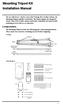 Mounting Tripod Kit Installation Manual For use with Davis s wireless and cabled Vantage Pro2 weather stations, the Mounting Tripod simplifies installation. The tripod supports the Integrated Sensor Suite
This mount uses concrete parking bumpers and a Davis tripod to create a mounting solution for nonpenetrable
 NON-PENETRATING FLAT ROOF MOUNT Application Note 18 For Any Davis Weather Station Installed on a Mounting Tripod Introduction This application note describes various mounting solutions for non-penetrable
AT&T. PARTNER Plus Door Phone. Installation and Operation Manual
 AT&T PARTNER Plus Door Phone Installation and Operation Manual Copyright 1990 AT&T All Rights Reserved Printed in U.S.A. CIC# 999-500-317 OII722050-051 Issue 1 October 1990 PARTNER Plus Door Phone is a
2.4M SERIES 1241 ANTENNA
 4096-859 Revision A August 7, 2012 2.4M SERIES 1241 ANTENNA GENERAL DYNAMICS SATCOM Technologies 1500 Prodelin Drive Newton NC 28658USA Phone 828-464-4141 www.gdsatcom.com Prodelin Corporation Page 1 8/17/2012
POD Visor Instructions
 POD Visor Instructions Please read fully before beginning assembly and mounting the Visor Parts List - Visor Left Part (LV), Visor Right Part (RV) Qty 2, Aluminum Crossbars Hardware - Qty 17, 1/4" X 3/4"
AstroSystems Digital Setting Circles for Zhumell, GSO, Apertura and Astro-Tech
 AstroSystems Digital Setting Circles for Zhumell, GSO, Apertura and Astro-Tech Components 1 Sky Commander Digital Setting Circle Computer 2 Encoders 10,000 step 1 Sky Commander Digital Setting Circle Manual
Installation Instructions
 READ BEFORE INSTALLING UNIT For Through-the-Wall Air Conditioners To avoid risk of personal injury, property damage, or product damage due to the weight of this device and sharp edges that may be exposed:
Installing the Broadband Global Area Network (BGAN) Fixed Mount Kit
 Installing the Broadband Global Area Network (BGAN) Fixed Mount Kit Product description BGAN fixed mount kit Although the BGAN satellite modem terminal is designed for portable use, the BGAN Fixed Mount
CP2 Buried Cable Pedestal Initial & Rehab Installation Instructions
 Printing 3 March 2008 CP2 Buried Cable Pedestal Initial & Rehab Installation Instructions This instruction is intended for CP2 cable pedestal installations and replacements. The following tools will be
Installation Instructions
 Installation Instructions READ BEFORE INSTALLING UNIT For Low Profile Window Air Conditioner INSTALLATION WARNINGS AND CAUTION Carefully read the installation manual before beginning. Follow each step
Navico-Northstar 2kW JRC Radar Package, Scanner Cable Removal and Replacement
 Navico-Northstar 2kW JRC Radar Package, Scanner Cable Removal and Replacement This work instruction describes the methods and means for which to remove and reinstall optional scanner cable configurations
SECTION 22 LIGHTNING PROTECTION SYSTEM
 SECTION 22 LIGHTNING PROTECTION SYSTEM 22.01 SCOPE: A. These Specifications shall form a part of the Contract Documents and shall govern construction work for all buildings to be built or modified for
INSTALLATION AND OPERATING INSTRUCTIONS For Model GL1 Gate Locks
 Securitron Magnalock Corp. www.securitron.com ASSA ABLOY, the global leader Tel 800.624.5625 [email protected] in door opening solutions INSTALLATION AND OPERATING INSTRUCTIONS For Model GL1 Gate
SPIRAL STAIR KIT INSTALLATION MANUAL
 SPIRAL STAIR KIT INSTALLATION MANUAL Effective January 1, 2014 If you have any questions, please call the location that your Stair Kit was purchased from: Broomall, Pennsylvania 1-800-52-7427 Ontario,
ReachFree ID Installation Instructions For Portal TI, Sentinel and C-Start. Unitec www.startwithunitec.com
 ReachFree ID Installation Instructions For Portal TI, Sentinel and C-Start Unitec www.startwithunitec.com Proprietary Information and Materials of Unitec, Inc. Such proprietary information and materials
Guidelines for Earthquake Bracing Residential Water Heaters
 Guidelines for Earthquake Bracing Residential Water Heaters Department of General Services Division of the State Architect In accordance with the Health and Safety Code Section 19215, the Division of the
31.39 1.69. Determine the desired location fixture and center the coaxial cord location to the electrical box.
 Installation Instructions for JORN 00LSJORN_ 90LSJORN.0 GENERAL PRODUCT I NFORMATION: This product is suitable for indoor dry locations only. CAUTION RISK OF FIRE This product requires installation by
Andersen Electric Window Opener for Andersen Awning and Roof Windows
 W A Electric Window Opener Electric Window Opener for Awning and Roof Windows Congratulations! You have just purchased one of the many fine products. For ease of installation and continued enjoyment of
Policy on Water Heater Installations Policy No. UPC 510-1-94 Effective: September 1, 1995 Revised: February 10, 1996
 CITY OF SAN JOSE BUILDING DIVISION POLICY Policy on Water Heater Installations Policy No. UPC 510-1-94 Effective: September 1, 1995 Revised: February 10, 1996 All new and replacement water heaters installed
Owner s Guide and Installation Manual. Vancouver Model Name. 21321, 21328 Model No. English Español
 For Your Records and Warranty Assistance For reference, also attach your receipt or a copy of your receipt to the manual. Vancouver Model Name 21321, 21328 Model No. Type A Models Owner s Guide and Installation
LED Security Spotlight User Manual
 MOT ION-TR ACKING LED Security Spotlight User Manual www.jascoproducts.com 1-800-654-8483 2 TABLE OF CONTENTS Parts List 3 Questions? Missing Parts? 4 Installation (Wall mount) 6-9 Installation (Eave mount)
Tools Required. Recommended Adhesives Vinyl Bonding: - Christy s White Hot Vinyl Cement
 Assembly Instructions STEP-BY-STEP HANDRAIL INSTALLATION for 1-1/2" vinyl handrail component system Rise in inches Run in inches 8 8.5 9 9.5 10 10.5 11 11.5 12 12.5 13 13.5 14 14.5 15 8.5 47 45 43 42 40
Connections and Setup
 9242_14_Ch12_eng 6/11/07 9:36 AM Page 1 Connections and Setup HOW TO CONNECT YOUR SATELLITE RECEIVER Do you have a handful of cables and a head full of questions? This chapter is the perfect place to find
MGB Chrome Bumper Conversion
 MGB Chrome Bumper Conversion Installation Instructions For 1974 1/2-1980 MGB This kit requires cutting, welding, and painting. Professional installation recommended. Note: Every MGB body is slightly different
OWNER S MANUAL Table Tennis Table Patent Pending
 OWNER S MANUAL Table Tennis Table Patent Pending Be sure to write your model number and serial number here for future reference. You can find these numbers printed on the bottom of the table. MODEL # T8179
ATS Overhead Table Shelf System INSTRUCTION MANUAL
 ATS Overhead Table Shelf System INSTRUCTION MANUAL ATS Overhead Table Shelf System Instruction Manual Warranty Newport Corporation warrants this product to be free of defects in material and workmanship
8' W x 8' H or 10' H Peak Style Shelter Assembly Instructions
 ' W x ' H or ' H Peak Style Shelter Assembly Instructions Description ' x ' x ' Peak Style Shelter - Gray ' x ' x ' Peak Style Shelter - Gray Recommended Tools Please read instructions COMPLETELY before
HORIZONTAL INSTALLATION
 THERMO/SOLAR Žiar s.r.o. MANUAL FOR INSTALLATION PV SUPPORTING FRAMES HORIZONTAL INSTALLATION Technical alternation reserved A1410 1 12/2014 CONTENT ORD.NO. PAGE Mounting information 3 Mounting, flat roof
TABLE OF CONTENTS. I. TROUBLESHOOTING... 2 - Section 1.01: Common Problems/Solutions... 2
 BAL Accu-Slide System I. Table of Contents TABLE OF CONTENTS I. TROUBLESHOOTING... 2 - Section 1.01: Common Problems/Solutions... 2 II. GETTING STARTED... 5 - Section 2.01: Tools You Will Need... 5 - Section
DE Frame with C Series Sidelight
 TOOLS REQUIRED Tape measure 6' magnetic level 3' magnetic level Screw gun with clutch adjusted #2 phillips tip #3 phillips tip Screwdriver (used to adjust frame on will using oval slots) Pry Bar Powder
BUILT-IN DISHWASHER INSTALLATION INSTRUCTIONS
 BUILT-IN DISHWASHER INSTALLATION INSTRUCTIONS PLEASE READ COMPLETE INSTRUCTIONS BEFORE YOU BEGIN LEAVE INSTALLATION INSTRUCTIONS AND USER'S GUIDE WITH OWNER ALL ELECTRIC WIRING AND PLUMBING MUST BE DONE
INSTALL INSTRUCTIONS KK-C-HVAC-1 HVAC UNIT 2003-2014 CHEVROLET/GMC VANS FOR
 INSTALL INSTRUCTIONS KK-C-HVAC-1 HVAC UNIT 2003-2014 CHEVROLET/GMC VANS FOR (For NEW 2007 ALL WHITE KWIK-KITS ONLY) Warning do not attempt to install A/C units unless you are experienced with servicing
1. SAFETY RULES. 8. Avoid placing objects in the path of the blades.
 1 1. SAFETY RULES 1. To reduce the risk of electric shock, insure electricity has been turned off at the circuit breaker or fuse box before beginning. 2. All wiring must be in accordance with the National
MODEL# SLA001-3 "SLIDE & LOCK" A-FRAME POOL LADDER
 MODEL# SLA001-3 "SLIDE & LOCK" A-FRAME POOL LADDER IMPORTANT INSTRUCTIONS: : Read all instructions carefully & completely to become familiar with parts, assembly, safety and proper use of this product.
AZEK Rail Install Guide
 TRIM MOULDING DECK PORCH RAIL PAVERS AZEK Rail Install Guide Installing AZEK Rail with CableRail by Feeney... 1 Installing CableRail by Feeney for AZEK Rail... 7 Installing AZEK Rail Stairs with CableRail
Wiper Motor Marinco 2.5. Installation Instructions
 Wiper Motor Marinco 2.5 Installation Instructions Wiper Motor Marinco-2.5 The Marinco 2.5 Wiper Motor Offers the Following Features: Fully sealed base and housing which allows installation in outdoor wet
AMF112 (6904-002010 <00>) 13mm (1/2 in.)
 AMF112 () Concrete Wood 13mm (1/2 in.) 5.5mm (7/32 in.) 10mm (3/8 in.) Sanus Systems 2221 Hwy 36 West Saint Paul, MN 55113 USA Customer Service Americas: 800-359-5520 651-484-7988 [email protected] Europe,
ECM-D70T / ECM-D70T1.5
 Elliptical Ceiling Dual Mount for 37 to 50 Flat Panels INSTALLATION INSTRUCTIONS CREATING POSITIVE CUSTOMER EXPERIENCES 9531-041-001-01 Contents ECM-D70T / ECM-D70T1.5 Installation Tools... 3 Parts List...
Electrical Wiring Technical Bulletin
 Electrical Wiring Technical Bulletin Overview In general, SIP construction is easier and more cost effective when things are planned and thought out before the panels are manufactured. This process will
Electrical for Detached Garages: Updated Feb 19, 2016 for 2015 CE Code in force Jan. 1, 2016. Underground branch circuit feeding a detached garage:
 Electrical for Detached Garages: Updated Feb 19, 2016 for 2015 CE Code in force Jan. 1, 2016 * Garage construction requires permits (electrical, building) * Permits must be applied for at the time. * Dial
TS93 EMR T/PT/TDE. Surface applied door closer
 TS EMR T/PT/TDE Surface applied door closer Installation instructions: Pull side track mount door closer with smoke detector (EMR T) Push side track mount door closer with smoke detector (EMR PT) Double
Awning Instructions. Standard Manual 1.5m to 4.5m
 Awning Instructions Standard Manual 1.5m to 4.5m English Standard Manual Instructions Contents Warning 1.5m 3.0m Awnings 4 x Expansion bolts (2 per bracket)** 2 x brackets 1 x Awning 1 x Winder handle
Front axle components, overview
 just a test. Front axle components, overview 40-1 General Information Load bearing components and parts of the suspension must not be welded or straightened. Vehicles without drive axle must not be moved,
Lynx Broadband Installation Manual for Residential Packages with a 20 db Amp Quick Start Guide (first two pages)
 Lynx Broadband Installation Manual for Residential Packages with a 20 db Amp Quick Start Guide (first two pages) 1. Be sure that your kit includes all the parts shown in the Check the Equipment section
How To Wire Wireline Cable To A Cell Phone (New Zealand)
 Installation Guide EnerNOC Site Server - S2 Installation Guide - AUS, NZ v 1.7 EnerNOC New Zealand Limited 2 Collina Terrace PO Box 12-202 Thorndon Wellington NZ 6144 +64 4 909 7546 1 Table of Contents
INSTALLATION INSTRUCTIONS
 Turbo Tube Slide INSTALLATION INSTRUCTIONS C A U T I O N Do not climb on the outside of the slide This slide is designed for home use only, not for Public Playgrounds PlayCore, Inc. 2004 Copyrighted Material.
GENUINE PARTS INSTALLATION INSTRUCTIONS
 GENUINE PARTS INSTALLATION INSTRUCTIONS DESCRIPTION: Illuminated Kick Plate APPLICATION: Rogue (2011) PART NUMBER: 999G6 GX010 KIT CONTENTS: Item A B C G H QTY 1 1 1 D 1 E 1 F 3 15 6 Description Kick Plate,
INSTALLATION INSTRUCTION SPEC. SHEET 7/00. City of New York Calendar #40747 ETL LISTED UNDER U.L. STD. 2108 LOW VOLTAGE TRACK LIGHTING SYSTEM
 7/00 INSTALLATION INSTRUCTION SPEC. SHEET 99052 99063 City of New York Calendar #40747 Copyright c 2000 ALFA Lighting, Inc. All rights reserved. Call:1-415-975-8080 QUICK JACK QJS R LISTED 9901483 ETL
INSTALLATION INSTRUCTIONS
 INSTALLATION INSTRUCTIONS PARTS REQUIRED Single QuickStand Parts A (1) QuickStand Unit B (1) Base Plate C (1) Platform D (1) Palm Support E (1) VESA Plate F (6) M8 x 18 mm Flat Head Machine Screws G (4)
Wireless Alarm System. Window/Door Sensor. User s Manual. Choice ALERT. Control all Sensors & accessories from one location
 45131 Wireless Alarm System Window/Door Sensor User s Manual Choice ALERT Control all Sensors & accessories from one location Table of Contents Important Safeguards 4 Introduction 5 Installation 6 Assigning
Panel Track Installation Guide
 Panel Track Installation Guide We make it easy! BTG 493361 EN_0510 Before starting Your new Blinds To Go panel track is custom made to your specifications from the finest materials available. To ensure
CLIENT. Inspection Report. 271 Front St. Alert Bay, B.C. Island Building Inspections V ANCOUVER I SLAND B. C.
 CLIENT Inspection Report 271 Front St. Alert Bay, B.C. Island Building Inspections 2013 V ANCOUVER I SLAND B. C. Elevation Photos For the Property at 271 Front Street Alert Bay, BC ELEVATION PICTURES Front
ColdGuard Bi-PARTING DOOR INSTALLATION INSTRUCTIONS
 EHD TRACK LEVEL, (SET LEVEL ON PLASTIC HEADER. DO NOT PLACE LEVEL ON ALUMINUM TRACK.) TRACK IS FLUSH WITH TOP OF HEADER JUNCTION BOX IDLER PULLEY LOCATOR PINS LOCATOR PINS OPERATOR DOOR STOP JUNCTION BOX
INSTALLATION INSTRUCTIONS for Bifold Doors (JII103)
 Thank you for selecting JELD-WEN products. Attached are JELD-WEN s recommended installation instructions for premium composite, hollow and solid core molded Bifold Doors. Bifolds are designed for fast
RadianceRail Installation Guide
 RadianceRail Installation Guide Installing RadianceRail with CableRail by Feeney... 2 Installing CableRail by Feeney for RadianceRail... 7 Installing RadianceRail Stairs with CableRail by Feeney... 10
LED MOTION ACTIVATED FLOOD LIGHT
 Utilitech & UT Design are registered trademarks of LF, LLC. All Rights Reserved. ITEM #0611551, #0611550 LED MOTION ACTIVATED FLOOD LIGHT MODEL #SE1036-BP2-02LF0-U, SE1036-WH3-02LF0-U Français p. 10 Español
GPS AutoSteer System Installation Manual
 GPS AutoSteer System Installation Manual Supported Vehicles John Deere Sprayers 4720 4630 4730 4830 AutoTrac Ready PN: 602-0227-01-A LEGAL DISCLAIMER Note: Read and follow ALL instructions in this manual
POWER LOCK KIT GENERAL INSTALLATION -J04427 REV. 2007-12-04. Kit Number. Models. Additional Parts Required. Kit Contents
 -J0 REV. 00--0 POWER LOCK KIT GENERAL Kit Number -0, 0-0 Models For model fitment information, please see the P&A Retail Catalog or the Parts and Accessories section of www.harleydavidson.com (English
Wireless Alarm System. Panic Button. User s Manual. Choice ALERT. Control all sensors, accessories and remote transmitters from one location
 Wireless Alarm System Panic Button User s Manual Choice ALERT Control all sensors, accessories and remote transmitters from one location Table of Contents Important Safeguards 4 Introduction 5 Activating
Protecting Your Home From Hurricane Wind Damage
 T H E W I N D Protecting Your Home From Hurricane Wind Damage During a hurricane, homes may be damaged or destroyed by high winds and high waves. Debris can break windows and doors, allowing high winds