
Chapter 2 Mold Design
|
|
|
- Jeffery Hoover
- 10 years ago
- Views:
Transcription
1 Chapter 2 Mold Design 2.1 Molding Parts Molding parts refer to those in direct contact with plastics to form the shape of plastic parts, wherein those constituting the contour of the plastic parts are called cavities and those constituting the internal shape of the plastic parts are called cores. Since the cavity and core directly contact the plastics of high temperature and pressure and rub with the plastic parts when protruding, it is thus required that they are provided with sufficient intensity, rigidity, hardness, abrasion resistance, corrosion resistance as well as low enough surface roughness Structural Design 1. Cavity Structural Design 1) Integral Cavity Directly cut cavity in the die set plate as indicated in Fig The advantage thereof is that the processing cost is relatively low. Yet the molding board material for making the die set is usually common medium carbon steel which is short in service life if used as cavity parts, whereas selecting materials with high performance shall result in high production cost. Usually, for the mold and precision of plastic parts which are less than times of molding, relatively low requirements are made; therefore, for molds of simple shape, integral structure can be adopted. Fig.2-1: integral cavity 2) Integral Embedded Cavity Use high quality materials (high-carbon steel or alloy tool steel) which are slightly larger than the external shape of the plastic parts (wall thickness of sufficient intensity must be ensured) to make the cavity parts and embed them into the molding plate thereafter, as indicated in Fig The advantage is that the service life of the cavity parts can be ensured and meanwhile the material cost is reduced. Furthermore, it is easy and convenient to repair and replace the cavity parts if they are damaged.

2 Fig.2-2: integral embedded cavity 3) Insertion and Splice Cavity For cavities which are of complicated shapes or are damageable in certain parts, design the parts hard to be processed or easily damaged into insert form and embed them into the basal body of the cavity, as indicated in 2-3. Fig.2-3: local insertion and splice cavity For large and complicated cavity mold, the four walls of the cavity can be separately processed and inlaid into the mold sleeve and finally fitted with the soleplate, as indicated in Fig.2-4. Fig.2-4: split-type cavity

3 4) Threaded Ring Cavity Threaded ring cavity is a kind of active insert used to mold the outer thread of the plastic parts, which shall be protruded together with the parts after molding and dismounted outside the mold. Fig.2-5 shows an integral threaded ring cavity whose length of fit is 5mm~8mm. To make it easy for assembly, the remaining parts are made into 3 ~ 5 obliquity, and a four-sided plane is modified at the lower extreme so that it will be convenient to screw it from the plastic parts with tools. To sum up, cavity structures in more common application are integral embedded cavity and insertion and splice cavity. Fig.2-5: threaded ring cavity 2. Core Structural Design Integral punch costs too many materials and the working load for cutting and processing amounts too high. Therefore, hardly any such structure exists in modern mold structures which is instead preoccupied with integral embedded punch and inlaying modular punch, as indicated in Fig.2-6 and 2-7. Fig.2-6: core structure

4 Fig.2-7: inlaying modular core Dimension Design The working dimension of molding parts refers to the dimension in direct contact with plastic parts in the cavity and core. Its precision directly influences the precision of plastic parts. 1. Factors Relating with Working Dimension 1) The Shrinkage of Plastic Parts Due to the nature of plastic (to expand when hot and to shrink when cold), the dimension of plastic parts after molding and cooling is smaller than that of the cavity. 2) Manufacturing Tolerance The manufacturing tolerance directly influences the dimension tolerance of plastic parts. 1/3~1/6 of the tolerance of plastic parts is usually taken as the manufacturing tolerance of cavity and core, and the surface roughness Ra is 0.8um ~0.4um. 3) Abrasion Loss during Use The abrasion and restoration during production can lessen the dimension of cores and enlarge the dimension of cavities. Therefore, shrinkage plays a more important part in the dimension of plastic parts when molding large parts, whereas when molding small parts, the influence of manufacturing tolerance and abrasion loss is relatively greater. Commonly-used shrinkage of plastic parts is usually between several percent and parts per thousand. For specific shrinkage of plastic please refer to relevant manuals or instructions to plastic products. 2. Computation of Working Dimension Usually, the working dimension of cavities and cores is determined according to such three factors as the shrinkage of plastic, the manufacturing tolerance of cavity and core parts as well as the abrasion loss. 1) Computation of Cavity Working Dimension Cavities are mold parts for forming the external shape of plastic parts. Its working dimension is a kind of containment dimension which can gradually get larger due to the abrasion of cavity in use. Hence, to leave some space for mold-repair after abrasion and for the convenience of fitting and assembly, when designing mold, it might as well take the lower limit as the containment dimension and take the upper deviation as dimension tolerance. The specific formula is as follows: Formula for radial dimension of cavity:

5 +δ L = [ L( p 1+ k) (3/ 4) Δ] (2-1) Wherein: L p Nominal dimension of the external shape of plastic parts; k Average shrinkage of plastic; Δ Dimension tolerance of plastic parts; δ Manufacturing tolerance of molds, taking 1/3 ~ 1/6 of the dimension tolerance of corresponding plastic parts. Formula for depth dimension of cavity: +δ H = [ H( p 1+ k) (2 / 3) Δ] (2-2) Wherein: H p Nominal dimension in the altitude-direction of plastic parts. 2) Computation of Core Working Dimension Cores are used to mold the internal shape of plastic parts. Its working dimension also belongs to contained dimension which gradually decreases due to the abrasion of core in use. Hence, to leave some space for mold-repair after abrasion and for the convenience of fitting and assembly, when designing mold, it might as well take the upper limit as the contained dimension and take the lower deviation as dimension tolerance. The specific formula is as follows: Formula for radial dimension of core: l = [ l( p 1+ k) + (3/ 4) Δ] (2-3) Wherein: l p Radial nominal dimension of the internal shape of plastic parts. Formula for altitude dimension of core: δ h = [ h( p 1+ k) + (2 / 3) Δ] (2-4) Wherein: h p Nominal dimension in the depth-direction of plastic parts. 3) Computation of the Position Dimension of Molds (such as dimension of center-to-center distance of holes) The formula is: δ C = C( p 1+ k) ± δ / 2 (2-5) Wherein: C p Position dimension of plastic parts. 3. Computation for the Dimension of Threaded Ring Cavity and Threaded Core 1)Computation for the Dimension of Threaded Ring Cavity D D m = [ D ( 1+ k) Δ] D = [ D( 1+ k) Δ] l s pl pm = [ D( 1+ k) Δ] ps Wherein: D m Dimension of pitch diameter of threaded ring cavity; D l Dimension of major diameter of threaded ring cavity; D s Dimension of minor diameter of threaded ring cavity; D pm Nominal dimension of pitch diameter of plastic parts external thread; D pl Nominal dimension of major diameter of plastic parts external thread; D ps Nominal dimension of minor diameter of plastic parts external thread; + δ + δ + δ (2-6)
![Formula for depth dimension of cavity: +δ H = [ H( p 1+ k) (2 / 3) Δ] (2-2) Wherein: H p Nominal dimension in the altitude-direction of plastic parts.](/docs-images/50/15046185/images/page_5.jpg "2) Computation of Core Working Dimension Cores are used to mold the internal shape of plastic parts.")
6 Δ Pitch diameter tolerance of external thread of plastic parts; δ Manufacturing tolerance of threaded ring cavity, for pitch diameter, = Δ / 5 δ = Δ /. and for major and minor diameters, 4 2)Computation for the Dimension of Threaded Core d d m l = [ d ( 1+ k) Δ] = [ d( 1+ k) Δ] d = [ d ( 1+ k) Δ] s pl ps pm Wherein: d m Dimension of pitch diameter of threaded core; d l Dimension of major diameter of threaded core;; d s Dimension of minor diameter of threaded core; d pm Nominal dimension of pitch diameter of plastic parts internal thread; d pl Nominal dimension of major diameter of plastic parts internal thread; d ps Nominal dimension of minor diameter of plastic parts internal thread; Δ Tolerance of pitch diameter of plastic parts internal thread; δ = Δ / for major and minor diameters, δ = Δ / 4. 3)Computation for Working Dimension of Screw Pitch δ Manufacturing tolerance of threaded core, for pitch diameter, 5 δ δ δ δ, (2-7), and P = P( p 1+ k) ± δ / 2 (2-8) Wherein: P p Nominal dimension of screw pitch of plastic thread parts; δ Refer to Table 2-1 for the manufacturing tolerance of screw pitch; P Dimension of screw pitch of threaded ring cavity or threaded core. Usually, when the number of threads is less than 7~8, it is not necessary to count the working dimension of screw pitch; instead it can be redeemed through the engagement clearance of thread. Table 2-1: manufacturing tolerance of threaded core or threaded ring cavity Diameter of Thread Length of Fit Manufacturing Toleranceδ 3 ~10 12 ~22 24 ~ 66 ~ 12 >12 ~ 20 > ~ ~ ~ Examples of Computation Refer to Fig.2-8 for the structural dimension of plastic parts and corresponding cavity structure, wherein the plastic parts are made from polypropylene, the shrinkage is 1%-3%. The dimension of cavity and core is to be calculated. Fig.2-8: plastic parts and corresponding cavity and core

7 Answer: Average shrinkage of plastic is 2% 1 Computation of relevant dimension of cavity Radial Dimension: L p = [ L( 1+ k) (3/ 4) Δ] +δ = 1/ 6 [ 110(1 0.02) (3/ 4) 0.8] = Depth Dimension: H p = [ H( 1+ k) (2 / 3) Δ] +δ = [30( ) (2 / 3) 0.3] 0.3 1/ 6 = Computation of relevant dimension of core Radial Dimension: l p = [ l( 1+ k) + (3/ 4) Δ] δ = [ 80( ) + (3/ 4) 0.6] 0.6 1/ 6 = Depth Dimension: h p = [ h( 1+ k) + (2 / 3) Δ] δ = [ 15( ) + (2 / 3) 0.2] 0.2 1/ 5 = Core Diameter: d p = [ d( 1+ k)( + 3/ 4) Δ] δ = ) [( )( + 3/ 4 0.1] 0.1 1/ 5 = Computation of position dimension of core C p = C( 1+ k) ± δ / 2 = 30 ( ) ± (0.3 1/ 6) / 2 = 30.6 ± Simplifying Method for Dimension Design Presently, almost all mold enterprises adopt three-dimension CAD/CAM to design mold, which turns out to be inconvenient. Therefore, they usually use simplifying method to calculate
![05 2 Computation of relevant dimension of core Radial Dimension: l p = [ l( 1+ k) + (3/ 4) Δ] δ = [ 80(1 + 0.02) + (3/ 4) 0.6] 0.6 1/ 6 = 82.05 0.](/docs-images/50/15046185/images/page_7.jpg "1 Depth Dimension: h p = [ h( 1+ k) + (2 / 3) Δ] δ = [ 15(1 + 0.02) + (2 / 3) 0.2] 0.2 1/ 5 = 15.43 0.04 Core Diameter: d p = [ d( 1+ k)( + 3/ 4) Δ] δ = ) [( 8 1+ 0.02)( + 3/ 4 0.1] 0.1 1/ 5 = 8.24 0.")
8 the forming design of mold, of which the following is a commonly-used one: L = L p k (2-9) δ = Δ Wherein: L Working dimension of molds forming parts; p L p Nominal dimension of plastic parts external shape; k Average shrinkage of plastic; Δ Dimension tolerance of plastic parts; δ Manufacturing tolerance of molds; p Proportion, usually taking 50%. When the upper and lower tolerance are either positive or negative value, it is a seldom-used tolerance, which can easily result in faulty calculation; thus, it needs to be modified during design before calculating the working dimension and tolerance, for example: Dimension of plastic parts , re-defined as the medium value10.3 +, dimension and tolerance of its molds: ; Dimension of plastic parts10 0.1, re-defined as the medium value9.7 +, dimension and tolerance of its molds: This principle is very important, since when modifying the product chart of plastic parts, it must be modified into the medium dimension in accordance with the requirements of dimension and tolerance of drawings. Several instances of such dimension and tolerance see Table 2-2. Table 2-2: several instances of dimension and tolerance Dimension and Tolerance of Plastic Parts Plastic Shrinkage Working Dimension Manufacturing Tolerance Dimension and Tolerance of Molds 10 ± 0.1 HIPS 0.5% ± ± HIPS 0.5% HIPS 0.5% HIPS 0.5% HIPS 0.5% Side Core-pulling Mechanism The flanks of plastic parts are usually provided with holes or flutes, as indicated in Fig.2-9. Under such cases, side-direction forming cores must be employed to form plastic parts. However, such forming cores must be fabricated into active parts so that they can be pulled out prior to the stripping of plastic parts. The mechanism for pulling out and restoring such active forming cores is called core-pulling mechanism.

9 Fig.2-9: plastic parts with side holes and side flutes Classification of Core-pulling Mechanism Core-pulling mechanism usually comprises the following types: 1. Manual Pulling Manual pulling refers to the pulling of side-direction cores with hand or hand tools. Such mechanism is simple in structure yet low in productivity and large in labor intensity. See Fig Fig.2-10: screw mandril manual side core-pulling mechanism 2. Hydraulic or Pneumatic Core-pulling Use pressure oil or compressed air as power, equipped the molds with special hydraulic or pneumatic tank, and achieve core-pulling through the to-and-fro movements of piston. The pulling force under such structure is large yet the cost is relatively higher. See Fig.2-11, 2-12 and Fig.2-11: hydraulic (pneumatic) side corepulling mechanism for fixed half mold Fig.2-12: hydraulic (pneumatic) side corepulling mechanism for moving half mold

10 Fig.2-13: hydraulic long-core-pulling mechanism 1- fixed plate; 2- long core; 3- moving plate 3. Power-driven Core-pulling Such mechanism pulls out the active cores by utilizing the mold opening force of injection machine and through the driving of parts. Such mechanisms as angle pin core-pulling, gear and rack core-pulling etc. have been extensively applied in production. 4. Side Core-pulling Mechanism Driven by Spring When the side concave of plastic parts is shallow and requires relatively smaller pulling force, spring or ebonite can be used to achieve core-pulling. See Fig.2-14, 2-15 and Fig.2-14: ebonite core-pulling (a) close mold; (b) open mold core-pulling Fig.2-15: spring core-pulling (a) close mold; (b) open mold core-pulling Fig.2-16: spring core-pulling fixed mold (a) close mold; (b) open mold core-pulling Design of Angle Pin Core-pulling Mechanism 1. Principle of Design

11 The angle pin core-pulling mechanism consists of an angle pin and a slide forming an angle against the mold opening direction, and is provided with a slide positioning device and locking device to ensure safe and reliable pulling movement. A typical example as indicated in Fig.2-17: angle pin 3 is secured on fixed plate 2, slide 8 glides in the chute of plate 7, and side core 5 is fixed on slide 8 with pin 4. When opening, the mold opening force acts on the slide through the angle pin, forcing the slide to glide out from the guiding chute of the moving plate and thereby completes core-pulling. The plastic part is pulled out by ejector sleeve 6. The stop device composed by bracket 9, bolt 11 and spring 10 is applied to ensure that the slide stops at the final position after core-pulling so that the angle pin can smoothly enter the angle hole during mold opening and that the slide can successfully restore to its former position. Wedge block 1 is used to lock the slide and prevent it from gliding out as caused by the forming pressure on the side core. The following factors should be taken into account during designing: 1) The core should be set preferably in the moving or fixed mold vertical against the parting line so that the side core can be pulled out through mold opening or the pulling action; Fig. 2-17: angle pin core-pulling mechanism 1- wedge block; 2- fixed plate; 3- angle pin; 4- pin; 5- side core; 6- ejector sleeve; 7- moving plate; 8- slide; 9- stop block; 10- spring; 11- bolt 2) Use preferably core-pulling mechanism wherein the angle pin is located in the fixed mold and the slide in the moving mold; 3) Wedge angleθ of the wedge block should be larger than the obliquity a of angle pin, usually larger than 2 ~ 3 ; otherwise, the angle pin cannot drive the slide; 4) Upon completion of core-pulling, the slide left in the chute should not be less than 2/3 of total length of slide; 5) Try not to make the projection of the ejector pin coincide with that the of the active core on the parting line to prevent mutual interference of the slide and the ejector unit during restoration; 6) When the slide is set on the fixed mold, the side-direction core must be pulled out prior to mold opening to ensure that the plastic part remains on the moving mold. A limit straining device can be used for this purpose. 2. Pulling Force During its molding and cooling in the mold, the plastic part wraps around the side-direction active core owing to the contraction of its volume. Yet when stripping it must overcome the wrapping force and the friction force produced by the core-pulling mechanism so that the active

12 core can be pulled out. The pulling force can be calculated as per the following formula: F = pacos( f tan a) /(1 + f sin a 1 cos a1) (2-10) Wherein: p Contraction stress of plastic parts, MPa, plastic parts cooled within the mold p=19.6mpa and those cooled outside the mold p=39.2mpa; A Side area of the core wrapped by the plastic parts, m 2 ; f friction coefficient, generally f =0.15 ~ 1.0; a 1 Draft; F Pulling force, N. Bending force of the angle pin is: F b = F / cos a (2-11) Wherein: a Dip angle of the angle pin; F b Bending force of the angle pin, N. 3. Core-pulling Distance Pull the active core out from the molding position to a place not interfering ejection of the plastic parts, and the distance moved by the active core or slide is called core-pulling distance. Generally, core-pulling distance equals to the depth of side hole plus a safety distance of 2mm~3mm. The formula is: S = H tan a + (2 ~ 3) (2-12) Wherein: H The mold opening journey required by the angle pin for completing the core-pulling distance, mm; A Dip angle of the angle pin; S Core-pulling distance, mm. 4. Dip Angle of the Angle Pin a The size of dip angle is not only related with the bending force of angle pin and the actually realized pulling force but also connected with the working length of angle pin, the core-pulling distance as well as the journey for mold opening. To ensure a certain amount of pulling force and certain intensity of angle pin, a shall be taken as less than 25 and shall be generally selected within the range of 12 ~ Diameter of Angle Pin The formula for diameter of angle pin can be inferred according to mechanics of materials: d ( / 0.1[ σ ] cos a) 1/ 3 = Fb L b (2-13) Wherein: a Dip angle of the angle pin; F 弯 Bending force of angle pin, N; L Effective working length of angle pin, m; [σ ] b Bending allowable stress, take 140Mpa for carbon steel.

13 6. Computation for the Length of Angle Pin The effective working length of angle pin L is related with the core-pulling distance S, dip angle of angle pin a as well as the angle of tilt β formed by the slide and the parting line. β is usually zero, hence, L = S / cos a. Total length of the angle pin is also related with diameter of the guide pillar and the thickness of retainer plate, as indicated in Fig L = L L2 + L3 + L4 L5 = d / 2 tan a + h / cos a + d / 2 tan a + s / sin a (5 ~ 10) (2-14) 2 + Generally, computation of relevant parameters of angle pin is mainly based on the computation of the relations between dip angle and core-pulling distance, length of angle pin as well as the mold opening journey. Other parameters such as pulling force and diameter of angle pin shall be generally determined upon experience. Fig.2-18: length of angle pin 7. Structural Design 1) Angle Pin Shape of angle pin is indicated in Fig Angle pin is usually made from 45 steel, the rigidity of which after quenching is 35HRC, or from T8 or T10, the rigidity after quenching is above 55HRC. The angle pin and the retainer plate are fitted by H7/m6. Since the angle pin is mainly used to drive the slide, and the stationarity of slide is ensured by the quality of fit between the guide runner and the slide, relatively looser clearance fit H11/h11 can be applied to the slide and the angle pin or a clearance of 0.5mm ~1mm can be reserved. 2) Slide Fig.2-19: form of angle pin

14 The slide comprises two types: the integral and the combined wherein the core is assembled on the slide for the purpose of saving steels and for easy processing. As indicated in Fig are various slide structures combined with the core. Fig.2-20: fixed forms of core and slide 3) Glide Guiding Form Various mechanisms of glide guiding form are indicated in Fig.2-21, wherein Fig.c) and e) are two most-commonly-used forms. The glide guiding parts are usually fitted by H8/g7. Certain length of fit should be maintained between the guide runner and the slide. The slide s gliding length of fit is generally larger than 1.5 times of the width of slide, and upon completion of core-pulling, the length of slide left in the guide runner should not be less than 2/3 of total length of slide. Fig.2-21: glide guiding form of slide 4) Positioning Device The positioning device of slide is used to ensure that the slide remain at the position just disengaging from the angle pin after mold opening so that the angle pin can exactly enter the angle hole on the slide during mold closing without any damage to the mold. The structures are indicated in Fig.2-22.

15 Fig.2-22: positioning form of slide 5) Wedge Block In the course of plastic injection, the active core subjects to a large pushing force in core-pulling direction, and therefore, a wedge block must be adopted to prevent the slide from displacing. The structure as indicated in Fig.2-23, wherein the wedge angle a 1 should be larger than the dip angle of angle pin a, so that the wedge block can keep off when the mold is opened. Generally, a 1 =a + (2 ~3 ), and when the slide dips in angle β as indicated in Fig.2-24, a 1 can prescind from the impact of angle β. Fig.2-23: form of wedge block

16 Fig.2-24: angle of wedge block 6) Interference during Core-pulling When designing such structural form wherein the angle pin is located in the fixed mold and the slide in the moving mold, please ensure that no interference between the slide and the ejector pin shall occur during the process of mold opening restoration. The so-called interference refers to the phenomenon wherein the restoration of slide precedes that of ejector pin, resulting in the collision between and damage of the active core and the ejector pin, as indicated in Fig To avoid the interference and under the permission of the structure of plastic parts, try not to design the ejector pin in the coinciding point of the horizontal projection of the active core; otherwise, it must meet the condition h tan a > s c c, as indicated in Fig.2-26, so that the interference can be avoided. Fig.2-25: interference (a) An ejector pin is provided under the projection of side core; (b) Interference is to occur 1- angle pin; 2- side core-pulling; 3- ejector pin Fig.2-26: conditions for non-occurrence of interference (a) protruding process of mold opening; (b) critical condition for non-occurrence of interference during mold

17 opening; (c) The status after completing mold opening and restoration 1- return pin; 2- moving plate; 3- ejector pin; 4- side core slide; 5- angle pin; 6- fixed plate; 7- wedge block Design of Side Core-pulling Mechanism of Tilted Lifter Shallow side concave of plastic parts requires small core-pulling distance, yet when the molding area of side concave is large, a large core-pulling force is thereby needed; therefore, tilted lifter mechanism can be adopted for side parting and core-pulling. The characteristic is that the pushing force of the ejector is applied to drive the sideway movement of the tilted lifter, and that the sideway parting and core-pulling action is completed by the tilted lifter along with the ejecting and stripping of plastic parts. As indicated in Fig.2-27, the gist of design is as follows: 1) For inner side core-pulling, top of the tilted slide should be lower than the end plate of core, since during the protruding, the tilted lifter performs core-pulling action which moves innerside. To prevent the radial interference from bottom of the plastic part on core-pulling, the said bottom must be higher than the top of the mechanism, and meanwhile, opposite to the moving range S of the radial around the mechanism there must be provided with a S 1 which is larger than the distance of S so that such barrier as circular bead can form to avoid interference on core-pulling, i.e. S 1 >S. 2) The pin s dip angle β should be taken between 5 25, and the guide angle α on the core-pulling part of the mechanism should be smaller than or equal to β, i.e. α β. This is also for preventing the interference between the tilted lifter and the bevel of core during the protruding. 3) To endow the mechanism with restoration function, the length of circular bead for restoration should be adopted preferably larger under possible conditions, and the four corners of the side slide should be made into circular angles which are easy for mill processing. Such design shall ensure the steady and reliable restoration of the mechanism and meanwhile can also enlarge the space for processing. 4) When slide friction between the tilted lifter and the retainer plate of the ejector plate occurs, harden quenching should be applied to the head of the mandril and the insert of the roof plate to increase abrasion resistance. Fig.2-27: gist of design for tilted lifter 2.3 Design of the Guiding and Positioning Mechanism 1. Guide Pillar and Guide Bush

18 The guide pillar and guide bush play important part in the guiding and positioning of fixed mold and moving mold as well as relevant mold plate (such as runner plate and ejection plate), and also protect cores during the assembly of molds. 1 The guide pillar is usually set on the moving mold, whereas the guide bush is set on corresponding part of the fixed mold; sometimes the two pieces are assembled vice versa according to the structure of the mold (such as the runner plate in the fixed mold). 2 The injection mold is usually provided with four guide pillars and guide bushes, scattering in the margin of four corners of the mold plate, wherein distance between center of the guide pillar and margin of the plate is usually 1~1.5 times of the diameter of the pillar s retaining end. 3 Headed guide pillars are usually applied to small molds or molds with scarce productivity, while large- and medium-sized injection molds or molds of large quantity and with rich productivity are mostly provided with shouldered guide pillars. To reduce friction, an oil storage tank can be cut on the pillar according to the actual use; spiral oil storage tanks can be found in some large molds. 4 Straight guide bushes are usually applied to simple molds or molds with thin plate; I-type headed guide bush is mainly applied to complicated molds or the guide of fixed and moving molds of large- and medium-sized molds; II-type headed guide bush is principally used in the guide of ejection mechanism. To reduce friction, an oil storage tank can also be cut in the guide bush or use a self-lubricating guide bush (Use MoS 2 in the annular groove of steel guide bush and use solid graphite in the side wall hole of high-intensity brass guide bush). 5 To ensure sound fitting of parting line after mold closing, a cuttings shoot of the guide pillar and guide bush should be made on the parting line: generally one of the sides is cut or chamfered on the orifice of the bush, as indicated in Fig Length of the pillar on the working part should be 6-8mm higher than the end plane of the core as indicated in Fig The surface roughness for the working part of the guide pillar takes R a 0.4 (micron order R a 0.2), and take R a 0.8 for the retaining part; surface roughness for the inner and outer cylinder of the guide bush can take R a 0.8 or R a 1.6 (micron order of the inner cylinder can take R a 0.2). 9 Clearance fit is adopted between the guide pillar and guide bush, with the quality of fit usually as H7/f7 (G6/h5 or H6/h5 for high quality of fit and H8/f8 or H9/f9 for low quality of fit) and the slip length usually takes times of the mating diameter, whereas the remaining parts are countersunk to reduce friction. Transitional fit is usually adopted between the mold plate and the guide pillar and guide bush, with the quality of fit as H7/k6 or H7/m6. In addition, to prevent the straight guide bush from falling off, a retaining groove can be applied to the flank of the straight guide bush, screwed with hexagonal socket head plug. 10 For molds with small batch of production and of low precision, the guide pillar can be directly fitted with pilot hole on the plate. The hole should be generally made into through hole; when the cavity plate is rather thick, if the pilot hole is a blind hole, a blowhole should be made on the side wall of the blind hole, or a vent groove can be abraded on the main body of the guide pillar and at the open end of the pilot hole; length and surface roughness of the slide guiding plane on the pilot hole can be adopted in accordance with the size of guide bush of equal specifications, and the diameter with exceeding length should be expanded so as to shorten the slip surface.

19 Fig.2-28: cuttings shoot of guide bush Fig.2-29: protruding length of guide pin 2. Cone Positioning Mechanism The structure as indicated in Fig.2-30 is a precise positioning form for the cone between the mold plate, which is mainly applied to large-sized and deep-recessed molds with thin plastic parts; to avoid occlude on the cone and to improve the service life of molds, quenching should be made to the fitting part of the cone or inlay it with quenching insert. Fig.2-30: conical surface positioning mechanism As indicated in Fig.2-31 is a commonly-used module for precise positioning of cone in the precise positioning of injection mold, which is assembled around the mold cavity. Fig.2-31a) and b) are standard cone positioning bush, and the structure as indicated in Fig.2-31c) can be assembled and dismounted on the side of parting line, which is easy for repair and maintenance and is often used when the fixed plate is thick. The positioning pin for the cone is usually assembled on the moving mold. a) b) c) Fig.2-31: demonstration for the application of cone positioning parts 1 & 6- bolt; 2 & 9- cone precise positioning bush; 3- fixed mold plate; 4- cone precise positioning pin; 5- moving mold plate; 7 & 8- gasket 3. Bevel Face Precise Positioning Mechanism The application of bevel face precise positioning on injection mold is indicated in

20 Fig.2-32,2-33 and For some, the precise positioning bevel face is directly cut on the plate, and for some others, precise positioning insert for bevel face is adopted; to improve the service life and for the convenience of adjustment, sometimes abrasion resistant quenching insert can be inlaid on the precise positioning bevel face. Fig.2-32: single-bevel insert Fig.2-33: double-bevel insert Fig.2-34: wear-resisting precise positioning precise positioning plate bevel positioning 1- fixed mold; 2- positioning 1- fixed mold; 2- double bevel 1- slide wedge; slide wedge; 3-moving mold; side wedge; 3- moving mold 2- wear-resisting plate 2.4 Design of Ejector Unit During each cycle of the injection and molding, the plastic part must strip from the cavity and core of the mold, and the device which completes the stripping is referred to as the ejector unit which is also called stripping mechanism Principle of Design The following principles shall be adhered to during the design of ejector unit: 1) The action point of the ejection force shall be near the protruding mold as much as possible since the plastic parts would enclasp the protruding mold when contracting; 2) The ejection force shall be imposed upon the section of the plastic parts with the largest rigidity and intensity, such as the reinforced rib, protruding edge and thick wall etc, and the area shall be large enough to prevent plastic parts from distortion and damage; 3) The ejection position shall be set in the plastic parts or at the position with the least influence over the appearance of the plastic parts, thus ensuring the sound appearance of the parts; 4) In case the ejection position shall be on the base level of the plastic parts for use or assembly, the contact position of pin and the plastic parts shall be recessed 0.1mm into the plastic parts to avoid the influence on the size and use of plastic parts; or else, the plastic parts would be upheaved and affect the smoothness of the base level Simple Ejector Unit Apply an ejection force in a side direction to one side of the moving mold and the stripping of the plastic parts can be achieved. Such mechanism is called the simple ejector unit, which usually includes mandril ejector unit, sleeve ejector unit, plate ejector unit and block ejector unit

21 etc. 1) Ejector Pin Unit This is a most-commonly-used ejector unit as indicated in Fig Fig.2-36 shows common forms of mandrils which only play the role as ejecting tools. Sometimes, mandrils can also partake in the molding of plastic parts according to the needs thereof. Such mandrils can then be made into the same shape as certain part of the plastic parts or just as core. Mandrils are usually made from T8A or T10A materials, with quenching hardness in head reaching over 50HRC and the surface roughness Ra less than 0.8um, forming a fitting of H8/f8 with the mandril hole. Mandrils are standard parts for molds and those of various diameters, lengths and sectional forms can be found in many cities marketplace for standard parts of molds. Fig.2-35: ejector pin unit Fig.2-36: commonly-used ejector pin forms 1- moving plate; 2- roof plate; 3-ejector pin; 4- return pin; 5- moving mold plate; 6- retainer plate Ejector pins must return to the original position prior to ejection after having been ejected out of the plastic parts, so that the subsequent work can be carried out. Therefore, a return pin must be designed to complete the movement. Currently there are three common return forms: 1 Return through return pin, as indicated in Fig The end plane of return pin is flush with parting line; fixed plate 4 drives return pin 5 during mold closing and mandril 6, through mandril retainer plate 7 and roof plate 8, returns to its former position prior to ejection. The return pin must be installed on the same retainer plate with the retainer ejector pins. 2 Return through ejector pin and return pin concurrently, as indicated in Fig Return through spring, as indicated in Fig Sometimes, when there are too many mandrils in the ejector unit or the mandrils are rather thin or the ejection force is imbalanced, ejector pins may tilt after being ejected, resulting in the crooking or breaking of ejector pins. Should such case occur, design of a guide device for the ejector unit should be taken into account. Common guide device of ejector unit is indicated in Fig.2-40.
22 Fig.2-37: function of return pin Fig.2-38: ejector pin concurrently as return pin 1- soleplate of moving mold; 2- stand; 3- moving plate; 1- ejector pin; 2- moving mold; 3- ejector pin 4- fixed plate; 5- return pin; 6-ejector pin; concurrently as return pin 7- ejector pin retainer plate ; 8- roof plate; 9- sprue bush Fig.2-39: return by spring Fig.2-40: guide device of ejector unit 2) Sleeve Ejector Unit The device is suitable for cylindrical or partially cylindrical plastic parts with thin walls as indicated in Fig The movement of its ejection is similar to the ejection of plastic parts by mandrils, except that a fixed core is provided at the center of the sleeve. Therefore, it is required that the retaining form of the sleeve must adapt to the retaining method of the core. To shorten the length of fit between the sleeve and the core so as to reduce friction, diameter of the latter half of the sleeve fitting hole can be diminished. To protect cavity and core from being
23 scratched on the surface, outer diameter of the sleeve should be smaller than that of the plastic parts, whereas the inner diameter should be slightly larger than that of the corresponding hole in the plastic parts, as indicated in Fig.2-42, wherein H is the ejecting distance. The sleeve and core are usually fitted as per H7/e7, and H7/f7 is usually adopted for the sleeve and mold plate. Fig.2-41: sleeve ejector unit Fig.2-42: shape of sleeve 3)Ejector Plate Unit The ejector plate unit as indicated in Fig.2-43, an ejector plate is assembled at the root of the protruding mold, forming close assortment therewith. When protruding, the ejector plate moves along the margin of the protruding mold and ejects plastic parts away from the mold. The mechanism is mainly applied to the ejection of large cylindrical plastic parts, containers with thin walls as well as shell plastic parts of various liners. Plate ejection is endowed with such features as balanced ejection, strong force, calm movement, simple structure, no distortion on the plastic parts, and no mark is left. Above all, it is unnecessary to attach a return pin. To avoid scratch on the protruding mold, the inner hold of the ejector plate should be 0.20mm~0.25mm larger than the forming part of the mold. Furthermore, the fitting surface of the protruding mold and the ejector plate should be made into conical surface to prevent flash caused by the deviation of ejector plate. The pitch on a single side should be preferably around 10. As indicated in Fig are various forms of plate ejector unit. As indicated in Fig.2-43 (b) and (c), the ejector plate is drawn by the pitch bolt to avoid falling off. The form as indicated in Fig.2-43 (e) is applied to large-sized container-like plastic
24 parts with deep cavity. An air-inlet unit is added on the core to avoid vacuum forming between the plastic parts and core during ejection, which can baffle the ejection of plastic parts. 4)Ejector Block Unit As indicated in Fig Fig.2-43: various forms of ejector plate unit Fig.2-44: ejector block unit 1- ejector pin; 2- supporting plate; 3- core retainer plate; 4- core; 5- ejector block; 6- return pin Secondary Ejector Unit Generally, plastic parts can be taken out of the mold cavity by only one ejection, yet due to their special forms, it is still difficult to take out the parts from cavity or the parts cannot fall off freely from the mold upon the completion of a ejection movement. Under such cases, another ejection must be applied to make the plastic parts fall off; sometimes a secondary ejection is also adopted to avoid exceeding force on plastic parts through one ejection, such as plastic parts with thin walls and deep cavity or those of complicated shapes, which can easily get cracked or distorted upon one ejection due to the large contact area between the parts and the mold, and
25 hence, secondary ejection is applied to such plastic parts to detract ejection force, thereby ensuring the quality of plastic parts. As indicated in Fig.2-45 is a swing rod secondary ejector unit. Fig.2-45 (a) shows mold closing status: upon mold opening, rod 10, which is fixed on side of the fixed mold, pulls swing block 7, causing the block 7 to eject moving plate 9, and then the plastic parts is stripped out of core 3, thereby completing the first ejection. As indicated in Fig.2-45 (b), the ejecting distance is controlled by pitch bolt 2. Fig.2-45 (c) shows the secondary ejection: after first ejection, the moving mold keeps moving and the ejector pin 11 ejects plastic parts from the cavity of moving mold 9, thereby completing secondary ejection. The restoration of the ejector unit as indicated in the figure is completed by return pin 6, while spring 8 is used to ensure the steady contact between the swing block and the moving mold. Fig.2-45: swing rod secondary ejector unit 1- core retainer plate; 2- pitch bolt; 3- core; 4- core; 5- ejector pin retainer plate; 6- roof plate; 6- return pin; 7- swing block; 8- spring; 9- moving plate; 10- rod; 11-ejector pin As indicated in Fig.2-46 is a draw hook secondary ejector unit. During mold opening, mandril of the injector acts on front ejector plate 3; since hook 4 hitches between the front and rear ejector plate, when ejecting, ejector pin 5 along with the moving mold ejects plastic part from core 7, yet the part is still left in cavity 6. When the ejection is further applied to the front end of the hook, touches the backing board and gradually raises, the hook is forced to release ejector pin retainer plate 2, when the rear ejector plate stops moving and the front ejector plate drives the ejector pin, thereby ejecting the plastic part from the cavity.
26 Fig.2-46: draw hook secondary ejector unit (a) Prior to the movement of ejector unit; (b) The first ejection strips the plastic part from the core; (c) The second ejection strips plastic part from concave mold 1- rear ejector plate; 2- ejector pin retainer plate; 3- front ejector plate; 4- hook; 5- ejector pin 2.5 Temperature Control System Temperature of the plastic molds directly influences the molding quality and productivity of plastic parts. For thermoset plastics, the molds require high temperature, and some thermoset plastics, which are of low fluidity (such as PC,POM,PPO and RSF etc) and demand warming to the molds, require a heating device during molding. Table 2-3 shows mold temperature required by common thermoset plastics. Table 2-3: mold temperature required by common thermoset plastics Name of Plastic Mold Temperature Name of Plastic Mold Temperature Polystyrene 40~60 Polypropylene 55~65 Low Pressure 60~70 ABS 40~60 High Pressure 35~55 Polycarbonate 80~110 Nylon 1010 Polyformaldehyde 40~60 90~120 PVC Polyphenylene oxide Perspex 30~60 polysulfone 110~150 40~60 130~ Electric Heating Device If mold temperature is required to be above 80, a heating device shall be needed. The
27 electric heating method generally comprises the following three types: 1. Direct heating with resistance wire Select sound resistance wires, insert them into insulated a porcelain tube, place the assembled part into the mold plate and heat the mold after turning on the power source. This method is not commonly used. 2. Heating with electrical bar The electrical bar is a standard heating module. It can operate by simply inserting it into the port on the mold plate and turn on the power source as indicated in Fig This is a more commonly used method. Fig.2-47: electrical bar and assembly (a) Electrical bar; (b) Assembly of electrical bar; 1- resistance wire; 2- heating resistant filler (silica sand or magnesia); 3- metal gland; 4- heating resistant insulated gasket (mica or asbestos); 5- heating plate 3. Heating with electric ring Wind the flat resistance wire around the mica and put the part into a tailor-made metal shell, thereby forming an electric ring as indicated in Fig Place mold therein and heat. Such heating device is suitable for the heating of compression mold and transfer mold. Fig.2-48: forms of electric heating ring Commonly-used empirical formula for computation of the power of electric heating device P=mq (2-15) Wherein: P Power needed for electric heating, W;
28 M Mass of mold, kg; q Electric power needed for the heating of molds of each kilogram, see Table 2-4. Table 2-4: electric power needed for the heating of molds of each kilogram (W/kg) Type of Mold q Value Heating with Electrical Bar Heating with Electric Ring Large Medium Small Hot and Cold Medium Channel of Molds The hot and cold medium channel is usually in slot form. Upon injection and molding, the molds need to be cooled to shorten molding cycle. Water is usually used to cool the molds, i.e. after injection connect cold water to the parts near cavity or into the port on the cavity parts so that molds can be promptly cooled. On the other hand, in order to remove such defect as the welding mark and to produce plastic parts with high lucency, dielectric such as high temperature and high pressure steam, high pressure hot water or thermal conducting oil should be applied to the molds to raise surface temperature molds. The most ideal status is that the surface temperature of molds can uniformly remain at the heat distortion temperature of plastic parts and meanwhile the speed of cooling on the section of the products should be kept as uniform as possible. 1. Principle of Design 1) Generally, it is more effective to heat or cool slender slots of large quantity than large-sized slots, which expands the range for mold temperature control. However, the slots should not be too slender in order that jam caused by scale can be avoided. The center distance between slots is approximate 3~5 times of the length of slots. Sectional area of the slots generally equals to that of a circular hole whose diameter is between 6~12mm. 2) Distance from the medium channel to cavity surface should be as equal as possible. When the wall thickness of plastic parts is even, the aforementioned distance should be preferably equal at every point; when the wall thickness of plastic parts is uneven, cooling should be intensified for thick walls, as indicated in Fig.2-49 and Fig.2-49: collocation of medium channel when wall thickness of plastic parts is even Fig.2-50: collocation of medium channel when wall thickness of plastic parts is uneven 3) The cores and cavity molds should be separately controlled. Generally, cavity molds absorb more heat and contain large heat radiating area, and therefore, require stronger control than cores. For mold ejection, the core should be preferentially cooled after ejection, and for heat
29 preservation, the cavity should be preferentially insulated. 4) Cooling at the gate part should be intensified, as indicated in Fig ) For cooling only, avoid set the medium channel at the welding mark of the plastic parts, whereas the heating of medium channel should be preferably near the welding mark. 6) Joint of the inlet and outlet tubes for hot and cold medium should be preferably on the same side with the mold and should be generally set at the back of the injector to make it convenient for operation. 7) Rust prevention for the slot or channel should be taken into account. Structure of the slot and channel should be designed for the convenience of cleaning. 8) The medium channel should be able to resist against distortion and damage under repeated injection pressure and relevant intensity matters should be considered with special caution. 9) Water leakage may lead to a lot of accidents, which requires sufficient attention. In addition, service life of the seal ring should be identified. 2. Common Structures The common structures are indicated in Fig.2-52, 2-53, 2-54 and 2-55; Fig.2-56 is a shape follow-up medium channel for one side of the fixed molds which have all undergone milling processing. Balanced surface temperature on the cavity of fixed mold and the appearance of products as well as uniform speed for heating and cooling can be ensured. Fig.2-51: arrangements at the entrance and exit of medium channel (a) edge gate; (b) multi-pin-point gate; (c) direct gate Fig.2-52: medium channel for plastic parts with shallow cavity
30 Fig.2-53: medium channel for large plastic parts with deep cavity Fig.2-54: medium channel for plastic parts with super-deep cavity Fig.2-55: ejection cooling channel for slender protruding mold Fig.2-56: shape follow-up medium channel on one side of fixed mold 1- highlight shell; 2- backboard; 3- shape follow-up medium channel 2.6 Example Surface rough for injection mold with highlight and no welding line should be at least the degree A2. The example of section 1.6 has not special requirements for computation of its cavity/core dimensions including the calculation of its shrinkage rate, which can be completed with Mold CAD/CAM software (UG, PRO-E, etc.). 1.Feed system 1 Sprue. The diameter of its upper end: d = diameter of injection machine nozzle +0.5mm = 3.34mm, takes its inner hole s draft at 2, therefore, The diameter of its lower end: D = 6.19mm. Its sphere radius: R = sphere radius of injection machine nozzle + (1~5) mm. Sphere radius of Yanhing SP108A injection molding machine nozzle is 12mm, so R=16mm. 2 Cold-slug well. Use a Z cold-slug well and take its diameter at 5 mm. 3 Runner. Use a round runner system and take its diameter at 5mm, which is occupied respectively by the fixed half and moving half mold. 4 Gate. Use an edge gate because of its application condition and appearance requirements of the molded part, and take the gate width at 3mm and height at 2mm. 5 Locating ring and sprue bush. According to the center hole dimension of fixed mold plate
31 of injection machine, the inner diameter of location ring is 36mm, and the diameter of sprue bush is 16mm. 2.Ejector mechanism 1 Ejector pins. Six ejector pins are disposed on the allowance locations of the core, and the diameter is 5mm. 2 Return mechanism. After the plastic part is ejected by ejector pins, the ejector pins should return to the initial position for the next cycle. Four return pins are used and the diameter is 15mm. 3 Guide mechanism. The guide mechanism is done by four guide pins and guide bushs and the diameter is 20mm. 4 Sprue puller pin. Use a Z-type sprue puller pin and its work end diameter is 5mm. 5 Ejection stroke. The height of plastic part is 10.52mm. The ejection stroke should not be less than 15mm for the plastic part s ejecting from the moving half mold. Yanhing 108A injection machine s ejection distance is 74mm, which meets the requirement. 3.The side core-pulling mechanism 1 Core-pulling distance. Generally core-pulling distance is longer than side hole or side dent depth by 2~3mm, here, S=1+(2~3)=3.5mm. 2 Gradient a of angle pin. Usually the range of angle pin is 15 ~20, not over 25. The core-pulling distance is short, so take the gradient of angle pin at Diameter of angle pin. Take its work end diameter at 12mm because the pull-out force and gradient is low. 4 Minimum opening stroke and work length of the angle pin. The minimum opening stroke for the side core-pulling: S (2 ~ 3) H = = = 3.5 mm tanα tan16 The effective work length of angle pin: L = S / cosα = 3.5 / cos16 = 3.7 mm 5Slides. The slide assembly structure has T-type guide slots. In order to ensure the angle pins are exactly inserted into the slide holes when the mold is closed again after the side core-pulling is done, the wedge plates are used for the slide location in the mold structure. 4.Air vent Because this part is small, just one cavity, the gap between parting line and ejector pin is enough to vent. There is no need to set special air vents. 5.Temperature control Use three rectangle conformal channels whose width is 10mm and depth is 5mm. As shown in the Fig.1-51, the middle conformal channel divides into two branches when it meets the direct gate, and they join together in the other side. The mold cavity surface temperature at about 95 controlled by hot medium in the conformal channel, which can completely eliminate defects such as welding marks and obtain highlight & no welding line parts 6.Checking up of injection machine parameters
32 Where: 1)Checking up of maximum injection volume The maximum injection volume of the selected machine should be: 0.8V m V p 十 V g Vm The maximum injection volume of injection machine (cm 3 ); V p The volume of plastic part (cm 3 ). This part V p = 4.3 cm 3 ; V g The volume of feed system (cm 3 ). This part V g = 2.58 cm 3 ; So V m (V p 十 V g )/0.8 = 6.88cm 3 The rated injection volume of Yanhing 108A injection machine is 150cm 3, so it meets the requirement. 2)Checking up of locking force F l >P m S P Where:P m The pressure of melt plastic in the mold cavity, 20Mpa~40MPa. Take the pressure at 35Mpa. A The projection area of plastic part and feed system on the parting line (mm 3 ). F l The rated locking force of injection machine (ton). The projection area of plastic part: A = L W = = 3312 mm 2 故 F > P A = = T l m So F > P A = = l m The rated locking force of Yanhing 108A is 108 ton, so it meets the requirement. 3)Checking up of the assembly dimensions 1 The mold shut height, length and width should match the mold plate dimensions of injection machine and rod space. The length and width of the mold is (mm mm) < inside rod space, (mm mm). So it meets the requirement. 2 Checking up of mold shut height The maximum and minimum space between the mold plates of Yanhing 108A injection machine is respectively 305mm and 102mm. Actual mold thickness is H m =261mm, so H min <H m <H max, which meets the requirement. 4)Checking up of opening stroke The maximum opening stroke of Yanhing 108A injection machine is 290 mm. The stroke of the moving mold plate should be greater two times than the height of the plastic part for ejecting. So the stroke of injection machine is relative to the mold thickness. The opening stroke of injection machine should meet the following formula: S max - (H m - H min ) > H 1 + H 2 + (5~10)mm That is, S max - (H m - H min ) = ( ) = 131
33 H 1 + H 2 + (5~10) = = 85 So it meets the requirement. Where:H 1 Ejecting distance which is taken at 15mm. H 2 The height of the molded part including feed system which is taken at the thickness of cavity-retainer plate (60mm). S max Maximum mold opening stroke of injection machine. Maximum mold opening stroke of Yanhing 108A injection machine is 290 mm. The fixed half mold is shown in Fig.2-57, moving half in Fig.2-58 and BOM in Table ,15 6,7,8, ,12 13 Fig. 2-57: fixed half mold
34 8,9,10 11,12 6,7 5 13,14 4 1,2, , ,26 Fig. 2-58: moving half mold
35 Components Fixed mold Moving mold 表 2-5 BOM sequence Name Amount number 1 Fastening screws of fixed mold 4 2 Locating ring 1 3 Sprue bush 1 4 Clamping plate of fixed half mold 1 5 Cavity-retainer plate 1 6 Highlight shell in cavity insert 1 7 Fastening screw of highlight shell on cavity insert 4 8 Inner packing ring between highlight shell and cavity insert 1 9 Outer packing ring between highlight shell and cavity insert 1 10 Background plate in cavity insert 1 11 Fastening blocks of cavity insert 4 12 Fastening screws of fastening blocks 4 13 Guide bushs 4 14 Wedge plates for slides 2 15 Fastening screws for wedge plates 8 16 Angle pins 2 1 Clamping plate of moving half mold 1 2 Fastening screws of clamping plates 4 3 Fastening screws of core-retainer plate 5 4 Core-retainer plate 1 5 Core insert 1 6 Fastening blocks of core insert 4 7 Fastening screws of fastening blocks 4 8 Slides 2 9 Slide inserts 2 10 Fastening screws of slide inserts 4 11 Guide rails on slides 4 12 Fastening screws of guide rails 8 13 Guide plates 2 14 Fastening screws of guide plates 4 15 Spacer block 1 16 Spacer block with a slot 1 17 Ejector-retainer plate 1 18 Ejector-support plate 1 19 Fastening screws of ejector-retainer plate 4 20 Ejector pins 6 21 Guide pins 4 22 Return pins 4 23 Stop pins 2 24 Ejector-retainer rods 6 25 Fastening block of ejector-retainer rods 1 26 Fastening screws of fastening block of ejector-retainer rods 2 27 Support plate of ejector-retainer rods 1 28 Fastening screws of support plate of ejector-retainer rods 2 a) highlight shell( 见 AutoCAD 文 件 ) b) background plate( 见 AutoCAD 文 件 ) Fig. 2-59: cavity insert( 见 AutoCAD 文 件 ) Fig. 2-60: cavity-retainer plate ( 见 AutoCAD 文 件 ) Fig. 2-61: core insert( 见 AutoCAD 文 件 ) Fig. 2-62: core-retainer plate( 见 AutoCAD 文 件 )
Solid shape molding is not desired in injection molding due to following reasons.
 PLASTICS PART DESIGN and MOULDABILITY Injection molding is popular manufacturing method because of its high-speed production capability. Performance of plastics part is limited by its properties which
Mould and Die Standard Parts
 Mould and Die Standard Parts Tampere University of technology - Tuula Höök Mould standard parts can be divided into the following groups: Standard mould set with guide bars, guide sleeves and other guiding
Removing chips is a method for producing plastic threads of small diameters and high batches, which cause frequent failures of thread punches.
 Plastic Threads Technical University of Gabrovo Yordanka Atanasova Threads in plastic products can be produced in three ways: a) by direct moulding with thread punch or die; b) by placing a threaded metal
Single Cavity Mould. Basic Mould Construction. Ejection System. Multi Cavity Mould
 Basic Mould Construction Basic mould construction: Core plate and Core (moving) Cavity plate and cavity (fixed) Other features include Guide pillars / guide bush Sprue bush Locating ring Single Cavity
General Injection Mould Specifications KONGSBERG AUTOMOTIVE GROUP
 KONGSBERG AUTOMOTIVE GROUP Edition 3 19.06.2013 A: GENERAL STATEMENT B: STEEL/COLUMN/STANDARD ELEMENTS STEEL COLUMN STANDARD ELEMENTS C: TECHNICAL CHARACTERISTICS I- MOULD BASE GENERAL CONTENT II- MOULD
p l a s t i c i n j e c t i o n m o l d i n g p a r t 1 p r o c e s s, m o l d a n d m a c h i n e e r i k d e l a n g e
 p l a s t i c i n j e c t i o n m o l d i n g p a r t 1 p r o c e s s, m o l d a n d m a c h i n e e r i k d e l a n g e H R O R o t t e r d a m B r n o U T j o i n t p r o j e c t 1 plastic injection
3D Printed Injection Molding Tool ("PIMT") Guide. Objet Ltd.
 3D Printed Injection Molding Tool ("PIMT") Guide Objet Ltd. 2 Injection molding is a high speed, automated and versatile process that can produce high precision complex three dimensional parts from a fraction
What is a mold? Casting. Die casting. Injection Molding Machine. Injection Molding. 2.008 Design & Manufacturing II. Spring 2004
 2.008 Design & Manufacturing II What is a mold? From Webster: a cavity in which a substance is shaped: as (1) : a matrix for casting metal (2) : a form in which food is given a decorative shape Spring
6 Design of Gates. 6.1 The Sprue Gate
 6 Design of Gates 6.1 The Sprue Gate The sprue gate is the simplest and oldest kind of gate. It has a circular cross-section, is slightly tapered, and merges with its largest cross-section into the part.
INJECTION MOULD DESIGN: MARPLEX PVC RESINS
 MACHINE RECCOMENDATIONS PVC requires reciprocating screw injection moulding machine with a plasticising screw to produce homogeneous melt. It is recommended that a shot weight of the part should take two
Injection molding equipment
 Injection Molding Process Injection molding equipment Classification of injection molding machines 1. The injection molding machine processing ability style clamping force(kn) theoretical injection volume(cm3)
Plastic Injection Molds
 Training Objective After watching the program and reviewing this printed material, the viewer will become familiar with the variety, design, and productive use of plastic injection molds. Mold components
CHAPTER 2 INJECTION MOULDING PROCESS
 CHAPTER 2 INJECTION MOULDING PROCESS Injection moulding is the most widely used polymeric fabrication process. It evolved from metal die casting, however, unlike molten metals, polymer melts have a high
Module 2 GEARS. Lecture 3 - INVOLUTE SPUR GEARS
 Module 2 GEARS Lecture 3 - INVOLUTE SPUR GEARS Contents 3.1 Introduction 3.2 Standard tooth systems for spur gears 3.3 Profile shifted gears 3.4 Involutometry 3.5 Design of gear blanks 3.1 INTRODUCTION
DIESEL EFFECT PROBLEM SOLVING DURING INJECTION MOULDING
 RESEARCH PAPERS FACULTY OF MATERIALS SCIENCE AND TECHNOLOGY IN TRNAVA SLOVAK UNIVERSITY OF TECHNOLOGY IN BRATISLAVA 2014 Volume 22, Special Number DIESEL EFFECT PROBLEM SOLVING DURING INJECTION MOULDING
Linear modules Lifting units Rotary modules Grip modules Inductive proximity switches Plug connectors
 20000 Linear modules Lifting units Rotary modules Grip modules Inductive proximity switches Plug connectors 23000 22000 21000 20000 09000 08000 07000 06000 05000 04000 03000 02000 01000 823 Notes 824 Technical
SECTION G2: CABLE PROCESSOR MODULE MAINTENANCE
 SECTION G2: CABLE PROCESSOR MODULE MAINTENANCE Cable Processor Module overview WARNING! When tipping the Cable Processor Module back, (after removing the toggle arm pin), use extreme caution not to drop
Lecture slides on rolling By: Dr H N Dhakal Lecturer in Mechanical and Marine Engineering, School of Engineering, University of Plymouth
 Lecture slides on rolling By: Dr H N Dhakal Lecturer in Mechanical and Marine Engineering, School of Engineering, University of Plymouth Bulk deformation forming (rolling) Rolling is the process of reducing
Free piston Stirling engine for rural development
 Free piston Stirling engine for rural development R. Krasensky, Intern, Stirling development, [email protected] W. Rijssenbeek, Managing director, [email protected] Abstract: This paper presents
NetShape - MIM. Metal Injection Molding Design Guide. NetShape Technologies - MIM Phone: 440-248-5456 31005 Solon Road FAX: 440-248-5807
 Metal Injection Molding Design Guide NetShape Technologies - MIM Phone: 440-248-5456 31005 Solon Road FAX: 440-248-5807 Solon, OH 44139 [email protected] 1 Frequently Asked Questions Page What
Part and tooling design. Eastman Tritan copolyester
 Part and tooling design Eastman Tritan copolyester Part and tooling design Process Part design Tooling design High cavitation considerations Process Process Project development flow chart Concept OEM generates
Unit 6: EXTRUSION. Difficult to form metals like stainless steels, nickel based alloys and high temperature metals can also be extruded.
 1 Unit 6: EXTRUSION Introduction: Extrusion is a metal working process in which cross section of metal is reduced by forcing the metal through a die orifice under high pressure. It is used to produce cylindrical
Plastic Injection Molding
 Training Objective After watching this video and reviewing the printed material, the student/trainee will understand the principles and physical operations of the plastic injection molding process. An
C O N V E Y O R C O M P O N E N T S C H A I N S B E L T S B E A R I N G S
 C O N V E Y O R C O M P O N E N T S C H A I N S B E L T S B E A R I N G S January 2009 Issue 6 Valu Guide Brackets The Ultimate in Adjustability and Cost Savings Valu Guide brackets are part of a family
PRESENTATION ON REPAIR AND REHABILITATION OF BUILDINGS DAMAGED IN EARTHQUAKE. By H P Gupta & D K Gupta
 PRESENTATION ON REPAIR AND REHABILITATION OF BUILDINGS DAMAGED IN EARTHQUAKE By H P Gupta & D K Gupta DIFFERENT TYPES OF DAMAGES 1.Minor cracks 0.5 to 5 mm wide in load or non-load bearing walls 2.Major
Craft and Design Application of Injection Moulding (Mobile Phone)
 Craft and Design Application of Injection Moulding (Mobile Phone) 5700 Summer 1999 HIGHER STILL Craft and Design Application of Injection Moulding (Mobile Phone) Support Materials This Support Material
DIAMOND Retractable Rodding Robot Model SPRAYROD-R
 2004-12-21 2 1 (23) DIAMOND Retractable Rodding Robot Model SPRAYROD-R 2004-12-21 2 2 (23) Table of contents 1 TECHNICAL DESCRIPTION...4 1.1 MAIN DETAILS...5 1.2 COMPONENTS DESCRIPTION...5 1.2.1 Pneumatic
Die casting Figure M2.3.1
 Die casting Die casting is a moulding process in which the molten metal is injected under high pressure and velocity into a split mould die. It is also called pressure die casting. The split mould used
Front axle components, overview
 just a test. Front axle components, overview 40-1 General Information Load bearing components and parts of the suspension must not be welded or straightened. Vehicles without drive axle must not be moved,
Machine needle shut-off nozzle type-a
 Machine needle shut-off nozzle type-a spring operated Applications: Thermoplastics (not applicable for PVC) Shut-off mechanism: Operated with one axial high performance spring Index of contents Chapter
Guidelines for Earthquake Bracing of Residential Water Heaters
 Guidelines for Earthquake Bracing of Residential Water Heaters Department of General Services Division of the State Architect 1102 Q Street, Suite 5100 Sacramento, CA 95814 Phone: (916) 324-7099 Fax: (916)
Cutting and Shearing die design Cutting die design
 Manufacturing Processes 2 Dr. Alaa Hasan Ali Cutting and Shearing die design Cutting die design A stamping die is a special, one-of-a-kind precision tool that cuts and forms sheet metal into a desired
SERIES ASM NEOPRENE/EPMD FLANGED SINGLE SPHERE CONNECTOR CONNECTORS. Pressures to 225 PSIG (15.51 barg) Temperatures to 230ºF (110ºC)
 APPLICATIONS Process Industry Weak Acids Alkalies Compressed Air Pulp & Paper MODELS ASM - Flanged Connection OPTIONS Control Rods Oil & Gas Water & Waste Pump suction & discharge Sea water Chemical lines
Effects of the MuCell Molding Process
 Effects of the MuCell Molding Process Molding MuCell versus Solid Shot size is reduced Final mold fill is completed with cell growth Little or no Hold Time or Pressure Reduced molded-in stress Less warp
Session 13 Design for Injection Moulding
 Session 13 Design for Injection Moulding Lecture delivered by Prof. M. N. Sudhindra Kumar Professor MSRSAS-Bangalore 1 Session Objectives At the end of this session the delegate would have understood Applying
How to reduce the cure time without damaging the rubber compound during injection molding?
 How to reduce the cure time without damaging the rubber compound during injection molding? 0Introduction This article aims at analyzing the rubber injection process and highlighting the limits that prevent
Installation Instructions For Slider Casement Air Conditioners
 Installation Instructions For Slider Casement Air Conditioners NOTE: These instructions describe installation in a typical wood framed window with a wood SLIDE-BY sash, or installation in a metal CASEMENT
The "DAVID" Steam Engine By Alan Marconett Hobbit Engineering HTTP://WWW.HobbitEngineering.com Alan@HobbitEngineering.
 The "DAVID" Steam Engine By Alan Marconett Hobbit Engineering HTTP://WWW.HobbitEngineering.com [email protected] (c) 2/20/03 The David steam engine is a simple oscillating steam engine, many plans
CLASSIFICATIONS OF INJECTION MOLDS
 CLASSIFICATIONS OF INJECTION MOLDS General Notes The following classifications are guidelines to be used in obtaining quotations and placing orders for uniform types of molds. It is our desire, through
Volkswagen B3 Passat Manual Transmission 02A 34 Manual Transmission - Controls, Assembly (Page GR-34) 02A 5-speed. Gearshift cable/lever installing
 34 Manual Transmission - Controls, Assembly (Page GR-34) 02A 5-speed Gearshift cable/lever installing Gearshift housing repairing Gearshift lever repairing lever/relay lever, installing Gearshift mechanism
Drive shaft, servicing
 Volkswagen Passat B6 - Drive shaft, servicing Стр. 1 из 41 40-7 Drive shaft, servicing Drive shafts, overview I - Assembly overview: Drive axle with CV joint VL100 40-7, Drive axle with CV joint VL100,
Injection molding overview
 Injection molding overview This injection molding overview is designed to help our customers understand the process of injection molding and mold-making. Please read it fully as it helps to define what
Installation Instructions
 Installation Instructions READ BEFORE INSTALLING UNIT For Low Profile Window Air Conditioner INSTALLATION WARNINGS AND CAUTION Carefully read the installation manual before beginning. Follow each step
Verification Experiment on Cooling and Deformation Effects of Automatically Designed Cooling Channels for Block Laminated Molds
 International Journal of Engineering and Advanced Technology (IJEAT ISSN: 2249 8958 Volume-4 Issue-5 June 2015 Verification Experiment on Cooling and Deformation Effects of Automatically Designed Cooling
It's large enough to handle most welding job shop projects, yet small enough to make it a worth while home-workshop tool
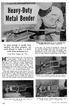 It's large enough to handle most welding job shop projects, yet small enough to make it a worth while home-workshop tool H Craft Print Project No. 272 ERE'S a metal bender that will enable you to bend
GENERAL RUBBER LINING PRINCIPLES
 GENERAL RUBBER LINING PRINCIPLES I. METAL PREREQUISITES Metal to be lined should meet the requirements as stated in section 8 Metal Fabrication and section 12 Blasting and Cementing Procedures. The surface
Figure 1 (end) Updated document to corporate requirements Added text to Paragraph 2.4
 This specification covers the requirements for application of ELCON Drawer Series Connectors: True Hot Plug, Blind Mating Mixed Signal and Power Connectors. These connectors are designed for use in pluggable
Technical Data. 7. Bearing Fits. 7.1 Interference. 7.2 Calculation of interference F B LLLLLLLLL( A-54
 Technical Data 7. Bearing Fits 7.1 Interference For rolling s the rings are fixed on the or in the housing so that slip or movement does not occur between the mated surface during operation or under. This
James M. Pleasants Company
 James M. Pleasants Company SUBMITTAL DATA GAINESVILLE MECHANICAL DECEMBER 20, 2013 PROJECT: GSU: J-183 HUMANITIES LAW BLDG. QUOTE NO:12116 ENGINEER: STEVENS & WILKINSON GASKETED PLATE HEAT EXCHANGER Tag:
Brick Veneer Construction
 Brick Veneer Construction Check list of suggested tools & support items Claw hammer Tape measure 3/4" [19 or 20] Wood chisel Wood or plastic shims Pry bar Utility knife Caulking and caulking gun Power
Machine nozzle with needle shut-off type HP pneumatically or hydraulically controlled
 Machine nozzle with needle shut-off type HP pneumatically or hydraulically controlled Applications: Thermoplastics (not applicable for PVC) Shut-off mechanism: Needle shut-off with integrated 2-way actuator
Heat Transfer Prof. Dr. Aloke Kumar Ghosal Department of Chemical Engineering Indian Institute of Technology, Guwahati
 Heat Transfer Prof. Dr. Aloke Kumar Ghosal Department of Chemical Engineering Indian Institute of Technology, Guwahati Module No. # 02 One Dimensional Steady State Heat Transfer Lecture No. # 05 Extended
MGB Chrome Bumper Conversion
 MGB Chrome Bumper Conversion Installation Instructions For 1974 1/2-1980 MGB This kit requires cutting, welding, and painting. Professional installation recommended. Note: Every MGB body is slightly different
WIRE, TERMINAL AND CONNECTOR REPAIR CONDUCTORS
 CONDUCTORS Conductors are needed to complete the path for electrical current to flow from the power source to the working devices and back to the power source. Special wiring is needed for battery cables
SECTION 15076 CEMENT-MORTAR LINED AND COATED STEEL PIPE
 SECTION 15076 CEMENT-MORTAR LINED AND COATED (CML&C) STEEL PIPE PART 1 GENERAL 1.01 DESCRIPTION This section designates the requirements for steel pipe fabrication, test in shop, installation of steel
Installation Instructions
 READ BEFORE INSTALLING UNIT For Slider Casement Air Conditioners To avoid risk of personal injury, property damage, or product damage due to the weight of this device and sharp edges that may be exposed:
Slide the new steering column shaft through the steering column from the driver compartment.
 Slide the new steering column shaft through the steering column from the driver compartment. Push the column shaft through the steering column until the machined end is out past the column lower bushing.
Self-aligning ball bearings
 Self-aligning ball bearings Designs... 470 Basic design... 470 Sealed bearings... 470 Bearings with an extended inner ring... 472 Bearings on sleeves... 473 Self-aligning ball bearing kits... 474 Appropriate
MOLD STANDARDS. Auburn Hills, Michigan, USA. 421 Page 1 6/28/11 Rev: 11/20/02
 MOLD STANDARDS Auburn Hills, Michigan, USA 421 Page 1 6/28/11 Rev: 11/20/02 REVISION RECORD Original Release Date 10/17/99 Revised Release Date 08/19/02 Revised Release Date 11/20/02 Revised Release Date
Go-kart for little race-drivers
 Go-kart for little race-drivers Drill and drive. Go-kart What it lacks in speed, it more than makes up for in fun: the go-kart will excite little race-drivers. 1 Introduction It s only a go-kart, but it
Machine devices, jig devices
 Machine devices, jig devices 853 K0697 Rolled thread studs DIN 6379 Material: Tempered steel. KIPP Rolled thread studs DIN 6379 Order No. D L B1 B2 Approx. weight g Surface finish: Thread rolled. Class
TECHNICAL DATA SHEET GRILON BG-15 S
 TECHNICAL DATA SHEET GRILON BG-1 S Grilon BG-1 S is a heat stabilised PA6 injection moulding grade with 1% glass fibres. Grilon BG-1 S has the following important properties: Excellent surface finish Easy
SITEMA PowerStroke. Technical Information TI-P11. 1 Function. 2 Applications. Mould Closing Devices series FSK. Contents
 English translation of German original Technical Information TI-P11 SITEMA PowerStroke Mould Closing Devices series FS drive system for powerful forces on a short stroke hydraulic actuation closing force
Injection Molding. Materials. Plastics 2.008. Outline. Polymer. Equipment and process steps. Considerations for process parameters
 Outline 2.008 Polymer Equipment and process steps Injection Molding Considerations for process parameters Design for manufacturing, tooling and defects 1 2.008 spring 2004 S. Kim 2 Materials Solid materials
Guidelines for Earthquake Bracing Residential Water Heaters
 Guidelines for Earthquake Bracing Residential Water Heaters Department of General Services Division of the State Architect In accordance with the Health and Safety Code Section 19215, the Division of the
STORAGE, INSTALLATION AND MAINTENANCE PROCEDURES
 GATE VALVE O.S. & Y 1.0 Periodic Inspections 1.1 The valve stem packing should be inspected at least monthly. If the stem packing shows signs of leakage, simply tighten the adjusting nuts to compress the
MACHINE DRAWING QUESTION BANK. 2. What are the parts not usually sectioned? (Nov 04)
 MACHINE DRAWING QUESTION BANK UNIT-I 1. Answer the following: Sketch a i. Hexagonal nut convention, ii. Convention of a stud bolt. (Nov 04) 2. What are the parts not usually sectioned? (Nov 04) 3 Answer
Friction Analysis for Piston Ring of Seal Device in the Stirling Engine
 Friction Analysis for Piston Ring of Seal Device in the Stirling Engine Hou Shunqiang 1, a, Zhang Lili 2,b and Zhang Xiaoyan 3,c 1 Qingdao Binhai University, Qingdao China 2 Shandong University of Science
M A N U A L 13-10-05
 Documentation The following information sheets illustrate the description below: 12-WW01-4G-E Sectional view of the lance with main dimensions 12-W101-6G-E Sectional view of the head of the lance with
Speed-Mat Rectangle Cutter
 Speed-Mat Rectangle Cutter 1 Honeycomb baseboard. 2 Left hold down. 14 3 Bottom hold down. 4 4 Left / right rule. 8 5 8 5 Left / right rule pointer. 1 6 Top / bottom rule. 7 Top / bottom rule pointer.
For New Technology Network. Steel Manufacturing Machinery Product Guide Book
 For New Technology Network R Steel Manufacturing Machinery Product Guide Book Ecological / Economical proposals from NTN NTN products exhibit benefits at various locations. Steel manufacturing equipment
1) Cut-in Place Thermoforming Process
 Standard Thermoforming Equipment Overview There are three standard configurations for thermoforming equipment: 1. Heat and Cut-in-Place Forming 2. In-Line Forming with Steel Rule or Forged Steel Trim wand
Injection Molding Design Guide. Table of Contents
 Injection Molding Design Guide 400 Injection Molding Design Guide Table of Contents Injection Mold Tooling Process Comparison...2 Size Limitations...3 Straight Pull Design...4 Other Geometric Considerations...5
Elo Touch Solutions Wall-mounting Kit for the 5501L IDS Touchmonitors
 Installation Manual Elo Touch Solutions Wall-mounting Kit for the 5501L IDS Touchmonitors SW602206 Rev B Table of Contents Chapter 1: Safety Warning... 3 Chapter 2: Kit Contents... 4 Included in Kit...
Precision Vise Combinations
 Precision Vise Combinations PanaVise vises and work holding tools have hundreds of uses limited only by your imagination! Each vise allows the head to Tilt, Turn & Rotate and position your work anywhere
INSTALLATION AND OPERATING INSTRUCTIONS For Model GL1 Gate Locks
 Securitron Magnalock Corp. www.securitron.com ASSA ABLOY, the global leader Tel 800.624.5625 [email protected] in door opening solutions INSTALLATION AND OPERATING INSTRUCTIONS For Model GL1 Gate
POSEIDON 2-29, 2-25 & 2-22 POSEIDON 2-29, 2-25 & 2-22 XT
 POSEION 2-29, 2-25 & 2-22 POSEION 2-29, 2-25 & 2-22 XT Repair Manual Index A. Safety precautions 3 B. Technical data 4 C. Structure 5-6. Service / Repair 7-23 E. Tools 24 F. Function 25-26 G. Electric
Rebuild Instructions for 70001 and 70010 Transmission
 Rebuild Instructions for 70001 and 70010 Transmission Brinn, Incorporated 1615 Tech Drive Bay City, MI 48706 Telephone 989.686.8920 Fax 989.686.6520 www.brinninc.com Notice Read all instructions before
Machine bolt shut-off nozzle type BHP pneumatically or hydraulically controlled
 Machine bolt shut-off nozzle type BHP pneumatically or hydraulically controlled Applications: Thermoplastics (not applicable for PVC) Shut-off mechanism: Bolt shut-off with integrated 2-way actuator pneumatically
1. Injection Molding (Thermoplastics)
 1. Injection Molding (Thermoplastics) l Molding: Injection (thermoplastics) INJECTION MOLDING of thermoplastics is the equivalent of pressure die casting of metals. Molten polymer is injected under high
Machine Design II Prof. K.Gopinath & Prof. M.M.Mayuram. Module 2 - GEARS. Lecture 17 DESIGN OF GEARBOX
 Module 2 - GEARS Lecture 17 DESIGN OF GEARBOX Contents 17.1 Commercial gearboxes 17.2 Gearbox design. 17.1 COMMERCIAL GEARBOXES Various commercial gearbox designs are depicted in Fig. 17.1 to 17.10. These
1 FOSC cover 1 piece Protecting fiber cable splices in whole 2 FOSC bottom 1 piece Fixing reinforced core, fiber cable
 TS-GPJ02VM 1. Scope of application This Installation Manual suits for the Fiber Optic Splice Closure (Hereafter abbreviated as FOSC), as the guidance of proper installation. The scope of application is:
EH-20 20m antenna. By VE3RGW
 EH-20 20m antenna By VE3RGW Equivalent circuit of EH-20 (prototype 2A) antenna system. Upper cylinder Lower cylinder Ground Counter pose Phasing coil Impedance transformer and tune circuit Tune coil Feed
Application Specification SIAMEZE * Standard and 114-13166 Fine Range Terminals 18 Mar 11 Rev C
 Application Specification SIAMEZE * Standard and 4-66 Fine Range Terminals 8 Mar Rev C NOTE i All numerical values are in metric units [with U.S. customary units in brackets]. Dimensions are in millimeters
Investigation of process parameters for an Injection molding component for warpage and Shrinkage
 Investigation of process parameters for an Injection molding component for warpage and Shrinkage Mohammad Aashiq M 1, Arun A.P 1, Parthiban M 2 1 PGD IN TOOL & DIE DESIGN ENGINEERING-PSG IAS 2 ASST.PROFESSOR
Operating Instructions
 Operating Instructions Cable Glands Ex d and Ex e with Compound > Contents 1 Contents 1 Contents...2 2 General Information...2 3 General Safety Information...3 4 Designated Use...4 5 Technical Data...4
Screw Thread Design. Rev. 3-4-09
 Screw Thread Design Screw Thread Fundamentals A screw thread is defined as a ridge of uniform section in the form of a helix on either the external or internal surface of a cylinder. Internal threads refer
Sheet metal operations - Bending and related processes
 Sheet metal operations - Bending and related processes R. Chandramouli Associate Dean-Research SASTRA University, Thanjavur-613 401 Table of Contents 1.Quiz-Key... Error! Bookmark not defined. 1.Bending
GK Packing System Welding Instructions
 GK Packing System Welding Instructions Roxtec GmbH Neuer Höltigbaum 1-3, 22143 Hamburg GERMANY Tel +49 (040) 657398-0, Fax +49 (040) 657398-50 EMAIL [email protected], www.roxtec.de Welding instructions
Crimp Tooling Where Form Meets Function
 Crimp Tooling Where Form Meets Function Quality, cost, and throughput are key attributes for any production process. The crimp termination process is no exception. Many variables contribute to the results.
Structural Integrity Analysis
 Structural Integrity Analysis 1. STRESS CONCENTRATION Igor Kokcharov 1.1 STRESSES AND CONCENTRATORS 1.1.1 Stress An applied external force F causes inner forces in the carrying structure. Inner forces
Trouble shooting guide
 guide DPR/PSR Leak Insuffi ciently tightened, shallow bite Tighten the nut according to correct number of turns, direct assembly only for maintanance/repair, use of recommended pre-assembly machines Mark
Replacement Window Installation Guide Non-Impact & Impact Resistant Windows without Nailing Fin
 Replacement Window Installation Guide Non-Impact & Impact Resistant Windows without Nailing Fin americancraftsmanwindows.com Project Requirements: Failure to follow these instructions may void product
EDEXCEL NATIONAL CERTIFICATE/DIPLOMA MECHANICAL PRINCIPLES OUTCOME 2 ENGINEERING COMPONENTS TUTORIAL 1 STRUCTURAL MEMBERS
 ENGINEERING COMPONENTS EDEXCEL NATIONAL CERTIFICATE/DIPLOMA MECHANICAL PRINCIPLES OUTCOME ENGINEERING COMPONENTS TUTORIAL 1 STRUCTURAL MEMBERS Structural members: struts and ties; direct stress and strain,
TECHNICAL SPECIFICATION SERIES 8000 PRECAST CONCRETE
 TECHNICAL SPECIFICATION SERIES 8000 PRECAST CONCRETE TECHNICAL SPECIFICATION PART 8000 - PRECAST CONCRETE TABLE OF CONTENTS Item Number Page 8100 PRECAST CONCRETE CONSTRUCTION - GENERAL 8-3 8101 General
Cooling system components, removing and installing
 Engine BHW Cooling system components, removing and installing Page 1 / 24 19-1 Cooling system components, removing and installing Warning! When doing any repair work, especially in the engine compartment,
REPAIR INSTRUCTIONS UNDER BODY CYLINDER (UM, UL)
 Table of contents 1. Introduction... 3 1.1. Scope of use... 3 1.2. General remarks... 3 1.3. Contact Hyva... 3 1.4. Precautions... 4 1.5. Spare parts... 4 1.5.1. Prior to use... 4 1.6. Recycling and Reuse
Service Manual Rol-Lift
 R 2000 Service Manual Rol-Lift Series: T and E Developed by Generic Parts Service This manual is intended for basic service and maintenance of the Rol-Lift pallet jack. The pallet jacks you are servicing
DE Frame with C Series Sidelight
 TOOLS REQUIRED Tape measure 6' magnetic level 3' magnetic level Screw gun with clutch adjusted #2 phillips tip #3 phillips tip Screwdriver (used to adjust frame on will using oval slots) Pry Bar Powder
Why Plastic Flows Better in Aluminum Injection Molds
 Why Plastic Flows Better in Aluminum Injection Molds An investigative study directly comparing melt flow characteristics of general purpose resins in QC-10 aluminum molds and P20 steel molds. By: David