
Die casting Figure M2.3.1
|
|
|
- August Small
- 9 years ago
- Views:
Transcription
1 Die casting Die casting is a moulding process in which the molten metal is injected under high pressure and velocity into a split mould die. It is also called pressure die casting. The split mould used under this type of casting is reusable. Die casting is categorized two types namely- hot chamber and cold chamber as shown in Figure M Metals like Zinc, tin and lead alloys are casted in hot chamber die casting having melting point below C whereas aluminum alloys are casted in cold chamber die casting machine. Aluminum dissolves ferrous parts in the die chamber and hence preferred to be used in cold chamber die casting. Continuous contact of molten metal is avoided by using a ladle for introducing molten metal directly to the machine.. Figure M2.3.1: Die casting process

2 Advantages of the die casting process 1. High production rate. 2. High accuracy in part dimensions. 3. Smooth surface finish for minimum mechanical finishing. 4. Ability to make many intricate parts such as hole opening slot trademark number etc. 5. Much thinner wall sections can be produced which can t be produced by other casting methods. 6. Varieties of alloys can be used as per design requirements. For example zinc can be used for intricate forms and plasticity, aluminum for higher structural strength, rigidity and light weight. 7. Ability to cast inserts such as pins studs shafts, fasteners etc. Disadvantages of the die casting process 1. Microporosityinthe die casting products is a common problem because of faster solidification, trapped air and vaporized die lubricants. 2. Undercuts cannot be found in simple two piece dies. 3. Hollow shapes are not readily casted because of the high metal pressure. 4. Limited sizes of the products can be produced based on the availability of the equipment 5. High melting temperature alloys are practically not die casted 6. Flash is present except for very small zinc die casting.

3 Applications Die casting process is preferred for nonferrous metal parts of intricate shapes. Examples of products are automobiles appliances, hand tools, computer peripherals, toys, optical and photographic equipment etc. Suitable material consideration Since dies are made from tool steel, for die casting products lower melting point nonferrous materials are used. Popular among them are aluminum and zinc alloys. In recent days, ferrous metal die casting is carried out on an experimental basis. Also on limited production basis, dies with refractory material are used for materials having high melting temperature of about C. Different material properties of various types of alloys are shown in Table M Table M2.3.1: Various types of alloys recommended for die casting (Source: Design for Manufacturability Handbook by James G Bralla, 2nd Ed) Material Aluminum Zinc Commercial alloy name Melting point, C Ultimate tensile strength, kpa Castability Remarks ,000 Excellent Most popular aluminum alloy; best combination of properties and ease of use ,000 Good Used when better corrosion resistance and ductility are required AG40A (Zamak No. 3) ,000 Excellent Used for the majority of commercial applications for thin walls and good platability Magnesium AZ91B ,000 Excellent Used for the majority of commercial applications for lightness with strength Brass ,000 Fair Used when high strength, elongation, and corrosion resistance are required

4 General design consideration The following design guidelines need to be followed for die casting: 1. Identify the possibility of incorporating several functions in to one die casting. Full advantages must be taken for the reduction of machining that die casting can afford. 2. Before the design and construction of die begin the designer should finalize the design of die casted product and its producibility. Dies after machined undergo heat treatment for hardening. 3. The designer must consult die cater about the location of the ejector pin as early as possible in the product design stage itself. If the impression left by the pins are not tolerable or can t be cored out, as an alternative solution rings or sleeve ejection can be opted. 4. Abrupt section changes, sharp corners and wall at an acute angle to one another need to be avoided. These features disturb the continuity of metal flow and lead to form a porous structure and surface irregularities. Therefore, it is recommended to provide radii as generous as possible with differing sections blending into one another. 5. Blind recesses are needed to be provided in the die to form bosses. Due to trapped air subsurface porosity is developed and this causes the drills to wander and taps to break in secondary machining and hence recommended to be avoided. Specific design recommendation Wall thickness: Sharp changes in sectional area and heavy sections over 6 mm thickness should be avoided if possible. Uniform wall thickness need to be maintained so as to achieve a minimum porous die casted product. The injected liquid metal cools rapidly on contact with the die casting surface resulting in a fine grained dense structure (the surface is termed as skin) generally devoid of porosity and is considered to be the strongest region of the die casted product. Depending upon the casting size, the recommended skin measures between 0.38 and 0.63 as mentioned in the Table M2.3.2.

5 Table M2.3.2: Recommended wall thickness (mm) (Source: Design for Manufacturability Handbook by James G Bralla, 2nd Ed) Surface area(cm 2 ) Zinc alloys Aluminum and magnesium alloys Copper alloys Up to Figure M2.3.2: To avoid surface shrinks, connect the boss to the wall with a short rib. During cooling process, due to shrinkage in the metal inside the boss even after the cooling of the adjacent walls, bosses behind the surface can cause visible sinks on decorative parts having flat, expansive areas. Sink effects are magnified in thinner walls. To avoid such surface shrinks the bosses are relocated and connected to the wall with a short rib as shown in Figure M2.3.2.

6 Ribs and fillets: Ribs are provided for structural reinforcing. It must be perpendicular to the parting line so as to allow the removal of casting from the die. In order to avoid sink, it is recommended that the width of the rib should not exceed the wall thickness of the casting. The minimum distance between the two adjacent ribs must be the sum of their heights. Sufficient (at least 2 0 per side) drafts should be provided to help in ejection. Ribs and fillets are also used to improve the rigidity and strength of the standing bosses. Ribs can be designed on both the halves of the die instead of providing on one side of the wall, thereby strengthening it avoiding local thickening effect. In case, ribs are designed to cross, they should do so at right angles. Acute angle intersections are avoided because it causes the die to overheat in the area between the ribs. (Figure M2.3.3 to M2.3.6) Undesirable Desirable Figure M2.3.3: Incorporating internal ribs for Box-shaped components and provide radius for corners Undesirable Desirable Figure M2.3.4: Introduction of further coring for heavy section

7 Undesirable Desirable Figure M2.3.5: Avoid external-wall undercuts Figure M2.3.6: Kissing cores in opposite die halves. Draft: The side wall of the die casting and other features perpendicular to the parting line must be tapered or drafted as much as possible to easy removal from the die. Draft angles depend upon the type of alloy is used and draft requirements have been provided in Table M For the case of outside wall, the recommended draft angel should be the half of the draft angle used in the inside wall.

8 Table M2.3.3: The recommended draft angel for inside wall (in degree) Draft angle for inside wall(in degree) Depth of wall (mm ) Copper alloys Aluminum alloys Magnesium alloys Zinc alloys Radii: Sharp internal corners in die casting are to be avoided. The various reasons for avoiding sharp corners are: stress concentration at the corner, subsurface porosity due to abrupt change in metal flow direction during injection, and premature erosion of the die material because of heat concentration at sharp corners. It is recommended that radii and fillets should be 1.5 times the wall thickness for both inside and outside radii. (See Figure M2.3.7)

9 Figure M2.3.7: Allow generous radii at internal and external corners. Holes: The die-casting process uses cores to produce holes or openings. However, the cores used to create hole are to be placed at right angles to the parting line and there are core length limits that should not be exceeded depending upon the diameter. Sufficient draft should be provided to the cores to ensure longevity (Refer Table M2.3.4 & Table M2.3.5). (Figure M2.3.8 to M2.3.9) Table M2.3.4: Draft provided for different material a/c to diameter of hole. Diameter of hole (mm) Alloy Maximum depth(mm) Zinc Aluminum Magnesium Copper

10 Undesirable Desirable Figure M2.3.8: Countersink on both sides to avoid a deburring operation. Undesirable Desirable Figure M2.3.9: Core slides can be avoided by using this hole design. Table M2.3.5: Draft Requirements for Cored Holes in Die Castings Draft, Depth of hole, mm Copper alloys Aluminum alloys Magnesium alloys Zinc alloys

11 Core slides: Avoid designing for core slides that must fit accurately through both die halves. Drill holes in internal ribs. (Figure M2.3.10) Undesirable Desirable Figure M2.3.10: Avoid drill holes in internal ribs. Threads: External screw threads can be formed on die casting but not for a precision fit. Production of threads by machining is recommended for precision type of fit. The most practical way to cut the threads are between the die halves and eject the part in normal manner. Due to accuracy reasons, pitches finer than 24 threads per inch for Aluminum and Magnesium and 32 threads per inch for Zinc are not recommended. In fact, it is possible to die cast internal threads either by unscrewing the casting from the threaded core or rotating the core out of the casting during ejection. Zinc is recommended for this type of design since other alloys shrink more tightly onto the core. Inserts: Inserts can be incorporated into die casted parts where necessary. The most common type of insert is the threaded stud used for assembly operation. It must be designed in such a manner that material will shrink on to its shank with sufficient force thereby preventing the movement in use. (Figure M2.3.11) Figure M2.3.11: Insert designs to prevent rotation and pullout

12 Machining allowance: When die casting operation requires machining operation the machining allowance (the added material need to be removed) should not exceed 0.5 mm. At the same time, the allowance should not be less than 0.25 mm to avoid excessive tool wear. If an area is to be machined covers ejector pin location their impressions should be left standing to 0.4 mm to make sure that they are removed during machining. (Figure M2.3.12) Undesirable Desirable Figure M2.3.12: Limit machining allowance to 0.25 to 0.50mm. Flash and gate removal: A well-built trimming die generally removes flash almost to the most extremely drafted point of the casting wall. In order to avoid the wear of the cutting edges certain allowances must be provided. Commercial die castings are considered to be adequately trimmed if flash and gates are removed to within 0.38mm of the casting wall. In case of very heavy gates having size more than 2.2mm thick, gates are removed within 0.75mm. Angled junctions of an external wall are avoided with parting line. It is preferable to add a minimum draft shoulder at the parting line. (Figure M2.3.13) Figure M2.3.13: Provide1.5-mm minimum height shoulder at parting line.

13 Lettering: The easy way to specify the character is that, by raising it in the casting. This can be achieved by engraving of the die. If the character is to be depressed into the casting all the background steel on that face of the die must be painstakingly removed around the character. Some design rules for lettering are: Minimum character width: 0.25mm Character height: 0.25 to 0.5 mm Draft for clean ejection: at least 10 Surface design: Large plain area is generally not advisable because, any slight casting imperfection will be readily visible. Recommended option to resolve this issue is to mask irregularities by designing in ribs, serrations or mould texturing. Dimension and tolerances The main cause of dimensional variation in die casting are due to the thermal expansion of both the die and the casting. For designing die, a shrink factor of 0.6% is provided for both the contraction and expansion mentioned above. Recommended tolerances for die casting by cavity dimensions in either half of the die is shown in Table M2.3.6.

14 Table M2.3.6: Recommended tolerances for die casting by cavity dimensions in either half of the die. Dimensions to 25 mm Die casting alloys Zinc Aluminum Magnesium Copper For critical dimensions Each additional 25 mm over 25 to 300 mm Each additional 25 mm over 300 mm For noncritical dimensions Dimensions to 25 mm Each additional 25 mm over 25 to 300 mm Each additional 25 mm over 300 mm

Solid shape molding is not desired in injection molding due to following reasons.
 PLASTICS PART DESIGN and MOULDABILITY Injection molding is popular manufacturing method because of its high-speed production capability. Performance of plastics part is limited by its properties which
Casting. Training Objective
 Training Objective After watching the program and reviewing this printed material, the viewer will learn the essentials of the various metal casting processes used in industry today. The basic principles
DIE CASTING. This process if for high volume, high detail, and value added economically priced cast parts. HOW IT WORKS
 DIE CASTING PROCESS This process if for high volume, high detail, and value added economically priced cast parts. HOW IT WORKS A metal tool is built and attached to a furnace of molten metal Then molten
Craft and Design Application of Injection Moulding (Mobile Phone)
 Craft and Design Application of Injection Moulding (Mobile Phone) 5700 Summer 1999 HIGHER STILL Craft and Design Application of Injection Moulding (Mobile Phone) Support Materials This Support Material
Single Cavity Mould. Basic Mould Construction. Ejection System. Multi Cavity Mould
 Basic Mould Construction Basic mould construction: Core plate and Core (moving) Cavity plate and cavity (fixed) Other features include Guide pillars / guide bush Sprue bush Locating ring Single Cavity
NetShape - MIM. Metal Injection Molding Design Guide. NetShape Technologies - MIM Phone: 440-248-5456 31005 Solon Road FAX: 440-248-5807
 Metal Injection Molding Design Guide NetShape Technologies - MIM Phone: 440-248-5456 31005 Solon Road FAX: 440-248-5807 Solon, OH 44139 [email protected] 1 Frequently Asked Questions Page What
Session 13 Design for Injection Moulding
 Session 13 Design for Injection Moulding Lecture delivered by Prof. M. N. Sudhindra Kumar Professor MSRSAS-Bangalore 1 Session Objectives At the end of this session the delegate would have understood Applying
Effects of the MuCell Molding Process
 Effects of the MuCell Molding Process Molding MuCell versus Solid Shot size is reduced Final mold fill is completed with cell growth Little or no Hold Time or Pressure Reduced molded-in stress Less warp
Zinc pressure die Casting Processes 1
 Zinc pressure die Casting Processes Pressure die casting is a process in which molten metal is injected at controlled high velocity and pressure into the cavity of a mould (die) which is usually made of
Removing chips is a method for producing plastic threads of small diameters and high batches, which cause frequent failures of thread punches.
 Plastic Threads Technical University of Gabrovo Yordanka Atanasova Threads in plastic products can be produced in three ways: a) by direct moulding with thread punch or die; b) by placing a threaded metal
Metal Injection Molded Parts
 Metal Injection Molded Parts Metal Injection Molding (MIM) is a powder metallurgy process. he difference between MIM and conventional powder metallurgy is that in MIM, metal powder along with binders is
3D Printed Injection Molding Tool ("PIMT") Guide. Objet Ltd.
 3D Printed Injection Molding Tool ("PIMT") Guide Objet Ltd. 2 Injection molding is a high speed, automated and versatile process that can produce high precision complex three dimensional parts from a fraction
MIT 2.810 Manufacturing Processes and Systems. Homework 6 Solutions. Casting. October 15, 2015. Figure 1: Casting defects
 MIT 2.810 Manufacturing Processes and Systems Casting October 15, 2015 Problem 1. Casting defects. (a) Figure 1 shows various defects and discontinuities in cast products. Review each one and offer solutions
Engineering & Design: Coordinate Dimensioning
 s e c t i o n Section Contents NADCA No. Format Page Frequently Asked Questions (FAQ) -2 1 Introduction -2 2 Section Objectives -3 3 Standard and Precision Tolerances -3 4 Production Part Technologies
Plastic Injection Molds
 Training Objective After watching the program and reviewing this printed material, the viewer will become familiar with the variety, design, and productive use of plastic injection molds. Mold components
Lecture slides on rolling By: Dr H N Dhakal Lecturer in Mechanical and Marine Engineering, School of Engineering, University of Plymouth
 Lecture slides on rolling By: Dr H N Dhakal Lecturer in Mechanical and Marine Engineering, School of Engineering, University of Plymouth Bulk deformation forming (rolling) Rolling is the process of reducing
Mould and Die Standard Parts
 Mould and Die Standard Parts Tampere University of technology - Tuula Höök Mould standard parts can be divided into the following groups: Standard mould set with guide bars, guide sleeves and other guiding
What is a mold? Casting. Die casting. Injection Molding Machine. Injection Molding. 2.008 Design & Manufacturing II. Spring 2004
 2.008 Design & Manufacturing II What is a mold? From Webster: a cavity in which a substance is shaped: as (1) : a matrix for casting metal (2) : a form in which food is given a decorative shape Spring
CHAPTER 2 INJECTION MOULDING PROCESS
 CHAPTER 2 INJECTION MOULDING PROCESS Injection moulding is the most widely used polymeric fabrication process. It evolved from metal die casting, however, unlike molten metals, polymer melts have a high
INJECTION MOULD DESIGN: MARPLEX PVC RESINS
 MACHINE RECCOMENDATIONS PVC requires reciprocating screw injection moulding machine with a plasticising screw to produce homogeneous melt. It is recommended that a shot weight of the part should take two
DIESEL EFFECT PROBLEM SOLVING DURING INJECTION MOULDING
 RESEARCH PAPERS FACULTY OF MATERIALS SCIENCE AND TECHNOLOGY IN TRNAVA SLOVAK UNIVERSITY OF TECHNOLOGY IN BRATISLAVA 2014 Volume 22, Special Number DIESEL EFFECT PROBLEM SOLVING DURING INJECTION MOULDING
Plastic Injection Molding
 Training Objective After watching this video and reviewing the printed material, the student/trainee will understand the principles and physical operations of the plastic injection molding process. An
Fundamentals of Design for Plastic Injection Molding. Kelly Bramble
 Fundamentals of Design for Plastic Injection Molding Kelly Bramble 1 Fundamentals of Design for Plastic Injection Molding Copyright, Engineers Edge, LLC www.engineersedge.com All rights reserved. No part
ARMSTRONG MOLD GRAPHITE DIE CASTING DIVISION
 ARMSTRONG MOLD CORPORATION GRAPHITE DIE CASTING DIVISION Getting Started The Evolution of GDC The GDC technology was developed as a hybrid of traditional permanent mold, graphite mold and the die casting
Unit 6: EXTRUSION. Difficult to form metals like stainless steels, nickel based alloys and high temperature metals can also be extruded.
 1 Unit 6: EXTRUSION Introduction: Extrusion is a metal working process in which cross section of metal is reduced by forcing the metal through a die orifice under high pressure. It is used to produce cylindrical
Remarkable magnesium: the 21st century structural alloy for small components
 WHITE PAPER FisherCast Global Corporation Remarkable magnesium: the 21st century structural alloy for small components By Bruce Mark Production and New Program Manager, Magnesium Castings FisherCast Global
General Guidelines for Building Aluminum Production Injection Molds
 General Guidelines for Building Aluminum Production Injection Molds Using 7000 series Aluminum Mold Plate By David Bank Aluminum Injection Mold Company Rochester, New York 1 Introduction This high strength
Copyright 1999 Society of Manufacturing Engineers. FUNDAMENTAL MANUFACTURING PROCESSES Die Casting NARRATION (VO): UTILIZED. NARRATION (VO): THE DIE.
 FUNDAMENTAL MANUFACTURING PROCESSES Die Casting SCENE 1. CG: Die Casting Machines white text centered on black SCENE 2. tape 445, 12:06:10-12:06:19 zoom out, horizontal die casting machines tape 443, 09:11:47-09:11:55
Part and tooling design. Eastman Tritan copolyester
 Part and tooling design Eastman Tritan copolyester Part and tooling design Process Part design Tooling design High cavitation considerations Process Process Project development flow chart Concept OEM generates
p l a s t i c i n j e c t i o n m o l d i n g p a r t 1 p r o c e s s, m o l d a n d m a c h i n e e r i k d e l a n g e
 p l a s t i c i n j e c t i o n m o l d i n g p a r t 1 p r o c e s s, m o l d a n d m a c h i n e e r i k d e l a n g e H R O R o t t e r d a m B r n o U T j o i n t p r o j e c t 1 plastic injection
6 Design of Gates. 6.1 The Sprue Gate
 6 Design of Gates 6.1 The Sprue Gate The sprue gate is the simplest and oldest kind of gate. It has a circular cross-section, is slightly tapered, and merges with its largest cross-section into the part.
General Injection Mould Specifications KONGSBERG AUTOMOTIVE GROUP
 KONGSBERG AUTOMOTIVE GROUP Edition 3 19.06.2013 A: GENERAL STATEMENT B: STEEL/COLUMN/STANDARD ELEMENTS STEEL COLUMN STANDARD ELEMENTS C: TECHNICAL CHARACTERISTICS I- MOULD BASE GENERAL CONTENT II- MOULD
Introduction to JIGS AND FIXTURES
 Introduction to JIGS AND FIXTURES Introduction The successful running of any mass production depends upon the interchangeability to facilitate easy assembly and reduction of unit cost. Mass production
CARL HANSER VERLAG. Herbert Rees. Mold Engineering 2nd edition 3-446-21659-6. www.hanser.de
 CARL HANSER VERLAG Herbert Rees Mold Engineering 2nd edition 3-446-21659-6 www.hanser.de 45 4 General Mold Design Guidelines 4.1 Before Starting to Design a Mold he mold designer starts with the design
Injection Molding Design Guide. Table of Contents
 Injection Molding Design Guide 400 Injection Molding Design Guide Table of Contents Injection Mold Tooling Process Comparison...2 Size Limitations...3 Straight Pull Design...4 Other Geometric Considerations...5
Common Mechanical Engineering Terms
 Common Mechanical Engineering Terms Ball and Detent (n) A simple mechanical arrangement used to hold a moving part in a temporarily fixed position relative to another part. The ball slides within a bored
Sheet Metal Stamping Dies & Processes
 Training Objectives After watching the program and reviewing this printed material, the viewer will gain knowledge and understanding of the stamping process and the die systems used to form sheet metal.
Glossary. 3D Animation Using computer software to create and animate a three-dimensional representation of image data.
 Glossary # 2D Control Drawing A line drawing showing various views of a product with details such as material, surface finish, volume, tolerances and critical dimensions. 3D Animation Using computer software
Injection molding overview
 Injection molding overview This injection molding overview is designed to help our customers understand the process of injection molding and mold-making. Please read it fully as it helps to define what
Screw Thread Design. Rev. 3-4-09
 Screw Thread Design Screw Thread Fundamentals A screw thread is defined as a ridge of uniform section in the form of a helix on either the external or internal surface of a cylinder. Internal threads refer
TECHNICAL DATA SHEET GRILON BG-15 S
 TECHNICAL DATA SHEET GRILON BG-1 S Grilon BG-1 S is a heat stabilised PA6 injection moulding grade with 1% glass fibres. Grilon BG-1 S has the following important properties: Excellent surface finish Easy
AN OVERVIEW OF GAS ASSIST
 GAS ASSIST INJECTION MOLDING AN OVERVIEW OF GAS ASSIST April 2010 www.bauerptg.com GAS ASSIST INJECTION MOLDING TECHNOLOGY It is a fact that packing force must be applied and maintained to an injection
Lathe Milling Attachment
 Lathe Milling Attachment By L C. MASON BY CLEVERLY stacking cold-rolled flat stock together, T-slots and slide for this lathe milling attachment are made without costly machinery. In fact, only two tools,
ECONOMIC DESIGN OF INJECTION MOLDED PARTS USING DFM GUIDELINES - A REVIEW OF TWO METHODS FOR TOOLING COST ESTIMATION
 ECONOMIC DESIGN OF INJECTION MOLDED PARTS USING DFM GUIDELINES - A REVIEW OF TWO METHODS FOR TOOLING COST ESTIMATION Adekunle Fagade, University of Massachusetts Amherst David Kazmer, University of Massachusetts
It's large enough to handle most welding job shop projects, yet small enough to make it a worth while home-workshop tool
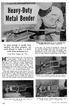 It's large enough to handle most welding job shop projects, yet small enough to make it a worth while home-workshop tool H Craft Print Project No. 272 ERE'S a metal bender that will enable you to bend
APPLYING RAPID TOOLING FOR INJECTION MOLDING & DIE CASTING From a RT users perspective
 APPLYING RAPID TOOLING FOR INJECTION MOLDING & DIE CASTING From a RT users perspective Glenn Anderson Senior Engineer, Research and Development Southco, Inc. RPA/SME Technical Forum on Rapid Tooling 20
ALUMINUM CASTING PROCESS COMPARISON CHARTS. Copyright 2002 Austin Group, LLC. All rights reserved.
 ALUMINUM CASTING COMPARISON CHARTS A Qualitative Comparison of Several Competing Processes for the Production of Aluminum Castings The following charts are intended to provide a relative guide to compare
Determining the Right Molding Process for Part Design
 Determining the Right Molding Process for Part Design How RIM Molding Advantages Compare with Traditional Production Technologies Page 2 Introduction This White Paper details the part production processes
Gear PEPSI CAN STOVE INSTRUCTIONS
 Gear PEPSI CAN STOVE INSTRUCTIONS [NOTE: Updated Instructions are now available. The new stove is less likely to develop flame leaks and the fuel/air mixture is improved. Instructions for a simmer ring
A Guide to Thermoform Processing of Polypropylene. Introduction
 A Guide to Thermoform Processing of Polypropylene Introduction Thermoforming is the process of heating plastic sheet to a pliable state and forming it into shape. Thermoforming offers processing advantages
Chapter 5 - Aircraft Welding
 Chapter 5 - Aircraft Welding Chapter 5 Section A Study Aid Questions Fill in the Blanks 1. There are 3 types of welding:, and, welding. 2. The oxy acetylene flame, with a temperature of Fahrenheit is produced
INJECTION BLOW MOLDING WITH FDM
 INJECTION BLOW MOLDING WITH FDM 3D PRODUCTION SYSTEMS Time Required Cost Skill Level By Susan Sciortino, Stratasys Inc. OVERVIEW Blow molding is a manufacturing process in which air pressure inflates heated
NYLON 6 RESINS CORRECTING MOLDING PROBLEMS A TROUBLE SHOOTING GUIDE
 NYLON 6 RESINS CORRECTING MOLDING PROBLEMS A TROUBLE SHOOTING GUIDE A. TROUBLESHOOTING GUIDE FOR INJECTION MOLDERS. I. INTRODUCTION The source of problems in injection molding of nylon resins can depend
DRAFTING. Prepared by:
 GTRI MACHINE SERVICES DRAFTING STANDARDS Prepared by: Machine Services Department Georgia Tech Research Institute December 16, 2011 Copyright 2011 Georgia Tech Research Corporation. Alll rights reserved.
CLASSIFICATIONS OF INJECTION MOLDS
 CLASSIFICATIONS OF INJECTION MOLDS General Notes The following classifications are guidelines to be used in obtaining quotations and placing orders for uniform types of molds. It is our desire, through
INJECTION MOLDING PROCESSING GUIDE Polymer
 FOAMAZOL Chemical Foaming Agents INJECTION MOLDING PROCESSING GUIDE Polymer Foaming Agent INJECTION MOLDING WITH CHEMICAL FOAMING AGENTS Introduction The injection molding of structural foam molded parts
Flex Circuit Design and Manufacture.
 Flex Circuit Design and Manufacture. Hawarden Industrial Park, Manor Lane, Deeside, Flintshire, CH5 3QZ Tel 01244 520510 Fax 01244 520721 [email protected] www.merlincircuit.co.uk Flex Circuit
Weld Cracking. An Excerpt from The Fabricators' and Erectors' Guide to Welded Steel Construction. The James F. Lincoln Arc Welding Foundation
 Weld Cracking An Excerpt from The Fabricators' and Erectors' Guide to Welded Steel Construction The James F. Lincoln Arc Welding Foundation Weld Cracking Several types of discontinuities may occur in welds
Kursus i Produktions- og materialeteknologi
 Kursus i Produktions- og materialeteknologi Plastsprøjtestøbning / Injection Molding Basics Short history of plastics 1862 first synthetic plastic 1866 Celluloid 1891 Rayon 1907 Bakelite 1913 Cellophane
Technical Information
 tapping Technical Information Troubleshooting Guide 115 TAP DOES NOT START Program depth: Tap drill size: Tap sharpness: Compression stroke may use up the entire program depth. Check for tap drill size.
Glossary of Terms Used in Plastic Injection Mold Manufacturing
 Acceptable Runner/Cavity Ratio: Runner systems designed for high pressure drops to minimize material usage and increase frictional heating in the runner. Annealing: The process of relieving internal stresses
The new. Zinc Alloy NORTH AMERICAN DIE CASTING ASSOCIATION
 The new High Fluidity Zinc Alloy NORTH AMERICAN DIE CASTING ASSOCIATION 2 The New HF (High Fluidity) Zinc Alloy: Extending zinc s alloying capabilities and improving energy efficiency Introduction A new
Understanding the Wire EDM Process
 5 Understanding the Wire EDM Process 69 Accuracy and Tolerances Wire EDM is extremely accurate. Many machines move in increments of 40 millionths of an inch (.00004") (.001 mm), some in 10 millionths of
EJOT Spiralform. The thread formers for metal. EJOT The Quality Connection
 EJOT Spiralform The thread formers for metal EJOT The Quality Connection Imprint Editor: EJOT GmbH & Co. KG Industrial Fasteners Division D 57319 Bad Berleburg Layout and Realisation: EJOT GmbH & Co. KG
Injection molding equipment
 Injection Molding Process Injection molding equipment Classification of injection molding machines 1. The injection molding machine processing ability style clamping force(kn) theoretical injection volume(cm3)
SHEET METAL DESIGN HANDBOOK
 SHEET METAL DESIGN HANDBOOK Forming Basics. 2 Critical Dimensions Embosses and Offsets Bend Radius Bend Relief Forming Near Holes Form height to thickness ratio Edge Distortion Laser cutting 5 Tolerances
The "DAVID" Steam Engine By Alan Marconett Hobbit Engineering HTTP://WWW.HobbitEngineering.com Alan@HobbitEngineering.
 The "DAVID" Steam Engine By Alan Marconett Hobbit Engineering HTTP://WWW.HobbitEngineering.com [email protected] (c) 2/20/03 The David steam engine is a simple oscillating steam engine, many plans
60.12. Depend-O-Lok FxE Expansion Coupling. System No. Submitted By Spec Sect Para Location Date Approved Date. DEPEND-O-LOK FxE EXPANSION COUPLING
 60.1 D-O-L FxE expansion couplings are a bolted, split-sleeve design that provides for expansion and contraction at the coupled joint. These couplings are furnished with restraint rings that, when affixed
Technical Data. 7. Bearing Fits. 7.1 Interference. 7.2 Calculation of interference F B LLLLLLLLL( A-54
 Technical Data 7. Bearing Fits 7.1 Interference For rolling s the rings are fixed on the or in the housing so that slip or movement does not occur between the mated surface during operation or under. This
The Ensat self-tapping threaded insert...
 The Ensat selftapping threaded insert... Ensat is a selftapping threaded insert with external and internal thread, cutting slots or cutting bores. A continuous process of further development has brought
CAST IRON THE BASICS. Heatline - Cast Iron Radiators SMOOTH FLAT FILE TO REMOVE ANY SWARF. ONE TIME. ASSEMBLY. JOINTS SHOULD BE TIGHTENED.
 CAST IRON THE BASICS 1. DO NOT LIFT ON YOUR OWN. 2. ONLY LIFT THE RADIATOR VERTICALLY. 3. DO NOT LIFT MORE THAN 8/10 SECTIONS AT ANY ONE TIME. 4. POSITION THE RADIATOR BEFORE FINAL ASSEMBLY. 5. THIS PRODUCT
Gate Leg Drop Leaf Table Plans
 Preparing the table top blanks: Cut and glue enough 3/4 stock to make three panels 40 long by 24 wide (they will be cut to final size at a later time). While the glue dries we will work on the legs. Preparing
Facts About. Industrial gases for better injection molding. This article appeared in the trade journal Kunststoffe plast europe, issue 12/2004.
 Facts About. Industrial gases for better injection molding. This article appeared in the trade journal Kunststoffe plast europe, issue 12/2004. 2 Industrial gases for better injection molding Gas injection
Fundamentals of Extrusion
 CHAPTER1 Fundamentals of Extrusion The first chapter of this book discusses the fundamentals of extrusion technology, including extrusion principles, processes, mechanics, and variables and their effects
Cutting and Shearing die design Cutting die design
 Manufacturing Processes 2 Dr. Alaa Hasan Ali Cutting and Shearing die design Cutting die design A stamping die is a special, one-of-a-kind precision tool that cuts and forms sheet metal into a desired
Advantages and application of PCD and CBn tools
 PCD and CBN tools Advantages and application of PCD and CBn tools Powerful and economical Tools with PCD and CBN cutting edges are the ideal solution for difficult-to machine, highly abrasive materials.
High speed machining and conventional die and mould machining
 High speed machining and conventional die and mould machining Reprint from HSM - High Speed Machining There are a lot of questions about HSM today and many different, more or less complicated, definitions
Fasteners and screw threads
 ISO Standards Handbook: Fasteners and screw threads Volume 2: Product standards Contents Part 3 : Product standards 2001, Ed. 5, 1094 p., ISBN 92-67-10345-8 3.1 External drive hexagon head bolts and screws
Why Plastic Flows Better in Aluminum Injection Molds
 Why Plastic Flows Better in Aluminum Injection Molds An investigative study directly comparing melt flow characteristics of general purpose resins in QC-10 aluminum molds and P20 steel molds. By: David
RESEARCH PROJECT. High Pressure Die Casting Defects and Simulation Process by Computer Added Engineering (CAE)
 RESEARCH PROJECT High Pressure Die Casting Defects and Simulation Process by Computer Added Engineering (CAE) ME8109 CASTING AND SOLIDIFICATION OF MATERIALS Presented by: Irshad Ali (Student # 500482510)
SHOP NOTES METAL SHAPER FOR YOUR SHOP
 SHOP NOTES METAL SHAPER FOR YOUR SHOP A METAL SHAPER is indispensable for certain machining operations where flat surfaces must be produced within very close limits, such as machining flats on castings,
POURING THE MOLTEN METAL
 HEATING AND POURING To perform a casting operation, the metal must be heated to a temperature somewhat above its melting point and then poured into the mold cavity to solidify. In this section, we consider
Lightweighting Custom enewsletter
 MuCell Injection Molding: Unique Process Solutions for Light Weighting Plastic Parts MuCell Injection Molding Brent Strawbridge, Vice President Sales Lightweighting Custom enewsletter AGENDA Technology
the runnerless types of molds are explained post molding operations are described the basic methods of applied decoration methods are examined
 Training Objectives After watching the video and reviewing this printed material, the viewer will gain knowledge and understanding of the various plastic finishing processes used in industry and their
Lapping and Polishing Basics
 Lapping and Polishing Basics Applications Laboratory Report 54 Lapping and Polishing 1.0: Introduction Lapping and polishing is a process by which material is precisely removed from a workpiece (or specimen)
Two-Shot Silico e Thermoplastic Medical Molding
 Two-Shot Silico e Thermoplastic Medical Molding Author: Sarah J. Voss, Product Specialist, Medical Co-Authors: Mark Simon, Ph. D. Research & Development Manager Danny Ou, Ph D. Research & Development,
DVD-PTH-E Through-Hole Solder Joint Workmanship Standards
 DVD-PTH-E Through-Hole Solder Joint Workmanship Standards Below is a copy of the narration for the DVD-PTH-E video presentation. The contents for this script were developed by a review group of industry
SAND CAST CHILL CAST LM4 - TF
 1 This alloy conforms with British Standards 1490 and is similar to the obsolete specifications BS.L79 and D.T.D 424A. Castings may be in the cast (M) of fully heat treated (TF) conditions. CHEMICAL COMPOSITION
Troubleshooting Guide. PS Injection moulding. Splay marks. Burning (Black streaks) Cool feed zone. Dry material, check source of moisture.
 Troubleshooting Guide PS Injection moulding Splay marks Trapped air that contains moisture Raise nozzle and front zone temperature. Cool feed zone. Wet feed Dry material, check source of moisture. Irregular
Two most common lock nut groups: 1-Prevailing Torque Type Lock Nuts:
 Two most common lock nut groups: 1. PREVAILING TORQUE a design feature of the lock nut produces friction between threads of mated components thereby increasing the force needed to tighten as well as loosen
CENTRIFUGAL CASTING. Email: [email protected] [email protected]
 CENTRIFUGAL CASTING Amit M Joshi (B.Engg. Mechanical, A.M.I.Prod.E, A.I.E) Dept. of Metallurgical Engg. & Material Science, Indian Institute of Technology Bombay, India. Email: [email protected] [email protected]
Specification for Rotary Drill Stem Elements
 Addendum 1 March 2007 Effective Date: September 1, 2007 Specification for Rotary Drill Stem Elements ANSI/API SPECIFICATION 7-1 FIRST EDITION, MARCH 2006 EFFECTIVE DATE: SEPTEMBER 2006 ISO 10424-1:2004
UNITED STATES CUTTING TOOL INSTITUTE Product Groupings for Standards Activities CUTTING TOOL PRODUCTS
 CUTTING TOOL PRODUCTS 1. BORING ISO 5609 Boring bars for indexable inserts Dimensions ISO 6261 Boring bars (tool holders with cylindrical shank) for indexable inserts Designation JIS B 4128 Boring bars
Chapter 6 Machining Center Carbide Insert Fundamentals
 This sample chapter is for review purposes only. Copyright The Goodheart-Willcox Co., Inc. All rights reserved. N10G20G99G40 N20G96S800M3 N30G50S4000 N40T0100M8 N50G00X3.35Z1.25T0101 N60G01X3.25F.002 N70G04X0.5
Machine devices, jig devices
 Machine devices, jig devices 853 K0697 Rolled thread studs DIN 6379 Material: Tempered steel. KIPP Rolled thread studs DIN 6379 Order No. D L B1 B2 Approx. weight g Surface finish: Thread rolled. Class
Chapter 3 Installing Over-the-Post Railing on an L-Shaped Stair
 49 Chapter 3 Installing Over-the-Post Railing on an L-Shaped Stair In this chapter: The Over-the-Post Balustrade System Determining the Rail Centerline Using Rail Bolts Making a Pitch Block Laying Out
Working Drawing and Assemblies. Chapter 10
 Working Drawing and Assemblies Chapter 10 Objectives 1.Define working drawings. 2. Describe how working drawings are used in industry. 3. List the major components of a complete set of working drawings.
AISI CHEMICAL COMPOSITION LIMITS: Nonresulphurized Carbon Steels
 AISI CHEMICAL COMPOSITION LIMITS: Nonresulphurized Carbon Steels AISI No. 1008 1010 1012 1015 1016 1017 1018 1019 1020 1021 1022 1023 1024 10 1026 1027 1029 10 1035 1036 1037 1038 1039 10 1041 1042 1043
LK Wallbox UNI Push. Assembly. Only intended for LK PE-X Universal Pipe X.
 LK Wallbox UNI Push Only intended for LK PE-X Universal Pipe X. LK Wallbox UNI Push 16 Single Article no. 188 06 38 LK Wallbox UNI Push 20 Single Article no. 188 06 39 LK Distance template LK Wallbox UNI
INTRODUCTION INTRODUCTION. to DIE CASTING NORTH AMERICAN DIE CASTING ASSOCIATION
 INTRODUCTION INTRODUCTION to DIE CASTING NORTH AMERICAN DIE CASTING ASSOCIATION Item# 101BK Although great care has been taken to provide accurate and current information, neither the author(s) nor the