
Lecture 1 Introduction Rectangular Coordinate Systems Vectors Lecture 2 Length, Dot Product, Cross Product Length...
|
|
|
- Madison Dorsey
- 10 years ago
- Views:
Transcription
1 CONTENTS i Contents Lecture Introduction. Rectangular Coordinate Sstems Vectors Lecture Length, Dot Product, Cross Product 5. Length Dot Product Orthogonal Projections Cross Product Lecture 3 Linear Functions, Lines and Planes 3 3. Linear Functions Linear mappings Lines Planes in 3-space Lecture 4 Quadratic Surfaces 4. Quadratic Functions Quadratic Curves Quadratic Surfaces Sketching Surfaces Lecture 5 Vector-Valued Functions 3 5. Vector-Valued Functions and Their Graphs

2 ii CONTENTS 5. Limits, Continuit and Derivatives Lecture 6 Integration of Vector-Valued Functions, Arc Length Integration Arc Length Arc Length as a Parameter Lecture 7 Unit Tangent and Normal Vectors 4 7. Smooth curves Unit Tangent Vector Principal Normal Vector Lecture 8 Curvature 48 Lecture 9 Multivariable Functions Definition of multivariable functions and their natural domains Graphing multivariable functions Topological properties of domains Lecture Limits and Continuit 58 Lecture Differentiabilit of Two Variable Functions 66 Lecture Partial Derivatives 68 Lecture 3 The Chain Rules 74 Lecture 4 Tangent Planes and Total Differentials 78

3 CONTENTS iii Lecture 5 Directional Derivatives and Gradients 83 Lecture 6 Functions of Three and n Variables 86 Lecture 7 Multivariable Talor formula 9 Lecture 8 Parametric Problems (optional) 9 Lecture 9 Maima and Minima 96 Lecture Etrema Over a Given Region Lecture Lagrange Multipliers 3 Lecture Double Integrals 6 Lecture 3 Integration of Double Integrals Lecture 4 Double Integrals in Polar Coordinates, Surface Area. 3 Lecture 5 Triple Integrals 7 Lecture 6 Change of Variables Lecture 7 Triple Integrals in Clindrical and Spherical Coordinates7 Lecture 8 Line Integrals 3 Lecture 9 Line Integrals Independent of Path 36 Lecture 3 Green s Theorem 4 Lecture 3 Surface Integrals 46
4 iv CONTENTS Lecture 3 Surface Integrals of Vector Functions 49 Lecture 33 The Divergence Theorem 54 Lecture 34 Stokes Theorem 58 Lecture 35 Applications 6

5 CONTENTS v.

6 Lecture Introduction In one-variable calculus ou have studied functions of one real variable, in particular the concepts of continuit, differentiation and integration. Functions of one variable can capture the dependence of some quantit b onl one other quantit. In practice however, one often needs to investigate the dependence on one or more quantities on man variables, such as time, location, temperature, air pressure, or costs of different products etc. Therefore it in natural to consider functions that depend on man variables. We will write f(, ) for a function of two variables, f(,, z) for a function of three variables or, more generall, f(,,..., n ) for a function of n variables. Instead of f other letters can be used (such as g, h, F, G, H or f, f etc.). Here it is assumed that a domain is specified to which the argument variables belong. We will write R for the set of all pairs (, ) of real numbers, R 3 for all triples of real numbers and R n for all n-tuples of real numbers. The domains of multivariable functions are subsets of those. It is convenient to plot functions of one variable as a graph in the two-dimensional plane (and, vice versa, one can stud curves in the plane using functions). Similar to this, a function of two variables can be plotted as a surface in three-dimensional space, and two-dimensional curved surfaces can be studied b functions of two variables. Visualising functions of more than two variables is more difficult. In this unit we will cover the concepts of continuit, differentiation and integration of functions of man variables, as well as appling these concepts to stud the geometr of curves and surfaces.. Rectangular Coordinate Sstems First we will recall some concepts from linear algebra that were introduced in Math. Recall that a point P in -space can be described b a pair of numbers, namel its Cartesian coordinates (, ). We use a coordinate sstem of two perpendicular aes, the -ais and -ais. Now, is the number on the -ais that corresponds to the perpendicular projection of P to the -ais (parallel to the -ais) and is the number on the -ais that corresponds to the perpendicular projection of P to the -ais (parallel to the -ais). Here we use the lower indices to indicate that these are the coordinates of the point P.
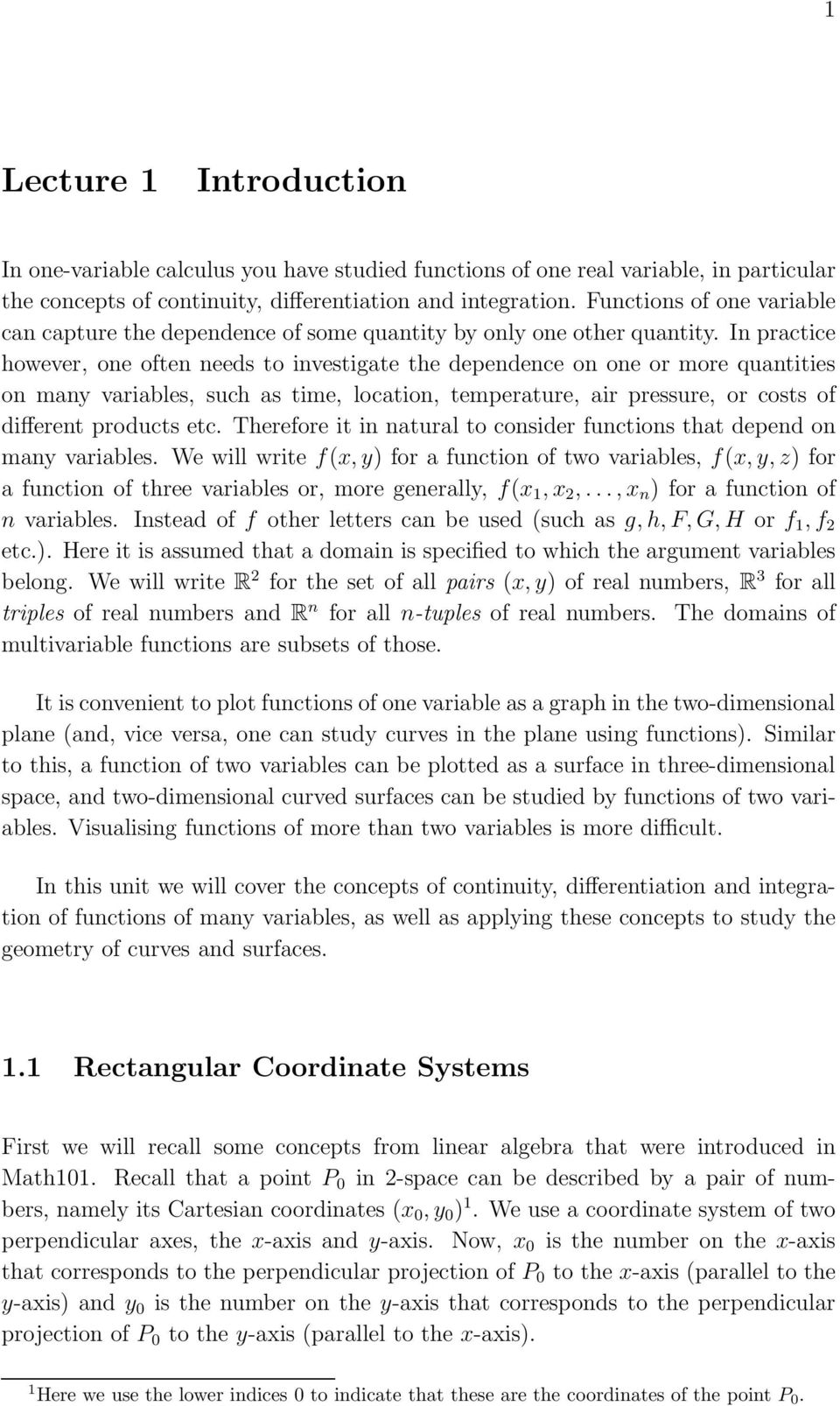
7 . Rectangular Coordinate Sstems (, ) In 3-space, the situation is similar. Here we need an etra ais, the z-ais. Usuall we make the z-ais vertical and pointing upward, while we make the -ais and -ais to form a horizontal -plane as follows z (,,z ) To find the coordinates a point P we need to project it perpendicularl to the corresponding ais (parallel to the plane spanned b the remaining aes). This can be done in two steps, we first find the point P that is the perpendicular projection of P to the -plane. Then, are the coordinates of P in the -plane and z is the distance between P and P with a positive sign if P is located above the -plane and with a negative sign in the opposite case. To find a point with given coordinates (,, z ) first find P with coordinates (, ) in the -plane and the go up b the distance of z z if z or down b z z if z < to find P. We will use the notation P (,, z ) to indicate that the point P has coordinates (,, z ). Note: The coordinate sstem as drawn above is called a right-handed sstem (when the fingers of the right hand are cupped so that the curve from the positive -ais toward the positive -ais, the thumb points (roughl) in the direction of the positive z-ais). If we interchange the positions of the -ais and -ais, then we obtain a left-handed sstem. It can be shown that rectangular coordinate sstems in 3-space fall into just these two categories: right-handed and left-handed. In this unit, we will alwas use right-handed sstems, and we will alwas draw the coordinates with the z-ais vertical and pointing upward. We will call this the z-coordinate sstem. Eample Find the point with coordinates (,, ) in the z-coordinate sstem.
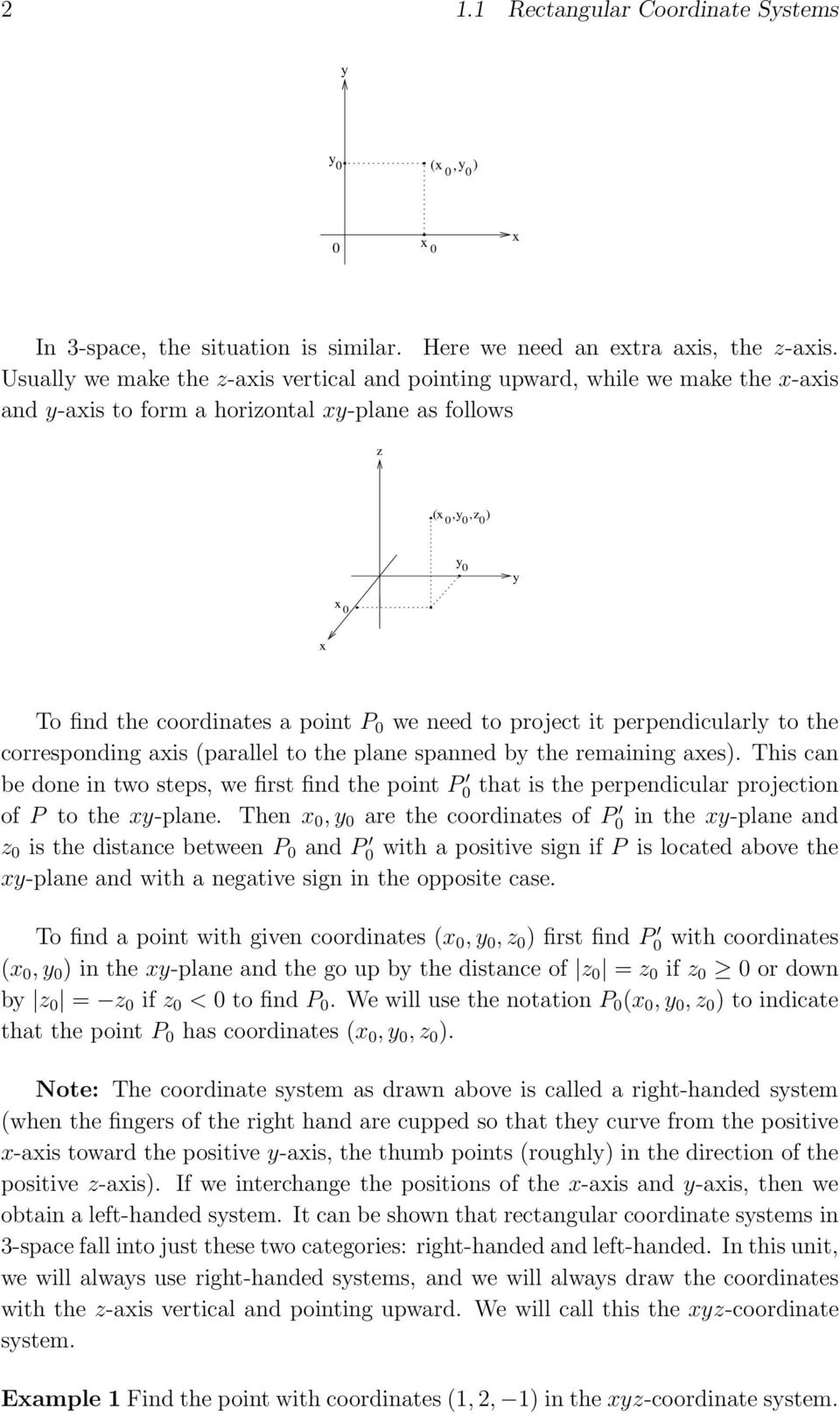
8 . Vectors 3 Solution: We first draw the coordinate aes to obtain the z-coordinate sstem. Then find (, ) on the -plane, draw a vertical line through the point, and move down one unit (since z ), and we arrive at (,, ). z (,,-). Vectors Shifts in the plane or space can be described b saing to what point P a given point P has been shifted. The line l connecting P and P gives the direction of the shift. An other point Q would be shifted along a line parallel to l b a distance equal to the distance between P and P to a point Q, so that P, P, Q, Q form a parallelogram. For this description it did not matter whether we started at P or Q, so instead of the pairs P (,, z )P (,, z ) or Q (X, Y, Z )Q (X, Y, Z ) we ma consider the object v,, z z X X, Y Y, Z Z called vector (in 3-space). To indicate that a vector v is represented b an initial point P and terminal point P we write v P P. When the initial and terminal point are the same, no shift occurs and the corresponding vector is the zero vector,,. The same concept works in the -dimensional plane and an n-dimensional space. To keep things simple, but not too simple, we restrict here to 3-dimensional space.

9 4. Vectors Points and vectors are described b in a similar wa b coordinates. In fact, a point P(,, z) can be identified with a vector v,, z that shifts the origin O(,, ) to P(,, z). Nevertheless, points and vectors are different objects. We cannot add points or multipl points with numbers, but we can add vectors: v + v,, z +,, z +, +, z + z. The geometric meaning of adding two vectors is to perform two shifts, first b v and then b v. The result is a single shift b v + v. Notice that the sum of two vectors does not depend on the order of the two shifts being performed. We can also multipl a vector v,, z b a number α (in this contet called a scalar as opposed to a vector): α v α,, z α, α, αz. Geometricall, the shift α v is in the same direction as v, if α > and in the opposite direction, if α <, b α times the original distance. It follows easil from the arithmetic of numbers that the following properties are satisfied: (a) u + v v + u (b) ( u + v) + w u + ( v + w) (c) u + + u u (d) u + ( u) (e) k(l u) (kl) u (f) k( u + v) k u + k u (g) (k + l) u k u + l u (h) u u. In our computations with vectors we will rel on these properties. One can define a more abstract notion of vector spaces b stipulating theses properties as aioms. This will be discussed in more detail in Linear Algebra Pmth3. You ma verif that the set of polnomials, or the set of polnomials of degree less or equal to 4 also constitute an abstract linear space.
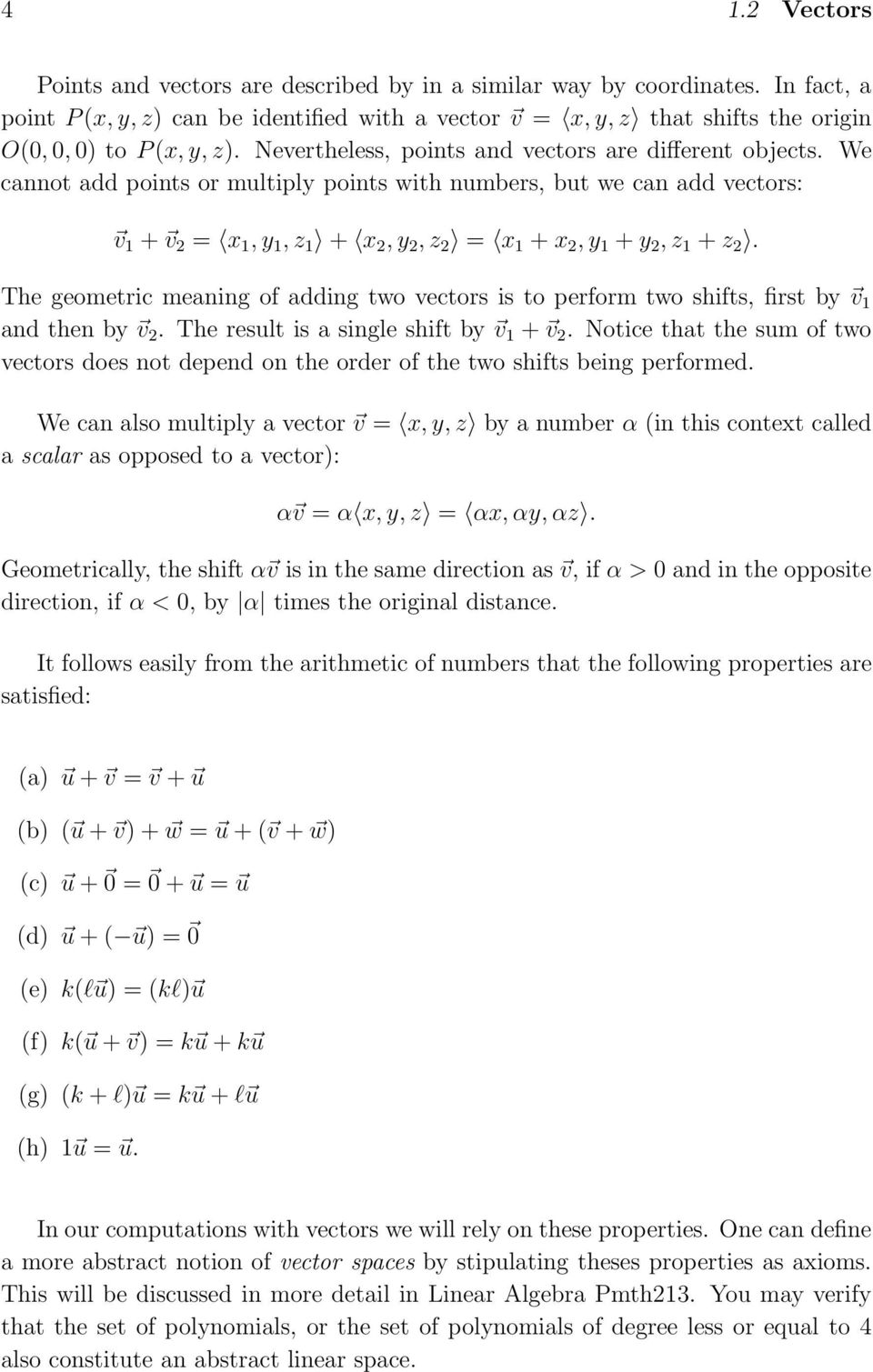
10 5 Lecture Length, Dot Product, Cross Product. Length We know that in -space, the distance between P (, ) and P (, ) is d ( ) + ( ). This is at the same time the length of the vector v P P, denoted b v. In 3-space, there is a similar formula: the distance between P (,, z ) and P (,, z ) is d ( ) + ( ) + (z z ) which again is the length v of the vector v P P. Can ou prove these formulas using elementar geometr and the following diagrams? (Hint: Pthagoras theorem). z (,,z ) (, ) z -z (, ) d - - (,,z ) - - Thus, the length of a vector v v, v, v 3 (or v v, v, v 3,...v n ), also called the norm of v, is given b v v + v + v 3 ( ) or v v + v + v v n. The zero vector has length. A vector of length is called a unit vector. For eample, if v, then v v is a unit vector (wh? Please check). The following unit vectors are of special importance:

11 6. Dot Product i,, j, in -space, i,,, j,,, k,, in 3-space. This is because for an vector v v, v, we have v v, v v, +, v v, + v, v i + v j; and for an vector v v, v, v 3, we have v v, v, v 3 v i + v j + v 3 k. These vectors are sometimes called the unit coordinate vectors.. Dot Product The dot product assigns a scalar (number) to two vectors. It can be defined in an dimension. Let u u, u, v u, v. Then the dot product of u and v is given b u v u v + u v. Similarl, for u u, u, u 3, v v, v, v 3, u v u v + u v + u 3 v 3, or, generall, for u u, u,..., u n, v v, v,..., v n, u v u v + u v + + u n v n. Notice that the length of a vector v can be epressed as v v v. The relation between the dot product and the Euclidean geometric notion of angle is the subject of the Theorem below.

12 . Dot Product 7 Theorem Let u, v be nonzero vectors in -space or 3-space 3, and let θ be the angle between u and v. Then u v u v cosθ, i.e. cosθ u v u v. Proof: We prove the case that u v are -space vectors. The 3-space case can be proved similarl. As in the diagram, we can use u and v to form the triangle OPQ, where u u, u, v v, v, and OP u, OQ v. Note that the length of OP is u, that of OQ is v and the length of PQ is PQ v u since PQ v u, v u v u. The law of cosines applied to the triangle OPQ gives v u u + v u v cosθ which is equivalent to u O P v Q i.e. u v cosθ ( u + v v u ) { u + u + v + v [ (v u ) + (v u ) ]} u v + u v u v u v u v cosθ. Theorem shows that dot product can be used to calculate the angle between two vectors. In particular, two non-zero vectors u, v are perpendicular if and onl if u v, i.e. cosθ. Another consequence of Theorem is the important Cauch-Schwarz inequalit u v u v 3 In higher dimensional spaces the formula cosθ u v u v can be used to define the notion of angle.

13 8. Dot Product with equalit occuring onl if the two vectors are parallel or one of them is the zero vector. Eample. Let P (,, ), P (3,, ) and P 3 (,, 3). Find the angle between P P and P P 3. Solution: Let θ denote the angle. Then, b Theorem, cosθ P P P P 3 P P P P 3 We have P P 3,,,, P P 3,, 3,, P P P P 3 + ( ) + 3 P P + ( ) + 6 P P Hence cos θ 3 6 6, θ 6o (or π 3 ) Dot product has the usual arithmetic properties which we list below, the proof follows from the definition of dot product directl, and therefore will not be provided. You are encouraged to prove some of them, at least (d). If u, v, and w are vectors and k is a scalar, then (a) u v v u (b) u ( v + w) u v + u w (c) k( u v) (k u) v u (k v) (d) v v v (and equalit holds onl for v ). Propert (a) is called smmetr, (b) and (c) together bilinearit and (d) positivit. In a more abstract setting these properties are used to define dot products in arbitrar vector spaces. This concept will be developed in Pmth3.
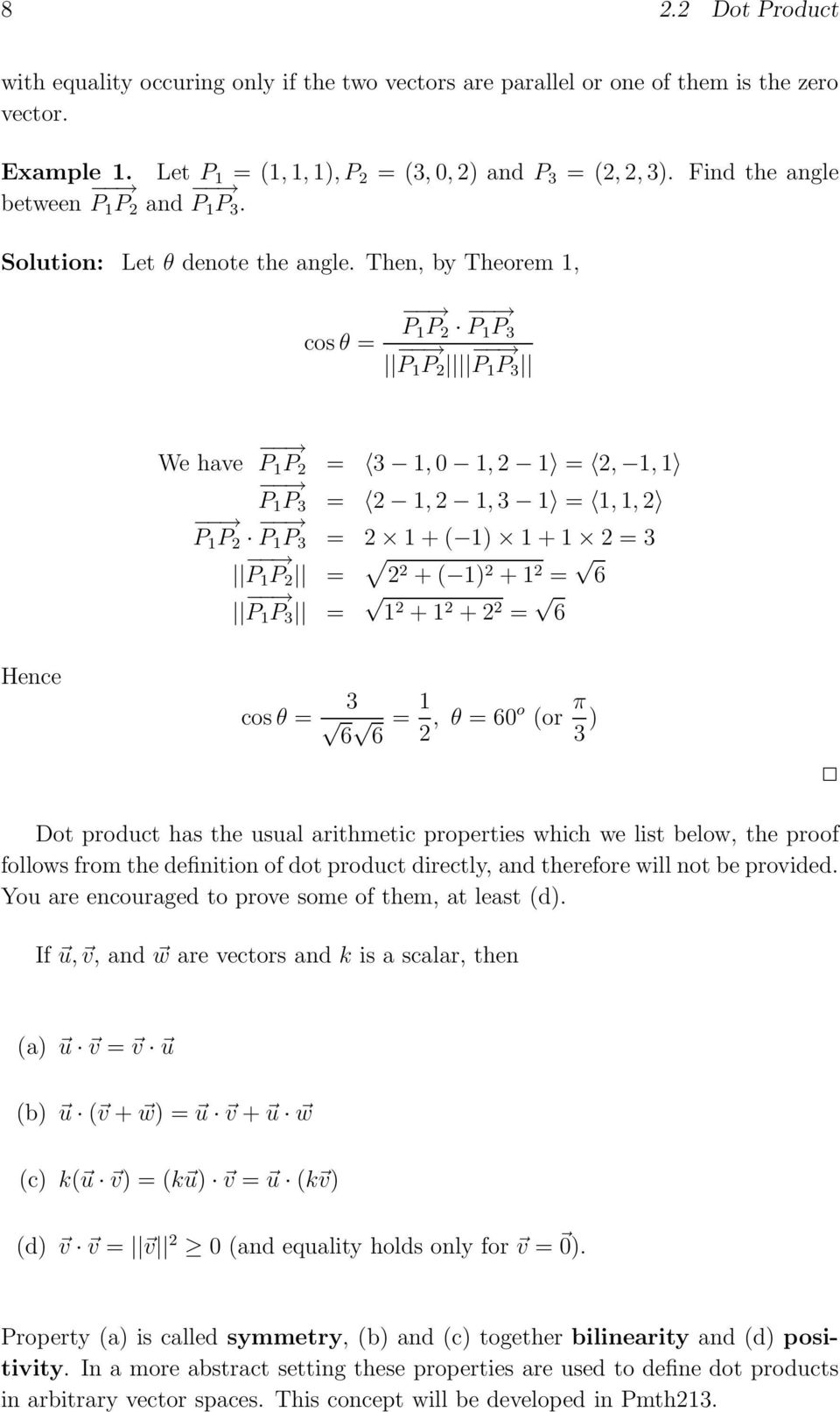
14 .3 Orthogonal Projections 9.3 Orthogonal Projections Let u and b be two vectors in -space or 3-space. Then the vector w formed as in the diagram below is called the orthogonal projection of u on b, and is denoted b proj b u u w b If the angle θ between u and b is less than 9, i.e. direction of b. Therefore proj b u has the form π, then proj b u is in the proj b u k b for some scalar k >. Using the definition, we find that the length of proj b u is u b u cos θ u u b u b b. (b Theorem ) On the other hand, proj b u k b k b. Therefore k b u b u b, that is k b b. Substituting back, we obtain Theorem proj b u u b b b The above formula is also true if θ is greater than 9. Please check this b modifing the above proof. Let us now look at some of the uses of this formula. B definition, the distance between two sets P and Q in - or 3-space is the infimum of all distances of a point P P and Q Q, i.e., roughl speaking, the
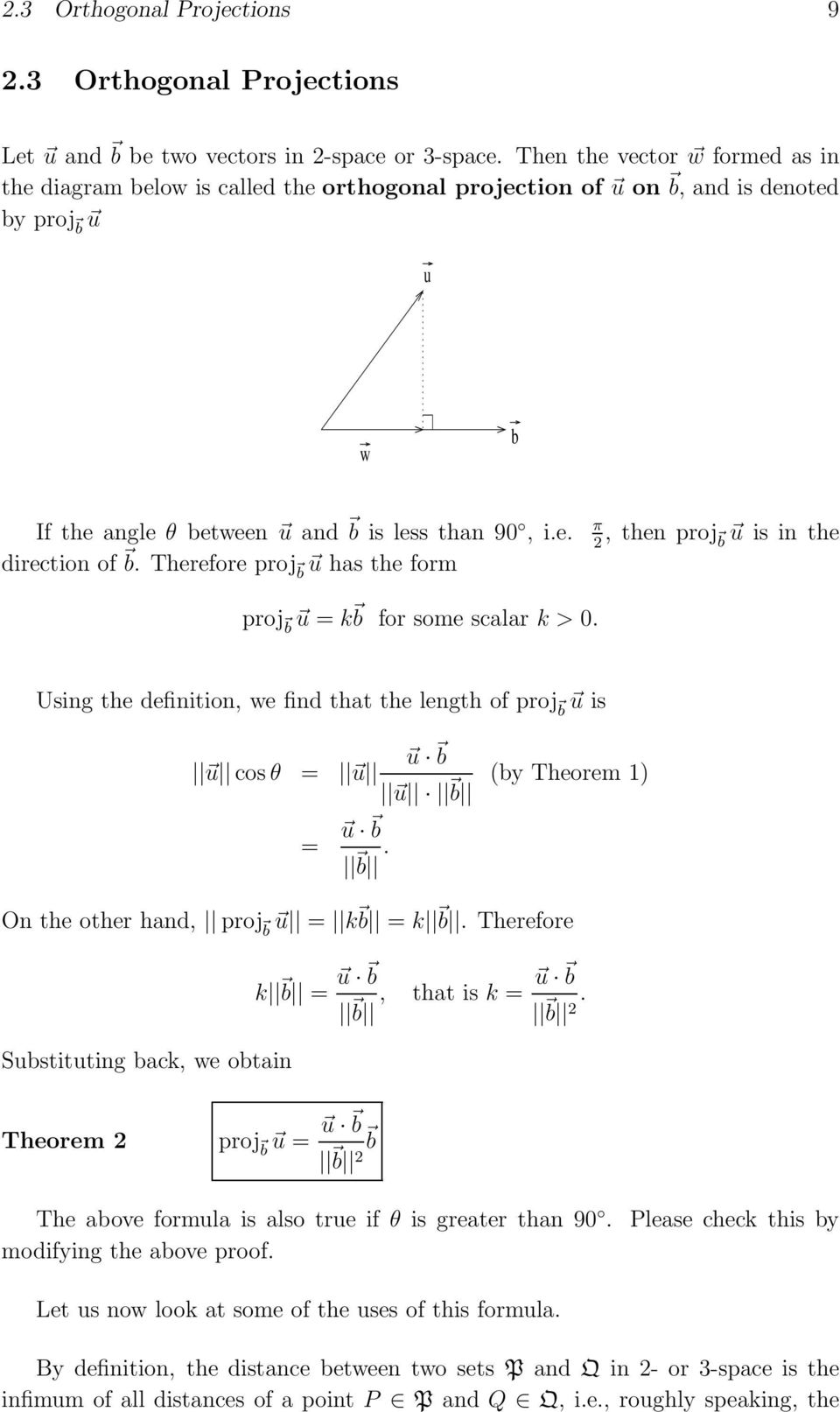
15 .3 Orthogonal Projections distance between the two points in P and Q that are closest to each other in the respective sets: dist(p, Q) inf PQ. P P,Q Q Eample. Find a formula for the distance D between the point P(, ) and the line A + B + C. Solution: Let us use the graph at the right to help with the argument. The distance from P to an arbitrar point Q on the line is the hpotenuse of a right triangle with one leg being the distance from P to the orthogonal projection (sa Q ) and the other being the distance between Q and Q. From PQ PQ we see that the infimum of distances PQ is attained for Q Q. Therefore we need to find the orthogonal projection of P on the line. Q n P a+b+c Let Q (, ) be an point on the line (i.e. A + B + C ) and position n so that Q is its initial point. Then QP n D proj n QP n (using Theorem ) n QP n n QP n n n (using k v k v ) But QP,, n A, B. Hence QP n A( ) + B( ) n A + B A B A + B + C (using A + B + C ), A + B and D QP n A + B + C n A + B Note: The point Q is introduced just for an intermediate step, it does not appear in the final formula.
16 .4 Cross Product Notice that the distance of a point P(, ) to the ais is just and the distance to the -ais is just. This can be verified b the formula with A, B, C and A, B, C, respectivel..4 Cross Product For vectors in 3-space onl, another kind of product, called the cross product, is defined. If u u, u, u 3 and v v, v, v 3, then the cross product u v is a vector given b u v u u 3 v v 3 i i j k u u u 3 v v v 3 u u 3 v v 3 j + u u u v k Note that u v is a number, but u v is a vector. The following theorem shows some of the properties of cross product are similar to dot product, but man are different. Theorem 3. Cross product has the following properties: () u v is orthogonal to both u and v, i.e. u ( u v), v ( u v). () u v u v sinθ (compare u v u v cosθ) Notice that this is the area of the parallelogram spanned b the vectors u and v. It follows u v u v where the equalit holds if and onl if u v. (3) (a) u v ( v u) (compare u v v u) (b) u ( v + w) ( u v) + ( u w) (c) ( u + v) w ( u w) + ( v w) (d) k( u v) (k u) v u (k v) (e) u u (f) u u (compare u u u ) similar to dot product

17 .4 Cross Product (4) If a a, a, a 3, b b, b, b 3 and c c, c, c 3, then a ( b c) a a a 3 b b b 3 c c c 3 (5) a ( b c) is the volume of the parallelepiped spanned on the vectors a, b and c. Proof: We onl prove (4) and (). We prove (4) first and then use (4) to deduce (). Proof of (4): b c i j k b b b 3 c c c 3 b b 3 c c 3 i b b 3 c c 3 j + b b c c k Hence a ( b b c) a b 3 c c 3 a b b 3 c c 3 a a a 3 b b b 3 c c c 3 + a 3 b b c c Proof of () (using (4)): u ( u v) u u u 3 u u u 3 v v v 3, because the first and second rows are the same.

18 3 Lecture 3 Linear Functions, Lines and Planes 3. Linear Functions A linear function of one variable is given b an equation of the form f() m + b, where m, b are real parameters. Its graph is a line in the -plane with slope m and -intercept b. Linear functions are eas to handle, et the can serve as good models for man processes in science, nature and econom. Even non-linear processes can often be modelled approimatel using linear functions. The means to do this is differential calculus. A function f() that is differentiable at some point can be epressed as f() f( ) + f ( )( ) + e(, ), where e(, is a small error term. The function f( ) + f ( )( ) m + b is a linear function with m f ( ) and b f( ) f ( ). The error term is small in the sense that it tends faster to zero than the linear function when approaches. More precisel, even the ratio of the two small quantities tends to zero: e(, ) as. Indeed, e(, ) f() f( ) f ( )( ) lim lim holds if and onl if f() f( ) lim f ( ), which is the definition of the derivative f ( ). Linear functions of several variables have the form f(, ) a + b + d f(,, z) a + b + cz + d f(,,..., n ) a + a + + a n n + d lim f() f( ) f ( ) in the case, 3 or n variables, respectivel. Here a, b, c, d, a,...,a s are parameters. We will investigate their geometric meaning later. The role of linear functions of several variables is similar to linear functions of one variable.

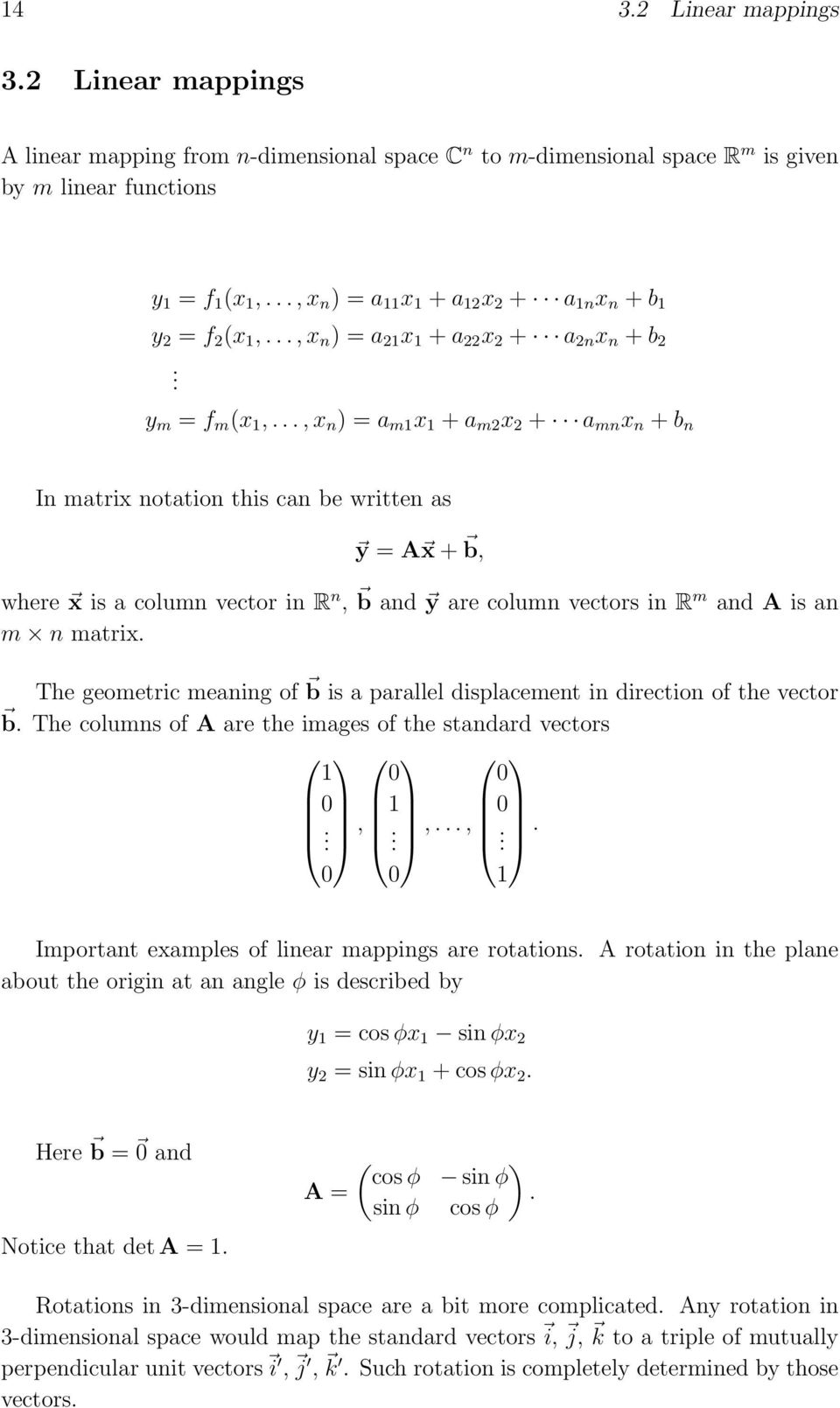
19 4 3. Linear mappings 3. Linear mappings A linear mapping from n-dimensional space C n to m-dimensional space R m is given b m linear functions f (,..., n ) a + a + a n n + b f (,..., n ) a + a + a n n + b. m f m (,..., n ) a m + a m + a mn n + b n In matri notation this can be written as A + b, where is a column vector in R n, b and are column vectors in R m and A is an m n matri. The geometric meaning of b is a parallel displacement in direction of the vector b. The columns of A are the images of the standard vectors,,...,.... Important eamples of linear mappings are rotations. A rotation in the plane about the origin at an angle φ is described b cos φ sin φ sin φ + cosφ. Here b and Notice that det A. ( ) cos φ sin φ A. sin φ cosφ Rotations in 3-dimensional space are a bit more complicated. An rotation in 3-dimensional space would map the standard vectors i, j, k to a triple of mutuall perpendicular unit vectors i, j, k. Such rotation is completel determined b those vectors.
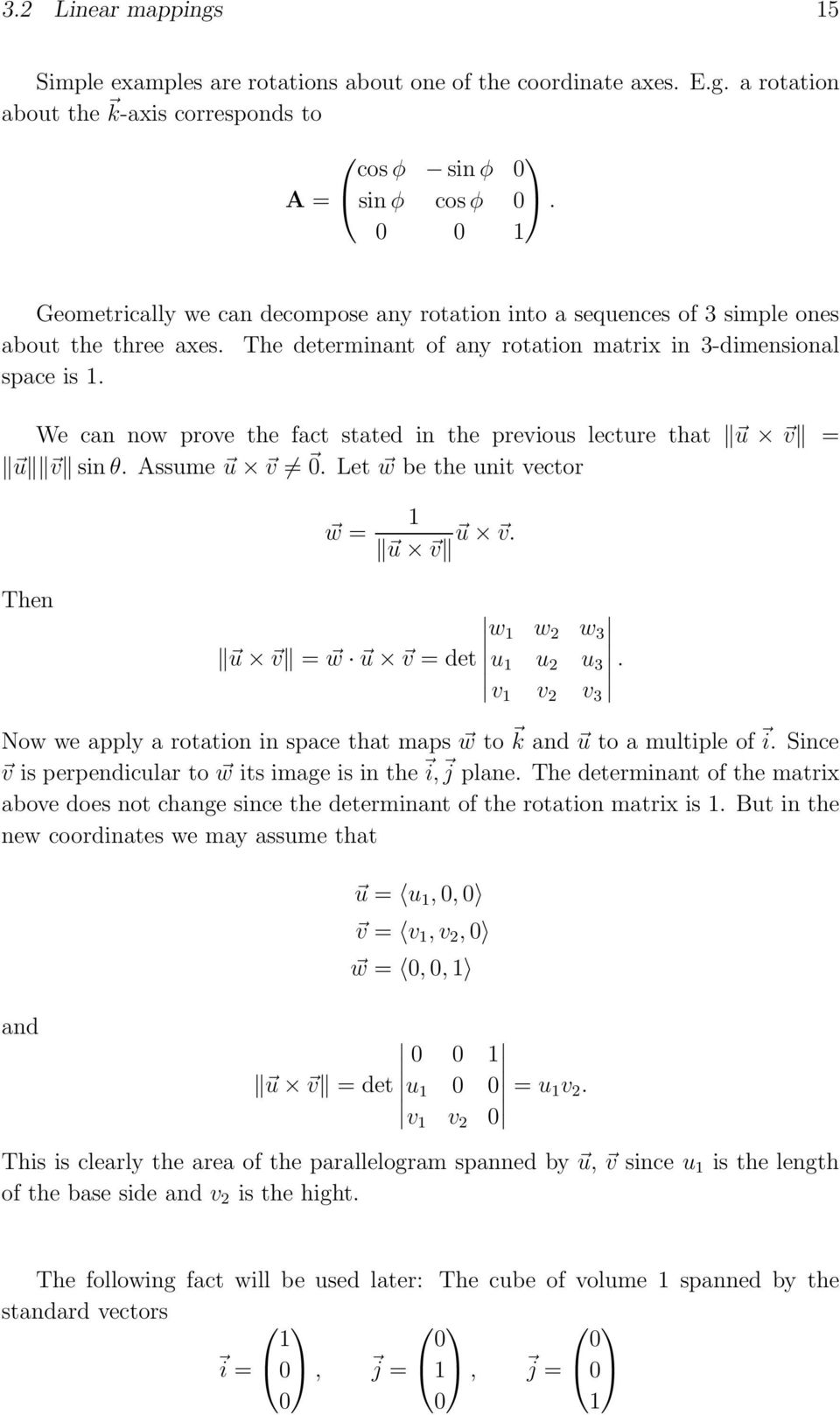
20 3. Linear mappings 5 Simple eamples are rotations about one of the coordinate aes. E.g. a rotation about the k-ais corresponds to cos φ sin φ A sin φ cosφ. Geometricall we can decompose an rotation into a sequences of 3 simple ones about the three aes. The determinant of an rotation matri in 3-dimensional space is. We can now prove the fact stated in the previous lecture that u v u v sin θ. Assume u v. Let w be the unit vector w u v. u v Then w w w 3 u v w u v det u u u 3 v v v. 3 Now we appl a rotation in space that maps w to k and u to a multiple of i. Since v is perpendicular to w its image is in the i, j plane. The determinant of the matri above does not change since the determinant of the rotation matri is. But in the new coordinates we ma assume that u u,, v v, v, w,, and u v det u v v u v. This is clearl the area of the parallelogram spanned b u, v since u is the length of the base side and v is the hight. The following fact will be used later: The cube of volume spanned b the standard vectors i, j, j
21 6 3.3 Lines is mapped under a linear mapping with matri A to a parallelepiped spanned b the vectors a a, a 3 a a, a 3 a 3 a 3 a 33 of volume det A. Hence a linear mapping stretches the volume of a solid b a factor of det A. 3.3 Lines In -space or 3-space, a line is determined b a point P on it, and a direction parallel to it. Here the point P will be given b its coordinates and the direction b a non-zero vector v. First, consider the case of a line in -space, which passes through P (, ) and parallel to v a, b. Let P (, ) be a general point on the line. Then P P, is parallel to v a, b. Now we use the fact that two vectors u and v are parallel if and onl if u t v for some scalar t. Hence, P P t v for some scalar t, i.e., t a, b or ta, tb. v P Now, when we let t run through (, ), the point (,, z) determined b the above formulas runs through the entire line. We sa + ta, + tb, t a parameter is the parametric equation for the line passing through P (, ), and parallel to v a, b. In the case of dimension, he two parametric equations can be reduced to one single equation b eliminating the parameter t. Multipling the first equation b b and subtracting the second equation multiplied b a we get b( ) a( ). Notice that the vector n b, a is perpendicular to v, since the dot product n v. Such vector is called normal vector for the line and therefore this equation is called the point-normal equation. It can be rewritten in the form A + B + C ()
22 3.3 Lines 7 with A b, B a, C a b. If B we obtain the usual slope--intercept equation b solving for : A B C B. If B the line is vertical and has no slope--intercept equation. Remark. If we divide equation () b the length of the normal vector A + B we obtain the so-called Hesse normal form A A + B + B A + B + C A + B. There are angles φ, φ π φ A such that B A cosφ +B and A sin φ +B cosφ. The angles φ, φ are the ones formed b the normal and the and -aes, C respectivel. The absolute value A gives the distance of the line to the origin. +B (Tr to prove this.) We rewrite now the parametric equation as vector equation. Let O be the origin and denote r OP, r OP. Then P P r r and the line can be represented b r r t v, or r r + t v, t a parameter. This equation can be used in 3 or, more generall, in an n-dimensional space. In 3-space, with P (,, z ), v a, b, c, r,, z and r,, z, the parametric equations become: + ta, + tb, z z + tc r r + t v vector equation. parametric equation. Notice that eliminating the parameter t from these equations leaves us still with equations. If a we find b a + b a z c a + z c a A -dimensional line in 3-space cannot be described b a single linear equation because one equation lowers the dimension onl b, so equations are needed 4. 4 This wouldn t be true if we permitted non-linear equations. E.g. + z describes the -ais {, z }.
23 8 3.4 Planes in 3-space Eample. Find an equation of the line L which passes through P (,, z ) and P (,, z ) where P P. Solution: If we can find a vector to which the line is parallel, then we can use the formulas discussed above to find the equation. Clearl P P,, z z is such a vector. Hence the parametric equation is + t( ), + t( ), z z + t(z z ). In vector form r,, z + t P P. Eample. Show that the vector n A, B is perpendicular to the line A + B + C. Proof: Let P (, ) and P (, ) be two points on the line, i.e. A + B + C, A + B + C. Then it suffices to show n A, B is perpendicular to P P,, i.e. to show n P P. We calculate n P P A( ) + B( ) A + B (A + B ) C ( C) and hence prove what we wanted. 3.4 Planes in 3-space A plane in 3-space is uniquel determined b a point P (,, z ) on it and a vector n A, B, C perpendicular to it. Such a vector is called a normal vector of the plane.
24 3.4 Planes in 3-space 9 A general point P (,, z) is on the plane if and onl if P P is perpendicular to n, i.e. P P n. Since P P,, z z and n A, B, C, we have P P n A( ) + B( ) + C(z z ), and the equation of the plane is P n P A( ) + B( ) + C(z z ) This is called the point-normal form of the equation of the plane. Note that on simplifing the above equation for the plane, we see that the equation has the form A + B + Cz + D where D A B Cz. () Now, if C this can be rewritten as a graph equation z A C B C D C. (3) Notice that one linear equation in 3-space lowers the dimension down b one to a -dimensional plane. Remark. There is also a Hesse normal form for planes in 3-space. Divide equation () b A + B + C A. Then there are angles φ, φ, φ 3 such that A +B +C B cosφ, C A cosφ +B +C, A cosφ +B +C 3. The angles φ, φ, φ 3 are the angles between the normal and the respective aes. The number of the plane to the origin O(,, ). Eample 3. If A, B, C, then the equation A + B + Cz + D D A +B +C is the distance describes a plane having normal vector n A, B, C. (Compare with eample above: A + B + C is a line having normal vector n A, B.) Proof: Since A, B, C, at least one of the three components A, B, C is not zero. Suppose C (the other cases can be proved similarl). Then for an given,, we can find a unique z such that the graph equation (3) and hence the plane equation is satisfied. Substituting this into A + B + Cz + D
25 3.4 Planes in 3-space we see the equation is equivalent to A( ) + B( ) + C(z z ). This is a point-normal form of the equation of a plane with normal vector n A, B, C passing through the point (,, z ).. Eample 4. Find an equation of the plane through three different points P (,, z ), P (,, z ) and P 3 ( 3, 3, z 3 ). Solution We need to find a normal vector for the plane. With the three given points, we can form two vectors P P and P P 3, both ling on the plane. According to the properties of cross product, P P P P 3 is perpendicular to both P P and P P 3, hence to the plane. Thus we can use n P P P P 3 as a normal vector. n P3 P P Since P P,, z z and P P 3 3, 3, z 3 z and the equation can be written as,, z z n we can use propert (4) for cross product to write the equation above in the following neat form: z z z z 3 3 z 3 z Eample 5. Find the distance d between P (,, z ) and the plane A + B + Cz + D. Solution We generalize the method used in Eample, Lecture.
26 3.4 Planes in 3-space Let Q (,, z ) be an point on the plane, and hence it satisfies A + B + Cz + D. Then d proj n QP, where n A, B, C is a normal vector. We have proj n QP n QP n n a( ) + b( ) + c(z z ) n a + b + c proj n QP A( ) + B( ) + C(z z ) n A + B + C A + B + Cz (A + B + Cz ) A + B + C A + B + C A + C + Cz + D A + B + C Q n P (using A + B + Cz D) Thus d A + B + Cz + D A + B + C.
27 4. Quadratic Functions Lecture 4 Quadratic Surfaces 4. Quadratic Functions Quadratic functions of one variable q() a + b + c with parameters a, b, c are the net simplest after linear functions. The are also often used to model processes in nature, science and econom. The Talor formula tells us that a function f() that has continuous derivatives up to third order can be approimated b a quadratic function in the following wa: f() f( )+f ( )( )+ f ( )( ) +e(, ) a +b+c+e(, ), where a f ( ), b f ( ) f ( ), c f( ) f ( ) + f ( ) error term e(, ) 6 f (ξ)( ) 3 and the tends to even faster than the quadratic function ( ) as tends to, i.e. e(, ) lim ( ). This has been used to investigate critical points for local maima and minima. Since the graph of a quadratic function is a parabola with an absolute minimum at its verte if a > or a maimum if a < one concludes that a function that is two times differentiable has a local minimum or maimum at a critical point if a f ( ) > or a f ( ) <. Indeed, if f ( ) (for being critical) we have f() f ( )( ) + f( ). The situation of man variables is similar, but slightl more complicated because of the large amount of possible quadratic terms. Let us look first into the case of two variables. f(, ) a + b + c + d + e + f. We introduce a more sstematic notation that uses indices and turns out to be even more useful in higher dimensions. Denote the first variable b and the second variable b. Then denote a a, b a a, c a, d a, e a, f a. The indices of the new a s tell us immediatel how man and which factors or follow. Also we don t need to invent new letters for the huge amount
28 4. Quadratic Curves 3 of coefficients that occur in higher dimensions, and we ma use sigma notation. The equation becomes f(, ) a +a +a +a +a +a a ij i j + a i i +a. i j i In three dimensions we get f(,, 3 ) a + a + a a + a a a + a + a a a ij i j + a i i + a. i j i In higher dimension we onl need to replace 3 as upper bound of the summation b the dimension n n n n f(,,..., n ) a ij i j + a i i + a. i j i 4. Quadratic Curves In Math we have studied implicit equations of curves F(, ) A second-degree equation in, has the general form A + B + C + D + E + F. (4) It gives a quadratic curve 5. B switching to an alternative coordinate sstem we can significantl simplif the equation (4). In a first step we will appl a rotation of the plane about the origin b a suitable angle φ in order to get rid of the mied term B. Recall that such rotation is performed b a mapping cos φ u + sin φ v (5) sin φ u + cosφv where, are the old coordinates and u, v are the new coordinates. You ma check that the unit vectors i, and j, are mapped to a pair of mutuall perpendicular unit vectors. 5 Quadratic curves are often called conic sections because the arise when a cone and a plane intersect in 3-space.
29 4 4. Quadratic Curves Theorem. B a suitable rotation of the form (5) the equation (4) turns into A u + C v + D u + E v + F, where A, C, D, E, F are some new coefficients. Proof. B plugging the epressions (5) for, into the equation (4) we find the coefficient in front of uv to be B A cosφsin φ + B(cos φ sin φ) C sin φ cosφ (A C) sin φ + B cos φ. Here we used standard trigonometric formulae. To make this epression zero we need cot φ C A B. If B this determines a unique angle φ between and π. If B the mied term didn t occur in the first place. Without developing the relevant theor (this will be left to Linear Algebra Pmth3) we notice that the new coefficients written as a matri can be computed in the following wa: ( ) ( A B cosφ sin φ sin φ cos φ B C ) ( A B B C ) ( ) cosφ sin φ. sin φ cosφ (You ma check this b direct computation.) B our choice of φ we have B. In the classification of quadratic curves below ou will see that the tpe of curve depends on whether A and C are positive, negative or zero. Notice that A and C are the eigenvalues 6 Of the matri at the left hand side. It turns out that the old and new coefficient matrices have the same eigenvalues, determinant (which is the product of the eigenvalues) and trace (which is the sum of the entries at the main diagonal, hence the sum of the eigenvalues). It follows that the eigenvalues have the same sign if the determinant A C AC B is positive and opposite signs if the 4 determinant is negative. If both eigenvalues have the same sign then it is the sign of A. Assume now that the quadratic equation has no mied term. The second step depends on whether A, C are zero or not. If A and C we use a shift of the coordinate sstem to get rid of D and E. B completing the squares we find A + C + D + E + F A( + D A ) + C( + E C ) + F D 4A E 4C. 6 You ma recall the concept of eigenvalues from Math. A more thorough theor of eigenvalues will be developed in Pmth3.
30 4. Quadratic Curves 5 Hence the equation takes the form A( ) + C( ) F, where D A, E C, F D 4A + E 4C F. If A but C or A and C then we complete the square for the variable with the non-vanishing coefficient and leave the other unchanged to get C( ) + D F or A( ) + E F. The following are the representative eamples.. If A >, B > and F > (or A <, B < and F < ) we divide b F and get the equation of an ellipse with half-aes a F /A and b F /C centred at (, ). Ellipse: ( ) a + ( ) b b a. If A and E we ma divide b E and find a vertical parabola with verte (, ). Parabola: a( ) Here a A E and F E. (a>) 3. If C and D we ma divide b D and find a horizontal parabola with verte (, ). b( ) Here b C D and F D. (b>)
31 6 4. Quadratic Curves 4. If A >, C < and F > (or A <, C > and F < ) we divide b F and find a hperbola. Hperbola: ( ) ( ) a b Here a F /A, b F /C. 5. If A >, C < and F < (or A <, C > and F > ) we divide b F and find again a hperbola. ( ) ( ) a b Here a F /A, b F /C. 6. The remaining cases are in some sense degenerate and not reall quadratic curves. We list them for the sake of completeness. (a) If A >, C >, F (or A <, C <, F ), the equation becomes A( ) + C( ), which is a single point. (Which?) (b) If A >, C <, F (or A <, C >, F ), the equation A( ) + C( ) describes a pair of crossing lines, namel, ± A/C( ) (c) If A >, C > and F /A < (or A <, C < and F /A < ) we get A( ) + C( ) F, which is the empt set. (d) If A, C, E and F /A < (or A, C, D and F /C < ) we get ( ) F /A (or ( ) F /C), which is the empt set. (e) If A, C, E and F /A > (or A, C, D and F /C > ) we get ± F /A (or ± F /C), which is a pair of parallel lines. (f) If A, C, E and F (or A, C, D and F ) we get ( ) (or ( ) ), which is a single line.
32 4.3 Quadratic Surfaces Quadratic Surfaces A second-degree equation in,, z has the general form A + B + Cz + D + Ez + Fz + G + H + Iz + J. It gives a quadric surface (a quadric for short). A classification of these surfaces would be similar to the classification of quadratic curves carried out above, but requires more effort and time. We ignore here the degenerate cases and list the 6 important tpes: z Ellipsoid: a + b + z c o z Hperboloid of one sheet: a + b z c o z Hperboloid of two sheets: a + b z c o z Elliptic cone: z a + b o z Elliptic paraboloid: z a + b o
33 8 4.4 Sketching Surfaces Hperbolic paraboloid: z b a z The most important quadratic surfaces for this unit are the paraboloids because the approimate the graphs of functions at its critical point and show whether the critical point is a maimum, a minimum or neither of them. Clearl, (z z ) A( ) + C( ) is a cup-like elliptic paraboloid with verte at (,, z ), i.e (,, z ) is a local minimum if both A, C are positive and an upside down cup-like elliptic paraboloid with verte at (,, z ), i.e (,, z ) is a local maimum if both A, C are negative. If A and C have opposite sign then the resulting surface is the saddle-like hperbolic paraboloid, i.e we have neither maimum nor minimum. The cases when A or C (or both) are zero are indecisive. If we started with a paraboloid of the form (z z ) A( ) + B( )( ) + C( ) we can perform a rotation in the, plane about (, ) eactl in the same wa as in the classification of quadratic curves to get rid of the mied term B( )( ). Without doing this we can decide whether the critical point (, ) is a maimum, minimum or saddle point b looking at the determinant det A B B C AC B and the coefficient A. IF AC B > we have a maimum or minimum depending on whether A < or A >. If AC B < we have a saddle. The case AC B is indecisive. 4.4 Sketching Surfaces Sketching the graph of a surface is usuall much more difficult than sketching a curve. One practical wa to sketch a surface is b using a method called mesh plot: one builds up the shape of the surface using curves obtained b cutting the surface with planes parallel to the coordinate planes.
34 4.4 Sketching Surfaces 9 The curve of intersection of a surface with a plane is called the trace of the surface in the plane. Let us now look at several eamples to see how the mesh plot method can be used in sketching surfaces. Eample. Sketch the graph of the surface 4 + z. Solution: For an fied value, the equation can be written as + z + 4 which gives a circle (for fied ) in the z-plane. If we take k, and put the circle in the plane k (b moving the one in the z-plane and keeping the motion parallel to the -ais), then when we choose different k, we obtain man circles which are parallel but with different radii (the circle on the plane k has radius + k 4 ). z z k- k- k k k The above graphs show the circles (k,,,, ) and a sketch of the surface obtained b smoothl connecting these circles. Eample. Sketch the graph of z 4 9. Solution: Take k. Then the equation becomes z k 4 9, which is of the form (z z ) a and hence is a parabola. The following graphs show various parabolas obtained b varing k and a sketch of the surface b connecting these parabolas.
35 3 4.4 Sketching Surfaces z z Eample 3. Sketch the graph of z + 8 4z 4. Solution: We can change the equation into one of the standard forms to help us to know the shape of the surface. We use the completing squares method: i.e. 4 + ( ) + (z 4z + 4) , 4 + 4( + ) + (z ) 4, or + ( + ) (z ) +. 4 Thus we know it represents an ellipsoid with center (,, ). z z Write, + and z z. Then the equation becomes + + z 4. We can use the mesh plot method to sketch the surface in the z -coordinate sstem and then move it to the z-coordinate sstem according to the relationship, + and z z. Note:,, z z z shows the,, z aes are parallel to the,, z aes, respectivel, and that the origin (,, z ) (,, ) in the z -sstem is at the point (,, z) (,, z ) in the z-sstem.
36 3 Lecture 5 Vector-Valued Functions 5. Vector-Valued Functions and Their Graphs. The function f() assigns to each from the domain D R a real value from the codomain B R, and hence it is a real-valued function. The equation of a line in -space has the form + ta, + tb, which can also be written in vector form where r,, r,, v a, b. r r + t v, We can regard r r +t v as a function which assigns to each t a vector r r +t v. Thus we have a vector-valued function here. In general, a vector-valued function in -space has the form r(t) (t), (t) (t) i + (t) j, in 3-space, a vector-valued function has the form r(t) (t), (t), z(t) (t) i + (t) j + z(t) k. The real-valued functions (t), (t) and z(t) are called the components of r(t). Clearl r(t) (t) i + (t) j + z(t) k is equivalent to (t), (t), z z(t). We call this later sstem of equations the parametric form of the vector-valued function r(t) (t) i + (t) j + z(t) k. Let r(t) be a vector-valued function in -space or 3-space defined on some closed interval [a, b]. Then the range of r describes a curve C, which we call the graph of r(t), or the graph of the equation r r(t). It might be helpful to visualise a vector function as the trajector of a point moving in space in dependence of time t. Clearl C has the parametric equation (t), (t) (in -space) (t), (t), z z(t) (in 3-space).
37 3 5. Limits, Continuit and Derivatives Eample. Describe the graph of the function r(t) cost i + sin t j, t π. Solution: The equation has the parametric form cost, sin t, t π which is just the parametric equation for the unit circle +. Thus the graph is the unit circle. Eample. Describe the graph of the vector-valued function r ( + t) i + 3t j + (5 4t) k, t R. Solution: The equation is equivalent to + t, 3t, z 5 4t. We know this is the parametric equation for the line passing through (,, 5) and parallel to the vector, 3, 4. Or we can simpl rewrite the vector equation as r,, 5 + t, 3, 4. This is the equation of the line through (,, 5) parallel to, 3, Limits, Continuit and Derivatives The notions of limit, continuit and derivative for real-valued functions can all be passed to vector-valued functions through the components. Namel, () Limit. For r(t) (t) i + (t) j, define ( ) lim r(t) lim (t) i + t a t a ( lim t a (t) ) j. For vectors in 3-space, the definition is similar. If at least one of the limits of the component functions does not eist, then we sa lim t a r(t) does not eist. () Continuit. r(t) defined on some domain D R is said to be continuous at t D 7 if 7 Sometimes the condition that r(t) is defined at t is stated eplicitl, but we take the point of view that continuit or non-continuit are notions that make sense onl for points that are a priori in the domain of the function.
38 5. Limits, Continuit and Derivatives 33 (a) lim t t r(t) eists and (b) lim t t r(t) r(t ). Clearl r(t) is continuous at t if and onl if all its component functions are continuous at t. (3) Derivative. The derivative of r(t ) is defined b This can be reformulated as r (t ) d r(t) lim dt h r(t + h) r(t ). h r(t) r(t ) + r (t )(t t ) + e(t, t ), where the error term e(t, t ) has the propert e(t, t ) lim, (6) t t t t i.e. e(t, t ) tends to zero faster than t t. In other words, is approimatel a linear function r(t) r + t v, where r r(t ) t r (t ) and v r (t ). The error is small, even compared to the small quantit t t. We introduce here a convenient notation that we will use later, namel to epress (6). More generall the o notation e(t, t ) o(t t ), has the meaning f(t) o(g(t)) as t t f(t) lim t t g(t). Notice that this notation is alwas related to a variable (here) t approaching a certain limit. This limiting process has to be stated or to be known b default. Eample. o() as ; cos o() as π ; m o( n ) as if m > n, we sa m tends to zero at a higher order that n. The convenience of the o is the simplicit of its arithmetic. Without knowing the particular functions we can state:. o( n ) ± o( n ) o( n ) (as.)
39 34 5. Limits, Continuit and Derivatives. o( n ) o( m ) o( n+m ). 3. o( n ) o( m ) if n m. 4. If f() is a bounded function defined in some neighbourhood of then f() o( n ) o( n ). Notice that o() is not the notation for a function, but onl epresses a propert of a function. In coordinates the derivative of a vector function is r (t) (t) i + (t) j if r(t) (t) i + (t) j, r (t) (t) i + (t) j + z (t) k if r(t) (t) i + (t) j + z(t) k. The following theorem collects some of the most important properties of derivatives for vector-valued functions. Theorem () r (t ) is tangent to the curve r r(t) at r(t ) and points in the direction of increasing parameter. () (a) ( C), where C is a constant vector. (b) (k r(t)) k r (t), where k is a scalar. (c) [ r (t) ± r (t)] r (t) ± r (t) (d) [f(t) r(t)] f(t) r (t) + f (t) r(t) (product rule) (e) r(u(t)) r (u(t))u (t) (chain rule) (3) (a) [ r (t) r (t)] r (t) r (t)+ r (t) r (t) (product rule for dot product) (b) [ r (t) r (t)] r (t) r (t) + r (t) r (t) (product rule for cross product) (4) If r(t) is constant for all t, then r(t) r (t), i.e., r(t) and r (t) are alwas perpendicular. Proof: For () notice that the vector equation of a secant through r(t ) and r(t ) is r(t) r(t ) + vt where v r(t ) r(t ) t t. The tangent vector is the limiting position of secant vectors where t approaches t. This limit is, as in single variable calculus, b definition the derivative r (t ).
40 5. Limits, Continuit and Derivatives 35 The properties () (a)-(e) can be proved in the same wa as in one variable calculus, or, even simpler, reduce to those properties. Although (3) (a) also reduces to properties of one variable functions we will give a proof that shows the advantage of the o notation. Notice that our proof below works for an dimension. We have r (t) r (t ) + r (t )(t t ) + o(t t ) r (t) r (t ) + r (t )(t t ) + o(t t ) B forming the dots product of both sides and using dot product rules we get r (t) r (t) r (t ) r (t ) + r (t ) r (t )(t t ) + r (t )(t t ) r (t )+ + ( r (t ) + r (t )(t t )) o(t t ) + ( r (t ) + r (t )(t t )) o(t t ) r (t ) r (t ) + ( r (t ) r (t ) + r (t ) r (t ))(t t ) + + o(t t ) Here we have used that r (t )+ r (t )(t t ) and r (t )+ r (t )(t t ) are bounded in some neighbourhood of t, i.e. r (t ) + r (t )(t t ) M r (t ) + r (t )(t t ) M and therefore, b the Cauch-Schwarz inequalities, ( r (t ) + r (t )(t t )) o(t t ) M o(t t ) o(t t ) ( r (t ) + r (t )(t t )) o(t t ) M o(t t ) o(t t ). This line proves the claim. The proof of (3) (b) is eactl the same with replaced b. To prove (4), let us first recall that r(t) r(t) r(t). Hence r(t) r(t) C for all t. It follows that (C) ( r(t) r(t)) r (t) r(t) + r(t) r (t) (using propert (3)(a)) r(t) r (t) This implies r(t) r (t) for all t. The proof for (4) is complete. Eample 3
41 36 5. Limits, Continuit and Derivatives (a) Find r (t) for r(t) ( + t) j + (3t) j + (4t ) k (b) Find r (t) and r () for r(t) sin t i + cost j. Solution: (a) (b) r (t) ( + t) i + (3t) j + (4t ) k i + 3 j + 4 k r (t) ( sin t) i + (cost) j cost i sin t j r () cos i sin j i Note: In part (a), the graph of r(t) is a straight line and r (t) is a constant vector which is parallel to the line. Recall that propert () in Theorem sas r (t) is tangent to the line and our eample confirms this. In part (b), r(t) ( sin t) + (cos t) and propert (4) in Theorem sas r(t) r (t). Here we can also check directl: r(t) r (t) ( sin t i + cost j) ( cost i sin t j) ( sin t)( cos t) + (cost)( sin t) sin t cost costsin t.
42 Lecture 6 Integration of Vector-Valued Functions, Arc Length Integration Recall that if r(t) (t) i + (t) j + z(t) k, then the derivative of r(t) is the vector function whose components are the derivatives of the components of r(t): r (t) (t) i + (t) j + z (t) k. The integral for r(t) is defined in the same fashion: b r(t)dt b (t)dt i + b (t)dt j + b a a a a z(t)dt k. The fundamental theorem of calculus is also true for vector functions, i.e. if R(t): [a, b] R 3 is a vector function such that then b a R (t) r(t) r(t)dt R(b) R(a). An such vector function is called antiderivative and the set of all antiderivatives is denoted b r(t)dt (t)dt i + (t)dt j + z(t)dt k. Notice that an two antiderivatives differ b a constant vector C c i + c j + c 3 k, i.e. an integration constant in each component. Using the definition and properties for integrals of real-valued functions, one can prove easil the following properties: () () (3) d dt C r(t)dt C r(t)dt [ r (t) ± r (t)]dt r(t)dt r(t) r (t)dt ± r (t)dt
43 38 6. Arc Length Eample. Find r(t)dt and r(t)dt, where Solution: or r(t)dt r(t) t i + (t + ) j t dt i + (t + )dt j ( ) t C i + ( ) t + t + C j t3 3 i + ( t + t ) j + C ( t 3 r(t)dt 3 i + ( t + t ) ) j 3 i + j. r(t)dt t dt i + t3 + (t 3 i + t) j 3 i + j (t + )dt j 6. Arc Length We know from first ear calculus that if (t) and (t) are continuous, then the curve given b (t), (t), a t b has arc length ((b),(b)) L b a (t) + (t) dt. ((a),(a)) This formula generalizes to 3-space curves: The arc length of the curve (t), (t), z z(t), a t b z ((b),(b),z(b)) is given b ((a),(a),z(a)) L b a (t) + (t) + z (t) dt.
44 6.3 Arc Length as a Parameter 39 Eample. Find the arc length of the curve r a cost i + a sin t j, t π. Solution: L π π π (t) + (t) dt ( a sin t) + (a cost) dt a (sin t + cos (t)) dt π a dt πa. 6.3 Arc Length as a Parameter If we visualise a curve as the trajector of a moving object it is clear that the same trajector can be travelled at a different speed. This means that the same curve is represented in the parametric form with different parameters, and thus it has different parametric equations. For eample, (t) a cos t, (t) a sin t, t π (s) a cos(s ), (s) a sin(s ), s π (u) a cos(πe u ), (u) a sin(πe u ), u < all represent the same curve: a circle with center (, ) and radius a. a To avoid such ambiguit, it is desirable to have a universal parameter for the parametric equations. This can be done b stipulating that we travel the curve with speed, i.e. length unit i unit of time. In other words, the arc length is used as parameter. Let us now see how this can be done. Let C be a given smooth curve. We first introduce the arc length parameter using the following three steps:
45 4 6.3 Arc Length as a Parameter () choose a point P on the curve, called a reference point; () Starting from P, choose one direction along the curve to be the positive direction and the other to be the negative direction; P P (3) If P is a point on C, let s be the signed arc length along C from P to P, where s is positive if P is in the positive direction from P and s is negative if P is in the negative direction from P. Let us suppose that C is initiall given b the parametric equations (t), (t), z z(t), and P ((t ), (t ), z(t )), P ((t), (t), z(t)), and the positive direction of C is the direction of increasing t. Then we know from the last section that s t t (u) + (u) + z (u) du This gives s as a function of t. Differentiating we obtain ds dt (t) + (t) + z (t). Eample 3. Find parametric equations for a cost, a sin t, t π, using arc length s as a parameter, with reference point for s being (, a) in the -plane. Solution: The point (, a) corresponds to t π on the curve. Therefore, s t π t π t π (u) + (u) du ( a sin u) + (a cosu) du ( a dt a t π ). Solving for t from s a ( t π ) we obtain t s a + π.
46 6.3 Arc Length as a Parameter 4 As t varies from to π, s varies from π a to 3 πa. Hence, the parametric equations in s are Or, in vector form ( s a cos a + π ( s, a sin ) a + π, ) π a s 3 πa. ( s r a cos a + π ) ( s i + a sin a + π ) j, π a s 3 πa.
47 4 7. Smooth curves Lecture 7 Unit Tangent and Normal Vectors 7. Smooth curves We call a curve smooth if it has a tangent at each point and the slope of the tangent changes in a continuous wa from point to point. In particular this means that the curve has no edges or cusps. If a curve in the -plane is described as the graph of a function f(): (a, b) R that has continuous derivative then the curve is a smooth function. However, the following eample shows that if r(t) has continuous derivative, the curve r r(t) ma not be smooth. Eample. Let r(t) t i + t 3 j, then r (t) t i + 3t j is continuous. The parametric form for the graph of r(t) is t, t 3, which is equivalent to 3 and it represents a curve which is not smooth at (, ). Indeed, the direction of the tangent at r(t ) is given b (t ), (t ) t, 3t. For t, the cusp point, this is the zero vector which does not give an direction. Let us tr to look a this curve as a graph. Since the vertical line test gives two intersection points, the curve is not the graph of a function f() but it is the graph of a function g() 3. Notice that the derivative of g() is, according to the chain rule g () d d d dt t 3t and does not eist at t, i.e. (, ) (, ). The vanishing denominator 3t is clearl the problem here. If we have a parametric curve (t), (t) such that d (t dt ) then the function (t) has an inverse t h() on some (possibl ver small) interval containing (t ). In this case the derivative h ( ) (t. This is the statement of the ) d dt
48 7. Unit Tangent Vector 43 inverse function theorem. It follows that g() (h()) is the desired graph equation. This motivates the following definition. A parametric curve r r(t), a t b, is called smooth if (a) r (t) eists, (b) r (t) is continuous in (a, b) and (c) r (t) for all t in (a, b) If r(t) (t) i + (t) j + z(t) k, then (a)-(c) above are equivalent to (a ) (t), (t), z (t) all eist, (b ) (t), (t), z (t) are all continuous in (a, b), (c ) at least one of (t), (t), z (t) is different from for an t in (a, b). 7. Unit Tangent Vector If C : r r(t) is a smooth curve (in -space or 3-space), then T(t) r (t) r (t) is well-defined (wh?), and it is a vector tangent to the curve with unit length (recall propert () in Theorem of Lecture 5). Such a vector is called a unit tangent vector to C at t. z T(t) r(t) Eample. Find a unit tangent vector to the curve r t i + t 3 j at t t, where t. Solution: T(t ) r (t ) r (t ) is such a vector.
49 Principal Normal Vector We calculate r (t ) t i + 3t j, r (t ) (t ) + (3t ) t 4 + 9t 4t + 9t4 Thus T(t ) T(t ) 3t i + j if t > 4 + 9t 4 + 9t ( ) 3t i + j 4 + 9t 4 + 9t if t <. Recall that if r r(t) is a smooth curve, then we can introduce the arc length parameter s at a reference point, sa, at t t. s s(t) From the properties of integrals, s (t) d dt t t t r (u) du r (u) du r (t) If the initial parameter t is alread the arc length, i.e. t s, then s (t) t and thus, from the above identit, r (t) s (t) i.e. r (s). Thus, in the arc length parameter, we alwas have T(s) r (s) r (s) r (s), or T d r ds. 7.3 Principal Normal Vector Recall that if r(t) C, then r(t) r (t), i.e. r(t) and r (r) are perpendicular: r(t) r (t). Appling this result to T(t) (note T(t) ), we see T(t) T (t). This
50 7.3 Principal Normal Vector 45 implies that T (t) is a normal vector to the curve r r(t). When T (t), we can normalise it z to obtain T N(t) (t) T (t), N(t) called the principal unit normal vector to C. T(t) To a smooth curve, at an given point on it, there is a normal plane and an vector on the normal plane is a normal vector to the curve. N(t) is a special normal vector and has several useful properties in practical problems. However, we are not going to persue this matter in this unit. C N Normal Plane Eample 3. Fine T(t) and N(T) for the circular heli Solution: r(t) a cost i + a sin t j + ct k where a >, c >. r (t) a sin t i + a cost j + c k r (t) ( a sin t) + (a cost) + c a (sin t + cos t) + c a + c. Therefore, T(t) T (t) T (t) N(t) r (t) r (t) a cost i a sin t j + k a + c a + c ( ) ( ) a cost a sin t + a + c a + c a sin t a + c i + a cost a + c j + a a + c a a + c T (t) T (t) cost i sin t j. c a + c k
51 Principal Normal Vector Let r r(t) (t) i + (t) j + z(t) k be a smooth curve in 3-space. Then at an given point P (,, z ) on the curve, sa, (,, z ) ((t ), (t ), z(t )), we have a tangent line and a normal plane. As r (t ) (t ) i + (t ) j + z (t ) k is parallel to the tangent line, and is P Tangent Line normal to the normal plane, we have the following equations: Normal Plane Tangent line: + (t )t, + (t )t, z z +z (t )t Normal plane: (t )( )+ (t )( )+z (t )(z z ). If r r(t) (t) i + (t) j is a smooth curve in -space, then we have similar results but this time we have normal line instead of normal plane to the curve. The equations are Tangent line: + (t )t, + (t )t Normal line: (t )( )+ (t )( ) Tangent Line P Normal Line Eample 4. Find equations for the tangent line and normal plane to the curve r cost i + sin t j + t k at t π. Solution: At t t π, r (t) sin t i + cos t j + k. r(t ) cos( π ) i + sin( π ) j + π k j + π k i.e.,, z π. r (t ) sin π i + cos π j + k i + k
52 7.3 Principal Normal Vector 47 i.e. (t ), (t ), z (t ). Thus the tangent line is t,, z π + t; the normal plane is ( ) + ( ) + (z π ), i.e. + z π.. Eample 5. If the 3-space curve r (t) i+(t) j +z(t) k lies in a plane a( )+ b( ) + c(z z ), show that T(t) and N(t) also lie in this plane. Proof: To show T(t) and N(t) lie in the plane, it suffices to show the are perpendicular to the normal n a, b, c of the plane, i.e. to show n T(t), n N(t). As the curve lies on the plane, the general point ((t), (t), z(t)) on the curve satisfies the equation of the plane: a((t) ) + b((t) ) + c(z(t) z ). That is n ( r(t) r ), where r,, z. Differentiate the above identit with respect to t, we have [ n ( r(t) r )] i.e. Hence n T(t) n n r (t). r (t) r (t) r (t) ( n r (t)). This shows T lies in the plane. Now differentiate n T(t) we deduce similarl n T (t), which implies n N(t)..
53 48 Lecture 8 Curvature Intuitivel, curvature, sa of a road bend, is reflected b how much ou need to turn the steering wheel when driving along that bend. If ou keep the steering wheel fied the path along which ou drive is a circle. A good measure for the curvature of a circle is the reciprocal of its radius. For another approach to curvature we could look at the rate of change of the direction of the tangent. Bigger curvature would relate to a more rapid change of the direction. The derivative of the unit tangent vector T(t) dt dt would depend on the parametrisation of the curve (the travel speed along the curve). Indeed, if τ was a another parameter, so that t t(τ) depends on τ then dt dτ dt dt To avoid such dependence on the choice of parameter we use the arc length parameter s. Now, as s varies, onl the direction of T(s) changes (its length is alwas ). The derivative of T(s), namel d T, then measures the rate of change of ds direction of the curve r r(s). The curvature of the curve is defined b d κ T ds. dt dτ. Eample Show that the two concepts of curvature introduced above are the same for the circle of radius R: r R(cos t i + sin t j). First change to arc length parameter. We choose the point t as a reference point and obtain s t t t r (u) du ( R sin u) + (R cosu) du Rdu Rt
54 49 Therefore r(s) R(cos s i + sin s j) and R R T(s) r (s) sin s R i + cos s R j T (s) R cos s R i R sin s R j κ(s) T (s) ( R cos s R ) + ( R sin s R ) R. The curvature is alwas, as epected. R Changing to arc length parameter according to the formula s t r (u) du could be difficult to use, as the integration could be hard to do. For eample, if r(t) cost i + 3 sint j, then r (t) ( sin t) + (3 cost) 4 sin t + 9 cos t and it is difficult to find t 4 sin u + 9 cos udu. The following theorem gives us some practical formula to calculate the curvature without changing to arc length parameter. Theorem. If r(t) is a smooth vector-valued function in -space or 3-space, and if T (t), r (t) eist, then (a) κ κ(t) T (t) r (t), (b) κ κ(t) r (t) r (t) r (t) 3. Note. In (b), if r(t) is in -space, i.e. r(t) (t) i + (t) j, then we write it as r(t) (t) i + t j + k in order to be able to perform the cross product (remember cross product is defined onl for 3-space vectors). Proof.
55 5 (a) Recall that from s(t) t to r (u) du, one alwas has s (t) r (t). Now b the chain rule T (t) d T dt d T ds ds dt d T ds r (t). Hence, T d (t) T ds r (t), and dividing b r (t), we obtain d κ T ds T (t) r (t). This proves (a) (b) Since T(t), b propert (4) in Theorem, Lecture 5, T(t) T (t), i.e. the angle between these two vectors is θ π. It follows, as T(t) and sin θ sin π, T(t) T (t) T(t) T (t) sin θ T (t). B definition, Therefore T (t) T(t) T (t) ( T(t) r (t) ) r (t). ( ) ( ) r (t) + r (t) r (t) r (t) ( ) ( ) T(t) r (t) + T(t) r (t). r (t) r (t) ( ) ( ) ( ) r (t) r (t) + r (t) r (t). r (t) r (t) r (t) ( ) r (t) r (t). r (t) Note that we have used r (t) r (t). Now we use the formula proved in part (a) together with what we have been proved above, namel T (t) T(t) T (t)
56 5 and and obtain T(t) T (t) r (t) r (t) r (t). κ T (t) r (t) T(t) T (t) r (t) r (t) r (t) r (t) r (t) r (t) r (t). r (t) 3 We show now that the two approaches to curvature are equivalent for all plain curves. Without loss of generalit we assume that a curve is given as a graph f() and the point at which we want to compute the curvature is the origin. We choose the coordinate sstem in such a wa that the -ais is tangent to the curve at the origin. Thus, f() and f () and therefore the curve has the equation f() f () + o( ). A (concave up) circle passing through the origin and tangent to the ais has the equation + ( R) R or R R R R( R ) + o( ) R + o( ). Hence the radius of the best fitting circle is R 8. f () On the other hand, and therefore r, f(), r, f (), r, f (), r r,, f () r r () (f ()) f () r () + (f ()) κ() f () R 8 If f () < the best fitting circle would be concave down with equation + ( + R) R. Then a similar computation shows that R f () f ().
57 5 which shows that the curvature is the reciprocal of the radius of the best fitting circle. Eample. Find κ(t) for r ( cost) i + (3 sin t) j. Solution: r (t) r (t) r(t) ( cost) i + (3 sin t) j + k r (t) ( sin t) i + (3 cost) j + k r (t) ( cost) i + ( 3 sin t) j + k i j k sin t 3 cost cost 3 sin t 6(sin t + cos t) k 6 k r (t) r (t) 6 k 6 r (t) ( sin t) + (3 cost) 4 sin t + 9 cos t κ(t) r (t) r (t) 6. r (t) 3 (4 sin t + 9 cos t) 3 Eample 3. Find κ(t) for a cost, a sin t, z ct (a >, c > ). Solution: r(t) a cost i + a sin t j + ct k r(t) a sin t i + a cost j + c k r (t) a cost i + ( a sin t) j + k i j k r (t) r (t) a sin t a cost c a cost a sin t (ac sin t) i (ac cost) j + a k r (t) r (t) (ac sin t) + ( ac cos t) + (a ) a c + a 4 a a + c r (t) ( a sin t) + (a cost) + c a + c κ(t) r(t) r (t) a a + c r (t) 3 ( a + c ) a 3 ( a + c ) a a + c
58 53 Lecture 9 Multivariable Functions 9. Definition of multivariable functions and their natural domains Let us first recall that a function of one variable, f(): D R, is a rule that assigns a unique real number f() to each point in some set D of the -ais. The set D is called the domain of the function. Mostl the domains of the functions we considered were open or closed intervals, the whole real line R or half-lines. A function f of two (or three) real variables, and (and z,... ), is a rule that assigns a unique number f(, ) (f(,, z)) to each point (, ) ((,, z)) in some set D of the -plane (z-space). The set D is also called the domain of the function. The above definition etends naturall to functions of n-real variables, usuall denoted b f(,,..., n ). If the domain of the function is not specified, then, as in the single variable case, it is understood that the domain consists of all points at which the formula in the definition of the function makes sense; this is called the natural domain of the function. The procedure of finding the natural domain is similar to single variable functions. First understand the formula as a chain of operations, as ou would if ou computed the formula using the calculator. E.g. f(, ) is represented log( + ) b the following chain: + log( + ) log( + ). Each step must be well-defined, which gives a number of conditions: no condition for +, for log being defined + >, for / log( +) being defined log +, i.e. +. In this case the natural domain is given b + > and +. The first condition is an inequalit. To understand the geometrical shape of the corresponding domain one ma look at the equalit + first. This is the parabola which cuts the -plane into two pieces, one where + > and + <. To find out which one we are interested in it suffices to check for one point. Since (, ) belongs to the set ( + > ), it is clearl the upper part of the two. From this we need to delete the parabola +, i.e.. The onl difference to the analogous problem in single variable calculus is that we need to handle inequalities and equations that involve several variables and describe regions in or higher dimensional space.
59 54 9. Graphing multivariable functions Eample. Find the natural domain of (a) f(, ) ln( ) (b) f(,, z) z. Solution (a) For ln( ) to be defined, we need > and that is the onl restriction. Therefore the natural domain consists of all the points (, ) which satisf >. We denote this set of points as {(, ) : > }. Geometricall, this set consists of all the points ling to the right of the parabola. (b) For the formula to make sense, we need z and z. Combining these two requirements, we need z z >, i.e. + + z <. Thus the natural domain is {(,, z) : + + z < }. This set consists of all the points ling inside the sphere + + z. 9. Graphing multivariable functions The graph of a function of two variables z f(, ): D R is the surface {(,, z): (, ) D, z f(, )} in the z-space ling in a curved wa over the domain D. Another wa to visualise functions of variables is the method of level curves. For a fied value z k, the equation f(, ) k represents a curve in the -space, called a level curve of height k, or level curve with constant k. These are the curves of intersection of the graph surface with the planes z k that are parallel to the plane and intersect the z-ais at the level z k. Such level curves are often used in practice, e.g. in meteorolog the points of equal barometric pressure are connected b curves (isobars).
60 9. Graphing multivariable functions 55 The level curves of the ellipsoid + +z are empt for k < or k > (the planes z k do not intersect the ellipsoid). For k ± the level curves are just a point (,, ±). For < k < the level curves are the ellipses + k. A three variable function w f(,, z) cannot be realised as a graph in or 3-space. But, similar to level curves, for fied values w k, the equations f(,, z) k represent surfaces in the z-space, called a level surfaces of height k. Eample. Describe the graph and level curves for z. Solution: Square both sides of the equation z. It results z, which is equivalent to + +z, and we know this equation represents a sphere of radius center (,, ). However, our initial equation z implies that z is alwas non-negative. Therefore the graph is the upper half of this sphere, or the upper hemisphere. To describe the level curves, let us choose a constant k and consider k. This equation can hold for some point (, ) onl if k, as the left hand side is alwas between and. On the other hand, for each constant k between and, k is equivalent to k, or + k. This last equation represents a circle with center (, ) and radius k. z zk k Eample 3. Describe the level surface for w + ( ) + (z ). Solution: Let w k. Then + ( ) + (z ) k is a sphere of radius k and center (,, ) if k. If k <, then the equation can never be satisfied.
61 Topological properties of domains 9.3 Topological properties of domains For computing limits and derivatives (which are a special tpe of limits) functions had to be defined in some neighbourhood of the limit point. On the other hand for the theorems on etrema and intermediate values of continuous functions it was essential that the function was defined on a closed interval. To understand the domain of a multivariable function properl, we need similar notions of open and closed sets. If D is a set of points in -space, then a point (, ) is called an interior point of D if there is a circular disk ( neighbourhood ) with center (, ) and positive radius which lies entirel in D. If ever such disk contains both points in D Boundar point and points not in D, then (, ) is called a boundar point of D. The set of Interior point all interior points of D is called the interior Interior of D, and the set of all boundar points of D is called the boundar of D. Boundar In 3-space, the definitions are similar: we replace (, ) b (,, z ), replace circular disk b spherical ball. If a set contains no boundar point, it is called an open set. If a set contains all its boundar points, it is called a closed set. The following common terminolog is convenient: An open set containing a point a is called a neighbourhood of a. A neighbourhood of a from which the point a has been deleted is called a punctured neighbourhood of a. A set S is said to be bounded if it can be put inside some circle or sphere, otherwise it is unbounded. A set S is said to be connected if for an two points a and b of the set there are finitel man points,... N such that the segments a,,..., N N, N b are all contained in S. Eample 4. (a) D {(, ) : + } is a closed set as it contains all its boundar points, its boundar is the circle +. It is bounded. (b) D {(, ) : + < } is an open set as it contains no boundar point. The set is bounded.
62 9.3 Topological properties of domains 57 (c) D 3 {(, ) : < + } is neither open nor closed, as it contains part of its boundar. It is bounded. (For sketches of the sets D, D, D 3 see the figure below.) With boundar Without boundar Eample 5 (a) D {(, ) : + } consists of all the points ling outside the sphere +, including the sphere which is its boundar. It is closed and unbounded. (b) D {(, ) : + > } is D without boundar. It is open and unbounded. (c) D 3 {(, ) : < + } consists of all the points ling between the two lines + and +. The line + is in D 3 but + is not. This set is unbounded, but it is neither open, nor closed. + + D D D 3
63 58 Lecture Limits and Continuit The idea of continuit for multivariable functions is the same as in the case of single variable functions, namel to make sure that the value of the function changes onl a little if the arguments change a little. Consider a function f(, ) of two variables defined on some domain D R. Let a (a, a ) be a point in the domain and f(a, a ) b. The change of f(, ) from f(a, a ) b is considered to be small if where ε is a small positive number. f() f(a) f(, ) f(a, a ) < ε, (7) We want now to control the magnitude of ε b restricting (, ) to a small neighbourhood of a, i.e. b requiring a ( a ) + ( a ) < δ where δ is a small positive number that depends on ε chosen in such a wa that (7) is satisfied. Notice that b combining (, ) into one smbol and (a, a ) into one smbol a the definition of continuit becomes eactl like in one variable calculus, with the onl difference that a < δ is now a distance in the -dimensional plane. The condition means that lies within a circle centred at a of (small) radius δ. This definition carries over to 3 and higher dimensional space b setting (,, 3 ) (or (,,..., n )) and a (a, a, a 3 ) (or a (a, a,...,a n )). The distance a is then ( a ) + ( a ) + ( 3 a 3 ) (or ( a ) + ( a ) + + ( n a n ) ). The formal definition of continuit is as follows: A function f : D R is continuous at a point a D if for an positive number ε there eists a positive number δ depending on ε such that the condition a < δ guarantees f( ) f( a) < ε. This can be written in a concise wa using the ( for all ) and ( there eists ) smbols: ε > δ > such that D with a < δ f( ) f( a) < ε. If a function is continuous at ever point in a set R, then we sa the function is continuous on R.
64 59 Eample. The constant functions f( ) c are continuous at an point a of their domain. In fact, f( ) f( a) < ε is satisfied for an no matter how small ε is and no matter how far from a is. Eample. Linear functions are continuous. Let us consider linear functions of 3 variables f(,, 3 ) c + c + c d, where c, c, c 3, d are some constants. We want to achieve f( ) f( a) c + c + c d (c a + c a + c 3 a 3 + d) c ( a ) + c ( a ) + c 3 ( 3 a 3 ) < ε (8) for an small positive number ε. In a first step we have applied elementar algebra to simplif the epression f( ) f( a). Now we need to find a condition of a being small that guarantees (8). Rather than tring to manipulate inequalit (8) we notice that the left hand side is a dot product c, c, c 3 a, a, 3 a 3 c ( a) which can be estimated using the Cauch-Schwarz inequalit b Now making c ( a) c a. a < δ, where δ is an positive number smaller than ε c we achieve as required. ε c ( a) c a c δ < c c ε The negation of the continuit statement is ε > such that δ > with a < δ but f( f( a) ε. Notice that for the negation the smbols and swap. To prove discontinuit we need to find one particular number ε such that, some arbitraril close to a such that the distance of f( ) to f( a) is bigger than the chosen ε. Below we look at two eamples that are not continuous. Eample 3. f(, ) + for and f( ) is not continuous at (, ).
65 6 z From the picture we see that f( ) becomes arbitraril big as approaches. We choose ε. Now we need to find arbitraril close to such that f( ) +. In fact, an with satisfies the condition. For an δ > choose (, ) with min{δ/, } in order to satisf < δ. Eample 4. { if, f(, ) otherwise is not continuous along the positive -ais and positive -ais. Here the function z jumps b a step of. Therefore choose ε (An number smaller than is good.) Now of we approach from the region { < } { < } then f( ), so f( ) f( ) > ε. Proving continuit from first principles is usuall difficult and it is easier to appl one of the following theorems, which are similar to one variable calculus theorems: Theorem (i) If f( ) and g( ) are continuous at a, then so is
66 6 (a) f( ) ± g( ), (b) f( ) g( ) (c) f( ) g( ) (provided g( a) ). (ii) If h( ) is continuous at ( a) and g(u) is continuous at u h( a), then f( ) g(h( a)), is continuous at ( a). (iii) All the elementar functions 9 are continuous on their natural domains. The following Theorem generalises the fact, known from Math, that continuous functions on closed intervals are bounded and attain their minimum, maimum and intermediate values. Notice that closed intervals are the onl bounded, closed, connected subsets of R. Theorem. If D R n is closed and bounded and f : D R is continuous on D then. f is bounded, i.e. inf D f( ) m >, sup D f( ) M <.. There are points a and b in D where the infimum m and supremum M are attained, i.e. f( a) m and f( b) M. 3. If D is connected then an intermediate value K [m, M] is attained, i.e. there eists c D such that f( c) K. As in one-variable calculus the concept of limit is related to continuit but slightl different. If a function f( ) is not defined at some point a or it is defined but we ignore the value b some reason (e.g. if we doubt the reliabilit of some measurement) we ma ask the question: What would be the right value for f at a to make f continuous at a? This right value L is called the limit of f( ) as approaches a and denoted b lim f( ) L. a The difference to continuit is that we need to specif the limit L and that the point must remain different from a itself when it approaches a. The formal definition is as follows. The limit lim a f( ) L if L is a number such that ε > δ > such that D with a < δ f( ) L < ε. 9 Elementar functions are: polnomials, trigonometric functions and their inverses, eponential and logarithmic functions and all their sums, products, quotients and composites.
67 6 To compute the limit of an elementar function f at a point a of its natural domain is as simple as plugging a into f. Other limits usuall require some algebraic or geometric tricks or some known limits and the following rules: Theorem If lim ( ) f( ) L and lim g( ) L, then (a) lim [Cf( )] CL, where C is a constant; (b) lim [f( ) ± g( )] L ± L ; (c) lim f( ) g( ) L L ; (d) lim f( ) g( ) L L provided that L. (e) If f( ) g( ) then L L. (f) (Squeezing principle) If L L and h( ) is a function such that f( ) h( ) g( ). Then lim h( ) eists and equals L L. The proofs of these statements are similar to the one-variable proofs and a the are a good eercise familiarise ourself with the ε δ technique. The proofs are not difficult, perhaps with the eception of (c) and (more so) (d). Eample 5. Find (a) lim (,) (,) (b) lim e + + (,) (,) Solution: (a) The function is a fraction of the elementar functions and +. Therefore it is continuous as long as the denominator is not zero. At (, ), + ( ) + 5. Hence the function is continuous at (, ), and the limit is simpl the value of the function at (, ), namel, lim (,) (,) + ( )() ( ) + 5. (b) As g(u) e u is continuous for all u and is continuous at (, ), + ( ) e + g is continuous at (, ). Thus + lim e + e 5. (,) (,)
68 63 If the continuit of a function f(, ) at a given point (, ) cannot be determined through Theorem above, to find whether lim f(, ) eists is usuall not eas. (,) (, ) Let us note that if lim f(, ) L, then f(, ) must be close to L as (,) (, ) soon as (, ) is close to (, ). While in one variable calculus could approach onl in two was, namel from the left or from the right, in the -dimensional plane (, ) can approach (, ) from infinitel man directions and even can change the direction during the approach. In particular, it can approach (, ) along an given smooth curve C : (t), (t), a t b, which passes through (, ), sa, at t t, i.e. (t ), (t ). This suggests that no matter what such curve C we choose, lim f(, ) lim f((t), (t)) L. (,) (, ) t t (along C) The limit lim t t f((t), (t)) is usuall much easier to obtain as it is the limit of a function with onl one variable t. The analsis here is particularl useful in showing that lim f(, ) does (,) (, ) not eist. If we can find two curves C and C both passing through (, ), but with lim f(, ) lim f(, ), (,) (, ) (,) (, ) (along C ) (along C ) then we conclude immediatel that lim f(, ) does not eist, for otherwise (,) (, ) the limit along C would have been the same as that along C. On the other hand, if we choose man curves passing through (, ) and find that the limit along all these curves are the same, sa L, then we ma suspect that lim f(, ) L. However, checking with man curves is not a proof for the (,) (, ) eistence of the limit. We need to provide a rigorous proof in this case. Indeed, the limit ma not eist even if the limits along man curves are the same as Eample 7 below shows. Eample 6 Determining whether lim (,) (,) + eists. Solution. The denominator is at (, ). Therefore we cannot find the limit through continuit. Let us check the limit along the straight line C k : k, or
69 64 t, kt. It passes through (, ) at t. Here k is a constant. lim (,) (,) + (along C k ) lim t t(kt) t + (kt) lim t k lim t + k k + k kt ( + k )t If we choose different values for k, we obtain different limit along C k. This implies that the limit lim (,) (,) does not eist. + Eample 7 Determining whether lim (,) (,) + 4 eists. Solution Let us check the limit along C k : t, kt. We have lim (,) (,) + 4 (along C k ) lim t t(kt) t + (kt) 4 k t lim t + k 4 t For C k : t, kt, lim (,) (,) + 4 (along C k ) lim t t(kt ) t + (kt ) 4 k t 3 lim t + k 4 t 8 It seems to suggest that the limit eists and is. However, on checking with C : t, t, we have lim (,) (,) (along C) + lim 4 t t( t) t + ( t) lim 4 t t t. As the limit along C is different from that along C k, we conclude that the limit does not eist. Eample 8. Show that lim (,) (,) 3 +. Before engaging in the proof, let us first note that we cannot just check the limit along several (or infinitel man) curves and conclude if these limits are all.
70 65 On the other hand we can reduce this limit to one-variable limit b switching to polar coordinates noticing that is equivalent to r cosθ r sin θ (, ) (, ) r (, ) (, ) +. Hence, the limit in Eample 8. is equivalent to r 4 cos 3 θ sin θ lim r r lim r r cos 3 θ sin θ. A squeezing argument shows that this limit is. Indeed, r cos 3 θ sin θ r cosθ 3 sinθ r since sin and cos var between and. As r both sides of the inequalit tend to hence the term squeezed in the middle must converge to as well. One can guess that the limit is zero b looking at the (minimal) degrees of numerator and denominator. In Eample 8. it is 4 :, so the degree in the denominator is bigger, which indicates a zero limit. To make this argument rigorous we prove the following lemma. Lemma. If g( ) is bounded in some neighbourhood of a and lim f( ) a then lim f( )g( ). a The proof is also based on the squeezing principle. Let M be a positive constant such that g( ) < M. Then f( )g( ) f( ) g( ) M f( ) in some neighbourhood of a. Now, as a, both sides of the inequalit tend to, hence the term in the middle tends to as well.
71 66 Lecture Differentiabilit of Two Variable Functions To motivate the introduction of differentiabilit for two variable functions, let us recall a few facts about one variable function. B definition, f() is differentiable at if f( + ) f( ) lim eists. The limit is denoted b f ( ), and is called the derivative of f() at. Now from we see that f f( + ) f( ) ( ) lim f( + ) f( ) f ( ) lim when f() is differentiable at. This implies that f( + ) f( ) + f ( ) when is small. More precisel, we have f( + ) f( ) + f ( ) + E( ) where the error term E( ) tends to zero faster than, i.e. using the o notation E( ) o( ). Geometricall this means that, up to a small error, the function f can be approimated b a linear function, as long as we sta close to. B passing to the limit for it follows that f ( ) and E( ) hence f( + ) f( ), i.e. f is continuous at when it is differentiable there. It turns out that the natural generalization of differentiabilit is along the line where the number A f ( ). f( + ) f( ) + A + o( ) Definition. f(, ) is said to be differentiable at (, ) if there eist numbers A, B such that f( +, + ) f(, ) + A + B + o( r )
72 67 where r +, or, equivalentl, f( +, + ) f(, ) A B lim. (, ) (,) + We sa f(, ) is differentiable in a region R if it is differentiable at ever point in R. The pair of numbers (A, B) replaces the single number f ( ) from one variable calculus. The differential, i.e. the linear function on df f ( ) is replaced b a linear function on two variables, df A + B. In matri notation this becomes df ( A B ) ( ). Theorem. If f(, ) is differentiable at (, ), then f(, ) is continuous at (, ). Proof. We want to show i.e., or lim f(, ) f(, ). (,) (, ) lim f( +, + ) f(, ) (, ) (,) lim [f( +, + ) f(, )]. (, ) (,) Denote We have to show that From the differentiabilit we have g(, ) f( +, + ) f(, ). lim g(, ). (, ) (,) g(, ) A + B + E(, ), where the error function E(, ) o r, i.e. E(, ) r e(, ), where e(, ) still tends to zero as (, ) (, ). Now all the functions A, B, e(, ) and r tend to and hence g(, ) tends to.
73 68 Lecture Partial Derivatives. Partial Derivatives for Two Variable Functions Consider a function f(, ). If we hold, then f(, ) is a function of onl, its derivative at (when eists) is denoted b f (, ), and called the partial derivative of f(, ) with respect to at the point (, ). Similarl, holding, f(, ) is a function of onl, and its derivative (if eists) at is denoted b f (, ), called the partial derivative of f(, ) with respect to at the point (, ). If (, ) is a general point, we usuall write f (, ) and f (, ) for the partial derivatives. The are functions of and. Eample. Find f (, ) and f (, ), where Solution f(, ) f(, ) () + () f (, ) ( ) 8 + f (, ) (8 + ) or f (, ) f (, ) 4()() + 9 f (, ) f (, ) () + 3() 4. The partial derivatives have man different kinds of notations. Some of the most often used are listed below (for z f(, )). f (, ) f z (, ) f (, ) f z f (, ) f z (, ) f (, ) f z. (, ) (, ) Eample. Find z, z if z sin().
74 69 Solution: z sin() + cos() sin() + cos() z cos() 3 cos(). (product rule and chain rule) It turns out that the numbers (A, B) in the definition of differentiabilit in the previous lecture are eactl the partial derivatives of the function f with respect to and at,. Indeed, for we get f( +, ) f(, ) + A + o( ), and hence A f (, ). In a similar wa we find B f (, ). We can rewrite the definition of differentiabilit as f( +, ) f(, ) + f (, ) + f (, ) + o( r ).. Higher-Order Partial Derivatives For a given function f(, ), f partial derivatives. We define and f f ( ) f, f ( ) f, are functions of and, each can have f ( ) f f ( ) f. These are called the second-order partial derivatives. Moreover, f and f are called the pure second-order partial derivatives as the are obtained b differentiation with respect to the same variable twice. f are called the mied second order partial derivatives. In this contet, f and f f and are called the first-order partial derivatives. We define third-order partial derivatives as the partial derivatives of the secondorder partial derivatives, and so on. For eample, we have 3 f ( ) f, 3 3 f ( ) f, 4 f ( ) 3 f, f ( ) 3 f.
75 7 Higher-order partial derivatives also have different notations. For eample, f f, Note that while f f f, f ( f 4 f 4 f. ), we have f (f ). That is wh we have f f (note the difference in the order for and in the notation). Eample 3. Let f(, ) e sin + ln. Find f. Solution f (e sin + ln ) e sin +. f f (f ) (f ) (e sin + ) e cos (f ) (f ) (e cos) e cos.. 3. Partial Derivatives of Functions of More Than Two Variables For functions of more than two variables, the partial derivatives and higherorder partial derivatives are defined analogousl. For eample, f f (,, z) is calculated b holding and z fied. f i f i (,..., n ) is calculated b holding all the variables ecept i fied. Eample 4. Let f(,, z) z + z +. Find f. Solution: f z +, f (z + ) z, f (z). Eample 5. Find Solution: 3 z where z θ φ ρ ρ cosφsin θ z ρ cosφsin θ ρ z φ ρ (ρ cosφ sin θ) ρ sin φ sin θ φ 3 z θ φ ρ ( ρ sin φ sin θ) ρ sin φ cosθ θ
76 7 ( ) ( ) Eample 6. Find n and i n. Solution ( ) n i ( ) n ( n) (chain rule) n ( n ) i (chain rule) i n The following theorem shows that we can use information on the partial derivatives f (, ) and f (, ) to determine the differentiabilit of f(, ). Theorem. If f (, ), f (, ) eist for (, ) in some circular region centered at (, ), and f (, ), f (, ) are continuous at (, ), then f(, ) is differentiable at (, ). Proof. We want to show f( +, + ) f(, ) f (, ) f (, ) lim (, ) (,) + Denoting the fraction above b I, we want to find a function g(, ) such that I g(, ) and lim g(, ) (, ) (,) B the squeezing method, the eistence of such a function g implies as required. To use the given information about the partial derivatives, we write f( +, + ) f(, ) lim I, (, ) (,) [f( +, + ) f(, +, )] + [f( +, ) f(, )], and use the mean-value theorem to obtain f( +, + ) f( +, ) f ( +, + θ ), < θ < f( +, ) f(, ) f ( + θ, ), < θ <.
77 7 Thus f( +, + ) f(, ) f ( +, + θ ) + f ( + θ, ). Substituting this into the epression of I, we obtain I [f ( + θ, ) f (, )] + [f ( +, + θ ) f (, )] + [f ( + θ, ) f (, )] + +[f ( +, + θ ) f (, )] + Since + +, and similarl, + we obtain I f ( + θ, ) f (, ) + + f ( +, + θ ) f (, ) + f ( + θ, ) f (, ) + f ( +, + θ ) f (, ). Let us choose g(, ) to be the right hand side of this last inequalit. Since f (, ) and f (, ) are continuous at (, ), as (, ) (, ), f (, ) f (, ), f (, ) f (, ). But from < θ <, < θ < we know that as (, ) (, ), ( + θ, ) (, ), ( +, + θ ) (, ). Therefore, as (, ) (, ), f ( + θ, ) f (, ) f ( +, + θ ) f (, ) It follows that lim g(, ). (, ) (,)
78 73 As we alread have, b the definition of g(, ), the squeezing method implies I g(, ), lim I. (, ) (,) This finishes the proof. In addition to guaranteeing differentiabilit and continuit of f(, ), continuit of the partial derivatives also ensures that the mied second-order partial derivatives of f are equal. This is the content of the following theorem, whose proof we omit. Theorem. If f (, ), f (, ), f (, ) and f (, ) are continuous on an open set, then f (, ) f (, ) at each point of the set. For most of the functions we meet, their partial derivatives are continuous. Therefore the mied partial derivatives are equal. Appling Theorem 3, sa to f, we can deduce f f, etc, provided the continuit conditions are met. Eample. For f(, ) e ( +), check that f f and f f f. Solution: f e ( + ) + e ( + ) e ( ) f e ( + ) f f e f f f (e ) e + e e ( + ) f (e + e ). Hence f f f, f f e ( + )..
79 74 Lecture 3 The Chain Rules Recall that in the one variable function case, if f(), (t), then the derivative of the composite function f((t)) can be calculated b te chain rule: d dt f ((t)) (t), or d dt d d d dt For two variable functions, there are several situations where the chain rule is needed. The first situation is described in the following theorem. Theorem (Chain Rule). If (t), (t) are differentiable at t and z f(, ) is differentiable at (, ) ((t), (t)), then z f((t), (t)) as a function of the single variable t is differentiable at t, and dz dt z d dt + z d dt, i.e d dt f((t), (t)) f ((t), (t)) (t) + f ((t), (t) (t) Proof. Since (t) and (t) are differentiable at t, b definition, lim t t lim t t (t + t) (t) lim t t lim t (t + t) (t) t (t), (t). The eistence of the above two limits implies that and as t. Let us denote, for convenience of later use, ε z f f + (9) f( +, + ) f(, ) f (, ) f (, ) + where we suppose (t), (t), (t + t) (t), (t + t) (t). Since f(, ) is differentiable at ((t), (t)), and we know alread that
80 75, as t, we obtain from the definition of differentiabilit that ε as t. We can rewrite equation () as from which we get z t z f + f + ε +, f t + f t + ε + t f ((t), (t)) t + f ((t), (t)) t ± ε ( ) + t ( ) t where, before the last term, we take positive sign when t > and take negative sign when t <. Now we take the limit t in the above identit, recalling t (t), t (t) and ε, and obtain That is to sa dz dt The proof is complete. z lim t t f ((t), (t)) (t) + f ((t), (t)) (t). eists and dz dt f ((t), (t)) (t) + f ((t), (t)) (t). Eample. Use the chain rule to find dz dt where z + +, t, t. Solution z +, z +, d dt t, d dt. B the chain rule, dz dt z d dt + z d ( + )(t) + ( + )() dt (t + t)(t) + (t + t )() 4t 3 + t + t + t 4t 3 + 3t + t. Note that we alwas have another wa to find the derivative, that is, we can substitute t, t into the epression z + + to obtain z (t ) + (t) + (t ) + (t )(t) t 4 + t + t 3
81 76 and then differentiate dz dt d dt (t4 + t 3 + t ) 4t 3 + 3t + t. However, if the finctions are complicated, it is usuall better to use the chain rule. Another case where the chain rule arises naturall is described b the following theorem. Theorem (Chain Rule) If (u, v), (u, v) have first order partial derivatives at (u, v) and z f(, ) is differentiable at ((u, v), (u, v)), then z f((u, v), (u, v)) has first order partial derivatives at (u, v), and z u z u + z u, z v z v + z v The proof of Theorem is similar to that of Theorem, because, for eample, when ou calculate z, v is held as a constant. The details are left as an eercise u (please have a tr!). Eample Given z sin(), u + v, uv. Find z u and z v. Solution z cos(), z cos(), u, v, u v, v u. B the chain rule, z u z u + z u ( cos())() + ( cos())(v) uv cos((u + v)(uv)) + v(u + v) cos((u + v)(uv)) uv cos(u v + uv ) + (uv + v ) cos(u v + uv ) (4uv + v ) cos(u v + uv ) z v z v + z v ( cos())() + ( cos()) u uv cos(u v + uv ) + u(u + v) cos(u v + uv ) (u + uv) cos(u v + uv ).
82 77 Please tr to substitute u + v, uv first and then differentiate. You should arrive at the same solutions.
83 78 Lecture 4 Tangent Planes and Total Differentials From the last lecture, we know that if z f(, ), (t) and (t), then b the chain rule d dt f((t), (t)) f ((t), (t)) (t) + f ((t), (t)) (t). For the case w f(,, z), (t), (t), z z(t), there is a natural generalization: d dt f((t), (t), z(t)) f (,, z) (t) + f (,, z) (t) + f z (,, z)z (t). This formula (a chain rule for three variable functions) will be useful below. Let us consider a surface determined b the equation F(,, z). P (,, z ) be a point on the surface (and hence F(,, z ) ). If the tangent lines at P to all smooth curves that pass through P and lie on the surface are contained in a common plane, then this plane is called the tangent plane to the surface at P. The line through P parallel to the normal vector of the tangent plane is called the normal line to the surface at P. Tangent Plane P Normal Line We now set to find an equation of the tangent plane at a given point P (,, z ) on a given surface F(,, z). As a point P on the plane is alread given, we need onl to find a normal vector n. To this end, we let (t), (t), z z(t) be the parametric equation of an arbitrar curve ling on F(,, z), passing through (,, z ) at t t. This implies that F((t), (t), z(t)) for all t, (t ), (t ), z(t ) z. Recall that r(t ) (t ), (t ), z (t ) is a tangent vector of the curve r (t), (t), z(t) at P. Thus the normal vector n should be perpendicular to r (t ), i.e. n r (t ). On the other hand, if we differentiate the identit F((t), (t), z(t)), Let
84 79 and use the chain rule, we obtain d F((t), (t), z(t), dt i.e. F ((t), (t), z(t)) (t)+f (...) (t)+f z (...)z (t), for all t. Take t t, we get F(,, z ) (t ) + F (,, z ) (t ) + F z (,, z )z (t ). That is to sa, the vector F (,, z ), F (,, z ), F z (,, z ) and r (t ) (t ), (t ), z (t ) are perpendicular. Therefore, we can take n F (,, z ), F (,, z o ), F z (,, z ). We can now write down the equation of the tangent plane: F (,, z )( ) + F (,, z )( ) + F z (,, z )(z z ) The equation of the normal line is F (,, z )t, F (,, z )t, z z F z (,, z )t It is preferable to give a surface as a graph over the -plane (or z- or z-plane) b its eplicit equation z f(, ). To find the eplicit equation one has to solve the implicit equation F(,, z) for z. If F(,, z) a + b + cz + d is a linear equation we readil find z a c b c d c if c. If c we cannot solve this equation for z. For non-linear F(,, z) it might be ver difficult or even impossible to solve this equation b algebraic manipulations. The so-called implicit function theorem tells us that a solution eists, even if we cannot write down a formula: Theorem. If F(,, z) is a function which has continuous derivatives in some neighbourhood of (,, z ), F(,, z ) and F z (,, z ). Then there eists a function f(, ) defined in a neighbourhood of (, ) such that (in some neighbourhood of (,, z )) the condition F(,, z) is equivalent to z f(, ). The function f has continuous partial derivatives f F F z, f F F z.
85 8 We do not give a proof for this but we point out that the proof is based on the fact that F(,, z) F(,, z )+F (,, z )( )+F (,, z )( )+F z (,, z )(z z ). Taking into account F(,, z) F(,, z ) we get z z F (,, z ) F z (,, z ) ( ) + F (,, z ) F z (,, z ) ( ) from which we can also guess the formula for the partial derivatives of f. To make this argument rigorous one would need to give a precise meaning to. In practice this result is used to find approimate solution, usuall b iterative methods such as Newton s method. This topic will be discussed in Amth5. Eample. Let F(,, z) + + z cosz. Then F(,, ) and F z cosz + z sin z, hence F z (,, ). According to the theorem then the is a function z f(, ) that solves the implicit equation F(,, z). We are not able to give an algebraic formula for f but we now that it eists and equals approimatel f(, ), since f(, ) z, f (, ) F (,, ) F z (,, ), f (, ) F (,, ) F z (,, ). Remark. If F z (,, z ) we cannot solve the equation with respect to z (similar to a + b + cz when c ), but if F (,, z ) we solve with respect to, i.e. find a function g(, z) such that F(,, z) is locall equivalent to g(, z). Or, if F (,, z ) then there is a function h(, z) such that F(,, z) is locall equivalent to h(, z). If the surface is alread given as a graph z f(, ), we can alwas rewrite it in the form F(,, z) b simpl letting F(,, z) f(, ) z. We have F (,, z ) f (, ), F (,, z ) f (, ) and F z (,, z ). Hence, on substituting into the above equations for tangent plane and normal line, we obtain (i) Tangent plane at (,, z ) for f(, ): f (, )( ) + f (, )( ) (z z ) (ii) Normal line: f (, )t, f (, )t, z z t
86 8 The above equation for the tangent plane can be written in the form z z f (, )( ) + f (, )( ), or z z + f (, )( ) + f (, )( ). Geometricall, we know the tangent plane is the closest plane to the surface near P. Analticall, this is to sa the linear function (in and ) z + f (, )( ) + f (, )( ) is the best linear approimation of the (in general nonlinear) function f(, ) near (, ). If we denote b, b and z z b z, then the best linear approimation for z is z f (, ) + f (, ). Write d, d. Then the quantit dz f (, )d + f (, )d is called the total differential of f(, ) at (, ). Our above discussion shows that when d and d are small, (i) dz is the best linear approimation of z, (ii) z + dz is the best linear approimation of f( + d, + d) Eample. Find an equation of the tangent plane to the surface z + at (,, ). Solution f(, ) +. At (, ) (, ), f (, ) (,), f (, ) (,) Therefore, the equation is ( ) + ( ) (z ). i.e. + z. Eample Use total differential to approimate f(.,.99) where f(, ) 3 4.
87 8 Solution f(.,.99) f( +.,.) f(, ) + f (, )(.) + f (, )(.) () 3 () 4 + 3() () 4 (.) + 4() 3 () 3 (.)
88 Lecture 5 Directional Derivatives and Gradients 83 Let us recall that if C : (t), (t) is a smooth curve passing through (, ) at t t, i.e., (t ), (t ), then the limit of f(, ) at (, ) along C is lim (, ) (, ) (along C) f(, ) lim t t f((t), (t)) Let u u, u be a given unit vector. Then the straight line l : + u t, + u t passes through (, ) at t and has positive direction u. Of course we can calculate the limit of f(, ) at (, ) along l. Moreover, we can also find the derivative of f(, ) along l as follows. Along l, f(, ) f( + u t, + u t). Therefore, d dt f( + u t, + u t) f ( + u t, + u t)u + f ( + u t, + u t)u. At t this derivative is f (, )u +f (, )u, which is called the directional derivative of f(, ) at (, ) in the direction of u, and is denoted b D u f(, ) Remark: We alwas require u to be a unit vector here. Eample Find the directional derivative of f(, ) e at (, ) in the direction of a 3 i + 4 j. Solution Since a is not a unit vector, we need firstl to normalise it: u a a 3 i + 4 j i j The directional derivative is D u f(, ) ) (,) ( 3 f 5 + f 4 5 ( e (,) 5) e 7 5 e.
89 84 If we introduce the vector u f (, ) i + f (, ) j, then D u f(, ) f (, )u + f (, )u u u (b definition of dot product) u u cosθ u cosθ (since u is a unit vector) where θ is the angle between u and u. It follows, as cosθ, u D u f(, ) u and D u f(, ) takes the maimum u if θ, i.e. u is in the direction of u ; it takes the minimum u if θ π, i.e. u is in the opposite direction of u. Recall that the derivative measures the rate of change. Therefore the above observation can be interpreted as the following: The function f(, ) increases most rapidl near (, ) in the direction of u f (, ) i + f (, ) j, and it decreases most rapidl near (, ) in the opposite direction of u. We call the vector f (, ) i + f (, ) j the gradient of f(, ) at (, ), and denote it b f(, ). Thus f(, ) f (, ) i + f (, ) j D u f(, ) f(, ) u Denote k f(, ). Then f(, ) k gives a curve, known as the level curve passing through (, ). Clearl the value of f(, ) does not change along this level curve (the value of f(, ) is fied at k there). We have alread known that the value of f(, ) changes most rapidl near (, ) in the direction of f(, ). Let us show in the following that f(, ) is in fact perpendicular to the level curve at (, ), i.e. f(, ) is perpendicular to the tangent line of this level curve at (, ). Suppose (t), (t) with (t ), (t ) is a parametric equation for the level curve f(, ) k. Then k f((t), (t)) for all t. We differentiate this identit and obtain d dt f((t), (t)) f ((t), (t)) (t) + f ((t), (t) (t) for all t.
90 85 Take t t. It gives f (, ) (t ) + f (, ) (t ) f(, ) (t ), (t ). But (t ), (t ) is a vector parallel to the tangent line of the level curve at (, ). Hence the above identit implies that f(, ) is perpendicular to the tangent line of the level curve at (, ). To summarise, we have proved the following theorem. Theorem () D u f(, ) takes the largest value f(, ) among all possible directions when u is in the same direction of f(, ); it takes the smallest value f(, ) when u is in the opposite direction of f(, ). () f(, ) is perpendicular, at (, ), to the level curve of f(, ) passing through (, ). Eample Find the equation of the level curve of the function f(, ) passing through (, ) and then find the equation of the normal line of this level curve at (, ). Solution. f(, ) () 3 + () 3 9. Therefore the equation of the level curve is B theorem, we know f(, ) (3 i+3 j) (,) 3 i+ j is perpendicular to the level curve at (, ) and hence is parallel to the normal line. Therefore, the normal line has equation + 3t, + t or or 3 4
91 86 Lecture 6 Functions of Three and n Variables All the definitions and results for two variable functions developed so far can be etended to functions of three or n variables. In the following, we list some of the most important definitions and properties for two and three variable functions: (a) f(, ) is differentiable at (, ) if f (, ), f (, ) eist and f( +, + ) f(, ) f (, ) f (, ) ) lim (, ) (,) + (a ) f(,, z) is differentiable at (,, z ) if f (,, z ), f (,, z ), f z (,, z ) eist and f f (,, z ) f (,, z ) f z (,, z ) z lim (,, z) (,,) + + z where f f( +, +, z + z) f(,, z ). (b) If f (, ), f (, ) eist for (, ) near (, ) and the are continuous at (, ) then f(, ) is differentiable at (, ). (b ) If f (,, z), f (,, z), f z (,, z) eist for (,, z) near (,, z ) and the are continuous at (,, z ), then f(,, z) is differentiable at (,, z ). (c) If z f(, ), (t), (t), then dz dt z d dt + z d dt (c ) If w f(,, z), (t), (t), z z(t), then dw dt w d dt + w d dt + w dz z dt (d) If u u i + u j and u, then D u f(, ) f (, )u + f (, )u f(, ) u, where f(, ) f (, ) i + f (, ) j is the gradient of f(, ) at (, ).
92 87 (d ) If u u i + u j + u 3 k and u, then D u f(,, z ) f (,, z )u + f (, z )u + f z (,, z )u 3 f(,, z ) u, where f(,, z ) f (,, z ) i + f (,, z ) j + f z (,, z ) k is the gradient of f(,, z) at (,, z ). (e) f(, ) is the direction when the directional derivative of f(, ) at (, ) takes maimum value among all the directions. (e ) f(,, z ) is the direction when the directional derivative of f(,, z) at (,, z ) takes maimum value among all the directions. (f) f(, ) is perpendicular to the level curve of f(, ) through (, ). (f ) f(,, z ) is perpendicular to the level surface of f(,, z) through (,, z ). (g) dz f (, )d + f (, )d is called the total differential of f(, ) at (, ), and dz is the best linear approimation of z when d and d are small. (g ) dw f (w,, z )d + f (,, z )d + f z (,, z ) is called the total differential of f(,, z) at (,, z ), and dw is the best linear approimation of w when d, d and dz are small. The generalization to n variable functions is similar. For eample, the directional derivative is given b D u f(,..., n) f (,..., n)u f n (,..., n)u n f(,..., n ) u f(,..., n) f (,..., n) e f n (,..., n) e n is the gradient of f(,..., n ) at (,..., n ), where e,,...,, e,,,...,,..., e n,...,,. dw f (,..., n )d f n (,..., n )d n is the total differential of f(,...,, n ) at (,..., n ). For functions of three or more variables, there are more versions of the chain rule than for two variable functions. It is impossible to give a complete list of such chain rules. However, the so called Tree Diagrams For the Chain Rules are ver useful and convenient. Let us see how these diagrams are used through several eamples. Eample
93 88 (a) The chain rule dz dt z d dt + z d dt can be eplained b the following tree diagram: z z/ z/ d/dt d/dt (b) The chain rule z u z u + z u z z v v + z v can be epressed b the tree diagram on the right. t / u t z z/ z/ u v u v. / v / u / v Eample Let w f(,, z), (r, s), (r, s), z z(r, s). Use a tree diagram to find the corresponding chain rule. Solution. The tree diagram should look like the following: w w/ w/ z / r / s w/ / r / s z z/ r z/ s The chain rules are r s r s r s w r w s w w r + w r + w z z r s + w s + w z z s Eample 3. Let w f(,, z), z z(, ). Find f(,, z(, )).
94 89 Solution. The tree diagram is the following w w/ w/ z w/ z z/ z/ The chain rule is w f(,, z(, )) + w z z. The chain rules are perhaps the most difficult part in the calculation of partial derivatives. You should have plent of practice with them in order to master this skill.
95 9 Lecture 7 Multivariable Talor formula Talor s formula tells us that a function that has n + continuous derivatives at can be approimated b a polnomial of degree n so that the error term E n tends to faster than ( ) n. This can be generalised to multivariable functions. For simplicit we start with the second order epansion of a function of two variables f(, ) with reference point (, ). We have f(, ) f(, )+f (, )+f (, )+ (f (, ) +f (, )+f )+E (, ). The error term E o( + ) o(, ). This follows from the one-variable Maclaurin formula for the auiliar function g(t) f(t, t): [, ] R g(t) g() + g ()t + g ()t + 6 g (θ)t 3 g() + g ()t + g ()t + E () where θ is some unknown number between and. Now g() f(, ) g () f (, ) d dt (t) t + f (, ) d dt (t) t f () g () f (, )( d dt (t) t) + f (, ) d dt (t) d t dt (t) t + f + f (, ) d dt (t) d t dt (t) t + f (, )( d dt (t) t) + f f (, ) + f (, ) + f (, ) + f (, ) f (, ) + f (, ) + f (, ). (, ) d dt (t) t (, ) d dt (t) t A similar computation shows that g (θ) is polnomial of pure 3rd order in, whose coefficients are third order partial derivatives of f, which are bounded b a constant M. Hence E M, 3 o(, ). From equation () with t we get now the desired formula f(, ) f(, )+f (, )+f (, )+ (f (, ) +f (, )+f (, ) )+o(, ). Eample. Find the second order Maclaurin formula f(, ) ln( + + ). This can be done b substituting t + into the one-variable Maclaurin formula ln( + t) t t + o(t ). Since t ( + ) o(, ) the result is f(, ) + + o(, ).
96 9 This can be used to compute limits, e.g. ln( + + ) + + o(, ) lim lim lim +o(). (,) (,) + (,) (,) + (,) (,) The second order Talor formula with reference point (, ) is f(, ) f(, ) + f (, )( ) + f (, )( ) + (f (, )( ) + f (, )( )( ) + f (, )( ) ) + o(, ). The corresponding formula for fuctions of three variables is f(,, z) f(,, z )+f (,, z )( )+f (,, z )( )+f z (,, z )(z z ) + (f (,, z )( ) + f (,, z )( ) + f zz (,, z )(z z ) ) +f (,, z )( )( )+f z (,, z )( )(z z )+f z (,, z )( )(z z ) + o(,, z z ).
97 9 Lecture 8 Parametric Problems (optional) For z f(, ) or w f(,, z), we have defined partial derivatives like z, w, w z, etc. These are differentiations with all ecept one variable held constant. Naturall, we can also perform integrations to multivariable functions but with all ecept one variable held constant, for eample, f(, ) d means that is held constant and the integration is for the variable onl; similarl, b f(,, z)d means and a z are held constant, and the definite integral is performed for the variable onl. Thus, if f(, ) + +, then b a f(, )d b a ( + + )d [ ] (b a) + b3 a (b a ) b a We see that b f(, )d is a function of, which we can denote as F(), where a a and b are regarded as given constants. Let us note that F () (b a)+ (b a ) b differentiation of the epression of F(), i.e. F() (b a) + b3 a (b a ). On the other hand, we have b Therefore, we have a f (, ) + f (, )d b a and ( + )d (b a) + b a F () b [ d b ] f(, )d d a a f (, )d, i.e. b a ( + ) b a f(, )d () This is to sa, whether we perform integration first and differentiation second, or differentiation first and integration second, we ma arrive at the same result.
98 93 Let us note, however, that our above discussion is not a rigorous proof that identit () holds for an function f(, ) as we merel checked that this identit happens to be true for the particular function f(, ) + +. Nevertheless, identit () might be true in general, and it is an interesting problem to find an answer for this. The following theorem is a result of some research along this line. Theorem. Suppose that for ever (c, d), where c < d, the following hold: (i) b f(, )d and b f(, )d eist, a a (ii) f (, ) eists and satisfies f (, ) g() for a b, c < < d, where g() is some function with the propert that Then for each (c, d), d d b a b a g()d K < f(, )d b a f(, )d Remark. Let us note that condition (i) in Theorem is ver natural. In fact, it is necessar for identit () to make an sense. However, condition (ii) makes a restriction to the function f(, ). For eample, if f(, ) g(), then f (, ) g() and such an f(, ) satisfies (ii) onl if b g()d <. Nevertheless, man a functions satisf (ii). Proof of Theorem. Let us denote F() b f(, )d. We need to show a F () b a f(, )d, i.e. or F( + h) F() lim h h b a f(, )d, [ F( + h) F() b ] lim f(, )d h h a
99 94 Our strateg of achieving this is to use a squeezing argument: if we can find a function ǫ(h) satisfing F( + h) F() b f(, )d h ǫ(h) and ǫ(h) as h, then we must have lim F( + h) F() h h a b a f(, )d which implies that the limit of the quantit inside the absolute value sign is. A ke step in this strateg is to rewrite and change the quantit inside the absolute value sign through using inequalities, to arrive at a simpler epression which can be used as ǫ(h). The criterion is that ǫ(h) should be evident. Let us now start this process. We have F( + h) F() b f(, )d h a [ b b ] b f( + h, )d f(, )d f(, )d h a a a b [ f( + h, ) f(, ) ] f(, ) d a h (b properties of integrals) [ ] b f (, )h + f ( + θh, ) h f (, ) d (b using Talor s formula) a h b h f ( + θh, )d h h a b a b a K h f ( + θh, ) d g()d b condition (ii) Clearl we can take ǫ(h) K h. This finishes the squeezing process and hence proved what we want. Eample Find d d e d ( > ). Solution f(, ) e, f (, ) e, f (, ) e For an d > c >, f (, ) e e c when c < < d and g() e c is clearl integrable on [, ). Hence condition (ii) of Theorem is satisfied. It is
100 95 easil seen that condition (i) is also satisfied (please check this). Therefore we can use theorem to conclude d e ( ) d d e d e d e e. From the last part of the above calculation, we observe that if we change the integration limits to from to, then e d e. Therefore, b using Theorem (please check that the conditions are satisfied), 3 ( ( ) ) d d d d e d e d e d ( e )d e d e d ( ) n n! n+ This last identit can be written as ( ) n n e d n e d n! n+, n,... This turns out to be a useful formula. For eample, if we let m, we obtain n e m d n! mn+, n,,..., m,,... This formula ma not be as easil proved b other methods (can ou?)
101 96 Lecture 9 Maima and Minima Recall that if the graph of the function f() is as in the following diagram, then f() has local maima at, 3 and it has a local minimum at. The absolute maimum in [a, b] is achieved at 3 and the absolute minimum is achieved at a. f() a 3 b These notions carr to multivariable functions naturall. We will stud in detail the situation with two variable functions. Definitions. We sa f(, ) has a relative maimum (or local maimum) at (, ) if f(, ) f(, ) for all (, ) near (, ). If the inequalit sign is reversed, then we sa f(, ) has a relative minimum (or local minimum) at (, ). f(, ) is said to have an absolute maimum at (, ) if f(, ) f(, ) for all (, ) in the domain of f(, ); if this inequalit is reversed, then we sa f(, ) has an absolute minimum at (, ). z Local and also absolute maimum Local maimum Local and also absolute minimum Theorem (Necessar condition) If f(, ) has a relative etremum (i.e., it has either a local ma or local min) at (, ), and if f (, ), f (, ) eist, then f (, ), f (, )
102 97 Proof. Denote G() f(, ) and H() f(, ). Then G() has a local etremum at, H() has a local etremum at. Therefore, b the properties for single variable functions, G ( ), H ( ). Since G ( ) f (, ), H ( ) f (, ), we obtain f (, ), f (, ). Theorem motivates the introduction of the following definition. Definition. If f (, ) and f (, ), then (, ) is called a critical point of f(, ). Theorem implies that a local etremum point must be a critical point (provided that the partial derivatives eist). The converse conclusion, i.e., a critical point must be a local etremum point, however, is not true in general. When a critical point is not a local etremum point, then it is called a saddle point. A tpical saddle point is indicated in the following diagram. z (, ) Saddle point Note that if (, ) is a critical point of z f(, ), then at (,, z ) on the surface, the tangent plane has normal n f (, ), f (, ),,,, which is perpendicular to the -plane. Therefore the tangent plane is horizontal. In particular, the tangent plane at a saddle point is horizontal. Just as in the case of single variable functions, to ensure that a critical point is a local etremum point for a two variable function, one needs etra conditions. This is the contents of the following theorem, whose proof we omit. Theorem (Sufficient conditions, also known as the second derivative test) Suppose that (, ) is a critical point of f(, ), and f(, ) has continuous second order partial derivatives near (, ). Denote D f (, )f (, ) [f (, ]. Then
103 98 (a) D > and f (, ) > impl that f(, ) has a local minimum at (, ); (b) D > and f (, ) < impl that f(, ) has a local maimum at (, ); (c) D < implies that (, ) is a saddle point; (d) D implies that no conclusion can be drawn unless higher order partial derivatives are used. is Proof. If (, ) is a critical point of f then the second order Talor polnomial f(, ) f(, )+ f (, )( ) + f (, )( ) +f (, )( )( ). The graph f is approimatel a paraboloid of the form z D + A( ) + B( )( ) + C( ) where D f(, ), A f (, ), B f (, ), f (, ). We have a cup-like elliptic paraboloid, corresponding to a minimum, if A > and AC B >, an upside-down elliptic paraboloid, corresponding to a maimum, if A < and AC B > and a saddle if AC B <. The remaining cases are inconclusive. This theorem is ver useful in classifing critical points of a given function f(, ), and is the main tool in finding local etremum points. Let us see how the theorem is used in some concrete problems below. Eample. Find all local etrema of f(, ) Solution. This function is a polnomial in and. Therefore it has all the partial derivatives, and the partial derivatives are continuous (the are again polnomials in and ). B Theorem we know all the etrema are critical points, and b Theorem, we can determine whether a critical point is local maimum or local minimum points, provided that case (d) does not occur. Thus we can follow two main steps: Step, find all the critical points, and Step, classif the critical points obtained in Step through using Theorem. We know critical points are the solutions of the equation sstem { f (, ) f (, )
104 99 i.e. { 3 3 () 3 3 () From () we obtain. Substituting this into (), we obtain 3 3( ), i.e. ( 3 ) The solutions are,. When, and we obtain one critical point (, ) (, ). When, and we obtain one more critical point (, ) (, ). Since these are the onl solutions to the sstem () - (), we have eactl two critical points for the function. Step is done. To use Theorem, we calculate f (, ) 6, f (, ) 6, f (, ) 3. Hence D f f f 36 9 At (, ), D 9 <. B Theorem, this critical point is a saddle point. At (, ), D 36 9 > and f 6 <. B Theorem, (, ) is a local maimum point. This finishes step, and we conclude that the function f(, ) has one local maimum point at (, ), and there is no other etremum point.
105 Lecture Etrema Over a Given Region Ver often, we need to find the absolute etrema of a given funciton f(, ) on a given region R which ma onl be part of the natural domain of f(, ). The following theorem guarantees that such etrema usuall eist. Theorem. If f(, ) is continuous on a closed and bounded region R, then f has both an absolute maimum and an absolute minimum on R. Though this theorem looks evident, a rigorous proof is not trivial it depends on the ver notion of continuit and the theor on the completeness of real numbers, the later being outside the scope of this unit. Therefore we will not give the proof of this theorem here. Nevertheless, let us see a few eamples showing that each condition in the theorem is necessar. Eample. f(, ) + is continuous on the bounded region R {(, ) : < + }, but it has no absolute maimum on R (when (, ) approaches (, ), f(, ) approached + ). The reason is that R is not closed. Eample f(, ) + is continuous on the closed region R {(, ) : + }, but it has no absolute maimum on R. This is because R is unbounded. { when(, ) (, ) Eample 3. f(, ) + has no absolute maimum when (, ) (, ) on the bounded closed region R {(, ) : + }. This is because f(, ) is not continuous at (, ). The following diagram shows that when the conditions of Theorem are satisfied, the etrema of f(, ) on R ma occur at an interior point of R as well as a boundar point of R. z Absolute maimum zf(,) Absolute minimum R Theorem. If f(, ) has an absolute etremum at an interior point (, ) of
106 R, then (, ) is a critical point if the partial derivatives f (, ) and f (, ) eist. Proof. As such an etremum is also a local etremum, the conclusion follows form Theorem in Lecture 8. The above theorem implies that absolute etrema of f(, ) on R can onl occur at critical points or boundar points. This helps ver much when we want to locate the absolute etrema. Indeed, we can follow the following three steps: Finding absolute etrema of f(, ) over R: Step. Find all the critical points that lie in the interior of R. Step. Find the boundar of R and the etrema of f(, ) over the boundar. Step 3. Evaluate f(, ) at all the points in Step, and compare them with the etrema obtained in Step. The largest is the absolute maimum, and the smallest is the absolute minimum. Eample Find the absolute maimum and minimum of f(, ) + +6 on the closed triangular region R with vertices (, ), (, ) and (, ). Solution. We follow the three steps listed above. Step. Find critical points. We need to solve { f (, ) f (, ) simultaneousl. f + 6, f + 6 Solving { we obtain one solution 3,. Thus there is one critical point (, ) ( 6 6 3, 6 6). A sketch of the region R shows this point is not in R. Therefore this point will not be counted. Step. Find the boundar of R and the etrema of f(, ) on the boundar.
107 We need a sketch of the region R and the equations of its boundar. It is convenient in this case to divide the boundar of R into three parts L, L and L 3, as indicated in the diagram. (,) L L3 (,) L (,) On L, and f(, ) f(, ),. This is a single variable function g() over the interval. Using first ear calculus we can easil obtain that it attains maimum at and, minimum 4 at. On L, and f(, ) f(, ),. Clearl its maimum is attained at, and minimum is at. On L 3, and f(, ) f(, ) 4 + 5,. Using first ear calculus, we find the maimum is 5 occurring at 5, and minimum is at 6 8. Combining results on L, L and L 3, we find that the maimum on the boundar is 5 6, minimum on the boundar is 4. Step 3. As there is no critical point in R, the absolute maimum on R is 5 and 6 absolute minimum on R is, both achieved on the boundar of R.. 4
108 3 Lecture Lagrange Multipliers We know from the last lecture that when we want to find the absolute etrema of f(, ) on a given bounded region R, we need to find the etrema of f(, ) on the boundar of R. If, for eample, f(, ) and R {(, ) : + }, then the boundar of R is just the unit circle C : +. To find the maimum of f(, ) on C is to find the maimum of f(, ) under the constraint +. Such a maimum or minimum is called the constrained maimum or minimum. In man practical situations, we need to solve such constrained etremum problems. Let us consider in some detail the constrained etremum problems for two and three variable functions. Problem: Maimize or minimize f(, ) under the constraint g(, ). There is a general method, called the Lagrange multiplies method, which can usuall be used effectivel in solving this problem. It asserts that the etrema occur at such points (, ) which satisf f(, ) λ g(, ), where λ is some unknown parameter, called the Lagrange multiplier. We will not give the rigorous mathematical theor for the validit of this method. Instead, we will eplain the use of this method through eamples. Eample. At what point on the circle + does f(, ) have a maimum? What is the maimum? Solution. Denote g(, ) +. Then we need to maimize f(, ) under the constraint g(, ). B Lagrange multipliers method, maimum occurs at some (, ) which solves We have Therefore () is equivalent to f(, ) λ g(, ) for some λ. () f(, ) i + j, g(, ) i + j { λ λ Remember we also require g(, ). Therefore, we need to solve the sstem of equations
109 4 λ () λ (3) + (4) Substituting () to (3) we obtain λ(λ) 4λ, i.e. ( 4λ ) Hence we have either (i) or (ii) 4λ, i.e. λ ±. If case (i) happens, b (), and hence (4) can never be satisfied. This shows that (i) cannot occur. Thus we must have case (ii), i.e. λ or λ. When λ, b (),. Substituting this into (4) we deduce, ±. It gives in turn ±. Therefore we obtain two pairs of solutions: ( ) ( ) (, ),, (, ),. When λ, b (),. Substituting this into (4) and we obtain another ( ) ( ) two pairs of solutions: (, ),, (, ),. The Lagrange multiples method sas the maimum occurs at some of these solutions. To determine at which solution, we calculate f (, ) (, f, ) (, f, ) (, f, Therefore, maimum is, and it occurs at (, ) (, ) and ). (, ). Lagrange multiples method works for three and n-variable functions as well. For three variable functions, it asserts that if an etremum of f(,, z) under the constraint g(,, z) occurs at (,, z ), then f(,, z ) λ g(,, z ) for some parameter λ. Eample. Find the points on the sphere + + z that are closest and furthest to the point (,, ). Solution. The distance from (,, ) to an arbitrar point (,, z) is d(,, z) ( ) + ( ) + (z ). Therefore, our problem is equivalent to: Minimize/maimise d(,, z) under the constraint + + z.
110 5 This is equivalent to Minimize D(,, z) ( ) + ( ) + (z ) under g(,, z) + + z We will see later that working with the function D(,, z) is much simpler than working with d(,, z), though the minimization problems are equivalent. Using Lagrange multipliers, we first solve { D(,, z) λ g(,, z) g(,, z) Since D(,, z) ( ) i + ( ) j + (z ) k (compare with d(,, z)) g(,, z) i + j + z k We need to solve ( ) λ ( ) λ (z ) λz + + z (5) λ, (6) λ, (7) z λ (5) (6) (7) (8) Substituting all these epressions into (8), we obtain ( ) ( ) ( ) + +, i.e. λ λ λ ( λ) 6, or λ ± 6, λ ± 6. When λ ( 6, we obtain 6, 6, z 6, or (,, z) ) 6, 6, 6. When λ + 6, we obtain (,, z) ( 6, 6, 6 ). Now we calculate ( ) ( ) ( ( ) ( ) D 6, 6 6 6, ) + 6 ( D,, ) ( ) ( Therefore the minimum occurs at 6, 6, 6 ) and the maimum occurs at ( ) 6, 6, 6.
111 6 Lecture Double Integrals Recall that the area under the curve f() between a and b is given b b n f()d lim f( k) k, n a k f() a k k+ b where for fied n, n k f( k ) k is the sum of the areas of n rectangles with base k and height f( k ), k,..., n. a < <... < n < n b divide the interval [a, b] into n parts with k k k converging to (for all k) as n, k [ k, k ]. Thus, for fied n, n k f( k ) k gives an approimation of the area under the curve, and b passing to the limit n, we obtain the accurate area under the curve. A similar consideration introduces double integrals. This time the question is to find the volume under a surface z f(, ). To be more accurate, we suppose f(, ) is positive everwhere, and we want to find the volume of the solid ling directl above a given region R in the plane but under the surface z f(, ). z zf(,) A k We divide R into n small parts with area A k, k,...,n and choose an arbitrar point ( k, k ) in each part and form the clinders with base A k and height f( k, k ). Then n k f( k, k) A k
112 7 gives a good approimation of the volume under surface. If there is a limit for this quantit as n (as before, we require A k uniforml in k when n ), then this limit is the accurate volume under surface, and we define this to be the double integral f(, )da, i.e. R n f(, )da lim f( k, n k ) A k. R k The above limit can be used for an function f(, ) (not necessaril positive) and hence the double integral f(, )da is defined for an function for which R the limit eists. From the definition, it is eas to deduce the following properties. (a) cf(, )da c f(, )da, c is a constant. R R (b) [f(, ) ± g(, )]da f(, )da ± g(, )da R R R (c) R f(, )da R f(, )da+ R f(, )da, where R is divided into two subregions R and R. Remember that though b f()d is defined b a limit, in practice, b f()d is a a calculated b the formula b a f()d F(b) F(a), where F() is an antiderivative of f(), i.e. F () f(). Similarl, we don t want to calculate f(, )da b its definition, i.e., b using R the limiting process described in the definition. A practical method of calculating a double integral is b changing it into iterated integrals. Theorem. Let R be the rectangle: a b, c d. If f(, ) is continuous on R, then b d d b f(, )da f(, )d d f(, )dd. Here R b d a c a f(, )d d c b a [ c c c a ] f(, )d d, where we calculate the integral d c f(, )d (regarding as a parameter) first, which gives a function of, and then integrate this function of from a to b.
113 8 d c b f(, )dd is done similarl but with the order of integration reversed (integrate for first, for second). These are called iterated a integrals. The proof of Theorem uses the definition of integrals, and we will not give it here. Eample Find R ( + )da, where R {(, ) :, }. Solution B Theorem, Or R ( + )da 3 ( + )d d 3 ( + ) d ( ) ( + )d ( + )da R ( + )dd ( ) d 3 d Theorem can be eplained geometricall in the following wa. For fied, z f(, ) is a curve, and A() d c f(, )d is the area under this curve. b A()d then gives the volume of the solid under the a surface and above the rectangle a b, c d. There is a similar eplanation for B() b a f(, )d and d c B()d. Eample. Find the volume of the solid that is bounded above b the surface z + and below b the rectangle R {(, ) :, }.
114 9 z A() Solution V R ( + )da ( + )dd ( ) d ( 3 + )d ( ) Eample 3 Find R sin()da, R { (, ) :, π 4 π }. Solution R sin()da π π 4 π sin()d d π π cos() d ( cos + )d π 4 4 π ( sin + ) π 4 + π π 4.
115 Lecture 3 Integration of Double Integrals We learned in the last lecture that if R is a rectangle: R {(, ) : a b, c d}, then the calculation of the double integral f(, )da can be reduced to R calculating iterated integrals, namel d b b d f(, )da f(, )dd f(, )d d. R c a This technique can be etended to more general regions. If g () and g () are continuous functions and g () g () for a b, then the region R {(, ) : g () g (), a b} is called a tpe I region. In other words, a tpe I region is a region that is bounded b two vertical lines ( a and b) and two curves g () and g (). If h () and h () are continuous functions of and h () h () for c d, then the region R {(, ) : h () h (), c d} is called a tpe II region. It is bounded b two horizontal lines ( c and d) and two curves h (), h (). a c h () h () tpe I region g () g () tpe II region a b For tpe I or tpe II regions, the double integral f(, )da can also be R calculated through iterated integrals, as the following theorem asserts. Theorem (a) If R is a tpe I region on which f(, ) is continuous, then f(, )da b g () R a g () f(, )d d (b) If R is a tpe II region on which f(, ) is continuous, then f(, )da d h () R c h () f(, )dd
116 Again we will not prove the theorem, but will see how it can be used in concrete eamples. Eample. Find R da where R is the region enclosed b, and. Solution B sketching the region, we see that it is a tpe I region, given b, or a, b, g (), g () in the old notations. Therefore, b Theorem, R da d d ( Eample. Evaluate [ d ( ) ] d ) e 3 dd b changing the order of integration. Solution The integral e 3 d is difficult to handle. However, the iterated integral can be changed back to a double integral, with region R given b,. Sketching R, we realize that it is also a tpe I region:,. Therefore e 3 d, d e 3 da R e 3 3 e3 e 3 d d d (e ) 3 e 3 d
117 Eample above shows that changing the order of integration sometimes can make the integration much easier (or harder). Eample 3. Find the volume of the solid bounded b the clinder +, the -plane and the plane z. Solution V ( )da R where R is the disk +, which can be regarded as a tpe I region:, or a tpe II region:,. z Therefore, V 8 4 π π π π ( )d d ) ( 4 d d 4 d (since 4 is an even function) 4 sin θd sin θ ( sin θ) 4 cosθ cosθdθ + cos(θ) dθ [θ + ] π sin(θ)
118 3 Lecture 4 Double Integrals in Polar Coordinates, Surface Area. Recall that a point (, ) with polar coordinates r and θ has the following relations between its coordinates: { r cosθ r sin θ r (,) A region R given in polar coordinates in the wa θ is called a simple polar region. R {(r, θ) : r (θ) r r (θ), α θ β} θβ rr (θ) simple polar region θα rr(θ) Theorem If R is a simple polar region on which f(, ) f(r cosθ, r sin θ) is continuous, then R f(, )da β r (θ) α r (θ) f(r cosθ, r sin θ)rdr dθ Thus we have one more class of regions for which a double integral can be calculated through an iterated integral. Theorem can be proved b the definition of double integrals. Instead of Riemann sums with rectangular area elements da d d we have now Riemann sums with area elements of the form of sectors with radii r and r+dr and angle dθ, hence da r dr dθ.
119 4 Eample. Evaluate R ( )da, where R is the part of the unit disk in the first quadrant of the -plane. Solution. R is a simple polar region: θ π, r. Therefore, R π π ( )da ( r )rdr dθ 4 dθ 4 π π 8. π π ( r cos θ r sin θ)rdr dθ ( ) r r4 dθ 4 Eample. Use polar coordinates to evaluate + d d. Solution The region of integration is R :, It is also a simple polar region, described b R : θ π, r
120 5 Therefore, b Theorem of this lecture and Theorem of Lecture, we have + d d + da R π π π π r 4 4 r cosθ r cos θ + r sin θrdrdθ r 3 cos θdrdθ cos θdθ 4 sin θ π 4 cosθdθ Apart from calculating the volume of a solid enclosed b some surfaces, double integrals can also be used to calculate the surface area S of a portion of a given surface z f(, ) whose projection on the -plane is a certain region R. z R The formula is S R [f (, )] + [f (, )] + da Notice the similarit to the arc length formula for a curve f() for a b l b a [f ] + d. The area formula is plausible b the following argument. The area is approimatel the sum of area elements on the surface that lie over rectangles with area
121 6 da dd. These curved area elements can be approimated b parallelograms in the corresponding tangent plane (think of fish scales attached to the surface) that project down to da. Such a parallelogram over the vectors, and, in the -plane is spanned b the vectors,, f and,, f. Using the cross product we find its area,, f,, f f + f +. Hence the area element da dd is stretched b that factor, which results in the above formula. Eample 3 Find the surface area of the portion of the paraboloid z + below the plane z. z Solution. A sketching of the paraboloid and the plane shows that R is the disk +. This is because the paraboloid z + and the plane z intersect at +, z. R is a simple polar region: θ π, r. Therefore, S R π π π π f + f + da R () + () + da 4r cos θ + 4r sin θ + rdrdθ 4r + rdrdθ (4r + ) 3/ dθ 3 6 dθ 3 6 π 3 3 π..
122 7 Lecture 5 Triple Integrals For a function f(), we have the integral b f()d, which ma be called a single integral. For a two variable function f(, ), we defined the double integral f(, )da a R over a region R in the plane, which is the limit of n k f( k, k ) A k as n, where A k is the area of the k th subregion of R, and ( k, k ) is an arbitraril chosen point in it. This idea generalises naturall to three variable functions f(,, z), and we define the triple integral f(,, z)dv b a similar process. Here G is a G bounded solid in the z space. Move precisel, we assume that G is contained in a large bo like region B: a < < a, b < < b, c < z < c and divide B into m subboes b planes parallel to the coordinate planes. We require that as m, the size of each of the subboes shrinks to. We then discard those subboes that contain an points outside G and let n denote the number of the remaining subboes. Let V k denote the volume of the kth remaining subbo. Let V k denote the volume of the kth remaining subbo and ( k, k, z k ) an arbitraril selected point in it. We can then form the sum (called the Riemann Sum) n S n f( k, k, z k ) V k k The limit lim n S n, when it eists, is defined to be the triple integral f(,, z)dv. G If f(,, z) is continuous on G, and G is not too complicated, then it can be proved that the triple integral f(,, z)dv alwas eists. If f(,, z) is the G varing densit of the solid G, then f(,, z)dv gives the mass of G. G Triple integrals have also the usual properties enjoed b single and double integrals. cf(,, z)dv c f(,, z)dv, c is a constant G G G [f ± g]dv G fdv ± G g dv G fdv G f dv + G f dv, where G is the union of G and G G dv volume of G
123 8 The evaluation of triple integrals is again through reducing it to iterated integrals when the region G has certain special peoperties. A region G is called a simple solid, if it can be epressed b G {(,, z) : g (, ) z g (, ), (, ) R} where R is a bounded region in the plane, and g (, ), g (, ) are continuous functions. In other words, G is a simple solid if it consists of all the points directl above or below R and are between the surfaces z g (, ) and z g (, ). We call R the projection of G on the plane. z zg (,) G zg (,) Theorem. If G is a simple solid: G {(,, z) : g (, ) z g (, ), (, ) R}, and f(,, z) is continuous on G, then G f(,, z)dv R R [ ] g (,) f(,, z)dz da g (,) This theorem shows that, if G is a simple solid, then the calculation of the triple integral f dv can be reduced to calculating the single integral g (,) G g f(,, z)dz (,) first, where, are regarded as constants, and after this integral is done, sa it is F(, ) (now, are regarded as variables), then calculating the double integral [ g (,) f(,, z)dz R g ]da, i.e. F(, )da. Of course, we need to change to (,) R iterated integrals to evaluate the double integral F(, )da. R Eample. Evaluate zdv, where G is the wedge in the first octant cut from G the clindrical solid + z b the planes and. Solution We sketch the graph of G and realize that it is a simple solid: z, (, ) R,
124 9 z +z (or z(-) / ) R R {(, ) :, } Therefore, b Theorem, G z dv z R R [ da ( )dd ( ) d 4 R z dz ] da ( )da ( 4 4 ) 6 B rotating the roles of, and z in Theorem, we have the following variants of it. Theorem. (a) If R is a bounded region in the z plane, and G {(,, z) : g (, z) g (, z), (, z) R} and f is continuous on G, then [ ] g (,z) f(,, z)dv f(,, z)d da G R g (,z) (b) If R is a bounded region in the z plane, and G {(,, z) : g (, z) g (, z), (, z) R}
125 and f is continuous on G, then [ g (,z) ] f(,, z)dv f(,, z)d da. G R g (,z) Eample. Evaluate zdv b integrating first with respect to, where G G is as in Eample. z Solution The projection of G on the z plane is (in polar coordinates) R : θ π, r G is between the plane and (i.e. ) Therefore, b Theorem part (b) G zdv R π π π 6 [ zd z R da r4 8 ] da (r sin θ)(r cos θ)rdrdθ sin θ cosθdθ 4 sin(θ)dθ π 6 cos(θ)
126 Lecture 6 Change of Variables Recall that, if g(t) f((t)) (t), then b a g(t)dt b a f((t)) (t)dt (b) (a) f()d. This is called integration b substitution, a ver useful technique of integration. For eample, 4 te t dt (t ) e d 4 e (e4 ) In double and triple integrals, there are similar techniques, which are the topics of this lecture.. Change of Variables in Double Integrals As the shape of the region R is important in changing the double integral f(, )da into iterated integrals (recall what is tpe I region, what is tpe R II region), it is better to view the change of variables (u, v), (u, v) as a transformation, which maps a point (u, v) in the uv plane to a point (, ) in the plane. Let S be a region in the uv plane, and D a region in the plane. We sa the transformation { (u, v) (u, v) is (one-to-one) from S onto D if the following are satisfied. (i) Ever point in S gets mapped to a point in D; (ii) Ever point in D is the image of a point in S; (iii) Different points in S get mapped to different points in D. u S (u,v) D (,) v Eample. The transformation u 3 5 v 5, u 5 v 5
127 transforms S {(u, v) : u, v 3} onto the set D {(, ) :, 3 3} v / u and In fact, from u 3 5v 5 and u 5v 5 we deduce u 5 v u 5 v 5 u. 3 3 u 5 v u 5 v 5 v. Thus, is transformed to or S : u, v 3, 3 3, Eample. The transformation { r cos θ r sin θ maps S {(r, θ) : r, θ π } onto the part of the annulus + 4 ling in the first quadrant. r S D θ This fact comes directl from the geometric interpretation of the transform, as (r, θ) is the polar coordinates in the plane.
128 3 Let us now come back to double integrals. If we use da dd to denote the area element in the plane, and dã dudv that in the uv plane, then da (, ) (u, v) dã, or dd (, ) (u, v) du dv, where (, ) (u, v) det ( u u is called the Jacobian of (u, v) and (u, v). The change of variable formula for double integral is D f(, )dd S v v ) f((u, v), (u, v)) (, ) (u, v) du dv Notice that (, ) (u, v) denotes the absolute value of the Jacobian. The proof of this formula is based on the fact that the rectangle with sides du and dv is approimatel mapped to a parallelogram with sides du, du and dv, dv in the plane b the linear u u v v mapping ( ) ( d ) ( ) u v du. d dv u Hence the area of the rectangle dd corresponds to the area of the parallelogram ( det du du ) ( ) u u det u u du dv. v dv v dv v v v Eample 3. For r cosθ, r sin θ, (, ) r θ (r, θ) cosθ r sin θ sin θ r cosθ r θ r cos θ + r sin θ r. Hence we have D f(, )dd S f(r cosθ, r sin θ)rdr dθ. Eample 4. Find the area of the region D given b, 3 3 3
129 4 Solution. Let u, v 3. Then D is mapped to S {(u, v) : u, v 3} under the transformation { u v 3 To calculate (,), we can first solve for and in terms of u and v to obtain (see (u,v) Eample ) u 3 5 v 5, u 5 v 5. Hence (, ) (u, v) 3 5v 5 u 8 5 5v 5 u v 5 u 6 5 5v 5 u u 9 5 v 8 5. Therefore, Area of D 4 D dd (, ) S (u, v) du dv 9 5 v 8 5 du dv S 5 u u ( u v 8 5 du dv ) v 8 5 dv 4 5 v 8 5 dv 4 ( ) v ( )( ).
130 5. Change of Variables in Triple Integrals. If the change of variables (u, v, w), (u, v, w), z z(u, v, w) gives a transformation that maps a region S in the uvw space onto a region D in the z space, then dv ( dddz) (,, z) (u, v, w) dudvdw and f(,, z)dddz g((u, v, w), (...), z(...)) (,, z) (u, v, w) dudvdw D S Here the Jacobian (,, z) (u, v, w) is given b the determinant (,, z) (u, v, w) u u z u v v z v w w z w. Again the reason is that the cube with edges d, d, dz corresponds approimatel to a parallelepiped with edges z z du, du, du, dv, dv, dv and u u u v v v dw with volume w dw, w dw, z w det du u dv v dw w du u dv v dw w z du u z dv z z dw w det u v w u v w z u z z z w du dv dw. Eample 5. If r cosθ, r sin θ, z z, then (,, z) (r, θ, z) cosθ r sin θ sin θ r cosθ r
131 6 Eample 6. If ρ sin φ cosθ, ρ sin φ sinθ, z ρ cosφ, then (,, z) (ρ, φ, θ) sin φ cosθ ρ cosφcosθ ρ sin φ sin θ sin φ sinθ ρ cosφsin θ ρ sin φ cosθ cos φ ρ sin φ cosφ ρ cosφcosθ ρ sin φ sin θ ρ cosφsin θ ρ sin φ cosθ + ρ sin φ sin φ cosθ ρ sin φ sin θ sin φ sin θ ρ sin φ cosθ ρ cos φ sin φ + ρ sin 3 φ ρ sin φ(cos φ + sin φ) ρ sin φ.
132 Lecture 7 Triple Integrals in Clindrical and Spherical Coordinates 7 From the previous Lecture we know that for the change of variables r cosθ, r sin θ, z z, we have D (,, z) (r, θ, z) f(,, z)dddz r, dddz rdrdθdz and S f(r cosθ, r sin θ, z)rdrdθdz Instead of viewing (r, θ, z) as coordinates of some rθz space, it is more convenient to view (r, θ, z) b their geometric meanings in the z space, as indicated b the following diagram. Since a clinder is involved in the diagram, (r, θ, z) are called the clindrical coordinates of a point (,, z) in the z space. z (,,z) z θ r Eample. The following diagram shows a solid in the z space whose clindrical coordinates satisf: π 4 θ π, r, z. z The change of variables ρ sin φ cosθ, ρ sin φ sin θ, z ρ cosφ
133 8 gives the geometric meanings of ρ, φ, and θ as shown in the following diagram, and (ρ, φ, θ) are called the spherical coordinates of a point (,, z) in the z space. z (,,z) θ ϕ ρ From Lecture 6, we know f(,, z)dddz f(ρ sin φ cosθ, ρ sin φ sinθ, ρ cosφ) ρ sin φ dρ dφ dθ D S Eample. Find the volume of the solid bounded above b the sphere + +z 4 and below b the cone z +. Solution The volume is V dv G where G denotes the given solid. From a sketch of the solid, as shown below, we find that it can be described in spherical coordinates b S : θ π, φ π 4, ρ. z
134 9 Therefore, V Eample 3 Evaluate dv G π π 4 π π π π π 4 π ρ π 3 G S ρ sin φdρdφdθ sin φdφdθ sin φdφdθ π 4 ( cosφ) dθ ( ) dθ ρ sin φdρdφdθ z + dv where G is the solid enclosed b the clinder +, the plane and the paraboloid z +. z Solution B sketching the solid G, we see that it can be described b clindrical coordinates as follows: θ π, r, z r Denote S {(r, θ, z) : θ π, r, z r }. We have z + dv z r cos θ + r sin θrdr dθ dz G π r π π zr dzdrdθ z r r drdθ r 7 π dθ 4 S π 4 dθ π 7 r 6 drdθ
135 3 Remark. Note that the region G in Eample 3 is a simple solid, with its projection on the plane R {(, ) : + }, and is between the plane z and the paraboloid z +. Therefore, R z G + z + dv + da R R [ + z ] + dz da ( + ) 5 da Now we use polar coordinates to calculate the double integral to obtain R ( + ) 5 da π r 7 dθ 4 π π r5 rdrdθ 4 dθ π 7. As a rule, it is alwas the case that when the clindrical coordinates can be used directl, one can also do the calculation b reducing it to a double integral first, and then use polar coordinates to calculate the double integral.
136 3 Lecture 8 Line Integrals The remaining part of this unit is devoted to integral along curved lines and surfaces. We start with line integrals. In fact there are two kinds of line integrals used for different applications. Let C be a smooth curve in -space given b r(t) (t), (t), a t b. We have encountred alread one kind of line integrals over C when we computed the arc length of C l C ds b a [d ] + dt [ ] d dt. dt A slightl more sophisticated version of this is needed to compute the mass of a thin bent rod of the form C with a densit distribution ρ(t). The corresponding integral is b [d ] [ ] d l ρ(, )ds ρ(t) + dt. dt dt C In this situation we integrate a function along a curve. a Another kind of integral is needed for the following problem: Imagine that an object is moved along the curve C against a force vector function F(, ) f(, ), g(, ). We are interested in the total work W performed (which is the same as the amount of energ spent). For a straight line C : αt, βt (a t b) the vector of replacement is (b a) α, β. If a constant force F f, g is applied then the work done is the dot product F α, β (b a). On a curved line with changing force the work done is approimated b the Riemann sum with partition a t < t < < t N b. W N F((t n ), (t n )) n which tends to the integral W b a F((t), (t)) d dt (t n), d dt (t n) (t n t n ), d d (t), dt dt (t) dt C F(, ) d r, where d r d r dt. This can be rewritten as an integral of the first kind dt W F(, ) τ(, ) ds, C where τ r r is the unit tangent vector of C and ds r dt is the arc length element. In other words we integrate a vector field along the curve C b turning
137 3 it into a function using the dot product with the unit tangent vector of C at each point of C. Notice that d r d r dt does not depend on the actual parametrisation of C. If u dt was another parameter then, b chain rule, This justifies the notation d r d r d r dt d r du du du dt du dt dt. W C F(, ) d r f d + g d. C The epression f(, ) d + g(, ) d is called a -form, thus we integrate a -form along a curve C. We have encountred -forms before as total differentials df F d + F d. An total differential is a -form but not an -form is a total differential. We will investigate this relation in the net Lecture. Eample. Find C d 3 d over the circular arc C : cost, sin t, t π. C Solution. Using the parametrisation cost, sin t we find d sin t dt
138 33 and d cos t dt. It follows C d 3 d π π (cost)(sin t) ( sin t)dt π [ cost sin 3 t costsin 3 t ] dt π π sin4 t 4 sin 3 t costdt sin 3 td sin t π. (sin t) 3 costdt The following properties about line integrals can be proved easil b the definition (please have a tr): () Line integrals do not change under different parametrizations of the curve C as long as the parametrizations have the same orientation of the curve. If the orientation is reversed, then the sign of the line integral is changed. () If C consists of finitel man smooth curves C,...,C n, joined end to end, then C f d + gd n k C k f d + g d. Eample. If we parametrize the circular arc C in Eample b t, t, t, then the orientation is reversed. If we denote b C the same arc but with the orientation determined b this new parametrization, then, b propert () above, we should have C d 3 d C d 3 c. Indeed, calculating directl, C
139 34 d 3 c [t( t ) (t) ( t ) 3 ( ] t ) dt C [ t( t ) ( ] t ) 3 t dt t [ t( t ) + t( t ) ] dt ( ) t t4 4 ( ) 4. The above discussion of line integrals in spaces etends naturall to 3 spaces. If r(t) (t), (t), z(t), a t b is the vector equation of a curve C in 3 space, and F(,, z) f(,, z), g(,, z), h(,, z) is a continuous vector function in a region containing C, then we define F(,, z) d r f(,, z) d + g(,, z) d + h(,, z) dz C b a C [f((t), (t), z(t)) (t) + g((t), (t), z(t)) (t) + h((t), (t), z(t))z (t)]dt The same properties also hold for 3 space line integrals. Eample 3 Calculate d+z d +( +z)dz, where C is the boundar of the C triangle with vertices (,, ), (,, ) and (,, ), oriented in this order. Solution C consists of three line segments C, C and C 3 with parametrizations given b: C : t, t, z, t C :, t, z t, t C 3 : t,, z t, t
140 35 z C 3 C C Hence, + + d + z d + ( + z)dz C 3 k C k d + z d + ( + z)dz {( t)(t)( t) + (t) + [( t)t + ] () } dt {()( t)() + t( t) + [()( t) + t] (t) }dt {(t)()(t) + ( t)() + [(t)() + ( t)] ( t) }dt [ ( t)t ( t)] dt ( ) t (t 3 )dt 3 t 3
141 36 Lecture 9 Line Integrals Independent of Path We know that the line integral f(, )d + g(, )d C C F(, ) d r does not depend on the particular parametrization of the curve C as long as the parametrization does not change the orientatin of C. In this lecture, we look at conditions under which the line integral does not even depend on the curve as long as the two end points are not changed. For eample, if C and C are as shown in the diagram, where the two end points of C and C are the same, then a line integral independent of path should have the same value over C and C. C C Theorem (The Fundamental Theorem of Line Integrals) Suppose F(, ) f(, ) i+g(, ) j, where f and g are continuous in some open region containing the two points (, ) and (, ). If there eists some function φ(, ) such that F(, ) φ(, ) at each point in this region,then for an smooth curve C starting at (, ), ending at (, ), and ling entirel inside the region, we have F(, ) d r φ(, ) φ(, ) C Note that in Theorem the line integral is determined b φ and (, ), (, ) onl, and is independent of the curve C. Therefore, we sa the line integral is independent of path. Moreover, when F φ for some φ, we sa F is conservative, and φ is a potential for F. Notice that if φ is a potential for F, then so is φ + c, where c is an arbitrar constant. Proof of Theorem. Let (t), (t), a t b be a parametrization of a smooth curve C starting at (, ) and ending at (, ), i.e., ((a), (a)) (, ), ((b), (b)) (, ). Moreover, C lies entirel inside the region where F(, ) φ(, ). Then, as F(, ) f(, ) i+g(, ) j and φ(, ) φ (, ) i+ φ (, ) j, we have and C F d r f(, ) φ (, ), g(, ) φ (, ) b a [f((t), (t)) (t) + g((t), (t)) (t)]dt
142 37 b a b a [φ ((t), (t)) (t) + φ ((t), (t)) (t)]dt [ ] d φ((t), (t)) dt dt φ((t), (t)) b φ((b), (b)) φ((a), (a)) a φ(, ) φ(, ) Corollar. If C is closed and F is conservative in a region containing C, then C F d r. Eample. Show that F(, ) 3 i + ( + 3 ) j is conservative. Proof. We need to show that there eists a function φ(, ) such that φ(, ) F(, ), i.e. φ φ 3, + 3. From φ 3 we obtain φ(, ) 3 d + C() 3 + C() where C() is some unknown function of. But we have φ + 3. Using φ(, ) 3 + C(), we deduce, φ 3 + C () Therefore we should have C (), or C() + C where C is an arbitrar constant. Thus φ(, ) C. One easil checks that indeed we have φ(, ) ( c) 3 i + (3 + ) j F(, ).
143 38 The method used in the above eample to check whether a given vector valued function F(, ) is conservative is usuall difficult to use, especiall if the function F is complicated, like F(, ) sin()e i + e cos() j. In the following, we are to find an easier method. For this purpose, we need a few new notions. Simple curve: A plane curve r r(t)(a t b) is said simple if it does not intersect itself between the end points. Simple Curves Non-simple Curves Simpl Connected Region: A plane region whose boundar consists of one simple closed curve is called a simpl connected region. The entire -plane is regarded as a simpl connected region (it has no boundar). Simpl Connected Not Simpl Connected Theorem 3. Let F(, ) f(, ) i + g(, ) j, where f and g have continuous partial derivatives in an open simpl connected region. Then F is conservative in that region if and onl if f g in that region. Proof. We onl prove the theorem for the simple case that the region is a rectangle a < < b, c < < d. To show the necessit, we assume that F is conservative, i.e. F φ for some φ for all (, ) in the region. Then f φ, f φ, g φ, g φ B a theorem on the mied partial derivatives (please find this theorem), we
144 39 have φ φ. Hence f g. Notice that for this part of the proof no assumptions on the region have been used. Now we show the sufficienc. Suppose that f g. Choose an arbitrar point (, ) in the rectangular region, and define φ(, ) f(t, )dt + g(, s)ds Then φ φ f(, ) f(t, )dt + g(, ) g(t, )dt + g(, ) g(t, ) + g(, ) g(, ) g(, ) + g(, ) g(, ) Hence φ F. ( using f g ) Eample. A particle moves over the semicircle C : F(t) cost i + sin t j, t π while subject to the force F(, ) e i + e j. Find the work done. Solution. We have f(, ) e, g(, ) e and f e g - C C
145 4 Therefore, the work done W C F d r does not depend on the path. Let C : t,, t be the line segment joining (, ) and (, ). Then F d r C F d r C [ e ( t) + ( t)e () ] dt dt. Note. In Eample, if we have used the original path C for the calculation, we would need to find π [ e sin t (cost) + coste sin t (sin t) ] dt π which is ver difficult to integrate. e sint ( sin t + cos t)dt,
146 4 Lecture 3 Green s Theorem Recall from Lecture 9 that if f g on a simpl connected domain, then F f i + g j is conservative, and therefore for an simple closed curve C (ling entirel in the region where F is conservative), f(, )d + g(, )d. We will see in C this lecture that this fact also follows from a more general result, known as Green s Theorem, which establishes an important relationship between line integrals and double integrals. Theorem (Green s Theorem). Let R be a simpl connected plane region whose boundar is a simple, closed, piecewise smooth curve C oriented counterclockwise. If f(, ) and g(, ) have continuous first order partial derivatives on some set containing R, then C f(, )d + g(, )d R ( g f ) da R C Proof. We onl prove the theorem for the case that R is both a tpe I and tpe II region. So R can be described b both g () g (), a b (tpe I region) and h () h (), c d (tpe II region)
147 4 g () d h () h () a g () b c We have, R d c g da d h () c h () g dd [g(h (t), t) g(h (t), t)] dt. d c [g(h (), ) g(h (), )]d Let C be the part of C parametrized b h (t), t, c t d Then g(, )d C d g(h (t), t)(t) dt d c c g(h (t), t)dt Let C be the remaining part of C which is parametrized b h (t), t, c t d. Then g(, )d C d g(h (t), t)(t) dt d c c g(h (t), t)dt. If we denote b C the curve C but with the orientation reversed, then C ( C ) C (the union of C and C ), and hence g(, )d g(, )d + g(, )d C C C d c d c R g(h (t), t)dt + d [g(h (t), t) g(h (t), t)]dt g da. c g(h (t), t)dt
148 43 In a similar fashion, f da R b g () a b a b a g () f d d [f(, g ()) f(, g ()] d [f(t, g (t)) f(t, g (t))] dt On the other hand, let C {(, ) : t, g (t), a t b} and C {(, ) : t, g (t), a t b} Then f(, )d C f(, )d C b a b a f(t, g (t))dt f(t, g (t))dt and C (C ) ( C ). Hence f(, )d Finall, we obtain C C f(, )d + f(, )d C C b a b f(t, g (t))dt R b a f(t, g (t))dt [f(t, g (t)) f(t, g (t)] dt a f da f(, )d + g(, )d R Eample Use Green s Theorem to evaluate R g da R ( g f C f da ) da. d + d, where C is the boundar of the triangle with vertices (, ), (, ) and (, ), oriented in that order.
149 44 Solution. R can be described b (,),. Therefore, b Green s theorem, (,) (,) [ d + d C ( ) ] ( ) da R (4 )da da R dd 3 d 4 4 R 4. d Eample. Find the area enclosed b the ellipse a + b Solution Area R da. Let C denote the ellipse oriented counterclockwise. We deduce from Green s Theorem that d C C d d + d C R d + d C R [ () ] () da da R [ () ] () da da R Therefore Area C d d C If we use the parametrization a cost, b sin t, t π for C, then
150 45 Area π π π ab a cost(b sin t) dt ab cos t dt + cos t ab (t ) sin t dt π ab π abπ. Note that in Eample, we used a double integral to calculate a line integral, while in Eample, a double integral was calculated b a line integral. Please tr both integrals directl and see which method is simpler. There is a nice wa to formulate Green s theorem using the language of -forms and -forms. We have introduced -forms a epressions of the form f(, ) d + g(, ) d (in -space) or f(,, z) d + g(,, z) d + h(,, z) dz (in 3-space). -forms are epressions of the form φ(, ) dd (in -space) or φ(,, z) dd + ψ(,, z) dzd + χ(,, z) ddz. The products dd etc. are not commutative but follow the rule dd dd. This is often emphasised b the notation d d. In particular, d d d d The differential operator d applied to a -form gives d(f d + g d) (f d + f d) d + (g d + g d) d ( f + g )d d d(f d + g d + h dz) ( f + g )d d + (f z h )dz d + ( g z + h )d dz Now, the necessar condition for the vector field F f, g being conservative can be epressed in terms of the corresponding -form f d + g d b d(f d + g d) ( f + g )d d. Green s theorem can now be stated as f d + g d d(f d + g d) C R R ( f + g )d d, where C is the boundar of R. In other words, the integral of a -form over the boundar of a simpl connected domain equals the integral of the d differential of the form over the domain itself.
151 46 Lecture 3 Surface Integrals Recall that the surface area of the part of surface z f(, ) ling directl above or below the region R in the -plane is given b Area f + f + da. R If we want to find the mass of a curved lamina with equation z f(, ), (, ) R and densit δ(,, z), then we need to calculate the integral δ(,, z) f + f + da R δ(,, f(, )) f + f + da R which gives the mass. In general, let σ be a surface z f(, ) and R the projection of σ on the plane. If f(, ) has continuous first order partial derivatives on R and g(,, z) is continuous on σ, then the surface integral is defined b σ g(,, z)ds R g(,, f(, )) f + f + da If σ is given b f(, z) and R is the projection of σ on the z-plane, then similarl, σ g(,, z)ds R g(, f(, z), z) f + f z + da If σ is given b f(, z) and R is the projection of σ on the z-plane, then σ g(,, z)ds R g(f(, z),, z) f + fz + da The following properties of surface integrals follow directl from the definition:
152 47 σ cg(,, z) ds c (g ± g ) ds σ g(,, z) ds, c is a constant g ds ± σ σ g ds g ds + g ds σ σ σ where σ consists of σ and σ. σ g ds Eample. Evaluate the surface integral ds, where σ is the part of the plane + + z that lies in the first octant. σ Solution. A sketch of σ shows that its projection on the -plane can be epressed b R :, z σ R Moreover, the equation of σ can be written as z. Therefore, σ ( z ) ( ) z ds + + da σ ( ) + ( ) + da 3 da R d d 3 ( ) 3 d R d
153 48 Eample. Evaluate the surface integral ( + )z ds, where σ is the portion of the sphere + + z 4 above the plane z. σ Solution. The plane z and the sphere + +z 4 intersect at + 3, z, which is a circle unit above the -plane, with centre on the z-ais, and radius 3. z The equation of σ can be rewritten as z 4 and the projection of σ on the -plane is the disk + 3, or R : θ π, r 3 (in polar coordinates). Therefore, ( + )z ds ( + ) σ R ( ) ( ) z 4 + ( ) z + da ( + ) ( ) ( ) da 4 4 R R ( + ) da ( + ) da R π 3 π r4 4 r rd rd θ 3 dθ π 9 dθ 9π.
154 Lecture 3 Surface Integrals of Vector Functions 49 Surface integrals also occur in calculations of the volume of fluid which passes through a certain surface σ. Suppose F(,, z) f(,, z) i + g(,, z) j + h(,, z) k is the velocit of the fluid at a point (,, z), and n n(,, z) is the unit normal vector of σ at (,, z). Then the volume of fluid that passes through σ per unit time is given b V F n ds If the surface σ is given b G(,, z), then we know σ G(,, z) G(,, z) is a unit normal vector of σ at (,, z). Clearl, is also a unit normal vector. G(,, z) G(,, z) A surface is called orientable if a unit vector can be constructed at each point of the surface such that the vectors var continuousl as we traverse an curve on the surface. A surface is said to be oriented if such a set of unit normal vectors is constructed. For eample, if the surface is the unit sphere, then it is orientable, with one orientation has all the unit normal vectors pointing outward the sphere, and the other has all the unit normal vectors pointing inward the sphere. Usuall, an orientable surface has eactl two orientations. There is a famous surface which is not orientable, i.e. the Möbius strip, as
155 5 shown in the following diagram. To help us describing orientations of surfaces, we sa the vector u a i + b j + c k is pointing upward if c >, rightward if b > and forward if a >. This describes the situation if the z-coordinate sstem is drawn (as usual) so that the z-ais points upward, -ais points rightward and -ais points forward. Eample Find all the upward unit normals for z +. Solution Let G(,, z) + z. Then G(,, z) i + j k G G i + j k j k i We know G G is a unit normal for G, i.e. z +. Since the last G component of G is <, it points downward. However, G G i j k is also a unit normal vector, and it points upward. As, varies, it gives all the upward unit normals for the surface. G As each component of in Eample is a continuous function of (, ), G these unit vectors var continuousl with (, ). Hence G gives an orientation G of the surface. The other orientation is given b G, the downward unit vectors. G Eample. Suppose that σ is the portion of the surface (paraboloid) z
156 5 above the -plane. Let σ be oriented b upward normals and let F(,, z) i + j + z k. Evaluate F n ds. σ Solution. The equation of the surface can be rewritten as G(,, z) z + + G i + j + k, G G i j k As G >, the normal vector Hence, G points upward. n F n G G z g + i j + z k A sketch of σ shows its projection on the -plane is the disk +, or R : θ π, r in polar coordinates. z z- -
157 5 Therefore, F n ds 4 + z ds σ R R σ 4 + ( ) [ ] [ ] ( ) + ( ) + da 4 + () + () + da (4 + ) da R π [4(r cos θ)(r sin θ) + r ]r dr dθ π ) (r 4 cos θ sin θ + r r4 dθ 4 π ( cosθ sin θ + ) dθ 4 ( sin θ + θ ) π π 4. We ma look at the integral σ F nds also in the following wa: First assume that F,, h and σ is given as a graph z φ(, ). Then n φ, φ, φ + φ + and σ F n ds h(,, φ(, )) σ z φ + φ + φ + φ σ + dd h dd, z where σ z is the projection of σ to the -plane. Similarl, for g h and f h we get F n ds f ddz, σ σ F n ds g dzd. σ σ Combining this we obtain a formula for general F F n ds f d dz + g dz d + h d d. σ σ
158 53 We recognise that f d dz + g dz d + h d d as a -form and use for the product of the differentials to emphasise the noncommutativit of this product.
159 54 Lecture 33 The Divergence Theorem Recall that Green s Theorem relates a line integral with a double integral where the integrand of the double integral consists of certain partial derivatives of the integrands in the line integral, and the curve in the line integral is the boundar of the region in the double integral: f(, )d + g(, )d C R ( g f ) da Notice that Green s formula can also be written as C f, g n ds C g, f d r R ( f + g ) where n is the outer unit normal to C and n ds d, d. There is a similar relationship between surface integrals and triple integrals, known as the Divergence theorem. Given a vector-valued function F(,, z) f(,, z) i + g(,, z) j + h(,, z) k, the divergence of F, denoted b div F(,, z), is defined b the following formula, da, div F(,, z) f (,, z) + g (,, z) + h z (,, z), or, div F f + g + h z Theorem (The Divergence Theorem). Let G be a solid whose boundar is an orientable surface σ and is oriented with all the unit normals pointing outward of G. If F(,, z) f(,, z) i + g(,, z) j + h(,, z) k has all its component functions f, g, h with continuous first order partial derivatives on some open set containing G, then
160 55 σ F nds G div FdV When G is simple, a proof of this theorem can be found in the reference books, which is in the spirit of the proof of Green s Theorem. However, for a general G, the proof is difficult. Apart from its theoretical importance, the divergence theorem sometimes provides a wa to simplif the calculation of surface or triple integrals. Again, the divergence theorem can be nicel epressed in terms of differential forms: The surface integral at the left hand side equals f d dz + g dz d + h d d. Now, σ d(f d dz + g dz d + h d d) (f + g + h z )d d dz div FdV. Hence, f d dz + g dz d + h d d σ G d(f d dz + g dz d + h d d), i.e., similar to Green s theorem, the integral of a -form over the boundar of a domain equals the volume integral of the d derivative of the -form over the domain itself. Eample Let r i + j + z k and σ the surface of a solid G oriented b outward unit normals. Show that vol(g) r nds 3 σ where vol (G) denotes the volume of G. Proof. B the divergence theorem, r nds div r dv σ G But clearl div r 3. Hence r nds 3dV 3vol(G) σ G
161 56 i.e. vol(g) 3 r nds. σ Remark. A variant of the above proof shows that if r i+ j+ k, r i+ j+ k and r 3 i + j + z k, then vol(g) r m nds, m,, 3 σ Eample. Find σ F nds where F i + j + z k and σ is the unit sphere + + z oriented with outward unit normals. Solution. We want to use the divergence theorem to transform the surface integral to a triple integral. We first compute the divergence of F: div F () + () + z (z) The unit sphere σ is the boundar of the unit ball B given b + + z. Thus, b the divergence theorem, f nds div FdV dv vol(b) 4π 3. Eample 3 Evaluate σ σ B F nds, where B F(,, z) i + ( + e z ) j + sin() k and σ is the surface of the region G bounded b the parabolic clinder z and the planes z,, and + z, and σ is oriented b outward normals. Solution. A sketch of G shows that σ consists of four pieces of smooth surfaces, and a direct calculation of the surface integral would involve calculating four surface integrals corresponding to each piece. Therefore, we use the divergence theorem to reduce it to a triple integral. Let R be the projection of G on the z-plane. Then G can be epressed b z, (, z) R,
162 57 z -z z- and R can be epressed b z, Therefore, F n ds div F dv σ G ( + + ) dv 3 dv G R R z 3 z R d da da 3 ( z) da G 3 ( z) dz d ( z)3 d [ 3 ( + ) 3] d ( ) d
163 58 Lecture 34 Stokes Theorem Recall that Green s Theorem relates line integrals with double integrals, and the Divergence theorem relates surface integrals with triple integrals. The following theorem, known as Stokes Theorem, will give a relationship between line integrals and surface integrals. To state Stokes theorem, we need one new notion. If then the curl of F is defined b F(,, z) f(,, z) i + g(,, z) j + h(,, z) k, curl F i j k z f g h ( h g ) ( h i z f ) ( g j + z f ) k Note that, in the above notation, the determinant is used to help with remembering the formula, it does not give a number, instead, it gives a vector. (Compare with the notation in the definition of cross product). Also,,, are never z numbers or functions. Theorem (Stokes Theorem) Let σ be an oriented surface, bounded b a simple curve C. If the components of F f i + g j + h k have continuous first order partial derivatives on some open set containing σ, then C F d r σ (curl F) n ds, where the line integral is taken in the positive direction of C, and the positive direction of C is determined in the following wa: If one moves the unit normal vector of σ (that determines the orientation of σ) along C in the positive direction, then the surface σ lies on the left side of the moving unit
164 59 normal vector. While we do not prove Stokes theorem whose proof is ver involved, we will see through eamples how it can be used. Again, Stoke s theorem can be reformulated in terms of differential forms: The integral at the left hand side is Now C f d + g d + h dz. d(f d + g d + h dz) ( f + g )d d + ( g z + h )d dz + (f z h )dz d, and therefore (curl F) n ds d(f d + g d + h dz). σ σ Again, the theorem states that the integral of a -form over the boundar of a surface equals to the d-derivative of the -form over the surface itself. Eample. Verif Stoke s theorem b computing C F d r and (curl F) n ds, where F i + j + z k, σ is the portion of the cone z + below the plane z, and oriented b upward unit normals. σ z Solution. B sketching σ we see that the boundar of σ is C : +, z, i.e., the unit circle one unit above the plane. C σ
165 6 The following parametrization of C : r cos θ i+sin θ j + k, θ π is in the positive direction of C. Therefore, C F d r π π ( cos 3 θ [ (cosθ) (cosθ) + (sin θ) (sin θ) + () () ] dθ [ (cosθ) (cosθ) + (sin θ) (sin θ) ] dθ 3 ) + sin3 θ π. 3 On the other hand, curl F i j k z z ( z ) z i + ( z ) ( z j + ) k Hence σ (curlf) n n (curl F) n ds ds C σ F d r. Eample. Use Stokes theorem to evaluate C F d r, where C is the intersection of the paraboloid z + and the plane z with counterclockwise orientation when looked down the positive z-ais, where F i + j + z k. z Solution. Let σ be the portion of the paraboloid cut off b the plane z, C and let σ be oriented b upward unit normals. σ Then b Stokes Theorem, F C d r (curl F) n ds. σ
166 6 curl F i j k z z ( (z ) ) z ( ) i + ( ) k k ( z () ) ( (z ) j + ( ) ) () k Let G(,, z) z denote the equation of the paraboloid. Then gives an upward normal. and Hence n G G G(,, z) i j + k i + (curl F) n j k, The projection of σ on the -plane is the region enclosed b the ( projection of C on the -plane, the latter has the equation +, i.e. + ) 4. ( Thus the projection of σ on the -plane is the disk R : + ) 4. We can regard R as a tpe II region epressed b ( R : 4 ) ( 4,. ) Therefore, (curl F) n ds σ σ ds f f + da (z f(, ) + is the equation for σ) R R da 4 ( ) 4 ( ) 4 ( ) d 4 ( ) d d d
167 6 Lecture 35 Applications Given a vector valued function F(,, z) f(,, z) i + g(,, z) j + h(,, z) k, in order to state the Divergence theorem and Stokes theorem, we introduced functions div F f + g + h z and curl F i j k z f g h It is important to understand the phsical meaning of div F and curl F. In fact, the identities consisting of the Divergence and Stokes Theorems were first obtained from phsical considerations. If F(,, z) stands for the velocit of certain fluid, then the phsical meaning of the surface integral F n ds is the flu of the flow F across σ, which σ represents the net volume of fluid that passes through σ per unit of time. B the Divergence Theorem, F n ds div F dv Hence σ G div F dv also represents the flu of the flow F across the surface of G (i.e. σ). G Recall that if the densit of a solid G is ρ(,, z), then Mass of G ρ(,, z) dv G Therefore, in a similar fashion, Flu of F div F dv G
168 63 and div F is the flu densit of F. curl F(,, z) is more difficult to eplain, and we just mention that it measures how the flow F rotates near (,, z). Eample. The flow of the vector field F(,, z) i + j + k is A cos(t + t ), A sin(t + t ), z B, where A, B, t are some constants. (Verif that F is tangent to the flow lines.) Geometricall, the flow is a rotation about the z-ais. curl F i j k z k z and div F. Eample. The flow of F i+ j+z k is described b A e t, B e t, z C e t, where A, B, C are some constants. It does not rotate, but diverges in all directions. i j k curl F z z, z and div F 3. Eample 3. Let F be as in Eample. Find the flu of F across the unit sphere σ : + + z oriented b outward unit normals. Solution. B the Divergence Theorem, if B denotes the unit ball: + +z, then flu F n ds div F dv σ dv. B B
169 64 Eample 4. Let F be as in Eample. Find the flu of F across the sphere σ : + + z r, oriented b outward unit normals. Solution. flu F n ds div F dv σ B r (a + b + c) dv (a + b + c) B r B r dv (a + b + c)vol(b r ) (a + b + c) 4 3 πr3, where B r denotes the ball: + + z r.
2.1 Three Dimensional Curves and Surfaces
 . Three Dimensional Curves and Surfaces.. Parametric Equation of a Line An line in two- or three-dimensional space can be uniquel specified b a point on the line and a vector parallel to the line. The
Identifying second degree equations
 Chapter 7 Identifing second degree equations 7.1 The eigenvalue method In this section we appl eigenvalue methods to determine the geometrical nature of the second degree equation a 2 + 2h + b 2 + 2g +
1. a. standard form of a parabola with. 2 b 1 2 horizontal axis of symmetry 2. x 2 y 2 r 2 o. standard form of an ellipse centered
 Conic Sections. Distance Formula and Circles. More on the Parabola. The Ellipse and Hperbola. Nonlinear Sstems of Equations in Two Variables. Nonlinear Inequalities and Sstems of Inequalities In Chapter,
Solutions to old Exam 1 problems
 Solutions to old Exam 1 problems Hi students! I am putting this old version of my review for the first midterm review, place and time to be announced. Check for updates on the web site as to which sections
INVESTIGATIONS AND FUNCTIONS 1.1.1 1.1.4. Example 1
 Chapter 1 INVESTIGATIONS AND FUNCTIONS 1.1.1 1.1.4 This opening section introduces the students to man of the big ideas of Algebra 2, as well as different was of thinking and various problem solving strategies.
13.4 THE CROSS PRODUCT
 710 Chapter Thirteen A FUNDAMENTAL TOOL: VECTORS 62. Use the following steps and the results of Problems 59 60 to show (without trigonometry) that the geometric and algebraic definitions of the dot product
Section 1.1. Introduction to R n
 The Calculus of Functions of Several Variables Section. Introduction to R n Calculus is the study of functional relationships and how related quantities change with each other. In your first exposure to
LINEAR FUNCTIONS OF 2 VARIABLES
 CHAPTER 4: LINEAR FUNCTIONS OF 2 VARIABLES 4.1 RATES OF CHANGES IN DIFFERENT DIRECTIONS From Precalculus, we know that is a linear function if the rate of change of the function is constant. I.e., for
Core Maths C2. Revision Notes
 Core Maths C Revision Notes November 0 Core Maths C Algebra... Polnomials: +,,,.... Factorising... Long division... Remainder theorem... Factor theorem... 4 Choosing a suitable factor... 5 Cubic equations...
COMPONENTS OF VECTORS
 COMPONENTS OF VECTORS To describe motion in two dimensions we need a coordinate sstem with two perpendicular aes, and. In such a coordinate sstem, an vector A can be uniquel decomposed into a sum of two
Solutions for Review Problems
 olutions for Review Problems 1. Let be the triangle with vertices A (,, ), B (4,, 1) and C (,, 1). (a) Find the cosine of the angle BAC at vertex A. (b) Find the area of the triangle ABC. (c) Find a vector
Physics 53. Kinematics 2. Our nature consists in movement; absolute rest is death. Pascal
 Phsics 53 Kinematics 2 Our nature consists in movement; absolute rest is death. Pascal Velocit and Acceleration in 3-D We have defined the velocit and acceleration of a particle as the first and second
Math 241, Exam 1 Information.
 Math 241, Exam 1 Information. 9/24/12, LC 310, 11:15-12:05. Exam 1 will be based on: Sections 12.1-12.5, 14.1-14.3. The corresponding assigned homework problems (see http://www.math.sc.edu/ boylan/sccourses/241fa12/241.html)
Section 11.1: Vectors in the Plane. Suggested Problems: 1, 5, 9, 17, 23, 25-37, 40, 42, 44, 45, 47, 50
 Section 11.1: Vectors in the Plane Page 779 Suggested Problems: 1, 5, 9, 17, 3, 5-37, 40, 4, 44, 45, 47, 50 Determine whether the following vectors a and b are perpendicular. 5) a = 6, 0, b = 0, 7 Recall
Higher. Polynomials and Quadratics 64
 hsn.uk.net Higher Mathematics UNIT OUTCOME 1 Polnomials and Quadratics Contents Polnomials and Quadratics 64 1 Quadratics 64 The Discriminant 66 3 Completing the Square 67 4 Sketching Parabolas 70 5 Determining
DISTANCE, CIRCLES, AND QUADRATIC EQUATIONS
 a p p e n d i g DISTANCE, CIRCLES, AND QUADRATIC EQUATIONS DISTANCE BETWEEN TWO POINTS IN THE PLANE Suppose that we are interested in finding the distance d between two points P (, ) and P (, ) in the
Equations Involving Lines and Planes Standard equations for lines in space
 Equations Involving Lines and Planes In this section we will collect various important formulas regarding equations of lines and planes in three dimensional space Reminder regarding notation: any quantity
C3: Functions. Learning objectives
 CHAPTER C3: Functions Learning objectives After studing this chapter ou should: be familiar with the terms one-one and man-one mappings understand the terms domain and range for a mapping understand the
1.3. DOT PRODUCT 19. 6. If θ is the angle (between 0 and π) between two non-zero vectors u and v,
 1.3. DOT PRODUCT 19 1.3 Dot Product 1.3.1 Definitions and Properties The dot product is the first way to multiply two vectors. The definition we will give below may appear arbitrary. But it is not. It
Lecture L3 - Vectors, Matrices and Coordinate Transformations
 S. Widnall 16.07 Dynamics Fall 2009 Lecture notes based on J. Peraire Version 2.0 Lecture L3 - Vectors, Matrices and Coordinate Transformations By using vectors and defining appropriate operations between
Two vectors are equal if they have the same length and direction. They do not
 Vectors define vectors Some physical quantities, such as temperature, length, and mass, can be specified by a single number called a scalar. Other physical quantities, such as force and velocity, must
11.1. Objectives. Component Form of a Vector. Component Form of a Vector. Component Form of a Vector. Vectors and the Geometry of Space
 11 Vectors and the Geometry of Space 11.1 Vectors in the Plane Copyright Cengage Learning. All rights reserved. Copyright Cengage Learning. All rights reserved. 2 Objectives! Write the component form of
MAT188H1S Lec0101 Burbulla
 Winter 206 Linear Transformations A linear transformation T : R m R n is a function that takes vectors in R m to vectors in R n such that and T (u + v) T (u) + T (v) T (k v) k T (v), for all vectors u
December 4, 2013 MATH 171 BASIC LINEAR ALGEBRA B. KITCHENS
 December 4, 2013 MATH 171 BASIC LINEAR ALGEBRA B KITCHENS The equation 1 Lines in two-dimensional space (1) 2x y = 3 describes a line in two-dimensional space The coefficients of x and y in the equation
Lines and Planes 1. x(t) = at + b y(t) = ct + d
 1 Lines in the Plane Lines and Planes 1 Ever line of points L in R 2 can be epressed as the solution set for an equation of the form A + B = C. The equation is not unique for if we multipl both sides b
Complex Numbers. w = f(z) z. Examples
 omple Numbers Geometrical Transformations in the omple Plane For functions of a real variable such as f( sin, g( 2 +2 etc ou are used to illustrating these geometricall, usuall on a cartesian graph. If
MAT 1341: REVIEW II SANGHOON BAEK
 MAT 1341: REVIEW II SANGHOON BAEK 1. Projections and Cross Product 1.1. Projections. Definition 1.1. Given a vector u, the rectangular (or perpendicular or orthogonal) components are two vectors u 1 and
Downloaded from www.heinemann.co.uk/ib. equations. 2.4 The reciprocal function x 1 x
 Functions and equations Assessment statements. Concept of function f : f (); domain, range, image (value). Composite functions (f g); identit function. Inverse function f.. The graph of a function; its
THREE DIMENSIONAL GEOMETRY
 Chapter 8 THREE DIMENSIONAL GEOMETRY 8.1 Introduction In this chapter we present a vector algebra approach to three dimensional geometry. The aim is to present standard properties of lines and planes,
Click here for answers.
 CHALLENGE PROBLEMS: CHALLENGE PROBLEMS 1 CHAPTER A Click here for answers S Click here for solutions A 1 Find points P and Q on the parabola 1 so that the triangle ABC formed b the -ais and the tangent
5.2 Inverse Functions
 78 Further Topics in Functions. Inverse Functions Thinking of a function as a process like we did in Section., in this section we seek another function which might reverse that process. As in real life,
1.6. Piecewise Functions. LEARN ABOUT the Math. Representing the problem using a graphical model
 . Piecewise Functions YOU WILL NEED graph paper graphing calculator GOAL Understand, interpret, and graph situations that are described b piecewise functions. LEARN ABOUT the Math A cit parking lot uses
Vector Algebra CHAPTER 13. Ü13.1. Basic Concepts
 CHAPTER 13 ector Algebra Ü13.1. Basic Concepts A vector in the plane or in space is an arrow: it is determined by its length, denoted and its direction. Two arrows represent the same vector if they have
L 2 : x = s + 1, y = s, z = 4s + 4. 3. Suppose that C has coordinates (x, y, z). Then from the vector equality AC = BD, one has
 The line L through the points A and B is parallel to the vector AB = 3, 2, and has parametric equations x = 3t + 2, y = 2t +, z = t Therefore, the intersection point of the line with the plane should satisfy:
Thnkwell s Homeschool Precalculus Course Lesson Plan: 36 weeks
 Thnkwell s Homeschool Precalculus Course Lesson Plan: 36 weeks Welcome to Thinkwell s Homeschool Precalculus! We re thrilled that you ve decided to make us part of your homeschool curriculum. This lesson
Math, Trigonometry and Vectors. Geometry. Trig Definitions. sin(θ) = opp hyp. cos(θ) = adj hyp. tan(θ) = opp adj. Here's a familiar image.
 Math, Trigonometr and Vectors Geometr Trig Definitions Here's a familiar image. To make predictive models of the phsical world, we'll need to make visualizations, which we can then turn into analtical
Name Class. Date Section. Test Form A Chapter 11. Chapter 11 Test Bank 155
 Chapter Test Bank 55 Test Form A Chapter Name Class Date Section. Find a unit vector in the direction of v if v is the vector from P,, 3 to Q,, 0. (a) 3i 3j 3k (b) i j k 3 i 3 j 3 k 3 i 3 j 3 k. Calculate
Chapter 8. Lines and Planes. By the end of this chapter, you will
 Chapter 8 Lines and Planes In this chapter, ou will revisit our knowledge of intersecting lines in two dimensions and etend those ideas into three dimensions. You will investigate the nature of planes
9 Multiplication of Vectors: The Scalar or Dot Product
 Arkansas Tech University MATH 934: Calculus III Dr. Marcel B Finan 9 Multiplication of Vectors: The Scalar or Dot Product Up to this point we have defined what vectors are and discussed basic notation
Section 9.5: Equations of Lines and Planes
 Lines in 3D Space Section 9.5: Equations of Lines and Planes Practice HW from Stewart Textbook (not to hand in) p. 673 # 3-5 odd, 2-37 odd, 4, 47 Consider the line L through the point P = ( x, y, ) that
Supporting Australian Mathematics Project. A guide for teachers Years 11 and 12. Algebra and coordinate geometry: Module 2. Coordinate geometry
 1 Supporting Australian Mathematics Project 3 4 5 6 7 8 9 1 11 1 A guide for teachers Years 11 and 1 Algebra and coordinate geometr: Module Coordinate geometr Coordinate geometr A guide for teachers (Years
5.3 The Cross Product in R 3
 53 The Cross Product in R 3 Definition 531 Let u = [u 1, u 2, u 3 ] and v = [v 1, v 2, v 3 ] Then the vector given by [u 2 v 3 u 3 v 2, u 3 v 1 u 1 v 3, u 1 v 2 u 2 v 1 ] is called the cross product (or
Section V.2: Magnitudes, Directions, and Components of Vectors
 Section V.: Magnitudes, Directions, and Components of Vectors Vectors in the plane If we graph a vector in the coordinate plane instead of just a grid, there are a few things to note. Firstl, directions
Adding vectors We can do arithmetic with vectors. We ll start with vector addition and related operations. Suppose you have two vectors
 1 Chapter 13. VECTORS IN THREE DIMENSIONAL SPACE Let s begin with some names and notation for things: R is the set (collection) of real numbers. We write x R to mean that x is a real number. A real number
LINEAR ALGEBRA W W L CHEN
 LINEAR ALGEBRA W W L CHEN c W W L Chen, 1982, 2008. This chapter originates from material used by author at Imperial College, University of London, between 1981 and 1990. It is available free to all individuals,
SECTION 9.1 THREE-DIMENSIONAL COORDINATE SYSTEMS 651. 1 x 2 y 2 z 2 4. 1 sx 2 y 2 z 2 2. xy-plane. It is sketched in Figure 11.
 SECTION 9.1 THREE-DIMENSIONAL COORDINATE SYSTEMS 651 SOLUTION The inequalities 1 2 2 2 4 can be rewritten as 2 FIGURE 11 1 0 1 s 2 2 2 2 so the represent the points,, whose distance from the origin is
Implicit Differentiation
 Revision Notes 2 Calculus 1270 Fall 2007 INSTRUCTOR: Peter Roper OFFICE: LCB 313 [EMAIL: [email protected]] Standard Disclaimer These notes are not a complete review of the course thus far, and some
Review Sheet for Test 1
 Review Sheet for Test 1 Math 261-00 2 6 2004 These problems are provided to help you study. The presence of a problem on this handout does not imply that there will be a similar problem on the test. And
Cross product and determinants (Sect. 12.4) Two main ways to introduce the cross product
 Cross product and determinants (Sect. 12.4) Two main ways to introduce the cross product Geometrical definition Properties Expression in components. Definition in components Properties Geometrical expression.
sin(θ) = opp hyp cos(θ) = adj hyp tan(θ) = opp adj
 Math, Trigonometr and Vectors Geometr 33º What is the angle equal to? a) α = 7 b) α = 57 c) α = 33 d) α = 90 e) α cannot be determined α Trig Definitions Here's a familiar image. To make predictive models
D.2. The Cartesian Plane. The Cartesian Plane The Distance and Midpoint Formulas Equations of Circles. D10 APPENDIX D Precalculus Review
 D0 APPENDIX D Precalculus Review SECTION D. The Cartesian Plane The Cartesian Plane The Distance and Midpoint Formulas Equations of Circles The Cartesian Plane An ordered pair, of real numbers has as its
THE PARABOLA 13.2. section
 698 (3 0) Chapter 3 Nonlinear Sstems and the Conic Sections 49. Fencing a rectangle. If 34 ft of fencing are used to enclose a rectangular area of 72 ft 2, then what are the dimensions of the area? 50.
Estimated Pre Calculus Pacing Timeline
 Estimated Pre Calculus Pacing Timeline 2010-2011 School Year The timeframes listed on this calendar are estimates based on a fifty-minute class period. You may need to adjust some of them from time to
Linear algebra and the geometry of quadratic equations. Similarity transformations and orthogonal matrices
 MATH 30 Differential Equations Spring 006 Linear algebra and the geometry of quadratic equations Similarity transformations and orthogonal matrices First, some things to recall from linear algebra Two
Dot product and vector projections (Sect. 12.3) There are two main ways to introduce the dot product
 Dot product and vector projections (Sect. 12.3) Two definitions for the dot product. Geometric definition of dot product. Orthogonal vectors. Dot product and orthogonal projections. Properties of the dot
LESSON EIII.E EXPONENTS AND LOGARITHMS
 LESSON EIII.E EXPONENTS AND LOGARITHMS LESSON EIII.E EXPONENTS AND LOGARITHMS OVERVIEW Here s what ou ll learn in this lesson: Eponential Functions a. Graphing eponential functions b. Applications of eponential
D.3. Angles and Degree Measure. Review of Trigonometric Functions
 APPENDIX D Precalculus Review D7 SECTION D. Review of Trigonometric Functions Angles and Degree Measure Radian Measure The Trigonometric Functions Evaluating Trigonometric Functions Solving Trigonometric
2.6. The Circle. Introduction. Prerequisites. Learning Outcomes
 The Circle 2.6 Introduction A circle is one of the most familiar geometrical figures and has been around a long time! In this brief Section we discuss the basic coordinate geometr of a circle - in particular
Mathematics 31 Pre-calculus and Limits
 Mathematics 31 Pre-calculus and Limits Overview After completing this section, students will be epected to have acquired reliability and fluency in the algebraic skills of factoring, operations with radicals
Addition and Subtraction of Vectors
 ddition and Subtraction of Vectors 1 ppendi ddition and Subtraction of Vectors In this appendi the basic elements of vector algebra are eplored. Vectors are treated as geometric entities represented b
9.5 CALCULUS AND POLAR COORDINATES
 smi9885_ch09b.qd 5/7/0 :5 PM Page 760 760 Chapter 9 Parametric Equations and Polar Coordinates 9.5 CALCULUS AND POLAR COORDINATES Now that we have introduced ou to polar coordinates and looked at a variet
Review of Intermediate Algebra Content
 Review of Intermediate Algebra Content Table of Contents Page Factoring GCF and Trinomials of the Form + b + c... Factoring Trinomials of the Form a + b + c... Factoring Perfect Square Trinomials... 6
discuss how to describe points, lines and planes in 3 space.
 Chapter 2 3 Space: lines and planes In this chapter we discuss how to describe points, lines and planes in 3 space. introduce the language of vectors. discuss various matters concerning the relative position
Double Integrals in Polar Coordinates
 Double Integrals in Polar Coordinates. A flat plate is in the shape of the region in the first quadrant ling between the circles + and +. The densit of the plate at point, is + kilograms per square meter
Linear Algebra Notes for Marsden and Tromba Vector Calculus
 Linear Algebra Notes for Marsden and Tromba Vector Calculus n-dimensional Euclidean Space and Matrices Definition of n space As was learned in Math b, a point in Euclidean three space can be thought of
South Carolina College- and Career-Ready (SCCCR) Pre-Calculus
 South Carolina College- and Career-Ready (SCCCR) Pre-Calculus Key Concepts Arithmetic with Polynomials and Rational Expressions PC.AAPR.2 PC.AAPR.3 PC.AAPR.4 PC.AAPR.5 PC.AAPR.6 PC.AAPR.7 Standards Know
Introduction to Matrices for Engineers
 Introduction to Matrices for Engineers C.T.J. Dodson, School of Mathematics, Manchester Universit 1 What is a Matrix? A matrix is a rectangular arra of elements, usuall numbers, e.g. 1 0-8 4 0-1 1 0 11
Colegio del mundo IB. Programa Diploma REPASO 2. 1. The mass m kg of a radio-active substance at time t hours is given by. m = 4e 0.2t.
 REPASO. The mass m kg of a radio-active substance at time t hours is given b m = 4e 0.t. Write down the initial mass. The mass is reduced to.5 kg. How long does this take?. The function f is given b f()
SAMPLE. Polynomial functions
 Objectives C H A P T E R 4 Polnomial functions To be able to use the technique of equating coefficients. To introduce the functions of the form f () = a( + h) n + k and to sketch graphs of this form through
v w is orthogonal to both v and w. the three vectors v, w and v w form a right-handed set of vectors.
 3. Cross product Definition 3.1. Let v and w be two vectors in R 3. The cross product of v and w, denoted v w, is the vector defined as follows: the length of v w is the area of the parallelogram with
7.3 Parabolas. 7.3 Parabolas 505
 7. Parabolas 0 7. Parabolas We have alread learned that the graph of a quadratic function f() = a + b + c (a 0) is called a parabola. To our surprise and delight, we ma also define parabolas in terms of
Numerical Analysis Lecture Notes
 Numerical Analysis Lecture Notes Peter J. Olver 5. Inner Products and Norms The norm of a vector is a measure of its size. Besides the familiar Euclidean norm based on the dot product, there are a number
1 VECTOR SPACES AND SUBSPACES
 1 VECTOR SPACES AND SUBSPACES What is a vector? Many are familiar with the concept of a vector as: Something which has magnitude and direction. an ordered pair or triple. a description for quantities such
FINAL EXAM SOLUTIONS Math 21a, Spring 03
 INAL EXAM SOLUIONS Math 21a, Spring 3 Name: Start by printing your name in the above box and check your section in the box to the left. MW1 Ken Chung MW1 Weiyang Qiu MW11 Oliver Knill h1 Mark Lucianovic
Solving Quadratic Equations by Graphing. Consider an equation of the form. y ax 2 bx c a 0. In an equation of the form
 SECTION 11.3 Solving Quadratic Equations b Graphing 11.3 OBJECTIVES 1. Find an ais of smmetr 2. Find a verte 3. Graph a parabola 4. Solve quadratic equations b graphing 5. Solve an application involving
Calculus with Parametric Curves
 Calculus with Parametric Curves Suppose f and g are differentiable functions and we want to find the tangent line at a point on the parametric curve x f(t), y g(t) where y is also a differentiable function
v 1 v 3 u v = (( 1)4 (3)2, [1(4) ( 2)2], 1(3) ( 2)( 1)) = ( 10, 8, 1) (d) u (v w) = (u w)v (u v)w (Relationship between dot and cross product)
![v 1 v 3 u v = (( 1)4 (3)2, [1(4) ( 2)2], 1(3) ( 2)( 1)) = ( 10, 8, 1) (d) u (v w) = (u w)v (u v)w (Relationship between dot and cross product)](/thumbs/40/20880945.jpg "v 1 v 3 u v = (( 1)4 (3)2, [1(4) ( 2)2], 1(3) ( 2)( 1)) = ( 10, 8, 1) (d) u (v w) = (u w)v (u v)w (Relationship between dot and cross product)") 0.1 Cross Product The dot product of two vectors is a scalar, a number in R. Next we will define the cross product of two vectors in 3-space. This time the outcome will be a vector in 3-space. Definition
0.1 Cross Product The dot product of two vectors is a scalar, a number in R. Next we will define the cross product of two vectors in 3-space. This time the outcome will be a vector in 3-space. Definition
Core Maths C1. Revision Notes
 Core Maths C Revision Notes November 0 Core Maths C Algebra... Indices... Rules of indices... Surds... 4 Simplifying surds... 4 Rationalising the denominator... 4 Quadratic functions... 4 Completing the
Mathematics Placement Packet Colorado College Department of Mathematics and Computer Science
 Mathematics Placement Packet Colorado College Department of Mathematics and Computer Science Colorado College has two all college requirements (QR and SI) which can be satisfied in full, or part, b taking
SECTION 2.2. Distance and Midpoint Formulas; Circles
 SECTION. Objectives. Find the distance between two points.. Find the midpoint of a line segment.. Write the standard form of a circle s equation.. Give the center and radius of a circle whose equation
Chapter 17. Orthogonal Matrices and Symmetries of Space
 Chapter 17. Orthogonal Matrices and Symmetries of Space Take a random matrix, say 1 3 A = 4 5 6, 7 8 9 and compare the lengths of e 1 and Ae 1. The vector e 1 has length 1, while Ae 1 = (1, 4, 7) has length
More Equations and Inequalities
 Section. Sets of Numbers and Interval Notation 9 More Equations and Inequalities 9 9. Compound Inequalities 9. Polnomial and Rational Inequalities 9. Absolute Value Equations 9. Absolute Value Inequalities
Higher Education Math Placement
 Higher Education Math Placement Placement Assessment Problem Types 1. Whole Numbers, Fractions, and Decimals 1.1 Operations with Whole Numbers Addition with carry Subtraction with borrowing Multiplication
Core Maths C3. Revision Notes
 Core Maths C Revision Notes October 0 Core Maths C Algebraic fractions... Cancelling common factors... Multipling and dividing fractions... Adding and subtracting fractions... Equations... 4 Functions...
13 CALCULUS OF VECTOR-VALUED FUNCTIONS
 CALCULUS OF VECTOR-VALUED FUNCTIONS. Vector-Valued Functions LT Section 4.) Preliminar Questions. Which one of the following does not parametrize a line? a) r t) 8 t,t,t b) r t) t i 7t j + t k c) r t)
PYTHAGOREAN TRIPLES KEITH CONRAD
 PYTHAGOREAN TRIPLES KEITH CONRAD 1. Introduction A Pythagorean triple is a triple of positive integers (a, b, c) where a + b = c. Examples include (3, 4, 5), (5, 1, 13), and (8, 15, 17). Below is an ancient
Exponential and Logarithmic Functions
 Chapter 6 Eponential and Logarithmic Functions Section summaries Section 6.1 Composite Functions Some functions are constructed in several steps, where each of the individual steps is a function. For eample,
Rotation of Axes 1. Rotation of Axes. At the beginning of Chapter 5 we stated that all equations of the form
 Rotation of Axes 1 Rotation of Axes At the beginning of Chapter we stated that all equations of the form Ax + Bx + C + Dx + E + F =0 represented a conic section, which might possibl be degenerate. We saw
Mathematics Notes for Class 12 chapter 10. Vector Algebra
 1 P a g e Mathematics Notes for Class 12 chapter 10. Vector Algebra A vector has direction and magnitude both but scalar has only magnitude. Magnitude of a vector a is denoted by a or a. It is non-negative
LINES AND PLANES CHRIS JOHNSON
 LINES AND PLANES CHRIS JOHNSON Abstract. In this lecture we derive the equations for lines and planes living in 3-space, as well as define the angle between two non-parallel planes, and determine the distance
REVIEW OF CONIC SECTIONS
 REVIEW OF CONIC SECTIONS In this section we give geometric definitions of parabolas, ellipses, and hperbolas and derive their standard equations. The are called conic sections, or conics, because the result
Equation of a Line. Chapter H2. The Gradient of a Line. m AB = Exercise H2 1
 Chapter H2 Equation of a Line The Gradient of a Line The gradient of a line is simpl a measure of how steep the line is. It is defined as follows :- gradient = vertical horizontal horizontal A B vertical
A QUICK GUIDE TO THE FORMULAS OF MULTIVARIABLE CALCULUS
 A QUIK GUIDE TO THE FOMULAS OF MULTIVAIABLE ALULUS ontents 1. Analytic Geometry 2 1.1. Definition of a Vector 2 1.2. Scalar Product 2 1.3. Properties of the Scalar Product 2 1.4. Length and Unit Vectors
M PROOF OF THE DIVERGENCE THEOREM AND STOKES THEOREM
 68 Theor Supplement Section M M POOF OF THE DIEGENE THEOEM ND STOKES THEOEM In this section we give proofs of the Divergence Theorem Stokes Theorem using the definitions in artesian coordinates. Proof
Graphing Quadratic Equations
 .4 Graphing Quadratic Equations.4 OBJECTIVE. Graph a quadratic equation b plotting points In Section 6.3 ou learned to graph first-degree equations. Similar methods will allow ou to graph quadratic equations
Warm-Up y. What type of triangle is formed by the points A(4,2), B(6, 1), and C( 1, 3)? A. right B. equilateral C. isosceles D.
 CST/CAHSEE: Warm-Up Review: Grade What tpe of triangle is formed b the points A(4,), B(6, 1), and C( 1, 3)? A. right B. equilateral C. isosceles D. scalene Find the distance between the points (, 5) and
CHAPTER 10 SYSTEMS, MATRICES, AND DETERMINANTS
 CHAPTER 0 SYSTEMS, MATRICES, AND DETERMINANTS PRE-CALCULUS: A TEACHING TEXTBOOK Lesson 64 Solving Sstems In this chapter, we re going to focus on sstems of equations. As ou ma remember from algebra, sstems
y intercept Gradient Facts Lines that have the same gradient are PARALLEL
 CORE Summar Notes Linear Graphs and Equations = m + c gradient = increase in increase in intercept Gradient Facts Lines that have the same gradient are PARALLEL If lines are PERPENDICULAR then m m = or
Differentiation of vectors
 Chapter 4 Differentiation of vectors 4.1 Vector-valued functions In the previous chapters we have considered real functions of several (usually two) variables f : D R, where D is a subset of R n, where