
Pre and post-visit activities - Navigating by the stars
|
|
|
- Constance Kennedy
- 10 years ago
- Views:
Transcription
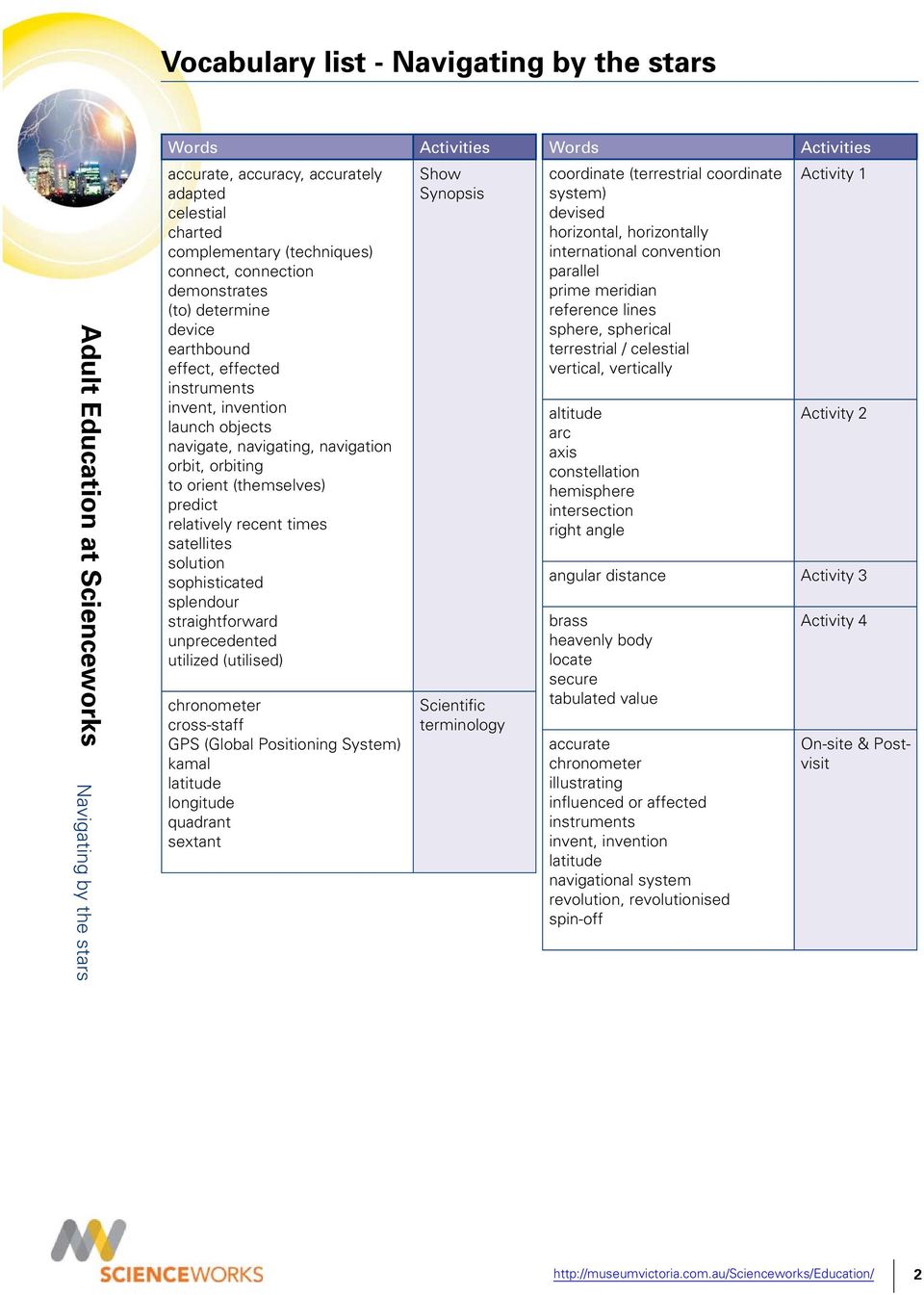
1 Pre and post-visit activities - Navigating by the stars Vocabulary List Adult Education at Scienceworks Pre-visit Activity 1: What is longitude and latitude? Activity 2: Using the Southern Cross to find South Activity 3: Measuring your latitude using hand-spans Activity 4: Measuring your latitude using a quadrant Post-visit Activity 5: Space spin-offs (Certificate I & II) Activity 6: Where on Earth are you? (Certificate II) These activities are designed to familiarise Certificate I and II students with the concepts and vocabulary they will encounter when they visit Scienceworks to see the Guiding Lights planetarium show, and to reinforce and extend their knowledge afterwards. You may need to modify or extend some of the ideas presented to best suit the needs of your students or student groups. Students should become familiar with the following words and their meanings, particularly those used in the planetarium show synopsis and on-site activities, before they visit Scienceworks. Navigating by the stars

2 Vocabulary list - Navigating by the stars Words Activities Words Activities Adult Education at Scienceworks Navigating by the stars accurate, accuracy, accurately adapted celestial charted complementary (techniques) connect, connection demonstrates (to) determine device earthbound effect, effected instruments invent, invention launch objects navigate, navigating, navigation orbit, orbiting to orient (themselves) predict relatively recent times satellites solution sophisticated splendour straightforward unprecedented utilized (utilised) chronometer cross-staff GPS (Global Positioning System) kamal latitude longitude quadrant sextant Show Synopsis Scientific terminology coordinate (terrestrial coordinate system) devised horizontal, horizontally international convention parallel prime meridian reference lines sphere, spherical terrestrial / celestial vertical, vertically altitude arc axis constellation hemisphere intersection right angle Activity 1 Activity 2 angular distance Activity 3 brass heavenly body locate secure tabulated value accurate chronometer illustrating influenced or affected instruments invent, invention latitude navigational system revolution, revolutionised spin-off Activity 4 On-site & Postvisit
3 Activity 1: What is longitude and latitude? Background information Due to the enthusiasm of our great explorers about 500 years ago, the demand for accurate maps and charts increased. It was only about a century ago that an international convention devised a terrestrial coordinate system using the lines of longitude and latitude. There are two main (imaginary) reference lines that divide the Earth vertically and horizontally and are marked 0 degrees. The equator is one of them and divides the Earth into two equal halves. The equator marks 0 degrees latitude and the lines of latitude run parallel to one another, measuring the distance, north or south from the equator. The North Pole lies at a latitude of 90 degrees North and the South Pole lies at a latitude of 90 degrees South. Recognised latitude lines: The Tropic of Cancer The Tropic of Capricorn The Arctic Circle Antarctic Circle 23.5 degrees N 23.5 degrees S 66.5 degrees N 66.5 degrees S The Tropic of Cancer and the Tropic of Capricorn mark the furthest points north and south of the equator where the Sun's rays fall vertically. The Arctic Circle and the Antarctic Circle mark the furthest points north or south of the equator where the Sun appears above the horizon each day of the year. Inside the Antarctic and Arctic Circles, the Sun does not appear above the horizon for the winter months and never drops below the horizon during the summer months. The other 0 degree (imaginary) reference line is the line that runs vertically through the North Pole, the South Pole and Greenwich in England. This line is called the prime meridian. The prime meridian was chosen to go through Greenwich because Greenwich Observatory played a major part in determining longitude at sea. Imaginary lines that run from the North Pole to the South Pole divide the Earth into sections. These imaginary lines are called lines of longitude or meridians and are measured east or west of the Prime Meridian. 3

4 Using this coordinate system, one can locate any place on Earth with accuracy. Some examples: The latitude and longitude for: a) Melbourne 38 degrees S, 145 degrees E b) Los Angeles (USA) 34 degrees N, degrees W c) Kenya 1 degree N, 38 degrees E d) Paris 48 degrees N, 2.20 degrees E What you need Spherical object eg. foam ball, blown up balloon Texta Earth globe String Sticky-tape What to do Use an Earth globe to help you do the following activity. 1 Mark in the North and South Pole on your spherical object. 2 Mark and label the equator half way around your spherical object as best as you can either using a texta or sticking a piece of string horizontally around the diameter. 3 Add lines of latitude 30 degrees S, 30 degrees N, 60 degrees S and 60 degrees N. (The lines of latitude are measured from the equator. Use the diagram on page 9 as a reference. ) 4 Mark in and label The Tropic of Cancer (23.5 degrees N) and the Tropic of Capricorn (23.5 degrees S). 5 Mark in and label the Arctic Circle (66.5 degrees N) and the Antarctic Circle (66.5 degrees S). 6 Mark and label the prime meridian that passes vertically through the North and South Pole. (The lines of longitude are measured from the prime meridian, which passes through Greenwich, England.) 7 Mark in lines of longitude 45 degrees E, 90 degrees E and 135 degrees E, 45 degrees W, 90 degrees W, 135 degrees W. 8 Find out the longitude and latitude of three different places you would like to visit and mark the (approximate) positions using the scale on your model. 4

5 Activity 2: Using the Southern Cross to find South Background information One of the things that that makes finding stars and constellations difficult is that the stars seem to move slowly across the sky during the night, rising in the East and setting in the West, just like the Sun during the day. From Southern Australia, if you watched the stars for a few hours they would move like this (if you are facing South): East SCP West Horizen Some stars travel in a large arc across the sky, then disappear below the horizon. Other stars never 'set' below the horizon but trace a circle in the sky. At the centre of these circles is a point called the South Celestial Pole. This part of the sky is directly above the South Pole of the Earth. That is, if you stood at the South Pole, the South Celestial Pole would be directly overhead. During summer at the South Pole the Sun circles the sky and never sets meaning it is daytime continuously. During winter the Sun never rises and it is constantly night. In the Northern Hemisphere, a star called Polaris or the Pole Star marks the North Celestial Pole. There is no star near the South Celestial Pole, so instead southerners must use the Southern Cross to find South. Once you are familiar with finding the Southern Cross, it can be used to find the direction of south, at any time of night, at any time of year because the Southern Cross never sets in our night sky, when viewed from the Southern part of Australia. 5

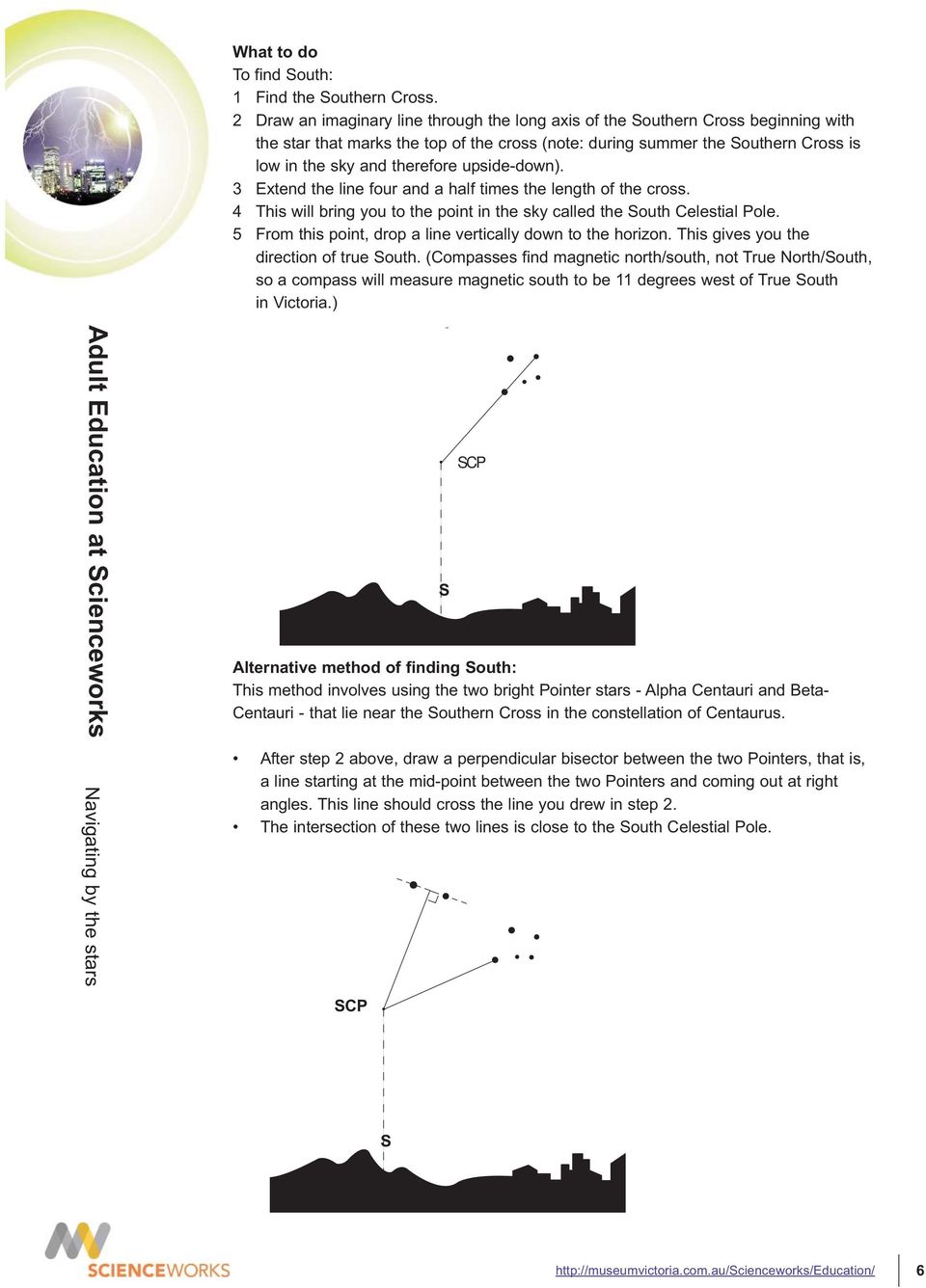
6 What to do To find South: 1 Find the Southern Cross. 2 Draw an imaginary line through the long axis of the Southern Cross beginning with the star that marks the top of the cross (note: during summer the Southern Cross is low in the sky and therefore upside-down). 3 Extend the line four and a half times the length of the cross. 4 This will bring you to the point in the sky called the South Celestial Pole. 5 From this point, drop a line vertically down to the horizon. This gives you the direction of true South. (Compasses find magnetic north/south, not True North/South, so a compass will measure magnetic south to be 11 degrees west of True South in Victoria.) Alternative method of finding South: This method involves using the two bright Pointer stars - Alpha Centauri and Beta- Centauri - that lie near the Southern Cross in the constellation of Centaurus. After step 2 above, draw a perpendicular bisector between the two Pointers, that is, a line starting at the mid-point between the two Pointers and coming out at right angles. This line should cross the line you drew in step 2. The intersection of these two lines is close to the South Celestial Pole. SCP S SCP S 6
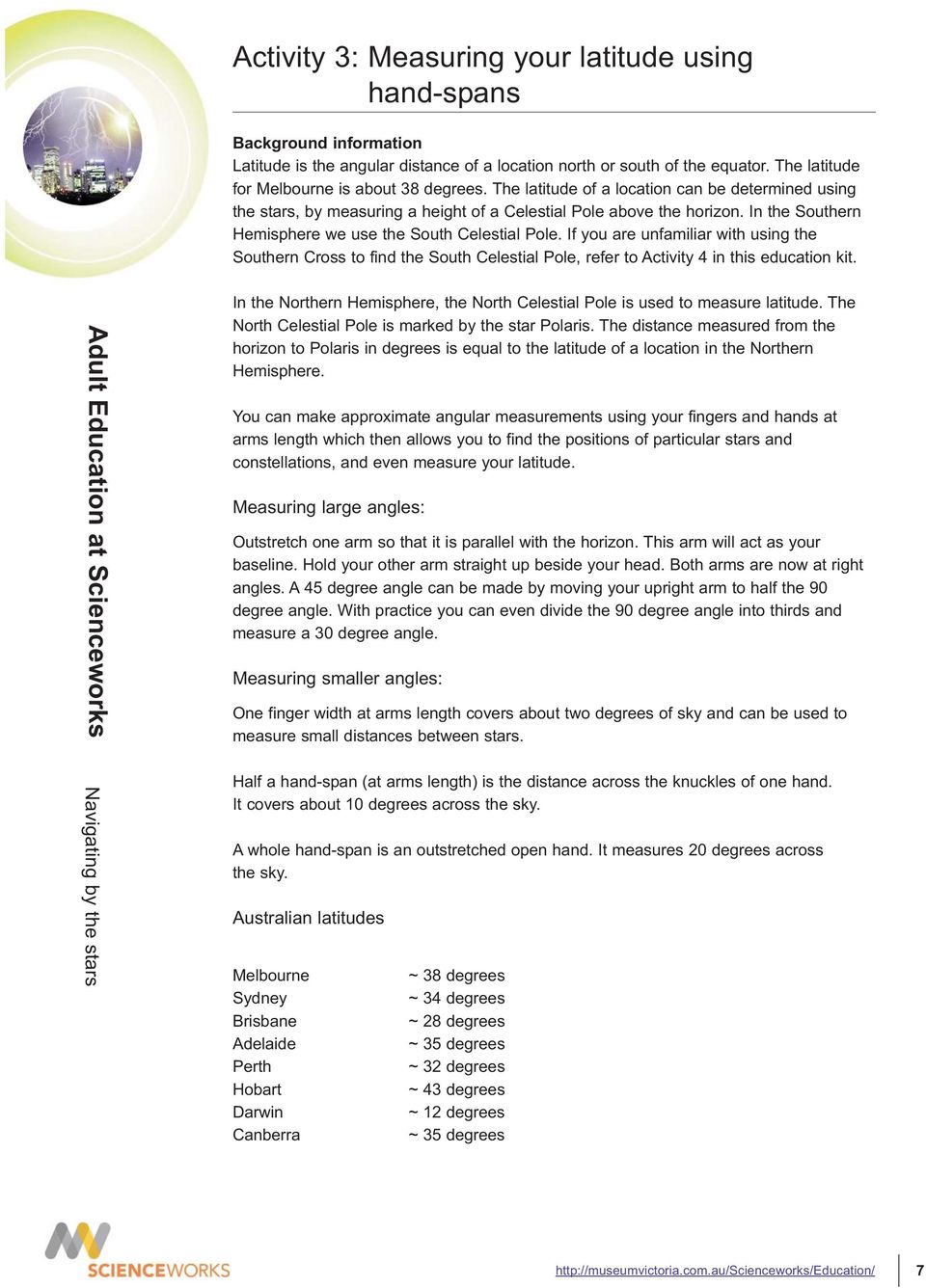
7 Activity 3: Measuring your latitude using hand-spans Background information Latitude is the angular distance of a location north or south of the equator. The latitude for Melbourne is about 38 degrees. The latitude of a location can be determined using the stars, by measuring a height of a Celestial Pole above the horizon. In the Southern Hemisphere we use the South Celestial Pole. If you are unfamiliar with using the Southern Cross to find the South Celestial Pole, refer to Activity 4 in this education kit. In the Northern Hemisphere, the North Celestial Pole is used to measure latitude. The North Celestial Pole is marked by the star Polaris. The distance measured from the horizon to Polaris in degrees is equal to the latitude of a location in the Northern Hemisphere. You can make approximate angular measurements using your fingers and hands at arms length which then allows you to find the positions of particular stars and constellations, and even measure your latitude. Measuring large angles: Outstretch one arm so that it is parallel with the horizon. This arm will act as your baseline. Hold your other arm straight up beside your head. Both arms are now at right angles. A 45 degree angle can be made by moving your upright arm to half the 90 degree angle. With practice you can even divide the 90 degree angle into thirds and measure a 30 degree angle. Measuring smaller angles: One finger width at arms length covers about two degrees of sky and can be used to measure small distances between stars. Half a hand-span (at arms length) is the distance across the knuckles of one hand. It covers about 10 degrees across the sky. A whole hand-span is an outstretched open hand. It measures 20 degrees across the sky. Australian latitudes Melbourne Sydney Brisbane Adelaide Perth Hobart Darwin Canberra ~ 38 degrees ~ 34 degrees ~ 28 degrees ~ 35 degrees ~ 32 degrees ~ 43 degrees ~ 12 degrees ~ 35 degrees 7
8 What you need Clear night What to do 1 On a clear night, find the Southern Cross and use it to find the approximate position of the South Celestial Pole. (Refer back to Activity 2) 2 Measure your latitude by measuring the distance between the horizon and the South Celestial Pole using hand-spans and finger width measurements as accurately as you can. 3 Discuss how accurate the measurements are. Compare measurements with other students. Who had the closest value to the tabulated value? Find out why. Question 1 If you were standing at the a) South Pole what would your latitude be? b) North Pole c) equator 8
9 Activity 4: Measuring your latitude using a quadrant Background information A quadrant is a very simple instrument that was used to determine the altitude of a heavenly body. It was made out of wood or brass and came into widespread use around It takes its name from its shape which is a quarter of a circle. A cord with a small weight or plumb bob made of lead or brass hangs down from the right angle which establishes a vertical line of reference. The quadrant is held at an angle so that the altitude of a heavenly body could be found from a simple reading on the scale. The following activity shows you how to make and use a simple quadrant. What you need A4 cardboard Glue Scissors Worksheet Measuring your latitude using a Quadrant String 25cm Sticky tape Weight or washer Straw cut in half What to do 1 Stick the worksheet onto the piece of cardboard. 2 Cut around the dark outline. 3 Poke a hole through the point marked X. 4 Insert the string from the graduated side of the quadrant and stick the string behind the quadrant using sticky-tape so that it is secure. 5 Tie the small weight onto the other end of the string. 6 Stick a straw with glue or sticky tape so that it lines up with the dotted line. How to use the quadrant to measure your latitude: Note: It is advisable to practise using the quadrant to measure the altitude of various objects (eg. top of a building or church) during the daytime before using it to measure latitude. 7 Go outside on a clear night and find the Southern Cross. Use the Southern Cross to locate the South Celestial Pole as accurately as possible. (Refer to Activity 2) 8 Start with holding the quadrant so that the weight hangs down along the zero line on the scale and the straw lines up with the horizon at eye level. 9 Then look through the straw and locate the South Celestial Pole. Since the quadrant is no longer horizontal, the string will move. 10 Hold the string in place against the quadrant. 11 Read the number of degrees between 0 degrees and 90 degrees. You now have an approximate measurement of your latitude. Repeat steps 8-11 three or four times so that an average value can be calculated. Compare the result to the tabulated value for your area. Optional 12 Use your quadrant and star map to check the altitude of given stars on a clear night. 9
10 front 70 x0 Measuring your latitude using a quadrant Worksheet x0 glue straw along dotted line glue straw along dotted line front 10

11 Activity 5: Space spin-offs Certificate I and II Background information A space spin-off is an invention originally developed for the space program but then was adapted to useful things we use every day. What you need Research facilities What to do Research another two space spin-offs that you make use of in your life and answer the following questions for each one: Questions 1. What was the object originally invented for? 2. What is the use of this object in every day life? 3. How did this object go from being a space related object to an object people use every day? 4. Get into groups of four and share your information with the group. 5. Make a list of space spin -offs researched by your group members. 6. Produce a poster illustrating all the spin-offs in your list and display in the classroom. 11

12 Activity 6: Where on Earth are you? Certificate II Background information A space spin-off is an invention originally developed for the space program but then was adapted to useful things we use every day. An example of a space spin-off is a ball point pen. It was originally invented for people in space so they could write up-side-down. What you need Research facilities What to do 1. Research the GPS (Global Positioning System). Find out how this system revolutionised navigation 2. How has this invention influenced or affected your life directly or indirectly? 3. Research the history of navigation and draw a simple time-line that outlines the major developments in the history of navigation. 4. Research the reasons for and against spending so much money on space research and exploration and then prepare a debate. 12
Solar Angles and Latitude
 Solar Angles and Latitude Objectives The student will understand that the sun is not directly overhead at noon in most latitudes. The student will research and discover the latitude ir classroom and calculate
Celestial Observations
 Celestial Observations Earth experiences two basic motions: Rotation West-to-East spinning of Earth on its axis (v rot = 1770 km/hr) (v rot Revolution orbit of Earth around the Sun (v orb = 108,000 km/hr)
Sun Earth Relationships
 1 ESCI-61 Introduction to Photovoltaic Technology Sun Earth Relationships Ridha Hamidi, Ph.D. Spring (sun aims directly at equator) Winter (northern hemisphere tilts away from sun) 23.5 2 Solar radiation
Stellarium a valuable resource for teaching astronomy in the classroom and beyond
 Stellarium 1 Stellarium a valuable resource for teaching astronomy in the classroom and beyond Stephen Hughes Department of Physical and Chemical Sciences, Queensland University of Technology, Gardens
Basic Coordinates & Seasons Student Guide
 Name: Basic Coordinates & Seasons Student Guide There are three main sections to this module: terrestrial coordinates, celestial equatorial coordinates, and understanding how the ecliptic is related to
Solar energy and the Earth s seasons
 Solar energy and the Earth s seasons Name: Tilt of the Earth s axis and the seasons We now understand that the tilt of Earth s axis makes it possible for different parts of the Earth to experience different
Tropical Horticulture: Lecture 2
 Lecture 2 Theory of the Tropics Earth & Solar Geometry, Celestial Mechanics The geometrical relationship between the earth and sun is responsible for the earth s climates. The two principal movements of
Earth-Sun Relationships. The Reasons for the Seasons
 Earth-Sun Relationships The Reasons for the Seasons Solar Radiation The earth intercepts less than one two-billionth of the energy given off by the sun. However, the radiation is sufficient to provide
Orientation to the Sky: Apparent Motions
 Chapter 2 Orientation to the Sky: Apparent Motions 2.1 Purpose The main goal of this lab is for you to gain an understanding of how the sky changes during the night and over the course of a year. We will
Lab Activity on the Causes of the Seasons
 Lab Activity on the Causes of the Seasons 2002 Ann Bykerk-Kauffman, Dept. of Geological and Environmental Sciences, California State University, Chico * Objectives When you have completed this lab you
The following words and their definitions should be addressed before completion of the reading:
 Seasons Vocabulary: The following words and their definitions should be addressed before completion of the reading: sphere any round object that has a surface that is the same distance from its center
The Reasons for the Seasons
 The Reasons for the Seasons (The Active Learning Approach) Materials: 4 Globes, One light on stand with soft white bulb, 4 flashlights, Four sets of "Seasons" Cards, Four laminated black cards with 1 inch
The Globe Latitudes and Longitudes
 INDIAN SCHOOL MUSCAT MIDDLE SECTION DEPARTMENT OF SOCIAL SCIENCE The Globe Latitudes and Longitudes NAME: CLASS VI SEC: ROLL NO: DATE:.04.2015 I NAME THE FOLLOWING: 1. A small spherical model of the Earth:
Navigation: Latitude and Longitude
 Sextants and Chronometers Help Sailors Find Their Position at Sea Latitude lines run horizontally across the globe and are used to measure distances north and south of the equator. Sailors used a sextant
Coordinate Systems. Orbits and Rotation
 Coordinate Systems Orbits and Rotation Earth orbit. The earth s orbit around the sun is nearly circular but not quite. It s actually an ellipse whose average distance from the sun is one AU (150 million
Cycles in the Sky. Teacher Guide: Cycles in the Sky Page 1 of 8 2008 Discovery Communications, LLC
 Cycles in the Sky What is a Fun damental? Each Fun damental is designed to introduce your younger students to some of the basic ideas about one particular area of science. The activities in the Fun damental
Use WITH Investigation 4, Part 2, Step 2
 INVESTIGATION 4 : The Sundial Project Use WITH Investigation 4, Part 2, Step 2 EALR 4: Earth and Space Science Big Idea: Earth in Space (ES1) Projects: Tether Ball Pole Sundial Globe and a Light Indoors
Which month has larger and smaller day time?
 ACTIVITY-1 Which month has larger and smaller day time? Problem: Which month has larger and smaller day time? Aim: Finding out which month has larger and smaller duration of day in the Year 2006. Format
Where on Earth are the daily solar altitudes higher and lower than Endicott?
 Where on Earth are the daily solar altitudes higher and lower than Endicott? In your notebooks, write RELATIONSHIPS between variables we tested CAUSE FIRST EFFECT SECOND EVIDENCE As you increase the time
CELESTIAL CLOCK - THE SUN, THE MOON, AND THE STARS
 INTRODUCTION CELESTIAL CLOCK - THE SUN, THE MOON, AND THE STARS This is a scientific presentation to provide you with knowledge you can use to understand the sky above in relation to the earth. Before
FIRST GRADE 1 WEEK LESSON PLANS AND ACTIVITIES
 FIRST GRADE 1 WEEK LESSON PLANS AND ACTIVITIES UNIVERSE CYCLE OVERVIEW OF FIRST GRADE UNIVERSE WEEK 1. PRE: Describing the Universe. LAB: Comparing and contrasting bodies that reflect light. POST: Exploring
1. In the diagram below, the direct rays of the Sun are striking the Earth's surface at 23 º N. What is the date shown in the diagram?
 1. In the diagram below, the direct rays of the Sun are striking the Earth's surface at 23 º N. What is the date shown in the diagram? 5. During how many days of a calendar year is the Sun directly overhead
ASTR 1030 Astronomy Lab 65 Celestial Motions CELESTIAL MOTIONS
 ASTR 1030 Astronomy Lab 65 Celestial Motions CELESTIAL MOTIONS SYNOPSIS: The objective of this lab is to become familiar with the apparent motions of the Sun, Moon, and stars in the Boulder sky. EQUIPMENT:
The Celestial Sphere. Questions for Today. The Celestial Sphere 1/18/10
 Lecture 3: Constellations and the Distances to the Stars Astro 2010 Prof. Tom Megeath Questions for Today How do the stars move in the sky? What causes the phases of the moon? What causes the seasons?
Activities: The Moon is lit and unlit too
 Activities: The Moon is lit and unlit too Key objectives: This activity aims to help student to: Identify the different phases of the Moon Know that the Moon does not produce its own light, but reflects
Stellar, solar, and lunar demonstrators
 Stellar, solar, and lunar demonstrators Rosa M. Ros, Francis Berthomieu International Astronomical Union, Technical University of Catalonia (Barcelona, España), CLEA (Nice, France) Summary This worksheet
User s Guide MARK 15 #026 MARK 25 #025 INDEX SHADES INDEX MIRROR. HORIZON MIRROR (Beam Converger on Mark 25 only) ADJUSTMENT SCREW HORIZON SHADES
 User s Guide INDEX SHADES INDEX MIRROR HORIZON MIRROR (Beam Converger on Mark 25 only) ADJUSTMENT SCREW HORIZON SHADES TELESCOPE MICROMETER DRUM QUICK RELEASE LEVERS LED ILLUMINATION (Mark 25 only) INDEX
compass Encyclopedic Entry
 This website would like to remind you: Your browser (Apple Safari 7) is out of date. Update your browser for more security, comfort and the best experience on this site. Encyclopedic Entry compass For
Shadows, Angles, and the Seasons
 Shadows, Angles, and the Seasons If it's cold in winter, why is Earth closer to the Sun? This activity shows the relationship between Earth-Sun positions and the seasons. From The WSU Fairmount Center
CELESTIAL MOTIONS. In Charlottesville we see Polaris 38 0 above the Northern horizon. Earth. Starry Vault
 CELESTIAL MOTIONS Stars appear to move counterclockwise on the surface of a huge sphere the Starry Vault, in their daily motions about Earth Polaris remains stationary. In Charlottesville we see Polaris
Today. Solstices & Equinoxes Precession Phases of the Moon Eclipses. Ancient Astronomy. Lunar, Solar FIRST HOMEWORK DUE NEXT TIME
 Today Solstices & Equinoxes Precession Phases of the Moon Eclipses Lunar, Solar Ancient Astronomy FIRST HOMEWORK DUE NEXT TIME The Reason for Seasons Hypothesis check: How would seasons in the northern
Earth In Space Chapter 3
 Earth In Space Chapter 3 Shape of the Earth Ancient Greeks Earth casts a circular shadow on the moon during a lunar eclipse Shape of the Earth Ancient Greeks Ships were observed to disappear below the
DETERMINING SOLAR ALTITUDE USING THE GNOMON. How does the altitude change during the day or from day to day?
 Name Partner(s) Section Date DETERMINING SOLAR ALTITUDE USING THE GNOMON Does the Sun ever occur directly overhead in Maryland? If it does, how would you determine or know it was directly overhead? How
EARTH'S MOTIONS. 2. The Coriolis effect is a result of Earth's A tilted axis B orbital shape C revolution D rotation
 EARTH'S MOTIONS 1. Which hot spot location on Earth's surface usually receives the greatest intensity of insolation on June 21? A Iceland B Hawaii C Easter Island D Yellowstone 2. The Coriolis effect is
The Size & Shape of the Galaxy
 name The Size & Shape of the Galaxy The whole lab consists of plotting two graphs. What s the catch? Aha visualizing and understanding what you have plotted of course! Form the Earth Science Picture of
Reasons for Seasons. Question: TRUE OR FALSE. Question: TRUE OR FALSE? What causes the seasons? What causes the seasons?
 Reasons for Seasons Question: TRUE OR FALSE? Earth is closer to the Sun in summer and farther from the Sun in winter. Question: TRUE OR FALSE? Earth is closer to the Sun in summer and farther from the
SECOND GRADE 1 WEEK LESSON PLANS AND ACTIVITIES
 SECOND GRADE 1 WEEK LESSON PLANS AND ACTIVITIES UNIVERSE CYCLE OVERVIEW OF SECOND GRADE UNIVERSE WEEK 1. PRE: Discovering stars. LAB: Analyzing the geometric pattern of constellations. POST: Exploring
4 The Rhumb Line and the Great Circle in Navigation
 4 The Rhumb Line and the Great Circle in Navigation 4.1 Details on Great Circles In fig. GN 4.1 two Great Circle/Rhumb Line cases are shown, one in each hemisphere. In each case the shorter distance between
Douglas Adams The Hitchhikers Guide to the Galaxy
 There is a theory which states that if ever anybody discovers exactly what the Universe is for and why it is here, it will instantly disappear and be replaced by something even more bizarre and inexplicable.
Measuring Your Latitude from the Angle of the Sun at Noon
 Measuring Your Latitude from the Angle of the Sun at Noon Background: You can measure your latitude in earth's northern hemisphere by finding out the altitude of the celestial equator from the southern
Newton s Law of Gravity
 Gravitational Potential Energy On Earth, depends on: object s mass (m) strength of gravity (g) distance object could potentially fall Gravitational Potential Energy In space, an object or gas cloud has
Motions of Earth LEARNING GOALS
 2 Patterns in the Sky Motions of Earth The stars first found a special place in legend and mythology as the realm of gods and goddesses, holding sway over the lives of humankind. From these legends and
Exploring Solar Energy Variations on Earth: Changes in the Length of Day and Solar Insolation Through the Year
 Exploring Solar Energy Variations on Earth: Changes in the Length of Day and Solar Insolation Through the Year Purpose To help students understand how solar radiation varies (duration and intensity) during
Today FIRST HOMEWORK DUE NEXT TIME. Seasons/Precession Recap. Phases of the Moon. Eclipses. Lunar, Solar. Ancient Astronomy
 Today FIRST HOMEWORK DUE NEXT TIME Seasons/Precession Recap Phases of the Moon Eclipses Lunar, Solar Ancient Astronomy How do we mark the progression of the seasons? We define four special points: summer
Homework Assignment #7: The Moon
 Name Homework Assignment #7: The Moon 2008 Ann Bykerk-Kauffman, Dept. of Geological and Environmental Sciences, California State University, Chico * Chapter 21 Origins of Modern Astronomy Motions of the
Noon Sun Angle = 90 Zenith Angle
 Noon Sun Angle Worksheet Name Name Date Subsolar Point (Latitude where the sun is overhead at noon) Equinox March 22 nd 0 o Equinox September 22 nd 0 o Solstice June 22 nd 23.5 N Solstice December 22 nd
Relationship Between the Earth, Moon and Sun
 Relationship Between the Earth, Moon and Sun Rotation A body turning on its axis The Earth rotates once every 24 hours in a counterclockwise direction. Revolution A body traveling around another The Earth
The Earth Really is Flat! The Globe and Coordinate Systems. Long History of Mapping. The Earth is Flat. Long History of Mapping
 The Earth Really is Flat! The Globe and Coordinate Systems Intro to Mapping & GIS The Earth is Flat Day to day, we live life in a flat world sun rises in east, sets in west sky is above, ground is below
Earth, Sun and Moon is a set of interactives designed to support the teaching of the QCA primary science scheme of work 5e - 'Earth, Sun and Moon'.
 is a set of interactives designed to support the teaching of the QCA primary science scheme of work 5e - ''. Learning Connections Primary Science Interactives are teaching tools which have been created
Full credit for this chapter to Prof. Leonard Bachman of the University of Houston
 Chapter 6: SOLAR GEOMETRY Full credit for this chapter to Prof. Leonard Bachman of the University of Houston SOLAR GEOMETRY AS A DETERMINING FACTOR OF HEAT GAIN, SHADING AND THE POTENTIAL OF DAYLIGHT PENETRATION...
Seasons on Earth LESSON
 LESSON 4 Seasons on Earth On Earth, orange and red autumn leaves stand out against the blue sky. NATIONAL OCEANIC AND ATMOSPHERIC ADMINISTRATION (NOAA) PHOTO LIBRARY/NOAA CENTRAL LIBRARY INTRODUCTION Nearly
EDMONDS COMMUNITY COLLEGE ASTRONOMY 100 Winter Quarter 2007 Sample Test # 1
 Instructor: L. M. Khandro EDMONDS COMMUNITY COLLEGE ASTRONOMY 100 Winter Quarter 2007 Sample Test # 1 1. An arc second is a measure of a. time interval between oscillations of a standard clock b. time
Motions of the Earth. Stuff everyone should know
 Motions of the Earth Stuff everyone should know Earth Motions E W N W Noon E Why is there day and night? OR Why do the Sun and stars appear to move through the sky? Because the Earth rotates around its
Solar System. 1. The diagram below represents a simple geocentric model. Which object is represented by the letter X?
 Solar System 1. The diagram below represents a simple geocentric model. Which object is represented by the letter X? A) Earth B) Sun C) Moon D) Polaris 2. Which object orbits Earth in both the Earth-centered
Geography I Pre Test #1
 Geography I Pre Test #1 1. The sun is a star in the galaxy. a) Orion b) Milky Way c) Proxima Centauri d) Alpha Centauri e) Betelgeuse 2. The response to earth's rotation is a) an equatorial bulge b) polar
The Four Seasons. A Warm Up Exercise. A Warm Up Exercise. A Warm Up Exercise. The Moon s Phases
 The Four Seasons A Warm Up Exercise What fraction of the Moon s surface is illuminated by the Sun (except during a lunar eclipse)? a) Between zero and one-half b) The whole surface c) Always half d) Depends
Renewable Energy. Solar Power. Courseware Sample 86352-F0
 Renewable Energy Solar Power Courseware Sample 86352-F0 A RENEWABLE ENERGY SOLAR POWER Courseware Sample by the staff of Lab-Volt Ltd. Copyright 2009 Lab-Volt Ltd. All rights reserved. No part of this
Astronomy. Introduction. Key concepts of astronomy. Earth. Day and night. The changing year
 Astronomy Introduction This topic explores the key concepts of astronomy as they relate to: the celestial coordinate system the appearance of the sky the calendar and time the solar system and beyond space
Chapter 3 Earth - Sun Relations
 3.1 Introduction We saw in the last chapter that the short wave radiation from the sun passes through the atmosphere and heats the earth, which in turn radiates energy in the infrared portion of the electromagnetic
What Causes Climate? Use Target Reading Skills
 Climate and Climate Change Name Date Class Climate and Climate Change Guided Reading and Study What Causes Climate? This section describes factors that determine climate, or the average weather conditions
Heat Transfer. Energy from the Sun. Introduction
 Introduction The sun rises in the east and sets in the west, but its exact path changes over the course of the year, which causes the seasons. In order to use the sun s energy in a building, we need to
Geometry and Geography
 Geometry and Geography Tom Davis [email protected] http://www.geometer.org/mathcircles March 12, 2011 1 Pedagogical Advice I have been leading mathematical circles using this topic for many years,
Lines of Latitude and Longitude
 ED 5661 Mathematics & Navigation Teacher Institute Keith Johnson Lesson Plan Lines of Latitude and Longitude Lesson Overview: This lesson plan will introduce students to latitude and longitude along with
ASTRONOMY 161. Introduction to Solar System Astronomy
 ASTRONOMY 161 Introduction to Solar System Astronomy Seasons & Calendars Monday, January 8 Season & Calendars: Key Concepts (1) The cause of the seasons is the tilt of the Earth s rotation axis relative
1-2. What is the name given to the path of the Sun as seen from Earth? a.) Equinox b.) Celestial equator c.) Solstice d.
 Chapter 1 1-1. How long does it take the Earth to orbit the Sun? a.) one sidereal day b.) one month c.) one year X d.) one hour 1-2. What is the name given to the path of the Sun as seen from Earth? a.)
LATITUDE GNOMON AND QUADRANT FOR THE WHOLE YEAR
 LATITUDE GNOMON AND QUADRANT FOR THE WHOLE YEAR Sakari Ekko EAAE Summer School Working Group (Finland) Abstract In this workshop, we examine the correlation between our latitude and the altitude of the
Stage 4. Geography. Blackline Masters. By Karen Devine
 1 Devine Educational Consultancy Services Stage 4 Geography Blackline Masters By Karen Devine Updated January 2010 2 This book is intended for the exclusive use in NSW Secondary Schools. It is meant to
APPENDIX D: SOLAR RADIATION
 APPENDIX D: SOLAR RADIATION The sun is the source of most energy on the earth and is a primary factor in determining the thermal environment of a locality. It is important for engineers to have a working
Motions of Earth, Moon, and Sun
 Motions of Earth, Moon, and Sun Apparent Motions of Celestial Objects An apparent motion is a motion that an object appears to make. Apparent motions can be real or illusions. When you see a person spinning
The Map Grid of Australia 1994 A Simplified Computational Manual
 The Map Grid of Australia 1994 A Simplified Computational Manual The Map Grid of Australia 1994 A Simplified Computational Manual 'What's the good of Mercator's North Poles and Equators, Tropics, Zones
MULTI-LEVEL LESSON PLAN GUIDE Earth, Moon, and Beyond
 1 MULTI-LEVEL LESSON PLAN GUIDE Earth, Moon, and Beyond Jeni Gonzales e-mail: [email protected] SED 5600 Dr. Michael Peterson December 18, 2001 1 2 Unit Plan: Multi-level- Earth, Moon, and Beyond Theme:
COASTLINING THE ZODIAC
 COASTLINING THE ZODIAC Astronomy books and skywatching guides offer a wide variety of charts for naked-eye observation of the skies. What works best for each person will depend on various factors such
Astrock, t he A stronomical Clock
 Astrock, t he A stronomical Clock The astronomical clock is unlike any other clock. At first glance you ll find it has similar functions of a standard clock, however the astronomical clock can offer much
Earth, Moon, and Sun Study Guide. (Test Date: )
 Earth, Moon, and Sun Study Guide Name: (Test Date: ) Essential Question #1: How are the Earth, Moon, and Sun alike and how are they different? 1. List the Earth, Moon, and Sun, in order from LARGEST to
Changes in Our Sky Grade Two
 Ohio Standards Connection: Earth and Space Sciences Benchmark A Observe constant and changing patterns of objects in the day and night sky. Indicator 2 Observe and describe how the sun, moon and stars
For further information, and additional background on the American Meteorological Society s Education Program, please contact:
 Project ATMOSPHERE This guide is one of a series produced by Project ATMOSPHERE, an initiative of the American Meteorological Society. Project ATMOSPHERE has created and trained a network of resource agents
Essential Question. Enduring Understanding
 Earth In Space Unit Diagnostic Assessment: Students complete a questionnaire answering questions about their ideas concerning a day, year, the seasons and moon phases: My Ideas About A Day, Year, Seasons
CHAPTER 9 SURVEYING TERMS AND ABBREVIATIONS
 CHAPTER 9 SURVEYING TERMS AND ABBREVIATIONS Surveying Terms 9-2 Standard Abbreviations 9-6 9-1 A) SURVEYING TERMS Accuracy - The degree of conformity with a standard, or the degree of perfection attained
Exploring Magnetism. DataQuest
 Exploring Magnetism Magnetism is the force of attraction or repulsion between a magnet and something else. Magnets attract materials made of iron, nickel, or cobalt. Can you think of five things to which
Using the Quadrant. Protractor. Eye Piece. You can measure angles of incline from 0º ( horizontal ) to 90º (vertical ). Ignore measurements >90º.
 Using the Quadrant Eye Piece Protractor Handle You can measure angles of incline from 0º ( horizontal ) to 90º (vertical ). Ignore measurements 90º. Plumb Bob ø
1. A student followed the given steps below to complete a construction. Which type of construction is best represented by the steps given above?
 1. A student followed the given steps below to complete a construction. Step 1: Place the compass on one endpoint of the line segment. Step 2: Extend the compass from the chosen endpoint so that the width
The Orbit TelleriumThe Orbit TelleriumThe Orbit Tellerium
 The Orbit TelleriumThe Orbit TelleriumThe Orbit Tellerium 16 Appendix 4 Moon Chart: For each day draw the shape of the Moon, record the time and mark the position of the Moon in the sky in relation to
Science in the Elementary and Middle School
 15-0 Science in the Elementary and Middle School Naturally Occurring Inquiry Process, Which Can Be Made More Effective With Experience Uses Observable Data Science Search for Regularity Involves Information
Periods of Western Astronomy. Chapter 1. Prehistoric Astronomy. Prehistoric Astronomy. The Celestial Sphere. Stonehenge. History of Astronomy
 Periods of Western Astronomy Chapter 1 History of Astronomy Western astronomy divides into 4 periods Prehistoric (before 500 B.C.) Cyclical motions of Sun, Moon and stars observed Keeping time and determining
The Mathematics of the Longitude
 The Mathematics of the Longitude Wong Lee Nah An academic exercise presented in partial fulfilment for the degree of Bachelor of Science with Honours in Mathematics. Supervisor : Associate Professor Helmer
Lines on Maps and Globes. Cross Curricular Writing Activity Social Studies Grade 4
 Lines on Maps and Globes Cross Curricular Writing Activity Social Studies Grade 4 Fourth Grade Social Studies Standard Map: Chart/Globe The learner will be able to use maps, charts, graphs, and globes
An Introduction to Coordinate Systems in South Africa
 An Introduction to Coordinate Systems in South Africa Centuries ago people believed that the earth was flat and notwithstanding that if this had been true it would have produced serious problems for mariners
Activity 3: Observing the Moon
 Activity 3: Observing the Moon Print Name: Signature: 1.) KEY. 2.). 3.). 4.). Activity: Since the dawn of time, our closest neighbor the moon has fascinated humans. In this activity we will explore the
www.mhhe.com/fix Sunrise from Earth orbit by the crew of the STS-47 Space Shuttle Mission. I pray the gods to quit me of my toils,
 Confirming Proofs I pray the gods to quit me of my toils, To close the watch I keep this livelong year; For as a watch-dog lying, not at rest, Propped on one arm, upon the palace roof Of Atreus race, too
Earth, Moon, and Sun Inquiry Template Eclipses
 One Stop Shop For Educators The following instructional plan is part of a GaDOE collection of Unit Frameworks, Performance Tasks, examples of Student Work, and Teacher Commentary. Many more GaDOE approved
Moon. & eclipses. Acting out celestial events. (oh my)
 phasestides & eclipses Moon (oh my) Acting out celestial events Developed by: Betsy Mills, UCLA NSF GK-12 Fellow Title of Lesson: Moon Phases, Tides, & Eclipses (oh my)! Grade Level: 8 th grade Subject(s):
The Basics of Navigation
 The Basics of Navigation Knowledge of map reading and the use of the compass is an indispensable skill of bushcraft. Without this skill, a walker is a passenger and mere follower on a trip. To become a
CHAPTER 3. The sun and the seasons. Locating the position of the sun
 zenith 90 summer solstice 75 equinox 52 winter solstice 29 altitude angles observer Figure 3.1: Solar noon altitude angles for Melbourne SOUTH winter midday shadow WEST summer midday shadow summer EAST
Lunar Phase Simulator Student Guide
 Name: Lunar Phase Simulator Student Guide Part I: Background Material Answer the following questions after reviewing the background pages for the simulator. Page 1 Introduction to Moon Phases Is there
CONTENTS PAGE: 1. EU-UNAWE Mission Statement 3 2. CAPS Life Skills Programme of Assessment 4 5-6
 CONTENTS PAGE: 1. EU-UNAWE Mission Statement 3 2. CAPS Life Skills Programme of Assessment 4 5-6 3. Core Knowledge & Content - CAPS Curriculum Life Skills Foundation Phase 4. Learning Outcomes & Definition
The ecliptic - Earth s orbital plane
 The ecliptic - Earth s orbital plane The line of nodes descending node The Moon s orbital plane Moon s orbit inclination 5.45º ascending node celestial declination Zero longitude in the ecliptic The orbit
Experiment 5: Magnetic Fields of a Bar Magnet and of the Earth
 MASSACHUSETTS INSTITUTE OF TECHNOLOGY Department of Physics 8.02 Spring 2005 Experiment 5: Magnetic Fields of a Bar Magnet and of the Earth OBJECTIVES 1. To examine the magnetic field associated with a
6. The greatest atmospheric pressure occurs in the 1) troposphere 3) mesosphere 2) stratosphere 4) thermosphere
 1. The best evidence of the Earth's nearly spherical shape is obtained through telescopic observations of other planets photographs of the Earth from an orbiting satellite observations of the Sun's altitude