
x1 x 2 x 3 y 1 y 2 y 3 x 1 y 2 x 2 y 1 0.
|
|
|
- Octavia Gordon
- 10 years ago
- Views:
Transcription
1 Cross product 1 Chapter 7 Cross product We are getting ready to study integration in several variables. Until now we have been doing only differential calculus. One outcome of this study will be our ability to compute volumes of interesting regions of R n. As preparation for this we shall learn in this chapter how to compute volumes of parallelepipeds in R 3. In this material there is a close connection with the vector product, which we now discuss. A. Definition of the cross product We begin with a simple but interesting problem. Let x, y be given vectors in R 3 : x = (x 1, x 2, x 3 ) and y = (y 1, y 2, y 3 ). Assume that x and y are linearly independent; in other words, 0, x, y determine a unique plane. We then want to determine a nonzero vector z which is orthogonal to this plane. That is, we want to solve the equations x z = 0 and y z = 0. We are certain in advance that z will be uniquely determined up to a scalar factor. The equations in terms of the coordinates of z are x 1 z 1 + x 2 z 2 + x 3 z 3 = 0, y 1 z 1 + y 2 z 2 + y 3 z 3 = 0. It is no surprise that we have two equations but three unknowns, as we know z is not going to be unique. Since x and y are linearly independent, the matrix ( ) x1 x 2 x 3 y 1 y 2 y 3 has row rank equal to 2, and thus also has column rank 2. Thus it has two linearly independent columns. To be definite, suppose that the first two columns are independent; in other words, x 1 y 2 x 2 y 1 0. (This is all a special case of the general discussion in Section 6B.) Then we can solve the following two equations for the unknowns z 1 and z 2 : The result is x 1 z 1 + x 2 z 2 = x 3 z 3, y 1 z 1 + y 2 z 2 = y 3 z 3.
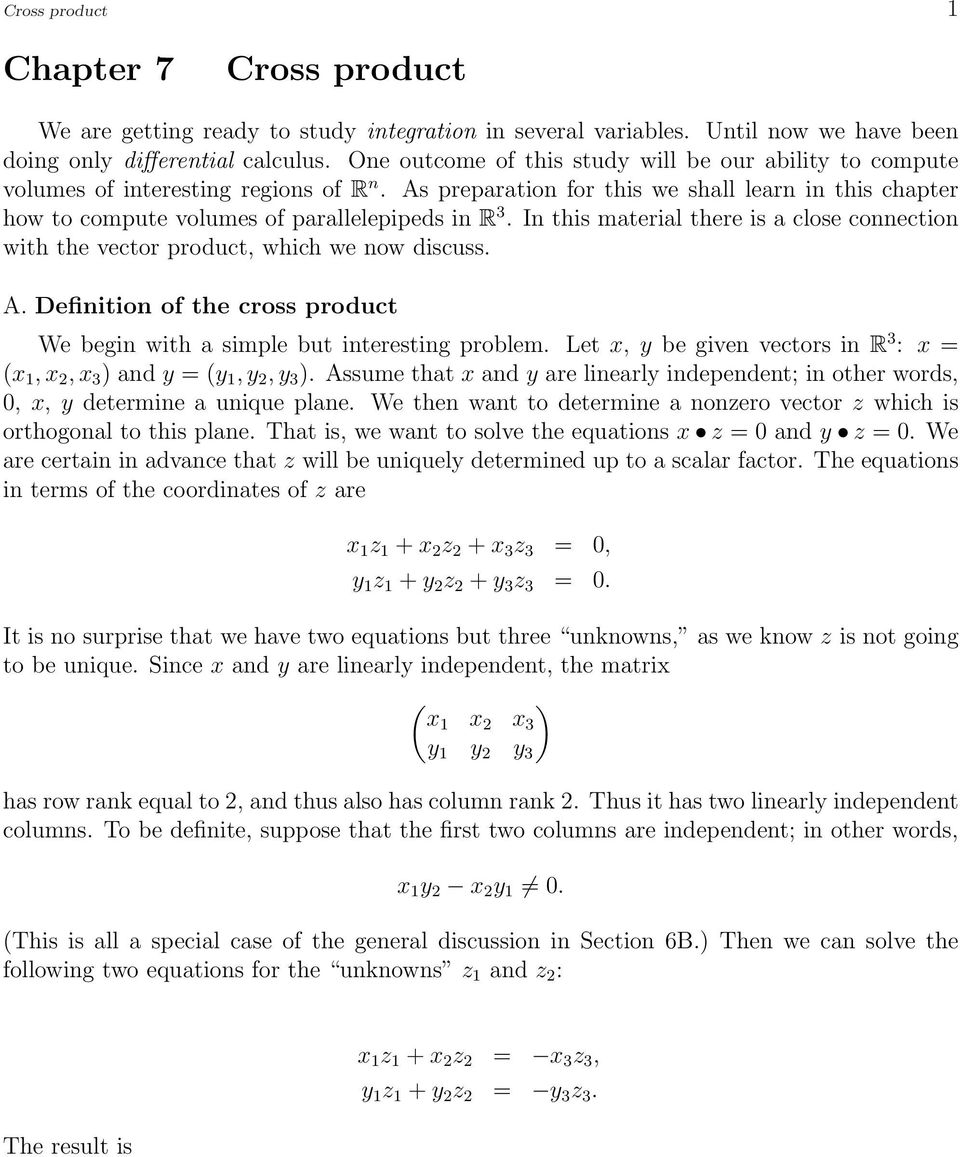
2 2 Chapter 7 z 1 = x 2y 3 x 3 y 2 x 1 y 2 x 2 y 1 z 3, z 2 = x 3y 1 x 1 y 3 x 1 y 2 x 2 y 1 z 3. Notice of course we have an undetermined scalar factor z 3. Now we simply make the choice z 3 = x 1 y 2 x 2 y 1 ( 0). Then the vector z can be written z 1 = x 2 y 3 x 3 y 2, z 2 = x 3 y 1 x 1 y 3, z 3 = x 1 y 2 x 2 y 1. This is precisely what we were trying to find, and we now simply make this a definition: DEFINITION. The cross product (or vector product) of two vectors x, y in R 3 is the vector x y = (x 2 y 3 x 3 y 2, x 3 y 1 x 1 y 3, x 1 y 2 x 2 y 1 ). DISCUSSION. 1. Our development was based on the assumption that x and y are linearly independent. But the definition still holds in the case of linear dependence, and produces x y = 0. Thus we can say immediately that x and y are linearly dependent x y = We also made the working assumption that x 1 y 2 x 2 y 1 0. Either of the other two choices of independent columns produces the same sort of result. This is clearly seen in the nice symmetry of the definition. 3. The definition is actually quite easily memorized. Just realize that the first component of z = x y is z 1 = x 2 y 3 x 3 y 2 and then a cyclic permutation of the indices automatically produces the other two components. 4. A convenient mnemonic for the definition is given by the formal determinant expression, x y = det î ĵ ˆk x 1 x 2 x 3. y 1 y 2 y 3

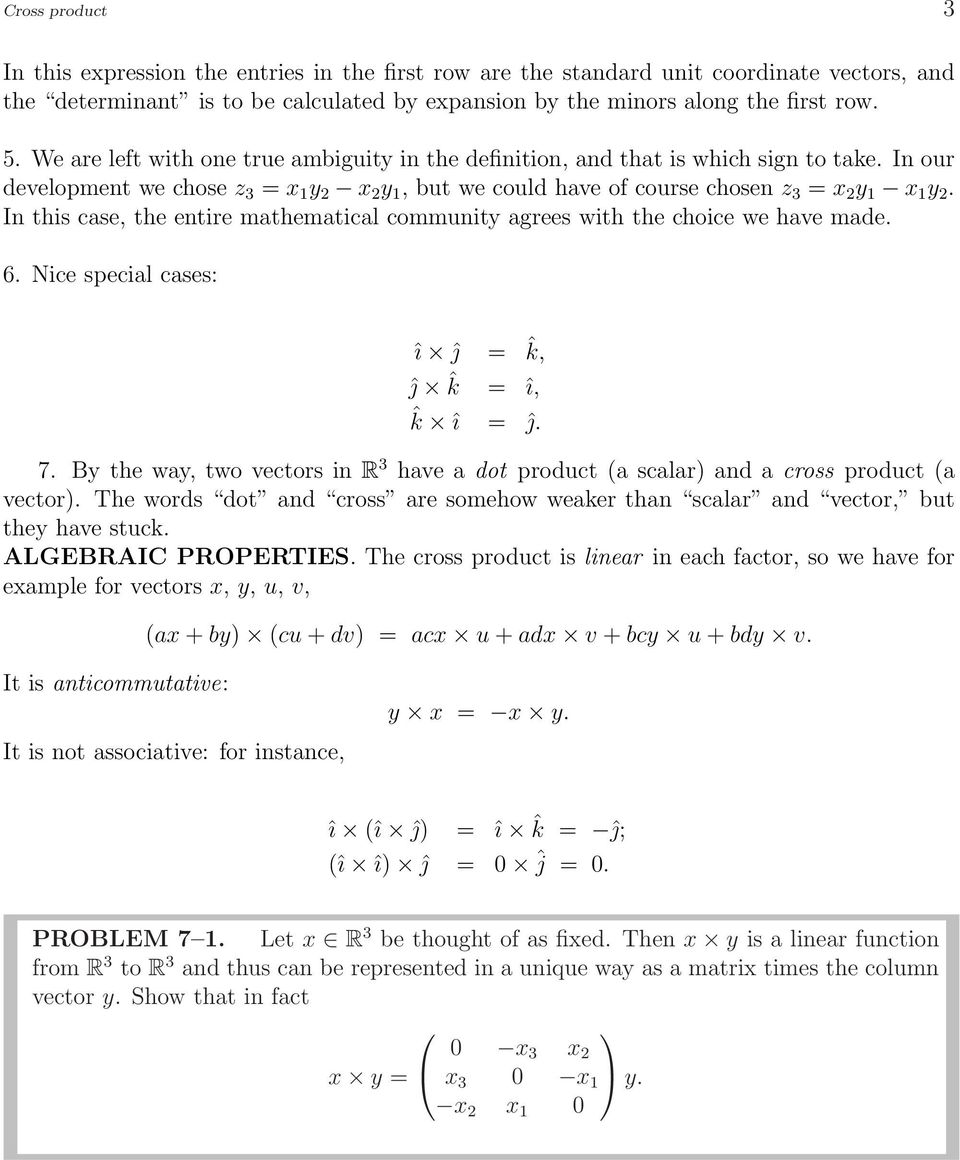
3 Cross product 3 In this expression the entries in the first row are the standard unit coordinate vectors, and the determinant is to be calculated by expansion by the minors along the first row. 5. We are left with one true ambiguity in the definition, and that is which sign to take. In our development we chose z 3 = x 1 y 2 x 2 y 1, but we could have of course chosen z 3 = x 2 y 1 x 1 y 2. In this case, the entire mathematical community agrees with the choice we have made. 6. Nice special cases: î ĵ = ˆk, ĵ ˆk = î, ˆk î = ĵ. 7. By the way, two vectors in R 3 have a dot product (a scalar) and a cross product (a vector). The words dot and cross are somehow weaker than scalar and vector, but they have stuck. ALGEBRAIC PROPERTIES. The cross product is linear in each factor, so we have for example for vectors x, y, u, v, (ax + by) (cu + dv) = acx u + adx v + bcy u + bdy v. It is anticommutative: It is not associative: for instance, y x = x y. î (î ĵ) = î ˆk = ĵ; (î î) ĵ = 0 ĵ = 0. PROBLEM 7 1. Let x R 3 be thought of as fixed. Then x y is a linear function from R 3 to R 3 and thus can be represented in a unique way as a matrix times the column vector y. Show that in fact 0 x 3 x 2 x y = x 3 0 x 1 y. x 2 x 1 0
4 4 Chapter 7 PROBLEM 7 2. Assuming x 0 in the preceding problem, find the characteristic polynomial of the 3 3 matrix given there. What are its eigenvalues? B. The norm of the cross product The approach I want to take here goes back to the Schwarz inequality on p. 1 15, for which we are now going to give an entirely different proof. Suppose then that x, y R n. We are going to prove x y x y by calculating the difference of the squares of the two sides, as follows: x 2 y 2 (x y) 2 = = = n i=1 n i=1 x 2 i x 2 i ( n n ) 2 yi 2 x i y i i=1 n yj 2 j=1 n x 2 i yj 2 i,j=1 i=1 n x i y i i=1 j=1 n x i y i x j y j i,j=1 n x j y j = n x 2 i yj 2 + x 2 i yi 2 + x 2 i yj 2 i<j i=1 i>j n x i y i x j y j x 2 i yi 2 x i y i x j y j i<j i=1 i>j = i<j x 2 i y 2 j + j>i x 2 jy 2 i 2 i<j x i y i x j y j = i<j ( x 2 i y 2 j 2x i y i x j y j + x 2 jy 2 i ) = i<j (x i y j x j y i ) 2. This then proves that x 2 y 2 (x y) 2 0. If we specialize to R 3, we have x 2 y 2 (x y) 2 = (x 1 y 2 x 2 y 1 ) 2 + (x 2 y 3 x 3 y 2 ) 2 + (x 1 y 3 x 3 y 1 ) 2. But the right side is precisely z z z 2 2 in the above notation. Thus we have proved the
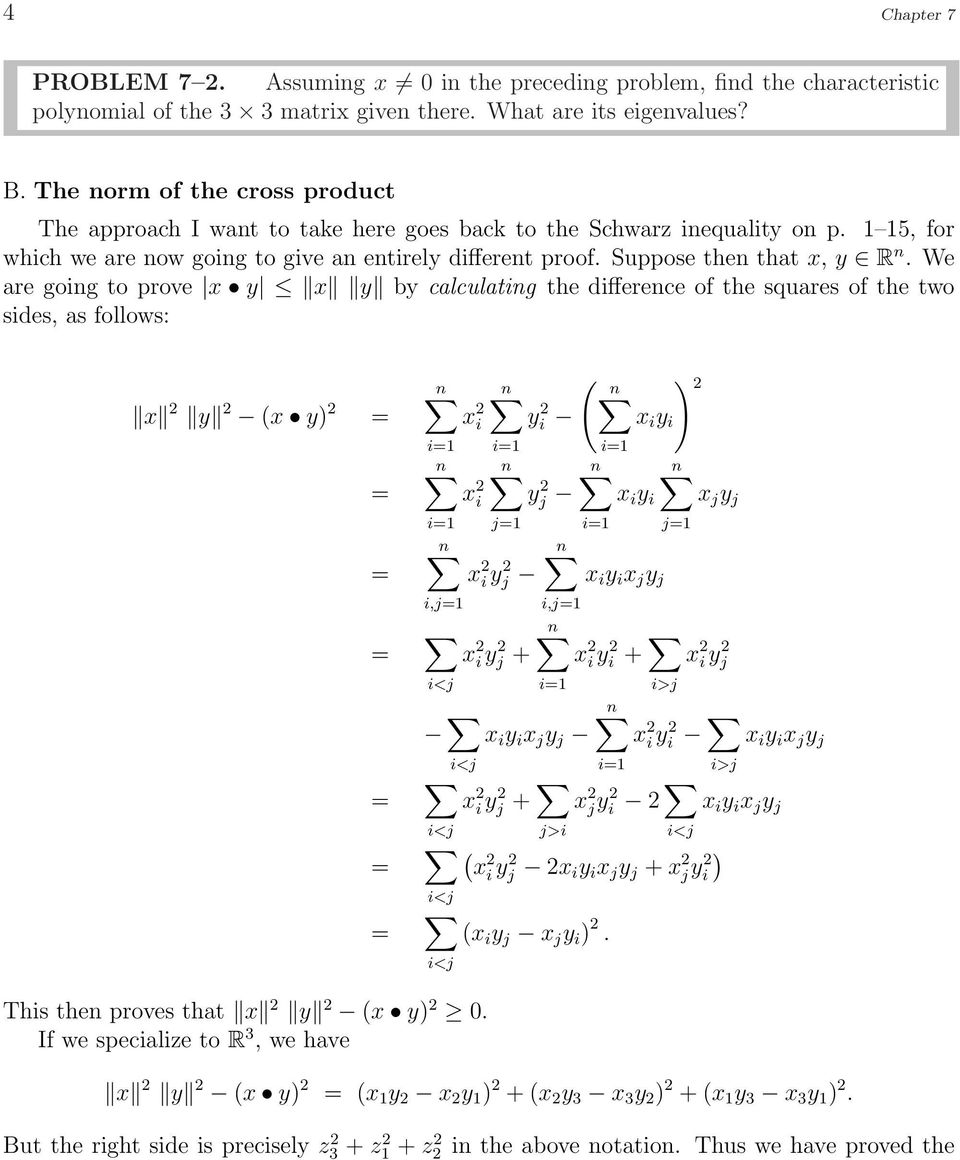
5 Cross product 5 wonderful Lagrange s identity x 2 y 2 = (x y) 2 + x y 2. This identity relates norms, dot products, and cross products. In terms of the angle θ between x and y, we have from p the formula x y = x y cos θ. Thus, x y = x y sin θ. This result completes the geometric description of the cross product, up to sign. The vector x y is orthogonal to the plane determined by 0, x and y, and its norm is given by the formula we have just derived. An even more geometric way of saying this is that the norm of x y is the area of the parallelogram with vertices 0, x, y, x + y: x y y x+y θ x

6 6 Chapter 7 PROBLEM 7 3. The Lagrange identity can easily be generalized. Using the following outline, prove that for x, y, u, v R 3, (x y) (u v) = (x u)(y v) (x v)(y u). Outline: the right side equals ( ) ( ) x i u i y j v j i j ( ) ( ) x i v i y j u j i j = x i y j (u i v j u j v i ) i,j (why?) = i,j x j y i (u j v i u i v j ) (why?) = 1 (x i y j x j y i )(u i v j u j v i ) (why?) 2 i,j = (x i y j x j y i )(u i v j u j v i ) i<j (why?) = (x y) (u v). C. Triple products The formal representation of x y as a determinant enables us to calculate inner products readily: for any u R 3 (x y) u = det î ĵ ˆk x 1 x 2 x 3 y 1 y 2 y 3 u 1 u 2 u 3 = det x 1 x 2 x 3. y 1 y 2 y 3 ( ) u 1 î + u 2 ĵ + u 3ˆk (Notice how clearly this formula displays the fact that (x y) x = (x y) y = 0.) This number (x y) u is called the scalar triple product of the vectors x, y, and u. The formula we have just given makes it clear that

7 Cross product 7 (x y) u = (u x) y = (y u) x = (y x) u = (x u) y = (u y) x. Thus we have the interesting phenomenon that writing x, y, u in order gives (x y) u = x (y u). So the triple product doesn t care which you call and which you call. For this reason, it s frequently written [x, y, u] = (x y) u. PROBLEM 7 4. The vector triple product is (x y) u. It can be related to dot products by the identity (x y) u = (x u)y (y u)x. Prove this by using Problem 7 3 to calculate the dot product of each side of the proposed formula with an arbitrary v R 3. PROBLEM 7 5. Prove quickly that the other vector triple product satisfies x (y u) = (x u)y (x y)u. The identities in Problems 7 4 and 7 5 can be remembered by expressing the right side of each as vector triple product = (outer far) near (outer near) far. The scalar triple product is exactly the device that enables us to compute volumes of parallelepipeds in R 3. Consider three vectors x, y, u in R 3. They generate a region D called a parallelepiped as follows: D = {ax + by + cu 0 a 1, 0 b 1, 0 c 1}. PROBLEM 7 6. Prove that [x y, y u, u x] = [x, y, u] 2.

8 8 Chapter 7 y u x O We use the usual intuitive definition of volume as the area of the base times the altitude. If we regard x and y as spanning the parallelogram which is the base, its area is of course x y. The altitude is then calculated as the norm of the projection of the side u onto the direction orthogonal to the base; of course, x y has the required direction: x y u θ O plane of 0, x, y In terms of the angle θ between x y and u, the altitude is

9 Cross product 9 Thus the volume of D is u cos θ = (x y) u u x y u = (x y) u. x y vol(d) = (x y) u. It is therefore computed as the absolute value of the scalar triple product of the three spanning edges of the parallelepiped. In terms of the determinant, u 1 u 2 u 3 vol(d) = det x 1 x 2 x 3. y 1 y 2 y 3 Notice in particular that vol(d) = 0 the vectors x, y, u are linearly dependent the parallelepiped D lies in a two dimensional subspace of R n. D. Orientation We now have the cross product characterized geometrically, up to a sign. Given linearly independent x, y R 3, the cross product has direction orthogonal to both x and y, and norm equal to x y sin θ, where θ is the angle between the vectors x and y. There are exactly two vectors with these properties, and we now want to discuss a geometric way to single out the cross product. The concept we need is important in general dimensions, so we shall deal with R n for any n. DEFINITION. A frame for R n is an ordered basis. That is, we have n linearly independent vectors ϕ 1,..., ϕ n, and they are written in a particular order. For example, are three distinct frames for R 3. {î, ĵ, ˆk}, {î + 2ĵ, ĵ, ˆk}, {î, ˆk, ĵ} DEFINITION. Let {ϕ 1,..., ϕ n } and {ψ 1,..., ψ n } be frames for R n. Then there exists a unique n n matrix A such that ϕ i = Aψ i, 1 i n.
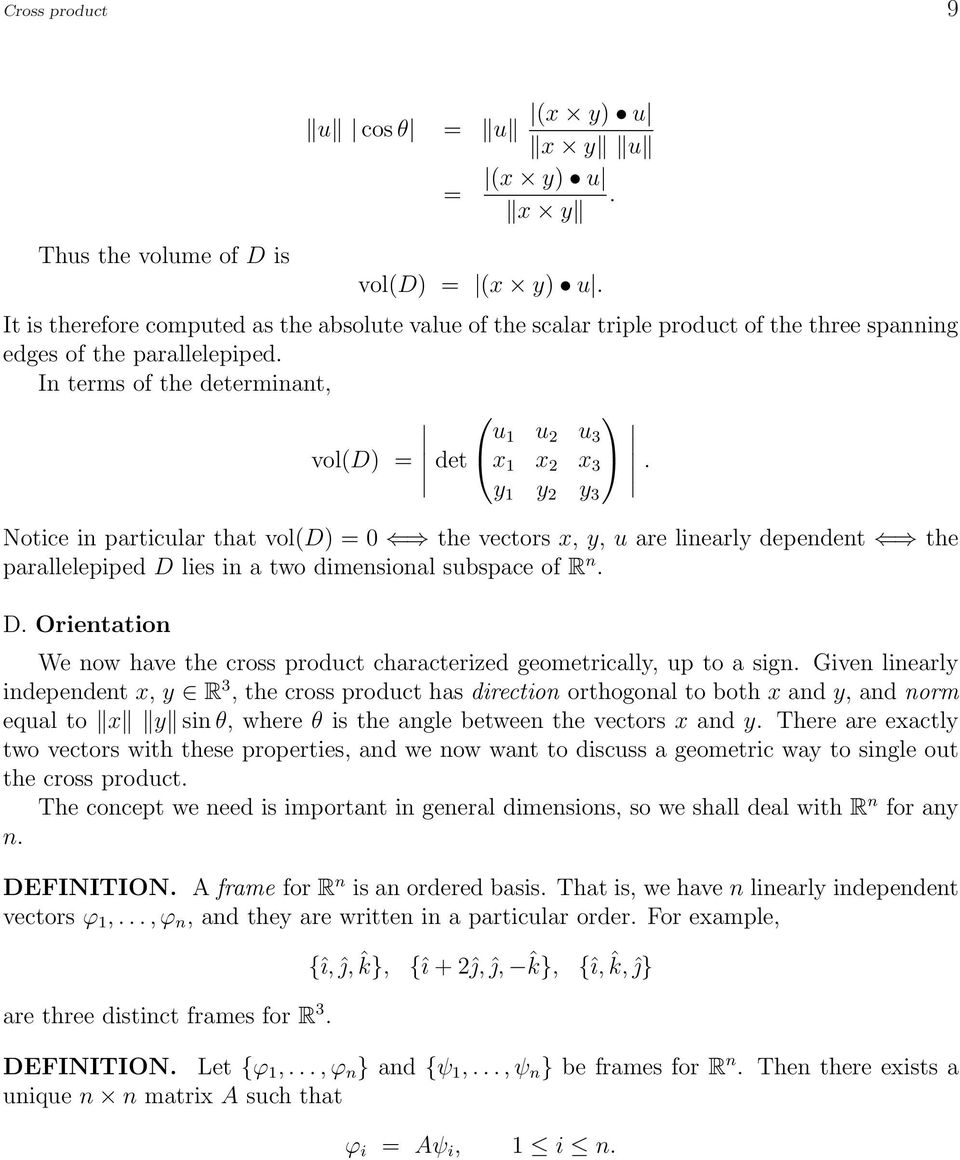
10 10 Chapter 7 This matrix is necessarily invertible. We say the two frames have the same orientation if det A > 0; and opposite orientation if det A < 0. PROBLEM 7 7. In the above definition we have used the column vector representation of vectors. We may then write the corresponding n n matrices Φ = (ϕ 1... ϕ n ), Ψ = (ψ 1... ψ n ). Prove that the frames have the same orientation det Φ and det Ψ have the same sign. PROBLEM 7 8. Prove that having the same orientation is an equivalence relation for frames. (Thus, as far as orientation is concerned, there are just two types of frames.) PROBLEM 7 9. Prove that if {ϕ 1,..., ϕ n } and {ψ 1,..., ψ n } happen to be orthonormal frames, the matrix A in the definition is in O(n); and the frames have the same orientation A SO(n). Let us say that the coordinate frame {ê 1,..., ê n } (also written {î, ĵ, ˆk} in the case of R 3 ) has the standard orientation. The corresponding matrix is the identity matrix I, and det I = 1. Thus we say that an arbitrary frame {ϕ 1,..., ϕ n } has the standard orientation if the corresponding matrix Φ = (ϕ 1... ϕ n ) has det Φ > 0. PROBLEM For which dimensions do both {ϕ 1, ϕ 2,..., ϕ n } and {ϕ n, ϕ 1, ϕ 2,..., ϕ n 1 } have the same orientation? PROBLEM For which dimensions do {ϕ 1, ϕ 2,..., ϕ n } and its reversal {ϕ n,..., ϕ 2, ϕ 1 } have the same orientation? Now we consider R 3 and two vectors x, y whose cross product x y 0. Writing everything as column vectors, we then have from Section C that det(x y x y) = x y 2 > 0. Thus the frame {x, y, x y} has the standard orientation. This fact is what settles the choice of direction of the cross product.
11 Cross product 11 SUMMARY. The cross product x y is uniquely determined by the geometric description: (1) x y is orthogonal to x and y, (2) x y = area of the parallelogram with edges x and y, (3) in case x y 0, the frame {x, y, x y} has the standard orientation. Since the cross product is characterized geometrically, we would expect the action of elements of O(3) to have a predictable outcome. Indeed this is so: THEOREM. Let A O(3). Then A(x y) = (det A)Ax Ay. Thus in case A SO(3), then A(x y) = Ax Ay. PROOF. We use the characterization in terms of column vectors (x y) u = det(x y u), all u R 3. Then for any 3 3 real matrix A, (Ax Ay) Au = det(ax Ay Au) = det A(x y u) = det A det(x y u) = det A(x y) u. But (Ax Ay) Au = A t (Ax Ay) u. Since we have two vectors with the same inner product with all u R 3, we thus conclude A t (Ax Ay) = det A(x y). If A is also invertible, then Ax Ay = det A(A t ) 1 (x y). Finally, if A O(3), then (A t ) 1 = A and det A = ±1. QED

12 12 Chapter 7 The outcome of our discussion is that the cross product enjoys the double-edged properties of being characterized completely geometrically and of being easily computed in coordinates. In Chapter 1 we experienced the same happy situation with dot products on R n. The dot product x y can be completely characterized as x y cos θ, where θ is the angle between x and y, but also it is easily computed in coordinates. E. Right hand rule This section just gives another way of presenting orientation. Given a Euclidean threedimensional space, we may think of first choosing an origin and then placing an orthogonal coordinate system x 1, x 2, x 3. We say this is a right-handed coordinate system if when you place your right hand so that your fingers curl from the positive x 1 -axis through 90 degrees to the positive x 2 -axis, your thumb points in the direction of the positive x 3 -axis. Another way of saying this is to place your right hand so that your fingers curl from î to ĵ. Then your thumb points in the direction ˆk if the coordinate system is right-handed. Notice that î ĵ = ˆk. This then gives the right-hand rule for cross products, supposing we have a right-handed coordinate system. Supposing that x y 0, place your right hand so that your fingers curl from x toward y through an acute angle. Then your thumb points in the direction of x y. This is easily proved by the device of using SO(3) to move your right hand from the {î, ĵ, ˆk} frame to an orthonormal frame associated with the frame {x, y, x y}. Here s the picture, looking down at the plane determined by 0, x, y:
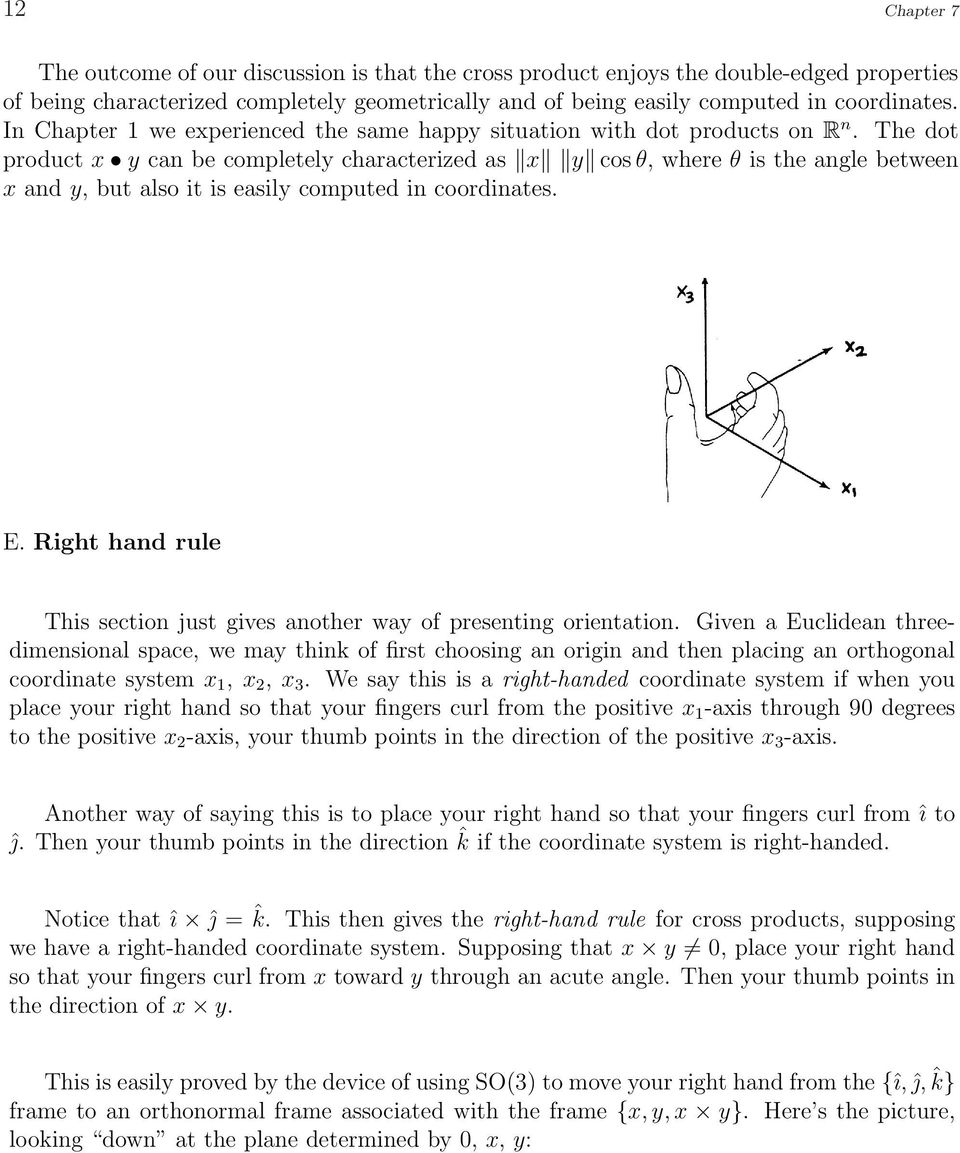
13 Cross product 13 y y O x x Let x = x/ x, and let y be the unit vector shown: Thus y = c 1 x + c 2 y, where c 2 > 0. Then y = y x y x y x y x. x y = c 2 x y = c 2 x x y. Thus x y is a positive scalar multiple of x y. Now define the matrix A in terms of its columns, A = (x y x y ). Then Aî = x, Aĵ = y, Aˆk = x y. And we know A SO(3). Thus A takes the righthanded frame {î, ĵ, ˆk} to the right-handed frame {x, y, x y }. This concludes the proof of the right-hand rule. F. What is SO(3)? This seems to be a good place to discuss the fine details of SO(3), the special orthogonal group on R 3. The members of this group are of course 3 3 orthogonal matrices with determinants equal to 1. Let A SO(3). This matrix of course acts on R 3 by matrix multiplication, sending column vectors x to the column vectors Ax. We are going to prove that this action can be described as an ordinary rotation of R 3 about an axis. We first pause to describe rotations. Suppose that ŵ is a fixed unit vector in R 3, and that θ is a fixed angle. We use the standard right-handed orientation for R 3. Now we take a view of R 3 looking from ŵ towards 0, and rotate the entire space counter-clockwise about the axis ŵ through the angle θ. Let us call the resulting matrix R(ŵ, θ). A couple of things should be noticed. One is that a counter-clockwise rotation with a negative angle θ is actually a
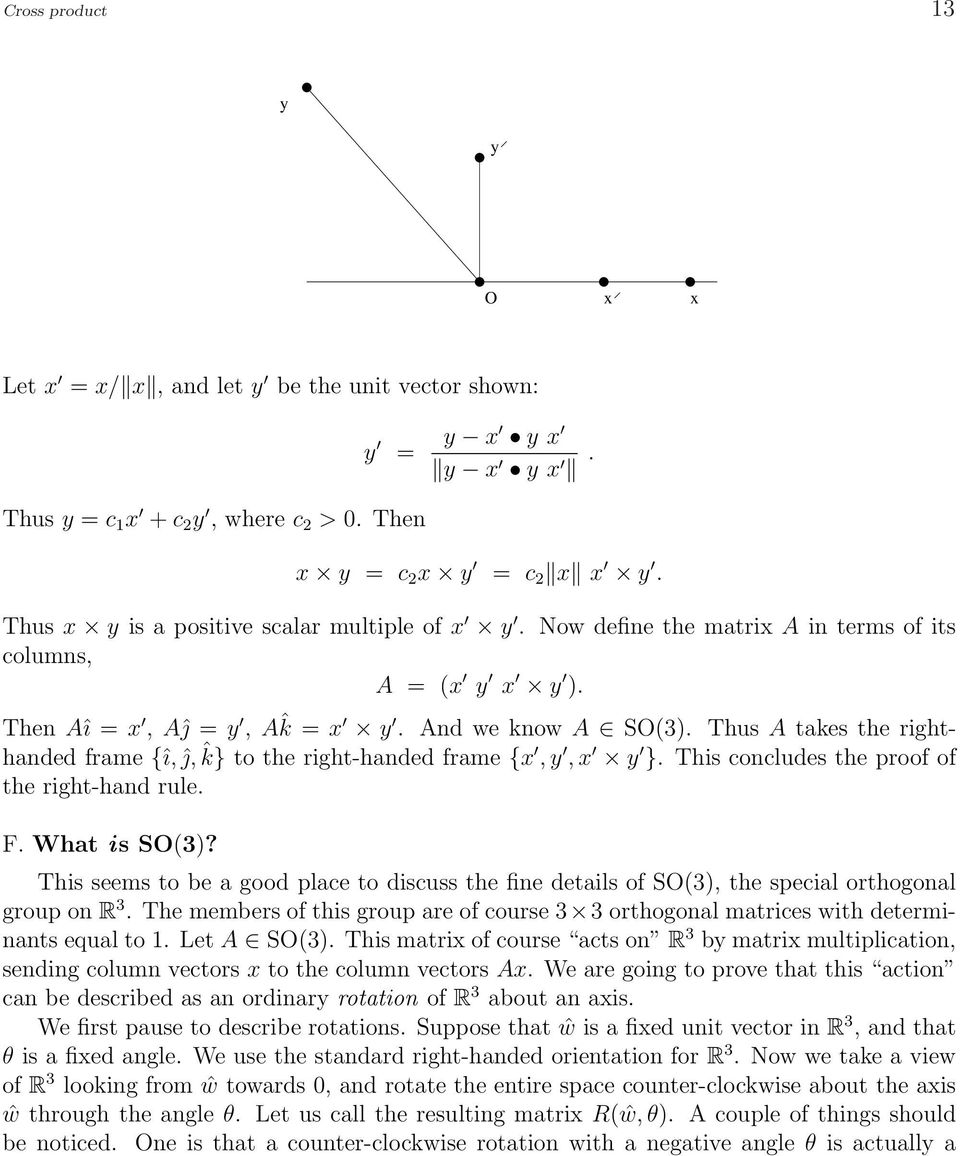
14 14 Chapter 7 clockwise rotation with the positive angle θ. The other is that adding any integer multiple of 2π to θ results in the same rotation, according to our convention here. Now we show how to calculate R(ŵ, θ). To do this use a right-handed orthonormal frame {û, ˆv, ŵ}. This can be computed by choosing any unit vector û which is orthogonal to ŵ, and then ˆv is uniquely determined by the required formula ˆv = ŵ û. Now think of projecting R 3 orthogonally onto the û, ˆv plane, and then rotating through the angle θ. Here s the view looking down from ŵ: p v θ u R(w, ) p θ Thus we have Of course, since ŵ is the axis of rotation, R(ŵ, θ)û = û cos θ + ˆv sin θ, R(ŵ, θ)ˆv = û sin θ + ˆv cos θ. R(ŵ, θ)ŵ = ŵ. The summary of this information is expressed in terms of matrices as Therefore R(ŵ, θ)(û ˆv ŵ) = (û cos θ + ˆv sin θ û sin θ + ˆv cos θ ŵ) cos θ sin θ 0 = (û ˆv ŵ) sin θ cos θ cos θ sin θ 0 R(ŵ, θ) = (û ˆv ŵ) sin θ cos θ 0 (û ˆv ŵ) ( )

15 Cross product 15 Remember: the computation of the inverse of the orthogonal matrix (û ˆv ŵ) is just a matter of writing down its transpose û t ˆv t. ŵ t Based on our understanding of what R(ŵ, θ) is, we are certain that this formula does not really depend on the choice of û and ˆv. See Problem 7 16 for the explicit verification of this fact. You should notice that the inner matrix in the above formula is precisely R(ˆk, θ). So the formula displays how we are able to move from a rotation about the x 3 -axis to a rotation about the axis determined by ŵ. PROBLEM Prove that R(ŵ, θ) SO(3). PROBLEM Using the above formula, show directly that R(ŵ, 0) = I. Then give a heuristic explanation of this equation. PROBLEM Using the above formula, show directly that R( ŵ, θ) = R(ŵ, θ). Then give a heuristic explanation of this equation. Also explain why we may thus assume without loss of generality that 0 θ π. PROBLEM Using the above formula, calculate directly that R(ŵ, θ 1 )R(ŵ, θ 2 ) = R(ŵ, θ 1 + θ 2 ). Then give a heuristic explanation of this equation.

16 16 Chapter 7 PROBLEM Calculate the product and thus obtain from ( ) 0 w 3 w 2 R(ŵ, θ) = (cos θ)i + (1 cos θ)(w i w j ) + sin θ w 3 0 w 1. w 2 w 1 0 (This displays R(ŵ, θ) in a form that shows its independence of the choice of û and ˆv.) PROBLEM Show that the action of R(ŵ, θ) can also be expressed in the form R(ŵ, θ)x = (cos θ)x + (1 cos θ)(ŵ x)ŵ + (sin θ)ŵ x, for all x R 3. Do this two ways: a. by simply using Problem 7 16; b. by describing the action of R(ŵ, θ) geometrically. PROBLEM Prove that for all x ŵ = 0, R(ŵ, π)x = x. Give a geometric interpretation of this result. Conversely, suppose that for a given rotation there exists a nonzero x R 3 such that R(ŵ, θ)x = x. Prove that θ = π and x ŵ = 0. (Of course, θ could also be π + 2mπ for any integer m.) PROBLEM Prove that R(ŵ, θ) is a symmetric matrix θ = 0 or π.
17 Cross product 17 PROBLEM Backward Andy all his life has insisted upon using a left-handed coordinate system for R 3. What formula must he use for R(ŵ, θ) that is the analog of ours found in Problem 7 16? We now turn to the perhaps surprising converse of the above material, which states that the only matrices in SO(3) are rotations! The crucial background for this result is contained in the following THEOREM. Let A SO(n), where n is odd. Then 1 is an eigenvalue of A. PROOF. Since A 1 = A t, we have det(a I) = det(a AA t ) = det(a(i A t )) = det A det(i A t ) = det(i A t ) = det(i A) = ( 1) n det(a I). Since n is odd, det(a I) = 0. QED PROBLEM Give a different proof of this result for the case n = 3, based on the characteristic polynomial det(a λi) = λ 3 + αλ 2 + βλ + 1. PROBLEM A. Let A O(n), but A / SO(n). Prove that 1 is an eigenvalue of THEOREM. Let A SO(3). Then there exists a unit vector ŵ R 3 and 0 θ π such that A = R(ŵ, θ). PROOF. Since A SO(3), we know from the preceding theorem that 1 is an eigenvalue of A. Therefore, there exists a unit vector ŵ such that Aŵ = ŵ.
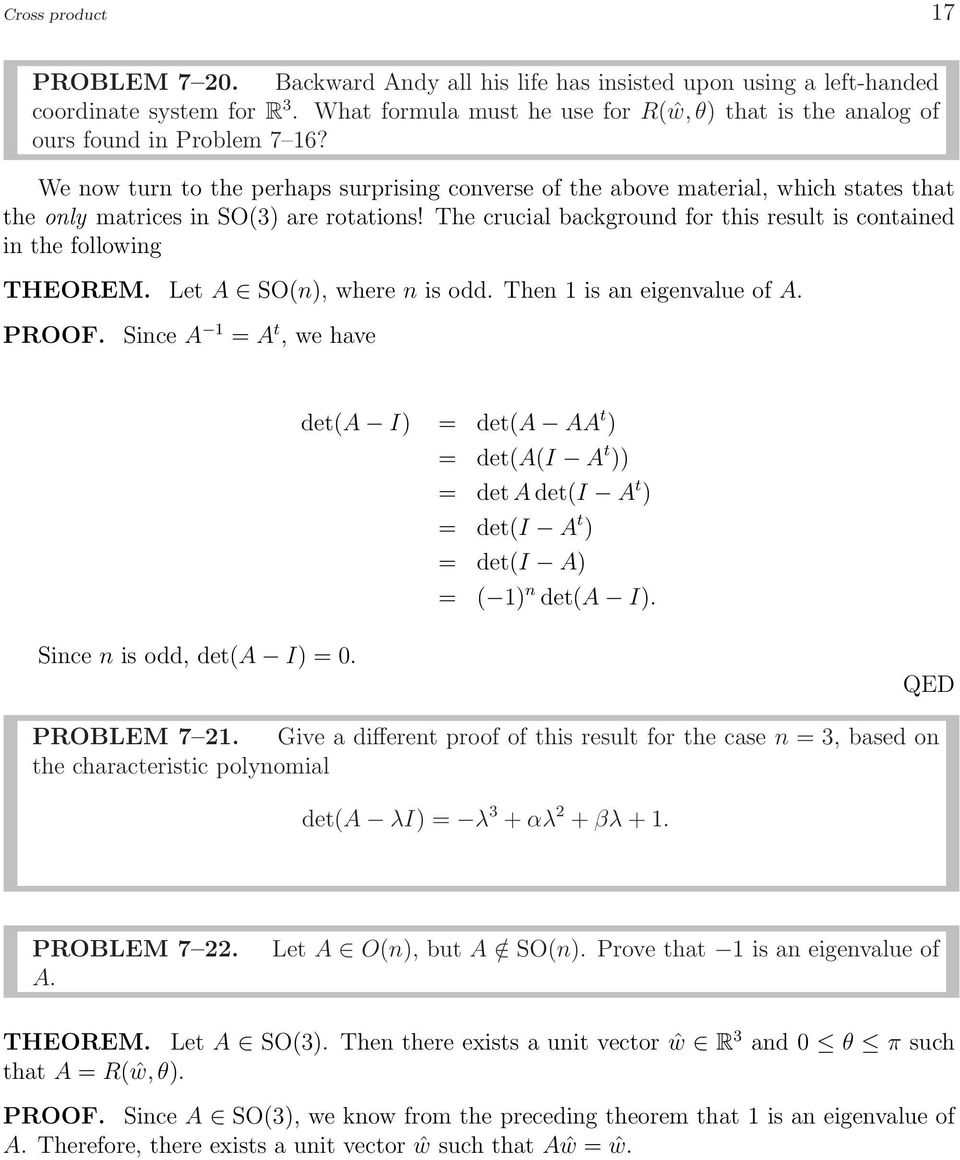
18 18 Chapter 7 Choose an orthonormal basis û, ˆv of the subspace of R 3 which is orthogonal to ŵ; arrange them so that the frame {û, ˆv, ŵ} has the standard orientation: Then ŵ = û ˆv, ˆv = ŵ û, û = ˆv ŵ. Aû ŵ = Aû Aŵ = û ŵ (A is in O(3)) = 0, so Aû is also orthogonal to ŵ. Thus Aû is a linear combination of û and ˆv: Aû = c 1 û + c 2ˆv. Since Aû = û = 1, c c 2 2 = 1. Thus there exists an angle θ such that c 1 = cos θ, c 2 = sin θ. That is, We conclude that Aû = û cos θ + ˆv sin θ. Aˆv = A(ŵ û) = Aŵ Aû (Section D) = ŵ (û cos θ + ˆv sin θ) = ˆv cos θ û sin θ. We now see that A and the rotation R(ŵ, θ) produce the same result on the frame {û, ˆv, ŵ}! Since every x R 3 is a linear combination of û, ˆv, ŵ, we conclude that Ax = R(ŵ, θ)x for all x R 3. Thus A = R(ŵ, θ). The final item, that we may require 0 θ π, follows immediately from Problem QED

19 Cross product 19 DISCUSSION. For a given A SO(3), the representation A = R(ŵ, θ), where ŵ is a unit vector and 0 θ π, is virtually unique. To see this we start with the result of Problem 7 16, and compute the trace of each matrix: tracea = 3 cos θ + (1 cos θ)(w w w 2 3) = 3 cos θ + (1 cos θ) = 2 cos θ + 1. Thus cos θ = tracea 1. 2 Therefore, as 0 θ π, the angle is completely determined by the knowledge of tracea. Next notice that Problem 7 16 implies 0 w 3 w 2 A A t = 2 sin θ w 3 0 w 1. w 2 w 1 0 We conclude immediately that if 0 < θ < π, the vector w is also uniquely determined. The only cases of nonuniqueness are thus when sin θ = 0, or, equivalently, A = A t. If θ = 0, then A = R(ŵ, 0) = I and the axis ŵ is irrelevant. If θ = π, then we have A = I + 2(w i w j ). It is easy to check in this case that ŵ is uniquely determined up to sign. This is because ŵ 0 and so some coordinate w j 0 and we obtain from the above equation 2w j ŵ = j th column of (A + I). This determines ŵ up to a scalar factor, and the fact that ŵ = 1 shows that the only possibilities are ŵ and ŵ. We now have a truly intuitive understanding of SO(3). In particular, the right-hand rule makes wonderful sense in this context, as we now explain. Suppose { ˆϕ 1, ˆϕ 2, ˆϕ 3 } is an arbitrary orthonormal frame with standard orientation, and form the usual matrix Φ with those columns, Φ = ( ˆϕ 1 ˆϕ 2 ˆϕ 3 ). Then Φ SO(3) and Φ 1 maps the frame { ˆϕ 1, ˆϕ 2, ˆϕ 3 } to {î, ĵ, ˆk}. Moreover, Φ is a rotation R(ŵ, θ). Thus if you place your right hand to lie in the correct ˆk = î ĵ position, then rotating your hand with R(ŵ, θ) produces the ˆϕ 3 = ˆϕ 1 ˆϕ 2 position.

20 20 Chapter 7 I would say it is almost amazing that a single rotation can move { ˆϕ 1, ˆϕ 2, ˆϕ 3 } to {î, ĵ, ˆk}! Here is a numerical example. Let A = Clearly, A SO(3). Then we compute tracea = 0, so that cos θ = 1 and we have θ = 2π/3. 2 Then 0 w 3 w 2 A A t = 2 sin θ w 3 0 w 1 w 2 w 1 0 becomes the equation = 0 w 3 w 2 3 w 3 0 w 1, w 2 w 1 0 so we read off immediately that ŵ = Thus = R(ŵ, 2π/3) PROBLEM Let A = Find ŵ and θ such that A = R(ŵ, θ). PROBLEM Compute R(ŵ, θ) 1 = R(?,?).
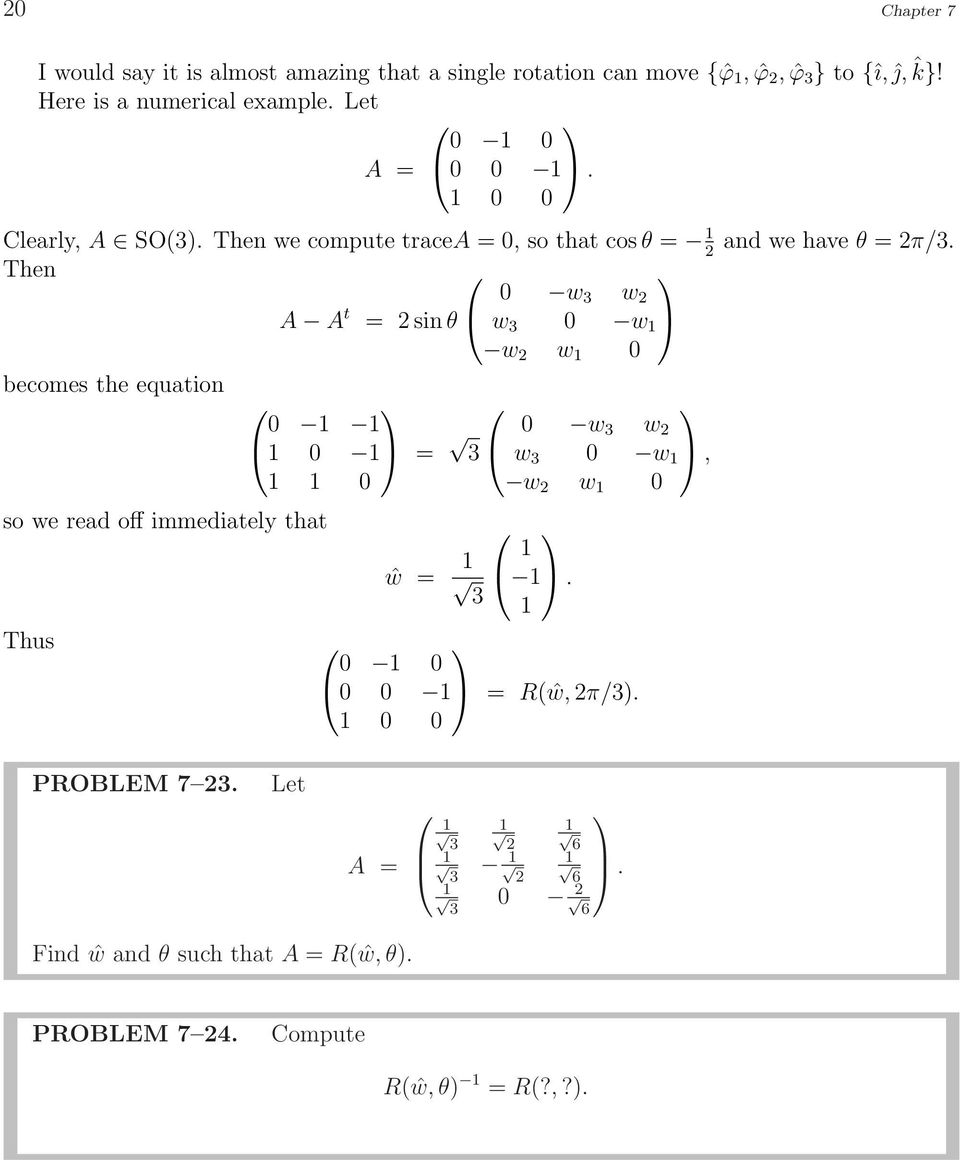
21 Cross product 21 PROBLEM Show that the given matrix is in SO(3) and calculate the unique ŵ R 3 and 0 θ π for it: G. Orientation reversal It is a relatively easy task to understand those matrices in O(n) which are not in SO(n). Suppose A is such a matrix. Of course, det A = 1. We conclude from Problem 7 22 that 1 is an eigenvalue of A. Therefore, there exists a unit vector ŵ: Aŵ = ŵ. Any unit vector ŵ can be used to define a reflection matrix S in that direction. Here s a schematic description: w x O Sx The algebra is governed by (Sx + x) ŵ = 0, Sx = x + tŵ for some t R. Solving these equations gives t = 2x ŵ so that Sx = x 2(x ŵ)ŵ.
22 22 Chapter 7 This matrix S is called reflection in the direction ŵ, and we denote it S(ŵ). PROBLEM Prove that the matrix S = S(ŵ) satisfies a. Sŵ = ŵ, b. S 2 = I, c. S O(n), d. det S = 1. PROBLEM Prove that Sŵ = I 2(w i w j ). Now we return to the situation of a matrix A O(n) with det A = 1. We know from Problem 7 22 that there is a unit vector ŵ satisfying Aŵ = ŵ. Now just define B = S(ŵ)A. Clearly, B SO(n). Thus, A = S(ŵ)B. Thus A is the product of a reflection S(ŵ) in a direction ŵ and a matrix B SO(n) with Bŵ = ŵ. PROBLEM It made no difference whether we chose to write B = SA or B = AS, for SA = AS. Prove this by noting that SAŵ = ASŵ and then considering those vectors x which are orthogonal to ŵ. In particular, for n = 3 the matrix A has the representation A = S(ŵ)R(ŵ, θ) = R(ŵ, θ)s(ŵ). PROBLEM Show that in this n = 3 situation 0 w 3 w 2 A = (cos θ)i (1 + cos θ)(w i w j ) + sin θ w 3 0 w 1. w 2 w 1 0
23 Cross product 23 PROBLEM Show that in case n = 2 every matrix A O(2) with det A = 1 is equal to a reflection matrix S(ŵ). PROBLEM Refer back to inversion in the unit sphere in R n, p. 6 34: f(x) = x x 2. Prove that Df(x) = x 2 S ( ) x. x Thus we say that inversion in the unit sphere is an orientation reversing conformal mapping. PROBLEM vectors in R 3. Let u, v be linearly independent vectors in R 3 and let u, v also be a. Suppose that A SO(3) satisfies Au = u, Av = v. Prove that u and v are linearly independent and u = u, v = v, u v = u v. ( ) b. Conversely, suppose that ( ) is satisfied. Prove that u and v are linearly independent, and that there exists a unique A SO(3) such that (HINT: A(u v u v) = (u v u v ).) Au = u, Av = v.
24 24 Chapter 7 PROBLEM Under the assumptions of the preceding problem prove that (u v u v) 1 = u v 2 (v (u v) u (u v) u v) t.
Section 1.1. Introduction to R n
 The Calculus of Functions of Several Variables Section. Introduction to R n Calculus is the study of functional relationships and how related quantities change with each other. In your first exposure to
Adding vectors We can do arithmetic with vectors. We ll start with vector addition and related operations. Suppose you have two vectors
 1 Chapter 13. VECTORS IN THREE DIMENSIONAL SPACE Let s begin with some names and notation for things: R is the set (collection) of real numbers. We write x R to mean that x is a real number. A real number
Inner Product Spaces and Orthogonality
 Inner Product Spaces and Orthogonality week 3-4 Fall 2006 Dot product of R n The inner product or dot product of R n is a function, defined by u, v a b + a 2 b 2 + + a n b n for u a, a 2,, a n T, v b,
v 1 v 3 u v = (( 1)4 (3)2, [1(4) ( 2)2], 1(3) ( 2)( 1)) = ( 10, 8, 1) (d) u (v w) = (u w)v (u v)w (Relationship between dot and cross product)
![v 1 v 3 u v = (( 1)4 (3)2, [1(4) ( 2)2], 1(3) ( 2)( 1)) = ( 10, 8, 1) (d) u (v w) = (u w)v (u v)w (Relationship between dot and cross product)](/thumbs/40/20880945.jpg "v 1 v 3 u v = (( 1)4 (3)2, [1(4) ( 2)2], 1(3) ( 2)( 1)) = ( 10, 8, 1) (d) u (v w) = (u w)v (u v)w (Relationship between dot and cross product)") 0.1 Cross Product The dot product of two vectors is a scalar, a number in R. Next we will define the cross product of two vectors in 3-space. This time the outcome will be a vector in 3-space. Definition
0.1 Cross Product The dot product of two vectors is a scalar, a number in R. Next we will define the cross product of two vectors in 3-space. This time the outcome will be a vector in 3-space. Definition
3. INNER PRODUCT SPACES
 . INNER PRODUCT SPACES.. Definition So far we have studied abstract vector spaces. These are a generalisation of the geometric spaces R and R. But these have more structure than just that of a vector space.
Chapter 17. Orthogonal Matrices and Symmetries of Space
 Chapter 17. Orthogonal Matrices and Symmetries of Space Take a random matrix, say 1 3 A = 4 5 6, 7 8 9 and compare the lengths of e 1 and Ae 1. The vector e 1 has length 1, while Ae 1 = (1, 4, 7) has length
Recall the basic property of the transpose (for any A): v A t Aw = v w, v, w R n.
 ORTHOGONAL MATRICES Informally, an orthogonal n n matrix is the n-dimensional analogue of the rotation matrices R θ in R 2. When does a linear transformation of R 3 (or R n ) deserve to be called a rotation?
α = u v. In other words, Orthogonal Projection
 Orthogonal Projection Given any nonzero vector v, it is possible to decompose an arbitrary vector u into a component that points in the direction of v and one that points in a direction orthogonal to v
Lectures notes on orthogonal matrices (with exercises) 92.222 - Linear Algebra II - Spring 2004 by D. Klain
 Lectures notes on orthogonal matrices (with exercises) 92.222 - Linear Algebra II - Spring 2004 by D. Klain 1. Orthogonal matrices and orthonormal sets An n n real-valued matrix A is said to be an orthogonal
Similarity and Diagonalization. Similar Matrices
 MATH022 Linear Algebra Brief lecture notes 48 Similarity and Diagonalization Similar Matrices Let A and B be n n matrices. We say that A is similar to B if there is an invertible n n matrix P such that
ISOMETRIES OF R n KEITH CONRAD
 ISOMETRIES OF R n KEITH CONRAD 1. Introduction An isometry of R n is a function h: R n R n that preserves the distance between vectors: h(v) h(w) = v w for all v and w in R n, where (x 1,..., x n ) = x
Orthogonal Projections
 Orthogonal Projections and Reflections (with exercises) by D. Klain Version.. Corrections and comments are welcome! Orthogonal Projections Let X,..., X k be a family of linearly independent (column) vectors
13 MATH FACTS 101. 2 a = 1. 7. The elements of a vector have a graphical interpretation, which is particularly easy to see in two or three dimensions.
 3 MATH FACTS 0 3 MATH FACTS 3. Vectors 3.. Definition We use the overhead arrow to denote a column vector, i.e., a linear segment with a direction. For example, in three-space, we write a vector in terms
Linear Algebra Notes for Marsden and Tromba Vector Calculus
 Linear Algebra Notes for Marsden and Tromba Vector Calculus n-dimensional Euclidean Space and Matrices Definition of n space As was learned in Math b, a point in Euclidean three space can be thought of
Mathematics Course 111: Algebra I Part IV: Vector Spaces
 Mathematics Course 111: Algebra I Part IV: Vector Spaces D. R. Wilkins Academic Year 1996-7 9 Vector Spaces A vector space over some field K is an algebraic structure consisting of a set V on which are
1 VECTOR SPACES AND SUBSPACES
 1 VECTOR SPACES AND SUBSPACES What is a vector? Many are familiar with the concept of a vector as: Something which has magnitude and direction. an ordered pair or triple. a description for quantities such
Math 241, Exam 1 Information.
 Math 241, Exam 1 Information. 9/24/12, LC 310, 11:15-12:05. Exam 1 will be based on: Sections 12.1-12.5, 14.1-14.3. The corresponding assigned homework problems (see http://www.math.sc.edu/ boylan/sccourses/241fa12/241.html)
13.4 THE CROSS PRODUCT
 710 Chapter Thirteen A FUNDAMENTAL TOOL: VECTORS 62. Use the following steps and the results of Problems 59 60 to show (without trigonometry) that the geometric and algebraic definitions of the dot product
Cross product and determinants (Sect. 12.4) Two main ways to introduce the cross product
 Cross product and determinants (Sect. 12.4) Two main ways to introduce the cross product Geometrical definition Properties Expression in components. Definition in components Properties Geometrical expression.
11.1. Objectives. Component Form of a Vector. Component Form of a Vector. Component Form of a Vector. Vectors and the Geometry of Space
 11 Vectors and the Geometry of Space 11.1 Vectors in the Plane Copyright Cengage Learning. All rights reserved. Copyright Cengage Learning. All rights reserved. 2 Objectives! Write the component form of
5.3 The Cross Product in R 3
 53 The Cross Product in R 3 Definition 531 Let u = [u 1, u 2, u 3 ] and v = [v 1, v 2, v 3 ] Then the vector given by [u 2 v 3 u 3 v 2, u 3 v 1 u 1 v 3, u 1 v 2 u 2 v 1 ] is called the cross product (or
LINEAR ALGEBRA. September 23, 2010
 LINEAR ALGEBRA September 3, 00 Contents 0. LU-decomposition.................................... 0. Inverses and Transposes................................. 0.3 Column Spaces and NullSpaces.............................
December 4, 2013 MATH 171 BASIC LINEAR ALGEBRA B. KITCHENS
 December 4, 2013 MATH 171 BASIC LINEAR ALGEBRA B KITCHENS The equation 1 Lines in two-dimensional space (1) 2x y = 3 describes a line in two-dimensional space The coefficients of x and y in the equation
Vector Math Computer Graphics Scott D. Anderson
 Vector Math Computer Graphics Scott D. Anderson 1 Dot Product The notation v w means the dot product or scalar product or inner product of two vectors, v and w. In abstract mathematics, we can talk about
Chapter 6. Orthogonality
 6.3 Orthogonal Matrices 1 Chapter 6. Orthogonality 6.3 Orthogonal Matrices Definition 6.4. An n n matrix A is orthogonal if A T A = I. Note. We will see that the columns of an orthogonal matrix must be
Recall that two vectors in are perpendicular or orthogonal provided that their dot
 Orthogonal Complements and Projections Recall that two vectors in are perpendicular or orthogonal provided that their dot product vanishes That is, if and only if Example 1 The vectors in are orthogonal
v w is orthogonal to both v and w. the three vectors v, w and v w form a right-handed set of vectors.
 3. Cross product Definition 3.1. Let v and w be two vectors in R 3. The cross product of v and w, denoted v w, is the vector defined as follows: the length of v w is the area of the parallelogram with
LINEAR ALGEBRA W W L CHEN
 LINEAR ALGEBRA W W L CHEN c W W L Chen, 1997, 2008 This chapter is available free to all individuals, on understanding that it is not to be used for financial gain, and may be downloaded and/or photocopied,
Math 312 Homework 1 Solutions
 Math 31 Homework 1 Solutions Last modified: July 15, 01 This homework is due on Thursday, July 1th, 01 at 1:10pm Please turn it in during class, or in my mailbox in the main math office (next to 4W1) Please
THREE DIMENSIONAL GEOMETRY
 Chapter 8 THREE DIMENSIONAL GEOMETRY 8.1 Introduction In this chapter we present a vector algebra approach to three dimensional geometry. The aim is to present standard properties of lines and planes,
Dot product and vector projections (Sect. 12.3) There are two main ways to introduce the dot product
 Dot product and vector projections (Sect. 12.3) Two definitions for the dot product. Geometric definition of dot product. Orthogonal vectors. Dot product and orthogonal projections. Properties of the dot
Linear Algebra Review. Vectors
 Linear Algebra Review By Tim K. Marks UCSD Borrows heavily from: Jana Kosecka [email protected] http://cs.gmu.edu/~kosecka/cs682.html Virginia de Sa Cogsci 8F Linear Algebra review UCSD Vectors The length
Geometry of Vectors. 1 Cartesian Coordinates. Carlo Tomasi
 Geometry of Vectors Carlo Tomasi This note explores the geometric meaning of norm, inner product, orthogonality, and projection for vectors. For vectors in three-dimensional space, we also examine the
1 Sets and Set Notation.
 LINEAR ALGEBRA MATH 27.6 SPRING 23 (COHEN) LECTURE NOTES Sets and Set Notation. Definition (Naive Definition of a Set). A set is any collection of objects, called the elements of that set. We will most
Numerical Analysis Lecture Notes
 Numerical Analysis Lecture Notes Peter J. Olver 5. Inner Products and Norms The norm of a vector is a measure of its size. Besides the familiar Euclidean norm based on the dot product, there are a number
Math 215 HW #6 Solutions
 Math 5 HW #6 Solutions Problem 34 Show that x y is orthogonal to x + y if and only if x = y Proof First, suppose x y is orthogonal to x + y Then since x, y = y, x In other words, = x y, x + y = (x y) T
Lecture L3 - Vectors, Matrices and Coordinate Transformations
 S. Widnall 16.07 Dynamics Fall 2009 Lecture notes based on J. Peraire Version 2.0 Lecture L3 - Vectors, Matrices and Coordinate Transformations By using vectors and defining appropriate operations between
Notes on Orthogonal and Symmetric Matrices MENU, Winter 2013
 Notes on Orthogonal and Symmetric Matrices MENU, Winter 201 These notes summarize the main properties and uses of orthogonal and symmetric matrices. We covered quite a bit of material regarding these topics,
Eigenvalues and Eigenvectors
 Chapter 6 Eigenvalues and Eigenvectors 6. Introduction to Eigenvalues Linear equations Ax D b come from steady state problems. Eigenvalues have their greatest importance in dynamic problems. The solution
MATRIX ALGEBRA AND SYSTEMS OF EQUATIONS
 MATRIX ALGEBRA AND SYSTEMS OF EQUATIONS Systems of Equations and Matrices Representation of a linear system The general system of m equations in n unknowns can be written a x + a 2 x 2 + + a n x n b a
The Characteristic Polynomial
 Physics 116A Winter 2011 The Characteristic Polynomial 1 Coefficients of the characteristic polynomial Consider the eigenvalue problem for an n n matrix A, A v = λ v, v 0 (1) The solution to this problem
Inner products on R n, and more
 Inner products on R n, and more Peyam Ryan Tabrizian Friday, April 12th, 2013 1 Introduction You might be wondering: Are there inner products on R n that are not the usual dot product x y = x 1 y 1 + +
1 Introduction to Matrices
 1 Introduction to Matrices In this section, important definitions and results from matrix algebra that are useful in regression analysis are introduced. While all statements below regarding the columns
CS3220 Lecture Notes: QR factorization and orthogonal transformations
 CS3220 Lecture Notes: QR factorization and orthogonal transformations Steve Marschner Cornell University 11 March 2009 In this lecture I ll talk about orthogonal matrices and their properties, discuss
1 2 3 1 1 2 x = + x 2 + x 4 1 0 1
 (d) If the vector b is the sum of the four columns of A, write down the complete solution to Ax = b. 1 2 3 1 1 2 x = + x 2 + x 4 1 0 0 1 0 1 2. (11 points) This problem finds the curve y = C + D 2 t which
MAT 1341: REVIEW II SANGHOON BAEK
 MAT 1341: REVIEW II SANGHOON BAEK 1. Projections and Cross Product 1.1. Projections. Definition 1.1. Given a vector u, the rectangular (or perpendicular or orthogonal) components are two vectors u 1 and
Orthogonal Projections and Orthonormal Bases
 CS 3, HANDOUT -A, 3 November 04 (adjusted on 7 November 04) Orthogonal Projections and Orthonormal Bases (continuation of Handout 07 of 6 September 04) Definition (Orthogonality, length, unit vectors).
Linear algebra and the geometry of quadratic equations. Similarity transformations and orthogonal matrices
 MATH 30 Differential Equations Spring 006 Linear algebra and the geometry of quadratic equations Similarity transformations and orthogonal matrices First, some things to recall from linear algebra Two
Inner product. Definition of inner product
 Math 20F Linear Algebra Lecture 25 1 Inner product Review: Definition of inner product. Slide 1 Norm and distance. Orthogonal vectors. Orthogonal complement. Orthogonal basis. Definition of inner product
Unified Lecture # 4 Vectors
 Fall 2005 Unified Lecture # 4 Vectors These notes were written by J. Peraire as a review of vectors for Dynamics 16.07. They have been adapted for Unified Engineering by R. Radovitzky. References [1] Feynmann,
Vector Algebra CHAPTER 13. Ü13.1. Basic Concepts
 CHAPTER 13 ector Algebra Ü13.1. Basic Concepts A vector in the plane or in space is an arrow: it is determined by its length, denoted and its direction. Two arrows represent the same vector if they have
MAT 200, Midterm Exam Solution. a. (5 points) Compute the determinant of the matrix A =
 MAT 200, Midterm Exam Solution. (0 points total) a. (5 points) Compute the determinant of the matrix 2 2 0 A = 0 3 0 3 0 Answer: det A = 3. The most efficient way is to develop the determinant along the
Section 1.4. Lines, Planes, and Hyperplanes. The Calculus of Functions of Several Variables
 The Calculus of Functions of Several Variables Section 1.4 Lines, Planes, Hyperplanes In this section we will add to our basic geometric understing of R n by studying lines planes. If we do this carefully,
Au = = = 3u. Aw = = = 2w. so the action of A on u and w is very easy to picture: it simply amounts to a stretching by 3 and 2, respectively.
 Chapter 7 Eigenvalues and Eigenvectors In this last chapter of our exploration of Linear Algebra we will revisit eigenvalues and eigenvectors of matrices, concepts that were already introduced in Geometry
5. Orthogonal matrices
 L Vandenberghe EE133A (Spring 2016) 5 Orthogonal matrices matrices with orthonormal columns orthogonal matrices tall matrices with orthonormal columns complex matrices with orthonormal columns 5-1 Orthonormal
( ) which must be a vector
 MATH 37 Linear Transformations from Rn to Rm Dr. Neal, WKU Let T : R n R m be a function which maps vectors from R n to R m. Then T is called a linear transformation if the following two properties are
A QUICK GUIDE TO THE FORMULAS OF MULTIVARIABLE CALCULUS
 A QUIK GUIDE TO THE FOMULAS OF MULTIVAIABLE ALULUS ontents 1. Analytic Geometry 2 1.1. Definition of a Vector 2 1.2. Scalar Product 2 1.3. Properties of the Scalar Product 2 1.4. Length and Unit Vectors
Lecture 1: Schur s Unitary Triangularization Theorem
 Lecture 1: Schur s Unitary Triangularization Theorem This lecture introduces the notion of unitary equivalence and presents Schur s theorem and some of its consequences It roughly corresponds to Sections
Problem Set 5 Due: In class Thursday, Oct. 18 Late papers will be accepted until 1:00 PM Friday.
 Math 312, Fall 2012 Jerry L. Kazdan Problem Set 5 Due: In class Thursday, Oct. 18 Late papers will be accepted until 1:00 PM Friday. In addition to the problems below, you should also know how to solve
[1] Diagonal factorization
![[1] Diagonal factorization](/thumbs/40/21671034.jpg "[1] Diagonal factorization") 8.03 LA.6: Diagonalization and Orthogonal Matrices [ Diagonal factorization [2 Solving systems of first order differential equations [3 Symmetric and Orthonormal Matrices [ Diagonal factorization Recall:
8.03 LA.6: Diagonalization and Orthogonal Matrices [ Diagonal factorization [2 Solving systems of first order differential equations [3 Symmetric and Orthonormal Matrices [ Diagonal factorization Recall:
Geometric description of the cross product of the vectors u and v. The cross product of two vectors is a vector! u x v is perpendicular to u and v
 12.4 Cross Product Geometric description of the cross product of the vectors u and v The cross product of two vectors is a vector! u x v is perpendicular to u and v The length of u x v is uv u v sin The
CONTROLLABILITY. Chapter 2. 2.1 Reachable Set and Controllability. Suppose we have a linear system described by the state equation
 Chapter 2 CONTROLLABILITY 2 Reachable Set and Controllability Suppose we have a linear system described by the state equation ẋ Ax + Bu (2) x() x Consider the following problem For a given vector x in
MAT188H1S Lec0101 Burbulla
 Winter 206 Linear Transformations A linear transformation T : R m R n is a function that takes vectors in R m to vectors in R n such that and T (u + v) T (u) + T (v) T (k v) k T (v), for all vectors u
Lecture 14: Section 3.3
 Lecture 14: Section 3.3 Shuanglin Shao October 23, 2013 Definition. Two nonzero vectors u and v in R n are said to be orthogonal (or perpendicular) if u v = 0. We will also agree that the zero vector in
3 Orthogonal Vectors and Matrices
 3 Orthogonal Vectors and Matrices The linear algebra portion of this course focuses on three matrix factorizations: QR factorization, singular valued decomposition (SVD), and LU factorization The first
Notes on Symmetric Matrices
 CPSC 536N: Randomized Algorithms 2011-12 Term 2 Notes on Symmetric Matrices Prof. Nick Harvey University of British Columbia 1 Symmetric Matrices We review some basic results concerning symmetric matrices.
MATRIX ALGEBRA AND SYSTEMS OF EQUATIONS. + + x 2. x n. a 11 a 12 a 1n b 1 a 21 a 22 a 2n b 2 a 31 a 32 a 3n b 3. a m1 a m2 a mn b m
 MATRIX ALGEBRA AND SYSTEMS OF EQUATIONS 1. SYSTEMS OF EQUATIONS AND MATRICES 1.1. Representation of a linear system. The general system of m equations in n unknowns can be written a 11 x 1 + a 12 x 2 +
28 CHAPTER 1. VECTORS AND THE GEOMETRY OF SPACE. v x. u y v z u z v y u y u z. v y v z
 28 CHAPTER 1. VECTORS AND THE GEOMETRY OF SPACE 1.4 Cross Product 1.4.1 Definitions The cross product is the second multiplication operation between vectors we will study. The goal behind the definition
26. Determinants I. 1. Prehistory
 26. Determinants I 26.1 Prehistory 26.2 Definitions 26.3 Uniqueness and other properties 26.4 Existence Both as a careful review of a more pedestrian viewpoint, and as a transition to a coordinate-independent
Inner Product Spaces
 Math 571 Inner Product Spaces 1. Preliminaries An inner product space is a vector space V along with a function, called an inner product which associates each pair of vectors u, v with a scalar u, v, and
3. Let A and B be two n n orthogonal matrices. Then prove that AB and BA are both orthogonal matrices. Prove a similar result for unitary matrices.
 Exercise 1 1. Let A be an n n orthogonal matrix. Then prove that (a) the rows of A form an orthonormal basis of R n. (b) the columns of A form an orthonormal basis of R n. (c) for any two vectors x,y R
State of Stress at Point
 State of Stress at Point Einstein Notation The basic idea of Einstein notation is that a covector and a vector can form a scalar: This is typically written as an explicit sum: According to this convention,
Orthogonal Diagonalization of Symmetric Matrices
 MATH10212 Linear Algebra Brief lecture notes 57 Gram Schmidt Process enables us to find an orthogonal basis of a subspace. Let u 1,..., u k be a basis of a subspace V of R n. We begin the process of finding
Vectors 2. The METRIC Project, Imperial College. Imperial College of Science Technology and Medicine, 1996.
 Vectors 2 The METRIC Project, Imperial College. Imperial College of Science Technology and Medicine, 1996. Launch Mathematica. Type
The Matrix Elements of a 3 3 Orthogonal Matrix Revisited
 Physics 116A Winter 2011 The Matrix Elements of a 3 3 Orthogonal Matrix Revisited 1. Introduction In a class handout entitled, Three-Dimensional Proper and Improper Rotation Matrices, I provided a derivation
Chapter 6. Linear Transformation. 6.1 Intro. to Linear Transformation
 Chapter 6 Linear Transformation 6 Intro to Linear Transformation Homework: Textbook, 6 Ex, 5, 9,, 5,, 7, 9,5, 55, 57, 6(a,b), 6; page 7- In this section, we discuss linear transformations 89 9 CHAPTER
x + y + z = 1 2x + 3y + 4z = 0 5x + 6y + 7z = 3
 Math 24 FINAL EXAM (2/9/9 - SOLUTIONS ( Find the general solution to the system of equations 2 4 5 6 7 ( r 2 2r r 2 r 5r r x + y + z 2x + y + 4z 5x + 6y + 7z 2 2 2 2 So x z + y 2z 2 and z is free. ( r
Grassmann Algebra in Game Development. Eric Lengyel, PhD Terathon Software
 Grassmann Algebra in Game Development Eric Lengyel, PhD Terathon Software Math used in 3D programming Dot / cross products, scalar triple product Planes as 4D vectors Homogeneous coordinates Plücker coordinates
Section 5.3. Section 5.3. u m ] l jj. = l jj u j + + l mj u m. v j = [ u 1 u j. l mj
![Section 5.3. Section 5.3. u m ] l jj. = l jj u j + + l mj u m. v j = [ u 1 u j. l mj](/thumbs/31/14930763.jpg "Section 5.3. Section 5.3. u m ] l jj. = l jj u j + + l mj u m. v j = [ u 1 u j. l mj") Section 5. l j v j = [ u u j u m ] l jj = l jj u j + + l mj u m. l mj Section 5. 5.. Not orthogonal, the column vectors fail to be perpendicular to each other. 5..2 his matrix is orthogonal. Check that
Section 5. l j v j = [ u u j u m ] l jj = l jj u j + + l mj u m. l mj Section 5. 5.. Not orthogonal, the column vectors fail to be perpendicular to each other. 5..2 his matrix is orthogonal. Check that
8 Square matrices continued: Determinants
 8 Square matrices continued: Determinants 8. Introduction Determinants give us important information about square matrices, and, as we ll soon see, are essential for the computation of eigenvalues. You
Lecture notes on linear algebra
 Lecture notes on linear algebra David Lerner Department of Mathematics University of Kansas These are notes of a course given in Fall, 2007 and 2008 to the Honors sections of our elementary linear algebra
MATH 304 Linear Algebra Lecture 18: Rank and nullity of a matrix.
 MATH 304 Linear Algebra Lecture 18: Rank and nullity of a matrix. Nullspace Let A = (a ij ) be an m n matrix. Definition. The nullspace of the matrix A, denoted N(A), is the set of all n-dimensional column
Linear Algebra Done Wrong. Sergei Treil. Department of Mathematics, Brown University
 Linear Algebra Done Wrong Sergei Treil Department of Mathematics, Brown University Copyright c Sergei Treil, 2004, 2009, 2011, 2014 Preface The title of the book sounds a bit mysterious. Why should anyone
Linear Algebra: Vectors
 A Linear Algebra: Vectors A Appendix A: LINEAR ALGEBRA: VECTORS TABLE OF CONTENTS Page A Motivation A 3 A2 Vectors A 3 A2 Notational Conventions A 4 A22 Visualization A 5 A23 Special Vectors A 5 A3 Vector
LINEAR ALGEBRA W W L CHEN
 LINEAR ALGEBRA W W L CHEN c W W L Chen, 1982, 2008. This chapter originates from material used by author at Imperial College, University of London, between 1981 and 1990. It is available free to all individuals,
Lecture 4: Partitioned Matrices and Determinants
 Lecture 4: Partitioned Matrices and Determinants 1 Elementary row operations Recall the elementary operations on the rows of a matrix, equivalent to premultiplying by an elementary matrix E: (1) multiplying
MATH 304 Linear Algebra Lecture 20: Inner product spaces. Orthogonal sets.
 MATH 304 Linear Algebra Lecture 20: Inner product spaces. Orthogonal sets. Norm The notion of norm generalizes the notion of length of a vector in R n. Definition. Let V be a vector space. A function α
Chapter 19. General Matrices. An n m matrix is an array. a 11 a 12 a 1m a 21 a 22 a 2m A = a n1 a n2 a nm. The matrix A has n row vectors
 Chapter 9. General Matrices An n m matrix is an array a a a m a a a m... = [a ij]. a n a n a nm The matrix A has n row vectors and m column vectors row i (A) = [a i, a i,..., a im ] R m a j a j a nj col
discuss how to describe points, lines and planes in 3 space.
 Chapter 2 3 Space: lines and planes In this chapter we discuss how to describe points, lines and planes in 3 space. introduce the language of vectors. discuss various matters concerning the relative position
Math 115A HW4 Solutions University of California, Los Angeles. 5 2i 6 + 4i. (5 2i)7i (6 + 4i)( 3 + i) = 35i + 14 ( 22 6i) = 36 + 41i.
 Math 5A HW4 Solutions September 5, 202 University of California, Los Angeles Problem 4..3b Calculate the determinant, 5 2i 6 + 4i 3 + i 7i Solution: The textbook s instructions give us, (5 2i)7i (6 + 4i)(
Equations Involving Lines and Planes Standard equations for lines in space
 Equations Involving Lines and Planes In this section we will collect various important formulas regarding equations of lines and planes in three dimensional space Reminder regarding notation: any quantity
15.062 Data Mining: Algorithms and Applications Matrix Math Review
 .6 Data Mining: Algorithms and Applications Matrix Math Review The purpose of this document is to give a brief review of selected linear algebra concepts that will be useful for the course and to develop
6. Vectors. 1 2009-2016 Scott Surgent ([email protected])
 6. Vectors For purposes of applications in calculus and physics, a vector has both a direction and a magnitude (length), and is usually represented as an arrow. The start of the arrow is the vector s foot,
Notes on Determinant
 ENGG2012B Advanced Engineering Mathematics Notes on Determinant Lecturer: Kenneth Shum Lecture 9-18/02/2013 The determinant of a system of linear equations determines whether the solution is unique, without
Linear Algebra Done Wrong. Sergei Treil. Department of Mathematics, Brown University
 Linear Algebra Done Wrong Sergei Treil Department of Mathematics, Brown University Copyright c Sergei Treil, 2004, 2009, 2011, 2014 Preface The title of the book sounds a bit mysterious. Why should anyone
MATH 551 - APPLIED MATRIX THEORY
 MATH 55 - APPLIED MATRIX THEORY FINAL TEST: SAMPLE with SOLUTIONS (25 points NAME: PROBLEM (3 points A web of 5 pages is described by a directed graph whose matrix is given by A Do the following ( points
1.3. DOT PRODUCT 19. 6. If θ is the angle (between 0 and π) between two non-zero vectors u and v,
 1.3. DOT PRODUCT 19 1.3 Dot Product 1.3.1 Definitions and Properties The dot product is the first way to multiply two vectors. The definition we will give below may appear arbitrary. But it is not. It
1 Symmetries of regular polyhedra
 1230, notes 5 1 Symmetries of regular polyhedra Symmetry groups Recall: Group axioms: Suppose that (G, ) is a group and a, b, c are elements of G. Then (i) a b G (ii) (a b) c = a (b c) (iii) There is an
NOTES ON LINEAR TRANSFORMATIONS
 NOTES ON LINEAR TRANSFORMATIONS Definition 1. Let V and W be vector spaces. A function T : V W is a linear transformation from V to W if the following two properties hold. i T v + v = T v + T v for all
AP Physics - Vector Algrebra Tutorial
 AP Physics - Vector Algrebra Tutorial Thomas Jefferson High School for Science and Technology AP Physics Team Summer 2013 1 CONTENTS CONTENTS Contents 1 Scalars and Vectors 3 2 Rectangular and Polar Form