
Best Management Practice Fact Sheet 7: Permeable Pavement
|
|
|
- James Merritt
- 10 years ago
- Views:
Transcription
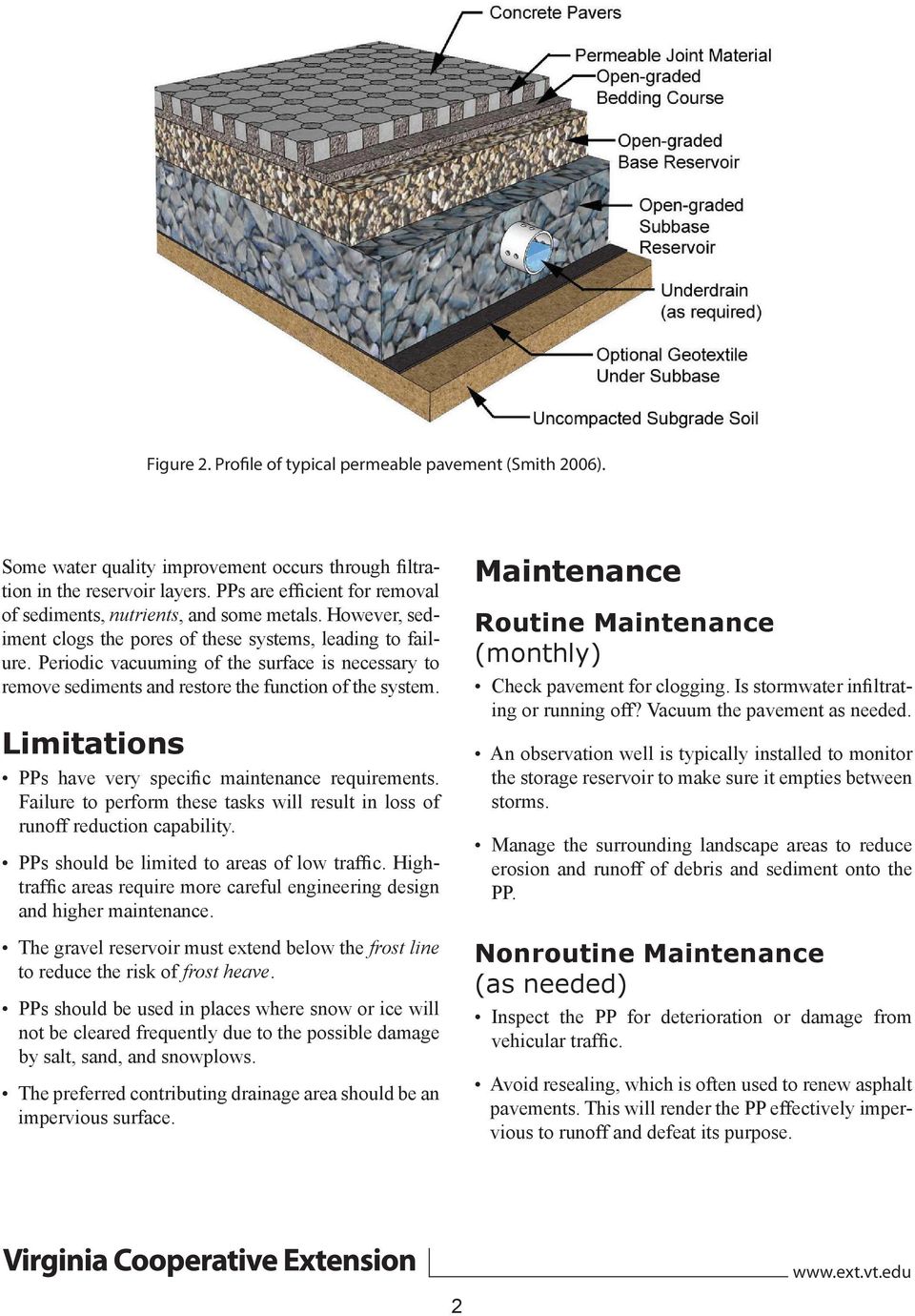
1 Publication Best Management Practice Fact Sheet 7: Permeable Pavement David J. Sample, Assistant Professor and Extension Specialist, Biological Systems Engineering, Virginia Tech Lia Doumar, Undergraduate Student, Biological Systems Engineering, Virginia Tech This fact sheet is one of a 15-part series on urban stormwater management practices. Please refer to definitions in the glossary at the end of this fact sheet. Glossary terms are italicized on first mention in the text. For a comprehensive list, see Virginia Cooperative Extension (VCE) publication , Urban Stormwater: Terms and Definitions. What Is Permeable Pavement? Permeable pavement (PP) is a modified form of asphalt or concrete with a top layer that is pervious to water due to voids intentionally created during mixing. PPs include pervious concrete, porous asphalt, and interlocking concrete pavers. These materials are used as stormwater treatment practices in urban areas. They are used in place of traditionally impervious surfaces to allow infiltration and storage, thus reducing runoff (see figure 1). Where Can Permeable Pavements Be Used? Permeable pavements can be used in a variety of urban settings. They are particularly suited for low-traffic-load areas, parking areas, overflow parking areas, and for pedestrian traffic areas. PP is also used on certain highways to prevent hydroplaning. As a general rule, the layers under PP should have an infiltration rate exceeding a half an inch per hour. PPs in high-traffic areas should be considered carefully. With more traffic, the pervious surface will receive increased wear, and is more likely to be clogged by sediment and need more frequent maintenance. In addition, high-traffic areas often have salt and sand applied to counter snow or ice. The salt can leach and cause groundwater contamination, and the sand can clog the pavement. Figure 1. Typical permeable pavement. Source: Wetland Studies and Solutions Inc., Gainesville, Va., Photo by D. Sample. How Does Permeable Pavement Work? These pavements consist of several layers, including the pervious top layer and underlying layers of gravel or stone that create a stormwater storage reservoir (see figure 2). The PP s depth and materials are determined by the amount of runoff storage and by concerns related to traffic. Permeable pavements provide stormwater management through temporary storage of runoff in the underground reservoir. Water leaves the reservoir by either infiltration or through an underdrain that discharged to a stormwater conveyance system. Produced by Communications and Marketing, College of Agriculture and Life Sciences, Virginia Polytechnic Institute and State University, 2013 Virginia Cooperative Extension programs and employment are open to all, regardless of race, color, national origin, sex, religion, age, disability, political beliefs, sexual orientation, genetic information, marital, family, or veteran status, or any other basis protected by law. An equal opportunity/affirmative action employer. Issued in furtherance of Cooperative Extension work, Virginia Polytechnic Institute and State University, Virginia State University, and the U.S. Department of Agriculture cooperating. Edwin J. Jones, Director, Virginia Cooperative Extension, Virginia Tech, Blacksburg; Jewel E. Hairston, Administrator, 1890 Extension Program, Virginia State, Petersburg. VT/0813/BSE-84P

2 Figure 2. Profile of typical permeable pavement (Smith 2006). Some water quality improvement occurs through filtration in the reservoir layers. PPs are efficient for removal of sediments, nutrients, and some metals. However, sediment clogs the pores of these systems, leading to failure. Periodic vacuuming of the surface is necessary to remove sediments and restore the function of the system. Limitations PPs have very specific maintenance requirements. Failure to perform these tasks will result in loss of runoff reduction capability. PPs should be limited to areas of low traffic. Hightraffic areas require more careful engineering design and higher maintenance. The gravel reservoir must extend below the frost line to reduce the risk of frost heave. PPs should be used in places where snow or ice will not be cleared frequently due to the possible damage by salt, sand, and snowplows. The preferred contributing drainage area should be an impervious surface. Maintenance Routine Maintenance (monthly) Check pavement for clogging. Is stormwater infiltrating or running off? Vacuum the pavement as needed. An observation well is typically installed to monitor the storage reservoir to make sure it empties between storms. Manage the surrounding landscape areas to reduce erosion and runoff of debris and sediment onto the PP. Nonroutine Maintenance (as needed) Inspect the PP for deterioration or damage from vehicular traffic. Avoid resealing, which is often used to renew asphalt pavements. This will render the PP effectively impervious to runoff and defeat its purpose. 2
3 Performance Permanent pavers are effective at removing multiple pollutants from stormwater runoff. A typical PP is expected to reduce total phosphorus (TP) and total nitrogen (TN) by approximately 60 percent on a mass load basis, accounting for the runoff reduction in the practice. In more advanced designs, the PP has more filtration layers to provide a longer residence time. Advanced PP designs can improve the reduction of TP and TN to 80 percent on a mass load basis, accounting for runoff reduction (VA-DCR 2011). Expected Cost PPs are relatively expensive stormwater treatment practices when compared to other alternatives. A preliminary estimate of the average cost of PPs to provide treatment for an acre of impervious surface is $45,000 to $100,000, depending on the specific system used. The annual maintenance cost depends on the increased frequency of vacuuming, which is based on individual site conditions and sweeping. Since PPs allow land to be used for alternative purposes, such as parking, the cost of land is not included in this analysis. Additional Information The Virginia departments of Conservation and Recreation (VA-DCR) and Environmental Quality (VA- DEQ) are the two state agencies that address nonpoint source pollution. The VA-DCR oversees agricultural conservation; VA-DEQ regulates stormwater through the Virginia Stormwater Management Program. Additional information on best management practices can be found at the Virginia Stormwater BMP Clearinghouse website at The BMP Clearinghouse is jointly administered by the VA-DEQ and the Virginia Water Resources Research Center, which has an oversight committee called the Virginia Stormwater BMP Clearinghouse Committee. Committee members represent various stakeholder groups involved with stormwater management. Online Resources Charles River Watershed Association projects/stormwater/stormwaterbmps.html Houston Advanced Research Center edu/projects/dallasuhi/leedpermeablepaving.pdf Interlocking Concrete Pavement Institute Low Impact Development Center NAHB Research Center org/home-building-topics/green-building/ permeable-pavement National Ready Mixed Concrete Association North Carolina State University info/permeable-pavement Permapave USA Terrafirm Enterprises U.S. Environmental Protection Agency Virginia Stormwater BMP Clearinghouse Companion Virginia Cooperative Extension Publications Daniels, W., G. Evanylo, L. Fox, K. Haering, S. Hodges, R. Maguire, D. Sample, et al Urban Nutrient Management Handbook. Edited by M. Goatley. VCE Publication Gilland, T., L. Fox, M. Andruczyk, and L. Swanson Urban Water-Quality Management - What Is a Watershed? VCE Publication Sample, D., et al Best Management Practices Fact Sheet Series VCE Publications through Acknowledgements The authors would like to express appreciation for the review and comments provided by the following individuals: Stuart Sutphin, Extension agent, Virginia Tech; Tim Mize, associate Extension agent, Virginia 3

4 Tech; Laurie Fox, research associate, Virginia Tech; and Richard Jacobs, conservation specialist, and Greg Wichelns, district manager, Culpeper Soil and Water Conservation District. References Smith, D Permeable Interlocking Concrete Pavements Manual: Selection, Design, Construction, Maintenance. 3rd Edition. Herndon, Va.: Interlocking Concrete Pavement Institute. Virginia Department of Conservation and Recreation (VA- DCR) Virginia Department of Conservation and Recreation (VA-DCR) Virginia DCR Stormwater Design Specification No. 7: Permeable Pavement, Version SpecsMarch11/VASWMBMPSpec7PERME- ABLEPAVEMENT.html. Glossary of Terms Best management practice (BMP) Any treatment practice for urban lands that reduces pollution from stormwater. BMPs can be either a physical structure or a management practice. A similar, but different, set of BMPs are used to mitigate agricultural runoff. Detention time See residence time. Erosion A natural process by either physical processes, such as water or wind, or chemical means that moves soil or rock deposits. Excessive erosion is considered an environmental problem that is very difficult to reverse. Filtration A treatment process that removes pollutants by straining, sedimentation, and similar practices. Frost heave When water in the soil freezes and expands, causing upward movement of the soil. Frost line The depth at which groundwater freezes above and remains liquid below. Groundwater contamination The presence of unwanted chemical compounds in groundwater. Hydroplaning Occurs when a wheeled vehicle loses traction and control when driving over wet roads. The surface of the tire is actually separated from the roadway surface by a thin layer of water. Impervious surfaces Hard surfaces that do not allow infiltration of rainfall into them; not pervious. Infiltration The process by which water (surface water, rainfall, or runoff) enters the soil. Interlocking concrete pavers Small pieces of concrete designed to attach to other similar pieces to form a contiguous pavement. They typically have a small amount of pervious space between them. Some of these pavers are permeable, but not all. Nutrients Substances required for growth of all biological organisms. When considering water qualities, the nutrients of greatest concern in stormwater are nitrogen and phosphorus, because they are often limiting in downstream waters. Excessive amounts of these substances are pollution and can cause algal blooms and dead zones to occur in downstream waters. Permeable pavement A modified form of asphalt or concrete with a top layer that is pervious to water due to voids within the mix design. Pervious A ground surface that is porous and allows infiltration into it. Pervious concrete A permeable pavement material consisting of concrete in which the fine materials are left out of the mix. The concrete pavement thus contains voids that allow water to pass through. Porous asphalt A permeable material that uses an asphaltic binder, which is semipermeable, because the smaller aggregates are left out of the process. Therefore, the final asphalt pavement allows water to pass through it. Reservoir A place where water is stored; in permeable pavement, it is the underground gravel layer where excess stormwater is stored. Residence time The average time it takes water to travel through a treatment system such as permeable pavers. Residence time can also be called detention time. Sediment Soil, rock, or biological material particles formed by weathering, decomposition, and erosion. In water environments, sediment is transported across a watershed via streams. 4
5 Stormwater Water that originates from impervious surfaces during rain events; often associated with urban areas. Also called runoff. Stormwater conveyance system Means by which stormwater is transported in urban areas. Stormwater treatment practice A type of best management practice that is structural and reduces pollution in the water that runs through it. Underdrain A perforated pipe in the bottom of a best treatment practice, such as bioretention or permeable pavement, designed to collect water that does not infiltrate native soils. Watershed A unit of land that drains to a single pour point. Boundaries are determined by water flowing from high elevations to the pour point. The pour point is the point of exit from the watershed, or where the water would flow out of the watershed if it were turned on end. 5

Rainwater Harvesting
 Publication 426-125 Best Management Practice Fact Sheet 6: Rainwater Harvesting David J. Sample, Assistant Professor and Extension Specialist, Biological Systems Engineering, Virginia Tech Lia Doumar,
Permeable Pavement Treatment Capacity
 Permeable Pavement Treatment Capacity April 20 2011 This investigation will analyze the pollutant removal capacity of various types of permeable paving techniques. Daniel Sullivan Joseph Fleury Contents
Guidelines for. Permeable Pavement
 What is permeable pavement? Guidelines for Permeable Pavement When rainwater falls on conventional pavement, such as concrete, it accumulates and then flows across and off of this impervious surface as
Permeable Interlocking Concrete Pavement (PICP) A Low Impact Development Tool Training for Schools and Universities
 Permeable Interlocking Concrete Pavement (PICP) A Low Impact Development Tool Training for Schools and Universities Presented by: Interlocking Concrete Pavement Institute The Low Impact Development Center,
Pervious Pavers. By: Rich Lahren. Hebron Brick & Block Supply
 Pervious Pavers By: Rich Lahren Hebron Brick & Block Supply Stormwater Management and Control Issues Past emphasis was on flood control Today s emphasis is also on pollution More impermeable areas are
Interlocking Concrete Pavement Institute (ICPI) Model Stormwater Ordinance for Permeable Interlocking Concrete Pavements August 2010
 Interlocking Concrete Pavement Institute (ICPI) Model Stormwater Ordinance for Permeable Interlocking Concrete Pavements August 2010 Background What are permeable interlocking concrete pavements (PICP)?
DESCRIPTION OF STORMWATER STRUCTURAL CONTROLS IN MS4 PERMITS
 DESCRIPTION OF STORMWATER STRUCTURAL CONTROLS IN MS4 PERMITS Phase I MS4 permits require continuous updating of the stormwater system inventory owned and operated by the MS4. They also include inspection
Structural/Hydrologic Design & Maintenance of Permeable Interlocking Concrete Pavement
 Structural/Hydrologic Design & Maintenance of Permeable Interlocking Concrete Pavement David R. Smith, Technical Director Interlocking Concrete Pavement InsCtute, Herndon, Virginia USA William F. Hunt,
APPENDIX F. RESIDENTIAL WATER QUALITY PLAN: ALLOWABLE BMP OPTIONS
 APPENDIX F. RESIDENTIAL WATER QUALITY PLAN: ALLOWABLE BMP OPTIONS The following section provides descriptions, advantages, limitations, and schematics of allowable best management practices (BMPs) for
CASFM Stormwater Quality Field Trip June 23rd, 2011
 CASFM Stormwater Quality Field Trip June 23rd, 2011 The 2011 CASFM Stormwater field trip included 42 attendees coming from as far south as Colorado Springs up to the Denver area and another 12 who joined
Permeable Pavement Operation & Maintanence Guide
 Permeable Pavement Operation & Maintanence Guide Permeable pavement at Olympic Park, Waitakere Final Construction result What are permeable pavements? Permeable pavements are hard surface paving systems
Scheduling Maintenance for Infiltration Basins and Trenches
 Visual Inspection for Infiltration Practices Visual inspection is a rapid assessment procedure for qualitatively evaluating the functionality of a stormwater best management practice (BMP). Visual inspections
Permeable Interlocking Concrete Pavement
 Permeable Interlocking Concrete Pavement A Comparison Guide to Porous Asphalt and Pervious Concrete Permeable pavement is becoming a major tool for on-site stormwater management. Background The past century
Sustainable Site Pavement Systems
 Sustainable Site Pavement Systems Permeable Interlocking Concrete Pavement Training for Design Professionals ICPI Presentation #003 Presented by: Brent Davis - Design Consultant Belgard Engineered Solutions
SUSTAINABLE URBAN DRAINAGE SYSTEMS
 overflow can lead into a permeable conveyance system to increase further the benefit and reduce the need for pipe systems. Pollutant removal rates have been shown to be high, with some pollutants being
Storm Water Runoff. Managing. A Self-Assessment Guide for Wisconsin Businesses. Storm water runoff is coming. This guide provides businesses
 Managing Storm Water Runoff A Self-Assessment Guide for Wisconsin Businesses Storm water runoff is coming under increasing scrutiny as both a source of pollutants to our lakes and streams, and as a cause
Updates on Pervious Pavement Design and Construction. Jason T. Peterein, P.E. June 19, 2012
 Updates on Pervious Pavement Design and Construction Jason T. Peterein, P.E. June 19, 2012 Program Outline Pervious Pavement Basics Pervious Pavement Construction Maintenance MSD Regulations Update Permeable
PRIVATE TREATMENT CONTROL BMP OPERATION AND MAINTENANCE VERIFICATION FORM BIORETENTION FACILITIES, VEGETATED SWALES & HIGHER RATE BIOFILTERS
 BIORETENTION FACILITIES, VEGETATED SWALES & HIGHER RATE BIOFILTERS Check here for Address or phone number change the fiscal year (July 1 June 30), and date(s) maintenance was performed. Under Inspection,
A Developer s Guide: Watershed-Wise Development
 A Developer s Guide: Watershed-Wise Development Environmental Protection What is a watershed? It does not matter how far away you build from a creek, lake, or the ocean, you are in a watershed. Another
Low Impact Development Permeable Paving
 Low Impact Development Permeable Paving An education initiative funded by the Department of Ecology June 11, 2013 How to Participate in a Webinar chat send to host Polling box will appear at first poll
Permeable Interlocking Concrete Pavements. The Stormwater Problem
 Permeable Interlocking Concrete Pavements The Stormwater Problem 1 Stormwater Management Objectives Water Quantity Accommodate water volumes & peak flows Water Quality Control pollutant levels A Low Impact
Post-Construction Stormwater Management Checklist* (5,000 SF or Greater)
 Applicability: Required for projects that create and/or replace 5,000 square feet or greater of impervious surface (i.e. asphalt roads, concrete structures, building area, sidewalks, etc.). Impervious
Lessons Learned from the Expert BMP Panel Process That May Apply to MTDs. Tom Schueler Chesapeake Stormwater Network
 Lessons Learned from the Expert BMP Panel Process That May Apply to MTDs Tom Schueler Chesapeake Stormwater Network Recent Expert Panels 1. Stormwater Retrofit Practices 2. New State Performance Standards
Permeable Pavement Construction Guide
 Permeable Pavement Construction Guide Permeable pavement at Olympic Park, Waitakere Final Construction result What are permeable pavements? Permeable pavements are hard surface paving systems that reduce
Pervious Concrete Pavement Maintenance and Operations Guide
 Pervious Concrete Pavement Maintenance and Operations Guide NRMCA Pervious Concrete Pavement Maintenance and Operations Guide Pervious concrete pavement is a Portland cement-based, rigid permeable pavement
Permeable Interlocking Concrete Pavement A Low Impact Development Tool. Training for Design Professionals
 Permeable Interlocking Concrete Pavement A Low Impact Development Tool Training for Design Professionals Presented by: Interlocking Concrete Pavement Institute (ICPI) The Low Impact Development Center,
1800 Washington Boulevard, Baltimore, MD 21230-1718 www.mde.maryland.gov 410-537-3000 800-633-6101 TTY Users 800-735-2258 Larry Hogan, Governor Boyd
 ENVIRONMENTAL SITE DESIGN (ESD) REDEVELOPMENT EXAMPLES OCTOBER 2010 1800 Washington Boulevard, Baltimore, MD 21230-1718 www.mde.maryland.gov 410-537-3000 800-633-6101 TTY Users 800-735-2258 Larry Hogan,
Field Performance of Two Stormwater Bioretention Filtration Design Configurations
 Field Performance of Two Stormwater Bioretention Filtration Design Configurations Andrew Anderson, E.I.T. North Carolina State University Department of Biological & Agricultural Engineering 2013 Annual
CLACKAMAS COUNTY ZONING AND DEVELOPMENT ORDINANCE
 1008 STORM DRAINAGE (3/24/05) 1008.01 PURPOSE To minimize the amount of stormwater runoff resulting from development utilizing nonstructural controls where possible, maintain and improve water quality,
Detention Ponds. Detention Ponds. Detention Ponds. Detention Ponds. Detention Ponds. Detention Ponds. CIVL 1112 Detention Ponds - Part 1 1/12
 CIVL 1112 - Part 1 1/12 The water cycle, also known as the hydrologic cycle, describes the continuous movement of water on, above and below the surface of the Earth. The water cycle, also known as the
Design, Construction and Maintenance of Permeable Pavements Case Studies and Technical Resources Robert Bowers, P. Eng.
 Design, Construction and Maintenance of Permeable Pavements Case Studies and Technical Resources Robert Bowers, P. Eng. Source: CH2M Hill The Presenter Robert Bowers, P.Eng., LEED GA [email protected] Director
PICP Construction. Why PICPs The Big Picture. Key things to know about PICPs
 PICP Construction Permeable Interlocking Concrete Pavement Presenter: Frank Gandora, President Creative Hardscape Why PICPs The Big Picture Germany was first to develop PICPs 2005 Clean Water Act Federal
AquaPaver & SF-Rima Permeable Interlocking Concrete Pavers
 F.P.O. Need SF-Rima THE TREMRON GROUP Permeable Paver Guide AquaPaver & SF-Rima Permeable Interlocking Concrete Pavers MIAMI 11321 NW 112th Court Medley, FL 33178 800.567.1480 or 305.825.9000 Fax 305.823.6614
Chagrin River Watershed Partners, Inc. Cost Analysis of Low Impact Development Best Management Practices
 Chagrin River Watershed Partners, Inc. Cost Analysis of Low Impact Development Best Management Practices Amy H. Brennan (440) 975-3870 www.crwp.org [email protected] Chagrin River Watershed Partners Formed
Planning, Health and Environment Division
 18 Planning, Health and Environment Division A Planning Guide to Sustainable Drainage Systems Introduction Working in co-operation with the Environment Agency, Severn Trent Water Ltd., the Highway Authority
Permeable Pavement (1008)
 Permeable Pavement (1008) Wisconsin Department of Natural Resources Conservation Practice Standard I. Definition A pavement system designed to achieve water quality and quantity benefits by allowing movement
Pervious Pavers: Where is the Perviousness?
 Pervious Pavers: Where is the Perviousness? Elizabeth (Betsy) Pappas Research Hydraulic Engineer Chi-hua Huang Soil Scientist United States Department of Agriculture Agricultural Research Service National
3.4 DRAINAGE PLAN. 3.4.1 Characteristics of Existing Drainages. 3.4.2 Master Drainage System. Section 3: Development Plan BUTTERFIELD SPECIFIC PLAN
 3.4 DRAINAGE PLAN This section describes the existing onsite drainage characteristics and improvements proposed within this Specific Plan. Following this description, drainage plan development standards
ALKS SIDEW II. TK TK TK TK TK TK TK TK 40 BOSTON COMPLETE STREETS GUIDELINES DRAFT - JULY 2011 BOSTON TRANSPORTATION DEPARTMENT
 40 Sidewalk Materials Materials and Sidewalk Zones Permeable Pavement Accessibility The key components of sidewalk construction are material selection and installation. These two aspects should come together
How To Amend A Stormwater Ordinance
 Regulatory Alternatives to Address Stormwater Management and Flooding in the Marlboro Street Study Area Alternative 1: Amend Existing Local Regulations This proposed alternative provides an incremental
Porous Pavement Alternatives Cost Analysis
 Porous Pavement Alternatives Cost Analysis Prepared by Century West Engineering for Metro This cost analysis compares the construction costs of six different types of pavement for three different scenarios.
NC STATE UNIVERSITY PERMEABLE PAVEMENT RESEARCH AND CHANGES TO THE STATE OF NC RUNOFF CREDIT SYSTEM
 NC STATE UNIVERSITY PERMEABLE PAVEMENT RESEARCH AND CHANGES TO THE STATE OF NC RUNOFF CREDIT SYSTEM William F. Hunt, III and Eban Z. Bean William F. Hunt, Biological and Agricultural Engineering, NC State
SE-10 STORM DRAIN INLET PROTECTION. Objectives
 STORM DRAIN INLET PROTECTION SE-10 Objectives Erosion Control - EC Sediment Control - SE Tracking Control - TC Wind Erosion Control - WE Non-Storm Water Management - NS Waste and Materials Management -
Permeable Interlocking Concrete Pavements
 Permeable Interlocking Concrete Pavements Rick Crooks, Director of Business Development Mutual Materials Co. Bellevue, WA 1-800-477-3008 [email protected] Stormwater Management Approaches: Restrict
Vehicle Tracking Control (VTC)
 Vehicle Tracking Control (VTC) SM-4 Description Vehicle tracking controls provide stabilized construction site access where vehicles exit the site onto paved public roads. An effective vehicle tracking
SUSTAINABILITY INITIATIVE: 01-02 PERMEABLE PAVEMENT: ADAPTING TO STORMWATER MANAGEMENT CHALLENGES
 PERMEABLE PAVEMENT: ADAPTING TO STORMWATER MANAGEMENT CHALLENGES SUSTAINABILITY INITIATIVE: 01-02 : ADAPTING TO STORMWATER MANAGEMENT CHALLENGES Impermeable surfaces, such as streets, parking lots, and
Permeable Paving System with StormAbsorb Technology
 Permeable Paving System with StormAbsorb Technology The water management solution. ideal for LEED projects 2 a better way to solve water management issues Increasingly, water management is an important
Low Impact Development
 Low Impact Development for Linear Transportation Projects Disclaimer This project was developed through an Assistance Agreement under the U.S. EPA Office of Water 104 b(3) Program. It is intended for use
Installing Porous Pavement Waukesha County Dept. of Parks & Land Use Storm Water BMP Design and Installation Workshop March 11, 2009
 Installing Porous Pavement Waukesha County Dept. of Parks & Land Use Storm Water BMP Design and Installation Workshop March 11, 2009 Presented by Willie Gonwa, P.E., Ph.D. West Allis, Wisconsin Porous
User s Manual for the BMPTRAINS Model
 User s Manual for the BMPTRAINS Model Prepared By: Marty Wanielista, Mike Hardin, Przemyslaw Kuzlo, and Ikiensinma Gogo-Abite STORMWATER TREATMENT ANALYSIS: STEP 1: Specify pre- and post-development watershed
Permeable Interlocking Concrete Pavements
 Permeable Interlocking Concrete Pavements Rick Crooks, Director of Business Development Mutual Materials Co. Bellevue, WA 1-800-477-3008 [email protected] Stormwater Management Approaches: Restrict
A San Antonio Case Study on the Water Quantity and Quality Benefits of LID Development
 A San Antonio Case Study on the Water Quantity and Quality Benefits of LID Development Chad Richards PE, CFM, CPSWQ Brett Sachtleben PE, CFM Agenda Purpose Water Quality Processes LID Components and their
10/4/2012. 40 slide sample of Presentation. Key Principles to Current Stormwater Management
 40 slide sample of Presentation Please contact [email protected] if you would like the complete presentation Key Principles to Current Stormwater Management Distributed Control Measures Integrated
Pervious Pavement. An Infiltration BMP A LID Technique. Dan Huffman Vice President, National Resources National Ready Mixed Concrete Association
 Pervious Pavement An Infiltration BMP A LID Technique Dan Huffman Vice President, National Resources National Ready Mixed Concrete Association Portland, Oregon 503-292-7729 [email protected] www.nrmca.org
Operation & Maintenance Document Templates
 Appendix G Operation & Maintenance Document Templates The following templates are provided to assist project applicants in preparing stormwater treatment measure maintenance plans, which municipalities
PP-1. Introduction. 4.2.4. Permeable Pavement (PP) 4.2.4. Permeable Pavement (PP)
 PP-1. Introduction Permeable Pavements are alternative paving surfaces that capture and temporarily store the Target Treatment Volume (Tv) by filtering runoff through voids in the pavement surface into
Vehicle Tracking Pad
 Stormwater Quality Best Management Practices Construction Sites s When to use: Where construction vehicles leave active construction areas onto surfaces where runoff is not checked by sediment controls
Operations and Maintenance Plan The Residences at Johnson Farm 189 Landham Road Sudbury, Massachusetts. Submitted to: Town of Sudbury
 Operations and Maintenance Plan The Residences at Johnson Farm 189 Landham Road Sudbury, Massachusetts Submitted to: Town of Sudbury December 2011 Table of Contents 1.0 Introduction... 1 1.1 Responsibility...
Sustainable Drainage Systems (SUDS) A guide for developers
 Sustainable Drainage Systems (SUDS) A guide for developers We are the Environment Agency. It s our job to look after your environment and make it a better place for you, and for future generations. Your
Dave Laurie, CTR. Sales Manager, Commercial Sales DESIGNED TO CONNECT
 Dave Laurie, CTR Sales Manager, Commercial Sales DESIGNED TO CONNECT Permeable Pavements For Sustainable Development Agenda Unit paver technology Permeable Interlocking Concrete Paver - research, technical
Land Disturbance, Erosion Control and Stormwater Management Checklist. Walworth County Land Conservation Department
 Land Disturbance, Erosion Control and Stormwater Management Checklist Walworth County Land Conservation Department The following checklist is designed to assist the applicant in complying with the Walworth
Minimizes sediment and debris from entering storm drains that lead to waterways and watercourses.
 4.5-p DRAIN INLET PROTECTION Alternative Names: DI protection, Drop Inlet Protection DESCRIPTION Storm drain inlet (DI) protection slows and ponds stormwater, and filters sediment and debris before it
Waukesha County. Municipal Separate Storm Sewer System (MS4) Permit. 2008 Annual Report to the Land Use Parks & Environment Committee
 Waukesha County Municipal Separate Storm Sewer System (MS4) Permit 2008 Annual Report to the Land Use Parks & Environment Committee What is an MS4 permit? 1972 Clean Water Act (Water pollution control):
Index. protection. excavated drop inlet protection (Temporary) 6.50.1 6.51.1. Block and gravel inlet Protection (Temporary) 6.52.1
 6 Index inlet protection excavated drop inlet protection (Temporary) 6.50.1 HARDWARE CLOTH AND GRAVEL INLET PROTECTION Block and gravel inlet Protection (Temporary) sod drop inlet protection ROCK DOUGHNUT
City of Paso Robles Community Development Department Construction Site Storm Water Quality Requirements
 City of Paso Robles Community Development Department Construction Site Storm Water Quality Requirements Overview of the City s Construction Storm Water Program The City of Paso Robles is committed to protecting
Storm Water Management Requirements for Construction Projects Less than One Acre
 Storm Water Management Requirements for Construction Projects Less than One Acre Purpose: UC Irvine s Phase II Small MS4 Storm Water Permit requires construction projects less than one acre in size to
Permeable Interlocking Concrete Pavements
 Permeable Interlocking Concrete Pavements Program 000003 Revised 1-29-08 Permeable Interlocking Concrete Pavements This program is registered with the AIA/CES and ASLA CPE for continuing education professional
Storm Drain Inlet Protection for Construction Sites (1060)
 Storm Drain Inlet Protection for Construction Sites (1060) Wisconsin Department of Natural Resources Conservation Practice Standard I. Definition A temporary device installed in or around a storm drain
Permeable Pavers. calstone.com. Permeable Interlocking Concrete Pavements (PICP s)
 Permeable Pavers Permeable Interlocking Concrete Pavements (PICP s) CBC Title 24/ADA Compliant LEED Functional Optimum balance of surface infiltration and joint interlock Available in a 6 x 9 Quarry Stone
Jon E. Zufelt, PhD, PE ERDC-CRREL Anchorage, Alaska
 Jon E. Zufelt, PhD, PE ERDC-CRREL Anchorage, Alaska Outline Why am I here? What exactly am I going to talk about? Energy Independence and Security Act Permeable Pavements in Cold Regions White Paper for
Green Alley. Handbook. The Chicago. Richard M. Daley, Mayor City of Chicago. An Action Guide to Create a Greener, Environmentally Sustainable Chicago
 The Chicago Green Alley Handbook An Action Guide to Create a Greener, Environmentally Sustainable Chicago Printed on recycled paper, 30% post-consumer waste Richard M. Daley, Mayor City of Chicago Cheri
Concrete Waste Management
 Categories EC SE TC WE NS WM Erosion Control Sediment Control Tracking Control Wind Erosion Control Non-Stormwater Management Control Waste Management and Materials Pollution Control Legend: Primary Category
Post Construction Stormwater Management Checklist Program
 Post Construction Stormwater Management Checklist Program Anahid Damerau, CPESC, CPSWQ Christopher Smith, P.E. Department of Environmental Protection Stormwater Section Watershed Management Program The
CONSTRUCTION MANAGER S WEEKLY PROGRESS REPORT
 Volkert Field Office 80 M Street SE, Suite 725 Washington, DC 20003 RIVERSMART WASHINGTON - CONSTRUCTION RIVERSMART MACFARLAND, RIVERSMART LAFAYETTE AND GREEN ALLEYS CHEVY CHASE D.C. Contract No.: DCKA-2013-C-0160
4.1. Permeable Pavement Systems
 4.1. Permeable Pavement Systems Permeable Pavement provides the structural support of conventional pavement, but allows stormwater to drain directly through the surface into the underlying stone base and
Storm Drain Inlet Protection
 Objectives EC Erosion Control SE Sediment Control TR Tracking Control WE Wind Erosion Control Non-Stormwater NS Management Control Waste Management and WM Materials Pollution Control Legend: Primary Objective
Outlet stabilization structure
 Overview of Sedimentation and Erosion Control Practices Practice no. 6.41 Outlet stabilization structure Erosion at the outlet of channels, culverts, and other structures is common, and can cause structural
National Pollutant Removal Performance Database
 National Pollutant Removal Performance Database Version 3 September, 2007 8390 Main Street, 2 nd Floor Ellicott City, MD 21043 410.461.8323 FAX 410.461.8324 www.cwp.org www.stormwatercenter.net The National
VA DEQ STORMWATER DESIGN SPECIFICATION NO. 7 PERMEABLE PAVEMENT. VERSION 2.0 January 1, 2013 SECTION 1: DESCRIPTION
 VIRGINIA DEQ STORMWATER DESIGN SPECIFICATION No. 7 VERSION 2.0 January 1, 2013 SECTION 1: DESCRIPTION Permeable pavements are alternative paving surfaces that allow stormwater runoff to filter through
Summary and Description of 2014 Enhancements to New Jersey Model Stormwater Control Ordinance for Municipalities
 Summary and Description of 2014 Enhancements to New Jersey Model Stormwater Control Ordinance for Municipalities This document summarizes and provides explanation for the purpose and intent of major recommended
ARTICLE 16 Retention Best Management Practices
 ARTICLE 16 Retention Best Management Practices T1600 Introduction This section provides guidance on a number of retention based stormwater BMP s that can be used to meet the Kane County 0.75-inch retention
Guidelines for Control of Water Runoff on Small Lots. Revised 6/09
 Guidelines for Control of Water Runoff on Small Lots Revised 6/09 Table of Contents Introduction and Purpose 3 Administrative Procedures 3 Plan Submittal Requirements 3 General Design Criteria 4 Dry Wells
AUSTRALIAN PAVING CENTRE
 AUSTRALIAN PAVING CENTRE The Concept 02 The concept of Ecopave permeable paving is already well established in many countries where development threatens already over-stretched drainage and river systems.
Phosphorus. Phosphorus Lake Whatcom Cooperative Management. www.ecy.wa.gov/programs/wq/nonpoint/phosphorus/phosphorusban.html
 Phosphorus Phosphorus Brochure Lake Whatcom Cooperative Management Reducing Phosphorus Website Washington State Department of Ecology www.ecy.wa.gov/programs/wq/nonpoint/phosphorus/phosphorusban.html Nutrients
Caltrans non-standard Special Provisions Pervious Concrete. David Akers Feb 28, 2012
 Caltrans non-standard Special Provisions Pervious Concrete David Akers Feb 28, 2012 Section Paragraph Content 19 RSS 19-5.03B Changes title of the section 19-5.03B USAGE NOTES FOR PERVIOUS CONCRETE AND
Underground Injection Control Storm Water Information
 Underground Injection Control Storm Water Information Best Management Practices DEQ has reviewed the EPA definition of a subsurface fluid distribution system and the infiltration design best management
BMP-7. A sediment filter or an excavated impounding area around a storm drain drop inlet or curb inlet.
 BMP-7 BMP: STORM DRAIN INLET PROTECTION Definition A sediment filter or an excavated impounding area around a storm drain drop inlet or curb inlet. To prevent sediment from entering storm drainage systems
SUDAS Revision Submittal Form
 SUDAS Revision Submittal Form Status Date: As of 3/13/15 Topic: Permeable interlocking pavers Manual: Design & Specs Manual Location: Design Section 5L-1; Spec Section 7080 Requested Revision: Reason for
Industry Guidelines for Permeable Interlocking Concrete Pavement in the United States and Canada
 Summary 10 th International Conference on Concrete Block Paving Industry Guidelines for Permeable Interlocking Concrete Pavement in the United States and Canada David R. Smith, Technical Director Interlocking
WSUD maintenance guidelines. A guide for asset managers
 WSUD maintenance guidelines A guide for asset managers Table of contents Introduction 2 How to use the guidelines 3 1 Asset management framework 5 1.1 Types of maintenance 6 1.1.1 Proactive maintenance
LOW IMPACT DEVELOPMENT TOOLKIT. prepared for the city of mesa, arizona
 LOW IMPACT DEVELOPMENT TOOLKIT prepared for the city of mesa, arizona low impact development toolkit prepared for the city of mesa By the Team of: With Funding From: Water Infrastructure finance authority