
Low Impact Development
|
|
|
- Annis Richardson
- 10 years ago
- Views:
Transcription
1 Low Impact Development for Linear Transportation Projects

2 Disclaimer This project was developed through an Assistance Agreement under the U.S. EPA Office of Water 104 b(3) Program. It is intended for use by federal state and local government transportation agencies. Reference herein to any specific commercial products, process or service by trade name, trademark, manufacturer, or otherwise, does not constitute or imply its endorsement, recommendation, or favoring by the LID Center and shall not be used for advertising or product endorsement purposes. Furthermore, the purpose of providing specific product information is to ensure that the end user has all the appropriate contact information and references to assess the usefulness of the product.

3 Course Goal Equip transportation planners, designers, specification writers, inspectors and technicians with A basic knowledge of Low Impact Development (LID) techniques A practical understanding of how LID components can be designed A set of resources to apply to LID planning and design

4 Lesson 1 Welcome! Personal Introductions Name Affiliation Previous stormwater management experience Familiarity with LID, including smallscale stormwater controls Your expectations for the course

5 Participants To benefit the most from this course, participants should already have Basic knowledge of hydrology and hydraulics Basic knowledge of conventional techniques in stormwater management Basic knowledge of regulatory issues (NPDES, etc.)

6 LESSON 1 Course Introduction

7 Lesson 1 Objectives List advantages and disadvantages of LID Recognize LID design in terms of Overall site versus individual components Single event versus continuous event hydrologic analysis Aesthetic versus technical aspects

8 Test Your Knowledge PRE-TEST!

9 Baseline: Natural Hydrology Source:

10 Problem Statement (to start) Impervious surfaces shed more water more quickly than natural landscape Runoff carries a variety of pollutants into natural water bodies

11 Impervious Surfaces Source: Tourbier, J. T., and R. Westmacott. Water Resources Protection Technology A Handbook to Protect Water Resources in Urban Development. The Urban Land Institute. Washington, D.C

12 Sources of Highway Pollutants Particulates Nitrogen, Phosphorus Lead Zinc Iron Copper Cadmium Chromium Pavement wear, vehicles, atmosphere, maintenance Atmosphere, roadside fertilizer application Leaded gasoline (auto exhaust), tire wear (lead oxide filler material), lubricating oil and grease, bearing wear Tire wear (filler material), motor oil (stabilizing additive), grease Auto body rust, steel highway structures (guard rails, bridges, etc.), moving engine parts Metal plating, bearing and bushing wear, moving engine parts, brake lining wear, fungicides and insecticides Tire wear (filler material), insecticide application Metal plating, moving engine parts, break lining wear
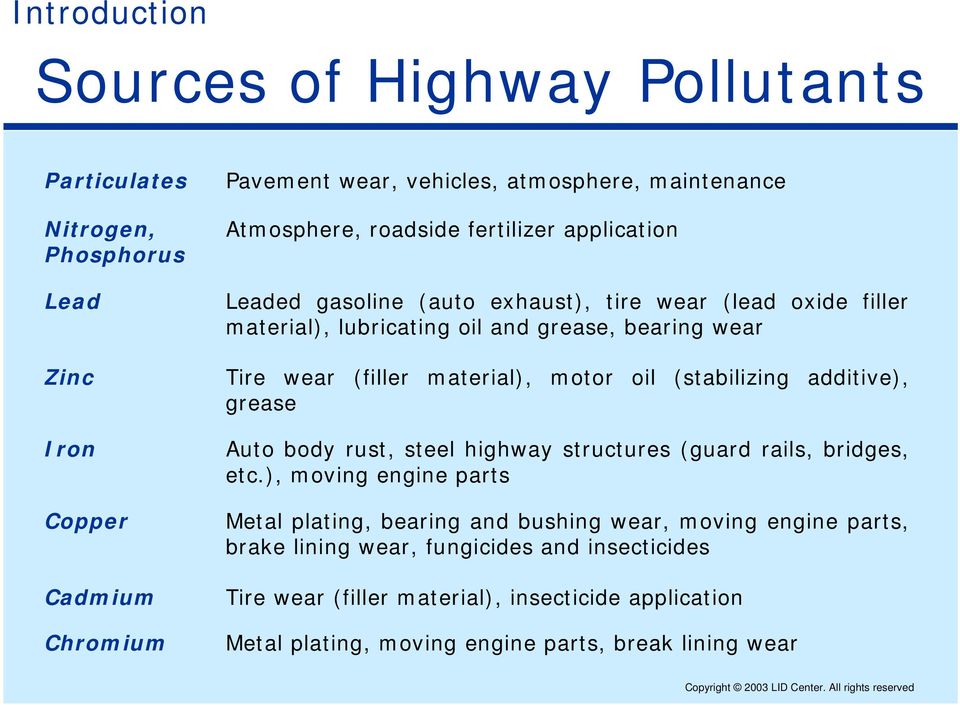
13 Sources of Highway Pollutants (cont d) Nickel Diesel fuel and gasoline (exhaust), lubricating oil, metal plating, bushing wear, brake lining wear, asphalt paving Manganese Engine parts wear Cyanide Anticake compound (used to keep deicing salt granular) Sodium, Calcium, Chloride Sulphate Deicing salts Roadway beds, fuel, deicing salts Petroleum Spills, leaks or blow-by of motor lubricants, antifreeze and hydraulic fluids, asphalt surface leachate

14 Problem Statement (cont d) Transportation projects can also cause Thermal impacts Higher frequency of runoff Increased kinetic energy of runoff (What is impact downstream?)

15 Ecological Effects Sediment loads Cause increased erosion Smother stream habitats Chemical pollutant loads Sicken or kill organisms Accumulate in higher trophic levels in the food chain Add nutrients causing algal blooms and subsequent oxygen deficit in water

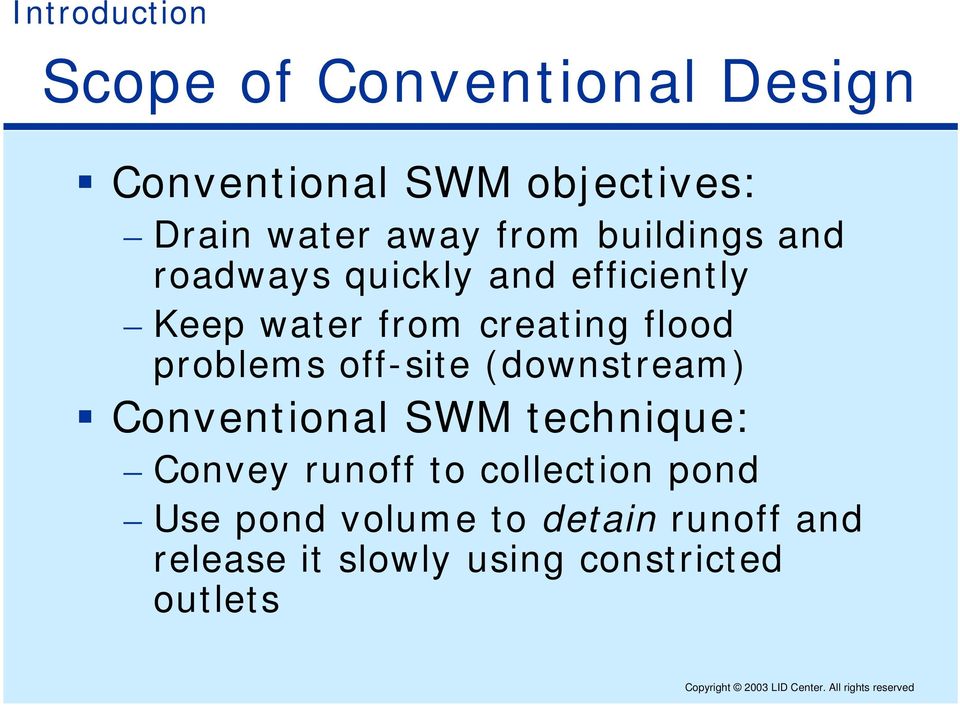
16 Scope of Conventional Design Conventional SWM objectives: Drain water away from buildings and roadways quickly and efficiently Keep water from creating flood problems off-site (downstream) Conventional SWM technique: Convey runoff to collection pond Use pond volume to detain runoff and release it slowly using constricted outlets
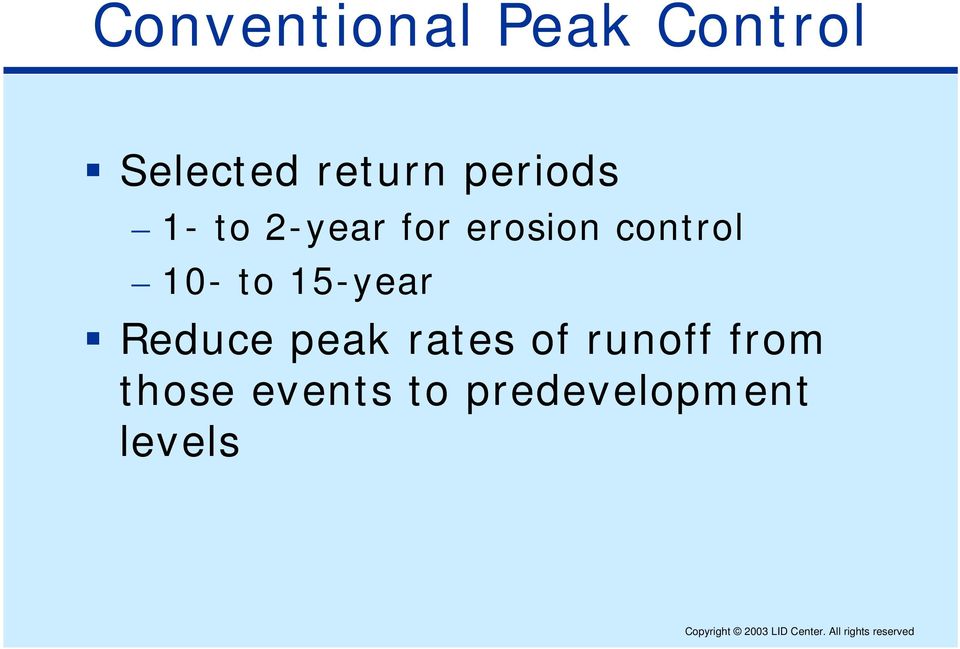
17 Conventional Peak Control Selected return periods 1- to 2-year for erosion control 10- to 15-year Reduce peak rates of runoff from those events to predevelopment levels
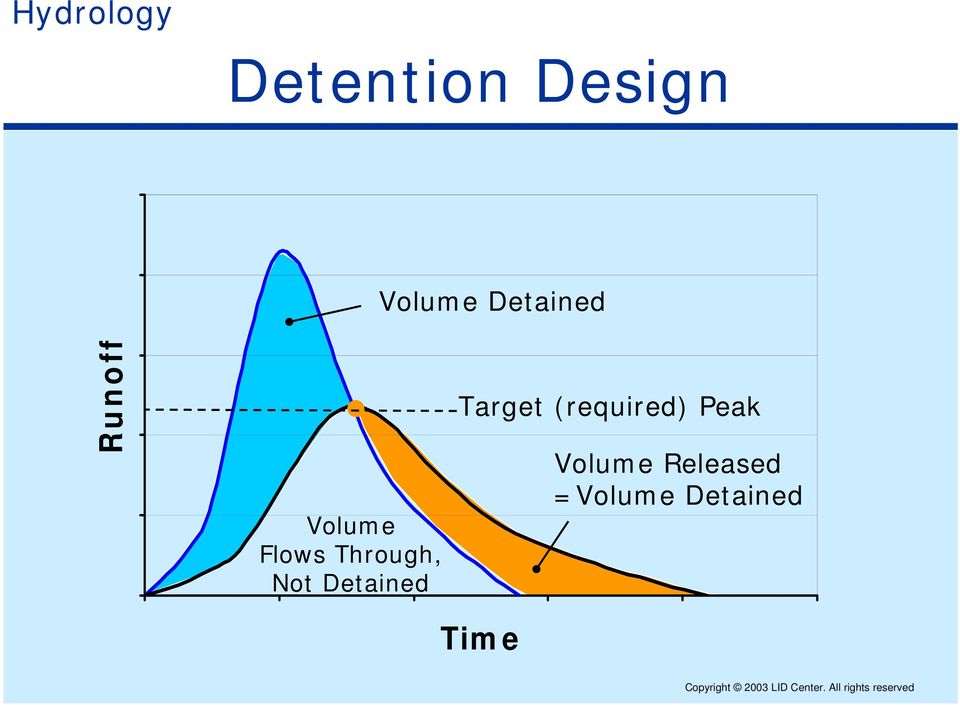
18 Hydrology Detention Design Volume Detained Runoff Volume Flows Through, Not Detained Target (required) Peak Volume Released =Volume Detained Time
19 Areas for Improvement Water quality: Chemical, thermal Runoff volume reduction Runoff frequency reduction Runoff kinetic energy reduction Aesthetics Safety Groundwater recharge Maintenance requirements You name it (open for discussion)

20 Why LID? LID is a SWM design approach that seeks to provide on-site management using a variety of distributed landscape features and engineered devices that capture rainwater, slow down runoff, enhance infiltration, and filter out runoff pollutants Source control : Managing runoff as it is being generated and before it flows together in large quantities.

21 The LID Ideal (Hydrology) Provide natural levels of Surface storage Infiltration Filtration Runoff velocity Interception Evapotranspiration Thermal control
22 LID Ideal (beyond hydrology) Utilize water on-site to avoid tap water consumption Meet space limitations Avoid habitat disturbance Satisfy regulatory objectives
23 LID at Two Site Scales Macro site characteristics, e.g. Lower slope, higher roughness Lower imperviousness, more storage Higher vegetation density Micro site characteristics, e.g. Bioretention cells ( rain gardens ) Vegetated swales Permeable pavement installations
24 LID Incentives Ecologic (as already described) Economic: Reduce stormwater conveyance and management costs Safety and aesthetic (compared, for example, to detention ponds) Regulatory: Infiltration and WQ requirements Discuss: Any other incentives?
25 LID Disincentives Effort to learn new approaches Broader scope of design Technical goals more than peak control Across site, not just at outlet Higher level of design detail Some risk associated with new technologies Discuss: Any other disincentives?
26 Infiltration Supports Ecosystems
27 Thinking Ecologically LID motivated by opportunity to reduce ecological impacts, i.e., impacts on living organisms, but-- LID stormwater design largely based on Physical endpoints (runoff rates and volumes) Constituent endpoints (pollutant loads)
28 LID Hydrology Can Be Analyzed at Different Time Scales Single rainfall event Initial conditions assumed No between-storm conditions modeled ET not significant over storm duration Average Annual Storage Volume captured for all storm events Ponding and subsurface storage considered Continuous Between-storm conditions modeled ET and infiltration rates included
29 Two LID Project Types Architecture/Aesthetic/Qualitative Place attractive LID components where space is available Engineer to ensure ongoing function and appearance Engineering/Technical/Quantitative Design LID components to meet specific runoff management targets (e.g. peak flow, volume, water quality) Incorporate aesthetic elements that enhance value, function
30 Course Objectives At the conclusion of this course, you will be able to List key SWM objectives Identify pertinent regulations Distinguish LID from conventional approaches Select effective SWM techniques for given runoff problems Perform typical LID design calculations Follow up with a variety of resources for further professional development
31 Course Format Lecture Your active participation! Demonstration and hands-on exercises Post-test
32 Course Materials Workbook
33 Ground Rules Punctuality Partnering Discussion encouraged Other literature Cell phones off
34 Questions? Answers!
A Developer s Guide: Watershed-Wise Development
 A Developer s Guide: Watershed-Wise Development Environmental Protection What is a watershed? It does not matter how far away you build from a creek, lake, or the ocean, you are in a watershed. Another
Pervious Pavers. By: Rich Lahren. Hebron Brick & Block Supply
 Pervious Pavers By: Rich Lahren Hebron Brick & Block Supply Stormwater Management and Control Issues Past emphasis was on flood control Today s emphasis is also on pollution More impermeable areas are
Storm Water Runoff. Managing. A Self-Assessment Guide for Wisconsin Businesses. Storm water runoff is coming. This guide provides businesses
 Managing Storm Water Runoff A Self-Assessment Guide for Wisconsin Businesses Storm water runoff is coming under increasing scrutiny as both a source of pollutants to our lakes and streams, and as a cause
SUSTAINABLE URBAN DRAINAGE SYSTEMS
 overflow can lead into a permeable conveyance system to increase further the benefit and reduce the need for pipe systems. Pollutant removal rates have been shown to be high, with some pollutants being
Interlocking Concrete Pavement Institute (ICPI) Model Stormwater Ordinance for Permeable Interlocking Concrete Pavements August 2010
 Interlocking Concrete Pavement Institute (ICPI) Model Stormwater Ordinance for Permeable Interlocking Concrete Pavements August 2010 Background What are permeable interlocking concrete pavements (PICP)?
Stormwater Ponds. c ıty of a bı le ne st or m wat e r utı lıty dıv ısı on
 CLEAN WATER FACT SHEET Stormwater Ponds c ıty of a bı le ne st or m wat e r utı lıty dıv ısı on Rapid growth in the City of Abil ene and consequent development, as well as construction of culverts, drains,
10/4/2012. 40 slide sample of Presentation. Key Principles to Current Stormwater Management
 40 slide sample of Presentation Please contact [email protected] if you would like the complete presentation Key Principles to Current Stormwater Management Distributed Control Measures Integrated
Planning, Health and Environment Division
 18 Planning, Health and Environment Division A Planning Guide to Sustainable Drainage Systems Introduction Working in co-operation with the Environment Agency, Severn Trent Water Ltd., the Highway Authority
Guidelines for. Permeable Pavement
 What is permeable pavement? Guidelines for Permeable Pavement When rainwater falls on conventional pavement, such as concrete, it accumulates and then flows across and off of this impervious surface as
Detention Ponds. Detention Ponds. Detention Ponds. Detention Ponds. Detention Ponds. Detention Ponds. CIVL 1112 Detention Ponds - Part 1 1/12
 CIVL 1112 - Part 1 1/12 The water cycle, also known as the hydrologic cycle, describes the continuous movement of water on, above and below the surface of the Earth. The water cycle, also known as the
1800 Washington Boulevard, Baltimore, MD 21230-1718 www.mde.maryland.gov 410-537-3000 800-633-6101 TTY Users 800-735-2258 Larry Hogan, Governor Boyd
 ENVIRONMENTAL SITE DESIGN (ESD) REDEVELOPMENT EXAMPLES OCTOBER 2010 1800 Washington Boulevard, Baltimore, MD 21230-1718 www.mde.maryland.gov 410-537-3000 800-633-6101 TTY Users 800-735-2258 Larry Hogan,
Permeable Interlocking Concrete Pavement (PICP) A Low Impact Development Tool Training for Schools and Universities
 Permeable Interlocking Concrete Pavement (PICP) A Low Impact Development Tool Training for Schools and Universities Presented by: Interlocking Concrete Pavement Institute The Low Impact Development Center,
Low Impact Development (LID) is an innovative approach to stormwater
 CHAPTER 2 The Benefits of Low Impact Development Low Impact Development (LID) is an innovative approach to stormwater management that is based upon the principle of managing rainfall at the source. The
A San Antonio Case Study on the Water Quantity and Quality Benefits of LID Development
 A San Antonio Case Study on the Water Quantity and Quality Benefits of LID Development Chad Richards PE, CFM, CPSWQ Brett Sachtleben PE, CFM Agenda Purpose Water Quality Processes LID Components and their
Operations and Maintenance Plan The Residences at Johnson Farm 189 Landham Road Sudbury, Massachusetts. Submitted to: Town of Sudbury
 Operations and Maintenance Plan The Residences at Johnson Farm 189 Landham Road Sudbury, Massachusetts Submitted to: Town of Sudbury December 2011 Table of Contents 1.0 Introduction... 1 1.1 Responsibility...
How To Amend A Stormwater Ordinance
 Regulatory Alternatives to Address Stormwater Management and Flooding in the Marlboro Street Study Area Alternative 1: Amend Existing Local Regulations This proposed alternative provides an incremental
APPENDIX F. RESIDENTIAL WATER QUALITY PLAN: ALLOWABLE BMP OPTIONS
 APPENDIX F. RESIDENTIAL WATER QUALITY PLAN: ALLOWABLE BMP OPTIONS The following section provides descriptions, advantages, limitations, and schematics of allowable best management practices (BMPs) for
Low Impact Development Checklist
 New Jersey Stormwater Best Management Practices Manual February 2004 A P P E N D I X A Low Impact Development Checklist A checklist for identifying nonstructural stormwater management strategies incorporated
Summary and Description of 2014 Enhancements to New Jersey Model Stormwater Control Ordinance for Municipalities
 Summary and Description of 2014 Enhancements to New Jersey Model Stormwater Control Ordinance for Municipalities This document summarizes and provides explanation for the purpose and intent of major recommended
Improper storage of fuel on construction sites will increase the risk of water pollution that may occur as a result of leaks or spills.
 WQ-10 Best Management Practice (BMP) Water Quality Protection Guideline Secondary Containment Design Standards Fuel Storage on Construction Sites According to the EPA, the majority of water pollution in
CLACKAMAS COUNTY ZONING AND DEVELOPMENT ORDINANCE
 1008 STORM DRAINAGE (3/24/05) 1008.01 PURPOSE To minimize the amount of stormwater runoff resulting from development utilizing nonstructural controls where possible, maintain and improve water quality,
City of Atlanta. Department of Watershed Management. Post-Development Stormwater Management Ordinance Summary of Revisions
 City of Atlanta Department of Watershed Management Post-Development Stormwater Management Ordinance Summary of Revisions Cory Rayburn, CPESC Environmental Program Manager [email protected] Stormwater
Stormwater management around the world Lessons from Novatech 2010 Dennis Corbett and Marion Urrutiaguer
 Stormwater management around the world Lessons from Novatech 2010 Dennis Corbett and Marion Urrutiaguer Novatech 2010, the 7th international conference on sustainable techniques and strategies in urban
4. Environmental Impacts Assessment and Remediation Targets
 4. Environmental Impacts Assessment and Remediation Targets 4.1 Environmental Impacts Significant additional development in the Alder Creek watershed is not anticipated at this time; however, there are
Lessons Learned from the Expert BMP Panel Process That May Apply to MTDs. Tom Schueler Chesapeake Stormwater Network
 Lessons Learned from the Expert BMP Panel Process That May Apply to MTDs Tom Schueler Chesapeake Stormwater Network Recent Expert Panels 1. Stormwater Retrofit Practices 2. New State Performance Standards
Best Management Practice Fact Sheet 7: Permeable Pavement
 Publication 426-126 Best Management Practice Fact Sheet 7: Permeable Pavement David J. Sample, Assistant Professor and Extension Specialist, Biological Systems Engineering, Virginia Tech Lia Doumar, Undergraduate
Compost-Based Stormwater Best Management Practices Using Compost to Improve Stormwater Management and Erosion Control On Roadsides
 Compost-Based Stormwater Best Management Practices Using Compost to Improve Stormwater Management and Erosion Control On Roadsides Chris Newman US EPA Region 5 Chicago, IL Compost-Based BMPs Compost-based
Using Green Infrastructure to Manage Combined Sewer Overflows and Flooding
 New York State Water Resources Institute Using Green Infrastructure to Manage Combined Sewer Overflows and Flooding Emily Vail Hudson River Estuary Program NYS Department of Environmental Conservation
Computing Stormwater Runoff Rates and Volumes
 New Jersey Stormwater Best Management Practices Manual February 2004 C H A P T E R 5 Computing Stormwater Runoff Rates and Volumes This chapter discusses the fundamentals of computing stormwater runoff
Field Performance of Two Stormwater Bioretention Filtration Design Configurations
 Field Performance of Two Stormwater Bioretention Filtration Design Configurations Andrew Anderson, E.I.T. North Carolina State University Department of Biological & Agricultural Engineering 2013 Annual
BLACK/HARMONY/FAREWELL CREEK WATERSHED EXISTING CONDITIONS REPORT CHAPTER 12 - STORMWATER MANAGEMENT
 Harmony Creek subwatershed Harmony Creek subwatershed BLACK/HARMONY/FAREWELL CREEK WATERSHED EXISTING CONDITIONS REPORT CHAPTER 12 - STORMWATER MANAGEMENT April 2011 TABLE OF CONTENTS 1.0 INTRODUCTION...
Phosphorus. Phosphorus Lake Whatcom Cooperative Management. www.ecy.wa.gov/programs/wq/nonpoint/phosphorus/phosphorusban.html
 Phosphorus Phosphorus Brochure Lake Whatcom Cooperative Management Reducing Phosphorus Website Washington State Department of Ecology www.ecy.wa.gov/programs/wq/nonpoint/phosphorus/phosphorusban.html Nutrients
DESIGN OF STORM WATER DETENTION POND
 Yunnan Chuxiong Urban Environment Improvement Project (RRP PRC 45507) DESIGN OF STORM WATER DETENTION POND A. Background 1. Chuxiong Yi Autonomous Prefecture (Chuxiong prefecture) is located at about 160
Sample DEQ Plan Submitter s Checklist for Stormwater Management Plans
 APPENDIX IV Version: February 2, 2015 Sample DEQ Plan Submitter s Checklist for Stormwater Management Plans Please fill in all blanks and please reference the plan sheets/pages where the information may
Chapter 2 Treatment Facility Menus
 Chapter 2 Treatment Facility Menus This chapter identifies the treatment facility menus. The menus in this chapter are as follows: Oil Control Menu, Section 2.1 Phosphorus Treatment Menu, Section 2.2 Enhanced
UNIFIED FACILITIES CRITERIA (UFC) LOW IMPACT DEVELOPMENT
 UNIFIED FACILITIES CRITERIA (UFC) LOW IMPACT DEVELOPMENT APPROVED FOR PUBLIC RELEASE; DISTRIBUTION UNLIMITED UNIFIED FACILITIES CRITERIA (UFC) LOW IMPACT DEVELOPMENT Any copyrighted material included in
STORMWATER POLLUTION PREVENTION PLAN TEMPLATE. 1.0 SITE DESCRIPTION 1.1 Project Name and Location Date
 STORMWATER POLLUTION PREVENTION PLAN TEMPLATE Disclaimer: This template was developed for guidance purposes only in an effort to assist Construction Storm Water permit applicants in meeting state and local
URBAN DRAINAGE CRITERIA
 URBAN DRAINAGE CRITERIA I. Introduction This division contains guidelines for drainage system design and establishes a policy for recognized and established engineering design of storm drain facilities
Permeable Pavement Treatment Capacity
 Permeable Pavement Treatment Capacity April 20 2011 This investigation will analyze the pollutant removal capacity of various types of permeable paving techniques. Daniel Sullivan Joseph Fleury Contents
AquaPaver & SF-Rima Permeable Interlocking Concrete Pavers
 F.P.O. Need SF-Rima THE TREMRON GROUP Permeable Paver Guide AquaPaver & SF-Rima Permeable Interlocking Concrete Pavers MIAMI 11321 NW 112th Court Medley, FL 33178 800.567.1480 or 305.825.9000 Fax 305.823.6614
Comments on: Middlesex School East Fields Athletics Drainage Calculations Samiotes Consultants, Inc., 16 November 2004
 Comments on: Middlesex School East Fields Athletics Drainage Calculations Samiotes Consultants, Inc., 16 November 2004 submitted to Massachusetts Department of Environmental Protection by William W. Walker,
Permeable Interlocking Concrete Pavements
 Permeable Interlocking Concrete Pavements Program 000003 Revised 1-29-08 Permeable Interlocking Concrete Pavements This program is registered with the AIA/CES and ASLA CPE for continuing education professional
Retention/Irrigation. Design Considerations. Soil for Infiltration Area Required Slope Environmental Side-effects
 Description Retention/irrigation refers to the capture of stormwater runoff in a holding pond and subsequent use of the captured volume for irrigation of landscape of natural pervious areas. This technology
LYNDE CREEK WATERSHED EXISTING CONDITIONS REPORT CHAPTER 12 - STORMWATER MANAGEMENT
 Whitby CLOCA Whitby CLOCA LYNDE CREEK WATERSHED EXISTING CONDITIONS REPORT CHAPTER 12 - STORMWATER MANAGEMENT June 2008 TABLE OF CONTENTS 1.0 INTRODUCTION... 3 2.0 STUDY AREA AND SCOPE... 4 3.0 METHODOLOGY...
Land Disturbance, Erosion Control and Stormwater Management Checklist. Walworth County Land Conservation Department
 Land Disturbance, Erosion Control and Stormwater Management Checklist Walworth County Land Conservation Department The following checklist is designed to assist the applicant in complying with the Walworth
COMPREHENSIVE PLAN SECTION B, ELEMENT 4 WATER RESOURCES. April 20, 2010 EXHIBIT 1
 COMPREHENSIVE PLAN SECTION B, ELEMENT 4 WATER RESOURCES April 20, 2010 EXHIBIT 1 ELEMENT 4 WATER RESOURCES TABLE OF CONTENTS 4.1 INTRODUCTION 4.2 GOALS AND POLICIES 4.2.A General Goals and Policies 1 4.2.B
Forward. Introduction. Objective of the manual. Development of the manual. Key revisions
 Forward Introduction Human land-based activities generate contaminants. In fresh and saline receiving waters these contaminants can and do cause problems for ecological and human health. Stormwater runoff
Total Suspended Solids: The Hows & Whys of Controlling Runoff Pollution
 New State Storm Water Rules: WHAT MUNICIPALITIES NEED TO KNOW Total Suspended Solids: The Hows & Whys of Controlling Runoff Pollution Stormwater management by Wisconsin municipalities is under scrutiny.
DESCRIPTION OF STORMWATER STRUCTURAL CONTROLS IN MS4 PERMITS
 DESCRIPTION OF STORMWATER STRUCTURAL CONTROLS IN MS4 PERMITS Phase I MS4 permits require continuous updating of the stormwater system inventory owned and operated by the MS4. They also include inspection
Guidance on the use of sustainable drainage systems (SUDS) and an overview of the adoption policy introduced by
 Guidance on the use of sustainable drainage systems (SUDS) and an overview of the adoption policy introduced by Easy guide to Sustainable drainage systems 02 Contents Page Introduction 05 Purpose of this
POLLUTION PREVENTION FACT SHEET: AUTOMOBILE MAINTENANCE
 POLLUTION PREVENTION FACT SHEET: AUTOMOBILE MAINTENANCE Description This pollution prevention measure involves creating a program of targeted outreach and training for businesses involved in automobile
STAFF REPORT TO COMMITTEE OF THE WHOLE
 STAFF REPORT TO COMMITTEE OF THE WHOLE DATE: November 7 2012 TO: FROM: SUBJECT: ATTACHMENT(S): COMMITTEE OF THE WHOLE GINA LAYTE-LISTON, SUPERVISOR, WASTEWATER Stormwater Management Funding Strategy None
Storm Water Management Requirements for Construction Projects Less than One Acre
 Storm Water Management Requirements for Construction Projects Less than One Acre Purpose: UC Irvine s Phase II Small MS4 Storm Water Permit requires construction projects less than one acre in size to
Green Infrastructure: Basic Principles and Techniques
 Green Infrastructure: Basic Principles and Techniques Simon Gruber Green Infrastructure Consultant, Hudson Valley Regional Council Fellow, City University of New York Institute for Sustainable Cities Green
Critical Regulations SUMMARY OF. Stormwater Management Regulations (National Pollutant Discharge Elimination System or "NPDES ) 40 CFR 122.
 SUMMARY OF Critical Regulations Stormwater Management Regulations (National Pollutant Discharge Elimination System or "NPDES ) 40 CFR 122.26 Spill Prevention, Control, and Countermeasures Rule (SPCC) 40
GENESEE COUNTY DRAIN COMMISSIONER S OFFICE
 GENESEE COUNTY DRAIN COMMISSIONER S OFFICE DIVISION OF SURFACE WATER MANAGEMENT G-4608 BEECHER ROAD, FLINT, MI 48532 PHONE (810) 732-1590 FAX (810) 732-1474 JEFFREY WRIGHT COMMISSIONER October 1, 2012
Recommendations for future developments
 C Recommendations for future developments C.1 Reducing flood risk through site layout and design C.1.1 C.1.2 Flood risk should be considered at an early stage in deciding the layout and design of a site
APPROVAL AMENDMENT HISTORY
 Prepared by: Aurecon South Africa (Pty) Ltd STORMWATER MANAGEMENT PLAN TOKAI ESTATE (DRAFT 1) Submission date: 11 January 2013 Contact Person: Francois du Toit T: +27 21 526 6950 F: +27 21 526 9500 E:
Guidelines for Control of Water Runoff on Small Lots. Revised 6/09
 Guidelines for Control of Water Runoff on Small Lots Revised 6/09 Table of Contents Introduction and Purpose 3 Administrative Procedures 3 Plan Submittal Requirements 3 General Design Criteria 4 Dry Wells
Post-Construction Stormwater Management Checklist* (5,000 SF or Greater)
 Applicability: Required for projects that create and/or replace 5,000 square feet or greater of impervious surface (i.e. asphalt roads, concrete structures, building area, sidewalks, etc.). Impervious
Outlet stabilization structure
 Overview of Sedimentation and Erosion Control Practices Practice no. 6.41 Outlet stabilization structure Erosion at the outlet of channels, culverts, and other structures is common, and can cause structural
Permeable Paving System with StormAbsorb Technology
 Permeable Paving System with StormAbsorb Technology The water management solution. ideal for LEED projects 2 a better way to solve water management issues Increasingly, water management is an important
MODULE 2 RULES RELATING RULES RELA
 MODULE 2 RULES RELATING TO STORM DRAINAGE STANDARDS MODULE 2 RULES RELATING TO STORM DRAINAGE STANDARDS 1 RULES RELATING TO STORM DRAINAGE STANDARDS Sections that underwent revision 1-11 PURPOSE 1-2 MODIFICATIONS
Please click on the tutorial most fitting of your expertise in order to learn about the features of the visualization tool.
 Introduction Welcome to the Indian Creek Conservation Reserve Program (CRP) visualization tool. This tool was developed by the University of Iowa - Institute for Hydroscience and Research (IIHR) as part
Gettysburg Adams Chamber of Commerce Storm Water Management
 Gettysburg Adams Chamber of Commerce Storm Water Management Table of Contents Section 1 Section 2 Section 3 Section 4 Section 5 Section 6 Section 7 Introduction Understanding Location and Landscape 2.1
City of Paso Robles Community Development Department Construction Site Storm Water Quality Requirements
 City of Paso Robles Community Development Department Construction Site Storm Water Quality Requirements Overview of the City s Construction Storm Water Program The City of Paso Robles is committed to protecting
Outdoor Liquid Container Storage
 Outdoor Liquid Container Storage SC-31 Objectives Cover Contain Educate Reduce/Minimize Description Accidental releases of materials from above ground liquid storage tanks, drums, and dumpsters present
Sustainable Site Pavement Systems
 Sustainable Site Pavement Systems Permeable Interlocking Concrete Pavement Training for Design Professionals ICPI Presentation #003 Presented by: Brent Davis - Design Consultant Belgard Engineered Solutions
Sustainable Drainage Systems (SUDS) A guide for developers
 Sustainable Drainage Systems (SUDS) A guide for developers We are the Environment Agency. It s our job to look after your environment and make it a better place for you, and for future generations. Your
PRIVATE TREATMENT CONTROL BMP OPERATION AND MAINTENANCE VERIFICATION FORM BIORETENTION FACILITIES, VEGETATED SWALES & HIGHER RATE BIOFILTERS
 BIORETENTION FACILITIES, VEGETATED SWALES & HIGHER RATE BIOFILTERS Check here for Address or phone number change the fiscal year (July 1 June 30), and date(s) maintenance was performed. Under Inspection,
User s Manual for the BMPTRAINS Model
 User s Manual for the BMPTRAINS Model Prepared By: Marty Wanielista, Mike Hardin, Przemyslaw Kuzlo, and Ikiensinma Gogo-Abite STORMWATER TREATMENT ANALYSIS: STEP 1: Specify pre- and post-development watershed
The International Stormwater BMP Database Part 1: Summary of Database
 Land Development Brief: February 2013 The Pennsylvania Housing Research Center The International Stormwater BMP Database Part 1: Summary of Database Katherine L. Blansett, Ph.D., P.E. INTRODUCTION This
Module 6: Pollution Prevention Plans and SWPPP Overview
 Module 6: Pollution Prevention Plans and SWPPP Overview Module 6 Objectives After completing this module, you should be able to: Explain the minimum requirements of a SWPPP Recognize and identify basic
CITY UTILITIES DESIGN STANDARDS MANUAL
 CITY UTILITIES DESIGN STANDARDS MANUAL Book 2 (SW) SW9 June 2015 SW9.01 Purpose This Chapter provides information for the design of open channels for the conveyance of stormwater in the City of Fort Wayne.
6 Chemicals from human settlements
 6 Chemicals from human settlements 6.1 Introduction The world is becoming increasingly urban, particularly in developing countries. The transition of people from rural areas to cities represents a major,
Waste Handling & Disposal
 Objectives Cover Contain Educate Reduce/Minimize Product Substitution Description Improper storage and handling of solid wastes can allow toxic compounds, oils and greases, heavy metals, nutrients, suspended
Storm Water Permanent Best Management Practices Manual
 Storm Water Permanent Best Management Practices Manual Department of Transportation Highways Division THIS PAGE INTENTIONALLY LEFT BLANK Storm Water Permanent Best Management Practices Manual Department
LITERATURE REVIEW OF GREEN INFRASTRUCTURE INITIATIVES IN THE U.S. Presentation by: Emily Dawes Jessica Moore Ekene Obi- Okoye
 LITERATURE REVIEW OF GREEN INFRASTRUCTURE INITIATIVES IN THE U.S. Presentation by: Emily Dawes Jessica Moore Ekene Obi- Okoye OBJECTIVES Highlight the significance of stormwater pollution and green infrastructure
CWSRF Project Descriptions and Examples for Green Project Reserve
 CWSRF Project Descriptions and Examples for Green Project Reserve I. Water Efficiency a. Water efficiency is the use of improved technologies and practices to deliver equal or better services with less
Chapter 2 Stormwater Pollution Prevention Plan (SWPPP) for Park Operations
 SWPPP for Park Operations 2 Chapter 2 Stormwater Pollution Prevention Plan (SWPPP) for Park Operations Bordered by Lake Washington & Lake Sammamish, the City of Bellevue has more than 60 miles of streams,
APPENDIX A: STORMWATER MANAGEMENT CHECKLIST
 APPENDIX A: STORMWATER MANAGEMENT CHECKLIST The first thing that applicants and designers must do before beginning a project is to make sure they are familiar with the 11 minimum standards listed in Manual
Pervious Pavement. An Infiltration BMP A LID Technique. Dan Huffman Vice President, National Resources National Ready Mixed Concrete Association
 Pervious Pavement An Infiltration BMP A LID Technique Dan Huffman Vice President, National Resources National Ready Mixed Concrete Association Portland, Oregon 503-292-7729 [email protected] www.nrmca.org
12-O-1761 A SUBSTITUTE ORDINANCE BY CITY UTILITIES COMMITTEE
 A SUBSTITUTE ORDINANCE BY CITY UTILITIES COMMITTEE 12-O-1761 AN ORDINANCE TO AMEND VARIOUS SECTIONS OF CHAPTER 74, ARTICLE X OF THE CITY OF ATLANTA CODE OF ORDINANCES FOR THE PURPOSE OF PROMOTING GREEN
4.8 Enhanced Grass Swale
 4.8 Enhanced Grass Swale 4.8.1 Overview Description Enhanced grass swales are vegetated open channels designed to convey, treat and attenuate stormwater runoff (also referred to as enhanced vegetated swales).
Low Impact Development Permeable Paving
 Low Impact Development Permeable Paving An education initiative funded by the Department of Ecology June 11, 2013 How to Participate in a Webinar chat send to host Polling box will appear at first poll
Green Infrastructure in Arid and Semi-Arid Climates
 Green Reserve The American Recovery and Reinvestment Act (ARRA), Green Project Reserve of 2009, through the State Revolving Fund, provided funding for a wide variety of qualifying projects in the categories
Pollution Control NEW! NEW! Stormwater Attenuation Systems Sustainable Urban Drainage Solutions for Domestic & Commercial Applications. klargester.
 Pollution Control NEW! NEW! Stormwater Attenuation Systems Sustainable Urban Drainage Solutions for Domestic & Commercial Applications klargester.com Stormwater Attenuation Systems Sustainable Urban Drainage