
DIRECT INTEGRATION GUIDE DIRECT INTEGRATION GUIDE. Version: 9.16
|
|
|
- Paul Watts
- 10 years ago
- Views:
Transcription

1 DIRECT Version:
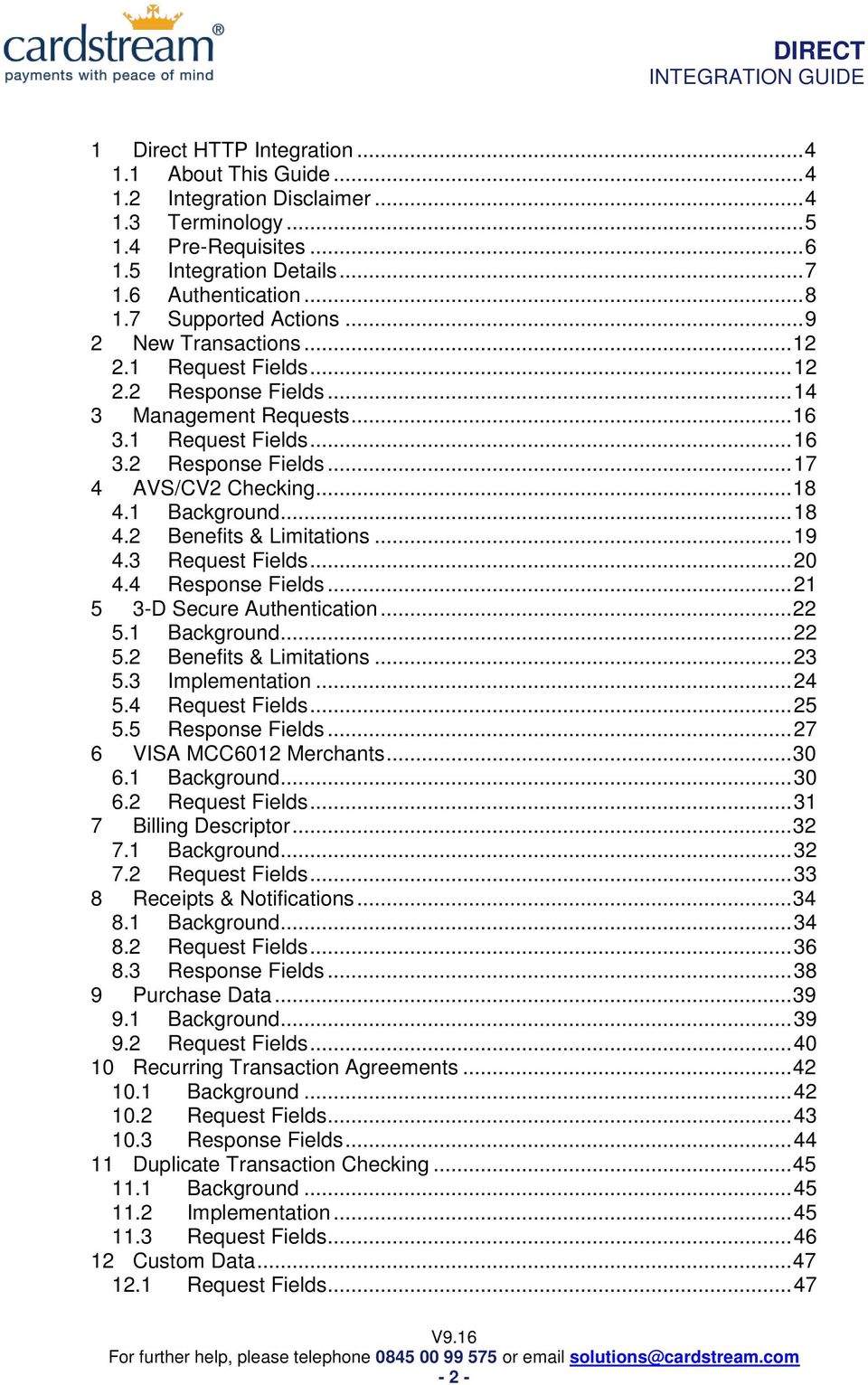
2 1 Direct HTTP Integration About This Guide Integration Disclaimer Terminology Pre-Requisites Integration Details Authentication Supported Actions New Transactions Request Fields Response Fields Management Requests Request Fields Response Fields AVS/CV2 Checking Background Benefits & Limitations Request Fields Response Fields D Secure Authentication Background Benefits & Limitations Implementation Request Fields Response Fields VISA MCC6012 Merchants Background Request Fields Billing Descriptor Background Request Fields Receipts & Notifications Background Request Fields Response Fields Purchase Data Background Request Fields Recurring Transaction Agreements Background Request Fields Response Fields Duplicate Transaction Checking Background Implementation Request Fields Custom Data Request Fields
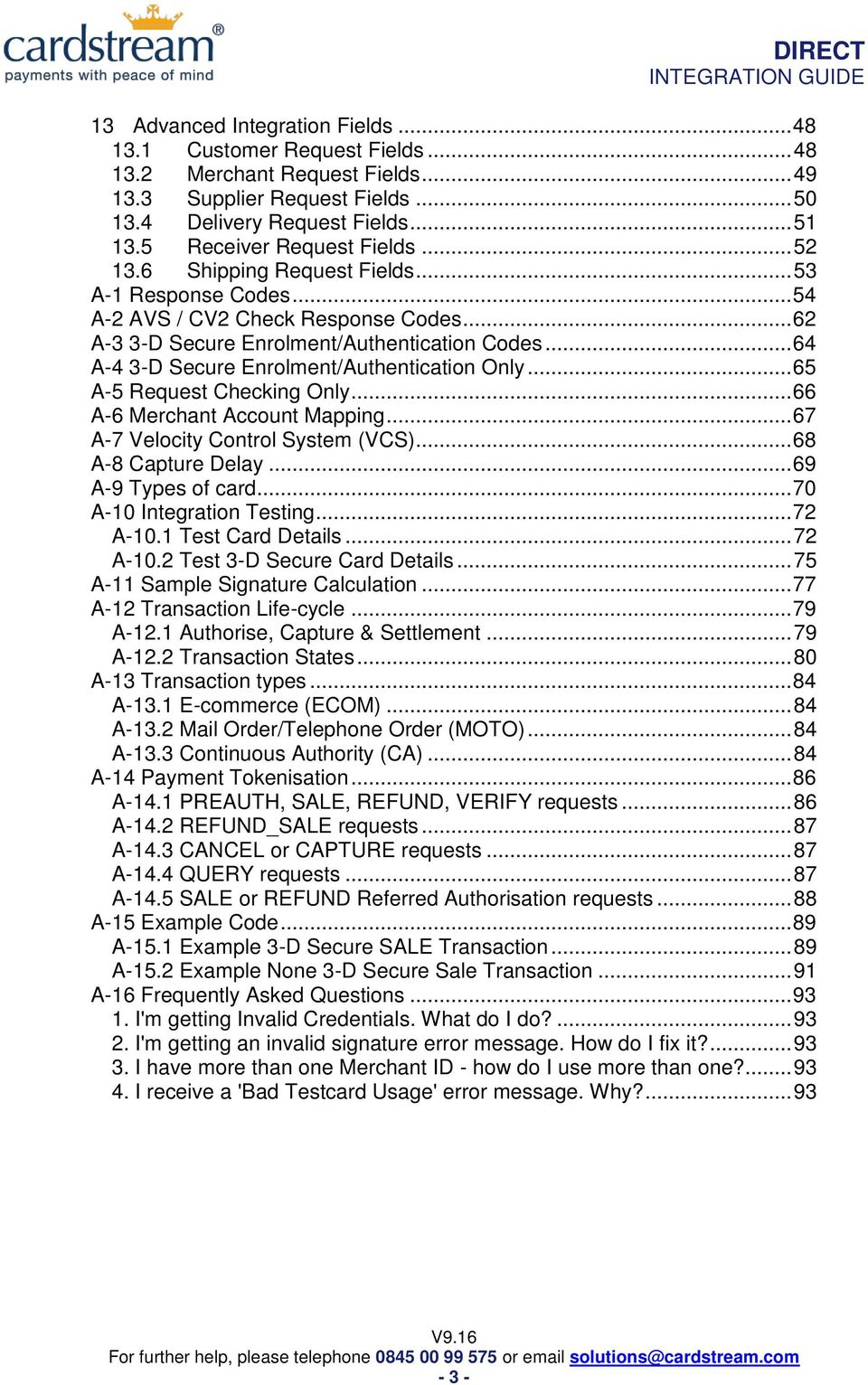
3 13 Advanced Integration Fields Customer Request Fields Merchant Request Fields Supplier Request Fields Delivery Request Fields Receiver Request Fields Shipping Request Fields A-1 Response Codes A-2 AVS / CV2 Check Response Codes A-3 3-D Secure Enrolment/Authentication Codes A-4 3-D Secure Enrolment/Authentication Only A-5 Request Checking Only A-6 Merchant Account Mapping A-7 Velocity Control System (VCS) A-8 Capture Delay A-9 Types of card A-10 Integration Testing A-10.1 Test Card Details A-10.2 Test 3-D Secure Card Details A-11 Sample Signature Calculation A-12 Transaction Life-cycle A-12.1 Authorise, Capture & Settlement A-12.2 Transaction States A-13 Transaction types A-13.1 E-commerce (ECOM) A-13.2 Mail Order/Telephone Order (MOTO) A-13.3 Continuous Authority (CA) A-14 Payment Tokenisation A-14.1 PREAUTH, SALE, REFUND, VERIFY requests A-14.2 REFUND_SALE requests A-14.3 CANCEL or CAPTURE requests A-14.4 QUERY requests A-14.5 SALE or REFUND Referred Authorisation requests A-15 Example Code A-15.1 Example 3-D Secure SALE Transaction A-15.2 Example None 3-D Secure Sale Transaction A-16 Frequently Asked Questions I'm getting Invalid Credentials. What do I do? I'm getting an invalid signature error message. How do I fix it? I have more than one Merchant ID - how do I use more than one? I receive a 'Bad Testcard Usage' error message. Why?
4 1 Direct HTTP Integration 1.1 About This Guide The Direct HTTP integration works by allowing you to keep the Customer on your system through the checkout process while processing the transactions via the Gateway in the background. This allows you to provide a smoother, more complete checkout process to the customer. If you wish to take card details on your website, or style your payment pages, then you either need to use the Direct integration or use the Hosted integration and request a Custom Hosted Payment Page for your website. To use the Direct integration your website must have a SSL Certificate. You will also need to consider the Payment Card Industry Data Security Standard (PCI:DSS) when capturing card details. For more information, please see In addition to transaction processing, the Direct integration can be used to perform other actions such as refunds and cancellations which can provide a more advanced integration with the Gateway. This guide provides the information required to integrate with the Payment Gateway and gives a very basic example of code for doing so (further examples can be found on our website at It is expected that you have some experience in server side scripting with languages such as PHP or ASP, or that an off-the-shelf software package is being used that has in-built or plug-in support for the Payment Gateway. If you do require programming assistance related to your integration, please contact Cardstream on or via to [email protected]. 1.2 Integration Disclaimer Cardstream provides all integration documentation necessary for enabling Merchants to process payments via our Payment Gateway. Whilst every effort has been made to ensure these guides are accurate and complete, we expect Merchants undertaking any integration to test all their technical work fully and satisfy their own standards. Cardstream is not responsible or liable for any Merchant or Third Party integration

5 1.3 Terminology The following terms are used throughout this guide; Gateway The Cardstream Payment Gateway Merchant The Merchant using the Gateway s services Acquirer The bank or financial institution used by the Merchant. Customer A customer of the Merchant making a payment etc. Cardholder The person who owns the payment card, normally the Customer. Merchant Account An account on the Gateway mapped to an Acquirer issued account. You/your The Merchant or their representative performing the integration

6 1.4 Pre-Requisites You will need the following information to integrate with the Payment Gateway using the Direct integration method; Cardstream Merchant ID Your Merchant ID enables you to access and communicate with the Payment Gateway. Please note that these details will differ to the login supplied to access the administration panel. You should have received these details when your account was set up. You may also use test Merchant IDs (if you have been issued with a test ID) and swap these for your live account details when you receive them. Integration URL New Merchants who have not yet received their live Merchant ID can still perform an integration for testing purposes. Simply enter one of the test Merchant IDs below and use the test cards provided in appendix A-10 to run a test transaction. For non 3-D Secure testing use Merchant ID For 3-D Secure Testing use Merchant ID

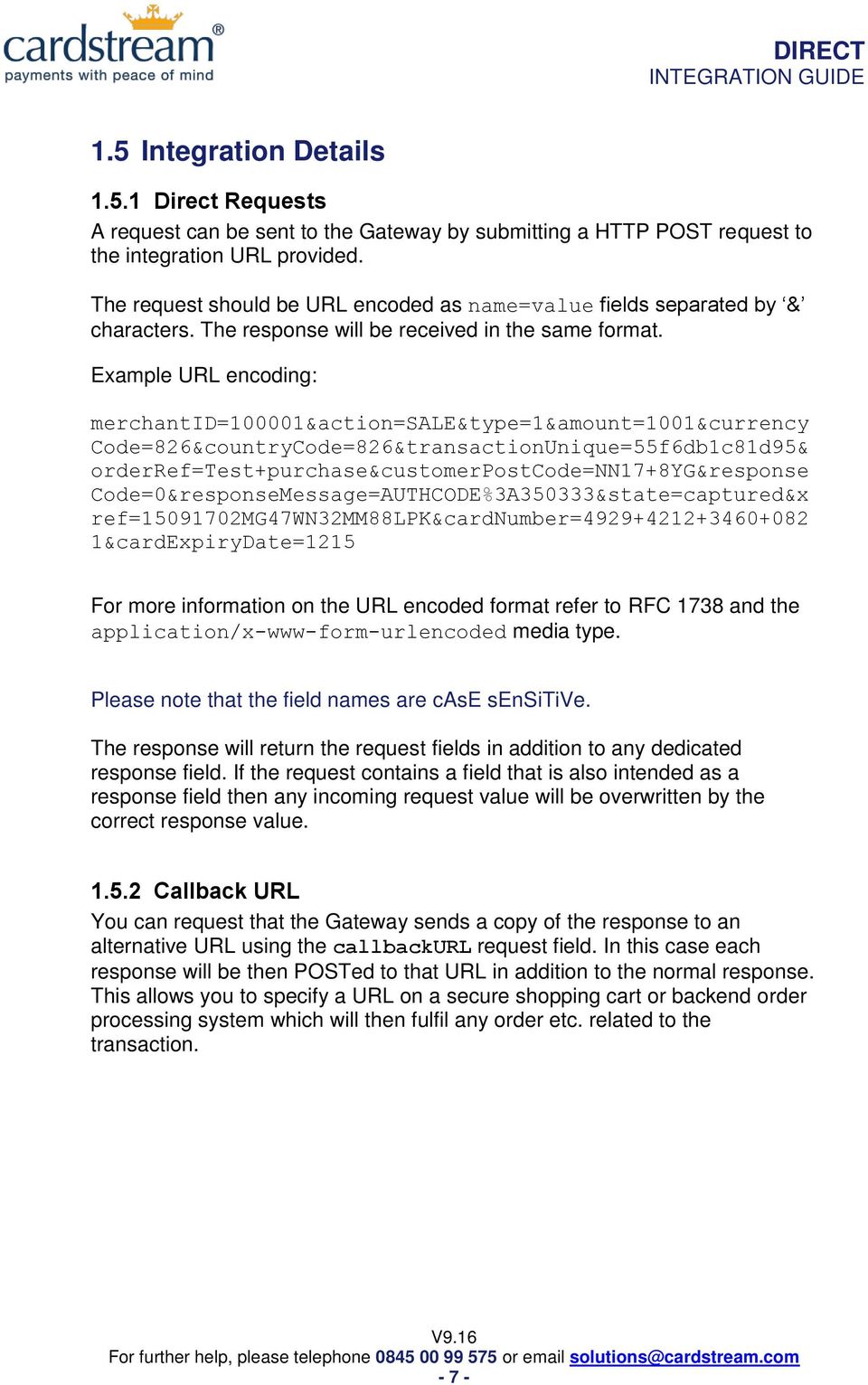
7 1.5 Integration Details Direct Requests A request can be sent to the Gateway by submitting a HTTP POST request to the integration URL provided. The request should be URL encoded as name=value fields separated by & characters. The response will be received in the same format. Example URL encoding: merchantid=100001&action=sale&type=1&amount=1001¤cy Code=826&countryCode=826&transactionUnique=55f6db1c81d95& orderref=test+purchase&customerpostcode=nn17+8yg&response Code=0&responseMessage=AUTHCODE%3A350333&state=captured&x ref= mg47wn32mm88lpk&cardnumber= &cardExpiryDate=1215 For more information on the URL encoded format refer to RFC 1738 and the application/x-www-form-urlencoded media type. Please note that the field names are case sensitive. The response will return the request fields in addition to any dedicated response field. If the request contains a field that is also intended as a response field then any incoming request value will be overwritten by the correct response value Callback URL You can request that the Gateway sends a copy of the response to an alternative URL using the callbackurl request field. In this case each response will be then POSTed to that URL in addition to the normal response. This allows you to specify a URL on a secure shopping cart or backend order processing system which will then fulfil any order etc. related to the transaction
8 1.6 Authentication All requests must specify which Merchant Account they are for using the merchantid request field. In addition to this the following security measures can be used; Password Authentication You can configure a password for each Merchant Account using the Merchant Management System (MMS). This password must then be sent in the merchantpwd field in each request. I an incorrect password is received by the Gateway then the transaction will be aborted and an error response returned Warning: Use of a password is discouraged in any integration where the transaction is posted from a form in the client browser as the password may appear in plain text in code Message signing Message signing requires you to generate a hash of the request message being sent and then send this hash along with the original request in the signature field. The gateway will then re-generate the hash on the request message received and compare it with the one sent. If the two hashes are different then the request received must not be the same as that sent and so the contents must have been tampered with and the transaction will be aborted and an error response returned The gateway will also return hash of the response message in the returned signature field allowing the merchant to create a hash of the response (minus the signature field) and verify the hashes match. If message signing is enabled then the data POSTed to any callback URL will also be signed. See appendix A-11 for information on how to create the hash Allowed IP addresses You can configure a list of IP addresses using the Merchant Management System (MMS). Two different address lists can be configured, one for standard requests, such as sales, and one for advanced requests, such as refunds and cancellations. If a request is received from an address other than those configured then it will be aborted and an error response returned

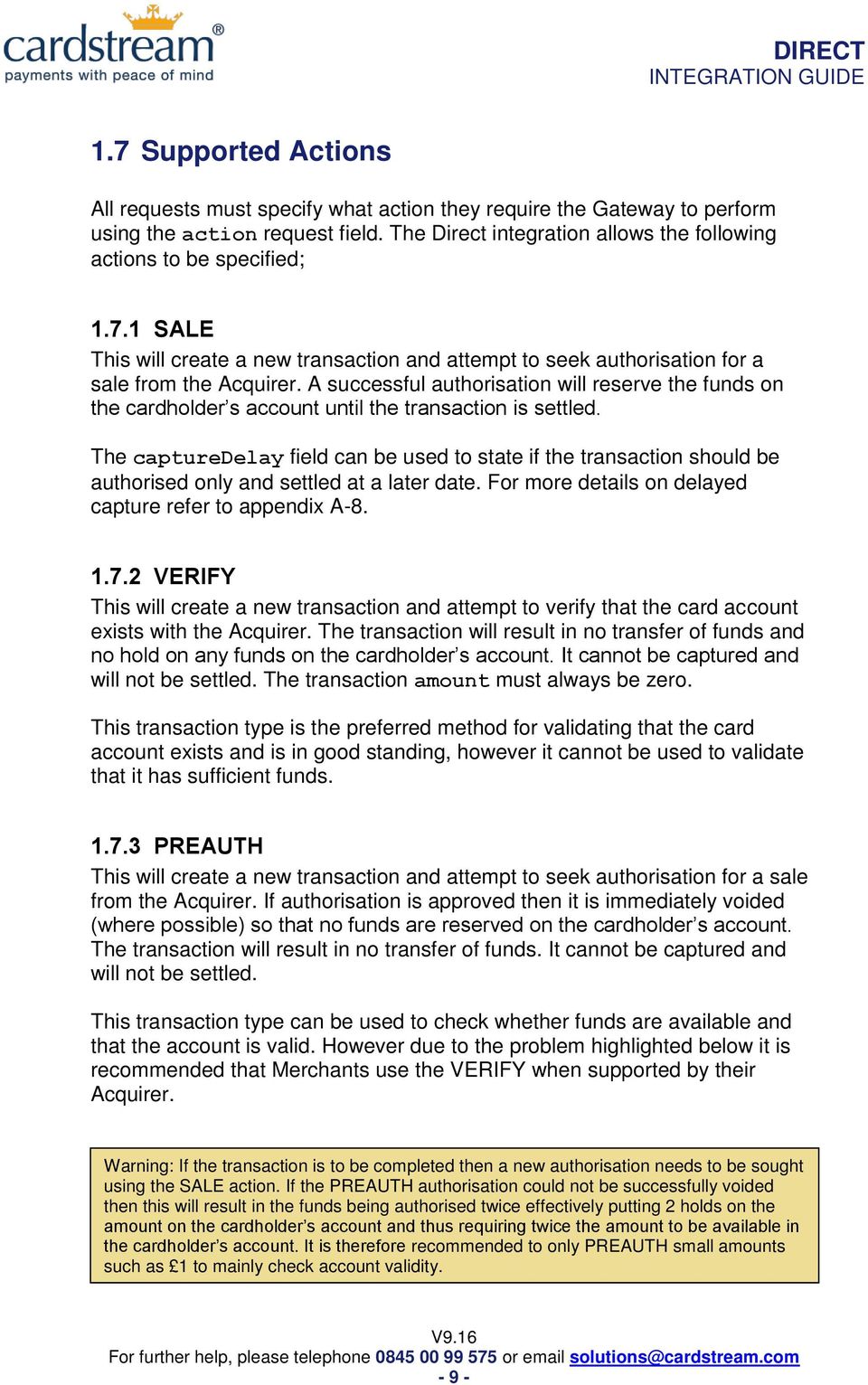
9 1.7 Supported Actions All requests must specify what action they require the Gateway to perform using the action request field. The Direct integration allows the following actions to be specified; SALE This will create a new transaction and attempt to seek authorisation for a sale from the Acquirer. A successful authorisation will reserve the funds on the cardholder s account until the transaction is settled. The capturedelay field can be used to state if the transaction should be authorised only and settled at a later date. For more details on delayed capture refer to appendix A VERIFY This will create a new transaction and attempt to verify that the card account exists with the Acquirer. The transaction will result in no transfer of funds and no hold on any funds on the cardholder s account. It cannot be captured and will not be settled. The transaction amount must always be zero. This transaction type is the preferred method for validating that the card account exists and is in good standing, however it cannot be used to validate that it has sufficient funds PREAUTH This will create a new transaction and attempt to seek authorisation for a sale from the Acquirer. If authorisation is approved then it is immediately voided (where possible) so that no funds are reserved on the cardholder s account. The transaction will result in no transfer of funds. It cannot be captured and will not be settled. This transaction type can be used to check whether funds are available and that the account is valid. However due to the problem highlighted below it is recommended that Merchants use the VERIFY when supported by their Acquirer. Warning: If the transaction is to be completed then a new authorisation needs to be sought using the SALE action. If the PREAUTH authorisation could not be successfully voided then this will result in the funds being authorised twice effectively putting 2 holds on the amount on the cardholder s account and thus requiring twice the amount to be available in the cardholder s account. It is therefore recommended to only PREAUTH small amounts such as 1 to mainly check account validity
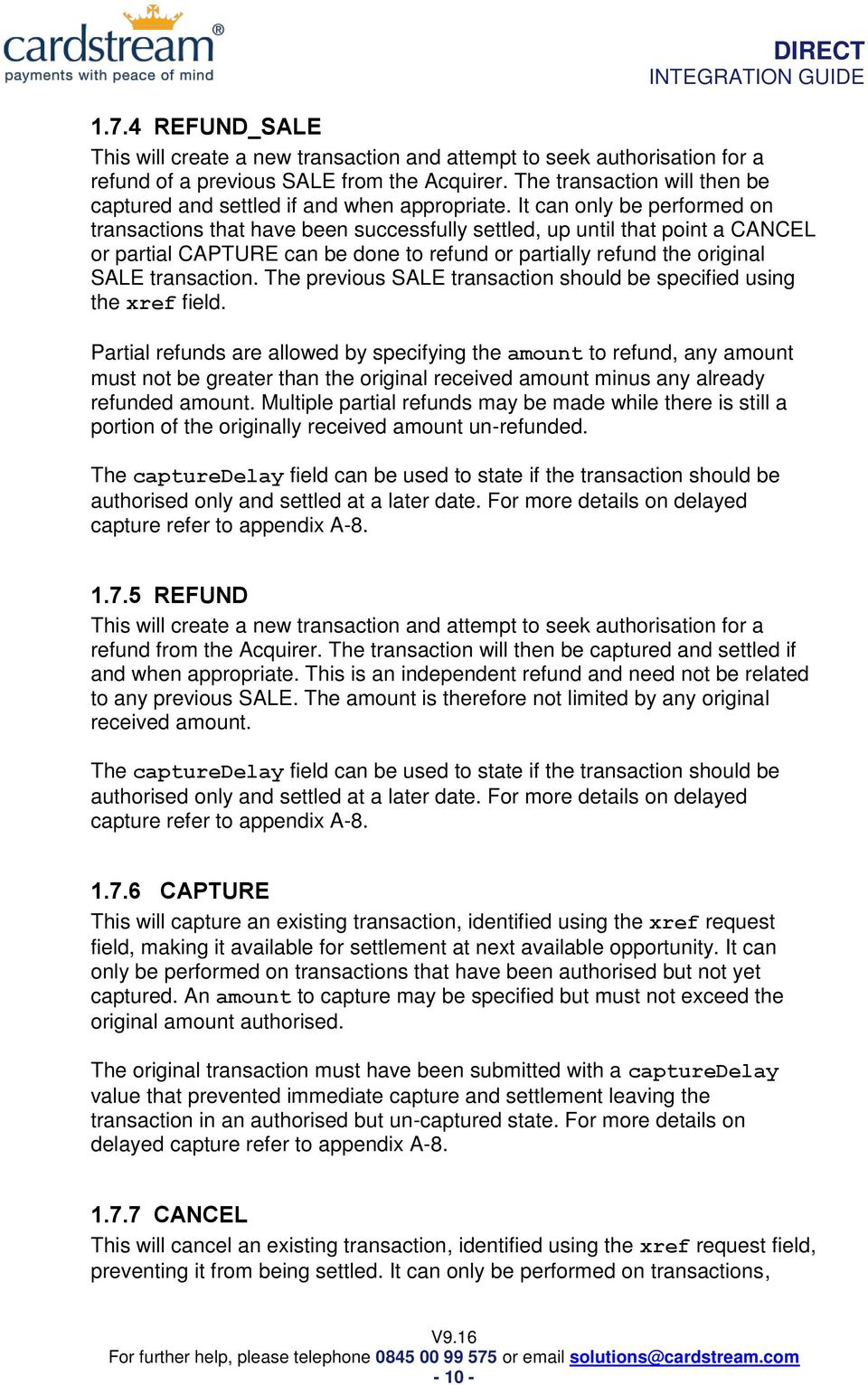
10 1.7.4 REFUND_SALE This will create a new transaction and attempt to seek authorisation for a refund of a previous SALE from the Acquirer. The transaction will then be captured and settled if and when appropriate. It can only be performed on transactions that have been successfully settled, up until that point a CANCEL or partial CAPTURE can be done to refund or partially refund the original SALE transaction. The previous SALE transaction should be specified using the xref field. Partial refunds are allowed by specifying the amount to refund, any amount must not be greater than the original received amount minus any already refunded amount. Multiple partial refunds may be made while there is still a portion of the originally received amount un-refunded. The capturedelay field can be used to state if the transaction should be authorised only and settled at a later date. For more details on delayed capture refer to appendix A REFUND This will create a new transaction and attempt to seek authorisation for a refund from the Acquirer. The transaction will then be captured and settled if and when appropriate. This is an independent refund and need not be related to any previous SALE. The amount is therefore not limited by any original received amount. The capturedelay field can be used to state if the transaction should be authorised only and settled at a later date. For more details on delayed capture refer to appendix A CAPTURE This will capture an existing transaction, identified using the xref request field, making it available for settlement at next available opportunity. It can only be performed on transactions that have been authorised but not yet captured. An amount to capture may be specified but must not exceed the original amount authorised. The original transaction must have been submitted with a capturedelay value that prevented immediate capture and settlement leaving the transaction in an authorised but un-captured state. For more details on delayed capture refer to appendix A CANCEL This will cancel an existing transaction, identified using the xref request field, preventing it from being settled. It can only be performed on transactions,
11 which have been authorised but not yet settled, and it is not reversible. Depending on the Acquirer it may not reverse the authorisation and release any reserved funds on the cardholder s account, in such cases authorisation will be left to expire as normal releasing the reserved funds this may take up to 30 days from the date of authorisation QUERY This will query an existing transaction, identified using the xref request field, returning the original response. This is a simple transaction lookup action. For more advance transaction querying please refer to the Gateway REST API guide
12 2 New Transactions You can perform a new transaction, such as a sale, by sending a request with the required action and transaction type along with details about the order and payment method. 2.1 Request Fields Field Name Mandatory? Description merchantid Yes Your Cardstream Merchant ID. merchantpwd No 1 Any password used to secure this account. Refer to section for details. signature Yes 2 Any hash used to sign this request. Refer to section for details. action Yes The action requested. Refer to section 1.7 for supported actions. Possible values are: PREAUTH, SALE, REFUND, REFUND_SALE, VERIFY. amount Yes 3 The amount of the transaction in minor currency. For the UK, this is pence, so should be sent as Numeric values only no decimal points or currency symbols. type Yes 3 The type of transaction. Refer to section A-13 for details. Possible values are: 1 E-commerce (ECOM) 2 - Mail Order/Telephone Order (MOTO). 9 Continuous Authority (CA). countrycode Yes 3 Merchant s location. Valid ISO-3166 alpha or numeric code. currencycode Yes 3 Transaction currency. Valid ISO-4217 alpha or numeric code. cardnumber Yes 3 The primary account number (PAN) as printed on the front of the payment card. Numeric values only (spaces allowed). cardexpirymonth Yes 3 Payment card s expiry month as a number from 1 to 12. Numeric values only. cardexpiryyear Yes 3 Last two digit of the payment card s expiry

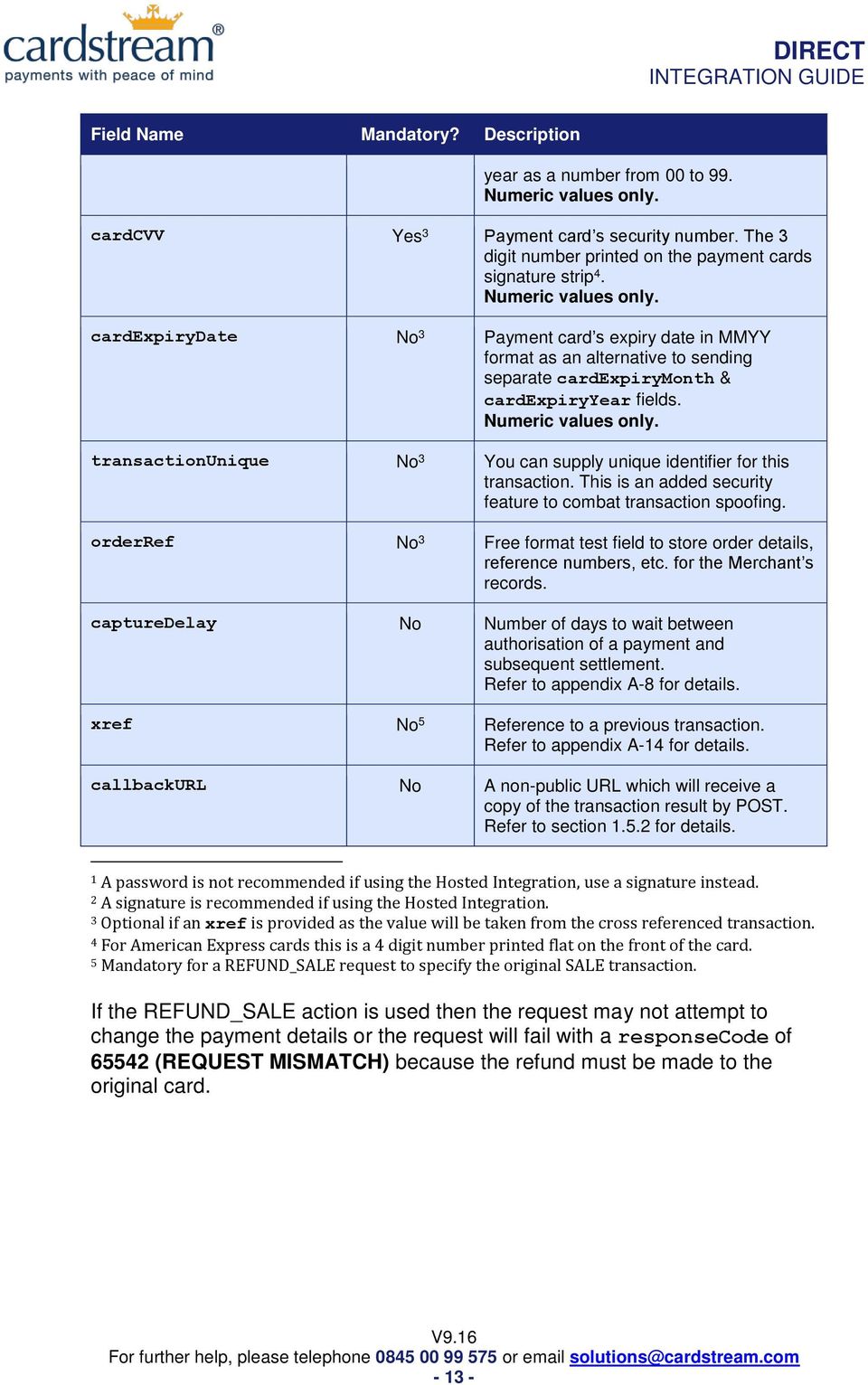
13 Field Name Mandatory? Description year as a number from 00 to 99. Numeric values only. cardcvv Yes 3 Payment card s security number. The 3 digit number printed on the payment cards signature strip 4. Numeric values only. cardexpirydate No 3 Payment card s expiry date in MMYY format as an alternative to sending separate cardexpirymonth & cardexpiryyear fields. Numeric values only. transactionunique No 3 You can supply unique identifier for this transaction. This is an added security feature to combat transaction spoofing. orderref No 3 Free format test field to store order details, reference numbers, etc. for the Merchant s records. capturedelay No Number of days to wait between authorisation of a payment and subsequent settlement. Refer to appendix A-8 for details. xref No 5 Reference to a previous transaction. Refer to appendix A-14 for details. callbackurl No A non-public URL which will receive a copy of the transaction result by POST. Refer to section for details. 1 A password is not recommended if using the Hosted Integration, use a signature instead. 2 A signature is recommended if using the Hosted Integration. 3 Optional if an xref is provided as the value will be taken from the cross referenced transaction. 4 For American Express cards this is a 4 digit number printed flat on the front of the card. 5 Mandatory for a REFUND_SALE request to specify the original SALE transaction. If the REFUND_SALE action is used then the request may not attempt to change the payment details or the request will fail with a responsecode of (REQUEST MISMATCH) because the refund must be made to the original card
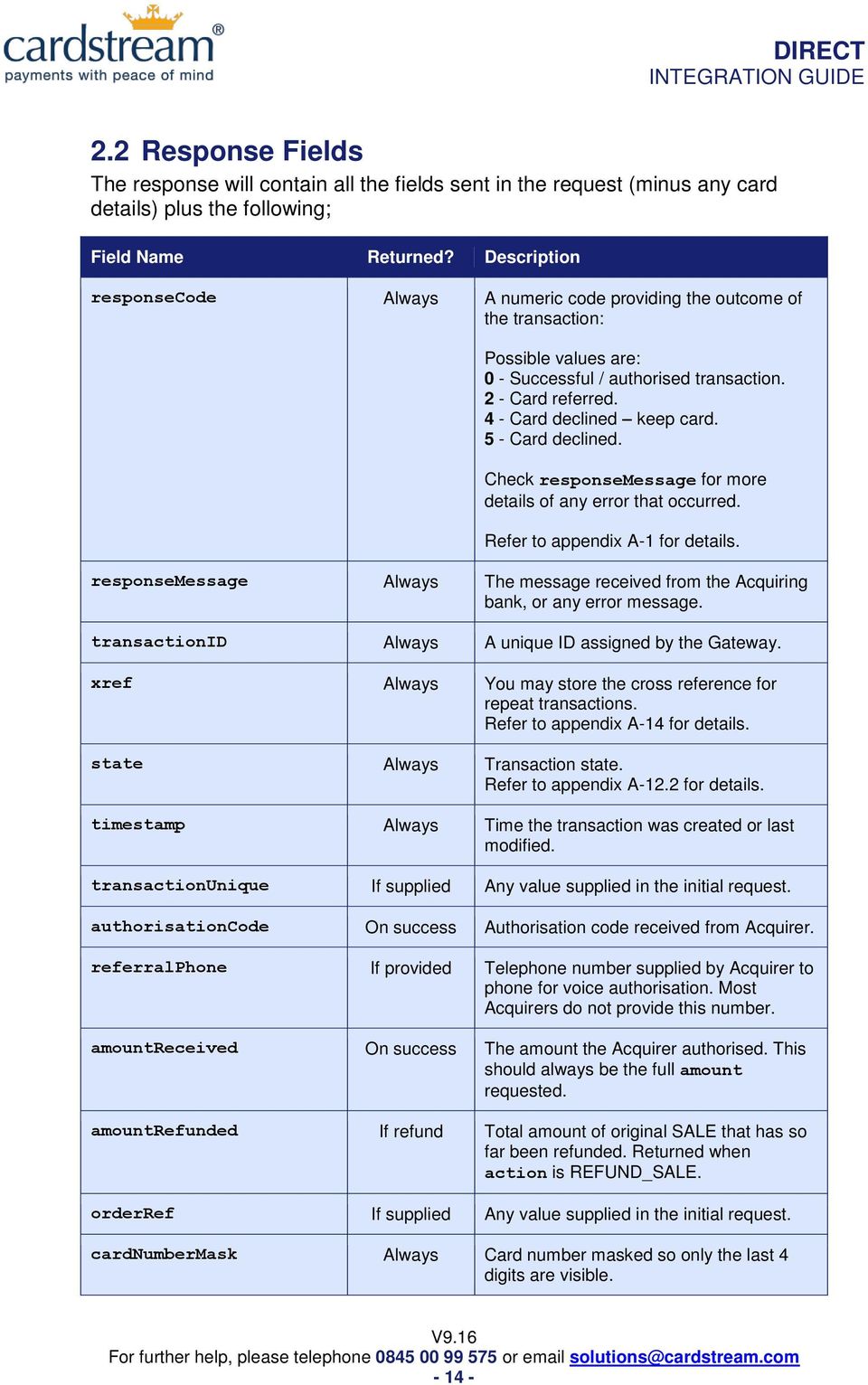
14 2.2 Response Fields The response will contain all the fields sent in the request (minus any card details) plus the following; Field Name Returned? Description responsecode Always A numeric code providing the outcome of the transaction: Possible values are: 0 - Successful / authorised transaction. 2 - Card referred. 4 - Card declined keep card. 5 - Card declined. Check responsemessage for more details of any error that occurred. Refer to appendix A-1 for details. responsemessage Always The message received from the Acquiring bank, or any error message. transactionid Always A unique ID assigned by the Gateway. xref Always You may store the cross reference for repeat transactions. Refer to appendix A-14 for details. state Always Transaction state. Refer to appendix A-12.2 for details. timestamp Always Time the transaction was created or last modified. transactionunique If supplied Any value supplied in the initial request. authorisationcode On success Authorisation code received from Acquirer. referralphone If provided Telephone number supplied by Acquirer to phone for voice authorisation. Most Acquirers do not provide this number. amountreceived On success The amount the Acquirer authorised. This should always be the full amount requested. amountrefunded If refund Total amount of original SALE that has so far been refunded. Returned when action is REFUND_SALE. orderref If supplied Any value supplied in the initial request. cardnumbermask Always Card number masked so only the last 4 digits are visible
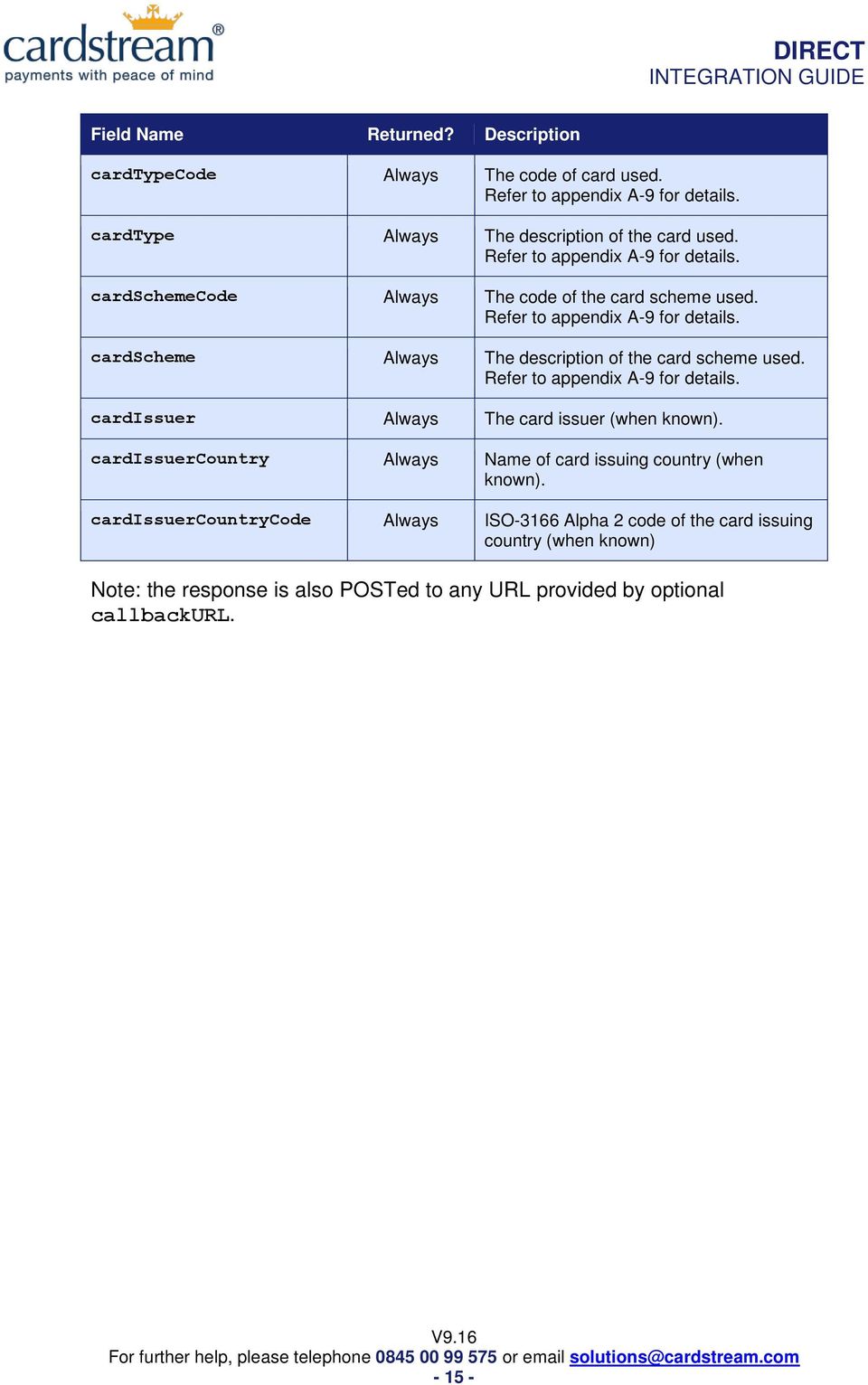
15 Field Name Returned? Description cardtypecode Always The code of card used. Refer to appendix A-9 for details. cardtype Always The description of the card used. Refer to appendix A-9 for details. cardschemecode Always The code of the card scheme used. Refer to appendix A-9 for details. cardscheme Always The description of the card scheme used. Refer to appendix A-9 for details. cardissuer Always The card issuer (when known). cardissuercountry Always Name of card issuing country (when known). cardissuercountrycode Always ISO-3166 Alpha 2 code of the card issuing country (when known) Note: the response is also POSTed to any URL provided by optional callbackurl
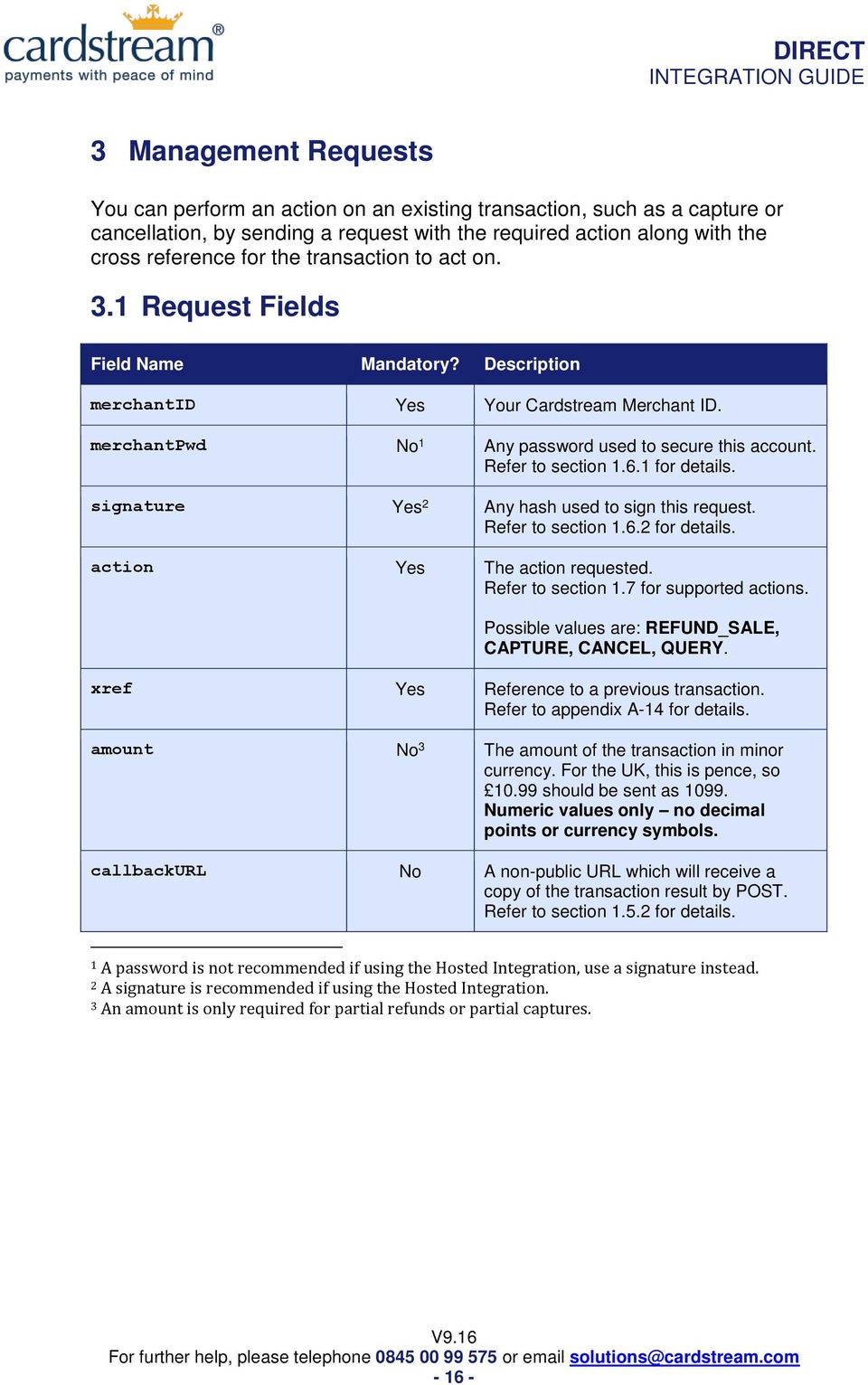
16 3 Management Requests You can perform an action on an existing transaction, such as a capture or cancellation, by sending a request with the required action along with the cross reference for the transaction to act on. 3.1 Request Fields Field Name Mandatory? Description merchantid Yes Your Cardstream Merchant ID. merchantpwd No 1 Any password used to secure this account. Refer to section for details. signature Yes 2 Any hash used to sign this request. Refer to section for details. action Yes The action requested. Refer to section 1.7 for supported actions. Possible values are: REFUND_SALE, CAPTURE, CANCEL, QUERY. xref Yes Reference to a previous transaction. Refer to appendix A-14 for details. amount No 3 The amount of the transaction in minor currency. For the UK, this is pence, so should be sent as Numeric values only no decimal points or currency symbols. callbackurl No A non-public URL which will receive a copy of the transaction result by POST. Refer to section for details. 1 A password is not recommended if using the Hosted Integration, use a signature instead. 2 A signature is recommended if using the Hosted Integration. 3 An amount is only required for partial refunds or partial captures
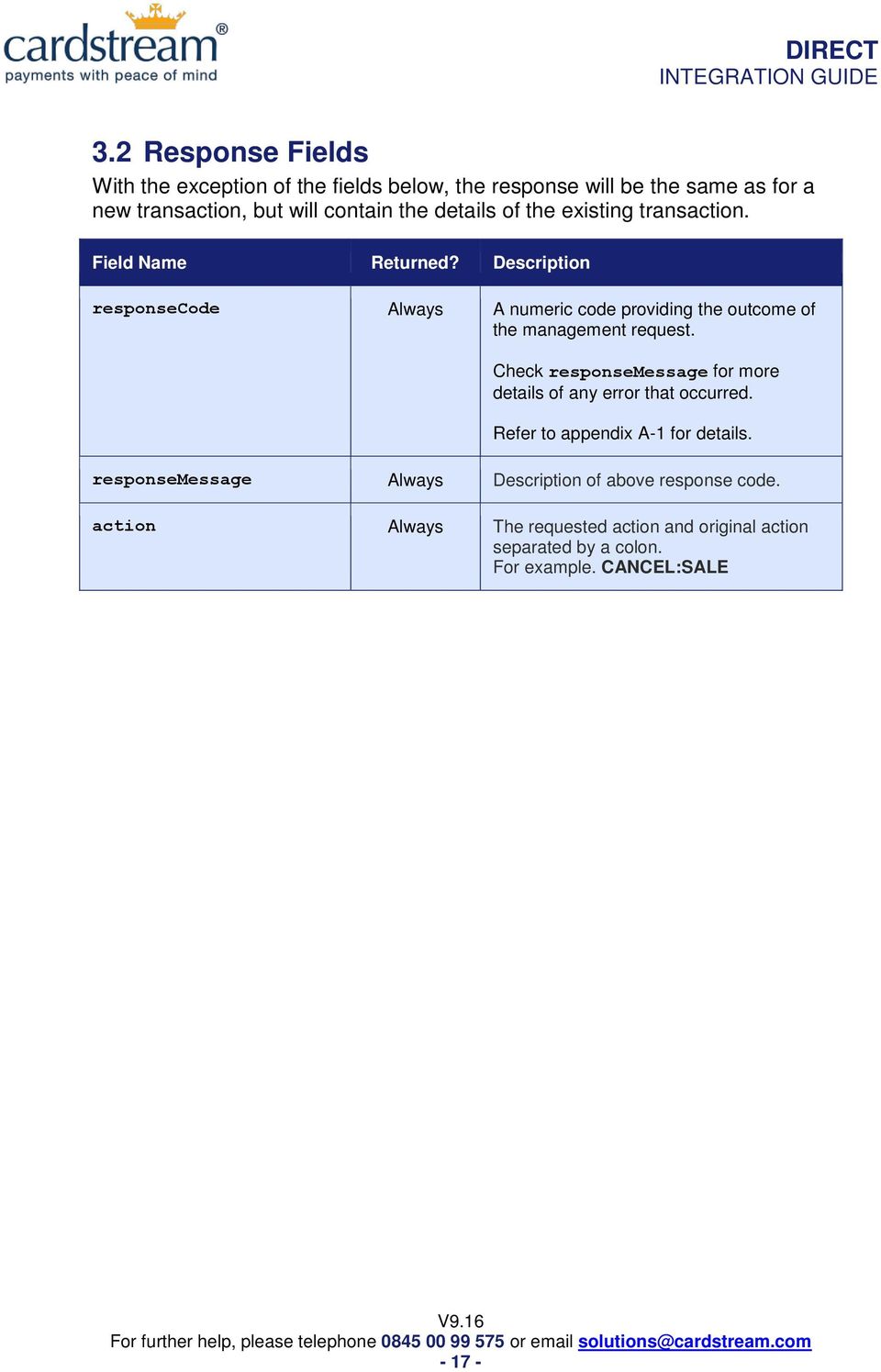
17 3.2 Response Fields With the exception of the fields below, the response will be the same as for a new transaction, but will contain the details of the existing transaction. Field Name Returned? Description responsecode Always A numeric code providing the outcome of the management request. Check responsemessage for more details of any error that occurred. Refer to appendix A-1 for details. responsemessage Always Description of above response code. action Always The requested action and original action separated by a colon. For example. CANCEL:SALE
18 4 AVS/CV2 Checking 4.1 Background You are able to request AVS and CV2 fraud checking on transactions processed by the Payment Gateway. These fraud prevention checks are performed by the Acquirer while authorising the transaction. You can choose how to act on the outcome of the check (or even to ignore them altogether) AVS Checking The Address Verification System (AVS) uses the address details that are provided by the cardholder to verify the address is registered to the card being used. The address and postcode are checked separately CV2 Checking CV2, CVV, or Card Verification Value is a 3 or 4 digit security code The check verifies the code is the correct one for the card used. For most cards the CVV is a 3 digit number to the right of the signature strip. For American Express cards this is a 4 digit number printed, not embossed, on the front right of the card. The AVS/CV2 checking preferences can be configured per Merchant Account within the Merchant Management System (MMS). These preferences can be overridden per transaction by sending one of the preference fields documented in section 4.3 which hold a comma separated list of the check responses that should be allowed to continue to completion. Responses not in the list will result in the transaction being declined with a responsecode of 5 (AVS/CV2 DECLINED)

19 4.2 Benefits & Limitations Benefits Instant: The results are available immediately and returned as part of the transaction Flexible: The checks can be managed independently allowing you the upmost control over how the results are used. Automatic: The checks can be configured to automatically decline transaction where required Limitations Not all countries supported: AVS is a UK scheme only: It is not possible to check AVS on non-uk issued cards. Only Address numerics are checked: The non-numerical characters in the billing address and postcode are not checked as part of the AVS checks. Unable to check AVS/CV2 on company cards: If you accept company credit cards you are not able to receive results on all company cards. This is due to the Acquirers not having access to this information

20 4.3 Request Fields These fields should be sent in addition to basic request fields in section 2.1. Field Name Mandatory? Description customeraddress Yes 1 For AVS checking this must be a registered billing address for the card. customerpostcode Yes 2 For AVS checking this must be a registered postcode for the card. cardcvv Yes 3 For CVV checking this must be the Card Verification Value printed on the card. avscv2checkrequired No 4 Is AVS/CV2 checking required for this transaction? Possible values are: N Checking is not required. Y Abort if checking is not enabled. cv2checkpref No 5 List of cv2check response values that are to be accepted, any other value will cause the transaction to be declined. Value is a comma separated list containing one or more of the following: not known, not checked, matched, not matched, partially matched. addresscheckpref No 5 List of addresscheck values that are to be accepted, any other value will cause the transaction to be declined. Value is a comma separated list containing one or more of the following not known, not checked, matched, not matched, partially matched. postcodecheckpref No 5 List of postcodecheck response values that are to be accepted, any other value will cause the transaction to be declined Value is a comma separated list containing one or more of the following: not known, not checked, matched, not matched, partially matched. 1 Mandatory if AVS address checking is required 2 Mandatory if AVS postcode checking is required 3 Mandatory if CV2 checking is required 4 The default value is Y if AVS/CV2 checking is enabled on the Merchant Account, otherwise N 5 If the value is not supplied than the default account preferences will be used

21 4.4 Response Fields These fields will be returned in addition to the AVS/CV2 request fields in section 4.3 and the basic response fields in section 2.2. Field Name Returned? Description avscv2checkenabled Always Is AVS/CV2 checking enabled for this Merchant Account? Possible values are: N Merchant account is not enabled. Y Merchant account is enabled. avscv2responsecode avscv2responsemessage avscv2authentity cv2check addresscheck postcodecheck If checks performed If checks performed If checks performed If checks performed If checks performed If checks performed The result of the AVS/CV2 check. Refer to appendix A-2 for details. The message received from the Acquiring bank, or any error message with regards to the AVS/CV2 check. Refer to appendix A-2 for details. Textual description of the AVS/CV2 authorizing entity as described in appendix A-2. Possible values are: not known, merchant host, acquirer host, card scheme, issuer. Description of the AVS/CV2 CV2 check as described in appendix A-2. Possible values are: not known, not checked, matched, not matched, partially matched. Description of the AVS/CV2 address check as described in appendix A-2. Possible values are: not known, not checked, matched, not matched, partially matched. Description of the AVS/CV2 postcode check as described in appendix A-2. Possible values are: not known, not checked, matched, not matched, partially matched
22 5 3-D Secure Authentication 5.1 Background 3-D Secure authentication is an additional fraud prevention scheme that is available to all Merchants using the Payment Gateway. It allows Cardholder s to assign a password to their card that is then verified whenever a transaction is processed through a site that supports the use of the scheme. The addition of password protection allows extra security on transactions that are processed online. 3-D Secure stands for 3 Domain Server, there are 3 parties that are involved in the 3-D Secure process: The company the purchase is being made from. The Acquiring Bank (the bank of the company) VISA and MasterCard (the card issuers themselves) The gateway supports 3-D Secure as implemented by Visa and Mastercard and marketed under the brand names of Verified by VISA (VBV) and MasterCard Secure Code (MSC). Implementations by American Express (SafeKey) and JCB (J/Secure) are not currently supported. 3-D Secure is also the only fraud prevention scheme that is available that offers Merchants liability cover for transactions that are verified by the checks. This provides additional protection to Merchants using the scheme as opposed to those that do not
23 5.2 Benefits & Limitations Benefits Instant: The results are available immediately and returned as part of the transaction Flexible: The checks can be managed independently allowing you the upmost control over how the results are used. Automatic: The checks can be configured to automatically decline transaction where required. Liability Shift: The main benefit to companies using the 3-D Secure scheme is the availability of a liability shift for a successfully authenticated transaction. This offers protection by the card issuers against charge backs as the liability is assumed. Note: You will need to check with your Acquirer for the exact terms on liability shifts. No extra cost: There are no extra costs to add 3-D Secure onto your gateway account. Your Acquirer may charge to add this onto your Merchant Account however you may also find that your transaction charges lower as a result of using 3-D Secure. Easy management: The 3-D Secure scheme is controlled within the Merchant Management System (MMS) Limitations Chargebacks can still occur: Fully authenticated 3-D Secure transactions do not guarantee a liability shift; this is decided on the discretion of your Acquirer. Not all cards are supported: At the moment the gateway does not support 3-D Secure for Amex, JCB or Diner s club cards
24 5.3 Implementation If your Merchant account is setup for 3-D Secure the Gateway will require further authentication details provided by the 3-D Secure system Initial Request (Verify Enrolment) If no 3-D Secure authentication details are provided in the initial request the Gateway will determine if the transaction is eligible for 3-D Secure by checking if the card is enrolled in the 3-D Secure scheme. If the Gateway determines that the transaction is not eligible for 3-D Secure then it will continue and process it as normal transaction without 3-D Secure unless the threedsrequired request field indicates that the transaction should be aborted instead. If the Gateway determines that the transaction is eligible it will respond with a responsecode of (3DS AUTHENTICATION REQUIRED) and included in the response will be a threedsacsurl field containing the URL required to contact the ACS on and a threedsmd and threedspareq to send to the provided URL. The latter two values must be posted to the provided ACS URL as the fields MD and PaReq along with a TermUrl field provided by the yourself which must contain the URL of a page on the Merchant s server to return to when authentication has been completed Continuation Request (Check Authentication & Authorise) On completion of the 3-D Secure authentication the ACS will post the original MD along with a PaRes value to the TermUrl provided. These values should then be sent to the Gateway in the threedsmd and threedspares fields of a new request. This new request will check the 3-D Secure authentication and then either complete or abort the transaction depending on the authentication result and the your preferences, either sent in the threedspref field on set in the Merchant Management System (MMS). If you would like an example of a 3-D Secure integration, please refer to our sample code Appendix A External Authentication Request You can choose to obtain the 3-D Secure authentication details from a thirdparty, in which case they should provide them as part of a standard request. If the Gateway receives valid third-party authentication details then it will use those and not attempt to contact the 3-D Secure system itself
25 5.4 Request Fields Initial Request These fields should be sent in addition to basic request fields in section 2.1. Field Name Mandatory? Description merchantname No 1 Merchant name to use on 3DS form. merchantwebsite No 1 Merchant website to use on 3DS form. threedsrequired No 2 Is 3DS required for this transaction? Possible values are: N 3DS is not required. Y Abort if 3DS is not enabled. threedscheckpref No 1 List of threedscheck response values that are to be accepted, any other value will cause the transaction to be declined. Value is a comma separated list containing one or more of the following values: not known, not checked, matched, not matched, partially matched. 1 If the value is not supplied than the default account preferences will be used. 2 The default value is Y if 3-D Secure is enabled on the Merchant Account, otherwise N Continuation Request These fields may be sent alone. Field Name Mandatory? Description threedsms Yes The value of the threedsmd field in the initial Gateway response. threedspares Yes The value of the PaRes field POSTed back from the Access Control Sever (ACS) Note: It is only necessary to send the threedsmd and the threedspares in the continuation request as the threedsmd will identify the Merchant Account and initial request. The message does not need to be signed. However you can send any of the normal request fields to modify or supplement the initial request. Any card details and transaction amount sent in the second request must match those used in the first request, or the second request will fail with a responsecode of (REQUEST MISMATCH)
26 5.4.3 External Authentication Request These fields should be sent in addition to basic request fields from section 2.1. Field Name Mandatory? Description threedsenrolled threedsauthenticated threedsxid threedseci threedscavv If 3DS enabled If 3DS enrolled If 3DS authenticated If 3DS authenticated If 3DS authenticated The 3DS enrolment status for the credit card. Refer to appendix A-3 for details. Possible values are: Y Enrolled. N - Not Enrolled. U - Unable To Verify. The 3DS authentication status for the credit card. Refer to appendix A-3 for details. Possible values are: Y - Authentication Successful. N - Not Authenticated. U - Unable To Authenticate. A - Attempted Authentication. The unique identifier for the transaction in the 3DS system. The Electronic Commerce Indicator (ECI). The Cardholder Authentication Verification Value (CAVV). Note: If 3-D Secure is not enabled for the Merchant Account then any 3-D Secure authentication fields sent in the request are ignored and the transaction is processed as normal without 3-D Secure
27 5.5 Response Fields Initial Response These fields will be returned in addition to the request fields from section and the basic response fields in section 2.2. Field Name Returned? Description threedsenabled Always Is 3DS enabled for this Merchant Account? Possible values are: N Merchant Account is not enabled. Y Merchant Account is enabled. threedsxid threedsvetimestamp threedsenrolled threedsms threedsacsurl threedspareq If 3DS enabled If 3DS enabled If 3DS enabled If 3DS enabled If 3DS enrolled If 3DS enrolled The unique identifier for the transaction in the 3DS system. The time the card was checked for 3DS enrolment. The 3DS enrolment status for the credit card. Refer to appendix A-3 for details. Possible values are: Y Enrolled. N - Not Enrolled. U - Unable To Verify. E - Error Verifying Enrolment. Value to return in the continuation request. Can be sent to the Access Control Server (ACS) in its MD field or stored locally by your server. The URL of the Access Control Server (ACS) to which the Payer Authentication Request (PaReq) should be sent. Payer Authentication Request (PaReq) that is sent to the Access Control Server (ACS) in order to verify the 3DS status of the credit card
28 5.5.2 Continuation Response These fields will be returned in addition to the request fields from section 5.4.1, the initial response fields in section and the basic response fields in section 2.2. Field Name Returned? Description threedspares threedscatimestamp threedsauthenticated threedseci threedscavv threedscavvalgorithm If 3DS enrolled If 3DS enrolled If 3DS enrolled If 3DS authenticated If 3DS authenticated If 3DS authenticated Payer Authentication Response (PaRes) that is returned from the Access Control Server (ACS) determining the 3DS status of the credit card. The time the card was checked for 3DS authentication. The 3DS authentication status for the credit card. Refer to appendix A-3 for details. Possible values are: Y - Authentication Successful. N - Not Authenticated. U - Unable To Authenticate. A - Attempted Authentication. E - Error Checking Authentication.. This contains a two digit Electronic Commerce Indicator (ECI) value, which is to be submitted in a credit card authorisation message. This value indicates to the processor that the Customer data in the authorisation message has been authenticated. The data contained within this property is only valid if the threedsauthenticated value is Y or A. This contains a 28-byte Base-64 encoded Cardholder Authentication Verification Value (CAVV). The data contained within this property is only valid if the threedsauthenticated value is Y or A. This contains the one digit value which indicates the algorithm used by the Access Control Server (ACS) to generate the CAVV. The data contained within this property is only valid if the threedsauthenticated
29 Field Name Returned? Description value is Y or A. threedserrorcode If 3DS error Any error response code returned by the Access Control Server (ACS) should there be an error in determining the card s 3DS status. threedserrordescription If 3DS error Any error response description returned by the Access Control Server (ACS) should there be an error in determining the card's 3DS status External Authentication Response These fields will be returned in addition to the request fields from section and the basic response fields in section 2.2. Field Name Returned? Description threedsenabled Always Is 3DS enabled for this Merchant Account? Possible values are: N Merchant Account is not enabled. Y Merchant Account is enabled. Note: If 3-D Secure is not enabled for the Merchant Account then any 3-D Secure authentication fields sent in the request are ignored and the transaction is processed as normal without 3-D Secure
30 6 VISA MCC6012 Merchants 6.1 Background Following changes implemented by VISA, any UK business falling under merchant category code 6012 must provide additional details with any transaction that is processed through their account. This mainly applies to financial institutions. According to Visa, the additional rules were brought in to protect consumers and prevent fraud. The Acquirer will inform you if they need to send this information Requirements This section only applies to transactions that: Involve a Merchant with a MCC 6012 category code. Use VISA Process a UK domestic payment. If any of the above three criteria do not apply, then no additional data need be supplied in the transaction Additional fields/information Merchants assigned the code MCC 6012 must collect the following data for the primary recipient for each UK domestic VISA transaction: Unique account identifier for the loan or outstanding balance funded. For example the loan account number or the PAN (Primary Account Number) if it is a credit card balance. Last name (family name) Date of Birth (D.O.B) Postcode Primary recipients are the entities (people or organisations) that have a direct relationship with the financial institution. Also, these primary recipients have agreed to the terms and conditions of the financial institution
31 6.2 Request Fields To comply with the rules, an MCC6012 Merchant must send these additional fields: Field Name Mandatory? Description merchantcategorycode Yes 1 Merchant s VISA MCC (should be 6012). receivername Yes Surname only - up to 6 letters allowed. receiveraccountno Yes Account number. If a PAN is supplied the only the first 6 and last 4 digits will be used. receiverdateofbirth Yes Primary recipient s date of birth. ISO Date Format: YYYY-MM-DD. receiverpostcode Yes Primary recipient s postcode. (Only the district is required but full postcodes are accepted, therefore W12 8QT or just W12 are acceptable values). 1 Only required if the Merchants Category Code is not configured on their gateway account
32 7 Billing Descriptor 7.1 Background The Billing Descriptor is how the Merchant s details appear on the cardholder s statement. It is set up with the Acquirer when the Merchant Account is opened. It is used by the cardholder to identify who a payment was made to on a particular transaction. Selecting a clear Billing Descriptor is important for a Merchant to avoid a chargeback when the cardholder does not recognise the name on the transaction Static Descriptor The Static Descriptor is the descriptor agreed between the Merchant and Acquirer when the Merchant Account is opened. The descriptor used is typically the Merchant s trading name, location and contact phone number Dynamic Descriptor The Dynamic Descriptor is a descriptor sent with the transaction that includes details on the goods purchased or service provided, this is often used by large companies that provide many services and where the brand of the service is more familiar than the company name. The Dynamic Descriptor usually replaces any Static Descriptor on a per transaction basis. Not all Acquirers accept Dynamic Descriptors and for those that do the format required varies. Often the Merchant s name is shortened to three (3) letter, followed by and asterisk (*), followed by a short description of the service or product that the business provides. This field typically has a limit of twenty-five (25) characters including the phone number For more information on whether your Acquirer allows Dynamic Descriptor and the format they should be sent in please contact your support representative
33 7.2 Request Fields The Dynamic Descriptor is built using one or more of the following narrative fields. Field Name Mandatory? Description statementnarrative1 No Merchant s name. statementnarrative2 No Product, service or other descriptive info
34 8 Receipts & Notifications 8.1 Background The Gateway can be configured to automatically transaction receipts to the Customer and notifications to the Merchant. The Gateway is also integrated into the ereceipts system which stores Customer receipts for access online Customer Receipts The Customer can be automatically ed a transaction receipt each time a transaction is processed by the Gateway. Receipts are sent at the time the transaction is authorised and only for transactions where the Acquirer has approved the authorisation. Receipts are not sent for declined or referred authorisations or aborted transactions. This functionality is enabled globally on a per Merchant Account basis using the Merchant Management System (MMS). This global setting can also be overridden per transaction if required using the customerreceiptsrequired field. Customer receipts require the Customer to provide their address; if no address is sent in the customer field then no receipt will be sent Merchant Notifications The Merchant can be automatically ed a transaction notification each time a transaction is processed by the Gateway. Notifications are sent at the time the transaction is authorised and only for transactions where the Acquirer approved, declined or referred the authorisation. Notifications are not sent for aborted transactions. This functionality is enabled globally on a per Merchant Account basis using the Merchant Management System (MMS). This global setting can also be overridden per transaction if required using the notify required field Customer Online Receipts The Gateway is integrated with the ereceipts system run by Paperless Receipts Ltd. This system is used by many high street retailers and allows a Merchant to capture data allowing a far deeper understanding and insight into their Customers shopping habits. Receipt information is sent to ereceipts at the time the transaction is authorised and only for transactions where the
35 Acquirer has approved the authorisation. Receipt information is not sent for declined or referred authorisations or aborted transactions. This functionality is enabled globally on a per Merchant Account basis using the Merchant Management System (MMS). This global setting can also be overridden per transaction if required using the ereceiptsrequired field. Merchant must supply a unique Customer reference (using the ereceiptscustomerref field) or, alternatively, the use the Customer s address (using the customer field) to identify the Customer in the ereceipts system. If purchase item data is sent in a transaction then this will be used to build an itemised electronic receipt. For more information regarding purchase data please refer to section 8.3, for information on which fields are used to build the electronic receipt refer to section 8.2 below
36 8.2 Request Fields General Fields Field Name Mandatory? Description customerreceiptsreqired No 1 Send a Customer receipt if possible. Possible values are: N Don t send a receipt. Y Send if Customer s provided. customer No Customer s address. notify required No 1 Send a notification if possible. Possible values are: N Don t send a notification. Y Send if notification provided. notify No 1 Merchant s notification address. ereceiptsrequired No 1 Send receipt data to ereceipts system. Possible values are: N Don t send data. Y Send data if API details provided. ereceiptsstoreid No 1 ereceipts store identifier. ereceiptscustomerref No 2 ereceipts Customer reference. ereceiptsapikey No 1 ereceipts API key. ereceiptsapisecret No 1 ereceipts API secret. ereceiptsreceiptref No ereceipts receipt reference. ereceiptsreceiptdata No 3 Complete ereceipts data 1 Overrides any global setting configured via the Merchant Management System (MMS). 2 Required if ereceipts is required and no customer is sent. 3 Allows complete ereceipts data to be sent rather than constructing it from the transaction
37 8.2.2 ereceipts Itemised Receipt Data Field Name Mandatory? Description grossamount No Total gross amount of sale. netamount No Total net amount of sale. taxamount No Total tax amount of sale. taxrate No Total tax rate (percentage). discountamount No Total discount amount of sale. discountreason No Reason for above discount. itemxxdescription No Description of XX th item purchased. itemxxquantity No Quantity of XX th item purchased. itemxxgrossamount No Gross amount for XX th item purchased. itemxxtaxamount No Tax amount for XX th item purchased. itemxxtaxrate No Total tax rate for XX th item purchased. itemxxdiscountamount No Total discount for XX th item purchased. itemxxdiscountreason No Discount reason for XX th item purchased. itemxxproductcode No Product code for XX th item purchased. itemxxcommoditycode No Commodity code for XX th item purchased. itemxxunitofmeasure No Unit of measure for XX th item purchased. itemxxunitamount No Unit amount for XX th item purchased. items No 1 Nested array of line items. 1 Used as an alternative to itemxxfield format, both formats can not be sent together. Note: no attempt is made to check that any gross, net and tax amounts are correct with respect to each other. It is the sender s responsibility to ensure alternative amount formats are correct
38 8.3 Response Fields The request fields for the required receipts and notifications are returned along with the appropriate fields from the following. Field Name Returned? Description customerreceiptsresponsecode If required Result of sending to Customer. Refer to appendix A-1 for details. customerreceiptsresponsemessage If required Description of above response code. notify responsecode If required Result of sending to Merchant. Refer to appendix A-1 for details. notify responsemessage If required Description of above response code. ereceiptsenabled If required Is ereceipts enabled for this Merchant Account? Possible values are: N Merchant Account is not enabled. Y Merchant Account is enabled. ereceiptsstoreid If required 1 Merchant s ereceipts store identifier. ereceiptsreceiptref If required Unique ereceipt reference. ereceiptsresponsecode If required Result of sending details to ereceipts. Refer to appendix A-1 for details. ereceiptsresponsemessage If required Description of above response code. 1 Either the value sent in the request or that calculated from the default account preferences
39 9 Purchase Data 9.1 Background The Gateway can be sent advance purchase information with each transaction where required. The Gateway provides a number of fields which you can use to store advanced purchase information about the transaction including details on individual items purchased etc. These fields are only sent to the Acquirer if needed. The stored data can be obtained by sending a QUERY request. The details may also be used for advanced purposes such as displaying shopping cart information on the MasterPass checkout or sending full receipt details to the ereceipts system American Express Purchases Purchases using American Express cards will send a subset of this information to the card scheme as appropriate. With American Express you can provide tax or discount reason (but not both). If taxamount is provided then taxreason is used, if discountamount is provided then discountamount is used. If both are provided then taxreason is used. Only the first size line item details are sent to American Express and then only the itemxxdescription, itemxxquantity and itemxxgrossamount fields are sent Purchase Orders These fields along with other advanced fields as detailed in section 13 can be used to send full information relating to a purchase order and related invoice indicating types, quantities and agreed prices for products or services. Details on the supplier, shipping, delivery etc. can also be included. At present this information is not sent to the Acquirer but future enhancements to the Gateway may include sending such information as Level 2 or 3 Purchasing data as defined by the relevant card schemes
40 9.2 Request Fields Field Name Mandatory? Description grossamount No Total gross amount of sale. netamount No Total net amount of sale. taxrate No Total tax rate (percentage). taxamount No 1 Total tax amount of sale. taxreason No 1 Reason for above tax (ie VAT). discountamount No 1 Total discount amount of sale. discountreason No 1 Reason for above discount. itemxxdescription 2 No Description of XX th item purchased. itemxxquantity 2 No Quantity of XX th item purchased. itemxxgrossamount 2 No Gross amount for XX th item purchased. itemxxtaxamount 2 No Tax amount for XX th item purchased. itemxxtaxrate 2 No Total tax rate for XX th item purchased. itemxxdiscountamount 2 No Total discount for XX th item purchased. itemxxdiscountreason 2 No Discount reason for XX th item purchased. itemxxproductcode 2 No Product code for XX th item purchased. itemxxcommoditycode 2 No Commodity code for XX th item purchased. itemxxunitofmeasure 2 No Unit of measure for XX th item purchased. itemxxunitamount 2 No Unit amount for XX th item purchased. items No 3 Nested array of line items. 1 Amex/Diners require either tax or discount not both 2 XX is a number between 1 and 99 3 Used as an alternative to itemxxfield format, both formats can not be sent together. Note: no attempt is made to check that any gross, net and tax amounts are correct with respect to each other. It is the sender s responsibility to ensure alternative amount formats are correct. Line item fields can either be sent flat using field names containing the item row number as a sequential number from 1 to 99 or using nested arrays of the
41 form items[xx][field] where XX is the row number from 1 to 99 and field is the field name from the above table without the itemxx prefix and starting with a lowercase first letter. For example, the tax rate for item 5 can either be sent as item5taxrate or as items[5][taxrate]. The two formats should not be mixed. If a request field of items is seen then the flat fields are ignored
42 10 Recurring Transaction Agreements 10.1 Background The Gateway makes it easy to perform repeating payments either ad-hoc or to a pre-configured schedule. Ad-hoc agreements can be performed by providing the cross reference to an existing transaction instead of (or in addition to) the card and order details when requesting a new transaction. Scheduled recurring transactions are configured be setting up a Recurring Transaction Agreement. This is an agreement with the Gateway telling it when and how to automatically take recurring payments. Repeat payment can be done as either Card On File or Continuous Authority transactions. For more information, refer to the Recurring Transactions guide Card On File transactions (COF) Transactions made using card details that have been previously captured and then stored on file are termed Card On File transactions. This is how most ad-hoc repeat transactions are performed using the xref field to refer to the card details stored on file during a previous transaction. As the card CVV number is never stored then such transactions will either require the cardholder to re-enter their CVV or the transaction has to be performed with no CVV, in such cases the Gateway will automatically suppress CVV checking Continuous Payment Authority (CPA) transactions A Continuous Payment Authority (CPA), which is sometimes referred to as a recurring payment or a continuous payment transaction, is where the Cardholder gives a Merchant permission to regularly take money from their debit or credit card whenever they think they re owed money. Often payday loan companies, online DVD rental subscriptions, magazine subscriptions and gym memberships use this method of payment. Your Acquirer may require you to use a specific Merchant Account different to your normal account for CPA transactions
43 10.2 Request Fields Field Name Mandatory? Description rtname No Free format short name for the agreement. rtdescription No Free format longer description for the agreement. rtpolicyref No Merchant Reference (MPRN). rttype No Recurring transaction type (defaults depending on request type). Possible values are: MOTO Card On File (COF). CA Continuous Authority (CAP). rtunique No Unique id for recurring transactions, will be append with transaction count (defaults to transactionunique). rtmerchantid No Merchant ID to use for the recurring transactions (defaults to merchantid). rtstartdate No Start date of agreement (default to date request received). rtinitialdate No Date of initial payment (defaults to rtstartdate). Format: YYYY-MM-DD HH:MM:SS rtinitialamount No Amount of initial payment (defaults to rtcycleamount). rtfinaldate No Date of final payment. Format: YYYY-MM-DD HH:MM:SS. rtfinalamount No Amount of final payment (defaults to rtcycleamount). rtcycleamount No Amount per cycle (defaults to amount). rtcycleduration Yes Cycle duration. rtcycledurationunit Yes Cycle duration unit. One of the following values: day, week, month or year. rtcyclecount No Number of cycles to repeat (defaults to repeat forever). rtmerchantdata No Free format Merchant data field
44 10.3 Response Fields Field Name Returned? Description rtid Always Recurring Transaction Agreement ID. rtresponsecode Always Result of setting up RT Agreement. Refer to appendix A-1 for details. rtresponsemessage Always Description of above response code
45 11 Duplicate Transaction Checking 11.1 Background Duplicate transaction checking prevents transaction requests from accidentally processing more than once. This can happen if a Customer refreshes your checkout page or clicks a button that issues a new transaction request. While duplicate checking can help prevent repeat transactions from going through, we recommend talking with your developers to see if changes can be made to your form to reduce the likelihood of this occurring (e.g. disabling the Submit button after it s clicked) Implementation To help prevent duplicate transactions each transaction can specify a time window during which during which previous transactions will be check to see if they could be possible duplicates. This time window is specified using the duplicatedelay field. The value for this field can range from 0 to 9999 seconds (approx 2 ¾ hours). If the transaction request does not include the duplicatedelay field or specifies a value of zero then a default delay of 300 seconds (5 minutes) is used. The following fields are used in transaction comparison and must be the same for a transaction to be regarded as a duplicate; merchantid action type amount transactionunique currencycode xref (if provided in lieu of card details) cardnumber (may be specified indirectly via cross reference) If a transaction is regarded as being a duplicate then a responsecode of (REQUEST DUPLICATE) will be returned
46 11.3 Request Fields Field Name Mandatory? Description duplicatedelay No Duplicate transaction time window in seconds. Numeric value between 0 and
47 12 Custom Data You may send arbitrary data with the request by appending extra fields, which will be returned in the response unmodified. These extra fields are merely echoed back and not stored by the Payment Gateway. Caution should be made to ensure that any extra fields do not match any currently documented fields or possible future fields; one way to do this is to prefix the field names with a value unique to the Merchant. You can also use the merchantdata field to store custom data with the transaction. This stored data can then be retrieved at a later date using a QUERY request. Associative data can be serialised using the notation merchantdata[name]=value Request Fields Field Name Mandatory? Description merchantdata No Arbitrary data to be stored along with this transaction
48 13 Advanced Integration Fields The Gateway provides a number of fields that you can use to store information about the transaction. These fields are only sent to the Acquirer if needed. The stored data can be obtained by sending a QUERY request Customer Request Fields These fields can be used to store details about the Customer and any relationship between the Customer and Merchant such as any purchase order raised etc. If AVS checks are in use then the Customer and cardholder are assumed to be the same person and the address and postcode fields are taken as being the registered billing address of the card. Field Name Mandatory? Description customername No Cardholder s name. customercompany No Cardholder s company (if applicable) customeraddress No 1 Cardholder s address. customerpostcode No 1 Cardholder s postcode. customertown No Cardholder s town/city. customercounty No Cardholder s county/province. customercountrycode No Cardholder s country. ISO-3166 alpha or numeric code. customerphone No Cardholder s phone number customermobile No Cardholder s mobile phone number. customerfax No Cardholder s fax number. customer No Cardholder s address. customerorderref No Customer s reference for this order. (Purchase Order Reference) customermerchantref No Customer s reference for the Merchant. customertaxref No Customer s tax reference number. 1 Mandatory if AVS checking required
49 13.2 Merchant Request Fields These fields can be used to store details about the Merchant and any relationship between the Merchant and Customer such as any invoice reference etc. Field Name Mandatory? Description/Value merchantname No Merchant s contact name. merchantcompany No Merchant s company name. merchantaddress No Merchant s contact address. merchanttown No Merchant s contact town/city. merchantcounty No Merchant s contact county. merchantpostcode No Merchant s contact postcode. merchantcountrycode No Merchant s contact country. Valid ISO-3166 alpha or numeric code. merchantphone No Merchant s phone. merchantmobile No Merchant s mobile phone number. merchantfax No Merchant s fax number. merchant No Merchant s address. merchantwebsite No Merchant s website. merchantorderref No Merchant s reference for this order. (Invoice/Sales Reference) merchantcustomerref No Merchant s reference for the Customer. merchanttaxref No Merchant s tax reference number. merchantoriginalorderref No Reference to a back order. merchantcategorycode No Scheme assigned Merchant Category Code (MCC)
50 13.3 Supplier Request Fields These fields can be used to store details about the Supplier address. This is where any purchased goods are being supplied from, if different to the Merchant s address. Field Name Mandatory? Description/Value suppliername No Supplier s contact name. suppliercompany No Supplier s company name. supplieraddress No Supplier s contact address. suppliertown No Supplier s contact town/city. suppliercounty No Supplier s contact county. supplierpostcode No Supplier s contact postcode. suppliercountrycode No Supplier s contact country. Valid ISO-3166 alpha or numeric code. supplierphone No Supplier s phone. suppliermobile No Supplier s mobile phone number. supplierfax No Supplier s fax number. supplier No Supplier s address
51 13.4 Delivery Request Fields These fields can be used to store details about the delivery address. This is where any purchased goods are being delivered to if different to the Customer s address. Field Name Mandatory? Description/Value deliveryname No Name of person receiving the delivery. deliverycompany No Name of company receiving the delivery. deliveryaddress No Delivery address. deliverytown No Delivery town/city. deliverycounty No Delivery county. deliverypostcode No Delivery postcode. deliverycountrycode No Delivery country. Valid ISO-3166 alpha or numeric code. deliveryphone No Phone number of delivery location. deliverymobile No Mobile phone number of delivery location. deliveryfax No Fax number of delivery location. delivery No Delivery address
52 13.5 Receiver Request Fields These fields can be used to store details about the recipient of the purchased goods where different to the Customer s and Delivery details. It is most commonly used by Financial Intuitions (MCC 6012 Merchants) who need to record the primary recipient of a loan etc. Field Name Mandatory? Description/Value receivername No Receiver s contact name. receivercompany No Receiver s company name. receiveraddress No Receiver s contact address. receivertown No Receiver s contact town/city. receivercounty No Receiver s contact county. receiverpostcode No Receiver s contact postcode. receivercountrycode No Receiver s contact country. Valid ISO-3166 alpha or numeric code. receiverphone No Receiver s phone. receivermobile No Receiver s mobile phone number. receiverfax No Receiver s fax number. receiver No Receiver s address. receiveraccountno No Receiver s account number. receiverdataofbirth No Receiver s date of birth
53 13.6 Shipping Request Fields These fields can be used to store details about the shipping method and costs. Field Name Mandatory? Description/Value shippingtrackingref No Shipping tracking reference. shippingmethod No Shipping method (eg. Courier, Post, etc.). shippingamount No Cost of shipping. shippinggrossamount No Gross cost of shipping. shippingnetamount No Net cost of shipping. shippingtaxrate No Tax rate as percentage to 2 decimal places. shippingtaxamount No Tax cost of shipping. Note: no attempt is made to check that any gross, net and tax amounts are correct with respect to each other. It is the sender s responsibility to ensure alternative amount formats are correct
54 A-1 Response Codes The Gateway will always issue a responsecode to report the status of the transaction. These codes should be used rather than the responsemessage field to determine the outcome of a transaction. A zero response code always indicates a successful outcome. Response codes are grouped as follows, the groupings are for informational purposes only and not all codes in a group are used; Acquirer (FI) Error codes: 1-99 Code Description 0 Successful / authorised transaction. Any code other than 0 indicates an unsuccessful transaction 2 Card referred 4 Card declined keep card 5 Card declined 30 An error occurred. Check responsemessage for more detail General Error Codes: Code Description Transaction in progress. Contact customer support if this error occurs Reserved for future use. Contact customer support if this error occurs Reserved for future use. Contact customer support if this error occurs Invalid Credentials: merchantid is unknown Permission denied: caused by sending a request from an unauthorised IP address Action not allowed: the transaction state or Acquirer doesn t support this action Request Mismatch: fields sent while completing a request do not match initially requested values. Usually due to sending different card details to those used to authorise the transaction when completing a 3-D Secure transaction or performing a REFUND_SALE transaction Request Ambiguous: request could be misinterpreted due to inclusion of mutually exclusive fields Request Malformed: couldn t parse the request data
55 General Error Codes: Code Description Suspended Merchant account Currency not supported by Merchant Request Ambiguous, both taxvalue and discountvalue provided when should be one only Database error Payment processor communications error Payment processor error Internal Gateway communications error Internal Gateway error Encryption error Duplicate request. Refer to Section Settlement error AVS/CV2 Checks are not supported for this card (or Acquirer) IP Blocked: Request is from a banned IP address Primary IP blocked: Request is not from one of the primary IP addresses configured for this Merchant Account Secondary IP blocked: Request is not from one of the secondary IP addresses configured for this Merchant Account Reserved for future use. Contact customer support if this error occurs Unsupported Card Type: Request is for a card type that is not supported on this Merchant Account Unsupported Authorisation: External authorisation code authcode has been supplied and this is not supported for the transaction or by the Acquirer Request not supported: The Gateway or Acquirer does not support the request Request expired: The request can not be completed as the information is too old Request retry: The request can be retried later Test Card Used: A test card was used on a live Merchant Account Unsupported card issuing country: Request is for a card issuing country that is not supported on this Merchant Account Unsupported payment type: Request uses a payment type which is not supported
56 General Error Codes: Code Description on this Merchant Account 3-D Secure Error Codes: Code Description D Secure transaction in progress. Contact customer support if this error occurs Unknown 3-D Secure Error D Secure processing is unavailable. Merchant account doesn t support 3-D Secure D Secure processing is not required for the given card D Secure processing is required for the given card Error occurred during 3-D Secure enrolment check Reserved for future use. Contact customer support if this error occurs Reserved for future use. Contact customer support if this error occurs Error occurred during 3-D Secure authentication check Reserved for future use. Contact customer support if this error occurs D Secure authentication is required for this card D Secure enrolment or authentication failure and Merchant 3-D Secure preferences are to STOP processing Missing Request Field Error Codes: Code Description Missing request. No data posted to integration URL Missing merchantid field Reserved for future use. Contact customer support if this error occurs Reserved for internal use. Contact customer support if this error occurs Reserved for internal use. Contact customer support if this error occurs Reserved for internal use. Contact customer support if this error occurs Reserved for internal use. Contact customer support if this error occurs
57 Missing Request Field Error Codes: Code Description Missing action field Missing amount field Missing currencycode field Missing cardnumber field Missing cardexpirymonth field Missing cardexpiryyear field Missing cardstartmonth field (reserved for future use) Missing cardstartyear field (reserved for future use) Missing cardissuenumber field (reserved for future use) Missing cardcvv field Missing customername field Missing customeraddress field Missing customerpostcode field Missing customer field Missing customerphone field (reserved for future use) Missing countycode field Missing transactionunique field (reserved for future use) Missing orderref field (reserved for future use) Missing remoteaddress field (reserved for future use) Missing redirecturl field Missing callbackurl field (reserved for future use) Missing merchantdata field (reserved for future use) Missing origin field (reserved for future use) Missing duplicatedelay field (reserved for future use) Missing itemquantity field (reserved for future use) Missing itemdescription field (reserved for future use)
58 Missing Request Field Error Codes: Code Description Missing itemgrossvalue field (reserved for future use) Missing taxvalue field (reserved for future use) Missing discountvalue field (reserved for future use) Missing taxdiscountdescription field (reserved for future use) Missing xref field (reserved for future use) Missing type field (reserved for future use) Missing signature field (field is required if message signing is enabled) Missing authorisationcode field (reserved for future use) Missing transactionid field (reserved for future use) Missing threedsrequired field (reserved for future use) Missing threedsmd field (reserved for future use) Missing threedspares field Missing threedseci field Missing threedscavv field Missing threedsxid field Missing threedsenrolled field Missing threedsauthenticated field Missing threedscheckpref field Missing cv2checkpref field Missing addresscheckpref field Missing postcodecheckpref field Missing capturedelay field Missing orderdate field Missing grossamount field Missing netamount field Missing taxrate field
59 Missing Request Field Error Codes: Code Description Missing taxreason field Missing cardexpirydate field Missing cardstartdate field Invalid Request Field Error Codes: Code Description Invalid request Invalid merchantid field Reserved for future use. Contact customer support if this error occurs Reserved for internal use. Contact customer support if this error occurs Reserved for internal use. Contact customer support if this error occurs Reserved for internal use. Contact customer support if this error occurs Reserved for internal use. Contact customer support if this error occurs Invalid action field Invalid amount field Invalid currencycode field Invalid cardnumber field Invalid cardexpirymonth field Invalid cardexpiryyear field Invalid cardstartmonth field Invalid cardstartyear field Invalid cardissuenumber field Invalid cardcvv field Invalid customername field Invalid customeraddress field Invalid customerpostcode field
60 Invalid Request Field Error Codes: Code Description Invalid customer field Invalid customerphone field Invalid countycode field Invalid transactionunique field (reserved for future use) Invalid orderref field (reserved for future use) Invalid remoteaddress field Invalid redirecturl field Invalid callbackurl field (reserved for future use) Invalid merchantdata field (reserved for future use) Invalid origin field (reserved for future use) Invalid duplicatedelay field. Refer to Section Invalid itemquantity field Invalid itemdescription field Invalid itemgrossvalue field Invalid taxvalue field Invalid discountvalue field Invalid taxdiscountdescription field (reserved for future use) Invalid xref field Invalid type field Invalid signature field Invalid authorisationcode field Invalid transactionid field Invalid threedsrequired field Invalid threedsmd field Invalid threedspares field Invalid threedseci field
61 Invalid Request Field Error Codes: Code Description Invalid threedscavv field Invalid threedsxid field Invalid threedsenrolled field Invalid threedsauthenticated field Invalid threedscheckpref field Invalid cv2checkpref field Invalid addresscheckpref field Invalid postcodecheckpref field Invalid capturedelay field Invalid orderdate field Invalid grossamount field Invalid netamount field Invalid taxrate field Invalid taxreason field Invalid card expiry date. Must be a date sometime in the next 10 years Invalid card start date. Must be a date sometime in the last 10 years
62 A-2 AVS / CV2 Check Response Codes The AVS/CV2 Check Response Message field avscv2responsemessage is sent back in the raw form that is received from the Acquiring bank and can contain the following values; Response ALL MATCH SECURITY CODE MATCH ONLY ADDRESS MATCH ONLY NO DATA MATCHES DATA NOT CHECKED SECURITY CHECKS NOT SUPPORTED Description AVS and CV2 match CV2 match only AVS match only No matches for AVS and CV2 Supplied data not checked Card scheme does not support checks
63 The AVS/CV2 Response Code avscv2responsecode is made up of six characters and is sent back in the raw form that is received from the Acquiring bank. The first 4 characters can be decoded as below, the remaining 2 characters are currently reserved for future use; Position 1 Value Description 0 No Additional information available. 1 CV2 not checked 2 CV2 matched. 4 CV2 not matched 8 Reserved Position 2 Value Description 0 No Additional information available. 1 Postcode not checked 2 Postcode matched. 4 Postcode not matched 8 Postcode partially matched Position 3 Value Description 0 No Additional Information 1 Address numeric not checked 2 Address numeric matched 4 Address numeric not matched 8 Address numeric partially matched Position 4 Value Description 0 Authorising entity not known 1 Authorising entity merchant host 2 Authorising entity acquirer host 4 Authorising entity card scheme 8 Authorising entity issuer
64 A-3 3-D Secure Enrolment/Authentication Codes The 3-D Secure enrolment check field threedsenrolled can return the following values; Y - Enrolled: The card is enrolled in the 3-D Secure program and the payer is eligible for authentication processing. N - Not Enrolled: The checked card is eligible for the 3-D Secure (it is within the card association s range of accepted cards) but the card issuing bank does not participate in the 3-D Secure program. If the Cardholder later disputes the purchase, the issuer may not submit a chargeback to the Merchant. U - Unable To Verify Enrolment: The card associations were unable to verify if the Cardholder is registered. As the card is ineligible for 3-D Secure, Merchants can choose to accept the card nonetheless and precede the purchase as nonauthenticated and submits authorization with ECI 7. The Acquirer/Merchant retains liability if the Cardholder later disputes making the purchase. E - Error Verify Enrolment: The Gateway encountered an error. This card is flagged as 3-D Secure ineligible. The card can be accepted for payment, yet the Merchant may not claim a liability shift on this transaction in case of a dispute with the Cardholder. The 3-D Secure authentication check field threedsauthenticated can return the following values; Y - Authentication Successful: The Issuer has authenticated the Cardholder by verifying the identity information or password. A CAVV and an ECI of 5 is returned. The card is accepted for payment. N - Not Authenticated: The Cardholder did not complete authentication and the card should not be accepted for payment. U - Unable To Authenticate: The authentication was not completed due to technical or another problem. A transmission error prevented authentication from completing. The card should be accepted for payment but no authentication data will be passed on to authorization processing and no liability shift will occur. A - Attempted Authentication: A proof of authentication attempt was generated. The Cardholder is not participating, but the attempt to authenticate was recorded. The card should be accepted for payment and authentication information passed to authorization processing. E - Error Checking Authentication: The Gateway encountered an error. The card should be accepted for payment but no authentication information will be passed to authorization processing and no liability shift will occur
65 A-4 3-D Secure Enrolment/Authentication Only Normally the Gateway will perform most of the 3-D Secure processing in the background leaving the only the actual contacting of the issuers Access Control Server (ACS) to the Merchant. However there may be times when you may wish to gain more control over the Enrolment and Authentication process. The following field allows the request processing to stop after the 3-D Secure enrolment check or authentication check and return; Field Name Mandatory? Description threedsonly No Complete the processing as far as the next 3-D Secure stage and then return with the appropriate response fields for that stage. As this stop is requested then a responsecode is returned as 0 (Success) however it will be recorded in the Merchant Management System (MMS) as (3DS IN PROGRESS) indicating that the transaction has been prematurely halted expecting it to be continued to the next 3-D Secure stage when required. In order to continue the process the threedsmd field is returned along with any relevant 3-D Secure response fields suitable for that stage in the processing. If this flag is used when 3-D Secure is not enabled on the account or after the 3-D Secure process has been completed for the request (i.e. once the authentication step has completed), then passing the flag will cause the transaction to abort with a responsecode of (3DS PROCESSING NOT REQUIRED). This ensures that the transaction doesn t go on to completion by accident while trying do 3-D Secure enrolment or authentication only
66 A-5 Request Checking Only Sometimes you may wish to submit a request to the Gateway in order for it to be validated only and not processed or sent to the Acquirer. In these instances the following flag can be used which will stop the processing after the integrity verification has been performed; Field Name Mandatory? Description checkonly No Check the request for syntax and field value errors only. Do not attempt to submit the transaction for honouring by the Merchants financial institution. If the request is ok then a responsecode is returned as 0 (Success) otherwise the code that would have prevented the request from completing is returned. Note: in these situations the request is not stored by the Gateway and is not available within the Merchants Management System (MMS)
67 A-6 Merchant Account Mapping Merchant Accounts can be grouped together so that if a transaction is sent to an account that doesn't support either the requested card type or currency then it can be automatically routed to another account in the same group that does support them. For example; you can group a Merchant Account that only supports American Express cards with a Merchant Account that only supports Visa cards, then if a request using an American Express card is sent to the Visa only Merchant Account the Gateway will automatically route it to the American Express Merchant Account. This prevents you from needing to know the card type in advance in order to send the request to the correct Merchant Account. This is important when using the Hosted integration as you don t know the card type at the time you send the request. It is usual for you to have one master account to which you direct all requests and then group all your accounts together. Any Gateway routing of the transaction can be seen from the following additional response fields; Field Name Returned? Description requestmerchantid Always ID of Merchant Account request was sent to (usually same as merchantid). processmerchantid Always ID of Merchant Account request was processed by
68 A-7 Velocity Control System (VCS) The Gateway allows you to configure velocity controls using the Merchant Management System (MMS). These can be used to automatically you decline transactions that exceed these controls. For example; you can set up a control that stops a certain card number from being used more than twice in the space of a few minutes. If one or more of these controls are broken by a transaction then the following response fields will show the problem. If a transaction is declined due to one or more of these rules then a responsecode of 5 (VCS DECLINE) will be returned. Field Name Returned? Description vcsresponsecode Always VCS error code. Normally 5. Refer to appendix A-1 for details. vcsresponsemessage Always Description of above response code or list of controls that broken by this transaction
69 A-8 Capture Delay Capture Delay enables the Merchant to specify a delay between the authorisation of a payment and its capture. This allows you time to verify the order and choose whether to fulfil it or cancel it. This can be very helpful in preventing chargebacks due to fraud. When NOT using capture delay, payments are authorised and captured immediately - funds are automatically debited from the Customer s credit or debit card at that time. When using capture delay, the payment is authorised only at the time of payment - funds are reserved against the credit or debit card and will not be debited until the payment is captured or cancelled. The Customer experience with capture delay is exactly the same as when capture delay is not used. The Customer will not know whether you are using capture delay or not. If you choose to use capture delay, you specify the number of days that capture is delayed for - this will be in the range of 0-30 days. Payments will automatically be captured after that delay unless you manually cancel the transaction (either using the Hosted Integration or via the Merchant Management System (MMS)). (Note that some cards require capture within 4-5 days - if payment is not automatically captured within that 4-5 day period, the transaction will expire and the reserved funds will be released to the Customer.) Why Use Capture Delay? Capture delay allows you to accept online orders normally, but allows you to cancel any transactions that you cannot or will not fulfil, thereby reducing the risks of chargeback. If you receive an order that appears to be fraudulent or that you cannot or do not wish to fulfil, you can simply cancel the transaction. Note: Cancelling a transaction will not reverse the authorisation and will not release the funds back to the Customer. The authorisation will be left to expire and release reserved funds, the time taken for this varies between cards. Some Acquirers do not support delayed capture, in which the Hosted Integration will return a responsecode of (INVALID CAPTURE DELAY)
70 A-9 Types of card The following is a list of primary card types supported by the Gateway. Card Code MC MD MA MI MP MU VC VD EL VA VP AM JC Card Type MasterCard Credit MasterCard Debit MasterCard International Maestro MasterCard/Diners Club MasterCard Purchasing MasterCard Domestic Maestro (UK) Visa Credit Visa Debt Visa Electron Visa ATM Visa Purchasing American Express JCB The Gateway primarily supports MasterCard, Visa and American Express branded cards. Some Acquirers may support JCB cards. Not all Acquirers support all types. Where cards are provided by a single card scheme then the primary card code is also used as a code to identify the card scheme (referred to as the cardschemecode in the transaction response). For example, cards issued by VISA will use the code VC, cards issued by MasterCard will use the code MC, etc
71 The following is a list of secondary card types recognised by the Gateway. Card Code CF CU BC DK DS DI DE DC FC LS SO ST SW TP IP XX Card Type Clydesdale Financial Services China UnionPay BankCard Dankort Discover Diners Club Diners Club Enroute Diners Club Carte Blanche FlexCache Laser Solo Style Switch Tempo Payments InstaPayment Unknown/unrecognised card type These cards may be returned in response to a card lookup but they are either deprecated or most likely not supported by any current Acquirer
72 A-10 Integration Testing You can perform test transaction using one of the test Merchant IDs below and using test card details. For non 3-D Secure testing use Merchant ID For 3-D Secure Testing use Merchant ID Test Merchant Accounts are not connected to an Acquirer and so simulate their response depending on the request amount as follows; Amount range from Amount range to Expected response 101 ( 1.01) 4999 ( 49.99) AUTH CODE: XXXXXX 5000 ( 50.00) 9999 ( 99.99) CARD REFERRED ( ) ( ) CARD DECLINED ( ) CARD DECLINED KEEP CARD A-10.1 Test Card Details DO NOT USE THESE TEST CARDS ON LIVE MERCHAT ACCOUNT. THEY ARE FOR TEST PURPOSES ONLY. The expiry date used for each test card should be December of the current year; in two digit format E.g. 12/15 for December 2015 Visa Credit Card Number CVV Number Address Flat 6 Primrose Rise 347 Lavender Road Northampton NN17 8YG Roseby Avenue Manchester M63X 7TH Rogerham Mansions 4578 Ermine Street Borehamwood WD54 8TH
73 Visa Debit Card Number CVV Number Address Unit 5 Pickwick Walk 120 Uxbridge Road Hatch End Middlesex HA6 7HJ Mews 57 Ladybird Drive Denmark MasterCard Credit Card Number CVV Number Address The Larches Narborough Leicester LE10 2RT Pear Tree Cottage The Green Milton Keynes MK11 7UY a Rubbery Close Cloisters Run Rugby CV21 8JT The Hay Market Grantham NG32 4HG MasterCard Debit Card Number CVV Number Address Merevale Avenue Leicester LE10 2BU
74 UK Maestro Card Number CVV Number Address The Parkway 5258 Larches Approach Hull North Humberside HU10 5OP The Manor Wolvey Road Middlesex TW7 9FF JCB Card Number CVV Number Address Middle Wallop Merideth-in-the-Wolds Lincolnshire LN2 8HG Electron Card Number CVV Number Address Ross Avenue Birmingham B67 8UJ American Express Card Number CVV Number Address The Hunts Way Southampton SO18 1GW Diners Club Card Number
75 A-10.2 Test 3-D Secure Card Details DO NOT USE THESE TEST CARDS ON LIVE MERCHAT ACCOUNT. THEY ARE FOR TEST PURPOSES ONLY. The expiry date used for each test card should be December of the current year; in two digit format E.g. 12/15 for December 2015 Visa Test Cards Card Number CVV Number Address Postcod e Amount Test Scenario Card range not participating Card registered with VbV (automated ACS response click on Submit button) Card registered with Visa (automated ACS response click on Submit button) Failed authentication issuer database unavailable Attempts processing (automated ACS response click on Submit button)
76 MasterCard Test Cards Note: These test cards are controlled by MasterCard and won't always act as expected. The 3-D Secure passwords can be changed by anyone during the 3-D Secure testing which means the password won t then work for the next person. The standard fallback password is dog33cat. Use Visa's 3-D Secure test cards if these are not behaving as expected. Card Number CVV Number Address Postcod e Amount Test Scenario Enrolled International Maestro account number valid SecureCode (multiple cardholder). Select MEGAN SANDERS with SecureCode password: secmegan Enrolled account number - valid SecureCode (single) SecureCode password: sechal Enrolled account number mixed SecureCode (multi) SecureCode password: Hannah sechannah1 (bad) Haley sechaley1 (good) Enrolled account number invalid SecureCode Invalid SecureCode password: invseccode Attempts processing Account number not enrolled Card range not participating
77 A-11 Sample Signature Calculation It is highly recommended that transactions are protected using message signing. The signing process offers a quick and simple way to ensure that the message came from an authorised source and has not been tampered with during transmission. Signing however must be done on your servers and never left for the Customers browser to do in JavaScript as this would mean revealing your secret signature code to anyone who viewed the JavaScript code in the browser. Signatures are especially important when a transaction is sent from a browsers payment form via the use of hidden for fields as the Customer can easily use tools built into their browser to modify these hidden fields and maybe change things like the amount they should be charged etc. The section below gives a step by step example of how to sign a transaction complete with coding examples using the PHP language. Example Signature Key: $key = 'DontTellAnyone' Example Transaction: $tran = array ( 'merchantid' => '100001', 'action' => 'SALE', 'type' => '1', 'currencycode' => '826', 'countrycode' => '826', 'amount' => '2691', 'transactionunique' => '55f025addd3c2', 'orderref' => 'Signature Test', 'cardnumber' => ' ', 'cardexpirydate' => '1213', ) The transaction used for signature calculation must not include any 'signature' field as this will be added after signing once its value is known
78 Step 1 - Sort transaction values by their field name Transaction fields must be in ascending field name order according to their numeric ASCII value. ksort($tran); DIRECT array ( 'action' => 'SALE', 'amount' => '2691', 'cardexpirydate' => '1213', 'cardnumber' => ' ', 'countrycode' => '826', 'currencycode' => '826', 'merchantid' => '100001', 'orderref' => 'Signature Test', 'transactionunique' => '55f025addd3c2', 'type' => '1' ) Step 2 - Create url encoded string from sorted fields Use RFC 1738 and the application/x-www-form-urlencoded media type, which implies that spaces are encoded as plus (+) signs. $str = http_build_query($tran, '', '&'); action=sale&amount=2691&cardexpirydate=1213&cardnumber= &countryCode=826¤cyCode=826&merchantID=100001&orderRef=Sig nature+test&transactionunique=55f025addd3c2&type=1 Step 3 - Normalise all line endings in the url encoded string Convert all CR NL, NL CR, CR character sequences to a single NL character. $str = str_replace(array('%0d%0a', '%0A%0D', '%0D'), '%0A', $str); action=sale&amount=2691&cardexpirydate=1213&cardnumber= &countryCode=826¤cyCode=826&merchantID=100001&orderRef=Sig nature+test&transactionunique=55f025addd3c2&type=1 Step 4 - Append your signature key to the normalised string The signature key is appended to the normalised string with no separator characters. $str.= 'DontTellAnyone' action=sale&amount=2691&cardexpirydate=1213&cardnumber= &countryCode=826¤cyCode=826&merchantID=100001&orderRef=Sig nature+test&transactionunique=55f025addd3c2&type=1donttellanyone Step 5 - Hash the string using the SHA-512 algorithm The normalised string is hashed to a more compact value using the secure SHA-512 hashing algorithm 1. $signature = hash('sha512', $str); da0acd2c d0e7ae74ad32d57c561e9b942f6bdb7e3dda49a08fcddf74fe6a f6b23b8481b8dc8895c12fc21c72c69d60f137fdf e33d94097 Step 6 - Add the signature to the transaction form or post data The signature should be sent as part of the transaction in a field called 'signature'. <input type="hidden" name="signature" value="<?=$signature?>"> or $tran['signature'] = $signature;
79 A-12 Transaction Life-cycle Each transaction received by the Gateway follows a pre-determined life-cycle from receipt to completion. The stages in the life cycle are determined by the type of transaction and its success or failure at different stages in its life. A-12.1 Authorise, Capture & Settlement The key stages in the transactions life-cycle can be grouped into the Authorisation, Capture and Settlement stages as follows; Authorisation An authorisation places a hold on the transaction amount in the cardholder s issuing bank. No money actually changes hands yet. For example, let s say that you are going to ship a physical product from your website. First you authorise the amount of the transaction, then you ship the product. Only after the product is shipped do you capture the transaction. Capture A capture essentially marks a transaction as ready for settlement. As soon as the product is shipped, you can capture an amount up to the amount of the authorisation. Usually the full amount is captured. An example of a situation in which the whole amount is not captured might be if the Customer ordered multiple items and one of them is unavailable. The Payment Gateway will normally automatically capture all authorisations as soon as they are approved freeing up you from having to do this. However, it is usually more desirable to either delay the capture for a period of time or indefinitely. The capturedelay field can be used for this purpose and allow will allow you to state the number of days to delay any automatic capture or to never automatically capture. For more details on delayed capture refer to appendix A-8. Settlement Within 24 hours the Gateway will instruct your Acquirer to settle the transaction. The Acquirer then transfers the funds between the cardholder s and your accounts
80 A-12.2 Transaction States At any time during the transactions life cycle it is in one of a number of states as follows; Received The transaction has been received by the Gateway and stored away. This is the very first stage. The Gateway will examine the transaction and pass it on the next stage as appropriate. Approved The transaction has been sent to the Acquirer for authorisation and the Acquirer has approved it and is holding the cardholder s funds. This is an intermediate state and follows the received state. Declined The transaction has been sent to the Acquirer for authorisation and the Acquirer declined it. The Acquirer will not normally give any reason for a decline and will not have held any funds. The transaction has now completed its life-cycle and no more processing will be done on it. This is a terminal state and follows the received state. The transaction will never be settled and no funds will ever be transferred. The transaction responsecode will be 5 (Declined). Referred The transaction has been sent to the Acquirer for authorisation and the Acquirer referred it for verbal approval. The Merchant will need to phone the Acquirer and seek verbal approval. They will probably be asked more information about the transaction and maybe required to gather other forms of identification from the Cardholder. The Merchant can choose not to seek verbal approval and treat these transaction the same as a normal declined authorisation. If the Merchant receives verbal approval then the authorisation code verbally provided needs to be sent to the Gateway in a separate request tied to this transaction. Once the Gateway receives the authorisation code it will proceed
81 as if the transaction had been automatically approved online and move the transaction to the approved state. This is an intermediate state and follows the received state. The transaction responsecode will be 2 (Referred). Reversed The transaction was sent the Acquirer for authorisation and the Acquirer approved it however the transaction has been voided and the approval reversed. The Acquirer will have been asked to reverse any approval previously received effectively cancelling the authorisation and returning any held funds back to the Cardholder. The gateway will reverse an authorisation if it declines the transaction post authorisation due to any AVS/CV checking. The PREAUTH action will also automatically reverse an authorisation before return This is a terminal state and follows the approved state. The transaction will never be settled and no funds will ever be transferred If the transaction was reversed due to AVS/CV2 checking then the transaction responsecode will be 5 (AVS/CV2 Declined). Captured The transaction has been captured and the Acquirer will be asked to capture the approved held funds when the settling process next runs. The settling process normally runs each evening but the Acquirer may take upto 3 days to transfer the funds. The capture state can either be entered automatically if the transaction requested an immediate or delayed capture or it can be manually requested by sending a CAPTURE request. You are free to change the amount to be captured to a value less than that initially approved by issuing one or more CAPTURE commands. Once captured there is no way to un-capture a transaction, if not explicitly cancelled, it will be sent for settlement at the next opportunity. This is an intermediate state and follows the approved state. Tendered The transaction has been sent to the Acquirer for settlement by the settling process and is awaiting confirmation that it has been accepted
82 At this point the transaction can no longer be cancelled or re-captured. This is an intermediate state and follows the captured state. DIRECT Deferred The transaction could not be settled due to some temporary problem such as a communications loss. It will be attempted again the next time the settling process runs usually first thing the next day. This is an intermediate state and follows the tendered state. It will normally be accompanied by a transaction response that indicates why the settlement process could not settle the transaction. Accepted The transaction has been accepted for settlement by the Acquirer. The held funds will be transferred between the Merchant and Cardholder in due course. The transaction has now completed its life-cycle and no more processing will be done on it, unless it is subject to a rejection while the Acquirer is settling it. This is a terminal state and follows the tendered state. Rejected The transaction has been rejected for settlement by the Acquirer. The held funds will not be transferred between the Merchant and Cardholder. Few Acquirers inform the Gateway that they have rejected a transaction; they normally inform the Merchant directly. Therefore a transaction may show as accepted even if was ultimately rejected or it may change from accepted to rejected if the Acquirer does inform the Gateway.. The transaction has now completed its life-cycle and no more processing will be done on it. This is a terminal state and follows the tendered or accepted states. The transaction response will normally indicate the reason the transaction was rejected. Cancelled The transaction has been cancelled by the Merchant by sending a cancellation request to the Gateway either using the CANCEL action of via the Merchant Management System (MMS). You can cancel any transaction that is not in a terminal state or in the tendered state. Once cancelled any further processing that would have
83 normally taken place will be halted. Cancelling a transaction may or may not release any funds held on the cardholder s card depending on support from the Acquirer and card scheme. This is a terminal state and follows any non terminal state that occurs before the transaction reaches the tendered state. Finished The transaction has finished and reached the end of its lifespan but did not reached one of the other terminal states. Usually this indicates a problem has occurred with the transaction that prevents it continuing with its normal lifecycle. This is a terminal state can follow any other state. The transaction response will normally indicate the reason the transaction failed
84 A-13 Transaction types The Gateway only supports card not present (CNP) types of transactions, made where the cardholder does not or can not physically present the card for a Merchant's visual examination at the time that an order is given and payment effected. The type of transaction required is specified using the type request field when performing a new payment transaction. A-13.1 E-commerce (ECOM) E-commerce transactions are supported by the Gateway by using a transaction type of 1. They are designed for Merchants who which to accept payments via a website, such as a shopping cart payment. E-commerce transactions can use advance fraud detection such as 3-D Secure. Due to MasterCard stipulations the Gateway will not allow Maestro cards to be for new e-commerce transactions without the use of 3-D Secure. A-13.2 Mail Order/Telephone Order (MOTO) Mail Order/Telephone Order transactions are supported by the Gateway by using a transaction type of 2. They are designed for Merchants who wish to build their own virtual terminal system to enter remote order details. You will need to ensure when processing such transactions, that their Acquirer understands the transaction is a MOTO transaction. The reason for this is because the Acquirer will have different requirements in order to classify a transaction as secure, e.g. 3-D Secure is often required for internet transactions, but impossible for MOTO transactions. A-13.3 Continuous Authority (CA) Continuous Authority transactions are supported by the Gateway by using a transaction type of 9. They are designed for Merchants who wish to take full control of their subscription transactions; however it is the responsibility of the Merchant to regulate the transaction values and frequencies. Please be aware as a rule of thumb the banks expect CA payments to be a predictable transaction amount on a regular or predictable frequency, any deviation from this can be viewed as an abuse of the Merchant s CA acquiring account. You must also only ever process a CA transaction on a card provided you have obtained full authorisation and authentication against that card via your normal Merchant Account
85 Due to MasterCard stipulations the Gateway will not allow Maestro cards to be used with CA transactions. The Gateway offers a means of automating the taking of regular CA transactions using Recurring Transaction Agreements (RTA) as detailed in section
86 A-14 Payment Tokenisation All new transactions stored by the gateway are assigned a unique reference number which is referred to the cross reference and returned in the xref response field. This cross reference is displayed on the Merchant Management System (MMS) and used when ever a reference to a previous transaction is required. The cross reference can be sent as part of a transaction request in the xref request field to tell the Gateway to perform an action on an existing transaction. This is normally for management actions such as CANCEL or CAPTURE. The cross reference can also be sent with new transactions such as PREAUTH, SALE, and REFUND actions to request that the Gateway uses the card and order details from the existing transactions if they have not been specified in the new request. This allows an existing transaction to be effectively repeated without you needing to know the original card number. The only exception to this is the card s security code (CVV) which, due to PCI:DSS restrictions, the Gateway cannot store this so it will have to be supplied in the new request (unless the new request is a Continuous Authority transaction, refer to appendix A-13.3). The use of cross references to perform repeat transactions is referred to as Payment Tokenisation and should not be confused with Card Tokenisation which is a separate service offered by the Gateway and covered in a separate guide. Refer to section 10 for details on how to instruct the Gateway to automatically repeat payment. The way each action handles any supplied xref is as follows; A-14.1 PREAUTH, SALE, REFUND, VERIFY requests These requests will always create a new transaction. The xref field can be provided to reference an existing transaction, which will be used to complete any missing card fields in the current transaction; this previous transaction will not be modified. If the existing transaction cannot be found then an error will be returned and recorded against the new transaction. The request is expected to contain any transaction information required. The xref will only be used to complete any missing card and order details, preventing you from having to store card details
87 A-14.2 REFUND_SALE requests These requests will always create a new transaction. The xref field can be provided to reference an existing transaction, which is going to be refunded. This existing transaction will be marked as have been fully or partially refunded and the amounts will be tallied to ensure you cannot refund more than the original amount of this existing transaction. If the existing transaction cannot be found then an error will be returned and recorded against the new transaction. The request is expected to contain any transaction information required. The xref will not only be used to find the transaction to be refunded but that transaction will be used to complete any missing card and order details, preventing you from having to store card details. A-14.3 CANCEL or CAPTURE requests These requests will always modify an existing transaction. The xref field must be provided to reference an existing transaction, which will be modified to the desired state. If the existing transaction cannot be found then an error is returned but no record of the error will be recorded against any transaction. The request should not contain any new transaction information any attempt to send any new transaction information will result in an error. The exception to this is that a CAPTURE request can send in a new lesser amount field when a lesser amount needs to be settled then was originally authorised. A-14.4 QUERY requests These requests will not create or modify any transaction. The xref field must be provided to reference an existing transaction, which will be returned as if it had just been performed. If the existing transaction cannot be found then an error is returned but no record of the error will be recorded against any transaction. The request should not contain any new transaction information any attempt to send any new transaction information will result in an error
88 A-14.5 SALE or REFUND Referred Authorisation requests These will always create a new transaction. The xref field must be provided to reference an existing transaction, which must be of the same request type and be in the referred state. A new transaction will be created based upon this transaction. If the existing transaction cannot be found or is not in the referred state then an error will be returned and recorded against the new transaction. The new transaction will be put in the approved state and captured when specified by the existing or new transaction details. It will not be sent for authorisation again first. The request may contain any new transaction but any card details or order amount must be the same as the existing transaction. Any attempt to send different card details or order details will result in an error. NB: This usage is very similar to a normal SALE or REFUND request sent with an authorisationcode included; the difference being the xref must refer to an existing referred transaction whose full details are used if required and not just an existing transaction whose card details are used if required. This means it is not possible to create a pre-authorised SALE or REFUND request and use a xref to mean use the card and order details from an existing transaction as a soon as the xref field is seen the Gateway assumes it is a referred transaction you wish to authorise
89 A-15 Example Code A-15.1 Example 3-D Secure SALE Transaction The following example PHP code shows how to send a SALE transaction with support for 3-D Secure; <?PHP // Signature key entered on MMS. The demo accounts is fixed to this value, $key = 'Circle4Take40Idea'; // Gateway URL $url = ' // Request $req = array( 'merchantid' => '100856', 'action' => 'SALE', 'type' => 1, 'countrycode' => 826, 'currencycode' => 826, 'amount' => 1001, 'cardnumber' => ' ', 'cardexpirymonth' => 12, 'cardexpiryyear' => 15, 'cardcvv' => '083', 'customername' => 'Cardstream', 'customer ' => '[email protected]', 'customeraddress' => '16 Test Street', 'customerpostcode' => 'TE15 5ST', 'orderref' => 'Test purchase', 'transactionunique' => (isset($_request['transactionunique'])? $_REQUEST['transactionUnique'] : uniqid()), 'threedsmd' => (isset($_request['md'])? $_REQUEST['MD'] : null), 'threedspares' => (isset($_request['pares'])? $_REQUEST['PaRes'] : null), 'threedspareq' => (isset($_request['pareq'])? $_REQUEST['PaReq'] : null) ); // Create the signature using the function called below. $req['signature'] = createsignature($req, $key); // Initiate and set curl options to post to the gateway $ch = curl_init($url); curl_setopt($ch, CURLOPT_POST, true); curl_setopt($ch, CURLOPT_POSTFIELDS, http_build_query($req)); curl_setopt($ch, CURLOPT_HEADER, false); curl_setopt($ch, CURLOPT_FOLLOWLOCATION, true); curl_setopt($ch, CURLOPT_RETURNTRANSFER, true); // Send the request and parse the response parse_str(curl_exec($ch), $res); // Close the connection to the gateway curl_close($ch);
90 // Extract the return signature as this isn't hashed $signature = null; if (isset($res['signature'])) { $signature = $res['signature']; unset($res['signature']); } // Check the return signature if (!$signature $signature!== createsignature($res, $key)) { // You should exit gracefully die('sorry, the signature check failed'); } // Check the response code if ($res['responsecode'] == 65802) { // Send details to 3D Secure ACS and the return here to repeat request $pageurl = (@$_SERVER['HTTPS'] == 'on')? ' : ' if ($_SERVER['SERVER_PORT']!= '80') { $pageurl.= $_SERVER['SERVER_NAME']. ':'. $_SERVER['SERVER_PORT']. $_SERVER['REQUEST_URI']; } else { $pageurl.= $_SERVER['SERVER_NAME']. $_SERVER['REQUEST_URI']; } echo " <p>your transaction requires 3D Secure Authentication</p> <form action=\"". htmlentities($res['threedsacsurl']). "\"method=\"post\"> <input type=\"hidden\" name=\"md\" value=\"". htmlentities($res['threedsmd']). "\"> <input type=\"hidden\" name=\"pareq\" value=\"". htmlentities($res['threedspareq']). "\"> <input type=\"hidden\" name=\"termurl\" value=\"". htmlentities($pageurl). "\"> <input type=\"submit\" value=\"continue\"> </form> "; } else if ($res['responsecode'] === "0") { echo "<p>thank you for your payment.</p>"; } else { echo "<p>failed to take payment: ". htmlentities($res['responsemessage']). "</p>"; } // Function to create a message signature function createsignature(array $data, $key) { // Sort by field name ksort($data); // Create the URL encoded signature string $ret = http_build_query($data, '', '&'); // Normalise all line endings (CRNL NLCR NL CR) to just NL (%0A) $ret = str_replace(array('%0d%0a', '%0A%0D', '%0D'), '%0A', $ret); } // Hash the signature string and the key together return hash( SHA512, $ret. $key);?>
91 A-15.2 Example None 3-D Secure Sale Transaction The following sample PHP code shows how to send a SALE transaction without support for 3-D Secure; <?PHP // Signature key entered on MMS. The demo accounts is fixed to this value, $key = 'Circle4Take40Idea'; // Gateway URL $url = ' // Request $req = array( 'merchantid' => '100001', 'action' => 'SALE', 'type' => 1, 'countrycode' => 826, 'currencycode' => 826, 'amount' => 1001, 'cardnumber' => ' ', 'cardexpirymonth' => 12, 'cardexpiryyear' => 15, 'cardcvv' => '083', 'customername' => 'Cardstream', 'customer ' => '[email protected]', 'customerphone' => '+44 (0) ', 'customeraddress' => '16 Test Street', 'customerpostcode' => 'TE15 5ST', 'orderref' => 'Test purchase', 'transactionunique' => uniqid(), ); // Create the signature using the function called below. $req['signature'] = createsignature($req, $key); // Initiate and set curl options to post to the gateway $ch = curl_init($url); curl_setopt($ch, CURLOPT_POST, true); curl_setopt($ch, CURLOPT_POSTFIELDS, http_build_query($req)); curl_setopt($ch, CURLOPT_HEADER, false); curl_setopt($ch, CURLOPT_FOLLOWLOCATION, true); curl_setopt($ch, CURLOPT_RETURNTRANSFER, true); // Send the request and parse the response parse_str(curl_exec($ch), $res); // Close the connection to the gateway curl_close($ch); // Extract the return signature as this isn't hashed $signature = null; if (isset($res['signature'])) { $signature = $res['signature']; unset($res['signature']); }
92 // Check the return signature if (!$signature $signature!== createsignature($res, $key)) { // You should exit gracefully die('sorry, the signature check failed'); } // Check the response code if ($res['responsecode'] === "0") { echo "<p>thank you for your payment.</p>"; } else { echo "<p>failed to take payment: ". htmlentities($res['responsemessage']). "</p>"; } // Function to create a message signature function createsignature(array $data, $key) { // Sort by field name ksort($data); // Create the URL encoded signature string $ret = http_build_query($data, '', '&'); // Normalise all line endings (CRNL NLCR NL CR) to just NL (%0A) $ret = str_replace(array('%0d%0a', '%0A%0D', '%0D'), '%0A', $ret); } // Hash the signature string and the key together return hash( SHA512, $ret. $key);?>
93 A-16 Frequently Asked Questions 1. I'm getting Invalid Credentials. What do I do? Check your Merchant ID in your integration is correct. Our Gateway Merchant IDs typically begin with 1 and are currently 6 digits long, e.g I'm getting an invalid signature error message. How do I fix it? Check you are using the correct method for calculating the signature and the correct secret signature key for the Merchant Account used. Make sure you are not using an image form submit button as that will add fields to the post which cannot be removed and will render the signature useless. Refer to appendix A-11 for a step by step guide to creating a signature with same values which you can using your own signature generation routing to see if it produced the same value as ours. This test step by step generator is available on our website, just click on the link before and follow the instructions I have more than one Merchant ID - how do I use more than one? You have a couple options here. You can setup separate integrations for each MID, which can be a bit inconvenient. Your other option is to request they are connected together. Please contact our support team to get your MIDs connected and you will then only need to use one. 4. I receive a 'Bad Testcard Usage' error message. Why? If you receive this error message you are using test cards on a live Merchant ID. Please only use live cards on live Merchant IDs. Our test cards will only work on the test Merchant ID provided when you sign up with us
HOSTED INTEGRATION GUIDE HOSTED INTEGRATION GUIDE. Version: 9.16
 HOSTED Version: 9.16-1 - 1 Hosted HTTP Integration... 4 1.1 About This Guide... 4 1.2 Integration Disclaimer... 4 1.3 Terminology... 5 1.4 Pre-Requisites... 6 1.5 Integration Details... 7 1.6 Authentication...
PAY BUTTON USER GUIDE PAY BUTTON USER GUIDE. Version: 1.2
 PAY BUTTON Version: 1.2-1 - 1 About Pay Button... 3 2 Using the Pay Button Creator... 3 2.1 Fields... 4 2.2 Inserting the Link/QR Code... 5 3 Advanced Integration... 10 3.1 Advanced Integration... 10 3.1.1
Cloud Integration INTEGRATION GUIDE. Version: 1.1
 Cloud Integration Version: 1.1-1 - 1 Cloud Integration... 3 1.1 About This Guide... 3 1.2 Cardstream Cloud Integration Disclaimer... 3 1.3 New Customers Testing... 3 1.4 Integration Description... 3 1.5
DIRECT INTEGRATION GUIDE DIRECT INTEGRATION GUIDE. Version: 9.15
 DIRECT Version: 9.15-1 - 1 Direct HTTP Integration... 3 1.1 About This Guide... 3 1.2 Cardstream Integration Disclaimer... 3 1.3 New Customers Testing... 3 1.4 Pre-Requisites... 4 1.5 3D Secure... 5 1.6
MySagePay. User Manual. Page 1 of 48
 MySagePay User Manual Page 1 of 48 Contents About this guide... 4 Getting started... 5 Online help... 5 Accessing MySagePay... 5 Supported browsers... 5 The Administrator account... 5 Creating user accounts...
Cardsave Payment Gateway
 Cardsave Payment Gateway Cart Implementation David McCann Cardsave Online Version 1 1 st August 2010 Contents Page Overview 3-4 o Integration Types 3 Direct/Integrated (Preferred Method) Re-direct/Hosted
Elavon Payment Gateway- Reporting User Guide
 Elavon Payment Gateway- Reporting User Guide Version: v1.1 Contents 1 About This Guide... 4 1.1 Purpose... 4 1.2 Audience... 4 1.3 Prerequisites... 4 1.4 Related Documents... 4 1.5 Terminology... 4 1.6
MiGS Virtual Payment Client Integration Guide. July 2011 Software version: MR 27
 MiGS Virtual Payment Client Integration Guide July 2011 Software version: MR 27 Copyright MasterCard and its vendors own the intellectual property in this Manual exclusively. You acknowledge that you must
MERCHANT MANAGEMENT SYSTEM
 MERCHANT MANAGEMENT SYSTEM Version: 1.2-1 - Welcome to the Retail Merchant Services Merchant Management System (MMS) user guide. In this guide we will look at the different sections of the MMS and explain
My Sage Pay User Manual
 My Sage Pay User Manual Page 1 of 32 Contents 01. About this guide..4 02. Getting started.4 Online help Accessing My Sage Pay Test Servers Live Servers The Administrator account Creating user accounts
Network Merchants Inc (NMI) Integration Resources. Direct Post API Documentation April 2010
 Network Merchants Inc (NMI) Integration Resources Direct Post API Documentation April 2010 Table of Contents Methodology... 2 Direct Post Method (Server to Server) FIG. 1... 2 Transaction Types... 3 Sale
Merchant One Payment Systems Integration Resources. Direct Post API Documentation June 2007
 Merchant One Payment Systems Integration Resources Direct Post API Documentation June 2007 Table of Contents Methodology... 2 Direct Post Method (Server to Server) FIG. 1... 2 Transaction Types... 3 Sale
ipayment Gateway API (IPG API)
 ipayment Gateway API (IPG API) Accepting e-commerce payments for merchants Version 3.2 Intercard Finance AD 2007 2015 Table of Contents Version control... 4 Introduction... 5 Security and availability...
Refer to the Integration Guides for the Connect solution and the Web Service API for integration instructions and issues.
 Contents 1 Introduction 4 2 Processing Transactions 5 2.1 Transaction Terminology 5 2.2 Using Your Web Browser as a Virtual Point of Sale Machine 6 2.2.1 Processing Sale transactions 6 2.2.2 Selecting
Credomatic Integration Resources. Browser Redirect API Documentation June 2007
 Credomatic Integration Resources Browser Redirect API Documentation June 2007 Table of Contents Methodology... 2 Browser Redirect Method (Browser to Server) FIG. 1... 2 API Authentication Parameters...
Gateway Direct Post API
 Gateway Direct Post API http://merchantguy.com @MerchantGuy Questions? [email protected] Contents Methodology....3! Direct Post Method (Server to Server FIG. 1...3 Transaction Types.....4! Sale (sale)..4!
Realex Payments. Magento Community / Enterprise Plugin. Configuration Guide. Version: 1.1
 Realex Payments Magento Community / Enterprise Plugin Configuration Guide Version: 1.1 Document Information Document Name: Magento Community / Enterprise Plugin Configuration Guide Document Version: 1.1
Volume PLANETAUTHORIZE PAYMENT GATEWAY. vtiger CRM Payment Module. User Guide
 Volume 2 PLANETAUTHORIZE PAYMENT GATEWAY vtiger CRM Payment Module User Guide S A L E M A N A G E R M E R C H A N T S E R V I C E S User Guide and Installation Procedures Information in this document,
Merchant Integration Guide
 Merchant Integration Guide Card Not Present Transactions Authorize.Net Customer Support [email protected] Authorize.Net LLC 071708 Authorize.Net LLC ( Authorize.Net ) has made efforts to ensure the
DalPay Internet Billing. Technical Integration Overview
 DalPay Internet Billing Technical Integration Overview Version 1.3 Last revision: 01/07/2011 Page 1 of 10 Version 1.3 Last revision: 01/07/2011 Page 2 of 10 REVISION HISTORY... 4 INTRODUCTION... 5 DALPAY
MasterCard In tern et Gateway Service (MIGS)
 MasterCard Internet Gateway Service Master Card Inter nati onal MasterCard In tern et Gateway Service (MIGS) Virtual Payment Client Integration Guide Prepared By: Patrick Hayes Department: Principal Consultant,
Virtual Payment Client Integration Reference. April 2009 Software version: 3.1.21.1
 Virtual Payment Client Integration Reference April 2009 Software version: 3.1.21.1 Copyright MasterCard and its vendors own the intellectual property in this Manual exclusively. You acknowledge that you
DalPay Internet Billing. Checkout Integration Guide Recurring Billing
 DalPay Internet Billing Checkout Integration Guide Recurring Billing Version 1.3 Last revision: 01/07/2011 Page 1 of 16 Version 1.3 Last revision: 01/07/2011 Page 2 of 16 REVISION HISTORY 4 INTRODUCTION
Realex Payments Integration Guide - Ecommerce Remote Integration. Version: v1.1
 Realex Payments Integration Guide - Ecommerce Remote Integration Version: v1.1 Document Information Document Name: Realex Payments Integration Guide Ecommerce Remote Integration Document Version: 1.1 Release
PROCESS TRANSACTION API
 PROCESS TRANSACTION API Document Version 8.7 May 2015 For further information please contact Digital River customer support at (888) 472-0811 or [email protected]. 1 TABLE OF CONTENTS 2 Lists of tables
Server-to-Server Credit Card Implementation Guide
 Server-to-Server Credit Card Implementation Guide Merchant implementation instructions to integrate to the Setcom credit card processing platform. Covers: Fraud Screening, Verified by Visa, MasterCard
Hosted Credit Card Forms Implementation Guide
 Hosted Credit Card Forms Implementation Guide Merchant implementation instructions to integrate to the Setcom s hosted credit card forms. Covers: fraud screening, Verified by Visa, MasterCard SecureCode
Virtual Terminal & Online Portal
 Authipay Gateway Virtual Terminal & Online Portal User Guide Version 5 (EMEA) Virtual Terminal & Online Portal User Guide Version 5 (EMEA) CONTENTS 1 Introduction... 5 2 Processing Transactions... 6 2.1
Process Transaction API
 Process Transaction API Document Version 5.9 March 2011 For further information please contact Beanstream customer support at (250) 472-2326 or [email protected]. BEAN # Page 2 of 90 Date Overview...
Merchant Integration Guide
 Merchant Integration Guide Card Not Present Transactions January 2012 Authorize.Net Developer Support http://developer.authorize.net Authorize.Net LLC 082007 Ver.2.0 Authorize.Net LLC ( Authorize.Net )
Three Step Redirect API V2.0 Patent Pending
 Three Step Redirect API V2.0 Patent Pending Contents Three Step Redirect Overview... 4 Three Step Redirect API... 4 Detailed Explanation... 4 Three Step Transaction Actions... 7 Step 1... 7 Sale/Auth/Credit/Validate/Offline
MasterCard In tern et Gatew ay Service (MIGS)
 Master Card Inter national MasterCard In tern et Gatew ay Service (MIGS) MIGS Payment Client Reference Manual Prepared By: Patrick Hayes Department: Principal Consultant, ebusiness Solutions Date Written:
Global Transport Secure ecommerce Decision Tree
 Global Transport Secure ecommerce Decision Tree Development work* or software configuration** is required. Please be prepared to engage a webmaster/developer for assistance Are you looking for a hosted
Magento Extension User Guide: Payment Pages. This document explains how to install the official Secure Trading extension on your Magento store.
 This document explains how to install the official Secure Trading extension on your Magento store. Module version: 3.5 Published: 6 August 2015 Table of Contents 1 Introduction... 3 1.1 Features... 3 1.2
Direct Payment Protocol Errors A Troubleshooter
 Direct Payment Protocol Errors A Troubleshooter December 2011 This manual and accompanying electronic media are proprietary products of Optimal Payments plc. They are to be used only by licensed users
Internet Payment Gateway
 Internet Payment Gateway Merchant Administration Console Merchant Services TABLE OF CONTENTS Introduction to the Merchant Administration Console... 5 Console Overview... 5 Login Conditions... 5 Merchant
Sage Pay Fraud Prevention Guide
 Sage Pay Fraud Prevention Guide April 2014 Table of Contents 1.0 Introduction to fraud prevention 3 1.1 What are the fraud prevention tools 3 2.0 AVS/CV2 4 2.1 What is AVS/CV2 4 2.2 How it works 5 2.3
COMMERCIAL-IN-CONFIDENCE
 CardEaseMPI a technical manual describing the use of CardEaseMPI 3-D Secure Merchant Plug-In. Authors: Nigel Jewell Issue 2.9. November 2014. COMMERCIAL-IN-CONFIDENCE Copyright CreditCall Limited 2007-2014
Web Services Credit Card Errors A Troubleshooter
 Web Services Credit Card Errors A Troubleshooter January 2012 This manual and accompanying electronic media are proprietary products of Optimal Payments plc. They are to be used only by licensed users
Direct Post. Integration Guide
 Direct Post Integration Guide Updated September 2013 Table of Contents 1 Introduction... 4 1.1 What is Direct Post?... 4 1.2 About this Guide... 4 1.3 Features and Benefits... 4 1.4 Card Types Accepted...
WEB TERMINAL AND RECURRING BILLING
 PROCESSING TRANSACTIONS WITH WEB TERMINAL AND RECURRING BILLING Document Version 1.4 December 2013 For further information please contact Digital River customer support at 0800 756 3350 or [email protected].
Account Management System Guide
 Account Management System Guide Version 2.2 March 2015 Table of Contents Introduction...5 What is the Account Management System?...5 Accessing the Account Management System...5 Forgotten Password...5 Account
Bank and SecurePay Response Codes
 Bank and SecurePay s Last updated: 19/07/2013 Bank s for Credit Card Transactions APPROVED 00 Approved 08 Honour with ID 11 Approved VIP (not used) 16 Approved, Update Track 3 (not used) 77 Approved (ANZ
Server Protocol and Integration Guideline (Protocol v3.00) Published Date 27/08/2013
 Server Protocol and Integration Guideline (Protocol v3.00) Published Date 27/08/2013 Document Index Version History... 3 LEGAL NOTICE... 3 Welcome to the Sage Pay Server integration method... 4 Overview
Web Services Credit Card Errors A Troubleshooter
 Web Services Credit Card Errors A Troubleshooter March 2011 This manual and accompanying electronic media are proprietary products of Optimal Payments plc. They are to be used only by licensed users of
NAB TRANSACT. XML API Integration Guide
 NAB TRANSACT XML API Integration Guide 1 Contents 1. Introduction 3 1.1 About this Guide 3 1.2 Card Types Accepted 3 1.3 Prerequisites 3 1.3.1 Merchant Services 3 1.3.2 NAB Transact Service 3 1.4 Website
Sage Pay Direct Integration and Protocol Guidelines 3.00. Published: 01/08/2014
 Sage Pay Direct Integration and Protocol Guidelines 3.00 Published: 01/08/2014 Table of Contents Document Details 4 Version History 4 Legal Notice 4 1.0 Introduction 5 2.0 Overview of Direct Integration
Virtual Terminal Guide
 Virtual Terminal Guide Version 1.3 June 2014 Table of Contents About this Guide...3 Introduction...4 Example of how to use Virtual Terminal within your business:...4 Accessing the Virtual Terminal...5
Merchant Card Payment Engine
 Merchant Card Payment Engine GATEWAY FREEDOM +IMA 3D SECURE INTEGRATION SUPPLEMENT Copyright PayPoint.net 2010 This document contains the proprietary information of PayPoint.net and may not be reproduced
Virtual Terminal User Guide
 Payment solutions for online commerce Virtual Terminal User Guide Copyright PayPoint.net 2010 This document contains the proprietary information of PayPoint.net and may not be reproduced in any form or
Form Protocol and Integration Guideline. Form Protocol and Integration Guideline (Protocol v3.00)
 Form Protocol and Integration Guideline (Protocol v3.00) Published Date 30/01/2014 Document Index Version History... 3 LEGAL NOTICE... 3 Welcome to the Sage Pay Form integration method... 4 Overview of
Version 1.0 STRATEGIC PARTNER TRAINING MANUAL
 Version 1.0 STRATEGIC PARTNER TRAINING MANUAL Table of Contents Introduction... 3 Features of the Strategic Partnership... 3 Responsibilities... 3 Billing... 4 Gateway Service... 4 Risk... 4 I. PRODUCTS/SERVICES...
London & Zurich Merchant Management System User Guide.
 London & Zurich Merchant Management System User Guide. Welcome to the London & Zurich Merchant Management System (MMS) user guide. In this guide we will look at the different sections of the MMS and explain
CyberSource Payer Authentication
 Title Page CyberSource Payer Authentication Using the Simple Order API September 2015 CyberSource Corporation HQ P.O. Box 8999 San Francisco, CA 94128-8999 Phone: 800-530-9095 CyberSource Contact Information
First Data Merchant Solutions Virtual Terminal & Manager
 First Data Merchant Solutions Virtual Terminal & Manager User Guide Version 2.2 firstdatams.co.uk First Data Merchant Solutions is a trading name of First Data Europe Limited, a private limited company
Netswipe Processing Implementation
 Netswipe Processing Implementation Direct Integration with Jumio s Payment Gateway Revision History Version Date published Description 1.0.0 November 22 nd, 2011 Initial release. 1.0.1 January 12 th, 2012
Swedbank Payment Portal Implementation Overview
 Swedbank Payment Portal Implementation Overview Product: Hosted Pages Region: Baltics September 2015 Version 1.0 Contents 1. Introduction 1 1.1. Audience 1 1.2. Hosted Page Service Features 1 1.3. Key
Merchant e-solutions Payment Gateway Back Office User Guide. Merchant e-solutions January 2011 Version 2.5
 Merchant e-solutions Payment Gateway Back Office User Guide Merchant e-solutions January 2011 Version 2.5 This publication is for information purposes only and its content does not represent a contract
First Data Merchant Solutions EMEA Payment Gateway
 ` First Data Merchant Solutions EMEA Payment Gateway Virtual Terminal & Online Portal User Guide Version 2.1 firstdatams.co.uk First Data Merchant Solutions is a trading name of First Data Europe Limited,
Mail & Telephone Order Payments Service (WorldAccess) Guide. Version 4.3 February 2014 Business Gateway
 Mail & Telephone Order Payments Service (WorldAccess) Guide Version 4.3 February 2014 Business Gateway Table Of Contents About this Guide... 1 Update History... 1 Copyright... 1 Introduction... 2 What
Merchant Plug-In. Specification. Version 3.2. 110.0093 SIX Payment Services
 Merchant Plug-In Specification Version 3.2 110.0093 SIX Payment Services Table of contents 1 Introduction... 3 1.1 Summary... 3 1.2 Requirements... 4 1.3 Participation and Result of the Authentication...
CRM4M Accounting Set Up and Miscellaneous Accounting Guide Rev. 10/17/2008 rb
 CRM4M Accounting Set Up and Miscellaneous Accounting Guide Rev. 10/17/2008 rb Topic Page Chart of Accounts 3 Creating a Batch Manually 8 Closing a Batch Manually 11 Cancellation Fees 17 Check Refunds 19
Virtual Terminal User s Guide
 Virtual Terminal User s Guide For Professional Use Only Currently only available in English. A usage Professional Uniquement Disponible en Anglais uniquement pour l instant. Last updated: June 2008 PayPal
Web Services Credit Card Errors A Troubleshooter
 Web Services Credit Card Errors A Troubleshooter January 2014 This manual and accompanying electronic media are proprietary products of Optimal Payments plc. They are to be used only by licensed users
Elavon Payment Gateway Integration Guide- Remote
 Elavon Payment Gateway Integration Guide- Remote Version: v1.1 Table of Contents 1 About This Guide 3 1.1 Purpose 3 1.2 Audience 3 1.3 Prerequisites 3 1.4 Related Documents 3 2 Elavon Payment Gateway Remote
Internet Authentication Procedure Guide
 Internet Authentication Procedure Guide Authenticating cardholders successfully V10.0 Released May 2012 Software Version: Internet Authentication Protocol COPYRIGHT NOTICE No part of this publication may
Methodology Three-Step
 Methodology Three-Step Method Overview Step One: Submit all transaction details to the Payment Gateway except the customer's sensitive payment information. The Payment Gateway will return a variable form-url.
CyberSource Business Center
 Title Page CyberSource Business Center User Guide January 2015 CyberSource Corporation HQ P.O. Box 8999 San Francisco, CA 94128-8999 Phone: 800-530-9095 CyberSource Contact Information For technical support
ANZ egate Merchant Administration. Quick Reference Guide
 ANZ egate Merchant Administration Quick Reference Guide Purpose The purpose of this Quick Reference Guide is to provide the user with a quick reference to using the ANZ egate Merchant Administration. We
Cardsave Gateway from Worldpay Merchant Management System User guide
 Cardsave Gateway from Worldpay Merchant Management System User guide Cardsave a division of Worldpay Contents Setting up & Responsibilities... 3 Logging-In... 4 First Time Login -Changing your Password...
Credit/Debit Card Processing Requirements and Best Practices. Adele Honeyman Oregon State Treasury Training Specialist
 Credit/Debit Card Processing Requirements and Best Practices Adele Honeyman Oregon State Treasury Training Specialist 1 What? What do I need to know about excepting credit cards? Who s involved, how it
First Data Global Gateway Virtual Terminal User Manual. Version 1.0
 First Data Global Gateway Virtual Terminal User Manual Version 1.0 Table of Contents 1 Introduction 5 1.1 First Data Global Gateway Virtual Terminal Overview 5 1.1.1 Processing Transactions 5 1.1.2 Managing
Secure XML API Integration Guide - Periodic and Triggered add in
 Secure XML API Integration Guide - Periodic and Triggered add in Document Control This is a control document DESCRIPTION Secure XML API Integration Guide - Periodic and Triggered add in CREATION DATE 15/05/2009
RealControl. User Guide. Version: v3.3
 RealControl User Guide Version: v3.3 Document Information Document Name: Realcontrol EFT User Guide Document Version: 3.3 Release Date: 12 th April 2013 Legal Statement This guide, in addition to the software
Realex Payments Gateway Extension with 3D Secure for Magento. User Guide to Installation and Configuration. StudioForty9 www.studioforty9.
 Realex Payments Gateway Extension with 3D Secure for Magento User Guide to Installation and Configuration StudioForty9 www.studioforty9.com User Guide: Table of Contents 3 How to Install the Realex Module
Payment Processor Errors A Troubleshooter
 Payment Processor Errors A Troubleshooter November 2005 Version 2.4 This manual and accompanying electronic media are proprietary products of Optimal Payments Inc. They are to be used only by licensed
Online Payment Processing Definitions From Credit Research Foundation (http://www.crfonline.org/)
 Online Payment Processing Definitions From Credit Research Foundation (http://www.crfonline.org/) The following glossary represents definitions for commonly-used terms in online payment processing. Address
OXY GEN GROUP. pay. payment solutions
 OXY GEN GROUP pay payment solutions hello. As UK CEO, I m delighted to welcome you to Oxygen8. We ve been at the forefront of multi-channel solutions since 2000. Headquartered in Birmingham, UK, we have
ANZ egate Virtual Payment Client
 ANZ egate Virtual Payment Client Integration Notes Contents Purpose of notes 3 For enquiries and support 3 Contents of ANZ egate kit 3 Sample Codes 3 Bank Hosted, Merchant Hosted and Merchant Hosted with
Programming for the Netregistry E-commerce Gateway
 Commercial in Confidence Programming for the Netregistry E-commerce Gateway Commercial and in Confidence Copyright 2013 - Netregistry Group Ltd 1 This work is copyright. Other than as permitted by law,
Global Iris Integration Guide ecommerce Remote Integration
 Global Iris Integration Guide ecommerce Remote Integration February 2013 Table Of Contents 1 About This Guide... 3 1.1 Purpose... 3 1.2 Audience... 3 1.3 Prerequisites... 3 1.4 Related Documents... 3 2
Merchant Interface Online Help Files
 Merchant Interface Online Help Files REGAL t e c h n o l o g i e s t h e f u t u r e o f p a y m e n t s Table of Contents Merchant Interface Online Help Files... 1 Tools... 2 Virtual Terminal... 7 Submit
MyGate Response Codes. Version 2.1
 MyGate Codes Version 2.1 Overview In every message request type sent to the Transaction Pipeline a response message type will be generated by MyGate. A response message will identify the success or failure
A: This will depend on a number of factors. Things to consider and discuss with a member of our ANZ Merchant Services team are:
 1 ANZ egate FAQ s Contents Section 1 General information: page 1 Section 2 Technical information for ANZ egate Merchants: page 5 November 2010 Section 1 General information Q: What is ANZ egate? A: ANZ
Virtual Terminal User s Guide
 Virtual Terminal User s Guide For Professional Use Only Currently only available in English. A usage Professional Uniquement Disponible en Anglais uniquement pour l instant. Last updated: June 2009 PayPal
Response Code Details
 Section 4 Transaction Response If the original transaction was approved, and a value was passed in the duplicate window field, the payment gateway response will also include the authorization code for
e Merchant Plug-in (MPI) Integration & User Guide
 e Merchant Plug-in (MPI) Integration & User Guide Enabling merchants to integrate their payment processing with SECPay s 3-D Secure Merchant Plug In (MPI) solution. This document provides the details of
Three Step Redirect API
 Inspire Commerce &.pay Three Step Redirect API Inspire Commerce 800-261-3173 [email protected] Contents Overview... 3 Methodology... 3 XML Communica:on... 5 Transac:on Opera:ons... 6 Customer
Fraud Prevention Guide. Version 3.0 January 2013
 Version 3.0 January 2013 Introduction... 3 What are Card-Not-Present (CNP) Transactions?... 3 Transaction Process Diagram for Form and Server... 4 Do I need to worry about CNP Fraud?... 5 The Internet
MiGS Merchant Administration User Manual. MiGS User Manual
 MiGS Merchant Administration User Manual MiGS User Manual June 2006 MasterCard International Copyright The information contained in this manual is proprietary and confidential to MasterCard International
ipay Checkout API (IPC API)
 ipay Checkout API (IPC API) Accepting e-commerce payments for merchants Version 2.1 Intercard Finance AD 2007 2013 Table of Contents Introduction... 9 Scope... 10 the merchant / commercial decision makers...
PayWay. User Guide. Westpac Banking Corporation ABN 33 007 457 141
 PayWay User Guide Westpac Banking Corporation ABN 33 007 457 141 Table of Contents 1 Introduction... 4 2 Quick Start... 6 2.1 Setting Up Your Facility... 6 2.2 Overview of Menu and PayWay Features... 7
Verified by Visa. Acquirer and Merchant Implementation Guide. U.S. Region. May 2011
 Verified by Visa Acquirer and Merchant Implementation Guide U.S. Region Verified by Visa Acquirer and Merchant Implementation Guide U.S. Region VISA PUBLIC DISCLAIMER: THE RECOMMENDATIONS CONTAINED HEREIN
Merchant Administration
 Merchant Administration User Guide Version 4.2.0 For TNSPay 4.2 Disclaimer Copyright 2010 TNS Payment Technologies Pty Ltd ("TNS"). All rights reserved. This document is provided by TNS on the basis that
PROTECT YOUR BUSINESS FROM LOSSES WHILE ACCEPTING CREDIT CARDS
 PROTECT YOUR BUSINESS FROM LOSSES WHILE ACCEPTING CREDIT CARDS TABLE OF CONTENTS Introduction...1 Preventing Fraud in a Card-Present Environment...2 How to Reduce Chargebacks in a Card-Present Environment...4
CyberSource Secure Acceptance Web/Mobile
 Title Page CyberSource Secure Acceptance Web/Mobile Configuration Guide October 2015 CyberSource Corporation HQ P.O. Box 8999 San Francisco, CA 94128-8999 Phone: 800-530-9095 CyberSource Contact Information
Virtual Terminal User s Guide
 Virtual Terminal User s Guide For Professional Use Only Currently only available in English. A usage Professional Uniquement Disponible en Anglais uniquement pour l instant. Last updated: August 2009 PayPal
Fraud Detection. Configuration Guide for the Fraud Detection Module v.4.2.0. epdq 2014, All rights reserved.
 Configuration Guide for the Fraud Detection Module v.4.2.0 Table of Contents 1 What is the... Fraud Detection Module? 4 1.1 Benefits 1.2 Access 1.3 Contents... 4... 4... 4 2 Fraud detection... activation