
Table of Contents Radiant Systems, Inc. All rights reserved. iii
|
|
|
- Julianna Rodgers
- 10 years ago
- Views:
Transcription
1 Installation Guide

2

3 Table of Contents Introduction...1 System requirements...3 CounterPoint SQL Server...3 Workstations...3 Software updates...5 Microsoft SQL Server...7 SQL Server 2005 Express Edition...7 SQL Server 2005 Standard, Workgroup, or Enterprise Editions...7 Windows Server 2008 Certification...9 Third-party components...9 Point of Sale devices...9 Installing CounterPoint SQL Windows LAN Step 1: Install Microsoft SQL Server (optional) Step 2: Install prerequisites on server Step 3: Configure remote connections Step 4: Install CounterPoint SQL Step 5: Install the current Service Pack Step 6: Share the top-level directory Step 7: Install prerequisites on workstations Step 8: Set up workstations Windows Terminal Services WAN Step 1: Install Microsoft SQL Server (optional) Step 2: Install prerequisites on server Step 3: Configure remote connections Step 4: Install CounterPoint SQL Step 5: Install the current Service Pack Step 6: Share the top-level directory Step 7: Install prerequisites on terminal server Step 8: Install workstation files on terminal server Step 9: Install OPOS drivers on terminal server Step 10: Configure Remote Desktop Connection Step 11: Enable port redirection on workstations Creating a new company Radiant Systems, Inc. All rights reserved. iii

4 Installation Guide Using Starter Data Step 1: Install Starter Data Step 2: Modify Starter Data System System: Company Settings System: Accounts System: System Security Codes System: Menu Codes System: User Preferences System: User Settings System: Workgroup Settings Inventory Customers Purchasing Point of Sale Point of Sale: Point of Sale Security Codes Point of Sale: Station Settings Point of Sale: Store Settings Point of Sale: User Drawer Settings Ecommerce Creating an empty database Step 1: Create the empty database Step 2: Set up the database connection Step 3: Run the MSSQL.SQL script Step 4: Complete company configuration Radiant Systems, Inc. All rights reserved. iv

5 Introduction CounterPoint SQL is a complete business system that provides integrated and scalable software for point-ofsale, inventory control, system security, purchasing, customer tracking, labeling, credit card processing, receivables, sales history, ecommerce, and reporting for retail and wholesale businesses. This guide includes detailed instructions for installing and configuring CounterPoint SQL in the following environments: Windows Local Area Network (LAN) Windows Terminal Services Wide Area Network (WAN) Each set of steps in Installing CounterPoint SQL describes the process of installing CounterPoint in one of these environments. If you are installing CounterPoint in a Multi-Site environment, refer to the Multi-Site online help for installation instructions. This guide is intended for new CounterPoint installations. If you are updating from a previous version, refer to the CounterPoint SQL Update Guide Radiant Systems, Inc. All rights reserved. 1

6

7 System requirements Before you install CounterPoint SQL, ensure that the computers in your network meet the minimum system requirements. CounterPoint SQL Server Component Requirement/Recommendation Operating system Processor Memory Hardware Database engine Windows XP Professional with SP2 (32-bit only) Windows Server 2003 with SP1 (32-bit only) Windows Server 2008 (32-bit or 64-bit) Refer to Windows Server 2008 Certification for more information about known issues with various third-party components and devices in Windows Server 2008 environments. 2 GHz Pentium 4 or better 2 GB DVD drive Microsoft SQL Server (MSSQL) 2005 Standard, Workgroup, or Enterprise Edition (available separately) with SP2 Microsoft SQL Server 2005 Express Edition (SSE) with SP2 (included on CounterPoint SQL DVD) Microsoft SQL Server 2005 Standard, Workgroup, or Enterprise Edition is strongly recommended for systems with more than 5 concurrent users. We do not currently plan to test or certify other 64-bit operating systems for use with CounterPoint SQL, including the 64-bit editions of Windows Server 2003, Windows XP, and Windows 7. Workstations Component Operating system Processor Memory Additional software Other Requirement/Recommendation Windows XP Professional with SP2 (32-bit only) Windows Vista Business (non-point-of-sale workstations only) 1.6 GHz Pentium M or better (LAN) 1.3 GHz Celeron M or better (WAN) 1 GB Internet Explorer 6.0 or later Creating or modifying reports requires Crystal Reports 9 or 10 Professional or Advanced (available separately) Creating or modifying label formats requires NiceLabel Pro 4 or later (available separately) Each workstation that will access the Radiant Dashbaord must have an active Internet connection. If you have the Offline V2 Option, each workstation that you intend to use in offline mode must have 2 GB of memory Radiant Systems, Inc. All rights reserved. 3

8

9 Software updates When you purchase CounterPoint, you receive the version of the software that was current at the time of the last DVD fabrication, which does not necessarily include the latest corrections and updates. To obtain the most up-to-date version of CounterPoint, download and install the current Service Pack. CounterPoint Service Packs contain the latest software updates and enhancements. You can obtain the current Service Pack from our Web site at Installation instructions for the Service Pack appear on the Web site. You must be a registered CSS subscriber to access the Support area of the CounterPoint Web site. The CounterPoint SQL Service Pack is updated on our Web site as often as updates become available. You should periodically download and install the current Service Pack to ensure that you are running the latest software. Each Service Pack includes the Service Pack Log and the Reported Problem Log. The Service Pack Log describes enhancements and corrections in the Service Pack, while the Reported Problem Log documents problems reported in the current software. We encourage you to install all Service Packs, regardless of whether the Service Pack Log includes anything that seems to be of interest to you. Service Packs may contain supplemental or revised documentation, as noted in the CounterPoint SQL Service Pack Release Notes. You can receive automatic notifications regarding new Service Packs by subscribing to our Service Pack list. To subscribe to this list, use the submission form in the Support area of our Web site at You can view your current CounterPoint version and Service Pack level at any time by selecting About CounterPoint from the Help menu in CounterPoint SQL. The date displayed next to the Product version is the date of the currently installed Service Pack Radiant Systems, Inc. All rights reserved. 5

10

11 Microsoft SQL Server Microsoft SQL Server is a database engine that provides secure, reliable data management and integrated analysis tools. Because CounterPoint SQL stores your company data in an SQL database, you must install Microsoft SQL Server before you can install or use CounterPoint SQL. SQL Server 2005 Express Edition Microsoft SQL Server 2005 Express Edition (SSE) is included on the CounterPoint SQL DVD. SSE offers the same level of flexibility and database integrity as Microsoft SQL Server 2005 Standard Edition and Enterprise Edition, but it has the following built-in limitations: You may experience performance issues when using SSE with more than 5 concurrent users. The maximum database size that SSE supports is 4 GB. CounterPoint SQL Express has a database limit of 2 GB. SSE also allows you to use Microsoft s graphical database management tool, SQL Server Management Studio Express (SSMSE) to manage your database(s), instead of requiring you to use SQLCMD commands. SSMSE is also included with CounterPoint. Complete instructions for installing SSE and SSMSE from the CounterPoint SQL DVD appear in the Installing CounterPoint SQL section. SQL Server 2005 Standard, Workgroup, or Enterprise Editions Microsoft SQL Server (MSSQL) Standard Edition, Workgroup Edition, and Enterprise Edition are available separately from CounterPoint SQL. These editions of MSSQL provide a number of additional capabilities that SSE does not support, including support for databases larger than 4 GB and more than 5 concurrent users. Refer to the MSSQL Standard, Workgroup, or Enterprise product documentation for complete MSSQL installation instructions Radiant Systems, Inc. All rights reserved. 7

12

13 Windows Server 2008 Certification Testing of CounterPoint SQL and Radiant Point of Sale devices, along with various third-party software and hardware, with Microsoft Windows Server 2008 is ongoing. Third-party components CounterPoint SQL has been tested with Windows Server 2008 on 32-bit and 64-bit servers in LAN and WAN environments and all known software issues have been addressed. However, several third-party applications and components that CounterPoint relies upon cannot be certified at this time, due to outstanding issues that were identified during testing. The following third-party components have not been certified for use with Windows Server 2008: Component DataXtend Replication Engine (DXRE) Data Transformation Services (DTS) NiceLabel Engine Crystal Reports V10 Runtime Known Issues Windows Server 2008 cannot currently be used in Multi-Site environments. Testing of Windows Server 2008 in Multi-Site environments will begin when the DataXtend Replication Engine (DXRE) is certified for use with Windows Server 2008, which is scheduled to be announced by the end of DTS has not been fully tested, which may affect Data Interchange and export accounting interface functionality. Label misalignment/formatting issues. Charts and graphs do not print correctly on reports (64-bit only). The Crystal Reports V10 Runtime is certified for use with the 32-bit edition of Windows Server Point of Sale devices Although we have tested Point of Sale devices in 32-bit and 64-bit Windows Server 2008 LAN and WAN environments, certification of many of these devices is still pending, due to known issues with third-party hardware and drivers. The following Point of Sale devices are not currently certified for use with Windows Server 2008: Device Epson TM-T88 (RS232) with Windows driver Bixolon SRP-350 Plus with Windows driver Bixolon SRP-350 Plus with OPOS driver Printer-driven cash drawers using Windows drivers Fingerprint readers (i.e., biometric devices) Radiant MSR with OPOS driver Datamax E-4203 label printer Known Issues Transaction number barcodes do not print on receipts (WAN environments only). Transaction number barcodes do not print on receipts (WAN environments only). Access violations and/or "out of memory" errors when printing receipts (64-bit WAN environments only). Drawer does not open or opens multiple times when completing a ticket. Fingerprint swipe not recognized. Card swipe not recognized (64-bit only). Label misalignment/formatting issues. We are working with vendors and manufacturers to obtain updated software components and drivers that will support Windows Server 2008 in all environments Radiant Systems, Inc. All rights reserved. 9

14

15 Installing CounterPoint SQL The following topics include detailed instructions for installing and configuring CounterPoint SQL in the following environments: Windows LAN WAN with Windows Terminal Services Each set of instructions in this section includes the steps you must follow to install CounterPoint in one of these environments. If you are installing CounterPoint in a Multi-Site environment, refer to the Multi-Site online help for installation instructions. Windows LAN The following steps outline the process of installing CounterPoint SQL in a single-site, local-area network environment: Step 1: Install Microsoft SQL Server (optional) Step 2: Install prerequisites on server Step 3: Configure remote connections Step 4: Install CounterPoint SQL Step 5: Install the current Service Pack Step 6: Share the top-level directory Step 7: Install prerequisites on workstations Step 8: Set up workstations Step 1: Install Microsoft SQL Server (optional) If you wish, you can install Microsoft SQL Server (MSSQL) 2005 Standard Edition, Workgroup Edition, or Enterprise Edition on your server. Refer to the documentation that came with your edition of MSSQL 2005 for installation instructions. If you do not install another edition of MSSQL 2005 on your server, you will be prompted to install Microsoft SQL Server 2005 Express Edition (SSE) when you install the CounterPoint SQL prerequisites on your server. If you install MSSQL 2005 on your server, choose SQL Server Authentication as your server s Authentication method. Also, make sure the SQL Server service is running on those servers before you deploy CounterPoint SQL. To start the SQL Server service, click the Windows Start button, select Programs > Microsoft SQL Server 2005 > Configuration Tools > SQL Server Configuration Manager, click SQL Server 2005 Services, right-click the SQL Server service, and then click Start. If you have an older version of MSSQL installed on your server, upgrade to MSSQL 2005 before proceeding with the remaining installation steps Radiant Systems, Inc. All rights reserved. 11

16 Installation Guide Step 2: Install prerequisites on server Before you install CounterPoint SQL, you must install the following components on your server: Microsoft.NET Framework 3.5 SP1 Microsoft SQL Server Native Client SQL Server Management Objects SQLXML4 The CounterPoint SQL Prerequisites installer will install all of these components automatically. In addition, if you have not installed a default instance of another edition of Microsoft SQL Server, the installer will prompt you to install SQL Server 2005 Express Edition (SSE). Select the type of server you are using below, either 32-bit or 64-bit, for more information about installing the CounterPoint SQL prerequisites. 32-bit server Follow these steps to install the CounterPoint SQL prerequisites on a server that is running a 32-bit operating system (i.e., Windows XP Professional, Windows Server 2003, or the 32-bit version of Windows Server 2008): 1. Log into your server as an Administrator. 2. If you intend to install SSE on your server, select Start > Settings > Control Panel, double-click Add or Remove Programs, select Microsoft SQL Server Native Client, click the Remove button, and then click Yes from the confirmation dialog. If you do not remove the version of Microsoft SQL Server Native Client that is pre-installed on your server, you will be unable to install SSE. 3. Insert the CounterPoint DVD into your DVD drive to display the CounterPoint SQL Installation menu. 4. Click CounterPoint SQL Enterprise or CounterPoint SQL Express, depending on which edition of CounterPoint you are installing. 5. Click Prerequisites to start the CounterPoint SQL Prerequisites installer Radiant Systems, Inc. All rights reserved. 12

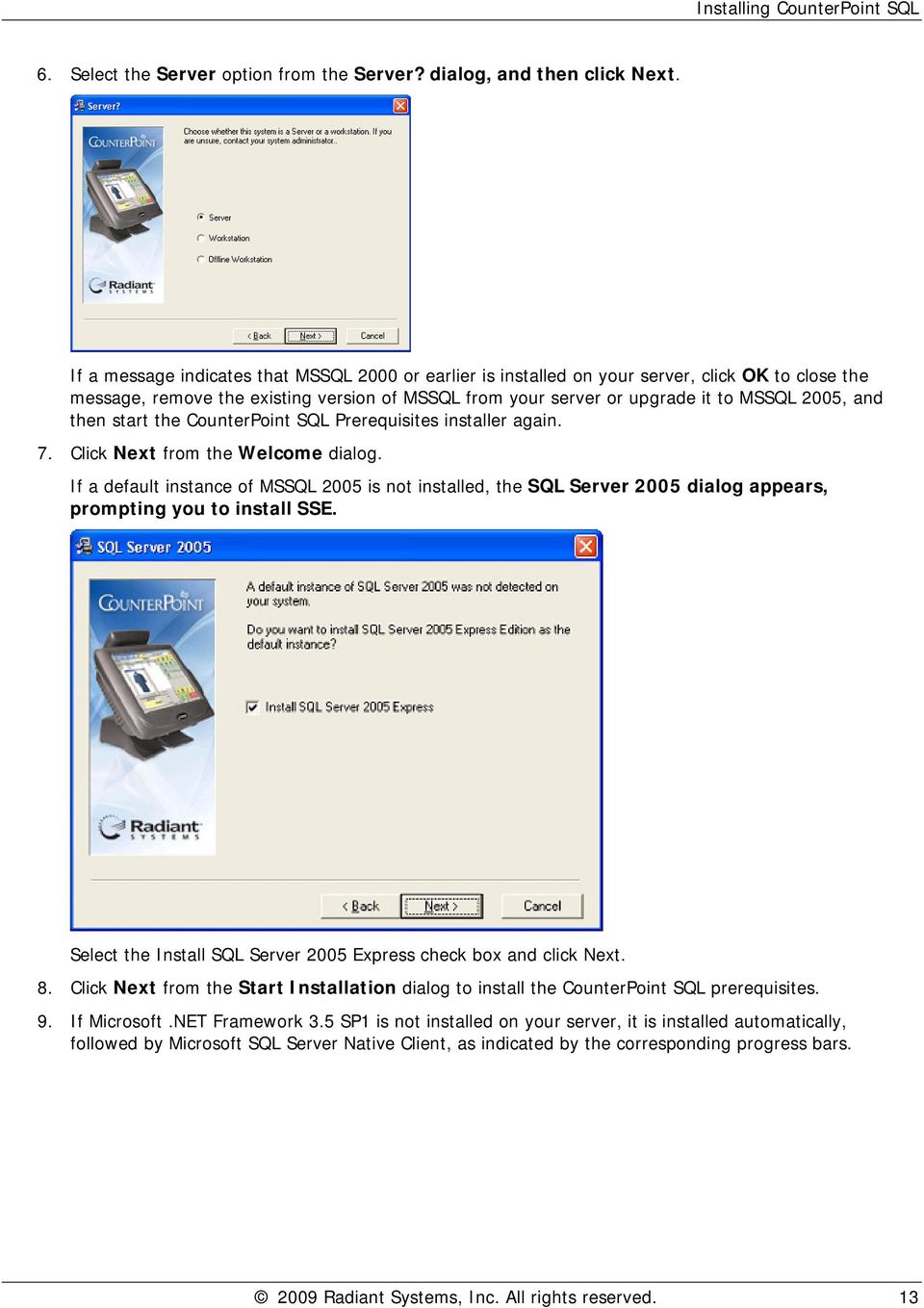
17 Installing CounterPoint SQL 6. Select the Server option from the Server? dialog, and then click Next. If a message indicates that MSSQL 2000 or earlier is installed on your server, click OK to close the message, remove the existing version of MSSQL from your server or upgrade it to MSSQL 2005, and then start the CounterPoint SQL Prerequisites installer again. 7. Click Next from the Welcome dialog. If a default instance of MSSQL 2005 is not installed, the SQL Server 2005 dialog appears, prompting you to install SSE. Select the Install SQL Server 2005 Express check box and click Next. 8. Click Next from the Start Installation dialog to install the CounterPoint SQL prerequisites. 9. If Microsoft.NET Framework 3.5 SP1 is not installed on your server, it is installed automatically, followed by Microsoft SQL Server Native Client, as indicated by the corresponding progress bars Radiant Systems, Inc. All rights reserved. 13
18 Installation Guide 10. Once.NET Framework and SQL Server Native Client are installed, if you chose to install SSE, the SQL Server 2005 Express installer starts automatically. Follow these steps to install SSE: Click Next from the Welcome dialog to display the Components to be Installed dialog. Make sure the SQL Server 2005 Express Database Engine check box is selected. Select the SQL Server 2005 Backward Compatibility check box if you intend to use CounterPoint s Data Migration utility or one of CounterPoint s export accounting interfaces. Select the SQL Server Management Studio Express check box to install the SQL Server Management Studio Express (SSMSE) database management tool. SSMSE allows you to create, back up, restore, and maintain SQL databases using a graphical interface. We strongly recommend that you install SSMSE on your server. Click Next to proceed to the Start Installation dialog, and then click Next to install the SSE database engine and the other SSE components you selected. Follow the on-screen instructions to accept the License Agreement and complete your Registration Information for the SQL Server 2005 Backward Compatibility components and SQL Server Management Studio Express. When the SSE database engine and other components you selected are installed, the Installation Complete dialog appears. Click Finish to close the SQL Server 2005 Express installer. 11. Next, SQL Server Management Objects is installed automatically, followed by SQLXML4, if it is not installed, as indicated by the corresponding progress bars. 12. When all of the CounterPoint SQL prerequisites are installed, the Installation Complete dialog appears. Click Finish to close the installer. 13. If you are prompted to restart your computer, click OK to complete the installation of the CounterPoint SQL prerequisites. A.log file for each installed SSE component is generated in the \Program Files\Microsoft SQL Server\90\Setup Bootstrap\LOG\Files subdirectory of your local drive. If you encounter any difficulties during the installation of SSE, review these log files in Notepad or another text editor. 64-bit server 2009 Radiant Systems, Inc. All rights reserved. 14

19 Installing CounterPoint SQL Follow these steps to install the CounterPoint SQL prerequisites on a server that is running the 64-bit version of Windows Server 2008: 1. Log in to your server as an Administrator. 2. Download the CounterPoint SQL 64-bit Prerequisites from the CounterPoint SQL Downloads area of the CounterPoint Web site ( to your server's local hard drive. 3. From your server, browse to this directory and double-click CPSQLPrereqs64.exe to start the installer. 4. Click Next from the Welcome dialog. If a default instance of MSSQL 2005 is not installed, the SQL Server 2005 dialog appears, prompting you to install SSE. Do not select the Install SQL Server 2005 Express check box at this time. When the other prerequisites have been installed, you must run the CounterPoint SQL 64-bit Prerequisites installer again to install SSE. 5. Click Next from the Start Installation dialog to install the CounterPoint SQL prerequisites. 6. The Local install file not found dialog appears, informing you that you do not have a local copy of the.net 3.5 SP1 installer. If you have an active Internet connection, click OK to run the installer over the Web. If you do not have an active Internet connection, click Cancel, copy the dotnetfx35.exe file from the \CPSQLPrereqs directory on the CounterPoint SQL DVD to the directory to which you copied the CounterPoint SQL 64-bit Prerequisites, and then double-click CPSQLPrereqs64.exe to start the installer again. 7. Microsoft.NET Framework 3.5 SP1 is installed automatically, as indicated by the corresponding progress bars. 8. Next, SQL Server Management Objects is installed automatically, followed by SQLXML4, if it is not installed, as indicated by the corresponding progress bars. 9. When all of the CounterPoint SQL prerequisites are installed, the Installation Complete dialog appears. Click Finish to close the installer. 10. When you are prompted to restart your computer, click OK Radiant Systems, Inc. All rights reserved. 15

20 Installation Guide 11. If you need to install SSE, browse to the directory to which you downloaded the CounterPoint SQL 64- bit Prerequisites, follow these additional steps: Browse to the directory to which you downloaded the CounterPoint SQL 64-bit Prerequisites and doubleclick CPSQLPrereqs64.exe to start the installer again. Click Next from the Welcome dialog. From the SQL Server 2005 dialog, select the Install SQL Server 2005 Express check box, and then click OK. Click Next from the Start Installation dialog. When the SQL Server 2005 Express installer starts, select the I accept the licensing terms and conditions check box from the End User License Agreement dialog, and then click Next. Click Install from the Installing Prerequisites dialog to install Microsoft SQL Native Client and other required files. When these components are installed, click Next. Click Next from the Welcome dialog to perform the System Configuration Check, and then click Next. On the Registration Information dialog, enter your Name and the name of your Company, clear the Hide Advanced configuration options check box, and then click Next. On the Feature Selection dialog, click the Connectivity Components option and select Will be installed on local hard drive from the pop-up menu. Click the Management Studio Express option and select Will be installed on local hard drive from the pop-up menu to install the SQL Server Management Studio Express (SSMSE) database management tool. SSMSE allows you to create, back up, restore, and maintain SQL databases using a graphical interface. We strongly recommend that you install SSMSE on your server. On the Instance Name dialog, select the Default instance option, and then click Next. On the Service Account dialog, click Next to accept the default settings. On the Authentication Mode dialog, select the Mixed Mode option, specify the password you want to use for the sa user (e.g., CounterPoint8) in the Enter password and Confirm password fields, and then click Next. On the Collation Settings dialog, click Next to accept the default settings. On the Configuration Options dialog, click Next to accept the default settings. On the Error and Usage Report Settings dialog, click Next to accept the default settings. Click Install on the Ready to Install dialog to install the SSE database engine and the other SSE components you selected. When the SSE database engine and other components you selected are installed, the Installation Complete dialog appears. Click Finish to close the SQL Server 2005 Express installer. A.log file for each installed SSE component is generated in the \Program Files\Microsoft SQL Server\90\Setup Bootstrap\LOG\Files subdirectory of your local drive. If you encounter any difficulties during the installation of SSE, review these log files in Notepad or another text editor Radiant Systems, Inc. All rights reserved. 16

21 Installing CounterPoint SQL Step 3: Configure remote connections Follow these steps to configure your server to allow remote connections using both TCP/IP and named pipes: 1. On your server, click the Start button and select Programs > Microsoft SQL Server 2005 > Configuration Tools > SQL Server Surface Area Configuration to start the SQL Server 2005 Surface Area Configuration utility. 2. Click the Surface Area Configuration for Services and Connections link to display the Surface Area Configuration for Services and Connections window. 3. Expand the MSSQLSERVER > Database Engine component branch, and then click Remote Connections. 4. Select the Local and remote connections option, and then select the Using both TCP/IP and named pipes option. 5. Click OK to save your changes and close the Surface Area Configuration for Services and Connections window. 6. Close the SQL Server 2005 Surface Area Configuration utility. Step 4: Install CounterPoint SQL Follow these steps to install CounterPoint SQL on your server: 1. Log in to your CounterPoint server as an Administrator. 2. Start the SQL Server service, if it is not running already. To start the SQL Server service, click the Windows Start button, select Programs / Microsoft SQL Server 2005 / Configuration Tools / SQL Server Configuration Manager, select SQL Server 2005 Services, right-click the SQL Server service, and then select Start. The SQL Server service must be running if you want to install Demo Data or Starter Data. 3. Insert the CounterPoint SQL DVD into your DVD drive to display the CounterPoint SQL Installation menu Radiant Systems, Inc. All rights reserved. 17
22 Installation Guide 4. Click CounterPoint SQL Express or CounterPoint SQL Enterprise, depending on which edition of CounterPoint you are installing. 5. Click CounterPoint SQL to start the installation process. If Microsoft Data Access Components (MDAC) 2.8 is not already installed on your server, you are prompted to install it and restart your server. When your server has restarted, the CounterPoint SQL Server Setup installer restarts automatically. 6. From the Welcome dialog, click Next. 7. Read the Software License Agreement, select the Agree option, and then click Next. 8. From the Select Components dialog, select the components you want to install. You must install the CounterPoint Server Files, so leave that check box selected. Select the check boxes for the databases you want to install. If you are installing CounterPoint SQL Enterprise, you can install the following databases: Demo Data is a sample database that demonstrates CounterPoint SQL s capabilities. Starter Data is a complete set of pre-defined CounterPoint data that is designed to minimize your configuration time. Dashboard Demo Data allows you to use the Sales History > Dashboard (Demo) function to review a functional Dashboard. If you are installing CounterPoint SQL Express, you can install the following databases: CPExpress Data is the database that stores your actual company records. CPPractice Data is a copy of your company database that you can use to practice working with CounterPoint Radiant Systems, Inc. All rights reserved. 18
23 Installing CounterPoint SQL 9. Click Next to display the Select Top-Level Directory dialog, which allows you to specify the Top-Level Directory. The top-level directory holds the CounterPoint SQL server files, including reports, forms, company information, data dictionaries, and system resource files. This directory must be accessible to all users. We recommend you accept the default top-level directory (i.e., C:\CounterPoint). 10. Click Next to proceed. If you are installing CounterPoint SQL Enterprise and you chose to install Demo Data, the Demo Data Database Name dialog appears. Enter the Database Name and Company Name for the Demo Data database. We recommend that you accept the default names, but you can use whatever names you prefer. Use only letters and numbers in the Database Name. Do not use spaces, periods or other punctuation marks, or special characters. In addition, the first character in the Database Name cannot be a number Radiant Systems, Inc. All rights reserved. 19
24 Installation Guide 11. Click Next to proceed. If you are installing CounterPoint SQL Enterprise and you chose to install Starter Data, the New Company Database Name dialog appears. Enter a unique Database Name to assign to the new company and a friendly Company Name that will refer to the company within CounterPoint. For example, if your company is Camptown Golf Pro Shop, Inc., you might use Camptown as your Database Name and Camptown Golf Pro Shop as your Company Name. Use only letters and numbers in the Database Name. Do not use spaces, periods or other punctuation marks, or special characters. In addition, the first character in the Database Name cannot be a number. When you finish installing CounterPoint, refer to Modifying Starter Data for instructions on tailoring the Starter Data database for your company. 12. Click Next, specify the program group to which you want to add the Radiant Management Console and Radiant Log Viewer from the Select Start Menu Program Group dialog. and then click Next Radiant Systems, Inc. All rights reserved. 20
25 Installing CounterPoint SQL 13. If you chose to install one or more databases, the SQL Server dialog appears, allowing you to specify whether SQL Server is installed on the same server as CounterPoint. If SQL Server is installed on the server on which you are installing CounterPoint, select This computer and click Next. If you have multiple instances of SQL Server installed, you are prompted to select the SQL Server instance you want to use for your CounterPoint SQL database(s). If you installed SQL Server on a different server from the one on which you are installing CounterPoint, select Other computer, click Next, and then enter the name of your SQL server in the Remote SQL Server field on the Remote SQL Server Settings dialog. If you have multiple instances of SQL Server installed, append the name of the instance you want to use for your CounterPoint SQL database(s), preceded by a slash (e.g., \Instance), to the name of your remote SQL server Radiant Systems, Inc. All rights reserved. 21
26 Installation Guide 14. On the SQL User Information dialog (or the Remote SQL Server Settings dialog, if SQL Server is on a different server), select the Windows Authentication check box if your server is configured to use Windows authentication. If your server does not use Windows authentication, enter your SQL User ID (i.e., sa) and SQL Password. If you installed SSE from the CounterPoint SQL DVD, the default password is CounterPoint8 (casesensitive). You can use SQL Server Management Studio Express (SSMSE) to change the default SSE SQL Password. 15. Click Next to display the SQL Server Settings dialog, which indicates the Version and Service Pack Level of SQL Server on your server, along with the default directory for your SQL Server data files. To change the location of your SQL Server data files, enter a different path in the Data Directory field or click the Browse button to locate the appropriate directory Radiant Systems, Inc. All rights reserved. 22
27 Installing CounterPoint SQL 16. Click Next to begin installing the CounterPoint server files and data files. Follow the on-screen prompts and instructions to complete the installation. 17. When the server files are installed, you are prompted to run the CounterPoint SQL Workstation Setup installer. If you do not intend to run CounterPoint SQL or any of the CounterPoint SQL database utilities on your server, clear the Run workstation setup check box, click Finish, and then proceed to Step 5: Install the current Service Pack. If you intend to run CounterPoint or the CounterPoint database utilities on your server, select the Run workstation setup check box and click Finish to start the CounterPoint SQL Workstation Setup installer. 18. When the installer starts, click Next to display the Select Components dialog, and then select the components to install from the Select Components dialog: Program Files include the CounterPoint application and documentation. You must install the program files to run CounterPoint. Utilities include a number of database- and system-related tools, including the SQL Script Utility, the Table Editor, the System Configuration utility, and so forth. These utilities allow unrestricted access to the CounterPoint database. You should install the utilities on your server, but you may not want to install them on a workstation, unless it will be used only by a system administrator. Dashboard installs the necessary components for the Dashboard, including Windows Installer 3.1 and.net Framework 3.0, if they are not already installed. 19. Click Next, and then specify the Destination Directory for the CounterPoint SQL programs. We recommend that you accept the default directory (i.e., C:\Program Files\CounterPoint). 20. Click Next, and then specify the location for the Start Menu Program shortcuts. We recommend that you accept the default program group (i.e., Start / Program / CounterPoint SQL). 21. Follow the on-screen instructions to complete the installation Radiant Systems, Inc. All rights reserved. 23
28 Installation Guide Step 5: Install the current Service Pack Download and run the current Service Pack (cpsqlsp.exe) for your version of CounterPoint SQL to install the latest updates and enhancements. You can download Service Packs from the Support area of our Web site at You must be a registered CSS subscriber to access the Support area of the CounterPoint Web site. If you are installing a single-user CounterPoint SQL system, proceed to Creating a new company for information about setting up your new company. If you are installing a multi-user CounterPoint SQL system with multiple workstations, continue with the remaining steps. Step 6: Share the top-level directory To allow other workstations to access the CounterPoint server files, you must share the top-level CounterPoint directory on your server Follow these steps to share your top-level CounterPoint directory: 1. Log in to your server as an Administrator. 2. Browse to the top-level CounterPoint directory on your server (e.g., C:\CounterPoint), right-click the folder, and then select Sharing and Security. 3. Select the Sharing tab, select the Share this folder option, and then enter a Share name (e.g., CounterPoint) for the top-level directory. 4. Select the appropriate User limit (e.g., Maximum allowed), and then click Permissions. 5. Under Group or user name, select Everyone, and then select Full Control from the Allow column. 6. Click OK, and then click Apply Radiant Systems, Inc. All rights reserved. 24
29 Installing CounterPoint SQL Step 7: Install prerequisites on workstations Skip this step if you are using Radiant POS terminals for your workstations. Follow these steps to install the CounterPoint SQL prerequisites on your workstations: If you have purchased the Offline V2 Option, follow these steps for workstations that you do not intend to use in offline mode only. Refer to the Offline V2 topics in the CounterPoint SQL Online Help for more information about installing CounterPoint SQL prerequisites on your offline workstations. 1. Copy the \CPSQLPrereqs directory from the CounterPoint SQL DVD to the \WorkstationFiles subdirectory of the top-level directory on your server (e.g., C:\CounterPoint\WorkstationFiles). 2. From a workstation, browse to this directory on your server and double-click CPSQLPrereqs.exe to start the CounterPoint SQL Prerequisites installer. 3. Select the Workstation option from the Server? dialog, and then click Next. 4. Click Next from the Welcome dialog. 5. Click Next from the Start Installation dialog to install the CounterPoint SQL prerequisites. If Microsoft.NET Framework 3.5 SP1 is not installed on your workstation, it is installed automatically. Next, SQL Server Management Objects is installed automatically, followed by SQLXML4, if it is not installed, as indicated by the corresponding progress bars. 6. When all of the CounterPoint SQL prerequisites are installed, the Installation Complete dialog appears. Click Finish to close the installer. 7. If you are prompted to restart your computer, click OK to complete the installation of the CounterPoint SQL prerequisites. Repeat steps 2 through 7 for each of your workstations Radiant Systems, Inc. All rights reserved. 25
30 Installation Guide Step 8: Set up workstations After you share the top-level directory on your server, follow these steps to set up each workstation that will run CounterPoint SQL: If you have purchased the Offline V2 Option, follow these steps for workstations that you do not intend to use in offline mode only. Refer to the Offline V2 topics in the CounterPoint SQL Online Help for more information about setting up your offline workstations. 1. Log in to the workstation as an Administrator. The default Administrator User name and Password for Radiant POS terminals are administrator and gorads. 2. Browse to the top-level CounterPoint directory on your server (e.g., C:\CounterPoint) and doubleclick WorkstationSetup.exe to start the CounterPoint SQL Workstation Setup installer. If MDAC 2.8 is not installed on the workstation, you will be prompted to install it and restart the workstation. 1. Click Next from the Welcome dialog. 2. From the Select Components dialog, make sure the Program Files check box is selected, select the Utilities check box if you want to install the CounterPoint utilities, and select the Dashboard check box to allow users to access the Dashboard. 3. Click Next, and then specify the Destination Directory for CounterPoint SQL. We recommend you accept the default directory (i.e., C:\Program Files\CounterPoint). 4. Click Next, and then specify the location for the Start Menu Program shortcuts. We recommend you accept the default program group (i.e., Start / Program / CounterPoint SQL). 5. Click Next, and then follow the on-screen instructions to complete the installation process. 6. When the workstation files and other components are installed, the Installation complete dialog appears. If you would like to create a CounterPoint shortcut on the workstation s desktop, select the Create shortcut on desktop check box. 7. Click Finish to complete the installation. Repeat these steps at each workstation. If you installed CounterPoint SQL Enterprise, refer to Creating a new company for information about setting up your company. If you installed CounterPoint SQL Express, your company was created during installation and you can now begin using CounterPoint. Refer to the CounterPoint SQL Online Help for more information about setting up and using your system Radiant Systems, Inc. All rights reserved. 26
31 Installing CounterPoint SQL Windows Terminal Services WAN Terminal Services is a component of Microsoft Windows that allows remote users to access applications and data stored on a central computer or terminal server over a wide-area network connection. With Terminal Services, you can set up a single terminal server as a CounterPoint SQL workstation, and then enable each workstation to connect to the terminal server and run CounterPoint, regardless of its location. CounterPoint SQL Enterprise is compatible with Terminal Services running on Microsoft Windows Server 2008 or 2003, Standard or Enterprise Edition. CounterPoint SQL is not compatible with Terminal Services running on Windows Small Business Server In a Terminal Services environment, you must first install Microsoft SQL Server and CounterPoint SQL on your CounterPoint server, and then configure your terminal server as a CounterPoint workstation. Finally, you must set up a Remote Desktop Connection and redirect the ports on each of your workstations to the terminal server. Each terminal server can support between 20 and 25 simultaneous Terminal Services sessions. Therefore, we recommend that you set up one terminal server for every 20 to 25 CounterPoint users. The following steps outline the process of installing CounterPoint SQL in a Terminal Services WAN environment: Step 1: Install Microsoft SQL Server (optional) Step 2: Install prerequisites on server Step 3: Configure remote connections Step 4: Install CounterPoint SQL Step 5: Install the current Service Pack Step 6: Share the top-level directory Step 7: Install prerequisites on terminal server Step 8: Install workstation files on terminal server Step 9: Install OPOS drivers on terminal server Step 10: Configure Remote Desktop Connection Step 11: Enable port redirection on workstations You must have Administrator rights to your server and each of your workstations to install CounterPoint SQL. Step 1: Install Microsoft SQL Server (optional) If you wish, you can install Microsoft SQL Server (MSSQL) 2005 Standard Edition, Workgroup Edition, or Enterprise Edition on your server. Refer to the documentation that came with your edition of MSSQL 2005 for installation instructions. If you do not install another edition of MSSQL 2005 on your server, you will be prompted to install Microsoft SQL Server 2005 Express Edition (SSE) when you install the CounterPoint SQL prerequisites on your server. If you install MSSQL 2005 on your server, choose SQL Server Authentication as your server s Authentication method. Also, make sure the SQL Server service is running on those servers before you deploy CounterPoint SQL. To start the SQL Server service, click the Windows Start button, select Programs > Microsoft SQL Server 2005 > Configuration Tools > SQL Server Configuration Manager, click SQL Server 2005 Services, right-click the SQL Server service, and then click Start. If you have an older version of MSSQL installed on your server, upgrade to MSSQL 2005 before proceeding with the remaining installation steps Radiant Systems, Inc. All rights reserved. 27
32 Installation Guide Step 2: Install prerequisites on server Before you install CounterPoint SQL, you must install the following components on your server: Microsoft.NET Framework 3.5 SP1 Microsoft SQL Server Native Client SQL Server Management Objects SQLXML4 The CounterPoint SQL Prerequisites installer will install all of these components automatically. In addition, if you have not installed a default instance of another edition of Microsoft SQL Server, the installer will prompt you to install SQL Server 2005 Express Edition (SSE). Select the type of server you are using below, either 32-bit or 64-bit, for more information about installing the CounterPoint SQL prerequisites. 32-bit server Follow these steps to install the CounterPoint SQL prerequisites on a server that is running a 32-bit operating system (i.e., Windows Server 2003 or the 32-bit version of Windows Server 2008): 1. Log into your server as an Administrator. 2. If you intend to install SSE on your server, select Start > Settings > Control Panel, double-click Add or Remove Programs, select Microsoft SQL Server Native Client, click the Remove button, and then click Yes from the confirmation dialog. If you do not remove the version of Microsoft SQL Server Native Client that is pre-installed on your server, you will be unable to install SSE. 3. Insert the CounterPoint DVD into your DVD drive to display the CounterPoint SQL Installation menu. 4. Click CounterPoint SQL Enterprise. CounterPoint SQL Express is not compatible with Windows Terminal Services. 5. Click Prerequisites to start the CounterPoint SQL Prerequisites installer Radiant Systems, Inc. All rights reserved. 28
33 Installing CounterPoint SQL 6. Select the Server option from the Server? dialog, and then click Next. If a message indicates that MSSQL 2000 or earlier is installed on your server, click OK to close the message, remove the existing version of MSSQL from your server or upgrade it to MSSQL 2005, and then start the CounterPoint SQL Prerequisites installer again. 7. Click Next from the Welcome dialog. If a default instance of MSSQL 2005 is not installed, the SQL Server 2005 dialog appears, prompting you to install SSE. Select the Install SQL Server 2005 Express check box and click Next. 8. Click Next from the Start Installation dialog to install the CounterPoint SQL prerequisites. 9. If Microsoft.NET Framework 3.5 SP1 is not installed on your server, it is installed automatically, followed by Microsoft SQL Server Native Client, as indicated by the corresponding progress bars Radiant Systems, Inc. All rights reserved. 29
34 Installation Guide 10. Once.NET Framework and SQL Server Native Client are installed, if you chose to install SSE, the SQL Server 2005 Express installer starts automatically. Follow these steps to install SSE: Click Next from the Welcome dialog to display the Components to be Installed dialog. Make sure the SQL Server 2005 Express Database Engine check box is selected. Select the SQL Server 2005 Backward Compatibility check box if you intend to use CounterPoint s Data Migration utility or one of CounterPoint s export accounting interfaces. Select the SQL Server Management Studio Express check box to install the SQL Server Management Studio Express (SSMSE) database management tool. SSMSE allows you to create, back up, restore, and maintain SQL databases using a graphical interface. We strongly recommend that you install SSMSE on your server. Click Next to proceed to the Start Installation dialog, and then click Next to install the SSE database engine and the other SSE components you selected. Follow the on-screen instructions to accept the License Agreement and complete your Registration Information for the SQL Server 2005 Backward Compatibility components and SQL Server Management Studio Express. When the SSE database engine and other components you selected are installed, the Installation Complete dialog appears. Click Finish to close the SQL Server 2005 Express installer. 11. Next, SQL Server Management Objects is installed automatically, followed by SQLXML4, if it is not installed, as indicated by the corresponding progress bars. 12. When all of the CounterPoint SQL prerequisites are installed, the Installation Complete dialog appears. Click Finish to close the installer. 13. If you are prompted to restart your computer, click OK to complete the installation of the CounterPoint SQL prerequisites. A.log file for each installed SSE component is generated in the \Program Files\Microsoft SQL Server\90\Setup Bootstrap\LOG\Files subdirectory of your local drive. If you encounter any difficulties during the installation of SSE, review these log files in Notepad or another text editor. 64-bit server 2009 Radiant Systems, Inc. All rights reserved. 30
35 Installing CounterPoint SQL Follow these steps to install the CounterPoint SQL prerequisites on a server that is running the 64-bit version of Windows Server 2008: 1. Log in to your server as an Administrator. 2. Download the CounterPoint SQL 64-bit Prerequisites from the CounterPoint SQL Downloads area of the CounterPoint Web site ( to your server's local hard drive. 3. From your server, browse to this directory and double-click CPSQLPrereqs64.exe to start the installer. 4. Click Next from the Welcome dialog. If a default instance of MSSQL 2005 is not installed, the SQL Server 2005 dialog appears, prompting you to install SSE. Do not select the Install SQL Server 2005 Express check box at this time. When the other prerequisites have been installed, you must run the CounterPoint SQL 64-bit Prerequisites installer again to install SSE. 5. Click Next from the Start Installation dialog to install the CounterPoint SQL prerequisites. 6. The Local install file not found dialog appears, informing you that you do not have a local copy of the.net 3.5 SP1 installer. If you have an active Internet connection, click OK to run the installer over the Web. If you do not have an active Internet connection, click Cancel, copy the dotnetfx35.exe file from the \CPSQLPrereqs directory on the CounterPoint SQL DVD to the directory to which you copied the CounterPoint SQL 64-bit Prerequisites, and then double-click CPSQLPrereqs64.exe to start the installer again. 7. Microsoft.NET Framework 3.5 SP1 is installed automatically, as indicated by the corresponding progress bars. 8. Next, SQL Server Management Objects is installed automatically, followed by SQLXML4, if it is not installed, as indicated by the corresponding progress bars. 9. When all of the CounterPoint SQL prerequisites are installed, the Installation Complete dialog appears. Click Finish to close the installer. 10. When you are prompted to restart your computer, click OK Radiant Systems, Inc. All rights reserved. 31
36 Installation Guide 11. If you need to install SSE, browse to the directory to which you downloaded the CounterPoint SQL 64- bit Prerequisites, follow these additional steps: Browse to the directory to which you downloaded the CounterPoint SQL 64-bit Prerequisites and doubleclick CPSQLPrereqs64.exe to start the installer again. Click Next from the Welcome dialog. From the SQL Server 2005 dialog, select the Install SQL Server 2005 Express check box, and then click OK. Click Next from the Start Installation dialog. When the SQL Server 2005 Express installer starts, select the I accept the licensing terms and conditions check box from the End User License Agreement dialog, and then click Next. Click Install from the Installing Prerequisites dialog to install Microsoft SQL Native Client and other required files. When these components are installed, click Next. Click Next from the Welcome dialog to perform the System Configuration Check, and then click Next. On the Registration Information dialog, enter your Name and the name of your Company, clear the Hide Advanced configuration options check box, and then click Next. On the Feature Selection dialog, click the Connectivity Components option and select Will be installed on local hard drive from the pop-up menu. Click the Management Studio Express option and select Will be installed on local hard drive from the pop-up menu to install the SQL Server Management Studio Express (SSMSE) database management tool. SSMSE allows you to create, back up, restore, and maintain SQL databases using a graphical interface. We strongly recommend that you install SSMSE on your server. On the Instance Name dialog, select the Default instance option, and then click Next. On the Service Account dialog, click Next to accept the default settings. On the Authentication Mode dialog, select the Mixed Mode option, specify the password you want to use for the sa user (e.g., CounterPoint8) in the Enter password and Confirm password fields, and then click Next. On the Collation Settings dialog, click Next to accept the default settings. On the Configuration Options dialog, click Next to accept the default settings. On the Error and Usage Report Settings dialog, click Next to accept the default settings. Click Install on the Ready to Install dialog to install the SSE database engine and the other SSE components you selected. When the SSE database engine and other components you selected are installed, the Installation Complete dialog appears. Click Finish to close the SQL Server 2005 Express installer. A.log file for each installed SSE component is generated in the \Program Files\Microsoft SQL Server\90\Setup Bootstrap\LOG\Files subdirectory of your local drive. If you encounter any difficulties during the installation of SSE, review these log files in Notepad or another text editor Radiant Systems, Inc. All rights reserved. 32
37 Installing CounterPoint SQL Step 3: Configure remote connections Follow these steps to configure your server to allow remote connections using both TCP/IP and named pipes: 1. On your server, click the Start button and select Programs > Microsoft SQL Server 2005 > Configuration Tools > SQL Server Surface Area Configuration to start the SQL Server 2005 Surface Area Configuration utility. 2. Click the Surface Area Configuration for Services and Connections link to display the Surface Area Configuration for Services and Connections window. 3. Expand the MSSQLSERVER > Database Engine component branch, and then click Remote Connections. 4. Select the Local and remote connections option, and then select the Using both TCP/IP and named pipes option. 5. Click OK to save your changes and close the Surface Area Configuration for Services and Connections window. 6. Close the SQL Server 2005 Surface Area Configuration utility. Step 4: Install CounterPoint SQL Follow these steps to install CounterPoint SQL on your server: 1. Log in to your CounterPoint server as an Administrator. 2. Start the SQL Server service, if it is not running already. To start the SQL Server service, click the Windows Start button, select Programs / Microsoft SQL Server 2005 / Configuration Tools / SQL Server Configuration Manager, select SQL Server 2005 Services, right-click the SQL Server service, and then select Start. The SQL Server service must be running if you want to install Demo Data or Starter Data. 3. Insert the CounterPoint SQL DVD into your DVD drive to display the CounterPoint SQL Installation menu Radiant Systems, Inc. All rights reserved. 33
38 Installation Guide 4. Click CounterPoint SQL Enterprise. CounterPoint SQL Express is not compatible with Windows Terminal Services. 5. Click CounterPoint SQL to start the installation process. If Microsoft Data Access Components (MDAC) 2.8 is not already installed on your server, you are prompted to install it and restart your server. When your server has restarted, the CounterPoint SQL Server Setup installer restarts automatically. 6. From the Welcome dialog, click Next. 7. Read the Software License Agreement, select the Agree option, and then click Next. 8. From the Select Components dialog, select the components you want to install. You must install the CounterPoint Server Files, so leave that check box selected. Select the check boxes for the databases you want to install. If you are installing CounterPoint SQL Enterprise, you can install the following databases: Demo Data is a sample database that demonstrates CounterPoint SQL s capabilities. Starter Data is a complete set of pre-defined CounterPoint data that is designed to minimize your configuration time. Dashboard Demo Data allows you to use the Sales History > Dashboard (Demo) function to review a functional Dashboard. If you are installing CounterPoint SQL Express, you can install the following databases: CPExpress Data is the database that stores your actual company records. CPPractice Data is a copy of your company database that you can use to practice working with CounterPoint Radiant Systems, Inc. All rights reserved. 34
39 Installing CounterPoint SQL 9. Click Next to display the Select Top-Level Directory dialog, which allows you to specify the Top-Level Directory. The top-level directory holds the CounterPoint SQL server files, including reports, forms, company information, data dictionaries, and system resource files. This directory must be accessible to all users. We recommend you accept the default top-level directory (i.e., C:\CounterPoint). 10. Click Next to proceed. If you are installing CounterPoint SQL Enterprise and you chose to install Demo Data, the Demo Data Database Name dialog appears. Enter the Database Name and Company Name for the Demo Data database. We recommend that you accept the default names, but you can use whatever names you prefer. Use only letters and numbers in the Database Name. Do not use spaces, periods or other punctuation marks, or special characters. In addition, the first character in the Database Name cannot be a number Radiant Systems, Inc. All rights reserved. 35
40 Installation Guide 11. Click Next to proceed. If you are installing CounterPoint SQL Enterprise and you chose to install Starter Data, the New Company Database Name dialog appears. Enter a unique Database Name to assign to the new company and a friendly Company Name that will refer to the company within CounterPoint. For example, if your company is Camptown Golf Pro Shop, Inc., you might use Camptown as your Database Name and Camptown Golf Pro Shop as your Company Name. Use only letters and numbers in the Database Name. Do not use spaces, periods or other punctuation marks, or special characters. In addition, the first character in the Database Name cannot be a number. When you finish installing CounterPoint, refer to Modifying Starter Data for instructions on tailoring the Starter Data database for your company. 12. Click Next, specify the program group to which you want to add the Radiant Management Console and Radiant Log Viewer from the Select Start Menu Program Group dialog. and then click Next Radiant Systems, Inc. All rights reserved. 36
41 Installing CounterPoint SQL 13. If you chose to install one or more databases, the SQL Server dialog appears, allowing you to specify whether SQL Server is installed on the same server as CounterPoint. If SQL Server is installed on the server on which you are installing CounterPoint, select This computer and click Next. If you have multiple instances of SQL Server installed, you are prompted to select the SQL Server instance you want to use for your CounterPoint SQL database(s). If you installed SQL Server on a different server from the one on which you are installing CounterPoint, select Other computer, click Next, and then enter the name of your SQL server in the Remote SQL Server field on the Remote SQL Server Settings dialog. If you have multiple instances of SQL Server installed, append the name of the instance you want to use for your CounterPoint SQL database(s), preceded by a slash (e.g., \Instance), to the name of your remote SQL server Radiant Systems, Inc. All rights reserved. 37
42 Installation Guide 14. On the SQL User Information dialog (or the Remote SQL Server Settings dialog, if SQL Server is on a different server), select the Windows Authentication check box if your server is configured to use Windows authentication. If your server does not use Windows authentication, enter your SQL User ID (i.e., sa) and SQL Password. If you installed SSE from the CounterPoint SQL DVD, the default password is CounterPoint8 (casesensitive). You can use SQL Server Management Studio Express (SSMSE) to change the default SSE SQL Password. 15. Click Next to display the SQL Server Settings dialog, which indicates the Version and Service Pack Level of SQL Server on your server, along with the default directory for your SQL Server data files. To change the location of your SQL Server data files, enter a different path in the Data Directory field or click the Browse button to locate the appropriate directory Radiant Systems, Inc. All rights reserved. 38
43 Installing CounterPoint SQL 16. Click Next to begin installing the CounterPoint server files and data files. Follow the on-screen prompts and instructions to complete the installation. 17. When the server files are installed, you are prompted to run the CounterPoint SQL Workstation Setup installer. If you do not intend to run CounterPoint SQL or any of the CounterPoint SQL database utilities on your server, clear the Run workstation setup check box, click Finish, and then proceed to Step 5: Install the current Service Pack. If you intend to run CounterPoint or the CounterPoint database utilities on your server, select the Run workstation setup check box and click Finish to start the CounterPoint SQL Workstation Setup installer. 18. When the installer starts, click Next to display the Select Components dialog, and then select the components to install from the Select Components dialog: Program Files include the CounterPoint application and documentation. You must install the program files to run CounterPoint. Utilities include a number of database- and system-related tools, including the SQL Script Utility, the Table Editor, the System Configuration utility, and so forth. These utilities allow unrestricted access to the CounterPoint database. You should install the utilities on your server, but you may not want to install them on a workstation, unless it will be used only by a system administrator. Dashboard installs the necessary components for the Dashboard, including Windows Installer 3.1 and.net Framework 3.0, if they are not already installed. 19. Click Next, and then specify the Destination Directory for the CounterPoint SQL programs. We recommend that you accept the default directory (i.e., C:\Program Files\CounterPoint). 20. Click Next, and then specify the location for the Start Menu Program shortcuts. We recommend that you accept the default program group (i.e., Start / Program / CounterPoint SQL). 21. Follow the on-screen instructions to complete the installation. Step 5: Install the current Service Pack Download and run the current Service Pack (cpsqlsp.exe) for your version of CounterPoint SQL to install the latest updates and enhancements. You can download Service Packs from the Support area of our Web site at You must be a registered CSS subscriber to access the Support area of the CounterPoint Web site Radiant Systems, Inc. All rights reserved. 39
44 Installation Guide Step 6: Share the top-level directory In a WAN environment, you must share the top-level CounterPoint directory on your server to allow your terminal server to access the CounterPoint server files. Follow these steps to share your top-level CounterPoint directory: 1. From your server, browse to your top-level CounterPoint directory (e.g., C:\CounterPoint), right-click the folder, and then select Sharing and Security. 2. Select the Sharing tab, select the Share this folder option, and then enter a Share name (e.g., CounterPoint) for the top-level directory. 3. Select the appropriate User limit (e.g., Maximum allowed), and then click Permissions. 4. Under Group or user name, select Everyone, and then select Full Control from the Allow column. 5. Click OK, and then click Apply. Step 7: Install prerequisites on terminal server After you share the top-level directory on your server, follow these steps to install the CounterPoint SQL prerequisites on your terminal server: 1. Copy the \CPSQLPrereqs directory from the CounterPoint SQL DVD to the \WorkstationFiles subdirectory of the top-level directory on your server (e.g., C:\CounterPoint\WorkstationFiles). 2. From your terminal server, browse to this directory and double-click CPSQLPrereqs.exe to start the CounterPoint SQL Prerequisites installer. 3. Select the Workstation option from the Server? dialog, and then click Next. 4. Click Next from the Welcome dialog. 5. Click Next from the Start Installation dialog to install the CounterPoint SQL prerequisites. If Microsoft.NET Framework 3.5 SP1 is not installed on your terminal server, it is installed automatically. Next, SQL Server Management Objects is installed automatically, followed by SQLXML4, if it is not installed, as indicated by the corresponding progress bars Radiant Systems, Inc. All rights reserved. 40
45 Installing CounterPoint SQL 6. When all of the CounterPoint SQL prerequisites are installed, the Installation Complete dialog appears. Click Finish to close the installer. 7. If you are prompted to restart your terminal server, click OK to complete the installation of the CounterPoint SQL prerequisites. If you have more than one terminal server, repeat these steps for each one. Step 8: Install workstation files on terminal server Follow these steps to install the CounterPoint SQL workstation files on your terminal server: 1. Log in to your terminal server as an Administrator. 2. From the Control Panel, double-click Add or Remove Programs. 3. Click the Add New Programs button, and then click CD or Floppy. 4. Click Next to proceed to the Run Installation Program dialog. 5. Browse to the top-level CounterPoint directory on your server (e.g., C:\CounterPoint), double-click WorkstationSetup.exe, and then click Finish to start the CounterPoint SQL Workstation Setup installer. If MDAC 2.8 is not installed on your terminal server, you will be prompted to install it and restart the terminal server. 6. Click Next from the Welcome dialog. 7. From the Select Components dialog, make sure the Program Files check box is selected, select the Utilities check box if you want to install the CounterPoint utilities, and select the Dashboard check box to allow users to access the Dashboard. 8. Click Next, and then specify the Destination Directory for CounterPoint SQL. We recommend you accept the default directory (i.e., C:\Program Files\CounterPoint). 9. Click Next, and then specify the location for the Start Menu Program shortcuts. We recommend you accept the default program group (i.e., Start / Program / CounterPoint SQL). 10. Click Next, and then follow the on-screen instructions to complete the installation process. 11. When the workstation files and other components are installed, the Installation complete dialog appears. If you would like to create a CounterPoint shortcut on the terminal server s desktop, select the Create shortcut on desktop check box. 12. Click Finish to complete the installation. If you have more than one terminal server, repeat these steps for each one. Step 9: Install OPOS drivers on terminal server If you are using OPOS receipt printers, pole displays, MSRs, or other point-of-sale devices, install the corresponding OPOS driver(s) on your terminal server by following the manufacturer s instructions. Refer to Radiant Hardware in the CounterPoint SQL Online Help for a list of Terminal Services-compatible peripherals that are available from Radiant Systems, along with instructions for configuring them Radiant Systems, Inc. All rights reserved. 41
46 Installation Guide Step 10: Configure Remote Desktop Connection Follow these steps to configure the Remote Desktop Connection settings on each of your workstations: 1. From a workstation, click the Start button and select Programs / Accessories / Communications / Remote Desktop Connection. 2. Click the Options button, and then click the Local Resources tab. 3. Select the On the local computer option from the Apply Windows key combinations list. 4. Under Local devices, select the Printers and Serial ports check boxes. 5. Configure the remaining settings to allow the workstation to connect to your Terminal Server. 6. Click Connect to connect to your Terminal Server. Repeat these steps for each of your workstations. Step 11: Enable port redirection on workstations Follow these steps to enable port redirection on each of your workstations: 1. From a workstation, click the Start button, select Run, type regedit, and then click OK. 2. Locate and click the following registry key: HKEY_CURRENT_USER\Software\Microsoft\Terminal Server Client\Default\AddIns\RDPDR This registry key will not exist if your workstation hasn t connected to your Terminal Server at least once. 3. On the Edit menu, point to New, and then click DWORD Value. 4. Type FilterQueueType, and then press Enter to name the new key. 5. On the Edit menu, click Modify to display the Edit DWORD Value dialog. 6. Type FFFFFFFF (i.e., eight Fs), and then click OK. 7. Close the Registry Editor, and then restart the POS terminal. Repeat these steps for each of your workstations. Refer to Creating a new company for more information about setting up your new company Radiant Systems, Inc. All rights reserved. 42
47 Creating a new company After you install CounterPoint SQL Enterprise, you can create a new company using Starter Data or by creating an empty database. Using Starter Data Creating an empty database Using Starter Data Starter Data is a complete, pre-defined CounterPoint SQL database that is designed to minimize the amount of time it takes to get CounterPoint SQL up and running. The easiest method of creating a new CounterPoint SQL company is to install the Starter database and modify it to suit your needs. Follow these steps to set up your company using Starter Data: Step 1: Install Starter Data Step 2: Modify Starter Data Step 1: Install Starter Data If you installed Starter Data when you installed CounterPoint SQL on the server, you can skip to Step 2: Modify Starter Data. You must install the Starter Data database on your server. Perform the following steps at the server to install Starter Data and attach the new database to the SQL Server: 1. Start the SQL Server service, if it is not running already. To start the SQL Server service, click the Windows Start button, select Programs / Microsoft SQL Server 2005 / Configuration Tools / SQL Server Configuration Manager, select SQL Server 2005 Services, right-click the SQL Server service, and then select Start. 2. Insert the CounterPoint SQL DVD into your DVD drive, click CounterPoint SQL Enterprise, and then click CounterPoint SQL. 3. Click Next from the Welcome dialog. 4. From the Software License Agreement dialog, select the Agree option, and then click Next. 5. From the Select Components dialog, select the Starter Data check box, and then click Next. Do not reinstall the Server Files and Demo Data database if you have already installed them. 6. Enter or browse to the Top-Level Directory you specified when you installed CounterPoint SQL, and then click Next Radiant Systems, Inc. All rights reserved. 43
48 Installation Guide 7. From the New Company Database Name dialog, enter a unique Database Name to assign to the new company and a friendly Company Name that will refer to the company within CounterPoint. For example, if your company is Camptown Golf Pro Shop, Inc., you might use Camptown as your Database Name and Camptown Golf Pro Shop as your Company Name. Use only letters and numbers in the Database Name. Do not use spaces, periods or other punctuation marks, or special characters. In addition, the first character of the Database Name cannot be a number. 8. Click Next to display the SQL Server dialog, which allows you to specify whether SQL Server is installed on the same server as CounterPoint. If SQL Server is installed on the server on which you are installing CounterPoint, select This computer and click Next. If you have multiple instances of SQL Server installed, you are prompted to select the SQL Server instance you want to use for your CounterPoint SQL database(s) Radiant Systems, Inc. All rights reserved. 44
49 Creating a new company If you installed SQL Server on a different server from the one on which you are installing CounterPoint, select Other computer, click Next, and then enter the name of your SQL server in the Remote SQL Server field on the Remote SQL Server Settings dialog. If you have multiple instances of SQL Server installed, append the name of the instance you want to use for your CounterPoint SQL database(s), preceded by a slash (e.g., \Instance), to the name of your remote SQL server. 9. On the SQL User Information dialog (or the Remote SQL Server Settings dialog, if SQL Server is on a different server), select the Windows Authentication check box if your server is configured to use Windows authentication. If your server does not use Windows authentication, enter your SQL User ID (i.e., sa) and SQL Password. If you installed SSE from the CounterPoint SQL DVD, the default password is CounterPoint8 (casesensitive) Radiant Systems, Inc. All rights reserved. 45
50 Installation Guide You can use SQL Server Management Studio Express (SSMSE) to change the default SSE SQL Password. 10. Click Next to display the SQL Server Settings dialog, which indicates the Version and Service Pack Level of SQL Server on your server, along with the default directory for your SQL Server data files. To change the location of your SQL Server data files, enter a different path in the Data Directory field or click the Browse button to locate the appropriate directory. 11. Click Next to begin installing Starter Data. Follow the on-screen prompts and instructions to complete the installation process. Step 2: Modify Starter Data While the Starter Data database contains enough information for you to actually begin using CounterPoint SQL, you will need to modify Starter Data to meet your particular business needs. These topics detail the pre-defined content of the Starter Data database and provide general advice about changes you should make to tailor Starter Data for your company. System Inventory Customers Purchasing Point of Sale Ecommerce 2009 Radiant Systems, Inc. All rights reserved. 46
51 Creating a new company System Setup > System > Company Default company settings are defined. Required: Replace the company name and address. Verify that the Current calendar value is correct. Enter contact, phone number, , and other information. Enable passwords If you enable passwords, use Setup > System > Users to define passwords for your users before closing CounterPoint. Accounting Interface Accounts No accounting interfaces are defined. Define an accounting interface to transfer General Ledger and Accounts Payable data to your third-party accounting system. A simple chart of accounts is defined that contains all of the account numbers required for configuration, plus a few additional accounts to indicate the overall organization of the complete chart. Add, modify, or delete accounts as needed. Bank Account Codes Batches No bank account codes are defined. Define bank account codes and assign them to pay codes using Setup > System > Pay Codes. No batches are defined. Required: If you are setting up a Multi-Site environment, define workgroup-specific or user-specific batches for each Batch type. Define workgroup-specific or user-specific batches for each Batch type Radiant Systems, Inc. All rights reserved. 47
52 Installation Guide Setup > System > Calendars Calendars are defined for the years 2008 through Update a calendar definition before making it the Current calendar in Setup > System > Company. Add, modify, or delete calendars as needed. For example, you might define specific Seasons for the purpose of creating forecasts. Commission Codes Currency Codes No commission codes are defined. Define commission codes and assign them to sales reps using Setup > System > Users. The HOME currency is U.S. Dollars. No foreign currency codes are defined. Define a currency code for each type of foreign currency you accept, and then assign each currency code to at least one pay code using Setup > System > Pay Codes. Dashboard Thresholds Gift Certificate Codes No Dashboard thresholds are defined. If you are using Dashboard, schedule the Data Mart Update task and define the necessary thresholds for each Dashboard metric you want to track. The GC10 ($10), GC25 ($25), GC50 ($50), and GC (user-defined amount) gift certificate codes are defined. Define additional gift certificate codes for specific amounts. Label Jobs A variety of label jobs have been defined to allow you to print different types of labels. Create additional label jobs to meet specific label-printing needs Radiant Systems, Inc. All rights reserved. 48
53 Creating a new company Setup > System > Menu Codes The MGR, SUPERVISOR, POS, and BACKOFFC menu codes are defined and assigned to the corresponding system security codes. Modify the available menu selections in each pre-defined menu code. Define additional menu codes and assign them to the appropriate system security codes. Pay Codes The following pay codes are pre-defined and assigned to the TEMPLATE store: AMEX (American Express) AR (Accounts Receivable) CASH CHECK DEBIT DISCOVER GC (Gift Certificate) LOYALTY MC (MasterCard) STORE CRED (Store Credit) SVC (Stored Value Card) VISA Add, modify, or delete pay codes as needed. If desired, create separate credit card type pay codes to track each type of credit card separately. If using the Credit Cards Option, set EDC transactions to Online and select the Use reader check box (for the magstripe reader). Registration Required: You must register CounterPoint SQL when you set up your first company. Registration information applies to all companies and only needs to be defined once per CounterPoint SQL installation. To register your software, copy your Registration.ini file into your top-level CounterPoint SQL directory (e.g., C:\CounterPoint). You can obtain this file from your CounterPoint SQL Authorized Reseller (CSAR) Radiant Systems, Inc. All rights reserved. 49
54 Installation Guide Setup > System > Security Codes The MGR, SUPERVISOR, POS, and BACKOFFC system security codes are defined. Required: Verify that the assigned authorizations are correct for each security code. Add, modify, or delete system security codes as needed. Ship-Via Codes Ship-via codes for C (Customer Pickup), F (FedEx), M (Mail), T (Truck), U (UPS), and O (Other) are defined. Add, modify, or delete ship-via codes as needed. Tax Authorities The LOCAL (10% tax rate), EXEMPT (0%), and OST (Out of State - 0%) tax authorities are defined. Required: Change the LOCAL tax percentage to reflect the correct tax rate. Add county, city, and other tax authorities as needed. Add tax authorities to the proper tax codes using Setup > System > Tax Codes. Tax Codes The LOCAL (10% tax rate), EXEMPT (0%), and OST (Out of State - 0%) tax codes are defined. The TEMPLATE store s default tax code is set to LOCAL. Required: Change LOCAL to reflect the correct tax authorities and rates. Add the appropriate tax authorities to the existing tax codes, as needed. Define additional tax codes, as needed. Assign tax codes to stores, customers, or ship-to addresses, as appropriate. User Preferences Preferences for the pre-defined SYSADMIN, MGR, SUPERVISOR, POS, and BACKOFFC users have been defined. Change the menu style, toolbar scheme, and other preferences for each user Radiant Systems, Inc. All rights reserved. 50
55 Creating a new company Setup > System > Users The following users are pre-defined to match typical employee roles: SYSADMIN MGR SUPERVISOR POS BACKOFFC Add, modify, or delete users as needed. If you delete or modify the SYSADMIN user, make sure you have defined a user who can perform all system maintenance functions. Change user information as needed. Set a password for each user, if you choose to use passwords. Workgroups The TEMPLATE workgroup has been defined to use the TEMPLATE store and location. The TEMPLATE item and TEMPLATE customer have been for this workgroup. Add, modify, or delete workgroups as needed. Enable system-assigned numbers for Items, Customers, Events, etc. If you are setting up a Multi-Site environment, each site must use a different workgroup with a different set of auto-assign numbers. Overlapping auto-assign numbers could result in replication errors. Workstations The TEMPLATE workstation has been defined. Register your workstations for your company to assign each one to a specific Workgroup, Station, and/or Drawer Radiant Systems, Inc. All rights reserved. 51
56 Installation Guide System: Company Settings The following tables detail the default Company settings (Setup > System > Company) for the Starter Data company: Main Setting Value Century offset years 80 Current calendar 2009 Hide company from unregistered workstations Use passwords Use Windows authentication N/A Domain Path N/A Require complex passwords Min password length 7 Days password is valid 90 Number of failed login attempts allowed 6 Number of unique passwords before re-use 4 Main acct start pos 1 Main acct length 4 Profit center start pos 6 Profit center length Radiant Systems, Inc. All rights reserved. 52
57 Creating a new company Distributions Setting Cash receipts Adjustments Finance charges Payments Sales/returns Misc charges Taxes Gift certificates Store credits Pay-in/pay-out Pay-on-account Stored value cards Sales/returns (cost) Inventory adjustments Physical count Transfers Quick assemblies Receivings RTVs Purchasing adjustments Value 2009 Radiant Systems, Inc. All rights reserved. 53
58 Installation Guide References Setting Cash Receipts Adjustments Finance Charges Payments Sales/Returns Misc Charges Taxes Gift Certificates Store credits Pay-in/Pay-out Pay-on-account Stored value cards Sales/Returns (cost) Inventory Adjustments Physical Count Transfers Quick Assemblies Receivings RTVs Purchasing Adjustments Value Cash Receipt reference Adjustment reference Finance charge reference Station/Ticket/Customer Station/Ticket/Customer Station/Ticket/Customer Station/Ticket/Customer Gift certificate number Store credit number To From Customer Stored value card number Station/Ticket/Customer Adjustment reference Item number Transfer reference Quick assembly reference Receivings reference RTV reference Adjustment reference Gift Certificates Setting Value Use gift certificates Valid at other stores Minimum redemption percent 0.00 Closed gift certificate journal Prompt user to review Print distributions Always valid Months valid N/A Use end of month N/A 2009 Radiant Systems, Inc. All rights reserved. 54
59 Creating a new company Store Credits Setting Value Use store credits Valid at other stores Closed store credit journal Prompt user to review Print distributions Store credit Liability 2070 Store credit Redemption 2070 Store credit forfeit 8510 Always valid Months valid N/A Use end of month N/A Stored Value Cards Setting Value Use stored value cards SVC processor First Data Minimum activation amount 0.00 Minimum recharge amount 0.00 Maximum refund amount 0.00 Maximum cash back amount 0.00 Unlimited cash back Require PIN for manual entry 2009 Radiant Systems, Inc. All rights reserved. 55
60 Installation Guide Other Setting Value Use Timecards Allow clock-in if already clocked in Treat as clocked out after 12 hours Allow clock-out without clock-in Default to current user Max rows in lookups 50 Max rows in table view 200 Use fast open Copy user batches Show User batches form Copy user drawers Show User Drawers form Copy user preference Show User Preferences form Refresh messages every 30 seconds Purge messages older than 30 days 2009 Radiant Systems, Inc. All rights reserved. 56
61 Creating a new company System: Accounts This table lists the pre-defined accounts (Setup > System > Accounts) in the Starter Database, including the field to which each account is assigned: Account Name Account Number Assigned in Store Credit Liability 2070 Setup / System / Company Forfeited Deposits 8510 Setup / System / Company Gift Certificate Liabilities 2090 Setup / System / Gift Certificate Codes Forfeited Deposits 8510 Setup / System / Gift Certificate Codes Cash in Bank 1010 Setup / System / Pay Codes Amex Credit Card Deposits 1050 Setup / System / Pay Codes Sales Allowances 4130 Setup / System / Pay Codes EBT 1060 Setup / System / Pay Codes SVC Liabilities 2200 Setup / System / Pay Codes Credit Card Deposits 1040 Setup / System / Pay Codes Drawer Over/Short 7400 Setup / System / Pay Codes Sales Tax Payable 2310 Setup / System / Tax Authorities Inventory - Merchandise 1410 Setup / Inventory / Account Codes Uninvoiced Receivings 2010 Setup / Inventory / Account Codes Inventory Transfers 1450 Setup / Inventory / Account Codes Assigned to Store credit liability Store credit redemption Store credit forfeit Gift certificate liability Gift certificate redemption Gift certificate forfeit Cash Check Debit Amex Loyalty EBT SVC Credit Discover MC Visa Drawer Over/Short Amounts Tax B/S Inventory Receivings accrual Transfer clearing 2009 Radiant Systems, Inc. All rights reserved. 57
62 Installation Guide Account Name Account Number Assigned in Accrued RTVs 2020 Setup / Inventory / Account Codes Sales - Merchandise 4010 Setup / Inventory / Account Codes Cost of Goods Sold/Returned 5010 Setup / Inventory / Account Codes Sales Returns 4140 Setup / Inventory / Account Codes Inventory Adjustments 5030 Setup / Inventory / Account Codes RTV Adjustments 5080 Setup / Inventory / Account Codes Bad Debt Expense 8030 Setup / Customers / Control Finance Charges 4150 Setup / Customers / Finance Charge Codes Sales - Discounts 4120 Setup / Customers / Terms Codes Purchase Discounts 5020 Setup / Purchasing / Terms Codes Order Deposit Liabilities 2080 Setup / Point of Sale / Stores Forfeited Deposits 8510 Setup / Point of Sale / Stores Petty Cash (pay-in/pay-out) 1005 Setup / Point of Sale / Stores Layaway Deposit Liabilities 2060 Setup / Point of Sale / Stores Assigned to RTV accrual Sales Cost-of-goods sold Cost-of-goods returned Cost correction Misc item expense Customer returns Adjustments Physical count RTV adjustments Write-off (bad debt expense) Finance charge Sales discounts given Sales Miscellaneous charges Purchase discounts taken Order deposits received Order deposits forfeited Layaway deposit forfeited Default pay-in Default pay-out Layaway deposit received System: System Security Codes The following tables indicate the default settings on the System Security Codes window (Setup > System > Security Codes) for each pre-defined system security code in the Starter Data database: General 2009 Radiant Systems, Inc. All rights reserved. 58
63 Creating a new company SYSADMIN MGR SUPERVISOR POS BACKOFFC Menu code None MGR SUPERVISOR POS BACKOFFC Allow cost entry X X X View costs X X X Allow other locations X X Allow other stores X X Allow management console X X X X Authorizations SYSADMIN MGR SUPERVISOR POS BACKOFFC Allow protected changes X X X Other users' preferences X X Workstation preferences X X Allow message suppression X X A/R document maintenance X X Gift certificate maintenance X X Store credit maintenance X X Maintain public report parameters Maintain private report parameters Maintain import/export parameters X X X X X Allow margin-driven pricing during receivings X X X Customize data dictionary X Customize filter dictionary X Customize lookup dictionary X Customize text dictionary X Customize zoom dictionary X Save customized data grids X X Customize toolbars X X Manually authorize credit cards X X X Skip AVS checking X Override AVS mismatch X X Override AVS unavailable X X X 2009 Radiant Systems, Inc. All rights reserved. 59
64 Installation Guide SYSADMIN MGR SUPERVISOR POS BACKOFFC Skip CVV/CID checking X Override CVV/CID mismatch X X X Override CVV/CID unavailable X X X View credit card numbers X X Transaction dates SYSADMIN MGR SUPERVISOR POS BACKOFFC Previous trx # months Allow trx for last calendar X X X X Future trx # months Allow trx for next calendar X X X X Timecards SYSADMIN MGR SUPERVISOR POS BACKOFFC Clock-in/Clock-out Allowed Allowed Required Required Allowed Show timecard warning X X Prompt for clock-in at login Prompt for clock-out at logout X X X X System: Menu Codes The following tables indicate which menu items in CounterPoint are available in each pre-defined menu code (Setup > System > Menu Codes) in the Starter Data database: Point of Sale > Tickets > Ticket Entry X X X X Touchscreen X X X X Edit List X X X X Post X X X X Point of Sale > Gift Registries > Manage Gift Registries X X Print Blank Registry Form X X 2009 Radiant Systems, Inc. All rights reserved. 60
65 Creating a new company Gift Registry Reports X X Point of Sale > Drawers > Activate X X X X Cash Drop X X X X Cash Loan X X X Count X X X X Reconcile X X X X Drawer management X X X X Reading X X X X X Point of Sale > Batch Processing > Print X X X Fill Preview X X X Pick X X X Release X X X 2009 Radiant Systems, Inc. All rights reserved. 61
66 Installation Guide Point of Sale > Credit Cards > Pre-settlement list X X X Settle X X X X CPGateway Status X X X X X Point of Sale > Tracking numbers > Enter X X X Import X X X Point of Sale > Reports > Holds X X X X Quotes X X X X Orders X X X X Order Activity X X X X Layaways X X X X Layaway Activity X X X X Open Customer-specific Purchases X X X X X-tape X X X X X Price Exceptions X X X X Reprint tickets X X X X X Point of Sale Exceptions X Point of Sale > Reports > History > Closed Order History X X X X Closed Layaways History X X X X Drawer History X X X X Settlement History X X X X Ticket History X X X X Z-Tape History X X X X 2009 Radiant Systems, Inc. All rights reserved. 62
67 Creating a new company Point of Sale > Reports > Journals > Drawer Summary X X X X Ticket Journal X X X X Closed Order Journal X X X X Closed Layaways Journal X X X X Settlement History X X X X Z-Tape X X X X Point of Sale > Views > View Tickets X X X X X View Orders X X X X X View Layaways X X X X X View Holds X X X X X View Quotes X X X X X Inventory > Items X X X X Quick Items X X X X X Inventory X X X X Barcode Management X X X X Labels from Tags X X X X Item Labels X X X X Bills of Material X X X X Sales Kits X X X X Forecast X Inventory > Adjustments > Enter X X X Edit List X X X Post X X X 2009 Radiant Systems, Inc. All rights reserved. 63
68 Installation Guide Inventory > Physical Count > Create X X X Worksheet X X X Enter X X X Import X X X Edit List X X X Post X X X Remove X X X Inventory > Transfers > Transfer Out > Enter X X X X Transfer Advice X X X X Edit List X X X X Post X X X X Print Forms X X X X Inventory > Transfers > Transfer In > Enter X X X X Edit List X X X X Post X X X X Print Forms X X X X Inventory > Quick Transfers > Enter X X X X Edit List X X X X Summary X X X X Post X X X X 2009 Radiant Systems, Inc. All rights reserved. 64
69 Creating a new company Inventory > Quick Assemblies > Enter X X X X Edit List X X X X Forms X X X X Post X X X X Inventory > Prices > Item Prices X X X X Mix-and-Match Codes X X X Special Prices X X X Promotional Prices X X X Contract Prices X X X Planned Promotions X X X Inventory > Views > Items X X X X Serial Numbers X X X X Inventory Detail X Inventory > Reports> Items X X X X Inventory Analysis X X X Inventory History X X X Inventory Status X X X Consolidated Grid X X X Inventory Snapshot X X X Inventory Availability X X X Merchandise Analysis X X X Retail Value X X X Historyical Valuation X X X Inventory Grid Overview X 2009 Radiant Systems, Inc. All rights reserved. 65
70 Installation Guide Sell-Through Rate X Serial Numbers X X X Six Week Item History X X X Twelve Month Item History X X X Valuation X X X Inventory Aging X X X Transfer Status X X X Committed Inventory X X X Price Rules X X X Planned Promotions X X X Items on Sale X X X Items Price List X X X Item Price-1 List X X X Prices X X X Customer Price List X X X Markdowns X X X Mix-and-Match Codes X X X Sales Kits X X X Bill of Material Definitions X X X Where Used X X X Component Usage History X X X Inventory > Reports > History > Adjustments History X X X Physical Count History X X X Quick Assemblies History X X X Quick Transfers history X X X Reconcile History X X X Transfer In History X X X Transfer Out History X X X 2009 Radiant Systems, Inc. All rights reserved. 66
71 Creating a new company Inventory > Reports > Journals > Adjustments X X X Physical Count X X X Quick Assemblies X X X Quick Transfers X X X Reconcile X X X Transfer In X X X Transfer Out X X X Inventory > Utilities > Item Notes X X X Category Notes X X X Markdown History X X X Sub-Category Notes X X X Price Test X X X Purge Tags X X X Renumber Items X X X Transfer Notes X X X Purge Inactive Items X X Recalc Item Quantities X Create Inventory X X X Assign Mix-and-Match Codes X X X Barcodes X X X Customers > Customers X X X X Quick Customers X X X X X Ship-to Addresses X X X X Account Management X X X 2009 Radiant Systems, Inc. All rights reserved. 67
72 Installation Guide Customers > Adjustments > Enter X X X Edit List X X X Post X X X Customers > Cash Receipts > Enter X X X Edit List X X X Post X X X Customers > Finance Charges > Calculate Finance Charges X X X Enter X X X Edit List X X X Post X X X Customers > Loyalty Programs > Adjust Points > Enter X X X Edit List X X X Post X X X Customers > Views > Customers X X X X A/R Documents X X X X 2009 Radiant Systems, Inc. All rights reserved. 68
73 Creating a new company Customers > Reports > Customers X X X Loyalty Points X X X Aging X X X Statements X X X Open and Unposted Documents X X X Point History X X X Point Redemptions X X X Customers > Reports > History > Cash Receipts X X X Adjustments X X X Finance Charges X X X Point Adjustments X X X Customers > Reports > Journals > Adjustments X X X Cash Receipts X X X Finance Charges X X X Point Adjustments X X X Customers > Utilities > Customer Notes X X X Category Notes X X X Maintain A/R Documents X X Reapply A/R Documents X X Ship-to Address Notes X X X Renumber Customers X X Purge Inactive Customers X X Recalc Customer Balances X X 2009 Radiant Systems, Inc. All rights reserved. 69
74 Installation Guide Merge Customers X X Purchasing > Vendors X X X Vendor Items X X X Purchasing > Purchase Requests > Enter X X X Purchasing Advice X X X Forecast-driven Replenishment X Customer-specific Purchases X X X Edit List X X X Post X X X Purchase Request Forms X X X Purchasing > Purchase Orders > Purchase Order Forms X X X Cancel Purchase Orders X X X Reissue Purchase Orders X X X Change Purchase Orders X X X Purchasing > Receivings > Enter X X X Edit List X X X Post X X X Receiver Forms X X X Purchasing > Adjustments > Enter X X X Edit List X X X Post X X X 2009 Radiant Systems, Inc. All rights reserved. 70
75 Creating a new company Purchasing > Quick Receivings > Enter X X X Edit List X X X Post X X X Purchasing > Returns to Vendor > Enter X X X Edit List X X X Post X X X Print Returns to Vendors X X X Purchasing > Views > Vendors X X X Purchase Orders X X X Receivings History X X X RTV History X X X Purchasing > Reports > Purchase Orders X X X Vendors X X X Purchasing > Reports > History > Purchase Adjustments History X X X Purchase Requests History X X X Quick Receivings History X X X Receivings History X X X Returns to Vendor History X X X 2009 Radiant Systems, Inc. All rights reserved. 71
76 Installation Guide Purchasing > Reports > Journals Purchase Request X X X Receivings X X X Quick Receivings X X X Purchase Adjustments X X X Returns to Vendor X X X Purchasing > Utilities > Purchase Order Notes X X X Vendore Item Notes X X X Vendor Notes X X X Returns to Vendor Notes X X X Renumber Vendors X X X Sales History > Dashboard X X X Dashboard (Demo) X X X Sales History > Views > Ticket History X X X Closed Orders X X X Closed Layaways X X X Voided History X X X 2009 Radiant Systems, Inc. All rights reserved. 72
77 Creating a new company Sales History > Reports > Commission Due X X X Flash Sales X X X Management History X X X Return Tickets X X X Tax History X X X Tax Exceptions X X X Price Exceptions History X X X Voided Tickets X X X Sales Analysis by Groups X X X Sales History Profit X X X Sales History by Customer by Item Sales History by Item by Customer X X X X X X X X Sales History by Sales Rep X X X Sales Rep Productivity X X X Sales History > Utilities > Purge Ticket History X X X Purge Settlement History X X X Ecommerce > Publish X X X Ecommerce Import X X X Ecommerce > Reports > Ecommerce Items X X X Ecommerce Customers X X X 2009 Radiant Systems, Inc. All rights reserved. 73
78 Installation Guide Timecards > Clock-in/out X X X X X Enter X X X Timecards Report X X X X Export Timecards X X X Purge Timecards X X X Data Interchange > Data Interchange Import X X X Data Interchange Export X X X System > Change Password X X X X X Labels from Tags X X X X Message Center X X X X X Work Center X System > Accounting > Interface Distributions X X X Voucher Receivings X X X Mark as Fully Vouchered X X X Mark as Partially Vouchered X X X System > Accounting > Reports > Distribution Report X X X Unvouchered Receivings X X X Vouchered Receivings X X X 2009 Radiant Systems, Inc. All rights reserved. 74
79 Creating a new company System > Accounting > Utilities > Import Accounts X X X Import Vendors X X X Export Vendors X X X Purge Distributions X X X System > Gift Certificates > Edit Gift Certificates X X X Close Gift Certificates X X X Gift Certificate List X X X Maintain Gift Certificates X X X System > Store Credits > Edit Store Credits X X X Close Store Credits X X X Store Credit List X X X Maintain Store Credits X X X System > Views > Distributions X X X Environment Settings X X X Events X X X Resources and Locks X X X X Replication Summary X X X X System > Reports > History > Closed Gift Certificates X X X Closed Store Credits X X X 2009 Radiant Systems, Inc. All rights reserved. 75
80 Installation Guide System > Reports > Journals > Closed Gift Certificates X X X Closed Store Credits X X X System > Utilities > Column Description Report X X X Data Verify X X X Database Customizations Report X X X Database Export X Database Import X Encrypt Credit Card Numbers X Event Notes X Purge Messages X Saved Report Parameters X X X Saved Import/Export Parameters X X X Ticket Performance Test X X Pre-defined Data X X Data Migration X X Setup > System > Quick Setup X X Company X X Accounting Interface X X X Accounts X X X Bank Account Codes X X Batches X X X Calendars X X X Commission Codes X X X Currency Codes X X X Dashboard Thresholds X X X Gift Certificate Codes X X X Label Jobs X X X 2009 Radiant Systems, Inc. All rights reserved. 76
81 Creating a new company Menu Codes X X X Message Groups X Pay Codes X X X Registration X X Security Codes X X Ship-via Codes X X Stored Value Card Codes X X Tax Authorities X X X Tax Codes X X X User Preferences X X X Users X X X Workgroups X X Workstations X Setup > System > Configuration > Customize Toolbars Data Dictionary Text Dictionary Zoom Dictionary X X X X Setup > System > Reports > Accounts X X X Bank Account Codes X X X Batches X X X Calendars X X X Commission Codes X X X Currency Codes X X X Gift Certificate Codes X X X Label Jobs X X X Menu Codes X X Pay Codes X X Security Codes X X Ship-via Codes X X 2009 Radiant Systems, Inc. All rights reserved. 77
82 Installation Guide Stored Value Card Codes X X Tax Authorities X X X Tax Codes X X X User Preferences X X Users X X Workgroups X X Setup > Inventory > Control X X Account Codes X X X Adjustment Reason Codes X Attributes X X Barcode Types X X Categories X X X Label Codes X X X Locations X X Location Groups X X X Profile Codes X X Prompt Codes X X Serial Prompt Codes X X Sub-Catergories X X Tare Weight Codes X X Tax Categories X X X Units X X Setup > Inventory > Reports > Account Codes X X Attributes X X Barcode Types X X Categories X X Label Codes X X Locations X X Location Groups X X 2009 Radiant Systems, Inc. All rights reserved. 78
83 Creating a new company Profile Codes X X Prompt Codes X X Serial Prompt Codes X X Sub-Catergories X X Units X X Tare Weight Codes X X Tax Categories X X Setup > Customers > Control X X Categories X X Finance Charge Codes X X X Loyalty Programs X X X Profile Codes X X Shipping Zones X X Statement Codes X X X Terms Codes X X X Setup > Customers > Reports > Categories X X Finance Charge Codes X X X Profile Codes X X X Shipping Zones X X X Statement Codes X X X Terms Codes X X X Loyalty Programs X X Setup > Purchasing > Control X X Categories X X X Profile Codes X X Terms Codes X X 2009 Radiant Systems, Inc. All rights reserved. 79
84 Installation Guide Setup > Purchasing > Reports > Categories X X Profile Codes X X Terms Codes X X Setup > Point of Sale > Control X X Devices X X Discount Codes X Drawers X X Form Groups X X Gift Registry Occasions X X Profile Codes X X Reason Codes X X Security Codes X X Stations X X Stores X X Touchscreen Codes X X User Drawers X X Setup > Point of Sale > Reports > Drawers X X Form Groups X X Profile Codes X X Reason Codes X X Security Codes X X Stations X X Stores X X Touchscreen Codes X X User Drawers X X 2009 Radiant Systems, Inc. All rights reserved. 80
85 Creating a new company Setup > Ecommerce > Control X X Categories X X Publishing Codes X X X Setup > Ecommerce > Reports > Categories X X X Publishing Codes X X X System: User Preferences The following tables detail the default user preferences (Setup > System > User Preferences) for the predefined users in the Starter Data database: Main Setting SYSADMIN MGR SUPERVISOR POS BACKOFFC Home action Ticket Entry Ticket Entry Ticket Entry Touchscreen Ticket Entry Ticket Entry Open home action at startup Main menu style Buttons Buttons Buttons Buttons Buttons User Interface Setting SYSADMIN MGR SUPERVISOR POS BACKOFFC Show forms on taskbar Allow multiple form instances Implied decimals Show suppressed messages Enable customizations Use simplified filters Default form view for Maintenance forms Record View Record View Record View Record View Record View Default form view for Document forms Record View Record View Record View Record View Record View Remember last view Scheme Simple Simple Simple Simple Simple 2009 Radiant Systems, Inc. All rights reserved. 81
86 Installation Guide System: User Settings This table details the default settings in Setup > System > Users for each pre-defined user in the Starter Data database: Setting SYSADMIN MGR SUPERVISOR POS BACKOFFC Employee # N/A N/A N/A N/A N/A Department N/A N/A N/A N/A N/A Workgroup Template Template Template Template Template Allow other workgroups Sales rep Commission code N/A N/A N/A N/A N/A Valid buyer System Security Code SYSADMIN MGR SUPERVISOR POS BACKOFFC Login disabled Require password change Point of Sale user Point of Sale manager Point of Sale Security Code SYSADMIN MGR SUPERVISOR POS BACKOFFC Last store used N/A N/A N/A N/A N/A Last station used N/A N/A N/A N/A N/A Last drawer used N/A N/A N/A N/A N/A Message manager Send instant message 2009 Radiant Systems, Inc. All rights reserved. 82
87 Creating a new company System: Workgroup Settings The following tables detail the default settings in Setup > System > Workgroups for the pre-defined TEMPLATE workgroup in the Starter Data database: Identification Setting This location This store ID PS user defaults to Location Group This site ID Restrict site ID Domain path Template item number Template customer number Item lookup shows Check vendors item numbers Use Gel Menu Buttons Numbers Setting Value Template Template None N/A None N/A Template Template Item and Inventory data Value Next item number Always auto-assign next item number Next customer number Always auto-assign next customer number Next vendor number Always auto-assign next vendor number Next purchase request number Always auto-assign next purchase request number Same number for PO s Next PO Number N/A Next receiver number Always auto-assign next receiver number Next RTV number Always auto-assign next RTV number Next transfer number Radiant Systems, Inc. All rights reserved. 83
88 Installation Guide Always auto-assign next transfer number Next gift certificate number Always auto-assign next gift certificate number Next store credit number Always auto-assign next store credit number Next event number Next barcode Next A/R doc # Inventory Setup > Inventory > Control Inventory control enables overall Inventory functionality. You should review these settings to be sure the system functions according to your needs. Choose the print method for printing Inventory Journals. Enable the user-defined item profile codes of your choice. You can define item profile codes using Setup > Inventory > Profile Codes. Enable the user-defined attributes of your choice. You can define item attributes using Setup > Inventory > Item Attributes. Set default label jobs. You can define labels jobs using Setup > System > Label Jobs. Enable New item setup features to simplify the creation of new items. Define transfer and quick transfer settings. Account Codes An account code of RETAIL is defined. Add, modify, or delete account codes as needed. Change the account numbers specified in the RETAIL account code Radiant Systems, Inc. All rights reserved. 84
89 Creating a new company Setup > Inventory > Adjustment Reason Codes The following inventory adjustment reason codes are pre-defined: DEFECTIVE - Defective product LOCATIONUSE - Used product in location SHRINK - Physical count shortage WHSEBREAKAGE - Item broke in warehouse Add, modify, or delete inventory adjustment reason codes as needed. Attributes No item attributes are defined. Add, modify, or delete item attributes. Specify whether each attribute is a valid choice for the item attribute fields you enabled in Setup > Inventory > Control (Attribute 1 through Attribute 6). Barcode Types The ITEM and UPC barcode types are defined. You may define an unlimited number of barcode types. Add, modify, or delete barcode types as needed. If you need to track more than one barcode per item, you MUST define additional barcode types. Categories Item categories GOODS, SERVICES, and OTHER are defined. Add, modify, or delete item categories as needed. Define sub-categories for further grouping of items using Setup > Inventory > Sub- Categories Radiant Systems, Inc. All rights reserved. 85
90 Installation Guide Setup > Inventory > Label Codes The BUTTERFLY, HANGTAG, SPLIT, and STANDARD label codes are defined. Define additional label codes and assign to items to use as a filter when printing item labels. Locations The TEMPLATE location is defined. Required: Verify that the TEMPLATE location's settings are set up correctly for your needs. Replace the location name, address, contact name, and phone number. Define additional locations (e.g., WAREHOUSE) as needed. Location Groups No location groups are defined. Define location groups based on your locations and purchasing needs. Profile Codes No item profile codes are defined. Add, modify, or delete profile codes. Specify whether each profile code is valid for the profile code fields you enabled in Setup > Inventory > Control (Profile Code 1 through Profile Code 5). Prompt Codes The OVER 18 and OVER 21 item prompt codes are defined Add, modify, or delete item prompt codes as needed Radiant Systems, Inc. All rights reserved. 86
91 Creating a new company Setup > Inventory > Serial Prompt Codes No serial prompt codes are defined. Add serial prompt codes as needed. Sub-Categories No sub-categories are defined. Add sub-categories as needed. Tare Weight Codes No tare weight codes are defined. Add tare weight codes as needed. Tax Categories No tax categories are defined. Define tax categories, as needed, and assign them to the appropriate items. Units The 12 Case, 24 Case, 6-Pack, Dozen, and Each units are pre-defined. Define a unit code and conversion settings for each additional stocking unit, alternate unit, and purchasing unit that you will assign to your items (e.g., BOX, GROSS, and so forth) Radiant Systems, Inc. All rights reserved. 87
92 Installation Guide Inventory > Items or Quick Items The TEMPLATE is defined for use as a template. This item is the Template item number for the TEMPLATE workgroup. The values from the template item are used as defaults whenever you add an item. Required: Define your items and/or set up a few miscellaneous (non-inventory) items to represent departments or groups of items. Change the values for the TEMPLATE item to defaults that more closely match your business requirements. Create images for your items and place them in your company s images directory (e.g., C:\CounterPoint\<CompanyAlias>\Images). Customers Setup > Customers > Control Customer control enables overall Customers and Accounts Receivable functionality. You should review these settings to be sure the system functions according to your needs. Define aging periods and dunning messages. Choose the print method for printing Customer Journals. Enable the user-defined customer profile codes of your choice. You can define customer profile codes using Setup > Customers > Profile Codes. Categories The MISC, RETAIL, OTHER, and WHOLESALE customer categories are defined. Add, modify, or delete customer categories as needed. Loyalty Programs A BASIC loyalty program is pre-defined that allows customers to: Earn 1 point per dollar spent (on sales and price overrides, unlimited points per ticket) Redeem points as cash for merchandise ($1 per point, partial payments allowed) Earn reduced points while redeeming points (zero points earned if fully paid in points) Modify the BASIC loyalty program to meet your needs. Create additional loyalty programs for different customer levels. Profile Codes No customer profile codes are defined. Add, modify, or delete profile codes. Specify whether each profile code is valid for the profile code fields you enabled in Setup > Customers > Control (Profile Code 1 through Profile Code 5). Shipping Zones Zones 1 through 8 for FedEx and UPS are pre-defined. Add, modify, or delete shipping zones as needed Radiant Systems, Inc. All rights reserved. 88
93 Creating a new company Setup > Customers > Statement Codes For use with A/R customers if you have the Receivables Option, the EOM (end of month) and Mid-Month statement codes are pre-defined. Add, modify, or delete statement codes as needed. Terms Codes For use with A/R customers if you have the Receivables Option, the NET15 (Net 15 days) and N30 (Net 30 days) terms codes are defined. If you are using the Receivables Option, add, modify, or delete customer terms codes as needed. Customers > Customers or Quick Customers The TEMPLATE customer is defined for use as a template. This customer is the Template customer # for the TEMPLATE workgroup. The values from the template customer are used as defaults whenever you add a customer. The CASH customer is defined as the default Point of Sale walk-in customer. Required: Define your customers or set up a few miscellaneous cash customers to represent groups of customers. If you are using the Receivables Option, set up and individual customer record for each A/R customer. Change the values for the TEMPLATE customer to defaults that more closely match your business requirements. Create images for your customers and place them in your company s images directory (e.g., C:\CounterPoint\<CompanyAlias>\Images). Customers > Utilities > (only if you are using the Receivables Option) Maintain A/R Documents Use this function during to enter and modify unpaid invoices and documents. Required: Enter any unpaid documents still owed to you. Rather than defining each document separately, you may wish to add one Balance Forward document for each customer with the total amount owed to you by that customer Radiant Systems, Inc. All rights reserved. 89
94 Installation Guide Purchasing Setup > Purchasing > Control Purchasing control enables overall Purchasing functionality. You should review these settings to be sure the system functions according to your needs. Choose the print method for printing Purchasing Journals. Enable the user-defined vendor profile codes of your choice. You can define vendor profile codes using Setup > Purchasing > Profile Codes. Set default label jobs. You can define labels jobs using Setup > System > Label Jobs. Categories No vendor categories are defined. Add, modify, or delete vendor categories as needed. Profile Codes No vendor profile codes are defined. Add, modify, or delete profile codes. Specify whether each profile code is valid for the profile code fields you enabled in Setup > Purchasing > Control (Profile Code 1 through Profile Code 5. Terms Codes The COD (Cash on Delivery), N15 (Net 15 days), and N30 (Net 30 days) vendor terms codes are pre-defined. Add, modify, or delete vendor terms codes as needed. Point of Sale Setup > Point of Sale > Control One miscellaneous charge is enabled for use as Freight. Customer and item auto-display note IDs are set to AUTO. Enable additional miscellaneous charges (up to five) as needed. Choose the print method for printing Point of Sale Journals. Enable the user-defined Ticket profile codes of your choice. Specify the stores that use them in Setup > Point of Sale > Stores. Define profile codes using Setup > Point of Sale > Profile Codes. Devices The Crystal receipt printer is set to the Windows default printer. Required: Configure and test all devices that will be used at each workstation, including cash drawers, receipt printers, customer displays, scales, and so forth Radiant Systems, Inc. All rights reserved. 90
95 Creating a new company Drawers Drawers 1 and 2 are defined for the TEMPLATE store. Add, modify, or delete drawers as needed. Form Groups The following OPOS and Crystal Point of Sale form groups are pre-defined: TICKET for receipts and sales drafts GIFTRCPT for gift receipts HOLD for holds LAYAWAY for layaways and layaway deposits ORDER for orders and order deposits PAYINOUT (for pay-in and pay-out receipts) PAYONACCT (for pay-on-account receipts) PICK (for picking tickets) QUOTE (for quotes) VOID for voided tickets VOID-PIO for voided pay-in and pay-out transactions VOID-POA for voided pay-on-account transactions Add, modify, or delete form groups as needed. Gift Registry Occasions The following gift registry occasions are pre-defined for use with the Gift Registry Option: ANNIVERS (Anniversary) BABYSHOWER BARMITZVAH BATMITZVAH BIRTHDAY GRADUATION WEDDING Define additional gift registry occasions as needed. Profile Codes No ticket profile codes are defined. Add, modify, or delete point of sale ticket profile codes as needed. Specify whether each profile code is valid for the profile code fields you enabled in Setup > Purchasing > Control (Profile Code 1 through Profile Code 5) Radiant Systems, Inc. All rights reserved. 91
96 Installation Guide Reason Codes The following Point of Sale reason codes are pre-defined as valid for: Returns CHG MIND (Changed Mind) DAMAGE-RTN (Damaged - Return) EXCHANGE NOT LIKE (Did not like) SCRAP-RTN (Return and scrap item) Price overrides DAMAGE-PRC (Damaged - Price Override) MGR-PRIC (Manager Override - Price) WRNG PRICE (Wrong Price) Complete document voids MGR-TICKET (Manager Override - Void Ticket) WRNG TICKT (Wrong Ticket) Tax overrides WRNG TAX (Wrong Tax Calculation) If you require reason codes for returns, price overrides, voiding completed tickets or tax overrides (per store maintenance), add or modify reason codes as needed. Security Codes The MGR, SUPERVISOR, SYSADMIN, and POS Point of Sale security codes are defined. Required: Verify that the authorizations are correct for each security code. Add, modify, or delete Point of Sale security codes as needed. Assign Point of Sale security codes to users on the Point of Sale tab of Setup > System > Users. Stations The TEMPLATE station is defined for the TEMPLATE store. Required: Verify that the TEMPLATE station s settings are set up correctly for your needs. Create a station record for each of your Point of Sale stations. Select the different forms groups to print various types of documents Radiant Systems, Inc. All rights reserved. 92
97 Creating a new company Stores The TEMPLATE store is pre-defined with all pay codes assigned. Required: Verify that the TEMPLATE store's settings are set up correctly for your needs. Create a store record for each of your stores. Verify the document sequence numbering for Tickets, Holds, Quotes, and Orders is set up correctly for your needs. For credit cards, set up CPGateway and/or CPDialup for each store. If you enabled ticket profile fields in Setup > Point of Sale > Control, specify which fields will be used by each store. Add, edit, or delete store pay codes, as needed. If you are using the Offline V2 Option, specify the allowed offline activities for each store. Touchscreen Codes User Drawers The BASICCFG Touchscreen code is partially defined and is assigned to each station. Required (if using Touchscreen Ticket Entry): Complete the definition of BASICCFG by adding buttons and images for your items, and by defining buttons on the tender page to match your store s pay codes. Use Setup > Point of Sale > Stations to specify the Touchscreen code to use for each station (BASICCFG is already assigned to the TEMPLATE station, but if you add new stations or Touchscreen codes, you must assign each Touchscreen code to the appropriate stations). By default, the MGR and SYSADMIN users are authorized to use all drawers at all stores. The POS and SUPERVISOR users are authorized to use all drawers at the TEMPLATE store. Required: Verify that drawer permissions are correct for each user. Add modify, or delete user drawer records as needed Radiant Systems, Inc. All rights reserved. 93
98 Installation Guide Point of Sale: Point of Sale Security Codes The following tables indicate the default settings on the Point of Sale Security Codes window (Setup > Point of Sale > Security Codes) for each pre-defined point of sale security code in the Starter Data database: Tickets SYSADMIN MGR SUPERVISOR POS Void current docs X X X Void completed docs X X X Unlock others' stations X X X Override cust. 'No tickets' flag X X Perform 'No Sale' X X X Override max return X X Override required print X X Reprint X X X X Change sales rep X X X Change tax code X X Change ship-from location X X X Change price-from location X X X Change profit center X X X Use holds X X X X Delete holds X X Use quotes X X X X Delete quotes X X Use pay-ins X X X Use pay-outs X X X Use pay-on-accounts X X X X Clock in/out X X X X Enter purchase order # X X X X Enter bill to X X X X Enter customer X X X X Enter misc. charge X X X X Enter notes X X X X Enter package tracking # X X X X Enter ship-to address X X X X 2009 Radiant Systems, Inc. All rights reserved. 94
99 Creating a new company Hold and recall X X X X Edit ticket profile X X X X Allow discounts X X X X Override max discount X X Line items SYSADMIN MGR SUPERVISOR POS Edit lines X X X X Override prices X X X Sell below minimum price X X X Override qty restrictions X X X Change line tax category X X Change line taxable status X X Allow sale lines X X X X Allow return lines X X X X Edit item prompt X X X Move lines up/down X X X X Re-price all lines X X X X Allow validated returns X X X X Total/Tender SYSADMIN MGR SUPERVISOR POS Override credit limit X X Change tax code X X Allow no signature X X X Bypass drawer alarm X X X Reissue change X X X Redeem loyalty points X X X X Clear payments X X X X Use customer's on file credit card number X X X X 2009 Radiant Systems, Inc. All rights reserved. 95
100 Installation Guide Orders SYSADMIN MGR SUPERVISOR POS Override customer 'No orders' flag X X Allow order lines X X X X Allow backorder lines X X X X Allow special order lines X X X X Edit orders X X X X Enter order deposits X X X X Allow order deposit refund X X X Pick orders X X X X Release orders X X X X Copy-release orders X X X X Cancel orders X X Reinstate orders X X View order history X X X X Print orders X X X X Layaways SYSADMIN MGR SUPERVISOR POS Override customer 'No layaways flag' X X Allow layaway lines X X X X Edit layaways X X X X Pick layaways X X X X Enter layaway deposits X X X X Allow layaway deposit refund X X X Release layaways X X X X Copy-release layaways X X Cancel layaways X X Reinstate layaways X X View layaway history X X X Print layaways X X X X 2009 Radiant Systems, Inc. All rights reserved. 96
101 Creating a new company Touchscreen SYSADMIN MGR SUPERVISOR POS Custom action X X X X Customer from lookup X X X X Run external program X X X X Item from lookup X X X X Execute run page X X X X Stored Value Cards SYSADMIN MGR SUPERVISOR POS Allow SVC activate X X X X Allow SVC recharge X X X X Allow SVC balance inquiry X X X X Allow SVC cash back X X X Override minimum SVC activation X X Override minimum SVC recharge X X Override maximum SVC refund X X Override maximum SVC cash back X X 2009 Radiant Systems, Inc. All rights reserved. 97
102 Installation Guide Point of Sale: Station Settings The following tables outline the default station settings in Setup > Point of Sale > Stations for the TEMPLATE station in the Starter Data database: Main Setting Default line type Begin tickets at Begin lines at Use default customer Default entry mode Primary dialup server Alternate dialup server Automatic station lock Minutes until lock Default tender pay code Default change pay code Use tender pay code for change Default refund pay code Touchscreen code Show customer images Show item images Use consolidated lines Signature capture after print Show point redemption message Value Sale Customer number Item number Normal N/A N/A N/A Cash Cash Cash BASICCFG Numbers Setting Next document number Next hold ID Next quote number Next order number Next layaway number Value 2009 Radiant Systems, Inc. All rights reserved. 98
103 Creating a new company Form Groups Setting Use all form groups Form type Value Both Point of Sale: Store Settings The following tables outline the default store settings in Setup > Point of Sale > Stores for the TEMPLATE store in the Starter Data database: Main Setting Value Locations Default ship-from location Allow document entry Allow line entry Prompt for document entry Prompt for line entry Default price-from location Profit center Profit center Allow document entry Allow line entry Prompt for document entry Prompt for line entry Other Default customer # Use tax code from Store tax code Prompt for name/address Maximum return amount Template Template CASH Store Local Unlimited 2009 Radiant Systems, Inc. All rights reserved. 99
104 Installation Guide Tickets-1 Setting Value Use Reasons for Use Reasons for Returns Use Reasons for Price Overrides Use Reasons for Void completed tickets Use Reasons for Tax overrides Drawer Activity Allow auto-count Allow auto-activate Allow auto-reconcile Allow reactivation Close after activate Close after cash drop Close after cash loan Close after count Close after reconcile Line Items Line tax display Default line description Quantity override method Insufficient qty line type Show gift certificates as lines Default grid entry mode Use item total qty for pricing Minimum Prices Minimum price level Minimum profit level Minimum profit percent Base profit on Random Weight Barcodes Random Weight barcode type Always use qty 1 None Description Silently Override Order Single cell None None None 2009 Radiant Systems, Inc. All rights reserved. 100
105 Creating a new company PO Number Allow PO number entry Prompt for PO number Validated Returns Default return reason Discounts Max. discount amt. Max. discount pct. NOT LIKE N/A N/A Tickets-2 Setting Value Login Log-in for each ticket Station defaults to Allow station change Drawer defaults to Allow drawer change Sales Rep Sales rep defaults to Allow sales rep change Print and Reprint Require ticket print Disable ticket reprint Allow reissuing change Open Drawer Alarm Use open drawer alarm Alarm delay Alarm sound file Alarm repeat time Messages Suppress ticket completion confirmation dialog Suppress EDC authorization code information dialog Station User Last Used Station Value Current User N/A N/A N/A 2009 Radiant Systems, Inc. All rights reserved. 101
106 Installation Guide Tickets-3 Setting Value Pay-in Default pay-in account 1005 Allow change Pay-out Default pay-out account 1005 Allow change Hold and Quotes Access other stores' holds Access other stores' quotes Days quote is valid 30 Hold and Recall Automatic for line changes Automatic before payment entry Reprice after recall Allow add on the fly for "Item not on file" Item LookUp "Customer not on file" Customer LookUp 2009 Radiant Systems, Inc. All rights reserved. 102
107 Creating a new company Orders Setting Value Use orders Orders Access other stores orders Check for open orders Prompt for ship-to address on orders Show unshipped lines on tickets Warn when releasing unpicked orders Warn when editing picked orders Use order # as release ticket # Allow hold/quote for release tickets Reprice when edited Deposits Orders - Minimum amount 0.00 Orders - Minimum percent 0.00 Backorders - Minimum amount 0.00 Backorders - Minimum percent 0.00 Special orders - Minimum amount 0.00 Special orders - Minimum amount 0.00 Line items Quantity override method Silently Override Insufficient quantity line type Backorder Order release state Selected Backorder release state Selected Special order release state Selected Default grid entry mode Single-cell Accounts Deposits received 2080 Deposits forfeited Radiant Systems, Inc. All rights reserved. 103
108 Installation Guide Layaways Setting Value Use layaways Layaways Access other stores' layaways Check for open layaways Prompt for ship-to address on layaways show unshipped lines on tickets Warn when releasing unpicked layaways Warn when editing picked layaways Use layaway # as release ticket # Allow hold/quote for release tickets Reprice when edited Deposits Layaway - Minimum amount 0.00 Layaway - Minimum percent 0.00 Line items Quantity override method Silently Override Layaway release state Selected Default grid entry mode Single-cell Accounts Deposits received 2060 Deposits forfeited Radiant Systems, Inc. All rights reserved. 104
109 Creating a new company Lines Setting Value Line types and precedence Available line types Sale Return Order Backorder Special order Layaway Validated return Show discontinued item warnings for Sale lines Return lines Layaway lines Order lines Backorder lines Special order lines Numbers Setting Ticket numbers from Next ticket number Hold numbers from Next hold ID Quote numbers from Next quote number Order numbers from Next order number Layaway numbers from Next layaway number Value Store (Always auto-assign) Store (Always auto-assign) Store (Always auto-assign) Store (Always auto-assign) Store (Always auto-assign) Misc Charges Setting Use misc charge 1 Value 2009 Radiant Systems, Inc. All rights reserved. 105
110 Installation Guide Point of Sale: User Drawer Settings This table indicate the default settings on the User Drawers window (Setup > Point of Sale > User Drawers) for each pre-defined user in the Starter Data database: Setting SYSADMIN MGR SUPERVISOR POS Store All All TEMPLATE TEMPLATE Drawers All All All All Allow activate X X X X Allow use X X X X Allow count X X X X Allow reconcile X X X Allow post X X X Allow cash loan X X X Allow cash drop X X X X Allow void of cash loans/drops X X Ecommerce Setup > Ecommerce (only if you are using CPOnline) Control Ecommerce is not enabled. Enable ecommerce and define your ecommerce settings (item information, accepted payments, and so forth). Categories No ecommerce categories are defined. Add, modify, or delete ecommerce categories as needed. Publishing Codes No ecommerce publishing codes are defined. Add, modify, or delete ecommerce publishing codes as needed. Define a filter and the Activity for each ecommerce publishing code Radiant Systems, Inc. All rights reserved. 106
111 Creating a new company Creating an empty database Instead of using Starter Data, you can complete the steps outlined below to create a brand new (i.e., empty) company database. Follow these steps to set up your company from an empty database: Step 1: Create the empty database Step 2: Set up the database connection Step 3: Run the MSSQL.SQL script Step 4: Complete company configuration Step 1: Create the empty database If you are using MSSQL Standard Edition or Enterprise Edition, refer to the accompanying documentation for more information about creating an empty database. If you are using SSE, follow these steps to use SQL Server Management Studio Express (SSMSE) to create an empty database: If you did not install SSMSE when you installed SSE, insert the CounterPoint SQL DVD into your DVD drive, click Additional Components, click SSMSE, and then follow the on-screen instructions to install it. 1. At your server, click the Start button, and then select Programs > Microsoft SQL Server 2005 > SQL Server Management Studio Express. 2. On the Connect to Server dialog, select SQL Server Authentication from the Authentication field, enter sa in the User name field, and then enter your Password for the sa user (e.g., CounterPoint8). You can change the default SSE SQL Password in SSMSE by expanding the Security \ Logins folder in the Object Explorer, double-clicking the sa login, and then entering a new password in the Password and Confirm password fields. 3. In the Object Explorer, right-click the Databases folder, and then select the New database option to display the New Database window Radiant Systems, Inc. All rights reserved. 107
112 Installation Guide 4. Enter the Database name you want to use for your CounterPoint database. For example, if your company is named Camptown Golf Pro Shop, Inc., you might use Camptown as your database name. Use only letters and numbers in the Database name. Do not use spaces, punctuation marks, or special characters. 5. Click OK to create a new CounterPoint company database. 6. When the database is created, select Exit from the File menu to close SSSMSE. Step 2: Set up the database connection Follow these steps to establish a connection between the company information within CounterPoint SQL and your SQL Server: You must perform these steps at your server or at a workstation on which you installed the CounterPoint utilities. 1. Click the Windows Start button, and then select Programs > CounterPoint SQL > System Configuration Utility. 2. Click the Companies button to display the Company Names window. 3. Click the New Company button ( ) to add a new company. 4. Enter the name of your database in the Alias field and the company name in the Company field. The alias is the unique identifier for the company. The company name is the friendly name that will refer to the company within CounterPoint SQL. For example, if your company is Camptown Golf Pro Shop, Inc., you might enter Camptown for the Alias and Camptown Golf Pro Shop for the Company. Use only letters and numbers in the Alias. Do not use spaces, punctuation marks, or special characters. 5. Click the ConnectionString field to display the button, and then click this button to display the Data Link Properties dialog. 6. Select Microsoft OLE DB Provider for SQL Server from the Provider tab, and then click Next to display the Connection tab. 7. Select your SQL Server from the Select or enter a server name list, or enter the name of your SQL Server Radiant Systems, Inc. All rights reserved. 108
113 Creating a new company 8. If your server is configured to use Windows authentication, select the Use Windows NT integrated security option. If your server does not use Windows authentication, select the Use a specific user name and password option, and then enter your User name (i.e., sa) and Password for SQL Server. If you installed SSE from the CounterPoint SQL DVD, the default password is CounterPoint8. You can use SQL Server Management Studio Express (SSMSE) to change the default SSE SQL Password. 9. Select your database from the Select the database on the server list. 10. Click Test Connection to verify the connection, and then click OK. 11. If the connection fails, verify that you entered the correct User name and Password. If the connection still isn t successful, review all of your steps and make sure that you performed each step as instructed. 12. Click OK to close the Data Link Properties dialog, click the Save button to save the new company settings, and then click OK to return to the System Configuration Utility window. 13. Close the System Configuration Utility window. Step 3: Run the MSSQL.SQL script Follow these steps to establish the tables, columns, and index structures for your new CounterPoint SQL database: 1. Click the Windows Start button, select Programs > CounterPoint SQL > SQL Script Utility, and then select your new company from the Alias-Company list. 2. From the File menu, select Open, select the mssql.sql file from the \Scripts subdirectory of your toplevel CounterPoint directory (e.g., C:\CounterPoint\Scripts), and then click Open to display the script on the Script tab. 3. From the Script menu, select Execute to run the mssql.sql script. 4. From the Login Information window, enter your SQL User ID and Password. (e.g., sa and CounterPoint8). 5. Click OK to create a new CounterPoint SQL database. The script creates the CounterPoint SQL database tables and structures. When the script finishes, the Information message displays the total number of statements that were executed. 6. Close the SQL Script Utility. Any errors that occur while the script is running are most likely due to a disk failure, lack of disk space, hardware that does not meet minimum requirements, or a network or power failure. If you encounter any errors while running this script, close the SQL Script Utility, resolve the errors, delete the partially-created database, and then repeat this process, beginning with Step 1: Create the empty database Radiant Systems, Inc. All rights reserved. 109
114 Installation Guide Step 4: Complete company configuration Follow these steps to set up your new company: These steps represent the minimum changes you must make to set up your company. 1. Start CounterPoint SQL, select your new Company from the Select a Company dialog, and then click OK. 2. For your initial CounterPoint SQL session, enter any User ID on the Login dialog, and then click OK to log in to your company. When you complete the changes outlined below, you ll use your own User ID to log in to CounterPoint. 3. Select System > Utilities > Pre-defined data to display the Update pre-defined data window, and then click Update to create label jobs, form groups, and other pre-defined CounterPoint SQL data. 4. Complete the steps outlined in the following table to fulfill the minimum requirements for your new company. Setup > System > Registration Register CounterPoint when you set up your first company. Registration information applies to all companies and only needs to be created once per installation. To register, copy your Registration.ini file into your top-level directory (e.g., C:\CounterPoint). Calendars Company Accounts Security Codes Workgroups Users Define a calendar for the current year. You will be required to specify the current calendar when you set up your company. Set up your company information. Define the chart of accounts for your company. Define at least one system security code to assign to your users. Define at least one workgroup to which you will assign your users. Define at least one user and restart CounterPoint to put that user s settings into effect. Your company is ready to use! You can now log in to CounterPoint as a valid user and continue the setup process by defining control settings, defining stores and stations, registering workstations, entering item and customer data, and so forth Radiant Systems, Inc. All rights reserved. 110
Table of Contents. 2009 Radiant Systems, Inc. All rights reserved. iii
 Update Guide Table of Contents Introduction... 7 Software updates... 8 Updating V8.3.9... 9 Updating a Multi-Site environment... 9 Updating an Offline V2 environment... 9 Pre-installation steps... 9 Step
Introduction and Overview
 Inmagic Content Server Workgroup 10.00 Microsoft SQL Server 2005 Express Edition Installation Notes Introduction and Overview These installation notes are intended for the following scenarios: 1) New installations
Migrating MSDE to Microsoft SQL 2008 R2 Express
 How To Updated: 11/11/2011 2011 Shelby Systems, Inc. All Rights Reserved Other brand and product names are trademarks or registered trademarks of the respective holders. If you are still on MSDE 2000,
Table of Contents. FleetSoft Installation Guide
 FleetSoft Installation Guide Table of Contents FleetSoft Installation Guide... 1 Minimum System Requirements... 2 Installation Notes... 3 Frequently Asked Questions... 4 Deployment Overview... 6 Automating
FAS Asset Accounting FAS CIP Accounting FAS Asset Inventory SQL Server Installation & Administration Guide Version 2011.1
 FAS Asset Accounting FAS CIP Accounting FAS Asset Inventory SQL Server Installation & Administration Guide Version 2011.1 2011 Sage Software, Inc. All rights reserved. Published by Sage 2325 Dulles Corner
Xactimate v.27 Network Installation
 Xactimate v.27 Network Installation Requirements Like all networked software applications, Xactimate Version 27 must be installed on a workstation connected to a network that has been properly set up and
Portions of this product were created using LEADTOOLS 1991-2009 LEAD Technologies, Inc. ALL RIGHTS RESERVED.
 Installation Guide Lenel OnGuard 2009 Installation Guide, product version 6.3. This guide is item number DOC-110, revision 1.038, May 2009 Copyright 1992-2009 Lenel Systems International, Inc. Information
Upgrading from MSDE to SQL Server 2005 Express Edition with Advanced Services SP2
 Upgrading from MSDE to SQL Server 2005 Express Edition with Advanced Services SP2 Installation and Configuration Introduction This document will walk you step by step in removing MSDE and the setup and
Table of Contents. CHAPTER 1 About This Guide... 9. CHAPTER 2 Introduction... 11. CHAPTER 3 Database Backup and Restoration... 15
 Table of Contents CHAPTER 1 About This Guide......................... 9 The Installation Guides....................................... 10 CHAPTER 2 Introduction............................ 11 Required
Introduction 1-1 Installing FAS 500 Asset Accounting the First Time 2-1 Installing FAS 500 Asset Accounting: Upgrading from a Prior Version 3-1
 Contents 1. Introduction 1-1 Supported Operating Environments................ 1-1 System Requirements............................. 1-2 Security Requirements........................ 1-3 Installing Server
Microsoft SQL Server Express 2005 Install Guide
 Microsoft SQL Server Express 2005 Install Guide Version 1.1 Page 1 of 32 Contents 1.0 Introduction... 3 1.1 Installing Microsoft SQL Server Express 2005 SP4 Edition... 3 1.2 Installing Microsoft SQL Server
WhatsUp Gold v16.1 Installation and Configuration Guide
 WhatsUp Gold v16.1 Installation and Configuration Guide Contents Installing and Configuring Ipswitch WhatsUp Gold v16.1 using WhatsUp Setup Installing WhatsUp Gold using WhatsUp Setup... 1 Security guidelines
Portions of this product were created using LEADTOOLS 1991-2010 LEAD Technologies, Inc. ALL RIGHTS RESERVED.
 Installation Guide Lenel OnGuard 2010 Installation Guide, product version 6.4. This guide is item number DOC-110, revision 1.045, May 2010 Copyright 1995-2010 Lenel Systems International, Inc. Information
StruxureWare Power Monitoring 7.0.1
 StruxureWare Power Monitoring 7.0.1 Installation Guide 7EN02-0308-01 07/2012 Contents Safety information 5 Introduction 7 Summary of topics in this guide 7 Supported operating systems and SQL Server editions
Point of Sale 2015 Enterprise. Installation Guide
 Point of Sale 2015 Enterprise Installation Guide Contents About this guide 3 System Requirements - Microsoft SQL Server 2008 R2 Express 3 System Requirements - POS Enterprise 2015 (Administrator) 3 System
Bosch ReadykeyPRO Unlimited Installation Guide, product version 6.5. This guide is item number DOC-110-2-029, revision 2.029, May 2012.
 Bosch ReadykeyPRO Unlimited Installation Guide, product version 6.5. This guide is item number DOC-110-2-029, revision 2.029, May 2012. Copyright 1995-2012 Lenel Systems International, Inc. Information
GUARD1 PLUS SE Administrator's Manual
 GUARD1 PLUS SE Administrator's Manual Version 4.4 30700 Bainbridge Road Solon, Ohio 44139 Phone 216-595-0890 Fax 216-595-0991 [email protected] www.guard1.com i 2010 TimeKeeping Systems, Inc. GUARD1 PLUS
ArcGIS 9. Installation Guide: Workgroup for Microsoft SQL Server Express
 ArcGIS 9 Installation Guide: Workgroup for Microsoft SQL Server Express Copyright 2006 ESRI All Rights Reserved. Printed in the United States of America. The information contained in this document is the
NCR Counterpoint Course 309 Multi-Site Exercise Handbook
 NCR Integrated Stall Solution 1 NCR Counterpoint Course 309 Multi-Site Exercise Handbook NCR Corporation 2012 Summary of Exercises Deploying Counterpoint and DataXtend When initially setting up Counterpoint
InventoryControl for use with QuoteWerks Quick Start Guide
 InventoryControl for use with QuoteWerks Quick Start Guide Copyright 2013 Wasp Barcode Technologies 1400 10 th St. Plano, TX 75074 All Rights Reserved STATEMENTS IN THIS DOCUMENT REGARDING THIRD PARTY
IMPORTANT: The person who installs and sets up the PCS Axis database on the central database server
 PCS Axis v1.9 Client/Server New Installation (without Replication) May 2015 Introduction American Innovations (AI) is pleased to announce version 1.9 of our Pipeline Compliance System Axis software (PCS
Premier Installation 2013.1 Guide for SQL Server Administrators
 for Depreciation, Tracking, Planning, and Reporting Premier Installation 2013.1 Guide for SQL Server Administrators Premier Installation Guide Version 2013.1 Contents Chapter 1. Introduction Supported
Print Audit 6 - SQL Server 2005 Express Edition
 Print Audit 6 - SQL Server 2005 Express Edition Summary This is a step-by-step guide to install SQL Server 2005 Express Edition to use as a database for Print Audit 6. Pre-Requisites There are a few pre-requisites
WhatsUp Gold v16.2 Installation and Configuration Guide
 WhatsUp Gold v16.2 Installation and Configuration Guide Contents Installing and Configuring Ipswitch WhatsUp Gold v16.2 using WhatsUp Setup Installing WhatsUp Gold using WhatsUp Setup... 1 Security guidelines
Guide to Installing BBL Crystal MIND on Windows 7
 Guide to Installing BBL Crystal MIND on Windows 7 Introduction The BBL Crystal MIND software can not be directly installed on the Microsoft Windows 7 platform, however it can be installed and run via XP
Trax Attendance Manager Full Installation (Windows XP, 32 bit Windows Vista, or 32 bit Windows 7)
 Trax Attendance Manager Full Installation (Windows XP, 32 bit Windows Vista, or 32 bit Windows 7) NOTE: There are separate instructions for 64 bit Windows Vista, 64 bit Windows 7, and clients in Canada.
Nexio Connectus with Nexio G-Scribe
 Nexio Connectus with Nexio G-Scribe 2.1.2 3/20/2014 Edition: A 2.1.2 Publication Information 2014 Imagine Communications. Proprietary and Confidential. Imagine Communications considers this document and
Sage ERP Accpac 6.0A. SageCRM 7.0 I Integration Guide
 Sage ERP Accpac 6.0A SageCRM 7.0 I Integration Guide 2010 Sage Software, Inc. All rights reserved. Sage, the Sage logos, and all Sage ERP Accpac product and service names mentioned herein are registered
PLEASE NOTE: The client data used in these manuals is purely fictional.
 Welcome! CAREWare Quick Start guides will walk you through the basics of setting up, managing and using the main CAREWare functions. It is intended for non-technical users who just need to get basic information
Novell ZENworks Asset Management 7.5
 Novell ZENworks Asset Management 7.5 w w w. n o v e l l. c o m October 2006 INSTALLATION GUIDE Table Of Contents 1. Installation Overview... 1 If you are upgrading... 1 Installation Choices... 1 ZENworks
Pipeline Compliance System v7.6. Installation Guide
 Pipeline Compliance System v7.6 Installation Guide Information in this document is subject to change without notice. 1999-2014 American Innovations, Ltd. All rights reserved. American Innovations www.aiworldwide.com
About This Manual. 2 About This Manual
 Ver.4.1 Important This System Guide applies to RadiNET Pro Ver. 4.1. Please read this System Guide and the User s Manual on the RadiNET Pro CD-ROM carefully to familiarize yourself with safe and effective
Sage 300 ERP 2014. Sage CRM 7.2 Integration Guide
 Sage 300 ERP 2014 Sage CRM 7.2 Integration Guide This is a publication of Sage Software, Inc. Version 2014 Copyright 2013. Sage Software, Inc. All rights reserved. Sage, the Sage logos, and the Sage product
Installation Instruction STATISTICA Enterprise Server
 Installation Instruction STATISTICA Enterprise Server Notes: ❶ The installation of STATISTICA Enterprise Server entails two parts: a) a server installation, and b) workstation installations on each of
Topaz Installation Sheet
 Topaz Installation Sheet P/N 460924001E ISS 08FEB12 Content Introduction... 3 Recommended minimum requirements... 3 Setup for Internet Explorer:... 4 Topaz installation... 10 Technical support... 14 Copyright
for Networks Installation Guide for the application on a server September 2015 (GUIDE 2) Memory Booster version 1.3-N and later
 for Networks Installation Guide for the application on a server September 2015 (GUIDE 2) Memory Booster version 1.3-N and later Copyright 2015, Lucid Innovations Limited. All Rights Reserved Lucid Research
UNICORN 6.4. Administration and Technical Manual
 UNICORN 6.4 Administration and Technical Manual Page intentionally left blank Table of Contents Table of Contents 1 Introduction... 1.1 Administrator functions overview... 1.2 Network terms and concepts...
INSTALL AND CONFIGURATION GUIDE. Atlas 5.1 for Microsoft Dynamics AX
 INSTALL AND CONFIGURATION GUIDE Atlas 5.1 for Microsoft Dynamics AX COPYRIGHT NOTICE Copyright 2012, Globe Software Pty Ltd, All rights reserved. Trademarks Dynamics AX, IntelliMorph, and X++ have been
Install SQL Server 2014 Express Edition
 How To Install SQL Server 2014 Express Edition Updated: 2/4/2016 2016 Shelby Systems, Inc. All Rights Reserved Other brand and product names are trademarks or registered trademarks of the respective holders.
Magaya Software Installation Guide
 Magaya Software Installation Guide MAGAYA SOFTWARE INSTALLATION GUIDE INTRODUCTION Introduction This installation guide explains the system requirements for installing any Magaya software, the steps to
ProSystem fx Engagement Installation Guide
 ProSystem fx Engagement Installation Guide August 2011 Copyright 2011 CCH INCORPORATED. A Wolters Kluwer business. All Rights Reserved. Material in this publication may not be reproduced or transmitted,
4.0 SP1 (4.0.1.0) November 2014 702P03296. Xerox FreeFlow Core Installation Guide: Windows Server 2008 R2
 4.0 SP1 (4.0.1.0) November 2014 702P03296 Installation Guide: Windows Server 2008 R2 2014 Xerox Corporation. All rights reserved. Xerox, Xerox and Design, FreeFlow, and VIPP are trademarks of Xerox Corporation
MGC WebCommander Web Server Manager
 MGC WebCommander Web Server Manager Installation and Configuration Guide Version 8.0 Copyright 2006 Polycom, Inc. All Rights Reserved Catalog No. DOC2138B Version 8.0 Proprietary and Confidential The information
Ajera 7 Installation Guide
 Ajera 7 Installation Guide Ajera 7 Installation Guide NOTICE This documentation and the Axium software programs may only be used in accordance with the accompanying Axium Software License and Services
Video Administration Backup and Restore Procedures
 CHAPTER 12 Video Administration Backup and Restore Procedures This chapter provides procedures for backing up and restoring the Video Administration database and configuration files. See the following
INSTALLING SQL SERVER 2012 EXPRESS WITH ADVANCED SERVICES FOR REDHORSE CRM
 Page 1 INSTALLING SQL SERVER 2012 EXPRESS WITH ADVANCED SERVICES FOR REDHORSE CRM This article will walk you through the installation of Microsoft SQL Server 2012 Express Step 1: Download Microsoft SQL
Omgeo OASYS Workstation Installation Guide. Version 6.4 December 13, 2011
 Omgeo OASYS Workstation Installation Guide Version 6.4 December 13, 2011 Copyright 2011 Omgeo LLC. All rights reserved. This publication (including, without limitation, any text, image, logo, compilation,
Preparing to Install SQL Server 2005
 Preparing to Install SQL Server 2005 Depending on your requirements, Microsoft SQL Server 2005 Setup installs a new instance of SQL Server. The following topics address important considerations for the
Issue Tracking Anywhere Installation Guide
 TM Issue Tracking Anywhere Installation Guide The leading developer of version control and issue tracking software Table of Contents Introduction...3 Installation Guide...3 Installation Prerequisites...3
for Networks Installation Guide for the application on the server July 2014 (GUIDE 2) Lucid Rapid Version 6.05-N and later
 for Networks Installation Guide for the application on the server July 2014 (GUIDE 2) Lucid Rapid Version 6.05-N and later Copyright 2014, Lucid Innovations Limited. All Rights Reserved Lucid Research
UNICORN 7.0. Administration and Technical Manual
 UNICORN 7.0 Administration and Technical Manual Page intentionally left blank Table of Contents Table of Contents 1 Introduction... 1.1 Administrator functions overview... 1.2 Network terms and concepts...
WhatsUp Gold v16.3 Installation and Configuration Guide
 WhatsUp Gold v16.3 Installation and Configuration Guide Contents Installing and Configuring WhatsUp Gold using WhatsUp Setup Installation Overview... 1 Overview... 1 Security considerations... 2 Standard
QUANTIFY INSTALLATION GUIDE
 QUANTIFY INSTALLATION GUIDE Thank you for putting your trust in Avontus! This guide reviews the process of installing Quantify software. For Quantify system requirement information, please refer to the
Sage 300 ERP 2014. Installation and Administration Guide
 Sage 300 ERP 2014 Installation and Administration Guide This is a publication of Sage Software, Inc. Copyright 2013. Sage Software, Inc. All rights reserved. Sage, the Sage logos, and the Sage product
Blackbaud FundWare Installation and Update Guide VERSION 7.60, JULY 2010
 Blackbaud FundWare Installation and Update Guide VERSION 7.60, JULY 2010 Blackbaud FundWare Installation and Update Guide USER GUIDE HISTORY Date Changes November 2000 June 2001 August 2001 January 2002
Important. Please read this User s Manual carefully to familiarize yourself with safe and effective usage.
 Important Please read this User s Manual carefully to familiarize yourself with safe and effective usage. About This Manual This manual describes how to install and configure RadiNET Pro Gateway and RadiCS
4cast Client Specification and Installation
 4cast Client Specification and Installation Version 2015.00 10 November 2014 Innovative Solutions for Education Management www.drakelane.co.uk System requirements The client requires Administrative rights
Preparing Your Server for an MDsuite Installation
 Preparing Your Server for an MDsuite Installation Introduction This document is intended for those clients who have purchased the MDsuite Application Server software and will be scheduled for an MDsuite
Sage ERP Accpac 6.0A. Installation and System Administrator's Guide
 Sage ERP Accpac 6.0A Installation and System Administrator's Guide 2010 Sage Software, Inc. All rights reserved. Sage, the Sage logos, and all Sage ERP Accpac product and service names mentioned herein
MRI Commercial. MRI Residential. CRE Manager. Windows Version 4.0 Installation Guide
 MRI Commercial MRI Residential CRE Manager Windows Version 4.0 Installation Guide Stock Number: IG40WIN March 2007 2007 Intuit Inc. Any unauthorized use or reproduction of this documentation is strictly
Mobility Services Platform 3.1.1 Software Installation Guide
 Mobility Services Platform 3.1.1 Software Installation Guide Mobility Services Platform 3.1.1 Software Installation Guide 72E-100159-04 Revision D January 2008 2007 by Motorola, Inc. All rights reserved.
Installation Instruction STATISTICA Enterprise Small Business
 Installation Instruction STATISTICA Enterprise Small Business Notes: ❶ The installation of STATISTICA Enterprise Small Business entails two parts: a) a server installation, and b) workstation installations
Sage 300 ERP 2012. Installation and Administration Guide
 Sage 300 ERP 2012 Installation and Administration Guide This is a publication of Sage Software, Inc. Version 2012 Copyright 2012. Sage Software, Inc. All rights reserved. Sage, the Sage logos, and the
SQL Server 2008 R2 Express Edition Installation Guide
 Hardware, Software & System Requirements for SQL Server 2008 R2 Express Edition To get the overview of SQL Server 2008 R2 Express Edition, click here. Please refer links given below for all the details
Installation Manual Version 8.5 (w/sql Server 2005)
 C ase Manag e m e n t by C l i e n t P rofiles Installation Manual Version 8.5 (w/sql Server 2005) T E C H N O L O G Y F O R T H E B U S I N E S S O F L A W Table of Contents - 2 - Table of Contents SERVER
http://docs.trendmicro.com
 Trend Micro Incorporated reserves the right to make changes to this document and to the products described herein without notice. Before installing and using the product, please review the readme files,
Install MS SQL Server 2012 Express Edition
 Install MS SQL Server 2012 Express Edition Sohodox now works with SQL Server Express Edition. Earlier versions of Sohodox created and used a MS Access based database for storing indexing data and other
STATISTICA VERSION 9 STATISTICA ENTERPRISE INSTALLATION INSTRUCTIONS FOR USE WITH TERMINAL SERVER
 Notes: STATISTICA VERSION 9 STATISTICA ENTERPRISE INSTALLATION INSTRUCTIONS FOR USE WITH TERMINAL SERVER 1. These instructions focus on installation on Windows Terminal Server (WTS), but are applicable
Design Better Products. SolidWorks 2009. SolidWorks Enterprise PDM Installation Guide
 Design Better Products SolidWorks 2009 SolidWorks Enterprise PDM Installation Guide 1995-2008, Dassault Systèmes Dassault Systèmes SolidWorks Corporation, a Dassault Systèmes S.A. company. 300 Baker Avenue
Abila MIP. Installation Guide
 This is a publication of Abila, Inc. Version 2015.x Copyright 2014 Abila, Inc. All rights reserved. Abila, the Abila logos, and the Abila product and service names mentioned herein are registered trademarks
CODESOFT Installation Scenarios
 CODESOFT Installation Scenarios NOTES: CODESOFT is a separate install from existing versions of CODESOFT. You will need to make note of your current settings (default directories, etc.) so you can duplicate
Sage Accpac Extended Enterprise Edition 5.6A. Installation and System Administrator's Guide
 Sage Accpac Extended Enterprise Edition 5.6A Installation and System Administrator's Guide 2009 Sage Software, Inc. All rights reserved. Sage, the Sage logos, and all Sage Accpac product and service names
SYSTEM REQUIREMENTS...3
 Contents INTRODUCTION...1 Web Suite Setup Checklist... 2 SYSTEM REQUIREMENTS...3 SERVER REQUIREMENTS... 3 Hardware Requirements... 3 Software Requirements... 3 CLIENT/WORKSTATION REQUIREMENTS... 5 Hardware
SQL Server 2008 R2 Express Installation for Windows 7 Professional, Vista Business Edition and XP Professional.
 SQL Server 2008 R2 Express Installation for Windows 7 Professional, Vista Business Edition and XP Professional. 33-40006-001 REV: B PCSC 3541 Challenger Street Torrance, CA 90503 Phone: (310) 303-3600
SQL EXPRESS INSTALLATION...
 Contents SQL EXPRESS INSTALLATION... 1 INSTALLING SQL 2012 EXPRESS... 1 SQL EXPRESS CONFIGURATION... 7 BILLQUICK DATABASE... 9 SQL Express Installation The Microsoft SQL Server 2012 Express software is
Installing GFI MailArchiver
 Installing GFI MailArchiver Introduction This chapter highlights important points you should take into consideration before installing GFI MailArchiver on your network, so that you can make the best decisions
STATISTICA VERSION 12 STATISTICA ENTERPRISE SMALL BUSINESS INSTALLATION INSTRUCTIONS
 STATISTICA VERSION 12 STATISTICA ENTERPRISE SMALL BUSINESS INSTALLATION INSTRUCTIONS Notes 1. The installation of STATISTICA Enterprise Small Business entails two parts: a) a server installation, and b)
STATISTICA VERSION 10 STATISTICA ENTERPRISE SERVER INSTALLATION INSTRUCTIONS
 Notes: STATISTICA VERSION 10 STATISTICA ENTERPRISE SERVER INSTALLATION INSTRUCTIONS 1. The installation of the STATISTICA Enterprise Server entails two parts: a) a server installation, and b) workstation
Installing and Configuring WhatsUp Gold
 Installing and Configuring WhatsUp Gold This guide provides information about installing and configuring WhatsUp Gold v14.2, including instructions on how to run the WhatsUp web interface through an Internet
Diamond II v2.3 Service Pack 4 Installation Manual
 Diamond II v2.3 Service Pack 4 Installation Manual P/N 460987001B ISS 26APR11 Copyright Disclaimer Trademarks and patents Intended use Software license agreement FCC compliance Certification and compliance
Installing GFI MailArchiver
 Installing GFI MailArchiver Introduction This chapter highlights important points you should take into consideration before installing GFI MailArchiver on your network, so that you can make the best decisions
Abila MIP. Installation User's Guide
 This is a publication of Abila, Inc. Version 2014.x Copyright 2013 Abila, Inc. All rights reserved. Abila, the Abila logos, and the Abila product and service names mentioned herein are registered trademarks
Microsoft Corporation. Project Server 2010 Installation Guide
 Microsoft Corporation Project Server 2010 Installation Guide Office Asia Team 11/4/2010 Table of Contents 1. Prepare the Server... 2 1.1 Install KB979917 on Windows Server... 2 1.2 Creating users and groups
Install Pocket Inventory in a Windows Server 2008 Standard Environment
 One Blue Hill Plaza, 16th Floor, PO Box 1546 Pearl River, NY 10965 1-800-PC-AMERICA, 1-800-722-6374 (Voice) 845-920-0800 (Fax) 845-920-0880 Install Pocket Inventory in a Windows Server 2008 Standard Environment
Sage 300 ERP 2012. Sage CRM 7.1 Integration Guide
 Sage 300 ERP 2012 Sage CRM 7.1 Integration Guide This is a publication of Sage Software, Inc. Version 2012 Copyright 2012. Sage Software, Inc. All rights reserved. Sage, the Sage logos, and the Sage product
TECHNICAL SUPPORT GUIDE
 TECHNICAL SUPPORT GUIDE INTRODUCTION This document has been developed to provide a guideline for assisting our clients and their technicians with a standard Console Gateway Live configuration. IS THIS
ProSystem fx Workpaper Manager. Installation Guide
 ProSystem fx Workpaper Manager Installation Guide July 2014 Copyright 2014, CCH INCORPORATED, a part of Wolters Kluwer. All Rights Reserved. Material in this publication may not be reproduced or transmitted,
DigitalPersona Pro Server for Active Directory v4.x Quick Start Installation Guide
 DigitalPersona Pro Server for Active Directory v4.x Quick Start Installation Guide 1 of 7 DigitalPersona Pro Server for Active Directory v4.x Quick Start Installation Guide Process Overview Step Description
Version 3. Installation Guide for SQL Server 2005 Express Edition. Copyright 2011 Teclink Development Ltd. All rights reserved.
 Version 3 Installation Guide for SQL Server 2005 Express Edition Copyright 2011 Teclink Development Ltd. All rights reserved. IP-guard v3 Installation Guide for SQL Server Express 2005 P.2 Table of contents
7.92 Installation Guide
 7.92 Installation Guide 042412 2012 Blackbaud, Inc. This publication, or any part thereof, may not be reproduced or transmitted in any form or by any means, electronic, or mechanical, including photocopying,
NETWRIX WINDOWS SERVER CHANGE REPORTER
 NETWRIX WINDOWS SERVER CHANGE REPORTER INSTALLATION AND CONFIGURATION GUIDE Product Version: 4.0 March 2013. Legal Notice The information in this publication is furnished for information use only, and
Spector 360 Deployment Guide. Version 7.3 January 3, 2012
 Spector 360 Deployment Guide Version 7.3 January 3, 2012 Table of Contents Deploy to All Computers... 48 Step 1: Deploy the Servers... 5 Recorder Requirements... 52 Requirements... 5 Control Center Server
Active Directory Management. Agent Deployment Guide
 Active Directory Management Agent Deployment Guide Document Revision Date: April 26, 2013 Active Directory Management Deployment Guide i Contents System Requirements... 1 Hardware Requirements... 2 Agent
GE Healthcare Life Sciences UNICORN 5.31. Administration and Technical Manual
 GE Healthcare Life Sciences UNICORN 5.31 Administration and Technical Manual Table of Contents Table of Contents 1 Network setup... 1.1 Network terms and concepts... 1.2 Network environment... 1.3 UNICORN
Spector 360 Deployment Guide. Version 7
 Spector 360 Deployment Guide Version 7 December 11, 2009 Table of Contents Deployment Guide...1 Spector 360 DeploymentGuide... 1 Installing Spector 360... 3 Installing Spector 360 Servers (Details)...
Core Protection for Virtual Machines 1
 Core Protection for Virtual Machines 1 Comprehensive Threat Protection for Virtual Environments. Installation Guide e Endpoint Security Trend Micro Incorporated reserves the right to make changes to this
SQL Server 2008 - Express Edition 8-April-2014
 SQL Server 2008 - Express Edition 8-April-2014 SQL Server 2008 - Express Edition Publication Information 2014 Imagine Communications Corp. Proprietary and Confidential. Imagine Communications considers
Installing GFI MailArchiver
 Installing GFI MailArchiver Introduction This chapter highlights important points you should take into consideration before installing GFI MailArchiver on your network, so that you can make the best decisions