
eyebeam 1.11 User Guide
|
|
|
- Cathleen Walker
- 10 years ago
- Views:
Transcription
1 eyebeam 1.11 User Guide Operations and Configuration Guide to eyebeam CounterPath s Full-Featured Video Softphone CounterPath Solutions, Inc. Floor 8, 100 West Pender St. Vancouver, BC CANADA V6B 1R8 Tel: [email protected] Copyright 2005 by CounterPath Solutions, Inc. All rights reserved

2 Notice Liability All rights reserved. The content of this publication is intended to demonstrate typical uses and capabilities of the eye- Beam 1.11 application from CounterPath Solutions Inc. Users of this material must determine for themselves whether the information contained herein applies to a particular IP-based networking system. CounterPath makes no warranty regarding the content of this document, including but not limited to implied warranties of fitness for any particular purpose. In no case will CounterPath or persons involved in the production of this documented material be liable for any incidental, indirect or otherwise consequential damage or loss that may result after the use of this publication. i

3 Publication History 2005: First Issue ii

4 Interactive Aids and Conventions The eyebeam 1.11 User Guide makes use of the following interactive aids and conventions to help readers locate relevant information: Command-line input actions, as well as the names of files, classes and directories appear in Courier font. On-screen information and messages are represented in Italics. On-screen clickable actions and keyboard actions are represented in Bold Italics. Names of menu items appear in Bold, with arrows separating parent-child relationships for applicable submenus. Cross-references within this document are hyperlinked and indicated by underlined text. External hyperlinks are represented by text that is blue and underlined, and are clickable for accessing additional information outside this document. Important information is emphasized for users with sentences in SMALL CAPS. iii

5 List of Figures Figure 1 - The eyebeam User Interface...8 Figure 2 - VoIP Service Provider Information Figure 3 - Login Dialog Figure 4 - Dialing a Number Figure 5 - Incoming Call Figure 6 - Dial Pad Context Menu Figure 7 - The Privacy Management Window Figure 8 - The Contact Drawer Figure 9 - The Instant Message Window Figure 10 - The Video Drawer Figure 11 - The Diagnostic Log

6 List of Tables Conference Management Application Hot Keys Relevant Network Hosts Standard Ports

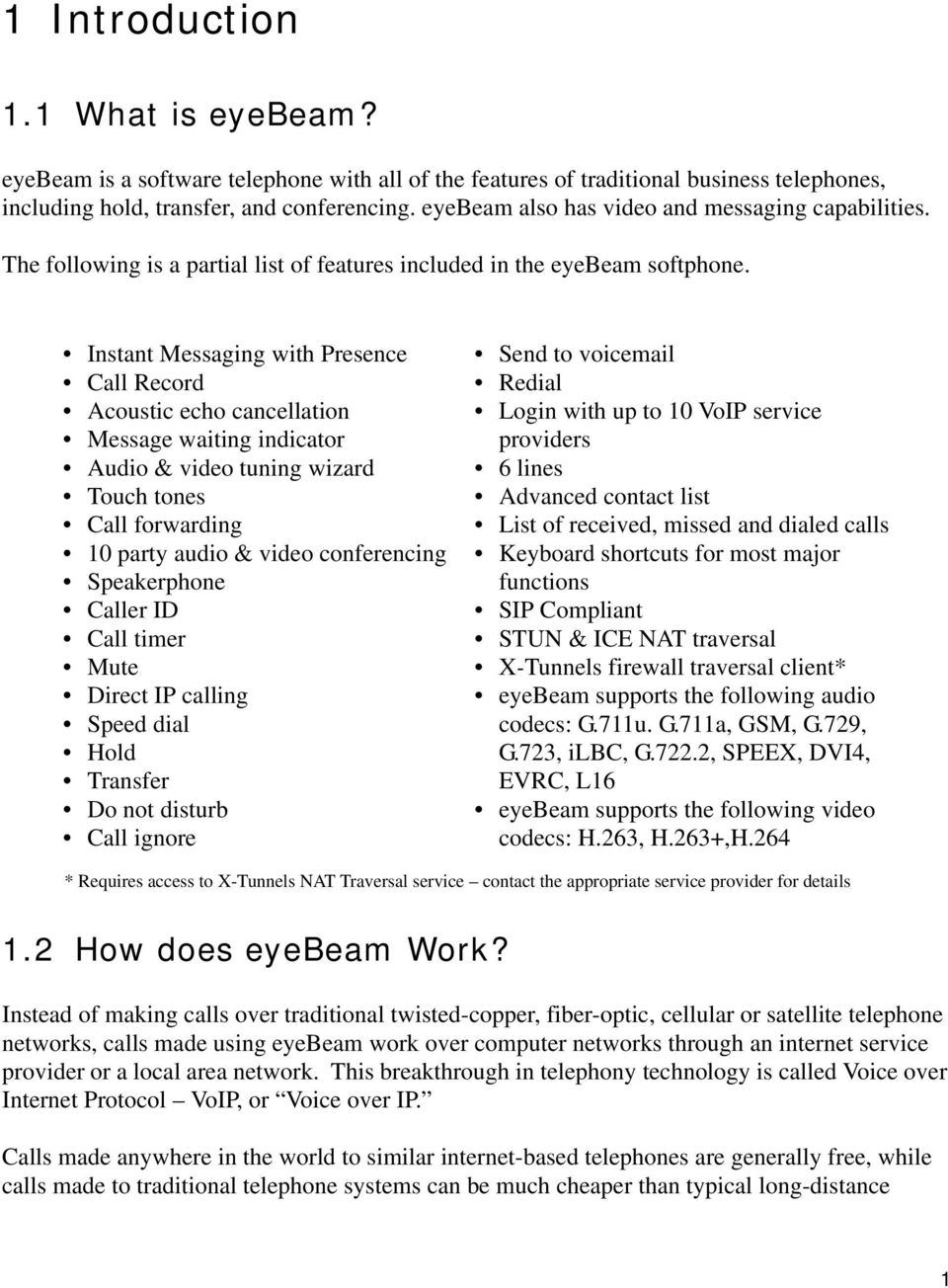
7 1 Introduction 1.1 What is eyebeam? eyebeam is a software telephone with all of the features of traditional business telephones, including hold, transfer, and conferencing. eyebeam also has video and messaging capabilities. The following is a partial list of features included in the eyebeam softphone. Instant Messaging with Presence Call Record Acoustic echo cancellation Message waiting indicator Audio & video tuning wizard Touch tones Call forwarding 10 party audio & video conferencing Speakerphone Caller ID Call timer Mute Direct IP calling Speed dial Hold Transfer Do not disturb Call ignore Send to voic Redial Login with up to 10 VoIP service providers 6 lines Advanced contact list List of received, missed and dialed calls Keyboard shortcuts for most major functions SIP Compliant STUN & ICE NAT traversal X-Tunnels firewall traversal client* eyebeam supports the following audio codecs: G.711u. G.711a, GSM, G.729, G.723, ilbc, G.722.2, SPEEX, DVI4, EVRC, L16 eyebeam supports the following video codecs: H.263, H.263+,H.264 * Requires access to X-Tunnels NAT Traversal service contact the appropriate service provider for details 1.2 How does eyebeam Work? Instead of making calls over traditional twisted-copper, fiber-optic, cellular or satellite telephone networks, calls made using eyebeam work over computer networks through an internet service provider or a local area network. This breakthrough in telephony technology is called Voice over Internet Protocol VoIP, or Voice over IP. Calls made anywhere in the world to similar internet-based telephones are generally free, while calls made to traditional telephone systems can be much cheaper than typical long-distance 1
8 charges. Voice quality for conversations using VoIP technologies can greatly exceed traditional telephone services. Note that CounterPath Solutions, Inc. does not provide a telephone service, but instead offers software to use such services. Please refer to Section of this guide for information about VoIP service providers. eyebeam uses open standards, which permit inter-operability between products from all vendors in a given industry. Open standards give consumers a choice, rather than being locked-in to the proprietary solutions of one vendor. CounterPath Solutions plans to use open standards for future VoIP products as well, with hopes that customers will recognize CounterPath s commitment to open standards and excellence in high-quality VoIP softphones. eyebeam uses the Session Initiation Protocol (SIP) for session signaling, ITU codec standards for voice and video (G.711, G.723, G.729, H.263, H.264), and the SIMPLE standard for instant messaging (IM) and presence. 2

9 2 Installation and Setup 2.1 Before Installing This section covers important information that is required before installing the software to use eyebeam softphones Finding a Service Provider Note: If eyebeam came as part of a VoIP service package, then this section will not apply. Please refer instead to the documentation from the applicable service provider. The first step to making calls with VoIP technology is to choose a service provider. There are many VoIP service providers available; refer to a partial list of such service providers at NOTE THAT THIS PARTIAL LIST DOES NOT IMPLY COUNTERPATH RECOMMENDATIONS OR ENDORSEMENT OF ANY PROVIDER. CONSUMERS THEMSELVES ARE SUITED BEST TO MAKE SUCH ASSESSMENTS ABOUT VOIP SERVICES Getting necessary information from a Service Provider After choosing a VoIP service provider, eyebeam users will need further information regarding specific account information. NOTE THAT NOT ALL OF THIS INFORMATION IS REQUIRED, DEPENDING ON THE SERVICE PROVIDER: User Name Password Authorization User Name* Domain Proxy address and port* STUN server address and port* X-Tunnels server address and port* * value not used by all service providers 3

10 2.2 Minimum System Requirements The following tables outline hardware and software requirements for installing eyebeam: eyebeam for Windows Processor: Memory: Operating System: Connection: Sound Adapter: Other: Pentium II 300 (or equivalent) 128 MB RAM Windows 2000, XP, 2003 Server, or higher IP network connection (broadband, dialup, local, wireless) Full-duplex, 16-bit Speakers and microphone, or headset eyebeam for Macintosh Hardware: Operating System: Suggested configuration for Mac OS X version 10.2* Mac OS X version 10.2 or later * Contact apple.com for details 2.3 Multi-media Device Requirements Since eyebeam is a software application, both speakers and a microphone are required to make calls. Any of the following configurations are acceptable: External speakers and microphone Dual-jack multimedia headset Built-in microphone and speakers USB multimedia headset USB phone Calls made with eyebeam will work without a video camera, but one is necessary to allow other parties to see a caller s image. eyebeam will work with most modern USB video cameras. 4

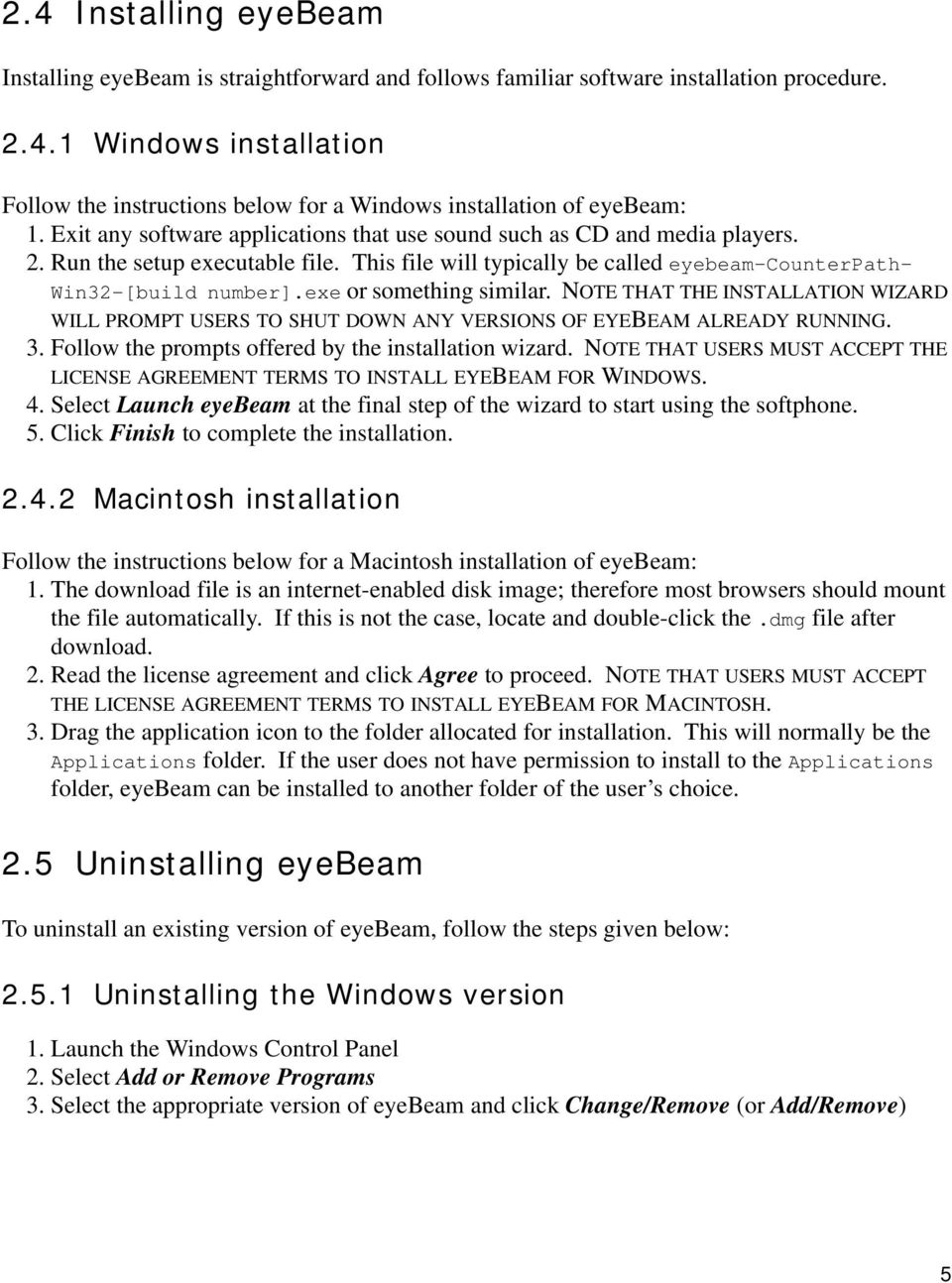
11 2.4 Installing eyebeam Installing eyebeam is straightforward and follows familiar software installation procedure Windows installation Follow the instructions below for a Windows installation of eyebeam: 1. Exit any software applications that use sound such as CD and media players. 2. Run the setup executable file. This file will typically be called eyebeam-counterpath- Win32-[build number].exe or something similar. NOTE THAT THE INSTALLATION WIZARD WILL PROMPT USERS TO SHUT DOWN ANY VERSIONS OF EYEBEAM ALREADY RUNNING. 3. Follow the prompts offered by the installation wizard. NOTE THAT USERS MUST ACCEPT THE LICENSE AGREEMENT TERMS TO INSTALL EYEBEAM FOR WINDOWS. 4. Select Launch eyebeam at the final step of the wizard to start using the softphone. 5. Click Finish to complete the installation Macintosh installation Follow the instructions below for a Macintosh installation of eyebeam: 1. The download file is an internet-enabled disk image; therefore most browsers should mount the file automatically. If this is not the case, locate and double-click the.dmg file after download. 2. Read the license agreement and click Agree to proceed. NOTE THAT USERS MUST ACCEPT THE LICENSE AGREEMENT TERMS TO INSTALL EYEBEAM FOR MACINTOSH. 3. Drag the application icon to the folder allocated for installation. This will normally be the Applications folder. If the user does not have permission to install to the Applications folder, eyebeam can be installed to another folder of the user s choice. 2.5 Uninstalling eyebeam To uninstall an existing version of eyebeam, follow the steps given below: Uninstalling the Windows version 1. Launch the Windows Control Panel 2. Select Add or Remove Programs 3. Select the appropriate version of eyebeam and click Change/Remove (or Add/Remove) 5
12 2.5.2 Uninstalling the Macintosh version 1. Click on the eyebeam icon and hold it down 2. Drag the icon to the Trash. 2.6 Starting eyebeam Users can start eyebeam for Windows and Macintosh by following the steps given below: Starting eyebeam for Windows 1. Click the Start button. 2. Select Programs (All Programs on some systems) 3. Select the eyebeam folder (or the folder specified upon install). 4. Click the eyebeam icon. NOTE THAT USERS CAN ALSO LAUNCH EYEBEAM BY DOUBLE-CLICKING ON THE APPROPRIATE DESKTOP SHORTCUT ICON Starting eyebeam for Macintosh 1. Open the folder containing the appropriate version of eyebeam. 2. Double-click the eyebeam icon License key When starting eyebeam for the first time, users will be prompted for a product-specific license key. Copy and paste this vendor-provided key into the on-screen field labeled License Key. 2.7 The Tuning Wizard The eyebeam software includes a Tuning Wizard that allows users to select available audio and video devices for use during calls. For example, with an installed USB web cam connected to a computer, the Tuning Wizard can help users select this device for softphone calls. The Tuning Wizard appears automatically the first time a user runs eyebeam. Users are advised to complete the wizard to ensure that all devices are working properly and are set at the proper level. NOTE THAT THE TUNING WIZARD WILL ONLY APPEAR ON ITS OWN THE FIRST TIME A USER STARTS EYEBEAM. USERS WILL HAVE TO LAUNCH THE WIZARD MANUALLY EACH TIME AFTER THAT (RIGHT-CLICK ON THE DISPLAY SCREEN TO ACCESS A CONTEXT MENU FROM WHICH THE TUNING WIZARD CAN BE LAUNCHED). 6

13 Follow the steps below to complete the Tuning Wizard: 1. Click Next to begin the wizard. 2. Choose which type of device to configure. 3. Choose the correct audio devices and mixers to use. Click Next to advance. 4. Adjust the speaker volume to a comfortable level. Click Next to advance. 5. Adjust the microphone volume; listen to the playback of the recorded sample and make changes if necessary. Click Next to advance. 6. Choose a video device, if applicable. Click Next to advance. 7. Choose the desired video quality, if applicable. Click Next to advance. 8. Click Finish to complete the wizard. 7

14 3 Using the Softphone 3.1 The Dial Pad The eyebeam softphone provides an easy-to-use dial pad as the main user interface, which allows for quick access to both basic and advanced calling features. Refer to Figure 1 below for an illustration of the eyebeam user interface. Camera Settings Detach Video Drawer Network Status Flash Record Button Help Minimize Close Missed Calls Indicator Line Buttons Redial Calls & Contacts Menu Online Status Detach Contacts Drawer Start Video Video Drawer With Local Video Feed Transfer Hold & Park Hang Up Microphone Slider & Level Indicator Mute Clear Dial Pad Speaker Phone Calls & Dial Contacts Calls & Contacts Drawer Speaker Auto Answer Drawer Slider & Auto Conference Level Indicator Do Not Disturb & Conference Figure 1 - The eyebeam User Interface 8

15 3.2 Before Making a Call Things to keep in mind Making calls with eyebeam is simple; there are, however, some differences between a softphone and a traditional telephone that of which the user should be aware: 1. A softphone is a computer application that must be running to make or receive calls. 2. Softphone software must login to the network before making or receiving calls. This procedure may take a few seconds as the softphone contacts the user s service provider network. Once the softphone s call status reads Logged in Enter Phone Number the user is ready to make or receive calls. 3. Since calls are transmitted over the internet, service quality may drop due to network congestion. Although eyebeam includes advanced signal processing features to mask the effect of such congestion, decreased voice quality may be noticeable during poor network conditions. Most broadband connections provide adequate bandwidth for high-quality voice & video. Users experiencing poor audio or video quality during their calls can refer to Appendix A: eyebeam Troubleshooting Logging in to a Service Provider Upon eyebeam start-up, when the dial pad first appears on-screen, users should see the messages Initializing, Performing DNS Lookup, followed by Discovering Firewall in the call status screen. This normal eyebeam behavior indicates that the softphone is discovering the user s network environment. After discovering the appropriate network environment, users might see the message Awaiting proxy login information. This indicates that the user needs to enter VoIP service provider information described in Section to enable the softphone to login to the network. eyebeam allows users to configure a softphone to use more than one service provider. Setting up the softphone for multiple providers is covered in Section Shown below is the eyebeam settings dialog, which allows users to enter and/or edit settings for softphones. This dialog can be launched at any time by right-clicking on the main display window and choosing Settings, and is arranged as a tree with expandable branches similar to Windows Explorer. When finished entering a group of settings, the user can click OK to save changes and close the dialog. 9

16 Figure 2 - VoIP Service Provider Information Complete the following fields to login to the service provider s network. NOTE THAT NOT ALL OF THESE FIELDS ARE REQUIRED, DEPENDING ON THE SERVICE PROVIDER. Enable this SIP account Checked Display Name User name. This field is required. User name [from the VoIP service provider] (often a phone number ) Authorization User name [from the VoIP service provider]* Password [from the VoIP service provider] Domain [from the VoIP service provider] * Value not used by all Service Providers 10

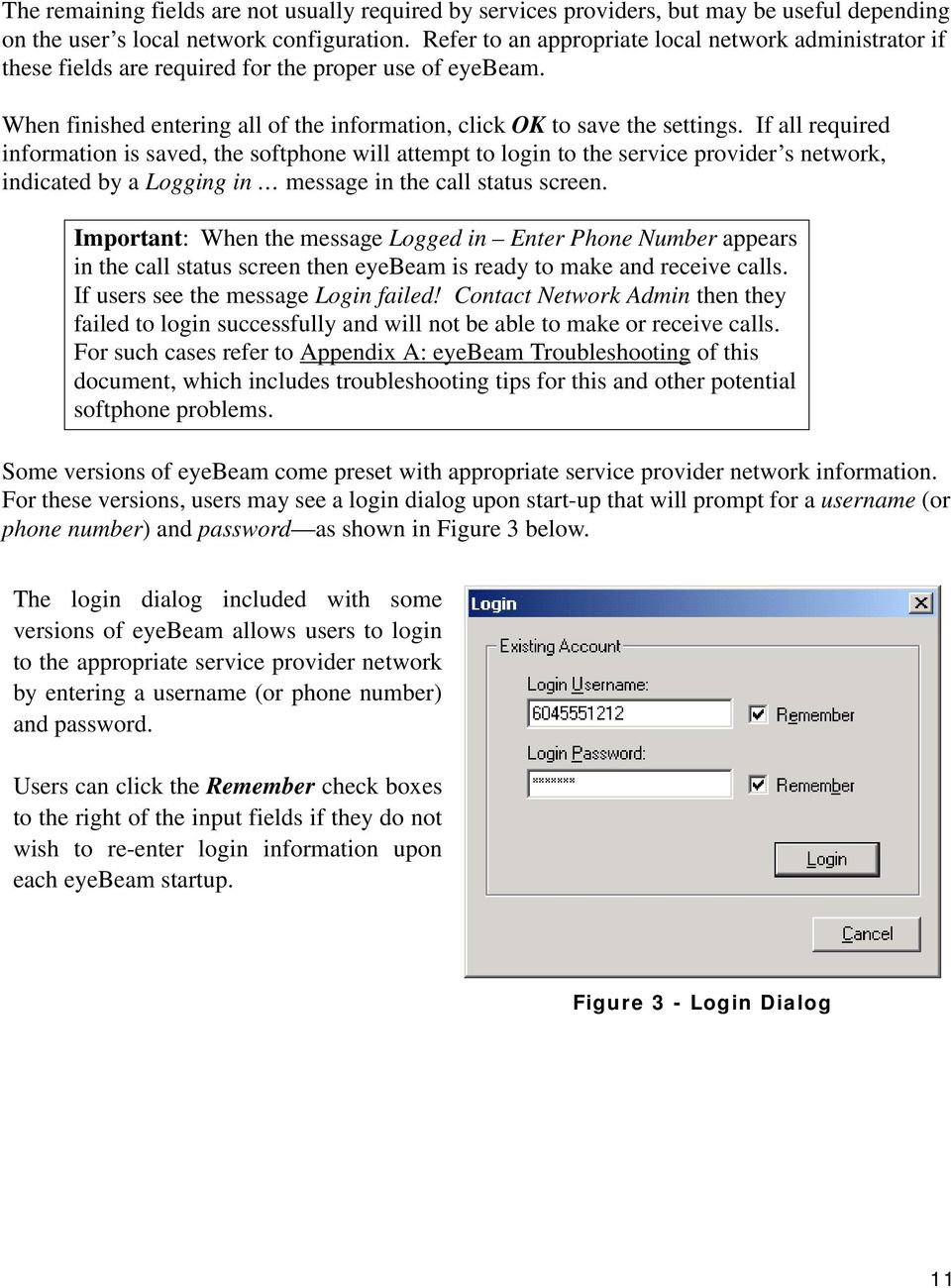
17 The remaining fields are not usually required by services providers, but may be useful depending on the user s local network configuration. Refer to an appropriate local network administrator if these fields are required for the proper use of eyebeam. When finished entering all of the information, click OK to save the settings. If all required information is saved, the softphone will attempt to login to the service provider s network, indicated by a Logging in message in the call status screen. Important: When the message Logged in Enter Phone Number appears in the call status screen then eyebeam is ready to make and receive calls. If users see the message Login failed! Contact Network Admin then they failed to login successfully and will not be able to make or receive calls. For such cases refer to Appendix A: eyebeam Troubleshooting of this document, which includes troubleshooting tips for this and other potential softphone problems. Some versions of eyebeam come preset with appropriate service provider network information. For these versions, users may see a login dialog upon start-up that will prompt for a username (or phone number) and password as shown in Figure 3 below. The login dialog included with some versions of eyebeam allows users to login to the appropriate service provider network by entering a username (or phone number) and password. Users can click the Remember check boxes to the right of the input fields if they do not wish to re-enter login information upon each eyebeam startup. Figure 3 - Login Dialog 11
18 3.3 Placing a Call As mentioned in the previous section, eyebeam becomes ready to make or receive calls once users see the message Logged in Enter Phone Number in the call status screen. There are several ways to enter a phone number in eyebeam. Users can click the digits of eyebeam s on-screen numeric keypad, or they can enter the numbers/letters directly from their computer s alphanumeric keyboard. Notice that as users begin entering a number, Line 1 becomes automatically selected as the line in use for that call as shown in Figure 4 to the right. If at any point users enter erroneous digits, clicking the Clear button within the dial pad or pressing Backspace on the computer keyboard will allow for corrections. Note that as users enter a phone number they may see suggestions for completing that number (as shown in Figure 4). To enter the rest of the number as suggested, hit the Tab key on the computer keyboard to fill in the remaining digits. 212 Figure 4 - Dialing a Number When finished entering a number, click the green Dial button within the on-screen dial pad or press Enter on the computer keyboard. Like a traditional telephone, users will hear a ringing tone as eyebeam tries to access the remote party; with a softphone, users will also see the message Ringing in the call status screen. When the remote party answers, users will see the message Call Established in the call status screen. Users can also place a call by clicking on an available on-screen line button and dialing the appropriate number. Call conferencing is covered in Section 4.1 of this document. 12

19 Important: When users place a call by simply dialing the number of the other party, they will most likely be using their default service provider for the call. eyebeam allows users to have multiple service providers configured to place calls over a variety of networks. To place a call via a service provider other than the default, users need to choose the desired provider (also called the proxy) before entering the number to dial. Making calls using multiple providers is covered in Section Users can also dial a number by entering a valid SIP URL such as: [email protected] 3.4 Ending a Call As with traditional phones, softphone calls are brought to a close when either the eyebeam user or the other party hangs up. Users can end an active call by clicking the Hangup button within the on-screen dial pad. When a call has ended the message Hung up will appear in the call status screen. After a call has ended, details of the call (such as the length of the call and the caller ID) will remain in the call display. To clear the display, click the Clear button. 3.5 Redial To redial a number, click the Redial button within the on-screen dial pad. 3.6 Answering a Call eyebeam must be running to answer incoming calls. As users receive a new call, a ring tone will sound over the computer s configured speaker device. Users will hear the softphone ringing from whatever device (e.g. headset/usb phone) they configured within the Tuning Wizard (refer to Section 2.7 for information about the Tuning Wizard). If the softphone is hidden behind another window or minimized, the application will come into focus as the incoming call arrives. 13

20 Incoming calls will be indicated in the call display as shown in Figure 5 to the right. Calls will arrive on Line 1 by default, and are indicated by a flashing light on the line button. Users can choose to ignore calls by clicking the Ignore button found within the call status screen below the caller ID of the incoming call. S S Figure 5 - Incoming Call As a call arrives, click the Dial button (or press Enter on the computer keyboard) to answer. Users can also click the appropriate flashing line button to answer the incoming call. 3.7 Placing a Call on Hold While engaged with a call, users can place that call on hold by either clicking the corresponding line button or by selecting another line altogether. The on-hold line s button will flash to indicate that its corresponding call has been placed on hold. To resume a call that is on hold, select the line again by clicking on the appropriate button. 3.8 Dial Pad Controls As described below, the eyebeam dial pad includes several controls which allow users to customize their softphone experience: Microphone and speaker adjustment The eyebeam dial pad includes microphone and speaker sliders as shown in Figure 1. Simply click on the slider and drag it up or down to increase or decrease the desired level. Users may also mute the softphone so that the other party cannot hear what is being spoken. Press the MUTE button at the bottom-left of the dial pad to mute the phone. Press the button once more to take the phone off mute. 14

21 3.8.2 Codec selection eyebeam allows users to select which audio codec(s) to use for calls. Audio codecs describe the format by which audio streams are compressed for transmission over networks. While some codecs require less bandwidth than others, lower bandwidth often exhibits lower voice quality. Users can enable codecs or change their properties by navigating to Media -> Audio -> Advanced -> Codecs in the Settings menu (right-click to access the Settings menu). With only one codec enabled, all calls made will use that particular audio compression format. The G.729 codec consumes the lowest bandwidth, whereas the G codec requires the most bandwidth but provides the best voice quality. 3.9 Context Menu eyebeam includes a context menu which allows users quick access to the following features: Tuning Wizard Privacy Management Settings Dialog Sip Account Status Diagnostic Log About Dialog To launch the dial pad context menu, right-click (or Control-click for Mac users) anywhere over the on-screen dial pad. Figure 6 - Dial Pad Context Menu The Diagnostic Log contains important network and protocol information that may be useful for trouble-shooting various issues. For more on this see Appendix A: eyebeam Troubleshooting The Privacy Management window The Privacy Management window allows users to customize the way in which contacts can reach them. Right-click the main eyebeam window and choose Privacy Management. 15
22 Figure 7 - The Privacy Management Window Click the Add button to add a contact s address. By default all actions will be allowed for the contact. To prevent a particular contact from reaching an eyebeam user in a certain way, uncheck the appropriate box in the corresponding column. For example, to allow a contact to phone a user while preventing them from seeing whether or not the user is online, check Allow Phone, and uncheck Show Presence SIP Account Status Right-click the main eyebeam window and choose SIP Account Status to view the status for SIP accounts. This feature will show the account name, status, user name, the number of new and saved messages, the date of last login, and the dialing prefix The About window Right-click the main eyebeam window and choose About. This will show what version of eyebeam is running, and will allow quick access to the user s VoIP service provider website. 16
23 3.10 Window Controls At the top of the dial pad are the help, minimize, and close buttons (see Figure 1). Depending on the version running, the behavior of these buttons will vary as described below: Window controls within eyebeam for Windows As expected, the minimize button will send the application to the Windows system tray. eyebeam users will still be able to receive calls when the softphone is minimized. The close button will shut down the application altogether; users will not be able to receive calls after closing the application. NOTE THAT THIS BEHAVIOR IS DIFFERENT FROM PREVIOUS VERSIONS OF EYEBEAM SOFTPHONES Window controls within eyebeam for Mac As with other Mac OS X applications, the minimize button will send eyebeam to the Dock. Like the Windows version, the close button shuts down the application in one step. To hide the Mac version of eyebeam, select Hide eyebeam from the Application menu item labeled eyebeam in the familiar Mac OS X menu bar. eyebeam and all of its windows will become invisible, although its icon will remain in the Dock. Click on the icon in the dock to reveal eyebeam once again. NOTE THAT WHEN THE PHONE IS HIDDEN, THE DOCK ICON WILL BOUNCE WITH THE RING! MESSAGE SUPERIMPOSED TO SIGNAL AN INCOMING CALL Help Clicking the help button at the top of the dial pad will open the CounterPath Softphone Support Forum, where users can post any issue regarding the use of a softphone and receive help from other users and members of the CounterPath support team. NOTE THAT CO-BRANDED VERSIONS OF EYEBEAM MAY LINK TO THE SERVICE PROVIDER S HELP SITE INSTEAD. 17
24 4 Extended Calling Features Along with basic calling functionality, eyebeam also includes many advanced features found in traditional business phones. These features include call conferencing and call transfer, each of which is covered in the following subsections: 4.1 Call Conferencing eyebeam allows users to establish a conference call which will let more than two parties to converse at once. Each party in the conference call can hear and speak to every other participant Starting a conference call Users may host a conference by calling the other parties involved, or by allowing them to arrange the call themselves. For example, users can create a simple three-way call by following the steps below: 1. With an active call on one of the lines, place the call on hold by either: selecting another line and dialing a third party, or accepting an incoming call from a third party by clicking the line on which the call arrives. NOTE THAT EITHER OPERATION PLACES THE ORIGINAL PARTY ON HOLD. 2. After informing the arriving participant about the three-way call, click the CONF button (see Figure 1) to include all parties in the conversation. 3. To end a three-way call, click the CONF button again to place both parties on hold. At this point no participants can speak to one another. 4. Users can then talk to each party individually by selecting the appropriate line Adding another party to the conference To add another party to an existing conference call, complete the following steps: 1. Place the conference on hold by clicking the CONF button. 2. Invite another party to the conference on hold by either: selecting the line of an incoming call, or selecting an available line to initiate a call to an outside party. NOTE THAT USERS SPEAK TO THE OUTSIDE PARTY WHILE THE CONFERENCE IS ON HOLD. 3. After advising the outside party that they will soon be part of a conference call, click the CONF button once more to re-establish the conference. 18
25 4.1.3 Removing a party from the conference To remove a party form an existing conference call, complete the following steps: 1. Place the conference on hold by clicking the CONF button. 2. Select the line of the participant who wishes to leave the conference. 3. Say goodbye to the party then click the Hangup button. 4. Click the CONF button once more to re-establish the conference. NOTE THAT A PARTY MAY LEAVE THE CONFERENCE ON THEIR OWN BY HANGING-UP. THEIR LINE WILL THEN BE INDICATED AS INACTIVE AND THE REST OF THE CONFERENCE WILL BE UNAFFECTED Multiple conference hosts An eyebeam conference call may include up to seven individuals the conference host plus a participant on each of the six lines. Users can establish multiple conference hosts if they wish to daisy chain together a conference call with more than seven participants. For example, one person may host six other parties (to occupy all of its available lines) with one of those parties being a conference of their own containing six other parties. This would bring the total number in the aggregate conference call to twelve. In theory, such daisy chains would allow for an unlimited number of parties in a conference call; in a real scenario, however, the number of participants would be limited by bandwidth constraints at each of the conference host s machines, causing audio quality to degrade more and more as new participants are added. For this reason, conference participants are advised to select lower bandwidth codecs such as G.729 to preserve audio quality during large conference calls Adding a party to the conference from the Contact Drawer Users can also add a person from their Contact list to a conference call by right-clicking their name in the Contact drawer and selecting Conference in [party s name] 4.2 Call Transfer The eyebeam softphone allows users to transfer an active call to a third party. The softphone allows two different types of call transfer: unattended and attended. 19
26 4.2.1 Unattended call transfer Also called a blind call transfer, this type occurs when a user initiates a transfer without informing the third party that a call is coming their way. Follow the steps below to perform an unattended call transfer: 1. With an active call in progress, inform the person on the other end that they are about to be transferred to a third party, then click the XFER button (see Figure 1). 2. Dial the number to which the call is to be transferred. 3. Click the XFER button again to connect the original party to the third party. When a transfer is complete, the remaining two parties will be speaking to each other and both will have ended their call with the transferor. Both lines corresponding to the other two parties will become free for use on the transferor s softphone Attended call transfer Also known as a supervised call transfer, this type occurs when before making the transfer a user first calls to inform the third party that a transferred call is coming their way. Follow the steps below to perform an attended call transfer: 1. With an active call in progress, select an available line with which to call the third party (selecting a new line will put the original call on hold). 2. Inform the third party that they are about to receive a call, then press the XFER button (see Figure 1). 3. Select the line associated with the original party to connect them to the third party. When a transfer is complete, the remaining two parties will be speaking to each other and both will have ended their call with the transferor. Both lines corresponding to the other two parties will become free for use on the transferor s softphone. 4.3 Call Forwarding Users can set their eyebeam softphone to forward incoming calls to a desired URL which could be either another SIP User Agent, phone number or a voic address. Follow the steps below to set an existing SIP account in eyebeam to forward to another URL: 1. Access the Settings dialog by either pressing F8 or by right-clicking and choosing Settings Select SIP Accounts -> [SIP account to forward] -> Advanced 3. Under Foward Settings, select Fowarding -> Go to forward URL (or Go to voic URL for SIP accounts that support voic ) 4. In the Forward URL field, enter the SIP URL or phone number to which the selected SIP account should forward calls 5. Click OK 20
27 4.4 Do Not Disturb eyebeam allows users to set their softphone to a Do Not Disturb mode. When the softphone is set to this mode all incoming calls will be sent to voic or given a busy indication. NOTE THAT DETAILED EXPRESSIONS OF THIS FEATURE ARE DEPENDENT UPON THE USER S SERVICE PROVIDER NETWORK. Do Not Disturb is toggled on/off by clicking the on-screen DND button. 4.5 Auto-Answer eyebeam allows users to set their softphone to Auto-Answer mode. When the softphone is set to this mode eyebeam answers the call automatically after a wait time that can be changed from the System item found in the Settings menu. Auto-Answer is toggled on/off by clicking the on-screen AA button. NOTE THAT THIS FEATURE CAN BE COMBINED WITH AUTO-CONFERENCE DESCRIBED BELOW. 4.6 Auto-Conference eyebeam includes an Auto-Conference feature which can be enabled or disabled by clicking on the AC button. When combined with the Auto-Answer feature described above, eyebeam can control the way participants get added to a conference. The different levels of control for managing a conference are shown in Table 1 below: Table 1: Conference Management Level of Control AA off / AC off Manual conference AA on / AC off Auto-answer, manual add to conference AA off / AC on Individual answer, auto add to conference AA on / AC on Conference Server Mode Conference Process Conference Host manually accepts calls and adds each to conference see Section eyebeam automatically answers calls and the conference host manually adds each to conference Conference host answers each call and each is automatically added to conference eyebeam acts as a fully automated conference server answering each incoming call and adding them to the conference 21
28 4.7 Flash The Flash button on eyebeam works the same way as flash on a traditional telephone. Clicking the hang-up button quickly on a traditional telephone performs the same task. Such actions are used sometimes to transfer calls or initiate three-way calling. Note that this functionality depends on the user s service provider. To flash, click the Flash button within the on-screen dial pad. If the user is in an active call, clicking Flash will provide a new line If the user clicks Flash while receiving a call, the softphone will pick up If a line is on hold, clicking Flash will allow the eyebeam user to speak with that person 4.8 Speakerphone eyebeam can work as a speakerphone as well. If a user normally speaks with a headset, they will require a second sound device such as sound card or USB device to use eyebeam as a speakerphone. Run the Tuning Wizard (see Section 2.7) to set up a speakerphone sound device. To activate the speakerphone, click the Speakerphone button. To de-activate the speakerphone, click Speakerphone again. 4.9 Call Record eyebeam can record calls. Perform the following steps to set the folder in which recorded calls are to be stored: 1. Open the Settings dialog 2. Choose the Media branch 3. Under Folder for Media Files, click the Choose Directory button 4. Choose the desired directory and click OK To record a call, click the REC button at any time during the call. Click the button again to stop recording. Recordings will be saved as AVI files. 22
29 5 The Drawers & Settings Menu As with similar features on cell phones, eyebeam allows users to store a list of contacts in a virtual phone book. The softphone also includes a settings dialog, which provides access to a variety of relevant settings. 5.1 The Contact Drawer To bring up the eyebeam Contract Drawer, click the black button toward the extreme right edge of the softphone application. To add a new contact, access the Calls & Contacts menu, then choose Add A New Contact. Enter the name, phone number or SIP URL. Contacts can be grouped together. To create a new group, access the Calls & Contacts menu, then choose Add a New Group. This will create a new item in the contact list, which the user can rename at any time thereafter. To rename an existing group, right-click the group and choose Rename Group. To move a contact to a group, simply drag the contact to that group. To dial a contact s phone directly from the Contact Drawer, right-click the contact s name and choose Place a Call. If there is more than one number for this contact, eyebeam will show a list of numbers from which to choose. To close the Contact Drawer, click the same button at the right edge of the application. Users can detach the Contact Drawer from the softphone by clicking Detach, and can click Reattach to reattach a detached Contact Drawer to the softphone. 23
30 Right-click a contact to dial them or add them to a conference Users can drag a contact to any other group Users can drag a contact to a Line or to the main display window to call them To rename a group click the group name and wait one second Click X at the upper-right corner to close and reattach the Contact Drawer to the Dial Pad Drag a contact to an in-use Line to add them to a conference Figure 8 - The Contact Drawer Recent calls As users make and receive phone calls, eyebeam stores them in a list of recent calls. Click the Received Calls item in the Contact Drawer to view recent calls received. Click the Dialed Calls or Received Calls item in the Contact Drawer to display a comprehensive list of calls. Right-click any item to show its context menu. Using this context menu, users can do the following: Phone back the contact Mark the call as unanswered Delete the call from the list Add the caller to the user s contact list 24
31 5.1.2 Importing contacts Select this option to import a list of contacts from another CounterPath client into the eyebeam phone book. Access the Calls & Contacts menu of the Contact Drawer, then choose Import Contacts. Find the appropriate CSV file on the client computer and click OK. NOTE THAT USERS MUST FIRST EXPORT THEIR LIST OF CONTACTS FROM THEIR COUNTERPATH CLIENT TO A CSV (COMMA SEPARATED VALUE) FILE. PLEASE REFER TO THE APPLICABLE COUNTERPATH CLIENT DOCUMENTATION FOR INFORMATION ABOUT HOW TO DO THIS Exporting contacts Users may also export all contacts stored in their eyebeam phone book into a CSV file that can be imported later into an client. To do this, select the Export Contacts menu item from the Calls & Contacts menu in the Contact Drawer. eyebeam will prompt the user to specify the name and location of the CSV file containing their contact list. NOTE THAT THE USER MUST REFER TO ANY APPROPRIATE CLIENT DOCUMENTATION FOR INSTRUCTIONS ON HOW TO IMPORT A CSV FILE CONTAINING A CONTACT LIST. 5.2 Instant Messaging To send an instant message to a contact, right-click the contact, and choose Send an Instant Message. 25
32 Figure 9 - The Instant Message Window Type a message in the bottom text area, then click Send on the right to send the message. Click the blue phone icon near the top of the IM screen to call the person for a voice conversation. Click the green icon to add them to the contact manager. Click the icon with the red circle to ban the person. A banned person will not be able to send any phone calls or instant messages to the user who banned them, and they will not be able to ascertain whether or not the user is online. Users can un-ban people previously banned using the Privacy Management window. Click the X icon to close the Instant Message window. 5.3 The Video Drawer To bring up the eyebeam Video Drawer click on the black button toward the extreme left edge of the softphone application. 26
33 To start video, click the Start Video button at the top of the screen. NOTE THAT NOT ALL VOIP SERVICE PROVIDERS ALLOW VIDEO. Users will see their own image at the bottom and image(s) of the other party/parties at the top. To configure a video camera, click the Video Tools button. The options available depend on the type of camera being used. For more information, please refer to the appropriate camera manufacturer s documentation. Users can close, detach, and reattach the Video Drawer in the same manner as they would for the Contact Drawer. Figure 10 - The Video Drawer 5.4 The Settings Dialog Right-click on the eyebeam softphone to bring up the context menu, then choose Settings to access eyebeam s settings dialogs SIP accounts Click Add a new SIP Account to add a new account Enable this SIP account: Display Name: User name: Check this box to enable this SIP account. This is the value that will show on the call display window of many phones. This value is assigned to the user by their VoIP service provider. REQUIRED. 27
34 Password: Authorization user name: Domain: Domain Proxy Host: Use as Outbound Proxy: Register with domain: SIP Listen Port: Clear Proxy button: This value is assigned to the user by their VoIP service provider. May be required by the service provider. The value is often blank, or the same as the user name. The domain name for the user s service provider. The fully-qualified domain name or IP address of the SIP proxy. Check this box to use the domain proxy host as an outbound proxy. Often an outbound proxy is used for call accounting and may be used to traverse firewalls. Check this box if users must register with their SIP proxy to receive inbound calls. Set this value to specify the UDP port on which to listen for SIP messages. Click this button to clear any information in the current dialog. Using dialing prefixes to access different SIP proxy accounts When following the instructions provided in this section to configure a new SIP account, eyebeam users can also designate an associated dialing prefix to use for making calls through that specific SIP account. To access a specific SIP account, enter the appropriate prefix before entering the desired number to call; to view or change the dialing prefix, access the Settings menu and complete these steps: Expand the Add a New SIP Account sub-menu 1. Click on Advanced 2. Locate the Dialing plan input option and either: use the displayed prefix to access the specific SIP account change the prefix to one more acceptable for accessing the specific SIP account Firewall/NAT Send internal IP: Some firewall proxies require the user s internal IP address. 28
35 STUN server: Firewall Proxy: Enable ICE: Set this value to enable eyebeam to override the STUN host. The STUN protocol is the preferred protocol for detecting firewall and NAT status. Set the DNS name or IP address of the firewall proxy of the user s local network. Check this box to enable ICE. ICE is a protocol for detecting the shortest network path during a voice conversation, which can help overcome some problems with endpoints behind the same firewall Server-side storage Use this dialog to indicate where to store contact information. Use either Local, or the information provided by the VoIP service provider Presence Presence allows other users to see a user s online status, and for users to see that of others. Use the information provided by the VoIP service provider XTunnels X-Tunnels is a protocol to tunnel voice packets across firewalls. Use XTunnels: Use SIP Credentials: Username: Password: XTunnels server: Protocol Version: Enable data encryption: Set to Never to disable XTunnels. Set to Default or Always to enable XTunnels. Check this box to use the same username and password as the user s SIP account. Enter the appropriate XTunnels username if different from the user s SIP account. Enter a specific XTunnels password if different from the user s SIP account. Enter the DNS name or IP address of the XTunnels server (if required). Check this value with the VoIP service provider. Check this box to encrypt the voice and data traffic. 29
36 Enable message authentication: Check this box to ensure messages come from the expected source Media Use this menu to configure headsets, speaker phones, and USB devices Folder for Media Files: Vertically flip AVI video: Set the location to save AVI files for recorded conversations. Check this box if video appears upside-down Media Audio Internal Sampling Rate: Enable PLC: Automatic Gain Control: Device Name: Force sampling rate to X Hz: Voice Activity Detection: Change this value if the user s sound card produces a different sampling rate. Packet Loss Concealment (PLC) will improve audio quality during audio packet loss. Check this box to enable. Automatic Gain Control (AGC) allows eyebeam to adjust sound volume for optimal audio listening quality. Check this box to enable this feature. Select the audio device to use as a headset, speakerphone, or USB. Try entering different values if the user is having difficulties with their sound card. Voice Activity Detection (VAD) allows eyebeam to detect speech activity. Change these values to alter the sensitivity Media - Advanced Audio - Codecs Move codecs to or from the enabled window using the arrow buttons. NOTE THAT THE OTHER SETTINGS SHOULD NOT BE CHANGED Advanced Audio Panic 30
37 NOTE THAT THESE SETTINGS SHOULD NOT BE CHANGED Video Use this dialog to change video settings. Users may have to set video to the minimum value before making incremental moves up to determine the best video settings for their system System settings Use this dialog to change voic , auto answer, and auto dial settings. Auto Dial Enabled: Product Information: Check this box to enable auto dialing after a certain time span. If the user is unable to dial the number before eyebeam starts dialing, uncheck this box. Technical Support may ask for this value to identify the appropriate softphone version Network settings Auto-detect IP address: If eyebeam is having difficulty detecting the correct values, uncheck this box and enter the user s local and NAT IP addresses instead. This is often useful when on a VPN User Interface Always on top: Check this box to force the user interface on top of all windows at all times. Launch when Windows starts: Check this box to allow eyebeam to start when the user logs in to Windows. Letters to digits mode: Check this box to allow dialing by letter (e.g EYE-BEAM to call ). Message: Change the message that others will see when the user is away from their computer. 31
38 Diagnostics Set advanced diagnostics options here. Press F9 to view the diagnostic log. NOTE THAT THE USER S TECHNICAL SUPPORT REPRESENTATIVE MAY ASK TO ADJUST VALUES ON THIS DIALOG License key Enter the product license key here. The VoIP service provider or softphone reseller will provide this key to users. 32
39 6 Application Hot Keys eyebeam includes a number of keyboard shortcuts available for many of its functions. A list of these is shown in Table 2 below: Table 2: Application Hot Keys Function Keyboard Shortcut Select Line 1 F1 or Ctrl + 1 Select Line 2 F2 or Ctrl + 2 Select Line 3 F3 or Ctrl + 3 Select Line 4 F4 or Ctrl + 4 Select Line 5 F5 or Ctrl + 5 Select Line 6 F6 or Ctrl + 6 Tuning Wizard F7 or Ctrl + 7 Settings Dialog F8 or Ctrl + 8 Diagnostic Window F9 or Ctrl + 9 (Command-D for Mac) Toggle Letters-to-Digits Space bar (Windows only) Auto complete (number to dial) Tab Clear Backspace Dial Enter Help Ctrl + F1 Auto-Answer (AA) Ctrl + a Contacts (Buddies) Ctrl + b Do Not Disturb (DND) Ctrl + d Auto-Conference (AC) Ctrl + f Hang up Ctrl + h Call Ignore Ctrl + i Mute Ctrl + m (Space bar for Mac) Conference Ctrl + n Hold Ctrl + o Exit Ctrl + q Redial Ctrl + r Send to Voice Mail Ctrl + s Transfer Ctrl + t Paste Ctrl + v Inc/Dec Speaker Volume Up/Down Arrows Inc/Dec Microphone Volume Right/Left Arrows 33
40 Appendix A: eyebeam Troubleshooting The following is a guide to troubleshooting various issues that may arise when using the eyebeam softphone. Users may find solutions to common problems explained within. Networking Problems This guide assumes that the user s internet connection is working. If that is not the case, please contact the appropriate internet service provider. Login timeout If the user gets a Login Timed Out error message, they may have entered their username or password incorrectly. Double-check these values with the VoIP service provider. Users also may have problems contacting a SIP proxy server. Make sure the user s computer can ping the computers listed in Table 3 below. If the user cannot contact any one of these computers, there may be difficulties with softphone calls. Table 3: Relevant Network Hosts Ping is a network utility used to determine if a remote computer is alive and reachable across a network. How to ping a computer (Windows): Computer SIP Proxy Outbound SIP Proxy (if applicable) STUN Server DNS Server X-Tunnels Server (if applicable) 1. Click the Start button 2. Click Run 3. Type command 4. Click the OK button 5. The Windows Command Prompt will open 6. At the prompt type ping <computer address>, where <computer address> is the domain name or IP address of one of the computers in the above table. 34
41 7. If the result is could not find host, or request timeout, that computer is not available. Please contact the appropriate VoIP service provider for assistance. How to ping a computer (Mac OS X): 1. Launch the Network Utility found in the Applications/Utilities folder. 2. Click on Ping from the list at the top. 3. Enter the address of the computer and click Ping. Firewall and NAT issues If a user computer is behind a firewall, certain ports must be open for eyebeam to be able to communicate with a VoIP service provider. The required ports are listed below in Table 4. Please refer to applicable firewall documentation for help on opening ports. Table 4: Standard Ports Port Type and Number UDP 3478 UDP 5060 UDP 8000 UDP 8001 Service STUN SIP RTP RTCP Two additional ports after 8001 are required for each additional line used. For example, if using a second line, UDP ports are used. If the user computer is behind a firewall from which it is impossible to open such ports, contact the VoIP service provider regarding firewall traversal solutions such as X-Tunnels. If the firewall restricts incoming connections, the user may need to use an Outbound Proxy to properly receive audio. Ask the VoIP service provider for a Outbound Proxy address and port number, then enter those values into eyebeam in the following location: Settings Menu -> Proxies -> [User s SIP Proxy] -> <Outbound Proxy>:<Port> Users must also set the Use Outbound Proxy field (found with the above setting) to Always. Port forwarding is not required on a user s NAT. 35
42 Multiple IP addresses on the same computer If a user s computer has more than one IP address, eyebeam may have difficulty choosing the correct address for softphone calls. To set the correct IP address manually, configure the following settings as instructed below: Settings Menu -> System -> Network -> Auto-Detect IP Address: Unchecked Local IP Address: [User Computer s IP Address] NAT Firewall IP Address: [IP Address of the user s NAT or firewall] Another solution is to disable all but one network adapter until after eyebeam starts. RPort attribute Some VoIP providers do not support the rport signaling attribute. Check with the VoIP service provider for details. To turn off rport configure the following setting as instructed below: Settings Menu -> Proxies -> [User s Proxy] -> Advanced Options -> Use rport: Unchecked Audio Problems This guide assumes that the user computer s sound and video system are working normally, and that the user has run the Tuning Wizard at least once. To run the Tuning Wizard, right-click over the dial pad, and select Tuning Wizard. There are several factors that may affect sound quality when using eyebeam. These include the quality of the network connection, network device quality, and headset model. Some of the common problems experienced are given below, along with some useful tips on how to minimize their effect: Audio contains pops at loud points in voice Popping sound is a symptom of over-modulation. Ask the other party to decrease their microphone slider and/or adjust the microphone gain. 36
43 Audio contains bothersome background noise Significant background noise can be due to the level of the silence threshold. Have the other party adjust their silence threshold, which they can do by running the Tuning Wizard covered in Section 2.7. Audio sounds choppy in a conference Poor conference audio may be caused by upload bandwidth limitations. For example, some sites have 1 Mbps download bandwidth, but only 128 kbps upload bandwidth. Under such conditions, try multiple hosts for the conference, or have all participants disconnect and switch to a lesser bandwidth audio compression codec such as G.729. Poor sound Poor or scratchy sound is a symptom of a problem with network connections, or a faulty network card. The following issues could contribute to poor sound quality: There may be packet loss on the IP network. Check the network performance, latency, and throughput. A 200-millisecond round trip latency as determined from a ping should deliver good audio quality. Older network devices may have performance problems. Make sure to use the latest driver. There is an echo there is an echo The following tips may be useful for reducing echo heard during the conversation: Try using a headset with plugged into the sound card. Another suggestion is to use a USB-enabled headset, which bypasses system sounds by acting as its own sound device. If using a boom type headset, note that some boom headsets can create feedback between the boom microphone and the headset earpiece. The microphone balance is not muted in the playback section of Windows audio controls. When configuring sound, examine the volume control setting. Echo will occur if the user s microphone can pick up sounds coming from the speakers used for the softphone call (when not using an integrated headset). The microphone level might be too high or the amplifier might be turned on in the generic Windows audio controls. 37
44 One-way audio If a firewall restricts incoming connections, users may get only one-way audio. Configure eyebeam to use the service provider s Outbound Proxy (if available), as explained under Firewall and NAT issues earlier in this appendix. Diagnostic Log eyebeam writes diagnostic information to a log file. Users can view this log file by pressing F9 on their keyboard. The log is rather cryptic, but when having difficulties with eyebeam, it may become necessary for the user to the log to their technical support representative CounterPath Solutions Figure 11 - The Diagnostic Log 38
Operations and Configuration Guide to eyebeam
 eyebeam 1.1.1 User s Guide Operations and Configuration Guide to eyebeam Xten s Full-Featured Video Softphone Xten Networks, Inc. Floor 8, 100 W Pender St Vancouver, BC Canada V6B 1R8 Tel: 1.604.878.0440
eyebeam Quick Start Guide
 Installation and Basic Operations Guide to eyebeam Xten s Full-Featured Video SIP Softphone Xten Networks, Inc. Research and Development Facility Suite 188, 4664 Lougheed Highway Burnaby, BC Canada V5C
X-PRO Quick Start Guide
 Installation and Basic Operations Guide to X-PRO Xten s Full-Featured Softphone Xten Networks, Inc. Suite 188, 4664 Lougheed Highway Burnaby, BC Canada V5C 5T5 Tel: 1.604.878.0440 [email protected] www.xten.com
PortGo 6.0 for Wndows User Guide
 PortGo 6.0 for Wndows User Guide PortSIP Solutions, Inc. [email protected] http:// @May 20, 2010 PortSIP Solutions, Inc. All rights reserved. This User guide for PortGo Softphone 6.0. 1 Table of Contents
USER GUIDE. Table of Contents. MyNetFone Soft Phone Software User Guide
 Table of Contents MyNetFone Soft Phone Software User Guide 1 Introduction 1 1.1 Minimum System requirements 1 2 MyNetFone Soft Phone Software 1 2.1 Service Functions 1 2.2 Service Features 1 2.3 Main Panel
Using Avaya Flare Experience for Windows
 Using Avaya Flare Experience for Windows Release 9.0 Issue 02.01 September 2013 Contents Chapter 1: About Flare Experience... 5 About Flare Experience... 5 Main window... 6 Button descriptions... 10 Chapter
eyebeam 1.5 for Windows User Guide
 eyebeam 1.5 for Windows User Guide CounterPath Corporation Suite 300, Bentall One Centre 505 Burrard Street Box 95 Vancouver BC V7X 1M3 Tel: 1.604.320.3344 [email protected] www.counterpath.com November,
Bria iphone Edition User Guide
 Bria iphone Edition User Guide CounterPath Corporation CounterPath Corporation Suite 300, One Bentall Centre 505 Burrard Street, Box 95 Vancouver, BC V7X 1M3 Tel: 604.320.3344 [email protected] www.counterpath.com
X Lite 3.0. User Guide
 X Lite 3.0 User Guide Copyright 2006 CounterPath Solutions, Inc. CounterPath Solutions, Inc. Floor 8, 100 West Pender St. Vancouver, BC Canada V6B 1R8 Tel: 1.604.878.0440 www.counterpath.com [email protected]
User Manual. 3CX VOIP client / Soft phone Version 6.0
 User Manual 3CX VOIP client / Soft phone Version 6.0 Copyright 2006-2008, 3CX ltd. http:// E-mail: [email protected] Information in this document is subject to change without notice. Companies names and data
Bria iphone Edition User Guide
 Bria iphone Edition User Guide CounterPath Corporation CounterPath Corporation Suite 300, One Bentall Centre 505 Burrard Street, Box 95 Vancouver, BC V7X 1M3 Tel: 604.320.3344 [email protected] www.counterpath.com
Using CounterPath X-Lite with Virtual PBX - PC
 Using CounterPath X-Lite with Virtual PBX - PC Installing X-Lite - Exit any software applications that use sound such as CD and media players. - Run the setup executable file. - Follow the prompts offered
Product Comparison Chart. Compare CounterPath Multimedia Communicators X-Lite 3.0 - eyebeam 1.5 - Bria 2.2. www.counterpath.com
 Product Comparison Chart Compare CounterPath Multimedia Communicators X-Lite 3.0 - eyebeam 1.5 - Bria 2.2 LEGEND New Feature Indicates feature which is available in free download (X-Lite only) Indicates
MAX CRM v 1.2 User Guide
 MAX CRM v 1.2 User Guide MAIN Telecom, Inc. 1 Mohammed Roshdy St., Agouza, Giza. Tel: +202 3037893 Tel: +202 3037894 5 Lotfy Elsayed St., El-Haram, Giza Tel: +202 5848308 Tel: +202 5870862 [email protected]
USER GUIDE. MyNetFone USB VoIP Phone with Soft Phone Software User Guide. Table of Contents
 MyNetFone USB VoIP Phone with Soft Phone Software User Guide Table of Contents 1 Introduction 1 1.1 Minimum System requirements 1 2 VoIP USB Phone 1 2.1 Features 1 2.2 Phone Keypad 1 2.3 Technical Specifications
All Rights Reserved. Copyright 2006
 All Rights Reserved Copyright 2006 The use, disclosure, modification, transfer, or transmittal of this work for any purpose, in any form, or by any means, without the written permission of the copyright
Bria iphone Edition User Guide
 Bria iphone Edition User Guide CounterPath Corporation CounterPath Corporation Suite 300, One Bentall Centre 505 Burrard Street, Box 95 Vancouver, BC V7X 1M3 Tel: 604.320.3344 [email protected] www.counterpath.com
X-Lite 5 for Windows. User Guide
 X-Lite 5 for Windows User Guide CounterPath Corporation CounterPath Corporation Suite 300, One Bentall Centre 505 Burrard Street, Box 95 Vancouver, BC V7X 1M3 Tel: 604.320.3344 [email protected] www.counterpath.com
Configuring a Softphone for Windows for Virtual Contact Center
 Configuring Bria 3 for Virtual Contact Center Configuring a Softphone for Windows for Virtual Contact Center 8x8 issues softphone licenses to Virtual Contact Center customers allowing them to manage all
The Comcast Softphone User Guide for microsoft windows
 The Comcast Softphone User Guide for Microsoft Windows 1 Contents Introduction 3 System Requirements and Devices 3 Login 4 Emergency Calling 7 Basics on Using Your Comcast Softphone 8 Placing A Call 11
Configuring Bria 3 Mac for Virtual Contact Center
 Configuring Bria 3 Mac for Virtual Contact Center Counterpath s Bria 3 is a softphone application that enables you to manage your Virtual Contact Center VOIP calls easily from your desktop replacing or
Personal Call Manager User Guide. BCM Business Communications Manager
 Personal Call Manager User Guide BCM Business Communications Manager Document Status: Standard Document Version: 04.01 Document Number: NN40010-104 Date: August 2008 Copyright Nortel Networks 2005 2008
Bria Android Edition User Guide
 Bria Android Edition User Guide CounterPath Corporation CounterPath Corporation Suite 300, One Bentall Centre 505 Burrard Street, Box 95 Vancouver, BC V7X 1M3 Tel: 604.320.3344 [email protected] www.counterpath.com
Hosted VoIP Phone System. Desktop Toolbar User Guide
 Hosted VoIP Phone System Desktop Toolbar User Guide Contents 1 Introduction... 3 1.1 System Requirements... 3 2 Installing the Telesystem Hosted VoIP Toolbar... 4 3 Accessing the Hosted VoIP Toolbar...
Digital telephony. Softphone Getting Started Guide. Business Edition TEL-GDA-AFF-002-0902
 Digital telephony Business Edition Softphone Getting Started Guide TEL-GDA-AFF-002-0902 Contents ABOUT THIS GUIDE 3 911 EMERGENCY SERVICES 3 DOWNLOADING THE SOFTWARE 3 CONFIGURING THE SOFTWARE 5 INITIALIZING
Dial91 iphone User Guide
 Dial91 iphone User Guide Dial91 iphone Edition User Guide 1 About Dial91 iphone Edition Dial91 iphone Edition is a SIP-based phone for the Apple iphone mobile digital device, and ipod touch mobile digital
X-Lite 4.0 for Windows. User Guide
 X-Lite 4.0 for Windows User Guide CounterPath Corporation CounterPath Corporation Suite 300, One Bentall Centre 505 Burrard Street, Box 95 Vancouver, BC V7X 1M3 Tel: 604.320.3344 [email protected]
BigConnect v1.x. Software Guide 009-1525-00
 BigConnect v1.x Software Guide 009-1525-00 Contents Overview...3 Installation...3 Launch BigConnect...7 Minimize BigConnect...7 Exit BigConnect...7 BigConnect Home Page...8 Call Management...11 Make a
Phone & Features Guide
 Phone & Features Guide Seventh Edition 11/19/08 Contents Introduction To The Guide...6 1. Star2Star Supported Phones...7 2. Polycom Phones...9 a). Answering a Call...9 b). Making a Call...9 c). Microphone
Polycom Converged Management Application (CMA ) Desktop for Mac OS X. Help Book. Version 5.1.0
 Polycom Converged Management Application (CMA ) Desktop for Mac OS X Help Book Version 5.1.0 Copyright 2010 Polycom, Inc. Polycom and the Polycom logo are registered trademarks and Polycom CMA Desktop
P160S SIP Phone Quick User Guide
 P160S SIP Phone Quick User Guide Version 2.2 TABLE OF CONTENTS 1.0 INTRODUCTION... 1 2.0 PACKAGE CONTENT... 1 3.0 LIST OF FIGURES... 2 4.0 SUMMARY OF KEY FUNCTIONS... 3 5.0 CONNECTING THE IP PHONE... 4
Hosted PBX. TelePacific Communicator User Guide. Desktop Edition
 Hosted PBX TelePacific Communicator User Guide Desktop Edition 11/19/2014 CONTENTS Login... 2 Home Window... 3 Status Flag... 4 My Room... 6 Contacts Screen... 6 History... 8 Directory... 9 Dialpad...
Bria 3 for Windows User Guide. Retail Deployments
 Bria 3 for Windows User Guide Retail Deployments CounterPath Corporation CounterPath Corporation Suite 300, One Bentall Centre 505 Burrard Street, Box 95 Vancouver, BC V7X 1M3 Tel: 604.320.3344 [email protected]
SIP-T22P User s Guide
 SIP-T22P User s Guide Thank you for choosing this T-22 Enterprise IP Phone. This phone is especially designed for active users in the office environment. It features fashionable and sleek design, and abundant
DPH-140S SIP Phone Quick User Guide
 DPH-140S SIP Phone Quick User Guide Version 1.0 TABLE OF CONTENTS 1.0 INTRODUCTION... 1 2.0 PACKAGE CONTENT... 1 3.0 LIST OF FIGURES... 2 4.0 SUMMARY OF KEY FUNCTIONS... 3 5.0 CONNECTING THE IP PHONE...
Cloud Voice Service Cloud Communicator User Guide. (Version 1.0)
 Cloud Voice Service Cloud Communicator User Guide (Version 1.0) Table of Content 1.0 Cloud Communicator Installation Guide... 3 1.1 Install Cisco AnyConnect VPN...3 1.2 Install Cisco IP Communicator...5
Contents 1. Setting up your Phone Phone Setup Phone Usage 2. User Portal 3. Softphone for your computer 4. Faxing
 User Guide 1 Contents 1. Setting up your Phone Phone Setup Phone setup instructions Recording Voicemail Greeting and Voicemail Menu Testing tools Phone Usage Call Transfer, Call Forwarding and Do Not Disturb
X-Lite 4 For Mac Softphone
 X-Lite 4 for Mac User Guide CounterPath Corporation CounterPath Corporation Suite 300, One Bentall Centre 505 Burrard Street, Box 95 Vancouver, BC V7X 1M3 Tel: 604.320.3344 [email protected] www.counterpath.com
Dial91 Android Edition User Guide
 Dial91 Android Edition User Guide Dial91 Android Edition User Guide 1 About Dial91 Android Edition Dial91 Android Edition is a SIP- based phone for an Android phone. With Dial91 Android Edition (Dial91),
Intermedia Cloud Softphone. User Guide
 Intermedia Cloud Softphone User Guide FOR MORE INFO VISIT: CALL US EMAIL US intermedia.net +1.800.379.7729 [email protected] 1 Contents 1 Introduction... 3 1.1 Cloud Softphone Features... 3 2 Installation...
Note: these functions are available if service provider supports them.
 Key Feature New Feature Remote Maintenance: phone can be diagnosed and configured by remote. Zero Config: automated provisioning and software upgrading even through firewall/nat. Centralized Management:
Bria BlackBerry Edition User Guide
 Bria BlackBerry Edition User Guide CounterPath Corporation CounterPath Corporation Suite 300, One Bentall Centre 505 Burrard Street, Box 95 Vancouver, BC V7X 1M3 Tel: 604.320.3344 [email protected]
OfficeSuite PC Softphone User Guide
 OfficeSuite PC Softphone User Guide Contents 1 Introduction... 2 2 Installation and Setup... 3 2.1 Getting Ready... 3 2.2 Installing OfficeSuite Softphone... 5 2.3 Starting OfficeSuite Softphone... 6 2.4
Frequently Asked Questions: Cisco Jabber 9.x for Android
 Frequently Asked Questions Frequently Asked Questions: Cisco Jabber 9.x for Android Frequently Asked Questions (FAQs) 2 Setup 2 Basics 4 Connectivity 8 Calls 9 Contacts and Directory Search 14 Voicemail
MS Live Communication Server managed by TELUS. Getting Started Guide. v. 1.0
 MS Live Communication Server managed by TELUS Getting Started Guide v. 1.0 Table of Contents Getting Connected...1 Managing Contacts...2 Searching for a Contact...2 Adding a Contact to Your Contacts List...2
Polycom RealPresence Desktop for Windows
 3.1 January 2014 3725-69930-002A Polycom RealPresence Desktop for Windows Trademark Information POLYCOM and the names and marks associated with Polycom's products are trademarks and/or service marks of
Ipiphony Phone System. User Manual. 1 P a g e
 Ipiphony Phone System User Manual 1 P a g e About this Guide This guide explains how to use the basic features of your new Aastra phones. Not all features listed are available by default. Contact your
1 VoIP/PBX Axxess Server
 - 1 1 VoIP/PBX Axxess Server The Axxess Server supports comprehensive Voice Over Internet Protocol network services, which are based on the Open Source Asterisk VoIP software. The Axxess Server VoIP telephony
User s Guide for X-Lite and X-PRO CounterPath SIP User Agents by CounterPath Solutions, Inc.
 User s Guide for X-Lite and X-PRO CounterPath SIP User Agents by CounterPath Solutions, Inc. Version 2.0 for Windows: 98SE, NT 4.0, ME, 2000, XP, Pocket PC 2000/2002, and Mac OS X Revision Date: November
Getting Started with Microsoft Office Live Meeting. Published October 2007 Last Update: August 2009
 Getting Started with Microsoft Office Live Meeting Published October 2007 Last Update: August 2009 Information in this document, including URL and other Internet Web site references, is subject to change
Getting Started with Microsoft Office Live Meeting. Published October 2007
 Getting Started with Microsoft Office Live Meeting Published October 2007 Information in this document, including URL and other Internet Web site references, is subject to change without notice. Unless
Corporate Telephony Toolbar User Guide
 Corporate Telephony Toolbar User Guide 1 Table of Contents 1 Introduction...6 1.1 About Corporate Telephony Toolbar... 6 1.2 About This Guide... 6 1.3 Accessing The Toolbar... 6 1.4 First Time Login...
1 Introduction - 2 - 1.1 Summary. 1.2 What is Skype?
 1 Introduction 1.1 Summary Your VoiceGear Internet Voice Adapter empowers you to add free Internet calling capabilities to your existing home phone. It has been designed to work with the most popular free
Chapter 6: Send and Receive Instant Messages
 Microsoft Office Communicator 2007 Getting Started Guide 33 Chapter 6: Send and Receive Instant Messages With Communicator, you can start an instant messaging session with a single contact or multiple
Cisco IP Communicator User Guide
 Cisco IP Communicator User Guide Version 1.1 Corporate Headquarters Cisco Systems, Inc. 170 West Tasman Drive San Jose, CA 95134-1706 USA http://www.cisco.com Tel: 408 526-4000 800 553-NETS (6387) Fax:
Features Reference. About Unified Communication System. Before Using This Machine. Starting a Meeting. What You Can Do During the Meeting
 Features Reference About Unified Communication System Before Using This Machine Starting a Meeting What You Can Do During the Meeting Leaving a Meeting Managing Address Book Changing Network Configuration
OCS Client Installation - Quick Start Guide. Web Conferencing & Secure Instant Messaging via Microsoft Office Communications Server 2007
 OCS Client Installation - Quick Start Guide Web Conferencing & Secure Instant Messaging via Microsoft Office Communications Server 2007 MailStreet Live Support: 866-461-0851 Document Revision: March, 2010
Avaya one-x Communicator User Reference
 Avaya one-x Communicator User Reference Table Of Contents Introduction...1 Logging in to the server...3 Logging out of the server...5 Using your feature buttons...7 Using Avaya one-x Communicator with
This Guide Will Show Agents How To Download Firefox and X-Lite v3 and How to Login to the MarketDialer and begin taking calls.
 This Guide Will Show Agents How To Download Firefox and X-Lite v3 and How to Login to the MarketDialer and begin taking calls. X-Lite SIP SoftPhone Configuration Guide Important Note: Plug in your headset
How To Use A Sim Sim Sims 3.2 On A Cell Phone On A Pc Or Mac Or Ipa (For A Sims) On A Simmer (For An Ipa) Or Ipb (For Mac) On An Ip
 Telephone and Voice Mail Quick Reference Guide ADTRAN IP 712 and IP 706 Phones ADTRAN Polycom IP 650, IP 601, IP 501, and IP 430 Phones Table of Contents 4 5 6 10 15 16 17 19 20 21 22 Voice Mail Quick
Bria 2.0 for Windows User Guide
 Bria 2.0 for Windows User Guide CounterPath Solutions, Inc. CounterPath Solutions, Inc. Suite 300, Bentall One Centre 505 Burrard Street Box 95 Vancouver BC V7X 1M3 Tel: 1.604.320.3344 [email protected]
Avaya one-x Communicator User Reference
 Avaya one-x Communicator User Reference November 2009 Table Of Contents Introduction...1 Log into the server...3 Log out of the server...5 Use your feature buttons...7 Use Avaya one-x Communicator with
Personal VoIP Gateway SKG-300 User Manual
 Personal VoIP Gateway SKG-300 User Manual 1 Copyright Copyright (C) 2005 PLANET Technology Corp. All rights reserved. The products and programs described in this User s Manual are licensed products of
X-Lite for Windows User Guide
 X-Lite for Windows User Guide CounterPath Corporation CounterPath Corporation Suite 300, One Bentall Centre 505 Burrard Street, Box 95 Vancouver, BC V7X 1M3 Tel: 604.320.3344 [email protected] www.counterpath.com
DSG SoftPhone & USB Phone Series User Guide
 DSG SoftPhone & USB Phone Series User Guide Table of Contents Overview Before You Start Installation Step 1. Installing DSG SoftPhone Step 2. Installing USB Phone Step 3. System Check First Time Use Step
UC-One. Epik. UC-One Quick Guide. Quick Guide For Apps. Why we love UC-One
 Quick Guide For Apps Epik UC-One UC-One is part of our Epik suite enabling you to access all your communication services, telephony, video, IM and presence from any supported device. Contact Integration
VoIPOffice Communicator User Guide Version 3.1.5, January 2013
 VoIPOffice Communicator User Guide Version 3.1.5, January 2013 Introduction VoIPOffice Communicator is a computer application that turns your PC into a powerful unified communications tool. It provides
UniCom with Office Communicator and Live Meeting. Quick Start Guide
 UniCom with Office Communicator and Live Meeting Quick Start Guide Table of Contents Understanding UniCom and Office Communicator... 1 What is UniCom?... 1 What Is Office Communicator?... 1 Who Can Use
Wave IP 2.0 SP1. Wave ViewPoint User Guide
 Wave IP 2.0 SP1 Wave ViewPoint User Guide 2011 by Vertical Communications, Inc. All rights reserved. Vertical Communications and the Vertical Communications logo and combinations thereof and Vertical ViewPoint
University Systems Client Technologies. Skype User Guide for Windows XP and Windows Vista
 University Systems Client Technologies Skype User Guide for Windows XP and Windows Vista Created By: Scott Thorpe Created On: April 2nd, 2008 Last Modified By: Scott Thorpe Last Modified On: August 7th,
Zed One Hosted VoIP Telephony User Guide. A document to provide end user guidance on enterprise-class Hosted VoIP Telephony solution.
 Zed One Hosted VoIP Telephony User Guide A document to provide end user guidance on enterprise-class Hosted VoIP Telephony solution. Contents Unity Desktop Client Quick Start User Guide... 3 Broadworks
Verizon Collaboration Plug-In for Microsoft Outlook User Guide
 Verizon Collaboration Plug-In for Microsoft Outlook User Guide Version 4.11 Last Updated: July 2011 2011 Verizon. All Rights Reserved. The Verizon and Verizon Business names and logos and all other names,
Call Recorder Oygo Manual. Version 1.001.11
 Call Recorder Oygo Manual Version 1.001.11 Contents 1 Introduction...4 2 Getting started...5 2.1 Hardware installation...5 2.2 Software installation...6 2.2.1 Software configuration... 7 3 Options menu...8
VoIPvoice MAC Integration User Guide. VoIPvoice Skype Integration for MAC. User Guide. Last Updated 02 December 2005. Page 1 of 11
 VoIPvoice Skype Integration for MAC User Guide Last Updated 02 December 2005 Page 1 of 11 Contents 1 Getting Started 3 Who are VoIPvoice? 3 What is Skype? 3 Minimum System Requirements 3 2 Hardware Overview
Help Menu. Kakapo Systems Ltd 1
 Help Menu 1. Introducing Unity 2. Initial Login and Setup 3. Getting Started 3.1. Resizing Unity 3.2. Maximising and Minimising 3.2.1. Using Unity From the System Tray 4. Call Control 4.1. Make a Call
WebEx Meeting Center User's Guide
 WebEx Meeting Center User's Guide Table of Contents Accessing WebEx... 3 Choosing the scheduler that works for you... 6 About the Quick Scheduler Page... 6 About the Advanced Scheduler... 8 Editing a scheduled
Using Basic Call Management Functions
 Using Basic Call Management Functions This chapter provides instructions on using your basic phone functions. It includes the following sections: Managing the Audio Source and Volume, page 28 Answering
OmniTouch 8400 Instant Communications Suite. My Instant Communicator Desktop User guide. Release 6.7
 OmniTouch 8400 Instant Communications Suite My Instant Communicator Desktop User guide Release 6.7 8AL 90219 USAE ed01 Sept 2012 Table of content MY INSTANT COMMUNICATOR FOR THE PERSONAL COMPUTER... 3
ConferenceMe. Release notes. Software version 1.0(1.2) May 2009 D1446801
 ConferenceMe Release notes Software version 1.0(1.2) May 2009 D1446801 Introduction The TANDBERG ConferenceMe version 1.0 (1.2) is the first release of the new TANDBERG software endpoint. If you have a
User Manual. Onsight Management Suite Version 5.1. Another Innovation by Librestream
 User Manual Onsight Management Suite Version 5.1 Another Innovation by Librestream Doc #: 400075-06 May 2012 Information in this document is subject to change without notice. Reproduction in any manner
Business Communications Solutions 9910 Irvine Center Drive Irvine, CA 92618 www.bcsconsultants.com [ m ] 949.333.1000 [ f ] 949.333.
![Business Communications Solutions 9910 Irvine Center Drive Irvine, CA 92618 www.bcsconsultants.com [ m ] 949.333.1000 [ f ] 949.333.](/thumbs/28/12943220.jpg "Business Communications Solutions 9910 Irvine Center Drive Irvine, CA 92618 www.bcsconsultants.com [ m ] 949.333.1000 [ f ] 949.333.") VERTICAL VIEWPOINT 2.0 USER GUIDE Business Communications Solutions 9910 Irvine Center Drive Irvine, CA 92618 www.bcsconsultants.com [ m ] 949.333.1000 [ f ] 949.333.1001 TABLE OF CONTENTS Logging on to
VERTICAL VIEWPOINT 2.0 USER GUIDE Business Communications Solutions 9910 Irvine Center Drive Irvine, CA 92618 www.bcsconsultants.com [ m ] 949.333.1000 [ f ] 949.333.1001 TABLE OF CONTENTS Logging on to
Unified Communicator Advanced Training Handout
 Unified Communicator Advanced Training Handout About Unified Communicator Advanced (UCA) Video Summary (must have access to the internet for this to launch) http://www.mitel.tv/videos/mitel_unified_communicator_advanced_na
IP Office 3.2 Phone Manager User Guide
 IP Office 3.2 Phone Manager User Guide 15-600988 Issue 14b (14 th June 2006) 2006 Avaya Inc. All Rights Reserved. Introduction Notice While reasonable efforts were made to ensure that the information in
About. IP Centrex App for ios Tablet. User Guide
 About IP Centrex App for ios Tablet User Guide December, 2015 1 2015 by Cox Communications. All rights reserved. No part of this document may be reproduced or transmitted in any form or by any means, electronic,
IP Voice UNIFI. ipad User Guide
 IP Voice UNIFI ipad User Guide CONTENTS 1 About UNIFI for ios Tablet 4 2 Getting Started 4 2.1 Installation 4 2.2 Sign In 4 3 Main Tabs 5 4 Contacts 6 4.1 Add Contacts 6 4.2 Edit Contacts 7 5 Presence
Getting Started with Vision 6
 Getting Started with Vision 6 Version 6.9 Notice Copyright 1981-2009 Netop Business Solutions A/S. All Rights Reserved. Portions used under license from third parties. Please send any comments to: Netop
KONNECT Office Phone System User Guide UG-0000-00-00
 Abstract User guide for the KONNECT Office Phone System (600P/600PL) Table of Contents 1 Introduction... 1 1.1 Features... 1 1.1.1 Major Features... 1 1.1.2 Calling Features... 1 1.1.3 Other Features...
Wave 4.5. Wave ViewPoint Mobile 2.0. User Guide
 Wave 4.5 Wave ViewPoint Mobile 2.0 User Guide 2014 by Vertical Communications, Inc. All rights reserved. Vertical Communications and the Vertical Communications logo and combinations thereof and Applications
Verizon Collaboration Plug-In for Microsoft Outlook User Guide
 Verizon Collaboration Plug-In for Microsoft Outlook User Guide Version 4.11 Last Updated: July 2011 2011 Verizon. All Rights Reserved. The Verizon and Verizon Business names and logos and all other names,
DPH-50U VoIP USB Phone Adapter Quick User Guide
 DPH-50U VoIP USB Phone Adapter Quick User Guide Version 1.0 TABLE OF CONTENTS 1. INTRODUCTION...3 2. PACKAGE CONTENTS...4 3. REQUIREMENTS...5 4. DPH-50U INSTALLATION...6 5. ENABLING DPH-50U...16 6. DPH-50U
TeamViewer 7 Manual Remote Control
 TeamViewer 7 Manual Remote Control TeamViewer GmbH Kuhnbergstraße 16 D-73037 Göppingen teamviewer.com Table of Contents 1 About TeamViewer... 5 1.1 About the software... 5 1.2 About the manual... 5 2 Basics...
Audio Help for Webinar Attendees. GoToWebinar User Guide. Virtual Operating System (VMware, Parallels, etc.)
 Virtual Operating System (VMware, Parallels, etc.) An error message will appear if you are attempting to join a Webinar using VoIP through a virtualized operating system, such as VMware, Parallels, etc.
User Guide. Updated 1-1-11
 User Guide Updated 1-1-11 1 Contents 1. Setting up your Phone Phone Setup o Phone setup instructions o Recording Voicemail Greeting and Voicemail Menu o Testing tools Phone Usage o Call Transfer, Call
MyIC setup and configuration (with sample configuration for Alcatel Lucent test environment)
 MyIC setup and configuration (with sample configuration for Alcatel Lucent test environment) N.B. Goto MyIC Preferences in the System Toolbar. Description: this may be any appropriate description of the
Cisco TelePresence Movi for Windows
 Cisco TelePresence Movi for Windows User Guide 14409.07 April 2011 Software version 4.2.0.10318 Contents Getting started 4 Signing in 4 Show video window 4 Making a call 4 Receiving a call 4 Pop-up toolbar
IP Office IP Office Softphone User Guide
 Softphone User Guide - Issue 02c - (14 May 2011) 2011 AVAYA All Rights Reserved. Notices While reasonable efforts have been made to ensure that the information in this document is complete and accurate
For customers in AL, FL, GA, KS, SC, TN. wowforbusiness.com MATRIX USER GUIDE. For Cisco SPA504 & SPA509 IP Phones MGCP.U.1304.O
 wowforbusiness.com MATRIX USER GUIDE For Cisco SPA504 & SPA509 IP Phones MGCP.U.1304.O Matrix User Guide Table of Contents Getting Started...3 CommPortal...3 Support...3 Understanding Your Phone s Lines