
R E C O M M E N D E D P R A C T I C E FOR THE REPAIR OF ROTATING ELECTRICAL APPARATUS
|
|
|
- Berenice Hodges
- 10 years ago
- Views:
Transcription
1 Recognized as an American National Standard (ANSI) A N S I / E A S A A R EASA Standard AR R E C O M M E N D E D P R A C T I C E FOR THE REPAIR OF ROTATING ELECTRICAL APPARATUS ELECTRICAL SERVICE APPARATUS EA SA ASSOCIATION Reliable Solutions Today

2 EASA AR Recommended Practice - Rev. October 2010 EASA AR R e c o m m e n d e d P r a c t i c e for the Repair of Rotating Electrical Apparatus 1

3 EASA AR Recommended Practice - Rev. October 2010 Electrical Apparatus Service Association, Inc Baur Blvd. St. Louis, MO USA Fax: [email protected] Copyright All rights reserved. 2ii

4 EASA AR Recommended Practice - Rev. October 2010 Table of Contents, Page 1 TABLE OF CONTENTS SECTION 1: GENERAL 1.1 PURPOSE 1.2 SCOPE 1.3 IDENTIFICATION Service Center Labeling Records Nameplate 1.4 CONDITION ASSESSMENT AND FAILURE INVESTIGATION 1.5 INSPECTION AND CLEANING Inspection Cleaning 1.6 TERMINAL LEADS 1.7 TERMINAL CONNECTORS 1.8 TERMINAL BOXES 1.9 COOLING SYSTEM 1.10 EXTERIOR FINISH 1.11 PACKAGING AND TRANSPORTATION SECTION 2: MECHANICAL REPAIR 2.1 SHAFTS Diameter Tolerances Permissible Runout Keyseat (Keyway) Width Tolerances 2.2 BEARINGS Ball or Roller Bearings Sleeve Bearings Sleeve Bearing End-Thrust Oil Rings Seals 2.3 LUBRICATION Grease Oil 2.4 FRAME AND BEARING HOUSINGS General Mounting Surface Tolerances, Eccentricity and Face Runout 2.5 LAMINATIONS Rotors Stators 2.6 BALANCING 2.7 SLIP RINGS 2.8 COMMUTATORS Machining Undercutting 2.9 BRUSHHOLDERS 2.10 BRUSHES 2.11 BRUSH SETTING FOR DC MACHINES 2.12 AIR GAP OF DC MACHINES 2.13 ACCESSORIES Capacitors Starting Components and Switches Terminal Boards Space Heaters Temperature Sensors TABLES 2-1 Shaft Extension Diameter Tolerances NEMA Machines 2-2 Shaft Extension Diameter Tolerances IEC Machines 2-3 Permissible Shaft Extension Runout NEMA Machines 2-4 Permissible Shaft Extension Runout IEC Machines 2-5 Shaft Extension Keyseat Width Tolerances NEMA Machines 2-6 Shaft Extension Keyseat (Keyway) Width Tolerances IEC Machines 2-7 Labyrinth Seal Diametral Clearance Guide 2-8 Mounting Surface Tolerances, Eccentricity, and Face Runout NEMA Type C Face- Mounting Motors and Type D Flange- Mounting Motors 2-9 Mounting Surface Tolerances, Eccentricity, and Face Runout NEMA Type P Flange- Mounting Motors 2-10 Mounting Rabbet (Spigot) Diameter Tolerances IEC Flange-Mounted Machines 2-11 Mounting Surface Eccentricity and Face Runout IEC Flange-Mounted Machines 2-12 Brush-to-Brushholder Clearance 2-13 Radial Ball Bearing Fit Tolerances 2-14 Cylindrical Roller Bearing Fit Tolerances SECTION 3: REWINDING 3.1 INSPECTION Core Laminations Thermal Protectors or Sensors 3.2 REWINDING SPECIFICATION 3.3 STRIPPING OF WINDINGS 3.4 INSULATION SYSTEM 3.5 CONDUCTORS 3.6 STATOR, ROTOR, AND ARMATURE COILS Random-Wound Coils Form-Wound Coils 3.7 FIELD COILS iii 3

5 Table of Contents, Page 2 EASA AR Recommended Practice - Rev. October Stationary Coils Rotating Coils 3.8 SQUIRREL CAGE AND AMORTISSEUR WINDINGS 3.9 THERMAL PROTECTORS OR SENSORS 3.10 SHAPING AND LACING OF STATOR WINDINGS 3.11 COIL CONNECTIONS Making Connections Insulating Connections 3.12 WEDGES 3.13 BANDING OF ROTORS AND ARMATURES 3.14 IMPREGNATION OF WINDINGS SECTION 4: TESTING 4.1 SAFETY CONSIDERATIONS 4.2 INSULATION CONDITION INSPECTION AND TESTS Insulation Resistance Test Polarization Index (P.I.) Test Insulation Power Factor Tests Step Voltage Test Turn-to-Turn Test Surge Comparison Testing Interlaminar Insulation Test Bearing Insulation Test 4.3 RECOMMENDED WINDING TESTS Stator and Wound-Rotor Windings Squirrel Cage Windings Armature Windings Shunt, Series, Interpole, Compensating and Synchronous Rotor Windings Interconnection of Windings 4.4 HIGH-POTENTIAL TESTS Windings New Windings Reconditioned Windings Windings Not Reconditioned Accessories New Accessories Accessories of Machines with Reconditioned Windings Accessories of Machines with Windings Not Reconditioned 4.5 NO-LOAD TESTS Speed Current Cooling System Sound Level Bearing Temperature Vibration Tests 4.6 TESTS WITH LOAD 4.7 INSTRUMENT CALIBRATION TABLES 4-1 High-Potential Test Using AC New Windings 4-2 High-Potential Test Using DC New Windings 4-3 High-Potential Test Using AC New Accessories 4-4 High-Potential Test Using DC New Accessories 4-5 Unfiltered Vibration Limits Resiliently Mounted Machines APPENDIX: Electrical Testing Safety Considerations A.1 PERSONAL SAFETY A.1.1 Training A.1.2 Clothing A.1.3 Supervision A.1.4 First Aid and CPR A.2 TEST AREA A.2.1 Enclosure A.2.2 Gates A.2.3 Signs A.2.4 Lighting A.2.5 Safety Equipment A.2.6 Test Unit Clearance A.3 UNIT UNDER TEST A.3.1 Suitability for Test A.3.2 Exclusive Attention A.3.3 Grounding A.3.4 Base A.4 TEST PANELS A.4.1 Construction A.4.2 Voltages A.4.3 Warning Lights A.4.4 Disconnect A.4.5 Safety Switch A.4.6 Leads A.5 HIGH-POTENTIAL GROUND TEST BIBLIOGRAPHY STANDARDS ORGANIZATIONS & OTHER RESOURCES 4iv

6 EASA AR Recommended Practice - Rev. October 2010 Section 1, Page 1 Section 1 General 1.1 PURPOSE The purpose of this document is to establish recommended practices in each step of rotating electrical apparatus rewinding and rebuilding. 1.2 SCOPE This document describes record keeping, tests, analysis, and general guidelines for the repair of rotating electrical apparatus. It is not intended to take the place of the customer s or the machine manufacturer s specific instructions or specifications. Excluded from the scope of this document are specific requirements, certification, and inspection required for listed explosion proof, dust-ignitionproof, and other listed machines for hazardous locations; and specific or additional requirements for hermetic motors, hydrogen-cooled machines, submersible motors, traction motors, or Class 1E nuclear service motors. 1.3 IDENTIFICATION Service Center Labeling Machines received for repair should have the repair company s name or identifying logo and shop order number permanently embossed or inscribed adjacent to the nameplate on the frame for future reference. This shop order number should be listed on the repair invoice Records A record of each machine received for repair should be established at the time of receipt and kept on file for at least 3 years. The record should include the nameplate data, electrical test data (both before and after repair), mechanical measurements (both before and after repair), original winding data, final winding data, and details of replaced parts. This record should be made available to the customer for review if requested. The primary cause of failure should be determined, if possible, and should be recorded on the apparatus repair record Nameplate An electrical machine should have a permanent nameplate containing the principal information needed to put the machine into service. The original nameplate is preferred. If a machine is redesigned, the original nameplate should remain on the unit and a new nameplate mounted adjacent to it with the word redesigned and the new rating and date of redesign shown. The original nameplate may be reversed (blank side out) to prevent misinterpretation, but it should remain with the frame. 1.4 CONDITION ASSESSMENT AND FAILURE INVESTIGATION The service center should inspect and test the apparatus to confirm its condition and obtain data for any failure investigation. For the latter, data collection should proceed before any work is carried out. Inspect all parts for defects before and after cleaning. Document any evidence of distress, such as physical damage, overheating, tampering, oil levels, electrical tracking, or encounters with animals. If possible, obtain information about operating conditions at the time of failure. Collect and carefully examine any debris from any fault. 1.5 INSPECTION AND CLEANING Inspection Inspect all parts for wear and damage before and after cleaning. Insulation should be examined for evidence of degradation or damage, such as: (1) Puffiness, cracking, separation or discoloration as indication of thermal aging. (2) Contamination of coil and connection surfaces. (3) Abrasion or other mechanical stresses. (4) Evidence of partial discharges (corona). (5) Loose wedges, fillers, ties, banding, or surge rings. (6) Fretting at supports, bracing or crossings (an indication of looseness or movement). (Reference: IEEE Stds. 432, Sec. 5.) Bars and end rings for amortisseur and squirrel cage windings should be examined for evidence of defects. Testing may be needed (see Paragraph 4.3.2) Cleaning All windings and parts should be cleaned. Dirt, grit, grease, oil, and cleaning agents should be removed. Windings and parts should then be dried. 1.6 TERMINAL LEADS All apparatus should be equipped with lead wire of rated temperature and voltage insulation and of sufficient current carrying capacity. The temperature rating should be appropriate for the duty and any oven curing process, and allow for the effect of heat transfer to the terminals. All leads should be suitably marked or colored where necessary to indicate correct connection. Lead markings should conform to original manufacturer markings, NEMA Stds. MG 1 or IEC Stds , whichever is applicable. Leads and markings should be of sufficient du- 1

7 Section 1, Page 2 EASA AR Recommended Practice - Rev. October 2010 rability to withstand the environment involved and be of sufficient length for ease of connecting to power supply at the terminal box or to terminal blocks. Leads on totally enclosed apparatus should be properly sealed to meet environmental operating conditions. A print or plate should be furnished, where necessary, indicating correct connections. 1.7 TERMINAL CONNECTORS The recommended method of attaching terminal connectors (lugs) to lead wire is by crimping or pressure indenting the lug barrel, using a lug sized to suit the particular cable stranding provided, in accordance with recommendations of the lug manufacturer. Damaged or missing lugs should be repaired or replaced. 1.8 TERMINAL BOXES Terminal boxes should accommodate the connections without crowding. Missing terminal boxes should be replaced, and damaged terminal boxes should be repaired or replaced. See NEMA Stds. MG 1, 4.19 for guidance on replacement terminal boxes. Gaskets and seals should be replaced where necessary. 1.9 COOLING SYSTEM The fans and cooling ducts should be clean and operational. Cover plates and air baffles should be in place. Damaged or missing parts of the cooling system should be repaired or replaced EXTERIOR FINISH Apparatus should be externally cleaned and painted. Shaft extensions should be treated to prevent corrosion PACKAGING AND TRANSPORTATION After completion of the repair and testing, the machine should be packed in a manner suitable for the form of transport to be used. Packing and transport should be as arranged with the customer. Blocking of the shaft is recommended, depending on the type of machine, mode of transport and the distance to be traveled. Where blocking is used, it should be clearly identified. Oil-lubricated machines should be shipped without oil, and the need for lubricant clearly identified. 2

8 EASA AR Recommended Practice - Rev. October 2010 Section 2, Page 1 Section 2 Mechanical Repair 2.1 SHAFTS Shafts should be checked for wear, cracks, scoring and straightness. Shaft extension dimensions should be checked Diameter Tolerances NEMA frame size machines: See Table 2-1. IEC frame size machines: See Table Permissible Runout NEMA frame size machines: See Table 2-3. IEC frame size machines: See Table Keyseat (Keyway) Width Tolerances NEMA frame size machines: See Table 2-5. IEC frame size machines: See Table 2-6. Keyseats should be true and accommodate keys to a tap fit. 2.2 BEARINGS Bearings should be inspected for fretting, fluting, frosting, scoring or other damage Ball or Roller Bearings Bearing housing and shaft bearing fits should be measured and compared to design specifications (Reference: ANSI/ABMA Stds. 7 as a guide). Any fits that are not within tolerance should be restored. See Tables 2-13 and Replacement bearings should be equivalent to the original manufacturer s specifications Sleeve Bearings When sleeve bearings are remanufactured or replaced by new bearings, the fit in the housing and the diametral clearance should be set to original equipment manufacturer s specifications if available. See Section 9 of the EASA Technical Manual for guidance on diametral clearances for oil-lubricated horizontally-mounted sleeve bearings. Measure the new bearing dimensions. Sleeve bearings should be uniform in diameter, of proper fit in the housing, smooth internally, and suitably grooved for adequate distribution of lubricant. Note: Not all sleeve bearing bores are cylindrical Sleeve Bearing End-Thrust Bearings of horizontal machines should be positioned on the shaft to eliminate end-thrust against either bearing Oil Rings Oil rings should be true and rotate freely. Retainers, when provided, should be inspected and replaced if necessary Seals Seal clearance should be set to original equipment manufacturer s specifications if available. Otherwise, the values in Table 2-7 are provided as a guide. Measure the final seal dimensions. 2.3 LUBRICATION Grease Grease passages and pipes should be clean. Grease inlets should be equipped with fittings. Lubricant should be compatible with the customer s lubricant. Open bearings should be filled with grease during assembly. In the absence of the machine manufacturer s lubrication instructions, the grease reservoir should be filled to approximately 1/3 capacity Oil Lubricant, including oil for test operation, should be compatible with the customer s lubricant. There should be a means to indicate proper oil level, such as an oil sight gauge. Evidence of oil leaks should be investigated and the cause corrected. 2.4 FRAME AND BEARING HOUSINGS General Frame and bearing housings should be examined for defects. Cracks and breaks should be repaired and fits restored to manufacturer s specifications Mounting Surface Tolerances, Eccentricity and Face Runout NEMA Type C face-mounting motors and Type D flange-mounting motors: See Table 2-8. NEMA Type P flange-mounting motors: See Table 2-9. IEC flange-mounted machines: See Table 2-10 and Table LAMINATIONS Examine stator and rotor laminations for evidence of hot spots or damaged or missing components Rotors The rotor laminations should be of proper fit on the shaft, sleeve or spider on which the lamination stack is assembled. The outer diameter of the rotor laminations should be true and concentric with the bearing journals. Inspect stator and rotor for evidence of stator-rotor contact and visual evidence of post-manufacture machining of the outer diameter of the rotor. Cores should be examined for evidence of shorting or lamination hot spots. Testing may be needed (see 3

9 Section 2, Page 2 EASA AR Recommended Practice - Rev. October 2010 Paragraph 4.2.7) Stators The stator laminations should not be loose in the frame. The bore of the stator laminations should be true and concentric with the rabbet (spigot) diameter of the frame. 2.6 BALANCING Dynamic balancing of the rotating element should be to the level specified by the customer. In the absence of a requested level, dynamic balancing to balance quality grade G2.5 (ISO 1940/1) should enable the machine to meet final vibration limits as defined in Paragraph Note: Locate balance weights so that they do not interfere with other components. 2.7 SLIP RINGS The slip rings should be turned to concentricity with the shaft bearing seats. The surface of the finished rings should be smooth and polished. Slip rings should have sufficient stock to ensure proper brush performance. Manufacturer s limits should apply. 2.8 COMMUTATORS Machining The commutator should be turned to concentricity with the shaft bearing seats. The surface of the machined commutator should be smooth and burnished. No flat spots or high, low or loose segments should exist. Commutators should have sufficient stock to ensure proper brush performance. Manufacturer s limits should apply Undercutting The mica should be undercut, or left flush, as required by the application. When undercut, the mica should be removed along the sides of the bar for at least the complete length up to the riser or dust groove and to a depth of approximately the width of the slot. Undercut areas should be free of foreign material and high mica. Beveling may be required for those commutators that have rough segment edges resulting from workhardening of the copper during the undercutting process. 2.9 BRUSHHOLDERS Brushholders should be clean and free of any debris, oil, or dirt. Movable brushholder parts should be free working. The brush fit in the brushholder box should be inspected for excessive clearance, and worn brushholders should be replaced. Clearances should be as specified in Table Brush stud insulation should be free of cracks and should not be charred or have missing components. In the final assembly of the machine, brushhold ers should be adjusted for clearance to the commutator or slip rings of inch (1.5 mm) to inch (3 mm), depending on the size of the unit. Manufacturer s specifications should apply. For commutator machines, it should be verified that the brushholders align the brushes with the commutator bars and maintain equal circumferential spacing between brushes. Spring pressure should be measured and adjusted to a range recommended by the original equipment manufacturer or the brush manufacturer for the specific application and brush type. For commutator machines, brush springs should provide the required brush pressure for successful commutation. Brushholders and jumpers should be high-potential tested to the machine frame at the test voltage specified for the corresponding winding circuit (see Subsection 4.4) BRUSHES Brush shunts should be tight in the brush and connections to the holder should be clean and tight and clear of other items. The face of the brush should be seated, or contoured, to make full contact with the commutator surface or slip rings. The brush fit in the brushholder box should be inspected for side clearance (see Table 2-12) and for excessively worn brushes. Brushes worn beyond useful length should be replaced. Brushes in the same circuit of a machine should be of the same grade unless otherwise specified by the original equipment manufacturer. For DC machines, brushes should be the size and grade to give successful commutation in normal service BRUSH SETTING FOR DC MACHINES In the final assembly, the brush rigging should be positioned so that the brushes are set for brush neutral, with brush position clearly marked. Accepted methods of determining this position vary widely, and no single standard procedure applies. Note: In an assembled DC machine, each brush must contact at least two commutator bars at a time. Then, the brush short-circuits the armature coil connected to these bars. The brushes are considered to be set for brush neutral when the armature coils shorted by the brushes are midway between main poles AIR GAP OF DC MACHINES In a DC machine, the main pole and the interpole air gap should be uniform (within plus or minus 5% of the average), or to original manufacturer s specifications. Note: Some manufacturers intentionally 4

10 EASA AR Recommended Practice - Rev. October 2010 Section 2, Page 3 vary the air gap of the interpoles to obtain satisfactory commutation ACCESSORIES Capacitors Capacitors should be tested for rated capacitance and subjected to a high-potential test (see Paragraph 4.4). Capacitors should be replaced if damaged Starting Components and Switches Short circuit devices, centrifugal mechanisms, switches, and starting relays should be verified for electrical and mechanical operation at correct speed and voltage. These items should be replaced if damaged Terminal Boards Terminal boards should be replaced if damaged, with components of the same ampacity and temperature rating of the original components Space Heaters Space heaters should be tested for rated current or power and subjected to a high-potential test (see Paragraph 4.4). They should be replaced if damaged Temperature Sensors Bearing and winding sensors or protectors should be identical with or equivalent to the original devices in electrical and thermal characteristics. Table 2-1. SHAFT EXTENSION DIAMETER TOLERANCES NEMA MACHINES DIMENSIONS IN INCHES DIMENSIONS IN MILLIMETERS Shaft Diameter Tolerance Shaft Diameter Tolerance to , incl to 38.1, incl Over to 6.500, incl Over 38.1 to 165.1, incl Reference: NEMA Stds. MG 1, Dimensions shown in millimeters are rounded off. Table 2-2. SHAFT EXTENSION DIAMETER TOLERANCES IEC MACHINES DIMENSIONS IN MILLIMETERS DIMENSIONS IN INCHES Tolerance Nominal Shaft Diameter Tolerance Designation Shaft Diameter Over Up To Over Up To Tolerance j6* j6* j6* k m m m m m m m m *In some countries the k6 tolerance is used instead of j6. Reference: IEC Stds , C.1.4. Dimensions shown in millimeters are rounded off. Table 2-3. PERMISSIBLE SHAFT EXTENSION RUNOUT NEMA MACHINES DIMENSIONS IN INCHES DIMENSIONS IN MILLIMETERS Shaft Diameter Shaft Runout* Shaft Diameter Shaft Runout* to incl to 41.3, incl Over to 6.500, incl Over 41.3 to 165.1, incl *Maximum permissible change in indicator reading when measured at the end of the shaft extension. Note: The permissible shaft runout tolerance has not been established where the shaft extension length exceeds the NEMA standard. However, runouts for shafts longer than standard are usually greater than those indicated above. Reference: NEMA Stds. MG 1, Dimensions shown in millimeters are rounded off. 5

11 Section 2, Page 4 EASA AR Recommended Practice - Rev. October 2010 Table 2-4. PERMISSIBLE SHAFT EXTENSION RUNOUT IEC MACHINES DIMENSIONS IN MILLIMETERS DIMENSIONS IN INCHES Nominal Shaft Diameter Shaft Runout* Shaft Diameter Shaft Runout* Over Up To Over Up To This table applies to rigid foot-mounted and flange-mounted machines. *Maximum permissible change in indicator reading when measured midway along the shaft extension length. Reference: IEC Stds , C.1.6. Dimensions shown in inches are rounded off. Table 2-5. SHAFT EXTENSION KEYSEAT WIDTH TOLERANCES NEMA MACHINES DIMENSIONS IN INCHES DIMENSIONS IN MILLIMETERS Width of Keyseat Tolerance Width of Keyseat Tolerance to 0.750, incl to 19.1, incl Over to 1.500, incl Over 19.1 to 38.1, incl Reference: NEMA Stds. MG 1, Dimensions shown in millimeters are rounded off. Table 2-6. SHAFT EXTENSION KEYSEAT (KEYWAY) WIDTH TOLERANCES IEC MACHINES DIMENSIONS IN MILLIMETERS DIMENSIONS IN INCHES Nominal Width of Width of Keyseat (Keyway) Tolerance* Keyseat (Keyway) Tolerance* Over Up To Over Up To 2 up to *Normal keys, Tolerance N9. Reference: IEC Stds , C.1.5. Dimensions shown in inches are rounded off. 6

12 EASA AR Recommended Practice - Rev. October 2010 Section 2, Page 5 Table 2-7. LABYRINTH SEAL DIAMETRAL CLEARANCE GUIDE DIMENSIONS IN INCHES Shaft Diameter* 3000 to 3600 rpm Diametral Clearance** Shaft Diameter* 1800 rpm or lower Diametral Clearance** From Up To (+.002 /-.000 ) From Up To (+.002 /-.000 ) DIMENSIONS IN MILLIMETERS Shaft Diameter* Diametral Shaft Diameter* Diametral Clearance** 3000 to 3600 rpm Clearance** 1800 rpm or lower From Up To (+.050mm/-.000mm) From Up To (+.050mm/-.000mm) Speeds given are synchronous speeds corresponding to the applicable line frequency and winding poles. Dimensions shown in millimeters are rounded off. The above table is to be used for horizontal machines with bronze/brass labyrinth seals, absent specific clearance recommendations from the manufacturer. Galling materials, such as cast-iron, may require greater clearance. Vertical machines may require less clearance. Labyrinth seal clearance must always be greater than the bearing clearance. A general rule of thumb suggests labyrinth seal clearance should be ( mm) greater than the sleeve bearing clearance. *The shaft diameter is the diameter at the seal fit; and up to means up to but not including. **The diametral clearance is the clearance for the applicable range of shaft diameter. Rabbet Diameter Table 2-8. MOUNTING SURFACE TOLERANCES, ECCENTRICITY AND FACE RUNOUT DIMENSIONS IN INCHES Tolerance on Diameter NEMA TYPE C FACE-MOUNTING MOTORS AND TYPE D FLANGE-MOUNTING MOTORS Eccentricity & Face Runout* Rabbet Diameter DIMENSIONS IN MILLIMETERS Tolerance on Diameter Eccentricity & Face Runout* Less than Less than to to Over 24 to Over to *Maximum permissible change in indicator reading. Reference: NEMA Stds. MG 1, 4.12, Table 4-5. Dimensions shown in millimeters are rounded off. 7

13 Section 2, Page 6 EASA AR Recommended Practice - Rev. October 2010 Rabbet Diameter Table 2-9. MOUNTING SURFACE TOLERANCES, ECCENTRICITY AND FACE RUNOUT DIMENSIONS IN INCHES Tolerance on Diameter NEMA TYPE P FLANGE-MOUNTING MOTORS Eccentricity & Face Runout* Rabbet Diameter DIMENSIONS IN MILLIMETERS Tolerance on Diameter Eccentricity & Face Runout* Less than Less than to to Over 24 to Over to Over 40 to Over 1016 to *Maximum permissible change in indicator reading. Reference: NEMA Stds. MG 1, 4.13, Table 4-6. Dimensions shown in millimeters are rounded off. Tolerance Designation Table MOUNTING RABBET (SPIGOT) DIAMETER TOLERANCES DIMENSIONS IN MILLIMETERS Nominal Rabbet (Spigot) Diameter IEC FLANGE-MOUNTED MACHINES DIMENSIONS IN INCHES Tolerance Rabbet (Spigot) Diameter Tolerance Over Up To Over Up To j j j j j h h h h h h h h h h Note: This table applies to machines with FF, FT and FI mounting flanges. Reference: IEC Stds , C.1.7. Dimensions shown in inches are rounded off. 8

14 EASA AR Recommended Practice - Rev. October 2010 Section 2, Page 7 Table MOUNTING SURFACE ECCENTRICITY AND FACE RUNOUT IEC FLANGE-MOUNTED MACHINES DIMENSIONS IN MILLIMETERS DIMENSIONS IN INCHES Nominal Rabbet Rabbet (Spigot) (Spigot) Diameter Eccentricity & Diameter Eccentricity & Face Runout* Face Runout* Over Up To Over Up To 40 up to Note: This table applies to machines with FF, FT and FI mounting flanges. *Maximum permissible change in indicator reading. Reference: IEC Stds , C.7. Dimensions shown in inches are rounded off. Table BRUSH-TO- BRUSHHOLDER CLEARANCE DIMENSIONS IN MILLIMETERS DIMENSIONS IN INCHES Nominal Brush Nominal Brush Dimensions Width and Clearance Dimensions Width and Clearance Thickness Max. Min. Thickness Max. Min / / / /4 5/16 3/ /16 1/2 5/ /4 7/ /4 1-1/ / Reference: IEC Stds , Table I. To avoid confusion between dimensions in millimeters and in inches, brushes and brushholders may have markings as follows: metric dimensions ; inch dimensions. NOTE: Replacement of a brush made to inch dimensions with a brush made to millimeter dimensions (or vice versa) might cause problems because of an improper fit in the brushholder. 9

15 Section 2, Page 8 EASA AR Recommended Practice - Rev. October 2010 Table Radial Ball Bearing Fit Tolerances* BASIC NUMBER TOLERANCE CLASS** SHAFT FITS (j5 and k5) HOUSING FITS (H6) BEARING BORE mm SHAFT DIAMETER (inches) BEARING OD mm 200 SERIES HOUSING BORE (inches) BEARING OD mm 300 SERIES HOUSING BORE (inches) MAXIMUM MINIMUM MINIMUM MAXIMUM MINIMUM MAXIMUM 00 j j j j k k k k k k k k k k k k k k k k k m m m m m m m m m m m *Shaft rotates outer ring stationary. ** For hollow shafts, use j6 instead of j5, m5 instead of k5, n6 instead of m5, and p6 instead of m6. Adapted from ABMA Standard 7, Tables 1, 2, 3 and 4. The above shaft (interference) fits and housing (clearance) fits are practical for most standard electric motor applications. Where wider tolerances (housing fits) are permissible, use tolerance class h7 instead of h6. Some applications such as hollow shaft motors, spindle motors and vibrator motors require a different tolerance class than shown in the table. 10

16 EASA AR Recommended Practice - Rev. October 2010 Section 2, Page 9 Table Cylindrical Roller Bearing Fit Tolerances* BASIC NUMBER TOLERANCE CLASS SHAFT FITS (k5, m5, m6 and n6) HOUSING FITS (H6) BEARING BORE mm SHAFT DIAMETER (inches) BEARING OD mm 200 SERIES HOUSING BORE (inches) BEARING OD mm 300 SERIES HOUSING BORE (inches) MAXIMUM MINIMUM MINIMUM MAXIMUM MINIMUM MAXIMUM 00 m m m m m m m m m m m m m m n n n n n n n n n n n n p p p p p p *Shaft rotates outer ring stationary. Adapted from ABMA Standard 7, Tables 1, 2, 3 and 4. The above shaft (interference) fits and housing (clearance) fits are practical for most standard electric motor applications. Where wider tolerances (housing fits) are permissible, use tolerance class h7 instead of h6. Some applications such as hollow shaft motors, spindle motors and vibrator motors require a different tolerance class than shown in the table. 11

17 Section 3, Page 1 EASA AR Recommended Practice - Rev. October 2010 Section 3 Rewinding 3.1 INSPECTION Core Laminations Core testing is recommended before burnout or other equivalent process and after winding removal, and the results should be compared (see Paragraph 4.2.8). Any increase in losses should be investigated, and damaged laminations should be repaired or replaced Thermal Protectors or Sensors Thermostats, resistance temperature detectors (RTDs), thermocouples and thermistors should be checked for electrical and physical defects. 3.2 REWIND SPECIFICATION The winding should maintain the same electrical characteristics as the original. Winding data should be reviewed for accuracy. 3.3 STRIPPING OF WINDINGS Defective windings should be removed from the core in a manner that will not damage the laminations or other components. Part temperature should be controlled to avoid degradation of the interlaminar insulation and distortion of any parts. The oven should use a water suppression system. Parts should be oriented and supported in the oven so as to avoid distortion of the parts. Core slots should be clean and free of sharp edges or particles. 3.4 INSULATION SYSTEM The entire insulation system, materials, and methods of application should be equal to or better than that used by the original machine manufacturer. All components of the insulation system must be compatible with each other with respect to electrical, mechanical, and thermal characteristics. The insulation system should withstand the high-potential tests described in Subsection 4.4 and the normal operation of the machine. 3.5 CONDUCTORS The current-carrying capacity, insulation, and mechanical qualities of the conductors should be suitable for the environment in which the machine is to operate. The temperature rating of the coil conductor insulation should be equal to or higher than that of the insulation system. If the conductor material is changed, it should be equal to or better than the original material in all aspects of performance and application. 3.6 STATOR, ROTOR, AND ARMATURE COILS Coil extensions should not be longer than the originals. The wire cross-sectional area should be at least equal to the original manufacturer s specifications Random-Wound Coils Coils should be wound and inserted in the core slots with a minimum of crossed conductors. Care should be taken not to damage the insulation or conductors. Coils should be wedged with full-length top sticks to hold them securely in the slots. Interphase insulation should be used (where applicable) Form-Wound Coils The fabricating of coil loops and the forming of these loops into the coil shape should be accomplished without damage to the conductor insulation. Each layer of coil insulation should be uniformly and tightly applied to minimize stress points and air voids. Coils should be placed in the core slots without damaging the coil insulation. Coils should tightly fit slots. Coils should be wedged to hold them securely in the slots. Surge rings or similar supports should be secured to the coils and the coils laced to one another as necessary to minimize coil distortion and movement. 3.7 FIELD COILS Where high rigidity and a complete bonding of all the components is required, a high bond strength varnish or a thixotropic resin should be applied to the ground insulation and to each layer of the coil during winding of the coil; otherwise, vacuum pressure impregnation may be utilized when a complete bond between insulation and conductors can be ensured Stationary Coils Varnish treatment of shunt, series and interpole coils is acceptable for coils originally manufactured by this method. The insulation of the outer coil layer should be sufficient to withstand surges or inductive voltage spikes Rotating Coils Coils and pole pieces should be securely wedged and braced when installed. 3.8 SQUIRREL CAGE AND AMORTISSEUR WINDINGS Bars for squirrel cage and amortisseur wind- 12

18 EASA AR Recommended Practice - Rev. October 2010 Section 3, Page 2 ings should fit tightly in the core slots. End rings should be secured to the bars by welding or brazing, as appropriate for materials used. The winding should maintain the same electrical, thermal and mechanical characteristics as the original unless redesigned by agreement with, or at the instruction of, the customer. For balancing, see Subsection THERMAL PROTECTORS OR SENSORS Thermostats, resistance temperature detectors (RTDs), thermocouples and thermistors should be identical with or equivalent to the original devices in electrical and thermal characteristics and placed at the same locations in the winding. Thermal protectors or sensors should be removed or omitted only with customer consent SHAPING AND LACING OF STATOR WINDINGS End windings should be shaped and laced as needed to provide the necessary clearance to the rotor, stator, frame, bearing housings, air deflectors and frame hardware. On machines with surge rings (coil supports), the rings should be suitably insulated, accurately fitted and laced to the coils to ensure adequate support for the winding. The winding should maintain the same electrical, thermal and mechanical characteristics as the original unless redesigned by agreement with, or at the instruction of, the customer. Restrictions to air flow should be avoided COIL CONNECTIONS Making Connections Connections which are made by crimping, soldering, brazing, or welding should use materials that have adequate conductivity and are mechanically strong enough to withstand the normal operating conditions. Materials such as solder paste, fluxes, inhibitors and compounds, where employed, should be neutralized after using. These materials should be suitable for the intended use and of a type that will not adversely affect the conductors. Soldered joints should not be used in place of brazed or welded joints. Connections and splices should be so constructed as to have resistance no greater than that of the conductors Insulating Connections Connections should be adequately insulated to withstand the temperature and voltage ratings of the machine and be mechanically adequate to withstand normal operation. Connections and leads should be laced, tied, or otherwise securely fastened to prevent movement. The insulation should be applied so as to allow the varnish/resin to penetrate WEDGES Wedges for stators, armatures and rotors should have adequate mechanical strength and thermal rating to withstand normal operation of the machine. Magnetic wedges should be replaced with equivalent magnetic wedges Wedges should fit tightly in the slots BANDING OF ROTORS AND ARMATURES Resin-filled glass banding tape may be applied directly to the winding. It should be applied at the manufacturer s recommended tension and method of curing. The banding should be of sufficient thickness and width to restrain the coils during normal operation. When wire banding is used, it should be applied to the winding over banding insulation. The banding should match the original in location, material (magnetic or non-magnetic), wire size and number of turns. The wire should be applied with sufficient tension to hold the coils in place without distorting them. Caution: Replacing wire banding with resin-filled glass banding may change the magnetic circuit configuration, affecting commutation and thermal rating of the winding. Similar effects may result from replacing glass banding with wire banding IMPREGNATION OF WINDINGS Windings of rewound machines should be preheated, varnish/resin treated and cured using a method of application and a material of sufficient thermal rating to withstand the normal operation of the machine. The treatment should be compatible with the entire insulation system and suitable for the environment in which the machine is to operate. 13

19 Section 4, Page 1 EASA AR Recommended Practice - Rev. October 2010 Section 4 Testing 4.1 SAFETY CONSIDERATIONS See Appendix for safety considerations. 4.2 INSULATION CONDITION INSPECTION AND TESTS Tests should be performed to indicate the suitability of the insulation for continued operation. Insulation resistance tests should be performed with acceptable results before the high-potential tests. Other tests, indicated below, may also be applied. All test results should be retained. Trends in results are often better condition indicators than the absolute values (Reference: IEEE Stds. 95) Insulation Resistance Test Test voltage should be applied for one minute. (Reference: IEEE Stds. 43, Sec. 5.4 and 12.2.) GUIDELINES FOR DC VOLTAGES TO BE APPLIED DURING INSULATION RESISTANCE TEST Winding Rated Voltage (V) a Insulation Resistance Test Direct Voltage (V) < , >12, ,000 a Rated line-to-line voltage for three-phase AC machines, line-toground for single-phase machines, and rated direct voltage for DC machines or field windings. Reference: IEEE Stds. 43, Table Polarization Index (P.I.) Test The polarization index (P.I.) test should be performed at the same voltage as the test in Paragraph for ten minutes. The recommended minimum value of polarization index for windings rated Class B and higher is 2.0 (References: IEEE Stds. 43, Sec. 9.2; and IEEE Stds. 432, App. A2). If the one minute insulation resistance is above 5000 megohms, the calculated polarization index (P.I.) may not be meaningful. In such cases, the P.I. may be disregarded as a measure of winding condition (Reference: IEEE 43, Sec. 5.4 and 12.2) Insulation Power Factor Tests Insulation power factor, dissipation factor, and tip-up tests may be performed on large machines. Interpretation of results is by comparison with RECOMMENDED MINIMUM INSULATION RESISTANCE VALUES AT 40 C (All Values in MΩ) Minimum Insulation Resistance IR 1min = kv + 1 IR 1min = 100 IR 1min = 5 Test Specimen For most windings made before about 1970, all field windings, and others not described below. For most DC armature and AC windings built after about 1970 (form-wound coils). For most machines with randomwound stator coils and formwound coils rated below 1 kv. Notes: 1 IR 1min is the recommended insulation resistance, in megohms, at 40 C of the entire machine winding. 2 kv is the rated machine terminal-to-terminal voltage, in rms kv. Reference: IEEE Stds. 43, Table 3. results of tests on similar machines. No standard interpretation of results has been established (Reference: IEEE Stds. 432, Sec. 8.1) Step Voltage Test Step voltage tests are useful if performed at regular maintenance intervals. Changes in results may indicate insulation degradation (Reference: IEEE Stds. 95) Turn-To-Turn Test Accepted methods of testing turn-to-turn insulation vary widely. No single standard procedure applies, although several standards touch on the subject (IEEE Stds. 432, 522, and 792; and NEMA Stds. MG 1, 12.5) Surge Comparison Testing The surge comparison test is most often applied to winding circuits using a test voltage of twice the circuit rating plus 1000 volts Interlaminar Insulation Test Defects in laminated cores can be detected by loop or core tests (Reference: IEEE Stds. 432, Sec. 9.1, App. A4) Bearing Insulation Test Bearing insulation should be tested with a 500V megohmmeter. Insulation resistance should be 1 megohm or greater. 14

20 EASA AR Recommended Practice - Rev. October 2010 Section 4, Page RECOMMENDED WINDING TESTS Windings should be tested to ensure that there are no grounds, short circuits, open circuits, incorrect connections or high resistance connections Stator and Wound-Rotor Windings One or more of the following tests should be performed: (1) Insulation resistance test. (2) Winding resistance test. (3) Growler test. (4) Phase-balance test. (5) Surge comparison test. (6) Polarity test. (7) Ball rotation test (low voltage energization) Squirrel Cage Windings One or both of these tests should be performed: (1) Growler test. (2) Single-phase test Armature Windings One or more of the following tests should be performed: (1) Insulation resistance test. (2) Growler test. (3) Surge comparison test. (4) Bar-to-bar resistance or voltage drop test Shunt, Series, Interpole, Compensating and Synchronous Rotor Windings One or more of the following tests should be performed: (1) Insulation resistance test. (2) Winding resistance test. (3) Surge comparison test. (4) Voltage drop test (DC or AC voltage), coils in series. The variation in DC voltage drops should not be greater than 5% between coils of same field circuit. 10% variation in AC test results is acceptable if the DC test is within limit Interconnection of Windings Shunt, series, interpole, compensating, and synchronous rotor windings should be tested to ensure that the polarities and connections are correct. Terminal and lead markings should comply with Subsection HIGH-POTENTIAL TESTS High-potential tests should be performed on windings and certain accessories of electrical machines at a specified voltage. To avoid excessive stressing of the insulation, repeated application of the highpotential test voltage is not recommended. Machines to be tested must be clean and dry. Inspection and insulation resistance tests with acceptable results should be performed before the high-potential tests. Insulation resistance tests should be repeated at the completion of the highpotential tests. When a high-potential test is conducted on an assembled brushless exciter and synchronous machine field winding, the brushless circuit components (diodes, thyristors, etc.) should be short-circuited (not grounded) during the test. High-potential tests should be successively applied between each winding or electric circuit under test and the frame (or core) of the machine. All other windings or electric circuits not under test should be connected to the frame (or core). Capacitors of capacitor-type motors must be left connected to the winding in the normal manner for machine operation (running or starting). Electrical machines may be tested using AC or DC high-potential test equipment. A DC instead of an AC voltage may be used for high-potential tests. In such cases, the DC test voltage should be 1.7 times the specified AC voltage. A failure under test can be less damaging to the winding if a DC voltage is used. AC high-potential testing should be performed by applying specified voltage at Hz continuously for one minute. DC high-potential testing should be performed by applying specified voltage for a duration of one minute after test voltage is reached. The DC potential should be increased gradually to the desired test voltage in order to limit the charging current. Caution: After completion of a DC high-potential test, the winding must be grounded to the frame (or core) until the charge has decayed to zero. (References: IEEE Stds. 4 and 95; and NEMA Stds. MG 1, ) Windings New Windings High-potential tests should be applied as specified in Table 4-1 for AC voltage and Table 4-2 for DC voltage. To avoid excessive stressing of the insulation, repeated application of the high-potential test voltage is not recommended. Immediately after rewind, when equipment is installed or assembled and a high-potential test of the entire assembly is required, it is recommended that the test voltage not exceed 80% of the original test voltage. The tests should be applied once only at the specified voltage. (Reference: NEMA Stds. MG 1, 12.3.) Reconditioned Windings High-potential tests for reconditioned windings 15

21 Section 4, Page 3 EASA AR Recommended Practice - Rev. October 2010 should be performed at 65% of the new winding test value Windings Not Reconditioned Machines with windings not reconditioned should have an insulation resistance test instead of a highpotential test Accessories New Accessories Accessories such as surge capacitors, lightning arresters, current transformers, etc., which have leads connected to the machine terminals should be disconnected during the test, with the leads connected together and to the frame or core. These accessories should have been subjected to the high-potential test applicable to the class of machine at their point of manufacture. Capacitors of capacitor-type motors must be left connected to the winding in the normal manner for machine operation (running or starting). Component devices and their circuits, such as space heaters and temperature sensing devices in contact with the winding (thermostats, thermocouples, thermistors, resistance temperature detectors, etc.), connected other than in the line circuit, should be connected to the frame or core during machine winding high-potential tests. Each of these component device circuits, with leads connected together, should then be tested by applying a voltage between the circuit and the frame or core. The high-potential tests should be applied as specified in Table 4-3 for AC voltage and Table 4-4 for DC voltage. During each device circuit test, all other machine windings and components should be connected together and to the frame or core. (Reference: NEMA Stds. MG 1, ) Accessories of Machines with Reconditioned Windings The high-potential test for accessory circuits of reconditioned machines should be performed at 65% of the new device test value Accessories of Machines with Windings Not Reconditioned Accessory circuits of machines which have not had their windings reconditioned should have an insulation resistance test instead of a high-potential test. 4.5 NO-LOAD TESTS Speed For AC motors, no-load running tests should be made at rated voltage and rated frequency. The speed should be measured and compared with nameplate speed. Shunt-wound and compound-wound DC motors should be run with rated voltage applied to the armature, and rated current applied to the shunt field. The speed should be measured and compared with nameplate speed. Series-wound motors should be separately excited when tested due to danger of runaway. DC generators should be driven at rated speed with rated current applied to the shunt field. The output voltage should be measured and compared with rated voltage Current No-load current should be recorded Cooling System The cooling system should be verified as being operational Sound Level Tests may be made for sound level as an indication of fault or as an irritation to those in the machine ambient (Reference: NEMA Stds. MG 1, Part 9) Bearing Temperature Ambient and bearing housing temperatures may be measured periodically until temperatures are stabilized Vibration Tests The vibration tests should be in accordance with NEMA Stds. MG 1, 7 for standard machines, as arranged with the customer, or as necessary to check the operating characteristics of the machine. When there are special requirements, i.e., lower than standard levels of vibration for a machine, NEMA Stds. MG 1, 7 for special machines is recommended. The unfiltered vibration limits for resiliently mounted standard machines (having no special vibration requirements), based on rotational speed, are shown in Table 4-5. Vibration levels for speeds above 1200 rpm are based on the peak velocity of 0.15 inch per second (3.8 mm/s). Vibration levels for speeds below about 1200 rpm are based on the peak velocity equivalent of inch ( mm) peak-to-peak displacement. For machines with rigid mounting, multiply the limiting values by 0.8. Note: International standards specify vibration velocity as rms in mm/s. To obtain an approximate metric rms equivalent, multiply the peak vibration in in/s by 18 (Reference: NEMA Stds. MG 1, 7.8). 4.6 TESTS WITH LOAD Tests with load may be made as arranged with the customer or as necessary to check the operating characteristics of the machine (References: IEEE Stds. 112 and 115 and NEMA Stds. MG-1). 16
22 EASA AR Recommended Practice - Rev. October 2010 Section 4, Page INSTRUMENT CALIBRATION Each instrument and transducers, if applicable, required for test results should be calibrated at least annually against standards traceable to the National Institute of Standards and Technology (NIST) or equivalent standards laboratories (References: ANSI/NCSL Z and ISO 10012). 17
23 Section 4, Page 5 EASA AR Recommended Practice - Rev. October 2010 Table 4-1. High-Potential Test USING AC New Windings Description of machine EFFECTIVE AC HIGH-POTENTIAL TEST Voltage AC INDUCTION MACHINES AND NONEXCITED SYNCHRONOUS MACHINES STATOR WINDING ROTOR WINDING Motors rated 0.5 hp and less, generators rated 373 watts (or equivalent) and less, and for operation on circuits: 1000 volts a) 250 volts or less 1000 volts + 2 times the b) Above 250 volts secondary voltage Motors rated greater than 0.5 hp, generators rated greater than 373 watts (or equivalent), and for: 1000 volts + 2 times the a) Non-reversing duty rated voltage of the machine b) Reversing duty 1000 volts + 4 times the secondary voltage AC SYNCHRONOUS MACHINES WITH SLIP RINGS STATOR WINDING FIELD WINDING MOTORS Generators a) With stator (armature) or field windings rated 35 volts or less b) With output less than 250 watts and rated voltage 250 volts or less 1000 volts + 2 times the rated voltage of the motor 500 volts 1000 volts Starting Method 1* 10 times the rated excitation voltage but not less than 2500 volts nor more than 5000 volts Starting Method 2* 2 times the IR drop across the resistor but not less than 2500 volts c) With rated excitation voltage 500 volts DC or less 10 times the rated excitation voltage but not less than 1000 volts + 2 times the 1500 volts rated voltage of the generator d) With rated excitation voltage above 500 volts DC 4000 volts + 2 times the rated excitation voltage * Starting Method 1: For a motor to be started with its field short-circuited or closed through an exciting armature. Starting Method 2: For a motor to be started with a resistor in series with the field winding. The IR drop is taken as the product of the resistance and the current that would circulate in the field winding if short-circuited on itself at the specified starting voltage (Reference: NEMA Stds. MG 1, ). 18
24 EASA AR Recommended Practice - Rev. October 2010 Section 4, Page 6 Table 4-1. High-Potential Test USING AC New Windings continued Description of machine AC BRUSHLESS SYNCHRONOUS MACHINES AND EXCITERS Armature (stator) or field windings rated 35 volts or less With rated output less than 250 watts and 250 volts or less With rated main excitation voltage 350 volts DC or less With rated main excitation voltage greater than 350 volts DC BRUSHLESS EXCITERS a) With exciter field excitation voltage not greater than 350 volts DC b) With exciter field excitation voltage greater than 350 volts DC EFFECTIVE AC HIGH-POTENTIAL TEST Voltage MAIN STATOR WINDING 1000 volts + 2 times the rated voltage of the machine EXCITER STATOR (FIELDS) 10 times the rated excitation voltage but not less than 1500 volts 2800 volts + 2 times the rated excitation voltage c) With AC-excited stators (fields) 1000 volts + 2 times the AC-rated voltage of the stator MAIN FIELD WINDING AND EXCITER ARMATURE 500 volts 1000 volts 10 times the rated excitation voltage but not less than 1500 volts* 2800 volts + 2 times the rated excitation voltage* Alternatively, the brushless exciter rotor (armature) shall be permitted to be tested at 1000 volts plus 2 times the rated nonrectified alternating current voltage but in no case less than 1500 volts.* DC MOTORS AND GENERATORS FIELD WINDING ARMATURE WINDING With armature or field windings rated 35 volts or less Motors rated 0.5 hp and less, generators rated less than 250 watts, and for operation on circuits: a) 240 volts or less b) Above 240 volts Motors rated greater than 0.5 hp and generators rated 250 watts and larger 500 volts 1000 volts 1000 volts + 2 times the rated voltage of the machine UNIVERSAL MOTORS RATED 250 VOLTS OR LESS FIELD WINDING ARMATURE WINDING Rated 0.5 hp and less, except motors marked for portable tools Rated greater than 0.5 hp, and all motors marked for portable tools 1000 volts 1000 volts + 2 times the rated voltage of the motor * The brushless circuit components (diodes, thyristors, etc.) should be short-circuited (not grounded) during the test. References: NEMA Stds. MG 1, 12.3, 15.48, 20.17, , , and
25 Section 4, Page 7 EASA AR Recommended Practice - Rev. October 2010 Table 4-2. High-Potential Test USING DC New Windings Description of machine DC HIGH-POTENTIAL TEST Voltage AC INDUCTION MACHINES AND NONEXCITED SYNCHRONOUS MACHINES STATOR WINDING ROTOR WINDING Motors rated 0.5 hp and less, generators rated 373 watts (or equivalent) and less, and for operation on circuits: 1700 volts a) 250 volts or less 1700 volts times the b) Above 250 volts secondary voltage Motors rated greater than 0.5 hp, generators rated greater than 373 watts (or equivalent), and for: 1700 volts times the a) Non-reversing duty rated voltage of the machine b) Reversing duty 1700 volts times the secondary voltage AC SYNCHRONOUS MACHINES WITH SLIP RINGS STATOR WINDING FIELD WINDING MOTORS Generators a) With stator (armature) or field windings rated 35 volts or less b) With output less than 250 watts and rated voltage 250 volts or less 1700 volts times the rated voltage of the motor 850 volts 1700 volts Starting Method 1* 17 times the rated excitation voltage but not less than 4250 volts nor more than 8500 volts Starting Method 2* 3.4 times the IR drop across the resistor but not less than 4250 volts c) With rated excitation voltage 500 volts DC or less 17 times the rated excitation voltage but not less than 1700 volts times the 2550 volts rated voltage of the generator d) With rated excitation voltage above 500 volts DC 6800 volts times the rated excitation voltage * Starting Method 1: For a motor to be started with its field short-circuited or closed through an exciting armature. Starting Method 2: For a motor to be started with a resistor in series with the field winding. The IR drop is taken as the product of the resistance and the current that would circulate in the field winding if short-circuited on itself at the specified starting voltage (Reference: NEMA Stds. MG 1, ). Caution: After completion of a DC high-potential test, the winding must be grounded to the frame (or core) until the charge has decayed to zero. (References: IEEE Stds. 4 and 95; and NEMA Stds. MG 1, 3.1.) 20
26 EASA AR Recommended Practice - Rev. October 2010 Section 4, Page 8 Table 4-2. High-Potential Test USING DC New Windings continued Description of machine AC BRUSHLESS SYNCHRONOUS MACHINES AND EXCITERS Armature (stator) or field windings rated 35 volts or less With rated output less than 250 watts and 250 volts or less With rated main excitation voltage 350 volts DC or less With rated main excitation voltage greater than 350 volts DC BRUSHLESS EXCITERS a) With exciter field excitation voltage not greater than 350 volts DC b) With exciter field excitation voltage greater than 350 volts DC DC HIGH-POTENTIAL TEST Voltage MAIN STATOR WINDING 1700 volts times the rated voltage of the machine EXCITER STATOR (FIELDS) 17 times the rated excitation voltage but not less than 2550 volts 4750 volts times the rated excitation voltage c) With AC-excited stators (fields) 1700 volts times the AC-rated voltage of the stator MAIN FIELD WINDING AND EXCITER ARMATURE 850 volts 1700 volts 17 times the rated excitation voltage but not less than 2550 volts* 4750 volts times the rated excitation voltage* Alternatively, the brushless exciter rotor (armature) shall be permitted to be tested at 1700 volts plus 3.4 times the rated nonrectified alternating current voltage but in no case less than 2550 volts.* DC MOTORS AND GENERATORS FIELD WINDING ARMATURE WINDING With armature or field windings rated 35 volts or less Motors rated 0.5 hp and less, generators rated less than 250 watts, and for operation on circuits: a) 240 volts or less b) Above 240 volts Motors rated greater than 0.5 hp and generators rated 250 watts and larger 850 volts 1700 volts 1700 volts times the rated voltage of the machine UNIVERSAL MOTORS RATED 250 VOLTS OR LESS FIELD WINDING ARMATURE WINDING Rated 0.5 hp and less, except motors marked for portable tools 1700 volts Rated greater than 0.5 hp, and all motors marked for portable tools 1700 volts times the rated voltage of the motor * The brushless circuit components (diodes, thyristors, etc.) should be short-circuited (not grounded) during the test. References: NEMA Stds. MG 1, 12.3, 15.48, 20.17, , , and Caution: After completion of a DC high-potential test, the winding must be grounded to the frame (or core) until the charge has decayed to zero. (References: IEEE Stds. 4 and 95; and NEMA Stds. MG 1, 3.1.) 21
27 Section 4, Page 9 EASA AR Recommended Practice - Rev. October 2010 Table 4-3. High-Potential Test USING AC Accessory* New ACCESSORIES Rated Voltage** Effective AC High-Potential Test Voltage Thermostats 600 volts 1000 volts + 2 times the Thermocouples 50 volts rated voltage of the accessory Thermistors Resistance temperature dectectors (RTDs) or equal to the high-potential test voltage of the machine, whichever is lower. Space heaters All * Accessories not connected in the line circuit. ** Unless otherwise stated. Reference: NEMA Stds. MG 1, Table 4-4. High-Potential Test USING DC Accessory* New ACCESSORIES Rated Voltage** DC High-Potential Test Voltage Thermostats 600 volts 1700 volts times the Thermocouples 50 volts rated voltage of the accessory Thermistors Resistance temperature dectectors (RTDs) or equal to the high-potential test voltage of the machine, whichever is lower. Space heaters All * Accessories not connected in the line circuit. ** Unless otherwise stated. Reference: NEMA Stds. MG 1, Hz Table 4-5. Unfiltered Vibration Limits Resiliently Mounted Machines Velocity in/s peak Velocity mm/s 50 Hz Velocity in/s peak Velocity mm/s Note: For machines with rigid mounting, multiply the limiting values by 0.8. Reference: NEMA Stds. MG 1, 7.8.2, Table
28 EASA AR Recommended Practice - Rev. October 2010 Appendix, Page 1 Appendix Electrical Testing Safety Considerations (This Appendix is not a part of EASA AR , Recommended Practice for the Repair of Rotating Electrical Apparatus.) A.1 PERSONAL SAFETY A.1.1 Training Employees should be trained and qualified in safe operation of all electrical equipment within their responsibility. Training should be provided by use of relevant equipment operational manuals, hands-on training and other multi-media methods. Employees should be informed of the relevant safety rules, and employers should enforce compliance. A.1.2 Clothing Clothing should be suitable for the work to be performed. Arc-rated material is recommended. Exposed jewelry should not be worn. Safety glasses and safety shoes should be worn at all times. When working on or near energized electrical conductors or circuit parts, personnel should adhere to safe work practices as outlined in NFPA 70E, Standard for Electrical Safety in the Workplace. A.1.3 Supervision Employees should work under the direction of an experienced and qualified person within the test area. At least two qualified persons should be within the test area at all times. A.1.4 First Aid And CPR Personnel should be trained in the procedures for first aid, cardiopulmonary resuscitation (CPR), and securing emergency medical aid. A.2 TEST AREA A.2.1 Enclosure The test area should be enclosed with a fence or other physical barricade. Red or yellow strobe lights may be placed at test corner areas for additional warning. A.2.2 Gates When a metallic fence or cage is used, it should be grounded. Gates provided for entry of equipment and personnel should be equipped with interlocks so power to test area is interrupted if gate is opened. A.2.3 Signs Signs should be posted concerning the electrical hazards, warning unauthorized personnel to stay out of the test area. A.2.4 Lighting Test areas should be well illuminated. A.2.5 Safety Equipment Fire extinguishers and first aid equipment should be readily available and personnel should be trained in their use. A.2.6 Test Unit Clearance Clearance should be provided between the unit under test and the test area boundaries to allow ease of movement for personnel. Lead length should allow a minimum of ten feet (3 meters) between test center operator and the unit under test. Exposed shafts and couplings/sheaves should be guarded. A.3 UNIT UNDER TEST A.3.1 Suitability For Test Test personnel should verify that the unit is mechanically and electrically suitable to undergo the proposed test procedures. A.3.2 Exclusive Attention Only the unit under test should be in the test area. A.3.3 Grounding An equipment ground should be installed on all apparatus under test. A.3.4 Base Units under test should be secured to prevent rolling or tipping during testing. A.4 TEST PANELS A.4.1 Construction Construction should be of the dead front type. Instantaneous over-current trips or fuses should limit fault currents in the main power supply to the panel capacity. A.4.2 Voltages Output voltages should be clearly marked. Voltages above 600V should require special selection procedures to prevent inadvertent application. A.4.3 Warning Lights A warning light should indicate when the panel is energized. An additional warning light should indicate when power leads to a unit under test are energized. A.4.4 Disconnect A means for disconnecting the line-side power supply to the test panel should be located within sight from the test panel. 23
29 Appendix, Page 2 EASA AR Recommended Practice - Rev. October 2010 A.4.5 Safety Switch An emergency hand or foot operated switch or push button to de-energize the power source should be located in the test area. A remote emergency safety switch adjacent to the test area also is recommended. A.4.6 Leads Test leads and insulated clips should be of adequate ampacity and voltage class for the machine being tested. A.5 High-Potential Ground Test AC or DC high-potential testing current should be limited by impedance or instantaneous trips to limit damage when breakdown occurs. 24
30 EASA AR Recommended Practice - Rev. October 2010 Bibliography, Page 1 Bibliography All references are to the revision dates listed below. ANSI/ABMA Standard : Shaft and Housing Fits for Metric Radial Ball and Roller Bearings (Except Tapered Roller Bearings) Conforming to Basic Boundary Plans. American Bearing Manufacturers Association, Inc. and American National Standards Institute. New York, NY, ANSI S : Mechanical Vibration of Large Rotating Machines With Speed Ranges From 10 to 200 RPS. Measurement And Evaluation of Vibration Severity In Situ. American National Standards Institute. New York, NY, 1985; reaffirmed (Note: Published originally by International Organization for Standardization; Geneva, Switzerland, 1985; withdrawn by ISO in 1995 but retained by ANSI.) ANSI/NCSL Z : Calibration Calibration Laboratories and Measuring and Test Equipment General Requirements. American National Standards Institute. New York, NY, IEC Standard Publication : Rotating Electrical Machines, Part 8: Terminal Markings and Direction of Rotation of Rotating Machines. International Electrotechnical Commission. Geneva, Switzerland, 2002; second edition, IEC Standard Publication : Part 1 Frame Numbers 56 to 400 and Flange Numbers 55 to International Electrotechnical Commission. Geneva, Switzerland; seventh edition, IEC Standard Publication 60136: Dimensions of Brushes and Brush-holders for Electric Machinery. International Electrotechnical Commission. Geneva, Switzerland; second edition, IEEE Standard : Standard Techniques for High-Voltage Testing. Institute of Electrical and Electronics Engineers, Inc. New York, NY, IEEE Standard : IEEE Recommended Practice for Testing Insulation Resistance of Rotating Machinery. Institute of Electrical and Electronics Engineers, Inc. New York, NY, IEEE Standard : IEEE Recommended Practice for Insulation Testing of Large AC Rotating Machinery with High Direct Voltage. Institute of Electrical and Electronics Engineers, Inc. New York, NY, 1977; IEEE Standard : IEEE Standard Test Procedure for Polyphase Induction Motors and Generators. Institute of Electrical and Electronics Engineers, Inc. New York, NY, IEEE Standard : IEEE Guide: Test Procedures for Synchronous Machines. Institute of Electrical and Electronics Engineers, Inc. New York, NY, IEEE Standard : IEEE Guide for Insulation Maintenance for Rotating Electric Machinery (5 hp to less than hp). Institute of Electrical and Electronics Engineers, Inc. New York, NY, IEEE Standard : IEEE Guide for Testing Turn-To-Turn Insulation on Form-Wound Stator Coils for Alternating-Current Rotating Electric Machines. Institute of Electrical and Electronics Engineers, Inc. New York, NY, IEEE Standard : IEEE Recommended Practice for the Evaluation of the Impulse Voltage Capability of Insulation Systems for AC Electric Machinery Employing Form-Wound Stator Coils. Institute of Electrical and Electronics Engineers, Inc. New York, NY, IEEE Standard : IEEE Recommended Practice for the Repair and Rewinding of Motors for the Petroleum and Chemical Industry. Institute of Electrical and Electronics Engineers, Inc. New York, NY, ISO : Quality Assurance Requirements for Measuring Equipment. International Organization for Standardization. Geneva, Switzerland, ISO : Mechanical Vibration Balance Quality Requirements of Rigid Rotors. International Organization for Standardization. Geneva, Switzerland, ISO : Determination of Permissible Residual Unbalance. International Organization for Standardization. Geneva, Switzerland, ISO : Mechanical Vibration Evaluation of Machine Vibration by Measurements on Non- Rotating Parts Part 1: General Requirements. International Organization for Standardization. Geneva, Switzerland,
31 Bibliography, Page 2 EASA AR Recommended Practice - Rev. October 2010 NEMA Standards MG : Motors and Generators. National Electrical Manufacturers Association. Rosslyn, VA; NFPA Standard 70E-2009: Standard for Electrical Safety in the Workplace. National Fire Protection Association, Quincy, MA; CFR OSHA: Electrical Safety- Related Work Practices. Occupational Safety And Health Administration. Washington, DC; revised
32 EASA AR Recommended Practice - Rev. October 2010 Standards Organizations, Page 1 Standards Organizations & Other Resources The following organizations produce documents and standards, some of which are referenced in the EASA Recommended Practice for the Repair of Rotating Electrical Apparatus. ABMA American Bearing Manufacturers Association 2025 M St., NW, Ste. 800 Washington, DC Fax: Web Site: [email protected] ANSI American National Standards Institute Headquarters 1819 L St., NW, 6th Floor Washington, DC Fax Operations 25 West 43rd St., 4th Floor New York, NY Fax: Web Site: [email protected] CSA Canadian Standards Association 178 Rexdale Blvd. Rexdale, ON M9W 1R3 Canada Fax: Web Site: [email protected] IEC International Electrotechnical Commission* 3, rue de Varembé P.O. Box 131 CH-1211 Geneva 20 Switzerland Fax: Web Site: [email protected] IEEE Institute of Electrical and Electronics Engineers, Inc. 3 Park Ave., 17th Floor New York, NY Fax: Web Site: Publications IEEE Operations Center 445 Hoes Lane Piscataway, NJ Fax: ISO International Organization for Standardization* 1, ch. de la Voie-Creuse, Case postale 56 CH-1211 Geneva 20 Switzerland Fax: Web Site: [email protected] MIL-STD United States Government Printing Office 710 North Capitol St. N.W. Washington, DC Fax: Web Site: Orders Web Site: bookstore.gpo.gov (Do not put www. in front of this address) NEMA National Electrical Manufacturers Association 1300 North 17th St., Ste Rosslyn, VA Fax: Web Site: * IEC and ISO standards are available through ANSI, which is the American representative to all international standards groups. 27
33 Standards Organizations, Page 2 EASA AR Recommended Practice - Rev. October 2010 Sales Fax: Web Site: globalihs.com [email protected] NFPA National Fire Protection Association 1 Batterymarch Park Quincy, MA (Mexico-toll free) Fax: Web Site: Sales , Option , Option 1 Fax: UL Underwriters Laboratories, Inc. 333 Pfingsten Rd. Northbrook, IL Web Site: Customer Service All initial US inquiries 2600 N.W. Lake Rd. Camas, WA Fax: cec.us.ul.com Product Directories and CDs Underwriters Laboratories, Inc. 333 Pfingsten Rd. Northbrook, IL Fax: [email protected] NIST National Institute of Standards and Technology 100 Bureau Dr. Stop 1070 Gaithersburg, MD Federal Relay Service: (TTY) Web Site: [email protected] 28
34 ELECTRICAL SERVICE APPARATUS EA SA ASSOCIATION Electrical Apparatus Service Association, Inc Baur Blvd. St. Louis, MO U.S.A. Version 1010JS3M-1010
BRUSHHOLDERS AND THE PERFORMANCE OF CARBON BRUSHES
 Tech Note No. 22 TECH NOTE NO. 22 Brushholders and the Performance of Carbon Brushes Reliable Solutions Today! EA SA ELECTRICAL SERVICE APPARATUS ASSOCIATION BRUSHHOLDERS AND THE PERFORMANCE OF CARBON
DC MOTOR ANALYSIS & TROUBLESHOOTING
 DC MOTOR ANALYSIS & TROUBLESHOOTING By Don Shaw Condition assessment of DC motors requires a basic understanding of the design and operating characteristics of the various types available: the series motor,
AC Electric Motors best practice
 If you want to learn more about best practice machinery maintenance, or world class mechanical equipment maintenance and installation practices, follow the link to our Online Store and see the Training
SECTION 4 ELECTRIC MOTORS UNIT 17: TYPES OF ELECTRIC MOTORS
 SECTION 4 ELECTRIC MOTORS UNIT 17: TYPES OF ELECTRIC MOTORS UNIT OBJECTIVES After studying this unit, the reader should be able to Describe the different types of open single-phase motors used to drive
SYNCHRONOUS MACHINE TESTING WITH MOTOR CIRCUIT ANALYSIS INSTRUMENTATION
 SYNCHRONOUS MACHINE TESTING WITH MOTOR CIRCUIT ANALYSIS INSTRUMENTATION Introduction Howard W. Penrose, Ph.D., CMRP Vice President, Engineering and Reliability Services Dreisilker Electric Motors, Inc.
EVANS ENTErprises, Inc.
 EVANS ENTErprises, Inc. Since 1954 THE LEADER IN ELECTRO-MECHANICAL SALES, SERVICE AND INTERGRATION Our Mission Our purpose at Evans Enterprises is to serve customers by providing increased value of product
SALVAGING FLOOD DAMAGED ELECTRICAL EQUIPMENT
 SALVAGING FLOOD DAMAGED ELECTRICAL EQUIPMENT Overview In all drying out of electrical windings, the regulation of temperature should be controlled carefully. Maximum drying temperatures on windings should
Submit shop drawings for equipment provided under this section Shop drawings shall indicate:
 Section 16435 - SWITCHBOARDS Introduction Part 1 - General Reference The work under this section is subject to requirements of the Contract Documents including the General Conditions, Supplementary Conditions,
DIRECT CURRENT GENERATORS
 DIRECT CURRENT GENERATORS Revision 12:50 14 Nov 05 INTRODUCTION A generator is a machine that converts mechanical energy into electrical energy by using the principle of magnetic induction. This principle
Model Repair Specifications For Low Voltage Induction Motors
 OFFICE OF INDUSTRIAL TECHNOLOGIES Model Repair Specifications For Low Voltage Induction Motors OFFICE OF INDUSTRIAL TECHNOLOGIES ENERGY EFFICIENCY AND RENEWABLE ENERGY U.S. DEPARTMENT OF ENERGY Model Repair
DC GENERATOR THEORY. LIST the three conditions necessary to induce a voltage into a conductor.
 DC Generators DC generators are widely used to produce a DC voltage. The amount of voltage produced depends on a variety of factors. EO 1.5 LIST the three conditions necessary to induce a voltage into
INSTALLATION AND MAINTENANCE INSTRUCTIONS FOR THREE PHASE INDUCTION MOTORS
 INSTALLATION AND MAINTENANCE INSTRUCTIONS FOR THREE PHASE INDUCTION MOTORS Frames 143T - 449TZ 5100 North IH 35 Round Rock, Texas 78681 Phone: 800-451-8798 512-255-4141 Fax: 512-244-5512 RECEIVING 1. Check
2. A conductor of length 2m moves at 4m/s at 30 to a uniform magnetic field of 0.1T. Which one of the following gives the e.m.f. generated?
 Extra Questions - 2 1. A straight length of wire moves through a uniform magnetic field. The e.m.f. produced across the ends of the wire will be maximum if it moves: a) along the lines of magnetic flux
SEWER CHEWER Wastewater / Sludge Grinder Submersible Gearmotor
 INSTALLATION, OPERATION AND MAINTENANCE MANUAL For SEWER CHEWER Wastewater / Sludge Grinder Submersible Gearmotor Yeomans Chicago Corporation 3905 Enterprise Court P.O. Box 6620 Aurora, IL 60598-0620 Phone:
Wound Rotor Induction Motors 4-12 poles, up to 8000 kw, 11500 HP
 Wound Rotor Induction Motors 4-12 poles, up to 8000 kw, 11500 HP ABB The Preferred Partner Egypt Cement Corporation, a major cement manufacturer, has chosen ABB wound rotor motors for all key applications
Power-factor testing of rotating machinery is another valuable test
 Feature Power-Factor Testing of Stator Winding Insulation: Understanding the Test Technique and Interpretation of Results Power-factor testing of rotating machinery is another valuable test technique providing
4 LEAD DEDICATED SINGLE PHASE LIMA MAC GENERATOR MODELS 250MSL1185 AND 250MSL1152
 4 LEAD DEDICATED SINGLE PHASE LIMA MAC GENERATOR MODELS 250MSL1185 AND 250MSL1152 SERVICE PROCEDURE ELECTRICAL COMPONENT TESTING HI POTENTIAL TETS None of the windings, either rotating or stationary should
4 DEDICATED SINGLE PHASE LIMA MAC GENERATOR LIGHT TOWER DUTY MODELS 250MSL1278 AND 250MSL1299 SERVICE PROCEDURE ELECTRICAL COMPONENT TESTING
 HI POTENTIAL TESTS 4 DEDICATED SINGLE PHASE LIMA MAC GENERATOR LIGHT TOWER DUTY MODELS 250MSL1278 AND 250MSL1299 SERVICE PROCEDURE ELECTRICAL COMPONENT TESTING None of the windings, either rotating or
Unified requirements for systems with voltages above 1 kv up to 15 kv
 (1991) (Rev.1 May 2001) (Rev.2 July 2003) (Rev.3 Feb 2015) Unified requirements for systems with voltages above 1 kv up to 15 kv 1. General 1.1 Field of application The following requirements apply to
(3) Explosion proof. Designed to prevent ignition of any explosive gases or dust and dirt which may surround the motor.
 ELECTRIC MOTORS Enclosures for Motors Types of motor enclosures generally used in farm applications: (1) Open type; drip proof or splash-proof. A general purpose motor for use in dry locations which are
Single-Phase AC Synchronous Generator
 ST Series Single-Phase AC Synchronous Generator Instructions for Operation and Maintenance English to English translation by R.G. Keen, May 2004. ST Series of Single-Phase AC Synchronous Generators Description
Welcome to Linear Controls Quarterly Training
 Welcome to Linear Controls Quarterly Training Introduction to Power Generation Objectives Supply attendees with basic knowledge of power generators and voltage regulators and provide the fundamentals of
CHAPTER 4 DESIGN OF INTEGRAL SLOT AND FRACTIONAL SLOT BRUSHLESS DC MOTOR
 47 CHAPTER 4 DESIGN OF INTEGRAL SLOT AND FRACTIONAL SLOT BRUSHLESS DC MOTOR 4.1 INTRODUCTION This chapter deals with the design of 24 slots 8 poles, 48 slots 16 poles and 60 slots 16 poles brushless dc
Type MG-6 Multi-Contact Auxiliary Relay
 Type MG-6 Multi-Contact Auxiliary Relay Instruction Leaflet: 41-753.1 N Effective: August 2008 Supersedes 41-753.1 M, Dated December 1999 ( ) Denotes Change Since Previous Issue Device Number: 94X, Y,
Packaged Terminal Air Conditioner Wall Sleeve Installation
 Installation & Maintenance Data IM 1196 Group: PTAC Part Number: 910141799 Date: October 2013 Packaged Terminal Air Conditioner Installation x 42" PGAN with Top-Mounted Hydronic Heat Note: Installation
TABLE OF CONTENTS INTRODUCTION...3 ADVANTAGES...5 OPERATION CHARACTERISTICS...6 EXCITATION TYPES...8 CONSTRUCTIVE COMPONENTS...9 ACCESSORIES...
 SYNCHRONOUS MOTORS TABLE OF CONTENTS Motores Síncronos INTRODUCTION...3 ADVANTAGES...5 OPERATION CHARACTERISTICS...6 EXCITATION TYPES...8 CONSTRUCTIVE COMPONENTS...9 ACCESSORIES...11 CONSTRUCTIVE CHARACTERISTICS...12
BRAKE DRUM AND ROTOR SERVICE INFORMATION
 SERVICE INFORMATION To achieve maximum drum life and optimum performance, proper brake maintenance and brake balance are essential. Consult your truck or trailer manufacturer s maintenance manual for proper
ABB ! CAUTION. Type COQ Negative Sequence Generator Relay. (50/60 Hertz) 41-161J. Instruction Leaflet
 ABB Instruction Leaflet 41-161J Effective: May 1997 Supersedes I.L. 41-161H Dated July 1984 ( ) Denotes Change Since Previous Issue Type COQ Negative Sequence Generator Relay (50/60 Hertz)! CAUTION Before
. Failure. Analysis... Report...
 . Failure. Analysis... Report..... for (Generation Company) (Station) Purchase Order Number XXXX (Dated XX/XX/XXXX) Report N-XXXX-FA, Revision 0 Schulz Electric Company Job Number N-XXXX Motor ID Number
Motor Fundamentals. DC Motor
 Motor Fundamentals Before we can examine the function of a drive, we must understand the basic operation of the motor. It is used to convert the electrical energy, supplied by the controller, to mechanical
V94 BULK TAPE DEGAUSSER
 TECHNICAL MANUAL Operating and Maintenance Instructions for V94 BULK TAPE DEGAUSSER V94 BULK TAPE DEGAUSSER TECHNICAL MANUAL Document No. M000208 Production Standard ZZ 009 415 WARNING To help minimise
Technical Data. 7. Bearing Fits. 7.1 Interference. 7.2 Calculation of interference F B LLLLLLLLL( A-54
 Technical Data 7. Bearing Fits 7.1 Interference For rolling s the rings are fixed on the or in the housing so that slip or movement does not occur between the mated surface during operation or under. This
AMPSEAL* Automotive Plug Connector and Header Assembly
 AMPSEAL* Automotive Plug Connector and Header Assembly Application Specification 24 SEP 97 Rev E All dimensions are given in millimeters unless otherwise specified. All dimensional tolerances are +0.2
Chen. Vibration Motor. Application note
 Vibration Motor Application note Yangyi Chen April 4 th, 2013 1 Table of Contents Pages Executive Summary ---------------------------------------------------------------------------------------- 1 1. Table
Lenntech. 1000 psi End port pressure vessels 2.5. User s Guide to: Phoenix Vessel Technology Limited. Model number: 1503
 1 User s Guide to: Phoenix Vessel Technology Limited 1000 psi End port pressure vessels 2.5. Model number: 1503 Lenntech [email protected] Tel. +31-152-610-900 www.lenntech.com Fax. +31-152-616-289 Phoenix
Bearing Failure: Causes and Cures
 Bearing Failure: Causes and Cures bearing.ppt Page 1 Excessive loads usually cause premature fatigue. Tight fits, brinelling and improper preloading can also bring about early fatigue failure. The solution
Evaluate, Clean, and Tune Guidance
 Evaluate, Clean, and Tune Guidance The Evaluate, Clean and Tune (ECT) process serves three essential purposes in the Weatherization Assistance Program (WAP). The first is to evaluate the existing system
Figure 1 (end) Updated document to corporate requirements Added text to Paragraph 2.4
 This specification covers the requirements for application of ELCON Drawer Series Connectors: True Hot Plug, Blind Mating Mixed Signal and Power Connectors. These connectors are designed for use in pluggable
We will discuss common industrial applications with guides for the proper use of electric motors on these.
 INTRODUCTION: Baldor Electric Company has prepared this Specifiers Guide to help you cover all the bases when you are specifying electric motors. It will cover in a generic way most of the subjects which
Reasons for reissue are provided in Section 6, REVISION SUMMARY.
 Reasons for reissue are provided in Section 6, REVISION SUMMARY. The FRONT OF TOOL has the AMP marking on the link. The BACK OF TOOL (Wire Side), into which the wire is inserted, has the wire size marked
ELECTROPUTERE ROTATING ELECTRICAL MACHINES DIVISION
 ELECTROPUTERE ROTATING ELECTRICAL MACHINES DIVISION SC ELECTROPUTERE SA SC ELECTROPUTERE SA 1. Vision, Mission, Values SC ELECTROPUTERE SA 2. LOCATION Craiova: Located in the South West of the country,
A S Y N C H R O N O U S M O T O R S
 ASYNCHRONOUS M O T O R S S E R I E S INDAR ASYNCHRONOUS MOTORS S E R I E S WHO WE ARE Indar Electric s trajectory is endorsed by the construction of thousands of motors for the different industrial sectors.
Section 6 Brake Drum Failure Analysis. Brake Drum Wear Conditions. What is Normal Wear? What is Deep or Excessive Wear? WARNING. Deep, Uniform Wear
 Section Brake Drum 6 Failure Analysis WARNING To prevent serious eye injury, always wear safe eye protection when you perform vehicle maintenance or service. Figure 6.1 ASBESTOS AND NON-ASBESTOS FIBERS
Unit 33 Three-Phase Motors
 Unit 33 Three-Phase Motors Objectives: Discuss the operation of wound rotor motors. Discuss the operation of selsyn motors. Discuss the operation of synchronous motors. Determine the direction of rotation
DESIGN CLARIFICATION (DC)
 DESIGN CLARIFICATION (DC) Owner: Victor Valley Wastewater Reclamation Authority Date: 03/03/2015 Contractor: W M Lyles Carollo Project No.: 8299A.20 Project Name: Subregional WRPs DC No.: 001 DC Title:
Pump Specifications 250 Series Submersible Sump / Effluent Pump 2 Solids handling
 Pump Specifications 250 Series Submersible Sump / Effluent Pump 2 Solids handling 250_P1 R10/7/2015 Copyright 2015 Liberty Pumps Inc. All rights reserved. Specifications subject to change without notice.
26 3213.13 Diesel Engine Driven Generators Page 1 of 6
 Last Update: December 8, 2014 A. Description of System Consultant s Handbook Page 1 of 6 1. Provide a diesel engine driven electric generating unit, factory assembled, tested and certified to operate at
Oil and Coolant Circulating Heating System. Model - OCSM
 Oil and Coolant Circulating Heating System Model - OCSM Installation & Operation Manual 216280-000 REV 2 Identifying Your System The HOTSTART heating system is designed to heat fluids for use in marine
CRN32-2-2 A-F-G-E-HQQE 3x400D 50 HZ
 GRUNDFOS DATA BOOKLET CRN32-2-2 A-F-G-E-HQQE 3x4D 5 HZ Grundfos Pump 96122352 Thank you for your interest in our products Please contact us for more information, or visit our website http://www.lenntech.com/grundfos/crn32/96122352/crn-32-2-2-a-f-g-e-hqqe.html
INSTALLATION INSTRUCTIONS: Viewline 52 mm
 -5 Safety information The product was developed, manufactured and inspected according to the basic safety requirements of EC Guidelines and state-of-the-art technology. The instrument is designed for use
A Guide To AC Motor Repair And Replacement
 A Guide To AC Motor Repair And Replacement Reliable Solutions Today Table Of Contents Introduction... 1 Plan Ahead... 2 Why Motors Fail... 2 Making The Decision To Repair Or Replace... 3 Obtaining Quality
ELECTRICAL ENGINEERING Vol. III - Induction Motor and Self-Excited Induction Generator - Tze-Fun Chan
 INDUCTION MOTOR AND SELFEXCITED INDUCTION GENERATOR TzeFun Chan The Hong Kong Polytechnic University, Hung Hom, Kowloon, Hong Kong, China Keywords: threephase induction motor, singlephase induction motor,
MDM-5000 DIRECT DRIVE SETS
 MDM-5000 DIRECT DRIVE SETS PRODUCT GUIDELINES REVISION AA This documentation may not be copied, photocopied, reproduced, translated, or reduced to any electronic medium or machine-readable format without
SINGLE PHASE MOTORS. INSTALLATION AND MAINTENANCE MANUAL March 21, 2006
 SINGLE PHASE MOTORS INSTALLATION AND MAINTENANCE MANUAL March 21, 2006 Irvine, California (800) 474-0520 Indianapolis, Indiana (800) 866-7973 Hamilton, Ontario (800) 809-0330 e-mail: [email protected]
DiscPlus DX195 and DX225 Air Disc Brakes
 Revised 11-04 Technical Bulletin Revised 1 Technical 11-04 Bulletin DiscPlus DX195 and DX225 Air Disc Brakes Inspection, Installation and Diagnostics Air Disc Brake Inspection Intervals and Procedures
STAR PIPE Polska S.A ul. Gdyńska 51 62-004 Czerwonak tel. +48 61 667 41 20 fax +48 61 667 41 38
 THE ALARM SYSTEM The base of the system consists of two non-insulated copper alarm wires with section equal to 1.5 mm2, located inside polyurethane foam parallel to the conduit pipe, offset in relation
ALIGNMENT. Pump and Driver Alignment
 ALIGNMENT Pump and Driver Alignment Alignment Subject: Pump and Driver Alignment In the pump business alignment means that the centerline of the pump is aligned with the centerline of the driver. Although
CONTINUOUS AUTOMATED FLUX MONITORING FOR TURBINE GENERATOR ROTOR CONDITION ASSESSMENT
 CONTINUOUS AUTOMATED FLUX MONITORING FOR TURBINE GENERATOR ROTOR CONDITION ASSESSMENT Abstract J. Kapler, S. Campbell, M. Credland Iris Power Engineering Inc. Toronto, Canada Flux monitoring via permanently
Single Phase Soft Starter
 Single Phase Soft Starter Installation & Operating Manual 6/02 Table of Contents Section 1 General Information................................................... 1 1 General Description................................................
Specifying a Variable Frequency Drive s
 Specifying a Variable Frequency Drive s Put on by Bruce Reeves and Jeremy Gonzales Dykman Electrical Covering the Western US For all of your VFD and Soft Start and Motor Needs How To Specify a Variable
James M. Pleasants Company
 James M. Pleasants Company SUBMITTAL DATA GAINESVILLE MECHANICAL DECEMBER 20, 2013 PROJECT: GSU: J-183 HUMANITIES LAW BLDG. QUOTE NO:12116 ENGINEER: STEVENS & WILKINSON GASKETED PLATE HEAT EXCHANGER Tag:
AC-Synchronous Generator
 Design Description AC Generators come in two basic types synchronous and non-synchronous. Synchronous generators lock in with the fundamental line frequency and rotate at a synchronous speed related to
SWITCHGEAR Section 16. SECTION INCLUDES This Section includes service and distribution switchboards rated 600 V and less.
 PART 1 - GENERAL SECTION INCLUDES This Section includes service and distribution switchboards rated 600 V and less. RELATED SECTIONS Division 16 Section "Basic Electrical Materials and Methods" for general
*ADVANCED ELECTRIC GENERATOR & CONTROL FOR HIGH SPEED MICRO/MINI TURBINE BASED POWER SYSTEMS
 *ADVANCED ELECTRIC GENERATOR & CONTROL FOR HIGH SPEED MICRO/MINI TURBINE BASED POWER SYSTEMS Jay Vaidya, President Electrodynamics Associates, Inc. 409 Eastbridge Drive, Oviedo, FL 32765 and Earl Gregory,
Vertical Break Parallel (VBP) / Vertical Break Slant (VBS)
 August, 2009 Vertical Break Parallel (VBP) / Vertical Break Slant (VBS) Type VBPA (Aluminum) / Type VBPC (Copper) Type VBSA (Aluminum) / Type VBSC (Copper) PASCOR Air Break Switch Technology PASCOR offers
SECTION 08360 SECTIONAL OVERHEAD DOORS 521 SERIES ALUMINUM SECTIONAL OVERHEAD DOORS
 SECTION 08360 SECTIONAL OVERHEAD DOORS 521 SERIES ALUMINUM SECTIONAL OVERHEAD DOORS Display hidden notes to specifier by using Tools / Options / View / Hidden Text. On newer versions of Microsoft Word
PANCAKE CAPACITOR GENERATOR Installation, Operation and Maintenance Manual
 PANCAKE CAPACITOR GENERATOR Installation, Operation and Maintenance Manual A Regal Brand TABLE OF CONTENTS INTRODUCTION 2 General Data 2 Initial Inspection 2 SAFETY 2 INSTALLATION 3 Location / Environment
Understanding Insulation Resistance Testing
 Understanding Insulation Resistance Testing Why have an insulation testing program? A regular program of testing insulation resistance is strongly recommended to prevent electrical shocks, assure safety
CRN5-5 A-FGJ-G-E-HQQE 3x230/400 50HZ
 GRUNDFOS DATA BOOKLET CRN5-5 A-FGJ-G-E-HQQE 3x23/4 5HZ Grundfos Pump 96517184 Thank you for your interest in our products Please contact us for more information, or visit our website http://www.lenntech.com/grundfos/crn5/96517184/crn-5-5-a-fgj-g-e-hqqe.html
Current valve. for AC 24 V pulse/pause control of electrical loads up to 30 kw
 4 937 DESIO Current valve for AC 24 V pulse/pause control of electrical loads up to 30 kw SEA45.1 Use The current valve is used for the control of electric heating elements in heating, ventilation and
WIRE, TERMINAL AND CONNECTOR REPAIR CONDUCTORS
 CONDUCTORS Conductors are needed to complete the path for electrical current to flow from the power source to the working devices and back to the power source. Special wiring is needed for battery cables
Lab 14: 3-phase alternator.
 Lab 14: 3-phase alternator. Objective: to obtain the no-load saturation curve of the alternator; to determine the voltage regulation characteristic of the alternator with resistive, capacitive, and inductive
Trouble Shooting. Pump
 Trouble Shooting Pump Trouble Possible Cause Remedy Oil leaking in the area of water pump crankshaft Worn crankshaft seal, bad bearing, grooved shaft, or failure of retainer o-ring. Excessive play on crankshaft
AutoLink Three-Phase Sectionalizer Specifications. Scope. General. Applicable Standards. Operating principle
 Scope This specification stipulates the minimum requirements for mechanically linked three-phase electronic sectionalizers, for use on outdoor medium voltage overhead lines of 15, 27, and 38 kv. Electronic
Gunite Disc Brake Rotors
 Gunite Disc Brake Rotors Maintenance Manual Gunite is the industry leader in the development of brake system components for heavy-duty truck applications including air disc brake rotors. Gunite was the
Principles of Adjustable Frequency Drives
 What is an Adjustable Frequency Drive? An adjustable frequency drive is a system for controlling the speed of an AC motor by controlling the frequency of the power supplied to the motor. A basic adjustable
REVIEWED BY CAPITAL PROJECTS MANAGER (DAN REDDY) GENERAL MANAGER EQUIPMENT ENGINEERING & ASSET MANAGEMENT (HAMILTON NXUMALO)
 SA Port Operations DOCUMENT TYPE: REFERENCE EEAM-Q-014 (ORIGINAL SPECIFICATION HE8.2.3 Ver5) REVISION 0 SPECIFICATION TITLE: SPECIFICATION FOR ELECTRICAL MOTORS AND GENERATORS PAGE 0 of 07 COMPILED BY
SECTION 08332 COILING COUNTER DOORS. Display hidden notes to specifier. (Don't know how? Click Here)
 SECTION 08332 COILING COUNTER DOORS Display hidden notes to specifier. (Don't know how? Click Here) PART 1 GENERAL 1.1 SECTION INCLUDES A. Coiling Metal Counter Doors. B. Coiling Counter Fire Doors. 1.2
3.0 CHARACTERISTICS. AR Auxiliary Relay High Speed, High Threshold 41-759.3C
 41-759.3C the magnetic core upon energizing of the switch. When the switch closes, the moving contacts bridge two stationary contacts, completing the trip circuit. Also during this operation two fingers
Transformer Bushings for GIS
 Transformer Bushings for GIS Oil to SF6 Connections GARIP RTKG 725-55 kv SQS certified ISO 91 / ISO 141 Bushings RIP - Technology for SF6 / Oil - Bushings In modern metal enclosed switchgear SF6 -gas is
Rotary Phase Converters
 FACTS from Ronk Electrical Industries, Inc. Bulletin 11981 Rotary Phase Converters ROTOVERTER Pat. No. 3,670,238 ROTO-CON Pat. No. 4,158,225 What are the ROTO-CON and ROTOVERTER power converters? The ROTO-CON
AC Submersible Pump Motors Installation & Operating Manual
 AC Submersible Pump Motors Installation & Operating Manual 2/12 Any trademarks used in this manual are the property of their respective owners. Table of Contents Section 1 General Information... Overview...
All work must conform to the National Electric Code, latest edition, and all other applicable codes and regulations.
 DIVISION 16 ELECTRICAL SECTION 16100 - ELECTRICAL PART 1 - GENERAL SCOPE All electrical work as shown on the drawings and as necessary to provide a complete electrical system. Include primary service,
UGVCL/SP/591/11KV HT AB CABLE
 TECHNICAL SPECIFICATION FOR 11KV AERIAL BUNCHED CABLES FOR OVERHEAD LINES (CROSSED LINKED POLYTHENE DRY GAS CURED) 1. SCOPE This specification covers requirements of XLPE insulated, 11 KV Aerial Bunched
3. Three phase winding technology
 3. Three phase winding technology VATech Hydro, Austria Prof. A. Binder 3/1 Single layer winding Per slot only one coil side is placed. Coils manufactured as: a) Coils with identical coil span: W = τ p
TERMINAL MARKINGS AND CONNECTIONS PART WINDING START
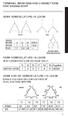 TERMINAL MARKINGS AND CONNECTIONS PART WINDING START NEMA NOMENCLATURE 6 LEADS 7 7 3 9 8 Delta 3 9 8 Wye OPER. 9 MODE L L L3 OPEN 7 START 3 7,8,9 T T T3 T7 T8 T9 RUN,7,8 3,9 3 8 MOTOR LEADS 3 7 Double
IA Renewal Seminar 2014
 IA Renewal Seminar 2014 Introductions Introductions Scott Durham President, Co-Owner Overview of FAA / EASA Certified Repair Station Instrument & Accessory Overhaul Location: McClellan CA (Sacramento)
BRUSHLESS DC MOTORS. BLDC 22mm. BLDC Gearmotor Size 9. nuvodisc 32BF. BLDC Gearmotor Size 5
 BRUSHLESS DC MOTORS BLDC Gearmotor Size 9 BLDC 22mm nuvodisc 32BF BLDC Gearmotor Size 5 Portescap Brushless DC motors are extremely reliable and built to deliver the best performances. Their high power
The DC Motor/Generator Commutation Mystery. Commutation and Brushes. DC Machine Basics
 The DC Motor/Generator Commutation Mystery One small, yet vital piece of the DC electric motor puzzle is the carbon brush. Using the correct carbon brush is a key component for outstanding motor life,
32:(5#5$7,1* 4833#USP283#+] 4;33#USP293#+] 3ULPH 113 kva, 90 kw 124 kva, 99 kw 6WDQGE\ 114 kva, 91 kw 125 kva, 100 kw
![32:(5#5$7,1* 4833#USP283#+] 4;33#USP293#+] 3ULPH 113 kva, 90 kw 124 kva, 99 kw 6WDQGE\ 114 kva, 91 kw 125 kva, 100 kw](/thumbs/30/14614129.jpg "32:(5#5$7,1* 4833#USP283#+] 4;33#USP293#+] 3ULPH 113 kva, 90 kw 124 kva, 99 kw 6WDQGE\ 114 kva, 91 kw 125 kva, 100 kw") ,1'8675,$/#*(16(7 6HULHV#'9#448 32:(5#5$7,1* 4833#USP283#+] 4;33#USP293#+] 3ULPH 113 kva, 90 kw 124 kva, 99 kw 6WDQGE\ 114 kva, 91 kw 125 kva, 100 kw Generator set consisting of engine and alternator mounted
,1'8675,$/#*(16(7 6HULHV#'9#448 32:(5#5$7,1* 4833#USP283#+] 4;33#USP293#+] 3ULPH 113 kva, 90 kw 124 kva, 99 kw 6WDQGE\ 114 kva, 91 kw 125 kva, 100 kw Generator set consisting of engine and alternator mounted
STORAGE, INSTALLATION AND MAINTENANCE PROCEDURES
 GATE VALVE O.S. & Y 1.0 Periodic Inspections 1.1 The valve stem packing should be inspected at least monthly. If the stem packing shows signs of leakage, simply tighten the adjusting nuts to compress the
AC MOTORS REPAIR SPECIFICATION
 AC MOTORS REPAIR SPECIFICATION AC MOTORS REPAIR SPECIFICATION TABLE OF CONTENTS DATED: 3/1/99 Revision 8/16/05 1. Overview Page 3 2. Definitions Page 3 3. Pre-Repair Activity and Responsibility Page 4
T A B L E T 1 T E S T S A N D I N S P E C T I O N C A B L E P C U T A N D P C U T - A
 T A B L E T 1 1 of 7 Tests & Inspection Cable PCUT & PCUT-A (Table T1) T E S T S A N D I N S P E C T I O N C A B L E P C U T A N D P C U T - A No. Test Scale MOC Requirements G 20:10:001:01 Defined Test
Technical Data. Dimensions
 0102 Model Number Features 15 mm quasi flush Usable up to SIL2 acc. to IEC 61508 Accessories BF 30 Mounting flange, 30 mm V1-G-N-2M-PUR Female cordset, M12, 2-pin, NAMUR, PUR cable V1-W-N-2M-PUR Female
This section applies to the design and installation of transformers.
 ELECTRICAL: TRANSFORMERS BASIS OF DESIGN This section applies to the design and installation of transformers. Design Criteria 13.8-kV equipment shall be 15-kV class. Coordinate with short-circuit studies
Digital Energy ITI. Instrument Transformer Basic Technical Information and Application
 g Digital Energy ITI Instrument Transformer Basic Technical Information and Application Table of Contents DEFINITIONS AND FUNCTIONS CONSTRUCTION FEATURES MAGNETIC CIRCUITS RATING AND RATIO CURRENT TRANSFORMER
Permanent Magnetic Generator Construction Manual
 Permanent Magnetic Generator Construction Manual http://hojomotor.com Our Team Doing an On-site Assembly in Peru http://hojomotor.com Section 1) Introduction This manual describes how to build a 'permanent
Electric Heat Tracing INSTALLATION PROCEDURES
 INSTALLATION PROCEDURES The following installation procedures are suggested guidelines for the installation of a Thermon electric heat tracing system 1. Individuals installing these products are responsible