
About TomTom WORKsmart Vehicle maintenance User management in WEBFLEET Management reporting Report working time...
|
|
|
- Melina Shepherd
- 10 years ago
- Views:
Transcription
1
2 About TomTom WORKsmart... 4 WORKsmart components... 4 WEBFLEET... 4 LINK... 4 Connected navigation devices... 5 Non-connected navigation devices... 5 Remote LINK... 5 ecoplus... 5 Object... 5 Tracking and tracing... 5 Built-in devices... 6 Portable devices... 6 Tracking... 6 Tracing... 6 Trip... 6 Trip with LINK device... 6 Trip with navigation device only... 6 Standstill... 7 Idle time... 7 Event... 7 Driving event... 7 Order... 7 Working time... 7 Working time reporting across vehicles or devices... 8 Maintenance schedule... 8 Maintenance task... 8 On-demand report... 8 Scheduled report... 8 Logging into WEBFLEET... 9 Map display Zoom and drag Map types TomTom map Full screen map Searching the Map Additional filter options in the Map View Tracking and tracing Track order status Real-time map data Vehicle trail Position filter Order management Sending orders Start working on orders Sending order status Order options Order overview Smart order assignment Addresses on the map Job status Traffic information Quickly assign orders to the nearest vehicle Driver communication Sending a message to a driver Sending a message to multiple or all drivers Handle text messages on your TomTom navigation device Defining the status messages for the different vehicles Using status messages Forwarding status messages to your address Easy vehicle management Assign details to new vehicles Assign one vehicle to a group Assign several vehicles to a group Using vehicle groups Vehicle maintenance Creating maintenance schedules Maintenance intervals When is a maintenance task due? Using the reminder Copying a maintenance schedule Monitoring maintenance tasks Processing maintenance tasks Creating maintenance reports User management in WEBFLEET Creating users Granting access to WEBFLEET Profile settings Sessions Failed logins Groups of users Rights settings for reports, orders, and areas Rights for accessing vehicles, addresses, and drivers Management reporting About the Dashboard view Configuring charts Drilling down into charts Scrolling the timeline Viewing the details Printing Dashboard views Report working time Creating a driver Settings for the TomTom navigation device Reporting to TomTom WEBFLEET Generating a "working time" report Logbook Selecting logbook mode Private or business mode Administrating logbook records Generating a "logbook" report (NEW) Reporting Understanding the structure of the reports Graphs Summaries Tables Conditional highlights The Reports view Manager tab Classic tabs On-demand reports First usage Filter settings Conditional highlights Scheduled reports in the Archive Setup information Retention of scheduled reports in the Archive Managing reports - overview Customising your reports with an individual logo Previewing a report (NEW) Creating and managing reports Choosing the right template Choosing file format and layout Modifying the layout of reports Modifying charts Modifying details tables Columns Grouping Conditional highlights Defining the delivery settings Delivery settings for on-demand reports

3 Delivery settings for scheduled reports Filter settings Finalising a report Assigning reports to users Driver safety and efficiency Driving style in the drivers list The OptiDrive chart OptiDrive variables in more detail Customising the OptiDrive indicator Safety and efficiency reporting Configuring the Dashboard Viewing detailed information in the Dashboard Address management Creating addresses Address names in position information Managing addresses in groups Showing addresses in the map Enabling addresses to appear on the map Standstills at an address Using areas Creating areas Scheduling notifications for areas Schedules Area notifications per Assigning vehicles to areas Account settings Overview of settings Enabling users to manage account settings User specific account settings Settings for vehicles on the map Account settings Order settings Location information Labelling address colours Defining status and order messages Customising the order workflow Warnings for single workflow states Order states Settings for Reporting Customising the OptiDrive indicator Driving too fast Fuel notifications

4 About TomTom WORKsmart About TomTom WORKsmart Here is a description of the terms used in the context of fleet management, and the TomTom WORKsmart solutions and how to log in to TomTom WEBFLEET. WORKsmart components There are three variations of WORKsmart solutions: a) WEBFLEET connected to a LINK device, b) WEBFLEET connected to a LINK device and a TomTom navigation device, c) WEBFLEET connected to a TomTom navigation device. WORKsmart solutions components WEBFLEET TomTom WEBFLEET is the core component of WORKsmart solutions. WEBFLEET is the web-based application for managing vehicles and orders and accessing TomTom tracking and tracing functionality. LINK The TomTom LINK is a black box installed in the vehicle. The LINK is connected to the vehicle's power supply and the ignition. It registers ignition events, vehicle movement and position information and sends About TomTom WORKsmart 4

5 all this information to the office. Connected via GPRS to WEBFLEET, it also enables communication between the office and a TomTom navigation device. This device enables tracking and tracing. Different models of the LINK are supported in WEBFLEET: TomTom LINK 510, TomTom LINK 300/310, TomTom LINK (first generation) Connected navigation devices The term "Connected" refers to all navigation devices that come with a built-in GPRS modem. Connected navigation devices do not need to establish a connection to a LINK but directly connect to WEBFLEET instead. There are different generations of connected navigation devices currently supported in WEBFLEET: PRO 9150, PRO 9100, GO 9000, GO 715. The connected GO devices are similar to each other, but the PRO devices have different software and therefore work differently. Non-connected navigation devices The term "Non-connected" refers to all navigation devices that need a LINK device for communication with WEBFLEET and the office. There are different generations of non-connected devices currently in use: PRO 7150 (TRUCK), PRO 7100 (TRUCK), GO 7000 (TRUCK), GO x20/x30, GO x10. The non-connected GO devices are similar to each other, but the non-connected PRO devices have different software and therefore work differently. Remote LINK TomTom Remote LINK is a remote control. It must be connected via Bluetooth to an associated LINK 510/ 3xx installed in a vehicle. There are two variations: Remote LINK Working Time - With Remote LINK Working Time, multiple employees are able to register their working times via the LINK 510/3xx. Remote LINK Logbook - With Remote LINK Logbook, drivers are able to maintain a logbook via the LINK 510/3xx. ecoplus TomTom ecoplus retrieves fuel consumption information over the vehicle's OBD-II connector and sends this information to WEBFLEET in real time. TomTom ecoplus works together with the LINK 510/3xx using Bluetooth. Check the TomTom ecoplus Installation Guide for compatibility. Object An object is the central entity in WEBFLEET. An object can be a vehicle, like a car, truck or trailer. A TomTom unit is installed in the vehicle or trailer. The TomTom unit delivers all relevant vehicle/trailer-related information to WEBFLEET, such as position, time, speed, etc. The object is then shown on the map and in the respective lists in WEBFLEET. It is created in the WEBFLEET database as soon as it is activated after a successful installation. Tracking and tracing Tracking and tracing is the general term used for tracking the position of an object, either in real time or historically. Usually this includes functionality to communicate with vehicles and their drivers. Tracking and About TomTom WORKsmart 5
6 tracing requires dedicated hardware and software. TomTom WEBFLEET uses both built-in and portable devices. Built-in devices 24/7 monitoring and security is made possible through the use of built-in LINK devices. The LINK device delivers position, movement and ignition information as well as input events (such as "engine is running") related to the specific vehicle and cannot be switched off. The LINK device normally sends six positions per minute as long as the vehicle is operated in a national or home zone. The zone varies per subscription. As soon as the vehicle is operated outside the home zone, the LINK device records one position per minute and sends the collected positions to WEBFLEET as soon as the device enters the home zone again. The number of positions that can be stored is limited. When the maximum number is reached, the oldest positions are overwritten. Roaming zones vary per subscription. A LINK device installed in the vehicle is required for additional devices, such as the following: nonconnected navigation devices, Remote LINK, ecoplus, Digital tachograph. For compatibility see These devices have basic functions like sending and accepting orders and messages, reporting working times, logbook-keeping, reporting on driver behavior, driving times of driver and co-driver and fuel consumption. Portable devices Part-time tracking and tracing can be achieved with Connected navigation devices that directly communicate with WEBFLEET. Tracking Tracking is monitoring the position, movement, driving and other events of a vehicle in real time. The vehicle reports its current speed and the direction in which it is moving to WEBFLEET. Additionally you can see if a vehicle is stuck in a traffic jam, if it is parked and/or if it is idling the engine. This kind of information is available in WEBFLEET, for example on the map and in the vehicle details panel. Tracing Tracing is the ability to see the vehicles' positions, movements, driving and other events historically. The information is stored to WEBFLEET for up to 90 days and can be evaluated during this time. Trip A trip is a movement of a vehicle from a start position to an end position. After a trip has ended a trip report is sent to WEBFLEET containing all trip-relevant information such as start time, end time, standstills, idling times, and fuel consumption. Trip with LINK device A trip start is reported when the vehicle's ignition is switched on and the vehicle moves or changes its GPS position for a minimum configured duration (default five min.), retroactive to vehicle ignition time. The end of a trip is reported when one of the following conditions applies: a) the vehicle's ignition is switched off and remains so for a minimum configured duration (default 15 min.), and the vehicle does not move or change its GPS position, b) the logbook trip mode changes from private trip to business trip or vice versa, c) the driver changes, reported either through the TomTom navigation device or the digital tachograph. Trip with navigation device only When using a connected navigation device, trips are reported under the following conditions: The start of a trip is reported when all the following conditions apply to the navigation device: a) it is properly connected to the dock in the vehicle, b) it has GPS reception, c) it changes its GPS position. The end of a trip is reported when one of the following conditions applies to the navigation device: a) it is removed from the dock, b) it has been switched off, c) it stands still for a minimum of ten minutes, d) the About TomTom WORKsmart 6
7 logbook mode has changed from business to private mode or vice versa, e) the driver changes, reported through the TomTom navigation device (depending on model and software version). Standstill A standstill is reported when the vehicle stops moving or changing its GPS position for minimum configured duration (default five min.). The end of a standstill is established when the vehicle starts moving or changing its GPS position. The complete standstill interval is reported to WEBFLEET when the standstill has ended. Idle time Idle time is the time a vehicle stands still with the engine running or the time the vehicle is moving very slowly. Idling is recognized after five minutes. Event Events are incidents recorded on the TomTom unit that are reported as messages to WEBFLEET. Typical examples include the following: a) predefined general status messages, b) predefined order-related status messages, c) being within geographical zones, d) information on disconnection of peripherals, undesired functions, digital input events, etc. Status messages and geo-zone events can be classified as notice, warning or alarm in three levels according to their importance. Driving event A driving event is reported to WEBFLEET when a driver exceeds a certain level of acceleration. Acceleration is recorded during braking, cornering and steering and exceptional acceleration, such as car crashes. Order An order is a message containing instructions about the order to be performed. There are three types of orders: delivery order, pick-up order, service order. An order contains an order number and a freelydefinable text message of up to 500 bytes. Optionally, the following can be attached to an order: a) a contact, b) a phone number for the contact, c) the planned date of execution, d) a destination address to be displayed to the driver on the TomTom navigation device, e) destination coordinates to be used by the TomTom navigation device for route calculation to the order location, f) the desired time of arrival, g) a time tolerance for the start of execution to generate an alarm message if the tolerance is exceeded, h) a lead time for an arrival message. The order instructions appear on the navigation device and can be accepted, rejected or simply saved for later. The driver or co-driver can accept or refuse an order and start and complete activities on the order by using the corresponding order steps. If the driver rejects or cancels the order, he is asked to type in a reason. All actions on the order taken by the driver generate messages sent to WEBFLEET. Working time Working time can be reported to WEBFLEET using: a) a connected navigation device - the driver can report working time, by identifying himself to the connected navigation device, b) a navigation device in combination with a LINK device - the driver can report working time, by identifying himself to the navigation device, c) A Remote LINK Working Time together with a LINK device - multiple employees can report working time via one installation, as they identify themselves through a personalized ID Key, d) a digital tachograph. The following working time states can be reported to WEBFLEET: a) Commute to work. About TomTom WORKsmart 7
8 b) Start break. c) Start work, also indicates end of a break if the last reported status was start break. d) End work, also indicates end of a break if last reported status was start break. Working time reporting across vehicles or devices Generally, when reporting working time, the start and the end are performed on the same device, but if drivers and workers use various vehicles and thus devices, the following rules should be considered: a) if a driver moves between PRO navigation devices or Remote LINK devices working times are driver-oriented, b) if a driver moves between GO navigation devices, working times are vehicle-oriented, c) working sessions have to be closed, with End work, before pairing any device with a different device, d) closing working sessions on a different device than the one with which you have started the working session is only possible if you use Remote LINK with an ID Key or PRO navigation devices. Maintenance schedule A maintenance schedule describes a maintenance task that has to be carried out on a vehicle. It defines when the task is scheduled and whether it has to be carried out once at a certain date or vehicle mileage, or if it needs to start at a certain date or vehicle mileage and be repeated at regular intervals. In accordance with the maintenance schedule, WEBFLEET creates a maintenance task when the task is due. A reminder can also be issued a certain time or distance before the task is due, giving advanced notice of the maintenance task. Maintenance task A maintenance task for a vehicle is created from the respective maintenance schedule. The task appears in WEBFLEET when it is due or the task's reminder is issued. On-demand report On-demand reports are reports that have been assigned to users for downloading whenever they wish. Before downloading the report, the user can set filters and conditional highlights. The data that is included in the report will be complied at the moment the user downloads the report from WEBFLEET. Scheduled report Scheduled reports are reports that are automatically generated periodically, and can be created on a daily, weekly, monthly or quarterly basis. There are two variations of scheduled reports: (1) Scheduled reports to be automatically sent to an address - Scheduled reports that are sent to an address will not be stored in the WEBFLEET "Archive". (2) Scheduled reports to be stored in the Archive - Scheduled reports that are stored in the "Archive" can be downloaded at any time during the retention period, which may be defined when the report is created. The retention period can be set for a maximum of three years, depending on the delivery period you have chosen, which can be daily, weekly, monthly or quarterly. The reports will be automatically deleted after About TomTom WORKsmart 8

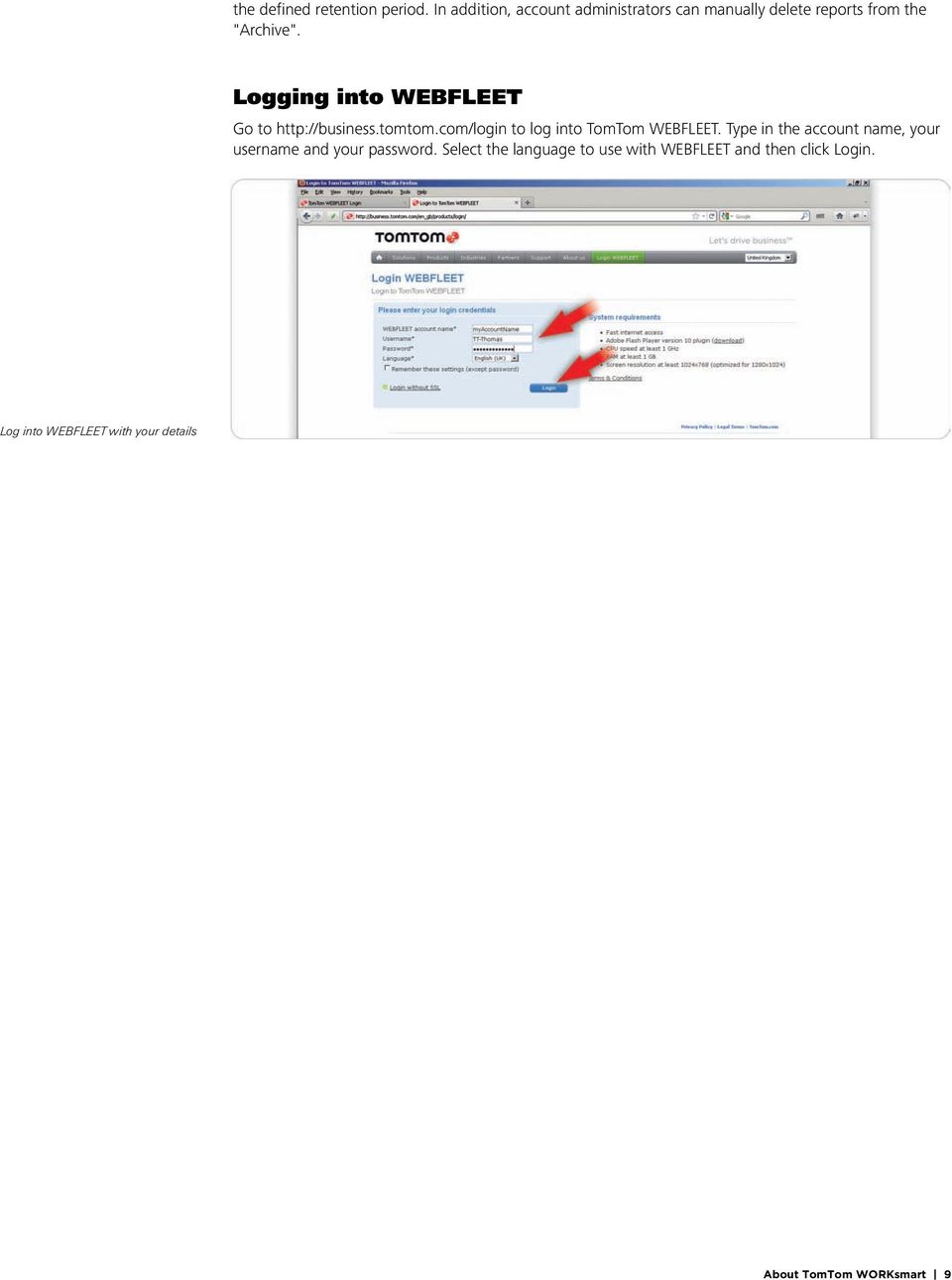
9 the defined retention period. In addition, account administrators can manually delete reports from the "Archive". Logging into WEBFLEET Go to to log into TomTom WEBFLEET. Type in the account name, your username and your password. Select the language to use with WEBFLEET and then click Login. Log into WEBFLEET with your details About TomTom WORKsmart 9
10 Map display Map display TomTom WEBFLEET offers several types of maps. In this chapter you will learn how to work with the map, the map types that are available in TomTom WEBFLEET and which information is provided by the different map types. Zoom and drag Once you have accessed TomTom WEBFLEET you will see the map displaying all the vehicles in the currently selected group of vehicles. Zooming in on the map is easy. Simply use the mouse wheel or use the zoom level selector in the top right corner of the map. By pressing the left mouse button you can simply drag the map in any direction, allowing you to focus on specific vehicles. Press the left mouse button and drag the map to the best position. To zoom in on the map, either use the mouse wheel or adjust to the desired zoom level. Map types TomTom WEBFLEET offers the following map types to display your vehicle fleet and order data: TomTom map with up-to-date traffic information, Google map, and Satellite map. For the most realistic view of your vehicles, just click the "Satellite" button in the top left corner of your map. Click the "Satellite" button for the most realistic view of your vehicles' whereabouts. Map display 10

11 TomTom map The TomTom map shows up-to-date traffic information including traffic jams, construction sites and possible delay times. To avoid delays in your service, allocate jobs by sending the driver who is located closest to the job. View up-to-date traffic information on the TomTom map. Full screen map A feature that is supported by all maps is the possibility to enlarge the map to full screen. This provides you with the best overview of your vehicle fleet and fleet movements. Click the navigator icon below the zoom level indicator to activate the full screen map. Click it once more to return to the map view with the vehicle list on the side. Enlarge the map to full screen to see more of your vehicles. Searching the Map The WEBFLEET map offers a powerful and comprehensive search function to find individual vehicles, addresses, places and areas, and all vehicles at an address or a location that matches the search term you have entered. Click the "Search" button, which has a magnifying glass icon, in the top right corner of the map, enter your search term, then press "Enter" on your keyboard. The resulting list shows all matching results, arranged by category. You can also search for a specific address. Click the "Find city" button, which Map display 11

12 has a house icon, in the top right corner of the map. Enter the address details, select the country, then click "Find." All matches are shown in a list or directly on the map. Search the map for vehicles, addresses and places. Find a specific address in the map with "Find city." In "Map Settings," in the top right corner of the map, you can define the items to show on the map. You can also create filters for items, so that, for example, only addresses and vehicles of a certain group or color will be shown on the map. The "Print Map" button on the right side of the map below the zoom level selector lets you easily print the current map view. This is helpful, for example, if you need to prove the route a vehicle has taken. Additional filter options in the Map View Having a large fleet may lead to you losing an overview and time needed to search for drivers or vehicles. You can filter for availability and ignition status, if the vehicle is standing still or driving. Search for one of the three notifications Alarm, Warning and Notices, as well as logbook modes. Filter your list of objects by unread messages to make sure they are read. Click on the cogwheel button in the top right corner of the Vehicle Panel in the Map view to open the smart filter. Here you can define which objects you want to show on the map and in the list in the Vehicle Panel. Using this filter allows you to select one or combine several conditions. When you click Apply WEBFLEET will immediately show the applicable objects both on the map and in the Vehicle Panel. Filter vehicles on the map and in the Vehicle Panel with the additional filter options. Map display 12

13 Tracking and tracing Tracking and tracing In this chapter you will learn how to see an overview of all orders from all vehicles and how to find out where your vehicles are right now and at any time. Track order status TomTom WEBFLEET allows you to easily receive an up-to-date overview on the status of all orders assigned to all of your vehicles. You can set a filter to define a more precise selection. The orders can be individually or collectively filtered by vehicle groups, single vehicles, status and time periods. In addition, these filters can be extended using a free text filter. To view the order list click on "Orders" in the top menu. To apply the different filters, select the relevant information from the drop-down menu boxes and enter your text in the text box. When selecting and entering the filters the list will be adjusted automatically. Track the status of all orders assigned to your vehicles with the help of several filters. Real-time map data The positions of vehicles equipped with WORKsmart are registered every ten seconds. These positions are transmitted to TomTom WEBFLEET every minute. This means you can keep track of your fleet and monitor vehicle movements on the map in real-time. See the most recent positions of all your vehicles, automatically displayed on the map. Vehicle trail The record of all your vehicle locations, recored by TomTom WEBFLEET, is stored for a period of 90 days. This allows you to easily check where your vehicles have been during the last 90 days. To see the vehicle trail for the current day, open the vehicle information box on the map and click "Track". The track displayed on the map indicates standstills with corresponding information such as position, beginning and end, and the overall duration of the standstill. By moving the mouse over the trail, a speed label is shown, providing the current time and speed at this position of the vehicle. The vehicle box shows information Tracking and tracing 13
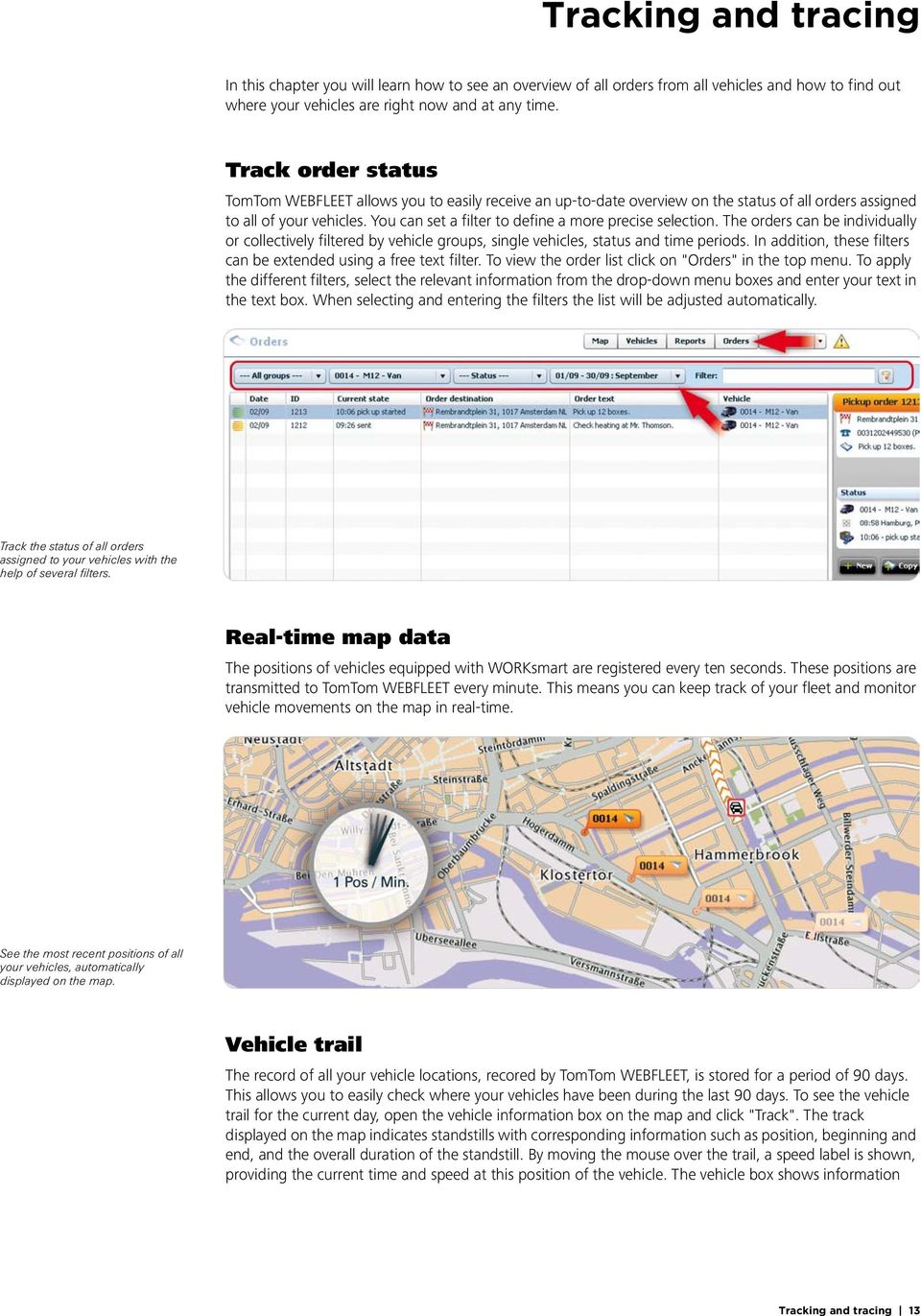
14 about the current order status, the destination, the estimated time of arrival and the time of the last position update. You can also view the direction in which the vehicle was travelling and the last position. See the vehicle trail for the current day. Get more detailed information about speed, standstills etc. directly out of the track. The vehicle information box shows the current order status, destination, estimated time of arrival, the last time of the last position update, etc. Position filter To view the trip data for your vehicles in the list view, set a time filter. To activate this feature, click "Details" in the vehicle information box and then click "Reports" under "Positions". For a more precise selection of entries, use the drop down-box and enter your query in the "Filter" dialogue box. Get trip data for your the vehicles in the list view, using filters to customise your lists. Tracking and tracing 14
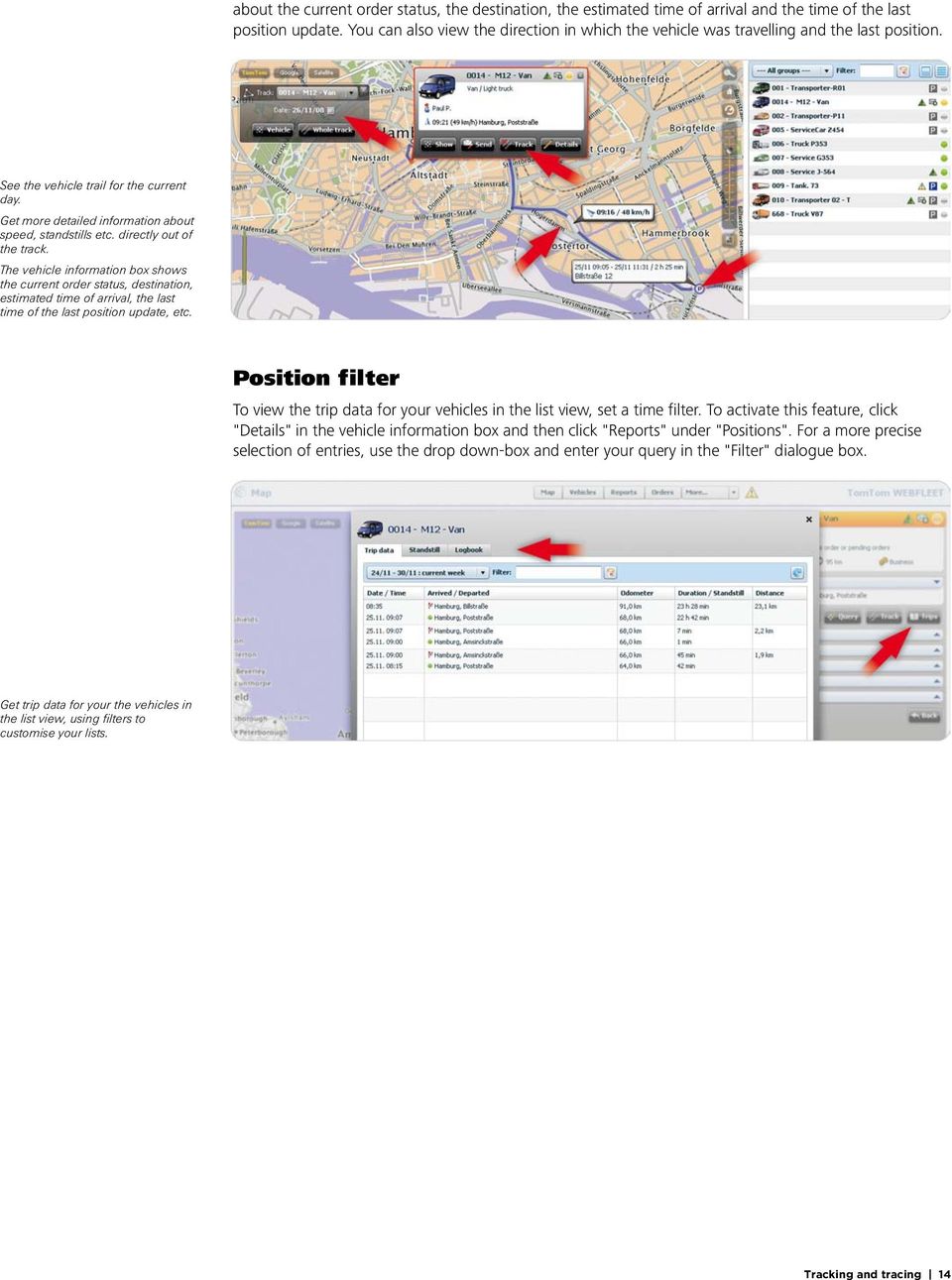
15 Order management Order management This chapter provides information on how to send orders with destination addresses to your people on the road, how your drivers work on such orders and how you can see the most recent status of the job. Sending orders With TomTom WEBFLEET you can easily send orders to your vehicles. Click on the vehicle on the map and then click "Send". Select "Send order" and then select the type of order. You can select between delivery, pick up and service order. You need to enter an order ID and add order text. You can also define the date of execution, the desired time of arrival and a certain tolerance. Entering the destination address can be done by typing it in manually or by using your own pre-defined address list. You can also attach a contact name and phone number to your order so your driver is fully informed. Easily send pick up, delivery or service orders to your vehicles with a few clicks. Start working on orders Immediately after sending the order, the field employee receives the job instructions on his TomTom navigation device. An envelope icon appears in the top left corner of his TomTom device. Simply tapping this icon brings up the order text. By tapping "I agree" the order is accepted. To reject the order first tap "Option" and then "Reject order". To start working on the order tap "I agree" and then tap "Start". You are prompted to start the navigation to the order destination. After you have tapped "OK" the route is calculated and the navigation to the order destination is started. Start working on orders and navigating to the job destination by simply tapping the screen. Order management 15
16 Sending order status With the TomTom GO navigation device you can easily report the current status of the order to the office by tapping the Quick Menu icon. Then tap "Active order". To browse the order status tap the arrow buttons. To report a new order status to the office simply tap the corresponding status icon. Report the current job status to the centre and save time. Order options The WORKsmart features on your TomTom navigation device have several order-related options such as cancelling or suspending the order. You can also use your TomTom navigation device as a hands-free set connected to your Bluetooth-enabled mobile phone to call the contact person attached to your order. To bring up the order-related option tap "Options" in the corresponding order dialogue. Cancel or suspend orders with the help of order options. Use the TomTom navigation device as a hands-free set connected to your Bluetooth enabled mobile phone to call contact persons attached to your order. Order overview To see the current status of your driver's orders click the "Details" button in the object box. On the righthand side all orders (active and suspended) are displayed. To see more order details click the "Orders" button. A list of all orders is displayed. You can set several filters, such as group, vehicle, status, time, and free text. Select an order from the list by clicking on the order. On the right-hand side the order information is displayed. Here you can edit the order (in case conditions have changed), see the workflow Order management 16

17 of the order and the location on the map. You can also cancel this order. From this screen you can also send a new order to any of your vehicles. See the current status and more details of the driver's orders. Set several filters to optimise the list display. See all order information. Edit the order, see the workflow, the location on the map or even create new orders. Order management 17

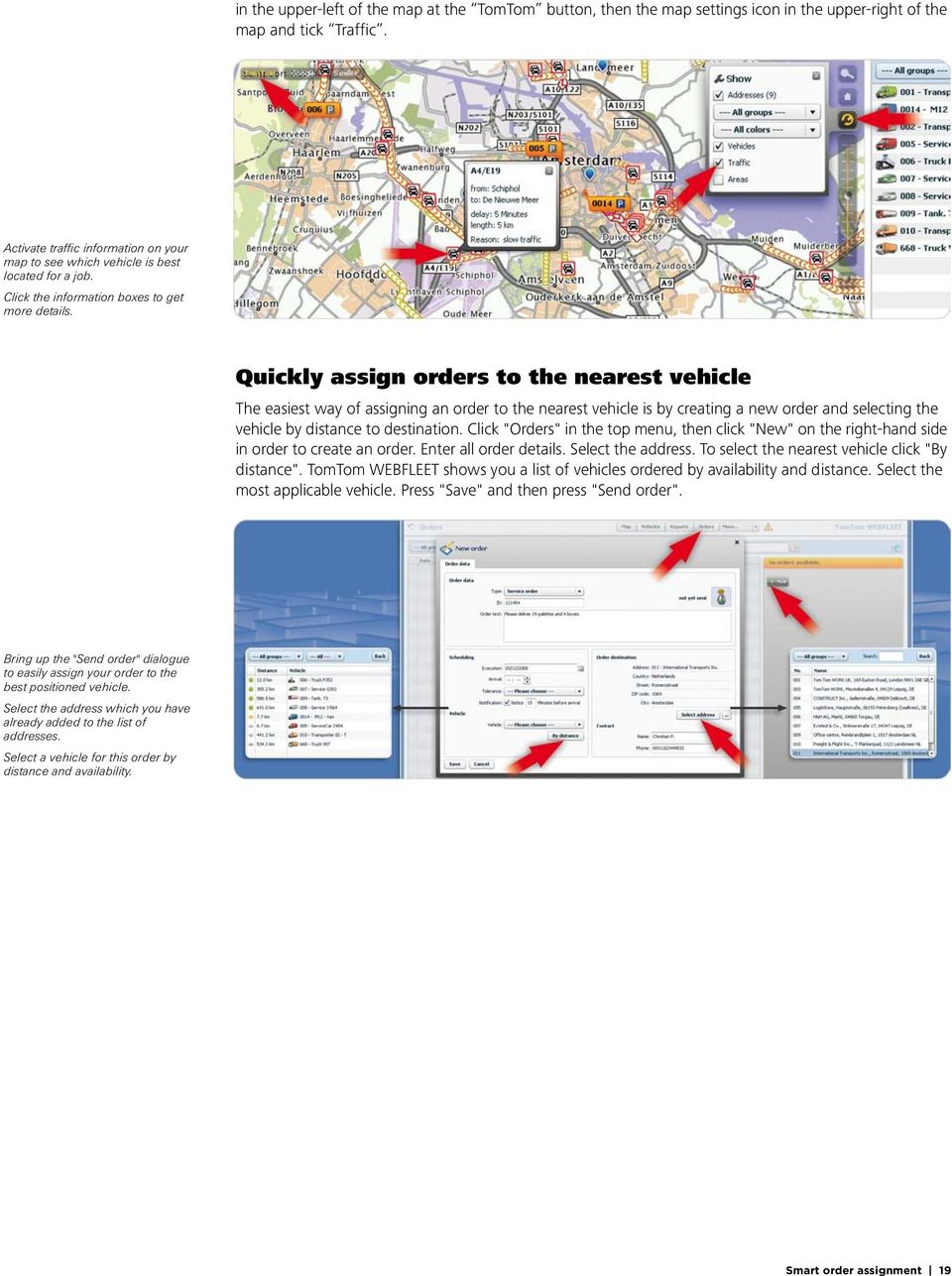
18 Smart order assignment Smart order assignment Smartly allocate orders based on real-time information ranging from driver availability and the nearest vehicle to traffic information on the route. This chapter will show how to avoid delays and keep your fleet out of the jams where possible. Addresses on the map To find a destination on the map, click the address icon in the upper-right of the map and enter the address details. Then press "Find". The address will immediately appear on the map with a label. When moving the mouse over the address label an information box gives you the option to add the address to your address list or immediately create an order (see step Quickly assigning to the nearest vehicle ). Easily find addresses on the map. Add the address to your address list. Send an order with this destination to a vehicle. Job status To see if your vehicles are available for new orders, all vehicles are labelled with a job status icon. Green indicates "Vehicle is available ", yellow indicates "Vehicle is busy " and grey indicates "Vehicle is unavailable ". To find out more details about a current order, click "Details", then click "Orders". The current order status will be displayed. To find out how many other pending orders are assigned to this vehicle, click the button "Orders" and set the status and the time filter. The order list is filtered immediately. Find out which vehicle is currently available. See more details on the current job of your vehicle. Find out about other jobs assigned to this vehicle. Traffic information Traffic jams, construction sites etc. might take the nearest vehicle more time to reach the order destination than another. To see traffic information on the map, activate the display of traffic information by clicking Smart order assignment 18

19 in the upper-left of the map at the TomTom button, then the map settings icon in the upper-right of the map and tick Traffic. Activate traffic information on your map to see which vehicle is best located for a job. Click the information boxes to get more details. Quickly assign orders to the nearest vehicle The easiest way of assigning an order to the nearest vehicle is by creating a new order and selecting the vehicle by distance to destination. Click "Orders" in the top menu, then click "New" on the right-hand side in order to create an order. Enter all order details. Select the address. To select the nearest vehicle click "By distance". TomTom WEBFLEET shows you a list of vehicles ordered by availability and distance. Select the most applicable vehicle. Press "Save" and then press "Send order". Bring up the "Send order" dialogue to easily assign your order to the best positioned vehicle. Select the address which you have already added to the list of addresses. Select a vehicle for this order by distance and availability. Smart order assignment 19
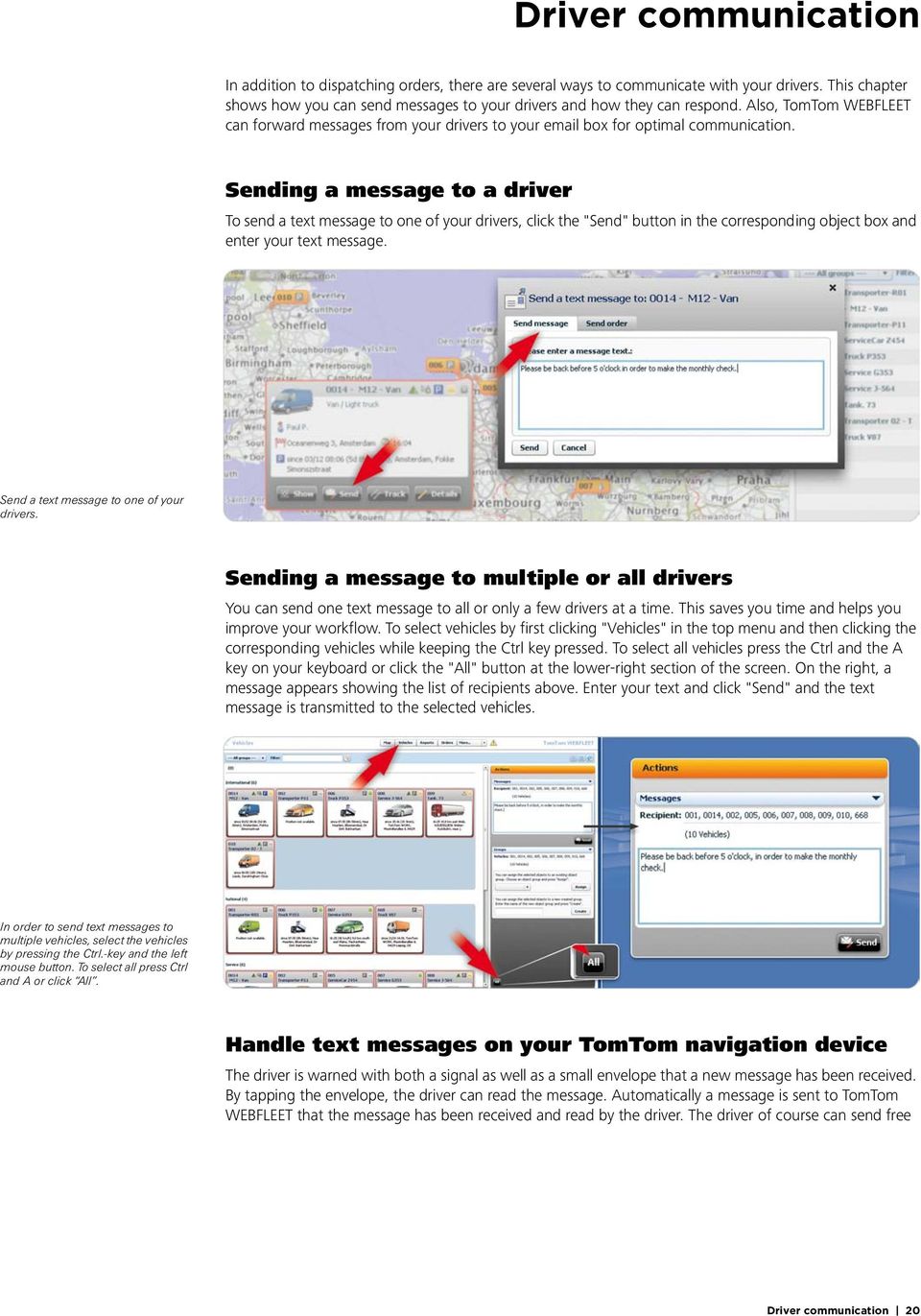
20 Driver communication Driver communication In addition to dispatching orders, there are several ways to communicate with your drivers. This chapter shows how you can send messages to your drivers and how they can respond. Also, TomTom WEBFLEET can forward messages from your drivers to your box for optimal communication. Sending a message to a driver To send a text message to one of your drivers, click the "Send" button in the corresponding object box and enter your text message. Send a text message to one of your drivers. Sending a message to multiple or all drivers You can send one text message to all or only a few drivers at a time. This saves you time and helps you improve your workflow. To select vehicles by first clicking "Vehicles" in the top menu and then clicking the corresponding vehicles while keeping the Ctrl key pressed. To select all vehicles press the Ctrl and the A key on your keyboard or click the "All" button at the lower-right section of the screen. On the right, a message appears showing the list of recipients above. Enter your text and click "Send" and the text message is transmitted to the selected vehicles. In order to send text messages to multiple vehicles, select the vehicles by pressing the Ctrl.-key and the left mouse button. To select all press Ctrl and A or click All. Handle text messages on your TomTom navigation device The driver is warned with both a signal as well as a small envelope that a new message has been received. By tapping the envelope, the driver can read the message. Automatically a message is sent to TomTom WEBFLEET that the message has been received and read by the driver. The driver of course can send free Driver communication 20
21 text messages from the TomTom navigation device to the centre as well. In order to do so he needs to tap Send to centre and then Send text message in the WORK dialogue box. TomTom WEBFLEET is automatically informed that the message has been read. Send free text messages over the TomTom navigation device to TomTom WEBFLEET. Defining the status messages for the different vehicles Within TomTom WEBFLEET you can define status messages and order related status messages for your vehicles. These messages help to improve communication between the driver and the centre (e.g. for certain recurring events static messages can be used). To define status messages for an object, click "Details" then click "Configure" under "Contract/Device". Click "Status messages" and enter the status message. You can select a warning type for selected message features, such as forwarding. Easily define status messages using certain warning types for your vehicle. You can also define order related status messages. Using status messages Your driver simply selects the status message that he would like to send and chooses whether to add some text or not before sending. Bring up the "WORK" menu, then tap "Send to centre" and "Send status message". To add text to the status message tap "Edit". Easily send status messages to the centre. If required, simply add free text to the predefined status message. Driver communication 21
22 Forwarding status messages to your address A status message can be forwarded to your box. To do this, select the warning level for each vehicle (object) and select the address you want to have it forwarded to. Click on the top menu "More" and select "Notifications/Preferences". Click "New" on the right to create a new rule or "Edit" to change an existing rule. Select the type of notifications you want to forward to the address. You can tick different ones at a time. Select the group and/or vehicle from which those notifications shall be forwarded. Enter the name of the recipient and the corresponding address and click "Save". Forward status messages to your address. Select the warning level for each vehicle and the corresponding address. Select the vehicles, from which the messages shall be forwarded. Driver communication 22
23 Easy vehicle management Easy vehicle management TomTom WEBFLEET helps you to organise your fleet in an efficient way. This chapter provides useful information on how to set up your account to create a customised overview of your fleet, set to your requirements. Assign details to new vehicles Once you have added new vehicles to your TomTom WEBFLEET account, they are listed with an automatically assigned name and basic data. TomTom WEBFLEET offers you an easy way to edit data such as license plate and odometer. Select the vehicle from the vehicle list and click "Edit" in the section "Vehicle details". Then select the vehicle type from the drop down list. The selected type creates a vehicle icon to act as a label for this item. You can also select the colour for this icon and enter all required vehicle specific data. Edit the details of your vehicles and customise their display. Assign one vehicle to a group When you have assigned all relevant vehicle data, you can now assign this vehicle to one or more groups within few steps. Simply select the tab "Groups" and select the group or groups this vehicle shall be assigned to. If no group exists click "New group" in the lower right. To rename existing groups click the action button " " and edit the group name. To delete groups click the actions button "X". If this group included vehicles which were not assigned to another group as well, they are automatically grouped in the group named "Unassigned". Assign a vehicle to one or more groups. Easily create new groups. Assign several vehicles to a group TomTom WEBFLEET provides an easy way to assign several vehicles to a new or existing group. Select the vehicles you want to group together by clicking on them while keeping the Ctrl key pressed. In order to select all, press the Ctrl and the A keys. Under Groups on the right, the different vehicle numbers and the number of all selected vehicles are shown. To assign the selected vehicles to an existing group, select the Easy vehicle management 23
24 group from the drop down list and click "Assign". To assign them to a new group, enter a name for the group in the text field, click "Create", select it from the drop down list and click "Assign". Assign several vehicles to one group. Assign several vehicles to a group you uniquely create for these vehicles. Using vehicle groups Besides using groups as a filter setting for reports, messages, orders etc., groups are very useful when you want an overview of your fleet on the map, as when you select a group instantly only this group's vehicles are shown on the map. Use vehicle groups to display your vehicles on the map. Easy vehicle management 24
25 Vehicle maintenance Vehicle maintenance WEBFLEET helps you schedule maintenance tasks for your vehicles and follow the maintenance intervals. You can create both one-time maintenance tasks and maintenance tasks which repeat after either a certain mileage or time interval. WEBFLEET automatically notifies you when a maintenance task is due so you will not lose track of vehicle maintenance, which helps to maintain the value of your vehicle fleet. Creating maintenance schedules To create a maintenance schedule select the vehicle in the map or in the details panel on the right. In the "Maintenance tasks" section click "Create". In the new window select the "Maintenance" tab then click "New". Select an icon, type a name and a description for the maintenance task, then define the scheduled date for the maintenance task. In "Maintenance task rule", define whether the task will be repeated or is a one-time task. If the maintenance task must be repeated, enter a time or mileage interval between tasks. Select whether the task will either be repeated in a fixed interval or after the task has been marked as completed. You can also define when you would like to be automatically reminded in WEBFLEET by a coloured tool icon that displays at the top right of the main menu. Click "Save" to save your new maintenance schedule. Create a maintenance schedule, define due dates and intervals and set a reminder. Maintenance intervals The maintenance interval can be a period or a mileage, or a combination of both. When a combination of both is set, the interval reached first is used. The maintenance schedule defines if the maintenance task must be repeated in a fixed time or mileage interval, or if the interval will start again after the current due maintenance task is marked as completed. When is a maintenance task due? A maintenance task needs to be carried out as soon as the set date or mileage is reached. The vehicle mileage you enter in "First scheduled for" is not a relative value but refers to the actual mileage shown on the vehicle's odometer. A yellow tool icon at the top right of the main menu indicates that maintenance tasks are due. When a maintenance task is overdue, the tool icon is red. Using the reminder You will be reminded when the set time or distance before the due date or distance is reached. Make sure you set a period or distance that is reasonable for managing maintenance planning. Copying a maintenance schedule Once you have created a maintenance schedule for a vehicle you can copy it to more vehicles. Select the maintenance schedule you want to copy from the list of maintenance schedules for your vehicle then click "Copy". Select a vehicle from the list. You can edit the description of the schedule, and the date and the vehicle mileage at which the maintenance will first be carried out on the selected vehicle. Click "Edit" to edit the schedule. Click "Apply" to save your changes for that specific vehicle. After you have edited the date and/or the vehicle mileage for each vehicle you want to copy the schedule to, press and hold the Ctrl Vehicle maintenance 25
26 key and select the applicable vehicles. You can also select all vehicles from the list by clicking "Select all". Click "Save" to copy the task to the selected vehicles. Copy maintenance tasks to one or more vehicles. When you copy a maintenance task to another vehicle, the vehicle mileage for which the maintenance task is next scheduled is changed in accordance with the rule. For example, when you copy a task that has an interval of 15,000 km to a vehicle with a current odometer reading of 30,000 km, the vehicle mileage for which the task is next scheduled is automatically set to 45,000 km. After copying a task, make sure the changed interval is correct for this vehicle. Monitoring maintenance tasks When WEBFLEET has created a maintenance task, you will be alerted by a yellow tool icon displayed at the top right of the main menu. If a maintenance task is overdue, the tool icon appears red. To view the list of maintenance tasks click either the tool icon or "More..." in the main menu, then select "Maintenance" from the list. The list shows open and completed maintenance tasks ordered by status and due date. You can filter the list on vehicle groups, single vehicles, and open, overdue and completed maintenance tasks. The icon in the first column quickly gives you an overview of the status of your maintenance tasks. Select a maintenance task from the list to read it. If you want to inform a driver about the due maintenance work you can send the driver a message by clicking on "Send message". Click "Mark as read" to confirm that the task was read. When the maintenance task is completed, select it in the list and click "Complete". If you want to delete the maintenance task from the list, click "Delete". See an overview of all open and completed maintenance tasks, inform your drivers and process the tasks. Processing maintenance tasks You must first read the maintenance task. You have to select the maintenance task from the list and click "Mark as read" in the details panel on the right. If you want to mark all maintenance tasks in the list as Vehicle maintenance 26
27 read, click "Mark all as read" in the details panel. The date when the task was read and the WEBFLEET username of the user will be attached to the task. When the task is done it can be marked as completed. Select the maintenance task from the list and click "Complete" in the details panel on the right. The date when the maintenance task was completed and the username of the WEBFLEET user are logged. Maintenance tasks stay in the list until they are manually deleted. To delete a maintenance task, select it from the list and click "Delete". Creating maintenance reports You can download a maintenance report in CSV or PDF format in the "Reports" view. Vehicle maintenance 27
28 User management in WEBFLEET User management in WEBFLEET With TomTom WEBFLEET user management, you can give employees, business partners or customers access to WEBFLEET. In this chapter you will learn how to create users in WEBFLEET with different profiles and assign permissions that range from viewing only to having full administrative rights. Creating users In WEBFLEET you can create users in a few easy steps. WEBFLEET offers different predefined user profiles. The profile rights range from viewing only rights to administrative rights, and you can define a period to limit a user's access to the system. To create a new user, click "More" in the top menu, select "Users" from the list, then click "New" in the details panel. In the "New user" window, on the "User data" tab enter the user name that will be used to log on to WEBFLEET, the name of the user and a password. Select a profile setting for that user. Under "Interface" you can define whether the user shall be presented with the standard WEBFLEET interface or only the map. To save your changes, click "Save". Create users as administrator, standard users or guests in few easy steps. Granting access to WEBFLEET Under "User data" you can limit the access to WEBFLEET by defining start and end dates for a user. Use the calendar to define the dates. When a user has tried to log on to WEBFLEET using incorrect access details, access is blocked after the third attempt. You can unblock access by clicking the "Unblock" button on the "User data" tab. Profile settings Under "Profile settings" you can select between profiles giving different levels of rights for using WEBFLEET. Detailed information about a profile appears below the profile you selected. Sessions The "Sessions" tab shows you an overview of a user's WEBFLEET sessions. You can see the start of each session and the address from where the user logged on to WEBFLEET. You can filter the list by period and by entering text terms. Failed logins In the "Failed logins" tab you can see when a user has tried to log on to WEBFLEET using incorrect details. The time is shown together with the address from where the user tried to log on. You can filter the list by period and by entering text terms. Groups of users You can manage users in groups to help maintain an overview. Select a user from the list and click "Edit" in the details panel. In the "Groups" tab you can create new groups, edit their names and delete existing User management in WEBFLEET 28
29 groups. You can assign the user to one or more groups by selecting them in the left column. To save your changes, click "Save assignment". Manage your users in groups. The "Groups" feature is only to manage your users and maintain an overview. You cannot manage rights for a user group. Rights can only be managed per user. Rights settings for reports, orders, and areas You can manage the rights of a user at a detailed level. Click "Advanced" under "Profile settings". In the "System" tab you can define whether the user can change the user password, and access and edit WEBFLEET user and account settings. You can set the user's rights for the creation and administration of reports, orders and areas, and grant access to WEBFLEET.connect. Manage general settings and rights for working with reports, orders and addresses. The "Advanced" button is activated after you have created and saved a user. In the "General" section, you can enable the user to logon to WEBFLEET, change the password and edit user and account settings. You can find the "User settings" and "Account settings" under "Settings" in the top right of the WEBFLEET user interface. Rights for accessing vehicles, addresses, and drivers You can define which vehicles, addresses, drivers and groups users have access to. Additionally, you can set different levels of permissions for a user to access certain vehicles, addresses and drivers. In the "Advanced rights management window" select the "Vehicles" tab. Here you can define what kind of access the user shall have. Select a minimum rights level from the list at the top that applies to all vehicles. You can extend the user's access rights to single vehicles and/or vehicle groups by adding vehicles and/or vehicle groups to the list. Click "New vehicle" or "New group". Select one or multiple vehicles or groups from the list, then select the "Right level" to access these items from the list at the bottom of the window. User management in WEBFLEET 29
30 Click "Assign". Use the same method to define user permissions for addresses and drivers on the "Addresses" and "Drivers" tabs. Give access to single or groups of vehicles, addresses and drivers. Define different levels of access rights. When you select the access rights for all vehicles, remember that you can only extend the rights for certain vehicles or groups by adding them to the list. If you do not want the user to access all vehicles, you need to select "None" from the pull down list. You must then add the vehicles or groups to the list below by clicking on "New vehicle" or "New group". Here, choose the "Right level" for the selected vehicles and click "Assign". The user will then only have access to those vehicles with the selected rights level. If you want to give the user different types of access to different vehicles, then you must make multiple selections and assignments. User management in WEBFLEET 30
31 Management reporting Management reporting This chapter shows you how to define your business requirements and find the information whenever you need it using the Dashboard. Learn how to configure the Dashboard and the individual charts showing the performance of your vehicle fleet measured against Key Performance Indicators (KPI) in trend or ranking charts. View the Dashboard chart for a trend over time and the ranking of vehicles, drivers and groups for the current day, week or month. See how you can drill down into the information to view details and how to print Dashboard views. About the Dashboard view You can add and remove charts in the Dashboard. Configure the Dashboard to show four, six or nine charts at a time to obtain the most comprehensive overview of your fleet's performance using the different KPIs. Switch between the three different views without removing the charts from the Dashboard. Use the four buttons in the top left corner of the Dashboard to add charts and select the number of charts. Add charts and switch between the different views the Dashboard offers. Easily remove and add charts to the Dashboard. You can create up to nine charts. Remove a chart by clicking the cross on the chart. When you reduce the number of charts shown in the Dashboard using the "Change layout" buttons at the top left, the charts that are not shown have not been deleted. Configuring charts You can configure each chart to show your fleet's performance using one of the numerous KPIs the Dashboard offers. For each chart, you can select whether it is displayed in ranking or trend view. Configure the chart for vehicles or vehicle groups, or for drivers or driver groups. And define upper and lower limits to highlight exceptions and make your thresholds visible. Select Dashboard from the main menu, then click the Chart configuration "wrench" icon in the top right corner of the respective chart to define the settings for that chart. Configure the Dashboard chart to use the desired KPI, type of chart, period and entity, and to define the thresholds. The range covered by the thresholds is shown in the chart by a light green background. Ranges outside the defined thresholds are highlighted with a light red background that is made visible when you move your mouse over the items in the top left of the chart. A blue line in the chart shows the average Management reporting 31
32 performance of your fleet. Move your mouse over the items in the top left corner of the chart to highlight the related graphical elements in the chart. Drilling down into charts You can drill down into charts to obtain a high level of detail. Click the Show details icon in the top right corner of the chart to display the Details view. In the upper area of the Details view, a trend indicates the performance over time. The lower area shows a ranking referring to the day, week or month you have selected in the timeline above. Enlarge the view of the lower or the upper area to fully fit the content area by using the "Maximize chart" buttons in the top right corner of the respective area. View the Dashboard chart for a trend over time and the ranking for the current day, week or month. As in the main Dashboard view, the thresholds and the average value are shown in the charts of the Details view. You can adjust the view using the filters at the top and by sorting the ranking chart by drivers/ vehicles or groups, in ascending or descending order. Scrolling the timeline The Dashboard comes with a powerful feature that lets you scroll the timeline in the upper area of the Details view. The date items below or above the trend chart are interactive. You can click items with an arrow to easily step to the next date level, from day to week and from month to year. Use the left and right arrows on the timeline to scroll through it. Change the date settings for the trend. Management reporting 32
33 Viewing the details The WEBFLEET Dashboard also provides insight into the detailed information for every single chart. If you select a bar from the ranking chart in the lower area, you are given the complete information set the result consists of. If information relates to trips, you can even view these directly in the Dashboard on the map. View detailed information for every single vehicle or driver. Printing Dashboard views You can easily print Dashboard views on paper or to PDF by pressing the "Print" button in the top right corner of every view in the Dashboard. Print Dashboard views on paper or to a PDF. Management reporting 33
34 Report working time Report working time By tapping on the display, your drivers will be able to report their work time. In this way, TomTom WEBFLEET automatically manages a large part of your companies' administration. Note: With TomTom WEBFLEET you can report working times and use the records for logbook keeping at the same time. You need to edit the trip data afterwards according to your trip. For more details see Logbook. Creating a driver To report work time, a driver first needs to be created in TomTom WEBFLEET. His data must also include a driver ID. To do this highlight "More..." in the top menu and then select "Drivers". Then click "New" and enter the required data. Create a new driver with all details, including a driver ID. Settings for the TomTom navigation device The driver needs to enter the Driver ID in the TomTom GO navigation device. Click "Configure" under "Contract/Details" on the corresponding vehicle. Then select "Working times recording" under "Function". To force the driver to enter his ID when switching on the TomTom GO navigation device, select the corresponding box under "Navigation system settings". If you want to suggest begin or end of work or break then you can also make the setting for this here. Activate report working times on your TomTom GO navigation device. You can force the driver to enter his driver ID when switching on the TomTom navigation device. Reporting to TomTom WEBFLEET When the driver switches on his TomTom navigation device, he will now be asked to enter his driver ID. The driver can immediately report the start and end of work or a break by tapping the corresponding Report working time 34
35 buttons. The driver can still report work times at a later time, by opening the WORK menu and tapping "Report work time". The TomTom navigation device will only highlight the relevant icons. Easily report working times by simply tapping the screen of your TomTom navigation device. Generating a "working time" report In the "Reports" view you can create working time reports for all your drivers in PDF and CSV format. Report working time 35
36 Logbook Logbook If you want TomTom WEBFLEET to administer the mileage of your vehicles for tax purposes, you can use the logbook function. The driver states whether he is driving a private or business related trip on the TomTom GO navigation device or you can define this in TomTom WEBFLEET. Selecting logbook mode To maintain a logbook the driver needs to enter his Driver ID into the TomTom navigation device. These settings first need to be saved within TomTom WEBFLEET and then sent to the TomTom navigation device. Open the configuration dialogue for the corresponding vehicle under "Contract / Details" and select Logbook. Activate the logbook feature for your TomTom GO navigation device. Private or business mode The driver can tap the "Change logbook mode" button in the Quick Menu of the TomTom GO navigation device and then tap "Change logbook mode". Here, the driver can select whether he is currently in private or in business mode. Easily select private or business mode. Administrating logbook records Using TomTom WEBFLEET, you can easily administer your logbook records. Logbook records are generated when you select "Report working time". To edit the generated data, open the vehicle's "Details" list, then open the "Position" section, click "Trips" and select the tab "Logbook". To change the kind of trip, Logbook 36
37 indicated with a small icon, click on the icon. You can also edit the purpose of your trips and contact details. Edit your logbook details within few clicks on the screen. Change the type of trip, the purpose and edit the contact. Generating a "logbook" report A PDF report gives you a clear overview of the business and private trips. In the "Reports" view you can easily download logbook reports. Logbook 37
38 (NEW) Reporting (NEW) Reporting WEBFLEET offers an extensive number of report templates to choose from in order to create your own personalised reports. There is no limit to the number of reports that can be created, and all reports can be downloaded on demand or scheduled to be created automatically. They can also be retained in the WEBFLEET reports "Archive" or sent to your address. In this chapter you will learn how to understand, download and customise reports to your needs. Understanding the structure of the reports When reading the PDF report from top to bottom, it becomes more detailed and informative. Graphs, totals and individual summaries let you understand the most relevant information for all drivers, vehicles or days that you have selected for this report. In the details tables, you can find issues, identify potentials for improvements and be informed on the current performance of your fleet. Conditional highlights assist with that, by marking exceptions in the table according to the conditions that you have defined. Graphs provide visual impressions. Summaries give quick insight. Tables show details. Conditional highlights mark exceptions. Graphs The graphs provide a visual impression of the report content, while rankings, trend lines, pie charts or stacked bars quickly alert you to performance issues. Your fleet's values compared to reference values help you make the right decisions. Smartly set filter criteria to change the values used in the chart and get specific reports for individual members of your fleet. Summaries The reports come with summaries per fleet or selected group, and per object (vehicle, driver or period). These help you easily compare individual versus overall performance. Tables In the tables, the detailed information that is visualised in the charts and shown in the total summary is clearly sorted. The tables' bookmarks help you quickly find the driver, vehicle or period you are looking for, and the individual summary gives insight into the performance of the vehicle, driver or during a specified period. Conditional highlights You can define the values you want to observe and select a colour to make exceptions and issues visible in the report. The Reports view Select "Reports" from the main menu to access WEBFLEET's reporting functionality. From the "Reports" tab, you can download reports on-demand in just a few steps. Set the filters, define conditional highlights and click "Download". From the "Archive", you can download reports that have been scheduled for a periodic creation, and that have been stored in the "Archive". These are then sorted by date and report type. If you are an account administrator or have additional reporting rights, you can customise existing (NEW) Reporting 38
39 reports, create new reports from the various reports templates, and manage them all within the "Manager" tab. Download scheduled reports stored in the "Archive" or on-demand reports. Create new reports, customise existing reports, and manage their assignment to users. Manager tab The "Manager" tab is only visible to account administrators, or users with additional reporting rights to create and manage reports. Classic tabs The "Reports Classic" and the "Scheduled reports Classic" tabs are visible to users that have been using WEBFLEET reporting before the introduction of the enhanced reporting functionality. For a limited time, the classic reporting interface will still be accessible only to these users. On-demand reports Click "Reports" in the main menu and select the "Reports" tab to get a clearly sorted list of all on-demand reports that have been assigned to you. Find the required report by using the free text filter or sorting the columns. You can mark reports as favourites to quickly find the most requested reports. Once you select a report in the list, you can click on "Filter settings" in the right panel and set the filters to your needs. You can also highlight exceptions in the report by clicking "Conditional highlights" in the right panel, then click Add. Here you can define one or more conditions. To download the report, just click "Download". Select the report you want to download from the list, set the filters and add one or more conditional highlights. (NEW) Reporting 39
40 First usage For first usage, you will find a couple of standard reports in the list. Account administrators and users with additional reporting rights can assign more reports to you. Filter settings In the "Filter settings" you can select the period, an individual item or group. Depending on the setting for this report, this can either be a vehicle, a driver or a day (period). Specific user rights regarding vehicle groups, vehicles, drivers, addresses, etc. will be taken into account when downloading the report. Conditional highlights For each condition, you can define that a cell or row should be marked, as well as select the colour that should be used to highlight the exception. You can add several conditions by clicking Add, or you may remove conditions from the list by clicking the X-button. Scheduled reports in the Archive Using WEBFLEET, you can schedule reports on a daily, weekly, monthly or quarterly basis. Scheduled reports can be sent to an address or stored in the "Archive". Having scheduled reports in the archive lets you keep them perfectly organised and accessible for a duration that you define. You can securely download them from the "Archive" at any time without flooding your inbox. Select the "Archive" tab to access the list of scheduled reports that are stored in the "Archive". The reports are sorted in folders with the report name. They are flagged with the date and time that they have been stored. Browse for and select your report and click "Download". The "Archive" holds scheduled reports for downloading for a defined period. Setup information When you first access the "Archive" tab, the list will be empty. Scheduled reports need to be created by account administrators or users with additional reporting rights. Select the report to store it in the "Archive". The users to which this report is assigned will receive an e- mail notification once the report has been archived. Up to 10 different scheduled reports can be set up per account for storage in the "Archive". Note: Scheduled reports that are sent as attachment to an address will however not be stored in the "Archive". Retention of scheduled reports in the Archive You can define the retention period when creating a report. The retention period can be up to three years, depending on the delivery period which you have chosen when creating the report. The delivery periods you can select from are: daily, weekly, monthly or quarterly. The reports will be automatically deleted after (NEW) Reporting 40
41 the defined retention period, or they can be manually deleted from the "Archive" by an account administrator. Managing reports - overview Account administrators and users with additional reporting rights can create and edit reports and assign them to users. In the "Reports" view, select the "Manager" tab. The left side lists all previously created reports. You can filter the list by entering free text in the filter above, and you can additionally sort the list by report name, file format and delivery type. When you select a report from the list, the description, schedule details and the assignments are shown in the right panel. You can copy, edit, delete and preview the report that you have selected. You can also create new reports by clicking "New", after which the "Report administrator" opens and will guide you through the steps of creating your new report. In the "Manager" tab, you may also upload an image to be shown in all your reports. This can be your company logo for example. In the "Manager" tab, account administrators can create, edit, copy, assign, preview and delete reports. Customising your reports with an individual logo You can customise your reports by uploading your company logo. Click "Logo upload" in order to upload a PNG or SVG image that will be used for all your PDF reports. The logo can have a maximum file size of 150 kb and the maximum dimensions are 200 px x 75 px (width x height). Previewing a report When you select a report from the list and click "Preview", WEBFLEET shows you preview of your report showing actual data taken from your fleet. This gives you an accurate impression of how your report will look like when it's going to be delivered or downloaded on demand. (NEW) Reporting 41
42 (NEW) Creating and managing reports (NEW) Creating and managing reports In this chapter, you will learn how to create a new report using the "Report administrator" in five easy steps. You will also learn how to assign individual users and user groups to a report, and how to upload an image, such as your company logo, which will be displayed in all reports. Choosing the right template To create a new report, click "Reports" in the main menu. Select the "Manager" tab and click "New" in the right panel. The "Report administrator" opens and shows the step "Choose template". In the "Report administrator" on the right you will see eight different report categories are listed. Click on a category to show the more than 40 different report templates which are sorted under these categories. By hovering with your mouse over a report in the list, a short text description will be shown. Highlighting a report template in the list will show a draft of the report on the left hand side. When you have found a template that suits your needs, click on "Next". In the steps that follow, you can customise the selected report to your needs. Choose from more than 40 different report templates sorted under eight categories. Choosing file format and layout In the step "Choose file format", you can define whether your report should be shown in portrait or landscape mode. Additionally, you can select the file format which can be either a PDF which perfectly serves as a graphical representation of your data, or CSV in the case that you need the raw data for further processing or textual representation. Before continuing, you may preview your report by clicking the "Preview" button. Choose between PDF and CSV file format and between portrait or landscape mode. When you click on "Preview", a sample report will be shown using real data taken from your WEBFLEET account. Modifying the layout of reports In the "Modify" step, you can customise the contents and the visual appearance of charts and tables. You can easily resize columns and charts as well as move columns to change their order in the table. To resize the charts, drag the border between the graphs to the left or to the right. If a column doesn't fully show (NEW) Creating and managing reports 42
43 the contents, drag the border in the header of the table to the left or to the right. If you want to move a column to another position, just drag and drop it to the right place. Drag the borders to resize charts and columns. Drag and drop columns to change their order in the table. Modifying charts Select a chart from the area on the left. The other elements will be greyed out. In the right panel, a list of customisable data for this chart is shown. For each chart, you can edit general details such as headline and description, or you may also select between vertical and horizontal orientation and select a colour theme for the graphs. The chart can show a trend line and several different average lines. Additionally, you can define thresholds and their respective conditions to help keep track of key performance indicators (KPIs). Modify the headlines and descriptions as well as chart settings and thresholds. Modifying details tables Select the table from the area on the left. In the right panel you may edit the column headlines and select the contents. You may also select which report to apply to vehicles, drivers or a specific day. Additionally, you can add one or more conditions to your report to highlight exceptions in the table. Edit labels and select the contents that shall be shown in the report. (NEW) Creating and managing reports 43
44 Columns Under "Columns", you can change the type of data that shall be shown and the column name for every column or data set. You may add a new column by clicking on "Add", or delete individual columns or data sets by clicking the X-button. Grouping Under "Grouping", you can select by which entity the data is grouped - vehicles, drivers or days. The summaries show aggregates for these entities in the report. You can also combine two of them, by clicking "Add" to select a second item. Conditional highlights Under "Conditional highlights", you can set conditions that flag exceptions in the table. You can add one or more conditions by clicking "Add", or you can remove them by clicking the X-button. You may also set if the cell or the row that shows the exception shall be highlighted, or select the colour for the exception. Select the condition and the thresholds. If you don't want that users may change conditional highlights themselves, simply select "Fixed setting". Defining the delivery settings After you have modified the layout and the contents of your report, you can define how the report shall be made available by choosing between downloading the report on-demand or as a scheduled generation. For scheduled reports you can define the report to be delivered per or stored in the "Archive". Use the filters to create reports for individual vehicles, drivers, vehicle groups or drivers groups and much more. Define in which way and how often you want to obtain your report. Use the filter settings to create highly specified reports. Delivery settings for on-demand reports On-demand reports are available in the "Reports" tab, and they become instantly available to the assigned users. The report will run by default with the set report filters. A user has the possibility to change the filter settings, as long those have not been defined as "Fixed setting". Note: Specific user rights regarding vehicle groups, vehicles, drivers, addresses, etc. will be taken into account when downloading the report. Delivery settings for scheduled reports When you have selected "Scheduled", you may choose to receive the report per or store it in the "Archive" for later downloading. The users to which this report is assigned will receive an notification once the report is stored in the "Archive". Up to 10 different scheduled reports can be set up (NEW) Creating and managing reports 44
45 per account to be archived. The maximum number of scheduled reports can be extended on request by purchasing an extra report package. Please refer to your local sales representative. Choose the period (frequency) in which the report shall be created by selecting between "daily", "weekly", "monthly", or "quarterly". Note: Scheduled reports that are sent as an attachment to an address will not be stored in the "Archive". Filter settings Depending on the report, you can filter by: Individual vehicles or vehicle groups, individual drivers or driver groups, total mileage, start/end location, odometer, and much more. Finalising a report You may store your report under a name of your choice. This enables you to find it easier, or just stick to naming conventions that you are used to. You will find your report under the name that you have defined here in the "Reports", "Archive" and "Manager" tabs. When you have created a scheduled report that is stored in the "Archive", you can define how long the report shall be held in the "Archive" before it gets automatically deleted. To finalise your report, click "Finalise". Name your report and select how long your scheduled report shall be stored in the "Archive". The retention period that you can choose here, can be up to three years, depending on the delivery period you have chosen. Assigning reports to users When you have created your new report, it needs to be made available to users or user groups. Select your report from the list. Click "Assign" in the right panel. To expand a user group to show the users within, click the grey arrow. Use the free text filter to find the user you are looking for. Select individual users or user groups, and click the arrow buttons in the centre to assign the report to them or to remove the assignment, or you may also drag and drop them. Click "Save" to save the changes. Assign your report to individual users or user groups. When you assign a scheduled report to an individual user or a user group, the address needs to be available in the user details otherwise the user will be asked to complete the missing data. (NEW) Creating and managing reports 45
46 Driver safety and efficiency Driver safety and efficiency TomTom WEBFLEET helps you to guide your drivers to improve their driving style. The WEBFLEET OptiDrive indicator shows how safely and efficiently your drivers are on the road. This chapter describes how to understand and configure the OptiDrive indicator, its variables and the corresponding reports you can create. Driving style in the drivers list With WEBFLEET you can quickly see how safe and efficient the driving style of each of your drivers is and how it developed over time. You find every driver s OptiDrive indicator shown in the list of drivers. To view the list of drivers, click "More" in the main menu and select "Drivers" from the list. A coloured icon and the value for each driver are shown in the "OptiDrive indicator" column. The colour of the icon shows if the driver s driving style is excellent (green), good (yellow) or if it needs improvement (red). The "Trend" column gives an indication of how the safety and efficiency of each driver has changed over the past seven days. View all your drivers in one list. See their OptiDrive indicator and how the safety and efficiency of their driving style has changed over time. The OptiDrive indicator ranges from 0 (needs improvement) to 10 (excellent). The arrow in the "Trend" column indicates the development of the driving style by pointing up (increasing), to the right (stable) and down (decreasing). The OptiDrive chart The OptiDrive indicator value is visualised in a stacked column chart created from the categories used to measure the safety and efficiency of the driver s driving style. A full column indicates safe, efficient and environmentally-responsible driving. Selecting a driver from the list of drivers displays that driver s "OptiDrive details"; this contains the value between 0 and 10, the four variables used to create the value, and the column chart. The value of each variable is determined by two factors; for example, the variable "Speeding" is calculated from the duration of driving too fast and the amount by which the speed limit is broken. The influence applied to a variable also affects its value. See the variables, their factors and the given weight influencing the OptiDrive indicator. You determine the variables of the OptiDrive indicator. If certain information is not available or not relevant for you, you can configure the account settings for that vairable to exclude it from the OptiDrive Driver safety and efficiency 46
47 indicator accordingly. The respective variable is then disregarded in the OptiDrive calculation and reporting. OptiDrive variables in more detail WEBFLEET shows you an overview of each variable used to calculate the OptiDrive indicator. Clicking on a variable opens a window showing detailed information for that driver. Data from the last seven days is shown. Each tab shows an OptiDrive indicator, the value's two determining factors and a table containing the collected information. You can filter the data by vehicle and by range. Find detailed information about speeding, driving events, idling and fuel consumption. The "Speeding" tab shows all trips where speeding occurred, and the related data for each event. The "Driving events" tab shows all reported events, indicating the event time, type, severity etc. The "Idling" tab lists all reported idling times, indicating duration, the amount of fuel wasted etc. The "Fuel consumption" tab shows fuel consumption data. A reference fuel consumption value is used to determine the fuel consumption difference for each trip. Customising the OptiDrive indicator You can configure the calculation of the OptiDrive indicator for your WEBFLEET account according to your own requirements. On the "Settings" page select the "Reporting" tab. Under "OptiDrive variables" you find one slider for each of the four variables. Move each of the four OptiDrive variables sliders to set the influence of each variable in the calculation of the OptiDrive indicator. For example, if speeding is an important consideration for your company, move the "Speeding" slider to "Max". To completely remove a variable from the OptiDrive indicator move the slider to Min. For example, if fuel consumption information is not available for all vehicles in your account, move the "Fuel consumption" slider to Min; the OptiDrive indicator is then based on the three remaining variables. Click "Save" to save your changes. Configure the calculation of the OptiDrive indicator according to your own requirements in the account settings. The "Settings" tab lets you set the speed limit used to report speeding events. The average fuel consumption and the fuel type are used as reference values to determine vehicle fuel consumption. This Driver safety and efficiency 47
48 setting is applicable for all the vehicles in the account. Idling and fuel consumption information are only available when you use TomTom ecoplus. Safety and efficiency reporting WEBFLEET lets you analyse the safety and efficiency of each of your drivers using clearly structured PDF reports. You can also create CSV files that you can use in spreadsheet programs for advanced processing. To download a report showing the OptiDrive indicators, their trends and variables per driver go to "Reports" and select the "OptiDrive report". Configure the filters to output the information you require. You can sort the results by driver or by indicator. The PDF report shows you all drivers, their variables values and the resulting OptiDrive indicator, also visualised as a segmented bar, and the trend indicated by an arrow. Use reports to analyse the safety and efficiency of your drivers driving styles. The OptiDrive indicator and trend calculation relate to the period you have configured for your report. The variables are always shown in the speeding/idling and driving events/fuel consumption columns, even when a variable s OptiDrive indicator slider setting is set to Min. The bar showing the composition of the OptiDrive indicator also indicates the influence each variables has. Configuring the Dashboard Using the WEBFLEET Dashboard you can monitor rankings and trends of your drivers safety and efficiency. To show the OptiDrive information in the Dashboard select "Dashboard" from the main menu and click on the "Chart configuration" icon. A new window opens. Select the OptiDrive indicator from the list, then set the type you want to display. In "Time", select the period to display. Choose to show information for all drivers, for a driver group or for one driver only; for groups or single drivers select the group or the driver you want to display. Define the upper and lower thresholds that cause the graph bars to appear in another colour when outside the threshold limits. Let WEFBLEET display your fleet s driving style with the help of trends and rankings graphs in the Dashboard. Driver safety and efficiency 48
49 Set the lower threshold to your minimum expectations for a safe and efficient driving style so you can easily see potential for improvement. Viewing detailed information in the Dashboard In the Dashboard s details screen you can view all details and underlying data in a clear overview. The column chart, which shows how the OptiDrive indicator is calculated, and the four variables and their factors are shown together with the corresponding information. Click on the "Show details" icon. Select an item from the details area or a period from the time line in the upper area to view the detailed information about the OptiDrive indicator. Select one of the four variables to the right of the column to view the corresponding information in the table. View detailed information in the Dashboard's details screen. Driver safety and efficiency 49
50 Address management Address management WEBFLEET helps you manage the addresses that you have to deal with every day. You can use the addresses for dispatching your orders. Addresses are shown in trip-based reports, such as the trip report, when a trip starts or ends at an address created in WEBFLEET. This chapter shows you how to create addresses in WEBFLEET, sort them by colour or group and make them visible in the map. You can give an address a name so you can find it easier, and you can add a contact that is automatically attached to an order you send using that address. Creating addresses To create an address in WEBFLEET, click "More" in the top menu and select "Addresses" from the list. In the details panel, click "New". You can type in up to three names for an address. All the names are used when you send an order to a vehicle using that address. Select a radius surrounding the address. When a vehicle is within the radius of an address, the address is automatically attached to the vehicle's position information. You can assign the address to a group and activate it to show it on the map. Select a coloured address type icon to identify the address on the map. Additionally, you can add a contact to the address. This contact is automatically suggested to be attached to the logbook. Also the contact is automatically attached to orders you send to a vehicle. Create addresses and assign them to groups. Attach contact details and make them visible on the map. When you create an address in WEBFLEET and you want to show it in the map, make sure you have selected "Display in map". The coloured icons help you sort your addresses easily, independent of the groups they are assigned to. Address names in position information The radius applied to an address is only used to make the address information readable as an actual address rather than street names and numbers. The actual address then appears in a vehicle's position information log when the vehicle enters the radius. This makes it easier to find and sort vehicles' location information rather than having to read addresses from the list of trips. Managing addresses in groups Once you have created an address you can assign it to one or more groups. Select the address from the list and click "Edit". In the "Groups" tab, select one or more groups to assign your address to. To create a new group, click "New group". To delete a group, click the delete button in the "Actions" column. To edit the Address management 50
51 name of a group, click the edit button. Click "Save assignment" to save the assignments of your address to one or more groups. Manage addresses in groups. Create, delete and edit address groups. Showing addresses in the map You can show one or all addresses in the map or filter them by group or colour. When you edit an address and select the "Map" tab, the address is shown on the map. You can click in the middle of the circle on the map and drag it to change its location. Additionally, you can click anywhere else in the circle to increase or decrease its radius. When you want to show multiple addresses on the map, select "Map" from the main menu, then click the "Map settings" button in the top right of the map. Select "Addresses" to enable the map to show addresses. You can filter on specific address groups or colours. Show the address you have edited, or show multiple addresses filtered by group or colour in the map. Enabling addresses to appear on the map If you have not enabled an address to appear on the map, it will not appear even if you select the correct group or select "All groups" and "All colours" in the map view. To make an address appear, make sure you select "Display in map" when you edit the address. The map can show up to 2000 addresses. Standstills at an address When you want to know which vehicles were standing still at a certain address, select the address from the list, click "Edit" and select the "Standstill" tab. Here all standstills are listed indicating the beginning, Address management 51
52 end and duration of each standstill for the different vehicles. You can filter the list by groups, vehicles and date. View standstills of your vehicles at an address. Address management 52
53 Using areas Using areas WEBFLEET offers a solution to keep track of your vehicles by reporting their positions in relation to defined areas. You can combine reporting by using different types of notifications for locating your vehicles inside and/or outside of areas. This chapter shows how you can create one or more areas, define the periods when your vehicles' positions inside or outside those areas are reported to WEBFLEET, and set area reporting to single or multiple vehicles and vehicle groups. Creating areas To create areas, click "More" in the main menu and select "Areas" from the list. Click "New" in the details panel on the right. In the "Area definition" tab you can see a circle showing an area on the map. Click in its middle and drag it to the desired location to centre on. To change the radius, click somewhere in the area and drag it to the outside to increase the area or to the middle to decrease the area. You can also type in a radius under "Area properties" on the right hand side. Give your area a name and a number and define whether your area shall be a circle or a rectangle. To save your area to the list, click "Save". Create areas where you want, as a circle or a rectangle, and increase or decrease the radius or dimensions. The new area is shown in the list. Here you can see the number, the name and the type, either circle or rectangle, that you have assigned to your area. The table also shows the action that occurs when a vehicle is inside and/or outside that area. When you select an area from the list, it appears on the map together with an overview of the area details on the right of the screen. Areas have a minimum radius of 50m for circles and minimum dimensions of 50m by 50m for rectangles. Scheduling notifications for areas The locations of your vehicles inside and/or outside of an area can be reported to WEBFLEET and to an address. You can create a schedule with different report properties, or simply set it to always monitor positions. Select an area from the list and click "Edit". To schedule notifications, first select a type of notification from the list for "Inside area" and "Ouside area". You can select different types of notifications, such as Notice, Warning and Alarm. Under "Area monitoring" on the right hand side, "Always valid" is selected by default. To customize the monitoring schedule, select "Custom", then go to the "Schedule" tab. Here you can define time periods and single days when these areas will be monitored. Click "Save". Define days and time periods to monitor your areas. Using areas 53
54 Schedules You can add one or more periods and/or single days to the list. Select start and end days and times and click "Add" to add the period to the list. To define single days and time periods for monitoring, select "Single days". You can select the weekdays and define a time slot for reporting positions to WEBFLEET. Area notifications per A notification about a vehicle that is inside or outside an area can be forwarded to an address. Make sure you have selected a notification type that you have enabled for notifications. An will be sent only once for one event type, for example "Inside area", until you have resolved the notification. All notifications for that event that are reported later to WEBFLEET will only be listed in the "Notifications" list. To receive further notifications for this event you must first resolve the notification. To resolve a notification, click "More" in the main menu, select "Notifications" and "Event messages". Select the notification from the list and click "Resolve". Assigning vehicles to areas You can select multiple vehicles and/or vehicle groups to report their positions to WEBFLEET as being inside and/or outside of a specific area. Select an area from the list and click "Edit". Under "Area monitoring", select "Custom" for "Assignments". In the "Assignments" tab you can add single vehicles and vehicle groups. To save your assignments, click "Save". Select vehicles and vehicle groups to report their positions for a specific area. Using areas 54
55 Account settings Account settings In this chapter, you will learn how to customise account-wide settings, for the Map View, the Dashboard, addresses, messages, orders and reporting. Overview of settings WEBFLEET allows you to customise settings which apply to all users with a WEBFLEET account. Additionally, you can change settings, which apply to your user exclusively. Click "Settings" in the top right of the WEBFLEET interface to open the "Edit settings" window. Here you can: customise how to show vehicles on the map; define units, periods, formats, order workflow and reporting settings; create general messages that are used for status reporting and for orders; and assign names to a large variety of address colours. Make WEBFLEET account-wide settings for all users and make individual settings for your user only. Enabling users to manage account settings Users must have the required rights to access all the tabs in the settings window. You can assign these rights when you edit a user. Click "More" in the main menu then select "Users" from the list. Select a user then click "Edit" in the Details Panel to open the user settings window. In the "User data" tab under "Profile settings" click "Advanced". In the section "General" you can make the respective changes. User specific account settings In the "User" tab of the WEBFLEET settings window you can change settings that apply to your user only. You can select how to show your vehicles on the map, to keep a better overview of your fleet. You can select the distance unit to be either km or mi. Set if and how you want to be informed when notifications are sent. Additionally, you can set the time format and the time zone for your WEBFLEET account; and you can indicate the number of working days to be used for the Dashboard calculation. Click "Save", to apply these settings to your user. Edit settings specific to your user. Settings for vehicles on the map On the "User" tab you can select to show your vehicles labelled with their number, name or both. If there are many vehicles shown on the map, it can be difficult to keep overview. You can select to show vehicles Account settings 55
56 on the map as a point depending on the zoom level, the number of vehicles and how close the vehicles are to each other. You can set the zoom level for the map that applies when you click the "Show" button to show a vehicle on the map. The map zooms in to the level you set. You can also define how many days of inactivity are required before a vehicle is greyed out on the map and in the Details Panel. Account settings You can change settings that apply to all users. Select the "Account" tab in the WEBLFEET "Edit settings" window. In addition to the options you have for vehicles on the map, you can make several locationinformation related settings. Select whether to lock accounts if users enter the wrong password five times when logging on to WEBFLEET. Set notifications that are sent a set time before a vehicle reaches the order location. Select a default order type to save time when creating orders. You can also disable or enable whether your drivers can reject orders on their navigation device. After you've made your changes to the account settings, click "Save". Make general account settings for all users. Settings made on the "Account" tab can be overridden on a per user basis on the "User" tab, if that user has the rights to change their own settings. Order settings If you mainly have, for example, delivery jobs, you can select "Delivery order" as the default order type. When you create an order, "Delivery order" is automatically selected. Location information Location information in the messages list and in the vehicle's position description on the map or in the Details Panel shows a vehicle's position in relation to the next city. Depending on the setting of "Detail level of location description", this information uses international, national or regional cities as a reference. The relevance depends on whether your business is active regionally, nationally or internationally. Labelling address colours WEBFLEET offers a list of colours you can use for addresses shown on the map. They can represent address categories or groups. In the WEBFLEET account settings on the "Address colours" tab you can assign Account settings 56
57 names to these colours. Select a colour and type the name. Click "Save" to apply your changes to the "Address colours" tab. Assign names to address colours. Defining status and order messages You can create two types of messages that are used across your WEBFLEET account. In the "Status messages" tab you can create up to 15 general message texts, which are transferred to your drivers' PRO devices. Drivers can use them for reporting to WEBFLEET. In the "Order messages" tab you can create up to 15 status messages which your drivers can select from the list to report to the office when they work on an order. Depending on the notification type you have selected for each message and how you customised the notifications, those messages can be forwarded to your inbox. Before you switch to another tab or close the window, click "Save" to store your messages. Create general and order related status messages. Customising the order workflow In the "Order workflow" tab, you can customise the workflow for your drivers during an order. WEBFLEET can create a warning when a certain state in the workflow was reported. If some of the order states are not needed you can remove them from the workflow on the PRO device. You can do this for each of the Account settings 57
58 order types. Additionally, under "Workflow control" you can reduce the number of actions your drivers have to take on the PRO device when they receive and start an order. Click "Save" to save your changes. Customise the order workflow on the PRO devices and define notifications for specific workflow states. Warnings for single workflow states You can select that WEBFLEET creates warnings for single states listed under "Workflow state" such as "Received", "Read", "Started" etc. These are generic order states. They do not refer to the work progress of the actual service, pick-up or delivery order such as "Work started" or "Pick-up started". Order states When working on an order your drivers have to report the work progress to WEBFLEET. For this they have to tap the screen for every single order state such as "Arrived at destination", "Work started" etc. You can define which of these states shall be reported. You can do this for each of the three order types separately. Additionally, you can select to send a warning to WEBFLEET when a certain order state is reported. Settings for Reporting In the "Reporting" tab of the WEBFLEET account settings, you can configure the calculation of the OptiDrive indicator according to your own requirements. You can indicate a speed limit to be used for the reporting of fast driving. If the map does not contain the speed limit of a specific road, this value is being used for reference. You can define how much you tolerate the driver driving too fast in percent. You can also define whether you want to be notified when the fuel level of one of your vehicles falls below a defined limit, when it's refuelled or an unexpected fuel loss was detected. To store your adjustments in the "Reporting" tab, click "Save". Define thresholds for the OptiDrive indicator and conditions for the reporting of speeding and fuel usage. Account settings 58
59 Customising the OptiDrive indicator For detailed information about the configuration of the OptiDrive Indicator refer to the chapter "Customising the OptiDrive indicator". Driving too fast The WEBFLEET map comes with speed limit information from the road. The speed limit you define under "Speeding" applies to the account. The lower speed limit is always used for reporting. Example 1 - If the account/vehicle specific speed limit is 100 km/h and the actual road speed limit is 70 km/ h, the actual road speed limit is used for reporting. Example 2 - If the account/vehicle specific speed limit is 100 km/h and the actual road speed limit is 130 km/h, the account/vehicle specific limit is used for reporting. You can define a tolerance limit for speed in percent. If the speed limit is 80 km/h, and the tolerance you set is 10%, your driver can drive up to 88 km/h without any reports being made for driving too fast. Fuel notifications In the "Fuel notifications" area you can define a minimum fuel level to let WEBFLEET create a notification when the fuel level in the tank falls below that limit. You can define which type of notification shall be created. You can also define if you want to be notified when your vehicles are refuelled. When you activate "When refuelled" you can select the type of notification that shall be created. Additionally, you will be notified when an abnormal fuel level drop in the tank is detected. This can be the case, for example when the tank is leaking. The fuel notifications and revolutions per minute functionality is only available for vehicles installed with a TomTom LINK 510 connected to the vehicle's FMS interface. Account settings 59
60
29082012_WF_reporting_bro_UK. www.tomtom.com/telematics
 29082012_WF_reporting_bro_UK www.tomtom.com/telematics T E L E M AT I C S WEBFLEET Reporting Let s drive business WEBFLEET Reporting Difficult business decisions are much more straightforward with TomTom
User Guide. Vehicle Diagnostics by Delphi
 User Guide Vehicle Diagnostics by Delphi Table Of Contents Welcome...9 Is My Vehicle Compatible?...9 Equipment Overview...10 Package Contents...10 System Requirements...11 Installation Requirements...11
Magnum AVL GPS Fleet Tracking User Interface Help Guide
 2011 Magnum AVL GPS Fleet Tracking User Interface Help Guide Contents: Recent Technical Bulletins and Website Updates, Overview of Control Panel and Software Menus and Quick Reference How To Guide Magnum
LOCAL FLEET TRACKING. GPS Fleet Tracking Help Guide
 LOCAL FLEET TRACKING GPS Fleet Tracking Help Guide Table of Contents HOW TO SET UP THE CONTROL PANEL... 3 HOW TO SET UP A BOOKMARK... 5 HOW TO SET UP A GEOFENCE... 7 HOW TO DISPLAY VEHICLE HISTORY... 9
How To Use Textbuster On Android (For Free) On A Cell Phone
 www.textbuster.com 1 Applications and Account Manager Dashboard User Guide For Android phones www.textbuster.com 2 Downloading the TextBuster applications After the TextBuster device is installed into
Cut fleet operating costs. Let your truck tell you how.
 Scania Services Scania Fleet Management Cut fleet operating costs. Let your truck tell you how. Not all the products and services mentioned in this brochure may be available in all markets. For details
TrackRoad GPS User Guide
 TrackRoad GPS User Guide Contents OVERVIEW... 3 GPS FOR FLEETS... 3 GPS FOR CARS... 4 GPS FOR MOTORCYCLES... 5 GPS FOR WATERCRAFTS... 5 GPS FOR LANDSCAPING EQUIPMENT... 6 TRACKROAD WEB BROWSER REQUIREMENTS...
OPTAC Fleet Viewer. Instruction Manual
 OPTAC Fleet Viewer Instruction Manual Stoneridge Limited Claverhouse Industrial Park Dundee DD4 9UB Help-line Telephone Number: 0870 887 9256 E-Mail: [email protected] Document version 4.0 Part Number:
Volvo Parts Corporation 04-02-03 Volvo Trip Manager. Contents
 User s Manual Contents Functional Overview...4 Welcome to Volvo Trip Manager...4 About the documentation...4 Information Downloading...5 Vehicle Groups...6 Warning Messages...6 Reports...7 Trend Report...7
OBTIS / Autotoll GPS Fleet Management System
 OBTIS / Autotoll GPS Fleet Management System User Manual December 2011 Edition 1. Introduction Thank you for using with OBTIS service platform. To enable you to fully understand of superior functionality
GETTING STARTED WITH COVALENT BROWSER
 GETTING STARTED WITH COVALENT BROWSER Contents Getting Started with Covalent Browser... 1 What is the Browser Version?... 4 Logging in... 5 The URL address... 5 Home page... 5 Menu bar... 5 Go To button...
OPTAC Fleet Viewer. Instruction Manual
 OPTAC Fleet Viewer Instruction Manual Stoneridge Limited Claverhouse Industrial Park Dundee DD4 9UB Help-line Telephone Number: 0870 887 9256 E-Mail: [email protected] Document version 3.0 Part Number:
Uplink GPS Vehicle Tracking User Guide
 Uplink GPS Vehicle Tracking User Guide UM1086 Draft October 8, 2014 Contents Introduction... 1 Abbreviations and Definitions... 1 Scope... 1 Logging In... 2 User Interface and Application Navigation...
23042012_WORKsmart_ECO_bro_UK. WORKsmart -Eco. Protecting the environment and your bottom line. Let s drive business. www.tomtom.
 23042012_WORKsmart_ECO_bro_UK WORKsmart -Eco Protecting the environment and your bottom line www.tomtom.com/business Let s drive business Content 2 How green is your business? 3 Optimise vehicle utilisation
Concur Expense Quick Reference Guide
 Content Section 1: Section 2: Section 3: Section 4: Section 4a: Section 4b: Section 4c: Getting Started, Login Explore My Concur tab Update Your Profile, Add an Expense Delegate Create a New Expense Report
WAM Remote Wireless Asset Monitoring. Website User Guide
 WAM Remote Wireless Asset Monitoring Website User Guide Table of Contents Overview... 2 Login Page... 2 Quick Start Guide...3-4 Locations Page... 5 Devices Page... 5 Register Devices Page... 6 Temp or
How to Manage Email. Guidance for staff
 How to Manage Email Guidance for staff 1 Executive Summary Aimed at Note Purpose Benefits staff Necessary skills to All staff who use email This guidance does NOT cover basic IT literacy skills. Staff
Haas GPS Text N-Track H1400. Fleet Guide. Haas GPS 5774 Uplander Way Culver City, CA 90230 310.641.1274 866.524.4227 866.524.HAAS www.haasgps.
 Haas GPS Text N-Track H1400 Fleet Guide Haas GPS 5774 Uplander Way Culver City, CA 90230 310.641.1274 866.524.4227 866.524.HAAS www.haasgps.com Accessing the Website/Introduction This guide offers an overview
Verizon Wireless Field Force Manager Device User Guide
 Verizon Wireless Field Force Manager Device User Guide Verizon Wireless Field Force Manager Device User Guide Table of Contents General Information...4 System requirements...4 Privacy and mobility...4
Time & Attendance Manager Basics
 Time & Attendance Manager Basics Handout Manual V03261272136EZ18CMB2 2012 ADP, Inc. ADP s Trademarks The ADP Logo, ADP Workforce Now, and ezlabormanager are registered trademarks of ADP, Inc. In the Business
Quick Start Guide: Iridium GO! Advanced Portal
 Quick Start Guide: Iridium GO! Advanced Portal Contents Set-Up... 3 Overview... 4 Main Tab 1: General... 5 Status.... 5 Settings... 8 Audio.... 8 GPS.... 9 Tab 2: Communication... 9 Wi-Fi... 9 Satellite...
Geomama Vehicle Tracking Training Manual Getting Started
 Geomama Vehicle Tracking Training Manual Getting Started Geo and Logic Geo & logic GIS Solutions P.O BOX 121051 Dubai, UAE Tel: (+971 4) 396 5136 Fax: (+971 4) 396 5136 Email: [email protected] Website:
Recruiter s Resource Guide
 Recruiter s Resource Guide First Edition 1.29.2015 Contents Section One Recruiting... 3 Accessing Team Georgia Careers... 4 My Setup Preferences... 5 Creating a Requisition... 6 Approving a Requisition...
Hosted VoIP Phone System. Admin Portal User Guide for. Call Center Administration
 Hosted VoIP Phone System Admin Portal User Guide for Call Center Administration Contents Table of Figures... 4 1 About this Guide... 6 2 Accessing the Hosted VoIP Phone System Administration Portal...
GpsGate VehicleTracker
 GpsGate VehicleTracker Application Manual Version: 2.0 Rev: 01 Table of Contents 1 Introduction...3 2 System Requirements...4 3 Device Management...4 3.1 Device Mapper...4 3.2 Channel Mapper...6 4 Account
Omatics User s Guide
 Omatics User s Guide Web Interface V2.1 User s Guide Table of Contents I. Introduction... 2 II. The Omatics Interface... 3 III. Omatics Functionality... 4 A. Launching Omatics... 4 B. Viewing current vehicle
Managing Expense Claims
 Managing Expense Claims Page 1 of 14 Version 1.2, July 2012 Introduction Functionality provided by People Inc. Employee Intranet enables you to process expense claims electronically. This is done via the
WebSphere Business Monitor V6.2 Business space dashboards
 Copyright IBM Corporation 2009 All rights reserved IBM WEBSPHERE BUSINESS MONITOR 6.2 LAB EXERCISE WebSphere Business Monitor V6.2 What this exercise is about... 2 Lab requirements... 2 What you should
Table of Contents INTRODUCTION... 5 ADMINISTRATION... 6 MANAGING ACD GROUPS... 8
 WorldSmart ACD Help Table of Contents INTRODUCTION... 5 OVERVIEW... 5 WHO CAN CREATE AND MANAGE ACD... 5 ADMINISTRATION... 6 CREATING A NEW GROUP... 6 ASSIGN PHONE NUMBER... 7 MANAGING ACD GROUPS... 8
USER MANUAL FOR INTERNET BANKING (IB) SERVICE
 USER MANUAL FOR INTERNET BANKING (IB) SERVICE Content: Introduction and General questions. Accessing and using Internet Banking. 1. Log In, Log Out and Printing screen/transaction information 2. Inquiries
Profile. 2 On the Expense Settings menu on the left
 Section 1: Getting Started Step 1: Log on to Concur Expense 1 In the User Name field, enter your user name. 2 In the Password field, enter your password. 3 Click Login. If you are not sure how to start
Mikogo User Guide Linux Version
 Mikogo User Guide Linux Version Table of Contents Registration 3 Downloading & Running the Application 4 Start a Session 5 Join a Session 6 Features 7 Participant List 7 Switch Presenter 8 Remote Control
SolarTrak Users Guide GPS Satellites
 SolarTrak Users Guide GPS Satellites Your PC or Smartphone How SolarTrak Works 1. GPS signal received from the Satellite Cell Tower SolarTrak Tracker installed on Equipment 2. Communication is established
Table of Contents. 1. Product Overview... 3. 2. Proposed Solution... 3. 3. System Architecture... 4. 4. Key Modules & Features...
 Features. Table of Contents 1. Product Overview... 3 2. Proposed Solution... 3 3. System Architecture... 4 4. Key Modules & Features... 5 5. Product Hardware Device and Software (SaaS) Costing... 10 6.
Avigilon Control Center Web Client User Guide
 Avigilon Control Center Web Client User Guide Version: 4.12 Enterprise OLH-WEBCLIENT-E-E-Rev2 Copyright 2013 Avigilon. All rights reserved. The information presented is subject to change without notice.
Vodafone Email Plus. User Guide for Windows Mobile
 Vodafone Email Plus User Guide for Windows Mobile 1 Table of Contents 1 INTRODUCTION... 4 2 INSTALLING VODAFONE EMAIL PLUS... 4 2.1 SETUP BY USING THE VODAFONE EMAIL PLUS ICON...5 2.2 SETUP BY DOWNLOADING
Power Monitoring Expert 7.2
 Power Monitoring Expert 7.2 PDF version of the Web Applications online help 7ENxx-00xx-00 07/2013 PDF version of the Web Applications online help Safety information Safety information Important information
Mikogo User Guide Mac Version
 Mikogo User Guide Mac Version Table of Contents Registration... 3 Download & Installation... 4 Start a Session... 5 Join a Session... 5 Features... 6 Participant List... 6 Switch Presenter... 7 Remote
Quick Start Guide. www.uptrendsinfra.com
 Quick Start Guide Uptrends Infra is a cloud service that monitors your on-premise hardware and software infrastructure. This Quick Start Guide contains the instructions to get you up to speed with your
Supply Chain Finance WinFinance
 Supply Chain Finance WinFinance Customer User Guide Westpac Banking Corporation 2009 This document is copyright protected. Apart from any fair dealing for the purpose of private study, research criticism
Using Webmail. Technical Manual: User Guide. Document Updated: 1/07. The Webmail Window. Displaying and Hiding the Full Header.
 Using Webmail Technical Manual: User Guide The Webmail Window To save an attachment: 1. Click once on the attachment name. Or, if there are multiple attachments, click the Save icon to save all attachments
Mikogo User Guide Windows Version
 Mikogo User Guide Windows Version Table of Contents Registration 3 Download & Installation 4 Start a Session 4 Join a Session 5 Features 6 Participant List 6 Switch Presenter 7 Remote Control 7 Whiteboard
Service Scheduler User Guide. Version 1.6 (Nov 2011) Service Scheduler is a product of ABit Consulting. All rights reserved.
 Page 1 of 78 Page 2 of 78 Table of Contents Document Revisions... 7 Contact Information (Australia)... 8 Service Scheduler Basics... 9 Signing In... 9 Navigation... 9 Sort Columns... 10 Moving Columns...
Table of Contents INTRODUCTION... 2 HOME PAGE... 3. Announcements... 7 Personalize & Change Password... 8 Reminders... 9 SERVICE CATALOG...
 Table of Contents INTRODUCTION... 2 HOME PAGE... 3 Announcements... 7 Personalize & Change Password... 8 Reminders... 9 SERVICE CATALOG... 11 Raising a Service Request... 12 Edit the Service Request...
Getting Started with Mamut Online Desktop
 // Mamut Business Software Getting Started with Mamut Online Desktop Getting Started with Mamut Online Desktop Contents Welcome to Mamut Online Desktop... 3 Getting Started... 6 Status... 23 Contact...
GPS Tracking Software Training and User Manual
 GPS Tracking Software Training and User Manual Table of Contents Introduction... 4 Login Page... 4 Dashboard... 4 Create Group... 5 Edit Group... 6 Group Editor... 6 Add New Vehicle... 7 Configure Tracking...
User Guide. Logout button: will log you out of the session! The tablet tool automatically logs out after 30 minutes of idle time. www.salonbiz.
 User Guide Log In 1. Open Safari on your tablet. 2. Enter the following url US customers http://central.salonbiz.com European customers http://central.spabiz.co.uk 3. Enter your Username and Password.
Email -- Reading and Printing Email
 Email -- Reading and Printing Email Checking for New Email By default, webmail checks for new email automatically. If you want to manually check for new email, click the Check Email button. Or, click the
Sophos Enterprise Console Help. Product version: 5.1 Document date: June 2012
 Sophos Enterprise Console Help Product version: 5.1 Document date: June 2012 Contents 1 About Enterprise Console...3 2 Guide to the Enterprise Console interface...4 3 Getting started with Sophos Enterprise
Web Mail Guide... Error! Bookmark not defined. 1 Introduction to Web Mail... 4. 2 Your Web Mail Home Page... 5. 3 Using the Inbox...
 Powered by Table of Contents Web Mail Guide... Error! Bookmark not defined. 1 Introduction to Web Mail... 4 1.1 Requirements... 4 1.2 Recommendations for using Web Mail... 4 1.3 Accessing your Web Mail...
BeamYourScreen User Guide Mac Version
 BeamYourScreen User Guide Mac Version Table of Contents Registration 3 Download & Installation 4 Start a Session 5 Join a Session 6 Features 7 Participant List 7 Switch Presenter 8 Remote Control 8 Whiteboard
Getting Started on the PC and MAC
 Getting Started on the PC and MAC Click on the topic you want to view. Download the Desktop App Download the ios or Android App Desktop App Home Screen Home Screen Drop Down Menu Home Screen: Upcoming
Microsoft Outlook Setup With Exchange Server. Outlook 2007 2010 2013
 Microsoft Outlook Setup With Exchange Server Outlook 2007 2010 2013 Revised 12/1/2014 CONTENTS SUMMARY... 3 I. OUTLOOK SETUP... 4 II. PERSONAL FOLDERS SETUP... 7 III. RULES SETUP... 9 Rule #1: Move Inbox
Intelligent Fleet Management Platform User Manual (V1.2)
 Intelligent Fleet Management Platform User Manual (V1.2) 2015-01-28 1 / 54 Catolog I Introduction... 3 II Login Interface... 4 III Monitor... 5 IV Track... 8 V Report... 9 5.1 Trip Fuel Report by Car...
Central Management Software CV3-M1024
 Table of Contents Chapter 1. User Interface Overview...5 Chapter 2. Installation...6 2.1 Beginning Installation...6 2.2 Starting the CMS software...10 2.3 Starting it from the Start menu...10 2.4 Starting
T Analyst User Guide 1
 T Analyst User Guide 1 Contents Contents...2 Getting Started...3 Navigation...4 Logging Out of T Analyst...4 View bills...4 Bill columns and definitions...4 Viewing a PDF bill...5 Comparing bills...5 Requesting
Guardian Tracking Systems
 Guardian Tracking Systems Operations Manual Revision 2.7 May 2010 All Rights Reserved. 2006-2010 Table of Contents LOGIN SCREEN... 3 USER CONFIGURATION... 4 Locale Screen... 4 Report Email... 4 Report
Traffic Management App. User Guide
 Traffic Management App User Guide content section one Introduction 2 Logging In 2 section two Creating a new Traffic Management Plan 4 Identifying the location 4 Associating with a non-streetworks or unplanned
Mikogo Web Conferencing & Remote Support. User Guide (Windows Version)
 Mikogo Web Conferencing & Remote Support User Guide (Windows Version) Table of Contents Register an Account... 3 Download the Software... 3 Start a Session... 4 Informing your Participants to Join the
USER MANUAL (PRO-CURO LITE, PRO & ENT) [SUPPLIED FOR VERSION 3]
![USER MANUAL (PRO-CURO LITE, PRO & ENT) [SUPPLIED FOR VERSION 3]](/thumbs/39/19325006.jpg "USER MANUAL (PRO-CURO LITE, PRO & ENT) [SUPPLIED FOR VERSION 3]") Pro-curo Software Ltd USER MANUAL (PRO-CURO LITE, PRO & ENT) [SUPPLIED FOR VERSION 3] CONTENTS Everyday use... 3 Logging on... 4 Main Screen... 5 Adding locations... 6 Working with locations... 7 Duplicate...
Pro-curo Software Ltd USER MANUAL (PRO-CURO LITE, PRO & ENT) [SUPPLIED FOR VERSION 3] CONTENTS Everyday use... 3 Logging on... 4 Main Screen... 5 Adding locations... 6 Working with locations... 7 Duplicate...
Document Services Online Customer Guide
 Document Services Online Customer Guide Logging in... 3 Registering an Account... 3 Navigating DSO... 4 Basic Orders... 5 Getting Started... 5 Attaching Files & Print Options... 7 Advanced Print Options
Blackboard 1: Course Sites
 Blackboard 1: Course Sites This handout outlines the material covered in the first of four workshops on teaching with Blackboard. It will help you begin building your Blackboard course site. You will learn
Executive Dashboard. User Guide
 Executive Dashboard User Guide 2 Contents Executive Dashboard Overview 3 Naming conventions 3 Getting started 4 Welcome to Socialbakers Executive Dashboard! 4 Comparison View 5 Setting up a comparison
Webmail Instruction Guide
 Webmail Instruction Guide This document is setup to guide your through the use of the many features of our Webmail system. You may either visit www.safeaccess.com or webmail.safeaccess.com to login with
Infoview XIR3. User Guide. 1 of 20
 Infoview XIR3 User Guide 1 of 20 1. WHAT IS INFOVIEW?...3 2. LOGGING IN TO INFOVIEW...4 3. NAVIGATING THE INFOVIEW ENVIRONMENT...5 3.1. Home Page... 5 3.2. The Header Panel... 5 3.3. Workspace Panel...
AppFolio Property Manager User Guide
 AppFolio Property Manager User Guide January, 2010 AppFolio, Inc. 55 Castilian Dr. Goleta, CA 93117 805.617.2167 866.648.1536 [email protected] [email protected] [email protected] [email protected]
AVM Software Upgrade + New Hardware Release. Saturday 13 TH June 2015
 AVM Software Upgrade + New Hardware Release Saturday 13 TH June 2015 Pinpoint are planning a software release to take place on Saturday the 13 th of June 2015. The update will result in the AVM service
Managing your Joomla! 3 Content Management System (CMS) Website Websites For Small Business
 2015 Managing your Joomla! 3 Content Management System (CMS) Website Websites For Small Business This manual will take you through all the areas that you are likely to use in order to maintain, update
Email. Using Outlook Live
 Using Outlook Live Contents What is Email?... 4 Using Email... 4 Email Address... 4 Password... 4 The Windows Live Hotmail Welcome Screen... 6 Inbox... 7 The Mail Inbox Toolbar... 8 Sending Mail... 9 Attaching
Introduction... 2. Download and Install Mobile Application... 2. About Logging In... 4. Springboard... 4. Navigation... 6. List Pages...
 Contents Introduction... 2 Download and Install Mobile Application... 2 About Logging In... 4 Springboard... 4 Navigation... 6 List Pages... 6 Example: Edit Contact... 7 View Pages... 12 Example: Companies...
SmartTraveler Plus Overview Web Based Information
 SmartTraveler Plus Overview Web Based Information 1 SmartTraveler Plus Overview Web Based Information Following are Trademarks of ACS: ORBSTAR, ORBGUIDE, ORBTRAC, ORBCAD, SMARTMDT, SMARTCOUNT, SMARTDATA,
Hamline University Administrative Computing Page 1
 User Guide Banner Handout: BUSINESS OBJECTS ENTERPRISE (InfoView) Document: boxi31sp3-infoview.docx Created: 5/11/2011 1:24 PM by Chris Berry; Last Modified: 8/31/2011 1:53 PM Purpose:... 2 Introduction:...
Microsoft Outlook 2013 Workshop
 Microsoft Outlook 2013 Workshop Course objectives: Manage correspondence and contacts efficiently Use the calendar effectively for appointments, meetings and events Customise Outlook settings View and
User Manual for Web. Help Desk Authority 9.0
 User Manual for Web Help Desk Authority 9.0 2011ScriptLogic Corporation ALL RIGHTS RESERVED. ScriptLogic, the ScriptLogic logo and Point,Click,Done! are trademarks and registered trademarks of ScriptLogic
State of Ohio DMS Solution for Personnel Records Training
 State of Ohio DMS Solution for Personnel Records Training 1 Contents LOGGING IN AND THE BASICS... 3 LOGGING INTO THE DMS... 3 NAVIGATING THE UNITY CLIENT... 4 CREATING PERSONAL PAGES... 6 ADDING WEB LINKS
VoiceManager User Guide Release 2.0
 VoiceManager User Guide Release 2.0 Table of Contents 2013 by Cox Communications. All rights reserved. No part of this document may be reproduced or transmitted in any form or by any means, electronic,
Fleet Management Presentation
 Fleet Management Presentation SMS Fleet (Pty) Ltd Privately owned company established in 2006 Our product My Tracer is a locally developed, brilliant, fully internet based GPS Vehicle Tracking System integrated
999GPS Tracking Platform Operation Guide
 999GPS Tracking Platform Operation Guide Welcome to use this Real Time GPS tracking platform, This software is web based system, it is not necessary to download any software or any plug-in software, just
LogMeIn Ignition for Android User Guide
 LogMeIn Ignition for Android User Guide Contents About LogMeIn Ignition...3 Getting Started with LogMeIn Ignition...3 How to Create a LogMeIn Account for Use with Ignition...4 How to Add Computers to your
WebSphere Business Monitor V7.0 Business space dashboards
 Copyright IBM Corporation 2010 All rights reserved IBM WEBSPHERE BUSINESS MONITOR 7.0 LAB EXERCISE WebSphere Business Monitor V7.0 What this exercise is about... 2 Lab requirements... 2 What you should
Using Outlook WebAccess
 Using Outlook WebAccess Outlook Toolbars - Terminology Update all folders New Move/Copy Reply Forward Check for New Messages Help Show/Hide Folders Delete Reply to All Show/Hide Reading Pain Search Address
Microsoft Outlook 2010
 Microsoft Outlook 2010 Prepared by Computing Services at the Eastman School of Music July 2010 Contents Microsoft Office Interface... 4 File Ribbon Tab... 5 Microsoft Office Quick Access Toolbar... 6 Appearance
Contact Center Anywhere: Supervision Manager (SM) Overview
 Contact Center Anywhere: Supervision Manager (SM) Overview Supervision Manager Overview The majority of all Call Center expenses revolve around people. The ability to more effectively manage the people
Virtual EMS User Guide
 EMS Workplace 5.1 EMS Campus 2.1 EMS Enterprise 5.1 EMS Legal 5.1 Dean Evans & Associates, Inc. Copyright Copyright 2009 Dean Evans & Associates, Inc. All rights reserved. No part of this document may
Using Webmail. Document Updated: 9/08. Technical Manual: User Guide. The Webmail Window. Displaying and Hiding the Full Header.
 Using Webmail Technical Manual: User Guide Webmail is supported in the following browsers: Windows Internet Explorer 6, Internet Explorer 7, Firefox 2, and Firefox 3 Mac OSX Safari 2, Safari 3, Firefox
Table of Contents Chapter 1 INTRODUCTION TO MAILENABLE SOFTWARE... 3 MailEnable Webmail Introduction MailEnable Requirements and Getting Started
 Webmail User Manual Table of Contents Chapter 1 INTRODUCTION TO MAILENABLE SOFTWARE... 3 MailEnable Webmail Introduction MailEnable Requirements and Getting Started Chapter 2 MAILENABLE KEY FEATURES OVERVIEW...
Lenovo Online Data Backup User Guide Version 1.8.14
 Lenovo Online Data Backup User Guide Version 1.8.14 Contents Chapter 1: Installing Lenovo Online Data Backup...5 Downloading the Lenovo Online Data Backup Client...5 Installing the Lenovo Online Data
Decision Support AITS University Administration. Web Intelligence Rich Client 4.1 User Guide
 Decision Support AITS University Administration Web Intelligence Rich Client 4.1 User Guide 2 P age Web Intelligence 4.1 User Guide Web Intelligence 4.1 User Guide Contents Getting Started in Web Intelligence
GL-300 GPS TRACKER User Manual
 GL-300 GPS TRACKER User Manual Spy Tec www.spytecinc.com GETTING STARTED Components Features Activating the Device Charging the Device Powering the Device Placing the Device Accessing the Spy Tec GPS Portal/Interface
First Security Bank. Retail User Guide. First Security Bank - Retail User Guide
 First Security Bank Retail User Guide Rev: 09/23/2015 UUX Support Overview About the Unified User Experience (UUX) Hardware and software requirements Exploring the Accounts page Accounts The Menu The Sidebar
Online Bill Payment & Presentment User Guide
 Table of Contents Alerts and Notifications... 4 Add an email Notification...4 Cancel an email Notification...5 Automatic Payments... 6 Add a Standard Automatic Payment Rule...6 Add an Automatic Payment
GPS Tracking. Product Manual
 GPS Tracking Product Manual Table of Contents Topic Page # Logging in to the web site 3 Top Menu Bar 3 International Settings 3 Asset Management 4 Asset Details 7 Logout 11 Facility Setup 12 Asset Alerts
NMS300 Network Management System
 NMS300 Network Management System User Manual June 2013 202-11289-01 350 East Plumeria Drive San Jose, CA 95134 USA Support Thank you for purchasing this NETGEAR product. After installing your device, locate
Baylor Secure Messaging. For Non-Baylor Users
 Baylor Secure Messaging For Non-Baylor Users TABLE OF CONTENTS SECTION ONE: GETTING STARTED...4 Receiving a Secure Message for the First Time...4 Password Configuration...5 Logging into Baylor Secure Messaging...7
User Guide Setup, sales, purchase and support information for your Clear Books account
 User Guide Setup, sales, purchase and support information for your Clear Books account Digital Edition Contents 4 Chapter 1: Customising your Dashboard 7 Chapter 2: Setting up a Bank Account 12 Chapter
Logbook Entry Creator Program
 Aircraft Maintenance Logbook Entries Made Easy Logbook Entry Creator Program Instruction Manual www.ronsaviationsoftware.com Rons Aviation Software V1.2 The log book entry creator program is designed to
Pocket-sized fleet management. TomTom WEBFLEET Mobile Product kit
 Pocket-sized fleet management TomTom WEBFLEET Mobile Product kit Content Introducing WEBFLEET Mobile Benefits & Highlights Platform & Availability Functionality There is an app for that Now also for TomTom