
Electromagnetic Radiation
|
|
|
- Camron Holland
- 10 years ago
- Views:
Transcription
1 UNIT VII Electromagnetic Radiation (a) (b) (c) This series of photos of a supernova remnant shows the various types of electromagnetic radiation that are being emitted from the supernova remnant. The large image is a composite. Images (a) and (b) were taken by the Chandra space telescope (high-energy and low-energy X ray), image (c) was taken by the Hubble space telescope (visible part of the spectrum), and image (d) by the Spitzer space telescope (infrared). 632 Unit VII

2 Unit at a Glance CHAPTER 13 The wave model can be used to describe the characteristics of electromagnetic radiation What Is Electromagnetic Radiation? 13.2 The Speed of Electromagnetic Radiation 13.3 Reflection 13.4 Refraction 13.5 Diffraction and Interference CHAPTER 14 The wave-particle duality reminds us that sometimes truth really is stranger than fiction! 14.1 The Birth of the Quantum 14.2 The Photoelectric Effect 14.3 The Compton Effect 14.4 Matter Waves and the Power of Symmetric Thinking 14.5 Coming to Terms with Wave-Particle Duality and the Birth of Quantum Mechanics Unit Themes and Emphases Diversity and Matter Nature of Science Scientific Inquiry (d) Focussing Questions The study of electromagnetic radiation and its behaviour requires interpretation of evidence to form theories and models. As you study this unit, consider these questions: What roles do electricity and magnetism play in electromagnetic radiation? Does electromagnetic radiation have a wave or a particle nature? What experimental evidence is required to decide whether electromagnetic radiation has a wave or a particle nature? Unit Project From Particle to Quantum When you have finished this unit you will be able to use experimental evidence concerning electromagnetic radiation to describe our current understanding of light. You will be able to craft a multi-media presentation of highlights in the development of this understanding. Unit VII Electromagnetic Radiation 633

3 CHAPTER 13 The wave model can be used to describe the characteristics of electromagnetic radiation. Key Concepts In this chapter, you will learn about speed and propagation of electromagnetic radiation reflection, refraction, diffraction, and interference total internal reflection and Snell s Law Learning Outcomes When you have completed this chapter, you will be able to: Knowledge describe how accelerating charges produce EMR explain the electric and magnetic fields associated with the propagation of EMR explain how the speed of EMR can be investigated and calculated describe reflection, refraction, total internal reflection, and simple optical systems describe diffraction, interference, and polarization and how this supports the wave model of light Science, Technology, and Society explain that scientific knowledge may lead to the development of new technologies and new technologies may lead to scientific discovery explain that scientific knowledge is subject to change as new evidence is found and as laws and theories are tested and subsequently restricted, revised, or reinforced based on new findings and new technologies Figure 13.1 A Fresnel lens captures light from a lamp and redirects it into a concentrated beam. This 19th-century lens technology used many prisms to produce a light that could be seen for great distances. When you open your eyes in the morning, the first thing you see is light. In fact, it is the only thing you see. In general, what we perceive with our eyes is a combination of many colours, each with varying brightness, but all coming together through the optical system of our eye. It is light or, more broadly speaking, a form of electromagnetic radiation (EMR), which produces an image in the human eye. But what is EMR? How is it produced? How is it transmitted and at what speed? These questions are historically significant, guiding the direction of research and debate over the ages. Finding answers has helped us understand the fundamental principles of our universe and has enabled advances in technology in areas such as lenses (Figure 13.1), fibre optics, and digital devices. Radios, lasers, global positioning systems, and compact discs (CDs) are examples of devices that depend on an understanding of EMR. The nature of light has long been a topic of intrigue and debate. Early Greek scientific thought was based on the work of Aristotle and Euclid, who concerned themselves with the physical and geometric mechanisms of visual perception. A more modern debate ensued as detailed evidence began to be collected about the wave and/or particle nature of light. Isaac Newton ( ) and Christiaan Huygens ( ) defined this debate with evidence from early experiments. Newton put forward the particle or corpuscular theory, while Huygens supported the wave model. Today, both the particle and wave models of light have some validity and contribute to our present understanding, described by the quantum model of light. 634 Unit VII

4 In this chapter, you will see that visible light is only one form of EMR. You will also discover that the concepts of electrical charge and magnetic fields, explored in Chapters 10 12, come together when you consider EMR. You will investigate the generation, speed, and propagation of EMR, and see how light can be reflected, refracted, diffracted, and polarized. In each instance, the wave and particle nature of light is revealed, helping us to understand these complex phenomena and apply them in new technologies QuickLab Investigating Light as a Form of EMR Problem How can the properties of light be revealed? Materials light source 2 polarizing filters Procedure 1 Place a light source in front of one polarizing filter and observe whether the light is able to penetrate the filter.? 2 Turn the filter 90 degrees as shown in Figure 13.2 and observe whether the light is able to penetrate the filter. 3 Place the filters at 90 degrees to one another and observe whether the light is able to penetrate the filters. 4 Slowly rotate one of the filters and observe whether the light is able to penetrate both filters at a variety of angles and positions. Questions 1. Can visible light pass through a single polarizing filter, regardless of how it is oriented? Figure 13.2?? 2. Can visible light pass through two filters when they are aligned at 90 degrees to one another? 3. Describe one characteristic of EMR indicated by your observations of light in this QuickLab. 4. Do the observations made in this investigation explain what EMR is, or do they simply reveal one characteristic of EMR? Think About It 1. Do your observations from 13-1 QuickLab give information on whether electromagnetic radiation has wave or particle characteristics? Explain. 2. What experimental evidence would be needed to decide whether electromagnetic radiation has a wave or a particle nature? Discuss your answers in a small group and record them for later reference. As you complete each section of this chapter, review your answers to these questions. Note any changes in your ideas. Chapter 13 The wave model can be used to describe the characteristics of electromagnetic radiation. 635

5 13.1 What Is Electromagnetic Radiation? electromagnetic radiation: radiant energy in the form of a wave produced by the acceleration of electrons or other charged particles. EMR does not require a material medium; can travel through a vacuum. frequency: the number of cycles per unit of time wavelength: the distance between adjacent points that vibrate in phase with one another in a wave info BIT Seeing is a photochemical process that is sensitive to certain wavelengths of electromagnetic radiation. When EMR is absorbed by the tissues in the human eye, a compound called retinal changes in physical form from bent to straight. The retinal molecule, in turn, is connected to a membrane-bound protein called opsin forming the complex molecule called rhodopsin. When the retinal molecule changes its form, it separates from the rhodopsin and the opsin triggers a nerve cell to signal the brain that light has been seen. Electromagnetic radiation (EMR) is radiant energy, energy that travels outward in all directions from its source. There are different types of EMR, some very familiar, and others rarely mentioned outside scientific discussions. Electromagnetic radiation includes AM/FM radio waves, microwaves, heat, visible light (red to violet), ultraviolet radiation, X rays, and gamma rays. Electromagnetic radiation types are identified based on their frequency, wavelength, and source. The energy sources that produce EMR vary greatly, from nuclear reactions in the Sun, which generate gamma radiation, to chemical reactions in the human body that generate infrared radiation (heat). EMR is produced by the acceleration of charged particles resulting in transverse waves of changing electric and magnetic fields that can travel through space without the need of a material medium. All forms of EMR travel at the same speed, commonly referred to as the speed of light (c, in a vacuum), equal to m/s. EMR does not always travel directly from the source to the observer. As a result, it can be observed in one of two ways: directly from the source indirectly, as reflected or transmitted radiation Burning magnesium (Figure 13.3) allows both methods of observing radiation. Other objects, such as the text you are reading now, do not produce radiation. You are able to read the text because it is reflecting radiation (light) from another source. If you are wearing glasses, this radiation is transmitted through your lenses. The evidence obtained in 13-1 QuickLab indicates one unique characteristic of electromagnetic radiation. However, visible light, radiant energy that the eye can detect, only makes up a small portion of the spectrum of EMR present in our universe. Concept Check Figure 13.3 When magnesium burns, you can observe radiation directly from the reaction and indirectly from the radiation that is reflected from the smoke. Can infrared radiation reflect off objects and be observed by the human body? Explain and give examples. 636 Unit VII Electromagnetic Radiation

6 Types of Electromagnetic Radiation The electromagnetic spectrum is the term applied to all the types of EMR considered together in terms of frequency, wavelength, or energy. All parts of the spectrum are found, with varying intensity, in our natural environment. We are most familiar with the visible spectrum since we sense it directly with our eyes. The infrared spectrum is sensed as heat and the ultraviolet spectrum includes radiation that can damage living cells, often causing a physiological response such as sunburn. Other parts of the spectrum may be present as background radiation. Natural background radiation originates from two primary sources: cosmic radiation and terrestrial sources. Cosmic radiation from deep space interacts with atoms in the atmosphere producing X rays and unstable isotopes. Terrestrial sources of gamma radiation include radioactive isotopes of uranium, radon, potassium, and carbon. Also, aboveground nuclear tests of the 1940s 1960s combined with nuclear accidents such as Chernoybl have scattered a substantial amount of radioactive material within our environment. Figure 13.4 shows the overlap of frequencies and wavelengths among the different forms of EMR in the electromagnetic radiation spectrum. electromagnetic spectrum: all types of EMR considered in terms of frequency, wavelength, or energy e WEB To learn more about the different types of EMR and the trends seen across the spectrum, follow the links at physicssource radio waves frequency f (Hz) microwaves infrared visible light ultraviolet X rays gamma rays 3 x 10 4 m 3 m 3 x 10 4 m 3 x 10 8 m 3 x m wavelength λ (m) a) Electromagnetic spectrum 800 nm 700 nm 600 nm 500 nm 400 nm infrared red yellow blue wavelength λ (m) b) Visible spectrum Figure 13.4 orange green violet ultraviolet The electromagnetic radiation spectrum showing the visible range The relative energy of the different types of EMR varies with frequency across the spectrum. Table 13.1 compares the various sources and characteristics of the radiation found in the EMR spectrum. e WEB To learn more about the medical uses of different types of EMR, follow the links at physicssource. Chapter 13 The wave model can be used to describe the characteristics of electromagnetic radiation. 637

7 Table 13.1 The Electromagnetic Spectrum: Characteristics Type of Electromagnetic Radiation Method of Production Characteristics Problems Radio and Radar f Hz m relative energy: very low oscillation of electrons in an electric circuit like an antenna long wavelength allows a large amount of diffraction making it useful for longdistance communication, e.g., PC broadband requires government regulations to control transmission and avoid interference Microwaves f Hz m relative energy: low oscillation of electrons in special tubes and solid state devices shorter wavelength reduces diffraction for short-distance communication; frequency matches the natural resonant frequency of water molecules; used in microwave ovens and cell phones may be linked to some forms of cancer; causes damage to living tissue due to heating of water molecules within tissues Infrared f Hz m relative energy: low motion of particles, transitions of valence electrons in atoms and molecules causes object absorbing it to become warm; used for remote sensing, night vision scopes, and identification of sources of heat significant exposure can burn tissue Visible f Hz m relative energy: medium higher-energy transitions involving valence electrons in atoms reflects off small objects, making them visible; diffracts around very small objects, making them invisible limits the size of objects that can be seen Ultraviolet f Hz m relative energy: high even higher-energy transitions involving valence electrons in atoms easily absorbed by objects; causes fluorescence of some materials, tanning in humans; kills bacteria may cause sunburn; prolonged exposure can cause mutations and cancer in humans X ray f Hz m relative energy: very high transitions of electrons in an atom or the sudden acceleration of high-energy free electrons penetrates most matter and is absorbed by denser material (like bone or metal); destroys carcinogenic or mutant cells; used for medical imaging in humans and in industry can cause mutations and cancer in humans Gamma f Hz m relative energy: extremely high decomposition of unstable nuclei, either spontaneously or by the sudden negative accelerations from highenergy particle accelerators penetrates matter very deeply; destroys carcinogenic or mutant cells on a local scale; used to probe the structure of matter and in industrial imaging can cause radiation sickness and death Cosmic f Hz and greater m and less relative energy: extremely high bombardment of Earth s atmosphere by extremely high-energy particles from space penetrates matter very deeply; study of cosmic rays allows investigators to formulate ideas about the universe can cause radiation sickness and death 638 Unit VII Electromagnetic Radiation

8 Competing Models of Electromagnetic Radiation Historically, investigators have tried to explain transmission, reflection, refraction, and absorption, and the other characteristics common to all types of EMR by using models. The historical particle model describes EMR as a stream of tiny particles radiating outward from a source. A particle is a discrete unit of matter having mass, momentum (and thus kinetic energy), and the ability to carry an electric charge. The particle model of EMR is the simplest of all the models. It is supported by the facts that EMR propagates in straight lines, can be reflected, and can be absorbed. The pool ball (particle) in Figure 13.5 exhibits particle characteristics. It can travel in a straight line, obey the law of reflection when it bounces off a side rail, and be absorbed by the table when it drops into a pocket. info BIT The Particle Theory of Light, also known as the Corpuscular Theory of Light, was put forward in Newton s Opticks, published in particle model: describes EMR as a stream of tiny particles radiating out from a source wave model: describes EMR as a stream of transverse waves radiating out from a source Figure 13.5 A pool ball on a pool table exhibits the particle characteristics of linear movement, reflection, and absorption. Figure 13.6 A water wave is a transverse wave that transfers energy in the form of a disturbance. waterbed sponge A second model, the wave model, describes EMR as a stream of transverse waves radiating outward from a source. As you learned in Chapter 8, a wave is a transfer of energy in the form of a disturbance. The energy transfer usually occurs in, but is not limited to, a material medium like water. A water wave travels in a straight line, reflects from surfaces, and can be absorbed (Figure 13.6). For example, water waves, which continually reflect inside a waterbed, transfer unwanted energy that can be absorbed by a sponge (Figure 13.7). EMR, however, does not require the presence of a medium. The modern wave model of light has its origins in the 17th century when the Dutch mathematician and scientist Christiaan Huygens argued that light consisted of waves. He suggested light waves could interfere to produce a wave front, travelling outward in a straight line. At the time, however, Huygens wave theory was overshadowed by the immense scientific popularity of Newton s particle theories. The wave model gained further support from evidence produced by the work of Thomas Young (Figure 13.8) and his now-famous two-slit experiment of The details and implication of the experiment are set out in section 13.5, but in general, Young was able to show that a beam of light, when split into two beams and then recombined, shows interference effects that can only be explained by assuming that light has wavelike properties. Figure 13.7 Waves in a waterbed exhibit the wave characteristics of linear movement, reflection, and absorption. Figure 13.8 ( ) Thomas Young Chapter 13 The wave model can be used to describe the characteristics of electromagnetic radiation. 639

9 e WEB To learn more about Young s experiment and its relationship to the models of EMR, follow the links at physicssource. If light behaves as a particle, then one would expect to observe a bright region wherever the light emanating from the slits reaches a distant screen (Figure 13.9(a)). But Young obtained a result similar to that shown in Figure 13.9(b), where a pattern of light of varying intensity is observed after the light passes through the two slits. This pattern is similar to two-source interference patterns in water waves, as seen in section 8.3. Young s experiment thus presented strong evidence for the wave model of light. schematic representation of particle theory prediction schematic representation of wave theory prediction (a) screen (b) screen Figure 13.9 When light is incident on two small slits, it is diffracted as it passes through each slit and an interference pattern is observed that supports the wave model of light. a) A schematic representation of the particle theory prediction b) A schematic representation of the wave theory prediction info BIT A quantum is a discrete unit of energy. The term originates from the Latin quantus, which means how much. Quanta is the plural of quantum. The Quantum Theory was so revolutionary that its formulation distinguishes the shift from classical physics to what we now call modern physics. photon: (from the Greek word meaning light ); a discrete packet of energy associated with an electromagnetic field quantum model: light and all other EMR are discrete bundles of energy, each of which has both particle and wave characteristics Planck and Einstein By the end of the 19th century, both the particle and wave models of EMR were supported by scientific evidence. In 1900, Max Planck ( ) proposed a radically new model to explain the spectrum of radiation emitted from a perfectly black object. In a mathematical derivation Planck assumed that all of the vibrating molecules, oscillators, in the black body could vibrate with only specific, discrete amounts of energy. In doing so, he had to ignore the continuous distribution of energy of classical physics and introduce the concept of quanta, or discrete packets of energy. Planck was awarded the Nobel Prize for Physics in 1918, in recognition of the services he rendered to the advancement of Physics by his discovery of energy quanta. In 1905 Einstein extended this quantum theory by proposing that light is emitted in quantized, tiny, massless particles, which are now called photons. Planck s original theory thus evolved into the currently accepted quantum model of light, which is a combination of both the particle and wave models. This model describes light and all other electromagnetic radiation as discrete bundles or packets of energy. Each packet, or photon, has both particle and wave characteristics. In the quantum model, EMR has two aspects of behaviour, one being 640 Unit VII Electromagnetic Radiation

10 wavelike and the other being particle-like. Quantum theory encompasses these two types of behaviour while, at the same time, challenging both the classical wave and particle models. Planck s quantum idea challenged the wave model by proposing that EMR does not deliver energy in a continuous form as a wave would, but rather, it delivers energy in small bundles. At the same time, his idea challenged the particle model by limiting the energy of the particles to certain discrete values, a condition not possible for a Newtonian particle. Concept Check Consider the wave model of light and the particle model of light. 1. Which of the following best describes the word model? (a) simplified description of a complex entity or process; (b) a representation of something on a smaller scale; (c) both a and b. 2. Explain your answer from part 1 and provide several examples of models that are used in a similar way. 3. The EMR spectrum includes many classes of radiation. Describe the wave characteristics used to classify each type of radiation on the spectrum. How are these characteristics related to the energy of the radiation? e WEB To learn more about Max Planck, begin your search at school/physicssource. Project LINK How will you present the observations and theoretical concepts that culminated in the ideas of Planck and Einstein? Maxwell s Electromagnetic Theory, 1865 In 1865, James Clerk Maxwell ( ) proposed his Electromagnetic Theory, which synthesized earlier ideas and theories with the results of experiments to provide a theoretical framework for future studies. Maxwell proposed the idea that a changing electric field produces a changing magnetic field and that the interaction between these fields propagates as a wave through space. In his theory Maxwell linked concepts of electricity and magnetism so that we now call them electromagnetic. Maxwell based his theory on key phenomena observed by earlier investigators of electricity and magnetism. You have already met these ideas in Unit 6, but we will restate them here to appreciate the importance of Maxwell s contribution. The Concept of the Electric Field As Faraday had proposed and as you saw in Chapter 11, an electric field surrounds any charged particle and an electrostatic force will act on another charged particle when it is placed in that field. The electric field strength can be calculated and electric field lines drawn to illustrate the region of influence. Electric field lines begin and end at a charge (Figure 13.10) and the number of field lines at any closed surface is determined by the total charge at the surface. This concept allows the idea of interaction between particles at a distance, even though there is no contact between them. electric field: a three-dimensional region of electrostatic influence surrounding a charged object magnetic field: a threedimensional region of magnetic influence surrounding a magnet Figure Electric field lines are used to illustrate the region of influence between two oppositely charged particles. Chapter 13 The wave model can be used to describe the characteristics of electromagnetic radiation. 641

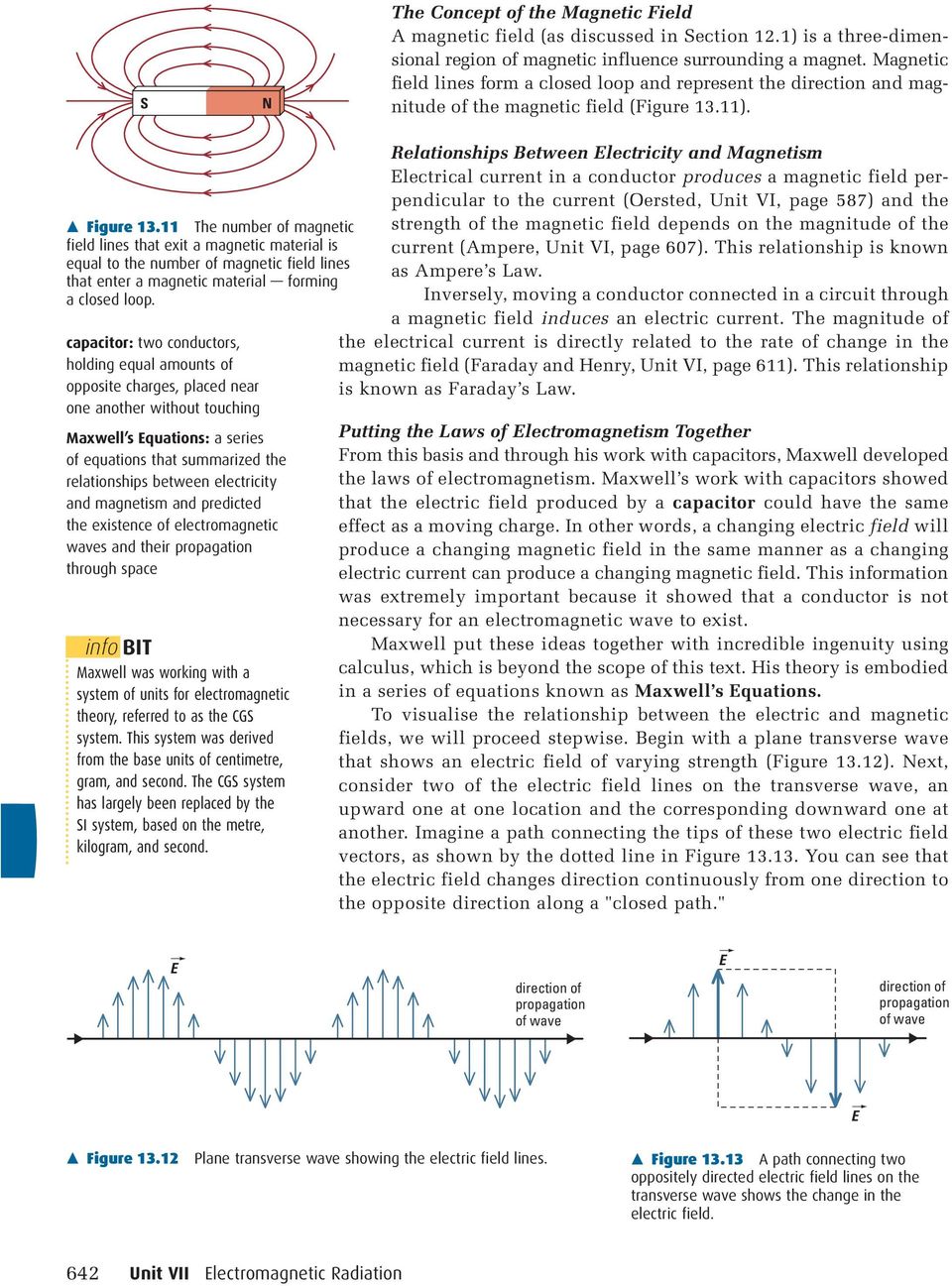
11 S N The Concept of the Magnetic Field A magnetic field (as discussed in Section 12.1) is a three-dimensional region of magnetic influence surrounding a magnet. Magnetic field lines form a closed loop and represent the direction and magnitude of the magnetic field (Figure 13.11). Figure The number of magnetic field lines that exit a magnetic material is equal to the number of magnetic field lines that enter a magnetic material forming a closed loop. capacitor: two conductors, holding equal amounts of opposite charges, placed near one another without touching Maxwell s Equations: a series of equations that summarized the relationships between electricity and magnetism and predicted the existence of electromagnetic waves and their propagation through space info BIT Maxwell was working with a system of units for electromagnetic theory, referred to as the CGS system. This system was derived from the base units of centimetre, gram, and second. The CGS system has largely been replaced by the SI system, based on the metre, kilogram, and second. Relationships Between Electricity and Magnetism Electrical current in a conductor produces a magnetic field perpendicular to the current (Oersted, Unit VI, page 587) and the strength of the magnetic field depends on the magnitude of the current (Ampere, Unit VI, page 607). This relationship is known as Ampere s Law. Inversely, moving a conductor connected in a circuit through a magnetic field induces an electric current. The magnitude of the electrical current is directly related to the rate of change in the magnetic field (Faraday and Henry, Unit VI, page 611). This relationship is known as Faraday s Law. Putting the Laws of Electromagnetism Together From this basis and through his work with capacitors, Maxwell developed the laws of electromagnetism. Maxwell s work with capacitors showed that the electric field produced by a capacitor could have the same effect as a moving charge. In other words, a changing electric field will produce a changing magnetic field in the same manner as a changing electric current can produce a changing magnetic field. This information was extremely important because it showed that a conductor is not necessary for an electromagnetic wave to exist. Maxwell put these ideas together with incredible ingenuity using calculus, which is beyond the scope of this text. His theory is embodied in a series of equations known as Maxwell s Equations. To visualise the relationship between the electric and magnetic fields, we will proceed stepwise. Begin with a plane transverse wave that shows an electric field of varying strength (Figure 13.12). Next, consider two of the electric field lines on the transverse wave, an upward one at one location and the corresponding downward one at another. Imagine a path connecting the tips of these two electric field vectors, as shown by the dotted line in Figure You can see that the electric field changes direction continuously from one direction to the opposite direction along a "closed path." E direction of propagation of wave E direction of propagation of wave E Figure Plane transverse wave showing the electric field lines. Figure A path connecting two oppositely directed electric field lines on the transverse wave shows the change in the electric field. 642 Unit VII Electromagnetic Radiation
12 Now, consider the magnetic field that exists perpendicular to the electric field along this closed path. When the electric field is set in motion, the magnetic field will change along with the electric field, and similarly along a closed path. An electromagnetic wave will propagate in a direction perpendicular to both fields (Figure 13.14). The changing electric and magnetic fields will propagate, or radiate, through space in the form of a wave an electromagnetic wave (Figure 13.15). Maxwell proposed that the electromagnetic wave consists of periodic variations in the electric and magnetic field strengths and that these variations occur at right angles to one another as the wave propagates. B Figure Three-dimensional view of an electromagnetic wave E direction of propagation of wave E B direction of propagation of wave Figure The magnetic field lines (in red) allow us to visualize the magnetic field that exists perpendicular to both the electric field and the direction of the wave. electromagnetic wave: periodic variation in perpendicular electric and magnetic fields, propagating at right angles to both fields Maxwell s Predictions Maxwell s equations not only correctly predicted the existence of electromagnetic waves, but also allowed him to make some predictions about the waves properties. 1. Electromagnetic waves are produced whenever an electric charge is accelerating. Therefore, as an electric charge oscillates, electrical energy will be lost, and an equivalent amount of energy will be radiated outward in the form of oscillating electric and magnetic fields. 2. When the electric charge is accelerated in periodic motion, the frequency of oscillation of the charge will correspond exactly to the frequency of the electromagnetic wave that is produced. 3. All electromagnetic waves will travel at a speed of m/s and obey the universal wave equation (c f) relating speed, frequency, and wavelength. (Note that Maxwell s theoretical prediction was not far from today s currently accepted value of m/s for the speed of light in a vacuum.) 4. The oscillating electric and magnetic fields will always be perpendicular to each other and perpendicular to the direction of propagation of the wave. 5. Electromagnetic waves should show all the phenomena associated with transverse waves: interference, diffraction, refraction, and polarization. It is Maxwell s last prediction that supports the wave model of EMR and relates his predictions to experimental evidence. Interference, diffraction, polarization, and refraction, as they relate to the wave model of EMR, will be explored in sections 13.4 and e WEB To learn more about ways of representing the relation between electric and magnetic fields, follow the links at physicssource. Compare and contrast the representations you find. Chapter 13 The wave model can be used to describe the characteristics of electromagnetic radiation. 643

13 e WEB To learn more about details of Hertz s experiment, follow the links at physicssource. Producing Electromagnetic Radiation The Story of Accelerating Charge In 1887, the German physicist Heinrich Hertz ( ) set up an experiment designed both to produce and to detect EMR. In his experimental apparatus, Hertz used a radiator, consisting of a pair of wires attached to both a high-voltage induction coil and a pair of capacity spheres. The wires were separated by a small gap and, given a sufficient quantity of opposite charge on each wire, a current would oscillate back and forth across the gap at a frequency of 10 9 Hz. With each oscillation a spark was produced when the moving charge ionized the air molecules on its way from one wire to the other. From Maxwell s equations Hertz knew theoretically that this rapidly moving electric charge should produce EMR. A short distance away from the radiator a collector plate containing a small loop of wire, the antenna, was observed to detect the effect of EMR. While the radiator was in operation and when the radiator and the antenna were tuned to the same frequency, a spark was observed at the antenna indicating a potential difference and an electric current (Figure 13.16). 3. Electromagnetic waves create electric current in antenna loop; produces small spark in spark gap. 2. Spark produces electromagnetic waves. 1. Induction coil produces high voltage. Figure Hertz s apparatus consisted of a high-voltage induction coil, a radiator that produces sparks, and an antenna loop. Relating Theory and Practice in Hertz s Experiment The word changing appears a number of times in Maxwell s original proposal. As Maxwell understood it, a changing electric field was crucial to creating an electromagnetic wave. This is where the induction coil was important in Hertz s experimental design. The induction coil rapidly changed the electric field across the spark gap. When this electric field reached a sufficiently high value, the electrons in the wire jumped from one electrode to the other. As the charge was rapidly transferred, the electric field underwent a rapid change that caused a changing magnetic field, which then caused a changing electric field, and so on. An electromagnetic wave was produced and it radiated outward in all directions. 644 Unit VII Electromagnetic Radiation

14 In Hertz s experiment, when the receiver was tuned to the same frequency as the radiator, the induced current flow in the antenna oscillated at a frequency identical to that of the changing electric field in the radiator. This was conclusive evidence that Hertz s device had indeed produced the EMR that was being observed at his antenna. Furthermore, he was able to measure the velocity of the waves by using a zinc reflector plate to produce a standing wave and moving a ring antenna within the standing wave. He could determine the magnitude and direction of the wave s components and therefore the wavelength. Given the frequency of the radiator, the velocity of the wave could be calculated using the universal wave equation (v f). Hertz had produced and measured the wavelength and velocity of non-visible EMR for the first time. Two years later, in 1889, radio pioneers used this method to transmit the first radio waves across the English Channel. By 1901, the first radio waves were transmitted across the Atlantic Ocean from Cornwall, England to St. John s, Newfoundland and a new age of technology had dawned. The production of EMR was one of the greatest scientific achievements of the 19th century, ushering in new possibilities and technologies that are commonplace today. e WEB To learn more about Marconi and details of the first trans-atlantic radio transmission, follow the links at physicssource. MINDS ON Going Wireless Wireless communication systems that transmit data are commonplace today. 1. Create a list of wireless data transmission technologies. 2. What process must be common to all wireless transmission devices? 3. What variable is used to control the acceleration, and hence the energy, of the accelerating electrons in a wireless device? 4. One radio transmission tower transmits at 5.0 kv. Another transmits at 10.0 kv. Which tower has a greater signal strength and why? 5. Cell phones communicate with cell towers that are dispersed throughout urban cities and transportation corridors. Explain the relationship between the distance that separates a cell phone from the nearest cell tower and the operating power of the cell phone. 6. Many studies have been conducted to investigate and determine if there is a relationship between brain cancer and cell phone usage. Why would one suspect a relationship between cell phone use and brain cancer? Although modern radio signals are generated without a spark, the technology operates in a way similar to Hertz s original experiment. Radio waves are generated by rapidly changing the electric potential, or voltage, in the radiator tower. The oscillating voltage produces an oscillating electric field in the radiator tower (Figure 13.17). sound waves microphone amp Figure radio transmitter radio signal (radio frequency) RF audio signal mixer (audio frequency) AF amp Schematic of a simple radiator tower audio wave (AF) carrier wave (RF) amplitude modulation (AM) Figure Amplitude modulation. The audio signal and the carrier signal are mixed by modifying the amplitude of the carrier signal. audio wave (AF) carrier wave (RF) frequency modulation (FM) Figure Frequency modulation. The signal is combined with a carrier wave to create a resultant wave with constant amplitude, but varying frequency. Chapter 13 The wave model can be used to describe the characteristics of electromagnetic radiation. 645

15 THEN, NOW, AND FUTURE From Analog Radio to Digital Wireless Analog Radio Technology The first application of Hertz s discovery was made by Guglielmo Marconi ( ). He recognized the potential for transmitting information using electromagnetic waves, by coding the information into dots and dashes, like the Morse code already used in telegraphy. Today, the dots and dashes have been replaced by an analog signal, which uses a continuous spectrum of values. In radio, sound waves in the range of Hz (audible to humans) are converted into a weak electrical signal in an analog form. This wave is called the audio frequency signal (AF). The weak audio frequency is then amplified and sent to a mixer. In the mixer, a radio frequency (RF) called a carrier signal is added to the audio signal to produce an analog wave that contains two sets of information: the audio signal and the carrier signal. The carrier signal frequency is determined by the government and is unique to that station for that broadcast area. It is the carrier signal that you select when you tune your radio to the station. Finally, the mixed signal is amplified and delivered to the radiator tower, where the movement of electrons through the radiator wire will produce the corresponding form of electromagnetic wave (Figure 13.17). Television signals follow the same process, except that the video and audio portions are transmitted separately. Radio reception is accomplished by tuning the radio to the carrier signal and then removing, or demodulating, the wave. This reveals the audio signal, which is amplified and delivered to the speakers. AM or FM Radio? The mixing of the audio signal and the carrier signal occurs in one of two ways. The first is called amplitude modulation or AM (Figure 13.18). The second method is called frequency modulation or FM. The audio signal and the carrier signal are mixed by modifying the frequency of the carrier signal (Figure 13.19). Figure Digital Wireless Cell Phones The cell phone and text messaging technology of today operates on a very different set of principles. When a cell phone is switched on, it registers with the mobile telephone exchange using a unique digital identifier. Once it has been identified, it stays connected to a cellular network of ground-based stations, commonly referred to as cellular tower base stations, which can be found on radio towers, buildings, in church steeples, or any location which is free of physical obstacles and interference. Figure shows one such cellular tower base station. A cell phone communicates with the cell tower base station using radio waves. In turn the base station relays all information to and from the cell phone to another subscriber of the same cell phone network or through an interconnected public switched telephone network that uses fibre optic and copper land lines to transmit the data. When in use, a cell phone converts the analog voice signal of the person talking into a stream of digital data, which is received by the nearest cell tower base station that may be anywhere from km away. Each cell tower site has a lowpower microwave broadcast which can be picked up by cell phones. As the user moves, the cell phone constantly monitors the signals being received from various nearby cell tower stations, switching from one tower to another in such a way that the signal strength remains as high as possible. The stream of digital data is unique to each type of network technology and each operator is assigned a different radio frequency so that several networks can operate simultaneously at the same location and they will not interfere with one another. Wireless Technology for the Future Future uses of cellular phone technology are emerging in the market place as the networks evolve and consume broadcast frequencies formerly occupied by some television channels. New entertainment features will include: streaming video; music downloads; podcasts; smooth speech recognition and language translations; ebook features that use projection; barcode readers that direct users to Internet urls; global positioning systems and mapping combined with accelerometers to measure position and movements of the cell phone user. Questions 1. Suggest why cell phone user data, including geographical position and movement, could be considered an invasion of privacy. 2. How can multiple cell phone networks and traditional radio broadcasts all exist in the same geographical location and not interfere with one another? 3. Compare the carrier frequency of radio broadcasts with the unique digital identifier of a cell phone. What common purpose do they both serve? 4. Explain why a cell phone only works in certain areas and how changes in the signal strength will be observed by the cell phone user as he or she moves. 646 Unit VII Electromagnetic Radiation

16 Concept Check 1. Consider two electric field lines on a transverse electromagnetic wave. Explain how a changing electric field will produce a changing magnetic field. 2. Why can electromagnetic radiation propagate through empty space, in the absence of a conductor? 3. An electromagnetic wave is produced if an electric charge accelerates. Explain how these two phenomena are linked Check and Reflect Knowledge 1. List two ways that electromagnetic radiation is detected. 2. List the different types of EMR in the spectrum and the ways in which they are classified. 3. Define EMR using the (a) particle model (b) wave model (c) quantum model 4. Describe the evidence that Thomas Young obtained from the two-slit experiment and explain how it supported the wave model of light. 5. Explain how the observations made by Hertz support the electromagnetic theories of Maxwell. 6. How did Maxwell s study of capacitors add to his theories? 7. Why is the process of changing critical to the production of EMR? Applications 8. A high-voltage spark gap produced sparks with a frequency of Hz. What is the frequency of the EMR observed at an antenna located nearby? 9. What properties need to be considered when choosing the material to build an antenna for a radio receiver? 10. If the magnetic field lines held within a closed path are constant and unchanging, will there be an electric field along the closed path? Explain. 11. If an electric charge is not moving, will it produce a magnetic field? Explain. 12. Explain why it is necessary for the technician to leave the room or wear protective clothing when a patient is being X rayed. 13. Describe how an antenna is affected by an electromagnetic wave. 14. Describe one method used to produce EMR with a known frequency. Extensions 15. Explain, with the aid of a transverse standing wave diagram, how the current in a ring antenna (such as the one used by Hertz) will be affected as the antenna is moved along the axis of the standing wave. How could this data be used to determine the wavelength of the standing wave? 16. Draw a schematic that shows, in general terms, the role of a satellite in delivering digital, high-definition, television signals between the signal provider and the customer s home receiver. e TEST To check your understanding of the nature and production of electromagnetic radiation, follow the etest links at Chapter 13 The wave model can be used to describe the characteristics of electromagnetic radiation. 647

17 info BIT Maxwell predicted the speed of EMR before Hertz experimentally verified it. Maxwell knew that electric and magnetic fields are not independent of one another and predicted a speed of propagation by dividing the constants, k e and k m, which describe electric and magnetic forces between moving charged particles. Using today s currently accepted values of k e and k m, we can show that the magnetic field and the electrical field are related by a particular speed k 9 N 2 m 2 e C k m N s 2 2 C m 2 s Earth longer time m m s s 2 Sun Earth s orbital diameter approximate 13.2 The Speed of Electromagnetic Radiation In addition to producing and detecting electromagnetic radiation in his 1887 experiment, Hertz was able to show that the radiation was travelling at approximately m/s. This was an empirical verification of a theoretical speed predicted by Maxwell years earlier, as described on page 643: All electromagnetic waves will travel at a speed of m/s and obey the universal wave equation (c f) relating speed, frequency, and wavelength. Empirical Determination of the Speed of Electromagnetic Radiation Light travels so quickly that there is no apparent time difference between turning on a light and the light reaching your eyes even when the light source is many kilometres away. Galileo ( ) found this out in his attempt to measure the speed of light. His experiment was very basic: Galileo and an assistant stood, each with a covered lantern, on adjacent hills separated by about a kilometre. Galileo would uncover his lantern and as soon as his assistant observed Galileo s lantern, he would uncover the second lantern so that Galileo would see it. Galileo used his pulse rate to measure the time difference. The time interval is actually extremely small Galileo didn t know it at the time, but light could travel 2 km in about s, a time you couldn t even measure with a digital stopwatch. Galileo realized that using his pulse as a timepiece was not appropriate. Olaus Rømer ( ) and Christiaan Huygens used one of the four easily visible moons of Jupiter Earth shorter time Jupiter Figure Earth s orbital diameter causes the eclipse of Io to occur at different times because of the extra distance the light must travel when Earth is farthest from Jupiter. Io to calculate the speed of light. The period of revolution for Io (Jupiter s brightest moon) had been accurately determined using large amounts of astronomical data collected over many years. Roemer knew that the moon Io should be eclipsed and disappear behind Jupiter at regular, periodic intervals (every 42.5 h). However, he discovered that Io appeared to be eclipsed later than scheduled when Earth was farther away from Jupiter and earlier than scheduled when Earth was closer to Jupiter. The time difference between the longest and shortest periods was 22 min (Figure 13.21). 648 Unit VII Electromagnetic Radiation

18 Huygens reasoned that this discrepant behaviour could be due to the difference in the time taken for the light to travel from Jupiter to Earth. Following this reasoning, he estimated Earth s orbital diameter and then determined the speed of light based on the following calculations. d Orbital diameter m v t Time difference 22 min 1320 s m 1320 s m/s His calculations produced a value of m/s astoundingly close to the currently accepted value of m/s. The value was so large it was rejected by the scientific community of the time and was not accepted until after both Huygens and Roemer were dead. In 1848, Armand Fizeau became the first person to successfully measure the speed of light at the surface of the planet. His apparatus consisted of a rotating toothed wheel, a light source, some lenses, and a mirror. In his experiment, light was allowed to pass through one of the gaps on the toothed wheel and travel toward the mirror (located on an adjacent hilltop 8.63 km away) where it was reflected back toward the spinning wheel (Figure 13.22). The toothed wheel was rotated such that the reflected light was blocked by a tooth in the wheel as it turned, and the observer would not be able to see the source light. Using the rotational frequency of the spinning wheel, Fizeau was able to determine the time it took the light to travel 8.63 km and back (17.26 km round trip) and therefore to determine the speed at which the light was travelling to the distant mirror and back. His experimentally determined value for the speed of light was m/s only 5% more than the currently accepted value. toothed wheel observer path A observation point water in mirror glass path B light source water out light source Figure Fizeau s original apparatus for measuring the time it takes light to travel the distance (8.63 km) and back Figure Fizeau s apparatus for measuring the speed of light in water Three years later Fizeau conducted an investigation to determine if the speed of light was affected by a moving medium such as water. In this experiment, water was pumped in opposite directions through two parallel tubes (Figure 13.23). Light from a single source was directed through both tubes, following paths A and B, of identical lengths, to an Chapter 13 The wave model can be used to describe the characteristics of electromagnetic radiation. 649

19 observation point. Fizeau argued that if the speed of the light waves changed as a result of travelling through the water tubes, the waves arriving from path A and B would produce an interference pattern at the observation point. A device called an interferometer was used to observe this interference. The experiment proved that light would travel at different speeds in different media. The interference pattern produced was also very strong evidence that light was a wave. octagonal set of mirrors observer telescope path of light curved mirror light from source Figure Michelson s experimental apparatus to measure the speed of light Mount Wilson 35 km Mount St. Antonio Practice Problems 1. Students using a 12-sided set of rotating mirrors in an experiment similar to Michelson s determine the speed of light to be m/s. The mirrors are located 30.0 km from the fixed mirror. What is the frequency of rotation if 1/12th of a rotation occurs before the light returns? 2. Light reflected from an 8-sided set of rotating mirrors travels 15.0 km to a distant fixed mirror and back. At what frequency is the set rotating if it has turned 1/8th of a rotation before the light returns? 3. An 8-sided set of mirrors, similar to Michelson s, rotating with a frequency of 500 Hz, is located 36.0 km away from a fixed mirror. If the returning light is observed in the system, at what speed is the light travelling? Answers Hz Hz m/s Michelson s Experiment Building on Fizeau s 1848 experimental design and the work of others, Albert Michelson performed an experiment in 1905, using a rotating set of mirrors instead of a toothed wheel. A very intense light source was directed at an 8-sided, rotating set of mirrors, which reflected the light toward a curved mirror located 35 km away. After travelling 35 km, the light was reflected back toward the rotating mirrors. If the rotating mirrors had made 1/8th of a rotation just as the light returned, the returning light could be observed in a telescope (Figure 13.24). For the returning light to be observed in the telescope, the rotating mirrors had to turn at a very precise frequency. Michelson knew the light had to travel a round trip distance of 70 km, and if the rotating mirrors had made 1/8th of a rotation (or a multiple of an 1/8th rotation) between the time the light left and then returned, the light could be observed in the telescope. All Michelson needed to measure was the frequency of rotation and he could determine the time required for 1/8th of a rotation. When his mirror rotated at rpm (533 Hz), he could observe the light in the telescope. Example 13.1 The set of rotating mirrors in Michelson s experiment was rotating at 533 Hz and the curved mirror was located 35.0 km away. Show how Michelson determined the speed of light from these data. Given distance between rotating and curved mirrors 35.0 km m f 533 Hz Required speed of light (c) Analysis and Solution d c t The light must travel from the set of mirrors to the curved mirror and back again, so the round-trip distance is twice the given distance. d m m 650 Unit VII Electromagnetic Radiation

20 For the light to follow the path illustrated in Figure 13.24, the rotating set of mirrors must complete a minimum of 1/8th of a rotation while the light is travelling between the rotating mirrors and the curved mirror. Therefore, the minimum travel time (t) is equal to 1/8th of the period of rotation. T 1 f t 1 8 T c d t Hz 8 ( s) m 10 4 s s s m/s Paraphrase According to Michelson s observations, the speed of light in air was found to be m/s QuickLab Measuring the Speed of EMR Problem Microwaves are a type of electromagnetic radiation and travel at the speed of light. They have a defined wavelength and frequency when they travel in a vacuum or in air. The universal wave equation v f relates the speed of the wave to its frequency and wavelength, where f is the frequency of the radiation, and is the wavelength. Each microwave oven generates microwaves at a given frequency, usually 2450 MHz. If the wavelength of the microwave can be measured, its speed can be determined using the universal wave equation. Materials microwave oven microwave-safe dish marshmallows Procedure 1 Pack a solid layer of marshmallows in a casserole or microwave-safe dish. 2 Remove the turntable from the microwave oven. 3 Place the dish in the oven and cook until the marshmallows begin to melt in four or five locations. 4 Remove the dish from the oven and measure the distance between adjacent soft spots. 5 Determine the average separation distance between several soft spots. This distance is equal to half the wavelength of a microwave. 6 Calculate the wavelength by multiplying the average separation distance by two. 7 Record the frequency of the microwave, which will be indicated on the back of the microwave oven. Questions Use the wavelength and frequency of the microwave to answer the following questions. 1. What is the speed of the microwaves? 2. What is the percent error of your calculated value, when compared with the currently accepted value for the speed of light ( m/s)? 3. What are several possible sources of error that could affect your calculation? 4. Compare the wavelength of microwaves with that of radio waves and visible light waves. Why are they called microwaves? Chapter 13 The wave model can be used to describe the characteristics of electromagnetic radiation. 651

21 13.2 Check and Reflect Knowledge 1. Why was Galileo s original experiment to determine the speed of light unsuccessful? 2. Explain why, in a Michelson-type experiment, the rotating mirrors have to turn at a very precise frequency in order for light to reach a stationary observer. 3. Explain why the periodic motion of Jupiter s moon Io appears to be constantly changing when observed from Earth. Applications 4. In measuring the speed of light, the difference in eclipse times for Jupiter s moon Io, is measured. If an eclipse occurs 24 min later than expected, and Earth s orbital diameter is m, calculate the speed of light. 5. A communications satellite is in orbit around Earth at an altitude of km. If the satellite is directly above a groundbased station, how long does it take a signal to travel between the satellite and the station? 6. Using a similar approach to Michelson, a student sets up a 64-sided set of rotating mirrors, 8.00 km away from a fixed mirror. What minimum frequency of rotation would be required to successfully measure the speed of light? 7. A 16-sided set of rotating mirrors is used to measure the time it takes light to travel a certain distance. At what frequency does the mirror need to rotate such that it makes 1/16th of a rotation in the time it takes light to travel 3.5 km and back again? 8. An 8-sided set of rotating mirrors rotates at 545 Hz in an experiment similar to that of Michelson. How far away should the fixed mirror be placed in order to correctly measure the speed of light? 9. The speed of light was measured to be m/s using a 16-sided set of rotating mirrors and a fixed mirror separated by m. At what frequency was the mirror rotating? 10. Students who measure the speed of light using an experimental design similar to that of Michelson with an 8-sided set of rotating mirrors, make the following observations when light passes through the apparatus: (a) rotating mirror frequency Hz (b) distance between fixed and rotating mirror 17.5 km Determine the speed of light based on the students recorded observations. 11. A 64-sided set of rotating mirrors is turning at 340 Hz. If a fixed mirror is located 6.55 km away from the rotating mirror and the light is reflected correctly, what value for the speed of light would be obtained? Extensions 12. Global positioning satellites (GPS) are used to pinpoint individual locations on the surface of Earth. A minimum of three GPS satellites are required, each with synchronized atomic clocks. Each satellite simultaneously sends a time signal to a GPS receiver on the surface. The time signal of each satellite is compared with the time on the receiver s clock. (a) Explain how the exact distance between each satellite and the receiver can be determined. (b) Explain how the receiver s location relative to all three satellites indicates an exact coordinate on Earth s surface. e TEST To check your understanding of speed and propagation of electromagnetic radiation, follow the etest links at Unit VII Electromagnetic Radiation
22 13.3 Reflection On a windless day, the smooth surface of a lake will reflect light and produce stunning images of the surrounding landscape and sky. But introduce the slightest disturbance, a gust of wind or a morning rain shower, and the image becomes distorted and blurred. With enough disturbance, the image on the surface of the water completely disappears. Figure a) Reflection in a smooth lake b) Diffuse reflection due to windy conditions How do the images in Figure form? Light travels in straight lines through a medium that is uniform. This characteristic is termed rectilinear propagation. The light falling on a flat, smooth, reflecting surface, such as a mirror, undergoes specular or regular reflection. In the case of the smooth lake, the crisp, clear images that form are the result of many parallel incident rays that reflect as parallel reflected rays (Figure 13.26). In the case of the rough lake, the blurred images that form are the result of many parallel incident rays that are scattered after reflecting in many different directions. This behaviour is called diffuse or irregular reflection (Figure 13.27). rectilinear propagation: movement of light in straight lines through a uniform medium Figure Ray diagram of specular (regular) reflection Figure Ray diagram of diffuse (irregular) reflection The Law of Reflection Particular terms are used to describe reflection. These terms are illustrated in the ray diagram shown in Figure on the next page. Regular reflection will occur when an incident light ray contacts a polished, reflecting surface. The incident ray makes contact at the point of incidence and then it leaves the reflecting surface and becomes the reflected ray. If, at the point of incidence, an imaginary line, called the ray diagram: a diagram to show a result of a light ray interacting with a surface Chapter 13 The wave model can be used to describe the characteristics of electromagnetic radiation. 653
23 e SIM Find out more about the law of reflection from the use of simulations. Follow the esim links at physicssource. plane mirror: a smooth, flat, reflecting surface law of reflection: the angle of reflection is equal to the angle of incidence and is in the same plane normal line (N), is drawn perpendicular to the surface, then the angle formed between the incident ray and the normal line is called the angle of incidence. The angle formed between the reflected ray and the normal line is called the angle of reflection. reflecting surface angle of incidence θ i incident ray point of incidence N normal angle of reflection θ r reflected ray incident ray θ i θr Figure The Law of Reflection reflected ray image I O point object plane mirror mirror Figure How two different observers see the image of an object located in front of a plane mirror virtual image: an image from which light rays appear to come; cannot be formed on a nonreflective surface or screen real image: an image from which light rays come; can be formed on a diffusely reflecting surface or screen Figure Ray diagram and terminology for regular reflection Light rays that are incident upon a plane mirror at 90 will be reflected directly back to the source. In this case, the incident and reflected rays are parallel to the normal line so that the angle of incidence and the angle of reflection are both zero. In a similar way, when a light ray contacts a mirror at an angle of 25 relative to the normal line, it will reflect at an angle of 25 relative to the normal line. In all cases, the angle of incidence will be equal to the angle of reflection. This is called the law of reflection (Figure 13.29). The angle of reflection is equal to the angle of incidence and is in the same plane. Image Formation in a Plane Mirror Look at the image of an object formed in a plane, flat mirror in Figure What do the dashed lines represent? Are they real rays coming from a real object? The dashed lines are an extension of the reflected rays, causing your brain to believe that they are rays, originating from an object that is located behind the mirror. But this cannot be so. The light rays appear to be coming from an image, but this image is not real. The image formed in a plane mirror in this fashion is therefore called a virtual image. For example, if you were to hold a piece of paper behind the mirror where the image appears to be, you would not see the image on the paper. By contrast, a real image is one that can be formed on a diffusely reflecting surface, such as a piece of paper. A projector is a familiar device that produces real images on a screen. Ray diagrams can be used to show how images form with a reflecting surface, such as a mirror. 654 Unit VII Electromagnetic Radiation
24 13-3 QuickLab Drawing a Ray Diagram Problem To construct a ray diagram of an image formed in a plane, flat mirror. Materials observer Procedure object Figure N ray 1 mirror 1 Choose one point on the object, such as the tip of the candle flame, in Figure Draw an incident ray from the selected point on the object (adding a small normal line where the ray is incident on the surface of the mirror) (Figure 13.31). 3 Based on the law of reflection, the reflected ray leaves the mirror surface such that the angle of incidence is equal to the angle of reflection. Draw the reflected ray. 4 Use a dashed line to extend the reflected ray beyond the back surface of the mirror. 5 On your diagram, repeat steps 2 to 4 for a ray originating from the same location on the object, but at a slightly different angle. 6 Note that the viewer must be located where both reflected rays would enter the eye. 7 Repeat steps 2 to 6 and locate the point where the two dashed lines converge (meet). This is the image location for the first selected point on the object. Questions 1. How could you test whether the image formed in the mirror was real or virtual? 2. Is the image magnified or the same size as the object? 3. Will the image appear right side up (erect) or upside down (inverted)? 4. Could you use a ray diagram to determine if the word HELP would appear backwards in a mirror? Explain. MINDS ON Image in a Mirror Figure shows a woman looking in a mirror. 1. How far behind the mirror does her image form, if she is standing 50.0 cm in front of the mirror? Explain how the ray diagram is used to determine this distance. 2. Is the image real or virtual? 3. According to the ray diagram, two sections of the mirror could be removed and her entire face would still be visible. Which two sections are not needed? Explain your reasoning. G F E Figure D C O B A Woman in a Mirror Chapter 13 The wave model can be used to describe the characteristics of electromagnetic radiation. 655
25 Image Characteristics magnification: the relationship of the size of the image to the size of the object image attitude: the orientation characteristic of an image, whether erect or inverted When an object is placed in front of a mirror, the image can be described by four general characteristics (Table 13.2). The magnification relates the size of the image to the size of the object. The image can be enlarged, diminished, or the same size as the object. The image attitude describes the image as being either erect (upright) or inverted (upside down) relative to the object. This is termed vertical inversion. Horizontal, or left/right, inversion can also occur. The position describes where the image forms relative to the surface of the mirror. The type of image distinguishes between real and virtual images. A real image is one that can be projected on a screen or surface, and a virtual image is one that can only be seen, or photographed. Table 13.2 Image Characteristics Image Characteristic magnification attitude position type Description same size, enlarged, diminished erect or inverted displacement from mirror surface real or virtual Image characteristics are important for the proper application of signage and warning labels. For example, the word ambulance is written in reverse on the front of the vehicle so that other drivers will be able to read the writing in their rear-view mirrors when the ambulance is approaching. MINDS ON Image Characteristics Figure shows (a) an image of an ambulance and (b) its image in a rear-view mirror. 1. What image characteristic is addressed by printing the word ambulance in reverse? 2. While standing in front of a plane, flat mirror, raise your right hand. Which hand in your image was raised? 3. In a plane, flat mirror, do images appear backwards horizontally or upside down vertically or both? Explain. 4. Can an image in a plane mirror ever appear upside down? Figure (a) The front of an ambulance (b) The image it makes in a rear-view mirror 656 Unit VII Electromagnetic Radiation
26 Image Formation in a Curved Mirror Curved mirrors come in a variety of shapes, the most common being spherical. Spherical mirrors, like the ones used for store security, have a unique geometrical shape (Figure 13.34). This shape is derived from a sphere. Imagine a hollow sphere, with a polished mirror surface on the inside and out. hollow sphere polished inside and out convex reflecting surface concave reflecting surface Figure A curved mirror can be formed from a hollow sphere. Figure A spherical store security mirror By removing a section of the sphere, you produce a double-sided spherical mirror with a concave reflecting surface on one side and a convex reflecting surface on the other (Figure 13.35). The concave reflecting surface is curved inwards. This surface is also referred to as a converging mirror since it causes parallel light rays to converge, or come together, after being reflected. The convex reflecting surface is curved outwards. This surface is also referred to as a diverging mirror since it causes parallel light rays to spread out or diverge after being reflected. As with plane-mirror image formation, ray diagrams are useful to determine how images form from curved surfaces. Ray diagrams for curved surfaces, as in Figure for example, are more complex and involve an expanded set of terminology. converging mirror: a concave reflecting surface that causes parallel light rays to converge after being reflected diverging mirror: a convex reflecting surface that causes parallel light rays to spread out after being reflected 1. centre of curvature (C) the point in space that would represent the centre of the sphere from which the curved mirror was cut 2. radius of curvature (r) the distance from the centre of curvature to the mirror surface 3. vertex (V) the geometric centre of the curved mirror surface 4. principal axis (PA) an imaginary line drawn through the vertex, perpendicular to the surface of the curved mirror at this point 5. principal focal point (F) the point where light rays that are parallel to and close to the principal axis converge, or appear to diverge from, after being reflected 6. focal length (f) the distance from the vertex to the focal point, measured along the principal axis. The focal length is related to the radius of curvature by f r2. This means that as the radius of curvature is reduced, so too is the focal length of the reflecting surface. PA ray 2 ray 1 Figure ray 3 C F V f A ray diagram for a converging mirror r Chapter 13 The wave model can be used to describe the characteristics of electromagnetic radiation. 657
27 Figure Reflection of three rays from spherical mirrors ray 1 ray 3 PHYSICS INSIGHT C ray 2 a) A concave, converging mirror ray 1 ray 2 All three incident rays obey the Law of Reflection. The resulting rules for drawing ray diagrams are just the application of geometry. F ray 3 b) A convex, diverging mirror V V Drawing Ray Diagrams for Curved Mirrors The four general image characteristics of magnification, attitude, position, and type, which were applied to plane mirrors, can also be applied to curved mirrors. For curved mirrors, the normal line at the point of incidence is the same as an extension of the radius of the spherical surface drawn at this point. The law of reflection still describes how all the rays will be reflected. To understand and predict how images are produced from curved mirrors, we will need to use three light rays, the law of reflection, and the mirror s focal point, centre of curvature, and vertex. Two rays from a point on an object locate the corresponding point on the image and the third ray will verify its location (Figure 13.37). Consider each of the three rays: Incident Ray 1 travels from a point on the object parallel to the principal axis. Any ray that is PA parallel to the principal axis will reflect through the focal point on a converging mirror, or appear to have originated from the focal point on a diverging mirror. Incident Ray 2 travels from a point on the object toward the focal point. Any ray that passes through the focal point on a converging mirror, or is directed at the focal point on a diverging mirror, will be reflected back parallel to the PA principal axis. F C Incident Ray 3 travels from a point on the object toward the centre of curvature. Any ray that passes through the centre of curvature on a converging mirror, or is directed at the centre of curvature on a diverging mirror, will be reflected directly back along the incident path. At what incident angle must this light ray hit the mirror surface in order to be reflected straight back along the original path? These three rays alone will allow you to predict and verify the location and characteristics of the image. Notice that some conventions are used when drawing these ray diagrams: 1. objects are often drawn as erect arrows 2. real rays are drawn as solid lines 3. virtual rays (that only appear to exist behind the mirror) are drawn as dashed lines Figure (a) shows that the converging mirror produces a real image that is inverted and diminished. Figure (b) shows that the diverging mirror produces a virtual image that is erect and diminished. Why is one image real and the other virtual? For curved mirrors, a real image is formed where the reflected light rays converge or meet. At this location, a focussed image would appear on a sheet of paper or a screen if it were located in the exact location where the light rays meet. If the screen were to be moved slightly, the image would appear 658 Unit VII Electromagnetic Radiation
28 blurred because the reflected rays would not be converging perfectly at the screen s new location. For the diverging mirror, the reflected rays appear to be originating from behind the mirror, but if a screen were located there, the incident light rays would not reach it (the rays would be blocked by the mirror). Figure Steps for drawing a ray diagram in converging and diverging spherical mirrors e WEB To learn more about ray diagrams for curved mirrors and lenses, follow the links at physicssource. 3 ray 1 object ray 3 ray 2 C F V PA 2 image 1 a) A concave, converging mirror object ray 1 ray 2 ray 3 image b) A convex, diverging mirror Characteristics of an Image in a Curved Mirror If you look at the image of your face in a polished spoon and bring the spoon closer and closer to your nose, you will demonstrate that with curved mirrors, the object s distance from the mirror s vertex has an effect on the characteristics of the image produced. For example, what happens to an image as the object is brought closer to a converging mirror surface? In Figure 13.39(a), the object is located outside the centre of curvature, and a real, inverted, and diminished image appears. If the object is brought closer to the vertex of the mirror, such that it is inside the focal length, as in Figure 13.39(b), then the image becomes virtual, erect, and enlarged. Figure Object location affects image characteristics. object C F C image object F mirror V mirror a) A converging mirror with object located outside C (real, inverted, diminished) V image PA PA b) A converging mirror with object located inside F (virtual, erect, enlarged) Chapter 13 The wave model can be used to describe the characteristics of electromagnetic radiation. 659
29 Table 13.3 Image Characteristics for Converging Mirrors Object Position Image Characteristic distant outside centre of curvature at the centre of curvature, C between focal point and centre of curvature at focal point, F between focal point and vertex real, inverted, and diminished, close to F real, inverted, and diminished, between F and C real, inverted, and same size, at C real, inverted, and enlarged, beyond C undefined (no image forms), at infinity virtual, erect, and enlarged, behind mirror Table 13.3 summarizes the image characteristics for a concave, converging mirror. You can verify the characteristics by placing the concave side of a spoon in front of your nose and slowly moving it outward. Note that your image will disappear briefly just as the distance between your nose and the spoon reaches the focal point of the spoon. In a similar way, the image characteristics produced by a convex, diverging mirror can be investigated by using the other surface of the spoon QuickLab Converging and Diverging Mirrors Problem How do image characteristics in converging and diverging mirrors change as you change the object distance? Materials polished spoon drawing materials Procedure 1 Place a polished metal spoon on your nose and slowly pull it away from your face while watching the image. 2 Complete ray diagrams for the image of your nose inside F, at F, at C, and at a distance, with respect to the spoon as a converging mirror. (Use a small upright arrow to represent your nose in the ray diagram.) 3 Reverse the spoon so that you are looking at the other side and move it away from your nose again. 4 Complete ray diagrams for the image of your nose inside F, at F, at C, and at a distance, with respect to the spoon as a diverging mirror. (Remember that a diverging mirror has a virtual focal length, so F and C are located on the opposite side of the spoon to your face.) Questions 1. What happens to the image as the object is brought closer to the surface of a converging mirror? 2. What happens to the image as the object is brought closer to the surface of a diverging mirror? 3. What characteristics do all images formed in a diverging mirror share? 4. Your image disappears when your face is at the focal point of the mirror. Sketch a ray diagram for a converging mirror with the object located at the focal point to explain why an image should not appear when the object is located at the focal point. 5. Why is it not possible to put an object at F for a convex mirror? 660 Unit VII Electromagnetic Radiation
30 MINDS ON Seeing Is Believing Or Is It? A parabolic mirror is shaped so that incident light rays that travel parallel to the principal axis will be reflected to a central point, or focus. Optical illusions can be produced by arranging two parabolic mirrors facing one another. Use a ray diagram to explain how a three-dimensional, real image, is produced in Figure Hint: The object is located at the focal point of the top mirror. Therefore, all rays that originate from the object will be reflected straight down from the top mirror. Assume the bottom mirror has the same focal length as the top mirror. mirror real image appears here object inside bottom mirror Figure Two parabolic mirrors facing one another, with a hole cut around the vertex of one mirror Equations for Curved Mirrors The general rules for drawing ray diagrams of curved mirrors, in combination with the law of reflection, allow us to generate several equations for use with curved mirrors. These equations can be used to determine the characteristics of the image. In any ray diagram, two rays can be used to determine the image characteristics. In Figure 13.41, there are two similar triangles (AOV, above, and DIV, below). Both triangles have an identical angle () and right angles at the principal axis. Thus, DI AO DV AV O h o D F h C A i θ θ V I B d o d i f This translates into where Figure Triangles AOV and DIV are similar ho do triangles; triangles FVB and FAO are also similar triangles. h o is the height of the object, h i is the height of the image, d o is the distance between the mirror vertex and the object, and d i is the distance between the mirror vertex and the image. When we use the ray OFB, the triangles FVB and FAO (shaded light blue) are also similar. Therefore, AO VB AF VF Since AO h o VB h i AF d o f VF f h i d i Chapter 13 The wave model can be used to describe the characteristics of electromagnetic radiation. 661
31 We can write this relationship as: h o hi d o f f h i ho d i do h o hi Since the inverse is also true: d o di Combining the equations gives: d o di d o f f Dividing both sides by d o and rearranging: d o d o 1 di d o do f do We obtain this equation: do di f mirror equation: the equation that relates the focal length of a curved mirror to the image and object distances This is the mirror equation, which relates the focal length of a curved mirror to the image and object distances. Sign Conventions for Use with the Mirror Equation As we have seen previously, there are real and virtual images, which can form either in front of or behind the curved mirror. When using the mirror equation, it is therefore necessary to follow a sign convention, which can distinguish the type of image formed. Real objects and images have positive distances (measured from vertex). Virtual objects and images have negative distances (measured from vertex). Erect images and objects have a positive height. Inverted images and objects have a negative height. Converging mirrors have a real principal focal point and the focal length is positive. Diverging mirrors have a virtual principal focal point and the focal length is negative. With this sign convention, a real image formed by a converging mirror will have a negative height (inverted attitude) while the object height is positive (erect attitude). Both the object and image distances will be positive. Magnification (m) is the ratio of the image height to the object height. A negative sign must be added to the equation for magnification to agree with the sign convention above. h i d i m ho do An erect image has a positive magnification and an inverted image has a negative magnification. Concept Check 1. If the object distance is extremely large, approaching infinity, 1 becomes zero. Based on the mirror equation, where will the d o image form in relation to the focal length of the mirror? 2. For a plane, flat mirror, 1 f approaches zero. Based on the mirror equation, where will the image form in relation to the object? 662 Unit VII Electromagnetic Radiation
32 13-5 Problem-Solving Lab Using a Converging Mirror to Heat Water (Determining the Focal Length of a Converging Mirror) Required Skills Initiating and Planning Performing and Recording Analyzing and Interpreting Communication and Teamwork Recognize a Need A converging mirror can be used to focus the radiant energy of the Sun onto a specific point to capture energy, to heat water, or to generate electrical energy using a photovoltaic cell. The Problem Design an efficient apparatus that uses radiation to heat water. Criterion for Success Observing the maximum increase in water temperature in a given time period. Brainstorm Ideas To design an efficient water heater that uses sunlight for energy, you will need to consider the following questions: Where would a water tank be placed in relation to a converging mirror in order to maximize the amount of radiation that it could absorb? What colour should the water tank be? What effect will the size of the mirror have on the water temperature? What positive and negative effects would result from insulating the water tank? Build a Prototype Construct a miniature version of your water heater using a 50-mL volumetric flask, a thermometer, and a converging mirror mounted on a base of clay. Test and Evaluate Determine the focal length of the converging mirror using a heat lamp, a metre-stick, and a sheet of paper (Figure 13.42). Recall that rays that travel parallel to the principal axis will be reflected back through the focal point. 1. Place the heat lamp a great distance away so that most of the incident rays travel parallel to the principal axis. Adjust the position of the paper until the light is focussed into a small region. Be careful not to block the light from reaching the mirror. You may need to adjust the position of the mirror to avoid this try tilting it slightly downward and turning the room lights off to see the image clearly. 2. Record the distance between the paper and the vertex of the mirror. This is the approximate focal length of the mirror and it is also the image distance. 3. Measure the distance between the lamp and the mirror. This is the object distance. Using the mirror equation, with the image and object distances, calculate and verify the approximate focal length of the mirror. heat lamp Figure Using the heat lamp in place of sunlight, measure the increase in water temperature for a given time period when the water tank is located beyond the focal point, at the focal point, and inside the focal point of the mirror. 5. Determine which position results in the greatest increase in water temperature and explain why. Communicate d o paper Locating the focal point converging mirror clay Using presentation software, create a brochure that outlines the basic operating principles of your water heater and explains the role of radiant energy in its operation. d i Chapter 13 The wave model can be used to describe the characteristics of electromagnetic radiation. 663
33 Practice Problems 1. A diverging mirror of focal length 10.0 cm produces an image of an object located 20.0 cm from the mirror. Determine the image distance and the magnification. Is the image real or virtual? 2. Determine the image distance, magnification, and attributes for the following: (a) a converging mirror with a focal length of 12.0 cm with an object 6.0 cm from the mirror (b) a diverging mirror of focal length 5.00 cm with an object 10.0 cm from the mirror (c) a diverging mirror of focal length 10.0 cm with an object 2.0 cm from the mirror 3. A 5.0-cm-high object is placed 2.0 cm in front of a converging mirror and the image is magnified 4. Where does the image form and what is the focal length of the mirror? 4. A 4.0-cm-high object is placed 15.0 cm from a concave mirror of focal length 5.0 cm. Determine the image characteristics using a ray diagram and the mirror equation. 5. Light from a distant planet is incident on a converging mirror. The image of the planet forms on a screen 45.0 cm from the vertex of the mirror. Find the focal length of the mirror and the image characteristics. Answers 1. d i 6.67 cm; m 0.333, virtual 2. (a) d i 12 cm; m 2.0, virtual, erect, enlarged (b) d i 3.33 cm; m 0.333, virtual, erect, diminished (c) d i 1.7 cm; m 0.83, virtual, erect, diminished 3. d i 8 cm; f 1.6 cm 4. d i 7.5 cm; m 0.50 ; h i 2.0 cm; real, inverted, diminished 5. f 45.0 cm; real, inverted, diminished Example 13.2 An object is located 20.0 cm from a converging mirror that has a focal length of 15.0 cm. (a) Where will the image form relative to the mirror vertex? (b) If the object is 5.00 cm high, determine the attitude, height, and magnification of the image. Given d o 20.0 cm f 15.0 cm (converging mirror has a positive focal length) h o 5.00 cm (assume that the object is erect) Required image distance (d i ) image height (h i ) magnification (m) Analysis and Solution (a) To locate the image, use the relationship between focal length and object distance, the mirror equation: 1 f 1 di Now, solve for d i : d 15. 0cm 20. 0cm i d i or 1 do 1 f 60.0 cm dof d i do f 1 di 1 do (20.0 cm)(15.0 cm) (20.0 cm) (15.0 cm) 60.0 cm (b) To determine the attitude, height, and magnification, use the equation for magnification: h i d i m ho do Now, solve for m: 60.0 cm m cm 664 Unit VII Electromagnetic Radiation
34 Then solve for h i : h i d iho d o (60.0 cm)(5.00 cm) (20.0 cm) 15.0 cm Paraphrase (a) The real image forms 60.0 cm in front of the mirror vertex. (b) It is inverted and magnified 3 times to a height of 15.0 cm Check and Reflect Knowledge 1. Explain why the normal lines in Figure are drawn in a variety of directions. 2. Create a concept map using ray diagram terminology including: principal axis, focal point, centre of curvature, and vertex. 3. Explain the difference between specular and diffuse reflection. 4. Compare virtual images with real images. 5. Compare converging and diverging mirrors. 6. Describe the path of the three rays that can be used to determine the characteristics of an image formed in a curved mirror. 7. Why does a diverging, convex mirror have a virtual focal point and not a real focal point? Applications 8. An object 4.0 cm high is located 10.0 cm in front of a concave mirror. If the image produced is erect, virtual, and 5.0 cm high, what is the focal length of the mirror? 9. Draw a ray diagram for a converging mirror and determine the image characteristics when the object is located at: (a) 2.0 f (b) 0.50 f (c) 3.0 f 10. Draw a ray diagram for a diverging mirror and determine the image characteristics when the object is located at: (a) 0.50 f (b) 1.0 f (c) 1.5 f 11. Some flashlights and headlights use concave mirrors to help generate a light beam. If the light source is positioned at the focal point of the mirror, would all the reflected rays travel outward, parallel to the principal axis? Explain your answer. Include a ray diagram. Extension 12. A reflecting telescope uses a curved mirror to produce the image at the eyepiece. Research the telescope s design and function. Sketch a ray diagram to explain how the converging mirror is used in the telescope design. e TEST To check your understanding of reflection in plane and curved mirrors, follow the etest links at Chapter 13 The wave model can be used to describe the characteristics of electromagnetic radiation. 665
35 13.4 Refraction Figure A paddle as it appears partially submerged in water refraction: a change in the direction of a light wave due to a change in its speed as it passes from one medium to another refractive index: a ratio comparing the speed of light in a vacuum to the measured speed of light in a given material less refractive more refractive incident ray angle of incidence angle of refraction A paddle appears bent when you put it in water (Figure 13.43); the Sun appears to change shape when it sets; a rainbow appears when it rains; and a mirage occurs over the hot desert sand, or even over a hot Alberta highway during the day. These are all visual effects created by refraction, a change in the direction of a light wave due to a change in its speed as it passes from one medium to another. When light rays pass at an angle from air to water, they immediately change direction. However, not all of the light will be refracted. Light rays are partially reflected and partially refracted when they pass from one medium to the next. Figure illustrates this phenomenon.. The process of refraction is described by an incident ray and a refracted ray. The angle between the normal line (drawn perpendicular to the medium interface) and the incident ray is called the angle of incidence. The angle between the normal line and the refracted ray is called the angle of refraction. When the light ray passes from air to water, it is bent or refracted toward the normal line. And conversely, if a light ray travels from water into air, it is bent away from the normal line. The bending of the light ray depends on the refractive index of the medium in which the light travels. The refractive index of a medium is related to the effect on the speed of light when it travels within that medium. A vacuum does not impede or slow down light travelling through it and therefore, the speed of light (c) is defined as its speed in a vacuum. Air slows the light down a small amount and thus has a slightly greater refractive index than a vacuum. Water slows the light down to a greater extent and has a greater refractive index than air. This retarding effect was observed in Fizeau s experiment on the speed of light in water (page 649). The amount of refraction is normal angle of reflection reflected ray point of incidence refracted ray related to the magnitude of the change in the speed of light as it passes from one medium to another; the greater the change in speed, the greater the amount of refraction. Mathematically, the refractive index of a medium (n) can be described as a ratio that compares the speed of light in a vacuum (c) to the measured speed of light in the medium (v). Figure Ray diagram of partial reflection and partial refraction n c v 666 Unit VII Electromagnetic Radiation
36 Table 13.4 lists the refractive indexes for some common substances. Since the speed of light in air is very close to the speed of light in a vacuum, the refractive indexes for a vacuum and for air are considered to be the same. The following general rules are based on refractive indexes: When light passes from a medium with a high refractive index to one with a low refractive index, it is refracted away from the normal line. When light passes from a medium with a low refractive index to one with a high refractive index, it is refracted toward the normal line. Table 13.4 Absolute Refractive Indexes (for Sodium Yellow Light, 589 nm) Medium Index of Refraction vacuum air ice 1.31 water 1.33 ethanol 1.37 glycerin 1.47 quartz glass 1.47 crown glass 1.52 light flint glass 1.58 Lucite (plexiglass) 1.52 ruby 1.54 zircon 1.92 diamond 2.42 PHYSICS INSIGHT On passing through a medium, each wavelength of EMR has a unique refractive index. For this reason, Absolute Refractive Indexes must be quoted for a specific wavelength, as in Table Snell s Law of Refraction Although the phenomenon of refraction had been observed for centuries, it was not until 1621 that the Dutch mathematician, Willebrord Snell ( ), identified the exact relationship between the angle of incidence and the angle of refraction. Snell s Law states that: Snell s Law: For any angle of incidence greater than zero, the ratio sin i /sin r is a constant for any light ray passing through the boundary between two media. sin i sin r a constant This relationship indicates that for any angle of incidence greater than zero, the ratio sin i / sin r will be constant for any light ray that passes through the boundary between the two media. In the case of an air-water interface, the constant is 1.33, which corresponds to the refractive index of water. In fact, for any ray that passes from air ( air ) into a second medium ( r, refractive index n), Snell s Law may also be written in a simple form as: sin air n sin r info BIT A mirage (derived from the Latin term mirare, meaning to wonder at ) is a naturally occurring phenomenon caused by refraction. Often, mirages appear as large bodies of water on hot desert sand, or small puddles on highways. What appears as water is actually an image of the sky being refracted back up from the hot air just above the road surface. As long as the first medium is air, the Snell s constant and the index of refraction for the second medium are one and the same thing. If the first medium is not air, then the general form of Snell s Law applies. In the general form, the angle of incidence ( i ) is replaced with 1 and the angle of refraction ( r ) is replaced with 2. The index of refraction for the first medium is denoted as n 1 and the index of refraction Figure Chapter 13 The wave model can be used to describe the characteristics of electromagnetic radiation. 667
37 e SIM Find out more about refraction through the use of simulations. Follow the esim links at school/physicssource. for the second medium is denoted as n 2. In all cases, the subscript 1 refers to the incident medium and the subscript 2 is reserved for the refracting medium. The general form of Snell s Law is written as: sin 1 sin 2 n 2 n1 n 1 sin 1 n 2 sin 2 The general form of Snell s Law applies in all cases, regardless of the indexes of refraction of the media and/or the direction in which the light travels. Compare the general form with the simple form above. If the first medium is air, or a vacuum, so that n 1 is 1.00, substituting this value into the general form results in the simple form of Snell s Law. Practice Problems 1. Light passes from a diamond into air. The angle of refraction as the light emerges from the diamond is 25. What was the angle of incidence? 2. Light travelling from air into a transparent material is incident at an angle of 20 and refracted at an angle of 17. Determine the index of refraction for the transparent material. 3. A ray of light passes from air into ruby at an incident angle of 15. Calculate the angle of refraction. 4. A ray of light, travelling in air, is incident on an unknown sample at an angle of 20. If the angle of refraction is 15, determine the index of refraction for the unknown sample. Answers Example 13.3 Yellow light travels from water into crown glass. The light rays are incident on the crown glass at an angle of 35. Calculate the angle of refraction as the light enters the crown glass. Given 1 35 Required the angle of refraction ( 2 ) Analysis and Solution From Table 13.4, Index of refraction of water, the first medium, is n Index of refraction of crown glass, the second medium, is n Therefore, the general form of Snell s Law applies. n 1 sin 1 n 2 sin 2 sin 2 n 1 sin 1 n2 2 sin 1 (1.33 )( sin35) Paraphrase The angle of refraction for the light travelling from water into crown glass is 30, when the angle of incidence is Unit VII Electromagnetic Radiation
38 Snell s Law, Refraction, and Wavelength Can we explain the phenomenon of refraction, and by association, Snell s Law, by considering light as a wave? Recall that the wave model describes light as a stream of transverse waves radiating outward from a source. Let us assume that the light waves are indeed transverse waves of electromagnetic radiation. As each wave front moves from one medium to the next, there is no change in frequency. In other words, the wave fronts do not pile up at the boundary between the two media. The number of waves arriving at the boundary is equal to the number of waves leaving the boundary for any given time interval, so the incident and refracted waves have the same frequency. However, the wavelength changes at the boundary because the speed changes. According to the universal wave equation (v f), if the speed changes and the frequency remains constant, then the wavelength must change as well. To visualize this, consider light waves travelling from air into water as illustrated in Figure 13.46: The wavelength in air is given by 1 v 1 /f; The wavelength in water is given by 2 v 2 /f. The wave fronts travel faster in air than they do in water (Fizeau s experiment, page 649). It follows that v 1 is greater than v 2, and 1 is greater than 2. An enlarged view of two wave fronts, as shown in Figure 13.47, reveals another relationship. When we use similar triangles, the angle of incidence 1 and the angle of refraction 2 are shown within the coloured right triangles and they share the same hypotenuse, x. Therefore, the trigonometric ratio for the sine of an angle when applied to each triangle gives: Since sin 1 sin 2 x therefore 1 sin 1 and also x This equation can also be written as: sin 1 sin 2 1 sin 1 opposite hypotenuse opposite hypotenuse 2 sin x 2 x 2 sin 2 less optically dense medium more optically dense medium vacuum speed c less refractive medium n 1.00 A more refractive medium n > 1.00 d v t C medium speed v Figure air into water. refracted wavefront Figure incident ray λ 1 i incident wave fronts λ 2 B R d ct D refracted wave fronts Wave fronts are refracted as they pass from θ 1 θ 1 λ 2 θ 2 x θ 2 refracted ray incident wavefront λ 1 Enlarged view of two wave fronts Chapter 13 The wave model can be used to describe the characteristics of electromagnetic radiation. 669
39 When the universal wave equation is used, the wavelength can also be written in terms of the wave speed as follows. v 1 sin 1 f sin v 2 2 f sin 1 sin 2 v 1 v2 Therefore, Snell s Law can be expanded to read: sin 1 sin 2 v 1 v2 1 2 n 2 n1 By measuring the incident and refracted angles, velocity, and wavelength, this relationship can be tested. Practice Problems 1. Determine the speed of light in the following materials: (a) water (b) ethanol (c) ruby (d) crown glass 2. Light with a wavelength of 737 nm enters quartz glass at an angle of Determine the angle of refraction and the wavelength of the light in the quartz glass. 3. Light enters an unknown crystal from air with a wavelength of 500 nm. If the wavelength of the light in the crystal is found to be 450 nm, what is the refractive index of the crystal? Answers 1. (a) m/s (b) m/s (c) m/s (d) m/s , 501 nm Example 13.4 A ray of yellow light with a wavelength of 570 nm travels from air into diamond at an angle of 30. Determine the following: (a) the speed of light in the diamond (b) the wavelength of the light as it travels in the diamond Given nm m Required the speed of light in diamond (v 2 ) the wavelength of light travelling in diamond ( 2 ) Analysis and Solution v 1, the speed of light in air m/s From Table 13.4, Index of refraction of air, the first medium, is n Index of refraction of diamond, the second medium, is n The general form of Snell s Law applies: s in 1 v1 1 n 2 sin 2 v 2 2 n1 Therefore, v 2 n 1 v 1 n2 2 n 1 1 n ( ms) 1.00 ( m) ms m 236 nm Paraphrase (a) The speed of light in the diamond is m/s. (b) The wavelength of light in the diamond is 236 nm. 670 Unit VII Electromagnetic Radiation
40 Inquiry Lab Determining the Refractive Index of a Variety of Materials Required Skills Initiating and Planning Performing and Recording Analyzing and Interpreting Communication and Teamwork In this experiment, known values of the refractive indexes of water and ethanol are verified. Question rays from ray box What are the refractive indexes of water and alcohol (ethanol)? Variables Manipulated variable: angle of incidence Responding variable: angle of refraction Controlled variables: refracting substance, wavelength of light less refractive (air) more refractive (liquid) Materials and Equipment polar coordinate paper graphing paper water ethanol single-slit ray box or laser semicircular plastic dish Procedure 1 Design a data table or spreadsheet with the headings: angle of incidence (i), angle of refraction (r), sin angle of incidence (sin i), sin angle of refraction (sin r), and ratio sin i / sin r. 2 Fill the semicircular dish with water and place it on the polar coordinate paper such that the line is perpendicular to the centre of the flat side of the dish. This will make the line the normal line (Figure 13.48). 3 Direct a single ray of light along the normal line (0). Record the angle of refraction. (This should be zero if the apparatus is set up correctly.) 4 Record the angles of refraction for 10 to 70, increasing the angle by 10º for each step. 5 Complete the data table or spreadsheet calculations and plot a graph of sin angle of incidence vs. sin angle of refraction. Calculate the slope of this graph. 6 Repeat steps 2 to 5 using ethanol instead of water in the semicircular dish Analysis (a) What is the value of the slope for the graph when water was used as the refracting substance? (b) What is the value of the slope when ethanol was used as the refracting substance? 2. According to your slope calculations, which material, water or ethanol, has a higher index of refraction? 3. Calculate the percent error for each index of refraction using the absolute index of refraction given for each substance in Table Comment on the sources of error that could have occurred in this experiment. 5. Why is it important that the incident light ray contacts the semicircular dish at the centre? 6. Why is it important that a semicircular dish is used, instead of a rectangular dish? 7. Which material is more effective in changing the direction of light when light enters it? Predict what would happen if the semicircular dish were replaced with a semicircular block of glass or Lucite. If you have time, test your prediction semicircular container Figure Semicircular dish on polar coordinate paper with several incident ray angles shown Chapter 13 The wave model can be used to describe the characteristics of electromagnetic radiation. 671
41 light source Figure Increasing the incident angle for light leaving a water-air interface leads to total internal reflection. total internal reflection: reflection of all incident light back into a medium of higher refractive index due to the inability to refract light beyond the maximum angle of 90 critical angle: for any two media, the size of the incident angle for which the angle of refraction is 90 info BIT The sparkle and glitter associated with diamonds is caused by total internal reflection. The high index of refraction of the diamond and the skill of the jeweller in cutting and finishing are used to trap and focus light, which we observe as sparkles. Polar Bear Diamonds, mined, cut, and polished in the Northwest Territories, are recognized for their quality worldwide. Total Internal Reflection If you look down a long straight tube, you air n 1.00 should be able to see what is at the other water n 1.33 end. If the tube has a bend in it, a set of mirrors could be used to reflect the light through to your eye. This is how the periscope on a submarine works. But what if the tube has multiple bends in it? What could be done to ensure the light is able to travel through the entire length of the tube? Could you line the inside walls with mirrors and angle the light so that it reflects from side to side all along the tube, entering at one end and emerging at the opposite end? In theory, this is exactly what happens in the optical fibres that facilitate the data and telephone communication of computer networks. The process is based on total internal reflection. Recall that when light travels from one medium to another, some of the light is partially reflected and some is partially refracted. When light travels from a medium with a high refractive index, like glass, to a medium with a low refractive index, like air, more of the light is reflected than it would be at an interface where its speed decreases. As illustrated by Figure 13.49, when light travels from the water with a high refractive index to the air with a low refractive index, it bends away from the normal line. As the angle of incidence is increased, the angle of refraction also increases, bending farther and farther from the normal line, and eventually reaching the maximum angle of 90. Beyond this angle, refraction ceases and all incident light will be reflected back into the high-index medium (in this case, the water). Therefore, not all the light that approaches a water-air boundary will be refracted. The light approaching the boundary at large angles will be reflected back into the water. This is why underwater pool lights, for example, are not visible at all angles from above. At particular angles, they cannot be seen. When the angle of refraction is 90, the incident angle will have a value unique to the two media that form the interface. This unique angle of incidence is called the critical angle. For light travelling from a medium with a high refractive index to a medium with a low refractive index, the critical angle is determined by assuming that the angle of refraction is 90. Figure Concept Check 1. Is light refracted toward or away from the normal line when passing from a medium with a low refractive index like air, into a medium with a high refractive index like water? 2. Based on your answer above, can total internal reflection occur when light travels from a low-index medium like air, into a high-index medium like water? Explain why or why not. 672 Unit VII Electromagnetic Radiation
42 Example 13.5 What is the critical angle for the quartz glass-air interface? Given The angle of refraction at the critical angle is defined to be r Required the critical angle for this interface ( critical ) Analysis and Solution From Table 13.4, Index of refraction of air, the first medium, is n Index of refraction of quartz glass, the second medium, is n Use the form of Snell s law for the critical angle: n 2 sin critical n 1 sin 90.0 sin critical n 1 sin 90.0 n2 critical sin n 1 1 sin 90.0 n2 sin s 1.4 in Paraphrase Light at an incident angle of 42.9 or greater will be internally reflected at the quartz glass-air interface. Total internal reflection has many applications. Most notable are optical fibres (Figure 13.51). An optical fibre consists of a central core of glass with a refractive index of approximately 1.5, surrounded by a cladding material of a slightly lower refractive index. Such fibres are used to transmit data on computer and communication networks. The data are transmitted via the core >θ modulation of laser light travelling through a c glass fibre, with virtually none of the energy loss associated with electrical transmission. Some of the advantages of fibre-optic networks include: economically less expensive than copper Figure wire of equivalent length and critical angle thinner, more flexible, and made of nonflammable materials able to handle a higher data-carrying capacity based on the fibre bundle diameter less signal degradation and interference between multiple signals on the same fibre as compared with copper networks the glass fibres are highly transparent so that repeaters (amplifiers) can be many kilometres apart, as opposed to coaxial cable repeaters that must be less than 1 km apart Practice Problem 1. Determine the critical angle for the following interfaces: (a) water and air (b) diamond and air (c) diamond and water Answer 1. (a) 48.8 (b) 24.4 (c) 33.3 e MATH To investigate Snell s Law, refraction, and the concept of the critical angle, using a graphing calculator or a spreadsheet program, visit school/physicssource. >θ c cladding An optical fibre showing cladding, core, axis, e WEB To learn more about fibre optics including applications in audiovisual equipment and in nanotechnology, begin your search at physicssource. Chapter 13 The wave model can be used to describe the characteristics of electromagnetic radiation. 673
43 info BIT Buckyballs, also called C 60 or buckminsterfullarenes, are soccer-ball-shaped molecules made of 60 linked carbon atoms. These carbon molecules may be formed into nanotubes to transmit data using light. info BIT Binoculars consist of two identical telescopes mounted side by side and aligned to point in the same direction. When the images from each side of the binoculars are viewed simultaneously, the user is able to sense depth and distance that is not possible with a single telescope view. objective Figure eyepiece The light path in binoculars Porro prisms The Porro prisms in the binoculars use total internal reflection to direct light through the compact, short body of the binoculars with minimal absorption, producing a high-quality image. F F Figure A double Porro prism A double Porro-prism system is used in binoculars to reorient an inverted image while at the same time producing a longer, folded pathway for the light to travel between the objective lens and the eyepiece, producing a greater magnification. F Fibre-optic systems also have drawbacks. The complex design of the fibres makes the fibre-optic system relatively expensive to set up and the fibres are also subject to wear and breakage Decision-Making Analysis Fibre Optics: Endless Light The Issue The new knowledge society of today has emerged as a result of our ability to communicate and transmit data on a large scale. And to a very large extent, the infrastructure that supports our communication is based on the principles of total internal reflection and its application in fibre-optic systems. New and innovative advances are being made with fibre optics every day from nanotechnology to entertainment services. Background Information The flexibility of fibre optics has allowed for applications in a variety of industries. For example, telephone, television, and data networks, originally all separate industries, are merging into one large application, which is supported by a fibre-optic backbone. In medicine, applications include the use of a fibrescope to both illuminate internal organs and capture images of them. For example, to see inside the small intestine, an endoscope, a small, flexible bundle of fibres is inserted down the patient s throat and through the stomach. Once the fibres reach the small intestine, images can be transmitted through individual fibres while others are simultaneously used to illuminate the tissue. This application prevents the need for more-invasive, risky procedures that can leave the patient with a higher risk of infection and perhaps result in a prolonged hospital stay. Other applications include mechanical imaging. For example, fibre-optic bundles can be used to inspect the interior of long pipes, vessels, and hard-to-reach locations, such as bore holes for oil and water wells, pipelines, and hazardous goods containers. With proper instrumentation devices attached, fibre-optic bundles can be used in dangerous conditions to identify gases, pressures, temperatures, and concentrations. Nanotechnology is an emerging application for fibre optics. In this industry, new nanomaterials, such as C 60 ( buckyballs), are being investigated to expand the power and application of data transmission using light. Analyze and Evaluate 1. Research applications of fibre optics using the Internet, research journals, and periodicals. 2. Group all the applications by industry and identify what you believe to be the most important applications in each industry. 3. For each of the most important applications, identify the social, political, economic, and environmental impact of the technology. 4. New applications of fibre optics are emerging in nanotechnology. Identify these applications and describe what technological advances could be expected as a result of merging nanotechnology with fibre-optic technology. 5. Prepare a multimedia presentation that demonstrates advances that have been made in a number of industries as a result of fibre-optic applications. Predict what future applications and social issues will evolve as new technologies begin to merge with fibre optics. 674 Unit VII Electromagnetic Radiation
44 Prisms Dispersion of White Light Where have you seen a rainbow? Everyone has seen one in the sky, but what about in a diamond, or perhaps on the wall near a hanging crystal in a window. There are many items that produce a rainbow of colours, but all the rainbows have something in common. They all originate from white light. The investigation of such effects was undertaken by Newton in He placed a transparent prism in a beam of sunlight passing through his window shutter at Cambridge University. On the opposite wall, an elongated band of colours appeared and he called this a spectrum (Figure 13.54). In this spectrum, Newton noted the colours red, orange, yellow, green, blue, indigo, and violet, in the order in which they appeared. info BIT It may be that Newton noted seven colours in the spectrum, in part to go along with the views of society at that time: numerology regarded 7 as a special number. Six colours are more commonly used, as in Figure and Table spectrum: the bands of colours making up white light; in order, red, orange, yellow, green, blue, violet dispersion: separation of white light into its components Figure The complete spectrum produced by white light passing through a prism Newton set out to determine which of two things was true: either the colours of the spectrum are added to the white light by the prism, or the prism separates all the colours from the white light. To test this, Newton set up two prisms, the first one exposed to white light, producing a spectrum of colours (Figure 13.55), and the second one, only exposed to the red (monochromatic) light coming from the first prism. The second prism did not produce any more colours; only the red light emerged. As a second test, Newton placed a converging lens into the path of the spectrum of light and observed the resulting white light as an image on a sheet of white paper. Based on his observations, Newton concluded that white light is made up of all the colours in the spectrum and the prism was simply separating the colours from one another. The separation of white light into its components is called dispersion. slit aperture white light Figure prism screen red orange yellow green blue violet Dispersion of white light by a prism visible spectrum Chapter 13 The wave model can be used to describe the characteristics of electromagnetic radiation. 675
45 The recomposition of the spectrum, therefore, should produce white light, as Newton was able to demonstrate in his second experiment. Recomposition can also be demonstrated by painting all the colours of the spectrum in certain proportions on a disc and spinning the disc at a very high speed (Figure 13.56). At sufficient speed, the disc appears white. Is dispersion consistent with the wave model of light? If we consider light as a wave, each of the colours in the spectrum has a unique wavelength, as listed in Table As light enters a medium with a high refractive index, the wavelength is reduced but the frequency is unchanged. The speed of a wave is the product of its frequency and wavelength as described by the universal wave equation (v f ). Therefore, the light must slow down as it enters the highindex medium. Because the refractive index is related to the speed of a wave, it is therefore also related to the wavelength of the wave when the frequency is constant. n o Figure Recomposition of the spectrum using a high-speed disc o wavelength in vacuum wavelength in medium This relationship between refractive index and wavelength, for a constant frequency, means that the refractive index is different for each wavelength of light that passes through the same medium. Incident light with a smaller, shorter wavelength will slow down and refract to a greater extent than light with a larger, longer wavelength. As each wavelength of light refracts at a slightly different angle, the wavelengths will separate, producing a continuous spectrum. The wave model of light, therefore, is consistent with the phenomenon of dispersion. e SIM To learn more about the effects of prisms through the use of simulations, follow the esim links at physicssource. Table 13.5 Wavelength of each colour in the spectrum Colour Wavelength (nm) violet blue green yellow orange red Unit VII Electromagnetic Radiation
46 13-8 QuickLab Dispersion Using a Prism Problem Is white light made up of all the colours we can see? Materials 2 identical prisms convex lens intense light source (flashlight or white light ray box) white paper Procedure 1 Using one prism, observe the colour spectrum on a piece of white paper. A dark room and a very intense white light source will work best. The convex lens may be placed between the light source and prism to intensify the beam of white light if the spectrum is not immediately clear and visible. 2 Position the second prism in the spectrum produced by the first one. Rotate the second prism and position the white paper so that you can observe the light that emerges from the second prism. 3 Explore a variety of positions and orientations with both prisms. Questions 1. What is the best way to make a colour spectrum using a single prism? Draw a picture showing the flashlight, prism, convex lens, paper, and the colour spectrum. 2. List the colours of the spectrum from most refracted to least refracted. 3. Compare the wavelengths of each colour to the amount of refraction observed. Describe the relationship between wavelength and amount of refraction. 4. Are the colours of the spectrum added to, or separated from, white light when white light passes through a prism? Support your answer with observations made using two prisms. 5. The spectrum produced by a prism is similar to that observed as a rainbow. Research and explore the similarities between the spectrum produced by a prism and that which is observed as a rainbow. Thin Lenses Projection systems connected with computers and movie players, and optical systems including microscopes and telescopes, use lenses that refract light in order to generate images. A typical thin lens is a circular piece of transparent material with a spherically shaped surface that refracts, or changes the direction of light that passes through it. The uniformly curved surface will refract light rays to varying extents depending on where they contact the lens. Rays that are incident near the edge of the lens will be refracted at larger angles than those that are incident near the centre, where the two faces of the lens are almost parallel. For a converging lens, rays that travel parallel to the principal axis will be refracted inward, intersecting at the principal focus, F. For a diverging lens, rays that travel parallel to the principal axis will be refracted outward, appearing as though they have originated at a virtual principal focus, F. The distance from each lens to F is the focal length, f (Figures and 13.58). Each type of lens has a secondary focus, F at a distance of f, on the opposite side of the lens. converging lens: a lens that refracts rays travelling parallel to the principal axis inward to intersect at the principal focus diverging lens: a lens that refracts rays travelling parallel to the principal axis outward to appear as though they have originated at a virtual principal focus Chapter 13 The wave model can be used to describe the characteristics of electromagnetic radiation. 677
47 PHYSICS INSIGHT A ray that travels through the optical centre is indeed refracted. This causes the refracted ray to emerge parallel to, but laterally shifted from, the incident ray. For a thin lens, this lateral shift is so small that it is assumed that the ray is not refracted. Figure O f focal length Converging lens F principal focus F virtual principal focus PA optical centre lateral shift Figure Diverging lens F f focal length O Figure Lateral shift object F F 2 object Figure F image F Drawing Ray Diagrams for Thin Lenses A ray diagram is a useful tool for predicting and understanding how images form as a result of light rays emerging from a curved lens. Ray diagrams for lenses are similar to the ray diagrams used with curved mirrors; only two rays are needed to predict the image location, and a third is used as verification (Figure 13.60). optical centre image Ray diagrams for (a) converging, and (b) diverging lenses Ray 1 travels parallel to the principal axis and is refracted such that it emerges and passes through (or appears to have originated from) the principal focus, F. Ray 2 travels through (or appears to be directed toward) the secondary focus, F, and is refracted such that it emerges and travels parallel to the principal axis. Ray 3 travels straight through the optical centre of the lens and is not bent. The ray diagram is not only used to identify the location of an image relative to the lens, but it can also illustrate the other three image attributes of type, attitude, and magnification, that have previously been described for curved mirrors. Relative to the object, the image produced by a thin lens can be real or virtual, inverted or erect, and enlarged or diminished. 678 Unit VII Electromagnetic Radiation
48 Example F and 2F represent two points each at a distance of 2f (twice the focal length) from a lens on either side of the lens. Draw a diagram to determine the image attributes for an object located at the following positions relative to a converging lens. a) beyond 2F b) at F c) between the lens and F Given Object position relative to the converging lens Required Ray diagram showing image location and attributes Analysis and Solution Construct a ray diagram and visually inspect the image location relative to the converging lens and the image attributes.. object Figure F F F 2F (a) image Practice Problems 1. Using a ray diagram, determine the image attributes for the following: (a) an object located between 2F and F relative to a converging lens (b) an object located between 2F and F relative to a diverging lens (c) an object located between F and a diverging lens Answers 1. (a) Image is beyond 2F, real, inverted, and enlarged. (b) Image is between the lens and F, virtual, erect, and diminished. (c) Image is between the lens and F, virtual, erect, and diminished. object 2F F F 2F Figure (b) image 2F F object F 2F Figure (c) Paraphrase (a) The image is located between F and 2F, and is real, inverted, and diminished. (b) No image is formed. (c) The image is located between F and 2F, and is virtual, erect, and enlarged. Chapter 13 The wave model can be used to describe the characteristics of electromagnetic radiation. 679
49 e WEB To learn more about thin lenses, follow the links at school/physicssource. Equations for Thin Lenses An equation relating object distance, image distance, and the focal length of a curved lens can be derived using an analysis nearly identical to that for curved mirrors. In Figure 13.62, the green triangle XOF and the blue triangle ZYF are similar. Therefore, X OX OF YZ YF h o object F O F Y h i image h o f h i ho h i di f d i f f d o f d i Z h i ho d i do d i do d i f f Figure Thin lens ray diagram d i do d i f f f Dividing both sides by d i, and simplifying, gives the thin lens equation. thin lens equation: the equation that relates object distance, image distance, and focal length of a curved lens d i di d o 1 do 1 di d i di f 1 f 1 di Notice that this equation is identical to the mirror equation. A sign convention will be used here also, to distinguish between real and virtual distances as well as to identify erect and inverted images. Sign Conventions for the Thin Lens Equation All distance measurements are relative to the optical centre of the lens. Positive distances are used for real objects and images. Negative distances are used for virtual images. Positive image and object heights are upward relative to the principal axis. Negative image and object heights are downward relative to the principal axis. Converging lenses have a positive focal length. Diverging lenses have a negative focal length. Results with a thin lens are similar to those with a curved mirror in that an erect image has a positive magnification and an inverted image has a negative magnification. Therefore, the same magnification equation that is used for curved mirrors is also used for thin lenses. m h i ho d i do 680 Unit VII Electromagnetic Radiation
50 Example 13.7 A 2.5-cm-high object is placed 10.0 cm from a diverging lens of focal length 5.0 cm. Determine the image distance, height, and attributes using the thin lens equation. Verify your answer with a ray diagram. Given h o 2.5 cm d o 10.0 cm f 5.0 cm (The lens is a diverging lens.) Required image distance (d i ) height (h i ) image characteristics Analysis and Solution The thin lens equation can be used to determine the image distance, image height, and attributes. A ray diagram can verify the answer d d f hi di h d o 1 1 d f 1 d i i o o o h i d iho d (3.33 cm)(2.5 cm) h i d 5.0 cm 10. 0cm 10.0 cm i cm d i 10.0 cm cm o 0.83 cm Paraphrase The image distance is 3.3 cm and height is 0.83 cm, indicating the image is virtual, erect, and diminished. The answers are verified by the ray diagram in Figure object 2F Figure F image F 2F Practice Problems 1. A 3.00-cm-high object is located 15.0 cm from a converging lens with a focal length of 10.0 cm. (a) How far is the image from the lens? (b) How high is the image? (c) Describe the image characteristics and verify them using a ray diagram. 2. A 10.0-cm-high candle is placed cm from a diverging lens with a focal length of 25.0 cm. Determine the following using a ray diagram and the thin lens equation: (a) the image location from the lens (b) the image height (c) the type of image formed 3. A projector uses a converging lens to create a focussed image on a screen located 5.00 m away. The image is generated from a slide located 7.50 cm from the lens. (a) What is the focal length of the lens? (b) Determine the magnification of the image. Answers 1. (a) d i 30.0 cm (b) h i 6.00 cm (c) image is real, inverted, enlarged 2. (a) d i 20.0 cm (b) h i 2.00 cm (c) image is virtual 3. (a) f 7.39 cm (b) m 66.7 X Chapter 13 The wave model can be used to describe the characteristics of electromagnetic radiation. 681
51 13-9 Inquiry Lab Comparing Keplerian and Galilean Telescopes Required Skills Initiating and Planning Performing and Recording Analyzing and Interpreting Communication and Teamwork In this investigation the functional differences between a Keplerian telescope, with two converging lenses, and a Galilean telescope, with one converging lens and one diverging lens, are explored. Question What are the differences between Keplerian and Galilean telescopes? Variables manipulated: type of lens used responding: magnification of the image controlled: focal length of double concave and double convex lenses Materials and Equipment long focal length converging lens short focal length converging lens short focal length diverging lens lens holders optical bench for measuring distances lamp paper, ruler, pencil, and tape Procedure for Galilean Telescope 1 Place the long focal length converging lens at one end of the optical bench. This will serve as the objective lens for both telescopes. 2 If the long focal length is unknown, place a lamp in front of the lens and measure the distance between the lamp and the lens. Next, slide a sheet of paper or screen along the optical bench until a bright spot appears (image of the lamp). Record the distance between the paper and the lens. Calculate the focal length of the objective lens using the lens equation, and image and object distances. 3 Place the short focal length diverging lens halfway between the converging lens and its principal focus as illustrated in Figure Draw a series of 5 vertical arrows, 1 cm apart, on a sheet of paper. Tape the sheet to a distant wall so that it will be visible in the telescope. 5 Look through the eyepiece with one eye and compare the image with the sheet seen with an unaided eye. 6 Estimate how many vertical arrows (viewed with the unaided eye) would fit in between two of the vertical arrows observed in the telescope. Record this as the estimated magnification. Procedure for Keplerian Telescope 7 Remove the diverging lens from the optical bench. 8 If the focal length of the short focal length converging lens is not known, place a lamp in front of the lens and slide a sheet of paper or screen along the optical bench until a bright spot appears. Record the focal length for the short focal length lens. 9 Position the short focal length converging lens such that the distance between the two lenses is slightly less than the sum of the focal lengths, as shown in Figure light from object 10 Estimate how many vertical arrows (viewed with the unaided eye) would fit in between two of the vertical arrows observed in the telescope. Record this as the estimated magnification. Analysis objective lens Figure fo fe eyepiece Keplerian telescope 1. Prepare a table that compares the attitude, magnification, and brightness of the image in each telescope. light from object objective lens Figure eyepiece f o Galilean telescope 2. Complete a ray diagram to show how the image is formed in each telescope. 3. Suggest a different application for each telescope. Compare the telescopes efficiency in looking at relatively close terrestrial objects, like mountains, or far away extraterrestrial objects, such as the Moon. 682 Unit VII Electromagnetic Radiation
52 13.4 Check and Reflect Knowledge 1. Is light bent toward or away from the normal line when it passes from a lowindex medium to a high-index medium? 2. How is the index of refraction measured for a particular medium? 3. Construct a concept map using the following terms: incident ray, refracted ray, angle of incidence, angle of refraction, normal line. 4. What is the difference between the simple and general forms of Snell s Law? 5. Suggest an experimental design to determine the critical angle for a Lucite -air boundary. 6. List five advantages of a fibre-optic network when compared to traditional electric networks used for data transmission. 7. How does a prism separate all the colours of white light? 8. Explain the effect of wavelength on the index of refraction for a particular medium, like glass. How does this lead to dispersion? Applications 9. What is the speed of light in water (n 1.33)? 10. A light ray is incident on a block of quartz glass (n 1.47) at an angle of Determine the angle of refraction. 11. When a ray of light passes from water (n 1.33) into a Lucite block (n 1.52) it is refracted at an angle of Determine the angle of incidence. 12. What is the critical angle for a Lucite -air interface? 13. A light ray travelling in water approaches the water-air boundary at an angle of 50. What happens to the light ray at the boundary? 14. Light with a wavelength of 540 nm enters a ruby crystal (n 1.54) at an angle of Determine the angle of refraction and the wavelength of the light in the ruby. 15. Using a ray diagram, determine the image attributes for an object located at 2F relative to a converging lens. 16. A camera with a converging lens (f 4.50 cm) is used to take a picture of a 25.0-m-high tree that is 50.0 m from the camera. How tall is the image? Is it erect or inverted? 17. Red light of 700 nm and blue light of 475 nm are both incident on a Lucite block. Which colour will be refracted to a greater extent? 18. The focal length of the converging lens in a computer projector is 8.00 cm. An LCD panel positioned inside the projector serves as the object for the lens. (a) If the LCD panel is located 8.10 cm from the lens inside the projector, how far away should the screen be placed so that a clear image is produced? (b) If the LCD panel is 1.75 cm high, how large is the image on the screen? (c) If the screen is moved 3.0 m closer to the projector, how far must the object now be from the lens in order to generate a focussed image? Extensions 19. Explain why jewellery crystals, such as diamonds, sparkle. 20. Explain why you can start a fire with a magnifying glass. 21. If a diver is underwater and looks up, a circular hole appears on the surface of the water directly above the diver. Other than this hole, the surface appears as a mirror. Explain how this happens. e TEST To check your understanding of refraction, fibre optics, dispersion, and lenses, follow the etest links at Chapter 13 The wave model can be used to describe the characteristics of electromagnetic radiation. 683
53 13.5 Diffraction and Interference In section 8.3 you learned that there are many forms of interference patterns produced by mechanical waves that travel in a medium like water. And more importantly, you learned that the interference pattern contains information about the properties of the waves that created the pattern. In this section, we will investigate interference patterns produced by electromagnetic radiation and analyze the patterns to further our understanding of the wave model of light. Figure Christiaan Huygens Huygens Principle: a model of wave theory, which predicts the motion of a wave front as being many small point sources propagating outward in a concentric circle at the same speed as the wave itself Huygens Principle Robert Hooke proposed the Wave Model of Light in his Micrographica of The first major improvement to this model was made by Christiaan Huygens (Figure 13.66), twenty years later. A Dutch physicist, Huygens contributed to the study of astronomy by advancing techniques in lens grinding and by discovering Saturn s rings and its largest satellite, Titan. He is also credited with producing the pendulum clock, originally proposed by Galileo. With regard to wave theory, Huygens described an elegant, conceptual model that predicted the motion of a wave front. This model is known as Huygens Principle. A wave front consists of many small point sources of tiny secondary waves, called wavelets, which propagate outward in a concentric circle at the same speed as the wave itself. The line tangent to all the wavelets constitutes the wave front. To visualize Huygens Principle, consider a point source of light that emits electromagnetic waves outward, in a concentric circle. At an instant in time, the wave front will form the line t 1. According to Huygens Principle, all the points along line t 1 become secondary sources, producing wavelets that radiate outward to form the wave front at a future time t 2. Line t 2 is the tangent to all the wavelets that make up the wave front a short time later (Figure 13.67). The same analysis can be performed on a straight wave front, as shown in Figure t 2 t 1 t 2 t 1 point source of EMR point source of EMR circular wave front straight wave front Figure Circular wave front emitted by a light source Figure Straight wave front emitted by a distant light source 684 Unit VII Electromagnetic Radiation
54 Concept Check Use Huygens Principle to predict the wave front shapes that occur after the straight waves pass through the openings shown in Figure (a) and (b). (a) barrier (b) barrier t e SIM Explore Huygens Principle through simulations. Follow the esim links at physicssource. t Figure At each opening, one or more secondary point sources exist. Draw the line tangent across the wavelets that would exist a short time after the secondary point sources pass through the opening. Explain what has happened to the shape and direction of the wave front after it passed through the barriers in Figure (a) and (b). According to Huygens Principle, a periodic straight wave will continue to propagate in a straight line until it encounters a barrier. If the wave front encounters a small opening or aperture in the barrier, the wave front will change shape and direction. This process is called diffraction. Young s Experiment Huygens wave theory can explain many of the properties of electromagnetic radiation, including reflection and refraction, but initially, the scientific reputation of Newton and his belief in the particle model of light dominated the scientific community. However, in 1801, an experiment by Thomas Young provided significant evidence in support of the wave model of light. diffraction: the change in shape and direction of a wave front as a result of encountering a small opening or aperture in a barrier, or a corner Problems Involved in the Design of the Experiment In the years leading up to Young s groundbreaking work, scientists studying light were attempting to observe an interference pattern that was similar in nature to that of two point sources. They believed that if light were indeed a wave, then two side-by-side light sources should produce an interference pattern similar to that observed with water in a ripple tank (section 8.3). In these early light experiments, the light from the two sources was incident on a nearby screen that was observed for evidence of an interference pattern. What was not well understood at the time was that waves of high frequency and short wavelength result in a very short distance between nodal lines, the regions of destructive interference that appear dark. As we know today, light waves have an extremely high frequency and short wavelength, so the distance between nodal lines would be so small it could interference: an effect resulting from the passage of two like waves through each other e SIM Learn more about Young s classic experiment through simulations. Follow the esim links at school/physicssource. Chapter 13 The wave model can be used to describe the characteristics of electromagnetic radiation. 685
55 Figure interference top down view pattern sunlight pinhole card not be observed using traditional means. In addition, to produce an interference pattern, the waves must be in phase. When there are two incandescent lights, each source emits light in random bursts not necessarily in phase with the other source. These bursts of light have a variety of wavelengths that make up all the colours in the spectrum. Therefore, the interference pattern would not be constant, but would vary rapidly over time, making any observation of a pattern more difficult. The Experiment (a) Interference fringes screen (b) Photo of two-slit pattern from Young s experiment info BIT The double-slit experiment works for water waves too! When a single wave front is incident on a barrier with two holes it will produce an interference pattern similar to the one observed by Young. This effect is explored in Unit IV. Figure Interference pattern produced by water waves passing through two holes in a barrier Thomas Young solved both of these problems and successfully observed an interference pattern produced by light. Young conducted his experiment using a pinhole in a window shutter and a card he described as a slip of card, about one-thirtieth of an inch in breadth (thickness). The card was positioned edgewise into a horizontal sunbeam directed into the room by using a mirror. The sunbeam had a diameter slightly greater than the thickness of the card. When the card was positioned edgewise in the centre of the sunbeam it split the sunbeam into two coherent beams separated by a very small distance (Figure 13.70(a)). The effect was equivalent to light passing through two slits that were very close together. The small distance of separation between the two beams of light expanded the interference pattern on the screen so that the distance between nodal lines was large enough that it could be observed. Light coming from both sides of the card was in phase and the wave fronts could create a fixed interference pattern of light and dark bands, called interference fringes, on the screen (Figure and also Figure 13.9, page 640). Bright fringes or antinodal lines were regions of constructive interference and dark fringes or nodal lines were regions of destructive interference. Young s double-slit experiment provided the strong evidence needed for acceptance of the wave model of light. The Interference Pattern To understand how the interference pattern is created, consider three different points. The first point is the central antinode (Figure 13.72). This point occurs at the centre of the pattern, along the perpendicular bisector. The perpendicular bisector is an imaginary straight line that runs from the midpoint of a line joining the two slits to the area of constructive interference on the screen. This area of constructive interference may be called the central antinode, central bright fringe, or central maximum. At the central antinode, both waves travel the same distance from the slits and arrive at the screen in phase. Constructive interference will be observed as a bright band. path difference: 3.00 λ 3.00 λ 0 λ path length 3.00 λ screen antinode: a point of interaction between waves, at which only constructive interference occurs; in an interference pattern, antinodes occur at path difference intervals of whole wavelengths Figure A path difference of zero at the central antinode results in constructive interference and a bright band on the screen. d path length 3.00 λ l constructive } interference at central antinode 686 Unit VII Electromagnetic Radiation
56 The second point is the first node, also called the first dark fringe or the first minimum. At this location, one wave travels a distance of 1 farther than the other so that the waves arrive out of phase, and 2 destructive interference is observed as a dark band (Figure 13.73). The third point is another antinode or bright fringe. At this location, one wave travels a distance of 1 farther than the other, causing the waves to arrive at the screen in phase once again (Figure 13.74). This pattern of bright and dark fringes repeats as we move out in both directions from the central, perpendicular bisector. node: a point of interaction between waves, at which only destructive interference occurs; in an interference pattern, nodes occur at path difference intervals of one-half wavelength path difference: λ 3.25 λ 2 λ path length 3.75 λ path difference: 4.50 λ 3.50 λ 1 λ path length 4.50 λ d d path length 3.25 λ l destructive } interference at 1st node path length 3.50 λ l constructive } interference at n 1 antinode Figure A path difference of 1, at the first node results in destructive 2 interference and a dark band on the screen. Figure A path difference of, at the first antinode results in constructive interference and a bright band on the screen. Mathematical Analysis of Young s Experiment Young s experiment and interference patterns in general contain mathematical information about the waves that create them. For instance, the interference pattern that Young observed can be used to determine the wavelength of the light that created it. 4 dark nodes (destructive interference) bisector bright central antinode 10 λ 9 λ d bright antinodes (constructive interference) S 1 Point sources, S 1 and S 2, from the same original source, are separated by a short distance, d, and produce identical waves that are in phase. S 2 P screen Figure Two point sources, separated by a short distance, produce antinodal lines of constructive interference and nodal lines of destructive interference. PHYSICS INSIGHT Compare Figures and The absolute path lengths (expressed in number of wavelengths) shown in Figure and are different, yet the waves are still causing constructive interference at the point where they meet. How can this be? If the distance separating the sources and the screen is constant, then the path length (expressed in number of wavelengths) to the antinodes can and will be different for different wavelengths of light. As long as the difference in path lengths is a whole number multiple of the wavelength of the light, constructive interference will occur where the waves meet and this will be observed as an antinode. Chapter 13 The wave model can be used to describe the characteristics of electromagnetic radiation. 687
57 path length: the distance between a point source and a chosen point in space difference in path length: the difference between two path lengths, each measured from a different origin and extending to a common point in space An equal number of antinodal lines, or lines of constructive interference, radiate outward on either side of the perpendicular bisector of the line joining S 1 and S 2. Beginning at the perpendicular bisector, antinodal lines on each side are numbered 1, 2, 3, etc., resulting in a duplicated series (Figure 13.75). For our analysis, we will chose a point, P, on the n 1 antinodal line. The path length from S 1 to P and from S 2 to P can be measured in multiples of wavelengths. From Figure 13.75, the path S 1 P is 10 and the path S 2 P is 9. The difference in path length from point P to the two sources is Therefore, for any point along the first antinodal line (on either side of the bisector), the following relationship is true: S 1 P S 2 P 1 Recall from section 8.3 that waves that are 1 out of phase will constructively interfere. This explains why the antinodal lines are bright. A similar analysis for a point, P 2, on the n 2 antinodal line generates a similar relationship S 1 P 2 S 2 P 2 2 An analysis of points on the n 3 and n 4, etc., antinodal lines follows a similar pattern, generating the following relationship between path difference and wavelength along the antinodal lines. S 1 P n S 2 P n n, where n 1, 2, 3, 4,... (1) If the wavelength is sufficiently large, the difference in path length can be calculated as in Equation (1). Light waves have extremely small wavelengths; therefore, another method of calculating path length becomes appropriate. Difference in Path Length for Waves of Short Wavelength X S 1 S 2 d Pn (close) d P n far away Figure Two point sources, separated by a short distance, d, with path lengths to point P n S 1 X θ n S 2 Consider the triangles illustrated in Figure 13.76, showing the path length from two sources to point P n. For any point along the antinodal line P n, the difference in path length will be equal to the segment S 1 X. When P n is selected to be very far away, the paths are nearly parallel. In such a case, S 1 -X-S 2 forms a right triangle allowing the difference in path length to be expressed in terms of angle n, S 1 X sin n d sin n difference in path length d 688 Unit VII Electromagnetic Radiation
58 Constructive interference For constructive interference or antinodal lines, substitute the generalization for the difference in path length (Equation 1 above): sin n n d angle of diffraction: the angle formed between the perpendicular bisector and the straight line to a nodal or antinodal point on the interference pattern d sin n for n 1, 2, 3, 4,... (2) n screen Equation (2) can be used to determine the wavelength of the light used to produce the interference pattern, where n is the number of the nth antinodal line and d is the distance between the two sources. For a point P n located far away from the two point sources, the angle n is equivalent to the angle, located between the perpendicular bisector and the straight line drawn between the midpoint of the two sources and the point P n. The angle is known as the angle of diffraction (Figure 13.77). bisector P n Destructive interference The analysis for destructive interference, which occurs along the nodal lines, is done in an almost identical way. Recall that destructive interference occurs when the path difference between waves is a half number of wavelengths. Therefore, the generalization for the difference in path length becomes (n 1 2 ) sin n d d sin n for n 1, 2, 3, 4,... (3) (n 1 2 ) where n is the number of the nth nodal line relative to the perpendicular bisector, d is the distance between the two sources, and the angle n is equivalent to the angle between the perpendicular bisector and the straight line drawn between the midpoint of the two sources and the point P n. X θ α θ n S 1 C S 2 (midpoint) d Figure When P n is far away, line S 1 P n is approximately parallel to CP n, making n and equal. is the angle of diffraction. Example 13.8 Monochromatic light is incident on two slits separated by 0.30 mm, and the first bright fringe (n 1 antinode) is located at an angle of from the central antinode. What is the wavelength of the light? Given d 0.30 mm m n n 1 Required Wavelength () Practice Problems 1. Light of an unknown wavelength is incident on two slits separated by 0.20 mm. The second bright fringe is located at an angle of 0.26 from the central antinode. What is the light s wavelength? 2. Blue light of 460 nm is incident on two slits that are 0.55 mm apart. What is the angle of diffraction for the third antinodal line? Analysis and Solution The angle given is relative to the central antinode, which occurs along the perpendicular bisector; therefore, the angle given is relative to the perpendicular bisector. The first bright fringe is a region of constructive Chapter 13 The wave model can be used to describe the characteristics of electromagnetic radiation. 689
59 3. The second nodal line of an interference pattern occurs at relative to the central antinode. The two slits are separated by 0.40 mm. What is the wavelength and colour of light producing this pattern? Answers m, violet interference, where the path difference must be one full wavelength different. Therefore, Equation (2) above for constructive interference applies: d sin n n ( m) sin m Paraphrase Monochromatic light with a wavelength of m will produce a bright fringe at an angle of from the central antinode. When the angle is small (10º) sin is nearly equal to tan as illustrated in the calculated values for both shown below: n λ info BIT Angle sin tan sin / tan distance between central antinode and n th antinodal line screen x n P n l (distance to the screen) θ θ S 1 C S 2 d Figure Determining sin using x and l Finding Wavelength and the Angle of Diffraction Under Experimental Conditions In experimental settings, it is often difficult to measure the angle of diffraction because this angle is very small relative to a point that is very far away from the two slits. It is easier to obtain a value for sin by determining the ratio x/l, as shown in Figure Here, x is the distance between the central antinode (where the perpendicular bisector intersects the screen) and the antinodal fringe. The length of the perpendicular bisector, l, is the distance from the midpoint between the slits to the screen, where the interference pattern is observed. In Figure 13.78, x/l tan, but when l is much greater than x, the ratio of x/l is very small (generally less than 0.2) making tan nearly equal to sin (see Infobit). Therefore, it is acceptable to assume sin x/l in this case. By replacing sin with the ratio x/l, we arrive at the following equation for antinodal (bright) fringes: Applying the same analysis to nodal (dark) fringes gives: d x l n xd nl d x l n 1 2 xd n 1 2 l 690 Unit VII Electromagnetic Radiation
60 Example 13.9 A student measuring the wavelength of light emitted by a krypton gas sample directs the light through two slits separated by mm. An interference pattern is created on a screen 3.0 m from the slits and the distance between the second bright (n 2 antinode) fringe and the central antinode is measured to be 1.18 cm. What is one of the wavelengths of light emitted by the krypton gas sample? Given d mm m l 3.0 m x 1.18 cm m n 2 Required wavelength () Analysis and Solution The bright fringe is a region of constructive interference, where the path difference must be a whole number of wavelengths. Solve for the wavelength by using the equation: xd nl ( m)( m) (2)(3.0 m) m Practice Problems 1. Monochromatic light is incident on two slits separated by 0.15 mm. An interference pattern is observed on a screen 5.0 m away. The distance between the 3rd dark fringe and the central antinode is m. What is the wavelength of the light? 2. Monochromatic light is incident on two slits separated by m. The distance between antinodes is m. If the screen is 1.50 m from the slits, what is the light s colour and wavelength? 3. A student used light of wavelength m and found that the distance between the third node and the central antinode was m. If the screen was located 1.20 m away from the slits, how far apart are the slits? Answers m m, red m Paraphrase The krypton gas sample emits light with a wavelength of m. Poisson s Bright Spot Using an analysis similar to that in Example 13.9, Young calculated the wavelength of various colours of light and announced his results in He was still overshadowed by Newton s reputation and support for the particle model of light. Thus, Young was not taken seriously by the scientific community until 1818, when Augustin Fresnel, a French physicist (Figure 13.79), proposed another mathematical wave theory. This new theory formed a critical turning point in the debate between the wave and particle models of the time. A mathematician by the name of Simon Poisson argued that the equations in Fresnel s theory could be used to predict a unique diffraction pattern that should be produced when light is incident on a small round disc. Poisson showed that Fresnel s equations should produce a central bright fringe at the centre of a shadow cast by a solid round disc when it is illuminated by a point source of monochromatic light (Figure13.80(a)). This predicted result was similar to the central bright fringe observed in Young s double-slit experiment. Chapter 13 The wave model can be used to describe the characteristics of electromagnetic radiation. 691
61 Fresnel s equations showed that the light that is diffracted around the edge of the disc should constructively interfere at the centre of the shadow. Poisson was unable to observe this bright spot experimentally and was of the opinion that he had refuted the wave model of light. solid disc shadow equal path length bright spot of constructive interference Figure Augustin Fresnel ( ). Fresnel s analysis of diffraction provided the theoretical groundwork for the transverse wave model of light. He also designed the lenses that were used in lighthouses of the 19th century and in overhead projectors, solar collectors, and beacon lights of the 21st century. diffraction grating: a sheet of glass or plastic etched with a large number of parallel lines. When light is incident on the grating, each line or slit acts as one individual light source. Figure Diffraction grating info BIT The concentric circles cut into a CD when it is made make it behave as a diffraction grating. So, the rainbow pattern you see when you look at a CD is the product of interference caused by diffraction. Figure Poisson s Bright Spot (a) Constructive interference at the bright spot Poisson s prediction of a bright spot was retested by Dominique Arago in 1818, and this time, the bright spot was verified (Figure (b)). The bright spot is known as Poissson s Bright Spot because, even though Poisson was a supporter of the particle model of light, he had predicted the spot s existence if the wave model of light was correct. Mainly as a result of this verification of Poisson s Bright Spot, by 1850 the wave model of light was generally accepted by the scientific community. The model was then successfully applied to many of the properties of light. Diffraction Gratings (b) Photograph of Poisson s Bright Spot Young s experiment used only two small point sources of light that were in phase. A diffraction grating (Figure 13.81) has a very large number of equally spaced, parallel lines that act as individual light sources. When light is incident on a multi-slit diffraction grating, an interference pattern, similar to that of a double slit, is produced on a distant screen. But there are several key differences. First, the large number of lines in a diffraction grating can deliver more light energy to the distant screen, increasing the brightness of the interference pattern. Second, the antinodal, bright fringes are more defined, being sharper and narrower. And third, when line separation is very small, the separation between the lines (d) is inversely proportional to the distance between the fringes (x) in the interference pattern according to xd nl d nl x Figure Therefore, the extremely small separation distance between lines on a grating will cause an increase in the separation between the fringes in the pattern. For these reasons, a diffraction grating is a very precise apparatus for investigating the wavelength of light. When a diffraction grating is used with monochromatic light, the interference pattern will have the same colour as the wavelength of light used to produce it. When full-spectrum, white light is used, each antinode will appear as a rainbow because each wavelength is diffracted 692 Unit VII Electromagnetic Radiation
62 at a slightly different angle. The relationship between the wavelength and the angle is: n sin n d as was derived earlier for Young s double-slit experiment. Diffraction gratings are produced by etching a large number of parallel lines on a sheet of glass or plastic. Each grating is defined by the number of lines per centimetre etched on it. Tens of thousands of lines per centimetre are common. The distance between lines is the inverse of the number of lines per centimetre, so as the number of lines increases, the distance between any two lines decreases accordingly. Diffraction in Nature Solar and Lunar Coronas When the Sun is rising (Figure 13.83) or an overexposed photo of the Moon is taken (Figure 13.84), a pattern of rings appears. These are examples of diffraction in the atmosphere. When light from the Sun or Moon enters the atmosphere it encounters uniformly sized droplets of water and ice crystals. Diffraction occurs as the light bends around the edges of the particles at varying degrees depending upon the wavelength of the light. A series of coloured rings surrounding the astronomical object results. e LAB For a probeware activity, go to school/physicssource. e SIM Investigate diffraction gratings through the use of simulations. Follow the esim links at school/physicssource. e WEB To learn more about diffraction effects in nature, follow the links at school/physicssource. Example A diffraction grating has 1000 lines/cm. When light passes through the grating, an interference pattern is produced on a screen 4.00 m away. The first-order bright fringe is 19.2 cm away from the central antinode. What is the wavelength and colour of the light? Given d 1 cm / 1000 lines cm/line m/line x 19.2 cm m n 1 l 4.00 m Required wavelength of light () Figure Analysis and Solution The separation between lines is the inverse of the lines per centimetre given for the diffraction grating. Line separation is very small, and the first-order bright fringe is n 1 because it is an antinode, or line of constructive interference. Therefore, this equation applies: A rising Sun Practice Problems Figure the Moon A ring around 1. An unknown wavelength of light is incident on a diffraction grating with 2500 lines/cm. The distance between the central antinode and the 3rd dark node is 20.0 cm when the screen is located 50.0 cm from the grating. Determine the wavelength of the light. 2. How many lines/cm are there in a diffraction grating if the 3rd dark fringe is located 5.00 cm from the central antinode when the screen is located 60 cm from the grating? Assume 500 nm. 3. A diffraction grating has 1000 lines/cm. When red light ( 750 nm) is incident on the grating, what will be the separation between bright antinodes on a screen 3.0 m away? Chapter 13 The wave model can be used to describe the characteristics of electromagnetic radiation. 693
63 Answers m lines/cm cm xd nl ( m)( m) (1)(4.00 m) m 480 nm Paraphrase Based on the interference pattern, the incident light is 480 nm, which corresponds to the colour blue Inquiry Lab Determining the Wavelength of Red, Green, and Blue Light This investigation will verify the known wavelengths of different colours of light. According to the visible spectrum, red, green, and blue light have wavelengths in the following ranges: red: nm green: nm blue: nm Question What are the wavelengths of red, green, and blue light? Variables manipulated: the distance between the diffraction grating and the screen will be indirectly manipulated responding: the position of the first-order antinodes for red, blue, and green light on the apparent screen controlled: single-filament incandescent light source and diffraction grating Materials and Equipment thin-film diffraction grating two metre-sticks single-filament lamp masking tape and pen Required Skills Initiating and Planning Performing and Recording Analyzing and Interpreting Communication and Teamwork them. A screen is not needed as the angles are identical, so we can assume the distance to the hypothetical screen is identical to the distance between the lamp and the grating (1.0 m). While one person observes the antinode, a second person is directed to place an identification tape on the metrestick where the antinode appears to be. This allows the distance between the central antinode and the position of the firstorder antinode to be measured. This procedure can also be used to find the position of the second-order antinode. Procedure 1 Set up the two metre-sticks such that they make a right angle with one another. 2 Place the lamp at the point where the metre-sticks join as shown in Figure Place the thin-film diffraction grating vertically upright at the end of one of the metre-sticks. x 2 1 m n 2 n 1 x 1 lamp Experimental Design To investigate the position of the first- and second-order antinodes in an interference pattern produced by white light, a simulated screen will be used. Two metre-sticks and a lamp are arranged as shown in Figure In this design, observers look through the diffraction grating to see the antinodes as they would appear on a screen behind Figure θ 2 θ 1 θ 1 1 m θ 2 thin-film diffraction grating 694 Unit VII Electromagnetic Radiation
64 4 Turn on the lamp and look through the grating, moving your head side to side until you can see the first-order antinode, which should appear as a rainbow. Your eye acts as the wavelength detector, in place of a screen. 5 While looking at the antinode, direct your lab partner to put a piece of tape labelled B on the metre-stick where the blue antinode band appears to be. 6 Repeat step 5 using tape labelled G for the green band of light and R for the red band of light. 7 Repeat steps 5 and 6 for the second-order antinode, if it is visible along the metre-stick. 8 Record the distance between the lamp and each piece of labelled tape. Analysis 1. Using the first antinode (n 1), calculate the wavelength of red, blue, and green light. 2. Determine the mean wavelength of each colour of light using the ranges given. 3. Calculate the percent difference between the mean wavelength of each colour and your experimentally determined value. 4. Explain why each antinode appears as a rainbow. Hint: What effect does the wavelength have on the angle of diffraction? 5. How many antinodes should appear in the diffraction grating on either side of the light source? Assume the largest angle of diffraction that could be visible is 89. MINDS ON Comparing Spectra: Dispersion vs. Diffraction The rainbow produced when white light is refracted through a prism is similar to the rainbow produced at each antinode when white light passes through a thinfilm diffraction grating. In small groups, prepare a presentation to compare and contrast these two phenomena. Your presentation should consider: 1. The wave nature of light 2. The similarities of refraction and diffraction as they relate to Huygens Principle of wavelets 3. The different wavelengths of the visible spectrum and how this leads to the separation of the colours in both dispersion and diffraction Polarization Young s double-slit experiment, and interference in general, provided strong evidence that light does exhibit wave properties. However, evidence of interference alone could not distinguish whether the waves were transverse or longitudinal. Recall that in section 13.1 light, and electromagnetic radiation in general, was described by Maxwell as consisting of perpendicular electric and magnetic fields, propagating through space at the speed of light. In other words, Maxwell predicted that light was a transverse wave. Is there evidence that this is indeed the case? Using a mechanical model, such as a rope, one can see that a transverse wave can be linearly polarized when vibrations only occur in one plane. The vertically polarized transverse waves shown in Figure can pass through the vertical slit, but are blocked, or absorbed, by the horizontal slit. The longitudinal waves, on the other hand, can pass 4. The key differences in the causes of dispersion in a prism and the production of antinodes in an interference pattern 5. The reversed order of colours Your presentation should also include: relevant images of both phenomena schematics of each phenomenon using ray diagrams where appropriate the use of animations and simulations found at physicssource a list of references e LAB For a probeware activity, go to school/physicssource. (a) (b) Figure (a) A transverse wave passing through a vertical slit and being absorbed by a horizontal slit (b) A longitudinal wave passing through both a vertical and a horizontal slit Chapter 13 The wave model can be used to describe the characteristics of electromagnetic radiation. 695
65 info BIT Ancient Inuit hunters developed a unique technology to limit the glare of the Sun s light reflecting off the spring snow. Snow goggles, similar to those seen in the movie Atanarjuat: The Fast Runner, were the first sunglasses. The goggles were carved mainly from caribou antler whalebone, or ivory; driftwood was also used. Narrow slits in the snow goggles reduced the amount of light, thus protecting the hunter s eyes and preventing the debilitating effects of snow blindness. A secondary positive effect of the goggles was improved visibility. Figure Inuit snow goggles polarizing filter: a filter that allows only one plane of the electric field to pass through it; plane polarized EMR emerges polarization: production of a state in which the plane of the electric field for each electromagnetic wave occurs only in one direction plane polarized light: light resulting from polarization, in which only one plane of the electric field is allowed to pass through a filter through both slits unaffected because longitudinal waves are not linearly polarized. By a process similar to the mechanical model, electromagnetic waves can be blocked by two polarizing filters held at right angles to one another. In 13-1 QuickLab at the beginning of the chapter, you discovered that two polarizing filters, held at right angles to one another, can absorb light. Figure Two polarizing filters, one held vertically, the other held horizontally, partially overlap, showing the absorption of electromagnetic waves. The photograph in Figure can be explained by considering electromagnetic radiation as perpendicular magnetic and electric fields, with the plane of polarization arbitrarily defined by the direction of the electric field. When light is produced by an incandescent light bulb it is not polarized, meaning that the plane of the electric fields for each wave occurs randomly as light propagates outward from the source in all directions. When unpolarized light is incident on a polarizing filter, only one plane of the electric field is allowed to pass through, causing plane polarized light to emerge. If a second polarizing filter is held at right angles to the plane polarized light, then the plane polarized light also is absorbed (Figure 13.89). randomly oriented EMR vertical polarizer vertically polarized EMR horizontal polarizer no waves Figure Unpolarized light incident on two polarizing filters at right angles to one another The blue light in sunlight is partially polarized when it is scattered in the atmosphere. Therefore, in sunglasses and camera lenses, polarized filters are used to reduce the blue polarized light from the sky while allowing other non-polarized colours to pass through and appear brighter. To see this effect, tilt your head from side to side while looking at the blue sky with polarized glasses. The polarizing effect supports the wave model of light in general and in particular, the concept that light is composed of perpendicular, oscillating electric and magnetic fields (Figure 13.90). Figure Two pairs of polarized sunglasses, at right angles 696 Unit VII Electromagnetic Radiation
66 13.5 Check and Reflect Knowledge 1. According to Huygens Principle, what will happen to the shape of a straight wave front after it passes through a small opening in a barrier? 2. Use Huygens Principle to describe how interference can occur when a straight wave front is incident on two narrow openings. 3. Two incandescent white lights are placed close to one another. Explain why an interference pattern is not observed on a nearby screen. 4. What parameters did Young need to control to enable him to observe an interference pattern from two point sources of light? 5. Construct a concept map to show the relationship between path length, nodal fringes, antinodal fringes, wave phase, and interference. Applications 6. In an experiment similar to Young s, how far apart are two slits if the 3rd antinode is measured to be 20 from the central antinode, when light with a wavelength of 650 nm is used? 7. Determine the angle of diffraction to the 2nd node when light with a wavelength of 425 nm is incident on two slits separated by m. 8. Light with a wavelength of 700 nm is diffracted by a diffraction grating with lines/cm. If a screen is positioned 1.00 m away from the grating, what is the distance between the 1st and central antinodes? 9. Monochromatic light with a frequency of Hz is incident on a diffraction grating with 60 lines/cm. What is the distance between the 2nd and 3rd dark fringes when the screen is located 1.20 m away? 10. An unknown light source is directed at a diffraction grating with lines/m. If the nodal lines are 5.50 cm apart when the screen is 1.50 m away, what is the wavelength and frequency of the light? 11. Light emitted from an unknown gas sample is incident on a diffraction grating with lines/cm. The antinodes appear on a screen 1.50 m away and are separated by m. What is the wavelength and frequency of the light? Extensions 12. Design an experiment to determine the wavelength of an unknown monochromatic light. Include an experimental design, material list, and procedure. 13. Compare the wavelength of X rays to that of visible light and explain what should happen to the diffraction pattern if X rays were used instead of visible light. 14. Investigate how the process of diffraction, using radiation other than visible light, can be useful for determining the shapes of crystal lattices and structures too small to be seen with visible light. e TEST To check your understanding of diffraction, interference, and polarization, follow the etest links at Chapter 13 The wave model can be used to describe the characteristics of electromagnetic radiation. 697
67 CHAPTER 13 SUMMARY Key Terms and Concepts electromagnetic radiation frequency wavelength electromagnetic spectrum particle model wave model photon quantum model electric field magnetic field capacitor Maxwell s Equations electromagnetic wave rectilinear propagation ray diagram plane mirror law of reflection virtual image real image magnification image attitude converging mirror diverging mirror mirror equation refraction refractive index Snell s Law total internal reflection critical angle spectrum dispersion converging lens diverging lens thin lens equation Huygens Principle diffraction interference antinode node path length difference in path length angle of diffraction diffraction grating polarizing filter polarization plane polarized light Key Equations h i d i c m n n 1 sin 1 n 2 sin f v 2 ho do do di sin 1 sin 2 v n sin n xd 1 1 n 2 v2 2 n1 d nl Conceptual Overview Summarize this chapter by explaining how the properties of electromagnetic radiation support either the wave model of light or the particle model of light, or both. reflection refraction diffraction Particle Model polarization Wave Model interference electric field magnetic field 698 Unit VII Electromagnetic Radiation
68 CHAPTER 13 REVIEW Knowledge 1. (13.1) Create a table to identify all the major categories of electromagnetic radiation, including the wavelengths and frequencies listed in the spectrum shown in Figure Brainstorm common uses for each type of radiation. 2. (13.1) Compare and contrast the particle and wave models of electromagnetic radiation. 3. (13.1) What two critical insights were understood by Maxwell when he developed his theory of electromagnetic radiation? 4. (13.1) Consider two electric field lines on a transverse wave. One field line is up, and a moment later, another is down. What is produced as a result of this changing electric field? 5. (13.1) Describe how an electromagnetic wave is able to propagate in empty space. 6. (13.1) Describe the five predictions that Maxwell made regarding the properties of electromagnetic radiation. 7. (13.1) How did Hertz prove that the EMR observed at his antenna was, in fact, produced by the nearby spark gap and did not originate from another source? 8. (13.2) The first significant attempt to measure the speed of light was made by Christiaan Huygens, using the eclipse of Jupiter s moon Io. Describe this method. 9. (13.2) In addition to measuring the speed of light with a rotating toothed wheel, Armand Fizeau demonstrated that light travelled at different speeds in moving water. Explain how the results of his investigation support the wave model of light. 10. (13.3) Draw a ray diagram to demonstrate the law of reflection. 11. (13.3) Construct a ray diagram for a converging mirror and illustrate the following terms. (a) centre of curvature (C) (b) radius of curvature (r) (c) vertex (V) (d) principal axis (PA) (e) principal focal point (F) (f) focal length (f) 12. (13.3) Can a diverging mirror produce a real image? Explain. 13. (13.4) Using a ray diagram, illustrate partial reflection and partial refraction for a ray passing from air into water at an angle of 15. On your ray diagram, label the normal line, the index of refraction, the angle of incidence, the angle of reflection, and the angle of refraction. 14. (13.4) Light passes from a medium with a high refractive index to one with a low refractive index. Is the light bent away from or toward the normal line? 15. (13.4) Dispersion is the separation of white light into all the colours of the spectrum. Explain two different methods that could be used to separate all the colours in white light. 16. (13.5) Illustrate the process of refraction using a straight wave front that travels from air into water. Based on your diagram, does Huygens Principle support the wave model or the particle model of light? 17. (13.5) A straight wave front is incident on two small holes in a barrier; illustrate the shape of the wave front a moment after it makes contact with the barrier. Does your drawing indicate that interference will occur? 18. (13.5) Why is an interference pattern not observed when two incandescent lights are located next to one another? 19. (13.5) How does the evidence from polarizing filters support the transverse nature of the wave model of light? 20. (13.5) Each antinode appears as a full spectrum when white light is incident on a diffraction grating. Explain this phenomenon. 21. (13.5) Explain how path length and diffraction are related to the production of Poisson s Bright Spot. Chapter 13 The wave model can be used to describe the characteristics of electromagnetic radiation. 699
69 Applications 22. (13.1) High-voltage transmission lines that carry alternating current can interfere with radio waves. Explain how this interference can occur. 23. (13.2) An 8-sided mirror is rotating at Hz. At what distance should the fixed mirror be placed to replicate Michelson s experiment? 24. (13.2) A fixed mirror and a rotating mirror are separated by 30.0 km. The 8-sided rotating set of mirrors turns at 600 Hz when the light is able to pass through the experimental apparatus. Calculate the speed of light. 25. (13.3) When you look into a plane mirror, an image is formed. Describe the characteristics of the image based on attitude, type, and magnification. 26. (13.3) A student stands 30 cm from a plane mirror. If the student s face is 25 cm in length, what is the minimum length of mirror needed for the student to see her entire face? 27. (13.3) An object is located 25.0 cm from a converging mirror with a focal length of 15.0 cm. Draw a scale ray diagram to determine the following: (a) the image location and type (b) the image attitude (c) the magnification of the image 28. (13.3) Construct a ray diagram for a diverging mirror and illustrate the following terms: (a) centre of curvature (C) (b) radius of curvature (r) (c) vertex (V) 29. (13.3) Where must an object be placed relative to the focal point for a converging mirror such that the image produced is virtual? 30. (13.3) A 15.0-cm-high object is placed 20.0 cm from a diverging mirror with a virtual focal length of 10.0 cm. How high is the image and where is it located? 31. (13.3) A 20.0-cm-high, inverted image is produced when an object is placed 12.0 cm from a converging lens with a focal length of 11.0 cm. Calculate the height of the object. 32. (13.4) Calculate the speed of yellow light, 589 nm, in the following materials: (a) water (b) ethanol (c) Lucite (d) quartz glass (e) diamond 33. (13.4) Light with a wavelength of 610 nm is incident on a quartz glass crystal at an angle of 35. Determine the angle of refraction and the wavelength of the light in the quartz glass. 34. (13.4) Can total internal reflection occur when light travels from (a) air into water? (b) water into air? (c) Lucite into water? (d) water into diamond? 35. (13.4) Light enters an unknown material and slows down to a speed of m/s. What is the refractive index of the unknown material? Compare the refractive index of this material to that of water which one has a higher index? 36. (13.4) Calculate the critical angle of the following boundaries: (a) water-air (b) diamond-air (c) diamond-water (d) Lucite -air 37. (13.4) A 4.00-cm-high object is located 5.00 cm from a diverging lens with a focal length of 10.0 cm. Using the thin lens equation, determine the image attributes and position. Verify your answer with a scale ray diagram. 700 Unit VII Electromagnetic Radiation
70 38. (13.5) In an experiment similar to Young s, light with a wavelength of 630 nm is incident on two slits separated by m. What is the angle to the 1st, 2nd, and 3rd antinodes? 39. (13.5) Monochromatic light is incident on two slits separated by 0.25 mm. The first dark fringe deviated an angle of from the central antinode. What is the wavelength and colour of the light? 40. (13.5) Light from an unknown gas sample is incident on two slits separated by m. On a screen 1.1 m away, the distance between the 7th node and the central antinode is measured to be m. What is the wavelength of the light emitted by the unknown gas sample? 41. (13.5) A screen is located 4.5 m from two slits that are illuminated with a 490-nm light source. If the distance between the central antinode and the first-order antinode is m, how far apart are the two slits? Extensions 42. An X-ray machine operates by accelerating an electron through a large potential difference, generating a large amount of kinetic energy. The high-speed electron then collides with a metal barrier. Explain why the collision produces a high-frequency X ray. 43. Cable television wires have a metal shield surrounding the copper wire that carries the television signal. The shielding prevents interference from electromagnetic radiation and it must be grounded in order to effectively block interference. Explain how the shielding prevents interference and why it needs to be grounded. 44. When you place the concave side of a spoon on your nose and slowly pull it away from your face, your image disappears at a certain distance. What is the significance of this distance? 45. After light enters Earth s atmosphere it encounters a temperature gradient as it approaches the surface of Earth, causing a mirage. If the warm air near the surface of Earth has a lower index of refraction than the cooler air above, which way is the light bent? Show this with a ray diagram. 46. Explain why a fibre-optic network is much more efficient and powerful than a copper-wire network. Consolidate Your Understanding 1. Explain how electromagnetic radiation is able to propagate in the absence of a medium, like air. 2. Why is an accelerating charge required to produce electromagnetic radiation and how does this relate to the word changing in Maxwell s explanation of EMR? 3. Describe the three-dimensional shape of an electromagnetic wave. Specify the directions of both the electric and magnetic field variations, and the direction of wave propagation. 4. Has Maxwell s last prediction been verified by experimental evidence? If so, describe the evidence as it relates to reflection, refraction, diffraction, interference, and polarization. 5. Could Hertz have investigated the phenomenon of diffraction by using the same equipment as in his famous experiment? If so, how? Think About It Review your answers to the Think About It questions on page 635. How would you answer each question now? e TEST To check your understanding of the nature and behaviour of electromagnetic radiation, follow the etest links at Chapter 13 The wave model can be used to describe the characteristics of electromagnetic radiation. 701
Physics 30 Worksheet # 14: Michelson Experiment
 Physics 30 Worksheet # 14: Michelson Experiment 1. The speed of light found by a Michelson experiment was found to be 2.90 x 10 8 m/s. If the two hills were 20.0 km apart, what was the frequency of the
COLLATED QUESTIONS: ELECTROMAGNETIC RADIATION
 COLLATED QUESTIONS: ELECTROMAGNETIC RADIATION 2011(2): WAVES Doppler radar can determine the speed and direction of a moving car. Pulses of extremely high frequency radio waves are sent out in a narrow
5. The Nature of Light. Does Light Travel Infinitely Fast? EMR Travels At Finite Speed. EMR: Electric & Magnetic Waves
 5. The Nature of Light Light travels in vacuum at 3.0. 10 8 m/s Light is one form of electromagnetic radiation Continuous radiation: Based on temperature Wien s Law & the Stefan-Boltzmann Law Light has
Physical Science Study Guide Unit 7 Wave properties and behaviors, electromagnetic spectrum, Doppler Effect
 Objectives: PS-7.1 Physical Science Study Guide Unit 7 Wave properties and behaviors, electromagnetic spectrum, Doppler Effect Illustrate ways that the energy of waves is transferred by interaction with
Name Date Class ELECTRONS IN ATOMS. Standard Curriculum Core content Extension topics
 13 ELECTRONS IN ATOMS Conceptual Curriculum Concrete concepts More abstract concepts or math/problem-solving Standard Curriculum Core content Extension topics Honors Curriculum Core honors content Options
After a wave passes through a medium, how does the position of that medium compare to its original position?
 Light Waves Test Question Bank Standard/Advanced Name: Question 1 (1 point) The electromagnetic waves with the highest frequencies are called A. radio waves. B. gamma rays. C. X-rays. D. visible light.
PHYS 222 Spring 2012 Final Exam. Closed books, notes, etc. No electronic device except a calculator.
 PHYS 222 Spring 2012 Final Exam Closed books, notes, etc. No electronic device except a calculator. NAME: (all questions with equal weight) 1. If the distance between two point charges is tripled, the
Personal Broadband Networks, PBN (CE74024-3)
 Faculty of Computing, Engineering & Technology Introduction to Radio Systems Personal Broadband Networks, PBN (CE74024-3) Alison L Griffiths C203 [email protected] www.soc.staffs.ac.uk/alg1 2004
Review Vocabulary spectrum: a range of values or properties
 Standards 7.3.19: Explain that human eyes respond to a narrow range of wavelengths of the electromagnetic spectrum. 7.3.20: Describe that something can be seen when light waves emitted or reflected by
Light as a Wave. The Nature of Light. EM Radiation Spectrum. EM Radiation Spectrum. Electromagnetic Radiation
 The Nature of Light Light and other forms of radiation carry information to us from distance astronomical objects Visible light is a subset of a huge spectrum of electromagnetic radiation Maxwell pioneered
Experiment #5: Qualitative Absorption Spectroscopy
 Experiment #5: Qualitative Absorption Spectroscopy One of the most important areas in the field of analytical chemistry is that of spectroscopy. In general terms, spectroscopy deals with the interactions
Energy. Mechanical Energy
 Principles of Imaging Science I (RAD119) Electromagnetic Radiation Energy Definition of energy Ability to do work Physicist s definition of work Work = force x distance Force acting upon object over distance
STAAR Science Tutorial 30 TEK 8.8C: Electromagnetic Waves
 Name: Teacher: Pd. Date: STAAR Science Tutorial 30 TEK 8.8C: Electromagnetic Waves TEK 8.8C: Explore how different wavelengths of the electromagnetic spectrum such as light and radio waves are used to
Electromagnetic (EM) waves. Electric and Magnetic Fields. L 30 Electricity and Magnetism [7] James Clerk Maxwell (1831-1879)
![Electromagnetic (EM) waves. Electric and Magnetic Fields. L 30 Electricity and Magnetism [7] James Clerk Maxwell (1831-1879)](/thumbs/40/20813653.jpg "Electromagnetic (EM) waves. Electric and Magnetic Fields. L 30 Electricity and Magnetism [7] James Clerk Maxwell (1831-1879)") L 30 Electricity and Magnetism [7] ELECTROMAGNETIC WAVES Faraday laid the groundwork with his discovery of electromagnetic induction Maxwell added the last piece of the puzzle Heinrich Hertz made the experimental
L 30 Electricity and Magnetism [7] ELECTROMAGNETIC WAVES Faraday laid the groundwork with his discovery of electromagnetic induction Maxwell added the last piece of the puzzle Heinrich Hertz made the experimental
v = fλ PROGRESSIVE WAVES 1 Candidates should be able to :
 PROGRESSIVE WAVES 1 Candidates should be able to : Describe and distinguish between progressive longitudinal and transverse waves. With the exception of electromagnetic waves, which do not need a material
Blackbody Radiation References INTRODUCTION
 Blackbody Radiation References 1) R.A. Serway, R.J. Beichner: Physics for Scientists and Engineers with Modern Physics, 5 th Edition, Vol. 2, Ch.40, Saunders College Publishing (A Division of Harcourt
Atomic Structure Ron Robertson
 Atomic Structure Ron Robertson r2 n:\files\courses\1110-20\2010 possible slides for web\atomicstructuretrans.doc I. What is Light? Debate in 1600's: Since waves or particles can transfer energy, what is
Overview. What is EMR? Electromagnetic Radiation (EMR) LA502 Special Studies Remote Sensing
 LA502 Special Studies Remote Sensing Electromagnetic Radiation (EMR) Dr. Ragab Khalil Department of Landscape Architecture Faculty of Environmental Design King AbdulAziz University Room 103 Overview What
AP Physics B Ch. 23 and Ch. 24 Geometric Optics and Wave Nature of Light
 AP Physics B Ch. 23 and Ch. 24 Geometric Optics and Wave Nature of Light Name: Period: Date: MULTIPLE CHOICE. Choose the one alternative that best completes the statement or answers the question. 1) Reflection,
INTRODUCTION FIGURE 1 1. Cosmic Rays. Gamma Rays. X-Rays. Ultraviolet Violet Blue Green Yellow Orange Red Infrared. Ultraviolet.
 INTRODUCTION Fibre optics behave quite different to metal cables. The concept of information transmission is the same though. We need to take a "carrier" signal, identify a signal parameter we can modulate,
UNIVERSITY OF SASKATCHEWAN Department of Physics and Engineering Physics
 UNIVERSITY OF SASKATCHEWAN Department of Physics and Engineering Physics Physics 111.6 MIDTERM TEST #4 March 15, 2007 Time: 90 minutes NAME: (Last) Please Print (Given) STUDENT NO.: LECTURE SECTION (please
The Phenomenon of Photoelectric Emission:
 The Photoelectric Effect. The Wave particle duality of light Light, like any other E.M.R (electromagnetic radiation) has got a dual nature. That is there are experiments that prove that it is made up of
The University of the State of New York REGENTS HIGH SCHOOL EXAMINATION PHYSICAL SETTING PHYSICS. Wednesday, June 17, 2015 1:15 to 4:15 p.m.
 P.S./PHYSICS The University of the State of New York REGENTS HIGH SCHOOL EXAMINATION PHYSICAL SETTING PHYSICS Wednesday, June 17, 2015 1:15 to 4:15 p.m., only The possession or use of any communications
PHOTOELECTRIC EFFECT AND DUAL NATURE OF MATTER AND RADIATIONS
 PHOTOELECTRIC EFFECT AND DUAL NATURE OF MATTER AND RADIATIONS 1. Photons 2. Photoelectric Effect 3. Experimental Set-up to study Photoelectric Effect 4. Effect of Intensity, Frequency, Potential on P.E.
How To Understand Light And Color
 PRACTICE EXAM IV P202 SPRING 2004 1. In two separate double slit experiments, an interference pattern is observed on a screen. In the first experiment, violet light (λ = 754 nm) is used and a second-order
Preview of Period 3: Electromagnetic Waves Radiant Energy II
 Preview of Period 3: Electromagnetic Waves Radiant Energy II 3.1 Radiant Energy from the Sun How is light reflected and transmitted? What is polarized light? 3.2 Energy Transfer with Radiant Energy How
Physics 9e/Cutnell. correlated to the. College Board AP Physics 1 Course Objectives
 Physics 9e/Cutnell correlated to the College Board AP Physics 1 Course Objectives Big Idea 1: Objects and systems have properties such as mass and charge. Systems may have internal structure. Enduring
Physics 1230: Light and Color
 Physics 1230: Light and Color Instructor: Joseph Maclennan TOPIC 3 - Resonance and the Generation of Light http://www.colorado.edu/physics/phys1230 How do we generate light? How do we detect light? Concept
AS COMPETITION PAPER 2008
 AS COMPETITION PAPER 28 Name School Town & County Total Mark/5 Time Allowed: One hour Attempt as many questions as you can. Write your answers on this question paper. Marks allocated for each question
Chapter 18: The Structure of the Atom
 Chapter 18: The Structure of the Atom 1. For most elements, an atom has A. no neutrons in the nucleus. B. more protons than electrons. C. less neutrons than electrons. D. just as many electrons as protons.
Physics 202 Problems - Week 8 Worked Problems Chapter 25: 7, 23, 36, 62, 72
 Physics 202 Problems - Week 8 Worked Problems Chapter 25: 7, 23, 36, 62, 72 Problem 25.7) A light beam traveling in the negative z direction has a magnetic field B = (2.32 10 9 T )ˆx + ( 4.02 10 9 T )ŷ
Science In Action 8 Unit C - Light and Optical Systems. 1.1 The Challenge of light
 1.1 The Challenge of light 1. Pythagoras' thoughts about light were proven wrong because it was impossible to see A. the light beams B. dark objects C. in the dark D. shiny objects 2. Sir Isaac Newton
CHAPTER - 1. Chapter ONE: WAVES CHAPTER - 2. Chapter TWO: RAY OPTICS AND OPTICAL INSTRUMENTS. CHAPTER - 3 Chapter THREE: WAVE OPTICS PERIODS PERIODS
 BOARD OF INTERMEDIATE EDUCATION, A.P., HYDERABAD REVISION OF SYLLABUS Subject PHYSICS-II (w.e.f 2013-14) Chapter ONE: WAVES CHAPTER - 1 1.1 INTRODUCTION 1.2 Transverse and longitudinal waves 1.3 Displacement
PHYSICS PAPER 1 (THEORY)
 PHYSICS PAPER 1 (THEORY) (Three hours) (Candidates are allowed additional 15 minutes for only reading the paper. They must NOT start writing during this time.) ---------------------------------------------------------------------------------------------------------------------
Indiana's Academic Standards 2010 ICP Indiana's Academic Standards 2016 ICP. map) that describe the relationship acceleration, velocity and distance.
 .1.1 Measure the motion of objects to understand.1.1 Develop graphical, the relationships among distance, velocity and mathematical, and pictorial acceleration. Develop deeper understanding through representations
D.S. Boyd School of Earth Sciences and Geography, Kingston University, U.K.
 PHYSICAL BASIS OF REMOTE SENSING D.S. Boyd School of Earth Sciences and Geography, Kingston University, U.K. Keywords: Remote sensing, electromagnetic radiation, wavelengths, target, atmosphere, sensor,
RADIOFREQUENCY RADIATION, (RFR): (RFR Information - Technology Newsletter, Full Version)
 RADIOFREQUENCY RADIATION, (RFR): (RFR Information - Technology Newsletter, Full Version) George M. Harris, P.E. (Revised February, 2011) Questions: -What is Radiofrequency Radiation, (RFR)? -With SO MANY
INTRODUCTION TO COMMUNICATION SYSTEMS AND TRANSMISSION MEDIA
 COMM.ENG INTRODUCTION TO COMMUNICATION SYSTEMS AND TRANSMISSION MEDIA 9/6/2014 LECTURES 1 Objectives To give a background on Communication system components and channels (media) A distinction between analogue
MAKING SENSE OF ENERGY Electromagnetic Waves
 Adapted from State of Delaware TOE Unit MAKING SENSE OF ENERGY Electromagnetic Waves GOALS: In this Part of the unit you will Learn about electromagnetic waves, how they are grouped, and how each group
NASA LAUNCHPAD Educational Product Educators & Students Grades 9-12 www.nasa.gov NP-2009-12-232-LaRC
 National Aeronautics and Space Administration NASA eclips TM Educator Guide NASA LAUNCHPAD Making Waves Educational Product Educators & Students Grades 9-12 NP-2009-12-232-LaRC www.nasa.gov eclips Making
Yerkes Summer Institute 2002
 Before we begin our investigations into radio waves you should review the following material on your trip up to Yerkes. For some of you this will be a refresher, but others may want to spend more time
Quantum Phenomena and the Theory of Quantum Mechanics
 Quantum Phenomena and the Theory of The Mechanics of the Very Small Waseda University, SILS, Introduction to History and Philosophy of Science . Two Dark Clouds In 1900 at a Friday Evening lecture at the
ILLUSTRATIVE EXAMPLE: Given: A = 3 and B = 4 if we now want the value of C=? C = 3 + 4 = 9 + 16 = 25 or 2
 Forensic Spectral Anaylysis: Warm up! The study of triangles has been done since ancient times. Many of the early discoveries about triangles are still used today. We will only be concerned with the "right
Computers Are Your Future. 2006 Prentice-Hall, Inc.
 Computers Are Your Future 2006 Prentice-Hall, Inc. Computers Are Your Future Chapter 3 Wired and Wireless Communication 2006 Prentice-Hall, Inc Slide 2 What You Will Learn... ü The definition of bandwidth
G482 Electrons, Waves and Photons; Revision Notes Module 1: Electric Current
 G482 Electrons, Waves and Photons; Revision Notes Module 1: Electric Current Electric Current A net flow of charged particles. Electrons in a metal Ions in an electrolyte Conventional Current A model used
Introduction. In Physics light is referred to as electromagnetic radiation which is a natural phenomenon that can
 Introduction In Physics light is referred to as electromagnetic radiation which is a natural phenomenon that can also be produced and detected through technological means. It has proven invaluable for
Production of X-rays. Radiation Safety Training for Analytical X-Ray Devices Module 9
 Module 9 This module presents information on what X-rays are and how they are produced. Introduction Module 9, Page 2 X-rays are a type of electromagnetic radiation. Other types of electromagnetic radiation
Waves Sound and Light
 Waves Sound and Light r2 c:\files\courses\1710\spr12\wavetrans.doc Ron Robertson The Nature of Waves Waves are a type of energy transmission that results from a periodic disturbance (vibration). They are
Physics 6C, Summer 2006 Homework 2 Solutions
 Physics 6C, Summer 006 Homework Solutions All problems are from the nd edition of Walker. Numerical values are different for each student. Chapter 3 Problems. Figure 3-30 below shows a circuit containing
Science Standard 4 Earth in Space Grade Level Expectations
 Science Standard 4 Earth in Space Grade Level Expectations Science Standard 4 Earth in Space Our Solar System is a collection of gravitationally interacting bodies that include Earth and the Moon. Universal
Cathode Ray Tube. Introduction. Functional principle
 Introduction The Cathode Ray Tube or Braun s Tube was invented by the German physicist Karl Ferdinand Braun in 897 and is today used in computer monitors, TV sets and oscilloscope tubes. The path of the
WAVES AND ELECTROMAGNETIC RADIATION
 WAVES AND ELECTROMAGNETIC RADIATION All waves are characterized by their wavelength, frequency and speed. Wavelength (lambda, ): the distance between any 2 successive crests or troughs. Frequency (nu,):
Does Quantum Mechanics Make Sense? Size
 Does Quantum Mechanics Make Sense? Some relatively simple concepts show why the answer is yes. Size Classical Mechanics Quantum Mechanics Relative Absolute What does relative vs. absolute size mean? Why
Science Standard 3 Energy and Its Effects Grade Level Expectations
 Science Standard 3 Energy and Its Effects Grade Level Expectations Science Standard 3 Energy and Its Effects The flow of energy drives processes of change in all biological, chemical, physical, and geological
Use the following image to answer the next question. 1. Which of the following rows identifies the electrical charge on A and B shown above?
 Old Science 30 Physics Practice Test A on Fields and EMR Test Solutions on the Portal Site Use the following image to answer the next question 1. Which of the following rows identifies the electrical charge
Atomic Structure: Chapter Problems
 Atomic Structure: Chapter Problems Bohr Model Class Work 1. Describe the nuclear model of the atom. 2. Explain the problems with the nuclear model of the atom. 3. According to Niels Bohr, what does n stand
Chemistry 102 Summary June 24 th. Properties of Light
 Chemistry 102 Summary June 24 th Properties of Light - Energy travels through space in the form of electromagnetic radiation (EMR). - Examples of types of EMR: radio waves, x-rays, microwaves, visible
Name Class Date. true
 Exercises 131 The Falling Apple (page 233) 1 Describe the legend of Newton s discovery that gravity extends throughout the universe According to legend, Newton saw an apple fall from a tree and realized
Electromagnetic Radiation (EMR) and Remote Sensing
 Electromagnetic Radiation (EMR) and Remote Sensing 1 Atmosphere Anything missing in between? Electromagnetic Radiation (EMR) is radiated by atomic particles at the source (the Sun), propagates through
DO PHYSICS ONLINE FROM QUANTA TO QUARKS QUANTUM (WAVE) MECHANICS
 DO PHYSICS ONLINE FROM QUANTA TO QUARKS QUANTUM (WAVE) MECHANICS Quantum Mechanics or wave mechanics is the best mathematical theory used today to describe and predict the behaviour of particles and waves.
Fundamentals of radio communication
 Fundamentals of radio communication This worksheet and all related files are licensed under the Creative Commons Attribution License, version 1.0. To view a copy of this license, visit http://creativecommons.org/licenses/by/1.0/,
Chapter 2: Forms of Energy
 Chapter 2: Forms of Energy Goals of Period 2 Section 2.1: To describe the forms of energy Section 2.2: To illustrate conversions from one form of energy to another Section 2.3 To describe energy storage
Physics 10. Lecture 29A. "There are two ways of spreading light: to be the candle or the mirror that reflects it." --Edith Wharton
 Physics 10 Lecture 29A "There are two ways of spreading light: to be the candle or the mirror that reflects it." --Edith Wharton Converging Lenses What if we wanted to use refraction to converge parallel
CPI Links Content Guide & Five Items Resource
 CPI Links Content Guide & Five Items Resource Introduction The following information should be used as a companion to the CPI Links. It provides clarifications concerning the content and skills contained
Energy Transformations
 Energy Transformations Concept Sheet Energy Transformations PS.6: The student will investigate and understand states and forms of energy and how energy is transferred and transformed. 1. Energy is the
Antennas & Propagation. CS 6710 Spring 2010 Rajmohan Rajaraman
 Antennas & Propagation CS 6710 Spring 2010 Rajmohan Rajaraman Introduction An antenna is an electrical conductor or system of conductors o Transmission - radiates electromagnetic energy into space o Reception
AP1 Waves. (A) frequency (B) wavelength (C) speed (D) intensity. Answer: (A) and (D) frequency and intensity.
 1. A fire truck is moving at a fairly high speed, with its siren emitting sound at a specific pitch. As the fire truck recedes from you which of the following characteristics of the sound wave from the
"in recognition of the services he rendered to the advancement of Physics by his discovery of energy quanta". h is the Planck constant he called it
 1 2 "in recognition of the services he rendered to the advancement of Physics by his discovery of energy quanta". h is the Planck constant he called it the quantum of action 3 Newton believed in the corpuscular
Robot Perception Continued
 Robot Perception Continued 1 Visual Perception Visual Odometry Reconstruction Recognition CS 685 11 Range Sensing strategies Active range sensors Ultrasound Laser range sensor Slides adopted from Siegwart
Code number given on the right hand side of the question paper should be written on the title page of the answerbook by the candidate.
 Series ONS SET-1 Roll No. Candiates must write code on the title page of the answer book Please check that this question paper contains 16 printed pages. Code number given on the right hand side of the
Chapter 2: Forms of Energy
 Chapter 2: Forms of Energy Goals of Period 2 Section 2.1: To describe the forms of energy Section 2.2: To illustrate conversions from one form of energy to another Section 2.3: To define the efficiency
ITRAINONLINE MMTK BASIC RADIO PHYSICS HANDOUT
 ITRAINONLINE MMTK BASIC RADIO PHYSICS HANDOUT Developed by: Sebastian Buettrich, wire.less.dk Edited by: Alberto Escudero Pascual, IT +46 Table of Contents 1. About this document...1 1.1 Copyright information...2
GRID AND PRISM SPECTROMETERS
 FYSA230/2 GRID AND PRISM SPECTROMETERS 1. Introduction Electromagnetic radiation (e.g. visible light) experiences reflection, refraction, interference and diffraction phenomena when entering and passing
Explaining Ellipse I 2 PL
 Explaining Ellipse I 2 PL CLINICALLY PROVEN SAFE AND EFFECTIVE Ellipse I 2 PL stands for Ellipse secondgeneration Intense Pulsed Light The Ellipse I 2 PL system is used for the treatment of a wide range
Study Guide for Exam on Light
 Name: Class: Date: Study Guide for Exam on Light Multiple Choice Identify the choice that best completes the statement or answers the question. 1. Which portion of the electromagnetic spectrum is used
The University of the State of New York REGENTS HIGH SCHOOL EXAMINATION PHYSICAL SETTING PHYSICS. Friday, June 20, 2014 1:15 to 4:15 p.m.
 P.S./PHYSICS The University of the State of New York REGENTS HIGH SCHOOL EXAMINATION PHYSICAL SETTING PHYSICS Friday, June 20, 2014 1:15 to 4:15 p.m., only The possession or use of any communications device
Examples of Uniform EM Plane Waves
 Examples of Uniform EM Plane Waves Outline Reminder of Wave Equation Reminder of Relation Between E & H Energy Transported by EM Waves (Poynting Vector) Examples of Energy Transport by EM Waves 1 Coupling
Physics PH1FP. (Jun15PH1FP01) General Certificate of Secondary Education Foundation Tier June 2015. Unit Physics P1. Unit Physics P1 TOTAL
 Centre Number Surname Candidate Number For Examiner s Use Other Names Candidate Signature Examiner s Initials Question Mark Science A Unit Physics P1 Physics Unit Physics P1 Friday 12 June 2015 General
The Electromagnetic Spectrum
 INTRODUCTION The Electromagnetic Spectrum I. What is electromagnetic radiation and the electromagnetic spectrum? What do light, X-rays, heat radiation, microwaves, radio waves, and gamma radiation have
Study of the Human Eye Working Principle: An impressive high angular resolution system with simple array detectors
 Study of the Human Eye Working Principle: An impressive high angular resolution system with simple array detectors Diego Betancourt and Carlos del Río Antenna Group, Public University of Navarra, Campus
Radio waves and health. Mobile communications
 Radio waves and health Mobile communications Mobile communications and health Mobile telephony Radio communications have been used for more than a hundred years in various sorts of applications. Already
Waves: Recording Sound Waves and Sound Wave Interference (Teacher s Guide)
 Waves: Recording Sound Waves and Sound Wave Interference (Teacher s Guide) OVERVIEW Students will measure a sound wave by placing the Ward s DataHub microphone near one tuning fork A440 (f=440hz). Then
INSPIRE GK12 Lesson Plan. The Chemistry of Climate Change Length of Lesson
 Lesson Title The Chemistry of Climate Change Length of Lesson 180 min Created By David Wilson Subject Physical Science / Chemistry / Organic Chemistry Grade Level 8-12 State Standards 2c, 4d / 2a, 4d /
XX. Introductory Physics, High School
 XX. Introductory Physics, High School High School Introductory Physics Test The spring 2013 high school Introductory Physics test was based on learning standards in the Physics content strand of the Massachusetts
EE4367 Telecom. Switching & Transmission. Prof. Murat Torlak
 Path Loss Radio Wave Propagation The wireless radio channel puts fundamental limitations to the performance of wireless communications systems Radio channels are extremely random, and are not easily analyzed
XX. Introductory Physics, High School
 XX. Introductory Physics, High School High School Introductory Physics Test The spring 2014 high school Introductory Physics test was based on learning standards in the Introductory Physics content strand
Development of Optical Wave Microphone Measuring Sound Waves with No Diaphragm
 Progress In Electromagnetics Research Symposium Proceedings, Taipei, March 5 8, 3 359 Development of Optical Wave Microphone Measuring Sound Waves with No Diaphragm Yoshito Sonoda, Takashi Samatsu, and
Germanium Diode AM Radio
 Germanium Diode AM Radio LAB 3 3.1 Introduction In this laboratory exercise you will build a germanium diode based AM (Medium Wave) radio. Earliest radios used simple diode detector circuits. The diodes
Interferometers. OBJECTIVES To examine the operation of several kinds of interferometers. d sin = n (1)
 Interferometers The true worth of an experimenter consists in his pursuing not only what he seeks in his experiment, but also what he did not seek. Claude Bernard (1813-1878) OBJECTIVES To examine the
Name Period 4 th Six Weeks Notes 2015 Weather
 Name Period 4 th Six Weeks Notes 2015 Weather Radiation Convection Currents Winds Jet Streams Energy from the Sun reaches Earth as electromagnetic waves This energy fuels all life on Earth including the
P R E A M B L E. Facilitated workshop problems for class discussion (1.5 hours)
 INSURANCE SCAM OPTICS - LABORATORY INVESTIGATION P R E A M B L E The original form of the problem is an Experimental Group Research Project, undertaken by students organised into small groups working as
where h = 6.62 10-34 J s
 Electromagnetic Spectrum: Refer to Figure 12.1 Molecular Spectroscopy: Absorption of electromagnetic radiation: The absorptions and emissions of electromagnetic radiation are related molecular-level phenomena
Single Transistor FM Transmitter Design
 Single Transistor FM Transmitter Design In telecommunications, frequency modulation (FM) conveys information over a carrier wave by varying its frequency. FM is commonly used at VHF radio frequencies for
Waves - Transverse and Longitudinal Waves
 Waves - Transverse and Longitudinal Waves wave may be defined as a periodic disturbance in a medium that carries energy from one point to another. ll waves require a source and a medium of propagation.
Antenna Properties and their impact on Wireless System Performance. Dr. Steven R. Best. Cushcraft Corporation 48 Perimeter Road Manchester, NH 03013
 Antenna Properties and their impact on Wireless System Performance Dr. Steven R. Best Cushcraft Corporation 48 Perimeter Road Manchester, NH 03013 Phone (603) 627-7877 FAX: (603) 627-1764 Email: [email protected]
Sample Exercise 6.1 Concepts of Wavelength and Frequency
 Sample Exercise 6.1 Concepts of Wavelength and Frequency Two electromagnetic waves are represented in the margin. (a) Which wave has the higher frequency? (b) If one wave represents visible light and the
E/M Experiment: Electrons in a Magnetic Field.
 E/M Experiment: Electrons in a Magnetic Field. PRE-LAB You will be doing this experiment before we cover the relevant material in class. But there are only two fundamental concepts that you need to understand.
Light and its effects
 Light and its effects Light and the speed of light Shadows Shadow films Pinhole camera (1) Pinhole camera (2) Reflection of light Image in a plane mirror An image in a plane mirror is: (i) the same size