
By Donald Fisher, P.Eng., Associate Member ASHRAE
|
|
|
- Arabella Wheeler
- 10 years ago
- Views:
Transcription
1 By Donald Fisher, P.Eng., Associate Member ASHRAE Decisions to purchase a commercial kitchen ventilation (CKV) system often are based on rule-of-thumb estimates using a $/cfm index (i.e., annual energy cost to operate the CKV system divided by the average exhaust ventilation rate), typically ranging between $1 and $3 per cfm ($2.12 and $6.36 per L/s) per year. Unfortunately, the $/cfm index may not reflect actual energy consumption and cost. If the $/cfm indicator has been derived from detailed engineering calculations or a computer simulation of a similar project in a similar location, its application may be appropriate and relatively accurate. However, if the index has been selected casually, the resulting estimate of the system operating cost may be wrong. An inherent bias exists on the part of an equipment supplier or designer to select a higher $/cfm index when promoting an energy-efficient product. This cost estimating practice is easy to inflate and can generate energy costs out of proportion with the whole-facility energy bill. As an example, assume a casual dining facility with a design exhaust rate of 6,000 cfm (2830 L/s) operating 16 hours per day. At $2/cfm ($4.24 per L/s) per year, the CKV system energy cost would be $12,000. If the annual gas and electric bills for the facility total $50,000, the CKV system would represent 24% of this total. Not impossible, but less plausible than if the estimate had been based on $1/cfm ($2.12 per L/s) and the CKV energy cost estimated at $6,000. In many situations, such as in the design of a CKV system for a multi-unit restaurant operation or a large institutional food service facility, the magnitude of the potential energy savings and/or capital cost of the proposed kitchen ventilation system deserves a more rigorous energy cost analysis. Guidelines for estimating the energy consumption and cost of kitchen ventilation systems are not well established. Engineers often rely on their own in-house energy calculation protocol to generate this estimate. This article provides insight into the complexity of the energy model, and introduces a nocost, publicly available calculation tool for engineers who do not work in the food service field regularly. Factors Affecting Energy Consumption and Cost Beyond the design exhaust ventilation rate itself, the energy consumption and cost of a CKV system are affected by key factors such as geographic location, operating hours of the system, static pressure and fan efficiencies, makeup air heating setpoint, makeup air cooling setpoint and level of dehumidification, efficiency of heating and cooling systems, level of interaction with kitchen HVAC system, appliances under the hood and associated heat gain to space, and applied utility rates. Hours of Operation. The energy consumption of a CKV system is proportional to its hours of operation, where a 12-hour K8 June 2003 Kitchen Ventilation A Supplement to ASHRAE Journal

2 per day operation consumes significantly less energy than a 24-hour operation. But when the system cost estimate is based on a $/cfm index, the accounting for differences in operating time may not be obvious (e.g., $2/cfm [$4.24 per L/s] for a 24hour operation becomes approximately $1/cfm [$2.12 per L/s] for a 12-hour operation and $0.50/cfm [$1.06 per L/s] for a sixhour operation all of which are real-world scenarios in commercial food service). Although the energy consumption is proportional to operating time, it is not a straight-line relationship. In the winter, the heating load will increase during the evening hours over daytime hours. In the summer, cooling loads will increase during daytime hours over the evening hours. Makeup Air Heating and Cooling. Stating the obvious, makeup air (MUA) heating and cooling loads vary dramatically across the continent. The MUA heating load in Minneapolis and Chicago can be a significant component, while in San Diego and Miami it may not exist at all. The reciprocal is true for cooling. And the latent energy component in Miami quickly differentiates itself from the desert climates. perature also can result in simultaneous heating by the MUA unit and cooling by the kitchen rooftop HVAC unit. Fan Energy. Depending on system static pressure, fan energy may be a significant component. The author has measured combined exhaust fan and makeup air fan power ranging from a low of 200 W per 1,000 cfm (200 W per 472 L/s) to a high of 1,000 W per 1,000 cfm (1,000 W per 472 L/s) a fiveto-one ratio! The higher-pressure drop systems tend to be associated with larger, engineered systems in hospitals and hotels. Quick service restaurants with backshelf hoods tend toward the middle of this range, while casual dining facilities and supermarkets with canopy hoods and short duct runs are generally near the lower end of the scale. Energy Rates. The cost of energy (particularly electricity) varies significantly across North America. The electricity rate applied to a commercial food service operation can range from $0.04/kWh to $0.18/kWh, depending on location, season, the size of operation (and associated rate established with the utility), and the hours of operation per day. System operating time Unfortunately, the $/cfm index may not reflect actual energy consumption and cost. Kitchen Appliance Heat Gain to Space. It is difficult to uncouple the impact of appliance heat gain1 on the heating and cooling load, as the primary purpose of the exhaust hood is to ventilate cooking equipment that is at operating temperature. Radiant heat gain from cooking equipment, such as underfired broilers, can be a significant factor in the energy equation. In general, the internal load from both hooded and unhooded equipment in the kitchen results in a balance point temperature that is much lower (e.g., 50 F [10 C]) than it is in other types of commercial spaces. This factor is significant in estimating makeup air heating loads, as it is often possible to introduce makeup air at a much lower temperature than the ambient kitchen temperature. If the makeup air is heated to a higher than needed temperature, the balance point heating credit may be shifted to the kitchen rooftop unit. But, this increased return air tem- affects the applied utility rate as the contribution of an electric demand charge (or time-of-use rate) is diminished for a 24hour, seven-day-per-week operation compared to an eight-hour, five-day-per-week operation. Although gas rates tend to be more uniform, they vary depending on the geographic location, season and the local utility. Accurate energy-cost estimates can only be generated with realistic utility rates for the project location. Energy Consumption & Cost Components Analogous to developing a cost estimate for any project, the more one can dissect and estimate individual cost components, the better the chance that the overall cost estimate will be more accurate. Typically, the engineer defaults to the makeup air heating and cooling load as a primary estimate for the CKV K i t c h e n Ve n t i l a t i o n A S u p p l e m e n t t o A S H R A E J o u r n a l June 2003 K9
![24 per L/s] for a 24hour operation becomes approximately $1/cfm [$2.12 per L/s] for a 12-hour operation and $0.50/cfm [$1.](/docs-images/53/11871391/images/page_2.jpg "06 per L/s] for a sixhour operation all of which are real-world scenarios in commercial food service).")
3 energy cost. Although this may be the dominant component in many cases, all parameters in the cost equation should be considered, including: Makeup air heating, HVAC transfer air heating (if applicable), Makeup air cooling, HVAC transfer air cooling (if applicable), Exhaust fan energy, Makeup fan energy, and HVAC supply fan energy (if applicable). 1,000 cfm 5,000 cfm 6,000 cfm Outdoor Air Load Calculations Although the equations for calculating the heating and cooling load of an outdoor air load are used by engineers to calculate the design heating or cooling requirements for a given outdoor airflow rate, 2 it is more difficult to integrate (particularly using hand calculations) the hourly energy requirements over a complete heating or cooling season. Average outdoor air temperatures must be determined (or assumed) over a specified period of time (e.g., heating or cooling month), the operating time of the system must be considered, and the effective setpoint of the outdoor air heating or cooling system must be established. On one level, an engineer can simply estimate average outdoor temperatures from published degree-day data for different locations. On a more complex level, the engineer may apply hour-by-hour energy simulations to calculate the outdoor air loads. However, the level of effort associated with this second option may exceed the engineer s budget for the analysis of an outdoor air load reduction strategy. Outdoor Air Load Calculator (OALC). The need for an easy-to-use tool to accurately determine the heating and cooling load for a given amount of outdoor (makeup) air led to the development of a no-cost, publicly available software referred to generically as the outdoor air load calculator (OALC). Since this tool does not model a complete building in detail, the minimal required input parameters are geographic location, outdoor airflow, operating hours, and the heating and cooling setpoints. With these basic inputs, the OALC is able to calculate monthly and annual heating and cooling loads, as well as design loads (the maximum heating and cooling load that occurred during the year). Through a Details menu, it is possible to customize the calculation setup for dehumidification, equipment lockout during parts of the year, and fan characteristics for estimating exhaust and makeup air fan energy consumption. The versatility of the OALC allows simulation of a variety of scenarios. It also places responsibility on the user. Casual selection of user inputs may result in unrealistic results. The OALC uses weather data in four-hour bins for the calculation of heating and cooling loads. Weather data is available for 239 U.S. and 47 Canadian locations. The individual Article Continues on Page K13 Figure 1: Simplified schematic of restaurant kitchen ventilation system used as a basis for estimating CKV costs for three U.S. cities. This kitchen uses a 6,000 cfm (2830 L/s) exhaust hood that operates from 6 a.m. to 10 p.m., seven days per week. A dedicated MUA supplies 5,000 cfm (2360 L/s) of the replacement air and 1,000 cfm (472 L/s) is air transferred from the restaurant HVAC. Example: CKV Energy And Cost Estimates The simplified restaurant schematic shown in Figure 1 has been used as a basis for estimating CKV costs for three U.S. cities (Chicago, Los Angeles and Miami) with representative utility rates. Two scenarios have been developed for each city, representing an upper and lower estimate in energy consumption and cost charged against the CKV system. The parameters for this commercial food service facility include a 6,000 cfm (2830 L/s) kitchen exhaust hood operating from 6 a.m. to 10 p.m., seven days per week. Five-thousand cfm (2360 L/s) of the replacement air requirement is supplied locally through a dedicated MUA unit (conditioned to the level indicated in the example scenario). One-thousand cfm (472 L/s) of the replacement air is transferred from the restaurant HVAC system. The energy cost associated with conditioning this transfer air may or may not be assigned to the CKV system. If this amount of outdoor air is being brought into the dining room to satisfy ANSI/ ASHRAE Standard 62, Ventilation for Acceptable Indoor Air Quality, ventilation requirements, then charging its energy cost against the CKV system may not be defensible. K10 June 2003 Kitchen Ventilation A Supplement to ASHRAE Journal

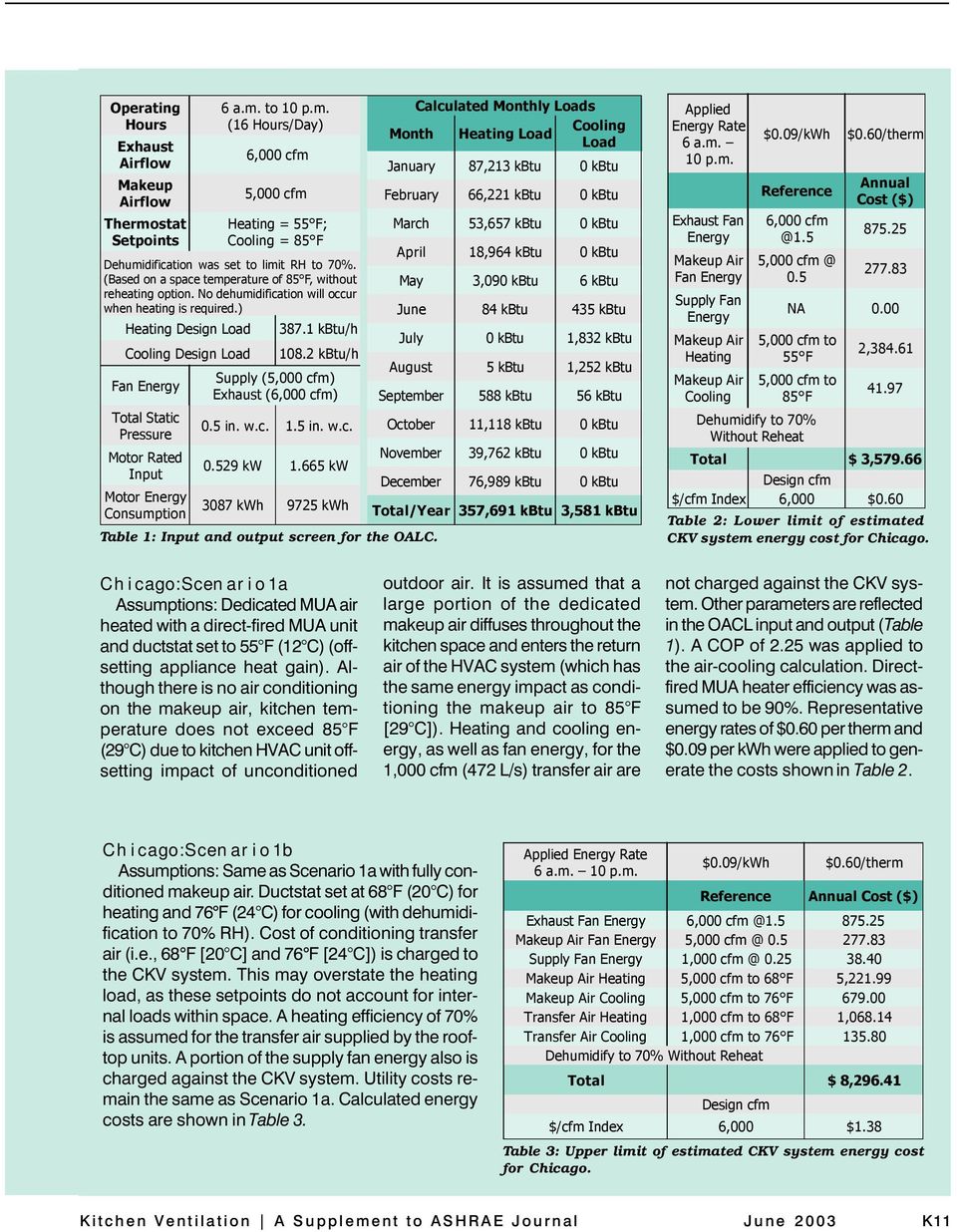
4 Operating Hours Exhaust Airflow Makeup Airflow Thermostat Setpoints Heating Design Load Cooling Design Load Fan Energy Total Static Pressure Motor Rated Input 6 a.m. to 10 p.m. (16 Hours/Day) 6,000 cfm 5,000 cfm Heating = 55 F; Cooling = 85 F Dehumidification was set to limit RH to 70%. (Based on a space temperature of 85 F, without reheating option. No dehumidification will occur when heating is required.) kbtu/h kbtu/h Supply (5,000 cfm) Exhaust (6,000 cfm) 0.5 in. w.c. 1.5 in. w.c kw kw Calculated Monthly Loads Month Heating Load Cooling Load January 87,213 kbtu 0 kbtu February 66,221 kbtu 0 kbtu March 53,657 kbtu 0 kbtu April 18,964 kbtu 0 kbtu May 3,090 kbtu 6 kbtu June 84 kbtu 435 kbtu July 0 kbtu 1,832 kbtu August 5 kbtu 1,252 kbtu September 588 kbtu 56 kbtu October 11,118 kbtu 0 kbtu November 39,762 kbtu 0 kbtu December 76,989 kbtu 0 kbtu Motor Energy 3087 kwh 9725 kwh Consumption Total/Year 357,691 kbtu 3,581 kbtu Table 1: Input and output screen for the OALC. Applied Energy Rate 6 a.m. 10 p.m. Exhaust Fan Energy Makeup Air Fan Energy Supply Fan Energy Makeup Air Heating Makeup Air Cooling $0.09/kWh Reference 6,000 5, $0.60/therm Annual Cost ($) NA ,000 cfm to 55 F 5,000 cfm to 85 F 2, Dehumidify to 70% Without Reheat Total $ 3, $/cfm Index 6,000 $0.60 Table 2: Lower limit of estimated CKV system energy cost for Chicago. Chicago: Scenario 1a Assumptions: Dedicated MUA air heated with a direct-fired MUA unit and ductstat set to 55 F (12 C) (offsetting appliance heat gain). Although there is no air conditioning on the makeup air, kitchen temperature does not exceed 85 F (29 C) due to kitchen HVAC unit offsetting impact of unconditioned outdoor air. It is assumed that a large portion of the dedicated makeup air diffuses throughout the kitchen space and enters the return air of the HVAC system (which has the same energy impact as conditioning the makeup air to 85 F [29 C]). Heating and cooling energy, as well as fan energy, for the 1,000 cfm (472 L/s) transfer air are not charged against the CKV system. Other parameters are reflected in the OACL input and output (Table 1). A COP of 2.25 was applied to the air-cooling calculation. Directfired MUA heater efficiency was assumed to be 90%. Representative energy rates of $0.60 per therm and $0.09 per kwh were applied to generate the costs shown in Table 2. Chicago: Scenario 1b Assumptions: Same as Scenario 1a with fully conditioned makeup air. Ductstat set at 68 F (20 C) for heating and 76 F (24 C) for cooling (with dehumidification to 70% RH). Cost of conditioning transfer air (i.e., 68 F [20 C] and 76 F [24 C]) is charged to the CKV system. This may overstate the heating load, as these setpoints do not account for internal loads within space. A heating efficiency of 70% is assumed for the transfer air supplied by the rooftop units. A portion of the supply fan energy also is charged against the CKV system. Utility costs remain the same as Scenario 1a. Calculated energy costs are shown in Table 3. $0.09/kWh $0.60/therm Exhaust Fan Energy 6, Makeup Air Fan Energy 5, Supply Fan Energy 1, Makeup Air Heating 5,000 cfm to 68 F 5, Makeup Air Cooling 5,000 cfm to 76 F Transfer Air Heating 1,000 cfm to 68 F 1, Transfer Air Cooling 1,000 cfm to 76 F Total $ 8, $/cfm Index 6,000 $1.38 Table 3: Upper limit of estimated CKV system energy cost for Chicago. Kitchen Ventilation A Supplement to ASHRAE Journal June 2003 K11
5 Miami: Scenario 2a Assumptions: Dedicated MUA air heated with a direct-fired MUA unit and ductstat set to 55 F (13 C). (In reality, makeup air heating would not be specified for a Miami restaurant.) There is no air-conditioning on makeup air, but kitchen temperature does not exceed 85 F (29 C) due to the kitchen HVAC unit offsetting impact of unconditioned outdoor air (same energy impact as conditioning the makeup air to 85 F [29 C]). Heating and cooling energy, as well as fan energy, for the 1,000 cfm (472 L/s) transfer air are not charged against the CKV system. Other input parameters are similar to the Chicago scenario. A COP of 2.25 was applied to the air-conditioning calculation. Representative energy rates of $0.80 per therm and $0.07 per kwh were applied to generate the costs shown in Table 4. $0.07/kWh $0.80/therm Exhaust Fan Energy 6, Makeup Air Fan Energy 5, Supply Fan Energy NA 0.00 Makeup Air Heating 5,000 cfm to 55 F Makeup Air Cooling 5,000 cfm to 85 F Transfer Air Heating NA 0.00 Transfer Air Cooling NA 0.00 Total $ 1, $/cfm Index 6,000 $0.21 Table 4: Lower limit of estimated CKV system energy cost for Miami. Miami: Scenario 2b Assumptions: Same as Scenario 2a but with fully conditioned makeup air. Ductstat set at 68 F (20 C) for heating and 76 F (24 C) for cooling (with dehumidification to 70% RH). Cost of conditioning transfer air to the same temperatures is charged to the CKV system (i.e., 68 F [20 C] and 76 F [24 C]). A heating efficiency of 70% is applied to the transfer air with a COP of 2.25 for cooling. A portion of the supply fan energy also is charged against the CKV system. Utility costs remain the same as Scenario 2a. Calculated energy costs are shown in Table 5. $0.07/kWh $0.80/therm Exhaust Fan Energy 6, Makeup Air Fan Energy 5, Supply Fan Energy 1, Makeup Air Heating 5,000 cfm to 68 F Makeup Air Cooling 5,000 cfm to 76 F 6, Transfer Air Heating 1,000 cfm to 68 F Transfer Air Cooling 1,000 cfm to 76 F 1, Dehumidify to 70%Without Reheat Total $ 9, $/cfm Index 6,000 $1.54 Table 5: Upper limit of estimated CKV system energy cost for Miami. Los Angeles: Scenario 3a Assumptions: Dedicated MUA air heated with a direct-fired MUA unit and ductstat set to 55 F (13 C) (offsetting appliance heat gain). No air conditioning on makeup air, but kitchen temperature is assumed to not exceed 85 F (29 C) due to the kitchen HVAC unit offsetting impact of unconditioned outdoor air diffusing throughout the kitchen space. Heating and cooling energy as well as fan energy for the 1,000 cfm (472 L/s) transfer air are not charged against the CKV system. Representative energy rates of $0.70 per therm and $0.16 per kwh were applied to the energy components to generate the costs shown in Table 6. $0.16/kWh $0.70/therm Exhaust Fan Energy 6,000 1, Makeup Air Fan Energy 5, Supply Fan Energy NA 0.00 Makeup Air Heating 5,000 cfm to 55 F Makeup Air Cooling 5,000 cfm to 85 F 3.10 Transfer Air Heating NA 0.00 Transfer Air Cooling NA 0.00 Total $ 2, $/cfm Index 6,000 $0.36 Table 6: Lower limit of estimated CKV system energy cost for Los Angeles. K12 June 2003 Kitchen Ventilation A Supplement to ASHRAE Journal
![conditioning the makeup air to 85 F [29 C]). Heating and cooling energy, as well as fan energy, for the 1,000 cfm (472 L/s) transfer air are not charged against the CKV system.](/docs-images/53/11871391/images/page_5.jpg "Other input parameters are similar to the Chicago scenario. A COP of 2.25 was applied to the air-conditioning calculation. Representative energy rates of $0.80 per therm and $0.")
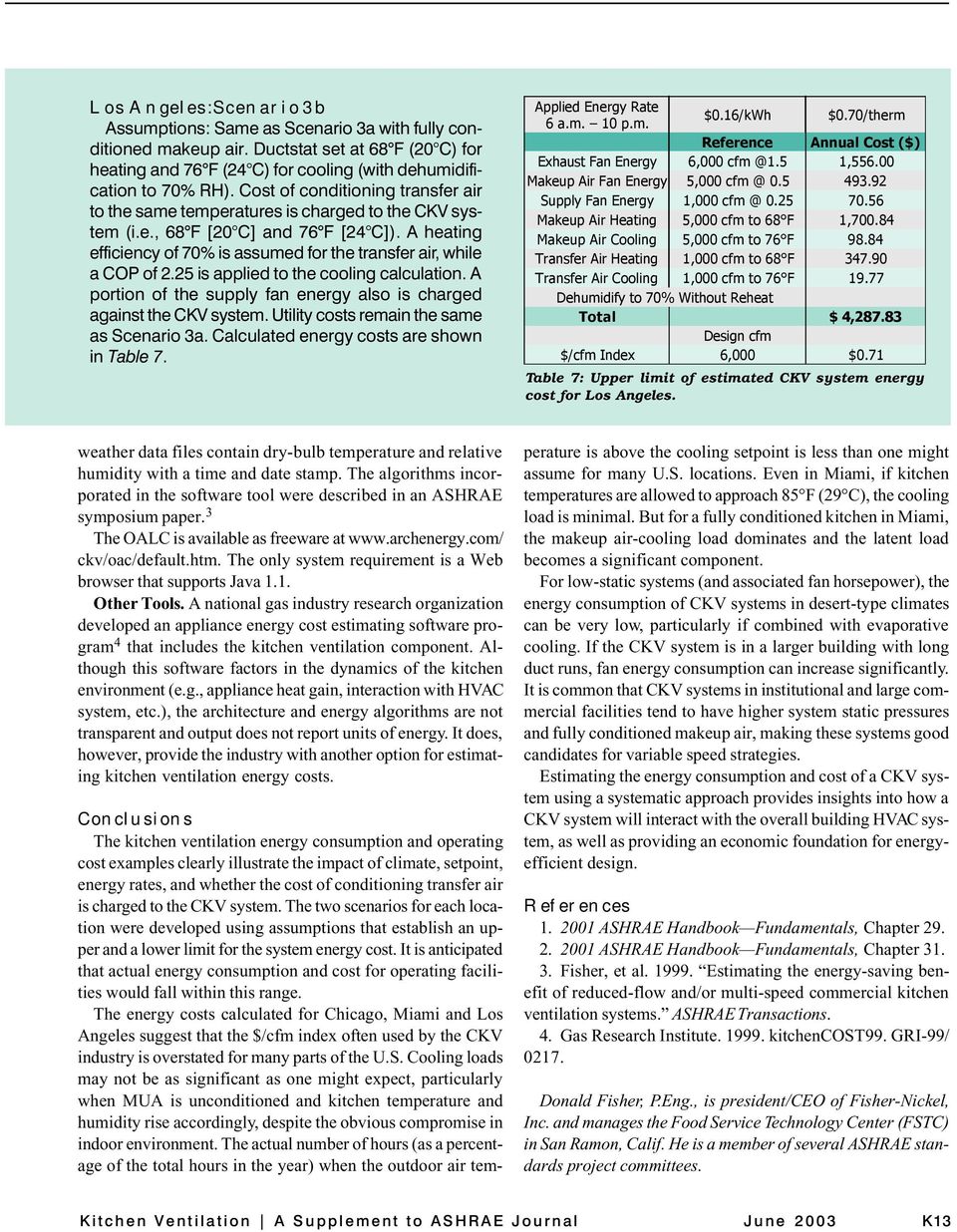
6 Los Angeles: Scenario 3b Assumptions: Same as Scenario 3a with fully conditioned makeup air. Ductstat set at 68 F (20 C) for heating and 76 F (24 C) for cooling (with dehumidification to 70% RH). Cost of conditioning transfer air to the same temperatures is charged to the CKV system (i.e., 68 F [20 C] and 76 F [24 C]). A heating efficiency of 70% is assumed for the transfer air, while a COP of 2.25 is applied to the cooling calculation. A portion of the supply fan energy also is charged against the CKV system. Utility costs remain the same as Scenario 3a. Calculated energy costs are shown in Table 7. $0.16/kWh $0.70/therm Exhaust Fan Energy 6,000 1, Makeup Air Fan Energy 5, Supply Fan Energy 1, Makeup Air Heating 5,000 cfm to 68 F 1, Makeup Air Cooling 5,000 cfm to 76 F Transfer Air Heating 1,000 cfm to 68 F Transfer Air Cooling 1,000 cfm to 76 F Total $ 4, $/cfm Index 6,000 $0.71 Table 7: Upper limit of estimated CKV system energy cost for Los Angeles. weather data files contain dry-bulb temperature and relative humidity with a time and date stamp. The algorithms incorporated in the software tool were described in an ASHRAE symposium paper. 3 The OALC is available as freeware at ckv/oac/default.htm. The only system requirement is a Web browser that supports Java 1.1. Other Tools. A national gas industry research organization developed an appliance energy cost estimating software program 4 that includes the kitchen ventilation component. Although this software factors in the dynamics of the kitchen environment (e.g., appliance heat gain, interaction with HVAC system, etc.), the architecture and energy algorithms are not transparent and output does not report units of energy. It does, however, provide the industry with another option for estimating kitchen ventilation energy costs. Conclusions The kitchen ventilation energy consumption and operating cost examples clearly illustrate the impact of climate, setpoint, energy rates, and whether the cost of conditioning transfer air is charged to the CKV system. The two scenarios for each location were developed using assumptions that establish an upper and a lower limit for the system energy cost. It is anticipated that actual energy consumption and cost for operating facilities would fall within this range. The energy costs calculated for Chicago, Miami and Los Angeles suggest that the $/cfm index often used by the CKV industry is overstated for many parts of the U.S. Cooling loads may not be as significant as one might expect, particularly when MUA is unconditioned and kitchen temperature and humidity rise accordingly, despite the obvious compromise in indoor environment. The actual number of hours (as a percentage of the total hours in the year) when the outdoor air temperature is above the cooling setpoint is less than one might assume for many U.S. locations. Even in Miami, if kitchen temperatures are allowed to approach 85 F (29 C), the cooling load is minimal. But for a fully conditioned kitchen in Miami, the makeup air-cooling load dominates and the latent load becomes a significant component. For low-static systems (and associated fan horsepower), the energy consumption of CKV systems in desert-type climates can be very low, particularly if combined with evaporative cooling. If the CKV system is in a larger building with long duct runs, fan energy consumption can increase significantly. It is common that CKV systems in institutional and large commercial facilities tend to have higher system static pressures and fully conditioned makeup air, making these systems good candidates for variable speed strategies. Estimating the energy consumption and cost of a CKV system using a systematic approach provides insights into how a CKV system will interact with the overall building HVAC system, as well as providing an economic foundation for energyefficient design. References ASHRAE Handbook Fundamentals, Chapter ASHRAE Handbook Fundamentals, Chapter Fisher, et al Estimating the energy-saving benefit of reduced-flow and/or multi-speed commercial kitchen ventilation systems. ASHRAE Transactions. 4. Gas Research Institute kitchencost99. GRI-99/ Donald Fisher, P.Eng., is president/ceo of Fisher-Nickel, Inc. and manages the Food Service Technology Center (FSTC) in San Ramon, Calif. He is a member of several ASHRAE standards project committees. Kitchen Ventilation A Supplement to ASHRAE Journal June 2003 K13
HVAC. Kitchen Exhaust. rooftop equipment! let s drop on a few exhaust fans! it doesn t get easier!
 HVAC & Kitchen Exhaust The Heart of Restaurant HVAC rooftop equipment! let s drop on a few exhaust fans! it doesn t get easier! 1 CKV Design: Just not that easy! There is no piece of equipment in the commercial
Integrating Kitchen Exhaust Systems with Building HVAC
 Design Guide 3 Improving Commercial Kitchen Ventilation System Performance Integrating Kitchen Exhaust Systems with Building HVAC This design guide provides information that may help achieve optimum performance
Halton - Achieving Energy Efficiency in School Design
 Halton - Achieving Energy Efficiency in School Design Enabling Wellbeing Halton Design Tools Drive Energy Efficient Kitchen Ventilation and Comfort Today, nutritional guidelines for school foodservice
EFFECTS OF INDOOR RELATIVE HUMIDITY ON REFRIGERATED DISPLAY CASE PERFORMANCE
 P (5, EFFECTS OF INDOOR RELATIVE HUMIDITY ON REFRIGERATED DISPLAY CASE PERFORMANCE Ronald H. Howell, Professor Luis Rosario, Graduate Student Antonio Bula, Graduate Student Department of Mechanical Engineering
HVAC Simplified Approach Option
 HVAC Simplified Approach Option Part I Project Address: City: HVAC System Designer of Record: Date: Zip: Qualification The building is 2 stories or less in height and has a gross floor area is less than
Makeup Air For Exhaust Systems In Tight Houses. Tony Jellen Engineering Projects
 Makeup Air For Exhaust Systems In Tight Houses Tony Jellen Engineering Projects PA Housing & Land Development Conference February 23, 2012 Effects of Kitchen Ventilation on Residential Dwellings Anthony
Optimizing Makeup Air
 Design Guide 2 Improving Commercial Kitchen Ventilation System Performance Optimizing Makeup Air This design guide provides information that will help achieve optimum performance and energy efficiency
Air Side Economizers and Energy Recovery - Improvements and New Regulations. Richard Lord 09-20-2012
 Air Side Economizers and Energy Recovery - Improvements and New Regulations Richard Lord 09-20-2012 Introduction For commercial buildings the use of outside air for cooling and ventilation is an important
The Impact of Demand-Controlled and Economizer Ventilation Strategies on Energy Use in Buildings
 4276 The Impact of Demand-Controlled and Economizer Ventilation Strategies on Energy Use in Buildings Michael J. Brandemuehl, Ph.D., P.E. Member ASHRAE James E. Braun, Ph.D., P.E. Member ASHRAE ABSTRACT
85 F 80 F 50% 75 F 70 F 73.0/61.8 45 F 10% Figure 1
 Feb. 07 INTRODUCTION: Wrap around heat pipes are air-to-air heat exchangers that are installed in the airstream upstream and downstream of a cooling coil to deliberately reduce the Sensible Heat Ratio
CRITICAL COOLING FOR DATA CENTERS
 IDEA 100 th Annual Conference & Trade Show CRITICAL COOLING FOR DATA CENTERS Presented by Ron Johanning, PE, LEED AP Mission Critical Market Leader Agenda EPA Report Data Center Energy Trends IT Best Practice
Creating Efficient HVAC Systems
 Creating Efficient HVAC Systems Heating and Cooling Fundamentals for Commercial Buildings Heating, ventilating, and air conditioning (HVAC) systems account for nearly half of the energy used in a typical
HVAC Technologies for Building Energy Efficiency Improvements 2013 National Symposium on Market Transformation. Richard Lord Carrier Fellow
 HVAC Technologies for Building Energy Efficiency Improvements 2013 National Symposium on Market Transformation Richard Lord Carrier Fellow HVAC Industry Challenges and Issues Ozone Deletion Global Warming
DATA CENTER COOLING INNOVATIVE COOLING TECHNOLOGIES FOR YOUR DATA CENTER
 DATA CENTER COOLING INNOVATIVE COOLING TECHNOLOGIES FOR YOUR DATA CENTER DATA CENTERS 2009 IT Emissions = Aviation Industry Emissions Nations Largest Commercial Consumers of Electric Power Greenpeace estimates
Saving Heating Costs In Warehouses
 2005, American Society of Heating, Refrigerating and Air-Conditioning Engineers, Inc. (www.ashrae.org). Reprinted by permission from ASHRAE Journal, (Vol. 47, No. 12, December 2005). This article may not
Achieving ENERGY EFFICIENCY with Standard Air-Conditioning Units. Mike West, PhD, PE Advantek Consulting, Inc
 Achieving ENERGY EFFICIENCY with Standard Air-Conditioning Units Mike West, PhD, PE Advantek Consulting, Inc Standard Air Conditioning Unit Packaged Unit Split System DX (not chilled water) Air-cooled
Whole House Dehumidification for Occupant Comfort and Energy Savings
 Downloaded from www.rsrews.com. Since 1968, RS Andrews has proudly served Atlanta's Heating, Air Conditioning & Plumbing Needs. Whole House Dehumidification for Occupant Comfort Energy Savings June 2009
Using Time-of-Day Scheduling To Save Energy
 The following article was published in ASHRAE Journal, May 29. Copyright 29 American Society of Heating, Refrigerating and Air-Conditioning Engineers, Inc. It is presented for educational purposes only.
APPLICATION GUIDE. Comparison of Latent Cooling Performance of Various HVAC systems in a Classroom Application
 APPLICATION GUIDE Comparison of Latent Cooling Performance of Various HVAC systems in a Classroom Application Section Comparison of Latent Cooling Performance of Introduction Most commercial HVAC systems
The ASHRAE HQ Building Can the energy efficiency of the different mechanical systems really be compared? RESIDENTIAL LIGHT COMMERCIAL COMMERCIAL
 The ASHRAE HQ Building Can the energy efficiency of the different mechanical systems really be compared? RESIDENTIAL LIGHT COMMERCIAL COMMERCIAL Technical Article April 2013 The ASHRAE HQ Building Can
White Paper Nest Learning Thermostat Efficiency Simulation for France. Nest Labs September 2014
 White Paper Nest Learning Thermostat Efficiency Simulation for France Nest Labs September 2014 Introduction This white paper gives an overview of potential energy savings using the Nest Learning Thermostat
Lesson 36 Selection Of Air Conditioning Systems
 Lesson 36 Selection Of Air Conditioning Systems Version 1 ME, IIT Kharagpur 1 The specific objectives of this chapter are to: 1. Introduction to thermal distribution systems and their functions (Section
Bring the fresh in. Dedicated Outside Air Systems
 Bring the fresh in. Dedicated Outside Air Systems The inside story on outside air. On average, we breathe in 3,400 gallons of air each day. Ambient indoor air pollution is a major problem, affecting health
SIMULATION OF RADIANT COOLING PERFORMANCE WITH
 SUMMARY REPORT MAY 2008 SIMULATION OF RADIANT COOLING PERFORMANCE WITH EVAPORATIVE COOLING SOURCES Timothy Moore Center for the Built Environment (CBE) University of California, Berkeley May 2008 EXECUTIVE
ENERGY SAVING STUDY IN A HOTEL HVAC SYSTEM
 ENERGY SAVING STUDY IN A HOTEL HVAC SYSTEM J.S. Hu, Philip C.W. Kwong, and Christopher Y.H. Chao Department of Mechanical Engineering, The Hong Kong University of Science and Technology Clear Water Bay,
Theoretical Study on Separate Sensible and Latent Cooling Air-Conditioning System
 Purdue University Purdue e-pubs International Refrigeration and Air Conditioning Conference School of Mechanical Engineering 2008 Theoretical Study on Separate Sensible and Latent Cooling Air-Conditioning
How To Save Money On Energy
 Business Programs and Services At our Delray location, we had an immediate 23 percent drop in lighting kilowatt-hour usage. That has a significant impact on our energy bills. Ken Infante, AutoNation, Inc.
Variable Air Volume - VAV
 Mode Enable Sensor Options Variable Air Volume - VAV The temperature of this sensor will determine if the unit is in heating, cooling or vent mode during occupied operation. The following options are available:
HVAC Efficiency Definitions
 HVAC Efficiency Definitions Term page EER - 2 SEER - 3 COP - 4 HSPF - 5 IPLV - 6 John Mix May 2006 Carrier Corporation 1 Energy Efficiency Ratio (EER) The energy efficiency ratio is used to evaluate the
Glossary of Heating, Ventilation and Air Conditioning Terms
 Glossary of Heating, Ventilation and Air Conditioning Terms Air Change: Unlike re-circulated air, this is the total air required to completely replace the air in a room or building. Air Conditioner: Equipment
Presentation Outline. Common Terms / Concepts HVAC Building Blocks. Links. Plant Level Building Blocks. Air Distribution Building Blocks
 Presentation Outline Common Terms / Concepts HVAC Building Blocks Plant Level Building Blocks Description / Application Data Green opportunities Selection Criteria Air Distribution Building Blocks same
EnergyPro Building Energy Analysis. Assisted Living Building
 EnergyPro Building Energy Analysis Assisted Living Building EnergyPro Building Energy Analysis for an assisted living building Project Scope The purpose of the EnergyPro energy model was to evaluate the
Comparing Energy Savings of Different VAV Systems
 Comparing Energy Savings of Different VAV Systems Prepared By: Martyn Dodd [email protected] EnergySoft LLC 1025 5th Street, Suite A Novato, CA 94945 415-897-6400 www.energysoft.com Last Modified: March
newsletter engineers energy-saving strategies for Water-Source Heat Pump Systems volume 36 2 providing insights for today s hvac system designer
 engineers volume 36 2 newsletter providing insights for today s hvac system designer energy-saving strategies for Water-Source Heat Pump Systems from the editor... Water-source heat pump (WSHP) systems
Dehumidification Frequently Asked Questions
 Dehumidification Basics Why do you want to keep indoor Rh between 30-60%? ASHRAE recommends keeping the relative humidity in a home between 30-60% to limit the effects of many unwanted conditions and harmful
ENHANCED LABORATORY HVAC SYSTEM
 ENHANCED LABORATORY HVAC SYSTEM INTRODUCTION Since the early 1980's the attention to more energy efficient laboratory designs has been on the rise due to the increase in energy cost and the emergence of
Element D Services Heating, Ventilating, and Air Conditioning
 Load Calculation Criteria PART 1 - GENERAL 1.01 OVERVIEW A. This section includes requirements for calculating HVAC cooling and heating loads. B. Load calculations must be performed in accordance with
Pool Dehumidification Basics
 Copyright 2009 Wescor. All rights reserved. Permission granted to reproduce for personal and educational use only. When energy costs were low, many pool owners considered only first cost when choosing
MODELLING AND OPTIMIZATION OF DIRECT EXPANSION AIR CONDITIONING SYSTEM FOR COMMERCIAL BUILDING ENERGY SAVING
 MODELLING AND OPTIMIZATION OF DIRECT EXPANSION AIR CONDITIONING SYSTEM FOR COMMERCIAL BUILDING ENERGY SAVING V. Vakiloroaya*, J.G. Zhu, and Q.P. Ha School of Electrical, Mechanical and Mechatronic Systems,
Preliminary Final Proposal
 1 Butler Memorial Hospital New Inpatient Tower Senior Capstone Project Mechanical Option Preliminary Final Proposal Mechanical System Re-design and Breadth Topics Butler Memorial Hospital New Inpatient
Hospital Application Guide. Cost-effective climate control for hospitals
 Hospital Application Guide Cost-effective climate control for hospitals Munters is the world leader in dehumidification Munters is the largest manufacturer of dehumidifiers in the world. Since developing
J O U R N A L. Energy Performance for. Proper Specification of Air Terminal Units Future Climate Impacts on Building Design
 Copyright 24, American Society of Heating, Refrigerating & Air-Conditioning Engineers, Inc., 79 Tullie Circle NE, Atlanta, GA. 3329. Reprinted by permission from the September 24 Issue of ASHRAE Journal
Answers to Your Questions from the Webinar
 2008 Desert Aire and USA Swimming. Used by permission. Desert Aire & USA Swimming - Aquatics Webinar - Answers to Your Questions Answers to Your Questions from the Webinar Thank you for your interest in
Applying Schedules and Profiles in HAP
 This HAP e-help discusses the importance of properly applying schedules and profiles in HAP. We will also discuss potential misapplications of these user inputs. First, we need to understand the differences
By Tom Brooke PE, CEM
 Air conditioning applications can be broadly categorized as either standard or critical. The former, often called comfort cooling, traditionally just controlled to maintain a zone setpoint dry bulb temperature
Flexibility, Efficiency In San Antonio Arena
 2005, American Society of Heating, Refrigerating and Air-Conditioning Engineers, Inc. (www.ashrae.org). Reprinted by permission from ASHRAE Journal, (Vol. 47, No. 9, September 2005). This article may not
Smart School Symposium Heating Ventilation and Air Conditioning Session HVAC Products. Richard Lord
 Smart School Symposium Heating Ventilation and Air Conditioning Session HVAC Products Richard Lord Overview and Agenda My goal today is to give you quick an overview of the current status of HVAC products
Heat Recovery In Retail Refrigeration
 This article was published in ASHRAE Journal, February 2010. Copyright 2010 American Society of Heating, Refrigerating and Air-Conditioning Engineers, Inc. Posted at www.ashrae.org. This article may not
Improving Data Center Energy Efficiency Through Environmental Optimization
 Improving Data Center Energy Efficiency Through Environmental Optimization How Fine-Tuning Humidity, Airflows, and Temperature Dramatically Cuts Cooling Costs William Seeber Stephen Seeber Mid Atlantic
Kitchen Ventilation Systems: Part 2 Providing Adequate Makeup Air
 The Pennsylvania Housing Research Center Kitchen Ventilation Systems: Part 2 Providing Adequate Makeup Air Builder Brief: April 2012 Anthony C. Jellen, PE & Brian M. Wolfgang, EIT, Michael A. Turns, MS
DEVELOPMENT OF AN OPEN SOURCE HOURLY BUILDING ENERGY MODELING SOFTWARE TOOL
 DEVELOPMENT OF AN OPEN SOURCE HOURLY BUILDING ENERGY MODELING SOFTWARE TOOL Brittany Hanam, MASc, EIT RDH Building Engineering Ltd. Vancouver, BC John Straube, PhD, P.Eng. Building Engineering Group, Civil
RESEARCH HIGHLIGHT. The Impact of Heat Pump Water Heaters on Whole-House Energy Consumption
 RESEARCH HIGHLIGHT December 2014 Technical Series 14-104 The Impact of Heat Pump Water Heaters on Whole-House Energy Consumption INTRODUCTION Heat pump water heaters are one of the most energyefficient
RESEARCH HIGHLIGHT. Performance Assessment of a Cold-Climate Air Source Heat Pump
 RESEARCH HIGHLIGHT December 2014 Technical Series 14-102 Performance Assessment of a Cold-Climate Air Source Heat Pump INTRODUCTION Most Canadians are familiar with air source heat pump technology in the
Lawrence Berkeley National Laboratory Lawrence Berkeley National Laboratory
 Lawrence Berkeley National Laboratory Lawrence Berkeley National Laboratory Title: Energy Implications of Economizer Use in California Data Centers Author: Shehabi, Arman Publication Date: 09-23-8 Permalink:
Benefits of Water-Cooled Systems vs. Air-Cooled Systems for Air-Conditioning Applications
 Benefits of Water-Cooled Systems vs. Air-Cooled Systems for Air-Conditioning Applications Kavita A. Vallabhaneni U. S. Government commitment to reduce greenhouse gas emissions can have a significant impact
PERCENT OUTDOOR AIR (%OA) CALCULATION AND ITS USE
 PERCENT OUTDOOR AIR (%OA) CALCULATION AND ITS USE APPLICATION NOTE TI-138 TSI s IAQ-CALC TM Indoor Air Quality Meter and TH-CALC TM Thermohygrometer calculate Percent Outdoor Air (%OA). In order to take
Lower Energy Costs with Rooftop Air-Conditioning Package Units
 Lower Energy Costs with Rooftop Air-Conditioning Package Units Sponsored by Mike West, PhD, PE Advantek Consulting, Inc Package Unit Efficiency Factors Sensible and latent performance ratings Unit efficiency
PROTOCOL FOR BUILDING ENERGY ANALYSIS SOFTWARE For Class 3, 5, 6, 7, 8 and 9 buildings
 PROTOCOL FOR BUILDING ENERGY ANALYSIS SOFTWARE For Class 3, 5, 6, 7, 8 and 9 buildings Version 2006.1 AUSTRALIAN BUILDING CODES BOARD JANUARY 2006 TABLE OF CONTENTS Foreword 1. Scope 2. Purpose and context
DOAS UNITS. www.reznorhvac.com MAKEUP AND VENTILATION AIR 100% OUTSIDE AIR. Kitchens Hotel Corridors Laboratories. Paint Booths. Capacities Tons MBH
 MAKEUP AND VENTILATION AIR 100% OUTSIDE AIR Kitchens Hotel Corridors Laboratories Conference CENTERS Schools Paint Booths Malls/Shopping Centers DOAS UNITS Capacities 5-35 Tons 50-800 MBH 30-120 kw 650-9,000
Dr. Michael K. West, PE 1 Dr. Richard S. Combes, PE 2 Advantek Consulting / Melbourne, Florida
 Optimizing 100% Outside Air Systems with Heat Pipes Dr. Michael K. West, PE 1 Dr. Richard S. Combes, PE 2 Advantek Consulting / Melbourne, Florida Introduction To meet increasingly rigorous building codes
Data Center Heat Rejection
 This article was published in ASHRAE Journal, March 2011. Copyright 2011 American Society of Heating, Refrigerating and Air-Conditioning Engineers, Inc. Posted at www.ashrae.org. This article may not be
International Telecommunication Union SERIES L: CONSTRUCTION, INSTALLATION AND PROTECTION OF TELECOMMUNICATION CABLES IN PUBLIC NETWORKS
 International Telecommunication Union ITU-T TELECOMMUNICATION STANDARDIZATION SECTOR OF ITU Technical Paper (13 December 2013) SERIES L: CONSTRUCTION, INSTALLATION AND PROTECTION OF TELECOMMUNICATION CABLES
Impacts of Refrigerant Charge on Air Conditioner and Heat Pump Performance
 Purdue University Purdue e-pubs International Refrigeration and Air Conditioning Conference School of Mechanical Engineering 2010 Impacts of Refrigerant Charge on Air Conditioner and Heat Pump Performance
Greenhouse Gas Implications of HVAC Upgrades in Multi-Unit Residential Buildings
 Greenhouse Gas Implications of HVAC Upgrades in Multi-Unit Residential Buildings J A NUARY 2015 INTRODUCTION This Research Report explores best practices and approaches for reducing greenhouse gas (GHG)
CHAPTER 3. BUILDING THERMAL LOAD ESTIMATION
 CHAPTER 3. BUILDING THERMAL LOAD ESTIMATION 3.1 Purpose of Thermal Load Estimation 3.2 Heating Load versus Cooling Load 3.3 Critical Conditions for Design 3.4 Manual versus Computer Calculations 3.5 Heating
Venice Library Humidity Study. for Williams Building Diagnostics, LLC 305 15 th Street West Bradenton, FL 34205. Report April 13, 2015
 for Williams Building Diagnostics, LLC 305 15 th Street West Bradenton, FL 34205 Report April 13, 2015 Moses & Associates, Inc. 2209 NW 40 th Terrace, Suite A Gainesville, FL 32605 FL License EB-0003097
Rating Water-Source Heat Pumps Using ARI Standard 320 and ISO Standard 13256-1
 Rating Water-Source Heat Pumps Using ARI Standard 320 and ISO Standard 13256-1 W. Vance Payne and Piotr A. Domanski National Institute of Standards and Technology Building and Fire Research Laboratory
Hybrid (Dual Fuel) - Gas Heat and Air Source Heat Pump
 s.doty 10-2014 White Paper #30 Hybrid (Dual Fuel) - Gas Heat and Air Source Heat Pump System Switches Fuels Automatically for Economy. What is an Air-Source Heat Pump? A heat pump is a modified air conditioning
Energy Efficiency Analysis for a Multi-Story Commercial Office Building. (LG Multi V Water II Heat Recovery VRF System)
 Energy Efficiency Analysis for a Multi-Story Commercial Office Building (LG Multi V Water II Heat VRF System) Commercial Air-Conditioning Engineering Study VRF-ES-BL-001-US 011M05 Executive Summary Contents
Strategy Guideline: HVAC Equipment Sizing
 Strategy Guideline: HVAC Equipment Sizing Arlan Burdick IBACOS, Inc. February 2012 This report received minimal editorial review at NREL NOTICE This report was prepared as an account of work sponsored
Energy Use in Residential Housing: A Comparison of Insulating Concrete Form and Wood Frame Walls
 PCA R&D Serial No. 415 Energy Use in Residential Housing: A Comparison of Insulating Concrete Form and Wood Frame Walls by John Gajda and Martha VanGeem 000 Portland Cement Association KEYWORDS Concrete,
Engineers Newsletter. Understanding Single-Zone VAV Systems. providing insights for today s hvac system designer. volume 42 2
 providing insights for today s hvac system designer Engineers Newsletter volume 42 2 Understanding Single-Zone VAV Systems Single-zone variable-air-volume (VAV) is not a new concept, but due to new energy
CHAPTER 4 LOAD CALCULATIONS 4.1 CONTEXT
 CHAPTER 4 LOAD CALCULATIONS 4.1 CONTEXT The accurate calculation of heating and cooling loads is essential to provide a sound bridge between fundamental building design decisions and an operating building.
Heating, Ventilation & Air Conditioning Equipment
 FinAnswer Express Utah Incentive Catalog Effective as of May 19, 2012 Heating, Ventilation & Air Conditioning Equipment Rocky Mountain Power provides incentives for many types of energy-efficient technologies.
Ventilation Retrofit Opportunities for Packaged HVAC
 Ventilation Retrofit Opportunities for Packaged HVAC Reid Hart, PE National Energy Efficiency Technology Summit September 2012 PNNL-SA-90782 Acknowledgements Bonneville Power Administration City of Eugene
COMPARATIVE LIFE-CYCLE ANALYSIS OF ENERGY-EFFICIENCY MEASURES AT TVA S CHATTANOOGA OFFICE COMPLEX: PHASE II RESULTS & FINAL DESIGN
 COMPARATIVE LIFE-CYCLE ANALYSIS OF ENERGY-EFFICIENCY MEASURES AT TVA S CHATTANOOGA OFFICE COMPLEX: PHASE II RESULTS & FINAL DESIGN Umesh Atre Innovative Design Inc 850 W Morgan St Raleigh, NC 27603 [email protected]
Section 2: Estimating Energy Savings and Incentives
 Section 2: Estimating Energy Savings and Incentives 2.1 Estimating Energy Savings and Incentives... 2 2.2 Customized Measures - Estimation Software... 2 2.2.1 AC&R I - High Efficiency Chiller... 3 2.2.2
Economizer Fundamentals: Smart Approaches to Energy-Efficient Free-Cooling for Data Centers
 A White Paper from the Experts in Business-Critical Continuity TM Economizer Fundamentals: Smart Approaches to Energy-Efficient Free-Cooling for Data Centers Executive Summary The strategic business importance
Comfort Conditioning & Indoor Air Quality
 This article was published in ASHRAE Journal, May 2011. Copyright 2011 American Society of Heating, Refrigerating and Air-Conditioning Engineers, Inc. Reprinted here by permission from ASHRAE at www.newellinstruments.com.
CLIMATE ENERGY INDEX AND BUILDING ENERGY INDEX: NEW INDICES TO ASSESS AND BENCHMARK BUILDING ENERGY PERFORMANCE
 CLIMATE ENERGY INDEX AND BUILDING ENERGY INDEX: NEW INDICES TO ASSESS AND BENCHMARK BUILDING ENERGY PERFORMANCE Don McLean, Ya Roderick, Richard Quincey, David McEwan, Integrated Environmental Solutions
How To Buy A Lennox Power System
 HVAC for Schools A Comprehensive Look at Products for a Clean, Comfortable Learning Environment Why Schools Choose Lennox Even as resources for schools continue to be constrained, education leaders and
CURBING THE COST OF DATA CENTER COOLING. Charles B. Kensky, PE, LEED AP BD+C, CEA Executive Vice President Bala Consulting Engineers
 CURBING THE COST OF DATA CENTER COOLING Charles B. Kensky, PE, LEED AP BD+C, CEA Executive Vice President Bala Consulting Engineers OVERVIEW Compare Cooling Strategies in Free- Standing and In-Building
HOW TO CONDUCT ENERGY SAVINGS ANALYSIS IN A FACILITY VALUE ENGINEERING STUDY
 HOW TO CONDUCT ENERGY SAVINGS ANALYSIS IN A FACILITY VALUE ENGINEERING STUDY Benson Kwong, CVS, PE, CEM, LEED AP, CCE envergie consulting, LLC Biography Benson Kwong is an independent consultant providing
Causes of High Relative Humidity Inside Air Conditioned Buildings. Roger G.Morse AIA, Paul Haas CSP, CIH Morse Zehnter Associates
 Causes of High Relative Humidity Inside Air Conditioned Buildings Roger G.Morse AIA, Paul Haas CSP, CIH Morse Zehnter Associates S. FLORIDA AVE. AMBIENT 91 F db / 78 F wb 16,000 HOURS ANNUALLY THAT wb
Tips and Tricks for Estimating Energy Savings. Celeste Cizik, P.E. Project Manager E M C Engineers, Inc.
 Tips and Tricks for Estimating Energy Savings Celeste Cizik, P.E. Project Manager E M C Engineers, Inc. AIA Quality Assurance Learning Objectives 1. Understand the pros and cons of various energy calculation
Scope of Work. See www.sei.ie for resources available
 HVAC SWG Summary Background Pool energy-efficiency knowledge Increase cost-competitiveness Develop resources aimed at assisting in reducing HVAC energy consumption Address barriers to energy-saving HVAC
Energy Efficiency Analysis for a Multi-Story Commercial Office Building. (LG Multi V III Heat Recovery VRF System)
 Energy Efficiency Analysis for a Multi-Story Commercial Office Building (LG Multi V III Heat Recovery VRF System) Commercial Air-Conditioning Engineering Study VRF-ES-BK-011-US 011L18 Executive Summary
Data Centers WHAT S ONTHEHORIZON FOR NR HVAC IN TITLE 24 2013? SLIDE 1
 WHAT S ONTHEHORIZON FOR NR HVAC IN TITLE 24 2013? SLIDE 1 Data Center CASE Scope Existing Title 24 2008 Scope Current scope ( 100 T24-2008) exempts process space from many of the requirements, however
HVAC Basic Science - System Capacity
 HVAC Basic Science - System Capacity Btu/hour, btu/h, b/h, btuh. btu?? 1 MBH = 1000 btu/hour 1 KBH = 1000 btu/hour 1 ton of cooling= 12,000 btu/hour 1 watt = 3.414 btu/hour 1 kilowatt = 1000 watts = 3,414
A Comparison of Energy, Economic and Environmental Benefits of Tinted Low-E Glasses
 A Comparison of Energy, Economic and Environmental Benefits of Tinted Low-E Glasses When measured against dual-pane tinted glass, the most commonly specified type of tinted glass, the study showed that
1. What percent of a commercial business s energy usage comes from their HVAC system? A. 13% B. 23% C. 33% D. 43% E. 53%
 1 1. What percent of a commercial business s energy usage comes from their HVAC system? A. 13% B. 23% C. 33% D. 43% E. 53% 2. How much money do commercial facilities spend per square foot on energy costs
Example Retrocommissioning Measure: Opening Throttled Discharge Valves
 Opening Throttled Discharge Valves This 21-story building, constructed in 1997, is located in Oregon and contains 589,000 gross square feet of mostly office occupancy. The HVAC system includes six large
Selecting the Supply Air Conditions for a Dedicated Outdoor Air System Working in Parallel with Distributed Sensible Cooling Terminal Equipment
 AT-01-7-3 Selecting the Supply Air Conditions for a Dedicated Outdoor Air System Working in Parallel with Distributed Sensible Cooling Terminal Equipment Kurt M. Shank Student Member ASHRAE Stanley A.
Dedicated Outdoor Air-Dual Wheel System Control Requirements
 4428 Dedicated Outdoor Air-Dual Wheel System Control Requirements Stanley A. Mumma, Ph.D., P.E. Fellow ASHRAE ABSTRACT The central thrust of this paper is to develop a clear understanding of the performance