
The Global Market for Liquefied Natural Gas
|
|
|
- May Mitchell
- 10 years ago
- Views:
Transcription
1 The Global Market for Liquefied Natural Gas David Jacobs* Liquefied natural gas (LNG) provides an economic means to transport natural gas over long distances, bringing production from remote gas reserves to market. A large expansion in global LNG trade is currently under way, and Australia is likely to emerge as the second largest supplier globally in coming years. This article describes the functioning of the global LNG market and outlines Australia s position within the market. Introduction The global market for LNG is of growing importance to the Australian economy. In recent years, significant investments in LNG production have been committed, with projects under construction currently totalling around A$12 billion. If these projects proceed as planned, Australia s LNG exports are likely to increase more than three-fold over the next five years (see Christie et al 211). 1 In addition to these committed projects, a number of other developments are being evaluated that could see LNG exports approach coal and iron ore in terms of their contribution to total export earnings over the coming decade. 2 Natural Gas Natural gas supplies around one-fifth of the globe s energy needs, compared with one-third from oil and one-quarter from coal (Graph 1). Natural gas has a wide variety of uses with the largest being power generation, followed by industrial uses (such as the production of chemicals) and residential * The author is from Domestic Markets Department, and formerly from Economic Analysis Department, and would like to thank Virginia Christie for her valuable contributions. 1 These figures are based on projects that have received final investment approval: Australia Pacific LNG (phase 1), Gladstone LNG, Gorgon LNG, Pluto Foundation Project, Prelude FLNG and Queensland Curtis LNG. Some projects have received approval since Christie et al (211). 2 The global market for bulk commodities has been discussed previously in Christie et al (211) and Andrews (29) Graph 1 World Energy Consumption by Fuel* Per cent of total energy consumption, 28 Other Industry Residential Power Transport Oil Coal Natural gas * Oil includes crude oil and oil products; coal includes all coal types and peat; power includes electricity and heat plants, blast furnaces and energy industry use Sources: International Energy Agency; RBA uses (including heating and cooking). In recent decades, there has been strong growth in natural gas consumption in the Asia-Pacific region and the Middle East, although North America remains the largest gas consumer (Graph 2). 3 Natural gas is the cleanest-burning fossil fuel, producing significantly lower carbon emissions than coal or oil, as well as lower levels of other pollutants (Table 1). As a result, natural gas has made up a large 3 A variety of measurement units are commonly used for natural gas and LNG. This article uses billions of cubic metres () except where otherwise indicated, consistent with the practice of the International Energy Agency. For conversion tables, see BP (211) Bulletin SEPTEMBER Quarter

2 Table 1: Energy Commodities Global Reserves and Production (a) Proven reserves 21 Production 21 Reserves to production ratio Carbon emissions (b) Billion tonnes oil equivalent Billion tonnes oil equivalent per year Years Grams CO 2 per kilowatt hour Natural gas Crude oil Coal (a) Oil equivalence is based on average calorific value of different fuels. Proven reserves are those which, based on geological and engineering information, can be recovered in future with reasonable certainty based on current economic and operating conditions. Both conventional and unconventional sources of gas and oil are included in figures for production and proven reserves. (b) Figures based on average emissions per kilowatt hour from power generation in OECD member countries over 26 to 28. Values are an approximation and should be interpreted with caution. Sources: BP (211); International Energy Agency Graph 2 Global Natural Gas Consumption North America Former Soviet Union Europe (excluding Former Soviet Union) Latin America Middle East Source: BP (211) Asia-Pacific 2 Africa 21 portion of new electric power generation capacity in recent years, particularly in developed economies where it accounted for nearly three-quarters of capacity growth between 2 and 29. The shift toward gas power generation also reflects: lower capital outlays and shorter project lead times compared with coal and nuclear plants; flexibility in providing either peak or base load power or a supplement to intermittent renewable sources; and energy diversification policies. Global proven reserves of natural gas that is, known deposits that can be recovered with reasonable certainty given current technology and prices represent around 6 years of current production (Table 1). Based on energy content, proven gas reserves are around 8 per cent of the size of oil reserves, but only 4 per cent the size of coal reserves. Proven reserves of gas have increased gradually over time as a result of exploration and improved technology. In recent years, advances in drilling have meant that unconventional reserves of gas have become more economic to extract. Unconventional reserves are found in rock formations through which gas does not flow easily so is more difficult to extract these include coal seam gas, shale gas and tight gas. In Australia, conventional reserves are located primarily off the north-west coast, while significant coal seam gas reserves exist in the eastern coal basins. 4 The world s total recoverable reserves of gas are likely to be much larger than proven reserves, which are a relatively conservative measure requiring a high degree of certainty. While total recoverable reserves are difficult to measure, the International Energy Agency (IEA) estimates that they equate to around 12 years of current production for conventional deposits, and around 2 years of production including unconventional deposits (IEA 211b). 4 See Geoscience Australia and ABARE (21). While coal seam gas currently accounts for a small portion of Australia s economic demonstrated reserves, total identified and potential coal seam reserves are substantially larger and may exceed conventional reserves. 18 Reserve bank of Australia

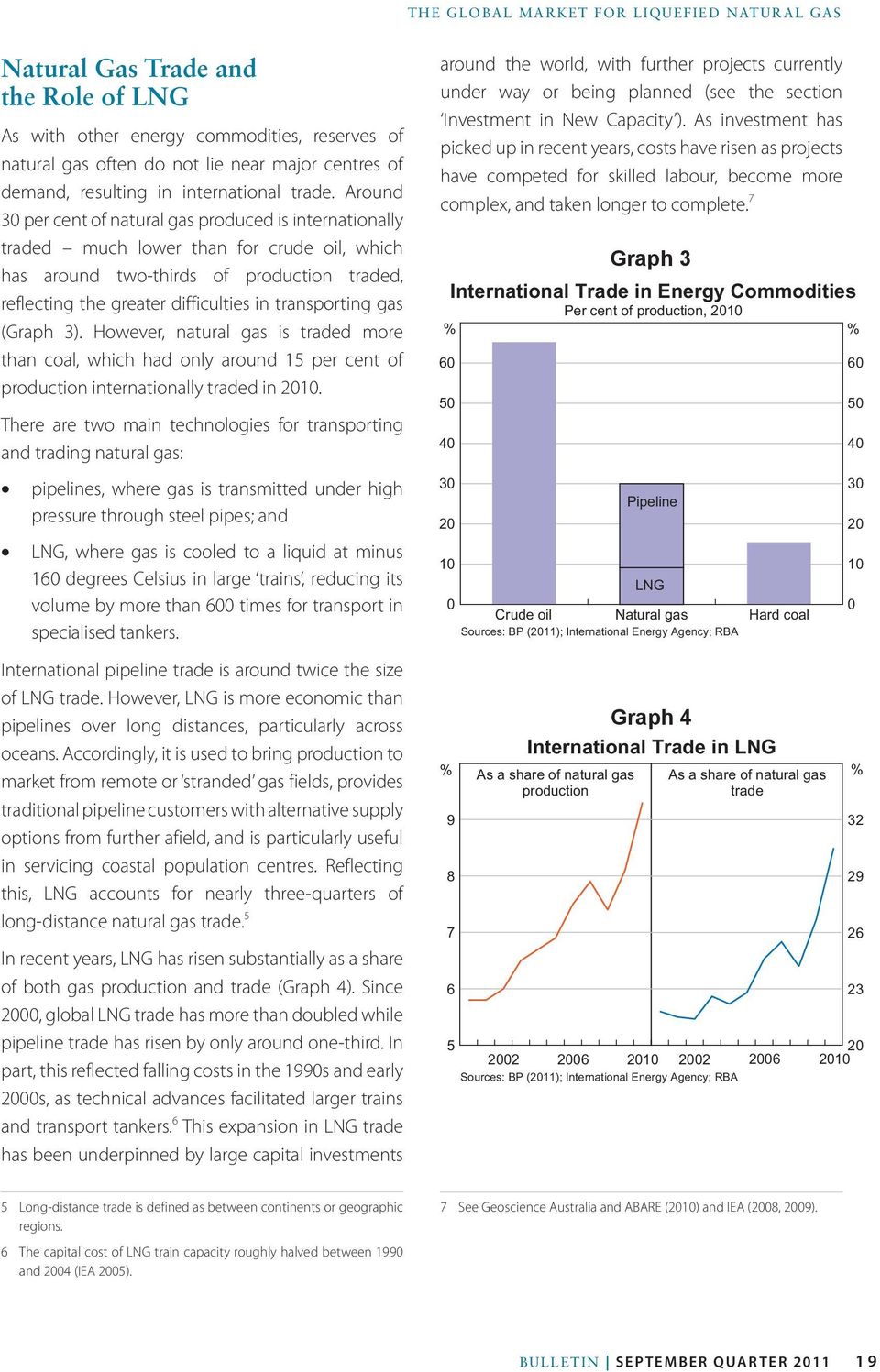
3 Natural Gas Trade and the Role of LNG As with other energy commodities, reserves of natural gas often do not lie near major centres of demand, resulting in international trade. Around 3 per cent of natural gas produced is internationally traded much lower than for crude oil, which has around two-thirds of production traded, reflecting the greater difficulties in transporting gas (Graph 3). However, natural gas is traded more than coal, which had only around 1 per cent of production internationally traded in 21. There are two main technologies for transporting and trading natural gas: pipelines, where gas is transmitted under high pressure through steel pipes; and LNG, where gas is cooled to a liquid at minus 16 degrees Celsius in large trains, reducing its volume by more than 6 times for transport in specialised tankers. International pipeline trade is around twice the size of LNG trade. However, LNG is more economic than pipelines over long distances, particularly across oceans. Accordingly, it is used to bring production to market from remote or stranded gas fields, provides traditional pipeline customers with alternative supply options from further afield, and is particularly useful in servicing coastal population centres. Reflecting this, LNG accounts for nearly three-quarters of long-distance natural gas trade. In recent years, LNG has risen substantially as a share of both gas production and trade (Graph 4). Since 2, global LNG trade has more than doubled while pipeline trade has risen by only around one-third. In part, this reflected falling costs in the 199s and early 2s, as technical advances facilitated larger trains and transport tankers. 6 This expansion in LNG trade has been underpinned by large capital investments around the world, with further projects currently under way or being planned (see the section Investment in New Capacity ). As investment has picked up in recent years, costs have risen as projects have competed for skilled labour, become more complex, and taken longer to complete Graph 3 International Trade in Energy Commodities Per cent of production, 21 Pipeline LNG Crude oil Natural gas Sources: BP (211); International Energy Agency; RBA Hard coal Graph 4 International Trade in LNG As a share of natural gas As a share of natural gas production trade Sources: BP (211); International Energy Agency; RBA Long-distance trade is defined as between continents or geographic regions. 6 The capital cost of LNG train capacity roughly halved between 199 and 24 (IEA 2). 7 See Geoscience Australia and ABARE (21) and IEA (28, 29). Bulletin SEPTEMBER Quarter
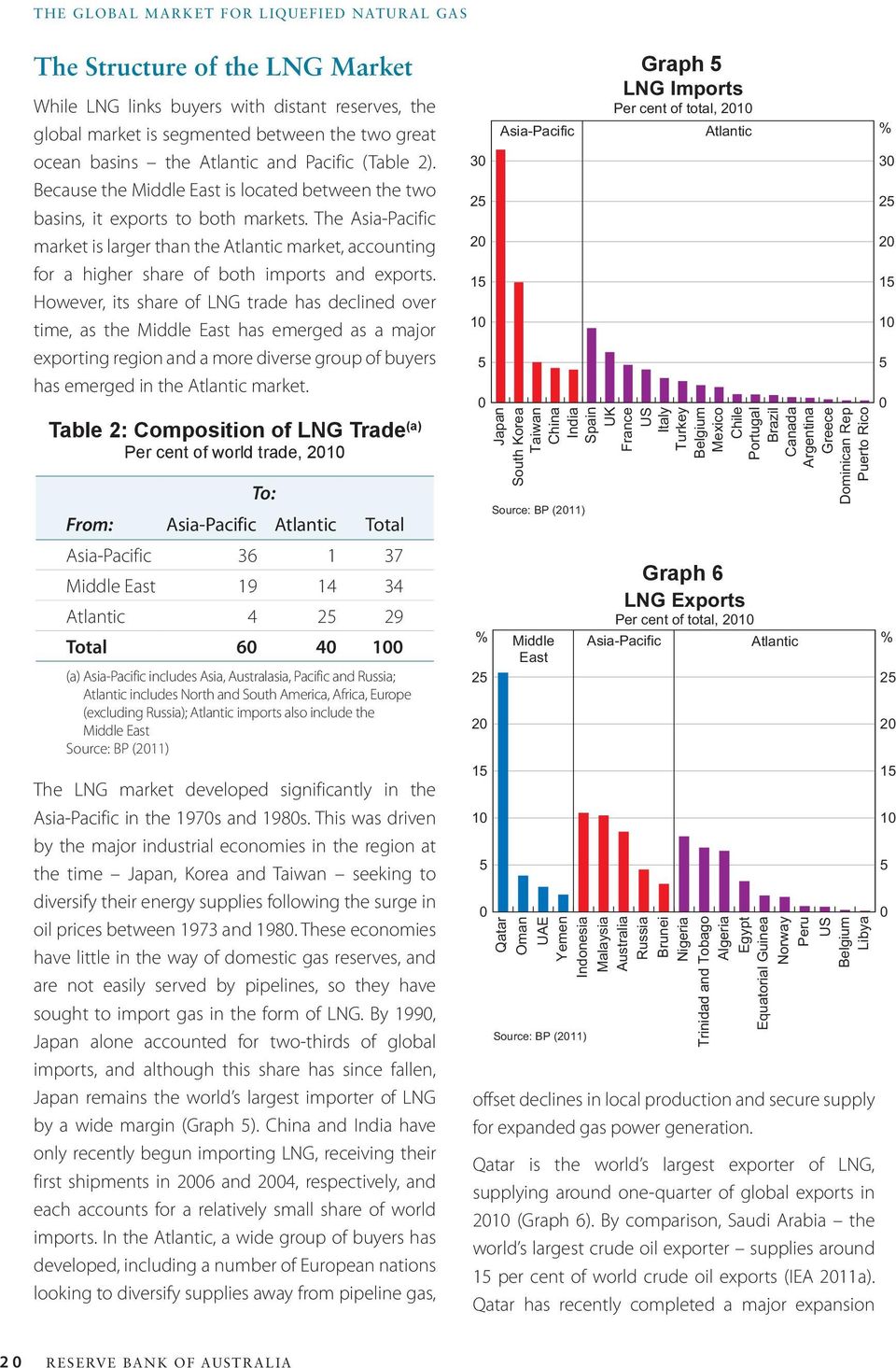
4 The Structure of the LNG Market While LNG links buyers with distant reserves, the global market is segmented between the two great ocean basins the Atlantic and Pacific (Table 2). Because the Middle East is located between the two basins, it exports to both markets. The Asia-Pacific market is larger than the Atlantic market, accounting for a higher share of both imports and exports. However, its share of LNG trade has declined over time, as the Middle East has emerged as a major exporting region and a more diverse group of buyers has emerged in the Atlantic market. Table 2: Composition of LNG Trade (a) Per cent of world trade, 21 To: From: Asia-Pacific Atlantic Total Asia-Pacific Middle East Atlantic Total (a) Asia-Pacific includes Asia, Australasia, Pacific and Russia; Atlantic includes North and South America, Africa, Europe (excluding Russia); Atlantic imports also include the Middle East Source: BP (211) The LNG market developed significantly in the Asia-Pacific in the 197s and 198s. This was driven by the major industrial economies in the region at the time Japan, Korea and Taiwan seeking to diversify their energy supplies following the surge in oil prices between 1973 and 198. These economies have little in the way of domestic gas reserves, and are not easily served by pipelines, so they have sought to import gas in the form of LNG. By 199, Japan alone accounted for two-thirds of global imports, and although this share has since fallen, Japan remains the world s largest importer of LNG by a wide margin (Graph ). China and India have only recently begun importing LNG, receiving their first shipments in 26 and 24, respectively, and each accounts for a relatively small share of world imports. In the Atlantic, a wide group of buyers has developed, including a number of European nations looking to diversify supplies away from pipeline gas, n Asia-Pacific Japa South Korea Taiwan China India Source: BP (211) Qatar Oman Middle East UAE Spain Yemen Indonesia Source: BP (211) Graph LNG Imports Per cent of total, 21 UK France US Italy Turkey Atlantic Belgium Mexico Chile Portugal Brazil Graph 6 LNG Exports Per cent of total, 21 Asia-Pacific Malaysia Australia Russia Brunei Nigeria Trinidad and Tobago Algeria Egypt Equatorial Guinea Atlantic a Canada Argentin Greece Norway Peru US Dominican Rep Puerto Rico Belgium Libya offset declines in local production and secure supply for expanded gas power generation. Qatar is the world s largest exporter of LNG, supplying around one-quarter of global exports in 21 (Graph 6). By comparison, Saudi Arabia the world s largest crude oil exporter supplies around 1 per cent of world crude oil exports (IEA 211a). Qatar has recently completed a major expansion Reserve bank of Australia
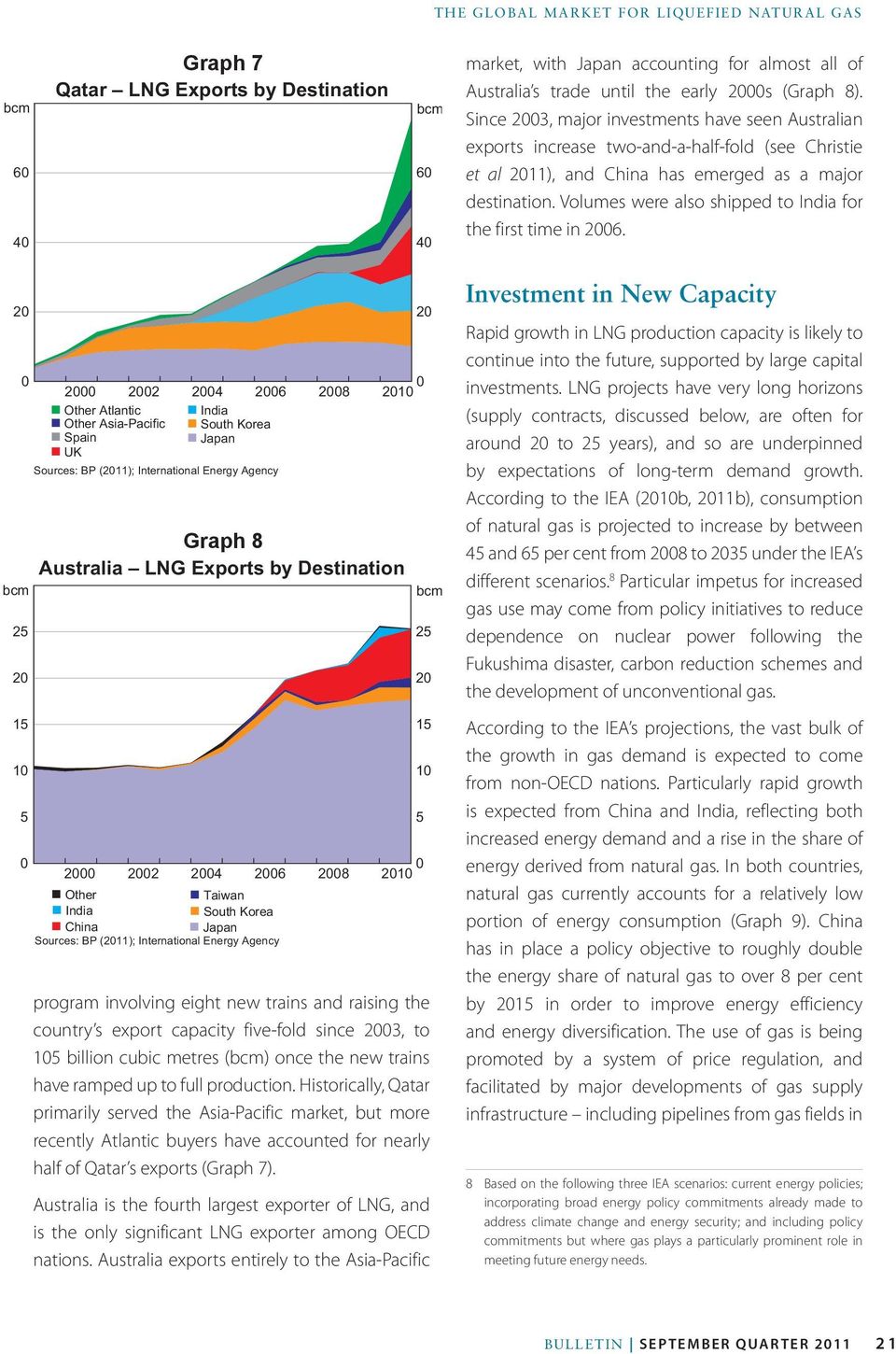
5 6 4 Graph 7 Qatar LNG Exports by Destination 6 4 market, with Japan accounting for almost all of Australia s trade until the early 2s (Graph 8). Since 23, major investments have seen Australian exports increase two-and-a-half-fold (see Christie et al 211), and China has emerged as a major destination. Volumes were also shipped to India for the first time in Other Atlantic Other Asia-Pacific Spain UK India South Korea Japan Sources: BP (211); International Energy Agency Graph 8 Australia LNG Exports by Destination Other Taiwan India South Korea China Japan Sources: BP (211); International Energy Agency program involving eight new trains and raising the country s export capacity five-fold since 23, to 1 billion cubic metres () once the new trains have ramped up to full production. Historically, Qatar primarily served the Asia-Pacific market, but more recently Atlantic buyers have accounted for nearly half of Qatar s exports (Graph 7). Australia is the fourth largest exporter of LNG, and is the only significant LNG exporter among OECD nations. Australia exports entirely to the Asia-Pacific Investment in New Capacity Rapid growth in LNG production capacity is likely to continue into the future, supported by large capital investments. LNG projects have very long horizons (supply contracts, discussed below, are often for around 2 to 2 years), and so are underpinned by expectations of long-term demand growth. According to the IEA (21b, 211b), consumption of natural gas is projected to increase by between 4 and 6 per cent from 28 to 23 under the IEA s different scenarios. 8 Particular impetus for increased gas use may come from policy initiatives to reduce dependence on nuclear power following the Fukushima disaster, carbon reduction schemes and the development of unconventional gas. According to the IEA s projections, the vast bulk of the growth in gas demand is expected to come from non-oecd nations. Particularly rapid growth is expected from China and India, reflecting both increased energy demand and a rise in the share of energy derived from natural gas. In both countries, natural gas currently accounts for a relatively low portion of energy consumption (Graph 9). China has in place a policy objective to roughly double the energy share of natural gas to over 8 per cent by 21 in order to improve energy efficiency and energy diversification. The use of gas is being promoted by a system of price regulation, and facilitated by major developments of gas supply infrastructure including pipelines from gas fields in 8 Based on the following three IEA scenarios: current energy policies; incorporating broad energy policy commitments already made to address climate change and energy security; and including policy commitments but where gas plays a particularly prominent role in meeting future energy needs. Bulletin SEPTEMBER Quarter
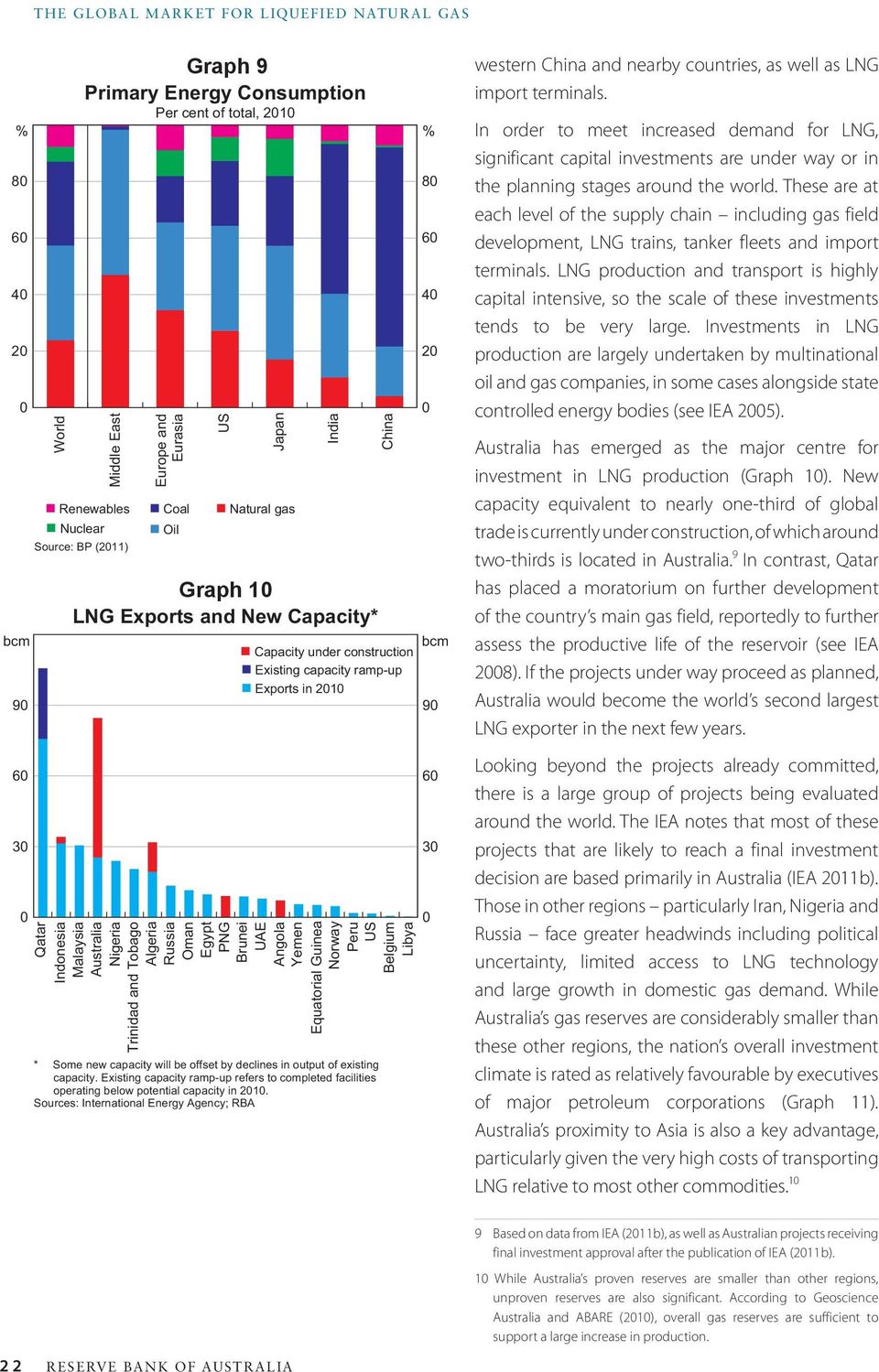
6 World Graph 9 Primary Energy Consumption Per cent of total, 21 Middle East Renewables Nuclear Source: BP (211) Qatar Indonesia Malaysia Europe and Eurasia Coal Oil US Japan Natural gas India Graph 1 LNG Exports and New Capacity* Australia Nigeria Trinidad and Tobago Algeria Russia Oman Egypt PNG Brunei * Some new capacity will be offset by declines in output of existing capacity. Existing capacity ramp-up refers to completed facilities operating below potential capacity in 21. Sources: International Energy Agency; RBA China Capacity under construction Existing capacity ramp-up Exports in 21 9 UAE Angola Yemen Equatorial Guinea Norway Peru US Belgium Libya 6 3 western China and nearby countries, as well as LNG import terminals. In order to meet increased demand for LNG, significant capital investments are under way or in the planning stages around the world. These are at each level of the supply chain including gas field development, LNG trains, tanker fleets and import terminals. LNG production and transport is highly capital intensive, so the scale of these investments tends to be very large. Investments in LNG production are largely undertaken by multinational oil and gas companies, in some cases alongside state controlled energy bodies (see IEA 2). Australia has emerged as the major centre for investment in LNG production (Graph 1). New capacity equivalent to nearly one-third of global trade is currently under construction, of which around two-thirds is located in Australia. 9 In contrast, Qatar has placed a moratorium on further development of the country s main gas field, reportedly to further assess the productive life of the reservoir (see IEA 28). If the projects under way proceed as planned, Australia would become the world s second largest LNG exporter in the next few years. Looking beyond the projects already committed, there is a large group of projects being evaluated around the world. The IEA notes that most of these projects that are likely to reach a final investment decision are based primarily in Australia (IEA 211b). Those in other regions particularly Iran, Nigeria and Russia face greater headwinds including political uncertainty, limited access to LNG technology and large growth in domestic gas demand. While Australia s gas reserves are considerably smaller than these other regions, the nation s overall investment climate is rated as relatively favourable by executives of major petroleum corporations (Graph 11). Australia s proximity to Asia is also a key advantage, particularly given the very high costs of transporting LNG relative to most other commodities. 1 9 Based on data from IEA (211b), as well as Australian projects receiving final investment approval after the publication of IEA (211b). 1 While Australia s proven reserves are smaller than other regions, unproven reserves are also significant. According to Geoscience Australia and ABARE (21), overall gas reserves are sufficient to support a large increase in production. 22 Reserve bank of Australia
7 Graph 11 Proven Gas Reserves and Investment Climate* 2 Per cent of global proven reserves Investment climate rank: Top third Middle third Bottom third 2 9 Graph 12 LNG Exports by Contract Type* 21 Long-term contract Spot and short-term contract Russia Iran Qatar Turkmenistan US UAE Venezuela Nigeria * Country scores based on average across states or provinces; no rating available for Saudi Arabia, which has 4 per cent of global proven gas reserves Sources: BP (211); Fraser Institute; RBA Contractual Arrangements and Pricing The vast bulk of LNG trade is conducted under long-term supply contracts. Long-term contracts provide buyers with security of energy supply, and producers with certainty when making large scale, long-term investment decisions. Long-term contracts are particularly prevalent in the Asia-Pacific market, accounting for more than 9 per cent of the region s exports in 21 (Graph 12). Historically, security of supply was particularly important for the traditional LNG importers in the Asia-Pacific Japan, Korea and Taiwan as these economies are almost entirely reliant upon LNG imports for their natural gas supply (Graph 13). While still dominated by long-term contracts, there has been a gradual shift to more flexible arrangements as the LNG market has grown and become more diverse. Trade on a spot basis and under short-term contracts (of less than four years) has risen from around per cent to 2 per cent of trade over the past decade. 11 Algeria Iraq Indonesia Australia China Malaysia Atlantic Middle East Asia-Pacific * Short-term contracts defined as term of four years or less Sources: International Group of Liquefied Natural Gas Importers; RBA Japan Graph 13 Source of Natural Gas Consumed Per cent of total, 21 South Korea LNG imports Sources: BP (211); RBA Taiwan In some cases, this reflects projects electing not to sell their entire output under contract in advance due to production uncertainty, and selling any above-contract output on the spot market. Spot and short-term trade has been relatively prevalent in the Atlantic market, accounting for one-third of trade in 21. Among Atlantic importers, LNG is small relative China Pipeline imports India US Europe and Eurasia Local production According to GIIGNL (21) and IGU (21). Bulletin SEPTEMBER Quarter

8 to pipeline trade and local gas production, and has to compete with these alternative gas supplies. Spot trade also accounts for a large portion of inter-basin LNG trade, with cargoes in recent years tending to flow from Atlantic producers to Asia-Pacific buyers. Prices under long-term contracts are based on formulas linked to a reference rate usually the lagged price of crude oil. Accordingly, the price per unit of LNG increases (decreases) when spot price of crude oil rises (falls), usually with a set lag of a few months. However, because these contracts are privately negotiated the exact formulas are not publicly available. Across Asia, LNG contract prices are typically linked to the Japan Customs-cleared Crude price (JCC). Historically, it has been common for contracts to have formulas that are non-linear, incorporating an S-curve that moderates the impact of both high and low oil prices upon the LNG price. 12 In contrast, spot LNG prices tend to track natural gas market fundamentals more closely. Spot prices are most easily observed at major gas trading hubs, where competing sources of gas (both pipeline and LNG) are priced. Of particular note are the Henry Hub in the southern United States, and the National Balancing Point in the United Kingdom (which is not actually a physical location). These hubs act as the pricing and delivery points for natural gas futures contracts. Because of the diversity in pricing arrangements, the segmented nature of the global market, and differences in gas quality, prevailing LNG prices can vary significantly around the world (Graph 14). While only limited data are available, the highest reported LNG import price in 21 was around three times the lowest reported price (on an annual average basis). 13 In contrast, there is much less variation in crude oil prices across the world. US$ US$ Graph 14 International LNG and Oil Prices* Annual average Range US average LNG US$/mBtu Crude Oil US$/barrel Japan average EU average * Based on available prices only; sample of 2 to 3 prices per year for LNG, and 48 prices per year for crude oil; includes cost of freight and insurance Sources: International Energy Agency; RBA LNG prices have become more dispersed in recent years. This has been due primarily to different supply and demand developments across regions, and between the gas and oil markets. After falling during the global recession, oil-linked contract prices in the Asia-Pacific have risen as a result of higher oil prices; the average cost of Japanese LNG imports from Australia has doubled since its trough in 29 (Graph 1). 14 However, spot gas prices in the Atlantic have remained relatively subdued, particularly in North America, with the Henry Hub spot price having risen little since 29. The low level of US spot prices has reflected large growth in unconventional gas production, as well as weak energy demand. US$ US$ Jensen (211) notes that S-curves have become less prevalent in recent years. 13 Jensen (211) discusses arbitrage in the LNG market. 14 Around 97 per cent of Australian exports to Japan in 21 were under long-term contracts, according to GIIGNL (21). 24 Reserve bank of Australia
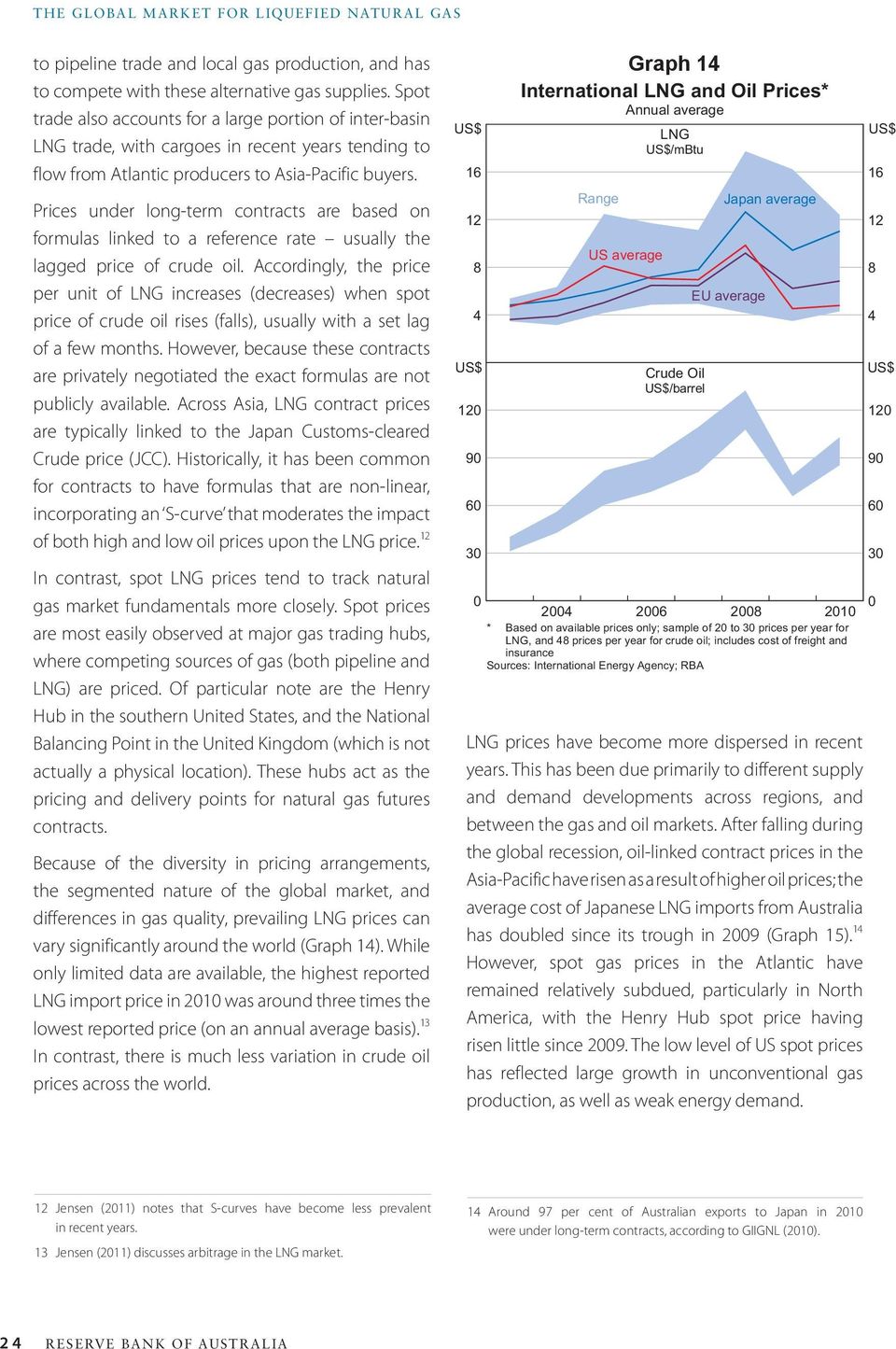
9 US$ Graph 1 Natural Gas Prices* US$ per million British thermal units, monthly average Japanese LNG imports from Australia (Average) UK spot (National Balancing Point) US spot (Henry Hub) * Cost of freight and insurance included in Japan import prices but not UK and US spot prices Sources: Bloomberg; RBA Risks to the Outlook While large-scale investments in LNG are under way, these projects are subject to a number of risks, both prior to and after completion. These risks include competing sources of gas supply, escalating costs in the investment stage and changes in global oil prices. Unconventional gas production has already had a considerable impact upon the LNG market, and could further affect the global gas supply if developed more widely. In the United States, increased unconventional production has resulted in a large fall in expected LNG import demand, and been a major factor in the low level of US spot gas prices. Since 2, shale gas has risen from 4 per cent to 23 per cent of US gas production, and is expected to reach one-third by the middle of the decade (EIA 211a, 211b). This has substantially altered the nation s supply-demand balance; the United States was previously expected to become a major LNG importer, as reflected in Energy Information Administration forecasts at the time (Graph 16). However, the nation is now largely gas self-sufficient and there are some proposals to export LNG, potentially to the Asia-Pacific market. To date the development of unconventional gas has been primarily in the United States and Canada, but US$ deposits are abundant around the world (Graph 17). A number of regions have taken steps in recent years to increase unconventional production, including some of Australia s major export markets (IEA 21a). In China, large reserves of both shale and coal seam gas are believed to exist, and there have recently been various steps towards exploration and development of these reserves. Australia currently produces small volumes of unconventional natural gas, although projects under way in Queensland will see coal seam gas used to supply LNG for the first time. Graph 16 United States Forecast Net Imports of LNG Actual 2 21 Source: Energy Information Administration Source: International Energy Agency 21 2 forecast 211 forecast Graph 17 Estimated Remaining Recoverable Gas Reserves trcm Eastern Europe and Eurasia Middle East Trillions of cubic metres Tight gas trcm Shale gas Coal seam methane Conventional 2 OECD North America Asia-Pacific Latin America Africa OECD Europe 1 1 Bulletin SEPTEMBER Quarter 211 2

10 While unconventional gas has the potential to provide a major source of new supply globally, possibly displacing some LNG imports, there are also barriers to its further development. The methods used to extract unconventional gas have come under scrutiny in recent years, particularly with regard to their potential impact on the environment. Concerns have been raised regarding the possible contamination of groundwater from the main technique used to extract unconventional gas, which involves fracturing rock deposits by pumping fluids under high pressure. In some cases around the world, the quality of gas is also thought to be low compared with the high-grade gas used to produce Australian LNG. Aside from environmental issues, it may also take some time to bring new production to market. An additional risk to Asia-Pacific LNG producers is the potential for Qatar to redirect production. According to industry analysts, a significant volume of Qatar s LNG output could potentially be diverted from the Atlantic market to the Asia-Pacific market (see, for example, Wood Mackenzie (211)). However, Qatar is reportedly seeking pricing terms that some Asia-Pacific buyers have to date been unwilling to accept. While LNG investments face a variety of risks, the use of long-term contracts affords a significant degree of protection, particularly in terms of volumes. In Australia, projects typically do not proceed until sales contracts are in place. Australia also remains a favoured contract partner owing to a low level of geopolitical risk. Thus, although the LNG market might look substantially different down the track, projects that are currently well advanced and can get product to market quickly will have an advantage in securing long-term supply contracts. Australian projects are well placed in this regard, as LNG investments have already progressed significantly with a number of projects receiving final investment approval in 211, and more are expected over the period ahead. Conclusion Natural gas is a key source of energy for the world economy. An increasing share of natural gas is traded by way of LNG, which facilitates long-distance trade and brings gas from remote reserves to market. The LNG market is not as globalised as some other energy commodities, with trade segmented between regions and subject to a variety of pricing arrangements. Over coming decades, demand for LNG is expected to grow rapidly in the Asia-Pacific. In response, Australia has emerged as a major centre for LNG investment and is likely to become the second largest LNG supplier globally during the decade. As a result, developments in the LNG market have taken on increased importance for the Australian economy. R 26 Reserve bank of Australia
11 References Andrews D (29), Australia and the Global Market for Bulk Commodities, RBA Bulletin, January, pp 1 6. BP (211), BP Statistical Review of World Energy, June 211, BP plc, London. Christie V, B Mitchell, D Orsmond and M Van Zyl (211), The Iron Ore, Coal and Gas Sectors, RBA Bulletin, March, pp 1 7. EIA (Energy Information Administration) (211a), Annual Energy Outlook 211, US Department of Energy, Washington DC. EIA (211b), World Shale Gas Resources: An Initial Assessment of 14 Regions Outside the United States, US Department of Energy, Washington DC. Geoscience Australia and ABARE (21), Australian Energy Resource Assessment, Canberra. GIIGNL (International Group of Liquefied Natural Gas Importers) (21), The LNG Industry 21, Paris. IEA (28), Natural Gas Market Review 28, OECD/IEA, Paris. IEA (29), Natural Gas Market Review 29, OECD/IEA, Paris. IEA (21a), Medium-Term Oil & Gas Markets 21, OECD/IEA, Paris. IEA (21b), World Energy Outlook 21, OECD/IEA, Paris. IEA (211a), Oil Information 211, OECD/IEA, Paris. IEA (211b), World Energy Outlook 211 Special Report: Are We Entering a Golden Age of Gas?, OECD/IEA, Paris. IGU (International Gas Union) (21), World LNG Report, Oslo. Jensen JT (211), Asian Natural Gas Markets: Supply, Infrastructure, and Pricing Issues, Paper presented at the 211 Pacific Energy Summit, Unlocking the Potential of Natural Gas in the Asia Pacific, Jakarta, February. Wood Mackenzie (211), Pacific Basin LNG How Will the Market be Balanced, Paper presented at the Wood MacKenzie Global Gas and LNG Forum, Factors Shaping Asia-Pacific s Future, Tokyo/Singapore, 17/24 May. IEA (International Energy Agency) (2), Resources to Reserves: Oil & Gas Technologies for the Energy Markets of the Future, OECD/IEA, Paris. Bulletin SEPTEMBER Quarter
12 28 Reserve bank of Australia

LNG Poised to Significantly Increase its Share of Global Gas Market David Wood February 2004 Petroleum Review p.38-39
 LNG Poised to Significantly Increase its Share of Global Gas Market David Wood February 2004 Petroleum Review p.38-39 For the past few years LNG has experienced high levels of activity and investment in
Global growth rates Macroeconomic indicators CEDIGAZ Reference Scenario
 Medium and Long Term Natural Gas Outlook CEDIGAZ February 215 Global growth rates Macroeconomic indicators CEDIGAZ Reference Scenario 4 3 %/year 199-213 213-235 6 Main consuming markets - %/year (213-235)
Table 1: Resource Exports Per cent of total nominal exports; selected years
 Australia and the Global market for Bulk Commodities Introduction The share of Australia s export earnings derived from bulk commodities coking coal, thermal coal and iron ore has increased over recent
THE GROWING GLOBAL MARKET OF LNG
 THE GROWING GLOBAL MARKET OF LNG ISSUES & CHALLENGES Dr Naji Abi-Aad April 2013 The Growing Global Market of LNG Outline Characteristics of Liquefied Natural Gas (LNG) & its Trade Increasing Volumes of
Natural Gas and LNG Business Today and Tomorrow
 Natural Gas and LNG Business Today and Tomorrow September 7, 2011 Mitsubishi Corporation Energy Business Group Junichi Iseda Senior Vice President, Division COO Natural Gas Business Division B Part 1:
Brisbane Mining Club June Lunch 2014 David Knox Managing Director & CEO, Santos Limited
 Brisbane Mining Club June Lunch 2014 David Knox Managing Director & CEO, Santos Limited Thursday, 5 June Brisbane Ladies and Gentlemen Thank you for inviting me here today. Today I want to talk to you
Australia s Liquefied Natural Gas (LNG) exports, 2003-04 to 2013-14 and beyond
 s Liquefied Natural Gas (LNG) exports, 23-4 to 213-14 and beyond LNG has been an increasingly important export for in the last decade 1. In 23-4, exported $2.2 billion worth of LNG (representing 1.5 per
Preparing for Changes in Market Design
 Preparing for Changes in Market Design EMART Conference Didier Lebout, Strategy and Development Director Gazprom Marketing and Trading France Amsterdam, 21 November 2012 In this presentation GM&T Ltd:
Issue. September 2012
 September 2012 Issue In a future world of 8.5 billion people in 2035, the Energy Information Administration s (EIA) projected 50% increase in energy consumption will require true all of the above energy
Australia The Future for Oil and Gas
 Australia The Future for Oil and Gas Philip Aiken President and CEO BHP Billiton Petroleum Asia Pacific Petroleum Conference Singapore, September 2003 Australia historical production MMboe 200 150 100
U.S. Trade Overview, 2013
 U.S. Trade Overview, 213 Stephanie Han & Natalie Soroka Trade and Economic Analysis Industry and Analysis Department of Commerce International Trade Administration October 214 Trade: A Vital Part of the
LNG. a natural gas partner
 LNG a natural gas partner LNG - a dynamic and vibrant business Liquefied Natural Gas (LNG) is the fastest growing sector of the international gas business. For many years, a predictable industry involving
Rush hour in Kolkata (formerly Calcutta), India. Between 1990 and 2000, the number of motor vehicles per capita more than doubled in four
 Rush hour in Kolkata (formerly Calcutta), India. Between 1990 and 2000, the number of motor vehicles per capita more than doubled in four Asia-Pacific nations: South Korea, the Philippines, India, and
CBRE CLARION SECURITIES MASTER LIMITED PARTNERSHIPS: GLOBALIZATION OF ENERGY MARKETS LEADING TO SECULAR GROWTH
 CBRE CLARION SECURITIES MASTER LIMITED PARTNERSHIPS: GLOBALIZATION OF ENERGY MARKETS LEADING TO SECULAR GROWTH MAY 2014 201 King of Prussia Road, Suite 600 Radnor, PA 19087 USA T. 610.995.2500 www.cbreclarion.com
Energy Prices. Presented by: John Heffernan
 Global Wholesale Energy Prices Presented by: John Heffernan Energy in 2012 In 2012, the growth in Energy consumption slowed in 2012 90% of this growth came from China & India Consumption & production of
NATURAL GAS DEMAND AND SUPPLY Long Term Outlook to 2030
 1. Background On different occasions, Eurogas is asked to present its views on the future of the European gas industry. The forecasts are mainly needed for conferences and bilateral discussions with European
Biomass Pellet Prices Drivers and Outlook What is the worst that can happen?
 Biomass Pellet Prices Drivers and Outlook What is the worst that can happen? European Biomass Power Generation 1st October 2012 Cormac O Carroll Director, London Office Pöyry Management Consulting (UK)
Unconventional oil and gas: outlook, risks, and potential
 20140519_SBC_International Energy Forum - Paper_v05 Unconventional oil and gas: outlook, risks, and potential May 2014 Moscow Table of Contents KEY INSIGHTS... 2 1. UNCONVENTIONAL RESOURCES ARE SIZEABLE
Energy Briefing: Global Crude Oil Demand & Supply
 Energy Briefing: Global Crude Oil Demand & Supply November 6, 215 Dr. Edward Yardeni 516-972-7683 eyardeni@ Debbie Johnson 48-664-1333 djohnson@ Please visit our sites at www. blog. thinking outside the
World Energy Outlook 2007: China and India Insights. www.worldenergyoutlook.org International Energy Agency
 World Energy Outlook 27: China and India Insights www.worldenergyoutlook.org International Energy Agency Why Focus on China & India? Increase in World Primary Energy Demand, Imports & Energy-Related CO
NATURAL GAS: CHANGING THE MIDDLE EAST ENERGY LANDSCAPE. Malcolm Brinded EXECUTIVE DIRECTOR, UPSTREAM INTERNATIONAL
 NATURAL GAS: CHANGING THE MIDDLE EAST ENERGY LANDSCAPE Malcolm Brinded EXECUTIVE DIRECTOR, UPSTREAM INTERNATIONAL 1 KUWAIT: UNLOCKING JURASSIC GAS FIELDS 2 THE MIDDLE EAST GAS PUZZLE Middle East has 40%
List of tables. I. World Trade Developments
 List of tables I. World Trade Developments 1. Overview Table I.1 Growth in the volume of world merchandise exports and production, 2010-2014 39 Table I.2 Growth in the volume of world merchandise trade
World Energy Outlook. Dr. Fatih Birol IEA Chief Economist Paris, 27 February 2014
 World Energy Outlook Dr. Fatih Birol IEA Chief Economist Paris, 27 February 2014 The world energy scene today Some long-held tenets of the energy sector are being rewritten Countries are switching roles:
Working Paper Research Unit Global Issues Stiftung Wissenschaft und Politik German Institute for International and Security Affairs.
 Working Paper Research Unit Global Issues Stiftung Wissenschaft und Politik German Institute for International and Security Affairs Friedemann Müller Paper presented at KAS CFIE CFISAE AHK International
2014 BP Madrid forum on energy & sustainability BP 2014
 14 BP Madrid forum on energy & sustainability BP 14 Contents Global energy trends Liquid fuels Refining implications European focus Energy Outlook 35 BP 14 Primary energy consumption growth slows and the
Annex 5A Trends in international carbon dioxide emissions
 Annex 5A Trends in international carbon dioxide emissions 5A.1 A global effort will be needed to reduce greenhouse gas emissions and to arrest climate change. The Intergovernmental Panel on Climate Change
International Gas Union. Wholesale Gas Price Survey - 2015 Edition. News, views and knowledge on gas worldwide
 IGU - WHOLESAFE GAS PRICE FORMATION 2014 International Gas Union International Gas Union News, views and knowledge on gas worldwide Wholesale Gas Price Survey - 2015 Edition 090054-2015, Photo: Eiliv Leren,
The current business context and future role of LNG in Europe. Ulco Vermeulen Executive Director Participations and Business Development
 The current business context and future role of LNG in Europe Ulco Vermeulen Executive Director Participations and Business Development EBC, Amsterdam, 31 May 2013 Agenda 1 Current situation LNG market
BP Energy Outlook 2035
 BP February 215 bp.com/energyoutlook #BPstats Disclaimer This presentation contains forward-looking statements, particularly those regarding global economic growth, population growth, energy consumption,
The shale revolution - impact on the global oil and gas market
 The shale revolution - impact on the global oil and gas market Thina Margrethe Saltvedt, Senior Analyst, Macro/Oil March 2013 @ThinaSaltvedt Brief intro to the oil market Drivers of the oil price Short-term
U.S. Energy Outlook. Oil and Gas Strategies Summit May 21, 2014 New York, NY. By Adam Sieminski, EIA Administrator
 U.S. Energy Outlook May 21, 214 New York, NY By Adam Sieminski, EIA Administrator U.S. Energy Information Administration Independent Statistics & Analysis www.eia.gov The U.S. has experienced a rapid increase
Revisiting Global Energy Security. Girijesh Pant Jawaharlal Nehru University
 Revisiting Global Energy Security Girijesh Pant Jawaharlal Nehru University Global Age-Nation to Global Nation Economies are globalising. Globalising nation economies are integrating. Interoperability
World Energy Outlook 2009. Presentation to the Press London, 10 November 2009
 World Energy Outlook 29 Presentation to the Press London, 1 November 29 The context The worst economic slump since the 2 nd World War & signs of recovery but how fast? An oil price collapse & then a rebound
UNECE Energy Week Geneva. in Energy Security
 UNECE Energy Week Geneva Investing in Energy Security Committee on Sustainable Energy and related Meetings Wednesday 28 November 2007 Special Session: Investing in and Financing the Hydrocarbon Sector
Global Oil and Gas Capital Expenditure Outlook 2010: National Oil Companies (NOCs) to Drive Investment
 Global Oil and Gas Capital Expenditure Outlook 21: GlobalData s new report Global Oil and Gas Capital Expenditure Outlook 21: National Oil Companies (NOCs) to Drive Investment provides in-depth analysis
Carlos Fernández Alvarez
 Carlos Fernández Alvarez Senior Coal Analyst Madrid, 30 January 2014 About the IEA Established in November 1974 in order to: Promote energy security Provide analysis to ensure reliable, affordable and
WORLD ENERGY INVESTMENT OUTLOOK 2014 FACTSHEET OVERVIEW
 OVERVIEW More than $1.6 trillion was invested in 2013 in energy supply, a figure that has more than doubled in real terms since 2000, and a further $130 billion to improve energy efficiency. Renewables
Australia s Natural Gas Opportunity: Fuelling A Manufacturing Renaissance
 Australia s Natural Gas Opportunity: Fuelling A Manufacturing Renaissance Fact Sheet 1: September 2012 Supply Constraints Ahead for Gas Natural gas is essential for Australian industry. It is used as an
Energy White Paper at a glance
 and Science Energy White Paper at a glance WWW. i Energy White Paper at a glance The Australian Government made an election commitment to deliver an Energy White Paper to give industry and consumers certainty
Der europäische Energiemarkt im Einfluss globaler Entwicklungen Auswirkungen unkoordinierter, regionaler Energiestrategien
 Der europäische Energiemarkt im Einfluss globaler Entwicklungen Auswirkungen unkoordinierter, regionaler Energiestrategien DI Dr.techn. Christian Panzer Wien Energie Unternehmensentwicklung Web: http://wienenergie.at
THE WORLD OIL MARKET. Mohan G. Francis
 THE WORLD OIL MARKET Mohan G. Francis With the Bush administration busily moving military forces to the Gulf region, the sense of an impending war has begun to make an impact on the world petroleum markets.
Wheat Import Projections Towards 2050. Chad Weigand Market Analyst
 Wheat Import Projections Towards 2050 Chad Weigand Market Analyst January 2011 Wheat Import Projections Towards 2050 Analysis Prepared by Chad Weigand, Market Analyst January 2011 Purpose The United Nations
Summit Level Group of Developing Countries
 Summit Level Group of Developing Countries GROUP OF FIFTEEN The Current Status of G-15 International Trade Working Paper Series, Volume 1 January 2007 Disclaimer: This is a working paper, and hence it
Electricity & Gas Energy & Energy Services
 Electricity & Gas Energy & Energy Services International Development Executive Training Programme for Young Energy Leaders Energy Charter Secretariat Brussels 29 October 2013 César Ortiz Sotelo Deputy
LNG Balancing domestic and export needs
 LNG Balancing domestic and export needs World Gas Conference Paris, France Maarten Wetselaar Executive Vice President, Shell Integrated Gas, Royal Dutch Shell plc June 3 2015 Appointed the Executive Vice
Effect of Increased Natural Gas Exports on Domestic Energy Markets
 Effect of Increased Natural Gas Exports on Domestic Energy Markets as requested by the Office of Fossil Energy January 2012 This report was prepared by the U.S. Energy Information Administration (EIA),
Displacement of Coal with Natural Gas to Generate Electricity
 Displacement of Coal with Natural Gas to Generate Electricity The American Coalition for Clean Coal Electricity (ACCCE) supports a balanced energy strategy that will ensure affordable and reliable energy,
Falling Oil Prices and US Economic Activity: Implications for the Future
 Date Issue Brief # I S S U E B R I E F Falling Oil Prices and US Economic Activity: Implications for the Future Stephen P.A. Brown December 2014 Issue Brief 14-06 Resources for the Future Resources for
I. World trade developments
 I. World trade developments The value of world merchandise exports increased by 20 per cent in 2011 while exports of commercial services grew by 11 per cent. Key developments in 2011: a snapshot Trade
Chart 1: Zambia's Major Trading Partners (Exports + Imports) Q4 2008 - Q4 2009. Switzernd RSA Congo DR China UAE Kuwait UK Zimbabwe India Egypt Other
 Bank of Zambia us $ Million 1. INTRODUCTION This report shows Zambia s direction of merchandise trade for the fourth quarter of 2009 compared with the corresponding quarter in 2008. Revised 1 statistics,
41 T Korea, Rep. 52.3. 42 T Netherlands 51.4. 43 T Japan 51.1. 44 E Bulgaria 51.1. 45 T Argentina 50.8. 46 T Czech Republic 50.4. 47 T Greece 50.
 Overall Results Climate Change Performance Index 2012 Table 1 Rank Country Score** Partial Score Tendency Trend Level Policy 1* Rank Country Score** Partial Score Tendency Trend Level Policy 21 - Egypt***
Triple-play subscriptions to rocket to 400 mil.
 Triple-play criptions to rocket to 400 mil. Global triple-play criptions will reach 400 million by 2017; up by nearly 300 million on the end-2011 total and up by 380 million on the 2007 total, according
Global LNG Practice Lawyers to the LNG Industry
 Global LNG Practice Lawyers to the LNG Industry Leading players in the liquefied natural gas industry need leading-edge advice to navigate the complexities that LNG projects and LNGrelated disputes present.
Global Effective Tax Rates
 www.pwc.com/us/nes Global s Global s April 14, 2011 This document has been prepared pursuant to an engagement between PwC and its Client. As to all other parties, it is for general information purposes
Consumer Credit Worldwide at year end 2012
 Consumer Credit Worldwide at year end 2012 Introduction For the fifth consecutive year, Crédit Agricole Consumer Finance has published the Consumer Credit Overview, its yearly report on the international
Appendix SM1: Sources of Modal Data and Calculation of Modal Shares
 Online Appendix for Trade and the Greenhouse Gas Emissions from International Freight Transport, Cristea Anca, David Hummels, Laura Puzzello and Avetisyan Misak: Supplementary Materials The supplementary
Sulfuric Acid 2013 World Market Outlook and Forecast up to 2017
 Brochure More information from http://www.researchandmarkets.com/reports/2547547/ Sulfuric Acid 2013 World Market Outlook and Forecast up to 2017 Description: Sulfuric Acid 2013 World Market Outlook and
Corporate presentation
 Corporate presentation Table of Contents 1. Liquefied Natural Gas What is Liquefied Natural Gas (LNG)? Natural gas within the global energy context. The value chain of natural gas. Demand and transport
The Global Chemical Industry: US, China and Global Status and Opportunities, 2015
 The Global Chemical Industry: US, China and Global Status and Opportunities, 2015 August 28, 2005 American Chemical Society Martha Gilchrist Moore Moore Economics [email protected] Opportunities
Estimating Future Energy Prices: Geopolitics, Economics & Vulnerability
 Estimating Future Energy Prices: Geopolitics, Economics & Vulnerability By David Bangert, Polaris Consulting & Neil Davies and John Walls, Defence Economics Tel: 023 9225 9930 [email protected]
Cooking up a price rise
 Cooking up a price rise Will CSG exports push up the price of gas? Policy Brief No. 53 July 2013 ISSN 1836-9014 Matt Grudnoff Policy Brief 3 About TAI The Australia Institute is an independent public
Energy Megatrends 2020
 Energy Megatrends 2020 Esa Vakkilainen 1 NOTE The data included in the following is mainly based on International Energy Agency's (IEA) World Energy Outlook 2007 IEA is considered the most reliable source
March 2015 MEGATRENDS IN THE OIL AND GAS INDUSTRY
 March 2015 MEGATRENDS IN THE OIL AND GAS INDUSTRY Cautionary Statement The following presentation includes forward-looking statements. These statements relate to future events, such as anticipated revenues,
Long-term macroeconomic forecasts Key trends to 2050
 A special report from The Economist Intelligence Unit www.eiu.com Contents Overview 2 Top ten economies in 5 at market exchange rates 3 The rise of Asia continues 4 Global dominance of the top three economies
How To Predict The Long Term Demand And Supply Of Natural Gas In Europe
 17 th INTERNATIONAL CONFERENCE & EXHIBITION ON 17 th INTERNATIONAL CONFERENCE & EXHIBITION LIQUEFIED NATURAL GAS (LNG 17) ON LIQUEFIED NATURAL GAS (LNG 17) Competition pipeline gas vs LNG in Europe
Russian Gas and European Energy Security : Beyond Clichés
 Russian Gas and European Energy Security : Beyond Clichés World Energy Council Workshop Energy Vulnerabilities in Europe Didier Lebout, Strategy and Development Director Gazprom Marketing and Trading France
Anne Sophie CORBEAU International Energy Agency GEP AFTP 12Janvier 2012
 World Energy Outlook Russie et Energie Anne Sophie CORBEAU International Energy Agency GEP AFTP 12Janvier 2012 Emerging economies continue todrive global energy demand Mtoe 4 500 4 000 3 500 3 000 2 500
Unconventional Oil and Gas Production Drives Trends in Water Management and Treatment
 Unconventional Oil and Gas Production Drives Trends in Water Management and Treatment Jelena Stanic, Global Water Intelligence A research report, Water for the Onshore Oil and Gas, by Global Water Intelligence
Global Energy Dynamics: Outlook for the Future. Dr Fatih Birol Chief Economist, IEA 18 June 2014
 Global Energy Dynamics: Outlook for the Future Dr Fatih Birol Chief Economist, IEA 18 June 2014 The world energy scene today Some long held tenets of the energy sector are being rewritten Countries are
www.pwc.co.uk/economics Global wage projections to 2030 September 2013
 www.pwc.co.uk/economics Global wage projections to 2030 Summary: Wage gap between emerging and advanced economies will shrink significantly by 2030 By 2030, our projections in this report suggest that
Economic and Market Outlook. EU Automobile Industry
 Economic and Market Outlook EU Automobile Industry March 2015 Report 1 of 4 2015 CONTENTS EU ECONOMIC FORECASTS... 2 PASSENGER CARS... 4 REGISTRATIONS... 4 WORLD... 4 THE EUROPEAN UNION... 6 PRODUCTION...
WORLD ENERGY OUTLOOK 2012 FACTSHEET How will global energy markets evolve to 2035?
 How will global energy markets evolve to 2035? Taking all new developments and policies into account, the world is still failing to put the global energy system onto a more sustainable path. The New Policies
2015 Country RepTrak The World s Most Reputable Countries
 2015 Country RepTrak The World s Most Reputable Countries July 2015 The World s View on Countries: An Online Study of the Reputation of 55 Countries RepTrak is a registered trademark of Reputation Institute.
Is fracking cracking the renewable industry? How big a threat is shale gas to renewables?
 Is fracking cracking the renewable industry? How big a threat is shale gas to renewables? Infrastructure Investor: Renewable Energy Forum 2012 London, 30 th October 2012 Dragoș Tâlvescu on behalf Karen
Second Quarter and First Half 2015 Trading Update
 Second Quarter and First Half 2015 Trading Update Trading Performance Year-on-Year Gross Profit Reported ( m) Constant 2015 2014 % % Q2 145.3 137.1 +6.0% +10.6% H1 281.0 263.7 +6.6% +10.8% Q2 Gross Profit
BIS CEMLA Roundtable on Fiscal Policy, public debt management and government bond markets: issues for central banks
 BIS CEMLA Roundtable on Fiscal Policy, public debt management and government bond markets: issues for central banks Is monetary policy constrained by fiscal policy? by Carlos Montoro 26-27 November 212
EMEA BENEFITS BENCHMARKING OFFERING
 EMEA BENEFITS BENCHMARKING OFFERING COVERED COUNTRIES SWEDEN FINLAND NORWAY ESTONIA R U S S I A DENMARK LITHUANIA LATVIA IRELAND PORTUGAL U. K. NETHERLANDS POLAND BELARUS GERMANY BELGIUM CZECH REP. UKRAINE
Oil Gas expo 2015 is comprised of 13 Main tracks and 131 sub tracks designed to offer comprehensive sessions that address current issues.
 OMICS Group cordially invites participants from all over the world to attend International Conference and Expo on Oil and Gas, scheduled during November, 16-18, 2015 at Dubai, UAE mainly focused on the
Natural Gas: Winter 2012-13 Abundance! and Some Confusion
 Natural Gas: Winter 2012-13 Abundance! and Some Confusion NASEO Winter Fuels Outlook Washington, D.C. October 10, 2012 Bruce B. Henning Vice President, Energy Regulatory and Market Analysis [email protected]
Market Outlook on the Deepwater Subsea Sector. Marine Richard, Associate Analyst 6th February 2014
 Market Outlook on the Deepwater Subsea Sector Marine Richard, Associate Analyst 6th February 2014 Table of Contents I. Introduction to Infield Systems II. Global Macroeconomic Overview III. Offshore Capex
Canada s Energy Sector in a Changing Global Market. Kristi Varangu Director, International Energy Division March 10, 2014
 Canada s Energy Sector in a Changing Global Market Kristi Varangu Director, International Energy Division March 10, 2014 2 Purpose Illustrate the profound changes that are taking place in global and North