
Introduction to Numerical Math and Matlab Programming
|
|
|
- Dwain Lewis
- 10 years ago
- Views:
Transcription
1 Introduction to Numerical Math and Matlab Programming Todd Young and Martin Mohlenkamp Department of Mathematics Ohio University Athens, OH c Todd Young and Martin Mohlenkamp. All rights reserved. Origninal edition 2004, by Todd Young. Students at Ohio University may print, copy and use for class and as reference material. Adoption of these notes for classroom purposes is encouraged, but instructors are asked to notify the authors of such use. Use of any part of these notes for profit without the expressed, written consent of the authors is illegal under U.S. copyright laws. September 8, 2009

2 Contents I Matlab and Solving Equations 1 Lab 1. Vectors, Functions, and Plots in Matlab 2 Lab 2. Matlab Programs - Input/Output and Global Variables 5 Lab 3. Newton s Method and for Loops 8 Lab 4. Controlling Error and while Loops 11 Lab 5. The Bisection Method 14 Lab 6. Secant Methods 16 Lab 7. Symbolic Computations 19 Review of Part I 22 II Linear Algebra 27 Lab 8. Matrices and Matrix Operations in Matlab 28 Lab 9. Introduction to Linear Systems 32 Lab 10. Some Facts About Linear Systems 36 Lab 11. Accuracy, Condition Numbers and Pivoting 39 Lab 12. Eigenvalues and Eigenvectors 43 Lab 13. Eigenvalues and Eigenvectors of Stochastic Matrices 46 Review of Part II 49 III Functions and Data 51 Lab 14. Polynomial Interpolation 52 Lab 15. Spline Interpolation 55 Lab 16. Least Squares Interpolation: Noisy Data 57 ii

3 CONTENTS iii Lab 17. Integration: Left, Right and Trapezoid Rules 60 Lab 18. Integration: Midpoint and Simpson s Rules 64 Lab 19. Plotting Functions of Two Variables 68 Review of Part III 71 IV Appendices 73 Lab A. Sample Exams 74 Lab B. Glossary of Matlab Commands 75

4 iv CONTENTS

5 Part I Matlab and Solving Equations c Copyright, Todd Young and Martin Mohlenkamp, Mathematics Department, Ohio University, 2009

6 Lab 1 Vectors, Functions, and Plots in Matlab Entering vectors In Matlab, the basic objects are matrices, i.e. arrays of numbers. Vectors can be thought of as special matrices. A row vector is recorded as a 1 n matrix and a column vector is recorded as a m 1 matrix. To enter a row vector in Matlab, type the following at the prompt ( > ) in the command window (do not type > ): > v = [ ] and press enter. Matlab will print out the row vector. To enter a column vector type: > u = [0; 1; 2; 3] You can change a row vector into a column vector, and vice versa easily in Matlab using: > w = v (This is called transposing the vector and we call the transpose operator.) There are also useful shortcuts to make vectors such as: > x = -1:.1:1 and > y = linspace(0,1,11) In the rest of the book > will indicate commands to be entered in the command window. Plotting Data Consider the following table, obtained from experiments on the viscosity of a liquid. 1 We can enter T (C ) µ this data into Matlab with the following commands entered in the command window: > x = [ ] > y = [ ] Entering the name of the variable retrieves its current values. For instance: > x > y We can plot data in the form of vectors using the plot command: > plot(x,y) This will produce a graph with the data points connected by lines. If you would prefer that the data points be represented by symbols you can do so. For instance: 1 Adapted from Ayyup & McCuen 1996, p
![To enter a row vector in Matlab, type the following at the prompt ( > ) in the command window (do not type > ): > v = [0 1 2 3] and press enter. Matlab will print out the row vector.](/docs-images/54/10146348/images/page_6.jpg "To enter a column vector type: > u = [0; 1; 2; 3] You can change a row vector into a column vector, and vice versa easily in Matlab using: > w = v (This is called transposing the vector and we call")
7 3 > plot(x,y, * ) > plot(x,y, o ) > plot(x,y,. ) To connect the data, click on Tools, then click on the Basic Fitting option. This should produce a small window with several fitting options. Begin clicking them one at a time, clicking them off before clicking the next. Which ones produce a good-looking fit? Later in this course we will study how these plots are produced. Data as a Representation of a Function A major theme in this course is that often we are interested in a certain function y = f(x), but the only information we have about this function is a discrete set of data {(x i, y i )}. Plotting the data, as we did above, can be thought of envisioning the function using just the data. We will find later that we can also do other things with the function, like differentiating and integrating, just using the available data. Numerical methods, the topic of this course, means doing mathematics by computer. Since a computer can only store a finite amount of information, we will almost always be working with a finite, discrete set of values of the function (data), rather than a formula for the function. Built-in Functions If we wish to deal with formulas for functions, Matlab contains a number of built-in functions, including all the usual functions, such as sin( ), exp( ), etc.. The meaning of most of these is clear. The dependent variable (input) always goes in parentheses in Matlab. For instance: > sin(pi) should return the value of sinπ, which is of course 0 and > exp(0) will return e 0 which is 1. More importantly, the built-in functions can operate not only on single numbers but on vectors. For example: > x = linspace(0,2*pi,40) > y = sin(x) > plot(x,y) will return a plot of sinx on the interval [0, 2π] Some of the built-in functions in Matlab include: cos( ), tan( ), sinh( ), cosh( ), log( ) (natural logarithm), log10( ) (log base 10), asin( ) (inverse sine), acos( ), atan( ). User-Defined Inline Functions If we wish to deal with a function which is a composition of the built-in function, Matlab has a couple of ways for the user to define functions. One which we will use a lot is the inline function, which is a way to define a function in the command window. The following is a typical inline function: > f = inline( 2*x.^2-3*x + 1, x ) This produces the function f(x) = 2x 2 3x + 1. To obtain a single value of this function enter: > f( ) Just as for built-in functions, the function f as we defined it can operate not only on single numbers

8 4 LAB 1. VECTORS, FUNCTIONS, AND PLOTS IN MATLAB but on vectors. Try the following: > x = -2:.2:2 > y = f(x) The results can be plotted using the plot command, just as for data: > plot(x,y) The reason f(x) works when x is a vector is because we represented x 2 by x.^2. The. turns the exponent operator ^ into entry-wise exponentiation. This is an example of vectorization, i.e. putting several numbers into a vector and treating the vector all at once, rather than one component at a time. The ability to do this is one of the main advantages of Matlab over usual programming languages such as C, C++, or Fortran. Also notice that before plotting the function, we in effect converted it into data. Plotting on any machine always requires this step. Exercises 1.1 Find a table of data in a textbook. Input it as vectors and plot it. Use the insert icon to label the axes and add a title to your graph. Turn in the graph. Indicate what the data is and where it came from. 1.2 Make an inline function g(x) = x + cos(x 5 ). Plot it using vectors x = -5:.1:5; and y = g(x);. What is wrong with this graph? Find a way to make it look more like the graph of g(x) should. Turn in both plots.

9 Lab 2 Matlab Programs - Input/Output and Global Variables In Matlab, programs may be written and saved in files with a suffix.m called M-files. There are two types of M-file programs: functions and scripts. Function Programs Begin by clicking on the new document icon in the top left of the Matlab window (it looks like an empty sheet of paper). In the document window type the following: function y = myfunc(x) y = 2*x.^2-3*x + 1; Save this file as: myfunc.m in your working directory. This file can now be used in the command window just like any predefined Matlab function; in the command window enter: > x = -2:.1:2;... Produces a vector of x values. > y = myfunc(x);... Produces a vector of y values. > plot(x,y) Look back at the program. All function programs are like this one, the essential elements are: - Begin with the word function. - There are inputs and outputs. - The outputs, name of the function and the inputs must appear in the first line. - The body of the program must assign values to the outputs. Functions can have multiple inputs and/or multiple outputs. Next let s create a function with one input and 3 output variables. Open a new document and type: function [x2 x3 x4] = mypowers(x) x2 = x.^2; x3 = x.^3; x4 = x.^4; 5

10 6 LAB 2. MATLAB PROGRAMS - INPUT/OUTPUT AND GLOBAL VARIABLES Save this file as mypowers.m. In the command window, we can use the results of the program to make graphs: > x = -1:.1:1 > [x2 x3 x4] = mypowers(x); > plot(x,x, black,x,x2, blue,x,x3, green,x,x4, red ) Script Programs Matlab uses a second type of program that differs from a function program in several ways, namely: - There are no inputs and outputs. - A script program may use and change variables in the current workspace (the variables used by the command window.) Below is a script program that accomplishes the same thing as the function program plus the commands in the previous section: x2 = x.^2; x3 = x.^3; x4 = x.^4; plot(x,x, black,x,x2, blue,x,x3, green,x,x4, red ) Type this program into a new document and save it as mygraphs.m. In the command window enter: > x = -1:.1:1; > mygraphs Note that the program used the variable x in its calculations, even though x was defined in the command window, not in the program. Many people use script programs for routine calculations that would require typing more than one command in the command window. They do this because correcting mistakes is easier in a program than in the command window. Program Comments For programs that have more than a couple of lines it is important to include comments. Comments allow other people to know what your program does and they also remind yourself what your program does if you set it aside and come back to it later. It is best to include comments not only at the top of a program, but also with each section. In Matlab anything that comes in a line after a % is a comment. For a script program it is often helpful to include the name of the program at the beginning. For example:

11 7 % mygraphs % plots the graphs of x, x^2, x^3, and x^4 % on the interval [-1,1] % fix the domain and evaluation points x = -1:.1:1; % calculate powers % x1 is just x x2 = x.^2; x3 = x.^3; x4 = x.^4; % plot each of the graphs plot(x,x, black,x,x2, blue,x,x3, green,x,x4, red ) Exercises 2.1 Write a function program for the function x 2 e x2, using entry-wise operations (such as.* and.^). To get e x use exp(x). Include adequate comments in the program. Plot the function on [ 5, 5]. Turn in printouts of the program and the graph. (The graph of the function e x2 is the bell-curve that is used in probability and statistics.) 2.2 Write a script program that graphs the functions sinx, sin2x, sin 3x, sin 4x, sin5x and sin 6x on the interval [0, 2π] on one plot. (π is pi in Matlab.) Include comments in the program. Turn in the program and the graph.
![To get e x use exp(x). Include adequate comments in the program. Plot the function on [ 5, 5]. Turn in printouts of the program and the graph.](/docs-images/54/10146348/images/page_11.jpg "(The graph of the function e x2 is the bell-curve that is used in probability and statistics.) 2.")
12 Lab 3 Newton s Method and for Loops Solving equations numerically For the next few lectures we will focus on the problem of solving an equation: f(x) = 0. (3.1) As you learned in calculus, the final step in many optimization problems is to solve an equation of this form where f is the derivative of a function, F, that you want to maximize or minimize. In real problems the function you wish to optimize can come from a large variety of sources, including formulas, solutions of differential equations, experiments, or simulations. Newton iterations We will denote an actual solution of equation (3.1) by x. There are three methods which you may have discussed in Calculus: the bisection method, the secant method and Newton s method. All three depend on beginning close (in some sense) to an actual solution x. Recall Newton s method. You should know that the basis for Newton s method is approximation of a function by it linearization at a point, i.e. f(x) f(x 0 ) + f (x 0 )(x x 0 ). (3.2) Since we wish to find x so that f(x) = 0, set the left hand side (f(x)) of this approximation equal to 0 and solve for x to obtain: x x 0 f(x 0) f (x 0 ). (3.3) We begin the method with the initial guess x 0, which we hope is fairly close to x. Then we define a sequence of points {x 0, x 1, x 2, x 3,...} from the formula: x i+1 = x i f(x i) f (x i ), (3.4) which comes from (3.3). If f(x) is reasonably well-behaved near x and x 0 is close enough to x, then it is a fact that the sequence will converge to x and will do it very quickly. The loop: for... end In order to do Newton s method, we need to repeat the calculation in (3.4) a number of times. This is accomplished in a program using a loop, which means a section of a program which is repeated. 8

13 9 The simplest way to accomplish this is to count the number of times through. In Matlab, a for... end statement makes a loop as in the following simple function program: function S = mysum(n) % gives the sum of the first n integers S = 0; % start at zero % The loop: for i = 1:n % do n times S = S + i; % add the current integer end % end of the loop Call this function in the command window as: > mysum(100) The result will be the sum of the first 100 integers. All for... end loops have the same format, it begins with for, followed by an index (i) and a range of numbers (1:n). Then come the commands that are to be repeated. Last comes the end command. Loops are one of the main ways that computers are made to do calculations that humans cannot. Any calculation that involves a repeated process is easily done by a loop. Now let s do a program that does n steps (iterations) of Newton s method. We will need to input the function, its derivative, the initial guess, and the number of steps. The output will be the final value of x, i.e. x n. If we are only interested in the final approximation, not the intermediate steps, which is usually the case in the real world, then we can use a single variable x in the program and change it at each step: function x = mynewton(f,f1,x0,n) format long % prints more digits format compact % makes the output more compact % Solves f(x) = 0 by doing n steps of Newton s method starting at x0. % Inputs: f -- the function, input as an inline % f1 -- it s derivative, input as an inline % x0 -- starting guess, a number % n -- the number of steps to do % Output: x -- the approximate solution x = x0; % set x equal to the initial guess x0 for i = 1:n % Do n times x = x - f(x)/f1(x) % Newton s formula end In the command window define an inline function: f(x) = x 3 5 i.e. > f = inline( x^3-5 ) and define f1 to be its derivative, i.e. > f1 = inline( 3*x^2 ). Then run mynewton on this function. Change to format long. By trial and error, what is the lowest value of n for which the program converges (stops changing). By simple algebra, the true root of this function is 3 5. How close is the program s answer to the true value? Convergence Newton s method converges rapidly when f (x ) is nonzero and finite, and x 0 is close enough to x that the linear approximation (3.2) is valid. Let us take a look at what can go wrong.

14 10 LAB 3. NEWTON S METHOD AND FOR LOOPS For f(x) = x 1/3 we have x = 0 but f (x ) =. If you try > f = inline( x^(1/3) ) > f1 = inline( (1/3)*x^(-2/3) ) > x = mynewton(f,f1,0.1,10) then x explodes. For f(x) = x 2 we have x = 0 but f (x ) = 0. If you try > f = inline( x^2 ) > f1 = inline( 2*x ) > x = mynewton(f,f1,1,10) then x does converge to 0, but not that rapidly. If x 0 is not close enough to x that the linear approximation (3.2) is valid, then the iteration (3.4) gives some x 1 that may or may not be any better than x 0. If we keep iterating, then either x n will eventually get close to x and the method will then converge (rapidly), or the iterations will not approach x. Exercises 3.1 Use mynewton on the function f(x) = x 5 7, with x 0 = 2. By trial and error, what is the lowest value of n for which the program converges (stops changing). How close is the answer to the true value? Plug the program s answer into f(x); is the value zero? 3.2 Suppose a ball with a coefficient of elasticity of.9 is dropped from a height of 2 meters onto a hard surface. Write a script program to calculate the distance traveled by the ball after n bounces. Include lots of comments. By trial and error approximate how large n must be so that total distance stops changing. Turn in the program and a brief summary of the results. 3.3 For f(x) = x 3 4, perform 3 iterations of Newton s method with starting point x 0 = 2. (On paper, but use a calculator.) Calculate the true solution (x = 4 1/3 ) in Matlab and find the errors and percentage errors of x 0, x 1, x 2 and x 3. Put the results in a table.

15 Lab 4 Controlling Error and while Loops Measuring error If we are trying to find a numerical solution of an equation f(x) = 0, then there are a few different ways we can measure the error of our approximation. The most direct way to measure the error would be as: {Error at step n} = e n = x n x where x n is the n-th approximation and x is the true value. However, we usually do not know the value of x, or we wouldn t be trying to approximate it. This makes it impossible to know the error directly, and so we must be more clever. For Newton s method we have the following principle: At each step the number of significant digits roughly doubles. While this is an important statement about the error (since it means Newton s method converges really quickly), it is somewhat hard to use in a program. Rather than measure how close x n is to x, in this and many other situations it is much more practical to measure how close the equation is to being satisfied, in other words, how close f(x n ) is to 0. We will use the quantity r n = f(x n ) 0, called the residual, in many different situations. Most of the time we only care about the size of r n, so we look at r n = f(x n ). The if... end statement If we have a certain tolerance for r n = f(x n ), then we can incorporate that into our Newton method program using an if... end statement: function x = mynewton(f,f1,x0,n,tol) % Solves f(x) = 0 by doing n steps of Newton s method starting at x0. % Inputs: f -- the function, input as an inline % f1 -- it s derivative, input as an inline % x0 -- starting guess, a number % tol -- desired tolerance, prints a warning if f(x) >tol % Output: x -- the approximate solution x = x0; % set x equal to the initial guess x0 for i = 1:n % Do n times x = x - f(x)./f1(x); % Newton s formula end r = abs(f(x)); if r > tol warning( The desired accuracy was not attained ) end 11
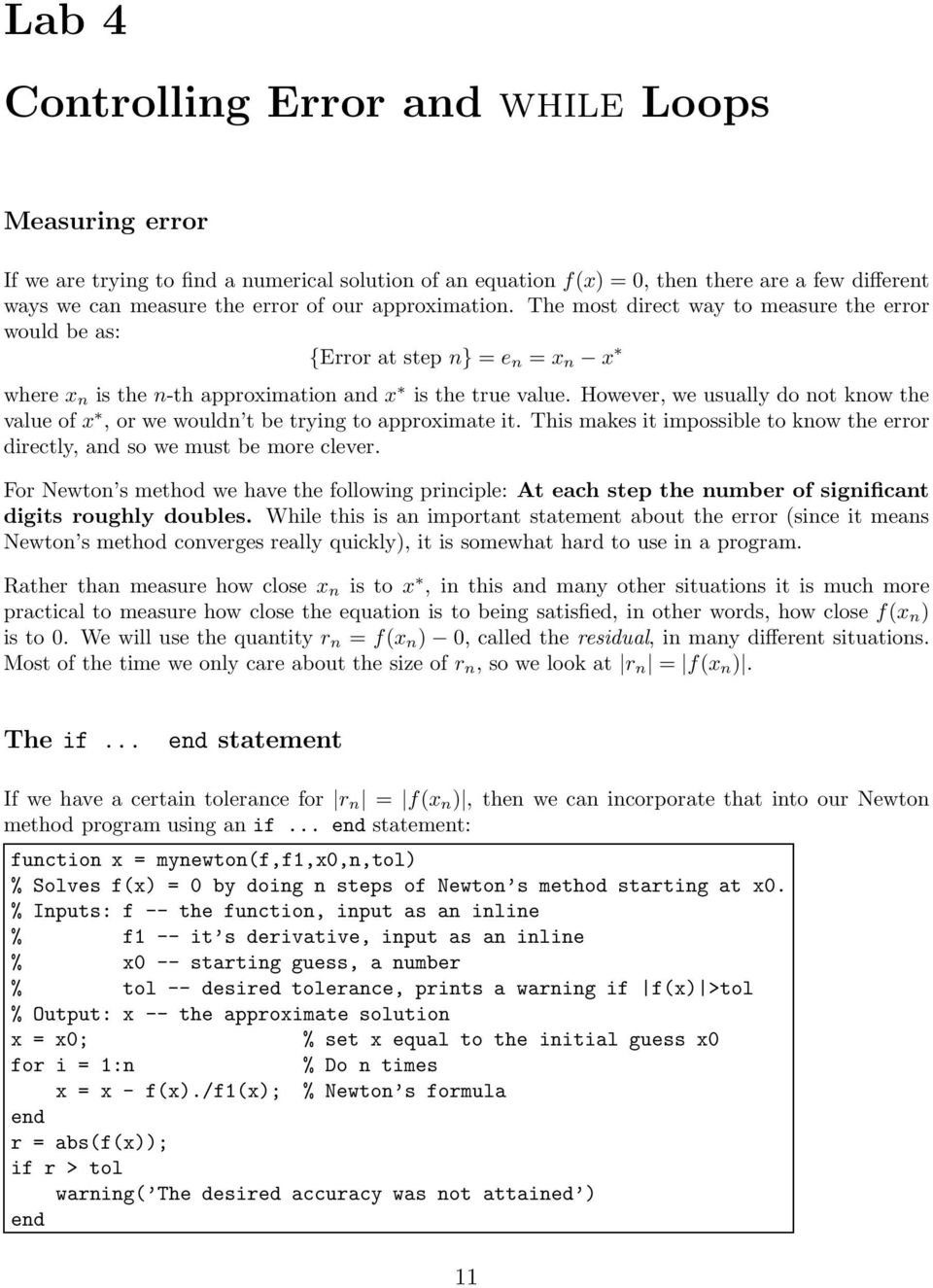
16 12 LAB 4. CONTROLLING ERROR AND WHILE LOOPS In this program if checks if abs(y) > tol is true or not. If it is true then it does everything between there and end. If not true, then it skips ahead to end. In the command window define the function > f = inline( x^3-5, x ) and its derivative > f1 = inline( 3*x^2, x ). Then use the program with n = 5 and tol =.01. Next, change tol to and repeat. The loop: while... end While the previous program will tell us if it worked or not, we still have to input n, the number of steps to take. Even for a well-behaved problem, if we make n too small then the tolerance will not be attained and we will have to go back and increase it, or, if we make n too big, then the program may run for longer than necessary. One way to control the number of steps taken is to iterate until the residual r n = f(x) = y is small enough. In Matlab this is easily accomplished with a while... end loop. function x = mynewtontol(f,f1,x0,tol) % Solves f(x) = 0 by doing Newton s method starting at x0. % Inputs: f -- the function, input as an inline % f1 -- it s derivative, input as an inline % x0 -- starting guess, a number % tol -- desired tolerance, goes until f(x) <tol % Output: x -- the approximate solution format long format compact x = x0; % set x equal to the initial guess x0 y = f(x); while abs(y) > tol % Do until the tolerence is reached. x = x - y/f1(x) % Newton s formula y = f(x); end The statement while... end is a loop, similar to for... end, but instead of going through the loop a fixed number of times it keeps going as long as the statement abs(y) > tol is true. One obvious drawback of the program is that abs(y) might never get smaller than tol. If this happens, the program would continue to run over and over until we stop it. Try this by setting the tolerance to a really small number: > tol = 10^(-100) then run the program again for f(x) = x 3 5. You can use Ctrl-c to stop a program that s stuck in an endless loop.

17 13 Exercises 4.1 In Calculus we learn that a geometric series has an exact sum: i=0 r i = 1 1 r provided that r < 1. For instance, if r =.5 then the sum is exactly 2. Below is a script program that lacks one line as written. Put in the missing command and then use the program to verify the result above. How many steps does it take? How close is the answer to 2? Change r =.5 to r=.999. How many steps does it take now? Is the answer accurate? %myrsum format long format compact r =.5; Snew = 0; % start sum at 0 Sold = -1; % set Sold to trick while the first time i = 0; % count iterations while Snew > Sold % is the sum still changing? Sold = Snew; % save previous value to compare to Snew = Snew + r^i; i=i+1; Snew % prints the final value. i % prints the # of iterations.

18 Lab 5 The Bisection Method Bisecting and the if... else... end statement Suppose that c = f(a) < 0 and d = f(b) > 0. If f is continuous, then obviously it must be zero at some x between a and b. The bisection method then consists of looking half way between a and b for the zero of f, i.e. let x = (a + b)/2 and evaluate y = f(x). Unless this is zero, then from the signs of c, d and y we can decide which new interval to subdivide. In particular, if c and y have the same sign, then [x, b] should be the new interval, but if c and y have different signs, then [a, x] should be the new interval. (See Figure 5.1.) Deciding to do different things in different situations in a program is called flow control. The most common way to do this is the if... else... end statement which is an extension of the if... end statement we have used already. Bounding the Error One good thing about the bisection method, that we don t have with Newton s method, is that we always know that the actual solution x is inside the current interval [a, b], since f(a) and f(b) have different signs. This allows us to be sure about what the maximum error can be. Precisely, the error is always less than half of the length of the current interval [a, b], i.e. {Absolute Error} = x x < (b a)/2, where x is the center point between the current a and b. The following function program (also available on the webpage) does n iterations of the bisection a 0 x 1 x 2 x 0 b 0 a 1 b 1 a 2 b 2 Figure 5.1: The bisection method. 14

19 15 method and returns not only the final value, but also the maximum possible error: function [x e] = mybisect(f,a,b,n) % function [x e] = mybisect(f,a,b,n) % Does n iterations of the bisection method for a function f % Inputs: f -- an inline function % a,b -- left and right edges of the interval % n -- the number of bisections to do. % Outputs: x -- the estimated solution of f(x) = 0 % e -- an upper bound on the error format long format compact c = f(a); d = f(b); if c*d > 0.0 error( Function has same sign at both endpoints. ) end for i = 1:n x = (a + b)/2 y = f(x) if c*y < 0 % compare signs of f(a) and f(x) b=x; % move b else a=x; % move a end end e = (b-a)/2; Another important aspect of bisection is that it always works. We saw that Newton s method can fail to converge to x if x 0 is not close enough to x. In contrast, the current interval [a, b] in bisection will always get decreased by a factor of 2 at each step and so it will always eventually shrink down as small as you want it. Exercises 5.1 Modify mybisect to solve until the error is bounded by a given tolerance for the error. Use a while loop and x n x (b a)/2 to do this. Run your program on the function f(x) = 2x 3 + 3x 1 with starting interval [0, 1] and a tolerance of How many steps does the program use to achieve this tolerance? Turn in your program and a brief summary of the results. 5.2 Perform 3 iterations of the bisection method on the function f(x) = x 3 4, with starting interval [1, 3]. (On paper, but use a calculator.) Calculate the errors and percentage errors of x 0, x 1, and x 2. Compare the errors with those in exercise 3.3.

20 Lab 6 Secant Methods In this lecture we introduce two additional methods to find numerical solutions of the equation f(x) = 0. Both of these methods are based on approximating the function by secant lines just as Newton s method was based on approximating the function by tangent lines. The Secant Method The secant method requires two initial points x 0 and x 1 which are both reasonably close to the solution x. Preferably the signs of y 0 = f(x 0 ) and y 1 = f(x 1 ) should be different. Once x 0 and x 1 are determined the method proceeds by the following formula: x i+1 = x i x i x i 1 y i y i 1 y i (6.1) Example: Suppose f(x) = x 4 5 for which the true solution is x = 4 5. Plotting this function reveals that the solution is at about If we let x 0 = 1 and x 1 = 2 then we know that the root is in between x 0 and x 1. Next we have that y 0 = f(1) = 4 and y 1 = f(2) = 11. We may then calculate x 2 from the formula (6.1): x 2 = = 11 ( 4) Pluggin x 2 = 19/15 into f(x) we obtain y 2 = f(19/15) In the next step we would use x 1 = 2 and x 2 = 19/15 in the formula (6.1) to find x 3 and so on. Below is a program for the secant method. Notice that it requires two input guesses x 0 and x 1, but it does not require the derivative to be input. figure yet to be drawn, alas Figure 6.1: The secant method. 16

21 17 function x = mysecant(f,x0,x1,n) format long % prints more digits format compact % makes the output more compact % Solves f(x) = 0 by doing n steps of the secant method starting with x0 and x1. % Inputs: f -- the function, input as an inline function % x0 -- starting guess, a number % x1 -- second starting geuss % n -- the number of steps to do % Output: x -- the approximate solution y0 = f(x0); y1 = f(x1); for i = 1:n % Do n times x = x1 - (x1-x0)*y1/(y1-y0) % secant formula. y=f(x) % y value at the new approximate solution. % Move numbers to get ready for the next step x0=x1; y0=y1; x1=x; y1=y; end The Regula Falsi Method The Regula Falsi method is somewhat a combination of the secant method and bisection method. The idea is to use secant lines to approximate f(x), but choose how to update using the sign of f(x n ). Just as in the bisection method, we begin with a and b for which f(a) and f(b) have different signs. Then let: b a x = b f(b) f(a) f(b). Next check the sign of f(x). If it is the same as the sign of f(a) then x becomes the new a. Otherwise let b = x. Convergence If we can begin with a good choice x 0, then Newton s method will converge to x rapidly. The secant method is a little slower than Newton s method and the Regula Falsi method is slightly slower than that. Both however are still much faster than the bisection method. If we do not have a good starting point or interval, then the secant method, just like Newton s method can fail altogether. The Regula Falsi method, just like the bisection method always works because it keeps the solution inside a definite interval. Simulations and Experiments Although Newton s method converges faster than any other method, there are contexts when it is not convenient, or even impossible. One obvious situation is when it is difficult to calculate a
22 18 LAB 6. SECANT METHODS formula for f (x) even though one knows the formula for f(x). This is often the case when f(x) is not defined explicitly, but implicitly. There are other situations, which are very common in engineering and science, where even a formula for f(x) is not known. This happens when f(x) is the result of experiment or simulation rather than a formula. In such situations, the secant method is usually the best choice. Exercises 6.1 Use the program mysecant on f(x) = x 3 4. Compare the results with those of Exercises 3.3 and 5.3. Then modify the program to accept a tolerance using a while loop. Test the program and turn in the program as well as the work above. 6.2 Write a program myregfalsi based on mybisect. Use it on f(x) = x 3 4. Compare the results with those of Exercises 3.3 and 5.3.
23 Lab 7 Symbolic Computations The focus of this course is on numerical computations, i.e. calculations, usually approximations, with floating point numbers. However, Matlab can also do symbolic computations which means exact calculations using symbols as in Algebra or Calculus. You should have done some symbolic Matlab computations in your Calculus courses and in this chapter we review what you should already know. Defining functions and basic operations Before doing any symbolic computation, one must declare the variables used to be symbolic: > syms x y A function is defined by simply typing the formula: > f = cos(x) + 3*x^2 Note that coefficients must be multiplied using*. To find specific values, you must use the command subs: > subs(f,pi) This command stands for substitute, it substitutes π for x in the formula for f. This is the only way to evaluate a specific value of a symbolic function. The following command will not work: > f(pi) If we define another function: > g = exp(-y^2) then we can compose the functions: > h = compose(g,f) i.e. h(x) = g(f(x)). Since f and g are functions of different variables, their product must be a function of two variables: > k = f*g > subs(k,[x,y],[0,1]) We can do simple calculus operations, like differentiation: > f1 = diff(f) indefinite integrals (antiderivatives): > F = int(f) and definite integrals: > int(f,0,2*pi) To change a symbolic answer into a numerical answer, use the double command which stands for double precision, (not times 2): > double(ans) Note that some antiderivatives cannot be found in terms of elementary functions, for some of these 19
24 20 LAB 7. SYMBOLIC COMPUTATIONS cos(x 5 ) x Figure 7.1: Graph of cos(x 5 ) produced by the ezplot command. It is wrong because cos u should oscillate smoothly between 1 and 1. The origin of the problem is that cos(x 5 ) oscillates extremely rapidly, and the plot did not consider enough points. it can be expressed in terms of special functions: > G = int(g) and for others Matlab does the best it can: > int(h) For definite integrals that cannot be evaluated exactly, Matlab delivers an error: > int(h,0,1) We will see later that even functions that don t have an antiderivative can be integrated numerically. You can change the last answer to a numerical answer using: > double(ans) Plotting a symbolic function can be done as follows: > ezplot(f) or the domain can be specified: > ezplot(g,-10,10) > ezplot(g,-2,2) To plot a symbolic function of two variables use: > ezsurf(k) It is important to keep in mind that even though we have defined our variables to be symbolic variables, plotting can only plot a finite set of points. For intance: > ezplot(cos(x^5)) will produce a plot that is clearly wrong, because it does not plot enough points.
25 21 Other useful symbolic operations Matlab allows you to do simple algebra. For instance: > poly = (x - 3)^5 > polyex = expand(poly) > polysi = simple(polyex) To find the symbolic solutions of an equation, f(x) = 0, use: > solve(f) > solve(g) > solve(polyex) Another useful property of symbolic functions is that you can substitute numerical vectors for the variables: > X = 2:0.1:4; > Y = subs(polyex,x); > plot(x,y) Exercises 7.1 Starting from mynewton write a program mysymnewton that takes as its input a symbolic function f(x), x 0 and n. Let the program take the symbolic derivative f (x), and then use subs to proceed with Newton s method. Test it on f(x) = x 3 4 starting with x 0 = 2. Turn in the program and a brief summary of the results.
26 Review of Part I Methods and Formulas Solving equations numerically: f(x) = 0 an equation we wish to solve. x a true solution. x 0 starting approximation. x n approximation after n steps. e n = x n x error of n-th step. r n = y n = f(x n ) residual at step n. Often r n is sufficient. Newton s method: x i+1 = x i f(x i) f (x i ) Bisection method: f(a) and f(b) must have different signs. x = (a + b)/2 Choose a = x or b = x, depending on signs. x is always inside [a, b]. e < (b a)/2, current maximum error. Secant method: x i+1 = x i x i x i 1 y i y i 1 y i Regula Falsi: x = b Choose a = x or b = x, depending on signs. Convergence: Bisection is very slow. Newton is very fast. Secant methods are intermediate in speed. Bisection and Regula Falsi never fail to converge. Newton and Secant can fail if x 0 is not close to x. b a f(b) f(a) f(b) Locating roots: Use knowledge of the problem to begin with a reasonable domain. Systematically search for sign changes of f(x). Choose x 0 between sign changes using bisection or secant. Usage: For Newton s method one must have formulas for f(x) and f (x). 22
27 23 Secant methods are better for experiments and simulations. Matlab Commands: > v = [ ]...Make a row vector. > u = [0; 1; 2; 3]....Make a column vector. > w = v.... Transpose: row vector column vector > x = linspace(0,1,11)...make an evenly spaced vector of length 11. > x = -1:.1:1... Make an evenly spaced vector, with increments 0.1. > y = x.^2... Square all entries. > plot(x,y) plot y vs. x. > f = inline( 2*x.^2-3*x + 1, x )....Make a function. > y = f(x)....a function can act on a vector. > plot(x,y, *, red )...A plot with options. > Control-c... Stops a computation. Program structures: for... end Example: for i=1:20 S = S + i; end if... end Example: if y == 0 disp( An exact solution has been found ) end while... end Example: while i <= 20 S = S + i; i = i + 1; end if... else... end Example: if c*y>0 a = x; else b = x; end Function Programs: - Begin with the word function. - There are inputs and outputs. - The outputs, name of the function and the inputs must appear in the first line. i.e. function x = mynewton(f,x0,n) - The body of the program must assign values to the outputs.
28 24 LAB 7. SYMBOLIC COMPUTATIONS - internal variables are not visible outside the function. Script Programs: - There are no inputs and outputs. - A script program may use and change variables in the current workspace. Symbolic: > syms x y > f = 2*x^2 - sqrt(3*x) > subs(f,sym(pi)) > double(ans) > g = log(abs(y)).... Matlab uses log for natural logarithm. > h(x) = compose(g,f) > k(x,y) = f*g > ezplot(f) > ezplot(g,-10,10) > ezsurf(k) > f1 = diff(f, x ) > F = int(f, x ).... indefinite integral (antiderivative) > int(f,0,2*pi)... definite integral > poly = x*(x - 3)*(x-2)*(x-1)*(x+1) > polyex = expand(poly) > polysi = simple(polyex) > solve(f) > solve(g) > solve(polyex) Here are some sample questions from old tests. Some topics that we covered are not represented by these questions, but are still fair game. 1. Give Matlab commands to plot the function f(x) = x 2 5 on the interval [0, 8]. 2. Write a Matlab script program that will plot the functions x, x 2, sinx, e x and lnx on the interval [0, 1]. 3. The function f(x) = x 2 5 is continuous and f(0) < 0 < f(8), so it has a zero on the interval [0, 8]. Perform 3 iterations of the bisection method to narrow down this interval. 4. Write a Matlab function program to do n steps of the bisection method for a function f with starting interval [a, b]. Let f, a, b and n be the inputs and the final x be the output. Include comments. 5. For f(x) = x 2 5, do 2 iterations of the secant method, starting with x 0 = 1 and x 1 = Write a Matlab function program to do Newton s method for a function f until f(x) < tol. Let f, f, x 0 and tol be the inputs and the final x be the output. Include comments. 7. (a) We can approximate 2 by setting f(x) = x 2 2 and solving for f(x ) = 0. A reasonable starting guess is x 0 = 1. Do two iterations of Newton s method to get a better approximation for 2. (b) Write a Matlab function with inputs z and tol that computes z to tolerance tol using Newton s method, and returns the result. Include comments. (It is illegal to use sqrt in your program.)
29 Math 344 Sample Test Problems from Part I Write a Matlab function program that calculates the sum of the squares of the first n integers. 9. For f(x) = x 2 5, do 2 iterations of Newton s method, starting with x 0 = 2.0. What is the relative error of x 2? About how many more steps would be needed to make the error less than 10 16? 10. Write a Matlab program to do n steps of Newton s method for a function f with starting interval [a, b]. Let f, f, x 0 and n be the inputs and the final x the output. 11. For f(x) = x 2 5, do 2 iterations of the bisection method, starting with [a, b, ] = [2, 3]. What is the relative error? About how many more steps would be needed to make the error less than 10 6? 12. List your 10 least favorite Matlab commands.
30 26 LAB 7. SYMBOLIC COMPUTATIONS
31 Part II Linear Algebra c Copyright, Todd Young and Martin Mohlenkamp, Mathematics Department, Ohio University, 2009
32 Lab 8 Matrices and Matrix Operations in Matlab Matrix operations Recall how to multiply a matrix A times a vector v: ( ) ( ) ( ( 1) Av = = ( 1) ) ( 3 = 5 This is a special case of matrix multiplication. To multiply two matrices, A and B you proceed as follows: ( ) ( ) ( ) ( ) AB = = = Here both A and B are 2 2 matrices. Matrices can be multiplied together in this way provided that the number of columns of A match the number of rows of B. We always list the size of a matrix by rows, then columns, so a 3 5 matrix would have 3 rows and 5 columns. So, if A is m n and B is p q, then we can multiply AB if and only if n = p. A column vector can be thought of as a p 1 matrix and a row vector as a 1 q matrix. Unless otherwise specified we will assume a vector v to be a column vector and so Av makes sense as long as the number of columns of A matches the number of entries in v. Enter a matrix into Matlab with the following syntax: > format compact > A = [ ; ; ] Also enter a vector u: > u = [ ] To multiply a matrix times a vector Au use *: > A*u Since A is 3 by 4 and u is 4 by 1 this multiplication is valid and the result is a 3 by 1 vector. Now enter another matrix B using: > B = [3 2 1; 7 6 5; 4 3 2] You can multiply B times A: > B*A but A times B is not defined and > A*B will result in an error message. You can multiply a matrix by a scalar: > 2*A Adding matrices A + A will give the same result: 28 ).
33 29 > A + A You can even add a number to a matrix: > A This adds 3 to every entry of A. Component-wise operations Just as for vectors, adding a. before *, /, or ^ produces entry-wise multiplication, division and exponentiation. If you enter: > B*B the result will be BB, i.e. matrix multiplication of B times itself. But, if you enter: > B.*B the entries of the resulting matrix will contain the squares of the same entries of B. Similarly if you want B multiplied by itself 3 times then enter: > B^3 but, if you want to cube all the entries of B then enter: > B.^3 Note that B*B and B^3 only make sense if B is square, but B.*B and B.^3 make sense for any size matrix. The identity matrix and the inverse of a matrix The n n identity matrix is a square matrix with ones on the diagonal and zeros everywhere else. It is called the identity because it plays the same role that 1 plays in multiplication, i.e. AI = A, IA = A, Iv = v for any matrix A or vector v where the sizes match. An identity matrix in Matlab is produced by the command: > I = eye(3) A square matrix A can have an inverse which is denoted by A 1. The definition of the inverse is that: AA 1 = I and A 1 A = I. In theory an inverse is very important, because if you have an equation: Ax = b where A and b are known and x is unknown (as we will see, such problems are very common and important) then the theoretical solution is: x = A 1 b. We will see later that this is not a practical way to solve an equation, and A 1 is only important for the purpose of derivations. In Matlab we can calculate a matrix s inverse very conveniently: > C = randn(5,5) > inv(c) However, not all square matrices have inverses: > D = ones(5,5) > inv(d)
34 30 LAB 8. MATRICES AND MATRIX OPERATIONS IN MATLAB The Norm of a matrix For a vector, the norm means the same thing as the length. Another way to think of it is how far the vector is from being the zero vector. We want to measure a matrix in much the same way and the norm is such a quantity. The usual definition of the norm of a matrix is the following: Definition 1 Suppose A is a m n matrix. The norm of A is A max v =1 Av. The maximum in the definition is taken over all vectors with length 1 (unit vectors), so the definition means the largest factor that the matrix stretches (or shrinks) a unit vector. This definition seems cumbersome at first, but it turns out to be the best one. For example, with this definition we have the following inequality for any vector v: Av A v. In Matlab the norm of a matrix is obtained by the command: > norm(a) For instance the norm of an identity matrix is 1: > norm(eye(100)) and the norm of a zero matrix is 0: > norm(zeros(50,50)) For a matrix the norm defined above and calculated by Matlab is not the square root of the sum of the square of its entries. That quantity is called the Froebenius norm, which is also sometimes useful, but we will not need it. Some other useful commands Try out the following: > C = rand(5,5)... random matrix with uniform distribution in [0, 1]. > size(c)... gives the dimensions (m n) of C. > det(c)...the determinant of the matrix. > max(c)... the maximum of each column. > min(c).....the minimum in each column. > sum(c)...sums each column. > mean(c) the average of each column. > diag(c)... just the diagonal elements. > C....tranpose the matrix (flip along the diagonal). In addition to ones, eye, zeros, rand and randn, Matlab has several other commands that automatically produce special matrices: > hilb(6) > pascal(5)
35 31 Exercises 8.1 By hand, calculate Av, AB, and BA for: A = , B = , v = Check the results using Matlab. Does AB = BA? Think about how fast computers are. Turn in your hand work. 8.2 Write a Matlab function program that makes a n n random matrix (normally distributed, A = randn(n,n)), calculates its inverse (B = inv(a)), multiplies the two back together, and calculates the error equal to the norm of the difference of the result from the n n identity matrix (eye(n)). Starting with n = 10 increase n by factors of 2 (10, 20, 40, 80, 160,...) until the program stops working, recording the results of each trial. What happens to error as n gets big? Turn in a printout of the program and a very brief report on the results of your experiments with it, including a plot of error vs. n. (Wouldn t this be a great time for a log plot? See help loglog.)
36 Lab 9 Introduction to Linear Systems How linear systems occur Linear systems of equations naturally occur in many places in applications. Computers have made it possible to quickly and accurately solve larger and larger systems of equations. Not only has this allowed engineers and scientists to handle more and more complex problems where linear systems naturally occur, but has also prompted engineers to use linear systems to solve problems where they do not naturally occur such as thermodynamics, internal stress-strain analysis, fluids and chemical processes. It has become standard practice in many areas to analyze a problem by transforming it into a linear systems of equations and then solving those equation by computer. In this way, computers have made linear systems of equations the most frequently used tool in modern engineering and science. In Figure 9.1 we show a truss with equilateral triangles. Engineers would use the method of joints to write equations for each node of the truss 1. This set of equations is an example of a linear system. Making the approximation 3/2.8660, the equations for this truss are:.5 T 1 + T 2 = R 1 = f T 1 = R 2 =.433 f 1.5 f 2.5 T T 3 + T 4 = f T T 3 = 0 T 2.5 T T 5 + T 6 = 0 (9.1).866 T T 5 = f 2 T 4.5 T T 7 = 0, where T i represents the tension in the i-th member of the truss. You could solve this system by hand with a little time and patience; systematically eliminating variables and substituting. Obviously, it would be a lot better to put the equations on a computer and let the computer solve it. In the next few lectures we will learn how to use a computer effectively to solve linear systems. The first key to dealing with linear systems is to realize that they are equivalent to matrices, which contain numbers, not variables. As we discuss various aspects of matrices, we wish to keep in mind that the matrices that come up in engineering systems are really large. It is not unusual in real engineering to use matrices whose dimensions are in the thousands! It is frequently the case that a method that is fine for a 2 2 or 3 3 matrix is totally inappropriate for a matrix. We thus want to emphasize methods that work for large matrices. 1 See or for reference. 32
37 33 Figure 9.1: An equilateral truss. Joints or nodes are labeled alphabetically, A, B,...and Members (edges) are labeled numerically: 1, 2,... The forces f 1 and f 2 are applied loads and R 1, R 2 and R 3 are reaction forces applied by the supports. Linear systems are equivalent to matrix equations The system of linear equations, is equivalent to the matrix equation, which is equivalent to the augmented matrix, x 1 2x 2 + 3x 3 = 4 2x 1 5x x 3 = 15 2x 2 10x 3 = 10, x 1 x 2 x 3 = The advantage of the augmented matrix, is that it contains only numbers, not variables. The reason this is better is because computers are much better in dealing with numbers than variables. To solve this system, the main steps are called Gaussian elimination and back substitution. The augmented matrix for the equilateral truss equations (9.1) is given by:., f f 1.5 f f f (9.2) Notice that a lot of the entries are 0. Matrices like this, called sparse, are common in applications and there are methods specifically designed to efficiently handle sparse matrices.
38 34 LAB 9. INTRODUCTION TO LINEAR SYSTEMS Triangular matrices and back substitution Consider a linear system whose augmented matrix happens to be: (9.3) Recall that each row represents an equation and each column a variable. The last row represents the equation 2x 3 = 4. The equation is easily solved, i.e. x 3 = 2. The second row represents the equation x 2 + 6x 3 = 7, but since we know x 3 = 2, this simplifies to: x = 7. This is easily solved, giving x 2 = 5. Finally, since we know x 2 and x 3, the first row simplifies to: x = 4. Thus we have x 1 = 8 and so we know the whole solution vector: x = 8, 5, 2. The process we just did is called back substitution, which is both efficient and easily programmed. The property that made it possible to solve the system so easily is that A in this case is upper triangular. In the next section introduce Gaussian elimination the most efficient way to transform an augmented matrix into an upper triangular matrix. Gaussian Elimination Consider the matrix: A = The first step of Gaussian elimination is to get rid of the 2 in the (2,1) position by subtracting 2 times the first row from the second row, i.e. (new 2nd = old 2nd - (2) 1st). We can do this because it is essentially the same as adding equations, which is a valid algebraic operation. This leads to: There is already a zero in the lower left corner, so we don t need to eliminate anything there. To eliminate the third row, second column, we need to subtract 2 times the second row from the third row, (new 3rd = old 3rd - (-2) 2nd): This is now just exactly the matrix in equation (9.3), which we can now solve by back substitution.... Matlab s matrix solve command In Matlab the standard way to solve a system Ax = b is by the command: > x = A\b. This command carries out Gaussian elimination and back substitution. We can do the above computations as follows: > A = [1-2 3 ; ; ]
39 35 > b = [ ] > x = A\b Next, use the Matlab commands above to solve Ax = b when the augmented matrix for the system is: Check the result by entering: > A*x - b You will see that the resulting answer satisfies the equation exactly. Next try solving using the inverse of A: > x = inv(a)*b This answer can be seen to be inaccurate by checking: > A*x - b Thus we see one of the reasons why the inverse is never used for actual computations, only for theory. Exercises 9.1 Set f 1 = 1000N and f 2 = 5000N in the equations (9.1) for the equailateral truss. Input the coefficient matrix A and the right hand side vector b in (9.2) into Matlab. Solve the system using the command \ to find the tension in each member of the truss. Print out and turn in A, b and solution x. 9.2 Write each system of equations as an augmented matrix, then find the solutions using Gaussian elimination and back substitution. Check your solutions using Matlab. (a) (b) x 1 + x 2 = 2 4x 1 + 5x 2 = 10 x 1 + 2x 2 + 3x 3 = 1 4x 1 + 7x x 3 = 3 x 1 + 4x 2 + 4x 3 = 1
40 Lab 10 Some Facts About Linear Systems Some inconvenient truths In the last lecture we learned how to solve a linear system using Matlab. Input the following: > A = ones(4,4) > b = randn(4,1) > x = A\b As you will find, there is no solution to the equation Ax = b. This unfortunate circumstance is mostly the fault of the matrix, A, which is too simple, its columns (and rows) are all the same. Now try: > b = ones(4,1) > x = A\b This gives an answer, even though it is accompanied by a warning. So the system Ax = b does have a solution. Still unfortunately, that is not the only solution. Try: > x = [ ] > A*x We see that this x is also a solution. Next try: > x = [ ] > A*x This x is a solution! It is not hard to see that there are endless possibilities for solutions of this equation. Basic theory The most basic theoretical fact about linear systems is: Theorem 1 A linear system Ax = b may have 0, 1, or infinitely many solutions. Obviously, in most applications we would want to have exactly one solution. The following two theorems show that having one and only one solution is a property of A. Theorem 2 Suppose A is a square (n n) matrix. The following are all equivalent: 1. The equation Ax = b has exactly one solution for any b. 2. det(a) A has an inverse. 4. The only solution of Ax = 0 is x = The columns of A are linearly independent (as vectors). 6. The rows of A are linearly independent. If A has these properties then it is called non-singular. 36
41 37 On the other hand, a matrix that does not have these properties is called singular. Theorem 3 Suppose A is a square matrix. The following are all equivalent: 1. The equation Ax = b has 0 or many solutions depending on b. 2. det(a) = A does not have an inverse. 4. The equation Ax = 0 has solutions other than x = The columns of A are linearly dependent as vectors. 6. The rows of A are linearly dependent. To see how the two theorems work, define two matrices (type in A1 then scroll up and modify to make A2) : A1 = , A2 = , and two vectors: b1 = 0 3 6, b2 = First calculate the determinants of the matrices: > det(a1) > det(a2) Then attempt to find the inverses: > inv(a1) > inv(a2) Which matrix is singular and which is non-singular? Finally, attempt to solve all the possible equations Ax = b: > x = A1\b1 > x = A1\b2 > x = A2\b1 > x = A2\b2 As you can see, each equation involving the non-singular matrix has one and only one solution, but equation involving a singular matrix are more complicated The residual vector Recall that the residual for an approximate solution x of an equation f(x) = 0 is defined as r = f(x). It is a measure of how close the equation is to being satisfied. For a linear system of equations we want Ax b = 0 and so we define the residual of an approximate solution, x by r = Ax b. (10.1) Notice that r is a vector. Its size (norm) is an indication of how close we have come to solving Ax = b.
42 38 LAB 10. SOME FACTS ABOUT LINEAR SYSTEMS Exercises 10.1 By hand, find all the solutions (if any) of the following linear system using the augmented matrix and Gaussian elimination: x 1 + 2x 2 + 3x 3 = 4 4x 1 + 5x 2 + 6x 3 = 10 7x 1 + 8x 2 + 9x 3 = 14, 10.2 Write a function program whose input is a number n which makes a random n n matrix A and a random vector b, solves the linear system Ax = b and calculates the norm of the residual r = Ax b and outputs that number as the error e. Run the program 5 times each for n = 5, 10, 50, 100, 500, 1000,..., recording and averaging the results. Make a log-log plot (see help loglog) of average e vs. n. Turn in the plot and the program.
43 Lab 11 Accuracy, Condition Numbers and Pivoting In this lecture we will discuss two separate issues of accuracy in solving linear systems. The first, pivoting, is a method that ensures that Gaussian elimination proceeds as accurately as possible. The second, condition number, is a measure of how bad a matrix is. We will see that if a matrix has a bad condition number, the solutions are unstable with respect to small changes in data. The effect of rounding All computers store numbers as finite strings of binary floating point digits. This limits numbers to a fixed number of significant digits and implies that after even the most basic calculations, rounding must happen. Consider the following exaggerated example. Suppose that our computer can only store 2 significant digits and it is asked to do Gaussian elimination on: ( ) Doing the elimination exactly would produce: ( but rounding to 2 digits, our computer would store this as: ( Backsolving this reduced system gives: x 1 = 0, x 2 = 3. This seems fine until you realize that backsolving the unrounded system gives: ), x 1 = 1, x 2 = ). Row Pivoting A way to fix the problem is to use pivoting, which means to switch rows of the matrix. Since switching rows of the augmented matrix just corresponds to switching the order of the equations, 39
44 40 LAB 11. ACCURACY, CONDITION NUMBERS AND PIVOTING no harm is done: ( Exact elimination would produce: ( Storing this result with only 2 significant digits gives: ( ) ). ). Now backsolving produces: which is exactly right. x 1 = 1, x 2 = 3, The reason this worked is because 1 is bigger than To pivot we switch rows so that the largest entry in a column is the one used to eliminate the others. In bigger matrices, after each column is completed, compare the diagonal element of the next column with all the entries below it. Switch it (and the entire row) with the one with greatest absolute value. For example in the following matrix, the first column is finished and before doing the second column, pivoting should occur since 2 > 1 : Pivoting the 2nd and 3rd rows would produce: Condition number In some systems, problems occur even without rounding. Consider the following augmented matrices: ( ) ( ) 1 1/2 3/2 1 1/2 3/2 and. 1/2 1/3 1 1/2 1/3 5/6 Here we have the same A, but two different input vectors: b 1 = (3/2, 1) and b 2 = (3/2, 5/6) which are pretty close to one another. You would expect then that the solutions x 1 and x 2 would also be close. Notice that this matrix does not need pivoting. Eliminating exactly we get: ( ) ( ) 1 1/2 3/2 1 1/2 3/2 and. 0 1/12 1/4 0 1/12 1/12 Now solving we find: x 1 = (0, 3) and x 2 = (1, 1) which are not close at all despite the fact that we did the calculations exactly. This poses a new problem: some matrices are very sensitive to small changes in input data. The extent of this
45 41 sensitivity is measured by the condition number. The definition of condition number is: consider all small changes δa and δb in A and b and the resulting change, δx, in the solution x. Then: cond(a) max δx / x ( ) Relative error of output = max. Relative error of inputs δa A + δb b Put another way, changes in the input data get multiplied by the condition number to produce changes in the outputs. Thus a high condition number is bad. It implies that small errors in the input can cause large errors in the output. In Matlab enter: > H = hilb(2) which should result in the matrix above. Matlab produces the condition number of a matrix with the command: > cond(h) Thus for this matrix small errors in the input can get magnified by 19 in the output. Next try the matrix: > A = [ ; ] > cond(a) For this matrix small errors in the input can get magnified by in the output! This is obviously not very good for science and engineering where all measurements, constants and inputs are approximate. Is there a solution to the problem of bad condition numbers? Usually, bad condition numbers in engineering contexts result from poor design. So, the engineering solution to bad conditioning is redesign. Finally, find the determinant of the matrix A above: > det(a) which will be small. If det(a) = 0 then the matrix is singular, which is bad because it implies there will not be a unique solution. The case here, det(a) 0, is also bad, because it means the matrix is almost singular. Although det(a) 0 generally indicates that the condition number will be large, they are actually independent things. To see this, find the determinant and condition number of the matrix [1e-10,0;0,1e-10] and the matrix [1e+10,0;0,1e-10]. Exercises 11.1 Using Matlab find the determinant and inverse of: [ ] A = Let B be the matrix obtained from A by rounding off to three decimal places ( ). Find the determinant and inverse of B. How do A 1 and B 1 differ? Explain how this happened. Set b1 = [1.2969; ] and do x = A\b1. Repeat the process but with a vector b2 obtained from b1 by rounding off to three decimal places. Explain exactly what happened. Why was the first answer so simple? Why do the two answers differ by so much?
46 42 LAB 11. ACCURACY, CONDITION NUMBERS AND PIVOTING 11.2 Try > B = [sin(sym(1)) sin(sym(2)); sin(sym(3)) sin(sym(4))] > c = [1; 2] > x = B\c > pretty(x) > double(x) Next input the matrix: Cs = [ symbolically as above. Create a numerical version via Cn = double(cs) and define the two vectors d1 = [4; 8] and d2 = [1; 1]. Solve the systems Cs*x = d1, Cn*x = d1, Cs*x = d2, and Cn*x = d2. Explain the results. Does the symbolic or numeric way give more information? ]
47 Lab 12 Eigenvalues and Eigenvectors Suppose that A is a square (n n) matrix. We say that a nonzero vector v is an eigenvector (ev) and a number λ is its eigenvalue (ew) if Av = λv. (12.1) Geometrically this means that Av is in the same direction as v, since multiplying a vector by a number changes its length, but not its direction. Matlab has a built-in routine for finding eigenvalues and eigenvectors: > A = pascal(4) > [V E] = eig(a) The results are a matrix V that contains eigenvectors as columns and a diagonal matrix E that contains eigenvalues on the diagonal. We can check this by: > v1 = V(:,1) > A*v1 > E(1,1)*v1 Finding Eigenvalues for 2 2 and 3 3 If A is 2 2 or 3 3 then we can find its eigenvalues and eigenvectors by hand. Notice that Equation (12.1) can be rewritten as: Av λv = 0. (12.2) It would be nice to factor out the v from the right-hand side of this equation, but we can t because A is a matrix and λ is a number. However, since Iv = v, we can do the following: Av λv = Av λiv = (A λi)v = 0 (12.3) If v is nonzero, then by Theorem 3 the matrix (A λi) must be singular. By the same theorem, we must have: This is called the characteristic equation. det(a λi) = 0. (12.4) 43
48 44 LAB 12. EIGENVALUES AND EIGENVECTORS For a 2 2 matrix, A λi is calculated as in the following example: ( ) ( ) A λi = λ ( ) ( ) 1 4 λ 0 = λ ( ) 1 λ 4 =. 3 5 λ The determinant of A λi is then det(a λi) = (1 λ)(5 λ) 4 3 = 7 6λ + λ 2. The characteristic equation det(a λi) = 0 is simply a quadratic equation: (12.5) (12.6) λ 2 6λ 7 = 0. (12.7) The roots of this equation are λ 1 = 7 and λ 2 = 1. These are the ew s of the matrix A. Now to find the corresponding ev s we return to the equation (A λi)v = 0. For λ 1 = 7, the equation for the ev is (A λi)v = 0 which is equivalent to the augmented matrix ( ). (12.8) Notice that the first and second rows of this matrix are multiples of one another. Thus Gaussian elimination would produce all zeros on the bottom row. Thus this equation has infinitely many solutions, i.e. infinitely many ev s. Since only the direction of the ev matters, this is okay, we only need to find one of the ev s. Since the second row of the augmented matrix represents the equation we can let 3x 2y = 0, ( 2 v 1 = 3 This comes from noticing that (x, y) = (2, 3) is a solution of 3x 2y = 0. For λ 2 = 1, (A λi)v = 0 is equivalent to the augmented matrix: ( ) Once again the first and second rows of this matrix are multiples of one another. For simplicity we can let ( ) 2 v 2 =. 1 One can always check an ev and ew by multiplying: ( ) ( ) ( ) ( ) Av 1 = = = 7 = 7v and ( ) ( ) ( ) ( ) Av 2 = = = 1 = 1v For a 3 3 matrix we could complete the same process. The det(a λi) = 0 would be a cubic polynomial and we would get 3 roots, which are the ew s. ).
49 45 Larger Matrices For a n n matrix with n 4 this process is too long and cumbersome to complete by hand. Further, this process is not well suited even to implementation on a computer program since it involves determinants and solving a n-degree polynomial. For n 4 we need more ingenious methods. These methods rely on the geometric meaning of ev s and ew s rather than solving algebraic equations. Complex Eigenvalues It turns out that the eigenvalues of some matrices are complex numbers, even when the matrix only contains real numbers. When this happens the complex ew s must occur in conjugate pairs, i.e.: λ 1,2 = α ± iβ. The corresponding ev s must also come in conjugate pairs: w = u ± iv. In applications, the imaginary part of the ew, β, often is related to the frequency of an oscillation. This is because of Euler s formula e α+iβ = e α (cosβ + i sinβ). Certain kinds of matrices that arise in applications can only have real ew s and ev s. The most common such type of matrix is the symmetric matrix. A matrix is symmetric if it is equal to its own transpose, i.e. it is symmetric across the diagonal. For example, ( ) is symmetric and so we know beforehand that it s ew s will be real, not complex. Exercises 12.1 Find the eigenvalues and eigenvectors of the following matrix by hand: ( ) 2 1 A = Find the eigenvalues and eigenvectors of the following matrix by hand: ( ) 1 2 B =. 2 1 Can you guess the ew s of the matrix ( a b C = b a )?
50 Lab 13 Eigenvalues and Eigenvectors of Stochastic Matrices Finite Markov Process and Stochastic Matrices Imagine the following situation. Suppose that a system has n different states. Suppose that the system can change from one state to another state randomly, but with some restrictions. Namely, suppose that during a certain time interval, if the system is in some state i it has a fixed probabability of moving to another state j and this probability does not change over time. Denote this transition probability as t ij. If there are n states as supposed and there is probability of transition for each pair (i, j), then we can represent the system as the matrix T = (t ij ). Note that t ii would denote the probability of the system remaining in state i if it already is there. Given the basic law of probability that the sum of all probabilities must be one, we see that for any current state i, we have: n t ij = 1. (13.1) j=1 A simple way of interpreting this equation is that no matter what state the system is in now it must be somewhere in the next step. A Stochastic or Markov matrix is an n n matrix T for which 1. All entries t ij satisfy: 0 t ij Equation 13.1 holds. A 2 2 example of a Markov matrix is: T = (.5 1/3.5 2/3 We interpret this matrix in the following way: There are two possible states: A and B. If the system is in state A then there is a 50% chance of staying in state at the next time and a 50% chance of moving into state B. If the system is in State B, then there is an 2/3 chance it will remain there and a 1/3 chance it will move to state A at the next time step. You can imagine this concretely by marking two spots on the ground as A and B. Stand on A and roll a die. If 1, 2 or 3 is rolled stay where you are and if 4, 5 or 6 is rolled move to B. If you stay where you are then repeat. If you find yourself on B, roll a die. If 1 4 is rolled stay and if 5 or 6 is rolled move. 46 ).
51 47 Likely States of a Markov Matrix If you actually carry out the above example you will find experimentally that you will spend more time on B than on A. Now suppose instead of one person there are many people playing this game. A natural question to ask that has very important implications in many applications is: Typically, what portion of people will be on A and what portion will be on B? We can investigate this question easily with the following mind experiment: If there are currently M 0 people on A at a certain time then at the next step move M 0 /2 of them to B and leave M 0 /2 at A. In there are N 0 people on B, then move N 0 /3 of them to A and leave 2N 0 /3 of them at B. It is easy to see that the new number of people at A and B are: M 1 = 1 2 M N 0, N 1 = 1 2 M N 0. and (13.2) It is not hard to see that this actually is an equation involving the matrix T, i.e.: ( ) ( ) ( ) M1 1/2 1/3 M0 =. N 1 1/2 2/3 N 0 Now if M and N are very large, than rather than count the numbers of people, we could simple keep track of the ratios of people on A and B. We can carry this out conveniently in Matlab. Make the matrix: > T = [.5 1/3 ;.5 2/3] and make the intial vector supposing the half of the people are on each spot: > v = [.5 ;.5 ] We can find the proportion at the next step by multiplying: > v = T*v If you repeat the above command (use the up arrow), it will produce the second step. If you continue to repeat it you will see very quickly that the vector v seems to be converging and after 20 steps it will have converged to (.4.6 If you continue repeating it will not change. We call this vector a Steady state of the Markov matrix, because v = T v. Implied by this equation is that v is an eigenvector of T with eigenvalue 1. It is a mathematical fact that any transition matrix has 1 as an eigenvalue and that any eigenvector corresponding to 1 is a steady state of T. Thus to find the steady states of T all we really need to do is calculate the eigenvectors of T corresponding to eigenvalue 1. In Matlab find the eigenvalues and eigenvectors of T by the command: > [V E] = eig(t) You will see indeed that 1 is an entry of E in the second column. Thus the second column of V is the eigenvector corresponding to 1. Type: > v2 = V(;,2) to isolate this vector. You will see that it is not the vector v = (.4,.6). However as we know eigenvectors are not unique and only their direction matters, thus with the command: ).
52 48 LAB 13. EIGENVALUES AND EIGENVECTORS OF STOCHASTIC MATRICES > v2 = v2/sum(v2) you will retrieve v = (.4,.6). Exercises 13.1 Input the following matrices in Matlab: A = B = Confirm that these matrices are Markov by using the command sum. Find the eigenvalues and eigenvectors of each of these matrices. What are the steady-states of each? Verify each steady state by multplying it by the original matrix. Interpret the results.
53 Review of Part II Methods and Formulas Basic Matrix Theory: Identity matrix: AI = A, IA = A, and Iv = v Inverse matrix: AA 1 = I and A 1 A = I Norm of a matrix: A max v =1 Av A matrix may be singular or nonsingular. See Lecture 10. Solving Process: Gaussian Elimination produces LU decomposition Row Pivoting Back Substitution Condition number: cond(a) max δx / x A big condition number is bad. δa A + δb b = max ( ) Relative error of output. Relative error of inputs LU factorization: Solving steps: Multiply by P: b = Pb Backsolve: Ly = b Backsolve: Ux = y PA = LU. Eigenvalues and eigenvectors: A nonzero vector v is an eigenvector (ev) and a number λ is its eigenvalue (ew) if Characteristic equation: det(a λi) = 0 Equation of the eigenvector: (A λi)v = 0 Av = λv. Complex ew s: Occur in conjugate pairs: λ 1,2 = α ± iβ and ev s must also come in conjugate pairs: w = u ± iv. Symmetric and Positive definite: - Symmetric: A = A. - If A is symmetric its ew s are real. - Positive definite: Ax x > 0. - If A is positive definite, then its ew s are positive. 49
54 50 LAB 13. EIGENVALUES AND EIGENVECTORS OF STOCHASTIC MATRICES Matlab Matrix arithmetic: > A = [ ; ; ]... Manually enter a matrix. > u = [ ] > A*u > B = [3 2 1; 7 6 5; 4 3 2] > B*A...multiply B times A. > 2*A... multiply a matrix by a scalar. > A + A add matrices. > A add 3 to every entry of a matrix. > B.*B component-wise multiplication. > B.^ component-wise exponentiation. Special matrices: > I = eye(3)... identity matrix > D = ones(5,5) > O = zeros(10,10) > C = rand(5,5)... random matrix with uniform distribution in [0, 1]. > C = randn(5,5)...random matrix with normal distribution. > hilb(6) > pascal(5) General matrix commands: > size(c).... gives the dimensions (m n) of A. > norm(c) gives the norm of the matrix. > det(c)...the determinant of the matrix. > max(c) the maximum of each row. > min(c) the minimum in each row. > sum(c)... sums each row. > mean(c)... the average of each row. > diag(c)... just the diagonal elements. > inv(c) inverse of the matrix. > C... transpose of the matrix. Matrix decompositions: > [L U P] = lu(c) > [Q R] = qr(c).... QR decomposition (important, but we did not use it). > [U S V] = svd(c)... singular value decomposition (important, but we did not use it). > H = hess(c) transform into a Hessian tri-diagonal matrix. A matrix that has the same eigenvalues as A. > [U T] = schur(c).... Schur Decomposition A = U TU. > R = chol(c*c ) Cholesky decomposition of a symmetric, positive definite matrix, A = R R.
55 Part III Functions and Data c Copyright, Todd Young and Martin Mohlenkamp, Mathematics Department, Ohio University, 2009
56 Lab 14 Polynomial Interpolation A Chemical Reaction In a chemical reaction the concentration level y of the product at time t was measured every half hour. The following results were found: t y We can input this data into Matlab as: > t1 = 0:.5:2 > y1 = [ ] and plot the data with: > plot(t1,y1) Matlab automatically connects the data with line segments. This is the simplest form of interpolation, meaning fitting a graph (of a function) between data points. What if we want a smoother graph? Try: > plot(t1,y1, * ) which will produce just asterisks at the data points. Next click on Tools, then click on the Basic Fitting option. This should produce a small window with several fitting options. Begin clicking them one at a time, clicking them off before clicking the next. Which ones produce a goodlooking fit? You should note that the spline, the shape-preserving interpolant and the 4th degree polynomial produce very good curves. The others do not. We will discuss polynomial interpolation in this lecture and spline interpolation in the next. Polynomial Fitting The most general degree n polynomial is: p n (x) = a n x n + a n 1 x n a 1 x + a 0. If we have exactly n + 1 data points, that is enough to exactly determine the n + 1 coefficients of p n (x) (as long as the data does not have repeated x values). If there are more data points, that would give us an overdetermined system (more equations than unknowns) and if there is less data the system would be undetermined. Conversely, if we have n data points, then an n 1 degree polynomial has exactly enough coefficients to fit the data. This is the case in the example above; there are 5 data points so there is exactly one 4th degree polynomial that fits the data. When we tried to use a 5th or higher degree polynomial Matlab returned a warning that the polynomial is not unique since degree >= number of data points. 52
57 53 When we tried a lower degree polynomial, we did not get a warning, but we did notice that the resulting curve does not hit all the data points. If there was an overdetermined system how did Matlab come up with a pretty good approximation (for cubic)? The answer is Least Squares, which we will study later. Predicting the future? Suppose we want to use the data to extrapolate into the future. Set the plot to the 4th degree polynomial. Then click the Edit button and select the Axes Properties option. A box should appear that allows you to adjust the domain of the x axes. Change the upper limit of the x-axis from 2 to 4. Based on the 4th degree polynomial, what will the chemical reaction do in the future? Is this reasonable? Next change from 4th degree polynomial to spline interpolant. According to the spline, what will the chemical reaction do in the future? Try the shape-preserving interpolant also. From our (limited) knowledge of chemical reactions, what should be the behavior as time goes on? It should reach a limiting value (chemical equilibrium). Could we use the data to predict this equilibrium value? Yes, we could and it is done all the time in many different contexts, but to do so we need to know that there is an equilibrium to predict. This requires that we understand the chemistry of the problem. Thus we have the following principle: To extrapolate beyond the data, one must have some knowledge of the process. More data Generally one would think that more data is better. Input the following data vectors: > t2 = [ ] > y2 = [ ] There are 11 data points, so a 10-th degree polynomial will fit the data. However, this does not give a good graph. Thus: A polynomial fit is better for small data sets. Finally, we note that each data point (x i, y i ) gives an equation: p n (x i ) = a 0 + a 1 x i + a 2 x 2 i + + a n x n i = y i. The unknowns are the coefficients a 0,..., a n. This equation is linear in these unknowns, so determining a polynomial fit requires solving a linear system of equations. This makes polynomial fits quick to calculate since solving linear systems is what computers do best. Exercises 14.1 Find by hand, using Gaussian Elimination, the polynomial interpolant y = a + bx + cy 2 of the following data set: > x = [ 1 2 3] > y = [ 1 0 5] Check your answer using Matlab s plot tool. Plot both the data and your interpolant on the same plot Plot the following data, then try a polynomial fit of the correct degree to interpolate this number of data points:
58 54 LAB 14. POLYNOMIAL INTERPOLATION > t = [ ] > y = [ ] What do you observe. Give an explanation of this error, in particular why is the term badly conditioned used?
59 Lab 15 Spline Interpolation A challenging data set Input the following data set: > x = -4:1:5 > y = [ ] and plot it: > plot(x,y, * ) There are 10 data points, so there is a unique 9 degree polynomial that fits the data. Under Tools and Basic Fitting select the 9th degree polynomial fit. How does it look? De-select the 9th degree polynomial and select the spline interpolant. This should produce a much more satisfactory graph and the shape-preserving spline should be even better. In this section we learn what a spline is. The idea of a spline The general idea of a spline is this: on each interval between data points, represent the graph with a simple function. The simplest spline is something very familiar to you; it is obtained by connecting the data with lines. Since linear is the most simple function of all, linear interpolation is the simplest form of spline. The next simplest function is quadratic. If we put a quadratic function on each interval then we should be able to make the graph a lot smoother. If we were really careful then we should be able to make the curve smooth at the data points themselves by matching up the derivatives. This can be done and the result is called a quadratic spline. Using cubic functions or 4th degree functions should be smoother still. So, where should we stop? There is an almost universal consensus that cubic is the optimal degree for splines (Matlab uses cubic) and so we focus the rest of the lecture on cubic splines. Cubic spline Again, the basic idea of the cubic spline is that we represent the function by a different cubic function on each interval between data points. That is, if there are n data points, then the spline S(x) is the function: C 1 (x), x 0 x x 1 S(x) = C i (x), x i 1 x x i (15.1) C n (x), x n 1 x x n where each C i is a cubic function. The most general cubic function has the form: C i (x) = a i + b i x + c i x 2 + d i x 3. 55
60 56 LAB 15. SPLINE INTERPOLATION To determine the spline we must determine the coefficients, a i, b i, c i, and d i for each i. Since there are n intervals, there are 4n coefficients to determine. First we require that the spline be exact at the data: C i (x i 1 ) = y i 1 and C i (x i ) = y i, (15.2) at every data point. In other words, a i + b i x i 1 + c i x 2 i 1 + d ix 3 i 1 = y i 1 and a i + b i x i + c i x 2 i + d ix 3 i = y i. Notice that there are 2n of these conditions. Then to make S(x) as smooth as possible we require: C i(x i ) = C i+1(x i ) C i (x i) = C i+1 (x i), (15.3) at all the internal points, i.e. x 1, x 2, x 3,..., x n 1. In terms of the points these conditions can be written as: b i + 2c i x i + 3d i x 2 i = b i+1 + 2c i+1 x i + 3d i+1 x 2 i 2c i + 6d i x i = 2c i+1 + 6d i+1 x i. (15.4) There are 2(n 1) of these conditions. Since each C i is cubic, there are a total of 4n coefficients in the formula for S(x). So far we have 4n 2 equations, so we are 2 equations short of being able to determine all the coefficients. At this point we have to make a choice. The usual choice is to require: C 1 (x 0) = C n (x n) = 0. (15.5) These are called natural or simple boundary conditions. The other common option is called clamped boundary conditions: C 1(x 0 ) = C n(x n ) = 0. (15.6) The terminology used here is obviously parallel to that used for beams. That is not the only parallel between beams and cubic splines. It is an interesting fact that a cubic spline is exactly the shape of a (linear) beam restrained to match the data by simple supports. Note that the equations above are all linear equations with respect to the unknowns (coefficients). This feature makes splines easy to calculate since as we will discuss later solving linear systems is what computers do best. Exercises 15.1 Plot the following data along with a spline interpolant: > t = [ ] > y = [ ] How does this compare with the plot in the previous section? What is a way to make the plot better?
61 Lab 16 Least Squares Interpolation: Noisy Data Very often data has a significant amount of noise. The least squares approximation is intentionally well-suited to represent noisy data. The next illustration shows the effects noise can have and how least squares is used. Traffic flow model Suppose you are interested in the time it takes to travel on a certain section of highway for the sake of planning. According to theory, assuming up to a moderate amount of traffic, the time should be approximately: T(x) = ax + b where b is the travel time when there is no other traffic, and x is the current number of cars on the road (in hundreds). To determine the coefficients a and b you could run several experiments which consist of driving the highway at different times of day and also estimating the number of cars on the road using a counter. Of course both of these measurements will contain noise, i.e. random fluctuations. We could simulate such data in Matlab as follows: > x = 1:.1:6; > T =.1*x + 1; > Tn = T +.1*randn(size(x)); > plot(x,tn,. ) The data should look like it lies on a line, but with noise. Click on the Tools button and choose Basic fitting. Then choose a linear fit. The resulting line should go through the data in what looks like a very reasonable way. Click on show equations. Compare the equation with T(x) =.1x + 1. The coefficients should be pretty close considering the amount of noise in the plot. Next, try to fit the data with a spline. The result should be ugly. We can see from this example that splines are not suited to noisy data. How does Matlab obtain a very nice line to approximate noisy data? The answer is a very standard numerical/statistical method known as least squares. Linear least squares Consider in the previous example that we wish to fit a line to a lot of data that does not exactly lie on a line. For the equation of the line we have only two free coefficients, but we have many data points. We can not possibly make the line go through every data point, we can only wish for it to come reasonably close to as many data points as possible. Thus, our line must have an error with 57
62 58 LAB 16. LEAST SQUARES INTERPOLATION: NOISY DATA respect to each data point. If l(x) is our line and {(x i, y i )} are the data, then e i = y i l(x i ) is the error of l with respect to each (x i, y i ). To make l(x) reasonable, we wish to simultaneously minimize all the errors: {e 1, e 2,...,e n }. There are many possible ways one could go about this, but the standard one is to try to minimize the sum of the squares of the errors. That is, we denote by E the sum of the squares: E = n (y i l(x i )) 2 = i=1 n (y i ax i b) 2. (16.1) In the above expression x i and y i are given, but we are free to choose a and b, so we can think of E as a function of a and b, i.e. E(a, b). In calculus, when one wishes to find a minimum value of a function of two variables, we set the partial derivatives equal to zero: i=1 E n a = 2 (y i ax i b)x i = 0 i=1 E n b = 2 (y i ax i b) = 0. We can simplify these equations to obtain: ( n ) ( n a + x i )b = i=1 x 2 i i=1 i=1 ( n x i )a + nb = i=1 n x i y i i=1 n y i. i=1 (16.2) (16.3) Thus, the whole problem reduces to a 2 by 2 linear system to find the coefficients a and b. The entries in the matrix are determined from simple formulas using the data. The process is quick and easily automated, which is one reason it is very standard. We could use the same process to obtain a quadratic or higher polynomial fit to data. If we try to fit an n degree polynomial, the software has to solve an n n linear system, which is easily done. This is what Matlab s basic fitting tool uses to obtain an n degree polynomial fit whenever the number of data points is more than n + 1. Drag coefficients Drag due to air resistance is proportional to the square of the velocity, i.e. d = kv 2. In a wind tunnel experiment the velocity v can be varied by setting the speed of the fan and the drag can be measured directly (it is the force on the object). In this and every experiment some random noise will occur. The following sequence of commands replicates the data one might receive from a wind tunnel: > v = 0:1:60; > d =.1234*v.^2; > dn = d +.4*v.*randn(size(v)); > plot(v,dn, * ) The plot should look like a quadratic, but with some noise. Using the tools menu, add a quadratic fit and enable the show equations option. What is the coefficient of x 2? How close is it to ?
63 59 Note that whenever you select a ploynomial interpolation in Matlab with a degree less than n 1 Matlab will produce a least squares interpolation. You will notice that the quadratic fit includes both a constant and linear term. We know from the physical situation that these should not be there; they are remnants of noise and the fitting process. Since we know the curve should be kv 2, we can do better by employing that knowledge. For instance, we know that the graph of d versus v 2 should be a straight line. We can produce this easily: > vs = v.^2; > plot(vs,dn, * ) By changing the independent variable from v to v 2 we produced a plot that looks like a line with noise. Add a linear fit. What is the linear coefficient? This should be closer to than using a quadratic fit. The second fit still has a constant term, which we know should not be there. If there was no noise, then at every data point we would have k = d/v 2. We can express this as a linear system vs *k = dn, which is badly overdetermined since there are more equations than unknowns. Since there is noise, each point will give a different estimate for k. In other words, the overdetermined linear system is also inconsistent. When Matlab encounters such systems, it automatically gives a least squares solution of the matrix problem, i.e. one that minimizes the sum of the squared errors, which is exactly what we want. To get the least squares estimate for k, do > k = vs \dn. This will produce a number close to Note that this is an application where we have physical knowledge. In this situation extrapolation would be meaningful. For instance we could use the plot to find the predicted drag at 80 mph. Exercises 16.1 Find two tables of data in an engineering textbook. Plot each and decide if the data is best represented by a polynomial, spline or least squares polynomial. Turn in the best plot of each. Indicate the source and meaning of the data The following table contains information from a chemistry experiment in which the concentration of a product was measured at one minute intervals. T C Plot this data. Suppose it is known that this chemical reaction should follow the law: c = a b exp( 0.2t). Following the example in the notes about the drag coefficients, change one of the variables so that the law is a linear function. Then plot the new variables and use the linear fit option to estimate a and b. What will be the eventual concentration? Finally, plot the graph of a b exp( 0.2t) on the interval [0,10], along with the data.
64 Lab 17 Integration: Left, Right and Trapezoid Rules The Left and Right endpoint rules In this section, we wish to approximate a definite integral: b a f(x)dx where f(x) is a continuous function. In calculus we learned that integrals are (signed) areas and can be approximated by sums of smaller areas, such as the areas of rectangles. We begin by choosing points {x i } that subdivide [a, b]: a = x 0 < x 1 <... < x n 1 < x n = b. The subintervals [x i 1, x i ] determine the width x i of each of the approximating rectangles. For the height, we learned that we can choose any height of the function f(x i ) where x i [x i 1, x i ]. The resulting approximation is: b n f(x)dx f(x i ) x i. a To use this to approximate integrals with actual numbers, we need to have a specific x i in each interval. The two simplest (and worst) ways to choose x i are as the left-hand point or the right-hand point of each interval. This gives concrete approximations which we denote by L n and R n given by n L n = f(x i 1 ) x i and R n = i=1 i=1 n f(x i ) x i. function L = myleftsum(x,y) % produces the left sum from data input. % Inputs: x -- vector of the x coordinates of the partitian % y -- vector of the corresponding y coordinates % Output: returns the approximate integral n = max(size(x)); % safe for column or row vectors L = 0; for i = 1:n-1 L = L + y(i)*(x(i+1) - x(i)); end i=1 60
65 61 Figure 17.1: The left and right sums, L n and R n. Often we can take {x i } to be evenly spaced, with each interval having the same width: x = b a n, where n is the number of subintervals. If this is the case, then L n and R n simplify to: L n = b a n R n = b a n n 1 f(x i ) and (17.1) i=0 n f(x i ). (17.2) i=1 The foolishness of choosing left or right endpoints is illustrated in Figure As you can see, for a very simple function like f(x) = 1 +.5x, each rectangle of L n is too short, while each rectangle of R n is too tall. This will hold for any increasing function. For decreasing functions L n will always be too large while R n will always be too small. The Trapezoid rule Knowing that the errors of L n and R n are of opposite sign, a very reasonable way to get a better approximation is to take an average of the two. We will call the new approximation T n : T n = L n + R n. 2 This method also has a straight-forward geometric interpretation. On each subrectangle we are using: A i = f(x i 1) + f(x i ) x i, 2 which is exactly the area of the trapezoid with sides f(x i 1 ) and f(x i ). We thus call the method the trapezoid method. See Figure We can rewrite T n as T n = n i=1 f(x i 1 ) + f(x i ) x i. 2
66 62 LAB 17. INTEGRATION: LEFT, RIGHT AND TRAPEZOID RULES Figure 17.2: The trapezoid rule, T n. In the evenly spaced case, we can write this as T n = b a ( f(x0 ) + 2f(x 1 ) f(x n 1 ) + f(x n ) ). (17.3) 2n Caution: The convention used here is to begin numbering the points at 0, i.e. x 0 = a; this allows n to be the number of subintervals and the index of the last point x n. However, Matlab s indexing convention begins at 1. Thus, when programming in Matlab, the first entry in x will be x(1)= x 0 and the last x(n+1)= x n. If we are given data about the function, rather than a formula for the function, often the data are not evenly spaced. The following function program could then be used. function T = mytrap(x,y) % Calculates the Trapezoid rule approximation of the integral from input data % Inputs: x -- vector of the x coordinates of the partitian % y -- vector of the corresponding y coordinates % Output: returns the approximate integral n = max(size(x)); % safe for column or row vectors T = 0; for i = 1:n-1 T = T +.5*(y(i)+y(i+1))*(x(i+1) - x(i)); end Exercises 17.1 For the integral 2 1 x dx calculate L4, R 4, and T 4 with even spacing (by hand, but use a calculator) using formulas (17.1), (17.2) and (17.3). Find the exact value of the integral and the precentage error of these approximations Write a function program myints whose inputs are f, a, b and n and whose outputs are L n, R n and T n, the integral approximations for f on [a, b] with n subintervals. To make it
67 63 efficient, first use x = linspace(a,b,n+1) to make the x values and y = f(x) to make the y values, then add the 2nd to nth y entries only once using the command sum(y(2:n) instead of loops. Change to format long and apply your program to the integral 2 1 xdx. Compare with the results of the previous exercise. Also find L 100, R 100 and T 100 and the relative errors of these approximations. Turn in the program and a brief summary of the results.
68 Lab 18 Integration: Midpoint and Simpson s Rules Midpoint rule If we use the endpoints of the subintervals to approximate the integral, we run the risk that the values at the endpoints do not accurately represent the average value of the function on the subinterval. A point which is much more likely to be close to the average would be the midpoint of each subinterval. Using the midpoint in the sum is called the midpoint rule. On the i-th interval [x i 1, x i ] we will call the midpoint x i, i.e. x i = x i 1 + x i. 2 If x i = x i x i 1 is the length of each interval, then using midpoints to approximate the integral would give the formula: n M n = f( x i ) i. i=1 For even spacing, x = (b a)/n, and the formula is: M n = b a n n i=1 f( x i ) = b a n (ŷ 1 + ŷ ŷ n ), (18.1) where we define ŷ i = f( x i ). While the midpoint method is obviously better than L n or R n, it is not obvious that it is actually better than the trapezoid method T n, but it is and below we will see why. Simpson s rule Consider Figure If f is not linear on a subinterval, then it can be seen that the errors for the midpoint and trapezoid rules behave in a very predictable way; they have opposite sign. For example, if the function is concave up then T n will be too high, while M n will be too low. Thus it makes sense that a better estimate would be to average T n and M n. However, in this case we can do better than a simple average. The error will be minimized if we use a weighted average. To find the proper weight we take advantage of the fact that for a quadratic function the errors EM n and ET n are exactly related by: EM n = 1 2 ET n. 64
69 65 Figure 18.1: Comparing the trapezoid and midpoint method on a single subinterval. The function is concave up, in which case T n is too high, while M n is too low. Thus we take the following weighted average of the two, which is called Simpson s rule: S 2n = 2 3 M n T n. If we use this weighting on a quadratic function the two errors will exactly cancel. Notice that we write the subscript as 2n. That is because we usually think of 2n subintervals in the approximation; the n subintervals of the trapezoid are further subdivided by the midpoints. We can then number all the points using integers. If we number them this way we notice that the number of subintervals must be an even number (and the number of endpoints odd). The formula for Simpson s rule if the subintervals are evenly spaced is the following (with n intervals, where n is even): S n = b a 3n (f(x 0) + 4f(x 1 ) + 2f(x 2 ) + 4f(x 3 ) f(x n 2 ) + 4f(x n 1 ) + f(x n )). Note that if we are presented with data {x i, y i } where the x i points are evenly spaced with x i+1 x i = x, it is easy to apply Simpson s method: S n = x 3 (y 0 + 4y 1 + 2y 2 + 4y y n 2 + 4y n 1 + y n ). (18.2) Notice the pattern of the coeficients. The following program will produce these coefficients for n intervals, if n is an even number. Try it for n = 6, 7, 100.
70 66 LAB 18. INTEGRATION: MIDPOINT AND SIMPSON S RULES function w = mysimpweights(n) % computes the weights for Simpson s rule % Input: n -- the number of intervals, must be even % Output: a vector with the weights, length n+1 if rem(n,2) ~= 0 error( n must be even ) end w = ones(n+1,1); for i = 2:n if rem(i,2)==0 w(i)=4; else w(i)=2; end end Simpson s rule is incredibly accurate. We will consider just how accurate in the next section. The one drawback is that the points used must either be evenly spaced, or at least the odd number points must lie exactly at the midpoint between the even numbered points. In applications where you can choose the spacing, this is not a problem. In applications such as experimental or simulated data, you might not have control over the spacing and then you cannot use Simpson s rule. Error bounds The trapezoid, midpoint, and Simpson s rules are all approximations. As with any approximation, before you can safely use it, you must know how good (or bad) the approximation might be. For these methods there are formulas that give upper bounds on the error. In other words, the worst case errors for the methods. These bounds are given by the following statements: Suppose f is continuous on [a,b]. Let K 2 = max x [a,b] f (x). Then the errors ET n and EM n of the Trapezoid and Midpoint rules, respectively, applied to b f dx satisfy: a ET n K 2(b a) 3 12n 2 = K 2(b a) x 2 and 12 EM n K 2(b a) 3 24n 2 = K 2(b a) x Suppose f (4) is continuous on [a,b]. Let K 4 = max x [a,b] f (4) (x). Then the error ES n of Simpson s rule applied to b a f dx satisfies: ES n K 4(b a) 5 180n 4 = K 4(b a) x In practice K 2 and K 4 are themselves approximated from the values of f at the evaluation points. The most important thing in these error bounds is the last term. For the trapezoid and midpoint method, the error depends on x 2 whereas the error for Simpson s rule depends on x 4. If x is just moderately small, then there is a huge advantage with Simpson s method. When an error depends on a power of a parameter, such as above, we sometimes use the order notation. In the above error bounds we say that the trapezoid and midpoint rules have errors of order O( x 2 ), whereas Simpson s rule has error of order O( x 4 ).
71 67 In Matlab there is a built-in command for definite integrals: quad(f,a,b) where the f is an inline function and a and b are the endpoints. Here quad stands for quadrature, which is a term for numerical integration. The command uses adaptive Simpson quadrature, a form of Simpson s rule that checks its own accuracy and adjusts the grid size where needed. Here is an example of its usage: > f = inline( x.^(1/3).*sin(x.^3) ) > I = quad(f,0,1) Exercises 18.1 Using formulas (18.1) and (18.2), for the integral 2 1 x dx calculate M4 and S 4 (by hand, but use a calculator). Find the percentage error of these approximations, using the exact value. Compare with exercise Write a function program mymidpoint that calculates the midpoint rule approximation for f on the interval [a, b] with n subintervals. The inputs should be f, a, b and n. Use your program on the integral 2 1 xdx to obtain M4 and M 100. Compare these with the previous exercise and the true value of the integral Write a function program mysimpson that calculates the Simpson s rule approximation for f on the interval [a, b] with n subintervals. It should call the program mysimpweights to produce the coefficients. To do this simply include the following command in your program: w = mysimpweights(n) Use your program on the integral 2 1 xdx to obtain S4 and S 100. Compare these with the previous exercise and the true value.
72 Lab 19 Plotting Functions of Two Variables Functions on Rectangular Grids Suppose you wish to plot a function f(x, y) on the rectangle a x b and c y d. The graph of a function of two variables is of course a three dimensional object. Visualizing the graph is often very useful. For example, suppose you have a formula: f(x, y) = xsin(xy) and you are interested in the function on the region 0 x 5, π y 2π. A way to plot this function in Matlab would be the following sequence of commands: > f = inline( x.*sin(x.*y), x, y ) > [X,Y] = meshgrid(0:.1:5,pi:.01*pi:2*pi); > Z = f(x,y) > mesh(x,y,z) This will produce a 3-D plot that you can rotate by clicking on the rotate icon and then dragging with the mouse. Instead of the command mesh, you could use the command: > surf(x,y,z) The key command in this sequence is [X Y] = meshgrid(a:h:b,c:k:d), which produces matrices of x and y values in X and Y. Enter: > size(x) > size(y) > size(z) to see that each of these variables is a matrix. To see the first few entries of X enter: > X(1:6,1:6) and to see the first few values of Y type: > Y(1:6,1:6) You should observe that the x values in X begin at 0 on the left column and increase from left to right. The y values on the other have start at π at the top and increase from top to bottom. Note that this arrangement is flipped from the usual arrangment in the x-y plane. In the command [X Y] = meshgrid(a:h:b,c:k:d), h is the increment in the x direction and k is the increment in the y direction. Often we will calculate: h = b a m and k = d c n, where m is the number of intervals in the x direction and n is the number of intervals in the y direction. To obtain a good plot it is best if m and n can be set between 20 and
73 69 For another example of how meshgrid works, try the following and look at the output in X and Y. > [X,Y] = meshgrid(0:.5:4,1:.2:2); Scattered Data and Triangulation Often we are interested in objects that are not rectangular. For instance, data does not usually come arranged in a nice rectangular grid; rather, measurements are taken where convenient. In Matlab we can produce triangles for a region by recording the coordinates of the vertices and recording which vertices belong to each triangle. The following script program produces such a set of triangles: % mytriangles % Program to produce a triangulation. % V contains vertices, which are (x,y) pairs V = [ 1/2 1/2 ; 1 1 ; 3/2 1/2 ; ; ; 2 0 ; 2 1 ; ; ; 0 1] % x, y are row vectors containing coordinates of vertices x = V(:,1) ; y = V(:,2) ; % Assign the triangles T = delaunay(x,y) You can plot the triangles using the following command: > trimesh(t,x,y) You can also prescribe values (heights) at each vertex directly (say from a survey): > z1 = [ ]; or using a function: > f = inline( abs(sin(x.*y)).^(3/2), x, y ); > z2 = f(x,y); The resulting profiles can be plotted: > trimesh(t,x,y,z1) > trisurf(t,x,y,z2) Each row of the matrix T corresponds to a triangle, so T(i,:) gives triangle number i. The three corners of triangle number i are at indices T(i,1), T(i,2), and T(i,3). So for example to get the y-coordinate of the second point of triangle number 5, enter: > y(t(5,2)) To see other examples of regions defined by triangle get mywedge.m and mywasher.m from the MATH 344 class web site and run them. Each of these programs defines vectors x and y of x and y values of vertices and a matrix T. As before T is a list of sets of three integers. Each triple of integers indicates which vertices to connect in a triangle. To plot a function, say f(x, y) = x 2 y 2 on the washer figure try: > mywasher > z = x.^2 - y.^2 > trisurf(t,x,y,z) Note again that this plot can be rotated using the icon and mouse.
74 70 LAB 19. PLOTTING FUNCTIONS OF TWO VARIABLES Exercises 19.1 Plot the function f(x, y) = xe x2 y 2 on the rectangle 3 x 3, 2 y 2 using meshgrid. Make an appropriate choice of h and k and if necessary a rotation to produce a good plot. Turn in your plot and the calculation of k and h Download the programs mywedge.m and mywasher.m from the MATH 344 web site. Plot f(x, y) = xe x2 y 2 for each of these figures. Plot a function that is zero on all nodes except on one boundary node, where it has value 1. Plot a function that is zero on all nodes except on one interior node, where it has value 1.
75 Review of Part III Methods and Formulas Polynomial Interpolation: An exact fit to the data. For n data points it is a n 1 degree polynomial. Only good for very few, accurate data points. The coefficients are found by solving a linear system of equations. Spline Interpolation: Fit a simple function between each pair of points. Joining points by line segments is the most simple spline. Cubic is by far the most common and important. Cubic matches derivatives and second derivatives at data points. Simply supported and clamped ends are available. Good for more, but accurate points. The coefficients are found by solving a linear system of equations. Least Squares: Makes a close fit of a simple function to all the data. Minimizes the sum of the squares of the errors. Good for noisy data. The coefficients are found by solving a linear system of equations. Interpolation vs. Extrapolation: Polynomials, Splines and Least Squares are generally used for Interpolation, fitting between the data. Extrapolation, i.e. making fits beyond the data, is much more tricky. To make predictions beyond the data, you must have knowledge of the underlying process, i.e. what the function should be. Numerical Integration: Left Endpoint: Right Endpoint: Trapezoid Rule: Midpoint Rule: M n = n i=1 T n = L n = R n = n i=1 n f(x i 1 ) x i i=1 n f(x i ) x i. i=1 f(x i 1 ) + f(x i ) x i. 2 f( x i ) x i where x i = x i 1 + x i. 2 71
76 72 LAB 19. PLOTTING FUNCTIONS OF TWO VARIABLES Numerical Integration Rules with Even Spacing: For even spacing: x = b a n where n is the number of subintervals, then: n 1 L n = x y i = b a n R n = x i=0 n i=1 y i = b a n n 1 f(x i ), i=0 n f(x i ), T n = x ( ) b a( y 0 + 2y y n 1 + y n = f(x0 ) + 2f(x 1 ) f(x n 1 ) + f(x n ) ), 2n n M n = x ȳ i = b a n f( x i ), n Simpson s rule: S n = x ( y 0 + 4y 1 + 2y 2 + 4y y n 2 + 4y n 1 + y n ) i=1 = b a 3n (f(x 0) + 4f(x 1 ) + 2f(x 2 ) + 4f(x 3 ) f(x n 2 ) + 4f(x n 1 ) + f(x n )). Accuracy of integration rules: Right and Left endpoint are O( ) Trapezoid and Midpoint are O( 2 ) Simpson is O( 4 ) i=1 i=1 Matlab Data Interpolation: Use the plot command plot(x,y, * ) to plot the data. Use the Basic Fitting tool to make an interpolation or spline. If you choose an n 1 degree polynomial with n data points the result will be the exact polynomial interpolation. If you select a polynomial degree less than n 1, then Matlab will produce a least squares approximation. Integration > quadl(f,a,b)...numerical integral of f(x) on [a, b]. > dblquad(f,a,b,c,d)... Integral of f(x, y) on [a, b] [c, d]. Example: > f = inline( sin(x.*y)/sqrt(x+y), x, y ) > I = dblquad(f,0,1,0,2) Matlab uses an advanced form of Simpson s method.
77 Part IV Appendices c Copyright, Todd Young and Martin Mohlenkamp, Mathematics Department, Ohio University, 2009
78 Appendix A Sample Exams MATH 344 Midterm Exam Spring What 10 commands in Matlab are the least useful? 2. For f(x) = x 3 6, do 2 iterations of Newton s method, starting with x 0 = What are the main differences in the uses of: Polynomial Interpolation, Splines and Least Squares Fitting? 4. Find[ the LU decomposition ] of A using pivoting if needed: 3 2 A = Write a Matlab function program that calculates the sum of the squares of the first n integers. 6. What is the command in Matlab to produce the eigenvalues and eigenvectors of a matrix. Which method does it use? What will be the form of the output? 7. What is the condition number of a matrix? How do you find it with Matlab? What are the implications of the condition number when solving a linear system? 8. Find[ the eigenvalues ] and eigenvectors of the matrix: 3 2 A = Write a Matlab function program that takes an input n, produces a random n n matrix A and random vector b, solves A x = b (using the built in command) and outputs the residual (number). 10. Write a Matlab script program that will use Newton s method to find a root of the system of functions f 1 (x, y) = x 3 y and f 2 (x, y) = y 3 + x 1 starting from the initial guess (0, 0). X. In this class, every problem leads to
79 Appendix B Glossary of Matlab Commands Mathematical Operations + Addition. Type help plus for information. - Subtraction. Type help minus for information. * Scalar or matrix multiplication. Type help mtimes for information. / Scalar or right matrix division. Type help slash for information. For matrices, the command A/B is equivalent to A*inv(B). ^ Scalar or matrix powers. Type help mpower for information..* Element by element multiplication. Type help times for information..^ Element by element exponentiation. Type help power for information../ Element by element division. Built-in Mathematical Constants eps Machine epsilon, i.e. approximately the computer s floating point roundoff error. i 1. Inf. NaN Not a number. Indicates an invalid operation such as 0/0. pi π = Built-in Mathematical Functions abs(x) Absolute value x. acos(x) Inverse cosine arccos x. asin(x) Inverse sine arcsin x. 75
80 76 APPENDIX B. GLOSSARY OF MATLAB COMMANDS atan(x) Inverse tangent arctan x. cos(x) Cosine cos x. cosh(x) Hyperbolic cosine cosh x. cot(x) Cotangent cot x. exp(x) Exponential function e x = exp x. log(x) Natural logarithm ln x = log e x. sec(x) Secant sec x. sin(x) Sine sin x. sinh(x) Hyperbolic sine sinh x. sqrt(x) Square root x. tan(x) Tangent tan x. tanh(x) Hyperbolic tangent tanh x. max Computes maximum of the rows of a matrix. mean Computes the average of the rows of a matrix. min Computes the minimum of the rows of a matrix. Built-in Numerical Mathematical Operations fzero Tries to find a zero of the specified function near a starting point or on specified interval. inline Define a function in the command window. ode113 Numerical multiple step ODE solver. ode45 Runga-Kutta 45 numerical ODE solver. quad Numerical integration using an adaptive Simpson s rule. dblquad Double integration. triplequad Triple integration. a Built-in Symbolic Mathematical Operations collect Collects powers of the specified variable is a given symbolic expression. compose Composition of symbolic functions. diff Symbolic differentiation. double Displays double-precision representation of a symbolic expression. dsolve Symbolic ODE solver. expand Expands an algebraic expression. factor Factor a polynomial. int Symbolic integration; either definite or indefinite.
81 77 limit Finds two-sided limit, if it exists. pretty Displays a symbolic expression in a nice format. simple Simplifies a symbolic expression. subs Substitutes for parts a a symbolic expression. sym or syms Create symbolic variables. symsum Performs a symbolic summation, possibly with infinitely many entries. taylor Gives a Taylor polynomial approximation of a given order at a specified point. Graphics Commands contour Plots level curves of a function of two variables. contourf Filled contour plot. ezcontour Easy contour plot. loglog Creates a log-log plot. mesh Draws a mesh surface. meshgrid Creates arrays that can be used as inputs in graphics commands such as contour, mesh, quiver, and surf. ezmesh Easy mesh surface plot. plot Plots data vectors. ezplot Easy plot for symbolic functions. plot3 Plots curves in 3-D. polar Plots in polar coordinates. quiver Plots a vector field. semilogy Semilog plot, with logarithmic scale along the vertical direction. surf Solid surface plot. trimesh Plot based on a triangulation trisurf Surface plot based on a triangulation Special Matlab Commands : Range operator, used for defining vectors and in loops. Type help colon for information. ; Suppresses output. Also separates rows of a matrix. = Assigns the variable on the left hand side the value of the right hand side. ans The value of the most recent unassigned. cd Change directory. clear Clears all values and definitions of variables and functions. You may also use to
82 78 APPENDIX B. GLOSSARY OF MATLAB COMMANDS clear only specified variables. diary Writes a transcript of a Matlab session to a file. dir Lists the contents in the current working directory. Same as ls. help inline Define an inline function. format Specifies output format, e.g. > format long. load Load variables from a file. save Saves workspace variables to a file. Matlab Programming == Is equal? ~= Is not equal? < Less than? > Greater than? <= Less than or equal? break Breaks out of a for or while loop. end Terminates an if, for or while statement. else Alternative in an if statement. error Displays and error message and ends execution of a program. for Repeats a block of commands a specified number of times. function First word in a function program. if Checks a condition before executing a block of statements. return Terminates execution of a program. warning Displays a warning message. while Repeats a block of commands as long as a condition is true. Commands for Matrices and Linear Algebra Matrix arithmetic: > A = [ ; ; ]...Manually enter a matrix. > u = [ ] > A*u > B = [3 2 1; 7 6 5; 4 3 2] > B*A... multiply B times A.
83 79 > 2*A...multiply a matrix by a scalar. > A + A...add matrices. > A add a number to every entry of a matrix. > B.*B... component-wise multiplication. > B.^3... component-wise exponentiation. Special matrices: > I = eye(3)...identity matrix > D = ones(5,5) > O = zeros(10,10) > C = rand(5,5)...random matrix with uniform distribution in [0,1]. > C = randn(5,5)... random matrix with normal distribution. > hilb(6) > pascal(5) General matrix commands: > size(c)...gives the dimensions (m n) of A. > norm(c)... gives the norm of the matrix. > det(c)... the determinant of the matrix. > max(c)... the maximum of each row. > min(c)...the minimum in each row. > sum(c)...sums each row. > mean(c)...the average of each row. > diag(c)...just the diagonal elements. > inv(c)... inverse of the matrix. Matrix decompositions: > [L U P] = lu(c) > [Q R] = qr(c) > [U S V] = svm(c)... singular value decomposition.
84 80 APPENDIX B. GLOSSARY OF MATLAB COMMANDS
85 Bibliography [1] Ayyup and McCuen, [2] E. Johnston, J. Mathews, Calculus, Addison-Wesley,
Introduction to Numerical Methods and Matlab Programming for Engineers
 Introduction to Numerical Methods and Matlab Programming for Engineers Todd Young and Martin J. Mohlenkamp Department of Mathematics Ohio University Athens, OH 45701 [email protected] May 5, 2015 ii Copyright
Part I Matlab and Solving Equations
 Part I Matlab and Solving Equations c Copyright, Todd Young and Martin Mohlenkamp, Mathematics Department, Ohio University, 2007 Lecture 1 Vectors, Functions, and Plots in Matlab In this book > will indicate
MATLAB Basics MATLAB numbers and numeric formats
 MATLAB Basics MATLAB numbers and numeric formats All numerical variables are stored in MATLAB in double precision floating-point form. (In fact it is possible to force some variables to be of other types
correct-choice plot f(x) and draw an approximate tangent line at x = a and use geometry to estimate its slope comment The choices were:
 Topic 1 2.1 mode MultipleSelection text How can we approximate the slope of the tangent line to f(x) at a point x = a? This is a Multiple selection question, so you need to check all of the answers that
Lectures 5-6: Taylor Series
 Math 1d Instructor: Padraic Bartlett Lectures 5-: Taylor Series Weeks 5- Caltech 213 1 Taylor Polynomials and Series As we saw in week 4, power series are remarkably nice objects to work with. In particular,
December 4, 2013 MATH 171 BASIC LINEAR ALGEBRA B. KITCHENS
 December 4, 2013 MATH 171 BASIC LINEAR ALGEBRA B KITCHENS The equation 1 Lines in two-dimensional space (1) 2x y = 3 describes a line in two-dimensional space The coefficients of x and y in the equation
How long is the vector? >> length(x) >> d=size(x) % What are the entries in the matrix d?
 MATLAB : A TUTORIAL 1. Creating vectors..................................... 2 2. Evaluating functions y = f(x), manipulating vectors. 4 3. Plotting............................................ 5 4. Miscellaneous
South Carolina College- and Career-Ready (SCCCR) Pre-Calculus
 South Carolina College- and Career-Ready (SCCCR) Pre-Calculus Key Concepts Arithmetic with Polynomials and Rational Expressions PC.AAPR.2 PC.AAPR.3 PC.AAPR.4 PC.AAPR.5 PC.AAPR.6 PC.AAPR.7 Standards Know
Math Review. for the Quantitative Reasoning Measure of the GRE revised General Test
 Math Review for the Quantitative Reasoning Measure of the GRE revised General Test www.ets.org Overview This Math Review will familiarize you with the mathematical skills and concepts that are important
2+2 Just type and press enter and the answer comes up ans = 4
 Demonstration Red text = commands entered in the command window Black text = Matlab responses Blue text = comments 2+2 Just type and press enter and the answer comes up 4 sin(4)^2.5728 The elementary functions
Nonlinear Algebraic Equations. Lectures INF2320 p. 1/88
 Nonlinear Algebraic Equations Lectures INF2320 p. 1/88 Lectures INF2320 p. 2/88 Nonlinear algebraic equations When solving the system u (t) = g(u), u(0) = u 0, (1) with an implicit Euler scheme we have
MATLAB LECTURE NOTES. Dr. ADİL YÜCEL. Istanbul Technical University Department of Mechanical Engineering
 MATLAB LECTURE NOTES Dr. ADİL YÜCEL Istanbul Technical University Department of Mechanical Engineering MATLAB LECTURE NOTES Student Name Student ID Dr. ADİL YÜCEL Istanbul Technical University Department
Math 2400 - Numerical Analysis Homework #2 Solutions
 Math 24 - Numerical Analysis Homework #2 Solutions 1. Implement a bisection root finding method. Your program should accept two points, a tolerance limit and a function for input. It should then output
Notes on Determinant
 ENGG2012B Advanced Engineering Mathematics Notes on Determinant Lecturer: Kenneth Shum Lecture 9-18/02/2013 The determinant of a system of linear equations determines whether the solution is unique, without
Algebra Unpacked Content For the new Common Core standards that will be effective in all North Carolina schools in the 2012-13 school year.
 This document is designed to help North Carolina educators teach the Common Core (Standard Course of Study). NCDPI staff are continually updating and improving these tools to better serve teachers. Algebra
CORRELATED TO THE SOUTH CAROLINA COLLEGE AND CAREER-READY FOUNDATIONS IN ALGEBRA
 We Can Early Learning Curriculum PreK Grades 8 12 INSIDE ALGEBRA, GRADES 8 12 CORRELATED TO THE SOUTH CAROLINA COLLEGE AND CAREER-READY FOUNDATIONS IN ALGEBRA April 2016 www.voyagersopris.com Mathematical
Section 1.1. Introduction to R n
 The Calculus of Functions of Several Variables Section. Introduction to R n Calculus is the study of functional relationships and how related quantities change with each other. In your first exposure to
Solution of Linear Systems
 Chapter 3 Solution of Linear Systems In this chapter we study algorithms for possibly the most commonly occurring problem in scientific computing, the solution of linear systems of equations. We start
Linear Algebra Notes for Marsden and Tromba Vector Calculus
 Linear Algebra Notes for Marsden and Tromba Vector Calculus n-dimensional Euclidean Space and Matrices Definition of n space As was learned in Math b, a point in Euclidean three space can be thought of
Vector and Matrix Norms
 Chapter 1 Vector and Matrix Norms 11 Vector Spaces Let F be a field (such as the real numbers, R, or complex numbers, C) with elements called scalars A Vector Space, V, over the field F is a non-empty
15.062 Data Mining: Algorithms and Applications Matrix Math Review
 .6 Data Mining: Algorithms and Applications Matrix Math Review The purpose of this document is to give a brief review of selected linear algebra concepts that will be useful for the course and to develop
An important theme in this book is to give constructive definitions of mathematical objects. Thus, for instance, if you needed to evaluate.
 Chapter 10 Series and Approximations An important theme in this book is to give constructive definitions of mathematical objects. Thus, for instance, if you needed to evaluate 1 0 e x2 dx, you could set
Eigenvalues and Eigenvectors
 Chapter 6 Eigenvalues and Eigenvectors 6. Introduction to Eigenvalues Linear equations Ax D b come from steady state problems. Eigenvalues have their greatest importance in dynamic problems. The solution
Taylor and Maclaurin Series
 Taylor and Maclaurin Series In the preceding section we were able to find power series representations for a certain restricted class of functions. Here we investigate more general problems: Which functions
Section 3.7. Rolle s Theorem and the Mean Value Theorem. Difference Equations to Differential Equations
 Difference Equations to Differential Equations Section.7 Rolle s Theorem and the Mean Value Theorem The two theorems which are at the heart of this section draw connections between the instantaneous rate
COLLEGE ALGEBRA. Paul Dawkins
 COLLEGE ALGEBRA Paul Dawkins Table of Contents Preface... iii Outline... iv Preliminaries... Introduction... Integer Exponents... Rational Exponents... 9 Real Exponents...5 Radicals...6 Polynomials...5
Review of Matlab for Differential Equations. Lia Vas
 Review of Matlab for Differential Equations Lia Vas 1. Basic arithmetic (Practice problems 1) 2. Solving equations with solve (Practice problems 2) 3. Representing functions 4. Graphics 5. Parametric Plots
Algebra and Geometry Review (61 topics, no due date)
 Course Name: Math 112 Credit Exam LA Tech University Course Code: ALEKS Course: Trigonometry Instructor: Course Dates: Course Content: 159 topics Algebra and Geometry Review (61 topics, no due date) Properties
2 Integrating Both Sides
 2 Integrating Both Sides So far, the only general method we have for solving differential equations involves equations of the form y = f(x), where f(x) is any function of x. The solution to such an equation
Administrative - Master Syllabus COVER SHEET
 Administrative - Master Syllabus COVER SHEET Purpose: It is the intention of this to provide a general description of the course, outline the required elements of the course and to lay the foundation for
MATH2210 Notebook 1 Fall Semester 2016/2017. 1 MATH2210 Notebook 1 3. 1.1 Solving Systems of Linear Equations... 3
 MATH0 Notebook Fall Semester 06/07 prepared by Professor Jenny Baglivo c Copyright 009 07 by Jenny A. Baglivo. All Rights Reserved. Contents MATH0 Notebook 3. Solving Systems of Linear Equations........................
Thnkwell s Homeschool Precalculus Course Lesson Plan: 36 weeks
 Thnkwell s Homeschool Precalculus Course Lesson Plan: 36 weeks Welcome to Thinkwell s Homeschool Precalculus! We re thrilled that you ve decided to make us part of your homeschool curriculum. This lesson
SYSTEMS OF EQUATIONS AND MATRICES WITH THE TI-89. by Joseph Collison
 SYSTEMS OF EQUATIONS AND MATRICES WITH THE TI-89 by Joseph Collison Copyright 2000 by Joseph Collison All rights reserved Reproduction or translation of any part of this work beyond that permitted by Sections
0 Introduction to Data Analysis Using an Excel Spreadsheet
 Experiment 0 Introduction to Data Analysis Using an Excel Spreadsheet I. Purpose The purpose of this introductory lab is to teach you a few basic things about how to use an EXCEL 2010 spreadsheet to do
Homework # 3 Solutions
 Homework # 3 Solutions February, 200 Solution (2.3.5). Noting that and ( + 3 x) x 8 = + 3 x) by Equation (2.3.) x 8 x 8 = + 3 8 by Equations (2.3.7) and (2.3.0) =3 x 8 6x2 + x 3 ) = 2 + 6x 2 + x 3 x 8
Find all of the real numbers x that satisfy the algebraic equation:
 Appendix C: Factoring Algebraic Expressions Factoring algebraic equations is the reverse of expanding algebraic expressions discussed in Appendix B. Factoring algebraic equations can be a great help when
What are the place values to the left of the decimal point and their associated powers of ten?
 The verbal answers to all of the following questions should be memorized before completion of algebra. Answers that are not memorized will hinder your ability to succeed in geometry and algebra. (Everything
u = [ 2 4 5] has one row with three components (a 3 v = [2 4 5] has three rows separated by semicolons (a 3 w = 2:5 generates the row vector w = [ 2 3
![u = [ 2 4 5] has one row with three components (a 3 v = [2 4 5] has three rows separated by semicolons (a 3 w = 2:5 generates the row vector w = [ 2 3](/thumbs/40/21151686.jpg "u = [ 2 4 5] has one row with three components (a 3 v = [2 4 5] has three rows separated by semicolons (a 3 w = 2:5 generates the row vector w = [ 2 3") MATLAB Tutorial You need a small numb e r of basic commands to start using MATLAB. This short tutorial describes those fundamental commands. You need to create vectors and matrices, to change them, and
MATLAB Tutorial You need a small numb e r of basic commands to start using MATLAB. This short tutorial describes those fundamental commands. You need to create vectors and matrices, to change them, and
New Higher-Proposed Order-Combined Approach. Block 1. Lines 1.1 App. Vectors 1.4 EF. Quadratics 1.1 RC. Polynomials 1.1 RC
 New Higher-Proposed Order-Combined Approach Block 1 Lines 1.1 App Vectors 1.4 EF Quadratics 1.1 RC Polynomials 1.1 RC Differentiation-but not optimisation 1.3 RC Block 2 Functions and graphs 1.3 EF Logs
Sequences and Series
 Sequences and Series Consider the following sum: 2 + 4 + 8 + 6 + + 2 i + The dots at the end indicate that the sum goes on forever. Does this make sense? Can we assign a numerical value to an infinite
MATRIX ALGEBRA AND SYSTEMS OF EQUATIONS
 MATRIX ALGEBRA AND SYSTEMS OF EQUATIONS Systems of Equations and Matrices Representation of a linear system The general system of m equations in n unknowns can be written a x + a 2 x 2 + + a n x n b a
AMATH 352 Lecture 3 MATLAB Tutorial Starting MATLAB Entering Variables
 AMATH 352 Lecture 3 MATLAB Tutorial MATLAB (short for MATrix LABoratory) is a very useful piece of software for numerical analysis. It provides an environment for computation and the visualization. Learning
MATH 095, College Prep Mathematics: Unit Coverage Pre-algebra topics (arithmetic skills) offered through BSE (Basic Skills Education)
 MATH 095, College Prep Mathematics: Unit Coverage Pre-algebra topics (arithmetic skills) offered through BSE (Basic Skills Education) Accurately add, subtract, multiply, and divide whole numbers, integers,
Operation Count; Numerical Linear Algebra
 10 Operation Count; Numerical Linear Algebra 10.1 Introduction Many computations are limited simply by the sheer number of required additions, multiplications, or function evaluations. If floating-point
Mathematics Pre-Test Sample Questions A. { 11, 7} B. { 7,0,7} C. { 7, 7} D. { 11, 11}
 Mathematics Pre-Test Sample Questions 1. Which of the following sets is closed under division? I. {½, 1,, 4} II. {-1, 1} III. {-1, 0, 1} A. I only B. II only C. III only D. I and II. Which of the following
MATH 551 - APPLIED MATRIX THEORY
 MATH 55 - APPLIED MATRIX THEORY FINAL TEST: SAMPLE with SOLUTIONS (25 points NAME: PROBLEM (3 points A web of 5 pages is described by a directed graph whose matrix is given by A Do the following ( points
Excel supplement: Chapter 7 Matrix and vector algebra
 Excel supplement: Chapter 7 atrix and vector algebra any models in economics lead to large systems of linear equations. These problems are particularly suited for computers. The main purpose of this chapter
Understanding Basic Calculus
 Understanding Basic Calculus S.K. Chung Dedicated to all the people who have helped me in my life. i Preface This book is a revised and expanded version of the lecture notes for Basic Calculus and other
Florida Math for College Readiness
 Core Florida Math for College Readiness Florida Math for College Readiness provides a fourth-year math curriculum focused on developing the mastery of skills identified as critical to postsecondary readiness
Tips for Solving Mathematical Problems
 Tips for Solving Mathematical Problems Don Byrd Revised late April 2011 The tips below are based primarily on my experience teaching precalculus to high-school students, and to a lesser extent on my other
FIRST YEAR CALCULUS. Chapter 7 CONTINUITY. It is a parabola, and we can draw this parabola without lifting our pencil from the paper.
 FIRST YEAR CALCULUS WWLCHENW L c WWWL W L Chen, 1982, 2008. 2006. This chapter originates from material used by the author at Imperial College, University of London, between 1981 and 1990. It It is is
by the matrix A results in a vector which is a reflection of the given
 Eigenvalues & Eigenvectors Example Suppose Then So, geometrically, multiplying a vector in by the matrix A results in a vector which is a reflection of the given vector about the y-axis We observe that
How To Understand And Solve Algebraic Equations
 College Algebra Course Text Barnett, Raymond A., Michael R. Ziegler, and Karl E. Byleen. College Algebra, 8th edition, McGraw-Hill, 2008, ISBN: 978-0-07-286738-1 Course Description This course provides
Preface of Excel Guide
 Preface of Excel Guide The use of spreadsheets in a course designed primarily for business and social science majors can enhance the understanding of the underlying mathematical concepts. In addition,
MATRIX ALGEBRA AND SYSTEMS OF EQUATIONS. + + x 2. x n. a 11 a 12 a 1n b 1 a 21 a 22 a 2n b 2 a 31 a 32 a 3n b 3. a m1 a m2 a mn b m
 MATRIX ALGEBRA AND SYSTEMS OF EQUATIONS 1. SYSTEMS OF EQUATIONS AND MATRICES 1.1. Representation of a linear system. The general system of m equations in n unknowns can be written a 11 x 1 + a 12 x 2 +
6 EXTENDING ALGEBRA. 6.0 Introduction. 6.1 The cubic equation. Objectives
 6 EXTENDING ALGEBRA Chapter 6 Extending Algebra Objectives After studying this chapter you should understand techniques whereby equations of cubic degree and higher can be solved; be able to factorise
Polynomial Operations and Factoring
 Algebra 1, Quarter 4, Unit 4.1 Polynomial Operations and Factoring Overview Number of instructional days: 15 (1 day = 45 60 minutes) Content to be learned Identify terms, coefficients, and degree of polynomials.
WEEK #3, Lecture 1: Sparse Systems, MATLAB Graphics
 WEEK #3, Lecture 1: Sparse Systems, MATLAB Graphics Visualization of Matrices Good visuals anchor any presentation. MATLAB has a wide variety of ways to display data and calculation results that can be
Prentice Hall Mathematics: Algebra 2 2007 Correlated to: Utah Core Curriculum for Math, Intermediate Algebra (Secondary)
 Core Standards of the Course Standard 1 Students will acquire number sense and perform operations with real and complex numbers. Objective 1.1 Compute fluently and make reasonable estimates. 1. Simplify
Higher Education Math Placement
 Higher Education Math Placement Placement Assessment Problem Types 1. Whole Numbers, Fractions, and Decimals 1.1 Operations with Whole Numbers Addition with carry Subtraction with borrowing Multiplication
1 VECTOR SPACES AND SUBSPACES
 1 VECTOR SPACES AND SUBSPACES What is a vector? Many are familiar with the concept of a vector as: Something which has magnitude and direction. an ordered pair or triple. a description for quantities such
Solving Linear Systems, Continued and The Inverse of a Matrix
 , Continued and The of a Matrix Calculus III Summer 2013, Session II Monday, July 15, 2013 Agenda 1. The rank of a matrix 2. The inverse of a square matrix Gaussian Gaussian solves a linear system by reducing
G.A. Pavliotis. Department of Mathematics. Imperial College London
 EE1 MATHEMATICS NUMERICAL METHODS G.A. Pavliotis Department of Mathematics Imperial College London 1. Numerical solution of nonlinear equations (iterative processes). 2. Numerical evaluation of integrals.
To define function and introduce operations on the set of functions. To investigate which of the field properties hold in the set of functions
 Chapter 7 Functions This unit defines and investigates functions as algebraic objects. First, we define functions and discuss various means of representing them. Then we introduce operations on functions
Mathematica Tutorial
 Mathematica Tutorial To accompany Partial Differential Equations: Analytical and Numerical Methods, 2nd edition by Mark S. Gockenbach (SIAM, 200) Introduction In this introduction, I will explain the organization
Beginner s Matlab Tutorial
 Christopher Lum [email protected] Introduction Beginner s Matlab Tutorial This document is designed to act as a tutorial for an individual who has had no prior experience with Matlab. For any questions
8 Square matrices continued: Determinants
 8 Square matrices continued: Determinants 8. Introduction Determinants give us important information about square matrices, and, as we ll soon see, are essential for the computation of eigenvalues. You
SECTION 2.5: FINDING ZEROS OF POLYNOMIAL FUNCTIONS
 SECTION 2.5: FINDING ZEROS OF POLYNOMIAL FUNCTIONS Assume f ( x) is a nonconstant polynomial with real coefficients written in standard form. PART A: TECHNIQUES WE HAVE ALREADY SEEN Refer to: Notes 1.31
Introduction to Matlab
 Introduction to Matlab Social Science Research Lab American University, Washington, D.C. Web. www.american.edu/provost/ctrl/pclabs.cfm Tel. x3862 Email. [email protected] Course Objective This course provides
SECTION 0.6: POLYNOMIAL, RATIONAL, AND ALGEBRAIC EXPRESSIONS
 (Section 0.6: Polynomial, Rational, and Algebraic Expressions) 0.6.1 SECTION 0.6: POLYNOMIAL, RATIONAL, AND ALGEBRAIC EXPRESSIONS LEARNING OBJECTIVES Be able to identify polynomial, rational, and algebraic
JUST THE MATHS UNIT NUMBER 1.8. ALGEBRA 8 (Polynomials) A.J.Hobson
 JUST THE MATHS UNIT NUMBER 1.8 ALGEBRA 8 (Polynomials) by A.J.Hobson 1.8.1 The factor theorem 1.8.2 Application to quadratic and cubic expressions 1.8.3 Cubic equations 1.8.4 Long division of polynomials
1 Sets and Set Notation.
 LINEAR ALGEBRA MATH 27.6 SPRING 23 (COHEN) LECTURE NOTES Sets and Set Notation. Definition (Naive Definition of a Set). A set is any collection of objects, called the elements of that set. We will most
http://school-maths.com Gerrit Stols
 For more info and downloads go to: http://school-maths.com Gerrit Stols Acknowledgements GeoGebra is dynamic mathematics open source (free) software for learning and teaching mathematics in schools. It
Factoring Polynomials
 Factoring Polynomials Hoste, Miller, Murieka September 12, 2011 1 Factoring In the previous section, we discussed how to determine the product of two or more terms. Consider, for instance, the equations
Georgia Department of Education Kathy Cox, State Superintendent of Schools 7/19/2005 All Rights Reserved 1
 Accelerated Mathematics 3 This is a course in precalculus and statistics, designed to prepare students to take AB or BC Advanced Placement Calculus. It includes rational, circular trigonometric, and inverse
MATH 132: CALCULUS II SYLLABUS
 MATH 32: CALCULUS II SYLLABUS Prerequisites: Successful completion of Math 3 (or its equivalent elsewhere). Math 27 is normally not a sufficient prerequisite for Math 32. Required Text: Calculus: Early
Solving Systems of Linear Equations
 LECTURE 5 Solving Systems of Linear Equations Recall that we introduced the notion of matrices as a way of standardizing the expression of systems of linear equations In today s lecture I shall show how
CITY UNIVERSITY LONDON. BEng Degree in Computer Systems Engineering Part II BSc Degree in Computer Systems Engineering Part III PART 2 EXAMINATION
 No: CITY UNIVERSITY LONDON BEng Degree in Computer Systems Engineering Part II BSc Degree in Computer Systems Engineering Part III PART 2 EXAMINATION ENGINEERING MATHEMATICS 2 (resit) EX2005 Date: August
ALGEBRA REVIEW LEARNING SKILLS CENTER. Exponents & Radicals
 ALGEBRA REVIEW LEARNING SKILLS CENTER The "Review Series in Algebra" is taught at the beginning of each quarter by the staff of the Learning Skills Center at UC Davis. This workshop is intended to be an
FX 115 MS Training guide. FX 115 MS Calculator. Applicable activities. Quick Reference Guide (inside the calculator cover)
 Tools FX 115 MS Calculator Handouts Other materials Applicable activities Quick Reference Guide (inside the calculator cover) Key Points/ Overview Advanced scientific calculator Two line display VPAM to
Examples of Tasks from CCSS Edition Course 3, Unit 5
 Examples of Tasks from CCSS Edition Course 3, Unit 5 Getting Started The tasks below are selected with the intent of presenting key ideas and skills. Not every answer is complete, so that teachers can
Information Theory and Coding Prof. S. N. Merchant Department of Electrical Engineering Indian Institute of Technology, Bombay
 Information Theory and Coding Prof. S. N. Merchant Department of Electrical Engineering Indian Institute of Technology, Bombay Lecture - 17 Shannon-Fano-Elias Coding and Introduction to Arithmetic Coding
Excel Guide for Finite Mathematics and Applied Calculus
 Excel Guide for Finite Mathematics and Applied Calculus Revathi Narasimhan Kean University A technology guide to accompany Mathematical Applications, 6 th Edition Applied Calculus, 2 nd Edition Calculus:
Lecture notes on linear algebra
 Lecture notes on linear algebra David Lerner Department of Mathematics University of Kansas These are notes of a course given in Fall, 2007 and 2008 to the Honors sections of our elementary linear algebra
Polynomials and Quadratics
 Polynomials and Quadratics Want to be an environmental scientist? Better be ready to get your hands dirty!.1 Controlling the Population Adding and Subtracting Polynomials............703.2 They re Multiplying
INTERPOLATION. Interpolation is a process of finding a formula (often a polynomial) whose graph will pass through a given set of points (x, y).
 INTERPOLATION Interpolation is a process of finding a formula (often a polynomial) whose graph will pass through a given set of points (x, y). As an example, consider defining and x 0 =0, x 1 = π 4, x
GRE Prep: Precalculus
 GRE Prep: Precalculus Franklin H.J. Kenter 1 Introduction These are the notes for the Precalculus section for the GRE Prep session held at UCSD in August 2011. These notes are in no way intended to teach
CS 261 Fall 2011 Solutions to Assignment #4
 CS 61 Fall 011 Solutions to Assignment #4 The following four algorithms are used to implement the bisection method, Newton s method, the secant method, and the method of false position, respectively. In
Manifold Learning Examples PCA, LLE and ISOMAP
 Manifold Learning Examples PCA, LLE and ISOMAP Dan Ventura October 14, 28 Abstract We try to give a helpful concrete example that demonstrates how to use PCA, LLE and Isomap, attempts to provide some intuition
Below is a very brief tutorial on the basic capabilities of Excel. Refer to the Excel help files for more information.
 Excel Tutorial Below is a very brief tutorial on the basic capabilities of Excel. Refer to the Excel help files for more information. Working with Data Entering and Formatting Data Before entering data
www.mathsbox.org.uk ab = c a If the coefficients a,b and c are real then either α and β are real or α and β are complex conjugates
 Further Pure Summary Notes. Roots of Quadratic Equations For a quadratic equation ax + bx + c = 0 with roots α and β Sum of the roots Product of roots a + b = b a ab = c a If the coefficients a,b and c
Math 312 Homework 1 Solutions
 Math 31 Homework 1 Solutions Last modified: July 15, 01 This homework is due on Thursday, July 1th, 01 at 1:10pm Please turn it in during class, or in my mailbox in the main math office (next to 4W1) Please
MAT188H1S Lec0101 Burbulla
 Winter 206 Linear Transformations A linear transformation T : R m R n is a function that takes vectors in R m to vectors in R n such that and T (u + v) T (u) + T (v) T (k v) k T (v), for all vectors u
DRAFT. Algebra 1 EOC Item Specifications
 DRAFT Algebra 1 EOC Item Specifications The draft Florida Standards Assessment (FSA) Test Item Specifications (Specifications) are based upon the Florida Standards and the Florida Course Descriptions as
Algebra 1 Course Information
 Course Information Course Description: Students will study patterns, relations, and functions, and focus on the use of mathematical models to understand and analyze quantitative relationships. Through
MATH BOOK OF PROBLEMS SERIES. New from Pearson Custom Publishing!
 MATH BOOK OF PROBLEMS SERIES New from Pearson Custom Publishing! The Math Book of Problems Series is a database of math problems for the following courses: Pre-algebra Algebra Pre-calculus Calculus Statistics
REVIEW EXERCISES DAVID J LOWRY
 REVIEW EXERCISES DAVID J LOWRY Contents 1. Introduction 1 2. Elementary Functions 1 2.1. Factoring and Solving Quadratics 1 2.2. Polynomial Inequalities 3 2.3. Rational Functions 4 2.4. Exponentials and
PRE-CALCULUS GRADE 12
 PRE-CALCULUS GRADE 12 [C] Communication Trigonometry General Outcome: Develop trigonometric reasoning. A1. Demonstrate an understanding of angles in standard position, expressed in degrees and radians.
MBA Jump Start Program
 MBA Jump Start Program Module 2: Mathematics Thomas Gilbert Mathematics Module Online Appendix: Basic Mathematical Concepts 2 1 The Number Spectrum Generally we depict numbers increasing from left to right
NEW YORK STATE TEACHER CERTIFICATION EXAMINATIONS
 NEW YORK STATE TEACHER CERTIFICATION EXAMINATIONS TEST DESIGN AND FRAMEWORK September 2014 Authorized for Distribution by the New York State Education Department This test design and framework document