
|
|
|
- Merilyn Carter
- 10 years ago
- Views:
Transcription
1 GSD VIS Digital Media II - Topics in Parametric and Generative Geometry and Modeling Fall :00AM - 1:00PM Monday, Room 111 (Lectures and Workshops) Andrew Witt [email protected] Office hours: Monday 1PM-2PM on appointment Teaching Fellow/Assistants: Joelle Bitton, Patrica Correa This class explores the design and science of logical form making, examined through geometry, parametric control, algorithms, and digital tools. The point of departure is a cumulative sequence of fundamental topics and problems in design geometry which have recurring impact on the history of form. These problems will provide a context and pretext for a rigorous introduction to parametric modeling, algorithmic automation, and the mathematical principles underpinning them. These logical investigations of modeling will cultivate a certain objective approach to form that explores the application of parametric approaches that are both deductive (for example, topological classifications, surface characteristics, and pattern logics) and empirical (for example, material deformation and generative detailing). Thematically, the course will foster an integrated understanding of topics such as parametric geometry definition, surface geometry qualification, and the converse dynamics of packing and subdivision. As a part of the course, students will learn to use parametric design tools Rhino Grasshopper, Python, and Digital Project, supplemented by other tools to interrogate and permute these design problems. Through a series of lectures, software tutorials, and mathematical workshops students will respond to the fundamental design problems with a progression of digital design modeling exercises culminating in a final project which will demonstrate appropriate synthesis of design ambition, mathematical characterization, and parametric control. Format The class will be a weekly 3-hour session divided into a lecture half and software and geometry/ computation workshop half. The class will be organized thematically, with each theme encompassing certain historical, technical, and formal principles. Evaluation Students will be evaluated through a series of four assignments, including a final project.
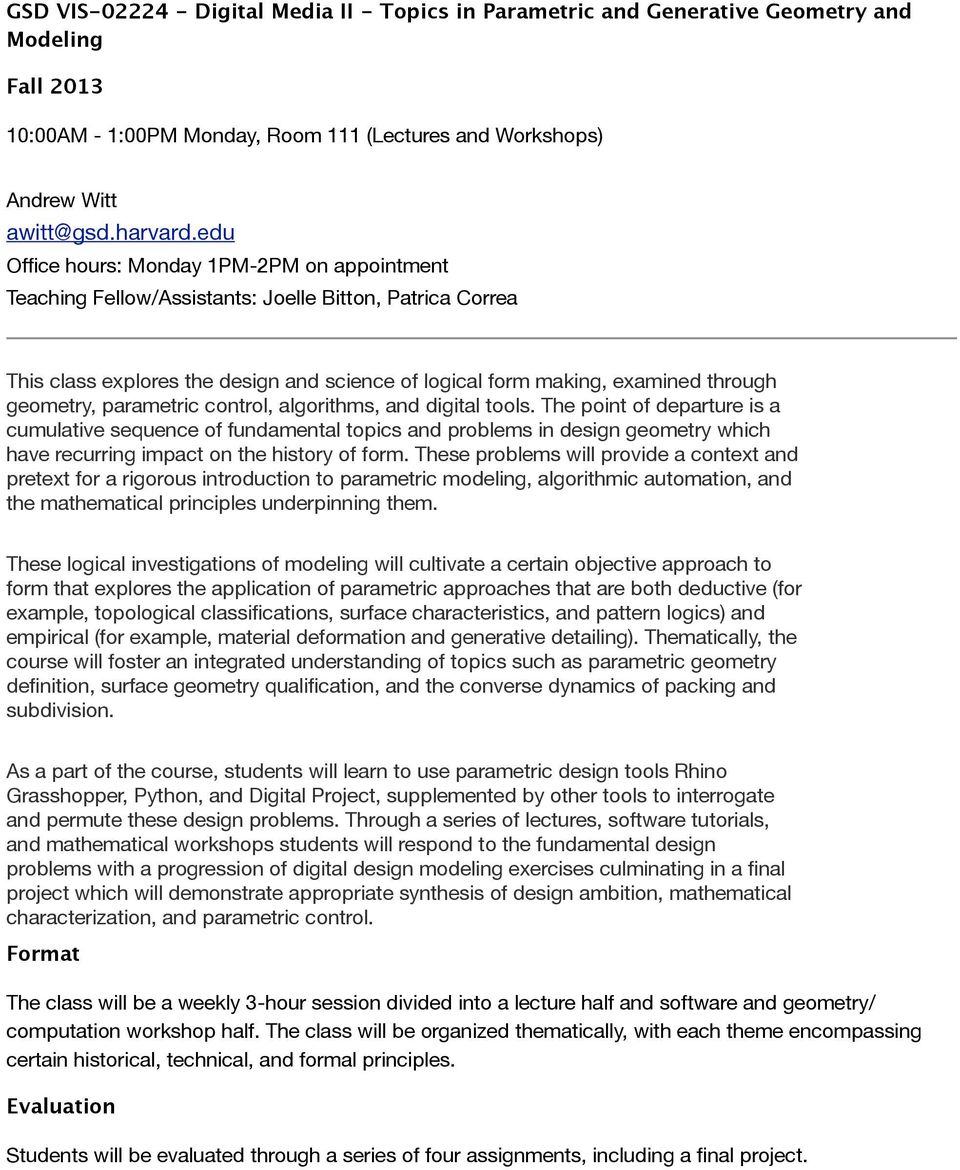
2 Schedule: Class Date Lecture Topic Workshop Topic Monday, Sept. 09, 2013 Introduction Mathematics of Geometry, Python I Monday, Sept. 16, 2013 Patterns, Symmetry, Topology Python II Monday, Sept. 23, 2013 Curves and Curvature Grasshopper I Monday, Sept. 30, 2013 Surface Geometry Surface Control, Grasshopper II Monday, Oct. 07, 2013 Surfaces and Topology I Grasshopper III Monday, Oct. 14, 2013 Surfaces and Topology II Grasshopper IV + Python Monday, Oct. 21, 2013 Subdivisions and Packings I Digital Project I + Formulas Monday, Oct. 28, 2013 Parametric Modules Digital Project II + Powercopies Monday, Nov. 04, 2013 Subdivisions and Packings II Digital Project III + Knowledge Patterns Monday, Nov. 11, 2013 Constraints and Embedded Digital Project IV + Rules, Analysis Rules Monday, Nov. 18, 2013 Combinatorics and Optimization, Galapagos Optimization Monday, Nov. 25, 2013 Data-driven Design Datasheets, Automated File I/O Monday, Dec. 02, 2013 Building Information Modeling BIM, Data Extraction Monday, Dec.16, 2013 Final Review (Tentative) Assessment: Grades will be evaluated based on the formal and experimental ambition of assignments, the conceptual clarity, cleverness, and precision of the execution, and the mastery of technical concepts as evidenced by submitted models, review interactions, and class participation. 20% Attendance. 40% Interim assignments 40% Final assignment September 09, Introduction Problem: What is design computation? This class introduces the broad topics and themes of the class in overview, including general problems and concepts of architectural geometry. Theoretical topics: Sets and numeric functions, weights and distributions, vectors. Technical topics: Python basics; variables, loops, conditionals

3 Carpo, Mario and Frederique Lemerle. Perspective, Projections, and Design: Technologies of Architectural Representation. New York: Routledge, Edwards, Lawrence. Projective Geometry. Edinburgh: Floris Books, Monge, Gaspard. Geometrie Descriptive. Paris: Baudoin, Pedoe, Daniel. Geometry: A Comprehensive Course. London: Cambridge University Press, Architectures Non-Standard. Paris: Centre Georges Pompidou, Legendre, George. Architectural Design: The Mathematics of Space. London: Wiley, September 16, Patterns, Symmetry, Pattern Topology Problem: What are the basic descriptors of 2-dimensional patterns? This class examines the fundamental symmetry patterns, both geometry and topological, that ascribe structure to 2-dimensional patterns. Theoretical topics: Topological and geometric symmetries, symmetry groups, topological exceptions, bi-arcs, graphs. Technical topics: Rhino Python. Points, lines, polylines, curves, patterns. Assignment: Assignment 01 given Kauffman, Louis. On Knots. Princeton: Princeton University Press, September 23, Curves and Curvature - Assignment 01 Due Problem: How does one represent and manipulate curves in space? This class examines the geometric and historical range of architectural surface types. Theory and construction methods for developable, spanning, and medial surfaces will be introduced. The class will particularly focus on surfaces which can be constructed from flat or singly-curved material. Theoretical topics: parametric curves, conic sections, NURBS curves, osculating circles, involutes and evolutes, osculating tangent and normal planes, torsion, mono- bi- and tri-tangencies, Biarc discretization. Technical topics: Introduction to Grasshopper.

4 Assignment: Assignment 01 due, assignment 02 given Burry, Mark. The New Mathematics of Architecture. London: Thames & Hudson, Piegl, Les and Wayne Tiller. The NURBS Book. September 30, Surface Geometry Problem: How does one represent, design, and build parametric surfaces? This class examines the geometric and historical range of architectural surface types. Theory and construction methods for developable and ruled surfaces will be introduced, including metrics for the measurement and quantification or such surfaces. The class will particularly focus on surfaces which can be constructed from flat or singly-curved material. Theoretical topics: Surface intersections, ruled surfaces, developable surfaces, affine developables, rectifying and tangent developables, curvature measures, implicit surfaces, kinetic surfaces. Technical topics: Grasshopper II. Assignment: Continue assignment 02 Lynn, Greg. Folding in Architecture. London: Wiley, Toponogov, Victor Andreevich. Differential geometry of curves and surfaces. Boston : Birkhauser, Shelden, Dennis R. Digital surface representation and the constructibility of Gehry's architecture. Cambridge: MIT, October 07, Surface and Topology I Problem: What are the methods to build topologically complex surfaces? This class considers the notion of surface topology and explores categories of surfaces that could be considered topologically complex. Particular care will be taken to examine surfaces that have specific architectural implications in terms of organization of constructability. Theoretical topics: Subdivision surfaces, offset surfaces, spanning surfaces, knot complexes, topological surfaces, medial surfaces.
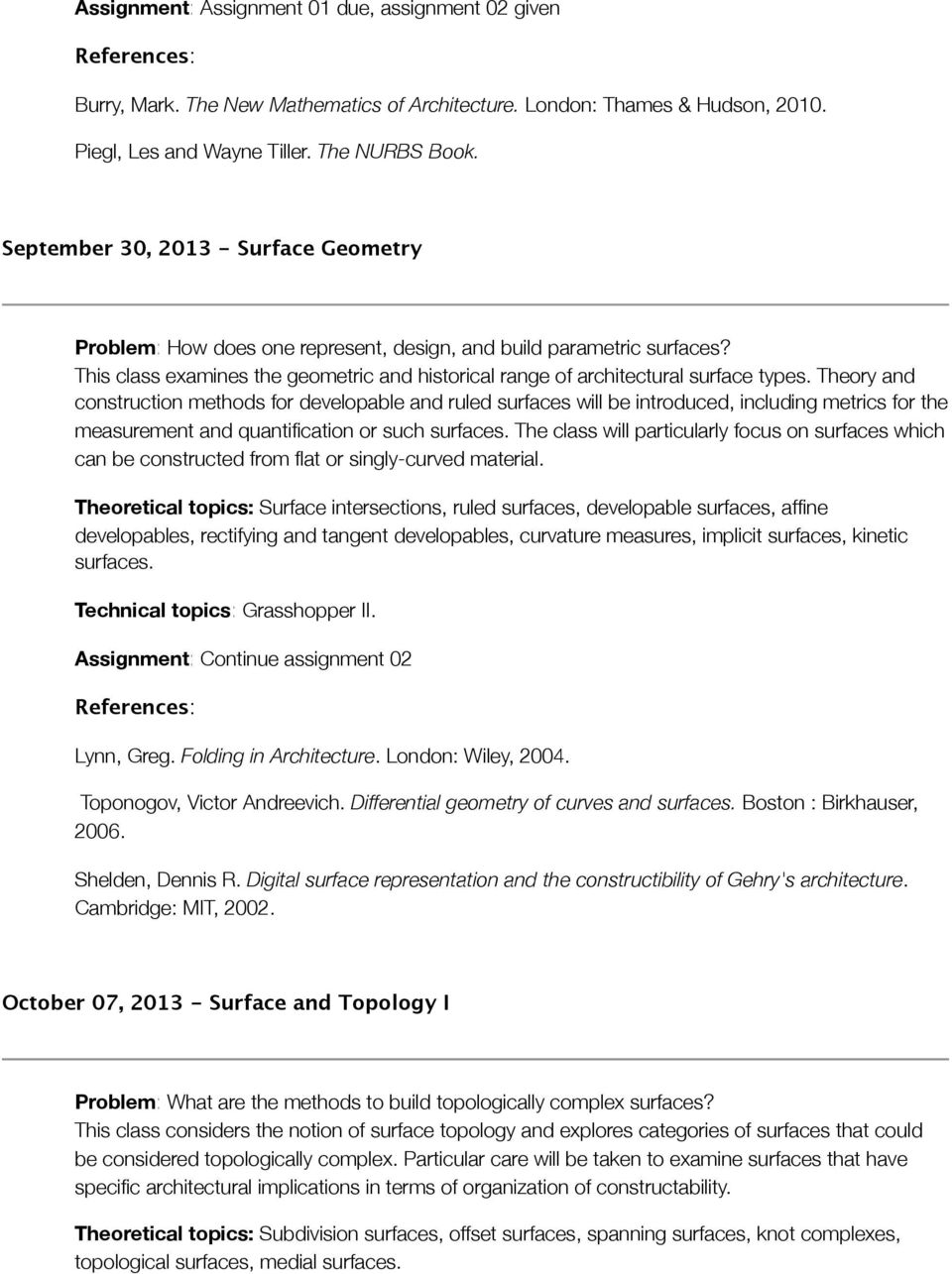
5 Technical topics: Grasshopper III Assignment: Continue Assignment 02 Burry, Mark. The New Mathematics of Architecture. London: Thames & Hudson, October 14, Surface and Topology II - Assignment 02 Due Problem: What are the methods to build topologically complex surfaces? This class continues to examine topological surfaces, including surface maps and metrics for subdivision. Theoretical topics: Subdivision surfaces, offset surfaces, spanning surfaces, knot complexes, topological surfaces, medial surfaces. Technical topics: Grasshopper IV Assignment: Assignment 02 due, Assignment 03 and Final Project given. Burry, Mark. The New Mathematics of Architecture. London: Thames & Hudson, October 21, 2013 Subdivisions and Packings I Problem: How can planes, surfaces, and spaces be filled and patterned? This class surveys the modes of tessellation possible for planes, surfaces, and spaces, with particular attention to implicit constraints on these partitions. Theoretical topics: Space packings, topological graph structures. Technical topics: Digital Project I Assignment: Continue Assignment 03 October 28, 2013 Parametric Modules Problem: How can the detailing of nonstandard components be automated?
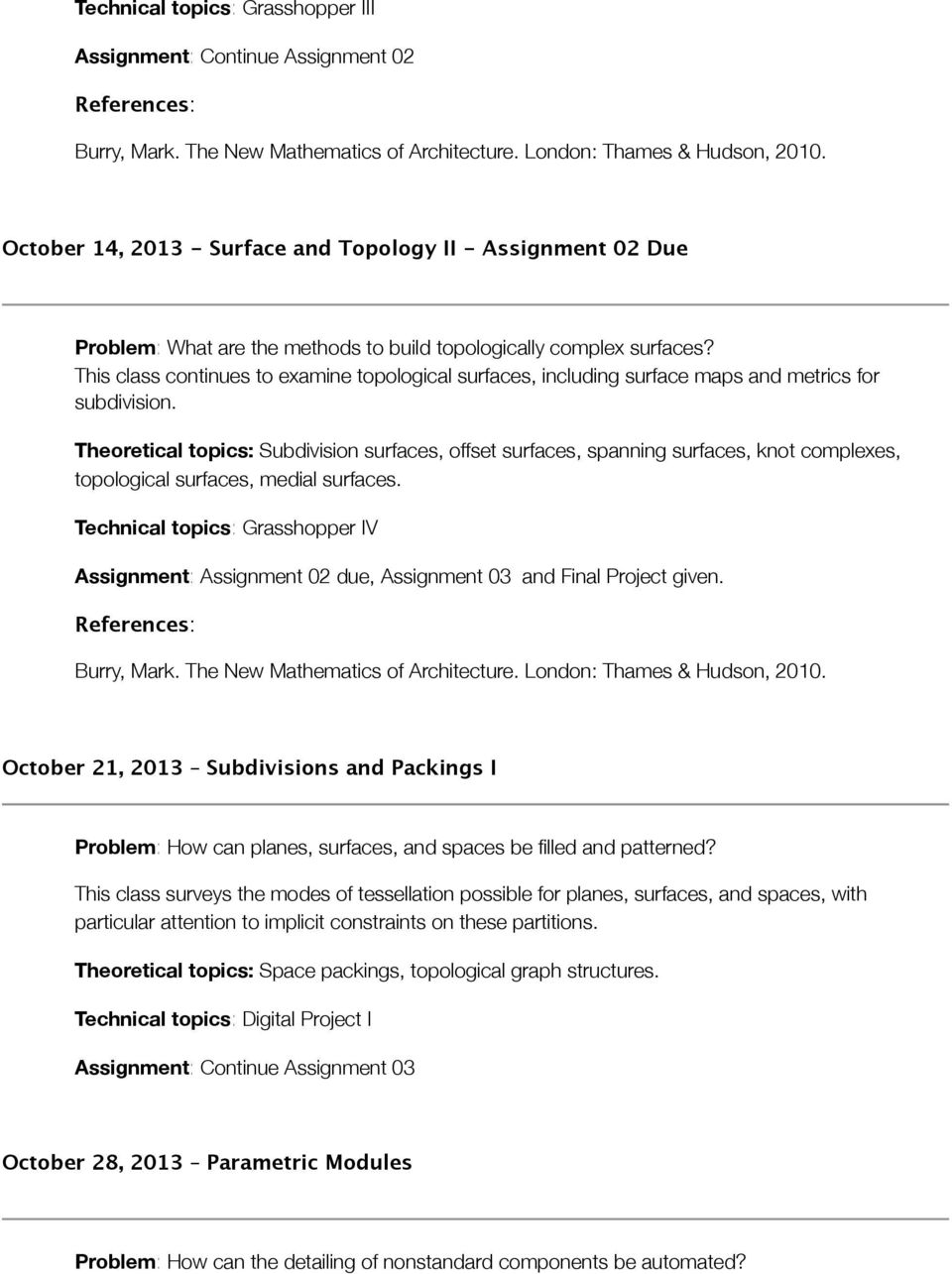
6 This class builds on the previous one to elaborate basic techniques for automation and modular surface effects. It also examines methods for embedding drawings, quantitative analysis, and fixation details into adaptive components. Examples from practice of generative detailing will be presented. Theoretical topics: Modularization, encapsulation, components. Technical topics: Digital Project II Assignment: Continue Assignment 03 November 04, Subdivisions and Packings II - Assignment 03 Due Problem: How can in irregular (2D or 3D) shape be smoothly patterned? This class examines the converse logics of subdivision and packing in the context of surfaces and spaces. Particular attention will be paid to invariants that help to classify the structure of forms and subdivide them in an ordered and formally determinate way. The class also introduces methods for the automated articulation of surfaces and basic data extraction. Examples from practice of the generation of subdivisions will be presented. Theoretical topics: Graphs, curve skeletons, topology of circle packing, orthotropic and nonorthotropic armatures, wrapping curves, reflect lines, ruling lines, geodesics, lines of curvature, modular subdivisions, polytopes, cellular growth, space packings. Technical topics: Digital Project III Assignment: Assignment 03 due Meredith, Michael. From Control to Design. New York : Actar, November 11, 2013 Constraints and Embedded Rules Problem: How can rules of a fabrication or design process be embedded in a 3D model? This class considers how responsive and adaptive rules can written and deployed in parametric models. Implicit rules, explicit rules, and constraints will be contextualized with case studies. Theoretical topics: Rule sets, constraint-based design, economies of fabrication and process. Technical topics: Digital Project IV Assignment: No assignment, continue work on assignment 03.

7 Legendre, George L. Architectural Design : The Mathematics of Space. London: Wiley, November 18, 2013 Combinatorics and Optimization Problem: What is design optimization? This class considers the tools and techniques used to generate viable alternatives and to achieve a design optimum. The underlying frameworks and assumptions that make optimization plausible will be explored in a critical context. Single-objective and multi-objective optimizations will be considered in detail, as well as broader questions on the theory of design optimization. Theoretical topics: Genetic algorithms, global and local optimization, gradient-based and simulated annealing techniques. Technical topics: Galapagos and Digital Project Optimizer. Assignment: Final assignment presented. November 25, 2013 Data-driven Design Problem: How can numeric and quantitative information inform the design process? This class investigates the use of existing or generated data sets to inform design. These data sets are either tabular information or databases, and the use of these sets is often central to the use of parametric models with specialist consultants. Theoretical topics: Data formats, using data sets with parametric models, integration with simulation tools. Technical topics: Datasheets, data file input. December 02, 2013 Building Information Models Problem: How can construction processes be integrated around 3D models? This class surveys the problems and themes of building information modeling. Here BIM is considered broadly, and includes integrated approached to bidding, construction, assembly, and

8 geometric control. The common BIM packages will be introduced and examined, and the practical impact of BIM explored. Theoretical topics: Organization problems of design, new contracting methods, integrated project delivery, Revit, model servers. Technical topics: BIM tools and processes. Eastman, Chuck. BIM Handbook: A Guide to Building Information Modeling for Owners, Managers, Designers, Engineers and Contractors. New York: Wiley, December 16, Final Review - Final Assignment Due Summary: The final review will require the production of a model, generative detail drawings, and analytic statistics of your design. You may optionally include an analytic animation to describe the parametric behavior of the model.

Prentice Hall Algebra 2 2011 Correlated to: Colorado P-12 Academic Standards for High School Mathematics, Adopted 12/2009
 Content Area: Mathematics Grade Level Expectations: High School Standard: Number Sense, Properties, and Operations Understand the structure and properties of our number system. At their most basic level
West Sound Technical Skills Center 101 National Avenue N. Bremerton WA 98312
 West Sound Technical Skills Center 101 National Avenue N. Bremerton WA 98312 Instructor: Tony Sharpe Phone: 360-473-0585 Fax: 360-478-5090 Email: [email protected] Hours: 7:30 a.m. 3:00
PA Academic Standards. 2.4. Mathematical Reasoning and Connections 2.5. Mathematical Problem Solving and Communication
 Curriculum Category Shift Standard Areas Grades K-8 and High School PA Academic Standards 2.4. Mathematical Reasoning and Connections 2.5. Mathematical Problem Solving and Communication PA Common Core
Computer Graphics CS 543 Lecture 12 (Part 1) Curves. Prof Emmanuel Agu. Computer Science Dept. Worcester Polytechnic Institute (WPI)
 Computer Graphics CS 54 Lecture 1 (Part 1) Curves Prof Emmanuel Agu Computer Science Dept. Worcester Polytechnic Institute (WPI) So Far Dealt with straight lines and flat surfaces Real world objects include
MEng, BSc Applied Computer Science
 School of Computing FACULTY OF ENGINEERING MEng, BSc Applied Computer Science Year 1 COMP1212 Computer Processor Effective programming depends on understanding not only how to give a machine instructions
OpenFOAM Optimization Tools
 OpenFOAM Optimization Tools Henrik Rusche and Aleks Jemcov [email protected] and [email protected] Wikki, Germany and United Kingdom OpenFOAM Optimization Tools p. 1 Agenda Objective Review optimisation
CSE 167: Lecture 13: Bézier Curves. Jürgen P. Schulze, Ph.D. University of California, San Diego Fall Quarter 2011
 CSE 167: Introduction to Computer Graphics Lecture 13: Bézier Curves Jürgen P. Schulze, Ph.D. University of California, San Diego Fall Quarter 2011 Announcements Homework project #6 due Friday, Nov 18
MEng, BSc Computer Science with Artificial Intelligence
 School of Computing FACULTY OF ENGINEERING MEng, BSc Computer Science with Artificial Intelligence Year 1 COMP1212 Computer Processor Effective programming depends on understanding not only how to give
UNIVERSITY OF BRADFORD
 UNIVERSITY OF BRADFORD Faculty of Engineering and Informatics School of Electrical Engineering and Computer Science Programme title: 3+0 BEng Electrical and Electronic Engineering (NAMAL) Awarding Institution:
Bachelor of Games and Virtual Worlds (Programming) Subject and Course Summaries
 First Semester Development 1A On completion of this subject students will be able to apply basic programming and problem solving skills in a 3 rd generation object-oriented programming language (such as
Big Ideas in Mathematics
 Big Ideas in Mathematics which are important to all mathematics learning. (Adapted from the NCTM Curriculum Focal Points, 2006) The Mathematics Big Ideas are organized using the PA Mathematics Standards
CATIA Wireframe & Surfaces TABLE OF CONTENTS
 TABLE OF CONTENTS Introduction... 1 Wireframe & Surfaces... 2 Pull Down Menus... 3 Edit... 3 Insert... 4 Tools... 6 Generative Shape Design Workbench... 7 Bottom Toolbar... 9 Tools... 9 Analysis... 10
Geometric Modelling & Curves
 Geometric Modelling & Curves Geometric Modeling Creating symbolic models of the physical world has long been a goal of mathematicians, scientists, engineers, etc. Recently technology has advanced sufficiently
Page 1 of 5. (Modules, Subjects) SENG DSYS PSYS KMS ADB INS IAT
 Page 1 of 5 A. Advanced Mathematics for CS A1. Line and surface integrals 2 2 A2. Scalar and vector potentials 2 2 A3. Orthogonal curvilinear coordinates 2 2 A4. Partial differential equations 2 2 4 A5.
Computer Graphics. Geometric Modeling. Page 1. Copyright Gotsman, Elber, Barequet, Karni, Sheffer Computer Science - Technion. An Example.
 An Example 2 3 4 Outline Objective: Develop methods and algorithms to mathematically model shape of real world objects Categories: Wire-Frame Representation Object is represented as as a set of points
Programme Specification (Undergraduate) Date amended: 27 February 2012
 Programme Specification (Undergraduate) Date amended: 27 February 2012 1. Programme Title(s) and UCAS code(s): BSc/BA/MMath Mathematics (Including year abroad) (G100/G102/G105) 2. Awarding body or institution:
15.496 Data Technologies for Quantitative Finance
 Paul F. Mende MIT Sloan School of Management Fall 2014 Course Syllabus 15.496 Data Technologies for Quantitative Finance Course Description. This course introduces students to financial market data and
Diablo Valley College Catalog 2014-2015
 Mathematics MATH Michael Norris, Interim Dean Math and Computer Science Division Math Building, Room 267 Possible career opportunities Mathematicians work in a variety of fields, among them statistics,
PCHS ALGEBRA PLACEMENT TEST
 MATHEMATICS Students must pass all math courses with a C or better to advance to the next math level. Only classes passed with a C or better will count towards meeting college entrance requirements. If
THE ALGORITHMIC AUDITORIUM. A computational model for auditorium design. 1. Introduction
 THE ALGORITHMIC AUDITORIUM A computational model for auditorium design GANAPATHY MAHALINGAM Department of Architecture and Landscape Architecture North Dakota State University Fargo, North Dakota USA Abstract.
MATH. ALGEBRA I HONORS 9 th Grade 12003200 ALGEBRA I HONORS
 * Students who scored a Level 3 or above on the Florida Assessment Test Math Florida Standards (FSA-MAFS) are strongly encouraged to make Advanced Placement and/or dual enrollment courses their first choices
PHILOSOPHY OF THE MATHEMATICS DEPARTMENT
 PHILOSOPHY OF THE MATHEMATICS DEPARTMENT The Lemont High School Mathematics Department believes that students should develop the following characteristics: Understanding of concepts and procedures Building
LEAVING CERT DCG SCHEME OF WORK
 2010-11 LEAVING CERT DCG SCHEME OF WORK ST OLIVER S COMMUNITY COLLEGE Mission statement The technology department aspires to provide a safe, stimulating environment where all students can develop their
Credit Number Lecture Lab / Shop Clinic / Co-op Hours. MAC 224 Advanced CNC Milling 1 3 0 2. MAC 229 CNC Programming 2 0 0 2
 MAC 224 Advanced CNC Milling 1 3 0 2 This course covers advanced methods in setup and operation of CNC machining centers. Emphasis is placed on programming and production of complex parts. Upon completion,
High School Mathematics Program. High School Math Sequences
 or High School Mathematics Program High School Math Sequences 9 th Grade 10 th Grade 11 th Grade 12 th Grade *Algebra I Pre- Calculus Personal Finance 9 th Grade 10 th Grade 11 th Grade 12 th Grade Calculus
Current Standard: Mathematical Concepts and Applications Shape, Space, and Measurement- Primary
 Shape, Space, and Measurement- Primary A student shall apply concepts of shape, space, and measurement to solve problems involving two- and three-dimensional shapes by demonstrating an understanding of:
Volumes of Revolution
 Mathematics Volumes of Revolution About this Lesson This lesson provides students with a physical method to visualize -dimensional solids and a specific procedure to sketch a solid of revolution. Students
CODING THE NATURE OF THINKING DISPLAYED IN RESPONSES ON NETS OF SOLIDS
 CODING THE NATURE OF THINKING DISPLAYED IN RESPONSES ON NETS OF SOLIDS Christine Lawrie: Centre for Cognition Research in Learning and Teaching, UNE, Australia John Pegg: Centre for Cognition Research
How To Use Design Mentor
 DesignMentor: A Pedagogical Tool for Computer Graphics and Computer Aided Design John L. Lowther and Ching Kuang Shene Programmers: Yuan Zhao and Yan Zhou (ver 1) Budirijanto Purnomo (ver 2) Michigan Technological
NEW MEXICO Grade 6 MATHEMATICS STANDARDS
 PROCESS STANDARDS To help New Mexico students achieve the Content Standards enumerated below, teachers are encouraged to base instruction on the following Process Standards: Problem Solving Build new mathematical
DELAWARE MATHEMATICS CONTENT STANDARDS GRADES 9-10. PAGE(S) WHERE TAUGHT (If submission is not a book, cite appropriate location(s))
 Prentice Hall University of Chicago School Mathematics Project: Advanced Algebra 2002 Delaware Mathematics Content Standards (Grades 9-10) STANDARD #1 Students will develop their ability to SOLVE PROBLEMS
MA150/WR150 Investigations in Geometry Spring 2014 Lectures: Tuesday, Thursday 2-3:30 in COM 213 Discussion section: Tuesday 3:30-4:30 in PSY B36
 MA150/WR150 Investigations in Geometry Spring 2014 Lectures: Tuesday, Thursday 2-3:30 in COM 213 Discussion section: Tuesday 3:30-4:30 in PSY B36 Professor: Steve Rosenberg Office: MCS 248 Contact: [email protected];
2. Distributed Handwriting Recognition. Abstract. 1. Introduction
 XPEN: An XML Based Format for Distributed Online Handwriting Recognition A.P.Lenaghan, R.R.Malyan, School of Computing and Information Systems, Kingston University, UK {a.lenaghan,r.malyan}@kingston.ac.uk
Further Steps: Geometry Beyond High School. Catherine A. Gorini Maharishi University of Management Fairfield, IA [email protected]
 Further Steps: Geometry Beyond High School Catherine A. Gorini Maharishi University of Management Fairfield, IA [email protected] Geometry the study of shapes, their properties, and the spaces containing
Information and Communications Technology Courses at a Glance
 Information and Communications Technology Courses at a Glance Level 1 Courses ICT121 Introduction to Computer Systems Architecture This is an introductory course on the architecture of modern computer
Everyday Mathematics. Grade 4 Grade-Level Goals CCSS EDITION. Content Strand: Number and Numeration. Program Goal Content Thread Grade-Level Goal
 Content Strand: Number and Numeration Understand the Meanings, Uses, and Representations of Numbers Understand Equivalent Names for Numbers Understand Common Numerical Relations Place value and notation
Indiana Academic Standards Mathematics: Probability and Statistics
 Indiana Academic Standards Mathematics: Probability and Statistics 1 I. Introduction The college and career ready Indiana Academic Standards for Mathematics: Probability and Statistics are the result of
LONDON SCHOOL OF COMMERCE. Programme Specification for the. Cardiff Metropolitan University. BSc (Hons) in Computing
 LONDON SCHOOL OF COMMERCE Programme Specification for the Cardiff Metropolitan University BSc (Hons) in Computing Contents Programme Aims and Objectives Programme Structure Programme Outcomes Mapping of
We can display an object on a monitor screen in three different computer-model forms: Wireframe model Surface Model Solid model
 CHAPTER 4 CURVES 4.1 Introduction In order to understand the significance of curves, we should look into the types of model representations that are used in geometric modeling. Curves play a very significant
In mathematics, there are four attainment targets: using and applying mathematics; number and algebra; shape, space and measures, and handling data.
 MATHEMATICS: THE LEVEL DESCRIPTIONS In mathematics, there are four attainment targets: using and applying mathematics; number and algebra; shape, space and measures, and handling data. Attainment target
EMERGING FRONTIERS AND FUTURE DIRECTIONS FOR PREDICTIVE ANALYTICS, VERSION 4.0
 EMERGING FRONTIERS AND FUTURE DIRECTIONS FOR PREDICTIVE ANALYTICS, VERSION 4.0 ELINOR L. VELASQUEZ Dedicated to the children and the young people. Abstract. This is an outline of a new field in predictive
Algebra 1 2008. Academic Content Standards Grade Eight and Grade Nine Ohio. Grade Eight. Number, Number Sense and Operations Standard
 Academic Content Standards Grade Eight and Grade Nine Ohio Algebra 1 2008 Grade Eight STANDARDS Number, Number Sense and Operations Standard Number and Number Systems 1. Use scientific notation to express
(Refer Slide Time: 1:42)
 Introduction to Computer Graphics Dr. Prem Kalra Department of Computer Science and Engineering Indian Institute of Technology, Delhi Lecture - 10 Curves So today we are going to have a new topic. So far
096 Professional Readiness Examination (Mathematics)
 096 Professional Readiness Examination (Mathematics) Effective after October 1, 2013 MI-SG-FLD096M-02 TABLE OF CONTENTS PART 1: General Information About the MTTC Program and Test Preparation OVERVIEW
Math 1280/1300, Pre-Calculus
 Math 1280/1300, Pre-Calculus Instructor: Office: Office Hours: Phone: E-mail: MyMathLab Course Code: Text and Materials: ISBN: 1269594060 Author: Blitzer Title: Precalculus, Books a la Carte Edition Package
MIDLAND ISD ADVANCED PLACEMENT CURRICULUM STANDARDS AP ENVIRONMENTAL SCIENCE
 Science Practices Standard SP.1: Scientific Questions and Predictions Asking scientific questions that can be tested empirically and structuring these questions in the form of testable predictions SP.1.1
04 Mathematics CO-SG-FLD004-03. Program for Licensing Assessments for Colorado Educators
 04 Mathematics CO-SG-FLD004-03 Program for Licensing Assessments for Colorado Educators Readers should be advised that this study guide, including many of the excerpts used herein, is protected by federal
MT120-ES: Topics in Applied College Math (4 credits; 100% online) Syllabus Fall 2013
 Contact Information for Professor Wood MT120-ES: Topics in Applied College Math (4 credits; 100% online) Syllabus Fall 2013 Phone: (603) 271-6484 x4341 E-mail: [email protected] Office: Sweeney Hall, Room
Database Marketing, Business Intelligence and Knowledge Discovery
 Database Marketing, Business Intelligence and Knowledge Discovery Note: Using material from Tan / Steinbach / Kumar (2005) Introduction to Data Mining,, Addison Wesley; and Cios / Pedrycz / Swiniarski
A Short Introduction to Computer Graphics
 A Short Introduction to Computer Graphics Frédo Durand MIT Laboratory for Computer Science 1 Introduction Chapter I: Basics Although computer graphics is a vast field that encompasses almost any graphical
Truman College-Mathematics Department Math 209-ABC: Calculus and Analytic Geometry III Course Syllabus Spring 2012
 Truman College-Mathematics Department Math 209-ABC: Calculus and Analytic Geometry III Course Syllabus Spring 2012 Instructor: Dr. Abdallah Shuaibi Office #: 3816 Email: [email protected] URL: http://faculty.ccc.edu/ashuaibi/
SOLIDWORKS: SKETCH RELATIONS
 Sketch Feature: The shape or topology of the initial sketch or model is important, but exact geometry and dimensions of the initial sketched shapes are NOT. It recommended to work in the following order:
CSCD18: Computer Graphics
 CSCD18: Computer Graphics Professor: Office: Office hours: Teaching Assistant: Office hours: Lectures: Tutorials: Website: Leonid Sigal [email protected] [email protected] Room SW626 Monday 12:00-1:00pm
Position Classification Flysheet for Computer Science Series, GS-1550. Table of Contents
 Position Classification Flysheet for Computer Science Series, GS-1550 Table of Contents SERIES DEFINITION... 2 OCCUPATIONAL INFORMATION... 2 EXCLUSIONS... 4 AUTHORIZED TITLES... 5 GRADE LEVEL CRITERIA...
2012/2013 Programme Specification Data. Honours Degree BA Hons Architecture. Architecture, 2010. The aims of the programme are to:
 2012/2013 Programme Specification Data Programme Name Programme Number Programme Award QAA Subject Benchmark Statements Honours Degree BA Hons Architecture P01101 BA Hons Architecture, 2010 Programme Aims
CURRICULUM FOR THE COMMON CORE SUBJECT OF MATHEMATICS
 CURRICULUM FOR THE COMMON CORE SUBJECT OF Dette er ei omsetjing av den fastsette læreplanteksten. Læreplanen er fastsett på Nynorsk Established as a Regulation by the Ministry of Education and Research
KEANSBURG SCHOOL DISTRICT KEANSBURG HIGH SCHOOL Mathematics Department. HSPA 10 Curriculum. September 2007
 KEANSBURG HIGH SCHOOL Mathematics Department HSPA 10 Curriculum September 2007 Written by: Karen Egan Mathematics Supervisor: Ann Gagliardi 7 days Sample and Display Data (Chapter 1 pp. 4-47) Surveys and
Glencoe. correlated to SOUTH CAROLINA MATH CURRICULUM STANDARDS GRADE 6 3-3, 5-8 8-4, 8-7 1-6, 4-9
 Glencoe correlated to SOUTH CAROLINA MATH CURRICULUM STANDARDS GRADE 6 STANDARDS 6-8 Number and Operations (NO) Standard I. Understand numbers, ways of representing numbers, relationships among numbers,
Identification algorithms for hybrid systems
 Identification algorithms for hybrid systems Giancarlo Ferrari-Trecate Modeling paradigms Chemistry White box Thermodynamics System Mechanics... Drawbacks: Parameter values of components must be known
Lecture 3: Models of Spatial Information
 Lecture 3: Models of Spatial Information Introduction In the last lecture we discussed issues of cartography, particularly abstraction of real world objects into points, lines, and areas for use in maps.
How To Teach Math
 Mathematics K-12 Mathematics Introduction The Georgia Mathematics Curriculum focuses on actively engaging the students in the development of mathematical understanding by using manipulatives and a variety
How SolidWorks Speeds Consumer Product Design
 white paper How SolidWorks Speeds Consumer Product Design inspiration SUMMARY SolidWorks Premium bridges the gap between industrial design and engineering by providing powerful surfacing capabilities,
Extracting Business. Value From CAD. Model Data. Transformation. Sreeram Bhaskara The Boeing Company. Sridhar Natarajan Tata Consultancy Services Ltd.
 Extracting Business Value From CAD Model Data Transformation Sreeram Bhaskara The Boeing Company Sridhar Natarajan Tata Consultancy Services Ltd. GPDIS_2014.ppt 1 Contents Data in CAD Models Data Structures
Faculty of Science School of Mathematics and Statistics
 Faculty of Science School of Mathematics and Statistics MATH5836 Data Mining and its Business Applications Semester 1, 2014 CRICOS Provider No: 00098G MATH5836 Course Outline Information about the course
FACULTY OF COMPUTER SCIENCE AND INFORMATION TECHNOLOGY AUTUMN 2016 BACHELOR COURSES
 FACULTY OF COMPUTER SCIENCE AND INFORMATION TECHNOLOGY Please note! This is a preliminary list of courses for the study year 2016/2017. Changes may occur! AUTUMN 2016 BACHELOR COURSES DIP217 Applied Software
Fanny Dos Reis. Visiting Assistant Professor, Texas A&M University. September 2006 - May 2008
 Fanny Dos Reis Positions Held Visiting Assistant Professor, Texas A&M University. September 2006 - May 2008 Visiting Assistant Professor, University of Lille 1, France. September 2004 - August 2006 Visiting
Classification of Fingerprints. Sarat C. Dass Department of Statistics & Probability
 Classification of Fingerprints Sarat C. Dass Department of Statistics & Probability Fingerprint Classification Fingerprint classification is a coarse level partitioning of a fingerprint database into smaller
New trend in Russian informatics curricula: integration of math and informatics
 New trend in Russian informatics curricula: integration of math and informatics Svetlana Gaisina Academy of post-degree pedagogical education, Saint Petersburg, [email protected] Sergei Pozdniakov Saint
Problem of the Month: Cutting a Cube
 Problem of the Month: The Problems of the Month (POM) are used in a variety of ways to promote problem solving and to foster the first standard of mathematical practice from the Common Core State Standards:
Modeling Curves and Surfaces
 Modeling Curves and Surfaces Graphics I Modeling for Computer Graphics!? 1 How can we generate this kind of objects? Umm!? Mathematical Modeling! S Do not worry too much about your difficulties in mathematics,
Indiana Academic Standards Mathematics: Algebra II
 Indiana Academic Standards Mathematics: Algebra II 1 I. Introduction The college and career ready Indiana Academic Standards for Mathematics: Algebra II are the result of a process designed to identify,
How To Understand And Understand The Theory Of Computational Finance
 This course consists of three separate modules. Coordinator: Omiros Papaspiliopoulos Module I: Machine Learning in Finance Lecturer: Argimiro Arratia, Universitat Politecnica de Catalunya and BGSE Overview
How To Model Space Frame Structure In Cad 3D Software
 PARAMETRIC MODELING OF SPACE FRAME STRUCTURES STUDY OF COMPARISON BETWEEN TWO METHODS EMPLOYING TWO DIFFERENT SOFTWARE TOOLS: CATIA V5 DSS and GRASSHOPPER PLUGIN 1/16 TABLE OF CONTENTS - BIM and parametric
Programme Specification
 LOUGHBOROUGH UNIVERSITY Programme Specification Information Technology & Physics Please note: This specification provides a concise summary of the main features of the programme and the learning outcomes
Everyday Mathematics. Grade 4 Grade-Level Goals. 3rd Edition. Content Strand: Number and Numeration. Program Goal Content Thread Grade-Level Goals
 Content Strand: Number and Numeration Understand the Meanings, Uses, and Representations of Numbers Understand Equivalent Names for Numbers Understand Common Numerical Relations Place value and notation
NURBS Drawing Week 5, Lecture 10
 CS 430/536 Computer Graphics I NURBS Drawing Week 5, Lecture 10 David Breen, William Regli and Maxim Peysakhov Geometric and Intelligent Computing Laboratory Department of Computer Science Drexel University
What is Modeling and Simulation and Software Engineering?
 What is Modeling and Simulation and Software Engineering? V. Sundararajan Scientific and Engineering Computing Group Centre for Development of Advanced Computing Pune 411 007 [email protected] Definitions
Texas Success Initiative (TSI) Assessment. Interpreting Your Score
 Texas Success Initiative (TSI) Assessment Interpreting Your Score 1 Congratulations on taking the TSI Assessment! The TSI Assessment measures your strengths and weaknesses in mathematics and statistics,
Course 803401 DSS. Business Intelligence: Data Warehousing, Data Acquisition, Data Mining, Business Analytics, and Visualization
 Oman College of Management and Technology Course 803401 DSS Business Intelligence: Data Warehousing, Data Acquisition, Data Mining, Business Analytics, and Visualization CS/MIS Department Information Sharing
Generative Shape Design
 Generative Shape Design Preface What's New Getting Started Basic Tasks Advanced Tasks Workbench Description Glossary Index Dassault Systèmes 1994-99. All rights reserved. Preface CATIA Version 5 Generative
Investigating Area Under a Curve
 Mathematics Investigating Area Under a Curve About this Lesson This lesson is an introduction to areas bounded by functions and the x-axis on a given interval. Since the functions in the beginning of the
Robust NURBS Surface Fitting from Unorganized 3D Point Clouds for Infrastructure As-Built Modeling
 81 Robust NURBS Surface Fitting from Unorganized 3D Point Clouds for Infrastructure As-Built Modeling Andrey Dimitrov 1 and Mani Golparvar-Fard 2 1 Graduate Student, Depts of Civil Eng and Engineering
CS 425 Software Engineering
 Department of Computer Science and Engineering College of Engineering, University of Nevada, Reno Fall 2009 CS 425 Software Engineering Lectures: Instructors: Office hours: Catalog description: Course
Specification and Analysis of Contracts Lecture 1 Introduction
 Specification and Analysis of Contracts Lecture 1 Introduction Gerardo Schneider [email protected] http://folk.uio.no/gerardo/ Department of Informatics, University of Oslo SEFM School, Oct. 27 - Nov.
Georgia Department of Education Kathy Cox, State Superintendent of Schools 7/19/2005 All Rights Reserved 1
 Accelerated Mathematics 3 This is a course in precalculus and statistics, designed to prepare students to take AB or BC Advanced Placement Calculus. It includes rational, circular trigonometric, and inverse
Applied mathematics and mathematical statistics
 Applied mathematics and mathematical statistics The graduate school is organised within the Department of Mathematical Sciences.. Deputy head of department: Aila Särkkä Director of Graduate Studies: Marija
How To Gain Competitive Advantage With Big Data Analytics And Visualization
 MKTG3000 Special Topics: Competitive Advantage with Big Data Marketing Analytics & Marketplace Visualization Strategy Fall 2015 Dr. Jared Hansen Associate Professor of Marketing MKTG3000-001: Special Topics:
2. Basis for computing design and implementation at all levels through OS, distributed systems, human interface and computer graphics.
 School of Science 1 Awarding institution Bangor University 2 Teaching institution Bangor University 3 Programme accredited by BCS 4 Final award BSc (Hons) 5 Programme Science 6 UCAS code G400 7 QAA subject
Integration of acoustics in parametric architectural design
 Toronto, Canada International Symposium on Room Acoustics 2013 June 9-11 ISRA 2013 Integration of acoustics in parametric architectural design Dr Thomas Scelo ([email protected]) Marshall Day Acoustics
South Carolina College- and Career-Ready (SCCCR) Probability and Statistics
 South Carolina College- and Career-Ready (SCCCR) Probability and Statistics South Carolina College- and Career-Ready Mathematical Process Standards The South Carolina College- and Career-Ready (SCCCR)
Prentice Hall Mathematics: Course 1 2008 Correlated to: Arizona Academic Standards for Mathematics (Grades 6)
 PO 1. Express fractions as ratios, comparing two whole numbers (e.g., ¾ is equivalent to 3:4 and 3 to 4). Strand 1: Number Sense and Operations Every student should understand and use all concepts and
Tennessee Mathematics Standards 2009-2010 Implementation. Grade Six Mathematics. Standard 1 Mathematical Processes
 Tennessee Mathematics Standards 2009-2010 Implementation Grade Six Mathematics Standard 1 Mathematical Processes GLE 0606.1.1 Use mathematical language, symbols, and definitions while developing mathematical
NURBS Drawing Week 5, Lecture 10
 CS 430/536 Computer Graphics I NURBS Drawing Week 5, Lecture 10 David Breen, William Regli and Maxim Peysakhov Geometric and Intelligent Computing Laboratory Department of Computer Science Drexel University
CATIA V5R21 - FACT SHEET
 CATIA V5R21 - FACT SHEET Introduction What s New at a Glance Overview Detailed Description INTRODUCTION CATIA V5 is the leading solution for product success. It addresses all manufacturing organizations;
Eastern Washington University Department of Computer Science. Questionnaire for Prospective Masters in Computer Science Students
 Eastern Washington University Department of Computer Science Questionnaire for Prospective Masters in Computer Science Students I. Personal Information Name: Last First M.I. Mailing Address: Permanent