
Exchange Rates, Equity Prices, and Capital Flows
|
|
|
- Janice Hood
- 10 years ago
- Views:
Transcription
1 Exchange Raes, Equiy Prices, and Capial Flows Harald Hau Deparmen of Finance, INSEAD Hélène Rey Deparmen of Economics and Woodrow Wilson School, Princeon Universiy We develop an equilibrium model in which exchange raes, sock prices, and capial flows are joinly deermined under incomplee foreign exchange (forex) risk rading. Incomplee hedging of forex risk, documened for U.S. global muual funds, induces he following price and capial flow dynamics: Higher reurns in he home equiy marke relaive o he foreign equiy marke are associaed wih a home currency depreciaion. Ne equiy flows ino he foreign marke are posiively correlaed wih a foreign currency appreciaion. The model predicions are srongly suppored a daily, monhly, and quarerly frequencies for 17 OECD counries vis-à-vis he Unied Saes. Correlaions are sronges afer 1990 and for counries wih higher equiy marke capializaion relaive o GDP, suggesing ha he observed exchange rae dynamics is indeed relaed o equiy marke developmen. The las 25 years have been characerized by a remarkable increase in inernaional capial mobiliy. While gross cross-border ransacions in bond and equiy for he Unied Saes were equivalen o only 4% of GDP in 1975, his share increased o 100% in he early 1990s and has grown o 245% by Furhermore, a growing proporion of hese capial flows consiss of equiy as opposed o bank loans or governmen bonds 1 The Deniz Igan provided ousanding research assisance. We hank Mike Woodford for his commens. Thanks also o paricipans in he 2004 American Economeric Associaion Winer Meeings, he 2003 European summer symposium in financial markes, he FX microsrucure conference a he Sockholm Insiue for Finance and a he London School of Economics (Financial Marke Group), he 2002 NBER IFM summer insiue, and in seminars a Columbia Universiy, INSEAD, London Business School, ESCP-EAP (Paris), Georgeown Universiy, George Washingon Universiy, and he IMF. We are boh very graeful o he IMF Research Deparmen for is warm hospialiy and is simulaing environmen while wriing pars of his paper. Sergio Schmukler and Sijn Claessens provided he sock marke capializaion daa. This paper is par of a research nework on The Analysis of Inernaional Capial Markes: Undersanding Europe s Role in he Global Economy, funded by he European Commission under he Research Training Nework Program (Conrac No. HPRNŒCTŒ 1999Œ00067). Address correspondence o Harald Hau, Deparmen of Finance, Boulevard de Consance, Fonainebleau Cedex, France, or [email protected]. 1 The London-based research firm Cross Border Capial repors ha during he period , bank loans accouned on average for 39.5% of oal ouflows from major indusrialized counries (60.3% of inflows), while equiies accouned for only 9.5% of ouflows (6.1% of inflows). During he period, hese proporions were reversed. Bank loans accouned only for 8.3% of ouflows (16.3% of inflows), while equiies jumped o 35.9% of ouflows (31.6% of inflows). Similarly Lane and Milesi- Ferrei (2003) repor ha he raio of foreign asses and liabiliies o GDP has increased by 250% over he period The same raio compued only for equiy and FDI has more han ripled over he same period. See also Frankel (1994) and Obsfeld and Taylor (2002). ª The Auhor Published by Oxford Universiy Press on behalf of The Sociey for Financial Sudies. All righs reserved. For permissions, please [email protected]. doi: /rfs/hhj008 Advance Access publicaion Ocober 28, 2005
2 The Review of Financial Sudies / v 19 n increasing size and equiy conen of curren capial flows has no ye inspired a new financial marke paradigm for exchange rae heory, in which exchange raes, equiy marke reurns, and capial flows are joinly deermined. Recenly, posiive exchange rae heory has advanced mosly ouside he scope of radiional macroeconomic heory, plagued wih is nooriously poor empirical performance [Meese and Rogoff (1982, 1983)] and wih widespread pessimism abou he explanaory power of macro variables in general o explain shor- o medium-run exchange rae movemens. 2 The empirical microsrucure lieraure has examined he role of foreign exchange (forex) order flow defined as he difference beween buy and sell orders. Evans and Lyons (2002a, 2002b, 2002c, 2003), Hau, Killeen, and Moore (2002), Killeen, Lyons, and Moore (2006), Lyons (2001), and Rime (2001) show ha order flow from elecronic rading sysems has remarkably high correlaion wih conemporaneous exchange rae changes. Since order flow in he forex marke is a leas parly deermined by invesors desires for porfolio shifs, hese resuls sugges an imporan linkage beween exchange rae dynamics and invesor behavior. The mos comprehensive order flow daa are owned by global cusodians like Sae Sree, which underake a large proporion of global equiy clearing. Such (proprieary) daa have been analyzed by Froo and Ramadorai (2005) and Froo, O Connell, and Seasholes (2001). The resuls show ha he impac of invesor order flow on he exchange rae is very persisen and peaks a horizons of abou a monh for major currencies. Overall, he linkage beween order flow and exchange rae movemens appears very srong, nowihsanding he possibiliy ha exchange raes may also move because of public informaion only and wihou any ransacion. Bu he capial flow exchange rae linkage has no ye been imbedded in a heoreical framework in which order flow is derived from opimizing inernaional invesmen behavior. There is sill no model ha bridges he gap beween forex microsrucure and macroeconomic fundamenals. To develop such a framework and explore is empirical implicaions are he main objecives of his aricle. Our model depars from he exising lieraure on inernaional porfolio choice in several imporan ways. Firs, we focus exclusively on modeling shor- o medium-run exchange rae flucuaions and emphasize accordingly invesmen flows as he main deerminan of he exchange rae. The flow deerminaion can be undersood as a consequence of limied forex arbirage of risk averse speculaors. Tradiional porfolio balance models have ypically imposed a purchasing power 2 Frankel and Rose (1995) summarize he siuaion by saying ha [n]o model based on such sandard fundamenals like money supplies, real income, ineres raes, inflaion raes, and curren accoun balances will ever succeed in explaining or predicing a high percenage of he variaion in he exchange rae, a leas a shor- or medium-erm frequencies. 274
![Recenly, posiive exchange rae heory has advanced mosly ouside he scope of radiional macroeconomic heory, plagued wih is nooriously poor empirical performance [Meese and Rogoff (1982, 1983)] and wih](/docs-images/45/8839383/images/page_2.jpg "widespread pessimism abou he explanaory power of macro variables in general o explain shor- o medium-run exchange rae movemens.")
3 Exchange Raes, Equiy Prices, and Capial Flows pariy condiion for he exchange rae deerminaion. We absrac enirely from curren accoun consideraions, since he empirical lieraure has unambiguously shown ha goods marke variables do no explain exchange rae movemens a he shor- o medium-run frequencies. 3 Second, he exising sochasic porfolio balance models ypically assume exogenous asse price processes. This precludes any feedback effecs of opimal asse demands on he equilibrium price processes. Our framework fully endogenizes he equiy marke prices as well as he exchange rae and hereby allows a meaningful analysis of correlaion srucure of equiy reurns relaive o exchange rae reurns and equiy flows. Third, unlike his lieraure, we make he assumpion ha bond supplies are infiniely elasic, which allows us o significanly simplify he dynamics of bond holdings in our model. Fourh, our mos imporan srucural assumpion concerns incomplee forex risk rading. In complee markes and in a compleely symmeric wo-counry model wih equal marke capializaions, exchange rae risk hedging is a free lunch [Karolyi and Sulz (2002) and Perold and Schulman (1988)]. Invesors in he home counry can simply swap and eliminae forex risk by rading i wih foreign invesors holding he reciprocal risk. Under full forex risk hedging, he domesic and inernaional invesmen problems are alike, unless we separae home and foreign invesors by asymmeric informaion, differen consumpion opporuniies, or preferences. Bu he evidence on forex hedging srongly suggess ha marke compleeness represens a highly counerfacual benchmark. We have survey evidence on muual funds and oher insiuional invesors, which manage a large proporion of U.S. foreign equiy invesmens. Their lower ransacion coss and higher financial sophisicaion make hem beer candidaes for forex risk rading compared o individual invesors. Do hey swap forex risk wih heir foreign counerpars? Levich, Hay, and Ripson (1999) surveyed 298 U.S. insiuional invesors and found ha more han 20% were no even permied o hold derivaive conracs in heir invesmen porfolio. A furher 25% of insiuional invesors were formally unconsrained, bu did no rade in derivaives. The remaining 55% of insiuional invesors hedged only a minor proporion of heir forex exposure. For he full sample, Levich, Hay, and Ripson (1999) calculaed ha forex risk hedging concerned only 8% of he oal foreign equiy invesmen. 4 Porfolio managers cied 3 Hence, we make he polar assumpion of he one chosen by he New Open Economy Macroeconomics lieraure, which ends o focus exclusively on he goods marke and o shu down he capial accoun by assuming specific uiliy funcions [see for example Obsfeld and Rogoff (2000)]. Noe ha alhough his lieraure is unsuccessful a explaining exchange rae movemens, i is well suied o address a hos of oher imporan issues ha our simple model canno ackle. We herefore see our approach and he exising lieraure as complemenary. 4 We also consuled marke expers in wo large U.S. cusodians. Independen sources a boh Sae Sree Bank and Ciibank esimaed he noional forex hedge a <10%. This confirms he survey evidence. 275
4 The Review of Financial Sudies / v 19 n monioring problems, lack of knowledge, and public and regulaory percepions as mos imporan reasons for he resriced forex derivaive use. The developmen of he derivaive marke nowihsanding, only a minor proporion of he oal macroeconomic forex reurn risk seems o be separaely raded and eliminaed. The ypical foreign equiy invesor holds currency reurn and foreign equiy reurn risk as a bundle. Exposure o exchange rae risk implies ha he inernaional invesor generally cares abou boh he volailiy of he exchange rae and he correlaion srucure of exchange raes and foreign equiy reurns. For example, higher exchange rae volailiy ends o induce a home equiy bias. On he oher hand, a negaive correlaion beween forex rae reurns and foreign sock marke reurns reduces he reurn volailiy in home currency erms and makes foreign invesmen more aracive. Porfolio choice herefore depends on exchange rae dynamics. Bu dynamic porfolio choice should simulaneously affec he exchange rae. Differences in he performance or value of he home and foreign sock marke change he exchange rae risk exposure of boh invesors and give rise o porfolio rebalancing. Such dynamic rebalancing of equiy porfolios hen iniiaes forex order flow, which in urn induces exchange rae movemens. We capure his ineracion beween opimal porfolio choice under marke incompleeness and exchange rae dynamics in a simple model. In paricular, exchange raes, porfolio equiy flows, and equiy reurns are joinly and endogenously deermined. Bu o preserve racabiliy and gain some inuiion on how he ineracion beween exchange rae and equiy markes operae, we had o make some srong assumpions. We assume ha in each of he wo counries of our world economy, here is a consan risk-free ineres rae and an exogenous sochasic dividend process for he equiy marke. Domesic and foreign invesors are risk averse and maximize a simple rade-off beween insananeous rading profis and heir variance. Any porfolio shif or dividend repariaion riggers an increase in demand for forex as invesors do no hold foreign currency balances and all asse ransacions are underaken in he currency of denominaion of he asse. Hence, a ne ouflow ou of he domesic economy (which, for example, sems from purchases of foreign equiies by domesic residens) ranslaes ino purchases of he foreign currency. Conversely, a ne capial inflow leads o purchases of he domesic currency. 5 One imporan building block of our model is he forex marke. The exchange rae is deermined under marke clearing in he forex marke where privae invesor order flows ha sems from porfolio rebalancing 5 Since equiy flows accoun for above 30% of gross capial flows for developed counries in he early 1990s, he cusomer order flow hey generae is quaniaively imporan. We also noe ha he gross crossborder equiy volumes are roughly of a similar magniude as he cusomer dealer segmen of he FX spo marke. 276
5 Exchange Raes, Equiy Prices, and Capial Flows and dividend repariaion mee a less han fully elasic forex supply of liquidiy-providing financial insiuions. This implies ha order flow drives he exchange rae in accordance wih he empirical findings in he recen finance microsrucure lieraure. The model we develop has esable implicaions regarding he relaive volailiies of equiy and exchange rae reurns; correlaions beween sock index (excess) reurns and exchange rae reurns; and correlaions beween porfolio flows and exchange rae reurns. We highligh here he hree main empirical implicaions of our model:. Marke incompleeness in combinaion wih a low price elasiciy of forex liquidiy supply generaes exchange raes which are almos as volaile as equiy prices.. Higher reurns in he home equiy marke (in local currency) relaive o he foreign equiy marke are associaed wih a home currency depreciaion: he model predics wha amouns o an uncovered equiy pariy condiion.. Ne equiy flows ino he foreign marke are posiively correlaed wih a foreign currency appreciaion. We confron hese model predicions wih he daa. Raios of exchange rae volailiy o equiy reurn volailiy are generally smaller han one and in he range replicaed by he model. Reurn correlaions are examined wih daily, monhly, and quarerly sock index and exchange rae reurn daa for 17 OECD counries. Srong saisical evidence is produced for a negaive correlaion beween excess reurns on foreign over U.S. equiy and reurns on he foreign currency as prediced by he model. Hence, boh heory and evidence conradic he convenional wisdom ha a srong equiy marke comes wih a srong currency. We also highligh ha hese findings are produced a high saisical significance in conras o he well-known failure of uncovered ineres pariy for he same se of counries. The evidence for he negaive correlaion beween excess equiy reurns and exchange rae is sronges for he pos-1990 period, when equiy markes became more open. Cross-secionally, we find ha he negaive correlaion is more pronounced for counries wih he mos developed equiy markes. Finally, we also use monhly equiy flow daa on he same OECD counries o verify he porfolio flow implicaions. In accordance wih he model, he pooled regressions reveal a posiive correlaion beween equiy flows ino he foreign marke and he appreciaion of he foreign currency. The main inuiion behind he uncovered equiy pariy condiion is one of porfolio rebalancing. Whenever foreign equiy holdings ouperform domesic holdings, domesic invesors are exposed o higher relaive exchange rae exposure. They repariae some of he foreign equiy wealh o decrease he exchange rae risk. By doing so, hey sell he foreign 277
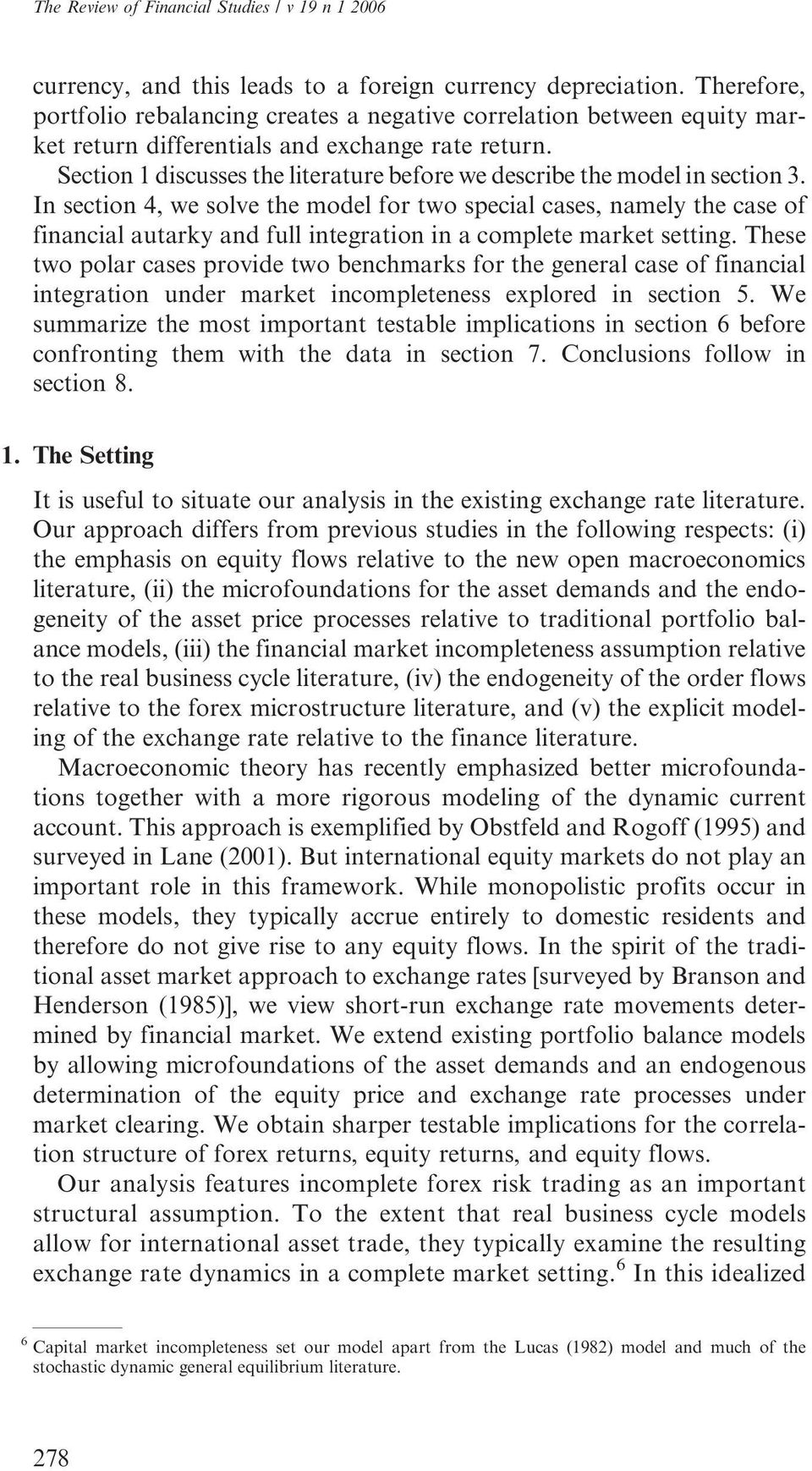
6 The Review of Financial Sudies / v 19 n currency, and his leads o a foreign currency depreciaion. Therefore, porfolio rebalancing creaes a negaive correlaion beween equiy marke reurn differenials and exchange rae reurn. Secion 1 discusses he lieraure before we describe he model in secion 3. In secion 4, we solve he model for wo special cases, namely he case of financial auarky and full inegraion in a complee marke seing. These wo polar cases provide wo benchmarks for he general case of financial inegraion under marke incompleeness explored in secion 5. We summarize he mos imporan esable implicaions in secion 6 before confroning hem wih he daa in secion 7. Conclusions follow in secion The Seing I is useful o siuae our analysis in he exising exchange rae lieraure. Our approach differs from previous sudies in he following respecs: (i) he emphasis on equiy flows relaive o he new open macroeconomics lieraure, (ii) he microfoundaions for he asse demands and he endogeneiy of he asse price processes relaive o radiional porfolio balance models, (iii) he financial marke incompleeness assumpion relaive o he real business cycle lieraure, (iv) he endogeneiy of he order flows relaive o he forex microsrucure lieraure, and (v) he explici modeling of he exchange rae relaive o he finance lieraure. Macroeconomic heory has recenly emphasized beer microfoundaions ogeher wih a more rigorous modeling of he dynamic curren accoun. This approach is exemplified by Obsfeld and Rogoff (1995) and surveyed in Lane (2001). Bu inernaional equiy markes do no play an imporan role in his framework. While monopolisic profis occur in hese models, hey ypically accrue enirely o domesic residens and herefore do no give rise o any equiy flows. In he spiri of he radiional asse marke approach o exchange raes [surveyed by Branson and Henderson (1985)], we view shor-run exchange rae movemens deermined by financial marke. We exend exising porfolio balance models by allowing microfoundaions of he asse demands and an endogenous deerminaion of he equiy price and exchange rae processes under marke clearing. We obain sharper esable implicaions for he correlaion srucure of forex reurns, equiy reurns, and equiy flows. Our analysis feaures incomplee forex risk rading as an imporan srucural assumpion. To he exen ha real business cycle models allow for inernaional asse rade, hey ypically examine he resuling exchange rae dynamics in a complee marke seing. 6 In his idealized 6 Capial marke incompleeness se our model apar from he Lucas (1982) model and much of he sochasic dynamic general equilibrium lieraure. 278
7 Exchange Raes, Equiy Prices, and Capial Flows seing,allbenefisfrominernaional exchange rae risk rading are realized. We argue ha his assumpion is a odds wih curren evidence on very low hedge raios for foreign equiy invesmen as discussed above. In our view, he marke rades equiy fairly fricionlessly across borders, bu fails o realize he full benefi of rading he associaed forex risk. This marke incompleeness is no relaed o he absence of he markes (forex derivaives exis), bu raher o ransacion and agency coss of using hem. This aricle is inspired by he new empirical lieraure on he microsrucure of he forex marke. Order flow is idenified as an imporan deerminan of exchange rae dynamics. We inerpre his lieraure as evidence for a less han infiniely-elasic forex supply and explore is consequences for opimal inernaional porfolio invesmen. 7 In our model, forex order flow is derived endogenously from he opimal dynamic porfolio policy. Also, he ime horizon for our analysis exends o several monhs unlike he high frequency focus in many microsrucure models. These models also ypically involve informaional asymmeries, which play no role in our analysis. Finally, our analysis relaes o a recen lieraure on inernaional equiy flows. Some of his work is mainly empirical [Bekaer and Harvey (2000), Bekaer, Harvey, and Lumsdaine (2002), and Pores and Rey (2005); Richards (2005)]. Brennan and Cao (1997) and Griffin, Nardari, and Sulz (2002) also provide a heoreical analysis of foreign invesmen behavior. Bu boh reaed foreign invesmen like domesic invesmen by modeling only dollar reurns. Insead of an exchange rae, home and foreign invesors are separaed by informaion asymmeries [Brennan and Cao (1997)] or by exogenous differences in reurn expecaions [Griffin, Nardari, and Sulz (2002)]. Unlike hese models, our framework assumes ha foreign and home invesors are separaed by an exchange rae and pursue invesmen objecives in he currency of heir respecive residence. 2. The Model A world wih wo counries has a home and a foreign invesor. Boh invesors are risk averse and can inves in risky home and foreign equiies and in riskless bonds. Equiies pay a coninuous sochasic dividend flow. Purchase of a foreign equiy by a domesic agen is seled in foreign currency and herefore requires a parallel purchase of foreign currency in he forex marke. Increases in foreign equiy holdings herefore generae 7 In a similar spiri, Osler (1998) and Carlson and Osler (2000) model he exchange rae as he price equaing supply and demand on a foreign exchange marke where curren accoun raders mee raional currency speculaors. 279

8 The Review of Financial Sudies / v 19 n an order flow in he forex marke. 8 Invesors do no hold money balances in equilibrium, since hey are dominaed by invesmens in he riskless bonds, which generae a nominal reurn of r and r in he respecive local currencies. Cenral banks in boh counries peg he ineres rae so ha he bond supplies are assumed o be infiniely price elasic. The wo ineres raes r and r are exogenous; for symmery we impose r ¼ r. Foreign dividend income is eiher reinvesed in foreign equiy or repariaed for home counry invesmen. The supply of home and foreign equiy is fixed and is price deermined by marke clearing. The supply of forex is less han perfecly elasic o reflec he empirical findings of he forex microsrucure lieraure. The evidence presened in he inroducion srongly suggess ha incomplee hedging of foreign invesmen is he more realisic benchmark compared o a world of full inernaional exchange rae risk sharing. We herefore do no allow for shor-selling of foreign bonds, as a shor posiion in foreign bonds works as a forex hedge on he foreign equiy invesmen. I is imporan o highligh ha he shorsale consrain is binding in he seady-sae equilibrium. 9 Inuiively, he home bond invesmen always sricly dominaes he foreign bond invesmen under idenical foreign and home bond reurns and addiional exchange rae risk on he foreign bond. Since home invesors would like o hold a shor posiion in foreign bonds o hedge he currency risk of heir foreign equiy posiion, 10 bu are prohibied from doing so, hey can a bes choose a zero posiion of foreign bonds. To simplify he exposiion and reduce noaions, we herefore presen he model as if invesors were prevened from invesing in foreign bonds alogeher. 11 The marke srucure is summarized as follows: 8 We assume ha when an agen purchases an equiy from a foreign agen, she iniiaes he purchase of foreign exchange, so ha our ne currency flow coincides wih he convenional definiion of he order flow (ne of buyer over seller iniiaed rades). Conversely if a domesic agen sells a foreign equiy ha she owns o a foreign invesor, he sale is seled in foreign currency and he domesic agen hen eiher convers he money in her own currency and buys a domesic bond or reinves i in foreign asses. In he aggregae, his implies ha here is a sraighforward correspondence beween ne capial ouflows ou of he domesic economy and ne domesic currency sale on one hand, and capial inflows ino he domesic economy and ne domesic currency purchases on he oher hand. 9 For a formal proof, see Appendix F of he working paper version [Hau and Rey (2003), NBER WP 9398]. 10 We sudy only equilibria in which invesors have posiive ne foreign equiy holdings in he seady sae, since hese are he only empirically relevan cases. 11 Holding zero foreign bonds sricly dominaes any posiive foreign bond posiion only for seady-sae values of he equilibrium price process and in some neighborhood around hese values. Large deviaions of he exchange rae from he long-run equilibrium may generae expecaions of exchange rae changes which make posiive foreign bond holdings opimal for one of he invesors. In he case of large expeced exchange rae changes, he equivalence of shor-sale consrains and zero foreign bond holdings breaks down and we have o assume zero foreign bond holdings direcly. 280

9 Exchange Raes, Equiy Prices, and Capial Flows Assumpion 1: Asse Marke Srucure A home (h) and a foreign (f) sock marke provide exogenous sochasic dividend flows D h and D f in local currency. Home and foreign invesors can inves in boh sock markes. In addiion, each invesor can inves in a domesic bond providing a riskless consan reurn r in he respecive local currency. Invesors in our model are risk averse and heir objecive is o find an opimal rade-off beween expeced profi flow of heir asse posiion and he insananeous profi risk. Each invesor measures profis in home currency. This invesor objecive implies paricularly racable asse demand funcions which are linear in he raio of expeced reurn and insananeous reurn risk. 12 Formally, we assume: Assumpion 2: Invesor Behavior Home and foreign invesors are risk averse and maximize (in local currency erms) a mean variance objecive for he profi flow. 13 Home invesors choose a porfolio of home and foreign equiy, K ¼ðK h ; Kf Þ, and foreign ¼ðK f ; K h Þ. Le invesors choose a porfolio of foreign and home equiy, K dr ¼ðdR h ; drf Þ T and dr ¼ðdRf ; dr h Þ T denoe he corresponding excess payoffs (in local currency erms over he local riskless bond) for domesic and foreign invesors, respecively. 14 The corresponding sochasic excess profi flows follow as and he wo invesors opimize max f max f K h,kf K f,k h d ¼ K dr d ¼ K dr, g E g E Z 1 s¼ Z 1 s¼ e rðs Þ e rðs Þ d s 1 2 d2 s d s 1 2 d2 s, 12 The common dynamic CARA uiliy framework produces similar asse demands which differ only by an addiional ineremporal hedging demand componen proporional o he covariance beween asse excess reurn and he sae variables. For reasons of racabiliy and simpliciy, we chose no o model hedging demands o focus on he dynamic ineracions beween he equiy and forex markes. The mean variance objecive here follows iner alia Hau (1998). 13 For he ime horizons relevan for our exercise (1 day o several monhs), prices can be considered o be sicky in local currency. 14 The ransposed vecor is marked by T. 281

10 The Review of Financial Sudies / v 19 n where E denoes he raional expecaion operaor and he invesor risk aversion. Invesor wealh evolves as dw ¼ d þ W rd dw ¼ d þ W rd: Boh sock markes have o clear under he opimal asse demand. For simpliciy, we normalize he quaniy of ousanding equiy o one. This implies K h þ K h ¼ 1 ð1þ K f þ K f ¼ 1: as he wo asse marke-clearing condiions. An addiional marke-clearing condiion applies o he forex marke wih an exchange rae E expressed in unis of foreign currency per unis of domesic currency. Denoing home and foreign equiy prices in local currencies by P h and P f, respecively, we can measure he equiy-relaed capial flows dq ou of he home counry (in foreign currency erms) as dq ¼ E K h D h d Kf D f d þ dk f P f E dk h h P The firs wo erms capure he ouflow if all dividends are repariaed. Bu invesors can also increase heir holdings of foreign equiy asses. The ne purchases of foreign equiy, dk f and dk h are capured by he hird and fourh erms. Le us for example denoe he euro area as he foreign and he Unied Saes as he home counry. Then dq represens he oal ne capial flow induced by equiy rade (boh dividend repariaion and ne purchases) by U.S. invesors ino he euro area, in euro erms. An increase in E (denominaed in euro per dollar) corresponds o a dollar appreciaion agains he euro. Any ne capial flow ou of a counry is, in our model, idenical o a ne demand for foreign currency as all invesmen is assumed o occur in local currency. We can herefore also idenify dq wih he equiy rade-induced order flow for foreign currency in he forex marke. 15 Furhermore, he above ne capial flow ou of he home counry (or forex order flow) can be linearly approximaed by dq D ¼ E E K Dd þ EK h K f Dd þ ED h Df þ dk f EdK h Kd ð2þ P: ð3þ 15 Remember ha here is no rade in he foreign riskless bond in he seady-sae equilibrium, so he forex order flow resuls only from equiy rade and dividend repariaion. 282
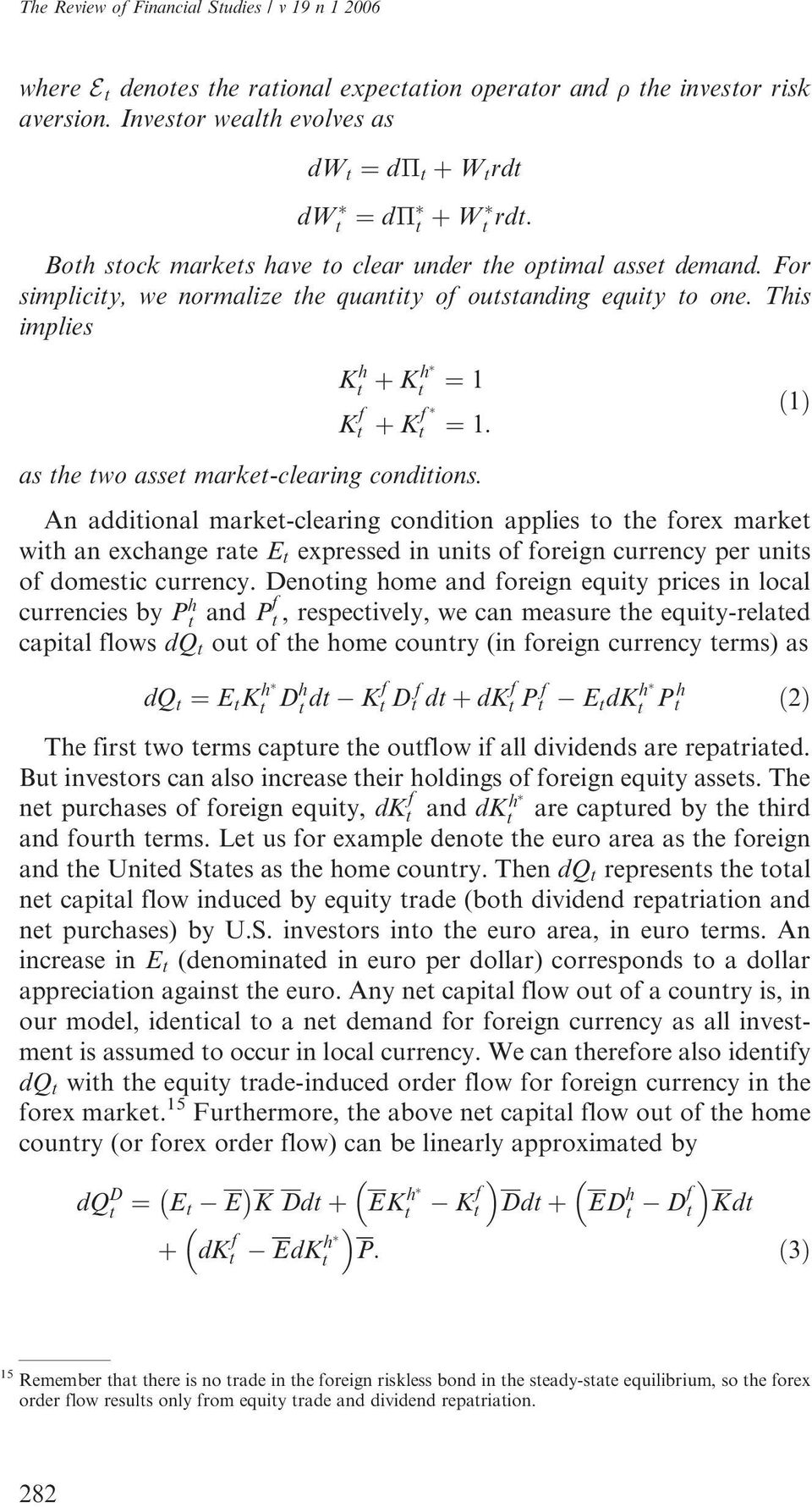
11 Exchange Raes, Equiy Prices, and Capial Flows where he upper bar variables denoe he uncondiional means of he sochasic variables. The linearizaion renders he analysis racable. The ne forex order flow of invesors is absorbed by liquidiy-supplying banks which can buffer forex imbalances. 16 The following assumpion characerizes he liquidiy supply Assumpion 3: Price-Elasic Excess Supply of Foreign Exchange The foreign exchange marke clears for a less han fully price-elasic excess supply curve wih elasiciy parameer. For an equilibrium exchange rae E, he excess supply of foreign exchange is given by Q S ¼ ðe EÞ where E denoes he seady-sae exchange rae level. An increase in E (euro depreciaion) decreases he excess supply of euro balances. Such an upward-sloping currency supply schedule can be inerpreed lierally as he se of limi orders in an elecronic order book like Reuers Dealing or EBS. 17 Lineariy of he supply curve simplifies he analysis. Bu we can also provide a more srucural inerpreaion of he supply curve and he parameer. Such a microfoundaion can eiher be based on imperfec ineremporal speculaion of risk averse currency raders or alernaively be moivaed by more long-run real rade effecs. Imperfec ineremporal speculaion by risk averse currency raders may presen he mos plausible inerpreaion for less han fully elasic shor-run excess supply curve. Currency speculaors end o sell dollars for euros when he dollar is high and buy dollars when he dollar is low. Differen ypes of speculaors provide liquidiy a differen horizons. Forex marke makers ake posiions wih half-lives measured in hours, while he half-lives of posiions of proprieary rading desks, hedge funds, and non-financial corporaions are measured in days, weeks, or monhs. Ineremporal risky arbirage is imperfec since in pracice raders do no have infiniely deep pockes. They face capial consrains [Shleifer and Vishny (1997)]. Generally, ineremporal speculaion involves considerable risk and needs o be compensaed by expeced rading profi. Risk averse forex raders maximize a quadraic objecive funcion sricly parallel o he equiy invesors (see assumpion 2), 16 A generalizaion of he model consiss in allowing for addiional curren accoun imbalances given by CA d ¼ E E d. Mos microfounded rade or macroeconomic models generae a defici for he curren accoun of U.S. when he dollar is srong and vice versa ( is he exchange rae elasiciy of he curren accoun). This generalizaion is sraighforward and allows o reinroduce he goods marke in he analysis. 17 For a recen descripion of he microsrucure of he foreign exchange marke, see Hau, Killeen, and Moore (2002). 283

12 The Review of Financial Sudies / v 19 n max fq S g E ð 1 e rðs Þ s¼ d s 1 2 d2 s where currency rading profis are given by d ¼ Q S de and denoes he risk aversion of he currency speculaors. The opimal liquidiy supply Q S is herefore given by Q S ¼E ðde Þ 2 ed. Assuming, as will be he case in our model, ha he exchange rae follows an Ornsein Uhlenbeck process revering o a (consan) equilibrium value E a speed e, hen he expeced exchange rae change E ðde Þis equal o e E E 2 e. Therefore, he opimal currency supply can be rewrien as Q S 2 ¼ e E E e which is of he form E E. This highlighs he role of raional exchange rae expecaions for he currency raders despie he apparen absence of such expecaions in he formulaion of he above supply curve. 18 The parameer is deermined by he degree of risk aversion of currency speculaors and he saisical characerisics of he exchange rae process. In paricular, if currency speculaors are almos risk neural, and herefore arbirage aggressively deviaions of he exchange rae from is long run level E, hen he supply of currency is very price elasic. 19 Marke clearing in he forex marke requires Q S ¼ Q D, and he forex rae is subjec o he consrain de ¼ E E K Dd þ EK h K f Dd þ ED h Df Kd þ dk f EdK h P: ð4þ The exchange rae dynamics is herefore ied o he relaive dividend flows, ED h Df, he relaive level of foreign asse holdings EK h K f, and heir relaive changes EdK h dk f. The relaive dividend flows are exogenous, bu he opimal relaive foreign equiy holdings are endogenously deermined and depend in urn on he exchange rae dynamics. We normalize E o 1, because he wo counries are symmerical. I is sraighforward o express he excess payoffs (over he riskless asse) on a uni of home equiy over he inerval d as dr h.tocharacerizehe foreign excess payoff dr f in home currency, we use a linear approximaion 18 For a recen empirical analysis of ineremporal liquidiy supply in he forex marke, see Bjønnes, Rime, and Solheim (2005). 19 An alernaive microfoundaion for he less han fully price-elasic currency supply resides simply in he dynamics of impor and expor markes for goods and services [see also Osler (1998)]. Mos macroeconomic models incorporae shor-run nominal price rigidiies, and here are herefore compeiiveness effecs on inernaional goods markes when a currency flucuaes. A counry ends o run a rade surplus when he domesic currency is undervalued (relaive o he long-run level E ) and a rade defici in he case of overvaluaion. For example, a euro undervaluaion E > E generaes a euro area rade surplus and herefore an excess demand for euro balances. In his case, he parameer depends on he elasiciy of subsiuion beween domesic and foreign goods and he degree of nominal rigidiy in he good markes. 284

13 Exchange Raes, Equiy Prices, and Capial Flows around he seady-sae exchange rae E ¼ 1 and he seady-sae price P. Formally, excess payoffs are given as dr h ¼ dph rph d þ Dh d dr f de P þ dp f de dp f rp f PE ð 1Þ d þ D f DE ð 1Þ d for he home and foreign asses, respecively. Excess reurns follow as dr h =P and drf =P, respecively. The exchange rae componen of he foreign payoff is given by PdE and he exchange rae reurn by de. 20 Finally, we specify he sochasic srucure of he sae variables: Assumpion 4: Sochasic Srucure The home and foreign dividends expressed in local currencies follow independen Ornsein Uhlenbeck processes wih idenical variance and mean reversion D > 0 given by dd h ¼ DðD D h Þd þ Ddw h dd f ¼ D ðd D f Þd þ D dw f : The innovaions dw h and dw f are independen. The mean reversion of all sochasic processes simplify he analysis considerably. We can now inroduce variables F h and F f which denoe he expeced presen value of he fuure discouned dividend flow, F h ¼E ð 1 s¼ F f ¼E ð 1 s¼ D h s e rðs Þ ds ¼ f 0 þ f D D h D f s e rðs Þ ds ¼ f 0 þ f D D f, wih consan erms defined as f D ¼ 1=ð D þ rþ and f 0 ¼ðr 1 f D ÞD. The risk aversion of he invesors and he marke incompleeness wih respec o forex risk rading imply ha he asse price will generally differ from his fundamenal value. 20 The model is closed and here is no sock-flow inconsisency. A foreign equiy purchase of he home invesor is seled in foreign currency. Bu he foreign equiy seller immediaely reinvess his liquidiy and holds zero money balances since money is a dominaed sore of value. He can eiher exchange i in he forex marke if he reinvess in equiy abroad, or bring i o his cenral bank a a fixed riskless rae. Cenral banks hus absorb he addiional liquidiy a he fixed rae r. 285

14 The Review of Financial Sudies / v 19 n Two Special Cases I is insrucive o explore wo special variaions of our model. Firs, we cover he exreme case in which no foreign asse holdings are allowed. We refer o his case as financial auarky. I provides a useful closed economy benchmark for he sock marke equilibrium, in which invesors do no inernaionally share heir domesic equiy risk. The opposie exreme assumpion is o allow boh he equiy risk and he exchange rae risk o be fully and separaely raded. This second benchmark characerizes he inernaional financial marke equilibrium wih complee risk sharing. Formally, i is idenical o an economy wih wo freely radeable asses. The exchange rae is a redundan price. As empirically mos relevan, we consider a hird case in which equiy is freely raded bu he exchange rae risk is no. We analyze his case in secion 5. Solving he model always requires hree seps. Firs, we posulae a linear soluion for he asse prices and he exchange rae. Second, we derive he opimal asse demand under he conjecured soluion. Third, we impose he marke-clearing condiions, show ha he resuling price funcions are indeed of he conjecured form, and finally solve for he coefficiens. To provide for a more coheren exposiion, we summarize our resuls in various proposiions. All derivaions are relegaed o appendices. 3.1 Financial auarky Under financial auarky, he home invesor s foreign equiy posiion ðk f Þ and he foreign invesor s home equiy posiion ðk h Þ are assumed o be zero. All domesic asses are owned by domesic invesors, hence! K f ¼ 1 0 : 1 0 K h K f K h The financial marke equilibrium for he home and foreign equiy marke can be deermined separaely. Proposiion 1 saes he resul: Proposiion 1: Equilibrium under Financial Auarchy Assume a wo-counry world in which home invesors hold he domesic asse and foreign invesors he foreign asse. The home and foreign sock marke prices are given by P h ¼ p 0 þ p F F h P f ¼ p 0 þ p F F f wih p 0 ¼ R 2 r. and pf ¼ 1. The (insananeous) reurn volailiy follows as 2 R ¼ 2 D ð D þ rþ 2. Proof : See Appendix A. 286

15 Exchange Raes, Equiy Prices, and Capial Flows A price parameer p F ¼ 1 implies ha he asse prices are proporional o heir fundamenal values F h and F f, respecively. The fundamenal values represen he expeced discouned fuure cash flows. The risk aversion of he invesors is refleced in he coefficien p 0 50, which capures he equiy risk premium as a price discoun. I is proporional o he invesor risk aversion and he insananeous variance 2 R of he excess reurn processes. These equilibrium resuls are sandard for a closed economy wih a fixed asse supply and mean variance preferences for he invesor. 3.2 Equilibrium wih complee risk sharing A second model variaion consiss in he full risk-sharing benchmark. Forex risk can hen be fully raded eiher hrough derivaive conracs or hrough shor sales of he foreign riskless bond. Perfec and complee risk rading resuls in he eliminaion of all exchange rae risk. Inuiively, home and foreign invesors hold exacly opposie and off-seing exchange rae risk in heir global equiy porfolio. They jus need o swap he forex risk and hereby eliminae i. 21 The resuling financial marke equilibrium is saed in proposiion 2: Proposiion 2: Equilibrium wih Complee Risk Sharing The home and foreign sock marke prices and he exchange rae are given by P h ¼ p 0 þ p F F h P f ¼ p 0 þ p F F f E ¼ 1 where we define p 0 ¼ 2 R =2r, and p ¼ 1. The (insananeous) reurn F volailiy follows as 2 R ¼ 2 D = ð D þ rþ 2. The domesic and foreign porfolio posiions of he wo invesors are equal and consan wih!! K h K f ¼ K f K h Proof: An idenical riskless rae in he home and foreign counry under complee markes implies a consan exchange rae, E ¼ 1. The complee soluion is derived in Appendix B. Firs, we noe ha he exchange rae is consan. In a world of perfec risk sharing, he wo-counry model is no differen from one domesic The exchange rae risk can be fully eliminaed because of he symmery of he wo-counry seup. In a more general model, forex risk can only be parially eliminaed hrough swapping. 287
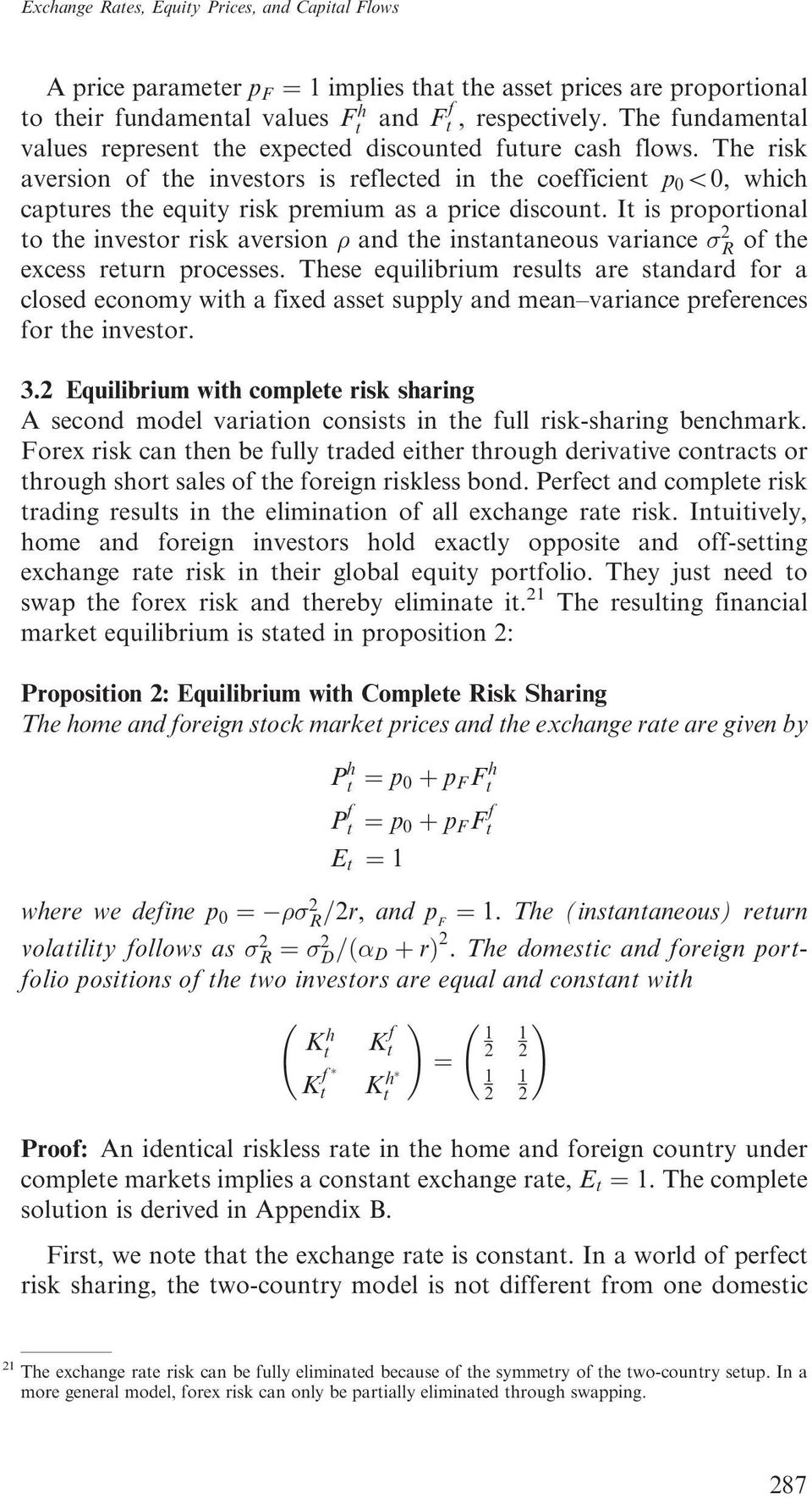
16 The Review of Financial Sudies / v 19 n economy wih wo socks. Home and foreign invesors each hold equal and consan shares of he world marke porfolio. The asse prices move one o one wih heir fundamenal values, F h and F f, respecively. The risk sharing across he wo invesor groups implies ha he asse price risk discoun p 0 50 is only half as large as in he auarky case for he same reurn volailiy 2 R. This implies lower average asse reurns under marke inegraion. Evidence ha financial inegraion indeed reduces marke sock reurns is provided by Bekaer and Harvey (2000), Henry (2000), and Sulz (1999) among ohers. These auhors show reduced capial coss or excess reurns on equiy for emerging counries following heir capial marke liberalizaion. We furher highligh ha complee forex risk rading implies no paricular correlaion srucure beween exchange rae and equiy reurns. The exchange rae is a redundan price and consan. This implicaion is of course a odds wih he high exchange rae volailiy observed in pracice. Bu i provides a useful benchmark for he following secion which explores he case of equiy marke inegraion under incomplee exchange rae risk rading. 4. Foreign Invesmen under Incomplee Risk Sharing We now rea he case in which a forex marke allows invesmen in he foreign equiy, bu exchange rae risk rading is incomplee. If he exchange rae moves sochasically, home invesors wih foreign equiy holdings incur an addiional exchange rae risk in addiion o he risk of he sochasic dividend flow. Foreign invesors hold he opposie risk due o ownership sakes in foreign equiy. If his reciprocal exchange rae risk were radeable, i could be perfecly eliminaed as assumed in he perfec marke case discussed in secion 4.2. Bu now we assume ha such forex risk rading does no occur. The non-radeabiliy of he forex risk no only excludes derivaive conracs, bu also requires ha invesors canno shor-sell he foreign riskless asse. Shor-selling of foreign riskless asses effecively amouns o a separae rading of he exchange rae risk. As discussed before, assuming a no shor-sale consrain on he riskless foreign asse implies zero foreign bond holdings in he seady sae. If unconsrained, invesors should seek a shor posiion in he foreign riskless asse equivalen o heir foreign equiy sake. Bu hey would no seek a long posiion which adds exchange rae risk o he porfolio. The shor-selling consrain is binding. Seing he foreign bond posiion o zero does no represen an addiional resricion. 4.1 Exchange rae dynamics Before we conjecure he exchange rae dynamics under incomplee markes, i is useful o highligh wo principal equilibrium forces which shape 288
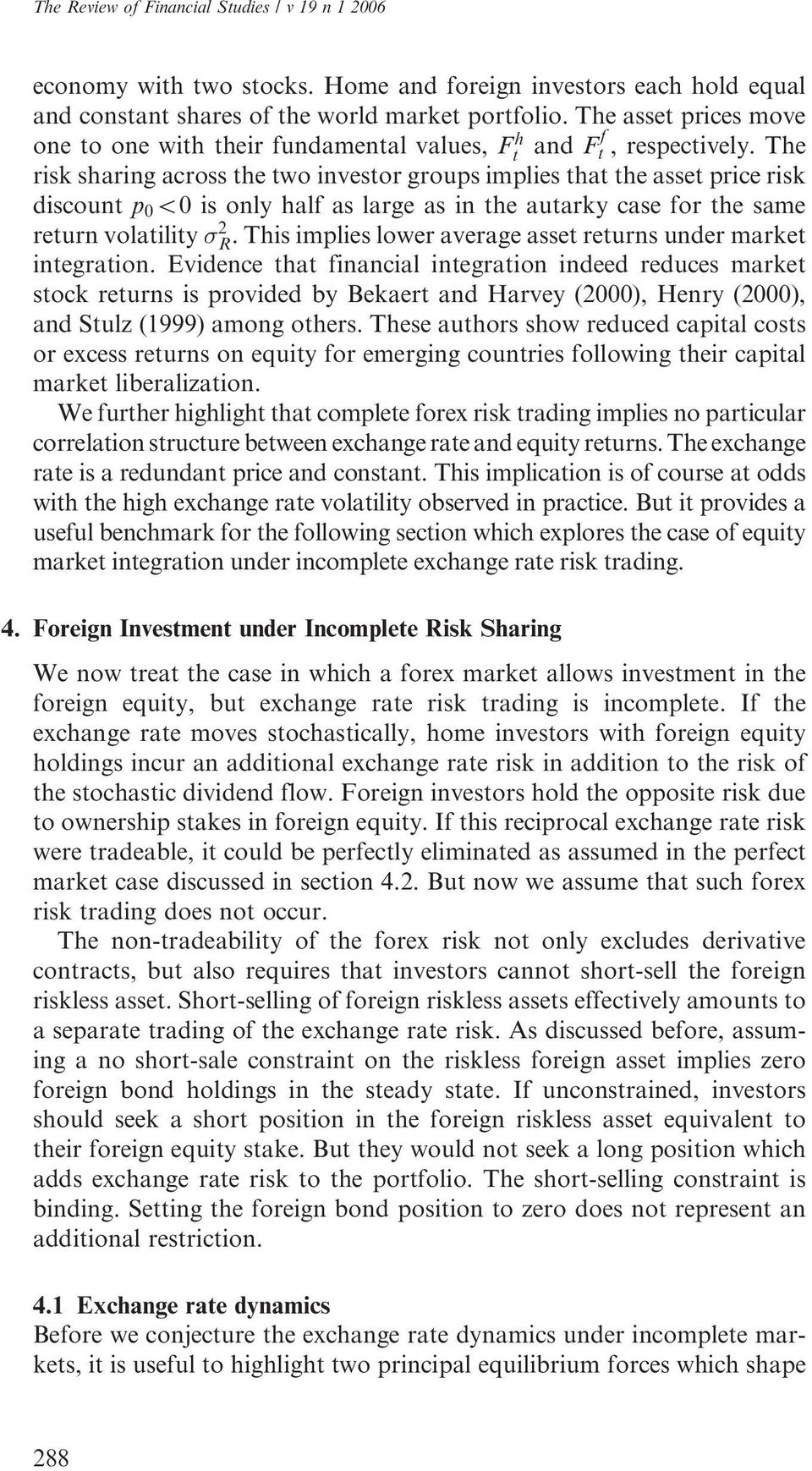
17 Exchange Raes, Equiy Prices, and Capial Flows his dynamics. The firs equilibrium endency is governed by he less han fully elasic supply for forex order flow. Forex order flow dq D in Equaion (3) is accommodaed by financial insiuions which finance hese home ouflows according o an upward-sloping supply curve. The elasiciy of forex liquidiy supply cerainly influences he impac of ne order flow on he exchange rae and indirecly he adjusmen speed owards he seady-sae exchange rae, E. We associae he supply-induced mean reversion wih a firs characerisic roo (labeled z). A second imporan parameer for exchange rae dynamics is he mean reversion of he dividend processes. This mean reversion D is exogenous, and any feedback effec from he exchange rae dynamics o he dividend process is ruled ou by assumpion. An imporan simplifying feaure of our model is is symmery beween he home and foreign counry. Symmery implies ha he exchange rae can depend only on differences beween home and foreign counry variables, bu no on a counry-specific variable iself. Oherwise he symmery would be broken. The symmery requiremen also implies ha exchange rae surprises can depend only on curren and pas relaive dividend innovaions, dw s ¼ dw h s dwf s. These relaive innovaions are he only exogenous source of exchange rae dynamics. Finally, we highligh he lineariy of he model srucure. The forex order flow consrain is linearized and he exogenous dividend dynamics is linear by assumpion. Moreover, we have assumed a mean variance uiliy funcion which ranslaes linear dividend, price, and reurn processes ino linear asse demands. I is herefore jusified o resric our aenion o he class of linear exchange rae and price processes. The argumen for wo fundamenal equilibrium forces explains why we focus on wo sae variables D and, boh of which depend for reasons of model symmery on curren and pas relaive dividend innovaions dw s only. The following proposiion 3 saes he conjecured exchange rae process and derives is implicaions for he order flow consrain (4). Proposiion 3: Exchange Rae Dynamics Assume ha (i) equiy prices P ¼ðP h ; P f Þ depend linearly on he exchange rae E and he dividend processes D ¼ðD h ; D f Þ and (ii) he exchange rae has he following linear represenaion wih E ¼ 1 þ e D D þ e, 289

18 The Review of Financial Sudies / v 19 n D ¼ D h Df ¼ ¼ ð 1 ð 1 e zð sþ dw s, e Dð s Þ D dw s where z50 and dw s ¼ dw h s dwf s. Then i follows ha he order flow consrain (4) is of he simple form de ¼ k 1 D d þ k 2 ðe 1Þd þ k 3 dw, where k 1, k 2, and k 3 represen undeermined coefficiens. Proof: The derivaion is provided in Appendix C1. We have o show ha for a linear price and a linear exchange rae, invesor uiliy maximizaion implies opimal foreign equiy demands K h ; K f such ha he expression ðk h and dw. K f ÞDd þðdk f dk h ÞP in Equaion (4) is linear in E 1; D Under lineariy of he price and exchange rae processes, he order flow consrain simplifies o a differenial equaion in only wo sae variables D and E 1. This allows us o characerize he exchange rae dynamics as a sysem of wo firs-order differenial equaions, dd de ¼ D 0 k 1 k 2 D E 1 d þ D k 3 dw : The associaed characerisic roos are D and k 2. A sable soluion requires k The exchange rae soluion can hen be wrien as a linear combinaion e D D þ e of he wo eigenvecors and ð D ¼ e Dð sþ D dw s 1 ¼ ð 1 e k 2ð sþ dw s, as conjecured in proposiion 3. To find he soluion parameers, we have o impose he marke-clearing condiions (1) and deermine he seady-sae levels for he equiy price, P, and he foreign equiy holding, K. Non-negaive (seady sae) prices P>0 and posiive (seady sae) home and foreign equiy holdings 290

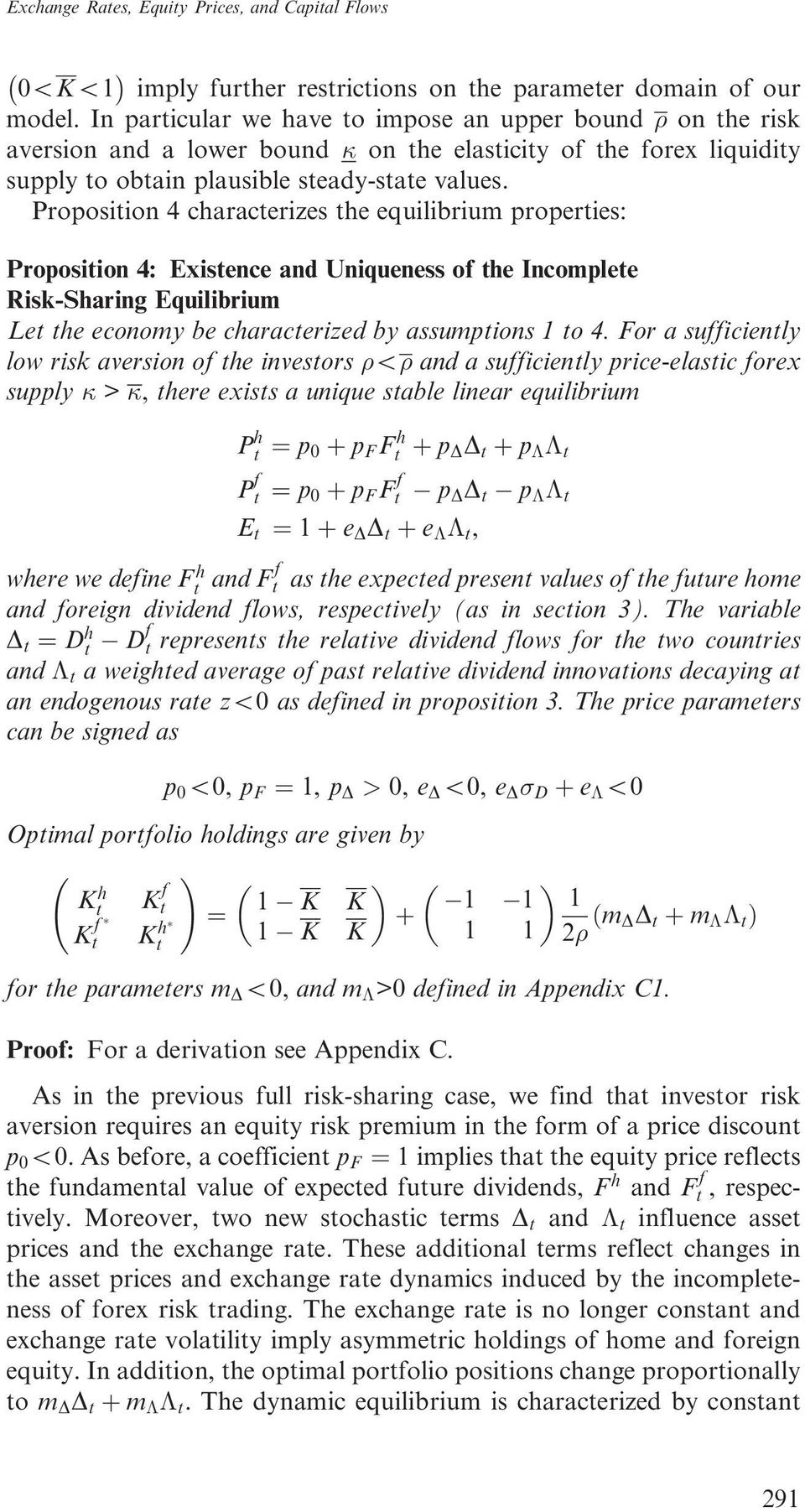
19 Exchange Raes, Equiy Prices, and Capial Flows 05K51 imply furher resricions on he parameer domain of our model. In paricular we have o impose an upper bound on he risk aversion and a lower bound on he elasiciy of he forex liquidiy supply o obain plausible seady-sae values. Proposiion 4 characerizes he equilibrium properies: Proposiion 4: Exisence and Uniqueness of he Incomplee Risk-Sharing Equilibrium Le he economy be characerized by assumpions 1 o 4. For a sufficienly low risk aversion of he invesors 5 and a sufficienly price-elasic forex supply >, here exiss a unique sable linear equilibrium P h ¼ p 0 þ p F F h þ p D D þ p P f ¼ p 0 þ p F F f p D D p E ¼ 1 þ e D D þ e, where we define F h and F f as he expeced presen values of he fuure home and foreign dividend flows, respecively (as in secion 3). The variable D ¼ D h Df represens he relaive dividend flows for he wo counries and a weighed average of pas relaive dividend innovaions decaying a an endogenous rae z50 as defined in proposiion 3. The price parameers can be signed as K h K f K f K h p 0 50, p F ¼ 1, p D > 0, e D 50, e D D þ e 50 Opimal porfolio holdings are given by! ¼ 1 K K þ 1 K K ðm DD þ m Þ for he parameers m D 50, and m >0 defined in Appendix C1. Proof: For a derivaion see Appendix C. As in he previous full risk-sharing case, we find ha invesor risk aversion requires an equiy risk premium in he form of a price discoun p As before, a coefficien p F ¼ 1 implies ha he equiy price reflecs he fundamenal value of expeced fuure dividends, F h and F f, respecively. Moreover, wo new sochasic erms D and influence asse prices and he exchange rae. These addiional erms reflec changes in he asse prices and exchange rae dynamics induced by he incompleeness of forex risk rading. The exchange rae is no longer consan and exchange rae volailiy imply asymmeric holdings of home and foreign equiy. In addiion, he opimal porfolio posiions change proporionally o m D D þ m. The dynamic equilibrium is characerized by consan 291
20 The Review of Financial Sudies / v 19 n rebalancing of he opimal porfolios. We herefore have endogenous equiy purchases and sales as a resul of opimal equiy risk rading under consrained forex risk rading. The ne equiy flows and he corresponding forex order flow in urn generae he equilibrium exchange rae dynamics under he price elasic forex liquidiy supply. 4.2 Economic inerpreaion Invesors in he wo counries care abou nominal rading profis in heir domesic currency. This does no imply, however, ha hey only inves in home asses. Given ha foreign asse invesmen provides an equiy risk diversificaion benefi, foreign equiy ownership is desirable for he home invesor. Bu his diversificaion benefi comes a he cos of exchange rae risk on foreign equiy posiions and foreign dividend income. Incomplee inernaional exchange rae risk rading implies ha his exchange rae risk is no eliminaed. Moreover, he respecive exposure of he home and foreign invesor o forex risk varies wih he relaive performance of he home and foreign equiy marke. Any ouperformance of he foreign equiy marke over he home equiy marke will end o increase he relaive exposure of he home invesor o exchange rae risk and herefore alers his rade-off beween diversificaion benefis and he coss of bearing currency risk. The foreign invesor on he oher hand does no face any currency risk on he higher marke capializaion of he foreign marke which provides payoffs in his own currency. The foreign invesor herefore has a comparaive advanage for holding a larger share of he foreign marke capializaion given is relaive value increase. The home invesor can be expeced o decrease his foreign posiion and his forex exposure. We refer o his as he risk rebalancing channel for capial flows. The risk rebalancing channel implies an opimal invesmen behavior for he home invesor which is counercyclical o he foreign marke excess performance. Inspecion of proposiion 4 shows ha for high foreign marke fundamenals ðf h F f 50;, D ¼ D h Df 50Þ, he foreign holdings of he home invesors ðk f Þ decreases by he erm 2 1 m DD 50, where m D 50. This porfolio rebalancing consiues an opimal adjusmen of his equiy posiions in he face of exchange rae risk and incomplee forex risk rading. 22 Bu a second effec creaes addiional capial flows. A higher relaive foreign marke capializaion coincides wih relaively higher foreign dividend flows ðd d ¼ðD h Df Þd50Þ. In he symmeric seady sae, in which home and foreign invesors hold equal shares of equiy abroad, he home invesor s foreign dividend income will exceed foreign invesor s 22 For developed equiy markes, rading coss like fees and selemen coss are sufficienly small o be unlikely o impede porfolio adjusmen. As for he price impac of rades, i is fully incorporaed ino he model since invesors raionally foresee he equilibrium price impac of heir reallocaions. 292

21 Exchange Raes, Equiy Prices, and Capial Flows dividend income from home counry invesmens. Reciprocal dividend repariaion herefore creaes an addiional foreign capial ouflow. We refer o his as he dividend repariaion channel. A new aspec of our analysis is o consider he endogenous exchange rae reacion o boh he dividend repariaion channel and he risk rebalancing channel. Boh channels creae a foreign capial ouflow (for D 50). The less han fully elasic currency supply implies ha he foreign capial ouflow generaes an excess demand for home (dollar) currency and is appreciaion. In oher words, he foreign equiy marke excess reurns come wih a foreign currency (euro) depreciaion. This explains why he coefficiens p D > 0 and e D 50 in proposiion 4 have opposie signs. We can formally summarize his effec as follows: Corollary 1: Negaive Correlaion of Foreign Sock and Forex Reurns Under incomplee forex risk rading, foreign sock reurns ðdr f =PÞ and exchange rae reurns ð de Þ are negaively correlaed, hence E ð de dr f =PÞd ¼E de dr h P d50: Proof: Appendix E. The negaive correlaion implies ha he exchange rae provides a parial bu auomaic hedge agains foreign equiy risk. When foreign sock marke reurns are high, he foreign currency depreciaes and vice versa. This reduces he reurn risk of foreign invesmen in home currency erms and increases he (seady-sae) demand for foreign equiy. We also highligh he role of he risk rebalancing channel (and herefore incomplee forex risk rading) for magnifying exchange rae changes. If he exchange rae adjusmen jus counerbalanced high foreign dividend ouflows ðd > 0Þ wihou addiional porfolio rebalancing, he flow consrain (4) would only consis of he erms de 50; ðe EÞKDd50 and ðd h Df ÞKd > 0. Bu invesors adjus heir opimal porfolio holdings o he exchange rae dynamics, and hese equilibrium porfolio shifs influence he exchange rae change hrough he addiional erms ðk h K f ÞDd and ðdk f dk h ÞPd in Equaion (4). A low home counry exchange rae (E low) makes foreign equiy holdings relaively more aracive for he home invesor since he value of foreign dividends in domesic currency is high, implying K h K f 50 (or m D 50); an expeced appreciaion leads o a expeced ne equiy flow ino he domesic marke E ðdk f dk h Þ50. I follows from he flow consrain (4) ha he endogenous porfolio shifs generally require a larger exchange rae appreciaion de 0 han is needed o eliminae he imbalance in dividend income. In his sense, he exchange rae overshoos he dividend income 293
22 The Review of Financial Sudies / v 19 n imbalance, and his overshooing is a consequence of incomplee forex risk rading. Finally, we also noe ha imperfec ineremporal forex speculaion is a necessary condiion for hese resuls. This can be verified by examining he limiing case of a compleely price-elasic forex liquidiy supply. In his case, he imperfec risk rading equilibrium converges o he special case of complee equiy risk sharing: Proposiion 5: Convergence o Complee Risk Sharing The incomplee risk-sharing equilibrium (characerized in proposiion 4) converges o he complee risk-sharing equilibrium (characerized in proposiion 2) as he currency supply becomes infiniely price elasic, ha is!1. Proof: Appendix D. In his limiing case, he invesors can always exchange foreign dividend income a he consan exchange rae E ¼ 1. Opimal inernaional equiy risk sharing is achieved by equally shared ownership of he world equiy porfolio. The infiniely elasic currency supply corresponds o a scenario of perfec ineremporal speculaion in he forex marke. If here exised a risk neural forex rader wih deep pockes, she could arbirage away all exchange rae excess reurns in which case he exchange rae would be consan and equal o one, as in he complee risk-sharing equilibrium. In pracice, capial consrains for arbiraging speculaors impose limis on he amoun of ineremporal speculaion [Shleifer and Vishny (1997)]. A relaively small supply elasiciy of currency is herefore he correc benchmark. In our model, exchange rae pegging would enable complee risk-sharing and be welfare-improving. Bu his resul is cerainly no robus since our seup merely oulines he benefis of a peg for equiy marke inegraion bu has nohing o say abou he effec of a fixed exchange rae on he real side of he economy. However, hese real effecs are likely o deermine he feasibiliy and credibiliy of a fixed exchange rae regime. 5. Model Implicaions We summarize he main empirical implicaions of our model, which concern he volailiy of he exchange rae reurn relaive o he equiy reurn in secion 6.1, he correlaion srucure of exchange rae and equiy reurns in secion 6.2, and he correlaion srucure of exchange rae reurn and equiy flows in secion 6.3. We also discuss he effec of equiy marke developmen on he srengh of our resuls in secion Exchange rae volailiy Marke compleeness means ha forex risk is widely and efficienly raded. Derivaive rading or shor-selling of bonds reallocae and largely 294
23 Exchange Raes, Equiy Prices, and Capial Flows eliminae he forex risk of all inernaional equiy invesors. Moreover, many marke paricipans and heir low aggregae risk aversion imply a very price-elasic forex supply. Home and foreign currency are hen close subsiues. This limis he scope for forex order flow o generae considerable exchange rae volailiy. Alernaively, if forex risk rading is resriced o a relaively small number of banks and hedge funds, hen we expec a less price-elasic forex liquidiy supply. In he laer case, forex order flow may resul in considerable exchange rae movemens. Our model capures he elasiciy of he forex supply in he parameer. Porfolio flows in he incomplee risk-sharing seing can generae considerable exchange rae volailiy if becomes small. The volailiy raio of he exchange rae reurns and he sock marke reurns (in local currency) sffiffiffiffiffiffiffiffiffiffiffiffiffiffiffiffiffiffiffiffiffiffiffiffiffiffi varðde Þ f varðdr, =PÞ is decreasing in, when everyhing else is held consan. A high price elasiciy of forex liquidiy supply ( large) implies a low forex volailiy. Numerical simulaions show ha a decrease in he elasiciy of he liquidiy supply (lower ) comes wih subsanial forex volailiy. 23 Specifically, when he elasiciy of he liquidiy supply is low, he volailiy of he exchange rae reurns amouns o 30 70% of he volailiy of sock marke reurns, depending on he degree of risk aversion. If invesor risk aversion decreases, he volailiy of he exchange rae increases since more risk averse raders engage less aggressively in arbiraging. We summarize his resul as follows: Implicaion 1: Exchange Rae Volailiy Marke incompleeness in combinaion wih a less han fully elasic forex liquidiy supply can generae exchange raes which are almos as volaile as equiy reurns. 5.2 Equiy reurns and exchange rae reurns Marke incompleeness implies a negaive correlaion srucure beween foreign equiy reurns and exchange rae reurns as saed in Corollary 1. Because of he symmery of he model, i is mos convenien o sae he correlaion srucure for differences of he foreign and home equiy 23 See he working paper version (NBER WP 9398 or CEPR DP 3735) for deails. In he simulaions, we keep consan he riskless rae r and he hree parameers governing he dividend processes D; D ; D. We allow he degree of risk aversion o ake any value of he inerval [0.04, 0.44]; he liquidiy supply parameer can ake any value of [20, 100]. 295
24 The Review of Financial Sudies / v 19 n reurns in local currency, namely ðdr f dr h Þ=P. The following corollary provides he resul: Corollary 2: Under incomplee forex risk rading, a foreign currency appreciaion and foreign excess reurns (in local currency) over home marke reurns have a perfec negaive correlaion, hence h i corr de,ðdr f dr h Þ=P ¼ 1: Proof: See Appendix E. For example, a U.S. equiy marke reurn shorfall relaive o he European equiy marke ððdr f dr h Þ=P >0Þ should ceeris paribus coincide wih a dollar appreciaion ðde > 0Þ. The negaive correlaion is perfec, because we have only wo exogenous sochasic processes for he dividends which influence he model dynamics. For reasons of symmery, reurn differences and exchange rae reurns are driven exclusively by relaive dividend innovaions, dw ¼ dw h dwf. The insananeous correlaion beween he local currency excess reurn can herefore only be eiher perfecly negaive or posiive or zero. Our analysis shows ha he correlaion is perfecly negaive. Empirically, we canno expec o find a perfecly negaive correlaion. Shocks oher han dividend innovaions and cross-counry asymmeries will end o reduce he absolue value of he correlaion. As he empirically relevan implicaion, we herefore reain only he sign of he correlaion: Implicaion 2: Differenial Equiy Reurns and Foreign Exchange Rae Reurn When foreign sock index reurns in (local currency) are in excess of he U.S. sock index reurns (in dollars), he foreign currency depreciaes. To our knowledge, his paricular correlaion srucure has no ye been relaed o financial srucure in general and he incompleeness of forex risk rading in paricular. We explore is empirical validiy in secion Exchange rae reurns and porfolio flows Exchange raes in our model are deermined hrough a price-elasic response o forex order flow, which in urn originaes parly in equiy flows. I herefore seems appropriae o relae exchange rae reurns direcly o equiy porfolio flows. Using he price equilibrium in proposiion 4, i is sraighforward o show ha he equiy flows ino he foreign 296
25 Exchange Raes, Equiy Prices, and Capial Flows marke by home invesors, dk f ¼ dk f, and he equiy flow ino he home marke by foreign invesors, dk h ¼ dk h, boh correlae posiively wih he exchange rae reurn de and de, respecively. Formally, E ð de dk f Þ¼E ðde dk h Þ¼¼ P ðe D D þ e Þ 2 d > 0: The symmery of he model implies ha he exchange rae reurn has he same absolue covariance wih foreign ne purchases of domesic equiies and wih domesic ne purchases of foreign equiies, bu wih opposie signs. We can express he ne equiy flow ino he foreign counry as he difference dk f dk h. This ne flow exhibis a perfec posiive correlaion wih he exchange rae reurn. Hence he following corollary: Corollary 3: Under incomplee forex risk rading, a foreign currency appreciaion and he ne equiy flow ino he foreign counry have a perfec posiive correlaion, h i corr de, dk f dk h ¼ 1: Proof: See Appendix E. Again, he correlaion is perfec, because all variables for counry differences or he exchange rae are governed by sochasic innovaions which are proporional o he relaive dividend innovaions, dw ¼ dw h dw f. Counry heerogeneiy in oher dimensions will cerainly end o decrease he correlaion o a value below one. We herefore reain only he sign of he correlaion as he empirically relevan model implicaion and refer o he U.S. as he home counry: Implicaion 3: Forex Reurn and Ne Equiy Flows A foreign currency appreciaion is posiively correlaed wih ne equiy flows ino he foreign marke. 5.4 The role of equiy marke developmen The correlaion srucure of equiy and exchange rae reurns was derived for inegraed and fricionless equiy markes. Bu equiy marke developmen and inegraion consiue a relaively recen phenomenon. Only in he 1990s did inernaional equiy rading become a prominen feaure in inernaional finance. Hence, we expec he empirical model implicaions o hold bes for OECD counry daa over he las decade. We herefore examine he correlaion srucure separaely over he enire daa collecion period and for wo subsamples saring in 1990 and An increasingly negaive correlaion beween foreign excess equiy 297
26 The Review of Financial Sudies / v 19 n reurns and he forex rae reurn suggess ha he correlaion srucure is indeed induced by increasing equiy marke inegraion. Moreover, he evidence should be sronges for counries wih relaively developed equiy markes. Such equiy marke developmen can be crudely measured by he raio of marke capializaion o GDP. Alernaively, we can measure he inegraion of a local equiy marke ino he world equiy marke by he raio of gross equiy rade o GDP. Boh marke developmen measures should be correlaed wih he magniude of he prediced correlaion srucure. Such cross-secional evidence suggess again ha he exchange rae dynamics represens a financial marke phenomenon. We can summarize boh he ime-series and cross-secional implicaions as follows: Implicaion 4: Negaive Correlaion and Equiy Marke Developmen The magniude of he negaive correlaion beween foreign equiy excess reurn and he exchange rae reurn should increase in he 1990s and should be sronges for counries wih a high degree of equiy marke developmen as measured by he raio of marke capializaion o GDP or gross equiy rade o GDP. 6. Evidence The empirical work focuses on OECD counries relaive o he Unied Saes. OECD counries end o have he mos developed equiy markes and are herefore mos perinen for he model. The Unied Saes represens by far he larges source and recipien of inernaional equiy flows. Furhermore, he mos comprehensive bilaeral asse flow daa are available for he Unied Saes only. Wihin he OECD sample, we excluded hree counries for which daily exchange rae daa were no available over a sufficienly long ime period: Iceland, Greece, and New Zealand. Belgium and Luxemburg are reaed as one counry because of heir common currency. Canada was excluded because of is effecive exchange rae fixing wih he Unied Saes according o Reinhar and Rogoff (2004). 24 The remaining 17 OECD counries mainained flexible exchange raes relaive o he Unied Saes and consiue our sample. The daily equiy index and exchange rae daa are obained from Daasream. We used he MSCI series for he end of he day sock index quoe and he corresponding dollar exchange raes. Mos daily price daa are available since The daa are screened for daa ouliers and errors and do no show any abnormal enries. Porfolio flow daa are more difficul o obain. We use he so-called TIC daa [Board of Governors of he Federal Reserve Sysem (2004)]. 24 The same exchange rae consideraion would also lead o he exclusion of Hong Kong and Singapore, which have developed equiy markes bu are no considered OECD counries. 298
27 Exchange Raes, Equiy Prices, and Capial Flows Available on a monhly frequency since 1987, he TIC daa record ransacions in porfolio equiies beween U.S. residens and residens of foreign counries. 25 They allow us o compue ne purchases of foreign equiies by U.S. residens ðdk f Þ and ne purchases of U.S. equiies by foreigners dk h. Cross-border equiy flows have been growing sizably in he las decade. 26 Hence, we have o find a suiable normalizaion of he porfolio flow series. We consider a normalizaion for capial flows by marke capializaion and alernaively by he average flows over he previous 12 monhs [as in Brennan and Cao (1997)]. Boh mehods produce very similar resuls and we only repor ables wih he normalizaion based on pas average flows. The sock marke capializaion daa come from he S&P Emerging Markes Daabase. 6.1 Exchange rae volailiy Firs, we examine he volailiy raio of exchange rae reurns o sock index reurns. We calculae he sandard deviaion of he log reurns of he dollar exchange rae and he sock index reurns in local currency. Table 1 repors he raio of he sandard deviaions for he enire daa sample since 1980 [column (a)], he subsample since 1990 [column (b)], and he mos recen period since 1995 [column (c)]. The volailiy raio over he full sample varies beween for Finland and for Swizerland wih a mean for all counries of Our heoreical framework can explain such high exchange rae volailiy wih a relaively low price elasiciy of he forex liquidiy supply. Comparing volailiy raios for he enire period since 1980 o he more recen subsamples since 1990 and 1995, we find declining volailiy raios for mos counries. This can mosly be aribued o a decrease in exchange rae volailiy. We can speculae ha he elasiciy of liquidiy supply in he forex marke (parameer in our model) migh have increased over ime. This would be consisen wih increasing forex marke deph in he more recen period. 6.2 Equiy reurns and exchange rae reurns The mos imporan model implicaion concerns he negaive correlaion of equiy reurn differenial beween foreign and home index reurns expressed in he respecive local currency and he exchange rae reurn. We calculae he reurn correlaions based on daily reurns for various daa periods. Exchange rae reurns are in foreign currency per dollar and 25 For a horough presenaion of hese daa, see Warnock, Griever, and Lee (2001). We noe ha TIC daa records ransacions based on he residency of he seller and of he buyer. For example, a German equiy sold in London by a U.S. residen o a U.K. Bank will be recorded as a sale of a foreign securiy by a U.S. residen o he U.K. In our model, his ransacion will herefore be inerpreed as a dollar pound ransacion on he forex marke. This inference can be flawed insofar as he real operaion was acually performed in euro and no in Serling or as i was realized on he behalf of a German equiy rader. 26 See Pores and Rey (2004) for a deailed sudy of he properies of hese flows. 299
28 The Review of Financial Sudies / v 19 n Table 1 Volailiy raios of exchange rae and sock marke index reurns rffiffiffiffiffiffiffiffiffiffiffiffiffiffiffiffiffiffiffiffi varðde Þ varðdr f =P Þ (a) January 1, 1980 December 31, 2001 (b) January 1, 1990 December 31, 2001 (c) January 1, 1995 December 31, 2001 Ausralia Ausria Belgium-Luxembourg Denmark Finland France Germany Ireland Ialy Japan Neherlands Norway Porugal Spain Sweden Swizerland U.K Mean SD Pooled daa Repored are volailiy raios of daily (log) exchange rae reurns and daily (log) foreign sock marke index reurns (in local currency) for various sample periods. The exchange rae E is expressed in foreign currency per dollar (de > 0 corresponds o a dollar appreciaion), and he index f represens 1 of he 17 foreign OECD counries. The las row provides he resul for he pooled daa. sock index reurns are measured in local currency. The correlaion evidence is produced a he daily, monhly, and quarerly frequency in Tables 2, 3, and 4, respecively. Daily correlaions in Table 2 provide srong saisical evidence in favor of our correlaion hypohesis. The model predicion of a negaive correlaion is validaed for mos counries a a 1% saisical significance level. 27 Moreover, he correlaions become more negaive in he wo more recen periods. The correlaion in he pooled daa decreases from over he enire period o for he period since 1990 and o for he mos recen period since The correlaion has grown more negaive along wih he equiy marke inegraion, which has inensified since he 1990s. The only counries for which he correlaion is sill posiive afer 1995 are Ausralia and Japan. 28 Overall, our evidence srongly suppors 27 Sandards errors are correced for heeroskedasiciy and serial correlaion. 28 We conjecure ha he Ausralian evidence migh be ained by he role of naural resource prices. Chen and Rogoff (2002) and Cashin, Cespedes and Sahay (2002) show indeed ha he Ausralian exchange rae is srongly relaed o world commodiy price flucuaions. They underline he specificiy of his counry in his respec. Japan on he oher hand is special because inernaional porfolio flows concern mosly bonds as opposed o equiy. 300
29 Exchange Raes, Equiy Prices, and Capial Flows Table 2 Daily correlaions of exchange rae and foreign sock marke excess reurns h i corr de ; dr f dr h =P (a) January 1, 1980 December 31, 2001 (b) January 1, 1990 December 31, 2001 (c) January 1, 1995 December 31, 2001 Ausralia Ausria Belgium-Luxembourg Denmark Finland France Germany Ireland Ialy Japan Neherlands Norway Porugal Spain Sweden Swizerland U.K Mean SD Pooled daa Repored are correlaions of daily (log) exchange rae reurns, de, and he daily (log) foreign sock marke index reurns (in local currency) relaive o he U.S. marke index reurn (in dollars), ðdr f dr h Þ= P, for various sample periods. The exchange rae E is expressed in foreign currency per dollar (de > 0 corresponds o a dollar appreciaion). The index f represens 1 of 17 OECD counries and f h he U.S. marke. The model predics corr de ; dr dr h =P 50. We es wheher he correlaion is significanly differen from zero using robus sandard errors and denoe by,,and significance a a 10, 5, and 1% level, respecively. The las row provides he resul for he pooled daa. he prediced negaive correlaion. Regression evidence on he pooled daa sample shows a srong negaive correlaion significan a he 1% level. A high level of saisical significance is also obained if we aggregae counries in he European moneary sysem ino single-counry observaion. The monhly reurn daa in Table 3 provide very similar resuls. In he sample period since 1995, every OECD counry feaures a negaive correlaion a he monhly frequency, and he average correlaion in he pooled sample exceeds 20%. We consider his as economically highly significan. Again, we find ha he correlaion became more negaive in he 1990s. For he enire daa collecion period from 1973 o 2002, he correlaion is roughly half as srong as in he las decade. Table 4 confirms our resuls on quarerly daa for he period 1990 o We presen regressions of exchange rae changes on reurn differenials for all he counries of our sample. The correlaion is again negaive and srongly significan for mos counries. Furhermore, he variance of he exchange rae explained by our simple reurn differenial variable is srikingly high for some counries. Wih a single variable, 301
30 The Review of Financial Sudies / v 19 n Table 3 Monhly correlaions of exchange rae and foreign sock marke excess reurns h i corr de ; dr f dr h =P (a) January 1980 December 2001 (b) January 1990 December 2001 (c) January 1995 December 2001 Ausralia Ausria Belgium-Luxembourg Denmark Finland France Germany Ireland Ialy Japan Neherlands Norway Porugal Spain Sweden Swizerland U.K Mean SD Pooled daa Repored are correlaions of monhly (log) exchange rae reurns, de, and he monhly (log) foreign sock marke index reurns (in local currency) relaive o he U.S. marke index reurn (in dollars), f dr dr h =P, for various sample periods. The exchange rae E is expressed in foreign currency per dollar (de > 0 corresponds o a dollar appreciaion). The index f represens one of 17 foreign OECD f counries and h he U.S. marke. The model predics corr de ; dr dr h =P 50. We es if he correlaion is significanly differen from zero using robus sandard errors and denoe by,, and significance a a 10, 5, and 1% level, respecively. The las row provides he resul for he pooled daa. namely equiy reurn differenial, we explain 30% of quarerly exchange rae movemens in Spain, 28% in Sweden, and 25% in Germany. For he pooled daa he R 2 is 13%. These resuls offer a sharp conras wih he dismal performance of moneary variables in sandard exchange rae models a quarerly horizons. The larger explanaory power of he local currency equiy reurn differenial for monhly and quarerly exchange rae changes compared o daily daa may be explained by he sluggishness of porfolio rebalancing. Many invesors may underake rebalancing decisions no on daily, bu raher a a weekly or monhly frequency. The negaive correlaion has previously been noed by oher researchers for some paricular counries. Bu hey were mosly puzzled by he lack of a coheren heoreical explanaion. Brooks e al. (2001) for example documen negaive correlaions beween European equiy excess reurns over U.S. equiy and he euro-dollar exchange rae. Ineresingly, hey discard heir finding as couner-inuiive (p. 17), since i conradics he popular view ha a srenghening equiy marke should be mirrored by a 302
31 Exchange Raes, Equiy Prices, and Capial Flows Table 4 Regressions of quarerly exchange rae on foreign sock marke excess reurns Coefficiens (January 1990 December 2001) Adjused R 2 Ausralia (0.0064) Ausria (0.0078) Belgium-Luxembourg (0.0073) Denmark (0.0067) Finland (0.0087) France (0.0065) Germany (0.0068) Ireland (0.0069) Ialy (0.0081) Japan (0.0119) Neherlands (0.0066) Norway (0.0070) Porugal (0.0069) Spain (0.0063) Sweden (0.0082) Swizerland (0.0083) U.K (0.0073) Mean (0.0075) SD (0.0014) Pooled daa (0.0057) (0.1336) (0.0825) (0.1430) (0.0780) (0.0451) (0.0783) (0.0656) (0.0604) (0.0972) (0.1483) (0.1121) (0.0562) (0.0740) (0.0659) (0.0969) (0.1377) (0.1348) (0.0947) (0.0339) (0.0426) Repored are regressions of quarerly (log) exchange rae reurns on he quarerly (log) foreign sock marke excess reurn (in local currency) relaive o he U.S. sock marke reurn (in dollars) for he period : de ¼ þ ðdr f dr h Þ=P þ " : The exchange rae E is expressed in foreign currency per dollar (de > 0 corresponds o a dollar appreciaion). The index f represens 1 of 17 foreign OECD counries and h he U.S. marke. The model predics < 0. We denoe by,,and significance a a 10, 5, and 1% level, respecively. Newey Wes-adjused sandard errors are repored in parenheses. The las row provides he resul for he pooled daa. 303
32 The Review of Financial Sudies / v 19 n srenghening exchange rae. 29 Incomplee forex risk rading offers a coheren heoreical explanaion for he observed correlaion srucure. From an empirical perspecive, he negaive correlaion deserves o be highlighed because of is srong saisical significance and increasing magniude. Moreover, i sands ou relaive o he empirical failure of uncovered ineres pariy for he same se of counries. 30 One could heoreically offer an alernaive hypohesis for his negaive correlaion. A depreciaion of he exchange rae could be associaed wih higher equiy reurns via a compeiiveness effec for exporing firms. Such a mechanism, which would be presen in mos open-economy macroeconomic models wih sicky prices, has however failed o find srong suppor in previous empirical sudies [see in paricular Bodnar and Genry (1993) and Friberg and Nydahl (1999)]. Furhermore, i should apply only o exporing firms, and no o enire sock marke indices, which we use in our empirical applicaion. Moreover, ha alernaive explanaion could no accoun for he ineremporal increase in he correlaion, nor for he posiive link beween equiy marke developmen and he srengh of he correlaion, which we presen in secion Exchange rae reurns and porfolio flows Daa on equiy flows allow for anoher es of our model. Model implicaion 3 highlighs a posiive correlaion beween equiy invesmen ino he foreign marke and he foreign currency reurn. Daa on bilaeral equiy flows relaive o he Unied Saes are unforunaely available only a he monhly frequency. Table 5 summarizes he evidence on he correlaion of ne U.S. flows ino he same 17 OECD counries as before and he corresponding forex rae reurns. Only France and Porugal show posiive correlaion a he 1% significance level for he enire daa period since Pooling he enire daa for all counries even produces a negaive, albei insignifican, correlaion. However, his picure is reversed for he more recen daa period since The correlaion is now significanly posiive a he 1% level for six counries. I is posiive bu insignifican for four ohers. The correlaion for he pooled sample increases o and is saisically significan a he 1% level. Overall, he evidence is supporive of a linkage beween ne equiy porfolio flows and exchange rae reurns. Ne equiy flows ino he foreign marke are posiively correlaed wih an appreciaing foreign currency. 29 Lane and Milesi-Ferrei (2003) also repor a negaive correlaion beween domesic real reurn in local currency and he real exchange rae a he yearly horizon. 30 I would be desirable o allow for nonrivial ineres rae deerminaion in our model so as o analye joinly he uncovered ineres and equiy pariy condiions. We leave his complex exension for furher research. 304
33 Exchange Raes, Equiy Prices, and Capial Flows Table 5 Correlaion of exchange rae reurns and ne foreign equiy inflows corr de ; dk f dk h (a) January 1980 December 2001 (b) January 1990 December 2001 (c) January 1995 December 2001 Ausralia Ausria Belgium-Luxembourg Denmark Finland France Germany Ireland Ialy Japan Neherlands Norway Porugal Spain Sweden Swizerland U.K Mean SD Pooled daa Repored are correlaions of he exchange rae reurn, de, and ne foreign sock ownership increase by U.S. residens, dk f dk h, for various sample periods. Ne foreign sock ownership increase (or ne foreign inflow) is defined as ne U.S. purchases of foreign equiies minus ne foreign purchases of U.S. equiies, and normalized as a proporion of he average absolue level of ne foreign sock ownership increase by U.S. residens over he previous 12 monhs. The heory predics corrð de ; dk f dk h Þ > 0. We es wheher he correlaion is significanly differen from zero using robus sandard errors and denoe by,,and significance a a 10, 5, and 1% level, respecively. The las row provides he resul for he pooled daa. 6.4 Equiy marke developmen and he correlaion srucure The evidence in Tables 2, 3, and 4 sugges ha foreign equiy excess reurns became a more imporan deerminan of exchange rae behavior in he 1990s, presumably because of increased equiy marke developmen and inegraion. We can es his hypohesis furher by examining he cross-secional variaion of equiy marke developmen wihin he OECD sample. Two crude measures of equiy marke developmen are given by he quarerly marke capializaion of he OECD counry relaive o is GDP as a proxy for inernal capial marke developmen and by he gross equiy rade wih he Unied Saes relaive o GDP as a proxy for inernaional marke inegraion. These measures of equiy marke developmen are highly correlaed a Figure 1 plos he average monhly correlaion beween local equiy excess reurns (over U.S. reurns) and FX reurns for he 17 counries as a funcion of he (log) marke capializaion o GDP raio for he sample period Counries wih higher equiy marke developmen end o show a more negaive correlaion beween heir equiy marke excess 305
34 The Review of Financial Sudies / v 19 n Figure 1 Ploed are he average monhly realized correlaion of excess equiy reurns (defined as local index reurns over U.S. index reurns) and he corresponding foreign exchange reurn (in dollar erms) as a funcion of he log average marke capializaion o GDP raio for 17 OECD counries over he period The counries are Ausralia (AU), Ausria (OE), Belgium-Luxembourg (BG), Denmark (DK), Finland (FN), France (FR), Germany (BD), Ireland (IR), Ialy (IT), Japan (JP), Neherlands (NL), Norway (NW), Porugal (PT), Spain (ES), Sweden (SD), Swizerland (SW), and he U.K. (UK). reurn and he exchange rae reurn. We can analyze his link furher using panel regressions repored in Table 6. We calculae quarerly realized correlaions from daily reurns for all 17 OECD counries and regress hose alernaively on boh measures of marke developmen and a fixed ime effec for each quarer. Boh marke developmen proxies are saisically significan a a 1% level. We conclude ha he correlaion srucure of equiy and exchange rae reurns is relaed o he level of equiy marke developmen. The correlaion is more negaive for OECD counries wih he mos developed equiy markes. 7. Conclusion This aricle develops a new inegraed analysis of exchange raes, equiy prices, and equiy porfolio flows. Such a framework is warraned by he increasing magniude of inernaional equiy flows over he las decade. We argue ha he inegraion of equiy markes does no imply convergence o a financial srucure based on full exchange rae risk rading. The 306
35 Exchange Raes, Equiy Prices, and Capial Flows Table 6 Correlaion srucure and sock marke developmen Specificaion Coefficiens ðn ¼ 724Þ Adjused R 2 I (0.0384) II (0.0403) (0.0231) (0.0051) Repored are he panel regressions of he quarerly realized correlaions ðqrcorr i Þ beween foreign sock marke excess reurns and exchange rae reurns on wo alernaive measures of sock marke developmen and fixed ime effecs D for each quarer of he sample period : I:QRcorr i ¼ þ logðmcap i =GDP i ÞþD þ " i II : QRcorr i ¼ þ logðtvol i =GDP i ÞþD þ " i Quarerly-realized correlaions are calculaed based on daily equiy marke excess reurns for 17 OECD counries ði ¼ 1; 2; :::; 17Þ relaive o he U.S. equiy marke reurn and daily exchange rae reurns of he respecive dollar exchange rae. Marke developmen is alernaively measured by he raio of quarerly capial marke capializaion ðmcap i Þ o GDP or he raio of quarerly cross-border equiy rading volume wih he U.S. ðtvol i Þ o GDP. We repor in parenhesis robus sandard errors (Newey Wes) and allow for firs-order serial auocorrelaion of he error. Fixed effecs are no repored. available evidence from U.S. global muual funds suggess o he conrary ha forex risk in inernaional equiy porfolios is mosly unhedged and herefore no inernaionally raded. The main heoreical conribuion of his aricle is o explore he implicaions of incomplee forex risk rading for he correlaion srucure of exchange rae and equiy reurns and exchange rae reurns and ne porfolio flows. The heoreical analysis incorporaes a sylized fac from he recen microsrucure research on exchange raes, namely ha ne forex order flow ends o generae large and persisen exchange rae changes. Bu he forex order flow iself is ied o endogenous porfolio flows which emerge under opimal dynamic invesmen in an incomplee marke seing. The enire exchange rae dynamics is herefore based exclusively on he financial marke srucure as opposed o radiional macroeconomic deerminans. We highligh hree dimensions in which his parsimonious approach is successful. Firs, he model can explain a large degree of exchange rae volailiy if he elasiciy of forex liquidiy supply is sufficienly low. Second, we derive a negaive correlaion beween foreign equiy excess reurns (in local currency) and he corresponding exchange rae reurns. This correlaion conradics he convenional belief ha srong equiy markes are accompanied by currency appreciaion. I is induced by he rebalancing of he porfolio of global invesors who decrease he exposure of heir invesmens o exchange rae risk. This correlaion srucure has no been highlighed in he previous exchange rae lieraure. Such a negaive correlaion decreases he risk of foreign invesmen in home currency erms as negaive foreign equiy reurns end o be compensaed 307
36 The Review of Financial Sudies / v 19 n by posiive exchange rae reurns. This auomaic hedge reduces he home bias and faciliaes inernaional equiy risk sharing. We find very srong empirical suppor for he prediced reurn correlaion a daily, monhly, and quarerly horizons. Sock reurn differenials explain as much as 30% of he variance of he exchange rae a he quarerly frequency for some counries. Moreover, he negaive correlaion becomes more pronounced afer 1990, perhaps because of more developed and inegraed inernaional equiy markes. The cross-secional evidence also poins o he role of financial marke developmen. Counries wih a higher equiy marke capializaion relaive o GDP end o have a more negaive reurn correlaion. Third, we explore he correlaion beween exchange rae reurns and ne equiy flows. The model predics a posiive correlaion since ne equiy flows are ied o forex order flows. The period afer 1990 shows a saisically highly significan posiive correlaion for he pooled daa of 17 OECD counries. Also, he economic significance of his correlaion increases afer 1995 o 11% in he pooled daa. Our analysis can be exended in boh he heoreical and empirical dimensions. Theoreical work could accoun for asymmeric informaion or differences in opinion concerning he inernaional equiy reurns beween he home and foreign invesors [Shiller, Kon-Ya, and Tsusui (1996)]. This would inroduce an addiional and poenially imporan new moive for porfolio flows alongside he exchange rae risk rebalancing moive highlighed in he presen framework. Anoher ineresing exension consiss in relaxing our assumpion of perfecly elasic bond supplies and allow for dynamic ineres rae differenials beween he wo counries. Since a home ineres rae decrease is relaed o a home equiy price increase simply hrough he discoun rae and since a home equiy increase is in urn relaed o a home currency depreciaion, we expec our framework o produce he sysemaic violaions of uncovered ineres rae pariy repored in he lieraure. Theoreical work could also generalize he uiliy specificaion o sudy he links beween equiy flows, consumpion volailiy, and exchange rae risk [Bekaer, Harvey, and Lundblad, (2004)]. Fuure empirical work should es he porfolio balancing channel a he aggregae level [Hau and Rey (2004) and Siourounis (2004)] or using invesor or fund-specific daa. This promising direcion is pursued by Broner, Gelos, and Reinhar (2004). Microdaa should ulimaely allow us o evaluae he empirical imporance of he porfolio rebalancing moive relaive o oher informaion or belief-based rading moives in explaining aggregae equiy flows. On a more general level, we need a beer undersanding of he source of equiy marke incompleeness and why for example forex hedging seems prevalen for bond funds, bu no for equiy funds. Furhermore, we would like o know more abou he role forex derivaives in invesmen sraegies of invesors and funds and how permission o use such derivaives changes invesmen allocaions. Indeed he underlying reason for incomplee forex risk 308
37 Exchange Raes, Equiy Prices, and Capial Flows rading cerainly maers for policy conclusions. If forex risk hedging sraegies are perceived o be oo expensive in erms of ransacion coss, hen a more liquid marke for long-run forex hedging insrumens may allow for a shif owards a more efficien inernaional risk sharing under which he documened correlaion srucure migh disappears. If on he oher hand agency problems are a he roo of he problem, hen improvemen in marke qualiy is unlikely o change he risk allocaion. Appendix A: Equilibrium under Financial Auarchy Proposiion 1: Le F h ¼ f 0 þ f D D h denoe he fundamenal equiy value in he home counry wih f D ¼ 1= ð D þ rþ and f 0 ¼ðr 1 f D ÞD. We conjecure a linear price equilibrium of he form P h ¼ p 0 þ p F F h P f ¼ p 0 þ p F F f : The excess payoffs over he riskless rae of home counry equiy follows as dr h ¼ dph rph d þ Dh d ¼ h Y h d þ bh dw h wih Y h ¼ð1; Dh ÞT and coefficiens a h ¼ð rp 0 ; 1 p F Þ and b h ¼ p F f D D. The opimal asse demand for invesors is given by K h ¼ E dr h 2 R d wih 2 R d ¼E ðdr h Þ2. Marke clearing requires K h ¼ 1 and implies for he price coefficiens p 0 ¼ 2 R r p F ¼ 1: The same price parameers are obained for he foreign sock marke. The insananeous volailiy of he excess payoff is given by 2 R ¼ 2 2 bh ¼ D ð D þ rþ 2 : Appendix B: Equilibrium under Complee Risk-Sharing Proposiion 2: We conjecure a linear price sysem of he form P h ¼ p 0 þ p F F h P f ¼ p 0 þ p F F f E ¼ 1: 309
38 The Review of Financial Sudies / v 19 n As before, we denoe by F h ¼ f 0 þ f D D h and F f f ¼ f 0 þ f D D he fundamenal values of he wo risky asses. The home counry invesor faces excess payoffs R h and Rf for home and foreign equiy, respecively. The foreign counry invesor (denoed by ) faces excess payoffs (in foreign currency) R f and R h for foreign and home counry equiy, respecively. Linear approximaions allow us o wrie: dr h ¼ dp h rp h d þ D h d dr f de P þ dp f de dp f r½p f PðE 1ÞŠd þ½d f DðE 1ÞŠd dr f ¼ dp f rp f d þ D f d h dr de P þ dp h þ de dp h r½p h þ PðE 1ÞŠd þ½d h þ DðE 1ÞŠd: The consan exchange rae ðde ¼ 0Þ implies ha payoffs in foreign currency erms are equal o home currency payoffs, hence dr h ¼ dr h, and drf ¼ dr f. The excess payoffs ake on he simple form dr j ¼ j Y j d þ b j dw j j dr ¼ j Y j d þ b j j dw where j ¼ h; f denoes he counry index, Y j ¼ð1; D j Þ T he sae variable and a j ¼ a j ¼ ð j 0 ; j D Þ; b j ¼ b j coefficiens. Finally, we consider he correlaion srucure of he payoffs. Le d denoe he covariance marix of he excess payoffs ðdr h ; drf Þ (in home currency erms) for he home invesor and d he corresponding covariance marix of he excess payoffs ðdr f ; dr h Þ (in foreign currency) for he foreign invesor. Symmery of he wo-counry model implies ¼ ¼ 11 21, 1 ¼ð Þ 1 ¼ de wih de ¼ For he special case of complee markes wih a consan exchange rae, we have E ðde dp h Þ¼0; 21 ¼ 0, and 11 ¼ 22 ¼ 2 R. Therefore, 1 ¼ 1 4 R ¼ 1 2 R ¼ : R The firs-order condiion for he asse demands is given by K h K f K f K h! ¼ 1 d E dr h dr f dr f dr h! 1 : ð6þ Marke clearing in he wo sock markes ðk h þ K h coefficiens ¼ 1; K f þ K f ¼ 1Þ implies he price p 0 ¼ 2 R 2r p F ¼ 1: For he opimal porfolio posiions we obain 310
39 Exchange Raes, Equiy Prices, and Capial Flows K h K f K f K h! ¼ ! : Hence, he exisence and uniqueness of he complee risk-sharing equilibrium (proposiion 2). Appendix C: Equilibrium under Incomplee Risk-Sharing We prove he exisence of he equilibrium under incomplee risk-sharing and is uniqueness in he class of linear equilibria. We proceed in four seps: (i) using our guessed soluions for exchange raes and equiy prices, we derive opimal asse demands and he differenial sysem governing he dynamics of our model (Appendix C1, proposiion 3 in he aricle); (ii) we impose marke clearing and idenify he parameers (Appendix C2); (iii) we show he exisence and uniqueness of z (Appendix C3); (iv) we show he exisence and uniqueness of all he oher parameers, hereby esablishing he exisence and uniqueness of he equilibrium (Appendix C4, proposiion 4 in he aricle). Appendices C3 and C4 are prined only in he working paper version (NBER WP 9398). C1 Exchange rae dynamics Proposiion 3: We assume ha he exchange rae process is of he form E ¼ 1 þ e D D þ e and ha equiy prices have he following represenaion P h ¼ p 0 þ p F F h þ p D D þ p P f ¼ p 0 þ p F F f p D D p : j Le j ¼ h; f denoe he counry index, Y ¼ð1; D j ; D ; Þ T he sae variable, dw j ¼ ðdw j ; dw Þ T ¼ðdw j ; dw h dw f Þ T a ð1 2Þ vecor of innovaions. For coefficiens j ¼ð j 0 ; j D ; j D ; j Þ; j j ¼ð j 0 ; j D ; j D ; Þ; b j ¼ðp F f D D ; b j Þ; b j ¼ðp F f D D ; b j Þ we express excess payoffs as dr j ¼ j Y j d þ b j dw j dr j ¼ j Y j d þ b j dw j and he firs-order condiions imply for he opimal asse demand!! K h K f K f ¼ 1 a h Y h a f f Y K h a f f Y a h Y h 1 : Marke clearing K h þ K h ¼ 1; K f þ K f ¼ 1 gives K f ¼ 1 ½ m DD þ m Š K h dk h dk f ¼ 1 ½ Dm D D d þ zm dšþ 1 ½ m D D þ m Šdw where we define he coefficiens 311
40 The Review of Financial Sudies / v 19 n Finally, we replace and find ha he erm ðk h m D ¼ 2p D ð D þ rþ 1 m ¼ 2p ð z þ rþ 1 m ¼ ð D þ rþp D m z ¼ð z þ rþp D ¼ 1 e ðe EÞ e D e D 2m e D mz e 1 K f ÞDd þðdk f dk h ÞP is linear in E E; D and dw. Subsiuion in he forex order flow consrain (4) implies ha he exchange rae process can be represened as: de ¼ k 1 D þ k 2 E E þ k3 dw : The whole model is herefore amenable o Equaion (5) of he aricle (proposiion 3). C2 Idenificaion of he parameers Marke clearing in he wo sock markes ðk h þ K h ¼ 1; K f þ K f ¼ 1Þ implies four parameer consrains (one for each elemen in Y j ¼ ð1; D j ; D ; Þ T Þ given by 22 p 0 ¼ de ð ÞE ðde dp f Þ=d rð þ 22 Þ ð7þ p F ¼ 1 ð8þ m ð 21 þ 11 Þ p D ¼ e D ð D þ rþ ð9þ m z ð 21 þ 11 Þ p ¼ e ð z þ rþ ð10þ where we define ¼ 11 þ 2 21 þ 22. The forex order flow consrain (4) implies an addiional hree consrains (for D ; ; dw ) given by 1 e D KD D þ md D þ DP ¼ K ð11þ 1 e KD þ z þ m D zp ¼ 0 ð12þ e D D þ e m D 1 P D m 1 P ¼ 0: ð13þ These seven equaions deermine he seven parameers p 0 ; p F ; p D ; p ; e D ; e ; and z as a funcion of P; and K as well as he parameers of he dividend process D ; D; D, he 312
41 Exchange Raes, Equiy Prices, and Capial Flows elasiciy of he forex liquidiy supply,, and he invesor risk aversion. Moreover, seadysae levels P>0; and 05K51 are equal o P ¼ p 0 þ D r þ p ¼ p 0 þ D r K ¼ ½ Š E ðde dp f Þ=d ð þ 22 Þ ¼ 0: The covariances are given by 11 ¼ ðf D D ½ 12 ¼ 2ðp D D þ p 22 ¼ ðf D D Þ 2 þ2 p D D þ p Š 2 þ 2f D D ½p D D þ p Š Þ 2 ½2ðp D D þ p Þþf D D ŠPe ð D D þ e Þ 2ðp D D þ p Þf D D Þ 2 2þ þ2 Pe ð D D þ e Þþp D D þ p 2fD D Pðe D D þ e Þþp D D þ p and furhermore ¼ 2ðf D D Þ 2 2, þ2 Pe ð D D þ e Þ ð14þ where ðzþ ¼ 11 þ 2 21 þ 22 > 0 represens he insananeous excess payoff variance of he oal marke porfolio of all domesic and foreign equiy. Appendix D: Infiniely Elasic Supply and Complee Risk Sharing Proposiion 5: For a compleely price elasic currency supplyð!1þ; he exchange rae is consan a E ¼ 1. This requires ha e D ¼ e ¼ 0. I follows ha c D ¼ c ¼ 0 and Cp ¼ d (see Appendix C4 of he working paper version) implies p D ¼ p ¼ 0. The laer gives m D ¼ m ¼ 0. Moreover, since E ðde dp f Þ¼0 and 21 ¼ 0, we obain seady-sae equiy holdings 11 K ¼ ð 11 þ 22 Þ ¼ 1 2, which correspond o full equiy risk sharing as in proposiion 2. Appendix E: Correlaion Srucure Corollary 1: The symmery of he model implies E ðde dr h Þ¼ E ðde dr f Þ: Furhermore, E de dr h =d ¼ ð ed D þ e Þ½ f D D þ 2ðp D D þ p ÞŠ50 amouns o showing ha e e D D þ e 50 and f D D þ 2ðp D D þ p Þ >; 0. We noe ha he laer follows for some > since p D D þ p! 0 for!1 (see proposiion 5) and f D D > 0. To simplify noaions we define m ¼ KD D P KD þ z P, n ¼ : D þ D P D zp 313
42 The Review of Financial Sudies / v 19 n Clearly, m50 and n50 under he parameer consrains of proposiion 4. Moreover, m n50, because (for D > z) we find D zp KD D D þ D P KD þ z ¼ D ð þ zþ D þpkd 50: Subsiuing Equaions (11) and (12) ino (13) implies e D D ½ þ mšþe ½ þ nš ¼ KP D 50: D þ D P Subracing he erm e D D ðm nþ > 0 (because e D 50) from he lef hand side implies e D D ½ þ nšþe ½ þ nš50. Therefore e D D þ e 50, since þ n>0 is rivially fulfilled (for > ; K>0; D>0; P>0). Hence E de dr h 50. Corollary 2: The home and foreign excess payoff processes (in local currency) and he exchange rae reurns are dr h ¼ h 0 d þ h D Dh d þ h D D d þ h d þ p F f D D dw h þðp D D þ p Þdw dr f ¼ f 0 d þ f D Df d þ f D D d þ f d þ p F f D D dw f ðp D D þ p Þdw de ¼ e D D D d e D d þðe D D þ e Þdw and he relaive payoff follows as f dr dr h ¼ 2p Dð D þ rþd d þ 2p ð z þ rþ d ½ f D D þ 2p D D þ 2p Šdw : Hence, we obain a perfec negaive reurn correlaion, h f corr de, dr dr h. i P ¼ 150: Corollary 3: The ne foreign equiy inflows are given by dk f dk h ¼ 1 ½ Dm D D d zm dš 1 ½ m D D þ m Šdw : E de,dk f dk h ¼ 2 P ð e D D þ e Þ 2 d Hence h i corr de, dk f dk h ¼ 1 > 0: References Bekaer, G., and C. Harvey, 2000, Foreign Speculaors and Emerging Equiy Markes, Journal of Finance, 55(2), Bekaer, G., C. Harvey, and R. L. Lumsdaine, 2002, The Dynamics of Emerging Marke Equiy Flows, Journal of Inernaional Money and Finance, 21(3), Bekaer, G., C. Harvey, and C. Lundblad, 2004, Growh Volailiy and Financial Liberalizaion, Working Paper 10560, NBER. 314
43 Exchange Raes, Equiy Prices, and Capial Flows Bodnar, G., and W. Genry, 1993, Exchange Rae Exposure and Indusry Characerisics: Evidence from Canada, Japan and he USA, Journal of Inernaional Money and Finance, 44, Bjønnes, G. H., D. Rime, and H. O. A. Solheim, 2005, Liquidiy Provision in he Overnigh Foreign Exchange Marke, Journal of Inernaional Money and Finance, 24, Board of Governors of he Federal Reserve Sysem, 2004, Repor on U.S. Holdings of Foreign Long- Term Securiies, Washingon, DC. Branson, W., and W. Henderson, 1985, The Specificaion and Influence of Asse Markes, in R. Jones and P. Kenen (eds), Handbook of Inernaional Economics, Norh-Holland, Amserdam. Brennan, M. J., and H. H. Cao, 1997, Inernaional Porfolio Invesmen Flows, Journal of Finance, 52, Broner, F., G. R. Gelos, and C. Reinhar, 2004, When in Peril, Rerench: Tesing he Porfolio Channel of Conagion, Working Paper 04/131, IMF. Brooks, R., H. Edison, M. Kumar, and T. Slok, 2001, Exchange Raes and Capial Flows, Working Paper 01/190, IMF. Carlson, J., and C. Osler, 2000, Raional Speculaors and Exchange Rae Volailiy, European Economic Review, 44, Cashin, P., L. Cespedes, and R. Sahay, 2002, Keynes, Cocoa and Copper: In Search of Commodiy Currencies, Working Paper 02/223, IMF. Chen, Y., and K. Rogoff, 2002, Commodiy Currencies and Empirical Exchange Rae Equaions, Working Paper 02/27, IMF. Evans, M., and R. Lyons, 2002a, Order Flow and Exchange Rae Dynamics, Journal of Poliical Economy, 110(1), Evans, M., and R. Lyons, 2002b, Time-Varying Liquidiy in Foreign Exchange, Journal of Moneary Economics, 49(5), Evans, M., and R. Lyons, 2002c, Informaional Inegraion and FX Trading, Journal of Inernaional Money and Finance, 21(6), Evans, M., and R. Lyons, 2003, How Is Macro News Transmied o Exchange Raes? Working Paper 9433, NBER. Frankel, J., 1994, The Inernaionalizaion of Equiy Markes, Universiy of Chicago Press, Chicago, Frankel, J., and A. Rose, 1995, Empirical Research on Nominal Exchange Raes, in G. Grossman and K. Rogoff (eds), Handbook of Inernaional Economics, Norh-Holland, Amserdam. Friberg, R., and S. Nydahl, 1999, Openness and he Exchange Rae Exposure of he Naional Sock Markes, Inernaional Journal of Finance and Economics, 4, Froo, K. A., and T. Ramadorai, 2005, Currency Reurns, Inrinsic Value, and Insiuional Invesor Flows, Journal of Finance, 60, Froo, K., P. O Connell, and M. Seasholes, 2001, The Porfolio Flows of Inernaional Invesors, Journal of Financial Economics, 59, Griffin, J., F. Nardari, and R. Sulz, 2002, Daily Cross-Border Equiy Flows: Pushed or Pulled? Working Paper 9000, NBER. Hau, H., 1998, Compeiive Enry and Endogenous Risk in he Foreign Exchange Marke, Review of Financial Sudies, 11(4), Hau, H., and H. Rey, 2003, Exchange Raes, Equiy Prices and Capial Flows, Working Paper 9398, NBER. 315
44 The Review of Financial Sudies / v 19 n Hau, H., and H. Rey, 2004, Can Porfolio Rebalancing Explain he Dynamics of Equiy Reurns, Equiy Flows, and Exchange Raes? American Economic Review, 96(2), Hau, H., W. Killeen, and M. Moore, How Has he Euro Changed he Foreign Exchange Marke? Economic Policy, 34, Henry, P. B., 2000, Do Sock Marke Liberalizaions Cause Invesmen Booms? Journal of Financial Economics, 58(1 2), Karolyi, G. A., and R. M. Sulz, 2002, Are Financial Asses Priced Locally or Globally? Working Paper 8994, NBER. Killeen, W., R. Lyons, and M. Moore, 2006, Fixed versus Floaing: Lessons from he EMS Order Flow, forhcoming in Journal of Inernaional Money and Finance. Lane, P., 2001, The New Open Economy Macroeconomics: A Survey, Journal of Inernaional Economics, 54(2), Lane, P., and G. M. Milesi-Ferrei, 2003, Inernaional Financial Inegraion, Working Papers 03/86, IMF. Levich, R. M., G. S. Hay, and B. A. Ripson, 1999, 1998 Survey of Derivaive and Risk Managemen Pracices by U.S. Insiuional Invesors, Survey conduced by he NYU Salomon Cener, CIBC World Markes, and KPMG, available a hp:// Lucas, R., 1982, Ineres Raes and Currency Prices in a Two-Counry World, Journal of Moneary Economics, 10(3), Lyons, R., 2001, The Microsrucure Approach o Exchange Raes, MIT Press, Cambridge, MA. Meese, R., and K. Rogoff, 1982, The Ou-of-Sample Failure of Empirical Exchange Rae Models: Sampling Error or Misspecificaion? Inernaional Finance Discussion Paper 204, Board of Governors of he Federal Reserve Sysem. Meese, R., and K. Rogoff, 1983, Empirical Exchange Rae Models of he Sevenies: Do hey Fi Ou-of- Sample? Journal of Inernaional Economics, 14(2), Obsfeld, M., and K. Rogoff, 1995, Exchange rae Dynamics Redux, Journal of Poliical Economy, 103, Obsfeld, M., and K. Rogoff, 2000, New Direcions for Sochasic Open Economy Models, Journal of Inernaional Economics, 50, Obsfeld, M., and A. Taylor, 2002, Globalizaion and Capial Markes, Working Paper 8846, NBER. Osler, C., 1998, Shor-Term Speculaors and he Puzzling Behavior of Exchange Raes, Journal of Inernaional Economics, 43(1), Perold, A. F., and E. C. Schulman, 1988, The Free Lunch in Currency Hedging: Implicaions for Invesmen Policy and Performance Sandards, Financial Analys Journal, 44, Pores, R., and H. Rey, 2005, The Deerminans of Cross-Border Equiy Flows, Journal of Inernaional Economics, 65, Reinhar, C. M., and K. Rogoff, 2004, The Modern Hisory of Exchange Rae Arrangemens: A Reinerpreaion, Quarerly Journal of Economics, 119(1), Richards, A., 2005, Big Fish in Small Ponds: The Trading Behavior and Price Impac of Foreign Invesors in Asian Emerging Equiy Markes, Journal of Financial and Quaniaive Analysis, 40, Rime, D., 2001, Trading in Foreign Exchange Markes, PhD Thesis, Norwegian School of Managemen. Shiller, R. J., F. Kon-Ya, and Y. Tsusui, 1996, Why Did he Nikkei Crash? Expanding he Scope of Expecaions Daa Collecion, Review of Economics and Saisics, 78(1),
45 Exchange Raes, Equiy Prices, and Capial Flows Shleifer, A., and R. W. Vishny, 1997, The Limis of Arbirage, Journal of Finance, 52(1), Siourounis, G., 2004, Capial Flows and Exchange Raes: an Empirical Analysis, mimeo, London Business School. Sulz, R., 1999, Globalizaion of Equiy Markes and he Cos of Capial, Working Papers 7021, NBER. Warnock, F., B. Griever, and G. Lee, 2001, The U.S. Sysem for Measuring Cross-Border Invesmen in Securiies: A Primer wih a Discussion of Recen Developmens, Federal Reserve Bullein, 87(10),
Exchange Rates, Equity Prices and Capital Flows
 Exchange Raes, Equiy Prices and Capial Flows Forhcoming in he Review of Financial Sudies Harald Hau INSEAD and CEPR Hélène Rey Princeon Universiy, CEPR and NBER Ocober 2004 Absrac We develop an equilibrium
4. International Parity Conditions
 4. Inernaional ariy ondiions 4.1 urchasing ower ariy he urchasing ower ariy ( heory is one of he early heories of exchange rae deerminaion. his heory is based on he concep ha he demand for a counry's currency
BALANCE OF PAYMENTS. First quarter 2008. Balance of payments
 BALANCE OF PAYMENTS DATE: 2008-05-30 PUBLISHER: Balance of Paymens and Financial Markes (BFM) Lena Finn + 46 8 506 944 09, [email protected] Camilla Bergeling +46 8 506 942 06, [email protected]
The Greek financial crisis: growing imbalances and sovereign spreads. Heather D. Gibson, Stephan G. Hall and George S. Tavlas
 The Greek financial crisis: growing imbalances and sovereign spreads Heaher D. Gibson, Sephan G. Hall and George S. Tavlas The enry The enry of Greece ino he Eurozone in 2001 produced a dividend in he
Hedging with Forwards and Futures
 Hedging wih orwards and uures Hedging in mos cases is sraighforward. You plan o buy 10,000 barrels of oil in six monhs and you wish o eliminae he price risk. If you ake he buy-side of a forward/fuures
PROFIT TEST MODELLING IN LIFE ASSURANCE USING SPREADSHEETS PART ONE
 Profi Tes Modelling in Life Assurance Using Spreadshees PROFIT TEST MODELLING IN LIFE ASSURANCE USING SPREADSHEETS PART ONE Erik Alm Peer Millingon 2004 Profi Tes Modelling in Life Assurance Using Spreadshees
The Real Business Cycle paradigm. The RBC model emphasizes supply (technology) disturbances as the main source of
 Prof. Harris Dellas Advanced Macroeconomics Winer 2001/01 The Real Business Cycle paradigm The RBC model emphasizes supply (echnology) disurbances as he main source of macroeconomic flucuaions in a world
Option Put-Call Parity Relations When the Underlying Security Pays Dividends
 Inernaional Journal of Business and conomics, 26, Vol. 5, No. 3, 225-23 Opion Pu-all Pariy Relaions When he Underlying Securiy Pays Dividends Weiyu Guo Deparmen of Finance, Universiy of Nebraska Omaha,
Market Liquidity and the Impacts of the Computerized Trading System: Evidence from the Stock Exchange of Thailand
 36 Invesmen Managemen and Financial Innovaions, 4/4 Marke Liquidiy and he Impacs of he Compuerized Trading Sysem: Evidence from he Sock Exchange of Thailand Sorasar Sukcharoensin 1, Pariyada Srisopisawa,
Duration and Convexity ( ) 20 = Bond B has a maturity of 5 years and also has a required rate of return of 10%. Its price is $613.
 Graduae School of Business Adminisraion Universiy of Virginia UVA-F-38 Duraion and Convexiy he price of a bond is a funcion of he promised paymens and he marke required rae of reurn. Since he promised
Optimal Investment and Consumption Decision of Family with Life Insurance
 Opimal Invesmen and Consumpion Decision of Family wih Life Insurance Minsuk Kwak 1 2 Yong Hyun Shin 3 U Jin Choi 4 6h World Congress of he Bachelier Finance Sociey Torono, Canada June 25, 2010 1 Speaker
11/6/2013. Chapter 14: Dynamic AD-AS. Introduction. Introduction. Keeping track of time. The model s elements
 Inroducion Chaper 14: Dynamic D-S dynamic model of aggregae and aggregae supply gives us more insigh ino how he economy works in he shor run. I is a simplified version of a DSGE model, used in cuing-edge
Order Flows, Delta Hedging and Exchange Rate Dynamics
 rder Flows Dela Hedging and Exchange Rae Dynamics Bronka Rzepkowski # Cenre d Eudes rospecives e d Informaions Inernaionales (CEII) ABSTRACT This paper proposes a microsrucure model of he FX opions and
Morningstar Investor Return
 Morningsar Invesor Reurn Morningsar Mehodology Paper Augus 31, 2010 2010 Morningsar, Inc. All righs reserved. The informaion in his documen is he propery of Morningsar, Inc. Reproducion or ranscripion
Chapter 6: Business Valuation (Income Approach)
 Chaper 6: Business Valuaion (Income Approach) Cash flow deerminaion is one of he mos criical elemens o a business valuaion. Everyhing may be secondary. If cash flow is high, hen he value is high; if he
Principal components of stock market dynamics. Methodology and applications in brief (to be updated ) Andrei Bouzaev, bouzaev@ya.
 Principal componens of sock marke dynamics Mehodology and applicaions in brief o be updaed Andrei Bouzaev, [email protected] Why principal componens are needed Objecives undersand he evidence of more han one
BALANCE OF PAYMENTS AND FINANCIAL MA REPORT 2015. All officiell statistik finns på: www.scb.se Statistikservice: tfn 08-506 948 01
 RKET BALANCE OF PAYMENTS AND FINANCIAL MA REPORT 2015 All officiell saisik finns på: www.scb.se Saisikservice: fn 08-506 948 01 All official saisics can be found a: www.scb.se Saisics service, phone +46
Chapter 8: Regression with Lagged Explanatory Variables
 Chaper 8: Regression wih Lagged Explanaory Variables Time series daa: Y for =1,..,T End goal: Regression model relaing a dependen variable o explanaory variables. Wih ime series new issues arise: 1. One
A Note on Using the Svensson procedure to estimate the risk free rate in corporate valuation
 A Noe on Using he Svensson procedure o esimae he risk free rae in corporae valuaion By Sven Arnold, Alexander Lahmann and Bernhard Schwezler Ocober 2011 1. The risk free ineres rae in corporae valuaion
Investor sentiment of lottery stock evidence from the Taiwan stock market
 Invesmen Managemen and Financial Innovaions Volume 9 Issue 1 Yu-Min Wang (Taiwan) Chun-An Li (Taiwan) Chia-Fei Lin (Taiwan) Invesor senimen of loery sock evidence from he Taiwan sock marke Absrac This
Does Option Trading Have a Pervasive Impact on Underlying Stock Prices? *
 Does Opion Trading Have a Pervasive Impac on Underlying Sock Prices? * Neil D. Pearson Universiy of Illinois a Urbana-Champaign Allen M. Poeshman Universiy of Illinois a Urbana-Champaign Joshua Whie Universiy
Foreign Exchange Market Microstructure
 Foreign Exchange Marke Microsrucure Marin.. Evans 1 Georgeown Universiy and NBER Absrac This paper provides an overview of he recen lieraure on Foreign Exchange Marke Microsrucure. Is aim is no o survey
DOES TRADING VOLUME INFLUENCE GARCH EFFECTS? SOME EVIDENCE FROM THE GREEK MARKET WITH SPECIAL REFERENCE TO BANKING SECTOR
 Invesmen Managemen and Financial Innovaions, Volume 4, Issue 3, 7 33 DOES TRADING VOLUME INFLUENCE GARCH EFFECTS? SOME EVIDENCE FROM THE GREEK MARKET WITH SPECIAL REFERENCE TO BANKING SECTOR Ahanasios
Stochastic Optimal Control Problem for Life Insurance
 Sochasic Opimal Conrol Problem for Life Insurance s. Basukh 1, D. Nyamsuren 2 1 Deparmen of Economics and Economerics, Insiue of Finance and Economics, Ulaanbaaar, Mongolia 2 School of Mahemaics, Mongolian
Estimating Time-Varying Equity Risk Premium The Japanese Stock Market 1980-2012
 Norhfield Asia Research Seminar Hong Kong, November 19, 2013 Esimaing Time-Varying Equiy Risk Premium The Japanese Sock Marke 1980-2012 Ibboson Associaes Japan Presiden Kasunari Yamaguchi, PhD/CFA/CMA
Markit Excess Return Credit Indices Guide for price based indices
 Marki Excess Reurn Credi Indices Guide for price based indices Sepember 2011 Marki Excess Reurn Credi Indices Guide for price based indices Conens Inroducion...3 Index Calculaion Mehodology...4 Semi-annual
Risk Modelling of Collateralised Lending
 Risk Modelling of Collaeralised Lending Dae: 4-11-2008 Number: 8/18 Inroducion This noe explains how i is possible o handle collaeralised lending wihin Risk Conroller. The approach draws on he faciliies
The Grantor Retained Annuity Trust (GRAT)
 WEALTH ADVISORY Esae Planning Sraegies for closely-held, family businesses The Granor Reained Annuiy Trus (GRAT) An efficien wealh ransfer sraegy, paricularly in a low ineres rae environmen Family business
Relationships between Stock Prices and Accounting Information: A Review of the Residual Income and Ohlson Models. Scott Pirie* and Malcolm Smith**
 Relaionships beween Sock Prices and Accouning Informaion: A Review of he Residual Income and Ohlson Models Sco Pirie* and Malcolm Smih** * Inernaional Graduae School of Managemen, Universiy of Souh Ausralia
Measuring macroeconomic volatility Applications to export revenue data, 1970-2005
 FONDATION POUR LES ETUDES ET RERS LE DEVELOPPEMENT INTERNATIONAL Measuring macroeconomic volailiy Applicaions o expor revenue daa, 1970-005 by Joël Cariolle Policy brief no. 47 March 01 The FERDI is a
Lecture Note on the Real Exchange Rate
 Lecure Noe on he Real Exchange Rae Barry W. Ickes Fall 2004 0.1 Inroducion The real exchange rae is he criical variable (along wih he rae of ineres) in deermining he capial accoun. As we shall see, his
The Transport Equation
 The Transpor Equaion Consider a fluid, flowing wih velociy, V, in a hin sraigh ube whose cross secion will be denoed by A. Suppose he fluid conains a conaminan whose concenraion a posiion a ime will be
Why Did the Demand for Cash Decrease Recently in Korea?
 Why Did he Demand for Cash Decrease Recenly in Korea? Byoung Hark Yoo Bank of Korea 26. 5 Absrac We explores why cash demand have decreased recenly in Korea. The raio of cash o consumpion fell o 4.7% in
How To Calculate Price Elasiciy Per Capia Per Capi
 Price elasiciy of demand for crude oil: esimaes for 23 counries John C.B. Cooper Absrac This paper uses a muliple regression model derived from an adapaion of Nerlove s parial adjusmen model o esimae boh
I. Basic Concepts (Ch. 1-4)
 (Ch. 1-4) A. Real vs. Financial Asses (Ch 1.2) Real asses (buildings, machinery, ec.) appear on he asse side of he balance shee. Financial asses (bonds, socks) appear on boh sides of he balance shee. Creaing
Individual Health Insurance April 30, 2008 Pages 167-170
 Individual Healh Insurance April 30, 2008 Pages 167-170 We have received feedback ha his secion of he e is confusing because some of he defined noaion is inconsisen wih comparable life insurance reserve
MACROECONOMIC FORECASTS AT THE MOF A LOOK INTO THE REAR VIEW MIRROR
 MACROECONOMIC FORECASTS AT THE MOF A LOOK INTO THE REAR VIEW MIRROR The firs experimenal publicaion, which summarised pas and expeced fuure developmen of basic economic indicaors, was published by he Minisry
International Risk Sharing: Through Equity Diversification or Exchange Rate Hedging?
 WP/09/38 Inernaional Risk Sharing: Through Equiy Diversificaion or Exchange Rae Hedging? Charles Engel and Akio Masumoo 2009 Inernaional Moneary Fund WP/09/38 IMF Working Paper Research Deparmen Inernaional
INTEREST RATE FUTURES AND THEIR OPTIONS: SOME PRICING APPROACHES
 INTEREST RATE FUTURES AND THEIR OPTIONS: SOME PRICING APPROACHES OPENGAMMA QUANTITATIVE RESEARCH Absrac. Exchange-raded ineres rae fuures and heir opions are described. The fuure opions include hose paying
II.1. Debt reduction and fiscal multipliers. dbt da dpbal da dg. bal
 Quarerly Repor on he Euro Area 3/202 II.. Deb reducion and fiscal mulipliers The deerioraion of public finances in he firs years of he crisis has led mos Member Saes o adop sizeable consolidaion packages.
Supplementary Appendix for Depression Babies: Do Macroeconomic Experiences Affect Risk-Taking?
 Supplemenary Appendix for Depression Babies: Do Macroeconomic Experiences Affec Risk-Taking? Ulrike Malmendier UC Berkeley and NBER Sefan Nagel Sanford Universiy and NBER Sepember 2009 A. Deails on SCF
Cointegration: The Engle and Granger approach
 Coinegraion: The Engle and Granger approach Inroducion Generally one would find mos of he economic variables o be non-saionary I(1) variables. Hence, any equilibrium heories ha involve hese variables require
Equities: Positions and Portfolio Returns
 Foundaions of Finance: Equiies: osiions and orfolio Reurns rof. Alex Shapiro Lecure oes 4b Equiies: osiions and orfolio Reurns I. Readings and Suggesed racice roblems II. Sock Transacions Involving Credi
Are hedge funds uncorrelated with financial markets? An empirical assessment
 Business School W O R K I N G P A P E R S E R I E S Working Paper 2014-103 Are hedge funds uncorrelaed wih financial markes? An empirical assessmen Khaled Guesmi Saoussen Jebri Abdelkarim Jabri Frédéric
LEASING VERSUSBUYING
 LEASNG VERSUSBUYNG Conribued by James D. Blum and LeRoy D. Brooks Assisan Professors of Business Adminisraion Deparmen of Business Adminisraion Universiy of Delaware Newark, Delaware The auhors discuss
LIFE INSURANCE WITH STOCHASTIC INTEREST RATE. L. Noviyanti a, M. Syamsuddin b
 LIFE ISURACE WITH STOCHASTIC ITEREST RATE L. oviyani a, M. Syamsuddin b a Deparmen of Saisics, Universias Padjadjaran, Bandung, Indonesia b Deparmen of Mahemaics, Insiu Teknologi Bandung, Indonesia Absrac.
THE FIRM'S INVESTMENT DECISION UNDER CERTAINTY: CAPITAL BUDGETING AND RANKING OF NEW INVESTMENT PROJECTS
 VII. THE FIRM'S INVESTMENT DECISION UNDER CERTAINTY: CAPITAL BUDGETING AND RANKING OF NEW INVESTMENT PROJECTS The mos imporan decisions for a firm's managemen are is invesmen decisions. While i is surely
GOOD NEWS, BAD NEWS AND GARCH EFFECTS IN STOCK RETURN DATA
 Journal of Applied Economics, Vol. IV, No. (Nov 001), 313-37 GOOD NEWS, BAD NEWS AND GARCH EFFECTS 313 GOOD NEWS, BAD NEWS AND GARCH EFFECTS IN STOCK RETURN DATA CRAIG A. DEPKEN II * The Universiy of Texas
ABSTRACT KEYWORDS. Term structure, duration, uncertain cash flow, variable rates of return JEL codes: C33, E43 1. INTRODUCTION
 THE VALUATION AND HEDGING OF VARIABLE RATE SAVINGS ACCOUNTS BY FRANK DE JONG 1 AND JACCO WIELHOUWER ABSTRACT Variable rae savings accouns have wo main feaures. The ineres rae paid on he accoun is variable
Chapter 7. Response of First-Order RL and RC Circuits
 Chaper 7. esponse of Firs-Order L and C Circuis 7.1. The Naural esponse of an L Circui 7.2. The Naural esponse of an C Circui 7.3. The ep esponse of L and C Circuis 7.4. A General oluion for ep and Naural
Stock Trading with Recurrent Reinforcement Learning (RRL) CS229 Application Project Gabriel Molina, SUID 5055783
 Sock raing wih Recurren Reinforcemen Learning (RRL) CS9 Applicaion Projec Gabriel Molina, SUID 555783 I. INRODUCION One relaively new approach o financial raing is o use machine learning algorihms o preic
The Influence of Positive Feedback Trading on Return Autocorrelation: Evidence for the German Stock Market
 The Influence of Posiive Feedback Trading on Reurn Auocorrelaion: Evidence for he German Sock Marke Absrac: In his paper we provide empirical findings on he significance of posiive feedback rading for
Does Option Trading Have a Pervasive Impact on Underlying Stock Prices? *
 Does Opion Trading Have a Pervasive Impac on Underlying Soc Prices? * Neil D. Pearson Universiy of Illinois a Urbana-Champaign Allen M. Poeshman Universiy of Illinois a Urbana-Champaign Joshua Whie Universiy
Can Individual Investors Use Technical Trading Rules to Beat the Asian Markets?
 Can Individual Invesors Use Technical Trading Rules o Bea he Asian Markes? INTRODUCTION In radiional ess of he weak-form of he Efficien Markes Hypohesis, price reurn differences are found o be insufficien
Evidence from the Stock Market
 UK Fund Manager Cascading and Herding Behaviour: New Evidence from he Sock Marke Yang-Cheng Lu Deparmen of Finance, Ming Chuan Universiy 250 Sec.5., Zhong-Shan Norh Rd., Taipe Taiwan E-Mail [email protected],
SURVEYING THE RELATIONSHIP BETWEEN STOCK MARKET MAKER AND LIQUIDITY IN TEHRAN STOCK EXCHANGE COMPANIES
 Inernaional Journal of Accouning Research Vol., No. 7, 4 SURVEYING THE RELATIONSHIP BETWEEN STOCK MARKET MAKER AND LIQUIDITY IN TEHRAN STOCK EXCHANGE COMPANIES Mohammad Ebrahimi Erdi, Dr. Azim Aslani,
Present Value Methodology
 Presen Value Mehodology Econ 422 Invesmen, Capial & Finance Universiy of Washingon Eric Zivo Las updaed: April 11, 2010 Presen Value Concep Wealh in Fisher Model: W = Y 0 + Y 1 /(1+r) The consumer/producer
The Interest Rate Risk of Mortgage Loan Portfolio of Banks
 The Ineres Rae Risk of Morgage Loan Porfolio of Banks A Case Sudy of he Hong Kong Marke Jim Wong Hong Kong Moneary Auhoriy Paper presened a he Exper Forum on Advanced Techniques on Sress Tesing: Applicaions
Real Business Cycles Theory
 Real Business Cycles Theory Research on economic flucuaions has progressed rapidly since Rober Lucas revived he profession s ineres in business cycle heory. Business cycle heory is he heory of he naure
Journal Of Business & Economics Research September 2005 Volume 3, Number 9
 Opion Pricing And Mone Carlo Simulaions George M. Jabbour, (Email: [email protected]), George Washingon Universiy Yi-Kang Liu, ([email protected]), George Washingon Universiy ABSTRACT The advanage of Mone Carlo
Appendix D Flexibility Factor/Margin of Choice Desktop Research
 Appendix D Flexibiliy Facor/Margin of Choice Deskop Research Cheshire Eas Council Cheshire Eas Employmen Land Review Conens D1 Flexibiliy Facor/Margin of Choice Deskop Research 2 Final Ocober 2012 \\GLOBAL.ARUP.COM\EUROPE\MANCHESTER\JOBS\200000\223489-00\4
Migration, Spillovers, and Trade Diversion: The Impact of Internationalization on Domestic Stock Market Activity
 Migraion, Spillovers, and Trade Diversion: The mpac of nernaionalizaion on Domesic Sock Marke Aciviy Ross Levine and Sergio L. Schmukler Firs Draf: February 10, 003 This draf: April 8, 004 Absrac Wha is
Measuring the Effects of Exchange Rate Changes on Investment. in Australian Manufacturing Industry
 Measuring he Effecs of Exchange Rae Changes on Invesmen in Ausralian Manufacuring Indusry Robyn Swif Economics and Business Saisics Deparmen of Accouning, Finance and Economics Griffih Universiy Nahan
Does International Trade Stabilize Exchange Rate Volatility?
 Does Inernaional Trade Sabilize Exchange Rae Volailiy? Hui-Kuan Tseng, Kun-Ming Chen, and Chia-Ching Lin * Absrac Since he early 980s, major indusrial counries have been suffering severe muli-laeral rade
The Impact of Surplus Distribution on the Risk Exposure of With Profit Life Insurance Policies Including Interest Rate Guarantees.
 The Impac of Surplus Disribuion on he Risk Exposure of Wih Profi Life Insurance Policies Including Ineres Rae Guaranees Alexander Kling 1 Insiu für Finanz- und Akuarwissenschafen, Helmholzsraße 22, 89081
Chapter 1.6 Financial Management
 Chaper 1.6 Financial Managemen Par I: Objecive ype quesions and answers 1. Simple pay back period is equal o: a) Raio of Firs cos/ne yearly savings b) Raio of Annual gross cash flow/capial cos n c) = (1
WHAT ARE OPTION CONTRACTS?
 WHAT ARE OTION CONTRACTS? By rof. Ashok anekar An oion conrac is a derivaive which gives he righ o he holder of he conrac o do 'Somehing' bu wihou he obligaion o do ha 'Somehing'. The 'Somehing' can be
LECTURE: SOCIAL SECURITY HILARY HOYNES UC DAVIS EC230 OUTLINE OF LECTURE:
 LECTURE: SOCIAL SECURITY HILARY HOYNES UC DAVIS EC230 OUTLINE OF LECTURE: 1. Inroducion and definiions 2. Insiuional Deails in Social Securiy 3. Social Securiy and Redisribuion 4. Jusificaion for Governmen
Economics Honors Exam 2008 Solutions Question 5
 Economics Honors Exam 2008 Soluions Quesion 5 (a) (2 poins) Oupu can be decomposed as Y = C + I + G. And we can solve for i by subsiuing in equaions given in he quesion, Y = C + I + G = c 0 + c Y D + I
Migration, Spillovers, and Trade Diversion: The Impact of Internationalization on Stock Market Liquidity
 Migraion, Spillovers, and Trade Diversion: The mpac of nernaionalizaion on Sock Marke Liquidiy Ross Levine and Sergio L. Schmukler Firs Draf: February 10, 2003 This draf: March 30, 2003 Absrac Wha is he
Does Stock Price Synchronicity Represent Firm-Specific Information? The International Evidence
 Does Sock Price Synchroniciy Represen Firm-Specific Informaion? The Inernaional Evidence Hollis Ashbaugh-Skaife Universiy of Wisconsin Madison 975 Universiy Avenue Madison, WI 53706 608-63-7979 [email protected]
The Impact of Surplus Distribution on the Risk Exposure of With Profit Life Insurance Policies Including Interest Rate Guarantees
 1 The Impac of Surplus Disribuion on he Risk Exposure of Wih Profi Life Insurance Policies Including Ineres Rae Guaranees Alexander Kling Insiu für Finanz- und Akuarwissenschafen, Helmholzsraße 22, 89081
Vector Autoregressions (VARs): Operational Perspectives
 Vecor Auoregressions (VARs): Operaional Perspecives Primary Source: Sock, James H., and Mark W. Wason, Vecor Auoregressions, Journal of Economic Perspecives, Vol. 15 No. 4 (Fall 2001), 101-115. Macroeconomericians
Working Paper On the timing option in a futures contract. SSE/EFI Working Paper Series in Economics and Finance, No. 619
 econsor www.econsor.eu Der Open-Access-Publikaionsserver der ZBW Leibniz-Informaionszenrum Wirschaf The Open Access Publicaion Server of he ZBW Leibniz Informaion Cenre for Economics Biagini, Francesca;
Efficient Risk Sharing with Limited Commitment and Hidden Storage
 Efficien Risk Sharing wih Limied Commimen and Hidden Sorage Árpád Ábrahám and Sarola Laczó March 30, 2012 Absrac We exend he model of risk sharing wih limied commimen e.g. Kocherlakoa, 1996) by inroducing
CRISES AND THE FLEXIBLE PRICE MONETARY MODEL. Sarantis Kalyvitis
 CRISES AND THE FLEXIBLE PRICE MONETARY MODEL Saranis Kalyviis Currency Crises In fixed exchange rae regimes, counries rarely abandon he regime volunarily. In mos cases, raders (or speculaors) exchange
Demand-Based Option Pricing
 Demand-Based Opion Pricing Nicolae Gârleanu Universiy of California a Berkeley, CEPR, and NBER Lasse Heje Pedersen New York Universiy, CEPR, and NBER Allen M. Poeshman Universiy of Illinois a Urbana-Champaign
Longevity 11 Lyon 7-9 September 2015
 Longeviy 11 Lyon 7-9 Sepember 2015 RISK SHARING IN LIFE INSURANCE AND PENSIONS wihin and across generaions Ragnar Norberg ISFA Universié Lyon 1/London School of Economics Email: [email protected]
Single-machine Scheduling with Periodic Maintenance and both Preemptive and. Non-preemptive jobs in Remanufacturing System 1
 Absrac number: 05-0407 Single-machine Scheduling wih Periodic Mainenance and boh Preempive and Non-preempive jobs in Remanufacuring Sysem Liu Biyu hen Weida (School of Economics and Managemen Souheas Universiy
Distributing Human Resources among Software Development Projects 1
 Disribuing Human Resources among Sofware Developmen Proecs Macario Polo, María Dolores Maeos, Mario Piaini and rancisco Ruiz Summary This paper presens a mehod for esimaing he disribuion of human resources
How To Price An Opion
 HE PERFORMANE OF OPION PRIING MODEL ON HEDGING EXOI OPION Firs Draf: May 5 003 his Version Oc. 30 003 ommens are welcome Absrac his paper examines he empirical performance of various opion pricing models
Dynamic Hybrid Products in Life Insurance: Assessing the Policyholders Viewpoint
 Dynamic Hybrid Producs in Life Insurance: Assessing he Policyholders Viewpoin Alexander Bohner, Paricia Born, Nadine Gazer Working Paper Deparmen of Insurance Economics and Risk Managemen Friedrich-Alexander-Universiy
Flight-to-Liquidity and Global Equity Returns
 Fligh-o-Liquidiy and Global Equiy Reurns Ruslan Goyenko and Sergei Sarkissian * Firs draf: November 2007 This draf: May 2008 * The auhors are from he Faculy of Managemen, McGill Universiy, Monreal, QC
Chapter 9 Bond Prices and Yield
 Chaper 9 Bond Prices and Yield Deb Classes: Paymen ype A securiy obligaing issuer o pay ineress and principal o he holder on specified daes, Coupon rae or ineres rae, e.g. 4%, 5 3/4%, ec. Face, par value
THE SUPPLY OF STOCK MARKET RETURNS. Roger G. Ibbotson Yale University. Peng Chen Ibbotson Associates, Inc.
 THE SUPPLY OF STOCK MARKET RETURNS Roger G. Ibboson Yale Universiy Peng Chen Ibboson Associaes, Inc. June 2001 The Supply of Sock Marke Reurns Roger G. Ibboson, Ph.D. Professor in he Pracice of Finance
TREASURY WORKING PAPER 01/32
 TREASURY WORKING PAPER 01/32 Saving and growh in an open economy Iris Claus, David Haugh, Gran Scobie and Jonas Törnquis Absrac Concern has been raised by an apparen lack of saving in New Zealand. I is