
Business & Investment Guide
|
|
|
- Audrey Shaw
- 10 years ago
- Views:
Transcription
1 Business & Investment Guide 2015 / 2016 Steel worker. l EY Machu Picchu citadel, Cusco. Photograph: Enrique Castro-Mendívil l PromPerú, Costa Verde of Miraflores - Lima. Photograph: Carlos Ibarra l PromPerú Prepared by:

2 Board of Directors José Antonio Blanco Cáceres Executive Chairman Bank Association (Asbanc) Director Holder Christian Laub Benavides Vice Chairman Lima Stock Exchange (Bolsa de Valores de Lima) Chairman Holder Luis Valdivieso Director Pension Fund Association (Asociación de AFP) Chairman Holder Rafael Alcázar Director Association of Capital Market Participants (Procapitales) Chairman Holder Alejandro Gómez Saba Director Finance Association (Asociacion Peruana de Finanzas) Chairman Holder Martín Pérez Monteverde Director National Confederation of Private Business Association (CONFIEP) Chairman Holder Eduardo Morón Pastor Director Insurance Association (APESEG) Chairman Holder Oscar Rivera Rivera Executive Chairman Bank Association (Asbanc) Chairman Alternate Francis Stenning De Lavalle Vice Chairman Central Securities Depository (Cavali) Chairman Alternate Víctor Sánchez Azañero Director Central Securities Depository (Cavali) CEO Holder Gerardo Gonzales Arrieta Director Association of Capital Market Participants (Procapitales) CEO Alternate Segundo Capristán Núñez Director Finance Association (Asociacion Peruana de Finanzas) CEO Alternate Gabriel Amaro Alzamora Director National Confederation of Private Business Association (CONFIEP) CEO Alternate Felipe Morris Guerinoni Director Insurance Association (APESEG) Vicepresident Alternate Roberto Hoyle Past President Inteligo Sociedad Agente de Bolsa Chairman Executive Team Ana María Soldevilla Executive Director Lima Stock Exchange (Bolsa de Valores de Lima) Chief Corporate Relations & Marketing Officer Contact Us Phone: Ext.2169 Web:

3 Founders: inperu is a non-profit Peruvian association founded by the main business organizations of the Peruvian market: APEF, APESEG, ASBANC, AAFP, BVL, Cavali, CONFIEP and Procapitales. Our main objectives Promote the growth of investment opportunities in Peru and the development of the Peruvian capital and financial markets by providing, on a regular basis and structured format, the following information to foreign investors: (i) Most relevant political developments, (ii) Changes in fiscal and monetary policy, (iii) Market infrastructure and recent changes and (iv) Most important local projects / issuers. Introduce foreign investors to Peruvian participants (issuers / brokers / market authorities).

4 Advisory Committee Roque Benavides Compañía de Minas Buenaventura S.A.A. CEO Walter Bayly Credicorp CEO Jorge Ramos AFP Integra S.A. CEO Mariela García De Fabbri Ferreycorp CEO Alfredo Thorne Thorne & Associates CEO Carlos Saco-Vertiz Tudela Sacovertiz Abogados Socio Principal

5 Ancient pottery of cochas. Photograph: Luis Gamero l PromPerú Book park, Miraflores - Lima. Photograph: Leslie Searles l PromPerú Words from the President of inperu Dear reader, On behalf of inperu association, I am pleased to introduce our Business & Investment Guide : Exporting Peru to the world, kindly prepared by EY. This publication is a tool for foreign investors, providing key information on the country s current economic perspective, and its main tax, legal and labor aspects on incorporating businesses in Peru. It also includes general information on how to invest and do business in the country, as well as a detailed sector by sector analysis. Nowadays, the global environment forces the corporations, independent on their size, to be aware of the opportunities and challenges they can face. Keeping track of these changes will establish the difference between leaders and followers. In the latest years, Peru has been one of the countries that are experiencing a constant development based on the positive environment and the economic perspective. Being informed of the Peruvian fiscal and regulatory regime will help your company to take advantage for your business. inperu promotes this country as one of the most important territories in LatAm for international investment. We hope you find this guide of your interest and feel free to share it with your colleagues and anyone you think would be interested. Yours sincerely, José Antonio Blanco Executive Chairman

6

7 Chan Chan Citadel, Trujillo - La Libertad. Photograph: Walter Silvera l PromPerú Sacsayhuaman's Fortress - Cusco. Photograph: Gihan Tubbeh l PromPerú Foreword I. Background Information Peru is one of the most important countries in Latin America. Some of its diverse characteristics include a variety of climates, a large territorial extension, important natural resources, people with great skills and high academic standards and a solid economic and industrial background. Today, Peru is considered to be one of the world s leading emerging market, with an important, recent history of economic stability, based on an uninterrupted average annual growth over the past 14 years of 5.6% of its Gross Domestic Product (GDP), as well as a people who stand out for their productivity and entrepreneurship. These reasons make Peru an excellent destination for foreign investment. This guide for business and investment is a tool for foreign investors, providing key information on the country s current economic situation and on the principal tax, legal and labor issues and on incorporating businesses in Peru, as well as general information on how to invest and do business in the country. Business & Investment guide 5

8

9 Royal Tombs of Sipán, Lambayeque Perú. Photograph: Inés Menacho l PromPerú Royal Tombs of Sipan Museum, Trujillo - La Libertad. Photograph: Renzo Tasso l PromPerú Contents I. Background Information 1 Government 11 2 Geography 12 3 Currency 13 4 Economy 13 5 Country Risk and Investment Grade 27 6 Investment 29 7 Population and Human Development 32 8 Poverty and Employment 35 II. Business Environment 1 Investment Promotion Conditions 39 2 Trade Agreements 44 3 Integrated Latin American Market - MILA 51 4 Mechanisms for the Promotion of Investment in Infrastructure and Public Services 52 III. Sectorial analysis 1 Mining 59 2 Financial System, Securities Market and Pension System 68 3 Electricity 73 4 Energy 74 5 Hydrocarbons 75 6 Construction 77 7 Manufacture 78 8 Trade and Domestic Consumption 78 9 Agriculture and Livestock Fisheries Transport and Communications Automotive Food and Beverages Tourism, Cuisine and Hospitality 87 IV. Incorporating a company in Peru 1 Joint Stock Companies 91 2 Closely Held Corporations 91 3 Publicly Held Corporations 92 4 Limited Liability Companies 92 5 Branches 92
10 Contents V. Taxes 1 Direct Taxes 96 2 Indirect Taxes Municipal Taxes Customs System Legal Stability Agreements Mining Law 110 VI. Labor and Employment Law 1 Hiring System Current Fringe Benefits Taxes and Contributions Levied on Remunerations Termination of the Employment Contract Immigration Supervisory Body 120 VII. Accounting Standards 1 Accounting Standards 123 Exhibits Principal regulatory and promotion entities in Peru 129 Economic promotion institutions 1 inperu Ministry of Foreign Affairs: Executive Office for Economic Promotion MRE - DPE Ministry of Foreign Trade and Tourism - MINCETUR and PromPeru Agency for the Promotion of Private Investment - ProInversion Peruvian Foreign Trade Association - ComexPeru National Confederation of Private Business Institutions - CONFIEP Association of Capital Markets Business Promoters - Procapitales Lima Chamber of Commerce - CCL National Association of Industries - SNI Peruvian Association of Exporters - ADEX National Institute of Statistics and Information - INEI 140 Directory of principal Chambers of Commerce 145

11 I Archeological Set of Caral, Barranca - Lima. Photograph: Michael Tweddle l PromPerú Background Information

12

13 I. Background Information 1 I Government Peru is a constitutional democratic republic with a multi-party system. Under the current Constitution of 1993, the President is the Head of State and Government, elected for a five-year period, without the possibility of running for immediate re-election. The President designates the Prime Minister and the rest of the Cabinet of Ministers. There is a 130-member unicameral Congress elected for a five-year term. Bills may be proposed either by the Executive or by the Legislative Branches, and they become law after being passed through Congress and enacted by the President. The Judiciary and the National Electoral Board are independent institutions. The Peruvian government is directly elected and voting is compulsory for all citizens between the ages of 18 and 70. In the most recent democratic elections of 2011, Ollanta Humala Tasso was elected President of the Republic of Peru. Peru has some of the best macroeconomic indicators in Latin America, with an expected Gross Domestic Product (GDP) growth rate well above the regional average. Country Overview Type of Government Constitutional Republic. Legal System Constitutional State of law based on laws and codes. Executive Branch Head of State and Government: President Ollanta Humala Tasso (since July 2011). Elections: Every five years by popular vote (consecutive re-election not permitted). Next elections: April Cabinet: The Cabinet of Ministers is appointed by the President. Legislative Branch Unicameral Congress. 130 seats. Members are elected by popular vote for a period of five years. Next elections: April Judiciary Branch Judges are appointed by the National Judge Selection and Evaluation Board. Main Autonomous Entities Superintendency of Banking and Insurance (SBS) and Private Pension Fund Management Companies (AFP). Central Reserve Bank of Peru (BCRP). Constitutional Court. National Electoral Board. Controller General s Office. Regional Governments 25 Regional Governments (including the Constitutional Province of Callao). Metropolitan Municipality of Lima. Local Governments 195 Provincial Municipalities. 1,647 District Municipalities (December 2014). International Relations Peru has numerous economic cooperation and Free Trade Agreements (FTAs) with multiple countries (see Section II.2: Trade Agreements). Member of the United Nations since 1945 and a member of the Security Council in 2006 and Member of the World Trade Organization (WTO) since Member of the Pacific Alliance since its fundation in In 1998, it became a member of the Asia Pacific Economic Cooperation (APEC) hosting the APEC and EU-LAC summits in 2008 and the Arab-South American Summit (ASPA) in In 2013, it hosted the World Economic Forum on Latin America. Peru was the site of the COP 20 (Climate Summit organized by the UN) in In October 2015 it will be the site of the World Bank (WB) and International Monetary Fund (IMF) Annual Assembly in 2015; and the APEC Summit in Sources: Peruvian Constitution / CIA - The World Factbook / United Nations (UN) / Ministry of Foreign Affairs (MRE) Business & Investment guide 11

14 2 I Geography Peru is located on the west central coast of South America. It is bordered by the Pacific Ocean to the west, by Chile to the south, by Bolivia and Brazil to the east, and by Colombia and Ecuador to the north. With a total land area of 1,285, km2, Peru is the third largest country in South America after Brazil and Argentina, and can be divided geographically into three natural regions: Although the Coast, a narrow strip along the ocean measuring approximately 3,080 km long, accounts for only 10.7% of Peru's territory, it is home to approximately 17.4 million inhabitants (est. 2015). Lima, the political and financial capital of the country, is located in this Region. The Highlands, or Sierra, is the site of the Andean Mountain Range, covering 31.8% of national territory and serving as home to approximately 10.9 million inhabitants (est. 2015). This Region contains the country's major mineral deposits. The Amazon Rainforest or Selva is the largest region and occupies 57.5% of the country s territory, rich in petroleum, gas and forestry resources. There are approximately 2.9 million (est. 2015) inhabitants in this area. Peru Population 31.2 million Urban: 76.6% Rural: 23.4% Area 1,285, km 2 *Currency Nuevo Sol (S/.) S/.1 = US$ US$1 = S/ Principal Languages Spanish / Quechua / Aymara Religion Climate Time Zone Natural Resources Freedom of religion Principally Roman Catholic Ranges from tropical in the Amazon Region to dry along the Coast. Temperate to very cold in the Highlands GMT -5 (five hours behind Greenwich Mean Time). There is no daylight savings time, and there is only one time zone throughout the entire country. Gold, copper, silver, zinc, lead, hydrocarbons, fishing, phosphates, and agricultural products *Interbank exchange rate as of December 31, 2014 Sources: Central Reserve Bank of Peru (BCRP) / International Monetary Fund (IMF) 12

15 I. Background Information 3 I Currency The official currency of Peru is the Nuevo Sol (S/.). The country has a free-floating exchange rate regime, with the government occasionally intervening for purposes of stabilization. As of December 31, 2014, banks were buying U.S. Dollars at S/ and selling them at S/ The gray market has very similar exchange rates. According to estimates as of the end of 2014, the Nuevo Sol is one of the least volatile currencies in the world, exhibiting firmness in the face of international market and currency fluctuations. The Central Reserve Bank of Peru (BCRP) implements fiscal stimulus and liquidity control measures. There are no restrictions or limitations on the number of bank accounts in foreign currency or the remittance of funds abroad that an individual or legal entity may make. Exchange Rate Evolution: Nuevos Soles per US$1 (end of each year) Source: Central Reserve Bank of Peru (BCRP) 4 I Economy With a population of 31.2 million (the estimate for 2015) Peru also has rich deposits of copper, silver, gold, lead, zinc, natural gas, petroleum, and urea. Owing to climate variations in its regions, as well as its natural and cultural resources, it is internationally classified as a mega-diverse country. Peru s economy reflects its varied geography. The abundance of resources is found mainly in mineral deposits in the mountainous regions, while its extensive maritime territory has always traditionally yielded excellent fishing resources. Despite the fluctuations of the world economy, the administration has resisted pressures for fiscal spending and has used the savings generated by the high prices of commodities between 2006 and 2008, investing since 2011 in infrastructure, paying off part of the public debt, and increasing assets. Peru has achieved significant progress in its macroeconomic performance in recent years, with very dynamic GDP growth rates, stable currency exchange rates, and low inflation. In fact, over the last fourteen years, the Peruvian economy has had the lowest annual average inflation rate in Latin America, at 2.5%, below that of Chile (2.9%), Colombia (4.6%), and Brazil (6.0%). There is also its impressive annual growth rate of approximately 2.4% of its GDP achieved in 2014, which gives the country the privileged ranking of one of the fastest-growing economies in the Region, consistently achieving an accumulated annual average growth of approximately 5.3% over the past 14 years. This dynamism has been driven by the rise in world commodity prices, market policies beneficial to investors, and aggressive free trade strategies. Over the past decade, Peru s GDP has tripled as a result of the country s economic growth, moving increasingly towards a middle and upper-middle income economy. Its rapid expansion has contributed to the reduction of the national poverty rate by almost 18% in the last seven years, to around 23.1% of its total population for Business & Investment guide 13

16 Gross Domestic Product (GDP) US$204 billion (estimate for 2014) GDP per Capita US$6,623 (estimate for 2014) GDP per Capita (Purchasing Power Parity / PPP) US$11,989 (estimate for 2014) Net International Reserves US$62,307 billion (as of December 31, 2014) Foreign Debt US$17.8 billion (estimate for 2014) Total Public Debt US$40.19 billion or 19.7% of the GDP (estimate for 2014) Fixed Gross Investment 25.6% of the GDP (estimate for 2014) Unemployment Rate 5.5% (estimate for 2014) Population Living Below the Poverty Line 23.9% (estimate for 2014) Minimum Wage Principal Destinations of Peruvian Exports Principal Exports Principal Countries of Origin of Imports to Peru Principal Imports S/.750 (as of December 31, 2014, approximately US$252) Germany, Brazil, Canada, Colombia, Chile, China, South Korea, Italy, Japan, Spain, Switzerland, United States, and Venezuela Gold, copper, silver, zinc, lead, crude oil and byproducts, coffee, potatoes, asparagus, paprika, organic bananas, mango, cacao, quinoa, grapes, berries, textiles, fishmeal, and urea Germany, Argentina, Brazil, Chile, China, Colombia, South Korea, Ecuador, United States, and Mexico Petroleum and byproducts, plastics, machinery, vehicles, iron and steel, wheat and paper Sources: Central Reserve Bank of Peru (BCRP) / Apoyo / Ministry of Economy and Finance (MEF) / International Labor Organization (ILO) / National Institute of Statistics and Information (INEI) / International Monetary Fund (IMF) / EY According to the International Monetary Fund (IMF), Peru is considered a rising star that is part of the new wave of leading emerging markets (2013), and today has solid fundamentals, a framework of sensible policies, and a prudent macroeconomic approach, all of which enables it to enjoy sustained growth and reduced vulnerability. Additionally, in 2014, the IMF has declared that "Peru has experienced a decade of deep growth and (...) the macroeconomical policies applied (...) aloud to achieve an impulsive development and to bring economical stability to the country. It is strongly encouraged the implementation of policies and measures that have been taking place from a monetary, fiscal an infraestructural side". The country s recent boost in economic growth has much to do with the monetary and fiscal policies applied over the past two decades, reducing the public debt level (from 32.3% of the GDP in 2006 to 19.7% in 2014 and an estimated 19.6% in 2015). All of this has gone hand-in-hand with the liberalization of the goods and labor markets, opening up trade through multiple recent international trade agreements, direct foreign investment, and the maximization of the revenues resulting from its rich natural resources. Peru is also reaping the benefits of the increasing size of its market and domestic consumption, and the development of its financial sector, which can be seen, for example, in the increase of private consumption by an estimated 4.3% in 2014 over the previous year (estimated at 4.5% and 4.8% for 2015 and 2016, respectively). Likewise, as of December 31, 2014, net international reserves stood at approximately 30.5% of the estimated GDP as of the same date. The Peruvian economy for 2014 is expected to be the fastest growing in Latin America, sharing this position with Colombia. This is driven principally by private consumption, domestic demand (2.5% in 2014 and estimated 4.7% for 2015) improved employment indicators, and the recovery of total exports. At the same time, the growth of fixed private investment in 2015 is expected to be situated at 3.0% (5.2% for 2016) while growth in public investment is estimated at 12.0% for 2015 and 11.6% for The following chart presents the GDP and GDP per capita (measured in Purchasing Power Parity) of the main economies of Latin America according to the IMF, as of 2014 and estimated for 2019: 14

17 I. Background Information GDP and GDP per Capita (Purchasing Power Parity-PPP) of the Principal Economies of Latin America Country GDP in US$ Billions (PPP) GDP per Capita in US$ (PPP) GDP in US$ Billions (PPP) GDP per Capita in US$ (PPP) Brazil 3,073 15,153 3,282 18,172 Argentina ,101 1,008 22,715 Colombia , ,489 Venezuela , ,574 Peru , ,953 Chile , ,946 Mexico 2,143 17,925 2,843 22,618 Source: International Monetary Fund (IMF) Peru has signed a number of Free Trade Agreements (FTAs) covering approximately 95% of its exports as of December 31, Free Trade Agreements (FTAs) have been entered into with the United States, China, Thailand, the European Union, the European Free Trade Association (EFTA), the Southern Common Market (MERCOSUR), South Korea, Canada, Costa Rica, Chile, Mexico, Venezuela, Panama, Japan, Singapore, and Cuba. It also has 28 Bilateral Reciprocal Investment Promotion and Protection Agreements (BRIPPAs). Finally, Peru has commenced trade negotiations corresponding to the Trans-Pacific Partnership Agreement, which includes Chile, the United States, Singapore, Australia, and New Zealand, among others (for more information, go to section II.2 Trade Agreements). The Free Trade Agreement (FTA) with the United States entered into force on February 1, 2009, opening the way to greater trade and investment between both countries. Likewise, the Free Trade Agreement (FTA) with China became effective in More recently, the Free Trade Agreement (FTA) with Japan came into force on March 1, Additionally, Peru entered into the Framework Agreement for the Pacific Alliance in April 2011, a trading bloc that it forms part of together with Chile, Colombia, and Mexico, aimed at encouraging regional integration and the greater growth, development, and competitiveness of their economies, as well as achieving the free circulation of goods, services, capital, and people. Peru s main exports are gold, copper, petroleum oil, natural gas, zinc, lead, iron, fishmeal, and coffee, and its principal trading partners are the United States, China, Brazil, Colombia, Chile, Ecuador, Argentina, Switzerland, South Korea, Japan, Canada, Germany, Spain, Mexico, and Italy. Business & Investment guide 15

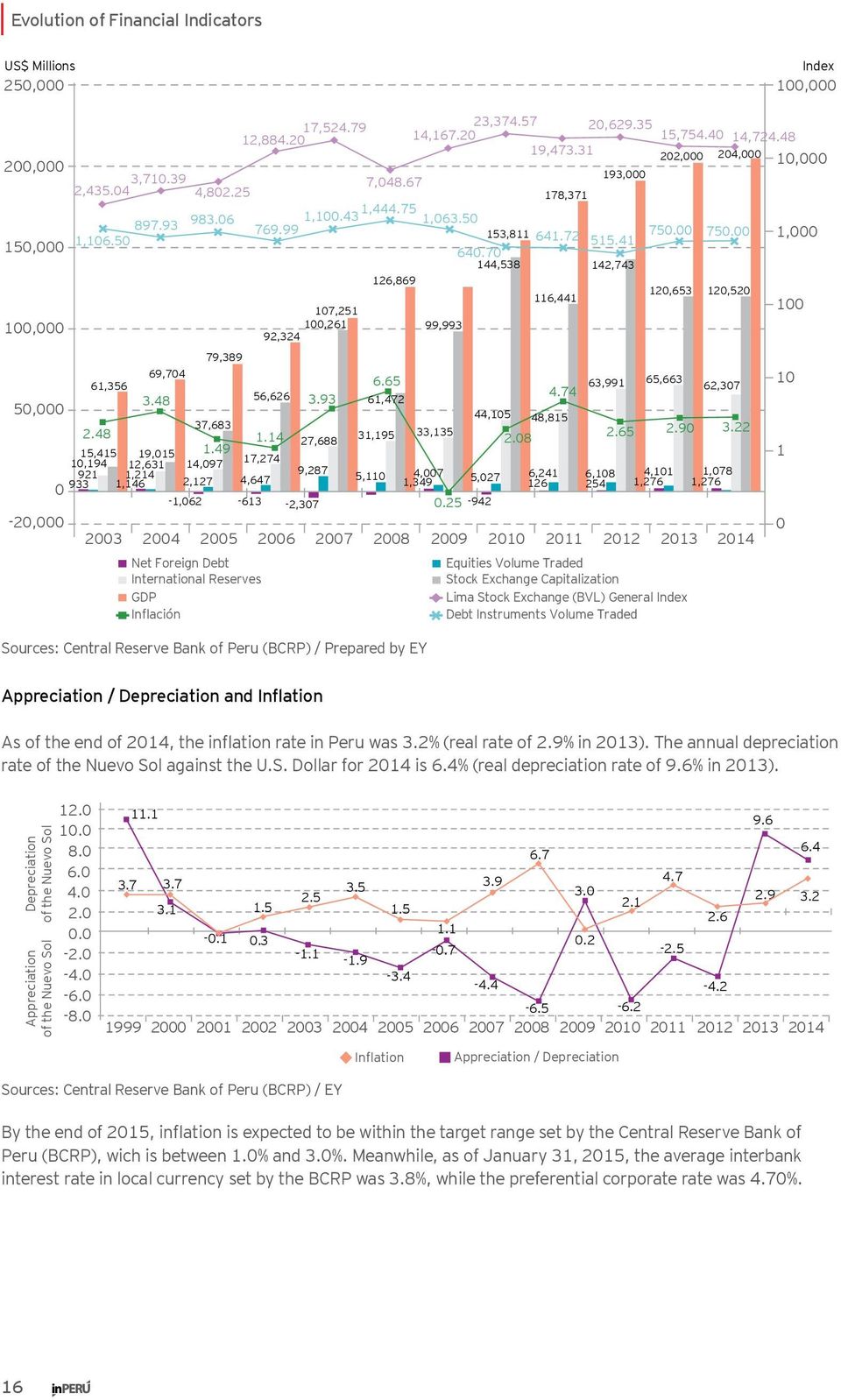
18 Evolution of Financial Indicators US$ Millions 250,000 Index 100, , , ,000 12, , , , , , , , , ,000 10,000 2, , ,000 7, , , , , , ,811 1, , ,869 Net Foreign Debt International Reserves GDP Inflación 107, ,261 99,993 92,324 Sources: Central Reserve Bank of Peru (BCRP) / Prepared by EY , ,743 Equities Volume Traded Stock Exchange Capitalization Lima Stock Exchange (BVL) General Index Debt Instruments Volume Traded , ,520 79,389 69, ,663 61,356 63,991 62, , ,472 50,000 44,105 48,815 37, ,195 33, ,688 15,415 19, ,194 17, ,631 14,097 1,214 9,287 2,127 4,647 5,110 4,007 1,146 1,349 5,027 6,241 6,108 4,101 1, ,276 1, , , , , Appreciation / Depreciation and Inflation As of the end of 2014, the inflation rate in Peru was 3.2% (real rate of 2.9% in 2013). The annual depreciation rate of the Nuevo Sol against the U.S. Dollar for 2014 is 6.4% (real depreciation rate of 9.6% in 2013). Depreciation of the Nuevo Sol Appreciation of the Nuevo Sol Inflation Appreciation / Depreciation Sources: Central Reserve Bank of Peru (BCRP) / EY By the end of 2015, inflation is expected to be within the target range set by the Central Reserve Bank of Peru (BCRP), wich is between 1.0% and 3.0%. Meanwhile, as of January 31, 2015, the average interbank interest rate in local currency set by the BCRP was 3.8%, while the preferential corporate rate was 4.70%. 16
19 I. Background Information Dollarization Rate of Bank Deposits Source: Central Reserve Bank of Peru (BCRP) Peru s Principal Economic Activities Peru s main economic activities include agriculture, fisheries, mining, the exploitation of petroleum and gas, and the manufacturing of goods, most notably textiles. The sharply contrasting geographical areas of Peru make it a particularly diverse country, with a wide variety of ecosystems, and thus, flora and fauna. During 2014, the non-traditional product markets with the most exports were livestock (21.2%) and handycrafts (61.9%). The principal non-traditional products exported in 2014 were quinoa (US$196 millions, % increase), mangoes (US$138 millions, 3.60% increase), asparagus (US$533 millions, -7.00% decrease), organic banano (US$119 millions, 33.99% increase), grapes (US$641 millions, 44.39% increase), berries (US$30 millions, 71.24% increase), refrigerated asparagus (US$38 millions, % decrease), avocado (US$384 millions, -6.96% decrease), cacao (US$152 millions, 82.53% increase), artichokes (US$92 millions, 3.81% increase), tangerine (US$60 millions, 38.78% increase), paprika and capsicums (US$41 millions, -8.88% decrease), natural calcium phosphates; refined copper wire, stout bobtail squid, common squid, and giant squid, whether frozen, dried, or in brine. In terms of traditional products, the most significant were gold, copper, lead, zinc, gas, petroleum oil, coffee, and fishmeal. In mining, according to the Mineral Commodity Summaries Publication authored by the U.S. State Department, in 2013 Peru ranked third in the world in the production of silver, copper, tin and zinc, fourth in lead, molybdenum and boron, fifth in mercury and gold, besides having large deposits of iron ore, phosphates and manganese, petroleum, and gas. The principal destinations for Peruvian copper are China and Japan, gold to Switzerland and Canada, and zinc and silver to China and South Korea. One of the economic activities that is only recently being exploited and which shows great potential is that of forestry resources (cedar, oak, and mahogany, mainly). Business & Investment guide 17

20 Principal industries in the different regions of Peru Au Ag Cu Zn Pb Fe Po C Petroleum Gold Silver Copper Natural Gas Zinc Lead Iron Phosphates Sugar Refinery Fishmeal Plant Textile Industry Cement Plant Chemicals Plant Oil Refinery Metals Industry Foundry Metal-Mechanical Plant Asparagus Grapes Mango Coffee Cabo Blanco Piura Talara Po Chiclayo Pacasmayo Chimbote Trujillo Paramonga Huacho - Chancay C Lima - Callao C Cajamarca Au Pisco Ag Zn Pb C Pucallpa Ag Pb La Oroya Cu Zn Au Ag Au Zn Ag Fe Cusco Zn Au Ica Ag C C Puno Arequipa Mollendo Ilo Iquitos Cu Source: EY Gross Domestic Product (GDP) / Trade Balance The Gross Domestic Product (GDP) estimate for 2014 is US$204 billion. It is estimated that at the end of 2014, total FOB exports came to US$37.9 billion, while imports totaled US$42.4 billion. The principal exports came from the mining, hydrocarbons, and agricultural and livestock industries. Real Gross Domestic Product (GDP) of Peru (in US$ Billion) * 2015*2016*2017*2018* *Estimated Sources: Central Reserve Bank of Peru (BCRP) / Ministry of Economy and Finance (MEF) / International Monetary Fund (IMF) / EY 18

21 I. Background Information Gross Domestic Product (GDP) (Annual Percentage Change) * GDP *Estimated Source: Central Reserve Bank of Peru (BCRP) Gross Domestic Product (GDP) by Industry - Annual % Change * Agriculture and Livestock Fisheries Mining Hydrocarbons Manufacturing Electricity and Water Construction Commerce Other Services GDP *Estimated Source: Central Reserve Bank of Peru (BCRP) Peru Gross Domestic Product (GDP) by economic sector in %, using the economic structure with a base estimate year of 2007 Other Services* 45.3% Manufacturing 16.6% Mining and Hydrocarbons 14.4% Commerce 10.2% Agriculture and livestock 6.0% Construction 5.1% Electricity and water 1.7% Fisheries 0.7% *According to the BCRP this economic sector in an heterogeneous group of services or invisible trades with the rest of the world, which includes transactions related to the areas of transport, travels, communications, insurances, and other services. Services transactions are registered when the service is provided or received. Source: National Institute of Statistics and Information (INEI) / Institute of Economics and Development of the Lima Chamber of Commerce (IED-CCL) Business & Investment guide 19
22 Net International Reserves (in US$ Millions) 70,000 60,000 50,000 40,000 30,000 20,000 10, ,613 Dec ,598 10,194 Dec Dec ,631 Dec ,097 17,275 Dec Dec ,689 Dec ,196 Dec ,135 Dec ,105 48,816 Dec Dec ,991 Dec ,663 Dec ,307 Dec Source: Central Reserve Bank of Peru (BCRP) Emerging Economies Indicators: Net International Reserves vs. Gross Domestic Product (GDP) and Fiscal Deficit/Surplus (Estimated for 2013) Net International Reserves / GDP (in %) 40 China 35 Israel Hungary Peru Above average Fiscal Deficit / Surplus India Poland Brazil Turkey Mexico Colombia -0.5 Russia Chile Below average 5 Argentina Below average Source: Central Reserve Bank of Peru (BCRP) 0 Above average Gross Domestic Product (GDP) by spending type (percent change) Variables * Gross Domestic Product Imports Domestic Demand a. Private Consumption b. Public Consumption Private Investment Public Investment Exports *Estimated Source: Central Reserve Bank of Peru (BCRP) 20
23 I. Background Information Domestic demand (percent change) % 13.1% 11.8% 10.3% Average : 8.4% 7.1% 7.3% 7.0% 4.7% 2.5% -2.8% * *Estimated Source: Central Reserve Bank of Peru (BCRP) Number of companies with annual revenues greater than US$360 million Companies with Turnover >= US$360 MM Companies with Turnover >= US$725 MM Companies with Turnover >= US$545 MM Companies with Turnover >= US$900 MM Sources: Top 10k Peru Top Publications / Peruvian Business Directory Duns & Bradstreet / Prepared by EY Real average income per capita by geographic areas (in US$) *Decrease mainly explained by Peruvian Nuevos Soles exchange rate depreciation Source: National Institute of Statistics and Information (INEI) * Urban Rural Business & Investment guide 21
24 Peruvian Social structure transformation by Social Economic Level (SEL) - urban Socio economic status - Urban Peru (2000) Socio economic status - Urban Peru (2014) Socio economic status - Urban Lima (2014) SEL AB 10% SEL C 20% SEL D 30% SEL E 40% SEL A 3% SEL B 14% SEL C 32% SEL D 30% SEL E 21% SEL A 5% SEL B 19% SEL C 41% SEL D 26% SEL E 9% Sources: INEI / APEIM / Rolando Arellano Public spending (real percent change) *Estimated Source: Central Reserve Bank of Peru (BCRP) * 2015* Balance of payments (in US$ Millions) 16,000 14,000 12,000 10,000 8,000 6,000 4,000 2, ,000-4,000 1,628 2,753 9,654 3,169 1,043 11, * 4,724 14,827 2,907-2, * *Estimated Source: Central Reserve Bank of Peru (BCRP) 22
25 I. Background Information Trade Balance (in US$ Billions) * * Exports Imports Trade Balance *Estimated Sources: Central Reserve Bank of Peru (BCRP) / Peruvian Foreign Trade Association (ComexPerú) Projection of regional exports of Peruvian goods 2011 vs (in US$ billions) 7 8 Europe 9 United States Middle East and North Africa 4 7 China 17 India 9 Rest 7 of Asia Peru Rest of Latin America Source: Oxford Economics / Prepared by EY Business & Investment guide 23
26 Annual change in exports by economic sector, in percentage (2014/2013) *Non-traditional **Traditional Source: Peruvian Foreign Trade Association (ComexPeru) 61.9 Misc (including jewelry) Handicrafts Furs and leathers Timbers and papers Metal-mechanical Non-metallic mining Fishing* Steel-metallurgical Chemical Textile Livestock Agricultural Fisheries** Petroleum and byproducts Mining Annual change in imports by economic sector, in percentage (2014/2013) *Non-traditional -2.2 Misc (including jewelry)* Handicrafts* Furs and leathers* Fisheries* Non-metallic mining* Timbers and papers* Textile* -0.1 Steel-metallurgical* 4.0 Livestock* -1.0 Chemical* -3.9 Metal-mechanical* Fisheries** Mining** 6.0 Agricultural** -9.8 Petroleum and byproducts** **Traditional Source: Peruvian Foreign Trade Association (ComexPeru) Exports by trading partner in US$ Millions top ten partners (2014) Source: Peruvian Foreign Trade Association (ComexPeru) China United States Switzerland Canada Brazil Japan Chile Spain Germany Colombia 1,353 1,229 1,219 1,580 1,546 1,521 2,476 2,640 6, ,000 1,500 2,000 2,500 3,000 3,500 4,000 4,500 5,000 5,500 6,000 6,500 7,000 6,948 24
27 I. Background Information Imports by trading partner in US$ Millions top ten partners (2014) China United States 8,928 8,858 Brazil Mexico Ecuador Germany South Korea Chile 2,000 1,950 1,774 1,511 1,383 1,283 Argentina 1,253 Colombia 1, ,000 2,000 3,000 4,000 5,000 6,000 7,000 8,000 9,000 Source: Peruvian Foreign Trade Association (ComexPeru) Traditional and non-traditional exports in US$ Billions 40,000 35,000 30,000 25,000 20,000 15,000 10,000 5, Traditional Non Traditional Source: Peruvian Foreign Trade Association (ComexPeru) / Central Reserve Bank of Peru (BCRP) During 2014, the non-traditional product markets with the most exports were livestock (21.2%) and handycrafts (61.9%). The principal non-traditional products exported in 2014 were quinoa (US$196 millions, % increase), mangoes (US$138 millions, 3.60% increase), asparagus (US$533 millions, -7.00% decrease), organic banano (US$119 millions, 33.99% increase), grapes (US$641 millions, 44.39% increase), berries (US$30 millions, 71.24% increase), refrigerated asparagus (US$38 millions, % decrease), avocado (US$384 millions, -6.96% decrease), cacao (US$152 millions, 82.53% increase), artichokes (US$92 millions, 3.81% increase), tangerine (US$60 millions, 38.78% increase), paprika and capsicums (US$41 millions, -8.88% decrease), natural calcium phosphates; refined copper wire, stout bobtail squid, common squid, and giant squid, whether frozen, dried, or in brine. In terms of traditional products, the most significant were gold, copper, lead, zinc, gas, petroleum oil, coffee, and fishmeal. Economic results (fiscal surplus / deficit) of the non-financial public sector (in % of the GDP) * *Estimated Source: Central Reserve Bank of Peru (BCRP) Business & Investment guide 25
28 Tax pressure (in % of the GDP) Source: Central Reserve Bank of Peru (BCRP) / National Superintendency of Tax Administration (SUNAT) During 2014, according to the National Superintendency of Customs and Tax Administration (SUNAT) the tax base was broadened by 3.4%. This was due in large part to auditing, control, and facilitation actions, which have helped tax collection to exceed the national average rate in many regions of the country. In 2014, the tax revenues collected totaled S/.95,389 millions with a 6% growth of the amount of registered taxpayers. Public debt (% of the GDP) * 2016* Non-domestic Domestic Total *Estimated Source: Central Reserve Bank of Peru (BCRP) 26
29 I. Background Information 5 I Country Risk and Investment Grade Peru has been given good forecasts by the best-known risk rating agencies, which have not only ratified the country s investment grade but have also raised the Peruvian sovereign credit rating. The factors that back this rating are the solid economic prospects reflected in a minimum growth estimate of 2.4% of the GDP for 2014, and an estimated 4.8% for These economic forecasts are backed by the rapid growth in investment and the significant drop in fiscal and external vulnerabilities, all within the context of several sources of growth, with low inflation and strong macroeconomic fundamentals. Obtaining the investment grade has permitted Peru to attract a great deal of international attention. Recently, an increasing number of multinational corporations have been looking at Peru with greater interest. The subsequent increase in jobs and decrease in poverty will predictably help improve social wellbeing. Peru s investment grade ratings Country S&P Fitch Moody's Chile AA- A+ Aa3 Peru BBB+ BBB+ A3 Mexico BBB+ BBB+ A3 Colombia BBB BBB Baa2 Brazil BBB- BBB Baa2 Uruguay BBB- BBB- Baa2 Bolivia BB BB- Ba3 Paraguay BB BB- Ba2 Ecuador B+ B B3 Venezuela CCC+ CCC Caa3 Argentina SD RD Caa1 Sources: Standard & Poor's / Fitch Ratings / Moody's S&P / Fitch Moody's Feature AAA Aaa Risk Free AA+, AA, AA- Aa1, Aa2, Aa3 High Grade A+, A, A- A1, A2, A3 High Repayment Capacity BBB+, BBB, BBB- Baa1, Baa2, Baa3 Moderate Repayment Capacity BB+, BB, BB- Ba1, Ba2, Ba3 Some Repayment Capacity B+, B, B- B1, B2, B3 Highly Uncertain Repayment Capacity CCC+, CCC, CCC-,CC Caa1, Caa2, Caa3 Extremely Vulnerable to Default SD/D Ca Default Investment Grade Source: Bloomberg Evolution of the long-term debt rating in foreign currency Agency Fitch BB- BB- BB BB BB+ BB+ BBB- BBB- BBB- BBB * BBB BBB+ BBB+ S&P BB- BB- BB BB BB+ BB+ BBB- BBB- BBB- BBB ** BBB BBB+ BBB+ Moody s Ba3 Ba3 Ba3 Ba3 Ba3 Ba2 Ba1 Baa3 Baa3 Baa3 Baa2 Baa2 A3 Source: EY Business & Investment guide 27
30 Country Risk As of January 13, 2015, Peru had a country risk of 197 base points, ranking second-lowest in Latin America. This score is less than half of the regional average (545 points). Country risk indicator (in based points) 2,000 2,814 1,800 1,600 1,400 1,200 1, Dec Dec Dec Dec Dec Dec Dec Dec. 13 Jan Venezuela Argentina Latin America Brazil Mexico Colombia Peru Chile Source: Central Reserve Bank of Peru (BCRP) Peru has recently achieved the position of the third most globalized country in Latin America, according to the Globalization Index established by EY. Five elements are considered within this index: openness to foreign trade, capital flows, exchange of technology and ideas, international movement of workers, and cultural integration. Additionally, in January 2013 Bloomberg Markets positioned Peru as the fourth emerging market with the greatest international projection, based on the country s advantages, such as low share prices and their possible increase in the future. As may be seen in the following charts, Peru s level of inflation is one of the lowest in Latin America, with a rate of 3.2% in 2014, and an estimated range of 1% to 3% for In addition, over the past decade, the Peruvian economy had the lowest average annual inflation rate in Latin America, at 2.5%, below that of Chile (2.9%) Colombia (4.6%) and Brazil (6.0%). Estimated inflation rates in Latin America 2.0 Peru Argentina Uruguay Chile Colombia Mexico Paraguay Brazil 7.7 Latin America * 2014* *Estimated Sources: BBVA Research - Peru / Central Reserve Bank of Peru (BCRP) 28
31 I. Background Information Estimated Gross Domestic Product (GDP) growth percentage rates in Latin America Peru Chile Colombia Mexico Latin America * * 2013 *Estimated Sources: BBVA Research Peru / Ministry of Economy and Finance MEF (Multiannual Macroeconomic Framework) / International Monetary Fund (IMF) / BCRP / Mexico s Bank (Banxico) / Bank of the Republic of Colombia / Central Bank of Chile / EY I Investment Private investment (percent change) 30% 25% 20% 15% 10% 5% 0-5% -10% -15% -20% 25.9% 20.1% 23.3% 23.9% 15.6% 11.0% 6.5% 3.0% 5.2% -1.5% -9.1% * 2016* *Estimated Source: Central Reserve Bank of Peru (BCRP) Public investment (percent change) 40% 30% 27.9% 32.9% 20% 10% 0-10% -20% 17.5% 17.1% 19.1% 14.2% 12.1% 12.0% 11.6% -3.6% -11.2% -30% * 2016* *Estimated Source: Central Reserve Bank of Peru (BCRP) Business & Investment guide 29
32 Fixed gross investment in % of the Gross Domestic Product (GDP) Private investment Public investment * 2016* *Estimated Source: Central Reserve Bank of Peru (BCRP) Total investment in Latin America in % of Gross Domestic Product (GDP) (2014 y 2013) 2014: Peru 25.6 Chile 23.8 Mexico : Argentina 18.0 Colombia 25.0 Brazil Source: International Monetary Fund (IMF) / Central Reserve Bank of Peru (BCRP) Direct Foreign Investment stock by sector in % of Gross Domestic Product (GDP) (2014) Sector 2014 Mining 24% Finance 18% Communications 17% Industry 14% Energy 13% Others 3% Commerce 3% Services 3% Petroleum 3% Transports 2% Mining 5,604 Finance 4,298 Communications 3,932 Industry 3,163 Energy 3,074 Commerce 798 Petroleum 680 Services 674 Transport 364 Others 695 Total US$ (in millions) 23,283 Source: Agency for the Promotion of Private Investment (ProInversion) 30
33 I. Background Information Direct foreign investment in Latin America in % of Gross Domestic Product (GDP) (2013) Peru 4.6 Chile 3.4 Colombia 2.4 Latin America 2.7 Brazil 3.0 Mexico 2.3 Source: EY Private investment (US$ Billions) * 2016* *Estimated Source: Ministry of Economy and Finance (MEF) (Multiannual Macroeconomic Framework) / Agency for the Promotion of Private Investment (ProInversion) Business & Investment guide 31
34 7 I Population and Human Development The estimated population of Peru for 2015 is approximately 31.2 million of which approximately 10.5 million (2013) reside in Lima (including the population of th Constitutional Province of Callao). The national workforce (total EAP) is estimated at around 16.1 million people. The main religion is Roman Catholicism, and the principal official languages are Spanish and Quechua. The Aymara language is also spoken, mostly in the Southern Highland Region, along with various other native languages, particularly in the Amazon Jungle Region. As of 2012, the literacy rate was 93.8% of the population over age 15, and it is estimated that by 2015, 94.3% of Peruvians over the age of 15 will be able to read and write. Population Summary Population 31.2 million (estimated, 2015) 75.7% live in urban areas (2013) Age range 0-14 years old: 28.7% years old: 65.0% 65 years or older: 6.3% Growth rate 1.13% (estimated, 2013) Birth rate 20.4 births / 1,000 people Mortality rate 5.6 deaths / 1,000 people Gender ratio Births: male / female Life expectancy at birth 74.1 años (estimate for ) Source: National Institute of Statistics and Information (INEI) / Economic Commission for Latin America and the Caribbean (CEPAL) / International Monetary Fund (IMF) (Population) Over the last four years, the population has grown by an average of 1.13% annually (in 2013, it is estimated to have grown by 1.12%). As of 2013, it is estimated that the urban areas population will achieve 75.7% and the rural areas population will achieve 24.3% of the total national population. Total population and average annual growth rate in % 35,000 30, % 2.55% 28,221 28,807 29,132 29,462 29,798 30,136 30, ,000 20,000 15,000 10,000 5, % 7,023 10,420 14, % 22,639 17, % 1.14% 1.14% 1.13% 1.13% 1.13% 1.13% 1.12% * 0.00 Total population Growth rate (%) *Estimated Source: National Institute of Statistics and Information (INEI) (it differs from the IMF, that estimates 30.9 million habitants for 2013) 32
35 I. Background Information Population census by area of residence in % * Rural area Urban area *Estimated; information taken from National Censuses through 2007 Source: National Institute of Statistics and Information (INEI) / EY In 2013, the male population was greater than the female population by 0.1%. On the other hand, the population on the Coast accounted for 54.8% of the total population, while the population of the Highlands was 32.2%, and that of the Jungle was 13.0%. Evolution of the census population by natural region in % * Coast Highlands Jungle *Estimated Source: National Institute of Statistics and Information (INEI) / EY Census population pyramid (1972 and 2007) Age group Male Female 80 and over % 8% 7% 6% 5% 4% 3% 2% 1% 0% 1% 2% 3% 4% 5% 6% 7% 8% 9% 1972 Census 2007 Census Source: National Institute of Statistics and Information (INEI) Business & Investment guide 33
36 Of the total Peruvian population, 65.0% is between the ages of 15-64, while the Economically Active Population (EAP) as of 2012 was 72.8% of the total, giving Peru a demographic bond effect, which may be simply explained as the structural benefit of its population being of an age to produce and consume. It is estimated that this high percentage of workforce will extend its maximum registration period for up to three and a half more decades, and the power of this demographic bond is that of fostering greater production, consumption, savings, and investment. Perhaps the most important aspect of this demographic overview is that Peru has the advantage of practically just having begun its demographic bond period, which will provide it with the conditions to make the necessary public and private investments in order to cover the demands and opportunities that arise from the consumption of its demographic bond period. Projected population by department in thousands (2013) 9,524 1,815 1,8141,520 1,390 1,331 1,301 1,259 1,240 1,136 1, Lima Piura La Libertad Cajamarca Puno Junin Cusco Arequipa Lambayeque Ancash Loreto Const. Province of Callao Huanuco San Martin Ica Ayacucho Huancavelica Ucayali Apurimac Amazonas Tacna Pasco Tumbes Moquegua Madre de Dios Source: National Institute of Statistics and Information (INEI) Coinciding with the population percentages by Region, the three most populous departments of Peru belong to the Coast Region: Lima, Piura, and La Libertad, followed by Cajamarca, Puno, Junin, Cusco, and Arequipa. The Human Development Index (HDI) is a compound index that measures the average advances in three basic dimensions of human development: a long and healthy life; knowledge level of dignified life, via the combination of indicators for life expectancy, educational achievements, and income. The HDI defines a minimum and maximum value for each dimension (called objectives ), and then shows the position of each country with regard to these objective values, expressed in the form of a value between 0 and 1. According to the 2014 Human Development Report issued by the United Nations Development Programme (UNDP), the ranking and evolution of the six principal countries in Latin America are as follows: Ranking Classification Country Growth Rate 2013 / 1980 World Total % Latin America and the Caribbean % Very High Human Development 41 Chile % 49 Argentina % High Human Development 71 Mexico % 79 Brazil % 82 Peru % 98 Colombia % Note: The ranking refers to each country s position in the world classification for
37 I. Background Information 8 I Poverty and employment Recently, the United Nations stated that Peru has all the conditions necessary to achieve its poverty reduction goal of 20% of the population by Total incidence of poverty in % * 2014* Total poverty Extreme poverty *Estimated Source: National Institute of Statistics and Information (INEI) / Ministry of Development and Social Inclusion (MIDIS) Poverty rate in Latin America (2011 and 2012) Venezuela Ecuador Brazil Peru Argentina Colombia El Salvador Costa Rica Dominican Republic Uruguay Mexico Poverty Extreme Poverty Poverty Extreme Poverty Source: Economic Commission for Latin America and the Caribbean (CEPAL) / Ministry of Development and Social Inclusion (MIDIS) Total incidence of poverty by geographic area (2012) National 25.8% Urban 16.6% Rural 53.0% Coast 16.5% Highlands 38.5% Jungle 32.5% Urban coast 17.5% Rural coast 31.6% Urban highlands 17.0% Rural highlands 58.8% Urban jungle 22.4% Rural jungle 46.1% Metropolitan Lima 14.5% Source: National Institute of Statistics and Information (INEI) / Ministry of Development and Social Inclusion (MIDIS) Business & Investment guide 35
38 In 2012, the country s Economically Active Population (EAP) included 72.8% of the total population (including employed and unemployed EAP) with 96.3% of the EAP employed. Of this percentage, 74.3% were located in urban areas, while the remaining 25.7% were located in rural areas. Evolution of the economically active population (thousands of people) 25,000 20,000 19,144 19,502 19,851 20,193 20,533 20,875 21,223 21,579 21,938 14,903 15,158 15,448 15,736 15,949 16,142 15,000 13,791 13,867 14,356 14,758 15,090 15,307 15,541 13,683 14,197 14,459 13,060 13,120 10,000 5, Working-Age Population Total EAP Employed EAP Unemployed EAP Source: National Institute of Statistics and Information (INEI) Evolution of unemployment (percent change) * *Estimated Source: 2013 ILO Global Employment Outlook / EY 36
39 II. Business Environment San Isidro district, Lima - Lima. Photograph: Fernando López l PromPerú II Business Environment Business & Investment guide 37
40
41 II. Business Environment 1 I Investment promotion conditions a. Legislation and Trends in Foreign Investment in Peru Peru seeks to attract both domestic and foreign investment in all sectors of the economy. To achieve this, it has taken the necessary steps to establish a consistent investment policy that eliminates any barriers that foreign investors may face. As a result, Peru is considered a country with one of the most open investment systems in the world. Peru has adopted a legal framework for investments that requires no previous authorization for foreign investment. Additionally, it establishes the necessary regulations to protect the economic stability of investors from arbitrary changes in legal terms or conditions applicable to their projects and reduces government interference in economic activities. The Peruvian government guarantees legal stability to foreign investors with regard to the legislation governing income tax and distribution of dividends. Foreign investors with the right to obtain legal and tax stability are those willing to invest in Peru for a period of no less than two (2) years and for a minimum amount of US$10 million in the Mining and/or Hydrocarbons sectors, or US$5 million in any other economic activity, or those who acquire more than 50% of the shares in a company in the process of privatization. Peru s laws, regulations, and practices do not discriminate between domestic and foreign companies. Foreign investors receive equal treatment. There are no restrictions on repatriation of profits, international transfers of capital, or foreign exchange practices. The remittance of interest and royalties is also not restricted in any way. Foreign currency may be used to acquire goods or cover financial obligations, provided the operator complies with Peruvian tax laws. b. Beneficial legal framework for foreign investors Peru offers a legal framework 1 that protects foreign investors' interests by offering them: An equal and non-discriminatory treatment Unrestricted access to the majority of economic sectors Free capital transfer Additionally, Peruvian and foreign investors are provided with: Right to free competition Guarantee of private property (no expropriations or nationalizations) Freedom to acquire shares in Peruvian companies Freedom to access internal and external credit Freedom to transfer royalties and profits from their investment Simplicity for most operations, whether in local currency (Nuevo Sol) or U.S. Dollars, without foreign exchange controls A wide network of investment agreements and membership in the Investment Committee of the Organization for Economic Cooperation and Development (OECD) Direct foreign investments must be registered with the Agency for the Promotion of Private Investment (ProInversion). Foreign investors may remit abroad the net profits (without any restriction whatsoever) from their registered investments, as well as transferring their shares, ownership interests, or participatory rights, perform capital reductions, and dissolve or wind-up their companies. 1 Constitutional provisions; Foreign Investment Act, Executive Order 662; Framework Act for the Growth of Private Investment, Executive Order 757; Act for the Promotion of Private Investment in Public Infrastructure and Utility Works, TUO approved by Supreme Executive Order PCM. Taken from ProInversion. Business & Investment guide 39
42 Recognition of Favorable Investment Climate According to this ranking, Peru is among the top countries in Latin America in terms of macroeconomic environment, market size, financial market development, labor market efficiency, and goods market efficiency Ranking Score Ranking Score Total Peru 61/ / SUB-INDEX: Basic Requirements Institutions Infrastructure Macroeconomic Environment Health and Primary Education Efficiency Enhances Higher Education Goods Market Efficiency Labor Market Efficiency Financial Market Development Technological Readiness Market Size Innovation and Sophistication Factors Business Sophistication Innovation Source: World Economic Forum c. Ease of Doing Business in Peru According to Doing Business 2015, Peru ranks 35th out of 189 countries in terms of ease of starting a company and doing business, and ranks second in Latin America, as corroborated by Forbes. Doing Business Ranking for Latin America Position Country 34 Colombia 35 Peru 39 Mexico 41 Chile 47 Puerto Rico (United States) 52 Panama 73 Guatemala 82 Uruguay 83 Costa Rica 84 Dominican Republic 92 Paraguay Source: World Bank (WB) - Doing Business 2015 Forbes Best Counstries for Doing Business Position Country 29 Chile 52 Peru 55 Uruguay 57 Costa Rica 61 Mexico 66 Panama 67 Colombia 90 El Salvador 94 Brazil 95 Guatemala 106 Paraguay Source: Forbes
43 II. Business Environment The following are the principal indicators for the investment climate: Indicators Peru Latin America and the Caribbean Starting a business Number of procedures Time (days) Cost (% of per capita income) Registration of minimum capital paid up (% of per capita income) Construction permits Number of procedures Time (days) Cost (% of per capita income) Property registration Number of procedures Time (days) Cost (% of property value) Getting electricity Number of procedures Time (days) Cost (% of per capita income) Access to credit Strength of legal rights index (0-10) Depth of credit information index (0-6) Coverage of Public Records Offices (% of adults) Coverage of private entities (% of adults) Protecting investors Extent of transparency and access to public information index (0-10) Extent of director liability index (0-10) Ease of shareholder legal proceedings index (0-10) Strength of investor protection index (0-10) Paying taxes Number of payments per year Time (hours per year) Profit tax (%) Labor tax and contributions (%) Other taxes (%) Total tax rate (% of profit) Trading across borders Documents to export (number) Time to export (days) Cost to export (US$ per container) ,299.1 Documents to import (number) Time to import (days) Cost to import (US$ per container) 1, ,691.1 Enforcing contracts Time (days) Cost (% of claim) Procedures (number) Resolving bankruptcy Time (years) Cost (% of estate) Recovery rate (cents on the dollar) Source: World Bank (WB) - Doing Business 2015 Business & Investment guide 41
44 Index of Economic Freedom According to the 2015 Index of Economic Freedom prepared by the Heritage Foundation, which includes an analysis of the environment and economic freedom of each country based on ten indicators covering issues such as compliance with the law, the level of government intervention, market openness, and efficient State regulations, the overall results obtained confirm that promoting economic freedom in terms of the rule of law, limited government, regulatory efficiency, and open markets, generates a broad economic dynamism. Thus, boosting these levels will prove significant in order to sustain the wealth of nations, as well as being the most effective way to eliminate poverty. Below is a summary of this ranking: Country Worldwide Ranking Latin America Ranking 2015 Score Hong Kong Singapore Australia Canada Chile Colombia Uruguay Peru Mexico Paraguay Brazil Ecuador Bolivia Argentina Venezuela Source: The Heritage Foundation Emerging and Growth-Leading Economies ("EAGLE s") The emerging and growth-leading economies (EAGLEs) are elected every year by BBVA Research, based on how their performance contributes to global growth. In order to do this, it is important to analyze their economic relevance and performance compared to the entire set of developed countries. Currently, there are nine countries qualified as EAGLEs such as: China, India, Indonesia, Brazil, Russia, Korea, Turkey, Mexico, and Taiwan. In addition, within the group of key emerging countries complementing the above, there is a group known as Nest ( Nest of EAGLE economies) which consists of 14 countries. It is expected that -together with the EAGLE countries- "Nest" countries will contribute 73% to global growth between 2013 and Peru is part of this group of "Nest countries, with a growth over and above the forecast for this group of countries. Worth noting is the average annual growth projected for Peru up to 2023, which will be 5.4%. 42
45 II. Business Environment Contribution to global growth between 2013 and 2023 EAGLE's Nest Country Estimated Annual Variation of GDP Estimated World Percentage os Share in GDP Growth China India Indonesia Brazil Russia Turkey Mexico Saudi Arabia Nigeria Thailand Colombia Philippines Malaysia Irak Vietnam Pakistan Bangladesh Poland Egypt Iran Peru South Africa Chile Source: BBVA Research Peru Among the reasons why it is possible to predict such a favorable performance from these emerging economies, is the planning and implementation of prudent policies aimed at maintaining macroeconomic stability in the long term, as well as an awareness that their development is closely linked to a deep connection with the world in commercial and financial terms. However, a key factor in the good performance of emerging economies has been, especially in Peru, the role played by the middle class population, since their increase in purchasing power has led to the transition of the sector from poverty to an emerging situation. This means that consumption patterns of these countries will cause -if they have not already done so- a change that will work for a wider variety of industries. Business & Investment guide 43
46 2 I Trade Agreements Peru s development strategy is based on an economy open to the world and competitive in its export offer. It has been a successful strategy that has permitted the country to consolidate its foreign trade in goods and services as an instrument for economic development and the reduction of poverty. International trade negotiations, which have benefited from rigorous macroeconomic management and its consequent stability, have allowed the Peruvian economy to gradually tackle and reduce its external vulnerability in times of crisis such as in the current international situation. In recent years, Peru has negotiated Free Trade Agreements (FTA) with large and medium-sized markets. Nearly 95% of Peru s exports are covered by Free Trade Agreements (FTAs) currently in force. This enables Peruvian products to enter, subject to the rules of origin of each trade agreement, under preferential conditions to 53 countries, including the United States, China, Canada, Japan, South Korea, Thailand, Singapore, and the member countries of the European Union, among others. This market openness and the trade agreements that Peru has signed have permitted an increase in the number of exported products and exporting companies, particularly in non-traditional exports. Despite the fact that exports of traditional products still represent 75% of the country s total exports, it is clear that the trade agreements have allowed the country to diversify its offer of non-traditional goods. For example, in the first three years of the FTA with the United States, 488 new tariff headings were registered for non-traditional exports shipped to the United States, while 204 new non-traditional export headings were observed at the end of the second year of the FTA with China. Additionally, these trade agreements are a valuable instrument for attracting direct foreign investment and boosting increased productivity in companies, as well as the transfer of technology through the lower cost of imports of capital goods and quality inputs. Trade agreements provide an incentive to the processes of convergence of international standards, which has enabled more Peruvian companies to improve their management and logistics practices. Peru has also negotiated Reciprocal Investment Promotion and Protection Agreements. As of this date, Peru has investment agreements with 53 countries, considering signed and in force agreements. The principal rights protected include: The right to fair and equal treatment The right to receive the same treatment as domestic investors The right to receive indemnity in case of expropriation The right to the free transfer of profits And the most favored nation clause, under which the better treatment given to Peru s partner in these matters also covers Peru s other partners in these types of investment agreements. In an effort to strengthen and consolidate Peru s image as an attractive destination for investments, there are currently 39 agreements in force: 28 Bilateral Reciprocal Investment Promotion and Protection Agreements (BRIPPAs): Germany, Argentina, Australia, Bolivia, China, Colombia, South Korea, Cuba, Denmark, Ecuador, El Salvador, Spain, Finland, France, Italy, Japan, Malaysia, Norway, The Netherlands, Paraguay, Portugal, United Kingdom, Czech Republic, Romania, Sweden, Switzerland, Thailand, the Belgium-Luxembourg Economic Union, and Venezuela. 11 Free Trade Agreements (FTAs) which include an investment chapter (Costa Rica, Panama, Mexico, United States, EFTA, Canada, Chile, China, South Korea, Singapore, and the European Union). 44
47 II. Business Environment It should be noted that Peru has a signed agreement with the Overseas Private Investment Corporation (OPIC) and a Constitutive Agreement with the Multilateral Investment Guaranty Agency (MIGA). Peru has also signed the International Convention for Settlement of Investment Disputes (ICSID) as an alternative for resolving disputes that might arise between investors covered by the ICSID and the Peruvian State. Free Trade Agreements (FTAs) Signed by Peru Good international relations are of vital importance to the sustainable development of a nation. The opening up of new international markets has allowed Peru to achieve a more dynamic economy, as reflected in the signing of Free Trade Agreements (FTAs) in turn resulting in market growth in exports. To date, Peru and its exports have benefited from a variety of regional trade agreements, multilateral agreements, and bilateral trade agreements. The following is a list of the agreements signed 2. List of trade agreements in force: Multilateral Agreements: - World Trade Organization (WTO) Regional Agreements: - Andean Community of Nations (CAN) - Bolivia, Colombia, Ecuador, and Peru Bilateral Agreements: - European Free Trade Association (EFTA) Switzerland, Iceland, Liechtenstein, and Norway - Canada - Chile - China - South Korea - Costa Rica - Cuba - United States - Japan - Southern Common Market (MERCOSUR) - Argentina, Brazil, Paraguay, and Uruguay - Mexico - Panama - Singapore - Thailand - European Union - Venezuela - Pacific Alliance (Colombia, Chile, Mexico and Peru) Pending Entry into Force: - Guatemala Ongoing Negotiations: - Honduras - El Salvador - Thailand - Turkey - Trans-Pacific Partnership (TPP) - Brunei Darussalam, Chile, New Zealand, Singapore, Australia, United States, Malaysia, Vietnam, Canada, Mexico, Japan and Peru. 2 Peruvian Ministry of Foreign Affairs and Agency for the Promotion of Private Investment (ProInversion) Business & Investment guide 45
48 Peru is an active member of the Asia Pacific Economic Cooperation (APEC) Forum, together with 20 other economies from that Region. It is also a member country of the Latin American Integration Association (ALADI). The following maps show the status of Peru s agreements, exports under these agreements, and a brief summary of the main instruments: EFTA Canada China Thailand Singapore Japan European Union United States Korea Mexico Vietnam Brunei Andean Community APEC Malaysia OMC Central America Chile Australia Mercosur New Zealand Current agreements Agreements under negotiation* *Additionally, there is also an agreement pending to entry into force with the Trans-Pacific Partnership (Brunei Darussalam, Chile, New Zealand, Singapore, Australia, United States, Malaysia, Vietnam, Canada, Mexico and Japan). Peruvian exports distributed by markets under trade agreements In Force 95% Source: EY 46 No Negotiations 4% Negotiations Underway 1%
49 II. Business Environment In Force 1. Peru China Free Trade Agreement (FTA) In economic terms, China has been the fastest growing economy worldwide over the past two decades (around 10% per year of sustained growth). The entry into force of this Agreement in March 2010 has opened up a market of 1.35 billion inhabitants, of which 350 million are consumers with high purchasing power. As of July 2012, exports to China had grown at an approximate average rate of 31% per year during the period. Peru s principal exports to China are copper, fishmeal, and iron ore, lead, and zinc. In exchange, China ships machinery, mobile telephones, and high technology products to Peru. Among the main Peruvian products benefitting from the trade agreement are giant squid, cuttlefish and squid, fresh grapes, avocado, mango, barley, paprika, tara powder, and fine wool yarn, etc. In line with Peru s strategy to become the hub of Asian operations in South America, the FTA provides Peru with the opportunity to establish clear rules of the game, within a transparent and predictable framework through which it will not only contribute to increasing bilateral trade, but also boost Chinese investment in Peru, principally in the industries of mining, agriculture, electricity, wind power, petroleum and gas, and fisheries. 2. Peru - United States Trade Promotion Act Peru had access to certain unilateral preferential customs duties with the United States starting in 1991, granted by the U.S. Congress to Andean Countries through the Andean Trade Preference Act (ATPA) which remained in force until These preferential duties were renewed in 2002 with the enactment of the Andean Trade Promotion and Drug Eradication Act (ATPDEA) under which they remained in force until In 2004, Peru initiated negotiations for a Free Trade Agreement (FTA) with the United States, and in 2009 the Peru United States Free Trade Act entered into force. Just two years after entering into force, 418 new products were exported, of which 96% were non-traditional products, most notably in the areas of Metal-Mechanical (32%), Chemicals (20%), and Textiles (11%). 3. Peru - European Union (EU) Free Trade Agreement (FTA) The Trade Agreement with the EU is part of a business strategy to expand and develop the export supply of Peru. It became effective on March 1, The EU is one of the main destinations for Peruvian exports. This Region represents a large market opportunity, with over 490 million inhabitants and per capita income levels which are among the highest in the world. With the entry into force of the Peru EU FTA, custom duties were removed in 99.3% of Peru's exports, benefiting 95% of custom duty lines for agricultural products. The main products of export interest to the European bloc are asparagus, avocados, coffee, fruits of the genus capsicum, (for example, paprika and chili peppers) artichokes, among others. 4. Peru Japan Free Trade Agreement (FTA) The Economic Partnership Agreement between Peru and Japan was entered into on May 31, 2011, and went into full force and effect on March 1, The Peru Japan Economic Partnership Agreement (EPA) allows for preferential access to an established international market, which has a great capacity for consumption of products with high added value. Business & Investment guide 47
50 Under this Agreement, Peruvian products such as coffee, asparagus, sacha inchi, giant squid, fish oil, copper, lead, zinc, purple corn, giant corn from Cusco, swordfish, among others, enter the Japanese market with preferential access. The Agreement also gives Peru access to a market with a greater demand for consumer goods, raw materials, intermediate goods and capital goods. 5. Peru - South Korea Free Trade Agreement (FTA) The Free Trade Agreement (FTA) between Peru and South Korea was signed on March 21, 2011, in Seoul, Korea, and it became effective on August 1, In line with the Peruvian strategy to strengthen trade with Asia, South Korea was the third Asian country with which Peru signed an FTA. Among other characteristics of the Peru - Korea FTA, as is typical of a commercial agreement, a 10-year term was established, to eliminate custom duties on products that both countries share. However, there may be other measures which may be applied in the form of import duties on some agricultural goods which are specified in the Agreement. Through this Bilateral Agreement, Peru reaches a 50 million people market with a per capita GDP of more than US$25,000. For Peruvian exports, this represents a larger number of potential consumers and a greater chance of placing its products, thanks to the preferential access that many products enjoy under customs duty headings. Peruvian non-traditional exports reap the most benefit from this Agreement, since, according to the Peruvian Ministry of Foreign Trade and Tourism (MINCETUR) the Korean market has a preference for high quality fresh products, such as agricultural and fisheries products from Peru. 6. Peru - Singapore and Peru Thailand Free Trade Agreements (FTAs) In the context of the policy to approach the Asian market, Peru executed the Peru - Singapore Free Trade Agreement (FTA) on May 29, 2008, in Lima, which entered into force on August 1, Likewise, it signed the Protocol between the Republic of Peru and the Kingdom of Thailand which is in full force and effect as from December 31, Unlike Thailand and the case of most Asian countries, which import mainly minerals from Peru, Singapore is a very important non-traditional Peruvian exports destination. According to the Peruvian Ministry of Foreign Trade and Tourism (MINCETUR), the main products exported to Singapore, which are already benefiting from this Agreement, are: cocoa, grapes, t-shirts, shirts, asparagus, shellfish, and other marine products. While the main products exported to Thailand are zinc ore, copper ore, flour, fishmeal and fish pellets, cuttlefish, and fresh grapes. The tariff liberalization agreed with Thailand covers about 75% of the sub-categories of both countries. Sub-categories corresponding to Basket A had an immediate liberalization and those corresponding to Basket B have a five-year liberalization as from the date the Protocol entered into full force and effect. Singapore is one of the main ports of entry into East Asia, thus, the Agreement will enable Peruvian products to be admitted with better conditions throughout the Region. 7. Peru MERCOSUR Economic Complementation Agreement (ACE) Economic Complementation Agreement 58 (ACE 58) was signed between Peru and the MERCOSUR countries (Argentina, Brazil, Paraguay and Uruguay) on November 30, 2005 and became effective on January The purpose of this Agreement was to establish a legal framework for integration, to facilitate business trade between member countries, through the elimination of tariff and non-tariff measures affecting trade in goods and services. 48
51 II. Business Environment Therefore, since January 1, 2012, products exported to Argentina and Brazil enter these countries with a rate of 0% in customs duties. 8. Peru - Mexico Trade Integration Agreement The Trade Integration Agreement was entered into by and between Peru and Mexico on April 6, 2011, and became effective on February 1, This Agreement opened up a 112 million people market, allowing our exports preferential access to over 12,000 products, such as canned fish, cookies, timber, shrimp, and other products. This Agreement will also make it possible for us to access a wider range of kitchen appliances. 9. Andean Community of Nations (CAN) Peru is a member of CAN in agreements related to lower customs duties for goods, sub-regional liberalization of service markets, community regulations regarding intellectual property, land, air and water transport, telecommunications, etc. An important part of Peruvian trade regulations are governed by the commitments made under this forum. However, in its policy of trade liberalization with other countries and blocs, Peru deepened the liberalization of trade and the opening of its market to much higher levels, and with commitments that are broader in scope than those arising from the CAN. 10. Peru Chile Free Trade Agreement (FTA) This Agreement is effective as from March 1, It extends the Economic Complementation Agreement signed by Peru and Chile in 1998, together with its annexes, protocols and other tools. According to the schedule of lower duties of this Agreement, by 2016 there will be a total exemption in the trading of goods between the two countries. 11. Asia Pacific Economic Cooperation (APEC) Forum Asia Pacific Economic Cooperation (APEC) is a forum to promote economic cooperation, economic growth, and the expansion of trade among its members. Unlike the World Trade Organization (WTO) and other multilateral forums, APEC does not yet comprise a trade treaty or agreement involving obligations. However, Peru is active in the work of this forum, and it participates in the definition of the work lines and its organization. As it was in 2008, in 2016, Peru will be the host of the APEC forum, the ministerial meetings, and the summit of leaders of the 21 economies making up the forum. According to the Ministry of Foreign Trade and Tourism (MINCETUR), APEC countries account for approximately 60% of the global GDP 50% of world trade, and around 50% of the world population. A trade agreement within this bloc (which, at a later stage, could be the agreement resulting from negotiations of the Transpacific Partnership Agreement or TPP) would further open more doors to the world's largest market for Peru s export offering. 12. World Trade Organization (WTO) It is the world's largest trading forum, where the rules governing trade in almost all the countries of the world are discussed. Peru has been a member of the WTO since its creation in 1995, and all commercial agreements reached at the WTO have been ratified by its domestic law. Business & Investment guide 49
52 The following agreements will soon come into full force and effect: Pacific Alliance Pacific Alliance is a trade bloc consisting of four Latin American countries: Chile, Colombia, Mexico, and Peru. This proposal was unveiled in Peru, on April 28, 2011, through the Declaration of Lima. The aim of this partnership is to encourage regional integration and further growth, development, and competitiveness of its member countries economies, and to progressively move closer to the goal of achieving the free movement of goods, services, capital, and people. Among these agreements to form part of the Pacific Alliance, an essential requirement set forth is that all new members of the alliance must have in place the rule of law, democracy, and constitutional order in the country. The countries members of the Pacific Alliance represent 38% of Latin America s GDP and 2.7% of the global GDP. Together, they would be the eigth largest economy in the world. Trade represents more than 36% of Latin America and the Caribbean. Additionally, by 2013, they were able to obtain US$83 billion in Direct Foreign Investment (DFI). The four member countries of the Pacific Alliance have agreed to the elimination of visas between them. Under this commitment, Mexico s Department of Foreign Affairs (SRE) announced -on November 9, the abolition of visas for Peruvian citizens. Furthermore, the Integrated Latin American Stock Market known as MILA is currently in operation. It consists of Colombia, Peru, Chile, and Mexico joined stock markets operations. Moreover, according to data from the National Administration of Customs and Tax Administration (SUNAT) trade between Peru and the member countries of the Pacific Alliance grew 27% between 2009 and Finally, Chile, Colombia, Mexico, and Peru have agreed to liberalize at least 90% common custom duty tariffs upon the Agreement coming into force. Recently, several countries have requested inclusion as observer members, invited by the Pacific Alliance, including Costa Rica, Panama, Uruguay, Japan, Canada, Guatemala, Spain, Australia, New Zealand, and Paraguay. Peru s Upcoming Trade Agreements As part of efforts deployed to expand and strengthen the market for Peruvian products worldwide, Peru and Turkey have begun negotiations for a Free Trade Agreement (FTA). An important fact is that it has been decided for the negotiations to include liberalization of trade in services, which is something that Turkey had never negotiated in earlier agreements from the start. The products enjoying a greater interest on the part of Turkey include mining, fisheries, livestock, leather, and fur. Peru is also taking the initiative to promote the start of trade negotiations with India and the Russian Federation. One of the interests in future negotiations with India is to strengthen openness and trade preferences for Peru in a market that concentrates one sixth (1/6th) of the world s population. In an initial MINCETUR study, it has been identified 61 Peruvian products (52 belonging to the non-traditional sector) in which Peru has significant comparative advantages and where India would have a relatively high purchasing power. In addition, an agreement with the Russian Federation would open up, for Peru, a market in an economy which represents 4% of world s exports and 2% of the world s imports. In this regard, MINCETUR has determined that custom duty tariff liberalization between the two countries could generate an increase in bilateral exports of 36% for Peru and 10% for the Russian Federation, emphasizing, for the Peruvian side, the ability to export fresh grapes, colorants, tangerines, capsicum, zinc oxide, fresh mangoes, and other products. On October 2, 2012, Peru also signed a Framework Agreement for Economic, Commercial, and Technical Cooperation and Investments, with Member States of the Gulf Cooperation Council, made up of Saudi Arabia, Bahrain, Kuwait, Qatar, Oman, and the United Arab Emirates. The Agreement is the first one signed with a South American country. For more information on Peru Trade Agreements, please visit: 50
53 II. Business Environment Trans-Pacific Partnership Agreement (TPP) The Trans-Pacific Partnership is in the process of negotiation. It aims to promote economic growth and job creation, and to establish a platform for potential economic integration among the 11 member countries of this initiative, which belong to three different continents. Thus, it is considered one of the most ambitious projects in the history of multilateral negotiations. The countries negotiating the TPP as of January 2014 are Australia, Brunei, Canada, Chile, United States, Japan, Malaysia, Mexico, New Zealand, Peru, Singapore and Vietnam. Peru was accepted as a participant in this process on February 10, Since then, there have been 18 rounds of negotiations between March 2010 and December 2013, discussing issues relating to regional integration, regulatory coherence, economic development, SME access to markets, competitiveness, and transparency, in addition to commitments to liberalize trade in goods and services, proper of last generation FTAs. With the latest country joining the TPP, Japan, this trading bloc became the world s largest. With a population of over 650 million people, for Peru this opportunity will represent a trading platform where one can diversify export destinations among its 11 member countries. Proof of this is the 46% increase in the total amount of exports to this bloc in the past five years. Business Agenda As part of the trade liberalization policy that has been followed by Peru, the trade agenda includes the commencement of negotiations with different economies, including the following partners: India Russia Indonesia Israel Turkey ASPA Bloc Countries (Morocco, United Arab Emirates and others) 3 I Integrated Latin American Market - MILA The Lima Stock Exchange - BVL (Peru), the Santiago Stock Exchange - BCS (Chile), the Colombia Stock Exchange - BVC (Colombia) and the Mexican Stock Exchange - BMV (Mexico) along with the security depositories of each country, Cavali, DC, Deceval and INMEX RT, respectively, have built their equities (stock) market, with which they seek to diversify, expand, and improve the attractiveness of trading in such assets in the three countries for both local as well as foreign investors. This integration aims at the development of the capital market through their amalgamation in order to provide investors with a wider range of securities, and issuers with greater sources of funding. It is expected that these countries joint market will become the first one in the Region as far as number of issuers is concerned. As of December 1st, 2014, the Mexican Stock Exchange (BMV) entered into the MILA, achieving a consolidated market capitalization higher than US$1.1 billion, considering their four country members and building one of the most attractive markets in the latinamerican region. As of november 2014, the total volume traded on the MILA amounted to US$57,516 millions. Additionally, as of that date there are more than 780 issuers and 36 brokers with 47 brokerage agreements signed by the brokerage firms in Chile, Colombia and Peru. For further information, please visit: Business & Investment guide 51
54 4 I Mechanisms for the Promotion of Investment in Infrastructure and Public Services 3 The Peruvian Government facilitates access to private investment for a wide range of activities and projects. Mindful of the dynamic role of business, Peruvian law recognizes the following types of private involvement: (a) Private Initiative, (b) Public-Private Partnership and (c) Transfer of Public Works for the Payment of Taxes. a. Private Initiative Through Private Initiative, the Peruvian Government affords the private sector the opportunity to submit a proposal for investment in assets, companies, projects, services or public works of government infrastructure. Private initiatives must be submitted in accordance with the requirements set forth, to the Agencies for the Promotion of Private Investment (in the case of the National Government, ProInversion; in case of the Regional and Local Governments, the designated authority) for respective evaluation and admission for processing. From the financing point of view, private initiatives can be self-sustaining or cofinanced. The main criteria that the Agency for the Promotion of Private Investment (ProInvesion) takes into account for the evaluation include: Financial standing and technical capacity of the submitting party to develop the proposed projects of a similar magnitude. Economic and social profitability. Project s environmental impact. To be admissible for processing, the private sector must have a total investment of more than 15,000 Tax Units - "UIT" (approximately US$20 million) and it must follow the process flow, as summarized below 4 : 1 Submission and admissibility A simple bid must be filed with ProInversion. 2 Relevance and prioridty ProInversion will forward the entire documentation to the sector, or pertinent Regional Government or Local Government, to render an opinion on the relevance and priority of the Private Initiative. 3 Declaration of feasibility ProInversion will advise the bidder, so that it will proceed with the preparation of pre-investment studies. The feasibility of the Private Initiative will be subsequently assessed. 4 Cost-benefit analysis ProInversion will perform a cost-benefit analysis of the Private Initiative. 5 Opinions rendered by the Ministry of Economy and Finance (MEF) and the regulatory agency The Ministry of Economy and Finance (MEF) will render an opinion about the cost-benefit analysis, as well as on the soundness of the budget and government's fiscal responsibility. 6 Statement of interest ProInversion will express an interest in the Private Initiative. 7 Bidding or direct awarding The bidding or direct awarding of the bidder will be carried out. 8 Signing of agreement The sector or the competent Regional Government or Local Government will sign the agreement, including its addenda. 3 Source: Agency for the Promotion of Private Investment (ProInversion) 4 Source: Agency for the Promotion of Private Investment (ProInversion) (simplified preparation by EY; to see the full flow chart, please visit 52
55 II. Business Environment b. Public-Private Partnership Public Private Partnerships (PPPs) are arrangements for participation in private investment, whereby experience, knowledge, equipment, and technology are incorporated, while risks and resources are distributed, preferably of a private nature, in order to create, develop, improve, operate or maintain public infrastructure or to provide public services. PPPs are executed under arrangements such as a concession, operation, management, joint venture, or by some other means, provided it matches the definition. PPPs can be accessed either by state or private sector initiative, depending on whether the origin of the project occurs in the public sector or the private sector. Types of PPPs Self-sustainable: These are those financed through fees paid by users or prices, tolls or similar investment recovery mechanisms, not requiring the use of public funds for co-financing. Also qualifying as self-sustainable PPPs are those requiring financial guarantees from Government, the probability of activation of these guarantees should be minimal or non-existent. Minimum guarantees are deemed to be those not exceeding 5% of the total investment cost, which does not include operating and maintenance costs. Additionally qualifying as self-sustainable PPPs are those not requiring financial guarantees, having no or low probabilities of demanding the use of public funds in other words, that the probability of the use of public funds is not greater than 10% for each of the first five years of the project. Co-financed: These are those requiring co-financing, or providing or retaining financial guarantees or financial guarantees with a significant probability of demanding the use of public funds (greater than 5% of total investment cost). Principles Governing the Application for PPP Value for money: A public service should be provided by a private entity which can offer a better quality for a given cost or the same quality results at a lower cost. The idea is to maximize user satisfaction and enhance the value of money originating from public funds. Transparency: A quantitative and qualitative information used in decision-making at the evaluation, development, implementation and accountability stages must be known by all citizens under the principle of disclosure of the provisions of the Law for Transparency and Access to Public Information. Competition: Competition is promoted to ensure efficiency and lower costs in the provision of infrastructure and public services, and to prevent any anti-competitive and/or collusive acts. Adequate allocation of risks: Assign risks to the party with the best capacity to manage them, at a lower cost, considering the public interest and the project s profile. Budget responsibility: Issues to be considered include the Government s payment capacity to acquire the financial, firm and contingent commitments, without compromising the sustainability of public finances, and the regular provision of the services. Business & Investment guide 53
56 Organizations Promoting Private Investment in PPP a. In the case of the National Government: The Agency for the Promotion of Private Investment (ProInversion) works with projects meeting any of the following criteria: - Total investment amount in excess of 15,000 Tax Units - "UIT" (approximately US$20 million) - Multi-sectorial - Geographical scope covering more than one region - Application and approval of the ProInversión Board of Directors The Ministries, through their Investment Committees, in those cases excluded from the above criteria. b. In the case of the Regional or Local Government: The Regional or Local Government agency designated for that purpose. c. Transfer of Public Works for the Payment of Taxes - Act Act 29230, the Law on the Transfer of Public Works for the Payment of Taxes, was established as a mechanism to allow private companies to carry out the public investment projects of Regional and Local Governments and universities, to then deduct the total amount of investment from their Income Tax. The Government issues a Regional or Local Public Investment Certificate (CIPRL) for the sum of the investment made. The main objective of the Law is to promote the implementation of public investment projects and help narrow the infrastructure gap existing in the country. To do this, it is necessary, through a process conducted by a special committee, to select the private company that will privately finance and implement the project. This process is described in the Regulations of the Law, approved by Executive Order EF. 5 CIPRL Emission Limit 6 Each year, the National Government establishes, for each Regional and Local Government of the country, a maximum amount for the issuance of the corresponding CIPRL, which is updated by the Ministry of Economy and Finance (MEF) in March of each year. 5 Executive Order EF, approves the Regulations of Law Published in the Official Gazette El Peruano on July 27, CIPRL: Regional or Local Public Investment Certificates. 54
57 II. Business Environment Description of the Mechanism Transfer of Public Works for the Payment of Taxes 40 days A Private company proposes priority project Private company selection process Start B Project is included in priority list Yes Project > = 15 M No Execution of works Issue of CIPRL Private company selection process 22 days Source: Public AC Range of projects One of the main changes set forth in the Regulations to Law 29230, is the possibility that the private sector may propose to the Regional or Local Government the formulation of pre-investment studies for projects meeting the requirements of the National Public Investment System (SNIP) to be incorporated in the list of priority projects. This must be approved by the Regional Council or Municipal Council. The website Transfer of Public Works for the Payment of Taxes ( provides a list of projects given priority by the Regional and Local Governments. Benefits of the law Below are the main financial and social benefits provided by the Transfer of Public Works for the Payment of Taxes scheme: Financial and Social Benefits For Regional and Local Governments For Private Companies For Society Increased local economic dynamism Faster execution of high social impact works Simplification of procedures and freeing up of technical resources Provision of financial advances, which are deducted the year following completion of the works Increased current investment budget Direct and efficient use of Income Tax Full recovery of investment Association of their image with high social impact works Improved relations with their stakeholders Speeds up works which could enhance both local competitiveness and the company s competitiveness Source: Agency for the Promotion of Private Investment (ProInversion) Wider coverage and higher service quality Creation of direct and indirect jobs in the local community, either through construction or during subsequent operation and maintenance Promotion of the undertaking of quality public works, guaranteed by the financing company Contribution to the development of a culture involving payment of taxes and the implementation of social corporate responsibility programs Business & Investment guide 55
58 Characteristics and use of the CIPRLs by private companies Private companies choosing the execution of projects through this mechanism must take the following into account: - The amount invested by companies in the execution of public projects is recognized through the CIPRLs, which will be issued by the Debt and Treasury Bureau (DGETP) on the request of the Regional Government or Local Government, once conformity has been granted as to the quality of works and reception thereof. - The CIRPLs may be issued by stage of completion 7. - The CIPRLs are negotiable and are valid for ten (10) years as from their date of issue. - The CIPRLs are used by private companies solely for their payments on account and payments for the regularization of Third Bracket Income Tax, including late payment fees. - Private companies may use the CIPRLs in the current period to a maximum of 50% of Income Tax calculated in the Annual Tax Return for the previous fiscal year, being able to use the balance in the following fiscal years, adjusting a 2% revaluation on the unused balance. - If the CIPRLs were not used by their expiry date, the Tax Administration (SUNAT) 8 will return to the company any amount due, via negotiable credit notes. New incentives for Transfer of Public Works for the Payment of Taxes The following incentives were introduced in July 2013, through Law 30056: - Direct awarding upon the simple expression of interest by the company. - Expansion of any type of public investment projects, not only infrastructure related. - The works maintenance and operation may be funded by the tax. - Use of new funds other than canon and overriding fees. - Public universities with a canon may also apply Transfer of Public Works for the Payment of Taxes. 7 Partial (quarterly) CIPRL may be issued for projects which execution demands timeframes in excess of six (6) months. 8 SUNAT: National Superintendency of Customs and Tax Administration. 56
59 III. Sectorial analysis Textil craft, Cusco - Cusco. Photograph: Gihan Tubbeh l PromPerú III Sectorial analysis Business & Investment guide 57
60
61 III. Sectorial analysis Thanks to the sound economic growth and macroeconomic policies aimed at encouraging greater competitiveness, which have translated into increased employment and, therefore, increased domestic consumption, Peruvian industries are experiencing growth, as highlighted below: 1 I Mining The Mining Sector has been and is of great importance to the Peruvian economy. The country's mining tradition has been around since pre-inca times, positioning to this day as one of the main activities related to the development of Peru. Thus, over the years, mining has contributed approximately one half of the country's revenues, as a result of its exports. In recent years, mining exports have grown eight-fold, accounting for 65% of total exports. As of December 2013, mining exports were US$22.51 billion. Ore production (fine content - in thousands) Ore * Copper (TMF) 1,048 1,190 1,268 1,276 1,247 1,235 1,299 1,376 1,266 Gold (Fine ounce) 202, , , , , , , , ,453 Zinc (TMF) 1,203 1,444 1,603 1,513 1,470 1,256 1,281 1,351 1,199 Silver (Fine ounce) 3,471 3,501 3,686 3,923 3,640 3,419 3,481 3,674 3,436 Lead (TMF) Iron (TMF) 4,861 5,185 5,243 4,489 6,043 7,011 6,685 6,687 6,853 Tin (TMF) Molybdenum (TMF) *January to November Source: Ministry of Energy and Mines (MINEM) / National Institute of Statistics and Information (INEI) Peru s ranking in world metals production (2013) Product Global Ranking Latin American Ranking Product Global Ranking Latin American Ranking Silver 3 2 Molybdenum 4 2 Tin 3 1 Lead 4 1 Zinc 3 1 Gold 5 1 Copper 3 2 Selenium 9 2 Mercury 5 2 Cadmium 8 2 Source: Mineral Commodity Summaries 2014 Business & Investment guide 59
62 Peru is one of the countries with the greatest variety of minerals in the world. It currently has some of the world s largest precious metal and base metal mines. Many of the most important mining companies around the world, such as Xstrata, Newmont, Glencore, Gold Fields, Freeport McMoRan, Rio Tinto, Anglo American, MMG, Barrick and Chinalco have operations in the country. Evolution of mining sector s macroeconomic indices (in US$ Millions) 30,000 10,000 2,517 25,000 23,066 1,000 20,000 20, , ,000 5, GDP (current value figures) Price index Mining exports (in US$ millions) Ore extraction: Stock exchange price index Source: National Institute of Statistics and Information (INEI) / Lima Stock Exchange (BVL) / Central Reserve Bank of Peru (BCRP) Mining investments by production type (in US$ Millions) Production Smelting Plant Equipment , , , Mining Equipment Exploration Exploitation , , Infrastructure , , , ,361.7 Other , , , ,988.7 Preparation Total 1, , , , , , , ,643.2 Source: Ministry of Energy and Mines (MINEM) This is how Peru finds itself among the six countries with the highest mineral wealth in the world. In 2013, Peru maintained its position as the second largest producer of silver in Latin America and third worldwide. It was also the third largest producer of copper, zinc, and tin. In turn, it was the fourth largest producer of molybdenum and lead, and fifth in mercury and gold largest producer. The mining industry is a major source of taxes in Peru. It is expected that in the last ten years, the accumulated taxes from the mining industry will represent more than 30% of the annual tax collection of the Peruvian Government. Furthermore, the Mining Sector is important for its contribution to job creation. During 2013, it is estimated that about 208,000 people worked directly in mining activities, and several million people in indirect activities. Although Peru has large deposits of various mineral resources, only a small percentage of Peru s mineral reserves are being exploited; 13.6% of the territory is subject to mining concessions and only 1.09% of land is tapped for exploration and mining. According to recent statistics, Peruvian production ranges are minimal considering the country s mineral potential. However, using modern techniques and equipment, it is developing the commercial potential of various minerals from regions previously considered inaccessible. 60
63 III. Sectorial analysis Peru has many regions engaged in mining, a variety of world-class mineral deposits, and a very dynamic mining community. It also boasts of an excellent geographical location in the center of South America, with easy access to the Asian and North American markets. Even within Latin America, Peru enjoys one of the largest potentials for mining exploration and production. Moreover, its clear and simple mining laws, and excellent geological potential, have contributed to Peru attracting one of the largest projects for mineral exploration and development in the world. Therefore, it is believed that Peru has the ability to double or triple production, especially in the area of basic metals. The following table shows a list of estimated reserves of major minerals in the country. These mineral reserves include the "proven" and "probable" categories, excluding those classified as "possible". Reserves in millions (2013) Metal 2013 Copper (Thousands of FMT) 70,000 Gold (Thousands of Fine Ounces) 19,000 Zinc (Thousands of FMT) 24,000 Silver (Thousands of Fine Ounces) 87,000 Lead (Thousands of FMT) 7,500 Molybdenum (Thousands of FMT) 450 Tin (Thousands of FMT) 91,000 Source: US Geology Survey Business & Investment guide 61
64 Mining projects pipeline Mining and metals investment over the period is estimated by Peru s Ministry of Energy and Mines to be around US$60.9 billion. About 62.9% will be invested in copper projects, with gold and iron ore set for much of the rest. The following figure and chart show which are the projects involved, distinguishing between expansions of existing operations; projects under construction for which investment is confirmed ; projects for which feasibility studies have been carried out and exploration projects. Expansions EIA approved EIA in evaluation Explorations Cerro Verde Freeport Mac Moran Cooper (USA) Marcona Ilo Smelter Shougang Corp. Grupo Mexico (China) (Mexico) Bayovar Compañia Vale Do Rio Doce (Brazil) Ilo Refinery Grupo Mexico (Mexico) Amp. Uchucchacua Buenaventura (Peru) Amp. Cerro Lindo Votarantim Metais (Brazil) Colquijirca Buenaventura (Peru) Amp. Proy. Toromocho Chinalco Aluminium (Corp. of China) Toquepala Grupo Mexico (Mexico) Las Bambas MMG Limited (China) Minas Conga Newmont, Buenaventura (Peru) Toromocho* Chinalco- Aluminium (Corp. of China) Quellaveco Anglo American Quellaveco S.A. (UK) Constancia Hudbay Peru S.A.C (Canada) Inmaculada Hochschild Mining Plc (USA) Crespo Grupo Hochschild (Peru) Shoxin Explotac. de Relaves Shoxin (China) Invicta Invicta Mining Corp (Canada) Shahuindo Sulliden Gold Corp. (Canada) Proy. Fosfatos Cementos Pacasmayo (Peru) Tia Maria Grupo Mexico (Mexico) San Luis Silver Standard (Canada) Corani Bear Creek Mining (US) Ollachea Minera IRL Limited (Australia) Anama Grupo G. Castillo (Peru) Pukaqaqa Votarantin Metais (Brazil) Pampa de Pongo Nanjinzhao Group Co (China) Santa Ana Bear Creek Mining (US) Tambomayo Buenaventura (Peru) Magistral Grupo Milpo (Peru) Accha Zincore Metals (Canada) Marcobre- Mina Justa Grupo Bescria, Korea Resources, LS-Nikko Cooper (Peru-Korea-Japan) Haquira First Quantum Minerals Ltd. (Canada) Cercana Junefield Group S.A. (China) Rio Blanco Zijin Mining Group (China) Michiquillay Anglo American Michiquillay S.A. (UK) La Granja Rio Tinto (UK-Australia) Galeno Jiangxi Copper (China) Chucapaca Canteras del Hallazgo (Peru) Cañariaco Candente Resources (Canada) Zafranal AQM Cooper (Canada) Los Calatos Min. Hampton Peru (Australia) Quechua Mitsui Mining (Japan) Accha Zincore Metals Inc (Canada) Hilarion Grupo Milpo (Peru) Explotación Relaves Bofedal II Grupo Brescia (Peru) Hierro Apurimac Strike ResourcesPeru S.A.C. (Australia) Los Chancas Grupo Mexico (Mexico) Anubia Grupo G. Castillo (Peru) Fosfatos Mantaro Focus Venture (Canada) Cerro Ccopane-Huillque Cuervo Resources Inc (Canada) Quicay II Corp. Mra. Centauro (Peru) Rondoni Grupo Volcan (Peru) Salmueras de Sechura GrowMax Agri Corp. (Canada) *In commissioning mining phase / Projects have been sorted randomly / Ministry of Energy and Mines EIA: Environmental Impact Assessment 62
65 III. Sectorial analysis Geographic location of Peru s Main Mining Projects Expansions Bayovar Colquijirca Toromocho Cerro Lindo Marcona EIA approved / In process of construction 11 Fosfatos 12 Conga 13 Shahuindo 14 San Luis 15 Invicta EIA approved / In process of evaluation Cerro Verde Toquepala Ref. Ilo Fundición Uchucchacua 16 Toromocho 17 E.R. Shouxin 18 Inmaculada 19 Las Bambas 20 Crespo Constancia 5 22 Ollachea Corani 24 Tia Maria 25 Quellaveco Pukaqaqa 27 Pampa de Pongo 28 Tambomayo 29 Santa Ana Exploration 30 Rio Blanco 36 Magistral 42 Hierro Apurimac 48 Accha 31 Salmueras Sechura 37 Hilarion 43 Anubia 49 Quechua 32 Cañariaco 38 Quicay II 44 Haquira 50 Zafranal 33 La Granja 39 Fosfato Mantaro 45 Los Chancas 51 Cercana 34 Michiquillay 40 Rondoni 46 Anama 52 Chucapaca 35 Galeno 41 Mina Justa 47 Cerro Ccopane 53 Los Calatos EIA: Environmental Impact Assessment The Project Toromocho will continue in portfolio until the register of beginning of operations and production. Source: Communications of mining companies / Preparation: Ministry of Energy and Mines. Business & Investment guide 63
66 Estimated portfolio of mining projects - Peru Company Project Region Province District Metal Investment US$MM Expansions Southern Copper Corp. Smelter Moquegua Ilo Pacocha Cu To be defined Southern Copper Corp. Toquepala Tacna Jorge Basadre Ilabaya Cu 1100 Southern Copper Corp. Ilo refinery Moquegua Ilo Pacocha Cu To be defined Compañía Minera Miski Mayo S.R.L. Bayovar Piura Sechura Sechura Phosphate 520 Shougang Hierro Perú S.A.A. Marcona Ica Nazca Marcona Fe 1,500 Sociedad Minera Cerro Verde S.A.A. Cerro Verde Arequipa Arequipa Yarabamba Cu 4,600 Minera Chinalco Perú S.A. Toromocho Junín Yauli Morococha Cu 1,320 Sociedad Minera El Brocal S.A.A. Colquijirca Pasco Pasco Tinyahuarco Polimetalic 432 Compañía Minera Milpo S.A.A. Cerro Lindo Ica Chinca Chavín Polimetalic 40 Compañía De Minas Buenaventura S.A.A. Uchucchacua Lima Oyón Oyón Polimetalic 100 EIA approved / In process of Construction Anglo American Quellaveco S.A. Quellaveco Moquegua Mariscal neto Torata Cu 3,300 Invictamining Corp. S.A.C. Invicta Lima Huaura Leoncio prado Polimetalic 93 Minera Chinalco Perú S.A. Toromocho Junín Yauli Morococha Cu 3,500 Minera Yanacocha S.R.L. Minas Conga Cajamarca Cajamarca Baños del inca Cu, Au 4,800 Hudbay Perú S.A.C. Constancia Cusco Chumbivilcas Chamaca y livitaca Cu 1,800 Las Bambas Mining Company S.A. Las Bambas Apurímac Cotabambas Chalhuahuacho Cu 6,031 Minera Suyamarca S.A.C. Inmaculada Ayacucho Parinacochas Pacapausa/ oyolo Au, Ag 373 Reliant Ventures S.A.C. San Luis Ancash Yungay Shupluy Au, Ag To be defined Compañía Minera Ares S.A.C. Crespo Cusco Chumbivilcas Santo tomás Au, Ag 110 Minera Shouxin Perú S.A. Relaves Marcona Nazca Ica Cu, Fe, Zn 239 Minera Sulliden Shahumdo S.A.C. Shahuindo Cajamarca Cajamarca Cachachi Au 132 Bear Creek Mining Company Corani Puno Carabaya Corani Ag 600 Compañía Minerakuri Kullu S.A. Ollachea Puno Carabaya Ollachea Au 170 Fosfatos Del Pacífico S.A. Proyecto Fosfatos Piura Sechura Sechura Phosphate 500 Anabi S.A.C. Anama Apurimac Antabamba Huaquirca Au 40 Southern Peru Copper Corporation Tía maría Arequipa Islay Cocachacra Cu 1,400 64
67 III. Sectorial analysis Company Project Region Province District Metal Investment US$MM EIA submitted / In process of evaluation Compañía Minera Milpo S.A.A. Pukaqaqa Huancavelica Huancavelica Huando Cu, Mo 630 Compañía De Minas Buenaventura S.A.A. Tambomayo Arequipa Caylloma Tapay Au, Ag 256 Bear Creek Mining Company Santa Ana Puno Chucuito Huacullani Ag 71 Jinzhao Mining Perú S.A. Pampa de Pongo Arequipa Caravelí Bella Unión Fe 1700 Exploration Marcobre S.A.C Marcobre (Mina Justa) Ica Nazca San Juan de Marcona Cu 744 Angloamercan Michiquillay S.A. Michiquillay Cajamarca Cajamarca La encañada Cu 700 Apurimac Ferrum S.A. Hierro Apurímac Apurímac Andahuaylas Andahuaylas Fe 2300 Cañariaco copper peru S.A. Cañariaco Lambayeque Ferreñafe Cañaris Cu 1599 Canteras Del Hallazgo S.A.C. Chucapaca Moquegua Gral sanchez cerro Ichuña Au 1200 Compañía Minera Milpo S.A.A. Hilarión Anchash Bolognesi Huallanca Zn 740 Compañía Minera Quechua S.A. Quechua Cusco Espinar Espinar Cu 490 Junefield Group S.A. Don Javier Arequipa Arequipa Yarabamba Cu 600 Lumina CoppeR S.A.C. Galeno Cajamarca Celendin Celendín Cu, Mo, Au, Ag 2500 Minera Antares Peru S.A.C. Haquira Apurimac Cotabambas Chalhuahuacho Cu, Mo 2800 Minera Hampton Peru S.A.C. Los Calatos Moquegua Mariscal neto Moquegua Cu, Mo 1320 MInera Cuervo S.A.C. Cerro Coopane Cusco Paruro Omacha Fe Compañía Minera Milpo S.A.A. Magistral Áncash Pallasca Conchucos Cu 750 RIo Blanco Copper S.A. Río Blanco Piura Huancabamba Carmen de la frontera Cu 1500 Rio Tinto Minera Perú Ltd. S.A.C. La Granja Cajamarca Chota Querocoto Cu 1000 Southern Peru Copper Corporation Los Chancas Apurímac Aymares Pocohuanca Cu 1560 Americas Potash Peru S.A. Salmueras de Sechura Piura Sechura Sehura Potassium 125 Compañía Minera Vichaycocha S.A.C. Rondoni Huánuco Ambo Cayma Cu 350 Minera Aqm Copper Perú S.A.C Zafranal Arequipa Castilla Huancarqui Cu, Au 1122 Exploraciones Collasuyo S.A.C. Accha Cusco Paruro Accha Zn, Pb 346 Mantaro Perú S.A.C. Fosfatos Mantaro Junín Concepción Aco Phosphate 850 Corporación Minera Centauro Quicay II S.A.C. Pasco Pasco Simón Bolívar Au, Cu 3000 Anabi S.A.C. Anubia Apurímac Abancay Curahuasi Cu 90 Minsur S.A. Explotación de relaves Bofedal II Puno Melgar Antauta Sn 165 Total US$ Millions 60,938 *Not available **The Project Toromocho will continue in portfolio until the register of beginning of operations and production. Source: Communications of mining companies / Preparation: Ministry of Energy and Mines. Business & Investment guide 65
68 Mining exports by mining product type (2014) Copper 46.4% Other 2.0% Silver 1.9% Gold 28.7% Zinc 7.6% Tin 1.7% Lead 8.1% Iron 3.6% Source: Peruvian Foreign Trade Association (ComexPeru) The role of government with respect to mining is that of a regulator, promoter and observer. Currently, government has privatized much of its property and assets in the Mining Sector; thus, large mining operations are in the hands of private domestic and foreign mining companies. Mining companies are not obliged to satisfy the domestic market before exporting their products, and they are not conditioned to sell on official terms or prices. In addition, Peru offers significant business advantages to the mining investors and abundant freedom to import the machinery and equipment needed to carry out their activities at a lower cost and with less bureaucratic requirements. The measures introduced by Peru regarding the development of the Mining Sector are yielding favorable results. The major international mining companies perceive the country as an attractive area for investment. Thus, in 2011, Peru attracted a record level of investment in the Mining Sector and became the fifth favorite destination for global investment in mining exploration. Investment in mining activities is expected that it has reached about 7 billion dollars during Also, investment mining in Peru had a remarkable increase in recent years; investment in 2013 is 6 times the investment achieved in 2007 with significant growth in the areas of processing plant equipment, mining equipment, exploration, exploitation, infrastructure and operation expansion preparation. Exports growth and global positioning are explained by a larger volume of production of major minerals, which evolution has remained steady between 2000 and now. From 2000 to 2013, exports growth in FOB value is reflected in the following minerals: iron (+ 1179%), copper (+952%), silver (+168%), zinc (+185%) and gold (+604%). Origin of estimated mining projects portfolio, by country (in US$ Millions, October 2014) Country US$MM % China 18, % United States 10, % Canada 8, % Peru 6, % United Kingdom 5, % Mexico 4, % Australia 3, % Brazil 2, % Japan % Other 4, % Total US$ MM 64, % Source: Ministry of Energy and Mines (MINEM) 66
69 III. Sectorial analysis Investment in mining, hydrocarbons, electricity and infrastructure (in US$ Billions) * * 2015* 2016* *Estimated Source: Ministry of Energy and Mines (MINEM) / Supervisory Agency of Investments in Transport Infrastructure (OSITRAN) / Apoyo Exploration budgets for the top ten countries (2013) Canada 13% United States Mexico 7% 6% Peru 5% 3% Brazil Chile 6% 6% Other Latin America West Africa Europe 4% 6% DRC 2% 3% 3% East Africa Southern Africa FSU 2% 5% Russia 4% China 6% Pacific Island 13% Australia Source: Metals Economic Group Peru: country for Extractive Industries Transparency Initiative (EITI) The Extractive Industries Transparency Initiative (EITI) is a recognized alliance comprising government agencies, extractive companies, international organizations and civil society sectors to promote the use of standards of transparency in payments performed by the mining, oil and gas companies to each state, and how they channel such income to guarantee the sustainable development of their people. Peru was the first country in the Americas to join this initiative, due to the great importance and impact of extractive industries on their national income. The Permanent Multisectorial Commission for Extractive Industries Transparency was created in Peru in In February 2012, Peru received the rank of being in compliance with the EITI initiative, after satisfying the corresponding audit. For further information, please visit: EY features a specialized Investment Guide to Mining. To request it, please write: [email protected] or download it from ey.com/pe Business & Investment guide 67
70 2 I Financial System, Securities Market and Pension System a) Financial System As of November 30, 2014, the Peruvian Financial System consisted of a total of 66 companies, divided into six groups: Banks (17), Financial Institutions (12) Non-Banking Micro-Finance Institutions (33) Leasing Companies (2), Banco de la Nación (1) and Banco Agropecuario (1). In this structure, Banks had the highest share in terms of assets, with 81.4% of the total, followed by Non-Banking Micro-Finance Institutions, with 5.9%, and Financial Institutions, with 4.3%. The Financial Sector is characterized by the presence of 12 foreign banks, notable for their importance and support of their head offices. New foreign banks have announced their new presence in the Peruvian market. In the past five years, the dynamism of the Peruvian economy has caused the Financial Sector to increase by 148% (December 2013 / December 2008) in outstanding loans. It is worth pointing out that the default rate of the Peruvian Financial Sector has remained at low levels in the past six years, at an average rate of 2.0% (2.8% as of November 2014). Furthermore, the Level of Access to Banking Services (Bankarization) (measured as gross loans to Gross Domestic Product - GDP) increased from 22% in 2007 to 32.0% in November This is largely explained by the greater number of branches across the country, which has tripled in the last five years. However, the level of banking penetration is still below the average for the Region, representing an opportunity at the local level, especially in the Retail Sector as consumer, micro and small enterprises loans. There is a Deposit Insurance Fund (FSD) which aims to protect depositors in the case that a financial institution member of FSD, where the depositors keep deposits, should become bankrupt. The Deposit Insurance Fund (FSD) for the period December 2014 to February 2015, amounted to S/.95,625 (equivalent to US$33,080). It covers all registered and insured deposits that depositors hold in the financial institution. Financial system structure Structure of the Peruvian financial system Banking Institutions 17 Financial Institutions 12 Non-Banking Micro-Finance Institutions 32 Municipal Thrifts (CM) 12 Rural Savings and Loans Institutions (CRAC) 10 SME Development Institutions (EDPYME) 11 Leasing Companies 2 Banco de la Nación 1 Banco Agropecuario 1 Total 66 Source: Superintendency of Banking and Insurance (SBS) (November 2014) 68
71 III. Sectorial analysis Evolution of the financial system (in S/.) In thousands of S/. 800,000 N of entities , , , , , , , , , , , , ,563 86,449 92, , , ,664 79, , , , , , , ,548 59,386 64,754 49,660 41,552 50,442 58,246 75,895 6,466 8,021 9,281 11,983 16,032 17,147 17,828 21,129 24,418 22,902 26, * Revenues in thousands S/. Assets in thousands S/. *Estimate Source: Superintendency of Banking and Insurance (SBS) Loans in thousands S/. N of entities , , ,019 Deposits in thousands S/ Evolution of total loans portfolio US$ millions Level of Access to Banking Services (Bankarization) 2014* 76, * 32.00% , % , % , % , % , % , % , % *Information as of November 2014 Source: Superintendency of Banking and Insurance (SBS) *Information as of November 2014 Source: Inter-American Development Bank (BID) / Superintendency of Banking and Insurance (SBS) Evolution of arrears % Evolution of deposits in US$ millions 2014* 2.46% 2014* 74, % , % , % , % , % , % , % , *Information as of November 2014 Source: Superintendency of Banking and Insurance (SBS) *Information as of November 2014 Source: Superintendency of Banking and Insurance (SBS) Business & Investment guide 69
72 Financial companies constitution Incorporation Method and Minimum Capital Organization Approval (7.25 months aprox.) Business License (5.75 months aprox.) Requirements for the financial company application Submission of the request for the organization of the financial company to the SBS Period for objections related to the financial company application SBS evaluates the application for the company incorporation to the financial system SBS notifies BCRP about the application BCRP evaluates the request for the organization of the financial company BCRP emits its opinion to the SBS SBS issue the resolution authorizing or refusing the company organization SBS grant the Certificate of Authorization to Organize Registration of the company in SUNARP Request of the verification visit to SBS SBS verifies the application SBS issue the resolution authorizing the granting of the business license Limit period to start Inscription of operating the company shares in the stock exchange market (BVL & SMV) >>>>>>>>>>>>>>>>>>>>>>>>>>>>>>>>>>>>>>>>>>>>>>>>>>>>>>>>>>>>>>>>>>>>>>>>> Days 0 to 15 Days 0 to 60 Days 0 to 30 Days 0 to 90 Days 0 to 21 Days 0 to 60 Days 0 to 30 Days 0 to 60 Days 0 to 21 Total time estimated: 13 months Sources: Peruvian Central Bank (BCRP) / Peruvian Banking, Insurance, and Pension Fund Regulator (SBS) / Peruvian Public Registration Office (SUNARP) / Lima Stock Exchange (BVL) / Peruvian Securities Market Superintendency (SMV) / EY Microfinance sector During 2014, The Economist Intelligence Unit presented the results of the 2014 Global Microscope on microfinance. Additionally, the Multilateral Investment Fund (IDB) and MIX determined the annual ranking of the Leading 100 Microfinance Institutions in Latin America and the Caribbean, and the performance of the institutions was evaluated in three areas: scope, efficiency, and transparency. Scope measures the success attained in the expansion of financial services; efficiency measures the extent to which microfinance reduces costs to its customers; transparency measures the public dissemination of performance results in a comparable and standard manner. Consequently, Peru has held for seven consecutive years the first place in microfinance in the world. Countries with a favorable environment for microfinance also tend to have favorable conditions for financial inclusion. Financial companies constitution Clasification Score /100 Clasification Score /100 1 Peru El Salvador 48 2 Colombia Panama 44 3 Chile Jamaica 43 4 Mexico Guatemala 39 5 Bolivia Costa Rica 37 6 Brazil Argentina 36 7 Paraguay Honduras 35 8 Uruguay Trinidad and Tobago 33 9 Nicaragua Venezuela Dominican Republic Haiti Ecuador 48 Source: The Economist Intelligence Unit 70
73 III. Sectorial analysis b) Securities Market The Peruvian Securities Market consists of the primary market, in which public and private institutions issue debt and equity instruments, and the secondary market, where financial intermediaries place such instruments in the securities market through trading mechanisms and platforms, such as the Lima Stock Exchange. The Lima Stock Exchange General Index (IGBVL) consists of the 32 most traded stocks in the market. Between January and December 2014, the average daily trading volume of the Lima Stock Exchange (BVL) was US$22.97 million. The BVL is a member of the Latin American Integrated Market (MILA), an entity responsible for integrating the multi-national stock exchange through the use of technological tools and standardization of regulations on the capital market trading. Regarding authorized stock market brokers, there are 25 brokerage firms (SAB) in the country, responsible for marketing, custody, management, and advice with respect to securities trading. Main Stock Market Indicators (in US$ Million) 8, , , , , , , , , , , Equity 2012 Debt instruments Firt Issue Loan Operations Total Traded Source: Lima Stock Exchange (BVL) The Exchange Traded Fund (ETF) is an ishares stock that measures the stock exchange performance of a set of underlying securities of this fund. The ETF that measures the performance of securities of the economic performance of Peru (known as EPU) has shown the following pattern: US$ /01/11 31/01/12 31/01/13 31/01/14 31/12/ Source: Bloomberg Business & Investment guide 71
74 Average daily trading volume in BVL (in US$ Millions) Source: Lima Stock Exchange (BVL) c) Private Pension System The Private Pension System consists of four financial institutions responsible for the management of pension funds in the form of Individual Capitalization Accounts (CIC). The role of the Private Pension Fund Management Companies (AFPs) is to receive input from their participants, investing in a manner permitted by law, to provide benefits relating to retirement, disability, survivorship, and funeral expenses. In mid-2012, the Superintendency of Banking and Insurance (SBS) and Private Pension Fund Management Companies (AFPs) passed Law Reform of the Private Pension System (SPP) whereby it seeks to increase the coverage of pension security, encourage competition between Private Pension Fund Managers (AFPs) and increase net returns of pension funds commissions to improve participants pensions. Pension System Statistics Registration N of active AFP participants 5,714,936 Pension fund and contributions Total Pension Fund US$39.48 billion Source: Superintendency of Banking and Insurance (SBS, December 2014) Private health insurance expenditure (in S/. Millions) 5, ,000 3, ,000 1, * *Estimated Sources: Superintendency of Banking and Insurance (SBS) / National Superintendency of Health Assurance (SUNASA) / Apoyo 72
75 III. Sectorial analysis 3 I Electricity Electricity and Water Sectors have grown 4.9% in 2014, it is estimated that will increase 5.3% in 2015 and 6.1% in Electricity production at the national level (GWh) 4,000 3,815 3,800 3,701 3,716 3,657 3,649 3,587 3,600 3,571 3,545 3,532 3,591 3,573 3,574 3,582 3,538 3,488 3,509 3,490 3,360 3,406 3,425 3,419 3,400 3,369 3,376 3,507 3,261 3,458 3,410 3,461 3,457 3,340 3,204 3,329 3,200 3,308 3,337 3,339 3,156 3,272 3,000 2,953 2,990 3,157 3,187 3,223 3,261 3,291 3,291 3,204 3,181 2,990 3,165 3,074 2,951 2,948 2,951 2,942 2,990 3,064 3,013 3,009 2,823 2,772 2,752 2,805 2,805 2,776 2,776 2,800 2,729 2,701 2,671 2,696 2,591 2,753 2,797 2,741 2,600 2,716 2,740 2,701 2,673 2,678 2,613 2,663 2,684 2,560 2,400 Ene Feb Mar Abr May Jun Jul Ago Sep Oct Nov Dic *As of October, 2014 Source: Ministry of Energy and Mines (MINEM) * Maximum domestic electricity demand (MWh) 5,800 5,637 5,677 5,628 5,660 5,630 5,592 5,641 5,600 5,564 5,577 5,523 5,505 5,575 5,355 5,389 5,400 5,291 5,363 5,200 5,324 5,336 5,363 5,212 5,321 5,298 5,099 5,264 5,255 5,000 4,900 4,961 5,049 5,071 5,030 5,079 5,031 4,993 5,027 4,800 4,900 4,715 4,863 4,600 4,744 4,670 4,718 4,764 4,791 4,788 4,691 4,676 4,522 4,579 4,453 4,400 4,586 4,350 4,381 4,436 4,385 4,387 4,322 4,404 4,344 4,461 4,256 4,200 4,290 4,105 4,155 4,180 4,125 4,091 4,040 4,073 4,108 4,088 4,199 4,000 4,091 4,072 4,043 3,983 4,009 4,019 4,034 3,973 4,025 4,057 4,088 4,156 3,800 Ene Feb Mar Abr May Jun Jul Ago Sep Oct Nov Dic * *As of October, 2014 Source: Economic Operation Committee for the National Interconnected System (COES) Cost of electricity by 2020 (US$ cents/kwh) Canada Mongolia Peru United States Argentina Australia Mexico Chile Source: Ministry of Economy and Finance (MEF) Business & Investment guide 73
76 Electricity and water sector indicators Item V.A.B. Electricity and water Current (millions of S/.) 5,656 6,011 6,539 7,440 7,758 8,634 9,473 Constant (millions of 1994 S/.) 3,307 3,588 3,867 3,912 4,218 4,536 4,780 Annual variation % Electricity production (GWh) Total 27, , , , , , ,036.3 Hydraulic 19, , , , , , ,038.7 Thermal 7, , , , , , ,940.8 Solar power Wind power National electrification ratio (%) Nº of power supply customers (thousands) 4,172 4,367 4,628 4,888 5,166 5,497 5,828 Production of drinking water (thousands of m 3 ) National level 1,264,459 1,263, ,370 1,304,255 1,321,358 1,320,838 1, Metropolitan Lima 664, , , , , , ,449 Drinking water coverage (%) National level Metropolitan Lima Source: National Institute of Statistics and Information (INEI) 4 I Energy According to the Ministry of Energy and Mines (MINEM) by 2018, mining investments will total US$64,590 million, while oil investments (including gas) will add up to US$28 billion. Meanwhile, it is estimated that investments in the Energy Sector will amount to US$4,632 million for Until 2018, one of the most important energy investments is intended for the Gasoducto del Sur project, which would amount approximately US$10 billion. Capacity for power generation with renewable energy to be exploited As shown below, Peru is one of the countries in Latin America with one of the highest ratios of energy reserves measured as total power / capacity. This ensures relatively cheaper costs of power generation and sustainable reserves within the Region. Energy Type Total Power (MW) Country s Installed Capacity (MW) Total Power / Capacity (Times) Hydraulic 58,937 2, Wind 22, Solar Indefinite 80 - Biomass Indefinite Geothermal 3,000 0 To be exploited Sources: Ministry of Energy and Mines (MINEM) / Produced by EY 74
77 III. Sectorial analysis Generation dispatch The table below shows the estimated annual generation meant to cover the plans to deal with the system s demand, separating the plants generation by source: hydraulic, natural gas, wind, solar, biomass, coal, residual, and diesel: Source Type GWh % GWh % Hydraulic 26, % 31, % Natural Gas 23, % 25, % Coal % % Biomass % % Wind % % Solar % % Residual % % Diesel % % Total 53, % 59, % Source: Report Economic Operation Committee for the National Interconnected System (COES) / DP Diagnostic Report of Operating Conditions of the SEIN COES 5 I Hydrocarbons The Hydrocarbons Sector has become one of the industries with the largest amount of private investment initiatives in the country. Gas reserves have recently been discovered in Blocks 57 and 58, they are currently awaiting certification. To date, proven natural gas reserves are located in Blocks 56 (2.4 TCF) and 88 (8.7 TCF). In addition, reportedly, there are 4.6 TCF in probable reserves and 3.4 TCF in possible reserves. Block 76 may contain additional reserves of 20 TCF. The average growth experienced by this Sector in recent years is mainly due to the increased production of the mentioned important blocks and gas operations. The Hydrocarbons Industry has grown 3.9% in Additionally, it is estimated that will grow 3.2% in 2015 and 5.0% in Evolution of macroeconomic indices of the hydrocarbons industry (in US$ Millions) 6,000 1,000 5,205 4,996 5,000 4,746 4,568 4, , , , ,877 3,822 3,000 2,681 2,306 3,197 3,088 2,000 1,818 2,603 1, ,269 1,921 1, ,435 1, GDP (values at current prices) Export of crude oil and byproducts (in millions of US$) Price index Source: National Institute of Statistics and Information (INEI) / Lima Stock Exchange (BVL) / Central Reserve Bank of Peru (BCRP) Business & Investment guide 75
78 Average production of hydrocarbons (thousands barrels per day) 180, , , , ,000 80,000 60,000 40,000 20, Source: Ministry of Energy and Mines (MINEM) Oil production (BLS) 2,250,000 2,150,000 2,050,000 1,950,000 1,888,438 1,850,000 2,217,377 2,278,642 2,161,290 2,125,350 2,063,749 2,150,434 2,118,492 1,988,791 2,087,627 2,021,355 1,972,550 1,920,592 1,750,000 1,650,000 1,803,504 sep-13 oct-13 nov-13 dec-13 jan-14 feb-14 mar-14 apr-14may-14 jun-14 jul-14 aug-14 sep-14 oct-14 Source: Ministry of Energy and Mines (MINEM) Natural gas production (MPC) 45,000,000 41,653,998 40,250,330 39,647,927 40,000,000 38,825,121 37,776,599 36,793,446 35,000,000 37,197,099 36,428,732 36,672,689 37,702,643 36,648,504 34,455,433 33,396,155 30,000,000 25,000,000 20,000,000 sep-13 oct-13 nov-13 dec-13 jan-14 feb-14 mar-14 apr-14 may-14 jun-14 jul-14 aug-14 sep-14 oct-14 Source: Ministry of Energy and Mines (MINEM) For further information, EY features a specialized Investment Guide to Oil & Gas. To request it, please write: [email protected] or download it from ey.com/pe 76
79 III. Sectorial analysis 6 I Construction Evolution of construction sector in US$ Millions and percentage change 20,000 18,000 16,000 14,000 12,000 10,000 8,000 6,000 4,000 2, % 12,340 11, % 12.5% 14, Source: Central Reserve Bank of Peru (BCRP) 15, % 17, % 11, % 14.0% 12.0% 10.0% 8.0% 6.0% 4.0% 2.0% 0.0% Construction and real estate (US$) Construction and real estate (%) Projection of the construction sector in US$ Millions and percentage change 14,000 13,500 13,000 12,500 12,000 11,500 11,600 11, % 5.7% 12, % 13, % 7.0% 6.0% 5.0% 4.0% 3.0% 2.0% Construction and real estate (US$) Construction and real estate (%) 11, % 10, % Source: Peruvian Construction Chamber (CAPECO) / Central Reserve Bank of Peru (BCRP) Evolution of macroeconomic indicators for the construction sector (in US$ Millions) 12,000 10,000 10,911 11,600 11, ,000 8,491 9, ,000 4, ,215 2,000 3,279 4,274 3,067 3,691 6, , , GDP (current value figures) Price index Source: National Institute of Statistics and Information (INEI) / Lima Stock Exchange (BVL) / Central Reserve Bank of Peru (BCRP) Business & Investment guide 77
80 7 I Manufacture Between 2008 and 2013, there has been an average annual growth of 13% in the Manufacturing Sector, in response to improved revenues from higher levels of employment, and to the execution of real estate and road infrastructure projects. It is estimated that between 2014 and 2016, the Primary Sector would increase an average of 6.2%, while the Non-Primary Sector will have an upward trend of 4.0% in Due to an increased mining industry, and to a strong domestic market. Evolution of manufacture sector indicators 12,000 10,000 8,000 6,000 4,000 2,000 6,515 6,760 8,491 9,020 10,911 11,600 10, Dic 08 Dic 09 Dic 10 Dic 11 Dic 12 Dic 13 Dic 14* Manufacture (in US$ millions) Primary resource processors index (2007=100) Non-primary manufacture (2007=100) *Estimated Source: Central Reserve Bank of Peru (BCRP) / Ministry of the Economy and Finance MEF (Multiannual Macroeconomic Framework) I Trade and Domestic Consumption According to the Ministry of the Economy and Finance (MEF) in recent years, the country s economic growth has developed largely due to private spending, which is, in turn, broken down into private consumption and private investment. Evolution of trade production (annual percentage change) *Estimated Source: Ministry of Economy and Finance (MEF) (Multiannual Macroeconomic Framework) * 2016* Evolution of private consumption (in %) * 2016* *Estimated Source: Central Reserve Bank of Peru (BCRP) 78
81 III. Sectorial analysis Regarding the modern retail channel, a sector which has experienced significant growth is shopping centers, which has tripled sales in the period. Growth is expected to continue, creating significant opportunities for different companies in the Textile, Food, and Service Sectors. Retail sales (annual variation) Latin America Peru Brazil Chile Colombia Mexico *Estimated Source: Latin Focus Consensus Forecast * 2014* 9 I Agriculture and Livestock According to the Central Reserve Bank of Peru, agricultural and livestock production grew by 0.9% as of October, It is expected to rise in 2.6% in 2015 and 3.5% by Gross value of agricultural and livestock production January - October period (in US$ millions) Activity * Var. % Agriculture 14,894 14, % Livestock 8,372 8, % Agriculture and Livestock 23,266 23, % *Preliminary Source: Ministry of Agriculture and Irrigation Evolution of macroeconomic indicators of the agricultural sector 10, , , ,000 7,703 8,225 9,096 9, , ,000 6,930 6,096 4,000 4,592 4,734 4,801 5,141 5, ,000 1, , GDP (current value figures in US$ million) Price index Agriculture: stock exchange price index Traditional agricultural product exports (in US$ millions) Source: National Institute of Statistics and Information (INEI) / Lima Stock Exchange (BVL) / Central Reserve Bank of Peru (BCRP) Business & Investment guide 79
82 Traditional and non-traditional agricultural exports in US$ millions 5,000 4,000 3,000 2,000 1, ,995 2, Traditional *Preliminary Source: Ministry of Agriculture and Irrigation / Customs 3,107 1,671 3,317 Non-traditional 3,445 1, , * Agro-exports (in US$ millions) Product Unroasted coffee 1,593 1, Fresh grapes Asparagus Avocados Artichokes Quinoa n.d. n.d Cacao n.d. n.d Animal feed Source: Peruvian Foreign Trade Association (ComexPeru) 10 I Fisheries Processing of hydro-biological and maritime products by type of use (in thousands of metric tons) Type of Use * Direct Human Consumption Canned Frozen Cured Indirect Human Consumption 2,221 1,622 1,709 1,708 1, ,975 1,050 1, Fishmeal 1,931 1,342 1,399 1,415 1, , , Fish oil Total 2,444 1,979 2,082 2,146 1,998 1,279 2,496 1,521 1,708 1,043 Source: Ministry of Fisheries and Industry 80
83 III. Sectorial analysis Export value of fishmeal (in US$ Millions) 2,000 1,800 1,600 1,400 1,200 1, ,780 1,610 1,413 1,427 1,148 1,139 1, , ,355 1, Source: Peruvian Foreign Trade Association (ComexPeru) / Ministry of Industry Fishmeal exports by country of destination (January - December 2014)* China 49.4% Other 12.4% Germany 15.6% Chile 8.3% Japan 9.2% Vietnam 5.2% *Preliminary Source: Ministry of Fisheries and Industry Fish oil export by destination country (January - November 2014) Denmark 30.2% Belgium 17.9% Chile 20.3% Norway 7.8% Other 6.5% Australia 3.6% China 5.0% Canada 3.8% Japan 4.8% Source: Ministry of Fisheries and Industry Business & Investment guide 81
84 11 I Transport and Communications It is estimated that Peru's economic growth is closely linked to the progressive reduction of its shortcomings in terms of infrastructure. Peru has recently begun to take steps to improve this sector, focusing mainly on transport, electricity, water, and communications infrastructure, with the intention of promoting new investments. Thereby, the development of transport and communications will impact positively and directly on the development of other sectors such as mining. In addition, investment in infrastructure reduces the effect of the distance between regions, resulting in the full integration of the domestic market, connecting at a lower cost with markets in other countries and regions. Details of the projects to be undertaken in the coming years, both through public works as well as via Public - Private Partnerships (PPPs) can be found at: Pacific ocean Juan Pablo Quay Bayovar Puerto Rico Cabo Pantoja Colombia Talara Punta Arena Paita Juan Pablo Quay Bayovar Sechura Piura Tumbes Piura Lambayeque Amazonas Etén Cajamarca Pacasmayo Malabrigo o Chicama Salaverry Chimbote La Libertad Ancash Saramiriza Yurimaguas Contamana San Martín Huánuco Refinería Iquitos Loreto Requena Pucallpa Mazan Pijuayal Iquitos Tamshiyacu San Pablo Brazil San Nicolás Pacific ocean Ica Nazca San Juan Puerto Huarmey Huarmey Antamina Pacific ocean Ancash Antamina Supe Vegueta Huacho Chancay La Pampilla Callao Conchán Refinería Conchán Cerro Azul Terminal embarque marítimo Camisea San Martín Ucayali Pasco Junín Madre de Dios Maldonado Lima Cusco Huancavelica Pacucha Puno Ica Apurimac San Nicolás Ayacucho Arequipa Bolivia Lamariyuni Puno Barco Atico Matarani Moquegua Ports Roadways Mollendo Ilo Tacna Chile General Mining Hydrocarbons Paved Unpaved Roadways IIRSA - Peru IIRSA Norte / Amazon axis IIRSA Centro / Central Amazon axis IIRSA Sur / Peru - Brazil - Bolivia and Interoceanic highway axis Andean axis Projected roads Source: Ministry of Transportation and Communications (MTC) 82
85 III. Sectorial analysis a. Transport Sector Item U.M Variation % (2013/2012) Infrastructure - Road network Km. 125, , , ,792 11% - Railway network Km. 1,943 1,965 1,953 1,953 0% - Airports Unit % - Ports Unit % Vehicle Fleet - Automotive Unit 2,183,278 2,616,637 2,999,223 3,279, % - Locomotives Unit % - Aircraft Unit % - Ships Unit , % Source: Ministry of Transportation and Communications (MTC) Peru has given priority to the development of transport infrastructure (road, railway, port, and airport) to increase competitiveness and set a logistics hub that will integrate Latin America with the Asia-Pacific Economic Region. These investments aim to modernize the country's infrastructure, reducing logistics costs and enhancing the use of Free Trade Agreements (FTAs) signed by the country to increase Peru's integration with world markets. By 2016, it is estimated that US$20.93 billions worth of projects will be carried out, representing significant investment opportunities for contractors and logistics operators. New investments in transport infrastructure scheduled for 2016 (US$ Millions) Infrastructure US$ Million Road 12,791 Railway 7,308 Airport 128 Port 708 Waterway - Total 20,935 Source: Agency for the Promotion of Private Investment (Proinversion) / Ministry of Transportation and Communications (MTC) The current government is promoting the use of the Transfer of Public Works for the Payment of Taxes mechanism as a means to leverage private investment. Its appeal lies in the tax advantages and direct social license or reputational capital. In that sense, this is a form of investment that is of particular interest to industry stakeholders. In December 2014, 43.5% of investments executed and/or committed through the Transfer of Public Works for the Payment of Taxes program was accounted for projects of the Transport Sector. Details of projects registered through this mechanism can be found at: Business & Investment guide 83
86 b. Communications Sector In recent years, through the investments performed, the density of fixed telephone and mobile telephone lines have increased significantly: Fixed Telephone Mobile Telephone Año Lines in operations Density (lines x 100 inhabitants) Lines in operations Density (lines x 100 inhabitants) ,400, ,772, ,677, ,417, ,875, ,951, ,965, ,702, ,949, ,002, ,951, ,305, ,083, ,451, ,095, ,975, * 3,086, ,558, Source: Supervisory Agency of Private Investment in Telecommunications (OSIPTEL) as of June, 2014 Through the Telecommunications Investment Fund (FITEL) actions are being developed aimed at bridging the digital gap in essential public telecommunications services in rural communities and preferential places of social interest. Thus, in the last two years, nearly US$120 million has been invested in this effort; and as of June 2014, there was already a mobile coverage in 1,830 districts and provinces from a total of 1,842 districts and provinces throughout Peru. July 2012 saw the enactment of Law Act for the Promoting of Broadband and Construction of High-Speed Optical Fiber Backbone. The National High-Speed Optical Fiber Backbone includes the installation, operation and maintenance of approximately 13,400 km of optical fiber, to connect 180 provincial capitals in the country, at an estimated investment of US$273.7 million. It is expected that the implementation of the optical fiber backbone and 4G technology can gradually increase the annual investment to equal US$1.6 billion by I Automotive Total vehicle sales (thousands of units) * *Estimated Source: Apoyo, Peruvian Association of Automotive Representatives (Araper)
87 III. Sectorial analysis Projection of vehicle sales by category (in thousands of units) 2014* 2,137 15,837 30, , ,839 20,960 38, , ,577 21,055 38, , ,577 2,625 18,747 35,658 14,787 29,530 73,858 93,055 Light Commercial Buses Trucks / tow trucks 9, ,648 17,339 48, ,000 40,000 60,000 80, ,000 *Estimated Source: Peruvian Association of Automotive Representatives (Araper) 120, ,000 In early 2011, customs duties fell from 9% to 6% for light vehicles, as a result of the tariff reduction package enacted by the Ministry of Economy and Finance (MEF). At the end of the tariff reduction period (five years), this implied a decline in the import price of cars of approximately 8%. Heavy vehicles, linked to investment, already enjoy duty-free entry from any origin. 13 I Food and Beverages Percentage change in the Consumer Price Index CCIF Level Description Variation % Bread and cereals Meat Fish Milk, cheese, and eggs Oil and fat Fruits Legumes vegetables Sugar and sweetmeats Unspecified (N.E.P.) food products Coffee, tea, and cocoa Beverages Prepared foods consumed at home Source: National Institute of Statistics and Information (INEI) The food industry in Peru has been primarily driven by the increased purchasing power of the population, influenced by job growth and consumer credit provided by the financial system. The food industry in Peru has been primarily driven by the increased purchasing power of the population, influenced by job growth and consumer credit provided by the financial system. The household consumption grew 3.6% in the third quarter of 2014, supported by the higher income. The increase in family income is reflected in the higher nominal spending in foods and beverages such as fish (18.0%), prepared foods consumed within the household (15.3%), fruits (13.5%) and bread and cereals (7.7%). Business & Investment guide 85
88 It is expected that for the period, per capita food consumption in Peru will increase by 55.2%, one of the highest rates in Latin America. On the other hand, it is expected that during the years 2013 and 2014, the most consumed food consisted of vegetable oil, rice and wheat. Per capita food consumption (percentage change) Peru Argentina Brazil Colombia Chile 34.9 Mexico Source: Business Monitor International Food consumption profile 100% 90% 80% 70% 60% 50% 40% 30% 20% 10% 0% 2009/ / / / / / / / / /19 Wheat Vegetable oils Poultry Powdered cream Sweeteners Feed grains Roots and tubers Cattle Butter Rice Beef Eggs Cheese Oleaginous crops Pork Powdered whole milk Fresh dairy products Source: Bioenergy and Food Security (BEFS) - Technical Compendium, Volume 1 86
89 III. Sectorial analysis Evolution of beverages consumption per capita in liters ( ) Beers Water can Bottled water Soda Juices Isotonic beverages Source: Ministry of Fisheries and Industry / Produced by ITG Research 14 I Tourism, Cuisine and Hospitality Tourism Peru is a privileged tourist destination worldwide, ranking within the top ten world places preferred for their authenticity, art and culture, history and natural beauty, in addition to the famous tourist places of Machu Picchu and the Amazon, declared World Heritage Sites. According to the Immigration and Naturalization Service (DIGEMIN), the arrival of tourists in 2014 was 3.2 million, which represented an increase of 2% compared with the same period of last year. In the third quarter of 2014, there was a 15% increase in tourist from Oceania, 10% from Central America, 6% from North America and 5% from Europe, compared to the same period of As of October 2014, the foreign currency generated by tourism reached US$2,890 millions. The annual increase of tourist flow was as follows (in millions): *Estimated Source: National Tourism Chamber (CANATUR) / EY (2014) 2014* Business & Investment guide 87
90 Cuisine Peruvian cuisine is considered one of the most praised fares worldwide. Over the years, it has become a flagship product for quality and increasing international competitiveness, in addition to being a cuisine which is rich in tradition and history. Peru is currently experiencing a gastronomic boom, and 42% of tourists visiting Peru say that food is one of the aspects that influence their choosing Peru as a tourist destination. The expansion of Peruvian cuisine reflects on the possibility of doing business, whether exporting the supplies, know-how, and skills in its preparation, or representing Peruvian food franchises in a growing number of countries. It is estimated that Peru will get US$1 billion for culinary tourism in Hotels Collective accommodations establishments by category (2014) Category Nº of establishments Nº of rooms Nº of bed-places Classified and categorized establishments 2,317 60, ,267 Classified and categorized - 1-star Hotel 354 6,004 10,216-2-star Hotel 1,192 25,271 44,131-3-star Hotel ,366 34,921-4-star Hotel 63 4,846 8,994-5-star Hotel 40 4,935 9,046 Classified - Youth Hostel ,494 - Ecolodge Non-categorized establishments 14, , ,632 Total 17, , ,899 Source: Ministry of Foreign Trade and Tourism (MINCETUR) 88
91 IV. Incorporating a company in Peru Brüning Museum - Lambayeque. Photograph: Daniel Silva l PromPerú IV Incorporating a company in Peru Business & Investment guide 89
92
93 IV. Incorporating a company in Peru There are different types of legal entities which investors can use in order to incorporate businesses in Peru. The following are those most commonly used by foreign investors: 1 I Joint Stock Companies A minimum of two shareholders is required. Non-domiciled shareholders must appoint an attorney-in-fact to sign off on the by-laws on their behalf. Funds in local or foreign currency for the initial capital contribution must be deposited in a local bank. There is no minimum amount required by law, but financial institutions generally require a minimum initial deposit of S/.1,000 (approximately US$330). Features: - Denomination: must include the indication Sociedad Anónima or the abbreviation "S.A." - Limited liability: shareholders' liability is limited to the par value of the shares they hold. - Centralized management: Shareholders' Meetings, Board of Directors, and Chief Executive Officer (General Manager). - Stock transfer: the transfer of shares is free. However, in the case of closely held corporations, existing shareholders have the right of first refusal in the event that shares are proposed for transfer to a third party. - Continuity: death, illness, bankruptcy, and/or retirement or resignation of any shareholder does not cause the dissolution of the corporation. 2 I Closely Held Corporations Closely held corporations resemble limited liability companies and must have a minimum of 2 and a maximum of 20 shareholders. Shares cannot be registered in the Public Registry listed on the Stock Exchange. Features: - Denomination: must include the indication Sociedad Anonima Cerrada or the abbreviation "S.A.C." - Limited liability: shareholders' liability is limited to the par value of the shares they hold. - Management: Shareholders' Meeting (which may be held without the physical presence of the shareholders) and the Chief Executive Officer (General Manager). A Board of Directors is optional. - Stock transfer: existing shareholders have the right of first refusal in the event that shares are proposed for transfer to a third party. This right may be eliminated in the by-laws. Business & Investment guide 91
94 3 I Publicly Held Corporations Publicly held corporations are intended basically for companies with a large number of shareholders (more than 750) or for which an Initial Public Offering has been made, or which have debts that can be converted into shares, or in which more than 35% of the capital stock belong to 175 or more shareholders. They must be registered in the Public Registry listed on the Stock Exchange. Features: - Denomination: must include the indication Sociedad Anonima Abierta or the abbreviation "S.A.A." - Limited liability: shareholders liability is limited to the par value of the shares they hold. - Centralized management: Shareholders' Meetings, Board of Directors, and Chief Executive Officer (General Manager). - Supervision: publicly held corporations are subject to the supervision of the Stock Exchange Superintendency (SMV). - Stock transfer: transfer of shares is completely free. No restrictions or limitations are permitted. 4 I Limited Liability Companies Limited liability companies may be established with a minimum of 2 and a maximum of 20 partners. This type of company does not issue shares. The incorporation procedures are the same as those for all other corporations. Its capital is divided into ownership interests, which are accumulative and indivisible. Features: - Limited liability: partners are not personally liable for corporate obligations. - Centralized management: Partners' Meeting and Management). - Stock transfer: transfer of ownership interests to third parties is subject to approval by the existing partners (right of first refusal is mandatory) and must be registered in the Public Records Office. - Continuity: death, illness, bankruptcy, and/or retirement or resignation of any partner does not cause the dissolution of the legal entity. 5 I Branches A parent company agreement is required to incorporate a branch in Peru, and must be certified by the Peruvian Consulate in the country of the home office and authenticated by the Peruvian Ministry of Foreign Affairs (MRE) where applicable, or otherwise have it stamped with the Apostille (Convention of The Hague) in the country of origin before it is put into the form of a notarially recorded instrument and registered in the Public Records Office of this country. A Certificate of Good Standing from the parent company is also required. In accordance with the Business Corporation Act (LGS), branches of foreign companies may be legally incorporated in Peru as any type of legal business entity provided for in said law. 92
95 V. Taxes V Ancient town of Zaña, Chiclayo - Lambayeque. Photograph: Christopher Plunkett l PromPerú Taxes Business & Investment guide 93
96
97 V. Taxes The Tax System in Peru is governed by the principles of legal confidentiality and those of equality and respect for the basic rights of the person. The Constitution establishes the principle of the non - confiscatory nature of taxes, as well as guaranteeing the right to tax confidentiality. In Peru, the main taxes are levied on income, production and consumption, the circulation of money and equity. There are also other contributions to the Public Healthcare Service and the National Pension System. The management and collection of taxes is the responsibility of the National Superintendency of Tax Administration (SUNAT) and, in some cases, the Municipalities. The Tax Administration has the power to use all the methods of interpretation permitted by law, as well as to object to the economic purpose of taxpayers acts, prioritizing content over the form of the acts. Analogy in tax matters is prohibited. Starting on July 19, 2012, anti-evasion rules were introduced into the Tax Code regarding the faculties of the Tax Administration in situations considered to be tax evasion or simulated transactions. In effect, in case of situations of tax evasion, the Tax Administration shall have the faculty to request the enforced payment of the tax debt, reduction of tax credits, tax losses, or the elimination of tax benefits (including the restitution of taxes unduly refunded). In order to implement this power, the Tax Administration shall prove that the taxpayer meets the following conditions: a) The taxpayer whether individually or jointly and severally with other taxpayers has engaged in illegal or deceptive acts to obtain a specific tax result; and b) The use of said deceptive or illegal act causes legal or economic effects other than tax savings or advantages equal or similar to those that would have been obtained through usual or legal acts. The following table shows the list of taxes according to their nature (direct, indirect, and municipal). Each one of these taxes is summarized below. Direct Taxes Indirect Taxes Municipal Taxes Income Tax (IR) Value Added Tax (VAT) Property Tax Temporary Net Assets Tax (ITAN) Selective Consumption Tax (ISC) Property Transfer Tax Tax on Financial Transactions (ITF) Vehicle Property Tax Business & Investment guide 95
98 1 I Direct Taxes a. Income Tax (IR) Income tax is levied on income and is determined annually. The tax year begins on January 1 of each year and ends on December 31, with no exceptions. Tax returns for corporations, branches, and individuals must generally be filed by March 31 of the following year. Legal Entities Corporations incorporated in Peru are subject to third-bracket income tax on a worldwide income basis. Nondomiciled corporations, branches, and permanent establishments of foreign companies that are located in Peru are only taxed on Peruvian-source income. The corporate income tax rate for domiciled companies is 30% for 2014, 28% for 2015 and 2016, 27% for 2017 and 2018, and 26% for 2019 and onwards, and is applied over the net income, which is determined after the deduction of expenses incurred in the generation of income or maintenance of the source. Dividends received from other domiciled legal entities are not taxed. Dividends received from non-domiciled legal entities are subject to specific tax rates further explained here. In general, subject to certain requisites and conditions, the deduction of interest, insurance, non-recurring losses, collection, depreciation, and pre-operating expenses, authorized reserves, write-offs and loan loss provision, provision for social benefits, retirement pensions, and employee bonuses, etc., is permitted. Expenses incurred abroad are deductible provided they are necessary and have been accredited with the respective payment vouchers issued abroad. Expenses that are not accepted as deductions include, among others, personal expenses, assumed income tax (except in the case of interest), tax and administrative fines, donations and reserves, or allowances not permitted by law, etc. Taxpayers can select between the following two systems to carry forward their losses: Losses can be carried forward for four consecutive years, beginning with the first subsequent year in which the losses arise; or Losses can be carried forward indefinitely, but with an annual limit equivalent to 50% of the taxpayer's taxable income for each subsequent year. Neither loss carrybacks nor the deduction of net losses abroad is permitted. It should be noted that domiciled companies are obligated to make prepayments on income tax, for an amount determined by comparing the monthly installments resulting from the application of one of the following methods, whichever is highest: Percentage method: Apply 1.5% to the total net income for the month. Method of undetermined coefficients: Divide the tax calculated for the previous fiscal year by the total net income for the same fiscal year and apply the resulting coefficient to the net income for the month. For the months of January and February, use the coefficient determined using the taxable base calculated and net income for the fiscal year preceding the prior fiscal year. For 2015, such coefficient must be multiplied by Notwithstanding the foregoing, it is possible to request the suspension of the obligation to make the aforementioned prepayments, under certain circumstances. 96
99 V. Taxes In case the prepayments exceed the tax determined on said occasion, the excess may be carried forward as credit against subsequent advance and regularization tax payments, or may be refunded to the taxpayer. Domiciled Individuals Under the Peruvian tax system, Peruvian citizens domiciled in Peru are subject to taxation on their worldwide income, regardless of the country from which it derives, from which payments are made, or the currency in which income is received. By contrast, non-domiciled individuals are only taxed in Peru on their Peruvian-source income. In the case of domiciled individuals, fourth- and fifth-bracket income tax, i.e., the tax on income received for personal work (independent and dependent, respectively), as well as foreign-source income, is determined by applying a cumulative progressive rate, as follows: Until 2014 Scale Cumulative Progressive Rate Up to 27 Tax Units UITs 9 (S/.102,600 or US$32,645) 15% From 27 UITs (S/.102,600 or US$32,645) to 54 UITs (S/.205,200 or US$73,285) 21% Any excess 30% Beginning on 2015 tax period (January 2015 and onwards) Scale Cumulative Progressive Rate Up to 5 UIT (1 UIT = US$1,291 as of December, 2014) 8% From 5 to 20 UIT 14% From 20 to 35 UIT 17% From 35 to 45 UIT 20% Any excess 30% For salaries, wages, and any other type of remuneration received for dependent or independent work (fourth- and fifth-bracket income) a non-taxable minimum of 7 Tax Units - UITs (S/. 26,950 or approximately US$9,000) applies. Additionally, there is a deduction of 20% on income received for independent work, as well as the deduction of donations and Tax on Financial Transactions (ITF). The deduction of further expenses is not permitted. Income obtained by domiciled individuals from the lease, sublease, or assignment of assets (first-bracket income) as well as all other capital incomes (second-bracket income) are subject to an effective rate of 5% of gross income. Dividends distributed by companies incorporated or established in Peru and received by individuals are subject to a schedular rate of 4.1% for 2014, 6.8% for 2015 and 2016, 8% for 2017 and 2018, and 9.3% for 2019 and onwards. Non-Domiciled Individuals Individuals not domiciled in Peru must pay taxes only on Peruvian-source income. In general, Peruvian-source income is considered to include: Income received for properties and the rights related thereto, including that coming from their disposal, when the properties are located within Peruvian territory. 9 For 2014, one Tax Unit (UIT) equals S/.3,800 or US$1,357 (as of December, 2013); for 2015, one UIT equals to S/.3,850 or US$1,291 (as of December, 2014). Business & Investment guide 97
100 Income received for assets or rights, including that coming from their disposal, when such assets are physically located or the rights are economically used in the country. Royalties when the assets or rights are economically used in the country, or when they are paid by a taxpayer domiciled in the country. Interest, when the capital is placed or economically used in the country; or when the payer is a taxpayer domiciled in the country. Dividends distributed by entities domiciled in the country. Civil, commercial, business, and personal work activities conducted in the country. The disposal or surrender of marketable/negotiable securities (shares, ownership interests, bonds, etc.), when they have been issued by entities incorporated or established in Peru. Technical assistance and digital services economically used in Peru. The results obtained by non-domiciled taxpayers from derivative financial instruments entered into with domiciled taxpayers whose underlying asset involves the exchange rate of Peruvian currency compared to a foreign currency, provided that the effective term thereof is less than sixty (60) calendar days. Income obtained from the indirect disposal of shares or ownership interests in the capital stock of legal entities domiciled in the country, provided that it meets certain requisites. For non-domiciled individuals, the income tax on the dependent labor income is 30%, with no deductions. Income received for independent work is subject to an effective tax rate of 24%. Without prejudice to the foregoing, income earned in their country of origin by non-domiciled individuals entering Peru on a temporary basis in order to perform any of the activities listed below are not considered to be Peruvian-source income. Such activities include: Acts executed before making any kind of foreign investments or doing business of any kind. Acts intended to supervise or control the investment or business (data or information collection, interviews with people from the public or private sectors, among others). Acts related to the hiring of local personnel. Acts related to the execution of similar contracts or documents. For foreigners coming from countries with which Peru currently maintains agreements to avoid double taxation, such as Chile, Canada, Brazil, Portugal, South Korea, Mexico, and Switzerland; or from countries that are part of the Andean Community of Nations (Ecuador, Colombia and Bolivia), other tax provisions may apply. 98
101 V. Taxes Non-Domiciled Entities Income obtained by non-domiciled entities is subject to income tax withholding, depending on the type of income, as follows: Withholding Tax Rate on Income of Non-Domiciled Companies Income Dividends and other forms of profit distribution, as well as the remittance of profits from the branch 6.80% Interest paid to non-domiciled companies, provided certain requirements are met 4.99% Interest paid to related companies abroad 30.00% Technical assistance services economically used in Peru 15.00% Digital services economically used in Peru 30.00% Royalties 30.00% Capital gains deriving from the disposal of marketable/negotiable securities through the Lima Stock Exchange (BVL) including: Rate (1) Disposal, redemption, or surrender of shares, bonds, or other securities issued by corporations incorporated in Peru 5.00% Indirect disposal of shares in Peruvian companies Capital gains deriving from the disposal of marketable/negotiable securities outside the Lima Stock Exchange (BVL), including: Disposal, redemption, or surrender of shares, bonds, or other securities issued by corporations incorporated in Peru 30.00% Indirect disposal of shares in Peruvian companies Other income deriving from business activities conducted in Peruvian territory 30.00% (1) 6.80% for 2015 and 2016, 8% for 2017 and 2018, and 9.6% for 2019 and onwards. Income from activities performed partially in Peru and partially abroad by non-domiciled companies, including that obtained by their branches or permanent establishments are subject to the following effective tax rates: Activities Net Peruvian-Source Income (% of Gross Income) Effective Income Tax Rate (%) Air transport Maritime transport Vessel lease Aircraft lease Supply of transport containers Demurrage of containers Insurance International news agencies Motion picture distribution Television broadcasting rights assignment Telecommunication services /11 The withholding rate for these activities is 10% Business & Investment guide 99
102 Thin Capitalization Rules Interest paid by domiciled taxpayers to related or associated companies is not income tax deductible in the portion that exceeds the result of applying a coefficient (debt/equity ratio) of 3/1, at the close of the immediately preceding fiscal year. Double-Taxation Treaties Peru has currently signed and ratified treaties to avoid double taxation with the following countries: Brazil, Chile, Canada, South Korea, Mexico, Switzerland and Portugal, with whom it has established credit as a method for avoiding double taxation. Peru is also part of the Andean Community, along with Colombia, Ecuador and Bolivia. As such, Decision 578 for the avoidance of double taxation between the countries referred to above applies. Unlike the OECD Model, Decision 578 prioritizes taxation at the source, using the exemption method. Likewise, negotiations are underway with Japan, Qatar, the United Arab Emirates, the Netherlands, Italy, France, Sweden, and the United Kingdom. Transfer Pricing Transfer pricing rules are based on the arm's length principle, as interpreted by the Organization for Economic Co-operation and Development (OECD), and should be considered solely for income tax purposes. In Peru, these rules not only apply to transactions between related parties, but also to transactions with companies domiciled in tax havens. Note, however, that the value agreed to by the parties must only be adjusted when they are detrimental to the tax results. The prices of the transactions subject to transfer pricing rules shall be determined in accordance with any of the internationally accepted methods, for which purpose the one found to best reflect the economic reality of the operation shall be taken into account. Taxpayers involved in international transactions involving two or more jurisdictions may enter into Advance Transfer Pricing Agreements (APAs) with the Tax Administration, which may be unilateral or bilateral. Bilateral agreements may only be entered into with regard to operations with residents in countries with which Peru has entered into double taxation agreements. APAs may also be entered into with regard to transactions carried out between related companies domiciled in Peru. Starting on January 1, 2013, certain specific parameters were incorporated, to be taken into account for the determination of the fair value in the specific case of import and export operations for given goods involving an international intermediary who is not the effective recipient of the goods in question, or in those performed from, to, or through tax havens. International Tax Transparency System Starting on January 1, 2013, the International Tax Transparency System was incorporated, applicable to taxpayers domiciled in Peru who are owners of controlled non-domiciled entities (CNDEs) with regard to the passive income of the CNDEs, provided that they are subject to income tax in Peru for foreign-source income. According to this system, the passive income obtained through subsidiaries incorporated in other jurisdictions must be included in the taxable income of individuals and companies domiciled in Peru, even when the effective distribution of the dividends associated with such passive income has not occurred. 100
103 V. Taxes The Law provides the requisites that foreign companies must meet in order to be considered a CNDE. For such purpose, it shall be understood that the CNDE is the property of a domiciled taxpayer when: It has a legal status apart from that of its partners, associates, shareholders, or, in general, the people who integrate it. It is incorporated, established, domiciled in or is a resident of (i) a tax haven; or (ii) a country or territory where its passive income is not subject to income tax or such tax is at least 75% less than the income tax that would have been levied in Peru. It is the property of a taxpayer domiciled in Peru. For such purpose, this shall be understood to be the case when, at the close of the fiscal year, the domiciled taxpayer has on its own or jointly with its related parties domiciled in the country a direct or indirect share in over 50% of the capital stock, or the results, or voting rights of said entity. Likewise, the presumption of a share in a CNDE is established when there is a direct or indirect purchase option in said entity. For the application of the system, an exhaustive list of concepts that qualify as passive income (e.g., dividends, interest, royalties, capital gains deriving from the disposal of real property and marketable/ negotiable securities, etc.) and a list of excluded concepts have been drawn up. It has also been established that if the income qualifying as passive is equal to or greater than 80% of the total income of the CNDE, the total income thereof shall be considered passive income. The passive income shall be attributed to its owners domiciled in Peru who, as of the close of the fiscal year, have a direct or indirect share in over 50% of the results of the controlled entity. Corporate Reorganization System With regard to income tax, there are three systems from which the taxpayer may choose: Voluntary revaluation with tax effects: The difference between the revaluated value and the historical cost is subject to income tax. The tax basis of the assets transferred shall be the revaluated value. Starting on January 1, 2013, the difference subject to income tax may not be offset with the tax loss of the taxpayer performing the revaluation. Voluntary revaluation without tax effects: The difference between the revaluated value and the historical cost shall not be subject to income tax provided that the earnings are not distributed. In this case, the revaluated value of the assets transferred is not a tax basis. Starting on January 1, 2013, it is presumed, without permitting evidence to the contrary, that earnings have been distributed: i) In the case of a spin-off, if the newly-issued shares are transferred or cancelled by a subsequent reorganization, provided that the shares represent over 50% of the capital stock or voting rights and the transfer or cancellation occurs before the close of the fiscal year following that in which the spinoff entered into force. ii) When the distribution of dividends is agreed to within the four (4) fiscal years following the fiscal year in which the reorganization is performed. Transfer at cost value: The assets transferred shall have the same tax basis for the acquirer as they would have had for the transferor. Business & Investment guide 101
104 Starting on January 1, 2013, under certain circumstances, it shall be assumed, without allowing evidence to the contrary, that capital gains exist (difference between the market value and the tax basis of the assets transferred). In the case of spin-off or corporate reorganization, this will occur when the newlyissued shares or assets are transferred or cancelled due to a subsequent reorganization, provided that the shares represent over 50% of the capital stock or voting rights and the transfer or cancellation occurs before the close of the fiscal year following that in which the spin-off or reorganization entered into force. Indirect Stock Transfer Starting on February 16, 2011, the Income Tax Act considers capital gains obtained from the indirect transfer of shares or ownership interests of capital stock in legal entities domiciled in Peru to be Peruviansource income subject to tax. In this regard, the indirect transfer of shares shall be considered to have taken place when shares or ownership interests in the capital stock of a company not domiciled in the country which is in turn the owner whether directly or through another company or companies---of shares or ownership interests in the capital stock of legal entities domiciled in the country are disposed of, provided that: i) In any of the twelve (12) months preceding the disposal, the market value of said shares or ownership interests is equivalent to 50% or more of the market value of the non-domiciled corporation. ii) In any twelve (12) month period, shares or ownership interests are disposed of that represent 10% or more of the capital stock of the non-domiciled legal entity. Likewise, specific cases of tax evasion have been regulated with regard to the indirect disposal of shares, such as the presumed indirect disposal through the dilution of shareholders of non-domiciled companies and distribution of dividends by non-domiciled companies. Capital gains driving from the indirect transfer of shares shall be subject to a tax rate of 5% or 30%, depending on whether the transfer is made through the Lima Stock Exchange (BVL). Under certain circumstances, the Peruvian issuer shall be jointly and severally responsible. Tax Havens Companies domiciled in the country cannot deduct, for effects of determining their income tax, the expenses derived from operations performed with individuals or entities residing in countries or territories with low or no taxes, nor shall they have the right to offset losses generated by these operations with foreign-source income, except in the case of operations involving (i) loans; (ii) insurance and reinsurance; (iii) assignment for use of vessels or aircraft; (iv) transport performed from Peru abroad and from abroad to Peru; (v) fee for transit through the Panama Canal. Likewise, those operations performed from, to, or through tax havens shall comply with transfer pricing rules. On the other hand, interest paid by domiciled companies to a non-domiciled individual for credit operations from, to, or through tax havens is subject to a withholding tax of 30%. Finally, derivative financial instruments entered into with taxpayers domiciled in tax havens shall be considered speculative, in which case losses may only be offset with profits of the same kind. Tax Credit Taxes effectively paid abroad may be offset against Peruvian income tax, even if there is no double taxation treaty, provided that the amount resulting from the application of the average taxpayer rate for income obtained abroad is not exceeded. 102
105 V. Taxes The credit not applied in a given fiscal year cannot be offset during subsequent or prior fiscal years, nor may it be refunded. Other Specific Anti-Evasion Rules Non-deductible capital losses for the disposal of securities: Capital losses originated from the disposal of securities shall not be deductible when: a) At the time of the disposal or thereafter, within a term of no more than thirty (30) calendar days, the acquisition of marketable/negotiable securities of the same type as those disposed of or purchase options thereon occurs. b) Prior to the disposal, within a term of no more than thirty (30) calendar days, the acquisition of marketable/negotiable securities of the same type as those disposed or of purchase options thereon occurs. c) The tax basis of the marketable/negotiable securities whose acquisition would have given rise to the non-deductibility of the capital losses in question shall be increased by the amount of the nondeductible capital loss. Non-deductible expenses for assignment of credits: Expenses incurred for the difference between the nominal value of a credit originated between related parties and its transfer value to third parties that assume the debtor s credit risk shall not be deductible. In case said credit transfers generate accounts receivable in favor of the transferor, the allowances and/ or write-offs for bad debt with regard to said accounts receivable do not constitute a deductible expense for said transferor. The foregoing is not applicable to the companies of the financial system. b. Temporary Net Assets Tax (ITAN) The Temporary Net Assets Tax (ITAN) is equivalent to 0.4% of the total value of net assets in excess of S/.1 million (approximately US$334,000) determined as at December 31 of the previous year. Companies in the pre-operational stage are excluded. The ITAN payments can be used as a tax credit. A refund may be requested for any balance not used in the current year. To avoid double taxation issues, subsidiaries and branches of foreign companies may elect to reverse the order of the tax credit so the Peruvian income tax is creditable against the ITAN and not vice versa. As such, taxpayers might be able to claim the income tax paid in Peru as foreign tax credit in their country of origin, and not the ITAN. c. Tax on Financial Transactions (ITF) and Means of Payment A 0.005% tax is generally imposed on deposits and withdrawals in Peruvian bank accounts. Any payment in excess of S/.3,500 or US$1,000 must be made through the Peruvian banking system using the so-called Means of Payment, which include bank deposits, wire transfers, payment orders, credit and debit cards issued in Peru, and non-negotiable checks. Not using these methods of payment would mean that the corresponding cost or expense of the payment cannot be recognized for income tax purposes. In addition, any Value Added Tax (VAT) related to the acquisition of goods and services cannot be used as tax credit. Business & Investment guide 103
106 2 I Indirect Taxes a. Value Added Tax (VAT) Taxable Base and Application Value Added Tax (VAT) is levied on the consumption of goods and services in Peru with an 18% tax rate (includes 2% for Municipal Promotion Tax). The Value Added Tax (VAT) Act uses the debit/credit system, under which the VAT paid on sales is offset against the VAT paid on purchases. Any VAT that is not used as credit in a particular month may be applied in the following months until it is used up. This credit is not subject to expiration or the running of statutes. Corporate reorganizations are not subject to this tax. Early VAT Recovery System Individuals or legal entities developing projects currently in the pre-operational stage (which shall be longer than or equal to two (2) years) may request the early recovery of the VAT before starting operations and obtaining a Ministerial Ruling from the sector corresponding to the project to be carried out. For such purpose, the company must sign an investment agreement with the Peruvian government, requesting the recovery through ProInversión. The investment must be made during the pre-operational stage and may not be less than US$5 million, except for investments to be made in the agricultural sector, which is exempt from this requirement. Final VAT Refund Final VAT refunds apply to: (i) individuals and legal entities who are the holders of mining concessions; and (ii) investors who have entered into license agreements or service contracts according to the Organic Law of Hydrocarbons. In both cases, the beneficiary must be in the exploration stage. In the case of holders of mining concessions, an exploration investment agreement must also be entered into. Export of Goods The VAT Act defines the export of goods as the sale of real property performed by a taxpayer domiciled in the country to a non-domiciled party, regardless of whether the transfer occurs abroad or in Peru, provided that said goods are subject to a customs process for definitive export. Export of Services Operations considered to be export of services include those contained in Appendix V of the VAT Act, so long as that they are provided for valuable consideration, the exporter is domiciled, the user is nondomiciled, and the use or exploitation of the services by the non-domiciled party occurs abroad. These services include, among others, consulting and technical assistance, lease of real property, advertising services, data processing services, application of computer programs and the like, staff outsourcing and supply services, credit placement commission services, financing operations, insurance and reinsurance, certain telecommunications services, tourism services, and business support services. Also included are accounting, treasury, technological, IT, or logistical support services, call centers, laboratories, and the like. 104
107 V. Taxes b. Selective Consumption or Luxury Tax (ISC) This tax applies to the consumption of specific goods, such as fuels, cigarettes, beers, liquors, soft drinks, etc. It is applied under three systems: (i) specific, which involves a fixed amount in Nuevos Soles per unit of measurement; (ii) at value, based on a percentage of the sale price; and (iii) sale price, a percentage of the suggested retail price. 3 I Municipal Taxes a. Property Tax Property Tax is an annual municipal tax that is levied over the value of urban or rustic premises. For such purpose, premises are considered to include land, buildings, and fixed and permanent facilities. The tax rate is a progressive cumulative scale varying between 0.2%, 0.6% and 1.0%, depending on the value of the property. b. Property Transfer Tax Property Transfer Tax is levied on the transfer of urban or rural property, with or without valuable consideration, in any form or manner, including sales in which the ownership rights are not transferred to the buyer until the total price is paid. The taxable base is the sale price of the property. The tax rate is 3%, to be paid by the buyer. The first 10 Tax Units (UITs) (S/.38,500 or approximately US$12,900) are tax-free. c. Vehicle Property Tax The Vehicle Property Tax is an annual tax levied on the ownership of automobiles, pickup trucks, and station wagons manufactured in the country or imported that are no more than three (3) years old. The three (3) years are calculated from the first filing of the automobile in the Vehicle Property Registry. The taxable base is determined by the original value of acquisition, importation, or entry into ownership. The applicable tax rate is 1%. 4 I Customs System a. Customs Taxes Imported goods are subject to import tariffs with currently ad valorem rates of 0%, 6% and 11% 12. Likewise, the Value Added Tax (VAT) of 18% is applied to imported goods. Additionally, and depending on the type of goods, imports may be taxed with the Selective Consumption or Luxury Tax (ISC) Antidumping Duties, Compensation Duties, or others. Provisional corrective ad valorem duties are charged on the import of lards from Colombia and Venezuela, as corrective measures applied by Peru within the framework of the Andean Community (CAN). 12 In the case of Expedited Shipments (goods with an FOB value equivalent to US$200 or up to a maximum of US$2,000 per shipment, an ad valorem rate of 4% is charged. Business & Investment guide 105
108 There are also specific duties to be applied as additional variable duties on imported agricultural products such as yellow corn, rice, milk and sugar. Some imported goods can also be charged with anti-dumping or compensation duties. The former is applied to some imported goods when the price discrimination could harm or threaten to harm a branch of national production. Compensation duties are applied to imported goods that are subsidized in their country of origin and can harm or threaten to harm national production via the importation thereof. The customs taxes and duties applied are summarized as follows: Tax Rate Taxable Base Customs Tariffs (a) 0%, 6% and 11% 13 CIF Value Value Added Tax (VAT) (b) (c) 18% CIF + Customs Duties (a) The customs tariff rates depend on the type of goods being imported (b) The Value Added Tax (VAT) can be used as tax credit by the importer (c) Certain goods are additionally subject to the Selective Consumption or Luxury Tax (ISC) When importing consumer goods worth more than US$1,000, the services of a customs agent authorized by Peruvian Customs will be necessary, to undertake the documentary procedures for the imports. It is worth noting that the importer will be required to have the necessary documents that support the entry of goods, such as the commercial invoice, shipping documents, etc. In addition to the formalities of customs clearance procedures, there are local regulations that establish additional requirements for the entry of goods that are considered restricted or prohibited. Further details are provided herein below. b. Restricted or Prohibited Goods Some goods that are imported into the country may be considered by legal mandate to be restricted or prohibited, for reasons of national security or public health, among other reasons. Restricted goods are those that require special authorizations, licenses, permits, etc., from the pertinent institutions, depending on the goods to be imported. These goods must have the required documentation at the time of importation. Prohibited goods, on the other hand, cannot enter or leave the country. In order for restricted goods to enter the country, the requirements to be met are established by the control units of the competent sector. Some of the entities and types of restricted goods are as follows: National Superintendency of Customs and Tax Administration (SUNAT) through the National Intendancy of Chemical Supplies and Supervised Goods for controlled chemical inputs. Ministry of Health, through the Medicines, Supplies and Drug Administration (DIGEMID), with respect to medicines; and through the General Bureau of Environmental Health (DIGESA) with regard to food and beverages, etc. Ministry of Energy and Mines (MINEM) in the case of goods (products, machinery and equipment) that use radioactive sources. Ministry of Internal Affairs, through the National Superintendency for the Control of Security Services, Arms, Ammunition, and Explosives for Civil Use (SUCAMEC) for goods such as fire arms, explosives, etc. Ministry of Agriculture, through the National Agricultural Sanitation Service (SENASA) as the institution in charge of protecting agricultural health, etc. 13 For Expedited Shipments, a rate of 4% ad valorem is charged. 106
109 V. Taxes Ministry of Transportation and Communications (MTC) for radio-electric transmitters in general and/or communications equipment. Ministry of Foreign Affairs (MRE) for texts and/or publications that include geographical-cartographical and historical material. c. Anti-Dumping Measures and Compensation Duties When an importation is performed, anti-dumping and/or compensation duties may be applied for the customs clearance of certain goods in order to prevent or to correct distortions due to dumping or subsidies, as set forth by the Commission for Control of Dumping and Subsidies (CFD) of the National Institute for the Defense of Free Competition and the Protection of Intellectual Property (INDECOPI). Likewise, it is possible that during or after customs clearance, INDECOPI may bring proceedings to establish anti-dumping or compensation duties, in those cases in which the declared prices may cause a threat or harm to a branch of national production. It should be noted that the measures established by INDECOPI Commission for Control of Dumping and Subsidies (CFD) may be temporary or permanent. Currently, anti-dumping duties are charged on biodiesel originating from the United States, and shoes and denim fabrics from China, among other products. d. Trademarks and Patents For purposes of protecting copyrights and the like, as well as trademarks, country border measures have been established so that a request may be initiated ex parte by the State or the interested party, or ex officio, through the Customs Administration. This mechanism permits companies that own a protected right to register with the Customs Authority in order to request that an importation process be suspended (authorization for removal from bonded warehouses) in the case of goods that are presumed to bear fake or confusingly similar trademarks, or pirated goods that violate copyrights. Such requests are filed so that INDECOPI may conduct an inspection of the goods to be imported into the country. e. Customs Systems The following are some of the customs systems established in the General Customs Act: Drawback The simplified system of returning customs duties, or drawback, allows producer-exporters to recover all or part of the customs duties paid on importing raw materials, inputs, intermediate goods, and parts and pieces incorporated or used in the production of goods to be exported, provided the CIF import value is not more than 50% of the FOB value of the exported product, and all the requisites established in order to be eligible for this benefit are met. The drawback rate applicable is equivalent to 5% of the FOB value of the exported product. Duty-Free Replacement of Goods This customs system allows for importation with automatic exemption from customs duties and other taxes levied on imports, goods equivalent to those which - after having been cleared through customs - have been processed, elaborated, or materially incorporated into products that are permanently exported. The beneficiaries of this system are those individuals or legal entities that have exported directly or through third parties products which use imported goods. Business & Investment guide 107
110 Temporary Admission for Re-Exportation in the Same State This customs system allows for the reception of certain goods in national territory, with the suspension of customs duties and other taxes levied on the importation thereof (for a maximum period of eighteen -18- months) duly guaranteed, destined for a specific purpose in a specific place and which will be re-exported within the established term without having undergone any modification whatsoever, with the exception of the depreciation as a consequence of normal wear and tear. Bonded Warehouses This system allows for goods entering national territory to be stored in a bonded warehouse for such purpose, for a given period (maximum term of twelve -12- months) under the control of a customs agency, without paying customs duties and other taxes applicable to importation for consumption, provided that no specific customs system has been requested for them and they are not in a situation of abandonment. e. Free Trade Zones Tacna Free Trade Zone The Tacna Free Trade Zone was created in 2002 in order to promote investment in the south of the country through the incorporation of companies engaged in a series of industrial activities, agribusiness, in-bond processing and assembly, and storage, distribution, unpacking, and packaging services, etc. A tax exemption system was granted, which includes Income Tax, Value Added Tax (VAT), Selective Consumption or Luxury Tax (ISC) Municipal Promotion Tax, as well as any other tax, whether existing or to be created, provided the activities are developed within that Zone. Products shipped from abroad that enter the Zone are not subject to import duties, since the Tacna Free Trade Zone has been granted the status of a special customs treatment area. In the case of goods transferred to the Tacna Commercial Area, only a special tariff is paid. However, if those goods are destined for the rest of the country, then they are subject to payment of the duties charged on imported goods. The benefits system of tax exemptions is in effect until 2032, with the exception of Income Tax, which will expire on December 31, Puno Special Economic Zone Like the Tacna Free Trade Zone, the Puno Special Economic Zone is an area which enjoys the status of falling outside customs territory, where a special tax system is applied that not only exempts goods entering the area from import duties, but also provides an exemption to Income Tax, the Value Added Tax (VAT), Selective Consumption or Luxury Tax (ISC), Municipal Promotion Tax, as well as any other federal, regional or municipal tax currently in force or to be created, including those that require express exemption, provided that users carry out authorized activities such as industry, agribusiness, in-bond processing and assembly, and storage, distribution, unpacking, packaging services, etc., within the Zone. The exemptions are valid through 2027, with the exception of Income Tax, which concludes December 31, f. Other Special Treatment Zones Ceticos In addition to the special customs areas mentioned above, there are also Centers for Export, Processing, Industry, Commercialization, and Services (CETICOS) in Ilo, Matarani, Paita, Tumbes, and Loreto. CETICOS are limited geographical areas that are considered primary customs zones subject to special treatment, where repair, reconditioning of goods, modifications, mixtures, packaging, in-bond processing, 108
111 V. Taxes processing, passive finalization, distribution and storage services may be provided, among others. Under this system, goods that enter these zones are exempt from import duties. However, goods from CETICOS that are then shipped to other parts of the country are subject to the payment of customs duties and other taxes applicable to imported goods. With regard to all other duties and taxes, the development of activities in the country s CETICOS is exempt until December 31, 2022 from Income Tax, Value Added Tax (VAT), Selective Consumption or Luxury Tax (ISC), Municipal Promotion Tax, as well as all taxes in force or created in the future including those that require express exemption by law with the exception of contributions to EsSalud and rates. Likewise, transfers of goods and provisions of services between users established in CETICOS are exempt from Income Tax, Value Added Tax (VAT), Selective Consumption or Luxury Tax (ISC) and any other tax in force or to be created, including those that require express exemption. In the case of the Loreto CETICOS, it is important to note that the term for incorporating companies in that Zone, as well as their exemptions, is 50 years, as from May 22, At the present time, the Loreto CETICOS still lacks regulations and a specifically delineated area. Amending Protocol to the Peruvian Colombian Customs Cooperation Agreement of 1938 This Protocol grants preferential duties for the importation of certain goods detailed in the Common External Duty Schedule that forms part of the Protocol. This preferential treatment applies solely to those goods imported to Loreto, San Martín, and Ucayali. Act for the Promotion of Investment in the Peruvian Amazon Law This Law enables importers to bring certain goods to Peru without paying Value Added Tax (VAT), provided that such goods are listed in the Common External Duty Schedule of 1938 and/or the list contained in the Appendix of Executive Order The preferential treatment applies only for those goods imported to Loreto, Madre de Dios, and Ucayali, as well as certain provinces of the Departments of Ayacucho, Cajamarca, Cuzco, Huánuco, Junín, Pasco, Puno, Huancavelica, La Libertad, and Piura. 5 I Legal Stability Agreements The Agency for the Promotion of Private Investment (ProInversion) as representative of the Government of Peru, can enter into legal stability agreements guaranteeing foreign investors that they will enjoy the stability of the legal and tax system applicable to the investors and companies receiving these investments. For such purpose, it is necessary to make capital contributions to a company currently established or to be incorporated in Peru for an amount of no less than US$10 million in the mining and hydrocarbons sector, and US$5 million in any other economic sector. This investment may be made within a period of no more than two years. The term of the agreement is ten years, except for those investors who have entered into a concession agreement. Investors in concessionaires or the concessionaires themselves, who have won the contract in concession processes, as established in Supreme Executive Order PCM, may enter into these agreements, in which case their term shall last for the duration of the concession. Business & Investment guide 109
112 6 I Mining Law Law Special Mining Tax (IEM) The Special Mining Tax (IEM) in force since October 1, 2011, is levied on the operating profits of holders of mining concessions and assignees that undertake the exploitation of mineral resources, applicable to the sale of metallic mineral resources as well as resources for personal use or unjustified withdrawals of such assets. The IEM is determined and paid quarterly based on a progressive cumulative scale of operating margins, with marginal rates ranging from 2.00% to 8.40%. Technically the IEM is based on the sum of each increase in the operating margin, multiplied by the rate of the progressive tax as per the following table and definitions: Special Mining Tax (IEM) Scale N Scale of Operating Margin Lower Limit Upper Limit Marginal Rate 1 0% 10% 2.00% 2 10% 15% 2.40% 3 15% 20% 2.80% 4 20% 25% 3.20% 5 25% 30% 3.60% 6 30% 35% 4.00% 7 35% 40% 4.40% 8 40% 45% 4.80% 9 45% 50% 5.20% 10 50% 55% 5.60% 11 55% 60% 6.00% 12 60% 65% 6.40% 13 65% 70% 6.80% 14 70% 75% 7.20% 15 75% 80% 7.60% 16 80% 85% 8.00% 17 Over 85% 8.40% Operating Margin = Operating Profit x 100 Sales Income Where: Operating Profit: income generated through the sale of mineral resources for each quarter, less: (i) the cost of goods sold; and (ii) operating expenses, including cost of sales and administrative expenses. Exploration expenses shall be distributed proportionally over the useful life of the mine. Costs and expenses incurred in on-site consumption or unjustified withdrawals of mineral resources are not deductible, nor are interest charges, regardless of whether they have been capitalized as part of the cost of sales or treated as operating expenses. Sales Revenue: income generated by sales of metallic mineral resources, with certain adjustments such as adjustments due to final determination of amounts due, discounts, return of goods, and other concepts of a similar nature that are common practice. The amount effectively paid for IEM is considered a deductible expense for effects of determining income tax for the fiscal year in which it was paid. 110
113 V. Taxes Furthermore, those in the mining industry must file a statement and pay the IEM every quarter, within twelve (12) business days of the second month after it was generated, under the terms and conditions established by the Tax Administration (SUNAT). Law Special Mining Encumbrance (GEM) / Supreme Executive Order EF Regulations on the GEM The Special Mining Encumbrance (GEM, in spanish), in force as of October 1, 2011, is a voluntary payment, applicable to holders of mining concessions and concessionaires engaged in the exploitation of metallic mineral resources with projects subject to Contracts for Guarantees and Promotional Measures for Investment established in the General Mining Act, which cannot be affected by changes in the legislation regarding the IEM and mining royalties. For such purpose, an agreement is entered into for the payment of the GEM. In accordance with the foregoing, the GEM does not qualify as a tax insofar as it cannot be forcefully collected according to law and have originating status. As in the case of the IEM, the GEM is determined and paid every quarter for each contract, according to a progressive cumulative scale of operating margins, with marginal rates ranging from 4.00% to 13.12%, as follows: Special Mining Encumbrance (GEM) Scale N Scale of Operating Margin Lower Limit Upper Limit Marginal Rate 1 0% 10% 4.00% 2 10% 15% 4.57% 3 15% 20% 5.14% 4 20% 25% 5.71% 5 25% 30% 6.28% 6 30% 35% 6.85% 7 35% 40% 7.42% 8 40% 45% 7.99% 9 45% 50% 8.56% 10 50% 55% 9.13% 11 55% 60% 9.70% 12 60% 65% 10.27% 13 65% 70% 10.84% 14 70% 75% 11.41% 15 75% 80% 11.98% 16 80% 85% 12.55% 17 Over 85% 13.12% Supreme Executive Order EF has specified that the operating costs to be considered in determining the GEM shall not include royalties, the IEM, the GEM, or the profit sharing of employees. It further establishes that the adjustments made in the final determination of amounts due, discounts, returns, and other similar concepts shall affect the calculation base in the calendar quarter in which they are granted or made, such that those that are not completely absorbed in any particular quarter shall not affect the calculation base for subsequent quarters. Unlike the IEM, the mining royalties established by Law and the contractual royalties that expire after the signing of the respective agreement may be discounted when determining the GEM. If these concepts exceed the amount of the encumbrance, they may be carried forward to subsequent quarters until they are used up. Additionally, the effective amount paid on the GEM shall be considered a deductible expense when determining income tax for the fiscal year in which it is paid. Business & Investment guide 111
114 It has been established that the return filed and the payment of this tax must be made in local currency, and those in the mining industry who are authorized to keep their books in foreign currency shall convert each of the components to be considered in the statement into local currency at the rate of exchange published by the Superintendency of Banking and Insurance (SBS) and Private Pension Fund Management Companies (AFP) on the date the tax is due or paid, whichever occurs first. Lastly, this Supreme Executive Order approves the model agreement to be applied for the GEM to be entered into by and between those in the mining industry and the Peruvian State, in order to bring the tax into effect. Article Eleven of said model establishes that the signing of the agreement does not constitute any amendment or waiver, in whole or in part, of the guarantee and investment promotion measures agreement signed by the holders of mining concessions and concessionaires engaged in the exploitation of metallic mining resources. Supreme Executive Order EF was published on September 29, Law Amendment to the Mining Royalties Act (Law 28258) Law 29788, which entered into force as of October 1, 2011, amended Sections 2, 3, 4, 6, and 11 of Law 28258, according to which the mining royalty to be paid by mining concessionaires was calculated based on the application of a cumulative progressive rate of between 1% and 3% on the value of sales. The mining royalty is applicable to holders of mining concessions and concessionaires that undertake the exploitation of metallic and non-metallic mineral resources. Pursuant to the amendment introduced, the mining royalty must be calculated on a quarterly basis according to the cumulative progressive scale on operating margins, with marginal rates between 1.00% and 12.00%. Thus, the amount to be paid on the mining royalty shall be the established by comparing the result of the application of the marginal rate to the operating profits, and 1% of sales revenues for that quarter, whichever is higher. The base of the mining royalty and the form in which it is calculated are the same as those established for the determination of the IEM and the GEM: Mining Royalties Scale N Scale of Operating Margin Lower Limit Upper Limit Marginal Rate 1 0% 10% 1.00% 2 10% 15% 1.75% 3 15% 20% 2.50% 4 20% 25% 3.25% 5 25% 30% 4.00% 6 30% 35% 4.75% 7 35% 40% 5.50% 8 40% 45% 6.25% 9 45% 50% 7.00% 10 50% 55% 7.75% 11 55% 60% 8.50% 12 60% 65% 9.25% 13 65% 70% 10.00% 14 70% 75% 10.75% 15 75% 80% 11.50% 16 Over 80% 12.00% 112
115 VI. Labor and Employment Law Kuelap citadel, Luya - Amazonas. Photograph: Michael Tweddle l PromPerú VI Labor and Employment Law Business & Investment guide 113
116
117 VI. Labor and Employment Law 1 I Hiring System a. For Peruvian Workers Indefinite-term contracts are the general rule for hiring in Peru, although fixed-term and part-time contracts may also be signed as an exception. The principal features of each one of these contracts is detailed below: Indefinite term contracts: Have no expressly defined duration. This form of employment contract grants workers all labor rights and benefits in force under Peruvian law, as detailed in Section 2. Fixed term contracts: Provide all the rights and benefits granted to workers hired for an indefinite term. For this form of contract, the legislation requires proof of an objective cause or motive that warrants temporary hiring (for example, the start-up of a new business, specific projects or services, substitution, etc.) and the validity thereof is subject to compliance with the requisites provided by law. Part-time contracts: These contracts govern labor relations that cover work schedules with a weekly average of less than four (4) hours per day. Part-time workers are eligible for all benefits under the law, except for: i) arbitrary dismissal indemnity; ii) severance pay (CTS); and iii) vacation time of thirty (30) days (they only have the right to six (6) business days vacation per year). All of these contracts allow for a trial period, during which the workers have no right to indemnity in the event of arbitrary dismissal. The trial period is counted from the start of the labor relationship and may have a maximum term of: i) three (3) months for all workers in general; ii) six (6) months for qualified workers or those in positions of trust; and iii) twelve (12) months for management staff. b. For Foreign Workers The labor relations governing foreign citizens entering Peru to render services for a domiciled company are governed by employment contracts for foreign personnel. These workers have the right to the same benefits provided to all workers in the private business workforce, and are subject to the same taxes and contributions. As a general rule, foreign workers must not exceed 20% of all personnel. Additionally, the total remuneration received by foreign workers must not exceed 30% of the total payroll. Exceptions to these limits may be made in the case of professionals and specialized technical staff, or for management staff for a new business activity or corporate restructuring or reorganization, etc. None of the limits on number of personnel and salary amounts are applicable to foreign workers who render services in Peru on an immigrant visa, who are married to Peruvian citizens, or who have children of Peruvian nationality, parents or siblings, and foreign investors with a permanent investment in Peru of at least five (5) Tax Units - UITs, or foreign workers who render services in the country by virtue of bilateral or multilateral conventions, among other exceptions. Business & Investment guide 115
118 2 I Current Fringe Benefits Workers have the right to the following fringe benefits, the cost of which is borne by the employer: Benefit Vacation Time Legal Bonuses Severance Pay (CTS) Profit Sharing Amount / Applicable Rate Equivalent to thirty (30) calendar days of rest, with one (1) month of paid remuneration Two (2) months remuneration per year monthly remunerations per year Between 5% and 10% of income before taxes Family Allowance S/.75 per month, for 2015 Vacation Time: The right to thirty (30) calendar days of paid vacation per complete year of service, provided workers meet the vacation record, which is a minimum of days effectively worked as required by law. The vacation period must be taken within the calendar year following the year of services rendered and the related record. In the event that the worker does not take vacation time when due, the employer shall pay one additional month of remuneration as vacation indemnity Legal Bonuses: Two bonuses per year, the first in July (Independence Day holidays) and the second in December (Christmas). Workers who leave their job before the months of July or December are entitled to receive the proportional payment of this benefit for the full months completed on the job, provided they have worked at least one full month (incomplete bonus) Severance Pay (CTS): This is a fringe benefit to cover contingencies arising from termination of employment and promotion of the workers and their families. The payment is deposited in the workers bank account in the months of May and November Profit Sharing: Companies with more than twenty (20) workers that engage in activities that generate business income are required to distribute a percentage of their annual income before taxes among their workers. The percentage of the share is fixed by law, and depends on the company s principal activity, as follows: Type of Company Percentage Fisheries, telecommunications, and industrial companies 10% Mining companies, wholesale and retail businesses, and restaurants 8% Companies engaged in other activities 5% Family Allowance: Workers who have one or more dependent children under the age of 18, or children over 18 enrolled in vocational or university education, have the right to this benefit. The amount is equivalent to 10% of the Minimum Wage. Comprehensive Annual Remuneration: With workers who receive a monthly salary of at least S/.7,700 (approximately US$2,584), the employer can negotiate a comprehensive annual remuneration (RIA) to which all the benefits detailed above are added, with the exception of profit sharing, to be paid as provided by law, and which may be paid directly to the worker in monthly installments. 116
119 VI. Labor and Employment Law 3 I Taxes and Contributions Levied on Remunerations The employer shall assume the payment of the following taxes and contributions: Taxes / Contributions Applicable Rate Public Health Insurance (EsSalud) 9% Mandatory Life Insurance Depends on the type of policy Occupational Life and Disability Insurance Depends on the type of policy Pension System 13% for the Public System or 12.90% for the Private System (approximately) Income Tax: The employer is responsible for withholding and paying income tax on earnings. A projection of the worker s annual earnings is made, to which the rates established in Section V.1 of this Guide are applied on individual taxes. The approximate monthly retention shall be one-twelfth (1/12th) of the determined annual tax amount, which may be established by following the procedures provided by law. Public Health Insurance (EsSalud): This contribution is paid by the employer and is designed to finance the public health system (EsSalud) so that the system may provide healthcare services to workers and financial assistance in case of disability, through the payment of subsidies. The collection of this amount is undertaken by the Tax Administration (SUNAT) to which employers make this payment. The amount contributed is equivalent to 9% of the worker s monthly remuneration. If the company provides health coverage to its workers using its own resources or through a Healthcare Service Provider Company (EPS) it may request a credit of up to 25% of the EsSalud contribution, provided it complies with the limits established by law. Mandatory Life Insurance: This is a collective insurance provided to workers with more than four (4) years of service for the same employer. However, the employer may optionally grant it after the third month of service. The premium depends on the number of insured workers, the work they carry out and, in general, the terms agreed to with the insurance company. Pension System: The workers may join the National Pension System (SNP) or the Private Pension System (SPP) which are mutually exclusive. This contribution is to be assumed fully by the worker, with the employer being responsible solely for its collection. Other Contributions: Other contributions depend on the activity performed by the companies, for example: a) Occupational Life and Disability Insurance: A mandatory insurance to be paid by companies whose activities involve a high level of risk, and which grants additional coverage for health and pensions. The contract for health services may be made with EsSalud or with a Healthcare Service Provider Company (EPS); while pension-related services may be contracted with the Government Agency for Pension Fund Management (ONP) or with a private insurance company. The rates depend on the type of activity and/or the terms agreed on with the specific entity. b) Supplementary Retirement Fund for Miners: Mining, metallurgical, and iron and steel companies must contribute 0.5% of their annual net earnings before taxes to this fund, as well as withholding 0.5% of the gross monthly remuneration of each mining, metallurgical, and iron and steel worker. c) Contribution to the National Industrial Vocational Training Service (SENATI): Companies engaged in industrial activities included in Category D of the Uniform International Industrial Classification (UIIC) are under the obligation to make a contribution to the National Service for Training in Industrial Work (SENATI). The contribution amounts to 0.75% of the worker s remuneration, according to the conditions provided by law. Business & Investment guide 117
120 d) Contribution to the Administrative Committee of the Fund for the Construction of Housing and Recreational Centers (CONAFOVICER): This is a contribution to be assumed in full by those workers who perform civil construction activities for a company engaged in construction. The amount of the contribution is equivalent to 2% of the worker s basic daily remuneration. e) Contribution to the National Training Service for the Construction Industry (SENCICO): This is a contribution to be paid by companies engaged in construction activities. The contribution amounts to 0.2% of the total company income for labor, general expenses, technical direction, profits, and any other concept billed to the client, regardless of the employment contract executed. 4 I Termination of the Employment Contract The employment contract is terminated under the following circumstances: Cumplimiento de la condición resolutoria o vencimiento del plazo en los contratos a plazo fijo. By agreement between the workers and the employer, which should be put into writing. Resignation of the workers, who must provide thirty (30) days prior notice. Due to permanent absolute disability or death of the workers. Retirement of the workers. Justified dismissal, in which the cause must be related to the skill or conduct of the workers, according to conditions established under national legislation. In cases established for collective dismissal, pursuant to Peruvian law. The dismissal shall be subject to the verification of an objective cause that justifies the action, pursuant to law. If the cause is found not to exist, the employer shall be penalized via the payment of indemnity. However, the Constitutional Court has established certain cases in which the workers may also request their reincorporation into their job position, as per the following chart: Type of Dismissal Description Consequences Unfounded dismissal Fraudulent dismissal Void dismissal Dismissal with reasonable charge of gross negligence Indirect dismissal When the employer does not give a legal cause or motive When the employer falsely charges the worker of committing gross negligence When the measure violates the fundamental rights of the worker When the gross negligence is not proven during the process, although due process was followed as required by law When the worker is subject to acts of hostility comparable to dismissal Reincorporation / indemnity at the discretion of the worker Reincorporation / indemnity at the discretion of the worker Reincorporation Indemnity Indemnity Indemnity shall only proceed once the trial period has been completed (first three -3- months of a contract) and is limited to twelve (12) monthly remunerations. 118
121 VI. Labor and Employment Law In the case of workers who are hired for an indefinite term, the amount to be paid is one and a half months remuneration for each year of completed service. On the other hand, in the case of workers hired on a fixedterm contract, indemnity is one and a half months remuneration for each month not worked up until the termination of the contract. In both cases, indemnity is paid in fractions of twelfths (12ths) and thirteenths (13ths) per year. Management staff or workers in positions of trust who are hired as such may not request reincorporation, and are only entitled to receive an indemnity for dismissal, unless they have previously held an ordinary position, in which case they may also be entitled to reincorporation into such ordinary position. 5 I Immigration Foreigners may apply for one of the visas listed below, depending on the activity they wish to undertake in Peru: Visa Type of Visa Activities Permitted Tourist Visa Temporary Limited to tourist visits, recreation, or similar activities. Paid or lucrative activities are not permitted. Business Visa Temporary The individuals may take part in business, legal, or similar negotiations. They may sign contracts or perform transactions. The individuals cannot perform activities that are paid or lucrative or generate income from a Peruvian source, except in the case of director s fees for companies domiciled in Peru or as a speaker or international consultancy fees as part of a service contract that does not exceed thirty (30) calendar days, whether consecutive or cumulative, within any period of twelve (12) months. Work Visa Temporary / Resident This visa allows them to work in Peru on a contract previously approved by the Ministry of Labor Investor Visa Temporary / Resident Foreigners must make investments in a company incorporated or to be incorporated totaling no less than the equivalent in Nuevos Soles to US$30,000 and submit a feasibility project or business plan, as applicable, which include the creation of five (5) job positions within a term of no more than one (1) year. Designated Work Visa Temporary Foreigners may perform labor activities when they are sent by their foreign employer for a limited and defined term to engage in a specific task or duty or a work that requires professional, commercial, technical, or highly-skilled knowledge of another kind. They may also sign contracts and perform transactions. Freelance Work Visa Temporary / Resident They may exercise their profession independently Immigrant Resident Provided they enter the country to take up residence, they can develop their activities on a permanent basis Student Visa Temporary / Resident Those entering the country for the purpose of studying at educational centers accredited by the State cannot receive Peruvian-source income, with the exception of that received for professional internships or work during vacations, prior authorization from the competent authority. Foreigners coming from MERCOSUR countries (Brazil, Argentina, Chile, Uruguay, Paraguay, and Bolivia); from CAN countries (Bolivia, Colombia, and Ecuador, besides Peru); or from countries with specific migration agreements (Argentina and Ecuador, among others) may be subject to other immigration provisions and/or facilities. Business & Investment guide 119
122 6 I Supervisory Body The National Superintendency for Labor Audits (SUNAFIL) is a specialized technical entity attached to the Ministry of Labor and Job Promotion. The SUNAFIL is responsible for promoting, supervising, and auditing the compliance with labor laws and laws on occupational health and safety. It designs and conducts nationwide all duties and competencies established in Law the General Labor Inspection Act, and acts as the central authority and guiding entity of the Labor Inspection System, in accordance with national and sector plans, as well as the institutional policies and technical guidelines of the Ministry of Labor and Job Promotion. 120
123 VII. Accounting Standards Ghost town of Choclococha - Huancavelica. Photograph: Juan Puelles l PromPerú VII Accounting Standards Business & Investment guide 121
124
125 VII. Accounting Standards 1 I Accounting Standards The Peruvian Business Corporation Act (LGS) establishes that the financial statements of companies incorporated in Peru must follow the general accounting principles accepted in Peru and other applicable legal provisions. The Peruvian Accounting Standards Board (CNC) has established that the general accounting principles are basically the standards issued by the International Financial Reporting Standards Board (IFRSB) including the IFRS, IFRIC, and IAS, and the specific provisions approved for particular businesses (banks, insurance companies, etc.). Likewise, on a supplementary basis, the U.S. Generally Accepted Accounting Principles (GAAPs) shall apply. The Peruvian Accounting Standards Board (CNC) is responsible for issuing the General Chart of Accounts for companies and methodologies that apply to both private business and government entities. The CNC adheres to the standards approved by the IFRS, which are explicitly approved by the CNC and published in the Official Gazette El Peruano, indicating their date of approval, which may differ from the internationally approved date. Companies that issue debt or shares in the capital market are subject to regulation by the Stock Exchange Superintendency (SMV). Companies supervised by this institution must issue their financial statements in accordance with the IFRS, as issued by the International Accounting Standards Board (IASB) and are as effective in Peru as they are worldwide. The annual financial information given by companies supervised by the SMV must be audited and include the previous year for comparative purposes. Quarterly reports do not need to be audited. The audit must be conducted according to regulations of the International Auditing and Assurance Board issued by the International Federation of Accountants (IFAC). Mandatory auditing has recently been approved for the financial reports of all companies with assets or annual income greater than 15,000 UITs (approximately US$19.3 million), which must comply with IFRS- IASB. Also, mandatory auditing under IFRS-CNC applies to all companies with assets or annual income greater than 10,000 UITs (approximately US$12.9 million), but lower than 15,000 UITs (must also comply with IFRS-IASB on 2015). Business & Investment guide 123
126
127 Exhibits - Principal regulatory and promotion entities in Peru Wiracocha Temple in Raqchi, Canchis - Cusco. Photograph: Renzo Giraldo l PromPerú Exhibits Business & Investment guide 125
128
129 Chavin de Huantar, Huari - Ancash. Photograph: Mayu Mohanna l PromPerú Principal regulatory and promotion entities in Peru Business & Investment guide 127
130
131 Exhibits - Principal regulatory and promotion entities in Peru Principal regulatory and promotion entities Central Reserve Bank of Peru BCRP (Banco Central de Reserva del Peru BCRP) Tel: Prime Minister s Office PCM (Presidencia del Consejo de Ministros PCM) Tel: Ministry of the Economy and Finance MEF (Ministerio de Economia y Finanzas MEF) Tel: Ministry of Labor and Job Promotion MTPE (Ministerio de Trabajo y Promocion del Empleo MTPE) Tel: National Institute for the Defense of Free Competition and the Protection of Intellectual Property INDECOPI) (Instituto Nacional de Defensa de la Competencia y de la Proteccion de la Propiedad Intelectual INDECOPI) Tel: Organismo Supervisor de la Inversion en Energia y Mineria - OSINERGMIN Tel: / Supervisory Board for Private Investment in Telecommunications OSIPTEL (Organismo Supervisor de Inversion Privada en Telecomunicaciones OSIPTEL) Tel: Supervisory Board for Investment in Public Transportation Infrastructure OSITRAN (Organismo Supervisor de la Inversion en Infraestructura de Transporte de Uso Publico OSITRAN) Description The Central Reserve Bank of Peru (BCRP) is an autonomous constitutional institution of the Peruvian State. According to the Constitution, the faculties of the BCRP are to regulate the currency and the credit in the financial system, manage international reserves under its care, and other functions indicated in the law that created the institution. Likewise, the Constitution orders the BCRP to issue coins and paper money and to accurately inform the country from time to time on the state of national finances. It also has the responsibility of maintaining monetary stability, avoiding the pressures of inflation and depreciation on the economy. The Prime Minister s Office is the technical-administrative institution of the Executive Branch, whose maximum authority is the President of the Republic of Peru. It coordinates and follows up on multi-sector policies and programs of the Executive Branch. It also carries out coordinated actions with the Congress and different constitutional entities. The Ministry of the Economy and Finance is an entity of the Executive Branch responsible for planning, directing, and controlling matters related to the budget, treasury, debt, accounting, fiscal policy, public spending, and economic and social policies. It also designs, establishes, performs, and supervises national and sector policies under its competence, assuming a guiding role therein. The Ministry of Labor and Job Promotion is the State institution responsible for designing, coordinating, and performing the policies and programs aimed at creating and improving dignified and productive work through the promotion of job market insertion opportunities and skills, as well as fostering a democratic system of labor relations through labor coordination, surveillance of compliance with laws, conflict prevention and resolution, and the improvement of working conditions. INDECOPI promotes a culture of fair competition and protects all forms of intellectual property (trademarks, copyrights, patents, and biotechnology). OSINERGMIN is responsible for supervising and controlling compliance with legal and technical provisions of activities developed by companies in the electricity and hydrocarbons subsectors, as well as compliance with legal and technical regulations related to the conservation and environmental protection. It is also in charge of quality and quantity control of fuels and higher prerogatives as part of its power to impose sanctions. OSIPTEL is in charge of regulating and supervising the public telecommunication services market, independently of the operating companies. The general purpose of OSITRAN is to regulate, govern, supervise, and audit the behavior of the markets under its competence, with regard to the actions of service providers, as well as the compliance with concession agreements, impartially and objectively holding harmless the interests of the State, investors, and users. Tel: Business & Investment guide 129
132 Principal regulatory and promotion entities National Superintendency of Labor Auditing SUNAFIL (Superintendencia Nacional de Fiscalizacion Laboral SUNAFIL) For more information, visit: Superintendency of Banking and Insurance (SBS) and Private Pension Fund Management Companies (AFP) (Superintendencia de Banca, Seguros y Administradoras de Fondos de Pensiones - AFP - SBS) Tel: National Superintendency of Public Records Offices SUNARP (Superintendencia Nacional de los Registros Públicos SUNARP) Tel: National Superintendency of Sanitation Services SUNASS (Superintendencia Nacional de Servicios de Saneamiento SUNASS) Description SUNAFIL is a specialized technical entity that forms part of the Ministry of Labor and Job Promotion, and is responsible for promoting, supervising, and auditing the compliance with labor laws and those related to occupational health and safety. SBS - AFP is in charge of regulating and supervising the financial, insurance, and private pension fund systems. Its main objective is to protect the interests of depositors, the insured, and pension fund affiliates. The mission of the SUNARP is to provide legal security and certainty on ownership of different rights registered with it, backed by modernization, simplification, integration and the specialization of registration nationwide. The SUNASS is a decentralized public institution that rules, regulates, supervises and controls water and sewage services provided, impartially and objectively protecting the interests of the State, investors, and users. Tel: Stock Exchange Superintendency SMV (Superintendencia del Mercado de Valores SMV) Tel: National Superintendency of Tax Administration SUNAT (Superintendencia Nacional de Administracion Tributaria SUNAT) Tel: / General Bureau of Environmental Health DIGESA) (Direccion General de Salud Ambiental DIGESA) Tel: / Environmental Assessment and Supervisory Board OEFA (Organismo de Evaluacion y Fiscalizacion Ambiental OEFA) Tel: The SMV is a specialized technical institution attached to the Ministry of Economy and Finance (MEF) designed to oversee the protection of investors, the efficiency and transparency of the markets under its supervision, the correct setting of prices, and the dissemination of all information necessary to achieve these goals. It has legal status to act in national administrative or constitutional law and has complete functional, administrative, economic, technical, and budgetary autonomy. The SUNAT also includes the National Customs Superintendency. It is in charge of managing, supervising, and collecting domestic taxes, with the exception of municipal taxes. It also manages and controls the international trafficking of goods within customs territory and collects the duties applicable by law, as well as facilitating foreign trade, inspecting the international traffic of persons and the means of transportation, and conducting the actions necessary to prevent and punish customs crimes. DIGESA is the technical regulator on issues related to basic health, occupational health, food hygiene, zoonosis, and protection of the environment. The OEFA is the guiding entity of the National Environmental Assessment and Supervisory System (SINEFA) and is responsible as such for the evaluation, supervision, and auditing of the compliance with environmental laws nationwide, integrating the efforts of the State and society in a coordinated and transparent manner to ensure the effective management and protection of the environment. 130
133 Kuelap citadel, Luya - Amazonas. Photograph: César Vallejos l PromPerú Economic promotion institutions Business & Investment guide 131
134
135 Exhibits - Economic promotion institutions 1 I inperu inperu was established on January 11, 2012 as a non-profit corporation to promote investment towards Peru in the principal international financial markets, seeking an exchange of better practices and, in general, providing information on Peru as a destination of multiple investment opportunities. The incorporations of inperu consist of the following private institutions: Lima Stock Exchange (BVL), Cavali, Private Pension Fund Management Association (AAFP), Banking Association of Peru (ASBANC), Procapitales, Peruvian Finance Association (APEF), National Confederation of Private Business Institutions (CONFIEP) and the Peruvian Association of Insurance Companies (APESEG). It also has the support of the Peruvian State through the Ministry of Economy and Finance (MEF), the Ministry of Foreign Trade and Tourism (MINCETUR), the Ministry of Foreign Relations (MRE), the Central Reserve Bank of Peru (BCRP), the Superintendency of Banking, Insurance and Pension Fund Management Companies (SBS), the Superintendency of the Stock Market (SMV), ProInversion and PromPeru. During 2015, inperu plans to undertake the following road shows: inperu Brasil: March 17th 19th inperu Asia: June 29th July 3rd inperu NY/UK: September 28th October 2nd Contact: José Antonio Blanco Executive Chairman Tel Ext Website: 2 I Ministry of Foreign Affairs: Executive Office for Economic Promotion MRE - DPE The Executive Office for Economic Promotion (DPE) is the institution of the Ministry of Foreign Affairs (MRE) responsible for coordinating with Peruvian missions abroad in an effort to promote Peru as a country capable of providing goods and services in international markets, as well as positioning it as a world-renowned tourist destination, and a country with interesting business and investment opportunities in different economic sectors. It should be noted that the DPE has a Quality Management System certified with ISO 9001:2008 International Standards, governed under the values of equality, social commitment, honesty, transparency, and teamwork, thus ensuring that the needs of its national and international users are met. The DPE reaffirms its commitment to provide services with high standards of quality, excellence, and continuous improvement in the development of the certified processes, such as: Support for exporters, investments, and travel agents. Support for trade, investment, and tourism missions. Attention to requests. Training. Dissemination of opportunities. Organization of events. Resolution of trade problems and impasses. Support for exporters, investors and travel agents. Business & Investment guide 133
136 Services Offered by the DPE Trade Promotion Services PCO (Servicios de Promoción del Comercio - PCO) Diffusion of business opportunities Diffusion of the export offer Support in the solution of trade problems between companies Identification of business opportunities Support to trade missions and their participation in fairs abroad Support to exporters in the resolution of trade impasses Organization of trade events Investment Promotion Services - PIN (Servicios de Promoción de las Inversiones - PIN) Participation in the negotiation of Foreign Investment Promotion Agreements Diffusion of investment opportunities (federal, regional, and municipal governments) Coordination of international events for investment promotion (road shows, videoconferences, fairs, and seminars) Preparation and coordination of an agenda for foreign business missions Diffusion of specialized information on foreign investment Support in the identification of investment possibilities and strategic alliances Diffusion of tenders and international bidding processes called by public and private Peruvian entities Tourism Promotion Services - PTU (Servicios de Promoción del Turismo - PTU) Diffusion of tourism offer Support for culinary events Diffusion of tourism materials Support for tourism promotion fairs abroad Support for agendas involved in the promotion of tourism Promotion and negotiation of tourism agreements Diffusion of tourism information obtained by our missions Contacts: Guido Loayza Devéscovi Ambassador Executive Director of Economic Promotion Tel: / Fax: [email protected] María Eugenia Chiozza Bruce de De Zela Minister Director of Investment Promotion Bureau of Economic Promotion Tel: / [email protected] Jaime Cacho-Sousa Velázquez Minister Director of Trade Promotion Bureau of Economic Promotion Tel: / [email protected] Alfredo Chuquihuara Chil Ambassador Director of Tourism Promotion Bureau of Economic Promotion Tel: / [email protected] Address: Jr. Lampa 545, Piso 10 Lima 1 Tel: / (DPE) (PCO) / (PIN) (PTU) Fax: [email protected] Website: (This website contains the list of Decentralized Offices in Tumbes, Piura, Iquitos, Arequipa, Cusco, Puno, and Tacna) 134
137 Exhibits - Economic promotion institutions 3 I Ministry of Foreign Trade and Tourism MINCETUR and PromPeru The Ministry of Foreign Trade and Tourism (MINCETUR) defines, directs, carries out, coordinates, and supervises foreign trade and tourism policies. In coordination with the Ministry of Foreign Affairs (MRE) and the Ministry of Economy and Finance (MEF) and the other Government sectors in their related areas, it is responsible for the promotion of exports and international trade negotiations. The Minister leads international trade negotiations on behalf of the State and may sign related agreements. With regard to tourism, the Ministry promotes, orients, and regulates tourism activities in order to encourage the sustainable development thereof, including the promotion, orientation, and regulations of handicrafts. Contacts: Magali Silva Minister Address: Calle Uno Oeste 050 Urb. Córpac, San Isidro Tel: Web: PromPeru PromPeru is the agency of the Ministry of Foreign Trade and Tourism (MINCETUR) that is in charge of developing strategies to produce an integrated and attractive image of Peru. This image will help develop domestic tourism and promote the country to the world as a privileged destination for inbound tourism and investment. It is also in charge of promoting Peruvian exports. Objectives and Guidelines: - Design, coordinate, arrange, and execute policies and actions with the objective of promoting Peru's image internationally, as well as promoting its exports. - Manage and channel international technical and financial cooperation to meet its objectives. - Participate in the strategic planning for the promotion of exports, as set forth in Executive Order Participate in the design, coordination and execution of a strategic plan to promote investment, in coordination with the competent entities. - Design, coordinate, and execute actions to promote inbound tourism to Peru and domestic tourism among Peruvians. - Manage and channel international financial and technical cooperation for the promotion of tourism in Peru. Contacts: Address: - Office for Exports and General Secretariat: Av. República de Panamá 3647, San Isidro - Lima, Perú - Tourism Office: Calle Uno Oeste 50, Edificio Mincetur, Pisos 13 y 14, San Isidro - Lima, Perú Tel: (Office for Exports and General Secretariat) (Tourism Office) / [email protected] Website: Business & Investment guide 135
138 Peru Brand This project is led by the Commission for the Promotion of Peru for Exports and Tourism (PromPeru) with the support of the Ministry of Foreign Affairs (MRE) and ProInversion. The primary objective of the Peru brand is to endorse the country s image, building and protecting its international reputation. It thus seeks to become the seal that accompanies everything originating in Peru and which represents the country beyond its borders. It focuses on three main areas of promotion: Tourism: Centered on promoting Peru as a unique and comprehensive tourist destination that includes cuisine, archaeology, culture, etc. Exports: Backs Peruvian products to the world, based on the premise that Peruvian exports are singular, unique, and not mass-produced, but above all, they are of very high-quality. Investment: Promotes the country s positive business climate and encourages investment with the presentation of Peru as a land full of opportunities, with an enviable growth rate. 4 I Agency for the Promotion of Private Investment - ProInversion ProInversion is a public entity attached to the Ministry of Economy and Finance (MEF) and is in charge of executing the national policy for promoting private investment. Its mission is to promote investment via agents in the private sector, in order to boost Peru's competitiveness and sustainable development and thus improve the wellbeing of the population. In turn, its vision is to be recognized by investors and the population as an efficient and strategic ally in the development of investment in Peru". ProInversion provides information to potential investors regarding the incorporation of a business in Peru, identifying investment opportunities by sectors, learning about the processes of public-private partnerships, among others. ProInversion offers its services for investments in Peru free of charge, in three stages: Pre-Incorporation Incorporation Post-Incorporation General information service: macroeconomic data, legal framework, tax system, etc. Specific information service, at the request of the potential investor. Preparation of agendas with: potential partners, suppliers, clients, authorities, associations, unions, etc. Guidance on obtaining municipal permits and licenses for the establishment of an industrial or commercial business. Contact and accompaniment to the regions and potential production zones. Advisory on migratory processes for entry and residence of business people. Establishment of a network of contacts with public and private companies. Guidance for the expansion of the business. Identification of administrative barriers. 136
139 Exhibits - Economic promotion institutions Contacts: Carlos Herrera Perret Executive Director Address: Main Office (Lima): Av. Enrique Canaval Moreyra Nº 150, piso 9, San Isidro Lima 27 Tel: Fax: [email protected] Website: Decentralized Offices: - Arequipa: Pasaje Belén N 113 Vallecito, Arequipa Tel: Fax: Piura: Los Palmitos Mz. Q - Lote 13, Los Cocos de Chipe, Piura Tel / Fax: / I Peruvian Foreign Trade Association - ComexPeru ComexPeru is the private association that groups the leading companies involved in foreign trade in Peru. Its main purpose is to contribute to the improvement of competitive conditions within a free market environment that will make Peru an attractive destination for private investment. Objectives and Guidelines: - Promote the development of foreign trade. - Defend free market policies. - Encourage private investment. Contacts: Eduardo Ferreyros General Manager Address: Calle Bartolomé Herrera 254, Miraflores, Lima 18 Tel: Fax: Website: Business & Investment guide 137
140 6 I National Confederation of Private Business Institutions - CONFIEP The National Confederation of Private Business Institutions (CONFIEP) brings together and represents private business activities within Peru and abroad. Its principal objective is to contribute to the process of sustained economic growth, based on investment and job creation through individual effort and initiative, the promotion of entrepreneurship and private property. Objectives and Guidelines: - Business unity: Strengthen the union between Peruvian business entrepreneurs to build an order in which free enterprise and a market economy are the distinguishing features. - Representation: Act as the principal spokesperson for entrepreneurs nationwide before the State, and in public and private forums. - Services: Promote greater communication and coordination between business sectors, and support, back, and provide advice to the business community. Contacts: Martín Pérez President Adress: Av. Víctor Andrés Belaúnde 147, Edificio Real Tres, Of. 401 San Isidro, Lima - Perú Tel: Fax: Website: 7 I Association of Capital Markets Business Promoters - Procapitales The Association of Capital Markets Business Promoters (Procapitales) brings together the principal actors in the market, channeling their concerns and proposals. It acts as a business guild to focus fundamentally on promoting investment and capital markets. It speaks on behalf of its associates to the public sectors with proposals to reduce legal costs and bureaucratic barriers that hinder easy market access. The institution s principal objective is to encourage an efficient legal framework and appropriate corporate governance practices. Objectives and Guidelines: - Promote the development of new investment instruments. - Encourage access by new issuers of fixed-income and equity securities. - Promote the mobilization of institutional investor resources through new intermediary vehicles. - Actively promote improvements in legislation and the regulation of the capital market. - Publicize and encourage the implementation of good corporate governance practices. - Create a permanent, proactive, and organized space for dialogue and interaction between agents in the market, including the regulatory and supervisory institutions. - Contribute to the institutional strengthening of agents participating in the capital market. 138
141 Exhibits - Economic promotion institutions Contacts: Adress: Las Camelias 820 Of. 601 San Isidro, Lima 27 Tel: Fax: Ext. 110 Website: 8 I Lima Chamber of Commerce - CCL For the last 125 years, the Lima Chamber of Commerce (CCL) has represented and defended the interests of the business class before the country s authorities, as well as national and foreign entities. As part of its activities, it promotes free market policies and free competition with a sense of social responsibility, as well as fair and honest competition within a framework of values and ethical principles, fostering domestic and foreign trade and promoting good commercial practices. The Lima Chamber of Commerce (CCL) is a strategic partner of the State, cooperating to ensure that the laws and other provisions foster national social and economic prosperity, taking the initiative in offering proposals and assuming responsibility in the activities entrusted to it by the State. It attempts to maintain close relations among all organizations representing business activities and cooperation for development, both Peruvian and international, especially supporting the decentralization of production. As a complementary activity, it conciliates interests and manages arbitration proceedings in an affordable and democratic manner between companies or business people, trying to ensure quick and friendly agreements. The Lima Chamber of Commerce (CCL) shares the community s and the world s concern for the environment. As such, it leads by example, through the implementation of sustainable eco-efficient practices in its offices and activities. It also supports the pathway to making Peru a first-world country, promoting research, advisory and, in general, any other entity that contributes to development, acting as a source of knowledge and education for business activities. In this regard, it provides quality services certified under the international ISO 9001 standards demanded by its associates and the business community. The mission of the Lima Chamber of Commerce (CCL) is to promote the development of free enterprise, ensuring respect for the business community s legitimate rights and facilitating business opportunities, providing assistance and services, and incentivizing competitiveness. The vision of the Lima Chamber of Commerce (CCL) is to be the country s leading business association, respected by society and a reference point for the opinion of the business class. The Lima Chamber of Commerce (CCL) groups together over 13,000 member companies, including the Chamber of Commerce, Production, and Services (Perucamaras) which, in turn, groups together the country s 63 chambers and associations. Contacts: Jorge Von Wedemeyer Knigge President José Rosas Bernedo General Manager Adress: Av. Giuseppe Garibaldi 396 Jesús María, Lima Tel: Fax: Anx. 674 Website: Business & Investment guide 139
142 9 I National Association of Industries SNI The National Association of Industries (SNI) is the institution that groups together Peru s private industrial companies. It is a private-law, non-profit legal entity. The members of the SNI currently include over 1,000 of the most representative companies of the country s industrial sector, accounting for 90% of the gross value of national production. It should be noted that 16% of Peru s Gross Domestic Product (GDP) is contributed by the industrial sector. Contacts: Luis Salazar Steiger President Adress: Los Laureles 365 San Isidro, Lima Tel: Website: 10 I Peruvian Association of Exporters - ADEX The Peruvian Association of Exporters (ADEX) is a business institution founded in 1973 to represent and provide services to its members: exporters, importers, and trade service providers. It is an association made up of large, medium, and small enterprises whose common denominator is their vision of achieving ambitious business objectives. Contact: Gastón Pacheco Zerga President Adress: Av. Javier Prado Este 2875 San Borja, Lima Tel: Website: 11 I National Institute of Statistics and Information - INEI The INEI is the entity responsible for producing and disseminating the official statistical information that the country needs with the quality, timeliness, and coverage required, in order to contribute to the design, monitoring, and evaluation of public policies and the decision-making process of socioeconomic agents, the public sector, and the community in general. Its main duties include: - Formulating and evaluating the National Statistics Policy and Plan, as well as coordinating and orienting the formulation and evaluation of sectoral, regional, local, and institutional plans. - Coordinating and/or carrying out the production of basic statistics through censuses, sample-based surveys, and administrative records on the public sector, as well as keeping census maps up-to-date. 140
143 Exhibits - Economic promotion institutions - Entering into agreements on technical assistance, specialized training, and the provision of statistic-related services. - Regulating, orienting, and evaluating the organization of the Statistic Offices of the National Statistics System, as well as promoting the creation of Statistic Offices. - Coordinating, providing opinions, and supporting national and international projects for the provision of financial technical assistance required in matters of statistics by the entities of the National Statistics System at all levels. - Safeguarding the confidentiality of the information produced by the entities of the system. Contacts: Hermógenes Alejandro Vílchez de los Ríos INEI, Head Address: Av. Gral. Garzón , Jesús María, Lima - Perú Tel: Website: Business & Investment guide 141
144
145 Archeological Set of Piruro, Huamalíes - Huánuco. Photograph: Pedro Cárdenas l PromPerú Directory of principal Chambers of Commerce Business & Investment guide 143
146
147 Exhibits - Directory of principal Chambers of Commerce Peruvian - American Chamber of Commerce - AmCham Av. Víctor Andrés Belaúnde 177, San Isidro, Lima 27 Tel: Fax: [email protected] Website: Aldo Defilippi Executive Director Peruvian Brazilian Binational Chamber of Commerce and Integration - Capebras Calle El Rosario 359 A, Miraflores, Lima 18 Tel: Website: Miguel Vega Alvear President Spanish Chamber of Commerce in Peru Av. República de Panamá 3581, Of. 301, San Isidro, Lima 27 Tel: [email protected] Website: Luisa García President Peruvian Chilean Chamber of Commerce Calle Monterrey 281, Of. 214, Urb. Chacarilla, Santiago de Surco, Lima 33 Tel: / Website: Juan Carlos Fisher President Canadian Peruvian Chamber of Commerce Calle Santander 186, Of. 201, Miraflores, Lima 18 Tel: [email protected] Website: José Tudela President Peruvian Ecuadorian Chamber of Commerce and Integration Capecua Av. Paseo de la República 3195, Of. 603, San Isidro, Lima 27 Tel: / Fax: [email protected] Website: Miguel Arbulú President Business & Investment guide 145
148 Peruvian German Chamber of Commerce and Industry Av. Camino Real 348, Of.1502, San Isidro Tel: / Website: Bernd Schmidt President Peruvian French Chamber of Commerce and Industry Los Nogales 326, San Isidro Tel: / Website: Emmanuel Bonnet President Italian Chamber of Commerce in Peru Calle Almirante Lord Cochrane 107, Of. 13, San Isidro Tel: [email protected] Website: Barbara Bocci Vice-President Peruvian Argentine Chamber of Commerce Av. Camino Real 479, Of. 301B, San Isidro, Lima 27 Tel: Fax: [email protected] Website: Oscar Scarpari President Peruvian British Chamber of Commerce Av. José Larco 1301, piso 22, Torre Parque Mar, Miraflores, Lima 18 Tel: Fax: [email protected] Web: Enrique Anderson President Peruvian Mexican Chamber of Commerce A.C. Montebello 170, Urb. Chacarilla, Santiago de Surco, Lima 33 Tel: Fax: Website: Gerardo Solís Macedo President 146
149 Exhibits - Directory of principal Chambers of Commerce Swiss Chamber of Commerce in Peru Av. Salaverry 3240, piso 4, San Isidro, Lima 27 Tel: Fax: [email protected] Website: Leno Mulder President Peruvian Venezuelan Chamber of Economic Integration and Export Promotion - CAPEVEN Calle Mariano de los Santos 115, Of. 501, San Isidro, Lima 27 Tel: / [email protected] Oscar Vargas President Peruvian Chinese Chamber of Commerce Av. Navarrete 762, Edificio Torre Andina, piso 8, San Isidro, Lima 27 Tel: / Fax: [email protected] Website: Jose Tam President Commercial Council of the Embassy of Colombia Av. Alfredo Benavides 1555, Of. 506, Miraflores, Lima 18 Tel: Fax: [email protected] Website: Juliana Villegas Commercial Attaché Peruvian Japanese Chamber of Commerce and Industry Av. Gregorio Escobedo 803, piso 7, Jesús María, Lima 11 Tel: Fax: Website: Yoshinari Kawabata President Peruvian Nordic Chamber of Commerce Av. La Encalada 1010, Of. 204, Santiago de Surco, Lima 33 Tel: / [email protected] [email protected] Website: Raúl Alta Torre President Sophie Morales Arhan General Manager Business & Investment guide 147
150 Peruvian Irish Chamber of Commerce Av. Paseo de la República 5757-B, Urb. San Antonio, Miraflores Tel: [email protected] Website: ccpi.org.pe MIchael Russell President Peruvian Arab Chamber of Commerce Manuel Olguín 211, Of. 1301, Edificio Omega, piso 13, Surco, Lima 33 Tel: Fax: [email protected] Hamed Abouzahr President Indian Chamber of Commerce in Peru Jr. Amazonas 675, Magdalena del Mar Tel: [email protected] Website: Ravi Krishna President 148
151 This Business and Investment Guide was prepared by EY Contacts I EY Peru Paulo Pantigoso Country Managing Partner Tel: [email protected] Advisory Jorge Acosta Advisory Leader Tel: [email protected] Transactions and Corporate Finance - TAS Enrique Oliveros TAS Leader Tel: [email protected] Assurance Juan Paredes Assurance Leader Tel: [email protected] Corporate Governance and Sustainability Beatriz Boza Corporate Governance and Sustainability Leader Tel: [email protected] Tax David de la Torre Tax Leader Tel: [email protected] Av. Víctor Andrés Belaunde 171, San Isidro - Lima 27, Perú Tel: Fax: ey.com/pe Download this publication on is.gd/inperubusinessguide2015 Statement This publication contains summarized information and is therefore intended solely as a general reference guide for facilitating potential business. It is not intended, under any circumstances, to be used as a substitute for detailed research or the exercise of professional criteria and judgment. Additionally, the constant changes in the markets and their resulting information may result in the need to update the information included in this document. EY accepts no responsibility for the economic results that any person, company, or business may attempt to attribute to any material in this publication. For all specific business or investment matters, advice should always be sought from a qualified advisor.
152 2015 inperu. All Rights Reserved EY. All Rights Reserved.
Peru's Business and Investment Guide
 Peru's Business and Investment Guide 2015 / 2016 Costa Verde, Miraflores - Lima. Photo: Carlos Ibarra l PromPeru The Citadel of Machu Picchu, Cuzco. Photo: Enrique Castro-Mendivil l PromPeru Steelworker.
Peru s oil & gas investment guide 2014 / 2015
 Peru s oil & gas investment guide 2014 / 2015 contacts oil & gas leaders Paulo Pantigoso Deputy Managing Partner Tel: +51 1 411 4418 [email protected] Jorge Acosta Advisory Tel: +51 1 411 4437
The peruvian mining sector an overview
 The peruvian mining sector an overview Pedro Martinez Carlevarino President January 19th, 2012 National Society of Mining, Oil and Energy (SNMPE) Our institution represents the main mining, hydrocarbons
Peru s oil & gas investment guide
 Peru s oil & gas investment guide 2016 / 2017 February 2016 Contacts EY Peru oil & gas leaders Paulo Pantigoso Country Managing Partner Tel: +51 1 411 4418 [email protected] Jorge Acosta Advisory
pwc.com/pe Doing Deals in Peru Doing Deals in Peru 2013
 pwc.com/pe 2013 Doing Deals in Peru 1 Contents * 5 6 7 1. General Information 1.1 Geographical location 1.2 Population 81.3 Government Organization 1.4 Economy 9 32 1.5 Monetary Policy 35 1.6 Investment
Fine-Tuning Regulation based on Access Indicators
 Fine-Tuning Regulation based on Access Indicators Fiorella Arbulú Díaz 1 / Abstract This document highlights the importance of financial inclusion data in the policymaking process. In particular, it describes
Pacific Alliance Business and Investment Guide 2015 / 2016
 Pacific Alliance Business and Investment Guide 2015 / 2016 February 2015 Contacts Chile Cristian Lefevre Country Managing Partner Telephone: +56 2 676 1271 [email protected] Diego Pleszowski Leader,
Peru s oil & gas investment guide. 2015 / 2016 February 2015
 Peru s oil & gas investment guide 2015 / 2016 February 2015 Contacts EY Peru oil & gas leaders Paulo Pantigoso Country Managing Partner Tel: +51 1 411 4418 [email protected] Jorge Acosta Advisory
Deutsche Bank Research. The Pacific Alliance. A bright spot in Latin America May 2014. Deutsche Bank Research
 The Pacific Alliance A bright spot in Latin America May 2014 Agenda 1 2 3 What is it about? Combined strengths Challenges ahead 1 What is it about? A next generation free trade agreement Mexico Colombia
U.S. Trade Overview, 2013
 U.S. Trade Overview, 213 Stephanie Han & Natalie Soroka Trade and Economic Analysis Industry and Analysis Department of Commerce International Trade Administration October 214 Trade: A Vital Part of the
student. They should complete the
 Brazil & Cuba Standards SS6E1 The student will analyze different economic systems. a. Compare how traditional, command, and market, economies answer the economic questions of 1- what to produce, 2-how
The Pacific Alliance: Creating opportunities for investors. A TMF Group briefing. Antonio Soler Regional Director Business Development - Americas
 The Pacific Alliance: Creating opportunities for investors A TMF Group briefing Antonio Soler Regional Director Business Development - Americas In this paper Pacific Alliance synopsis 3 The Alliance members
FINANCIAL INCLUSION INDICATORS FOR DEVELOPING COUNTRIES: The Peruvian Case
 FINANCIAL INCLUSION INDICATORS FOR DEVELOPING COUNTRIES: The Peruvian Case Mrs. Giovanna Priale Reyes Head of the Office of Products and Services to the Consumer [email protected] Superintendency of Banking,
SS6E1 The student will analyze different economic systems.
 Brazil & Cuba Standards SS6E1 The student will analyze different economic systems. a. Compare how traditional, command, and market, economies answer the economic questions of 1-what to produce, 2-how to
Mexico Trade and Economic Overview (June 2015)
 Mexico Trade and Economic Overview (June 2015) 1. Economic performance The Mexican economy is highly concentrated in services, accounting for 62% of GDP, then industry 34% and agriculture only 4%. Mexico
Peru: Economic and Social Outlook
 Peru: Economic and Social Outlook Luis Miguel Castilla Minister of Economy and Finance January, 1 Peru Key Investment Highlights Outstanding economic perspectives Highest growth in the region with moderated
Argentina s Economy: A death foretold again, or a surprise rescue? Claudio M. Loser Centennial- Latin America March 2014
 Argentina s Economy: A death foretold again, or a surprise rescue? Claudio M. Loser Centennial- Latin America March 214 Argentine performance tended to be ahead the world and even the Emerging Economies
3 rd Brazil - China Capital Markets Forum
 3 rd Brazil - China Capital Markets Forum Ilan Goldfajn Chief Economist, Itaú Unibanco Partner, Itaú BBA August 30 th, 2012 In Brief World: consolidating a scenario of low growth. Slow recovery in the
How To Understand The Relationship Between Free Trade And Meat Production In Mexico
 FREE TRADE AND MEXICO S MEAT SECTOR September 27, 2012 Contents I. Trade Agreements signed by Mexico II. Benefits of Foreign Trade III. External Challenges of Foreign Trade IV. Foreign Trade and the Mexican
SITUATION OF CHILDREN IN PerU
 SITUATION OF CHILDREN IN PerU executive SUMMARY Index INTRODUCTIOn... 1 SituaTIOn OF CHILDREN AND adolescents... 2 EARLY CHILDHOOD (FROM CONCEPTION THROUGH 5 YEARS)... 4 CHILDHOOD (FROM 6 TO 11 YEARS)...
How To Understand Current Account Balance In Armenia
 CURRENT ACCOUNT: THE REGIONAL DEVELOPMENTS AND TRENDS Prepared by Armenuhi Burnazyan and Arevik Aleksanyan In our project we tried to analyze Current Account (CA) balance trends for Armenia, Georgia and
World Manufacturing Production
 Quarterly Report World Manufacturing Production Statistics for Quarter III, 2013 Statistics Unit www.unido.org/statistics Report on world manufacturing production, Quarter III, 2013 UNIDO Statistics presents
BTMU Focus Latin America Mexico: Export performance in 2014
 BTMU Focus Latin America Mexico: Export performance in 2014 MUFG UNION BANK Economic Research (New York) Hongrui Zhang Latin America Economist [email protected] +1(212)782-5708 June 15, 2015 Contents
Falabella Perú Peru Finance & Banking Day 2013 Julio Alcalde Chief Financial Officer
 Falabella Perú Peru Finance & Banking Day 2013 Julio Alcalde Chief Financial Officer Falabella at a Glance Operational Highlights Multi-format retailer in Chile, Peru, Colombia, Argentina and Brasil 298
The Mexican Economy: Facts and Opportunities
 Manuel Sánchez Santander Global Fixed Income Summit London, England, September 20, 2012 Contents 1 Structural features 2 Recent developments and outlook 3 Inflation and monetary policy 4 Economic challenges
Investment opportunities in Andean Region of Peru
 PERU-QATAR January 2013 Investment opportunities in Andean Region of Peru Sierra Exportadora 1 Peru s investment climate has been changing in a very positive way Greater social inclusion and poverty reduction.
Agricultural Reinsurance in Latin America Actual Situation & Outlook. 4 th Reinsurance Congress Rio de Janeiro (Brazil) April 2015
 Agricultural Reinsurance in Latin America Actual Situation & Outlook 4 th Reinsurance Congress Rio de Janeiro (Brazil) April 2015 AGENDA Commodity Price & Food Consumption Context Worldwide Agriculture
APEC Information Privacy Principles in the Development of Outsourcing Business: Contact Center in Peru
 2008/SOM1/ECSG/SEM/018 APEC Information Privacy Principles in the Development of Outsourcing Business: Contact Center in Peru Submitted by: Peru Technical Assistance Seminar on International Implementation
URUGUAY. 1. General trends
 Economic Survey of Latin America and the Caribbean 2014 1 URUGUAY 1. General trends In 2013, Uruguay s level of economic activity increased by 4.4% compared with 2012, according to the country s physical
BIS CEMLA Roundtable on Fiscal Policy, public debt management and government bond markets: issues for central banks
 BIS CEMLA Roundtable on Fiscal Policy, public debt management and government bond markets: issues for central banks Is monetary policy constrained by fiscal policy? by Carlos Montoro 26-27 November 212
Latin America s s Foreign Debt
 Latin America s s Foreign Debt Causes and Effects Internal Causes of the Debt Overvalued currency associated with ISI Returns on projects in future, but payments now: Debt trap Populist economic policies:
Comparing Levels of Development
 2 Comparing Levels of Development Countries are unequally endowed with natural capital. For example, some benefit from fertile agricultural soils, while others have to put a lot of effort into artificial
Sergio Silva Alcalde Beachhead Advisor South America. Presentation to Latin America New Zealand Business Council
 Sergio Silva Alcalde Beachhead Advisor South America Presentation to Latin America New Zealand Business Council Stable economy: The good performance of the Chilean economy is one of the major qualities
Doing Business in Panama
 Doing Business in Panama www.bakertillyinternational.com This guide has been prepared by Baker Tilly Panama, an independent member of Baker Tilly International. It is designed to provide information on
MGE#12 The Balance of Payments
 MGE#12 The Balance of Payments The Current Account, the Capital Account and the Balance of Payments Introduction to the Foreign Exchange Market Savings, Investment and the Current Account 1 From last session
Market Briefing: S&P 500 Revenues & the Economy
 Market Briefing: S&P Revenues & the Economy December 14, 2 Dr. Edward Yardeni 16-972-7683 eyardeni@ Joe Abbott 732-497-36 jabbott@ Mali Quintana 48-664-1333 aquintana@ Please visit our sites at www. blog.
Economic Watch. New Pacific Alliance Bloc: Mexico and Andeans look towards Asia. Mexico, Colombia, Peru and Chile new strategy for the XXI Century
 EAGLEs Economic Analysis Emerging Economies Chief Economist Alicia García-Herrero [email protected] Cross-Country Emerging Markets Analysis Chief Economist Alvaro Ortiz [email protected]
World Manufacturing Production
 Quarterly Report World Manufacturing Production Statistics for Quarter IV, 2013 Statistics Unit www.unido.org/statistics Report on world manufacturing production, Quarter IV, 2013 UNIDO Statistics presents
Chart 1: Zambia's Major Trading Partners (Exports + Imports) Q4 2008 - Q4 2009. Switzernd RSA Congo DR China UAE Kuwait UK Zimbabwe India Egypt Other
 Bank of Zambia us $ Million 1. INTRODUCTION This report shows Zambia s direction of merchandise trade for the fourth quarter of 2009 compared with the corresponding quarter in 2008. Revised 1 statistics,
PANAMA. 1. General trends
 Economic Survey of Latin America and the Caribbean 2014 1 PANAMA 1. General trends The Panamanian economy continued on its growth path of recent years, posting an 8.4% expansion in 2013, thanks in large
Doing Business in Russia
 Doing Business in Russia www.bakertillyinternational.com Contents 1 Fact Sheet 2 2 Business Entities and Accounting 4 2.1 Companies 4 2.2 Partnerships 5 2.3 Branches and Representative Offices 6 2.4 Individual
Finding a niche in the global software marketplace: The case of the Peruvian firm LOLIMSA, Technologias para Salud.
 Finding a niche in the global software marketplace: The case of the Peruvian firm LOLIMSA, Technologias para Salud. This is the year of the launch of Peruvian software, like a rocket, said Alfredo Taboada,
EXTERNAL DEBT AND LIABILITIES OF INDUSTRIAL COUNTRIES. Mark Rider. Research Discussion Paper 9405. November 1994. Economic Research Department
 EXTERNAL DEBT AND LIABILITIES OF INDUSTRIAL COUNTRIES Mark Rider Research Discussion Paper 9405 November 1994 Economic Research Department Reserve Bank of Australia I would like to thank Sally Banguis
Cantv Overview. Presentation to the Investor Community. February, 2006
 Cantv Overview Presentation to the Investor Community February, 2006 1 Compañía Anónima Nacional Teléfonos de Venezuela (CANTV) The leading telecommunications services provider in Venezuela and the country
THE LOW INTEREST RATE ENVIRONMENT AND ITS IMPACT ON INSURANCE MARKETS. Mamiko Yokoi-Arai
 THE LOW INTEREST RATE ENVIRONMENT AND ITS IMPACT ON INSURANCE MARKETS Mamiko Yokoi-Arai Current macro economic environment is of Low interest rate Low inflation and nominal wage growth Slow growth Demographic
Country trade view Italy. Trends in global trade
 Country trade view Italy Trends in global trade Summary Italy is a significant player in world trade. In 2014, it was the eleventh-largest importer and the ninth-largest exporter in the world. Italy comprises
Treatment of capital gains in mining projects in Ecuador
 Treatment of capital gains in mining projects in Ecuador September 2015 CAPITAL GAINS TA IN LATIN AMERICA Is the indirect disposal of shares taxed? Country Taxes Does not tax Brazil Argentina Chile Colombia
Santander Asset Management Focus on LATAM. Sao Paulo, May 2011
 Santander Asset Management Focus on LATAM Sao Paulo, May 2011 2 Santander Asset Management advise that this presentation contains representations regarding forecasts and estimates. Said forecasts and estimates
U.S. Trading Companies, 2012
 U.S. Trading Companies, 2012 Natalie Soroka Trade and Economic Analysis Industry and Analysis Department of Commerce International Trade Administration November 2014 U.S. Trading Companies: 2012 Highlights
The investment fund statistics
 The investment fund statistics Narodowy Bank Polski (NBP) publishes data reported by investment funds which have been defined in Art. 3 section 1 of the Act of 27 May 2004 on investment funds (Journal
GCC in times of cheap oil: an opportunity for economic reform and diversification
 GCC in times of cheap oil: an opportunity for economic reform and diversification Kevin Körner & Oliver Masetti GCC in times of cheap oil: an opportunity for economic reform and diversification, June 215
HAS BRAZIL REALLY TAKEN OFF? BRAZIL LONG-RUN ECONOMIC GROWTH AND CONVERGENCE
 HAS BRAZIL REALLY TAKEN OFF? BRAZIL LONG-RUN ECONOMIC GROWTH AND CONVERGENCE COUNTRY PROFILE: A COUNTRY IN TRANSFORMATION POLICY RECOMENDATIONS COUNTRY PROFILE Brazilian Equivalent Population in The World
Consumer Credit Worldwide at year end 2012
 Consumer Credit Worldwide at year end 2012 Introduction For the fifth consecutive year, Crédit Agricole Consumer Finance has published the Consumer Credit Overview, its yearly report on the international
The Emerging Markets The Evolving View From a Developed Perspective
 The Emerging Markets The Evolving View From a Developed Perspective CFA Society Pittsburgh May 22, 2014 John Parsons Partner & Manager, Institutional Marketing MSCI Classification of Global Equity Markets
Contents. 1 Peru: Atractive economy and financial system 2 Organization 3 BBVA Continental vs. Peers 4 Social responsibility and Awards 5 Ratings
 March 2013 Disclaimer This document has been elaborated as a part of the information policies and transparency of BBVA Continental and contains public information, own source and provided by third parties,
Private Investment Promotion Plan
 REPUBLIC OF PERU Private Investment Promotion Plan Project: Energy Security of the Country and Peru s South Gas Pipeline Development Private Investment Promotion Agency PROINVERSIÓN Committee in Energy
Santiago Stock Exchange (SSE) Chilean Capital Market 2014
 Santiago Stock Exchange (SSE) Chilean Capital Market 2014 Agenda 1. Chile: A place to invest 2. Chilean Capital Market 3. Santiago Stock Exchange 4. Next steps Chile: A place to invest Population: 17.46
Fifty years of Australia s trade
 Fifty years of Australia s trade Introduction This edition of Australia s Composition of Trade marks the publication s 50th anniversary. In recognition of this milestone, this article analyses changes
corporate presentation santander 15th annual latin american ceo conference cancun January 2011
 corporate presentation santander 15th annual latin american ceo conference cancun January 2011 disclaimer This presentation may contain projections or other forward-looking statements related to masisa
Emerging Markets Local Currency Debt and Foreign Investors
 Emerging Markets Local Currency Debt and Foreign Investors Recent Developments Daniela Klingebiel Pension & Endowments Departments Nov. 20, 2014 Outline Structural trends in emerging markets (EM) external
Busiest ports. Asian Tiger. Business friendly. Highest Trade/GDP Ratio. 4 th biggest financial centre
 Busiest ports Business friendly Asian Tiger Highest Trade/GDP Ratio 4 th biggest financial centre Singapore economy at a glance: Singapore is a global trading power. Its strategic geographical location,
MACROECONOMIC AND FISCAL ASSESSMENT
 Public Sector Financial Management Program (RRP SAM 46384) A. BACKGROUND MACROECONOMIC AND FISCAL ASSESSMENT 1. Samoa is composed of about 10 islands, 4 inhabited, and several uninhabited islets situated
Appendix. Debt Position and Debt Management
 Appendix Debt Position and Debt Management BUDGET '97 BUILDING ALBERTA TOGETHER Table of Contents Debt Position and Debt Management... 349 The Consolidated Balance Sheet and Net Debt... 350 Liabilities...
INTERNATIONAL FACTORING
 INTERNATIONAL FACTORING November 3, 2011 1 L. Gabriel Segura President and founding officer of CVCredit Inc, a Miami-based company which focuses in USA-domestic and international factoring services. Nine
Hydropower Projects Portfolio
 Business Network Forum 18th Meeting, Iquitos- Peru, 04 March 2008 MINISTRY OF ENERGY AND MINES Hydropower Projects Portfolio By Jorge Aguinaga Diaz General Director for Electricity 1 Content I. GENERAL
Understanding Fixed Income
 Understanding Fixed Income 2014 AMP Capital Investors Limited ABN 59 001 777 591 AFSL 232497 Understanding Fixed Income About fixed income at AMP Capital Our global presence helps us deliver outstanding
List of tables. I. World Trade Developments
 List of tables I. World Trade Developments 1. Overview Table I.1 Growth in the volume of world merchandise exports and production, 2010-2014 39 Table I.2 Growth in the volume of world merchandise trade
THE COUNTRY STRATEGY OF THE INTERNATIONAL INVESTMENT BANK for the Russian Federation
 THE COUNTRY STRATEGY OF THE INTERNATIONAL INVESTMENT BANK for the Russian Federation (Main provisions) This country strategy for 2013-2015 has been drawn up as an elaboration of the Development Strategy
Traditionally pension schemes invested in four main asset classes: Shares (Equities or Stocks), Bonds, Property and Cash.
 Asset Classes Traditionally pension schemes invested in four main asset classes: Shares (Equities or Stocks), Bonds, Property and Cash. Shares (also called Equities or Stocks) are shares bought in quoted
The Case for International Fixed Income
 The Case for International Fixed Income June 215 Introduction Investing in fixed-income securities outside of the United States is often perceived as a riskier strategy than deploying those assets domestically,
American Funds Insurance Series. New World Fund. Summary prospectus Class 2 shares May 1, 2015
 American Funds Insurance Series New World Fund Summary prospectus Class 2 shares May 1, 2015 Before you invest, you may want to review the fund s prospectus and statement of additional information, which
Brazil Economic Overview
 Brazil Economic Overview New York Alexandre Tombini Governor February 2013 1 Macroeconomic Policy and Social Development Macroeconomic fundamentals, combined with adequate prudential policies and strong
Economic Change in India
 Adam Cagliarini and Mark Baker* India has become an increasingly important part of the global economic landscape over the past decade. Its economy has become more open to international trade, its workforce
A vision of growth for the Swedish mining industry
 A vision of growth for the Swedish mining industry September 2012 Photo: Sandvik The mining industry a growth engine for Sweden Photo: Boliden Swedish mining in a strong market The continous demand on
ING International Trade Study Developments in global trade: from 1995 to 2017. Mexico
 ING International Trade Study Developments in global trade: from 1995 to 2017 Mexico Executive summary Mexico is expected to grow on average 3.9% in the coming years. This is relatively high compared to
Agricultural Catastrophic Insurance for Poor Farmers in Perú. Lourdes del Carpio Manager, Agricultural Insurance Rio de Janeiro, November 2011
 Agricultural Catastrophic Insurance for Poor Farmers in Perú Lourdes del Carpio Manager, Agricultural Insurance p g, g Rio de Janeiro, November 2011 La Positiva Seguros Who we are? La Positiva Seguros
International Education in the Comox Valley: Current and Potential Economic Impacts
 International Education in the Comox Valley: Current and Potential Economic Impacts FINAL REPORT March 2012 Prepared by: Vann Struth Consulting Group Inc. Vancouver, BC www.vannstruth.com Prepared for:
July 2012 Decoding Global Investment Attitudes
 July 2012 Decoding Global Investment Attitudes Investment decisions and matters of personal wealth vary by gender, age and geographic region Globally, men are 36% more active than women with investments
Recent Developments in Local Currency Bond Markets (LCBMs) 1. October 2013
 Recent Developments in Local Currency Bond Markets (LCBMs) 1 October 2013 Given the importance of local currency bond markets (LCBMs), including in the context of the work now underway on financing for
TYPES OF ECONOMIC SYSTEMS Definition Key Terms Countries
 Cuba Brazil TYPES OF ECONOMIC SYSTEMS Definition Key Terms Countries 1) Market economy An economic system in which individuals own and operate the factors of production. 2) Command economy An economic
Globalization and International Trade
 12 Globalization and International Trade Globalization refers to the growing interdependence of countries resulting from the increasing integration of trade, finance, people, and ideas in one global marketplace.
Evolution of informal employment in the Dominican Republic
 NOTES O N FORMALIZATION Evolution of informal employment in the Dominican Republic According to official estimates, between 2005 and 2010, informal employment fell from 58,6% to 47,9% as a proportion of
How To Improve The Mining Industry In Usa
 MEXICO S MINING POLICY May 2014 MEXICAN MINING SECTOR DEVELOPMENT 2001-2012 Metal prices Competitiveness GDP Investment Employment Productivity Exports Increase of 209.2% 5th best mining investment destination
Business Briefing: Germany
 159870 Business Briefing: Germany May 2015 Overview Area Population Population density 357,340.0 sq km 2014: 80.9 million people Population growth rate 2014: -0.2%* Fertility rate Birthrate Age group distribution
Reading the balance of payments accounts
 Reading the balance of payments accounts The balance of payments refers to both: All the various payments between a country and the rest of the world The particular system of accounting we use to keep