
The kidneys play a dominant role in regulating the composition
|
|
|
- Merilyn Willis
- 10 years ago
- Views:
Transcription
1 PART VI RENAL PHYSIOLOGY AND BODY FLUIDS C H A P T E R 22 Kidney Function George A. Tanner, Ph.D. LEARNING OBJECTIVES Upon mastering the material in this chapter you should be able to: Summarize the functions of the kidneys. Define the renal clearance of a substance. Explain how glomerular filtration rate is measured, the nature of the glomerular filtrate, and the factors that affect filtration rate. Describe how renal blood flow can be determined from the clearance of p-aminohippurate (PAH) and the hematocrit, and discuss the factors that influence renal blood flow. Calculate rates of net tubular reabsorption or secretion of a substance, given the filtered and excreted amounts of the substance. For glucose, explain what is meant by tubular transport maximum, threshold, and splay. Discuss the magnitude and mechanisms of solute and water reabsorption in the proximal convoluted tubule, loop of Henle, and distal nephron. Explain why sodium reabsorption is a key operation in the kidneys. Describe the active tubular secretion of organic anions and organic cations in the proximal tubule and passive transport via nonionic diffusion. Explain how arginine vasopressin increases collecting duct water permeability. Discuss the countercurrent mechanisms responsible for production of osmotically concentrated urine. Explain how osmotically dilute urine is formed. The kidneys play a dominant role in regulating the composition and volume of the extracellular fluid (ECF). They normally maintain a stable internal environment by excreting in the urine appropriate amounts of many substances. These substances include not only waste products and foreign compounds, but also many useful substances that are present in excess because of eating, drinking, or metabolism. This chapter considers the basic renal processes that determine the excretion of various substances. The kidneys perform a variety of important functions: 1. They regulate the osmotic pressure (osmolality) of the body fluids by excreting osmotically dilute or concentrated urine. 2. They regulate the concentrations of numerous ions in blood plasma, including Na +, K +, Ca 2+, Mg 2+, Cl, bicarbonate (HCO 3 ), phosphate, and sulfate. 3. They play an essential role in acid base balance by excreting H + when there is excess acid or HCO 3 when there is excess base. 4. They regulate the volume of the ECF by controlling Na + and water excretion. 5. They help regulate arterial blood pressure by adjusting Na + excretion and producing various substances (e.g., renin) that can affect blood pressure. 6. They eliminate the waste products of metabolism, including urea (the main nitrogen-containing end product of protein metabolism in humans), uric acid (an end product of purine metabolism), and creatinine (an end product of muscle metabolism). 7. They remove many drugs (e.g., penicillin) and foreign or toxic compounds. 391
2 392 PART VI RENAL PHYSIOLOGY AND BODY FLUIDS 8. They are the major sites of production of certain hormones, including erythropoietin (see Chapter 9) and 1,25-dihydroxy vitamin D 3 (see Chapter 35). 9. They degrade several polypeptide hormones, including insulin, glucagon, and parathyroid hormone. 10. They synthesize ammonia, which plays a role in acid base balance (see Chapter 24). 11. They synthesize substances that affect renal blood flow and Na + excretion, including arachidonic acid derivatives (prostaglandins, thromboxane A 2 ) and kallikrein (a proteolytic enzyme that results in the production of kinins). When the kidneys fail, a host of problems ensue. Dialysis and kidney transplantation are commonly used treatments for advanced (end-stage) renal failure. FUNCTIONAL RENAL ANATOMY Each kidney in an adult weighs about 150 g and is roughly the size of one s fist. If the kidney is sectioned (Fig. 22.1), two regions are seen: an outer part, called the cortex, and an inner part, called the. The cortex typically is reddish brown and has a granulated appearance. All of the glomeruli, convoluted tubules, and cortical collecting ducts are located in the cortex. The is lighter in color and has a striated appearance that results from the parallel arrangement of loops of Henle, ry collecting ducts, and blood vessels of the. The can be further subdivided into an outer, which is closer to the cortex, and an inner, which is farther from the cortex. The human kidney is organized into a series of lobes, usually 8 to 10 in number. Each lobe consists of a pyramid of ry tissue, plus the cortical tissue overlying its base Chronic kidney disease is usually progressive and may lead to renal failure. Common causes include diabetes mellitus, hypertension, inflammation of the glomeruli (glomerulonephritis), urinary reflux and infections (pyelonephritis), and polycystic kidney disease. Renal damage may occur over many years and may be undetected until a considerable loss of functioning nephrons has occurred. When GFR has declined to 5% of normal or less, the internal environment becomes so disturbed that patients usually die within weeks or months if they are not dialyzed or provided with a functioning kidney transplant. Most of the signs and symptoms of renal failure can be relieved by dialysis, the separation of smaller molecules from larger molecules in solution by diffusion of the small molecules through a selectively permeable membrane. Two methods of dialysis are commonly used to treat patients with severe, irreversible ( end-stage ) renal failure. In continuous ambulatory peritoneal dialysis (CAPD), the peritoneal membrane, which lines the abdominal cavity, acts as a dialyzing membrane. About 1 to 2 L of a sterile glucose/salt solution are introduced into the abdominal cavity, and small molecules (e.g., K + and urea) diffuse into the introduced solution, which is then drained and discarded. The procedure is usually done several times every day. Hemodialysis is more efficient in terms of rapidly removing wastes. The patient s blood is pumped through an artificial kidney machine. The blood is separated from a balanced salt solution by a cellophanelike membrane, and small molecules can diffuse across this membrane. Excess fluid can be removed by applying pressure to the blood and filtering it. Hemodialysis is usually done three times a week (4 to 6 hours per session) in a medical facility or at home. CLINICAL FOCUS 22.1 Dialysis can enable patients with otherwise fatal renal disease to live useful and productive Dialysis and lives. Many physiological and psychological problems persist, however, including bone disease, Transplantation disorders of nerve function, hypertension, atherosclerotic vascular disease, and disturbances of sexual function. There is a constant risk of infection and, with hemodialysis, clotting and hemorrhage. Dialysis does not maintain normal growth and development in children. Anemia (primarily resulting from deficient erythropoietin production by damaged kidneys) was once a problem but can now be treated with recombinant human erythropoietin. Renal transplantation is the only real cure for patients with end-stage renal failure. It may restore complete health and function. In 3, about 15,000 kidney transplantation operations were performed in the United States. At present, about 95% of kidneys grafted from a living donor related to the recipient function for 1 year; about 90% of kidneys from cadaver donors function for 1 year. Several problems complicate kidney transplantation. The immunological rejection of the kidney graft is a major challenge. The powerful drugs used to inhibit graft rejection compromise immune defensive mechanisms so that unusual and difficult-to-treat infections often develop. The limited supply of donor organs is also a major, unsolved problem; there are many more patients who would benefit from a kidney transplantation than there are donors. The median waiting time for a kidney transplantation is currently more than 900 days. Finally, the cost of transplantation (or dialysis) is high. Fortunately for people in the United States, Medicare covers the cost of dialysis and transplantation, but these life-saving therapies are beyond the reach of most people in developing countries.

3 CHAPTER 22 KIDNEY FUNCTION 393 Hilum Renal vein Pelvis Major calyx Renal capsule Ureter Arcuate artery Renal artery Cortical radial artery and glomeruli Interlobar artery Pyramid Outer Papilla Segmental artery Minor calyx Cortex Inner FIGURE 22.1 The human kidney, sectioned vertically. (Modified from Smith HW. Principles of Renal Physiology. New York: Oxford University Press, 1956.) and covering its sides. The tip of the ry pyramid forms a renal papilla. Each renal papilla drains its urine into a minor calyx, The minor calices unite to form a major calyx, and the urine then flows into the renal pelvis. Peristaltic movements propel the urine down the ureters to the urinary bladder, which stores the urine until the bladder is emptied. The medial aspect of each kidney is indented in a region called the hilum, where the ureter, blood vessels, nerves, and lymphatic vessels enter or leave the kidney. The Nephron Is the Basic Unit of Renal Structure and Function Each human kidney contains about one million nephrons (Fig. 22.2), each of which consists of a renal corpuscle and a renal tubule. The renal corpuscle consists of a tuft of capillaries, the glomerulus, surrounded by Bowman s capsule. The renal tubule is divided into several segments. The part of the tubule nearest the glomerulus is the proximal tubule. This is subdivided into a proximal convoluted tubule and proximal straight tubule. The straight portion heads toward the, away from the surface of the kidney. The loop of Henle includes the proximal straight tubule, thin limb, and thick ascending limb. Connecting tubules connect the next segment, the short distal convoluted tubule, to the collecting duct system. Several nephrons drain into a cortical collecting duct, which passes into an outer ry collecting duct. In the inner, inner ry collecting ducts unite to form large papillary ducts. The collecting ducts perform the same types of functions as the renal tubules, so they are often considered to be part of the nephron. The collecting ducts and nephrons differ, however, in embryological origin, and because the collecting ducts form a branching system, there are many more nephrons than collecting ducts. The entire renal tubule and collecting duct system consists of a single layer of epithelial cells surrounding fluid (urine) in the tubule or duct lumen. FIGURE 22.2 Components of the nephron and the collecting duct system. On the left is a long-looped juxtary nephron; on the right is a superficial cortical nephron. (Modified from Kriz W, Bankir L. A standard nomenclature for structures of the kidney. Am J Physiol 1988;254:F1 F8.) Cortex Juxtaglomerular apparatus Connecting tubule Distal convoluted tubule Proximal convoluted tubule Cortical collecting duct Renal corpuscle containing Bowman s capsule and glomerulus Outer Outer ry collecting duct Thick ascending limb Proximal straight tubule Descending thin limb Inner Ascending thin limb Inner ry collecting duct Papillary duct

4 394 PART VI RENAL PHYSIOLOGY AND BODY FLUIDS Cells in each segment have a characteristic histological appearance. Each segment has unique transport properties (discussed later). Not All Nephrons Are Alike Three groups of nephrons are distinguished, based on the location of their glomeruli in the cortex: superficial, midcortical, and juxtary nephrons. The juxtary nephrons, whose glomeruli lie in the cortex next to the, comprise about one eighth of the total nephron population. They differ in several ways from the other nephron types: they have a longer loop of Henle, longer thin limb (both descending and ascending portions), lower renin content, different tubular permeability and transport properties, and different type of postglomerular blood supply. Figure 22.2 shows superficial and juxtary nephrons; note the long loop of the juxtary nephron. The Kidneys Have a Rich Blood Supply and Innervation Each kidney is typically supplied by a single renal artery, which branches into anterior and posterior divisions, which give rise to a total of five segmental arteries. The segmental arteries branch into interlobar arteries, which pass toward the cortex between the kidney lobes (see Fig. 22.1). At the junction of the cortex and, the interlobar arteries branch to form arcuate arteries. These, in turn, give rise to smaller cortical radial arteries, which pass through the cortex toward the surface of the kidney. Several short, wide, muscular afferent arterioles arise from the cortical radial arteries. Each afferent arteriole gives rise to a glomerulus. The glomerular capillaries are followed by an efferent arteriole. The efferent arteriole then divides into a second capillary network, the peritubular capillaries, which surround the kidney tubules. Venous vessels, in general, lie parallel to the arterial vessels and have similar names. The blood supply to the is derived from the efferent arterioles of juxtary glomeruli. These vessels give rise to two patterns of capillaries: peritubular capillaries, which are similar to those in the cortex, and vasa recta, which are straight, long capillaries (Fig. 22.3). Some vasa recta reach deep into the inner. In the outer, descending and ascending vasa recta are grouped in vascular bundles and are in close contact with each other. This arrangement greatly facilitates the exchange of substances between blood flowing into and blood flowing out of the. The kidneys are richly innervated by sympathetic nerve fibers, which travel to the kidneys mainly in thoracic spinal nerves X, XI, and XII and lumbar spinal nerve I. Stimulation of sympathetic fibers causes constriction of renal blood vessels and a fall in renal blood flow. Sympathetic nerve fibers also innervate tubular cells and may cause an increase in Na + reabsorption by a direct action on these cells. In addition, stimulation of sympathetic nerves increases the release of renin by the kidneys. Afferent (sensory) renal nerves are stimulated by mechanical stretch or by various chemicals in the renal parenchyma. Cortex Afferent arteriole Efferent arteriole Outer Renal pelvis Ascending vasa recta Descending vasa recta Inner To renal vein Interlobar artery Interlobar vein From renal artery Glomerulus Juxtary glomerulus Arcuate vein Arcuate artery Cortical radial vein FIGURE 22.3 The blood vessels in the kidney. Peritubular capillaries are not shown. (Modified from Kriz W, Bankir L. A standard nomenclature for structures of the kidney. Am J Physiol 1988;254:F1 F8.) Renal lymphatic vessels drain the kidneys, but little is known about their functions. The Juxtaglomerular Apparatus Is the Site of Renin Production Cortical radial artery Each nephron forms a loop, and the thick ascending limb touches the vascular pole of the glomerulus (see Fig. 22.2). At this site is the juxtaglomerular apparatus, a region comprising the macula densa, extraglomerular mesangial cells, and granular cells (Fig. 22.4). The macula densa (dense spot) consists of densely crowded tubular epithelial cells on the side of the thick ascending limb that faces the glomerular tuft; these cells monitor the composition of the fluid in the tubule lumen at this point. The extraglomerular mesangial cells are continuous with mesangial cells of the glomerulus; they may transmit information from macula densa cells to the granular cells. The granular cells are modified vascular smooth muscle cells with an epithelioid appearance, located mainly in the afferent arterioles close to the glomerulus. These cells synthesize and release renin, a proteolytic enzyme that results in angiotensin formation (see Chapter 23).

5 CHAPTER 22 KIDNEY FUNCTION 395 Thick ascending limb Granular cell Nerve Afferent arteriole Glomerular capillary Macula densa Efferent arteriole Extraglomerular mesangial cell Bowman s capsule Mesangial cell FIGURE 22.4 Histological appearance of the juxtaglomerular apparatus. A cross section through a thick ascending limb is on top, and part of a glomerulus is below. The juxtaglomerular apparatus consists of the macula densa, extraglomerular mesangial cells, and granular cells. (Modified from Taugner R, Hackenthal E. The Juxtaglomerular Apparatus: Structure and Function. Berlin: Springer, 1989.) AN OVERVIEW OF KIDNEY FUNCTION Three processes are involved in forming urine: glomerular filtration, tubular reabsorption, and tubular secretion (Fig. 22.5). Glomerular filtration involves the ultrafiltration of plasma in the glomerulus. The filtrate collects in the urinary space of Bowman s capsule and then flows downstream through the tubule lumen, where tubular activity alters its composition and volume. Tubular reabsorption involves the transport of substances out of tubular urine. These substances are then returned to the capillary blood, which surrounds the kidney tubules. Reabsorbed substances include many important ions (e.g., Na +, K +, Ca 2+, Mg 2+, Cl, HCO 3, phosphate), water, important metabolites (e.g., glucose, amino acids), and even some waste products (e.g., urea, uric acid). Tubular secretion involves the transport of substances into the tubular urine. For example, many organic anions and cations are taken up by the tubular epithelium from the blood surrounding the tubules and added to the tubular urine. Some substances (e.g., H +, ammonia) are produced in the tubular cells and secreted into the tubular urine. The terms reabsorption and secretion indicate movement out of and into tubular urine, respectively. Tubular transport (reabsorption, secretion) may be either active or passive, depending on the particular substance and other conditions. Excretion refers to elimination via the urine. In general, the amount excreted is expressed by the following equation: Excreted = Filtered Re absorbed + Secreted ( 1) The functional state of the kidneys can be evaluated using several tests based on the renal clearance concept (see below). These tests measure the rates of glomerular filtration, renal blood flow, and tubular reabsorption or secretion of various substances. Some of these tests, such as the measurement of glomerular filtration rate, are routinely used to evaluate kidney function. Renal Clearance Equals Urinary Excretion Rate Divided by Plasma Concentration A useful way of looking at kidney function is to think of the kidneys as clearing substances from the blood plasma. When a substance is excreted in the urine, a certain volume of plasma is, in effect, freed (or cleared) of that substance. The renal clearance of a substance can be defined as the volume of plasma from which that substance is completely removed (cleared) per unit time. The clearance formula is C x Ux V = P where X is the substance of interest, C X is the clearance of substance X, U X is the urine concentration of substance X, P X is the plasma concentration of substance X, and V. is the urine flow rate. The product of U X times V. equals the excretion rate and has dimensions of amount per unit time (e.g., mg/min or meq/day). The clearance of a substance can easily be determined by measuring the concentrations of a substance in urine and plasma and the urine flow rate (urine volume/time of collection) and substituting these values into the clearance formula. x ( 2) Filtration Kidney tubule Inulin Clearance Equals the Glomerular Filtration Rate Glomerulus Reabsorption Secretion Excretion Peritubular capillary FIGURE 22.5 Processes involved in urine formation. This highly simplified drawing shows a nephron and its associated blood vessels. An important measurement in the evaluation of kidney function is the glomerular filtration rate (GFR), the rate at which plasma is filtered by the kidney glomeruli. If we had a substance that was cleared from the plasma only by glomerular filtration, it could be used to measure GFR. The ideal substance to measure GFR is inulin, a fructose polymer with a molecular weight of about 5,000. Inulin is suitable for measuring GFR for the following reasons: It is freely filterable by the glomeruli. It is not reabsorbed or secreted by the kidney tubules.

6 396 PART VI RENAL PHYSIOLOGY AND BODY FLUIDS It is not synthesized, destroyed, or stored in the kidneys. It is nontoxic. Its concentration in plasma and urine can be determined by simple analysis. The principle behind the use of inulin is illustrated in Figure The amount of inulin (IN) filtered per unit time, the filtered load, is equal to the product of the plasma [inulin] (P IN ) times GFR. The rate of inulin excretion is equal to U IN times V.. Because inulin is not reabsorbed, secreted, synthesized, destroyed, or stored by the kidney tubules, the filtered inulin load equals the rate of inulin excretion. The equation can be rearranged by dividing by the plasma [inulin]. The expression U IN V. /P IN is defined as the inulin clearance. Therefore, inulin clearance equals GFR. Normal values for inulin clearance or GFR (corrected to a body surface area of 1.73 m 2 ) are 110 ± 15 (SD) ml/min for young adult women and 125 ± 15 ml/min for young adult men. In newborns, even when corrected for body surface area, GFR is low, about 20 ml/min per 1.73 m 2 body surface area. Adult values (when corrected for body surface area) are attained by the end of the first year of life. After the age of 45 to 50, GFR declines, and it is typically reduced by 30% to 40% by age 80. If GFR is 125 ml plasma/min, then the volume of plasma filtered in a day is 180 L (125 ml/min 1,440 min/day). Plasma volume in a 70-kg young adult man is only about 3 L, so the kidneys filter the plasma some 60 times in a day. The glomerular filtrate contains essential constituents (salts, water, metabolites), most of which are reabsorbed by the kidney tubules. The Endogenous Creatinine Clearance Is Used Clinically to Estimate Glomerular Filtration Rate Inulin clearance is the gold standard for measuring GFR and is used whenever highly accurate measurements of GFR are desired. The clearance of iothalamate, an iodinated organic compound, also provides a reliable measure of GFR. It is not common, however, to use these substances in the clinic. They must be infused intravenously and the bladder is usually catheterized, because short urine collection periods are used; these procedures are inconvenient. It would be simpler to use Filtered inulin P IN x GFR GFR = FIGURE 22.6 The principle behind the measurement of glomerular filtration rate (GFR). P IN, plasma [inulin]; U IN, urine [inulin]; V, urine flow rate; C IN, inulin clearance. = U IN V P IN = C IN Excreted inulin U IN x V an endogenous substance (i.e., one native to the body) that is only filtered, is excreted in the urine, and normally has a stable plasma value that can be accurately measured. There is no such known substance, but creatinine comes close. Creatinine is an end product of muscle metabolism, a derivative of muscle creatine phosphate. It is produced continuously in the body and is excreted in the urine. Long urine collection periods (e.g., a few hours) can be used, because creatinine concentrations in the plasma are normally stable and creatinine does not have to be infused; consequently, there is no need to catheterize the bladder. Plasma and urine concentrations can be measured using a simple colorimetric method. The endogenous creatinine clearance is calculated from the formula C CREATININE U = P CREATININE CREATININE V There are two potential drawbacks to using creatinine to measure GFR. First, creatinine is not only filtered but secreted by the human kidney. This elevates urinary excretion of creatinine, normally causing a 20% increase in the numerator of the clearance formula. The second drawback is related to errors in measuring plasma [creatinine]. The colorimetric method usually used also measures other plasma substances, such as glucose, leading to a 20% increase in the denominator of the clearance formula. Because both numerator and denominator are 20% too high, the two errors cancel, so the endogenous creatinine clearance fortuitously affords a good approximation of GFR when it is about normal. When GFR in an adult has been reduced to about 20 ml/min because of renal disease, the endogenous creatinine clearance may overestimate the GFR by as much as 50%. This results from higher plasma creatinine levels and increased tubular secretion of creatinine. Drugs that inhibit tubular secretion of creatinine or elevated plasma concentrations of chromogenic (color-producing) substances other than creatinine may cause the endogenous creatinine clearance to underestimate GFR. Plasma Creatinine Concentration Can Be Used as an Index of Glomerular Filtration Rate Because the kidneys continuously clear creatinine from the plasma by excreting it in the urine, the GFR and plasma [creatinine] are inversely related. Figure 22.7 shows the steadystate relationship between these variables that is, when creatinine production and excretion are equal. Halving the GFR from a normal value of 180 L/day to 90 L/day results in a doubling of plasma [creatinine] from a normal value of 1 mg/dl to 2 mg/dl after a few days. A reduction in GFR from 90 L/day to 45 L/day results in a greater increase in plasma creatinine, from 2 to 4 mg/dl. Figure 22.7 shows that with low GFR values, small absolute changes in GFR lead to much greater changes in plasma [creatinine] than occur at high GFR values. The inverse relationship between GFR and plasma [creatinine] allows the use of plasma or serum [creatinine] as an index of GFR, provided certain cautions are kept in mind: 1. It takes a certain amount of time for changes in GFR to produce detectable changes in plasma [creatinine]. ( 3)
![The amount of inulin (IN) filtered per unit time, the filtered load, is equal to the product of the plasma [inulin] (P IN ) times GFR. The rate of inulin excretion is equal to U IN times V.](/docs-images/45/6969086/images/page_6.jpg ". Because inulin is not reabsorbed, secreted, synthesized, destroyed, or stored by the kidney tubules, the filtered inulin load equals the rate of inulin excretion.")
7 CHAPTER 22 KIDNEY FUNCTION 397 Plasma [creatinine] (mg/dl) Produced Filtered Excreted 1.8 g/day 10 mg/l 180 L/day 1.8 g/day 1.8 g/day 1.8 g/day 1.8 g/day GFR (L/day) Steady state for creatinine 20 mg/l 90 L/day 1.8 g/day 40 mg/l 45 L/day 1.8 g/day 80 mg/l 22 L/day 1.8 g/day 1.8 g/day 160 mg/l 11 L/day 1.8 g/day FIGURE 22.7 The inverse relationship between plasma [creatinine] and glomerular filtration rate (GFR). If GFR is decreased by half, plasma [creatinine] is doubled when the production and excretion of creatinine are in balance in a new steady state. RBF = RPF 1 Hematocrit ( 4) The hematocrit is easily determined by centrifuging a blood sample. Renal plasma flow is estimated by measuring the clearance of the organic anion p-aminohippurate (PAH), infused intravenously. PAH is filtered and also vigorously secreted, so it is nearly completely cleared from all of the plasma flowing through the kidneys. The renal clearance of PAH, at low plasma PAH levels, approximates the renal plasma flow. The equation for calculating the true value of the renal plasma flow is where C PAH is the PAH clearance and E PAH is the extraction ratio (see Chapter 15) for PAH the difference between the arterial and renal venous plasma [PAH]s (P a PAH P rv PAH) divided by the arterial plasma [PAH] (P a PAH). The equation is derived as follows. In the steady state, the amounts of PAH per unit time entering and leaving the kidneys are equal. The PAH is supplied to the kidneys in the arterial plasma and leaves the kidneys in urine and renal venous plasma, or: PAH entering kidneys = PAH leaving kidneys a RPF P = U V rv + RPF P ( 6) PAH RPF = C E ( 5) PAH ( ) PAH PAH PAH Rearranging, we get: 2. Plasma [creatinine] is also influenced by muscle mass. A young, muscular man will have a higher plasma [creatinine] than an older woman with reduced muscle mass. 3. Some drugs inhibit tubular secretion of creatinine, leading to a raised plasma [creatinine] even though GFR may be unchanged. The relationship between plasma [creatinine] and GFR is one example of how a substance s plasma concentration can depend on GFR. The same relationship is observed for several other substances whose excretion depends on GFR. For example, the plasma [urea] (or blood urea nitrogen [BUN]) rises when GFR falls. Several empirical equations have been developed that allow physicians to estimate GFR from serum creatinine concentration. These equations often take into consideration such factors as age, gender, race, and body size. The equation: GFR (in ml/min per 1.73 m 2 ) = 186 (serum [creatinine] in mg/dl) (age in years) (if the subject is female) or (if the subject is black) is recommended by the National Kidney Disease Education Program, which provides a calculator on its Web site: Para-Aminohippurate Clearance Nearly Equals Renal Plasma Flow Renal blood flow (RBF) can be determined from measurements of renal plasma flow (RPF) and blood hematocrit, using the following equation: a rv RPF = U V P P ( 7) PAH ( PAH PAH ) If we divide the numerator and denominator of the right side of the equation by P a PAH, the numerator becomes C PAH and the denominator becomes E PAH. If we assume extraction of PAH is 100% (E PAH = 1.00), then the RPF equals the PAH clearance. When this assumption is made, the renal plasma flow is usually called the effective renal plasma flow and the blood flow calculated is called the effective renal blood flow. However, the extraction of PAH by healthy kidneys at suitably low plasma PAH concentrations is not 100% but averages about 91%, so the assumption of 100% extraction results in about a 10% underestimation of the true renal plasma flow. To calculate the true renal plasma flow or blood flow, it is necessary to sample renal venous blood to measure its plasma [PAH], a procedure not often done. Net Tubular Reabsorption or Secretion of a Substance Can Be Calculated From Filtered and Excreted Amounts The rate at which the kidney tubules reabsorb a substance can be calculated if we know how much is filtered and how much is excreted per unit time. If the filtered load of a substance exceeds the rate of excretion, the kidney tubules must have reabsorbed the substance. The equation is Treabsorbed = Px GFR Ux V ( 8) where T is the tubular transport rate.
![7 The inverse relationship between plasma [creatinine] and glomerular filtration rate (GFR).](/docs-images/45/6969086/images/page_7.jpg "If GFR is decreased by half, plasma [creatinine] is doubled when the production and excretion of creatinine are in balance in a new steady state.")
8 398 PART VI RENAL PHYSIOLOGY AND BODY FLUIDS The rate at which the kidney tubules secrete a substance is calculated from this equation: Tsec reted = Ux V Px GFR ( 9) Note that the quantity excreted exceeds the filtered load, because the tubules secrete X. In equations 8 and 9, we assume that substance X is freely filterable. If, however, substance X is bound to the plasma proteins, which are not filtered, then it is necessary to correct the filtered load for this binding. For example, about 40% of plasma Ca 2+ is bound to plasma proteins, so 60% of plasma Ca 2+ is freely filterable. Equations 8 and 9, which quantify tubular transport rates, yield the net rate of reabsorption or secretion of a substance. It is possible for a single substance to be both reabsorbed and secreted; the equations do not give unidirectional reabsorptive and secretory movements, only the net transport. The Glucose Titration Study Assesses Renal Glucose Reabsorption Insights into the nature of glucose handling by the kidneys can be derived from a glucose titration study (Fig. 22.8). The Glucose (mg/min) Threshold Filtered Splay Reabsorbed Tm G Excreted Plasma glucose (mg/dl) FIGURE 22.8 Glucose titration study in a healthy man. The plasma [glucose] was elevated by infusing glucose-containing solutions. The amount of glucose filtered per unit time (top line) is determined from the product of the plasma [glucose] and GFR (measured with inulin). Excreted glucose (bottom line) is determined by measuring the urine [glucose] and flow rate. Reabsorbed glucose is calculated from the difference between filtered and excreted glucose. Tm G, tubular transport maximum for glucose. plasma [glucose] is elevated to increasingly higher levels by the infusion of glucose-containing solutions. Inulin is infused to permit measurement of GFR and calculation of the filtered glucose load (plasma [glucose] GFR). The rate of glucose reabsorption is determined from the difference between the filtered load and the rate of excretion. At normal plasma glucose levels (about 100 mg/dl), all of the filtered glucose is reabsorbed and none is excreted. When the plasma [glucose] exceeds a certain value (about mg/dl in Fig. 22.8), significant quantities of glucose appear in the urine; this plasma concentration is called the glucose threshold. Further elevations in plasma glucose lead to progressively more excreted glucose. Glucose appears in the urine because the filtered amount of glucose exceeds the capacity of the tubules to reabsorb it. At high filtered glucose loads, the rate of glucose reabsorption reaches a constant maximal value, called the tubular transport maximum (Tm) for glucose (G). At Tm G, the tubule glucose carriers are all saturated and transport glucose at the maximal rate. The glucose threshold is not a fixed plasma concentration but depends on three factors: GFR, Tm G, and amount of splay. A low GFR leads to an elevated threshold, because the filtered glucose load is reduced and the kidney tubules can reabsorb all the filtered glucose despite an elevated plasma [glucose]. A reduced Tm G lowers the threshold, because the tubules have a diminished capacity to reabsorb glucose. Splay is the rounding of the glucose reabsorption curve. Figure 22.8 shows that tubular glucose reabsorption does not abruptly attain Tm G when plasma glucose is progressively elevated. One reason for splay is that not all nephrons have the same filtering and reabsorbing capacities. Thus, nephrons with relatively high filtration rates and low glucose reabsorptive rates excrete glucose at a lower plasma concentration than nephrons with relatively low filtration rates and high reabsorptive rates. A second reason for splay is the fact that the glucose carrier does not have an infinitely high affinity for glucose, so glucose escapes in the urine even before the carrier is fully saturated. An increase in splay causes a decrease in glucose threshold. In uncontrolled diabetes mellitus, plasma glucose levels are abnormally elevated, so more glucose is filtered than can be reabsorbed. Urinary excretion of glucose, glucosuria, produces an osmotic diuresis. A diuresis is an increase in urine output. In osmotic diuresis, the increased urine flow results from the excretion of osmotically active solute. Diabetes (from the Greek for syphon ) gets its name from this increased urine output. The Tubular Transport Maximum for PAH Provides a Measure of Functional Proximal Secretory Tissue Para-aminohippurate is secreted only by proximal tubules in the kidneys. At low plasma PAH concentrations, the rate of secretion increases linearly with the plasma [PAH]. At high plasma PAH concentrations, the secretory carriers are saturated and the rate of PAH secretion stabilizes at a constant maximal value, called the tubular transport maximum for PAH (Tm PAH ). The Tm PAH is directly related to the number of functioning proximal tubules and therefore provides a measure of the mass of proximal secretory tissue. Figure 22.9

9 CHAPTER 22 KIDNEY FUNCTION the arterial oxygen to be shunted to the veins before the blood enters the capillaries. Therefore, the oxygen tension in the tissue is not as high as one might think, and the kidneys are sensitive to ischemic damage. p-aminohippurate (mg/min) Excreted Secreted Tm PAH Blood Flow Is Higher in the Renal Cortex and Lower in the Renal Medulla Blood flow rates differ in different parts of the kidney (Fig ). Blood flow is highest in the cortex, averaging about 4 to 5 ml/min per gram of tissue. The high cortical blood flow permits a high rate of filtration in the glomeruli. Blood flow (per gram of tissue) is about 0.7 to 1 ml/min in the outer and 0.20 to 0.25 ml/min in the inner. The relatively low blood flow in the helps maintain a hyperosmolar environment in this region of the kidney Filtered Plasma [p-aminohippurate] (mg/dl) FIGURE 22.9 Rates of excretion, filtration, and secretion of p-aminohippurate (PAH) as a function of plasma [PAH]. More PAH is excreted than is filtered; the difference represents secreted PAH. Tm PAH, tubular transport maximum for PAH. illustrates the pattern of filtration, secretion, and excretion of PAH observed when the plasma [PAH] is progressively elevated by intravenous infusion. The Kidneys Autoregulate Their Blood Flow Despite changes in mean arterial blood pressure (from 80 to 180 mm Hg), renal blood flow is kept at a relatively constant level, a process known as autoregulation (see Chapter 15). Autoregulation is an intrinsic property of the kidneys and is observed even in an isolated, denervated, perfused kidney. GFR is also autoregulated (Fig ). When the blood pressure is raised or lowered, vessels upstream of the glomerulus (cortical radial arteries and afferent arterioles) constrict or dilate, respectively, thereby maintaining relatively constant glomerular blood flow and capillary pressure. Below or above the autoregulatory range of pressures, blood flow and GFR change appreciably with arterial blood pressure. Two mechanisms account for renal autoregulation: the myogenic mechanism and the tubuloglomerular feedback mechanism. In the myogenic mechanism, an increase in RENAL BLOOD FLOW The kidneys have a high blood flow. This allows them to filter the blood plasma at a high rate. Many factors, both intrinsic (autoregulation, local hormones) and extrinsic (nerves, bloodborne hormones), affect the rate of renal blood flow. The Kidneys Have a High Blood Flow In resting, healthy, young adult men, renal blood flow averages about 1.2 L/min. This is about 20% of the cardiac output (5 to 6 L/min). Both kidneys together weigh about g, so blood flow per gram of tissue averages about 4 ml/min. This rate of perfusion exceeds that of all other organs in the body, except the neurohypophysis and carotid bodies. The high blood flow to the kidneys is necessary for a high GFR and is not a result of excessive metabolic demands. The kidneys use about 8% of total resting oxygen consumption, but they receive much more oxygen than they need. Consequently, renal extraction of oxygen is low, and renal venous blood has a bright red color (resulting from its high oxyhemoglobin content). The anatomic arrangement of the vessels in the kidney permits a large fraction of Cortex 4 5 Outer Inner FIGURE Blood flow rates (in ml/min per gram tissue) in different parts of the kidney.

10 PART VI RENAL PHYSIOLOGY AND BODY FLUIDS 1.5 Autoregulatory range Flow rate (L/min) 1.0 Renal blood flow 0.5 GFR Mean arterial blood pressure (mm Hg) FIGURE The tubuloglomerular feedback mechanism. When single-nephron GFR is increased for example, because of an increase in arterial blood pressure more is delivered to and reabsorbed by the macula densa, leading to constriction of the nearby afferent arteriole. This negative-feedback system plays a role in autoregulation of renal blood flow and GFR. FIGURE Renal autoregulation, based on measurements in isolated, denervated, perfused kidneys. In the autoregulatory range, renal blood flow and glomerular filtration rate (GFR) stay relatively constant despite changes in arterial blood pressure. This is accomplished by changes in the resistance (caliber) of preglomerular blood vessels. The circles indicate that vessel radius (r) is smaller when blood pressure is high and larger when blood pressure is low. Because resistance to blood flow varies as r 4, changes in vessel caliber are greatly exaggerated in this figure. pressure stretches blood vessel walls and opens stretchactivated cation channels in smooth muscle cells. The ensuing membrane depolarization opens voltage-dependent Ca 2+ channels, and intracellular [Ca 2+ ] rises, causing smooth muscle contraction. Vessel lumen diameter decreases and vascular resistance increases. Decreased blood pressure causes the opposite changes. In the tubuloglomerular feedback mechanism, the transient increase in GFR resulting from an increase in blood pressure leads to increased delivery to the macula densa (Fig ). This increases reabsorption and adenosine triphosphate (ATP) release from macula densa cells. ATP is metabolized to adenosine diphosphate (ADP), adenosine monophosphate (AMP), and adenosine in the juxtaglomerular interstitium. Adenosine combines with receptors in the afferent arteriole and causes vasoconstriction, and blood flow and GFR are lowered to a more normal value. Sensitivity of the tubuloglomerular feedback mechanism is altered by changes in local renin activity, but adenosine, not angiotensin II, is the vasoconstrictor agent. The tubuloglomerular feedback mechanism is a negative-feedback system that stabilizes renal blood flow and GFR. If delivery to the macula densa is increased experimentally by perfusing the lumen of the loop of Henle, filtration rate in the perfused nephron decreases. This suggests that the purpose of tubuloglomerular feedback may be to control the amount of Na + presented to distal nephron segments. Regulation of Na + delivery to distal parts of the nephron is important because these segments have a limited capacity to reabsorb Na +. Renal autoregulation minimizes the impact of changes in arterial blood pressure on Na + excretion. Without renal autoregulation, increases in arterial blood pressure would lead to dramatic increases in GFR and potentially serious losses of and water from the ECF. Renal Sympathetic Nerves and Various Hormones Change Renal Blood Flow The stimulation of renal sympathetic nerves or the release of various hormones may change renal blood flow. Sympathetic nerve stimulation causes renal vasoconstriction and a consequent decrease in renal blood flow. Renal sympathetic nerves are activated under stressful conditions, including cold temperatures, deep anesthesia, fearful situations, hemorrhage, pain, and strenuous exercise. In these conditions, renal vasoconstriction may be viewed as an emergency mechanism that increases total peripheral resistance, raises arterial blood pressure, and allows more of the cardiac output to perfuse other vital organs, such as the brain and heart, which are more important for short-term survival. Many substances cause vasoconstriction in the kidneys, including adenosine, angiotensin II, endothelin, epinephrine, norepinephrine, thromboxane A 2, and vasopressin. Other substances cause vasodilation in the kidneys, including atrial natriuretic peptide, dopamine, histamine, kinins, nitric oxide, and prostaglandins E 2 and I 2. Some of these substances (e.g., prostaglandins E 2 and I 2 ) are produced locally in the kid-

11 CHAPTER 22 KIDNEY FUNCTION 401 neys. An increase in sympathetic nerve activity or plasma angiotensin II concentration stimulates the production of renal vasodilator prostaglandins. These prostaglandins then oppose the pure constrictor effect of sympathetic nerve stimulation or angiotensin II, thereby reducing the fall in renal blood flow and preventing renal damage. GLOMERULAR FILTRATION Glomerular filtration involves the ultrafiltration of plasma. This term reflects the fact that the glomerular filtration barrier is an extremely fine molecular sieve that allows the filtration of small molecules but restricts the passage of macromolecules (e.g., the plasma proteins). The Glomerular Filtration Barrier Has Three Layers Podocyte foot processes Bowman s space Filtration slit Slit diaphragm An ultrafiltrate of plasma passes from glomerular capillary blood into the space of Bowman s capsule through the glomerular filtration barrier (Fig ). This barrier consists of three layers. The first, the capillary endothelium, is called the lamina fenestra, because it contains pores or windows (fenestrae). At about 50 to 100 nm in diameter, these pores are too large to restrict the passage of plasma proteins. The second layer, the basement membrane, consists of a meshwork of fine fibrils embedded in a gel-like matrix. The third layer is composed of podocytes, which constitute the visceral layer of Bowman s capsule. Podocytes ( foot cells ) are epithelial cells with extensions that terminate in foot processes, which rest on the outer layer of the basement membrane (see Fig ). The space between adjacent foot processes, called a filtration slit, is about 40 nm wide and is bridged by a diaphragm. A key component of the diaphragm is a molecule called nephrin, which forms a zipperlike structure; between the prongs of the zipper are rectangular pores. Nephrin is mutated in congenital nephrotic syndrome, a rare, inherited condition characterized by excessive filtration of plasma proteins. The glomerular filtrate normally takes an extracellular route, through holes in the endothelial cell layer, the basement membrane, and the pores between adjacent nephrin molecules. Size, Shape, Deformability, and Electrical Charge Affect the Filterability of Macromolecules The permeability properties of the glomerular filtration barrier have been studied by determining how well molecules of different sizes pass through it. Table 22.1 lists many molecules that have been tested. Molecular radii were calculated from diffusion coefficients. The concentration of the molecule in the glomerular filtrate (fluid collected from Bowman s capsule) is compared with its concentration in plasma water. A ratio of 1 indicates complete filterability, and a ratio of zero indicates complete exclusion by the glomerular filtration barrier. Molecular size is an important factor affecting filterability. All molecules with weights less than 10,000 kilodaltons are freely filterable, provided they are not bound to plasma proteins. Molecules with weights greater than 10,000 kilodaltons experience more and more restriction to passage through the glomerular filtration barrier. Large molecules (e.g., molecular weight of 100,000 kilodaltons) cannot get through at all. Most plasma proteins are large molecules, so they are not appreciably filtered. From studies with molecules of different sizes, it has been calculated that the glomerular filtration barrier behaves as though cylindrical pores of about 7.5 to 10 nm in diameter penetrated it. No one, however, has ever seen such pores in electron micrographs of the glomerular filtration barrier. Molecular shape influences the filterability of macromolecules. For a given molecular weight, a long, slender molecule will pass through the glomerular filtration barrier more easily than a spherical molecule. Also, passage of a macromolecule through the barrier is favored by greater deformability. Electrical charge is thought, by most investigators, to influence the passage of macromolecules through the glomerular filtration barrier. The barrier bears fixed negative charges. Glomerular endothelial cells and podocytes have a negatively charged surface coat (glycocalyx), and the glomerular basement membrane contains negatively charged sialic acid, sialoproteins, and heparan sulfate. These negative charges could Glomerular basement membrane TABLE 22.1 of Molecules Restrictions to the Glomerular Filtration Endothelium Capillary lumen Fenestrae FIGURE Schematic of the three layers of the glomerular filtration barrier: endothelium, basement membrane, and podocytes. The pathway for filtration is indicated by the arrow. Molecular Molecular [Filtrate]/ Substance Weight Radius (nm) [Plasma Water] Water Glucose Inulin 5, Myoglobin 17, Hemoglobin 68, Serum albumin 69,

12 402 PART VI RENAL PHYSIOLOGY AND BODY FLUIDS impede the passage of negatively charged macromolecules by electrostatic repulsion. In addition to its large molecular size, the net negative charge on serum albumin at physiological ph could be a factor that reduces its filterability. In some glomerular diseases, a loss of fixed negative charges from the glomerular filtration barrier is associated with increased filtration of serum albumin. Filtered serum albumin is reabsorbed in the proximal tubule by endocytosis, but when excessive amounts are filtered, some will escape in the urine, a situation called albuminuria. Microalbuminuria, defined as excretion of 30 to mg serum albumin/day, may be an early sign of kidney damage in patients with diabetes mellitus or hypertension or an indication of cardiovascular disease. A normal albumin excretion rate is about 5 to 20 mg/day. Proteinuria (or albuminuria) is a hallmark of glomerular disease. Proteinuria not only is a sign of kidney disease but results in tubular and interstitial damage and contributes to the progression of chronic renal disease. When too much The kidney glomeruli may be injured by many immunological, toxic, hemodynamic, and metabolic disorders. Glomerular injury impairs filtration barrier function and consequently increases the filtration and excretion of plasma proteins (proteinuria). Red cells may appear in the urine, and sometimes GFR is reduced. Three general syndromes are encountered: nephritic diseases, nephrotic diseases (nephrotic syndrome), and chronic glomerulonephritis. In the nephritic diseases, the urine contains red blood cells, red cell casts, and mild-to-modest amounts of protein. A red cell cast is a mold of the tubule lumen formed when red cells and proteins clump together; the presence of such casts in the final urine indicates that bleeding had occurred in the kidneys (usually in the glomeruli), not in the lower urinary tract. Nephritic diseases are usually associated with a fall in GFR, accumulation of nitrogenous wastes (urea, creatinine) in the blood, and hypervolemia (hypertension, edema). Most nephritic diseases are a result of immunological damage. The glomerular capillaries may be injured by antibodies directed against the glomerular basement membrane, by deposition of circulating immune complexes along the endothelium or in the mesangium, or by cell-mediated injury (infiltration with lymphocytes and macrophages). A renal biopsy and tissue examination by light and electron microscopy and immunostaining are often helpful in determining the nature and severity of the disease and in predicting its most likely course. Poststreptococcal glomerulonephritis is an example of a nephritic condition that may follow a sore throat caused by certain strains of streptococci. Immune complexes of antibody and bacterial antigen are deposited in the glomeruli, complement is activated, and polymorphonuclear leukocytes and macrophages infiltrate the glomeruli. Endothelial cell damage, accumulation of leukocytes, and the release of vasoconstrictor substances reduce the glomerular surface area and fluid permeability and lower glomerular blood flow, causing a fall in GFR. Nephrotic syndrome is a clinical state that can develop as a consequence of many different diseases causing glomerular injury. It is characterized by heavy proteinuria (>3.5 g/day per 1.73 m 2 body surface area), hypoalbuminemia (<3 g/dl), generalized edema, and hyperlipidemia. Abnormal glomerular leakiness to plasma proteins leads to increased proximal tubular CLINICAL FOCUS 22.2 reabsorption and catabolism of filtered proteins and increased protein excretion in the urine. The Glomerular resulting loss of protein (mainly serum albumin) leads to a fall in plasma [protein] (and Disease colloid osmotic pressure). The edema results from the hypoalbuminemia and renal Na + retention. Also, a generalized increase in capillary permeability to proteins (not just in the glomeruli) may lead to a decrease in the effective colloid osmotic pressure of the plasma proteins and may contribute to the edema. The hyperlipidemia (elevated serum cholesterol, and elevated triglycerides in severe cases) is probably a result of increased hepatic synthesis of lipoproteins and decreased lipoprotein catabolism. Most often, nephrotic syndrome in young children cannot be ascribed to a specific cause; this is called idiopathic nephrotic syndrome. Nephrotic syndrome in children or adults can be caused by infectious diseases, neoplasia, certain drugs, various autoimmune disorders (such as lupus), allergic reactions, metabolic disease (such as diabetes mellitus), or congenital disorders. The distinctions between nephritic and nephrotic diseases are sometimes blurred, and both may result in chronic glomerulonephritis. This disease is characterized by proteinuria and/or hematuria (blood in the urine), hypertension, and renal insufficiency that progresses over years. Renal biopsy shows glomerular scarring and increased numbers of cells in the glomeruli and scarring and inflammation in the interstitial space. The disease is accompanied by a progressive loss of functioning nephrons and proceeds relentlessly even though the initiating insult may no longer be present. The exact reasons for disease progression are not known, but an important factor may be that surviving nephrons hypertrophy when nephrons are lost. This leads to an increase in blood flow and pressure in the remaining nephrons, a situation that further injures the glomeruli. Also, increased filtration of proteins causes increased tubular reabsorption of proteins, and the latter results in production of vasoactive and inflammatory substances that cause ischemia, interstitial inflammation, and renal scarring. Dietary manipulations (such as a reduced protein intake) or antihypertensive drugs (such as angiotensin-converting enzyme inhibitors) may slow the progression of chronic glomerulonephritis. Glomerulonephritis in its various forms is the major cause of renal failure in people.

13 CHAPTER 22 KIDNEY FUNCTION 403 protein (along with bound materials such as lipids) is filtered, proximal tubule cells endocytose abnormally large amounts. This may have a toxic effect on the cells, and they express a number of vasoactive and chemotactic factors. These factors lead to ischemia, inflammation, and interstitial fibrosis. The layer of the glomerular filtration barrier primarily responsible for limiting the filtration of macromolecules such as serum albumin is a matter of debate. Some investigators hold that the basement membrane is the principal size-selective barrier, whereas others believe that it is the filtration slit diaphragms. It is likely that both together contribute to the size-selective properties of the barrier. Why the glomerular filtration barrier does not clog is not fully understood. Glomerular Filtration Rate Is Determined by the Glomerular Ultrafiltration Coefficient and the Net Ultrafiltration Pressure Gradient Glomerular filtration rate depends on the balance of hydrostatic and colloid osmotic pressures acting across the glomerular filtration barrier, the Starling forces (see Chapter 15), and therefore it is determined by the same factors that affect fluid movement across capillaries in general. In the glomerulus, the driving force for fluid filtration is the glomerular capillary hydrostatic pressure (P GC ). This pressure ultimately depends on the pumping of blood by the heart, an action that raises the blood pressure on the arterial side of the circulation. Filtration is opposed by the hydrostatic pressure in the space of Bowman s capsule (P BS ) and by the colloid osmotic pressure (COP) exerted by plasma proteins in glomerular capillary blood. Because the glomerular filtrate is virtually protein-free, we neglect the colloid osmotic pressure of fluid in Bowman s capsule. The net ultrafiltration pressure gradient (UP) is equal to the difference between the pressures favoring and opposing filtration: GFR = K UP = K P P COP f f GC BS ( ) ( 10) where K f is the glomerular ultrafiltration coefficient. Estimates of average, normal values for pressures in the human kidney are as follows: P GC, 55 mm Hg; P BS, 15 mm Hg; COP, 30 mm Hg. From these values, we calculate a net ultrafiltration pressure gradient of +10 mm Hg. The Pressure Profile Along Glomerular Capillaries Is Different From Those in Other Capillaries Figure shows how pressures change along the length of a glomerular capillary, in contrast to those seen in a capillary in other vascular beds (in this case, skeletal muscle). Note that average capillary hydrostatic pressure in the glomerulus is much higher (55 versus 25 mm Hg) than in a skeletal muscle capillary. Also, capillary hydrostatic pressure declines little (perhaps 1 to 2 mm Hg) along the length of the glomerular capillary, because the glomerulus contains many (30 to 50) capillary loops in parallel, thereby making the resistance to blood flow in the glomerulus low. In the skeletal muscle capillary, there is a much higher resistance to blood flow, resulting in an appreciable fall in capillary hydrostatic pressure with distance. Finally, note that in the glomerulus, the colloid osmotic pressure increases substantially along the length of the capillary, because a large volume of filtrate (about 20% of the entering plasma flow) is pushed out of the capillary, and the proteins remain in the circulation. The increase in colloid osmotic pressure opposes the outward movement of fluid. In the skeletal muscle capillary, the colloid osmotic pressure hardly changes with distance, because little fluid moves across the capillary wall. In the average skeletal muscle capillary, outward filtration occurs at the arterial end and absorption occurs at the venous end. At some point along the skeletal muscle capillary, there is no net fluid movement; this is the point of so-called filtration pressure equilibrium. Filtration pressure equilibrium probably is not attained in the normal human glomerulus; in other words, the outward filtration of fluid probably occurs all along the glomerular capillaries. Several Factors Can Affect Glomerular Filtration Rate The GFR depends on the magnitudes of the different terms in equation 10. Thus, GFR varies with changes in K f, hydrostatic pressures in the glomerular capillaries and Bowman s capsule, and the glomerular capillary colloid osmotic pressure. These factors are discussed next. The Glomerular Ultrafiltration Coefficient Depends on the Properties of the Glomerular Filtration Barrier The glomerular ultrafiltration coefficient (K f ) is the glomerular equivalent of the capillary filtration coefficient encountered in Chapter 15. It depends on both the hydraulic conductivity (fluid permeability) and surface area of the glomerular filtration barrier. In chronic renal disease, functioning glomeruli are lost, leading to a reduction in surface area available for filtration and a fall in GFR. Acutely, a variety of drugs and hormones appear to change glomerular K f and thus alter GFR, but the mechanisms are not completely understood. A High Capillary Hydrostatic Pressure Promotes Filtration of Plasma in the Glomeruli Glomerular capillary hydrostatic pressure (P GC ) is the driving force for filtration; it depends on the arterial blood pressure and the resistances of upstream and downstream blood vessels. Because of autoregulation, P GC and GFR are maintained at relatively constant values when arterial blood pressure is varied from 80 to 180 mm Hg. Below a pressure of 80 mm Hg, however, P GC and GFR decrease, and GFR ceases at a blood pressure of about 40 to 50 mm Hg. One of the classic signs of hemorrhagic or cardiogenic shock is an absence of urine output, which is a result of an inadequate P GC and GFR. The caliber of afferent and efferent arterioles can be altered by a variety of hormones and by sympathetic nerve stimulation, leading to changes in P GC, glomerular blood flow, and GFR. Some hormones act preferentially on afferent or efferent arterioles. Afferent arteriolar dilation increases glomerular blood flow and P GC and therefore produces an
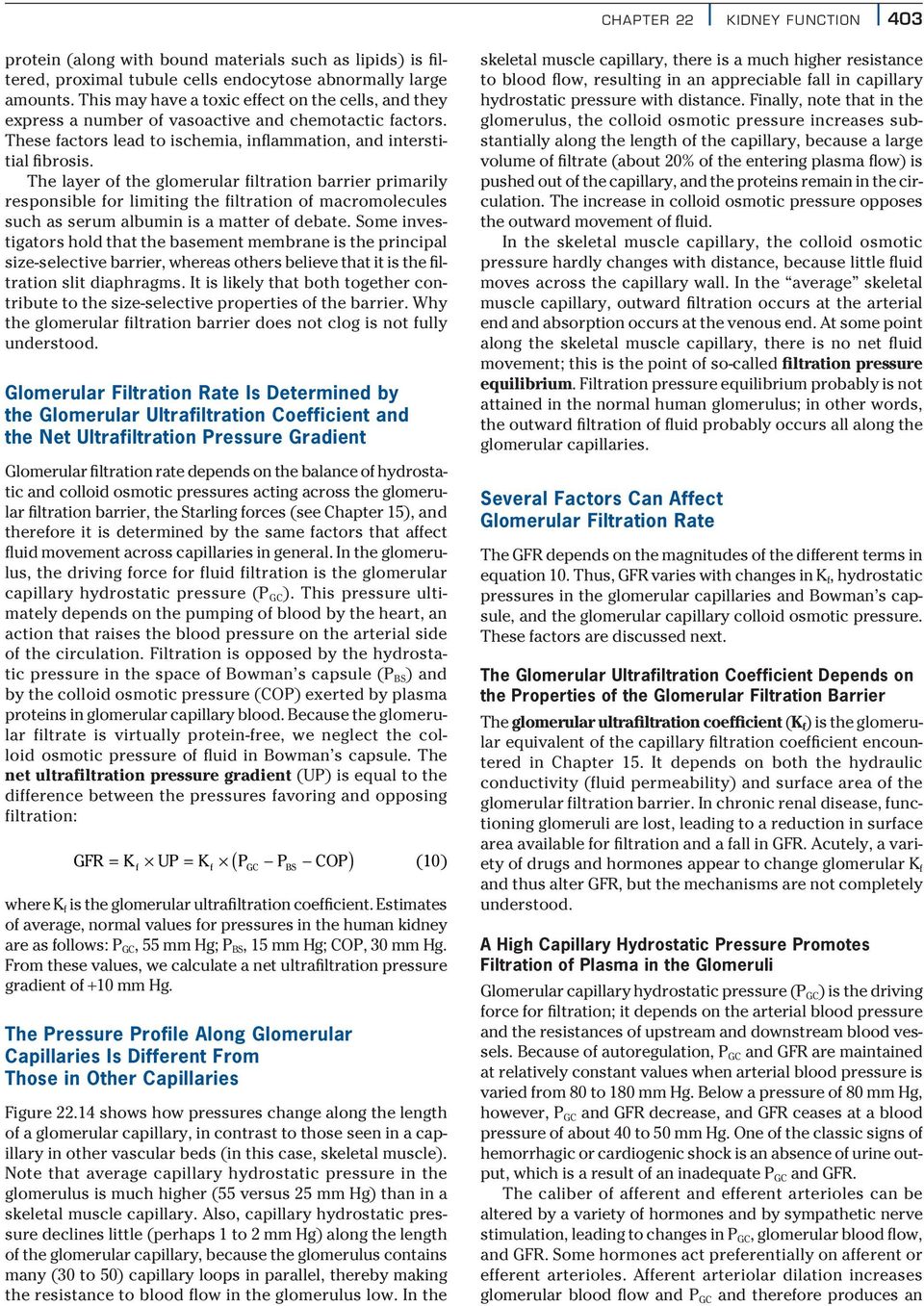
14 404 PART VI RENAL PHYSIOLOGY AND BODY FLUIDS A. Skeletal muscle capillary B. Glomerular capillary FIGURE Pressure profiles along a skeletal muscle capillary and a glomerular capillary. A, In the typical skeletal muscle capillary, filtration occurs at the arterial end and absorption at the venous end of the capillary. Interstitial fluid hydrostatic and colloid osmotic pressures are neglected here because they are roughly equal and counterbalance each other. B, In the glomerular capillary, glomerular hydrostatic pressure (P GC ) (top line) is high and declines only slightly with distance. The bottom line represents the hydrostatic pressure in Bowman s capsule (P BS ). The middle line is the sum of P BS and the glomerular capillary colloid osmotic pressure (COP). The difference between P GC and P BS + COP is equal to the net ultrafiltration pressure gradient (UP). In the normal human glomerulus, filtration probably occurs along the entire capillary. Assuming that K f is uniform along the length of the capillary, filtration rate would be highest at the afferent arteriolar end and lowest at the efferent arteriolar end of the glomerulus. increase in GFR. Afferent arteriolar constriction produces the exact opposite effects. Efferent arteriolar dilation increases glomerular blood flow but leads to a fall in GFR because P GC is decreased. Constriction of efferent arterioles increases P GC and decreases glomerular blood flow. With modest efferent arteriolar constriction, GFR increases because of the increased P GC. With extreme efferent arteriolar constriction, however, GFR decreases because of the marked decrease in glomerular blood flow. Normally, about 20% of the plasma flowing through the kidneys is filtered in the glomeruli. This percentage (or fraction) is called the filtration fraction. It can be estimated from the inulin clearance/pah clearance. Changes in filtration fraction will result from constriction or dilation of afferent or efferent arterioles. For example, afferent arteriolar dilation or efferent arteriolar constriction leads to an increase in filtration fraction. An increase in filtration fraction will increase the protein concentration of the blood exiting the glomerulus and hence will increase the colloid osmotic pressure in the peritubular capillaries. Such a change will increase sodium reabsorption in the kidneys (see Chapter 23). The Hydrostatic Pressure in Bowman s Capsule Opposes Glomerular Filtration Hydrostatic pressure in Bowman s capsule (P BS ) depends on the input of glomerular filtrate and the rate of removal of this fluid by the tubule. This pressure opposes filtration. It also provides the driving force for fluid movement down the tubule lumen. If there is obstruction anywhere along the urinary tract for example, because of stones, ureteral obstruction, or prostate enlargement then pressure upstream to the block is increased and GFR consequently falls. If tubular reabsorption of water is inhibited, pressure in the tubular system is increased because an increased pressure head is needed to force a large volume flow through the loops of Henle and collecting ducts. Consequently, a large increase in urine output caused by a diuretic drug may be associated with a tendency for GFR to fall. Glomerular Capillary Colloid Osmotic Pressure Opposes Glomerular Filtration The COP opposes glomerular filtration. Dilution of the plasma proteins (e.g., by intravenous infusion of a large volume of
15 CHAPTER 22 KIDNEY FUNCTION 405 isotonic saline) lowers the plasma COP and leads to an increase in GFR. Part of the reason glomerular blood flow has important effects on GFR is that it changes the COP profile along the length of a glomerular capillary. Consider, for example, what would happen if glomerular blood flow were low. Filtering a small volume out of the glomerular capillary would lead to a sharp rise in COP early along the length of the glomerulus. As a consequence, filtration would soon cease and GFR would be low. On the other hand, a high blood flow would allow a high rate of filtrate formation with a minimal rise in COP. In general, then, renal blood flow and GFR change hand in hand, but the exact relationship between GFR and renal blood flow depends on the magnitude of the other factors that affect GFR. Several Factors Contribute to the High GFR in the Human Kidney The rate of plasma ultrafiltration in the kidney glomeruli (180 L/day) far exceeds that in all other capillary beds, for several reasons: 1. The filtration coefficient is unusually high in the glomeruli. Compared with most other capillaries, the glomerular capillaries behave as though they have more pores per unit surface area; consequently, they have an unusually high hydraulic conductivity. The total glomerular filtration barrier area, about 2 m 2, is large. 2. Capillary hydrostatic pressure is higher in the glomeruli than in any other capillaries. 3. The high rate of renal blood flow helps sustain a high GFR by limiting the rise in colloid osmotic pressure, thereby favoring filtration along the entire length of the glomerular capillaries. In summary, glomerular filtration is high because the glomerular capillary blood is exposed to a large porous surface and there is a high transmural pressure gradient. TRANSPORT IN THE PROXIMAL TUBULE Glomerular filtration is a rather nonselective process, because both useful and waste substances are filtered. By contrast, tubular transport is selective; different substances are transported by different mechanisms. Some substances are reabsorbed, others are secreted, and still others are both reabsorbed and secreted. For most, the amount excreted in the urine depends in large measure on the magnitude of tubular transport. Transport of various solutes and water differs in the various nephron segments. Here we describe transport along the nephron and collecting duct system, starting with the proximal convoluted tubule. The proximal convoluted tubule comprises the first 60% of the length of the proximal tubule. Because the proximal straight tubule is inaccessible to study in vivo, most quantitative information about function in the living animal is confined to the convoluted portion. Studies on isolated tubules in vitro indicate that the two segments of the proximal tubule are functionally similar. The proximal tubule is responsible for reabsorbing all of the filtered glucose and amino acids, reabsorbing the largest fraction of the filtered Na +, K +, Ca 2+, Cl, HCO 3, and water, and secreting various organic anions and organic cations. The Proximal Convoluted Tubule Reabsorbs About 70% of the Filtered Water The percentage of filtered water reabsorbed along the nephron has been determined by measuring the degree to which inulin is concentrated in tubular fluid, using the kidney micropuncture technique in laboratory animals. Samples of tubular fluid from surface nephrons are collected and analyzed, and the site of collection is identified by nephron microdissection. Because inulin is filtered but not reabsorbed by the kidney tubules, as water is reabsorbed the inulin becomes increasingly concentrated. For example, if 50% of the filtered water is reabsorbed by a certain point along the tubule, the [inulin] in tubular fluid (TF IN ) will be twice the plasma [inulin] (P IN ). The percentage of filtered water reabsorbed by the tubules is equal to 100 (SNGFR V. TF) / SNGFR, where SN (single-nephron) GFR gives the rate of filtration of water and V. TF is the rate of tubular fluid flow at a particular point. The SNGFR can be measured from the single-nephron inulin clearance and is equal to TF IN V. TF / P IN. From these relations: % of filtered water reabsorbed = 1 1 ( TF P ) Figure shows how the TF IN /P IN ratio changes along the nephron in normal rats. In fluid collected from Bowman s capsule, the [inulin] is identical to that in plasma (inulin is freely filterable), so the concentration ratio starts at 1. By the end of the proximal convoluted tubule, the ratio is a little higher than 3, indicating that about 70% of the filtered water was reabsorbed in the proximal convoluted tubule. The ratio is about 5 at the beginning of the distal tubule, indicating that 80% of the filtered water was reabsorbed up to this point. From these measurements, we can conclude that the loop of Henle reabsorbed 10% of the filtered water. The urine/plasma inulin concentration ratio in the ureter is greater than 100, indicating that more than 99% of the filtered water was reabsorbed. These percentages are not fixed; they can vary widely, depending on conditions. Proximal Tubular Fluid Is Essentially Isosmotic to Plasma [ IN IN ] ( ) Samples of fluid collected from the proximal convoluted tubule are always essentially isosmotic to plasma (Fig ), a consequence of the high water permeability of this segment. Overall, 70% of filtered solutes and water are reabsorbed along the proximal convoluted tubule. Na + salts are the major osmotically active solutes in the plasma and glomerular filtrate. Because osmolality does not change appreciably with proximal tubule length, it is not surprising that [Na + ] also does not change under ordinary conditions. If an appreciable quantity of nonreabsorbed solute is present (e.g., the sugar alcohol mannitol), proximal tubular fluid

16 406 PART VI RENAL PHYSIOLOGY AND BODY FLUIDS 4.0 PAH Inulin 3.0 [Tubular fluid]/[plasma ultrafiltrate] 2.0 Urea Cl 1.0 Osmolality, Na, K FIGURE Tubular fluid (or urine) [inulin]/plasma [inulin] ratio as a function of collection site. (Data are from micropuncture experiments in rats.) The increase in this ratio depends on the extent of tubular water reabsorption. The distal tubule is defined in these studies as beginning at the macula densa and ending at the junction of the tubule and a collecting duct and includes the distal convoluted tubule, connecting tubule, and initial part of the collecting duct. (Modified from Giebisch G, Windhager E. Renal tubular transfer of sodium, chloride, and potassium. Am J Med 1964;36: ) [Na + ] falls to values below the plasma concentration. This is evidence that Na + can be reabsorbed against a concentration gradient in an active process. The fall in proximal tubular fluid [Na + ] increases diffusion of Na + into the tubule lumen and results in reduced net Na + and water reabsorption, leading to increased excretion of Na + and water, an osmotic diuresis. Two major anions, Cl and HCO 3, accompany Na + in plasma and glomerular filtrate. HCO 3 is preferentially reabsorbed along the proximal convoluted tubule, leading to a fall in tubular fluid [HCO 3 ], mainly because of H + secretion (see Chapter 24). The Cl lags behind; as water is reabsorbed, [Cl ] rises (see Fig ). The result is a tubular fluid-toplasma concentration gradient that favors Cl diffusion out of the tubule lumen. Outward movement of Cl in the late proximal convoluted tubule creates a small (1 to 2 mv), lumenpositive transepithelial potential difference that favors the passive reabsorption of Na +. Figure shows that the [K + ] hardly changes along the proximal convoluted tubule. If K + were not reabsorbed, its concentration would increase as much as that of inulin. The fact that the concentration ratio for K + remains about 1 in this nephron segment indicates that 70% of filtered K + is reabsorbed along with 70% of the filtered water. HCO 3 Amino acids Glucose % Proximal tubule length FIGURE Tubular fluid/plasma ultrafiltrate concentration ratios for various solutes as a function of proximal tubule length. All values start at a ratio of 1, because the fluid in Bowman s capsule (0% proximal tubule length) is a plasma ultrafiltrate. PAH, p-aminohippurate. The concentrations of glucose and amino acids fall steeply in the proximal convoluted tubule. This nephron segment and the proximal straight tubule are responsible for complete reabsorption of these substances. Separate, specific mechanisms reabsorb glucose and various amino acids. The concentration ratio for urea rises along the proximal tubule, but not as much as the inulin concentration ratio, because about 50% of the filtered urea is reabsorbed. The concentration ratio for PAH in proximal tubular fluid increases more steeply than the inulin concentration ratio because of PAH secretion. In summary, though the osmolality (total solute concentration) does not change detectably along the proximal convoluted tubule, it is clear that the concentrations of individual solutes vary widely. The concentrations of some substances fall (glucose, amino acids, HCO 3 ), others rise (inulin, urea, Cl, PAH), and still others do not change (Na +, K + ). By the end of the proximal convoluted tubule, only about one third of the filtered Na +, water, and K + are left; almost all of the filtered glucose, amino acids, and HCO 3 have been reabsorbed; and

17 CHAPTER 22 KIDNEY FUNCTION 407 many solutes destined for excretion (PAH, inulin, urea) have been concentrated in the tubular fluid. Na + Reabsorption Is the Major Driving Force for Reabsorption of Solutes and Water in the Proximal Tubule Figure is a model of a proximal tubule cell. Na + enters the cell from the lumen across the apical cell membrane and is pumped out across the basolateral cell membrane by the Na + /K + -ATPase. The blood surrounding the tubules then takes up the Na +, accompanying anions, and water. Filtered Na + salts and water are thus returned to the circulation. At the luminal cell membrane (brush border) of the proximal tubule cell, Na + enters the cell down combined electrical and chemical potential gradients. The inside of the cell is about 70 mv compared with tubular fluid, and intracellular [Na + ] is about 30 to 40 meq/l compared with a tubular fluid concentration of about 140 meq/l. Na + entry into the cell occurs via a number of cotransport and antiport mechanisms. Na + is reabsorbed together with glucose, amino acids, phosphate, and other solutes by way of separate, specific cotransporters. The downhill (energetically speaking) movement of Na + into the cell drives the uphill transport of these solutes. In other words, glucose, amino acids, phosphate, and so on are reabsorbed by secondary active transport. Na + Tubular urine Na + Glucose, amino acids, phosphate Na + Cl - Apical cell membrane H + Base - Proximal tubule cell Tight junction Na + Cl - ATP ADP + P i K + K + Cl - Na + 3HCO 3 - Lateral intercellular space Interstitial space Na + K + Solute + Glucose, amino acids, phosphate Basolateral cell membrane Blood FIGURE A cell model for transport in the proximal tubule. The luminal (apical) cell membrane in this nephron segment has a large surface area for transport because of the numerous microvilli that form the brush border (not shown). Glucose, amino acids, phosphate, and numerous other substances are transported by separate carriers. ADP, adenosine diphosphate; ATP, adenosine triphosphate. is also reabsorbed across the luminal cell membrane in exchange for H +. The Na + /H + exchanger, an antiporter, is also a secondary active transport mechanism; the downhill movement of Na + into the cell energizes the uphill secretion of H + into the lumen. This mechanism is important in the acidification of urine (see Chapter 24). Cl may enter the cells by way of a luminal cell membrane Cl -base (formate or oxalate) exchanger. Once inside the cell, Na + is pumped out the basolateral side by a vigorous Na + /K + -ATPase that keeps intracellular [Na + ] low. This membrane ATPase pumps three Na + out of the cell and two K + into the cell and splits one ATP molecule for each cycle of the pump. K + pumped into the cell diffuses out the basolateral cell membrane mostly through a K + channel. Glucose, amino acids, and phosphate, accumulated in the cell because of active transport across the luminal cell membrane, exit across the basolateral cell membrane by way of separate, Na + -independent facilitated diffusion mechanisms. HCO 3 exits together with Na + by an electrogenic mechanism; the carrier transports three HCO 3 for each Na +. Cl may leave the cell by way of an electrically neutral K-Cl cotransporter. The reabsorption of Na + and accompanying solutes establishes an osmotic gradient across the proximal tubule epithelium that is the driving force for water reabsorption. Because the water permeability of the proximal tubule epithelium is extremely high, only a small gradient (a few mosm/kg ) is needed to account for the observed rate of water reabsorption. Some experimental evidence indicates that proximal tubular fluid is slightly hypo-osmotic to plasma. Because the osmolality difference is so small, it is still proper to consider the fluid as essentially isosmotic to plasma. Water crosses the proximal tubule epithelium through the cells, via water channels (aquaporins) in the cell membranes and between the cells (tight junctions and lateral intercellular spaces). The final step in the overall reabsorption of solutes and water is uptake by the peritubular capillaries. This mechanism involves the usual Starling forces that operate across capillary walls. Recall that blood in the peritubular capillaries was previously filtered in the glomeruli. Because a proteinfree filtrate was filtered out of the glomeruli, the [protein] (hence, colloid osmotic pressure) of blood in the peritubular capillaries is high, thereby providing an important driving force for the uptake of reabsorbed fluid. The hydrostatic pressure in the peritubular capillaries (a pressure that opposes the capillary uptake of fluid) is low, because the blood has passed through upstream resistance vessels. The balance of pressures acting across peritubular capillaries favors the uptake of reabsorbed fluid from the interstitial spaces surrounding the tubules. The Proximal Tubule Secretes Organic Ions The proximal tubule, both convoluted and straight portions, secretes a large variety of organic anions and organic cations (Table 22.2). Many of these substances are endogenous compounds, drugs, or toxins. The organic anions are mainly carboxylates and sulfonates (carboxylic and sulfonic acids in their protonated forms). A negative charge on the molecule appears to be important for secretion of these compounds. Examples of organic anions actively secreted

18 408 PART VI RENAL PHYSIOLOGY AND BODY FLUIDS TABLE 22.2 Some Organic Compounds Secreted by Proximal Tubules a Compound Organic Anions Phenol red (phenolsulfonphthalein) p-aminohippurate (PAH) Penicillin Probenecid (Benemid) Furosemide (Lasix) Acetazolamide (Diamox) Creatinine b Organic Cations Histamine Cimetidine (Tagamet) Cisplatin Norepinephrine Quinine Tetraethylammonium (TEA) Creatinine b Use ph indicator dye Measurement of renal plasma flow and proximal tubule secretory mass Antibiotic Inhibitor of penicillin secretion and uric acid reabsorption Loop diuretic drug Carbonic anhydrase inhibitor Normal end product of muscle metabolism Vasodilator, stimulator of gastric acid secretion Drug for treatment of gastric and duodenal ulcers Cancer chemotherapeutic agent Neurotransmitter Antimalarial drug Ganglion-blocking drug Normal end product of muscle metabolism a This list includes only a few of the large variety of organic anions and cations secreted by kidney proximal tubules. b Creatinine is an unusual compound, because it is secreted by both organic anion and cation mechanisms. The creatinine molecule bears both negatively charged and positively charged groups at physiological ph (it is a zwitterion), and this property may enable it to interact with both secretory mechanisms. in the proximal tubule include penicillin and PAH. Organic anion transport becomes saturated at high plasma organic anion concentrations (see Fig. 22.9), and the organic anions compete with each other for secretion. Figure shows a cell model for active secretion. Proximal tubule cells actively take up PAH from the blood side by exchange for cell α-ketoglutarate. This exchange is mediated by an organic anion transporter (OAT). The cells accumulate α-ketoglutarate from metabolism and because of cell membrane Na + -dependent dicarboxylate transporters. PAH accumulates in the cells at a high concentration and then moves downhill into the tubular urine in an electrically neutral fashion, by exchanging for an inorganic anion (e.g., Cl ) or an organic anion via another OAT. Organic anions may also be actively pumped into the tubular urine via a multidrug resistance associated protein (MRP), which is an ATPase. The organic cations are mainly amine and ammonium compounds and are secreted by other transporters. Entry into the cell across the basolateral membrane is favored by the inside negative membrane potential and occurs via facilitated diffusion, mediated by an organic cation transporter (OCT). The exit of organic cations across the luminal membrane is accomplished by an organic cation/h + antiporter (exchanger) and is driven by the lumen-to-cell [H + ] gradient established by Na + /H + exchange. The transporters for organic anions and organic cations show broad substrate specificity Tubular urine Anion - Na + H + MRP Proximal tubule cell ATP ADP PAH - Metabolism H + OC + 2K + αkg 2- αkg 2- OAT1 OCT -70 mv 0 mv Blood 3Na + Na + PAH - OC + FIGURE A cell model for the secretion of organic anions (p-aminohippurate [PAH]) and organic cations in the proximal tubule. Upward slanting arrows indicate transport against an electrochemical gradient (energetically uphill transport) and downward slanting arrows indicate downhill transport. PAH accumulation in the cell is mediated by a basolateral membrane organic anion transporter (OAT) that exchanges PAH for α-ketoglutarate (α-kg 2 ). The α-kg 2 level in the cell is higher than in the blood because of metabolic production and Na + -dependent uptake of α-kg 2. PAH exits the cell passively via a luminal membrane PAH/anion exchanger or can be actively pumped into the lumen by a multidrug resistance associated protein (MRP) that consumes adenosine triphosphate (ATP). Organic cations (OC + ) enter the cell down the electrical gradient, a process mediated by a basolateral membrane organic cation transporter (OCT), and move uphill into the lumen via an organic cation/h + exchanger. ADP, adenosine diphosphate; ATP, a denosine triphosphate. and accomplish the secretion of a large variety of chemically diverse compounds. In addition to being actively secreted, some organic compounds passively diffuse across the tubular epithelium (Fig ). Organic anions can accept H + and organic cations can release H +, so their charge is influenced by ph. The non- A + H + Secretion HA NH 3 + H + Nonionic diffusion NH 4 + (trapped) FIGURE Nonionic diffusion of lipid-soluble weak organic acids and bases. Acidification of the urine converts the organic anion A to the undissociated (nonionized) acid HA, which is reabsorbed by diffusion. NH 3, a lipid-soluble base, diffuses into the tubular urine, where it is converted to NH 4+, thereby trapping the ammonia in the acidic urine.
19 CHAPTER 22 KIDNEY FUNCTION 409 ionized (uncharged) form, if it is lipid-soluble, can diffuse through the lipid bilayer of cell membranes down concentration gradients. The ionized (charged) form passively penetrates cell membranes with difficulty. Consider, for example, the carboxylic acid probenecid (pk a = 3.4). This compound is filtered by the glomeruli and secreted by the proximal tubule. When H + is secreted into the tubular urine (see Chapter 24), the anionic form (A ) is converted to the nonionized acid (HA). The concentration of nonionized acid is also increased because of water reabsorption. A concentration gradient for passive reabsorption across the tubule wall is created, and appreciable quantities of probenecid are passively reabsorbed. This occurs in most parts of the nephron but particularly in those where ph gradients are largest and where water reabsorption has resulted in the greatest concentration (i.e., the collecting ducts). The excretion of probenecid is enhanced by making the urine more alkaline (by administering NaHCO 3 ) and by increasing urine flow rate (e.g., by drinking water). In the case of a lipidsoluble base, such as ammonia (NH 3 ), excretion is favored by making the urine more acidic and enhancing the urine flow. Finally, a few organic anions and cations are also actively reabsorbed. For example, uric acid is both secreted and reabsorbed in the proximal tubule. Normally, the amount of uric acid excreted is equal to about 10% of the filtered uric acid, so reabsorption predominates. In gout, plasma levels of uric acid are increased. One treatment for gout is to promote urinary excretion of uric acid by administering drugs that inhibit its tubular reabsorption. TUBULAR TRANSPORT IN THE LOOP OF HENLE The loop of Henle includes several distinct segments with different structural and functional properties. As noted earlier, the proximal straight tubule has transport properties similar to those of the proximal convoluted tubule. The thin descending, thin ascending, and thick ascending limbs of the loop of Henle all display different permeability and transport properties. Descending and Ascending Limbs Differ in Water Permeability Tubular fluid entering the loop of Henle is isosmotic to plasma, but fluid leaving the loop is distinctly hypo-osmotic. Fluid collected from the earliest part of the distal convoluted tubule has an osmolality of about 100 mosm/kg, compared with 285 mosm/kg in plasma, because more solute than water is reabsorbed by the loop of Henle. The loop of Henle reabsorbs about 20% of filtered Na +, 25% of filtered K +, 30% of filtered Ca 2+, 65% of filtered Mg 2+, and 10% of filtered water. The descending limb of the loop of Henle (except for its terminal portion) is highly water-permeable. The ascending limb is water-impermeable. Because solutes are reabsorbed along the ascending limb and water cannot follow, fluid along the ascending limb becomes more and more dilute. Deposition of these solutes (mainly Na + salts) in the interstitial space of the kidney is critical in the operation of the urinary concentrating mechanism (discussed below). The Luminal Cell Membrane of the Thick Ascending Limb Contains a Na-K-2Cl Cotransporter Figure is a model of a thick ascending limb cell. Na + enters the cell across the luminal cell membrane by an electrically neutral Na-K-2Cl cotransporter that is specifically inhibited by the loop diuretic drugs bumetanide and furosemide. The downhill movement of Na + into the cell results in secondary active transport of one K + and 2 Cl. Na + is pumped out the basolateral cell membrane by a vigorous Na + /K + -ATPase. K + recycles back into the lumen via a luminal cell membrane K + channel. Cl leaves through the basolateral side by a K-Cl cotransporter or Cl channel. The luminal cell membrane is predominantly permeable to K +, and the basolateral cell membrane is predominantly permeable to Cl. Diffusion of these ions out of the cell produces a transepithelial potential difference, with the lumen about +6 mv compared with the interstitial space around the tubules. This potential difference drives small cations (Na +, K +, Ca 2+, Mg 2+, and NH 4+ ) out of the lumen, between the cells. The tubular epithelium is extremely impermeable to water; there is no measurable water reabsorption along the ascending limb despite a large transepithelial gradient of osmotic pressure. TUBULAR TRANSPORT IN THE DISTAL NEPHRON The so-called distal nephron includes several distinct segments: the distal convoluted tubule; the connecting tubule; and the cortical, outer ry, and inner ry collecting ducts (see Fig. 22.2). Note that the distal nephron includes the collecting duct system which, strictly speaking, is not part of the nephron but, from a functional perspective, Tubular urine Cl - Cl - K + Thick ascending limb cell +6 mv -72 mv -72 mv 0 mv Na +, K +, Ca 2+, Mg 2+, NH + 4 Blocked by furosemide Na + Na + K + H + ATP ADP + P i Cl - K + Cl - K + Blood Na + FIGURE A cell model for ion transport in the thick ascending limb. ADP, adenosine diphosphate; ATP, adenosine triphosphate. K +

20 410 PART VI RENAL PHYSIOLOGY AND BODY FLUIDS this is justified. Transport in the distal nephron differs from that in the proximal tubule in several ways: Tubular urine Distal convoluted tubule cell Blood 1. The distal nephron reabsorbs much smaller amounts of salt and water. Typically, the distal nephron reabsorbs 9% of the filtered Na + and 19% of the filtered water, compared with 70% for both substances in the proximal convoluted tubule. 2. The distal nephron can establish steep gradients for salt and water. For example, the [Na + ] in the final urine may be as low as 1 meq/l (versus 140 meq/l in plasma) and the urine osmolality can be almost one tenth that of plasma. By contrast, the proximal tubule reabsorbs Na + and water along small gradients, and the [Na + ] and osmolality of its tubule fluid are normally close to those of plasma. 3. The distal nephron has a tight epithelium, whereas the proximal tubule has a leaky epithelium (see Chapter 2). This explains why the distal nephron can establish steep gradients for small ions and water, whereas the proximal tubule cannot. 4. Na + and water reabsorption in the proximal tubule are normally closely coupled, because epithelial water permeability is always high. By contrast, Na + and water reabsorption can be uncoupled in the distal nephron, because water permeability may be low and variable. Proximal reabsorption overall can be characterized as a coarse operation that reabsorbs large quantities of salt and water along small gradients. By contrast, distal reabsorption is a finer process. The collecting ducts are at the end of the nephron system, and what happens there determines the final excretion of Na +, K +, H +, and water. Transport in the collecting ducts is finely tuned by hormones. Specifically, aldosterone increases Na + reabsorption and K + and H + secretion, and arginine vasopressin increases water reabsorption at this site. The Luminal Cell Membrane of the Distal Convoluted Tubule Contains a Na-Cl Cotransporter Figure is a model of a distal convoluted tubule cell. In this nephron segment, Na + and Cl are transported from the lumen into the cell by a Na-Cl cotransporter that is inhibited by thiazide diuretics. Na + is pumped out the basolateral side by the Na + /K + -ATPase. Water permeability of the distal convoluted tubule is low and is not changed by arginine vasopressin. Blocked by thiazides Na + ATP ADP + P i K + Cl - Cl - Na + FIGURE A cell model for ion transport in the distal convoluted tubule. ADP, adenosine diphosphate; ATP, adenosine triphosphate. active uptake by a Na + /K + -ATPase in the basolateral cell membrane, followed by diffusion of K + through luminal membrane K + channels. Outward diffusion of K + from the cell is favored by concentration gradients and opposed by electrical gradients. Note that the electrical gradient opposing exit from the cell is smaller across the luminal cell membrane than across the basolateral cell membrane, thereby favoring movement of K + into the lumen rather than back into the blood. The luminal cell membrane potential difference is low (e.g., 20 mv, cell inside negative) because this membrane has a high Na + permeability and is depolarized by Na + diffusing into the cell. Recall that the entry of Na + into a cell causes membrane depolarization (see Chapter 3). The magnitude of K + secretion is affected by several factors (see Fig ): 1. The activity of the basolateral membrane Na + /K + -ATPase is a key factor affecting secretion: the greater the pump Tubular urine Collecting duct principal cell K + Blood Na + ATP Na + ADP + P i K + The Cortical Collecting Duct Is an Important Site Regulating K + Excretion K + K + Under normal circumstances, the cortical collecting ducts secrete most of the excreted K +. With great K + excess (e.g., a high-k + diet), the cortical collecting ducts may secrete so much K + that more K + is excreted than was filtered. With severe K + depletion, the cortical collecting ducts reabsorb K +. K + secretion appears to be a function primarily of the collecting duct principal cell (Fig ). K + secretion involves -50 mv -70 mv -70 mv 0 mv FIGURE A model for Na + and K + transport by a collecting duct principal cell. ADP, adenosine diphosphate; ATP, adenosine triphosphate.

21 CHAPTER 22 KIDNEY FUNCTION 411 activity, the higher the rate of secretion. A high plasma [K + ] promotes K + secretion. Increased amounts of Na + in the collecting duct lumen (e.g., as a result of inhibition of Na + reabsorption by a loop diuretic drug) result in increased entry of Na + into principal cells, increased activity of the Na + /K + -ATPase, and increased K + secretion. 2. The lumen-negative transepithelial electrical potential promotes K + secretion. 3. An increase in permeability of the luminal cell membrane to K + favors secretion. 4. A high fluid flow rate through the collecting duct lumen maintains the cell-to-lumen concentration gradient, which favors K + secretion. The hormone aldosterone promotes K + secretion by several actions (see Chapter 23). Na + entry into the collecting duct cell is by diffusion through a Na + channel (see Fig ). This channel has been cloned and sequenced and is known as ENaC, for epithelial sodium (Na) channel. The entry of Na + through this channel is rate-limiting for overall Na + reabsorption and is increased by aldosterone. Intercalated cells are scattered among collecting duct principal cells; they are important in acid base transport (see Chapter 24). A H + /K + -ATPase is present in the luminal cell membrane of α intercalated cells and contributes to renal K + conservation when dietary intake of K + is deficient. URINARY CONCENTRATION AND DILUTION The human kidney can form urine with a total solute concentration greater or lower than that of plasma. Maximum and minimum urine osmolalities in humans are about 1, to 1, mosm/kg and 30 to 40 mosm/kg, respectively. We next consider the mechanisms involved in producing osmotically concentrated or dilute urine. The Ability to Concentrate Urine Osmotically Is an Important Adaptation to Life on Land When the kidneys form osmotically concentrated urine, they save water for the body. The kidneys have the task of getting rid of excess solutes (e.g., urea, various salts), which requires the excretion of solvent (water). Suppose, for example, we excrete 600 mosm of solutes per day. If we were only capable of excreting urine that is isosmotic to plasma (approximately mosm/kg ), then we would need to excrete 2.0 L /day. If we can excrete the solutes in urine, which is four times more concentrated than plasma (1, mosm/kg ), then only 0.5 L /day would be required. By excreting solutes in an osmotically concentrated urine, the kidneys in effect save 1.5 L ( L ) for the body. The ability to concentrate the urine decreases the amount of water we are obliged to find and drink each day. Arginine Vasopressin Promotes the Excretion of Osmotically Concentrated Urine Changes in urine osmolality are normally brought about largely by changes in plasma levels of arginine vasopressin (AVP), also known as antidiuretic hormone (ADH) (see Chapter 31). In the absence of AVP, the kidney collecting ducts are relatively water-impermeable. Reabsorption of solute across a water-impermeable epithelium leads to an osmotically dilute urine. In the presence of AVP, collecting duct water permeability is increased. Because the ry interstitial fluid is hyperosmotic, water reabsorption in the ry collecting ducts can lead to the production of osmotically concentrated urine. A model for the action of AVP on cells of the collecting duct is shown in Figure When plasma osmolality is increased, plasma AVP levels increase. The hormone binds to a specific vasopressin (V 2 ) receptor in the basolateral cell membrane. By way of a guanine nucleotide stimulatory protein (G s ), the membrane-bound enzyme adenylyl cyclase is activated. This enzyme catalyzes the formation of cyclic AMP (camp) from ATP. Cyclic AMP then activates a camp-dependent protein kinase (protein kinase A, or PKA) that phosphorylates other proteins. This leads to the insertion, by exocytosis, of intracellular vesicles that contain water channels (aquaporin-2) into the luminal cell membrane. The resulting increase in number of luminal membrane water channels leads to an increase in water permeability. Water leaves the lumen and then exits the cells via aquaporin-3 and aquaporin-4 in the basolateral cell membrane. The solutes in the collecting duct lumen become concentrated as water leaves. This response to AVP occurs in minutes. AVP also has delayed effects on collecting ducts; it increases the transcription of aquaporin-2 genes and increases the total number of aquaporin-2 molecules per cell. Tubular urine Aquaporin-2 Collecting duct epithelium Vesicle with aquaporin-2 PKA camp ATP Nucleus ( gene transcription) aquaporin-2 synthesis Blood FIGURE A model for the action of arginine vasopressin (AVP) on the epithelium of the collecting duct. The second messenger for AVP is cyclic adenosine monophosphate (camp). AVP has both prompt effects on luminal membrane water permeability (the movement of aquaporin-2 containing vesicles to the luminal cell membrane) and delayed effects (increased aquaporin-2 synthesis). ATP, adenosine triphosphate; G s, guanine nucleotide stimulatory protein; PKA, protein kinase A; V 2, vasopressin. G s V 2 receptor AVP Adenylyl cyclase
22 412 PART VI RENAL PHYSIOLOGY AND BODY FLUIDS The Loops of Henle Are Countercurrent Multipliers, and the Vasa Recta Are Countercurrent Exchangers A gradient of osmolality exists in the kidney, with the highest osmolality present at the tips of the renal papillae. This gradient is explained by the countercurrent mechanism. Two countercurrent processes occur in the kidney countercurrent multiplication and countercurrent exchange. The term countercurrent indicates a flow of fluid in opposite directions in adjacent structures (Fig ). The loops of Henle are countercurrent multipliers. Fluid flows toward the tip of the papilla along the descending limb of the loop and toward the cortex along the ascending limb of the loop. The loops of Henle set up the osmotic gradient in the (see below). The vasa recta are countercurrent exchangers. Blood flows in opposite directions along juxtaposed descending (arterial) and ascending (venous) vasa recta, and solutes and water are exchanged passively between these capillary blood vessels. The vasa recta help maintain the gradient in the. The collecting ducts act as osmotic equilibrating devices; depending on the plasma level of AVP, the collecting duct urine is allowed to equilibrate more or less with the hyperosmotic ry interstitial fluid. Vasa recta Loop of Henle Collecting duct Outer Inner FIGURE Elements of the urinary concentrating mechanism. The vasa recta are countercurrent exchangers, the loops of Henle are countercurrent multipliers, and the collecting ducts are osmotic equilibrating devices. Most loops of Henle and vasa recta do not reach the tip of the papilla but turn at higher levels in the outer and inner. There are no thick ascending limbs in the inner. Countercurrent multiplication is the process whereby a modest gradient established at any level of the loop of Henle is increased (multiplied) into a much larger gradient along the axis of the loop. A simplified model for countercurrent multiplication (Fig ) shows how this works. Initially the loop is filled with fluid isosmotic to plasma ( mosm/kg ) (Fig A). Next, we assume that at any level of the loop, the intervening membrane is able to establish an osmotic gradient of mosm/kg (Fig B). This so-called single effect could occur by active transport of solute (salt) out of the ascending limb (top limb in the model) and deposition of the salt in the descending limb (bottom limb of model); water is left behind in the ascending limb because of its low water permeability (see Fig B). In the real kidney, there is an interstitial space between ascending and descending limbs, and the increase in solute concentration along the descending limb is primarily a result of water movement out of the descending limb, because of the higher osmolality outside the descending limb. Next, we add new fluid to the loop and push the fluid in the loop around the bend (Fig C). We repeat the single effect (Fig D), and continue the process (Fig E to H). The final result (see Fig H) is a much larger gradient ( mosm/kg ) along the axis of the loop. In the kidney, the interstitial space shares this axial gradient and the highest osmolalities are reached at the bends of the longest loops of Henle, i.e., deep within the inner or, in other words, at the tips of the renal papillae. The extent to which countercurrent multiplication can establish a large axial gradient in a model of the kidney depends on several factors, including the magnitude of the single effect, the rate of fluid flow, and the length of the loop. The larger the single effect, the larger the axial gradient. If flow rate through the loop is too high, not enough time is allowed for establishing a significant single effect, and consequently the axial gradient is reduced. Finally, if the loops are long, there is more opportunity for multiplication, and a larger axial gradient can be established. Countercurrent multiplication is an energy-demanding process. To build an osmotic gradient requires work. In the kidney outer, the energy is derived from ATP, which powers active pumping of Na + by the Na + /K + -ATPase in thick ascending limbs. The energy source for building the gradient in the inner is less well understood. Countercurrent exchange is a common process in the vascular system. In many vascular beds, arterial and venous vessels lie close to each other, and exchanges of heat or materials can occur between these vessels. For example, because of the countercurrent exchange of heat between blood flowing toward and away from its feet, a penguin can stand on ice and yet maintain a warm body (core) temperature. Countercurrent exchange between descending and ascending vasa recta in the kidney reduces dissipation of the solute gradient in the. The descending vasa recta tend to give up water to the more concentrated interstitial fluid. The ascending vasa recta, which come from more concentrated regions of the, take up this water. In effect, then, much of the water in the blood shortcircuits across the tops of the vasa recta and does not flow deep into the, where it would tend to dilute the accumulated solute. The ascending vasa recta tend to give up solute as the blood moves toward the cortex. Solute enters
23 CHAPTER 22 KIDNEY FUNCTION 413 Stepwise shift of fluid Development of single effect A B C D E F G H FIGURE Model for countercurrent multiplication. At any level of the loop, a mosm/kg gradient is established by active transport of solute out of the ascending (top) limb across a water-impermeable barrier. This single effect is multiplied (magnified) into a larger ( mosm/kg ) axial gradient along the length of the loop by a stepwise shift of fluid, countercurrent flow, and repetition of the single effect. (Modified from Pitts RF. Physiology of the Kidney and Body Fluids. 3rd Ed. Chicago: Year Book, 1974.) the descending vasa recta and therefore tends to be trapped in the. Countercurrent exchange is a purely passive process; it helps maintain a gradient established by some other means. Operation of the Urinary Concentrating Mechanism Requires an Integrated Functioning of the Loops of Henle, Vasa Recta, and Collecting Ducts Figure summarizes the mechanisms involved in producing osmotically concentrated urine. A maximally concentrated urine, with an osmolality of 1, mosm/kg and a low urine volume (0.5% of the original filtered water), is being excreted. About 70% of filtered water is reabsorbed along the proximal convoluted tubule, so 30% of the original filtered volume enters the loop of Henle. As discussed earlier, proximal reabsorption of water is essentially an isosmotic process, so fluid entering the loop is isosmotic. As the fluid moves along the descending limb of the loop of Henle in the, it becomes increasingly concentrated. This rise in osmolality could in principle be a result of two processes: 1. The movement of water out of the descending limb because of the hyperosmolality of the ry interstitial fluid. 2. The entry of solute from the concentrated ry interstitial fluid. The relative importance of these processes may depend on the species of animal. For the most efficient operation of the concentrating mechanism, water removal should be predominant, so only this process is depicted in Figure The removal of water along the descending limb leads to a rise in [] in the loop fluid to a value higher than in the interstitial fluid. When the fluid enters the ascending limb, it enters waterimpermeable segments. is transported out of the ascending limb and deposited in the ry interstitial fluid. In the thick ascending limb, Na + transport is active and is powered by a vigorous Na + /K + -ATPase. In the thin ascending limb, reabsorption appears to be mainly passive. It occurs because the [] in the tubular fluid is higher than in the interstitial fluid and because the passive permeability of the thin ascending limb to Na + is high. There is also some evidence for a weak active Na + pump in the thin ascending limb. The net addition of solute to the by the loops is essential for the subsequent osmotic concentration of urine in the collecting ducts. Fluid entering the distal convoluted tubule is hypoosmotic compared with plasma (see Fig ) because of the removal of solute without water along the ascending limb. In the presence of AVP, the cortical collecting ducts become water-permeable and water is passively reabsorbed into the cortical interstitial fluid. The high blood flow to
24 414 PART VI RENAL PHYSIOLOGY AND BODY FLUIDS Urea Urea Na + K + Cortex Outer Urea Inner Urea 1, 1, ,000 1, , ,000 Urea 1, 0.5 FIGURE Formation of osmotically concentrated urine. This diagram summarizes movements of ions, urea, and water in the kidney during production of maximally concentrated urine (1, mosm/kg ). Numbers in ovals represent osmolality in mosm/kg. Numbers in boxes represent relative amounts of water present at each level of the nephron. Solid arrows indicate active transport; dashed arrows indicate passive transport. The heavy outlining along the ascending limb of the loop of Henle indicates relative water-impermeability. the cortex rapidly carries away this water, so there is no detectable lowering of cortical tissue osmolality. Before the tubular fluid re-enters the, it is isosmotic and reduced to about 5% of the original filtered volume. The reabsorption of water in the cortical collecting ducts is important for the overall operation of the urinary concentrating mechanism. If this water were not reabsorbed in the cortex, an excessive amount would enter the. It would tend to wash out the gradient in the, leading to an impaired ability to concentrate the urine maximally. All nephrons drain into collecting ducts that pass through the. In the presence of AVP, the ry collecting ducts are permeable to water. Water moves out of the collecting ducts into the more concentrated interstitial fluid. At high levels of AVP, the fluid equilibrates with the interstitial fluid and the final urine becomes as concentrated as the tissue fluid at the tip of the papilla. Many different models for the countercurrent mechanism have been proposed; each must take into account the principle of conservation of matter (mass balance). In the steady state, the inputs of water and every nonmetabolized solute must equal their respective outputs. This principle must be obeyed at every level of the. Figure presents a simplified scheme that applies the mass balance principle to the as a whole. It provides some additional insights into the countercurrent mechanism. Notice that fluids entering the (from the proximal tubule, descending vasa recta, and cortical collecting ducts) are isosmotic; they all have an osmolality of about 285 mosm/kg. Fluid leaving the in the urine is hyperosmotic. It follows from mass balance considerations that somewhere a hypo-osmotic fluid has to leave the ; this occurs in the ascending limb of the loop of Henle. The input of water into the must equal its output. Because water is added to the along the descending limbs of the loops of Henle and the collecting ducts, this water must be removed at an equal rate. The ascending limbs of the loops of Henle cannot remove the added water because they are water-impermeable. The water is removed by the vasa recta; this is why blood flow in the ascending vasa recta exceeds blood flow in the descending vasa recta (see Fig ). Blood leaving the is hyperosmotic because it drains a region of high osmolality. Urea Plays a Special Role in the Concentrating Mechanism It has been known for many years that animals or humans on a low-protein diet have an impaired ability to concentrate the urine maximally. A low-protein diet is associated with a decreased [urea] in the kidney. Figure shows how urea is handled along the nephron. The proximal convoluted tubule is fairly permeable to urea and reabsorbs about 50% of the filtered urea. Fluid collected from the distal convoluted tubule, however, has as much urea as the amount filtered. Therefore, urea is secreted in the loop of Henle.
25 CHAPTER 22 KIDNEY FUNCTION 415 Vasa recta Loop of Henle Collecting duct Osmolality mosm/kg Flow ml /min Cortex Outer Outer Inner Inner 50 1, 1 Osmolality mosm/kg Flow ml /min FIGURE Mass balance considerations for the as a whole. In the steady state, the inputs of water and solutes must equal their respective outputs. Water input into the from the cortex ( = 142 ml/min) equals water output from the ( = 142 ml/min). Solute input ( = 40.5 mosm/min) is likewise equal to solute output ( = 40.5 mosm/min). FIGURE Movements of urea along the nephron. The numbers indicate relative amounts (100 = filtered urea), not concentrations. The heavy outline from the thick ascending limb to the outer ry collecting duct indicates relatively ureaimpermeable segments. Urea is added to the inner by its collecting ducts; most of this urea re-enters the loop of Henle, and the vasa recta remove some The thick ascending limb, distal convoluted tubule, connecting tubule, cortical collecting duct, and outer ry collecting duct are relatively urea-impermeable. The [urea] rises as water is reabsorbed along cortical and outer ry collecting ducts. The result is the delivery to the inner of a concentrated urea solution. The inner ry collecting duct has a facilitated urea transporter, which is activated by AVP, and favors urea diffusion into the interstitial fluid of the inner. Urea may re-enter the loop of Henle and be recycled (see Fig ), thereby building up its concentration in the inner. Urea is also added to the inner by diffusion from the urine surrounding the papillae (calyceal urine). Urea accounts for about half of the osmolality in the inner. The urea in the interstitial fluid of the inner counterbalances urea in the collecting duct urine, allowing the other solutes (e.g., ) in the interstitial fluid to counterbalance osmotically the other solutes (e.g., creatinine, various salts) that need to be concentrated in the urine. This enhances the urinary concentrating ability and allows urea to be excreted with less water. A Dilute Urine Is Excreted When Plasma Arginine Vasopressin Levels Are Low Figure depicts osmolalities during excretion of dilute urine, as occurs when plasma AVP levels are low. Tubular fluid is diluted along the ascending limb and becomes even more dilute as solute is reabsorbed across the relatively water-impermeable distal portions of the nephron and collecting ducts. Because as much as 15% of filtered water is not reabsorbed, a high urine flow rate results. In these circumstances, the osmotic gradient in the is reduced but not abolished. The decreased gradient results from several factors. First, ry blood flow is increased, which tends to wash out the osmotic gradient. Second, less urea is added to the inner interstitium because the urea in the collecting duct urine is less concentrated than usual and there is less of a concentration gradient for
26 416 PART VI RENAL PHYSIOLOGY AND BODY FLUIDS Na + K + Cortex passive reabsorption of urea. Furthermore, the inner collecting ducts are less permeable to urea when AVP levels are low. Finally, because of diminished water reabsorption in the cortical collecting ducts, too much water may enter and be reabsorbed in the, lowering its osmotic gradient. 425 Outer Inner FIGURE Osmotic gradients during excretion of osmotically dilute urine. The collecting ducts are relatively waterimpermeable (heavy outlining) because arginine vasopressin (AVP) is absent. The is still hyperosmotic, but less so than in a kidney producing osmotically concentrated urine. INHERITED DEFECTS IN KIDNEY TUBULE EPITHELIAL CELLS Recent studies have elucidated the molecular basis of several inherited kidney disorders. In many cases, the normal and mutated molecules have been cloned and sequenced. It appears that inherited defects in kidney tubule carriers, ion channels, receptors, or other molecules may explain the disturbed physiology of these conditions. Table 22.3 lists a few of these inherited disorders. Specific molecular defects have been identified in the proximal tubule (renal glucosuria, cystinuria), thick ascending limb (Bartter syndrome), distal convoluted tubule (Gitelman syndrome), and collecting duct (Liddle syndrome, pseudohypoaldosteronism, distal renal tubular acidosis, nephrogenic diabetes insipidus, nephrogenic syndrome of inappropriate antidiuresis). Although these disorders are rare, they shed light on the pathophysiology of disease in general. For example, the finding that increased epithelial Na + channel activity in Liddle syndrome is associated with hypertension strengthens the view that excessive salt retention leads to high blood pressure. TABLE 22.3 Inherited Defects in Kidney Tubule Epithelial Cells Condition Molecular Defect Clinical Features Renal glucosuria Cystinuria Bartter syndrome Gitelman syndrome Liddle syndrome Pseudohypoaldosteronism Distal renal tubular acidosis Nephrogenic diabetes insipidus Nephrogenic syndrome of inappropriate antidiuresis Na + -dependent glucose cotransporter Amino acid transporter Na-K-2Cl cotransporter, K channel, Cl channel, or barttin (recruits Cl channel to basolateral membrane) in thick ascending limb Thiazide-sensitive Na-Cl cotransporter in distal convoluted tubule Increased open time and number of principal cell epithelial sodium channels Decreased activity of epithelial sodium channels or defective mineralocorticoid receptor α-intercalated cell Cl /HCO 3 exchanger, H + -ATPase Vasopressin-2 (V 2 ) receptor or aquaporin-2 deficiency Increased vasopressin-2 (V 2 ) receptor activity Glucosuria, polyuria, polydipsia, polyphagia Kidney stone disease Salt wasting, hypokalemic metabolic alkalosis Salt wasting, hypokalemic metabolic alkalosis, hypocalciuria Hypertension, hypokalemic metabolic alkalosis Salt wasting, hyperkalemic metabolic acidosis Metabolic acidosis, osteomalacia Polyuria, polydipsia Hyponatremia, inappropriately elevated urine osmolality
27 CHAPTER 22 KIDNEY FUNCTION 417 FROM BENCH TO BEDSIDE 22.1 Polycystic Kidney Disease Polycystic kidney disease (PKD) is a disorder, usually inherited, in which numerous cysts develop in both kidneys. The cysts are fluid-filled epithelial sacs that arise from nephrons or collecting ducts. The growth of cysts can produce massive enlargement of the kidneys and ultimately complete renal failure. PKD is the most common of all life-threatening genetic diseases and affects 600,000 Americans and millions more worldwide. PKD in people may be produced by several genes. The most common (about 85% of patients) and most severe form is autosomal dominant PKD1 (ADPKD1) and is a result of a defective gene on chromosome 16. The PKD1 gene encodes a large transmembrane protein called polycystin-1. Its extracellular domain contains a variety of protein motifs, which may serve as targets (receptors) for mostly unknown ligands. The PKD2 gene, which accounts for about 10% to 15% of patients, encodes a transmembrane protein called polycystin-2, which behaves as a Ca 2+ -permeable nonselective cation channel. Polycystin-1 and polycystin-2 interact with each other and form a cell-signaling complex that transfers information from the cell s environment to intracellular signals that affect cell behavior. Both polycystins are found to be associated with the primary cilium that is present in most renal tubule cells. This structure is a nonmotile sensory process located at the apical side of the cell and may function to sense changes in tubule fluid flow. In many cystic kidney diseases, the primary cilium is poorly developed, suggesting a link between abnormalities in this structure and the cystic phenotype. Genetic testing for ADPKD1 and ADPKD2 is now available. Autosomal recessive PKD (ARPKD), which occurs in about 1:10,000 to 1:40,000 live births, results in a high infant mortality. The defective gene (PKHD1) is on chromosome 6 and produces a protein called fibrocystin or polyductin, which is found in cilia, plasma membranes, and the cytoplasm. There are, additionally, other inherited and acquired forms of renal cystic disease. The phenotypic expression of ADPKD is variable. Some people show symptoms in childhood, whereas others may lead a long and healthy life, with cystic kidneys detected only on autopsy. The usual pattern is for patients to develop symptoms (such as hypertension or pain in the back and sides) in their 30s and 40s. Extrarenal manifestations, such as hepatic cysts, are common. End-stage renal failure (requiring dialysis or a kidney transplantation) occurs in about 50% of patients by the age of 60. The specific gene affected, the nature of the mutation in a particular gene, the genetic background of a person, and environmental factors may all play a role in determining the development of the disease. It is generally believed that only a minority (about 1%) of nephrons produce cysts in ADPKD, even though every kidney cell has a mutant copy of a dominant gene. The two-hit hypothesis explains why the disease is so variable and why only relatively few nephrons produce cysts. According to this idea, the production of a cyst requires a second (somatic) mutation, so that the gene (allele) accompanying the inherited defective gene is also abnormal. Only when this happens does a cyst develop. Researchers have demonstrated that in many cysts in human ADPKD, two abnormal genes are indeed present. An elevated blood pressure is a common finding in patients with ADPKD and is associated with a faster progression of renal disease in general and increased cardiovascular mortality. Angiotensin-converting enzyme inhibitors are currently recommended to control blood pressure and reduce urinary protein excretion in patients with PKD. Whether this treatment is really effective in slowing the progression of ADPKD is currently being investigated in a large-scale clinical trial. It is possible that dietary manipulations might affect the course of the disease. Studies on rats with PKD have demonstrated that a low-protein intake results in improved kidney function. In a large-scale, multicenter, randomized clinical trial (the Modification of Diet in Renal Disease Study), patients with ADPKD were provided with a reduced protein intake, but no beneficial effect could be demonstrated. The relatively short duration of this study (patients were studied for an average of 2.2 years) and the fact that treatment was started at a relatively late stage of the disease may have resulted in these disappointing results. In rats with PKD, a diet containing soy protein (instead of animal protein), flaxseed oil, or citrate (an alkalinizing diet) leads to greatly improved kidney function; whether these treatments would benefit people with PKD is not known. Researchers have succeeded in ameliorating PKD in animals with the use of epidermal growth hormone receptor, tyrosine kinase inhibitors, c-myc antisense RNA, mtor inhibitors, and vasopressin-2 receptor antagonists. Vasopressin stimulates the production of cyclic adenosine monophosphate (AMP), and this second messenger is known to stimulate cyst fluid secretion and proliferation of cyst cells. Currently, a controlled clinical trial of a vasopressin receptor antagonist is underway; a side effect of this treatment (not unexpected, however) is an increased urine output. One of the difficulties in studying treatments for ADPKD in patients is the long time-course of the disease (decades). Clinical investigators have recently shown that measurements of kidney volume by magnetic resonance imaging are a good short-term marker for the progression of the disease. This should enable more clinical treatment trials in the future. Further information on PKD can be obtained from the PKD Foundation and their Web site:
28 418 PART VI RENAL PHYSIOLOGY AND BODY FLUIDS CHAPTER SUMMARY The formation of urine involves glomerular filtration, tubular reabsorption, and tubular secretion. The renal clearance of a substance is equal to its rate of excretion divided by its plasma concentration. Inulin clearance provides the most accurate measure of glomerular filtration rate (GFR). The clearance of p-aminohippurate (PAH) is equal to the effective renal plasma flow. The rate of net tubular reabsorption of a substance is equal to its filtered load minus its excretion rate. The rate of net tubular secretion of a substance is equal to its excretion rate minus its filtered load. The kidneys, especially the cortex, have a high blood flow. Kidney blood flow is autoregulated; it is also profoundly influenced by nerves and hormones. The glomerular filtrate is an ultrafiltrate of plasma. GFR is determined by the glomerular ultrafiltration coefficient, glomerular capillary hydrostatic pressure, hydrostatic pressure in the space of Bowman s capsule, and glomerular capillary colloid osmotic pressure. The proximal convoluted tubule reabsorbs about 70% of filtered Na +, K +, and water and nearly all of the filtered glucose and amino acids. It also secretes many organic anions and organic cations. The transport of water and most solutes across tubular epithelia is dependent on active reabsorption of Na +. The thick ascending limb is a water-impermeable segment that reabsorbs Na + via a Na-K-2Cl cotransporter in the apical cell membrane and a vigorous Na + /K + -ATPase in the basolateral cell membrane. The distal convoluted tubule epithelium is water-impermeable and reabsorbs Na + via a thiazide-sensitive apical membrane Na-Cl cotransporter. Cortical collecting duct principal cells reabsorb Na + and secrete K +. The kidneys save water for the body by producing urine with a total solute concentration (i.e., osmolality) greater than that of plasma. The loops of Henle are countercurrent multipliers; they set up an osmotic gradient in the kidney. Vasa recta are countercurrent exchangers; they passively help maintain the ry gradient. Collecting ducts are osmotic equilibrating devices; they have a low water permeability, which is increased by arginine vasopressin (AVP). Genetic defects in kidney epithelial cells account for several disorders.
LECTURE 1 RENAL FUNCTION
 LECTURE 1 RENAL FUNCTION Components of the Urinary System 2 Kidneys 2 Ureters Bladder Urethra Refer to Renal System Vocabulary in your notes Figure 2-1,page10 Kidney Composition Cortex Outer region Contains
The digestive system eliminated waste from the digestive tract. But we also need a way to eliminate waste from the rest of the body.
 Outline Urinary System Urinary System and Excretion Bio105 Lecture 20 Chapter 16 I. Function II. Organs of the urinary system A. Kidneys 1. Function 2. Structure III. Disorders of the urinary system 1
Chapter 26: The Urinary System
 Chapter 26: The Urinary System Chapter Objectives OVERVIEW OF KIDNEY FUNCTION 1. List and describe the functions of the kidneys. NEPHRONS 2. Describe the two major portions of a nephron and the capillaries
CHAPTER 20: URINARY SYSTEM
 OBJECTIVES: 1. Name the major function of the urinary system, and name and locate (on a diagram) the organs that compose the system. 2. Explain what the term renal refers to. 3. Define the term retroperitoneal.
Select the one that is the best answer:
 MQ Kidney 1 Select the one that is the best answer: 1) n increase in the concentration of plasma potassium causes increase in: a) release of renin b) secretion of aldosterone c) secretion of H d) release
Chapter 23. Urine Formation I Glomerular Filtration
 Chapter 23 Urine Formation I Glomerular Filtration Urine Formation I: Glomerular Filtration kidneys convert blood plasma to urine in three stages glomerular filtration tubular reabsorption and secretion
Renal Blood Flow GFR. Glomerulus Fluid Flow and Forces. Renal Blood Flow (cont d)
 GFR Glomerular filtration rate: about 120 ml /minute (180 L a day) Decreases with age (about 10 ml/min for each decade over 40) GFR = Sum of the filtration of two million glomeruli Each glomerulus probably
Pathophysiology Introduction/ Renal Anatomy and Function
 Pathophysiology Introduction/ Renal Anatomy and Function I. Functions of the kidney A. Maintaining homeostasis of a large number of solutes and water is the main job of the kidney. Total body contents
Sign up to receive ATOTW weekly - email [email protected]
 RENAL PHYSIOLOGY - PART 1 ANAESTHESIA TUTORIAL OF THE WEEK 273 5 th NOVEMBER 2012 Dr Matthew Gwinnutt Mersey Deanery, UK Dr Jennifer Gwinnutt Mersey Deanery, UK Correspondence to: [email protected]
Urinary System. And Adrenal Function
 Urinary System And Adrenal Function Overview Kidney anatomy and physiology Urine Ureters, Bladder and Urethra Adrenal Function Functions of the Kidney Filter fluids from the blood Regulate volume and composition
Kidney Structure and Function.
 Kidney Structure and Function. Learning Objectives. At the end of this section, you should be able to : 1. describe the structure of the kidney; 2. understand the vascular organisation of the kidneys;
April 18, 2008 Dr. Alan H. Stephenson Pharmacological and Physiological Science
 Renal Mechanisms for Regulating Urine Concentration April 18, 2008 Dr. Alan H. Stephenson Pharmacological and Physiological Science Amount Filtered Reabsorption is selective Examples of substances that
Components. Urinary System. Formation of Urine. Functions of Kidney. Pathway of Urine. Kidney. Major functions of the kidneys include:
 Components Urinary System To Accompany: Anatomy and Physiology Text and Laboratory Workbook, Stephen G. Davenport, Copyright 2006, All Rights Reserved, no part of this publication can be used for any commercial
Body Fluids. Physiology of Fluid. Body Fluids, Kidneys & Renal Physiology
 Pc Remember arterioles have more smooth muscle So SNS effects are greater on arterioles than on venules Net effects: SNS P c (vasoconstriction > venoconstriction) SNS P c (vasodilation > venodilation)
Essentials of Human Anatomy & Physiology. Chapter 15. The Urinary System. Slides 15.1 15.20. Lecture Slides in PowerPoint by Jerry L.
 Essentials of Human Anatomy & Physiology Elaine N. Marieb Seventh Edition Chapter 15 The Urinary System Slides 15.1 15.20 Lecture Slides in PowerPoint by Jerry L. Cook Functions of the Urinary System Elimination
DIALYSIS COMPACT. The function, diseases and treatments for the human kidney.
 DIALYSIS COMPACT The function, diseases and treatments for the human kidney. Content 3 Editorial 4 What do healthy kidneys accomplish? 5 What causes kidney disease? 6 What effects does kidney disease have?
RENAL WATER REGULATION page 1
 page 1 INTRODUCTION TO WATER EXCRETION A. Role of the Kidney: to adjust urine formation rate and urine concentration to maintain 1. body fluid osmolar concentration 2. body fluid volume 3. intravascular
Pathophysiology Renal Anatomy and Function II
 Pathophysiology Renal Anatomy and Function II I. Effects of blood volume on the filtration fraction (FF) {Altered Volume Effects in syllabus A. Under normal conditions, ~20% of renal plasma flow becomes
Urinary System Lab Guide
 Urinary System Lab Guide I. Prelab Questions Name 1. Describe the location of the kidneys. 2. Describe the following structures: a. renal cortex b. renal pyramid c. renal column d. minor calyx e. renal
Regulating the Internal Environment Water Balance & Nitrogenous Waste Removal
 Regulating the Internal Environment Water Balance & Nitrogenous Waste Removal 2006-2007 Animal systems evolved to support multicellular life CH CHO O 2 O 2 NH 3 CH CHO O 2 CO 2 NH NH 3 O 2 3 NH 3 intracellular
Chapter 23. Composition and Properties of Urine
 Chapter 23 Composition and Properties of Urine Composition and Properties of Urine urinalysis the examination of the physical and chemical properties of urine appearance - clear, almost colorless to deep
Biology 224 Human Anatomy and Physiology II Week 8; Lecture 1; Monday Dr. Stuart S. Sumida. Excretory Physiology
 Biology 224 Human Anatomy and Physiology II Week 8; Lecture 1; Monday Dr. Stuart S. Sumida Excretory Physiology The following ELEVEN slides are review. They will not be covered in lecture, but will be
Blood Pressure Regulation
 Blood Pressure Regulation Graphics are used with permission of: Pearson Education Inc., publishing as Benjamin Cummings (http://www.aw-bc.com) Page 1. Introduction There are two basic mechanisms for regulating
Water Homeostasis. Graphics are used with permission of: Pearson Education Inc., publishing as Benjamin Cummings (http://www.aw-bc.
 Water Homeostasis Graphics are used with permission of: Pearson Education Inc., publishing as Benjamin Cummings (http://www.aw-bc.com) 1. Water Homeostasis The body maintains a balance of water intake
Structure of the Kidney Laboratory Exercise 56
 Structure of the Kidney Laboratory Exercise 56 Background The two kidneys are the primary organs of the urinary system. They are located in the upper quadrants of the abdominal cavity, against the posterior
AORN A.CARDARELLI NAPOLI dr.e.di Florio III SAR
 AORN A.CARDARELLI NAPOLI dr.e.di Florio III SAR Renal Anatomy Renal Artery & Veins 6 cm 3cm Cortex 11cm Pelvis of the ureter Capsule Ureter To the bladder Medulla Medulary Pyramid Renal Anatomy and Physiology
Renal Topics 1) renal function 2) renal system 3) urine formation 4) urine & urination 5) renal diseases
 Renal Topics 1) renal function 2) renal system 3) urine formation 4) urine & urination 5) renal diseases 1/9/2015 Renal Biology - Sandra Hsu 1 Renal Functions 1) excrete metabolic wastes (blood cleaning)
Urinary System! (Chapter 26)! Lecture Materials! for! Amy Warenda Czura, Ph.D.! Suffolk County Community College! Eastern Campus!
 Urinary System! (Chapter 26)! Lecture Materials! for! Amy Warenda Czura, Ph.D.! Suffolk County Community College! Eastern Campus! Urinary System Components:! -Kidneys! -Ureters! -Urinary Bladder!! -Urethra!
Vascular System The heart can be thought of 2 separate pumps from the right ventricle, blood is pumped at a low pressure to the lungs and then back
 Vascular System The heart can be thought of 2 separate pumps from the right ventricle, blood is pumped at a low pressure to the lungs and then back to the left atria from the left ventricle, blood is pumped
UNIT 11 - URINARY SYSTEM LECTURE NOTES
 UNIT 11 - URINARY SYSTEM LECTURE NOTES 11.01 FUNCTIONS OF THE URINARY SYSTEM A. Regulate the composition and volume of the blood by removing and restoring selected amounts of water and solutes. B. Excretes
CHAPTER 11: URINARY SYSTEM. At the end of this chapter, student will be able to:
 CHAPTER 11: URINARY SYSTEM At the end of this chapter, student will be able to: a) Describe the location and general function of each organ of the urinary system. b) Name the parts of a nephron and the
The Urinary System Urine (pp. 984 985)
 Kidney Anatomy (pp. 961 969) Location and External Anatomy (pp. 961 962) Internal Anatomy (pp. 962 963) Blood and Nerve Supply (pp. 963 964) Nephrons (pp. 964 969) Kidney Physiology: Mechanisms of Urine
InDependent Diabetes Trust
 InDependent Diabetes Trust Kidneys and Diabetes Updated July 2015 Registered Company Number 3148360 Registered Charity No 1058284 Contents Introduction Healthy Kidneys Kidney disease and diabetes The use
Drug Excretion. Renal Drug Clearance. Drug Clearance and Half-Life. Glomerular Filtration II. Glomerular Filtration I. Drug Excretion and Clearance
 t/.drugexcretion AINTRAVENOUSDOSE 36848765430TIME(hours) t/ Drug Excretion Dr. Robert G. Lamb Professor Pharmacology & Toxicology Drug Excretion and Clearance Drug Excretion: is the movement of drug from
Absorption of Drugs. Transport of a drug from the GI tract
 Absorption of Drugs Absorption is the transfer of a drug from its site of administration to the bloodstream. The rate and efficiency of absorption depend on the route of administration. For IV delivery,
Kidneys, Nephrons, and Urine Production
 Valerie ovelace Kidneys, Nephrons, and rine Production Part of the urinary system, our kidneys are vital organs that serve to remove waste from the bloodstream through ultrafiltration and the formation
Chronic Kidney Disease and Diabetes
 Anyone with diabetes can get kidney disease. Diabetes and high blood pressure are the most common causes of kidney disease, and people often have both. Chronic (long term) kidney disease (CKD) caused by
Human Anatomy & Physiology I with Dr. Hubley. Practice Exam 1
 Human Anatomy & Physiology I with Dr. Hubley Practice Exam 1 1. Which definition is the best definition of the term gross anatomy? a. The study of cells. b. The study of tissues. c. The study of structures
2. Understand the structure of the kidney, and how this structure facilitates its function
 Objectives 1. Understand the roles of the kidney 2. Understand the structure of the kidney, and how this structure facilitates its function 3. Begin to appreciate the inter-dependence of regulatory mechanisms
23. The Urinary System Text The McGraw Hill Companies, 2003 CHAPTER
 CHAPTER 23 The kidneys (green), ureters, and urinary bladder (red) of a healthy person (colorized X ray) The Urinary System CHAPTER OUTLINE Functions of the Urinary System 880 Functions of the Kidneys
Part I Clinical Chemistry of the Kidney and Renal-Associated Physiology
 Part I Clinical Chemistry of the Kidney and Renal-Associated Physiology 1 Kidney Anatomy and Function (Lecture 1) 2 Functions of Kidney A) Regulation of water B) Regulation of electrolytes C) Acid-base
Eating, pooping, and peeing THE DIGESTIVE SYSTEM
 THE DIGESTIVE SYSTEM Ingested food is not technically in the body until it is absorbed so it needs to be: Mechanically and chemically reduced Transported by the blood to the cells Large portions are not
Nursing 113. Pharmacology Principles
 Nursing 113 Pharmacology Principles 1. The study of how drugs enter the body, reach the site of action, and are removed from the body is called a. pharmacotherapeutics b. pharmacology c. pharmacodynamics
Chapter 48. Nutrients in Food. Carbohydrates, Proteins, and Lipids. Carbohydrates, Proteins, and Lipids, continued
 Carbohydrates, Proteins, and Lipids The three nutrients needed by the body in the greatest amounts are carbohydrates, proteins, and lipids. Nutrients in Food All of these nutrients are called organic compounds,
KEY CHAPTER 14: BLOOD OBJECTIVES. 1. Describe blood according to its tissue type and major functions.
 KEY CHAPTER 14: BLOOD OBJECTIVES 1. Describe blood according to its tissue type and major functions. TISSUE TYPE? MAJOR FUNCTIONS connective Transport Maintenance of body temperature 2. Define the term
3. Tunica adventitia is the outermost layer; it is composed of loosely woven connective tissue infiltrated by nerves, blood vessels and lymphatics
 Blood vessels and blood pressure I. Introduction - distribution of CO at rest II. General structure of blood vessel walls - walls are composed of three distinct layers: 1. Tunica intima is the innermost
Functions of Blood System. Blood Cells
 Functions of Blood System Transport: to and from tissue cells Nutrients to cells: amino acids, glucose, vitamins, minerals, lipids (as lipoproteins). Oxygen: by red blood corpuscles (oxyhaemoglobin - 4
Liver Function Essay
 Liver Function Essay Name: Quindoline Ntui Date: April 20, 2009 Professor: Dr. Danil Hammoudi Class: Anatomy and Physiology 2 Liver function The human body consist of many highly organize part working
Diabetes and Your Kidneys
 American Kidney Fund reaching out giving hope improving lives Diabetes and Your Kidneys reaching out giving hope improving lives Diabetes: The #1 Cause of Kidney Failure Your doctor told you that you have
2161-1 - Page 1. Name: 1) Choose the disease that is most closely related to the given phrase. Questions 10 and 11 refer to the following:
 Name: 2161-1 - Page 1 1) Choose the disease that is most closely related to the given phrase. a disease of the bone marrow characterized by uncontrolled production of white blood cells A) meningitis B)
D.U.C. Assist. Lec. Faculty of Dentistry General Physiology Ihsan Dhari. The Autonomic Nervous System
 The Autonomic Nervous System The portion of the nervous system that controls most visceral functions of the body is called the autonomic nervous system. This system helps to control arterial pressure,
Renal syndromes leading to abnormal kidney function:
 Renal syndromes leading to abnormal kidney function: An abnormality in kidney function can be detected by the following: 1) changes in serum creatinine concentration, reflecting changes in GFR 2) abnormalities
Paramedic Program Anatomy and Physiology Study Guide
 Paramedic Program Anatomy and Physiology Study Guide Define the terms anatomy and physiology. List and discuss in order of increasing complexity, the body from the cell to the whole organism. Define the
Problem 24. Pathophysiology of the diabetes insipidus
 Problem 24. Pathophysiology of the diabetes insipidus In order to workout this problem, study pages 240 6, 249 51, 318 9, 532 3 and 886 7 of the Pathophysiology, 5 th Edition. (This problem was based on
Acid-Base Balance and Renal Acid Excretion
 AcidBase Balance and Renal Acid Excretion Objectives By the end of this chapter, you should be able to: 1. Cite the basic principles of acidbase physiology. 2. Understand the bicarbonatecarbon dioxide
Milwaukee School of Engineering [email protected]. Case Study: Factors that Affect Blood Pressure Instructor Version
 Case Study: Factors that Affect Blood Pressure Instructor Version Goal This activity (case study and its associated questions) is designed to be a student-centered learning activity relating to the factors
Your Kidneys: Master Chemists of the Body
 Your Kidneys: Master Chemists of the Body www.kidney.org National Kidney Foundation's Kidney Disease Outcomes Quality Initiative Did you know that the National Kidney Foundation's Kidney Disease Outcomes
HUMAN ANATOMY & PHYSIOLOGY MAINTENANCE 30
 Curriculum Development In the Fairfield Public Schools FAIRFIELD PUBLIC SCHOOLS FAIRFIELD, CONNECTICUT HUMAN ANATOMY & PHYSIOLOGY MAINTENANCE 30 Board of Education Approved 05/22/2007 HUMAN ANATOMY & PHYSIOLOGY
BIOL 1108 Vertebrate Anatomy Lab
 BIOL 1108 Vertebrate Anatomy Lab This lab explores major organs associated with the circulatory, excretory, and nervous systems of mammals. Circulatory System Vertebrates are among the organisms that have
12.1: The Function of Circulation page 478
 12.1: The Function of Circulation page 478 Key Terms: Circulatory system, heart, blood vessel, blood, open circulatory system, closed circulatory system, pulmonary artery, pulmonary vein, aorta, atrioventricular
Introduction to Animal Systems
 Human Body Systems Introduction to Animal Systems Recurring Themes in Biology 1. Correlation between structure and function( seen at many levels) 2. Life is organized at many levels from Smallest ----
Acid-Base Balance and the Anion Gap
 Acid-Base Balance and the Anion Gap 1. The body strives for electrical neutrality. a. Cations = Anions b. One of the cations is very special, H +, and its concentration is monitored and regulated very
Lymph capillaries, Lymphatic collecting vessels, Valves, Lymph Duct, Lymph node, Vein
 WLHS/A&P/Oppelt Name Lymphatic System Practice 1. Figure 12-1 provides an overview of the lymphatic vessels. First color code the following structures. Color code in Figure 12-1 Heart Veins Lymphatic vessels/lymph
Acute Renal Failure. usually a consequence.
 Acute Renal Failure usually a consequence www.philippelefevre.com Definitions Pathogenisis Classification ICU Incidence/ Significance Treatments Prerenal Azotaemia Blood Pressure Cardiopulmonary Baroreceptors
1. Give the name and functions of the structure labeled A on the diagram. 2. Give the name and functions of the structure labeled B on the diagram.
 2013 ANATOMY & PHYSIOLOGY Sample Tournament Station A: Use the diagram in answering Questions 1-5. 1. Give the name and functions of the structure labeled A on the diagram. 2. Give the name and functions
THE SPINAL CORD AND THE INFLUENCE OF ITS DAMAGE ON THE HUMAN BODY
 THE SPINAL CORD AND THE INFLUENCE OF ITS DAMAGE ON THE HUMAN BODY THE SPINAL CORD. A part of the Central Nervous System The nervous system is a vast network of cells, which carry information in the form
STAGES OF SHOCK. IRREVERSIBLE SHOCK Heart deteriorates until it can no longer pump and death occurs.
 STAGES OF SHOCK SHOCK : A profound disturbance of circulation and metabolism, which leads to inadequate perfusion of all organs which are needed to maintain life. COMPENSATED NONPROGRESSIVE SHOCK 30 sec
THE URINARY SYSTEM THE URINARY SYSTEM 2012
 THE URINARY SYSTEM KIDNEYS A. Location: a. under the back muscles b. behind the parietal peritoneum c. just above the waistline d. right kidney a little lower than the left B. internal structure a. cortex:
Anatomy and Physiology
 Learning Activities It is important that you do not lecture all of the time. If you employ a variety of teaching styles, your students will stay focused better and they will find it easier to process the
ACID-BASE BALANCE AND ACID-BASE DISORDERS. I. Concept of Balance A. Determination of Acid-Base status 1. Specimens used - what they represent
 ACID-BASE BALANCE AND ACID-BASE DISORDERS I. Concept of Balance A. Determination of Acid-Base status 1. Specimens used - what they represent II. Electrolyte Composition of Body Fluids A. Extracellular
Compound extracted from plant Aristolochia. Nephrotoxin and carcinogen. Page 2
 Mariana Babayeva MD, PhD Touro College of Pharmacy, New York, NY, USA Page 1 Compound extracted from plant Aristolochia Nephrotoxin and carcinogen Page 2 AA-I is an organic anion eliminated by the kidney
Fluid, Electrolyte & ph Balance
 , Electrolyte & ph Balance / Electrolyte / AcidBase Balance Body s: Cell function depends not only on continuous nutrient supply / waste removal, but also on the physical / chemical homeostasis of surrounding
CHAPTER 1: THE LUNGS AND RESPIRATORY SYSTEM
 CHAPTER 1: THE LUNGS AND RESPIRATORY SYSTEM INTRODUCTION Lung cancer affects a life-sustaining system of the body, the respiratory system. The respiratory system is responsible for one of the essential
URINARY CATHETER CARE
 URINARY CATHETER CARE INTRODUCTION Urinary catheter care is a very important skill, and it is a skill that many certified nursing assistants (CNAs) must know. Competence at providing urinary catheter care
Kidney Disease WHAT IS KIDNEY DISEASE? TESTS TO DETECT OR DIAGNOSE KIDNEY DISEASE TREATMENT STRATEGIES FOR KIDNEY DISEASE
 Kidney Disease WHAT IS KIDNEY DISEASE? Kidney disease is when your kidneys are damaged and not functioning as they should. When kidney disease is not going away it is called chronic kidney disease or CKD.
Chapter 15. Autonomic Nervous System (ANS) and Visceral Reflexes. general properties Anatomy. Autonomic effects on target organs
 Chapter 15 Autonomic Nervous System (ANS) and Visceral Reflexes general properties Anatomy Autonomic effects on target organs Central control of autonomic function 15-1 Copyright (c) The McGraw-Hill Companies,
Visual Acuity. Hearing. Height and Weight. Blood Pressure MEASURED VALUE
 TEST ITEM DESCRIPTION STANDARD LEVEL Standard level varies among different examination methods. Please check with your medical facility about normal level. MEASURED VALUE Visual Acuity You look at rings
2012 Anatomy & Physiology C Division. National Competition-Science
 2012 Anatomy & Physiology C Division National Competition-Science Olympiad 1. The alimentary canal includes 8 different parts and 4 accessory organs. Name 5 parts from the alimentary canal and 3 accessory
RAD 223. Radiography physiology. Lecture Notes. First lecture: Cell and Tissue
 RAD 223 Radiography physiology Lecture Notes First lecture: Cell and Tissue Physiology: the word physiology derived from a Greek word for study of nature. It is the study of how the body and its part work
Norepinephrine Effects On the System
 Norepinephrine Effects On the System NE Conversion to Epinephrine in the Circulation Under stress, the increased norepinephrine produced is transmitted throughout the system. This increased level represents
Chapter 25: Metabolism and Nutrition
 Chapter 25: Metabolism and Nutrition Chapter Objectives INTRODUCTION 1. Generalize the way in which nutrients are processed through the three major metabolic fates in order to perform various energetic
Factors Affecting Blood Pressure. Vessel Elasticity Blood Volume Cardiac Output
 Factors that Affect Pressure Graphics are used with permission of: Pearson Education Inc., publishing as Benjamin Cummings (http://www.aw-bc.com) Page 1. Introduction pressure is affected by several factors:
Exchange solutes and water with cells of the body
 Chapter 8 Heart and Blood Vessels Three Types of Blood Vessels Transport Blood Arteries Carry blood away from the heart Transport blood under high pressure Capillaries Exchange solutes and water with cells
Fundamentals of Anatomy & Physiology Course Outline, Objectives and Accreditation Information
 201 Webster Building 3411 Silverside Road Wilmington, DE 19810 Phone: 1-888-658-6641 Fax: 1-302-477-9744 [email protected] www.corexcel.com Course Outline, Objectives and Accreditation Information Chapter
The Respiratory System
 Human Anatomy III: Respiratory, Urinary & Digestive Systems The Respiratory System Major functions include: Obtaining oxygen Removing carbon dioxide Maintenance of ph balance Respiration may be accomplished
Diabetic Nephropathy
 Diabetic Nephropathy Kidney disease is common in people affected by diabetes mellitus Definition Urinary albumin excretion of more than 300mg in a 24 hour collection or macroalbuminuria Abnormal renal
Dr. Johnson PA Renal Winter 2010
 1 Renal Control of Acid/Base Balance Dr. Johnson PA Renal Winter 2010 Acid/Base refers to anything having to do with the concentrations of H + ions in aqueous solutions. In medical physiology, we are concerned
Hemodialysis: What You Need to Know
 Hemodialysis: What You Need to Know Healthy kidneys clean your blood and remove extra fluid in the form of urine. They also make hormones your body needs for some important functions. When kidney failure
Chronic Kidney Disease
 Page 1 of 6 Chronic Kidney Disease Chronic kidney disease (CKD) means that your kidneys are not working as well as they once did. Various conditions can cause CKD. Severity can vary but most cases are:
Chapter 26: The Urinary System Kidney
 Chapter 26: The Urinary System Kidney --Overview of Kidney Function a. Regulation of blood ionic composition b. Regulation of blood ph and osmolarity c. Regulate blood glucose level (gluconeogenesis) d.
BLOOD-Chp. Chp.. 6 What are the functions of blood? What is the composition of blood? 3 major types of plasma proteins
 6.1 Blood: An overview BLOOD-Chp Chp.. 6 What are the functions of blood? Transportation: oxygen, nutrients, wastes, carbon dioxide and hormones Defense: against invasion by pathogens Regulatory functions:
ANATOMY & PHYSIOLOGY ONLINE COURSE - SESSION 2 ORGANIZATION OF THE BODY
 ANATOMY & PHYSIOLOGY ONLINE COURSE - SESSION 2 ORGANIZATION OF THE BODY Human beings are arguably the most complex organisms on this planet. Imagine billions of microscopic parts, each with its own identity,
Insulin is a hormone produced by the pancreas to control blood sugar. Diabetes can be caused by too little insulin, resistance to insulin, or both.
 Diabetes Definition Diabetes is a chronic (lifelong) disease marked by high levels of sugar in the blood. Causes Insulin is a hormone produced by the pancreas to control blood sugar. Diabetes can be caused
GFR (Glomerular Filtration Rate) A Key to Understanding How Well Your Kidneys Are Working
 GFR (Glomerular Filtration Rate) A Key to Understanding How Well Your Kidneys Are Working www.kidney.org National Kidney Foundation's Kidney Disease Outcomes Quality Initiative Did you know that the National
The Body s Defenses CHAPTER 24
 CHAPTER 24 The Body s Defenses PowerPoint Lectures for Essential Biology, Third Edition Neil Campbell, Jane Reece, and Eric Simon Essential Biology with Physiology, Second Edition Neil Campbell, Jane Reece,
PHOSPHATE-SANDOZ Tablets (High dose phosphate supplement)
 1 PHOSPHATE-SANDOZ Tablets (High dose phosphate supplement) PHOSPHATE-SANDOZ PHOSPHATE-SANDOZ Tablets are a high dose phosphate supplement containing sodium phosphate monobasic. The CAS registry number
Provided by the American Venous Forum: veinforum.org
 CHAPTER 1 NORMAL VENOUS CIRCULATION Original author: Frank Padberg Abstracted by Teresa L.Carman Introduction The circulatory system is responsible for circulating (moving) blood throughout the body. The
37 2 Blood and the Lymphatic System Slide 1 of 34
 1 of 34 Blood is a connective tissue that contains both dissolved substances and specialized cells. 2 of 34 The functions of blood include: collecting oxygen from the lungs, nutrients from the digestive
UNIT 3 : MAINTAINING DYNAMIC EQUILIBRIUM
 BIOLOGY - 2201 UNIT 3 : MAINTAINING DYNAMIC EQUILIBRIUM What happens to your body as you run? Breathing, heart rate, temperature, muscle pain, thirsty... Homeotasis Homeostasis is the process of maintaining