
MANUFACTURING TECHNOLOGY October 2014, Vol. 14, No. 3. Content
|
|
|
- Leonard Elvin McCarthy
- 10 years ago
- Views:
Transcription
1 Content MANUFACTURING TECHNOLOGY October 2014, Vol. 14, No The Use of Optical Microscopy to Evaluate the Tribological Properties Totka Bakalova, Petr Louda, Lukáš Voleský, Zuzana Andršová Metallography Evaluation of IN 718 after Applied Heat Treatment Juraj Belan, Lenka Hurtalová, Alan Vaško, Eva Tillová Analysis of HVOF Coating on Molds Used for Refractory Fireclay Shapes Libor Beranek, Jiri Kyncl, Petr Mikes Characterization of Porous Magnesium Prepared by Powder metallurgy - Influence of Powder Shape Jaroslav Čapek, Dalibor Vojtěch Identification of Stress and Structure Properties in Surface and Subsurface Layers of Nuclea Reactor Austenitic Steel Andrej Czán, Anton Martikáň, Jozef Holubják, Jozef Struhárňansky Ultrasonic Testing of Girth Welded Joint with TOFD and Phased Array Daniel Dopjera, Radoslav Koňár, Miloš Mičian Temperature Dependence of the Internal Friction Measured at Different Excitation Voltages Zuzana Dresslerová, Peter Palček Effect of Cutting Fluids on the Tool Life in Turning and Milling of Construction Steel Andrey Dugin, Lukas Volesky Non-destructive Magnetic Evaluation of Ground Surfaces Made of Bearing Steel of Variable Hardness Zuzana Durstová, Branislav Mičieta, Mária Čilliková, Miroslav Neslušan, Jozef Mrázik Preparation of Magnesium-zinc Alloy by Mechanical Alloying Michaela Fousova, Jaroslav Capek, Dalibor Vojtech Coating Surface Roughness Measurement Made On Coining Dies Tomáš Hanes, Pavol Hvizdoš, Miroslava Ťavodová, Daniela Kalincová, Júlia Hricová, Pavel Beňo Measurement of Wear Metals in Engine Oils by Atomic Absorption Spektrometry Method Vladimír Hönig, Daniela Miholová, Matyáš Orsák Application of Discriminant Analysis in Monitoring the Wear Particles in the Engine Oil Vladimír Hönig, Luboš Smrčka, Štěpánka Horníčková Microstructure Control of Secondary A 231 Cast Alloy Used in Automotive Industry Lenka Hurtalová, Eva Tillová, Mária Chalupová, Juraj Belan, Alan Vaško The Usage of Backscattered Electrons in Scanning Electron Microscopy Pavel Kejzlar, Martin Švec, Eva Macajová Defect Detection in Pipelines during Operation Using Magnetic Flux Leakage and Phased Array Ultrasonic Method Radoslav Konar, Milos Mician, Ivo Hlavaty Preparation and Characterization of NiTi Shape Memory Alloy Preparedby Powder Metallurgy Vojtěch Kučera, Jaroslav Čapek, Alena Michalcová, Dalibor Vojtěch Analysis of the Defects Causes in Rolled Brass Sheet Sylvia Kuśmierczak, Nataša Náprstková, Michal Kuba Advisory Board Prof. hab. Dr. Stanislav Adamczak, MSc. Politechnika Kielce, Poland Prof. Dana Bolibruchová, MSc. PhD. UZ in Zilina, Slovakia Prof. Milan Brožek, MSc., Ph.D. CULS in Prague, Czech Prof. Dr. M. Numan Durakbasa Vienna University of Technology, Austria Prof. Dr. František Holešovský, MSc. president, JEPU in Usti n. Labem Prof. Jiří Hrubý, MSc., Ph.D. VSB TU in Ostrava Prof. Karel Jandečka, MSc., Ph.D. UWB in Pilsen, Czech Prof. h. c. Stanislaw Legutko, MSc., Sc.D. Politechnika Poznańska, Poland Prof. Karel Kocman, MSc., Sc.D. TBU in Zlin, Czech Prof. Pavel Kovac, MSc., Ph.D. University of Novi Sad, Serbia Prof. Dr. János Kundrák, MSc., Sc.D. University of Miskolc, Hungary Prof. Ivan Kuric, MSc., Ph.D. UZ in Zilina, Slovakia Prof. Imrich Lukovics, MSc., Ph.D. TBU in Zlin, Czech Prof. Jan Mádl, MSc., Ph.D. CTU in Prague, Czech Prof. Ioan D. Marinescu, Ph.D. University of Toledo, USA Prof. Iva Nová, MSc., Ph.D. TU in Liberec, Czech Prof. Dr. Hitoshi Ohmori, MSc. RIKEN, Japan Prof. Ing. Ľubomír Šooš, PhD. SUT in Bratislava, Slovakia Prof. Dr. Dalibor Vojtěch, MSc. ICHT in Prague, Czech Col. Assoc. Prof. Milan Chalupa, Ph.D. FMT, University of Defence, Czech Assoc. Prof. Jan Jersák, MSc., Ph.D. TU in Liberec, Czech Assoc. Prof. Štefan Michna, MSc., PhD. JEPU in Usti n. Labem, Czech Assoc. Prof. Dr. Ivan Mrkvica, MSc. VSB TU in Ostrava, Czech Assoc. Prof. Pavel Novák, MSc., Ph.D. ICHT in Prague, Czech Assoc. Prof. Iveta Vaskova, MSc., PhD. FM, TU in Kosice, Slovakia Dr. Michael N. Morgan John Moores University, Great Britain Dr. Thomas Pearce UWE Bristol, Great Britain Editor-in-chief Martin Novak, Eng. MSc., Ph.D. Editorial Office Address J. E. Purkyne University in Usti nad Labem FVTM, Campus UJEP, Building H Pasteurova 3334/7, Usti nad Labem Czech Republic Tel.: [email protected] Print PrintPoint Ltd, Prague Publisher J. E. Purkyne University in Usti nad Labem Pasteurova 1, Usti nad Labem, Czech Republic VAT: CZ Published 4 p. a., 300 pcs. published in October 2014, 250 pages Permission: MK CR E ISSN indexed on:

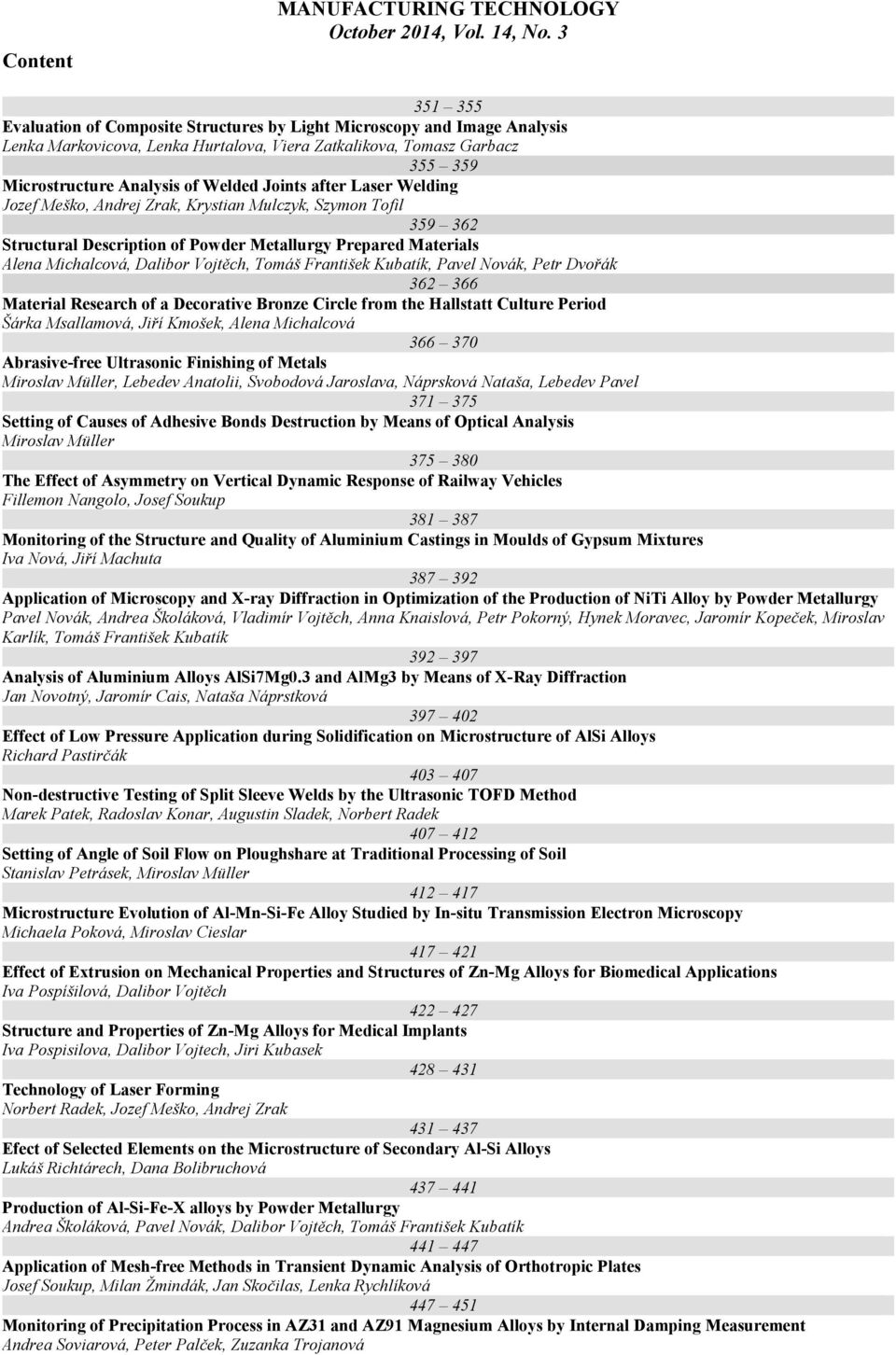
2 Content MANUFACTURING TECHNOLOGY October 2014, Vol. 14, No Evaluation of Composite Structures by Light Microscopy and Image Analysis Lenka Markovicova, Lenka Hurtalova, Viera Zatkalikova, Tomasz Garbacz Microstructure Analysis of Welded Joints after Laser Welding Jozef Meško, Andrej Zrak, Krystian Mulczyk, Szymon Tofil Structural Description of Powder Metallurgy Prepared Materials Alena Michalcová, Dalibor Vojtěch, Tomáš František Kubatík, Pavel Novák, Petr Dvořák Material Research of a Decorative Bronze Circle from the Hallstatt Culture Period Šárka Msallamová, Jiří Kmošek, Alena Michalcová Abrasive-free Ultrasonic Finishing of Metals Miroslav Müller, Lebedev Anatolii, Svobodová Jaroslava, Náprsková Nataša, Lebedev Pavel Setting of Causes of Adhesive Bonds Destruction by Means of Optical Analysis Miroslav Müller The Effect of Asymmetry on Vertical Dynamic Response of Railway Vehicles Fillemon Nangolo, Josef Soukup Monitoring of the Structure and Quality of Aluminium Castings in Moulds of Gypsum Mixtures Iva Nová, Jiří Machuta Application of Microscopy and X-ray Diffraction in Optimization of the Production of NiTi Alloy by Powder Metallurgy Pavel Novák, Andrea Školáková, Vladimír Vojtěch, Anna Knaislová, Petr Pokorný, Hynek Moravec, Jaromír Kopeček, Miroslav Karlík, Tomáš František Kubatík Analysis of Aluminium Alloys AlSi7Mg0.3 and AlMg3 by Means of X-Ray Diffraction Jan Novotný, Jaromír Cais, Nataša Náprstková Effect of Low Pressure Application during Solidification on Microstructure of AlSi Alloys Richard Pastirčák Non-destructive Testing of Split Sleeve Welds by the Ultrasonic TOFD Method Marek Patek, Radoslav Konar, Augustin Sladek, Norbert Radek Setting of Angle of Soil Flow on Ploughshare at Traditional Processing of Soil Stanislav Petrásek, Miroslav Müller Microstructure Evolution of Al-Mn-Si-Fe Alloy Studied by In-situ Transmission Electron Microscopy Michaela Poková, Miroslav Cieslar Effect of Extrusion on Mechanical Properties and Structures of Zn-Mg Alloys for Biomedical Applications Iva Pospíšilová, Dalibor Vojtěch Structure and Properties of Zn-Mg Alloys for Medical Implants Iva Pospisilova, Dalibor Vojtech, Jiri Kubasek Technology of Laser Forming Norbert Radek, Jozef Meško, Andrej Zrak Efect of Selected Elements on the Microstructure of Secondary Al-Si Alloys Lukáš Richtárech, Dana Bolibruchová Production of Al-Si-Fe-X alloys by Powder Metallurgy Andrea Školáková, Pavel Novák, Dalibor Vojtěch, Tomáš František Kubatík Application of Mesh-free Methods in Transient Dynamic Analysis of Orthotropic Plates Josef Soukup, Milan Žmindák, Jan Skočilas, Lenka Rychlíková Monitoring of Precipitation Process in AZ31 and AZ91 Magnesium Alloys by Internal Damping Measurement Andrea Soviarová, Peter Palček, Zuzanka Trojanová
3 Content MANUFACTURING TECHNOLOGY October 2014, Vol. 14, No Heat-Affected Zone of Plasma of Laser Cut Materials Dana Stancekova, Jan Semcer, Michal Sajgalik, Miroslav Janota The Effect of Niobium Addition and Heat Treatment on the Phase Structure of Fe3Al Type Intermetallic Alloys Martin Švec, Věra Vodičková SEM and EDS Analysis Used in Evaluation of Chemical Pre-treatment Based on Nanotechnology Jaroslava Svobodova Change of Internal Friction on Aluminium Alloy with 10.1 % Mg Dependence on the Temperature Milan Uhríčik, Peter Palček, Andrea Soviarová, Przemysław Snopiński Analysis of Surface Integrity of Parts after Non-conventional Methods of Machining Alena Vajdová, Anna Mičietová, Miroslav Neslušan, Kamil Kolařik Picture Analysis of Failure Areas of Particle Composites Petr Valášek, Miroslav Müller Quantitative Evaluation of Microstructure of Graphitic Cast Irons Alan Vaško, Lenka Markovičová, Viera Zatkalíková, Eva Tillová Structure and Mechanical Properties of Mg-Based Alloys for Elevated Temperature Applications Dalibor Vojtěch, Jiří Kubásek, Milena Voděrová, Jan Šerák New Inspection Technologies for Identification of Failure in the Materials and Welded Joints for Area of Gas Industry Peter Vrzgula, Martin Faturík, Miloš Mičian Variability of Local Corrosion Attack Morphology of AISI 316Ti Stainless Steel in Aggressive Chloride Environment Viera Zatkalíková, Lenka Markovičová, Juraj Belan, Tatiana Liptáková Vanadium and Chromium Impact to Microstructure of AlSi10MgMn Alloy with Elevated Iron Content Maria Zihalova, Dana Bolibruchova JUNE 2014, Vol. 14, No. 3 INTERNATIONAL REVIEWERS AND EDITORS LIST Technology and Assembly Frantisek Holesovsky Gejza Horvath Karel Kocman Janos Kundrak Stanislaw Legutko Jan Madl Milos Mician Miroslav Muller Natasa Naprstkova Martin Novak Vladimir Pata Libuse Sykorova Karol Vasilko Material Engineering and Design Libor Benes Milan Brozek Dana Bolibruchova Juraj Gerlici Jiri Hruby Milan Chalupa Ivan Lukac Iva Nova Stefan Segla Augustin Sladek Josef Soukup Eva Tillova Milan Zmindak home page indexed on databases [SC] [IET]

4 The Use of Optical Microscopy to Evaluate the Tribological Properties Totka Bakalova 1, Petr Louda 1, 2, Lukáš Voleský 1, Zuzana Andršová 1 1 Institute for Nanomaterials, Advanced Technologies and Innovation, Technical university of Liberec, Studentská 2, Liberec, Czech Republic, [email protected]. 2 Faculty of mechanical Engineering, Department of Material Science, Technical university of Liberec, Studentská 2, Liberec, Czech Republic. [email protected] Tribology is an important method for evaluating the coefficient of friction and wear of friction pairs of technical materials. The most commonly used modes are pin on disc, resp. ball on disc. Tribology can simulate the stress of two objects (the friction between the objects) under the real conditions. The output of the tribological test is a specific value of the coefficient of friction and wear rate. For a comprehensive evaluation of tribological properties is used the optical microscopy - to evaluate the size of wear of the pad (groove width) and of the pin (loss of material of the ball or roller). The use of modern sophisticated equipment allows to evaluate the coefficient of friction and wear also in various environments, such as in the process fluids. Keywords: tribology, coefficient of friction, optical microscopy, process fluids Acknowledgment The results of this project LO1201 were obtained through the financial support of the Ministry of Education, Youth and Sports in the framework of the targeted support of the "National Programme for Sustainability I" and the OPR&DI project Centre for Nanomaterials, Advanced Technologies and Innovation CZ.1.05/2.1.00/ and by the Project Development of Research Teams of R&D Projects at the Technical University of Liberec CZ.1.07/2.3.00/ The paper was supported in part by the project OP VaVpI Innovative products and environmental technologies, registration number CZ.1.05/3.1.00/ HOLMEG, K., MATTHEWS, A. (1998). Coating tribology properties, techniques and applications in surface engineering, Elsevier, Amsterdam. BURAKOWKI, T., WIERZCHON, T. (1999). Surface engineering of metals, CRC Press LLC, ISNB , New York. KRAUS, V. (2000). Povrchy a jejich úpravy, ZČU Plzeň. BAKALOVA T., LOUDA, P., VOLESKÝ L. (2014). Hodnocení tribologických vlastností procesních kapalin, Tribotechnika, Mazání v moderním průmyslovém podníku, dubna, p BAKALOVA T. (2010). Vliv materiálových a technologických parametrů obrábění na napětí v povrchové vrstvě a vlastnosti dynamický namáhaných strojních součástí, Disertační práce, TUL, Liberec. BUMBÁLEK, B. (2003). Integrita povrchu a její význam pro posouzení vhodnosti dané plochy pro její funkci, Vysoké učení technické v Brně, ISBN: , Brno. TÖNSHOFF, H. K., ARENDT, C., BEN AMOR, R. (2000). Cutting of Hardened Steel, CIRP Annals Manufacturing Technology, DUGIN, A., POPOV, A. (2012). Effect of the processing materials on the ploughing force values, Manufacturing Technology, 12(13): POPOV A., DUGIN A., (2013). Influence of Lubricant and Coolant Fluid on the Cutting Force in Small-Increment Planing, Russian Engineering Research, 33(2): JANG, D. Y., WATKINS, T. R., KOZACZEK, K. J., HUBBARD, CR., CAVIN, O. B. (1996). Surface residual stresses in machined austenitic stainless steel, Wear HAUK, V a H. BEHNKEN. (1997). Structural and residual stress analysis by nondestructive methods: evaluation, application, assessment. New York: Elsevier, xiv, 640 p. Materials science and technology (Boca Raton, Fla.) ISBN ANDRŠOVÁ Z., KEJZLAR, P., VOLESKÝ, L. (2013) Image analysis as a basis for the use of ultrasonic structuroscopy, Jemná mechanika a optika, č. 1, p , ISSN indexed on:

5 SERRA, J. (1983). Image Analysis and Mathematical Morphology, Academic Press, Inc. Orlando, FL, USA, ISBN: KEJZLAR, P., MACAJOVÁ E., KRATOCHVÍL P. (2013). The Use of Correlative Microscopy for The Structural Examination of Fe-Al-Zr-based Materials, Jemná mechanika a optika, č. 1, p , ISSN Paper number: M indexed on: 257

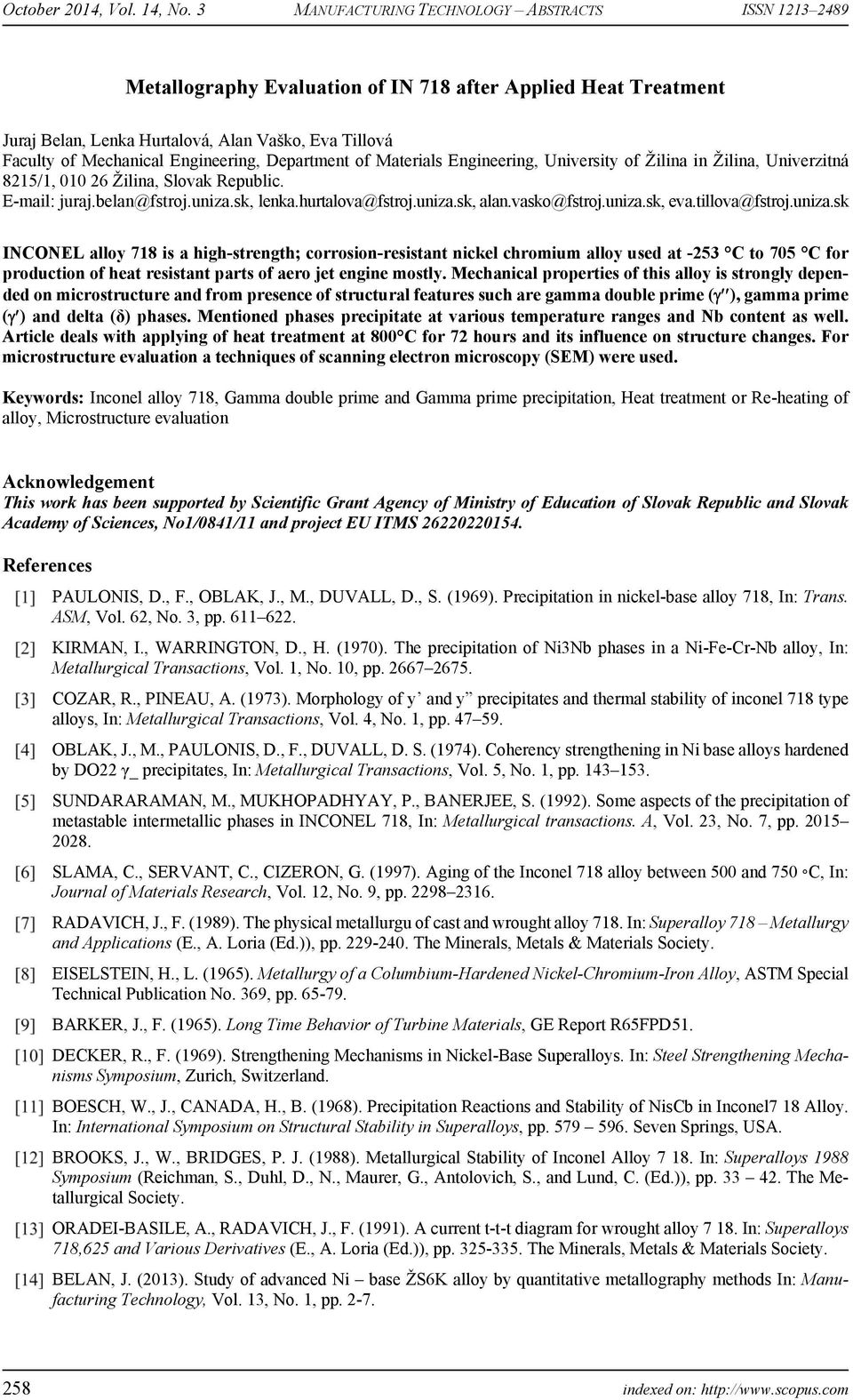
6 Metallography Evaluation of IN 718 after Applied Heat Treatment Juraj Belan, Lenka Hurtalová, Alan Vaško, Eva Tillová Faculty of Mechanical Engineering, Department of Materials Engineering, University of Žilina in Žilina, Univerzitná 8215/1, Žilina, Slovak Republic. INCONEL alloy 718 is a high-strength; corrosion-resistant nickel chromium alloy used at -253 C to 705 C for production of heat resistant parts of aero jet engine mostly. Mechanical properties of this alloy is strongly depended on microstructure and from presence of structural features such are gamma double prime ( ), gamma prime ( ) and delta (δ) phases. Mentioned phases precipitate at various temperature ranges and Nb content as well. Article deals with applying of heat treatment at 800 C for 72 hours and its influence on structure changes. For microstructure evaluation a techniques of scanning electron microscopy (SEM) were used. Keywords: Inconel alloy 718, Gamma double prime and Gamma prime precipitation, Heat treatment or Re-heating of alloy, Microstructure evaluation This work has been supported by Scientific Grant Agency of Ministry of Education of Slovak Republic and Slovak Academy of Sciences, No1/0841/11 and project EU ITMS PAULONIS, D., F., OBLAK, J., M., DUVALL, D., S. (1969). Precipitation in nickel-base alloy 718, In: Trans. ASM, Vol. 62, No. 3, pp KIRMAN, I., WARRINGTON, D., H. (1970). The precipitation of Ni3Nb phases in a Ni-Fe-Cr-Nb alloy, In: Metallurgical Transactions, Vol. 1, No. 10, pp COZAR, R., PINEAU, A. (1973). Morphology of y and y precipitates and thermal stability of inconel 718 type alloys, In: Metallurgical Transactions, Vol. 4, No. 1, pp OBLAK, J., M., PAULONIS, D., F., DUVALL, D. S. (1974). Coherency strengthening in Ni base alloys hardened by DO22 γ_ precipitates, In: Metallurgical Transactions, Vol. 5, No. 1, pp SUNDARARAMAN, M., MUKHOPADHYAY, P., BANERJEE, S. (1992). Some aspects of the precipitation of metastable intermetallic phases in INCONEL 718, In: Metallurgical transactions. A, Vol. 23, No. 7, pp SLAMA, C., SERVANT, C., CIZERON, G. (1997). Aging of the Inconel 718 alloy between 500 and 750 C, In: Journal of Materials Research, Vol. 12, No. 9, pp RADAVICH, J., F. (1989). The physical metallurgu of cast and wrought alloy 718. In: Superalloy 718 Metallurgy and Applications (E., A. Loria (Ed.)), pp The Minerals, Metals & Materials Society. EISELSTEIN, H., L. (1965). Metallurgy of a Columbium-Hardened Nickel-Chromium-Iron Alloy, ASTM Special Technical Publication No. 369, pp BARKER, J., F. (1965). Long Time Behavior of Turbine Materials, GE Report R65FPD51. DECKER, R., F. (1969). Strengthening Mechanisms in Nickel-Base Superalloys. In: Steel Strengthening Mechanisms Symposium, Zurich, Switzerland. BOESCH, W., J., CANADA, H., B. (1968). Precipitation Reactions and Stability of NisCb in Inconel7 18 Alloy. In: International Symposium on Structural Stability in Superalloys, pp Seven Springs, USA. BROOKS, J., W., BRIDGES, P. J. (1988). Metallurgical Stability of Inconel Alloy In: Superalloys 1988 Symposium (Reichman, S., Duhl, D., N., Maurer, G., Antolovich, S., and Lund, C. (Ed.)), pp The Metallurgical Society. ORADEI-BASILE, A., RADAVICH, J., F. (1991). A current t-t-t diagram for wrought alloy In: Superalloys 718,625 and Various Derivatives (E., A. Loria (Ed.)), pp The Minerals, Metals & Materials Society. BELAN, J. (2013). Study of advanced Ni base ŽS6K alloy by quantitative metallography methods In: Manufacturing Technology, Vol. 13, No. 1, pp indexed on:
7 HURTALOVÁ, L., TILLOVÁ, E. (2013). Elimination of the negative effect of Fe-rich intermetallic phases in secondary (recycled) aluminium cast alloy In: Manufacturing Technology, Vol. 13, No. 1, pp VAŠKO, A. (2013). Influence of heat treatment on the microstructure of synthetic nodular cast iron. In: Manufacturing Technology, Vol. 13, No. 1, pp Paper number: M Analysis of HVOF Coating on Molds Used for Refractory Fireclay Shapes Libor Beranek, Jiri Kyncl, Petr Mikes Faculty of Mechanical Engineerign, Czech Technical University in Prague. Technicka 4, 16607, Prage 6. Czech Republic. Molds used for pressing refractory fireclay shapes are exposed to very strong abrasive wear, which is given by the combination of applied pressure of more than 60MPa and processed materials like alumina (Al2O3) and silica (SiO2). Typical lifespan of molds is in several thousand cycles, our aim was to improve the lifespan 10 fold at minimum. To increase the lifespan of the critical parts of the molds, it was decided to use HVOF coating technology based on WC. This article evaluates the quality of the coating on the pins for pressing tools based on the technology used for deposition. An analysis was made on two sets of HVOF coated pins from different suppliers marked as a sample "A and B". Pins were analysed on tactile CMM with scanning system and samples from these pins were analysed on a multisensor CMM. Keywords: HVOF Coating Thickness, Flatness, Mold Lifespan Increase NOUROUZI, S., AZIZPOUR, M.J., SALIMIJAZI, H.R., Parametric study of residual stresses in HVOF thermally sprayed WC-12Co Coatings, Materials and Manufacturing Processes, 2014, 29 (9), pp MYALSKA, H., MOSKAL, G., SZYMAŃSKI, K., Microstructure and properties of WC-Co coatings, modified by sub-microcrystalline carbides, obtained by different methods of high velocity spray processes, Surface and Coatings Technology, MASOUMI, H., SAFAVI, S.M., SALEHI, M., NAHVI, S.M., Effect of grinding on the residual stress and adhesion strength of HVOF thermally sprayed WC-10Co-4Cr Coating, Materials and Manufacturing Processes, 2014, pp OLADIJO, O.P., VENTER, A.M., CORNISH, L.A., Correlation between residual stress and abrasive wear of WC-17Co coatings, International Journal of Refractory Metals and Hard Materials, 2014, 44, pp VENTER, A.M., OLADIJO, O.P., LUZIN, V., CORNISH, L.A., SACKS, N., Performance characterization of metallic substrates coated by HVOF WC-Co, Thin Solid Films, 2013, 549, pp STEWART, D.A., SHIPWAY, P.H., McCARTNEY, D.G., Abrasive Wear Behaviour of Conventional and Nanocomposite HVOF Sprayed WC-Co coatings, Wear, 1999, , p GHABCHI, A., VARIS, T., TURUNEN, E., at al. Behavior of HVOF WC-10Co4Cr Coatings with Different Carbide Size in Fine and Coarse Particle Abrasion, J. Therm. Spray Technol., 2010, 19(1-2), p PAWLOWSKI, L.: The Science and Engineering of Thermal Spray Coatings. Second edition. John Wiley & Sons, Ltd., 2008, 626 p. ISBN Paper number: M indexed on: 259

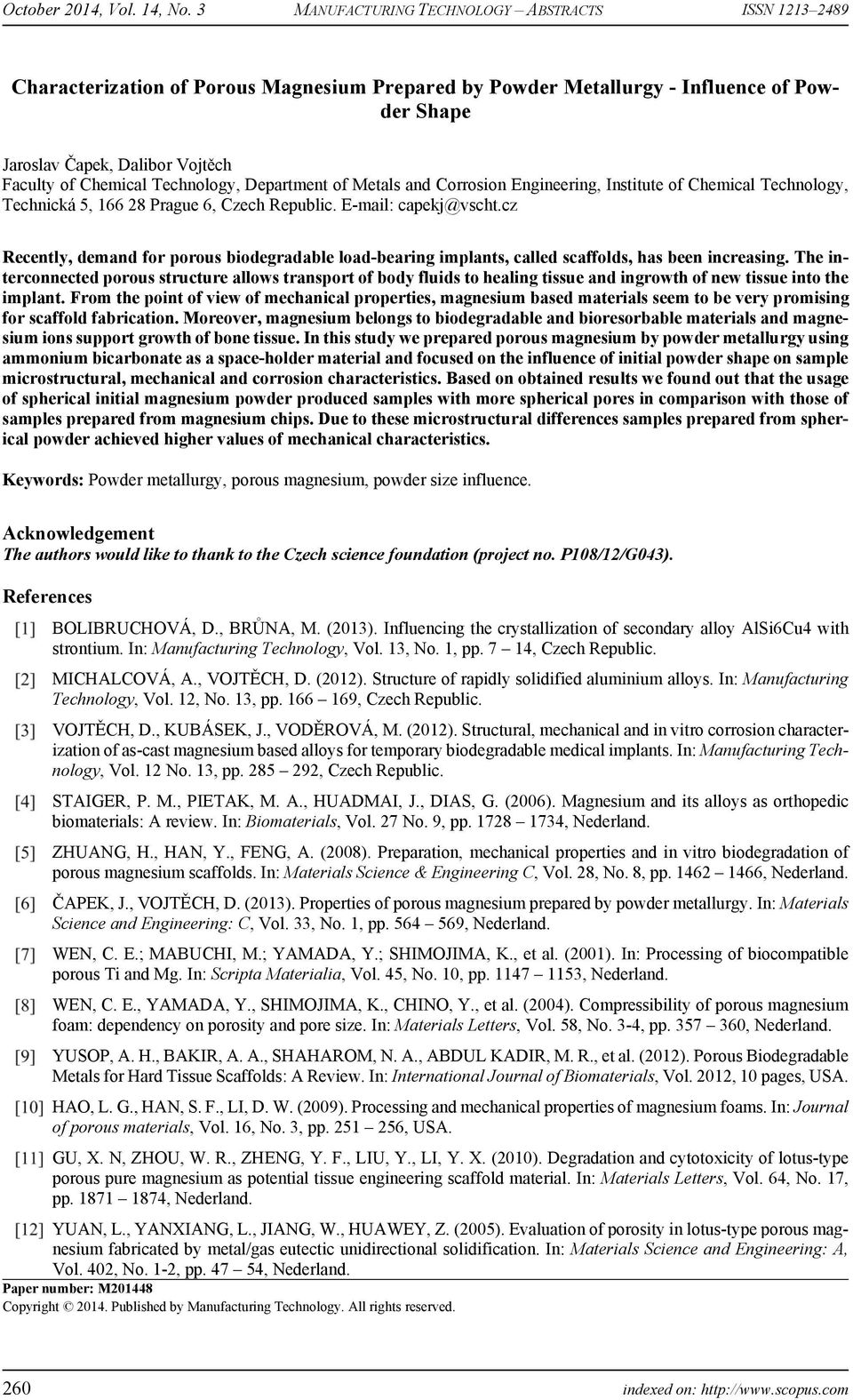
8 Characterization of Porous Magnesium Prepared by Powder Metallurgy - Influence of Powder Shape Jaroslav Čapek, Dalibor Vojtěch Faculty of Chemical Technology, Department of Metals and Corrosion Engineering, Institute of Chemical Technology, Technická 5, Prague 6, Czech Republic. [email protected] Recently, demand for porous biodegradable load-bearing implants, called scaffolds, has been increasing. The interconnected porous structure allows transport of body fluids to healing tissue and ingrowth of new tissue into the implant. From the point of view of mechanical properties, magnesium based materials seem to be very promising for scaffold fabrication. Moreover, magnesium belongs to biodegradable and bioresorbable materials and magnesium ions support growth of bone tissue. In this study we prepared porous magnesium by powder metallurgy using ammonium bicarbonate as a space-holder material and focused on the influence of initial powder shape on sample microstructural, mechanical and corrosion characteristics. Based on obtained results we found out that the usage of spherical initial magnesium powder produced samples with more spherical pores in comparison with those of samples prepared from magnesium chips. Due to these microstructural differences samples prepared from spherical powder achieved higher values of mechanical characteristics. Keywords: Powder metallurgy, porous magnesium, powder size influence. The authors would like to thank to the Czech science foundation (project no. P108/12/G043). BOLIBRUCHOVÁ, D., BRŮNA, M. (2013). Influencing the crystallization of secondary alloy AlSi6Cu4 with strontium. In: Manufacturing Technology, Vol. 13, No. 1, pp. 7 14, Czech Republic. MICHALCOVÁ, A., VOJTĚCH, D. (2012). Structure of rapidly solidified aluminium alloys. In: Manufacturing Technology, Vol. 12, No. 13, pp , Czech Republic. VOJTĚCH, D., KUBÁSEK, J., VODĚROVÁ, M. (2012). Structural, mechanical and in vitro corrosion characterization of as-cast magnesium based alloys for temporary biodegradable medical implants. In: Manufacturing Technology, Vol. 12 No. 13, pp , Czech Republic. STAIGER, P. M., PIETAK, M. A., HUADMAI, J., DIAS, G. (2006). Magnesium and its alloys as orthopedic biomaterials: A review. In: Biomaterials, Vol. 27 No. 9, pp , Nederland. ZHUANG, H., HAN, Y., FENG, A. (2008). Preparation, mechanical properties and in vitro biodegradation of porous magnesium scaffolds. In: Materials Science & Engineering C, Vol. 28, No. 8, pp , Nederland. ČAPEK, J., VOJTĚCH, D. (2013). Properties of porous magnesium prepared by powder metallurgy. In: Materials Science and Engineering: C, Vol. 33, No. 1, pp , Nederland. WEN, C. E.; MABUCHI, M.; YAMADA, Y.; SHIMOJIMA, K., et al. (2001). In: Processing of biocompatible porous Ti and Mg. In: Scripta Materialia, Vol. 45, No. 10, pp , Nederland. WEN, C. E., YAMADA, Y., SHIMOJIMA, K., CHINO, Y., et al. (2004). Compressibility of porous magnesium foam: dependency on porosity and pore size. In: Materials Letters, Vol. 58, No. 3-4, pp , Nederland. YUSOP, A. H., BAKIR, A. A., SHAHAROM, N. A., ABDUL KADIR, M. R., et al. (2012). Porous Biodegradable Metals for Hard Tissue Scaffolds: A Review. In: International Journal of Biomaterials, Vol. 2012, 10 pages, USA. HAO, L. G., HAN, S. F., LI, D. W. (2009). Processing and mechanical properties of magnesium foams. In: Journal of porous materials, Vol. 16, No. 3, pp , USA. GU, X. N, ZHOU, W. R., ZHENG, Y. F., LIU, Y., LI, Y. X. (2010). Degradation and cytotoxicity of lotus-type porous pure magnesium as potential tissue engineering scaffold material. In: Materials Letters, Vol. 64, No. 17, pp , Nederland. YUAN, L., YANXIANG, L., JIANG, W., HUAWEY, Z. (2005). Evaluation of porosity in lotus-type porous magnesium fabricated by metal/gas eutectic unidirectional solidification. In: Materials Science and Engineering: A, Vol. 402, No. 1-2, pp , Nederland. Paper number: M indexed on:
9 Identification of Stress and Structure Properties in Surface and Subsurface Layers of Nuclea Reactor Austenitic Steel Andrej Czán, Anton Martikáň, Jozef Holubják, Jozef Struhárňansky University of Zilina, Faculty of Mechanical Engineering, Univerzitna 1, , Zilina, Slovak Republic The article deals with non-destructive measuring and evaluation of residual stresses and chemical properties of stainless steel sample and its possibility to affect functional properties of the material. X-ray diffractometry can accurately determine values of both residual stress and austenite percentage. Due that this method of measuring is non-destructive, it is possible to ensure measure repeatability and measured component is able to keep its original function. Monitoring of residual stresses in components can be useful in predicting damage incidences due to workload over lifetime of components and together with austenite volume it can also be used as evaluation parameter of suitability of applied manufacturing technological operations. Keywords: Residual stress, austenite volume, stainless steel, X-ray diffraction This work is related to the project with the University of Zilina, 2009/2.2/04-SORO OPVaV number ( ). Name project is intelligent system for nondestructive evaluation technologies for functional properties of components of X-ray difractometry ". GRIFFITHS, C. A. (1989). Closing the Loop on Product Integrity on Bearings with Engineered Source Approval, Split Ballbearing Features, Company Newsletter TIITTO, K. et al. (1991). Testing Shot Peening Stresses in the Field, The Shot Peener, vol. 4, ISSN PREVÉY, P.S. (1986). X-ray Diffraction Residual Stress Techniques, Metals Handbook 10, Metals Park: American Society for Metals, p FITZPATRICK, M.E. et.al. (2005). Determination of Residual Stresses by X-rayDiffraction. MeasurementGood Practice No. 52. National Physical Laboratory, Teddlingtoon. BREZINA, M., KUPCA, L. (2008). Stress corrosion cracking of austenitic stainless steel in a nuclear power plant enviroment. Enviromentinducted cracking ofmaterials. Department of Structural Analysis, VUJE Inc, Trnava, p SADÍLEK, M., KRATOCHVÍL, J., PETRŮ, J., ČEP, R., ZLÁMAL, T., STANČEKOVÁ, D. (2014) Cutting tool wear monitoring with the use of impedance layers. In. Tehnicki Vjesnik, Volume 21, 2014, Pages CEP, R., JANASEK A., PETRU J., CEPOVA L., CZAN A., VALICEK J. (2013) Hard Machinable Machining of Cobalt-based Superalloy. In ManufacturingTechnology XIII/13. UJEP: Ústi n. Labem. p ISSN SAPIETOVA, A., SAGA, M., NOVAK, P. (2012). Multi-software Platform for Solving of Multibody Systems Synthesis, Comunications, vol. 14, No. 3, 43-48, 2012, ISSN MOHYLA, P., TOMČÍK, P., BENEŠ, L., HLAVATY, I. (2011) Effectof post-welding heat treatment on secondary hardening of welded joints of Cr-Mo-v steel. Metal Science and Heat Treatment 53 (7-8), pp ISSN: CZAN, A., TILLOVA, E., SEMCER, J., PILC, J. (2013). Surface and subsurface residual stresses after machining and their analysis by x-raydiffraction. In. Komunikacie, Volume 15, Issue 2, 2013, Pages ISSN STANČEKOVÁ, D., ŠEMCER, J, DERBAS, M, KURŇAVA, T. (2013), Methods of measuring of residualstresses and evaluation of residual state of functional surfaces by x-ray diffractometric methods.in: Manufacturing technology. Vol. 13, no. 4 (2013), s VASILKO, K., PILC, J. (2013). New technological knowledge of the rotary turning tool, JournalManufacturing Technology, Volume 13, Issue 4, December 2013, Pages , ISSN: MICHALIK, P., ZAJAC, J., HATALA, M. (2013). Programming CNC machines using computer-aided manufacturing software, Advanced Science LettersVolume 19, Issue 2, February 2013, Pages , ISSN: indexed on: 261

10 CEP, R., KOURIL, K., MRKVICA, I., JANASEK, I., PROCHAZKA, J. (2010). Zkoušky nastroju Kyocera v podminkach prerusovaneho rezu. In. Strojirenska technologie, vol. XV, 2010/3, pp , ISSN LITVAJ, I., PONIŠČIAKOVÁ, O., STANČEKOVÁ, D., DRBÚL, M. (2013). Knowledge processes and their implementation in small transport companies, 17th International Conference Transport Means 2013; Kaunas; Lithuania; 24 October 2013 through 25 October 2013; Code , pages , ISSN: X HOLESOVSKY, F., NAPRSTKOVA, N., NOVAK, M. (2012). GICS for grinding process optimization. In Manufacturing Technology XII/ UJEP: Ústi n. Labem. p ISSN ČEP, R., JANÁSEK, A., ČEPOVÁ, L., PETRŮ, J., HLAVATÝ, I., CAR, Z., HATALA, M. (2013). Eksperimentalno ispitivanje rezne sposobnosti izmjenjivih reznih In Tehnicki Vjesnik 20 (1), pp ISSN: Paper number: M indexed on:

11 Ultrasonic Testing of Girth Welded Joint with TOFD and Phased Array Daniel Dopjera, Radoslav Koňár, Miloš Mičian University of Žilina, Faculty of Mechanical Engineering, Department of Technological Engineering. Univerzitná 1, Žilina. Slovakia. The article describes the fundamental physical principles of the ultrasonic defectoscopy TOFD (Time of Flight Diffraction) and Phased Array. There is a report from the ultrasonic testing of girth welded joint with ultrasonic flaw detector OmniScan MX2 16:64 PA from the company Olympus NDT. In welded joint were artificaly made three defetcts. Two lack of sidewall fusion (on the left and right side of welded joint) and one crack in axis of welded joint. Both ultrasonic testing were designed in software ESBeamTool 5 from the company Eclipse Scientific, which simulates the geometrical ultrasonic beams spread. At the end, data from both ultrasonic testing were evaluated. The same procedure will be used for the design of ultrasonic inspection TOFD and Phased Array at girth welded joints of gas pipelines. Keywords: NDT, Ultrasonic testing, TOFD, Phased Array This article was created within the project solution no. 561/PG04/2011, which is supported by non profit fund Eko- Fond, which founder is joint stock company SPP. ANDROŠOVÁ, Z., SKRBEK, B. (2012). The use of magnetic and ultrasonic structuroscopy for inspection of ADI/AGI castings. In: Manufacturing technology, Vol. 12, No. 13, pp ISSN MEŠKO, J., et al. (2011). Shape of heat source in simulation program SYSWELD using different types of gases and welding methods. In: Strojírenská technologie. Vol. 16, No. 5, pp ISSN NOVÁK, P., MEŠKO, J., ŽMINDÁK, M. (2011). Finite element implementation of multi-pass fillet weld with phase changes. In: Manufacturing technology, Vol. 13, No.1, pp ISSN OLYMPUS. (2013). The company Olympus NDT. [Online]. 2013, [cit ]. Internet: < OLYMPUS. (2013). Phased Array Tutorial. [Online]. 2013, [cit ]. Internet: < OLYMPUS. (2012). Phased Array Testing Basic Theory for Industrial Applications. 2nd ed. Waltham, MA: Olympus NDT, pp. DMTA EN. OLYMPUS. (2007). Advances in Phased Array Ultrasonic Technology Applications. Waltham, MA: Olympus NDT, pp. ISBN OLYMPUS. (2004). Introduction to Phased Array Ultrasonic Technology Applications. Waltham, MA: Olympus NDT, pp. ISBN X. SKRBEK, B., et al. (2012). Verification of Modification Effect on Prototype Castings from GJV Using Ultrasound Checking. In: Archives of Foundry Engineering. Vol. 12, No. 3, pp ISSN TEMBLAY, P. RICHARD. D. (2013). Development and validation of a full matrix capture solution. [Online]. 2013, [cit ]. Internet: < ŽMINDÁK, M., et al. (2014). Finite element analysis of crack growth in pipelines. In: Manufacutirn Technology, Vol. 14., No. 1, pp ISSN Paper number: M indexed on: 263

12 Temperature Dependence of the Internal Friction Measured at Different Excitation Voltages Zuzana Dresslerová, Peter Palček University of Žilina, Faculty of Mechanical Engineering, Department of Material Engineering, Univerzitná 8215/1, Žilina, Slovakia. Internal friction reflects the ability of the material irreversibly dissipating mechanical energy oscillations. That means, the material of high internal friction ability is able to significantly reduce the vibration amplitude. Dispersion of mechanical energy in the material is just the one of the ways of energy transformation for example conversion of mechanical energy to heat energy. This article is focused on the analysis of the internal friction changes depending on the temperature. For experimental measurements was used AZ91 magnesium alloy. Measurements were performed at different excitation voltages. In experimental measurements was used only ultrasonic resonance method. This method is based on continuous excitation of oscillations of the test bar, and the entire apparatus vibrates at a frequency which is close to the resonance. Keywords: Internal friction, Resonance Method, Magnesium Alloy This work has been supported by Scientific Grant Agency of Ministry of Education of Slovak Republic and Slovak Academy of Sciences N o 1/0797/12 and project SK-PL SCHALLER, R., FANTOZZI, G., GREMAUD, G. (2001). Mechanical spectroscopy Q with applications to materials science. Switzerland Trans Tech Publications, 683p. ISBN BLANTER, M. (2007). Internal Friction in Metallic Materials. Springer - Verlag: Berlin Heidelberg, 539p. ISBN SEUNGH.B. (2000). High damping Fe - Mn martensitic alloys for engineering applications, Nuclear Engineering and Design, vol. 198, issue 3, pp ISSN HAO, G.L., HAN, F.S., WANG, Q.Z., WU, J. (2007). Internal friction peaks associated with the precipitation in AZ91 magnesium alloy. Physica B, vol. 391, issue 1, pp ISSN PUŠKÁR, A. (1995). Vnútorné tlmenie materiálov. Žilina: EDIS, 382p. ISBN (in Slovak). HLAVÁČOVÁ, I., PALČEK, P., CHALUPOVÁ, M., DRESSLEROVÁ, Z. (2013). Plastic Deformation Properties of Magnesium Alloy AZ61. Manufacturing Technology, vol. 13, pp ISSN SOVIAROVÁ, A., DRESSLEROVÁ, Z., PALČEK, P., CHALUPOVÁ, M. (2013). Influence of precipitation on internal damping of AZ61 alloy. 30th international colloquium: Visegrád, Hungary - Budapešť, pp ISBN SOVIAROVÁ A., PALČEK P., BLAŽEK D., CHALUPOVÁ M. (2014). Analysis of Dependence of Internal Friction on temperature of Magnesium Alloy with Aluminium Addition. Transportation Engineering, vol. 42, issue 2, pp ISSN BLAŽEK. D. (2012). Analýza spektra vnútorného tlmenia horčíkových zliatin, thesis. Žilina (in Slovak). Paper number: M indexed on:

13 Effect of cutting fluids on the tool life in turning and milling of construction steel Andrey Dugin 1, Lukas Volesky 2 1 Department of Machining and Assembly, Faculty of Mechanical Engineering, Technical University of Liberec. 2 Centre for Nanomaterials, Advanced Technologies and Innovation, Technical University of Liberec , Studentská 1402/2, Liberec 1, Czech Republic. [email protected], [email protected] Using cutting fluids often enables an increase of cutting tool life. A large amount of cutting fluids produced in the European Union exists on the market of Czech Republic. It is quite difficult for purchasers of cutting fluids to acquire reliable test data about the performance of the fluids in industrial conditions and choose the best cutting fluid, the use of which will guarantee the longest tool life. In this regard comparative tests of cutting fluids were conducted at the laboratory of the Department of Machining and Assembly of the Technical University of Liberec to determine the effect of cutting fluids from different producers (from England, Germany, Norway and Switzerland) on tool life in turning and milling. Keywords: Machining, Cutting fluid, Wear Acknowledgments The paper was supported in part by the project OP VaVpI Innovative products and environmental technologies, registration number CZ.1.05/3.1.00/ JAYAL, A.D., BALAJI, A.K., SESEK, R., GAUL, A., LILLQUIST, D.R., (2007), Machining performance and health effects of cutting fluid application in drilling of A390.0 cast aluminum alloy, Journal of Manufacturing Processes, Vol. 9, No. 2, pp ROTELLA, G., DILLON JR., O.W., UMBRELLO, D., SETTINERI, L., JAWAHIR, I.S., (2014), The effects of cooling conditions on surface integrity in machining of Ti6Al4V alloy, International Journal of Advanced Manufacturing Technology, Vol. 71, No. 1-4, pp WEINERT, K., INASAKI, I., SUTHERLAND, J.W., WAKABAYASHI, T., (2004), Dry machining and minimum quantity lubrication, CIRP Annals - Manufacturing Technology, Vol. 53, No. 2, pp POPOV, A., DUGIN, A., (2013), Study of reasons of increased active force using coolant with uncut chip thickness, The International Journal of Advanced Manufacturing Technology, Vol. 70, No. 9-12, pp THEPSONTHI, T., HAMDI, M., MITSUI, K., (2009), Investigation into minimal-cutting-fluid application in high-speed milling of hardened steel using carbide mills, International Journal of Machine Tools and Manufacture, Vol. 49, No. 2, pp DINIZ, A.E., MICARONI, R., (2007), Influence of the direction and flow rate of the cutting fluid on tool life in turning process of AISI 1045 steel, International Journal of Machine Tools and Manufacture, Vol. 47, No. 2, pp KURAM, E., OZCELIK, B., BAYRAMOGLU, M., DEMIRBAS, E., SIMSEK, B.T., (2013), Optimization of cutting fluids and cutting parameters during end milling by using D-optimal design of experiments, Journal of Cleaner Production, Vol. 42, pp NÁPRSTKOVÁ, N., CAIS, J., STANCEKOVÁ, D., (2014), Influence of Alsi7Mg0.3 alloy modification by Sb on the tool wear, Manufacturing Technology, Vol. 14, No. 1, pp VASILKO, K., (2014), New experimental dependence of machining, Manufacturing Technology, Vol. 14, No. 1, pp KOLARIK, K., GANEV, N., PALA, Z., BAKALOVA, T., (2009), Comparative study of experimental methods for evaluation of residual stress distribution, EAN 2009: 47th International Conference on Experimental Stress Analysis DUGIN, A., JERSAK, J., POPOV, A., (2014), Method for determining of the anti-adhesion ability of cutting fluids, Manufacturing Technology, Vol. 14, No. 2, pp indexed on: 265

14 DUGIN, VOTOCEK, J., POPOV, A., (2014), Method for determining the tribological properties of the cutting fluid, Manufacturing Technology, Vol. 14, No. 2, pp JERSÁK, J., VRKOSLAVOVÁ, L., (2013), The influence of process fluids on the properties of the surface layer of machined components, Manufacturing Technology, Vol. 13, No. 4, pp POPOV A, DUGIN A, (2013), Influence of Lubricant and Coolant Fluid on the Cutting Force in Small-Increment Planning, Russian Engineering Research, Vol. 33, No. 2, pp NATH, C., KAPOOR, S.G., SRIVASTAVA, A.K., IVERSON, J., (2013), Effect of fluid concentration in titanium machining with an atomization-based cutting fluid (ACF) spray system, Journal of Manufacturing Processes, Vol. 15, No. 4, pp Paper number: M indexed on:

15 Non-destructive Magnetic Evaluation of Ground Surfaces Made of Bearing Steel of Variable Hardness Zuzana Durstová, Branislav Mičieta, Mária Čilliková, Miroslav Neslušan, Jozef Mrázik Faculty of Mechanical Engineering, University of Žilina, Univerzitná 8215/1, Žilina, Slovak Republic; This paper deals with non destructive magnetic evaluation of ground surfaces of variable hardness based on Barkhausen noise (BN) technique. Except magnetic investigation, obtained BN signals are correlated with metallographic observation, microhardness readings as well as residual stress measurements. The results show that regime of heat treatment annealing after hardening significantly affects the possible concept for monitoring surfaces after grinding. Conventionally heat treated surfaces of hardness 62 HRC indicate the typical surface thermal softening induced by grinding cycle whereas samples of lower hardness exhibit rehardening effect associated with the progressive decrease of Barkhausen noise responses along with the developed grinding wheel wear. Keywords: Heat treatment, grinding, Barkhausen noise The authors gratefully acknowledge the support by KEGA agency (project n. 005 ŽU 4/2014). MOORTHY, V., et. all.(2001). Evaluation of heat treatment and deformation induced changes in material properties in gear steels using magnetic Barkhausen noise analysis, Conference ICBN 03, Tampere. ČILLIKOVÁ, M., MIČÚCH, M., NESLUŠAN, M., MIČIETOVÁ, A. (2013). Nondestructrive micromagnetic evaluation of surface damage after grinding, In: Manufacturing technology,vol.13, No. 2, pp KAMEDA, J., RANJAN, R. (1987) Nondestructive evaluation of steels using acoustic and magnetic Barkhausen signals II. Effect of intergranular impurity segregation, In: Acta Metall. 35/7, pp BUTTLE, D.J., SCRUBY, C.B., JAKUBOVICS, J.P., BRIGGS, G.A.D. (1991). Magneto-acoustic and Barkhausen emission: their dependence on dislocations in iron, In: NDTE Int. 24, pp GATELIER-ROTHEA, C., CHICOIS, J., FOUGERES, R., FLEISCHMANN, P. (1998). Characterization of pure iron and carbon-iron binary alloy by Barkhausen noise measurements: study of the influence of stress and microstructure, In: Acta Mater. 46/14, pp RANJAN, R., JILES, D. C., RASTOGI, P., (1987). Magnetic properties of decarburized steels: An investigation of the effects of grain size and carbon content, In: IEEE Trans. Magn. 23/3, pp MOORTHY, V., VAIDYANATHAN, S., JAYAKUMAR, T., RAJ, B., (1998). On the influence of tempered microstructures on magnetic Barkhausen emission in ferritic steels, In: Philos. Mag. A 77/6, pp ČILLIKOVÁ M., NESLUŠAN, M., KOLAŘÍK, K., MIČÚCH, M., (2014). Detection of Surface Damage after Grinding of Large Case hardened Bearing Rings, In: Engineering Materials, Vol. 581, pp KARPUCHEWSKI, B., (2002). Introduction to micro magnetic techniques, ICBN 01 Hannover, Germany. Paper number: M indexed on: 267

16 Preparation of Magnesium-zinc Alloy by Mechanical Alloying Michaela Fousova, Jaroslav Capek, Dalibor Vojtech Faculty of Chemical Technology, Department of Metals and Corrosion Engineering, Institute of Chemical Technology, Technická 5, Prague 6, Czech Republic. Mechanical alloying is one of the ways how to prepare nanostructured and amorphous metallic materials. In this paper we used this method to prepare Mg-Zn alloy containing 50 wt.% of zinc. Powders produced by milling in a planetary ball mill were consequently compacted by the SPS method, a very fast method which prevents grain coarsening. The prepared samples were subjected to a closer examination - microstructure, phase composition, hardness and short-term thermal stability were studied. We found out that the prepared powder consisted of Mg and Mg7Zn3 phases, which were very fine and homogeneously distributed. After the SPS compacting, the metastable Mg7Zn3 phase decomposed and new phases (Mg, MgZn, MgZn2, Mg2Zn11) formed. The compacted sample possessed relatively inhomogeneous microstructure and hardness about 260 HV5. Investigation of the short-term thermal stability was accomplished by annealing at temperatures up to 300 C. We observed changes in hardness it regularly decreased up to 200 C and then it slightly increased. Keywords: Mg-Zn alloy, mechanical alloying, SPS The authors would like to thank to the Czech science foundation (project no. P108/12/G043). SCHROERS, J., KUMAR, G., HODGES, T. M., CHAN, S., et al. (2009). Bulk metallic glasses for biomedical applications. In: Jom, Vol. 61, No. 9, pp ZBERG, B., UGGOWITZER, P. J., LOFFLER, J. F. (2009). MgZnCa glasses without clinically observable hydrogen evolution for biodegradable implants. In: Nature Materials, Vol. 8, No. 11, pp MA, E., XU, J. (2009). BIODEGRADABLE ALLOYS The glass window of opportunities. In: Nature Materials, Vol. 8, No. 11, pp MICHALCOVA, A., VOJTECH, D., CIZEK, J., PROCHAZKA, I., et al. (2011). Microstructure characterization of rapidly solidified Al-Fe-Cr-Ce alloy by positron annihilation spectroscopy. In: Journal of Alloys and Compounds, Vol. 509, No. 7, pp CALKA, A., RADLINSKI, A. P. (1989). Amorphization of Mg-Zn alloys by mechanical alloying. In: Materials Science and Engineering a-structural Materials Properties Microstructure and Processing, Vol. 118, pp SURYANARAYANA, C.; IVANOV, E.; BOLDYREV, V. V. (2001). The science and technology of mechanical alloying. In: Materials Science and Engineering a-structural Materials Properties Microstructure and Processing, Vol. 304, pp SURYANARAYANA, C. (2001). Mechanical alloying and milling. In: Progress in Materials Science, Vol. 46, No. 1-2, pp GOVIND, NAIR, K. S., MITTAL, M. C., LAL, K., et al. (2001). Development of rapidly solidified (RS) magnesium-aluminium-zinc alloy. In: Materials Science and Engineering a-structural Materials Properties Microstructure and Processing, Vol. 304, pp OMORI, M. (2000). Sintering, consolidation, reaction and crystal growth by the spark plasma system (SPS). Materials Science and Engineering a-structural Materials Properties Microstructure and Processing, Vol. 287, No.2, pp MUNIR, Z. A., ANSELMI-TAMBURINI, U., OHYANAGI, M. (2006). The effect of electric field and pressure on the synthesis and consolidation of materials: A review of the spark plasma sintering method. In: Journal of Materials Science, Vol. 41, No. 3, pp Paper number: M indexed on:

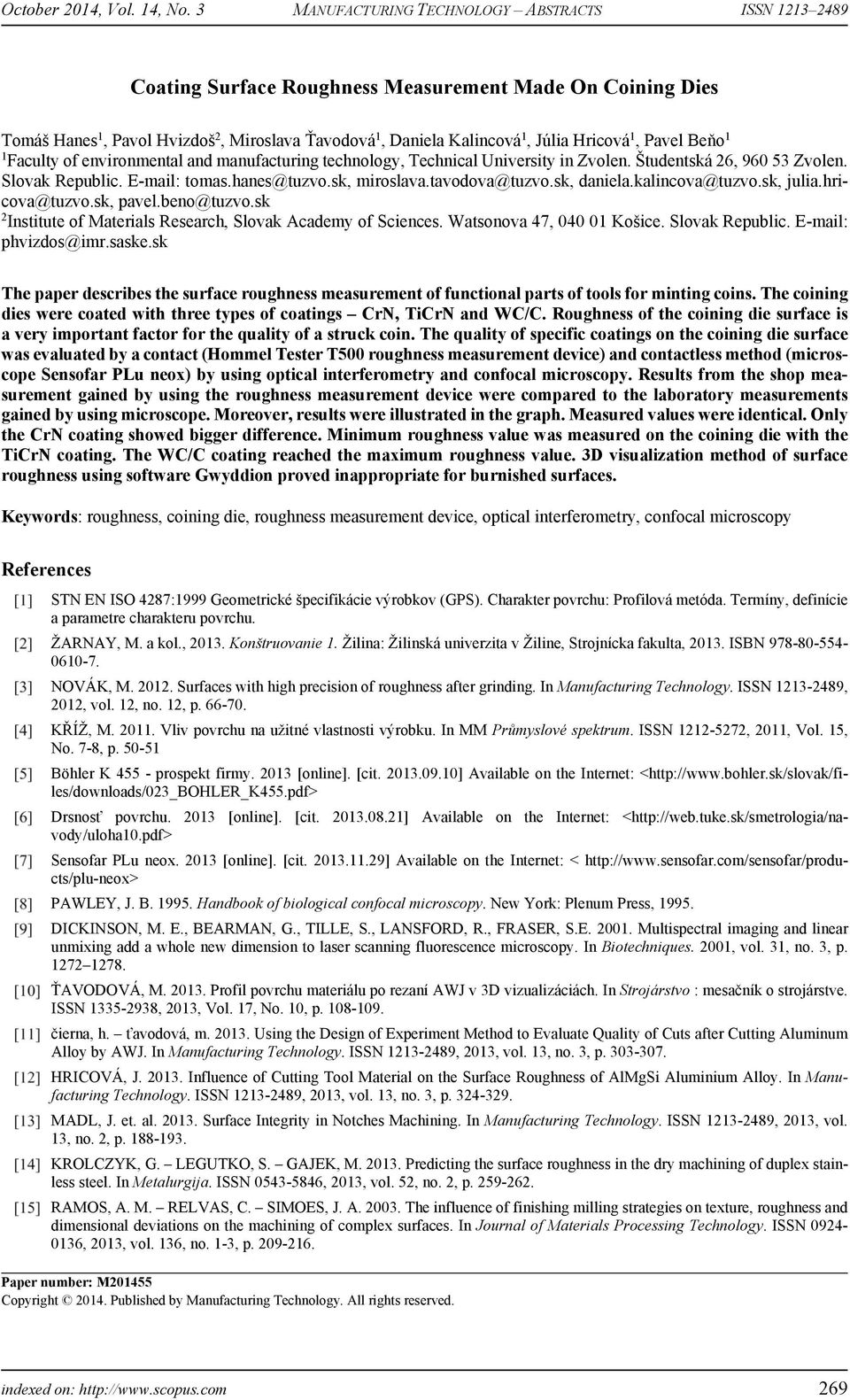
17 Coating Surface Roughness Measurement Made On Coining Dies Tomáš Hanes 1, Pavol Hvizdoš 2, Miroslava Ťavodová 1, Daniela Kalincová 1, Júlia Hricová 1, Pavel Beňo 1 1 Faculty of environmental and manufacturing technology, Technical University in Zvolen. Študentská 26, Zvolen. Slovak Republic. [email protected], [email protected], [email protected], [email protected], [email protected] 2 Institute of Materials Research, Slovak Academy of Sciences. Watsonova 47, Košice. Slovak Republic. [email protected] The paper describes the surface roughness measurement of functional parts of tools for minting coins. The coining dies were coated with three types of coatings CrN, TiCrN and WC/C. Roughness of the coining die surface is a very important factor for the quality of a struck coin. The quality of specific coatings on the coining die surface was evaluated by a contact (Hommel Tester T500 roughness measurement device) and contactless method (microscope Sensofar PLu neox) by using optical interferometry and confocal microscopy. Results from the shop measurement gained by using the roughness measurement device were compared to the laboratory measurements gained by using microscope. Moreover, results were illustrated in the graph. Measured values were identical. Only the CrN coating showed bigger difference. Minimum roughness value was measured on the coining die with the TiCrN coating. The WC/C coating reached the maximum roughness value. 3D visualization method of surface roughness using software Gwyddion proved inappropriate for burnished surfaces. Keywords: roughness, coining die, roughness measurement device, optical interferometry, confocal microscopy STN EN ISO 4287:1999 Geometrické špecifikácie výrobkov (GPS). Charakter povrchu: Profilová metóda. Termíny, definície a parametre charakteru povrchu. ŽARNAY, M. a kol., Konštruovanie 1. Žilina: Žilinská univerzita v Žiline, Strojnícka fakulta, ISBN NOVÁK, M Surfaces with high precision of roughness after grinding. In Manufacturing Technology. ISSN , 2012, vol. 12, no. 12, p KŘÍŽ, M Vliv povrchu na užitné vlastnosti výrobku. In MM Průmyslové spektrum. ISSN , 2011, Vol. 15, No. 7-8, p Böhler K prospekt firmy [online]. [cit ] Available on the Internet: < Drsnosť povrchu [online]. [cit ] Available on the Internet: < Sensofar PLu neox [online]. [cit ] Available on the Internet: < PAWLEY, J. B Handbook of biological confocal microscopy. New York: Plenum Press, DICKINSON, M. E., BEARMAN, G., TILLE, S., LANSFORD, R., FRASER, S.E Multispectral imaging and linear unmixing add a whole new dimension to laser scanning fluorescence microscopy. In Biotechniques. 2001, vol. 31, no. 3, p ŤAVODOVÁ, M Profil povrchu materiálu po rezaní AWJ v 3D vizualizáciách. In Strojárstvo : mesačník o strojárstve. ISSN , 2013, Vol. 17, No. 10, p čierna, h. ťavodová, m Using the Design of Experiment Method to Evaluate Quality of Cuts after Cutting Aluminum Alloy by AWJ. In Manufacturing Technology. ISSN , 2013, vol. 13, no. 3, p HRICOVÁ, J Influence of Cutting Tool Material on the Surface Roughness of AlMgSi Aluminium Alloy. In Manufacturing Technology. ISSN , 2013, vol. 13, no. 3, p MADL, J. et. al Surface Integrity in Notches Machining. In Manufacturing Technology. ISSN , 2013, vol. 13, no. 2, p KROLCZYK, G. LEGUTKO, S. GAJEK, M Predicting the surface roughness in the dry machining of duplex stainless steel. In Metalurgija. ISSN , 2013, vol. 52, no. 2, p RAMOS, A. M. RELVAS, C. SIMOES, J. A The influence of finishing milling strategies on texture, roughness and dimensional deviations on the machining of complex surfaces. In Journal of Materials Processing Technology. ISSN , 2013, vol. 136, no. 1-3, p Paper number: M indexed on: 269
18 Measurement of Wear Metals in Engine Oils by Atomic Absorption Spektrometry Method Vladimír Hönig, Daniela Miholová, Matyáš Orsák Faculty of Agrobiology, Food and Natural Resources, Department of Chemistry, Czech University of Life Sciences Prague. Kamýcká 129, Prague 6 Suchdol. Czech Republic. [email protected], [email protected], [email protected] The article describes a method of measuring engine oil wear metals by Atomic Absorption Spectrometry (AAS), which is an analytical method used to determine the concentrations of various elements in the sample. Atoms of different elements absorb different wavelengths of light in proportion to the quantities in which they are represented, as an analytical measurement property is performing absorption of radiation by free atoms of the reference element. AAS method with flame atomization allows measuring the concentration of about 60 elements of the periodic table in a solution with a sensitivity from hundredths to hundred μg.ml -1. It is used in the analysis of samples of different origins. This method makes up a significant part of monitoring low levels of toxic elements in environmental samples, which is very good to be used for its high sensitivity and selectivity. The aim of the study was the evaluation of the composition of wear particles tested oil samples by AAS, which is highly accurate and a fully automated tribotechnical diagnostics method. The intensity of each line radiation gives information about the content of investigated metals in the tested samples of motor oils, which enable us to identify not only the place from which abrasion arises, but also reveals the cause of the critical condition of the mechanism. Keywords: Atomic Absorption Spectrometry, Absorbance, Engine Oil, Wear Particles, Tribotechnical Diagnosis ALEŠ, Z., PEXA, M., PAVLŮ, J. (2012). Tribotechnical diagnostics of agricultural machines, Engineering for Rural Development conference Jelgava, , [online]. [cit ] Available at www: ALEŠ, Z. (2010). Field experience with transmission oil EP Gear Synth 150, Research in Agricultural Engineering, Vol. 55, pp Czech Academy of Agricultural Sciences. Prague. Czech Republic. CELEBRANT, F., ZIEGLER, J., MARASOVÁ, D. (1996). Technická diagnostika a spolehlivost I. Tribodiagnostika. 1. vydání. pp VŠB-TU, Ostrava, Czech Republic FOSTER, L.H., SUMAR, S. (1996). Hydride generation atomic absorption spectrometric (HGAAS) determination of selenium in term and preterm infant formulae available in the United Kingdom, Food Chemistry, Vol. 55, No. 3, pp Elsevier Limited. United Kingdom. HÖNIG, V., HROMÁDKO, J. (2014). Possibilities of using vegetable oil to power diesel engines as well as their impact on engine oil, Agronomy Research Vol. 12, No. 8, pp Estonian Agricultural University. Estonia. SZÁKOVÁ, J., KOLIHOVÁ, D., MIHOLOVÁ, D., MADER, P. (2004). Single- purpose atomic absorption spectrometer AMA-254 for mercurydetermination and its performance in analysis of agricultural andenvironmental materials. Chemical Papers, Vol. 58, No. 5, pp Versita, United Kingdom. SPĚVÁČKOVÁ, V., KNOTKOVÁ, J. (1998). Prvková analýza klinických materiálu aplikace elektrotermické atomové absorbční spektrometrie, Chemické listy Vol. 92, pp Czech Society of Chemical Engineering, Prague, Czech Republic. TINGGI, U., REILLY, C., PATTERSON, C. (1997). Determination of manganese and chromium in foods by atomic absorption spectrometry after wet digestion, Food Chemistry, Vol. 60, No. 1, pp Elsevier Limited. United Kingdom. Paper number: M indexed on:

19 Application of Discriminant Analysis in Monitoring the Wear Particles in the Engine Oil Vladimír Hönig 1, Luboš Smrčka 2, Štěpánka Horníčková 1 1 Faculty of Agrobiology, Food and Natural Resources, Department of Chemistry, Czech University of Life Sciences Prague. Kamýcká 129, Prague 6 Suchdol. Czech Republic. [email protected], [email protected] 2 Faculty of Business Administration, Department of Business Economics, University of Economics. Nám. W. Churchilla 4, , Prague 3 Žižkov. Czech Republic. [email protected] Multi-dimensional analysis does not include the conventional statistical techniques used in the operating reliability of the machine, where it is much more appropriate than the one-dimensional analytical method. The article deals with monitoring the wear particles in the tractor Zetor 8641 Forterra to pherograph creating pherographical footprint, in which the engine is in critical condition. The experimental part focuses on the trend curve fitting wear evaluated from individual particle analysis tests conducted to permit the monitoring of internal combustion engines (especially diesel). Theoretical assumptions about the relationships between selected parameters of motor oils and knowledge of individual material components allow to reliably determine the accrued failure due to the increase of wear metals in the oil and signal the increased engine wear in a timely manner and to draw attention to the approaching critical condition of the machine. By applying multi-dimensional statistical data in the measurement of wear metals enabled uncovering the links and structure of the tribodiagnostic parameters and sampling the oil, which also helps to determine deeper conclusions depending on the material identification impurities. Keywords: Discriminant Analysis, Engine Oil, Wear Particles, Tribotechnical Diagnosis, Trendy Wear ALEŠ, Z. (2010). Field experience with transmission oil EP Gear Synth 150, Research in Agricultural Engineering, Vol. 55, pp Czech Academy of Agricultural Sciences. Prague. Czech Republic. CELEBRANT, F., ZIEGLER, J., MARASOVÁ, D. (1996). Technická diagnostika a spolehlivost I. Tribodiagnostika. 1. vydání. pp VŠB-TU, Ostrava. Czech Republic. KEJZLAR, P. (2012). Structure and mechanical properties of Fe-25Al-5Zr and Fe-30Al-5Zr intermetallic alloys. Manufacturing Technology, Vol. 12, No. 13, pp , J. E. Purkyne University in Ústí nad Labem nad Labem. Czech Republic. MIHALČOVÁ, J., HEKMAT, H. (2008).Tribotechnická diagnostika v prevádzke použitých olejov I. metódy hodnotenia častíc opotrebovania v olejoch, Chemické listy Vol. 102, pp Czech Society of Chemical Engineering, Prague, Czech Republic. Ministry of Defence CZ. (2007). Instruction for Tribodiagnostics of Engines, Gear and Hydraulic Systems, No. 79: 27/2007:3042, Logistics Division. Prague, Czech Republic STODOLA, J., MACHALÍKOVÁ, J. Spolehlivost a diagnostika BSV. Část: Provozní hmoty a materiály pro MVT. Skriptum. Brno: Vydavatelská skupina UO, Brno. Univerzita obrany, p. 132, ISBN , (2006). STŘIHAVKOVÁ, E., WEISS, V. (2012) The Identification of the structures new type Al-Si-Mg Ca alloys with different Ca content using of the color metallography. Manufacturing Technology, Vol. 12, No. 13, pp , J. E. Purkyne University in Ústí nad Labem nad Labem. Czech Republic. VESELÁ, K.., PEXA, M., MAŘÍK, J. (2014) The effect of biofuels on the quality and purity of engine oil. Agronomy Research, Vol. 12, No. 2, pp , Estonian Agricultural University. Estonia. Paper number: M indexed on: 271
20 Microstructure Control of Secondary A 231 Cast Alloy Used in Automotive Industry Lenka Hurtalová, Eva Tillová, Mária Chalupová, Juraj Belan, Alan Vaško Faculty of Mechanical Engineering, University of Žilina, Univerzitná 8215/1, Žilina. Slovak Republic. [email protected], [email protected], [email protected], [email protected], [email protected] The application of Al-Si alloy castings has gradually increased in many mechanical components in the last years, especially for cars and rail vehicles, thanks to the great potential of these materials as replacements for ferrous alloys. Controlling the microstructure of secondary aluminium cast alloy (Al-scrap and workable Al-garbage) is very important, because these alloy containing more of additions elements, that forming various intermetallic phases in the structure. The mechanical properties are strongly depending on the morphologies, type and distribution of the structural parameters. Microstructure control was realized with combination of different analytical techniques (light microscopy, scanning electron microscopy (SEM) upon deep etching and energy dispersive X- ray analysis - EDX). Keywords: Al-Si cast alloy, mechanical properties, SEM, deep etching, X-ray analysis This work has been supported by Scientific Grant Agency of Ministry of Education of Slovak Republic and Slovak Academy of Sciences, No1/0841/11 and project EU ITMS DIN EN 1706 : 06/98. Aluminum die casting alloys MILLER, W. S., et al. (2000). Recent development in aluminium alloys for the automotive industry. In: Materials Science and Engineering, Vol. A280, pp WANG, Q. G., APELIAN, D., LADOS, D. A. (2001). Fatigue Behavior of A356/357 Aluminum Cast Alloys - part II. Efect of Microstructural Constituents. In: Journal of Light Metals, Vol. 1, pp MATVIJA, M., et al. (2012). The effect of ECAP and subsequent post-ecap annealing on the microstructure and mechanical properties of AlSi7Mg0.3 alloy. In: Acta Metallurgica Slovaca, Vol. 18, No. 1, pp SENČÁKOVÁ, L., VIRČÍKOVÁ, E. (2007). Life cycle assessment of primary aluminium production. In: Acta Metallurgica Slovaca, Vol. 13, No. 3, pp DAS, K. S. (2006). Designing Aluminum Alloys for a Recycling Friendly World. In: Materials Science Forum, Vol , pp CUI, J., ROVEN, H. R. (2010). Recycling of automotive aluminum. In: Transactions nonferous metal Society China, Vol. 20, pp TAVITAS-MEDRANO, J. F., et al. (2009). Precipitation - hardening in cast Al-Si-Cu-Mg alloys. In: Journals of Materials Science, Vol. 45, No. 3, pp WARMUZEK, M. (2004). Aluminium/Silicon Alloys: Atlas of Microfractographs. Introduction to Aluminium - Silicon Casting Alloys. MOUSTAFA, M. A., et al. (2003). Effect of solution heat treatment and additives on the microstructure of Al-Si (A413.1) automotive alloys. In: Journal of Material Science, Vol. 38, No. 22, pp SAMUEL, A. M., SAMUEL, F. H., DOTY, W. H. (1996). Observations on the formation of 13-AlFeSi phase in 319 type Al-Si alloys. In: Journal of Material Science, Vol. 31, pp MICHNA, Š., LUKÁČ, I., NAPRSTKOVÁ, N. (2009). AA4032 alloy s heat treatment and its influence into substructure. In: Manufacturing technology, Vol. IX, pp MICHALCOVÁ, A., VOJTĚCH, D. (2012). Structure of rapidly solidified aluminium alloys. In: Manufacturing technology, Vol. 12, No. 13, pp NÁPRSTKOVÁ, N., KUSMIERCZAK, S., CAIS, J. (2013). Modification of AlSi7Mg0.3 alloy by strontium. In: Manufacturing Technology, Vol. 13, Issue 3, pp indexed on:

21 SUN, Y., PANG, S-P., LIU, X-R., YANG, Z-R., SUN, G-X. (2011). Nucleation and growth of eutectic cell in hypoeutectic Al Si alloy. In: Transactions nonferous metal Society China, Vol. 21, pp HURTALOVÁ, L., TILLOVÁ, E. (2013). Elimination of the negative effect of Fe-rich intermetallic phases in secondary (recycled) aluminium cast alloy. In: Manufacturing technology, Vol. 13, N. 1, pp DOBRZAŃSKI, L. A., et al. (2007). Microstructure and mechanical properties of AC AlSi9CuX alloys. In: Journal of Achievements in Materials and Manufacturing Engineering, Vol. 24, No. 2, pp HONZÁTKO, R., MICHNA, Š., CAIS, J. (2013). The Influence of Porosity on Mechanical Properties of Casts Produced from Al - Si Alloys. In: Manufacturing Technology, Vol. 13, No. 3, pp TILLOVÁ, E., CHALUPOVÁ, M. (2009). Structural analysis (Štruktúrna analýza), Edis Žilina (in Slovak). WANG, S-R., et al. (2012). Growth mechanism of primary silicon in cast hypoeutectic Al-Si alloys. In: Transactions nonferous metal Society China, Vol. 22, pp SEIFEDDINE, S. (2007). The influence of Fe on the microstructure and mechanical properties of cast Al-Si alloys. In: Literature review - Vilmer project. Jönköping University, Sweden TAYLOR J. A. (2004). The effect of iron in Al-Si casting alloys. In: 35th Australian Foundry Institute National Conference, pp , Adelaide, South Australia CACERES, C. H.; SVENSON, I. L. & TAYLOR, J. A. (2003). Strenght-ductility Behaviour of Al-Si-Cu-Mg Casting Alloys in T6 temper. International Journal of Cast Metals Research, No. 15, pp MA, Z., et al. (2008). A study of tensile properties in Al-Si-Cu and Al-Si-Mg alloys: Effect of β-iron intermetallics and porosity. In: Materials Science and Engineering A, Vol. 490, pp KIM, H. Y., PARK, T. Y., HAN, S. W., MO, L. H. (2006). Effects of Mn on the crystal structure of α-al(mn,fe)si particles in A356 alloys. In: Journal of Crystal Growth, Vol. 291, No. 1, pp BOLIBRUCHOVÁ, D., RICHTÁRECH, L. (2013). Effect of adding iron to the AlSi7Mg0.3 (EN AC , A356) alloy. In: Manufacturing Technology, Vol. 13, No. 3, pp BOBOESCU, R., SPOREA, I., BORDEASU, I., TOKAR, A., BUJOR, V. (2008). The usage of type siliuminiu alloys with magnesium for casting a very large used pieces. In: Acta technical corviniensis bulletin of engineering, Vol. 1, pp Hunedoara, Romania. Paper number: M indexed on: 273
22 The Usage of Backscattered Electrons in Scanning Electron Microscopy Pavel Kejzlar 1, Martin Švec 2, Eva Macajová 2 1 Institute for Nanomaterials, Advanced Technologies and Innovation, Technical University of Liberec. Studentska 1402/2, Liberec. Czech Republic. [email protected] 2 Department of Materials Science, Technical University of Liberec, Studentska 1402/2, Liberec, Czech Republic. [email protected]; [email protected] Secondary and backscaterred electrons are the most common signals used for imaging in the scanning electron microscopy. Generally, SE are used to obtain topographical contrast while BSE show differences in chemical composition (so called Z-contrast).The aim of the present work is to show possibilities and techniques to obtain not-socommon information using BSE, as e.g. orientation contrast, residual stress, different allotropic modifications, etc. Keywords: Scanning Electron Microscopy, BSE, Structure. The results of this project LO1201 were obtained with co-funding from the Ministry of Education, Youth and Sports as part of targeted support from the "Národní program udržitelnosti I" programme. HAFNER, B. Scanning Electron Microscopy Primer. Available from: LIAO, Yougui. (2007). Practical Electron Microscopy and Database - An Online Book [online]. Second Edition [cit ]. Available from: KRUMEICH, F. Properties of Electrons, their Interactions with Matter and Applications in Electron Microscopy. Available from: KACZMAREK, D. (1998). Backscattered electrons topographic mode problems in the scanning electron microscope. Scanning Microscopy Vol. 12, No. 1, 1998, p JAKSH, H. (2008). Strain related contrast mechanisms in crystaline materials. In: EMC 2008: 14th European microscopy Congress 1-5 September 2008, Aachen Germany; Volume 1: Instrumentation and methods. 1st ed. New York: Springer, ISBN JAKSH, H. (2009). Low Loss BSE Imaging in FE-SEM. In: Microscopy Conference 2009 in Graz, Austria, Verlag der TU Graz 2009, DOI: / JAKSH, H. (2010). Low Loss-BSE Electrons and Their Contrast in FE-SEM. In: International Microscopy Conference 2010, Rio de Janeiro, Brasil. Paper number: M indexed on:
23 Defect Detection in Pipelines during Operation Using Magnetic Flux Leakage and Phased Array Ultrasonic Method Radoslav Konar 1, Milos Mician 1, Ivo Hlavaty 2 1 Department of Technological Engineering, Faculty of Mechanical Engineering, University of Zilina in Zilina. Univerzitna 1, Zilina. Slovak Republic. [email protected], [email protected] 2 Faculty of Mechanical Engineering, VSB - Technical University of Ostrava, 17. listopadu 15, Ostrava. Czech Republic. [email protected] The present article is focused on the non-destructive testing (NDT) inspection of pipelines during operation namely Magnetic Flux Leakage (MFL) method and Phased Array ultrasonic (PA) method. MFL inspection technique is electromagnetic test method primarily used to detect flaws or defects in high-permeability of ferromagnetic metals such as carbon steel tubing, plate, wire rope and tubular parts. PA ultrasonic method is an advanced NDT method that is used to detect component failures i.e. cracks or flaws and thereby determine component quality. Due to the possibility to control parameters such as beam angle and focal distance, this method is very efficient regarding to the defect detection and speed of testing. In this article real pipeline defect was identified by MFL method in the internal pipe inspection. This defect was fully mapped by Phased Array ultrasonic method in the terrain. 3D model of defect in the tested material was created from measured data and obtained by PA method. The real dimensions of the defect determined from measurements by the method of MFL and PA are compared. Keywords: Non-destructive Testing, Magnetic Flux Leakage, Phased Array, Gas Pipeline Inspection This work has been supported by non-profit organization EkoFond project No. 561/PG04/2011. PARK, S. (2014). Magnetic Flux Leakage Sensing-Based Steel Cable NDE Technique. In: Shock and Vibration Advanced in Structural Health Management and Composite Structures 2012, pp. 1-8, Hindawi Publishing Corporation, London KUMAR, M., SORABH (2013). Inspection of Pipelines Using MFL Technique. In: Confab Jourmal, pp Confab Journal, India LANGENBERG, K., J., MARKLEIN, R., MAYER, K. (2012). Ultrasonic nondestructive testing of materials Theoretical foundations. pp CRC Press, New York. ANDROSOVA, Z., SKRBEK, B. (2012). The use of magnetic and ultrasonic structuroscopy for inspection of ADI/AGI castings. In: Manufacturing technology, pp J.E. Purkyne University, Ústi nad Labem. NOVAK, P., MESKO, J., ZMINDAK, M. (2011). Finite element implementation of multi-pass fillet weld with phase changes. In: Manufacturing technology, pp J.E. Purkyne University, Ústi nad Labem. KONAR, R., MICIAN, M. (2012). Numerical simulation of residual stresses and distortions in butt weld in simulation programme SYSWELD. In: Communications, pp EDIS, Žilina. ZMINDAK, M. et al. (2014) Fiite element analysis of crack growth in pipelines. In: Manufacturing technology, pp J.E. Purkyne University, Ústi nad Labem. MICIAN, M., PATEK, M., SLADEK, A. (2014). Concept of Reapiring Branch Pipes on High-pressure Pipelines by Using split Sleeve. In: Manufacturing technology, pp J.E. Purkyne University, Ústi nad Labem. DOPJERA, D., MICIAN, M. (2014). The Detection of Artificially Made Defects in Welded Joint with Ultrasonic defectoscopy Phased Array. In: Manufacturing technology, pp J.E. Purkyne University, Ústi nad Labem. OLYMPUS (2013). The company Olympus NDT. Online: < Paper number: M indexed on: 275
24 Preparation and Characterization of NiTi Shape Memory Alloy Preparedby Powder Metallurgy Vojtěch Kučera, Jaroslav Čapek, Alena Michalcová, Dalibor Vojtěch Department of Metals and Corrosion Engineering, Institute of Chemical Technology, Prague, Technická 5, Prague 6, Czech Republic. Some perspective materials are characterized by shape memory effect and NiTi alloy belongs to their main representatives. NiTi is an approximately equiatomic alloy of nickel and titanium and it possesses interesting properties, such as superelasticity, pseudoplasticity and good corrosion resistance. Hence, it is used in different branches of industry (aerospace, medicine, engineering etc.). Common manufacturing melting methods of this alloy are vacuum arc remelting (VAR) and vacuum induction melting (VIM) methods. However, these methods have some disadvantages. The VAR process must be repeated several times to achieve sufficient homogeneity of manufactured ingots. During the VIM process the melt can be contaminated by carbon originated from graphite crucible. Therefore, powder metallurgical methods have been extensively investigated in last years as an alternative to the common processes. In this work, NiTi samples were prepared by the thermale xplosion mode of self-propagating high-temperature synthesis (TE-SHS). Chemical and phase composition, as well as microstructure and hardness of the prepared samples were studied. Afterwards, the samples were heat treated and the influence of the annealing on the studied characteristics was investigated. Keywords: NiTi alloy, powder metallurgy, SHS The authors would like to thank to the Czech science foundation (project no. P108/12/G043). NOVÁK, V. (2003). Intermetalika a jevy tvarové paměti. (accessed March 10, 2013), Czech Republic. BELAN, J. (2013). Study of advanced Ni base ZS6K alloy by quantitative metallography methods. In: Manufacturing Technology, Vol. 13, No. 1, pp. 2 7, Czech Republic. ZANABONI, E. (2008). One Way and Two Way Shape Memory Effect: Thermo Mechanical Characterization of Ni Ti wires. Corso di Laurea Magistrale, Universit`a degli Studi di Pavia, France. PELTON, A. R., RUSSELL, S. M., DICELLO, J. (2003). The Physical Metallurgy of Nitinol for Meddical Applications. In: JOM-Journal of the Minerals, Metals and Materials Society, Vol. 55, No. 5, pp , USA. NAYAN, N., GOVIN, D., SAIKRISHNA, C. N., VENKATA R. K., BHAUMIK, S. K., SUSEELAN N., K., MITTAL, M. (2007). Vacuum induction melting of NiTi shape memory alloys in graphite crucible. In: Materials Science and Engineering A, Vol. 462, No. 1 2, pp , Nederland. FRENZEL, J., ZHANG, Z., NEUKING, K., EGGELER, G. (2004). High quality vacuum induction melting of small quantities of NiTi shape memory alloys in graphite crucibles. In: Journal of Alloys and Compounds, Vol. 385, No. 1 2, pp , Switzerland. ELAHINIA, M. H., HASHEMI, M., TABESH, M., BHADURI, S. B. (2012). Manufacturing and processing of NiTi implants: A review. In: Progress in Materials Science, Vol. 57, No. 5, pp , England. LIU, G., Li, J., CHEN, K. (2012). Combustion synthesis of refractory and hard materials: A review. In: Int. Journal of Refractory Metals and Hard Materials, Vol. 39, No. SI, pp , England. NOVÁK, P., MICHALCOVÁ, A., MAREK, I., VODĚROVÁ, M., VOJTĚCH, D. (2012). Possibilities of the observation of chemical reactions during the preparation of intermetallics by reactive sintering. In: Manufacturing Technology, Vol. 12, No. 2, pp , Czech Republic. WHITNEY, M., CORBIN, S., GORBET, R., et al. (2008). Investigation of the mechanisms of reactive sintering and combustion synthesis of NiTi using differential scanning calorimetry and microstructural analysis. In: ActaMaterialia, Vol. 56, No. 3, pp , England. BISWAS, A. (2005). Porous NiTi by thermal explosion mode of SHS:processing, mechanism and generation of single phase microstructure. In: Acta Materialia, Vol. 53, No. 6, pp , England. 276 indexed on:
25 KAJIKAWA, K., OIKAWA, K., TAKAHASHI, F., YAMADA, H., ANZAI, K. (2010). Reassessment of Liquid/Solid Equilibrium in Ni-Rich Side of Ni-Nb and Ni-Ti Systems. In: Materials Transactions, Vol. 51, No. 4, pp , Japan. WEISS, V., KVAPILOVA, I. (2013). Assessment of the effect of temperature and annealing time homogenization AlCu4MgMn alloys in terms of microstructure image analysis methods and EDX. In: Manufacturing Technology, Vol. 13, No. 1, pp , Czech Republic. MENTZ, J., FRENZEL, J., MARTIN, F., WAGNER, X., NEUKING, K., EGGELER, G., BUCHKREMER, H. P., STOVER, D. (2008). Powder metallurgical processing of NiTi shape memory alloys with elevated transformation temperatures. In: Materials Science and Engineering: A, Vol. 491, No. 1 2, pp , Switzerland. MOTEMANI, Y., NILI-AHMADABADI, M., TAN, M. J., BOMAPOUR, M., RAYAGAN, S. (2009). Effect of cooling rate on the phase transformation behavior and mechanical properties of Ni-rich NiTi shape memory alloy. In: Journal of Alloys and Compounds, Vol. 469, No. 1 2, pp , Switzerland. QIAN, L., SUN, Q., XIAO, X. (2006). Role of phase transition in the unusual microwear behavior of superelastic NiTi shape memory alloy. In: Wear, Vol. 260, No. 4 5, pp , Switzerland. Paper number: M indexed on: 277
26 Analysis of the Defects Causes in Rolled Brass Sheet Sylvia Kuśmierczak 1, Nataša Náprstková 1, Michal Kuba 1 1 Faculty of Production Technology and Management, J. E. Purkyne University in Usti nad Labem. Pasteurova 3334/7, Usti nad Labem. Czech Republic. [email protected], [email protected] The aim of this paper is to identify the causes of defects in rolled brass sheets which appear in the final stage of the blank production. These defects cause the increase in the production cost of the blank, which is undesirable. The analysis methods were used, such as spectroscopic chemical analysis, microstructural analysis using light and electron microscopy and the application of selected mechanical tests. Based on the analysis results, the analysis and cause determining and type of qualification occurring defects was realized. Keywords: defect, brass, analysis, microstructure, REM Authors are grateful for the support of grant IRP VOJTĚCH, D. (2006) Kovové materiály. VŠCHT Praha, Praha, CZ, 140 pp., ISBN MICHNA, Š., KUŚMIERCZAK, S. (2012) Praktická metalografie. OPTYS, FVTM UJEP, Ústí nad Labem, CZ, 245 p. ISBN MICHNA, Š., KUŚMIERCZAK, S., BAJCURA, M. (2010) Metalografie metody a postupy. Adin, Prešov, SK, 192 p. ISBN TILLOVÁ E., CHALUPOVÁ M., HURTALOVÁ L., ĎURINÍKOVÁ E. (2011) Quality control of microstructure in recycled Al-Si cast alloy, In Manufacturing Technology, Vol.11, No. 11, pp 70 76, ISSN KEJZLAR P. (2012) Structure and mechanical properties of Fe-25Al-5Zr and Fe-30Al-5Zr intermetallic alloys. In Manufacturing Technology. FVTM UJEP. Ústí nad Labem, CZ, Vol. 12, No. 12, pp ISSN NOVAKOVA L., HOMOLA P., KAFKA V. (2012) Microstructure Analysis of Titanium Alloys after Deformation by means of Asymmetric Incremental Sheet Forming, In Manufacturing Technology, FVTM UJEP, Ústí nad Labem, CZ, Vol. 12, No. 12, pp ISSN BELAN J. (2013) Study of advanced Ni base ZS6K alloy by quantitative metallography methods, In Manufacturing Technology, FVTM UJEP, Ústí nad Labem, CZ, Vol. 13, No. 1, pp 2-7. ISSN SKALOVA, L., STANKOVA, H., MASEK, B. (2007) Advantages of laser confocal microscopy in microstructure analysis of TRIP steel. In Focus on Microscopy - FOM 2007, Valencia, Spain, Apríl, p. 199 MARTINKOVIČ, M. (1998) Základy stereologickej metalografie. STU, Bratislava, SK. NEWBURY, D. E., JOY, D. C., ECHLIN, P., FIORI, CH. E, GOLDSTEIN J. I. (1986) Advanced Scanning Electron Microscopy and X - Ray Microanalysis., Plenum Press, New York. Paper number: M indexed on:
27 Evaluation of composite structures by light microscopy and image analysis Lenka Markovicova 1, Lenka Hurtalova 1, Viera Zatkalikova 1, Tomasz Garbacz 2 1 Faculty of engineering, Department of materials engineering, University of Zilina, Univerzitna 8215/1, Zilina, Slovakia, [email protected] 2 Mechanical Engineering Faculty, Department of Polymer Processing, Lublin University of Technology, 36 Nadbystrzycka St., Lublin, Poland, [email protected] A composite is a material which is made up of two or more distinct materials. Composite materials are generally used for buildings, bridges and structures such as boat hulls, swimming pool panels, race car bodies, shower stalls, bathtubs, storage tanks, imitation granite and cultured marble sinks and counter tops. As a result of absorption of liquids usually occurs a change in volume, which is referred to as swelling. This process can give rise to physical and chemical properties of polymers.nis - Elements 3.0 was used to evaluate the microstructure of composite materials with different contents of ferrite powder filler. Using NIS - Elements 3.0 assessed the number of particles Sr ferrite surface area and perimeter Sr ferrite particles and the volume fraction of Sr ferrite in the microstructure. Keywords: composite, polyethylene, image analysis, chemical resistance, powder filler The research is supported by European Regional Development Fund and Slovak state budget by the project Research Centre of the University of Žilina, ITMS and project ITMS HAVALDA, A. (1994): Kompozitné matetriály. STU Bratislava VALÁŠEK, P., MÜLLER, M. (2012): Polymeric particle composites with filler saturated matrix. Manufacturing and technology, Vol. 12, No. 13, p NOVAKOVA-MARCINCINOVA, L., NOVAK-MARCINCIN, J. (2014): Production of ABS-Aramid composite material by fused deposition modelig rapid protopyping. Manufacturing technology, Vol.14, No. 1, p GUTFLEISH, O. (2001): Hard Magnetic Materials, Basic Principles Encyclopedia of Material: Science and Technology, Elsiever Science Ltd, ISBN: , s LOKANDER, M., REITBERGER, T., STENBERG, B. (2004): Polymer Degradation and Stability, 86, s MARKOVIČOVÁ, L. (2009): Kompozitné materiály s magnetickými plnivami. Dizertačná práca, STU Bratislava TOR-ŚWIĄTEK, A. (2013): Evaluation of the effectiveness of the microcellular extrusion process of low density polyethylene. Eksploatacja i Niezawodnosc Maintenance and Reliability, Vol. 15, No. 3, p Paper number: M indexed on: 279
28 Microstructure Analysis of Welded Joints after Laser Welding Jozef Meško 1, Andrej Zrak 1, Krystian Mulczyk 2, Szymon Tofil 2 1 Faculty of Mechanical Engineering, University of Žilina, Univerzitná 8215/1, Žilina. Slovak Republic. [email protected], [email protected] 2 Faculty of Mechatronics and Mechanical Engineering, Kielce University of Technology, Aleja 1000-lacia Panstva Polskiego 7, Kielce. Republic of Poland, [email protected], [email protected] Titanium alloys are widely used in aerospace and automotive industries. They are used to implement some parts of machines, also in the chemical industry, power industry, arms industry, shipbuilding, in implantology and biomedical engineering. Extent of use of this material is mainly due to high corrosion resistance, especially in aggressive environments. These are materials with a low ratio of the weight in relation to the mechanical properties. That is, while maintaining the desired mechanical properties of structures made of titanium is lighter than the standard stainless steel.unfortunately, the properties of titanium, in particular at temperatures higher than the affinity of the nitrogen and oxygen in the air, has an effect on some types of processing. In particular, the heat treatment as cutting or welding, due to the fact that the reaction of titanium and oxygen is highly exothermic. Therefore, the parts of the titanium produced in an inert atmosphere. Keywords: Laser welding, CO 2 laser, titan grade 2, microstructure This work was supported in part by the KEGA č. 054 ŽU 4/2012 and VEGA č. 1/0836/13. ASHBY M.F., EASTERLING K.E. (1984). The transformation hardening of steel surfaces by laser beams I. In: Hypo-eutectoid steels. Acta Metall. Vol. 32, No 11, pp DOPJERA, D., MIČIAN, M. (2014) The detection of articullary made defects in welded joint with ultrasonic defectoscopy Phased Array. In: Manufacturing Technology, Vol. 14, No. 1, pp , ISSN KOŇÁR, R., MIČIAN, M., (2012). Numerical simulation of residual stresses and distortions in butt weld in simulation program Sysweld. In: Comunications: scientific letters of the University of Žilina. Vol. 14, No. 3. pp ISSN Žilina. RADEK, N., ANTOSZEWSKI, B. (2009) Influence of laser treatment on the properties of electro-spark deposited coatings. In: Kovove Materialy - Metallic Materials 47, pp , 2009 ŽMINDÁK, M. et all., (2012). Numerical simulation of contact stresses analysis with crack. In: Machine modeling and simulations pp , Poznan, ISBN NOVAK, P., ŽMINDÁK, M., PELAGIĆ, Z., (2014). High-pressure pipelines repaired by steel sleeve and epoxy composition. In: Applied mechanics and materials. Vol. 486, pp ISSN LUKOVICS, I. MALACHOVÁ, M. (2007). Use of Laser in Engineering. In: Manufacturing Technology. Vol. 12. No. 13. pp ISSN KOŇÁR, R., MIČIAN, M. (2014) Non-destructive testing of welds in gas pipelines repair with Phased Array ultrasonic technique. In: Manufacturing Technology, Vol. 14, No. 1, pp , ISSN Paper number: M indexed on:
29 Structural Description of Powder Metallurgy Prepared Materials Alena Michalcová 1, Dalibor Vojtěch 1, Tomáš František Kubatík 2, Pavel Novák 1, Petr Dvořák 1 1 Department of Metals and Corrosion Engineering, Institute of Chemical Technology in Prague, Technická 5, Prag 6. Czech Republic. [email protected], [email protected], [email protected], [email protected] 2 Institute of Plasma Physics AS CR, v. v. i., Za Slovankou 1782/3, Prague 8. Czech Republic. [email protected] The compaction of powder metals and alloys is very difficult field due to preserving of unique properties of initial materials. One of few possible method of succesful compaction is plasma sintering. To describe detailed structure os powder metallurgy materials, it is necesary to use advanced microscopy methods such as SEM and TEM. In this study, the structure of NiAl intermetallic compaoud is described. The material was at first produce by reactive sintering from pure elements. Subsequently, the NiAl porous master alloy was milled and compacted by spark plasma sintering (SPS) technique.the particle size of NiAl powder was compareable to the grain size of compact material, which exhibited low porosity. It was proven that the interconnection on NiAl particles is performed by thin layer of nanocrystalline oxides. Keywords: SPS, intermetallics, powder metallurgy This research was financially supported by Czech Science Foundation, project No. P108/12/G043. TINGAUD, D., STUPPFLER, L., PARIS, S., VREL, D., BERNARD, F., PENOT, C., NARDOU, F. (2007). Time- Resolved X-ray Diffraction Study of SHS-produced NiAl and NiAl ZrO2 Composites. International Journal of Self-Propagating High-Temperature Synthesis, Vol. 16, No. 1, pp Springer. Germany. NOVAK, P., MICHALCOVÁ, A., MAREK. I., VODĚROVÁ, M., VOJTĚCH, D. (2012). Possibilities of the observation of chemical reactions during the preparation of intermetallics by reactive sintering. In: Manufacturing Technology, Vol. 12, No. 13, pp Faculty of Production Technology and Management. CR. ŠVEC M., VODIČKOVÁ, V., HANUS, P. (2012) The effect of heat treatment on the structure of Nb and C doped Fe3Al iron aluminides.. In: Manufacturing Technology, Vol. 12, No. 13, pp Faculty of Production Technology and Management. CR. ŠVEC M., HANUS, P., VODIČKOVÁ, V. (2013). Coefficient Thermal Expansion of Fe 3Al and FeAl type iron aluminides. In: Manufacturing Technology, Vol. 13, No. 3, pp Faculty of Production Technology and Management. CR. EDALATI, K., TOH, S., WATANABE, M., HORITA, Z. (2012). In situ production of bulk intermetallic-based nanocomposites and nanostructured intermetallics by high-pressure torsion. In: Scripta Materialia, Vol. 66, pp Elsevier. US. NOVÁK, P., ŠOTKA, D., NOVÁK, M., MICHALCOVÁ, A., ŠERÁK, J., VOJTĚCH, D. (2011). Production of NiAl matrix composites by reactive sintering. In: Powder Metallurgy, Vol. 54, No. 3, pp Maney. UK. TOKITA, M. (2013). Spark Plasma Sintering (SPS) Method, Systems, and Applications. Handbook of Advanced Ceramics, pp , 2nd ed.; Academic Press: Oxford. MUNIR, Z. A., ANSELMI-TAMBURINI, U., OHYANAGI, M. (2006). The effect of electric field and pressure on the synthesis and consolidation of materials: A review of the spark plasma sintering method.in: Journal of Materials Science, Vol. 41, No. 3, pp Springer. Germany. Paper number: M indexed on: 281
30 Material Research of a Decorative Bronze Circle from the Hallstatt Culture Period Šárka Msallamová, Jiří Kmošek, Alena Michalcová Institute of Chemical Technology Prague, Department of Metals and Corrosion Engineering, Technická 5, Prague 6, [email protected]; [email protected]; [email protected] The paper deals with material research of a bronze circle from the Hallstatt culture period. The structure of bronze was observed with an optical microscope and scanning electron microscope. The structure corresponds to wrought tin bronze after recrystallization annealing. One original repair of the crack in the material which was done by cast bronze, was determined. The bronze contains a big amount of sulphide inclusions, which are oriented in a direction of forming material. Chemical composition of the alloy and non-ferrous inclusions were determined by the EDS analyser and minority elements were determinated by the XRF spectrometer. The bronze contains 9 to 10 wt. % Sn with minority elements Pb, Ni and Fe. XRD and SEM were used in order to identify nonequilibrum Cu-Sn phases. The results were compared with EBSD analysis. The nonequilibrium phase Cu39Sn11 was reliably determined by EBSD analyser. Keywords: archaeological bronze, nonequilibrium phase, SEM-EDS, EBSD, XRD Research is financially supported by the Czech Science Foundation (project no. P108/12/G043). CHYTRÁČEK, M., DRDA, P., KOUTECKÝ, D., MICHÁLEK J., VENCLOVÁ, N., VOKOLEK, V. (2008). Archeologie pravěkých Čech 6, pp AV, Prague. CHVOJKA, O., MICHÁLEK, J. (2011). Výzkumy Josefa Ladislava Píče na mohylových pohřebištích doby bronzové a halštatské v jižních Čechách, pp National Muzeum, Prague. TYLECOTE, R. F. (1992). A History of Metallurgy, pp The Institute of materials, Great Britain. OTTAWAY, B. S. (1994). Prähistorische Archäometallurgie, Leidorf, Germany. SCOTT, D. A. (1991). Metallography and Mictrostructure of Ancient and Historic Metals, pp The Getty Conservation Institute, Singapore. WANG, Q., OTTAWAY, B. S. (2004). Casting Experiments and Microstructure of Archaeologically Relevant Bronzes, Archaeopress, Great Britain. SCHVARTZ, A.J., KUMAR, M., ADAMS, B.L., FIELD D.P. (2009). Electron Backscatter Diffraction in Material Science, pp Springer, USA. NOVAK-MARCINCIN, J., TOROK J., BARNA J., NOVAKOVA-MARCINCINOVA, L. (2012). Technology of Perspective Scanning Methods for Realization of 3D Models of Manufacturing Devices. In: Manufacturing Technology, Vol. 12, No. 13, pp NOVÁK, P., MICHALCOVÁ A., MAREK I., VODĚROVÁ M., VOJTĚCH D. (2012). Possibilities of the observation of chemical reactions during the preparation of intermetallics by reactive sintering. In: Manufacturing Technology, Vol. 12, No. 13, pp Paper number: M indexed on:
31 Abrasive-free Ultrasonic Finishing of Metals Miroslav Müller 1, Lebedev Anatolii 2, Svobodová Jaroslava 3, Náprsková Nataša 3, Lebedev Pavel 4 1 Faculty of Engineering, Czech University of Life Sciences Prague. Czech Republic. [email protected]. 2 Standardization and Metrology, Stavropol State Agrarian Mechanization, Russia. [email protected]. 3 Faculty of production technology and management, Jan Evangelista Purkyně University in Ústí nad Labem. Czech Republic. [email protected]. 4 Standardization and Metrology, Stavropol State Agrarian Mechanization, Russia. [email protected]. The aim of the research was to compare a classical (turning) machining and an abrasive-free ultrasonic machining (bufo) at three different materials. The surface was evaluated on the basis of an Olympus LEXT 3100 measuring of a surface roughness and hardness HV5. An ultrasonic set I 4 consisted of the ultrasonic generator, power output 630 W and working frequency 22 khz ± 10%, was used for the research. Main results are: increasing of the hardness HV5 of the machined surface, lowering of the roughness parameters Ra at the application of the abrasive-free ultrasonic machining, lowering of the roughness parameters Rz was not statistically proved at the application of the abrasive-free ultrasonic machining. It is possible to say according to a visual observing of the steel sample surface that a corrosive resistance was increased at the application of the abrasive-free ultrasonic machining. Keywords: Hardness, Machining, Microscopy, Surface Roughness, Testing This paper has been done when solving the grant IGA TF (No.: 2014:31140/1312/3133). NOVÁK, M. (2012). Surfaces with high precision of roughness after grinding. In: Manufacturing technology, Vol. 12, pp NOVÁK, M. (2011). Surface quality of hardened steels after grinding. In: Manufacturing technology, Vol. 11, pp HOLEŠOVSKÝ, F., NÁPRSTKOVÁ, N., NOVÁK, M. (2012). GICS for grinding process optimization. In: Manufacturing technology, Vol. 12, pp PA, P., S. (2009). Super finishing with ultrasonic and magnetic assistance in electrochemical micro-machining. In: Electrochimica Acta, Vol. 54, pp KROLCZYK, G., LEGUTKO, S. (2013). The machinability of duplex stainless steel-solutions in practice. In: Manufacturing technology, Vol. 13, pp HOLEŠOVSKÝ, F., NOVÁK, M., LATTER, M., VYSLOUZIL, T. (2013). Machining and its influence to surface quality of machine parts. In: Key Engineering Materials. Vol pp JÓZWIK, J., KURIC, I., SÁGA, M., LONKOWIC, P. (2014). Diagnostics of CNC machine tools in manufacturing process with laser interferometer technology. In: Manufacturing technology, Vol. 14, pp NOVÁK, M. (2013). New ways at the fine grinding. In: Key Engineering Materials. Vol pp KOMARAIAH, M., REDDY, N. (1993). A study on the influence of workpiece properties in ultrasonic machining, In: International Journal of Machine Tools & Manufacture. Vol. 33, pp CURODEAU, A., GUAY, J., RODRIGUE, D., BRAULT, L., GAGNE, D., BEAUDIOIN, L., P. (2008). Ultrasonic abrasive μ-machining with thermoplastic tooling. In: International Journal of Machine Tools & Manufacture. Vol. 48, pp LEGUTKO, S., KROLCZYK, G., KROLCZYK, G. (2014). Quality evaluation of surface layer in highly accurate manufacturing. In: Manufacturing technology, Vol. 14, pp Paper number: M indexed on: 283
32 Setting of Causes of Adhesive Bonds Destruction by Means of Optical Analysis Miroslav Müller Faculty of Engineering, Czech University of Life Sciences Prague. Czech Republic. A research analyses an influence of an adhesive surface treatment on an adhesive bond strength. Constructional adhesives used for bonding in an automotive industry were used for the research. A significant factor for evaluating the adhesive bond failure is the research of bonded areas by means of an optical analysis. An even layer of the adhesive in the bond is connected with it. The adhesive bonds diagnostics is difficult. It is necessary to control a quality of the production at the production process. A significant factor lowering the resultant strength of the adhesive bond is its creation. One of possibilities of the adhesive bond diagnostics is to use a method of an optical analysis. An uneven layer of the adhesive belongs among main causes of a failure / considerable decrease of the strength of the adhesive bond. Keywords: Adhesive layer, Diagnostic, Failure area, One-component epoxy, testing This paper has been done when solving the grant IGA TF (No.: 2014:31140/1312/3133). MÜLLER, M., CHOTĚBORSKÝ, R., KRMELA, J. (2007). Technological and constructional aspects affecting bonded joints. In: Research in Agricultural Engineering, Vol. 53, pp MÜLLER, M., VALÁŠEK, P. (2013). Assessment of bonding quality for several commercially available adhesives. In: Agronomy Research, Vol. 11, No. 1, pp CIDLINA, J., MÜLLER, M., VALÁŠEK, P. (2014). Evaluation of Adhesive Bond Strength Depending on Degradation Type and Time. In: Manufacturing Technology, Vol. 14, No. 1, pp NOVÁK, M. (2012). Surfaces with high precision of roughness after grinding. In: Manufacturing technology, Vol. 12, pp NOVÁK, M. (2011). Surface quality of hardened steels after grinding. In: Manufacturing technology, Vol. 11, pp HOLEŠOVSKÝ, F., NÁPRSTKOVÁ, N., NOVÁK, M. (2012). GICS for grinding process optimization. In: Manufacturing technology, Vol. 12, pp MESSLER, R. W. (2004). Joining of materials and structures from pragmatic process to enabling technology. Burlington: Elsevier, 790 p. MÜLLER, M. (2013). Research of renovation possibility of machine tools damage by adhesive bonding technology. In: Manufacturing Technology, Vol. 13, pp MÜLLER, M. (2014). Influence of adhesives storing temperature on adhesive bond strength. In: Manufacturing Technology, Vol. 14, pp MÜLLER, M. (2013). Research of Liquid Contaminants Influence on Adhesive Bond Strength Applied in Agricultural Machine Construction. In: Agronomy Research, Vol.11, pp MÜLLER, M. (2011). Influence of Surface Integrity on Bonding Process. In: Research in Agricultural Engineering, Vol. 57, pp RUDAWSKA, A. (2014). Selected aspects of the effect of mechanical treatment on surface roughness and adhesive joint strength of steel sheets. In: International Journal of Adhesion and Adhesives, Vol. 50, pp NAITO, K., ONTA, M., KOGO, Y. (2012). The Effect of Adhesive Thickness on Tensile and Shear Strength of Polyimide Adhesive. In: International Journal of Adhesion & Adhesives, Vol. 36, pp COMYN, J. (1990). Surface treatment and analysis for adhesive bonding. In: International Journal of Adhesion & Adhesives, Vol. 10, p KOTOUSOV, A. (2007). Effect of a thin plastic adhesive layer on the stress singularities in a bi-material wedge. In: International Journal of Adhesion & Adhesives, Vol. 27, No. 8, pp indexed on:
33 GRANT, L. D. R. et al., (2009). Experimental and numerical analysis of single-lap joints for the automotive industry. In: International Journal of Adhesion & Adhesives, Vol. 29, No. 4, pp OLIA, M., ROSSETTOS, J. N., (1996). Analysis of adhesively bonded joints with gaps subjected to bending. In: International Journal of Solids and Structures, Vol. 33, No. 18, pp Paper number: M indexed on: 285
34 The Effect of Asymmetry on Vertical Dynamic Response of Railway Vehicles Fillemon Nangolo, Josef Soukup Faculty of Production Technology and Management, J. E. Purkyne University in Usti nad Labem. Pasteurova 3334/7, Usti nad Labem. Czech Republic. An experimental and analytical study on the effect of asymmetry on vertical dynamic response of railway vehicles has been conducted. The experimental study featured a typical vehicle model of laboratory scale and a real railway vehicle wagon. The experiment was used to gain insight into the effect of asymmetry on vertical dynamic response and to validate an analytical model of the vehicle-track interaction. This paper presents the results from the study and shows that mechanical asymmetry changes the behaviors of the system. The current contribution introduces a methodology of analytical solution of vertical dynamic response of the railway vehicle. Moreover, a mathematical model according to the physical system considered was developed under MATLAB environment. Keywords: vehicle asymmetry, railway vehicle, analytical model, experiment test The research work is supported by the Student Grant Agency (SGA) UJEP, Czech Republic. SOUKUP, J., VOLEK, J. a kol.: Kmitání mechanických soustav vozidel. Analýza vlivu nesymetrie. Acta Universitatis Purkynianae, Universita J. E. Purkyně in Ústí nad Labem, 2008, ISBN JIMIN, H., ZHI-FANG, F: Modal Analysis ISBN GERLICI, J., LACK, T.: Modified HHT Method for Vehicle Vibration Analysis in Time Domain Utilisation. Page 10. Applied Mechanics and Materials, Scientific. Net, Switzerland. V tisku (ISSN ) MEIROVITCH, L.: Analytical Methods in Vibration. College of Engineering Sciences, Arizona State University NANGOLO, N., SOUKUP, J.: Modeling of Vertical Dynamic Response of Railway Vehicle System with Experimental Validation. Machine Modeling and Simulation. 2012, Poland. BLUDELL, M., HARTY, D.: The Multibody Systems Approach to Vehicle Dynamics. Elsevier, 2004, ISBN ERIK, M. L.: Development of an Intermediate DOF Vehicle. North Karolina State University, DANIEL, J. I.: Engineering Vibration II, Virginal Polytechnic Institute and State University, New Persey ISBN: SUN, Y. Q., DHANASEKAR, M., ROACH, D.: A Three-Dimensional Model for the Lateral and Vertical Dynamics of Wagon-Track System. Proceedings of the institution of Mechanical Engineers. SVOBODA, M., SOUKUP, J.: Dynamic Measurment of Four-Axle Railway wagon. Manufactoring Technology, vol.13 (2013), no. 4, p ISSN SVOBODA, M., SOUKUP, J.: Verification of Numeric Solution by Experiment for Examination Vertical Oscillation of a Mechanical System. Manufactoring Technology, vol.13 (2013), no. 4, p ISSN SEGĽA, Š., OREČNÝ, M., TRIŠOVIČ, N.: Pasive Seat Suspension With a Vibration Absorber. Manufactoring Technology, vol.13 (2013), no. 4, p ISSN Paper number: M indexed on:
35 Monitoring of the Structure and Quality of Aluminium Castings in Moulds of Gypsum Mixtures Iva Nová, Jiří Machuta Faculty of Mechanical Engineering, Technical University of Liberec, Studentská 2, Liberec. Czech Republic. E- The paper deals with the production of dimensionally accurate castings of aluminum alloys in moulds of gypsum moulding mixture. This manufacturing process is very important for the production of castings for radio technology. Castings have high dimensional accuracy and high - quality of surface. Production of aluminum alloy castings in moulds of gypsum mixtures belong to a group of non-traditional methods of casting and foundry practice, this method is used for the production of special castings. Moulds and cores from gypsum mixture have specific application not only in the production of aluminum alloy castings but cast alloys with low melting temperature (tin, zinc, lead). In these days this method produces dimensionally accurate parts with high surface smoothness such as those used for radio-communication systems or propeller small blowers. Under the conditions of the Czech foundry at our institution, the Department of Engineering Technology - TU of Liberec, we devote this method for many years. The main attention is paid to the methodology for the production of gypsum moulds and their heat treatment and the correct choice of the chemical composition of the aluminum alloy in order to obtain high-quality castings. Keywords: Structure, Quality, Aluminium alloy, Mould of gypsum mixtures, Castings. Project supported by: Support of the creation of excellent research and development teams at the Technical University of Liberec, registration number: No. CZ.1.07/2.3.00/ Degarmo, E. Paul et al. (2003) Materials and Processes in Manufacturing, 9thed., Wiley, ISBN RUSÍN, K. (1981) Disperzní formovací materiály. [Skripta]. VUT-FSI, Brno (in Czech). NOVÁ, I. (1986) Tepelné zpracování forem ze sádrových formovacích směsí (in Czech). [Doctoral dissertation work]. FS- KSM, VŠST v Liberci (in Czech). VILČKO, J., SLOVÁK, S. (1987) Zlievárenská technologia. 1. vyd. Bratislava (in Slovak). GRÍGEROVÁ, T., et al. (1988) Zlievarenstvo neželezných kovov. 1. vyd. Bratislava/Praha 1(in Slovak). RAVINS, T.L., GREVE, D.R. (1990) Fiber reinforced plaster moulds for metal casting. Composites, Vol. 21 Iss. 1, January, p. 96. BELICA, E. (2004) Sádrové změsi v umeleckom zlievarenstve. In. Sborník z mezinárodní konference. Trnava 2004 (in Slovak). ČECH, J., PERNIKÁŘ, J., PODDANÝ, K. (2009) Strojírenská metrologie I. 3. vyd. Brno: Akademické nakladatelství. CERM s.r. o., 183 s. ISBN (in Czech). ČSN EN ISO 4287, (1999) Geometrické požadavky na výrobky (GPS) - Struktura povrchu: Profilová metoda - Termíny, definice a parametry struktury povrchu. Praha: Český normalizační institut, (in Czech). WEISS, V., STŘIHAVKOVÁ, E. (2012) Influence of the homogenization annealing on microstructure and mechanical properties of AlZn5.5Mg2.5Cu1.5 alloy. Manufacturing Technology. Vol. 12, No. 13 pp ISSN MICHNA, Š., NÁPRSTKOVÁ, N. (2012) The use of fraktography in the analysis of cracking after formed workpiece blank mechanical machining from the AlCuSnBi alloy. Manufacturing Technology. Vol. 12, No. 13 pp ISSN HURTALOVÁ, L TILLOVÁ, E. (2013) Elimination of the negative effect of Fe rich intermetalic phases in secondary (recycled) aluminium cast alloy. Manufacturing Technology. Vol. 13, No. 1, pp ISSN LIPINSKI, T. (2011) Microstructure and mechanical properties of the AlSi13Mg1CuNi alloy with ecological modifier. In: Manufacturing Technology. Vol. 11, No. 11, pp ISSN LIPINSKI, T. (2011) Use properties of the AlSi9Mg alloys with exotermical modifier. In: Manufacturing Technology. Vol. 11, No. 11, pp ISSN Paper number: M indexed on: 287
36 Application of Microscopy and X-ray Diffraction in Optimization of the Production of NiTi Alloy by Powder Metallurgy Pavel Novák 1, Andrea Školáková 1, Vladimír Vojtěch 1, Anna Knaislová 1, Petr Pokorný 1, Hynek Moravec 1, Jaromír Kopeček 2, Miroslav Karlík 3, Tomáš František Kubatík 4 1 Institute of Chemical Technology, Prague, Department of Metals and Corrosion Engineering, Technická 5, Prague 6, Czech Republic, [email protected] 2 Institute of Physics of the ASCR, v. v. i., Na Slovance 2, Prague 8, Czech Republic, [email protected] 3 Czech Technical University in Prague, Faculty of Nuclear Sciences and Physical Engineering, Department of Materials, Trojanova 13, Prague 2, Czech Republic, [email protected] 4 Institute of Plasma Physics AS CR, v.v.i., Za Slovankou 1782/3, Prague 8, Czech Republic, [email protected] This paper describes the dependence of microstructure of NiTi shape memory alloy on the conditions of nonconventional powder metallurgy processing routes reactive sintering of compressed Ni+Ti powder mixture and mechanical alloying with consequent compaction by Spark Plasma Sintering. First method was chosen as the process enabling to yield the high-purity NiTi alloy, while the second one aimed to reach the ultrafine-grained microstructure. The microstructure and phase composition of the products are compared in this work. The positive effects of high heating rate (> 300 K.min-1) and high temperature (at least 900 C) on the reactive sintering process were recognized. Microstructure of the product is composed by NiTi matrix with dispersed Ti2Ni particles. Similar microstructure can be also obtained by mechanical alloying for at least 120 min and consequent compaction by Spark Plasma Sintering. Keywords: powder metalurgy, NiTi, mechanical alloying, reactive sintering This research was financially supported by the Czech Science Foundation, project No S. VOJTĚCH, D., KUBÁSEK, J., NOVÁK, P. (2013). Corrosion properties of the superelastic shape memory Ni-Ti alloy for medical implants. In: Manufacturing Technology, Vol. 13, No. 3, pp UJEP. Czech Republic. ELAHINIA, M.H., HASHEMI, M., TABESH, M., BHADURI, S.B. (2012). Manufacturing and processing of NiTi implants: A review. In: Progress in Materials Science, Vol. 57, No. 5, pp Elsevier. Netherlands. FOROOZMEHR, A., KERMANPUR, A., ASHRAFIZADEH, F., KABIRI, Y. (2011). Investigating microstructural evolution during homogenization of the equiatomic NiTi shape memory alloy produced by vacuum arc remelting. In: Materials Science and Engineering A, Vol. 528, No.27, pp Elsevier. Netherlands. SADRNEZHAAD, S.K., RAZ, S.B. (2005). Interaction between Refractory Crucible Materials and the Melted NiTi Shape-Memory Alloy. In: Metallurgical and Materials Transactions B, Vol. 36B, pp Springer. Germany. NOVÁK, P., MICHALCOVÁ, A. MAREK, I., VODĚROVÁ, M., OJTĚCH, D. (2012). Possibilities of the observation of chemical reactions during the preparation of intermetallics by reactive sintering. In: Manufacturing Technology, Vol. 12, No. 13, pp UJEP. Czech Republic. NOVÁK, P., VODĚROVÁ, M., HENDRYCH, R., KUBATÍK, T., MICHALCOVÁ, A., VOJTĚCH, D. (2013). Preparation of aluminium-based quasicrystals. In: Manufacturing Technology, Vol. 13, No. 3, pp UJEP. Czech Republic. NOVÁK, P., MICHALCOVÁ, A., MAREK, I., MUDROVÁ, M., SAKSL, K., BEDNARČÍK, J., ZIKMUND, P., VOJTĚCH, D. (2013). On the formation of intermetallics in Fe Al system An in situ XRD study. In: Intermetallics, Vol. 32, pp Elsevier. Netherlands. MASSALSKI, T.B. (1990). Binary Alloy Phase Diagrams, ASM, Materials Park. Paper number: M indexed on:
37 Analysis of aluminium alloys AlSi7Mg0.3 and AlMg3 by means of X-Ray Diffraction Jan Novotný, Jaromír Cais, Nataša Náprstková Faculty of Production Technology and Management, J. E. Purkyne University in Usti nad Labem. Pasteurova 1, Usti nad Labem. Czech Republic. Material crystal compositions and their phase structures have become the necessary and important part of the materials research and advanced technology in recent decades. Each property and information about material phase structure is more or less immediate way depending on the structure and crystal composition. Prerequisite of any technological breakthroughs in this area is therefore detailed information on the structural parameters of materials. Keywords: X-ray diffraction, thermal expansion, material properties GIACOVAZZO, C. (2002) Fundamentals of Crystallography, Oxford University Press, USA BELAN, J. (2013) Study of advanced Ni base alloy by quantitative metallography methods. In Manufacturing Technology, Vol. 13, No.FVTM UJEP, Ústí nad Labem, ISSN ANDRŠOVA, Z., SKRBEK, B. (2012) The use of magnetic and ultrasonic structuroscopy for inspection of ADI/AGI castings. In Manufacturing Technology, Vol. 12, No. 12, FVTM UJEP, Ústí nad Labem, ISSN ČERNOHORSKÝ, D., RAIDA, Z. (1999) Analýza a optimalizace mikrovlnných struktur, VUTIUM, Brno. ISBN VALVODA, V., M. POLCAROVÁ, M., LUKÁČ, P. (1992) Základy strukturní analýzy, Karolinum, Praha. STANČEKOVÁ, D., ŠEMCER, J., DERBAS, M., KURŇAVA, T (2013) Methods of Measuring of Residual Stresses and Evaluation of Residual State of Functional Surfaces by X-Ray Diffractometric Methods. In Manufacturing Technology, Vol. 13, No.4, FVTM UJEP, Ústí nad Labem, pp ISSN SCHMIDOVÁ, L., BAKALOVA T., MALEC J. (2013) Using of Barkhausen Noise Analysis and X-Ray Diffraction for Evaluation Of Surface Integrity, In Manufacturing Technology, Vol. 13, No.4, FVTM UJEP, Ústí nad Labem, pp ISSN MICHNA, Š., LUKÁČ, I., LOUDA, P. OČENÁŠEK, V., SCHNEIDER, H., DRÁPALA, J., KOŘENÝ, R., MIŠKUFOVÁ, A. at al. (2007) Aluminium material and Technologies from A to Z, Adin, Prešov, Slovakia, ISBN WEISS, V., STRIHAVKOVA, E. (2012) Influence of the homogenization annealing on microstructure and mechanical properties of AlZn5,5Mg2,5Cu1,5 alloy. In Manufacturing Technology, Vol. 12, No. 12,. FVTM UJEP, Ústí nad Labem ISSN BOLIBRUCHOVA, D., BRŮNA, M. (2013) Influencing the crystallization of secondary alloy AlSi6Cu4 with stroncium. In Manufacturing Technology, Vol. 13, FVTM UJEP, Ústí nad Labem ISSN NÁPRSTKOVÁ, N., SVOBODOVÁ, J., CAIS, J. (2013), Modification of AlSi7Mg0.3 alloy by strontium, In Manufacturing Technology, Vol. 13, No. 3, FVTM UJEP, Ústí nad Labem, pp ISSN Paper number: M indexed on: 289
38 Effect of Low Pressure Application during Solidification on Microstructure of AlSi Alloys Richard Pastirčák Department of technological engineering. Faculty of Mechanical Engineering, University of Žilina, Univerzitná 1, Žilina, Slovak Republic. This study investigated the effects of squeeze parameters on the properties of squeeze castings and the optimum parameters for producing squeeze castings from Al-Si alloy. It also compared the properties of the squeeze castings with those of chill castings. Squeeze castings were made from AlSi7Mg0.3 alloy using pressures of MPa with the alloy poured at 680, 700, 720 and 740 C into a die preheated to 150, 200 and 250 C. Squeeze time was 10s. At the pressure effect during crystallization there is possible to observe the refinement of eutectic silicium with the increasing pressured. Eutectic Si is excreted in clusters in comparison with non-influenced structure. There comes to increasing of failure strength and mainly of elongation. The hardness of investigated samples was not changed markedly. At the pressure of 15 MPa there comes to inadequate pressure influence, what causes the creation of shrinkage in the longitudinal part of the sample. This decreases the mechanical properties. Keywords: microstructure, low pressure, alloy AlSi7Mg0.3 s This work was created within the solution of the Operational Programme for Research and Development of ITMS code The authors thank the Grant Agency for support. NOVÁ, I., MACHUTA, J Squeeze casting results of aluminium alloys. In.: Manufacturing technology. ISSN , Vol. 13, No. 1(2013), pp RAGAN, E. et al Liatie kovov pod tlakom. Vydavateľstvo Michala Vaška, s. ISBN NOVÁ, I., NOVÁKOVÁ, I., MACHUTA, J Aluminium alloys squeeze casting. In.: Slévárenství. ISSN , Vol. LIX, No. 9-10(2011), p MICHNA, Š. NOVÁ, I Technológia a spracovanie kovových materiálov. Adin, s.r.o. Prešov. ISBN pp. BOLIBRUCHOVA, D Casting technology. GEORG Žilina, ISBN , 248 pp. BOLIBRUCHOVÁ, D., RICHTÁRECH, L Effect of adding iron to the AlSi7Mg0.3 (EN AC , A356) alloy In: Manufacturing technology. ISSN Vol. 13, No. 3, p EPERJEŠI, Ľ. et all Influence of returning material on porosity of die castings. In: Manufacturing Technology. ISSN Vol. 13, No. 1, p MALIK,J., FUTÁŠ,P., VASKOVÁ,I., EPERJEŠI,Š Vplyv technologických faktorov liatia na kvalitu odliatkov zo silumínu. Slévárenství, ISSN No..4-5, p BRŮNA,M., KUCHARČÍK, L Prediction of the Porosity of Al Alloys. In: Manufacturing Technology. ISSN Vol. 13, No. 3, p BOLIBRUCHOVÁ, D., RICHTÁRECH, L Effect of adding iron to the AlSi7Mg0.3 (EN AC , A356) alloy. In: Manufacturing Technology. ISSN Vol. 13, No. 3, p Paper number: M indexed on:
39 Non-destructive Testing of Split Sleeve Welds by the Ultrasonic TOFD Method Marek Patek 1, Radoslav Konar 1, Augustin Sladek 1, Norbert Radek 2 1 Department of Technological Engineering, Faculty of Mechanical Engineering, University of Žilina, Univerzitna 8215/1, Žilina. Slovak Republic. [email protected]. 2 The Centre for Laser Technologies of Metals, Kielce University of Technology Kielce. Poland. [email protected] This article deals with the non-destructive ultrasonic testing of split sleeve butt joints by ultrasonic methods. Split sleeve is used to repair gas pipelines with gas leakage. The new ultrasonic methods TOFD and Phased Arrays are compared considering to the selected butt weld configuration. To compare testing methods, ES Beam Tool software was used to prediction of ultrasonic beam spread through weld joint. TOFD technology was selected to butt weld section testing according to the beam spread simulation results. The results of ultrasonic testing by TOFD method were compared with results of macrostructural analysis of weld joint. Controlling the suitability of testing method to planar defect identification, the artificial defects were prepared and tested. The appropriate setting of measuring technique can be predicted from experimental results. Keywords: Ultrasonic testing, TOFD, Split Sleeve, Defects The article has been created within the framework of VaV task assigned by SPP-D Company, also nr. 561/PG04/2011 supported by uninvesting fund EkoFond, which founder is company SPP, a.s. and by SPP-D Company. This paper has been arisen also thanks to supply of grant project VEGA-1/0547/11, KEGA-039ŽU-4/2011. MICIAN, M., PATEK, M., SLADEK, A. (2014). Concept of repairing branch pipes on high-pressure pipelines by using split sleeve. In: Manufacturing Technology, Vol. 14, No. 1, pp Faculty of Production Technology and Management, Usti n. Labem, CR. PRAVEEN, A., VIJAYAREKHA, K., ABRAHAM, S.T., VENKATRAMAN, B. (2013). Signal quality enhancement using higher order wavelets for ultrasonic TOFD signals from austenitic stainless steel welds. In: Ultrasonics, Vol. 53, pp Elsevier, Philadelphia, USA. MERAZI-MEKSEN, T., BOUDRAA, M., BOUDRAA, B. (2014). Mathematical morphology for TOFD image analysis and automatic crack detection. In: Ultrasonics, Vol. 54, pp Elsevier, Philadelphia, USA. FERRAND, A., DARMON, M., CHATILLON, S., DESCHAMPS, M. (2014). Modelling of ray paths of head waves on irregular interfaces in TOFD inspection for NDE. In: Ultrasonics, Vol. 54, pp Elsevier, Philadelphia, USA. DUBE, N. (2004). Introduction to Phased Array Ultrasonic Technology Applications: R/D Tech Guideline, pp Olympus NDT, Waltham, USA. DOPJERA, D., MIČIAN, M. (2014). The Detection of Artificially Made Defects in Welded Joint with Ultrasonic Defectoscopy Phased Array. In: Manufacturing Technology, Vol. 14, No. 1, pp Faculty of Production Technology and Management, Usti n. Labem, CR. DOPJERA, D., MICIAN, M., SLADEK, A. (2013). Phased Array System for non destructive testing in the industry. In: Advanced manufacturing and repairing technologies in vehicle industry: 30 th international colloquium, pp , BME, Budapest, Hungary. KOŇÁR, R., MIČIAN, M. (2014). Non-destructive Testing of Welds in Gas Pipelines Repairs with Phased Array Ultrasonic Technique. In: Manufacturing Technology, Vol. 14, No. 1, pp Faculty of Production Technology and Management, Usti n. Labem, CR. ZMINDAK, M., MESKO, J., PELAGIC, Z., ZRAK, A. (2014). Finite Element Analysis of Crack Growth in Pipelines. In: Manufacturing Technology, Vol. 14, No. 1, pp Faculty of Production Technology and Management, Usti n. Labem, CR. CEP, R., JANASEK, A., CEPOVA, L., HLAVATY, I., et al. (2013). Experimental testing of exchangeable cutting inserts cutting ability. In: Tehnicki Vjestnik Technical Gazette, Vol. 20, No. 1, pp indexed on: 291
40 MOHYLA, P., TOMCIK, P., BENES, L., HLAVATY, I., et al. (2011). Effect of post-welding heat treatment on secondary hardening of welded joints of Cr-Mo-V steel. In: Metal Science and Heat Treatment, Vol. 53, No. 7-8, pp NOVAK, P., MESKO, J., ZMINDAK, M. (2013). Finite element implementation of Multi-pass Fillet Weld with Phase Changes. In: Manufacturing Technology, Vol. 13, No. 1, pp Faculty of Production Technology and Management, Usti n. Labem, CR. Paper number: M indexed on:
41 Setting of Angle of Soil Flow on Ploughshare at Traditional Processing of Soil Stanislav Petrásek, Miroslav Müller Faculty of Engineering, Czech University of Life Sciences Prague. Czech Republic. The soil is a considerable abrasive medium which exerts on tools processing the soil in a negative way. The main problem connected with using the soil processing machines is their wear owing to particles embedded in the soil. The ploughshare is one of the most loaded parts of the ploughing body and huge requirements are put on it. The aim of the research is to set an angle of a soil flow and connected wear of the ploughshare at the traditional processing of the soil. It is possible to further issue from ascertained pieces of knowledge at a production/renovation of the ploughshares with new functional surface. The statistical analysis evidenced that the angle of the soil flow on the ploughshare surface was the same with the angle of the ploughshare head. It followed from the measurements that the optimum angle for depositing the oblique overlay which is necessary for the creation of the serrated edge is in the interval 35 ± 4. Keywords: Composite, Functional surface, Optical analysis, Steel, Wear This paper has been done when solving the grant IGA TF (No.: 2014:31140/1312/3133). MÜLLER, M., CHOTĚBORSKÝ, R., VALÁŠEK, P., HLOCH, S. (2013). Unusual Possibility of Wear Resistance Increase Research in the Sphere of Soil Cultivation. In: Tehnicki Vjesnik-Technical Gazette, Vol. 20, No 4, pp MÜLLER, M., NOVÁK, P., HRABĚ, P. (2012). Innovation of material constructional solutions of ploughing blade in area of conventional processing of soil during cultivating sugar beet. In: Listy cukrovarnické a řepařské, Vol. 130, No 3. pp MÜLLER, M., HRABĚ, P. (2013). Overlay materials used for increasing lifetime of machine parts working under conditions of intensive abrasion. In: Research in Agricultural Engineering, Vol. 59, No 1. pp DOUBEK, P., FILÍPEK, J. (2011). Abrasive and erosive wear of technical materials. In: Acta Universitatis Agriculturae et Silviculturae Mendelianae Brunensis, 59(3), pp HORVAT, Z., FILIPOVI, D., KOSTIC, S., EMERT, R. (2008). Reduction of mouldboard plough share wear by a combination technique of hardfacing. In: Tribology International, Vol. 4. pp KEJVAL, J., MÜLLER, M. (2013). Mechanical properties of multi-component polymeric composite with particles of Al2O3/SiC. In: Scientia Agriculturae Bohemica, Vol. 44, No 4, pp MÜLLER, M., VALÁŠEK, P. (2012). Abrasive wear effect on Polyethylene, Polyamide 6 and polymeric particle composites. In: Manufacturing Technology, Vol. 12, No. 12, pp VOTAVA, J. et al. (2007). Abrasive wear of ploughshare blades made of Austempered Ductile Iron. In: Acta Universitatis Agriculturae et Silviculturae Mendelianae Brunensis, Vol. 55, No. 1, pp NATSIS, A., PAPADAKIS, G., PITSILIS J., (1999). The influence of soil type, soil water and share sharpness of a mouldboard plough on energy consumption, rate of work and tillage quality. In: Journal of Agricultural Engineering Research, Vol. 72, No. 2, pp NATSIS, A., PETROPOULOS, G., PANDAZARAS, C. (2008). Influence of local soil conditions on mouldboard ploughshare abrasive wear. In: Tribology International, Vol. 41, No. 3. pp CHOTĚBORSKÝ, R., HRABĚ, P., MÜLLER, M., SAVKOVÁ, J., JIRKA, M. (2008). Abrasive wear of high chromium Fe-Cr-C hardfacing alloys. In: Research of Agriculture Engineering, Vol. 54, No. 4. pp MÜLLER, M., VALÁŠEK, P., NOVÁK, P., HRABĚ, P., PAŠKO, J. (2011). Overlays and composites application in technology of sugar beet cultivation and harvest. In: Listy cukrovarnické a řepařské, Vol. 127, No 9. pp HRABĚ, P., MÜLLER, M. (2013). Research of overlays influence on ploughshare lifetime. In: Research in Agricultural Engineering, Vol. 59, No. 4. pp indexed on: 293
42 KIM, I. S., SON, K. J., YANG, Y. S., YARAGADA, P. K. D. V. (2013). Sensitivity analysis for process parameters in GMA welding processes using a factorial design method. In: International Journal of Machina Tools and Manufacture, Vol. 43, pp MÜLLER, M., VALÁŠEK, P. (2012). Polymeric particle composites with filler saturated matrix. In: Manufacturing Technology, Vol. 12, No 13. pp MÜLLER, M., VALÁŠEK, P. (2012). Abrasive wear effect on Polyethylene, Polyamide 6 and polymeric particle composites. In: Manufacturing Technology, Vol. 12, No 12. pp SATAPATHY, B.K., BIJWE, J. (2002). Analysis of simultaneous influence of operating variables on abrasive wear of phenolic composites. In: Wear, Vol. 253, pp Paper number: M indexed on:
43 Microstructure Evolution of Al-Mn-Si-Fe Alloy Studied by In-situ Transmission Electron Microscopy Michaela Poková, Miroslav Cieslar Charles University in Prague, Faculty of Mathematics and Physics, Department of Physics of Materials, Ke Karlovu 5, Praha 2, , Czech Republic Equal channel angular pressing is one of the techniques of severe plastic deformation, which produce materials with sub-micrometric grains. Materials with grains under 1 μm are of great importance for industrial applications thanks to enhanced strength at lower temperatures and formability at elevated temperatures. One of the possible ways how to enhance microstructure stability of aluminium alloys at elevates temperatures is addition of small amount of zirconium. In our study, heat treatment at 450 C leads to precipitation of Al3Zr phase. After ECAP these particles postpone recrystallization above 400 C. However, in the material without Al3Zr particles the recrystallization resistance is comparable thanks to impact of α-al(mn,fe)si phases. More over, initial microhardness after ECAP is higher for the alloy, which was not heat-treated at 450 C before ECAP, thanks to higher dislocation density and solid solution strengthening by Mn atoms. Keywords: Aluminium alloys, ECAP, TEM, recrystallization, precipitation. Financial supports of grants GAUK , GAČR P and SVV are acknowledged. Z. HORITA, T. FUJINAMI, M. NEMOTO, T. G. LANGDON. (2001). Improvement of Mechanical Properties for Al Alloys Using Equal-channel Angular Pressing. Journal of Materials Processing and Technology I. NIKULIN, A. KIPELOVA, S. MALOPHEYEV, R. KAIBYSHEV. (2012). Effect of Second Phase Particles on Grain Refinement During Equal-channel Angular Pressing of an Al-Mg-Mn Alloy. Acta Materialia J. L. NING, D. M. JIANG, X. G. FAN, Z. H. LAI, Q. C. MENG, D. L. WANG. (2009). Mechanical Properties and Microstructure of Al-Mg-Mn-Zr Alloy Processed by Equal Channel Angular Pressing at Elevated Temperature. Materials Characterization Y. IWAHASHI, Z. HORITA, M. NEMOTO, T. G. LANGDON. (1997). An Investigation of Microstructural Evolution During Equal-Channel Angular Pressing. Acta Materialia M. CABIBBO. (2013). Microstructure Strengthening Mechanisms in Different Equal Channel Angular Pressed Aluminum Alloys. Materials Science and Engineering A H. G. KANG, J. P. LEE, M. Y. HUH, O. ENGLER. (2008). Stability against coarsening in ultra-fine grained aluminum alloy AA 3103 sheet fabricated by continuous confined strip sheering. Materials Science and Engineering A A. B. NAIZABEKOV, V. A. ANDREYACHSHENKO, R. KOCICH. (2013). Study of deformation behavior, structure and mechanical properties of the AlSiMnFe alloy during ECAP-PBP. Micron P. MÁLEK, M. CIESLAR, V. OČENÁŠEK. (2010). Deformation Behaviour of the Al-Mn-Sc-Zr Alloy Produced Using ECAP. Metal 2010 Conference Proceedings. D. JIANG, J. NING, J. SUN, Z. HU, Y. HOU. (2008). Annealing Behavior of Al-Mg-Mn Alloy Processed by ECAP at Elevated Temperature. Transaction of Nonferrous Metals Society of China M. KARLÍK, T. MÁNIK, M. SLÁMOVÁ, H. LAUCHMANN. (2012). Effect of Si and Fe on the Recrystallization Response of Al-Mn Alloys with Zr addition. Acta Physica Polonica A M. POKOVÁ, M. CIESLAR, P. MÁLEK. (2014). Twin-Roll Cast Aluminium Alloys Processed by ECAP. Materials Science and Engineering, IOP Conference Series M. VLACH, I. STULÍKOVÁ, B. SMOLA, J. PIESOVÁ, H. CISAŘOVÁ, S. DANIŠ, J. PLÁŠEK, R. GEMMA, D. TANPRAYOON, V. NEUBERT. (2012). Effect of cold rolling on precipitation processes in Al-Mn-Sc-Zr alloy. Materials Science and Engineering A indexed on: 295
44 J. L. NING, D. M. JIANG. (2007). Influence of Zr addition on the microstructure evolution and thermal stability of Al-Mg-Mn alloy processed by ECAP at elevated temperature. Materials Science and Engineering A P. MÁLEK, K. TURBA, M. CIESLAR. (2010). High-temperature Deformation Characteristics of ECAP Al-based Alloys Stabilized by Sc+Zr. Nanocon 2010 Conference Proceedings K. TURBA, P. MÁLEK, M. CIESLAR. (2007). Superplasticity in a Zr and Sc Modified AA7075 Aluminium Alloy Produced by ECAP. Kovové Materiály M. POKOVÁ, M. CIESLAR, J. LACAZE. (2012). The Influence of Pre-deformation on Minority Phases Precipitation in Modified AW-3003 Aluminium. Metal 2012 Conference Proceedings M. POKOVÁ, M. CIESLAR, J. LACAZE. (2012). TEM Investigation of Precipitation in Al-Mn Alloys with Addition of Zr. Manufacturing Technology M. POKOVÁ, M. CIESLAR, J. LACAZE. (2012). The Influence of Silicon Content on Recrystallization of Twin- Roll Cast Aluminum Alloys for Heat Exchangers. Acta Physica Polonica A Y. BIROL. (2009). Response to annealing treatment of a twin-roll cast thin AlFeMnSi strip. Journal of Materials Processing Technology A. P. ZHILYAEV, D. L. SWISHER, O. OH-ISHI, T. G. LANGDON, T. R. MCNELLEY. (2006). Microtexture and microstructure evolution during processing of pure aluminum by repetitive ECAP. Materials Science and Engineering A M. POKOVÁ, M. CIESLAR, J. LACAZE. (2011). Enhanced AW3003 Aluminum Alloys for Heat Exchangers. WDS'11 Proceedings of Contributed Papers, Part III M. CIESLAR, M. SLAMOVA, M. HAJEK, J. VESELY. (2008). Effect of Thermomechanical Pretreatment on Mechanical Properties of Modified Al-Mn-Fe-Si Based Alloys. Materials Science Forum X. HUANG, N. HANSEN, N. TSUJI. (2006). Hardening by Annealing and Softening by Deformation in Nanostructured Metals. Science M. POKOVÁ, M. CIESLAR, M. SLÁMOVÁ. (2009). The influence of dispersoids on recrystallization of aluminium alloys. International Journal of Materials Research O. ENGLER. (1998). On the Influence of Dispersoids on the Particle Stimulated Nucleation of Recrystallization in an Al-Fe-Si Model Alloy. Materials Science Forum Paper number: M indexed on:
45 Effect of Extrusion on Mechanical Properties and Structures of Zn-Mg Alloys for Biomedical Applications Iva Pospíšilová, Dalibor Vojtěch Institut of Chemical Technology Prague, Department of Metals and Corrosion Engineering, Technicka 5, Prague, Czech Republic. Zn-Mg alloys, in which Mg is an alloying element, are proposed for medical applications as a promising biodegradable material for temporary implants in orthopedics or traumatology. They can be used to replace nonfunctional or damaged tissues. When the healing process of tissues is finished, the Zn-Mg alloys are gradually decomposed in a human body and a reoperation is therefore unnecessary. Their mechanical properties must be similar to the characteristics of human bones. Large grains are typical for the structure of cast alloys. Pure Zn and Zn-0.8Mg alloy were cast and subsequently extruded at 300 C. The structure and mechanical properties (Vickers hardness, compressive and tensile strength tests) of the cast alloys were compared with those of the extruded alloys. Pure Zn and Zn-0.8Mg alloy after the extrusion had a fine-grained structure and showed better values of mechanical properties in comparison with the cast alloys. Keywords: Biodegradable material, Zn-Mg alloys, Extrusion Research of the biodegradable metallic materials is financially supported by the Czech Science Foundation (project no. P108/ 12/ G043). DAVIS, J.R. (2003). Handbook of materials for medical devices, ASM International Park, OH. VALÁŠEK, P., MÜLLER, M. (2012). Polymeric particle composites with filler saturated matrix, Manufacturing Technology Vol. 12, pp WITTE, F. (2010). The history of biodegradable magnesium implants: A review. Acta Biomaterialia, pp FOSMIRE, G.J. (1990). Zinc toxicity. Am. J. Clin. Nutr., Vol. 51, pp VOJTECH, D., KUBASEK,J., SERAK, J., NOVAK, P. (2011). Mechanical and corrosion properties of newly developed biodegradable Zn-based alloys for bone fixation, Acta Biomaterialia, Vol. 7, pp VOJTECH, D., KUBASEK, J., VODĚROVÁ, M. (2012). Structural, mechanical and in vitro corrosion characterization of as-cast magnesium based alloys for temporary biodegradable mical implants, Manufacturig Technology, Vol. 12, pp POSPÍŠILOVÁ I., VOJTĚCH, D. (2014). Corrosion and mechanical properties of biodegradable Zn-Based and Mg-based alloys, Proceedings of METAL PARK, S.H., YOU, B.S., MISHARA, R.K., SHADEV, A.K. (2014). Effect of extrusion parameters on the microstructure and mechanical properties of Mg-Zn-(Mn)-Ce/Gd alloys. Materials science end engineering a- structural materials properties microstructure and processing, Vol. 598, pp GALE, W.F., TOTEMIER, T.C. (2004). Smithells metals reference book, Elsevier, Oxford. Paper number: M indexed on: 297
46 Structure and Properties of Zn-Mg Alloys for Medical Implants Iva Pospisilova, Dalibor Vojtech, Jiri Kubasek Department of Metals and Corrosion Engineering, Institute of Chemical Technology in Prague, Technicka 5, Prague 6, , Czech Republic. Polymeric materials are used in modern medicine for the fixation of fractured bones. Their function is only temporary - they serve as substitutes till they are replaced by human tissue (without additional reoperation). Their disadvantage is that they possess low mechanical strength and hardness. As an alternative to polymeric materials, the metallic fixation components are being developed. Their advantage is the higher value of strength, toughness and hardness. Zinc alloys represent a new trend in this technological field. They also meet the requirements for biocompatibility and their mechanical properties approach the properties of human bones. In this paper, the structural and mechanical characteristics are described. The only alloying element in the zinc alloys examined was magnesium in the range wt. %. The mechanical properties were discussed in the relation to the microstructure and the phase composition of the alloys. The results showed that the mechanical properties of binary Zn-Mg alloys increase with the growing content of Mg with the maximum achieved at the eutectic composition. Higher magnesium content strongly deteriorates the mechanical properties of these alloys. Keywords: Biodegradable material, Zinc, Mechanical properties, Structure Research of the biodegradable metallic materials is financially supported by the Czech Science Foundation (project no.p108/12/g043). VALÁŠEK, P.,MÜLLER, M. (2012). Polymeric particle composites with filler saturated matrix. In: Manufacturing Technology m, Vol.12, pp WITTE, F. (2010). The history of biodegradable magnesium implants: A review. In: Acta Biomaterialiam, Vol.6, pp HIROMOTO, S., SHISHIDO, T., YAMAMOTO, A., MARUYAMA, N., SOMEKAWA, H., and MUKAI, T. (2008). Precipitation control of calcium phosphate on pure magnesium by anodization. In: Corrosion Sciencem, Vol.50, pp ZHANG, C.Y., ZENG, R.C., LIU, C.L., and GAO, J.C. (2010). Comparison of calcium phosphate coatings on Mg-Al and Mg-Ca alloys and their corrosion behavior in Hank's solution. In: Surface & Coatings Technologym, Vol.204, pp PEREDA, M.D., ALONSO, C., BURGOS-ASPERILLA, L., DEL VALLE, J.A., RUANO, O.A., PEREZ, P., and FERNANDEZ LORENZO DE MELE, M.A. (2010). Corrosion inhibition of powder metallurgy Mg by fluoride treatments. In: Acta Biomaterialiam, Vol.6, pp GU, X.N., ZHENG, W., CHENG, Y., and ZHENG, Y.F. (2009). A study on alkaline heat treated Mg-Ca alloy for the control of the biocorrosion rate. In: Acta Biomaterm, Vol.5, pp WITTE, F., HORT, N., VOGT, C., COHEN, S., KAINER, K.U., WILLUMEIT, R., and FEYERABEND, F. (2008). Degradable biomaterials based on magnesium corrosion. In: Current Opinion in Solid State and Materials Sciencem, Vol.12, pp ZHANG, E., YANG, L., XU, J., and CHEN, H. (2010). Microstructure, mechanical properties and bio-corrosion properties of Mg-Si(-Ca, Zn) alloy for biomedical application. In: Acta Biomaterm, Vol.6, pp HUAN, Z.G., LEEFLANG, M.A., ZHOU, J., FRATILA-APACHITEI, L.E., and DUSZCZYK, J. (2010). In vitro degradation behavior and cytocompatibility of Mg-Zn-Zr alloys. In: Journal of Materials Science-Materials in Medicinem, Vol.21, pp LI, Z., GU, X., LOU, S., and ZHENG, Y. (2008). The development of binary Mg-Ca alloys for use as biodegradable materials within bone. In: Biomaterialsm, Vol.29, pp VOJTECH, D., KUBASEK, J., SERAK, J., and NOVAK, P. (2011). Mechanical and corrosion properties of newly developed biodegradable Zn-based alloys for bone fixation. In: Acta Biomaterialiam, Vol.7, pp indexed on:
47 GALE, W.F., TOTEMEIER, T.C., and SMITHELLS, A., (2004).Metals Reference Book: Elsevier Publishers. LI, Q.-F., WENG, H.-R., SUO, Z.-Y., REN, Y.-L., YUAN, X.-G., and QIU, K.-Q. (2008). Microstructure and mechanical properties of bulk Mg Zn Ca amorphous alloys and amorphous matrix composites. In: Materials Science and Engineering: Am, Vol.487, pp GU, X., ZHENG, Y., ZHONG, S., XI, T., WANG, J., and WANG, W. (2010). Corrosion of, and cellular responses to Mg-Zn-Ca bulk metallic glasses. In: Biomaterialsm, Vol.31, pp ZBERG, B., UGGOWITZER, P.J., and LOEFFLER, J.F. (2009). MgZnCa glasses without clinically observable hydrogen evolution for biodegradable implants. In: Nature Materialsm, Vol.8, pp VOJTĚCH, D., KUBÁSEK, J., and VODĚROVÁ, M. (2012). Structural, mechanical and in vitro coorosion characterization of as-cast magnesium based alloys for temporary biodegradable mical implants. In: Manufacturig Technology m, Vol.12, pp CZAJKOWSKA A, K.P., WCIŚLIK W, STASIAK-BETLEJEWSKA R. (2013). Application of Electron Scanning Microscope in the Analysis of Structure of Casting Non-Conformities Aimed at Optimization of Technological Process Parameters. In: Manufacturig Technology m, Vol.13, pp Paper number: M indexed on: 299
48 Technology of Laser Forming Norbert Radek 1, Jozef Meško 2, Andrej Zrak 2 1 Faculty of Mechatronics and Mechanical Engineering, Kielce University of Technology, Aleja 1000-lacia Panstva Polskiego 7, Kielce. Republic of Poland, [email protected] 2 Faculty of Mechanical Engineering, University of Žilina, Univerzitná 8215/1, Žilina. Slovak Republic. [email protected], [email protected] The presented article describes the unconventional technology - bending and forming by laser. This technology is alters the tension in the material, which subsequently change the shape of formed parts. Article also describes four mechanisms of deformation after the impact of the laser beam on the material: The first mechanism - mechanism of temperature gradient, the second mechanism - buckling mechanism, the third mechanism - pressing mechanism (Borten) and the fourth mechanism - mechanism of phase transition. The experimental part focuses on the metallographic evaluation of samples from three different areas of the laser micro forming. Article describes in detail the technological parameters used during the development of the experiment and includes a summary of results. Article contains images of the structures detected in the heat affected zone. Keywords: Laser forming, laser bending, CO 2 laser, carbon steel This work was supported in part by the KEGA č. 054 ŽU 4/2012 and VEGA č. 1/0836/13. FRACKIEWICZ, H. (1993). Method of bending metal objects with an energy beam, United States Patent. nr , United States of America KOŇÁR, R., MIČIAN, M. (2012). Numerical simulation of residual stresses and distortions in butt weld in simulation program Sysweld. In: Comunications: scientific letters of the University of Žilina. Vol. 14, No. 3. pp ISSN Žilina. LUKOVICS, I. MALACHOVÁ, M. (2007). Use of Laser in Engineering. In: Manufacturing Technology. Vol. 12. No. 13. pp ISSN NOVÁK, P., ŽMINDÁK, M., PELAGIĆ, Z. (2014). High-pressure pipelines repaired by steel sleeve and epoxy composition. In: Applied mechanics and materials. Vol. 486, pp ISSN NOVÁK, P., MEŠKO, J., ŽMINDÁK, M. (2013). Finite element implementation of Multi-Pass Fillet Weld with Phase Changes. In: Manufacturing Technology Vol. 13, No.1. ISSN ŽMINDÁK, M. et all. (2012). Numerical simulation of contact stresses analysis with crack. In: Machine modeling and simulations pp , Poznan, ISBN PAUNOIU, V. et all. (2008). Laser Bending of Stainless Steel Sheet Metals. In: International Journal of Material Forming, Vol. 1, Issue 1. Springer-Verlag. ISSN KOŇÁR, R., MIČIAN, M., STRAŠKO, J. (2010). Numerical simulation of temperature fields in sysweld simulation programme. In: International journal of applied mechanics and engineering, Vol. 15, No. 2, pp ISSN MIČIETOVÁ, M., NESLUŠAN, M., ČILLÍKOVÁ, M. (2013). Influence of surface geometry and structure after non-conventional methods of parting on the following milling operations. In: Manufacturing technology, Vol. 13, No. 2, pp ISSN LUKOVICS, I., MALACHOVÁ, M. (2007). Use of Laser in Engineering. In: Manufacturing technology, Vol. 7, pp ISSN Paper number: M indexed on:
49 Efect of Selected Elements on the Microstructure of Secondary Al-Si Alloys Lukáš Richtárech, Dana Bolibruchová Department of Technological Engineering, Faculty of Mechanical Engineering, University of Žilina, Univerzitná 1, , Slovak Republic, This paper deals with influence on segregation of iron based phases on the secondary alloy AlSi7Mg0.3 microstructure by chrome and nickel. It is impossible to remove iron from melt by standard operations, but it is possible to eliminate its negative influence by addition some other elements that affect the segregation of intermetallics in less harmful type. Realization of experiments and results of analysis shows new view on solubility of iron based phases during melt preparation with higher iron content. By experimental work were as an iron correctors used three different amounts of AlCr20 and AlNi20 master alloys. Addition of these master alloys had a significant impact on the shape of intermetallic phases and mechanical properties. Keywords: secondary AlSi7Mg0.3 alloys, intermetallic phases, iron correctors, AlCr20, AlNi20 Acknowledgment This work was created in framework of the grant project VEGA č. 1/0363/13. The authors would like to thank the Grant Agency for support. HURTALOVÁ, L., TILLOVÁ, E. (2013). Elimination of the negative effect of Fe-rich intermetallic phases in secondary (recycled) aluminium cast alloy. In Manufacturing Technology, Vol. 13, No. 1, p ĎURNIKOVÁ, E., TILLOVÁ, E. (2011). Phase and structure characteristics of recycled AlZn10Si8Mg cast alloy., In Manufacturing Technology: Journal for science research and production, Vol. 11, No. 11, pp BOLIBRUCHOVÁ, D., RICHTÁRECH, L. (2013). Effect of adding iron to the AlSi7Mg0.3 (EN AC , A356) alloy. In Manufacturing Technology : Journal for science research and production, Vol. 13, No. 3, p BRŮNA, M., KUCHARČÍK, L., SLÁDEK, A. (2013). Complex evaluation of porosity in A356 aluminium alloy using advanced porosity module. In Manufacturing Technology : Journal for science research and production, Vol. 13, No. 1, p MICHALCOVÁ, A., VOJTĚCH, D. (2012). Structure of rapidly solidified aluminium alloys. In Manufacturing Technology: Journal for science research and production. ISSN vol. 12, p LIPIŃSKI, T. (2011). Use Properties of the AlSi9Mg Alloy With Exothermical Modifier. In Manufacturing Technology: Journal for science research and production. ISSN vol. 11, p EPEREJEŠI, Ľ. MALIK, J. EPEREJEŠI, Š FECKO, D. (2013) Influence of returningmaterial on porosity of diecasting. In Manufacturing Technology: Journal for science research and production, Vol.13,No.1, pp PASTIRČÁK, R., KRIVOŠ, E. (2013). Effect of opening material granularity on the mould properties and the quality of casting made by patternless process technology. In Manufacturing Technology: Journal for science research and production. Vol.13, no.1 (2013), p , ISSN TAYLOR, J.A. (2004). The effect of iron in Al-Si casting alloys, 35th Australian Foundry Institute National Conference, Adelaide, South Australia, pp SAMUEL, A.M., SAMUEL, F. H., DOTY, H. W. (1996). Observation on the formation of β- Al5FeSi phase in 319 type Al-Si alloys. Journal of Materials Science, Vol. 31, pp GRZINCIC, M., LUKÁČ, I. (2014). Identification of Intermetallic Phases in the Alloy AlSi6Cu4. In Manufacturing Technology: Journal for science research and production. Vol. 14, No. 2 (2014), p , ISSN Paper number: M indexed on: 301
50 Production of Al-Si-Fe-X alloys by powder metallurgy Andrea Školáková 1, Pavel Novák 1, Dalibor Vojtěch 1, Tomáš František Kubatík 2 1 Institute of Chemical Technology, Prague, Department of Metals and Corrosion Engineering, Technická 5, Prague 6, Czech Republic, [email protected] 2 Institute of Plasma Physics AS CR, v.v.i., Za Slovankou 1782/3, Prague 8, Czech Republic, [email protected] The aim of the present work was to study the effect of chromium and nickel on the Al-Si alloy, which contained certain amount of iron, and to describe, how these alloying elements affect mechanical properties at room and elevated temperature. Nickel and chromium were chosen as alloying elements due to the low solubility and diffusivity in aluminium matrix, which improve mechanical properties and thermal stability at elevated temperature. Measurements were made on the cast alloys, rapidly solidified alloys and compact alloys. Rapidly solidified alloys were produced using a melt spinning process. Compaction of prepared ribbons was carried out using Spark Plasma Sintering. The microstructure of the products was examined using optical microscopy and X-ray diffraction. Vickers hardness was measured to determine mechanical properties. Key words: aluminium alloys, rapid solidification, melt spinning, Spark Plasma Sintering This research was financially supported by Czech Science Foundation, project No. P108/12/G043. LAVERNIA, E. J., AYERS, J. D., SRIVATSAN, T. S. (1992). Rapid solidification processing with specific application to aluminium alloys. In: International Materials Reviews, Vol. 37, pp Maney Publishing, UK. UZUN, O., KARAASLAN, T. GOGEBAKAN, M. KESKIN, M. (2004). Hardness and microstructural characteristics of rapidly solidified Al-8-16 wt. % Si alloys. In: J. Alloys Compd., Vol. 376, No. 1-2, pp Elsevier, Netherlands. ÜNLÜ, N., GENÇ, A., ÖVEÇOǦLU, M. L., LAVERNIA, E. J., FROES, F. H. (2002). Microstructural evolution during annealing of the melt-spun ternary hypoeutectic Al 7.6Si 3.3Fe (in wt.%) alloy. In: J. Alloys Compd., Vol. 343, No. 1-2, pp Elsevier, Netherlands. JOHANSEN, I., ROVEN, H. J. (1994). Mechanical properties of a rapidly solidified Al-Si-Ni-Mn. In: Material Science and Engineering, A, Vol. 180, No. 1, pp Elsevier, Netherlands. XU, C. L., WANG, H. Y., QIU, F., YANG, Y. F., JIANG, Q. C. (2006). Cooling rate and microstructure of rapidly solidified Al-20 wt. % Si alloy. In: Materials Science and Engineering, A, Vol. 417, No. 1-2, pp Elsevier, Netherlands. ZHANG, Z., LIU, Z., LU, J., SHEN, X., WANG, F., WANG, Y. (2014). The sintering mechanism in spark plasma sintering - Proof of the occurrence of spark discharge. In: Scripta Materialia, Vol. 81, pp Elsevier, Netherlands. Paper number: M indexed on:
51 Application of Mesh-free Methods in Transient Dynamic Analysis of Orthotropic Plates Josef Soukup 1, Milan Žmindák 2, Jan Skočilas 3, Lenka Rychlíková 1 1 Faculty of Production Technology and Management, J. E. Purkyne University in Usti nad Labem. Pasteurova 3334/7, Usti nad Labem. Czech Republic. [email protected], [email protected] 2 Faculty of Mechanical Engineering, University of Zilina, Slovak Republik. [email protected] 3 Faculty of Mechanical Engineering, Czech Technical University in Prague, Czech Republic. [email protected] The requirements for reducing the weight and increasing the strength and carrying capacity of the plane and space structures are constantly growing. The one of the way how to meet demands is to use the layered shell composite structures. They could be applied not only in mechanical engineering (containers, pressure vessels, etc.) but also in the civil engineering (cooling towers, roofs, etc.). The article deals with computation procedure of shell and plates using meshless methods. A mesh-free local Petrov-Galerkin (MLPG) method is applied to solve laminate plate problems described by the Reissner-Mindlin theory. Two projection methods are developed to generate the shell surface using the Lagrangian mesh-free interpolations. The bending moment and the shear force expressions are obtained by integration through the laminated plate for the considered constitutive equations in each lamina. The Reissner-Mindlin theory reduces the original three-dimensional (3-D) thick plate problem to a two-dimensional (2-D) problem. Results of transient dynamic loads in the composite plates using MLPG solution are presented here. Keywords: Composite Materials, Mesh-free Methods, Transient Dynamics, Orthotropic Plates. This work has been supported by grant SGS Internal Agency of University of Jan Evangelista Purkyně in Ústí nad Labem and by the Slovak Grant Agency VEGA 1/1226/12. REDDY J.N. (1997). Mechanics of Laminated Composite Plates, Theory and Analysis. CRC Press, Boca Raton. ALTENBACH, H., ALTENBACH, J., KISSING. W. (2001), Structural analysis of laminate and sandwich beams and plates. Lublin. BATHE, K.J. (1996). Finite Element Procedures, Prentice Hall, Inc ŽMINDÁK, M., MEŠKO, J., PELAGIĆ, Z., ZRAK, A., In: Finite Element Analysis of Crack Growth in Pipelines, Manufacturing Technology, Vol. 14, No. 1, pp BREZNIČAN, M., FABIAN, P., MEŠKO, J., DRBÚL, M. (2013). The simulation of influence of Quenching Temperature no properties of Bearing Rings. Manufacturing Technology, Vol. 13, No.1, pp MIČIAN, M., PATEK, M., SLÁDEK, A. (2014): Concept of Repairing Branch Pipes on High- Pressure Pipelines by using Split Sleeve. Manufacturing Technology, Vol. 14, No.1, pp JAKUBOVIČOVÁ, L., SÁGA, M., VAŠKO, M.(2013). Impact Analysis of Mutual Rotation of Roller Bearing Rings on the Process of Contact Stresses in Rolling Elements. Manufacturing Technology, Vol. 13,No.1, pp KORMANÍKOVÁ, E., KOTRASOVÁ, K. (2011). Elastic Properties of Fiber Reinforced Composite Materials. Chem. Listy 105, pp DVORKIN, E., BATHE, K. J. (1984). A continuum mechanics based four-node shell element for general nonlinear analysis. Engineering Computations, 1, pp CHAMPELLE, D., BATHE, K.J. (2003). The finite Element Analysis of shells-fundamentals. Springer-Verlag Berlin Heidelberg. ANTES, H. (1981), On boundary integral equation formulation for elastic shallow shell bending problems. In Boundary Element Methods (Brebbia C.A., ed.), Springer, Berlin. SLADEK, J., SLADEK, V, HELLMICH, CH., EBERHARDSTEINER, J. (2007), Analysis of thick functionally graded plates by local integral equation method. Communications in Numerical Methods in Engineering, Vol. 23, No. 8, s indexed on: 303
52 WANG J., HUANG M (1991). Boundary element method for orthotropic thick plates. Acta Mechanica Sinica 1991; 7: BESKOS D.E. (1991), Static and dynamic analysis of shells. In Boundary Element Analysis of Plates and Shells (Beskos D.E. ed.). Springer-Verlag: Berlin, s SLADEK, J.; SLADEK, V.; MANG, H.A. (2003). Meshless LBIE formulations for simply supported and clamped plates under dynamic load. Computers and Structures, 81, pp ŽMINDÁK, M., RIECKY, D.: Meshless modelling of Laminate Mindlin Plates under dynamic loads. Communications, 3/2012, pp ATLURI, S. N.- SHEN, S. (2002). The Mesh-free Local Petrov-Galerkin (MLPG) Method. Tech Science Press. ATLURI, S. N. (2004), The Meshless Method (MLPG) For Domain & BIE Discretizations. Tech Science Press. BELYTSCHKO, T.; KROGAUZ, Y.; ORGAN, D.; FLEMING, M.; KRYSL, P. (1996). Meshless methods; an overview and recent developments. Comp. Meth. Appl. Mech. Engn., 139, s SORIC, J. - LI, Q. - ATLURI, S.N. (2004), Meshless local Petrov-Galerkin (MLPG) formulation for analysis of thick plates. CMES: Computer Modeling in Engineering & Sciences, 6, s LONG, S.Y., ATLURI, S.N. (2002), A meshless local Petrov Galerkin method for solving the bending problem of a thin plate. CMES: Computer Modeling in Engineering & Sciences, 3, s SLADEK, J., SLADEK, V., MANG, H.A. (2002), Meshless formulations for simply supported and clamped plate problems. Int. J. Num. Meth. Engn., 55, pp LANCASTER, P., SALKAUSKAS, K. (1981): Surfaces generated by moving least squares methods, Math. Comput., 37, s CHEN, J.S., WU, C.T., YOON, S., YOU, Y.(2001). A Stabilized Conforming Nodal Integration for Galerkin Meshfree Methods. Int. J. for Num. Meth. in Engng., 50, pp WU, C.T., GUO, Y., WANG, H.P., BOTKIN, M.E. (2011), A meshfree Analysis of Shell Structures, In: 8 th International LS-DYNA Users Conference, pp , Paper number: M indexed on:
53 Monitoring of precipitation process in AZ31 and AZ91 magnesium alloys by internal damping measurement Andrea Soviarová 1, Peter Palček 1, Zuzanka Trojanová 2 1 University of Žilina, Faculty of Mechanical Engineering, Department of Material Engineering, Univerzitná 8215/1, Žilina, Slovakia. [email protected], [email protected] 2 Charles University in Prague, Faculty of Mathematics and Physics, Department of Physics of Materials, Ke Karlovu 5, Praha 2, Czech Republic. [email protected] Internal damping is able to monitor the microstructural changes in solid materials and these changes can be based onvarious mechanisms. In this investigation a same heat treatment was carried out on AZ31 and AZ91 magnesium alloys, aimed at detection of microstructure changes of material after homogenization annealing and also the process of precipitation was continuously analyzed by the internal damping measurement. Internal damping was measured as a function of temperature in AZ31 and AZ91 magnesium alloys by ultrasonic resonance spectroscopy. The internal damping spectrum was measured in the temperature range from 50 C up-to 390 C. Peaks of internal damping occurred in temperature range from 250 C up-to 350 C on AZ91 magnesium alloy. Also the mictrostructure analysis was carried out at the diferent stages of the internal damping measurement which showed creation of continuous precipitate in the maximum of the internal damping peak. The creation of the peak is caused by absorbation of energy by the process of continuous precipate nucleation and growth in the volume of material grains. Keywords: Internal Damping, Magnesium Alloy, Continuous Precipitate This work has been supported by Scientific Grant Agency of Ministry of Education of Slovak Republic and Slovak Academy of Sciences N o 1/0797/12 and project SK-PL AVEDESIAN M. M., BAKER, H. (1999). Magnesium and Magnesium Alloys. In Materials Park OH:ASM International, s. ISBN BLANTNER M. S. ET AL. (2007). Internal Friction in Metallic Materials. Berlin Heidelberg: Springer -Verlag, 2007, p. 539, ISBN BLAŽEK D., PALČEK P. (2011). Internal friction use in monitoring the degradation processes in a material, Materials Engineering Materiálové inžinierstvo 18 (2011) , ISSN BLAŽEK D. (2012). Analýza spektra vnútorného tlmenia horčíkových zliatin, (Analysis of internal friction spectra of magnesium alloys) [Dissertation thesis], University of Žilina, Žilina, 2012 (in Slovak) HLAVÁČOVÁ, I., PALČEK, P., CHALUPOVÁ, M., DRESSLEROVÁ, Z. (2013). Plastic Deformation Properties of Magnesium Alloy AZ61. Manufacturing Technology, vol. 13, pp ISSN LIU S., JIANG H., LI X., RONG, L. (2010). Effect of precipitation on internal friction of AZ91 magnesium alloy, In Trans. Nonferrous Met. Soc. China 20, 2010, p PALČEK P., SOVIAROVÁ A., TROJANOVÁ Z. (2014). Internal friction as a function of temperature in magnesium alloy. In:18 th Workshop on Advances in Experimental Mechanics 2014 (IWAEM) August 18-22, 2014 in Portorož, Slovenia 18th,, Center for Experimental Mechanics, Faculty of Mechanical Engineering, (in press) POLMEAR I. J. (2006). Light Alloys Light Alloys Fourth edition 2006, p. 421 ISBN SCHALLER R., FANTOZZI G., GREMAUD G. Mechanical spectroscopy Q with applications to materials science. Switzerland Trans Tech Publications, 683p. ISBN SERAK J., VODEROVA M., VOJTECH D., NOVAK P. (2014). Microstructure and Properties of Magnesium Alloys Working at Elevated Temperatures. In Manufacturing Technology June 2014, Vol. 14, No. 2, p ISSN , R.G LEISURE, K. FOSTER, J.E. HIGHTOWER, D.S AGOSTA,. (2007). Internal friction studies by resonant ultrasound spectroscopy, In Materials Science and Engineering A, 370 (2004) pp ZHENYAN ZHANG, XIAOQIN ZENG, WENJIANG DING. (2005).The influence of heat treatment on damping response of AZ91D magnesium alloy. Materials science and Enginering A 392 (2005) p Paper number: M indexed on: 305
54 Heat-Affected Zone of Plasma of Laser Cut Materials Dana Stancekova, Jan Semcer, Michal Sajgalik, Miroslav Janota University of Zilina, Faculty of Mechanical Engineering, Univerzitna 1, , Zilina, Slovak Republic Permanent evolution of new high-strength and difficult-to-machine materials as well as production of precise and shaped products have made the engineering practice to advance towards development of technologies to allow such materials to be machined without major difficulties. In such cases, advanced machining technologies are gaining ground whose principle is based on application of physical, or combined physical and mechanical methods of forceless material removal rather than mechanical work such as conventional cutting operations. In most cases, such methods involve conversion of the energy supplied to heat which, more or less, affects the base material being machined. The most frequent technologies of this kind include machining by cutting using a plasma beam or a laser beam. The plasma beam machining and laser beam machining are both based on melting the material at extremely high temperatures. Such extremely high temperatures cause formation on an area in the base material where the structure of the material is changed by the heat down to various depths. The objective of the experiments described in this paper is to determine the size of the heat-affected zone and to identify the changes in the structure of selected types of material and their effects on further machining. Keywords: plasma cutting, laser cutting, heat-affected zone, structure of base material The article was made under support grant project VEGA 1/0773/12 Implementation of technical ceramic material research to increase the innovation of hybrid products. CEP, R., JANASEK A., PETRU J., CEPOVA L., CZAN A., VALICEK J., (2013) Hard Machinable Machining of Cobalt-based Superalloy, Manufacturing Technology, XIII/13, 2013, , UJEP: Usti n. CZÁN, A., SAJGALÍK, M., HOLUBJAK, J., KOURIL, K. (2013) Studying of cutting zone when finishing titanium alloy by application of multifunction measuring syste, In. Manufacturing Technology, 2013, Vol. 13, No. 4, pp CZAN, A., TILLOVA, E., SEMCER, J., PILC, J. (2013) Surface and subsurface residual stresses after machining and their analysis by x-ray diffraction. In. Komunikacie, Volume 15, Issue 2, pp [ ] HOLESOVSKY, F., NAPRSTKOVA, N., NOVAK, M., (2012): GICS for grinding process optimization. In Manufacturing Technology XII/ UJEP: Ústi n. Labem. p ISSN MAŇKOVÁ, I., (2000) Progresívne technológie. Košice: VIENALA, 2000, s CUBONOVA, N. Post-processing of CL Data in CAD/CAM System Edgecam using the Constructor of Postprocessors, Manufacturing Technology: J. for Science, Research and Production, vol. 13, MICHALIK, P., ZAJAC, J., HATALA, M. (2013) Programming CNC machines using computer-aided manufacturing software, Advanced Science Letters Volume 19, Issue 2, February 2013, Pages , ISSN: STANČEKOVÁ, D., ŠEMCER, J, DERBAS, M, KURŇAVA, T. (2013) Methods of measuring of residual stresses and evaluation of residual state of functional surfaces by x-ray diffractometric methods.in: Manufacturing technology. Vol. 13, no. 4 (2013), s PILC, J.- VASILKO, K. (2013) Development and applications of a rotating turning tool. In Manufacturing Technology XIII/13. UJEP: Ústi n. Labem. p SADÍLEK, M., KRATOCHVÍL, J., PETRŮ, J., ČEP, R., ZLÁMAL, T., STANČEKOVÁ, D. (2014) Cutting tool wear monitoring with the use of impedance layers. In. Tehnicki Vjesnik, Volume 21, 2014, Pages DANIŠOVÁ, N., RUŽAROVSKÝ, R., VELÍŠEK, K.(2011) Design alternatives of intelligent camera system for check parts at the intelligent manufacturing-assembly cell. In. ITMS 2011; Shanghai, Applied Mechanics and Materials, 7 Volume pp indexed on:
55 LUKOVICS, I., BILEK, O., HOLEMY, S. (2010) Aplikace sintrovaneho korundu ve vyrobe naradi. In. Strojirenska technologie XV 2010/3, s LITVAJ, I., PONIŠČIAKOVÁ, O., STANČEKOVÁ, D., DRBÚL, M. (2013) Knowledge processes and their implementation in small transport companies, In: Transport means 2013, Kaunas NÁPRSTKOVÁ, N., CAIS, J., STANČEKOVÁ, D. (2014) Influence of strontium in AlSi7Mg0.3 alloy on the tool wear, In. Manufacturing Technology, 2014, Vol. 14, No. 1, pp , htpp:// [ ] [ ] [ ] Paper number: M indexed on: 307
56 The Effect of Niobium Addition and Heat Treatment on the Phase Structure of Fe3Al Type Intermetallic Alloys Martin Švec, Věra Vodičková Department of Material Science, Technical University of Liberec, Studentská 2, Liberec 1, Czech Republic, The iron aluminides seem to be a promising materials for high-temperature applications. They have a wide range of positive properties, but unfortunately also some negative (for example low ductility at room temperature or sharp drop in strength above 600 C). The addition of third element into the alloy can be the way to improvement of the properties. Nb, Zr or Ta seem to be appropriate elements. The niobium addition to the Fe-Al matrix leads to the formation of Laves phase. If the Laves phase is presented in an appropriate shape, it could enhance high temperature mechanical properties. These properties are dependent on the structure of alloy mainly on second phase distribution and type.two alloys with different content of niobium were investigated. The influence of niobium content and heat treatment on the structure and mechanical properties of the alloys were studied. The phase composition was determined using scanning electron microscopy (SEM) equipped by energy dispersive analysis (EDX) and electron backscattered diffraction detector (EBSD). This paper is the first part of study and it deals with description of the alloy structure and phases in the investigated materials. Keywords: Fe3Al type iron aluminides, Nb addition, phase structure, heat treatment Acknowledgment This research was supported by Grant Agency of the Czech Republic through the Project No. P108/12/1452. MC KAMEY, C. G. (1994) Iron Aluminides. In Physical Metalurgy and processing of Intermetallic Compounds, eds. STOLOFF N. S. SIKKA V. K., STOLOFF, N. S. (1998) Iron aluminides: present status and future prospects. In Materials Science and Engineering A DEEVI, S. C., SIKKA, V. K. (1996) Nickel and iron aluminides: an overview on properties, processing and applications. In Intermetallics PALM, M. (2005) Concepts derived from phase diagram studies for the strengthening of Fe Al-based alloys. In Intermetallics PALM, M., SCHNEIDER, A., STEIN, F., SAUTHOFF, G. (2005) Strengthening of iron aluminide alloys for hightemperature applications. In Mater. Res. Soc. Symp. Proc. Vol S1.7.1 S KRATOCHVÍL, P., KEJZLAR, P., KRÁL, R., VODIČKOVÁ, V. (2012) The effect of Zr addition on the structure and high temperature strength of Fe-30 at. % Al type alloys. In Intermetallics MORRIS, D. G. A et al. (2006) Strengthening at high temperatures by precipitates in Fe-Al-Nb alloys. In Intermetallics DIMIDUK, D. M., MENDIRATTA, M. G., BANERJEE, D., LIPSITT, H. A. (1988) A structural study of ordered precipitates in an ordered matrix within the Fe-Al-Nb system. In Acta Metallurgica, Vol. 36, Issue RISANTI, D. D., SAUTHOFF, G. (2005) Strengthening of iron aluminide alloys by atomic ordering and Laves phase precipitation for high-temperature applications. In Intermetallics HANUS, P. et al. (2010) Mechanical properties of a forged Fe-25Al-2Ta steam turbine blade. In Intermetallics RISANTI, D. D., SAUTHOFF, G. (2011) Microstructures and mechanical properties of Fe-Al-Ta alloys with strengthening Laves phase. In Intermetallics MORRIS, D. G., REQUEJO, L. M., MUNOZ MORRIS, M. A. (2005) A study of precipitation in D03 ordered Fe-Al-Nb alloy. In Intermetallics indexed on:
57 EFFENBERG, G., ILYENKO, S. Editors (2009) Ternary alloy systems. Springer publishing: Berlin. ISBN ALONSO, P. R. et al. (2001) Combined ab intio and experimental study of A2 + L21 coherent equilibria in the Fe-Al-X (X=Ti, Nb, V) systems. In Intermetallics VILLARS, P. et al. (1995) Handbook of ternary Alloy Phase Diagrams. 1. edition. ASM International Publishing. Volume 3 (Ag-Al-As Al-Ga-Gd). ISBN RAGHAVAN, V. (2010) Al-Fe-Nb (Aluminium-Iron-Niobium). In Journal of Phase Equilibria and Diffusion, Vol. 31, No PALM, M. Unpublished results. ŠVEC, M. (2014) Unpublished research, Technical University of Liberec. Paper number: M indexed on: 309
58 SEM and EDS Analysis Used in Evaluation of Chemical Pre-treatment Based on Nanotechnology Jaroslava Svobodova Faculty of Production Technology and Management, J. E. Purkyne University in Usti nad Labem. Pasteurova 3334/7, Usti nad Labem. Czech Republic. The most important aim of chemical pre-treatment is the removal of contaminants, corrosion products etc. from the material surface and obtaining such a basic material surface, which will provide sufficient corrosion resistance of the base material and suitable conditions for the adhesion of paints or other finish coatings to steel material. When selecting the method of chemical pre-treatment of the base material surface it should be considered whether the degree of preparation provides the required level of cleanliness of the surface and also the surface roughness and surface profile for the coating to be applied to the base material after chemical pre-treatment. The paper focuses on SEM and EDS analysis used in evaluation of chemical pre-treatment based on nanotechnology. These chemical pre-treatments are excluded on low carbon steel sheet. On the surface of low carbon steel sheet were excluded coatings of chemical pre-treatments (Fe phosphate, coating based on nanotechnology) and has been studied character of excluded layers on electron microscope. Keywords: SEM, EDS analysis, chemical pre-treatment, phosphating, nanopassivation. Acknowledgments Author is grateful for the support of Internal student grant UJEP (IGA) No [1] PHILIP, A., SCHWEITZER, P.E. (2005). Paint and Coatings: Aplications and Corrosion Reisistance,, pp Corrosion Technology Svazek 23, Taylor&Francis, ISBN [2] CHOU, T. P., CHANDRASEKARAN, C., LIMMER, S., NGUYEN, C., CAO, G. Z. (2012). Organic-inorganic sol-gel rating for corrosion protection fo stainless steel, pp Journal of Materials Science, Letters 21, 2002, ISSN [3] MATERNE, T., BUYL, F., WITUCKI G. L. (2012). Organisilane Technology in Coating Application, pp. 16. Review and Perspectives, [online], [cit. 2012_07_25]. Dostupné z www: [4] VOEVODIN, A. A., SHTANSKY, D. V., LEVASHOV, E., A., MOORE, J. J. (2004). Nanostructured Thin Films and Nanodispersion Strengthened Coatings. Springer, Nato Science Series II: - Svazek 155, ISBN [5] KUŚMIERCZAK, S., SVOBODOVÁ, J. (2012). Microscopic Evaluation of Protective Coating by Coated Sheets after Corrosion Load, pp Manufacturing Technology, Journal for Science, Research and Production, Vol. 12, No. 13, ISSN [6] CAVALEIRO, A., HOSSON, J. T. (2006). Nanostructured Coatings, pp Nanostructure Science and Technology, Springer, ISBN [7] ADHIKARI, SAIKAT, K. A. UNOCIC, Y. ZHAI, G. S. FRANKEL, JOHN ZIMMERMAN & FRISTAD (2011). Hexafluorozirconic acid based surface pretreatments: Characterization and performance assessment, pp Electrochimica Acta, roč. 56, č. 4, [online], [cit ]. Dostupné z www: [8] KUŚMIERCZAK, S., MICHNA, Š. (2011). Analýza korozního poškození povrchu hliníkových materiálů dlouhodobým skladováním, pp Strojírenská technologie, Vol. 4, No. 4, ISSN: [9] WEISS, V., STŘIHAVKOVÁ, E. (2012). Influence of the homogenization annealing on microstructure and mechanical properties of AlZn5,5Mg2,5Cu1,5 alloy, pp Manufacturing Technology, Vol.12, No. 13, ISSN [10] VALÁŠEK, P., MÜLLER, M. (2012). Influence of bonded abrasive particles size on wear of polymeric particle composites based on waste, pp Manufacturing Technology, roč. 12, č. 13. ISSN: [11] MÜLLER, M., NÁPRSTKOVÁ, N. (2010). Possibilities and limits of adhesive layer thickness optical evaluation, s Manufacturing Technology, roč. 10, č. 10, ISSN: indexed on:
59 [12] MICHNA, Š., NÁPRSTKOVÁ, N. (2009). Vliv vnějších faktorů na korozní poškození hliníkových polotovarů, s Strojírenská technologie, roč. 14, č. 2, ISSN: [13] NDREATTA, F. a kol. (2011). Development and industrial scale-up of ZrO2 coatings and hybrid organic inorganic coatings used as pre-treatments before painting aluminium alloys, pp Progress in Organic Coatings, Vol. 72, Issues 1 2, [online], [cit ]. Dostupné z www: Paper number: M indexed on: 311
60 Change of Internal Friction on Aluminium Alloy with 10,1 % Mg Dependence on the Temperature Milan Uhríčik 1, Peter Palček 1, Andrea Soviarová 1, Przemysław Snopiński 2, 1 Department of Material Engineering, Faculty of Mechanical Engineering, University of Žilina, Univerzitná 8215/1, Žilina, Slovakia. [email protected], 2 Institute of Engineering Materials and Biomaterials, Silesian University of Technology, KonarskiegoSt. 18a, Gliwice, Poland. [email protected] The article is focused on the analysis changes dependence on the temperature on the aluminium alloy with 10,1% Mg, 1,32% Si and 0,43% Mn by internal friction. Internal friction is a property of the material is measured on the ultrasonic resonant aparature at a frequency about f = Hz. The measured temperature range was from 50 C up to 420 C. Precisely measurement of the internal friction can be monitored ongoing structural changes and various mechanisms that prevent these changes. Keywords: Internal Friction, Aluminium Alloy, Resonant Frequency, Temperature This work has been supported by Scientific Grant Agency of Ministry of Education of Slovak Republic and Slovak Academy of Sciences, No1/0797/12 and project EU ITMS HURTALOVÁ, L., TILLOVÁ, E., CHALUPOVÁ, M. (2014).The changes of fatigue properties in aluminium alloy during solution treatment,pp key engineering materials, ISSN HURTALOVÁ, L., TILLOVÁ, E. (2013). Elimination of the negative effect of FE-rich intermetallic phases in secondary (recycled) aluminium cast alloy, pp Manufacturing Technology, Vol.13, Num.1, ISSN BLANTER, M. (2007). Internal Friction in Metallic Materials, pp.539, Springer - Verlag: Berlin Heidelberg. ISBN PUŠKÁR, A.(1995). Vnútorné tlmenie materiálov, pp.382, Žilina: EDIS, ISBN SOVIAROVÁ, A., DRESSLEROVÁ, Z., PALČEK, P., CHALUPOVÁ, M.(2013). Influence of precipitation on internal damping of AZ61 alloy. 30th international colloquium: Visegrád, Hungary - Budapešť, May 2013, pp ISBN HLAVÁČOVÁ, I., PALČEK, P., CHALUPOVÁ, M., DRESSLEROVÁ, Z. (2013). Plastic deformation properties of Magnesium alloy AZ61, pp Manufacturing Technology, Vol.13, Num.3, ISSN SOVIAROVÁ, A., PALČEK, P., BLAŽEK, D.(2013), Analysis of Spurious Effects on Ultrasonic Internal Damping Testing Equipment, In TRANSCOM th EUROPEAN CONFERENCE OF YOUNG RESEARCHES AND SCIENTISTS. PORUBČAN, J., PALČEK, P., BLAŽEK, D., TROJANOVÁ, Z. (2012). Internal friction in extruded aluminium alloy, pp Solid State Phenomena: Internal friction and mechanical spectroscopy. Vol. 184, ISSN KASENČÁK, M. (2010). Vnútorné tlmenie zliatin horčíka v závislosti od amplitúdy deformácie: Dizertačná práca, Žilina: Žilinská Univerzita v Žiline, 97 p. NAMAŠNÝ, A. (2008). Štúdium vlastností horčíkových zliatin meraním vnútorného tlmenia: Dizertačná práca, Žilina: Žilinská Univerzita v Žiline, 90 p. Paper number: M indexed on:
61 Analysis of surface integrity of parts after non conventional methods of machining Alena Vajdová 1, Anna Mičietová 1, Miroslav Neslušan 1 Kamil Kolařik 2 1 Faculty of Mechanical Engineering, University of Žilina, Univerzitná 8215/1, Žilina, Slovak Republic; [email protected], [email protected], [email protected]. 2 ČUVT Praha, Faculty of mechanical Engineering, Trojanova 13, Praha 2, Czech Republic; [email protected] This paper deals with analysis of surface integrity of steel after electro discharge machining (EDM), water jet machining, (WJM) laser beam machining (LBM) and plasma beam machining (PBM). The paper discusses surface integrity expressed in surface roughness, sample precision expressed in perpendicularity deviation as well as stress state. This study also demonstrates influence of the various non conventional methods on structure transformations and reports about sensitivity of the different non conventional methods of machining with regard to variable thickness of machined samples. Keywords: Equation, Manufacturing Technology, Pictures, Tables, Template : This project is solved under the financial support of VEGA agency (project n. 1/0097/12) and KEGA agency (project n. 009ŽU-4/2014, 023TUKE-4/2012 and 009ŽU-4/2014). MIČIETOVÁ, A. (2007). Nekonvenčné metódy obrábania - výber, využitie, perspektívy. EDIS-vydavateľstvo ŽU, Žilina, 2007, ISBN , s.72. MIČIETOVÁ, A., MAŇKOVÁ, I., VELÍŠEK, K. (2007). Top trendy v obrábaní, V. časť - Fyzikálne technológie obrábania. MEDIA/ST, s.r.o., Žilina, 2007, ISBN , 225 s. MAŇKOVÁ, I. (2000). Progresívne technológie, Vienala - vydavateľstvo, Košice, pp MIČIETOVÁ, A., NESLUŠAN, M., ČILLIKOVÁ, M. (2013). Influence of surface geometry and structure after non-convetional methods of parting on the following milling operation, Manufacturing technology, Vol.13, 2013, pp GANEV, N., ZEMAN, P., KOLAŘÍK, K., BAKALOVÁ, T. (2007). Residual Stresses Distribution in Surface Layer after Milling of Steel, Manufacturing Technology, Vol. 7, 2007, pp LUKOVICS, I., MALACHOVÁ, M. (2007). Use of Laser in Engineering, Manufacturing Technology, Vol. 7, 2007, pp MIČIETOVÁ, A., NESLUŠAN, M., ČILLIKOVÁ, M. (2013). Residual stresses after thermal methods parting, Machines Technologies Materials, Vol. 2, 2013, pp RAJESH, R., DEV ANAND, M. (2012). The optimization of EDM process using response surface methodology and generic algorithms, Procedia Engineering, Vol. 18, 2012, pp GARCÍA NAVAS, V. et. all (2008). EDM versus hard turning and grinding comparison of residual stress and surface integrity generated in AISI O1tool steel, Journal of Material processing Technology, Vol. 195, 2008, pp P HOSSAIN, A.: A review of modelling and simulation of LBM, International Journal of Machine Tools and Manufacture, Vol. 85, pp MEIJER, J. (2004). LBM state of art and new opportunities, Journal of Material Processing Technology, Vol. 149, 2004, pp ALLEN, D.M. et. all (2009). Ion beam, focused ion beam, and plasma discharge machining, CIRP Annals Vol. 58, 2009, pp AXINTE, D.A. (2014). HEFJet-machining: From scientific and technological advances to niche industrial applications, CIRP Annals, Vol. 63, 2014, In Press. JUNKAR, M., JURISEVIC, B., FAJDIGA, M., GRAH, M. (2006). Fine element analysis of single-impact in abrasive water jet machining, International Journal of Impact Engineering, Vol. 32, 2006, pp indexed on: 313
62 KRAUS I., GANEV N. (2004). Technické aplikace difrakční analýzy, Vydavatelství ČVUT, Praha 2004, 233 s. ISBN KRAUS I., GANEV N. (1995). Difrakční analýza mechanických napětí. 1 vyd., Praha : ČVUT, s. ISBN Paper number: M indexed on:
63 Picture Analysis of Failure Areas of Particle Composites Petr Valášek, Miroslav Müller Czech University of Life Sciences Prague, Faculty of Engineering, Department of Material Science and Manufacturing Technology, Kamýcká 129, , Prague, Czech Republic. Properties of polymeric materials are often optimized by various types of fillers. Optical analyses be means of a microscope can reveal undesirable phenomena which come into being during a preparation of composite systems they can define areas of filler clusters, an excessive occurrence of air bubbles, which lead to an initiation of cracks. The optical analysis can reveal a low interaction among mutual phases of the composite at the same time, e.g. a low wettability of fillers by a matrix. The paper describes possibilities of using optical analysis at polymeric microparticles composites with the filler on a basis of waste with the matrix from the epoxy resin. The optical analyses identified the air bubbles in failure areas of the composite systems the average area of the pore in 2D plane corresponded µm 2. Keywords: Epoxy resin, Failure, Microscope, Waste WALASZEK, H. (2013). Impact of new imaging non destructive methods in testing and monitoring of composite and metallic components. In: American Society of Mechanical Engineers, Pressure Vessels and Piping Division (Publication) PVP, Vol. ASME 2013 Pressure Vessels and Piping Conference, PVP 2013; Paris; France; 14 July 2013 through 18 July 2013 ČERNÝ, I. (2014). Monitoring of internal damage of glass fibre reinforced composite components using strain measurements with strain gauges and fibre optic sensors. In: Applied Mechanics and Materials, Vol. 486, pp STINCHCOMB, W.W. (1986). Nondestructive evaluation of damage accumulation processes in composite laminates. In: Composites Science and Technology, Vol. 25, pp NOVÁK, M. (2011). Surface duality hardened steels after grinding. In: Manufacturing technology, Vol. 11, pp AFFATATO, S., RUGGIERO, A., et al. (2013). On the roughness measurement of the knee femoral components. In: BIOMODLORE 2013 Palanga (LT) Sept Vilnius Vilnius Gediminas Technical University Press Technica (Sauletekio al.11, LT-10223, Vilnius, Lithuania.), pp RUDAWSKA, A. (2014). Selected aspects of the effect of mechanical treatment on surface roughness and adhesive joint strength of steel sheets. In: International Journal of Adhesion and Adhesives, Vol. 50, pp JOZWIK, J., KRAL, J., KRAL, J., SPIŠÁK, E. (2012). Grinding tools and grinding wheels for shaping CNC grinding machine. In: Advances in science and technology, Vol. 15, pp NÁPRSTKOVÁ, N., CAIS, J., SVOBODOVÁ, J. (2013). The Effect of Modification by Strontium of the AlSi7Mg0.3 Alloy on the Surface Roughness, In: Manufacturing Technology, Vol. 13, No. 3, pp SEBAIBI, N., BENZERZOUR, M., ABRIAK, N.E. (2014) Influence of the distribution and orientation of fibres in a reinforced concrete with waste fibres and powders. In: Construction and Building Materials, Vol. 65, pp VALÁŠEK, P., MÜLLER, M. (2013). Changes of Polyurethane Mechanicla Properties Filled with Glass Powder. In: Manufacturing Technology, Vol.13, No.4, pp MÜLLER, M., VALÁŠEK, P. (2012). Abrasive wear effect on Polyethylene, Polyamide 6 and polymeric particle composites. Manufacturing Technology, Vol. 12, pp VALÁŠEK, P., MÜLLER, M. (2013). Polymeric composite based on glass powder usage possibilities in agrocomplex. In: Scientia Agriculturae Bohemica, Vol. 44, pp VALÁŠEK, P., ŽARNOVSKÝ, J., MÜLLER, M. (2013). Thermoset composite on basis of recycled rubber. In: Advanced materials research, Vol. 801, pp BERTHELOT, J. M. (1999). Composite Materials Mechanical Behavior and Structural Analysis. Mechanical engineering series. 635 p., Springer, New York. Paper number: M indexed on: 315
64 Quantitative Evaluation of Microstructure of Graphitic Cast Irons Alan Vaško, Lenka Markovičová, Viera Zatkalíková, Eva Tillová Department of Materials Engineering, Faculty of Mechanical Engineering, University of Žilina. Univerzitná 8215/1, Žilina, Slovakia. The paper deals with some problems of quantitative metallography which includes evaluation of microstructure by etalons, measurement of structural parameters by coherent test grids and automatical image analysis. Some advantages and disadvantages of these methods are shown in this contribution on the example of evaluation of microstructure of graphitic cast irons. The automatical image analysis enables to eliminate some disadvantages of evaluation of microstructure by etalons and by coherent test grids but it has also some negatives. Keywords: Quantitative metallography, Microstructure, Image analysis, Graphitic cast irons This work has been supported by the Scientific Grant Agency of Ministry of Education of Slovak Republic, grant No. 1/0841/11 and project of European Union ITMS VOORT, G.V. (1997). Introduction to quantitative metallography. In: Tech-Notes, Vol. 1, No. 5. GEELS, K., FOWLER D.B., KOPP W.U., RÜCKERT M. (2007). Metallographic and materialographic specimen preparation, light microscopy, image analysis and hardness testing. ASTM International, West Conshohocken, Pensylvania, USA. VOORT, G.V. (2007). Metallography, principles and practice, ASM International, Materials Park, Ohio, USA. FRIEL, J.J. et al. (2000). Practical guide to image analysis, ASM International, Materials Park, Ohio, USA. SKOČOVSKÝ, P., VAŠKO, A. (2007). Kvantitatívne hodnotenie štruktúry liatin, EDIS. Žilina. BELAN, J. (2013). Study of advanced Ni-base ŽS6K alloy by quantitative metallography methods. In: Manufacturing Technology, Vol. 13, No. 1, pp HURTALOVÁ, L., TILLOVÁ, E. (2013). Elimination of the negative effect of Fe-rich intermetallic phases in secondary (recycled) aluminium cast alloy. In: Manufacturing Technology, Vol. 13, No. 1, pp JAKUBOVIČOVÁ, L., SÁGA, M., VAŠKO, M. (2013). Impact analysis of mutual rotation of roller bearing rings on the process of contact stresses in rolling elements. In: Manufacturing Technology, Vol. 13, No. 1, pp VAŠKO, M., SÁGA, M. (2013). Application of fuzzy structural analysis for damage prediction considering uncertain S/N curve. In: Applied Mechanics and Materials, Vol. 420, pp DURAND-CHARRE, M. (2004). Microstructure of steels and cast irons. Springer. Heidelberg. SKOČOVSKÝ, P., PODRÁBSKÝ, T. (2005). Grafitické liatiny. EDIS. Žilina. ULEWICZ, R. (2014) Practical application of quality tools in the cast iron foundry. In: Manufacturing Technology, Vol. 14, No. 1, pp KONEČNÁ, R. (2010). Praktická metalografia. KMI SjF ŽU. Žilina. SKOČOVSKÝ, P., MATEJKA, M. (1994). Mikroštruktúra liatin metalografická príručka. Fompex. Trenčín. Paper number: M indexed on:
65 Structure and Mechanical Properties of Mg-Based Alloys for Elevated Temperature Applications Dalibor Vojtěch, Jiří Kubásek, Milena Voděrová, Jan Šerák Department of Metals and Corrosion Engineering, Istitute of Chemical Technology, Prague, Technická 5, Prague 6, Czech Republic, Magnesium alloys are progressive light-weight materials with a great potential in automotive and aerospace applications in which they enable significant weight and fuel savings. However, the main drawback of the most widely used AZ type magnesium alloys (Mg-Al-Zn) is a very poor thermal stability. The AZ alloys cannot be applied in components exposed to temperatures exceeding 120 C, because of a rapid drop of mechanical characteristics at above this temperature. There are two approaches to improve the thermal stability of Mg alloys. The first one consists in alloying with rare earth metals and the second one involves simoultaneous additives of aluminium and alkaline earth metals (Ca, Sr). In the present study, microstructures, mechanical properties and thermal stability are characterized for advanced commercial Mg alloys, WE43 (MgY4Nd2RE1Zr) and AJ62 (MgAl6Sr2) developed for elevated temperature applications. It is semonstrated that thermal stability of both kinds of alloys significantly exceeds that of the commercial casting AZ91 (MgAl9Zn1) alloy. Keywords: Magnesium, Mechanical Properties, Thermal Stability Authors would like to thank the Czech Science Foundation (project no. P108/12/G043) for the financial support of this research. LICHÝ, P., BEŇO, J., CAGALA, M. (2013). Possibility of affecting the casting structure of magnesium alloys. In: Manufacturing Technology, Vol. 13, pp J. E. Purkyne University, Ústí nad Labem, Czech Republic. HLAVÁČOVÁ, I., PALČEK, P., CHALUPOVÁ, M. (2013). Plastic deformation properties of magnesium alloy AZ91. In: Manufacturing Technology, Vol. 13, pp J. E. Purkyne University, Ústí nad Labem, Czech Republic. BEŇO, J., LICHÝ, P., CAGALA, M., KONEČNÁ, K., BŘUSKA, M. (2013). Study of interactions between molding materials and magnesium alloys melt metal. In: Manufacturing Technology, Vol. 13, pp J. E. Purkyne University, Ústí nad Labem, Czech Republic. LICHÝ, P., BEŇO, J., CAGALA, M. (2013). Inoculant addition effect on thermomechanical and thermophysical properties of Mg-Sr magnesium alloy. In: Manufacturing Technology, Vol. 13, pp J. E. Purkyne University, Ústí nad Labem, Czech Republic. GALE, W.F., TOTEMEIER, T.C. (2004). Smithels Metals Reference Book. Elsevier, Amsterdam. KAINER, K.U. (2003). Magnesium Alloys and Technologies. WILEY-VCH, Weinheim. YOO, M.K., KIM, J.J., SHIN, K.S., KIM, N.J. (2002). Effect of Second Phases on the High temperature mechanical Properties of squeeze cast Mg-Al alloys. In: Magnesium Technology, pp TMS, Warrendale. RZYCHON, T., KIELBUS, A. (2007). Microstructure of WE43 casting magnesium alloy. In: Journal of Achievements in Materials and manufacturing Engineering, Vol. 21, pp International OCSCO World Press, Poland. LYON, P. (2004). New magnesium alloy for aerospace and speciality applications. In: Magnesium Technology, pp TMS, Warrendale. ŽALUDOVÁ, N. (2005). Mg-RE alloys and their applications. In: WDS 05 Proceedings of Contributed Papers, Part III, pp MATFYZPRESS, Prague. YU, K., LI, W.X., WANG, R.C. (2008). Effects of T5 and T6 tempers on a hot rolled WE43 magnesium alloy. In: Materials Transactions, Vol. 49, pp JIM, Japan. KUNST, M., FISCHERSWORRING-BUNK, A. (2009). Microstructure and dislocation analysis after creep deformation of die-cast Mg-Al-Sr (AJ) alloy. In: Materials Science and Engineering A, Vol , pp Elsevier, USA. indexed on: 317
66 XU, L., LIU, C., WAN, Y., WANG, X. (2012). Effects of heat treatments on microstructures and mechanical properties of Mg-4Y-2.5Nd-0.7Zr alloy. In: Materials Science and Engineering A, Vol. 558, pp Elsevier, USA. MENGUCCI, P., BARRUCCA, G. (2008). Structure evolution of a WE43 Mg alloy submitted to different thermal treatments. In: Materials Science and Engineering A, Vol. 479, pp Elsevier, USA. NEUBERT, V., STULÍKOVÁ, I., SMOLA, B., MORDIKE, B.L., VLACH, M., BAKKAR, A. (2007). Thermal stability and corrosion behaviour of Mg-Y-Nd and MgTb-Nd alloys. In: Materials Science and Engineering A, Vol. 462, pp Elsevier, USA. BLUM, W., LI, Y., ZENG, X., ZHANG, P. (2005). Creep deformation mechanisms in high-pressure die-cast magnesium-aluminium-base alloys. In: Metallurgical and Materials Transactions A, Vol. 36, pp ASM International, USA. Paper number: M indexed on:
67 New Inspection Technologies for Identification of Failure in the Materials and Welded Joints for Area of Gas Industry Peter Vrzgula, Martin Faturík, Miloš Mičian Faculty of Mechanical Engineering, University of Žilina. Univerzitná 1, Žilina. Slovak Republic. Contribution presents new principles of inspection technology for examination of integrity of the gas pipelines material and its welded joints. Information is linked with real output from measuring on gas pipelines and results are compared to conventional NDT methods. Visual control is done as a first non-destructive test in 100% extent for all welds. It must be executed well in advance before all the other tests in order to remove superficial defects and irregularities, which could prevent correct application and evaluation of other tests. It is used to detect superficial defects and geometrical irregularities, especially cracks on the surface of weld or in the heat affected area, elevation of weld, undercuts in transitions to base material, defects in the root of weld, if it is accessible from pipe s inner side, including inadmissible offset of weld surfaces from pipe s outer side and their continuity of transition to the weld. The following are the tests to detect internal defects radiographically, respectively by an ultrasound and tests to detect superficial cracks for branches, necks and fillet welds. Keywords: Gas industry, NDT, Phased Array, OmniScan Acknowledgments This work has been supported by Scientific Grant Agency of Ministry of Education of the Slovak republic, grant VEGA: V and non profit organization EkoFond project No. 561/PG04/2011. KOVÁČIK, M. - HYŽA, R. (2013). Ultrazvuková skúška časti obvodového zvaru čpavkovej tlakovej nádoby technikami Phased Array a TOFD. [Online] [Dátum: ] KOVÁČIK, M. (2010). Skúšanie materiálov ultrazvukom. Bratislava : s.n., LANGENBERG, K. J., MARKLEIN, R., MAYER, K. (2012). Ultrasonic nondestructive testing of materials (Theoretical foundations). Boca Raton : CRC Press, s ISBN LIETNER, B. (2003). Nedeštruktívne skúšanie materiálov v plynárenstve. Žilina : Žilinská univerzita v Žiline, s ISBN MARTANČÍK, B. (2012). Výskum diagnostiky defektov pomocou nových ultrazvukových metód TOFD a Phased Array a vplyv na životnosť zváraných konštrukcií. Bratislava : Slovenská technická unverzita v Bratislave, s. 151, dizertačná práca. OBRAZ, J. (1989). Zkoušení materiálu ultrazvukem. Praha : SNTL Nakladatelství technické literatury, s ISBN OLYMPUS. (2004). Introduction to Phased Array Ultrasonic Technology Applications. Waltham, MA : Olympus NDT, s ISBN X. OLYMPUS. (2012). Phased Array Testing Basic Theory for Industrial Applications. 2nd ed. Waltham, MA : Olympus NDT, s DMTA EN. MEŠKO, J., FABIÁN, P., HOPKO, A., KOŇÁR, R. (2011). Shape of heat source in simulation program SYSWELD using different types of gases and welding methods. In: Strojírenská technologie: časopis pro vědu, výzkum a výrobu. s Edition 16. Issue 5. ISSN Paper number: M indexed on: 319
68 Variability of Local Corrosion Attack Morphology of AISI 316Ti Stainless Steel in Aggressive Chloride Environment Viera Zatkalíková, Lenka Markovičová, Juraj Belan, Tatiana Liptáková Faculty of Mechanical Engineering, University of Žilina, Univerzitná 1, Žilina, Slovakia. AISI 316Ti is Cr-Ni-Mo austenitic stainless steel stabilized by Ti, recommended for construction of various industrial and medicine devices. In spite of its high Pitting Equivalent Resistance Number (PREN=23.688) it underlies local corrosion namely pitting in aggressive chloride environment. Appearance and extent of AISI 316Ti corrosion damage in a particular chloride solution depends strongly on temperature and surface treatment. One part of tested specimens is surface untreated the second part is treated by nitric acid passivation. Specimens are immersed for 24 hours at the temperatures of 30, 50 and 80 C in 0.3M FeCl3 solution to induce pitting. Pitting corrosion morphology (shape and size of corrosion pits) is observed viewed from above and in profile as well, by optical metallographic microscope and scanning electrone microscopy SEM. Shape and size of corrosion pits is compared in dependence on temperature and surface finish of specimens. Keywords: Pitting corrosion morphology, AISI 316Ti stainless steel, Immersion test, Aggressive chloride solution, Nitric acid passivation The research was supported partially by Scientific Grant Agency of Ministry of Education, Science and Sport of Slovak Republic and Slovak Academy of Science grant VEGA No. 1/0485/12 and by project ITMS LIPTÁKOVÁ, T. (2009). Bodová korózia nehrdzavejúcich ocelí (Pitting corrosion of stainless steels), pp , EDIS - Žilinská univerzita, Žilina. SZKLARSKA SMIALOWSKA, Z. (2005). Pitting and crevice corrosion, pp , NACE International, Houston, Texas. GRZEGORZ KROLCZYK, G., LEGUTKO, S. (2013). The Machinability of Duplex Stainless Steel Solutions in Practice. In: Manufacturing Technology, Vol. 13, No. 4, pp KUŚMIERCZAK, S., SVOBODOVÁ, J. (2012). Microscopic Evaluation of Protective Coating by Coated Sheets after Corrosion Load. Manufacturing Technology, Vol. 12, No. 13, pp KHATTAK, H. S. RAJ, B. (2002). Corrosion of Austenitic Stainless Steels, Mechanism, Mitigation and Monitoring, pp. 9 27, ASM International, Ohio. LAYCOCK, N. J., NEWMAN, R. C. (1998). Temperature dependence of pitting potentials for austenitic stainless steels above their critical pitting temperature. In: Corros. Sci., Vol. 40, pp ERNST, P., MOAYED, M.H. LAYCOCK, N. J. NEWMAN, R. C. (1997). Shapes of corrosion pits in metals. In: Electrochemical proceedings, Vol. 97 7, pp JIANG, Y., SUN, T. XU, J. (2014). Evaluation of Pitting Behavior on Solution Treated Duplex Stainless SteelUNSS In: J. Mater. Sci. Technol., 30(2), pp ZATKALÍKOVÁ, V., BUKOVINA, M., ŠKORÍK, V. PETREKOVÁ, L. (2010). Pitting corrosion of AISI 316 Ti stainless steel with polished surface. In: Materiálové inžinierstvo (Materials Engineering), Vol. 2/2010, pp , Žilina. MALIK, A. U., SIDDIQI, N.A., AHMAD, V., INDIANI, I. N. (1995). The effect of dominant alloy additions on the corrosion behavior of some conventional and high alloy stainless steels in seawater. In: Corros. Sci., Vol. 37, pp ( ) 320 indexed on:
69 DA-CUNHA-BELO, M., RONDOT, B., COMPERE, C., MONTEMOR, M.F., SIMOES, A. M. P., FERREIRA, M. G. S. (1998). Chemical composition and semiconducting behavior of stainless steel passive films in contact with artificial seawater. In: Corros. Sci., Vol.40, pp BABOIAN, R. (1995). Corrosion Test and Standards: Aplication and Interpretation, ASTM Manual Series, Philadelphia, USA, PA HADZIMA, B., LIPTÁKOVÁ, T. (2008). Základy elektrochemickej korózie kovov (Fundamentals of electrochemical corrosion of metals), EDIS - Žilinská univerzita, Žilina, pp Paper number: M indexed on: 321
70 Vanadium and Chromium Impact to Microstructure of AlSi10MgMn Alloy with Elevated Iron Content Maria Zihalova, Dana Bolibruchova Department of Technological Engineering, Faculty of Mechanical Engineering, University of Zilina, Univerzitna 8215/1, Žilina. Slovak Republic. In Al-Si alloys iron as an impurity causes decreasing of mechanical and foundry properties of castings. Nowadays is paid attention to adding different elements into aluminium alloys to increase the properties of final castings. Some elements eliminates iron by changing iron intermetallic phase morphology, decreasing its extent and by improving alloy properties. Also there is a possibility of using lower amounts of more elements, what can lead to change of morphology and to improve casting properties at the same time. The contribution is devoted to vanadium and combined vanadium and chromium impact to AlSi10MgMn alloy with high iron level. This effect is evaluated through microstructural analysis using different etchants. Colour metallography is also used to find the better and faster identification of the intermetallic phases. Keywords: Secondary Al alloys, Iron influence, Vanadium, Mutual V and Cr influence, Microstructure This work was created in the framework of the grant project VEGA N 1/0363/13. The authors acknowledge the grant agency for support. TILLOVA, E., CHALUPOVA, M. (2012). Solution treatment effect on microstructure and mechanical properties of automotive cast alloy. In: Materials Engineering, Vol. 19, pp KUMARI, S.S.S., PILLAI, R.M., RAJAN, T.P.D., PAI, B.C. (2007). Effects of individual and combined additions of Be, Mn, Ca and Sr on the solidification behaviour, structure and mechanical properties of Al-7Si-0.3Mg-0.8Fe alloy. In: Material Science and Engineering A, Vol , pp DINNIS, C.M., TAYLOR, J.A., DAHLE, A.K. (2005). As-cast morphology of iron-intermetallics in Al-Si foundry alloys. In: Scripta Materialia, Vol. 53, pp TAYLOR, J.A. (2012). Iron-containing intermetallic phases in Al-Si based casting alloys. In: Procedia Materials Science, Vol. 1, pp TAYLOR, J.A. (2004). The effect of iron in Al-Si casting alloys. In: 35 th Australian Foundry Institute National Conference, pp , Adelaide, South Australia. BOLIBRUCHOVA, D., ZIHALOVA, M. (2013). Possibilities of iron elimination in aluminium alloys by vanadium. In: Manufacturing technology, Vol. 13, No. 3, pp CAO, X., CAMPBELL, J. (2006). Morphology of Al5FeSi phase in Al-Si cast alloys. In: Materials Transactions, Vol. 47, No. 5, pp PETRIK, J., HORVATH, J. (2011). The iron correctors in Al-Si alloys. In: Annals of faculty engineering Hunedoara, Vol. 9, No. 3, pp MONDOLFO, L.F. (1943). Metallography of Aluminium Alloys. pp USA. TILLOVA, E., CHALUPOVA, M. (2009). Structural analysis of Al-Si cast alloys, pp EDIS, Žilina. ASM. (1992). ASM HANDBOOK. Vol. 9: Metallography And Microstructures. KUCHAR, L., DRAPALA, J. (2003). Binary systems aluminium-admixture and their importance for metallurgy. pp Delta Print, Decin. BOLIBRUCHOVA, D., RICHTARECH, L. (2014). Effect of the AlCr20 addition on the microstructure of secondary AlSi7Mg0.3 alloy. In: Archives of foundry engineering, Vol. 14, No. 2, pp HURTALOVA, L., TILLOVA, E. (2013). Elimination of the negative effect of Fe-rich intermetallic phases in secondary (recycled) aluminium cast alloy. In Manufacturing Technology, Vol. 13, No. 1, pp BRUNA, M., KUCHARCIK, L., SLADEK, A. (2013). Complex evaluation of porosity in A356 aluminium alloy using advanced porosity module. In Manufacturing Technology, Vol. 13, No.1 pp Paper number: M indexed on:
CIRP Encyclopedia of Production Engineering
 The International Academy for Production Engineering Luc Laperriere Gunther Reinhart Editors CIRP Encyclopedia of Production Engineering Volume 1 A-H With 1145 Figures and 85 Tables ^ Springer Reference
FRETTING FATIGUE OF STEELS WITH IFFERENT STRENGTH
 FRETTING FATIGUE OF STEELS WITH IFFERENT STRENGTH Václav LINHART, Martin ČIPERA, Dagmar MIKULOVÁ SVÚM, a.s., Podnikatelská 565, 190 11 Praha 9- Běchovice,Czech Republic Abstract The investigation of fretting
X15TN TM. A high hardness, corrosion and fatigue resistance martensitic grade CONTINUOUS INNOVATION RESEARCH SERVICE.
 TM A high hardness, corrosion and fatigue resistance martensitic grade CONTINUOUS METALLURGICAL SPECIAL STEELS INNOVATION RESEARCH SERVICE DEVELOPMENT Enhancing your performance THE INDUSTRIAL ENVIRONMENT
Engineering Materials Research /DEVISER/
 DEVelopment of Infrastructure for Smart Engineering Materials Research /DEVISER/ A Czech structural funds project aimed for building a new public research infrastructure called Laboratory of Functional
Examination sessions (two) winter session (January/February) summer session (June/July) Courses per years Year I Semester I Semester II crt.
 Transilvania University of Braşov, Romania Study program: EGINEERING AND MANAGEMENT OF ADVANCED MATERIALS METALLIC, CERAMIC AND COMPOSITE Faculty MATERIALS SCIENCE and ENGINEERING Study program (Curriculum)
THE EFFECT OF HIGH ENERGY MILLING ON THE MICROSTRUCTURE AND MECHANICAL PROPERTIES OF A Ti-13Nb-13Zr ALLOY PRODUCED BY POWDER METALLURGY
 THE EFFECT OF HIGH ENERGY MILLING ON THE MICROSTRUCTURE AND MECHANICAL PROPERTIES OF A Ti-13Nb-13Zr ALLOY PRODUCED BY POWDER METALLURGY J. H. Duvaizem¹, S. C. Silva¹, A. H. Bressiani¹, R. N. de Faria¹,
Metal Injection Molding (MIM) of components made of Titanium and its alloys
 Metal Injection Molding (MIM) of components made of Titanium and its alloys 1 Presentation content Introduction to Metal Injection Molding (MIM) Technology - explaination Products - examples Company brief
WJM Technologies excellence in material joining
 Girish P. Kelkar, Ph.D. (562) 743-7576 [email protected] www.welding-consultant.com Weld Cracks An Engineer s Worst Nightmare There are a variety of physical defects such as undercut, insufficient
Effect of Hydrogenation Pressure on Microstructure and Mechanical Properties of Ti-13Nb-13Zr Alloy Produced by Powder Metallurgy
 Materials Science Forum Vols. 660-661 (2010) pp 176-181 Online available since 2010/Oct/25 at www.scientific.net (2010) Trans Tech Publications, Switzerland doi:10.4028/www.scientific.net/msf.660-661.176
North American Stainless
 North American Stainless Long Products Stainless Steel Grade Sheet 2205 UNS S2205 EN 1.4462 2304 UNS S2304 EN 1.4362 INTRODUCTION Types 2205 and 2304 are duplex stainless steel grades with a microstructure,
BIOACTIVE COATINGS ON 316L STAINLESS STEEL IMPLANTS
 Trends Biomater. Artif. Organs. Vol. 17(2) pp 43-47 (2004) http//www.sbaoi.org BIOACTIVE COATINGS ON 316L STAINLESS STEEL IMPLANTS N. Ramesh Babu*,+, Sushant Manwatkar*, K. Prasada Rao* and T. S. Sampath
THREE MAIN SOLIDIFICATION REACTIONS OF VANADIUM MODIFIED T1 TUNGSTEN HIGH SPEED TOOL STEEL. Hossam Halfa
 THREE MAIN SOLIDIFICATION REACTIONS OF VANADIUM MODIFIED T1 TUNGSTEN HIGH SPEED TOOL STEEL Hossam Halfa Steel Technology Department, Central Metallurgical R&D Institute (CMRDI), Helwan, Egypt, [email protected];
MICROSTRUCTURAL AND MECHANICAL CHARACTERIZATION OF GRAY CAST IRON AND AlSi ALLOY AFTER LASER BEAM HARDENING
 Materials Science Forum Vols. 638-642 (2010) pp 769-774 Online available since 2010/Jan/12 at www.scientific.net (2010) Trans Tech Publications, Switzerland doi:10.4028/www.scientific.net/msf.638-642.769
SURFACE MODIFICATION OF METAL IMPLANTS WITH PLASMA SPRAYED LAYERS
 SURFACE MODIFICATION OF METAL IMPLANTS WITH PLASMA SPRAYED LAYERS Prof. János Takács Budapest University of Technology and Economics (BME) Ozsváth Péter MSc Budapest University of Technology and Economics
DIESEL EFFECT PROBLEM SOLVING DURING INJECTION MOULDING
 RESEARCH PAPERS FACULTY OF MATERIALS SCIENCE AND TECHNOLOGY IN TRNAVA SLOVAK UNIVERSITY OF TECHNOLOGY IN BRATISLAVA 2014 Volume 22, Special Number DIESEL EFFECT PROBLEM SOLVING DURING INJECTION MOULDING
EFFECT OF HARDNESS VARIATION ON SURFACE INTEGRITY OF CARBURIZED P20 STEEL
 Copyright 2013 by ABCM EFFECT OF HARDNESS VARIATION ON SURFACE INTEGRITY OF CARBURIZED P20 STEEL Franciele Litvin [email protected] Larissa França Madeira Manfrinato [email protected]
X-RAY DIFFRACTION IMAGING AS A TOOL OF MESOSTRUCTURE ANALYSIS
 Copyright(c)JCPDS-International Centre for Diffraction Data 2001,Advances in X-ray Analysis,Vol.44 241 X-RAY DIFFRACTION IMAGING AS A TOOL OF MESOSTRUCTURE ANALYSIS ABSTRACT J. Fiala, S. Němeček Škoda
TERMS AND CONDITIONS RESEARCH INITIATION FELLOWSHIPS (2 nd Call)
 TERMS AND CONDITIONS RESEARCH INITIATION FELLOWSHIPS (2 nd Call) IMDEA Materials Institute (Madrid Institute for Advanced Studies of Materials) is a nonprofit independent research organization promoted
Tableting Punch Performance Can Be Improved With Precision Coatings
 Tableting Punch Performance Can Be Improved With Precision Coatings by Arnold H. Deutchman, Ph. D. Director of Research and Development (614) 873-4529 X 114 [email protected] Mr. Dale C. Natoli
Drill Pipe Hard-facing
 Drill Pipe Hard-facing GLOBAL PROTECTION AGAINST WEAR AND TEAR Oxyacetylene Rods Flux- and Metal Cored Wires Electrodes PTA - Welding Oxyacetylene Welding and Spray Powders Flame Spraying FLSP Arc Spraying
EFFECT OF SEVERE PLASTIC DEFORMATION ON STRUCTURE AND PROPERTIES OF AUSTENITIC AISI 316 GRADE STEEL
 EFFECT OF SEVERE PLASTIC DEFORMATION ON STRUCTURE AND PROPERTIES OF AUSTENITIC AISI 316 GRADE STEEL Ladislav KANDER a, Miroslav GREGER b a MATERIÁLOVÝ A METALURGICKÝ VÝZKUM, s.r.o., Ostrava, Czech Republic,
Thermodynamic database of the phase diagrams in copper base alloy systems
 Journal of Physics and Chemistry of Solids 66 (2005) 256 260 www.elsevier.com/locate/jpcs Thermodynamic database of the phase diagrams in copper base alloy systems C.P. Wang a, X.J. Liu b, M. Jiang b,
HYDROGEN STORAGE AND MICROSTRUCTURE INVESTIGATIONS OF La 0.7- Av. Prof. Lineu Prestes, 2242, ZIP 05508-000, São Paulo, Brazil.
 HYDROGEN STORAGE AND MICROSTRUCTURE INVESTIGATIONS OF La 0.7- x Pr x ALLOYS G. S. Galdino 1,a, J. C. S. Casini 1, E. A. Ferreira 1, R. N. Faria 1, H. Takiishi 1 a [email protected] 1 Department of Metallurgy,
CORRELATION BETWEEN HARDNESS AND TENSILE PROPERTIES IN ULTRA-HIGH STRENGTH DUAL PHASE STEELS SHORT COMMUNICATION
 155 CORRELATION BETWEEN HARDNESS AND TENSILE PROPERTIES IN ULTRA-HIGH STRENGTH DUAL PHASE STEELS SHORT COMMUNICATION Martin Gaško 1,*, Gejza Rosenberg 1 1 Institute of materials research, Slovak Academy
FEATURES AND BENEFITS OF DIFFERENT PLATINUM ALLOYS. Kris Vaithinathan and Richard Lanam Engelhard Corporation
 FEATURES AND BENEFITS OF DIFFERENT PLATINUM ALLOYS Kris Vaithinathan and Richard Lanam Engelhard Corporation Introduction There has been a significant increase in the world wide use of platinum for jewelry
RAPIDLY SOLIDIFIED COPPER ALLOYS RIBBONS
 Association of Metallurgical Engineers of Serbia AMES Scientific paper UDC:669.35-153.881-412.2=20 RAPIDLY SOLIDIFIED COPPER ALLOYS RIBBONS M. ŠULER 1, L. KOSEC 1, A. C. KNEISSL 2, M. BIZJAK 1, K. RAIĆ
2. Deposition process
 Properties of optical thin films produced by reactive low voltage ion plating (RLVIP) Antje Hallbauer Thin Film Technology Institute of Ion Physics & Applied Physics University of Innsbruck Investigations
DEVELOPMENT OF SURFACE TREATMENT FOR THERMALLY AND MECHANICALLY LOADED PARTS OF COMBUSTION ENGINES
 DEVELOPMENT OF SURFACE TREATMENT FOR THERMALLY AND MECHANICALLY LOADED PARTS OF COMBUSTION ENGINES Pavel NOVÁK 1, Jiří VYSTRČIL 1, Ondřej CHOCHOLATÝ 2, Alena MICHALCOVÁ 1, Dalibor VOJTĚCH 1 1 Ústav kovových
Friction Surfacing of Austenitic Stainless Steel on Low Carbon Steel: Studies on the Effects of Traverse Speed
 , June 30 - July 2, 2010, London, U.K. Friction Surfacing of Austenitic Stainless Steel on Low Carbon Steel: Studies on the Effects of Traverse Speed H. Khalid Rafi, G. D. Janaki Ram, G. Phanikumar and
OLIVÉR BÁNHIDI 1. Introduction
 Materials Science and Engineering, Volume 39, No. 1 (2014), pp. 5 13. DETERMINATION OF THE ANTIMONY- AND STRONTIUM- CONTENT OF ALUMINIUM ALLOYS BY INDUCTIVELY COUPLED PLASMA ATOM EMISSION SPECTROMETRY
NetShape - MIM. Metal Injection Molding Design Guide. NetShape Technologies - MIM Phone: 440-248-5456 31005 Solon Road FAX: 440-248-5807
 Metal Injection Molding Design Guide NetShape Technologies - MIM Phone: 440-248-5456 31005 Solon Road FAX: 440-248-5807 Solon, OH 44139 [email protected] 1 Frequently Asked Questions Page What
NON-DESTRUCTIVE TESTING OF PIPELINES. L. Annila. Abstract
 NON-DESTRUCTIVE TESTING OF PIPELINES L. Annila Abstract This paper shall present different, contemporarily available non-destructive testing (NDT) methods of pipelines and compare them to each other from
Laser Technology www.trio-oiltec-services.com
 Laser Technology www.trio-oiltec-services.com Wear protection specialists since 1995 Leading contractor Oil & Gas industry SERVICE 24 hours 7 days a week Trio OilTec Services was founded in 1999 and became
VeMet, Utrecht, NL «Solution in Wear Protection» 26.10.2011 Dipl.-Ing. Wolfgang Leichnitz. Quit
 VeMet, Utrecht, NL «Solution in Wear Protection» 26.10.2011 Dipl.-Ing. Wolfgang Leichnitz Quit Theory and Practice of Wear Definition In materials science, wear is the erosion of material from a solid
IUCLID 5 COMPOSITION AND ANALYSIS GUIDANCE DOCUMENT: IRON ORES, AGGLOMERATES [EINECS NUMBER 265 996 3, CAS NUMBER 65996 65 8] IRON ORE PELLETS
![IUCLID 5 COMPOSITION AND ANALYSIS GUIDANCE DOCUMENT: IRON ORES, AGGLOMERATES [EINECS NUMBER 265 996 3, CAS NUMBER 65996 65 8] IRON ORE PELLETS](/thumbs/40/20960122.jpg "IUCLID 5 COMPOSITION AND ANALYSIS GUIDANCE DOCUMENT: IRON ORES, AGGLOMERATES [EINECS NUMBER 265 996 3, CAS NUMBER 65996 65 8] IRON ORE PELLETS") IUCLID 5 COMPOSITION AND ANALYSIS GUIDANCE DOCUMENT: IRON ORES, AGGLOMERATES [EINECS NUMBER 265 996 3, CAS NUMBER 65996 65 8] IRON ORE PELLETS INTRODUCTION Each REACH registrant is required to file its
IUCLID 5 COMPOSITION AND ANALYSIS GUIDANCE DOCUMENT: IRON ORES, AGGLOMERATES [EINECS NUMBER 265 996 3, CAS NUMBER 65996 65 8] IRON ORE PELLETS INTRODUCTION Each REACH registrant is required to file its
THERMAL STABILITY OF Al-Cu-Fe QUASICRYSTALS PREPARED BY SHS METHOD
 This work is licensed under the Creative Commons Attribution-NonCommercial-NoDerivs 3.0 Unported License. To view a copy of this license, visit http://creativecommons.org/licenses/by-nc-nd/3.0/ or send
THE POSSIBILITIES OF RUNNER PLACEMENTS FOR CASTINGS PRODUCED BY SPIN CASTING INTO SILICON RUBBER MOULDS. Matej BEZNÁK, Martin BAJČIČÁK, Roland ŠUBA
 THE POSSIBILITIES OF RUNNER PLACEMENTS FOR CASTINGS PRODUCED BY SPIN CASTING INTO SILICON RUBBER MOULDS Matej BEZNÁK, Martin BAJČIČÁK, Roland ŠUBA Authors: Matej Beznák, Assoc. Prof. PhD., Martin Bajčičák,
Sborník vědeckých prací Vysoké školy báňské - Technické univerzity Ostrava číslo 1, rok 2008, ročník LIV, řada strojní článek č.
 Sborník vědeckých prací Vysoké školy báňské - Technické univerzity Ostrava číslo 1, rok 2008, ročník LIV, řada strojní článek č. 1601 Miroslav MÜLLER *, Rostislav CHOTĚBORSKÝ **, Jiří FRIES ***, Petr HRABĚ
Dr Marcin Adamiak marcin.adamiak. www.imiib.polsl.pl/
 FP7 NMP/INCO Brokerage Event Warsaw, 17-18 September 2009 Dr Marcin Adamiak marcin.adamiak [email protected] http://www.imiib.polsl.pl www.imiib.polsl.pl/ Institute of Engineering Materials and Biomaterials
Indiana's Academic Standards 2010 ICP Indiana's Academic Standards 2016 ICP. map) that describe the relationship acceleration, velocity and distance.
 .1.1 Measure the motion of objects to understand.1.1 Develop graphical, the relationships among distance, velocity and mathematical, and pictorial acceleration. Develop deeper understanding through representations
Lecture slides on rolling By: Dr H N Dhakal Lecturer in Mechanical and Marine Engineering, School of Engineering, University of Plymouth
 Lecture slides on rolling By: Dr H N Dhakal Lecturer in Mechanical and Marine Engineering, School of Engineering, University of Plymouth Bulk deformation forming (rolling) Rolling is the process of reducing
EXPERIMENTAL AND NUMERICAL ANALYSIS OF THE COLLAR PRODUCTION ON THE PIERCED FLAT SHEET METAL USING LASER FORMING PROCESS
 JOURNAL OF CURRENT RESEARCH IN SCIENCE (ISSN 2322-5009) CODEN (USA): JCRSDJ 2014, Vol. 2, No. 2, pp:277-284 Available at www.jcrs010.com ORIGINAL ARTICLE EXPERIMENTAL AND NUMERICAL ANALYSIS OF THE COLLAR
Surface Treatment of Titanium
 Surface Treatment of Titanium Christiane Jung KKS Ultraschall AG, Steinen SZ The Tribology of Precision Swiss Tribology Meeting SBB Centre Löwenberg in Murten, Switzerland 16. November 2007 1 Outline:
DURABILITY OF MORTAR LININGS IN DUCTILE IRON PIPES Durability of mortar linings
 DURABILITY OF MORTAR LININGS IN DUCTILE IRON PIPES Durability of mortar linings I. S. MELAND SINTEF Civil and Environmental Engineering, Cement and Concrete, Trondheim, Norway Durability of Building Materials
Microwave absorbing tiles:
 On the basis of the results obtained from the first project activities, the grinding conditions on a larger scale were determined. As regards the sintering, an adjustment has been made to the roller furnaces
AUSTENITIC STAINLESS DAMASCENE STEEL
 AUSTENITIC STAINLESS DAMASCENE STEEL Damasteel s austenitic stainless Damascene Steel is a mix between types 304L and 316L stainless steels which are variations of the 18 percent chromium 8 percent nickel
ATI 2205 ATI 2205. Technical Data Sheet. Duplex Stainless Steel GENERAL PROPERTIES. (UNS S31803 and S32205)
 ATI 2205 Duplex Stainless Steel (UNS S31803 and S32205) GENERAL PROPERTIES ATI 2205 alloy (UNS S31803 and/or S32205) is a nitrogen-enhanced duplex stainless steel alloy. The nitrogen serves to significantly
The Coating Machinery Experts Supplier Questionnaire
 Date: Completed by: Company Data 1.1 General Data Full company name, legal form and address: Short form of company name: Country: USt. ID/ VAT Reg./ N.IVA/ NIPIC/ UID Nr./ ID TVA: Company homepage: www.
MANUFACTURING TECHNOLOGY October 2013, Vol. 13, No. 3
 Content MANUFACTURING TECHNOLOGY October 2013, Vol. 13, No. 3 255 261 Influence of chemical composition, form and morphology of surface of NaCl grains on mechanical properties of water soluble cores Eliška
Manufacturing Technology II. Exercise 6. Tool materials for forming tools
 Lehrstuhl für Technologie der Fertigungsverfahren Laboratorium für Werkzeugmaschinen und Betriebslehre Manufacturing Technology II Exercise 6 Tool materials for forming tools Werkzeugmaschinenlabor Lehrstuhl
Powder Injection Moulding (PIM) of Dissimilar Materials and Complex Internal Features
 Powder Injection Moulding (PIM) of Dissimilar Materials and Complex Internal Features Li Tao, Scientist II Metal&Ceramic Team, Forming Technology Group, (SIMTech) Tel: 67938968 Email: [email protected]
Additive Manufacturing applications in Aerospace, Automotive, Robotics and beyond
 Additive Manufacturing applications in Aerospace, Automotive, Robotics and beyond JGIF 2015 Tokio, 9th of November 2015 Joachim Zettler Airbus Apworks GmbH Airbus APWorks Founded in 2013 A perfectly harmonized
NON DESTRUCTIVE TESTING & ASNT WELD INSPECTION & AWS
 NON DESTRUCTIVE TESTING & ASNT WELD INSPECTION & AWS What is ASNT? What is ASNT? The American Society for Nondestructive Testing, Inc. What is ASNT? ASNT is the world's largest technical society for nondestructive
OPTIMIZING OF THERMAL EVAPORATION PROCESS COMPARED TO MAGNETRON SPUTTERING FOR FABRICATION OF TITANIA QUANTUM DOTS
 OPTIMIZING OF THERMAL EVAPORATION PROCESS COMPARED TO MAGNETRON SPUTTERING FOR FABRICATION OF TITANIA QUANTUM DOTS Vojtěch SVATOŠ 1, Jana DRBOHLAVOVÁ 1, Marian MÁRIK 1, Jan PEKÁREK 1, Jana CHOMOCKÁ 1,
Advancements in High Frequency, High Resolution Acoustic Micro Imaging for Thin Silicon Applications
 Advancements in High Frequency, High Resolution Acoustic Micro Imaging for Thin Silicon Applications Janet E. Semmens Sonoscan, Inc. 2149 E. Pratt Boulevard Elk Grove Village, IL 60007 USA Phone: (847)
Performance Testing of HVOF Coatings and Comparison with Hard Chrome Plate (HCP)
 Performance Testing of HVOF Coatings and Comparison with Hard Chrome Plate (HCP) HCAT/CHCAT Meeting December 14, 2000 by David Lee Deloro Stellite Co. Inc. - Stellite Coatings Div. Program Participants
Experimental Study on Non Destructive Testing Techniques (NDTT)
 Experimental Study on Non Destructive Testing Techniques (NDTT) G.Lalitha 1, K.Bala Showry 2 1 G.Lalitha Assistant Prof, Civil Engineering, BVRIT, TS, India 2 Dr.K.Bala Showry Professor, Mechanical Engineering,
Products. EschmannStahlGrades Plastic Mould Steel Hot Work Tool Steel Cold Work Tool Steel Overview
 Products EschmannStahlGrades Plastic Mould Steel Hot Work Tool Steel Cold Work Tool Steel Overview High quality, Comprehensive and applicationoriented We Have the Right Solution High Quality and Quickly
Specifications for Programs: 737, 747, 757, 767, 777, 787
 = Performed by GKN BAC 5000 AN General Sealing 6-262, 6-265, 6-267, 6-270 PSD for 787 Only: 6-242, 6-269, 6-271 PSD for 777 Only: 6-261,6-264, 6-266, 6-269, 6-271 BAC 5004 L Installation of Permanent Fasteners
RESIDUAL STRESSES AND THEIR EFFECTS ON FATIGUE RESISTANCE
 RESIDUAL STRESSES AND THEIR EFFECTS ON FATIGUE RESISTANCE Ali Fatemi-University of Toledo All Rights Reserved Chapter 8 Residual Stresses & Their Effects 1 RESIDUAL STRESSES AND THEIR EFFECTS ON FATIGUE
The mechanical properties of metal affected by heat treatment are:
 Training Objective After watching this video and reviewing the printed material, the student/trainee will learn the basic concepts of the heat treating processes as they pertain to carbon and alloy steels.
ENERGY HYDRO POWER SOLUTIONS FOR ELECTRICAL POWER TRANSFER ELECTRICAL PROTECTION SEALING
 ENERGY HYDRO POWER SOLUTIONS FOR ELECTRICAL POWER TRANSFER ELECTRICAL PROTECTION SEALING MERSEN A world leader committed to Renewable Energies A world leading supplier of electrical protection, sealing,
Brush Plating of Nickel-Tungsten Alloy for Engineering Application
 Brush Plating of Nickel-Tungsten Alloy for Engineering Application Zhimin Zhong & Sid Clouser ASETS Defense 12 1 Engineering (functional) applications Hardness, wear resistance, & corrosion protection
SS-EN ISO 9001 SS-EN ISO 14001
 This information is based on our present state of knowledge and is intended to provide general notes on our products and their uses. It should not therefore be construed as a warranty of specific properties
Corrosion-induced cracking of model train zincaluminium
 Nationaal Lucht- en Ruimtevaartlaboratorium National Aerospace Laboratory NLR Corrosion-induced cracking of model train zincaluminium die castings R.J.H. Wanhill and T. Hattenberg This report may be cited
AISI O1 Cold work tool steel
 T OOL STEEL FACTS AISI O1 Cold work tool steel Great Tooling Starts Here! This information is based on our present state of knowledge and is intended to provide general notes on our products and their
Scanning Electron Microscopy Services for Pharmaceutical Manufacturers
 Scanning Electron Microscopy Services for Pharmaceutical Manufacturers Author: Gary Brake, Marketing Manager Date: August 1, 2013 Analytical Testing Laboratory www.atl.semtechsolutions.com Scanning Electron
Iron-Carbon Phase Diagram (a review) see Callister Chapter 9
 Iron-Carbon Phase Diagram (a review) see Callister Chapter 9 University of Tennessee, Dept. of Materials Science and Engineering 1 The Iron Iron Carbide (Fe Fe 3 C) Phase Diagram In their simplest form,
Engine Bearing Materials
 Engine Bearing Materials Dr. Dmitri Kopeliovich (Research & Development Manager) The durable operation of an engine bearing is achieved if its materials combine high strength (load capacity, wear resistance,
Improved Broaching Steel Technology
 Improved Broaching Steel Technology Michael E. Burnett TimkenSteel Corporation 1835 Dueber Ave. SW, Canton Ohio 44706 Phone: (330) 471-3273 Email: [email protected] Key Words: Alloy Steel,
PROCESSING OF AISI M2 HSS WITH ADDITION OF NbC BY MECHANICAL ALLOYING USING TWO DIFFERENT TYPES OF ATTRITOR MILLS
 Materials Science Forum Vols. 660-661 (2010) pp 17-22 Online available since 2010/Oct/25 at www.scientific.net (2010) Trans Tech Publications, Switzerland doi:10.4028/www.scientific.net/msf.660-661.17
Introduction to Standards and Nondestructive Testing of Industrial Materials
 This sample chapter is for review purposes only. Copyright The Goodheart-Willcox Co., Inc. All rights reserved. KEY CONCEPTS 17 Introduction to Standards and Nondestructive Testing of Industrial Materials
Non-Destructive Testing
 Non-Destructive Testing Bureau Veritas is one of the largest Testing, Inspection and Certification service providers in the world. First established in 1828, Bureau Veritas now spans the globe with a network
METALLURGICAL EVALUATION OF SPRAY DEPOSITED AND RING ROLLED IN718
 Superalloys 718, 625, 706 and Derivatives 2005 Edited by E.A. Loria TMS (The Minerals, Metals & Materials Society), 2005 METALLURGICAL EVALUATION OF SPRAY DEPOSITED AND RING ROLLED IN718 Guoqing Zhang,
Enhanced version of 316/316L austenitic stainless steel. Better material performance at a lower cost. Juha Kela 16.6.2014. Juha Kela / 316plus
 Enhanced version of 316/316L austenitic stainless steel. Better material performance at a lower cost. Juha Kela 16.6.2014 8 July 2014 1 Lower cost 8 July 2014 2 Lower cost 316 plus is available at lower,
Wax-based binder for low-pressure injection molding and the robust production of ceramic parts
 Wax-based binder for low-pressure injection molding and the robust production of ceramic parts J. E. Zorzi a,* C. A. Perottoni b,a, J. A. H. da Jornada c,a a Universidade Federal do Rio Grande do Sul,
Der Einfluss thermophysikalischer Daten auf die numerische Simulation von Gießprozessen
 Der Einfluss thermophysikalischer Daten auf die numerische Simulation von Gießprozessen Tagung des Arbeitskreises Thermophysik, 4. 5.3.2010 Karlsruhe, Deutschland E. Kaschnitz Österreichisches Gießerei-Institut
2017A ALUMINUM ALLOY IN DIFFERENT HEAT TREATMENT CONDITIONS
 Acta Metallurgica Slovaca, Vol. 18, 2012, No. 2-3, p. 82-91 82 2017A ALUMINUM ALLOY IN DIFFERENT HEAT TREATMENT CONDITIONS K. Mroczka 1)*, A. Wójcicka 1), P. Kurtyka 1) 1) Department of Technology and
Development of Metal Injection Molding Process for Aircraft Engine Part Production
 Development of Metal Injection Molding Process for Aircraft Engine Part Production IKEDA Shuji : Manager, Engine Technology Department, Research & Engineering Division, Aero-Engine & Space Operations SATOH
INFLUENCE OF THERMOMECHANICAL TREATMENT ON THE STEEL C45 FATIGUE PROPERTIES
 CO-MAT-TECH 2005 TRNAVA, 20-21 October 2005 INFLUENCE OF THERMOMECHANICAL TREATMENT ON THE STEEL C45 FATIGUE PROPERTIES Jiří MALINA 1+2, Hana STANKOVÁ 1+2, Jaroslav DRNEK 3, Zbyšek NOVÝ 3, Bohuslav MAŠEK
GENERAL PROPERTIES //////////////////////////////////////////////////////
 ALLOY 625 DATA SHEET //// Alloy 625 (UNS designation N06625) is a nickel-chromium-molybdenum alloy possessing excellent resistance to oxidation and corrosion over a broad range of corrosive conditions,
CENTRIFUGAL CASTING. Email: [email protected] [email protected]
 CENTRIFUGAL CASTING Amit M Joshi (B.Engg. Mechanical, A.M.I.Prod.E, A.I.E) Dept. of Metallurgical Engg. & Material Science, Indian Institute of Technology Bombay, India. Email: [email protected] [email protected]
The objectives of this program are shown.
 1 2 Selecting the proper Tool Steels, Heat Treatment, & Surface Treatments for a stamping application can be a complex and confusing process. To simplify this process, a few basic facts should be understood.
Laser beam sintering of coatings and structures
 Laser beam sintering of coatings and structures Anne- Maria Reinecke, Peter Regenfuß, Maren Nieher, Sascha Klötzer, Robby Ebert, Horst Exner Laserinstitut Mittelsachsen e.v. an der Hochschule Mittweida,
REACTIONS IN THE SN CORNER OF THE CU-SN-ZN ALLOY SYSTEM
 REACTIONS IN THE SN CORNER OF THE CU-SN-ZN ALLOY SYSTEM D.D. Perovic, L Snugovsky and J.W. Rutter Department of Materials Science and Engineering University of Toronto Toronto, ON, Canada [email protected]
8.1 HPC for improved efficiency on standard machine tools by using new fluid-driven spindles
 8.1 HPC for improved efficiency on standard machine tools by using new fluid-driven spindles A. Schubert 1, O. Harpaz 2, B. Books 2, U. Eckert 1, R. Wertheim 1 1 Fraunhofer IWU, Reichenhainer Str. 88,
WEEKLY COURSE SCHEDULE : PRIMARY EDUCATION
 WEEKLY COURSE SCHEDULE : PRIMARY EDUCATION Semester 1 Week 1 ( 19.09.2011-23.09.2011 ) Introduction to sol-gel processes Properties of X-Rays General Explanations on Process Planning Introduction Semester
Section 4: NiResist Iron
 Section 4: NiResist Iron Section 4 Ni-Resist Description of Grades...4-2 201 (Type 1) Ni-Resist...4-3 202 (Type 2) Ni-Resist...4-6 Stock Listings...4-8 4-1 Ni-Resist Description of Grades Ni-Resist Dura-Bar
Laser sintering of greens compacts of MoSi 2
 Laser sintering of greens compacts of MoSi 2 G. de Vasconcelos 1, R. Cesar Maia 2, C.A.A.Cairo 3, R. Riva 2, N.A.S.Rodrigues 2, F.C.L.Mello 3 Instituto de Estudos Avançados 1, Instituto Tecnológico de
Production of ferrite nanopowders in radiofrequency thermal plasma
 Production of ferrite nanopowders in radiofrequency thermal plasma PhD Theses Loránd Gál Budapest, 2008 HAS Chemical Research Center Institute of Materials and Environmental Chemistry Department of Plasma
PREDICTION OF MACHINE TOOL SPINDLE S DYNAMICS BASED ON A THERMO-MECHANICAL MODEL
 PREDICTION OF MACHINE TOOL SPINDLE S DYNAMICS BASED ON A THERMO-MECHANICAL MODEL P. Kolar, T. Holkup Research Center for Manufacturing Technology, Faculty of Mechanical Engineering, CTU in Prague, Czech
NDT Procedure for Liquid Penetrant Inspection TRINITY NDT. An ISO 9001:2008 Certified Company
 NDT Procedure for Liquid Penetrant Inspection A Nondestructive testing (NDT) Procedure suitable for General Liquid/Dye Penetrant Inspections. This is a sample LPT procedure and may be required to be modified
, Yong-Min Kwon 1 ) , Ho-Young Son 1 ) , Jeong-Tak Moon 2 ) Byung-Wook Jeong 2 ) , Kyung-In Kang 2 )
 Effect of Sb Addition in Sn-Ag-Cu Solder Balls on the Drop Test Reliability of BGA Packages with Electroless Nickel Immersion Gold (ENIG) Surface Finish Yong-Sung Park 1 ), Yong-Min Kwon 1 ), Ho-Young
Science Standard Articulated by Grade Level Strand 5: Physical Science
 Concept 1: Properties of Objects and Materials Classify objects and materials by their observable properties. Kindergarten Grade 1 Grade 2 Grade 3 Grade 4 PO 1. Identify the following observable properties
Evaluation of the Susceptibility of Simulated Welds In HSLA-100 and HY-100 Steels to Hydrogen Induced Cracking
 Evaluation of the Susceptibility of Simulated Welds In HSLA-100 and HY-100 Steels to Hydrogen Induced Cracking R. E. Ricker, M. R. Stoudt, and D. J. Pitchure Materials Performance Group Metallurgy Division
DESIGN OF EXPERIMENTS IN MATERIAL TESTING AND DETERMINATION OF COEFFICIENT OF FRICTION. Ondřej ROZUM, Šárka HOUDKOVÁ
 8. 0.. 00, Rožnov pod Radhoštěm, Czech Republic DESIGN OF EXPERIMENTS IN MATERIAL TESTING AND DETERMINATION OF COEFFICIENT OF FRICTION Ondřej ROZUM, Šárka HOUDKOVÁ ŠKODA VÝZKUM s.r.o., Tylova /7, 36 00