
PREDICTION OF MACHINE TOOL SPINDLE S DYNAMICS BASED ON A THERMO-MECHANICAL MODEL
|
|
|
- Francis Powell
- 10 years ago
- Views:
Transcription
1 PREDICTION OF MACHINE TOOL SPINDLE S DYNAMICS BASED ON A THERMO-MECHANICAL MODEL P. Kolar, T. Holkup Research Center for Manufacturing Technology, Faculty of Mechanical Engineering, CTU in Prague, Czech Republic [email protected] This paper presents a thermo-mechanical model of spindles with rolling bearings. The heat generated in the bearings and the motor is transferred to the ambient air, the motor coolant and the spindle head structure. It warms the spindle up and causes thermal deformations of spindle parts. Thermal deformation affects significantly properties (internal loads, stiffness) of rolling bearings and need to be considered in predictive models of spindles dynamics. The structure of the transient model contains thermo-mechanical loops which update the model with respect to the instantaneous condition of the spindle. The changes of the bearings internal condition and stiffness are calculated using the Jones nonlinear theory. The thermo-mechanical spindle model predicts temperature distribution, thermal growth of spindle parts, and transient changes in bearing stiffness and contact loads under specified operating conditions. The predicted bearing properties are then used to estimate the variation of natural frequencies and dynamic stiffness of the spindle. Keywords Spindle, Rolling bearing, FEM modeling, Spindle dynamics, Thermal expansion 1. Introduction The main task of computational models of machine tool spindles is prediction of their frequency response function (FRF) at the spindle nose or at the tool tip. The FRF is the key information for further optimization of cutting parameters and for estimation of cutting stability. For building an accurate model of a spindle system it is necessary to mathematically describe the following: mechanical parts (tool, tool holder, spindle shaft and housing); spindle bearings; interfaces (tooling interface, supporting structure the machine tool); damping. Stiffness of spindle bearings has significant influence on spindle dynamics. The models presented in [Cao 2004], [Altintas 2005], [Rantatalo 2007] use the bearing model developed by [Jones 1960] that describes properties of bearings with respect to their running conditions speed and boundary conditions applied on bearing rings. However, the changes of bearing condition due to thermo-mechanical issues during spindle operation are neglected in these models. The paper presents a method which considers mechanical as well as thermal issues and it is demonstrated on a particular example of a grinding spindle. 2. Structure of the model The presented thermo-mechanical model of spindles is a combination of the thermo-mechanical model [Holkup 2006] and a model of spindle dynamics [Kolar 2007]. The structure of the model is shown in Figure 1. Input data describe the spindle design and working conditions which are: spindle geometry, motor parameters, shaft revolutions, shaft load, bearing type, arrangement and preload. This information is the basis for building the two-dimensional thermo-mechanical model of the spindle (see chapter 3) which produces the output data the relative displacement of bearing rings for particular conditions: speed, spindle power and time from the spindle s startup. The rings displacement of each bearing is passed to the threedimensional mechanical model of the spindle (see chapter 4) which predicts the spindle dynamics. If more running conditions ( e.g. different speed / power / time from the spindle s startup) need to be investigated, both models have to be updated. Figure 1. Structure of the thermo-mechanical model of spindles. 3. Thermo-mechanical model of spindle rolling bearings Many problems of modern high-speed spindles are caused by thermal expansion of spindle parts. During operation, heat is produced by rolling bearings, electric motor and cutting process. Preloaded angular contact ball bearings are commonly used to obtain high stiffness of spindles and two main preload concepts can be distinguished: constant force preload using springs; position preload using rigid spacers. In case of constant force preload thermal expansion affects the relative position of bearing rings in radial direction and axial position adapts so that the preload remains constant. Then contact angles are affected and bearing properties change slightly. In case of position preload, thermal expansion of stiff parts (shaft, housing, spacers, bearing rings, balls) can cause rapid changes in preload which affect the amount of heat produced in bearings. This closed-loop effect cause significant changes in bearing condition and properties which can lead to thermal instability and even seizure of bearings. This is noted as the thermally induced preload problem, [Li 2004a], [Li 2004b], [Li 2003], [Lin 2003]. 3.1 Structure of proposed thermo-mechanical model A comprehensive method for simulations of thermo-mechanical issues in HS spindles has been proposed in [Holkup 2006]. The model uses axisymmetric 2D finite element method (FEM) for determination of thermal field and deformations. The thermal simulation is coupled with the mechanical simulation which continuously updates bearing condition and properties during transient solution. There are three main steps of the iterative solution process: thermal analysis, with known thermal input data computed by FEM; deformation analysis, with known thermal field and load computed by FEM; internal condition of bearings, determined by system of algebraic equations according to [Jones 1960]. PREDICTION OF MACHINE TOOL SPINDLE S DYNAMICS BASED ON A THERMO-MECHANICAL MODEL March /167

2 There are three kinds of equations that form the bearing model: Hertzian force-deflection characteristics of ball-ring contacts in normal direction; force and moment equilibrium on bearing balls, Figure 4; geometrical formulas stating the relation of bearing ring positions, contact angles and ball-ring normal deflection. Figure 2. Solution flow diagram. The closed-loop structure of the analysis was built using ANSYS FEM software with its APDL programmer s capabilities. 3.2 Thermal model The model for simulation of spindle thermal field was build according to theories of heat transfer within solid materials and fluids, Figure 3. The bearing model from [Harris 1991] uses the Newton-Raphson method for computing the internal condition of bearings (contact forces, angles, rigidity) resulting from the external condition ring position calculated by FEM analysis. The result of the bearing model is always the complete stiffness matrix of each bearing in the assembly with diagonal as well as off-diagonal terms. 3.5 Results and outputs of the thermo-mechanical model The results of the thermo-mechanical model are time-dependent and specific for each of the bearings: preloading force; stiffness matrix; relative radial and axial displacement between bearing rings. Values of bearing ring s displacement and stiffness matrix are exported and used as input values for the subsequent mechanical spindle model. 4. Model of spindle mechanics The model of spindle mechanics connecting finite-element and analytical description of the spindle components is used for modeling the spindle mechanics. The schema of the model is shown in Figure 5. Figure 3. Heat transfer model of bearing surrounding. Very important is the formula of heat generation in bearings it depends on speed, preload, viscosity of lubricant, internal bearing design and other parameters. The theoretical formulas presented in [Harris 1991] were adjusted according to experimental results obtained on our test rig. These formulas match well in large range of operational conditions and bearing designs. The character of the problem, performed simulations and experiments shows, that mainly the accuracy of the heat generation characteristic plays the key role in estimation of thermal issues in HS spindles. 3.3 Structural model The FEM analysis of spindle deformations considers the thermal deformations based on the current thermal field resulting from last thermal solution. The deformations caused by external and internal forces are considered as well. 3.4 Bearing model In high speed operation of ball or roller bearings the rolling element centrifugal forces can be significantly large compared to the forces applied to the bearing externally. High speed affects the contact forces and angles, Figure 4, and also the dynamics of the bearing-supported rotor system. Figure 4. Ball loading. Figure 5. Schema of the model of spindle mechanics. Mechanical properties of spindle shaft and housing are described by its stiffness and mass matrices. Properties of other spindle system components (bearings, tool holder spindle interface) are described by corresponding stiffness matrices obtained separately. All matrices describe an undamped system which can be updated by additional damping information. 4.1 Modeling of spindle geometry The hybrid model uses the FEM software Ansys for generation of mass and stiffness matrices of spindle shaft, spindle housing and the tool. The full FEM model with 3D SOLID elements has too many degrees of freedom (DOF) therefore a reduction is necessary. The Guyan static reduction was used for decreasing the number of DOFs and only several nodes representing shaft/housing cross-sections were selected (see figure 6, reduction points are marked by arrows). The reduced mass and stiffness matrices of spindle shaft and housing

3 were exported from Ansys to text files which were imported to Matlab and used for further analyses. Example: The three-dimensional mapped mesh of spindle rotor has 9324 elements and nodes with 3 DOFs each. The reduced onedimensional model has 11 elements and 12 nodes with 6 DOFs each. The third step is to solve eigenvalue problem of undamped system. Results from this solution are eigen frequencies and eigen forms of spindle system. These are basis for next step. The last step is a conversion of the model into the state space. The state space model can be used for various types of analyses e.g. dynamical response of the spindle to cutting forces. 5. Example analysis 5.1 Spindle parameters The described thermo-mechanical-dynamical method was used for analyzing a particular grinding spindle. Main technical parameters of the spindle are: max. revolutions: 6000 rpm front bearing group: 4x FAG HCB7022C grinding wheel weight: 138 kg The geometry of the spindle shaft used for the computation is shown in Figure 7 before reduction. The grinding wheel was modeled using lumped mass elements at appropriate geometrical positions. Figure 6. Meshed spindle shaft before reduction and equivalent reduced model. A free-body modal analysis of spindle shaft was used for verification of the reduction method. The computations of modal properties of the three-dimensional model in Ansys and the reduced model in Matlab were compared with real measurement. The absolute total errors of both methods in comparison with the experiment are given in table 1. The non-reduced model in Ansys has an error about 1 % and the reduced model in Matlab has an error about 2 %. We can see that the reduction of the part s geometry brings very small error into the model of it s dynamics in a free-free condition. Table 1. Errors of computational methods in comparison with experiment. Freq. No. Measured data non-reduced FEM model (Ansys) reduced FEM model (Matlab) Hz 3,1% 0,1% Hz 0,1% 0,6% Hz 0,6% 4,3% Hz 0,3% 4,1% Average absolut total error: 1,01% 2,27% 4.2 Damping of the system Correct damping ratios can not be simulated and have to be obtained from measurements of a particular spindle. This is not useful for complex virtual design and optimization of cutting conditions [Altintas 2005]. It can be seen from statistical evaluation of measurements on real spindles (about 20 different types) that the most flexible frequencies have similar damping ratios. The most flexible frequency has mean damping of 3,2 % and the second most flexible frequency has mean damping of 4,3 %. Although the variability of damping ratios is relatively large these values are usable for pilot computations. 4.3 Structure of the hybrid model The process of building the hybrid model consists of several steps: The first step is to build the FEM 3D model of spindle shaft and housing and the tooling system. The FEM model is then reduced and stiffness and mass matrices are exported from Ansys into Matlab. The second step is to prepare the stiffness matrices of bearings and interfaces. Bearing stiffness matrix is created by the bearing model which assumes the results of the thermo-mechanical analysis of the spindle. The interface stiffness is chosen according to the type of interface (HSK, ISO) and interface size. These stiffness matrices connect previous individual parts of the model together. The global stiffness and mass matrices are built and prepared for the next step. Figure 7. Spindle geometry before reduction. 5.2 Thermo-mechanical model of the spindle A thermo-mechanical model of the front bearing assembly was built. The four bearings (sketch in Figure 8) are preloaded in two tandems in O configuration using rigid spacers. This kind of preload is very sensitive to thermal expansion of spindle parts; therefore the thermo-mechanical model must consider all heat sources and sinks accurately. Several boundary conditions were introduced in the FEM model: heat source in each bearing as a function of operational parameters; heat source from rotor and stator of the electric motor; heat convection inside the spindle cavity between rotating and stationary parts; heat sink at the spindle housing representing the heat convection and conduction to the air and mating parts; heat sink at the grinding wheel. 5.3 Results of the thermo-mechanical model The following Figures 8 10 show examples of results of the complex transient simulation. The resultant preload and stiffness characteristics are unique for each bearing, the numbers in the legend of Figures 9 and 10 refer to bearings from Figure 8 numbered from the left. Results in Figure 9 show increasing axial preloading force due to thermal expansion during rotation. This phenomenon influences the bearing stiffness, Figure 10. Comparison of results of the thermomechanical model (i.e. model which updates its input data according to current thermal situation) and mechanical model (i.e. model without update) is shown in Figure 11. The blue line shows the bearing radial stiffness as a function of increasing rotating speed due to centrifugal forces in one of the bearings. No thermal effects are considered. The stiffness at 6000 rpm is about 40% smaller than at zero speed (mounting condition) due to centrifugal effects inside the bearing. The colored squares show the stiffness of the first bearing of the spindle assembly at 6000 rpm computed by the thermo-mechanical model. We can see that the stiffness at the beginning of the simulation is the same as the stiffness from the mechanical model. The thermal condition inside the spindle changes over time and the incre- PREDICTION OF MACHINE TOOL SPINDLE S DYNAMICS BASED ON A THERMO-MECHANICAL MODEL March /169

4 Table 2. Spindle eigenvalues changing with the thermo-mechanical condition of bearings. Bending Spindle running time at 6000 rpm frequency: 0 hour 0,5 hour 2 hours 8 hours 1. freq. 153 Hz 194 Hz 212 Hz 219 Hz 2. freq. 313 Hz 346 Hz 353 Hz 356 Hz 3. freq. 401 Hz 473 Hz 500 Hz 511 Hz 4. freq. 933 Hz 1088 Hz 1157 Hz 1185 Hz Figure 8. Schematic chart of the front part of the spindle temperature field in the spindle. Figure 9. Preload force of all bearings. Figure 10. Radial stiffness of all bearings. asing preload forces cause the increase of bearing stiffness. It can be seen, that the stiffness of basic mechanical model and the stiffness resulting from the thermo-mechanical simulation differs nearly +300% after an eight-hour run. Figure 11. Influence of centrifugal and thermal effects on bearing stiffness. 5.4 Results of the model of spindle dynamics The results of the thermo-mechanical model were used for computation of spindle dynamic properties; resultant eigenfrequencies are show in Table 2 and Figure 12. Figure 12. Spindle eigenvalues changing with the thermo-mechanical condition of bearings. 6. Conclusions The results show that the thermal field that develops during spindle operation has significant effect on condition of spindle bearings, their properties and resultant spindle dynamics. The effect is very important mainly when position preload of bearings (rigid spacers) is used. The proposed method of building the thermo-mechanical-dynamical models enables to predict spindle properties and to optimize their structure at the design stage. The main task for the future is to connect the mentioned sequential models into one user-friendly tool and to provide complex experimental verification in large range of spindle designs and operational conditions. Acknowledgement This research has been supported by the 1M0507 grant of the Ministry of Education of the Czech Republic and by the SKF company. References [Altintas 2005] Altintas, Y., Cao, Y., Virtual design and optimization of machine tool spindles. In: Annals of the CIRP. 2005, vol. 54, p [Cao 2004] Cao, Y., Altintas, Y., A general method for the modeling of spindle-bearing system. Journal of Mechanical Desin. ASME 2004, vol. 126, p , ISSN: [Harris 1991] Harris, T. A., Rolling Bearings Analysis. Third Edition. New York: John Wiley & Sons [Holkup 2006] Holkup, T., Holý, S., Complex modelling of spindle rolling bearings. Journal of Machine Engineering Eficiency Development of Manufacturing Machines, vol. 6, no.3, 2006, p ISSN [Jones 1960] Jones, A.B., A general theory for elastically constrained ball and radial roller bearings under arbitrary load and speed conditions. Journal of Basic Design, Transactions of the ASME. 1960, s [Kolar 2007] Kolar, P., Holkup, T., Modeling of a Machine Tools Spindle using a Hybrid Model. In: Proceedings of 3rd International Conference Virtual Design and Automation. Poznań: Faculty of Mechanical Engineering and Management, Politechnika Poznańska, CD-ROM, paper No. S05_06_01_kolar. 8p

5 [Li 2003] Li, H., Shin, Y. C., Analysis of bearing configuration effects on high speed spindles using an integrated dynamic thermo-mechanical spindle model. International Journal of Machine Tools and Manufacture. 2003, vol. 44, p [Lin 2003] LIN, C. W., et al, An integrated thermo-mechanical-dynamical model to characterize motorized machine tool spindles during very high speed rotation. International Journal of Machine Tools and Manufacture. 2003, vol. 43, p [Li 2004a] Li, H., Shin, Y. C., Integrated dynamic thermo-mechanical modeling of high speed spindles, part 1: model development. Journal of Manufacturing Science and Engineering, Transactions of the ASME. 2004, vol. 126, p [Li 2004b] Li, H., Shin, Y. C., Integrated dynamic thermo-mechanical modeling of high speed spindles, part 2: solution procedure and validation. Journal of Manufacturing Science and Engineering, Transactions of the ASME. 2004, vol. 126, p [Rantatalo 2007] Rantalalo, M., Aidanpää, J. O., Göransson, B., Norman, P., Milling machine spindle analysis using FEM and non-contact spindle excitation and response measurement. International Journal of Machine Tools and Manufacture. 2007, vol. 47, p Contacts Dipl. Ing. Petr Kolar, PhD. Research Center for Manufacturing Technology Faculty of Mechanical Engineering, CTU in Prague Horska 3, Praha 2, Czech Republic tel.: , fax: [email protected] PREDICTION OF MACHINE TOOL SPINDLE S DYNAMICS BASED ON A THERMO-MECHANICAL MODEL March /171

The simulation of machine tools can be divided into two stages. In the first stage the mechanical behavior of a machine tool is simulated with FEM
 1 The simulation of machine tools can be divided into two stages. In the first stage the mechanical behavior of a machine tool is simulated with FEM tools. The approach to this simulation is different
Effect of Sleeve Shrink-fit on Bearing Preload of a Machine Tool Spindle: Analysis using Finite Element Method
 Effect of Sleeve Shrink-fit on Bearing Preload of a Machine Tool Spindle: Analysis using Finite Element Method Aslam Pasha Taj 1, Chandramouli SR 2* ACE Designers Limited, Peenya Industrial Area, Bangalore-560058
STATIC STIFFNESS ANALYSIS OF HIGH FREQUENCY MILLING SPINDLE
 STATIC STIFFNESS ANALYSIS OF HIGH FREQUENCY MILLING SPINDLE Anandkumar Telang Assistant.Professor, Mechanical Engg Department, BKIT, Bhalki, Karnataka, India Abstract Compared with conventional spindles,
Rotor Dynamic Response of a High-Speed Machine Tool Spindle
 Rotor Dynamic Response of a High-Speed Machine Tool Spindle Nagaraj Arakere, Assoc. Prof., Tony L. Schmitz, Asst. Prof., Chi-Hung Cheng, Grad. Student University of Florida, Department of Mechanical and
INJECTION MOLDING COOLING TIME REDUCTION AND THERMAL STRESS ANALYSIS
 INJECTION MOLDING COOLING TIME REDUCTION AND THERMAL STRESS ANALYSIS Tom Kimerling University of Massachusetts, Amherst MIE 605 Finite Element Analysis Spring 2002 ABSTRACT A FEA transient thermal structural
Simulation in design of high performance machine tools
 P. Wagner, Gebr. HELLER Maschinenfabrik GmbH 1. Introduktion Machine tools have been constructed and used for industrial applications for more than 100 years. Today, almost 100 large-sized companies and
Dynamic Models and Design of Spindle-Bearing Systems of Machine Tools: A Review
 INTERNATIONAL JOURNAL OF PRECISION ENGINEERING AND MANUFACTURING Vol. 14, No. 3, pp. 513-521 MARCH 2013 / 513 DOI: 10.1007/s12541-013-0070-6 Dynamic Models and Design of Spindle-Bearing Systems of Machine
MODELLING AND COMPUTATIONAL ANALYSIS
 DAAAM INTERNATIONAL SCIENTIFIC BOOK 2011 pp. 205-214 CHAPTER 17 MODELLING AND COMPUTATIONAL ANALYSIS OF SPINDLES IN COMSOL SYSTEM WOLNY, R. Abstract: This paper presents the opportunities of COMSOL multiphysics
Competence gives security. A competitive edge in rotary axes through experience, simulation, calculation, testing
 Competence gives security A competitive edge in rotary axes through experience, simulation, calculation, testing Bearings for rotary axes Competence gives security Figure 1: Axial/radial bearing YRTSM
Systematic Optimisation of Gearboxes for Hybrid and Electric Vehicles in Terms of Efficiency, NVH and Durability
 Systematic Optimisation of Gearboxes for Hybrid and Electric Vehicles in Terms of Efficiency, NVH and Durability Dr. Artur Grunwald GKN Driveline 1 Content of presentation Scope and introduction Gearbox
OPTIMIZING STATIC AND DYNAMIC STIFFNESS OF MACHINE TOOLS SPINDLE SHAFT, FOR IMPROVING MACHINING PRODUCT QUALITY
 Journal of KONES Powertrain and Transport, Vol. 20, No. 4 2013 OPTIMIZING STATIC AND DYNAMIC STIFFNESS OF MACHINE TOOLS SPINDLE SHAFT, FOR IMPROVING MACHINING PRODUCT QUALITY Tri Prakosa, Agung Wibowo
Cerobear Spindle Bearings for Machine Tool Applications
 Cerobear Spindle Bearings for Machine Tool Applications Cerobear Spindle Bearings About CEROBEAR Committed to the abbreviation CEramic in ROlling BEARings, CEROBEAR GmbH is the renowned world leader in
Dispersion diagrams of a water-loaded cylindrical shell obtained from the structural and acoustic responses of the sensor array along the shell
 Dispersion diagrams of a water-loaded cylindrical shell obtained from the structural and acoustic responses of the sensor array along the shell B.K. Jung ; J. Ryue ; C.S. Hong 3 ; W.B. Jeong ; K.K. Shin
POTENTIAL OF STATE-FEEDBACK CONTROL FOR MACHINE TOOLS DRIVES
 POTENTIAL OF STATE-FEEDBACK CONTROL FOR MACHINE TOOLS DRIVES L. Novotny 1, P. Strakos 1, J. Vesely 1, A. Dietmair 2 1 Research Center of Manufacturing Technology, CTU in Prague, Czech Republic 2 SW, Universität
Numerical Model for Thermo-Mechanical Spindle Behavior
 Numerical Model for Thermo-Mechanical Spindle Behavior EMIL UDUP 1,2, CLAUDIU-FLORINEL BISU 2, MIRON ZAPCIU 2 1 Machines and Production Systems Department, University Politehnica of Bucharest Spl. Independentei,
IDENTIFICATION OF STIFFNESS AND DAMPING COEFFICIENTS OF AEROSTATIC JOURNAL BEARING
 Engineering MECHANICS, Vol. 16, 2009, No. 3, p. 209 220 209 IDENTIFICATION OF STIFFNESS AND DAMPING COEFFICIENTS OF AEROSTATIC JOURNAL BEARING Jan Kozánek*, Jiří Šimek**, Pavel Steinbauer, Aleš Bílkovský***
Finite Element Analysis for Acoustic Behavior of a Refrigeration Compressor
 Finite Element Analysis for Acoustic Behavior of a Refrigeration Compressor Swapan Kumar Nandi Tata Consultancy Services GEDC, 185 LR, Chennai 600086, India Abstract When structures in contact with a fluid
DYNAMIC MODELING AND ANALYSIS OF MOTORIZED MILLING SPINDLES FOR OPTIMIZING THE SPINDLE CUTTING PERFORMANCE
 DYNAMIC MODELING AND ANALYSIS OF MOTORIZED MILLING SPINDLES FOR OPTIMIZING THE SPINDLE CUTTING PERFORMANCE Dr. Sinan Badrawy, Engineering Manager Moore Nanotechnology Systems, LLC ABSTRACT Future machine
SPINDLE ERROR MOVEMENTS MEASUREMENT ALGORITHM AND A NEW METHOD OF RESULTS ANALYSIS 1. INTRODUCTION
 Journal of Machine Engineering, Vol. 15, No.1, 2015 machine tool accuracy, metrology, spindle error motions Krzysztof JEMIELNIAK 1* Jaroslaw CHRZANOWSKI 1 SPINDLE ERROR MOVEMENTS MEASUREMENT ALGORITHM
The Basics of FEA Procedure
 CHAPTER 2 The Basics of FEA Procedure 2.1 Introduction This chapter discusses the spring element, especially for the purpose of introducing various concepts involved in use of the FEA technique. A spring
User orientated simulation strategy to analyse large drive trains in SIMPACK
 User orientated simulation strategy to analyse large drive trains in SIMPACK SIMPACK User Meeting / Dipl.-Ing. Thomas Hähnel / Dipl.-Ing. Mathias Höfgen 21. / 22. November 2007 Content Motivation, state
Research Article Effects of Machine Tool Spindle Decay on the Stability Lobe Diagram: An Analytical-Experimental Study
 Shock and Vibration Volume 2016, Article ID 4390185, 9 pages http://dx.doi.org/10.1155/2016/4390185 Research Article Effects of Machine Tool Spindle Decay on the Stability Lobe Diagram: An Analytical-Experimental
COMPUTATIONAL ACCURACY ANALYSIS OF A COORDINATE MEASURING MACHINE UNDER STATIC LOAD
 COMPUTATIONAL ACCURACY ANALYSIS OF A COORDINATE MEASURING MACHINE UNDER STATIC LOAD Andre R. Sousa 1 ; Daniela A. Bento 2 CEFET/SC Federal Center of Technological Education Santa Catarina Av. Mauro Ramos,
Back to Elements - Tetrahedra vs. Hexahedra
 Back to Elements - Tetrahedra vs. Hexahedra Erke Wang, Thomas Nelson, Rainer Rauch CAD-FEM GmbH, Munich, Germany Abstract This paper presents some analytical results and some test results for different
FUNDAMENTAL FINITE ELEMENT ANALYSIS AND APPLICATIONS
 FUNDAMENTAL FINITE ELEMENT ANALYSIS AND APPLICATIONS With Mathematica and MATLAB Computations M. ASGHAR BHATTI WILEY JOHN WILEY & SONS, INC. CONTENTS OF THE BOOK WEB SITE PREFACE xi xiii 1 FINITE ELEMENT
High Precision Bearings for Combined Loads
 High Precision Bearings for Combined Loads Axial/radial bearings Axial angular contact ball bearings Axial/radial bearings with angular measuring system added competence for your success With their forward-looking
List of Problems Solved Introduction p. 1 Concept p. 1 Nodes p. 3 Elements p. 4 Direct Approach p. 5 Linear Spring p. 5 Heat Flow p.
 Preface p. v List of Problems Solved p. xiii Introduction p. 1 Concept p. 1 Nodes p. 3 Elements p. 4 Direct Approach p. 5 Linear Spring p. 5 Heat Flow p. 6 Assembly of the Global System of Equations p.
Pushing the limits. Turbine simulation for next-generation turbochargers
 Pushing the limits Turbine simulation for next-generation turbochargers KWOK-KAI SO, BENT PHILLIPSEN, MAGNUS FISCHER Computational fluid dynamics (CFD) has matured and is now an indispensable tool for
Modeling Mechanical Systems
 chp3 1 Modeling Mechanical Systems Dr. Nhut Ho ME584 chp3 2 Agenda Idealized Modeling Elements Modeling Method and Examples Lagrange s Equation Case study: Feasibility Study of a Mobile Robot Design Matlab
Dynamic Load and Stress Analysis of a Crankshaft
 27-1-28 Dynamic Load and Stress Analysis of a Crankshaft Farzin H. Montazersadgh and Ali Fatemi The University of Toledo Copyright 27 SAE International ABSTRACT In this study a dynamic simulation was conducted
International Journal of Engineering Research-Online A Peer Reviewed International Journal Articles available online http://www.ijoer.
 RESEARCH ARTICLE ISSN: 2321-7758 DESIGN AND DEVELOPMENT OF A DYNAMOMETER FOR MEASURING THRUST AND TORQUE IN DRILLING APPLICATION SREEJITH C 1,MANU RAJ K R 2 1 PG Scholar, M.Tech Machine Design, Nehru College
Finite Element Methods (in Solid and Structural Mechanics)
 CEE570 / CSE 551 Class #1 Finite Element Methods (in Solid and Structural Mechanics) Spring 2014 Prof. Glaucio H. Paulino Donald Biggar Willett Professor of Engineering Department of Civil and Environmental
Simulation of Residual Stresses in an Induction Hardened Roll
 2.6.4 Simulation of Residual Stresses in an Induction Hardened Roll Ludwig Hellenthal, Clemens Groth Walzen Irle GmbH, Netphen-Deuz, Germany CADFEM GmbH, Burgdorf/Hannover, Germany Summary A heat treatment
3-D WAVEGUIDE MODELING AND SIMULATION USING SBFEM
 3-D WAVEGUIDE MODELING AND SIMULATION USING SBFEM Fabian Krome, Hauke Gravenkamp BAM Federal Institute for Materials Research and Testing, Unter den Eichen 87, 12205 Berlin, Germany email: [email protected]
Vehicle-Bridge Interaction Dynamics
 Vehicle-Bridge Interaction Dynamics With Applications to High-Speed Railways Y. B. Yang National Taiwan University, Taiwan J. D. Yau Tamkang University, Taiwan Y. S. Wu Sinotech Engineering Consultants,
Nuggets of Mechanical Engineering Revisit of the Free-Body Diagram Analysis and Force Flow Concept
 Nuggets of Mechanical Engineering Revisit of the Free-Body Diagram Analysis and Force Flow Concept Jay F. Tu, Ph.D. Department of Mechanical and Aerospace Engineering North Carolina State University Raleigh,
The elements used in commercial codes can be classified in two basic categories:
 CHAPTER 3 Truss Element 3.1 Introduction The single most important concept in understanding FEA, is the basic understanding of various finite elements that we employ in an analysis. Elements are used for
Fluid structure interaction of a vibrating circular plate in a bounded fluid volume: simulation and experiment
 Fluid Structure Interaction VI 3 Fluid structure interaction of a vibrating circular plate in a bounded fluid volume: simulation and experiment J. Hengstler & J. Dual Department of Mechanical and Process
MASTER DEGREE PROJECT
 MASTER DEGREE PROJECT Finite Element Analysis of a Washing Machine Cylinder Thesis in Applied Mechanics one year Master Degree Program Performed : Spring term, 2010 Level Author Supervisor s Examiner :
Equivalent Spring Stiffness
 Module 7 : Free Undamped Vibration of Single Degree of Freedom Systems; Determination of Natural Frequency ; Equivalent Inertia and Stiffness; Energy Method; Phase Plane Representation. Lecture 13 : Equivalent
Course in. Nonlinear FEM
 Course in Introduction Outline Lecture 1 Introduction Lecture 2 Geometric nonlinearity Lecture 3 Material nonlinearity Lecture 4 Material nonlinearity continued Lecture 5 Geometric nonlinearity revisited
THREE-DIMENSIONAL INSERT MOLDING SIMULATION IN INJECTION MOLDING
 THREE-DIMENSIONAL INSERT MOLDING SIMULATION IN INJECTION MOLDING Rong-Yeu Chang* National Tsing-Hua University, HsinChu, Taiwan 30043, ROC Yi-Hui Peng, David C.Hsu and Wen-Hsien Yang CoreTech System Co.,Ltd.,
Technical Data. 7. Bearing Fits. 7.1 Interference. 7.2 Calculation of interference F B LLLLLLLLL( A-54
 Technical Data 7. Bearing Fits 7.1 Interference For rolling s the rings are fixed on the or in the housing so that slip or movement does not occur between the mated surface during operation or under. This
Series 6000 Torque measured metal bellow coupling
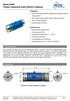 Properties Free of float metal bellow coupling with integrated torque measurement Non-contact measurement system, high robustness High torsional stiffness Limited torque of inertia Performance Measurement
Precise Modelling of a Gantry Crane System Including Friction, 3D Angular Swing and Hoisting Cable Flexibility
 Precise Modelling of a Gantry Crane System Including Friction, 3D Angular Swing and Hoisting Cable Flexibility Renuka V. S. & Abraham T Mathew Electrical Engineering Department, NIT Calicut E-mail : [email protected],
ME 343: Mechanical Design-3
 ME 343: Mechanical Design-3 Design of Shaft (continue) Dr. Aly Mousaad Aly Department of Mechanical Engineering Faculty of Engineering, Alexandria University Objectives At the end of this lesson, we should
Highly flexible couplings
 Construction and operation 8.03.00 Instructions for installation 8.03.00 Types of stress 8.04.00 Diagrams for static deformation of the coupling ring 8.05.00 Coupling size 8.07.00 Examples of combinations
KINETIC ENERGY RECOVERY SYSTEM BY MEANS OF FLYWHEEL ENERGY STORAGE
 ADVANCED ENGINEERING 3(2009)1, ISSN 1846-5900 KINETIC ENERGY RECOVERY SYSTEM BY MEANS OF FLYWHEEL ENERGY STORAGE Cibulka, J. Abstract: This paper deals with the design of Kinetic Energy Recovery Systems
CAE -Finite Element Method
 16.810 Engineering Design and Rapid Prototyping CAE -Finite Element Method Instructor(s) Prof. Olivier de Weck January 11, 2005 Plan for Today Hand Calculations Aero Æ Structures FEM Lecture (ca. 45 min)
EFFECTS ON NUMBER OF CABLES FOR MODAL ANALYSIS OF CABLE-STAYED BRIDGES
 EFFECTS ON NUMBER OF CABLES FOR MODAL ANALYSIS OF CABLE-STAYED BRIDGES Yang-Cheng Wang Associate Professor & Chairman Department of Civil Engineering Chinese Military Academy Feng-Shan 83000,Taiwan Republic
How To Design A Bevel And Hypoid Gear Drive
 New Developments in Tooth Contact Analysis (TCA) and Loaded TCA for Spiral Bevel and Hypoid Gear Drives Dr. Qi Fan and Dr. Lowell Wilcox This article is printed with permission of the copyright holder
COMPUTATIONAL FLUID DYNAMICS (CFD) ANALYSIS OF INTERMEDIATE PRESSURE STEAM TURBINE
 Research Paper ISSN 2278 0149 www.ijmerr.com Vol. 3, No. 4, October, 2014 2014 IJMERR. All Rights Reserved COMPUTATIONAL FLUID DYNAMICS (CFD) ANALYSIS OF INTERMEDIATE PRESSURE STEAM TURBINE Shivakumar
Simulation-News in Creo 1.0. Urs Simmler MCAD Simulation Specialist
 Simulation-News in Creo 1.0 Urs Simmler MCAD Simulation Specialist MECHANICA-News in Creo 1.0 Urs Simmler MCAD Simulation Specialist Creo Simulation App Standalone Mechanica Application > Dedicated User
CAE -Finite Element Method
 16.810 Engineering Design and Rapid Prototyping Lecture 3b CAE -Finite Element Method Instructor(s) Prof. Olivier de Weck January 16, 2007 Numerical Methods Finite Element Method Boundary Element Method
EDUMECH Mechatronic Instructional Systems. Ball on Beam System
 EDUMECH Mechatronic Instructional Systems Ball on Beam System Product of Shandor Motion Systems Written by Robert Hirsch Ph.D. 998-9 All Rights Reserved. 999 Shandor Motion Systems, Ball on Beam Instructional
TWO-DIMENSIONAL FINITE ELEMENT ANALYSIS OF FORCED CONVECTION FLOW AND HEAT TRANSFER IN A LAMINAR CHANNEL FLOW
 TWO-DIMENSIONAL FINITE ELEMENT ANALYSIS OF FORCED CONVECTION FLOW AND HEAT TRANSFER IN A LAMINAR CHANNEL FLOW Rajesh Khatri 1, 1 M.Tech Scholar, Department of Mechanical Engineering, S.A.T.I., vidisha
Finite Element Method
 16.810 (16.682) Engineering Design and Rapid Prototyping Finite Element Method Instructor(s) Prof. Olivier de Weck [email protected] Dr. Il Yong Kim [email protected] January 12, 2004 Plan for Today FEM Lecture
How To Write An Analysis System For Bridge Test
 Study of Analysis System for Bridge Test Chen Ke, Lu Jian-Ming, Research Institute of Highway, 100088, Beijing, China ([email protected], [email protected]) Summary Analysis System for Bridge Test (Chinese
Integration of a fin experiment into the undergraduate heat transfer laboratory
 Integration of a fin experiment into the undergraduate heat transfer laboratory H. I. Abu-Mulaweh Mechanical Engineering Department, Purdue University at Fort Wayne, Fort Wayne, IN 46805, USA E-mail: [email protected]
CHAPTER 4 4 NUMERICAL ANALYSIS
 41 CHAPTER 4 4 NUMERICAL ANALYSIS Simulation is a powerful tool that engineers use to predict the result of a phenomenon or to simulate the working situation in which a part or machine will perform in
CHAPTER 3. INTRODUCTION TO MATRIX METHODS FOR STRUCTURAL ANALYSIS
 1 CHAPTER 3. INTRODUCTION TO MATRIX METHODS FOR STRUCTURAL ANALYSIS Written by: Sophia Hassiotis, January, 2003 Last revision: February, 2015 Modern methods of structural analysis overcome some of the
Compensation of Thermal Effects on Machine Tools using a FDEM Simulation Approach
 Compensation of Thermal Effects on Machine Tools using a FDEM Simulation Approach Josef Mayr, Markus Ess 2, Sascha Weikert 2, Konrad Wegener,2 IWF Institute of Machine Tools and Manufacturing, ETH Zurich,
A NUMERICAL AND EXPERIMENTAL STUDY OF THE FACTORS THAT INFLUENCE HEAT PARTITIONING IN DISC BRAKES
 FISITA2010-SC-P-26 A NUMERICAL AND EXPERIMENTAL STUDY OF THE FACTORS THAT INFLUENCE HEAT PARTITIONING IN DISC BRAKES Loizou, Andreas *, Qi, Hong-Sheng, Day, Andrew J University of Bradford, UK KEYWORDS
Manufacturing Equipment Modeling
 QUESTION 1 For a linear axis actuated by an electric motor complete the following: a. Derive a differential equation for the linear axis velocity assuming viscous friction acts on the DC motor shaft, leadscrew,
Frequecy Comparison and Optimization of Forged Steel and Ductile Cast Iron Crankshafts
 International Journal of Engineering Science Invention ISSN (Online): 2319 6734, ISSN (Print): 2319 6726 Volume 2 Issue 11ǁ November2013 ǁ PP.38-45 Frequecy Comparison and Optimization of Forged Steel
Compatibility and Accuracy of Mesh Generation in HyperMesh and CFD Simulation with Acusolve for Torque Converter
 Compatibility and Accuracy of Mesh Genen in HyperMesh and CFD Simulation with Acusolve for Converter Kathiresan M CFD Engineer Valeo India Private Limited Block - A, 4th Floor, TECCI Park, No. 176 Rajiv
RESONANCE PASSAGE OF CYCLIC SYMMETRIC STRUCTURES
 11 th International Conference on Vibration Problems Z. Dimitrovová et.al. (eds.) Lisbon, Portugal, 9 12 September 213 RESONANCE PASSAGE OF CYCLIC SYMMETRIC STRUCTURES Marius Bonhage* 1, Lars Panning-v.Scheidt
Adaptive feature selection for rolling bearing condition monitoring
 Adaptive feature selection for rolling bearing condition monitoring Stefan Goreczka and Jens Strackeljan Otto-von-Guericke-Universität Magdeburg, Fakultät für Maschinenbau Institut für Mechanik, Universitätsplatz,
Slide 10.1. Basic system Models
 Slide 10.1 Basic system Models Objectives: Devise Models from basic building blocks of mechanical, electrical, fluid and thermal systems Recognize analogies between mechanical, electrical, fluid and thermal
CHAPTER 3 MODAL ANALYSIS OF A PRINTED CIRCUIT BOARD
 45 CHAPTER 3 MODAL ANALYSIS OF A PRINTED CIRCUIT BOARD 3.1 INTRODUCTION This chapter describes the methodology for performing the modal analysis of a printed circuit board used in a hand held electronic
Mechanical Design of Turbojet Engines. An Introduction
 Mechanical Design of Turbomachinery Mechanical Design of Turbojet Engines An Introduction Reference: AERO0015-1 - MECHANICAL DESIGN OF TURBOMACHINERY - 5 ECTS - J.-C. GOLINVAL University of Liege (Belgium)
Torque Sensor Technical Information
 Torque Sensor Technical Information Highlights Introduction to torque sensors Glossary of terms Figure 1. Wheatstone Bridge Principle of Operation All torque sensors manufactured by PCB are strain gage
Finite Element Formulation for Beams - Handout 2 -
 Finite Element Formulation for Beams - Handout 2 - Dr Fehmi Cirak (fc286@) Completed Version Review of Euler-Bernoulli Beam Physical beam model midline Beam domain in three-dimensions Midline, also called
SLOT FRINGING EFFECT ON THE MAGNETIC CHARACTERISTICS OF ELECTRICAL MACHINES
 Journal of ELECTRICAL ENGINEERING, VOL. 60, NO. 1, 2009, 18 23 SLOT FRINGING EFFECT ON THE MAGNETIC CHARACTERISTICS OF ELECTRICAL MACHINES Mohammad B. B. Sharifian Mohammad R. Feyzi Meysam Farrokhifar
Bearing Technical Calculation System for Machine Tool Spindles
 [ Technical Article ] Bearing Technical Calculation System for Machine Tool Spindles Customer Data sent by email Keiichi UEDA* Yushi ONDA* Shouhei HASHIZUME* Data received by email 24 hour/7 day support
Expert spindle design system
 International Journal of Machine Tools & Manufacture 45 (2005) 537 548 www.elsevier.com/locate/ijmactool Expert spindle design system Osamu Maeda, Yuzhong Cao, Yusuf Altintas* Manufacturing Automation
STUDY OF DAM-RESERVOIR DYNAMIC INTERACTION USING VIBRATION TESTS ON A PHYSICAL MODEL
 STUDY OF DAM-RESERVOIR DYNAMIC INTERACTION USING VIBRATION TESTS ON A PHYSICAL MODEL Paulo Mendes, Instituto Superior de Engenharia de Lisboa, Portugal Sérgio Oliveira, Laboratório Nacional de Engenharia
Comparison of the Response of a Simple Structure to Single Axis and Multiple Axis Random Vibration Inputs
 Comparison of the Response of a Simple Structure to Single Axis and Multiple Axis Random Vibration Inputs Dan Gregory Sandia National Laboratories Albuquerque NM 87185 (505) 844-9743 Fernando Bitsie Sandia
INDUCTION REGULATOR. Objective:
 INDUCTION REGULATOR Objective: Using a wound rotor induction motor an Induction Regulator, study the effect of rotor position on the output voltage of the regulator. Also study its behaviour under load
Technical Information. Hydrostatic Spindles. Hydrostatik by Hyprostatik. Innovative Spindle Concepts
 Technical Information Hydrostatic Spindles Hydrostatik by Hyprostatik Innovative Spindle Concepts 2 Table of contents 1. Advantages and disadvantages of hydrostatic spindles 4 1.1 Advantages of hydrostatic
Comparison of Bearings --- For the Bearing Choosing of High-speed Spindle Design. Xiaofan Xie. Dept. of Mechanical Engineering, University of Utah
 Comparison of Bearings --- For the Bearing Choosing of High-speed Spindle Design Xiaofan Xie Dept. of Mechanical Engineering, University of Utah ABSTRACT: Bearing is the most important part of my project
A. Hyll and V. Horák * Department of Mechanical Engineering, Faculty of Military Technology, University of Defence, Brno, Czech Republic
 AiMT Advances in Military Technology Vol. 8, No. 1, June 2013 Aerodynamic Characteristics of Multi-Element Iced Airfoil CFD Simulation A. Hyll and V. Horák * Department of Mechanical Engineering, Faculty
IP40 or IP64 (EN 60529) Protection class housing. IP50 (IP65 optional) (EN 60529) Minimum length of mountig
 Through hollow shaft Ø 5 bis 4 mm Outside diameter only 76 mm Easy installation by means of clamping ring front or rear Operating temperature up to 00 C Applications: motors, printing machines, lifts NUMBER
PLQE. The base of the economy gearboxes with square output flange. Economy Line. Formerly PLE
 20 ormerly PL The base of the economy gearboxes with square output flange The PL series with square output flange. A powerful alternative for additional higher radial and axial loads. Low backlash High
Structural Integrity Analysis of the Charging Air Tube Support for a Diesel Engine of Commercial Vehicle
 2012-36-0457 Structural Integrity Analysis of the Charging Air Tube Support for a Diesel Engine of Commercial Vehicle Thiago Barão Negretti, Helio Kitagawa T-Systems do Brasil Antonio Augusto Couto Universidade
Dynamics of Offshore Wind Turbines
 Proceedings of the Twenty-first (2011) International Offshore and Polar Engineering Conference Maui, Hawaii, USA, June 19-24, 2011 Copyright 2011 by the International Society of Offshore and Polar Engineers
Aeroelastic Investigation of the Sandia 100m Blade Using Computational Fluid Dynamics
 Aeroelastic Investigation of the Sandia 100m Blade Using Computational Fluid Dynamics David Corson Altair Engineering, Inc. Todd Griffith Sandia National Laboratories Tom Ashwill (Retired) Sandia National
Torque motors. direct drive technology
 Torque motors direct drive technology Why Direct Drive Motors? Fast and effective Direct-drive technology in mechanical engineering is defined as the use of actuators which transfer their power directly
A Simulation Study on Joint Velocities and End Effector Deflection of a Flexible Two Degree Freedom Composite Robotic Arm
 International Journal of Advanced Mechatronics and Robotics (IJAMR) Vol. 3, No. 1, January-June 011; pp. 9-0; International Science Press, ISSN: 0975-6108 A Simulation Study on Joint Velocities and End
ZKL Bearings for Railway Rolling Stock
 2 ZKL Bearings for Railway Rolling Stock ZKL Bearings for Railway Rolling Stock Railway industry is a very prospective sector worldwide and therefore ZKL pays particular attention to bearings for railway
INTERACTION BETWEEN MOVING VEHICLES AND RAILWAY TRACK AT HIGH SPEED
 INTERACTION BETWEEN MOVING VEHICLES AND RAILWAY TRACK AT HIGH SPEED Prof.Dr.Ir. C. Esveld Professor of Railway Engineering TU Delft, The Netherlands Dr.Ir. A.W.M. Kok Associate Professor of Railway Engineering
Feature Commercial codes In-house codes
 A simple finite element solver for thermo-mechanical problems Keywords: Scilab, Open source software, thermo-elasticity Introduction In this paper we would like to show how it is possible to develop a
Joints Workshop Vibration and Turbomachinery
 Vibration University Technology Centre Joints Workshop Vibration and Turbomachinery Muzio M. Gola Professor of Machine Design Team leader LAQ AERMEC DIMEAS -POLITO [email protected] C. Schwingshackl
Clutch and Operation as a System
 Clutch and Operation as a System Dipl.-Ing. Matthias Zink Dipl.-Ing. René Shead Introduction New technologies and increasing demands for comfort, require increased total system thinking, also in the area