
China Meteorological Administration
|
|
|
- Augustus Walton
- 10 years ago
- Views:
Transcription
1 Public-, security-, and resource-oriented meteorology China Meteorological Administration CMA 1

2 China Meteorological Administration Overview President HU Jintao, inspecting the Lanzhou Central Meteorological Office. The meteorological services and meteorologists across China are committed to developing the country, serving the society and benefiting the people. With your diligent work, pioneering spirit and unremitting exploratory efforts, you have made outstanding contributions to promoting economic and social development, safeguarding people s lives, health and well-being, and maintaining national security. Meteorology is of vital importance to the national economy and people s livelihood. As global climate change is intensifying and the economy and society are developing rapidly in China, meteorological services will play an increasingly prominent role and undertake growing tasks. I hope that you will step up your efforts to research and gain a better understanding of climatic behavior, vigorously promote meteorological science and technology innovation, and continuously improve capabilities in making meteorological predictions and forecasts. By preventing and mitigating meteorological disasters, coping with climate change, and exploiting climate resources, you provide strong support to building a moderately prosperous society in all respects and accelerate the socialist modernization drive, as well as make positive contributions to improving the global environment and promoting the sustainable development of human society. 02 HU Jintao President of China

3 Public-, security-, and resource-oriented meteorology Premier WEN Jiabao listening to the report on the development of China's meteorological satellites at the National Satellite Meteorological Centre. It is important to follow the direction of the development of public meteorological service, give top priority to the improvement of meteorological services, promote scientific and technological innovations, enhance the development of first-class equipment, first-class technologies, first-class human resources and first-class weather stations. Thus we build up a powerful, world-leading and modernized meteorological system for providing the first-class meteorological services for socioeconomic development, people s lives and national security. Premier WEN Jiabao The meteorological work has never been so attended by the government at various levels as it is today; it has never drawn so much attention from social communities as today; it has never been so popular among the general public as today; and it has never been so closely attended by the international community as today. HUI Liangyu Vice Premier Hui Liangyu met with the selected CMA staff, whose performances in major meteorological service delivery were well recognized. CMA 03

4 Foreword China is one of the countries in the world which are often seriously hit by meteorological disasters. Each year, up to 400 million people are affected by various meteorological hazards such as typhoons, heavy rainfall/snowfall, droughts, dust storms, lightning, hailstorms, frost, high winds, heavy fog, high temperatures, low temperatures and cold injury, tornadoes, as well as secondary disasters induced by heavy rain, including floods, flash floods, landslides, mud flow, etc.. The total economic loss is equivalent to 1%-3% of GDP. Therefore, it is of highly practical significance to provide accurate and timely weather forecasts and warnings, and to improve the capability of the whole society in preventing disastrous events for ensuring the maximum protection of people s lives, property, economic development and social progress. Situated in East Asia, facing the West coast of the Pacific Ocean, China has a land area of about 9,600,000 km2 and a sea area of more than 4,700,000 km2. China spans across five climate zones, featuring a monsoon climate, and abundant climate resources. Exploration of wind and solar energies, agro- and eco- climate resources, and atmospheric water resources has a huge potential, which would have enormous economic, environmental and ecological value when these resources are transferred into practical productivity. Climate change has led to a shortage of water resources, extensive droughts, sea level rise, glacier retreat, desertification, food output fluctuation and epidemic disease, which have posed serious threats to food, energy, water resources, ecological environment and public health. This affectis the survival and development of mankind, and deeply hinders our security. It is a common issue faced by human societies, a currently high profile international issue, and a realistic threat to China's sustainable economic and social development. The meteorological service falls into a category of fundamental public good, which is based on relevant sciences and technologies and oriented to the whole society. The Chinese Government has always attached great importance to the meteorological service. Under a series of major policies and measures such as The Meteorology Law of the People s Republic of China (promulgated on 1 January 2000), Some Comments Made by the State Council on Accelerating the Development of the Chinese Meteorological Service (GF [2006] No. 3), China s National Climate Change Programme (issued and implemented in
5 June 2007), Some Comments Made by the General Office of the State Council on Further Strengthening Meteorological Disaster Prevention (GBF [2007] No. 49), and Regulations on Prevention of and Preparedness for Meteorological Disasters the Chinese meteorological service has made substantial achievements. At present, the China Meteorological Administration (CMA) has established an integrated meteorological observing system incorporating space-based, airborne and groundbased observations, which has steadily improved the accuracy of weather forecasts and climate predictions. Its operational system has witnessed allround development covering climate change prediction & projection, weather modification, thunderstorm & lightning detection, forecasting and warning, eco- and agro-meteorological forecasts & services, atmospheric composition monitoring and service delivery, and space weather monitoring & warning, etc. All these have quickened the pace of the meteorological modernization, with significant economic, social and ecological benefits being achieved. Looking forward, the Chinese meteorological work will take scientific development as its theme, and regard change of the development modality as its pathway, adhering to public meteorology as the direction of its development and always giving the highest priority to the further improvement of its meteorological services. We shall continuously pursue in-depth reform and opening-up, and strongly promote scientific and technological innovations in meteorology. According to requirements for accumulating first-class equipment, technology, human resources and stations, we shall constantly improve our capabilities in making meteorological predictions and forecasts, in prevention and mitigation of meteorological disasters, in response to climate change, and in exploiting climate resources, in order to build up a world-class advanced meteorological modernization system, and to make a new and even greater contribution to economic development, social progress, all-round construction of a better-off society by providing first-class meteorological services for people s livelihood and national security, and to the advance of the great socialist cause with Chinese characteristics! Dr. ZHENG Guoguang Administrator China Meteorological Administration

6 China Meteorological Administration Overview CONTENTS 01 Overview 10 Meteorological Disaster Prevention & Mitigation 12 Response to Climate Change 16 Modernized Meteorological Operation 34 Scientific & Technological Innovation 37 Human Resources 39 Legal System Construction 41 International Cooperation 44 Meteorological Culture 06
7 OVERVIEW Mandates Formulating policies, legal and regulatory frameworks, development strategies and long-term plans governing meteorological services; formulating and issuing rules and regulations, technical standards and practices governing meteorological services, and supervising their execution; undertaking relevant administrative reviews. Participating in the central government decision-making process in meteorological disaster prevention, preparedness and mitigation; organizing a joint trans-regional and inter-departmental prevention campaign to combat major severe weather events; organizing and guiding the efforts to prevent and mitigate disasters induced by thunderstorm & lightning, heavy fog and other meteorological disasters; and being responsible for managing the local weather modification operations. Organizing to formulate and implement the plans for meteorological disaster prevention and preparedness; organizing the management work in emergency response to meteorological disaster prevention and preparedness; being responsible for providing meteorological support for public events; undertaking the operation and management of the early warning issuance platform for the nationwide public events. Formulating and implementing plans for meteorological disaster prevention and preparedness; organizing the management work for emergency responses to meteorological disaster prevention and preparedness; being responsible for providing meteorological support for public events; undertaking the operation and management of the early warning issuance platform for nationwide public events. Exercising management on the national weather forecasts and warnings, short-term climate predictions, urban environment-oriented meteorological forecasts, fire risk weather forecasts, space weather monitoring and warning and the issuance of climate impact assessments; organizing and guiding the exploitation and conservation of climatic resources; organizing and reviewing the meteorological certifications of state key construction projects, major regional economic development projects, and urban & rural construction planning. Organizing major meteorological research projects, and promoting wider applications of the proven research findings to meteorological operations; guiding and coordinating meteorological education and training; organizing the public outreach of meteorological knowledge to increase public awareness of meteorological disaster prevention & mitigation and climate resources. Managing international cooperative activities in meteorology; participating in activities of the World Meteorological Organization and other international meteorological institutions on behalf of the Chinese government; and conducting cooperation and exchanges with the meteorological institutions of other countries or regions. Providing leadership for the meteorological establishments nationwide; managing as the main governing body the meteorological bureaus at the provincial level in terms of planning and finance, institutional structures, personnel and human resources, scientific research, training and operational development; and guiding the development of local meteorological services. Assisting local people s governments in guiding ideological and cultural activities of local meteorological staff. Undertaking any other tasks assigned by the State Council. CMA 01
8 CMA Leading Team Dr. ZHENG Guoguang Administrator of the China Meteorological Administration 02

9 Dr. XU Xiaofeng Deputy Administrator of the CMA Dr. YU Rucong Deputy Administrator of the CMA Mr. SHEN Xiaonong Deputy Administrator of the CMA Ms. JIAO Meiyan Deputy Administrator of the CMA Mr. LIU Shi Chief of the Discipline Inspection Group Dr. YU Xinwen Deputy Administrator of the CMA CMA 03

10 China Meteorological Administration Overview Development Strategies Concept of development: Public-, security-, and resource-oriented meteorology Objective: Establishing a comprehensive modernized meteorological service system by 2020 Development and deployment of meteorological services with Chinese characteristics over the next 5 years: Centering on enhancing the meteorological service capability for the overall construction of a well-off society, focusing on building a modern meteorological service system, based on national meteorological science & technology innovation system and meteorological human resource system, and ultimately, laying a firm foundation for establishing a comprehensive modernized meteorological service system by Six requirements: To further enhance the meteorological service capability for the overall construction of a well-off society; To further emphasize meteorological disaster preparedness and mitigation; To further strengthen responses to climate change; To further coordinate the overall development of the meteorological service; To further deepen reform and opening up; To further promote the CPC buildup and meteorological culture. Some Comments Made by the State Council on Accelerating the Development of the Chinese Meteorological Service Under the leadership of the State Council, the China Meteorological Administration (CMA) organized the Research on the Chinese Meteorological Development Strategy. On 12 January 2006, Some Comments Made by the State Council on Accelerating the Development of the Chinese Meteorological Service ([2006] No.3) was issued, requesting that all regions and departments must attach greater importance to meteorological services, incorporate meteorological services into national economic and social development plans and scientific & technological development plans. Also to further refine the objectives and requirements for accelerating the development of the meteorological services and expedite the development and implementation of specific measures with coordinated arrangements and strengthened collaboration, so as to promote the overall, coordinated and sustainable development of the meteorological services. The meteorological services fall into a category of fundamental public good, which is based on relevant sciences and technologies and oriented to the whole society; Accelerating the development of meteorological services is in urgent need for addressing emergency events and securing people s lives and their property; Accelerating the development of meteorological services is in urgent need for responding to global climate change and ensuring national security; Accelerating the development of meteorological services is in urgent need for responding to strains on natural resources and ensuring sustainable development. 04
11 Public-, security-, and resource-oriented meteorology Guideline for Accelerating the Development of Meteorological Service The scientific development concept shall be implemented in all aspects. Meteorological services shall always be targeted to the public. To be first-class in equipment, techonology staff and stations, it is necessary to further strengthen the groundwork for observation, to improve weather forecasts and climate prediction skills, and to speed up scientific and technological innovations. Efforts shall be made to set up a modern meteorological system that is advanced in a global context in order to enhance the role of meteorology in support of economic and social development, national security and sustainability, and to deliver first-class meteorological services for the emerging harmonious and well-off society. Goals of the Meteorological Development By 2020, an advanced, well-structured and functioned modern meteorological system is expected to be set up so that the meteorological performance will approach a world-leading level, reaching such a level in some areas. Comments made by the General Office of the State Council on Fur-ther Strengthening Meteorological Disaster Prevention On 5 July 2007, the General Office of the State Council issued the Comments on Further Strengthening Meteorological Disaster Prevention (GBF [2007] No. 49), requesting that great importance be attached to the meteorological disaster prevention and preparedness in all localities and by all departments, and that disaster prevention, mitigation and response skills be improved across the whole society to minimize losses arising from meteorological disasters and to ensure the safety of people s lives and property. General Requirements for Strengthening Meteorological Disaster Prevention The people-first, prevention-oriented, and prevention/control-combined approach shall be pursued. Science and technology, rules and regulations, and the general public shall be relied upon. Overall planning and specific guidance shall be prepared and provided. A meteorological disaster prevention and preparedness plan shall be developed and implemented. A prevention and mitigation system shall be set up at a faster pace at national and local levels. The groundwork for disaster prevention and mitigation shall be strengthened. Monitoring and warning, combined prevention efforts, emergency responses and rescue and relief of all meteorological disasters shall be enhanced effectively. All these are aimed at improving disaster management of the whole society, and promoting coordinated and sustainable socio-economic development. Improving Meteorological Disaster Monitoring & Warning Enhancing Emergency Response to Meteorological Disasters Further Improving the Disaster Prevention & Management System Strengthening Leadership and Public Outreach Strengthening the integrated meteorological disaster monitoring system Strengthening disaster forecasts & prediction Strengthening the dissemination of meteorological disaster warning & advisories Developing an improved emergency response program Actively carrying out weather modification operations Building up an emergency rescue team Strengthening the capacity for disaster relief Strengthening the supportive role of science & technology Developing relevant regulations & standards Increasing financial input Fully implementing accountability for disaster prevention & mitigation Further strengthening the coordination with relevant departments Strengthening popular science education to increase public awareness CMA 05

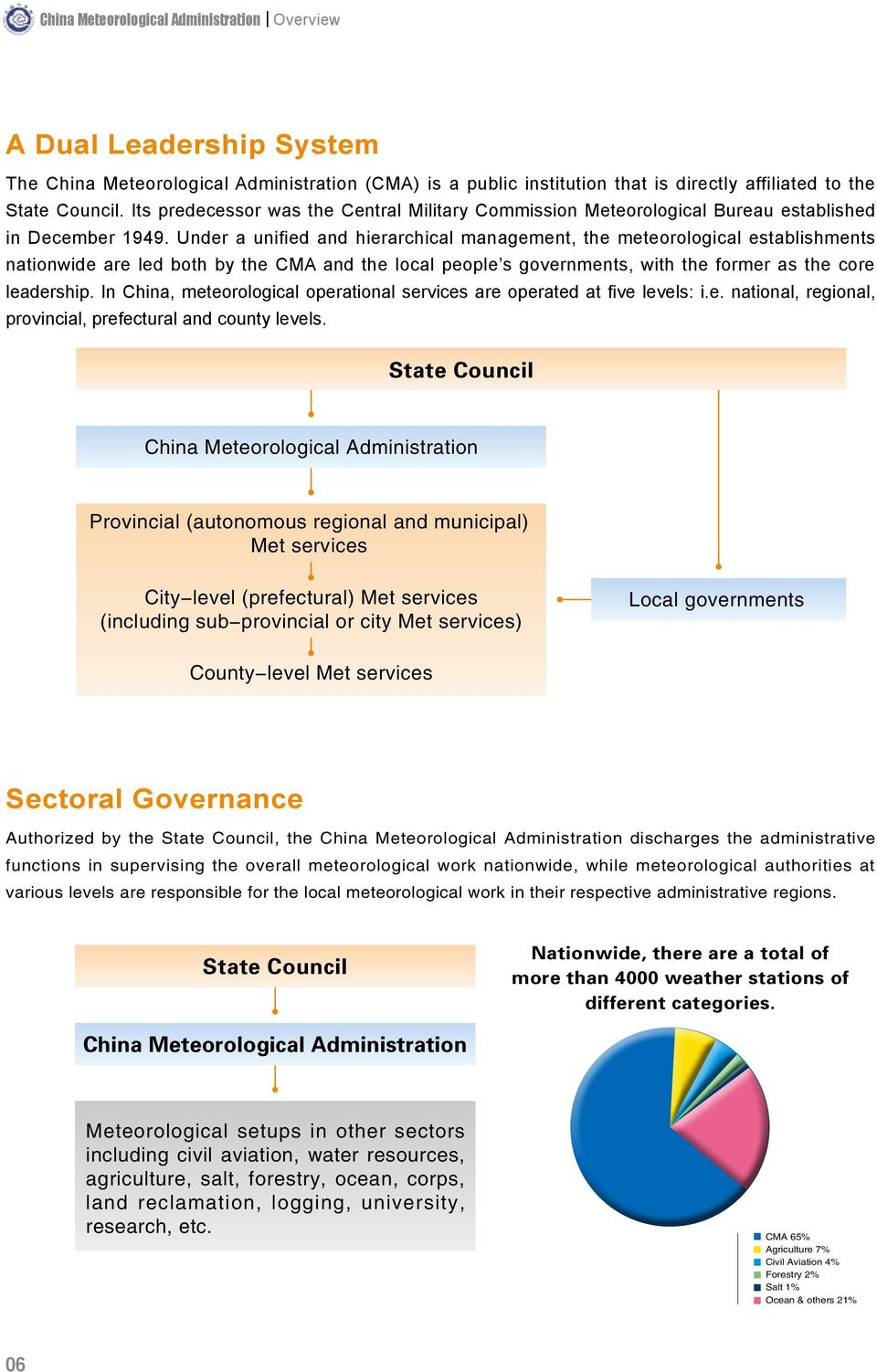
12 China Meteorological Administration Overview A Dual Leadership System The China Meteorological Administration (CMA) is a public institution that is directly affiliated to the State Council. Its predecessor was the Central Military Commission Meteorological Bureau established in December Under a unified and hierarchical management, the meteorological establishments nationwide are led both by the CMA and the local people s governments, with the former as the core leadership. In China, meteorological operational services are operated at five levels: i.e. national, regional, provincial, prefectural and county levels. State Council China Meteorological Administration Provincial (autonomous regional and municipal) Met services City-level (prefectural) Met services (including sub-provincial or city Met services) Local governments County-level Met services Sectoral Governance Authorized by the State Council, the China Meteorological Administration discharges the administrative functions in supervising the overall meteorological work nationwide, while meteorological authorities at various levels are responsible for the local meteorological work in their respective administrative regions. State Council Nationwide, there are a total of more than 4000 weather stations of different categories. China Meteorological Administration Meteorological setups in other sectors including civil aviation, water resources, agriculture, salt, forestry, ocean, corps, land reclamation, logging, university, research, etc. CMA 65% Agriculture 7% Civil Aviation 4% Forestry 2% Salt 1% Ocean & others 21% 06
13 Public-, security-, and resource-oriented meteorology Organizational Structure China Meteorological Administration Internal bodies Designated body Institutions under CMA Headquarters Office Department of Emergency Response, Disaster Mitigation and Public Services Department of Forecasting and Networking Discipline Inspection Group dispatched to the CMA by the Central Discipline Inspection Committee National Meteorological Centre (NMC) National Climate Centre (NCC) National Satellite Meteorological Centre (NSMC) Department of Integrated Observations Department of Science & Technology and Climate Change Department of Planning and Finance Department of Human Resources Department of Policy and Regulations Department of International Cooperation CMA CPC Committee Headquarters Office for Retirees National Meteorological Information Centre (NMIC) CMA Meteorological Observation Centre (MOC) CMA Public Meteorological Services Centre (PMSC) Chinese Academy of Meteorological Sciences (CAMS) CMA Training Centre (CMATC) CMA In-House Service Centre (ISC) China Meteorological News (CMN) By the end of 2010, within the CMA framework (excluding Hong Kong, Macao, Taiwan and Hainan Meteorological services), the following establishments have been set up: 30 provincial (autonomous regional and municipal) meteorological services, 14 Met bureaus of sub-provincial cities (including 4 cities that are specifically designated in the state development plan), 319 prefectural (or city-level) Met services and 2440 county Met services (stations). CMA 07

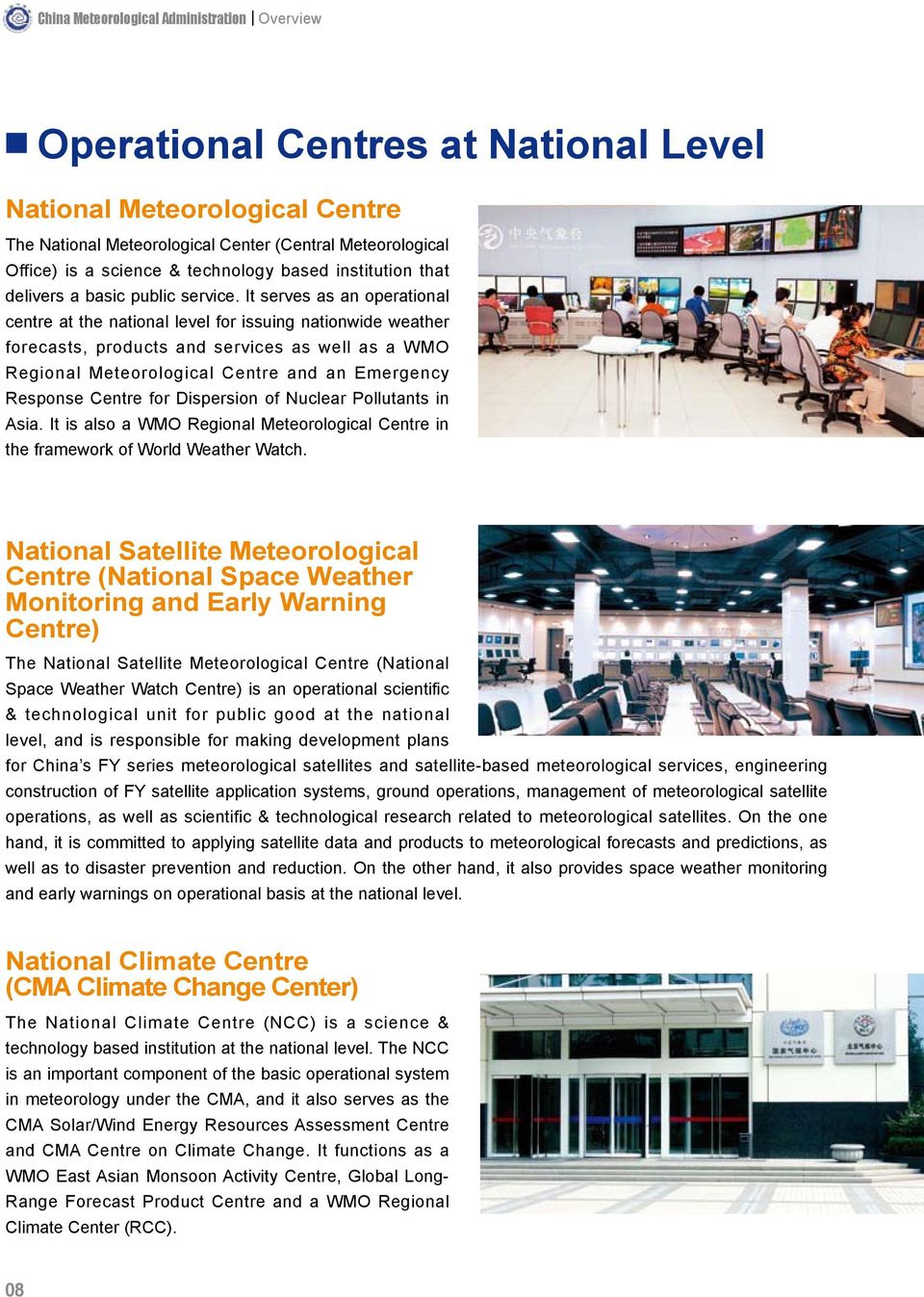
14 China Meteorological Administration Overview Operational Centres at National Level National Meteorological Centre The National Meteorological Center (Central Meteorological Office) is a science & technology based institution that delivers a basic public service. It serves as an operational centre at the national level for issuing nationwide weather forecasts, products and services as well as a WMO Regional Meteorological Centre and an Emergency Response Centre for Dispersion of Nuclear Pollutants in Asia. It is also a WMO Regional Meteorological Centre in the framework of World Weather Watch. National Satellite Meteorological Centre (National Space Weather Monitoring and Early Warning Centre) The National Satellite Meteorological Centre (National Space Weather Watch Centre) is an operational scientific & technological unit for public good at the national level, and is responsible for making development plans for China s FY series meteorological satellites and satellite-based meteorological services, engineering construction of FY satellite application systems, ground operations, management of meteorological satellite operations, as well as scientific & technological research related to meteorological satellites. On the one hand, it is committed to applying satellite data and products to meteorological forecasts and predictions, as well as to disaster prevention and reduction. On the other hand, it also provides space weather monitoring and early warnings on operational basis at the national level. National Climate Centre (CMA Climate Change Center) The National Climate Centre (NCC) is a science & technology based institution at the national level. The NCC is an important component of the basic operational system in meteorology under the CMA, and it also serves as the CMA Solar/Wind Energy Resources Assessment Centre and CMA Centre on Climate Change. It functions as a WMO East Asian Monsoon Activity Centre, Global Long- Range Forecast Product Centre and a WMO Regional Climate Center (RCC). 08
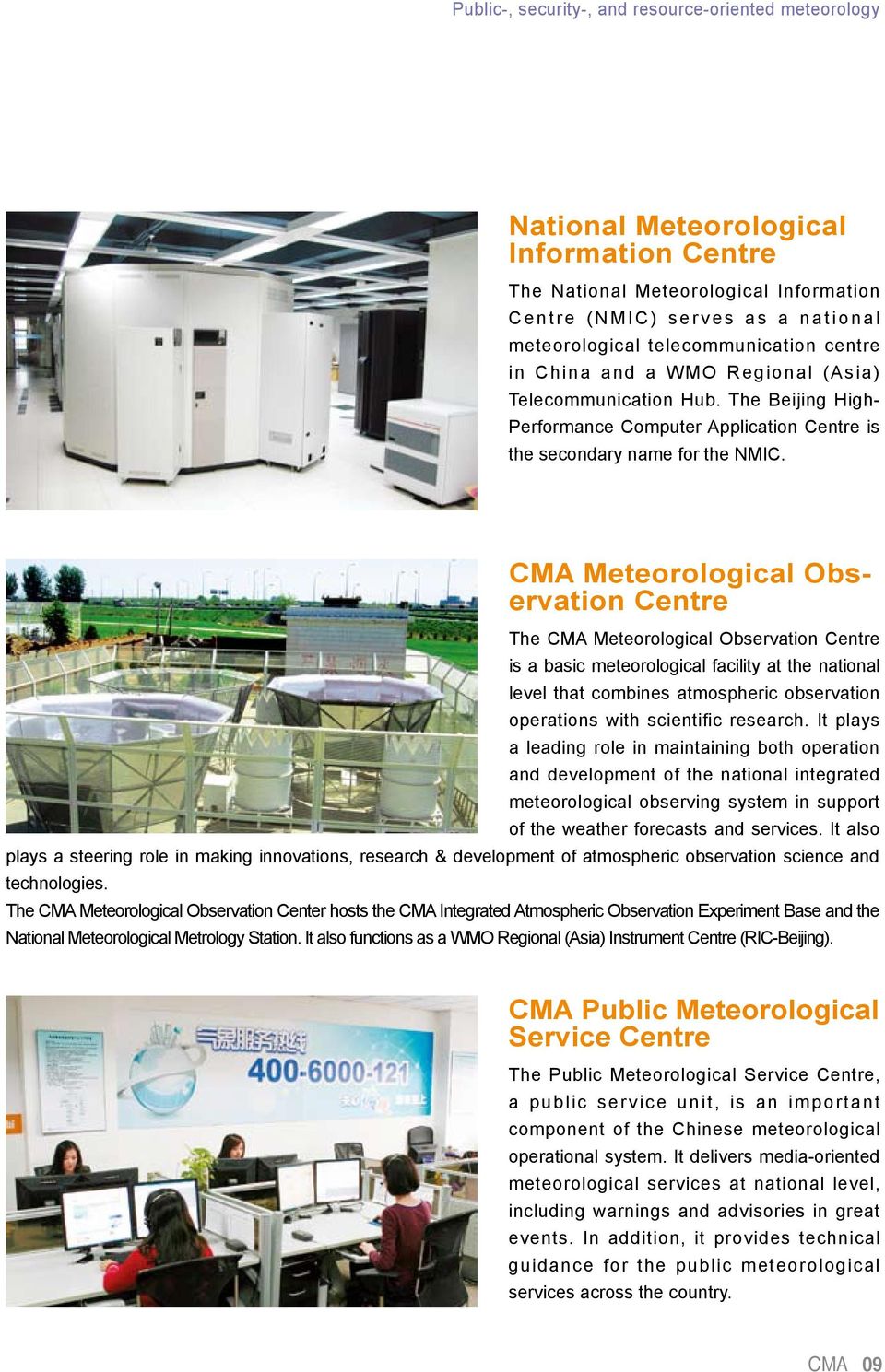
15 Public-, security-, and resource-oriented meteorology National Meteorological Information Centre The National Meteorological Information C e n t r e ( N M I C ) s e r v e s a s a n a t i o n a l meteorological telecommunication centre in China and a WMO Regional (Asia) Telecommunication Hub. The Beijing High- Performance Computer Application Centre is the secondary name for the NMIC. CMA Meteorological Observation Centre The CMA Meteorological Observation Centre is a basic meteorological facility at the national level that combines atmospheric observation operations with scientific research. It plays a leading role in maintaining both operation and development of the national integrated meteorological observing system in support of the weather forecasts and services. It also plays a steering role in making innovations, research & development of atmospheric observation science and technologies. The CMA Meteorological Observation Center hosts the CMA Integrated Atmospheric Observation Experiment Base and the National Meteorological Metrology Station. It also functions as a WMO Regional (Asia) Instrument Centre (RIC-Beijing). CMA Public Meteorological Service Centre The Public Meteorological Service Centre, a public service unit, is an important component of the Chinese meteorological operational system. It delivers media-oriented meteorological services at national level, including warnings and advisories in great events. In addition, it provides technical guidance for the public meteorological services across the country. CMA 09
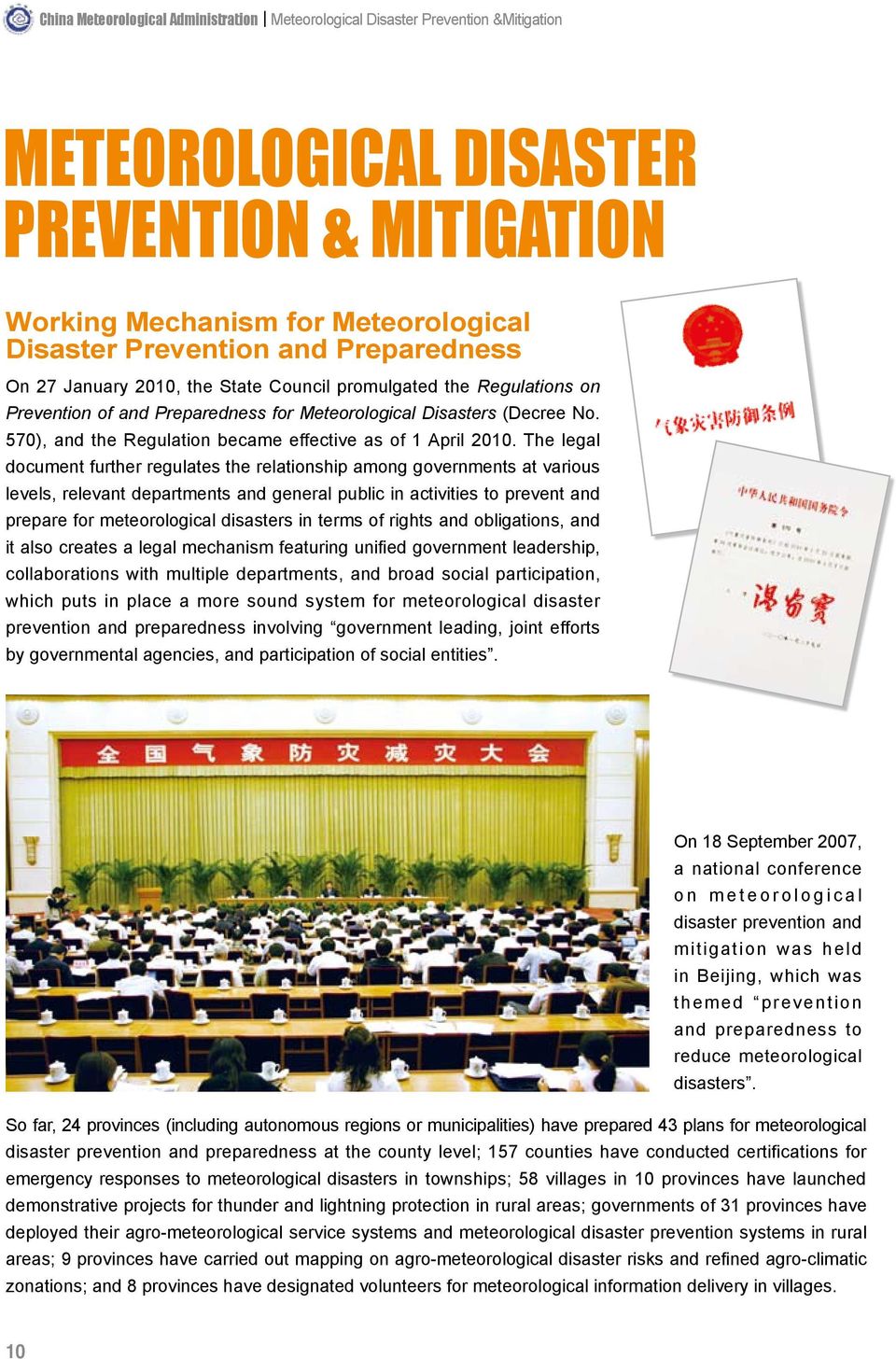
16 China Meteorological Administration Meteorological Disaster Prevention &Mitigation METEOROLOGICAL DISASTER PREVENTION & MITIGATION Working Mechanism for Meteorological Disaster Prevention and Preparedness On 27 January 2010, the State Council promulgated the Regulations on Prevention of and Preparedness for Meteorological Disasters (Decree No. 570), and the Regulation became effective as of 1 April The legal document further regulates the relationship among governments at various levels, relevant departments and general public in activities to prevent and prepare for meteorological disasters in terms of rights and obligations, and it also creates a legal mechanism featuring unified government leadership, collaborations with multiple departments, and broad social participation, which puts in place a more sound system for meteorological disaster prevention and preparedness involving government leading, joint efforts by governmental agencies, and participation of social entities. On 18 September 2007, a national conference o n m e t e o r o l o g i c a l disaster prevention and mitigation was held in Beijing, which was themed prevention and preparedness to reduce meteorological disasters. So far, 24 provinces (including autonomous regions or municipalities) have prepared 43 plans for meteorological disaster prevention and preparedness at the county level; 157 counties have conducted certifications for emergency responses to meteorological disasters in townships; 58 villages in 10 provinces have launched demonstrative projects for thunder and lightning protection in rural areas; governments of 31 provinces have deployed their agro-meteorological service systems and meteorological disaster prevention systems in rural areas; 9 provinces have carried out mapping on agro-meteorological disaster risks and refined agro-climatic zonations; and 8 provinces have designated volunteers for meteorological information delivery in villages. 10
17 Public-, security-, and resource-oriented meteorology Enhancing the inter-department synergy in meteorological disaster prevention and mitigation, to advance technical collaborations with multiple departments, and to refine specific cooperative items Through active implementation of the Regulations on Prevention of and Preparedness for Meteorological Disasters, the National Plan for Prevention of and Preparedness for Meteorological Disasters, and the National Plans for Emergency Response to Meteorological Disasters, an inter-department liaison conference on early warning and service delivery in case of meteorological disasters involving 25 governmental departments has been put into practice. A joint interview: interpreting the National Plans for Emergency Response to Meteorological Disasters The CMA has actively participated in preparation of the National Overall Plan for Harnessing Small and Mediumsized Rivers, Reinforcing Small Reservoirs, Preventing and Reducing Geological Disasters from Flash Floods, and Comprehensively Controlling Ecological Environment in Disaster-prone Areas, This is led by the National Development and Reform Commission. Together with the Ministry of Water Resources, Ministry of Finance, and Ministry of Land and Resources. The CMA is promoting the implementation of nationwide non-engineering measures against flash flood-related disasters at a county level. Increasing societal awareness and capabilities against meteorological disasters Enhancing public outreach of scientific knowledge for meteorological disaster prevention and mitigation in villages, schools, local communities, enterprises and public transport systems. CMA 11

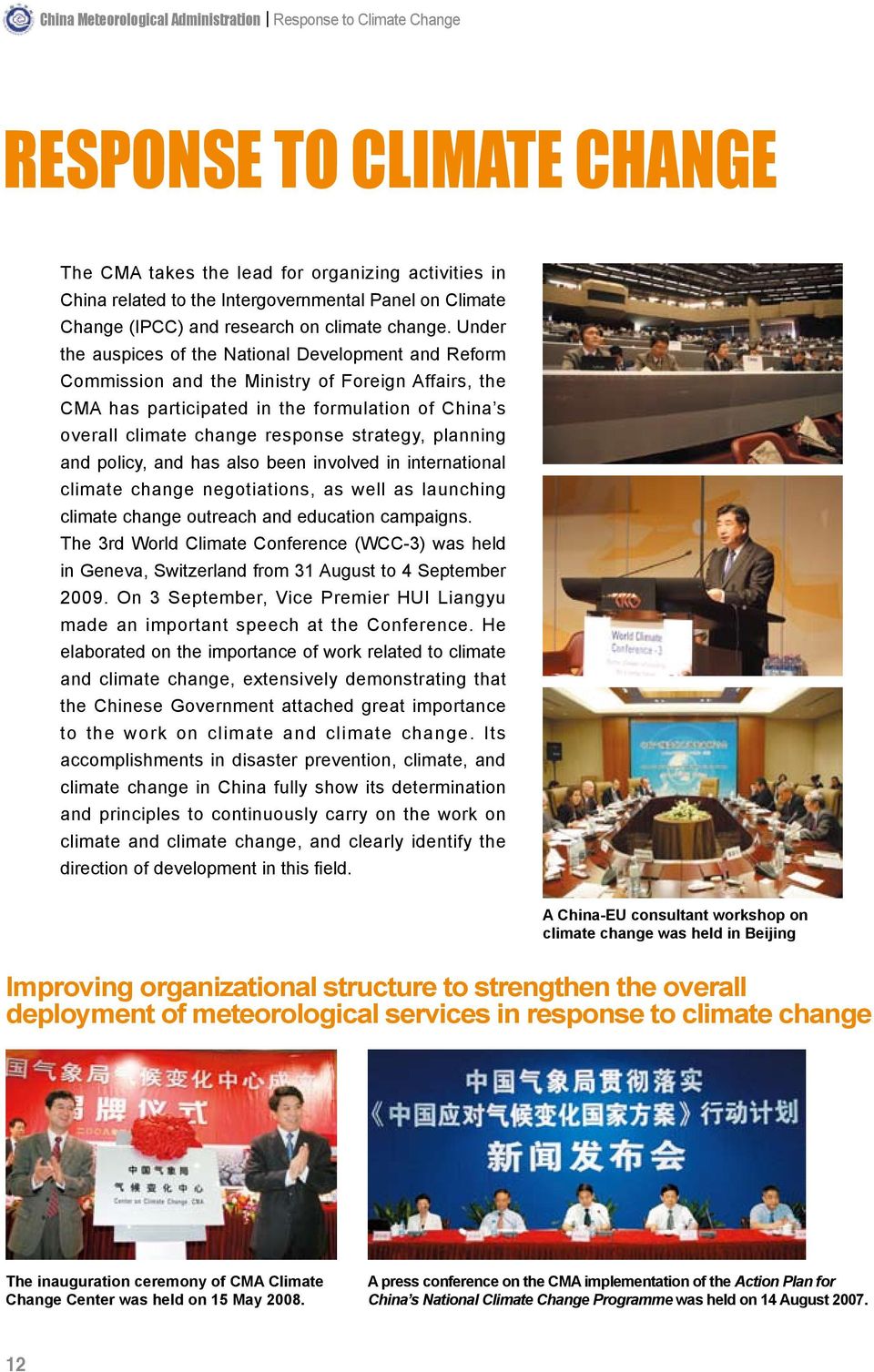
18 China Meteorological Administration Response to Climate Change RESPONSE TO CLIMATE CHANGE The CMA takes the lead for organizing activities in China related to the Intergovernmental Panel on Climate Change (IPCC) and research on climate change. Under the auspices of the National Development and Reform Commission and the Ministry of Foreign Affairs, the CMA has participated in the formulation of China s overall climate change response strategy, planning and policy, and has also been involved in international climate change negotiations, as well as launching climate change outreach and education campaigns. The 3rd World Climate Conference (WCC-3) was held in Geneva, Switzerland from 31 August to 4 September On 3 September, Vice Premier HUI Liangyu made an important speech at the Conference. He elaborated on the importance of work related to climate and climate change, extensively demonstrating that the Chinese Government attached great importance to the work on climate and climate change. Its accomplishments in disaster prevention, climate, and climate change in China fully show its determination and principles to continuously carry on the work on climate and climate change, and clearly identify the direction of development in this field. A China-EU consultant workshop on climate change was held in Beijing Improving organizational structure to strengthen the overall deployment of meteorological services in response to climate change The inauguration ceremony of CMA Climate Change Center was held on 15 May A press conference on the CMA implementation of the Action Plan for China s National Climate Change Programme was held on 14 August
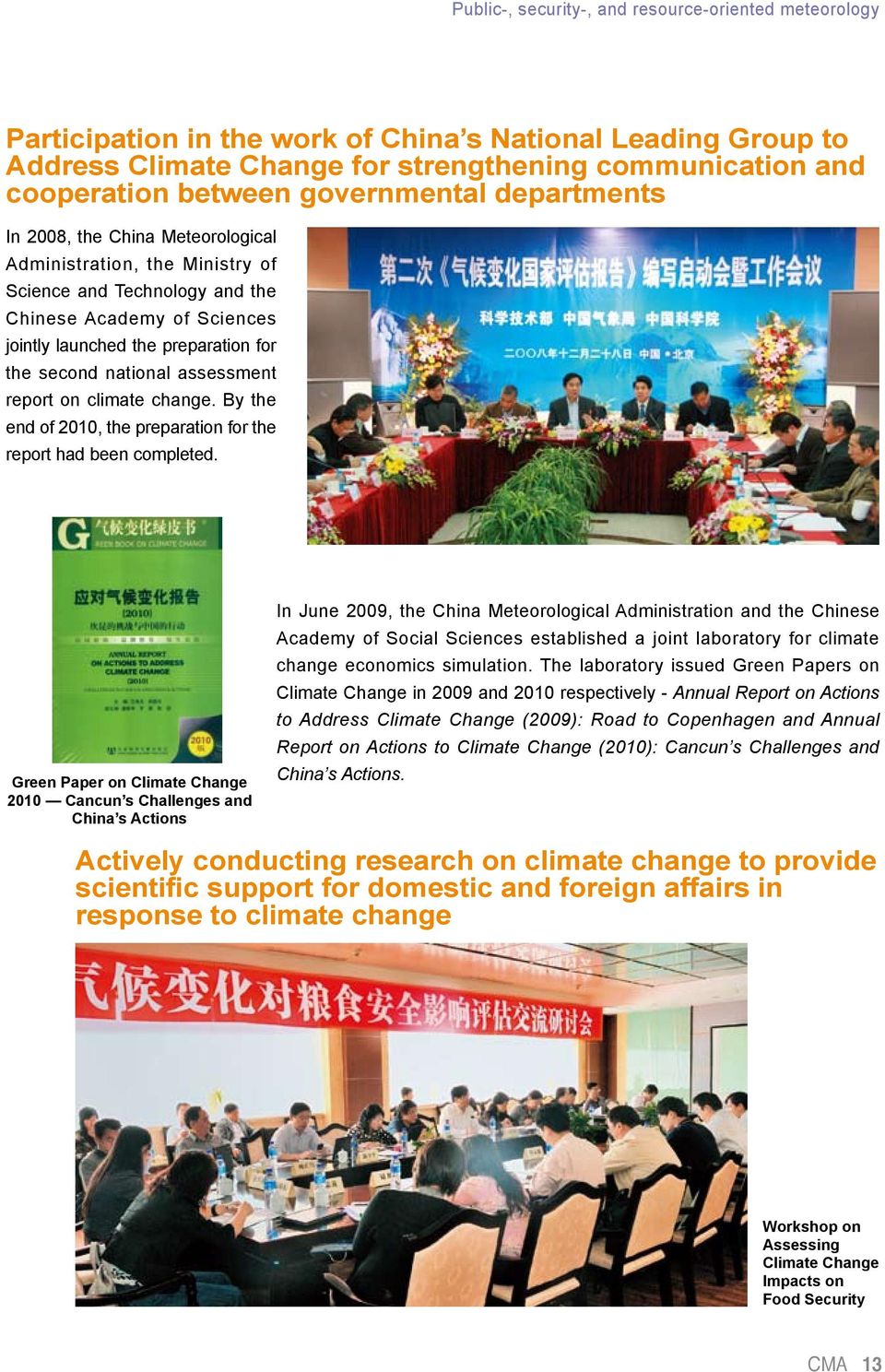
19 Public-, security-, and resource-oriented meteorology Participation in the work of China s National Leading Group to Address Climate Change for strengthening communication and cooperation between governmental departments In 2008, the China Meteorological Administration, the Ministry of Science and Technology and the Chinese Academy of Sciences jointly launched the preparation for the second national assessment report on climate change. By the end of 2010, the preparation for the report had been completed. Green Paper on Climate Change 2010 Cancun s Challenges and China s Actions In June 2009, the China Meteorological Administration and the Chinese Academy of Social Sciences established a joint laboratory for climate change economics simulation. The laboratory issued Green Papers on Climate Change in 2009 and 2010 respectively - Annual Report on Actions to Address Climate Change (2009): Road to Copenhagen and Annual Report on Actions to Climate Change (2010): Cancun s Challenges and China s Actions. Actively conducting research on climate change to provide scientific support for domestic and foreign affairs in response to climate change Workshop on Assessing Climate Change Impacts on Food Security CMA 13
20 China Meteorological Administration Response to Climate Change Actively conducting education, training and outreach of climate change science Since 2004, the CMA has successively held the International School on Climate System and Climate Change for 7 consecutive years, with a total of 900 students both at home and abroad being trained. Training courses are held for directors of meteorological services at provincial and county levels, to promote knowledge on climate change. Training Seminar on Climate and Climate Change A series of popular science readings on climate change have been produced to increase public knowledge about climate change. Since 2007, multi-language TV footage and popular science reading entitled Addressing Climate Change China in Action have been publicized. 14

21 Public-, security-, and resource-oriented meteorology China has established its operational climate operations system, including climatic monitoring and diagnosis, short-term climate predictions, climate impact assessment, climate applications and service delivery, and exploitation and utilization of climate resources. Now China is able to monitor the atmosphere, ocean and parts of the cryosphere in real time. The CMA has established its climate prediction system combining statistical methods with dynamic climate models, making qualitative and quantitative assessment of climate impacts on agriculture, water resources, transportation, energy, ecological environment and human health. By the end of 2005, China s First-generation Dynamic Climate Model Operational Prediction System, developed by the National Climate Center (NCC), enabled China to stand among the few countries in the world that produce climate prediction products using climate models, and to play an important role in the exchanges of climate predictions and information in East Asia and in the World. Main products: Monthly Climate Trend Prediction; Drought and Flood Trend Prediction; Annual Climate Trend Prediction; Monthly Climate Monitoring Bulletin; Monthly Climate Impact Assessment; China s Climate Bulletin on Drought and Flood; Seasonal Climate Monitoring Bulletin; Seasonal Climate Impact Assessment; Agrometeorology-based Annual Crop Yield Forecasts. Annually, the national consultation on climate trend prediction is held before the flood season. CMA 15
22 China Meteorological Administration Modernized Meteorological Operation MODERNIZED METEOROLOGICAL OPERATION Public Meteorological Service Service concept: providing people-oriented services, whatever, whenever and wherever they are needed. Meteorological services are the foundation of meteorology, and the starting point and destination of meteorological work. Through longterm efforts, the meteorological service delivery system with Chinese characteristics has been set up for decision-makers, the general public, and for specific users. Decision Making-oriented Meteorological Service Decision making-oriented service in China is unique globally. It provides governments at all levels with the services they require for meteorological and related disaster prevention and mitigation, response to climate change, major construction projects, regional development, and climate resource exploitation. In terms of its wide coverage, variety and sources, China s decision-making service is at the global forefront. Weather Forecasting Consultation for 2009 National Day Public Meteorological Service The coverage and content of public meteorological services continues to increase. Apart from television, radio, newspapers and telephones, the public service is also delivered via websites, mobile phones and electronic screens, with distinctive Chinese characteristics. TV weather forecast programmes cover 10 CCTV channels and other 5 overseas and local channels. China s Weather TV is available in 225 cities at the prefecture level in 30 provinces (and autonomous regions and municipalities) nationwide, with a total of users exceeding 44 million. China's Weather Website's page hits reached million, ranking the first in domestic life-service websites and the second in international weather service websites. China has 120 million weather SMS mobile phone users. 16
23 Public-, security-, and resource-oriented meteorology Meteorological Support for Major Social Events and Activities Weather services play an increasingly important role in major social events and activities. Weather Service for the World Expo 2010 Weather Service for the Asian Games Weather Service for the 60th Anniversary of New China Weather Service for the Olympic Games An emergency weather response platform at the forefront to combat snow disaster An automatic weather station was set up in the earthquake-stricken area. CMA 17
24 China Meteorological Administration Modernized Meteorological Operation Weather Forecasting and Climate Prediction Weather Forecasting Weather operations cover all techniques and routine operations in weather monitoring and assessment, numerical weather prediction, weather forecast and specialized weather forecast. Weather operations include 0-10 day weather and weather-induced disaster warning and forecasts, day extended weather forecasts and specialized weather forecasts, as well as corresponding observations, information processing and services. Weather operations are delivered at national, regional, provincial, prefectural and county levels. National centres are responsible for development and operation of national forecast and prediction platforms and numerical models, and for providing operational guidance products, including NWP, weather and meteorological disaster monitoring and early warning, very short-range, short-, medium- and extendedrange weather forecasts and other operational products. Regional meteorological centers are responsible for the development and applications of meso-scale numerical models, related specialized numerical models and related regional numerical predictions, and they provide the technical guidance and opportunities to exchange forecast and prediction techniques within the region. Based on the national guidance products, a provincial service provides weather and meteorological disaster monitoring, forecasts, early warnings and services, and it delivers weather forecast guidance products to lower-level services within the province (or autonomous region/municipality). Based on the provincial guidance products, a prefectural service provides weather and meteorological disaster monitoring, forecasts, early warnings and services, including weather forecast and guidance to county level stations operations within the prefecture. Based on the prefectural guidance products, a county station focuses on severe weather and meteorological disaster monitoring, produces weather forecast products by correctively using higher-level products, and delivers meteorological services within the county. Agricultural Meteorology Agro-meteorology is one of the important means to provide weather services for agriculture, the countryside and farmers. It has made significant contributions to providing specialized supportive services for development of modern agriculture, rural economy and community development, farming activities and farmers daily lives, and to ensuring China s food security. Modernized agro-meteorological operations mainly include agro-meteorological observations and experiments, agricultural weather forecasts, crop yield forecasts and specialized agricultural yield and quality forecasts, soil moisture and irrigation forecasts, phenological forecasts, weather condition forecasts against crop and forest diseases and pests, agrometeorological information delivery, agro-meteorological disaster monitoring, early warning and assessment, risk assessment on major agro-meteorological disasters, agricultural climate resource utilization and agricultural adaptation to climate change, and eco-meteorological monitoring and assessments. 18
25 Public-, security-, and resource-oriented meteorology Winter wheat development and harvesting progress on 1 June 2010 Agricultural drought monitoring on 2 July 2010 Severity forecasts of onset and development of corn borer in Northeast China in 2010 An autumn harvest season weather forecast for farmers from 29 September to 1 October 2010 CMA 19
26 China Meteorological Administration Modernized Meteorological Operation Atmospheric Composition The atmospheric composition-related operations are mainly to collect, transmit, archive and apply atmospheric composition data, providing assessment and analysis services; to develop and apply atmospheric composition reanalysis data, producing and delivering atmospheric composition forecasts and service products as guidance. An atmospheric composition observation station The GHG monitoring and analysis system, which is complemented by relevant research projects, has expanded from a single-station observation at Waliguan into a 5-station observing network (Waliguan in Qinghai, Shangdianzi in Beijing, Lin an in Zhejiang, Longfengshan in Heilongjiang and Shangri- La in Yunnan), which provide in-situ measurements of changing GHG concentrations in typical climatic zones, indirectly reflecting the effectiveness and process of emission reductions; it assesses regional differences and impacts of mutual transport by using meteorological data. It also estimates changing GWP in typical zones in relation to GHG variations. Annual concentration of atmospheric 大 气 CO2 carbon 年 均 dioxide 度 (ppm) Global NH SH MLO WLG 年 Annual average concentrations of atmospheric carbon dioxide (CO 2 ) (ppm, i.e. mole fraction 10-6 ) Global/Northern Hemisphere (NH)/Southern Hemisphere (SH)/MLO station (MLO), Hawaii, USA /Waliguan Station (WLG), Qinghai, China 20
27 Public-, security-, and resource-oriented meteorology Weather Modification Rainfall enhancement and hail suppression by rockets Hail suppression by artillery The CMA has set up a weather modification centre, shaping an organizational management structure involving government authorities and meteorological operators at various levels. Weather modification is operable nationwide. The operations mainly include rainfall/snowfall enhancement, hail suppression and fog dissipation. The operating means include aircraft, artillery and rockets. Weather modification is in order to exploit cloud precipitable water for drought alleviation, hail damage reduction, improvement of airport and road visibility, bushfire control and clear weather in support of major outdoor social events. 42,000 staff are currently employed nationwide in this field, with 6900 artillery units, 6900 rocket launchers, and 40 aircrafts leased each year. Weather modifications are operated in 2558 counties and large farms, to enhance rainfall over a target area of 5000,000 km 2 and suppress hail over 520,000 km 2. A ground-based silver iodide generator A rainfall enhancement aircraft CMA 21
28 China Meteorological Administration Modernized Meteorological Operation The CMA signed a cooperative agreement on Kuafu Space Weather Exploration Programme with Peking University and China Aerospace Science and Technology Corporation The impact of space weather on human activities Space Weather Space weather refers to the condition of the sun, solar wind, magnetosphere, ionosphere, and thermosphere in the space between the sun and the earth. Severe space weather has a serious impact on aviation, spaceflight, communication, electricity, human health, etc., endangering national economic development and public safety. In June 2002, with the approval of the government, the CMA set up the National Space Weather Monitoring and Early Warning Centre. The Center is mainly tasked to layout the China s space weather monitoring network, to monitor the space weather in real time, to analyze and process the observational data, and to issue monitoring outcomes, forecasts & warnings about severe space weather events. 22
29 Public-, security-, and resource-oriented meteorology Thunderstorm & Lightning Operational activities related to thunderstorms & lightning are to set up an integrated platform for thunderstorm & lightning monitoring, warning and forecast, research, service delivery and management, eventually shaping a lightning operation and service system that is based on monitoring, supported with research, and focuses on development of warning/forecasting and protective techniques as well as service delivery. Thunderstorm & lightning is regarded by the United Nations as one of 10 worst natural disasters. Management offices for lightning protection activities have been set up in meteorological services and governmental authorities at local levels to exercise their functions in this field, while institutional arrangements for research and operation have also been made, with the Thunderstorm & Lightning Physics and Protection Engineering Laboratory and the Beijing Thunderstorm & Lightning Protection Device Testing Centre inaugurated. Over 9000 CMA staff are involved in this work. Lightning triggered at a Guangzhou field experiment site for lightening research and testing A thunderstorm & lightning monitoring system Annual pattern in terms of most days with thunderstorm activity Meteorological service for lightning protection A lightning positioning system undergoing testing CMA 23
30 China Meteorological Administration Modernized Meteorological Operation Climatic Resources Annual mean windspeeds across China Climate is a clean and renewable resource. Across the five climate zones, China enjoys abundant and diverse climatic resources. Many of them, including wind energy, solar energy, agricultural and ecological climate resources, and cloud water have great potential to be exploited and boast massive economic, environmental and ecological value if they are converted into real productivity. As a result, the analysis of the variation of climatic resources, their assessment, and appropriate exploitation, and the use and protection of climatic resources all play an important role in facilitating sustainable socio-economic development. 400 observing towers have been erected in China for wind energy development. In June 2006, the CMA established the Wind- and Solar-Energy Assessment Centre. Annual Mean Windspeed Patterns Across China 24
31 Public-, security-, and resource-oriented meteorology Integrated observations An integrated (space-based, upper air and ground-based) meteorological observing system has been set up, which is composed of meteorological satellites, L-band upper air sounding systems, weather radars, AWSs and a variety of modern equipment. Surface observation A schematic diagram of the integrated observing system By late 2010, the CMA operated 2418 surface meteorological observing stations at a national level small and meso-scale weather stations have been set up mostly with local investment. There are AWSs, covering more than 85% of townships. Basic surface meteorological elements are automatically measured at 1-minute intervals. Legend National reference climate station National basic climate station National ordinary climate station The Huashan Weather Station Automatic weather station CMA 25
32 China Meteorological Administration Modernized Meteorological Operation Agrometeorological observation The CMA operates 653 agrometeorological observing stations and 1210 automatic soil moisture observing stations to observe major crops and meteorological conditions for agricultural production. Additional AWSs have been installed in response to requirements for the local development of the rural economy. Distribution of agrometeorological observing stations (653) A surface observing site at Anlong County Meteorological Service, Guizhou Province Waliguan GAW Observatory A national network of atmospheric composition observing stations Atmospheric background and composition observation China has set up a GAW station at Waliguan, Qinghai and regional atmospheric background observing stations in Shangdianzi, Beijing, Longfenfsahn, Heilongjiang, and Lin an, Zhejiang. Three other regional atmospheric background stations are being built in Shangri-La (Yunnan), Akdala (Xinjiang AR) and Jinsha (Hubei). In addition, 28 atmospheric composition observing stations, 29 dust storm and 342 acid rain observing stations are already in operation. 26
33 Public-, security-, and resource-oriented meteorology Thunderstorm & Lightning observation 425 lightning detection stations are set up nationwide covering most rural and urban communities. A lightning detection station Upper-air meteorological observation The CMA operates 120 upper-air observing stations. By the end of 2010, all L-band secondary wind radars-electronic radiosondes were put into operational use to replace past mechanical ones, with higher level automation, precision and intensified observations. An experimental network consisting of 24 fixed wind-profiling radars have been deployed for continuous all-weather upper-wind observations. 433 GPS/MET stations have been set up. The China-made GPS sounding system has been put into experimental use. Distribution of national upper-air meteorological observing stations A L-band sounding radar A wind-profiling radar CMA 27
34 China Meteorological Administration Modernized Meteorological Operation A weather radar By late 2010, 164 new generation Doppler weather radars had been deployed. The new generation weather radar network transmits data on a real time basis at 6-minute intervals, producing radar image mosaics, so as to play an important role in quantitative precipitation estimation, nowcasting, and severe weather monitoring and warning. National new generation weather radar network A new generation weather radar Typhoon Chanthu as observed by a radar in Zhanjiang, Guangdong at 13:48 on 22 July
35 Public-, security-, and resource-oriented meteorology FY Series Meteorological Satellites China is among the few countries in the world which are simultaneously operating both geostationary and polar-orbiting meteorological satellites. So far, China has successfully launched 6 polar-orbiting and 5 geostationary meteorological satellites. The following 6 satellites are currently functioning in orbit: FY-1D, FY-3A, FY-3B, FY-2C, FY-2D and FY-2E. The technologies used in FY-1 polar-orbiters have been upgraded, and they are operating in a network covering both morning and afternoon orbits. The geostationary satellites are functioning in a dual-satellite mode, providing mutual backups in orbit. All FY meteorological satellites have been put into operation; they are developing in series, and they have been incorporated into the global constellations of operational meteorological satellites within the WMO framework. FY-3A image of a tropical cyclone Fanapi A FY satellite image FY Meteorological Satellites FY-3A images: occurrence, development and dissipation of the ozone hole over Antarctic. FY series meteorological satellites are playing an important role in weather forecasts, climate predictions, and ecoenvironment and natural disaster monitoring, etc., and they have been widely used in marine activities, agriculture, forestry, water resource, civil aviation, ocean navigation, and environment protection, as a model for satellite applications for civil purposes. The ground application system for FY satellites consists of the Beijing Data Processing Centre, 5 ground receiving stations (i.e. at Beijing, Guangzhou, Urumqi, Jiamusi in China, and Kiruna in Sweden), and many User Service Stations across the country. It receives and processes remote-sensing data from more than 10 domestic and foreign satellites on a routine basis, generating nearly a hundred satellite products that are tailored to the needs of different users each day. These products are disseminated to users within the Asia-Pacific region via dedicated links, the Internet, the CMA-Cast data broadcasting system for government decision-making, disaster prevention, preparedness and mitigation, as well as services in response to global climate change. CMA 29
36 China Meteorological Administration Modernized Meteorological Operation Meteorological Telecommunication and Information Sharing The CMA is tasked with real-time collection of global and national meteorological data, international data exchange in real time, and dissemination of various meteorological data, weather forecasting, climate prediction products and real-time meteorological data access services. 3 Mbps 256 Kbps 3 Mbps 256 Kbps 64 kbps 64 kbps 64 kbps 64 kbps Global Telecommunication System (GTS) The CMA s international telecommunication system has 2 MTN links and 8 regional and interregional links connected with some other RTHs and neighboring GTS centers. The exchanged data includes global surface observations, upper-air observations, aviation meteorological data, marine observations, climate data, typhoon, tsunami, earthquake warnings etc., as well as various meteorological satellite data, NWP and graphic products. The daily data traffic is about 15 GB. 30
37 Public-, security-, and resource-oriented meteorology Domestic Meteorological Telecommunication System The domestic meteorological telecommunication system is composed of land-based wide area networks that extend to the meteorological services at 4 levels (national, provincial, prefectural and county-levels), a satellite-based broadcasting system, and a telecommunication system. It exchanges various meteorological and relevant data and products both on a real-time and non real-time basis between meteorological establishments at all levels, and it also delivers other telecommunication services. The bandwidth of the wide-area networks is 400 Mbps at a national level. Those for regional and provincial links are up to 16 Mbps and 12 Mbps respectively, and those for prefectural and county-level links reach 4 Mbps and 2 Mbps respectively. The VSAT broadcasting system is operating at 8.4 Mbps. A diagram showing overall structure of CMA meteorological telecommunication network (2008) CMA 31
38 China Meteorological Administration Modernized Meteorological Operation High Performance Computers High performance computers are essential tools for running numerical models for weather, climate and the Earth environment applications, as well as for model research and development. The Beijing High Performance Computation and Application Centre currently operates a number of high performance computers, including an SW-4000A, SW New Century Series and an IBM Cluster1600, with a total capacity approaching 50 TPLOS. Apart from meeting the needs for meteorological applications, the centre continues to expand its services and technical support to other social sectors, and shares its computational resources with more than 80 external users, including those in petroleum sector, universities and research institutions. Milestones of High Performance Computers (HPC) at the National Meteorological Information Centre (NMIC) CDC 系 列 曙 光 系 列 银 河 系 列 CRAY 系 列 IBM 系 列 神 威 系 列 CDC CYBER 曙 光 1000A YH-Ⅱ CRAY EL IBM SP SW-I CDC CYBER YH-Ⅲ CRAY C IBM SP 神 威 新 世 纪 32P CRAY J IBM CLUSTER 神 威 新 世 纪 32I 神 威 新 世 纪 48I 神 威 4000A 2009 IBM SP2 CRAY J90 SW-I 神 威 新 世 纪 48I CDC CYBER 962 IBM Cluster 1600 CRAY C92 YH-Ⅲ IBM SP CDC CYBER 962 CRAY EL98 神 威 4000A 神 威 新 世 纪 32I YH-Ⅱ 曙 光 1000A 神 威 新 世 纪 32P The growth of NMIC HPC computing capacity exceeds 1 order of magnitude every 5 years GFLOPS IBM Cluster1600 SW-4000A Supercomputer 32
39 Public-, security-, and resource-oriented meteorology A massive data storage and retrieval system National Meteorological Data Retrieval System (NMDRS) NMDRS is a data management and sharing system, which is centrally based on massive multiple hierarchy storage devices, high-performance servers and optical-fiber storage area network (SAN). The storage system is applied to database management, data processing, application-oriented retrieval, storage management, system control and data sharing and other application subsystems, etc. It serves not only as a massive storage system for multiple users, comprehensive applications and data sharing, but also as a core operational platform for meteorological information storage management and service access at the national level. This storage system provides the real-time operations including collection, processing, s t o r a g e, s e r v i c e Science and National Satellite Technology Meteorological Internet Externally Externally sharing and archival Building Center shared shared server No.1 server No.2 DMZ of global and national meteorological data as Backbone network well as other data related to Earth environment, t h r o u g h w h i c h t h e LAN switch LAN switch Master server No.1 Master server services are rendered Data VO Management No.2 server and monitoring Application Load-balancing server server Real-time data processing at Integrated t o m e t e o r o l o g i c a l the database database highperformance computer establishments within cluster the CMA framework and also made available to Optical fiber channel switch Optical fiber channel switch other users throughout society. NFS server backup and archival off-line tapes Tape base Disk array Disk array Schematic diagram of mass storage system (new) expandable data storage system CMA 33
40 China Meteorological Administration Scientific & Technological Innovation SCIENTIFIC & TECHNOLOGICAL INNOVATION The CMA strongly pursues scientific and technological innovations in meteorology. In this regard, the Chinese Academy of Meteorological Sciences (CAMS) and its eight specialized research institutes continuously undergo indepth reforms at the national level. S&T innovations and their transfers into operations have been further enhanced at operational centres and research bodies both at national and provincial levels. The four scientific research programmes on weather, climate, application meteorology and integrated meteorological observations are being fully implemented. The national investments in specialized scientific research projects for public good (meteorology) are increased significantly, with research infrastructure being substantively improved. 9 research findings, including the meteorological support to the Olympic Games, and weather modification techniques, won national awards. 12 key meteorological laboratories (e.g. on severe weather, atmospheric chemistry, fog physics and meteorological observation technologies) and other 39 open laboratories have been improved nationwide. By the end of 2010, CAMS and its 8 institutes had jointly established 31 field sites (stations) for scientific research. Chinese Academy of Meteorological Sciences A plasma spectrometer An field thunderdischarging experiment Aerosol mass spectrometer It is the largest scientific research institution, covering many disciplines in the field of atmospheric science, in China. It is a comprehensive meteorological research institution, focusing on atmospheric sounding, weather modification, severe weather, climate system, ecological environment and agrometeorology, numerical modeling, and the atmospheric composition, etc. Meteorological Science & Technology Building 34
41 Public-, security-, and resource-oriented meteorology Beijing Institute of Urban Meteorology The Beijing Urban Meteorology Institute is the first scientific research body addressing urban meteorological research. It focuses on such key disciplines as urban sustainable development, disaster prevention and mitigation, and particularly on urban meteorology. Comparison of static & dynamic environmental observing systems between urban and suburban areas A boundary-layer observation system Urban boundary layer observation experiment A conventional analysis laboratory at the Shenyang Institute of Atmospheric Environment T h e S h e n y a n g I n s t i t u t e o f Atmospheric Environment (SIAE) focuses on monitoring and prediction of atmospheric environmental quality. It has gradually developed into a basic application-oriented research body on eco-environment m e t e o r o l o g y a n d a t m o s p h e r i c environmental quality. It is also a training facility. A SIAE analysis laboratory Urumqi Institute of Desert Meteorology Tree ring samples in UIDM Open Laboratory U r u m q i I n s t i t u t e o f D e s e r t Meteorology (UIDM) has professional advantages and regional features in desert atmosphere, landa i r i n t e r a c t i o n, h y d r o t h e r m a l circulation, agricultural and livestock meteorology, tree ring-based climate research, the application of satellite remote sensing technologies, and weather forecast research. 沈 阳 大 气 环 境 研 究 所 常 规 分 析 实 验 室 CMA 35
42 China Meteorological Administration Scientific & Technological Innovation Shanghai Typhoon Institute (STI) T h e S h a n g h a i Ty p h o o n Institute (STI) mainly conducts basic research and applied research on tropical cyclones. STI is striving to become a domestically first-class and internationally-recognized scientific institution specializing in tropical cyclone research. It A STI typhoon monitoring vehicle serves as a base for training high-level professionals in tropical cyclone science. Wuhan Institute of Heavy Rain The Wuhan Institute of Heavy Rain (WIHR) conducts basic and applied research on heavy rain in China, and technological development. Guangzhou Institute of Tropical and Marine Meteorology A GITMM boundary layer & sea fog experiment in coastal zone The Guangzhou Institute of Tropical and Marine Meteorology (GITMM) focuses on researches in the following 3 fields: tropical atmospheric circulation & synoptic systems, the impact of air-sea interaction on weather and climate across China, and forecasting techniques in tropical meteorology. Lanzhou Institute of Arid Meteorology The Lanzhou Institute of Arid Meteorology (LIAM) involves basic and applied research on arid meteorology and ecological environments across China, as well as technological development, so as to meet the requirements for proceeding towards national socio-economic development, the Grand West Development Programme and Meteorological Modernization. A WIHR mobile radar Chengdu Institute of Plateau Meteorology The Chengdu Institute of Plateau Meteorology (CIPM) mainly conducts research on the impact on the Qinghai-Tibetan Plateau and its complex terrain, from weather and climate, particularly focusing on regional severe weather, climate and ecological environment changes and related scientific & technological issues. A LIAM laboratory A CIPM field observation experiment 36
43 Public-, security-, and resource-oriented meteorology HUMAN RESOURCES Staff Status Since 2001, the strategy of enhancing the CMA with human resources has been fully implemented, for which the CMA's 'Comments on Human Resources', together with other relevant documents, were issued. In 2004, a national conference on human resources was held, during which the CMA's 'Comments on Further Enhancing Human Resources' was distributed. Since 2009, the CMA has disseminated the 'CMA Comments on Enhancing Human Resource System' and other 9 related documents. Now, The human resource buildup has now reached a satisfactory development phase, with overall staff qualifications, knowledge, and professional classifications having been further improved. By the end of 2010, the total number of meteorological staff at the CMA was nationwide, including 8 academicians, 532 experts at the level of research fellow, 13 scientists who were elected from the national talent projects-talent Project in the New Millennium and 1 scientist who was elected in the Thousand Talent Programme, 28 experts for government advisory, 46 chief weather forecasters, 755 PhD and 3720 Master degree holders, and with under-graduate, with 80.3% having graduated from colleges and beyond Variation of staff with PhD and master degrees from 2002 to 2010 in the nation-wide meteorological offices Structure of staff professional titles in 2010 Below 11.0% High level 1.0% Vice senior level 12.1% Masters Doctors Primary 32.1% Intermittent 43.8% Variation of staff with bachelor or beyond degrees from 2002 to Bachelor degrees or above Other branches of Earth Science 5.1% Structure of staff professions in 2010 IT technology 19.3% Atmospheric 41.8% Other 33.8% CMA 37
44 China Meteorological Administration Human Resources A mobile training course for county-level meteorological directors was conducted at 7 locations simultaneously, at the beginning of which Dr. XU Xiaofeng, Deputy Administrator of CMA gave the first lecture via a distance learning system. A classroom for new generation weather radar training Education and Training In 2010, the CMA Comments on Accelerating Meteorological Training System was issued to further improve the training institutions at both national and provincial levels, and to let them play a major role in training to improve quality and on-post capability of meteorological staff. A national meteorological training system is being gradually set up, composing the current training centres, universities, research institutions and other relevant education and training facilities, featuring a plausible layout, clear-cut functions, mutual complement, individual characteristics, and being open and responsive to training requirements. In recent years, focusing on the needs in meteorological development, a meteorological education and training framework has been set up with Chinese characteristics. The China Meteorological Administration Training Centre (CMATC, a WMO Regional Training Center Beijing Branch, and a WMO/CGMS Virtual Laboratory/Centre of Excellence) has newly set up a core operational framework that incorporates "two bases (for leadership and forecasters training) " and "three platforms (for training on climate system monitoring and forecast & prediction; distance learning and resource sharing; and scientific and technological information sharing), thus shaping a new modality for modern meteorological operation, leadership, distance and international training. It also provides solid knowledge and qualified staff in support of the meteorological development in China. Especially since 2009, the CMA has vigorously conducted 3 mobile courses for departmental directors, forecasters and directors of county level services, to further enhance CMATC core capacity-building in faculty and teaching materials, and to promote allround basic meteorological buildup projects. Vigorous development in distance meteorological training Training materials 38
45 Public-, security-, and resource-oriented meteorology LEGAL SYSTEM CONSTRUCTION Meteorology Law of the People's Republic of China Chinese meteorological work is managed by law. T h e Meteorology Law of the People's Republic of China came into effect on 1 January 2000, which is to regulate the meteorological activities on a legal basis, and it holds meteorological departments responsible for discharging administrative management functions. The Chinese meteorological work has embarked on a legal track of development. China promulgated relevant laws and regulations such as Meteorology Law of the People's Republic of China, the Regulations on Management of Weather Modification and the Regulations on Prevention of and Preparedness for Meteorological Disasters. The CMA issued a series of regulatory documents and 16 departmental rules and regulations including the Meteorological Administrative Punishment Method, the Meteorological Administrative Reconsideration Method, the Administrative Regulations on Thunderstorm Prevention and Mitigation, the Administrative Regulations on Meteorological Data Sharing, the Administrative Regulations on Balloon Release, the Administrative Regulations on Meteorological Forecast Issuance and Media Coverage, the Methods on Protection of Meteorological Observation Environment and Facilities, the Administrative Regulations on Thunderstorm Prevention and Mitigation (revised), the Administrative Regulations on Balloon Release (revised), the Administrative Regulations on Professional Qualifications for Thunderstorm Prevention Projects, the Regulations on Review of Thunderstorm Protection Device Design and Completion Acceptance, and the Regulations on Meteorological Sector Management. The local governments have launched 70 local meteorological rules and regulations. CMA 39
46 China Meteorological Administration Legal System Construction The CMA actively pushes forward the standardization of meteorology, which allows meteorological standards to play a supportive role in meteorological disaster prevention and mitigation, response to climate change and modernization of meteorological operation. The CMA also promotes standardized and regulated operational services such as public meteorological services, forecasts and predictions, integrated meteorological observations, meteorological information sharing and technical support. In recent years, the CMA issued the National Meteorological Standard System and Standardization Development Plan and the Comments on Enhancing Meteorological Standardization, and formulated Measures for Meteorological Standardization Management and the Procedures for Meteorological Standardization and other rules, having set up a meteorological standard system, which covers all areas of meteorological operations, to further improve technical bodies working on meteorological standardization. By the end of 2010, the CMA had issued for implementation 20 national standards and 121 meteorological sector standards; it has established 4 standard committees such as National standard committees on Prevention of and Preparedness for Meteorological Disasters, and the Nationwide Sector Standard Committee on Thunderstorm & Lightning Disaster Prevention. Such standards like the Classification of Meteorological Drought and the Grades of Sand and Dust Storm Weather among others have played an important role in combat againsting natural disasters, for which they won the China Standard Innovation Award. The local meteorological authorities discharge their management responsibilities for meteorological disasters prevention and preparedness, meteorological observation environment protection, meteorological information release and dissemination, balloon release, lightning protection and other related social activities. Through training and examination, more than 11,000 people nationwide received the meteorological administrative enforcement or oversight certificates. The meteorological administrative enforcement teams have been further enhanced in combination of full-time and part-time workers. Through joint inspection by law and regulations in collaboration with the National People's Congress, governmental departments and others to intensity enforcement against violations, especially those that have major impacts on the society and draw wider public concerns. Various acts of violations have been effectively contained. In recent years, over 4000 illegal cases were addressed nationwide. 40
47 Public-, security-, and resource-oriented meteorology INTERNATIONAL COOPERATION China is a signatory to the WMO Convention and also a founding member of the organization. Permanent Representative of China with WMO (Administrator of CMA) has been a member of the WMO Executive Council since 1973, playing an important role in the international meteorological community. China fully participates in the activities of the WMO and other relevant organizations, and actively carries out technological cooperation in metrological science and technology with various countries. China introduces advanced technologies and talent from abroad, and sends professional and management staff for training overseas. International cooperation in meteorological science and technology which serves meteorological development has become an integral component of the overall development of Chinese meteorology, having made an important contribution to its rapid development and to its human resource development. Academician Qin Dahe, former Administrator of the CMA, serves as Co-Chair of the IPCC Working Group I. Dr. ZHENG Guoguang, Administrator of the CMA, Co-chaired the Group on Earth Observations (GEO) in , and was recommended and elected as a member of the High-Level Panel of Global Sustainability, which was set up by the UN Secretary General Ban Ki-moon in Along with the increasing development of meteorological service in China, the CMA has increased its participation in international meteorological cooperation in terms of depth and scope, with its voice being heard. Like his predecessors, the Administrator of the CMA serves as a member of the WMO Executive council. Mr. ZOU Jingmeng, the former Administrator of the CMA, was elected president of WMO for two consecutive terms from Prof. YAN Hong, the former Deputy Administrator of the CMA, served as Deputy Secretary- General of WMO in Since 2002, Academician QIN Dahe, the former Administrator of the CMA, has been the Co-Chair of Working Group I of the Intergovernmental Panel on Climate Change (IPCC). Dr. ZHENG Guoguang, Administrator of the CMA served as the Co-chair of the Group on Earth Observations (GEO) for two terms in In 2010, together with the WMO, GEO and EUMETSAT, the CMA participated in the World Expo Shanghai, and the MeteoWorld Pavilion was conferred with the World Exposition Awards Committee Special Prize by the International Exhibitions Bureau. CMA 41
48 China Meteorological Administration International Cooperation A donation ceremony of FENGYUNCAST (CMACAST) At present, the CMA has established a stable bilateral cooperative mechanism in meteorological science and technology with 23 countries including the United States, Canada, Finland, Australia, Japan, the Russian Federation, the United Kingdom, South Korea, Germany, France, the DPRK, Mongolia and Vietnam. This has been in various forms, such as protocol, Memorandum of Understanding (MOU), framework agreement, cooperative declaration and summary reporting. Both sides hold joint working group meetings biennially to discuss cooperative activities for the next two years. In , the CMA agreed with its counterparts 410 cooperative activities at JWG meetings, covering NWP, early warning systems and their applications, nowcasting and meteorological satellite data application, tropical meteorology, GAW, climate and climate change, agrometeorology, Olympic-oriented weather services, and education and training. Through bilateral cooperative activities in the field of meteorological science and technology, both sides have enhanced the operational and technical exchanges, and the CMA has learned the advanced meteorological science & technologies, and facilitated the development of Chinese meteorological services and its operational modernization. This has provided effective services in support of major social events including the 2008 Beijing Olympic Games and the 60th Anniversary of the People s Republic of China. Through WMO Voluntary Cooperation Programme (VCP), the CMA conducts a range of activities, including multi-country study tours, instrument and equipment donation, education and training, as well as contributions to VCP Fund. Since 1976, the CMA has held 40 study tours, receiving more than 350 NMS Directors and senior officials from 120 countries. Since 1978, the CMA has donated meteorological instruments and equipment to more than 70 countries. Since 1994, more than 1400 trainees from over 100 countries have received training at WMO Regional Meteorological Training Center-Nanjing and its Beijing branch. These activities have become a model for North-South Cooperation with NMSs in developing countries. Additionally, the CMA also contributed to IPCC Fund, GEO Fund, THORPEX Fund, IPY Fund and WIS Fund, as well as to other WMO Programmes and emergency assistance activities. A bilateral meeting on cooperation in meteorology between CMA and JMA 42
49 Public-, security-, and resource-oriented meteorology On 12 April 2010, the 13 th Session of the Joint Working Group on C o o p e r a t i o n i n M e t e o r o l o g y between the CMA and BoM, at which Mr. SHEN Xiaonong, Deputy Administrator of CMA and Mr. Neville Smith, Deputy Director-General of BoM were present. On 15 September 2010, the 12 th Session of the Joint Working Group on Cooperation in Meteorology between the CMA and MSC was held in Ottawa, Canada. On 20 September 2010, the 17 th Joint Working Group Session on Cooperation in the Field of Atmospheric Science and Technology between NOAA and the CMA was held in Silver Spring, Maryland, USA. Dr. ZHENG Guoguang, Administrator of the CMA, attended the Session with his delegation. CMA 43
50 China Meteorological Administration Meteorological Culture METEOROLOGICAL CULTURE Outreach of Scientific Knowledge Meteorological establishments nationwide have created more than 60 science outreach and education sites designated by relevant ministries, institutions and the CMA. In order to increase the public awareness of disasters and their prevention & mitigation, local meteorological services have publicised meteorological knowledge and a c h i e v e m e n t s m a d e i n t h e Chinese meteorological service via mass media. On 17 November 2008, the 3rd National Working Meeting on the Outreach of Meteorological Scientific Knowledge was held in Beijing. A series of Hot Topics on Global Change won the Second Award for National Science & Technology Advance Journals and Publications China Meteorological News a meteorological newspaper issued nationwide 4 times a week China Meteorological Press about 400 books published annually meteorological periodicals 27 regular periodicals and 895 internal publications 44
51 Public-, security-, and resource-oriented meteorology The Huafeng Meteorological Audio & Video Information Group produces over 500 thematic documentaries each year covering meteorology, Earth s environment and climate change. A documentary entitled Climate Change China in Action, which was successively shown at the UNFCCC/COP conference sites for 4 consecutive years. Websites and Video Information The CMA operates several websites such as the CMA Website, the China Weather Website, and the Chinese National Agriculture Network. Meteorological establishments at all levels have launched their meteorological websites. The CMA has established a dedicated weather TV channel and a number of China Meteorology web-pages on and China Weather TV has a dedicated video website: CMA 45
52 China Meteorological Administration Meteorological Culture CHINESE METEOROLOGICAL SOCIETY On 10 October 1924, the Chinese Meteorological Society was created in Qingdao, Shandong Province. It was one of the earliest societies of physical sciences in China. From its inception, the society has made great efforts in meteorological academic exchanges, publication of ACTA METEOROLOGICA SINICA, talent development and outreach of meteorological knowledge among others, serving as a catalyst for promoting national meteorological services and advance of modern meteorological sciences. Since the reform and opening up, under the leadership of China Association for Science and Technology and China Meteorological Administration, the Society has conducted a full range of activities, fully playing its essential roles in advancing meteorological science and technology, promoting build-up and development of modernized meteorological systems and services, as a meteorological scientific and technological society with important influence both at home and abroad. The 27 th Council of the Chinese Meteorological Society was set up in October 2010, with 132 members chaired by Dr. QIN Dahe. The Society consists of 35 disciplinary committees and 4 working committees. The Society publishes an academic journal ACTA METEOROLOGICA SINICA and a popular science journal Meteorological Knowledge. The cover page of ACTA METEOROLOGICA SINICA (Chinese Version) The birth place of the Chinese Meteorological Society 46
Head 168 HONG KONG OBSERVATORY
 Controlling officer: the Director of the Hong Kong Observatory will account for expenditure under this Head. Estimate... $203.4m Establishment ceiling (notional annual mid-point salary value) representing
Plan for the Establishment of ASEM Water Resources Research and Development Center
 2011/05/04 Plan for the Establishment of ASEM Water Resources Research and Development Center I. Background As one of the fundamental natural resources and strategic economic resources, and a key component
Preliminary advances in Climate Risk Management in China Meteorological Administration
 Preliminary advances in Climate Risk Management in China Meteorological Administration Gao Ge Guayaquil,Ecuador, Oct.2011 Contents China Framework of Climate Service Experience in Climate/disaster risk
Weather, Climate and Water Services for the Least Developed Countries
 Weather, Climate and Water Services for the Least Developed Countries The WMO Programme for the Least Developed Countries (LDCs) was established in 2003 in response to the call of the Third United Nations
Natural Disasters & Assessing Hazards and Risk. Natural Hazards and Natural Disasters
 Page 1 of 9 EENS 3050 Tulane University Natural Disasters Prof. Stephen A. Nelson Natural Disasters & Assessing Hazards and Risk This page last updated on 19-Aug-2014 Natural Hazards and Natural Disasters
Speech at the High-Level Conference on World Food Security
 Speech at the High-Level Conference on World Food Security SUN Zhengcai Minister of Agriculture People s Republic of China Rome, June 2008 Distinguished Chairperson, Excellencies, Ladies and Gentlemen,
Disaster Risk Reduction through people centered National Multi-hazard Early Warning System in the context of Maldives
 Disaster Risk Reduction through people centered National Multi-hazard Early Warning System in the context of Maldives Abdul Muhusin, Deputy Director Department of Meteorology, Maldives Fourth Technical
Hong Kong Observatory Summer Placement Programme 2015
 Annex I Hong Kong Observatory Summer Placement Programme 2015 Training Programme : An Observatory mentor with relevant expertise will supervise the students. Training Period : 8 weeks, starting from 8
Ensuring the Preparedness of Users: NOAA Satellites GOES R, JPSS Laura K. Furgione
 Ensuring the Preparedness of Users: NOAA Satellites GOES R, JPSS Laura K. Furgione U.S. Permanent Representative with the WMO Deputy Director, NOAA s s National Weather Service WMO Executive Council 65
The Positive Role of Audit in Public Debt Management in China
 The Positive Role of Audit in Public Debt Management in China (for the 1 st ASOSAI-EUROSAI Joint Conference) September 2011, Turkey By Dr. DONG Dasheng, the first Deputy Auditor Introduction Since 2008,
INDONESIA - LAW ON WATER RESOURCES,
 Environment and Development Journal Law LEAD INDONESIA - LAW ON WATER RESOURCES, 2004 VOLUME 2/1 LEAD Journal (Law, Environment and Development Journal) is a peer-reviewed academic publication based in
New challenges of water resources management: Title the future role of CHy
 New challenges of water resources management: Title the future role of CHy by Bruce Stewart* Karl Hofius in his article in this issue of the Bulletin entitled Evolving role of WMO in hydrology and water
THE STRATEGIC PLAN OF THE HYDROMETEOROLOGICAL PREDICTION CENTER
 THE STRATEGIC PLAN OF THE HYDROMETEOROLOGICAL PREDICTION CENTER FISCAL YEARS 2012 2016 INTRODUCTION Over the next ten years, the National Weather Service (NWS) of the National Oceanic and Atmospheric Administration
Finnish Meteorological Institute s Services for Insurance Sector
 Finnish Meteorological Institute s Services for Insurance Sector Regional training workshop Role of the NMHSs in support of DRR- related activities in the field of insurance Janne Miettinen, Account Manager,
The Status of Geospatial Information Management in China
 The Status of Geospatial Information Management in China Submitted by the National Administration of Surveying, Mapping and Geoinformation of China 1. Administration System The National Administration
SECTOR ASSESSMENT (SUMMARY): CLIMATE CHANGE. 1. Sector Performance, Problems, and Opportunities
 Climate Resilience Sector Project (RRP TON 46351) Sector Road Map SECTOR ASSESSMENT (SUMMARY): CLIMATE CHANGE 1. Sector Performance, Problems, and Opportunities 1. Tonga is being affected by climate change,
Discussion about the practicability of implementing flood risk. management and urban flood insurance in China. Longhua Gao, Xiaoqing Zhou
 Discussion about the practicability of implementing flood risk management and urban flood insurance in China Longhua Gao, Xiaoqing Zhou Abstract: This paper explains the flood risk management at first,
District Disaster Risk Management Planning
 District Disaster Risk Management Planning GUIDELINES JULY 2007 National Disaster Management Authority 1. Introduction Notifications for establishment of the District Disaster Management Authorities (DDMAs)
Real-time observation monitoring and analysis network
 Real-time observation monitoring and analysis network Haihe LIANG 1, Chunhui ZHANG 2,Zhaolin MENG 1 1 Meteorological Observation Centre of China Meteorological Administration, No.46, Zhongguancun South
BUSINESS REVIEW. The following table sets out our key operating data in 2002, 2003 and 2004.
 PIONEERING The following table sets out our key operating data in 2002, 2003 and 2004. Key Operating Data Change 2004 over Unit 2002 2003 2004 2003 Local wireline access lines in service thousand 133,056
Japan Meteorological Business Support Center (JMBSC)
 Japan Meteorological Business Support Center (JMBSC) The Japan Meteorological Business Support Center (JMBSC) is a general incorporated foundation* inaugurated in 1994, in accordance with the Meteorological
Mr. Yang Chao, Chairman of the Board of Directors of China Life, said: In 2010, the
 Press Release For Immediate Release CHINA LIFE INSURANCE COMPANY LIMITED ANNOUNCES 2010 ANNUAL RESULTS HONG KONG, 23 March 2011 China Life Insurance Company Limited (SSE: 601628, SEHK: 2628, NYSE: LFC;)
China Earth Observation
 China High-resolution Earth Observation China Earth Observation System (CHEOS) and its Lastest Development The Earth Observation System and Data Center, CNSA 2014-2 Outlines 1 Introduction 2 The composition
REPUBLIC OF TURKEY MINISTRY OF FORESTRY AND WATER AFFAIRS
 REPUBLIC OF TURKEY MINISTRY OF FORESTRY AND WATER AFFAIRS Turkey s position in the World Prof. Dr. Veysel EROĞLU Minister of Forestry and Water Affairs The Ministry of Forestry and Water Affairs, formerly
Order No. 07/2013/L-CTN of June 28, 2013, on the promulgation of law. Law on Natural Disaster Prevention and Control
 THE PRESIDENT Order No. 07/2013/L-CTN of June 28, 2013, on the promulgation of law THE PRESIDENT OF THE SOCIALIST REPUBLIC OF VIETNAM Pursuant to Articles 103 and 106 of the 1992 Constitution of the Socialist
II. Related Activities
 (1) Global Cloud Resolving Model Simulations toward Numerical Weather Forecasting in the Tropics (FY2005-2010) (2) Scale Interaction and Large-Scale Variation of the Ocean Circulation (FY2006-2011) (3)
EMERGENCY PROGRAM MANAGEMENT REGULATION 477/94
 PDF Version [Printer-friendly - ideal for printing entire document] EMERGENCY PROGRAM MANAGEMENT REGULATION 477/94 Published by Quickscribe Services Ltd. Updated To: [includes B.C. Reg. 200/98 amendments]
Inputs provided by: 1. General description of mandates and objective(s) of your organization / associated network with institutional structure
 Inputs provided by: Deutsche Gesellschaft für Internationale Zusammenarbeit (GIZ) GmbH 1. General description of mandates and objective(s) of your organization / associated network with institutional structure
Climate Change Impacts in the Asia/Pacific Region
 Climate Change Impacts in the Asia/Pacific Region Global CC threat CC in the A/P region The Stern Review and IPCC 4 th Assessment Report both state that climate change will have adverse impact on people
A Guide to Hazard Identification and Risk Assessment for Public Health Units. Public Health Emergency Preparedness Protocol
 A Guide to Hazard Identification and Risk Assessment for Public Health Units Public Health Emergency Preparedness Protocol Emergency Management Unit Public Health Division Ministry of Health and Long-Term
Asia-Pacific Environmental Innovation Strategy (APEIS)
 Asia-Pacific Environmental Innovation Strategy (APEIS) Integrated Environmental Monitoring IEM) Dust Storm Over-cultivation Desertification Urbanization Floods Deforestation Masataka WATANABE, National
The Economic Outlook of Hong Kong. in the Context of China s 12th Five-Year Plan
 The Economic Outlook of Hong Kong in the Context of China s 12th Five-Year Plan A Speech by Dr Victor Fung to the Students and Professionals at Savantas Liberal Arts Academy 匯 賢 智 庫 學 苑 on 21 May 2011
PRACTICAL STRATEGIES FOR IMMEDIATE PROGRESS ON CLIMATE CHANGE BUILDING BLOCKS FOR A GLOBAL AGREEMENT
 PRACTICAL STRATEGIES FOR IMMEDIATE PROGRESS ON CLIMATE CHANGE BUILDING BLOCKS FOR A GLOBAL AGREEMENT Forging an effective response to climate change is one of the international community s highest priorities.
Climate Change: A Local Focus on a Global Issue Newfoundland and Labrador Curriculum Links 2010-2011
 Climate Change: A Local Focus on a Global Issue Newfoundland and Labrador Curriculum Links 2010-2011 HEALTH Kindergarten: Grade 1: Grade 2: Know that litter can spoil the environment. Grade 3: Grade 4:
Application of Space Technology for Disaster monitoring and assessment current state in Vietnam
 Application of Space Technology for Disaster monitoring and assessment current state in Vietnam Lai Anh Khoi SPACE TECHNOLOGY INSTITUTE 8th GEOSS Asian Pacific Symposium Beijing, Sep. 09-11, 2015 Types
Introduction of Agro-meteorological Information Services In China. Prof. Wang Jianlin Dr. He Yanbo
 Introduction of Agro-meteorological Information Services In China Prof. Wang Jianlin Dr. He Yanbo National Meteorological center, China Meteorological Administration Contents Organization & Staff Members
CLIMATE ACTION IN BRITISH COLUMBIA 2014 PROGRESS REPORT
 CLIMATE ACTION IN BRITISH COLUMBIA 2014 PROGRESS REPORT B.C. is continuing to work towards an economy that is prepared for climate change, and helping to reduce greenhouse gas emissions on a global scale.
GCOS science conference, 2 Mar. 2016, Amsterdam. Japan Meteorological Agency (JMA)
 GCOS science conference, 2 Mar. 2016, Amsterdam Status of Surface Radiation Budget Observation for Climate Nozomu Ohkawara Japan Meteorological Agency (JMA) Contents 1. Background 2. Status t of surface
Domestic Policy Framework on Adaptation to Climate Change in Water Resources: Case Study for India. Working Together to Respond to Climate Change
 Domestic Policy Framework on Adaptation to Climate Change in Water Resources: Case Study for India Working Together to Respond to Climate Change WATER ACCOUNTING OF INDIA S TOTAL WATER RESOURCES Unutilizable
Index Insurance in India
 Index Insurance in India Kolli N Rao, PhD Aon Benfield, India Indian Agriculture & Risks What s Index Insurance? Why Index Insurance? The Outline Architecture of Indian Crop Insurance Coverage: The Numbers
FAO-Adapt. Framework Programme on Climate Change Adaptation
 FAO-Adapt Framework Programme on Climate Change Adaptation Food security and climate change FAO s vision for the future is a world free of hunger and malnutrition where food and agriculture contribute
Development of Shanghai Integrated Transport (2010-2015) XIAO Hui and GU Yu
 Development of Shanghai Integrated Transport (2010-2015) XIAO Hui and GU Yu Abstract This article summarises the general situation of Shanghai s integrated transport system and then determines the trends
Joint Polar Satellite System (JPSS)
 Joint Polar Satellite System (JPSS) John Furgerson, User Liaison Joint Polar Satellite System National Environmental Satellite, Data, and Information Service National Oceanic and Atmospheric Administration
Climate Change on the Prairie:
 Climate Change on the Prairie: A Basic Guide to Climate Change in the High Plains Region - UPDATE Global Climate Change Why does the climate change? The Earth s climate has changed throughout history and
2015 Program seminara u Kini
 2015 Program seminara u Kini No. Name of project Level of candidates 1 2 3 4 5 6 7 2015 Seminar on Circulation System Construction of Agricultural Products for Seminar on Economic Development and Social
A SWOT analysis of poverty alleviation and mountain development in China: A case study of Xiangxi prefecture
 Available online www.jocpr.com Journal of Chemical and Pharmaceutical Research, 2014, 6(5):750-755 Research Article ISSN : 0975-7384 CODEN(USA) : JCPRC5 A SWOT analysis of poverty alleviation and mountain
Post-Flood Assessment
 Page 1 of 7 Post-Flood Assessment CHAPTER 4 AGENCY COORDINATION Agency coordination is an essential element for the operation of the flood management systems in the Central Valley. Due to the nature of
International Training Program 2010 Management of Flood Control and Disaster Mitigation LOGO
 International Training Program 2010 Management of Flood Control and Disaster Mitigation LOGO June 2010 / China Prepared by HOY SEREIVATHANAK REASEY Royal University of Phnom Penh 1 Country Risk Profile
Basic Climatological Station Metadata Current status. Metadata compiled: 30 JAN 2008. Synoptic Network, Reference Climate Stations
 Station: CAPE OTWAY LIGHTHOUSE Bureau of Meteorology station number: Bureau of Meteorology district name: West Coast State: VIC World Meteorological Organization number: Identification: YCTY Basic Climatological
The Rundown on Rainmaking
 21 April 2011 The Rundown on Rainmaking Brooke Jones Researcher FDI Global Food and Water Crises Research Programme Summary Australia s susceptibility to drought has affected its farming capacity in the
SIXTH GRADE WEATHER 1 WEEK LESSON PLANS AND ACTIVITIES
 SIXTH GRADE WEATHER 1 WEEK LESSON PLANS AND ACTIVITIES WATER CYCLE OVERVIEW OF SIXTH GRADE WATER WEEK 1. PRE: Evaluating components of the water cycle. LAB: Experimenting with porosity and permeability.
The Development of Soil Survey and Soil Mapping in China
 The Development of Soil Survey and Soil Mapping in China Gan-Lin Zhang, Zi-Tong Gong State Key Laboratory of Soil and Sustainable Agriculture, Institute of Soil Science, Chinese Academy of Sciences, Nanjing
Exchanging Agricultural Market Information through SMS in Cambodia
 TECHNICAL BRIEF GCP/RAS/247/EC EC-FAO Food Security Programme Linking Information and Decision-Making to Improve Food Security Exchanging Agricultural Market Information through SMS in Cambodia Market
Satellite: Making Technology Work
 Satellite: Making Technology Work Satellite Industry Association: Who We Are We are the world s leading satellite companies: Satellite operators and service providers Satellite spacecraft manufacturers
Climate Change Long Term Trends and their Implications for Emergency Management August 2011
 Climate Change Long Term Trends and their Implications for Emergency Management August 2011 Overview A significant amount of existing research indicates that the world s climate is changing. Emergency
sample The IPCC Special Report on Managing the Risks of Extreme Events and Disasters to Advance Climate Change Adaptation
 sample The IPCC Special Report on Managing the Risks of Extreme Events and Disasters to Advance Climate Change Adaptation A changing climate leads to changes in extreme weather and climate events 2 Impacts
How can we defend ourselves from the hazard of Nature in the modern society?
 How can we defend ourselves from the hazard of Nature in the modern society?, University of Bologna President of the EGU Division of Natural Hazards Email: [email protected] [email protected] GIFT 2013 Natural
[ Climate Data Collection and Forecasting Element ] An Advanced Monitoring Network In Support of the FloodER Program
![[ Climate Data Collection and Forecasting Element ] An Advanced Monitoring Network In Support of the FloodER Program](/thumbs/33/16326315.jpg "[ Climate Data Collection and Forecasting Element ] An Advanced Monitoring Network In Support of the FloodER Program") [ Climate Data Collection and Forecasting Element ] An Advanced Monitoring Network In Support of the FloodER Program December 2010 1 Introduction Extreme precipitation and the resulting flooding events
[ Climate Data Collection and Forecasting Element ] An Advanced Monitoring Network In Support of the FloodER Program December 2010 1 Introduction Extreme precipitation and the resulting flooding events
Improved Warnings for Natural Hazards: A Prototype System for Southern California
 Improved Warnings for Natural Hazards: A Prototype System for Southern California Yehuda Bock Research Geodesist Scripps Institution of Oceanography University of California San Diego, La Jolla, Calif.
EU China River Basin Management Programme
 Ministry of Water Resources Ministry of Environmental Protection EU China River Basin Management Programme Technical Report 075 Water Resource Supply Security Strategy Analysis Ben Piper, Zhang Wang and
From Whitehall to orbit and back again: using space in government
 From Whitehall to orbit and back again: using space in government 18 th June 2014 Bristol 25 th June 2014 Liverpool 3 rd July 2014 -Newcastle Space for Smarter Government Programme ([email protected])
HAZARD VULNERABILITY & RISK ASSESSMENT
 Hazard Vulnerability Analysis Purpose and Scope A Hazard Vulnerability Analysis (HVA) evaluates risk associated with a specific hazard. During this analysis, the hazard is evaluated for its probability
Doing Business, Small & Medium Enterprise Support and Information Access
 Doing Business, Small & Medium Enterprise Support and Information Access Vietnam, a nation of 92 million people, aspires to be more fully integrated into the global economy and community and an industrialized
Nowcasting: analysis and up to 6 hours forecast
 Nowcasting: analysis and up to 6 hours forecast Very high resoultion in time and space Better than NWP Rapid update Application oriented NWP problems for 0 6 forecast: Incomplete physics Resolution space
Precipitation Monitoring Network:
 The Caribbean Drought and Precipitation Monitoring Network: Adrian R. Trotman Caribbean Institute for Meteorology and Hydrology CARIWIN Regional Seminar 14-15 January, 2010 Georgetown, Guyana Why Plan
North American Weather & Climate Extremes: Progress in Monitoring and Research
 North American Weather & Climate Extremes: Progress in Monitoring and Research July 15-21, 2005 Aspen Global Change Institute Aspen, Colorado Shaun McGrath Western Governors Association WGA Drought Report
Report to 8 th session of OOPC. By Dr. Alan R. Thomas, Director, GCOS Secretariat
 Report to 8 th session of OOPC By Dr. Alan R. Thomas, Director, GCOS Secretariat The GCOS is comprised of the climate components of the domain based observing systems including both satellite and in situ
Office of Climate Change, Energy Efficiency and Emissions Trading. Business Plan
 Office of Climate Change, Energy Efficiency and Emissions Trading Business Plan April 1, 2011 - March 31, 2014 Table of Contents Message from the Premier...3 1.0 OVERVIEW...4 2.0 MANDATE...5 3.0 LINES
Georgia Performance Standards Framework for Natural Disasters 6 th Grade
 The following instructional plan is part of a GaDOE collection of Unit Frameworks, Performance Tasks, examples of Student Work, and Teacher Commentary. Many more GaDOE approved instructional plans are
Graduate School of Disaster Prevention Kangwon National University. http://college.kangwon.ac.kr/prevention/main.jsp
 Graduate School of Disaster Prevention Kangwon National University 1joongang-Ro Samcheok-city, Gangwon-Do, Republic of Korea http://college.kangwon.ac.kr/prevention/main.jsp Outline Natural disasters such
The Water, Energy, Food Nexus: Lebanese Policy and Institutional Analysis
 The Water, Energy, Food Nexus: Lebanese Policy and Institutional Analysis Nadim Farajalla, Patricia Haydamous, Charbel Rizk, Silva Kerkezian and Rana El Hajj-Mitri Climate Change and the Environment in
DISASTER RISK DETECTION AND MANAGEMENT COURSES SETUP SCENARIO AT MAKERERE UNIVERSITY. Makerere University
 DISASTER RISK DETECTION AND MANAGEMENT COURSES SETUP SCENARIO AT MAKERERE UNIVERSITY CASE OF THE DEPARTMENT OF GEOGRAPHY Derek Muhwezi 2 MISSION OF THE DEPARTMENT To provide and promote quality education,
China's Aviation Sector - Overview, Current Trends & Opportunities for European Suppliers
 China's Aviation Sector - Overview, Current Trends & Opportunities for European Suppliers China Civil Aviation Report Uniworld, LLC/Francis Chao September 6, 2005. Dublin, Ireland Before 1978, It was a
Geospatial Software Solutions for the Environment and Natural Resources
 Geospatial Software Solutions for the Environment and Natural Resources Manage and Preserve the Environment and its Natural Resources Our environment and the natural resources it provides play a growing
Natural Hazards 1.1. Natural Hazards. Objective: Natural Hazards in Western Australia Are we at risk? Page 1. Natural Hazards Years 5-7
 Natural Hazards 1.1 Engage Natural Hazards To introduce students to the natural hazards which occur in Western Australia and their risk. Western Australia experiences a range of natural hazards each year,
Hanover Declaration Local Action Driving Transformation
 Hanover Declaration Local Action Driving Transformation 1 National Governments: Build upon local authority climate leadership! The International Conference on Climate Action 2015 (ICCA2015) showed that
Climate of Illinois Narrative Jim Angel, state climatologist. Introduction. Climatic controls
 Climate of Illinois Narrative Jim Angel, state climatologist Introduction Illinois lies midway between the Continental Divide and the Atlantic Ocean, and the state's southern tip is 500 miles north of
Co-creation progress update and an invitation to respond. Overview of ideas from co-creation activities towards a Climate Ready UK...
 Department for Environment, Food and Rural Affairs Climate Ready Co-creation progress update and an invitation to respond July 2012 Contents Overview of ideas from co-creation activities towards a Climate
CSCAP MEMORANDUM No. 15 The Security Implications of Climate Change
 CSCAP MEMORANDUM No. 15 The Security Implications of Climate Change A Memorandum from the Council for Security Cooperation in the Asia Pacific (CSCAP) June 2010 CSCAP Memorandum No. 15 The Security Implications
The Intended Nationally Determined Contribution of the Kingdom of Saudi Arabia under the UNFCCC
 The Intended Nationally Determined Contribution of the Kingdom of Saudi Arabia under the UNFCCC Riyadh, November 2015 The Kingdom of Saudi Arabia is pleased to submit its Intended Nationally Determined
How To Help The World Coffee Sector
 ICC 105 19 Rev. 1 16 October 2012 Original: English E International Coffee Council 109 th Session 24 28 September 2012 London, United Kingdom Strategic action plan for the International Coffee Organization
NAPA COUNTY WATERSHED SYMPOSIUM
 Planning, Building, and Environmental Services NAPA VALLEY GROWTH NAPA COUNTY WATERSHED SYMPOSIUM Plunging Forward May 15, 2015 1 YOU CAN T CROSS THE SEA MERELY BY STANDING AND STARING AT THE WATER. Rabindranath
Brief on Climate Change Finance
 Brief on Climate Change Finance Introduction Climate change is a complex policy issue with major implications in terms of finance. All actions to address climate change ultimately involve costs. Funding
CLIMATE CHANGE VULNERABILITY ASSESSMENT OF CAPE VERDE
 CLIMATE CHANGE VULNERABILITY ASSESSMENT OF CAPE VERDE SUMMARY FOR POLICY MAKERS panoramio.com 1 Ministry of Environment, Housing and Territory Planning B.P. 115 Praia Cape Verde http://www.governo.cv United
IBM Big Green Innovations Environmental R&D and Services
 IBM Big Green Innovations Environmental R&D and Services Smart Weather Modelling Local Area Precision Forecasting for Weather-Sensitive Business Operations (e.g. Smart Grids) Lloyd A. Treinish Project
Nanjing University of Information Science & Technology. QUIT HOME www.nuist.edu.cn
 A Brief Introduction to NUIST Message from President History Overview Nanjing University of Information Science & Technology Nanjing University of Information Science & Technology (NUIST), founded in 1960,
Proposal for the Establishment of an World Small Wind Turbine Test and Training Center" in China)
 Chinese Wind Energy Equipment Association (CWEEA) Chinese Wind Energy Association (CWEA) Proposal for the Establishment of an World Small Wind Turbine Test and Training Center" in China) CWEA and CWEEA
Greater Nanticoke Area School District Science/Technology Standards 5 th Grade
 Greater Nanticoke Area School District Science/Technology Standards 5 th Grade Standard 3.1 Unifying Themes CS 3.1.7A Explain the parts of a simple system and their relationship to each other 1. Describe
The Next Generation Science Standards (NGSS) Correlation to. EarthComm, Second Edition. Project-Based Space and Earth System Science
 The Next Generation Science Standards (NGSS) Achieve, Inc. on behalf of the twenty-six states and partners that collaborated on the NGSS Copyright 2013 Achieve, Inc. All rights reserved. Correlation to,
Key Recommendations of CVF Regional Activities
 Key Recommendations of CVF Regional Activities The Forum is currently meeting through regional-level activities since 2014, which produce recommendations in preparation for the UNFCCC Conference of Parties
THE NATIONAL SPACE WEATHER PROGRAM
 1 Office of the Federal Coordinator for Meteorological Services and Supporting Research (OFCM) THE NATIONAL SPACE WEATHER PROGRAM Committee on Solar and Space Physics National Research Council Space Studies