
Student Exploration: Rabbit Population by Season
|
|
|
- Rolf Powell
- 9 years ago
- Views:
Transcription
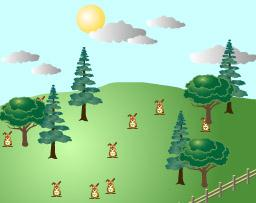
1 Name: Date: Student Exploration: Rabbit Population by Season Vocabulary: carrying capacity, density-dependent limiting factor, density-independent limiting factor, limiting factor, population, population density Prior Knowledge Questions (Do these BEFORE using the Gizmo.) 1. Suppose you had a pet rabbit. What would the rabbit need to stay alive and healthy? 2. A female rabbit can give birth to over 40 baby rabbits a year. Suppose all of her offspring survived and reproduced, all of their offspring survived and reproduced, and so on. If that happened, in only eight years the mass of rabbits would exceed the mass of Earth! So, why aren t we overrun with rabbits? What keeps the rabbit population in check? Gizmo Warm-up A population is a group of individuals of the same species that live in the same area. The size of a population is determined by many factors. In the Rabbit Population by Season Gizmo, you will see how different factors influence how a rabbit population grows and changes. 1. Select the BAR CHART tab. What is the approximate size of the initial rabbit population? 2. Select the TABLE tab. Click Play ( ), and allow the simulation to run for one year. A. In which season did the rabbit population increase the most? B. In which season did the rabbit population increase the least?
2 Activity A: Carrying capacity Click Reset ( ). Question: What determines how large a population can grow? 1. Think about it: A limiting factor is any factor that controls the growth of a population. What do you think are some of the limiting factors for the rabbit population? 2. Run Gizmo: Select the DESCRIPTION tab. Set the Simulation speed to Fast. Select the GRAPH tab. Click Play, and allow the simulation to run for at least 10 years. (Note: You can use the zoom controls on the right to see the whole graph.) A. Describe how the rabbit population changed over the course of 10 years. B. What pattern did you see repeated every year? C. How could you explain this pattern? 3. Analyze: The carrying capacity is the maximum number of individuals of a particular species that an environment can support. All environments have carrying capacities. A. What is this environment s approximate carrying capacity for rabbits? (Note: Average the summer and winter carrying capacities.) B. When did the rabbit population reach carrying capacity? Explain how you know.
3 Activity B: Density-dependent limiting factors Click Reset. On the SIMULATION pane, make sure Ample is selected for the amount of LAND available. Introduction: Population density is the number of individuals in a population per unit of area. Some limiting factors only affect a population when its density reaches a certain level. These limiting factors are known as density-dependent limiting factors. Question: How does a density-dependent limiting factor affect carrying capacity? 1. Think about it: What do you think some density-dependent limiting factors might be? 2. Predict: Suppose a shopping mall is built near a rabbit warren, leaving less land available for rabbits. How will this affect the environment s carrying capacity? 3. Experiment: Use the Gizmo to find the carrying capacity with Ample, Moderate, and Little land. List the carrying capacities below. Ample: Moderate: Little: 4. Analyze: How did the amount of space available to the rabbits affect how many individuals the environment could support? 5. Infer: Why do you think limiting a population s space decreases the carrying capacity? 6. Challenge yourself: Other than space, what might be another density-dependent limiting factor? Explain.
4 Activity C: Density-independent limiting factors Click Reset. On the SIMULATION pane, select Ample for the amount of LAND available. Introduction: Not all limiting factors are related to a population s density. Density-independent limiting factors affect a population regardless of its size and density. Question: How do density-independent limiting factors affect how a population grows? 1. Think about it: What do you think some density-independent limiting factors might be? 2. Gather data: Click Play. Allow the population to reach carrying capacity. Click Pause ( ). Select the GRAPH tab and click the camera ( ) to take a snapshot of the graph. Paste the snapshot into a blank document. Label the graph Normal Weather. 3. Predict: How do you think a period of harsh winters will affect the rabbit population? 4. Investigate: Click Reset. Select Harsh winter from the CONDITIONS listed on the SIMULATION pane. Click Play, and observe the how the population changes over five years. Paste a snapshot of the graph in your document. Label the graph Harsh Winter. A. How does the Harsh Winter graph differ from the Normal Weather graph? 5. Predict: Rabbits reproduce in the spring. How do you think a period of cold springs will affect the rabbit population? (Activity C continued on next page)
5 Activity C (continued from previous page) 6. Investigate: Deselect Harsh winter. Select Cold spring. Click Play, and observe the how the population changes over a period of five years. Paste a snapshot of the graph in your document and label the graph Cold Spring. A. How does the Cold Spring graph differ from the Normal Weather graph? 7. Predict: How do you think a period of hot summers will affect the rabbit population? 8. Investigate: Deselect Cold spring. Select Hot summer. Click Play, and observe the how the population changes over a period of five years. Paste a snapshot of the graph in your document. Label the graph Hot Summer. A. How does the Hot Summer graph differ from the Normal Weather graph? 9. Think and discuss: Other than unusual weather, what might be another density-independent limiting factor that could affect the rabbit population? If possible, discuss your answer with your classmates and teacher.
Discovering Math: Data and Graphs Teacher s Guide
 Teacher s Guide Grade Level: K 2 Curriculum Focus: Mathematics Lesson Duration: Two class periods Program Description Discovering Math: Data and Graphs From simple graphs to sampling to determining what
Student Exploration: Pulleys
 Name: Date: Student Exploration: Pulleys Vocabulary: effort, load, mechanical advantage, pulley, pulley system Prior Knowledge Questions (Do these BEFORE using the Gizmo.) 1. Suppose you had to haul a
Student Exploration: Archimedes Principle
 Name: Date: Student Exploration: Archimedes Principle Vocabulary: Archimedes principle, buoyant force, density, displace, mass, volume, weight Prior Knowledge Questions (Do these BEFORE using the Gizmo.)
Interview Questions for Secondary Schools Interviews
 Interview Questions for Secondary Schools Interviews PART I 1. What is your name? My name is Lu Kin Tsang. My English name is Donald. 2. How old are you? I am twelve years old. 3. Where were you born?
One basic need of living things is energy. Living things use food and water to get energy. The bird is living. It eats fish for energy.
 reflect If you are cold, what can you do to get warm? You could put on a coat and hat. You can jump in place. These are ways you might react to the cold. Now think about a rock. What if a rock is somewhere
M O N T E R E Y B A Y A Q U A R I U M
 Topics Biodiversity, Measurement Grades K-2 Sites Schoolyard, Classroom Duration 15-30 minutes each month throughout the school year Materials Quadrats (see Teacher Preparation, page 2) Thermometer Tape
Student Exploration: H-R Diagram
 Name: Date: Student Exploration: H-R Diagram Vocabulary: giant, H-R diagram, luminosity, main sequence, star, supergiant, white dwarf Prior Knowledge Questions (Do these BEFORE using the Gizmo.) 1. How
Southern AER Atmospheric Education Resource
 Southern AER Atmospheric Education Resource Vol. 9 No. 5 Spring 2003 Editor: Lauren Bell In this issue: g Climate Creations exploring mother nature s remote control for weather and Climate. g Crazy Climate
Study Guide: Sun, Earth and Moon Relationship Assessment
 I can 1. Define rotation, revolution, solstice and equinox. *Rotation and Revolution Review Worksheet 2. Describe why we experience days and years due to the rotation and r evolution of the Earth around
4THE UNIVERSITY OF THE STATE OF NEW YORK
 4THE UNIVERSITY OF THE STATE OF NEW YORK GRADE 4 ELEMENTARY-LEVEL SCIENCE TEST WRITTEN TEST JUNE 6, 2011 Student Name School Name Print your name and the name of your school on the lines above. The test
REVIEW UNIT 10: ECOLOGY SAMPLE QUESTIONS
 Period Date REVIEW UNIT 10: ECOLOGY SAMPLE QUESTIONS A. Sample Multiple Choice Questions Complete the multiple choice questions to review this unit. 1. All of the following are density-dependent factors
Photosynthesis Lesson Plan 1. Introduction to Photosynthesis (grade 4) Objectives:
 Photosynthesis Lesson Plan 1 Introduction to Photosynthesis (grade 4) Identify types of living things that use photosynthesis. Understand the concept of photosynthesis. Observe how flowers are grown. First
Exploration of the Solar System
 Exploration of the Solar System I. Phases of the Moon all about perspective. In this section you will use WWT to explore how the moon appears to change phases from our vantage point on Earth over the course
Weather & Water 6 th Grade
 Tucson Unified School District Middle School Science Weather & Water 6 th Grade Regional Supplemental Packet Table of Contents Title Page # Understanding by Design Stage Understanding by Design Stage Sequence
What Causes Climate? Use Target Reading Skills
 Climate and Climate Change Name Date Class Climate and Climate Change Guided Reading and Study What Causes Climate? This section describes factors that determine climate, or the average weather conditions
Class 4 Poetry 2008. Forever. Killer Lightning!! Lightning is dangerous so Keep Away!! By Gregory
 Class 4 Poetry 2008 Forever I went through A golden gate, A silver gate, A mother of pearl gate. Until I found a path, I followed it to I do not know where, But I ve followed it there, Through tangled
Monstrous Mutations Lab on the Effect of Random Mutations on Animals Survival Skills
 Name: Life Science Date: Period: Change Over Time Natural Selection Monstrous Mutations Lab on the Effect of Random Mutations on Animals Survival Skills Introduction The process of evolution involves changes
Mystery Class Teacher s Planning Packet #1 Discovering Photoperiod Clues
 Mystery Class Teacher s Planning Packet #1 Discovering Photoperiod Clues 1 Teacher s Planning Packet #1 Discovering Photoperiod Clues Includes: Sunrise/Sunset Data (Practice Chart) Page 3 The Mystery Class
List 10 different words to describe the weather in the box, below.
 Weather and Climate Lesson 1 Web Quest: What is the Weather? List 10 different words to describe the weather in the box, below. How do we measure the weather? Use this web link to help you: http://www.bbc.co.uk/weather/weatherwise/activities/weatherstation/
Phases of the Moon. Preliminaries:
 Phases of the Moon Sometimes when we look at the Moon in the sky we see a small crescent. At other times it appears as a full circle. Sometimes it appears in the daylight against a bright blue background.
PLANET EARTH: Seasonal Forests
 PLANET EARTH: Seasonal Forests Teacher s Guide Grade Level: 6-8 Running Time: 42 minutes Program Description Investigate temperate forests and find some of the most elusive creatures and welladapted plant
Pre-K Science. Earth and Space Air Weather. Life Science Living-Non Living Things. Physical Science Properties of Objects Motion
 Pre-K Science Earth and Space Air Weather Life Science Living-Non Living Things Physical Science Properties of Objects Motion Technology Simple Tools 1 Strand-Earth and Space Science 1.2 Pre-School Teacher
Earth, Sun and Moon. Table of Contents
 Earth, Sun and Moon Table of Contents 0. Unit Challenge 1. Earth and Its Motion 2. Earth s Rotation and Revolution 3. Earth s Tilt and Seasons 4. Seasons 5. The Moon 6. The Lunar Cycle 7. Lunar Geography
Lesson 4 What Is a Plant s Life Cycle? The Seasons of a Tree
 Lesson 4 What Is a Plant s Life Cycle? The Seasons of a Tree STUDENT SKILLS: predicting, communicating prior observations and knowledge, listening, cooperating, observing, sequencing, communicating, reasoning,
Our Earth, Our Resources
 UNIT 4 Essential Question: How can we take the best care of our Earth? Objectives Our Earth, Our Resources Unit Resource Guide Social Studies Resources Identify and describe the physical characteristics
WEATHER, CLIMATE AND ADAPTATIONS OF ANIMALS TO CLIMATE
 7 WEATHER, CLIMATE AND ADAPTATIONS OF ANIMALS TO CLIMATE TEXTBOOK QUESTIONS AND ANSWERS Q.1. Why weather changes so frequently? Ans. All changes in the weather are caused by the sun. The movement of the
Reading aloud to a child
 Reading aloud to a child Festivals and celebrations: introduction Me and my culture: festivals and celebrations Contents Festivals and celebrations: teachers notes Festivals and celebrations: classroom
2. What kind of energy is stored in food? A. chemical energy B. heat energy C. kinetic energy D. light energy
 Assessment Bank Matter and Energy in Living Things SC.8.L.18.4 1. What is energy? A. anything that takes up space B. anything that has mass C. the ability to conduct current D. the ability to do work 2.
Unit: Plants & Animals (Grade 2)
 Unit: Plants & Animals (Grade 2) Content Area: Science Course(s): Science Time Period: 8 weeks Length: Weeks Status: Published Unit Overview Students will determine the life cycles of plants and animals
Lesson 1 Characteristics of Life
 Lesson 1 Student Labs and Activities Page Appropriate For: Launch Lab 8 all students Content Vocabulary ELL 9 all students Lesson Outline ELL 10 all students MiniLab 12 all students Content Practice A
Kindergarten Seasons and Weather Assessment
 Kindergarten Seasons and Weather Assessment 1a. Circle the pictures that represent the four seasons: snowman going to a teacher harvest fruits colorful flowers the beach 1b. Write the name of the season
CGC1D1: Interactions in the Physical Environment Factors that Affect Climate
 Name: Date: Day/Period: CGC1D1: Interactions in the Physical Environment Factors that Affect Climate Chapter 12 in the Making Connections textbook deals with Climate Connections. Use pages 127-144 to fill
eschoolplus Users Guide Teacher Access Center 2.1
 eschoolplus Users Guide Teacher Access Center 2.1. i Table of Contents Introduction to Teacher Access Center... 1 Logging in to Teacher Access Center (TAC)...1 Your My Home Page... 2 My Classes...3 News...4
The Seven Characteristics of Life
 Jennifer Hepner Maureen Frandsen Fall 2003 Grade Level: 3 rd grade The Seven Characteristics of Life Abstract: The purpose of this lesson is for students to learn the characteristics of living organisms.
GETTING STARTED WITH THE MIPOWER MANAGEMENT SYSTEM
 GETTING STARTED WITH THE MIPOWER MANAGEMENT SYSTEM This Quick Start guide will help you start using the MiPower Management System provided by Grayson Collin Electric Cooperative. You should create your
FIRST GRADE 1 WEEK LESSON PLANS AND ACTIVITIES
 FIRST GRADE 1 WEEK LESSON PLANS AND ACTIVITIES UNIVERSE CYCLE OVERVIEW OF FIRST GRADE UNIVERSE WEEK 1. PRE: Describing the Universe. LAB: Comparing and contrasting bodies that reflect light. POST: Exploring
T E A C H E R S N O T E S
 T E A C H E R S N O T E S Focus: Students explore air and its properties. They will also learn about the connection between air pressure and weather, forces that can be used for flight, how these forces
PUTTING ENGLISH TO WORK 1: UNIT 20
 PUTTING ENGLISH TO WORK 1: UNIT 20 WEATHER In this unit you will learn: THESE LIFE SKILLS: Giving weather forecasts Leisure activities It s going to be warm tomorrow. taking photographs, playing a game
Climate Change is Underway Lesson Plan
 Climate Change is Underway Lesson Plan For Teachers: The following is a lesson plan designed to be used with section of the Climate Change material entitled Climate Change is Underway from the After Earth
Previous Letterland at Tweetsie Railroad Motivation and reward Letterland at Tweetsie Curriculum Guides
 Previous Letterland at Tweetsie Railroad Each May since 2007, children from all over North Carolina (and Texas and Georgia) have come to Letterland at Tweetsie Railroad, where we have transformed our theme
What qualities are employers looking for in teen workers? How can you prove your own skills?
 Sell Yourself 4 Finding a job The BIG Idea What qualities are employers looking for in teen workers? How can you prove your own skills? AGENDA Approx. 45 minutes I. Warm Up: Employer Survey Review (15
Grade 4 Standard 1 Unit Test Water Cycle. Multiple Choice. 1. Where is most water found on Earth? A. in glaciers B. in lakes C. in rivers D.
 Grade 4 Standard 1 Unit Test Water Cycle Multiple Choice 1. Where is most water found on Earth? A. in glaciers B. in lakes C. in rivers D. in oceans 2. What source of energy evaporates the most water from
ENDANGERED AND THREATENED
 ENDANGERED AND THREATENED Understand how species in the Sonoran Desert Region may become endangered or threatened and what is being done to protect them. ARIZONA SCIENCE STANDARDS SC03-S4C3-03&04, SC08-S1C3-07,
6 th Grade Persuasive Essay Prompts
 6 th Grade 6 th Grade Persuasive Essay Prompts 1. Situation: Many parents of sixth graders feel left out of their children s education. With today s technology web cameras and the Internet could help them
Earth, Moon, and Sun Study Guide. (Test Date: )
 Earth, Moon, and Sun Study Guide Name: (Test Date: ) Essential Question #1: How are the Earth, Moon, and Sun alike and how are they different? 1. List the Earth, Moon, and Sun, in order from LARGEST to
Geography affects climate.
 KEY CONCEPT Climate is a long-term weather pattern. BEFORE, you learned The Sun s energy heats Earth s surface unevenly The atmosphere s temperature changes with altitude Oceans affect wind flow NOW, you
ISA HELP BOOKLET AQA SCIENCE NAME: Class:
 ISA HELP BOOKLET AQA SCIENCE NAME: Class: Controlled Assessments: The ISA This assessment is worth 34 marks in total and consists of three parts: A practical investigation and 2 written test papers. It
AIMS Education Foundation
 Developed and Published by AIMS Education Foundation This book contains materials developed by the AIMS Education Foundation. AIMS (Activities Integrating Mathematics and Science) began in 1981 with a
A Year in Antarctica. Features of This Text. Focus for Instruction
 TM Celebration Press Reading DRA2 Level 38 Guided Reading Level P Genre: Nonfiction Narrative Reading Skill: A Year in Antarctica By Anita Ganeri What happens when a team of scientists sets out to spend
Bar Graphs with Intervals Grade Three
 Bar Graphs with Intervals Grade Three Ohio Standards Connection Data Analysis and Probability Benchmark D Read, interpret and construct graphs in which icons represent more than a single unit or intervals
ECOSYSTEM RESPONSES. reflect
 reflect There is a saying, No man is an island, which means that people need one another in order to survive. Everyone on Earth is interconnected in some way. This is not only true of human beings, but
investigations. K.2 C Gather information using simple equipment and tools to extend the senses.
 KINDERGARTEN Unit 7: Exploring Characteristics and Basic Needs of Living Organisms 2010 TEKS 1998 TEKS Curriculum and Instruction Considerations K.2 The student develops abilities to ask questions and
Probability and Statistics
 Activity: TEKS: Overview: Problems Kids Care About (K.12) Probability and statistics. The student constructs and uses graphs of real objects or pictures to answer questions. The student is expected to:
Computer Skills Microsoft Excel Creating Pie & Column Charts
 Computer Skills Microsoft Excel Creating Pie & Column Charts In this exercise, we will learn how to display data using a pie chart and a column chart, color-code the charts, and label the charts. Part
Discovering Math: Using and Collecting Data Teacher s Guide
 Teacher s Guide Grade Level: 3-5 Curriculum Focus: Mathematics Lesson Duration: Four class periods Program Description Discovering Math: Using and Collecting Data From data points and determining spread
ELEMENTARY-LEVEL SCIENCE TEST
 4THE UNIVERSITY OF THE STATE OF NEW YORK SPRING 2008 GRADE 4 ELEMENTARY-LEVEL SCIENCE TEST WRITTEN TEST Student Name School Name Print your name and the name of your school on the lines above. The test
EHR: Scavenger Hunt I
 EHR: Scavenger Hunt I Metadata Author: Kay Folk Date Submitted: 03/21/07 Editor: Kathie Owens & Sandra Kersten Competency Domain(s) Health record data collection tools Competency Subdomain(s) IA. Health
Microsoft Office Access 2007 Training
 Mississippi College presents: Microsoft Office Access 2007 Training Course contents Overview: Fast, easy, simple Lesson 1: A new beginning Lesson 2: OK, back to work Lesson 3: Save your files in the format
Studying Topography, Orographic Rainfall, and Ecosystems (STORE)
 Studying Topography, Orographic Rainfall, and Ecosystems (STORE) Basic Lesson 3: Using Microsoft Excel to Analyze Weather Data: Topography and Temperature Introduction This lesson uses NCDC data to compare
Can I interpret and explain data presented in line graphs?
 1 of 5 The National Strategies Primary Can I interpret and explain data presented in line graphs? Teaching guidance Key vocabulary data, information, survey, questionnaire, graph, chart, table, scale,
FOR TEACHERS ONLY. The University of the State of New York REGENTS HIGH SCHOOL EXAMINATION LIVING ENVIRONMENT
 FOR TEACHERS ONLY LE The University of the State of New York REGENTS HIGH SCHOOL EXAMINATION LIVING ENVIRONMENT Tuesday, June 21, 2011 9:15 a.m. to 12:15 p.m., only SCORING KEY AND RATING GUIDE Directions
BETTING ON CLIMATE CHANGE
 Overview: Students will compare breakup records from the Tanana River, in Alaska, recorded by the Nenana Ice Classic, to the timing of bud burst in the Interior and speculate about the relationship between
Materials Needed: Choose one of the following methods depending on how familiar your students are with the internet and how to use it.
 Teacher Information Lesson Title: Global Warming, Green House Effect and Climate Changes Lesson Description: This lesson helps students to understand or review their understanding of global warming, the
Biology: Foundation Edition Miller/Levine 2010
 A Correlation of Biology: Foundation Edition Miller/Levine 2010 to the IDAHO CONTENT STANDARDS Science - Biology Grades 9-10 INTRODUCTION This document demonstrates how Prentice Hall s Biology: Foundation
PowerPoint. Basics. Project
 PowerPoint 2010 Basics Project PRESENTED BY THE TECHNOLOGY TRAINERS OF THE MONROE COUNTY LIBRARY SYSTEM EMAIL: [email protected] MONROE COUNTY LIBRARY SYSTEM 734-241-5770 840 SOUTH ROESSLER
2. The map below shows high-pressure and low-pressure weather systems in the United States.
 1. Which weather instrument has most improved the accuracy of weather forecasts over the past 40 years? 1) thermometer 3) weather satellite 2) sling psychrometer 4) weather balloon 6. Wind velocity is
Topic: Cycles and Patterns of Earth and the Moon Grade Level: 7
 7 th Grade Science Unit: Experiencing Eclipses Unit Snapshot Topic: Cycles and Patterns of Earth and the Moon Grade Level: 7 Duration: 7 Days Summary The following activities allow students to examine
ESP MARKETING TEACHER S NOTES
 Teacher s notes: Level 1 (Intermediate) ESP MARKETING TEACHER S NOTES Worksheet A A. Vocabulary With stronger students, don t give them the correct answers until they have read the text and have had a
Paper Airplanes & Scientific Methods
 Paper Airplanes 1 Name Paper Airplanes & Scientific Methods Scientific Inquiry refers to the many different ways in which scientists investigate the world. Scientific investigations are done to answer
Energy at Home ENERGY USE AND DELIVERY LESSON PLAN 3.6. Public School System Teaching Standards Covered
 ENERGY USE AND DELIVERY LESSON PLAN 3.6 Energy at Home This lesson is designed for 3rd 5th grade students in a variety of school settings (public, private, STEM schools, and home schools) in the seven
Venn Diagrams. Goal. 1. a) Beside each object, write the part of the Venn diagram to which it belongs. At-Home Help A A D C
 1 Venn iagrams Sort and classify objects using Venn diagrams. 1. a) Beside each object, write the part of the Venn diagram to which it belongs. Only use Heavy outside A B C A Venn diagram is a tool for
Please be sure to save a copy of this activity to your computer!
 Thank you for your purchase Please be sure to save a copy of this activity to your computer! This activity is copyrighted by AIMS Education Foundation. All rights reserved. No part of this work may be
Name Class Date. Adapting to the Environment Adaptations and Survival
 CHAPTER 3 4 SECTIN Adapting to the Environment Adaptations and Survival EFRE YU READ After you read this section, you should be able to answer these questions: What adaptations help animals survive? What
SENTENCE FRAGMENTS. 1. Complete sentences
 SENTENCE FRAGMENTS A sentence fragment is a piece of information that is punctuated as a sentence but that lacks some of the characteristics of a complete sentence. 1. Complete sentences A sentence must
Please see the Seasonal Changes module description.
 Overview Children will measure and graph the precipitation on the playground throughout the year using a rain gauge. Children will also observe satellite images of clouds and begin to investigate how clouds
RENEWABLE OR NOT? ADVANCE PREPARATION MATERIALS
 AT A GLANCE RENEWABLE OR NOT? Students learn the difference between renewable and non-renewable resources and discover why sustainable use of natural resources is important. OBJECTIVES Students will: Identify
MiSP WEATHER WIND SPEED AND DIRECTION Teacher Guide, L1 L3. Introduction
 MiSP WEATHER WIND SPEED AND DIRECTION Teacher Guide, L1 L3 Introduction This MiSP unit can be included in a standard weather and climate unit. Some teachers may like it as part of the introduction. Others
Lesson 17: Margin of Error When Estimating a Population Proportion
 Margin of Error When Estimating a Population Proportion Classwork In this lesson, you will find and interpret the standard deviation of a simulated distribution for a sample proportion and use this information
EMPOWERING TEACHERS. Instructional Example LA.3.1.6.6. We are going to find the shades of meaning in words. TEACHER EXPLAINS TASK
 LA.3.1.6.6 EMPOWERING TEACHERS Vocabulary Instructional Routine: Shades of Meaning Preparation/Materials: Temperature Stories #1 and #2, Speaking volume story, Word Cards, Temperature Staircase, Speaking
Adjectives Using Ocean Facts
 GRACE Educational Curriculum OCEANS http://www.tsgc.utexas.edu/ Teachers Grades 3-5 Language Arts Adjectives Using Ocean Facts Background Information: Teaching students to use adjectives more effectively
Where in the World Are All the Earthquakes?
 Curry School of Education, University of Virginia www.teacherlink.org/content/science/ Where in the World Are All the Earthquakes? In this activity, students go to the United States Geological Survey (USGS)
Introduction to Visio 2003 By Kristin Davis Information Technology Lab School of Information The University of Texas at Austin Summer 2005
 Introduction to Visio 2003 By Kristin Davis Information Technology Lab School of Information The University of Texas at Austin Summer 2005 Introduction This tutorial is designed for people who are new
Signs of the Seasons: A Maine Phenology Project
 Signs of the Seasons: A Maine Phenology Project http://umaine.edu/signs- of- the- seasons/ Mapping and Graphing Your Phenology Observations Authors: Beth Bisson 1, Medea Steinman 2, and Esperanza Stancioff
Fall 2011 National Survey of American Public Opinion on Climate Change Christopher Borick and Barry Rabe
 Number 44 February 2012 Fall 2011 National Survey of American Public Opinion on Climate Change Christopher Borick and Barry Rabe Barry G. Rabe is a nonresident senior fellow in Governance Studies at The
Science Programme of Study Animals, including humans
 Science Programme of Study Animals, including humans This unit has been designed for children in Year 2 and meets the requirements of the 2014 Curriculum. Introduction to the programme Animals, including
Cloud UC Call Recording Interface in SAP dashboard
 FUSION CLOUD UC CALL RECORDING ADMIN GUIDE Contents: INTRODUCTION...3 LOGGING ON...4 HOME TAB (DASHBOARD)...6 First Look...6 Calls by Category...8 Frequent Callers...9 Calls by Location... 10 Call Handler
1 Characteristics of Living Things
 CHAPTER 2 1 Characteristics of Living Things SECTION It s Alive!! Or Is It? BEFORE YOU READ After you read this section, you should be able to answer these questions: What are all living things made of?
User Guide. Live Meeting. MailStreet Live Support: 866-461-0851
 User Guide Live Meeting Information in this document, including URL and other Internet Web site references, is subject to change without notice. Unless otherwise noted, the example companies, organizations,
Exploring Animal Environments
 Third Grade Science Design Brief Exploring Animal Environments forest - desert - grassland rainforest - marshland - swamp - pond - river - ocean - stream Background: In our studies of science, we have
climate science A SHORT GUIDE TO This is a short summary of a detailed discussion of climate change science.
 A SHORT GUIDE TO climate science This is a short summary of a detailed discussion of climate change science. For more information and to view the full report, visit royalsociety.org/policy/climate-change
HealthyCT Online Bill Pay
 HealthyCT Online Bill Pay User Guide for Enrollment and Online Payments Copyright 2015 by HealthyCT, Inc. All rights reserved. No part of this document may be reproduced or transmitted by any means, electronic
Getting Started With SPSS
 Getting Started With SPSS To investigate the research questions posed in each section of this site, we ll be using SPSS, an IBM computer software package specifically designed for use in the social sciences.